Search Results: "hug"

13 December 2008

David Welton: Startups and Work: Europe vs the US

Michael Arrington of Techcrunch comments on the US vs Europe in terms of startups: Joie De Vivre: The Europeans Are Out To Lunch It's a pretty rough and coarse-grained view of things, but there's a grain of truth there. I've written about this a little bit before. It's something that I feel qualified to talk about, having lived and worked in both the US and Europe (Italy and Austria to be precise), and in that time, generally gravitated towards startups. Here's my quick take on a list of what's good and bad about each. Please note that these are of course not true for everyone, that things are changing, but are still things I think are generally true, even when I could think of several counterexamples for some of them myself. Also, it's very important to keep in mind how diverse "Europe" is, so most of what I write is really about Italy, and to a much smaller degree, Austria. I'd be very curious to hear your own experiences in the comments. Europe Bad
  • Less of a startup culture and mentality. It's more typical to get a "job for life" and hang on to it for all you're worth. Many Italians are tremendously creative, industrious, inventive people, but are going to find it more difficult to express that in some form of business.
  • The side effects of this mean that there are fewer people to talk with, and network with, fewer potential employees willing to risk a startup, and so on. For instance, people are at times more suspicious of a new company - both clients and suppliers.
  • As I mentioned in my other article, it takes a lot more money to get started in many European countries - something like 10,000 Euro in Italy. Other places like the UK are cheaper, and apparently Germany is introducing some legislation to ease the burden on new companies. I really hope this changes in Europe because it's such an easy change to make: don't extract money from companies until they're making it.
  • More bureaucracy. I think that higher taxes, once you are profitable, might be worth paying for the social system you get in Europe, but the cost of sorting out paperwork falls inordinately on smaller, newer companies. Big, established firms can hire people to deal with all the rules and regulations, and probably have contacts in the government that can help them out in some cases. Smaller firms are the ones whose time is really going to be wasted running around to different offices trying to figure out what they have to do.
  • Smaller, fragmented markets. Localization is not a lot of fun in some ways, and trying to translate everything into all the languages of the European Union is a huge undertaking. In the US, you get a huge market with just English and the US Dollar. Even beyond language issues, the culture changes less in the US from place to place, meaning that you have a more homogeneous target.
  • Lack of acceptance of failure, both culturally and institutionally. If you go bankrupt in Italy, it's a very serious problem. Apparently (although this is second hand, I'm not 100% sure of it - maybe someone can confirm whether it's actually true?), you can even lose the right to vote. Plenty of people in the US try several times before they get it right.
Good
  • Even if your undertaking fails, you still have health care. Likewise, there are other bits and pieces of social support (that change from country to country) that mean you're probably not going to land quite so hard on your rear if things go wrong.
  • Lots of smart, educated people. I never lacked for plenty of smart people to talk shop with in Padova, and didn't miss the California bay area at all from that point of view. Open source is really big in Europe - perhaps, in part, because for many people it's a better avenue for their talents than creating a business, when doing so is difficult and less common.
  • Work/life balance. Sorry Mike, but the amount of people who are truly going to strike it rich is pretty small. If they want to work hard, great, but it's nice to have some other options, in terms of good, lasting friendships (rather than everything revolving around work), knowing plenty of people from outside your field, people living in and belonging to a community (how many people spend their whole lives in the bay area?). When I moved from San Francisco to Padova in 2000, I went from a world gone mad with money and the dot com craze to one where there were rich and poor, families, young people, old people, and many people who were not working for some dot com. That's not to say that people don't work quite hard in Italy - two hour lunches are a thing of the past for most anyone I know.
  • Smaller fragmented markets can be an advantage, too. By the time some valley-based startup finally gets around to noticing that languages other than English exist, it's possible to capture a smaller market. Ok, so you won't be the next Google that way, but there's good money to be had in doing so.
  • In some ways, the staid, established, don't rock the boat way of doing things in some industries may present big opportunities for outsiders to come in and pull the carpet out from under everyone. This is especially true of internet/web companies that can get started quickly and cheaply.
US Bad
  • If you're not careful, you can get completely sucked in to work - your life revolves around it, your friends are mostly work friends, and if something happens to your job, a lot of that goes poof. This is especially true in places like the bay area, where so many people are 'transients' - just there for a few years, without any real roots in the area. This is ok if you'll potentially make a big pile of money, but long term it's unhealthy.
  • Less of a sense of building for the long term. Personally, I don't want a "job for life", but I think there is some value in loyalty (the genuine sort, not the sort created by legally not being able to lose a job) between employer and employee that has been lost in the US. Being able to count on someone growing with your company, and as an employee, knowing that your company will do what it can to help you out even in tough times are things that capture some value. The US seems to be heading towards a "Coasian" world where everyone is a freelancer, and while that efficiency is hard to deny, I wonder what is lost in the process.
  • The competition is tough. Sure, it is in Europe too, but in Europe everyone may compete quite hard during the year, but still all take that one month vacation (although that is becoming a bit less common, especially amongst people my age), whereas in the US almost no one gets that kind of benefit - even if you wanted to take unpaid time off, people would look askance at that kind of behavior. That said, if you need to stay open in, say, August, in Italy, to compete, you are in big trouble, because for many businesses it's simply impossible because it's a chain reaction: all your suppliers and clients shut down, so you really have no choice.
Good
  • There are certainly bureaucratic obstacles in the US, but are much more maneageable, and don't hit smaller/newer companies quite so badly.
  • It's cheap to get started. As per my other article, the actual state filing fee in Oregon for an LLC is $55, and that's all you really need.
  • The culture is definitely there, especially in the right places like the Bay Area, but even in plenty of others.
  • You aren't bound to employees for life, and it's easy to find freelancers. I know I'm contradicting myself, but I think it's actually a complex issue, and there are definite advantages to not having people who expect or at least want to find that job for life.
  • A large target market. Go online in one state, and you can, for the most part, deal with customers all over the US, in one language.
  • Things turn around faster. I have more of a sense that when there are problems, they get fixed. Companies (the debacle of the automakers notwithstanding) are more often allowed to fail, or at least put in Chapter 11. Sometimes this means that when things are bad, they get really bad, but also turn around and get better sooner.

Conclusions An interesting example of all this from my own experience was Linuxcare. The company was, culturally, a Bay Area startup, with the headquarters in San Francisco, founded by very startup oriented guys (one of whom, Dave Sifry, went on to do technorati, and is currently working on yet another venture). However, most of the actual open source talent was in our satellite offices, in Australia, Italy and Canada, places where, perhaps, people were not so distracted by the prospect of "make money fast!!! hurry!!!" that they had time to work, learn, and create some really great open source code. To be honest, I find myself torn. Business-wise, I prefer the US. However, outside of that, there's a lot to be said for Europe. I also think that some of what's good about business in the US is coming to Europe, albeit slowly in some cases, in Europe. People my age here can see what's going on elsewhere, and try and copy what they like. A lot of what's good about Europe, though, might be more difficult to import into the US, especially the livability of the cities. In any case, I can conclude that it's a complex, difficult topic best discussed over a glass of wine.

David Welton: Startups and Work: Europe vs the US

Michael Arrington of Techcrunch comments on the US vs Europe in terms of startups: Joie De Vivre: The Europeans Are Out To Lunch It's a pretty rough and coarse-grained view of things, but there's a grain of truth there. I've written about this a little bit before. It's something that I feel qualified to talk about, having lived and worked in both the US and Europe (Italy and Austria to be precise), and in that time, generally gravitated towards startups. Here's my quick take on a list of what's good and bad about each. Please note that these are of course not true for everyone, that things are changing, but are still things I think are generally true, even when I could think of several counterexamples for some of them myself. Also, it's very important to keep in mind how diverse "Europe" is, so most of what I write is really about Italy, and to a much smaller degree, Austria. I'd be very curious to hear your own experiences in the comments. Europe Bad Good US Bad Good Conclusions An interesting example of all this from my own experience was Linuxcare. The company was, culturally, a Bay Area startup, with the headquarters in San Francisco, founded by very startup oriented guys (one of whom, Dave Sifry, went on to do technorati, and is currently working on yet another venture). However, most of the actual open source talent was in our satellite offices, in Australia, Italy and Canada, places where, perhaps, people were not so distracted by the prospect of "make money fast!!! hurry!!!" that they had time to work, learn, and create some really great open source code. To be honest, I find myself torn. Business-wise, I prefer the US. However, outside of that, there's a lot to be said for Europe. I also think that some of what's good about business in the US is coming to Europe, albeit slowly in some cases, in Europe. People my age here can see what's going on elsewhere, and try and copy what they like. A lot of what's good about Europe, though, might be more difficult to import into the US, especially the livability of the cities. In any case, I can conclude that it's a complex, difficult topic best discussed over a glass of wine.

12 December 2008

Russell Coker: Christmas Toys for Children

It’s almost Christmas and time to buy scientific toys for children. Here are some random ideas, of course it’s probably too late for the online stores to deliver - but there’s always next year. The MikroKopter is a kit helicopter based on four propellors (two rotating in each direction) and is capable of semi-autonomous flight while carrying a decent payload (such as a digital camera) [1]. The parts cost over E700 and the skill involved in assembling it is significant, but it would be an excellent present for anyone who is 14+. Of course the type of helicopter described in my previous post [2] is a much more affordable present and can be used by a young child. The scitoys.com site has a good range of scientific toys for sale [3], they are assembled into kits. The United Nuclear site has a huge range of chemical supplies and related things [4] that can be used for making some great science experiments and toys. They also have really detailed information about the potential hazards of the things that they sell (not that I was planning to buy Cesium or Uranium anyway). If buying exotic alloys elsewhere it’s probably a good idea to check the United Nuclear site for the hazard information (not all sites provide as much information as they should). Professor Bunsen is an Australian site selling similar produces to SciToys [5]. The range is slightly different, and if you are in Australia then it’s safer to buy locally - there is a significant amount of stuff on the United Nuclear site that would be unlikely to pass Australian customs. The Spirograph is a good way to introduce mathematical concepts to children [6], it would probably be a good present for children who’s parents are not interested in maths and science. Lego [7] is always good, but there are also other similar products to consider. Meccano is good for older children, but the ranges for younger children have some deficiencies (the 2+ stuff requires the finger strength of an adult to assemble all parts). The Italian company Quercetti has some great products [9]. Unfortunately their web site is only in Italian and they have no links to sites in other countries/languages (they do have the names of some distributors who may have web sites). Their products includes a gears set (suitable for teaching children as young as 1yo) and a model car with an engine that has pistons moving inside a clear plastic case, a two-speed gearbox, and a fully functional differential (designed for 2yo+). For more hands-on tasks that require supervision (not something that can go under a tree) one good option for ages 3+ is to disassemble a variety of computers and computer parts. CD-ROM drives are good because you can connect a 9V battery to the head assembly motor or the tray eject motor to make it work. Hard disks have insanely strong magnets inside them - don’t give two such magnets to a child. A multi-meter is a great educational toy that can be used for many great experiements (as well as for practical tasks such as determining which battery of a set is flat) [10]. The parts from a hard disk can be used to demonstrate how a generator works (the mechanism to move the heads provides you with strong magnets and a coil that fits them). Note that an analogue meter is needed for such experiments as the amount of electricity generated is small and AC - a digital meter will average it out to zero (at least for the more affordable meters that I have used). It’s probably best to own both a digital meter and an analogue one, the minimum age for owning such a meter is probably about 10, the minimum age for using one with supervision is about 3. An oscilloscope is a great educational toy [11], unfortunately they are quite expensive (Ebay seems to have nothing below about $450). They can be used for all sort of fun tasks such as measuring the speed of sound. The wikipedia page notes that you can get PC based Oscilloscopes (PCO) which are cheaper. I wonder if they have Linux support for such things… The OLPC is a great computer for kids in developing countries [12]. They are now available in Australia [13]. For most children in first-world countries a second-hand laptop of a more traditional design is probably a better option. There are a significant number of old laptops gathering dust which can easily have Linux installed with a variety of educational software. Buying an OLPC on the “give one get one” deal costs $400US plus tax and shipping, while a second-hand laptop can be purchased for significantly less than that. While giving an OLPC to some random needy child is a good thing, as the person who gives a laptop locally is probably going to provide support for it there are some benefits to giving a regular laptop. Conferences often have bags of random junk to give out to delegates, and trade shows always have lots of little toys with company logos on them. Such things are usually of little use - but children like them. Also the trinkets that computer companies give away are often educational. If you have a cupboard filled with such things then unloading them on some children is a good idea - of course you have to make sure that anything you give to young children can’t be swallowed and has no sharp points.

11 December 2008

Amaya Rodrigo: All laptop speakers suck

Yours faithfully,

Very un-unhappy Amaya.

Sorry about my last post. I never was upset at the people who pinged me. Just a bit overwhelmed. It just felt very scary to me.

I am damn fucking crazy after all, paranoid et all! Chemistry might help. Your hugs sure will!

10 December 2008

Erich Schubert: Four months in job review

I've been at my new job for almost four months now. After I had completed my degree, my advisors at the university quickly offered me a position. When I heard back e.g. from Google where I had submitted an application, I had already started my new job.
So from my current point of view it was the best thing to do:

MJ Ray: Environmental Policies and Computing

I’ve not written about this for a while, but I’ve just started seeing Apple’s Greenwash adverts, so I went and found the latest Greenpeace electronics report which says:
“Apple’s score increases slightly to 4.3 points, but the company drops to 14th position. Apple scores well for putting products on the market whose key components are free of brominated flame retardants (BFRs) and PVC vinyl plastic [...] All Apple products should be free of these substances by the end of 2008, which will challenge other PC makers to follow their lead. [...] Apple scores poorly on most e-waste criteria, except for reporting a recycling rate in 2006 of 18% as a percentage of sales 7 years ago. It does slightly better on energy criteria for disclosing the carbon footprint of every model of product although not exactly what is being evaluated in the criterion.”
I feel that it’s hard to push the large electronics companies by direct action and purchasing decisions (although I will continue to try). Regulations must be introduced too and now the EC has issued a Code of Conduct on Data Centres Energy Efficiency [TreeHugger report]. TTLLP has been slowly getting out of data centres for the last few years - between the toxic e-waste in servers and rising energy costs, with most of our competitors ignoring both of them, it was too hard to do the right thing and be profitable. I think the market is ready for a step-change to green data centres and we can’t do that alone. Expect a new TTLLP-branded venture early next year… Finally, tomorrow, on 11 December, our governments will decide Europe’s response to climate change for the next 12 years. Take 2 minutes to tell them to keep global warming below 2 C.

8 December 2008

Gunnar Wolf: Apt-get and gems: Different planets, right. But it must not be the war of the worlds!

Thanks to some unexplained comments on some oldish entries on my blog, I found -with a couple of days of delay- Rubigem is from Mars, Apt-get is from Venus, in Pelle's weblog. And no, I have not yet read the huge amount of comments generated from it... Still, I replied with the following text - And I am leaving this blog post in place to remind me to further extend my opinions later on.
Wow... Quite a bit of comments. And yes, given that the author wrote a (very well phrased and balanced) post, I feel obliged to reply. But given that he refered to me first, I'll just skip the chatter for later - I'm tired this time of day ;-)
Pelle, I agree with you - This problem is because we are from two very different mindsets. I have already said so - http://www.gwolf.org/soft/debian+rails is a witness to that point.
But I do not think the divide is between sysadmins and developers. I am a developer that grew from the sysadmin stance, but that's not AFAICT that much the fact in Debian.
Thing is, in a distribution, we try to cater for common users. I have a couple of Rails apps under development that I expect to be able to package for Debian, and I think can be very useful for the general public.
Now, how is the user experience when you install a desktop application, in whatever language/framework it is written? You don't care what the platform is - you care that it integrates nicely with your environment. Yes, the webapp arena is a bit more difficult - but we have achieved quite a bit of advance in that way. Feel like using a PHP webapp? Just install it, and it's there. A Python webapp? Same thing. A Perl webapp? As long as you don't do some black magic (and that's one of the main factors that motivated me away from mod_perl), the same: Just ask apt-get to install it and you are set.
But... What about installing a Rails application? From a package manager? For a user who does not really care about what design philosophy you followed, who might not even know what a MVC pattern is?
Thing is, distributions aim at _users_. And yes, I have gradually adopted a user's point of view. I very seldom install anything not available as a .deb - and if I do, I try to keep it clean enough so I can package it for my personal use later on.
Anyway... I will post a copy of this message in my blog (http://gwolf.org/), partly as a reminder to come back here and read the rest of the buzz. And to go to the other post referenced here. And, of course, I invite other people involved in Ruby and Debian to continue sharing this - I am sure I am not the only person (or, in more fairness, that Debian's pkg-ruby-extras team is not the only team) interested in bridging this huge divide and get to a point we can interact better - And I am sure that among the Rubyists many people will also value having their code usable by non-developers as well.

Amaya Rodrigo: Just a small little favor

To whoever started this campaign Amaya is oh so depressed
and please hug her and show her the love and interest you
have not shown for years :

STOP IT. NOW

Friendly,
Amayita

6 December 2008

Mike Hommey: On open source and mobile phones

No software is perfect, and most users happen to have some itches they would like to scratch on them. I don’t know anyone who hasn’t thought some day “why can’t that software do <some feature>”. But not everybody is able to scratch these itches. For a starter, most people aren’t developers, or aren’t able to modify source code to reach some known goal, be it fixing a bug or implementing a missing feature. But even when they are able to do so, most applications can’t be fixed or improved easily: most widespread applications are still proprietary software where access to the source code is either impossible or prohibitively expensive. That’s the good thing about open source and free software: you are able to itch these scratches yourself ; and as a free software user and developer, I often do so in the software I use. I must say it’s even frustrating when you are used to this possibility but end up on damn stupid bugs or limitations you can’t fix in proprietary software. I have quite a bunch of such examples, the most recent ones being with VMware ESX, but that’s another story. Mobile phones are everywhere nowadays. In some countries, there are even more mobile phones than people. A huge amount of people are using them daily. Or maybe should I say “endure”. When you go to shop for a laptop, digital camera, or digital portable music player, you can find demonstration models you can fiddle with, see what the user interface looks like, how it behaves, see if whatever feature you like on such devices is present and how easily you can do what you want. With a mobile phone, you don’t have all that (at least in France and Japan, where I experienced this). You’re lucky if one of the sellers owns the exact model you’d like to test and lends it to you for a minute. Most of the time, the “thing” to watch is a plastic model, not even remotely related to the real thing in colour, weight… and obviously, it has as much use as a brick (not even so, actually, as you can’t, for instance, break windows with it). And most of the time, you end up regretting the choice you made, because the UI is so unuseable, or so slow after a while, or so buggy, etc. More and more phones nowadays have multimedia as their main feature. While it can be nice, especially when you see how some are pretty good at it, and when you consider it avoids you to carry both a phone and a multimedia device. Sadly, they usually forget to be good phones, too. Sometimes even, multimedia(-related) features are crippled by the carriers. As an example, my phone, while able to read mp3 music, has been limited by the carrier to refuse to use them as ring tones, while, according to the maker and to various forums, the phone is perfectly able to do so. It’s even worse than that, because even converted as 3gp, which it otherwise allows as ring tones if you download them at a ridiculous price, it still doesn’t allow to put your music as a ring tone. You got it, features in phones are also limited for big money-making. Fortunately, there is a hole in my phone where I can set a 3gp as ring tone if I do it from the music player instead of the file browser. Most articles I read about Android, or the iPhone SDK, relate how they are great opportunities to enable developers to provide nice applications for users, using the provided frameworks. But the thing is : they’re only applications. An application is not the core of the phone. An application won’t take care of ring tones, or vibration types. And that’s what open source in mobile phones should also allow users to do. That’s what it all should be about. As a user and free-software developer, I would like to enhance my phone like I can enhance my laptop. For instance, my phone will only allow crappy polyphonic tones for SMS or e-mail reception. Digital music is only available when you receive a call. Why ? There is obviously nothing preventing digital musing when receiving SMS or e-mail, except a stupid software restriction that could be fixed if the firmware were open-source. Very few phones in France appear to allow japanese input, let alone proper display of japanese characters in e-mail or on the web. My previous phone was able to display japanese correctly. My current phone doesn’t. Neither of them is able to input japanese (which is not unexpected in France, actually). I know the iPhone does both. Anyways, these are informations very hard to get a hand on before buying a model, and something that open-source would allow me to fix. Even better, it would allow me to take the pieces from the asian version of the same (or similar) phone which probably has the functionality. The phone I had when I was living in Japan had a nice feature that I haven’t seen in any phone in France (but again, this kind of information is very hard to get): different vibration types. For example, you had a vibration type making short vibrations, another one long vibrations, yet another one 3 short vibrations, a short pause, then 3 short vibrations again, etc. This is very useful when you disable ring tones during a meeting or some other occasions where you don’t want to bother the people around you with your phone ringing: depending on how the phone vibrates, you know whether you have to take the call or can ignore it, or if it’s only an e-mail, without taking a look at the phone. Again, an open-source firmware would allow me to implement this. I’m sad so much of what open-source can bring to mobile phones is so badly publicized.

4 December 2008

MJ Ray: Do Your Shop Photos Leak?

If you’ve set up an online shop, are your product photos saying more about you than you intended?
“there’s a huge amount of potentially privacy-sensitive metadata in your typical JPEG as generated by your camera (including camera type, settings, date/time, maybe even GPS coordinates of your location, etc).” Source: jhead - List and modify EXIF fields in JPEG photos [Uwe Hermann's blog]
Even worse, if you’ve been using images from your suppliers or the manufacturers without permission, the metadata can be a dead giveaway. You really shouldn’t be using them without permission anyway, though. If you’re using your own photos, want to remove the camera data and you’re not comfortable using the command line, most graphics editors like GIMP allow you to edit or remove that extra information too (I think it’s on Save As… OK… Advanced Options and untick “Save EXIF data” in GIMP). It’s just a bit slower to convert lots of images with a GUI. (I’d usually do that sort of thing from the command line for TTLLP customers.) One fringe benefit is that removing the thumbnails and EXIF makes the images a bit smaller, so they’re quicker to download!

1 December 2008

Jordi Mallach: Iru a

This weekend I had the pleasure of visiting my friend Kike in Iru a, a city I really like but had not been able to visit in five years. I spent three days with him, after a really awful Bilman trip during Friday night. The first thing that happened on Friday morning was quite unexpected. I went out, crossed a pair of streets to get to Carlos III, and going past the corner I found myself surrounded by all kinds of policemen: red, blue, green and yellow. There were press reporters all over the place, with TV and photo cameras ready to record something big. What the hell? I looked around, and there it was: a huge blue sign read Populares de Navarra, and Mariano Rajoy was seconds away from getting out of the new PP headquarters in Nafarroa. With a few dozen policemen looking at me in suspicion, and realising my current hair dress wasn't the most appropriate for that scenario, I decided to disappear as quickly as possible. Populares aside, the weekend was really productive. I had a great time trying to find the places I visited 9 and 5 years ago. It was sad to see the fantastic Iru ako Gaztetxea turned into an iron building surrounded by old, traditional houses in the centre of the city. With Kike, I had enough time to learn more about the origins of Iru a and the three cities from which it originated, and visit the Ciudadela. On Saturday, Kike, Ana and I went to have some fun on a snowy day around Orreaga and had dinner in a small town around the area, maybe Lintzoain? I'm afraid I forgot due to the mix of basque names in my head. We had dinner in lo viejo, where I spotted a poster of Solidari@s con Itoiz for the Itoitz hustu arte campaign, a copy of which I unsuccessfully tried to get in several places in the city. On Sunday, Kike and I took a bus to Donosti, and I travelled across the most beautiful highway I've seen. But of course, that was from my perspective seated in a bus. I can imagine the Leitzaran highway project must have been greatly contested by the people of the tiny towns nearby. The spoiled valleys and views must have been really impressive in the past and seem now irreversibly ruined by a scar and holes through the mountains. This was my first visit to Donosti, which held its annual Marathon, and were lucky to meet our friend Rub n when he was around kilometre 25 of his race. He managed to finish under 2:50, which was a bit better than what he aimed for in his first Marathon. Well done! The weather was horrible, and our visit to La Concha, the old harbour and the Casco Viejo was short, we were freezing and getting our feet wet. While I visited Donosti for the first time, Mikel Laboa, one of the most respected singers in the basque culture, was ebbing away. Laboa's songs always give me goosebumps, even if I need to read a translation for the basque lyrics. Many will remember his music from Julio Medem's documentary, La pelota vasca, featuring Txoria txori, which has become a symbol of basque culture over the years. Youtube has quite a few videos, and I'd recommend watching Txoria txori, Gure bazterrak, Lili bat or Baga biga higa performed by the Orfe n Donostiarra to name a few. Mikel Laboa, goian bego.

27 November 2008

Holger Levsen: Interesting things to discover in Extremadura - or on the effects of Linex

Of course everybody in our crowd noticed the huge "Wifi zone powered by Debian" sticker with a Deban swirl at the restaurant door where we had dinner :-) And the Debian wallpaper among the other images on the screensaver on the restaurants computer was probably also noticed by many. What really freaked me out though (in a very positive sense) was that the owner/someone (? I have no idea, I talked with him, but not about restaurant ownership...) wrote the billing programm himself. When shown the features it looked to me like a good one, with a simple and nice looking interface and appearantly feature complete to manage the restaurant (including creditcard interface etc.). The cashier computer was running Debian and the app is written in gambas2, which is a BASIC interpreter with build-in database abstraction layers and supporting gtk and QT. And he plans to release this as free software. Yay. Yay Yay Yay!


Me looks forward to this to happen and also to get the .svg of the sticker

26 November 2008

Uwe Hermann: jhead - List and modify EXIF fields in JPEG photos

jhead is a very nice and very powerful command line utility to mess with JPEG headers (esp. EXIF fields).
  $ apt-get install jhead
It can display/extract a great amount of metadata fields from JPEG files and also extract the thumbnails stored in JPEG files (if any). The following will list all known metadata fields from a sample photo:
  $ wget http://farm4.static.flickr.com/3173/3061542361_60acb0904b_o.jpg
  $ jhead *.jpg
  File name    : 3061542361_60acb0904b_o.jpg
  File size    : 1074172 bytes
  File date    : 2008:11:26 23:38:04
  Camera make  : Panasonic
  Camera model : DMC-FZ18
  Date/Time    : 2008:03:05 15:45:52
  Resolution   : 3264 x 2448
  Flash used   : No
  Focal length : 4.6mm  (35mm equivalent: 28mm)
  Exposure time: 0.0100 s  (1/100)
  Aperture     : f/3.6
  ISO equiv.   : 100
  Whitebalance : Auto
  Metering Mode: matrix
  Exposure     : program (auto)
  GPS Latitude : N %:.7fd %;.8fm %;.8fs
  GPS Longitude: E %;.8fd %:.7fm %;.8fs
  GPS Altitude : 174.00m
  Comment      : Aufgenommen auf dem <a href="http://www.froutes.de/TT00000014_Ars_Natura">Kunstweg Ars Natura</a>.
  ======= IPTC data: =======
  Record vers.  : 4
  Headline      : Felsburg auf dem Felsberg
  (C)Notice     : www.froutes.de
  Caption       : Aufgenommen auf dem <a href="http://www.froutes.de/TT00000014_Ars_Natura">Kunstweg Ars Natura</a>.
As you can see there's a huge amount of potentially privacy-sensitive metadata in your typical JPEG as generated by your camera (including camera type, settings, date/time, maybe even GPS coordinates of your location, etc). You can extract the thumbnail stored in all JPEGs in the current directory with:
  $ jhead -st "&i_t.jpg" *.jpg
  Created: '3061542361_60acb0904b_o.jpg_t.jpg'
Random flickr image and its differing thumbnail Note that the JPEG thumbnail does not necessarily show the same picture as the JPEG itself. Depending on the image manipulation software that was used to create the edited/fixed/cropped JPEG, the thumbnail may still reflect the original JPEG contents (see sample image on the right-hand side). This is a huge potential privacy issue. There have been a number of articles about this some years ago, in case you missed them: Thus, an important jhead command line to know is the following, which removes all metadata (including any thumbnails) from all JPEG images in the current directory:
  $ jhead -purejpg *.jpg
  Modified: 3061542361_60acb0904b_o.jpg
As you can see the result is that only very basic information can be gathered from the file afterwards:
  $ jhead *.jpg
  File name    : 3061542361_60acb0904b_o.jpg
  File size    : 1052506 bytes
  File date    : 2008:11:26 23:38:04
  Resolution   : 3264 x 2448
  $ jhead -st "&i_t.jpg" *.jpg
  Image contains no thumbnail
I recommend doing this for most photos you make publically available on sites like flickr etc. (unless you have a good reason not to). Finally, see the jhead(1) manpage for lots more options that the tool supports.

20 November 2008

Gunnar Wolf: Remember, remember, the 20th of November...

This might be a good message to write in Spanish... But then again, a long time ago I decided this is an English-posting site. So be it, I'll only have to give more background information.
This day marks the date when, 98 years ago, Francisco I. Madero started the Mexican Revolution - About a decade of unrest, civil war and ideologies. The revolution is what created the violent, uncivil image of the Mexican, which accompanied us for long years in many foreigners' minds. The revolution brought to an end 30 years of a single-man rule, the Porfiriato. But that's only the major symptom - The Revolution had many, many other consequences. About one million (out of a 10 million population) people died. There was a very significative rearrangement of the society, a rearrangement that took about half a century to settle. But I won't write more background - You can always ask the wikipedia about our Revolution.
The reason I am posting this is that, as it usually happens in this time of year, several so-called analysts in the media have started asking, was the Revolution really worth it? Did it change anything at all? Did the Revolution in the end win, or was it defeated from within? Should we still celebrate it?
And there are, yes, reasons to doubt it. Renato Leduc, at the same time a great journalist and a delicious poet, says it as many - while at the same time, as nobody else: Tiempos en que era Dios omnipotente / y el se or Don Porfirio presidente / Tiempos, ay! tan iguales al presente, or ya se est n muriendo todos / Jes s qu desilusi n...! / se est volviendo gobierno / Ay dios...! La revoluci n.
Anyway... Our media overlords insist on us forgetting the struggles and the real changes that came from them, on rewriting the history... Probably they will push us later on to have the cristeros as the real fathers of the Nation?
Even if so many bits of reality didn't change after Porfirio Diaz's regime fell in 1910, I find it insulting to think that even 70 years of PRI -with very sharp differences between periods, with huge differences between the PRI-born governments- are comparable to 30 years of a one-man rule; even with brutal repressions such as the dirty war against so many subversive movements in the 50s-80s (as officially There Was No Armed Struggle Anymore, just some pesky communist subversives), it cannot be compared to the Porfirian Peace (ask Cananea and R o Blanco). Today we might have a shameful concentration of money and power in very few hands (including the world's richest man), but it certainly does not reach the point of 1910 where most of the Mexican soil was owned by less than 30 families, with latifundios as big as many states...
Anyway - So far, nothing new - just bits I heard here and there, and my reactions to them. But this morning, around 8:25, I tuned in to Noticias IMER, the news program of one of the few public, non-gubernamental, independent radio stations. An interview was under way, but I could not get the interviewed person's name (I guess, a historian - will write to ask for his data). His comments were very interesting, and very worth echoing. I'll try not to distort him.
The Revolution started off very organized, and with a very simple goal: Get Porfirio Diaz out, and call for real federal elections. Sufragio efectivo, no reelecci n. Of course, the fight was very short, and Madero became the president, with an overwhelming majority. Of course, also, the reactionary sectors set up a coup and killed Madero. Victoriano Huerta seized the power - and that's where the real revolution really began. Groups all over the country (some of which were at unrest since Madero, as they were not seeing the changes they needed - changes that would bring an end to the huge class differences and disrespect to the native Mexican population) rose in arms, and forced Huerta into exile. Then, they battled each other for many more years. It became known as la bola - When somebody joined the revolutionary forces, people said he went to fight with the crowd. But, inside the crowd, there were very different points of view. No, Carranza, Villa and Zapata (the foremost leaders in the hardest part of the fight) were not power-hungry barbarians - much to the contrary. They had very full, very complex views of the problem and possible solutions. I won't delve much into them, also, as I'm not an expert...
Villa and Zapata had the most compatible approaches, seeking an aggresive land redistribution, a communal property system (closest to most of the indigenous population's roots, what we would now call usos y costumbres). For the government, both favored going towards a Europe-like parliamentary system, where the parliament were the real force, and the president (or prime minister or whatever) would only be the designated person to implement the parliament's decision. Both Villa and Zapata feared the evil stemming from the unlimited power that the Presidential Chair symbolized (Fui soldado de Francisco Villa / de aquel hombre de fama mundial, / que aunque estuvo sentado en la silla / no envidiaba la presidencial). They met at the Aguascalientes convention, and were quite close to each other - but were defeated by the superior Venustiano Carranza (Constitucionalista) army.
Carranza, although vilified for his corruption (nowadays, carrancear is still a synonim for stealing), had an opposite view - also originating from a very deep analysis. Carranza saw that what brought down Madero was, in the end, the lack of power of the President to rule the country without support from the legislative power. So, he pushed a political program making the President the strongest man in Mexico. He and his people wrote and passed the 1917 Constitution, valid today. This constitution goes to great lengths pushing revolutionary ideals - Land and wealth redistribution, universal and free education, keeps a complete separation between state and church, ensures state control over strategic areas... The 1917 constitution is one of our history's greatest achievements.
But, of course, it is not perfect - it paved the way for a hegemonic party controlling the real power behind it all. PRI started as a very heterogeneous mixture of the whole revolutionary family, but slowly became a bureaucratic, stagnated monolith.
And in a somehow ironic twist of destiny, the forces that today push for deepest changes, and precisely in the same direction that Villa and Zapata wished, are... Ej rcito Zapatista de Liberaci n Nacional (EZLN) and Frente Popular Francisco Villa (FPFV). EZLN is far more successful and advanced in its social experiment. Again, I won't comment further in what I don't really understand.
As a last point, the commenter I'm quoting (and whose name I must get, to update this post!), said that practically in every country that has transited from any sort of dictatorship towards a more-or-less believable democracy (say, everywhere in South America, or Spain, or Eastern Europe, or...), one of the first steps has been to update or replace the constitution with a new one, preventing the mistakes overlooked by the previous one from being reinstated. In our country, we have long heard about the "Reforma del Estado", a very nice-sounding-term which nobody believes in. After the 2006 electoral mess (no matter who won in the end, everybody will agree it was a mess that should be prevented from happening again, we had high hopes of real changes being introduced. A parliamentary, or at least semi-presidentialist regime was strongly suggested as a way forward. Changing the electoral system towards having second-rounds if needed. _anything!_ But no, we were stuck with... The same as always.
So, did the Revolution win or lose? It is clear to me. It won, and it really shaped -for better- what would happen in the next 100 years. However, in a century, we have been able to twist the law to make it turn against itself. I have to agree with my EZLN-minded friends (I sympathize with EZLN's general goals, but don't think its way forward is the right way to go): Pushing the change from within the government is just wishful thinking, but a strong delusion. However, is there a way to push our country forward without repeating a violent cycle? I really hope so. Our current situation is simply pathetic.
I lack a good closing for this post... So I'll let good old Jefe Pluma Blanca, Renato Leduc, do it for me.
Tiempos de Pancho Villa
y de la guerra de mentadas y tiros en la sierra.
Tiempos de fe
no en Dios sino en la tierra
Por el cerro de la Pila
fueron entrando a Torre n
mi general Pancho Villa
y atr s la revoluci n...
Ay jijos...! ya se nos hizo
cu nto diablo bigot n... Ya viene Toribio Ortega
subiendo y bajando cerros
y no te enredes ni enga es
que ah anda Pablito Se ez
haciendo ladrar los perros. Cu nto usurero barb n...!
Ay jijos... c mo les vuela
de la levita el fald n...!
Ay jijos... ya se nos hizo:
triunf la revoluci n...! Tenemos camino andado...
No hay que juntarse con rotos
siempre te juegan traici n
ya Madero est vengado
ya muri la usurpaci n. En su caballo retinto
lleg Emiliano Zapata
bonita su silla charra
y sus botones de plata
pero mucho m s bonito
su famoso Plan de Ayala... Este gallo es de navaja
y no es gallo de espol n
si quieres tierra trabaja
trabaja no seas huev n... Ya lleg don Venustiano
con sus anteojos oscuros
y Villa y Zapata gritan:
No s que tengo en los ojos...
porque ya en Pablo Gonz lez
se vislumbra la traici n
Ay reata no te revientes
que es el ltimo jal n...! ya se est n muriendo todos
Jes s qu desilusi n...!
se est volviendo gobierno
Ay dios...! La revoluci n.

19 November 2008

John Goerzen: Jacob Update

Let’s start with a photo: img_5563r.jpg That’s Jacob over at the pumpkin patch near us. He found something to inspect, and spent awhile doing it. As he does. He’s taken a liking to our cat, Nash. Jacob calls him “cat Nash”. Never just “Nash”. When we get home from somewhere, if the cat is around, Jacob will say, “Hi cat Nash! Hi cat Nash!” Then he’ll bend over, touch his head to Nash’s back, and try to give him a hug. Nash, surprisingly, doesn’t mind this. Jacob enjoys being a part of — well, everything. He will repeat back new words and phrases, trying to learn how to say them, even if he doesn’t understand what they mean yet. His favorite recent outdoor discovery is that grain silos are all over the place. He’ll point them out excitedly as we drive down the road. I had never noticed just how many there are. One day, he pointed at a water tower and said “SILO!” I understood why he said that, but I told him it was a water tower. He remembered that, and learned to tell them apart in a day or two. Then one morning he surprised me with, “Water tower. Water inside.” How he figured that out, I don’t know. img_5446r.jpg There’s another photo of him at the pumpkin patch. The other day, I accidentally triggered our smoke alarms while checking one for a battery. After that, Jacob loved to say “BEEP! BEEP!” Sometimes followed by “Smoke larm. Hurt ears.” We learned how to say BEEP BEEP loud and also quiet. He’s certainly a lot of fun at this age.

17 November 2008

Russell Coker: The National Cost of Slow Internet Access

Australia has slow Internet access when compared to other first-world countries. The costs of hosting servers are larger and the cost of residential access is greater with smaller limits. I read news reports with people in other countries complaining about having their home net connection restricted after they transfer 300G in one month, I have two net connections at the moment and the big (expensive) one allows me 25G of downloads per month. I use Internode, here are their current prices [1] (which are typical for Australia - they weren’t the cheapest last time I compared but they offer a good service and I am quite happy with them). Most people in Australia don’t want to pay $70 per month for net access, I believe that the plans which have limits of 10G of download or less are considerably more popular. Last time I investigated hosting servers in Australia I found that it would be totally impractical. The prices offered for limits such as 10G per month (for a server!) were comparable to prices offered by Linode [2] (and other ISPs in the US) for hundreds of gigs of transfer per month. I have recently configured a DomU at Linode for a client, Linode conveniently offers a choice of server rooms around the US so I chose a server room that was in the same region as my client’s other servers - giving 7 hops according to traceroute and a ping time as low as 2.5ms! Currently I am hosting www.coker.com.au and my blog in Germany thanks to the generosity of a German friend. An amount of bandwidth that would be rather expensive for hosting in Australia is by German standards unused capacity in a standard hosting plan. So I get to host my blog in Germany with higher speeds than my previous Australian hosting (which was bottlenecked due to overuse of it’s capacity) and no bandwidth quotas that I am likely to hit in the near future. This also allows me to do new and bigger things, for example one of my future plans is to assemble a collection of Xen images of SE Linux installations - that will be a set of archives that are about 100MB in size. Even when using bittorrent transferring 100MB files from a server in Australia becomes unusable. Most Australians who access my blog and have reasonably fast net connections (cable or ADSL2+) will notice a performance improvement. Australians who use modems might notice a performance drop due to longer latencies of connections to Germany (an increase of about 350ms in ping times). But if I could have had a fast cheap server in Australia then all Australians would have benefited. People who access my blog and my web site from Europe (and to a slightly lesser extent from the US) should notice a massive performance increase, particularly when I start hosting big files. It seems to me that the disadvantages of hosting in Australia due to bandwidth costs are hurting the country in many ways. For example I run servers in the US (both physical and Xen DomUs) for clients. My clients pay the US companies for managing the servers, these companies employ skilled staff in the US (who pay US income tax). It seems that the career opportunities for system administrators in the US and Europe are better than for Australia - which is why so many Australians choose to work in the US and Europe. Not only does this cost the country the tax money that they might pay if employed here, but it also costs the training of other people. It is impossible to estimate the cost of having some of the most skilled and dedicated people (the ones who desire the career opportunities that they can’t get at home) working in another country, contributing to users’ groups and professional societies, and sharing their skills with citizens of the country where they work. Companies based in Europe and the US have an advantage in that they can pay for hosting in their own currency and not be subject to currency variations. People who run Australian based companies that rent servers in the US get anxious whenever the US dollar goes up in value. To quickly investigate the hosting options chosen for various blogs I used the command “traceroute -T -p80” to do SYN traces to port 80 for some of the blogs syndicated on Planet Linux Australia [3]. Of the blogs I checked there were 13 hosted in Australia, 11 hosted independently in the US, and 5 hosted with major US based blog hosting services (Wordpress.com, Blogspot, and LiveJournal). While this is a small fraction of the blogs syndicated on that Planet, and blog hosting is also a small fraction of the overall Internet traffic, I think it does give an indication of what choices people are making in terms of hosting. Currently the Australian government is planning to censor the Internet with the aim of stopping child porn. Their general plan is to spend huge amounts of money filtering HTTP traffic in the hope that pedophiles don’t realise that they can use encrypted email, HTTPS, or even a VPN to transfer files without them getting blocked. If someone wanted to bring serious amounts of data to Australia, getting a tourist to bring back a few terabyte hard disks in their luggage would probably be the easiest and cheapest way to do it. Posting DVDs is also a viable option. Given that the Internet censorship plan is doomed to failure, it would be best if they could spend the money on something useful. Getting a better Internet infrastructure in the country would be one option to consider. The cost of Internet connection to other countries is determined by the cost of the international cables - which can not be upgraded quickly or cheaply. But even within Australia bandwidth is not as cheap as it could be. If the Telstra monopoly on the local loop was broken and the highest possible ADSL speeds were offered to everyone then it would be a good start towards improving Australia’s Internet access. Australia and NZ seem to have a unique position on the Internet in terms of being first-world countries that are a long way from the nearest net connections and which therefore have slow net access to the rest of the world. It seems that the development of Content Delivery Network [4] technology could potentially provide more benefits for Australia than for most countries. CDN enabling some common applications (such as Wordpress) would not require a huge investment but has the potential to decrease international data transfer while improving the performance for everyone. For example if I could have a Wordpress slave server in Australia which directed all writes to my server in Germany and have my DNS server return an IP address for the server which matches the region where the request came from then I could give better performance to the 7% of my blog readers who appear to reside in Australia while decreasing International data transfer by about 300MB per month.

16 November 2008

Steve Kemp: We should just deal with nice people

For various reasons I've recently been thinking about forums. Many technical users dislike forums, because they are things that are hard to follow. Even with RSS feeds & etc you need to keep a login and remember to return to see if your post(s) have been answered. However non-technical users love forums, and from a community-building perspective they're very cheap and easy. Particularly if you manage to appoint moderators from within the comunity. I currently find myself in a position where I'd kinda like to have a forum package. Something that I can integrate into existing site easily. Unfortunately most of the "best" forum packages are PHP-based, and have their own complex login, group, and admin facilities. That makes it hard to update them to authenticate against my existing MySQL table(s). (We'll leave my PHP-allergy in the background) So, once more, I've been contemplating the bad route; create my own forum software. I'm well aware that down that path lies badness madnesss. Let us recap. What is a forum? Sound familiar? It should if you use email: So, the unthinkable, could we convert (bi/uni-directinally?) from a Maildir hierarchy to an online forum? Would that make sense? On the face of it. Yes. There are implementation details - the forum index would be essentially a list of Maildir folders (perhaps "~/Maildir/topic1/.title" would be require to give it a pretty name). Each thread topic would be a rendered display of the messages in the folder. So, what are the drawbacks? Well reading Maildir folders gives us threading, and subjects, bodies, etc. But it does mean a fair bit of overhead parsing messages. (Times like this I remember Hughe. Every time we've gotten together for beer & geekery the topic of an extensible perl-based IMAP server comes up. I'm sure it should be written ..) I'll wrap this up now. I'm sure I've made the point. There are some details which have impact - Should the forum accept new posts online? Or only via gated email-delivery? Will it work? Should it be Maildir, or IMAP based? Still at least filtering your SPAM would be easy ;) More questions. Some questions have no answers. Some answers we ignore because we don't like. I need to sleep. ObFilm: 007: Quantum of Solace Bad film. Don't waste your pennies.

14 November 2008

Christoph Haas: screenshots.debian.net goes live

After just three days of beta operation I could already make screenshots.debian.net go live. Within the first day I fixed a few typos, optimized database queries and added proper HTTP headers for caching. We got a huge load spike after my announcement on debian-devel-announce. I’m very happy and proud to have this service running and appreciate the help from the SQLAlchemy, Pylons and Debian community. Michael Vogt has already added screenshots support to the Synaptic package manager. Martin Stigge has joined the admin team to speed up approving screenshots in the moderation queue. (It would nice if someone else volunteered who is from .us or .au to deal with uploads while we sleep.) And above all I’d like to thank ‘zepolen’ from car.gr for allowing me to host the web application on his server. I think neither of us estimated so much interest in the service. May his server not melt under the load. :) Honestly the first feedback wasn’t very motivating (developers tend to point out errors first) but I enjoy seeing how quickly the news is spreading. And thanks to everybody for uploading further screenshots. I’ll keep on watching the moderation queue and enjoy how others blog about it. :)

10 November 2008

Benjamin Mako Hill: Wikimedia and GFDL 1.3

I spent more time than I would like to admit massaging the process that ultimately led to the release of the the GNU Free Documentation License 1.3 (GFDL) by the Free Software Foundation (FSF). Hours counted, it was probably one of my biggest personal projects this year. The effect is to allow wikis under the GFDL to migrate to the Creative Commons BY-SA license or, as Wikimedia's Erik M ller has proposed, to some sort of dual-license arrangement. There are many reasons for this change but the most important is that the move reduces very real barriers to collaboration between wikis and free culture projects due to license compatibility. BY-SA has become the GPL of the free culture world and Wikimedia wikis were basically locked out from sharing with a larger community, and vice-versa; projects will no longer have to choose between sharing with Wikipedia and sharing with essentially everyone else. The GFDL has done a wonderful job of helping get Wikimedia projects to where they are today and M ller's proposed switch seems, in my opinion, the best option to continue that work going forward. The FSF gets a lot of credit (and a lot of flack) for what it does. Offering to "let go" of Wikipedia -- without question the crown jewel of the free culture world -- represents a real relinquishing of a type of political control and power for the FSF. Doing so was not done lightly. But giving communities the choice to increase compatibility and collaboration by switching to a fundamentally similar license was and is, in my opinion, the right thing to do. Everyone who has worked hard to make this happen deserves the free culture movement's thanks. This list includes Richard Stallman, Brett Smith and Peter Brown of the FSF; James Vasile and Eben Moglen of the SFLC; Erik M ller, Mike Godwin and Shunling Chen of the Wikimedia Foundation. The FSF in general, and RMS in particular, deserves a huge amount of credit for what it has decided to not do in this case and for giving up control in a way that was responsible and accountable to its principles and to GFDL authors and in the interest of free culture movement more generally. It has not been easy or quick. If you support or appreciate work like this, please support the FSF and express this while doing so. Doing so is an important way to support these essential and almost inherently underappreciated efforts.

9 November 2008

Simon McVittie: Implementing D-Bus services with telepathy-glib

(Part 1 of an ongoing series: shiny things in telepathy-glib)
16:46 < epmf> tp-glib is made of magic

—#telepathy, 2008-04-15

Rob pointed out today that I'd been promising to blog about telepathy-glib for several months and still haven't done so. I think there's too much to cover in one blog post, so I'll start with the oldest part - implementing a service (typically a Telepathy connection manager).

While telepathy-glib is (obviously) intended for Telepathy implementors, I think the ideas we've been implementing are likely to be useful for any D-Bus API, particularly flexible/complex APIs where an object implements many interfaces.

Introduction to telepathy-glib telepathy-glib started out as a collection of code extracted from our XMPP connection manager, telepathy-gabble, but at some point it grew beyond that into a wrapper around/partial replacement for dbus-glib. We've been quite pleased with it, really :-) My first major round of work on telepathy-glib, during the first half of 2007, was to split it out from telepathy-gabble (versions up to 0.5.9 were released as part of Gabble 0.5.x tarballs, in fact), leading to the release of the 0.6.x stable branch in late September. This was very helpful for implementing connection managers - Salut, Idle and telepathy-sofiasip (our connection managers for link-local XMPP, IRC and SIP) all started off by forking/cargo-culting from Gabble, and achieved huge code reductions by porting to telepathy-glib. Also, Will Thompson used it in his Summer of Code project, telepathy-haze, to go from nothing to a working and useful Telepathy implementation based on libpurple in a matter of a few months. The second major round of work, which I'll discuss in a later article, added client code to telepathy-glib, obsoleting the older/worse libtelepathy and allowing client programs like Empathy and telepathy-stream-engine to be written using telepathy-glib. In the process, I accidentally reinvented DBusGProxy :-) More details to come later!
Some background: service-side code generation
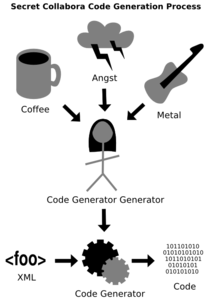
The secret Collabora code-generation process

(credit: daf)

Supporting D-Bus in the GObject world has always involved quite a lot of code generation. The core API of dbus-glib is heavily reliant on varargs functions, which aren't type-safe and are easy to get wrong. dbus-glib contains a program called dbus-binding-tool, which is meant to generate reasonably sane GObject APIs for D-Bus objects. Unfortunately, it seems to be intended to generate a whole GObject at a time. Early versions of telepathy-gabble used dbus-binding-tool plus a script called gengobject.py to generate API stubs for the exported objects; developers then filled in the blanks, and hey presto, we had a GObject on D-Bus. This was fine up to a point, but had a couple of major drawbacks. Whenever we changed the D-Bus API (quite common during the early development of Telepathy), there was a very laborious and error-prone merging process. We ended up with the following process:
  • copy the D-Bus introspection XML from the telepathy-spec repository into a directory xml/pristine (actually, the canonical form for the spec was Python for a while, and we had a script that exported a contrived object onto D-Bus and introspected itself to get the XML - but that's another story!)
  • preprocess the introspection XML to add the dbus-glib CFunctionName annotation, resulting in a directory xml/modified
  • run dbus-binding-tool and a Python script gengobject.py to generate C source in xml/src
  • three-way-diff the old version of xml/src, the new version of xml/src, and the real C code in src to create a new version of src
  • pray that the diff process hadn't randomly exchanged functions' implementations
  • update the resulting code in src so it worked
  • check the whole mess back into darcs
  • hope that nobody else had made changes that would result in darcs conflicts
If you haven't yet gathered, this was a bit of a nightmare. Also, it was very easy to return the wrong thing from a method without noticing - because all the APIs were varargs, the compiler didn't notice, and the first we'd know about it was a mysterious segfault under certain circumstances.
How telepathy-glib fixes code generation telepathy-glib improves on this by taking advantage of this innocuous-looking feature in dbus-glib:
commit 355ef78d98d6fc65715845d56232199162cab12a
Author: Steve Fr cinaux <steve istique net>
Date:   Thu Aug 17 11:48:20 2006 +0200
    Interface support for bindings.
Instead of running dbus-binding-tool or creating GObjects with D-Bus interfaces, we put the entire Telepathy spec through glib-ginterface-gen.py, a distant descendant of Gabble's gengobject.py. For each interface in the spec, we generate a GInterface that mirrors the D-Bus interface. Any GObject that implements the GInterface automatically gets the D-Bus interface if it's exported onto D-Bus. There are a few non-obvious refinements, though:
  • The signature of the method implementation is always in the mode that dbus-glib calls "asynchronous", where the method implementation can either send a reply message before or after it returns. For "slow" methods, this is the only thing you can do. For instance, many Telepathy D-Bus methods can't return anything until some TCP round-trips to the server have happened. This is also the only thing you can do if you want to extract extra information, like the sender's unique name, from the method-call message (dbus-glib's "synchronous" API doesn't allow this to be done). For "fast" methods, sending a reply message before returning is just as easy as using the "synchronous" API (it's just a difference of syntax), and has an API consistent with that of the "slow" methods, making it easier for service authors.

  • The layout of the GInterface vtable is private, and (auto-generated) accessor functions are used to fill in implementations. This means our ABI doesn't change just because we re-ordered functions in the spec.

  • If no implementation is provided for a method, we just raise an appropriate error (org.freedesktop.Telepathy.Errors.NotImplemented), rather than suffering an assertion failure. This means we can safely add methods to an interface.

  • While we're generating code anyway, we generate some static inline wrapper functions which wrap dbus_g_method_return(), to have type-safe method returns. You can easily check that a method replies with correct types, by checking that the implementation of Foo() replies by calling tp_svc_some_interface_return_from_foo().

  • Similarly, we generate wrapper functions to emit signals, to get type-safe signal emission.

Not all interfaces are stable enough to be included in telepathy-glib's stable API and ABI, so some of our other projects include a copy of the telepathy-glib code-generation tools, and generate their own "mini-telepathy-glib" (traditionally in a /extensions/ directory) for their implementation-specific (drafts of) interfaces. This isn't yet as polished as it ought to be (mainly because we don't want to freeze the augmented-introspection-XML format that we write the Telepathy spec in, because it's rather ad-hoc and hackish in places) but it works quite well in practice. To see what this looks like in practice, have a look at the examples in telepathy-glib, or at a Telepathy connection manager like telepathy-gabble.
Mixins and base classes Another feature of telepathy-glib which makes life easier for connection manager authors is that it provides "mixins" and base classes which implement some of the GInterfaces. There's absolutely nothing magic about the base classes - they don't have any access to private implementation details of the GInterfaces, they just implement them like everyone else does. The "mixins" are only slightly more magical - they store some extra state inside the structures representing GObjects and their classes, and use it to provide default implementations of some or all of the methods on a particular interface (or two interfaces, in the case of the new TpMessageMixin). I'll leave it up to Rob to explain those in greater detail, since I seem to remember that he invented them :-P The examples and regression tests in telepathy-glib are quite good examples of how these work in practice.

Next.

Previous.