Search Results: "ean"

13 July 2021

Debian XMPP Team: XMPP Novelties in Debian 11 Bullseye

This is not only the Year of the Ox, but also the year of Debian 11, code-named bullseye. The release lies ahead, full freeze starts this week. A good opportunity to take a look at what is new in bullseye. In this post new programs and new software versions related to XMPP, also known as Jabber are presented. XMPP exists since 1999, and has a diverse and active developers community. It is a universal communication protocol, used for instant messaging, IoT, WebRTC, and social applications. You probably will encounter some oxen in this post. That's all for now. Enjoy Debian 11 bullseye and Happy Chatting!

12 July 2021

Chris Lamb: Saint Alethia? On Bodies of Light by Sarah Moss

How are you meant to write about an unfinished emancipation? Bodies of Light is a 2014 book by Glasgow-born Sarah Moss on the stirrings of women's suffrage in an arty clique in nineteenth-century England. Set in the intellectually smoggy cities of Manchester and London, we follow the studious and intelligent Alethia 'Ally' Moberly, who is struggling to gain the acceptance of herself, her mother and the General Medical Council. 'Alethia' may be the Greek goddess of truth, but our Ally is really searching for wisdom. Her strengths are her patience and bookish learning, and she acquires Latin as soon as she learns male doctors will use it to keep women away from the operating theatre. In fact, Ally's acquisition of language becomes a recurring leitmotif: replaying a suggestive dream involving a love interest, for instance, Ally thinks of 'dark, tumbling dreams for which she has a perfectly adequate vocabulary'. There are very few moments of sensuality in the book, and pairing it with Ally's understated wit achieves a wonderful effect. The amount we learn about a character is adapted for effect as well. There are few psychological insights about Ally's sister, for example, and she thus becomes a fey, mysterious and almost Pre-Raphaelite figure below the surface of a lake to match the artistic movement being portrayed. By contrast, we get almost the complete origin story of Ally's mother, Elizabeth, who also constitutes of those rare birds in literature: an entirely plausible Christian religious zealot. Nothing Ally does is ever enough for her, but unlike most modern portrayals of this dynamic, neither of them are aware of what is going, and it is conveyed in a way that is chillingly... benevolent. This was brought home in the annual 'birthday letters' that Elizabeth writes to her daughter:
Last year's letter said that Ally was nervous, emotional and easily swayed, and that she should not allow her behaviour to be guided by feeling but remember always to assert her reason. Mamma would help her with early hours, plain food and plenty of exercise. Ally looks at the letter, plump in its cream envelope. She hopes Mamma wrote it before scolding her yesterday.
The book makes the implicit argument that it is a far more robust argument against pervasive oppression to portray a character in, say, 'a comfortable house, a kind husband and a healthy child', yet they are nonetheless still deeply miserable, for reasons they can't quite put their finger on. And when we see Elizabeth perpetuating some generational trauma with her own children, it is telling that is pattern is not short-circuited by an improvement in their material conditions. Rather, it is arrested only by a kind of political consciousness in Ally's case, the education in a school. In fact, if there is a real hero in Bodies of Light, it is the very concept of female education. There's genuine shading to the book's ideological villains, despite finding their apotheosis in the jibes about 'plump Tories'. These remarks first stuck out to me as cheap thrills by the author; easy and inexpensive potshots that are unbecoming of the pages around them. But they soon prove themselves to be moments of much-needed humour. Indeed, when passages like this are read in their proper context, the proclamations made by sundry Victorian worthies start to serve as deadpan satire:
We have much evidence that the great majority of your male colleagues regard you as an aberration against nature, a disgusting, unsexed creature and a danger to the public.
Funny as these remarks might be, however, these moments have a subtler and more profound purpose as well. Historical biography always has the risk of allowing readers to believe that the 'issue' has already been solved hence, perhaps, the enduring appeal of science fiction. But Moss providing these snippets from newspapers 150 years ago should make a clear connection to a near-identical moral panic today. On the other hand, setting your morality tale in the past has the advantage that you can show that progress is possible. And it can also demonstrate how that progress might come about as well. This book makes the argument for collective action and generally repudiates individualisation through ever-fallible martyrs. Ally always needs 'allies' not only does she rarely work alone, but she is helped in some way by almost everyone around her. This even includes her rather problematic mother, forestalling any simplistic proportioning of blame. (It might be ironic that Bodies of Light came out in 2014, the very same year that Sophia Amoruso popularised the term 'girl boss'.) Early on, Ally's schoolteacher is coded as the primary positive influence on her, but Ally's aunt later inherits this decisive role, continuing Ally's education on cultural issues and what appears to be the Victorian version of 'self-care'. Both the aunt and the schoolteacher are, of course, surrogate mother figures. After Ally arrives in the cut-throat capital, you often get the impression you are being shown discussions where each of the characters embodies a different school of thought within first-wave feminism. This can often be a fairly tedious device in fiction, the sort of thing you would find in a Sally Rooney novel, Pilgrim's Progress or some other ponderously polemical tract. Yet when Ally appears to 'win' an argument, it is only in the sense that the narrator continues to follow her, implicitly and lightly endorsing her point. Perhaps if I knew my history better, I might be able to associate names with the book's positions, but perhaps it is better (at least for the fiction-reading experience...) that I don't, as the baggage of real-world personalities can often get in the way. I'm reminded here of Regina King's One Night in Miami... (2020), where caricatures of Malcolm X, Muhammad Ali, Jim Brown and Sam Cooke awkwardly replay various arguments within an analogous emancipatory struggle. Yet none of the above will be the first thing a reader will notice. Each chapter begins with a description of an imaginary painting, providing a title and a date alongside a brief critical exegesis. The artworks serve a different purpose in each chapter: a puzzle to be unlocked, a fear to be confirmed, an unsolved enigma. The inclusion of (artificial) provenances is interesting as well, not simply because they add colour and detail to the chapter to come, but because their very inclusion feels reflective of how we see art today.
Orphelia (1852) by Sir John Everett Millais.
To continue the question this piece began, how should an author conclude a story about an as-yet-unfinished struggle for emancipation? How can they? Moss' approach dares you to believe the ending is saccharine or formulaic, but what else was she meant to turn in yet another tale of struggle and suffering? After all, Thomas Hardy has already written Tess of the d'Urbervilles. All the same, it still feels slightly unsatisfying to end merely with Ally's muted, uncelebrated success. Nevertheless, I suspect many readers will dislike the introduction of a husband in the final pages, taking it as a betrayal of the preceding chapters. Yet Moss denies us from seeing the resolution as a Disney-style happy ending. True, Ally's husband turns out to be a rather dashing lighthouse builder, but isn't it Ally herself who is lighting the way in their relationship, warning other women away from running aground on the rocks of mental illness? And Tom feels more of a reflection of Ally's newly acquired self-acceptance instead of that missing piece she needed all along. We learn at one point that Tom's 'importance to her is frightening' this is hardly something a Disney princess would say. In fact, it is easy to argue that a heroic ending for Ally might have been an even more egregious betrayal. The evil of saints is that you can never live up to them, for the concept of a 'saint' embodies an unreachable ideal that no human can begin to copy. By being taken as unimpeachable and uncorrectable as well, saints preclude novel political action, and are therefore undoubtedly agents of reaction. Appreciating historical figures as the (flawed) people that they really were is the first step if you wish to continue or adapt their political ideas. I had acquired Bodies of Light after enjoying Moss' Summerwater (2020), which had the dubious honour of being touted as the 'first lockdown novel', despite it being finished before Covid-19. There are countless ways one might contrast the two, so I will limit myself to the sole observation that the strengths of one are perhaps the weaknesses of the other. It's not that Bodies of Light ends with a whimper, of course, as it quietly succeeds in concert with Ally. But by contrast, the tighter arc of Summerwater (which is set during a single day, switches protagonist between chapters, features a closed-off community, etc.) can reach a higher high with its handful of narrative artifices. Summerwater is perhaps like Phil Collins' solo career: 'more satisfying, in a narrower way.'

10 July 2021

Sean Whitton: Live replacement of provider cloud images with upstream Debian

Tonight I m provisioning a new virtual machine at Hetzner and I wanted to share how Consfigurator is helping with that. Hetzner have a Debian buster image you can start with, as you d expect, but it comes with things like cloud-init, preconfiguration to use Hetzner s apt mirror which doesn t serve source packages(!), and perhaps other things I haven t discovered. It s a fine place to begin, but I want all the configuration for this server to be explicit in my Consfigurator consfig, so it is good to start with pristine upstream Debian. I could boot one of Hetzner s installation ISOs but that s slow and manual. Consfigurator can replace the OS in the VM s root filesystem and reboot for me, and we re ready to go. Here s the configuration:
(defhost foo.silentflame.com (:deploy ((:ssh :user "root") :sbcl))
  (os:debian-stable "buster" :amd64)
  ;; Hetzner's Debian 10 image comes with a three-partition layout and boots
  ;; with traditional BIOS.
  (disk:has-volumes
   (physical-disk
    :device-file "/dev/sda" :boots-with '(grub:grub :target "i386-pc")))
  (on-change (installer:cleanly-installed-once
              nil
              ;; This is a specification of the OS Hetzner's image has, so
              ;; Consfigurator knows how to install SBCL and debootstrap(8).
              ;; In this case it's the same Debian release as the replacement.
              '(os:debian-stable "buster" :amd64))
    ;; Clear out the old OS's EFI system partition contents, in case we can
    ;; switch to booting with EFI at some point (if we wanted we could specify
    ;; an additional x86_64-efi target above, and grub-install would get run
    ;; to repopulate /boot/efi, but I don't think Hetzner can boot from it yet).
    (file:directory-does-not-exist "/boot/efi/EFI")
    (apt:installed "linux-image-amd64")
    (installer:bootloaders-installed)
    (fstab:entries-for-volumes
     (disk:volumes
       (mounted-ext4-filesystem :mount-point "/")
       (partition
        (mounted-fat32-filesystem
         :mount-options '("umask=0077") :mount-point "/boot/efi"))))
    (file:lacks-lines "/etc/fstab" "# UNCONFIGURED FSTAB FOR BASE SYSTEM")
    (file:is-copy-of "/etc/resolv.conf" "/old-os/etc/resolv.conf")
    (mount:unmounted-below-and-removed "/old-os"))
  (apt:mirror "http://ftp.de.debian.org/debian")
  (apt:no-pdiffs)
  (apt:standard-sources.list)
  (sshd:installed)
  (as "root" (ssh:authorized-keys +spwsshkey+))
  (sshd:no-passwords)
  (timezone:configured "Etc/UTC")
  (swap:has-swap-file "2G")
  (network:clean-/etc/network/interfaces)
  (network:static "enp1s0" "xxx.xxx.xxx.xxx" "xxx.xxx.1.1" "255.255.255.255"))
and to use it you evaluate this at the REPL:
CONSFIG> (deploy ((:ssh :user "root" :hop "xxx.xxx.xxx.xxx") :sbcl) foo.silentflame.com)
Here the :HOP parameter specifies the IP address of the new machine, as DNS hasn t been updated yet. Consfigurator installs SBCL and debootstrap(8), prepares a minimal system, replaces the contents of /, gets to work applying the other properties, and then reboots. This gets us a properly populated fstab:
UUID=...            /           ext4    relatime    0   1
PARTUUID=...        /boot/efi   vfat    umask=0077  0   2
/var/lib/swapfile   swap        swap    defaults    0   0
(slightly doctored for more readable alignment) There s ordering logic so that the swapfile will end up after whatever filesystem contains it; a UUID is used for ext4 filesystems, but for fat32 filesystems, to be safe, a PARTUUID is used. The application of (INSTALLER:BOOTLOADERS-INSTALLED) handles calling both update-grub(8) and grub-install(8), relying on the metadata specified about /dev/sda. Next time we execute Consfigurator against the machine, it ll ignore all the property applications attached to the application of (INSTALLER:CLEANLY-INSTALLED-ONCE) with ON-CHANGE, and just apply everything following that block. There are a few things I don t have good solutions for. When you boot Hetzner s image the primary network interface is eth0, but then for a freshly debootstrapped Debian you get enp1s0, and I haven t got a good way of knowing what it ll be (if you know it ll have the same name, you can use (NETWORK:PRESERVE-STATIC-ONCE) to create a file in /etc/network/interfaces.d based on the current default route and corresponding interface). Another tricky thing is SSH host keys. It s easy to use Consfigurator to add host keys to your laptop s ~/.ssh/known_hosts, but in this case the host key changes back and forth from whatever the Hetzner image has and the newly generated key you get afterwards. One option might be to copy the old host keys out of /old-os before it gets deleted, like how /etc/resolv.conf is copied. This work is based on Propellor s equivalent functionality. I think my approach to handling /etc/fstab and bootloader installation is an improvement on what Joey does.

5 July 2021

Petter Reinholdtsen: Six complete translations of The Debian Administrator's Handbook for Buster

I am happy observe that the The Debian Administrator's Handbook is available in six languages now. I am not sure which one of these are completely proof read, but the complete book is available in these languages: This is the list of languages more than 70% complete, in other words with not too much left to do: I wonder how long it will take to bring these to 100%. Then there is the list of languages about halfway done: Several are on to a good start: Finally, there are the ones just getting started: If you want to help provide a Debian instruction book in your own language, visit Weblate to contribute to the translations. As usual, if you use Bitcoin and want to show your support of my activities, please send Bitcoin donations to my address 15oWEoG9dUPovwmUL9KWAnYRtNJEkP1u1b.

Michael Prokop: Debian bullseye: changes in util-linux #newinbullseye

Continuing with #newinbullseye. One package that isn t new but its tools are used by many of us is util-linux, providing many essential system utilities. There is util-linux v2.33.1 in Debian/buster and util-linux v2.36.1 in Debian/bullseye, and as usual there are many new features and options available. I don t want to replicate the release notes provided by upstream, instead make sure to check out the Release highlights sections in the following release notes: Tools that have been taken over from / moved to other packages Debian s util-linux source package provides new binary packages: eject (and eject-udeb) and bsdextrautils. The util-linux implementation of /usr/bin/eject is used now, replacing the one previously provided by the eject source package. Overall, from a util-linux perspective the following shifts took place: Deprecated / removed tools Tools that are no longer shipped as of Debian/bullseye: New tools Debian s bsdutils package (which is provided by the util-linux source package) provides a new tool from util-linux: The new tools lsirq + irqtop (to monitor kernel interrupts) sadly didn t make it into util-linux s packaging of Debian/bullseye (as without per-CPU data they do not seem mature at this time). The new hardlink tool (to consolidate duplicate files via hardlinks) won t be shipped, as there s an existing hardlink package already. New features/options agetty + getty:
--show-issue    display issue file and exit
blkdiscard:
--force         disable all checking
blkid:
-D, --no-part-details      don't print info from partition table
blkzone:
Commands:
open         Open a range of zones.
close        Close a range of zones.
finish       Set a range of zones to Full.
Options:
-f, --force            enforce on block devices used by the system
cfdisk:
--lock[=<mode>]      use exclusive device lock (yes, no or nonblock)
dmesg:
--noescape             don't escape unprintable character
-W, --follow-new       wait and print only new messages
fdisk:
-x, --list-details          like --list but with more details
-n, --noauto-pt             don't create default partition table on empty devices
--lock[=<mode>]             use exclusive device lock (yes, no or nonblock)
fstrim:
-I, --listed-in <list>   trim filesystems listed in specified files
--quiet-unsupported      suppress error messages if trim unsupported
lsblk:
Options:
-E, --dedup <column> de-duplicate output by <column> 
                     (for example 'lsblk --dedup WWN' to de-duplicate devices by WWN number, e.g. multi-path devices)
-M, --merge          group parents of sub-trees (usable for RAIDs, Multi-path)
                     see http://karelzak.blogspot.com/2018/11/lsblk-merge.html
New output columns:
FSVER         filesystem version
PARTTYPENAME  partition type name
DAX           dax-capable device
lscpu:
Options:
-B, --bytes             print sizes in bytes rather than in human readable format
-C, --caches[=<list>]   info about caches in extended readable format
    --output-all        print all available columns for -e, -p or -C
Available output columns for -C:
        ALL-SIZE  size of all system caches
           LEVEL  cache level
            NAME  cache name
        ONE-SIZE  size of one cache
            TYPE  cache type
            WAYS  ways of associativity
    ALLOC-POLICY  allocation policy
    WRITE-POLICY  write policy
        PHY-LINE  number of physical cache line per cache t
            SETS  number of sets in the cache; set lines has the same cache index
   COHERENCY-SIZE  minimum amount of data in bytes transferred from memory to cache         
lslogins:
--lastlog <path>     set an alternate path for lastlog
lsns:
-t, --type time      namespace type time is also supported now (next to mnt, net, ipc, user, pid, uts, cgroup)
mkswap:
--lock[=<mode>]      use exclusive device lock (yes, no or nonblock)
more:
Options:
-n, --lines <number>  the number of lines per screenful
New long options (in addition to the listed equivalent short options):
  --silent       - equivalent to -d
  --logical      - equivalent to -f
  --no-pause     - equivalent to -l
  --print-over   - equivalent to -c
  --clean-print  - equivalent to -p
  --squeeze      - equivalent to -s
  --plain        - equivalent to -u
mount:
Options:
--target-prefix <path>  specifies path use for all mountpoints
Source:
ID=<id>                 specifies device by udev hardware ID
mountpoint:
--nofollow     do not follow symlink
nsenter:
-T, --time[=<file>]    enter time namespace
script:
-I, --log-in <file>           log stdin to file
-O, --log-out <file>          log stdout to file (default)
-B, --log-io <file>           log stdin and stdout to file
-T, --log-timing <file>       log timing information to file
-m, --logging-format <name>   force to 'classic' or 'advanced' format
-E, --echo <when>             echo input (auto, always or never)
sfdisk:
--disk-id <dev> [<str>]           print or change disk label ID (UUID)
--relocate <oper> <dev>           move partition header
--move-use-fsync                  use fsync after each write when move data
--lock[=<mode>]                   use exclusive device lock (yes, no or nonblock)
unshare:
-T, --time[=<file>]       unshare time namespace
--map-user=<uid> <name>   map current user to uid (implies --user)
--map-group=<gid> <name>  map current group to gid (implies --user)
-c, --map-current-user    map current user to itself (implies --user)
--keep-caps               retain capabilities granted in user namespaces
-R, --root=<dir>          run the command with root directory set to <dir>
-w, --wd=<dir>            change working directory to <dir>
-S, --setuid <uid>        set uid in entered namespace
-G, --setgid <gid>        set gid in entered namespace
--monotonic <offset>      set clock monotonic offset (seconds) in time namespaces
--boottime <offset>       set clock boottime offset (seconds) in time namespaces
wipefs:
--lock[=<mode>] use exclusive device lock (yes, no or nonblock)

Russell Coker: Servers and Lockdown

OS security features and server class systems are things that surely belong together. If a program is important enough to buy expensive servers to run it then it s important enough that you want to have all the OS security features enabled. For such an important program you will also want to have all possible monitoring systems running so you can predict hardware failures etc. Therefore you would expect that you could buy a server, setup the vendor s management software, configure your Linux kernel with security features such as lockdown (a LSM that restricts access to /dev/mem, the iopl() system call, and other dangerous things [1]), and have it run nicely! You will be disappointed if you try doing that on a HP or Dell server though. HP Problems
[370742.622525] Lockdown: hpasmlited: raw io port access is restricted; see man kernel_lockdown.7
The above message is logged when trying to INSTALL (not even run) the hp-health package from the official HP repository (as documented in my previous blog post about the HP ML-110 Gen9 [2]) with lockdown=integrity (the less restrictive lockdown option). Now the HP package in question is in their repository for Debian/Stretch (released in 2017) and the Lockdown LSM was documented by LWN as being released in 2019, so not supporting a Debian/Bullseye feature in Debian/Stretch packages isn t inherently a bad thing apart from the fact that they haven t released a new version of that package since. The Stretch package that I am testing now was released in 2019. Also it s been regarded as best practice to have device drivers for this sort of thing since long before 2017.
# hplog -v
ERROR: Could not open /dev/cpqhealth/cdt.
Please make sure the Health Monitor is started.
Attempting to run the hplog -v command (to view the HP hardware log) gives the above error. Strace reveals that it could and did open /dev/cpqhealth/cdt but had problems talking to something (presumably the Health Monitor daemon) over a Unix domain socket. It would be nice if they could at least get the error message right! Dell Problems
[   13.811165] Lockdown: smbios-sys-info: /dev/mem,kmem,port is restricted; see man kernel_lockdown.7
[   13.820935] Lockdown: smbios-sys-info: raw io port access is restricted; see man kernel_lockdown.7
[   18.118118] Lockdown: dchcfg: raw io port access is restricted; see man kernel_lockdown.7
[   18.127621] Lockdown: dchcfg: /dev/mem,kmem,port is restricted; see man kernel_lockdown.7
[   19.371391] Lockdown: dsm_sa_datamgrd: raw io port access is restricted; see man kernel_lockdown.7
[   19.382147] Lockdown: dsm_sa_datamgrd: /dev/mem,kmem,port is restricted; see man kernel_lockdown.7
Above is a sample of the messages when booting a Dell PowerEdge R710 with lockdown=integrity with the srvadmin-omacore package installed from the official Dell repository I describe in my blog post about the Dell PowerEdge R710 [3]. Now that repository is for Ubuntu/Xenial which was released in 2015, but again it was best practice to have device drivers for this many years ago. Also the newest Debian based releases that Dell apparently supports are Ubuntu/Xenial and Debian/Jessie which were both released in 2015.
# omreport system esmlog
Error! No Embedded System Management (ESM) log found on this system.
Above is the result when I try to view the ESM log (the Dell hardware log). How Long Should Server Support Last? The Wikipedia List of Dell PowerEdge Servers shows that the R710 is a Generation 11 system. Generation 11 was first released in 2010 and Generation 12 was first released in 2012. Generation 13 was the latest hardware Dell sold in 2015 when they apparently ceased providing newer OS support for Generation 11. Dell currently sells Generation 15 systems and provides more recent support for Generation 14 and Generation 15. I think it s reasonable to debate whether Dell should support servers for 4 generations. But given that a major selling point of server class systems is that they have long term support I think it would make sense to give better support for this and not drop support when it s only 2 versions from the latest release! The support for Dell Generation 11 hardware only seems to have lasted for 3 years after Generation 12 was first released. Also it appears that software support for Dell Generation 13 ceased before Generation 14 was released, that sucks for the people who bought Generation 13 when they were new! HP is currently selling Gen 10 servers which were first released at the end of 2017. So it appears that HP stopped properly supporting Gen 9 servers as soon as Gen 10 servers were released! One thing to note about these support times, when the new generation of hardware was officially released the previous generation was still on sale. So while HP Gen 10 servers officially came out in 2017 that doesn t necessarily mean that someone who wanted to buy a ML-110 Gen10 could actually have done so. For comparison Red Hat Enterprise Linux has been supported for 4-6 years for every release they made since 2005 and Ubuntu has always had a 5 year LTS support for servers. How To Do It Properly The correct way of interfacing with hardware is via a device driver that is supported in the kernel.org tree. That means it goes through the usual kernel source code quality checks which are really good at finding bugs and gives users an assurance that the code won t cause security problems. Generally nothing about the code from Dell or HP gives me confidence that it should be directly accessing /dev/kmem or raw IO ports without risk of problems. Once a driver is in the kernel.org tree it will usually stay there forever and not require further effort from the people who submit it. Then it just works for everyone and tends to work with any other kernel features that people use, like LSMs. If they released the source code to the management programs then it would save them even more effort as they could be maintained by the community.

3 July 2021

Fran ois Marier: Zoom WebRTC links

Most people connect to Zoom via a proprietary client which has been on the receiving end of a number of security and privacy issues over the past year, with some experts even describing it as malware. It's not widely known however that Zoom offers a half-decent WebRTC client which means cross-platform one-click access to a Zoom room or webinar without needing to install any software. Given a Zoom link such as https://companyname.zoom.us/j/123456789?pwd=letmein, you can use https://zoom.us/wc/join/123456789?pwd=letmein to connect in your browser. Notice that the pool of Zoom room IDs is global and you can just drop the companyname from the URL. In my experience however, Jitsi has much better performance than Zoom's WebRTC client. For instance, I've never been able to use Zoom successfully on a Raspberry Pi 4 (8GB), but Jitsi works quite well. If you have a say in the choice of conference platform, go with Jitsi instead.

30 June 2021

Anton Gladky: 2021/06, FLOSS activity

LTS This is my fourth month of working for LTS. I was assigned 12 hrs and worked all of them.

Released DLAs
  1. DLA 2672-1 imagemagick_6.9.7.4+dfsg-11+deb9u13
    • CVE-2020-27751 A flaw was found in MagickCore/quantum-export.c. An attacker who submits a crafted file that is processed by ImageMagick could trigger undefined behavior in the form of values outside the range of type unsigned long long as well as a shift exponent that is too large for 64-bit type. This would most likely lead to an impact to application availability, but could potentially cause other problems related to undefined behavior.
    • CVE-2021-20243 A flaw was found in MagickCore/resize.c. An attacker who submits a crafted file that is processed by ImageMagick could trigger undefined behavior in the form of math division by zero.
    • CVE-2021-20245 A flaw was found in coders/webp.c. An attacker who submits a crafted file that is processed by ImageMagick could trigger undefined behavior in the form of math division by zero.
    • CVE-2021-20309 A division by zero in WaveImage() of MagickCore/visual-effects.c may trigger undefined behavior via a crafted image file submitted to an application using ImageMagick.
    • CVE-2021-20312 An integer overflow in WriteTHUMBNAILImage of coders/thumbnail.c may trigger undefined behavior via a crafted image file that is submitted by an attacker and processed by an application using ImageMagick.
    • CVE-2021-20313 A potential cipher leak when the calculate signatures in TransformSignature is possible.
  2. DLA 2677-1 libwebp_0.5.2-1+deb9u1
    • CVE-2018-25009 An out-of-bounds read was found in function WebPMuxCreateInternal. The highest threat from this vulnerability is to data confidentiality and to the service availability.
    • CVE-2018-25010 An out-of-bounds read was found in function ApplyFilter. The highest threat from this vulnerability is to data confidentiality and to the service availability.
    • CVE-2018-25011 A heap-based buffer overflow was found in PutLE16(). The highest threat from this vulnerability is to data confidentiality and integrity as well as system availability.
    • CVE-2018-25012 An out-of-bounds read was found in function WebPMuxCreateInternal. The highest threat from this vulnerability is to data confidentiality and to the service availability.
    • CVE-2018-25013 An out-of-bounds read was found in function ShiftBytes. The highest threat from this vulnerability is to data confidentiality and to the service availability.
    • CVE-2018-25014 An unitialized variable is used in function ReadSymbol. The highest threat from this vulnerability is to data confidentiality and integrity as well as system availability.
    • CVE-2020-36328 A heap-based buffer overflow in function WebPDecodeRGBInto is possible due to an invalid check for buffer size. The highest threat from this vulnerability is to data confidentiality and integrity as well as system availability.
    • CVE-2020-36329 A use-after-free was found due to a thread being killed too early. The highest threat from this vulnerability is to data confidentiality and integrity as well as system availability.
    • CVE-2020-36330 An out-of-bounds read was found in function ChunkVerifyAndAssign. The highest threat from this vulnerability is to data confidentiality and to the service availability.
    • CVE-2020-36331 An out-of-bounds read was found in function ChunkAssignData. The highest threat from this vulnerability is to data confidentiality and to the service availability.
    CVE-2020-36332 was marked as ignored for stretch due to too disruptive patch for older versions of libwebp.
  3. DLA-2687-1 prosody_0.9.12-2+deb9u3
    • CVE-2021-32917 The proxy65 component allows open access by default, even if neither of the users has an XMPP account on the local server, allowing unrestricted use of the server s bandwidth.
    • CVE-2021-32921 Authentication module does not use a constant-time algorithm for comparing certain secret strings when running under Lua 5.2 or later. This can potentially be used in a timing attack to reveal the contents of secret strings to an attacker.
  4. DLA-2687-2 prosody_0.9.12-2+deb9u4 Upload prosody_0.9.12-2+deb9u3 introduced a regression in the mod_auth_internal_hashed module. Big thanks to Andre Bianchi for the reporting an issue and for testing the update. CVE-2021-32918, CVE-2021-32920, were marked as ignored for stretch: the affected code is not existing in that version of prosody.

LTS-Meeting I attended the Debian LTS team Jitsi-meeting.

Debian Science Team

openpiv-python I started to package python-openpiv. The software implements PIV (Particle Image Velocimetry) method to compare two images and obtain velocity field.

Other FLOSS activities

Admesh Admesh is the first package which I adopted over 10 years ago! Upstream is not active for a very long time, so I created a github-repo back in 2013. The software helps to manipulate STL-files. STL is the file format for meshes, mostly developed for CAD programs. This month I decided to clean the build system. It was switched to cmake. CI was updated, now it compiles the sources under Linux/Windows environment, runs tests, AddressSanitizer and UndefinedBehaviourSanitizer were employed. Work is ongoing.

Russell Coker: Links June 2021

MIT Technology Review has an interesting article about Google Project Zero shutting down a western intelligence operation [1]. There s an Internet trend of people eating rotten meat they call high meat (rotten meat) [2]. This is up there with people setting themselves on fire and nut shot videos. A young female who was making popular Twitter posts about motorbikes turned out to be a 50yo man using deep fake technology [3]. He has long hair IRL and just needed to replace his face. After coming out of the closet he has continued making such videos and remains popular. FYHTECH has an informative blog post about using sgdisk to backup and restore GPT partition tables [4]. This is in the Debian package gdisk along with several other tools for managing partition tables. One interesting thing to note is that you can backup a partition table and restore to a smaller device (with a bunch of warnings that you can ignore if you know what you are doing). This is the only way I ve discovered to cleanly truncate a GPT partitioned disk, which is sometimes necessary when running VMs. Insightful blog post about PCIe bifurcation and how PCIe lanes are assigned to sockets [5]. This explains why many motherboards have sockets with unused PCIe lanes, EG *8 sockets that are wired for *4. The PCIe slots all go back to the CPU which has a limited number of *16 PCIe connections that are bifurcated to make the larger number of PCIe slots on the motherboard. New Republic has an interesting article on the infamous transphobe Jordan Peterson s battle with tranquiliser dependency [6]. Wired has an interesting article about the hack of RSA infrastructure related to the SecureID keys 10 years ago [7]. Apparently some 10 year NDAs had delayed it. There are many posts about the situation with Freenode, I think that this one best captures the problems in the shortest amount of text [8]. You could spend a few hours reading about it as I have just done, but just reading this gives you the basics that you need to know to avoid Freenode. That blog post has links to articles about Andrew Lee s involvement with Mt Gox and claims to be the heir to the throne of Korea (which is not a monarchy). Nicholas Wade wrote an insightful and informative article about the origin of Covid19, which leads to the conclusion that it was made in a Chinese laboratory [9]. I first saw this in David Brin s Facebook feed. I would be hesitant to share this sort of thing if it wasn t reviewed by a reliable source, I think David Brin has the skill to analyse this sort of article and the contacts to allow him to seek verification of any scientific issues that are outside his field. I believe that this article is reliable and it s conclusion is most likely to be correct. Interesting Wired article about an art project using display computers at Apple stores to photograph people [10]. Ends with a visit from the FBI.

Enrico Zini: Systemd containers with unittest

This is part of a series of posts on ideas for an ansible-like provisioning system, implemented in Transilience. Unit testing some parts of Transilience, like the apt and systemd actions, or remote Mitogen connections, can really use a containerized system for testing. To have that, I reused my work on nspawn-runner. to build a simple and very fast system of ephemeral containers, with minimal dependencies, based on systemd-nspawn and btrfs snapshots: Setup To be able to use systemd-nspawn --ephemeral, the chroots needs to be btrfs subvolumes. If you are not running on a btrfs filesystem, you can create one to run the tests, even on a file:
fallocate -l 1.5G testfile
/usr/sbin/mkfs.btrfs testfile
sudo mount -o loop testfile test_chroots/
I created a script to setup the test environment, here is an extract:
mkdir -p test_chroots
cat << EOF > "test_chroots/CACHEDIR.TAG"
Signature: 8a477f597d28d172789f06886806bc55
# chroots used for testing transilience, can be regenerated with make-test-chroot
EOF
btrfs subvolume create test_chroots/buster
eatmydata debootstrap --variant=minbase --include=python3,dbus,systemd buster test_chroots/buster
CACHEDIR.TAG is a nice trick to tell backup software not to bother backing up the contents of this directory, since it can be easily regenerated. eatmydata is optional, and it speeds up debootstrap quite a bit. Running unittest with sudo Here's a simple helper to drop root as soon as possible, and regain it only when needed. Note that it needs $SUDO_UID and $SUDO_GID, that are set by sudo, to know which user to drop into:
class ProcessPrivs:
    """
    Drop root privileges and regain them only when needed
    """
    def __init__(self):
        self.orig_uid, self.orig_euid, self.orig_suid = os.getresuid()
        self.orig_gid, self.orig_egid, self.orig_sgid = os.getresgid()
        if "SUDO_UID" not in os.environ:
            raise RuntimeError("Tests need to be run under sudo")
        self.user_uid = int(os.environ["SUDO_UID"])
        self.user_gid = int(os.environ["SUDO_GID"])
        self.dropped = False
    def drop(self):
        """
        Drop root privileges
        """
        if self.dropped:
            return
        os.setresgid(self.user_gid, self.user_gid, 0)
        os.setresuid(self.user_uid, self.user_uid, 0)
        self.dropped = True
    def regain(self):
        """
        Regain root privileges
        """
        if not self.dropped:
            return
        os.setresuid(self.orig_suid, self.orig_suid, self.user_uid)
        os.setresgid(self.orig_sgid, self.orig_sgid, self.user_gid)
        self.dropped = False
    @contextlib.contextmanager
    def root(self):
        """
        Regain root privileges for the duration of this context manager
        """
        if not self.dropped:
            yield
        else:
            self.regain()
            try:
                yield
            finally:
                self.drop()
    @contextlib.contextmanager
    def user(self):
        """
        Drop root privileges for the duration of this context manager
        """
        if self.dropped:
            yield
        else:
            self.drop()
            try:
                yield
            finally:
                self.regain()
privs = ProcessPrivs()
privs.drop()
As soon as this module is loaded, root privileges are dropped, and can be regained for as little as possible using a handy context manager:
   with privs.root():
       subprocess.run(["systemd-run", ...], check=True, capture_output=True)
Using the chroot from test cases The infrastructure to setup and spin down ephemeral machine is relatively simple, once one has worked out the nspawn incantations:
class Chroot:
    """
    Manage an ephemeral chroot
    """
    running_chroots: Dict[str, "Chroot"] =  
    def __init__(self, name: str, chroot_dir: Optional[str] = None):
        self.name = name
        if chroot_dir is None:
            self.chroot_dir = self.get_chroot_dir(name)
        else:
            self.chroot_dir = chroot_dir
        self.machine_name = f"transilience- uuid.uuid4() "
    def start(self):
        """
        Start nspawn on this given chroot.
        The systemd-nspawn command is run contained into its own unit using
        systemd-run
        """
        unit_config = [
            'KillMode=mixed',
            'Type=notify',
            'RestartForceExitStatus=133',
            'SuccessExitStatus=133',
            'Slice=machine.slice',
            'Delegate=yes',
            'TasksMax=16384',
            'WatchdogSec=3min',
        ]
        cmd = ["systemd-run"]
        for c in unit_config:
            cmd.append(f"--property= c ")
        cmd.extend((
            "systemd-nspawn",
            "--quiet",
            "--ephemeral",
            f"--directory= self.chroot_dir ",
            f"--machine= self.machine_name ",
            "--boot",
            "--notify-ready=yes"))
        log.info("%s: starting machine using image %s", self.machine_name, self.chroot_dir)
        log.debug("%s: running %s", self.machine_name, " ".join(shlex.quote(c) for c in cmd))
        with privs.root():
            subprocess.run(cmd, check=True, capture_output=True)
        log.debug("%s: started", self.machine_name)
        self.running_chroots[self.machine_name] = self
    def stop(self):
        """
        Stop the running ephemeral containers
        """
        cmd = ["machinectl", "terminate", self.machine_name]
        log.debug("%s: running %s", self.machine_name, " ".join(shlex.quote(c) for c in cmd))
        with privs.root():
            subprocess.run(cmd, check=True, capture_output=True)
        log.debug("%s: stopped", self.machine_name)
        del self.running_chroots[self.machine_name]
    @classmethod
    def create(cls, chroot_name: str) -> "Chroot":
        """
        Start an ephemeral machine from the given master chroot
        """
        res = cls(chroot_name)
        res.start()
        return res
    @classmethod
    def get_chroot_dir(cls, chroot_name: str):
        """
        Locate a master chroot under test_chroots/
        """
        chroot_dir = os.path.abspath(os.path.join(os.path.dirname(__file__), "..", "test_chroots", chroot_name))
        if not os.path.isdir(chroot_dir):
            raise RuntimeError(f" chroot_dir  does not exists or is not a chroot directory")
        return chroot_dir
# We need to use atextit, because unittest won't run
# tearDown/tearDownClass/tearDownModule methods in case of KeyboardInterrupt
# and we need to make sure to terminate the nspawn containers at exit
@atexit.register
def cleanup():
    # Use a list to prevent changing running_chroots during iteration
    for chroot in list(Chroot.running_chroots.values()):
        chroot.stop()
And here's a TestCase mixin that starts a containerized systems and opens a Mitogen connection to it:
class ChrootTestMixin:
    """
    Mixin to run tests over a setns connection to an ephemeral systemd-nspawn
    container running one of the test chroots
    """
    chroot_name = "buster"
    @classmethod
    def setUpClass(cls):
        super().setUpClass()
        import mitogen
        from transilience.system import Mitogen
        cls.broker = mitogen.master.Broker()
        cls.router = mitogen.master.Router(cls.broker)
        cls.chroot = Chroot.create(cls.chroot_name)
        with privs.root():
            cls.system = Mitogen(
                    cls.chroot.name, "setns", kind="machinectl",
                    python_path="/usr/bin/python3",
                    container=cls.chroot.machine_name, router=cls.router)
    @classmethod
    def tearDownClass(cls):
        super().tearDownClass()
        cls.system.close()
        cls.broker.shutdown()
        cls.chroot.stop()
Running tests Once the tests are set up, everything goes on as normal, except one needs to run nose2 with sudo:
sudo nose2-3
Spin up time for containers is pretty fast, and the tests drop root as soon as possible, and only regain it for as little as needed. Also, dependencies for all this are minimal and available on most systems, and the setup instructions seem pretty straightforward

29 June 2021

Ritesh Raj Sarraf: Plant Territorial Behavior

This blog post is about my observations of some of the plants in my home garden. While still a n00b on the subject, these notes are my observations and experiences over days, weeks and months. Thankfully, with the capability to take frequent pictures, it has been easy to do an assessment and generate a report of some of these amazing behaviors of plants, in an easy timeline order; all thanks to the EXIF data embedded. This has very helpfully allowed me to record my, otherwise minor observations, into great detail; and make some sense out of it by correlating the data over time. It is an emotional experience. You see, plants are amazing. When I sow a sapling, water it, feed it, watch it grow, prune it, medicate it, and what not; I build up affection towards it. Though, at the same time, to me it is a strict relationship, not too attached; as in it doesn t hurt to uproot a plant if there is a good reason. But still, I find some sort of association to it. With plants around, it feels I have a lot of lives around me. All prospering, communicating, sharing. And communicate they do. What is needed is just the right language to observe and absorb their signals and decipher what they are trying to say.

Devastation How in this world, when you are caring for your plants, can it transform:

From This
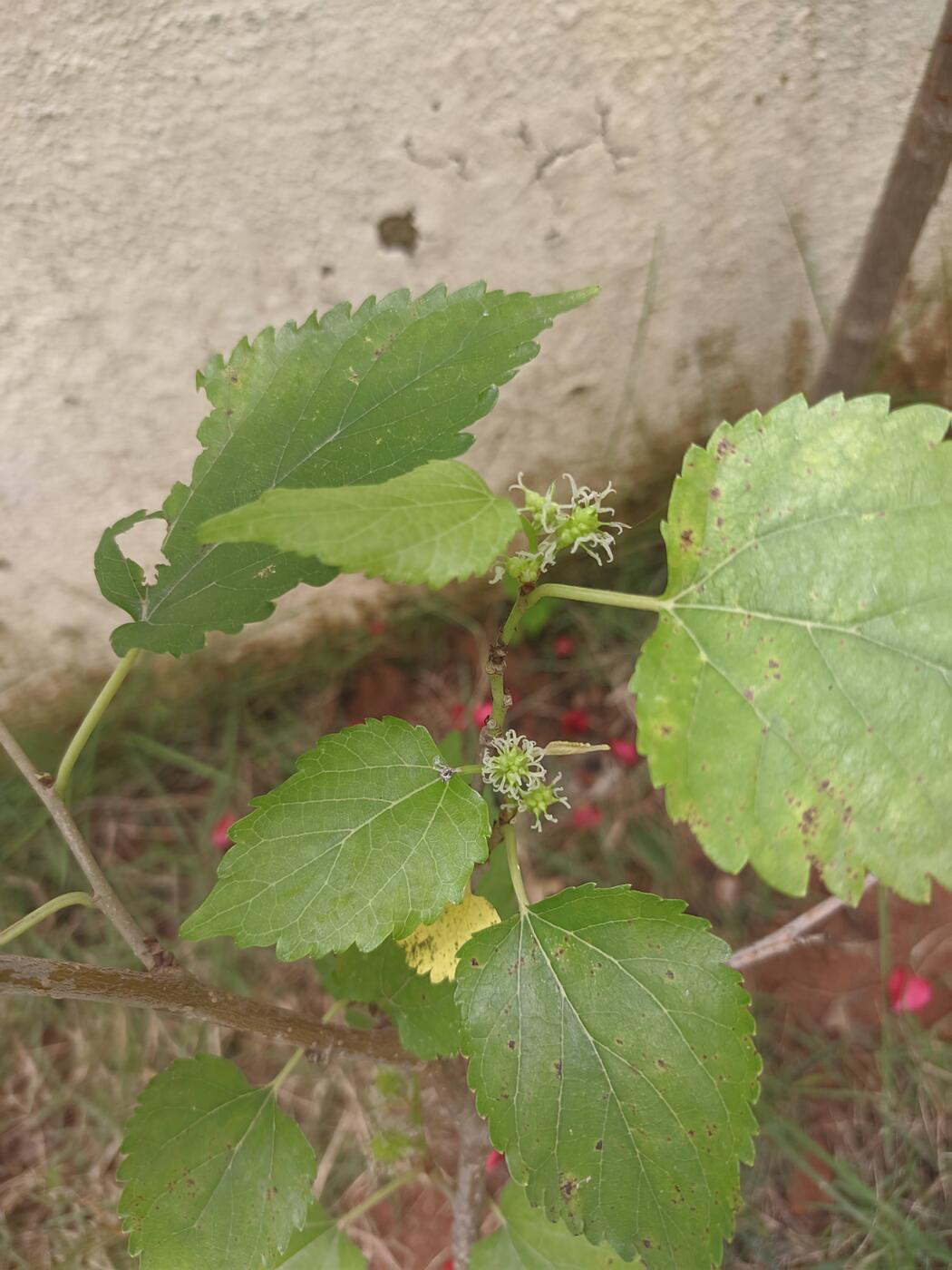
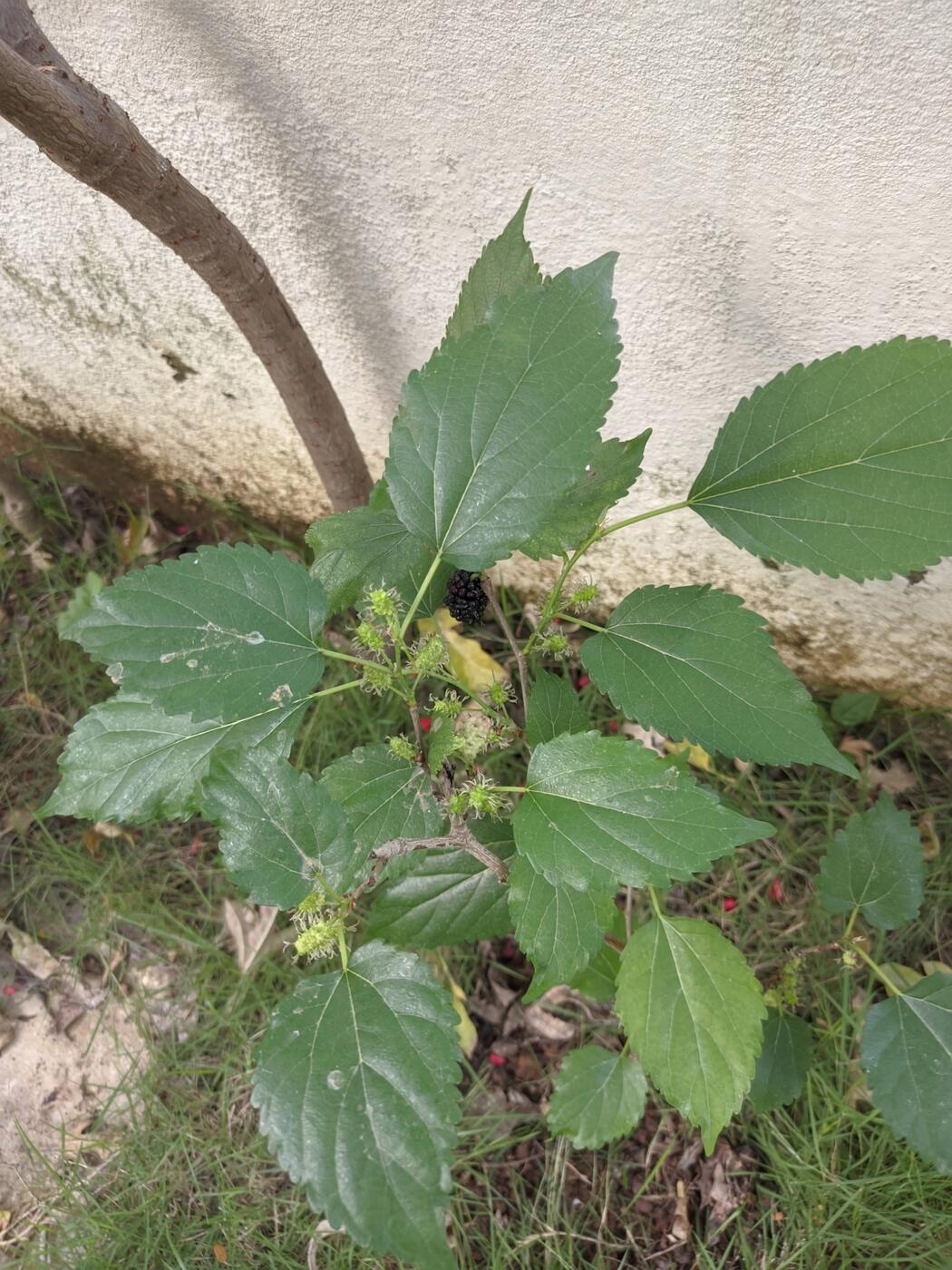
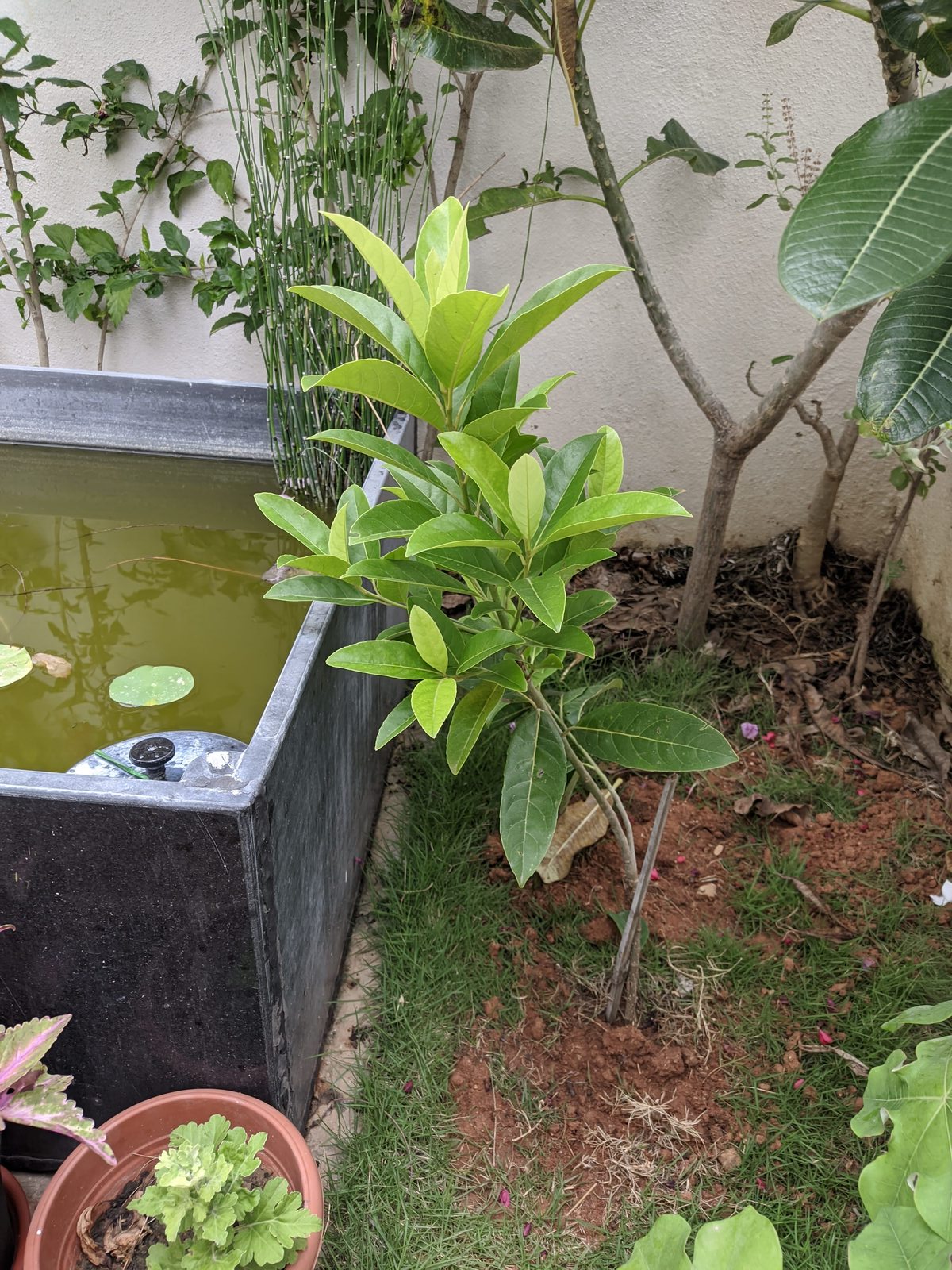
Healthy Mulberry Plant
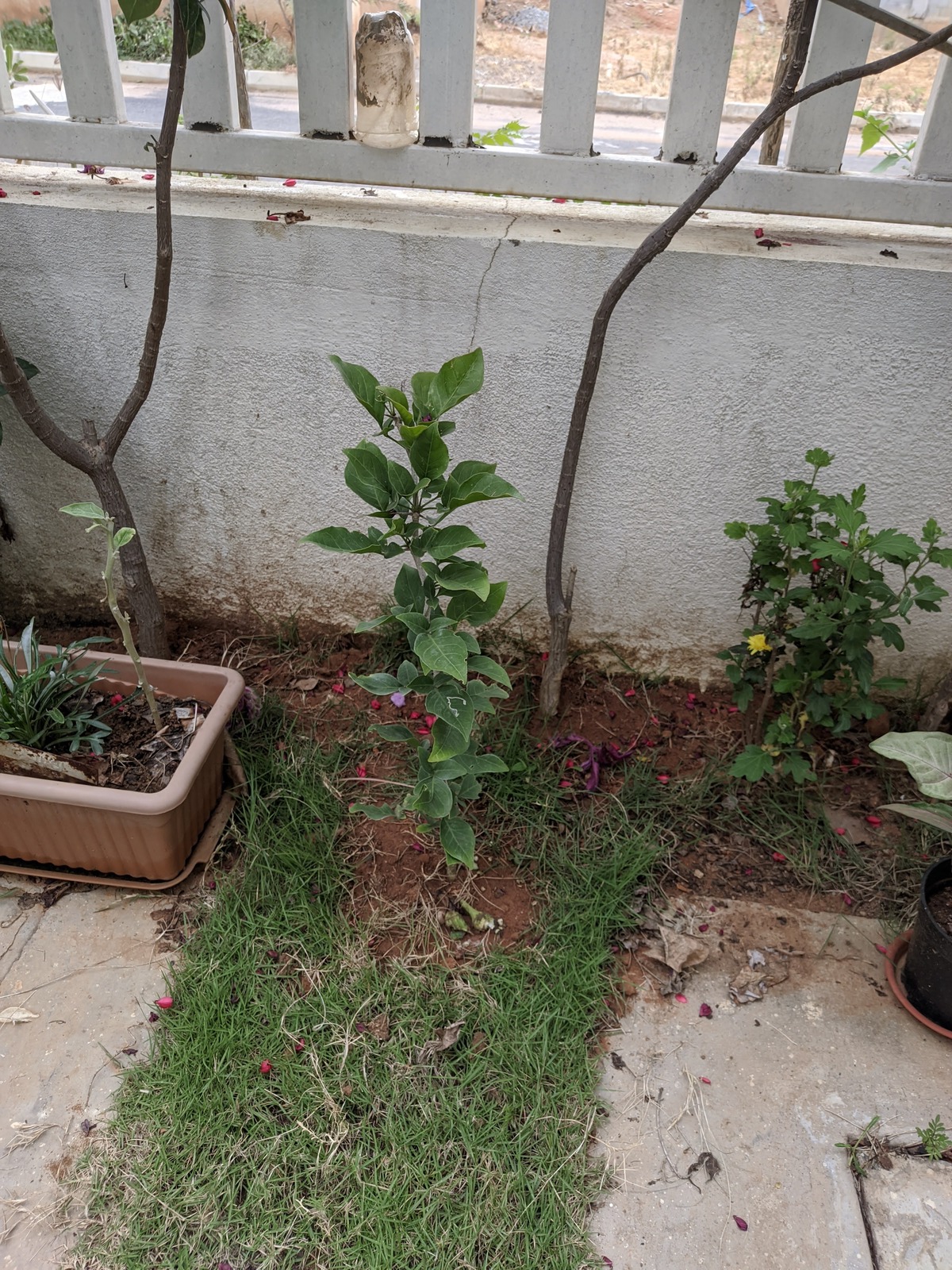
Healthy Bael Plant
Healthy Bael Plant

To This
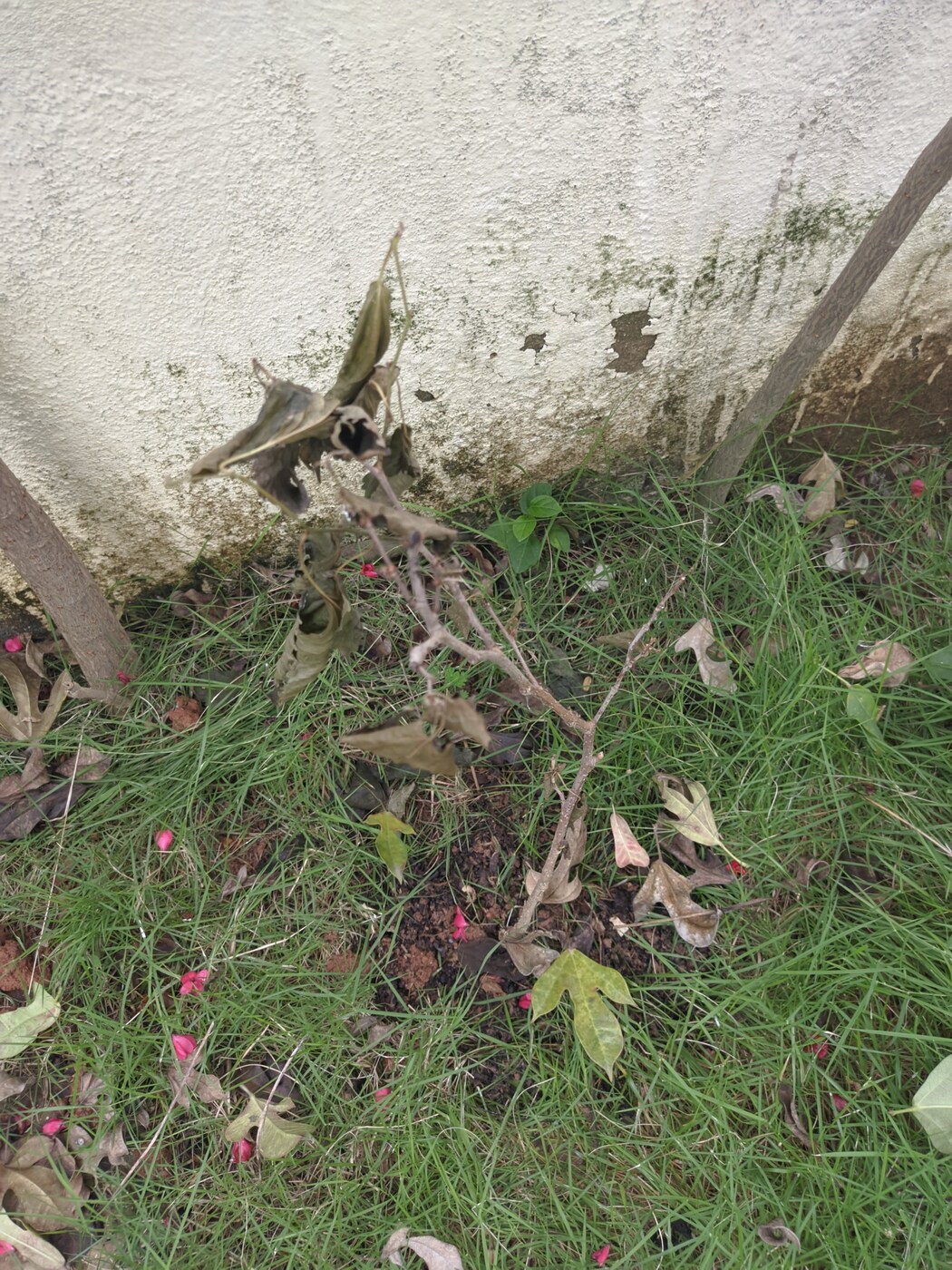
Dead Mulberry Plant
Dead Mulberry Plant
Very Sick Bael Plant
With emotions involved, this can be an unpleasant experience. Bael is a dear plant to me. The plant as a whole has religious values (Shiva). As well, its fruits have lots of health benefits, especially for the intestines. Its leaves have a lot of medicinal properties. When I planted the Bael, there were a lot of emotions that went along. On the other hand, the Mulberry is something I put in with a lot of enthusiasm. Mulberries are now rare to find, especially in urban locations. For one, they have a very short shelf life; But more than that, the way lifestyles are heading towards, I was always worried if my children would ever have a day to see and taste these fruits. The mulberry that I planted, yielded twice; once very soon when I had planted and second, before it died. Infact, it died while during its second yield phase. It was quite saddening to see that happen. It made me wonder why it happened. I had been caring for the plants fairly well. Watering them timely, feeding them the right amount of nutrients. They were getting a good amount of sun. But still their health was deteriorating. And then the demise of the Mulberry. Many thoughts hit my mind. I consulted the claimed experts in the domain, the maali, the gardener. I got a very vague answer; there must be termites in the soil. It didn t make much sense to me. I mean if there are termites they d hit day one. They won t sleep for months and just wake up one fine day and start attacking the roots of particular plants; not all. I wasn t convinced with the termite theory; But still, give the expert the blind hand, I went with his word. When my mulberry was dead, I dug its roots. Looking for proof, to see if there were any termites, I uprooted it. But I couldn t find any trace of termites. And the plant next to it was perfectly healthy and blossoming. So I was convinced that it wasn t the termite but something else. But else what ? I still didn t have an answer to that.

Thinking The Corona pandemic had embraced and there was a lot to worry, and worry not any, if you change the perspective. With plants around in my home, and our close engagement with them, and the helplessness that I felt after seeking help from the experts, it was time again; to build up some knowledge on the subject. But how ? How do you go about a subject you have not much clue about ? A subject which has always been around in the surrounding but very seldom have I dedicated focused thought to it. To be honest, the initial thought of diving on the subject made me clueless. I had no idea where to begin with. But, so, as has been my past history, I chose to take it as a curiosity. I gathered some books, skimmed through a couple of pages. Majority of the books I got hold of were about DIYs and How to do Home Gardening types. It was a decent introduction to a novice but my topic of curiosity was different. Thankfully, with the Internet, and YouTube in particular, a lot of good stuff is available as documentary videos. While going through some, I came across a video which mentioned about carnivore plants. Like, for example, this one.
Carnivore Plant
Carnivore Plant
This got me thinking that there could be a possibility of something similar, that did the fate to my Mulberry plant. But who did it ? And how to dive further on this suspicion ? And most of all, if that thought of possibility was actually the reality. Or was I just hitting in the dark ?

Beginning To put some perspective, here s how it started. When we moved into our home, the gardener put in a couple of plants stock, as part of the property handover. Now, I don t exactly recollect the name of the plants that came in stock, neither English nor Hindi; But at my neighbor s place, the plant is still there. Here are some of the pictures of this beauty. But don t just go by the looks as looks can be deceiving
Dominating Plant
Dominating Plant
Dominating Plant
Dominating Plant
Dominating Plant
Dominating Plant
We hadn t put any serious thought about the plants we were offered by the gardener. After all, we never had ever thought of any mishap either.

Plants we planted Apart from what was offered by the builder/gardener as part of the property handover, in over the next 6 months of we moving in, I planted 3 tree type plants.
  1. Mulberry
  2. Bael
  3. Rudraksha
The Mulberry, as I have described so far, died a tragic death. Bael, on the other hand, fought hard. But very little did we know that the plant was struggling the fight. Our impression was that we must have been given a bad breed of the plant. Or maybe the termite theory had some truth. For the Rudraksha plant, the growth was slow. This was the very first time I had seen a Rudraksha plant, so I had no clue of what its growth rate could be, and what to expect out of it. I wasn t sure if the local climate suited the plant. A quick search showed no objections to the plant in the local climate, but that was it. So my theory has been to put in the plant, and observe. Here s what my Rudraksha plant looked like during the initial days/weeks of its settlement
Rudraksha Plant
Rudraksha Plant

The Hint Days passed and so on. Not much had progressed in gathering information. The plant s health was usual; deteriorating at a slow pace. On day, thinking of the documentaries I had been watching, it hit my mind about the plant behavior.
  • Plants can be Carnivores.
  • Plants can be Aggressive.
  • Plants can be Invaders.
  • Plants can be Territorial.
There are many plants where their aggression can be witnessed with bare human eyes. Like creepers. Some of them are good at spreading tentacles, grabbing onto other plants' stems and branches and spread above it. This was my hint from the documentaries. That s one of the many ways plants set their dominance. That is what hit my mind that if plants are aggressive on the out, underneath the soil, they should be having similar behavior. I mean, what we see as humans is just a part of the actual plant. More than half of the actual plant is usually underneath the soil, in most plants. So there s a high chance to get more information out, if you dig the soil and look the roots.

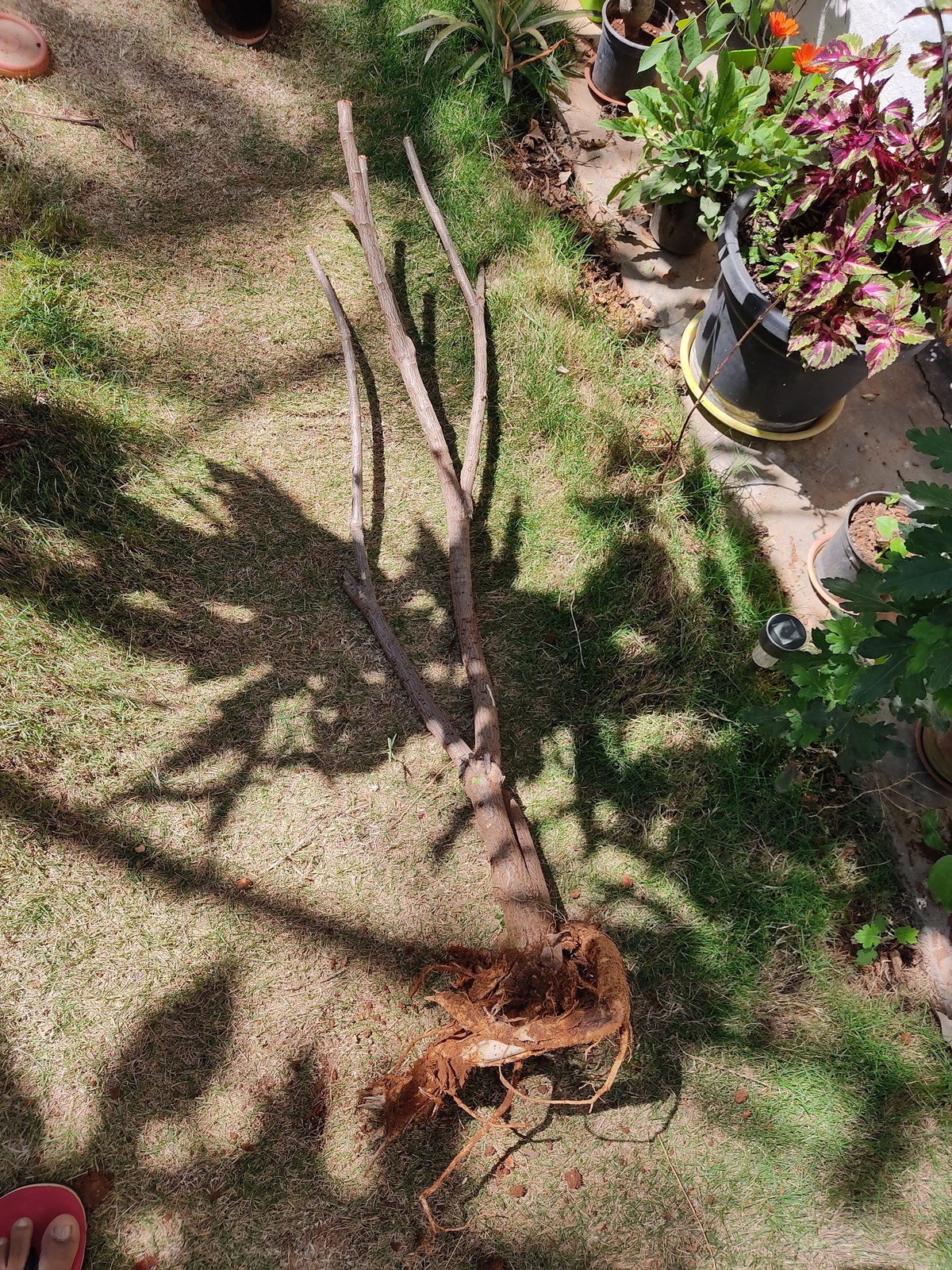
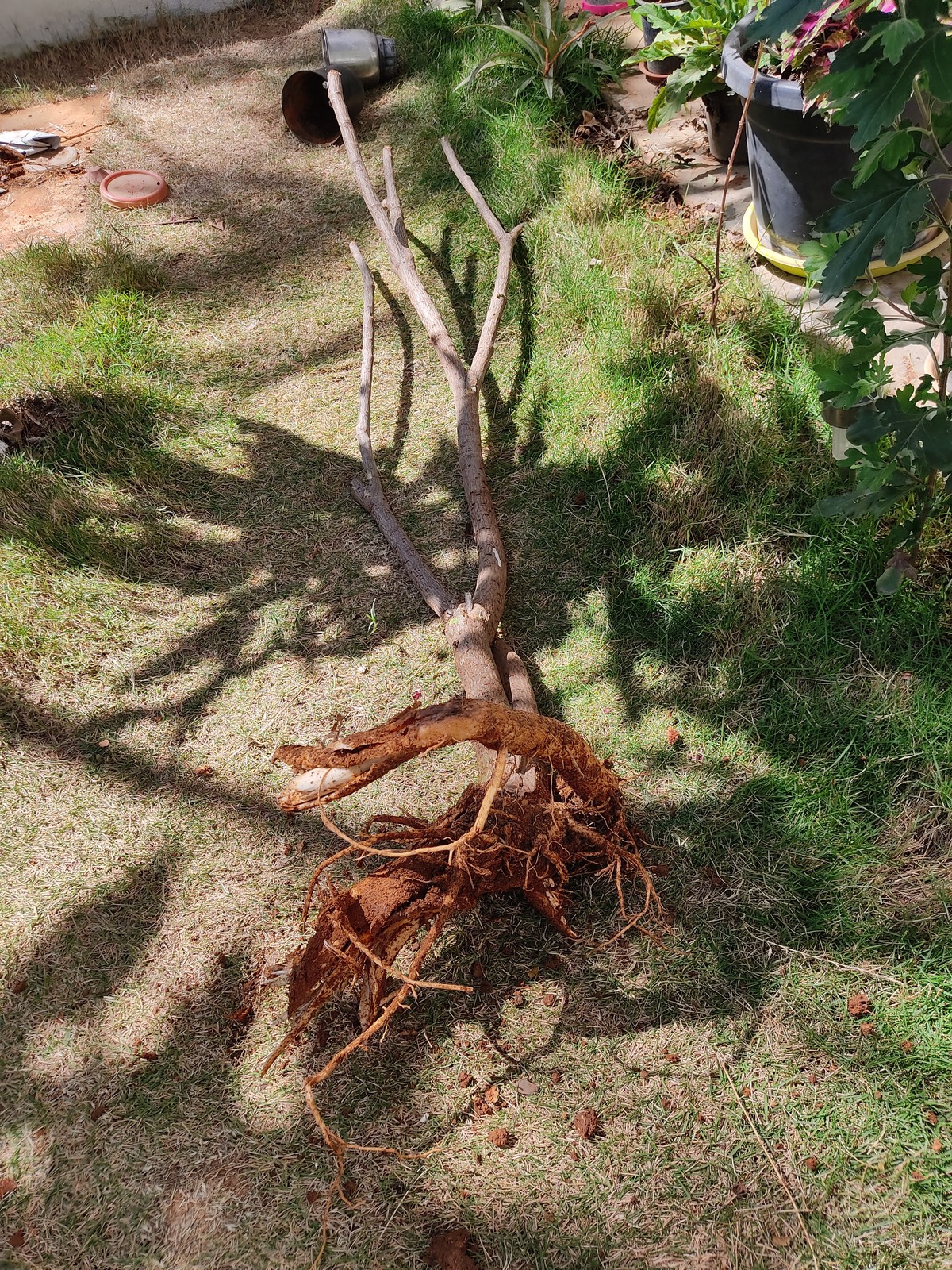
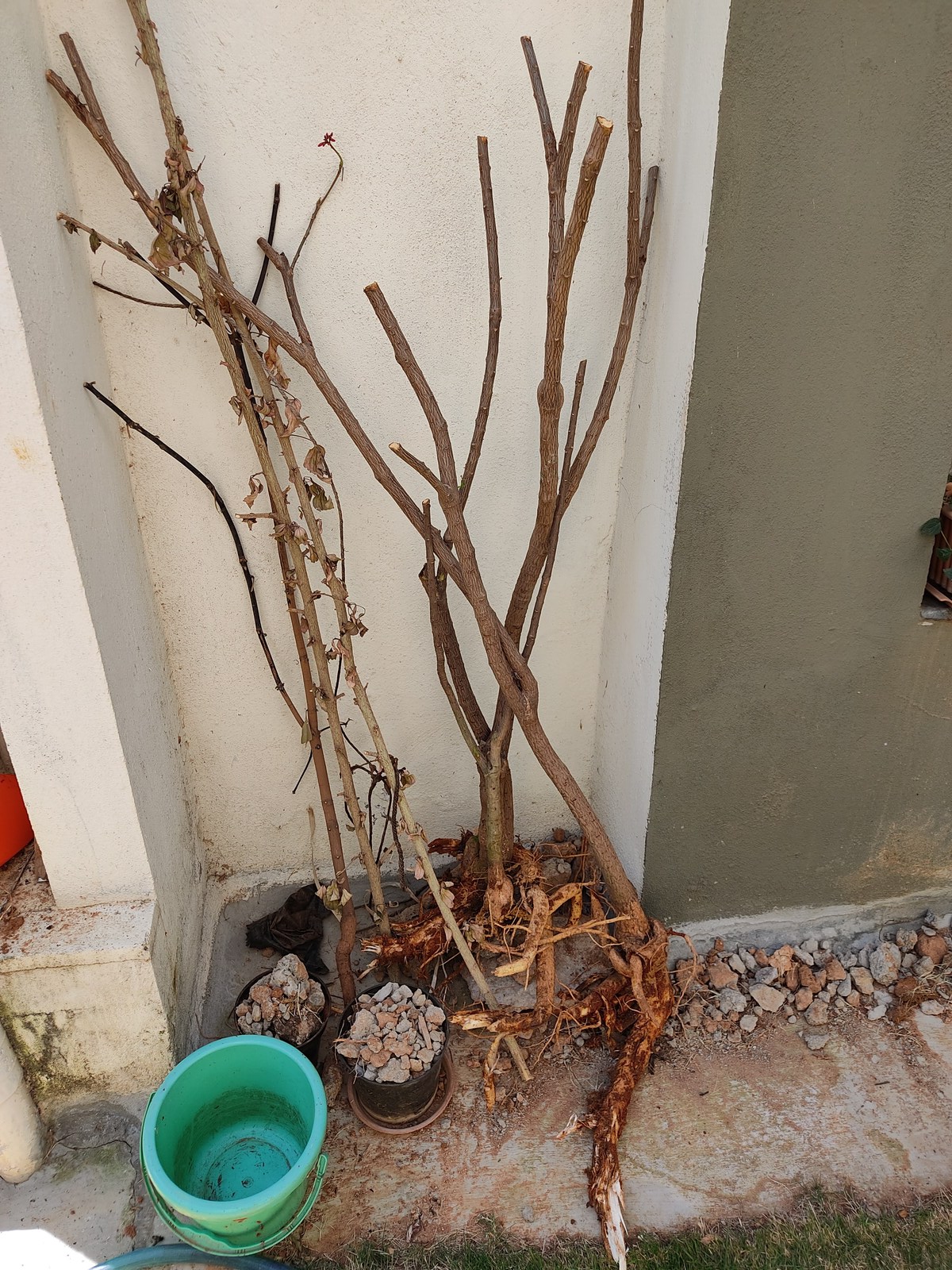
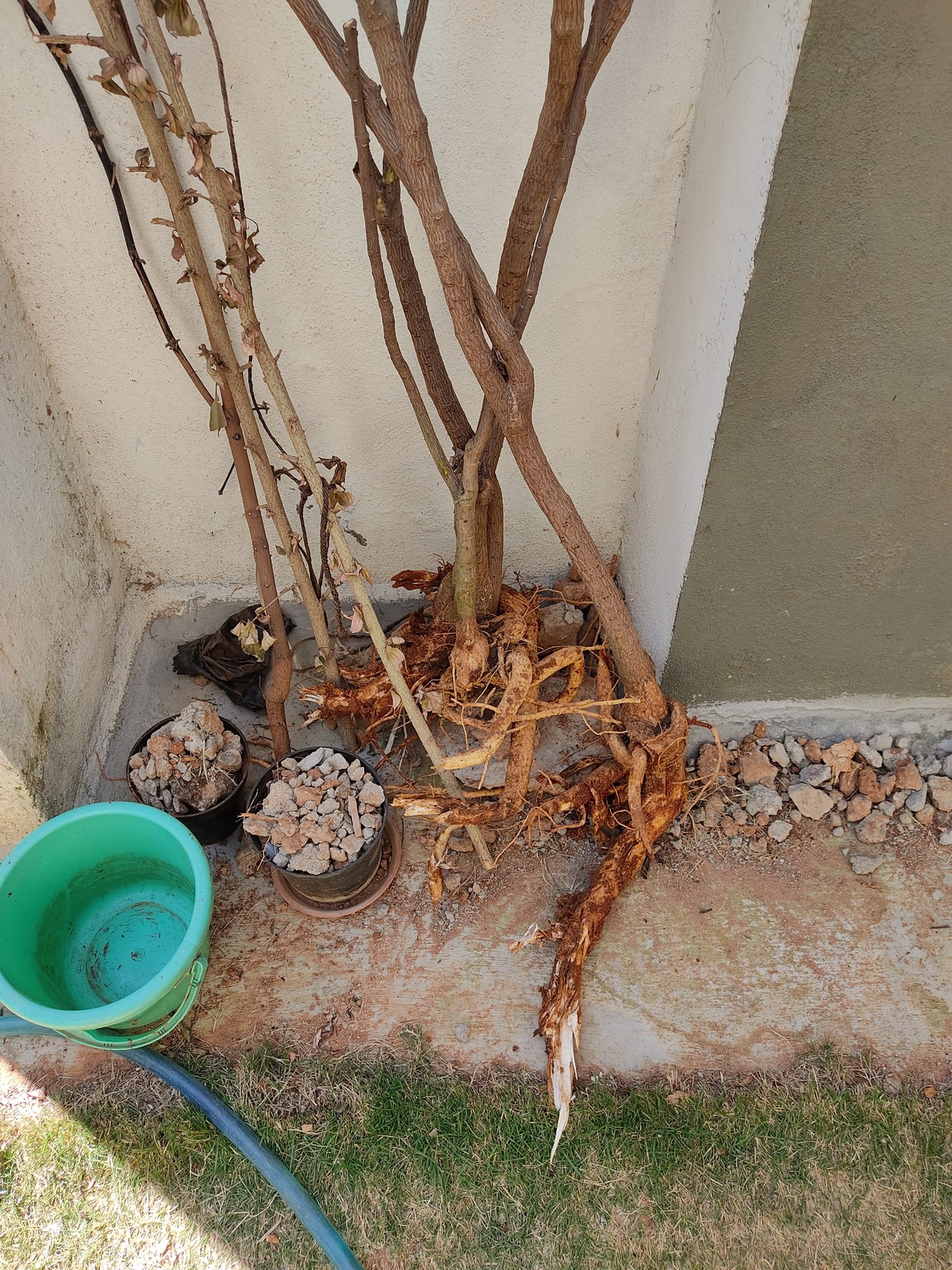
The Digging As I mentioned earlier, I do establish bindings, emotions and attachments. But not much usually comes in the way to curiosity. To dig further on the theory that the problem was elsewhere, with within the plants ecosystem, we needed to pick on another subject - the plant. And the plant we chose was the plant which was planted in the initial offering to us, when we moved into our home. It was the same plant breed which was neighboring all our newly planted trees: Rudraksha, Mulberry and Bael. If you look closely into the pictures above of these plants, you ll notice the stem of another plant, the Territorial Dominator, is close-by to these 3 plants. That s because the gardener put in a good number of them to get his action item complete. So we chose to dig and uproot one of those plant to start with. Now, while they may look gentle on the outside, with nice red colored tiny flowers, these plants were giants underneath. Their roots were huge. It took some sweat shredding to single-handedly remove them.
Dominating Plant Uprooted

Today is brighter

Bael I ll let the pictures do the initial talking today.
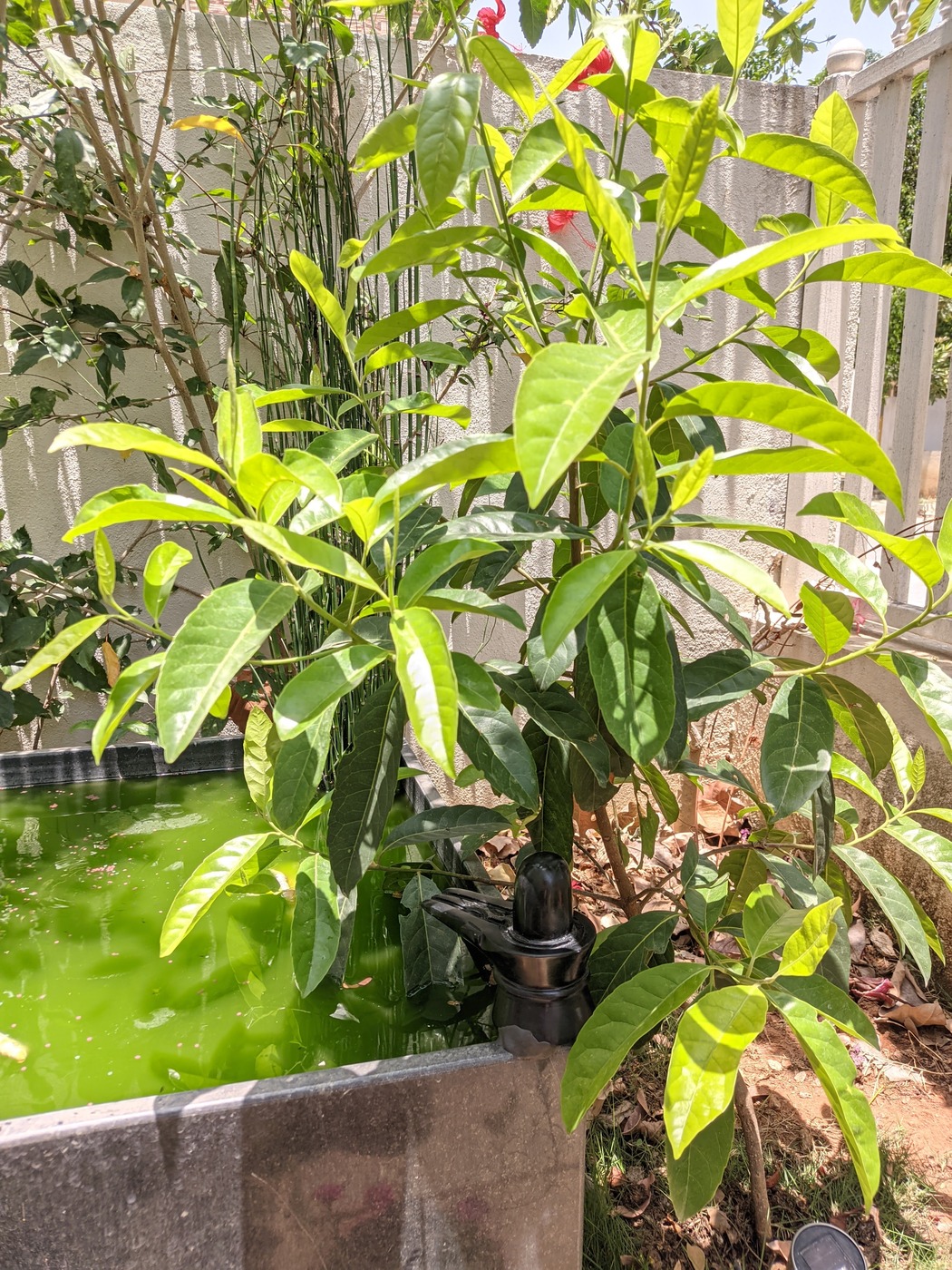
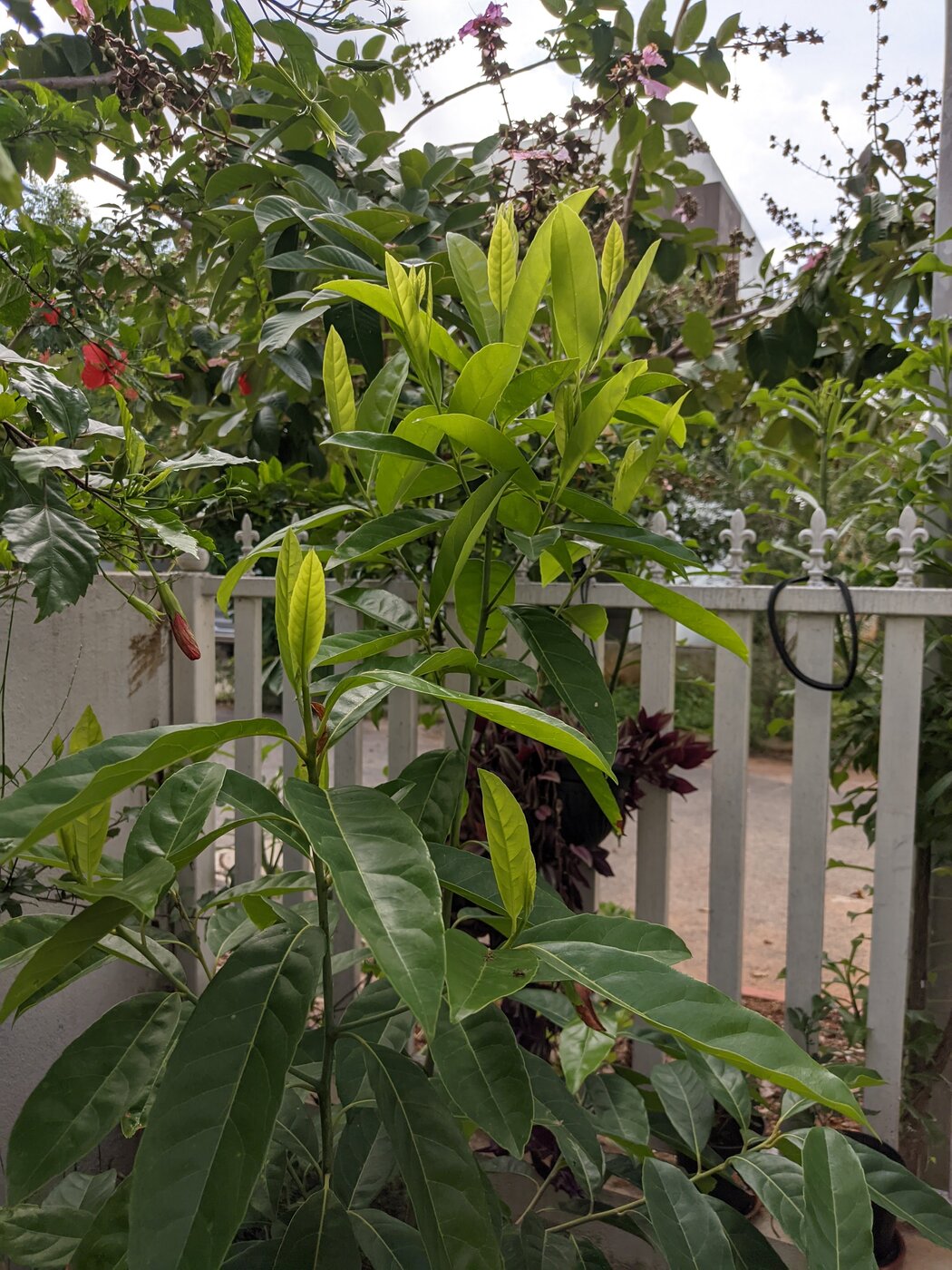
Healthy Bael
Healthy Bael
Healthy Bael
Healthy Bael
Healthy Bael
Healthy Bael
Healthy Bael
Healthy Bael
Healthy Bael
Healthy Bael
The above ones are pictures of the same Bael plant, which had struggled to live, for almost 14 months. Back then, this plant was starved of its resources. It was dying a slow death out of starvation. After we uprooted the other dominant species, the Bael has recovered and has regained its charm. In the pictures above of the Bael plant, you can clearly mark out the difference in its stem. The dark colored one is from its months of struggle, while the bright green is from now where it is well nourished and regained its health.

Mulberry As for the Mulberry, I couldn t save it. But I later managed to get another one. But it turns out I didn t take good, full length pictures of the new mulberry when I planted. The only picture I have is this:
Second Mulberry Plant
I recollect when I brought it home, it was around 1 - 1.5 feet in length. This is where I have it today: Majestically standing, 12 feet and counting
Second Mulberry Plant 7 feet tall

Rudraksha Then:
Rudraksha Plant
Rudraksha Plant
And now: I feel quite happy about
Rudraksha Plant
Rudraksha Plant
Rudraksha Plant
Rudraksha Plant
Rudraksha Plant
Rudraksha Plant
All these plants are on the very same soil with the very same care taker. What has changed is my experience and learning.

Plant Co-Existence Plant co-existence is a difficult topic. My knowledge on plants is very limited in general, and co-existence is something tricky, unexplored, at times invisible (when underneath the soil). So it is a difficult topic. So far, what I ve learnt is purely observations, experiences and hints from the documentaries. There surely are many many plants that co-exist very well. A good example is my Bael plant itself, which is healthily co-sharing its space with 2 other Croton plants. Same goes for the Rudraksha, which has a close-by neighbor in an Adenium and an Allamanda. The plant world is mesmerizing. How they behave, communicate and many many more signs. There s so much to observe, learn, explore and document. I hope to have more such observations and experiences to share

Antoine Beaupr : Another syncmaildir crash

So I had another major email crash with my syncmaildir setup. This time I was at least able to confirm the issue, and I still haven't lost mail thanks to backups and sheer luck (again).

The crash It is not really worth going over the crash in details, it's fairly similar to the last one: something bad happened and smd started destroying everything. The hint is that it takes a long time to do what usually takes seconds. It helps that I now have a second monitor showing logs. I still lost much more mail than the last time. I used to have "301 723 messages", according to notmuch. But then when I ran smd-pull by hand, it was telling me:
95K emails scanned
Oops. You can see notmuch happily noticing the destroyed files on the server:
jun 28 16:33:40 marcos notmuch[28532]: No new mail. Removed 65498 messages. Detected 1699 file renames.
jun 28 16:36:05 marcos notmuch[29746]: No new mail. Removed 68883 messages. Detected 2488 file renames.
jun 28 16:41:40 marcos notmuch[31972]: No new mail. Removed 118295 messages. Detected 3657 file renames.
The final count ended up being 81 042 messages, according to notmuch. A whopping 220 000 mails deleted. The interesting bit, this time around, is that I caught smd in the act of running two processes in parallel:
jun 28 16:30:09 curie systemd[2845]: Finished pull emails with syncmaildir. 
jun 28 16:30:09 curie systemd[2845]: Starting push emails with syncmaildir... 
jun 28 16:30:09 curie systemd[2845]: Starting pull emails with syncmaildir... 
So clearly that is the source of the bug.

Recovery Emergency stop on curie:
notmuch dump > notmuch.dump
systemctl --user --now disable smd-pull.service smd-pull.timer smd-push.service smd-push.timer notmuch-new.service notmuch-new.timer
On marcos (the server), guessed the number of messages delivered since the last backup to be 71, just looking at timestamps in the mail log. Made a list:
grep postfix/local /var/log/mail.log   tail -71 > lost-mail
Found postfix queue IDs:
sed 's/.*\]://;s/:.*//' lost-mail > qids
Turn those into message IDs, find those that are missing from the disk (had previously ran notmuch new just to be sure it's up to date):
while read qid ; do 
    grep "$qid: message-id" /var/log/mail.log
done < qids    sed 's/.*message-id=<//;s/>//'   while read msgid; do
    sudo -u anarcat notmuch count --exclude=false id:$msgid   grep -q 0 && echo $msgid
done
Copy this back on curie as missing-msgids and:
$ wc -l missing-msgids 
48 missing-msgids
$ while read msgid ; do notmuch count --exclude=false id:$msgid   grep -q 0 && echo $msgid ; done < missing-msgids
mailman.189.1624881611.23397.nodes-reseaulibre.ca@reseaulibre.ca
AnwMy7rdSpK-N-vt4AiOag@ismtpd0148p1mdw1.sendgrid.net
only two mails missing! whoohoo! Copy those back onto marcos as really-missing-msgids, and look at the full mail logs to see what they are:
~anarcat/src/koumbit-scripts/mail/postfix-trace --from-file really-missing-msgids2
I actually remembered deleting those, so no mail lost! Rebuild the list of msgids that were lost, on marcos:
while read qid ; do grep "$qid: message-id" /var/log/mail.log; done < qids    sed 's/.*message-id=<//;s/>//'
Copy that on curie as lost-mail-msgids, then copy the files over in a test dir:
while read msgid ; do
    notmuch search --output=files --exclude=false "id:$msgid"
done < lost-mail-msgids   sed 's#/home/anarcat/Maildir/##'   rsync -v  --files-from=- /home/anarcat/Maildir/ shell.anarc.at:restore/Maildir-angela/
If that looks about right, on marcos:
find restore/Maildir-angela/ -type f   wc -l
... should match the number of missing mails, roughly. Copy if in the real spool:
while read msgid ; do
    notmuch search --output=files --exclude=false "id:$msgid"
done < lost-mail-msgids   sed 's#/home/anarcat/Maildir/##'   rsync -v  --files-from=- /home/anarcat/Maildir/ shell.anarc.at:Maildir/
Then on the server, notmuch new should find the new emails, and we shouldn't have any lost mail anymore:
while read qid ; do grep "$qid: message-id" /var/log/mail.log; done < qids    sed 's/.*message-id=<//;s/>//'   while read msgid; do sudo -u anarcat notmuch count --exclude=false id:$msgid   grep -q 0 && echo $msgid ; done
Then, crucial moment, try to pull the new mails from the backups on curie:
anarcat@curie:~(main)$ smd-pull  -n  --show-tags -v
Found lockfile of a dead instance. Ignored.
Phase 0: handshake
Phase 1: changes detection
    5K emails scanned
   10K emails scanned
   15K emails scanned
   20K emails scanned
   25K emails scanned
   30K emails scanned
   35K emails scanned
   40K emails scanned
   45K emails scanned
   50K emails scanned
Phase 2: synchronization
Phase 3: agreement
default: smd-client@localhost: TAGS: stats::new-mails(49687), del-mails(0), bytes-received(215752279), xdelta-received(3703852)
"smd-pull  -n  --show-tags -v" took 3 mins 39 secs
This brought me back to the state after the backup plus the mails delivered during the day, which means I had to catchup with all my holiday's read emails (1440 mails!) but thankfully I made a dump of the notmuch database on curie at the start of the procedure, so this actually restored a sane state:
pv notmuch.dump   notmuch restore
Phew!

Workaround I have filed this as a bug in upstream issue 18. Considering I filed 11 issues and only 3 of those were closed, I'm not holding my breath. I nevertheless filed PR 19 in the hope that this will fix my particular issue, but I'm not even sure this is the right fix...

Fix At this point, I'm really ready to give up on SMD. It's really, really nice to be able to sync mail over SSH because I don't need to store my IMAP password on disk. But surely there are more reliable syncing mechanisms. I do not remember ever losing that much mail before. At worst, offlineimap would duplicate emails like mad, but never destroy my entire mail spool that way. As mentioned before, there are other programs that sync mail. I'm looking at:
  • offlineimap3: requires IMAP, used the py2 version in the past, might just still work, first sync painful (IIRC), ways to tunnel over SSH, see comment below
  • isync/mbsync: might be faster, I remember having trouble switching from offlineimap to this, has support for TLS client certs, running over SSH, and generally has good words from multiple Debian and notmuch people
  • getmail: just downloads email, might not be enough
  • nncp: treat the local spool as another mail server, might not be compatible with my "multiple clients" setup
  • doveadm-sync: requires dovecot on both ends, but supports using SSH to sync, will try this next, may have performance problems, see comment below
  • interimap: syncs two IMAP servers, apparently faster than doveadm and offlineimap
  • mail-sync: notify support, happens over any piped transport (e.g. ssh), diff/patch system, requires binary on both ends, mentions UUCP in the manpage, seems awfully complicated to setup, mentions rsmtp which is a nice name for rsendmail

28 June 2021

Shirish Agarwal: Indian Capital Markets, BSE, NSE

I had been meaning to write on the above topic for almost a couple of months now but just kept procrastinating about it. That push came to a shove when Sucheta Dalal and Debasis Basu shared their understanding, wisdom, and all in the new book called Absolute Power Inside story of the National Stock Exchange s amazing success, leading to hubris, regulatory capture and algo scam . Now while I will go into the details of the new book as currently, I have not bought it but even if I had bought it and shared some of the revelations from it, it wouldn t have done justice to either the book or what is sharing before knowing some of the background before it.

Before I jump ahead, I would suggest people to read my sort of introductory blog post on banking history so they know where I m coming from. I m going to deviate a bit from Banking as this is about trade and capital markets, although Banking would come in later on. And I will also be sharing some cultural insights along with history so people are aware of why things happened the way they did. Calicut, Calcutta, Kolkata, one-time major depot around the world Now, one cannot start any topic about trade without talking about Kolkata. While today, it seems like a bastion of communism, at one time it was one of the major trade depots around the world. Both William Dalrymple and the Chinese have many times mentioned Kolkata as being one of the major centers of trade. This was between the 13th and the late 19th century. A cursory look throws up this article which talks about Kolkata or Calicut as it was known as a major trade depot. There are of course many, many articles and even books which do tell about how Kolkata was a major trade depot. Now between the 13th and 19th century, a lot of changes happened which made Kolkata poorer and shifted trade to Mumbai/Bombay which in those times was nothing but just a port city like many others.

The Rise of the Zamindar Around the 15th century when Babur Invaded Hindustan, he realized that Hindustan is too big a country to be governed alone. And Hindustan was much broader than independent India today. So he created the title of Zamindars. Interestingly, if you look at the Mughal period, they were much more in tune with Hindustani practices than the British who came later. They used the caste divisions and hierarchy wisely making sure that the status quo was maintained as far as castes/creed were concerned. While in-fighting with various rulers continued, it was more or less about land and power other than anything else. When the Britishers came they co-opted the same arrangement with a minor adjustment. While in the before system, the zamindars didn t have powers to be landowners. The Britishers gave them land ownerships. A huge percentage of thess zamindars especially in Bengal were from my own caste Banias or Baniyas. The problem and the solution for the Britishers had been this was a large land to control and exploit and the number of British officers and nobles were very less. So they gave virtually a lot of powers to the Banias. The only thing the British insisted on were very high rents from the newly minted Zamindars. The Zamindar in turn used the powers of personal fiefdom to give loans at very high interest rates when the poor were unable to pay the interest rate, they would take the land while at the same time slavery was forced on both men and women, many a time rapes and affairs. While there have been many records shedding light on it, don t think it could be any more powerful as enacted and shared by Shabana Azmi in Ankur:the Seedling. Another prominent grouping was formed around the same time was the Bhadralok. Now as shared Bhadralok while having all the amenities of belonging to the community, turned a blind eye to the excesses being done by the Zamindars. How much they played a hand in the decimation of Bengal has been a matter of debate, but they did have a hand, that much is not contested.

The Rise of Stock Exchanges Sadly and interestingly, many people believe and continue to believe that stock exchanges is recent phenomena. The first stock exchange though was the Calcutta Stock Exchange rather than the Bombay Stock Exchange. How valuable was Calcutta to the Britishers in its early years can be gauged from the fact that at one time it was made the capital of India in 1772 . In fact, after the Grand Trunk Road (on which there had been even Train names in both countries) x number of books have been written of the trade between Calcutta and Peshawar (Now in Pakistan). And it was not just limited to trade but also cultural give-and-take between the two centers. Even today, if you look at YT (Youtube) and look up some interviews of old people, you find many interesting anecdotes of people sharing both culture and trade.

The problem of the 60 s and rise of BSE
After India became independent and the Constitutional debates happened, the new elites understood that there cannot be two power centers that could govern India. On one hand, were the politicians who had come to power on the back of the popular vote, the other was the Zamindars, who more often than not had abused their powers which resulted in widespread poverty. The Britishers are to blame, but so do the middlemen as they became willing enablers to the same system of oppression. Hence, you had the 1951 amendment to the Constitution and the 1956 Zamindari Abolition Act. In fact, you can find much more of an in-depth article both about Zamindars and their final abolition here. Now once Zamindari was gone, there was nothing to replace it with. The Zamindars ousted of their old roles turned and tried to become Industrialists. The problem was that the poor and the downtrodden had already had experiences with the Zamindars. Also, some Industrialists from North and West also came to Bengal but they had no understanding of either the language or the cultural understanding of what had happened in Bengal. And notice that I have not talked about both the famines and the floods that wrecked Bengal since time immemorial and some of the ones which got etched on soul of Bengal and has marks even today  The psyche of the Bengali and the Bhadralok has gone through enormous shifts. I have met quite a few and do see the guilt they feel. If one wonders as to how socialist parties are able to hold power in Bengal, look no further than Tarikh which tells and shares with you that even today how many Bengalis still feel somewhat lost.

The Rise of BSE Now, while Kolkata Stock Exchange had been going down, for multiple reasons other than listed above. From the 1950s onwards Jawaharlal Nehru had this idea of 5-year plans, borrowed from socialist countries such as Russia, China etc. His vision and ambition for the newly minted Indian state were huge, while at the same time he understood we were poor. The loot by East India Company and the Britishers and on top of that the division of wealth with Pakistan even though the majority of Muslims chose and remained with India. Travel on Indian Railways was a risky affair. My grandfather had shared numerous tales where he used to fill money in socks and put the socks on in boots when going between either Delhi Kolkata or Pune Kolkata. Also, as the Capital became Delhi, it unofficially was for many years, the transparency from Kolkata-based firms became less. So many Kolkata firms either mismanaged and shut down while Maharashtra, my own state, saw a huge boon in Industrialization as well as farming. From the 1960s to the 1990s there were many booms and busts in the stock exchanges but most were manageable.

While the 60s began on a good note as Goa was finally freed from the Portuguese army and influence, the 1962 war with the Chinese made many a soul question where we went wrong. Jawaharlal Nehru went all over the world to ask for help but had to return home empty-handed. Bollywood showed a world of bell-bottoms and cars and whatnot, while the majority were still trying to figure out how to put two square meals on the table. India suffered one of the worst famines in those times. People had to ration food. Families made do with either one meal or just roti (flatbread) rather than rice. In Bengal, things were much more severe. There were huge milk shortages, so Bengalis were told to cut down on sweets. This enraged the Bangalis as nothing else could. Note If one wants to read how bad Indians felt at that time, all one has to read is V.S. Naipaul s An Area of darkness . This was also the time when quite a few Indians took their first step out of India. While Air India had just started, the fares were prohibitive. Those who were not well off, either worked on ships or went via passenger or cargo ships to Dubai/Qatar middle-east. Some went to Russia and some even to States. While today s migr s want to settle in the west forever and have their children and grandchildren grow up in the West, in the 1960s and 70s the idea was far different. The main purpose for a vast majority was to get jobs and whatnot, save maximum money and send it back to India as a remittance. The idea was to make enough money in 3-5-10 years, come back to India, and then lead a comfortable life. Sadly, there has hardly been any academic work done in India, at least to my knowledge to document the sacrifices done by Indians in search of jobs, life, purpose, etc. in the 1960s and 1970s. The 1970s was also when alternative cinema started its journey with people like Smita Patil, Naseeruddin Shah who portrayed people s struggles on-screen. Most of them didn t have commercial success because the movies and the stories were bleak. While the acting was superb, most Indians loved to be captured by fights, car-chases, and whatnot rather than the deary existence which they had. And the alt cinema forced them to look into the mirror, which was frowned upon both by the masses and the classes. So cinema which could have been a wake-up call for a lot of Indians failed. One of the most notable works of that decade, at least to me, was Manthan. 1961 was also marked by the launch of Economic Times and Financial Express which tells that there was some appetite for financial news and understanding. The 1970s was also a very turbulent time in the corporate sector and stock exchanges. Again, the companies which were listed were run by the very well-off and many of them had been abroad. At the same time, you had fly-by-night operators. One of the happenings which started in this decade is you had corporate wars and hostile takeovers, quite a few of them of which could well have a Web series or two of their own. This was also a decade marked by huge labor unrest, which again changed the face of Bombay/Mumbai. From the 1950s till the 1970s, Bombay was known for its mills. So large migrant communities from all over India came to Bombay to become the next Bollywood star and if that didn t happen, they would get jobs in the mills. Bombay/Mumbai has/had this unique feature that somehow you will make money to make ends meet. Of course, with the pandemic, even that has gone for a toss. Labor unrest was a defining character of that decade. Three movies, Kaala Patthar, Kalyug, and Ankush give a broad outlook of what happened in that decade. One thing which is present and omnipresent then and now is how time and time again we lost our demographic dividend. Again there was an exodus of young people who ventured out to seek fortunes elsewhere. The 1970s and 80s were also famous for the license Raj which they bought in. Just like the Soviets, there were waiting periods for everything. A telephone line meant waiting for things anywhere from 4 to 8 years. In 1987, when we applied and got a phone within 2-3 months, most of my relatives both from my mother and father s side could not believe we paid 0 to get a telephone line. We did pay the telephone guy INR 10/- which was a somewhat princely sum when he was installing it, even then they could not believe it as in Northern India, you couldn t get a phone line even if your number had come. You had to pay anywhere from INR 500/1000 or more to get a line. This was BSNL and to reiterate there were no alternatives at that time.

The 1990s and the Harshad Mehta Scam The 90s was when I was a teenager. You do all the stupid things for love, lust, whatever. That is also the time you are introduced really to the world of money. During my time, there were only three choices, Sciences, Commerce, and Arts. If History were your favorite subject then you would take Arts and if it was not, and you were not studious, then you would up commerce. This is how careers were chosen. So I enrolled in Commerce. Due to my grandfather and family on my mother s side interested in stocks both as a saving and compounding tool, I was able to see Pune Stock Exchange in action one day. The only thing I remember that day is people shouting loudly with various chits. I had no idea that deals of maybe thousands or even lakhs. The Pune Stock Exchange had been newly minted. I also participated in a couple of mock stock exchanges and came to understand that one has to be aggressive in order to win. You had to be really loud to be heard over others, you could not afford to be shy. Also, spread your risks. Sadly, nothing about the stock markets was there in the syllabus. 1991 was also when we saw the Iraq war, the balance of payments crisis in India, and didn t know that the Harshad Mehta scam was around the corner. Most of the scams in India have been caught because the person who was doing it was flashy. And this was the reason that even he was caught as Ms. Sucheta Dalal, a young beat reporter from Indian Express who had been covering Indian stock market. Many of her articles were thought-provoking. Now, a brief understanding is required to know before we actually get to the scam. Because of the 1991 balance of payments crisis, IMF rescued India on the condition that India throws its market open. In the 1980s itself, Rajeev Gandhi had wanted to partially make India open but both politicians and Industrialists advised him not to do the same, we are/were not ready. On 21st May 1991, Rajeev Gandhi was assassinated by the LTTE. A month later, due to the sympathy vote, the Narsimha Rao Govt. took power. While for most new Governments there is usually a honeymoon period lasting 6 months or so till they get settled in their roles before people start asking tough questions. It was not to be for this Govt. Immediately, The problem had been building for a few years. Although, in many ways, our economy was better than it is today. The only thing India didn t do well at that time was managing foreign exchange. As only a few Indians had both the money and the opportunity to go abroad and need for electronics was limited. One of the biggest imports of the time then and still today is Energy, Oil. While today it is Oil/Gas and electronics, at that time it was only OIl. The Oil import bill was ballooning while exports were more or less stagnant and mostly comprised of raw materials rather than finished products. Even today, it is largely this, one of the biggest Industrialists in India Ambani exports gas/oil while Adani exports coal. Anyways, the deficit was large enough to trigger a payment crisis. And Narsimha Rao had to throw open the Indian market almost overnight. Some changes became quickly apparent, while others took a long time to come.

Satellite Television and Entry of Foreign Banks Almost overnight, from 1 channel we became multi-channel. Star TV (Rupert Murdoch) bought us Bold and Beautiful, while CNN broadcasted the Iraq War. It was unbelievable for us that we were getting reports of what had happened 24-48 hours earlier. Fortunately or unfortunately, I was still very much a teenager to understand the import of what was happening. Even in my college, except for one or two-person, it wasn t a topic for debate or talk or even the economy. We were basically somehow cocooned in our own little world. But this was not the case for the rest of India and especially banks. The entry of foreign banks was a rude shock to Indian banks. The foreign banks were bringing both technology and sophistication in their offerings, and Indian Banks needed and wanted fast money to show hefty profits. Demand for credit wasn t much, at least nowhere the level it today is. At the same time, default on credit was nowhere high as today is. But that will require its own space and article. To quench the thirst for hefty profits by banks, Enter Harshad Mehta. At that point in time, banks were not permitted at all to invest in the securities/share market. They could only buy Government securities or bonds which had a coupon rate of say 8-10% which was nowhere enough to satisfy the need for hefty profits as desired by Indian banks. On top of it, that cash was blocked for a long time. Most of these Government bonds had anywhere between 10-20 year maturity date and some even longer. Now, one loophole in that was that the banks themselves could not buy these securities. They had to approach a registered broker of the share market who will do these transactions on their behalf. Here is where Mr. Mehta played his game. He shared both legal and illegal ways in which both the bank and he would prosper. While banking at one time was thought to be conservative and somewhat cautious, either because they were too afraid that Western private banks will take that pie or whatever their reasons might be, they agreed to his antics. To play the game, Harshad Mehta needed lots of cash, which the banks provided him in the guise of buying securities that were never bought, but the amounts were transferred to his account. He actively traded stocks, at the same time made a group, and also made the rumor mill work to his benefit. The share market is largely a reactionary market. It operates on patience, news, and rumor-mill. The effect of his shenanigans was that the price of a stock that was trending at say INR 200 reached the stratospheric height of INR 9000/- without any change in the fundamentals or outlook of the stock. His thirst didn t remain restricted to stocks but also ventured into the unglamorous world of Govt. securities where he started trading even in them in large quantities. In order to attract new clients, he coveted a fancy lifestyle. The fancy lifestyle was what caught the eye of Sucheta Dalal, and she started investigating the deals he was doing. Being a reporter, she had the advantage of getting many doors to open and get information that otherwise would be under lock and key. On 23rd April 1992, Sucheta Dalal broke the scam.

The Impact The impact was almost like a shock to the markets. Even today, it can be counted as one of the biggest scams in the Indian market if you adjust it for inflation. I haven t revealed much of the scam and what happened, simply because Sucheta Dalal and Debasis Basu wrote The Scam for that purpose. How do I shorten a story and experience which has been roughly written in 300 odd pages in one or two paragraphs, it is simply impossible. The impact though was severe. The Indian stock market became a bear market for two years. Sucheta Dalal was kicked out/made to resign out of Indian Express. The thing is simple, all newspapers survive on readership and advertisements with advertisements. Companies who were having a golden run, whether justified or not, on the bourses/Stock Exchange. For many companies, having a good number on the stock exchange was better than the company fundamentals. There was supposed to be a speedy fast-track court setup for Financial crimes, but it worked only for the Harshad Mehta case and still took over 5 years. It led to the creation of NSE (National Stock Exchange). It also led to the creation of SEBI, perhaps one of the most powerful regulators, giving it a wide range of powers and remit but on the ground more often that proved to be no more than a glorified postman. And the few times it used, it used on the wrong people and people had to go to courts to get justice. But then this is not about SEBI nor is this blog post about NSE. I have anyways shared about Absolute power above, so will not repeat the link here. The Anecdotal impact was widespread. Our own family broker took the extreme step. For my grandfather on the mother s side, he was like the second son. The news of his suicide devastated my grandfather quite a bit, which we realized much later when he was diagnosed with Alzheimer s. Our family stockbroker had been punting, taking lots of cash from the market at very high rates, betting on stocks wildly as the stock market was reaching for the stars when the market crashed, he was insolvent. How the family survived is a tale in itself. They had just got married just a few years ago and had a cute boy and girl soon after. While today, both are grown-up, at that time what the wife faced only she knows. There were also quite a few shareholders who also took the extreme step. The stock markets in those days were largely based on trust and even today is unless you are into day-trading. So there was always some money left on the table for the share/stockbroker which would be squared off in the next deal/transaction where again you will leave something. My grandfather once thought of going over and meeting them, and we went to the lane where their house is, seeing the line of people who had come for recovery of loans, we turned back with a heavy heart. There was another taboo that kinda got broken that day. The taboo was that the stock market is open to scams. From 1992 to 2021 has been a cycle of scams. Even now, today, the stock market is at unnatural highs. We know for sure that a lot of hot money is rolling around, a lot of American pension funds etc. Till it will work, it will work, some news something and that money will be moved out. Who will be left handing the can, the Indian investors? A Few days back, Ambani writes about Adani. Now while the facts shared are correct, is Adani the only one, the only company to have a small free float in the market. There probably are more than 1/4th or 1/3rd of well-respected companies who may have a similar configuration, the only problem is it is difficult to know who the proxies are. Now if I were to reflect and compare this either with the 1960s or even the 1990s I don t find much difference apart from the fact that the proxy is sitting in Mauritius. At the same time, today you can speculate on almost anything. Whether it is stocks, commodities, derivatives, foreign exchange, cricket matches etc. the list is endless. Since 2014, the rise in speculation rather than investment has been dramatic, almost stratospheric. Sadly, there are no studies or even attempts made to document this. How much official and unofficial speculation is there in the market nobody knows. Money markets have become both fluid and non-transparent. In theory, you have all sorts of regulators, but it is still very much like the Wild West. One thing to note that even Income tax had to change and bring it provisions to account for speculative income.So, starting from being totally illegitimate, it has become kind of legal and is part of Income Tax. And if speculation is not wrong, why not make Indian cricket officially a speculative event, that will be honest and GOI will get part of the proceeds.

Conclusion I wish there was some positive conclusion I could drive, but sadly there is not. Just today read two articles about the ongoing environmental issues in Himachal Pradesh. As I had shared even earlier, the last time I visited those places in 2011, and even at that time I was devastated to see the kind of construction going on. Jogiwara Road which they showed used to be flat single ground/first floor dwellings, most of which were restaurants and whatnot. I had seen the water issues both in Himachal and UT (Uttarakhand) back then and this is when they made huge dams. In U.S. they are removing dams and here we want more dams

27 June 2021

Antonio Terceiro: Debian Continuous Integration now using Salsa logins

I have just updated the Debian Continuous Integration platform with debci 3.1. This update brings a few database performance improvements, courtesy of adding indexes to very important columns that were missing them. And boy, querying a table with 13 million rows without the proper indexes is bad! :-) Now, the most user visible change in this update is the change from Debian SSO to Salsa Logins, which is part of Pavit Kaur's GSoC work. She has been working with me and Paul Gevers for a few weeks, and this was the first official task in the internship. For users, this means that you now can only log in via Salsa. If you have an existing session where you logged in with an SSO certificate, it will still be valid. When you log in with Salsa, your username will be changed to match the one in Salsa. This means that if your account on salsa gets renamed, it will automatically be renamed on Debian CI when you log in the next time. Unfortunately we don't have a logout feature yet, but in the meantime you can use the developer toolbar to delete any existing cookies you might have for ci.debian.net. Migrating to Salsa logins was in my TODO list for a while. I had the impression that it could do it pretty quick to do by using pre-existing libraries that provide gitlab authentication integration for Rack (Ruby's de facto standard web application interface, like uwsgi for Python). But in reality, the devil was in the details. We went through several rounds of reviews to get it right. During the entire process, Pavit demonstrated an excelent capacity for responding to feedback, and overall I'm very happy with her performance in the internship so far. While we were discussing the Salsa logins, we noted a limitation in the existing database structure, where we stored usernames directly as the test requestor field, and decided it was better to normalize that relationship with a proper foreign key to the users table, which she also worked on. This update also include the very first (and non-user visible) step of her next task, which is adding support for having private tests. Those will be useful for implementing testing for embargoed security updates, and other use cases. This was broken up into 7 or 8 seperate steps, so there is still some work to do there. I'm looking forward to the continuation of this work.

Fran ois Marier: Removing unsafe-inline from Ikiwiki's style-src directive

After moving my Ikiwiki blog to my own server and enabling a basic CSP policy, I decided to see if I could tighten up the policy some more and stop relying on style-src 'unsafe-inline'. This does require that OpenID logins be disabled, but as a bonus, it also removes the need for jQuery to be present on the server.

Revised CSP policy First of all, I visited all of my pages in a Chromium browser and took note of the missing hashes listed in the developer tools console (Firefox doesn't show the missing hashes):
  • 'sha256-4Su6mBWzEIFnH4pAGMOuaeBrstwJN4Z3pq/s1Kn4/KQ='
  • 'sha256-j0bVhc2Wj58RJgvcJPevapx5zlVLw6ns6eYzK/hcA04='
  • 'sha256-j6Tt8qv7z2kSc7fUs0YHbrxawwsQcS05fVaX1r2qrbk='
  • 'sha256-p4cncjf0hAIeTSS5tXecf7qTUanDC27KdlKhT9eOsZU='
  • 'sha256-Y6v8OCtFfMmI5mbpwqCreLofmGZQfXYK7jJHCoHvn7A='
  • 'sha256-47DEQpj8HBSa+/TImW+5JCeuQeRkm5NMpJWZG3hSuFU='
which took care of all of the inline styles. Note that I kept unsafe-inline in the directive since it will be automatically ignored by browsers who understand hashes, but will be honored and make the site work on older browsers. Next I added the new unsafe-hashes source expression along with the hash of the CSS fragment (clear: both) that is present on all pages related to comments in Ikiwiki:
$ echo -n "clear: both"   openssl dgst -sha256 -binary   openssl base64 -A
matwEc6givhWX0+jiSfM1+E5UMk8/UGLdl902bjFBmY=
My final style-src directive is therefore the following:
style-src 'self' 'unsafe-inline' 'unsafe-hashes' 'sha256-4Su6mBWzEIFnH4pAGMOuaeBrstwJN4Z3pq/s1Kn4/KQ=' 'sha256-j0bVhc2Wj58RJgvcJPevapx5zlVLw6ns6eYzK/hcA04=' 'sha256-j6Tt8qv7z2kSc7fUs0YHbrxawwsQcS05fVaX1r2qrbk=' 'sha256-p4cncjf0hAIeTSS5tXecf7qTUanDC27KdlKhT9eOsZU=' 'sha256-Y6v8OCtFfMmI5mbpwqCreLofmGZQfXYK7jJHCoHvn7A=' 'sha256-47DEQpj8HBSa+/TImW+5JCeuQeRkm5NMpJWZG3hSuFU=' 'sha256-matwEc6givhWX0+jiSfM1+E5UMk8/UGLdl902bjFBmY='

Browser compatibility While unsafe-hashes is not yet implemented in Firefox, it happens to work just fine due to a bug (i.e. unsafe-hashes is always enabled whether or not the policy contains it). It's possible that my new CSP policy won't work in Safari, but these CSS clears don't appear to be needed anyways and so it's just going to mean extra CSP reporting noise.

Removing jQuery Since jQuery appears to only be used to provide the authentication system selector UI, I decided to get rid of it. I couldn't find a way to get Ikiwiki to stop pulling it in and so I put the following hack in my Apache config file:
# Disable jQuery.
Redirect 204 /ikiwiki/jquery.fileupload.js
Redirect 204 /ikiwiki/jquery.fileupload-ui.js
Redirect 204 /ikiwiki/jquery.iframe-transport.js
Redirect 204 /ikiwiki/jquery.min.js
Redirect 204 /ikiwiki/jquery.tmpl.min.js
Redirect 204 /ikiwiki/jquery-ui.min.css
Redirect 204 /ikiwiki/jquery-ui.min.js
Redirect 204 /ikiwiki/login-selector/login-selector.js
Replacing the files on disk with an empty reponse seems to work very well and removes a whole lot of code that would otherwise be allowed by the script-src directive of my CSP policy. While there is a slight cosmetic change to the login page, I think the reduction in the attack surface is well worth it.

26 June 2021

Enrico Zini: Ansible conditionals in Transilience

This is part of a series of posts on ideas for an ansible-like provisioning system, implemented in Transilience. I thought a lot of what I managed to do so far with Transilience would be impossible, but then here I am. How about Ansible conditionals? Those must be impossible, right? Let's give it a try. A quick recon of Ansible sources Looking into Ansible's sources, when expressions are lists of strings AND-ed together. The expressions are Jinja2 expressions that Ansible pastes into a mini-template, renders, and checks the string that comes out. A quick recon of Jinja2 Jinja2 has a convenient function (jinja2.Environment.compile_expression) that compiles a template snippet into a Python function. It can also parse a template into an AST that can be inspected in various ways. Evaluating Ansible conditionals in Python Environment.compile_expression seems to really do precisely what we need for this, straight out of the box. There is an issue with the concept of "defined": for Ansible it seems to mean "the variable is present in the template context". In Transilience instead, all variables are fields in the Role dataclass, and can be None when not set. This means that we need to remove variables that are set to None before passing the parameters to the compiled Jinjae expression:
class Conditional:
    """
    An Ansible conditional expression
    """
    def __init__(self, engine: template.Engine, body: str):
        # Original unparsed expression
        self.body: str = body
        # Expression compiled to a callable
        self.expression: Callable = engine.env.compile_expression(body)
    def evaluate(self, ctx: Dict[str, Any]):
        ctx =  name: val for name, val in ctx.items() if val is not None 
        return self.expression(**ctx)
Generating Python code Transilience does not only support running Ansible roles, but also converting them to Python code. I can keep this up by traversing the Jinja2 AST generating Python expressions. The code is straightforward enough that I can throw in a bit of pattern matching to make some expressions more idiomatic for Python:
class Conditional:
    def __init__(self, engine: template.Engine, body: str):
    ...
        parser = jinja2.parser.Parser(engine.env, body, state='variable')
        self.jinja2_ast: nodes.Node = parser.parse_expression()
    def get_python_code(self) -> str:
        return to_python_code(self.jinja2_ast
def to_python_code(node: nodes.Node) -> str:
    if isinstance(node, nodes.Name):
        if node.ctx == "load":
            return f"self. node.name "
        else:
            raise NotImplementedError(f"jinja2 Name nodes with ctx= node.ctx!r  are not supported:  node!r ")
    elif isinstance(node, nodes.Test):
        if node.name == "defined":
            return f" to_python_code(node.node)  is not None"
        elif node.name == "undefined":
            return f" to_python_code(node.node)  is None"
        else:
            raise NotImplementedError(f"jinja2 Test nodes with name= node.name!r  are not supported:  node!r ")
    elif isinstance(node, nodes.Not):
        if isinstance(node.node, nodes.Test):
            # Special case match well-known structures for more idiomatic Python
            if node.node.name == "defined":
                return f" to_python_code(node.node.node)  is None"
            elif node.node.name == "undefined":
                return f" to_python_code(node.node.node)  is not None"
        elif isinstance(node.node, nodes.Name):
            return f"not  to_python_code(node.node) "
        return f"not ( to_python_code(node.node) )"
    elif isinstance(node, nodes.Or):
        return f"( to_python_code(node.left)  or  to_python_code(node.right) )"
    elif isinstance(node, nodes.And):
        return f"( to_python_code(node.left)  and  to_python_code(node.right) )"
    else:
        raise NotImplementedError(f"jinja2  node.__class__  nodes are not supported:  node!r ")
Scanning for variables Lastly, I can implement scanning conditionals for variable references to add as fields to the Role dataclass:
class FindVars(jinja2.visitor.NodeVisitor):
    def __init__(self):
        self.found: Set[str] = set()
    def visit_Name(self, node):
        if node.ctx == "load":
            self.found.add(node.name)
class Conditional:
    ...
    def list_role_vars(self) -> Sequence[str]:
        fv = FindVars()
        fv.visit(self.jinja2_ast)
        return fv.found
The result in action Take this simple Ansible task:
---
 - name: Example task
   file:
      state: touch
      path: /tmp/test
   when: (is_test is defined and is_test) or debug is defined
Run it through ./provision --ansible-to-python test and you get:
from __future__ import annotations
from typing import Any
from transilience import role
from transilience.actions import builtin, facts
@role.with_facts([facts.Platform])
class Role(role.Role):
    # Role variables used by templates
    debug: Any = None
    is_test: Any = None
    def all_facts_available(self):
        if ((self.is_test is not None and self.is_test)
                or self.debug is not None):
            self.add(
                builtin.file(path='/tmp/test', state='touch'),
                name='Example task')
Besides one harmless set of parentheses too much, what I wasn't sure would be possible is there, right there, staring at me with a mischievous grin. Next: Building a Transilience playbook in a zipapp.

25 June 2021

Enrico Zini: Parsing YAML

This is part of a series of posts on ideas for an Ansible-like provisioning system, implemented in Transilience. The time has come for me to try and prototype if it's possible to load some Transilience roles from Ansible's YAML instead of Python. The data models of Transilience and Ansible are not exactly the same. Some of the differences that come to mind: To simplify the work, I'll start from loading a single role out of Ansible, not an entire playbook. TL;DR: scroll to the bottom of the post for the conclusion! Loading tasks The first problem of loading an Ansible task is to figure out which of the keys is the module name. I have so far failed to find precise reference documentation about what keyboards are used to define a task, so I'm going by guesswork, and if needed a look at Ansible's sources. My first attempt goes by excluding all known non-module keywords:
        candidates = []
        for key in task_info.keys():
            if key in ("name", "args", "notify"):
                continue
            candidates.append(key)
        if len(candidates) != 1:
            raise RoleNotLoadedError(f"could not find a known module in task  task_info!r ")
        modname = candidates[0]
        if modname.startswith("ansible.builtin."):
            name = modname[16:]
        else:
            name = modname
This means that Ansible keywords like when or with will break the parsing, and it's fine since they are not supported yet. args seems to carry arguments to the module, when the module main argument is not a dict, as may happen at least with the command module. Task parameters One can do all sorts of chaotic things to pass parameters to Ansible tasks: for example string lists can be lists of strings or strings with comma-separated lists, and they can be preprocesed via Jinja2 templating, and they can be complex data structures that might contain strings that need Jinja2 preprocessing. I ended up mapping the behaviours I encountered in an AST-like class hierarchy which includes recursive complex structures. Variables Variables look hard: Ansible has a big free messy cauldron of global variables, and Transilience needs a predefined list of per-role variables. However, variables are mainly used inside Jinja2 templates, and Jinja2 can parse to an Abstract Syntax Tree and has useful methods to examine its AST. Using that, I managed with resonable effort to scan an Ansible role and generate a list of all the variables it uses! I can then use that list, filter out facts-specific names like ansible_domain, and use them to add variable definition to the Transilience roles. That is exciting! Handlers Before loading tasks, I load handlers as one-action roles, and index them by name. When an Ansible task notifies a handler, I can then loop up by name the roles I generated in the earlier pass, and I have all that I need. Parsed Abstract Syntax Tree Most of the results of all this parsing started looking like an AST, so I changed the rest of the prototype to generate an AST. This means that, for a well defined subset of nsible's YAML, there exists now a tool that is able to parse it into an AST and raeson with it. Transilience's playbooks gained a --ansible-to-ast option to parse an Ansible role and dump the resulting AST as JSON:
$ ./provision --help
usage: provision [-h] [-v] [--debug] [-C] [--ansible-to-python role]
                 [--ansible-to-ast role]
Provision my VPS
optional arguments:
[...]
  -C, --check           do not perform changes, but check if changes would be
                        needed
  --ansible-to-ast role
                        print the AST of the given Ansible role as understood
                        by Transilience
The result is extremely verbose, since every parameter is itself a node in the tree, but I find it interesting. Here is, for example, a node for an Ansible task which has a templated parameter:
     
      "node": "task",
      "action": "builtin.blockinfile",
      "parameters":  
        "path":  
          "node": "parameter",
          "type": "scalar",
          "value": "/etc/aliases"
         ,
        "block":  
          "node": "parameter",
          "type": "template_string",
          "value": "root:  postmaster \n % for name, dest in aliases.items() % \n name :  dest \n % endfor % \n"
         
       ,
      "ansible_yaml":  
        "name": "configure /etc/aliases",
        "blockinfile":  ,
        "notify": "reread /etc/aliases"
       ,
      "notify": [
        "RereadEtcAliases"
      ]
     ,
Here's a node for an Ansible template task converted to Transilience's model:
     
      "node": "task",
      "action": "builtin.copy",
      "parameters":  
        "dest":  
          "node": "parameter",
          "type": "scalar",
          "value": "/etc/dovecot/local.conf"
         ,
        "src":  
          "node": "parameter",
          "type": "template_path",
          "value": "dovecot.conf"
         
       ,
      "ansible_yaml":  
        "name": "configure dovecot",
        "template":  ,
        "notify": "restart dovecot"
       ,
      "notify": [
        "RestartDovecot"
      ]
     ,
Executing The first iteration of prototype code for executing parsed Ansible roles is a little execise in closures and dynamically generated types:
    def get_role_class(self) -> Type[Role]:
        # If we have handlers, instantiate role classes for them
        handler_classes =  
        for name, ansible_role in self.handlers.items():
            handler_classes[name] = ansible_role.get_role_class()
        # Create all the functions to start actions in the role
        start_funcs = []
        for task in self.tasks:
            start_funcs.append(task.get_start_func(handlers=handler_classes))
        # Function that calls all the 'Action start' functions
        def role_main(self):
            for func in start_funcs:
                func(self)
        if self.uses_facts:
            role_cls = type(self.name, (Role,),  
                "start": lambda host: None,
                "all_facts_available": role_main
             )
            role_cls = dataclass(role_cls)
            role_cls = with_facts(facts.Platform)(role_cls)
        else:
            role_cls = type(self.name, (Role,),  
                "start": role_main
             )
            role_cls = dataclass(role_cls)
        return role_cls
Now that the parsed Ansible role is a proper AST, I'm considering redesigning that using a generic Role class that works as an AST interpreter. Generating Python I maintain a library that can turn an invoice into Python code, and I have a convenient AST. I can't not generate Python code out of an Ansible role!
$ ./provision --help
usage: provision [-h] [-v] [--debug] [-C] [--ansible-to-python role]
                 [--ansible-to-ast role]
Provision my VPS
optional arguments:
[...]
  --ansible-to-python role
                        print the given Ansible role as Transilience Python
                        code
  --ansible-to-ast role
                        print the AST of the given Ansible role as understood
                        by Transilience
And will you look at this annotated extract:
$ ./provision --ansible-to-python mailserver
from __future__ import annotations
from typing import Any
from transilience import role
from transilience.actions import builtin, facts
# Role classes generated from Ansible handlers!
class ReloadPostfix(role.Role):
    def start(self):
        self.add(
            builtin.systemd(unit='postfix', state='reloaded'),
            name='reload postfix')
class RestartDovecot(role.Role):
    def start(self):
        self.add(
            builtin.systemd(unit='dovecot', state='restarted'),
            name='restart dovecot')
# The role, including a standard set of facts
@role.with_facts([facts.Platform])
class Role(role.Role):
    # These are the variables used by Jinja2 template files and strings. I need
    # to use Any, since Ansible variables are not typed
    aliases: Any = None
    myhostname: Any = None
    postmaster: Any = None
    virtual_domains: Any = None
    def all_facts_available(self):
        ...
        # A Jinja2 string inside a string list!
        self.add(
            builtin.command(
                argv=[
                    'certbot', 'certonly', '-d',
                    self.render_string('mail. ansible_domain '), '-n',
                    '--apache'
                ],
                creates=self.render_string(
                    '/etc/letsencrypt/live/mail. ansible_domain /fullchain.pem'
                )),
            name='obtain mail.* letsencrypt certificate')
        # A converted template task!
        self.add(
            builtin.copy(
                dest='/etc/dovecot/local.conf',
                src=self.render_file('templates/dovecot.conf')),
            name='configure dovecot',
            # Notify referring to the corresponding Role class!
            notify=RestartDovecot)
        # Referencing a variable collected from a fact!
        self.add(
            builtin.copy(dest='/etc/mailname', content=self.ansible_domain),
            name='configure /etc/mailname',
            notify=ReloadPostfix)
        ...
Conclusion Transilience can load a (growing) subset of Ansible syntax, one role at a time, which contains: The role loader in Transilience now looks for YAML when it does not find a Python module, and runs it pipelined and fast! There is code to generate Python code from an Ansible module: you can take an Ansible role, convert it to Python, and then work on it to add more complex logic, or clean it up for adding it to a library of reusable roles! Next: Ansible conditionals

21 June 2021

Shirish Agarwal: Accessibility, Freenode and American imperialism.

Accessibility This is perhaps one of the strangest ways and yet also perhaps the straightest way to start the blog post. For the past weeks/months, a strange experience has been there. I am using a Logitech wireless keyboard and mouse for almost a decade. Now, for the past few months and weeks we observed a somewhat rare phenomena . While in-between us we have a single desktop computer. So me and mum take turns to be on the Desktop. At times, however, the system would sit idle and after some time it goes to low-power mode/sleep mode after 30 minutes. Then, when you want to come back, you obviously have to give your login credentials. At times, the keyboard refuses to input any data in the login screen. Interestingly, the mouse still functions. Much more interesting is the fact that both the mouse and the keyboard use the same transceiver sensor to send data. And I had changed batteries to ensure it was not a power issue but still no input :(. While my mother uses and used the power switch (I did teach her how to hold it for few minutes and then let it go) but for self, tried another thing. Using the mouse I logged of the session thinking perhaps some race condition or something might be in the session which was not letting the keystrokes be inputted into the system and having a new session might resolve it. But this was not to be  Luckily, on the screen you do have the option to reboot or power off. I did a reboot and lo, behold the system was able to input characters again. And this has happened time and again. I tried to find GOK and failed to remember that GOK had been retired. I looked up the accessibility page on Debian wiki. Very interesting, very detailed but sadly it did not and does not provide the backup I needed. I tried out florence but found that the app. is buggy. Moreover, the instructions provided on the lightdm screen does not work. I do not get the on-screen keyboard while I followed the instructions. Just to be clear this is all on Debian testing which is gonna be Debian stable soonish  I even tried the same with xvkbd but no avail. I do use mate as my desktop-manager so maybe the instructions need some refinement ???? $ cat /etc/lightdm/lightdm-gtk-greeter.conf grep keyboard
# a11y-states = states of accessibility features: name save state on exit, -name
disabled at start (default value for unlisted), +name enabled at start. Allowed names: contrast, font, keyboard, reader.
keyboard=xvkbd no-gnome focus &
# keyboard-position = x y[;width height] ( 50%,center -0;50% 25% by default) Works only for onboard
#keyboard= Interestingly, Debian does provide two more on-screen keyboards, matchbox as well as onboard which comes from Ubuntu. While I have both of them installed. I find xvkbd to be enough for my work, the only issue seems to be I cannot get it from the drop-down box of accessibility at the login screen. Just to make sure that I have not gone to Gnome-display manager, I did run

$ sudo dpkg-reconfigure gdm3 Only to find out that I am indeed running lightdm. So I am a bit confused why it doesn t come up as an option when I have the login window/login manager running. FWIW I do run metacity as the window manager as it plays nice with all the various desktop environments I have, almost all of them. So this is where I m stuck. If I do get any help, I probably would also add those instructions to the wiki page, so it would be convenient to the next person who comes with the same issue. I also need to figure out some way to know whether there is some race-condition or something which is happening, have no clue how would I go about it without having whole lot of noise. I am sure there are others who may have more of an idea. FWIW, I did search unix.stackexchange as well as reddit/debian to see if I could see any meaningful posts but came up empty.

Freenode I had not been using IRC for quite some time now. The reasons have been multiple issues with Riot (now element) taking the whole space on my desktop. I did get alerted to the whole thing about a week after the whole thing went down. Somebody messaged me DM. I *think* I put up a thread or a mini-thread about IRC or something in response to somebody praising telegram/WhatsApp or one of those apps. That probably triggered the DM. It took me a couple of minutes to hit upon this. I was angry and depressed, seeing the behavior of the new overlords of freenode. I did see that lot of channels moved over to Libera. It was also interesting to see that some communities were thinking of moving to some other obscure platform, which again could be held hostage to the same thing. One could argue one way or the other, but that would be tiresome and fact is any network needs lot of help to be grown and nurtured, whether it is online or offline. I also saw that Libera was also using a software Solanum which is ircv3 compliant. Now having done this initial investigation, it was time to move to an IRC client. The Libera documentation is and was pretty helpful in telling which IRC clients would be good with their network. So I first tried hexchat. I installed it and tried to add Libera server credentials, it didn t work. Did see that they had fixed the bug in sid/unstable and now it s in testing. But at the time it was in sid, the bug-fixed and I wanted to have something which just ran the damn thing. I chanced upon quassel. I had played around with quassel quite a number of times before, so I knew I could play/use it. Hence, I installed it and was able to use it on the first try. I did use the encrypted server and just had to tweak some settings before I could use it with some help with their documentation. Although, have to say that even quassel upstream needs to get its documentation in order. It is just all over the place, and they haven t put any effort into streamlining the documentation, so that finding things becomes easier. But that can be said of many projects upstream. There is one thing though that all of these IRC clients lack. The lack of a password manager. Now till that isn t fixed it will suck because you need another secure place to put your password/s. You either put it on your desktop somewhere (insecure) or store it in the cloud somewhere (somewhat secure but again need to remember that password), whatever you do is extra work. I am sure there will be a day when authenticating with Nickserv will be an automated task and people can just get on talking on channels and figuring out how to be part of the various communities. As can be seen, even now there is a bit of a learning curve for both newbies and people who know a bit about systems to get it working. Now, I know there are a lot of things that need to be fixed in the anonymity, security place if I put that sort of hat. For e.g. wouldn t it be cool if either the IRC client or one of its add-on gave throwaway usernames and passwords. The passwords would be complex. This would make it easier who are paranoid about security and many do and would have. As an example we can see of Fuchs. Now if the gentleman or lady is working in a professional capacity and would come to know of their real identity and perceive rightly or wrongly the role of that person, it will affect their career. Now, should it? I am sure a lot of people would be divided on the issue. Personally, as far as I am concerned, I would say no because whether right or wrong, whatever they were doing they were doing on their own time. Not on company time. So it doesn t concern the company at all. If we were to let companies police the behavior outside the time, individuals would be in a lot of trouble. Although, have to say that is a trend that has been seen in companies that are firing people either on the left or right. A recent example that comes to mind is Emily Wilder who was fired by Associated Press. Interestingly, she was interviewed by Democracy now, and it did come out that she is a Jew. As can be seen and understood there is a lot of nuance to her story and not the way she was fired. It doesn t give a good taste in the mouth, but then getting fired nobody does. On few forums, people did share of people getting fired of their job because they were dancing (cops). Again, it all depends, for me again, hats off to anybody who feels like dancing or whatever because there are just so many depressing stories all around.

Banned and FOE On few forums I was banned because I was talking about Brexit and American imperialism, both of which are seem to ruffle a few feathers in quite a few places. For instance, many people for obvious reasons do not like this video

Now I m sorry I am not able to and have not been able to give invidious links for the past few months. The reason being invidious itself went through some changes and the changes are good and bad. For e.g. now you need to share your google id with a third-party which at least to my mind is not a good idea. But that probably is another story altogether and it probably will need its own place. Coming back to the video itself, this was shared by Anthony hazard and the Title is The Atlantic slave trade: What too few textbooks told you . I did see this video quite a few years ago and still find it hard to swallow that tens of millions of Africans were bought as slaves to the Americas, although to be fair it does start with the Spanish settlement in the land which would be called the U.S. but they bought slaves with themselves. They even got the American natives, i.e. people from different tribes which made up America at that point. One point to note is that U.S. got its independence on July 4, 1776 so all the people before that were called as European settlers for want of a better word. Some or many of these European settlers would be convicts who were sent from UK. But as shared in the article, that would only happen with U.S. itself is mature and open enough for that discussion. Going back to the original point though, these European or American settlers bought lot of slaves from Africa. The video does also shed some of the cruelty the Europeans or Americans did on the slaves, men and women in different ways. The most revelatory part though which I also forget many a times that because lot of people were taken from Africa and many of them men, it did lead to imbalances in the African societies not just in weddings but economics in general. It also developed a theory called Critical Race theory in which it tries to paint the Africans as an inferior race otherwise how would Christianity work where their own good book says All men are born equal . That does in part explain why the African countries are still so far behind their European or American counterparts. But Africa can still be proud as they are richer than us, yup India. Sadly, I don t think America is ready to have that conversation anytime soon or if ever. And if it were to do, it would have to out-do any truth and reconciliation Committee which the world has seen. A mere apology or two would not just cut it. The problems of America sadly are not limited to just Africans but the natives of the land, for e.g. the Lakota people. In 1868, they put a letter stating we will give the land back to the Lakota people forever, but then the gold rush happened. In 2007, when the Lakota stated their proposal for independence, the U.S. through its force denied. So much for the paper, it was written on. Now from what I came to know over the years, the American natives are called First nations . Time and time again the American Govt. has tried or been foul towards them. Some of the examples include The Yucca Mountain nuclear waste repository . The same is and was the case with The Keystone pipeline which is now dead. Now one could say that it is America s internal matter and I would fully agree but when they speak of internal matters of other countries, then we should have the same freedom. But this is not restricted to just internal matters, sadly. Since the 1950 s i.e. the advent of the cold war, America s foreign policy made Regime changes all around the world. Sharing some of the examples from the Cold War

Iran 1953
Guatemala 1954
Democratic Republic of the Congo 1960
Republic of Ghana 1966
Iraq 1968
Chile 1973
Argentina 1976
Afghanistan 1978-1980s
Grenada
Nicaragua 1981-1990
1. Destabilization through CIA assets
2. Arming the Contras
El Salvador 1980-92
Philippines 1986 Even after the Cold War ended the situation was anonymolus, meaning they still continued with their old behavior. After the end of Cold War

Guatemala 1993
Serbia 2000
Iraq 2003-
Afghanistan 2001 ongoing There is a helpful Wikipedia article titled History of CIA which basically lists most of the covert regime changes done by U.S. The abvoe is merely a sub-set of the actions done by U.S. Now are all the behaviors above of a civilized nation ? And if one cares to notice, one would notice that all the above countries in the list which had the regime change had either Oil or precious metals. So U.S. is and was being what it accuses China, a profiteer. But this isn t just the U.S. China story but more about the American abuse of its power. My own country, India paid IMF loans till 1991 and we paid through the nose. There were economic sanctions against India. But then, this is again not just about U.S. India. Even with Europe or more precisely Norway which didn t want to side with America because their intelligence showed that no WMD were present in Iraq, the relationship still has issues.

Pandemic and the World So I do find that this whole blaming of China by U.S. quite theatrical and full of double-triple standards. Very early during the debates, it came to light that the Spanish Flu actually originated in Kensas, U.S.

What was also interesting as I found in the Pentagon Papers much before The Watergate scandal came out that U.S. had realized that China would be more of a competitor than Russia. And this itself was in 1960 s itself. This shows the level of intelligence that the Americans had. From what I can recollect from whatever I have read of that era, China was still mostly an agri-based economy. So, how the U.S. was able to deduce that China will surpass other economies is beyond me even now. They surely must have known something that even we today do not. One of the other interesting observations and understanding that I got while researching that every year we transfer an average of 7500 diseases from animal to humans and that should be a scary figure. I think more than anything else, loss of habitat and use of animals from food to clothing to medicine is probably the reason we are getting such diseases. I am also sure that there probably are and have been similar number of transfer of diseases from humans to animals as well but for well-known biases and whatnot those studies are neither done or are under-funded. There are and have been reports of something like 850,000 undiscovered viruses which various mammals and birds have. Also I did find that most of such pandemics are hard to identify, for e.g. SARS 1 took about 15 years, Ebola we don t know till date from where it came. Even HIV has questions for us. Hell, even why does hearing go away is a mystery to us. In all of this, we want to say China is culpable. And while China may or may not be culpable, only time will tell, this is surely the opportunity for all countries to spend and make capacities in public health. Countries which will take lessons from it and improve their public healthcare models will hopefully will not suffer as those who will suffer and are continuing to suffer now  To those who feel that habitat loss of animals is untrue, I would suggest them to see Sherni which depicts the human/animal conflict in all its brutality. I am gonna warn in advance that the ending is not nice but what can you expect from a country in which forest area cover has constantly declined and the Govt. itself is only interested in headline management

The only positive story I can share from India is that finally the Modi Govt. has said we will do free vaccine immunization for everybody. Although the pace is nothing to write home about. One additional thing they relaxed was instead of going to Cowin or any other portal, people could simply walk in using their identity papers. Although, given the pace of vaccinations, it is going to take anywhere between 13-18 months or more depending on availability of vaccines.

Looking forward to all and any replies have a virtual keyboard, preferably xvkbd as that is good enough for my use-case.

20 June 2021

Russ Allbery: Review: The Magician's Nephew

Review: The Magician's Nephew, by C.S. Lewis
Illustrator: Pauline Baynes
Series: Chronicles of Narnia #6
Publisher: Collier Books
Copyright: 1955
Printing: 1978
ISBN: 0-02-044230-0
Format: Mass market
Pages: 186
The Magician's Nephew is the sixth book of the Chronicles of Narnia in the original publication order, but it's a prequel, set fifty years before The Lion, the Witch and the Wardrobe. It's therefore put first in the new reading order. I have always loved world-building and continuities and, as a comics book reader (Marvel primarily), developed a deep enjoyment of filling in the pieces and reconstructing histories from later stories. It's no wonder that I love reading The Magician's Nephew after The Lion, the Witch and the Wardrobe. The experience of fleshing out backstory with detail and specifics makes me happy. If that's also you, I recommend the order in which I'm reading these books. Reading this one first is defensible, though. One of the strongest arguments for doing so is that it's a much stronger, tighter, and better-told story than The Lion, the Witch and the Wardrobe, and therefore might start the series off on a better foot for you. It stands alone well; you don't need to know any of the later events to enjoy this, although you will miss the significance of a few things like the lamp post and you don't get the full introduction to Aslan. The Magician's Nephew is the story of Polly Plummer, her new neighbor Digory Kirke, and his Uncle Andrew, who fancies himself a magician. At the start of the book, Digory's mother is bed-ridden and dying and Digory is miserable, which is the impetus for a friendship with Polly. The two decide to explore the crawl space of the row houses in which they live, seeing if they can get into the empty house past Digory's. They don't calculate the distances correctly and end up in Uncle Andrew's workroom, where Digory was forbidden to go. Uncle Andrew sees this as a golden opportunity to use them for an experiment in travel to other worlds. MAJOR SPOILERS BELOW. The Magician's Nephew, like the best of the Narnia books, does not drag its feet getting started. It takes a mere 30 pages to introduce all of the characters, establish a friendship, introduce us to a villain, and get both of the kids into another world. When Lewis is at his best, he has an economy of storytelling and a grasp of pacing that I wish was more common. It's also stuffed to the brim with ideas, one of the best of which is the Wood Between the Worlds. Uncle Andrew has crafted pairs of magic rings, yellow and green, and tricks Polly into touching one of the yellow ones, causing her to vanish from our world. He then uses her plight to coerce Digory into going after her, carrying two green rings that he thinks will bring people back into our world, and not incidentally also observing that world and returning to tell Uncle Andrew what it's like. But the world is more complicated than he thinks it is, and the place where the children find themselves is an eerie and incredibly peaceful wood, full of grass and trees but apparently no other living thing, and sprinkled with pools of water. This was my first encounter with the idea of a world that connects other worlds, and it remains the most memorable one for me. I love everything about the Wood: the simplicity of it, the calm that seems in part to be a defense against intrusion, the hidden danger that one might lose one's way and confuse the ponds for each other, and even the way that it tends to make one lose track of why one is there or what one is trying to accomplish. That quiet forest filled with pools is still an image I use for infinite creativity and potential. It's quiet and nonthreatening, but not entirely inviting either; it's magnificently neutral, letting each person bring what they wish to it. One of the minor plot points of this book is that Uncle Andrew is wrong about the rings because he's wrong about the worlds. There aren't just two worlds; there are an infinite number, with the Wood as a nexus, and our reality is neither the center nor one of an important pair. The rings are directional, but relative to the Wood, not our world. The kids, who are forced to experiment and who have open minds, figure this out quickly, but Uncle Andrew never shifts his perspective. This isn't important to the story, but I've always thought it was a nice touch of world-building. Where this story is heading, of course, is the creation of Narnia and the beginning of all of the stories told in the rest of the series. But before that, the kids's first trip out of the Wood is to one of the best worlds of children's fantasy: Charn. If the Wood is my mental image of a world nexus, Charn will forever be my image of a dying world: black sky, swollen red sun, and endless abandoned and crumbling buildings as far as the eye can see, full of tired silences and eerie noises. And, of course, the hall of statues, with one of the most memorable descriptions of history and empire I've ever read (if you ignore the racialized description):
All of the faces they could see were certainly nice. Both the men and women looked kind and wise, and they seemed to come of a handsome race. But after the children had gone a few steps down the room they came to faces that looked a little different. These were very solemn faces. You felt you would have to mind your P's and Q's, if you ever met living people who looked like that. When they had gone a little farther, they found themselves among faces they didn't like: this was about the middle of the room. The faces here looked very strong and proud and happy, but they looked cruel. A little further on, they looked crueller. Further on again, they were still cruel but they no longer looked happy. They were even despairing faces: as if the people they belonged to had done dreadful things and also suffered dreadful things.
The last statue is of a fierce, proud woman that Digory finds strikingly beautiful. (Lewis notes in an aside that Polly always said she never found anything specially beautiful about her. Here, as in The Silver Chair, the girl is the sensible one and things would have gone better if the boy had listened to her, a theme that I find immensely frustrating because Susan was the sensible one in the first two books of the series but then Lewis threw that away.) There is a bell in the middle of this hall, and the pillar that holds that bell has an inscription on it that I think every kid who grew up on Narnia knows by heart.
Make your choice, adventurous Stranger;
Strike the bell and bide the danger,
Or wonder, till it drives you mad,
What would have followed if you had.
Polly has no intention of striking the bell, but Digory fights her and does it anyway, waking Jadis from where she sat as the final statue in the hall and setting off one of the greatest reimaginings of a villain in children's literature. Jadis will, of course, become the White Witch who holds Narnia in endless winter some thousand Narnian years later. But the White Witch was a mediocre villain at best, the sort of obvious and cruel villain common in short fairy tales where the author isn't interested in doing much characterization. She exists to be evil, do bad things, and be defeated. She has a few good moments in conflict with Aslan, but that's about it. Jadis in this book is another matter entirely: proud, brilliant, dangerous, and creative. The death of everything on Charn was Jadis's doing: an intentional spell, used to claim a victory of sorts from the jaws of defeat by her sister in a civil war. (I find it fascinating that Lewis puts aside his normally sexist roles here.) Despite the best attempts of the kids to lose her both in Charn and in the Wood (which is inimical to her, in another nice bit of world-building), she manages to get back to England with them. The result is a remarkably good bit of villain characterization. Jadis is totally out of her element, used to a world-spanning empire run with magic and (from what hints we get) vaguely medieval technology. Her plan to take over their local country and eventually the world should be absurd and is played somewhat for laughs. Her magic, which is her great weapon, doesn't even work in England. But Jadis learns at a speed that the reader can watch. She's observant, she pays attention to things that don't fit her expectations, she changes plans, and she moves with predatory speed. Within a few hours in London she's stolen jewels and a horse and carriage, and the local police seem entirely overmatched. There's no way that one person without magic should be a real danger to England around the turn of the 20th century, but by the time the kids manage to pull her back into the Wood, you're not entirely sure England would have been safe. A chaotic confrontation, plus the ability of the rings to work their magic through transitive human contact, ends up with the kids, Uncle Andrew, Jadis, a taxicab driver and his horse all transported through the Wood to a new world. In this case, literally a new world: Narnia at the point of its creation. Here again, Lewis translates Christian myth, in this case the Genesis creation story, into a more vivid and in many ways more beautiful story than the original. Aslan singing the world into existence is an incredible image, as is the newly-created world so bursting with life that even things that normally could not grow will do so. (Which, of course, is why there is a lamp post burning in the middle of the western forest of Narnia for the Pevensie kids to find later.) I think my favorite part is the creation of the stars, but the whole sequence is great. There's also an insightful bit of human psychology. Uncle Andrew can't believe that a lion is singing, so he convinces himself that Aslan is not singing, and thus prevents himself from making any sense of the talking animals later.
Now the trouble about trying to make yourself stupider than you really are is that you very often succeed.
As with a lot in Lewis, he probably meant this as a statement about faith, but it generalizes well beyond the religious context. What disappointed me about the creation story, though, is the animals. I didn't notice this as a kid, but this re-read has sensitized me to how Lewis consistently treats the talking animals as less than humans even though he celebrates them. That happens here too: the newly-created, newly-awakened animals are curious and excited but kind of dim. Some of this is an attempt to show that they're young and are just starting to learn, but it also seems to be an excuse for Aslan to set up a human king and queen over them instead of teaching them directly how to deal with the threat of Jadis who the children inadvertently introduced into the world. The other thing I dislike about The Magician's Nephew is that the climax is unnecessarily cruel. Once Digory realizes the properties of the newly-created world, he hopes to find a way to use that to heal his mother. Aslan points out that he is responsible for Jadis entering the world and instead sends him on a mission to obtain a fruit that, when planted, will ward Narnia against her for many years. The same fruit would heal his mother, and he has to choose Narnia over her. (It's a fairly explicit parallel to the Garden of Eden, except in this case Digory passes.) Aslan, in the end, gives Digory the fruit of the tree that grows, which is still sufficient to heal his mother, but this sequence made me angry when re-reading it. Aslan knew all along that what Digory is doing will let him heal his mother as well, but hides this from him to make it more of a test. It's cruel and mean; Aslan could have promised to heal Digory's mother and then seen if he would help Narnia without getting anything in return other than atoning for his error, but I suppose that was too transactional for Lewis's theology or something. Meh. But, despite that, the only reason why this is not the best Narnia book is because The Voyage of the Dawn Treader is the only Narnia book that also nails the ending. The Magician's Nephew, up through Charn, Jadis's rampage through London, and the initial creation of Narnia, is fully as good, perhaps better. It sags a bit at the end, partly because it tries to hard to make the Narnian animals humorous and partly because of the unnecessary emotional torture of Digory. But this still holds up as the second-best Narnia book, and one I thoroughly enjoyed re-reading. If anything, Jadis and Charn are even better than I remembered. Followed by the last book of the series, the somewhat notorious The Last Battle. Rating: 9 out of 10

Sean Whitton: transient-caps-lock

If you re writing a lot of Common Lisp and you want to follow the convention of using all uppercase to refer to symbols in docstrings, comments etc., you really need something better than the shift key. Similarly if you re writing C and you have VARIOUS_LONG_ENUMS. The traditional way is a caps lock key. But that means giving up a whole keyboard key, all of the time, just for block capitalisation, which one hardly uses outside of programming. So a better alternative is to come up with some Emacs thing to get block capitalisation, as Emacs key binding is much more flexible than system keyboard layouts, and can let us get block capitalisation without giving up a whole key. The simplest thing would be to bind some sequence of keys to just toggle caps lock. But I came up with something a bit fancier. With the following, you can type M-C, and then you get block caps until the point at which you ve probably finished typing your symbol or enum name.
(defun spw/transient-caps-self-insert (&optional n)
  (interactive "p")
  (insert-char (upcase last-command-event) n))
(defun spw/activate-transient-caps ()
  "Activate caps lock while typing the current whitespace-delimited word(s).
This is useful for typing Lisp symbols and C enums which consist
of several all-uppercase words separated by hyphens and
underscores, such that M-- M-u after typing will not upcase the
whole thing."
  (interactive)
  (let* ((map (make-sparse-keymap))
     (deletion-commands &apos(delete-backward-char
                          paredit-backward-delete
                          backward-kill-word
                          paredit-backward-kill-word
                          spw/unix-word-rubout
                          spw/paredit-unix-word-rubout))
     (typing-commands (cons &aposspw/transient-caps-self-insert
                            deletion-commands)))
     (substitute-key-definition &aposself-insert-command
                                #&aposspw/transient-caps-self-insert
                                map
                                (current-global-map))
    (set-transient-map
     map
     (lambda ()
       ;; try to determine whether we are probably still about to try to type
       ;; something in all-uppercase
       (and (member this-command typing-commands)
            (not (and (eq this-command &aposspw/transient-caps-self-insert)
                      (= (char-syntax last-command-event) ?\ )))
            (not (and (or (bolp) (= (char-syntax (char-before)) ?\ ))
                      (member this-command deletion-commands))))))))
(global-set-key "\M-C" #&aposspw/activate-transient-caps)
A few notes:

Next.

Previous.