Search Results: "dom"

26 March 2016

Jonathan McDowell: Dr Stoll: Or how I learned to stop worrying and love the GPL

[I wrote this as part of BelFOSS but I think it s worth posting here.] My Free Software journey starts with The Cuckoo s Egg. Back in the early 90s a family friend suggested I might enjoy reading it. He was right; I was fascinated by the world of interconnected machines it introduced me to. That helped start my involvement in FidoNet, but it also got me interested in Unix. So when I saw a Linux book at the Queen s University bookshop (sadly no longer with us) with a Slackware CD in the back I had to have it. The motivation at this point was to have a low cost version of Unix I could run on the PC hardware I already owned. I had no knowledge of the GNU Project before this point, and as I wasn t a C programmer I had no interest in looking at the source code. I spent some time futzing around with it and that partition (I was dual booting with DOS 6.22) fell into disuse. It wasn t until I d learnt some C and turned up to university, which provided me with an internet connection and others who were either already using Linux or interested in doing so, that I started running a Linux box full time. Once I was doing that I became a lot more interested in the Open Source side of the equation. Rather than running a closed operating system that even the API for wasn t properly specified (or I wouldn t have needed my copy of Undocumented DOS) I had the complete source to both the underlying OS and all the utilities that it was using. For someone doing a computer science degree this was invaluable. Minix may have been the OS discussed in the OS Design module I studied, but Linux was a much more feature complete option that I was running on my desktop and could also peer under the hood of. In my professional career I ve always welcomed the opportunities to work with Open Source. A long time ago I experienced a particularly annoying issue when writing a device driver under QNX. The documentation didn t seem to match the observed behaviour of the subsystem I was interfacing with. However due to licensing issues only a small number of people in the organisation were able to actually look at the QNX source. So I ended up wasting a much more senior engineer s time with queries like I think it s actually doing x, y and z instead of a, b and c; can you confirm? . Instances where I can look directly at the source code myself make me much more productive. Commercial development also started to make me more understanding of the Free Software nature of the code I was running. It wasn t just the ability to look at the code which was useful, but also the fact there was no need to reinvent the wheel. Need a base OS to build an appliance on? Debian ensures that the main component is Free for all usage. No need to worry about rolling your own compilers, base libraries etc. From a commercial perspective that allows you to concentrate on the actual product. And when you hit problems, the source is available and you can potentially fix it yourself or at least more easily find out if there s been a fix for that issue released (being able to see code development in version control systems rather than getting a new upstream release with a whole heap on unrelated fixes in it really helps with that). I had thus progressed from using FLOSS because it was free-as-in-beer, to appreciating the benefits of Open Source in my own learning and employment experiences, to a deeper understanding of the free-as-in-speech benefits that could be gained. However at this point I was still thinking very much from a developer mindset. Even my thoughts about how users can benefit from Free Software were in the context of businesses being able to easily switch suppliers or continue to maintain legacy software because they had the source to their systems available. One of the major factors that has helped me to see beyond this is the expansion of the Internet of Things (IoT). With desktop or server software there is by and large a choice about what to use. This is not the case with appliances. While manufacturers will often produce a few revisions of software for their devices, usually eventually there is a newer and shiny model and the old one is abandoned. This is problematic for many reasons. For example, historically TVs have been long lived devices (I had one I bought second hand that happily lasted me 7+ years). However the smart capabilities of the TV I purchased in 2012 are already of limited usefulness, and LG have moved on to their current models. I have no intention of replacing the device any time soon, so have had to accept it is largely acting as a dumb display. More serious is the lack of security updates. For a TV that doesn t require a network connection to function this is not as important, but the IoT is a trickier proposition. For example Matthew Garrett had an awful experience with some intelligent light bulbs, which effectively circumvented any home network security you might have set up. The manufacturer s defence? No longer manufactured or supported. It s cases like these that have slowly led me to a more complete understanding of the freedom that Free Software truly offers to users. It s not just about cost free/low cost software. It s not just about being able to learn from looking at the source to the programs you are running. It s not even about the freedom to be able to modify the programs that we use. It s about giving users true Freedom to use and modify their devices as they see fit. From this viewpoint it is much easier to understand the protections against Tivoization that were introduced with GPLv3, and better appreciate the argument sometimes made that the GPL offers more freedom than BSD style licenses.

23 March 2016

Ingo Juergensmann: Xen randomly crashing server

It's a long story... an oddessey of almost two years... But to start from the beginning: Back then I rented a server at Hetzner until they decided to bill for every IP address you got from them. I got a /26 in the past and so I would have to pay for every IP address of that subnet in addition to the server rent of 79.- EUR/month. That would have meant nearly doubling the monthly costs. So I moved with my server from Hetzner to rrbone Net, which offered me a /26 on a rented Cisco C200 M2 server for a competitve price. After migrating the VMs from Hetzner to rrbone with the same setup that was running just fine at Hetzner I experienced spontaneous reboots of the server, sometimes several times per day and in short time frame. The hosting provider was very, very helpful in debugging this like exchanging the memory, setting up a remote logging service for the CIMC and such. But in the end we found no root cause for this. The CIMC logs showed that the OS was rebooting the machine. Anyway, I then bought my own server and exchanged the Cisco C200 by my own hardware, but the reboots still happen as before. Sometimes the servers runs for weeks, sometimes the server crashes 4-6 times a day, but usually it's like a pattern: when it crashes and reboots, it will do that again within a few hours and after the second reboot the chances are high that the server will run for several days without a reboot - or even weeks. The strange thing is, that there are absolutely no hints in the logs, neither syslog or in the Xen logs, so I assume that's something quite deep in the kernel that causes the reboot. Another hint is, that the reboots fairly often happened, when I used my Squid proxy on one of the VMs to access the net. I'm connecting for example by SSH with portforwarding to one VM, whereas the proxy runs on another VM, which led to network traffic between the VMs. Sometimes the server crashed on the very firsts proxy requests. So, I exchanged Squid by tinyproxy or other proxies, moved the proxy from one VM to that VM I connect to using SSH, because I thought that the inter-VM traffic may cause the machine to reboot. Moving the proxy to another virtual server I rented at another hosting provider to host my secondary nameserver did help a little bit, but with no real hard proof and statistics, just an impression of mine. I moved from xm toolstack to xl toolstack as well, but didn't help either. The reboots are still happening and in the last few days very frequent. Even with the new server I exchanged the memory, used memory mirroring as well, because I thought that it might be a faulty memory module or something, but still rebooting out of the blue. During the last weekend I configured grub to include "noreboot" command line and then got my first proof that somehow the Xen network stack is causing the reboots: This is a screenshot of the IPMI console, so it's not showing the full information of that kernel oops, but as you can see, there are most likely such parts involved like bridge, netif, xenvif and the physical igb NIC. Here's another screenshot of a crash from this night: Slightly different information, but still somehow network involved as you can see in the first line (net_rx_action). So the big question is: is this a bug Xen or with my setup? I'm using xl toolstack, the xl.conf is basically the default, I think:
## Global XL config file ##

# automatically balloon down dom0 when xen doesn't have enough free
# memory to create a domain
autoballoon=0

# full path of the lockfile used by xl during domain creation
#lockfile="/var/lock/xl"

# default vif script
#vif.default.script="vif-bridge"
With this the default network scripts of the distribution (i.e. Debian stable) should be used. The network setup consists of two brdiges:
auto xenbr0
iface xenbr0 inet static
address 31.172.31.193
netmask 255.255.255.192
gateway 31.172.31.254
bridge_ports eth0
pre-up brctl addbr xenbr0 auto xenbr1
iface xenbr1 inet static
address 192.168.254.254
netmask 255.255.255.0
pre-up brctl addbr xenbr1
There are some more lines to that config like setting up some iptables rules with up commands and such. But as you can see my eth0 NIC is part of the "main" xen bridge with all the IP addresses that are reachable from the outside. The second bridge is used for internal networking like database connections and such. I would rather like to use a netconsole to capture the full debug output in case of a new crash, but unfortunately this only works until the bridge is brought up and in place:
[ 0.000000] Command line: placeholder root=UUID=c3....22 ro debug ignore_loglevel loglevel=7 netconsole=port@31.172.31.193/eth0,514@5.45.x.y/e0:ac:f1:4c:y:x
[ 32.565624] netpoll: netconsole: local port $port
[ 32.565683] netpoll: netconsole: local IPv4 address 31.172.31.193
[ 32.565742] netpoll: netconsole: interface 'eth0'
[ 32.565799] netpoll: netconsole: remote port 514
[ 32.565855] netpoll: netconsole: remote IPv4 address 5.45.x.y
[ 32.565914] netpoll: netconsole: remote ethernet address e0:ac:f1:4c:y:x
[ 32.565982] netpoll: netconsole: device eth0 not up yet, forcing it
[ 36.126294] netconsole: network logging started
[ 49.802600] netconsole: network logging stopped on interface eth0 as it is joining a master device
So, the first question is: how to use netconsole with an interface that is used on a bridge? The second question is: is the setup with two bridges with Xen ok? I've been using this setup for years now and it worked fairly well on the Hetzner server as well, although I used there xm toolstack with a mix of bridge and routed setup, because Hetzner didn't like to see the MAC addresses of the other VMs on the switch and shut the port down if that happens.
Kategorie:

17 March 2016

Aurelien Jarno: (Pseudo-)virtualizing Intel USB controllers

I own a motherboard an Intel 8-Series Lynx Point chipset, with an Intel Haswell CPU supporting VT-d. This allow me to use Linux s VFIO features and assign PCIe devices to a KVM-based virtual machine. High-end network controllers goes even further with the Single Root I/O Virtualization (SR-IOV) capabilities, allowing them to be shared between to multiple virtual machines. The Lynx Point chipset provides a total of 14 USB ports arranged in 6 USB 3.0 ports and 8 USB 2.0 ports. It would be nice to be able to assign USB ports to virtual machines. QEMU already allows to assign a USB device to a virtual machine, but it works emulating a USB controller, and the traffic goes through userland. In addition it only works for a specific known device, a random device plugged to a given port is not automatically assigned to the guest (though I guess it can be scripted using the libvirt API). The xHCI specification, the one behind USB 3.0, has been designed to also support SR-IOV, to the best of my knowledege none of them actually support it. We ll see that with some hacks it is possible to actually assign a set of USB ports to a virtual machine, with the restrictions that running ports in SuperSpeed mode is allowed only on one side, host or virtual machine. First let s look at how the USB controllers appears on a Lynx Point chipset using lscpi:
00:14.0 USB controller [0c03]: Intel Corporation 8 Series/C220 Series Chipset Family USB xHCI [8086:8c31] (rev 04)
00:1a.0 USB controller [0c03]: Intel Corporation 8 Series/C220 Series Chipset Family USB EHCI #2 [8086:8c2d] (rev 04)
00:1d.0 USB controller [0c03]: Intel Corporation 8 Series/C220 Series Chipset Family USB EHCI #1 [8086:8c26] (rev 04)
As one can see, three controllers are visible, one xHCI one and two EHCI ones. Let s now look at how the USB ports are arranged using lsusb -t
/: Bus 04.Port 1: Dev 1, Class=root_hub, Driver=ehci-pci/3p, 480M
__ Port 1: Dev 2, If 0, Class=Hub, Driver=hub/8p, 480M
/: Bus 03.Port 1: Dev 1, Class=root_hub, Driver=ehci-pci/3p, 480M
__ Port 1: Dev 2, If 0, Class=Hub, Driver=hub/6p, 480M
/: Bus 02.Port 1: Dev 1, Class=root_hub, Driver=xhci_hcd/6p, 5000M
/: Bus 01.Port 1: Dev 1, Class=root_hub, Driver=xhci_hcd/15p, 480M
explain EHCI/OHCI/XHCI http://www.intel.com/content/www/us/en/chipsets/8-series-chipset-pch-datasheet.html the kernel in the VM might move back the devices to the xHCI controller. This is always the case for old kernels (like the 3.2 in Debian Wheezy), but for recent kernel it only happens if there is an intel EHCI controller available (either passed through VFIO or emulated by QEMU). add table Add warning

Enrico Zini: Enhanced xkcd password generator

gpw and xkcdpass have entered testing. How about putting them together?
#!/usr/bin/python3
import subprocess
import random
import re
re_spaces = re.compile(r"\s+")
def get_words(cmd):
    out = subprocess.check_output(cmd, universal_newlines=True)
    return (x for x in re_spaces.split(out) if x)
words = set()
words.update(get_words(["xkcdpass", "-c", "10"]))
for l in range(6, 9):
    words.update(get_words(["gpw", "10", str(l)]))
for i in range(7):
    print(" ".join(random.sample(words, 5)))
Let's check the results:
#!/usr/bin/python
from __future__ import print_function
from zxcvbn import password_strength
import sys
for line in sys.stdin:
    pw = line.strip()
    info = password_strength(pw)
    print(" pw :  crack_time_display   entropy ".format(pw=pw, **info))
$ xkcdpass -n 5 -c 7   ./checkpass
moribund fasten cologne enamor by-and-by: centuries 132.586
woolen leptonic pogrom roster Serra: centuries 127.145
shorthand Piman suctional elution unholy: centuries 119.809
Blackwell mauvish covey selenium finished: centuries 112.936
asthma bloat crenulate clean-cut cytoplasm: centuries 150.181
agreeable refined racism Captain Cyrenaic: centuries 104.28
Bothnia stagnant atomist these revise: centuries 97.91
$ gpw 7   ./checkpass
ncenspri: 11.0 days 33.903
orsterma: instant 19.54
entsssel: 14.0 hours 29.788
tempispi: instant 20.058
nidgersi: 14.0 hours 29.725
oligalin: 51.0 minutes 25.824
iseartio: 10.0 minutes 23.207
$ ./metapass   ./checkpass
herups icirop overdub oldster cingsape: centuries 147.265
mujahidin usufruct rition porky prignam: centuries 153.684
cannula irenics tableaux ntshed calcific: centuries 152.196
stopgap stale orthente Amazonia sharer: centuries 113.474
edudives mmingsso eremab prignam tableaux: centuries 147.354
tingei heroism Nathaniel cannula molasses: centuries 103.007
Torres blood lewdness prignam eremab: centuries 118.475
The strength, according to zxcvbn, seems only marginally better, and it's a wonderful way to grow a vocabulary of nonexisting words that can be dropped into cheap talk conversation to confuse the innocents.

13 March 2016

Ingo Juergensmann: Letsencrypt: challenging challenges solved

A few weeks ago I was wondering in Letsencrypt: challenging challenges about how to setup Letsencrypt when a domain is spread across several virtual machines (VM). One of the possible solutions would be to consolidate everything on one single VM, which is nothing I would like to do. The second option would need to generate the Letsencrypt certs on the webserver and copy over the certs to the appropriate VM on a regular basis or event driven. The third option is to use a network share - and this is what I'm using right now. So, my setup is as following after I solved the GlusterFS issue with rpcbind binding to all interfaces, although it has been configured to only listen to certain interfaces (solution was: simply remove all NFS related stuff): On Dom0 (or the host machine) I run GlusterFS as a server on a small 1 GB LVM as part of a replicate with the VM that will do the actual Letsencrypt work:
Volume Name: le
Type: Replicate
Status: Started
Number of Bricks: 1 x 2 = 2
Transport-type: tcp
Bricks:
Brick1: 192.168.x.254:/srv/gfs/le
Brick2: 192.168.x.1:/srv/gfs/le
This is to ensure that on reboot of the machine every other VM using Letsencrypt certs can mount the GlusterFS share, because the host machine will be there for sure whereas the other VM generating the certs with the letsencrypt.sh script might still be booting. And when the GlusterFS share is missing services will not start on the other VMs because of the missing certs, of course. So, the replica on the virtualization host (Dom0) is only acting as some kind of always-being-available network share, because, well, the other VM will not always be there... for example during a kernel update when a reboot is required. The same setup is on my mailserver, acting as the second GlusterFS brick of that replica drive. The mailserver hosts the bind9 nameserver as well and I might do something that new domains with Letsencrypt certs get added to my DNSSEC setup as well. Of course, when the letsencrypt.sh script creates or updates the certs, it needs the certs being mounted in that configured location, so I needed to add a line to /etc/fstab:
192.168.x.254:/le /etc/letsencrypt.sh/certs glusterfs noexec,nodev,_netdev 0 0
Basically the same needs to be done on the other VMs where you want to use the certs as well, but you may want to mount the share as read-only there. The next step was a little more tricky. When letsencrypt.sh generates new certs, Letsencrypt will contact the webserver for that domain to respond to the ACME challenge. This requires that on each VM you want to use letsencrypt you have to run a webserver. Well, actually at least that there is somewhere a webserver that can answer these requests for that specific domain... Now, the setup of the webserver (Apache in my case) is like this: I'm using the Apache macro module to make it more easy, so I generated two small configs in /etc/apache/conf-available and enabled them bei a2enconf: letsencrypt-proxy.conf to do some setup for proxying the ACME challenges to a common website called acme.example.org. And then letsencrypt-sslredir.conf to setup SSL redirection when everything is in place and the domain can be switched over to HTTPS-only. letsencrypt-proxy.conf:
<Macro le_proxy>
ProxyRequests Off
<Proxy *>
Order deny,allow
Allow from all
</Proxy>
ProxyPass /.well-known/acme-challenge/ http://acme.windfluechter.net/
ProxyPassReverse / http://% HTTP_HOST /.well-known/acme-challenge/
</Macro>
letsencrypt-sslredir.conf:
<Macro le_sslredir>
RewriteEngine on
RewriteCond % HTTPS !=on
RewriteRule . https://% HTTP_HOST % REQUEST_URI [L]
</Macro>
So, after all the setup of a virtual host for Apache looks like this:
<Macro example.org>
(lots of setup stuff)
</Macro>
<VirtualHost 31.172.31.x:443 [2a01:a700:4629:x::1]:443>
Header always set Strict-Transport-Security "max-age=31556926; includeSubDomains"
SSLEngine on
# letsencrypt certs:
SSLCertificateFile /etc/letsencrypt.sh/certs/example.org/fullchain.pem
SSLCertificateKeyFile /etc/letsencrypt.sh/certs/example.org/privkey.pem
SSLHonorCipherOrder On
Use example.org
Use le_proxy
</VirtualHost>
<VirtualHost 31.172.31.x:80 [2a01:a700:4629:x::1]:80>
Use example.org
Use le_proxy
Use le_sslredir
</VirtualHost>
le_sslredir is only needed when you are sure that you want all traffic being redirected to HTTPS. For example when your blog is listed on planet.debian.org or other Planets you might want to omit this from your HTTP config because bug #813313 is not yet solved. In the end, when creating a new Letsencrypt cert, you need to add the le_proxy macro to your website, add the domain to letsencrypt.sh config in /etc/letsencrypt.sh/domains.txt and then the scripts will request a new cert from Letsencrypt, handling the ACME challenge stuff via the URL redirection in le_proxy being redirected to your acme.exmaple.org site and finally writes your new cert to the GlusterFS share. From that share you can then use the new cert on all needed VMs, be it your mailserver, webserver or XMPP/SIP server VMs. At least this works for me.
Kategorie:

11 March 2016

Steinar H. Gunderson: Agon and the Candidates tournament

The situation where Agon (the designated organizer of the Chess World Championship, and also the Candidates tournament, the prequalifier to said WC) is trying to claim exclusive rights of the broadcasting of the moves (not just the video) is turning bizarre. First of all, they have readily acknowledged they have no basis in copyright to do so; chess moves, once played, are facts and cannot be limited. They try to jump through some hoops with a New York-specific doctrine (even though the Candidates, unlike the World Championship, is played in Moscow) about hot news , but their main weapon seems to be that they simply will throw out anyone from the hall who tries to report on the moves, and then try to give them only to those that promise not to give them on. This leads to the previously unheard-of situation where you need to register and accept their terms just to get to watch the games in your browser. You have to wonder what they will be doing about the World Championship, which is broadcast unencrypted on Norwegian television (previous editions also with no geoblock). Needless to say, this wasn't practically possible to hold together. All the big sites (like Chessdom, ChessBomb and Chess24) had coverage as if nothing had happened. Move sourcing is a bit of a murky business where nobody really wants to say where they get the moves from (although it's pretty clear that for many tournaments, the tournament organizers will simply come to one or more of the big players with an URL they can poll at will, containing the games in the standard PGN format), and this was no exception ChessBomb went to the unusual move of asking their viewers to download Tor and crowdsource the moves, while Chessdom and Chess24 appeared to do no such thing. In fact, unlike Chessdom and ChessBomb, Chess24 didn't seem to say a thing about the controversy, possibly because they now found themselves on the other side of the fence from Norway Chess 2015, where they themselves had exclusive rights to the PGN in a similar controversy although it would seem from a tweet that they were perfectly okay with people just re-broadcasting from their site if they paid for a (quite expensive) premium membership, and didn't come up with any similar legal acrobatics to try to scare other sites. However, their ToS were less clear on the issue, and they didn't respond to requests for clarification at the time, so I guess all of this just continues to be on some sort of gentleman's agreement among the bigger players. (ChessBomb also provides PGNs for premium members for the tournaments they serve, but they expressly prohibit rebroadcast. They claim that for the tournaments they host, which is a small minority, they provide free PGNs for all.) Agon, predictably, sent out angry letters where they threatened to sue the sites in question, although it's not clear at all to me what exactly they would sue for. Nobody seemed to care, except one entity TWIC, which normally has live PGNs from most tournaments, announced they would not be broadcasting from the Candidats tournament. This isn't that unexpected, as TWIC (which is pretty much a one-man project anyway) mainly is about archival, where they publish weekly dumps of all top-level games played that week. This didn't affect a lot of sites, though, as TWIC's live PGNs are often not what you'd want to base a top-caliber site on (they usually lack clock information, and moves are often delayed by half a minute or so). I run a hobby chess relay/analysis site myself (mainly focusing on the games of Magnus Carlsen), though, so I've used TWIC a fair bit in the past, and if I were to cover the Candidates tournament (I don't plan to do so, given Agon's behavior, although I plan to cover the World Championship itself), I might have been hit by this. So, that was the background. The strange part started when worldchess.com, Agon's broadcasting site, promptly went down during the first round of the Candidates tournament today Agon blamed DDoS, which I'm sure is true, but it's unclear exactly how strong the DDoS was, and if they did anything at all to deal with it other than to simply wait it out. But this lead to the crazy situation where the self-declared monopolist was the only big player not broadcasting the tournament in some form. And now, in the trully bizarre move, World Chess is publishing a detailed rebuttal of Agon's arguments, explaining how it is bad for chess, not juridically sound, and also morally wrong. Yes, you read that right; Agon's broadcast site is carrying an op-ed saying Agon is wrong. You at least have to give them credit for not trying to censor their columinst when he says something they don't agree with. Oh, and if you want those PGNs? I will, at least for the time being, be pushing them out live on http://pgn.sesse.net/. I have not gone into any agreement with Agon, and they're hosted in Norway, far from any New York-specific doctrines. So feel free to relay from them, although I would of course be happy to know if you do.

Matthew Garrett: I stayed in a hotel with Android lightswitches and it was just as bad as you'd imagine

I'm in London for Kubecon right now, and the hotel I'm staying at has decided that light switches are unfashionable and replaced them with a series of Android tablets.
A tablet displaying the text UK_bathroom isn't responding. Do you want to close it?
One was embedded in the wall, but the two next to the bed had convenient looking ethernet cables plugged into the wall. So.

I managed to borrow a couple of USB ethernet adapters, set up a transparent bridge (brctl addbr br0; brctl addif br0 enp0s20f0u1; brctl addif br0 enp0s20f0u2; ifconfig br0 up) and then stuck my laptop between the tablet and the wall. tcpdump -i br0 showed traffic, and wireshark revealed that it was Modbus over TCP. Modbus is a pretty trivial protocol, and notably has no authentication whatsoever. tcpdump showed that traffic was being sent to 172.16.207.14, and pymodbus let me start controlling my lights, turning the TV on and off and even making my curtains open and close. What fun!

And then I noticed something. My room number is 714. The IP address I was communicating with was 172.16.207.14. They wouldn't, would they?

I mean yes obviously they would.

It's basically as bad as it could be - once I'd figured out the gateway, I could access the control systems on every floor and query other rooms to figure out whether the lights were on or not, which strongly implies that I could control them as well. Jesus Molina talked about doing this kind of thing a couple of years ago, so it's not some kind of one-off - instead, hotels are happily deploying systems with no meaningful security, and the outcome of sending a constant stream of "Set room lights to full" and "Open curtain" commands at 3AM seems fairly predictable.

We're doomed.

(edited: this previously claimed I could only access systems on my own floor, but it turns out that each floor is a separate broadcast domain and I just needed to set a gateway to access the others)

(further edit: I'm deliberately not naming the hotel. They were receptive to my feedback and promised to do something about the issue.)

comment count unavailable comments

Rapha&#235;l Hertzog: Freexian s report about Debian Long Term Support, February 2016

A Debian LTS logoLike each month, here comes a report about the work of paid contributors to Debian LTS. Individual reports In February, 112.50 work hours have been dispatched among 11 paid contributors. Their reports are available: Evolution of the situation The number of sponsored hours continued to decrease a little bit. It s not worrisome yet but we should try to get back to a positive slope if we want to be able to do an outstanding job for wheezy LTS. On the positive side, TOSHIBA renewed their platinum sponsorship for another 6 months at least and we have some contacts for new sponsors, though they are far from being concluded yet. We are now in transition between squeeze LTS and wheezy LTS. The paid contributors are helping the security team by fixing packages that were fixed in squeeze already but that are still outstanding in wheezy. They are also taking generic measures to prepare wheezy LTS (for example to ensure all packages work with OpenJDK 7.x since support for 6.x will be dropped in the LTS period). Thanks to our sponsors New sponsors are in bold (none this month).

No comment Liked this article? Click here. My blog is Flattr-enabled.

10 March 2016

Lunar: Reproducible builds: week 45 in Stretch cycle

What happened in the reproducible builds effort between February 28th and March 5th:

Toolchain fixes
  • Antonio Terceiro uploaded gem2deb/0.27 that forces generated gemspecs to use the date from debian/changelog.
  • Antonio Terceiro uploaded gem2deb/0.28 that forces generated gemspecs to have their contains file lists sorted.
  • Robert Luberda uploaded ispell/3.4.00-5 which make builds of hashes reproducible.
  • C dric Boutillier uploaded ruby-ronn/0.7.3-4 which will make the output locale agnostic. Original patch by Chris Lamb.
  • Markus Koschany uploaded spring/101.0+dfsg-1. Fixed by Alexandre Detiste.
Ximin Luo resubmitted the patch adding the --clamp-mtime option to Tar on Savannah's bug tracker. Lunar rebased our experimental dpkg on top of the current master branch. Changes in the test infrastructure are required before uploading a new version to our experimental repository. Reiner Herrmann rebased our custom texlive-bin against the latest uploaded version.

Packages fixed The following 77 packages have become reproducible due to changes in their build dependencies: asciidoctor, atig, fuel-astute, jekyll, libphone-ui-shr, linkchecker, maven-plugin-testing, node-iscroll, origami-pdf, plexus-digest, pry, python-avro, python-odf, rails, ruby-actionpack-xml-parser, ruby-active-model-serializers, ruby-activerecord-session-store, ruby-api-pagination, ruby-babosa, ruby-carrierwave, ruby-classifier-reborn, ruby-compass, ruby-concurrent, ruby-configurate, ruby-crack, ruby-css-parser, ruby-cucumber-rails, ruby-delorean, ruby-encryptor, ruby-fakeweb, ruby-flexmock, ruby-fog-vsphere, ruby-gemojione, ruby-git, ruby-grack, ruby-htmlentities, ruby-jekyll-feed, ruby-json-schema, ruby-listen, ruby-markerb, ruby-mathml, ruby-mini-magick, ruby-net-telnet, ruby-omniauth-azure-oauth2, ruby-omniauth-saml, ruby-org, ruby-origin, ruby-prawn, ruby-pygments.rb, ruby-raemon, ruby-rails-deprecated-sanitizer, ruby-raindrops, ruby-rbpdf, ruby-rbvmomi, ruby-recaptcha, ruby-ref, ruby-responders, ruby-rjb, ruby-rspec-rails, ruby-rspec, ruby-rufus-scheduler, ruby-sass-rails, ruby-sass, ruby-sentry-raven, ruby-sequel-pg, ruby-sequel, ruby-settingslogic, ruby-shoulda-matchers, ruby-slack-notifier, ruby-symboltable, ruby-timers, ruby-zip, ticgit, tmuxinator, vagrant, wagon, yard. The following packages became reproducible after getting fixed: Some uploads fixed some reproducibility issues, but not all of them: Patches submitted which have not made their way to the archive yet:
  • #816209 on elog by Reiner Herrmann: use printf instead of echo which is shell-independent.
  • #816214 on python-pip by Reiner Herrmann: removes timestamp from generated Python scripts.
  • #816230 on rows by Reiner Herrmann: tell grep to always treat the input as text.
  • #816232 on eficas by Reiner Herrmann: use printf instead of echo which is shell-independent.
Florent Daigniere and bancfc reported that linux-grsec was currently built with GRKERNSEC_RANDSTRUCT which will prevent reproducible builds with the current packaging.

tests.reproducible-builds.org pbuilder has been updated to the last version to be able to support Build-Depends-Arch and Build-Conflicts-Arch. (Mattia Rizzolo, h01ger) New package sets have been added for Subgraph OS, which is based on Debian Stretch: packages and build dependencies. (h01ger) Two new armhf build nodes have been added (thanks Vagrant Cascadian) and integrated in our Jenkins setup with 8 new armhf builder jobs. (h01ger)

strip-nondeterminism development strip-nondeterminism version 0.016-1 was released on Sunday 28th. It will now normalize the POT-Creation-Date field in GNU Gettext .mo files. (Reiner Herrmann) Several improvements to the packages metadata have also been made. (h01ger, Ben Finney)

Package reviews 185 reviews have been removed, 91 added and 33 updated in the previous week. New issue: fileorder_in_gemspec_files_list. 43 FTBFS bugs were reported by Chris Lamb, Martin Michlmayr, and gregor herrmann.

Misc. After merging the patch from Dhiru Kholia adding support for SOURCE_DATE_EPOCH in rpm, Florian Festi opened a discussion on the rpm-ecosystem mailing list about reproducible builds. On March 4th, Lunar gave an overview of the general reproducible builds effort at the Internet Freedom Festival in Valencia.

Michal &#268;iha&#345;: Weblate 2.5

After almost six months of development Weblate 2.5 has been released. It brings lot of improvements and it's quite hard to point few ones. The most important ones include support for Python 3, reports generators, placeables highlighting, extended keyboard shortcuts, configurable dashboard or group based ACLs. Full list of changes for 2.5: If you are upgrading from older version, please follow our upgrading instructions. You can find more information about Weblate on https://weblate.org, the code is hosted on Github. If you are curious how it looks, you can try it out on demo server. You can login there with demo account using demo password or register your own user. Weblate is also being used https://hosted.weblate.org/ as official translating service for phpMyAdmin, OsmAnd, Aptoide, FreedomBox, Weblate itself and many other projects. Should you be looking for hosting of translations for your project, I'm happy to host them for you or help with setting it up on your infrastructure. Further development of Weblate would not be possible without people providing donations, thanks to everybody who have helped so far! The roadmap for next release is just being prepared, you can influence this by expressing support for individual issues either by comments or by providing bounty for them.

Filed under: English Weblate 0 comments

8 March 2016

Michal &#268;iha&#345;: Weekly phpMyAdmin contributions 2016-W09

The last week was mostly spent on bugfixing and cleanup after security releases. Hopefully the amount of security reports will go down now. Most of the bug fixes were in the SQL parser which influences quite a lot of parts of phpMyAdmin. It is responsible for splitting queries on import, generating queries for export or linting the queries as users type them. Additionally Debian packages were also updated, for both unstable and testing and for Ubuntu PPA. Handled issues:

Filed under: Debian English phpMyAdmin 0 comments

7 March 2016

Holger Levsen: 20160307-TorDevMeeting and InternetFreedomFestival

Some impressions from the TorDevMeeting and the Internet Freedom Festival (IFF) in Valencia Overheard at the Tor Dev meeting in Valencia, from people speaking about online identities: "You were on top of the list of the people I thought were you." It was really good to be there as my plan to meet people and work on torbrowser-launcher issues worked out nicely: in total seven bugs got fixed upstream and resulted in an torbrowser-launcher upload to sid after the meeting. So now only three bugs are open in sid and it's clear how to fix #811499 in stable so that torbrowser-launcher doesn't stop working on May 3rd 2016. So yay. At the IFF we also had a small reproducible builds Debian meeting, where I took these raw notes: (please ask for clarifications, how to help or correct me if you think other things are blockers right now as well!) Too bad IFF was not really well known in advance amongst some local free software advocates, I hope this improves next year!

4 March 2016

Mike Gabriel: My FLOSS activities in February 2016

February 2016 has been a very active month regarding me contributing to the FLOSS world. Honouring my Sponsors I am happy to share that this month's FLOSS work has been sponsored by various sponsors. Thanks to all people and companies sponsoring my work on FLOSS projects. This month's MATE uploads to Debian With regards to the Beta 1 Freeze date of Ubuntu 16.04 LTS (18th Feb 2016), Martin Wimpress, Vangelis Mouhtsis and I performed quite some work on Debian MATE. Uploads to Debian unstable: The Debian MATE Packaging Team also took over maintenance of the GTK-2+ legacy package libwnck [13]. The first upload introducing some major changes and package clean-ups caused a slight wave [14] because of a missing dependency in libwnck-dev (that fell victim to some clean-ups in debian/control). Those issues have been addressed immediately and have now been settled. The main reason for working on a legacy package like libwnck was the need for having gir1.2-wnck-1.0 (back) in Debian. The new MATE dock applet requires the libwnck GIR package to be present at runtime. One of the novelties in Ubuntu MATE 16.04 LTS will be the option to adapt the look and feel of the MATE desktop to how a Unity-based desktop looks like. Martin Wimpress is giving intense work to providing a dock applet and topmenu support as one alternative among the various Ubuntu MATE desktop experiences provided. The alternative desktop layouts can be configured with the MATE Tweak tool. Work on RDP related packages Work on FreeRDP 1.1 as currently in Debian I finally managed to give some priority (and thus time) to fixing various issues in the freerdp package in Debian [15]. Many people had provided patches and solutions to open issues and I tried to honour as many of those, as possible. Please note that I had to disable the GStreamer support in FreeRDP for the recent uploads, as the currently used Git snapshot of FreeRDP only supports GStreamer 0.10's API whereas the security team is in the process of having gstreamer0.10-* packages removed from the Debian stretch/unstable archives. Work on FreeRDP 2.0, coming to Debian soon Furthermore, Bernhard Miklautz is currently working on a freerdp2 package, which will bring the latest Git snapshot of FreeRDP upstream into Debian (and also re-introduce GStreamer support, based on GStreamer 1.0). Bernhard invested a lot of time on pushing the current HEAD of FreeRDP upstream [16] towards a FreeRDP 2.x version. Starting with FreeRDP 2.x it will be possible to install different FreeRDP versions on one system without file naming conflicts. For March 2016, I have doing the final freerdp2 reviewing on my todo list (possibly together with H ctor Or n Mart nez who is highly interested in the RDP backend support in Wayland/Weston), so that we can provide first uploads to Debian experimental sometime the coming month. The packaging progress is continuously discussed on the #freerdp channel on Freenode and can also be viewed on Github [17]. Review of revised XRDP package Recently, Dominik George from Teckids e.V. [18] contacted me about reviewing their effort of updating the Debian package xrdp, which currently is in ITA state [19]. Feedback has been provided and I am waiting for a ping from his side so that I can take some (ideally) final looks at the package and sponsor the upload. Work on Debian Edu related packages This month, I spent a couple of hours of work on several Debian Edu related tasks, some of them induced by problems at local school sites we support. Work on Debian LTS My 8h-portion of work for the Debian LTS Project, I performed at the very end of February. With the Debian squeeze LTS EOL date on 29th February, I saw to finalizing my personal open todos regarding Debian squeeze LTS, which basically was getting two CVE issues fixed in the lxc package [26]. The rest of the work hours has been spent on helping out the Security Team of Debian with open CVE issues in Debian wheezy packages: The gosa .debdiff has been approved by a member of the Security Team, the upload will happen today. With my LTS frontdesk hat on (during week 9 / 2016) I also spent some time providing help regarding SVN checkout problems and raised a couple of questions on how to coordinate the work phase between the Debian squeeze LTS EOL and the official launch of the Debian wheezy LTS project phase [27]. Work on nx-libs At the end of February, I finally managed to propose a way of dropping the libNX_Xrender.so bundled library from the nx-libs code base. I filed a PR [28] against nx-libs that proposes its removal and provides a patch for using X.Org's libXrender.so version. As a preview for nx-libs work in March 2016... I have started with removing the complete libNX_X11.so library from nx-libs and using X.Org's X11 client library. This will introduce a code removal of around 160.000 lines of code to nx-libs. More to come on this later... light+love,
Mike [1] http://ubuntu-mate.org/
[2] https://www.freexian.com/
[3] http://www.qindel.com/ [4] (caja)
https://lists.debian.org/debian-devel-changes/2016/02/msg00468.html
https://lists.debian.org/debian-devel-changes/2016/02/msg02080.html
https://lists.debian.org/debian-devel-changes/2016/02/msg02086.html
https://lists.debian.org/debian-devel-changes/2016/02/msg02183.html [5] (mate-menu)
https://lists.debian.org/debian-devel-changes/2016/02/msg00469.html [6] (mate-panel)
https://lists.debian.org/debian-devel-changes/2016/02/msg01900.html [7] (mate-dock-applet)
https://lists.debian.org/debian-devel-changes/2016/02/msg01935.html
https://lists.debian.org/debian-devel-changes/2016/02/msg02481.html
https://lists.debian.org/debian-devel-changes/2016/02/msg03097.html [8] (mate-polkit)
https://lists.debian.org/debian-devel-changes/2016/02/msg01936.html
https://lists.debian.org/debian-devel-changes/2016/02/msg02395.html [9] (eom)
https://lists.debian.org/debian-devel-changes/2016/02/msg02073.html [10] (pluma)
https://lists.debian.org/debian-devel-changes/2016/02/msg02128.html [11] (topmenu-gtk)
https://lists.debian.org/debian-devel-changes/2016/02/msg02399.html
https://lists.debian.org/debian-devel-changes/2016/02/msg02501.html [12] (mate-tweak)
https://lists.debian.org/debian-devel-changes/2016/02/msg03086.html [13] (libwnck)
https://lists.debian.org/debian-devel-changes/2016/02/msg01248.html
https://lists.debian.org/debian-devel-changes/2016/02/msg01404.html
https://lists.debian.org/debian-devel-changes/2016/02/msg01825.html [14] https://bugs.debian.org/cgi-bin/bugreport.cgi?bug=814585
https://bugs.debian.org/cgi-bin/bugreport.cgi?bug=814588
https://bugs.debian.org/cgi-bin/bugreport.cgi?bug=814697 [15] (freerdp)
https://lists.debian.org/debian-devel-changes/2016/02/msg02487.html
https://lists.debian.org/debian-devel-changes/2016/02/msg02630.html [16] https://github.com/FreeRDP/FreeRDP
[17] https://github.com/bmiklautz/debian-freerdp2 [18] https://www.teckids.org/ [19] https://bugs.debian.org/cgi-bin/bugreport.cgi?bug=719624 [20] (gosa)
https://lists.debian.org/debian-devel-changes/2016/02/msg01554.html
https://lists.debian.org/debian-devel-changes/2016/02/msg01954.html [21] https://sunweavers.net/blog/node/34 [22] (ldap2zone)
https://lists.debian.org/debian-devel-changes/2016/02/msg01966.html
https://lists.debian.org/debian-devel-changes/2016/02/msg01967.html [23] (shutdown-at-night)
https://lists.debian.org/debian-devel-changes/2016/02/msg03605.html [24] (italc)
https://lists.debian.org/debian-devel-changes/2016/02/msg01944.html [25] https://bugs.debian.org/cgi-bin/bugreport.cgi?bug=815948 [26] (lxc, Debian squeeze LTS)
https://lists.debian.org/debian-lts-changes/2016/02/msg00037.html [27] https://lists.debian.org/debian-lts/2016/02/msg00155.html
(The thread continues in March 2016) [28] https://github.com/ArcticaProject/nx-libs/pull/93

1 March 2016

Vincent Sanders: Hope is tomorrow's veneer over today's disappointment.

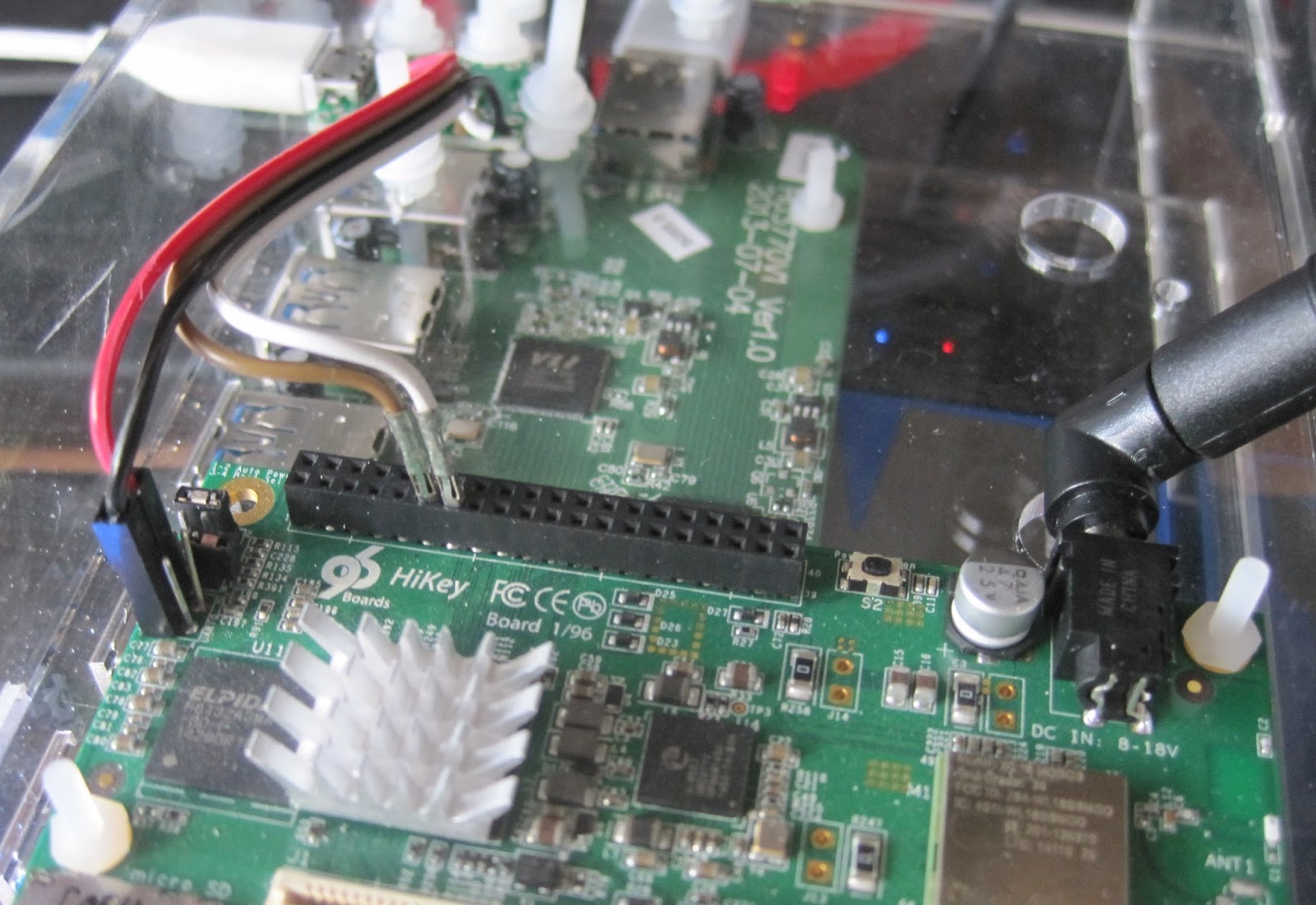
Recently I have been very hopeful about the 96boards Hikey SBC and as Evan Esar predicted I have therefore been very disappointed. I was given a Hikey after a Linaro connect event some time ago by another developer who could not get the system working usefully and this is the tale of what followed.
The Standard Design
This board design was presented as Linaro creating a standard for the 64bit Single Board Computer (SBC) market. So I had expected that a project with such lofty goals would have considered many factors and provided at least as good a solution as the existing 32bit boards.

The lamentable hubris of creating a completely new form factor unfortunately sets a pattern for the whole enterprise. Given the aim towards "makers" I would have accepted that the system would not be a ATX PC size motherboard, but mini/micro/nano and pico ITX have been available for several years.

If opting for a smaller "credit card" form factor why not use one of the common ones that have already been defined by systems such as the Raspberry Pi B+? Instead now every 96Board requires special cases and different expansion boards.

Not content with defining their own form factor the design also uses a 8-18V supply, this is the only SBC I own that is not fed from a 5V supply. I understand that a system might require more current than a micro USB connector can provide, but for example the Banana Pi manages with a DC barrel jack readily capable of delivering 25W which would seem more than enough

The new form factor forced the I/O connectors to be placed differently to other SBC, given the opportunity to concentrate all connectors on one edge (like ATX designs) and avoid the issues where two or three sides are used. The 96board design instead puts connectors on two edges removing any possible benefit this might have given.

The actual I/O connectors specified are rather strange. There is a mandate for HDMI removing the possibility of future display technology changes. The odd USB arrangement of two single sockets instead of a stacked seems to be an attempt to keep height down but the expansion headers and CPU heatsink mean this is largely moot.

The biggest issue though is mandating WIFI but not Ethernet (even as an option), everything else in the design I could logically understand but this makes no sense. It means the design is not useful for many applications without adding USB devices.

Expansion is presented as a 2mm pitch DIL socket for "low speed" signals and a high density connector for "high speed" signals. The positioning and arrangement of these connectors proffered an opportunity to improve upon previous SBC designs which was not taken. The use of 2mm pitch and low voltage signals instead of the more traditional 2.54mm pitch 3.3v signals means that most maker type applications will need adapting from the popular Raspberry Pi and Arduino style designs.

In summary the design appears to have been a Linaro project to favour one of their members which took a Hisilicon Android phone reference design and put it onto a board with no actual thought beyond getting it done. Then afterwards attempted to turn that into a specification, this has simply not worked as an approach.

My personal opinion is that this specification is fatally flawed and, is a direct cause of, the bizarre situation where the "consumer" specification exists alongside the "enterprise" edition which itself has an option of microATX form factor anyhow!
The ImplementationIf we ignore the specification appearing to be nothing more than a codification of the original HiKey design we can look at the HiKey as an implementation.

Initially the board required modifying to add headers to attach a USB to 1.8V LVTTL serial adaptor on the UART0 serial port. Once Andy Simpkins had made this change for me I was able to work through the instructions and attempt to install a bootloader and OS image.

The initial software was essentially HiSilicon vendor code using the Android fastboot system to configure booting. There was no source and the Ubuntu OS images were an obvious afterthought to the Android images. Just getting these images installed required a great deal of effort, repetition and debugging. It was such a dreadful experience this signalled the commencement one of the repeated hiatuses throughout this project, the allure of 64 bit ARM computing has its limits even for me.

When I returned to the project I attempted to use the system from the on-board eMMC but the pre-built binary only kernel and OS image were very limited. Building a replacement kernel , or even modules for the existing one proved fruitless and the system was dreadfully unstable.

I wanted to use the system as a builder for some Open Source projects but the system instability ruled this out. I considered attempting to use virtualisation which would also give better system isolation for builder systems. By using KVM running a modern host kernel and OS as a guest this would also avoid issues with the host systems limitations. At which point I discovered the system had no virtualisation enabled apparently because the bootloader lacked support.

In addition to these software issues there were hardware problems, despite forcing the use of USB for all additional connectivity the USB implementation was dreadful. For a start all USB peripherals have to run at the same speed! One cannot mix full (12Mbit) and high speed (480Mbit) devices which makes adding a USB Ethernet and SATA device challenging when you cannot use a keyboard.

And because I needed more challenges only one of the USB root hubs was functional. In effect this made the console serial port critical as it was the only reliable way to reconfigure the system without a keyboard or network link (and WIFI was not reliable either)
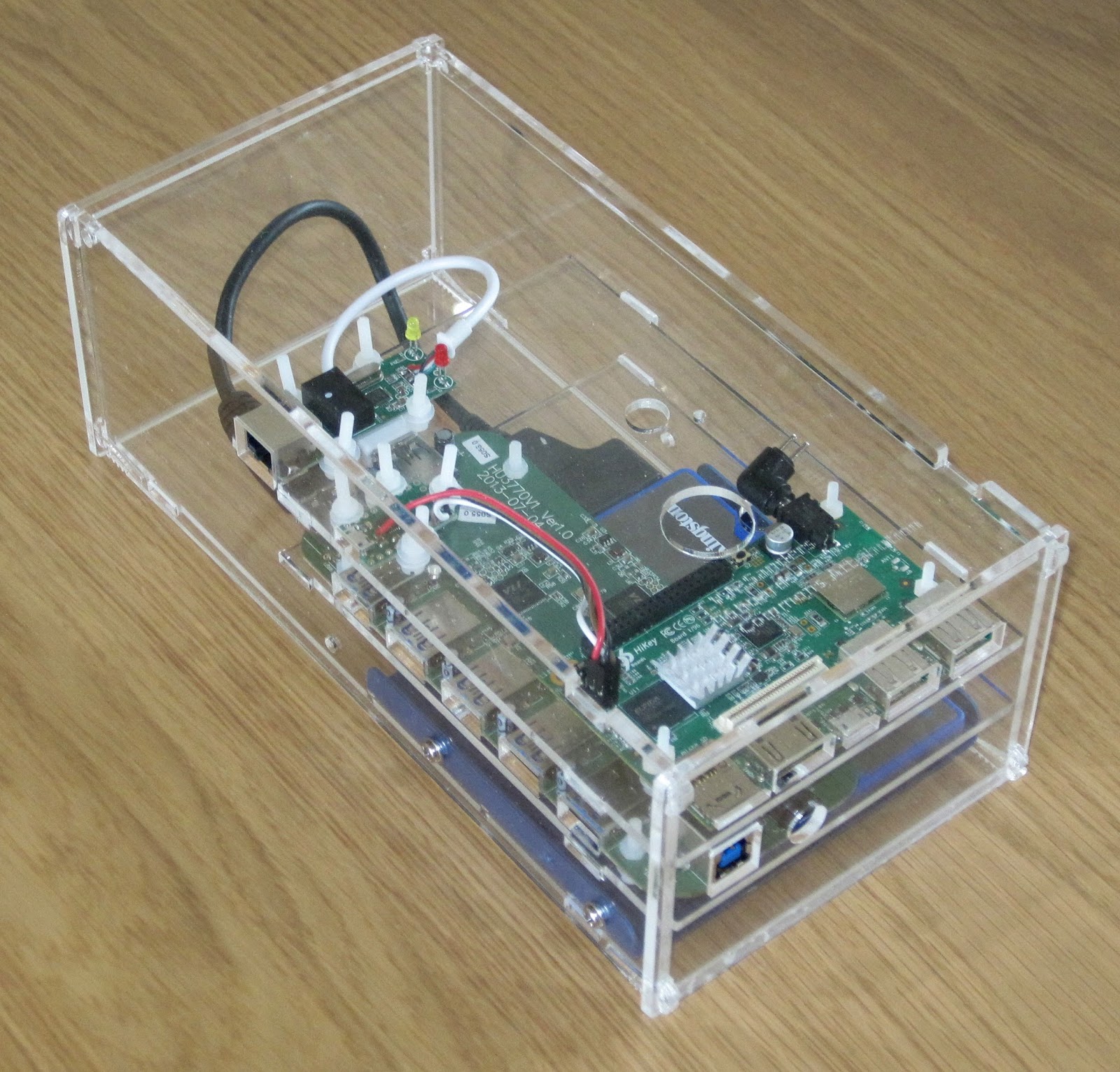
After another long pause in proceedings I decided that I should house all the components together and that perhaps being out on my bench might be the cause of some instability. I purchased a powered Amazon basics USB 2 hub, an Ethernet adaptor and a USB 2 SATA interface in the hope of accessing some larger mass storage.

The USB hub power supply was 12V DC which matched the Hikey requirements so I worked out I could use a single 4A capable supply and run a 3.5inch SATA hard drive too. I designed a laser cut enclosure and mounted all the components. As it turned out I only had a 2.5inch hard drive handy so the enclosure is a little over size. If I were redoing this design I would attempt to make it fit in 1U of height and be mountable in a 19inch rack instead it is an 83mm high (under 2U) box.

A new software release had also become available which purported to use an UEFI bootloader after struggling to install this version unsuccessfully, made somewhat more problematic by the undocumented change from UART0 (unpopulated header) to UART3 on the low speed 2mm pitch header. The system seemed to start the kernel which panicked and hung either booting from eMMC or SD card. Once again the project went on hold after spending tens of hours trying to make progress.
Third time's a charmAs the year rolled to a close I once again was persuaded to look at the hikey, I followed the much improved instructions and installed the shiny new November software release which appears to have been made for the re-release of the Hikey through LeMaker. This time I obtained a Debian "jessie" system that booted from the eMMC.

Having a booted system meant I could finally try and use it. I had decided to try and use the system to host virtual machines used as builders within the NetSurf CI system.

The basic OS uses a mixture of normal Debian packages with some replacements from Linaro repositories. I would have prefered to see more use of Debain packages even if they were from the backports repositories but on the positive side it is good to see the use of Debian instead of Ubuntu.

The kernel is a heavily patched 3.18 built in a predominantly monolithic (without modules) manner with the usual exceptions such as the mali and wifi drivers (both of which appear to be binary blobs). The use of a non-mainline capable SoC means the standard generic distribution kernels cannot be used and unless Linaro choose to distribute a kernel with the feature built in it is necessary to compile your own from sources.

The default install has a linaro user which I renamed to my user and ensured all the ssh keys and passwords on the system were changed. This is an important step when using this pre-supplied images as often a booted system is identical to every other copy.

To access mass storage my only option was via USB, indeed to add any additional expansion that is the only choice. The first issue here is that the USB host support is compiled in so when the host ports are initialised it is not possible to select a speed other than 12MBit. The speed is changed to 480Mbit by using a user space application found in the users home directory (why this is not a tool provided by a package and held in sbin I do not know).

When the usb_speed tool is run there is a chance that the previously enumerated devices will be rescanned and what was /dev/sda has become /dev/sdb if this happens there is a high probability that the system must be rebooted to prevent random crashes due to the "zombie" device.

Because the speed change operation is unreliable it cannot be reliably placed in the boot sequence so this must be executed by hand on each boot to get access to the mass storage.

NetSurf project already uses a x86_64 virtual host system which runs an LLVM physical volume from which we allocate logical volumes for each VM. I initially hoped to do this with the hikey but as soon as I tried to use the logical volume with a VM the system locked up with nothing shown on console. I did not really try very hard to discover why and instead simply used files on disc for virtual drives which seemed to work.

To provide reliable network access I used a USB attached Ethernet device, this like the mass storage suffered from unreliable enumeration and for similar reasons could not be automated requiring manually using the serial console to start the system.

Once the system was started I needed to install the guest VM. I had hoped I might be able to install locally from Debian install media as I do for x86 using the libvirt tools. After a great deal of trial and error I finally was forced to abandon this approach when I discovered the Linaro kernel is lacking iso9660 support so installing from standard media was not possible.

Instead I used the instructions provided by Leif Lindholm to create a virtual machine image on my PC and copied the result across. These instructions are great except I used version 2.5 of Qemu instead of 2.2 which had no negative effect. I also installed the Debian backports for Jessie to get an up to date 4.3 kernel.

After copying the image to the Hikey I started it by hand from the command line as a four core virtual machine and was successfully able to log in. The guest would operate for up to a day before stopping with output such as

$
Message from syslogd@ciworker13 at Jan 29 07:45:28 ...
kernel:[68903.702501] BUG: soft lockup - CPU#0 stuck for 27s! [mv:24089]

Message from syslogd@ciworker13 at Jan 29 07:45:28 ...

kernel:[68976.958028] BUG: soft lockup - CPU#2 stuck for 74s! [swapper/2:0]

Message from syslogd@ciworker13 at Jan 29 07:47:39 ...
kernel:[69103.199724] BUG: soft lockup - CPU#3 stuck for 99s! [swapper/3:0]

Message from syslogd@ciworker13 at Jan 29 07:53:21 ...
kernel:[69140.321145] BUG: soft lockup - CPU#3 stuck for 30s! [rs:main Q:Reg:505]

Message from syslogd@ciworker13 at Jan 29 07:53:21 ...
kernel:[69192.880804] BUG: soft lockup - CPU#0 stuck for 21s! [jbd2/vda3-8:107]

Message from syslogd@ciworker13 at Jan 29 07:53:21 ...
kernel:[69444.805235] BUG: soft lockup - CPU#3 stuck for 22s! [swapper/3:0]

Message from syslogd@ciworker13 at Jan 29 07:55:21 ...
kernel:[69570.177600] BUG: soft lockup - CPU#1 stuck for 112s! [systemd:1]

Timeout, server 192.168.7.211 not responding.

After this output the host system would not respond and had to be power cycled never mind the guest!

Once I changed to single core operation the system would run for some time until the host suffered from the dreaded kernel OOM killer. I was at a loss as to why the oom killer was running as the VM was only allocated half the physical memory (512MB) allowing the host what I presumed to be an adequate amount.

By adding a 512MB swapfile the system was able to push the few hundred kilobytes it wanted to swap and the system was now stable! The swapfile of course has to be started by hand as the external storage is unreliable and unavailable at boot.

I converted the qemu command line to a libvirt config using the virsh tool
virsh domxml-from-native qemu-argv cmdln.args
The converted configuration required manual editing to get a working system but now I have a libvirt based VM guest I can control along with all my other VM using the virt-manager tool.

This system is now stable and has been in production use for a month at time of writing. The one guest VM is a single core 512MB aarch64 system which takes over 1100 seconds (19 minutes) to do what a Banana Pi 2 dual core 1GB memory 32bit native ARM system manages in 300 seconds.

It seems the single core limited memory system with USB SATA attached storage is very, very slow.

I briefly attempted to run the CI system job natively within the host system but within minutes it crashed hard and required a power cycle to retrieve, it had also broken the UEFI boot. I must thank Leif for walking me through recovering the system otherwise I would have needed to start over.
ConclusionsI must stress these conclusions and observations are my own and do not represent anyone else.

My main conclusions are:

This project has taken almost a year to get to the final state and has been one of the least enjoyable within that time. The only reason I have a running system at the end of it is sheer bloody mindedness because after spending hundreds of hours of my free time I was not prepared to see it all go to waste.

To be fair, the road I travelled is now much smoother and if the application is suited to having a mobile phone without a screen then the Hikey probably works as a solution. For me, however, the Hikey product with the current hardware and software limitations is not something I would recommend in preference to other options.

Enrico Zini: Static site generators

I decided to rethink the state of my personal site, and try out some of the new static site generators that are available now. To do that, I jotted down a series of things that I want in a static site generator, then wrote a tool to convert my ikiwiki site to other formats, and set out to evaluate things. As a benchmark I did a full rebuild of my site, which currently contains 1164 static files and 458 markdown pages. My requirements Free layout for my site My / is mostly a high-level index to the site contents. Blog posts are at /blog. My talk archive is organised like a separate blog at /talks. I want the freedom to create other sections of the site, each with its own rss feed, located wherever I want in the site hierarchy. Assets next to posts I occasionally blog just a photo with a little comment, and I would like the .md page with the comment to live next to the image in the file system. I did not even know that I had this as a requirement until I found static site generators that mandated a completely different directory structure for markdown contents and for static assets. Multiple RSS/Atom feeds I want at least one RSS/Atom feed per tag, because I use tags for marking which articles go to http://planet.debian.org. I also want RSS/Atom feeds for specific parts of the site, like the blog and talks. Arbitrary contents in /index.html I want total control over the contents of the main home page of the site. Quick preview while editing contents I do not like to wait several seconds for the site to be rebuilt at every review iteration of the pages I write. This makes me feel like the task of editing is harder than it should, and makes me lose motivation to post. Reasonable time for a full site rebuild I want to be able to run a full rebuild of the site in a reasonable time. I could define "reasonable" in this case as how long I can stare at the screen without getting bored, starting to do something else, and forgetting what it was that I was doing with the site. It is ok if a rebuild takes something like 10 or 30 seconds. It is not ok if it takes minutes. Code and dependency ecosystems that I can work with I can deal with Python and Go. I cannot deal with Ruby or JavaScript. I forgot all about Perl. Also, if it isn't in Debian it does not exist. Decent themes out of the box One of my hopes in switching to a more mainstream generator is to pick and choose themes and easily give my site a more modern look. Hugo Hugo is written in Go and is in Debian testing. Full rebuild time for my site is acceptable, and it can even parallelize:
  $ time hugo
  real      0m5.285s
  user      0m9.556s
  sys       0m1.052s
Free layout for my site was hard to get. I could replace /index.html by editing the template page for it, but then I did not find out how to create another similar index in an arbitrary place. Also, archetypes are applied only on the first path component of new posts, but I would like them instead to be matched on the last path component first, and failing that traveling up to the path until the top. This should be easy to fix by reorganizing the content a bit around here For example, a path for a new blog post of mine could be blog/2016/debian/ and I would like it to match the debian archetype first, and failing that the blog archetype. Assets next to posts almost work. Hugo automatically generates one feed per taxonomy element, and one feed per section. This would be currently sufficient for me, although I don't like the idea that sections map 1 to 1 to toplevel directories in the site structure. Hugo has a server that watches the file system and rerenders pages as they are modified, so the quick preview while editing works fine. About themes, it took me several tries to find a theme that would render navigation elements for both sections and tags, and most themes would render by pages with white components all around, and expect me to somehow dig in and tweak them. That frustrated me, because for quite a while I could not tell if I had misconfigured Hugo's taxonomies or if the theme was just somehow incomplete. Nikola Nikola is written in Python and is in Debian testing. Full rebuild time for my site is almost two orders of magnitude more than Hugo, and I am miffed to find the phrases "Nikola is fast." or "Fast building process" in its front page and package description:
  $ time nikola build
  real      3m31.667s
  user      3m4.016s
  sys       0m24.684s
Free layout could be achieved fiddling with the site configuration to tell it where to read sources. Assets next to post work after tweaking the configuration, but they require to write inconsistent links in the markdown source: https://github.com/getnikola/nikola/issues/2266 I have a hard time accepting that that, because I want to author content with consistent semantic interlinking, because I want to be able 10 years from now to parse it and convert it to something else if a new technology comes out. Nikola generates one RSS/Atom feed per tag just fine. I have not tried generating feeds for different sections of the site. Incremental generation inside its built in server works fine. Pelican Pelican is written in Python and is in Debian testing. Full rebuild time for my site is acceptable:
  $ time pelican -d
  real      0m18.207s
  user      0m16.680s
  sys       0m1.448s
By default, pelican seems to put generate a single flat directory of html files regardless of the directory hierarchy of the sources. To have free layout, pelican needs some convincing in the configuration:
  PATH_METADATA = r"(?P<relpath>.+)\.md"
  ARTICLE_SAVE_AS = " relpath /index.html"
but even if I do that, the urls that it generates still point to just slug /index.html and I have not trivially found a configuration option to fix that accordingly. I got quite uncomfortable at the idea of needing to configure content generation and linking to match, instead of having one automatically being in sync with the other. Having assets next to posts seems to be possible (also setting STATIC_PATHS = ["."]), but I do not recall making progress on this front. I did not manage to generate a feed for each tag out of the box, and probably there is some knob in the configuration for it. I gave up with Pelican as trying it out felt like a constant process of hacking the configuration from defaults that do not make any sense for me, withouth even knowing if a configuration exists that would do what I need Ikiwiki Ikiwiki is written in Perl and is in Debian. Although I am not anymore proficient with Perl, I was already using it, so it was worth considering. Full rebuild time feels a bit on the slow side but is still acceptable:
  $ time ikiwiki --setup site.setup
  real      0m37.356s
  user      0m34.488s
  sys       0m1.536s
In terms of free site structure, all feeds for all or part of the site, ikiwiki just excels. I even considered writing a python web server that monitors the file system and calls ikiwiki --refresh when anything changes, and calling it a day. However, when I tried to re-theme my website around a simple bootstrap boilerplate, I found that to be hard, as a some of the HTML structure is hardcoded in Perl (and it's also my fault) and there is only so much that can be done by tweaking the (rather unreadable) templates. siterefactor During all these experiments I had built siterefactor to generate contents for all those static site engines, and it was going through all the contents quite fast:
  $ time ./siterefactor src dst -t hugo
  real  0m1.222s
  user  0m0.904s
  sys   0m0.308s
So I wondered how slow it would become if, instead of making it write markdown, I made it write HTML via python markdown and Jinja2:
  $ time ./siterefactor ~/zz/ikiwiki/pub/ ~/zz/ikiwiki/web -t web
  real  0m6.739s
  user  0m5.952s
  sys   0m0.416s
I then started wondering how slower it would become if I implemented postprocessing of all local URLs generated by Markdown to make sure they are kept consistent even if the path of a generated page is different than the path of its source. Not much slower, really. I then added taxonomies. And arbitrary Jinja2 templates in the input, able to generate page lists and RSS/Atom feeds. And theming. And realised that reading all the sources and cross-linking them took 0.2 seconds, and the rest was generation time. And that after cross-linking, each page can be generated independently from all the others. staticsite So my site is now generated with staticsite:
  $ time ssite build
  real  0m6.833s
  user  0m5.804s
  sys   0m0.500s
It's comparable with Hugo, and on a single process.

Erich Schubert: Stop abusing lambda expressions - this is not functional programming

I know, all the Scala fanboys are going to hate me now. But:
Stop overusing lambda expressions.
Most of the time when you are using lambdas, you are not even doing functional programming, because you often are violating one key rule of functional programming: no side effects.
For example:
collection.forEach(System.out::println);
is of course very cute to use, and is (wow) 10 characters shorter than:
for (Object o : collection) System.out.println(o);
but this is not functional programming because it has side effects.
What you are doing are anonymous methods/objects, using a shorthand notion. It's sometimes convenient, it is usually short, and unfortunately often unreadable, once you start cramming complex problems into this framework.
It does not offer efficiency improvements, unless you have the propery of side-effect freeness (and a language compiler that can exploit this, or parallelism that can then call the function concurrently in arbitrary order and still yield the same result).
Here is an examples of how to not use lambdas:
DZone Java 8 Factorial (with boilerplate such as the Pair class omitted):
Stream<Pair> allFactorials = Stream.iterate(
  new Pair(BigInteger.ONE, BigInteger.ONE),
  x -> new Pair(
    x.num.add(BigInteger.ONE),
    x.value.multiply(x.num.add(BigInteger.ONE))));
return allFactorials.filter(
  (x) -> x.num.equals(num)).findAny().get().value;
When you are fresh out of the functional programming class, this may seem like a good idea to you... (and in contrast to the examples mentioned above, this is really a functional program).
But such code is a pain to read, and will not scale well either. Rewriting this to classic Java yields:
BigInteger cur = BigInteger.ONE, acc = BigInteger.ONE;
while(cur.compareTo(num) <= 0)  
  cur = cur.add(BigInteger.ONE); // Unfortunately, BigInteger is immutable!
  acc = acc.multiply(cur);
 
return acc;
Sorry, but the traditional loop is much more readable. It will still not perform very well (because of BigInteger not being designed for efficiency - it does not even make sense to allow BigInteger for num - the factorial of 2**63-1, the maximum of a Java long, needs 1020 bytes to store, i.e. about 500 exabyte.
For some, I did some benchmarking. One hundred random values num (of course the same for all methods) from the range 1 to 1000.
I also included this even more traditional version:
BigInteger acc = BigInteger.ONE;
for(long i = 2; i <=x; i++)  
  acc = acc.multiply(BigInteger.valueOf(i));
 
return acc;
Here are the results (Microbenchmark, using JMH, 10 warum iterations, 20 measurement iterations of 1 second each):
functional    1000     100  avgt   20  9748276,035   222981,283  ns/op
biginteger    1000     100  avgt   20  7920254,491   247454,534  ns/op
traditional   1000     100  avgt   20  6360620,309   135236,735  ns/op
As you can see, this "functional" approach above is about 50% slower than the classic for-loop. This will be mostly due to the Pair and additional BigInteger objects created and garbage collected.
Apart from being substantially faster, the iterative approach is also much simpler to follow. (To some extend it is faster because it is also easier for the compiler!)
There was a recent blog post by Robert Br utigam that discussed exception throwing in Java lambdas and the pitfalls associated with this. The discussed approach involves abusing generics for throwing unknown checked exceptions in the lambdas, ouch.

Don't get me wrong. There are cases where the use of lambdas is perfectly reasonable. There are also cases where it adheres to the "functional programming" principle. For example, a stream.filter(x -> x.name.equals("John Doe")) can be a readable shorthand when selecting or preprocessing data. If it is really functional (side-effect free), then it can safely be run in parallel and give you some speedup.
Also, Java lambdas were carefully designed, and the hotspot VM tries hard to optimize them. That is why Java lambdas are not closures - that would be much less performant. Also, the stack traces of Java lambdas remain somewhat readable (although still much worse than those of traditional code). This blog post by Takipi showcases how bad the stacktraces become (in the Java example, the stream function is more to blame than the actual lambda - nevertheless, the actual lambda application shows up as the cryptic LmbdaMain$$Lambda$1/821270929.apply(Unknown Source) without line number information). Java 8 added new bytecodes to be able to optimize Lambdas better - earlier JVM-based languages may not yet make good use of this.
But you really should use lambdas only for one-liners. If it is a more complex method, you should give it a name to encourage reuse and improve debugging.
Beware of the cost of .boxed() streams!
And do not overuse lambdas. Most often, non-Lambda code is just as compact, and much more readable. Similar to foreach-loops, you do lose some flexibility compared to the "raw" APIs such as Iterators:
for(Iterator<Something>> it = collection.iterator(); it.hasNext(); )  
  Something s = it.next();
  if (someTest(s)) continue; // Skip
  if (otherTest(s)) it.remove(); // Remove
  if (thirdTest(s)) process(s); // Call-out to a complex function
  if (fourthTest(s)) break; // Stop early
 
In many cases, this code is preferrable to the lambda hacks we see pop up everywhere these days. Above code is efficient, and readable.
If you can solve it with a for loop, use a for loop!
Code quality is not measured by how much functionality you can do without typing a semicolon or a newline!
On the contrary: the key ingredient to writing high-performance code is the memory layout (usually) - something you need to do low-level.
Instead of going crazy about Lambdas, I'm more looking forward to real value types (similar to a struct in C, reference-free objects) maybe in Java 9 (Project Valhalla), as they will allow reducing the memory impact for many scenarios considerably. I'd prefer a mutable design, however - I understand why this is proposed, but the uses cases I have in mind become much less elegant when having to overwrite instead of modify all the time.

29 February 2016

Chris Lamb: Free software activities in February 2016

Here is my monthly update covering a large part of what I have been doing in the free software world (previously):
  • Various improvements to django-slack, a library to easily post messages to the Slack group-messaging utility from projects using the Django web development framework:
    • Added explicit support to send messages asynchronously via the Celery distributed task queue. (#29)
    • Worked with Patrick Clope to add an escapeslack template filter to ensure the correct characters for Slack's API are escaped using Django's built-in safe is too invasive. (#36)
    • Corrected an issue where custom endpoints and channel names were incompatible. (#27)
    • Overhaul of the field/option/block parsing. (49ff3c4)
    • Moved away from using a django.template.Context instance, preventing a deprecation warning. (#31)
  • Added a create-folders subcommand to my tickle-me-email Getting Things Done (GTD) email toolbox to create numbered folders for the rotate "tickler" functionality. (#3)
  • Wrote and released a Django template tag to collapse multiple whitespace/newline characters in order to correctly format, for example, plaintext emails that make extensive use of for-loops. These would normally require careful and fragile placement of the % for .. % and % endfor % tags. (Repo)
  • Pushed a number of updates to my Strava Enhancement Suite, a Chrome extension that improves and fixes annoyances in the web interface of the Strava cycling and running tracker:
    • Fix unit conversion where the element was wrapped in an another HTML element. (#48)
    • Hide premium indicator from top-level navigation. (#45)
    • Correct matching of the "shop" link in top-level navigation and footer module. (#47 & #46)
    • Remove "premium" pages on Club pages. (#44)
  • Added a security-oriented warning to Ansible's documentation regarding the behaviour if an UFW firewall application profile is added and subsequently removed. (#1740)
  • Added support to my django-staticfiles-dotd "staticfiles" library which concatenates Javascript and CSS files from .d-style directories to support an arbitrary file rendering method. This allows the use of media pre-processors such as SASS within such directories. (#1)
  • Corrected my Chrome extension for the FastMail web interface to correctly hook into the internal "send" mechanism. (#2)
  • Moved my stravabot IRC bot to use dh-virtualenv and systemd, improving security and reliability. (1c48709)
  • Updated django-pedantic-http-methods a tool to raise an exception during development when attempting to perform side effects in GET and HEAD HTTP methods to support the latest version of Django. (#1)

Debian
  • Updated travis.debian.net a hosted script to easily test and build Debian packages on the Travis CI continuous integration platform to support:
    • Automatic bumping of the version number in debian/changelog based on TRAVIS_BUILD_NUMBER. (#14)
    • Security repositories. Thanks to Stefan Jenkner for the initial pull request. These are additionally now enabled by default. (#15)
    • The backports repositories. (#13)
  • Applied #812830 and #812830 from James Clark to the Debian Archive Kit to improve the interface of various webpages it generates.
  • Updated the SSL certificate for try.diffoscope.org, a hosted version of the diffoscope in-depth and content-aware diff utility. Thanks to Bytemark for sponsoring the hardware.
  • Worked on my slides for Reproducible Builds - fulfilling the original promise of free software, to be presented at FOSSASIA '16.
My work in the Reproducible Builds project was also covered in more depth in Lunar's weekly reports (#40, #41, #42, #43)
LTS

This month I have been paid to work 18 hours on Debian Long Term Support (LTS). In that time I did the following:
  • "Frontdesk" duty for the week of 22nd 28th, triaging CVEs, etc.
  • Proofread announcements, etc. for the upcoming migration to wheezy-lts.
  • Issued DLA 417-1 for xdelta3 to fix a buffer overflow that allowed arbitrary code execution from input files.
  • Issued DLA 420-1 for libmatroska, correcting a heap information leak.
  • Issued DLA 428-1 for websvn fixing a cross-site scripting vulnerability.
  • Issued DLA 429-1 for pixman fixing a buffer overflow issue.
  • Issued DLA 430-1 & DLA 431-1 for libfcgi and libfcgi-perl respectfully, fixing a remote denial-of-service (DoS) vulnerability.

Uploads
  • redis (2:3.0.7-2) Correcting my SOURCE_DATE_EPOCH reproducibility patch as the conditional was accidentally inverted. Thanks to Reiner Herrmann (deki).
  • disque (1.0~rc1-5) Making the parallel SOURCE_DATE_EPOCH patch change and additionally tidying the packaging after introducing procps as a build-dependency.


RC bugs


I also filed 137 FTBFS bugs against aac-tactics, angular.js, astyle, bcftools, blacs-mpi, bogofilter, boxes, caldav-tester, ccdproc, ckeditor, coq-float, cqrlog, dasher, django-recurrence, dspdfviewer, eclipse-egit, ess, etcd, felix-latin, fio, flexml, funny-manpages, gap-atlasrep, garmin-plugin, gitlab, gnome-mines, graphicsmagick, haskell-nettle, healpy, hg-git, hunspell, hwloc, ijs, ipset, janest-core-extended, jpathwatch, kcompletion, kcompletion, keyrings.alt, kodi-pvr-hts, kodi-pvr-vdr-vnsi, libcommons-compress-java, libgnome2-wnck-perl, libkate, liblrdf, libm4ri, libnet-server-mail-perl, libsis-jhdf5-java, libspectre, libteam, libwnck, libwnckmm, libxkbcommon, lombok, lombok-patcher, mako, maven-dependency-analyzer, mopidy-mpris, mricron, multcomp, netty-3.9, numexpr, ocaml-textutils, openimageio, openttd-openmsx, osmcoastline, osmium-tool, php-guzzle, php-net-smartirc, plexus-component-metadata, polari, profitbricks-client, pyentropy, pynn, pyorbital, pypuppetdb, python-aioeventlet, python-certifi, python-hglib, python-kdcproxy, python-matplotlib-venn, python-mne, python-mpop, python-multipletau, python-pbh5tools, python-positional, python-pydot-ng, python-pysam, python-snuggs, python-tasklib, r-cran-arm, r-cran-httpuv, r-cran-tm, rjava, ros-geometry-experimental, ros-image-common, ros-pluginlib, ros-ros-comm, rows, rr, ruby-albino, ruby-awesome-print, ruby-default-value-for, ruby-fast-gettext, ruby-github-linguist, ruby-gruff, ruby-hipchat, ruby-omniauth-crowd, ruby-packetfu, ruby-termios, ruby-thinking-sphinx, ruby-tinder, ruby-versionomy, ruby-zentest, sbsigntool, scikit-learn, scolasync, sdl-image1.2, signon-ui, sisu-guice, sofa-framework, spykeutils, ssreflect, sunpy, tomcat-maven-plugin, topmenu-gtk, trocla, trocla, tzdata, verbiste, wcsaxes, whitedune, wikidiff2, wmaker, xmlbeans, xserver-xorg-input-aiptek & zeroc-icee-java.

FTP Team

As a Debian FTP assistant I ACCEPTed 107 packages: androguard, android-platform-dalvik, android-platform-development, android-platform-frameworks-base, android-platform-frameworks-native, android-platform-libnativehelper, android-platform-system-core, android-platform-system-extras, android-platform-tools-base, android-sdk-meta, apktool, armci-mpi, assertj-core, bart, bind9, caja, caldav-tester, clamav, class.js, diamond, diffoscope, django-webpack-loader, djangocms-admin-style, dnsvi, esptool, fuel-astute, gcc-6-cross, gcc-6-cross-ports, gdal, giella-core, gnupg, golang-github-go-ini-ini, golang-github-tarm-serial, gplaycli, gradle-jflex-plugin, haskell-mountpoints, haskell-simple, hurd, iceweasel, insubstantial, intellij-annotations, jetty9, juce, keyrings.alt, leptonlib, libclamunrar, libdate-pregnancy-perl, libgpg-error, libhtml5parser-java, libica, libvoikko, linux, llvm-toolchain-3.8, lombok-patcher, mate-dock-applet, mate-polkit, mono-reference-assemblies, mxt-app, node-abab, node-array-equal, node-array-flatten, node-array-unique, node-bufferjs, node-cors, node-deep-extend, node-original, node-setimmediate, node-simplesmtp, node-uglify-save-license, node-unpipe, oar, openjdk-8, openjdk-9, pg8000, phantomjs, php-defaults, php-random-compat, php-symfony-polyfill, pnetcdf, postgresql-debversion, pulseaudio-dlna, pyconfigure, pyomo, pysatellites, python-fuelclient, python-m3u8, python-pbh5tools, python-qtpy, python-shellescape, python-tunigo, pyutilib, qhull, r-cran-rjsonio, r-cran-tm, reapr, ruby-fog-dynect, scummvm-tools, symfony, talloc, tesseract, twextpy, unattended-upgrades, uwsgi, vim-command-t, win-iconv, xkcdpass & xserver-xorg-video-ast. I additionally REJECTed 4 packages.

Tom Marble: is-slfc-shooting-open-source-in-the-foot

Is SFLC Shooting Open Source in the Foot? The academic article by SFLC about ZFS is troubling and may unintentionally shoot free software licensing in the foot. When I was at Sun (as part of the team that released the Java Programming Language by starting the OpenJDK project) I often heard community concerns about the CDDL license. At the time the big complaint was about the "Choice of Venue" clause. I got involved because Sun had developed many essential Java libraries and distributed them under CDDL. The community requested a more permissive license and I was able to convince internal project leaders (and Sun's lawyers) to make a licensing change for a handful of these projects. And there was much rejoicing. Based on my experience in helping Java to become open source I came to appreciate the legal hacks on copyright which make open source possible. It's the free software license which uses copyright to enable sharing (vs. the default of disabling sharing).

Open Source Licenses
And so I have appreciated many of the writings and speeches from SFLC on the mechanisms of software freedom. I was particularly moved by the talks about the "Freedom Box" concept. That's why this SFLC post on ZFS sounds so off key: if open source works because of free software licenses it seems weird to weaken that foundation by prioritizing the "equity" (or intended spirit) of the license. Allow me to mention that as I do most of my computing these days on GNU/Linux I miss the super cool features of ZFS from Solaris. I did try an early version of btrfs and was quite disappointed (but that's another story). In this happy case the source code for ZFS is available, but what about the future, when we aren't so lucky and someone asserts in court that the "you know, the software license was really about the spirit of sharing and that means we are allowed to use it -- and not be held to the pesky details as written in the license". A lawyer I respect called this out: "Equity" has no place in US law. The point is that for lawyers software licenses work because they have clear, written rules to guarantee the spirit is upheld; but spirit doesn't work in front of a judge -- clear rules do. Free and open source software has made so much progress in all facets of life why on earth would we second guess the licensing tools that made it possible? And why would SFLC try to shift the spotlight (and in this case the legal burden) to "a good-faith belief that the conduct falls within the equity of the license". Especially given the earlier comment which clearly states "[the combination] is inconsistent with the literal meaning of GPLv2 section 2(b)."
Wat?

The entire raison d' tre for open source software licenses was so that developers (and users) would have clarity and wouldn't have to ask permission to use the software!!! As stated elsewhere (and like I did with those Java libraries) the easy solution is to have the ZFS copyright holder (now Oracle) reclicense (or dual license) the code under a compatible license (permissive or copyleft). If OpenSolaris was still a thing I might understand some hesitancy, but why not liberate ZFS now? So we have to wonder what could possibly be motivating this odd "spirit of the license" position on the part of SFLC? Fortunately charities that enjoy non-profit status are required to make public filings of their income in something called a "Form 990". The latest SFLC 990 I could find shows SFLC getting 78% (or just over $5 million) from "non public support" (see page 14). A number with "two commas" would even be interesting to for-profit companies. Just whom is making these "donations" and what exactly do they get in return? Apparently I'm not the only one wondering about this question. On one hand it's important to know if SFLC as a non-profit is, indeed, acting in the public interest (as the IRS requires). Yet the even bigger issue here is would "asking for a consensus about the spirit" trump the written copyright license and set a scary precedent for open source software in general?

Steve Kemp: If line-noise is a program, all fuzzers are developers

Recently I had a conversation with a programmer who repeated the adage that programming in perl consists of writing line-noise. This isn't true but it reminded me of my love of fuzzers. Fuzzers are often used to generate random input files which are fed to tools, looking for security problems, segfaults, and similar hilarity. To the untrained eye the output of most fuzzers is essentially line-noise, since you often start with a valid input file and start flipping bits, swapping bytes, and appending garbage. Anyway this made me wonder what happens if you fed random garbage into a perl interpreter? I wasn't brave enough to try it, because knowing my luck the fuzzer would write a program like so:
system( "rm -rf /home/steve" );
But I figured it was still an interesting idea, and I could have a go at fuzzing something else. I picked gawk, the GNU implementation of awk because the codebase is pretty small, and I understand it reasonably well. Almost immediately my fuzzer found some interesting segfaults and problems. Here's a nice simple example:
 $ gawk 'for (i = ) in steve kemp rocks'
 ..
 gawk: cmd. line:1: fatal error: internal error: segfault
 Aborted
I look forward to seeing what happens when other people fuzz perl..

25 February 2016

Matthew Garrett: I bought some awful light bulbs so you don't have to

I maintain an application for bridging various non-Hue lighting systems to something that looks enough like a Hue that an Amazon Echo will still control them. One thing I hadn't really worked on was colour support, so I picked up some cheap bulbs and a bridge. The kit is badged as an iSuper iRainbow001, and it's terrible.

Things seemed promising enough at first, although the bulbs were alarmingly heavy (there's a significant chunk of heatsink built into them, which seems to get a lot warmer than I'd expect from something that claims a 7W power consumption). The app was a bit clunky, but eh - I wasn't planning on using it for long. I pressed the button on the bridge, launched the app and could control the bulbs. The first thing I noticed was that they had a separate "white" and "colour" mode. White mode was pretty bright, but colour mode massively less so - presumably the white LEDs are entirely independent of the RGB ones, and much higher intensity. Still, potentially useful as mood lighting.

Anyway. Next step was to start playing with the protocol, which meant finding the device on my network. I checked anything that had picked up a DHCP lease recently and nmapped them. The OS detection reported Linux, which wasn't hugely surprising - there was no GPL notice or source code included with the box, but I'm way past the point of shock at that. It also reported that there was a telnet daemon running. I connected and got a login prompt. And then I typed admin as the username and admin as the password and got a root prompt. So, there's that. The copy of Busybox included even came with tftp, so it was easy to get copies of tcpdump and strace on there to see what was up.

So. Next step. Protocol sniffing. I wanted to know how discovery worked, so reset the device to factory and watched what happens. The app on my phone sent out a discovery packet on UDP port 18602 which looked like this:

INLAN:CLIP:23.21.212.48:CLPT:22345:MAC:02:00:00:00:00:00

The CLIP and CLPT fields refer to the cloud server that allows for management when you're not on the local network. The mac field contains an utterly fake address. If you send out a discovery packet and your mac hasn't been registered with the device, you get a denial back. If your mac has been (and by "mac" here I mean "utterly fake mac that's the same for all devices"), you get back a response including the device serial number and IP address. And if you just leave out the mac field entirely, you get back a response no matter whether your address is registered or not. So, that's a start. Once you've registered one copy of the app with the device, anything can communicate with it by just using the same fake mac in the discovery packets.

Onwards. The command format turns out to be simple. They start ##, are followed by two ascii digits encoding a command, four ascii digits containing a bulb id, two ascii digits containing the number of following bytes and then the command data (in ascii). An example is:

##05010002ff

which decodes as command 5 (set white intensity) on bulb 1 with two bytes of data following, each of which is an f. This translates as "Set bulb 1 to full white intensity". I worked out the rest pretty quickly - command 03 sets the RGB colour of the bulb, 0A asks the bridge to search for new bulbs, 0B tells you which bulbs are available and their capabilities and 0E gives you the MAC addresses of the bulbs( ). 0C crashes the server process, and 06 spews a bunch of garbage back at you and potentially crashes the bulb in a hilarious way that involves it flickering at about 15Hz. It turns out that 06 is actually the "Rename bulb" command, and if you send it less data than it's expecting something goes hilariously wrong in string parsing and everything is awful.

Ok. Easy enough, but not hugely exciting. What about the remote protocol? This turns out to involve sending a login packet and then a wrapped command packet. The login has some length data, a header of "MQIsdp", a long bunch of ascii-encoded hex, a username and a password.

The username is w13733 and the password is gbigbi01. These are hardcoded in the app. The ascii-encoded hex can be replaced with 0s and the login succeeds anyway.

Ok. What about the wrapping on the command? The login never indicated which device we wanted to talk to, so presumably there's some sort of protection going on here oh wait. The command packet is a length, the serial number of the bridge and then a normal command packet. As long as you know the serial number of the device (which it tells you in response to a discovery packet, even if you're unauthenticated), you can use the cloud service to send arbitrary commands to the device (including the one that crashes the service). One of which involves the device then doing some kind of string parsing that doesn't appear to work that well. What could possibly go wrong?

Ok, so that seemed to be the entirety of the network protocol. Anything else to do? Some poking around on the bridge revealed (a) that it had an active wireless device and (b) a running DHCP server. They wouldn't, would they?

Yes. Yes, they would.

The devices all have a hardcoded SSID of "iRainbow", although they don't broadcast it. There's no security - anybody can associate. It'll then hand out an IP address. It's running telnetd on that interface as well. You can bounce through there to the owner's internal network.

So, in summary: it's a device that infringes my copyright, gives you root access in response to trivial credentials, has access control that depends entirely on nobody ever looking at the packets, is sufficiently poorly implemented that you can crash both it and the bulbs, has a cloud access protocol that has no security whatsoever and also acts as an easy mechanism for people to circumvent your network security. This may be the single worst device I've ever bought.

I called the manufacturer and they insisted that the device was designed in 2012, was no longer manufactured or supported, that they had no source code to give me and there would be no security fixes. The vendor wants me to pay for shipping back to them and reserves the right to deduct the cost of the original "free" shipping from the refund. Everything is awful, which is why I just ordered four more random bulbs to play with over the weekend.

comment count unavailable comments

Next.

Previous.