Search Results: "bod"

12 August 2015

Daniel Pocock: Recording live events like a pro (part 2: video)

In the first blog in this series, we looked at how to capture audio effectively for a range of different events. While recording audio appears less complicated than video, it remains fundamental to a good recording. For some types of event, like a speech or a debate, you can have quite a bad video with poor lighting and other defects but people will still be able to watch it if the audio is good. Therefore, if you haven't already looked at the previous blog, please do so now. As mentioned in the earlier blog, many people now have high quality equipment for recording both audio and video and a wide range of opportunities to use it, whether it is a talk at a conference, a wedding or making a Kickstarter video. The right camera for video recording The fundamental piece of equipment is the camera itself. You may have a DSLR camera that can record video or maybe you have a proper handheld video camera. The leading DSLR cameras, combined with a good lens, make higher quality recordings than many handheld video cameras. Unfortunately, although you pay good money to buy a very well engineered DSLR that could easily record many hours of video, most DSLRs are crippled to record a maximum of 30 minutes in one recording. This issue and some workarounds are discussed later in this blog. If you don't have any camera at all you need to think carefully about which type to buy. If you are only going to use it once you may want to consider renting or borrowing or asking for other people attending the event to bring whatever cameras they have to help make multiple recordings (the crowdsourcing solution). If you are a very keen photographer then you will probably have a preference for a DSLR. Accessories Don't just look at the cost of your camera and conclude that is all the budget you need. For professional quality video recording, you will almost certainly need some accessories. You may find they are overpriced at the retail store where you bought your camera, but you still need some of them, so have a look online.
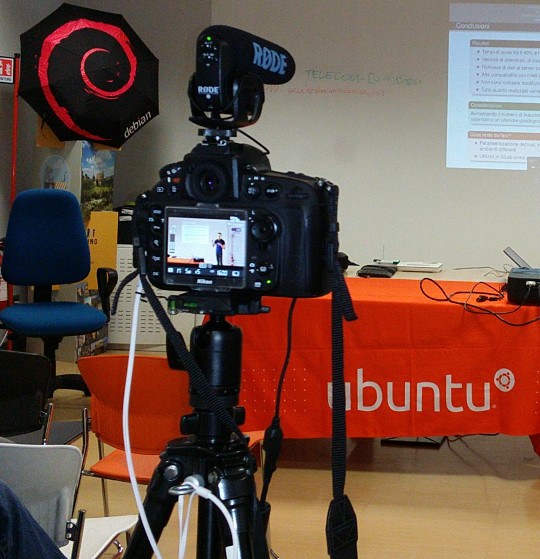
Recording a talk at a free software event with a Nikon D800 on a very basic tripod with Rode VideoMic Pro, headphones (white cable) and external power (black cable) If you want to capture audio with the camera and record it in the video file (discussed in more detail below), you will need to purchase a microphone that mounts on the camera. The built-in microphones on cameras are often quite bad, even on the most expensive cameras. If you are just using the built-in microphone for reference audio (to help with time synchronization when you combine different audio files with the video later) then the built-in microphone may be acceptable. Camera audio is discussed in more detail below. If your camera has a headphone socket, get some headphones for listening to the audio. Make sure you have multiple memory cards. Look carefully at the speed of the memory cards, slow ones are cheaper but they can't keep up with the speed of writing 1080p video. At a minimum, you should aim to buy memory cards that can handle one or two days worth of data for whatever it is you do. A tripod is essential for most types of video. If you use a particularly heavy camera or lens or if you are outdoors and it may be windy you will need a heavier tripod for stability. For video, it is very useful to have a tripod with a handle for panning left and right but if the camera will be stationary for the whole recording then the handle is not essential. Carrying at least one spare battery is another smart move. On one visit to the Inca Trail in Peru, we observed another member of our group hiking up and down the Andes with a brand new DSLR that they couldn't use because the battery was flat. For extended periods of recording, batteries will not be sufficient and you will need to purchase a mains power supply (PSU). These are available for most types of DSLR and video camera. The camera vendors typically design cameras with unusual power sockets so that you can only use a very specific and heavily overpriced PSU from the same company. Don't forget a surge protector too. There are various smartphone apps that allow you to remotely control the camera from the screen of your phone, such as the qDslrDashboard app. These often give a better preview than the screen built-in to the camera and may even allow you to use the touch screen to focus more quickly on a specific part of the picture. A regular USB cable is not suitable for this type of app, you need to buy a USB On-The-Go (OTG) cable.
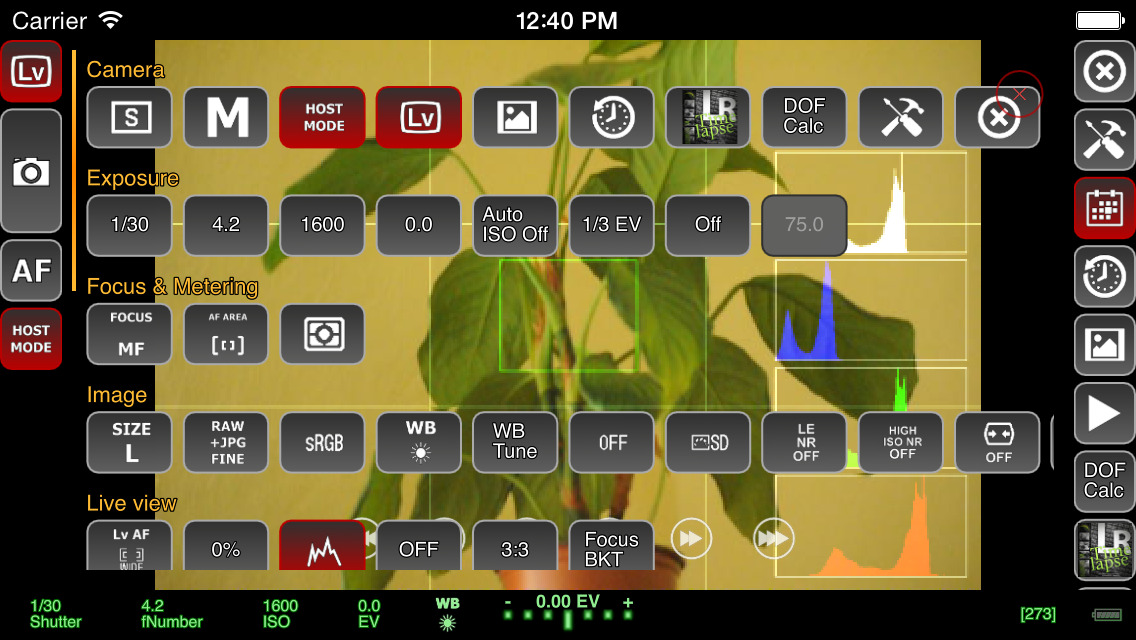
Screenshot of qDslrDashboard app on a smartphone, controlling a DSLR camera If you plan to copy the video from the camera to a computer at the event, you will need to make sure you have a fast memory card reader. The memory card readers in some laptops are quite slow and others can be quite fast so you may not need to buy an extra card reader. Camera audio Most cameras, including DSLRs, have a built-in microphone and a socket for connecting an external microphone. The built-in microphones obtain very poor quality sound. For many events, it is much better to have independent microphones, such as a lapel microphone attached to a smartphone or wireless transmitter. Those solutions are described in part one of this blog series. Nonetheless, there are still some benefits of capturing audio in the camera. The biggest benefit is the time synchronization: if you have audio recordings in other devices, you will need to align them with the video using post-production software. If the camera recorded an audio stream too, even if the quality is not very good, you can visualize the waveform on screen and use it to align the other audio recordings much more easily and precisely. If the camera will be very close to the people speaking then it may be acceptable to use a microphone mounted on the camera. This will be convenient for post-production because the audio will be synchronized with the video. It may still not be as good as a lapel microphone though, but the quality of these camera-mounted microphones is still far higher than the built-in microphones. I've been trying the Rode VideoMic Pro, it is definitely better than recording with the built-in microphone on the camera and also better than the built-in microphone on my phone. One problem that most people encounter is the sound of the lens autofocus mechanism being detected by the microphone. This occurs with both the built-in microphone and any other microphone you mount on the camera. A microphone mounted on top of the camera doesn't detect this noise with the same intensity as the built-in microphone but it is still present in the recordings. If using a camera-mounted microphone to detect the audio from an audience, you may need to have an omnidirectional microphone. Many camera-mounted microphones are directional and will not detect very much sound from the sides or behind the camera. When using any type of external microphone with the camera, it is recommend to disable automatic gain control (AGC) in the camera settings and then manually adjust the microphone sensitivity/volume level. Use headphones A final word on audio - most good cameras have an audio output socket. Connect headphones and wear them, to make sure you are always capturing audio. Otherwise, if the microphone's battery goes flat or if a wireless microphone goes out of range you may not notice. Choosing a lens The more light you get, the better. Bigger and more expensive lenses allow more light into the camera. Many of the normal lenses sold with a DSLR camera are acceptable but if it is a special occasion you may want to rent a more expensive lens for the day. If you already have a lens, it is a very good idea to test it in conditions similar to those you expect for the event you want to record. Recording duration limits Most DSLR cameras with video capability impose a 30 minute maximum recording duration This is basically the result of a friendly arrangement between movie studios and politicians to charge an extra tax on video recording technology and potentially make the movie studio bosses richer, supposedly justified by the fact that a tiny but exaggerated number of people use their cameras to record movies at the cinema. As a consequence, most DSLR manufacturers limit the duration of video recording so their product won't be subject to the tax, ensuring the retail price is lower and more attractive. On top of this, many DSLR cameras also have a 4GB file size limit if they use the FAT filesystem. Recording 1080p video at a high frame rate may hit the file size limit in 10 minutes, well before you encounter the 30 minute maximum recording duration. To deal with the file size issue, you can record at 720p instead of 1080p and use the frame rate 24fps. For events longer than 30 minutes or where you really want 1080p or a higher frame rate, there are some other options you can consider:
  • Buy or rent a proper video camera instead of using a DSLR camera
  • Using multiple cameras that can stop and be restarted at different times.
  • Manually stopping and restarting the camera if there are breaks in the event where it is safe to do so.
  • Use an app to control the camera and program it to immediately restart the recording each time it stops
  • Extract the raw output from the camera's HDMI socket and record into some other device or computer. There are several purpose-built devices
    that can be used this way with an embedded SSD for storage.
  • There are also some people distributing unofficial/alternative firmware images that remove the artificial 30 minute recording limit.

Camera settings There are many online tutorials and demonstration videos on YouTube that will help you optimize the camera settings for video. You may have already made recordings using the automatic mode. Adjusting some or all of the settings manually may help you create a more optimal recording. You will need to spend some time familiarizing yourself with the settings first. The first thing to check is white balance. This tells the camera the type of lighting in the location. If you set this incorrectly then the colours will be distorted. Many cameras have the ability to automatically set the white balance. For video, you may be able to change one or more settings that control the recording quality. These settings control the file compression ratio and image size. Typical image size settings are 720p and 1080p. Compression ratio may be controlled by a high/medium/low quality setting. Choosing the highest quality and biggest picture requires more space on the memory card and also means you reach the 4GB file size limit more quickly. A higher quality setting also implies a faster memory card is required, because the rate of megabytes per second written to the memory card is higher. Next you need to think about the frame rate. Events that involve fast moving subjects, such as sports, typically benefit from a higher frame rate. For other events it is quite acceptable to use 24 frames per second (fps). Higher frame rates also imply bigger file size and a requirement for a faster memory card. Once you have decided on the frame rate, the next thing to do is set the shutter speed. Use a shutter speed that is double the frame rate. For example, if using 24fps or 25fps, use a 1/50 shutter speed. The final two settings you need to adjust are the ISO and aperture. Set these based on the lighting conditions and extent to which the subjects are moving. For example, if the setting is dark or if you are trying to record fast moving subjects like athletes, vehicles or animals, use an ISO value of 800 or higher. Once you have chosen ISO, adjust the aperture to ensure the picture is sufficiently illuminated. Aperture also has a significant impact on the depth of field. Operating the camera: zoom and focus Many people use zoom lenses. It is not always necessary to change the zoom while recording a video, you can use software to zoom in and out on individual parts of the picture when editing it in post-production. If you do change the zoom while recording, it may be more difficult to maintain focus. Almost all lenses support manual focus (turning the focus ring by hand) and many support automatic focus. When shooting photographs with a DSLR, the mirror is down and the camera can use dedicated sensors for focus and light sensing. When shooting video, the mirror is up and the camera can not use the same focus sensors that are used in photography. Video recording uses a digital focussing algorithm based on contrast in the picture. If you take a lot of photos you are probably quite accustomed to the fast and precise autofocus for photography and you will notice that keeping a video in focus is more challenging. As mentioned already, one of the first things you can do to keep focus simple is to avoid zooming while recording. Record in a higher resolution than you require and then zoom with software later. Some people record using 4k resolution even when they only want to produce a 720p video, as they can digitally zoom in to different parts of the 4k recording without losing detail. If the subject is very stationary (people sitting at a desk for an interview is a typical example), you may be able to set the camera to manual focus and not change it at all while recording. If you choose to enable autofocus while recording, any built-in camera microphone or microphone mounted on the camera is likely to detect sounds from the motorized focus system. Ultimately, the autofocus mechanism is not accurate for all subjects and you may be unable to stop them moving around so you will need to change the focus manually while recording. It requires some practice to be able to do this quickly without overshooting the right focus. To make life more tricky, Nikon and Canon focus rings rotate in the opposite direction, so if you are proficient using one brand you may feel awkward if you ever have to use the other. A good way to practice this skill is to practice while in the car or on the train, pointing at different subjects outside the window and trying to stay in focus as you move from one subject to the next. Make a trial run Many events, from weddings right up to the Olympic Games opening ceremony, have a trial run the day before. One reason for that is to test the locations and settings of all the recording and broadcasting equipment. If a trial run isn't possible for your event, you may find some similar event to practice recording and test your equipment. For example, if you are planning to record a wedding, you could try and record a Sunday mass in the same church. Backup and duplicate the recordings before leaving the event If you only have one copy of the recordings and the equipment is stolen or damaged you may be very disappointed. Before your event, make a plan to duplicate the raw audio and video recordings so that several people can take copies away with them. Decide in advance who will be responsible for this, ensure there will be several portable hard disks and estimate how much time it will take to prepare the copies and factor this into the schedule. Conclusion All the products described can be easily purchased from online retailers. You may not need every accessory that is mentioned as it depends on the type of event you record. The total cost of buying or renting the necessary accessories may be as much as the cost of the camera itself so if you are new to this you may need to think carefully about making a budget with a spreadsheet to do it correctly. Becoming familiar with the camera controls and practicing the techniques for manual focus and zoom can take weeks or months. If you enjoy photography this can be time well spent but if you don't enjoy it then you may not want to commit the time necessary to make good quality video. Don't rule out options like renting equipment instead of buying it or crowdsourcing, asking several participants or friends to help make recordings with their own equipment. For many events, audio is far more indispensable than video and as emphasizing at the beginning of this article, it is recommended that you should be one hundred percent confident in your strategy for recording audio before you start planning to record video.

Daniel Pocock: UK wakes up to airport tax and data grab

The UK has just woken up to the fact that retailers at airports have been playing the VAT system. The focus of the media coverage has been on the VAT money, failing to give much emphasis to the fact this is also a sophisticated and coordinated attack on personal privacy. This situation has been obvious to me for years and it doesn't just occur in the UK. Whenever one of these retailers asks me for a boarding pass, I always refuse. Sometimes they lie to me and tell me that it is mandatory to let them scan my boarding pass: I tell them that a travel companion has the boarding passes and at this point they usually find some way to complete the transaction without further comment. It is only necessary to pay the correct amount With the rise of payment cards, people seem to be forgetting that you can pay for things in cash. If I have the right change to pay for something in this scenario, I typically put it on the counter and walk away. Why should I have to waste my time helping a poorly trained cashier understand VAT? I already deal with enough computer problems in the job I'm paid to do, why should I lose my time when on vacation explaining to a cashier that their computer is failing to correctly deduct 20% VAT? Whenever showing a boarding pass or passport It is far too common for people to try and scan or copy documents these days. When somebody in an airport shop or hotel asks to see a document, I don't let it out of my hands. It is not hard to cover the barcode with your fingers too. This prevents them making an unauthorized copy or using a barcode scanner to extract personal data. Some of these staff literally try to snatch the documents out of people's hands and drop them onto a scanner next to their till. In some countries hotels are obliged to look at your passport and make a record of the name but they often have no obligation to photocopy or scan it and it is often a huge risk if they do. If the airports are genuinely concerned about the security of passengers, they would be just as thorough in protecting data as they are in the hunt for terrorists. For example, they could give VAT-free passengers colour-coded boarding passes or some other vouchers without any personal information on them. VAT diversion funds customer data grab Shops pocket an extra 20% of the price of a product and they condition everybody, staff and customers, to having all customer data expropriated from the boarding pass at the point of sale, even the customers not eligible for a tax refund are unnecessarily having their data hoovered up in this way. The VAT money diverted away from both the tax man and the customer is rolled back into the system to fund the data grab. UK law promises customers significant protection from unlawful use of personal data, so how can these retailers lie to passengers and tell them that scanning the boarding pass is mandatory? Why not ask the Information Commission's Office to check up on this? Paying the correct amount and walking away It is not hard for people to add up the amount of VAT included in a price, deduct it themselves, give the correct and exact amount of cash to the cashier and walk away. Just type the price into your smart phone, divide by 1.2 and you can see the amount to pay. For example, if a product costs 24.95, just type 24.95 1.2 into the calculator on your phone and you find that you have to pay 20.79. It may only be necessary to show a boarding pass or ID for purchasing duty-free alcohol or tobacco. Not just for airports Carrying a correct amount of cash doesn't just help navigate the data grab in airports. Consider some of the other scenarios:
  • A long queue at the cashier in a petrol station, typically on a Sunday afternoon. Did you ever notice somebody who just walks past the queue and puts the exact change (or a cheque) on the counter and drives away while everybody else is waiting to pay with some payment card and scan their loyalty card?
  • Restaurant in a tourist spot, you receive a bill and notice they have added VAT and service charges or something you didn't ask for like bread. In European countries and Australia, the price next to each dish on the menu is the only price you have to pay, just like the price on the shelf in a shop or the price on a web page. If you have the right change you can just pay that amount and walk away without a discussion. In the US the taxes are added later and some tourist hot spots in Europe try this with English speaking customers, thinking that if they are American they won't complain.
  • Hotel tries to insist on a currency conversion when charging your credit card. Maybe you've already realized that dynamic currency conversion (DCC) used by retailers often adds at least 3% to a purchase but some hotels try to go way beyond this. The booking confirmation page you printed from their web site gives you a total price in one currency, perhaps USD or EUR and they use some arbitrary exchange rate, with a whopping 30% margin or more, to convert to the local currency and ask you to insert your PIN number or sign a credit card authorization. The best answer to this practice is usually to carry banknotes in the currency used for the booking, paying that exact amount in cash and if they try to argue, just keep counting out the bank notes to prove it matches the confirmation page. Hotels only get away with this trick because few people check the rate, even fewer carry sufficient cash and you may not be able to use local cash machines to get the currency specified in your booking. This is a situation I've encountered in eastern Europe and South America where it is common to quote in EUR and USD even if that isn't the domestic currency.

10 August 2015

Daniel Pocock: Going 4K

I recently started using a 4K monitor. I've generally had a positive experience and thought I would share some comments about it. What can you do with 4K resolution?
  • View the entire London Underground map or Swiss railway map without having to zoom or scroll
  • Run a mail client like Thunderbird/Icedove and an IRC client side-by-side
  • Run Eclipse and the Android emulator side-by-side
  • Run Eclipse and some other program you are debugging side-by-side
  • When reading a PDF, show a whole page at a time but only using half the screen
Are there hardware issues? Originally the hardware was expensive and people would have to do things like using multiple cables to join their video card to their 4K screen. The latest generation of video cards and monitors don't have this problem. I chose to use NVIDIA's entry-level Quadro K420 card, the smallest and least expensive Quadro supporting 4K. The PC is a HP Z800 workstation. HP suggests they only certify the K420 with their latest workstations (e.g. Z840) but I have observed no problem using it in a Z800. The monitor is a 32" BenQ display. After reading comments from other 4K users, I felt that any monitor less than 30" would not help me get the most from the world of 4K. The monitor connects to the video card using a DisplayPort 1.2 cable that was in the box with the monitor. I've been able to get sound through the monitor but I found the volume is always a bit low and at one point sound stopped completely. What about software issues? Everything just appeared to work although the fonts are a bit smaller than what I'm used to. This appears to be related to DPI issues. DPI is not automatically detected and several applications have their own way of handling non-standard DPI. Discussion about this started on the debian-devel mailing list, given that non-standard DPI will be an issue with many newer monitors, handheld devices and more exotic displays such as televisions. Some web sites just don't look so good when the browser window is maximized to 4K resolution while others use the extra space really well. For example, using the AirBNB search, the maps show more detail but using another hotel booking site I found that it was still trying to render a map within a constant size region using less than ten percent of the page.

Steve Kemp: A brief look at the weed file store

Now that I've got a citizen-ID, a pair of Finnish bank accounts, and have enrolled in a Finnish language-course (due to start next month) I guess I can go back to looking at object stores, and replicated filesystems. To recap my current favourite, despite the lack of documentation, is the Camlistore project which is written in Go. Looking around there are lots of interesting projects being written in Go, and so is my next one the seaweedfs, which despite its name is not a filesystem at all, but a store which is accessed via HTTP. Installation is simple, if you have a working go-lang environment:
go get github.com/chrislusf/seaweedfs/go/weed
Once that completes you'll find you have the executable bin/weed placed beneath your $GOPATH. This single binary is used for everything though it is worth noting that there are distinct roles: In our demo we'll have three hosts one, the master, two and three which are storage nodes. First of all we start the master:
root@one:~# mkdir /node.info
root@one:~# weed master -mdir /node.info -defaultReplication=001
Then on the storage nodes we start them up:
root@two:~# mkdir /data;
root@two:~# weed volume -dir=/data -max=1  -mserver=one.our.domain:9333
Then the second storage-node:
root@three:~# mkdir /data;
root@three:~# weed volume -dir=/data -max=1 -mserver=one.our.domain:9333
At this point we have a master to which we'll talk (on port :9333), and a pair of storage-nodes which will accept commands over :8080. We've configured replication such that all uploads will go to both volumes. (The -max=1 configuration ensures that each volume-store will only create one volume each. This is in the interest of simplicity.) Uploading content works in two phases: We'll do that like so:
laptop ~ $ curl -X POST http://one.our.domain:9333/dir/assign
 "fid":"1,06c3add5c3","url":"192.168.1.100:8080","publicUrl":"192.168.1.101:8080","count":1 
client ~ $ curl -X PUT -F file=@/etc/passwd  http://192.168.1.101:8080/1,06c3add5c3
 "name":"passwd","size":2137 
In the first command we call /dir/assign, and receive a JSON response which contains the IPs/ports of the storage-nodes, along with a "file ID", or fid. In the second command we pick one of the hosts at random (which are the IPs of our storage nodes) and make the upload using the given ID. If the upload succeeds it will be written to both volumes, which we can see directly by running strings on the files beneath /data on the two nodes. The next part is retrieving a file by ID, and we can do that by asking the master server where that ID lives:
client ~ $ curl http://one.our.domain:9333/dir/lookup?volumeId=1,06c3add5c3
 "volumeId":"1","locations":[
  "url":"192.168.1.100:8080","publicUrl":"192.168.1.100:8080" ,
  "url":"192.168.1.101:8080","publicUrl":"192.168.1.101:8080" 
] 
Or, if we prefer we could just fetch via the master - it will issue a redirect to one of the volumes that contains the file:
client ~$ curl http://one.our.domain:9333/1,06c3add5c3
<a href="http://192.168.1.100:8080/1,06c3add5c3">Moved Permanently</a>
If you follow redirections then it'll download, as you'd expect:
client ~ $ curl -L http://one.our.domain:9333/1,06c3add5c3
root:x:0:0:root:/root:/bin/bash
..
That's about all you need to know to decide if this is for you - in short uploads require two requests, one to claim an identifier, and one to use it. Downloads require that your storage-volumes be publicly accessible, and will probably require a proxy of some kind to make them visible on :80, or :443. A single "weed volume .." process, which runs as a volume-server can support multiple volumes, which are created on-demand, but I've explicitly preferred to limit them here. I'm not 100% sure yet whether it's a good idea to allow creation of multiple volumes or not. There are space implications, and you need to read about replication before you go too far down the rabbit-hole. There is the notion of "data centres", and "racks", such that you can pretend different IPs are different locations and ensure that data is replicated across them, or only within-them, but these choices will depend on your needs. Writing a thin middleware/shim to allow uploads to be atomic seems simple enough, and there are options to allow exporting the data from the volumes as .tar files, so I have no undue worries about data-storage. This system seems reliable, and it seems well designed, but people keep saying "I'm not using it in production because .. nobody else is" which is an unfortunate problem to have. Anyway, I like it. The biggest omission is really authentication. All files are public if you know their IDs, but at least they're not sequential ..

9 August 2015

Thorsten Alteholz: My Debian Activities in July 2015

FTP assistant This month I marked 485 packages for accept, rejected 87 of them and had to send 18 emails to maintainers. The NEW-queue is below 100 again, but you hardworking fellows don t make a break, but start the GCC5 transition. This is so much fun :-) . Squeeze LTS This was my thirteens month that I did some work for the Squeeze LTS initiative, started by Raphael Hertzog at Freexian. This month I got assigned a workload of 15h and I spent again most of it to work on a new upload of php5. I finally prepared the patches for the CVEs and realized only then that the number of failed tests drastically increased. So return to beginning and checking why everything is broken now :-( . The patch for [DLA 269-1] was prepared by Mats Erik Andersson. This month I also had another term of doing frontdesk work. So I answered questions on the IRC channel and looked for CVEs that are important for Squeeze LTS or could be ignored. Other stuff This month I could finally finish the harminv transition and all affected packages migrated to testing meanwhile. I also uploaded a new version for pipexec. Donations Again, thanks alot to all donors. I really appreciate this and hope that everybody is pleased with my commitment. Don t hesitate to make suggestions for improvements.

Yves-Alexis Perez: WPS and Network Manager

So, everybody knows that WPS (Wi-Fi Protected Setup) is broken. But sometimes, you don't own the access point, and you'd just want the wireless to work. That happens for example when you're a guest in some place using an Orange Livebox and you don't have the WPA passphrase (usually because it's written somewhere you don't have access too, or because someone forgot to tell you). Liveboxes WPS is the press button thing: you press a button on the front for one second, then any device can connect in the next two minutes. That works fine with Android devices, for example, but it didn't work with my laptop and NetworkManager, which doesn't support WPS at all. Fortunately, the underlying piece of software (wpa_supplicant) does support WPS, and even the push button style. And you can nicely ask it to reveal the passphrase to you with the following trick.
  1. Disconnect NetworkManager from the network, disable the wireless link, stop it; just make sure wpa_supplicant is not running;
  2. Put a stub wpa_supplicant.conf file with only the following content:
    update_config=1
    
  3. Start wpa_supplicant in the foreground with your stub config file:
    wpa_supplicant -iwlan0 -c wpa_supplicant.conf
    
  4. Start wpa_cli
Inside wpa_cli:
  1. Scan the network:
    scan
    
  2. Get the results:
    scan_results
    
    and identity the bssid of the Livebox
  3. Press the WPS button on the Livebox
  4. Run
    wps_pbc <bssid>
    ; some text should appear in the wpa_cli window, and it should eventually connect successfully (at that point you can even run a dhclient on wlan0)
  5. Run
    save_config
    
The last command will update your stub configuration file, adding a new network block with the passphrase in the clear. You can then use that passphrase inside Network Manager if it's more convenient for you. There might be something easier, but at least it worked just fine for me during the holidays.

Simon Kainz: DUCK challenge: week 5

Slighthly delayed, but here are the stats for week 5 of the DUCK challenge: So we had 10 packages fixed and uploaded by 10 different uploaders. A big "Thank You" to you!! Since the start of this challenge, a total of 59 packages, were fixed. Here is a quick overview:

Week 1 Week 2 Week 3 Week 4 Week 5 Week 6 Week 7
# Packages 10 15 10 14 10 - -
Total 10 25 35 49 59 - -
The list of the fixed and updated packages is availabe here. I will try to update this ~daily. If I missed one of your uploads, please drop me a line. Only 2 more weeks to DebConf15 so please get involved: The DUCK Challenge is running until end of DebConf15! Pevious articles are here: Week 1, Week 2, Week 3, Week 4.

8 August 2015

Matthew Garrett: Difficult social problems are still difficult problems

After less than a week of complaints, the TODO group have decided to pause development of their code of conduct. This seems to have been triggered by the public response to the changes I talked about here, which TODO appear to have been completely unprepared for.

While disappointing in a bunch of ways, this is probably the correct decision. TODO stumbled into this space with a poor understanding of the problems that they were trying to solve. Nikki Murray pointed out that the initial draft lacked several of the key components that help ensure less privileged groups can feel that their concerns are taken seriously. This was mostly rectified last week, but nobody involved appeared to be willing to stand behind those changes in a convincing way. This wasn't helped by almost all of this appearing to land on Github's plate, with the rest of the TODO group largely missing in action[1]. Where were Google in this? Yahoo? Facebook? Left facing an angry mob with nobody willing to make explicit statements of support, it's unsurprising that Github would try to back away from the situation.

But that doesn't remove their blame for being in the situation in the first place. The statement claims
We are consulting with stakeholders, community leaders, and legal professionals, which is great. It's also far too late. If an industry body wrote a new kernel from scratch and deployed it without any external review, then discovered that it didn't work and only then consulted any of the existing experts in the field, we'd never take them seriously again. But when an industry body turns up with a new social policy, fucks up spectacularly and then goes back to consult experts, it's expected that we give them a pass.

Why? Because we don't perceive social problems as difficult problems, and we assume that anybody can solve them by simply sitting down and talking for a few hours. When we find out that we've screwed up we throw our hands in the air and admit that this is all more difficult than we imagined, and we give up. We ignore the lessons that people have learned in the past. We ignore the existing work that's been done in the field. We ignore the people who work full time on helping solve these problems.

We wouldn't let an industry body with no experience of engineering build a bridge. We need to accept that social problems are outside our realm of expertise and defer to the people who are experts.

[1] The repository history shows the majority of substantive changes were from Github, with the initial work appearing to be mostly from Twitter.

comment count unavailable comments

7 August 2015

Norbert Preining: Japanese-English dictionary for Kobo

Since ever the Kobo firmwares also allowed downloading of a bunch of dictionaries, most of which I don t need. As I am fluent in most languages I read and write, the only real dictionary I would like to see is a Japanese-English (I don t dare asking for a Japanese-German). Unfortunately, Kobo never shipped one. OTOH, starting with firmware 3.16.10 they ships two different English-Japanese dictionaries, one excellent Japanese-Japanese dictionary, but not one Japanese-English. So I took the liberty to write a script that allows everyone to enrich the shipped Japanese-Japanese dictionary with English definitions. Kobo Logo Till now I have used Tshering s excellent Japanese dictionary which was enriched with English definitions. It was based on the older Japanese-Japanese dictionary shipped with firmwares before 3.16.10. I didn t want to loose the more complete dictionary from the new firmware, so here is a script that updates the dictionary for you Prerequisites The script is neither fool-proof nor does everything by itself. Furthermore, it requires a set of programs. In details: Supported dictionaries At the moment the program can use the following two dictionaries as sources: Edict2 and Japanese3. Edict2 The Edict dictionary is a free dictionary which is the base of most other dictionaries. Created by the JMdict/EDICT Project it provides a very complete Japanese-English dictionary. To use the dict with the current program, one need to download the edict2.gz file and unpack it with gunzip edict2.gz. If you put it into the same directory as the Perl script, nothing else needs to be done, otherwise one can use the command line option --edict PATH-TO-EDICT to specify the location of the edict2 file. Japanese3 The Japanese3 is a dictionary application for iOS which provides another very complete Japanese-English dictionary. My feeling is that it is 90% and more based on Edict, so adding it will not buy you much, but still a bit (see below for how much!). If you have purchased this dictionary/application, and you manage to get access to your iOS device (via jailbreaking or some other tools), then you need to get the file Japanese3.db from the application folder, and then generate a file via sqlite3 as follows:

$ sqlite3 Japanese3.db
.output japanese3-data
select Entry, Furigana, Summary from entries;
If you save the generated file japanese3-data into the same directory as the Perl script, nothing else needs to be done, otherwise one can use the command line option --japanese3 PATH-TO-J3-DATA to specify the location of the Japanese3 data file. Command line options The program supports the following command line options: Note that in case you pass in the option --unpacked, the files should be properly named (encodings are a problem!). Furthermore, note that the unpacked directory contains lots of .gif and .html files that are actually gzip-compressed files, but lacking the .gz extension. If you want to unpack the dictionary, by advised that the file names in the Zip directory are already encoded in UTF-8, but normal programs (unzip, 7z) assume that they are encoded in some other encoding. Thus, if your are using UTF-8 locale, it is necessary to set LC_CTYPE to C to make sure that the encoding is used, as in
LC_CTYPE=C 7z x ...
Typical run In the following example we use both dict2 and Japanese3 dictionaries, and prefer Edict2:
$ perl enhance-dictionary.pl --dicts edict2 --dicts japanese3
Using the following dictionaries as source for translations: edict2 japanese3
loading edict2 ... done
loading Japanese3 data ... done
unpacking original dictionary ... done
loading dict files ... done
searching for words and updating ... done
total words 805521, matches: 130563 (edict: 123388, japanese3: 7175)
creating output html ... done
creating update dictionary in dicthtml-jaxxdjs-201508072201.zip ... done
$
Installing the dictionary After having created the enhanced dictionary, one can install the generated file as KOBO/.kobo/dicts/dicthtml-jaxxdjs.zip (where KOBO is the mount point of the eReader). The dictionary should be picked up automatically. And the next lookup should give you something like the following:
kobo-glohd-enhanced-ja-dict There is only one caveat: Syncing with Kobo will re-download the original dictionary and overwrite the enhanced one. There is at least one solution here, which I am employing, see this post on MobileRead. Download and development place I am using the github repository kobo-ja-dict-enhance to develop the program. Please report bugs, and feature requests there. The file for the last released version can be downloaded from here: enhance-dictionary.pl Future plans I am planning to get rid of the 7z dependency and use Archive::Zip for all the unpacking and packing. This would also allow to do everything in memory and thus make it faster. There is a branch on github with ongoing work on this matter. I also think about including translations for Hiragana words by providing the translations of all possible Kanji readings. Conclusions Even if Kobo does not provide us with a decent Japanese-English dictionary, adding at least a huge amount of translations to the current dictionary is now easily possible. For serious students of Japanese who are reading or starting to read Japanese eBooks, this will be of great help. Enjoy, and don t forget to give feedback, suggestions, and improvements either here or better via the Github page.

4 August 2015

Matthew Garrett: Reverse this

The TODO group is an industry body that appears to be trying to define community best practices or something. I don't really know what their backstory is and whether they're trying to do meaningful work or just provide a fig leaf of respectability to organisations that dislike being criticised for doing nothing to improve the state of online communities but don't want to have to actually do anything, and their initial work on codes of conduct was, perhaps, suboptimal. But they do appear to be trying to improve things - this commit added a set of inappropriate behaviours, and also clarified that reverseisms were not actionable behaviour.

At which point Reddit lost its shit, because Reddit is garbage. And now the repository is a mess of white men attempting to explain how any policy that could allow them to be criticised is the real racism.

Fuck that shit.

Being a cis white man who's a native English speaker from a fairly well-off background, I'm pretty familiar with privilege. Spending my teenage years as an atheist of Irish Catholic upbringing in a Protestant school in a region of Northern Ireland that made parts of the bible belt look socially progressive, I'm also pretty familiar with the idea that that said privilege doesn't shield me from everything bad in life. Having privilege isn't a guarantee that my life will be better, in the same way that avoiding smoking doesn't mean I won't die of lung cancer. But there's an association in both cases, one that's strong enough to alter the statistical likelihood in meaningful ways.

And that inherently affects discussions about race or gender or sexuality. The probability that I've been subject to systematic discrimination because of these traits is vanishingly small. In the communities this policy is intended to cover, I'm the default. It's very difficult for any minority to exercise power over me. "You're white, you wouldn't understand" isn't fundamentally about my colour, it's about the fact that my colour means I haven't been subject to society trying to make my life more difficult at every opportunity. A community that considers saying that to be racist is a community that will never change the default, a community that will never be able to empower people who didn't grow up with that privilege. A code of conduct that makes it clear that "reverse racism" isn't grounds for complaint makes it clear that certain conversations are legitimate and helps ensure we have the framework we need to gradually change that default, and as such is better than one that doesn't.

(comments disabled because I don't trust any of you)

comment count unavailable comments

2 August 2015

Benjamin Mako Hill: Understanding Hydroplane Races for the New Seattleite

It s Seafair weekend in Seattle. As always, the centerpiece is the H1 Unlimited hydroplane races on Lake Washington. EllstromManufacturingHydroplaneIn my social circle, I m nearly the only person I know who grew up in area. None of the newcomers I know had heard of hydroplane racing before moving to Seattle. Even after I explain it to them i.e., boats with 3,000+ horse power airplane engines that fly just above the water at more than 320kph (200mph) leaving 10m+ (30ft) wakes behind them! most people seem more puzzled than interested. I grew up near the shore of Lake Washington and could see (and hear!) the races from my house. I don t follow hydroplane racing throughout the year but I do enjoy watching the races at Seafair. Here s my attempt to explain and make the case for the races to new Seattleites. Before Microsoft, Amazon, Starbucks, etc., there were basically three major Seattle industries: (1) logging and lumber based industries like paper manufacturing; (2) maritime industries like fishing, shipbuilding, shipping, and the navy; (3) aerospace (i.e., Boeing). Vintage hydroplane racing represented the Seattle trifecta: Wooden boats with airplane engines! The wooden U-60 Miss Thriftway circa 1955 (Thriftway is a Washinton-based supermarket that nobody outside has heard of) below is a picture of old-Seattle awesomeness. Modern hydroplanes are now made of fiberglass but two out of three isn t bad. miss_thriftwayAlthough the boats are racing this year in events in Indiana, San Diego, and Detroit in addition to the two races in Washington, hydroplane racing retains deep ties to the region. Most of the drivers are from the Seattle area. Many or most of the teams and boats are based in Washington throughout the year. Many of the sponsors are unknown outside of the state. This parochialness itself cultivates a certain kind of appeal among locals. In addition to old-Seattle/new-Seattle cultural divide, there s a class divide that I think is also worth challenging. Although the demographics of hydro-racing fans is surprisingly broad, it can seem like Formula One or NASCAR on the water. It seems safe to suggest that many of the demographic groups moving to Seattle for jobs in the tech industry are not big into motorsports. Although I m no follower of motorsports in general, I ve written before cultivated disinterest in professional sports, and it remains something that I believe is worth taking on. It s not all great. In particular, the close relationship between Seafair and the military makes me very uneasy. That said, even with the military-heavy airshow, I enjoy the way that Seafair weekend provides a little pocket of old-Seattle that remains effectively unchanged from when I was a kid. I d encourage others to enjoy it as well!

1 August 2015

Steve McIntyre: Justifying 32-bit UEFI on 64-bit Intel hardware, and tracking broken UEFI implementations

You might have seen some of the posts I've written in the last few months about adding support in Debian for so-called Mixed-EFI systems like the Intel Bay Trail: a 64-bit processor shipped with a 32-bit EFI implementation. I've finally seen a public justification from Intel evangelist Brian Richardson as to why these systems are crippled^Wconfigured this way, and it's nice to see our guesses confirmed. The reason is simply cost - like most consumer PCs shipped today, they come with Windows. In terms of system design, it's cheaper to just include the limited memory and storage needed for 32-bit Windows. 64-bit Windows takes a lot more storage in particular. And on modern systems 32-bit Windows can only boot using 32-bit UEFI. Fair enough... However, Brian goes on to state some more things that are simply out of date, saying that "Linux support for UEFI IA32 is still an unanswered question". Ummm, Brian: we've got working 32-bit x86 UEFI support in our standard Jessie (and newer) installation images already, and they work just fine on CD/DVD or USB stick. We've even gone one stage further than anybody else (thus far!) in adding easy support for running a full 64-bit Linux system on top of those 32-bit UEFI implementations. I say "thus far" here because all the work here here is Free Software. Other folks added the support in Linux for making a 64-bit kernel work with a 32-bit UEFI; I added code in Linux to expose some of the details to userspace, and code in Grub to work with it. My changes have gone upstream already, so I'd expect to see other distros like Fedora or Ubuntu also using them soon.

Russ Allbery: Review: The Pyramid Waltz

Review: The Pyramid Waltz, by Barbara Ann Wright
Series: Katya and Starbride #1
Publisher: Bold Strokes
Copyright: September 2012
ISBN: 1-60282-792-3
Format: Kindle
Pages: 264
Princess Katya Nar Umbriel is publicly a bored, womanizing, and difficult daughter to the rulers of Farraday. It's all an act, though, with the full knowledge of her parents. As the second child, she's the leader of the Order of Vestra: the equivalent of the Secret Service, devoted to protecting the royal family and, by extension, the kingdom, particularly against magical attacks. Starbride is new to court and entirely out of place. From a northern neighboring country, and far more comfortable in practical clothing than the frilled court dresses that her mother wants her to wear, she has been sent to court to make contacts. Her people are getting the bad side of various trade contracts and desperately need some political maneuvering space of their own. Starbride's best hope for this is to study law in the palace library when she can manage to avoid the other courtiers. But then she and Katya stumble across each other, outside of the roles they're playing, and might have an opportunity for a deeper connection. One that neither of them want to entangle in their personal worries. This is the last of a set of books I picked up while looking for lesbian romance with fantasy or science fiction elements. On the romance front, it's one of the better entries in that set. Both Katya and Starbride are likeable, in large part due to their mutual exasperation with the trappings of the court. (Making the protagonists more serious, thoughtful, and intelligent than the surrounding characters is an old trick, but it works.) Wright has a good ear for banter, particularly the kind when two people of good will are carefully feeling each other out. And despite Katya's need to keep a deep secret from Starbride for some of the book, The Pyramid Waltz mostly avoids irritating communication failures as a plot driver. The fantasy portion and the plot drivers, alas, are weaker. The world building is not exactly bad, but it's just not that interesting. There are a couple of moderately good ideas, in the form of pyramid magic and secret (and dangerous) magical powers that run in the royal family, but they're not well-developed. Pyramid magic turns out to look much like any other generic fantasy magic system, with training scenes that could have come from a Valdemar or Wheel of Time novel (and without as much dramatic tension). And the royal family's secret, while better-developed and integral to the plot, still felt rather generic and one-sided. Maybe that's something Wright develops better in future novels in this series, but that was another problem: the ending of The Pyramid Waltz was rather weak. Partly, I think, this is because the cast is too large and not well-developed. I cared about Katya and Starbird, and to a lesser extent their servants and one of the Order members. (Wright has a moderately interesting bit of worldbuilding about how servants work in Starbride's culture, which I wish we'd seen more of.) But there are a bunch of other Order of Vesta members, Katya's family, and various other bits of history and hinted world views, none of which seemed to get much depth. The ending climax involved a lot of revelations and twists that primarily concerned characters I didn't care about. It lost something in the process. This book is clearly set up for a sequel. There is an ending, but it's not entirely satisfying. Unfortunately, despite liking Katya and Starbird a lot, the rest of the story wasn't compelling enough to make me want to buy it, particularly since the series apparently goes through another three books before reaching a real ending. I enjoyed parts of this book, particularly Katya and Starbird feeling each other out and discovering similarities in their outlook. Katya teasing Starbird, and Starbird teasing herself, over her mother's choice of her clothing was probably the best part. It's not bad for what it's trying to do, but I think it's a bit too generic and not satisfying enough to really recommend. Followed by For Want of a Fiend. Rating: 6 out of 10

31 July 2015

Simon Kainz: DUCK challenge: week 4

The DUCK challenge is making a quite stable progress: in the last 4 weeks there were approximately 12.25 packages fixed and uploaded per week. In the current week the following packages were fixed and uploaded into unstable: So we had 14 packages fixed and uploaded by 10 different uploaders. A big "Thank You" to you!! Since the start of this challenge, a total of 49 packages, uploaded by 31 different persons were fixed. Here is a quick overview:
Week 1 Week 2 Week 3 Week 4 Week 5 Week 6 Week 7
# Packages 10 15 10 14 - - -
Total 10 25 35 49 - - -
The list of the fixed and updated packages is availabe here. I will try to update this ~daily. If I missed one of your uploads, please drop me a line. DebConf15 is approaching quite fast, so please get involved: The DUCK Challenge is running until end of DebConf15! Pevious articles are here: Week 1, Week 2, Week 3.

30 July 2015

Daniel Pocock: Free Real-time Communications (RTC) at DebConf15, Heidelberg

The DebConf team have just published the first list of events scheduled for DebConf15 in Heidelberg, Germany, from 15 - 22 August 2015. There are two specific events related to free real-time communications and a wide range of other events related to more general topics of encryption and privacy. 15 August, 17:00, Free Communications with Free Software (as part of the DebConf open weekend) The first weekend of DebConf15 is an open weekend, it is aimed at a wider audience than the traditional DebConf agenda. The open weekend includes some keynote speakers, a job fair and various other events on the first Saturday and Sunday. The RTC talk will look at what solutions exist for free and autonomous voice and video communications using free software and open standards such as SIP, XMPP and WebRTC as well as some of the alternative peer-to-peer communications technologies that are emerging. The talk will also look at the pervasive nature of communications software and why success in free RTC is so vital to the health of the free software ecosystem at large. 17 August, 17:00, Challenges and Opportunities for free real-time communications This will be a more interactive session people are invited to come and talk about their experiences and the problems they have faced deploying RTC solutions for professional or personal use. We will try to look at some RTC/VoIP troubleshooting techniques as well as more high-level strategies for improving the situation. Try the Debian and Fedora RTC portals Have you registered for rtc.debian.org? It can successfully make federated SIP calls with users of other domains, including Fedora community members trying FedRTC.org. You can use rtc.debian.org for regular SIP (with clients like Empathy, Jitsi or Lumicall) or WebRTC. Can't get to DebConf15? If you can't get to Heidelberg, you can watch the events on the live streaming service and ask questions over IRC. To find out more about deploying RTC, please see the RTC Quick Start Guide. Did you know? Don't confuse Heidelberg, Germany with Heidelberg in Melbourne, Australia. Heidelberg down under was the site of the athlete's village for the 1956 Olympic Games.

Steve Kemp: The differences in Finland start at home.

So we're in Finland, and the differences start out immediately. We're renting a flat, in building ten, on a street. You'd think "10 Streetname" was a single building, but no. It is a pair of buildings: 10A, and 10B. Both of the buildings have 12 flats in them, with 10A having 1-12, and 10B having 13-24. There's a keypad at the main entrance, which I assumed was to let you press a button and talk to the people inside "Hello I'm the postmaster", but no. There is no intercom system, instead you type in a magic number and the door opens. The magic number? Sounds like you want to keep that secret, since it lets people into the common-area? No. Everybody has it. The postman, the cleaners, the DHL delivery man, and all the ex-tenants. We invited somebody over recently and gave it out in advance so that they could knock on our flat-door. Talking of cleaners: In the UK I lived in a flat and once a fortnight somebody would come and sweep the stair-well, since we didn't ever agree to do it ourselves. Here somebody turns up every day, be it to cut the grass, polish the hand-rail, clean the glass on the front-door, or mop the floors of the common area. Sounds awesome. But they cut the grass, right outside our window, at 7:30AM. On the dot. (Or use a leaf-blower, or something equally noisy.) All this communal-care is paid for by the building-association, of which all flat-owners own shares. Sounds like something we see in England, or even like Americas idea of a Home-Owners-Association. (In Scotland you own your own flat, you don't own shares of an entity which owns the complete building. I guess there are pros and cons to both approaches.) Moving onwards other things are often the same, but the differences when you spot them are odd. I'm struggling to think of them right now, somebody woke me up by cutting our grass for the second time this week (!) Anyway I'm registered now with the Finnish government, and have a citizen-number, which will be useful, I've got an appointment booked to register with the police - which is something I had to do as a foreigner within the first three months - and today I've got an appointment with a local bank so that I can have a euro-bank-account. Happily I did find a gym to join, the owner came over one Sunday to give me a tiny-tour, and then gave me a list of other gyms to try if his wasn't good enough - which was a nice touch - I joined a couple of days later, his gym is awesome. (I'm getting paid in UK-pounds, to a UK-bank, so right now I'm getting local money by transferring to my wifes account here, but I want to do that to my own, and open a shared account for paying for rent, electricity, internet, water, & etc). My flat back home is still not rented, because the nice property management company lost my keys. Yeah you can't make that up can you? With a bit of luck the second set of keys I mailed them will arrive soon and the damn thing can be occupied, while I'm not relying on that income I do wish to have it.

28 July 2015

Norbert Preining: ePub editor Sigil landed in Debian

Long long time ago I wanted to have Sigil, an epub editor, to appear in Debian. There was a packaging wishlist bug from back in 2010 with intermittent activities. But thanks to concerted effort, especially by Mattia Rizzolo and Don Armstrong, packaging progressed to a state that I could sponsor the upload to experimental about 4 months ago. And yesterday, after long waiting, finally Sigil passed the watchful eyes of the Debian ftp-masters and has entered Debian/experimental. sigil-debian I have already updated the packaging for the latest version 0.8.7, which will be included in Debian/sid rather soon. Thanks again especially Mattia for his great work.
Email this to someonePrint this pageShare on FacebookShare on Google+Tweet about this on TwitterShare on LinkedInFlattr the author

26 July 2015

Norbert Preining: Challenging riddle from The Talos Principle

When I recently complained that Portal 2 was too easy, I have to say, The Talos Principle is challenging. For a solution that, if known, takes only a few seconds, I often have to wring my brain about the logistics for long long time. Here a nice screenshot from one of the easier riddles, but with great effect. TTP-screenshot A great game, very challenging. A more length review will come when I have finished the game.
Email this to someonePrint this pageShare on FacebookShare on Google+Tweet about this on TwitterShare on LinkedInFlattr the author

25 July 2015

Norbert Preining: PiwigoPress release 2.30

I just pushed a new release of PiwigoPress (main page, WordPress plugin dir) to the WordPress servers. This release incorporates some new features, mostly contributed by Anton Lavrov (big thanks!) piwigopress-logo The new features are: I also checked that the plugin runs with the soon to be released WordPress 4.3, and fixed a small problem with the setting of albumpicture not being saved. That s all, enjoy, and leave your wishlist items and complains at the issue tracker on the github project piwigopress.
Email this to someonePrint this pageShare on FacebookShare on Google+Tweet about this on TwitterShare on LinkedInFlattr the author

Next.

Previous.