Search Results: "az"

23 January 2015

Richard Hartmann: Release Critical Bug report for Week 04

The UDD bugs interface currently knows about the following release critical bugs: >How do we compare to the Squeeze and Wheezy release cycles?
Week Squeeze Wheezy Jessie
43 284 (213+71) 468 (332+136) 319 (240+79)
44 261 (201+60) 408 (265+143) 274 (224+50)
45 261 (205+56) 425 (291+134) 295 (229+66)
46 271 (200+71) 401 (258+143) 427 (313+114)
47 283 (209+74) 366 (221+145) 342 (260+82)
48 256 (177+79) 378 (230+148) 274 (189+85)
49 256 (180+76) 360 (216+155) 226 (147+79)
50 204 (148+56) 339 (195+144) ???
51 178 (124+54) 323 (190+133) 189 (134+55)
52 115 (78+37) 289 (190+99) 147 (112+35)
1 93 (60+33) 287 (171+116) 140 (104+36)
1 93 (60+33) 287 (171+116) 140 (104+36)
2 82 (46+36) 271 (162+109) 157 (124+33)
3 25 (15+10) 249 (165+84) 172 (128+44)
4 14 (8+6) 244 (176+68) 187 (132+55)
5 2 (0+2) 224 (132+92)
6 release! 212 (129+83)
7 release+1 194 (128+66)
8 release+2 206 (144+62)
9 release+3 174 (105+69)
10 release+4 120 (72+48)
11 release+5 115 (74+41)
12 release+6 93 (47+46)
13 release+7 50 (24+26)
14 release+8 51 (32+19)
15 release+9 39 (32+7)
16 release+10 20 (12+8)
17 release+11 24 (19+5)
18 release+12 2 (2+0)
Graphical overview of bug stats thanks to azhag:

22 January 2015

Erich Schubert: Year 2014 in Review as Seen by a Trend Detection System

We ran our trend detection tool Signi-Trend (published at KDD 2014) on news articles collected for the year 2014. We removed the category of financial news, which is overrepresented in the data set. Below are the (described) results, from the top 50 trends (I will push the raw result to appspot if possible due to file limits).
I have highlighted the top 10 trends in bold, but otherwise ordered them chronologically.
Updated: due to an error in a regexp, I had filtered out too many stories. The new results use more articles.

January
2014-01-29: Obama's state of the union address
February
2014-02-07: Sochi Olympics gay rights protests
2014-02-08: Sochi Olympics first results
2014-02-19: Violence in Ukraine and Maidan in Kiev
2014-02-20: Wall street reaction to Facebook buying WhatsApp
2014-02-22: Yanukovich leaves Kiev
2014-02-28: Crimea crisis begins
March
2014-03-01: Crimea crisis escalates futher
2014-03-02: NATO meeting on Crimea crisis
2014-03-04: Obama presents U.S. fiscal budget 2015 plan
2014-03-08: Malaysia Airlines MH-370 missing in South China Sea
2014-03-08: MH-370: many Chinese on board of missing airplane
2014-03-15: Crimean status referencum (upcoming)
2014-03-18: Crimea now considered part of Russia by Putin
2014-03-21: Russian stocks fall after U.S. sanctions.
April
2014-04-02: Chile quake and tsunami warning
2014-04-09: False positive? experience + views
2014-04-13: Pro-russian rebels in Ukraine's Sloviansk
2014-04-17: Russia-Ukraine crisis continues
2014-04-22: French deficit reduction plan pressure
2014-04-28: Soccer World Cup coverage: team lineups
May
2014-05-14: MERS reports in Florida, U.S.
2014-05-23: Russia feels sanctions impact
2014-05-25: EU elections
June
2014-06-06: World cup coverage
2014-06-13: Islamic state Camp Speicher massacre in Iraq
2014-06-14: Soccer world cup: Spain surprisingly destoyed by Netherlands
July
2014-07-05: Soccer world cup quarter finals
2014-07-17: Malaysian Airlines MH-17 shot down over Ukraine
2014-07-18: Russian blamed for 298 dead in airline downing
2014-07-19: Independent crash site investigation demanded
2014-07-20: Israel shelling Gaza causes 40+ casualties in a day
August
2014-08-07: Russia bans food imports from EU and U.S.
2014-08-08: Obama orders targeted air strikes in Iraq
2014-08-20: IS murders journalist James Foley, air strikes continue
2014-08-30: EU increases sanctions against Russia
September
2014-09-05: NATO summit with respect to IS and Ukraine conflict
2014-09-11: Scottish referendum upcoming - poll results are close
2014-09-23: U.N. on legality of U.S. air strikes in Syria against IS
2014-09-26: Star manager Bill Gross leaves Allianz/PIMCO for Janus
October
2014-10-22: Ottawa parliament shooting
2014-10-26: EU banking review
November
2014-11-05: U.S. Senate and governor elections
2014-11-12: Foreign exchange manipulation investigation results
2014-11-17: Japan recession
December
2014-12-11: CIA prisoner and U.S. torture centers revieled
2014-12-15: Sydney cafe hostage siege
2014-12-17: U.S. and Cuba relations improve unexpectedly
2014-12-18: Putin criticizes NATO, U.S., Kiev
2014-12-28: AirAsia flight QZ-8501 missing

As you can guess, we are really happy with this result - just like the result for 2013 it mentiones (almost) all the key events.
There probably is one "false positive" there: 2014-04-09 has a lot of articles talking about "experience" and "views", but not all refer to the same topic (we did not do topic modeling yet).
There are also some events missing that we would have liked to appear; many of these barely did not make it into the top 50, but do appear in the top 100, such as the Sony cyberattack (#51) and the Fergusson riots on November 11 (#66).
You can also explore the results online in a snapshot.

Diego Escalante Urrelo: Link Pack #04

Writing Your Way to Happiness (nytimes.com)
Researches believe that the way we think about, and remember, our story can be so powerful that it can actually influence our happiness and success. It s a nice little article summarizing actual research. The main study referred put fresh university students to test: a group received tools to rewrite their memory and story of their academic performance, another group didn t. The first group improved their grades and had only 1 student drop school within a year, the other group had 4 drop outs and no specific improvement. I ve been thinking about this as I recently rewrote my About page and also started writing down some past Travel journals. Looking back and rewriting your own story is incredibly empowering, it s a fantastic rush of confidence and self-assertion. Memory is always betraying us, and remembering our success is not particularly high on the list of things to keep.
The concept is based on the idea that we all have a personal narrative that shapes our view of the world and ourselves. But sometimes our inner voice doesn t get it completely right. Some researchers believe that by writing and then editing our own stories, we can change our perceptions of ourselves and identify obstacles that stand in the way of better health. It may sound like self-help nonsense, but research suggests the effects are real. Students who had been prompted to change their personal stories improved their grade-point averages and were less likely to drop out over the next year than the students who received no information. In the control group, which had received no advice about grades, 20 percent of the students had dropped out within a year. But in the intervention group, only 1 student or just 5 percent dropped out.
Old Masters at the Top of Their Game (nytimes.com)
Fantastic read on how these artists defy the conventions of old meaning useless. Masters at their art, they haven t quit nor have laid to rest and cash their reputation. They keep making, they stay alive (physically and metaphorically) through art. No rush to get to their age, but still a really interesting letter from the future . Full of cheat codes, read this now.
Now I am 79. I ve written many hundreds of essays, 10 times that number of misbegotten drafts both early and late, and I begin to understand that failure is its own reward. It is in the effort to close the distance between the work imagined and the work achieved wherein it is to be found that the ceaseless labor is the freedom of play, that what s at stake isn t a reflection in the mirror of fame but the escape from the prison of the self. T. H. White, the British naturalist turned novelist to write The Once and Future King, calls upon the druid Merlyn to teach the lesson to the young prince Arthur: You may grow old and trembling in your anatomies, you may lie awake at night listening to the disorder of your veins, you may miss your only love, you may see the world about you devastated by evil lunatics, or know your honour trampled in the sewers of baser minds. There is only one thing for it then to learn. Learn why the world wags and what wags it. That is the only thing which the mind can never exhaust, never alienate, never be tortured by, never fear or distrust, and never dream of regretting.
A Life with a View (ribbonfarm.com)
A somewhat tricky read, but with a nice payback. Take your time, and savor it slowly. It s a very interesting look into how we keep wanting new stuff, and how we shield from ourselves by looking for the place with no yearns , the place where we won t want anything anymore doesn t exist. Chains very well into the reads I shared a few days ago on practical contentment.
The arrival fallacy is about seeking a life from which one can look with a complacent equanimity upon the rest of reality, without yearning. It is an ideal of a life that is defined primarily by blindness to itself. You yearn while you see your life as others see it, until you arrive at a situation where you can disappear into the broader background, and see comfortably without being seen discomfittingly, especially by yourself. Once you re there, the yearning stops, so the theory goes. Of course it is a laughably bad theory.
How To Escape From A Moving Car (mrporter.com)
By Adam Kirley, stunt double for Daniel Craig in the crazy crane scene of Casino Royale (where 007 jumps from monkey nuts high to donkey bonkers high, a badger bum crazy distance). Really funny, and one of those things I always find myself thinking Almost as much as what to do in case of a Post Office Showdown (xkcd.com)
Everyone s first instinct is to put their hands or legs down first. That s the worst thing you can do: you will break something. The pointy parts of your body hurt elbows, knees, hips, ankles. Put your fists under your chin, and bring your elbows together. Keep your chin tucked in to your chest to protect your head. The best point of impact is the back of the shoulder and your back. If you dive out directly onto your shoulder you ll break it.
What the World Looks Like with Social Anxiety (collegehumor.com)
Funny vignettes about how the world looks like when you are socially anxious. I can only really identify with the last one:
cfd04d22a6dfa4fb858dee8d3d5592afShea Strauss.
Helsinki Bus Station Theory (fotocommunity.com)
Don t get off the bus. Art comes to those who wait and persevere. At first, you replicate the same route others have done, but only if you stay long enough in such path you begin to find your own path. Although perhaps a little more classic in conception, this is an interesting text advising artists to don t give up just because they don t compare well to the masters of their current art or genre. Only those who persevere will catch up and diverge from the masters. You could say that diverging early is also a way to find your path, but there s still a case to be made for learning from those who came before. Whether you want to imitate them, or rebel against them, you still need to know them. My take: it doesn t hurt to pick up some biographies or works from past masters and see what made them masters. Create your master genealogy, kinda like in Steal Like an Artist (which I recently read but haven t got around to write about yet).
Georges Braque has said that out of limited means, new forms emerge. I say, we find out what we will do by knowing what we will not do. And so, if your heart is set on 8 10 platinum landscapes in misty southern terrains, work your way through those who inspire you, ride their bus route and damn those who would say you are merely repeating what has been done before. Wait for the months and years to pass and soon your differences will begin to appear with clarity and intelligence, when your originality will become visible, even the works from those very first years of trepidation when everything you did seemed so done before.
At 90, She s Designing Tech For Aging Boomers (npr.org)
The inspiring tale of a 90 year old woman who joined IDEO to contribute a unique point of view to the design process. You can never stop learning, life never ceases to be interesting. It s short, and not incredibly shocking, but that this has happened somewhere as referenced and revered as IDEO says a lot.
And for the bulging demographic of baby boomers growing old, Beskind has this advice: Embrace change and design for it.

Previously on Link Pack

21 January 2015

Chris Lamb: Sprezzatura

Wolf Hall on Twitter et al:
He says, "Majesty, we were talking of Castiglione's book. You have found time to read it?" "Indeed. He extrolls sprezzatura. The art of doing everything gracefully and well, without the appearance of effort. A quality princes should cultivate." "Yes. But besides sprezzatura one must exhibit at all times a dignified public restraint..."

Dimitri John Ledkov: Python 3 ports of launchpadlib & ubuntu-dev-tools (library) are available

I'm happy to announce that Python 3 ports of launchpadlib & ubuntu-dev-tools (library) are available for consumption.

These are 1.10.3 & 0.155 respectfully.

This means that everyone should start porting their reports, tools, and scriptage to python3.

ubuntu-dev-tools has the library portion ported to python3, as I did not dare to switch individual scripts to python3 without thorough interactive testing. Please help out porting those and/or file bug reports against the python3 port. Feel free to subscribe me to the bug reports on launchpad.

For the time being, I believe some things will not be easy to port to python3 because of the elephant in the room - bzrlib. For some things like lp-shell, it should be easy to move away from bzrlib, as non-vcs things are used there. For other things the current suggestion is to probably fork to bzr binary or a python2 process. I ponder if a minimal usable python3-bzrlib wrapper around python2 bzrlib is possible to satisfy the needs of basic and common scripts.

On a side note, launchpadlib & lazr.restfulclient have out of the box proxy support enabled. This makes things like add-apt-repository work behind networks with such setup. I think a few people will be happy about that.

All of these goodies are available in Ubuntu 15.04 (Vivid Vervet) or Debian Experimental (and/or NEW queue).

18 January 2015

Jonathan Wiltshire: Alcester BSP, day three

We have had a rather more successful weekend then I feared, as you can see from our log on the wiki page. Steve reproduced and wrote patches for several installer/bootloader bugs, and Neil and I spent significant time in a maze of twist zope packages (we have managed to provide more diagnostics on the bug, even if we couldn t resolve it). Ben and Adam have ploughed through a mixture of bugs and maintenance work. I wrongly assumed we would only be able to touch a handful of bugs, since they are now mostly quite difficult, so it was rather pleasant to recap our progress this evening and see that it s not all bad after all.
Alcester BSP, day three is a post from: jwiltshire.org.uk Flattr

Gregor Herrmann: RC bugs 2014/51-2015/03

I have to admit that I was a bit lazy when it comes to working on RC bugs in the last weeks. here's my not-so-stellar summary:

17 January 2015

Ulrike Uhlig: Updating a profile in Debian s apparmor-profiles-extra package

I have gotten my first patch to the Pidgin AppArmor profile accepted upstream. One of my mentors thus suggested that I d patch the updated profile in the Debian package myself. This is fairly easy and requires simply that one knows how to use Git. If you want to get write access to the apparmor-profiles-extra package in Debian, you first need to request access to the Collaborative Maintenance Alioth project, collab-maint in short. This also requires setting up an account on Alioth. Once all is set up, one can export the apparmor-profiles-extra Git repository.
If you simply want to submit a patch, it s sufficient to clone this repository anonymously.
Otherwise, one should use the auth parameter with debcheckout . The debcheckout command is part of the devscripts package:
debcheckout --auth apparmor-profiles-extra
Go into the apparmor-profiles-extra folder and create a new working branch:
git branch workingtitle
git checkout workingtitle
Get the latest version of profiles from upstream. In profiles , one can edit the profiles. Test. The debian/README.Debian file should be edited: add what relevant changes one just imported from upstream. Then, one could either push the branch to collab-maint:
git commit -a
git push origin workingtitle
or simply submit a patch to the Debian Bug Tracking System against the apparmor-profiles-extra package. The Debian AppArmor packaging team mailing list will receive a notification of this commit. This way, commits can be peer reviewed and merged by the team.

16 January 2015

Erich Schubert: Year 2014 in Review as Seen by a Trend Detection System

We ran our trend detection tool Signi-Trend (published at KDD 2014) on news articles collected for the year 2014. We removed the category of financial news, which is overrepresented in the data set. Below are the (described) results, from the top 50 trends (I will push the raw result to appspot if possible due to file limits). The top 10 trends are highlighted in bold.
January
2014-01-29: Obama's State of the Union address
February
2014-02-05..23: Sochi Olympics (11x, including the four below)
2014-02-07: Gay rights protesters arrested at Sochi Olympics
2014-02-08: Sochi Olympics begins
2014-02-16: Injuries in Sochi Extreme Park
2014-02-17: Men's Snowboard cross finals called of because of fog
2014-02-19: Violence in Ukraine and Kiev
2014-02-22: Yanukovich leaves Kiev
2014-02-23: Sochi Olympics close
2014-02-28: Crimea crisis begins
March
2014-03-01..06: Crimea crisis escalates futher (3x)
2014-03-08: Malaysia Airlines machine missing in South China Sea (2x)
2014-03-18: Crimea now considered part of Russia by Putin
2014-03-28: U.N. condemns Crimea's secession
April
2014-04-17..18: Russia-Ukraine crisis continues (3x)
2014-04-20: South Korea ferry accident
May
2014-05-18: Cannes film festival
2014-05-25: EU elections
June
2014-06-13: Islamic state fighting in Iraq
2014-06-16: U.S. talks to Iran about Iraq
July
2014-07-17..19: Malaysian airline shot down over Ukraine (3x)
2014-07-20: Israel shelling Gaza kills 40+ in a day
August
2014-08-07: Russia bans EU food imports
2014-08-20: Obama orders U.S. air strikes in Iraq against IS
2014-08-30: EU increases sanctions against Russia
September
2014-09-04: NATO summit
2014-09-23: Obama orders more U.S. air strikes against IS
Oktober
2014-10-16: Ebola case in Dallas
2014-10-24: Ebola patient in New York is stable
November
2014-11-02: Elections: Romania, and U.S. rampup
2014-11-05: U.S. Senate elections
2014-11-25: Ferguson prosecution
Dezember
2014-12-08: IOC Olympics sport additions
2014-12-11: CIA prisoner center in Thailand
2014-12-15: Sydney cafe hostage siege
2014-12-17: U.S. and Cuba relations improve unexpectedly
2014-12-19: North Korea blamed for Sony cyber attack
2014-12-28: AirAsia flight 8501 missing

Richard Hartmann: Release Critical Bug report for Week 03

The UDD bugs interface currently knows about the following release critical bugs: How do we compare to the Squeeze release cycle?
Week Squeeze Wheezy Jessie
43 284 (213+71) 468 (332+136) 319 (240+79)
44 261 (201+60) 408 (265+143) 274 (224+50)
45 261 (205+56) 425 (291+134) 295 (229+66)
46 271 (200+71) 401 (258+143) 427 (313+114)
47 283 (209+74) 366 (221+145) 342 (260+82)
48 256 (177+79) 378 (230+148) 274 (189+85)
49 256 (180+76) 360 (216+155) 226 (147+79)
50 204 (148+56) 339 (195+144) ???
51 178 (124+54) 323 (190+133) 189 (134+55)
52 115 (78+37) 289 (190+99) 147 (112+35)
1 93 (60+33) 287 (171+116) 140 (104+36)
2 82 (46+36) 271 (162+109) 157 (124+33)
3 25 (15+10) 249 (165+84) 172 (128+44)
4 14 (8+6) 244 (176+68)
5 2 (0+2) 224 (132+92)
6 release! 212 (129+83)
7 release+1 194 (128+66)
8 release+2 206 (144+62)
9 release+3 174 (105+69)
10 release+4 120 (72+48)
11 release+5 115 (74+41)
12 release+6 93 (47+46)
13 release+7 50 (24+26)
14 release+8 51 (32+19)
15 release+9 39 (32+7)
16 release+10 20 (12+8)
17 release+11 24 (19+5)
18 release+12 2 (2+0)
Graphical overview of bug stats thanks to azhag:

15 January 2015

Lunar: 80%

Unfortunately I could not go on stage at the 31st Chaos Communication Congress to present reproducible builds in Debian alongside Mike Perry from the Tor Project and Seth Schoen from the Electronic Frontier Foundation. I've tried to make it up for it, though and we have made amazing progress. Wiki reorganization What was a massive and frightening wiki page now looks really more welcoming: Screenshot of ReproducibleBuilds on Debian wiki Depending on what one is looking for, it should be much easier to find. There's now a high-level status overview given on the landing page, maintainers can learn how to make their packages reproducible, enthusiasts can more easily find what can help the project, and we have even started writing some history. .buildinfo for all packages New year's eve saw me hacking Perl to write dpkg-genbuildinfo. Similar to dpkg-genchanges, it's run by dpkg-buildpackage to produce .buildinfo control files. This is where the build environment, and hash of source and binary packages are recorded. This script, integrated with dpkg, replace the previous debhelper interim solution written by Niko Tyni. We used to fix mtimes in control.tar and data.tar using a specific addition to debhelper named dh_fixmtimes. To better support the ALWAYS_EXCLUDE environment variable and for pragramtic reasons, we moved the process in dh_builddeb. Both changes were quickly pushed to our continuous integration platform. Before, only packages using dh would create a .buildinfo and thus eventually be considered reproducible. With these modifications, many more packages had their chance and this shows: Growing amount of packages considered reproducible Yes, with our experimental toolchain we are now at more than eighty percent! That's more than 17200 source packages! srebuild Another big item on the todo-list was crossed over by Johannes Schauer. srebuild is a wrapper around sbuild:
Given a .buildinfo file, it first finds a timestamp of Debian Sid from snapshot.debian.org which contains the requested packages in their exact versions. It then runs sbuild with the right architecture as given by the .buildinfo file and the right base system to upgrade from, as given by the version of the base-files package version in the .buildinfo file. Using two hooks it will install the right package versions and verify that the installed packages are in the right version before the build starts.
Understanding problems Over 1700 packages have now been reviewed to understand why build results could not be reproduced on our experimental platform. The variations between the two builds are currently limited to time and file ordering, but this still has uncovered many problems. There are still toolchain fixes to be made (more than 180 packages for the PHP registry) which can make many packages reproducible at once, but others like C pre-processor macros will require many individual changes. debbindiff, the main tool used to understand differences, has gained support for .udeb, TrueType and OpenType fonts, PNG and PDF files. It's less likely to crash on problems with encoding or external tool. But most importantly for large package, it has been made a lot faster, thanks to Reiner Herrmann and Helmut Grohne. Helmut has also been able to spot cross-compilation issues by using debbindiff! Targeting our efforts It gives warm fuzzy feelings to hit the 80% mark, but it would be a bit irrelevant if this would not concern packages that matter. Thankfully, Holger worked on producing statistics for more specific package sets. Mattia Rizzolo has also done great work to improve the scripts generating the various pages visible on reproducible.debian.net. All essential and build-esential packages, except gcc and bash, are considered reproducible or have patches ready. After some lengthy builds, I also managed to come up with a patch to make linux build reproducibly. Miscellaneous After my initial attempt to modify r-base to remove a timestamp in R packages, Dirk Eddelbuettel discussed the issue with upstream and came up with a better patch. The latter has already been merged upstream! Dirk's solution is to allow timestamps to be set using an external environment variable. This is also how I modified FontForge to make it possible to reproduce fonts. Identifiers generated by xsltproc have also been an issue. After reviewing my initial patch, Andrew Awyer came up with a much nicer solution. Its potential performance implications need to be evaluated before submission, though. Chris West has been working on packages built with Maven amongst other things. PDF generated by GhostScript, another painful source of troubles, is being worked on by Peter De Wachter. Holger got X.509 certificates signed by the CA cartel for jenkins.debian.net and reproducible.debian.net. No more scary security messages now. Let's hope next year we will be able to get certificates through Let's Encrypt! Let's make a difference together As you can imagine with all that happened in the past weeks, the #debian-reproducible IRC channel has been a cool place to hang out. It's very energizing to get together and share contributions, exchange tips and discuss hardest points. Mandatory quote:
* h01ger is very happy to see again and again how this is a nice
         learning circle...! i've learned a whole lot here too... in
         just 3 months... and its going on...!
Reproducible builds are not going to change anything for most of our users. They simply don't care how they get software on their computer. But they care to get the right software without having to worry about it. That's our responsibility, as developers. Enabling users to trust their software is important and a major contribution, we as Debian, can make to the wider free software movement. Once Jessie is released, we should make a collective effort to make reproducible builds an highlight of our next release.

12 January 2015

Ritesh Raj Sarraf: What firmware

Dear Lazy Web, I have an HP Envy J104TS laptop. Recently I saw an interesting message in the kernel log. [99360.969652] [Firmware Bug]: battery: (dis)charge rate invalid. Does anybody know what firmware is it referring to here ? I don't think the current set of firmwares shiped by linux are involved in battery related information. Is it the BIOS ?
[95474.561491] IPv6: ADDRCONF(NETDEV_UP): wlan0: link is not ready
[95474.803578] r8169 0000:0f:00.0 eth0: link down
[95474.803627] IPv6: ADDRCONF(NETDEV_UP): eth0: link is not ready
[95474.933797] IPv6: ADDRCONF(NETDEV_UP): wlan0: link is not ready
[95477.111599] wlan0: authenticate with 00:03:7f:fe:00:02
[95477.127389] wlan0: send auth to 00:03:7f:fe:00:02 (try 1/3)
[95477.129315] wlan0: authenticated
[95477.131352] wlan0: associate with 00:03:7f:fe:00:02 (try 1/3)
[95477.133605] wlan0: RX AssocResp from 00:03:7f:fe:00:02 (capab=0x411 status=0 aid=3)
[95477.133686] wlan0: associated
[95477.133703] IPv6: ADDRCONF(NETDEV_CHANGE): wlan0: link becomes ready
[99125.123138] device vethNLAABF entered promiscuous mode
[99125.123377] IPv6: ADDRCONF(NETDEV_UP): vethNLAABF: link is not ready
[99125.188568] IPv6: ADDRCONF(NETDEV_CHANGE): vethNLAABF: link becomes ready
[99125.188615] lxcbr0: port 1(vethNLAABF) entered forwarding state
[99125.188631] lxcbr0: port 1(vethNLAABF) entered forwarding state
[99140.239301] lxcbr0: port 1(vethNLAABF) entered forwarding state
[99360.969652] [Firmware Bug]: battery: (dis)charge rate invalid.
[99361.729291] NMI watchdog: enabled on all CPUs, permanently consumes one hw-PMU counter.
[99361.864205] EXT4-fs (dm-2): re-mounted. Opts: errors=remount-ro,data=writeback,commit=0
[99361.905210] EXT4-fs (sda6): re-mounted. Opts: data=ordered,commit=0
[102236.267648] lxcbr0: port 1(vethNLAABF) entered disabled state
[102236.556452] lxcbr0: port 1(vethNLAABF) entered disabled state
[102236.557476] device vethNLAABF left promiscuous mode
[102236.557483] lxcbr0: port 1(vethNLAABF) entered disabled state

Categories:

Keywords:

9 January 2015

Richard Hartmann: Release Critical Bug report for Week 02

The UDD bugs interface currently knows about the following release critical bugs: How do we compare to the Squeeze and Wheezy release cycles?
Week Squeeze Wheezy Jessie
43 284 (213+71) 468 (332+136) 319 (240+79)
44 261 (201+60) 408 (265+143) 274 (224+50)
45 261 (205+56) 425 (291+134) 295 (229+66)
46 271 (200+71) 401 (258+143) 427 (313+114)
47 283 (209+74) 366 (221+145) 342 (260+82)
48 256 (177+79) 378 (230+148) 274 (189+85)
49 256 (180+76) 360 (216+155) 226 (147+79)
50 204 (148+56) 339 (195+144) ???
51 178 (124+54) 323 (190+133) 189 (134+55)
52 115 (78+37) 289 (190+99) 147 (112+35)
1 93 (60+33) 287 (171+116) 140 (104+36)
2 82 (46+36) 271 (162+109) 157 (124+33)
3 25 (15+10) 249 (165+84)
4 14 (8+6) 244 (176+68)
5 2 (0+2) 224 (132+92)
6 release! 212 (129+83)
7 release+1 194 (128+66)
8 release+2 206 (144+62)
9 release+3 174 (105+69)
10 release+4 120 (72+48)
11 release+5 115 (74+41)
12 release+6 93 (47+46)
13 release+7 50 (24+26)
14 release+8 51 (32+19)
15 release+9 39 (32+7)
16 release+10 20 (12+8)
17 release+11 24 (19+5)
18 release+12 2 (2+0)
Graphical overview of bug stats thanks to azhag:

Chris Lamb: Uploading a large number of files to Amazon S3

I recently had to upload a large number (~1 million) of files to Amazon S3. My first attempts revolved around s3cmd (and subsequently s4cmd) but both projects seem to based around analysing all the files first rather than blindly uploading them. This not only requires a large amount of memory, non-trivial experimentation, fiddling and patching is also needed to avoid unnecessary stat(2) calls. I even tried a simple find xargs -P 5 s3cmd put [..] but I just didn't trust the error handling correctly. I finally alighted on s3-parallel-put, which worked out well. Here's a brief rundown on how to use it:
  1. First, change to your source directory. This is to ensure that the filenames created in your S3 bucket are not prefixed with the directory structure of your local filesystem whilst s3-parallel-put has a --prefix option, it is ignored if you pass a fully-qualified source, ie. one starting with a /.
  2. Run with --dry-run --limit=1 and check that the resulting filenames will be correct after all:
$ export AWS_ACCESS_KEY_ID=FIXME
$ export AWS_SECRET_ACCESS_KEY=FIXME
$ /path/to/bin/s3-parallel-put \
    --bucket=my-bucket \
    --host=s3.amazonaws.com \
    --put=stupid \
    --insecure \
    --dry-run --limit=1 \
    .
[..]
INFO:s3-parallel-put[putter-21714]:./yadt/profile.Profile/image/circle/807.jpeg -> yadt/profile.Profile/image/circle/807.jpeg
[..]
  1. Remove --dry-run --limit=1, and let it roll.

8 January 2015

Wouter Verhelst: ExtreMon example

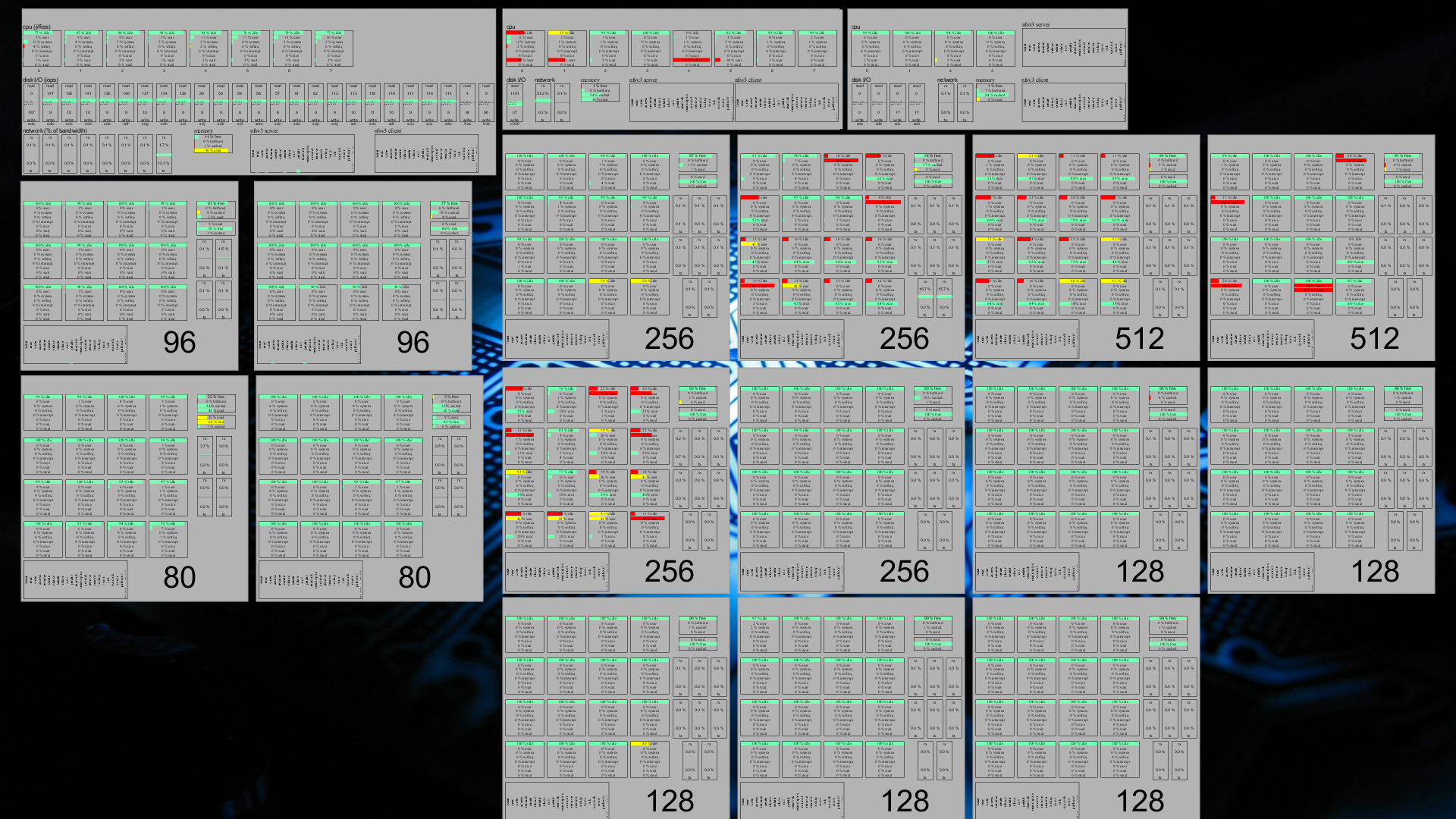
About a month ago, I blogged about extremon. As a reminder, ExtreMon is a monitoring tool that allows you to view things as they are happening, rather than with the ~5 minute delay that munin gives you, and also avoiding the quad-state limitation of Nagios' "good", "bad", "ugly", and "unknown" states. No, they're not really called that. Yes, I know you knew that. Anyway. In my blog post, I explained how you can set up ExtreMon, and I also set up a fairly limited demo version on my own server. But I have since realized that while it is functional, it doesn't actually show why ExtreMon is so great. In an effort to remedy that, I present you an example of what ExtreMon can do. Let's start with a screenshot of the ExtreMon console at the customer for which I spent time trying to figure out how to get it up and running: Click for full sized version. You'll note that even in that full-sized version, many things are unreadable. This is because the ExtreMon console allows one to move around (right mouse button drag for zoom; left mouse button drag for moving around; control+RMB for rotate; center mouse button to reset to default); so what matters is that everything fits on the screen, not whether it is all readable (if you need to read, you zoom). The image shows 18 rectangles. Each rectangle represents a single machine in this particular customer's HPC cluster. The top three rectangles are the cluster's file servers; the rest are its high performance nodes. You'll note that the left fileserver has 8 processor cores (top row), 8 network cards (bottom row, left part), and it also shows information on its memory usage (bottom row, small rectangle in the middle) as well as its NFS client and server procedure calls (bottom row, slightly larger rectangles to the right). This file server is the one on which I installed ZFS a while back; hence the large amount of disks visible in the middle row. The leftmost disk is the root filesystem (which is an ext4 off a hardware RAID1); the two rightmost "disks" are the PCIe-attached SSDs which are used for the ZFS L2ARC and write log. The other disks in this file server nicely show how ZFS does write load balancing over all its disks. The second file server has a hardware RAID1 on which it stores all its data; as such, there is only one disk graph there. It is also somewhat more limited in network, as it has only two NICs. It does, however, also have 8 cores. The last file server has no more than four processor cores; in addition, it also does not have a hardware RAID controller, so it must use software RAID over its four hard disks. This server is used for archival purposes, mostly, since it is insufficient for most anything else. As said, the other nodes are the "compute nodes", where the hard work is done. Most of these compute nodes have 16 cores each; two have 12 instead. When this particular screenshot was taken, four of the nodes (the ones showing red in their processor graphs) were hard at work; the others seem to have been mostly idling. In addition to the familiar memory, NFS (client only), network, and processor graphs, these nodes also show a "swap space" graph (just below the memory one), which seems fine for most nodes, except for the bottom left one (which shows a few bars that are coloured yellow rather than green). The green/yellow/red stuff is supposed to represent the "ok", "warning", "bad" states that would be familiar from Nagios. In this particular case, however, where "processor is busy all the time" is actually a wanted state, a low amount of idleness on the part of the processor isn't actually a problem, on the contrary. I did consider, therefore, to modify the ExtreMon configuration so that the processor graphs would not show red when the system was under high load; however, I found that differences in colour like this actually makes it more easy to see, at a glance, which machines are busy -- and that's one of the main reasons why we wanted to set this up. If you look carefully, you can find a particular processor core in the graph which shows 100% usage for "idle", "system", and "softirq", at the same time. Obviously that can't be the case, so there's a bug somewhere. Frank seems to believe it is a bug in CollectD; I haven't verified that. At any rate, though, this isn't usually a problem, due to the high update frequency of ExtreMon. The amount of data that's flowing through ExtreMon is amazing: Which renders a grand total of 2887 data points that are shown in this particular screenshot; and then I'm not even counting all the intermediate values, some of which also pass through ExtreMon. Nor am I counting the extra bits which have since been added (this screenshot is a few days old, now, and I'm still finetuning things). Yet even so, ExtreMon manages to update those values once every few seconds, in the worst case. As a result, the display isn't static for a moment, constantly moving and updating data so that what you see is never out of date for more than a second or two. Awesome.

6 January 2015

Tiago Bortoletto Vaz: A few excerpts from The Invisible Committe's latest article

Just sharing some points from "2. War against all things smart!" and "4. Techniques against Technology" by The Invisible Committee's "Fuck off Google" article. You may want to get the "Fuck off Google" pdf and watch that recent talk at 31C3. "...predicts The New Digital Age, there will be people who resist adopting and using technology, people who want nothing to do with virtual profiles, online data systems or smart phones. Yet a government might suspect that people who opt out completely have something to hide and thus are more likely to break laws, and as a counterterrorism measure, that government will build the kind of hidden people registry we described earlier. If you don t have any registered social-networking profiles or mobile subscriptions, and on-line references to you are unusually hard to find, you might be considered a candidate for such a registry. You might also be subjected to a strict set of new regulations that includes rigorous airport screening or even travel restrictions. " I've been introduced to following observations about 5 years ago when reading "The Immaterial" by Andr Gorz. Now The Invisible Committee makes that even clearer in a very few words: "Technophilia and technophobia form a diabolical pair joined together by a central untruth: that such a thing as the technical exists. [...] Techniques can t be reduced to a collection of equivalent instruments any one of which Man, that generic being, could take up and use without his essence being affected." "[...] In this sense capitalism is essentially technological; it is the profitable organization of the most productive techniques into a system. Its cardinal figure is not the economist but the engineer. The engineer is the specialist in techniques and thus the chief expropriator of them, one who doesn t let himself be affected by any of them, and spreads his own absence from the world every where he can. He s a sad and servile figure. The solidarity between capitalism and socialism is confirmed there: in the cult of the engineer. It was engineers who drew up most of the models of the neoclassical economy like pieces of contemporary trading software."

Russ Allbery: Review: Code Complete, Second Edition

Review: Code Complete, Second Edition, by Steve McConnell
Publisher: Microsoft
Copyright: June 2004
ISBN: 0-7356-1967-0
Format: Kindle
Pages: 960
As mentioned in the title, this is a review of the second edition of Code Complete, published in 2004. There doesn't appear to be a later edition at the time of this writing. I should say, as a prefix to this review, that I'm the sort of person who really likes style guides. When learning a language, a style guide is usually the second or third document I read. I enjoy debates over the clearest way to express a concept in code, trying to keep all the code in a large project consistent, and discussing the subtle trade-offs that sit on the boundary between mechanical style issues and the expressiveness of programming. I try to spend some time reading good code and getting better at expressing myself in code. Presumably, therefore, I'm the target audience for this book. It sounded good from the descriptions, so I picked it up during one of the Microsoft Press sales. The stated goal of Code Complete is to collect in one place as much as possible of the oral tradition and lore of the programming field, to try to document and communicate the techniques and approaches that make someone a good programmer. The table of contents sounds like a style guide, with entire sections on variables and statements in addition to topics like how to improve existing code and how to design a new program. If you're starting to think that a 960 page style guide sounds like a bad idea, you're wiser than I. (In my defense, I grabbed this as an ebook and didn't realize how large it was before I bought it.) I have not actually finished this book. I hate to do this: I don't like reviewing books I haven't finished (this will be the first), and I hate starting books and not finishing them. (This is probably not particularly wise, since some books aren't worth finishing, but I've gotten into a rhythm of reading and reviewing that works for me, so I try not to mess with it.) But I've been trying to finish this book off and on for about a year, I don't think it's worth the time investment, and I think I've gotten far enough in it to provide some warnings by others who are deceived by the very high ratings that it gets on Amazon and other places. The primarily problem with Code Complete is its sheer, mind-numbing comprehensiveness. It tries to provide a set of guidelines and a checklist to think about at each level of writing code. This is one of those ideas that might sound good on paper, but which completely doesn't work for me. There is no way I'm going to keep this many rules in my head, in the form of rules, while programming. Much of good style has to be done by feel, and the book I'm looking for is one that improves my feel and my sense of taste for code. What Code Complete seems to provide instead is a compilation of every thought that McConnell has ever had about programming. There's a lot of basic material, a few thoughtful statements, a ton of style advice, an endless compilation of trade-offs and concepts that one should keep in mind, and just a massive, overwhelming pile of stuff. Each chapter (and there are a lot of chapters) ends in a checklist of things that you should think about when doing a particular programming task. To give you a feel for the overwhelming level of trivia here, this is the checklist at the end of the chapter where I stopped reading, on quality assurance in software. This is one picked at random; a lot of them are longer than this.
  • Have you identified specific quality characteristics that are important to your project?
  • Have you made others aware of the project's quality objectives?
  • Have you differentiated between external and internal quality characteristics?
  • Have you thought about the ways in which some characteristics might compete with or complement others?
  • Does your project call for the use of several different error-detection techniques suited to finding several different kinds of errors?
  • Does your project include a plan to take steps to assure software quality during each stage of software development?
  • Is the quality measured in some way so that you can tell whether it's improving or degrading?
  • Does management understand that quality assurance incurs additional costs up front in order to save costs later?
I'm not saying those are bad things to think about with quality assurance, but you may notice a few issues immediately. They're very general and vague, they're not phrased in a particularly compelling or memorable way, and there are a lot of them. This falls between two stools: it's too much for the programmer who is thinking about quality as part of an overall project but not focusing on it (particularly when you consider that the book is full of checklists like this for everything from variable naming to how to structuring if statements to program debugging), but it's not nearly specific or actionable enough for someone who is focusing on quality assurance. It's not that the information isn't organized: there's a lot of structure here. And there are bits and pieces here that are occasionally interesting. McConnell is very data-driven and tries to back up recommendations with research on error rates and similar concrete measurements. It's just insufficiently filtered and without elegant or memorable summary. There is far too much here, an overwhelming quantity, and hopelessly mixed between useful tidbits and obvious observations that anyone who has been programming for a while would pick up, all presented in the same earnest but dry tone. It didn't help that there's a lot here I didn't agree with. Some of that is to be expected: I've never agreed completely with any style guide. But McConnell kept advocating variable and function naming conventions that I find rather ugly and tedious, and the general style of code he advocates feels very "bureaucratic" to me. It's not exactly wrong, but one of the things that I look for in style discussions is to be inspired by the elegant and simple way someone finds to phrase something in code. A lot of the code in this book just felt mind-numbing. It's functional, but uninteresting; perfectly adequate for a large project, but not the sort of discussion that inspires me to improve the quality of my craft. So, I didn't finish this. I gave up about halfway through. It's frustrating, since I was occasionally finding an interesting nugget of information. But they were too few and far between, and the rest of the book was mostly... boring. It's possible that I just know too much about programming to be the person for whom that McConnell was writing this book. It's certainly true that the book has not aged particularly well; it's focused on fairly old-school languages (C, C++, Java, and Visual Basic) and says almost nothing about modern language techniques, although it does have a bit about extreme programming. But whatever the reason is, it didn't work for me at all. I would rate it as one of the worst books about programming I've tried to read. And that's notably different enough from its reviews that it seems worth throwing this out there as a warning. I'm quite disappointed, since I'd heard nothing but praise for this book before picking it up. But it's not for me, and I'm now dubious of its value for any programmer outside of a fairly narrow, large-team, waterfall development process involving large numbers of people writing very large quantities of code in languages that aren't very expressive. And, well, in that situation I think one would get more benefit from changing that environment than reading this book. Rating: unfinished

5 January 2015

Russ Allbery: Review: Ancillary Sword

Review: Ancillary Sword, by Ann Leckie
Series: Imperial Radch #2
Publisher: Orbit
Copyright: October 2014
ISBN: 0-316-24665-4
Format: Trade paperback
Pages: 354
This is the second book in the Imperial Radch series and a direct sequel to Ancillary Justice. You don't want to read this book out of order, since the previous book sets up the background of everything that happens here. Besides, Ancillary Justice is an amazing book. It's going to be challenging to review Ancillary Sword without spoiling the previous book. If you're planning on reading Ancillary Justice but haven't gotten to it, you may want to stop here and come back to this review after you've read it. Or, even better, just read both books. They're some of the best science fiction I've read. Ancillary Justice started small, with one person and their quixotic search for revenge, and grew large, to encompass conflicts and confrontations that would shake the Radch. Ancillary Sword returns to a smaller scale and stays there. This means that much of what was left unresolved at the end of the previous book is still unresolved; Leckie does not continue escalating into large-scale conflict. It also means that we see a lot more of Breq making personal choices and trying to work out her own sense of morality, plus semi-adopting a couple more injured people along the way. One of my favorite types of stories is where I get to watch someone who is very good at something do the thing that they're very good at. Breq's unique background and experience makes her a wildcard outsider with vast experience in her new role. (Not to mention the special advantages she has from her implants.) Her long experience with people, similarly from a unique perspective, lets her use her power to effectively navigate political situations while keeping people slightly off-balance. And now she has some real power, made more potent for being somewhat ill-defined. In short, this is a story of political agency, given to someone who hasn't had it before but who is very good at using it. It's immensely satisfying, in part because it's not a simple wish fulfillment. Breq can't just reshape the world to her preferences; in fact, she can't do much about one of the social conflicts she runs into, except treat the people involved with unexpected respect. But she can occasionally do something, and she can always upset existing power structures in subtle ways, and the way Leckie writes this makes it so much fun to read. I think one of the reasons why I enjoyed this so much is that Breq is not relentlessly introspective. She just acts. Usually this sort of book involves lots of soul-searching and analysis, and the lack is refreshing. The other people in the story analyze Breq much more than she analyzes herself, sometimes incorrectly, and Breq finds the whole thing faintly amusing. Not only does this keep the story from bogging down in too much internal drama, it means that Breq frequently surprises the reader, usually in ways that had me grinning. And, despite not mulling things over incessantly, she is growing and developing, finding her own sense of morality and and ethics in a way that's sometimes only apparent in retrospect. The one caveat I will mention is that this is a book that concerns itself a great deal with colonialism and racial slavery, but it's a fantasy of political agency focused on someone who's part of the dominant culture. While it's not quite accurate to say that Breq is this world's equivalent of white, she can pass, and she's Radchaai. I thought the book handles the issues reasonably well, but it is still using oppressed cultures to focus on the agency and power of someone who is, comparatively, privileged. This didn't bother me while I was reading the story, but it started to bother me a little afterwards once it was pointed out. There's nothing inherently wrong with that story, but it's a rather common pattern, and I'm afraid Ancillary Sword doesn't do much to broaden the pattern. That said, it's a caveat rather than a fatal flaw, at least for me. Ancillary Sword is obviously the middle book of a trilogy, and normally the lack of forward progress on the overarching story and the sense of filling in background and setting the scene would undermine the book. But Breq and the other characters in this world are so fascinating that I didn't mind. The ending was not quite what I expected, but worked better the more that I thought about it. I'm really looking forward to the next book. Followed by Ancillary Mercy. Rating: 9 out of 10

2 January 2015

Simon Josefsson: OpenPGP Smartcards and GNOME

The combination of GnuPG and a OpenPGP smartcard (such as the YubiKey NEO) has been implemented and working well for around a decade. I recall starting to use it when I received a FSFE Fellowship card long time ago. Sadly there has been some regressions when using them under GNOME recently. I reinstalled my laptop with Debian Jessie (beta2) recently, and now took the time to work through the issue and write down a workaround. To work with GnuPG and smartcards you install GnuPG agent, scdaemon, pscsd and pcsc-tools. On Debian you can do it like this:
apt-get install gnupg-agent scdaemon pcscd pcsc-tools
Use the pcsc_scan command line tool to make sure pcscd recognize the smartcard before continuing, if that doesn t recognize the smartcard nothing beyond this point will work. The next step is to make sure you have the following line in ~/.gnupg/gpg.conf:
use-agent
Logging out and into GNOME should start gpg-agent for you, through the /etc/X11/Xsession.d/90gpg-agent script. In theory, this should be all that is required. However, when you start a terminal and attempt to use the smartcard through GnuPG you would get an error like this:
jas@latte:~$ gpg --card-status
gpg: selecting openpgp failed: unknown command
gpg: OpenPGP card not available: general error
jas@latte:~$
The reason is that the GNOME Keyring hijacks the GnuPG agent s environment variables and effectively replaces gpg-agent with gnome-keyring-daemon which does not support smartcard commands (Debian bug #773304). GnuPG uses the environment variable GPG_AGENT_INFO to find the location of the agent socket, and when the GNOME Keyring is active it will typically look like this:
jas@latte:~$ echo $GPG_AGENT_INFO 
/run/user/1000/keyring/gpg:0:1
jas@latte:~$ 
If you use GnuPG with a smartcard, I recommend to disable GNOME Keyring s GnuPG and SSH agent emulation code. This used to be easy to achieve in older GNOME releases (e.g., the one included in Debian Wheezy), through the gnome-session-properties GUI. Sadly there is no longer any GUI for disabling this functionality (Debian bug #760102). The GNOME Keyring GnuPG/SSH agent replacement functionality is invoked through the XDG autostart mechanism, and the documented way to disable system-wide services for a normal user account is to invoke the following commands.
jas@latte:~$ mkdir ~/.config/autostart
jas@latte:~$ cp /etc/xdg/autostart/gnome-keyring-gpg.desktop ~/.config/autostart/
jas@latte:~$ echo 'Hidden=true' >> ~/.config/autostart/gnome-keyring-gpg.desktop 
jas@latte:~$ cp /etc/xdg/autostart/gnome-keyring-ssh.desktop ~/.config/autostart/
jas@latte:~$ echo 'Hidden=true' >> ~/.config/autostart/gnome-keyring-ssh.desktop 
jas@latte:~$ 
You now need to logout and login again. When you start a terminal, you can look at the GPG_AGENT_INFO environment variable again and everything should be working again.
jas@latte:~$ echo $GPG_AGENT_INFO 
/tmp/gpg-dqR4L7/S.gpg-agent:1890:1
jas@latte:~$ echo $SSH_AUTH_SOCK 
/tmp/gpg-54VfLs/S.gpg-agent.ssh
jas@latte:~$ gpg --card-status
Application ID ...: D2760001240102000060000000420000
...
jas@latte:~$ ssh-add -L
ssh-rsa AAAAB3NzaC1yc2EAAAADAQABAAABAQDFP+UOTZJ+OXydpmbKmdGOVoJJz8se7lMs139T+TNLryk3EEWF+GqbB4VgzxzrGjwAMSjeQkAMb7Sbn+VpbJf1JDPFBHoYJQmg6CX4kFRaGZT6DHbYjgia59WkdkEYTtB7KPkbFWleo/RZT2u3f8eTedrP7dhSX0azN0lDuu/wBrwedzSV+AiPr10rQaCTp1V8sKbhz5ryOXHQW0Gcps6JraRzMW+ooKFX3lPq0pZa7qL9F6sE4sDFvtOdbRJoZS1b88aZrENGx8KSrcMzARq9UBn1plsEG4/3BRv/BgHHaF+d97by52R0VVyIXpLlkdp1Uk4D9cQptgaH4UAyI1vr cardno:006000000042
jas@latte:~$ 
That s it. Resolving this properly involves 1) adding smartcard code to the GNOME Keyring, 2) disabling the GnuPG/SSH replacement code in GNOME Keyring completely, 3) reorder the startup so that gpg-agent supersedes gnome-keyring-daemon instead of vice versa, so that people who installed the gpg-agent really gets it instead of the GNOME default, or 4) something else. I don t have a strong opinion on how to solve this, but 3) sounds like a simple way forward.

Richard Hartmann: Release Critical Bug report for Week 01

The UDD bugs interface currently knows about the following release critical bugs: How do we compare to the Squeeze release cycle?
Week Squeeze Wheezy Jessie
43 284 (213+71) 468 (332+136) 319 (240+79)
44 261 (201+60) 408 (265+143) 274 (224+50)
45 261 (205+56) 425 (291+134) 295 (229+66)
46 271 (200+71) 401 (258+143) 427 (313+114)
47 283 (209+74) 366 (221+145) 342 (260+82)
48 256 (177+79) 378 (230+148) 274 (189+85)
49 256 (180+76) 360 (216+155) 226 (147+79)
50 204 (148+56) 339 (195+144) ???
51 178 (124+54) 323 (190+133) 189 (134+55)
52 115 (78+37) 289 (190+99) 147 (112+35)
1 93 (60+33) 287 (171+116) 140 (104+36)
2 82 (46+36) 271 (162+109)
3 25 (15+10) 249 (165+84)
4 14 (8+6) 244 (176+68)
5 2 (0+2) 224 (132+92)
6 release! 212 (129+83)
7 release+1 194 (128+66)
8 release+2 206 (144+62)
9 release+3 174 (105+69)
10 release+4 120 (72+48)
11 release+5 115 (74+41)
12 release+6 93 (47+46)
13 release+7 50 (24+26)
14 release+8 51 (32+19)
15 release+9 39 (32+7)
16 release+10 20 (12+8)
17 release+11 24 (19+5)
18 release+12 2 (2+0)
Graphical overview of bug stats thanks to azhag:

Next.

Previous.