Search Results: "angel"

15 March 2008

Daniel Burrows: aptitude 0.4.10 released

I've just released version 0.4.10 of aptitude, a terminal and command-line package management tool for Debian. This release has many user-visible changes (see the changelog below). It also fixes an annoying and much-reported segfault. The Debian packages of this version are built against the new version of cwidget, which is sitting in NEW, but if you're impatient you can compile it by hand by dropping the versioned dependency. The dependency is there to ensure that we don't get dependency skew across architectures (aptitude depending on libcwidget0 on some archs and libcwidget1 on others) and doesn't represent an actual build requirement of aptitude.
[12/15/2007] Version 0.4.10 Oscillating Reindeer
  • New features:
    • In command-line mode, if the resolver fails to produce a solution for whatever reason, then instead of aborting the program entirely aptitude will now display a prompt at which you can fix the dependency problems by hand. Enter r at this prompt to try to automatically fix dependencies again.
    • safe-upgrade will now install new packages to fulfill dependences (but it will never remove packages, downgrade packages, or install a version that's not the default). The option --no-new-installs will disable this behavior.
    • Updates and commands that install, remove, or upgrade packages will now display a brief summary of what changed. For instance:
      There are now 64 updates [+10], 3 new [+1].
      
      Unfortunately, this change requires reading the cache after an update is complete. Passing -q will disable this behavior, but also make the update progress bar less attractive. More work on resolving this tension between features and performance remains to be done.
    • Add an option --allow-untrusted to override trust warnings. (Closes: bug #452201, bug #452541)
    • Recommended packages are now hidden if quiet mode is enabled. (Closes: bug #452202)
    • The options Aptitude::ProblemResolver::Trace-File and Aptitude::ProblemResolver::Trace-Directory allow you to generate a minimal cut of the cache that allows a problem resolver run to be reproduced. The eventual aim is both to simplify bug reporting and to generate a corpus of automatic test cases for the resolver (although more work needs to be done to accomplish the latter).
    • When run in command-line mode, instead of displaying many separate and sometimes duplicative groups of packages (e.g.: installed, auto-installed, auto-installed in a light cream sauce, etc), aptitude displays packages in a few exclusive categories and uses tags (like the existing purge tag) to provide more state information. For instance:
      $ aptitude -s install wesnoth
      The following NEW packages will be installed:
        wesnoth wesnoth-data a  wesnoth-music a 
      $ aptitude -s remove freeciv-data
          (... dependency resolution ...)
      The following packages will be REMOVED:
        freeciv-client-gtk a  freeciv-data freeciv-server a  ggzcore-bin u 
        libggz-gtk1 u  libggz2 u  libggzcore9 u  libggzdmod6 u  libggzmod4 u 
      
      Here a indicates that a package was automatically installed or removed, and u indicates that a package is being removed because it is unused. Hopefully this will be less confusing than the old format.
  • Bug fixes:
    • Crashes and serious errors:
      • Track down and fix a SEGV triggered on the first action after a cache reload (sometimes). There are multiple bugs where this might have been the root cause, but it's confirmed that it was the cause of at least bug #454695, bug #454700, bug #455349, and bug #453362. Bug bug #455865 is almost certainly the same issue, and bug bug #352278 may be another manifestation of it.
      • If StepLimit is set to 0, refuse to solve dependencies instead of going into an infinite loop. (Closes: bug #451311)
    • Minor bugs:
      • Return a failing exit code after jumping from the command-line to visual mode if the last install run failed. (Closes: bug #282408)
      • Return a failing exit code from aptitude update if any download fails. (Closes: bug #233129)
    • Cosmetic and UI bugs:
      • In addition to Enter, Space will now activate checkboxes and radio buttons. (Closes: bug #451765)
      • Abort the program if we get EOF at the resolver prompt instead of claiming the resolver failed.
      • Command-line searches will now only print each result once. (Closes: bug #450798)
    • Documentation bugs:
      • The options menu documentation now minimally describes the new configuration interface.
      • The documentation of the configuration file options has been placed back in alphabetic order after apparently suffering bitrot over the years.
      • Corrected the documented default of Parse-Description-Bullets to match reality.
      • The manpages for aptitude-create-state-bundle and aptitude-run-state-bundle are now generated using DocBook, which should produce higher-quality and more consistent typesetting, as well as making the manpages more maintainable and allowing translators to easily produce localized versions of the manpages.
  • Internal changes:
    • Removed some unit tests that really tested cwidget.
  • Translation updates:
    • French (Christian Perrier)

13 March 2008

Christian Perrier: Squashing badly encoded changelog files - task completed

Back in February, I worked on packages providing badly encoded changelog files. With the removal of gmanedit from testing and unstable (Gnome 1.x removal process) and the ack that perl wrongly changelog encoding is mostly upstream's changelog (which will be hopefully fixed), I think its OK, now, to announce that this lenny release goal is achieved. Thanks to Bas Zoetekouw who did the mass bug filing which helped a lot tracking this down. We could now imagine tracking down badly encoded debian/copyright files... PS: above, "badly" means "using national encoding"...which is generally ISO-stoneage^W8859-1.

John Goerzen: Hacking Traffic Signs

One of the funniest things I've seen in a long time:

Electronic Road Signs and Me

12 March 2008

Russell Coker: Not Visiting the US

I won’t be visiting the US in the forseeable future. For some time I have been concerned about the malfunctioning legal process and other related issues that arose from the so-called “War On Terror“. But the most recent news is that the TSA may just copy all the contents of your laptop or even steal it [1]. Law enforcement agents can search property if they see evidence of a crime in progress or if they have a search warrant. They can seize property as evidence in a trial, but if the property in question is not illegal then it will be returned afterwards. The TSA take property from travellers without any reason for doing so and do not return it. This is not law enforcement, it is banditry. It’s bad enough catching a late train while carrying a laptop and risking a junkie trying to steal it. When bandits have police protection (as the TSA do) then it becomes an unacceptable risk. The TSA have recently apologised for making people remove iPods and other devices from their luggage [2]. Strangely this has been interpreted by some people to mean that the TSA won’t be stealing data and hardware from travellers. I’m sure that if the TSA was going to stop searching laptop hard drives and confiscating laptops then they would have announced it. From now on I will avoid entering US territory (even for connecting flights), except in the unlikely event that someone pays me an unreasonably large amount of money such that I am prepared to travel without electronic gear. I know that some people in the US won’t like this (some people flip out when anything resembling a Boycott is mentioned). I am not Boycotting the US, merely avoiding bandits. If the fear of bandits hurts your business then you need to get a law enforcement system that can deal with the problem. On a related note, check out the TSA Gangstaz [3] video, funny.

10 March 2008

Dirk Eddelbuettel: PGApack 1.1: Almost as good as new

PGAPack is rather nice and fairly small library for 'parallel' optimisation via generic algorithms using the MPI message passing protocol. PGAPack 1.0 was written by David Levine while doing graduate work during the mid-1990s at Argonne Labs / University of Chicago. PGAPack has also been in or around Debian for a rather long time, but it suffered from benign neglect in the last few years. Some of this came to the fore in this bugreport which lead to my offer to the then-maintainer Andreas to help on the relicencing request. After all, Argonne Labs is just a few miles from where I live, and I had already spent a little bit of time polishing and upgrading the package for my own exploratory use. So I called Rusty Lust, head of the Mathematics and Computer Science section at Argonne to try to sort this out. He was sympathetic and put me in email contact with David Levine. As we are all somewhat busy, this dragged on for a little longer than we thought --- but as of today, about and a half years later, we have a new and shiny PGAPack 1.1 release, or around twelve years after the initial 1.0 version came out. I have done a fair amount of polishing: there are now two library packages for serial use (i.e. for debugging) as well as parallel use via MPI. We use Open MPI where available and LAM where not. All open Debian bugs have been addressed. One minor issue in the postscript documentation remains as David can no longer locate his LaTeX sources; I may just have to extract the text and re-latex this from scratch to update it. One day. Anyway, for full reference, the changelog entry is below. The package is currently in the NEW queue (as the new sub-package require manual inspection and approval) but should hit mirrors in a couple of days. My thanks to the two previous Debian maintainers; to Rusty Lusk for helping with the from the end MSC department at Argonne Labs and for suggesting the rather liberal and easy MPICH2 license (and he happens to be one of the MPICH2 authors); and of course to David Levine for writing PGAPack in the first place, for agreeing to relicense it and giving valuable feedback on my repackaging of what is now version 1.1 on the MCS ftp server at Argonne --- this library has held up really well over the years; let's hope it will find more good use going forward.
pgapack (1.1-1) unstable; urgency=low
  * Really good news:  The MCS divsion of Argonne National Laboratories has
    agreed to relicense pgapack using the MPICH2 license. So pgapack
    is now Free Software and can move into Debian's main archive!
  
    Our thanks go to David Levine and Rusty Lusk to make this possible.
  
  * New maintainer, following Andreas' offer dated 2006-10-04 in #379388
  * debian/control: Change section to math		(Closes: #379388)
  
  * Added new brinary packages libpgapack-mpi1 and libpgapack-serial1
  * The MPI package is configured using Open MPI where available and LAM
    where not. 
  * debian/control: Changed Build-Depends: to use OpenMPI where available, 
    and LAM otherwise.
 
  * Finally acknowledges old NMUs 		(Closes: #379168,#359549)
  * source/integer.c: Apply patch for one-off error 	(Closes: #333381)
  * source/report.c:  Do not unconditionally print at generation 1
  
  * debian/rules: Remove a bashism 			(Closes: #379168)
  * debian/rules: Install examples directly 		(Closes: #134331)
  * debian/control: libpgapack-lam1 Depends on lam4 	(Closes: #60376)
  * debian/rules: Rewritten using debhelper
  * debian/control: Added Build-Depends: section for debhelper
  * No longer install mpi.h in /usr/include		(Closes: #404027)
    
  * debian/control: Updated Standards-Version: to current version
  * man/man1/PGAGetCharacterAllele.1: fix whatis entry 		(lintian)
  
 -- Dirk Eddelbuettel   Mon, 10 Mar 2008 18:03:34 -0500

9 March 2008

John Goerzen: Vorsanger

This October, our church celebrates its hundredth anniversary. All this year, every so often, we are having brief "historical moments" during church.

Today, our temporary choir director -- and my high school band teacher -- was a Vorsanger. He got up during church and discussed how hymn singing was done in the early days of the church. Today, our Mennonite church sings in a variety of styles, most commonly 4-part music accompanied by a piano, and no director. But we also sing more "contemporary" styles.

Back in the earlier days, the church didn't have hymnals with music for everyone. The Vorsanger -- song leader -- would sing each phrase, then the congregation would sing it back in unison, throughout the whole song. Hymns that the congregation already knew well would just be sung normally, in unison, with the Vorsanger directing.

Not only did the Vorsanger lead the singing, but he or she also chose the music -- not the pastor. As the church purchased first a pump organ, and later a piano, the instruments would sometimes be used to accompany the singing. The musicians never knew what would be sung in advance. One 80-year-old member of our congregation remembered the she started to play for church at 8th grade. But much of the time, there would be no instrument, not even to pick the starting pitch.

This morning, we sang Holy God, We Praise Thy Name with the Vorsanger. It's a familiar song in our church, but we generally sing it in English. The Vorsanger taught it to us in German, the older people in church would have remembered it. He finished his introduction, stepped away from the microphone, and rang out with the first phrase.

Gro er Gott, wir loben dich

Then we all sang the phrase back to him, in unison. On to the next phrase, back and forth for the rest of the hymn. Terah and I were in the choir area, behind him, but could hear him -- and the rest of the congregation -- just fine.

At the end, our Vorsanger for a day said he thought we got it, so we sang through it again, still in unison, but without him leading us on each phrase.

Gro er Gott, wir loben dich,
Herr, wir preisen deine St rke,
Vor dir beugt die Erde sich
Und bewundert deine Werke.
Wie du warst vor aller Zeit,
So bleibst du in Ewigkeit.

What a powerful way to feel connected to the people that worshiped at the same place so many years ago.

As our director said before we sang in choir this morning, music can say so much more than words.

Neil Williams: dpkg-cross and emdebian-tools updates; apt and rsync

dpkg-cross updates
uploaded to Debian unstable

* General support for querying endianness of an architecture.
* Update standards version (no changes)
* Add Cvs-CVS field to debian/control
* Reinstate detect_arch for improved build test checks in emdebian-
tools
* get_endianness: new function for Emdebian TDeb support

This provides support for architecture-dependent TDebs in Emdebian as well as adding detection of armel.

emdebian-tools 0.8.3
Uploaded to Emdebian

* Interim Emdebian release.
* emsecondstage: ensure cdebconf environment is setup before
configuring packages
* emdebian.gpe: Add extra packages needed to allow the gpe package set
to boot.
* Emdebian::Tools, (create_patches) : skip generated files.
[*.debhelper, *.substvars, files]
* em_installtdeb: support special modes via debian/xcontrol
* Support unpack method in basic emsandbox rootfs
* embootstrap: continue after some errors
* Support unpack method in gtk emsandbox rootfs
* Simplify basic empdebuild chroot and copy in hostname files
* empbuilderlib: add support for creating skeleton versions of
/etc/group and /etc/passwd.
* empbuilderlib: add an approximate time set func for use when no
network is available.
* emsecondstage: configure cdebconf before others so that the database
is ready
* embootstrap: use the new support in empbuilderlib for group, passwd
and date
* Add --arch support to em_installtdeb
* Depend on new support in libdebian-dpkgcross-perl
* empdebuild: force the -S argument to apt-cross to prevent
intermittent failures
* empbuilderlib: parse the .list contents from dpkg
* embootstrap: ensure buildplace is clean before starting a fresh
debootstrap
* emdebuild: use dpkg-cross support for detect arch to distinguish
between arm and armel binaries
* Emdebian::Tools. add parse_xcontrol function for easy queries of
debian/xcontrol
* pbuilder/emdebian.crossd gpe gtk : Tidy up the scripts with routine
calls to the empbuilderlib library
* pbuilder/empbuilderlib: Add some common routines to help make the
rootfs bootable
* pbuilder/emsecondstage: bring into line with other changes in the
* empbuilderlib.3 : Add a manpage for the expanded set of common
functions in empbuilderlib
* Suggest file-roller for inspection of rootfs tarballs
* emdebhelper.mk: sync with recent changes in CDBS for debhelper
support


Reasoning
OK, so why upload emdebian-tools to Emdebian when it depends on the update to dpkg-cross in Debian?
Well, emdebian-tools is becoming a bit of a behemoth. I mean a package that has only existed for 12months and has had over 30 releases, increasing in size from 30kb to over 500kb (without counting dependencies) and which encompasses a gammut of scripts with different roles is just begging for a functional package split.
Package splits take time - not just the time in NEW but all the testing to ensure that each split can be installed separately without falling over "Unable to find foo in @INC" etc.
At the same time, emdebian-tools is both rapidly developing and becoming remarkably stable (which gives some indication of just how diverse it has become).
So I'm heading for a 1.0.0 release before Lenny and to achieve that, I want to split it:
  1. emdebian-tools - umbrella package consisting of the core build scripts (perl) - these are becoming quite stable - that depends on all the others.

  2. emdebian-archive-keyring - tiny package that just implements SecureApt for the Emdebian repository.

  3. emdebian-rootfs - the rapidly developing (shell and perl based) root filesystem management scripts, based on debootstrap and pbuilder.

  4. libemdebian-tools-perl - a standard perl module of common functions for the other packages.


This allows people to use the toolchains with the smallest package, prepare root filesystems from prebuilt binary packages with just three of the four and only those who build packages will need all four.
So the plan, overall, is to keep updating emdebian-tools in Emdebian unstable during the time that emdebian-tools 0.9.0 goes through NEW in Debian. Then, when 0.9.x is in testing and any issues from the split are resolved, 1.0.0 can be uploaded to Debian.

Package split issues in general
Something that bugs me with package splits is this stable vs development issue within the same source. I think it would be sensible to only upload emdebian-tools (the stable bit) if it changes but to upload emdebian-rootfs as often as necessary whilst still building from the same source.
This issue will also bite when Emdebian deploys other functional package splits and seeks to improve apt itself to handle many, many more binary packages.
It's also a similar idea to allowing translators to upload TDebs separately from normal package updates.
Why should I have to split the source in $RCS in order to upload package splits separately? Other upstream teams won't do that so Debian needs a solution.
Why should users have to download emdebian-tools 1.0.1 which is absolutely identical to 1.0.0 just because emdebian-rootfs needed lots of updates in 1.0.1. (Remember, emdebian-tools will depend on emdebian-rootfs so when emdebian-rootfs is updated, all users of emdebian-rootfs and all users of emdebian-tools will get the update. Yet I don't see why emdebian-tools itself needs to be touched.)
It is plain daft.
I've seen similar issues in other environments where, for various very good reasons, users need to limit the bandwidth and duration of apt downloads. For Emdebian, we also need to limit the total amount of data downloaded by apt-get upgrade simply because free space on the device can be severely restricted - my target device will have about 7Mb free space and that is regarded as "under-utilised". Downloading an entire package just to update /usr/share/foo/changelog.gz in such circumstances is just plain stupid. I know we can do better than that.
Apt needs to become much more intelligent and have a way of only downloading the changes in packages instead of the entire .deb - something along the lines of an rsync method. To get that working, the actual package names need to be munged so that rsync can compare foo_1.2.3-1_all.deb against foo_1.2.3-2_all.deb by having both symlinked as foo_current_all.deb. (dpkg-name can restore the original name if needed.)
Such a method must be possible and would have enormous benefits for packages like OOo where each upload can't be changing 100% of the code each time, yet we all have to download Mb after Mb of content that is identical to what dpkg is about to replace.
Am I just ranting or does this strike a chord on the lazyweb in general?
The slowest part of many desktop experiences of Debian could well be the time taken to download updates - not everyone has multi Mb broadband.

Bernhard R. Link: Why I am putting dpkg on hold on my unstable boxes right now...

A hijack of an important package makes me always uneasy. But reading the next two messages to the debian-dpkg list, which I can only read as "oh, I broke make dist. But why should I follow sane practises, all hail my workflow" and "oh, I brake Changelog, that's on purpose because I consider it a bad idea, if you want it make write some scripts to generate it" does nothing to make me believe such a person can be a good maintainer.

6 March 2008

John Goerzen: If Version Control Systems were Airlines

Many of you have seen the net classic If Operating Systems Were Airlines. Today, let's consider what the world might be like if version control systems were airlines...

Before anyone gets mad, this is all in fun, OK?

RCS Airlines: One of the first airlines, from way back when this whole aviation thing was new and exciting. Each RCS flight carries exactly one passenger, which RCS believes is a superior way to fly. Although most RCS airplanes are rusty and battered today, RCS Airlines still retains its historic dedication to security. Each airplane is kept locked as much as possible for safety. Occasionally flights will be delayed for hours because the pilot can't open the locked plane. When this happens, the pilot will frantically try to get the cell phone number of whoever it is that has locked the plane. When the plane finally gets unlocked, you may be tempted to ask why it was locked for so long. Veteran RCS users have learned that the answer is usually disgusting, and never ask anymore. Main competitor: CP/M airlines.

CVS Airlines: Founded on the belief that they could be more efficient than RCS by carrying multiple passengers per flight. They still carry each passenger in a separate RCS-built airplane, but the airplanes fly in a goose-like ",V" formation. Watch out for layovers, though. It can take hours to merge new passengers into the formation properly, and it might take several attempts to take off afterwards.

CVS flights often feature fights over who gets to fly. CVS piloting fights are legendary; rumor has it that OpenBSD got started after CVS airlines refused to allow a passenger to board on the grounds that he had in the past refused to stow his tray table in the upright and locked position.

CVS airlines mostly counts as customers the "over-50" crowd who grew up using CVS and don't like change. Its in-flight magazine features advertisements for balding-reversal treatments and uuencode tools.

Main competitor: AIX airlines.

Subversion Airlines: Started by some grey-haired CVS executives with long, wispy beards, Subversion airlines got started by trying to be "CVS, but better". Subversion airlines was the first major airline to use planes that seat more than one passenger. Unlike CVS airlines, all passengers on a Subversion flight travel in the same plane.

Subversion airlines is famous for its Soviet-like centralized control. All operations must be approved by the Kremlin, and you are allowed, by the grace of the Party Leader, to gaze at the massive airplanes. Those that have served the Party and Airline well for many years are allowed to enter the Great Shrine of the First-Class Comitter, and actually make changes to the airplanes themselves. Plainclothes Subversion Airlines security agents lurk on every flight, and you should not be surprised to be thrown out an airplane window if you make a joke in bad taste about the pilot's flying skills.

Subversion airlines thrives on the concept that "photocopying is cheap". You are encouraged to make photocopies of your ticket, or to photocopy your photo ID, and give copies of each to as many people as you can. At checkin time at the gate, if more than one person arrives with a copy of the same ticket, they are ushered into the "merging room" and each person is given a brick. The door is closed, something magical occurs, and the one person that emerges still able to walk is allowed to board the plane.

Main competitor: Windows airlines with no Administrators allowed.

tla airlines: Founded by one of those eccentric British noblemen, Lord Tom's airline is the utopian philosopher's airline. Chafed by the heavy-handed control of Subversion Airlines, tla airlines wants every passenger to be created equal. As you approach the gate area in the terminal, you will find many philosophers occupying the gate area, extolling the virtues of tla airlines. They compare tla airlines to reaching out and touching the heavens, leaving behind the bonds of a ground-based life, actually merging with the stars. Oh, the gorgeous beauty of it all! The things we will see!

As you see people arriving from another flight, you observe that some of them have burn marks. One of them comments that "merging with the stars doesn't work." Immediately, a dozen philosophers get in a fight with him, claiming that he simply doesn't understand what it means to merge with the stars, and that if he gets his inner being in the proper state first, he'll have a much better experience.

As you board the tla airplane, you obvserve that the jetway is a mile long. The airplane itself reminds you of something of a cross between a gothic cathedral and a level of Doom. There are spectacular archways everywhere, sometimes where they don't really belong. Each archway is supported by ornate curly braces which you don't normally see on airplanes, and frankly, you'd rather not, because they look all pointy and confuse the kids.

As you arrive as your destination terminal, you see it too is full of philosophers, most of them dining.

Main competitor: VMS airlines.

Darcs Airlines: Unlike every other airline, this one uses physicists instead of engineers to design its airplanes. One brilliant Darcs physicist has finally come up with The Theory of Everything, and as such, Darcs knows where you want to go before even you do. Darcs airlines prides itself on customer service, and asks your preference for even the tiniest details about your trip.

Each seat pocket features a copy of the Theory of Everything for your reading enjoyment, but nobody actually understands it.

Occasionally, you will find that Darcs pilots get into angry conflicts with the control tower in mid-flight. This results in the control tower revoking your permission to land. Legend has it that one Darcs pilot of a plane with exceptionally large fuel tanks actually resolved his conflict with the tower and landed two weeks after taking off. Experienced Darcs users board with several parachutes: one for themselves, and a few more for the newbies.

The Darcs physicists claim that the Theory of Everything predicted the pilots would act this way, and that all pilots eventually act this way throughout the entire universe. They toil day and night finding a way to adjust the gravitational constant of the universe, thereby reducing the anger factor of the pilots.

Main competitor: OS/2 airlines.

bzr airlines: Founded by a South African who had been injured by a curly brace on tla airlines, bzr airlines aims to be "tla done right". They have shortened the jetway, gotten rid of the curly braces, chased out the philosophers, and no longer have a vision of merging with the stars. Many that were injured on tla airlines fly bzr airlines, and out of respect for tla airlines, bzr airlines will still honor tla tickets.

bzr passengers consider themselves part of an exclusive club because each flight takes off from a launchpad. They often can be seen standing in the terminal passing out bzr literature, trying to get passengers of other airlines to fly bzr, and can't understand how other airlines continue to exist while people keep walking past their airplanes.

Main competitor: BeOS Airlines.

Bitkeeper Airlines: One of the world's faster airlines, Bitkeeper airlines occupied that obscure gate for rich people at the end of the terminal for many years. Tickets on Bitkeeper Airlines were rumored to cost thousands of dollars, and were rare and jealously guarded. Then for awhile, Bitkeeper Airlines started giving away tickets for free, though they also kept around the expensive tickets for those with discriminating tastes. Free tickets were made widely available, but the 3-point type on the back of tickets said that you were never allowed to think about another airline before, after, or during your flight, and some people claimed they actually saw the small print morphing right before their eyes.

Bitkeeper flights often featured arguments over whether people were harboring secret thoughts of other airlines. If you were caught thinking about another airline, you were expected to scream vigorously while being thrown out the escape hatch without a parachute. All of this commotion tarnished the rarified air that the rich people paid to experience, so one day it was decided that there would be a Great Purge, because obviously all free ticket holders had harbored lustful thoughts of other airlines, so they were all thrown off the airplanes simultaneously. Today, people aren't exactly sure where the Bitkeeper gate is, but everyone suspects it still lurks somewhere.

Main competitor: SCO Airlines.

Mercurial Airlines: The "there's one right way to do it" airline, Mercurial is a sterile, agile, and shiny airline. Every Mercurial airplane looks identical to every other one, shiny and clean. You could swear that all the passengers look alike too, and as you approach the gate, it seems like you too look like everyone else. Mercurial passengers tend to be a happy bunch, who can't comprehend anybody that flies Git Airlines. Specks of dirt and dust confuse the pilots, so it is best to make sure you have showered before boarding. It is rumored that, through bolting on more engines, some Mercurial airlines can fly to as many places as Git airlines can, but most Mercurial passengers are content to not worry about that.

Main competitor: Python Airlines.

Git Airlines: The "there's more than one way to do it" airline, Git flies the world's largest and fastest airplanes. Git Airlines was founded by some priests who were flying for free on Bitkeeper Airlines and survived the fall after the Great Purge. Git airplanes start as spartan, empty cabins, with no carpeting, chairs, or piloting controls. At the departure gate, each passenger is handed a bag containing 173 standard airplane components, accompanied by a 4x5" sheet of information on the theory of flight, written in 1950. Once onboard, the passengers use these components to finish out the airplane for flight: installing chairs, rudder controls, etc. Every flight results in a plane assembled in a different way, and passengers on each flight believe they are flying the world's best airplane. Arguments in the terminal after a flight are common, as passengers from different flights debate the merits of their particular design.

Despite all this, Git planes turn out to be safe, and Git passengers believe they get to their destinations in half the time it takes any other passengers, though sometimes they secretly wonder if the Mercurial flight got there faster. Occasionally, passengers on Git airlines build an airplane that appears to go into a tailspin. When that happens, they simply assemble a tool that lets them go back in time and change history so that it doesn't crash, although it is rumored that if you are a member of the public watching this happen from the ground, it will lead to seizures.

Git airlines takes special pride in the one piece that passengers don't have to assemble: the plumbing. Every Git lavatory is equipped with state-of-the-art never-fail plumbing, and the best porcelain washroom fixtures money can buy. None of these cheap plastic toilets like you get on every other airline. Here, we have fine porcelain fixtures.

During a flight, after passengers use the lavatory, they frequently get into arguments with each other about which style of porcelain toilet is the best. These arguments are only resolved by the Zen-like Git Priests, who insist that only inferior passengers need to use a toilet while in the air.

Main competition: Perl Airlines.

5 March 2008

Sami Haahtinen: Handling upstream packaging changelogs

For a while now I've been pondering how to handle a package that has Debian packaging in upstream tarball. The upstream packaging is pretty much written by me, so there is no duplication of work. The big problem is the packaging changelog. When ever a new upstream package is released the changelog is changed and since I keep my packaging in a VCS this causes conflicts and I end up manually merging the two changelogs. The problems is, how should I handle this? I'm starting to think that I should move to the Ubuntu style. Just include my changes to the upstream Debian packaging in the last changelog entry and just carry that along with the Debian package. The other options are to for the changelog in to changelog.upstream and my own. That would cause me to loose the upstream changes (if any) unless I mirror them in my own changelog. Or I could just split the Debian packaging from the upstream completely and just keep my own packaging instead. This would make it harder for me to provide the changes upstream that I've made for the packaging. Or I could just try and cope by merging the changelogs manually. It might be easiest to just keep the changes to the upstream packaging in the latest changelog entry since it should be quite obvious to me what I've changed. The downside is that the upstream changelog isn't really that informative and people using apt-listchanges get to see the same changes over and over since some of the changes are kept without including them in upstream packaging.

4 March 2008

John Goerzen: Git Feature Branches

I'm really liking this.

So I set up some Git feature branches to help get Redmine patches from their BTS into their SVN trunk faster. (I don't know why, but it seems to take a *very* long time for that to happen.)

Each BTS patch gets a Git feature branch. My Git repo for this project has about 21 branches in it.

So, I pull upstream into a branch called, well, upstream.

Each feature branch is created off upstream.

Then, the master branch merges all the feature branches in. I wrote a simple git-merge-fb shell script that just runs git-merge for each feature branch. Very simple. I expect to have a git-pull-fb script of some sort that merges upstream into each feature branch when I update against upstream. It could also run a diff at the end to see if there is any difference remaining, and if not, delete the branch.

It's trivial to give an updated diff to upstream for any given patch: git diff feature-blah..upstream will do it.

I only wish gitweb had a way to do that so I could just hand out a URL that always corresponds to the latest diff against upstream for a given feature. Now that would rock.

3 March 2008

John Goerzen: Thoughts on Redmine

A few days ago, I discussed Trac and Redmine. Redmine is a project management tool, similar to Trac, with built-in download tools, bug tracking, etc.

Redmine has a lot of nice features. Chief among them is better integration between multiple projects, so I don't have to go to 17 separate pages to see the open bugs on my projects.

But I'm worried about the Redmine community. It appears to live in an insular Ruby world, without much participation outside. I wrote about some of those concerns in their forums. I've also submitted bugs to Redmine, some with patches.

Also, it's concerning that, although Redmine includes a very nice forum module, the Redmine forums are still on RubyForge. Also, there are many bugs in the Redmine BTS that have patches but little, if any, comments from the Redmine people that have commit access.

It could just be that Redmine is a fairly new project and just needs some time to get on its feet more. It's been around since July, 2006, which isn't all that long on the one hand... or quite awhile, depending on how you look at it.

The git support patch for Redmine looks very nice. However, after a month, it still hasn't been replied and there's no indication why. Which also is troubling.

So I think I'll sit with Trac for a little while until I get a better feel of how Redmine is progressing.

2 March 2008

Adeodato Sim : Five films (#1), and a conversation about No Country for Old Men

I’ve decided to blog about films whenever there are in my backlog five films I’d like to mention or talk about. I’ll also mention that when I moved to ikiwiki, I set up a films.rss feed, and some other stuff. Now:
You may want to skip this part if you haven’t seen No Country for Old Men, though I won’t be spoiling much. My friends watched it some weeks ago, and I did yesterday (I refused to go with them to a dubbed session). One of them told me that she had disliked it very much because of the uneasiness she got from it, about how human life can result so worthless for people, and so on. Chatting a bit more, we came to the conclusion that I watch these films differently. Basically, I can unplug the empathy off from a film whenever (simplifying a bit) violence or cruelty reaches a certain level, and just consider it an entertainment completely unrelated to reality. Sort of, anyway. And I don’t think I could enjoy (some) films as much if I didn’t. For me, No Country for Old Men had no message in it, and had a single story line: following close the path of a creature portrayed by Bardem, that (maybe not) strangely enough managed to keep me hooked to the screen, not minding the low pace, and finding the end (minus the dreaming bits) very appropriate.

29 February 2008

John Goerzen: hg.complete.org is no more

As of today, hg.complete.org is no more. I have removed mercurial and hgwebdir from my server, removed hg from my DNS zone, and converted everything that was in Mercurial over to Git. (Except for hg-buildpackage, which I have orphaned) So there is now stuff at git.complete.org.

I still have a ton of Darcs repos to convert, which will take more time.

Also I have heard a lot of people say that the GitPlugin for Trac is not very good. I have two Trac instances running it: one for commithooks and another for ListLike. Both seem OK so far, but I haven't pushed them very much yet.

28 February 2008

John Goerzen: Trac & Git

For quite some time now, I've been running Trac over at software.complete.org. Most of my free software projects -- well, the ones where I actually go to the effort to make formal releases -- have a Trac instance. This Trac instance provides a wiki, bug tracker, downloads area, timeline (with RSS feeds), and VCS integration.

Trac is a nice program, but one thing has bugged me about it all this time:

Every trac instance is its own island.

I have 17 trac instances out there for my projects. To see what bugs are out there on my own server, I have to check 17 websites (or 17 RSS feeds or whatnot). Publishing a new program is not a lightweight process.

So today I started poking around looking for something better. I really like Trac's way of integrating the wiki with the BTS and the commits; wiki markup can refer to a bug or a changeset, and bugs can use wiki markup too.

I looked at Redmine, Mantis, and Roundup, and I also have experience with RT.

Of these, Redmine looks the most interesting. Multiple projects support, per project wiki and forums, gantt charting even, and support for SVN, CVS, Mercurial, Bazaar, and Darcs -- with Git support out there as patches to their development tree already too. Oh, and I saw references to a Trac importer as well. One thing that makes me nervous, though, is that they have no links to sites that use Redmine (except one in the news section), and Google isn't turning up users either. Does nobody use this thing?

What else should I be looking at?

Over on the Git side, I'm still liking Git. I have now migrated several Mercurial projects over to git (see git.complete.org). I am also playing with Darcs to git migration using darcs2git, which also is going well. Sometimes gitk shows a nicer representation of a Git repo converted from Darcs than I was able to get from Darcs.

27 February 2008

John Goerzen: Finally

About a week and a half ago, I had to call in to work. The conversation went about like this:

Me: I'm going to be a little late today. I'm stuck in the mud, but I'm still on the road.

Other end: (Laughter).. *ahem* I'm sorry, but that sounded really funny.

From our house, we can take either the south road or the north road to lead to the highway. The north road always has at least some rock or sand on it. The south road is just dirt. And at the corner where it meets our road, it's dirt in a flood area with lots of trees around it. Meaning that is is often impassible.

But the south road saves me 1.3 miles each way on my drive in to work. So I like to take it when I can.

Lately we've had moisture, but since it's winter, the mud and water on the south road freezes overnight sometimes. Generally I figure that if the mud all over on our own yard is frozen, it's safe to take the south road.

Last week, our yard was frozen. The mud was solid and there were patches of ice. So I started heading towards the south road. I got to the corner, and there was ice and solid-looking frozen mud. So I went ahead. And promptly fell through the ice and landed in the water -- and mud -- beneath it.

Not good. I figured I'd try to get out of it. I actually was able to move the car, and got to within 5 feet of the solid ground, but there was just no going past there. So I called a neighbor with a tractor, and called in to work while he made his way over. He wasn't sure if he wanted to pull our car out from the front, so, due to his location, he had almost a 3-mile tractor drive.

Meanwhile, I worked to get the car as far back as I could. He pulled me out with no problems. I offered to pay, but he wouldn't accept anything. I stopped at home for a quick change of clothes and shoes (I had hopped out in the mud to try to find any sort of debris or something that could provide better traction), then went in to work -- only an hour late.

I got several comments from co-workers. And some "helpful advice" regarding which road I ought to be taking for the next few days. All in good fun, of course.

Terah and I always knew it was just a matter of time before something like this happened.

So, finally, it has. What a relief!

Terah made some buried cherry cookies for me to take over to our neighbors that weekend as a thank-you. He's been pulling people out of that corner for decades, and from the sound of it, I'm just about the most boring one yet.

John Goerzen: Church Choir

Every year on Good Friday, our church choir joins with the other church choir in the area for an evening choir program.

This year we are performing The Seven Last Words of Christ by Theodore Dubois. It's a challenging and beautiful piece. We'll have our combined choir, plus pipe organ and various other instruments.

Easter starts with a sunrise service, then breakfast at church. During the service, we'll sing a number of additional songs. I think the list includes The heavens are telling by Haydn, Ave Verum (KV 618) by Mozart, Love Is Come Again arr. by Parker & Shaw, Praise the Lord by Handel, Alleluia (from Veni Sancte Spiritus, K 47) by Mozart, and Thanks Be to Thee by Handel.

It's a lot of fun to be in the choir, and also quite a joyful time. I'm looking forward to Easter.

26 February 2008

John Goerzen: Experimenting with Git

I've been writing about Git a bit lately.

I've decided to switch some of my Debian work over to it to start with, as well as some of my other projects.

Although I was thoroughly frustrated with Git a year ago, now I am quite pleased with it. What's different? The documentation is a LOT better. So far I have only found one manpage (git-show) that omits lots of its options. The system is friendlier, keystroke-happier, and powerful.

Compared to Mercurial, I've found some nice things:

In-directory branching. I didn't expect to care about this, since both git and hg permit lightweight clones. But it turns out to be so easy to use that it is great. Especially since I don't have to setup multiple branch repos on the server. I really like this. Note that "hg branch" is not the same as a git branch, and see the discussion on the hg lists about renaming that before 1.0.0 for why.

Flexibility in getting things around. Plain HTTP works fine (no static-http:// hack). ssh. git daemon. rsync. Very slick.

Performance. Surprisingly, git actually feels faster than Mercurial, especially when pushing or pulling. I didn't expect that.

Tags. They seem smarter in git. No more merging of .hgtags all the time. Also I like that I can attach a message to a tag and sign it.

All that power. There is a *lot* that Git can do. I should have been taking notes about it all.

My main complaint is still that Git doesn't have something as nice as "darcs send". Mercurial doesn't either, but it's a bit closer. Git has moved closer, but still has room to improve on that.

So I have set up git.complete.org and am starting to publish my Debian stuff on Debian's alioth server as well.

Also, hg-fast-export in the fast-export project is *awesome*. Branch-aware and everything. It made a perfect Git version of my Mercurial work.

Michael Prokop: Linux Live-CD grml 1.1 - Codename Skunk

It’s done, we have new releases of grml, the Debian-based Linux Live-CD for sysadmins and texttool users:
  • grml 1.1 (32bit) - Codename Skunk
  • grml64 0.2 (64bit) - Codename Schwammerlklauber
  • grml-medium 0.1 (32bit) / grml64-medium (64bit) - Codename Pfuh
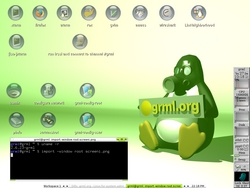
  • Screenshot von grml 1.1 It’s the first stable release being based on our new build-framework grml-live which itself is based on FAI (Fully Automatic Installation). Thanks to grml-live we can provide you a new grml flavour grml-medium which tries to close the gap between grml-small and grml. As usual you’ll get software and kernel updates, many new packages and features plus additional hardware support. We are using LZMA compression for squashfs and provide several additional kernel modules like atl2, iscsitarget, madwifi and (for the first time) loop-aes. Oh and the grml release is known to work fine on the Asus Eee PC - LAN, WLAN and webcam working out-of-the-box! Find all the glory details about the new releases in above mentioned release notes or just visit grml.org. For german readers there’s an article about the new release at pro-linux.de. BTW: On the next weekend (1st and 2nd of march) we - the grml team) - will present the new release on Chemnitzer Linuxdays at the grml booth. grml-CDs, grml-shirts und (new!) “ready to go grml-usb-pens” will be available as well as the chance to talk to us in reallife. 8-) So, we wish you a fast download and hope you enjoy the new release! :-)

    25 February 2008

    Julian Andres Klode: pristine-deb - git-buildpackage s pristine-tar support


    Reading about the idea of pristine-deb, I actually noticed that using ar -rc file.deb debian-binary control.tar.gz data.tar.gz does not work, due to timestamps and other differences. I am currently working on a pristine-deb program which will workaround all these issues. It will be able to work with git repositories like pristine-tar and uses pristine-tar for control.tar.gz and data.tar.gz. I may also add a function to decompress all compressed files (like changelog.gz) and uses pristine-gz to compress this file again before adding it to the tarball. This may save some additional space. BTW, git-buildpackage now supports pristine-tar. Simply enable it with “pristine-tar = True” in gbp.conf. Thank you Guido Guenther, for adding these patches.

    Next.

    Previous.