Search Results: "agi"

18 July 2017

Norbert Preining: Calibre and rar support

Thanks to the cooperation with upstream authors and the maintainer Martin Pitt, the Calibre package in Debian is now up-to-date at version 3.4.0, and has adopted a more standard packaging following upstream. In particular, all the desktop files and man pages have been replaced by what is shipped by Calibre. What remains to be done is work on RAR support.
Rar support is necessary in the case that the eBook uses rar as compression, which happens quite often in comic books (cbr extension). Calibre 3 has split out rar support into a dynamically loaded module, so what needs to be done is packaging it. I have prepared a package for the Python library unrardll which allows Calibre to read rar-compressed ebooks, but it depends on the unrar shared library, which unfortunately is not built in Debian. I have sent a patch to fix this to the maintainer, see bug 720051, but without reaction from the maintainer. Thus, I am publishing updated packages for unrar shipping also libunrar5, and unrardll Python package in my calibre repository. After installing python-unrardll Calibre will happily import meta-data from rar-compressed eBooks, as well as display them.
deb http://www.preining.info/debian/ calibre main
deb-src http://www.preining.info/debian/ calibre main
The releases are signed with my Debian key 0x6CACA448860CDC13 Enjoy

16 July 2017

Vasudev Kamath: Overriding version information from setup.py with pbr

I recently raised a pull request on zfec for converting its python packaging from pure setup.py to pbr based. Today I got review from Brian Warner and one of the issue mentioned was python setup.py --version is not giving same output as previous version of setup.py. Previous version used versioneer which extracts version information needed from VCS tags. Versioneer also provides flexibility of specifying type of VCS used, style of version, tag prefix (for VCS) etc. pbr also does extract version information from git tag but it expects git tag to be of format tags/refs/x.y.z format but zfec used a zfec- prefix to tag (example zfec-1.4.24) and pbr does not process this. End result, I get a version in format 0.0.devNN where NN is number of commits in the repository from its inception. Me and Brian spent few hours trying to figure out a way to tell pbr that we would like to override version information it auto deduces, but there was none other than putting version string in PBR_VERSION environment variable. That documentation was contributed by me 3 years back to pbr project. So finally I used versioneer to create a version string and put it in the environment variable PBR_VERSION.
import os
import versioneer
os.environ['PBR_VERSION'] = versioneer.get_version()
...
setup(
    setup_requires=['pbr'],
    pbr=True,
    ext_modules=extensions
)
And added below snippet to setup.cfg which is how versioneer can be configured with various information including tag prefixes.
[versioneer]
VCS = git
style = pep440
versionfile_source = zfec/_version.py
versionfile_build = zfec/_version.py
tag_prefix = zfec-
parentdir_prefix = zfec-
Though this work around gets the work done, it does not feel correct to set environment variable to change the logic of other part of same program. If you guys know the better way do let me know!. Also probably I should consider filing an feature request against pbr to provide a way to pass tag prefix for version calculation logic.

12 July 2017

Jose M. Calhariz: Crossgrading a minimal install of Debian 9

By testing the previous instructions for a full crosgrade I run into trouble. Here is the results of my tests to do a full crossgrade of a minimal installation of Debian inside a VM. First you need to install a 64bits kernel and boot with it. See my previous post on how to do it. Second you need to do a bootstrap of crossgrading:
 apt-get clean
 apt-get upgrade
 apt-get --download-only install dpkg:amd64 tar:amd64 apt:amd64 bash:amd64 dash:amd64 init:amd64
 dpkg --install /var/cache/apt/archives/*_amd64.deb
 dpkg --install /var/cache/apt/archives/*_amd64.deb
 dpkg --print-architecture
 dpkg --print-foreign-architectures
 apt-get --fix-broken --allow-remove-essential install
Third do a full crossgrade:
 apt-get install --allow-remove-essential $(dpkg --list   grep :i386   awk ' print $2 '   sed -e s/:i386// )
This procedure seams to be a little fragile, but worked most of the time for me.

Reproducible builds folks: Reproducible Builds: week 115 in Stretch cycle

Here's what happened in the Reproducible Builds effort between Sunday July 2 and Saturday July 8 2017: Reproducible work in other projects Ed Maste pointed to a thread on the LLVM developer mailing list about container iteration being the main source of non-determinism in LLVM, together with discussion on how to solve this. Ignoring build path issues, container iteration order was also the main issue with rustc, which was fixed by using a fixed-order hash map for certain compiler structures. (It was unclear from the thread whether LLVM's builds are truly path-independent or rather that they haven't done comparisons between builds run under different paths.) Bugs filed Patches submitted upstream: Reviews of unreproducible packages 52 package reviews have been added, 62 have been updated and 20 have been removed in this week, adding to our knowledge about identified issues. No issue types were updated or added this week. Weekly QA work During our reproducibility testing, FTBFS bugs have been detected and reported by: diffoscope development Development continued in git with contributions from: With these changes, we are able to generate a dynamically loaded HTML diff for GCC-6 that can be displayed in a normal web browser. For more details see this mailing list post. Misc. This week's edition was written by Ximin Luo, Bernhard M. Wiedemann and Chris Lamb & reviewed by a bunch of Reproducible Builds folks on IRC & the mailing lists.

11 July 2017

Andreas Bombe: PDP-8/e Replicated Overview

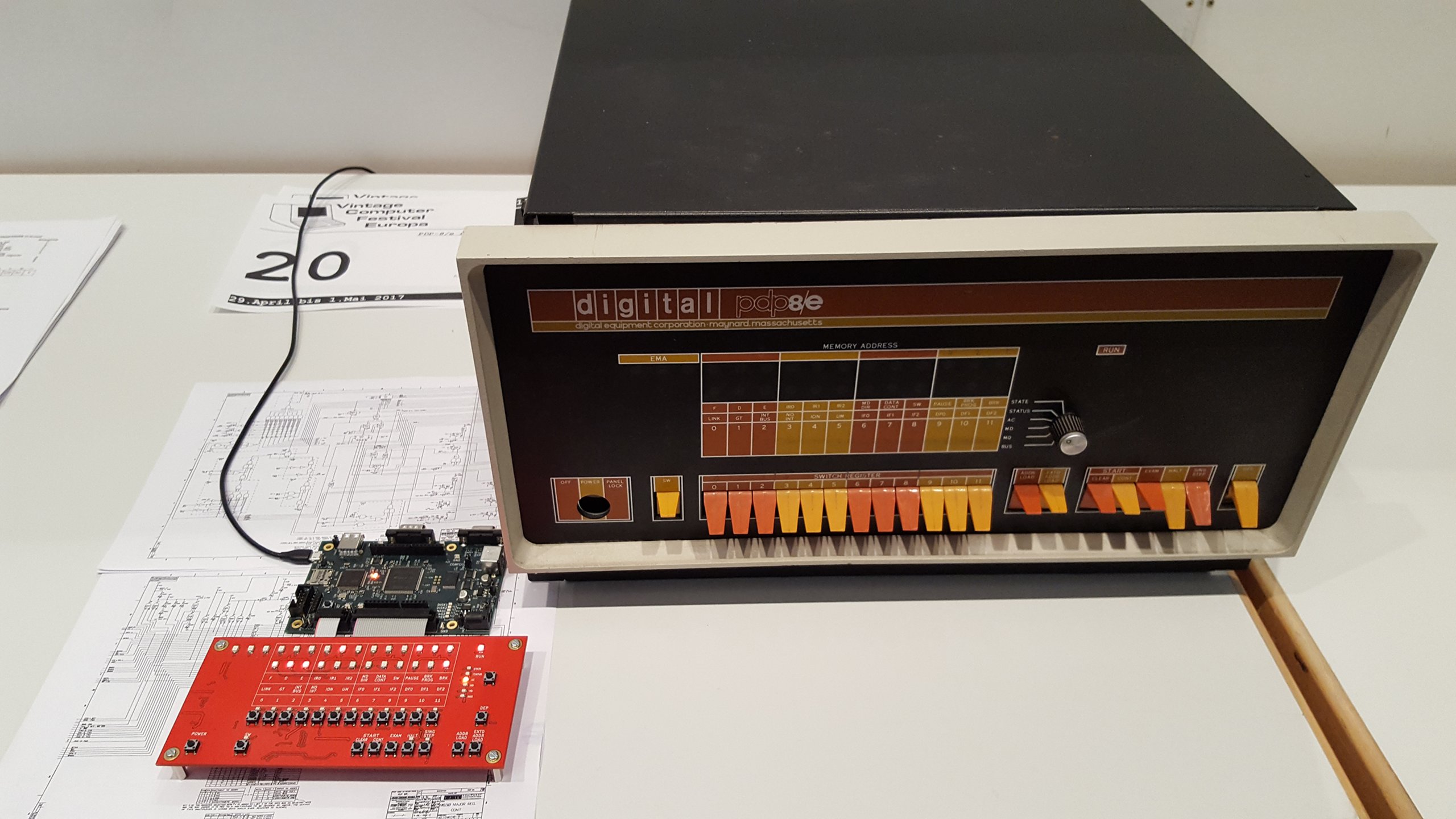
This is an overview of the hardware and internals of the PDP-8/e replica I m building.

The front panel board
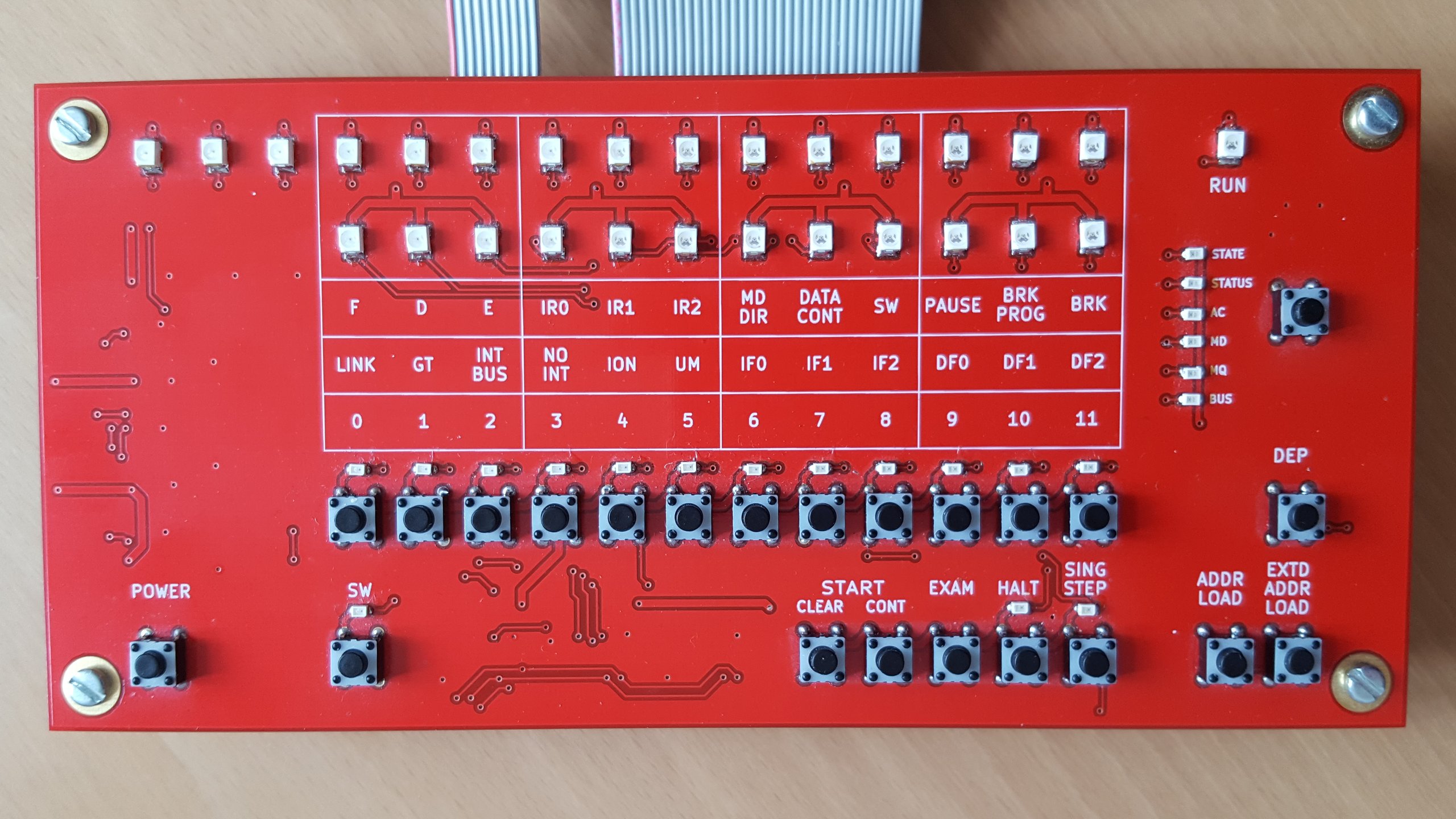
functional replica of the PDP-8/e front panel
If you know the original or remember the picture from the first post it is clear that this is a functional replica not aiming to be as pretty as those of the other projects I mentioned. I have reordered the switches into two rows to make the board more compact (which also means cheaper) without sacrificing usability. There s the two rows of display lights plus one run light the 8/e provides. The upper row is the address made up of 12 bits of memory address and 3 bits of extended memory address or field. Below are the 12 bits indicator which can show one data set out of six as selected by the user. All the switches of the original are implemented as more compact buttons1. While momentary switches are easily substituted by buttons, all buttons implementing two position switches toggle on/off with each press and they have a LED above that shows the current state. The six position rotary switch is implemented as a button cycling through all indicator displays together with six LEDs which show the active selection. Markings show the meaning of the indicator and switches as on the original, grouped in threes as the predominant numbering system for the PDPs was octal. The upper line shows the meaning for the state indicator, the middle for the status indicator and bit numbers for the rest. Note that on the PDP-8 and opposite to modern conventions, the most significant bit was numbered 0. I designed it as a pure front panel board without any PDP-8 simulation parts. The buttons and associated lights are controllable via SPI lines with a 3.3 V supply. The address and indicator lights have a separate common anode configuration with all cathodes individually available on a pin header without any resistors in the path, leaving voltage and current regulation up to the simulation board. This board is actually a few years old from a similar project where I emulated the PDP-8 in software on a microcontroller and the flexible design allowed me to reuse it unchanged.

The main board
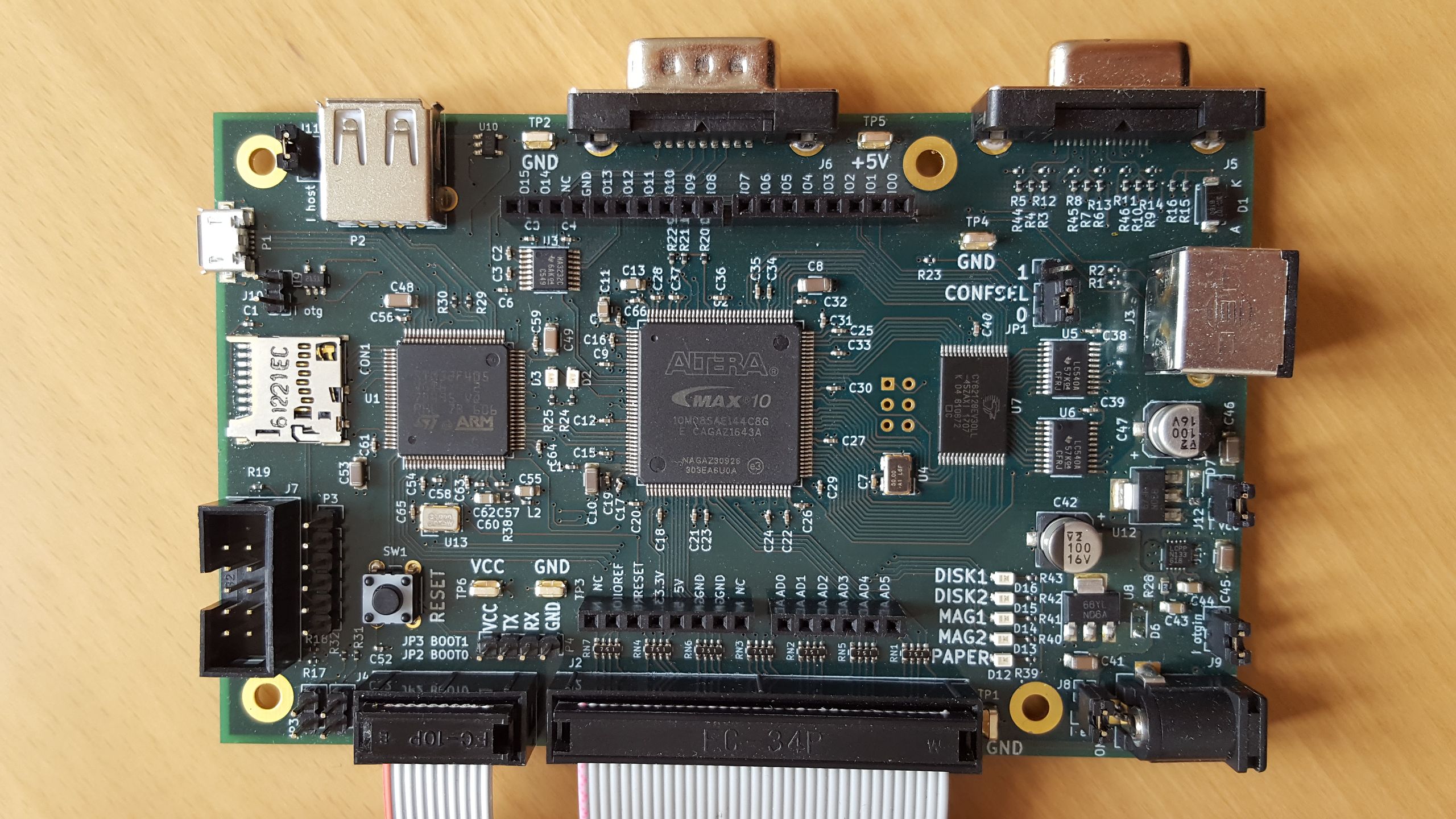
main board with CPU and peripherals of the replicated PDP-8/e
This is where the magic happens. You can see three big ICs on the board: On the left is the STM32F405 microcontroller (with ARM Cortex-M4 core), the bigger one in the middle is the Altera2 MAX 10 FPGA and finally to the right is the SRAM that is large enough to hold all the main memory of the 32 KW maximum expansion of the PDP-8/e. The two smaller chips to the right of that are just buffers that drive the front panel address LEDs, the small chip at the top left is a RS-232 level shifter. The idea behind this is that the PDP-8 and peripherals that are simple to directly implement, such as GPIO or a serial port, are fully on the FPGA. Other peripherals such as paper and magnetic tape and disks, which are after all not connected to real PDP-8 drives but disk images on a microSD, are implemented on the microcontroller interfacing with stub devices in the FPGA. Compared to implementing everything everything in the FPGA, the STM32F4 has the advantage of useful built in peripherals such as two host/device capable USB ports. 5 V tolerant I/O pins are very useful and simply not available in any FPGA. I have to admit that this board was a bit of a rush job in order to have something at all to show at the Vintage Computer Festival Europe 18.0. Given that it was my first time designing a board with a large microcontroller and the first time with an FPGA, it wasn t exactly my fastest progressing project either and I got basic functionality (front panel allows toggling in small programs and running them) working just in time. For various reasons the project hasn t progressed much since, so the following is still just plans, but plans for which the hardware was designed. Since the aim is to have a cycle accurate PDP-8/e implementation, digital I/O was always planned. Rather than defining my own header I have included Arduino R3 compatible headers (for 3.3 V compatible boards only) that have become a popular even outside the Arduino world for this purpose. The digital Arduino pins are connected directly to the FPGA and will be directly controllable by PDP-8 software. The downside of choosing the Arduino headers is that the original PDP-8 digital I/O interface is not a perfect match since it naturally has 12 lines whereas the Arduino has 15. The analog inputs are not connected to the FPGA, the documentation of the MAX10 s ADC in the EQFP package are not very encouraging. They are connected to the STM32 instead3. Another interface connected directly to the FPGA and that would be directly under PDP-8 control is a standard 9 pin RS-232 interface. RX, TX, CTS and RTS are connected and level-shifted between 3.3 V and RS-232 levels by a MAX3232. Besides the PDP-8, I also plan to implement a full video terminal on the board. The idea is that with a power supply, keyboard and monitor this board would form a complete system without the need of connecting another computer to act as a terminal. To that end, there is a VGA port attached to the FPGA with simple resistor network DACs for 9 bits color (RGB with 3 bits each). This is another spot where I left myself room to expand, for e.g. a VT220 you really only need one color in two brightness levels. Keyboards will be connected either via the PS/2 connector on the right or the USB-A host port at the top left. Last of the interface ports is the USB micro-AB port on the left, which for now I am using only for power supply. I mainly plan to use it to provide alternative or additional serial ports to the PDP-8 or to export the video terminal serial port for testing purposes. Other possible uses are access to the image files on the microSD and firmware updates. This has gotten rather long again, so I m stopping here and leave some implementation notes for another post.

  1. They are also much cheaper. Given the large number of switches, the savings are substantial. Additionaly the buttons are nicer to operate than long rows of tiny switches. [return]
  2. Or rather Intel now. At least Altera s web site, documentation and software have already been thoroughly rebranded, but the chips I got were produced prior to that. [return]
  3. That s not to say that the analog conversions on the STM32 are necessarily better than those of the MAX10 when you can t follow their guidelines, I have no comparisons. Certainly following the guidelines would have been prohibitive given how many pins usage they restrict. [return]

6 July 2017

Thadeu Lima de Souza Cascardo: News on Debian on apexqtmo

I had been using my Samsung Galaxy S Relay 4G for almost three years when I decided to get a new phone. I would use this new phone for daily tasks and take the chance to get a new model for hacking in the future. My apexqtmo would still be my companion and would now be more available for real hacking. And so it also happened that its power button got stuck. It was not the first time, but now it would happen every so often, and would require me to disassemble it. So I managed to remove the plastic button and leave it with a hole so I could press the button with a screwdriver or a paperclip. That was the excuse I needed to get it to running Debian only. Though it's now always plugged on my laptop, I got the chance to hack on it on my scarce free time. As I managed to get a kernel I built myself running on it, I started fixing things like enabling devtmpfs. I didn't insist much on running systemd, though, and kept with System V. The Xorg issues were either on the server or the client, depending on which client I ran. I decided to give a chance to running the Android userspace on a chroot, but gave up after some work to get some firmware loaded. I managed to get the ALSA controls right after saving them inside a chroot on my CyanogenMod system. Then, restoring them on Debian allowed to play songs. Unfortunately, it seems I broke the audio jack when disassembling it. Otherwise, it would have been a great portable audio player. I even wrote a small program that would allow me to control mpd by swiping on the touchscreen. Then, as Debian release approached, I decided to investigate the framebuffer issue closely. I ended finding out that it was really a bug in the driver, and after fixing it, the X server and client crashes were gone. It was beautiful to get some desktop environment running with the right colors, get a calculator started and really using the phone as a mobile device. There are two lessons or findings here for me. The first one is that the current environments are really lacking. Even something like GPE can't work. The buttons are tiny, scrollbars are still the only way for scrolling, some of the time. No automatic virtual keyboards. So, there needs to be some investing in the existing environments, and maybe even the development of new environments for these kinds of devices. This was something I expected somehow, but it's still disappointing to know that we had so much of those developed in the past and now gone. I really miss Maemo. Running something like Qtopia would mean grabing a very old unmaintained software not available in Debian. There is still matchbox, but it's as subpar as the others I tested. The second lesson is that building a userspace to run on old kernels will still hit the problem of broken drivers. In my particular case, unless I wrote code for using Ion instead of the framebuffer, I would have had that problem. Or it would require me to add code to xorg-xserver that is not appropriate. Or fix the kernel drivers of available kernel sourcecodes. But this does not scale much more than doing the right thing and adding upstream support for these devices. So, I decided it was time I started working on upstream support for my device. I have it in progress and may send some upstream patches soon. I have USB and MMC/SDcard working fine. DRM is still a challenge, but thanks to Rob Clark, it's something I expect to get working soon, and after that, I would certainly celebrate. Maybe even consider starting the work on other devices a little sooner. Trying to review my post on GNU on smartphones, here is where I would put some of the status of my device and some extra notes. On Halium I am really glad people started this project. This was one of the things I criticized: that though Ubuntu Phone and FirefoxOS built on Android userspace, they were not easily portable to many devices out there. But as I am looking for a more pure GNU experience, let's call it that, Halium does not help much in that direction. But I'd like to see it flourish and allow people to use more OSes on more devices. Unfortunately, it suffers from similar problems as the strategy I was trying to go with. If you have a device with a very old kernel, you won't be able to run some of the latest userspace, even with Android userspace help. So, lots of devices would be left unsupported, unless we start working on some upstream support. On RYF Hardware My device is one of the worst out there. It's a modem that has a peripherical CPU. Much has already been said about Qualcomm chips being some of the least freedom-friendly. Ironically, it's some with the best upstream support, as far as I found out while doing this upstreaming work. Guess we'll have to wait for opencores, openrisc and risc-v to catch up here. Diversity Though I have been experimenting with Debian, the upstream work would sure benefit lots of other OSes out there, mainly GNU+Linux based ones, but also other non-GNU Linux based ones. Not so much for other kernels. On other options After the demise of Ubuntu Phone, I am glad to see UBports catching up. I hope the project is sustainable and produce more releases for more devices. Rooting This needs documentation. Most of the procedures rely on booting a recovery system, which means we are already past the root requirement. We simply boot our own system, then. However, for some debugging strategies, getting root on the OEM system is useful. So, try to get root on your system, but beware of malware out there. Booting Most of these devices will have their bootloaders in there. They may be unlocked, allowing unsigned kernels to be booted. Replacing these bootloaders is still going to be a challenge for another future phase. Though adding a second bootloader there, one that is freedom respecting, and that allows more control on that booting step to the user is something possible once you have some good upstream support. One could either use kexec for that, or try to use the same device tree for U-Boot, and use the knowledge of the device drivers for Linux on writing drivers for U-Boot, GRUB or Libreboot. Installation If you have root on your OEM system, this is something that could be worked on. Otherwise, there is magic-device-tool, whose approach is one that could be used. Kernels While I am working on adding Linux upstream support for my device, it would be wonderful to see more kernels supporting those gadgets. Hopefully, some of the device driver writing and reverse engineering could help with that, though I am not too much optimistic. But there is hope. Basic kernel drivers Adding the basic support, like USB and MMC, after clocks, gpios, regulators and what not, is the first step to a long road. But it would allow using the device as a board computer, under better control of the user. Hopefully, lots of eletronic garbage out there would have some use as control gadgets. Instead of buying a new board, just grab your old phone and put it to some nice use. Sensors, input devices, LEDs There are usually easy too. Some sensors may depend on your modem or some userspace code that is not that easily reverse engineered. But others would just require some device tree work, or some small input driver. Graphics Here, things may get complicated. Even basic video output is something I have some trouble with. Thanks to some other people's work, I have hope at least for my device. And using the vendor's linux source code, some framebuffer should be possible, even some DRM driver. But OpenGL or other 3D acceleration support requires much more work than that, and, at this moment, it's not something I am counting on. I am thankful for the work lots of people have been doing on this area, nonetheless. Wireless Be it Wifi or Bluetooth, things get ugly here. The vendor driver might be available. Rewriting it would take a long time. Even then, it would most likely require some non-free firmware loading. Using USB OTG here might be an option. Modem/GSM The work of the Replicant folks on that is what gives me some hope that it might be possible to get this working. Something I would leave to after I have a good interface experience in my hands. GPS Problem is similar to the Modem/GSM one, as some code lives in userspace, sometimes talking to the modem is a requirement to get GPS access, etc. Shells This is where I would like to see new projects, even if they work on current software to get them more friendly to these form factors. I consider doing some work there, though that's not really my area of expertise. Next steps For me, my next steps are getting what I have working upstream, keep working on DRM support, packaging GPE, then experimenting with some compositor code. In the middle of that, trying to get some other devices started. But documenting some of my work is something I realized I need to do more often, and this post is some try on that.

4 July 2017

Raphaël Hertzog: My Free Software Activities in June 2017

My monthly report covers a large part of what I have been doing in the free software world. I write it for my donors (thanks to them!) but also for the wider Debian community because it can give ideas to newcomers and it s one of the best ways to find volunteers to work with me on projects that matter to me. Debian LTS I was allocated 12 hours to work on security updates for Debian 7 Wheezy. During this time I did the following: Debian packaging Django. A last-minute update to Django in stretch before the release, I uploaded python-django 1:1.10.7-2 fixing two bugs (among which one was release critical) and filed the corresponding unblock request. schroot. I tried to prepare another last-minute update, this time for schroot. The goal was to fix the bash completion (#855283) and a problem encountered by the Debian sysadmins (#835104). Those issues are fixed in unstable/testing but my unblock request got turned into a post-release stretch update because the release managers wanted to give the package some more testing time in unstable. Even now, they are wondering whether they should accept the new systemd service file. live-build, live-config and live-boot. On live-build, I merged a patch to add a keyboard shortcut for the advanced option menu entry (#864386). For live-config, I uploaded version 5.20170623 to fix a broken boot sequence when you have multiple partitions (#827665). For live-boot, I uploaded version 1:20170623 to fix the path to udevadm (#852570) and avoiding a file duplication in the initrd (864385). zim. I packaged a release candidate (0.67~rc2) in Debian Experimental and started to use it. I quickly discovered two annoying regressions that I reported upstream (here and here). logidee-tools. This is a package I authored a long time ago and that I m no longer actively using. It does still work but I sometimes wonder if it still has real users. Anyway I wanted to quickly replace the broken dependency on pgf but I ended up converting the Subversion repository to Git and I also added autopkgtests. At least those tests will inform me when the package no longer works otherwise I would not notice since I m no longer using it. Bugs filed. I filed #865531 on lintian because the new check testsuite-autopkgtest-missing is giving some bad advice and probably does its check in a bad way. I also filed #865541 on sbuild because sbuild --apt-distupgrade can under some circumstances remove build-essential and break the build chroot. I filed an upstream ticket on publican to forward the request I received in #864648. Sponsorship. I sponsored a jessie update for php-tcpdf (#814030) and dolibarr 5.0.4+dfsg3-1 for unstable. I sponsored many other packages, but all in the context of the pkg-security team. pkg-security work Now that the Stretch freeze is over, the team became more active again and I have been overwhelmed with the number of packages to review and sponsor: I also updated hashcat to a new upstream release (3.6.0) and had to discuss with upstream about its weird versioning change. Looks like we will have to introduce an epoch to be able to get back in sync with upstream.  To be able to get in sync with Kali, I introduced an hashcat-meta source package (in contrib) providing hashcat-nvidia to make it easy to install hashcat for owners of NVidia hardware. Misc stuff Distro Tracker. I merged a small CSS fix from Aur lien Couderc (#858101) and added a missing constraint on the data model (found through an unexpected traceback that I received by email). I also updated the list of repositories shortly after the stretch release (#865070). Salt formulas. As part of my Kali work, I did setup a build daemon on Debian stretch host and I encountered a couple of issues with my Salt rules. I reported one against salt-formula (here) and I pushed updates for debootstrap-formula, apache-formula and schroot-formula. Thanks See you next month for a new summary of my activities.

No comment Liked this article? Click here. My blog is Flattr-enabled.

3 July 2017

Vincent Bernat: Performance progression of IPv4 route lookup on Linux

TL;DR: Each of Linux 2.6.39, 3.6 and 4.0 brings notable performance improvements for the IPv4 route lookup process.
In a previous article, I explained how Linux implements an IPv4 routing table with compressed tries to offer excellent lookup times. The following graph shows the performance progression of Linux through history: IPv4 route lookup performance Two scenarios are tested: All kernels are compiled with GCC 4.9 (from Debian Jessie). This version is able to compile older kernels1 as well as current ones. The kernel configuration used is the default one with CONFIG_SMP and CONFIG_IP_MULTIPLE_TABLES options enabled (however, no IP rules are used). Some other unrelated options are enabled to be able to boot them in a virtual machine and run the benchmark. The measurements are done in a virtual machine with one vCPU2. The host is an Intel Core i5-4670K and the CPU governor was set to performance . The benchmark is single-threaded. Implemented as a kernel module, it calls fib_lookup() with various destinations in 100,000 timed iterations and keeps the median. Timings of individual runs are computed from the TSC (and converted to nanoseconds by assuming a constant clock). The following kernel versions bring a notable performance improvement:

  1. Compiling old kernels with an updated userland may still require some small patches.
  2. The kernels are compiled with the CONFIG_SMP option to use the hierarchical RCU and activate more of the same code paths as actual routers. However, progress on parallelism are left unnoticed.

1 July 2017

Paul Wise: FLOSS Activities June 2017

Changes

Issues

Review

Administration
  • Debian: redirect 2 users to support channels, redirect 1 person to the mirrors team, investigate SMTP TLS question, fix ACL issue, restart dead exim4 service
  • Debian mentors: service restarts, security updates & reboot
  • Debian QA: deploy my changes
  • Debian website: release related rebuilds, rebuild installation-guide
  • Debian wiki: whitelist several email addresses, whitelist 1 domain
  • Debian package tracker: deploy my changes
  • Debian derivatives census: deploy my changes
  • Openmoko: security updates & reboots.

Communication

Sponsors All work was done on a volunteer basis.

30 June 2017

Chris Lamb: Free software activities in June 2017

Here is my monthly update covering what I have been doing in the free software world (previous month):
Reproducible builds

Whilst anyone can inspect the source code of free software for malicious flaws, most software is distributed pre-compiled to end users. The motivation behind the Reproducible Builds effort is to allow verification that no flaws have been introduced either maliciously or accidentally during this compilation process by promising identical results are always generated from a given source. Multiple third-parties then can come to a consensus on whether a build was compromised or not. I have generously been awarded a grant from the Core Infrastructure Initiative to fund my work in this area. This month I:
  • Chaired our monthly IRC meeting. (Summary, logs, etc.)
  • Presented at Hong Kong Open Source Conference 2017.
  • Presented at LinuxCon China.
  • Submitted the following patches to fix reproducibility-related toolchain issues within Debian:
    • cracklib2: Ensuring /var/cache/cracklib/src-dicts are reproducible. (#865623)
    • fontconfig: Ensuring the cache files are reproducible. (#864082)
    • nfstrace: Make the PDF footers reproducible. (#865751)
  • Submitted 6 patches to fix specific reproducibility issues in cd-hit, janus, qmidinet, singularity-container, tigervnc & xabacus.
  • Submitted a wishlist request to the TeX mailing list to ensure that PDF files are reproducible even if generated from a difficult path after identifying underlying cause. (Thread)
  • Categorised a large number of packages and issues in the Reproducible Builds notes.git repository.
  • Worked on publishing our weekly reports. (#110, #111, #112 & #113)
  • Updated our website with 13 missing talks (e291180), updated the metadata for some existing talks (650a201) and added OpenEmbedded to the projects page (12dfcf0).

I also made the following changes to our tooling:
diffoscope

diffoscope is our in-depth and content-aware diff utility that can locate and diagnose reproducibility issues.


strip-nondeterminism

strip-nondeterminism is our tool to remove specific non-deterministic results from a completed build.

  • Add libarchive-cpio-perl with the !nocheck build profile. (01e408e)
  • Add dpkg-dev dependency build profile. (f998bbe)


Debian My activities as the current Debian Project Leader are covered in my "Bits from the DPL" email to the debian-devel-announce mailing list. However, I:
Debian LTS

This month I have been paid to work 16 hours hours on Debian Long Term Support (LTS). In that time I did the following:
  • "Frontdesk" duties, triaging CVEs, etc.
  • Issued DLA 974-1 fixing a command injection vulnerability in picocom, a dumb-terminal emulation program.
  • Issued DLA 972-1 which patches a double-free vulnerability in the openldap LDAP server.
  • Issued DLA 976-1 which corrects a buffer over-read vulnerability in the yodl ("Your Own Document Language") document processor.
  • Issued DLA 985-1 to address a vulnerability in libsndfile (a library for reading/writing audio files) where a specially-crafted AIFF file could result in an out-of-bounds memory read.
  • Issued DLA 990-1 to fix an infinite loop vulnerability in the expat, an XML parsing library.
  • Issued DLA 999-1 for the openvpn VPN server if clients used a HTTP proxy with NTLM authentication, a man-in-the-middle attacker could cause the client to crash or disclose stack memory that was likely to contain the proxy password.

Uploads
  • bfs (1.0.2-1) New upstream release, add basic/smoke autopkgtests.
  • installation-birthday (5) Add some basic autopkgtest smoke tests and correct the Vcs- Git,Browser headers.
  • python-django:
    • 1:1.11.2-1 New upstream minor release & backport an upstream patch to prevent a test failure if the source is not writable. (#816435)
    • 1:1.11.2-2 Upload to unstable, use !nocheck profile for build dependencies that are only required for tests and various packaging updates.

I also made the following non-maintainer uploads (NMUs):
  • kluppe (0.6.20-1.1) Fix segmentation fault caused by passing a truncated pointer instead of a GtkType. (#863421)
  • porg (2:0.10-1.1) Fix broken LD_PRELOAD path for libporg-log.so. (#863495)
  • ganeti-instance-debootstrap (0.16-2.1) Fix "illegal option for fgrep" error by using "--" to escape the search needle. (#864025)
  • pavuk (0.9.35-6.1) Fix segmentation fault when opening the "Limitations" window due to pointer truncation in src/gtkmulticol.[ch]. (#863492)
  • timemachine (0.3.3-2.1) Fix two segmentation faults in src/gtkmeter.c and gtkmeterscale.c caused by passing a truncated pointers using guint instead of a GtkType. (#863420)
  • jackeq (0.5.9-2.1) Fix another segmentation fault caused by passing a truncated pointer instead of a GtkType. (#863416)

Debian bugs filed
  • debhelper: Don't run dh_installdocs if nodoc is specified in DEB_BUILD_PROFILES? (#865869)
  • python-blessed: Non-determistically FTBFS due to unreliable timing in tests. (#864337)
  • apt: Please print a better error message if zero certificates are loaded from the system CA store. (#866377)

27 June 2017

Reproducible builds folks: Reproducible Builds: week 113 in Stretch cycle

Here's what happened in the Reproducible Builds effort between Sunday June 18 and Saturday June 24 2017: Upcoming and Past events Our next IRC meeting is scheduled for the 6th of July at 17:00 UTC with this agenda currently:
  1. Introductions
  2. Reproducible Builds Summit update
  3. NMU campaign for buster
  4. Press release: Debian is doing Reproducible Builds for Buster
  5. Reproducible Builds Branding & Logo
  6. should we become an SPI member
  7. Next meeting
  8. Any other business
On June 19th, Chris Lamb presented at LinuxCon China 2017 on Reproducible Builds. On June 23rd, Vagrant Cascadian held a Reproducible Builds question and answer session at Open Source Bridge. Reproducible work in other projects LEDE: firmware-utils and mtd-utils/mkfs.jffs2 now honor SOURCE_DATE_EPOCH. Toolchain development and fixes There was discussion on #782654 about packaging bazel for Debian. Dan Kegel wrote a patch to use ar determinitiscally for Homebrew, a package manager for MacOS. Dan Kegel worked on using SOURCE_DATE_EPOCH and other reproduciblity fixes in fpm, a multi plattform package builder. The Fedora Haskell team disabled parallel builds to achieve reproducible builds. Bernhard M. Wiedemann submitted many patches upstream: Packages fixed and bugs filed Patches submitted upstream: Other patches filed in Debian: Reviews of unreproducible packages 573 package reviews have been added, 154 have been updated and 9 have been removed in this week, adding to our knowledge about identified issues. 1 issue type has been updated: Weekly QA work During our reproducibility testing, FTBFS bugs have been detected and reported by: diffoscope development Version 83 was uploaded to unstable by Chris Lamb. It also moved the previous changes from experimental (to where they were uploaded) to unstable. It included contributions from previous weeks. You can read about these changes in our previous weeks' posts, or view the changelog directly (raw form). We plan to maintain a backport of this and future versions in stretch-backports. Ximin Luo also worked on better html-dir output for very very large diffs such as those for GCC. So far, this includes unreleased work on a PartialString data structure which will form a core part of a new and more intelligent recursive display algorithm. strip-nondeterminism development Versions 0.035-1 was uploaded to unstable from experimental by Chris Lamb. It included contributions from: Later in the week Mattia Rizzolo uploaded 0.035-2 with some improvements to the autopkgtest and to the general packaging. We currently don't plan to maintain a backport in stretch-backports like we did for jessie-backports. Please speak up if you think otherwise. reproducible-website development tests.reproducible-builds.org Misc. This week's edition was written by Ximin Luo, Holger Levsen, Bernhard M. Wiedemann, Mattia Rizzolo, Chris Lamb & reviewed by a bunch of Reproducible Builds folks on IRC & the mailing lists.

Colin Watson: New address book

I ve had a kludgy mess of electronic address books for most of two decades, and have got rather fed up with it. My stack consisted of: The biggest practical problem with this was that I had the address book that was most convenient for me to add things to (Google Contacts) and the one I used when sending email, and no sensible way to merge them or move things between them. I also wasn t especially comfortable with having all my contact information in a proprietary web service. My goals for a replacement address book system were: I think I have all this now! New stack The obvious basic technology to use is CardDAV: it s fairly complex, admittedly, but lots of software supports it and one of my goals was not having to write my own thing. This meant I needed a CardDAV server, some way to sync the database to and from both Android and the system where I run mutt, and whatever query glue was necessary to get mutt to understand vCards. There are lots of different alternatives here, and if anything the problem was an embarrassment of choice. In the end I just decided to go for things that looked roughly the right shape for me and tried not to spend too much time in analysis paralysis. CardDAV server I went with Xandikos for the server, largely because I know Jelmer and have generally had pretty good experiences with their software, but also because using Git for history of the backend storage seems like something my future self will thank me for. It isn t packaged in stretch, but it s in Debian unstable, so I installed it from there. Rather than the standalone mode suggested on the web page, I decided to set it up in what felt like a more robust way using WSGI. I installed uwsgi, uwsgi-plugin-python3, and libapache2-mod-proxy-uwsgi, and created the following file in /etc/uwsgi/apps-available/xandikos.ini which I then symlinked into /etc/uwsgi/apps-enabled/xandikos.ini:
[uwsgi]
socket = 127.0.0.1:8801
uid = xandikos
gid = xandikos
umask = 022
master = true
cheaper = 2
processes = 4
plugin = python3
module = xandikos.wsgi:app
env = XANDIKOSPATH=/srv/xandikos/collections
The port number was arbitrary, as was the path. You need to create the xandikos user and group first (adduser --system --group --no-create-home --disabled-login xandikos). I created /srv/xandikos owned by xandikos:xandikos and mode 0700, and I recommend setting a umask as shown above since uwsgi s default umask is 000 (!). You should also run sudo -u xandikos xandikos -d /srv/xandikos/collections --autocreate and then Ctrl-c it after a short time (I think it would be nicer if there were a way to ask the WSGI wrapper to do this). For Apache setup, I kept it reasonably simple: I ran a2enmod proxy_uwsgi, used htpasswd to create /etc/apache2/xandikos.passwd with a username and password for myself, added a virtual host in /etc/apache2/sites-available/xandikos.conf, and enabled it with a2ensite xandikos:
<VirtualHost *:443>
        ServerName xandikos.example.org
        ServerAdmin me@example.org
        ErrorLog /var/log/apache2/xandikos-error.log
        TransferLog /var/log/apache2/xandikos-access.log
        <Location />
                ProxyPass "uwsgi://127.0.0.1:8801/"
                AuthType Basic
                AuthName "Xandikos"
                AuthBasicProvider file
                AuthUserFile "/etc/apache2/xandikos.passwd"
                Require valid-user
        </Location>
</VirtualHost>
Then service apache2 reload, set the new virtual host up with Let s Encrypt, reloaded again, and off we go. Android integration I installed DAVdroid from the Play Store: it cost a few pounds, but I was OK with that since it s GPLv3 and I m happy to help fund free software. I created two accounts, one for my existing Google Contacts database (and in fact calendaring as well, although I don t intend to switch over to self-hosting that just yet), and one for the new Xandikos instance. The Google setup was a bit fiddly because I have two-step verification turned on so I had to create an app-specific password. The Xandikos setup was straightforward: base URL, username, password, and done. Since I didn t completely trust the new setup yet, I followed what seemed like the most robust option from the DAVdroid contacts syncing documentation, and used the stock contacts app to export my Google Contacts account to a .vcf file and then import that into the appropriate DAVdroid account (which showed up automatically). This seemed straightforward and everything got pushed to Xandikos. There are some weird delays in syncing contacts that I don t entirely understand, but it all seems to get there in the end. mutt integration First off I needed to sync the contacts. (In fact I happen to run mutt on the same system where I run Xandikos at the moment, but I don t want to rely on that, and going through the CardDAV server means that I don t have to poke holes for myself using filesystem permissions.) I used vdirsyncer for this. In ~/.vdirsyncer/config:
[general]
status_path = "~/.vdirsyncer/status/"
[pair contacts]
a = "contacts_local"
b = "contacts_remote"
collections = ["from a", "from b"]
[storage contacts_local]
type = "filesystem"
path = "~/.contacts/"
fileext = ".vcf"
[storage contacts_remote]
type = "carddav"
url = "<Xandikos base URL>"
username = "<my username>"
password = "<my password>"
Running vdirsyncer discover and vdirsyncer sync then synced everything into ~/.contacts/. I added an hourly crontab entry to run vdirsyncer -v WARNING sync. Next, I needed a command-line address book tool based on this. khard looked about right and is in stretch, so I installed that. In ~/.config/khard/khard.conf (this is mostly just the example configuration, but I preferred to sort by first name since not all my contacts have neat first/last names):
[addressbooks]
[[contacts]]
path = ~/.contacts/<UUID of my contacts collection>/
[general]
debug = no
default_action = list
editor = vim
merge_editor = vimdiff
[contact table]
# display names by first or last name: first_name / last_name
display = first_name
# group by address book: yes / no
group_by_addressbook = no
# reverse table ordering: yes / no
reverse = no
# append nicknames to name column: yes / no
show_nicknames = no
# show uid table column: yes / no
show_uids = yes
# sort by first or last name: first_name / last_name
sort = first_name
[vcard]
# extend contacts with your own private objects
# these objects are stored with a leading "X-" before the object name in the vcard files
# every object label may only contain letters, digits and the - character
# example:
#   private_objects = Jabber, Skype, Twitter
private_objects = Jabber, Skype, Twitter
# preferred vcard version: 3.0 / 4.0
preferred_version = 3.0
# Look into source vcf files to speed up search queries: yes / no
search_in_source_files = no
# skip unparsable vcard files: yes / no
skip_unparsable = no
Now khard list shows all my contacts. So far so good. Apparently there are some awkward vCard compatibility issues with creating or modifying contacts from the khard end. I ve tried adding one address from ~/.mutt/aliases using khard and it seems to at least minimally work for me, but I haven t explored this very much yet. I had to install python3-vobject 0.9.4.1-1 from experimental to fix eventable/vobject#39 saving certain vCard files. Finally, mutt integration. I already had set query_command="lbdbq '%s'" in ~/.muttrc, and I wanted to keep that in place since I still wanted to use LDAP querying as well. I had to write a very small amount of code for this (perhaps I should contribute this to lbdb upstream?), in ~/.lbdb/modules/m_khard:
#! /bin/sh
m_khard_query ()  
    khard email --parsable --remove-first-line --search-in-source-files "$1"
 
My full ~/.lbdb/rc now reads as follows (you probably won t want the LDAP stuff, but I ve included it here for completeness):
MODULES_PATH="$MODULES_PATH $HOME/.lbdb/modules"
METHODS='m_muttalias m_khard m_ldap'
LDAP_NICKS='debian canonical'
Next steps I ve deleted one account from Google Contacts just to make sure that everything still works (e.g. I can still search for it when composing a new message), but I haven t yet deleted everything. I won t be adding anything new there though. I need to push everything from ~/.mutt/aliases into the new system. This is only about 30 contacts so shouldn t take too long. Overall this feels like a big improvement! It wasn t a trivial amount of setup for just me, but it means I have both better usability for myself and more independence from proprietary services, and I think I can add extra users with much less effort if I need to. Postscript A day later and I ve consolidated all my accounts from Google Contacts and ~/.mutt/aliases into the new system, with the exception of one group that I had defined as a mutt alias and need to work out what to do with. This all went smoothly. I ve filed the new lbdb module as #866178, and the python3-vobject bug as #866181.

25 June 2017

Steinar H. Gunderson: Frame queue management in Nageru 1.6.1

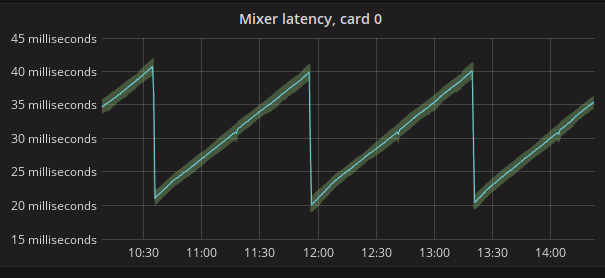
Nageru 1.6.1 is on its way, and what was intended to only be a release centered around monitoring improvements (more specifically a full set of native Prometheus] metrics) actually ended up getting a fairly substantial change to how Nageru manages its frame queues. To understand what's changing and why, it's useful to first understand the history of Nageru's queue management. Nageru 1.0.0 started out with a fairly simple scheme, but with some basics that are still relevant today: One of the input cards was deemed the master card, and whenever it delivers a frame, the master clock ticks and an output frame is produced. (There are some subtleties about dropped frames and/or the master card changing frame rates, but I'm going to ignore them, since they're not important to the discussion.) To this end, every card keeps a preallocated frame queue; when a card delivers a frame, it's put into the queue, and when the master clock ticks, it tries picking out one frame from each of the other card's queues to mix together. Note that mix here could be as simple as picking one input and throwing all the other ones away; the queueing algorithm doesn't care, it just feeds all of them to the theme and lets that run whatever GPU code it needs to match the user's preferences. The only thing that really keeps the queues bounded is that the frames in them are preallocated (in GPU memory), so if one queue gets longer than 16 frames, Nageru starts dropping it. But is 16 the right number? There are two conflicting demands here, ignoring memory usage: The 1.0.0 scheme does about as well as one could possibly hope in never dropping frames, but unfortunately, it can be pretty poor at latency. For instance, if your master card runs at 50 Hz and you have a 60 Hz card, the latter will eventually build up a delay of 16 * 16.7 ms = 266.7 ms clearly unacceptable, and rather unneeded. You could ask the user to specify a queue length, but the user probably doesn't know, and also shouldn't really have to care more knobs to twiddle are a bad thing, and even more so knobs the user is expected to twiddle. Thus, Nageru 1.2.0 introduced queue autotuning; it keeps a running estimate on how big the queue needs to be to avoid underruns, simply based on experience. If we've been dropping frames on a queue and then there's an underrun, the safe queue length is increased by one, and if the queue has been having excess frames for more than a thousand successive master clock ticks, we reduce it by one again. Whenever the queue has more than this safe number, we drop frames. This was simple, effective and largely fixed the problem. However, when adding metrics, I noticed a peculiar effect: Not all of my devices have equally good clocks. In particular, when setting up for 1080p50, my output card's internal clock (which assumes the role of the master clock when using HDMI/SDI output) seems to tick at about 49.9998 Hz, and my simple home camcorder delivers frames at about 49.9995 Hz. Over the course of an hour, this means it produces one more frame than you should have which should of course be dropped. Having an SDI setup with synchronized clocks (blackburst/tri-level) would of course fix this problem, but most people are not so lucky with their cameras, not to mention the price of PC graphics cards with SDI outputs! However, this happens very slowly, which means that for a significant amount of time, the two clocks will very nearly be in sync, and thus racing. Who ticks first is determined largely by luck in the jitter (normal is maybe 1ms, but occasionally, you'll see delayed delivery of as much as 10 ms), and this means that the 1000 frames estimate is likely to be thrown off, and the result is hundreds of dropped frames and underruns in that period. Once the clocks have diverged enough again, you're off the hook, but again, this isn't a good place to be. Thus, Nageru 1.6.1 change the algorithm around yet again, by incorporating more data to build an explicit jitter model. 1.5.0 was already timestamping each frame to be able to measure end-to-end latency precisely (now also exposed in Prometheus metrics), but from 1.6.1, they are actually used in the queueing algorithm. I ran several eight- to twelve-hour tests and simply stored all the event arrivals to a file, and then simulated a few different algorithms (including the old algorithm) to see how they fared in measures such as latency and number of drops/underruns. I won't go into the full details of the new queueing algorithm (see the commit if you're interested), but the gist is: Based on the last 5000 frames, it tries to estimate the maximum possible jitter for each input (ie., how late the frame could possibly be). Based on this as well as clock offsets, it determines whether it's really sure that there will be an input frame available on the next master tick even if it drops the queue, and then trims the queue to fit. The result is pretty satisfying; here's the end-to-end latency of my camera being sent through to the SDI output: As you can see, the latency goes up, up, up until Nageru figures it's now safe to drop a frame, and then does it in one clean drop event; no more hundreds on drops involved. There are very late frame arrivals involved in this run two extra frame drops, to be precise but the algorithm simply determines immediately that they are outliers, and drops them without letting them linger in the queue. (Immediate dropping is usually preferred to sticking around for a bit and then dropping it later, as it means you only get one disturbance event in your stream as opposed to two. Of course, you can only do it if you're reasonably sure it won't lead to more underruns later.) Nageru 1.6.1 will ship before Solskogen, as I intend to run it there :-) And there will probably be lovely premade Grafana dashboards from the Prometheus data. Although it would have been a lot nicer if Grafana were more packaging-friendly, so I could pick it up from stock Debian and run it on armhf. Hrmf. :-)

19 June 2017

Shirish Agarwal: Seizures, Vigo and bi-pedal motion

Dear all, an update is in order. While talking to physiotherapist couple of days before, came to know the correct term to what was I experiencing. I had experienced convulsive seizure , spasms being a part of it. Reading the wikipedia entry and the associated links/entries it seems I am and was very very lucky. The hospital or any hospital is a very bad bad place. I have seen all horror movies which people say are disturbing but have never been disturbed as much as I was in hospital. I couldn t help but hear people s screams and saw so many cases which turned critical. At times it was not easy to remain positive but dunno from where there was a will to live which pushed me and is still pushing me. One of the things that was painful for a long time were the almost constant stream of injections that were injected in me. It was almost an afterthought that the nurse put a Vigo in me. Similar to the Vigo injected in me. While the above medical device is similar, mine had a cross, the needle was much shorter and is injected into the vein. After that all injections are injected into that including common liquid which is salt,water and something commonly given to patients to stabilize first. I am not remembering the name atm. I also had a urine bag which was attached to my penis in a non-invasive manner. Both my grandfather and grandma used to cry when things went wrong while I didn t feel any pain but when the urine bag was disattached and attached again, so seems things have improved there. I was also very conscious of getting bed sores as both my grandpa and grandma had them when in hospital. As I had no strength I had to beg. plead do everything to make sure that every few hours I was turned from one side to other. I also had an air bag which is supposed to alleviate or relief this condition. Constant physiotherapy every day for a while slowly increased my strength and slowly both the vigo and feeding tube put inside my throat was removed. I have no remembrance as to when they had put the feeding tube as it was all rubber and felt bad when it came out. Further physiotherapy helped me crawl till the top of the bed, the bed was around 6 feet in length and and more than enough so I could turn both sides without falling over. Few days later I found I could also sit up using my legs as a lever and that gave confidence to the doctors to remove the air bed so I could crawl more easily. Couple of more days later I stood on my feet for the first time and it was like I had lead legs. Each step was painful but the sense and feeling of independence won over whatever pain was there. I had to endure wet wipes from nurses and ward boys in place of a shower everyday and while they were respectful always it felt humiliating. The first time I had a bath after 2 weeks or something, every part of my body cried and I felt like a weakling. I had thought I wouldn t be able to do justice to the physiotherapy session which was soon after but after the session was back to feeling normal. For a while I was doing the penguin waddle which while painful was also had humor in it. I did think of shooting the penguin waddle but decided against it as I was half-naked most of the time ( the hospital clothes never fit me properly) Cut to today and I was able to climb up and down the stairs on my own and circled my own block, slowly but was able to do it on my own by myself. While I always had a sense of wonderment for bi-pedal motion as well as all other means of transport, found much more respect of walking. I live near a fast food eating joint so I see lot of youngsters posing in different ways with their legs to show interest to their mates. And this I know happens both on the conscious and sub-conscious levels. To be able to see and discern that also put a sense of wonder in nature s creations. All in all, I m probabl6y around 40% independent and still 60% interdependent. I know I have to be patient with myself and those around me and explain to others what I m going through. For e.g. I still tend to spill things and still can t touch-type much. So, the road is long, I can only pray and hope best wishes for anybody who is my condition and do pray that nobody goes through what I went through, especiallly not children. I am also hoping that things like DxtER and range of non-invasive treatments make their way into India and the developing world at large. Anybody who is overweight and is either disgusted or doesn t like the gym route, would recommend doing sessions with a physiotherapist that you can trust. You have to trust that her judgement will push you a bit more and not more that the gains you make are toppled over. I still get dizziness spells while doing therapy but will to break it as I know dizziness doesn t help me. I hope my writings give strength and understanding to either somebody who is going through it, or relatives or/and caregivers so they know the mental status of the person who s going through it. Till later and sorry it became so long. Update I forgot to share this inspirational story from my city which I shared with a friend days ago. Add to that, she is from my city. What it doesn t share is that Triund is a magical place. I had visited once with a friend who had elf ears (he had put on elf ears) and it is kind of place which alchemist talks about, a place where imagination does turn wild and there is magic in the air.
Filed under: Miscellenous Tagged: #air bag, #bed sores, #convulsive epileptic seizure, #crawling, #horror, #humiliation, #nakedness, #penguin waddle, #physiotherapy, #planet-debian, #spilling things, #urine bag, #Vigo medical device

16 June 2017

Elena 'valhalla' Grandi: Travel piecepack v0.1

Travel piecepack v0.1

Immagine/fotosocial.gl-como.it/photos/valha

A www.piecepack.org/ set of generic board game pieces is nice to have around in case of a sudden spontaneous need of gaming, but carrying my full set www.trueelena.org/fantastic/fe takes some room, and is not going to fit in my daily bag.

I've been thinking for a while that an half-size set could be useful, and between yesterday and today I've actually managed to do the first version.

It's (2d) printed on both sides of a single sheet of heavy paper, laminated and then cut, comes with both the basic suites and the playing card expansion and fits in a mint tin divided by origami boxes.

It's just version 0.1 because there are a few issues: first of all I'm not happy with the manual way I used to draw the page: ideally it would have been programmatically generated from the same svg files as the 3d piecepack (with the ability to generate other expansions), but apparently reading paths from an svg and writing it in another svg is not supported in an easy way by the libraries I could find, and looking for it was starting to take much more time than just doing it by hand.

I also still have to assemble the dice; in the picture above I'm just using the ones from the 3d-printed set, but they are a bit too big and only four of them fit in the mint tin. I already have the faces printed, so this is going to be fixed in the next few days.

Source files are available in the same git repository as the 3d-printable piecepack git.trueelena.org/cgit.cgi/3d/, with the big limitation mentioned above; updates will also be pushed there, just don't hold your breath for it :)

14 June 2017

Antoine Beaupr : Alioth moving toward pagure

Since 2003, the Debian project has been running a server called Alioth to host source code version control systems. The server will hit the end of life of the Debian LTS release (Wheezy) next year; that deadline raised some questions regarding the plans for the server over the coming years. Naturally, that led to a discussion regarding possible replacements. In response, the current Alioth maintainer, Alexander Wirt, announced a sprint to migrate to pagure, a free-software "Git-centered forge" written in Python for the Fedora project, which LWN covered last year. Alioth currently runs FusionForge, previously known as GForge, which is the free-software fork of the SourceForge code base when that service closed its source in 2001. Alioth hosts source code repositories, mainly Git and Subversion (SVN) and, like other "forge" sites, also offers forums, issue trackers, and mailing list services. While other alternatives are still being evaluated, a consensus has emerged on a migration plan from FusionForage to a more modern and minimal platform based on pagure.

Why not GitLab? While this may come as a surprise to some who would expect Debian to use the more popular GitLab project, the discussion and decision actually took place a while back. During a lengthy debate last year, Debian contributors discussed the relative merits of different code-hosting platforms, following the initiative of Debian Developer "Pirate" Praveen Arimbrathodiyil to package GitLab for Debian. At that time, Praveen also got a public GitLab instance running for Debian (gitlab.debian.net), which was sponsored by GitLab B.V. the commercial entity behind the GitLab project. The sponsorship was originally offered in 2015 by the GitLab CEO, presumably to counter a possible move to GitHub, as there was a discussion about creating a GitHub Organization for Debian at the time. The deployment of a Debian-specific GitLab instance then raised the question of the overlap with the already existing git.debian.org service, which is backed by Alioth's FusionForge deployment. It then seemed natural that the new GitLab instance would replace Alioth. But when Praveen directly proposed to move to GitLab, Wirt stepped in and explained that a migration plan was already in progress. The plan then was to migrate to a simpler gitolite-based setup, a decision that was apparently made in corridor discussions surrounding the Alioth Git replacement BoF held during Debconf 2015. The first objection raised by Wirt against GitLab was its "huge number of dependencies". Another issue Wirt identified was the "open core / enterprise model", preferring a "real open source system", an opinion which seems shared by other participants on the mailing list. Wirt backed his concerns with an hypothetical example:
Debian needs feature X but it is already in the enterprise version. We make a patch and, for commercial reasons, it never gets merged (they already sell it in the enterprise version). Which means we will have to fork the software and keep those patches forever. Been there done that. For me, that isn't acceptable.
This concern was further deepened when GitLab's Director of Strategic Partnerships, Eliran Mesika, explained the company's stewardship policy that explains how GitLab decides which features end up in the proprietary version. Praveen pointed out that:
[...] basically it boils down to features that they consider important for organizations with less than 100 developers may get accepted. I see that as a red flag for a big community like debian.
Since there are over 600 Debian Developers, the community seems to fall within the needs of "enterprise" users. The features the Debian community may need are, by definition, appropriate only to the "Enterprise Edition" (GitLab EE), the non-free version, and are therefore unlikely to end up in the "Community Edition" (GitLab CE), the free-software version. Interestingly, Mesika asked for clarification on which features were missing, explaining that GitLab is actually open to adding features to GitLab CE. The response from Debian Developer Holger Levsen was categorical: "It's not about a specific patch. Free GitLab and we can talk again." But beyond the practical and ethical concerns, some specific features Debian needs are currently only in GitLab EE. For example, debian.org systems use LDAP for authentication, which would obviously be useful in a GitLab deployment; GitLab CE supports basic LDAP authentication, but advanced features, like group or SSH-key synchronization, are only available in GitLab EE. Wirt also expressed concern about the Contributor License Agreement that GitLab B.V. requires contributors to sign when they send patches, which forces users to allow the release of their code under a non-free license. The debate then went on going through a exhaustive inventory of different free-software alternatives:
  • GitLab, a Ruby-based GitHub replacement, dual-licensed MIT/Commercial
  • Gogs, Go, MIT
  • Gitblit, Java, Apache-licensed
  • Kallithea, in Python, also supports Mercurial, GPLv3
  • and finally, pagure, also written Python, GPLv2
A feature comparison between each project was created in the Debian wiki as well. In the end, however, Praveen gave up on replacing Alioth with GitLab because of the controversy and moved on to support the pagure migration, which resolved the discussion in July 2016. More recently, Wirt admitted in an IRC conversation that "on the technical side I like GitLab a lot more than pagure" and that "as a user, GitLab is much nicer than pagure and it has those nice CI [continuous integration] features". However, as he explained in his blog "GitLab is Opencore, [and] that it is not entirely opensource. I don't think we should use software licensed under such a model for one of our core services" which leaves pagure as the only stable candidate. Other candidates were excluded on technical grounds, according to Wirt: Gogs "doesn't scale well" and a quick security check didn't yield satisfactory results; "Gitblit is Java" and Kallithea doesn't have support for accessing repositories over SSH (although there is a pending pull request to add the feature). In an email interview, Sid Sijbrandij, CEO of GitLab, did say that "we want to make sure that our open source edition can be used by open source projects". He gave examples of features liberated following requests by the community, such as branded login pages for the VLC project and GitLab Pages after popular demand. He stressed that "There are no artificial limits in our open source edition and some organizations use it with more than 20.000 users." So if the concern of the Debian community is that features may be missing from GitLab CE, there is definitely an opening from GitLab to add those features. If, however, the concern is purely ethical, it's hard to see how an agreement could be reached. As Sijbrandij put it:
On the mailinglist it seemed that some Debian maintainers do not agree with our open core business model and demand that there is no proprietary version. We respect that position but we don't think we can compete with the purely proprietary software like GitHub with this model.

Working toward a pagure migration The issue of Alioth maintenance came up again last month when Boyuan Yang asked what would happen to Alioth when support for Debian LTS (Wheezy) ends next year. Wirt brought up the pagure migration proposal and the community tried to make a plan for the migration. One of the issues raised was the question of the non-Git repositories hosted on Alioth, as pagure, like GitLab, only supports Git. Indeed, Ben Hutchings calculated that while 90% (\~19,000) of the repositories currently on Alioth are Git, there are 2,400 SVN repositories and a handful of Mercurial, Bazaar (bzr), Darcs, Arch, and even CVS repositories. As part of an informal survey, however, most packaging teams explained they either had already migrated away from SVN to Git or were in the process of doing so. The largest CVS user, the web site team, also explained it was progressively migrating to Git. Mattia Rizzolo then proposed that older repository services like SVN could continue running even if FusionForge goes down, as FusionForge is, after all, just a web interface to manage those back-end services. Repository creation would be disabled, but older repositories would stay operational until they migrate to Git. This would, effectively, mean the end of non-Git repository support for new projects in the Debian community, at least officially. Another issue is the creation of a Debian package for pagure. Ironically, while Praveen and other Debian maintainers have been working for 5 years to package GitLab for Debian, pagure isn't packaged yet. Antonio Terceiro, another Debian Developer, explained this isn't actually a large problem for debian.org services: "note that DSA [Debian System Administrator team] does not need/want the service software itself packaged, only its dependencies". Indeed, for Debian-specific code bases like ci.debian.net or tracker.debian.org, it may not make sense to have the overhead of maintaining Debian packages since those tools have limited use outside of the Debian project directly. While Debian derivatives and other distributions could reuse them, what usually happens is that other distributions roll their own software, like Ubuntu did with the Launchpad project. Still, Paul Wise, a member of the DSA team, reasoned that it was better, in the long term, to have Debian packages for debian.org services:
Personally I'm leaning towards the feeling that all configuration, code and dependencies for Debian services should be packaged and subjected to the usual Debian QA activities but I acknowledge that the current archive setup (testing migration plus backporting etc) doesn't necessarily make this easy.
Wise did say that "DSA doesn't have any hard rules/policy written down, just evaluation on a case-by-case basis" which probably means that pagure packaging will not be a blocker for deployment. The last pending issue is the question of the mailing lists hosted on Alioth, as pagure doesn't offer mailing list management (nor does GitLab). In fact, there are three different mailing list services for the Debian project: Wirt, with his "list-master hat" on, explained that the main mailing list service is "not really suited as a self-service" and expressed concern at the idea of migrating the large number mailing lists hosted on Alioth. Indeed, there are around 1,400 lists on Alioth while the main service has a set of 300 lists selected by the list masters. No solution for those mailing lists was found at the time of this writing. In the end, it seems like the Debian project has chosen pagure, the simpler, less featureful, but also less controversial, solution and will use the same hosting software as their fellow Linux distribution, Fedora. Wirt is also considering using FreeIPA for account management on top of pagure. The plan is to migrate away from FusionForge one bit at a time, and pagure is the solution for the first step: the Git repositories. Lists, other repositories, and additional features of FusionForge will be dealt with later on, but Wirt expects a plan to come out of the upcoming sprint. It will also be interesting to see how the interoperability promises of pagure will play out in the Debian world. Even though the federation features of pagure are still at the early stages, one can already clone issues and pull requests as Git repositories, which allows for a crude federation mechanism. In any case, given the long history and the wide variety of workflows in the Debian project, it is unlikely that a single tool will solve all problems. Alioth itself has significant overlap with other Debian services; not only does it handle mailing lists and forums, but it also has its own issue tracker that overlaps with the Debian bug tracking system (BTS). This is just the way things are in Debian: it is an old project with lots of moving part. As Jonathan Dowland put it: "The nature of the project is loosely-coupled, some redundancy, lots of legacy cruft, and sadly more than one way to do it." Hopefully, pagure will not become part of that "legacy redundant cruft". But at this point, the focus is on keeping the services running in a simpler, more maintainable way. The discussions between Debian and GitLab are still going on as we speak, but given how controversial the "open core" model used by GitLab is for the Debian community, pagure does seem like a more logical alternative.
Note: this article first appeared in the Linux Weekly News.

13 June 2017

Reproducible builds folks: Reproducible Builds: week 111 in Stretch cycle

Here's what happened in the Reproducible Builds effort between Sunday June 4 and Saturday June 10 2017: Past and upcoming events On June 10th, Chris Lamb presented at the Hong Kong Open Source Conference 2017 on reproducible builds. Patches and bugs filed Reviews of unreproducible packages 7 package reviews have been added, 10 have been updated and 14 have been removed in this week, adding to our knowledge about identified issues. Weekly QA work During our reproducibility testing, FTBFS bugs have been detected and reported by: Two FTBFS issues of LEDE (exposed in our setup) were found and were fixed: diffoscope development tests.reproducible-builds.org: Alexander 'lynxis' Couzens made some changes for testing LEDE and OpenWrt: Hans-Christoph Steiner, for testing F-Droid: Daniel Shahaf, for testing Debian: Holger 'h01ger' Levsen, for testing Debian: Misc. This week's edition was written by Ximin Luo, Chris Lamb and Holger Levsen & reviewed by a bunch of Reproducible Builds folks on IRC & the mailing lists.

12 June 2017

Craig Small: psmisc 23.0

I had to go check but it has been over 3 years since the last psmisc release back in February 2014. I really didn t think it had been that long ago. Anyhow, with no further delay, psmisc version 23.0 has been released today! Update: 23.1 is out now, removed some debug line out of killall and shipped two missing documents. This release is just a few feature update and minor bug fixes. The changelog lists them all, but these are the highlights. killall namespace filtering killall was not aware of namespaces, which meant if you wanted to kill all specified processes in the root namespace, it did that, but also all the child namespaces. So now it will only by default kill processes in its current PID namespace, and there is a new -n flag to specify 0 for all or a PID to use the namespace of. killall command name parsing This is similar to the bug sudo had where it didn t parse process names properly. A crafted process name meant killall missed it, even if you specified the username or tty. While I checked for procps having this problem (it didn t) I didn t check psmisc. Now killall and sudo use a similar parsing method as procps. New program: pslog Wanted to know what logs a process is writing to? pslog can help you here. It will report on what files in /var/log are opened by the specified process ID.
pslog 26475
Pid no 26475:
Log path: /opt/observium/logs/error_log
Log path: /var/log/apache2/other_vhosts_access.log
Log path: /opt/observium/logs/access_log
Finding psmisc psmisc will be available in your usual distributions shortly. The Debian packages are about to be uploaded and will be in the sid distribution soon. Other distributions I imagine will follow. For the source code, look in the GitLab repository or the Sourceforge file location.

11 June 2017

Bastian Blank: New blog featuring Pelican

For years I used a working blog setup using Zope, Plone and Quills. Quills was neglected for a long time and made me stuck at the aging Plone 4.2. There seems to be some work done in the last year, but I did not really care. Also this whole setup was just a bit too heavy for what I actually use it for. Well, static page generators are the new shit, so there we are. So here is it, some new blog, nice and shiny, which I hope to stop neglecting. The blog is managed in a Git repository. This repository is hosted on a private GitLab instance. It uses Pelican to generate shiny pages and is run via the GitLab CI. The finished pages are served by a, currently not highly available, instance of GitLab Pages (yes, this is one of the parts they copied from Github first). So let's see if this setup makes me more comfortable.

Next.

Previous.