Search Results: "ag"

28 July 2011

Aigars Mahinovs: Debconf 11 the group picture

Debconf 11 group photo
The group picture of the Debconf11 has been up for 33 hours now and finally I also had a moment of time to make the numbered version so you can add peoples names to it. I am pleased to say it is the one of the largest Debconf group photos yet with 263 people and 86 Mpix resolution. It took 10 separate images to stitch it together (from 44 images taken) and 15 fixes of stitching bugs deemed RC, 4 bugs were noted post-release, deemed minor. Most noticeable is on very skinny leg in the front row :) . Short links: http://is.gd/dc11group http://is.gd/dc11names

Philipp Kern: caff harmful unless you know what you're doing

So there are two things I stumbled upon with caff:
Thanks to Tom Marble for the hint. I'm still sad that I'd basically need to re-do yesterday's keysigning (which was about 100 e-mails), just to switch from the default SHA1 to SHA256

Dirk Eddelbuettel: Rcpp 0.9.6

A new maintenance release version 0.9.6 of Rcpp went onto CRAN and into Debian earlier today. This release contains a fix which helps the RppEigen package (mentioned previously on this blog), as well as an addition which permits user-defined finalizers for external pointer objects (following a suggestion on the mailing list). Two new examples where added: a Gibbs sampler illustration (blogged about as well) and a Rcpp-based Fibonacci implementation following a question on StackOverflow. And while that last example is clearly degenerate, the 700+ fold net speedup (as shown in my answer) is still pretty neat. The complete NEWS entry is below; more details are in the ChangeLog file in the package and on the Rcpp Changelog page.
0.9.6   2011-07-26
    o   Added helper traits to facilitate implementation of the RcppEigen
        package: The is_eigen_base traits identifies if a class derives from
        EigenBase using SFINAE; and new dispatch layer was added to wrap() to
        help RcppEigen
    o   XPtr now accepts a second template parameter, which is a function
        taking a pointer to the target class. This allows the developper to
        supply his/her own finalizer. The template parameter has a default
        value which retains the original behaviour (calling delete on the
        pointer)
    o   New example RcppGibbs, extending Sanjog Misra's Rcpp illustration of
        Darren Wilkinson's comparison of MCMC Gibbs Sampler implementations;
        also added short timing on Normal and Gaussian RNG draws between Rcpp
        and GSL as R's rgamma() is seen to significantly slower
    o   New example on recursively computing a Fibonacci number using Rcpp and
        comparing this to R and byte-compiled R for a significant speed gain
Thanks to CRANberries, you can also look at a diff to the previous release 0.9.5. As always, even fuller details are on the Rcpp Changelog page and the Rcpp page which also leads to the downloads, the browseable doxygen docs and zip files of doxygen output for the standard formats. A local directory has source and documentation too. Questions, comments etc should go to the rcpp-devel mailing list off the R-Forge page

27 July 2011

Thorsten Glaser: jupp: new release, new distro package

jupp 3.1.17 uploaded today, mostly thanks to user input suggesting I improve things, especially the syntax highlighting. (Maybe more to come.) I like users who don t complain but give helpful comments and send in patches even. Since the Debian FTP masters complain that the NEW queue is empty for the first time in ages, I also uploaded jupp to Debian proper (got requests, several, from actual users independent of each other). I originally thought I were the only user, it s not worth it, maybe too close to joe (which segfaults a lot more and has some ugly things, so I cherry-picked the better features of it instead of rebasing jupp), but it s had a package in mports (MidnightBSD ports) for ages, users submitted one to FreeBSD last year and keep it updated, there s even a WIP package in pkgsrc , and who knows where else or how many people are using my OpenSuSE Buildservice package or have had installed the previous DEB package I uploaded to my play repo. So now I feel it worth to upload. I even invested some major packaging rework, such as splitting the build-arch and build-indep parts from each other, and importing the upstream source into the packaging VCS, as I have learned in the packaging with git talk here at DebConf. (No guys, I will stick to CVS as git doesn t give me anything.)

Thorsten Glaser: (Banja Luka)

Been hot and dry today (although the sky is now back full of dark clouds), so I had a headache most of the morning until way past noon. Better now though, and I found a place where I could get Cevapi, which are really some sort of quick imbiss / fast food here (no uve pirina though, and she didn t have any Ajvar nor did she speak any language other than the local, but that wasn t a problem, only a bit dry because I didn t give in and took the offered Ketchup). Bought a 1 bottle of Kru kovac (from Hrvatska, though) and some small plastic glasses, then. I wonder how many people would, now, be willing to give Bosna i Hercegovina a try as holiday region (which might have been the intent of having a Balkan DebConf). I m sure I do. To all attendees: the hotel will give you some kind of stamped hardpaper card which states where you stayed on the trip, and for how long give that to the border guards when exiting Bosnia.

Chris Lamb: Official Redis packages for Debian "squeeze"

Due to high demand I have prepared official Redis packages for Debian "squeeze":
  1. Add the following line to /etc/apt/sources.list:

    deb http://backports.debian.org/debian-backports squeeze-backports main
    
  2. Update your local package lists:

    sudo apt-get update
    
  3. Install redis-server with:

    sudo apt-get -t squeeze-backports install redis-server
    
The current version number in this repository may be found here. Bugs should be reported in the usual way. For the sections of the web community who insist on hitting problems solved years ago, here is why you should use these packages over installing Redis manually:

Alexander Wirt: Please welcome Melissa

I thought it would be a good idea to get some fresh blood into Debian, so my wife and I decided to "create" Melissa. Melissa was born on Monday 25th at 00:47h and was 54cm large and weighed 4200 gram. Of course she already has her first Debian shirt ;).

melissa-cropped.jpg

Full size images are available via http://apu.snow-crash.org/~formorer/melissa


26 July 2011

Alexander Reichle-Schmehl: -273,15, aka Absolute Zero

Continuing the shameless self-praise from our ftp-team talk, I'm now pleased to present you on behalf of the entire FTP-Team the following: As you can clearly see, you can see nothing. Yes, nothing! As of 18:55:52 UTC+2 the NEW queue, which at some times was well over 500, sometimes even 600 packages is now empty. Completely empty. To the best of my (and Ganneff's knowledge) the last time the NEW queue was empty was at least five years ago. Interesting enough, that triggered an yet undiscovered bug in dak, which refused to scan an empty directory...

Ingo Juergensmann: Upgrading m68k from etch-m68 to unstable

After being dropped out of Debian, the m68k was stalled from some time now. There was no real upgrade path and so my machines still are running etch-m68k. Thanks to Thorsten Glaser the port is slowly keeping up with NPTL now ported to kernel and glibc for m68k. He took care to port and compile a lots of packages that are needed for upgrading from etch-m68k. Big thanks for that to Thorsten! Anyway, I'm in the progress of upgrading my m68k machines and buildds with the help and tips from Thorsten and this is the way I'm doing this:
  1. Change your /etc/apt/sources.list to include this:

    deb http://ftp.debian-ports.org/debian/ unstable main contrib
    deb http://archive.debian.org/debian etch-m68k main contrib non-free
  2. Get libuuid-perl from snapshot.debian.org:

    wget http://snapshot.debian.org/archive/debian/20070128T000000Z/pool/main/libu/libuuid-perl/libuuid-perl_0.02-1_m68k.deb
    dpkg -i libuuid-perl_0.02-1_m68k.deb

  3. Get kernel & linux-base from unstable
    You need to install a recent kernel like linux-image-2.6.39-2-amiga in my case. Either download it by hand or use apt:

    apt-get -d install linux-image-2.6.39-2-amiga linux-base
    cd /var/cache/apt/archive
    dpkg --force-depends -i linux-image-2.6.39-2-amiga_2.6.39-3_m68k.deb linux-base_3.3_all.deb

  4. If needed, remove linux-bases postinst, when you get this kind of error:

    syntax error at /var/lib/dpkg/info/linux-base.postinst line 1275, near "# UUIDs under /dev"
    Can't use global $_ in "my" at /var/lib/dpkg/info/linux-base.postinst line 1289, near " $_"
    rm /var/lib/dpkg/info/linux-base.postinst
    dpkg --configure --pending --force-depends

  5. If everything installed fine you should be ready to boot into your new kernel.
    On Amigas you mostly likely need to edit your boot script and copy your kernel and System.map to your AmigaOS partition. This is how my boot looks like:

    amiboot-5.6 -k vmlinux-2.6.39 "debug=mem root=/dev/sda4 video=pal-lace devtmpfs.mount=1"


    You can omit the debug=mem. This is just for the case that the kernel crashes. You can then collect the dmesg output under AmigaOS with the dmesg tool. The other parameter devtmpfs.mount=1 is needed because we don't want udev. Using video=pal-lace is necessary because the 2.6.39 kernel crashes on initializing my PicassoII graphics card and I've unplugged the card for the time being necessary to solve the problem.
  6. Kernel 2.6.39 runs fine, but you can't ssh into machine.
    Because we don't want udevd, there's now a problem when trying to login by SSH:

    pty allocation request failed on channel 0
    stdin is not a tty


    You can fix this either by installing udev, which most websites recommend when you're looking for this error, because on Xen this is the recommended solution, but as we are on m68k and not under Xen, it's better to run with a static /dev. So you need to create /dev/pts and add the following to your /etc/fstab:

    mkdir /dev/pts

    devpts /dev/pts devpts rw,noexec,nosuid,gid=5,mode=620 0 0
  7. After kernel boots into 2.6.39 you can dist-upgrade to unstable.
    When you successfully booted into your new kernel, you should be save to proceed with upgrading to unstable. For that you should first let the missing or broken depends from linux-image and linux-base being installed:

    apt-get -f install


    This should lead to install some dependencies that were missing, because using dpkg --force-depends from above. After that I upgraded dpkg, apt and apt-utils:

    apt-get install dpkg apt apt-utils


    When this succeeded, you should be save to fully dist-upgrade to unstable:

    apt-get -u dist-upgrade

    When you get errors during apt-get dist-upgrade, you might run dpkg --configure --pending or apt-get -f install, before proceeding with apt-get -u dist-upgrade. Another problem can occur with apt. When you see this error:

    E: Could not perform immediate configuration on 'perl-modules'. Please see man 5 apt.conf under APT::Immediate-Configure for details. (2)

    you should add "-o APT::Immediate-Configure=false" to your apt-get command, for example:

    apt-get -o APT::Immediate-Configure=false -f install
As stated above, my PicassoII in my A3000 doesn't seem to work under 2.6.39, whereas the PicassoIV in my A4000T does not crash the kernel. Please don't hesitate to add additions, corrections or other kind of feedback by commenting below! P.S.:
Wouter and Thorsten are currently at Debconf in Banja Luka, working on the m68k port. Wouter just finished a first version of a new debian-installer image. He asks for testing it on real hardware. Please volunteer if you can! It's available at: http://people.debian.org/~wouter/di-m68k/

Ingo Juergensmann: Upgrading m68k from etch-m68k to unstable

After being dropped out of Debian, the m68k was stalled from some time now. There was no real upgrade path and so my machines still are running etch-m68k. Thanks to Thorsten Glaser the port is slowly keeping up with NPTL now ported to kernel and glibc for m68k. He took care to port and compile a lots of packages that are needed for upgrading from etch-m68k. Big thanks for that to Thorsten! Anyway, I'm in the progress of upgrading my m68k machines and buildds with the help and tips from Thorsten and this is the way I'm doing this:
  1. Change your /etc/apt/sources.list to include this:

    deb http://ftp.debian-ports.org/debian/ unstable main contrib
    deb http://archive.debian.org/debian etch-m68k main contrib non-free
  2. Get libuuid-perl from snapshot.debian.org:

    wget http://snapshot.debian.org/archive/debian/20070128T000000Z/pool/main/libu/libuuid-perl/libuuid-perl_0.02-1_m68k.deb
    dpkg -i libuuid-perl_0.02-1_m68k.deb

  3. Get kernel & linux-base from unstable
    You need to install a recent kernel like linux-image-2.6.39-2-amiga in my case. Either download it by hand or use apt:

    apt-get -d install linux-image-2.6.39-2-amiga linux-base
    cd /var/cache/apt/archive
    dpkg --force-depends -i linux-image-2.6.39-2-amiga_2.6.39-3_m68k.deb linux-base_3.3_all.deb

  4. If needed, remove linux-bases postinst, when you get this kind of error:

    syntax error at /var/lib/dpkg/info/linux-base.postinst line 1275, near "# UUIDs under /dev"
    Can't use global $_ in "my" at /var/lib/dpkg/info/linux-base.postinst line 1289, near " $_"
    rm /var/lib/dpkg/info/linux-base.postinst
    dpkg --configure --pending --force-depends

  5. If everything installed fine you should be ready to boot into your new kernel.
    On Amigas you mostly likely need to edit your boot script and copy your kernel and System.map to your AmigaOS partition. This is how my boot looks like:

    amiboot-5.6 -k vmlinux-2.6.39 "debug=mem root=/dev/sda4 video=pal-lace devtmpfs.mount=1"


    You can omit the debug=mem. This is just for the case that the kernel crashes. You can then collect the dmesg output under AmigaOS with the dmesg tool. The other parameter devtmpfs.mount=1 is needed because we don't want udev. Using video=pal-lace is necessary because the 2.6.39 kernel crashes on initializing my PicassoII graphics card and I've unplugged the card for the time being necessary to solve the problem.
  6. Kernel 2.6.39 runs fine, but you can't ssh into machine.
    Because we don't want udevd, there's now a problem when trying to login by SSH:

    pty allocation request failed on channel 0
    stdin is not a tty


    You can fix this either by installing udev, which most websites recommend when you're looking for this error, because on Xen this is the recommended solution, but as we are on m68k and not under Xen, it's better to run with a static /dev. So you need to create /dev/pts and add the following to your /etc/fstab:

    mkdir /dev/pts

    devpts /dev/pts devpts rw,noexec,nosuid,gid=5,mode=620 0 0
  7. After kernel boots into 2.6.39 you can dist-upgrade to unstable.
    When you successfully booted into your new kernel, you should be save to proceed with upgrading to unstable. For that you should first let the missing or broken depends from linux-image and linux-base being installed:

    apt-get -f install


    This should lead to install some dependencies that were missing, because using dpkg --force-depends from above. After that I upgraded dpkg, apt and apt-utils:

    apt-get install dpkg apt apt-utils


    When this succeeded, you should be save to fully dist-upgrade to unstable:

    apt-get -u dist-upgrade

    When you get errors during apt-get dist-upgrade, you might run dpkg --configure --pending or apt-get -f install, before proceeding with apt-get -u dist-upgrade. Another problem can occur with apt. When you see this error:

    E: Could not perform immediate configuration on 'perl-modules'. Please see man 5 apt.conf under APT::Immediate-Configure for details. (2)

    you should add "-o APT::Immediate-Configure=false" to your apt-get command, for example:

    apt-get -o APT::Immediate-Configure=false -f install

    Another pitfall might be exim4-daemon-heavy, which currently segfaults. Replace it by exim4-daemon-light in that case, which works.
As stated above, my PicassoII in my A3000 doesn't seem to work under 2.6.39, whereas the PicassoIV in my A4000T does not crash the kernel. Please don't hesitate to add additions, corrections or other kind of feedback by commenting below! P.S.:
Wouter and Thorsten are currently at Debconf in Banja Luka, working on the m68k port. Wouter just finished a first version of a new debian-installer image. He asks for testing it on real hardware. Please volunteer if you can! It's available at: http://people.debian.org/~wouter/di-m68k/

Benjamin Mako Hill: Dates and Memory

Recently, I was working with Daf and Rob on a little offline wiki project -- more on that soon -- and we realized that we needed to parse some dates in ISO 8601 format. One of us wondered out loud if there was a Python module that could help us. I offered to take a look. Turns out, less than two months before, someone had uploaded just such a module into Debian. The maintainer? Me.

Erich Schubert: Restricting Skype via iptables

Whenever I launch Skype on my computer, it gets banned from the university network within a few minutes; the ban expires again after a few minutes when I close Skype. This is likely due to the aggresive nature of Skype, maybe the firewalls think it is trying to do a DDoS attack. One of the known big issues of using Skype.
For Windows users, there are some known workaround to limit Skype that usually involve registry editing. These are however not available on Linux, unfortunately.
Therefore, I decided to play around with advanced iptables functionality. While you cannot match the originating process reliably (the owner match module seemed to include such functionality at some point, but it was deemed unreliable on multi-core systems). However, there are other and more efficient methods of achieving the same.
Here's my setup:
# Add a system group for Skype
addgroup --system skype
# Override permissions of skype (assuming Debian package!)
dpkg-statoverride --update --add root skype 2755  which skype 
And these are the iptables rules I use:
iptables -I OUTPUT -p tcp -m owner --gid-owner skype \
    -m multiport ! --dports 80,443 -j REJECT
iptables -I OUTPUT -p udp -m owner --gid-owner skype -j REJECT
They allow outgoing connections by Skype only on ports 80 and 443, which supposedly do not trigger the firewall (in fact, this filter is recommended by our network administration for Skype).
Or wrapped as pyroman (my firewall configuration tool; aptitude install pyroman) module:
"""
Skype restriction to avoid firewall block.
Raw iptables commands.
"""
iptables(Firewall.output, "-p tcp -m owner --gid-owner skype -m multiport ! --dports 80,443 -j %s" % Firewall.reject)
iptables(Firewall.output, "-p udp -m owner --gid-owner skype -j %s" % Firewall.reject)
which I've put just after the conntrack default module, as 05_skype.py

Martin F. Krafft: Wisdom tooth left in Bosnia

For those who care or wonder: the reason why I hold a white icepack to my cheek here at Debconf11 in Banja Luka, Bosnia & Hercegovina, talk fairly little and try not to smile is because I had one of my wisdom teeth removed this morning by one of the local dentists. Some might cringe at the idea of submitting yourself to such a treatment in Bosnia, but I have to say that Doctor Sa a Dabi did a splendid job, even though we weren t really able to communicate a lot. Still, 45 minutes after I entered the office, I saw my tooth on the table and was able to leave again. My tooth had been building up an infection for several weeks, and it was starting to become unbearable. Therefore I decided to simply bite the bullet, after having seen the x-rays and judging that it wouldn t be too hard to remove. It wasn t, the pain is now minor, the swelling mostly under control, the drugs are beer-compatible, and you all should just enjoy while I cannot talk for tomorrow I ll be back!

Tiago Bortoletto Vaz: Some pictures of DC11 Cheese and Wine party

In DebConf9 i worked on some photo editing and ended with a sort of over-saturated album which is still available online. For the C&W party in DebConf11 i tried to delivery a black and white set of pictures by just doing some adjustments using ufraw. Pictures were taken with a Nikon D50 camera + Nikkor 50mm 1/1.4 in raw mode. Here are some examples of the result:
debconf11debconf11debconf11
You can enjoy these and other DebConf11 shots by following the links in DC11 wikipage.

Michal Čihař: First MeeGo application

After some troubles I finally managed to write first usable application for MeeGo. The first thing I have choosen was intentionally simple as I more or less wanted to get used to Qt Quick. However I still think it can be useful (after some polishing), at least I used similar application on my older phone :-). The application is meant for photographers who don't remember hyperfocal distance for all their lenses and apertures or want to calculate depth of field: Screenshot Code is released under GNU GPL on Gitorious: https://gitorious.org/dofcalc

Filed under: English Meego 2 comments Flattr this!

Matthew Garrett: Further adventures in EFI booting

Many people still install Linux from CDs. But a growing number install from USB. In an ideal world you'd be able to download one image that would let you do either, but it turns out that that's quite difficult. Shockingly enough, it's another situation where the system firmware exists to make your life difficult.

Booting a hard drive is pretty easy. The BIOS reads the first 512 bytes off the drive, copies them to RAM and executes them. That code is then responsible for either starting your bootloader or identifying the currently active partition and jumping to its boot sector, but before too long you're in a happy place where you're executing whatever you want to. Life is good. So you'd think that CDs would work in a similar way. The ISO 9660 format even leaves a whole 32KB at the start of a filesystem, which is enough space for a pretty awesome bootloader. But no. This is not how CDs work. That would be far too easy.

Let's imagine we're back in the 90s. People want to be able to boot off CD without needing a boot floppy to do so. And you're a PC vendor with a BIOS that's been lovingly[1] forced into a tiny piece of flash and which has to execute out of an almost as tiny piece of RAM if you want your users to be able to play any games. Letting boot code read arbitrary content off the CD would mean adding a new set of interrupt hooks, and that's going to be even more complicated because CDs have a sector size of 2K while hard drives are 512 bytes[2] and who's going to pay to implement this and for the extra flash and RAM and look surely there has to be another way?

So, of course, another way was found. The El Torito specification defines a way for shoving a reference to some linear blocks into the ISO 9660 header. The BIOS reads those blocks into memory and then redirects either the floppy or hard drive access interrupts (depending on the El Torito type) to that region. The boot code can then proceed as if it had been read off a floppy without all the trouble of actually putting a floppy in the machine, and the extra code required in the system BIOS is minimal.

USB sticks, however, are treated as hard drives. The BIOS won't look for El Torito images on them. Instead, it'll try to execute a boot sector. That isn't there on a CD image. Sigh.

A few years ago a piece of software called isohybrid popped up and solved this problem nicely. isohybrid is a companion to isolinux, which itself is a bootloader that fits into an El Torito image and can then load your kernel and installer from CD. isohybrid takes an ISO image, adds an x86 boot sector and partition table and does some more fiddling to turn a valid ISO image into one that can be copied directly onto a USB stick and booted. The world suddenly becomes a better place.

But that's BIOS. EFI makes this easier, right? Right?

No. EFI does not make this easier.

Despite EFI being a modern firmware for the modern world[3], EFI implementations are not required to be able to understand ISO 9660. In fact, I've never seen one that does. FAT is all the spec requires, and FAT is typically all you get. Nor will EFI just execute some arbitrary boot code from the start of the CD. So, how does EFI boot off CD?

El Torito. Obviously.

It's not quite as bad as it sounds, merely almost as bad as it sounds. While the typical way of using El Torito for a long time was to use floppy or hard drive emulation, it also supports a "No emulation" mode. It also supports setting a type flag for your media, which means you can distinguish between images intended for BIOS booting and EFI booting. But the fact remains that your CD has to include an embedded FAT partition that then contains a bootloader that's able to read ISO 9660 because your firmware is too inept to handle that itself[4].

How about USB sticks? Thankfully, booting these on EFI doesn't require any boot sectors at all. Instead you just have to have a partition table, a FAT partition and a bootloader in a well known location in that FAT partition. The required partition is, in fact, identical to the one you need in an El Torito image. And so this is where we start introducing some extra hacks.

Like I said earlier, isohybrid fakes up an MBR and adds some boot code that points at the actual bootloader. It needs to do a little more on EFI. The first problem is that the isohybrid MBR partition has to cover the entire ISO 9660 filesystem on the USB stick so that the operating system can access it later, but the El Torito FAT image is inside that partition. A lot of MBR-based code becomes very unhappy if you try to set up a partition that's a subset of another partition. So we can't really use MBR. On to GPT.

GPT, or the GUID Partition Table, is the EFI era's replacement for MBR partitions. It has two main advantages over MBR - firstly it can cover partitions larger than 2TB without having to increase sector size, and secondly it doesn't have the primary/logical partition horror that still makes MBR more difficult than it has any right to be. The format is pretty simple - you have a header block 1 logical block into the media (so 512 bytes on a typical USB stick), and then a pointer to a list of partitions. There's then a secondary table one block from the end of the disk, which points at another list of partitions. Both blocks have multiple CRCs that guarantee that neither the header nor the partition list have been corrupted. It turns out to be a relatively straightforward modification of isohybrid to get it to look for a secondary EFI image and construct a GPT entry pointing at it. This works surprisingly well, and media prepared this way will boot EFI machines if burned to a CD or written to a USB stick.

There's a few quirks. Macs will show two boot icons for these CDs[6], one marked "EFI Boot" and one helpfully marked "Windows"[7], with the latter booting the BIOS El Torito image. That's a little irritating, but not insurmountable. The other issue is that older Macs won't look for boot loaders in the legacy locations. This is where things start getting horrible.

Back in the old days, Apple boot media used to have a special "blessed" folder. Attempting to boot would involve the firmware looking for such a folder and then using that to start itself up. Any folder in the filesystem could be blessed. Modern hardware doesn't use boot folders, but does use boot files. For an HFS+ filesystem, the inode of the bootloader is written to a specific offset in the filesystem superblock and the firmware simply finds that inode and executes it. And this appears to be all that older Macs support.

So, having written a small tool to bless an HFS+ partition, I tried the obvious first step of burning a CD with three El Torito images (one BIOS, one FAT, one HFS+). It failed. While Refit could see the bootloader in the HFS+ image, the firmware appeared to have no interest at all in booting off it. Yet Apple install media would boot. What was the difference?

The difference, obviously, was that these earlier Macs don't appear to support El Torito booting. The Apple install media contained an Apple partition map.

The Apple partition map (APM) is Apple's legacy partition table format. Apple mostly dropped it when they went to x86, where it's retained for two purposes. The first is for drives that need to be shared between Intel Macs and PPC ones. The second seems to be for their install DVDs. Some further playing revealed that burning a CD with an APM entry pointing at the HFS+ filesystem on the CD gave me a boot icon. Problem solved?

Not really. Remember how I earlier mentioned that ISO 9660 leaves 32KB at the start of the image, and that an isohybrid image then writes an MBR and boot sector in the first 512 bytes of that, and the GPT header starts 512 bytes into a drive? That means that it's easy to produce an ISO that has both a boot sector, MBR partition table and GPT. None of them overlap. APM, on the other hand, has a header that's located at byte 0 of the media, overlapping with the boot sector. And it has a partition listing that's located at sector 1, overlapping with the GPT. Is all lost?

No. Merely sanity.

The first thing to remember is that the boot sector is just raw assembler. It's a byte stream that's executed by the CPU. And there's a lot of things you can tell a CPU to do that result in nothing happening. Peter Jones pointed out that the only bits of the AFP header you actually need are the letters "ER", followed by the sector size as a two byte big endian integer. These disassemble to harmless instructions, so we can simply move the boot code down a little and stick these at the beginning. A PC that executes it will read straight through the bizarre (but harmless) Apple bytes and then execute the real boot code.

The second thing that's important here is that we were just given the opportunity to specify the sector size. The GPT is only relevant when the image is written to a USB stick, so assumes a sector size of 512 bytes. So when the GPT starts one sector into the drive, it's actually starting 512 bytes into the drive. APM also starts one sector into the drive, but we can simply put a different sector size into the header and suddenly we're able to choose where that's going to be. 2K seems like a good choice, and so the firmware will now look for the header at byte 2048.

That's still in them middle of the GPT partition listing, though. Except we can avoid that as well. GPT lets you specify where the partition listing starts and doesn't require it to be immediately after the header. So we can offset the partition listing to, say, byte 8192 and leave a hole for the Apple partition map.

And, shockingly, this works. Setting up a CD this way gives a boot icon on old Macs. On new Macs, it gives three - one for legacy boot, one for EFI boot via FAT and one for EFI boot via HFS. Less than ideal, but eh. The one remaining problem is that this doesn't work for USB sticks (the firmware sees the GPT and ignores the APM), so we also need to add a GPT entry for the HFS+ partition. Job done.

So, it is possible to produce install media that will work if burned to CD or written to a USB stick. It's even possible to produce a version that will work on Macs, as long as you're willing to put up with three partition tables and an x86 boot sector that doubles as an APM header. And patches to isohybrid to do all of this will be turning up as soon as I tidy the code to the point where it works without having to hack in offsets by hand.

[1] Insert some other adverb here if you feel like it
[2] Why yes, 15 years later BIOSes still tend to assume 512 bytes. Which is why your 4K sector disk is much harder to work with than you'd like it to be.
[3] Ever noticed how the modern world involves a great deal of suffering, misery and death? EFI fits into that world perfectly.
[4] Obviously if you want your media to be bootable via both BIOS and EFI you need to produce a CD with two El Torito images. BIOS systems should ignore the image that says it's for EFI, and EFI systems should ignore the BIOS one. Some especially creative BIOS authors[5] have decided that users shouldn't have their choices limited in such a way, and so pop up a screen that says:
1.
2.
Select CD-ROM boot type:

and wait for the user to press a key. The lack of labels after the numbers is not a typographical error on my part.
[5] Older (pre-2009, and some 2009 models) Apple hardware has this bug if a dual-El Torito CD is booted via the BIOS compatibility layer. This is especially unfortunate because said machines often fail to provide a working keyboard emulation at this stage, resulting in you being stuck forever at an impressively unhelpful screen. This isn't a Linux bug, since it's happening before we've run any of our code at all. It's not even limited to Linux. 64-bit install media for Vista SP1, Windows 7 and Server 2008 all have similar El Torito layout and all trigger the same bug on Apple hardware. Apple's aware of this, and has resolved the issue by declaring that these machines don't support 64 bit Windows.
[6] Even further investigation reveals that Apple will show you as many icons as there are El Torito images, which is a rare example of Apple giving the user the freedom to brutally butcher their extremities if they so desire
[7] "Windows" is Apple code for "Booting via BIOS compatibility". The Apple boot menu will call any filesystem with a BIOS boot sector Windows.

Wouter Verhelst: The things I find myself doing today.

Building debian-installer for m68k ...which requires localechooser ...which build-depends on python-lxml (amongst other things) ...which is uninstallable ...which contains some pythonesque source files that are converted into 6.7M C files (by something called "Cython") ...which is then compiled against python2.6. That takes somewhere between half an hour and one hour on this ARAnyM emulated box (I haven't timed, actually). ...a step which is then repeated for python2.7, and possibly more (I haven't gotten that far yet). ...and this file is located in a directory with dozens more of those pythonesque source files Looks like this is going to take a while. I should probably look into getting distcc set up.

Petter Reinholdtsen: Perl modules used by FixMyStreet which are missing in Debian/Squeeze

The Norwegian FiksGataMi site is build on Debian/Squeeze, and this platform was chosen because I am most familiar with Debian (being a Debian Developer for around 10 years) because it is the latest stable Debian release which should get security support for a few years. The web service is written in Perl, and depend on some perl modules that are missing in Debian at the moment. It would be great if these modules were added to the Debian archive, allowing anyone to set up their own FixMyStreet clone in their own country using only Debian packages. The list of modules missing in Debian/Squeeze isn't very long, and I hope the perl group will find time to package the 12 modules Catalyst::Plugin::SmartURI, Catalyst::Plugin::Unicode::Encoding, Catalyst::View::TT, Devel::Hide, Sort::Key, Statistics::Distributions, Template::Plugin::Comma, Template::Plugin::DateTime::Format, Term::Size::Any, Term::Size::Perl, URI::SmartURI and Web::Scraper to make the maintenance of FixMyStreet easier in the future. Thanks to the great tools in Debian, getting the missing modules installed on my server was a simple call to 'cpan2deb Module::Name' and 'dpkg -i' to install the resulting package. But this leave me with the responsibility of tracking security problems, which I really do not have time for.

Joachim Breitner: SAT-solving the testing transition problem

It is half-time for me at DebCamp/DebConf11 in Banja Luka, Bosnia-Herzegovina, and that is a good time to write about my work so far. I started with some finger exercises, such as the HTML copying for gnome-terminal (as blogged previously) and cosmetic changes to the buildd.debian.org/status website. After that, I began my main project: A SAT-based solver for the testing transition problem. In Debian, new software first enters a repository called unstable, where it is tested. Once some requirements are fulfilled (package has been in unstable for usually at least 10 days and has no new release critical bugs), it is entitled to enter the repository called testing, which will eventually form a new stable Debian release. But some packages need to migrate together, usually because either requires the new version of the other. Also, no packages in testing ought to become uninstallable by some seemingly unrelated change. The software that decides these things is called britney. It is sufficiently good in making sure nothing bad happens, but not smart enough to figure out what to do in case more than two packages need to migrate simultaneously. My goal is to improve this. Now, the the various requirements can all be expressed as predicative formulas, and a lot of research has been going into writing good solvers for such problems, called SAT-solvers. Hence my plan was to only specify what we expect from a testing migration, but leave the search for a solution to such a general purpose and highly optimized program. My initial progress was good and I had some result after two days of hacking, and the approach is promising. Because the data sets are pretty large (1.5GB of input data, the final SAT problem has 1.8 million clauses with 250.000 variables), so I learned quite a bit about profiling and optimizing Haskell programs, and that parsec is slower than working with BS.lines and BS.split to parse simple input. I also used the FFI to use dpkg code directly to compare Debian version numbers. At some point I noticed that I actually want to solve PMAX-SAT problems: Given two set of clauses, hard clauses and soft clauses, find a variable assignment that fulfills the hard clauses and as many of the soft clauses as possible. Unfortunately, there are no fast Free PMAX-SAT solvers around. The ones that I found and that were fast enough that I could use them, msuncore by Joao Marques-Silva at the University College Dublin and MiniMaxSat by Federico Heras at the Universitat Polit cnica de Catalunya, are only available as statically linked binaries. It is a shame that this is acceptable by the academic community; imagine mathematicians would stop including the proofs in their papers, and only share their theorems. So if you happen to have written a PMAX-SAT solver and can solve this instance (in weighted DIMACS format) in less than five minutes, and want to brag that the Debian project is using your code, then please release it under a Free license (e.g. GPL or BSD) and tell me about it! The code of my SAT-based solver is, of course, available, though slightly unpolished. Parts of it (notably the interface to picosat and the PMAX-SAT solvers) might be of general interest and I plan to put them on Hackage as a separate license. Update: I have contacted the authors of the SAT solvers mentioned above, and they have reconfirmed that they have no intention of releasing the source. Now I put my hope in maxsatz2009 by Chumin LI, which is GPL but was not able to cope with my large instance directly; I think I need to change the memory management.

Flattr this post

John Goerzen: Jacob and the Amazing Technicolor Adding Machine

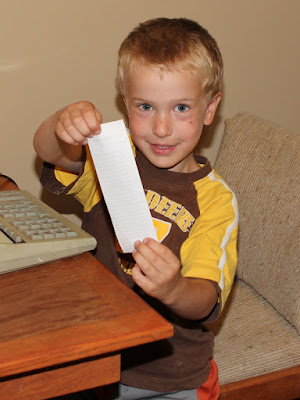
Jacob has been eagerly awaiting this day for at least, well, 2 days now. This morning he started asking questions. All day long he has been wondering how long until the big event. And that event is the arrival of the UPS truck carrying a special $8 package for him. And in that $8 package is not a DVD, or a book, or a toy, but rather 12 rolls of adding machine tape (totaling 1/3 of a mile). Oh yes, our four-year-old can hardly contain his excitement over office supplies. Let me back up a bit to explain. I am always on the lookout for a certain kind of toy. The sort of thing that you don t find in the toy section of a store. The sort of thing that is interesting and engages the curiosity of our boys, that most people would consider would toss, and that usually costs less than $5. Along those lines, Jacob has an old manual typewriter he can use, he and I built a switchbox full of switches and light bulbs that the boys love to play with, we built him a command-line-only PC out of spare parts, the boys have some radios they can use, and one day I salvaged a decades-old adding machine that was going to be thrown out. Jacob liked it he enjoys number and letter games and had some fun, but didn t zealously engage with it until just a few days ago. He sat down at his table and started making cards . He will print out a bunch of numbers, making a strip a couple of feet long, and then say, Dad, I made another card for you! We will then happily accept the card and he will continue making more. Here he is, holding up one of his cards: Jacob had a ton of fun making them, and Oliver wanted in on the action too. Oliver was somewhat interested in the adding machine, but not as much as Jacob, and Jacob didn t want to share. So somehow they decided that Oliver would run and get cards from Jacob and then take them to whatever parent Jacob said. Today Jacob said, Dad, the Oliver delivery service will bring you a card! Saturday morning we had some time to hang around and play, so we played some adding machine tape games. I tucked some long cards under my waistband, and the boys happily chased me all over the house trying to get them back. We also decorated: And here is what the room looked like after some cleanup: That orange bucket on the desk is my card bucket where I can put all the cards he gives me. He even helpfully empties it out into the recycle bin when there are too many old cards in it! But then tragedy struck it was out of paper! I ordered a 12-roll pack off Amazon, and boy was it a long couple of days until it arrived. Today before the UPS truck got here, I showed him how we could feed old paper through and print on the back side an incredible innovation, it seemed! Terah had a conversation with him earlier that went like this: Terah: Jacob, we need to clean up the house. Jacob: Why? Terah: Because some people are coming over. Jacob: Who is OH YES! The UPS delivery man! Yes, let s clean! Terah: Ah, well yes he will be here too, but your great uncle and aunt are coming. Jacob: Oh yay! And the UPS man! It is hard to describe Jacob s excitement when the package arrived. I quickly opened it up, and at his great uncle s prompting, he counted to see if he really did get 12 rolls of paper. IT IS TWELVE ROLLS! YAY! And then we quickly installed it in the machine and off he went. At his great uncle s prompting, he started writing a J on each card . This meant Jacob , or maybe he d put two J s, meaning To John From Jacob , or perhaps the two J s meant To Terah From Jacob he d always have to clue us in. Anyhow, for an $8 investment in paper this has brought hours of joy to our boys. Even though Jacob isn t yet really using it to perform arithmetic, it is setting him up to enjoy that sort of thing and encouraging his curiosity. Both good things.

Next.

Previous.