Search Results: "will"

3 July 2007

Peter Makholm: Debian Social Contract 10 years and the danish connection

  1. Our priorities are pancakes and beer We will be guidede by our need for pancakes and (preferable free) beer. We will place this interest first in our priorities. We wil support the needs of our users for knowledge of where to get many different kinds of pancakes and beers. We will not object to other kind of food and drinks, but pancakes and beer are our main common interesst and priorities. In furtherance of this need, we will provide guidance to beer and pancakes all over the world near and far away from Denmark.
For some reason the celebration of the Debian Social Contract was centered on Denmark. So I thought we might as well organize something in Denmark for real (some of us had talked about it some days ago). We have yet to decide if our main priority is beer or pancake so the plans aren’t quite final yet. lbaren has been mentioned. If you are interested in joining contact me. (Update: lbaren is closed for the month)

Robert Collins: 3 Jul 2007

I want to know when we will get interesting talks like this happening! Competing on the basis of speed.

Dirk Eddelbuettel: More on 'nicer charts'

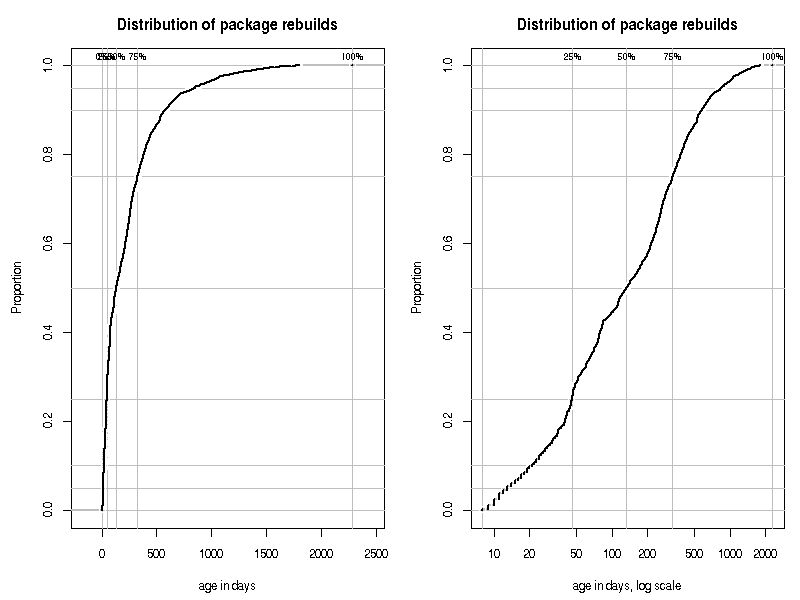
Via the Planet Debian aggregator and his blog, Sven followed up on my post regarding Lucas' plot of the package age distribution. As some of my points didn't seem to make it across, I will reiterate them more plainly: Sven also addresses the fact that what we really want is to see the quantiles of the data set. Quite right, and taking logs makes that easier. Consider the two charts below which plot the 'package age in days' as an empirical cumulative distribution function using built-in R functions ecdf and plot.stepfun (rather than redoing it ad-hoc as I had done), and also add explicitly quantiles. The two charts use the exact same instructions; however the second chart transforms the x-axis to a logarithmic scale. Debian Package Age-since-recompile Distributions charted two ways While it is close to impossible to find the 25 or 50 percentile on the first chart, it becomes a lot easier on the second chart because the x-axis is 'stretched' using the log transform. About one quarters of the distribution appears to be rebuild within 1.5 months old, and about half is younger than four months (as a quick call to summary(pkgAge) confirms). Reading these proprtions off the original chart, or the non-log chart, is much more difficult.

2 July 2007

Christoph Berg: Looking for a Window Manager

I had been using fvwm2 for some 10 years when around the beginning of this year, I thought it might be time for a change. My config was originally copied from some SuSE templates and then heavily tweaked over the years, but recently broke more and more in subtle way with new fvwm upstream versions, e.g. moving windows suddenly required a different mouse button. Probably the config was just slightly out of spec and fvwm got "fixed", but it was annoying. The "tiled" window managers I had seen on others' desktops made me curious, so I gave ion3 a try some months ago. The overall appearance was all cool, but it tried a bit too hard to squeeze all windows into tiled windows - of course there's the floating workspace, but creating one was weird, and moving windows even weirder. And if only the (default) key bindings were more vi-like... I admit I never really bothered to read the documentation - probably everything would have been much nicer otherwise. Then there was the big license "wtf" with ion, at which point I started looking around further. dwm looks clearly too l33t to be serious, so wmii was the next choice, 3.1 to be exact. vi key bindings, a nicely configurable status bar, easy workspace switching and window moving. wmii doesn't have horizontally split windows (windows are always in columns), and no "tabbed" windows, though. It didn't warp the pointer to the currently active window (something I got used to with fvwm), but some config tweaks mostly fixed that. This time, I read the documentation, but there's only a 10 page pdf beginners document, but there's not much to configure anyway. Then came lenny. Testing and unstable currently feature version 3.6 which is a big disappointment. It is broken (the default config is unusable), and even after fixing that, it looks like they removed all the little details that I liked. The status bar is still there (though with a new location in the virtual filesystem), the color cannot be changed anymore (unless changing some other color as well). The windows used to have slim 1-pixel (configurable) borders. Now they still have, but the border will be expanded if the window chooses a different size - xterm always rounds down to the next character size, so all my terminals have fat surroundings now. The last-active window in a inactive column still had some markup so I knew which window Alt-Left/Right wound return to, now I have to guess. I wouldn't mind fixing my 3.1 config for 3.6, but I don't think I will, given these issues look unfixable. The 3.1 wmiirc file looked like a sh script, the 3.6 uses eval and a bunch of functions that frighten me. On a positive note, it is now possible to create new workspaces by just selecting them, which is much handier than start-program, wait, move-window-over, move-workspace. I guess I will give ion (2, 3?) another try...

Gunnar Wolf: Keep rolling!

It seems that I've held up -at least for half a year- what I stated back in January - I come by bike to work almost every day, and really enjoy the time spent on two wheels. My times have -of course- improved, as has my dominion of the bike - I make ~10 minutes each way (must be a bit more on my way to work than on my way back, as it is uphill).
My city's government seems to be seriously promoting people to consider using the bicycle as means for regular transport and not just as a recreational device - I see some of its measures as quite silly, but some are just perfect. One week ago, while I was on the plane from Edinburgh, we had the first Ciclot n, a 32Km ride open to everybody (and of course, Nadezhda was among them). Over 70,000 people took part, reportedly, and it seems it will be held monthly. Besides that, yesterday we had the paseo dominical in Coyoac n very close to my house - What's that? Something similar to the ciclot n, only much smaller (14Km), much less publicized, and in a different place of the city every Sunday. Well, we started up the day at 8 AM by cycling from Metro Copilco to Miguel ngel de Quevedo, Av. Universidad, R o Churubusco, Divisi n del Norte and Henriquez Ure a back to Metro Copilco. We later learnt that around 10,000 people took part. 14 Km, 30 minutes - not bad, and quite enjoyable!
We didn't go for the second round, because we wanted to be by ~10 AM at Reforma, probably the city's most emblematic avenue, to be part of the demonstration marking one year of the electoral fraud. But... Well, we didn't want to just leave the bikes at home and go by metro - What can we do? Yes, take the open streets. We followed a bit of the path we had taken a bit earlier, then took Minerva, Insurgentes until Reforma (~45 minutes). And once we got to the meeting point, we didn't want to step down and crawl the bikes along... So we both found out that not only we dared take the main streets where people are not really used to cyclists and where taxi drivers will often try to make a point that if you don't own a car you should use a taxi and not a bike - We were able to cycle most of our way to Z calo, going slowly and moving through people, in what seemed to be almost an unthinkable feat for me just a couple of months ago. We can now control the bike, we can even be almost still while riding it, and not crash into anybody!
Of course, the way back was similar - We took our bikes across Obrera, Doctores, Algar n and lamos, then took Av. Universidad all the way down to Copilco, and -after some three hours riding, with my arms quite red and of course somewhat dehydrated and sore-butted- got home.
It feels great to have a well-deserved siesta! And... Well, biking is just too enjoyable. I guess we had ~45Km yesterday, plus some ~5 extra zig-zagging through the crowd. It rules.

Neil Williams: deb-gview remote .deb viewer

This isn't new, I just thought it was worth noting because it is useful to show an example of a packaging principle when sponsoring new maintainers etc.

deb-gview has been extended via GnomeVFS to view the contents of any .deb in the archive without having to install the package and without having to separately download the .deb itself. Either copy the link address and load the .deb on the command line or configure your browser to use deb-gview as a helper for .deb files (right click a .deb and select open with... or similar). Then just double click on any text file within the .deb to view it. Also works with manpages and images inside the .deb, other filetypes can be supported via a config file. Supports viewing a .deb for any architecture, not just your own (useful to see if the autobuilders have really done what you expected with generated files).

e.g. when advising on using README.Debian, it was useful to give a simple URL to allow the user to easily see the format:

$ sudo apt-get install deb-gview
$ deb-gview http://ftp.uk.debian.org/debian/pool/main/g/gpe-shield/gpe-shield_0.9-1_amd64.deb

The URL itself comes from viewing the package on packages.debian.org, clicking any architecture and right clicking the name of whichever mirror you want to use (or configure the browser as above).

Also supports .changes files so you can view all .deb files within a build or view the packages in the incoming queue direct from a d.d.p.o page.

The advantages over debc / dpkg -c dpkg -I are:


Using GnomeVFS means using a few Gnome libraries but even for non-Gnome users, this shouldn't be too much of a burden.

Russell Coker: New Storage Developments

Eweek has an article on a new 1TB Seagate drive. Most home users don’t have a need for 1TB of storage (the only way I’ve ever filled a 300G drive is by using it for multiple backups) and enterprise customers generally want small fast drives (with 100G drives still being sold for servers). One interesting thing to note about this is the fact that the new drive is described as being able to sustain 105MB/s (although I suspect that is only for the first few zones of the disk - see my ZCAV results page for graphs of the performance of some typical disks). The previous disks that I have seen have topped out at about 90MB/s. However even if the drive could deliver 105MB/s over it’s entire capacity it would take almost 3 hours to perform a backup - increases in IO speeds have not been keeping up with capacity increases. Another interesting thing is the potential for using the same technology in low power 2.5 inch disks. While a 1TB disk isn’t going to be much use to me a 300G 2.5inch disk that uses less power will be very useful - and it might be possible to perform a backup of such a disk in a reasonable amount of time! The latest trend in PCs seems to be small form factor (SFF) and low power machines that don’t have space for two drives. If you want RAID-1 on your home machines for reliability then that isn’t very convenient. But two 2.5 inch disks can fit in less space than a single 3.5 inch disk and therefore all the SATA based SFF machines that are currently being shipped with a single 3.5 inch disk can be upgraded to a pair of 2.5 inch disks - this will be convenient for me when those machines start going cheap at auction next year! Even for servers the trend seems to be towards 2.5 inch disks. I recently bought a 2U HP server that supports up to 8 hot-swap SFF disks, I wonder how the performance of 8*SFF disks would compare to 4 of the bigger and faster disks. The next thing we need is a method of backing up large volumes of data. The 650M data CD came out when a 150M disk was considered big. The 4.7G data DVD started to become popular when 45G disks were considered big. Now almost everyone has 300G disks and 1TB disks are becoming available yet the best commonly available backup method is a double-layer DVD at 9.4G - it seems that the vast majority of home users that make backups are using cheap IDE disks to do so. Fortunately there are some new technology developments that may improve the situation. Call/Recall has developed technology that may permit multiple terabytes of storage on an optical disk. It’s yet to be seen whether their technology lives up to the claims made about it, but we have to hope. The current storage situation is getting unmanagable.

Edd Dumbill: Nokia N800, the second time around

Nokia's N800 internet tablet is an intriguing device. When I originally got one a few months back I tried to treat it purely as a consumer object, just using the installed apps and things available through the obvious point-and-click channels.As a consequence it served mainly as a portable (and expensive) internet radio, streaming me the cricket commentary from the BBC. And when I upgraded my wireless network I somehow managed to make it WPA2 only, knocking the N800 offline. An offline N800 is an almost thoroughly useless device, so it went into the drawer and I forgot about it.Ultimately you can't leave something that expensive unused, so I dragged it out again, fiddled the wi-fi router into compliance, and decided not to deny my hacker nature this time. The N800 is Linux underneath, so who could resist?
The result is two-edged, really: I'm a lot happier with the device, but on the other hand must conclude that the N800 is still a bit far from being consumer-ready.Must-have softwareSo, what things did I install this time around that made the device happier?Claws Mail is a nice email client that works well with my IMAP accounts, which all use SSL and TLS, have lots of messages and a deep folder hierarchy. I don't really want to write much mail on the N800, but an easy reading interface is a bonus.The FM radio is something I can't believe I missed before. I had no idea this was in there, but plug some headphones into the N800 and they act as the antenna for an FM receiver. Desperately cute and old-world, a bit like when laptops still used to have parallel printer ports.I had previously ignored Maemo Mapper, thinking it was useless without a GPS, but it turns out to work very nicely as a dedicated client for Google Maps, as well as several other mapping sources. Must-do geeky bitsTry as I might to like the touch screen, the first thing I had to do with the device was find a way of not using the stylus to do sysadmin type tasks on it.So, first stop is to get a terminal up, figure out how to use the root account, install a SSH client and server, and get my pubkey onto the N800. Now I could shell into it and use a decent keyboard.On my local network I hate maintaining DNS if I don't have to, so the next thing I wanted was Zeroconf support in the shape of avahi. One of the quickest ways to get this going is to install the Canola media application, which uses Zeroconf to find shared music.With these basics in place, the N800 supports APT package repositories familiar to Debian and Ubuntu users, so the device becomes a lot less weird and much more manageable. I felt the same pleasant familiarity as I did with the NSLU2. Things to look forward toThe N800's video camera is neat, but nobody I know uses Google Talk for conferencing. Fortunately it seems that Skype for the N800 is just around the corner. Initially, video support is unlikely, but I imagine that if Skype on the N800 proves popular, it won't be far off.The N800 is something I don't mind having kicking around the kitchen or nursery, so staying in touch with my family while I'm travelling will become a lot more fun.
Also, I'd like to get NFS running on the N800, but that requires the installation of a new kernel, which I've not quite yet had the time to do. Once that's done, all my media, photos and storage will be handily available. 

1 July 2007

Clint Adams: El justiciero, cha, cha, cha

On February 14, 2004, Gage & Tollner, ostensibly New York's oldest restaurant, closed down and, if that weren't traumatic enough, became a TGI Friday's. Finally, Friday's is gone, and the fa ade sports a banner advertising a fully-equipped restaurant for rent. What will it become next?

Russell Coker: Committing Data to Disk

I’ve just watched the video of Stewart Smith’s LCA talk Eat My Data about writing applications to store data reliably and not lose it. The reason I watched it was not to learn about how to correctly write such programs, but so that I could recommend it to other people. Recently I have had problems with a system (that I won’t name) which used fwrite() to write data to disk and then used fflush() to commit it! Below is a section from the fflush(3) man page:
NOTES
Note that fflush() only flushes the user space buffers provided by the
C library. To ensure that the data is physically stored on disk the
kernel buffers must be flushed too, e.g. with sync(2) or fsync(2).
Does no-one read the man pages for library calls that they use? Then recently I discovered (after losing some data) that both dpkg and rpm do not call fsync() after writing package files to disk. The vast majority of Linux systems use either dpkg or rpm to manage their packages. All those systems are vulnerable to data loss if the power fails, a cluster STONITH event occurs, or any other unexpected reboot happens shortly after a package is installed. This means that you can use the distribution defined interface for installing a package, be told that the package was successfully installed, have a crash or power failure, and then find that only some parts of the package were installed. So far I have agreement from Jeff Johnson that RPM 5 will use fsync(), no agreement from Debian people that this would be a good idea, and I have not yet reported it as a bug in SUSE and Red Hat (I’d rather get it fixed upstream first). During his talk Stewart says sarcastically “everyone uses the same filesystem because it’s the one true way“. Unfortunately I’m getting this reaction from many people when reporting data consistency issues that arise on XFS. The fact that Ext3 by default will delay writes by up to 5 seconds for performance (which can be changed by a mount option) and that XFS will default to delaying up to 30 seconds means that some race conditions will be more likely to occur on XFS than in the default configuration of Ext3. This doesn’t mean that they won’t occur on Ext3, and certainly doesn’t mean that you can rely on such programs working on Ext3. Ext3 does however have the data=ordered mount option (which seems to be the default configuration on Debian and on Red Hat systems), this means that meta-data is committed to disk after the data blocks that it referrs to. This means that an operation of writing to a temporary file and then renaming it should give the desired result. Of course it’s bad luck for dpkg and rpm users who use Ext3 but decided to use data=writeback as they get better performance but significantly less reliability. Also we have to consider the range of filesystems that may be used. Debian supports Linux and HURD kernels as main projects and there are less supported sub-projects for the NetBSD, FreeBSD, and OpenBSD kernels as well as Solaris. Each of these kernels has different implementations of the filesystems that are in common and some have native filesystems that are not supported on Linux at all. It is not reasonable to assume that all of these filesystems have the same caching algorithms as Ext3 or that they are unlike XFS. The RPM tool is mainly known for being used on Red Hat distributions (Fedora and RHEL) and on SuSE - these distributions include support for Ext2/3, ReiserFS, and XFS as root filesystems. RPM is also used on BSD Unix and on other platforms that have different filesystems and different caching algorithms. One objection that was made to using fsync() was the fact that cheap and nasty hard drives have write-back caches that are volatile (their contents dissappear on power loss). As with such drives reliable operation will be impossible so why not just give up! Pity about the people with good hard drives that don’t do such foolishness, maybe they are expected to lose data as an expression of solidarity with people who buy the cheap and nasty hardware. Package installation would be expected to be slower if all files are sync’d. One method of mitigating this is to write a large number of files (EG up to a maximum of 900) and then call fsync() on each of them in a loop. After the last file has been written the first file may have been entirely committed to disk, and calling fsync() on one file may result in other files being synchronised too. Another issue is that the only time package installation speed really matters is during an initial OS install. It should not be difficult to provide an option to not call fsync() for use during the OS install (where any error would result in aborting the install anyway).

Bastian Venthur: Python, os.fork(), webbrowser and debbugs

Gustavo writes about python, it’s webbrowser module, os.fork and parsing bugreports from our BTS via html. This all sound very familiar, so here are some hints from me:

David Welton: 10 Years of Debian

I'm not sure of the exact date - if my memory serves me correctly, it was sometime during the summer of 1997 - I was given an account on Debian's server (located, at the time, in Beaverton, Oregon). I didn't go on to upload my first package until October of that year, as I had landed my first programming job at the same time, at CKS Partners. The "new maintainer process" in those days consisted of Klee Dienes calling me up and checking that I was a real person, had a pgp key, and wasn't completely clueless. It was a very different project in many ways than it is today - much smaller, much more informal, and of course much less well known in the world at large. Some elements were in place, though - my recollection is that the "flame friendly" atmosphere, while perhaps not quite as accentuated as it at times appears today, was firmly in place even back then. In '98, '99', and 2000, the Linux world was an exciting place to be. I still recall reading about the database companies deciding to release their products on Linux, reading The Cathedral and the Bazaar, and going to one of the first big commercial Linux conferences, in San Jose, in early 1999. Debian was well poised to take advantage of Linux's growth, too. Under Bruce Perens' leadership, several key elements of Debian had been put in place, like the social contract and free software guidelines. Fortuitously, Jason Gunthorpe was working on apt in that time period as well, which was another key element in Debian's success. One of the things I've always admired about Debian in the open source world is that it is in some ways a "stepping stone" project, meaning that it's a good way for people to start getting involved with free software, to get their toes wet "giving something back", without already being an expert hacker. It's easier to maintain a package of code, if you're willing to put in the time and attention to details, than to, say, write a new kernel module, or some other piece of critical C code. I've seen a number of people take this route - they get started with Debian, and as they go, learn more about the packages they work with, and perhaps even get involved with them "upstream", as they acquire skills and knowledge. By no means is everyone in Debian in that situation, though - there are some really first rate hackers, who tend to be the small core of people that really make Debian zing along. Indeed, being an autodidact in the world of computers, outside of one very forgettable term of C++ at Lane Community College, has given me an immense appreciation for the enormous opportunities open source affords in terms of learning - and especially hands-on learning. How many other fields let you work from anywhere in the world with an internet connection, with anyone else who is interested in the same subject, at whatever time you want, with tools that you can download entirely for free? It's really an intoxicating sensation realizing that you can do anything you want if you are willing to put the time in to learn how. The learning opportunities are one of the many things I'm grateful to Debian for. These days, I'm really not involved much with Debian anymore. I mostly run Ubuntu, which I think has perhaps improved on some of the social aspects of Debian (although Mark's zillions of dollars certainly play a large role, too). In terms of free software, I don't have as much time, and dedicate more of it to my own projects like Hecl. I still love the idea of open source software, but I'm also older and wiser (or more cynical?), and must face the reality that without scarcity, you have nothing to trade with others for things like food. Due to my lack of activity, perhaps I should resign, but ... I really don't want to, and who knows, maybe I'll have more time, and an "itch to scratch" at some point in the future. Who knows what the next ten years hold for Debian?

Biella Coleman: The Worst of the Web: Punditry 2.0

Tonight, instead of minding my dinner, which did burn, I was drawn into and extended a pretty fiery IRC conversation on debian-devel on a topic that does not like to die: the merits and demerits of Wikipedia. It is not worth summarizing the conversation here for it followed a pretty predictable arc. There were those who thought Wikipedia was novel and valuable, others who saw it as a pit of bad facts, and inaccuracies and a few others who saw it in ways negative and positive. I found the conversation somewhat ironic, because I usually find myself defending free software to outsiders much in the same way I was defending Wikipedia to free software developers. I tend to be in the camp of admirers, and for many reasons, although, of course, I also was arguing that it is too early to judge the value of Wikipedia as it is in its infancy. Like Debian, since Wikipedia is an institution that has changed *a lot* in its short history, it is hard to make any hard and fast conclusions about its worth, impact, etc, although more modest and qualified claims are certainly in order. The only reason I feel like I can argue anything about Wikipedia is because I am currently reading a dissertation on Wikipedia by Joseph Reagle. He not only has really insightful things to say about the collaborative culture driving the online encyclopedia, but also about the prolific commentary that has closely followed the heels of Wikipedia in the last few years. Just today, he wrote a blog entry entitled, Punditry and The Web 2.0 debate, which so hit the nail on the head on the problems–not with Wikipedia–but with the peanut gallery (commentary) on Wikipedia. As he notes, the problem is often not with the so called correct or incorrect judgments on Wikipedia (or other Web 2.0 phenomenon) but with the very debates themselves, because many of them are built on a shaky foundation of sand, but this punditry, as Joe rightly calls it, is nonetheless worthy of critical examination:
.. while I follow the discussion with interest, I actually don’t find it substantively engaging. Many of the arguments, particularly Gorman’s, tend to be characterized by unsubstantiated claims and the purposeful construal of nuanced issues as extremes — propping up strawmen for subsequent potshots. As I’ve already indicated, while it might bring pundits a sense of righteousness and attention, in the end “Time, not arguments, will utlimately tell.” (And, for this reason I appreciate Larry Sanger’s continuing efforts to implement his vision.)Why, then, do I find this discussion of interest? Punditry, communicative disorders, and history. First, I’m trying to come to an understanding of “punditry,” and I think Gorman’s recent bloggings is an exemplar. My sense is that sometimes people argue for arguments’ sake. That is, even if they genuinely believe the thing they are arguing for, attention, not persuasion, is the goal. (In a sense, perhaps it is a high-brow, and perhaps more genuinely held, form of trolling — another interesting phenomenon.)
While punditry has always existed, there is no doubt that the Internet has accentuated and facilitated this form of (often male) communication and it is great to see someone tackle this topic. Because let’s face it, there is a lot more “garbage” spewing from Web 2.0 or Wikipedia commentary compared to than the actual Wikipedia articles themselves.

30 June 2007

Gustavo R. Montesino: Python, os.fork() and GSoC

This one was a bit tricker to find, so I'm going to post it here: if you use os.fork() on Python, you will want to use os._exit() on the child process, or it will clean stuff it shouldn't and you will have segfaults with doubled memory free.

That said, python's webbrowser module is quite useful; check it if you ever has to open a browser from a Python script/program. The only downside I see on it is exactly that it doesn't takes care of the forking stuff for you. I'm using it on bug-triage to show a bug report on the user browser.

Talking about GSoC, during the last week the Debian BTS was updated, breaking, between other things, btsutils' 0.1 version. The current development version of btsutils, which uses BeautifulSoup to parse the HTML stuff more realiable, wasn't affected by the update.

That's all for now, time to code.

Junichi Uekawa: lib64 on amd64.

On debian amd64, there is /usr/lib64 directory which issymlinked to /usr/lib.It's useful since many upstreamexpect /usr/lib64 to exist, and changing every singleupstream isn't possible.However, there is one problem. Many libraries explicitly specify /usr/lib64, and that goes into libtool .la files and will generate a -rpath of /usr/lib64.libtool will ignore a set of pre-defined paths from -rpath,which is defined as sys_lib_dlsearch_path_spec,which is probably pulled from /etc/ld.so.conf on linuxsystems.The problem is, /usr/lib64 is a symlink to/usr/lib, and it is not included in library search path(although effectively, /usr/lib is included in the searchpath, so libraries in /usr/lib64 is searched).I am suspecting that this results in many -rpath set for/usr/lib64 on amd64 system.I think this is currently solved by running chrpath in debian/rules, but not all ofthem is fixed. Another way to fix it would be to patch libtool to ignore lib64.Hmm..

29 June 2007

MJ Ray: Sustainability, Search Engine Traffic and free software webmasters

Regular readers may remember that I'm a vocal critic of some search engines and the unreliability of their fast-changing algorithms. One day you're top ten and the next you're gone. If you're building your business on search engine referrals, you're building your castle on shifting sands. SEOBook: Website Sustainability: What Percent of Your Traffic Comes From Search Engines? has good advice:-
"one of the best moves you can make for the sustainability of that site is to lower the percentage of traffic that comes from search"
That's one reason why I'm glad to see the suggestion of etbe: Advertising Free Software Projects - nearly every free software project would be better off improving their web sites, adding cross-links and building more sustainable traffic, instead of wasting resources competing in the Google-ad Games. Unless you've got the thousands of pounds a year that successful AdWords marketers spend, your Google-ad success will probably be short-lived, as people with more money will outbid you for keywords that work. It's even less sustainable than search result traffic, because it's consuming your financial resources as well as your vounteer time. Meanwhile, most free software project webmasters I know are over-stretched, but many wannabe-contributors seem to want to nuke the entire site to rebuild it with their pet tool. Those offers are really about their ego more than helping the project, in my opinion. They want to Get Themslves Noticed, but I've seen far too many unfinished site rebuilds to like those offers. In fact, I don't think any good webmaster would offer a rebuild without the site owner asking for it - even in the rare cases where I really strongly want to restart a site, I explain why and ask permission first, not just wade in with an offer to nuke-and-rebuild. If the site owner says no, I move on: there's no shortage of work here, after all and very few free software projects pay their webmasters. So, if you want to help a free software project, ask their webmasters for suggestions and access to the site source code.

Martin F. Krafft: DebConf7

I am sitting at Frankfurt airport in between flights home from Edinburgh (not anymore, but that's where this post was born). It's been an intense 2.5 weeks of DebConf7, which has been unlike other DebConfs for me in two respects: this was the first time I actually went to DebCamp, the week leading up to the conference, which is designated to teams and individuals with development goals to achieve during the week. And I was also actively involved in the organisation of the conference, which was unexpected, but a very good experience I am not going to miss next year. Well, it wasn't unexpected. When I booked my flights in January, I had decided to arrive a day early and leave a day late to be able to lend a hand. In between then and the conference, my life turned somewhat upside-down and I had forgotten everything about these noble goals of mine. So when I arrived at the conference venue on Saturday morning with thoughts of netconf circling my head, I was surprised to find everyone buzzing about (how na ve of me) and somewhat clueless as to how I should merge in: my wrists didn't really hold up to heavy lifting, and my knee certainly didn't enjoy stairs, of which there were plenty on the way up to the top floor, where DebCamp was taking place. After trying and being mostly ridiculed by the other organisers ("friends"... ha!), I set out to accomplish some other tasks more suited to my bodily condition, such as wiring the hack lab to accomodate 40 geeks for the first week. That took me most of the day, but at least the space was ready for Sunday morning and the official start of the camp. My goal for the week was netconf and I made good progress until I ran into a wall on Tuesday and had to back off and rethink my design. Reinhart Tartler and Enrico Zini dedicated their time to listen to my design and the problems and helped me clear the mess up and helped me reduce complexity and converge on a straight-forward, event-based design. As the newly appointed DebConf press officer and one of the organisation volunteers, I did not get any further for a few days, as I was manning the front desk or preparing and releasing my first press release (with the help of several others), which lead to a lovely story on The Register and doubled the number of attendees that preregistered for DebianDay (which marks the end of DebCamp and the start of DebConf). I blame the geeks in skirts, actually. Silly bunch, but not quite as silly as those attendants who could get a laugh out of the underwear question for two weeks in a row. Up to this point, I had managed to keep a perfect balance between netconf, orga-team, and sleep. So good, apparently, that when the orga-team t-shirts arrived, Uncle Steve made it quite clear that I should be getting one, even though I had spent considerable time on netconf, am sure some of the others must have worked twice the amount, and I was still quite well rested then. But they gave me a shirt and thus I became part of the orga-team. And even though it was rough at times, running around during the day, filling spare minutes with netconf brain-work, and enjoying nights that got longer with every day of the conference, I am glad and proud to be a member of this team now. It took me until after the official start of the conference to return to the netconf code, but with the new design, I got most of the framework to a point where it could obtain static and dynamic addresses from configuration files as well as DHCP servers in time for my presentation on Tuesday (the recording of which shall be linked from the netconf homepage as soon as it's available). Of course, nothing worked on screen in front of the audience, but noone really expected that anyway. and then I took it all apart for further simplification, so by the time night fell, the slides from the talk had already become outdated as I moved to yet another design, which is even simpler and which allowed me to sketch complex scenarios, such as DHCP after WPA. For two days, I made good progress, but the time available for hacking decreased noticeably, as I kept volunteering for more tasks that needed doing, and more and more people turned up. Somewhere in between, Keith Packard took hostage of (and fixed parts of) my broken X40 laptop, but that's the meat of another story. And on some other night, our leader Sam, in his official capacity as DPL, presented me with the instantiation of my innermost desires as consolation for my hosital stay: a pony. Just look at that smile! With 400 attendants, this year's DebConf continued the trend of immense growth of the event, and while it's great to witness this increase in popularity among attendees and sponsors, who make it possible each year to fly more people to the destination, I am also rather sceptical. The problem is less the additional load on the organising team the next 100 people are going to be easier to accomodate than the previous 100 were. It is more that the conference is losing focus. More people make you spend less time with the same folks, and as the number of non-contributors increases, the social element starts to outweigh the technical element. I am not condemning the social element, but to paraphrase the words of my favourite Debian developer, it's painful to come to DebConf or even IRC with a project and questions just to find that the people are generally more interested in being social, even to the point of preventing technical discussions. I realise that this is a sensitive subject as the issue of various cabals keeps coming up frequently and it does not seem right to start limiting the audience to this conference, but unless we consider the matter, DebConf might deteriorate similarly to other conferences, which have enjoyed enormous growth as well before it was too late. I think we must make sure that people understand that we are, after all, a technical project and must not lose touch with out roots. Of course, I may also be overreacting, after a week of intense coding and many other stress factors I continued working hard on netconf and helping with the organisation throughout Friday, briefly taking time off to prepare a presentation on my Ph.D. research, which was very well received, as well as a workshop on Debian packaging with modern (distributed) version control systems, which yielded around a dozen new subscribers to the vcs-pkg mailing list. But now, back to netconf. All things considered, I was making good progress, but not getting netconf into a releasable state just yet. I can parse /etc/network/interfaces files and get data from DHCP servers, even configure interfaces with those, but it's all still work in progress as I have not yet bothered to implement such basics as default gateways or DNS servers. But the framework is in place, and I am very happy with it as everything I keep adding falls into place beautifully. To mark the end of my netconf development sprint at DebConf7, I scheduled a code introduction session on Friday, where around 15 people turned out to get a walkthrough of the code and explanation of some of my design decisions. The session was recorded and will be available on video shortly. I think it turned out to be a very good idea; I found myself intrigued by someone else's code before until that someone took the time to explain what was going on. I sincerely hope that this introduction helps bootstrap a few people's experiences with the code and yields more contributors! Even though we ended almost every single evening of the two weeks in one of the surrounding pubs, the last few nights were definitely the most enjoyable. On Thursday, the local team had organised a Ceilidh with a band teaching us geeks how to dance the Scottish way, and the venue stayed open for two hours longer than before, causing most people to come out for beer or bouncing about. On Friday and Saturday, the folks of InfoSeed let us use their comfy couches (in the basement of the conference night venue) and we chilled to music and massages, while on Sunday, after a very tiresome day of cleaning up, the noticably lesser number of survivors hung out at the Forest Cafe for some so-so live music, few beers, and an early journey to bed, where a Dutch Muppet kept us entertained for at least another hour. The best about Monday, my day of return, must have been that the airline lost my backpack, which saved me from having to lug it around in Zurich, and made for a great moment on the phone with the baggage tracing service, who announced that my bags would be delivered in about 6 hours between 20:00 and 22:00 just as the door bell rang and the courier dropped off my bag. I'll be back in Argentina, unless something goes seriously wrong. And I'll be on the orga-team again. If you guys stop holding your meetings on Monday night. Thanks to everyone who made DebConf7 possible. I am proud to have been able to contribute, but the real work was done by a few others. You know who you are. NP: Solar Project: Five
Lucas Nussbaum: How old are our packages?

Debian’s binary packages are only built when they are uploaded (or when a binNMU is requested, but that doesn’t happen frequently). They are never rebuilt later. This means that some binary packages in etch weren’t build in an up-to-date etch environment, but possibly in a much older environment. Is this a problem? It depends. Old packages don’t benefit from the improvements introduced in Debian after they were built. Like new compiler optimizations, or other changes in the toolchain that could induce changes in binary packages. For example, some files used to be at some place, but are now put at another place. Also, some parts of maintainers scripts are automatically generated, and would be different if the package was rebuilt today. But is it really a problem? Are our packages _that_ old? Also, when a big change is made in the way we generate our binary packages (like Raphael Hertzog’s new dpkg-shlibdeps), when can we expect that the change will be effective in all packages? I went through all binary packages in unstable (as on 24/06/2007) (both main, contrib and non-free packages) on i386. Using dpkg-deb –contents, I extracted the most recent date of each package (which can reasonably be taken as the date of the package’s creation). And here are the results. Most packages are actually quite recent. 9008 packages (43%) were built after the release of etch. And 19857 packages (94%) were built after the release of sarge. But that still leaves us with 1265 packages that were built before sarge was released, and even one package (exim-doc-html) that was built before the release of woody! (the removal of this package has been requested, so we will soon be woody-clean :-) Now, what could we do with this data? We could review the older packages, to determine if: Here is the full sorted list of packages.

David Nusinow: Post Debconf Spewage

I've been back from Edinburgh for a few days, but this is the first real chance I've had to sit down and write a little bit about it. I'll preface this blog post by saying that my first Debconf was probably the best single week of my entire life. Yeah, it was that awesome.

I won't talk about all the stuff that happened, because that would just take too long. The most important thing was that I got to see a number of old friends again and spend more time with them in one run than ever before. That alone was really enormous for me. On top of that was the pleasure of finally meeting so many people in person. I met a few XSF members finally, including Julien Cristau, my partner in crime. There's no way I could possibly list everyone that I'm so thankful to have finally met. There was one very memorable evening in the night venue where it was largely the same crowd who's usually in #debian-devel when I'm on, and we all just couldn't stop cracking jokes and laughing (not to mention ITP'ing absurd programs). There was another night when Old World Cambridge collided with New World Cambridge, and much Pimm's was had by (almost) all. There was staying up until 5 in the morning and stumbling back to the hostel in the dawn to try and get some sleep before running back to the conference. The most delightful thing about all this was that so many people I already knew and loved were there, and everyone who I hadn't met in person before turned out to be even better in real life. It was like a week of the purest joy.

I also got the privilege of giving my talk and BoF to fairly full audiences, particularly the former. The BoF was on maintaining packages with git. I didn't expect more than 10 people to show, but more than 5 times that did express interest, so many that they moved it to the main lecture hall instead of the small discussion room that it was going to be in originally. I hadn't really planned out how to handle an audience like that, and while I managed to get other people in the audience talking (thanks in particular to Madduck, MadCoder, and keithp for adding so much to the discussion) I felt like I had to fumble through a lot of it. That's the nature of a BoF I guess. I also gave a talk on my plans for the XSF for the Lenny release. I'll talk about that stuff in future blog posts (some of which are overdue) but I will say that it was surprisingly well attended given that it was scheduled for 9:45 am after one of the usual nights of drinking and hacking until dawn.

I have to echo others and give a big thank you to the organizers. You guys did a great job, and persevered in the face of adversity (read: cowgate) and really made a great conference out of it. I learned a lot, laughed even more, and drank even more than that and I can't wait to do it again.

Evan Prodromou: 9 Messidor CCXV

Last-minute note to Montreal BarCampers, hackers, entrepreneurs, designers, coworkingers, designers and other troublemakers: Tara Hunt is coming into town and I invited her to have lunch with local folks in the scene. We'll meet at 1PM, at La ka, since half of us will be there anyways. I've reserved space for twelve, but that can expand pretty easily. For those who don't spend 60% of their time there, La ka is at 4040 blvd St. Laurent near the corner of Duluth. URL: http://www.laikamontreal.com/ Please feel free to come and to invite others you think would like to meet Tara and vice versa. And feel free to Contact me if you've got questions or comments. I'd especially like to hear if a lot of people are coming, since I might need to expand the reservation. tags:

GPLv3 iPhone So, I'm as excited as everyone else to hear that the new Apple iPhone will be available today with a new GPLv3 Free Software license. A bold partnership between Apple and the FSF! tags:

New Oceans OK, so, that's a big lie. But wouldn't it be cool if it were the truth, and you could get a cool and good-looking Open Source phone? That way, you wouldn't only get Web 2.0 applications, without an API for the local machine. You could write local apps for the phone itself, and you could even re-write the phone OS if you want. Looks like pretty soon we'll have these Open phones. According to the http://lists.openmoko.org/pipermail/announce/2007-June/000013.html announcement on the openmoko-announce list, FIC will start taking orders on the first generation Neo 1973 on July 9. So, given that we've got an Open Source alternative to the iPhone coming down the pike in just a week or so, why is anyone working on iPhoneDevCamp? tags:

Next.

Previous.