Search Results: "ed"

12 May 2012

Ben Armstrong: Collaborative editing, the missing Vim feature (pentadactyl + etherpad?)

Do you wish, like I do, you could edit collaboratively in Vim? This feature is number 10 on the Vim voting page, so it seems I m not alone. How about Pentadactyl coupled with any of the existing web-based collaborative editors, such as Etherpad? OK, so it s not quite Vim, and there are some rough edges to this particular pairing, but I m finding it s good enough for my needs. It even gives me a Vim-like editing experience while other participants use the default Etherpad editor. Yes, I know about whiteboard.debian.net, but for the past three years I have been using a single instance of Etherpad with my family to maintain a shopping list to which we all make contributions. First of all, that s not a Debian activity, so to make the switch, I d need to make a personal clone of the service for our personal use. But more importantly, we find Etherpad features such as colours for different participants and the timeline are just too useful to give up on. On the other hand, the less the web editor interferes with your web browser s default textarea behaviour, the easier time Pentadactyl is going to have. Indeed, I asked on #pentadactyl @ irc.oftc.net about some problems I was having and I was told flat out that Pentadactyl does not work with graphical web editors. So, you may wish to use another web-based collaborative editor for this reason. That being said, I did learn a few things about helping Pentadactyl get along better with Etherpad, so if you would like to try it yourself, read on. The key to getting started was to enter text edit mode within the textarea with <C-t>. For the most part, this behaves like Vim normal mode . I am still learning, but many basic motion and editing keys behave just as they would in Vim. Fantastic! However, the moment I tried to :undo I hit my first problem. Using the latest release version of Pentadactyl (1.0rc1 at time of writing), pressing "u" to :undo produced no visible result. I tried the latest daily build as well, and only saw a marginally more helpful "Node not found" error message displayed in the status area. But it turns out you can use passthrough mode to use the textarea s own undo. Just :tmap u <C-v><C-z> and we re back in business again. I m still experimenting with this setup, so the jury s still out on whether I ll stick with it, or whether the remaining incompatibilities between Pentadactyl and Etherpad will drive me nuts. But it looks promising. Clearly, judicious use of :autocmd to always start in text edit mode and bind that undo key whenever I enter the site will help make the experience even better. If you try it out yourself, I d love to hear how things went for you. Or if you have found an even better solution that works for you, do share.

Joachim Breitner: 10 years of using Debian

Today, it must have been exactly 10 years that I started using Debian. The story of how I came to Debian shows some of its strengths, so I ll use this occasion to share it. I spent the first half of 2002 as an high-school exchange student in Wenatchee, USA. I was already a user of Linux at that time: I made my first contact roughly in 1996 and did my first installation at home two years later, but all that time I was dual-booting and my main system was a well-arranged Windows 98. The machine was a regular tower PC, but nevertheless I put the computer into my trunk when I flew to the US. It took away most of the space, and I had to put some of my cloths inside the case. So I was there, happily using my Windows and my manually set up Linux From Scratch until one day the inevitable happened; inevitable at least until you start doing backups: On April 30th, my hard drive crashed, and took the two systems together with 4 years of personal data with it. Two weeks later I had a new hard drive and was pondering my options. I did plan to install Windows again; at that time Windows XP was just released. But I wanted a German version of Windows, which would be hard to get there. Also, I did not want to use Linux from Scratch any more, and wanted to make a well-founded choice of a distribution. On the other hand, I really wanted to get my machine up and running quickly, to be able to read my mail more comfortably. I had heard that Debian had good support for network installations (downloading a full 700MB CD was something to avoid at that time), so I grabbed some netinst images, burned a CD, and quickly installed Debian. I was planning to use the system for about two weeks. I did not pay any particular attention to the setup. Heck, I even picked from my Simpsons sidekick machine naming scheme one that I would not miss being used up ( barney ). Nevertheless, I was using this installation for many years (and many upgrades), until I eventually switched to using laptops. In fact, that very installation is still on the machine somewhere and works. I did install Windows XP a few weeks later as well, but hardly used it. So May 12th of 2002 was when I turned into a full-time Linux and Debian user. I soon became interested in Debian the project and started to contribute. But that is another story for another ten year anniversary blog post, most likely on October 21, 2013...

Flattr this post

Christian Perrier: 2012 update 22 for Debian Installer localization

Status for D-I level 1 (core D-I files): Status for D-I level 2 (packages that have localized material that may appear during default installs, such as iso-codes, tasksel, etc.): Status for D-I level 3 (packages that have localized material that may appear during non-default installs, such as win32-loader) Full 100% completeness (hall of fame) for 23 languages: Asturian, Belarusian, Bulgarian, Catalan, Czech, German, Esperanto, Spanish, French, Indonesian, Italian, Japanese, Kazakh, Khmer, Dutch, Polish, Portuguese, Russian, Slovak, Slovenian, Swedish, Turkish, Simplified Chinese

Steve Kemp: On working from home

Recently an ex-colleague of mine changed jobs and suggested that I write something about the pros and cons of working from home. I've thought about this subject, off and on, for a few years and frustratingly I think most of the pros and the cons are the same: I live in a two-bedroom flat in Edinburgh. (Having just spent thousands on a new bathroom I don't expect I'll be moving any time soon. A rough budget of 40-50,000 would let me convert my attic into two/three rooms. So there is growth potential!) In my flat I have made one of the bedrooms an office. The office contains: One PC is for work. One PC is for me. One phone is for work. One phone is my own. Every working day I switch on the work router, the work phone, the work PC around 09:30. I then work, taking a lunch-break between either 12:00-13:00 or 13:00-14:00, until 18:00 at which point I switch off the work toys. I ignore my personal PC during the working day with the exception that it is the source of my music. I can reach across and hit the appropriate multi-media keys to select Play/Pause/Next Track/Previous Track/Volume Up/Volume Down. (When thenever the work-phone rings the first ring is ignored as I scramble to hit "Mute" or "Pause"..!) So what are some of the advantages/drawbacks? Well I'm at home. So the environment is one that I've made myself, and enjoy. The music is mine. The colour-scheme is mine. The pictures on the walls are mine. I have a Steve-loving chair. There is no soulless air-conditioning, no horrible cubicles, and no noisy people talking. The downside? No people talking. If I didn't leave my house at lunchtime I'd speak to zero people face to face in an average working day. That took a while for me to notice, but it is not nice. Since I work from home "the commute" takes seconds. I tend to get out of bed and wander straight to the desk. I'll work non-stop, then get dressed around lunchtime so that I can go out for lunch. Hail, Rain, Snow, or Sunshine I leave the house for lunch every single day (unless waiting for an atypical delivery). Because if I didn't I'd have no human contact. In the afternoon if it is a nice day I'll get undressed again, because I can, so why the hell not? Providing you're focussed working from home has several advantages that I can think of - I've no qualms about setting the washing machine going before I start work knowing that I can "spare" five minutes to empty it later in the day. Similarly I've no concern about ordering (even large) items, because I know what time the postman comes, and I know I'm never going to be out and miss a delivery. When I first started working from home I had a laptop instead of a PC and there were mornings when I worked, lazily, from my bed, or from my sofa whilst watching TV. That didn't last for long because I just didn't do a good job. I think I got away with it in the sense that I don't think people noticed, but I expect if it had lasted for longer it would have been quickly apparent. I stopped because the line was blurring between "home life" and "work life". Having a dedicated working area is essential in keeping me focussed. I don't do "home things" when I'm in "work time" - with very rare exceptions. Yes I wander around and pace if I'm thinking, yes I make more tea and coffee than I would in a real office, and yes I might open windows, phone a friend, read my gas meter, washup dishes, or similar as I'm "making coffee". But on the whole it only works if I work when I'm working. I could save money by using my work-internet instead of paying for personal-internet, but keeping the two links separate is another way of being focussed. I don't do "dodgy" things on the internet, on the whole (haha), but if I do I'd want to be damn sure that that was via my link and not the work-link - and having two PCs and two network links I know that is the case. There have been times when the work link has broken and I've used my personal link + openvpn to continue working, or at the very least re-join our internal chatroom and say "Internet down, brb". As a system administrator there are times when I have to do things either early in the morning, late at night, or even during a weekend. I guess a final advantage is that this is not a struggle - providing I don't schedule such operations at times when I'm in the pub, meeting friends, or taking pictures of cute strangers, it isn't a struggle to say "I'll do this after 8pm tonight", or set the alarm early. No long walk to an office, and if I've already got food cooking for my tea I can eat it nearby whilst still configuring things and testing sites/services/machines. So pros: I'm in my own environment, I don't worry about receiving parcels, meter-readings, and have wonderfully pleasant music all day. Ancillory bonuses are really side-effects of being in my environment: I have my good coffee, my nice cups, I can eat food I enjoy. etc, etc. Cons: You must be dedicated. You must be focussed lest you give in to temptation and cease working for minutes/hours at a time. You lose part of your home space - I can't turn this room into a childrens bedroom, for example. Nothing earth-shattering. I've done this for five years now, and although I was a little skeptical initially I thought "Why not?" It has worked out well and I think if I ever did need to leave my current position I'd have no hesitation about working from home in the future. Finally it has to be said that when I've had partners in my life they've traditionally been the type to wake up later than me. I get significant brownie points for being able to wake them up around 10/11AM with a cup of hot coffee & breakfast in bed every morning. By virtue of having a separate space I can close the door and not be disturbed by them walking around. I'm sure I've forgotten things - but as an initial pass the benefits and disadvantages of working from home are the same: You're in your own house. ObQuote: "Explorers in the further regions of experience." - HellRaiser

11 May 2012

Andrew Pollock: [life] Zoe at 24 months

Once again, another 3 months have flown by. Honestly, it's been a total blur. What on earth has happened since February? Well, heaps more travel of course. There was the trip to New Orleans, which I already wrote about. The other big trip we did was to Washington D.C. for a week, which I'm yet to write up. We stayed with friends in Alexandria for the week. Unfortunately, Zoe came down with conjunctivitis before Sarah's very eyes on the flight over (I'd been in North Carolina for work the week before, so they flew without me and I flew up to D.C. to meet them). She also developed an ear infection and a general cough/cold. Fortunately, we caught it all pretty much as soon as it happened, and spent Easter Sunday at an Urgent Care in Virginia getting antibiotics for her, but her sleep was not so great the whole time we were in D.C. Other than that, we've just been doing the normal stuff. Swimming classes have continued (she's very confident in the water now). Her speech continues developing well. Toilet training is continuing to go very well. There haven't been very many accidents at all. She's really loving the "new" day care. It was definitely the right thing to do to move her. Physically, she's in the 80th percentile for height and the 50th percentile for weight, so I guess she's currently tracking to be on the tall and thin side of things. We had another birthday party in the park behind our home, and this year the weather was much nicer, so we had people hanging around until about 7pm, and a good time was had by all. Zoe even successfully blew out her candle on the first attempt. Her two-year molars still haven't come through. They seem to go through various stages of giving her a lot of grief, and then they stop messing with her sleep. I was beginning to think we'd never get back to an uninterrupted night's sleep ever again. It's still a bit hit and miss, but she usually settles down again fairly quickly if she does wake up, and doesn't always require intervention from us. I've arrived at the theory that the "terrible twos" are largely the fault of trying to cut these two year molars. Her tantrums are so much worse when her teeth are actively giving her trouble. If she's had a good night's sleep and her teeth aren't driving her crazy, she's still pretty well behaved. If she's been awake half the night and her teeth are hurting during the day, she can be quite difficult. We seem to be currently at a point where they're not causing too much trouble at night, but she'll chew on her fingers like crazy if given the chance during the day. I think seasonal allergies are also messing with her a bit. After she got over the cold she came down with in Washington D.C., she's still had a runny nose and a bit of a cough, but I don't think she's actually "sick" I think it's more related to allergies. She passed on whatever she had to me, and since I've recovered from it I'm also not feeling quite right. I read somewhere that pollen counts are off the charts this year due to the weird weather, and Sarah's having a bit of a hard time as well, so I think we're all going to just have to ride it out with the judicious use of antihistamines. Speaking of allergies, it's about time to re-test her for her egg allergy. We'll have to try that at a point when she's not regularly taking antihistamines for seasonal allergies, so it might be a while yet before we can do that. I guess the next big development will be graduating from the crib to a toddler bed. I'm not in any hurry to do that though, so as long as she's not escaping the crib, her sleeping arrangements can stay the way they are. It'd be nice if she can cut her teeth first and then once she's sleeping properly, we can try converting the crib into a toddler bed. Zoe walking down Castro Street in Mountain View

Michal &#268;iha&#345;: Pootle vs. Weblate

As Weblate 1.0 is out, it's time to compare it to existing solutions. As first I've chosen Pootle as this is tool which we have been using for quite some time and I used it as an inspiration for Weblate. First of all, both Weblate and Pootle use same backend for manipulating with translation files - Translate Toolkit. On the way I've learned that I've chosen different way of manipulating with backend files, what seem to lead to much smaller changes (no more reformatting of whole po file as Pootle does). Also Weblate does not suffer from some Pootle issues like not properly handling changes to fuzzy flag, which has bitten us several times at phpMyAdmin. Another shared thing is web framework Django. For me it was obvious choice as I like writing application with it. The biggest difference here is that Weblate relies on Django admin interface for maintenance, while Pootle has everything in it's interface. Pootle has great advantage here for having consistent interface for everything, what was sacrificed in Weblate for less code to maintain (while having powerful Django admin interface). Also sharing same framework allows quite easy migration of user accounts. Now let's functional side of things - this is where I've tried to take all good things I've seen in Pootle, while adding features I've missed there. What makes biggest difference here are project/subproject classification in Weblate, which was originally started as way to handle more project branches, but proved to be useful for translating related projects as well. This allows automatic propagation of changes across project, what is really great for translating more branches of same program or different interfaces to same functionality (eg. GUI application and command line tool). The other big difference (and I would say key feature of Weblate) is Git integration - all changes are commited to Git with correct authorship, it can help in merging po files or automatically pull upstream changes (eg. from GitHub). This all makes integration into (Git based) development process really easy. Other features like consistency checks or dictionary (terminology) are quite similar, though different. There is more consistency checks in Pootle, but the main reason was that I found some of them too annoying. User dictionaries are still pretty basic in Weblate and that's definitely something what should improve in future versions. On configuration side, Pootle is much more flexible. The main reason here is that I've never used most of the options there. So there are no per project settings of checks or privileges. There is also no way to add language from Weblate - usually adding translation is not just matter of adding appropriate po file, but also other steps, which anyway had to be done manually. So Weblate leaves this up to user. On the other side as soon as new language pops up in Git repository, it is shown in the interface. Both projects have quite good documentation - Pootle has most things covered on wiki while Weblate relies on separate documentation. However there are definitely some bits missing on both sides. PS: If you want to want to have more "facts" in comparison, you can check Ohloh :-).

Filed under: English Weblate 0 comments Flattr this!

Alexander Reichle-Schmehl: Release Critical Bug report for Week 19

The bug webinterface of the Ultimate Debian Database currently knows about the following release critical bugs:
In Total:1609
Affecting Wheezy:1136
Wheezy only:206
Remaining to be fixed in Wheezy:930
Of these 930 bugs, the following tags are set:
Pending in Wheezy:83
Patched in Wheezy:208
Duplicates in Wheezy:46
Can be fixed in a security Update:27
Contrib or non-free in Wheezy:12
Claimed in Wheezy:2
Delayed in Wheezy:31
Otherwise fixed in Wheezy:61
Ignoring all the above (multiple tags possible) 556 bugs need to be fixed by Debian Contributors to get Debian 7.0 Wheezy released. However, with the view of the Release Managers, 1025 need to be dealt with for the release to happen. Please see Interpreting the release critical bug statistics for an explanation of the different numbers.

10 May 2012

Lars Wirzenius: Obnam 0.28 (backup program)

I've just released version 0.28 of Obnam, my backup application. The relevant part of NEWS:

Jo Shields: Sleeping with the enemy: my life with Windows Phone

In my last blog post about smartphones, I urged the universe at large to help maintain a variety of ecosystems, to help foster competition and originality amongst vendors and the same day I hit publish, WebOS was killed. Apparently the universe hates me. Since then, a few things have changed. My main phone since the day of its release was the HP Pre 3, running WebOS and whilst I still have a soft spot for the OS, the Pre 3 was simply too buggy for me to use full time. The main issue is that I use my phone as an MP3 player in the car but the Pre 3 would pause playback at the end of a track every half dozen tracks or so making it impossible to drive the 85 miles to work without needing to root around in the armrest and poke a touchscreen. Not something I really want to do whilst moving and ultimately too big a papercut to deal with. So, come the new year, I moved on to my next device, a Nokia N9 running MeeGo Harmattan. Ultimately, this was an even bigger failure for me than the Pre 3 was, and I lasted maybe two weeks with it before giving up and going back to the HP. Beyond massive usability errors in the software (especially the braindead unkillable pop-up demanding Internet access, even when none is available), the worst for me was how it handled the MP3 player task. My usual way of working is to have the phone hooked up to the stereo with a 3.5mm jack, and the car switches to headset Bluetooth profile to handle calls this is pretty common on cars too old to support A2DP profile (Stereo music-capable headphones). WebOS and Android are fine with this but not the N9. The N9, instead, will output all audio through the last connected audio device, regardless of how much that might not be helpful. Get in car, start music playing, plug in cable, start engine and it plays audio for about three seconds before the Bluetooth connects, and it switches to outputting music via the Headset bluetooth profile (not something that my car can do). Unplug and replug the cable, and music works but incoming calls are silent until I disconnect the 3.5mm jack, as it outputs the headset audio through the headphone socket. I just couldn t deal with this big a step back from WebOS as far as my workflow goes, and gave up. So, where next? Well, a funny thing happened a co-worker with generally very good instincts regarding consumer electronics usability told me that his housemate had just bought a Nokia Lumia 800 Windows phone (the WP7-based cousin to the N9) and loved it. Enough that said co-worker was considering getting one himself. This was a very strange thing to hear, especially from an iPhone owner, about a Microsoft product. I d been generally interested in WP7 on an academic level for a while, but to hear that degree of praise of the actual product was interesting. Also interesting, and roughly simultaneous, was seeing Sajid Anwar s reverse engineering of the proprietary Zune file transfer protocol go from theory into an actual set of libmtp patches. So if the capability to use Banshee to transfer music on is here or near and it can t be as braindead as Harmattan when it comes to headphone/bluetooth behaviour, then why not jump ship and squeeze a handset out of Orange? About a week after my co-worker replaced his iPhone with a Lumia 800, I bought one too. So where to begin? Well, I ll begin at the start: WP7 is a joy to use. It really just is. It s the first mobile OS to try something radically different in the UI department for years. Everyone else these days (especially Android) builds iPhone rip-offs to varying degrees, and even the iPhone interface has a lot in common with the old old OLD interfaces found on the dumb Nokia phones of the 1990s. WP7 has an interface which provides just the right level of passively visible information and interactivity, and manages to do it with an elegance that no Android home screen filled with widgets will ever manage. The uncluttered screens are easy to read, and the Metro usability paradigms are trivial to pick up and learn. Without a doubt I d recommend WP7 to friends and family from a usability perspective, and the Microsoft engineers and designers responsible for cooking up the WP7 interface are worthy of praise. And I m not the only one saying this Apple co-founder Steve Woz Wozniak recently came out with a similar line. That s the good. There s also some bad, make no mistake. I m going to cover all the reasons WP7 sucks over several paragraphs. But overall, a smartphone is a device which I expect to suck the question is how bad the suck is, and whether it gets in the way of me using the device for what I need at the time. Moreso than MeeGo, moreso than Android, and even WebOS (and I m still a big WebOS fan), WP7 has more good points than bad points. But there s still some room for improvement, and some room for caution and since I know there are a few Microsoft folks following me on Twitter, I m going to go over my prescription for continued platform success. Oh, one more thing before I start: I know WP7 isn t Free Software. As an end user, I really don t care about that. I just want something that works something I didn t get from WebOS and Harmattan, both of which are primarily Free Software stacks. I m not saying there s a causal relationship there, or that a mobile OS can t be both Free Software and good just that as an end user, my favourite platform right now is non-Free. Take from that whatever you like. It s also vitally important, as Free Software folks, never to lose sight of what the other players in the market are up to. If you can t objectively assess why people are using a proprietary option by using it & recognising its good points (i.e. what to steal & what to improve) then you can t hope to win over users. So. WP7 s downsides in detail. In-place updates. Seriously guys, even Apple can manage this now. Why can t Windows Phone? I understand that making backups is smart and all updates come with a mandatory backup but I really shouldn t be tied to a PC to update a post-PC device. Also, those backups are useless, since they cannot be restored onto replacement devices in the case of failure or theft, so fix that too. Update all the things. An iPhone sold in June 2009 still has access to the latest iOS releases. Android phones are notorious for shipping with an outdated version of the OS, then getting at most one major update over the phone s lifetime (usually the device is abandoned by its manufacturer within months of release). Which camp does Microsoft want to align with, there? Every Windows phone 7 device released should receive Windows Phone 8, even with some features disabled. Anything less is punishing every existing customer, in the hope that you ll attract new ones not a winning strategy for a fringe platform whose biggest evangelists are its users. Fix IMAP. IMAP isn t hard. Yet WP7 never seems to work properly with a subset of my mail, never showing the message body & just saying Downloading forever. Fix it. Bing sucks. Bing s search results are terrible. Either do something to make them bearable, or allow me to pick which search engine I get when I hit the search button. A Google live tile isn t the same thing. Make killing apps easier. I know you stole the WebOS card view for multitasking (hold the back button) please also steal the WebOS ability to close apps. I don t want to have to go into an app and bash back repeatedly until it quits. This is particularly annoying for Internet Explorer. Make reinstalling apps easier. If I want to install every app I previously had installed on a new device, without restoring a backup, this should be easy. There are third party apps which try to plug this gap. Find a way to support copyleft. I d like to port a few C# apps to WP7, but because they re LGPL, I can t. The code s copyright holders would have no issue with their code being on WP7, as long as end users have a mechanism to replace the libraries, so why not find a way to allow this? e.g. when compiling an app, let me mark a library as user-replaceable , then allow for some mechanism where an end user can replace those assemblies with their own version. Let me use multiple Google calendars. WP7 only lets me add/see appointments on my default Google calendar. I want to add/see things on my wife s calendar, which is shared with me. WebOS can do this. MTP-Z is the devil. I do not need or want encrypted end to end communication between my PC and my camera device, to transfer a photo off. I do not need or want encrypted end to end communication between my PC and my MP3 player to transfer a photo on. Let s be honest, the only reason for MTP-Z is to enforce DRM on Zune-rented music tracks and honestly, there s no good reason to require MTP-Z for *all* communications if all you want to do is protect one folder or file extension. Now, since MTP-Z theoretically forces me to use Zune for many tasks better handled by other apps, now I get to write multiple criticisms of Zune s desktop app and as long as MTP-Z is enforced, every Zune failing is a Windows Phone failing too. Zune: Support Windows codec infrastructure, and transcode where needed. Windows Media Player can play Ogg Vorbis files. No, not out of the box, but if one installs the required codecs. Zune should support the same files as WMP if you want to ensure people don t try to copy files to a portable device which are not supported on that device, then you should have an API in place to allow for pluggable seamless transcoding of files as required Banshee allows me to do this (e.g. to copy files I have as .flac to devices which do not support it). Zune: Search my tracks, not the web. Zune s searching is terrible it doesn t do as-you-type searches, and when I hit enter, matches from my collection are given a tiny little space compared to matches from the Zune music store. Let me easily pick the track I feel like listening to, don t make it a chore Zune: Let s solve metadata together. I absolutely love how nicely the Zune app on desktop and on phone shifts as appropriate to the currently playing artist (e.g. changing the lock screen to an image of the artist in question). However, Zune doesn t make it obvious how to set an album s metadata to support this, and it s particularly frustrating when it s a minor difference of spelling causing a track not to get the nice treatment e.g. UNKLE versus U.N.K.L.E. . Either start making heavy use of audio fingerprinting services like MusicBrainz to fill in metadata, or allow me to search for fully supported artists when filling in track metadata Zune: Random playlists are useless on devices. I like smart playlists. In Banshee, I have one to pick 12GB of random tracks, which I can sync to my phone. I can t do this with Zune. If I try to just sync all my random music to my phone, it errors out due to lack of space. If I have a random playlist, the random selection changes multiple times during a sync resetting the sync, wiping out half the tracks that were transferred on, and starting again. As a result, the sync goes on for literally hours, never ending up with more than a gig or so of tracks on the phone. Random playlists should be freezable, so I can transfer them to my device in peace, then get a new random selection when I want. So, that s my list of miserable failure and it s still a less painful list than any other mobile OS I ve used. Perhaps one day Android will approach being usable, perhaps Blackberry s BBX will actually appeal to human beings rather than corporate IT managers, and perhaps Mozilla s delightfully named Boot to Gecko will get some traction. Who knows. All I know is, My Lumia 800 is the best phone I think I ve ever owned, and it s important for anyone working in the mobile space to understand why.

Michal &#268;iha&#345;: Weblate 1.0

After few weeks of heavy testing, Weblate 1.0 has been released today. Compared to 0.9 there are just minor changes and bug fixes. The most important thing is that Weblate should be now really ready to use :-). Full list of changes for 1.0: You can find more information about Weblate on it's website, the code is hosted on Github. If you are curious how it looks, you can try it out on demo server. You can login there with demo account using demo password or register your own user. Ready to run appliances can be found in SUSE Studio Gallery. Weblate is also being used https://l10n.cihar.com/ as official translating service for phpMyAdmin, Gammu, Weblate itself and others. If you are free software project which would like to use Weblate, I'm happy to help you with set up or even host Weblate for you (this will be decided case by case as my hosting space is limited).

Filed under: English Phpmyadmin Suse Weblate 0 comments Flattr this!

Rapha&#235;l Hertzog: The Debian Administrator s Handbook is available

The Debian Administrator's Handbook CoverI am so glad that we managed to complete this project. Roland and I have spent countless hours on this book since December, both for the translation itself and also for all the things that we tend to forget: a nice book cover, a great book layout for the print version, coordinating the work of reviewers, registering as an editor to get an ISBN, etc. I think I will come back to this in a future article because some parts of the story are interesting. In the mean time, enjoy the DFSG-free Debian Administrator s Handbook: Check out the official announce (there s a discount for early buyers of the paperback).

12 comments Liked this article? Click here. My blog is Flattr-enabled.

DebConf team: Submit your greatest ideas as a DebConf12 talk (read: Call for Papers reminder) (Posted by Gunnar Wolf)

DebConf12 is drawing closer and closer! Have you ever been to a DebConf? You will surely agree with us: It s a life-changing event! It s one of the greatest geek gatherings in the world! It s something you can t afford on missing out! It s wait.. Oh, sorry, I had my spam mode set to highest. But still, that does not make it any less true. And one third of May has already passed. This means that the first deadlines are just around the corner: next Tuesday (15-may), sponsored registration will close, so make sure to register before it s too late. But wait wasn t this about the call for papers? Right, that s not the point of my post, I wandered off again. I m sorry, I just visited Managua last weekend (Holger will soon tell you about our visit), and it s impossible to keep the mind off the excitement. I wanted to ask you to share your greatest, latest ideas or projects. DebConf is about many things But one of its most important features is its rich set of talks, usually with very high and interesting contents in the technical, social, organizational levels Or several of them at once. As always, you will be able to submit talks until a day before you present it. However, it s best for your intended audience to know bits about your proposed topic, possibly even to share some information beforehand, so that the exposition can be as smooth as possible and the interaction during the talk even more And this is specially true for BoF sessions. However, we do have one advertised deadline: Talks submitted up to June 1st will be considered to be pre-scheduled. This means, to be part of the officially announced program, and have guaranteed coverage of our (always great) video team. DebConf Tracks But maybe you don t feel comfortable presenting a topic. Or you are, but you think it would be important to have several thematically related talks be grouped together. And if you are interested in this group of talks, you will probably know who would be more interesting to invite to present the topics - And will be able to prod them to do so. You can request to coordinate a track. That will ensure you get a contiguous block of timeslots for the talks you schedule, and do a great contribution to DebConf. To add your track, please mail talks@debconf.org. Please, specially if you do so in the few days following May 9, send me a copy to gwolf@gwolf.org, as it seems the alias is not yet set up. Tutorials and mentoring This year, we will have a high number of very motivated attendees from the many countries in the Central American region who want to get started in helping Debian, but have not yet found how to do it. Usually we would see local communities as prime material for DebianDay However, many of them are more interested in getting hands-on tutorials and be mentored into contributing to Debian. So, if you are part of a team working on a given aspect of Debian, or want to get people involved into your project, register it in the Tutorials and mentoring track. See you all soon, very soon, in tropical Managua for the hottest DebConf ever! (oh For those who remember days long past in Helsinki: There is even a sauna! ;-) And it s GREAT)

9 May 2012

Gintautas Miliauskas: Haskell online typechecker (2)

haskellonline.org, my recent experiment to make learning Haskell easier, has been doing quite well. More than a thousand people have checked the site out since my last blog post. Yay!

I have since prettied up the interface a little bit. The editor now highlights not just the line, but also the error token itself. Simple code folding is now available too: try clicking in the gutter (near the line numbers) on the first line of a multiline definition.

Kudos to Marijn Haverbeke, author of CodeMirror, the Javascript code editing component, which made it possible to write and deploy haskellonline.org in a weekend rather than a month.

Leandro G&oacute;mez: Are you going to DebConf12?

There s only a few days left before the sponsored registration for DebConf12 closes. If you haven t registered yet, please do it before May 15th and consider submitting a talk. We re looking forward to see you in Managua in July!

Norman Garc&iacute;a: Debian tour in Nicaragua

In April, the Nicaraguan Debian community started the Debian Tour, a series of talks in different universities around Nicaragua in order to promote Debian GNU/Linux and invite people to join our community.

The Debian Tour kicked off in the city of Masaya and we plan to visit other cities, like Le n and Chontales. In April we had two events, and we re planning four more events in May and an additional four in June for a total of 10 events, but hopefully we can do more :) At this time we have scheduled two visits to UNAN (Universidad Nacional Aut noma de Nicaragua), one in May and one in June, and one visit to UNI (Universidad Nacional de Ingenier a) and one more to UENIC (Universidad Evangelica de Nicaragua) in Masaya. Besides talks, we had one workshop with the help of the guys from UNI about Debian packaging by gwolf who was visiting Nicaragua last weekend. There are a few other workshops planned about sysadmin and security in Debian. I want to participate in Debian Tour but I still don t know how, maybe give a talk about LXDE or collaborating with Debian.

8 May 2012

Iustin Pop: pbuilder and binary-arch packages

Just got bitten by this, so note to self: Yes, I'm talking about Debian bug #671981. Fun!

Tim Retout: Engaged!

Following on from the weekend of change, I've got engaged to Kate. :) We now need to organise a combined housewarming/engagement party...

Vincent Sanders: NetSurf at a show

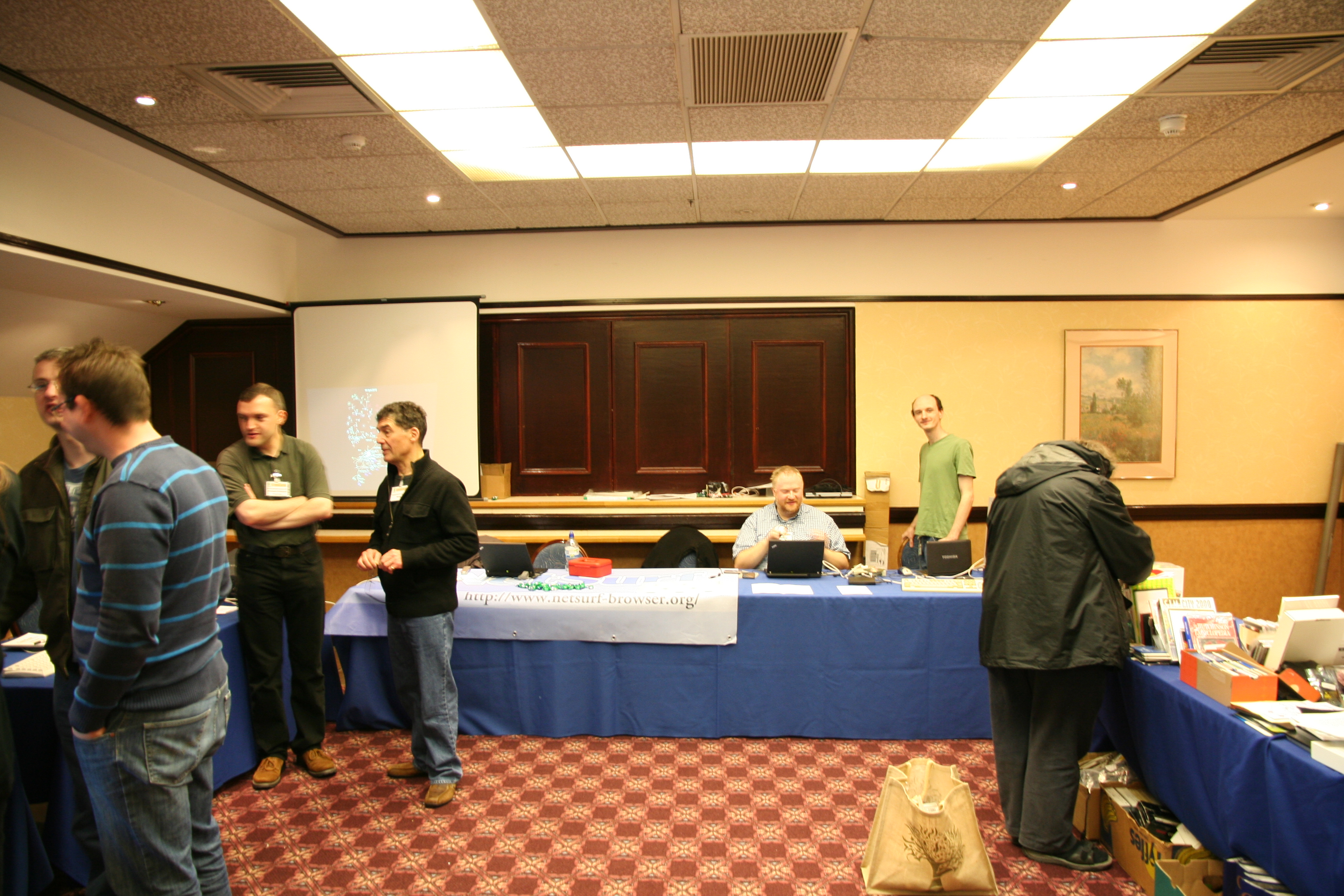
The wakefield RISC OS show is an event the NetSurf project has attended for a long time. in fact since 2005 when the "stand" was a name on an A4 sheet through 2006, 2007, 2008, 2009, 2010 to 2011 we have always been present.

The event has changed in that time from a large affair with many exhibitors to a small specialist interest event with a handful of stands. I took some pictures this year which give a fair impression of the event.

We were seriously considering not attending this year as 2011 had seen us barely break even on donations versus expenses to attend. However we decided that the projects annual Grey Ox Inn post event dinner was probably worth making the effort.

So we all met up in a hotel just off the M1 near Wakefield and set up our table. And although NetSurf as a project now has much more usage on other platforms we still represent the principle browser for the RISC OS platform!

We had a pleasant time, talked to a lot of users and made our expenses back in donations. Overall an amusing Saturday. Based on the size of the event and number and age of the attendees, I fear the RISC OS may be destined for the history books.

Vincent Sanders: Repaying a debt

Some debts are merely financial and some easily repaid but some require repayment in kind . Few debts are more important to me personally than a favour earned by a good friend.

Several years ago, before I started this blog, I replaced the kitchen in my house. Finances were tight at the time and I had to do the entire refit with only limited professional help. Because of this I imposed upon Mark Hymers and Steve Gran to come and assist me. They worked tirelessly for three days over a bank holiday for no immediate reward.

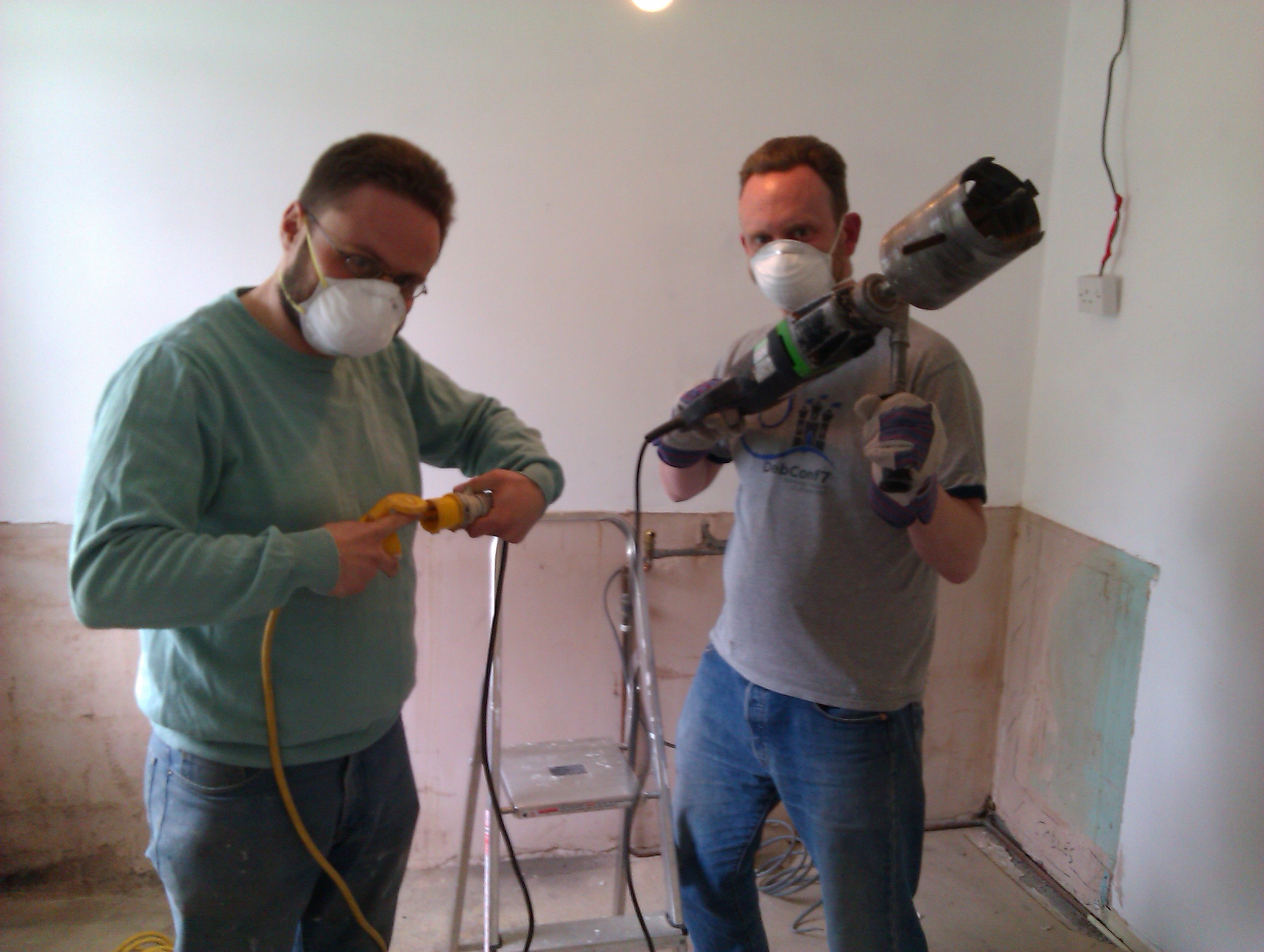
Mark and Steve with a drill
This weekend I had the opportunity to assist Mark with his own kitchen refit and reply my debt.

Although the challenges have been different on this build they were, nonetheless present, including walls which were most definitely not square and affixing cabinets 10mm too high so the doors could not close.

We also got to make a hole for a 125mm extractor which was physically demanding and not a little tiring (Steve actually wielding the drill had a fabulous aim)

I took some photos to document the process which has resulted in an image which is positively threatening, though the two of them are nice people really!

All in all a pleasant weekend with friends, the whole favour thing was really moot, I would have done it for a friend anyway.

James Bromberger: Courier IMAP and FAM

Last Friday, while tracking Debian Testing, the courier package was updated, and while authentication could be seen to be successful, actually using IMAP seemed to fail. Turns out the FAM package was somehow to blame; installing fam and libfam0 was the solution. This uninstalled gamin for me. So if you re pulling your hair out with a similar courier/imap issue, then perhaps have a look at the courier-imap mailing list.

Next.

Previous.