Search Results: "zed"

1 January 2015

Simon Kainz: Pigs-in-a-mud-pond Cake

In lack of some New-Years-Charms, this is our attempt at creating something by ourselves: Step 1 Make some pigs (Pigs being a symbol of luck!) 1 2 (Closeup, probably NSFW :-) ) Step 2 Make some pie. We made a simple, two layeres chocolate pie, topped with some jam to prevent that is all gets very dry. We then made the pond "walls" by sticking KitKat on the side of the pie. We used molten chocolate as "glue". 3 Step 3 Add some more chocolate and add the pigs! 4 5 (Piggy relaxing in liquid chocolate! :-) Step 4 Enjoy! Happy 2015!

28 December 2014

Dirk Eddelbuettel: RcppArmadillo 0.4.600.0

Conrad produced another minor release 4.600 of Armadillo. As before, I had created a GitHub-only pre-release(s) of his pre-release(s), and tested a pre-release as well as the actual release against the now over one hundred CRAN dependents of our RcppArmadillo package. The tests passed fine as usual with less than a handful of checks not passing, all for known cases -- and results are as always in the rcpp-logs repository. Changes are summarized below based on the NEWS.Rd file.
Changes in RcppArmadillo version 0.4.600.0 (2014-12-27)
  • Upgraded to Armadillo release Version 4.600 ("Off The Reservation")
    • added .head() and .tail() to submatrix views
    • faster matrix transposes within compound expressions
    • faster accu() and norm() when compiling with -O3 -ffast-math -march=native (gcc and clang)
    • workaround for a bug in GCC 4.4
Courtesy of CRANberries, there is also a diffstat report for the most recent release. As always, more detailed information is on the RcppArmadillo page. Questions, comments etc should go to the rcpp-devel mailing list off the R-Forge page.

This post by Dirk Eddelbuettel originated on his Thinking inside the box blog. Please report excessive re-aggregation in third-party for-profit settings.

27 December 2014

Joey Hess: shell monad day 3

I have been hard at work on the shell-monad ever since it was born on Christmas Eve. It's now up to 820 lines of code, and has nearly comprehensive coverage of all shell features. Time to use it for something interesting! Let's make a shell script and a haskell program that both speak a simple protocol. This kind of thing could be used by propellor when it's deploying itself to a new host. The haskell program can ssh to a remote host and run the shell program, and talk back and forth over stdio with it, using the protocol they both speak. abstract beginnings First, we'll write a data type for the commands in the protocol.
data Proto
    = Foo String
      Bar
      Baz Integer
    deriving (Show)
Now, let's go type class crazy!
class Monad t => OutputsProto t where
    output :: Proto -> t ()
instance OutputsProto IO where
    output = putStrLn . fromProto
So far, nothing interesting; this makes the IO monad an instance of the OutputsProto type class, and gives a simple implementation to output a line of the protocol.
instance OutputsProto Script where
    output = cmd "echo" . fromProto
Now it gets interesting. The Script monad is now also a member of the OutputsProto. To output a line of the protocol, it just uses echo. Yeah -- shell code is a member of a haskell type class. Awesome -- most abstract shell code evar! Similarly, we can add another type class for monads that can input the protocol:
class Monad t => InputsProto t p where
    input :: t p
instance InputsProto IO Proto where
    input = toProto <$> readLn
instance InputsProto Script Var where
    input = do
        v <- newVar ()
        readVar v
        return v
While the IO version reads and deserializes a line back to a Proto, the shell script version of this returns a Var, which has the newly read line in it, not yet deserialized. Why the difference? Well, Haskell has data types, and shell does not ... speaking the protocol Now we have enough groundwork to write haskell code in the IO monad that speaks the protocol in arbitrary ways. For example:
protoExchangeIO :: Proto -> IO Proto
protoExchangeIO p = do
    output p
    input
fooIO :: IO ()
fooIO = do
    resp <- protoExchangeIO (Foo "starting up")
    -- etc
But that's trivial and uninteresting. Anyone who has read to here certianly knows how to write haskell code in the IO monad. The interesting part is making the shell program speak the protocol, including doing various things when it receives the commands.
foo :: Script ()
foo = do
    stopOnFailure True
    handler <- func (NamedLike "handler") $
        handleProto =<< input
    output (Foo "starting up")
    handler
    output Bar
    handler
handleFoo :: Var -> Script ()
handleFoo v = toStderr $ cmd "echo" "yay, I got a Foo" v
handleBar :: Script ()
handleBar = toStderr $ cmd "echo" "yay, I got a Bar"
handleBaz :: Var -> Script ()
handleBaz num = forCmd (cmd "seq" (Val (1 :: Int)) num) $
    toStderr . cmd "echo" "yay, I got a Baz"
serialization I've left out a few serialization functions. fromProto is used in both instances of OutputsProto. The haskell program and the script will both use this to serialize Proto.
fromProto :: Proto -> String
fromProto (Foo s) = pFOO ++ " " ++ s
fromProto Bar = pBAR ++ " "
fromProto (Baz i) = pBAZ ++ " " ++ show i
pFOO, pBAR, pBAZ :: String
(pFOO, pBAR, pBAZ) = ("FOO", "BAR", "BAZ")
And here's the haskell function to convert the other direction, which was also used earlier.
toProto :: String -> Proto
toProto s = case break (== ' ') s of
    (w, ' ':rest)
          w == pFOO -> Foo rest
          w == pBAR && null rest -> Bar
          w == pBAZ -> Baz (read rest)
          otherwise -> error $ "unknown protocol command: " ++ w
    (_, _) -> error "protocol splitting error"
We also need a version of that written in the Script monad. Here it is. Compare and contrast the function below with the one above. They're really quite similar. (Sadly, not so similar to allow refactoring out a common function..)
handleProto :: Var -> Script ()
handleProto v = do
    w <- getProtoCommand v
    let rest = getProtoRest v
    caseOf w
        [ (quote (T.pack pFOO), handleFoo =<< rest)
        , (quote (T.pack pBAR), handleBar)
        , (quote (T.pack pBAZ), handleBaz =<< rest)
        , (glob "*", do
            toStderr $ cmd "echo" "unknown protocol command" w
            cmd "false"
          )
        ]
Both toProto and handleProto split the incoming line apart into the first word, and the rest of the line, then match the first word against the commands in the protocol, and dispatches to appropriate actions. So, how do we split a variable apart like that in the Shell monad? Like this...
getProtoCommand :: Var -> Script Var
getProtoCommand v = trimVar LongestMatch FromEnd v (glob " *")
getProtoRest :: Var -> Script Var
getProtoRest v = trimVar ShortestMatch FromBeginning v (glob "[! ]*[ ]")
(This could probably be improved by using a DSL to generate the globs too..) conclusion And finally, here's a main to generate the shell script!
main :: IO ()
main = T.writeFile "protocol.sh" $ script foo
The pretty-printed shell script that produces is not very interesting, but I'll include it at the end for completeness. More interestingly for the purposes of sshing to a host and running the command there, we can use linearScript to generate a version of the script that's all contained on a single line. Also included below. I could easily have written the pretty-printed version of the shell script in twice the time that it took to write the haskell program that generates it and also speaks the protocol itself. I would certianly have had to test the hand-written shell script repeatedly. Code like for _x in $(seq 1 "$ _v#[!\ ]*[\ ] ") doesn't just write and debug itself. (Until now!) But, the generated scrpt worked 100% on the first try! Well, it worked as soon as I got the Haskell program to compile... But the best part is that the Haskell program and the shell script don't just speak the same protocol. They both rely on the same definition of Proto. So this is fairly close to the kind of type-safe protocol serialization that Fay provides, when compiling Haskell to javascript. I'm getting the feeling that I won't be writing too many nontrivial shell scripts by hand anymore! :) the complete haskell program Is here, all 99 lines of it. the pretty-printed shell program
#!/bin/sh
set -x
_handler ()   :
    _v=
    read _v
    case "$ _v%%\ * " in FOO) :
        echo 'yay, I got a Foo' "$ _v#[!\ ]*[\ ] " >&2
    : ;; BAR) :
        echo 'yay, I got a Bar' >&2
    : ;; BAZ) :
        for _x in $(seq 1 "$ _v#[!\ ]*[\ ] ")
        do :
            echo 'yay, I got a Baz' "$_x" >&2
        done
    : ;; *) :
        echo 'unknown protocol command' "$ _v%%\ * " >&2
        false
    : ;; esac
 
echo 'FOO starting up'
_handler
echo 'BAR '
_handler
the one-liner shell program
set -p; _handler ()   :;    _v=;    read _v;    case "$ _v%%\ * " in FOO) :;        echo 'yay, I got a Foo' "$ _v#[!\ ]*[\ ] " >&2;     : ;; BAR) :;        echo 'yay, I got a Bar' >&2;    : ;; BAZ) :;        for _x in $(seq 1 "$ _v#[!\ ]*[\ ] ");      do :;           echo 'yay, I got a Baz' "$_x" >&2;      done;   : ;; *) :;      echo 'unknown protocol command' "$ _v%%\ * " >&2;       false;  : ;; esac;  ; echo 'FOO starting up'; _handler; echo 'BAR '; _handler

26 December 2014

Ritesh Raj Sarraf: Linux Containers and Productization

Linux has improved many many things over the last couple of years. Of the many improvements, the one that I've started leveraging the most today, are Control Groups. In the past, when there was a need to build a prototype for a solution, we needed hardware. Then came the virtualization richness to Linux. It came in 2 major flavors, KVM (Full Virtualization) and Xen (Para Virtualization). Over the years, the difference of para vs full, for both the implementations, is almost none. KVM now has support for Para-Virtualizaiton, with para-virtualized drviers for most resource intensive tasks, like network and I/O. Similarly, Xen has Full Virtualization support with the help of Qemu-KVM. But, if you had to build a prototype implementation comprising of a multi node setup, virtualization could still be resource hungry. Otherwise too, if your focus was an application (say like a web framework), virtualization was an overkill. All thanks to Linux Containers, prototyping applicaiton based solutions, is now a breeze in Linux. The LXC project is very well designed, and well balanced, in terms of features (as compared to the recently introduced Docker implementation). From an application's point of view, linux containers provide virtualization for namespace, network and resources. Thus making more than 90% of your application's needs fulfilled. For some apps, where a dependency on the kernel is needed, linux containers will not serve the need. Beyond the defaults provided by the distribution, I like to create a base container with my customizations, as a template. This allows me to quickly create environements, without too much housekeeping to do for the initial setup. My base config, looks like:
rrs@learner:~$ sudo cat /var/lib/lxc/deb-template/config
[sudo] password for rrs:
# Template used to create this container: /usr/share/lxc/templates/lxc-debian
# Parameters passed to the template:
# For additional config options, please look at lxc.container.conf(5)
# CPU
lxc.cgroup.cpuset.cpus = 0,1
lxc.cgroup.cpu.shares = 1234
# Mem
lxc.cgroup.memory.limit_in_bytes = 2000M
lxc.cgroup.memory.soft_limit_in_bytes = 1500M
# Network
lxc.network.type = veth
lxc.network.hwaddr = 00:16:3e:0c:c5:d4
lxc.network.flags = up
lxc.network.link = lxcbr0
# Root file system
lxc.rootfs = /var/lib/lxc/deb-template/rootfs
# Common configuration
lxc.include = /usr/share/lxc/config/debian.common.conf
# Container specific configuration
lxc.mount = /var/lib/lxc/deb-template/fstab
lxc.utsname = deb-template
lxc.arch = amd64
# For apt
lxc.mount.entry = /var/cache/apt/archives var/cache/apt/archives none defaults,bind 0 0
23:07          
rrs@learner:~$
Some of the important settings to have in the templace are the mount point, to point to your local apt cache, and CPU and Memory limits. If there was one feature request to ask the LXC developers, I'd ask them to provide a util-lxc tools suite. Currently, to know the memory (soft/hard) allocation for the container, one needs to do the following:
rrs@learner:/sys/fs/cgroup/memory/lxc/deb-template$ cat memory.soft_limit_in_bytes memory.limit_in_bytes
1572864000
2097152000
23:21          
rrs@learner:/sys/fs/cgroup/memory/lxc/deb-template$ bc
bc 1.06.95
Copyright 1991-1994, 1997, 1998, 2000, 2004, 2006 Free Software Foundation, Inc.
This is free software with ABSOLUTELY NO WARRANTY.
For details type  warranty'.
1572864000/1024/1024
1500
quit
23:21          
rrs@learner:/sys/fs/cgroup/memory/lxc/deb-template$
Tools like lxc-cpuinfo, lxc-free would be much better. Finally, there's been a lot of buzz about Docker. Docker is an alternate product offering, like LXC, for Linux Containers. From what I have briefly looked at, docker doesn't seem to be providing any ground breaking new interface than what is already possible with LXC. It does take all the tidbit tools, and presents you with a unified docker interface. But other than that, I couldn't find it much appealing. And the assumption that the profiles should be pulled off the internet (Github ?) is not very exciting. I am hoping they do have other options, where dependence on the network is not really required.

Categories:

Keywords:

Russ Allbery: pam-krb5 4.7

It's been a long, long time since the last upstream release. Rather too long, as the changes to the portability and test framework were larger than the changes to the module itself. But there are a few bug fixes here and one new feature. The new feature is a new option, no_update_user, which disables the normal update of PAM_USER for the rest of the PAM stack to the canonicalized local username. This allows users to do things like enter Kerberos principals into the login prompt and have the right thing happen, but sometimes it's important to keep the authentication credentials as originally entered and not canonicalize, even if there's a local canonicalization available. This new option allows that. In the bug-fix department, the module now suppresses spurious password prompts from Heimdal while using PKINIT and understands more Kerberos errors for purposes of try_first_pass support and returning better PAM errors. The documentation now notes next to each option the version of pam-krb5 at which it was introduced with its current meaning. You can get the latest version from the pam-krb5 distribution page.

24 December 2014

Gregor Herrmann: GDAC 2014/24

the last year hasn't been an easy one for debian. we've seen lots of fights, unproductive discussions, & in general behaviour which contributed to what enrico in his brilliant blog post called the "stink in the kitchen". people's feelings were hurt, some became less active, others resigned from a specific position or retired completely. it happened to me as well that reading through threads full of trolling, aggressiveness, finger-pointing, unrespectful or abusive behaviour, etc. made me frustrated, or sad, or angry, or all kinds of other negative feelings. but then I usually told myself: this is not the debian project as I know it; this is only a small part a part which urgently needs improvement! ; but if we only look at it alone, our picture of debian at large is distorted. the much bigger part of the debian life I know doesn't happen on this handful of high-profile mailing lists; it happens on dozens of specialized mailing lists, in many small IRC channels, in the BTS, & in in-person meetings. & what I see there is most of the time constructive, collaborative, respectful communication, & committed, helpful, funny, awesome people. the idea of this advent calendar was to give examples of some of my recent experiences which demonstrate what the bright side of debian is in my opinion & what contributes to my fun in debian. with the aim of sharing my impression that the proverbial "stink" is, if we take a step back, only one piece of the bigger picture, & that we shouldn't let ourselves get demotivated by only staring at this puzzle piece. thanks to all the awesome contributors for polishing existing & adding new shiny puzzle pieces to our common picture every day! finally: thanks for reading this series of posts, & especially thank you to all who provided positive feedback this in turn motivated me to follow through! & now: back to work, & don't forget to help cleaning the kitchen :)
this posting is part of GDAC (gregoa's debian advent calendar), a project to show the bright side of debian & why it's fun for me to contribute.

23 December 2014

Michael Stapelberg: Debian Code Search: taming the latency tail

It s been a couple of weeks since I ve launched Debian Code Search Instant, so people have had the chance to use it for a while and that gives me plenty of data points to look at :-). For every query, I log the search term itself as well as the duration the query took to execute. That way, I can easily identify queries that take a long time and see why that is. There is a class of queries for which Debian Code Search (DCS) doesn t perform so well, and that s queries that consist of trigrams which are extremely common. Whenever DCS receives such a query, it needs to search through a lot of files. Note that it doesn t really matter if there are plenty of results or not it s the number of files that potentially contain a result which matters. One such query is arse (we get a lot of curse words). It consists of only two trigrams ( ars and rse ), which are extremely common in program source code. As a couple of examples, the terms parse , sparse , charset and coarse are all matched by that. As an aside, if you really want to search for just arse , use word boundaries, i.e. \barse\b , which also makes the query significantly faster. Fixing the overloaded frontend When DCS first received the query, arse would lead to our frontend server crashing. That was due to (intentionally) unoptimized code we were aggregating all search results from all 6 source backends in memory, sorted them, and then wrote them out to disk. I addressed this in commit d2922fe92 with the following measures:
  1. Instead of keeping the entire result in memory, just write the result to a temporary file on disk ( unsorted.json ) and store pointers into that file in memory, i.e. (offset, length) tuples. In order to sort the results, we also need to store the ranking and the path (to resolve ties and thereby guarantee a stable result order over multiple search queries). For grouping the results by source package, we need to keep the package name.
  2. If you think about it, you don t need the entire path in order to break a tie the hash is enough, as it defines an ordering. That ordering may be different, but any ordering is good enough for the purpose of merely breaking a tie in a deterministic way. I m using Go s hash/fnv, the only non-cryptographic (fast!) hash function that is included in Go s standard library.
  3. Since this was still leading to Out Of Memory errors, I decided to not store a copy of the package name in each search result, but rather use a pointer into a string pool containing all package names. The number of source package names is relatively small, in the order of 20,000, whereas the number of search results can be in the millions. Using the stringpool is a clear win the overhead in the case where #results < #srcpackages is negligible, but as soon as #results > #srcpackages, you save memory.
With all of that fixed, the query became at all possible, albeit with a runtime of around 20 minutes. Double Writing When running such a long-running query, I noticed that the query ran smooth for a while, but then it took multiple seconds without any visible progress at the end of the query before the results appeared. This was due to the frontend ranking the results and then converting unsorted.json into actual result pages. Since we provide results ordered by ranking, but also results grouped by source packages, it was writing every result twice to disk. What s even worse is that due to re-ordering, every read was essentially random (as opposed to sequential reads). What s even worse is that nobody will ever click through all the hundreds of thousands of result pages, so they are prepared entirely in vain. Therefore, with commit c744b236e I made the frontend generate these result pages on demand. This cut down the time for the ranking phase at the end of each query from 20-30 seconds (for big queries) to typically less than one second. Profiling/Monitoring After adding monitoring to each of the source-backends, I realized that during these long-running queries, the disk I/O and network I/O was nowhere near my expectations: each source-backend was sending only a low single-digit number of megabytes per second back to the frontend (typically somewhere between 1 MB/s and 3 MB/s). This didn t match up at all with the bandwidth I observed in earlier performance tests, so I used wget -O /dev/null to send a query and discard the result in order to get some theoretical performance numbers. Suddenly, I was getting more than 10 MB/s worth of results, maxing out the disks with a read rate of about 200 MB/s. So where is the bottleneck? I double-checked that neither the CPU on any of our VMs, nor the network between them was saturated. Note that as of this point, the CPU of the frontend was at roughly 70% (of one core), which didn t seem a lot to me. Then, I followed this excellent tutorial on profiling Go programs to see where the frontend is spending its time. Turns out, the biggest consumer of CPU time was the encoding/json Go package, which is used for deserializing results received from the backend and serializing them again before sending them to the client. Since I was curious about it for a while already, I decided to give cap n proto a try to replace JSON as serialization mechanism for communication between the source backends and the frontend. Switching to it (commit 8efd3b41) brought down the CPU load immensely, and made the query a bit faster. In addition, I killed the next biggest consumer: the lseek(2) syscall, which we used to call with SEEK_CUR and an offset of 0 so that it would tell us the current position. This was necessary in the first place because we don t know in advance how many bytes we re going to write when serializing a result to disk. The replacement is a neat little trick:
type countingWriter int64
func (c *countingWriter) Write(p []byte) (n int, err error)  
    *c += countingWriter(len(p))
    return len(p), nil
 
// [ ]
// Then, use an io.MultiWriter like this:
var written countingWriter
w := io.MultiWriter(s.tempFiles[backendidx], &written)
result.WriteJSON(w)
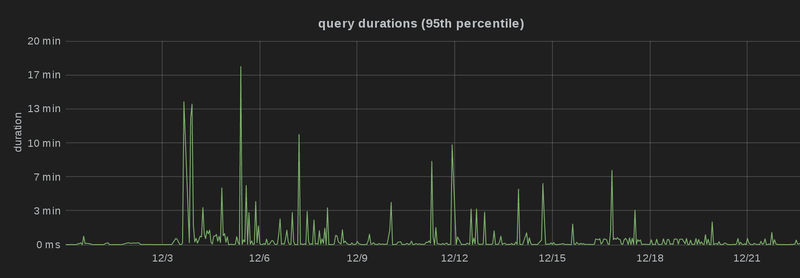
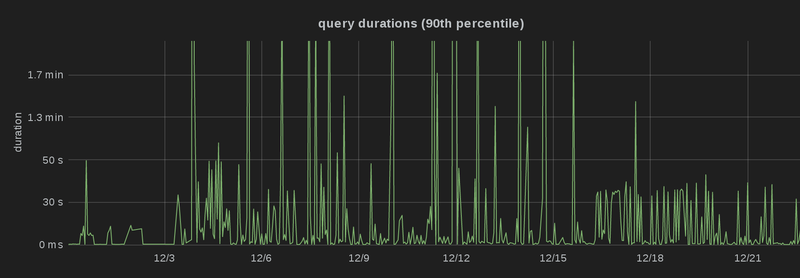
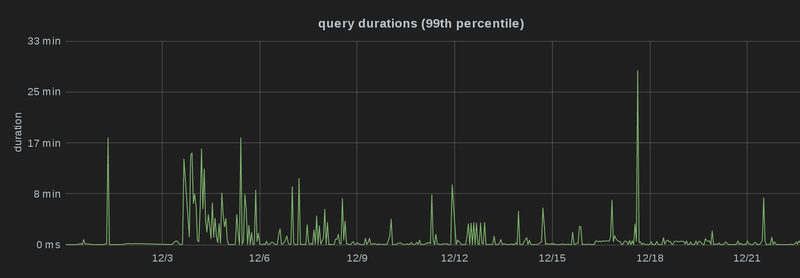
With some more profiling, the new bottleneck was suddenly the read(2) syscall, issued by the cap n proto deserialization, operating directly on the network connection buffer. strace revealed that crunching through the results of one source backend for a long query, read(2) was called about 250,000 times. By simply using a buffered reader (commit 684467ae), I could reduce that to about 2,000 times. Another bottleneck was the fact that for every processed result, the frontend needed to update the query state, which is shared amongst all goroutines (there is one goroutine for each source backend). All that parallelism isn t very effective if you need to synchronize the state updates in the end. So with commit 5d46a572, I refactored the state to be per-backend, so that locking is only necessary for the first couple of results, and the vast vast majority of results can be processed entirely without locking. This brought down the query time from 20 minutes to about 5 minutes, but I still wasn t happy with the bandwidth: the frontend was doing a bit over 10 MB/s of reads from all source backends combined, whereas with wget I could get around 40 MB/s with the same query. At this point, the CPU utilization was around 7% of one core on the frontend, and profiling didn t immediately reveal an obvious culprit. After a bit of experimenting (by commenting out code here and there ;-)), I figured out that the problem was that the frontend was still converting these results from capnproto buffers to JSON. While that doesn t take a lot of CPU time, it delays the network stream from the source-backend: once the local and remote TCP buffers are full, the source-backend will (intentionally!) not continue with its search, so that it doesn t run out of memory. I m still convinced that s a good idea, and in fact I was able to solve the problem in an elegant way: instead of writing JSON to disk and generating result pages on demand, we now write capnproto directly to disk (commit 466b7f3e) and convert it to JSON only before sending out the result pages. That decreases the overall CPU time since we only need to convert a small fraction of the results to JSON, but most importantly, the frontend is now not in the critical path anymore. It can directly pass the data through, and in fact it uses an io.TeeReader to do exactly that. Conclusion With all of these optimizations, we re now down to about 2.5 minutes for the search query arse , and the architecture of the system actually got simpler to reason about. Most importantly, though, the optimizations don t only play out for a single query, but for many different queries. I ve deployed the optimized version at the 15th of December 2014, and you can see that the 99th, 95th and 90th percentile latency dropped significantly, i.e. there are a lot fewer spikes than before, and more queries are processed faster, which is particularly obvious in the third graph (which is capped at 2 minutes):


21 December 2014

Gregor Herrmann: GDAC 2014/21

today I got two private mails from fellow DDs; both were personal messages & a pleasure to read. but what I also realized is that both emails were encrypted. which reminded me how hard it is to communicate securely with most people, & how easy it is with debian people. & this is something we can be proud of!
this posting is part of GDAC (gregoa's debian advent calendar), a project to show the bright side of debian & why it's fun for me to contribute.

19 December 2014

Petter Reinholdtsen: Of course USA loses in cyber war - NSA and friends made sure it would happen

So, Sony caved in (according to Rob Lowe) and demonstrated that America lost its first cyberwar (according to Newt Gingrich). It should not surprise anyone, after the whistle blower Edward Snowden documented that the government of USA and their allies for many years have done their best to make sure the technology used by its citizens is filled with security holes allowing the secret services to spy on its own population. No one in their right minds could believe that the ability to snoop on the people all over the globe could only be used by the personnel authorized to do so by the president of the United States of America. If the capabilities are there, they will be used by friend and foe alike, and now they are being used to bring Sony on its knees. I doubt it will a lesson learned, and expect USA to lose its next cyber war too, given how eager the western intelligence communities (and probably the non-western too, but it is less in the news) seem to be to continue its current dragnet surveillance practice. There is a reason why China and others are trying to move away from Windows to Linux and other alternatives, and it is not to avoid sending its hard earned dollars to Cayman Islands (or whatever tax haven Microsoft is using these days to collect the majority of its income. :)

Petter Reinholdtsen: Of course USA looses in cyber war - NSA and friends made sure it would happen

So, Sony caved in (according to Rob Lowe) and demonstrated that America lost its first cyberwar (according to Newt Gingrich). It should not surprise anyone, after the whistle blower Edward Snowden documented that the government of USA and their allies for many years have done their best to make sure the technology used by its citizens is filled with security holes allowing the secret services to spy on its own population. No one in their right minds could believe that the ability to snoop on the people all over the globe could only be used by the personnel authorized to do so by the president of the United States of America. If the capabilities are there, they will be used by friend and foe alike, and now they are being used to bring Sony on its knees. I doubt it will a lesson learned, and expect USA to loose its next cyber war too, given how eager the western intelligence communities (and probably the non-western too, but it is less in the news) seem to be to continue its current dragnet surveillance practice. There is a reason why China and others are trying to move away from Windows to Linux and other alternatives, and it is not to avoid sending its hard earned dollars to Cayman Islands (or whatever tax haven Microsoft is using these days to collect the majority of its income. :)

18 December 2014

John Goerzen: Aerial Photos: Our Little House on the Prairie

DJI00812 This was my first attempt to send up the quadcopter in winter. It s challenging to take good photos of a snowy landscape anyway. Add to that the fact that the camera is flying, and it s cold, which is hard on batteries and motors. I was rather amazed at how well it did! DJI00816 DJI00830

15 December 2014

Gustavo Noronha Silva: Web Engines Hackfest 2014

For the 6th year in a row, Igalia has organized a hackfest focused on web engines. The 5 years before this one were actually focused on the GTK+ port of WebKit, but the number of web engines that matter to us as Free Software developers and consultancies has grown, and so has the scope of the hackfest. It was a very productive and exciting event. It has already been covered by Manuel Rego, Philippe Normand, Sebastian Dr ge and Andy Wingo! I am sure more blog posts will pop up. We had Martin Robinson telling us about the new Servo engine that Mozilla has been developing as a proof of concept for both Rust as a language for building big, complex products and for doing layout in parallel. Andy gave us a very good summary of where JS engines are in terms of performance and features. We had talks about CSS grid layouts, TyGL a GL-powered implementation of the 2D painting backend in WebKit, the new Wayland port, announced by Zan Dobersek, and a lot more. With help from my colleague ChangSeok OH, I presented a description of how a team at Collabora led by Marco Barisione made the combination of WebKitGTK+ and GNOME s web browser a pretty good experience for the Raspberry Pi. It took a not so small amount of both pragmatic limitations and hacks to get to a multi-tab browser that can play youtube videos and be quite responsive, but we were very happy with how well WebKitGTK+ worked as a base for that. One of my main goals for the hackfest was to help drive features that were lingering in the bug tracker for WebKitGTK+. I picked up a patch that had gone through a number of iterations and rewrites: the HTML5 notifications support, and with help from Carlos Garcia, managed to finish it and land it at the last day of the hackfest! It provides new signals that can be used to authorize notifications, show and close them. To make notifications work in the best case scenario, the only thing that the API user needs to do is handle the permission request, since we provide a default implementation for the show and close signals that uses libnotify if it is available when building WebKitGTK+. Originally our intention was to use GNotification for the default implementation of those signals in WebKitGTK+, but it turned out to be a pain to use for our purposes. GNotification is tied to GApplication. This allows for some interesting features, like notifications being persistent and able to reactivate the application, but those make no sense in our current use case, although that may change once service workers become a thing. It can also be a bit problematic given we are a library and thus have no GApplication of our own. That was easily overcome by using the default GApplication of the process for notifications, though. The show stopper for us using GNotification was the way GNOME Shell currently deals with notifications sent using this mechanism. It will look for a .desktop file named after the application ID used to initialize the GApplication instance and reject the notification if it cannot find that. Besides making this a pain to test our test browser would need a .desktop file to be installed, that would not work for our main API user! The application ID used for all Web instances is org.gnome.Epiphany at the moment, and that is not the same as any of the desktop files used either by the main browser or by the web apps created with it. For the future we will probably move Epiphany towards this new era, and all users of the WebKitGTK+ API as well, but the strictness of GNOME Shell would hurt the usefulness of our default implementation right now, so we decided to stick to libnotify for the time being. Other than that, I managed to review a bunch of patches during the hackfest, and took part in many interesting discussions regarding the next steps for GNOME Web and the GTK+ and Wayland ports of WebKit, such as the potential introduction of a threaded compositor, which is pretty exciting. We also tried to have Bastien Nocera as a guest participant for one of our sessions, but it turns out that requires more than a notebook on top of a bench hooked up to a TV to work well. We could think of something next time ;D. I d like to thank Igalia for organizing and sponsoring the event, Collabora for sponsoring and sending ChangSeok and myself over to Spain from far away Brazil and South Korea, and Adobe for also sponsoring the event! Hope to see you all next year!

Web Engines Hackfest 2014 sponsors: Adobe, Collabora and Igalia

Web Engines Hackfest 2014 sponsors: Adobe, Collabora and Igalia

Thomas Goirand: Supporting 3 init systems in OpenStack packages

tl;dr: Providing support for all 3 init systems (sysv-rc, Upstart and systemd) isn t hard, and generating the init scripts / Upstart job / systemd using a template system is a lot easier than I previously thought. As always, when writing this kind of blog post, I do expect that others will not like what I did. But that s the point: give me your opinion in a constructive way (please be polite even if you don t like what you see I had too many times had to read harsh comments), and I ll implement your ideas if I find it nice. History of the implementation: how we came to the idea I had no plan to do this. I don t believe what I wrote can be generalized to all of the Debian archive. It s just that I started doing things, and it made sense when I did it. Let me explain how it happened. Since it s clear that many, and especially the most advanced one, may have an opinion about which init system they prefer, and because I also support Ubuntu (at least Trusty), I though it was a good idea to support all the main init system: sysv-rc, Upstart and systemd. Though I have counted (for the sake of being exact in this blog) : OpenStack in Debian contains currently 64 init scripts to run daemons in total. That s quite a lot. A way too much to just write them, all by hand. Though that s what I was doing for the last years until this the end of this last summer! So, doing all by hand, I first started implementing Upstart. Its support was there only when building in Ubuntu (which isn t the correct thing to do, this is now fixed, read further ). Then we thought about adding support for systemd. Gustavo Panizzo, one of the contributors in the OpenStack packages, started implementing it in Keystone (the auth server for OpenStack) for the Juno release which was released this October. He did that last summer, early enough so we didn t expect anyone to use the Juno branch Keystone. After some experiments, we had kind of working. What he did was invoking /etc/init.d/keystone start-systemd , which was still using start-stop-daemon. Yes, that s not perfect, and it s better to use systemd foreground process handling, but at least, we had a unique place where to write the startup scripts, where we check the /etc/default for the logging configuration, configure the log file, and so on. Then around in october, I took a step backward to see the whole picture with sysv-rc scripts, and saw the mess, with all the tiny, small difference between them. It became clear that I had to do something to make sure they were all the same, with the support for the same things (like which log system to use, where to store the PID, create /var/lib/project, /var/run/project and so on ). Last, on this month of December, I was able to fix the remaining issues for systemd support, thanks to the awesome contribution of Mikael Cluseau on the Alioth OpenStack packaging list. Now, the systemd unit file is still invoking the init script, but it s not using start-stop-daemon anymore, no PID file involved, and daemons are used as systemd foreground processes. Finally, daemons service files are also activated on installation (they were not previously). Implementation So I took the simplistic approach to use always the same template for the sysv-rc switch/case, and the start and stop functions, happening it at the end of all debian/*.init.in scripts. I started to try to reduce the number of variables, and I was surprised of the result: only a very small part of the init scripts need to change from daemon to daemon. For example, for nova-api, here s the init script (LSB header stripped-out):
DESC="OpenStack Compute API"
PROJECT_NAME=nova
NAME=$ PROJECT_NAME -api
That is it: only 3 lines, defining only the name of the daemon, the name of the project it attaches (eg: nova, cinder, etc.), and a long description. There s of course much more complicated init scripts (see the one for neutron-server in the Debian archive for example), but the vast majority only needs the above. Here s the sysv-rc init script template that I currently use:
#!/bin/sh
# The content after this line comes from openstack-pkg-tools
# and has been automatically added to a .init.in script, which
# contains only the descriptive part for the daemon. Everything
# else is standardized as a single unique script.
# Author: Thomas Goirand <zigo@debian.org>
# PATH should only include /usr/* if it runs after the mountnfs.sh script
PATH=/sbin:/usr/sbin:/bin:/usr/bin
if [ -z "$ DAEMON " ] ; then
	DAEMON=/usr/bin/$ NAME 
fi
PIDFILE=/var/run/$ PROJECT_NAME /$ NAME .pid
if [ -z "$ SCRIPTNAME " ] ; then
	SCRIPTNAME=/etc/init.d/$ NAME 
fi
if [ -z "$ SYSTEM_USER " ] ; then
	SYSTEM_USER=$ PROJECT_NAME 
fi
if [ -z "$ SYSTEM_USER " ] ; then
	SYSTEM_GROUP=$ PROJECT_NAME 
fi
if [ "$ SYSTEM_USER " != "root" ] ; then
	STARTDAEMON_CHUID="--chuid $ SYSTEM_USER :$ SYSTEM_GROUP "
fi
if [ -z "$ CONFIG_FILE " ] ; then
	CONFIG_FILE=/etc/$ PROJECT_NAME /$ PROJECT_NAME .conf
fi
LOGFILE=/var/log/$ PROJECT_NAME /$ NAME .log
if [ -z "$ NO_OPENSTACK_CONFIG_FILE_DAEMON_ARG " ] ; then
	DAEMON_ARGS="$ DAEMON_ARGS  --config-file=$ CONFIG_FILE "
fi
# Exit if the package is not installed
[ -x $DAEMON ]   exit 0
# If ran as root, create /var/lock/X, /var/run/X, /var/lib/X and /var/log/X as needed
if [ "x$USER" = "xroot" ] ; then
	for i in lock run log lib ; do
		mkdir -p /var/$i/$ PROJECT_NAME 
		chown $ SYSTEM_USER  /var/$i/$ PROJECT_NAME 
	done
fi
# This defines init_is_upstart which we use later on (+ more...)
. /lib/lsb/init-functions
# Manage log options: logfile and/or syslog, depending on user's choosing
[ -r /etc/default/openstack ] && . /etc/default/openstack
[ -r /etc/default/$NAME ] && . /etc/default/$NAME
[ "x$USE_SYSLOG" = "xyes" ] && DAEMON_ARGS="$DAEMON_ARGS --use-syslog"
[ "x$USE_LOGFILE" != "xno" ] && DAEMON_ARGS="$DAEMON_ARGS --log-file=$LOGFILE"
do_start()  
	start-stop-daemon --start --quiet --background $ STARTDAEMON_CHUID  --make-pidfile --pidfile $ PIDFILE  --chdir /var/lib/$ PROJECT_NAME  --startas $DAEMON \
			--test > /dev/null   return 1
	start-stop-daemon --start --quiet --background $ STARTDAEMON_CHUID  --make-pidfile --pidfile $ PIDFILE  --chdir /var/lib/$ PROJECT_NAME  --startas $DAEMON \
			-- $DAEMON_ARGS   return 2
 
do_stop()  
	start-stop-daemon --stop --quiet --retry=TERM/30/KILL/5 --pidfile $PIDFILE
	RETVAL=$?
	rm -f $PIDFILE
	return "$RETVAL"
 
do_systemd_start()  
	exec $DAEMON $DAEMON_ARGS
 
case "$1" in
start)
	init_is_upstart > /dev/null 2>&1 && exit 1
	log_daemon_msg "Starting $DESC" "$NAME"
	do_start
	case $? in
		0 1) log_end_msg 0 ;;
		2) log_end_msg 1 ;;
	esac
;;
stop)
	init_is_upstart > /dev/null 2>&1 && exit 0
	log_daemon_msg "Stopping $DESC" "$NAME"
	do_stop
	case $? in
		0 1) log_end_msg 0 ;;
		2) log_end_msg 1 ;;
	esac
;;
status)
	status_of_proc "$DAEMON" "$NAME" && exit 0   exit $?
;;
systemd-start)
	do_systemd_start
;;  
restart force-reload)
	init_is_upstart > /dev/null 2>&1 && exit 1
	log_daemon_msg "Restarting $DESC" "$NAME"
	do_stop
	case $? in
	0 1)
		do_start
		case $? in
			0) log_end_msg 0 ;;
			1) log_end_msg 1 ;; # Old process is still running
			*) log_end_msg 1 ;; # Failed to start
		esac
	;;
	*) log_end_msg 1 ;; # Failed to stop
	esac
;;
*)
	echo "Usage: $SCRIPTNAME  start stop status restart force-reload systemd-start " >&2
	exit 3
;;
esac
exit 0
Nothing particularly fancy here You ll noticed that it s really OpenStack centric (see the LOGFILE and CONFIGFILE things ). You may have also noticed the call to init_is_upstart which is needed for upstart support. I m not sure if it s at the correct place in the init script. Should I put that on top of the script? Was I right with the exit values for it? Please send me your comments Then I thought about generalizing all of this. Because not only the sysv-rc scripts needed to be squared-up, but also Upstart. The approach here was to source the sysv-rc script in debian/*.init.in, and then generate the Upstart job accordingly, using the above 3 variables (or more as needed). Here, the fun is that, instead of taking the approach of calculating everything at runtime with the sysv-rc, for Upstart jobs, many things are calculated at build time. For each debian/*.init.in script that the debian/rules finds, pkgos-gen-upstart-job is called. Here s pkgos-gen-upstart-job:
#!/bin/sh
INIT_TEMPLATE=$ 1 
UPSTART_FILE= echo $ INIT_TEMPLATE    sed 's/.init.in/.upstart/' 
# Get the variables defined in the init template
. $ INIT_TEMPLATE 
## Find out what should go in After=
#SHOULD_START= cat $ INIT_TEMPLATE    grep "# Should-Start:"   sed 's/# Should-Start://' 
#
#if [ -n "$ SHOULD_START " ] ; then
#	AFTER="After="
#	for i in $ SHOULD_START  ; do
#		AFTER="$ AFTER $ i .service "
#	done
#fi
if [ -z "$ DAEMON " ] ; then
        DAEMON=/usr/bin/$ NAME 
fi
PIDFILE=/var/run/$ PROJECT_NAME /$ NAME .pid
if [ -z "$ SCRIPTNAME " ] ; then
	SCRIPTNAME=/etc/init.d/$ NAME 
fi
if [ -z "$ SYSTEM_USER " ] ; then
	SYSTEM_USER=$ PROJECT_NAME 
fi
if [ -z "$ SYSTEM_GROUP " ] ; then
	SYSTEM_GROUP=$ PROJECT_NAME 
fi
if [ "$ SYSTEM_USER " != "root" ] ; then
	STARTDAEMON_CHUID="--chuid $ SYSTEM_USER :$ SYSTEM_GROUP "
fi
if [ -z "$ CONFIG_FILE " ] ; then
	CONFIG_FILE=/etc/$ PROJECT_NAME /$ PROJECT_NAME .conf
fi
LOGFILE=/var/log/$ PROJECT_NAME /$ NAME .log
DAEMON_ARGS="$ DAEMON_ARGS  --config-file=$ CONFIG_FILE "
echo "description \"$ DESC \"
author \"Thomas Goirand <zigo@debian.org>\"
start on runlevel [2345]
stop on runlevel [!2345]
chdir /var/run
pre-start script
	for i in lock run log lib ; do
		mkdir -p /var/\$i/$ PROJECT_NAME 
		chown $ SYSTEM_USER  /var/\$i/$ PROJECT_NAME 
	done
end script
script
	[ -x \"$ DAEMON \" ]   exit 0
	DAEMON_ARGS=\"$ DAEMON_ARGS \"
	[ -r /etc/default/openstack ] && . /etc/default/openstack
	[ -r /etc/default/\$UPSTART_JOB ] && . /etc/default/\$UPSTART_JOB
	[ \"x\$USE_SYSLOG\" = \"xyes\" ] && DAEMON_ARGS=\"\$DAEMON_ARGS --use-syslog\"
	[ \"x\$USE_LOGFILE\" != \"xno\" ] && DAEMON_ARGS=\"\$DAEMON_ARGS --log-file=$ LOGFILE \"
	exec start-stop-daemon --start --chdir /var/lib/$ PROJECT_NAME  \\
		$ STARTDAEMON_CHUID  --make-pidfile --pidfile $ PIDFILE  \\
		--exec $ DAEMON  -- --config-file=$ CONFIG_FILE  \$ DAEMON_ARGS 
end script
" >$ UPSTART_FILE 
The only thing which I don t know how to do, is how to implement the Should-Start / Should-Stop in an Upstart job. Can anyone shoot me a mail and tell me the solution? Then, I wanted to add support for systemd. Here, we cheated, since we only just called the sysv-rc script from the systemd unit, however, the systemd-start target uses exec, so the process stays in the foreground. It s also much smaller than the Upstart thing. However, here, I could implement the After thing, corresponding to the Should-Start:
#!/bin/sh
INIT_TEMPLATE=$ 1 
SERVICE_FILE= echo $ INIT_TEMPLATE    sed 's/.init.in/.service/' 
# Get the variables defined in the init template
. $ INIT_TEMPLATE 
if [ -z "$ SCRIPTNAME " ] ; then
	SCRIPTNAME=/etc/init.d/$ NAME 
fi
if [ -z "$ SYSTEM_USER " ] ; then
	SYSTEM_USER=$ PROJECT_NAME 
fi
if [ -z "$ SYSTEM_GROUP " ] ; then
	SYSTEM_GROUP=$ PROJECT_NAME 
fi
# Find out what should go in After=
SHOULD_START= cat $ INIT_TEMPLATE    grep "# Should-Start:"   sed 's/# Should-Start://' 
if [ -n "$ SHOULD_START " ] ; then
	AFTER="After="
	for i in $ SHOULD_START  ; do
		AFTER="$ AFTER $ i .service "
	done
fi
echo "[Unit]
Description=$ DESC 
$AFTER
[Service]
User=$ SYSTEM_USER 
Group=$ SYSTEM_GROUP 
WorkingDirectory=/var/lib/$ PROJECT_NAME 
PermissionsStartOnly=true
ExecStartPre=/bin/mkdir -p /var/lock/$ PROJECT_NAME  /var/log/$ PROJECT_NAME  /var/lib/$ PROJECT_NAME 
ExecStartPre=/bin/chown $ SYSTEM_USER :$ SYSTEM_GROUP  /var/lock/$ PROJECT_NAME  /var/log/$ PROJECT_NAME  /var/lib/$ PROJECT_NAME 
ExecStart=$ SCRIPTNAME  systemd-start
Restart=on-failure
[Install]
WantedBy=multi-user.target
" >$ SERVICE_FILE 
As you can see, it s calling /etc/init.d/$ SCRIPTNAME sytemd-start, which isn t great. I d be happy to have comments from systemd user / maintainers on how to fix it to make it better. Integrating in debian/rules To integrate with the Debian package build system, we only need had to write this:
override_dh_installinit:
	# Create the init scripts from the template
	for i in  ls -1 debian/*.init.in  ; do \
		MYINIT= echo $$i   sed s/.init.in//  ; \
		cp $$i $$MYINIT.init ; \
		cat /usr/share/openstack-pkg-tools/init-script-template >>$$MYINIT.init ; \
		pkgos-gen-systemd-unit $$i ; \
	done
	# If there's an upstart.in file, use that one instead of the generated one
	for i in  ls -1 debian/*.upstart.in  ; do \
		MYPKG= echo $$i   sed s/.upstart.in//  ; \
		cp $$MYPKG.upstart.in $$MYPKG.upstart ; \
	done
	# Generate the upstart job if there's no already existing .upstart.in
	for i in  ls debian/*.init.in  ; do \
		MYINIT= echo $$i   sed s/.init.in/.upstart.in/  ; \
		if ! [ -e $$MYINIT ] ; then \
			pkgos-gen-upstart-job $$i ; \
		fi \
	done
	dh_installinit --error-handler=true
	# Generate the systemd unit file
	# Note: because dh_systemd_enable is called by the
	# dh sequencer *before* dh_installinit, we have
	# to process it manually.
	for i in  ls debian/*.init.in  ; do \
		pkgos-gen-systemd-unit $$i ; \
		MYSERVICE= echo $$i   sed 's/debian\///'  ; \
		MYSERVICE= echo $$MYSERVICE   sed 's/.init.in/.service/'  ; \
		dh_systemd_enable $$MYSERVICE ; \
	done
As you can see, it s possible to use a debian/*.upstart.in and not use the templating system, in the more complicated case (I needed it mostly for neutron-server and neutron-plugin-openvswitch-agent). Conclusion I do not pretend that what I wrote in the openstack-pkg-tools is the ultimate solution. But I m convince that it answers our own need as the OpenStack maintainers in Debian. There s a lot of room for improvements (like implementing the Should-Start in Upstart jobs, or stop calling the sysv-rc script in the systemd units), but that this is a very good move that we did to use templates and generated scripts, as the init scripts are a way more easy to maintain now, in a much more unified way. As I m not completely satisfied for the systemd and Upstart implementation, I m sure that there s already a huge improvements on the sysv-rc script maintainability. Last and again: please send your comments and help improving the above! :)

12 December 2014

Dirk Eddelbuettel: RProtoBuf 0.4.2

A new release 0.4.2 of RProtoBuf is now on CRAN. RProtoBuf provides R bindings for the Google Protocol Buffers ("Protobuf") data encoding library used and released by Google, and deployed as a language and operating-system agnostic protocol by numerous projects. Murray and Jeroen did almost all of the heavy lifting. Many changes were triggered by two helpful referee reports, and we are slowly getting to the point where we will resubmit a much improved paper. Full details are below.
Changes in RProtoBuf version 0.4.2 (2014-12-10)
  • Address changes suggested by anonymous reviewers for our Journal of Statistical Software submission.
  • Make Descriptor and EnumDescriptor objects subsettable with "[[".
  • Add length() method for Descriptor objects.
  • Add names() method for Message, Descriptor, and EnumDescriptor objects.
  • Clarify order of returned list for descriptor objects in as.list documentation.
  • Correct the definition of as.list for EnumDescriptors to return a proper list instead of a named vector.
  • Update the default print methods to use cat() with fill=TRUE instead of show() to eliminate the confusing [1] since the classes in RProtoBuf are not vectorized.
  • Add support for serializing function, language, and environment objects by falling back to R's native serialization with serialize_pb and unserialize_pb to make it easy to serialize into a Protocol Buffer all of the more than 100 datasets which come with R.
  • Use normalizePath instead of creating a temporary file with file.create when getting absolute path names.
  • Add unit tests for all of the above.
CRANberries also provides a diff to the previous release. RProtoBuf page which has a draft package vignette, a a 'quick' overview vignette, and a unit test summary vignette. Questions, comments etc should go to the GitHub issue tracker off the GitHub repo.

This post by Dirk Eddelbuettel originated on his Thinking inside the box blog. Please report excessive re-aggregation in third-party for-profit settings.

9 December 2014

Joey Hess: podcasts that don't suck, 2014 edition

Also, out of the podcasts I listed previously, I still listen to and enjoy Free As In Freedom, Off the Hook, and the Long Now Seminars. PS: A nice podcatcher, for the technically inclined is git-annex importfeed. Featuring list of feeds in a text file, and distributed podcatching!

8 December 2014

Bernhard R. Link: The Colon in the Shell.

I was recently asked about some construct in a shell script starting with a colon(:), leading me into a long monologue about it. Afterwards I realized I had forgotten to mention half of the nice things. So here for your amusement some usage for the colon in the shell: To find the meaning of ":" in the bash manpage[1], you have to look at the start of the SHELL BUILTIN COMMANDS section. There you find:
: [arguments]
	No effect; the command does nothing beyond expanding arguments and performing any specified redirections.  A zero exit code is returned.
If you wonder what the difference to true is: I don't know any difference (except that there is no /bin/:) So what is the colon useful for? You can use it if you need a command that does nothing, but still is a command. Then there is more things you can do with the colon, most I'd put under "abuse": This is of course not a complete list. But unless I missed something else, those are the most common cases I run into. [1] <rant>If you never looked at it, better don't start: the bash manpage is legendary for being quite useless as hiding all information in other information in a quite absurd order. Unless you look at documentation about how to write a shell script parser, then the bash manpage is really what you want to read.</rant>

5 December 2014

Joey Hess: clean OS reinstalls with propellor

You have a machine someplace, probably in The Cloud, and it has Linux installed, but not to your liking. You want to do a clean reinstall, maybe switching the distribution, or getting rid of the cruft. But this requires running an installer, and it's too difficult to run d-i on remote machines. Wouldn't it be nice if you could point a program at that machine and have it do a reinstall, on the fly, while the machine was running? This is what I've now taught propellor to do! Here's a working configuration which will make propellor convert a system running Fedora (or probably many other Linux distros) to Debian:
testvm :: Host
testvm = host "testvm.kitenet.net"
        & os (System (Debian Unstable) "amd64")
        & OS.cleanInstallOnce (OS.Confirmed "testvm.kitenet.net")
                 onChange  propertyList "fixing up after clean install"
                        [ User.shadowConfig True
                        , OS.preserveRootSshAuthorized
                        , OS.preserveResolvConf
                        , Apt.update
                        , Grub.boots "/dev/sda"
                                 requires  Grub.installed Grub.PC
                        ]
        & Hostname.sane
        & Hostname.searchDomain
        & Apt.installed ["linux-image-amd64"]
        & Apt.installed ["ssh"]
        & User.hasSomePassword "root"
And here's a video of it in action.
It was surprisingly easy to build this. Propellor already knew how to create a chroot, so from there it basically just has to move files around until the chroot takes over from the old OS. After the cleanInstallOnce property does its thing, propellor is running inside a freshly debootstrapped Debian system. Then we just need a few more Propertites to get from there to a bootable, usable system: Install grub and the kernel, turn on shadow passwords, preserve a few config files from the old OS, etc. It's really astounding to me how much easier this was to build than it was to build d-i. It took years to get d-i to the point of being able to install a working system. It took me a few part days to add this capability to propellor (It's 200 lines of code), and I've probably spent a total of less than 30 days total developing propellor in its entirity. So, what gives? Why is this so much easier? There are a lot of reasons: This seems like the opposite of the Second System effect to me. So perhaps d-i was the second system all along? I don't know if I'm going to take this all the way to propellor is d-i 2.0. But in theory, all that's needed now is:
cleanInstallOnce and associated Properties will be included in propellor's upcoming 1.1.0 release, and are available in git now. Oh BTW, you could parameterize a few Properties by OS, and Propellor could be used to install not just Debian or Ubuntu, but whatever Linux distribution you want. Patches welcomed...

Michael Meskes: Conferences in Q4

Together with members of almost all credativ offices world-wide I travelled to Madrid in October to attend PGConf Europe, the most important European PostgreSQL event. The conference, as usual, was greatly organized and had a lot of interesting presentations and thus, was rightfully sold-out. It again brought together a lot of the PostgreSQL community. My non-technical presentation about whether Open Source is a blessing or a curse attracted a sizeable audience despite starting early. Also we got into a good discussion about some of the points raised which again showed that Open Source in general and PostgreSQL in particular are more and more considered because of their strategic importance.Then in November I was invited to do a presentation at Open Source India Days 2014 in Bangalore or as it nowadays is called again Bengaluru. I was able to conveniently combine the trip to the conference with a scheduled visit to our office there.The conference was a very pleasant surprise. Despite being called the largest Open-Source conference in Asia I never made it there before. And, frankly, I was impressed about the size. Maybe not so surprisingly the conference was dominated by presentations about cloud solutions and technology.I, however, talked about the importance of community for businesses in particular pointing to Debian and PostgreSQL as very successful community projects. And again a large audience listened ini showing again the interest in strategic aspects of Open Source. Due to time constraints we weren't able to do a discussion during the presentation, or even allow questions/answers at the end, but a lot of people caught me afterwards to discuss points or make valuable remarks.Both events are very worthy entries for next year's schedule.

2 December 2014

Richard Hartmann: Tabletop games

Wood. I really like wood. Even more, I like working with wood. Touching it, following its grain, and contemplating that it was made mostly from thin air and water. Normally, I just turn trees into handy pieces of firewood. While that's already deeply satisfying in the sense that you actually get to see what you worked for, it's a mostly destructive task. You kill a tree, you chop it up, only to turn it back into (mostly) thin air. As chance would have it, I needed a new table. After dragging myself through way too many furniture stores, I realized that I wouldn't be happy with what's on offer. So I struck a deal with a local carpenter: I would buy from them, but only if I could help building my own table; I would finally create something larger than a carving from wood. After some scouting, the carpenter found five planks of oak which were 4+ meter long, about 40-60 cm wide, and 8+ cm thick: Five raw planks of oak If you think this wood looks old, worn, and broken: You should have seen it up close; it was worse than on the potato-cam picture ;) But that's another great thing about working with wood: by taking off a laughably thin layer of surface material, you can renew the whole thing. We cut off 10 cm from each side as that's what tends to split and tossed that away. Afterwards, we cut off 80 cm from the wider side for the legs. Again, the base tends to have more imperfections and as you don't need to cut long pieces, you have more freedom in deciding how to cut. Cutting is an art in itself; tiny imperfections in the wood's surface can hint at large fissures underneath. The fact that the wood looks worn and spotty does not help in figuring this out. After cutting to minimize waste, you end up with a pile like this: Planks after cutting And a surprising amount of waste, i.e. firewood: Leftovers After a lot of planing, the wood becomes cleaner and smoother: Planed planks Then, everything's fitted so that neighbouring planks have their heartwood running into different directions, and so that the upper surface gets (most of) the interesting features. This is another surprisingly involved process and took about two hours. And no, the potato-cam does not manage to capture the wood's beauty. Set planks After sanding the sides down to perfection to ensure the glue can bond really tightly, the table feet are glued and put into a hydraulic press: Table feet about to be pressed while the tabletop itself shines in all its 287 cm x 107 cm x 6.3 cm glory: Tabletop set and glued Tomorrow, we will sand down the top and bottom of the tabletop and prepare the feet. Grooves will be milled into the wood to glue steel bars into it, as well as another plank that will be glued to the bottom of the tabletop, running along the middle. Along with the alternating heartwood, this helps ensure that this beast of a table will not fold in on itself or otherwise succumb to internal torsion or gravity. The final steps will be to fit the feet, sand down the surface again and then apply two layers of oil. And while most people may not fancy taking a week off just to rise way too early and then do unpaid work, I love it. As I said: I like wood.

Dirk Eddelbuettel: RQuantLib 0.4.0

A new major release of RQuantLib is now on CRAN and getting to Debian. All C++ source files have been rewritten to take advantage of newer Rcpp features. Several Fixed Income functions have been added, or refreshed, thanks to contributions by Michele Salvadore. Calendar support was greatly expanded thanks to a contribution by Danilo Dias da Silva. All key changes are listed in detail below.
Changes in RQuantLib version 0.4.0 (2014-12-01)
  • Changes in RQuantLib code:
    • All function interfaces have been rewritten using Rcpp Attributes. No SEXP remain in the function signatures. This make the code shorter, more readable and more easily extensible.
    • The header files have been reorganized so that plugin use is possible. An impl.h files is imported once for each compilation unit: for RQuantLib from the file src/dates.cpp directory, from a sourced file via a #define set by the plugin wrapper.
    • as<>() and wrap() converters have added for QuantLib Date types.
    • Plugin support has been added, allowing more ad-hoc use via Rcpp Attributes.
    • Several Fixed Income functions have been added, and/or rewritten to better match the QuantLib signatures; this was done mostly by Michele Salvadore.
    • Several Date and Calendar functions have been added.
    • Calendar support has been greatly expanded thanks to Danilo Dias da Silva.
    • Exported curve objects are now more parsimonious and advance entries in the table object roughly one business month at a time.
    • The DiscountCurve and Bond curve construction has been fixed via a corrected evaluation date and omitted the two-year swap rate, as suggested by Luigi Ballabio.
    • The NAMESPACE file has a tighter rule for export of *.default functions, as suggested by Bill Dunlap
    • Builds now use OpenMP where available.
    • The package now depends on QuantLib 1.4.0 or later.
  • Changes in RQuantLib tests:
    • New unit tests for dates have been added.
    • C++ code for the unit tests has also been converted to Rcpp Attributes use; a helper function unitTestSetup() has been added.
    • Continuous Integration via Travis is now enabled from the GitHub repo.
  • Changes in RQuantLib documentation:
    • This NEWS file has been added. Better late than never, as they say.
Courtesy of CRANberries, there is also a diffstat report for the this release. As always, more detailed information is on the RQuantLib page. Questions, comments etc should go to the rquantlib-devel mailing list off the R-Forge page. Issue tickets can be filed at the GitHub repo.

This post by Dirk Eddelbuettel originated on his Thinking inside the box blog. Please report excessive re-aggregation in third-party for-profit settings.

Next.

Previous.