Search Results: "xam"

26 September 2017

Colin Watson: A mysterious bug with Twisted plugins

I fixed a bug in Launchpad recently that led me deeper than I expected. Launchpad uses Buildout as its build system for Python packages, and it s served us well for many years. However, we re using 1.7.1, which doesn t support ensuring that packages required using setuptools setup_requires keyword only ever come from the local index URL when one is specified; that s an essential constraint we need to be able to impose so that our build system isn t immediately sensitive to downtime or changes in PyPI. There are various issues/PRs about this in Buildout (e.g. #238), but even if those are fixed it ll almost certainly only be in Buildout v2, and upgrading to that is its own kettle of fish for other reasons. All this is a serious problem for us because newer versions of many of our vital dependencies (Twisted and testtools, to name but two) use setup_requires to pull in pbr, and so we ve been stuck on old versions for some time; this is part of why Launchpad doesn t yet support newer SSH key types, for instance. This situation obviously isn t sustainable. To deal with this, I ve been working for some time on switching to virtualenv and pip. This is harder than you might think: Launchpad is a long-lived and complicated project, and it had quite a number of explicit and implicit dependencies on Buildout s configuration and behaviour. Upgrading our infrastructure from Ubuntu 12.04 to 16.04 has helped a lot (12.04 s baseline virtualenv and pip have some deficiencies that would have required a more complicated bootstrapping procedure). I ve dealt with most of these: for example, I had to reorganise a lot of our helper scripts (1, 2, 3), but there are still a few more things to go. One remaining problem was that our Buildout configuration relied on building several different environments with different Python paths for various things. While this would technically be possible by way of building multiple virtualenvs, this would inflate our build time even further (we re already going to have to cope with some slowdown as a result of using virtualenv, because the build system now has to do a lot more than constructing a glorified link farm to a bunch of cached eggs), and it seems like unnecessary complexity. The obvious thing to do seemed to be to collapse these into a single environment, since there was no obvious reason why it should actually matter if txpkgupload and txlongpoll were carefully kept off the path when running most of Launchpad: so I did that. Then our build system got very sad. Hmm, I thought. To keep our test times somewhat manageable, we run them in parallel across 20 containers, and we randomise the order in which they run to try to shake out test isolation bugs. It s not completely unknown for there to be some oddities resulting from that. So I ran it again. Nope, but slightly differently sad this time. Furthermore, I couldn t reproduce these failures locally no matter how hard I tried. Oh dear. This was obviously not going to be a good day. In fact I spent a while on various different guesswork-based approaches. I found bug 571334 in Ampoule, an AMP-based process pool implementation that we use for some job runners, and proposed a fix for that, but cherry-picking that fix into Launchpad didn t help matters. I tried backing out subsets of my changes and determined that if both txlongpoll and txpkgupload were absent from the Python module path in the context of the tests in question then everything was fine. I tried running strace locally and staring at the output for some time in the hope of enlightenment: that reminded me that the two packages in question install modules under twisted.plugins, which did at least establish a reason they might affect the environment that was more plausible than magic, but nothing much more specific than that. On Friday I was fiddling about with this again and trying to insert some more debugging when I noticed some interesting behaviour around plugin caching. If I caused the txpkgupload plugin to raise an exception when loaded, the Twisted plugin system would remove its dropin.cache (because it was stale) and not create a new one (because there was now no content to put in it). After that, running the relevant tests would fail as I d seen in our buildbot. Aha! This meant that I could also reproduce it by doing an even cleaner build than I d previously tried to do, by removing the cached txpkgupload and txlongpoll eggs and allowing the build system to recreate them. When they were recreated, they didn t contain dropin.cache, instead allowing that to be created on first use. Based on this clue I was able to get to the answer relatively quickly. Ampoule has a specialised bootstrapping sequence for its worker processes that starts by doing this:
from twisted.application import reactors
reactors.installReactor(reactor)
Now, twisted.application.reactors.installReactor calls twisted.plugin.getPlugins, so the very start of this bootstrapping sequence is going to involve loading all plugins found on the module path (I assume it s possible to write a plugin that adds an alternative reactor implementation). If dropin.cache is up to date, then it will just get the information it needs from that; but if it isn t, it will go ahead and import the plugin. If the plugin happens (as Twisted code often does) to run from twisted.internet import reactor at some point while being imported, then that will install the platform s default reactor, and then twisted.application.reactors.installReactor will raise ReactorAlreadyInstalledError. Since Ampoule turns this into an info-level log message for some reason, and the tests in question only passed through error-level messages or higher, this meant that all we could see was that a worker process had exited non-zero but not why. The Twisted documentation recommends generating the plugin cache at build time for other reasons, but we weren t doing that. Fixing that makes everything work again. There are still a few more things needed to get us onto pip, but we re now pretty close. After that we can finally start bringing our dependencies up to date.

25 September 2017

Enrico Zini: Systemd mount and swap units

These are the notes of a training course on systemd I gave as part of my work with Truelite. .mount and .swap units Describe mount points similarly as what /etc/fstab, but with more functionality and integration with the dependency system. It is possible to define, for example, a filesystem that should be mounted only when the network is available and a given service has successfully started, and a service that should be started only after a given filesystem has been successfully mounted. At boot, systemd uses systemd-fstab-generator to generate mount and swap units from /etc/fstab, so that the usual fstab configuration file can still be used to configure the file system layout. See man systemd.mount, and man systemd.swap. See systemctl --all -t mount and systemctl --all -t swap for examples.

Lior Kaplan: Recruiting for Open Source jobs

Part of services of Kaplan open source consulting is recruiting services to help companies find good open source people. In addition, we also try to help the community to find open source friendly businesses to work at. Expect the Usual Suspects (e.g. RedHat), I encounter job descriptions which convince me these companies know the advantages of using open source projects and hiring open source people. A few recent examples I found in Israel: From the applicant side, the possibility to know which code base he or she is going to work on could help do a better and more educated choice about the offered position. While from the company side, getting hard evidence of what are the applicant capabilities and code looks like instead of just describing them or trying to demonstrate them on short tests. Not to mention the applicant s ability to work as part of a team or community. For the Israeli readers, you can see the full list at https://kaplanopensource.co.il/jobs/
Filed under: Israeli Community, Open source businesses

24 September 2017

Enrico Zini: Systemd service units

These are the notes of a training course on systemd I gave as part of my work with Truelite. .service units Describe how to start and stop system services, like daemons. Services are described in a [Service] section. The Type= configuration describes how the service wants to be brought up: There are a lot more configuration options to fine-tune how the program should be managed, to limit its resource access or capabilities to harden the system security, to run setup/cleanup scripts before or after it started, and after it gets stopped, to control what signals to send to ask for reload or quit, and quite a lot more. See: man systemd.service, man systemd.exec, man systemd.resource-control, and man systemd.kill. See systemctl --all -t service for examples.

Petter Reinholdtsen: Easier recipe to observe the cell phones around you

A little more than a month ago I wrote how to observe the SIM card ID (aka IMSI number) of mobile phones talking to nearby mobile phone base stations using Debian GNU/Linux and a cheap USB software defined radio, and thus being able to pinpoint the location of people and equipment (like cars and trains) with an accuracy of a few kilometer. Since then we have worked to make the procedure even simpler, and it is now possible to do this without any manual frequency tuning and without building your own packages. The gr-gsm package is now included in Debian testing and unstable, and the IMSI-catcher code no longer require root access to fetch and decode the GSM data collected using gr-gsm. Here is an updated recipe, using packages built by Debian and a git clone of two python scripts:
  1. Start with a Debian machine running the Buster version (aka testing).
  2. Run 'apt install gr-gsm python-numpy python-scipy python-scapy' as root to install required packages.
  3. Fetch the code decoding GSM packages using 'git clone github.com/Oros42/IMSI-catcher.git'.
  4. Insert USB software defined radio supported by GNU Radio.
  5. Enter the IMSI-catcher directory and run 'python scan-and-livemon' to locate the frequency of nearby base stations and start listening for GSM packages on one of them.
  6. Enter the IMSI-catcher directory and run 'python simple_IMSI-catcher.py' to display the collected information.
Note, due to a bug somewhere the scan-and-livemon program (actually its underlying program grgsm_scanner) do not work with the HackRF radio. It does work with RTL 8232 and other similar USB radio receivers you can get very cheaply (for example from ebay), so for now the solution is to scan using the RTL radio and only use HackRF for fetching GSM data. As far as I can tell, a cell phone only show up on one of the frequencies at the time, so if you are going to track and count every cell phone around you, you need to listen to all the frequencies used. To listen to several frequencies, use the --numrecv argument to scan-and-livemon to use several receivers. Further, I am not sure if phones using 3G or 4G will show as talking GSM to base stations, so this approach might not see all phones around you. I typically see 0-400 IMSI numbers an hour when looking around where I live. I've tried to run the scanner on a Raspberry Pi 2 and 3 running Debian Buster, but the grgsm_livemon_headless process seem to be too CPU intensive to keep up. When GNU Radio print 'O' to stdout, I am told there it is caused by a buffer overflow between the radio and GNU Radio, caused by the program being unable to read the GSM data fast enough. If you see a stream of 'O's from the terminal where you started scan-and-livemon, you need a give the process more CPU power. Perhaps someone are able to optimize the code to a point where it become possible to set up RPi3 based GSM sniffers? I tried using Raspbian instead of Debian, but there seem to be something wrong with GNU Radio on raspbian, causing glibc to abort().

23 September 2017

Enrico Zini: Systemd unit files

These are the notes of a training course on systemd I gave as part of my work with Truelite. Writing .unit files For reference, the global index with all .unit file directives is at man systemd.directives. All unit files have a [Unit] section with documentation and dependencies. See man systemd.unit for documentation. It is worth having a look at existing units to see what they are like. Use systemctl --all -t unittype for a list, and systemctl cat unitname to see its content wherever it is installed. For example: systemctl cat graphical.target. Note that systemctl cat adds a line of comment at the top so one can see where the unit file is installed. Most unit files also have an [Install] section (also documented in man systemd.unit) that controls what happens when enabling or disabling the unit. See also: .target units .target units only contain [Unit] and [Install] sections, and can be used to give a name to a given set of dependencies. For example, one could create a remote-maintenance.target unit, that when brought up activates, via dependencies, a set of services, mounts, network sockets, and so on. See man systemd.target See systemctl --all -t target for examples. special units man systemd.special has a list of units names that have a standard use associated to them. For example, ctrl-alt-del.target is a unit that is started whenever Control+Alt+Del is pressed on the console. By default it is symlinked to reboot.target, and you can provide your own version in /etc/systemd/system/ to perform another action when Control+Alt+Del is pressed. User units systemd can also be used to manage services on a user session, starting them at login and stopping them at logout. Add --user to the normal systemd commands to have them work with the current user's session instead of the general system. See systemd/User in the Arch Wiki for a good description of what it can do.

Russell Coker: Converting Mbox to Maildir

MBox is the original and ancient format for storing mail on Unix systems, it consists of a single file per user under /var/spool/mail that has messages concatenated. Obviously performance is very poor when deleting messages from a large mail store as the entire file has to be rewritten. Maildir was invented for Qmail by Dan Bernstein and has a single message per file giving fast deletes among other performance benefits. An ongoing issue over the last 20 years has been converting Mbox systems to Maildir. The various ways of getting IMAP to work with Mbox only made this more complex. The Dovecot Wiki has a good page about converting Mbox to Maildir [1]. If you want to keep the same message UIDs and the same path separation characters then it will be a complex task. But if you just want to copy a small number of Mbox accounts to an existing server then it s a bit simpler. Dovecot has a mb2md.pl script to convert folders [2].
cd /var/spool/mail
mkdir -p /mailstore/example.com
for U in * ; do
  ~/mb2md.pl -s $(pwd)/$U -d /mailstore/example.com/$U
done
To convert the inboxes shell code like the above is needed. If the users don t have IMAP folders (EG they are just POP users or use local Unix MUAs) then that s all you need to do.
cd /home
for DIR in */mail ; do
  U=$(echo $DIR  cut -f1 -d/)
  cd /home/$DIR
  for FOLDER in * ; do
    ~/mb2md.pl -s $(pwd)/$FOLDER -d /mailstore/example.com/$U/.$FOLDER
  done
  cp .subscriptions /mailstore/example.com/$U/ subscriptions
done
Some shell code like the above will convert the IMAP folders to Maildir format. The end result is that the users will have to download all the mail again as their MUA will think that every message had been deleted and replaced. But as all servers with significant amounts of mail or important mail were probably converted to Maildir a decade ago this shouldn t be a problem.

22 September 2017

Enrico Zini: Systemd on the command line

These are the notes of a training course on systemd I gave as part of my work with Truelite. Exploring the state of a system Start and stop services Similar to the System V service command, systemctl provides commands to start/stop/restart/reload units or services: Changing global system state systemctl has halt, poweroff, reboot, suspend, hibernate, and hybrid-sleep commands to tell systemd to reboot, power off, suspend and so on. kexec and switch-root also work. The rescue and emergency commands switch the system to rescue and emergency mode (see man systemd.special. systemctl default switches to the default mode, which also happens when exiting the rescue or emergency shell. Run services at boot systemd does not implement runlevels, and services start at boot based on their dependencies. To start a service at boot, you add to its .service file a WantedBy= dependency on a well-known .target unit. At boot, systemd brings up the whole chain of dependency started from a default unit, and that will eventually activate also your service. See systemctl get-default for what unit is currently the default in your system. You can change it via the systemd.unit= kernel command line, so you can configure multiple entries in the boot loader that boot the system running different services. For example systemd.unit=rescue.target for a rescue mode, systemd.unit=multi-user.target for a non-graphical mode, or add your own .target file to implement new system modes. See systemctl list-units -t target --all for a list of all currently available targets in your system. Notes: systemctl start activates a unit right now, but does not automatically enable it at boot systemctl enable enables a unit at boot, but does not automatically start it right now * a disabled unit can still be activated if another unit depends on it To disable a unit so that it will never get started even if another unit depends on it, use systemctl mask unitname. Use systemctl unmask unitname to undo the masking. Reloading / restarting systemd systemctl daemon-reload tells systemd to reload its configuration. systemctl daemon-reexec tells systemd to restart iself.

21 September 2017

Enrico Zini: Systemd Truelite course

These are the notes of a training course on systemd I gave as part of my work with Truelite. There is quite a lot of material, so I split them into a series of posts, running once a day for the next 9 days. Units Everything managed by systemd is called a unit (see man systemd.unit), and each unit is described by a configuration in ini-style format. For example, this unit continuously plays an alarm sound when the system is in emergency or rescue mode:
[Unit]
Description=Beeps when in emergency or rescue mode
DefaultDependencies=false
StopWhenUnneeded=true
[Install]
WantedBy=emergency.target rescue.target
[Service]
Type=simple
ExecStart=/bin/sh -ec 'while true; do /usr/bin/aplay -q /tmp/beep.wav; sleep 2; done'
Units can be described by configuration files, which have different extensions based on what kind of thing they describe: System unit files can be installed in: Unit files in /etc/ override unit files in /lib/. Note that while Debian uses /lib/, other distributions may use /usr/lib/ instead. If there is a directory with the same name as the unit file plus a .d suffix, any file *.conf it contains is parsed after the unit, and can be used to add or override configuration options. For example: Similarly, a unitname.wants/ or unitname.requires/ directory can be used to extend Wants= and Requires= dependencies on other units, by placing symlinks to other units in them. See also:

19 September 2017

Reproducible builds folks: Reproducible Builds: Weekly report #125

Here's what happened in the Reproducible Builds effort between Sunday September 10 and Saturday September 16 2017: Upcoming events Reproduciblity work in Debian devscripts/2.17.10 was uploaded to unstable, fixing #872514. This adds a script to report on reproducibility status of installed packages written by Chris Lamb. #876055 was opened against Debian Policy to decide the precise requirements we should have on a build's environment variables. Bugs filed: Non-maintainer uploads: Reproduciblity work in other projects Patches sent upstream: Reviews of unreproducible packages 16 package reviews have been added, 99 have been updated and 92 have been removed in this week, adding to our knowledge about identified issues. 1 issue type has been updated: diffoscope development reprotest development trydiffoscope development Version 65 was uploaded to unstable by Chris Lamb including these contributions: Reproducible websites development tests.reproducible-builds.org Misc. This week's edition was written by Ximin Luo, Bernhard M. Wiedemann, Chris Lamb, Holger Levsen and Daniel Shahaf & reviewed by a bunch of Reproducible Builds folks on IRC & the mailing lists.

18 September 2017

Carl Chenet: The Github threat

Many voices arise now and then against risks linked to the Github use by Free Software projects. Yet the infatuation for the collaborative forge of the Octocat Californian start-ups doesn t seem to fade away.

These recent years, Github and its services take an important role in software engineering as they are seen as easy to use, efficient for a daily workload with interesting functions in enterprise collaborative workflow or amid a Free Software project. What are the arguments against using its services and are they valid? We will list them first, then we ll examine their validity.

1. Critical points

1.1 Centralization

The Github application belongs to a single entity, Github Inc, a US company which manage it alone. So, a unique company under US legislation manages the access to most of Free Software application code sources, which may be a problem with groups using it when a code source is no longer available, for political or technical reason.

The Octocat, the Github mascot

This centralization leads to another trouble: as it obtained critical mass, it becomes more and more difficult not having a Github account. People who don t use Github, by choice or not, are becoming a silent minority. It is now fashionable to use Github, and not doing so is seen as out of date . The same phenomenon is a classic, and even the norm, for proprietary social networks (Facebook, Twitter, Instagram).

1.2 A Proprietary Software

When you interact with Github, you are using a proprietary software, with no access to its source code and which may not work the way you think it is. It is a problem at different levels. First, ideologically, but foremost in practice. In the Github case, we send them code we can control outside of their interface. We also send them personal information (profile, Github interactions). And mostly, Github forces any project which goes through the US platform to use a crucial proprietary tools: its bug tracking system.

Windows, the epitome of proprietary software, even if others took the same path

1.3 The Uniformization

Working with Github interface seems easy and intuitive to most. Lots of companies now use it as a source repository, and many developers leaving a company find the same Github working environment in the next one. This pervasive presence of Github in free software development environment is a part of the uniformization of said developers working space.

Uniforms always bring Army in my mind, here the Clone army

2 Critical points cross-examination

2.1 Regarding the centralization

2.1.1 Service availability rate

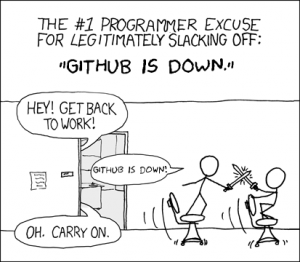
As said above, nowadays, Github is the main repository of Free Software source code. As such it is a favorite target for cyberattacks. DDOS hit it in March and August 2015. On December 15, 2015, an outage led to the inaccessibility of 5% of the repositories. The same occurred on November 15. And these are only the incident reported by Github itself. One can imagine that the mean outage rate of the platform is underestimated.
2.1.2 Chain reaction could block Free Software development

Today many dependency maintenance tools, as npm for javascript, Bundler for Ruby or even pip for Python can access an application source code directly from Github. Free Software projects getting more and more linked and codependents, if one component is down, all the developing process stop.

One of the best examples is the npmgate. Any company could legally demand that Github take down some source code from its repository, which could create a chain reaction and blocking the development of many Free Software projects, as suffered the Node.js community from the decisions of Npm, Inc, the company managing npm.

2.2 A historical precedent: SourceForge

Github didn t appear out of the blue. In his time, its predecessor, SourceForge, was also extremely popular.

Heavily centralized, based on strong interaction with the community, SourceForge is now seen as an aging SAAS (Software As A Service) and sees most of its customers fleeing to Github. Which creates lots of hurdles for those who stayed. The Gimp project suffered from spams and terrible advertising, which led to the departure of the VLC project, then from installers corrupted with adwares instead of the official Gimp installer for Windows. And finally, the Project Gimp s SourceForge account was hacked by SourceForge team itself!

These are very recent examples of what can do a commercial entity when it is under its stakeholders pressure. It is vital to really understand what it means to trust them with data and exchange centralization, where it could have tremendous repercussion on the day-to-day life and the habits of the Free Software and open source community.

2.3. Regarding proprietary software

2.3.1 One community, several opinions on proprietary software

Mostly based on ideology, this point deals with the definition every member of the community gives to Free Software and open source. Mostly about one thing: is it viral or not? Or GPL vs MIT/BSD.

Those on the side of the viral Free Software will have trouble to use a proprietary software as this last one shouldn t even exist. It must be assimilated, to quote Star Trek, as it is a connected black box, endangering privacy, corrupting for profit our uses and restrain our freedom to use as we re pleased what we own, etc.

Those on the side of complete freedom have no qualms using proprietary software as their very existence is a consequence of freedom without restriction. They even agree that code they developed may be a part of proprietary software, which is quite a common occurrence. This part of the Free Software community has no qualm using Github, which is well within their ideology parameters. Just take a look at the Janson amphitheater during Fosdem and check how many Apple laptops running on macOS are around.

FreeBSD, the main BSD project under the BSD license

2.3.2 Data loss and data restrictions linked to proprietary software use

Even without ideological consideration, and just focusing on Github infrastructure, the bug tracking system is a major problem by itself.

Bug report builds the memory of Free Software projects. It is the entrance point for new contributors, the place to find bug reporting, requests for new functions, etc. The project history can t be limited only to the code. It s very common to find bug reports when you copy and paste an error message in a search engine. Not their historical importance is precious for the project itself, but also for its present and future users.

Github gives the ability to extract bug reports through its API. What would happen if Github is down or if the platform doesn t support this feature anymore? In my opinion, not that many projects ever thought of this outcome. How could they move all the data generated by Github into a new bug tracking system? One old example now is Astrid, a TODO list bought by Yahoo a few years ago. Very popular, it grew fast until it was closed overnight, with only a few weeks for its users to extract their data. It was only a to-do list. The same situation with Github would be tremendously difficult to manage for several projects if they even have the ability to deal with it. Code would still be available and could still live somewhere else, but the project memory would be lost. A project like Debian has today more than 800,000 bug reports, which are a data treasure trove about problems solved, function requests and where the development stand on each. The developers of the Cpython project have anticipated the problem and decided not to use Github bug tracking systems.

Issues, the Github proprietary bug tracking system

Another thing we could lose if Github suddenly disappear: all the work currently done regarding the push requests (aka PRs). This Github function gives the ability to clone one project s Github repository, to modify it to fit your needs, then to offer your own modification to the original repository. The original repository s owner will then review said modification, and if he or she agrees with them will fuse them into the original repository. As such, it s one of the main advantages of Github, since it can be done easily through its graphic interface.

However reviewing all the PRs may be quite long, and most of the successful projects have several ongoing PRs. And this PRs and/or the proprietary bug tracking system are commonly used as a platform for comment and discussion between developers.

Code itself is not lost if Github is down (except one specific situation as seen below), but the peer review works materialized in the PRs and the bug tracking system is lost. Let s remember than the PR mechanism let you clone and modify projects and then generate PRs directly from its proprietary web interface without downloading a single code line on your computer. In this particular case, if Github is down, all the code and the work in progress is lost. Some also use Github as a bookmark place. They follow their favorite projects activity through the Watch function. This technological watch style of data collection would also be lost if Github is down.

Debian, one of the main Free Software projects with at least a thousand official contributors

2.4 Uniformization

The Free Software community is walking a thigh rope between normalization needed for an easier interoperability between its products and an attraction for novelty led by a strong need for differentiation from what is already there.

Github popularized the use of Git, a great tool now used through various sectors far away from its original programming field. Step by step, Git is now so prominent it s almost impossible to even think to another source control manager, even if awesome alternate solutions, unfortunately not as popular, exist as Mercurial.

A new Free Software project is now a Git repository on Github with README.md added as a quick description. All the other solutions are ostracized? How? None or very few potential contributors would notice said projects. It seems very difficult now to encourage potential contributors into learning a new source control manager AND a new forge for every project they want to contribute. Which was a basic requirement a few years ago. It s quite sad because Github, offering an original experience to its users, cut them out of a whole possibility realm. Maybe Github is one of the best web versioning control systems. But being the main one doesn t let room for a new competitor to grow. And it let Github initiate development newcomers into a narrow function set, totally unrelated to the strength of the Git tool itself.

3. Centralization, uniformization, proprietary software What s next? Laziness?

Fight against centralization is a main part of the Free Software ideology as centralization strengthens the power of those who manage it and who through it control those who are managed by it. Uniformization allergies born against main software companies and their wishes to impose a closed commercial software world was for a long time the main fuel for innovation thirst and intelligent alternative development. As we said above, part of the Free Software community was built as a reaction to proprietary software and their threat. The other part, without hoping for their disappearance, still chose a development model opposite to proprietary software, at least in the beginning, as now there s more and more bridges between the two.

The Github effect is a morbid one because of its consequences: at least centralization, uniformization, proprietary software usage as their bug tracking system. But some years ago the Dear Github buzz showed one more side effect, one I ve never thought about: laziness. For those who don t know what it is about, this letter is a complaint from several spokespersons from several Free Software projects which demand to Github team to finally implement, after years of polite asking, new functions. Since when Free Software project facing a roadblock request for clemency and don t build themselves the path they need? When Torvalds was involved in the Bitkeeper problem and the Linux kernel development team couldn t use anymore their revision control software, he developed Git. The mere fact of not being able to use one tool or functions lacking is the main motivation to seek alternative solutions and, as such, of the Free Software movement. Every Free Software community member able to code should have this reflex. You don t like what Github offers? Switch to Gitlab. You don t like it Gitlab? Improve it or make your own solution.

The Gitlab logo

Let s be crystal clear. I ve never said that every Free Software developers blocked should code his or her own alternative. We all have our own priorities, and some of us even like their beauty sleep, including me. But, to see that this open letter to Github has 1340 names attached to it, among them some spokespersons for major Free Software project showed me that need, willpower and strength to code a replacement are here. Maybe said replacement will be born from this letter, it would be the best outcome of this buzz.

In the end, Github usage is just another example of Internet usage massification. As Internet users are bound to go to massively centralized social network as Facebook or Twitter, developers are following the same path with Github. Even if a large fraction of developers realize the threat linked this centralized and proprietary organization, the whole community is following this centralization and uniformization trend. Github service is useful, free or with a reasonable price (depending on the functions you need) easy to use and up most of the time. Why would we try something else? Maybe because others are using us while we are savoring the convenience? The Free Software community seems to be quite sleepy to me.

The lion enjoying the hearth warm

About Me Carl Chenet, Free Software Indie Hacker, founder of the French-speaking Hacker News-like Journal du hacker. Follow me on social networks Translated from French by St phanie Chaptal. Original article written in 2015.

17 September 2017

Sean Whitton: Debian Policy call for participation -- September 2017

Here s a summary of the bugs against the Debian Policy Manual. Please consider getting involved, whether or not you re an existing contributor. Consensus has been reached and help is needed to write a patch #172436 BROWSER and sensible-browser standardization #273093 document interactions of multiple clashing package diversions #299007 Transitioning perms of /usr/local #314808 Web applications should use /usr/share/package, not /usr/share/doc/ #425523 Describe error unwind when unpacking a package fails #452393 Clarify difference between required and important priorities #476810 Please clarify 12.5, Copyright information #484673 file permissions for files potentially including credential informa #491318 init scripts should support start/stop/restart/force-reload - why #556015 Clarify requirements for linked doc directories #568313 Suggestion: forbid the use of dpkg-statoverride when uid and gid ar #578597 Recommend usage of dpkg-buildflags to initialize CFLAGS and al. #582109 document triggers where appropriate #587991 perl-policy: /etc/perl missing from Module Path #592610 Clarify when Conflicts + Replaces et al are appropriate #613046 please update example in 4.9.1 (debian/rules and DEB_BUILD_OPTIONS) #614807 Please document autobuilder-imposed build-dependency alternative re #628515 recommending verbose build logs #664257 document Architecture name definitions #682347 mark editor virtual package name as obsolete #685506 copyright-format: new Files-Excluded field #685746 debian-policy Consider clarifying the use of recommends #688251 Built-Using description too aggressive #749826 [multiarch] please document the use of Multi-Arch field in debian/c #757760 please document build profiles #759316 Document the use of /etc/default for cron jobs #761219 document versioned Provides #767839 Linking documentation of arch:any package to arch:all #770440 policy should mention systemd timers #773557 Avoid unsafe RPATH/RUNPATH #780725 PATH used for building is not specified #793499 The Installed-Size algorithm is out-of-date #810381 Update wording of 5.6.26 VCS-* fields to recommend encryption #823256 Update maintscript arguments with dpkg >= 1.18.5 #833401 virtual packages: dbus-session-bus, dbus-default-session-bus #835451 Building as root should be discouraged #838777 Policy 11.8.4 for x-window-manager needs update for freedesktop menus #845715 Please document that packages are not allowed to write outside thei #853779 Clarify requirements about update-rc.d and invoke-rc.d usage in mai #874019 Note that the -e argument to x-terminal-emulator works like #874206 allow a trailing comma in package relationship fields Wording proposed, awaiting review from anyone and/or seconds by DDs #515856 remove get-orig-source #542288 Versions for native packages, NMU s, and binary only uploads #582109 document triggers where appropriate #610083 Remove requirement to document upstream source location in debian/c #645696 [copyright-format] clearer definitions and more consistent License: #649530 [copyright-format] clearer definitions and more consistent License: #662998 stripping static libraries #682347 mark editor virtual package name as obsolete #683222 say explicitly that debian/changelog is required in source packages #688251 Built-Using description too aggressive #737796 copyright-format: support Files: paragraph with both abbreviated na #756835 Extension of the syntax of the Packages-List field. #786470 [copyright-format] Add an optional License-Grant field #810381 Update wording of 5.6.26 VCS-* fields to recommend encryption #835451 Building as root should be discouraged #845255 Include best practices for packaging database applications #850729 Documenting special version number suffixes #874090 Clarify wording of some passages #874095 copyright-format: Use the synopsis term established in the de Merged for the next release #661928 recipe for determining shlib package name #679751 please clarify package account and home directory location in policy #683222 say explicitly that debian/changelog is required in source packages #870915 [5.6.30] Testsuite: There are much more defined values #872893 Chapters, sections, appendices and numbering #872895 Include multi-page HTML in package #872896 An html.tar.gz has leaked into the .deb? #872900 Very generic info file name #872950 Too much indirection in info file menus #873819 upgrading-checklist.txt: typo pgpsignurlmangle in section 4.11 of V #874411 missing line breaks in summary of ways maintainers scripts are call

16 September 2017

Dirk Eddelbuettel: drat 0.1.3

A new version of drat arrived earlier today on CRAN as another no-human-can-delay-this automatic upgrade directly from the CRAN prechecks. It is mostly a maintenance release ensuring PACKAGES.rds is also updated, plus some minor other edits. drat stands for drat R Archive Template, and helps with easy-to-create and easy-to-use repositories for R packages. Since its inception in early 2015 it has found reasonably widespread adoption among R users because repositories with marked releases is the better way to distribute code. The NEWS file summarises the release as follows:

Changes in drat version 0.1.3 (2017-09-16)
  • Ensure PACKAGES.rds, if present, is also inserted in repo
  • Updated 'README.md' removing stale example URLs (#63)
  • Use https to fetch Travis CI script from r-travis

Courtesy of CRANberries, there is a comparison to the previous release. More detailed information is on the drat page.

This post by Dirk Eddelbuettel originated on his Thinking inside the box blog. Please report excessive re-aggregation in third-party for-profit settings.

15 September 2017

Chris Lamb: Which packages on my system are reproducible?

Whilst anyone can inspect the source code of free software for malicious flaws, most software is distributed pre-compiled to end users. The motivation behind the Reproducible Builds effort is to allow verification that no flaws have been introduced either maliciously or accidentally during this compilation process. As part of this project I wrote a script to determine which packages installed on your system are "reproducible" or not:
$ apt install devscripts
[ ]
$ reproducible-check
[ ]
W: subversion (1.9.7-2) is unreproducible (libsvn-perl, libsvn1, subversion) <https://tests.reproducible-builds.org/debian/subversion>
W: taglib (1.11.1+dfsg.1-0.1) is unreproducible (libtag1v5, libtag1v5-vanilla) <https://tests.reproducible-builds.org/debian/taglib>
W: tcltk-defaults (8.6.0+9) is unreproducible (tcl, tk) <https://tests.reproducible-builds.org/debian/tcltk-defaults>
W: tk8.6 (8.6.7-1) is unreproducible (libtk8.6, tk8.6) <https://tests.reproducible-builds.org/debian/tk8.6>
W: valgrind (1:3.13.0-1) is unreproducible <https://tests.reproducible-builds.org/debian/valgrind>
W: wavpack (5.1.0-2) is unreproducible (libwavpack1) <https://tests.reproducible-builds.org/debian/wavpack>
W: x265 (2.5-2) is unreproducible (libx265-130) <https://tests.reproducible-builds.org/debian/x265>
W: xen (4.8.1-1+deb9u1) is unreproducible (libxen-4.8, libxenstore3.0) <https://tests.reproducible-builds.org/debian/xen>
W: xmlstarlet (1.6.1-2) is unreproducible <https://tests.reproducible-builds.org/debian/xmlstarlet>
W: xorg-server (2:1.19.3-2) is unreproducible (xserver-xephyr, xserver-xorg-core) <https://tests.reproducible-builds.org/debian/xorg-server>
282/4494 (6.28%) of installed binary packages are unreproducible.
Whether a package is "reproducible" or not is determined by querying the Debian Reproducible Builds testing framework.


The --raw command-line argument lets you play with the data in more detail. For example, you can see who maintains your unreproducible packages:
$ reproducible-check --raw   dd-list --stdin
Alec Leamas <leamas.alec@gmail.com>
   lirc (U)
Alessandro Ghedini <ghedo@debian.org>
   valgrind
Alessio Treglia <alessio@debian.org>
   fluidsynth (U)
   libsoxr (U)
[ ]


reproducible-check is available in devscripts since version 2.17.10, which landed in Debian unstable on 14th September 2017.

13 September 2017

Shirish Agarwal: Android, Android marketplace and gaming addiction.

This would be a longish piece so please bear and play with tea, coffee, beer or anything stronger that you desire while reading below  I had bought an Android phone, a Samsung J5 just before going to debconf 2016. It was more for being in-trend rather than really using it. The one which I shared is the upgraded version (recentish) the one I have is 2 GB for which I had paid around double of what the list price was. The only reason I bought the model is that it had removable battery at the price point I was willing to pay. I did see that Samsung has the same ham-handed issues with audio as previous Nokia devices use to, the speakers and microphone probably the cheapest you can get on the market. Nokia was same too, at least on the lower-end of the market, while Oppo has loud ringtones and loud music, perfect for those who are a bit hard of hearing (as yours truly is). I had been pleasantly surprised by the quality of photos Samsung J5 was churning even though I m less than average shooter, never been really into it so was a sort of wake-up call for where camera sensor technology is advancing. And of course with newer phones the kind of detail it can capture is mesmerizing to say the least, although wide-angle shots still would take some time to get right I guess. If memory serves me right, sometime back Laura Arjona Reina (who handles part of debian-publicity and part of debian-women among other responsibilities) shared a blog post on p.d.o. where she had shared the troubles she had while exporting data from the phone. While she shared that and I lack the time or the energy to try and find it ( the entry is really bookmarkable, at least that specific blog post). What was interesting though that I had gone few years ago to Bangalore, there is an organization which I like and admire CIS great for researchers. Anyways they had done a project getting between 10-20 phones from the market made of Chinese origin (almost all mobiles sold in India, the fabrication of CPU and APU etc. are done in China/Taiwan and then assembled here). Here what is done at the most is assembly which for all political purposes is called manufacturing . All the mobiles kept quite a bit of info. on the device even after you wiped them clean/put some other ROM on them. The CIS site is more than a bit cluttered otherwise would have shared the direct link. I do hope to send an e-mail to CIS and hopefully they will respond with the report and will share that here as and when. It would be interesting to know if after people flash a custom rom if the status quo is the same as it was before. I do suspect it would be the former as flashing ROMs on phones is still a bit of specialized subject at least here in India with even an average phone costing a month or two s salary or more and the idea of bricking the phone scares most people (including yours truly). Anyways, for a long time I was on bed and had the phone. I used 2 games from the android marketplace which both mum and I enjoy and enjoyed. Those are Real jigsaw and Jigsaw puzzle HD . The permissions dialog which Real jigsaw among other games has is horrible and part of me freaks that all such apps. have unrestricted access to my storage area. Ideally, what Android should have done is either partition or give functionality to the user to have private space for their photos and whatever media they have and the rest of the area is like a public park. If anybody has any thoughts on partitioning on Android phone would like to hear that. One game though which really hooked mumma and me is The Island Experiment . It reminded me of my younger days when gaming addiction was not treated as a disease but thankfully now is . I would call myself somewhat of a functional addict as in do my every day things, work etc. but do dream about the game as to what it will show me next. A part of it is the game is web-based (which means it needs constant internet connection) and web access is somewhat pricey, although with Reliance Jio an upcoming data network operator having bundles of money and promising the moon, network issues at least on low-bandwidth game which I and mum are playing hopefully will not have any issues. I haven t used tshark or any such tool to analyze the traffic but I guess it probably just sends short messages of number of clicks in a time period and things like that, all the rest (I guess) is happening on the mobile itself. I know at sometime I probably will try to put a custom rom on it but which one is the question as there are so many and also which is most compatible with my device. It seems I would have to do lot of homework before I can make any choices. Couple of months back, a friend of mine Akshat who has been using Android for few years enabled Developer Options which I didn t know about till he shared that info. with me. I do hope people do check Akshat s repo. as he has made/has quite a few useful scripts, especially if you are into digital photography. I have shared with him gimp scripting few days back so along with imagemagick you might see him doing some rough scripts in it. Of course, if people use it and give feedback he might clean the scripts a bit so it gives useful error messages and gives statement like gimp is not installed on your system, please install it or ask for specific version but as it works in free software it is somewhat directly proportional to the number of users, bugs and users behind it. A good example of what I mean is youtube-dl . I filed 873853 where I shared the upstream ticket. Apparently YouTube again changed few days back and while upstream has fixed it, the youtube-dl maintainer probably needs to find time and get the new version up. Apparently the issues lies in [$] dpkg -L youtube-dl grep youtube.py
/usr/lib/python3/dist-packages/youtube_dl/extractor/youtube.py
Hopefully somebody does the needful. Btw, I find f-droid extremely useful and especially osmand but sadly both of them are not shared or talked about by people  The reason I shared about Developer Options in Android is that few days back I noticed that the phone wonks off and has unpredictable behaviour such as not letting me browse the web, do additions or deletions using the google play store and alike . Things came to a head when few days back I saw a fibre-optic splicing operation being carried by some workers near my home by the state operator which elated me and wanted to shoot the video for it but the battery died/there was no power even though I hadn t used it much. I have deliberately shared the hindi version which tells how that knowledge is now coming to the masses. I had seen fibre-optic splicing more than a decade and a half back at some net conference where it was going to be in your neighbourhood soonish, hopefully it will happen soon  I had my suspicions for quite sometime all the issues with the phone were not due to proper charging. During course of my investigation, found out that in Developer Options there is an option called USB Configuration and changing that from the default MTP (Media Transfer Protocol) (which is basically used to put or take movies, music or any file from the phone to the computer or vice-versa improved much better behaviour on my android phone. But this caused an unexpected side-effect, I got pretty aggressive polling of the phone by the computer even after saying I do not want to share the phone details with the computer. This I filed as 874216 . The phone and I am guessing most Samsung phones today come with an adaptor with a USB male socket which goes in to the phone s usb port. There is the classical port for electricity but like most people heavily rely on usb charging even for deep fully powered down phone for full charging. One interesting project which I saw which came in Debian some days back is dummydroid. I did file a bug about it . I do hope that either the maintainer gives some more documentation. I am sure many people might use and add to the resource if the documentation was/is there. I did take a look at the package and the profile seems to be like an xml pair kind of database. Having more profiles shouldn t be hard if we knew what info. needs to be added and how do we find that info. Lastly, I am slowly transferring all the above knowledge to my mum as well, although in small doses. She, just like me has and had problems coming from resistive touchscreen to capacitive touchscreen. You can call me wrong but resistive touchscreen seemed to be superior and not as error-prone or liable to commit mistakes as is possible in capacitive touchscreens. There may be a setting to higher/lower the threshold for touching which I have not been able to find as of yet. Hope somebody finds something useful in there. I do hope that Debian does become a replacement to be used on such mobiles but then they would have to duplicate/also have some sort of mainstream content with editors to help people find stuff, something that Debian is not so good at currently. Also I m not sure Synaptic is good fit as a mobile store.
Filed under: Miscellenous Tagged: #Android, #capacitive touchscreen, #custom ROMs, #digital photography, #dummydroid, #f-droid, #fabrication, #flashing, #game addiction, #Google Play Store, #Mainstreaming Debian, #mobile connectivity, #Oppo, #osmand, #planet-debian, #resistive touchscreen, #Samsung Galaxy J5, #scripting, #USB charging, #USB configuration, #youtube-dl, gaming

Vincent Bernat: Route-based IPsec VPN on Linux with strongSwan

A common way to establish an IPsec tunnel on Linux is to use an IKE daemon, like the one from the strongSwan project, with a minimal configuration1:
conn V2-1
  left        = 2001:db8:1::1
  leftsubnet  = 2001:db8:a1::/64
  right       = 2001:db8:2::1
  rightsubnet = 2001:db8:a2::/64
  authby      = psk
  auto        = route
The same configuration can be used on both sides. Each side will figure out if it is left or right . The IPsec site-to-site tunnel endpoints are 2001:db8: 1::1 and 2001:db8: 2::1. The protected subnets are 2001:db8: a1::/64 and 2001:db8: a2::/64. As a result, strongSwan configures the following policies in the kernel:
$ ip xfrm policy
src 2001:db8:a1::/64 dst 2001:db8:a2::/64
        dir out priority 399999 ptype main
        tmpl src 2001:db8:1::1 dst 2001:db8:2::1
                proto esp reqid 4 mode tunnel
src 2001:db8:a2::/64 dst 2001:db8:a1::/64
        dir fwd priority 399999 ptype main
        tmpl src 2001:db8:2::1 dst 2001:db8:1::1
                proto esp reqid 4 mode tunnel
src 2001:db8:a2::/64 dst 2001:db8:a1::/64
        dir in priority 399999 ptype main
        tmpl src 2001:db8:2::1 dst 2001:db8:1::1
                proto esp reqid 4 mode tunnel
[ ]
This kind of IPsec tunnel is a policy-based VPN: encapsulation and decapsulation are governed by these policies. Each of them contains the following elements: When a matching policy is found, the kernel will look for a corresponding security association (using reqid and the endpoint source and destination addresses):
$ ip xfrm state
src 2001:db8:1::1 dst 2001:db8:2::1
        proto esp spi 0xc1890b6e reqid 4 mode tunnel
        replay-window 0 flag af-unspec
        auth-trunc hmac(sha256) 0x5b68[ ]8ba2904 128
        enc cbc(aes) 0x8e0e377ad8fd91e8553648340ff0fa06
        anti-replay context: seq 0x0, oseq 0x0, bitmap 0x00000000
[ ]
If no security association is found, the packet is put on hold and the IKE daemon is asked to negotiate an appropriate one. Otherwise, the packet is encapsulated. The receiving end identifies the appropriate security association using the SPI in the header. Two security associations are needed to establish a bidirectionnal tunnel:
$ tcpdump -pni eth0 -c2 -s0 esp
13:07:30.871150 IP6 2001:db8:1::1 > 2001:db8:2::1: ESP(spi=0xc1890b6e,seq=0x222)
13:07:30.872297 IP6 2001:db8:2::1 > 2001:db8:1::1: ESP(spi=0xcf2426b6,seq=0x204)
All IPsec implementations are compatible with policy-based VPNs. However, some configurations are difficult to implement. For example, consider the following proposition for redundant site-to-site VPNs: Redundant VPNs between 3 sites A possible configuration between V1-1 and V2-1 could be:
conn V1-1-to-V2-1
  left        = 2001:db8:1::1
  leftsubnet  = 2001:db8:a1::/64,2001:db8:a6::cc:1/128,2001:db8:a6::cc:5/128
  right       = 2001:db8:2::1
  rightsubnet = 2001:db8:a2::/64,2001:db8:a6::/64,2001:db8:a8::/64
  authby      = psk
  keyexchange = ikev2
  auto        = route
Each time a subnet is modified on one site, the configurations need to be updated on all sites. Moreover, overlapping subnets (2001:db8: a6::/64 on one side and 2001:db8: a6::cc:1/128 at the other) can also be problematic. The alternative is to use route-based VPNs: any packet traversing a pseudo-interface will be encapsulated using a security policy bound to the interface. This brings two features:
  1. Routing daemons can be used to distribute routes to be protected by the VPN. This decreases the administrative burden when many subnets are present on each side.
  2. Encapsulation and decapsulation can be executed in a different routing instance or namespace. This enables a clean separation between a private routing instance (where VPN users are) and a public routing instance (where VPN endpoints are).

Route-based VPN on Juniper Before looking at how to achieve that on Linux, let s have a look at the way it works with a JunOS-based platform (like a Juniper vSRX). This platform as long-standing history of supporting route-based VPNs (a feature already present in the Netscreen ISG platform). Let s assume we want to configure the IPsec VPN from V3-2 to V1-1. First, we need to configure the tunnel interface and bind it to the private routing instance containing only internal routes (with IPv4, they would have been RFC 1918 routes):
interfaces  
    st0  
        unit 1  
            family inet6  
                address 2001:db8:ff::7/127;


routing-instances  
    private  
        instance-type virtual-router;
        interface st0.1;
     
 
The second step is to configure the VPN:
security  
    /* Phase 1 configuration */
    ike  
        proposal IKE-P1  
            authentication-method pre-shared-keys;
            dh-group group20;
            encryption-algorithm aes-256-gcm;
         
        policy IKE-V1-1  
            mode main;
            proposals IKE-P1;
            pre-shared-key ascii-text "d8bdRxaY22oH1j89Z2nATeYyrXfP9ga6xC5mi0RG1uc";
         
        gateway GW-V1-1  
            ike-policy IKE-V1-1;
            address 2001:db8:1::1;
            external-interface lo0.1;
            general-ikeid;
            version v2-only;
         
     
    /* Phase 2 configuration */
    ipsec  
        proposal ESP-P2  
            protocol esp;
            encryption-algorithm aes-256-gcm;
         
        policy IPSEC-V1-1  
            perfect-forward-secrecy keys group20;
            proposals ESP-P2;
         
        vpn VPN-V1-1  
            bind-interface st0.1;
            df-bit copy;
            ike  
                gateway GW-V1-1;
                ipsec-policy IPSEC-V1-1;
             
            establish-tunnels on-traffic;


We get a route-based VPN because we bind the st0.1 interface to the VPN-V1-1 VPN. Once the VPN is up, any packet entering st0.1 will be encapsulated and sent to the 2001:db8: 1::1 endpoint. The last step is to configure BGP in the private routing instance to exchange routes with the remote site:
routing-instances  
    private  
        routing-options  
            router-id 1.0.3.2;
            maximum-paths 16;
         
        protocols  
            bgp  
                preference 140;
                log-updown;
                group v4-VPN  
                    type external;
                    local-as 65003;
                    hold-time 6;
                    neighbor 2001:db8:ff::6 peer-as 65001;
                    multipath;
                    export [ NEXT-HOP-SELF OUR-ROUTES NOTHING ];


The export filter OUR-ROUTES needs to select the routes to be advertised to the other peers. For example:
policy-options  
    policy-statement OUR-ROUTES  
        term 10  
            from  
                protocol ospf3;
                route-type internal;
             
            then  
                metric 0;
                accept;


The configuration needs to be repeated for the other peers. The complete version is available on GitHub. Once the BGP sessions are up, we start learning routes from the other sites. For example, here is the route for 2001:db8: a1::/64:
> show route 2001:db8:a1::/64 protocol bgp table private.inet6.0 best-path
private.inet6.0: 15 destinations, 19 routes (15 active, 0 holddown, 0 hidden)
+ = Active Route, - = Last Active, * = Both
2001:db8:a1::/64   *[BGP/140] 01:12:32, localpref 100, from 2001:db8:ff::6
                      AS path: 65001 I, validation-state: unverified
                      to 2001:db8:ff::6 via st0.1
                    > to 2001:db8:ff::14 via st0.2
It was learnt both from V1-1 (through st0.1) and V1-2 (through st0.2). The route is part of the private routing instance but encapsulated packets are sent/received in the public routing instance. No route-leaking is needed for this configuration. The VPN cannot be used as a gateway from internal hosts to external hosts (or vice-versa). This could also have been done with JunOS security policies (stateful firewall rules) but doing the separation with routing instances also ensure routes from different domains are not mixed and a simple policy misconfiguration won t lead to a disaster.

Route-based VPN on Linux Starting from Linux 3.15, a similar configuration is possible with the help of a virtual tunnel interface3. First, we create the private namespace:
# ip netns add private
# ip netns exec private sysctl -qw net.ipv6.conf.all.forwarding=1
Any private interface needs to be moved to this namespace (no IP is configured as we can use IPv6 link-local addresses):
# ip link set netns private dev eth1
# ip link set netns private dev eth2
# ip netns exec private ip link set up dev eth1
# ip netns exec private ip link set up dev eth2
Then, we create vti6, a tunnel interface (similar to st0.1 in the JunOS example):
# ip tunnel add vti6 \
   mode vti6 \
   local 2001:db8:1::1 \
   remote 2001:db8:3::2 \
   key 6
# ip link set netns private dev vti6
# ip netns exec private ip addr add 2001:db8:ff::6/127 dev vti6
# ip netns exec private sysctl -qw net.ipv4.conf.vti6.disable_policy=1
# ip netns exec private sysctl -qw net.ipv4.conf.vti6.disable_xfrm=1
# ip netns exec private ip link set vti6 mtu 1500
# ip netns exec private ip link set vti6 up
The tunnel interface is created in the initial namespace and moved to the private one. It will remember its original namespace where it will process encapsulated packets. Any packet entering the interface will temporarily get a firewall mark of 6 that will be used only to match the appropriate IPsec policy4 below. The kernel sets a low MTU on the interface to handle any possible combination of ciphers and protocols. We set it to 1500 and let PMTUD do its work. We can then configure strongSwan5:
conn V3-2
  left        = 2001:db8:1::1
  leftsubnet  = ::/0
  right       = 2001:db8:3::2
  rightsubnet = ::/0
  authby      = psk
  mark        = 6
  auto        = route
  keyexchange = ikev2
  keyingtries = %forever
  ike         = aes256gcm16-prfsha384-ecp384!
  esp         = aes256gcm16-prfsha384-ecp384!
  mobike      = no
The IKE daemon configures the following policies in the kernel:
$ ip xfrm policy
src ::/0 dst ::/0
        dir out priority 399999 ptype main
        mark 0x6/0xffffffff
        tmpl src 2001:db8:1::1 dst 2001:db8:3::2
                proto esp reqid 1 mode tunnel
src ::/0 dst ::/0
        dir fwd priority 399999 ptype main
        mark 0x6/0xffffffff
        tmpl src 2001:db8:3::2 dst 2001:db8:1::1
                proto esp reqid 1 mode tunnel
src ::/0 dst ::/0
        dir in priority 399999 ptype main
        mark 0x6/0xffffffff
        tmpl src 2001:db8:3::2 dst 2001:db8:1::1
                proto esp reqid 1 mode tunnel
[ ]
Those policies are used for any source or destination as long as the firewall mark is equal to 6, which matches the mark configured for the tunnel interface. The last step is to configure BGP to exchange routes. We can use BIRD for this:
router id 1.0.1.1;
protocol device  
   scan time 10;
 
protocol kernel  
   persist;
   learn;
   import all;
   export all;
   merge paths yes;
 
protocol bgp IBGP_V3_2  
   local 2001:db8:ff::6 as 65001;
   neighbor 2001:db8:ff::7 as 65003;
   import all;
   export where ifname ~ "eth*";
   preference 160;
   hold time 6;
 
Once BIRD is started in the private namespace, we can check routes are learned correctly:
$ ip netns exec private ip -6 route show 2001:db8:a3::/64
2001:db8:a3::/64 proto bird metric 1024
        nexthop via 2001:db8:ff::5  dev vti5 weight 1
        nexthop via 2001:db8:ff::7  dev vti6 weight 1
The above route was learnt from both V3-1 (through vti5) and V3-2 (through vti6). Like for the JunOS version, there is no route-leaking between the private namespace and the initial one. The VPN cannot be used as a gateway between the two namespaces, only for encapsulation. This also prevent a misconfiguration (for example, IKE daemon not running) from allowing packets to leave the private network. As a bonus, unencrypted traffic can be observed with tcpdump on the tunnel interface:
$ ip netns exec private tcpdump -pni vti6 icmp6
tcpdump: verbose output suppressed, use -v or -vv for full protocol decode
listening on vti6, link-type LINUX_SLL (Linux cooked), capture size 262144 bytes
20:51:15.258708 IP6 2001:db8:a1::1 > 2001:db8:a3::1: ICMP6, echo request, seq 69
20:51:15.260874 IP6 2001:db8:a3::1 > 2001:db8:a1::1: ICMP6, echo reply, seq 69
You can find all the configuration files for this example on GitHub. The documentation of strongSwan also features a page about route-based VPNs.

  1. Everything in this post should work with Libreswan.
  2. fwd is for incoming packets on non-local addresses. It only makes sense in transport mode and is a Linux-only particularity.
  3. Virtual tunnel interfaces (VTI) were introduced in Linux 3.6 (for IPv4) and Linux 3.12 (for IPv6). Appropriate namespace support was added in 3.15. KLIPS, an alternative out-of-tree stack available since Linux 2.2, also features tunnel interfaces.
  4. The mark is set right before doing a policy lookup and restored after that. Consequently, it doesn t affect other possible uses (filtering, routing). However, as Netfilter can also set a mark, one should be careful for conflicts.
  5. The ciphers used here are the strongest ones currently possible while keeping compatibility with JunOS. The documentation for strongSwan contains a complete list of supported algorithms as well as security recommendations to choose them.

12 September 2017

Arturo Borrero Gonz lez: Google Hangouts in Debian testing (Buster)

debian-suricata logo Google offers a lot of software components packaged specifically for Debian and Debian-like Linux distributions. Examples are: Chrome, Earth and the Hangouts plugin. Also, there are many other Internet services doing the same: Spotify, Dropbox, etc. I m really grateful for them, since this make our life easier. Problem is that our ecosystem is rather complex, with many distributions and many versions out there. I guess is not an easy task for them to keep such a big variety of support variations. In this particular case, it seems Google doesn t support Debian testing in their .deb packages. In this case, testing means Debian Buster. And the same happens with the official Spotify client package. I ve identified several issues with them, to name a few: I m in need of using Google Hangout so I ve been forced to solve this situation by editing the .deb package provided by Google. Simple steps:
% user@debian:~ $ mkdir pkg
% user@debian:~ $ cd pkg/
% user@debian:~/pkg $ wget https://dl.google.com/linux/direct/google-talkplugin_current_amd64.deb
[...]
% user@debian:~/pkg $ dpkg-deb -R google-talkplugin_current_amd64.deb google-talkplugin_current_amd64/
% user@debian:~/pkg $ nano google-talkplugin_current_amd64/DEBIAN/control
% user@debian:~/pkg $ dpkg -b google-talkplugin_current_amd64
% user@debian:~/pkg $ sudo dpkg -i google-talkpluging_current_amd64.deb
I have yet to investigate how to workaround the lsb-core thing, so still I can t use Google Earth.

11 September 2017

Steinar H. Gunderson: rANS encoding of signed coefficients

I'm currently trying to make sense of some still image coding (more details to come at a much later stage!), and for a variety of reasons, I've chosen to use rANS as the entropy coder. However, there's an interesting little detail that I haven't actually seen covered anywhere; maybe it's just because I've missed something, or maybe because it's too blindingly obvious, but I thought I would document what I ended up with anyway. (I had hoped for something even more elegant, but I guess the obvious would have to do.) For those that don't know rANS coding, let me try to handwave it as much as possible. Your state is typically a single word (in my case, a 32-bit word), which is refilled from the input stream as needed. The encoder and decoder works in reverse order; let's just talk about the decoder. Basically it works by looking at the lowest 12 (or whatever) bits of the decoder state, mapping each of those 2^12 slots to a decoded symbol. More common symbols are given more slots, proportionally to the frequency. Let me just write a tiny, tiny example with 2 bits and three symbols instead, giving four slots:
Lowest bits Symbol
00 0
01 0
10 1
11 2
Note that the zero coefficient here maps to one out of two slots (ie., a range); you don't choose which one yourself, the encoder stashes some information in there (which is used to recover the next control word once you know which symbol there is). Now for the actual problem: When storing DCT coefficients, we typically want to also store a sign (ie., not just 1 or 2, but also -1/+1 and -2/+2). The statistical distribution is symmetrical, so the sign bit is incompressible (except that of course there's no sign bit needed for 0). We could have done this by introducing new symbols -1 and -2 in addition to our three other ones, but this means we'll need more bits of precision, and accordingly larger look-up tables (which is negative for performance). So let's find something better. We could also simply store it separately somehow; if the coefficient is non-zero, store the bits in some separate repository. Perhaps more elegantly, you can encode a second symbol in the rANS stream with probability 1/2, but this is more expensive computationally. But both of these have the problem that they're divergent in terms of control flow; nonzero coefficients potentially need to do a lot of extra computation and even loads. This isn't nice for SIMD, and it's not nice for GPU. It's generally not really nice. The solution I ended up with was simulating a larger table with a smaller one. Simply rotate the table so that the zero symbol has the top slots instead of the bottom slots, and then replicate the rest of the table. For instance, take this new table:
Lowest bits Symbol
000 1
001 2
010 0
011 0
100 0
101 0
110 -1
111 -2
(The observant reader will note that this doesn't describe the exact same distribution as last time zero has twice the relative frequency as in the other table but ignore that for the time being.) In this case, the bottom half of the table doesn't actually need to be stored! We know that if the three bottom bits are >= 110 (6 in decimal), we have a negative value, can subtract 6, and then continue decoding. If we are go past the end of our 2-bit table despite that, we know we are decoding a zero coefficient (which doesn't have a sign), so we can just clamp the read; or for a GPU, reads out-of-bounds on a texture will typically return 0 anyway. So it all works nicely, and the divergent I/O is gone. If this pickled your interest, you probably want to read up on rANS in general; Fabian Giesen (aka ryg) has some notes that work as a good starting point, but beware; some of this is pretty confusing. :-)

10 September 2017

Adnan Hodzic: Secure traffic to ZNC on Synology with Let s Encrypt

I ve been using IRC since late 1990 s, and I continue to do so to this day due to it (still) being one of the driving development forces in various open source communities. Especially in Linux development and some of my acquintances I can only get in touch with via IRC :) My Setup On my Synology NAS I run ZNC (IRC bouncer/proxy) to which I connect using various IRC clients (irssi/XChat Azure/AndChat) from various platforms (Linux/Mac/Android). In this case ZNC serves as a gateway and no matter which device/client I connect from, I m always connected to same IRC servers/chat rooms/settings when I left off. This is all fine and dandy, but connecting from external networks to ZNC means you will hand in your ZNC credentials in plain text. Which is a problem for me, even thought we re only talking about IRC bouncer/proxy. With that said, how do we encrypt external traffic to our ZNC? HowTo: Chat securely with ZNC on Synology using Let s Encrypt SSL certificate For reference or more thorough explanation of some of the steps/topics please refer to: Secure (HTTPS) public access to Synology NAS using Let s Encrypt (free) SSL certificate

Requirements:

1: DNS setup Create A record for sub/domain you d like to use to connect to your ZNC and point it to your Synology NAS external (WAN) IP. For your reference, subdomain I ll use is: irc.hodzic.org 2: Create Let s Encrypt certificate
DSM: Control Panel > Security > Certificates > Add
Followed by:
Add a new certificate > Get a certificate from Let's Encrypt
Followed by adding domain name A record was created for in Step 1, i.e: Get a certificate from Let's Encrypt for irc.hodzic.org After certificate is created, don t forget to configure newly created certificate to point to correct domain name, i.e: Configure Let's Encrypt Certificate 3: Install ZNC In case you already have ZNC installed, I suggest you remove it and do a clean install. Mainly due to some problems with package in past, where ZNC wouldn t start automatically on boot which lead to creating projects like: synology-znc-autostart. In latest version, all of these problems have been fixed and couple of new features have been added. ZNC can be installed using Synology s Package Center, if community package sources are enabled. Which can simply be done by adding new package sources:
Name: SynoCommunity
Location: http://packages.synocommunity.com
Enable Community package sources in Synology Package Center To successfuly authenticate newly added source, under General tab, Trust Level should be set to Any publisher As part of installation process, ZNC config will be run with most sane/useful options and admin user will be created allowing you access to ZNC webadmin. 4: Secure access to ZNC webadmin Now we want to bind our sub/domain created in Step 1 to ZNC webadmin, and secure external access to it. This can be done by creating a reverse proxy. As part of this, you need to know which port has been allocated for SSL in ZNC Webadmin, i.e: ZNC Webadmin > Global settings - Listen Ports In this case, we can see it s 8251. Reverse Proxy can be created in:
DSM: Control Panel > Application Portal > Reverse Proxy > Create
Where sub/domain created in Step 1 needs to be point to ZNC SSL port on localhost, i.e: Reverse proxy: irc.hodzic.org setup ZNC Webadmin is now available via HTTPS on external network for the sub/domain you setup as part of Step 1, or in my case: ZNC webadmin (HTTPS) As part of this step, in ZNC webadmin I d advise you to create IRC servers and chatrooms you would like to connect to later. Step 5: Create .pem file from LetsEncrpyt certificate for ZNC to use On Synology, Let s Encrypt certificates are stored and located on:
/usr/syno/etc/certificate/_archive/
In case you have multiple certificates, based on date your certificate was created, you can determine in which directory is your newly generated certificated stored, i.e:
drwx------ 2 root root 4096 Sep 10 12:57 JeRh3Y
Once it s determined which certifiate is the one we want use, generate .pem by running following: sudo cat /usr/syno/etc/certificate/_archive/JeRh3Y/ privkey,cert,chain .pem > /usr/local/znc/var/znc.pem After this restart ZNC: sudo /var/packages/znc/scripts/start-stop-status stop && sudo /var/packages/znc/scripts/start-stop-status start 6: Configure IRC client In this example I ll use XChat Azure on MacOS, and same procedure should be identical for HexChat/XChat clients on any other platform. Altough all information is picked up from ZNC itself, user details will need to be filled in. In my setup I automatically connect to freenode and oftc networks, so I created two for local network and two for external network usage, later is the one we re concentrating on. On General tab of our newly created server, hostname for our server should be the sub/domain we ve setup as part of Step 1 , and port number should be the one we defined in Step 4 , SSL checkbox must be checked. Xchat Azure: Network list - General tab On Connecting tab Server password field needs to be filled in following format:
johndoe/freenode:password
Where, johndoe is ZNC username. freenode is ZNC network name, and password is ZNC password. Xchat Azure: Network list - Connecting tab freenode in this case must first be created as part of ZNC webadmin configuration, mentioned in step 4 . Same case is for oftc network configuration. As part of establishing the connection, information about our Let s Encrypt certificate will be displayed, after which connection will be established and you ll be automatically logged into all chatrooms. Happy hacking!

intrigeri: Can you reproduce this Tails ISO image?

Thanks to a Mozilla Open Source Software award, we have been working on making the Tails ISO images build reproducibly. We have made huge progress: since a few months, ISO images built by Tails core developers and our CI system have always been identical. But we're not done yet and we need your help! Our first call for testing build reproducibility in August uncovered a number of remaining issues. We think that we have fixed them all since, and we now want to find out what other problems may prevent you from building our ISO image reproducibly. Please try to build an ISO image today, and tell us whether it matches ours! Build an ISO These instructions have been tested on Debian Stretch and testing/sid. If you're using another distribution, you may need to adjust them. If you get stuck at some point in the process, see our more detailed build documentation and don't hesitate to contact us: Setup the build environment You need a system that supports KVM, 1 GiB of free memory, and about 20 GiB of disk space.
  1. Install the build dependencies:
    sudo apt install \
        git \
        rake \
        libvirt-daemon-system \
        dnsmasq-base \
        ebtables \
        qemu-system-x86 \
        qemu-utils \
        vagrant \
        vagrant-libvirt \
        vmdebootstrap && \
    sudo systemctl restart libvirtd
    
  2. Ensure your user is in the relevant groups:
    for group in kvm libvirt libvirt-qemu ; do
       sudo adduser "$(whoami)" "$group"
    done
    
  3. Logout and log back in to apply the new group memberships.
Build Tails 3.2~alpha2 This should produce a Tails ISO image:
git clone https://git-tails.immerda.ch/tails && \
cd tails && \
git checkout 3.2-alpha2 && \
git submodule update --init && \
rake build
Send us feedback! No matter how your build attempt turned out we are interested in your feedback. Gather system information To gather the information we need about your system, run the following commands in the terminal where you've run rake build:
sudo apt install apt-show-versions && \
(
  for f in /etc/issue /proc/cpuinfo
  do
    echo "--- File: $ f  ---"
    cat "$ f "
    echo
  done
  for c in free locale env 'uname -a' '/usr/sbin/libvirtd --version' \
            'qemu-system-x86_64 --version' 'vagrant --version'
  do
    echo "--- Command: $ c  ---"
    eval "$ c "
    echo
  done
  echo '--- APT package versions ---'
  apt-show-versions qemu:amd64 linux-image-amd64:amd64 vagrant \
                    libvirt0:amd64
)   bzip2 > system-info.txt.bz2
Then check that the generated file doesn't contain any sensitive information you do not want to leak:
bzless system-info.txt.bz2
Next, please follow the instructions below that match your situation! If the build failed Sorry about that. Please help us fix it by opening a ticket: If the build succeeded Compute the SHA-512 checksum of the resulting ISO image:
sha512sum tails-amd64-3.2~alpha2.iso
Compare your checksum with ours:
9b4e9e7ee7b2ab6a3fb959d4e4a2db346ae322f9db5409be4d5460156fa1101c23d834a1886c0ce6bef2ed6fe378a7e76f03394c7f651cc4c9a44ba608dda0bc
If the checksums match: success, congrats for reproducing Tails 3.2~alpha2! Please send an email to tails-dev@boum.org (public) or tails@boum.org (private) with the subject "Reproduction of Tails 3.2~alpha2 successful" and system-info.txt.bz2 attached. Thanks in advance! Then you can stop reading here. Else, if the checksums differ: too bad, but really it's good news as the whole point of the exercise is precisely to identify such problems :) Now you are in a great position to help improve the reproducibility of Tails ISO images by following these instructions:
  1. Install diffoscope version 83 or higher and all the packages it recommends. For example, if you're using Debian Stretch:
    sudo apt remove diffoscope && \
    echo 'deb http://ftp.debian.org/debian stretch-backports main' \
        sudo tee /etc/apt/sources.list.d/stretch-backports.list && \
    sudo apt update && \
    sudo apt -o APT::Install-Recommends="true" \
             install diffoscope/stretch-backports
    
  2. Download the official Tails 3.2~alpha2 ISO image.
  3. Compare the official Tails 3.2~alpha2 ISO image with yours:
    diffoscope \
           --text diffoscope.txt \
           --html diffoscope.html \
           --max-report-size 262144000 \
           --max-diff-block-lines 10000 \
           --max-diff-input-lines 10000000 \
           path/to/official/tails-amd64-3.2~alpha2.iso \
           path/to/your/own/tails-amd64-3.2~alpha2.iso
    bzip2 diffoscope. txt,html 
    
  4. Send an email to tails-dev@boum.org (public) or tails@boum.org (private) with the subject "Reproduction of Tails 3.2~alpha2 failed", attaching:
    • system-info.txt.bz2;
    • the smallest file among diffoscope.txt.bz2 and diffoscope.html.bz2, except if they are larger than 100 KiB, in which case better upload the file somewhere (e.g. share.riseup.net and share the link in your email.
Thanks a lot! Credits Thanks to Ulrike & anonym who authored a draft on which this blog post is based.

Next.

Previous.