Search Results: "will"

6 February 2023

Reproducible Builds: Reproducible Builds in January 2023

Welcome to the first report for 2023 from the Reproducible Builds project! In these reports we try and outline the most important things that we have been up to over the past month, as well as the most important things in/around the community. As a quick recap, the motivation behind the reproducible builds effort is to ensure no malicious flaws can be deliberately introduced during compilation and distribution of the software that we run on our devices. As ever, if you are interested in contributing to the project, please visit our Contribute page on our website.


News In a curious turn of events, GitHub first announced this month that the checksums of various Git archives may be subject to change, specifically that because:

the default compression for Git archives has recently changed. As result, archives downloaded from GitHub may have different checksums even though the contents are completely unchanged.
This change (which was brought up on our mailing list last October) would have had quite wide-ranging implications for anyone wishing to validate and verify downloaded archives using cryptographic signatures. However, GitHub reversed this decision, updating their original announcement with a message that We are reverting this change for now. More details to follow. It appears that this was informed in part by an in-depth discussion in the GitHub Community issue tracker.

The Bundesamt f r Sicherheit in der Informationstechnik (BSI) (trans: The Federal Office for Information Security ) is the agency in charge of managing computer and communication security for the German federal government. They recently produced a report that touches on attacks on software supply-chains (Supply-Chain-Angriff). (German PDF)
Contributor Seb35 updated our website to fix broken links to Tails Git repository [ ][ ], and Holger updated a large number of pages around our recent summit in Venice [ ][ ][ ][ ].
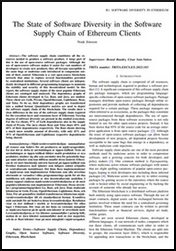
Noak J nsson has written an interesting paper entitled The State of Software Diversity in the Software Supply Chain of Ethereum Clients. As the paper outlines:
In this report, the software supply chains of the most popular Ethereum clients are cataloged and analyzed. The dependency graphs of Ethereum clients developed in Go, Rust, and Java, are studied. These client are Geth, Prysm, OpenEthereum, Lighthouse, Besu, and Teku. To do so, their dependency graphs are transformed into a unified format. Quantitative metrics are used to depict the software supply chain of the blockchain. The results show a clear difference in the size of the software supply chain required for the execution layer and consensus layer of Ethereum.

Yongkui Han posted to our mailing list discussing making reproducible builds & GitBOM work together without gitBOM-ID embedding. GitBOM (now renamed to OmniBOR) is a project to enable automatic, verifiable artifact resolution across today s diverse software supply-chains [ ]. In addition, Fabian Keil wrote to us asking whether anyone in the community would be at Chemnitz Linux Days 2023, which is due to take place on 11th and 12th March (event info). Separate to this, Akihiro Suda posted to our mailing list just after the end of the month with a status report of bit-for-bit reproducible Docker/OCI images. As Akihiro mentions in their post, they will be giving a talk at FOSDEM in the Containers devroom titled Bit-for-bit reproducible builds with Dockerfile and that my talk will also mention how to pin the apt/dnf/apk/pacman packages with my repro-get tool.

The extremely popular Signal messenger app added upstream support for the SOURCE_DATE_EPOCH environment variable this month. This means that release tarballs of the Signal desktop client do not embed nondeterministic release information. [ ][ ]

Distribution work

F-Droid & Android There was a very large number of changes in the F-Droid and wider Android ecosystem this month: On January 15th, a blog post entitled Towards a reproducible F-Droid was published on the F-Droid website, outlining the reasons why F-Droid signs published APKs with its own keys and how reproducible builds allow using upstream developers keys instead. In particular:
In response to [ ] criticisms, we started encouraging new apps to enable reproducible builds. It turns out that reproducible builds are not so difficult to achieve for many apps. In the past few months we ve gotten many more reproducible apps in F-Droid than before. Currently we can t highlight which apps are reproducible in the client, so maybe you haven t noticed that there are many new apps signed with upstream developers keys.
(There was a discussion about this post on Hacker News.) In addition:
  • F-Droid added 13 apps published with reproducible builds this month. [ ]
  • FC Stegerman outlined a bug where baseline.profm files are nondeterministic, developed a workaround, and provided all the details required for a fix. As they note, this issue has now been fixed but the fix is not yet part of an official Android Gradle plugin release.
  • GitLab user Parwor discovered that the number of CPU cores can affect the reproducibility of .dex files. [ ]
  • FC Stegerman also announced the 0.2.0 and 0.2.1 releases of reproducible-apk-tools, a suite of tools to help make .apk files reproducible. Several new subcommands and scripts were added, and a number of bugs were fixed as well [ ][ ]. They also updated the F-Droid website to improve the reproducibility-related documentation. [ ][ ]
  • On the F-Droid issue tracker, FC Stegerman discussed reproducible builds with one of the developers of the Threema messenger app and reported that Android SDK build-tools 31.0.0 and 32.0.0 (unlike earlier and later versions) have a zipalign command that produces incorrect padding.
  • A number of bugs related to reproducibility were discovered in Android itself. Firstly, the non-deterministic order of .zip entries in .apk files [ ] and then newline differences between building on Windows versus Linux that can make builds not reproducible as well. [ ] (Note that these links may require a Google account to view.)
  • And just before the end of the month, FC Stegerman started a thread on our mailing list on the topic of hiding data/code in APK embedded signatures which has been made possible by the Android APK Signature Scheme v2/v3. As part of this, they made an Android app that reads the APK Signing block of its own APK and extracts a payload in order to alter its behaviour called sigblock-code-poc.

Debian As mentioned in last month s report, Vagrant Cascadian has been organising a series of online sprints in order to clear the huge backlog of reproducible builds patches submitted by performing NMUs (Non-Maintainer Uploads). During January, a sprint took place on the 10th, resulting in the following uploads: During this sprint, Holger Levsen filed Debian bug #1028615 to request that the tracker.debian.org service display results of reproducible rebuilds, not just reproducible CI results. Elsewhere in Debian, strip-nondeterminism is our tool to remove specific non-deterministic results from a completed build. This month, version 1.13.1-1 was uploaded to Debian unstable by Holger Levsen, including a fix by FC Stegerman (obfusk) to update a regular expression for the latest version of file(1) [ ]. (#1028892) Lastly, 65 reviews of Debian packages were added, 21 were updated and 35 were removed this month adding to our knowledge about identified issues.

Other distributions In other distributions:

diffoscope diffoscope is our in-depth and content-aware diff utility. Not only can it locate and diagnose reproducibility issues, it can provide human-readable diffs from many kinds of binary formats. This month, Chris Lamb made the following changes to diffoscope, including preparing and uploading versions 231, 232, 233 and 234 to Debian:
  • No need for from __future__ import print_function import anymore. [ ]
  • Comment and tidy the extras_require.json handling. [ ]
  • Split inline Python code to generate test Recommends into a separate Python script. [ ]
  • Update debian/tests/control after merging support for PyPDF support. [ ]
  • Correctly catch segfaulting cd-iccdump binary. [ ]
  • Drop some old debugging code. [ ]
  • Allow ICC tests to (temporarily) fail. [ ]
In addition, FC Stegerman (obfusk) made a number of changes, including:
  • Updating the test_text_proper_indentation test to support the latest version(s) of file(1). [ ]
  • Use an extras_require.json file to store some build/release metadata, instead of accessing the internet. [ ]
  • Updating an APK-related file(1) regular expression. [ ]
  • On the diffoscope.org website, de-duplicate contributors by e-mail. [ ]
Lastly, Sam James added support for PyPDF version 3 [ ] and Vagrant Cascadian updated a handful of tool references for GNU Guix. [ ][ ]

Upstream patches The Reproducible Builds project attempts to fix as many currently-unreproducible packages as possible. This month, we wrote a large number of such patches, including:

Testing framework The Reproducible Builds project operates a comprehensive testing framework at tests.reproducible-builds.org in order to check packages and other artifacts for reproducibility. In January, the following changes were made by Holger Levsen:
  • Node changes:
  • Debian-related changes:
    • Only keep diffoscope s HTML output (ie. no .json or .txt) for LTS suites and older in order to save diskspace on the Jenkins host. [ ]
    • Re-create pbuilder base less frequently for the stretch, bookworm and experimental suites. [ ]
  • OpenWrt-related changes:
    • Add gcc-multilib to OPENWRT_HOST_PACKAGES and install it on the nodes that need it. [ ]
    • Detect more problems in the health check when failing to build OpenWrt. [ ]
  • Misc changes:
    • Update the chroot-run script to correctly manage /dev and /dev/pts. [ ][ ][ ]
    • Update the Jenkins shell monitor script to collect disk stats less frequently [ ] and to include various directory stats. [ ][ ]
    • Update the real year in the configuration in order to be able to detect whether a node is running in the future or not. [ ]
    • Bump copyright years in the default page footer. [ ]
In addition, Christian Marangi submitted a patch to build OpenWrt packages with the V=s flag to enable debugging. [ ]
If you are interested in contributing to the Reproducible Builds project, please visit the Contribute page on our website. You can get in touch with us via:

5 February 2023

James Valleroy: A look back at FreedomBox project in 2022

This post is very late, but better late than never! I want to take a look back at the work that was done on FreedomBox during 2022. Several apps were added to FreedomBox in 2022. The email server app (that was developed by a Google Summer of Code student back in 2021) was finally made available to the general audience of FreedomBox users. You will find it under the name Postfix/Dovecot , which are the main services configured by this app. Another app that was added is Janus, which has the description video room . It is called video room instead of video conference because the room itself is persistent. People can join the room or leave, but there isn t a concept of calling or ending the call . Actually, Janus is a lightweight WebRTC server that can be used as a backend for many different types of applications. But as implemented currently, there is just the simple video room app. In the future, more advanced apps such as Jangouts may be packaged in Debian and made available to FreedomBox. RSS-Bridge is an app that generates RSS feeds for websites that don t provide their own (for example, YouTube). It can be used together with any RSS news feed reader application, such as TT-RSS which is also available in FreedomBox. There is now a Privacy page in the System menu, which allows enabling or disabling the Debian popularity-contest tool. If enabled, it reports the Debian packages that are installed on the system. The results can be seen at https://popcon.debian.org, which currently shows over 400 FreedomBoxes are reporting data. A major feature added to FreedomBox in 2022 is the ability to uninstall apps. This feature is still considered experimental (it won t work for every app), but many issues have been fixed already. There is an option to take a backup of the app s data before uninstalling. There is also now an operations queue in case the user starts multiple install or uninstall operations concurrently. XEP-0363 (HTTP File Upload) has been enabled for Ejabberd Chat Server. This allows files to be transferred between XMPP clients that support this feature. There were a number of security improvements to FreedomBox, such as adding fail2ban jails for Dovecot, Matrix Synapse, and WordPress. Firewall rules were added to ensure that authentication and authorization for services proxied through Apache web server cannot be bypassed by programs running locally on the system. Also, we are no longer using libpam-tmpdir to provide temporary folder isolation, because it causes issues for several packages. Instead we use systemd s sandboxing features, which provide even better isolation for services. Some things were removed in 2022. The ez-ipupdate package is no longer used for Dynamic DNS, since it is replaced by a Python implementation of GnuDIP. An option to restrict who can log in to the system was removed, due to various issues that arose from it. Instead there is an option to restrict who can login through SSH. The DNSSEC diagnostic test was removed, because it caused confusion for many users (although use of DNSSEC is still recommended). Finally, some statistics. There were 31 releases in 2022 (including
point releases). There were 68 unique contributors to the git
repository; this includes code contributions and translations (but not
contributions to the manual pages). In total, there were 980 commits to the git repository.

Mike Gabriel: Call for translations: Lomiri / Ubuntu Touch 20.04

Prologue For over a year now, Fre(i)e Software GmbH (my company) is involved in Ubuntu Touch development. The development effort currently is handled by a mix of paid and voluntary developers/contributors under the umbrella of the UBports Foundation. We are approaching the official first release of Ubuntu Touch 20.04 with rapid pace. And, if you are a non-Englisch native speaker, we'd like to ask you for help... Read below. light+love
Mike (aka sunweaver at debian.org, Mastodon, IRC, etc.) Internationalization (i18n) of Ubuntu Touch 20.04 The UBports team has moved most of the translation workflows for localizing Ubuntu Touch over to Hosted Weblate: To contribute to the UBports projects you need to register here: The localization platform of all UBports / Lomiri components is sponsored by Hosted Weblate via their free hosting plan for Libre and Open Source Projects. Many thanks for providing this service. Translating Lomiri The translation components in the Lomiri project have already been set up and are ready for being updated by translators. Please expect some translation template changes for all those components to occur in the near future, but this should not hinder you from starting translation work right away. Translating Lomiri will bring the best i18n experience to Ubuntu Touch 20.04 end users for the core libraries and the pre-installed (so called) Core Apps. Translating Ubuntu Touch Apps For App Developers (apps that are not among the Core Apps) we will now offer a translation slot under the UBports project on hosted.weblate.org: If you are actively maintaining an Ubuntu Touch app, please ask for a translation component slot on hosted.weblate.org and we will set up your app's translation workflow for and with you. Using the translation service at Hosted Weblate is not a must for app developers, it's rather a service we offer to ease i18n work on Ubuntu Touch apps. Who to contact? To get translations for your app set up on Hosted Weblate, please get in touch with us on https://t.me/ubports, please highlight @sunweaver (Mike Gabriel), @BetaBreak (Raoul Kramer), @cibersheep and @Danfro with your request.

Jonathan Dowland: 2022 in reading

In 2022 I read 34 books (-19% on last year). In 2021 roughly a quarter of the books I read were written by women. I was determined to push that ratio in 2022, so I made an effort to try and only read books by women. I knew that I wouldn't manage that, but by trying to, I did get the ratio up to 58% (by page count). I'm not sure what will happen in 2023. My to-read pile has some back-pressure from books by male authors I postponed reading in 2022 (in particular new works by Christopher Priest and Adam Roberts). It's possible the ratio will swing back the other way, which would mean it would not be worth repeating the experiment. At least if the ratio is the point of the exercise. But perhaps it isn't: perhaps the useful outcome is more qualitative than quantitative. I tried to read some new (to me) authors. I really enjoyed Shirley Jackson (The Haunting of Hill House, We Have Always Lived In The Castle). I Struggled with Angela Carter's Heroes and Villains although I plan to return to her other work, in particular, The Bloody Chamber. I also got through Donna Tartt's The Secret History on the recommendation of a friend. I had to push through the first 15% or so but it turned out to be worth it.
a book cover for Shirley Jackson's 'We have always lived in the castle'
a book cover for Margaret Atwood's 'The Handmaid's Tale'
a book cover for Adam Roberts' 'The This'
a book cover for Emily St. John Mandel's 'Sea of Tranquility'

I finally read (and loved) The Handmaid's Tale, which I had never read despite loving Atwood. My top non-fiction book was The Nanny State Made Me by Stuart Maconie. I still read far more fiction than non-fiction. Or perhaps I'm not keeping track of non- fiction as well. I feel non-fiction requires a different approach to reading: not necessarily linear; it's not always important to read the whole book; it's often important to re-read sections. It might not make sense to consider them in the same bracket. My favourite novels this year were Sea of Tranquility by Emily St. John Mandel, a standalone sort-of sequel to The Glass House but in a very different genre; and The This by Adam Roberts, which was equally remarkable. The This has an interesting narrative device in the first third where a stream of tweets is presented in parallel with the main text. This works well, and does a good job of capturing the figurative river of tweet-like stuff that is woven into our lives at the moment. But I can't help but wonder how they tackle that in the audiobook.

Russell Coker: Wayland in Bookworm

We are getting towards the freeze for Debian/Bookworm so the current state of packages isn t going to change much before the release. Bugs will get fixed but missing features will mostly be missing until the next release. Anarcat wrote an excellent blog post about using Wayland with the Sway window manager [1]. It seems pretty good if you like Sway, but I like KDE and plan to continue using it. Several of the important utility programs referenced by Anarcat won t run with KDE/Wayland and give errors such as Compositor doesn t support wlr-output-management-unstable-v1 . One noteworthy thing about Wayland is the the Window manager and the equivalent to the X server are the same program so KDE has different Wayland code than Sway and doesn t support some features. The lack of these features limits my ability to manage multiple displays and therefore makes KDE/Wayland unsuitable for many laptop uses. My work laptop runs Ubuntu 22.04 with KDE and wouldn t correctly display on the pair of monitors on a USB-C dock that s the standard desktop configuration where I work. In my previous post about Wayland [2] I wrote about converting 2 of my systems to Wayland. Since then I had changed them back to X because of problems with supporting strange monitor configurations on laptops and also due to the KDE window manager crashing occasionally which terminates the session in Wayland but merely requires restarting the window manager in X. More recently I had a problem with the GPU in my main workstation sometimes not being recognised by the system (reporting no PCIe device), when I got a new one I couldn t get X to work with the error Cannot run in framebuffer mode. Please specify busIDs for all framebuffer devices so I tried Wayland again. Now in the later stage of the Bookworm development process it seems that the problem with the KDE window manager crashing has been solved or mitigates and there is a new problem of the plasmashell process crashing. As I can restart plasmashell without logging out that s much less annoying. So now my main workstation is running on Wayland with a slower GPU than I previously had while also giving a faster user experience so Wayland is providing a definite performance benefit. Maybe for Trixie (the next release of Debian after Bookworm) we should have a release goal of having full Wayland support in all the major GUI systems.

C.J. Collier: IPv6 with CenturyLink Fiber

In case you want to know how to configure IPv6 using CenturyLink s 6rd tunneling service. There are four files to update with my script: There are a couple of environment variables in /etc/default/centurylink-6rd that you will want to set. Mine looks like this:

LAN_IFACE="ens18,ens21,ens22"
HEADER_FILE=/etc/radvd.conf.header
The script will configure radvd to advertise v6 routes to a /64 of clients on each of the interfaces delimited by a comma in LAN_IFACE. Current interface limit is 9. I can patch something to go up to 0xff, but I don t want to at this time. If you have some static configuration that you want to preserve, place them into the file pointed to by $ HEADER_FILE and it will be prepended to the generated /etc/radvd.conf file. The up script will remove the file and re-create it every time your ppp link comes up, so keep that in mind and don t manually modify the file and expect it to perist. You ve been warned :-) So here s the script. It s also linked above if you want to curl it.
#!/bin/bash
#
# Copyright 2023 Collier Technologies LLC
# https://wp.c9h.org/cj/?p=1844
#
# # These variables are for the use of the scripts run by run-parts
# PPP_IFACE="$1"
# PPP_TTY="$2"
# PPP_SPEED="$3"
# PPP_LOCAL="$4"
# PPP_REMOTE="$5"
# PPP_IPPARAM="$6"
$ PPP_IFACE:="ppp0" 
if [[ -z $ PPP_LOCAL  ]]; then
    PPP_LOCAL=$(curl -s https://icanhazip.com/)
fi
6rd_prefix="2602::/24"
#printf "%x%x:%x%x\n" $(echo $PPP_LOCAL   tr . ' ')
# This configuration option came from CenturyLink:
# https://www.centurylink.com/home/help/internet/modems-and-routers/advanced-setup/enable-ipv6.html
border_router=205.171.2.64
TUNIFACE=6rdif
first_ipv6_network=$(printf "2602:%02x:%02x%02x:%02x00::" $(echo $ PPP_LOCAL    tr . ' '))
ip tunnel del $ TUNIFACE  2>/dev/null
ip -l 5 -6 addr flush scope global dev $ IFACE 
ip tunnel add $ TUNIFACE  mode sit local $ PPP_LOCAL  remote $ border_router 
ip tunnel 6rd dev $ TUNIFACE  6rd-prefix "$ first_ipv6_network 0/64" 6rd-relay_prefix $ border_router /32
ip link set up dev $ TUNIFACE 
ip -6 route add default dev $ TUNIFACE 
ip addr add $ first_ipv6_network 1/64 dev $ TUNIFACE 
rm /etc/radvd.conf
i=1
DEFAULT_FILE="/etc/default/centurylink-6rd"
if [[ -f $ DEFAULT_FILE  ]]; then
    source $ DEFAULT_FILE 
    if [[ -f $ HEADER_FILE  ]]; then
	cp $ HEADER_FILE  /etc/radvd.conf
    fi
else
    LAN_IFACE="setThis"
fi
   
for IFACE in $( echo $ LAN_IFACE    tr , ' ' ) ; do
    ipv6_network=$(printf "2602:%02x:%02x%02x:%02x0$ i ::" $(echo $ PPP_LOCAL    tr . ' '))
    ip addr add $ ipv6_network 1/64 dev $ TUNIFACE 
    ip -6 route replace "$ ipv6_network /64" dev $ IFACE  metric 1
    echo "
interface $ IFACE   
   AdvSendAdvert on;
   MinRtrAdvInterval 3;
   MaxRtrAdvInterval 10;
   AdvLinkMTU 1280;
   prefix $ ipv6_network /64  
     AdvOnLink on;
     AdvAutonomous on;
     AdvRouterAddr on;
     AdvValidLifetime 86400;
     AdvPreferredLifetime 86400;
    ;
 ;
" >> /etc/radvd.conf
    let "i=i+1"
done
systemctl restart radvd

4 February 2023

Jonathan Dowland: FreedomBox

personal servers Moxie Marlinspike, former CEO of Signal, wrote a very interesting blog post about "web3", the crypto-scam1. It's worth a read if you are interested in that stuff. This blog post, however, is not about crypto-scams; but I wanted to quote from the beginning of the article:
People don t want to run their own servers, and never will. The premise for web1 was that everyone on the internet would be both a publisher and consumer of content as well as a publisher and consumer of infrastructure. We d all have our own web server with our own web site, our own mail server for our own email, our own finger server for our own status messages, our own chargen server for our own character generation. However and I don t think this can be emphasized enough that is not what people want. People do not want to run their own servers.
What's interesting to me about this is I feel that he's right: the vast, vast majority of people almost certainly do not want to run their own servers. Yet, I decided to. I started renting a Linux virtual server2 close to 20 years ago3, but more recently, decided to build and run a home NAS, which was a critical decision for getting my personal data under control. FreedomBox and Debian I am almost entirely dormant within the Debian project these days, and that's unlikely to change in the near future, at least until I wrap up some other commitments. I do sometimes mull over what I would do within Debian, if/when I return to the fold. And one thing I could focus on, since I am running my own NAS, would be software support for that sort of thing. FreedomBox is a project that bills itself as a private server for non-experts: in other words, it's almost exactly the thing that Marlinspike states people don't want. Nonetheless, it is an interesting project. And, it's a Debian Pure Blend: which is to say (quoting the previous link) a subset of Debian that is tailored to be used out-of-the-box in a particular situation or by a particular target group. So FreedomBox is a candidate project for me to get involved with, especially (or more sensibly, assuming that) I end up using some of it myself. But, that's not the only possibility, especially after a really, really good conversation I had earlier today with old friends Neil McGovern and Chris Boot

  1. crypto-scam is my characterisation, not Marlinspike's.
  2. hosting, amongst other things, the site you are reading
  3. The Linux virtual servers replaced an ancient beige Pentium that was running as an Internet server from my parent's house in the 3-4 years before that.

3 February 2023

Scarlett Gately Moore: KDE Snaps, snapcraft, Debian packages.

Sunset, Witch Wells ArizonaSunset, Witch Wells Arizona
Another busy week! In the snap world, I have been busy trying to solve the problem of core20 snaps needing security updates and focal is no longer supported in KDE Neon. So I have created a ppa at https://launchpad.net/~scarlettmoore/+archive/ubuntu/kf5-5.99-focal-updates/+packages Which of course presents more work, as kf5 5.99.0 requires qt5 5.15.7. Sooo this is a WIP. Snapcraft kde-neon-extension is moving along as I learn the python ways of formatting, and fixing some issues in my tests. In the Debian world, I am sad to report Mycroft-AI has gone bust, however the packaging efforts are not in vain as the project has been forked to https://github.com/orgs/OpenVoiceOS/repositories and should be relatively easy to migrate. I have spent some time verifying the libappimage in buster is NOT vulnerable with CVE-2020-25265 as the code wasn t introduced yet. Skanpage, plasma-bigscreen both have source uploads so the can migrate to testing to hopefully make it into bookworm! As many of you know, I am seeking employment. I am a hard worker, that thrives on learning new things. I am a self starter, knowledge sponge, and eager to be an asset to < insert your company here > ! Meanwhile, as interview processes are much longer than I remember and the industry exploding in layoffs, I am coming up short on living expenses as my unemployment lingers on. Please consider donating to my gofundme. Thank you for your consideration.I still have a ways to go to cover my bills this month, I will continue with my work until I cannot, I hate asking, but please consider a donation. Thank you!GoFundMe

Ian Jackson: derive-adhoc: powerful pattern-based derive macros for Rust

tl;dr Have you ever wished that you could that could write a new derive macro without having to mess with procedural macros? Now you can! derive-adhoc lets you write a #[derive] macro, using a template syntax which looks a lot like macro_rules!. It s still 0.x - so unstable, and maybe with sharp edges. We want feedback! And, the documentation is still very terse. It is doesn t omit anything, but, it is severely lacking in examples, motivation, and so on. It will suit readers who enjoy dense reference material. ( Read more... )

comment count unavailable comments

2 February 2023

Matt Brown: 2023 Writing Plan

To achieve my goal of publishing one high-quality piece of writing per week this year, I ve put together a draft writing plan and a few organisational notes. Please let me know what you think - what s missing? what would you like to read more/less of from me? I aim for each piece of writing to generate discussion, inspire further writing, and raise my visibility and profile with potential customers and peers. Some of the writing will be opinion, but I expect a majority of it will take a learning by teaching approach - aiming to explain and present useful information to the reader while helping me learn more!

Topic Backlog The majority of my writing is going to fit into 4 series, allowing me to plan out a set of posts and narrative rather than having to come up with something novel to write about every week. To start with for Feb, my aim is to get an initial post in each series out the door. Long-term, it s likely that the order of posts will reflect my work focus (e.g. if I m spending a few weeks deep-diving into a particular product idea then expect more writing on that), but I will try and maintain some variety across the different series as well. This backlog will be maintained as a living page at https://www.mattb.nz/w/queue. Thoughts on SRE This series of posts will be pitched primarily at potential consulting customers who want to understand how I approach the development and operations of distributed software systems. Initial topics to cover include:
  • What is SRE? My philosophy on how it relates to DevOps, Platform Engineering and various other hot terms.
  • How SRE scales up and down in size.
  • My approach to managing oncall responsibilities, toil and operational work.
  • How to grow an SRE team, including the common futility of SRE transformations .
  • Learning from incidents, postmortems, incident response, etc.
Business plan drafts I have an ever-growing list of potential software opportunities and products which I think would be fun to build, but which generally don t ever leave my head due to lack of time to develop the idea, or being unable to convince myself that there s a viable business case or market for it. I d like to start sharing some very rudimentary business plan sketches for some of these ideas as a way of getting some feedback on my assessment of their potential. Whether that s confirmation that it s not worth pursuing, an expression of interest in the product, or potential partnership/collaboration opportunities - anything is better than the idea just sitting in my head. Initial ideas include:
  • Business oriented Mastodon hosting.
  • PDF E-signing - e.g. A Docusign competitor, but with a local twist through RealMe or drivers license validation.
  • A framework to enable simple, performant per-tenant at-rest encryption for SaaS products - stop the data leaks.
Product development updates For any product ideas that show merit and develop into a project, and particularly for the existing product ideas I ve already committed to exploring, I plan to document my product investigation and market research findings as a way of structuring and driving my learning in the space. To start with this will involve:
  • A series of explanatory posts diving into how NZ s electricity system works with a particular focus on how operational data that will be critical to managing a more dynamic grid flows (or doesn t flow!) today, and what opportunities or needs exist for generating, managing or distributing data that might be solvable with a software system I could build.
  • A series of product reviews and deep dives into existing farm management software and platforms in use by NZ farmers today, looking at the functionality they provide, how they integrate and generally testing the anecdotal feedback I have to date that they re clunky, hard to use and not well integrated.
  • For co2mon.nz the focus will be less on market research and more on exploring potential distribution channels (e.g. direct advertising vs partnership with air conditioning suppliers) and pricing models (e.g. buy vs rent).
Debugging walk-throughs Being able to debug and fix a system that you re not intimately familiar with is valuable skill and something that I ve always enjoyed, but it s also a skill that I observe many engineers are uncomfortable with. There s a set of techniques and processes that I ve honed and developed over the years for doing this which I think make the task of debugging an unfamiliar system more approachable. The idea, is that each post will take a problem or situation I ve encountered, from the initial symptom or problem report and walk through the process of how to narrow down and identify the trigger or root cause of the behaviour. Along the way, discussing techniques used, their pros and cons. In addition to learning about the process of debugging itself, the aim is to illustrate lessons that can be applied when designing and building software systems that facilitate and improve our experiences in the operational stage of a systems lifecycle where debugging takes place. Miscellaneous topics In addition the regular series above, stand-alone posts on the other topics may include:
  • The pros/cons I see of bootstrapping a business vs taking VC or other funding.
  • Thoughts on remote work and hiring staff.
  • AI - a confessional on how I didn t think it would progress in my lifetime, but maybe I was wrong.
  • Reflections on 15 years at Google and thoughts on subsequent events since my departure.
  • AWS vs GCP. Fight! Or with less click-bait, a level-headed comparison of the pros/cons I see in each platform.

Logistics

Discussion and comments A large part of my motivation for writing regularly is to seek feedback and generate discussion on these topics. Typically this is done by including comment functionality within the website itself. I ve decided not to do this - on-site commenting creates extra infrastructure to maintain, and limits the visibility and breadth of discussion to existing readers and followers. To provide opportunities for comment and feedback I plan to share and post notification and summarised snippets of selected posts to various social media platforms. Links to these social media posts will be added to each piece of writing to provide a path for readers to engage and discuss further while enabling the discussion and visibility of the post to grow and extend beyond my direct followers and subscribers. My current thinking is that I ll distribute via the following platforms:
  • Mastodon @matt@mastodon.nz - every post.
  • Twitter @xleem - selected posts. I m trying to reduce Twitter usage in favour of Mastodon, but there s no denying that it s still where a significant number of people and discussions are happening.
  • LinkedIn - probably primarily for posts in the business plan series, and notable milestones in the product development process.
In all cases, my aim will be to post a short teaser or summary paragraph that poses an question or relays an interesting fact to give some immediate value and signal to readers as to whether they want to click through rather than simply spamming links into the feed.

Feedback In addition to social media discussion I also plan to add a direct feedback path, particularly for readers who don t have time or inclination to participate in written discussion, by providing a simple thumbs up/thumbs down feedback widget to the bottom of each post, including those delivered via RSS and email.

Organisation To enable subscription to subsets of my writing (particularly for places like Planet Debian, etc where the more business focused content is likely to be off-topic), I plan to place each post into a set of categories:
  • Business
  • Technology
  • General
In addition to the categories, I ll also use more free-form tags to group writing with linked themes or that falls within one of the series described above.

Matthew Garrett: Blocking free API access to Twitter doesn't stop abuse

In one week from now, Twitter will block free API access. This prevents anyone who has written interesting bot accounts, integrations, or tooling from accessing Twitter without paying for it. A whole number of fascinating accounts will cease functioning, people will no longer be able to use tools that interact with Twitter, and anyone using a free service to do things like find Twitter mutuals who have moved to Mastodon or to cross-post between Twitter and other services will be blocked.

There's a cynical interpretation to this, which is that despite firing 75% of the workforce Twitter is still not profitable and Elon is desperate to not have Twitter go bust and also not to have to tank even more of his Tesla stock to achieve that. But let's go with the less cynical interpretation, which is that API access to Twitter is something that enables bot accounts that make things worse for everyone. Except, well, why would a hostile bot account do that?

To interact with an API you generally need to present some sort of authentication token to the API to prove that you're allowed to access it. It's easy enough to restrict issuance of those tokens to people who pay for the service. But, uh, how do the apps work? They need to be able to communicate with the service to tell it to post tweets, retrieve them, and so on. And the simple answer to that is that they use some hardcoded authentication tokens. And while registering for an API token yourself identifies that you're not using an official client, using the tokens embedded in the clients makes it look like you are. If you want to make it look like you're a human, you're already using tokens ripped out of the official clients.

The Twitter client API keys are widely known. Anyone who's pretending to be a human is using those already and will be unaffected by the shutdown of the free API tier. Services like movetodon.org do get blocked. This isn't an anti-abuse choice. It's one that makes it harder to move to other services. It's one that blocks a bunch of the integrations and accounts that bring value to the platform. It's one that hurts people who follow the rules, without hurting the ones who don't. This isn't an anti-abuse choice, it's about trying to consolidate control of the platform.

comment count unavailable comments

John Goerzen: Using Yggdrasil As an Automatic Mesh Fabric to Connect All Your Docker Containers, VMs, and Servers

Sometimes you might want to run Docker containers on more than one host. Maybe you want to run some at one hosting facility, some at another, and so forth. Maybe you d like run VMs at various places, and let them talk to Docker containers and bare metal servers wherever they are. And maybe you d like to be able to easily migrate any of these from one provider to another. There are all sorts of very complicated ways to set all this stuff up. But there s also a simple one: Yggdrasil. My blog post Make the Internet Yours Again With an Instant Mesh Network explains some of the possibilities of Yggdrasil in general terms. Here I want to show you how to use Yggdrasil to solve some of these issues more specifically. Because Yggdrasil is always Encrypted, some of the security lifting is done for us.

Background Often in Docker, we connect multiple containers to a single network that runs on a given host. That much is easy. Once you start talking about containers on multiple hosts, then you start adding layers and layers of complexity. Once you start talking multiple providers, maybe multiple continents, then the complexity can increase. And, if you want to integrate everything from bare metal servers to VMs into this well, there are ways, but they re not easy. I m a believer in the KISS principle. Let s not make things complex when we don t have to.

Enter Yggdrasil As I ve explained before, Yggdrasil can automatically form a global mesh network. This is pretty cool! As most people use it, they join it to the main Yggdrasil network. But Yggdrasil can be run entirely privately as well. You can run your own private mesh, and that s what we ll talk about here. All we have to do is run Yggdrasil inside each container, VM, server, or whatever. We handle some basics of connectivity, and bam! Everything is host- and location-agnostic.

Setup in Docker The installation of Yggdrasil on a regular system is pretty straightforward. Docker is a bit more complicated for several reasons:
  • It blocks IPv6 inside containers by default
  • The default set of permissions doesn t permit you to set up tunnels inside a container
  • It doesn t typically pass multicast (broadcast) packets
Normally, Yggdrasil could auto-discover peers on a LAN interface. However, aside from some esoteric Docker networking approaches, Docker doesn t permit that. So my approach is going to be setting up one or more Yggdrasil router containers on a given Docker host. All the other containers talk directly to the router container and it s all good.

Basic installation In my Dockerfile, I have something like this:
FROM jgoerzen/debian-base-security:bullseye
RUN echo "deb http://deb.debian.org/debian bullseye-backports main" >> /etc/apt/sources.list && \
    apt-get --allow-releaseinfo-change update && \
    apt-get -y --no-install-recommends -t bullseye-backports install yggdrasil
...
COPY yggdrasil.conf /etc/yggdrasil/
RUN set -x; \
    chown root:yggdrasil /etc/yggdrasil/yggdrasil.conf && \
    chmod 0750 /etc/yggdrasil/yggdrasil.conf && \
    systemctl enable yggdrasil
The magic parameters to docker run to make Yggdrasil work are:
--cap-add=NET_ADMIN --sysctl net.ipv6.conf.all.disable_ipv6=0 --device=/dev/net/tun:/dev/net/tun
This example uses my docker-debian-base images, so if you use them as well, you ll also need to add their parameters. Note that it is NOT necessary to use --privileged. In fact, due to the network namespaces in use in Docker, this command does not let the container modify the host s networking (unless you use --net=host, which I do not recommend). The --sysctl parameter was the result of a lot of banging my head against the wall. Apparently Docker tries to disable IPv6 in the container by default. Annoying.

Configuration of the router container(s) The idea is that the router node (or more than one, if you want redundancy) will be the only ones to have an open incoming port. Although the normal Yggdrasil case of directly detecting peers in a broadcast domain is more convenient and more robust, this can work pretty well too. You can, of course, generate a template yggdrasil.conf with yggdrasil -genconf like usual. Some things to note for this one:
  • You ll want to change Listen to something like Listen: ["tls://[::]:12345"] where 12345 is the port number you ll be listening on.
  • You ll want to disable the MulticastInterfaces entirely by just setting it to [] since it doesn t work anyway.
  • If you expose the port to the Internet, you ll certainly want to firewall it to only authorized peers. Setting AllowedPublicKeys is another useful step.
  • If you have more than one router container on a host, each of them will both Listen and act as a client to the others. See below.

Configuration of the non-router nodes Again, you can start with a simple configuration. Some notes here:
  • You ll want to set Peers to something like Peers: ["tls://routernode:12345"] where routernode is the Docker hostname of the router container, and 12345 is its port number as defined above. If you have more than one local router container, you can simply list them all here. Yggdrasil will then fail over nicely if any one of them go down.
  • Listen should be empty.
  • As above, MulticastInterfaces should be empty.

Using the interfaces At this point, you should be able to ping6 between your containers. If you have multiple hosts running Docker, you can simply set up the router nodes on each to connect to each other. Now you have direct, secure, container-to-container communication that is host-agnostic! You can also set up Yggdrasil on a bare metal server or VM using standard procedures and everything will just talk nicely!

Security notes Yggdrasil s mesh is aggressively greedy. It will peer with any node it can find (unless told otherwise) and will find a route to anywhere it can. There are two main ways to make sure your internal comms stay private: by restricting who can talk to your mesh, and by firewalling the Yggdrasil interface. Both can be used, and they can be used simultaneously. By disabling multicast discovery, you eliminate the chance for random machines on the LAN to join the mesh. By making sure that you firewall off (outside of Yggdrasil) who can connect to a Yggdrasil node with a listening port, you can authorize only your own machines. And, by setting AllowedPublicKeys on the nodes with listening ports, you can authenticate the Yggdrasil peers. Note that part of the benefit of the Yggdrasil mesh is normally that you don t have to propagate a configuration change to every participatory node that s a nice thing in general! You can also run a firewall inside your container (I like firehol for this purpose) and aggressively firewall the IPs that are allowed to connect via the Yggdrasil interface. I like to set a stable interface name like ygg0 in yggdrasil.conf, and then it becomes pretty easy to firewall the services. The Docker parameters that allow Yggdrasil to run are also sufficient to run firehol.

Naming Yggdrasil peers You probably don t want to hard-code Yggdrasil IPs all over the place. There are a few solutions:
  • You could run an internal DNS service
  • You can do a bit of scripting around Docker s --add-host command to add things to /etc/hosts

Other hints & conclusion Here are some other helpful use cases:
  • If you are migrating between hosts, you could leave your reverse proxy up at both hosts, both pointing to the target containers over Yggdrasil. The targets will be automatically found from both sides of the migration while you wait for DNS caches to update and such.
  • This can make services integrate with local networks a lot more painlessly than they might otherwise.
This is just an idea. The point of Yggdrasil is expanding our ideas of what we can do with a network, so here s one such expansion. Have fun!
Note: This post also has a permanent home on my webiste, where it may be periodically updated.

1 February 2023

Simon Josefsson: Apt Archive Transparency: debdistdiff & apt-canary

I ve always found the operation of apt software package repositories to be a mystery. There appears to be a lack of transparency into which people have access to important apt package repositories out there, how the automatic non-human update mechanism is implemented, and what changes are published. I m thinking of big distributions like Ubuntu and Debian, but also the free GNU/Linux distributions like Trisquel and PureOS that are derived from the more well-known distributions. As far as I can tell, anyone who has the OpenPGP private key trusted by a apt-based GNU/Linux distribution can sign a modified Release/InRelease file and if my machine somehow downloads that version of the release file, my machine could be made to download and install packages that the distribution didn t intend me to install. Further, it seems that anyone who has access to the main HTTP server, or any of its mirrors, or is anywhere on the network between them and my machine (when plaintext HTTP is used), can either stall security updates on my machine (on a per-IP basis), or use it to send my machine (again, on a per-IP basis to avoid detection) a modified Release/InRelease file if they had been able to obtain the private signing key for the archive. These are mighty powers that warrant overview. I ve always put off learning about the processes to protect the apt infrastructure, mentally filing it under so many people rely on this infrastructure that enough people are likely to have invested time reviewing and improving these processes . Simultaneous, I ve always followed the more free-software friendly Debian-derived distributions such as gNewSense and have run it on some machines. I ve never put them into serious production use, because the trust issues with their apt package repositories has been a big question mark for me. The enough people part of my rationale for deferring this is not convincing. Even the simple question of is someone updating the apt repository is not easy to understand on a running gNewSense system. At some point in time the gNewSense cron job to pull in security updates from Debian must have stopped working, and I wouldn t have had any good mechanism to notice that. Most likely it happened without any public announcement. I ve recently switched to Trisquel on production machines, and these questions has come back to haunt me. The situation is unsatisfying and I looked into what could be done to improve it. I could try to understand who are the key people involved in each project, and may even learn what hardware component is used, or what software is involved to update and sign apt repositories. Is the server running non-free software? Proprietary BIOS or NIC firmware? Are the GnuPG private keys on disk? Smartcard? TPM? YubiKey? HSM? Where is the server co-located, and who has access to it? I tried to do a bit of this, and discovered things like Trisquel having a DSA1024 key in its default apt trust store (although for fairness, it seems that apt by default does not trust such signatures). However, I m not certain understanding this more would scale to securing my machines against attacks on this infrastructure. Even people with the best intentions, and the state of the art hardware and software, will have problems. To increase my trust in Trisquel I set out to understand how it worked. To make it easier to sort out what the interesting parts of the Trisquel archive to audit further were, I created debdistdiff to produce human readable text output comparing one apt archive with another apt archive. There is a GitLab CI/CD cron job that runs this every day, producing output comparing Trisquel vs Ubuntu and PureOS vs Debian. Working with these output files has made me learn more about how the process works, and I even stumbled upon something that is likely a bug where Trisquel aramo was imported from Ubuntu jammy while it contained a couple of package (e.g., gcc-8, python3.9) that were removed for the final Ubuntu jammy release. After working on auditing the Trisquel archive manually that way, I realized that whatever I could tell from comparing Trisquel with Ubuntu, it would only be something based on a current snapshot of the archives. Tomorrow it may look completely different. What felt necessary was to audit the differences of the Trisquel archive continously. I was quite happy to have developed debdistdiff for one purpose (comparing two different archives like Trisquel and Ubuntu) and discovered that the tool could be used for another purpose (comparing the Trisquel archive at two different points in time). At this time I realized that I needed a log of all different apt archive metadata to be able to produce an audit log of the differences in time for the archive. I create manually curated git-repositories with the Release/InRelease and the Packages files for each architecture/component of the well-known distributions Trisquel, Ubuntu, Debian and PureOS. Eventually I wrote scripts to automate this, which are now published in the debdistget project. At this point, one of the early question about per-IP substitution of Release files were lingering in my mind. However with the tooling I now had available, coming up with a way to resolve this was simple! Merely have apt compute a SHA256 checksum of the just downloaded InRelease file, and see if my git repository had the same file. At this point I started reading the Apt source code, and now I had more doubts about the security of my systems than I ever had before. Oh boy how the name Apt has never before felt more Apt?! Oh well, we must leave some exercises for the students. Eventually I realized I wanted to touch as little of apt code basis as possible, and noticed the SigVerify::CopyAndVerify function called ExecGPGV which called apt-key verify which called GnuPG s gpgv. By setting Apt::Key::gpgvcommand I could get apt-key verify to call another tool than gpgv. See where I m going? I thought wrapping this up would now be trivial but for some reason the hash checksum I computed locally never matched what was on my server. I gave up and started working on other things instead. Today I came back to this idea, and started to debug exactly how the local files looked that I got from apt and how they differed from what I had in my git repositories, that came straight from the apt archives. Eventually I traced this back to SplitClearSignedFile which takes an InRelease file and splits it into two files, probably mimicking the (old?) way of distributing both Release and Release.gpg. So the clearsigned InRelease file is split into one cleartext file (similar to the Release file) and one OpenPGP signature file (similar to the Release.gpg file). But why didn t the cleartext variant of the InRelease file hash to the same value as the hash of the Release file? Sadly they differ by the final newline. Having solved this technicality, wrapping the pieces up was easy, and I came up with a project apt-canary that provides a script apt-canary-gpgv that verify the local apt release files against something I call a apt canary witness file stored at a URL somewhere. I m now running apt-canary on my Trisquel aramo laptop, a Trisquel nabia server, and Talos II ppc64el Debian machine. This means I have solved the per-IP substitution worries (or at least made them less likely to occur, having to send the same malicious release files to both GitLab and my system), and allow me to have an audit log of all release files that I actually use for installing and downloading packages. What do you think? There are clearly a lot of work and improvements to be made. This is a proof-of-concept implementation of an idea, but instead of refining it until perfection and delaying feedback, I wanted to publish this to get others to think about the problems and various ways to resolve them. Btw, I m going to be at FOSDEM 23 this weekend, helping to manage the Security Devroom. Catch me if you want to chat about this or other things. Happy Hacking!

Julian Andres Klode: Ubuntu 2022v1 secure boot key rotation and friends

This is the story of the currently progressing changes to secure boot on Ubuntu and the history of how we got to where we are.

taking a step back: how does secure boot on Ubuntu work? Booting on Ubuntu involves three components after the firmware:
  1. shim
  2. grub
  3. linux
Each of these is a PE binary signed with a key. The shim is signed by Microsoft s 3rd party key and embeds a self-signed Canonical CA certificate, and optionally a vendor dbx (a list of revoked certificates or binaries). grub and linux (and fwupd) are then signed by a certificate issued by that CA In Ubuntu s case, the CA certificate is sharded: Multiple people each have a part of the key and they need to meet to be able to combine it and sign things, such as new code signing certificates.

BootHole When BootHole happened in 2020, travel was suspended and we hence could not rotate to a new signing certificate. So when it came to updating our shim for the CVEs, we had to revoke all previously signed kernels, grubs, shims, fwupds by their hashes. This generated a very large vendor dbx which caused lots of issues as shim exported them to a UEFI variable, and not everyone had enough space for such large variables. Sigh. We decided we want to rotate our signing key next time. This was also when upstream added SBAT metadata to shim and grub. This gives a simple versioning scheme for security updates and easy revocation using a simple EFI variable that shim writes to and reads from.

Spring 2022 CVEs We still were not ready for travel in 2021, but during BootHole we developed the SBAT mechanism, so one could revoke a grub or shim by setting a single EFI variable. We actually missed rotating the shim this cycle as a new vulnerability was reported immediately after it, and we decided to hold on to it.

2022 key rotation and the fall CVEs This caused some problems when the 2nd CVE round came, as we did not have a shim with the latest SBAT level, and neither did a lot of others, so we ended up deciding upstream to not bump the shim SBAT requirements just yet. Sigh. Anyway, in October we were meeting again for the first time at a Canonical sprint, and the shardholders got together and created three new signing keys: 2022v1, 2022v2, and 2022v3. It took us until January before they were installed into the signing service and PPAs setup to sign with them. We also submitted a shim 15.7 with the old keys revoked which came back at around the same time. Now we were in a hurry. The 22.04.2 point release was scheduled for around middle of February, and we had nothing signed with the new keys yet, but our new shim which we need for the point release (so the point release media remains bootable after the next round of CVEs), required new keys. So how do we ensure that users have kernels, grubs, and fwupd signed with the new key before we install the new shim?

upgrade ordering grub and fwupd are simple cases: For grub, we depend on the new version. We decided to backport grub 2.06 to all releases (which moved focal and bionic up from 2.04), and kept the versioning of the -signed packages the same across all releases, so we were able to simply bump the Depends for grub to specify the new minimum version. For fwupd-efi, we added Breaks. (Actually, we also had a backport of the CVEs for 2.04 based grub, and we did publish that for 20.04 signed with the old keys before backporting 2.06 to it.) Kernels are a different story: There are about 60 kernels out there. My initial idea was that we could just add Breaks for all of them. So our meta package linux-image-generic which depends on linux-image-$(uname -r)-generic, we d simply add Breaks: linux-image-generic ( 5.19.0-31) and then adjust those breaks for each series. This would have been super annoying, but ultimately I figured this would be the safest option. This however caused concern, because it could be that apt decides to remove the kernel metapackage. I explored checking the kernels at runtime and aborting if we don t have a trusted kernel in preinst. This ensures that if you try to upgrade shim without having a kernel, it would fail to install. But this ultimately has a couple of issues:
  1. It aborts the entire transaction at that point, so users will be unable to run apt upgrade until they have a recent kernel.
  2. We cannot even guarantee that a kernel would be unpacked first. So even if you got a new kernel, apt/dpkg might attempt to unpack it first and then the preinst would fail because no kernel is present yet.
Ultimately we believed the danger to be too large given that no kernels had yet been released to users. If we had kernels pushed out for 1-2 months already, this would have been a viable choice. So in the end, I ended up modifying the shim packaging to install both the latest shim and the previous one, and an update-alternatives alternative to select between the two: In it s post-installation maintainer script, shim-signed checks whether all kernels with a version greater or equal to the running one are not revoked, and if so, it will setup the latest alternative with priority 100 and the previous with a priority of 50. If one or more of those kernels was signed with a revoked key, it will swap the priorities around, so that the previous version is preferred. Now this is fairly static, and we do want you to switch to the latest shim eventually, so I also added hooks to the kernel install to trigger the shim-signed postinst script when a new kernel is being installed. It will then update the alternatives based on the current set of kernels, and if it now points to the latest shim, reinstall shim and grub to the ESP. Ultimately this means that once you install your 2nd non-revoked kernel, or you install a non-revoked kernel and then reconfigure shim or the kernel, you will get the latest shim. When you install your first non-revoked kernel, your currently booted kernel is still revoked, so it s not upgraded immediately. This has a benefit in that you will most likely have two kernels you can boot without disabling secure boot.

regressions Of course, the first version I uploaded had still some remaining hardcoded shimx64 in the scripts and so failed to install on arm64 where shimaa64 is used. And if that were not enough, I also forgot to include support for gzip compressed kernels there. Sigh, I need better testing infrastructure to be able to easily run arm64 tests as well (I only tested the actual booting there, not the scripts). shim-signed migrated to the release pocket in lunar fairly quickly, but this caused images to stop working, because the new shim was installed into images, but no kernel was available yet, so we had to demote it to proposed and block migration. Despite all the work done for end users, we need to be careful to roll this out for image building.

another grub update for OOM issues. We had two grubs to release: First there was the security update for the recent set of CVEs, then there also was an OOM issue for large initrds which was blocking critical OEM work. We fixed the OOM issue by cherry-picking all 2.12 memory management patches, as well as the red hat patches to the loader we take from there. This ended up a fairly large patch set and I was hesitant to tie the security update to that, so I ended up pushing the security update everywhere first, and then pushed the OOM fixes this week. With the OOM patches, you should be able to boot initrds of between 400M and 1GB, it also depends on the memory layout of your machine and your screen resolution and background images. So OEM team had success testing 400MB irl, and I tested up to I think it was 1.2GB in qemu, I ran out of FAT space then and stopped going higher :D

other features in this round
  • Intel TDX support in grub and shim
  • Kernels are allocated as CODE now not DATA as per the upstream mm changes, might fix boot on X13s

am I using this yet? The new signing keys are used in:
  • shim-signed 1.54 on 22.10+, 1.51.3 on 22.04, 1.40.9 on 20.04, 1.37~18.04.13 on 18.04
  • grub2-signed 1.187.2~ or newer (binary packages grub-efi-amd64-signed or grub-efi-arm64-signed), 1.192 on 23.04.
  • fwupd-signed 1.51~ or newer
  • various linux updates. Check apt changelog linux-image-unsigned-$(uname -r) to see if Revoke & rotate to new signing key (LP: #2002812) is mentioned in there to see if it signed with the new key.
If you were able to install shim-signed, your grub and fwupd-efi will have the correct version as that is ensured by packaging. However your shim may still point to the old one. To check which shim will be used by grub-install, you can check the status of the shimx64.efi.signed or (on arm64) shimaa64.efi.signed alternative. The best link needs to point to the file ending in latest:
$ update-alternatives --display shimx64.efi.signed
shimx64.efi.signed - auto mode
  link best version is /usr/lib/shim/shimx64.efi.signed.latest
  link currently points to /usr/lib/shim/shimx64.efi.signed.latest
  link shimx64.efi.signed is /usr/lib/shim/shimx64.efi.signed
/usr/lib/shim/shimx64.efi.signed.latest - priority 100
/usr/lib/shim/shimx64.efi.signed.previous - priority 50
If it does not, but you have installed a new kernel compatible with the new shim, you can switch immediately to the new shim after rebooting into the kernel by running dpkg-reconfigure shim-signed. You ll see in the output if the shim was updated, or you can check the output of update-alternatives as you did above after the reconfiguration has finished. For the out of memory issues in grub, you need grub2-signed 1.187.3~ (same binaries as above).

how do I test this (while it s in proposed)?
  1. upgrade your kernel to proposed and reboot into that
  2. upgrade your grub-efi-amd64-signed, shim-signed, fwupd-signed to proposed.
If you already upgraded your shim before your kernel, don t worry:
  1. upgrade your kernel and reboot
  2. run dpkg-reconfigure shim-signed
And you ll be all good to go.

deep dive: uploading signed boot assets to Ubuntu For each signed boot asset, we build one version in the latest stable release and the development release. We then binary copy the built binaries from the latest stable release to older stable releases. This process ensures two things: We know the next stable release is able to build the assets and we also minimize the number of signed assets. OK, I lied. For shim, we actually do not build in the development release but copy the binaries upward from the latest stable, as each shim needs to go through external signing. The entire workflow looks something like this:
  1. Upload the unsigned package to one of the following build PPAs:
  2. Upload the signed package to the same PPA
  3. For stable release uploads:
    • Copy the unsigned package back across all stable releases in the PPA
    • Upload the signed package for stable releases to the same PPA with ~<release>.1 appended to the version
  4. Submit a request to canonical-signing-jobs to sign the uploads. The signing job helper copies the binary -unsigned packages to the primary-2022v1 PPA where they are signed, creating a signing tarball, then it copies the source package for the -signed package to the same PPA which then downloads the signing tarball during build and places the signed assets into the -signed deb. Resulting binaries will be placed into the proposed PPA: https://launchpad.net/~ubuntu-uefi-team/+archive/ubuntu/proposed
  5. Review the binaries themselves
  6. Unembargo and binary copy the binaries from the proposed PPA to the proposed-public PPA: https://launchpad.net/~ubuntu-uefi-team/+archive/ubuntu/proposed-public. This step is not strictly necessary, but it enables tools like sru-review to work, as they cannot access the packages from the normal private proposed PPA.
  7. Binary copy from proposed-public to the proposed queue(s) in the primary archive
Lots of steps!

WIP As of writing, only the grub updates have been released, other updates are still being verified in proposed. An update for fwupd in bionic will be issued at a later point, removing the EFI bits from the fwupd 1.2 packaging and using the separate fwupd-efi project instead like later release series.

31 January 2023

Dirk Eddelbuettel: #39: Faster Feedback Systems A Continuous Integration Example

Welcome to the 39th post in the relatively randomly recurring rants, or R4 for short. Today s post picks up where the previous post #38: Faster Feedback Systems started. As we argued in #38, the need for fast feedback loops is fairly universal and widespread. Fairly shortly after we posted #38, useR! 2022 happened and one presentation had the key line
Waiting 1-24 minutes for a build to finish can be a massive time suck.
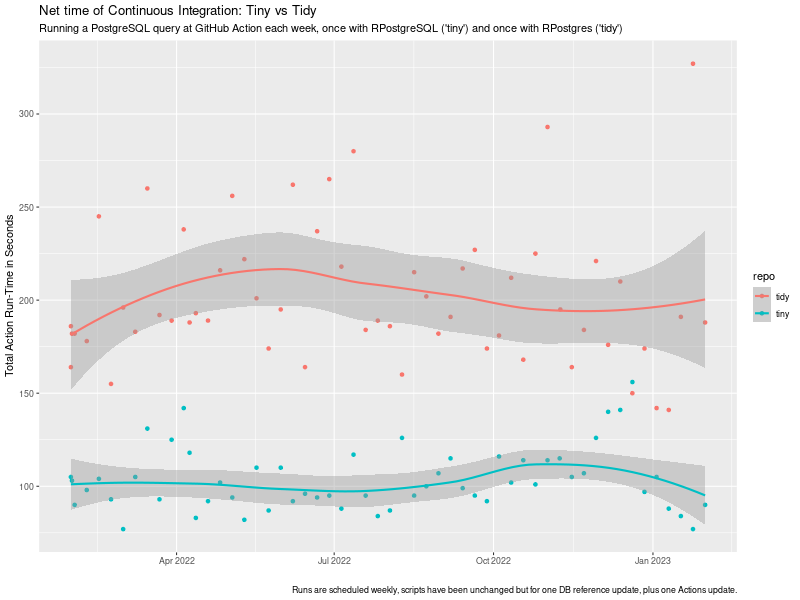
which we would like to come back to today. Furthermore, the unimitable @b0rk had a fabulous tweet just weeks later stating the same point debugging strategy: shorten your feedback loop as a key in a successful debugging strategy. So in sum: shorter is better. Nobody likes to wait. And shorter i.e. faster is a key and recurrent theme in the R4 series. Today we have a fairly nice illustration of two aspects we have stressed before: The combined effects can be staggering as we show below. The example is motivated by a truly surprising (we are being generous here) comment we received as an aside when discussing the eternal topic of whether R users do, or do not, have a choice when picking packages, or approaches, or verses. To our surprise, we were told that packages are not substitutable . Which is both demonstrably false (see below) and astonishing as it came from an academic. I.e. someone trained and paid to abstract superfluous detail away and recognise and compare core features of items under investigation. Truly stunning. But I digress. CRAN by now has many packages, slowly moving in on 20,000 in total, and is a unique success we commented-on time and time before. By now many packages shadow or duplicate each other, reinvent one another, or revise/review. One example is the pair of packages accessing PostgreSQL databases. There are several, but two are key. The older one is RPostgreSQL which has been around since Sameer Kumar Prayaga wrote it as a Google Summer of Code student in 2008 under my mentorship. The package has now been maintained well (if quietly) for many years by Tomoaki Nishiyama. The other entrant is more recent, though not new, and is RPostgres by Kirill M ller and others. We will for the remainder of this post refer to these two as the tiny and the tidy version as either can been as being a representative of a certain verse . The aforementioned comment on non-substitutability struck us as eminently silly, so we set out to prove just how absurd it really is. So about a year ago we set up pair of GitHub repos with minimal code in a pair we called lim-tiny and lim-tidy. Our conjecture was (and is!) that less is more just as post #34 titled Less Is More argued with respect to package dependencies. Each of the repos just does one thing: a query to a (freely accessible but remote) PostgreSQL database. The tiny version just retrieves a data frame using only the dependencies needed for RPostgreSQL namely DBI and nothing else. The tidy version retrieves a tibble and has access to everything else that comes when installing RPostgres: DBI, dplyr, and magrittr plus of course their respective dependencies. We were able to let the code run in (very default) GitHub Actions on a weekly schedule without intervention apart from one change to the SQL query when the remote server (providing public bioinformatics data) changed its schema slighly, plus one update to the action yaml code version. No other changes. We measure the time a standard continuous integration run takes in total using the default GitHub Action setup in the tidy case (which relies on RSPM/PPM binaries, caching, , and does not rebuild from source each time), and our own r-ci script (introduced in #32 for CI with R. It switched to using r2u during the course of this experiment but already had access to binaries via c2d4u so it is always binaries-based (see e.g. #37 or #13 for more). The chart shows the evolution of these run-times over the course of the year with one weekly run each.
tiny vs tidy ci timing impact chart tiny vs tidy ci timing impact chart
This study reveals a few things: The key point there is that while the net-time to fire off a single PostgreSQL is likely (near-)identical, the net cost of continuous integration is not. In this setup, it is about twice the run-time simply because Less Is More which (in this setup) comes out to about being twice as fast. And that is a valid (and concrete, and verifiable) illustration of the overall implicit cost of adding dependencies to creating and using development, test, or run-time environments. Faster feedback loops make for faster builds and faster debugging. Consider using fewer dependencies, and/or using binaries as provided by r2u.

This post by Dirk Eddelbuettel originated on his Thinking inside the box blog. Please report excessive re-aggregation in third-party for-profit settings.

30 January 2023

Arturo Borrero Gonz lez: Debian and the adventure of the screen resolution

Post logo I read somewhere a nice meme about Linux: Do you want an operating system or do you want an adventure? I love it, because it is so true. What you are about to read is my adventure to set a usable screen resolution in a fresh Debian testing installation. The context is that I have two different Lenovo Thinkpad laptops with 16 screen and nvidia graphic cards. They are both installed with the latest Debian testing. I use the closed-source nvidia drivers (they seem to work better than the nouveau module). The desktop manager and environment that I use is lightdm + XFCE4. The monitor native resolution in both machines is very high: 3840x2160 (or 4K UHD if you will). The thing is that both laptops show an identical problem: when freshly installed with the Debian default config, the native resolution is in use. For a 16 screen laptop, this high resolution means that the font is tiny. Therefore, the raw native resolution renders the machine almost unusable. This is a picture of what you get by running htop in the console (tty1, the terminal you would get by hitting CTRL+ALT+F1) with the default install: Linux tty console with high resolution and tiny fonts Everything in the system is affected by this:
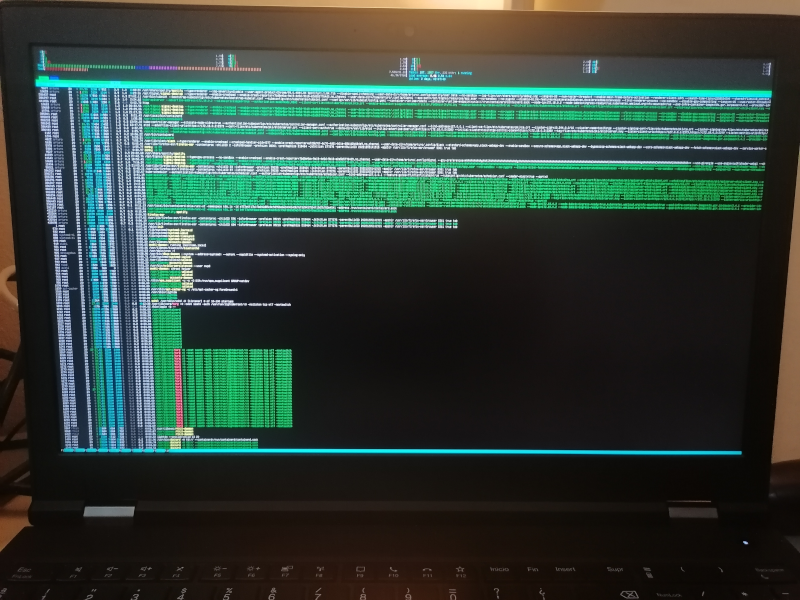
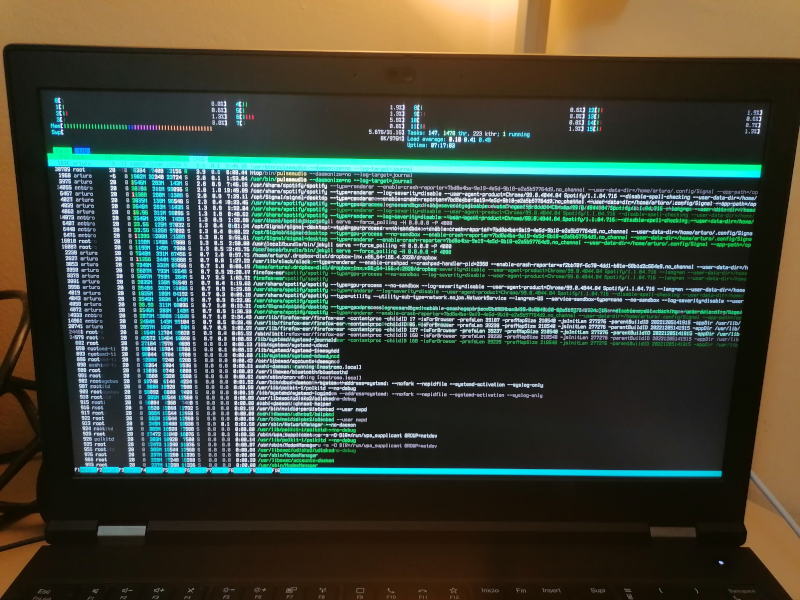
  1. the grub menu is unreadable. Thanksfully the right option is selected by default.
  2. the tty console, with the boot splash by systemd is unreadable as well. There are some colors, so you at least see some systemd stuff happening in green .
  3. when lightdm starts, the resolution keeps being very high. Can barely click the login button.
  4. when XFCE4 starts, it is a pain to navigate the menu and click the right buttons to set a more reasonable resolution.
The adventure begins after installing the system. Each of these four points must be fixed by hand by the user. XFCE4 Point #4 is the easiest. Navigate with the mouse pointer to the tiny Applications menu, then Settings, then Displays. This is more or less the same in every other desktop operating system. There are no further actions required to persist this setting. Thanks you XFCE4. lightdm Point #3, about lightdm, is more tricky to solve. It involves running xrandr when lightdm sets up the display. Nobody will tell you this trick. You have to search for it on the internet. Thankfully is a common problem, and a person who knows what to search for can find good results. The file /etc/lightdm/lightdm.conf needs to contain something like this:
[LightDM]
[Seat:*]
# set up correct display resolution
display-setup-script=sh -c -- "xrandr -s 1920x1080"
By the way, depending on your system hardware setup, you may also need an additional call to xrandr here. If you want to plug in an HDMI monitor, chances are you require something like xrandr --setprovideroutputsource NVIDIA-G0 modesetting && xrandr --auto to instruct the NVIDIA graphic card to work will with the kernel graphic system. In my case, one of my laptops require it, so I have:
[LightDM]
[Seat:*]
# don't ask me to type my username
greeter-hide-users=false
# set up correct display resolution, and prepare NVIDIA card for HDMI output
display-setup-script=sh -c "xrandr -s 1920x1080 && xrandr --setprovideroutputsource NVIDIA-G0 modesetting && xrandr --auto"
grub Point #1 about the grub menu is also not trivial to solve, but also widely known on the internet. Grub allows you to set arbitrary graphical modes. In Debian systems, adding something like GRUB_GFXMODE=1024x768 to /etc/default/grub and then running sudo update-grub should do the magic. console So we get to point #2 about the tty1 console. For months, I ve been investing my scarce personal time into trying to solve this annoyance. There are a lot of conflicting information about this on the internet. Plenty of misleading solutions, essays about framebuffer, kernel modeset, and other stuff I don t want to read just to get my tty1 in a readable status. People point in different directions, like using GRUB_GFXPAYLOAD_LINUX=keep in /etc/default/grub. Which is a good solution, but won t work: my best bet is that the kernel indeed keeps the resolution as told by grub, but the moment systemd loads the nvidia driver, it enables 4K in the display and the console gets the high resolution. Actually, for a few weeks, I blamed plymouth. Because the plymouth service is loaded early by systemd, it could be responsible for setting some of the display settings. It actually contains some (undocummented) DeviceScale configuration option that is seemingly aimed to integrate into high resolution scenarios. I played with it to no avail. Some folks from IRC suggested reconfiguring the console-font package. Back-then unknown to me. Running sudo dpkg-reconfigure console-font would indeed show a menu to select some preferences for the console, including font size. But apparently, a freshly installed system already uses the biggest possible, so this was a dead end. Other option I evaluted for a few days was touching the kernel framebuffer setting. I honestly don t understand this, and all the solutions pointing to use fbset didn t work for me anyways. This is the default framebuffer configuration in one of the laptops:
user@debian:~$ fbset -i

mode "3840x2160"
    geometry 3840 2160 3840 2160 32
    timings 0 0 0 0 0 0 0
    accel true
    rgba 8/16,8/8,8/0,0/0
endmode
Frame buffer device information:
    Name        : i915drmfb
    Address     : 0
    Size        : 33177600
    Type        : PACKED PIXELS
    Visual      : TRUECOLOR
    XPanStep    : 1
    YPanStep    : 1
    YWrapStep   : 0
    LineLength  : 15360
    Accelerator : No
Playing with these numbers, I was able to modify the geometry of the console, only to reduce the panel to a tiny square in the console display (with equally small fonts anyway). If it was possible to scale or resize the panel in other way, I was unable to understand how to do so by reading the associated docs. One day, out of despair, I tried disabling kernel modesetting (or KMS). It indeed got me a more readable tty1, only to prevent the whole graphic stack from starting, with Xorg complaining about the lack of kernel modeset. After lots of wasted time, I decided to blame the NVIDIA graphic card. Because why not: a closed source module in my system looks fishy. I registered in their official forum and wrote a message about my suspicion on the module, asking for advice on how to modify the driver default resolution. I was hoping that something like modprobe nvidia my_desired_resolution=1920x1080 could exist. Apparently not :-( I was about to give up. I had walked every corner of the known internet. I even tried summoning the ancient gods, I used ChatGPT. I asked the AI god for mercy, for a working solution to no avail. Then I decided to change the kind of queries I was issuing the search engines (don t ask me, I no longer remember). Eventually I landed in this askubuntu.com page. The question described the exact same problem I was experiencing. Finally, that was encouraging! I was not alone in my adventure after all! The solution section included a font size I hadn t seen before in my previous tests: 16x32. More excitement! I did all the steps. I installed the xfonts-terminus package, and in the file /etc/default/console-setup I put:
ACTIVE_CONSOLES="/dev/tty[1-6]"
CHARMAP="ISO-8859-15"
CODESET="guess"
FONTFACE="Terminus"
FONTSIZE="16x32"
VIDEOMODE=
Then I run setupcon from a tty, and the miracle happened! I finally got a bigger font in the tty1 console! Turned out a potential solution was about playing with console-setup, which I had tried wihtout success before. I m not even sure if the additional package was required. This is how my console looks now: Linux tty console with high resolution but not so tiny fonts The truth is the solution is satisfying only to a degree. I m a person with good eyesight and can work with these bit larger fonts. I m not sure if I can get larger fonts using this method, honestly. After some search, I discovered that some folks already managed to describe the problem in detail and filed a proper bug report in Debian, see #595696 opened more than 10 years ago. 2023 is the year of linux on the desktop Nope. I honestly don t see how this disconnected pile of settings can be all reconciled together. Can we please have a systemd-whatever that homogeinizes all of this mess? I m referring to grub + kernel drivers + console + lightdm + XFCE4. Next adventure When I lock the desktop (with CTRL+ALT+L) and close the laptop lid to suspend it, then reopen it, type the login info into the lightdm greeter, then the desktop environment never loads, black screen. I have already tried the first few search results without luck. Perhaps the nvidia card is to blame this time? Perhaps poorly coupled power management by the different system software pieces? Who knows what s going on here. This will probably be my next Debian desktop adventure.

Russell Coker: Links January 2023

The Intercept has an amusing and interesting article about senior Facebook employees testifying that they don t know where Facebook stores all it s data on users [1]. One lesson all programmers can learn from this is to document all these things in an orderly manner. Cory Doctorow wrote a short informative article about inflation from a modern monetary theory perspective [2]. Russ Allbery wrote an insightful blog post about effecive altruism and respect for disadvantaged people [3]. GiveDirectly sounds good. The Conversation has an interesting article about the Google and Apple app stores providing different versions of apps for users in different regions [4]. Apparently there are specific versions to comply with GDPR and versions that differ in adverts. The hope that GDPR would affect enough people to become essentially a world-wide standard was apparently overly optimistic. We need political lobbying in all countries for laws like the GDPR to force the app stores to give us the better versions of apps. Arya Voronova wrote an informative article about USB-C and extension or data blocker cables [5]. USB just keeps getting more horrible in technology while getting more useful in functionality. Laptops and phones catching fire will probably become more common in future. John McBride wrote an insightful article about the problems in the security of the software supply chain [6]. His main suggestion for addressing problems is If you are on a team that relies on some piece of open source software, allocate real engineering time to contributing , the problem with this is that real engineering time means real money and companies don t want to do that. Maybe having companies contribute moderate amounts of money to a foundation that hires people would be a viable option. Toms Guide has an interesting article describing problems with the Tesla [7]. It doesn t cover things like autopilot driving over children and bikers but instead covers issues of the user interface that make it less pleasant to drive and also remove concentration from the road. The BBC has an interesting article about the way mathematical skill is correlated with the way language is used to express numbers [8]. Every country with a lesser way of expressing numbers should switch to some variation of the East-Asian way. Science 2.0 has an interesting blog post about the JP Aerospace plans to use airships to get most of the way through the atmosphere and then a plane to get to orbit [9]. It s a wild idea but seems plausible. The idea of going to space in balloons seems considerably scarier to me than the current space craft. Interesting list of red team and physical entry gear with links to YouTube videos showing how to use them [10]. The Verge has an informative summary of the way Elon mismanaged Twitter after taking it over [11].

29 January 2023

Petter Reinholdtsen: Is the desktop recommending your program for opening its files?

Linux desktop systems have standardized how programs present themselves to the desktop system. If a package include a .desktop file in /usr/share/applications/, Gnome, KDE, LXDE, Xfce and the other desktop environments will pick up the file and use its content to generate the menu of available programs in the system. A lesser known fact is that a package can also explain to the desktop system how to recognize the files created by the program in question, and use it to open these files on request, for example via a GUI file browser. A while back I ran into a package that did not tell the desktop system how to recognize its files and was not used to open its files in the file browser and fixed it. In the process I wrote a simple debian/tests/ script to ensure the setup keep working. It might be useful for other packages too, to ensure any future version of the package keep handling its own files. For this to work the file format need a useful MIME type that can be used to identify the format. If the file format do not yet have a MIME type, it should define one and preferably also register it with IANA to ensure the MIME type string is reserved. The script uses the xdg-mime program from xdg-utils to query the database of standardized package information and ensure it return sensible values. It also need the location of an example file for xdg-mime to guess the format of.
#!/bin/sh
#
# Author: Petter Reinholdtsen
# License: GPL v2 or later at your choice.
#
# Validate the MIME setup, making sure motor types have
# application/vnd.openmotor+yaml associated with them and is connected
# to the openmotor desktop file.
retval=0
mimetype="application/vnd.openmotor+yaml"
testfile="test/data/real/o3100/motor.ric"
mydesktopfile="openmotor.desktop"
filemime="$(xdg-mime query filetype "$testfile")"
if [ "$mimetype" != "$filemime" ] ; then
    retval=1
    echo "error: xdg-mime claim motor file MIME type is $filemine, not $mimetype"
else
    echo "success: xdg-mime report correct mime type $mimetype for motor file"
fi
desktop=$(xdg-mime query default "$mimetype")
if [ "$mydesktopfile" != "$desktop" ]; then
    retval=1
    echo "error: xdg-mime claim motor file should be handled by $desktop, not $mydesktopfile"
else
    echo "success: xdg-mime agree motor file should be handled by $mydesktopfile"
fi
exit $retval
It is a simple way to ensure your users are not very surprised when they try to open one of your file formats in their file browser. As usual, if you use Bitcoin and want to show your support of my activities, please send Bitcoin donations to my address 15oWEoG9dUPovwmUL9KWAnYRtNJEkP1u1b.

Gunnar Wolf: miniDebConf Tamil Nadu 2023

Greetings from Viluppuram, Tamil Nadu, South India! As a preparation and warm-up for DebConf in September, the Debian people in India have organized a miniDebConf. Well, I don t want to be unfair to them They have been regularly organizing miniDebConfs for over a decade, and while most of the attendees are students local to this state in South India (the very tip of the country; Tamil Nadu is the Eastern side, and Kerala, where Kochi is and DebConf will be held, is the Western side), I have talked with attendees from very different regions of this country. This miniDebConf is somewhat similar to similarly-scoped events I have attended in Latin America: It is mostly an outreach conference, but it s also a great opportunity for DDs in India to meet in the famous hallway track. India is incredibly multicultural. Today at the hotel, I was somewhat surprised to see people from Kerala trying to read a text written in Tamil: Not only the languages are different, but the writing systems also are. From what I read, Tamil script is a bit simpler to Kerala s Mayalayam, although they come from similar roots. Of course, my school of thought is that, whenever you visit a city, culture or country that differs from the place you were born, a fundamental component to explore and to remember is Food! And one of the things I most looked forward for this trip was that precisely. I arrived to the Chennai Airport (MAA) 8:15 local time yesterday morning, so I am far from an expert but I have been given (and most happily received) three times biryani (pictured in the photo by this paragraph). It is delicious, although I cannot yet describe the borders of what should or should not be considered proper biryani): The base dish is rice, and you go mixing it with different sauces or foods. What managed to surprise us foreigners is, strangely, well known for us all: there is no spoon. No, the food is not pushed to your mouth using metal or wooden utensils. Not even using a tortilla as back home, or by breaking bits of the injera that serves also as a dish, as in Ethiopia. Sure, there is naan, but it is completely optional, and would be a bit too much for as big a big dish as what we have got. Biryani is eaten With the tools natural to us primates: the fingers. We have learnt some differnt techniques but so far, I am still using the base technique (thumb-finger-middle). I m closing the report with the photo of the closing of the conference as it happens. And I will, of course, share our adventures as they unfold in the next couple of days. Because Well, we finished with the conference-y part of the trip, but we have a full week of (pre-)DebConf work ahead of us!

Valhalla's Things: Hello World!

Posted on January 29, 2023
Welcome to my new blog! Or rather, strictly speaking, welcome to my first blog! Back when everybody had a blog, I had an old-fashioned personal website where pages were organized by topic rather than by date, so now that blogs are dead (or so they say), I guess it s time for me to have one :) . The old website is still online, but updating it is getting harder, both for organizational reasons and because the static generator I ve used is no longer supported and requires python 2; lately I ve started publish some specific categories of material such as sewing patterns into their own website (you can find a list in the about page), but I was missing a place to post about the history and experiences of the things I publish elsewhere, as well as more uncategorized things. Of course I ve chosen to use a static site generator, but since I m picky I ve discarded most of the common ones mostly because they enforce assumptions I don t agree with. On the other hand, one day I wouldn t mind learning a bit of Haskell, so I decided to look for trouble and use Hakyll, hoping that nobody will add a level 20 wandering monster to it. Right now I m using mostly the default theme, because I know that if I start fiddling with it I m not going to start posting content ever; maybe one day I ll decide to completely change the look. As for contents, on the bits side of things you can expect me to talk about Debian, the Fediverse, Python, my inventory manging program and a bit of arduino-level electronics; on the atom side you should definitely expect sewing, modern and mostly historically inspired, some fiber crafts (spinning, knitting, crochet), maybe some bad attempts at painting (watercolours and acrilics), printing (screen and linocut), things that are written on paper and, well, any other craft I will happen to collect. Before the blog gets too full I plan to add tag management to help people who are only interested in some of these contents. This being a blog, of course it has an atom feed you can add to your favourite (and ideally self-hosted) rss reader, and since this is a personal blog there will be no periodicity, posts will happen when I ll have something to say on some topic. Until next time

Next.

Previous.