Search Results: "reg"

8 June 2021

Pavit Kaur: GSoC: About my Project and Community Bonding Period

alt text To start writing about updates regarding my GSoC project, the first obvious thing I need to do is to explain what my project really is. So let s get started.


About my project

What is debci? Directly stating from the official docs:
The Debian continuous integration (debci) is an automated system that coordinates the execution of automated tests against packages in the Debian system.

Let s try decoding it: Debian is a huge system with thousands of packages and within these packages exist inter-package dependencies. So if any package is updated, it is important to test if that package is working correctly but it is equally important to test that all the packages which are dependent on this updated package are working correctly too. Debci is a platform serving this purpose of automated testing for the entire Debian archive whenever a new version of the package, or of any package in its dependency chain is available. It comes with a UI that lets developers easily run tests and see their results if they pass or not. For my GSoC project, I am working to implement some incremental improvements to debci making it easier to use and maintain.

Community Bonding Period

The debci community Everyone I have come across till now in the community is very nice. The debci community in itself is a small but active community. It really feels good to be a part of conversations here.

Weekly call set up I have two mentors for this project Antonio Terceiro and Paul Gevers and they have set up a weekly sync call with me in which I will share my updates regarding the work done in the past week, any issues I am facing, and discuss the work for next week. In addition to this, I can always contact them on IRC for any issue I am stuck in.

Work till now The first thing I did in the community bonding period is setting up this blog. I wanted to have one for a long time and this seems to be a really nice opportunity to start. And the fact this has been added to Planet Debian too makes me happier to write. I am still trying to get a hang of this and definitely need to learn how to spend less time writing it. I also worked on my already opened merge requests during this period and got them merged. Since I am already familiar with the codebase, so I started with my first deliverable a bit earlier before the official coding period begins which is migrating the logins to Salsa, Debian s Gitlab Instance. Currently, debci uses Debian SSO client certificates for logging in, but that is deprecated so it needs to be migrated to use Salsa as an identity provider. The OmniAuth library is being used to implement this with help of ruby-omniauth-gitlab strategy. I explored a great deal about integrating OmniAuth with our application and bumped into so many issues too when I began implementing that. Once I am done integrating the Salsa Authentication with debci, I am planning to write a separate tutorial on that which could be helpful to other people using OmniAuth with their application. With that, the community bonding period has ended on 7th June and the coding period officially begins and for now, I will be continuing working on my first deliverable. That s all for now. See you next time!

Bits from Debian: Registration for DebConf21 Online is Open

DebConf21 banner The DebConf team is glad to announce that registration for DebConf21 Online is now open. The 21st Debian Conference is being held Online, due to COVID-19, from August 22 to August 29, 2021. It will also sport a DebCamp from August 15 to August 21, 2021 (preceeding the DebConf). To register for DebConf21, please visit the DebConf website at https://debconf21.debconf.org/register Reminder: Creating an account on the site does not register you for the conference, there's a conference registration form to complete after signing in. Participation in DebConf21 is conditional on your respect of our Code of Conduct. We require you to read, understand and abide by this code. A few notes about the registration process: Any questions about registration should be addressed to registration@debconf.org. See you online! DebConf would not be possible without the generous support of all our sponsors, especially our Platinum Sponsors Lenovo and Infomaniak, and our Gold Sponsor Matanel Foundation.

7 June 2021

Mike Gabriel: UBports: Packaging of Lomiri Operating Environment for Debian (part 05)

Before and during FOSDEM 2020, I agreed with the people (developers, supporters, managers) of the UBports Foundation to package the Unity8 Operating Environment for Debian. Since 27th Feb 2020, Unity8 has now become Lomiri. Recent Uploads to Debian related to Lomiri (Feb - May 2021) Over the past 4 months I attended 14 of the weekly scheduled UBports development sync sessions and worked on the following bits and pieces regarding Lomiri in Debian: The largest amount of work (and time) went into getting lomiri-ui-toolkit ready for upload. That code component is a absolutely massive beast and dearly intertwined with Qt5 (and unit tests fail with every new warning a new Qt5.x introduces). This bit of work I couldn't do alone (see below in "Credits" section). The next projects / packages ahead are some smaller packages (content-hub, gmenuharness, etc.) before we will finally come to lomiri (i.e. main bit of the Lomiri Operating Environment) itself. Credits Many big thanks go to everyone on the UBports project, but especially to Ratchanan Srirattanamet who lived inside of lomiri-ui-toolkit for more than two weeks, it seemed. Also, thanks to Florian Leeber for being my point of contact for topics regarding my cooperation with the UBports Foundation. Packaging Status The current packaging status of Lomiri related packages in Debian can be viewed at:

https://qa.debian.org/developer.php?login=team%2Bubports%40tracker.debia... light+love
Mike Gabriel (aka sunweaver)

6 June 2021

Russell Coker: Netflix and IPv6

It seems that Netflix has an ongoing issue of not working well with IPv6, apparently they have some sort of region checking code that doesn t correctly identify IPv6 prefixes. To fix this I wrote the following script to make a small zone file with only A records for Netflix and no AAAA records. The $OUT.header file just has the SOA record for my fake netflix.com domain.
#!/bin/bash
OUT=/etc/bind/data/netflix.com
HEAD=$OUT.header
cp $HEAD $OUT
dig -t a www.netflix.com @8.8.8.8 sed -n -e "s/^.*IN/www IN/p" grep [0-9]$ >> $OUT
dig -t a android.prod.cloud.netflix.com @8.8.8.8 sed -n -e "s/^.*IN/android.prod.cloud IN/p" grep [0-9]$ >> $OUT
/usr/sbin/rndc reload > /dev/null
Update I updated this post to add a line for android.prod.cloud.netflix.com which is the address used by Android devices.

Evgeni Golov: Controlling Somfy roller shutters using an ESP32 and ESPHome

Our house has solar powered, remote controllable roller shutters on the roof windows, built by the German company named HEIM & HAUS. However, when you look closely at the remote control or the shutter motor, you'll see another brand name: SIMU. As the shutters don't have any wiring inside the house, the only way to control them is via the remote interface. So let's go on the Internet and see how one can do that, shall we? ;) First thing we learn is that SIMU remote stuff is just re-branded Somfy. Great, another name! Looking further we find that Somfy uses some obscure protocol to prevent (replay) attacks (spoiler: it doesn't!) and there are tools for RTL-SDR and Arduino available. That's perfect! Always sniff with RTL-SDR first! Given the two re-brandings in the supply chain, I wasn't 100% sure our shutters really use the same protocol. So the first "hack" was to listen and decrypt the communication using RTL-SDR:
$ git clone https://github.com/dimhoff/radio_stuff
$ cd radio_stuff
$ make -C converters am_to_ook
$ make -C decoders decode_somfy
$ rtl_fm -M am -f 433.42M -s 270K   ./am_to_ook -d 10 -t 2000 -    ./decode_somfy
<press some buttons on the remote>
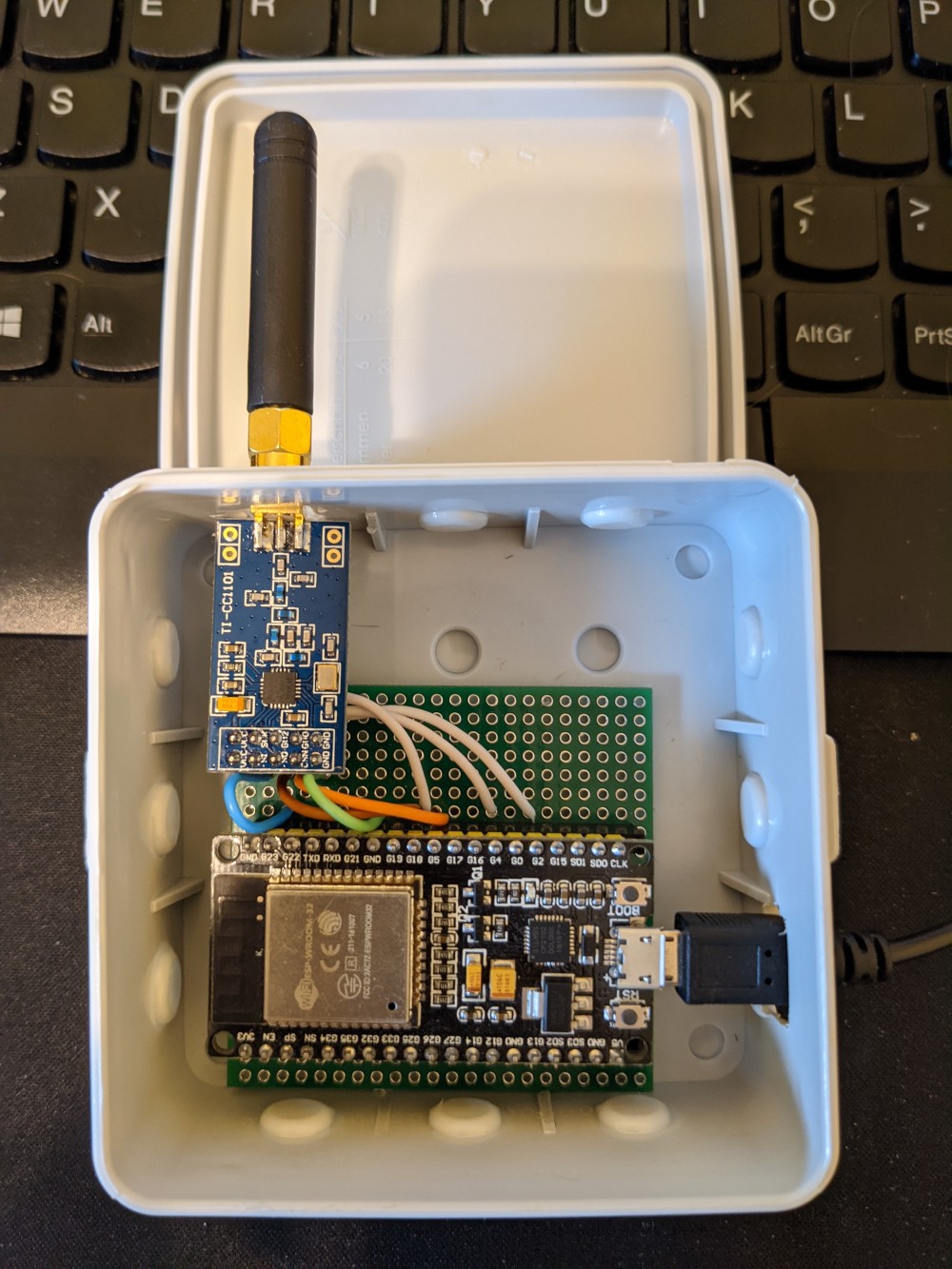
The output contains the buttons I pressed, but also the id of the remote and the command counter (which is supposed to prevent replay attacks). At this point I could just use the id and the counter to send own commands, but if I'd do that too often, the real remote would stop working, as its counter won't increase and the receiver will drop the commands when the counters differ too much. But that's good enough for now. I know I'm looking for the right protocol at the right frequency. As the end result should be an ESP32, let's move on! Acquiring the right hardware Contrary to an RTL-SDR, one usually does not have a spare ESP32 with 433MHz radio at home, so I went shopping: a NodeMCU-32S clone and a CC1101. The CC1101 is important as most 433MHz chips for Arduino/ESP only work at 433.92MHz, but Somfy uses 433.42MHz and using the wrong frequency would result in really bad reception. The CC1101 is essentially an SDR, as you can tune it to a huge spectrum of frequencies. Oh and we need some cables, a bread board, the usual stuff ;) The wiring is rather simple: ESP32 wiring for a CC1101 And the end result isn't too beautiful either, but it works: ESP32 and CC1101 in a simple case Acquiring the right software In my initial research I found an Arduino sketch and was totally prepared to port it to ESP32, but luckily somebody already did that for me! Even better, it's explicitly using the CC1101. Okay, okay, I cheated, I actually ordered the hardware after I found this port and the reference to CC1101. ;) As I am using ESPHome for my ESPs, the idea was to add a "Cover" that's controlling the shutters to it. Writing some C++, how hard can it be? Turns out, not that hard. You can see the code in my GitHub repo. It consists of two (relevant) files: somfy_cover.h and somfy.yaml. somfy_cover.h essentially wraps the communication with the Somfy_Remote_Lib library into an almost boilerplate Custom Cover for ESPHome. There is nothing too fancy in there. The only real difference to the "Custom Cover" example from the documentation is the split into SomfyESPRemote (which inherits from Component) and SomfyESPCover (which inherits from Cover) -- this is taken from the Custom Sensor documentation and allows me to define one "remote" that controls multiple "covers" using the add_cover function. The first two params of the function are the NVS name and key (think database table and row), and the third is the rolling code of the remote (stored in somfy_secrets.h, which is not in Git). In ESPHome a Cover shall define its properties as CoverTraits. Here we call set_is_assumed_state(true), as we don't know the state of the shutters - they could have been controlled using the other (real) remote - and setting this to true allows issuing open/close commands at all times. We also call set_supports_position(false) as we can't tell the shutters to move to a specific position. The one additional feature compared to a normal Cover interface is the program function, which allows to call the "program" command so that the shutters can learn a new remote. somfy.yaml is the ESPHome "configuration", which contains information about the used hardware, WiFi credentials etc. Again, mostly boilerplate. The interesting parts are the loading of the additional libraries and attaching the custom component with multiple covers and the additional PROG switches:
esphome:
  name: somfy
  platform: ESP32
  board: nodemcu-32s
  libraries:
    - SmartRC-CC1101-Driver-Lib@2.5.6
    - Somfy_Remote_Lib@0.4.0
    - EEPROM
  includes:
    - somfy_secrets.h
    - somfy_cover.h
 
cover:
  - platform: custom
    lambda:  -
      auto somfy_remote = new SomfyESPRemote();
      somfy_remote->add_cover("somfy", "badezimmer", SOMFY_REMOTE_BADEZIMMER);
      somfy_remote->add_cover("somfy", "kinderzimmer", SOMFY_REMOTE_KINDERZIMMER);
      App.register_component(somfy_remote);
      return somfy_remote->covers;
    covers:
      - id: "somfy"
        name: "Somfy Cover"
      - id: "somfy2"
        name: "Somfy Cover2"
switch:
  - platform: template
    name: "PROG"
    turn_on_action:
      - lambda:  -
          ((SomfyESPCover*)id(somfy))->program();
  - platform: template
    name: "PROG2"
    turn_on_action:
      - lambda:  -
          ((SomfyESPCover*)id(somfy2))->program();
The switch to trigger the program mode took me a bit. As the Cover interface of ESPHome does not offer any additional functions besides movement control, I first wrote code to trigger "program" when "stop" was pressed three times in a row, but that felt really cumbersome and also had the side effect that the remote would send more than needed, sometimes confusing the shutters. I then decided to have a separate button (well, switch) for that, but the compiler yelled at me I can't call program on a Cover as it does not have such a function. Turns out, you need to explicitly cast to SomfyESPCover and then it works, even if the code becomes really readable, NOT. Oh and as the switch does not have any code to actually change/report state, it effectively acts as a button that can be pressed. At this point we can just take an existing remote, press PROG for 5 seconds, see the blinds move shortly up and down a bit and press PROG on our new ESP32 remote and the shutters will learn the new remote. And thanks to the awesome integration of ESPHome into HomeAssistant, this instantly shows up as a new controllable cover there too. Future Additional Work I started writing this post about a year ago And the initial implementation had some room for improvement More than one remote The initial code only created one remote and one cover element. Sure, we could attach that to all shutters (there are 4 of them), but we really want to be able to control them separately. Thankfully I managed to read enough ESPHome docs, and learned how to operate std::vector to make the code dynamically accept new shutters. Using ESP32's NVS The ESP32 has a non-volatile key-value storage which is much nicer than throwing bits at an emulated EEPROM. The first library I used for that explicitly used EEPROM storage and it would have required quite some hacking to make it work with NVS. Thankfully the library I am using now has a plugable storage interface, and I could just write the NVS backend myself and upstream now supports that. Yay open-source! Remaining issues Real state is unknown As noted above, the ESP does not know the real state of the shutters: a command could have been lost in transmission (the Somfy protocol is send-only, there is no feedback) or the shutters might have been controlled by another remote. At least the second part could be solved by listening all the time and trying to decode commands heard over the air, but I don't think this is worth the time -- worst that can happen is that a closed (opened) shutter receives another close (open) command and that is harmless as they have integrated endstops and know that they should not move further. Can't program new remotes with ESP only To program new remotes, one has to press the "PROG" button for 5 seconds. This was not exposed in the old library, but the new one does support "long press", I just would need to add another ugly switch to the config and I currently don't plan to do so, as I do have working remotes for the case I need to learn a new one.

5 June 2021

Dirk Eddelbuettel: td 0.0.4 on CRAN: More Maintenance

The still fairly recent td package for accessing the twelvedata API for financial data has been updated on CRAN this morning, and is now at released version 0.0.4. This corrects something the previous 0.0.3 release from last weekend was meant to address, but didn t quite do it. Access to the helper function finding a proper user config file (for .e.g., the API config) is now correctly conditioned on R 4.0.0, and the versioned depends has been removed. The NEWS entry follows.

Changes in version 0.0.4 (2021-06-05)
  • The version comparison was corrected and the package no longer (formally) depends on R (>= 4.0.0)
  • Very minor README.md edits

Courtesy of my CRANberries, there is a comparison to the previous release. For questions or comments use the issue tracker off the GitHub repo. If you like this or other open-source work I do, you can now sponsor me at GitHub.

This post by Dirk Eddelbuettel originated on his Thinking inside the box blog. Please report excessive re-aggregation in third-party for-profit settings.

2 June 2021

Joachim Breitner: Verifying the code of the Internet Identity service

The following post was meant to be posted at https://forum.dfinity.org/, but that discourse instance didn t like it; maybe too much inline code, so I m posting it here instead. To my regular blog audience, please excuse the lack of context. Please comment at the forum post. The text was later also posted on the DFINITY medium blog You probably have used https://identity.ic0.app/ to log into various applications (the NNS UI, OpenChat etc.) before, and if you do that, you are trusting this service to take good care of your credentials. Furthermore, you might want to check that the Internet Identity is really not tracking you. So you want to know: Is this really running the code we claim it to run? Of course the following applies to other canisters as well, but I ll stick to the Internet Identity in this case. I ll walk you through the steps of verifying that:

Find out what is running A service on the Internet Computer, i.e. a canister, is a WebAssembly module. The Internet Computer does intentionally not allow you to just download the Wasm code of any canisters, because maybe some developer wants to keep their code private. But it does expose a hash of the Wasm module. The easiest way to get it is using dfx:
$ dfx canister --no-wallet --network ic info rdmx6-jaaaa-aaaaa-aaadq-cai
Controller: r7inp-6aaaa-aaaaa-aaabq-cai
Module hash: 0xd4af9277f3e8d26fd8cdc7874a9f47b6456587fbb2a64d61b6b6880d144d3c04
The controller here is the canister id of the governance canister. This tells you that the Internet Identity is controlled by the Network Nervous System (NNS), and its code can only be changed via proposals that are voted on. This is good; if the controller was just, say, me, I could just change the code of the Internet Identity and take over all your identities. The Module hash is the SHA-256 hash of the .wasm that was deployed. So let s follow that trace.

Finding the right commit Since upgrades to the Internet Identity are done via proposals to the NNS, we should find a description of such a proposal in the https://github.com/ic-association/nns-proposals repository, in the proposals/network_canister_management directory.
Github s list of recent NNS proposalsGithub s list of recent NNS proposals
We have to find the latest proposal upgrading the Internet Identity. The folder unfortunately contains proposals for many canisters, and the file naming isn t super helpful. I usually go through the list from bottom and look at the second column, which contains the title of the latest commit creating or modifying a file. In this case, the second to last is the one we care about: https://github.com/ic-association/nns-proposals/blob/main/proposals/network_canister_management/20210527T2203Z.md. This file lists rationales, gives an overview of changes and, most importantly, says that bd51eab is the commit we are upgrading to. The file also says that the wasm hash is d4a c04, which matches what we saw above. This is good: it seems we really found the youngest proposal upgrading the Internet Identity, and that the proposal actually went through. WARNING: If you are paranoid, don t trust this file. There is nothing preventing a proposal proposer to create a file pointing to one revision, but actually including other code in the proposal. That s why the next steps are needed.

Getting the source Now that we have the revision, we can get the source and check out revision bd51eab:
/tmp $ git clone https://github.com/dfinity/internet-identity
Klone nach 'internet-identity' ...
remote: Enumerating objects: 3959, done.
remote: Counting objects: 100% (344/344), done.
remote: Compressing objects: 100% (248/248), done.
remote: Total 3959 (delta 161), reused 207 (delta 92), pack-reused 3615
Empfange Objekte: 100% (3959/3959), 6.05 MiB   3.94 MiB/s, Fertig.
L se Unterschiede auf: 100% (2290/2290), Fertig.
/tmp $ cd internet-identity/
/tmp/internet-identity $ git checkout bd51eab
/tmp/internet-identity $ git log --oneline -n 1
bd51eab (HEAD, tag: mainnet-20210527T2203Z) Registers the seed phrase before showing it (#301)
In the last line you see that the Internet Identity team has tagged that revision with a tag name that contains the proposal description file name. Very tidy!

Reproducing the build The README.md has the following build instructions:

Official build The official build should ideally be reproducible, so that independent parties can validate that we really deploy what we claim to deploy. We try to achieve some level of reproducibility using a Dockerized build environment. The following steps should build the official Wasm image
docker build -t internet-identity-service .
docker run --rm --entrypoint cat internet-identity-service /internet_identity.wasm > internet_identity.wasm
sha256sum internet_identity.wasm
The resulting internet_identity.wasm is ready for deployment as rdmx6-jaaaa-aaaaa-aaadq-cai, which is the reserved principal for this service.

It actually suffices to run the first command, as it also prints the hash (we don t need to copy the .wasm out of the Docker canister):
/tmp/internet-identity $ docker build -t internet-identity-service .
 
Step 26/26 : RUN sha256sum internet_identity.wasm
 ---> Running in 1a04644b544c
d4af9277f3e8d26fd8cdc7874a9f47b6456587fbb2a64d61b6b6880d144d3c04  internet_identity.wasm
Removing intermediate container 1a04644b544c
 ---> bfe6a63a7980
Successfully built bfe6a63a7980
Successfully tagged internet-identity-service:latest
Success! The hashes match. You don t believe me? Try it yourself (and let us know if you get a different hash, maybe I got hacked). This may fail if you have too little RAM configured for Docker, 8GB should be enough. At this point you have a trust path from the code sitting in front of you to the Internet Identity running at https://identity.ic0.app, including the front-end code, and you can start auditing the source code.

What about the canister id? If you payed close attention you might have noticed that we got the module has for canister rdmx6-jaaaa-aaaaa-aaadq-cai, but we are accessing a web application at https://identity.ic0.app. So where is this connection? In the future, I expect some form of a DNS-like nice host name registry on the Internet Computer that stores a mapping from nice names to canister ids, and that you will be able to query that to for which canister serves rdmx6-jaaaa-aaaaa-aaadq-cai in a secure way (e.g. using certified variables). But since we don t have that yet, but still want you to be able to use a nice name for the Internet Identity (and not have to change the name later, which would cause headaches), we have hard-coded this mapping for now. The relevant code here is the Certifying Service Worker that your browser downloads when accessing any *.ic0.app URL. This piece of code will then intercept all requests to that domain, map it to an query call, and then use certified variables to validate the response. And indeed, the mapping is in the code there:
const hostnameCanisterIdMap: Record<string, [string, string]> =  
  'identity.ic0.app': ['rdmx6-jaaaa-aaaaa-aaadq-cai', 'ic0.app'],
  'nns.ic0.app': ['qoctq-giaaa-aaaaa-aaaea-cai', 'ic0.app'],
  'dscvr.ic0.app': ['h5aet-waaaa-aaaab-qaamq-cai', 'ic0.page'],
 ;

What about other canisters? In principle, the same approach works for other canisters, whether it s OpenChat, the NNS canisters etc. But the details will differ, as every canister developer might have their own way of
  • communicating the location and revision of the source for their canisters
  • building the canisters
In particular, without a reproducible way of building the canister, this will fail, and that s why projects like https://reproducible-builds.org/ are so important in general.

Matthew Garrett: Producing a trustworthy x86-based Linux appliance

Let's say you're building some form of appliance on top of general purpose x86 hardware. You want to be able to verify the software it's running hasn't been tampered with. What's the best approach with existing technology?

Let's split this into two separate problems. The first is to do as much as we can to ensure that the software can't be modified without our consent[1]. This requires that each component in the boot chain verify that the next component is legitimate. We call the first component in this chain the root of trust, and in the x86 world this is the system firmware[2]. This firmware is responsible for verifying the bootloader, and the easiest way to do this on x86 is to use UEFI Secure Boot. In this setup the firmware contains a set of trusted signing certificates and will only boot executables with a chain of trust to one of these certificates. Switching the system into setup mode from the firmware menu will allow you to remove the existing keys and install new ones.

(Note: You shouldn't use the trusted certificate directly for signing bootloaders - instead, the trusted certificate should be used to sign another certificate and the key for that certificate used to sign your bootloader. This way, if you ever need to revoke the signing certificate, you can simply sign a new one with the trusted parent and push out a revocation update instead of having to provision new keys)

But what do you want to sign? In the general purpose Linux world, we use an intermediate bootloader called Shim to bridge from the Microsoft signing authority to a distribution one. Shim then verifies the signature on grub, and grub in turn verifies the signature on the kernel. This is a large body of code that exists because of the use cases that general purpose distributions need to support - primarily, booting on arbitrary off the shelf hardware, and allowing arbitrary and complicated boot setups. This is unnecessary in the appliance case, where the hardware target can be well defined, where there's no need for interoperability with the Microsoft signing authority, and where the boot configuration can be extremely static.

We can skip all of this complexity using systemd-boot's unified Linux image support. This has the format described here, but the short version is that it's simply a kernel and initramfs linked into a small EFI executable that will run them. Instructions for generating such an image are here, and if you follow them you'll end up with a single static image that can be directly executed by the firmware. Signing this avoids dealing with a whole host of problems associated with relying on shim and grub, but note that you'll be embedding the initramfs as well. Again, this should be fine for appliance use-cases, but you'll need your build system to support building the initramfs at image creation time rather than relying on it being generated on the host.

At this point we have a single image that can be verified by the firmware and will get us to the point of a running kernel and initramfs. Unless you've got enough RAM that you can put your entire workload in the initramfs, you're going to want a filesystem as well, and you're going to want to verify that that filesystem hasn't been tampered with. The easiest approach to this is to use dm-verity, a device-mapper layer that uses a hash tree to verify that the filesystem contents haven't been modified. The kernel needs to know what the root hash is, so this can either be embedded into your initramfs image or into the kernel command line. Either way, it'll end up in the signed boot image, so nobody will be able to tamper with it.

It's important to note that a dm-verity partition is read-only - the kernel doesn't have the cryptographic secret that would be required to generate a new hash tree if the partition is modified. So if you require the ability to write data or logs anywhere, you'll need to add a new partition for that. If this partition is unencrypted, an attacker with access to the device will be able to put whatever they want on there. You should treat any data you read from there as untrusted, and ensure that it's validated before use (ie, don't just feed it to a random parser written in C and expect that everything's going to be ok). On the other hand, if it's encrypted, remember that you can't just put the encryption key in the boot image - an attacker with access to the device is going to be able to dump that and extract it. You'll probably want to use a TPM-sealed encryption secret, which will be discussed later on.

At this point everything in the boot process is cryptographically verified, and so should be difficult to tamper with. Unfortunately this isn't really sufficient - on x86 systems there's typically no verification of the integrity of the secure boot database. An attacker with physical access to the system could attach a programmer directly to the firmware flash and rewrite the secure boot database to include keys they control. They could then replace the boot image with one that they've signed, and the machine would happily boot code that the attacker controlled. We need to be able to demonstrate that the system booted using the correct secure boot keys, and the only way we can do that is to use the TPM.

I wrote an introduction to TPMs a while back. The important thing to know here is that the TPM contains a set of Platform Configuration Registers that are large enough to contain a cryptographic hash. During boot, each component of the boot process will generate a "measurement" of other security critical components, including the next component to be booted. These measurements are a representation of the data in question - they may simply be a hash of the object being measured, or the hash of a structure containing various pieces of metadata. Each measurement is passed to the TPM, along with the PCR it should be measured into. The TPM takes the new measurement, appends it to the existing value, and then stores the hash of this concatenated data in the PCR. This means that the final PCR value depends not only on the measurement, but also on every previous measurement. Without breaking the hash algorithm, there's no way to set the PCR to an arbitrary value. The hash values and some associated data are stored in a log that's kept in system RAM, which we'll come back to later.

Different PCRs store different pieces of information, but the one that's most interesting to us is PCR 7. Its use is documented in the TCG PC Client Platform Firmware Profile (section 3.3.4.8), but the short version is that the firmware will measure the secure boot keys that are used to boot the system. If the secure boot keys are altered (such as by an attacker flashing new ones), the PCR 7 value will change.

What can we do with this? There's a couple of choices. For devices that are online, we can perform remote attestation, a process where the device can provide a signed copy of the PCR values to another system. If the system also provides a copy of the TPM event log, the individual events in the log can be replayed in the same way that the TPM would use to calculate the PCR values, and then compared to the actual PCR values. If they match, that implies that the log values are correct, and we can then analyse individual log entries to make assumptions about system state. If a device has been tampered with, the PCR 7 values and associated log entries won't match the expected values, and we can detect the tampering.

If a device is offline, or if there's a need to permit local verification of the device state, we still have options. First, we can perform remote attestation to a local device. I demonstrated doing this over Bluetooth at LCA back in 2020. Alternatively, we can take advantage of other TPM features. TPMs can be configured to store secrets or keys in a way that renders them inaccessible unless a chosen set of PCRs have specific values. This is used in tpm2-totp, which uses a secret stored in the TPM to generate a TOTP value. If the same secret is enrolled in any standard TOTP app, the value generated by the machine can be compared to the value in the app. If they match, the PCR values the secret was sealed to are unmodified. If they don't, or if no numbers are generated at all, that demonstrates that PCR 7 is no longer the same value, and that the system has been tampered with.

Unfortunately, TOTP requires that both sides have possession of the same secret. This is fine when a user is making that association themselves, but works less well if you need some way to ship the secret on a machine and then separately ship the secret to a user. If the user can simply download the secret via some API, so can an attacker. If an attacker has the secret, they can modify the secure boot database and re-seal the secret to the new PCR 7 value. That means having to add some form of authentication, along with a strong binding of machine serial number to a user (in order to avoid someone with valid credentials simply downloading all the secrets).

Instead, we probably want some mechanism that uses asymmetric cryptography. A keypair can be generated on the TPM, which will refuse to release an unencrypted copy of the private key. The public key, however, can be exported and stored. If it's acceptable for a verification app to connect to the internet then the public key can simply be obtained that way - if not, a certificate can be issued to the key, and this exposed to the verifier via a QR code. The app then verifies that the certificate is signed by the vendor, and if so extracts the public key from that. The private key can have an associated policy that only permits its use when PCR 7 has an appropriate value, so the app then generates a nonce and asks the user to type that into the device. The device generates a signature over that nonce and displays that as a QR code. The app verifies the signature matches, and can then assert that PCR 7 has the expected value.

Once we can assert that PCR 7 has the expected value, we can assert that the system booted something signed by us and thus infer that the rest of the boot chain is also secure. But this is still dependent on the TPM obtaining trustworthy information, and unfortunately the bus that the TPM sits on isn't really terribly secure (TPM Genie is an example of an interposer for i2c-connected TPMs, but there's no reason an LPC one can't be constructed to attack the sort usually used on PCs). TPMs do support encrypted communication channels, but bootstrapping those isn't straightforward without firmware support. The easiest way around this is to make use of a firmware-based TPM, where the TPM is implemented in software running on an ancillary controller. Intel's solution is part of their Platform Trust Technology and runs on the Management Engine, AMD run it on the Platform Security Processor. In both cases it's not terribly feasible to intercept the communications, so we avoid this attack. The downside is that we're then placing more trust in components that are running much more code than a TPM would and which have a correspondingly larger attack surface. Which is preferable is going to depend on your threat model.

Most of this should be achievable using Yocto, which now has support for dm-verity built in. It's almost certainly going to be easier using this than trying to base on top of a general purpose distribution. I'd love to see this become a largely push button receive secure image process, so might take a go at that if I have some free time in the near future.

[1] Obviously technologies that can be used to ensure nobody other than me is able to modify the software on devices I own can also be used to ensure that nobody other than the manufacturer is able to modify the software on devices that they sell to third parties. There's no real technological solution to this problem, but we shouldn't allow the fact that a technology can be used in ways that are hostile to user freedom to cause us to reject that technology outright.
[2] This is slightly complicated due to the interactions with the Management Engine (on Intel) or the Platform Security Processor (on AMD). Here's a good writeup on the Intel side of things.

comment count unavailable comments

1 June 2021

Robert McQueen: Next steps for the GNOME Foundation

As the President of the GNOME Foundation Board of Directors, I m really pleased to see the number and breadth of candidates we have for this year s election. Thank you to everyone who has submitted their candidacy and volunteered their time to support the Foundation. Allan has recently blogged about how the board has been evolving, and I wanted to follow that post by talking about where the GNOME Foundation is in terms of its strategy. This may be helpful as people consider which candidates might bring the best skills to shape the Foundation s next steps. Around three years ago, the Foundation received a number of generous donations, and Rosanna (Director of Operations) gave a presentation at GUADEC about her and Neil s (Executive Director, essentially the CEO of the Foundation) plans to use these funds to transform the Foundation. We would grow our activities, increasing the pace of events, outreach, development and infrastructure that supported the GNOME project and the wider desktop ecosystem and, crucially, would grow our funding to match this increased level of activity. I think it s fair to say that half of this has been a great success we ve got a larger staff team than GNOME has ever had before. We ve widened the GNOME software ecosystem to include related apps and projects under the GNOME Circle banner, we ve helped get GTK 4 out of the door, run a wider-reaching program in the Community Engagement Challenge, and consistently supported better infrastructure for both GNOME and the Linux app community in Flathub. Aside from another grant from Endless (note: my employer), our fundraising hasn t caught up with this pace of activities. As a result, the Board recently approved a budget for this financial year which will spend more funds from our reserves than we expect to raise in income. Due to our reserves policy, this is essentially the last time we can do this: over the next 6-12 months we need to either raise more money, or start spending less. For clarity the Foundation is fit and well from a financial perspective we have a very healthy bank balance, and a very conservative 12 month run rate reserve policy to handle fluctuations in income. If we do have to slow down some of our activities, we will return to a steady state where our regular individual donations and corporate contributions can support a smaller staff team that supports the events and infrastructure we ve come to rely on. However, this isn t what the Board wants to do the previous and current boards were unanimous in their support of the idea that we should be ambitious: try to do more in the world and bring the benefits of GNOME to more people. We want to take our message of trusted, affordable and accessible computing to the wider world. Typically, a lot of the activities of the Foundation have been very inwards-facing supporting and engaging with either the existing GNOME or Open Source communities. This is a very restricted audience in terms of fundraising many corporate actors in our community already support GNOME hugely in terms of both financial and in-kind contributions, and many OSS users are already supporters either through volunteer contributions or donating to those nonprofits that they feel are most relevant and important to them. To raise funds from new sources, the Foundation needs to take the message and ideals of GNOME and Open Source software to new, wider audiences that we can help. We ve been developing themes such as affordability, privacy/trust and education as promising areas for new programs that broaden our impact. The goal is to find projects and funding that allow us to both invest in the GNOME community and find new ways for FOSS to benefit people who aren t already in our community. Bringing it back to the election, I d like to make clear that I see this reaching the outside world, and finding funding to support that as the main priority and responsibility of the Board for the next term. GNOME Foundation elections are a slightly unusual process that filters our board nominees by being existing Foundation members, which means that candidates already work inside our community when they stand for election. If you re a candidate and are already active in the community THANK YOU you re doing great work, keep doing it! That said, you don t need to be a Director to achieve things within our community or gain the support of the Foundation: being a community leader is already a fantastic and important role. The Foundation really needs support from the Board to make a success of the next 12-18 months. We need to understand our financial situation and the trade-offs we have to make, and help to define the strategy with the Executive Director so that we can launch some new programs that will broaden our impact and funding for the future. As people cast their votes, I d like people to think about what kind of skills building partnerships, commercial background, familiarity with finances, experience in nonprofit / impact spaces, etc will help the Board make the Foundation as successful as it can be during the next term.

Russell Coker: Internode NBN with Arris CM8200 on Debian

I ve recently signed up for Internode NBN while using the Arris CM8200 device supplied by Optus (previously used for a regular phone service). I took the configuration mostly from Dean s great blog post on the topic [1]. One thing I changed was the /etc/networ/interfaces configuration, I used the following:
# VLAN ID 2 for Internode's NBN HFC.
auto eth1.2
iface eth1.2 inet manual
  vlan-raw-device eth1
auto nbn
iface nbn inet ppp
    pre-up /bin/ip link set eth1.2 up
    provider nbn
There is no need to have a section for eth1 when you have a section for eth1.2. IPv6 IPv6 for only one system With a line in /etc/ppp/options containing only ipv6 , you get an IPv6 address automatically for the ppp0 interface after starting pppd. IPv6 for your lan Internode has documented how to configure the WIDE DHCPv6 client to get an IPv6 prefix (subnet) [2]. Just install the wide-dhcpv6-client package and put your interface names in a copy of the Internode example config and that works. That gets you a /64 assigned to your local Ethernet. Here s an example of /etc/wide-dhcpv6/dhcp6c.conf:
interface ppp0  
    send ia-pd 0;
    script "/etc/wide-dhcpv6/dhcp6c-script";
 ;
id-assoc pd  
    prefix-interface br0  
        sla-id 0;
        sla-len 8;
     ;
 ;
For providing addresses to other systems on your LAN they recommend radvd version 1.1 or greater, Debian/Bullseye will ship with version 2.18. Here is an example /etc/radvd.conf that will work with it. It seems that you have to manually (or with a script) set the value to use in place of xxxx:xxxx:xxxx:xxxx from the value that is assigned to eth0 (or whichever interface you are using) by the wide-dhcpv6-client.
interface eth0   
        AdvSendAdvert on;
        MinRtrAdvInterval 3; 
        MaxRtrAdvInterval 10;
        prefix xxxx:xxxx:xxxx:xxxx::/64   
                AdvOnLink on; 
                AdvAutonomous on; 
                AdvRouterAddr on; 
         ;
 ;
Either the configuration of the wide dhcp client or radvd removes the default route from ppp0, so you need to run a command like
ip -6 route add default dev ppp0 to put it back. Probably having ipv6 , is the wrong thing to do when using wide-dhcp-client and radvd. On a client machine with bridging I needed to have net.ipv6.conf.br0.accept_ra=2 in /etc/sysctl.conf to allow it to accept route advisory messages on the interface (in this case eth0), for machines without bridging I didn t need that. Firewalling The default model for firewalling nowadays seems to be using NAT and only configuring specific ports to be forwarded to machines on the LAN. With IPv6 on the LAN every system can directly communicate with the rest of the world which may be a bad thing. The following lines in a firewall script will drop all inbound packets that aren t in response to packets that are sent out. This will give an equivalent result to the NAT firewall people are used to and you can always add more rules to allow specific ports in.
ip6tables -A FORWARD -i ppp+ -m state --state ESTABLISHED,RELATED -j ACCEPT
ip6tables -A FORWARD -i ppp+ -i DROP

Russ Allbery: Review: The Horse and His Boy

Review: The Horse and His Boy, by C.S. Lewis
Illustrator: Pauline Baynes
Series: Chronicles of Narnia #5
Publisher: Collier Books
Copyright: 1954
Printing: 1978
ISBN: 0-02-044200-9
Format: Mass market
Pages: 217
The Horse and His Boy was the fifth published book in the Chronicles of Narnia, but it takes place during the last chapter of The Lion, the Witch and the Wardrobe, in the midst of the golden age of Narnia. It's the only true side story of the series and it doesn't matter much where in sequence you read it, as long as it's after The Lion, the Witch and the Wardrobe and before The Last Battle (which would spoil its ending somewhat). MAJOR SPOILERS BELOW. The Horse and His Boy is also the only book of the series that is not a portal fantasy. The Pevensie kids make an appearance, but as the ruling kings and queens of Narnia, and only as side characters. The protagonists are a boy named Shasta, a girl named Aravis, and horses named Bree and Hwin. Aravis is a Calormene, a native of the desert (and extremely Orientalist, but more on that later) kingdom to the south of Narnia and Archenland. Shasta starts the book as the theoretically adopted son but mostly slave of a Calormene fisherman. The Horse and His Boy is the story of their journey from Calormen north to Archenland and Narnia, just in time to defend Narnia and Archenland from an invasion. This story starts with a great hook. Shasta's owner is hosting a passing Tarkaan, a Calormene lord, and overhears a negotiation to sell Shasta to the Tarkaan as his slave (and, in the process, revealing that he rescued Shasta as an infant from a rowboat next to a dead man). Shasta starts talking to the Tarkaan's horse and is caught by surprise when the horse talks back. He is a Talking Horse from Narnia, kidnapped as a colt, and eager to return to Narnia and the North. He convinces Shasta to attempt to escape with him. This has so much promise. For once, we're offered a story where one of the talking animals of Narnia is at least a co-protagonist and has some agency in the story. Bree takes charge of Shasta, teaches him to ride (or, mostly, how to fall off a horse), and makes most of the early plans. Finally, a story that recognizes that Narnia stories don't have to revolve around the humans! Unfortunately, Bree is an obnoxious, arrogant character. I wanted to like him, but he makes it very hard. This gets even worse when Shasta is thrown together with Aravis, a noble Calormene girl who is escaping an arranged marriage on her own talking mare, Hwin. Bree is a warhorse, Hwin is a lady's riding mare, and Lewis apparently knows absolutely nothing about horses, because every part of Bree's sexist posturing and Hwin's passive meekness is awful and cringe-worthy. I am not a horse person, so will link to Judith Tarr's much more knowledgeable critique at Tor.com, but suffice it to say that mares are not meekly deferential or awed by stallions. If Bree had behaved that way with a real mare, he would have gotten the crap beaten out of him (which might have improved his attitude considerably). As is, we have to put up with rather a lot of Bree's posturing and Hwin (who I liked much better) barely gets a line and acts disturbingly like she was horribly abused. This makes me sad, because I like Bree's character arc. He's spent his whole life being special and different from those around him, and while he wants to escape this country and return home, he's also gotten used to being special. In Narnia, he will just be a normal talking horse. To get everything else he wants, he also has to let go of the idea that he's someone special. If Lewis had done more with this and made Bree a more sympathetic character, this could have been very effective. As written, it only gets a few passing mentions (mostly via Bree being weirdly obsessed with whether talking horses roll) and is therefore overshadowed by Shasta's chosen one story and Bree's own arrogant behavior. The horses aside, this is a passable adventure story with some well-done moments. The two kids and their horses end up in Tashbaan, the huge Calormene capital, where they stumble across the Narnians and Shasta is mistaken for one of their party. Radagast, the prince of Calormen, is proposing marriage to Susan, and the Narnians are in the process of realizing he doesn't plan to take no for an answer. Aravis, meanwhile, has to sneak out of the city via the Tisroc's gardens, which results in her hiding behind a couch as she hears Radagast's plans to invade Archenland and Narnia to take Susan as his bride by force. Once reunited, Shasta, Aravis, and the horses flee across the desert to bring warning to Archenland and then Narnia. Of all the Narnia books, The Horse and His Boy leans the hardest into the personal savior angle of Christianity. Parts of it, such as Shasta's ride over the pass into Narnia, have a strong "Footprints" feel to them. Most of the events of the book are arranged by Aslan, starting with Shasta's early life. Readers of the series will know this when a lion shows up early to herd the horses where they need to go, or when a cat keeps Shasta company in the desert and frightens away jackals. Shasta only understands near the end. I remember this being compelling stuff as a young Christian reader. This personal attention and life shaping from God is pure Christian wish fulfillment of the "God has a plan for your life" variety, even more so than Shasta turning out to be a lost prince. As an adult re-reader, I can see that Lewis is palming the theodicy card rather egregiously. It's great that Aslan was making everything turn out well in the end, but why did he have to scare the kids and horses half to death in the process? They were already eager to do what he wanted, but it's somehow inconceivable that Aslan would simply tell them what to do rather than manipulate them. There's no obvious in-story justification why he couldn't have made the experience much less terrifying. Or, for that matter, prevented Shasta from being kidnapped as an infant in the first place and solved the problem of Radagast in a more direct way. This sort of theology takes as an unexamined assumption that a deity must refuse to use his words and instead do everything in weirdly roundabout and mysterious ways, which makes even less sense in Narnia than in our world given how directly and straightforwardly Aslan has acted in previous books. It was also obvious to me on re-read how unfair Lewis's strict gender roles are to Aravis. She's an excellent rider from the start of the book and has practiced many of the things Shasta struggles to do, but Shasta is the boy and Aravis is the girl, so Aravis has to have girl adventures involving tittering princesses, luxurious baths, and eavesdropping behind couches, whereas Shasta has boy adventures like riding to warn the king or bringing word to Narnia. There's nothing very objectionable about Shasta as a character (unlike Bree), but he has such a generic character arc. The Horse and Her Girl with Aravis and Hwin as protagonists would have been a more interesting story, and would have helpfully complicated the whole Narnia and the North story motive. As for that storyline, wow the racism is strong in this one, starting with the degree that The Horse and His Boy is deeply concerned with people's skin color. Shasta is white, you see, clearly marking him as from the North because all the Calormenes are dark-skinned. (This makes even less sense in this fantasy world than in our world because it's strongly implied in The Magician's Nephew that all the humans in Calormen came from Narnia originally.) The Calormenes all talk like characters from bad translations of the Arabian Nights and are shown as cruel, corrupt slavers with a culture that's a Orientalist mishmash of Arab, Persian, and Chinese stereotypes. Everyone is required to say "may he live forever" after referencing the Tisroc, which is an obvious and crude parody of Islam. This stereotype fest culminates in the incredibly bizarre scene that Aravis overhears, in which the grand vizier literally grovels on the floor while Radagast kicks him and the Tisroc, Radagast's father, talks about how Narnia's freedom offends him and the barbarian kingdom would be more profitable and orderly when conquered. The one point to Lewis's credit is that Aravis is also Calormene, tells stories in the same style, and is still a protagonist and just as acceptable to Aslan as Shasta is. It's not enough to overcome the numerous problems with Lewis's lazy world-building, but it makes me wish even more that Aravis had gotten her own book and more meaningful scenes with Aslan. I had forgotten that Susan appears in this book, although that appearance doesn't add much to the general problem of Susan in Narnia except perhaps to hint at Lewis's later awful choices. She is shown considering marriage to the clearly villainous Radagast, and then only mentioned later with a weird note that she doesn't ride to war despite being the best archer of the four. I will say again that it's truly weird to see the Pevensie kids as (young) adults discussing marriage proposals, international politics, and border wars while remembering they all get dumped back into their previous lives as British schoolkids. This had to have had dramatic effects on their lives that Lewis never showed. (I know, the real answer is that Lewis is writing these books according to childhood imaginary adventure logic, where adventures don't have long-term consequences of that type.) I will also grumble once more at how weirdly ineffectual Narnians are until some human comes to tell them what to do. Calormen is obviously a threat; Susan just escaped from an attempted forced marriage. Archenland is both their southern line of defense and is an ally separated by a mountain pass in a country full of talking eagles, among other obvious messengers. And yet, it falls to Shasta to ride to give warning because he's the human protagonist of the story. Everyone else seems to be too busy with quirky domesticity or endless faux-medieval chivalric parties. The Horse and His Boy was one of my favorites when I was a kid, but reading as an adult I found it much harder to tolerate Bree or read past the blatant racial and cultural stereotyping. The bits with Aslan also felt less magical to me than they did as a kid because I was asking more questions about why Aslan had to do everything in such an opaque and perilous way. It's still not a bad adventure; Aravis is a great character, the bits in Tashbaan are at least memorable, and I still love the Hermit of the Southern March and want to know more about him. But I would rank it below the top tier of Narnia books, alongside Prince Caspian as a book with some great moments and some serious flaws. Followed in original publication order by The Magician's Nephew. Rating: 7 out of 10

31 May 2021

Dirk Eddelbuettel: inline 0.3.19: Another Update

A new release of the inline package got to CRAN today, following and further updating the recent update from earlier in the month. inline facilitates writing code in-line in simple string expressions or short files. The package was used quite extensively by Rcpp in the days before Rcpp Attributes arrived on the scene providing an even better alternative for its use cases. inline is still used by rstan and a number of other packages. This release builds on and extends the work of the recent 0.3.18 release and tweaks some of the test. We cannot fully test all platforms used by CRAN so some times iterations such as this one are needed. The package was uploaded a few days ago, but it sometimes takes a few days to clarify changes over email to the CRAN maintainers whose work is still greatly appreciated. The NEWS extract follows and details the changes some more.

Changes in inline version 0.3.19 (2021-05-25)
  • Documentation for moveDLL was updated and extended (Johannes in #22).
  • A few more tests were made conditional the test platform (Dirk in #24).

Courtesy of my CRANberries, there is a comparison to the previous release. If you like this or other open-source work I do, you can now sponsor me at GitHub.

This post by Dirk Eddelbuettel originated on his Thinking inside the box blog. Please report excessive re-aggregation in third-party for-profit settings.

Russell Coker: Some Ideas About Storage Reliability

Hard Drive Brands When people ask for advice about what storage to use they often get answers like use brand X, it works well for me and brand Y had a heap of returns a few years ago . I m not convinced there is any difference between the small number of manufacturers that are still in business. One problem we face with reliability of computer systems is that the rate of change is significant, so every year there will be new technological developments to improve things and every company will take advantage of them. Storage devices are unique among computer parts for their requirement for long-term reliability. For most other parts in a computer system a fault that involves total failure is usually easy to fix and even a fault that causes unreliable operation usually won t spread it s damage too far before being noticed (except in corner cases like RAM corruption causing corrupted data on disk). Every year each manufacturer will bring out newer disks that are bigger, cheaper, faster, or all three. Those disks will be expected to remain in service for 3 years in most cases, and for consumer disks often 5 years or more. The manufacturers can t test the new storage technology for even 3 years before releasing it so their ability to prove the reliability is limited. Maybe you could buy some 8TB disks now that were manufactured to the same design as used 3 years ago, but if you buy 12TB consumer grade disks, the 20TB+ data center disks, or any other device that is pushing the limits of new technology then you know that the manufacturer never tested it running for as long as you plan to run it. Generally the engineering is done well and they don t have many problems in the field. Sometimes a new range of disks has a significant number of defects, but that doesn t mean the next series of disks from the same manufacturer will have problems. The issues with SSDs are similar to the issues with hard drives but a little different. I m not sure how much of the improvements in SSDs recently have been due to new technology and how much is due to new manufacturing processes. I had a bad experience with a nameless brand SSD a couple of years ago and now stick to the better known brands. So for SSDs I don t expect a great quality difference between devices that have the names of major computer companies on them, but stuff that comes from China with the name of the discount web store stamped on it is always a risk. Hard Drive vs SSD A few years ago some people were still avoiding SSDs due to the perceived risk of new technology. The first problem with this is that hard drives have lots of new technology in them. The next issue is that hard drives often have some sort of flash storage built in, presumably a SSHD or Hybrid Drive gets all the potential failures of hard drives and SSDs. One theoretical issue with SSDs is that filesystems have been (in theory at least) designed to cope with hard drive failure modes not SSD failure modes. The problem with that theory is that most filesystems don t cope with data corruption at all. If you want to avoid losing data when a disk returns bad data and claims it to be good then you need to use ZFS, BTRFS, the NetApp WAFL filesystem, Microsoft ReFS (with the optional file data checksum feature enabled), or Hammer2 (which wasn t production ready last time I tested it). Some people are concerned that their filesystem won t support wear levelling for SSD use. When a flash storage device is exposed to the OS via a block interface like SATA there isn t much possibility of wear levelling. If flash storage exposes that level of hardware detail to the OS then you need a filesystem like JFFS2 to use it. I believe that most SSDs have something like JFFS2 inside the firmware and use it to expose what looks like a regular block device. Another common concern about SSD is that it will wear out from too many writes. Lots of people are using SSD for the ZIL (ZFS Intent Log) on the ZFS filesystem, that means that SSD devices become the write bottleneck for the system and in some cases are run that way 24*7. If there was a problem with SSDs wearing out I expect that ZFS users would be complaining about it. Back in 2014 I wrote a blog post about whether swap would break SSD [1] (conclusion it won t). Apart from the nameless brand SSD I mentioned previously all of my SSDs in question are still in service. I have recently had a single Samsung 500G SSD give me 25 read errors (which BTRFS recovered from the other Samsung SSD in the RAID-1), I have yet to determine if this is an ongoing issue with the SSD in question or a transient thing. I also had a 256G SSD in a Hetzner DC give 23 read errors a few months after it gave a SMART alert about Wear_Leveling_Count (old age). Hard drives have moving parts and are therefore inherently more susceptible to vibration than SSDs, they are also more likely to cause vibration related problems in other disks. I will probably write a future blog post about disks that work in small arrays but not in big arrays. My personal experience is that SSDs are at least as reliable as hard drives even when run in situations where vibration and heat aren t issues. Vibration or a warm environment can cause data loss from hard drives in situations where SSDs will work reliably. NVMe I think that NVMe isn t very different from other SSDs in terms of the actual storage. But the different interface gives some interesting possibilities for data loss. OS, filesystem, and motherboard bugs are all potential causes of data loss when using a newer technology. Future Technology The latest thing for high end servers is Optane Persistent memory [2] also known as DCPMM. This is NVRAM that fits in a regular DDR4 DIMM socket that gives performance somewhere between NVMe and RAM and capacity similar to NVMe. One of the ways of using this is Memory Mode where the DCPMM is seen by the OS as RAM and the actual RAM caches the DCPMM (essentially this is swap space at the hardware level), this could make multiple terabytes of RAM not ridiculously expensive. Another way of using it is App Direct Mode where the DCPMM can either be a simulated block device for regular filesystems or a byte addressable device for application use. The final option is Mixed Memory Mode which has some DCPMM in Memory Mode and some in App Direct Mode . This has much potential for use of backups and to make things extra exciting App Direct Mode has RAID-0 but no other form of RAID. Conclusion I think that the best things to do for storage reliability are to have ECC RAM to avoid corruption before the data gets written, use reasonable quality hardware (buy stuff with a brand that someone will want to protect), and avoid new technology. New hardware and new software needed to talk to new hardware interfaces will have bugs and sometimes those bugs will lose data. Filesystems like BTRFS and ZFS are needed to cope with storage devices returning bad data and claiming it to be good, this is a very common failure mode. Backups are a good thing.

30 May 2021

Dirk Eddelbuettel: td 0.0.3 on CRAN: Maintenance release

The still recent-ish td package for accessing the twelvedata API for financial data has been updated on CRAN yesterday, and is now at released version 0.0.3. A few URLs were updated to please the lint checker, and a Depends: on R 4.0.0 or later was added. We then realized (as always just after the release ) that the core issue was an incorrect version comparison which we already fixed in the git repo. The NEWS entry follows.

Changes in version 0.0.3 (2021-05-29)
  • The package now (formally) depends on R (>= 4.0.0) as it uses a recently added R function for the default config file.
  • A few URLs were updated in the README.md file

Courtesy of my CRANberries, there is a comparison to the previous release. For questions or comments use the issue tracker off the GitHub repo. If you like this or other open-source work I do, you can now sponsor me at GitHub.

This post by Dirk Eddelbuettel originated on his Thinking inside the box blog. Please report excessive re-aggregation in third-party for-profit settings.

29 May 2021

Shirish Agarwal: Planes, Pandemic and Medical Devices I

The Great Electric Airplane Race It took me quite sometime to write as have been depressed about things. Then a few days back saw Nova s The Great Electric Airplane Race. While it was fabulous and a pleasure to see and know that there are more than 200 odd startups who are in the race of making an electric airplane which works and has FAA certification. I was disappointed though that there no coverage of any University projects. From what little I know, almost all advanced materials which U.S. had made has been first researched in mostly Universities and when it is close to fruition then either spin-off as a startup or give to some commercial organization/venture to make it scalable and profitable. If they had, I am sure more people could be convinced to join sciences and engineering in college. I actually do want to come to this as part of both general medicine and vaccine development in U.S. but will come later. The idea that industry works alone should be discouraged, but that perhaps may require another article to articulate why I believe so.

Medical Device Ventilators in India Before the pandemic, probably most didn t know what a ventilator is and was, at least I didn t, although I probably used it during my somewhat brief hospital stay a couple of years ago. It entered into the Indian twitter lexicon more so in the second wave as the number of people who got infected became more and more and the ventilators which were serving them became less and less just due to sheer mismatch of numbers and requirements. Rich countries donated/gifted ventilators to India on which GOI put GST of 28%. Apparently, they are a luxury item, just like my hearing aid. Last week Delhi High Court passed a judgement that imposition of GST should not be on a gift like ventilators or oxygenators. The order can be found here. Even without reading the judgement the shout from the right was judicial activism while after reading it is a good judgement which touches on several points. The first, in itself, stating the dichotomy that if a commercial organization wanted to import a ventilator or an oxygenator the IGST payable is nil while for an individual it is 12%. The State (here State refers to State Government in this case Gujarat Govt.) did reduce the IGST for state from 12% to NIL IGST for federal states but that to till only 30.06.2021. No relief to individuals on that account. The Court also made use of Mr. Arvind Datar, as Amicus Curiae or friend of court. The petitioner, an 85-year-old gentleman who has put it up has put broad assertions under Article 21 (right to live) and the court in its wisdom also added Article 14 which enshrines equality of everyone before law. The Amicus Curiae, as his duty, guided the court into how the IGST law works and shared a brief history of the law and the changes happening before and after it. During his submissions, he also shared the Mega Exemption Notification no. 50/2017 under which several items are there which are exempted from putting IGST. The Amicus Curiae did note that such exemptions were also there before Mega Exemption Notification had come into play. However, DGFT (Directorate General of Foreign Trade) on 30-04-2021 issued notification No. 4/2015-2020 through which oxygenators had been exempted from Custom Duty/BCD (Basic Customs Duty. In another notification on no. 30/2021 dated 01.05.2021 it reduced IGST from 28% to 12% for personal use. If however the oxygenator was procured by a canalizing agency (bodies such as State Trading Corporation of India (STC) or/and Metals and Minerals Corporation (MMTC) and such are defined as canalising agents) then it will be fully exempted from paying any sort of IGST, albeit subject to certain conditions. What the conditions are were not shared in the open court. The Amicus Curiae further observed that it is contrary to practice where both BCD and IGST has been exempted for canalising agents and others, some IGST has to be paid for personal use. To share within the narrow boundaries of the topic, he shared entry no. 607A of General Exemption no.190 where duty and IGST in case of life-saving drugs are zero provided the life-saving drugs imported have been provided by zero cost from an overseas supplier for personal use. He further shared that the oxygen generator would fall in the same entry of 607A as it fulfills all the criteria as shared for life-saving medicines and devices. He also used the help of Drugs and Cosmetics Act 1940 which provides such a relief. The Amicus Curiae further noted that GOI amended its foreign trade policy (2015-2020) via notification no.4/2015-2020, dated 30.04.2021, issued by DGFT where Rakhi and life-saving drugs for personal use has been exempted from BCD till 30-07-2021. No reason not to give the same exemption to oxygenators which fulfill the same thing. The Amicus Curiae, further observes that there are exceptional circumstances provisions as adverted to in sub-section (2) of Section 25 of the Customs Act, whereby Covid-19 which is known and labelled as a pandemic where the distinctions between the two classes of individuals or agencies do not make any sense. While he did make the observation that exemption from duty is not a right, in the light of the pandemic and Article 14, it does not make sense to have distinctions between the two classes of importers. He further shared from Circular no. 9/2014-Customs, dated 19.08.2014 by CBEC (Central Board of Excise and Customs) which gave broad exemptions under Section 25 (2) of the same act in respect of goods and services imported for safety and rehabilitation of people suffering and effected by natural disasters and epidemics. He further submits that the impugned notification is irrational as there is no intelligible differentia rule applied or observed in classifying the import of oxygen concentrators into two categories. One, by the State and its agencies; and the other, by an individual for personal use by way of gift. So there was an absence of adequate determining principle . To bolster his argument, he shared the judgements of

a) Union of India vs. N.S. Rathnam & Sons, (2015) 10 SCC 681 (N.S. Ratnams and Sons Case) b) Shayara Bano vs. Union of India, (2017) 9 SCC 1 (Shayara Bano Case) The Amicus Curiae also rightly observed that the right to life also encompasses within it, the right to health. You cannot have one without the other and within that is the right to have affordable treatment. He further stated that the state does not only have a duty but a positive obligation is cast upon it to ensure that the citizen s health is secured. He again cited Navtej Singh Johars vs Union of India (Navtej Singh Johar Case) in defence of right to life. Mr. Datar also shared that unlike in normal circumstances, it is and should be enough to show distinct and noticeable burdensomeness which is directly attributable to the impugned/questionable tax. The gentleman cited Indian Express Newspapers (Bombay) Private Limited vs. Union of India, (1985) 1 SCC 641 (Indian Express case) 1985 which shared both about Article 19 (1) (a) and Article 21. Bloggers note At this juncture, I should point out which I am sharing the judgement and I would be sharing only the Amicus Curiae POV and then the judge s final observations. While I was reading it, I was stuck by the fact that the Amicus Curiae had cited 4 cases till now, 3 of them are pretty well known both in the legal fraternity and even among public at large. Another 3 which have been shared below which are also of great significance. Hence, felt the need to share the whole judgement. The Amicus Curiae further observed that this tax would have to be disproportionately will have to be paid by the old and the infirm, and they might find it difficult to pay the amounts needed to pay the customs duty/IGST as well as find the agent to pay in this pandemic. Blogger Note The situation with the elderly is something like this. Now there are a few things to note, only Central Govt. employees and pensioners get pensions which has been freezed since last year. The rest of the elderly population does not. The rate of interest has fallen to record lows from 5-6% in savings interest rate to 2% and on Fixed Deposits at 4.9% while the nominal inflation rate has up by 6% while CPI and real inflation rates are and would be much more. And this is when there is absolutely no demand in the economy. To add to all this, RBI shared a couple of months ago that fraud of 5 trillion rupees has been committed between 2015 and 2019 in banks. And this is different from the number of record NPA s that have been both in Public and Private Sector banks. To get out of this, the banks have squeezed their customers and are squeezing as well as asking GOI for bailouts. How much GOI is responsible for the frauds as well as NPA s would probably require its own space. And even now, RBI and banks have made heavy provisions as lockdowns are still a facet and are supposed to remain a facet till the end of the year or even next year (all depending upon when we get the vaccine). The Amicus Curiae further argued that the ventilators which are available locally are of bad quality. The result of all this has resulted in a huge amount of unsurmountable pressure on hospitals which they are unable to overcome. Therefore, the levy of IGST on oxygenators has direct impact on health of the citizen. So the examination of the law should not be by what intention it was but how it is affecting citizen rights now. For this he shared R.C.Cooper vs Union of India (another famous case R.C. Cooper vs Union of India) especially paragraph 49 and Federation of Hotel & Restaurant Association of India vs. Union of India, (1989) at paragraph 46 (Federation of Hotel Case) Mr. Datar further shared the Supreme Court order dated 18.12.2020, passed in Suo Moto Writ Petition(Civil) No.7/2020, to buttress the plea that the right to health includes the right to affordable treatment. Blogger s Note For those, who don t know Suo Moto is when the Court, whether Supreme Court or the High Courts take up a matter for public good. It could be in anything, law and order, Banking, Finance, Public Health etc. etc. This was the norm before 2014. The excesses of the executive were curtailed by both the Higher and the lower Judiciary. That is and was the reason that Judiciary is and was known as the third pillar of Indian democracy. A good characterization of Suo Moto can be found here. Before ending his submission, the learned Amicus Curiae also shared Jeeja Ghosh vs. Union of India, (2016) (Jeeja Ghosh Case, an outstanding case as it deals with people with disabilities and their rights and the observations made by the Division Bench of Hon ble Mr. Justice A. K. Sikri as well as Hon ble Mr. Justice R. K. Agrawal.) After Amicus Curiae completed his submissions, it was the turn of Mr. Sudhir Nandrajog, and he adopted the arguments and submissions made by the Amicus Curiae. The gentleman reiterated the facts of the case and how the impugned notification was violative of both Article 14 and 21 of the Indian Constitution. Blogger s Note The High Court s judgement which shows all the above arguments by the Amicus Curiae and the petitioner s lawyer also shared the State s view. It is only on page 24, where the Delhi High Court starts to share its own observations on the arguments of both sides. Judgement continued The first observation that the Court makes is that while the petitioner demonstrated that the impugned tax imposition would have a distinct and noticeable burdensomeness while the State did not state or share in any way how much of a loss it would incur if such a tax were let go and how much additional work would have to be done in order to receive this specific tax. It didn t need to do something which is down the wire or mathematically precise, but it didn t even care to show even theoretically how many people will be affected by the above. The counter-affidavit by the State is silent on the whole issue. The Court also contended that the State failed to prove how collecting IGST from the concerned individuals would help in fighting coronavirus in any substantial manner for the public at large. The High Court shared observations from the Navtej Singh Johar case where it is observed that the State has both negative and positive obligations to ensure that its citizens are able to enjoy the right to health. The High Court further made the point that no respectable person does like to be turned into a charity case. If the State contends that those who obey the law should pay the taxes then it is also obligatory on the state s part to lessen exactions such as taxes at the very least in times of war, famine, floods, epidemics and pandemics. Such an approach would lead a person to live a life of dignity which is part of Article 21 of the Constitution. Another point that was made by the State that only the GST council is able to make any changes as regards to exemptions rather than the State were found to be false as the State had made some exemptions without going to the GST council using its own powers under Section 25 of the Customs Act. The Court also points out that it does send a discriminatory pattern when somebody like petitioner has to pay the tax for personal use while those who are buying it for commercial use do not have to pay the tax. The Court agreed of the view of the Amicus Curiae, Mr. Datar that oxygenator should be taxed at NIL rate at IGST as it is part of life-saving drugs and oxygenator fits the bill as medical equipment as it is used in the treatment, mitigation and prevention of spread of Coronavirus. Mr. Datar also did show that oxygenator is placed at the same level as other life-saving drugs. The Court felt further emboldened as the observations by Supreme Court in State of Andhra Pradesh vs. Linde India Limited, 2020 ( State of Andhra Pradesh vs Linde Ltd.) The Court further shared many subsequent notifications from the State and various press releases by the State itself which does make the Court s point that oxygenators indeed are drugs as defined in the court case above. The State should have it as part of notification 190. This would preserve the start of the notification date from 03.05.2021 and the state would not have to issue a new notification. The Court further went to postulate that any persons similar to the petitioner could avail of the same, if they furnish a letter of undertaking to an officer designated by the State that the medical equipment would not be put to commercial use. Till the state does not do that, in the interim the importer could give the same undertaking to Joint Secretary, Customs or their nominee can hand over the same to custom officer. The Court also shared that it does not disagree with the State s arguments but the challenges which have arisen are in a unique time period/circumstances, so they are basing their judgement based on how the situation is. The Court also mentioned an order given by Supreme Court Diary No. 10669/2020 passed on 20.03.2020 where SC has taken pains to understand the issues faced by the citizens. The court also mentioned the Small Scale Industrial Manufactures Association Case (both of these cases I don t know) . So in conclusion, the Court holds the imposition of IGST on oxygenator which are imported by individuals as gifts from their relatives as unconstitutional. They also shared that any taxes taken by GOI in above scenario have to be returned. The relief to the state is they will not have to pay interest cost on the same. To check misuse of the same, the petitioner or people who are in similar circumstances would have to give a letter of undertaking to an officer designated by the State within 7 days of the state notifying the patient or anybody authorized by him/her to act on their behalf to share the letter of undertaking with the State. And till the State doesn t provide an officer, the above will continue. Hence, both the writ petition and the pending application are disposed off. The Registry is directed to release any money deposited by the petitioner along with any interest occurred on it (if any) . At the end they record appreciation of Mr. Arvind Datar, Mr. Zoheb Hossain, Mr. Sudhir Nandrajog as well as Mr. Siddharth Bambha. It is only due to their assistance that the court could reach the conclusion it did. For Delhi High Court RAJIV SHAKDHER, J. TALWANT SINGH, J. May 21, 2020 Blogger s Observations Now, after the verdict GOI does have few choices, either accept the verdict or appeal in the SC. A third choice is to make a committee and come to the same conclusions via the committee. GOI has done something similar in the past. If that happens and the same conclusions are reached as before, then the aggrieved may have no choice but to appear in the highest court of law. And this will put the aggrieved at a much more vulnerable place than before as SC court fees, lawyer fees etc. are quite high compared to High Courts. So, there is a possibility that the petitioner may not even approach unless and until some non-profit (NGO) does decide to fight and put it up as common cause or something similar. There is another judgement that I will share, probably tomorrow. Thankfully, that one is pretty short compared to this one. So it should be far more easier to read. FWIW, I did learn about the whole freeenode stuff and many channels who have shifted from freenode to libera. I will share my own experience of the same but that probably will take a day or two.
Zeeshan of IYC (India Youth Congress) along with Salman Khan s non-profit Being Human getting oxygenators
The above picture of Zeeshan. There have been a whole team of Indian Youth Congress workers (main opposition party to the ruling party) who have doing lot of relief effort. They have been buying Oxygenators from abroad with help of Being Human Foundation started by Salman Khan, an actor who works in A-grade movies in Bollywood.

27 May 2021

Michael Prokop: What to expect from Debian/bullseye #newinbullseye

Bullseye Banner, Copyright 2020 Juliette Taka Debian v11 with codename bullseye is supposed to be released as new stable release soon-ish (let s hope for June, 2021! :)). Similar to what we had with #newinbuster and previous releases, now it s time for #newinbullseye! I was the driving force at several of my customers to be well prepared for bullseye before its freeze, and since then we re on good track there overall. In my opinion, Debian s release team did (and still does) a great job I m very happy about how unblock requests (not only mine but also ones I kept an eye on) were handled so far. As usual with major upgrades, there are some things to be aware of, and hereby I m starting my public notes on bullseye that might be worth also for other folks. My focus is primarily on server systems and looking at things from a sysadmin perspective. Further readings Of course start with taking a look at the official Debian release notes, make sure to especially go through What s new in Debian 11 + Issues to be aware of for bullseye. Chris published notes on upgrading to Debian bullseye, and also anarcat published upgrade notes for bullseye. Package versions As a starting point, let s look at some selected packages and their versions in buster vs. bullseye as of 2021-05-27 (mainly having amd64 in mind):
Package buster/v10 bullseye/v11
ansible 2.7.7 2.10.8
apache 2.4.38 2.4.46
apt 1.8.2.2 2.2.3
bash 5.0 5.1
ceph 12.2.11 14.2.20
docker 18.09.1 20.10.5
dovecot 2.3.4 2.3.13
dpkg 1.19.7 1.20.9
emacs 26.1 27.1
gcc 8.3.0 10.2.1
git 2.20.1 2.30.2
golang 1.11 1.15
libc 2.28 2.31
linux kernel 4.19 5.10
llvm 7.0 11.0
lxc 3.0.3 4.0.6
mariadb 10.3.27 10.5.10
nginx 1.14.2 1.18.0
nodejs 10.24.0 12.21.0
openjdk 11.0.9.1 11.0.11+9 + 17~19
openssh 7.9p1 8.4p1
openssl 1.1.1d 1.1.1k
perl 5.28.1 5.32.1
php 7.3 7.4+76
postfix 3.4.14 3.5.6
postgres 11 13
puppet 5.5.10 5.5.22
python2 2.7.16 2.7.18
python3 3.7.3 3.9.2
qemu/kvm 3.1 5.2
ruby 2.5.1 2.7+2
rust 1.41.1 1.48.0
samba 4.9.5 4.13.5
systemd 241 247.3
unattended-upgrades 1.11.2 2.8
util-linux 2.33.1 2.36.1
vagrant 2.2.3 2.2.14
vim 8.1.0875 8.2.2434
zsh 5.7.1 5.8
Linux Kernel The bullseye release will ship a Linux kernel based on v5.10 (v5.10.28 as of 2021-05-27, with v5.10.38 pending in unstable/sid), whereas buster shipped kernel 4.19. As usual there are plenty of changes in the kernel area and this might warrant a separate blog entry, but to highlight some issues: One surprising change might be that the scrollback buffer (Shift + PageUp) is gone from the Linux console. Make sure to always use screen/tmux or handle output through a pager of your choice if you need all of it and you re in the console. The kernel provides BTF support (via CONFIG_DEBUG_INFO_BTF, see #973870), which means it s no longer necessary to install LLVM, Clang, etc (requiring >100MB of disk space), see Gregg s excellent blog post regarding the underlying rational. Sadly the libbpf-tools packaging didn t make it into bullseye (#978727), but if you want to use your own self-made Debian packages, my notes might be useful. With kernel version 5.4, SUBDIRS support was removed from kbuild, so if an out-of-tree kernel module (like a *-dkms package) fails to compile on bullseye, make sure to use a recent version of it which uses M= or KBUILD_EXTMOD= instead. Unprivileged user namespaces are enabled by default (see #898446 + #987777), so programs can create more restricted sandboxes without the need to run as root or via a setuid-root helper. If you prefer to keep this feature restricted (or tools like web browsers, WebKitGTK, Flatpak, don t work), use sysctl -w kernel.unprivileged_userns_clone=0 . The /boot/System.map file(s) no longer provide the actual data, you need to switch to the dbg package if you rely on that information:
% cat /boot/System.map-5.10.0-6-amd64 
ffffffffffffffff B The real System.map is in the linux-image-<version>-dbg package
Be aware though, that the *-dbg package requires ~5GB of additional disk space. Systemd systemd v247 made it into bullseye (updated from v241). Same as for the kernel this might warrant a separate blog entry, but to mention some highlights: Systemd in bullseye activates its persistent journal functionality by default (storing its files in /var/log/journal/, see #717388). systemd-timesyncd is no longer part of the systemd binary package itself, but available as standalone package. This allows usage of ntp, chrony, openntpd, without having systemd-timesyncd installed (which prevents race conditions like #889290, which was biting me more than once). journalctl gained new options:
--cursor-file=FILE      Show entries after cursor in FILE and update FILE
--facility=FACILITY...  Show entries with the specified facilities
--image=IMAGE           Operate on files in filesystem image
--namespace=NAMESPACE   Show journal data from specified namespace
--relinquish-var        Stop logging to disk, log to temporary file system
--smart-relinquish-var  Similar, but NOP if log directory is on root mount
systemctl gained new options:
clean UNIT...                       Clean runtime, cache, state, logs or configuration of unit
freeze PATTERN...                   Freeze execution of unit processes
thaw PATTERN...                     Resume execution of a frozen unit
log-level [LEVEL]                   Get/set logging threshold for manager
log-target [TARGET]                 Get/set logging target for manager
service-watchdogs [BOOL]            Get/set service watchdog state
--with-dependencies                 Show unit dependencies with 'status', 'cat', 'list-units', and 'list-unit-files'
 -T --show-transaction              When enqueuing a unit job, show full transaction
 --what=RESOURCES                   Which types of resources to remove
--boot-loader-menu=TIME             Boot into boot loader menu on next boot
--boot-loader-entry=NAME            Boot into a specific boot loader entry on next boot
--timestamp=FORMAT                  Change format of printed timestamps
If you use systemctl edit to adjust overrides, then you ll now also get the existing configuration file listed as comment, which I consider very helpful. The MACAddressPolicy behavior with systemd naming schema v241 changed for virtual devices (I plan to write about this in a separate blog post). There are plenty of new manual pages: systemd also gained new unit configurations related to security hardening: Another new unit configuration is SystemCallLog= , which supports listing the system calls to be logged. This is very useful for for auditing or temporarily when constructing system call filters. The cgroupv2 change is also documented in the release notes, but to explicitly mention it also here, quoting from /usr/share/doc/systemd/NEWS.Debian.gz:
systemd now defaults to the unified cgroup hierarchy (i.e. cgroupv2).
This change reflects the fact that cgroups2 support has matured
substantially in both systemd and in the kernel.
All major container tools nowadays should support cgroupv2.
If you run into problems with cgroupv2, you can switch back to the previous,
hybrid setup by adding systemd.unified_cgroup_hierarchy=false to the
kernel command line.
You can read more about the benefits of cgroupv2 at
https://www.kernel.org/doc/html/latest/admin-guide/cgroup-v2.html
Note that cgroup-tools (lssubsys + lscgroup etc) don t work in cgroup2/unified hierarchy yet (see #959022 for the details). Configuration management puppet s upstream doesn t provide packages for bullseye yet (see PA-3624 + MODULES-11060), and sadly neither v6 nor v7 made it into bullseye, so when using the packages from Debian you re still stuck with v5.5 (also see #950182). ansible is also available, and while it looked like that only version 2.9.16 would make it into bullseye (see #984557 + #986213), actually version 2.10.8 made it into bullseye. chef was removed from Debian and is not available with bullseye (due to trademark issues). Prometheus stack Prometheus server was updated from v2.7.1 to v2.24.1, and the prometheus service by default applies some systemd hardening now. Also all the usual exporters are still there, but bullseye also gained some new ones: Virtualization docker (v20.10.5), ganeti (v3.0.1), libvirt (v7.0.0), lxc (v4.0.6), openstack, qemu/kvm (v5.2), xen (v4.14.1), are all still around, though what s new and noteworthy is that podman version 3.0.1 (tool for managing OCI containers and pods) made it into bullseye. If you re using the docker packages from upstream, be aware that they still don t seem to understand Debian package version handling. The docker* packages will not be automatically considered for upgrade, as 5:20.10.6~3-0~debian-buster is considered newer than 5:20.10.6~3-0~debian-bullseye:
% apt-cache policy docker-ce
  docker-ce:
    Installed: 5:20.10.6~3-0~debian-buster
    Candidate: 5:20.10.6~3-0~debian-buster
    Version table:
   *** 5:20.10.6~3-0~debian-buster 100
          100 /var/lib/dpkg/status
       5:20.10.6~3-0~debian-bullseye 500
          500 https://download.docker.com/linux/debian bullseye/stable amd64 Packages
Vagrant is available in version 2.2.14, the package from upstream works perfectly fine on bullseye as well. If you re relying on VirtualBox, be aware that upstream doesn t provide packages for bullseye yet, but the package from Debian/unstable (v6.1.22 as of 2021-05-27) works fine on bullseye (VirtualBox isn t shipped with stable releases since quite some time due to lack of cooperation from upstream on security support for older releases, see #794466). If you rely on the virtualbox-guest-additions-iso and its shared folders support, you might be glad to hear that v6.1.22 made it into bullseye (see #988783), properly supporting more recent kernel versions like present in bullseye. debuginfod There s a new service debuginfod.debian.net (see debian-devel-announce and Debian Wiki), which makes the debugging experience way smoother. You no longer need to download the debugging Debian packages (*-dbgsym/*-dbg), but instead can fetch them on demand, by exporting the following variables (before invoking gdb or alike):
% export DEBUGINFOD_PROGRESS=1    # for optional download progress reporting
% export DEBUGINFOD_URLS="https://debuginfod.debian.net"
BTW: if you can t rely on debuginfod (for whatever reason), I d like to point your attention towards find-dbgsym-packages from the debian-goodies package. Vim Sadly Vim 8.2 once again makes another change for bad defaults (hello mouse behavior!). When incsearch is set, it also applies to :substitute. This makes it veeeeeeeeeery annoying when running something like :%s/\s\+$// to get rid of trailing whitespace characters, because if there are no matches it jumps to the beginning of the file and then back, sigh. To get the old behavior back, you can use this:
au CmdLineEnter : let s:incs = &incsearch   set noincsearch
au CmdLineLeave : let &incsearch = s:incs
rsync rsync was updated from v3.1.3 to v3.2.3. It provides various checksum enhancements (see option --checksum-choice). We got new capabilities (hardlink-specials, atimes, optional protect-args, stop-at, no crtimes) and the addition of zstd and lz4 compression algorithms. And we got new options: OpenSSH OpenSSH was updated from v7.9p1 to 8.4p1, so if you re interested in all the changes, check out the release notes between those version (8.0, 8.1, 8.2, 8.3 + 8.4). Let s highlight some notable new features: Misc unsorted

26 May 2021

Ian Jackson: Disconnecting from Freenode

I have just disconnected from irc.freenode.net for the last time. You should do the same. The awful new de facto operators are using user numbers as a public justification for their behaviour. Specifically, I recommend that you: Note that mentioning libera in the channel topic of your old channels on freenode is likely to get your channel forcibly taken over by the new de facto operators of freenode. They won't tolerate you officially directing people to the competition. I did an investigation and writeup of this situation for the Xen Project. It's a little out of date - it doesn't have the latest horrible behaviours from the new regime - but I think it is worth pasting it here:
Message-ID: <24741.12566.639691.461134@mariner.uk.xensource.com>
From: Ian Jackson <iwj@xenproject.org>
To: xen-devel@lists.xenproject.org
CC: community.manager@xenproject.org
Subject: IRC networks
Date: Wed, 19 May 2021 16:39:02 +0100
Summary:
We have for many years used the Freenode IRC network for real-time
chat about Xen.  Unfortunately, Freenode is undergoing a crisis.
There is a dispute between, on the one hand, Andrew Lee, and on the
other hand, all (or almost all) Freenode volunteer staff.  We must
make a decision.
I have read all the publicly available materials and asked around with
my contacts.  My conclusions:
 * We do not want to continue to use irc.freenode.*.
 * We might want to use libera.chat, but:
 * Our best option is probably to move to OFTC https://www.oftc.net/
Discussion:
Firstly, my starting point.
I have been on IRC since at least 1993.  Currently my main public
networks are OFTC and Freenode.
I do not have any personal involvement with public IRC networks.  Of
the principals in the current Freenode dispute, I have only heard of
one, who is a person I have experience of in a Debian context but have
not worked closely with.
George asked me informally to use my knowledge and contacts to shed
light on the situation.  I decided that, having done my research, I
would report more formally and publicly here rather than just
informally to George.
Historical background:
 * Freenode has had drama before.  In about 2001 OFTC split off from
   Freenode after an argument over governance.  IIRC there was drama
   again in 2006.  Significant proportion of the Free Software world,
   including Debian, now use OFTC.  Debian switched in 2006.
Facts that I'm (now) pretty sure of:
 * Freenode's actual servers run on donated services; that is,
   the hardware is owned by those donating the services, and the
   systems are managed by Freenode volunteers, known as "staff".
 * The freenode domain names are currently registered to a limited
   liability company owned by Andrew Lee (rasengan).
 * At least 10 Freenode staff have quit in protest, writing similar
   resignation letters protesting about Andrew Lee's actions [1].  It
   does not appear that any Andrew Lee has the public support of any
   Freenode staff.
 * Andrew Lee claims that he "owns" Freenode.[2]
 * A large number of channel owners for particular Free Software
   projects who previously used Freenode have said they will switch
   away from Freenode.
Discussion and findings on Freenode:
There is, as might be expected, some murk about who said what to whom
when, what promises were made and/or broken, and so on.  The matter
was also complicated by the leaking earlier this week of draft(s) of
(at least one of) the Freenode staffers' resignation letters.
Andrew Lee has put forward a position statement [2].  A large part of
the thrust of that statement is allegations that the current head of
Freenode staff, tomaw, "forced out" the previous head, christel.  This
allegation is strongly disputed by by all those current (resigning)
Freenode staff I have seen comment.  In any case it does not seem to
be particularly germane; in none of my reading did tomaw seem to be
playing any kind of leading role.  tomaw is not mentioned in the
resignation letters.
Some of the links led to me to logs of discussions on #freenode.  I
read some of these in particular[3].  MB I haven't been able to verify
that these logs have not been tampered with.  Having said that and
taking the logs at face value, I found the rasengan writing there to
be disingenuous and obtuse.
Andrew Lee has been heavily involved in Bitcoin.  Bitcoin is a hive of
scum and villainy, a pyramid scheme, and an environmental disaster,
all rolled into one.  This does not make me think well of Lee.
Additionally, it seems that Andrew Lee has been involved in previous
governance drama involving a different IRC network, Snoonet.
I have come to the very firm conclusion that we should have nothing to
do with Andrew Lee, and avoid using services that he has some
effective control over.
Alternatives:
The departing Freenode staff are setting up a replacement,
"libera.chat".  This is operational but still suffering from teething
problems and of course has a significant load as it deals with an
influx of users on a new setup.
On the staff and trust question: As I say, I haven't heard of any of
the Freenode staff, with one exception.  Unfortunately the one
exception does not inspire confidence in me[4] - although NB that is
only one data point.
On the other hand, Debian has had many many years of drama-free
involvement with OFTC.  OFTC has a formal governance arrangement and
it is associated with Software in the Public Interest.  I notice that
the last few OFTC'[s annual officer elections have been run partly by
Steve McIntyre.  Steve is a friend of mine (and he is a former Debian
Project Leader) and I take his involvement as a good sign.
I recommend that we switch to using OFTC as soon as possible.
Ian.
References:
Starting point for the resigning Freenode staff's side [1]:
  https://gist.github.com/joepie91/df80d8d36cd9d1bde46ba018af497409
Andrew Lee's side [2]:
  https://gist.github.com/realrasengan/88549ec34ee32d01629354e4075d2d48
[3]
https://paste.sr.ht/~ircwright/7e751d2162e4eb27cba25f6f8893c1f38930f7c4
[4] I won't give the name since I don't want to be shitposting.


comment count unavailable comments

25 May 2021

Vincent Bernat: Jerikan+Ansible: a configuration management system for network

There are many resources for network automation with Ansible. Most of them only expose the first steps or limit themselves to a narrow scope. They give no clue on how to expand from that. Real network environments may be large, versatile, heterogeneous, and filled with exceptions. The lack of real-world examples for Ansible deployments, unlike Puppet and SaltStack, leads many teams to build brittle and incomplete automation solutions. We have released under an open-source license our attempt to tackle this problem: Here is a quick demo to configure a new peering:
This work is the collective effort of C dric Hasco t, Jean-Christophe Legatte, Lo c Pailhas, S bastien Hurtel, Tchadel Icard, and Vincent Bernat. We are the network team of Blade, a French company operating Shadow, a cloud-computing product. In May 2021, our company was bought by Octave Klaba and the infrastructure is being transferred to OVHcloud, saving Shadow as a product, but making our team redundant. Our network was around 800 devices, spanning over 10 datacenters with more than 2.5 Tbps of available egress bandwidth. The released material is therefore a substantial example of managing a medium-scale network using Ansible. We have left out the handling of our legacy datacenters to make the final result more readable while keeping enough material to not turn it into a trivial example.

Jerikan The first component is Jerikan. As input, it takes a list of devices, configuration data, templates, and validation scripts. It generates a set of configuration files for each device. Ansible could cover this task, but it has the following limitations:
  • it is slow;
  • errors are difficult to debug;1 and
  • the hierarchy to look up a variable is rigid.
Jerikan inputs and outputs
If you want to follow the examples, you only need to have Docker and Docker Compose installed. Clone the repository and you are ready!

Source of truth We use YAML files, versioned with Git, as the single source of truth instead of using a database, like NetBox, or a mix of a database and text files. This provides many advantages:
  • anyone can use their preferred text editor;
  • the team prepares changes in branches;
  • the team reviews changes using merge requests;
  • the merge requests expose the changes to the generated configuration files;
  • rollback to a previous state is easy; and
  • it is fast.
The first file is devices.yaml. It contains the device list. The second file is classifier.yaml. It defines a scope for each device. A scope is a set of keys and values. It is used in templates and to look up data associated with a device.
$ ./run-jerikan scope to1-p1.sk1.blade-group.net
continent: apac
environment: prod
groups:
- tor
- tor-bgp
- tor-bgp-compute
host: to1-p1.sk1
location: sk1
member: '1'
model: dell-s4048
os: cumulus
pod: '1'
shorthost: to1-p1
The device name is matched against a list of regular expressions and the scope is extended by the result of each match. For to1-p1.sk1.blade-group.net, the following subset of classifier.yaml defines its scope:
matchers:
  - '^(([^.]*)\..*)\.blade-group\.net':
      environment: prod
      host: '\1'
      shorthost: '\2'
  - '\.(sk1)\.':
      location: '\1'
      continent: apac
  - '^to([12])-[as]?p(\d+)\.':
      member: '\1'
      pod: '\2'
  - '^to[12]-p\d+\.':
      groups:
        - tor
        - tor-bgp
        - tor-bgp-compute
  - '^to[12]-(p ap)\d+\.sk1\.':
      os: cumulus
      model: dell-s4048
The third file is searchpaths.py. It describes which directories to search for a variable. A Python function provides a list of paths to look up in data/ for a given scope. Here is a simplified version:2
def searchpaths(scope):
    paths = [
        "host/ scope[location] / scope[shorthost] ",
        "location/ scope[location] ",
        "os/ scope[os] - scope[model] ",
        "os/ scope[os] ",
        'common'
    ]
    for idx in range(len(paths)):
        try:
            paths[idx] = paths[idx].format(scope=scope)
        except KeyError:
            paths[idx] = None
    return [path for path in paths if path]
With this definition, the data for to1-p1.sk1.blade-group.net is looked up in the following paths:
$ ./run-jerikan scope to1-p1.sk1.blade-group.net
[ ]
Search paths:
  host/sk1/to1-p1
  location/sk1
  os/cumulus-dell-s4048
  os/cumulus
  common
Variables are scoped using a namespace that should be specified when doing a lookup. We use the following ones:
  • system for accounts, DNS, syslog servers,
  • topology for ports, interfaces, IP addresses, subnets,
  • bgp for BGP configuration
  • build for templates and validation scripts
  • apps for application variables
When looking up for a variable in a given namespace, Jerikan looks for a YAML file named after the namespace in each directory in the search paths. For example, if we look up a variable for to1-p1.sk1.blade-group.net in the bgp namespace, the following YAML files are processed: host/sk1/to1-p1/bgp.yaml, location/sk1/bgp.yaml, os/cumulus-dell-s4048/bgp.yaml, os/cumulus/bgp.yaml, and common/bgp.yaml. The search stops at the first match. The schema.yaml file allows us to override this behavior by asking to merge dictionaries and arrays across all matching files. Here is an excerpt of this file for the topology namespace:
system:
  users:
    merge: hash
  sampling:
    merge: hash
  ansible-vars:
    merge: hash
  netbox:
    merge: hash
The last feature of the source of truth is the ability to use Jinja2 templates for keys and values by prefixing them with ~ :
# In data/os/junos/system.yaml
netbox:
  manufacturer: Juniper
  model: "~  model upper  "
# In data/groups/tor-bgp-compute/system.yaml
netbox:
  role: net_tor_gpu_switch
Looking up for netbox in the system namespace for to1-p2.ussfo03.blade-group.net yields the following result:
$ ./run-jerikan scope to1-p2.ussfo03.blade-group.net
continent: us
environment: prod
groups:
- tor
- tor-bgp
- tor-bgp-compute
host: to1-p2.ussfo03
location: ussfo03
member: '1'
model: qfx5110-48s
os: junos
pod: '2'
shorthost: to1-p2
[ ]
Search paths:
[ ]
  groups/tor-bgp-compute
[ ]
  os/junos
  common
$ ./run-jerikan lookup to1-p2.ussfo03.blade-group.net system netbox
manufacturer: Juniper
model: QFX5110-48S
role: net_tor_gpu_switch
This also works for structured data:
# In groups/adm-gateway/topology.yaml
interface-rescue:
  address: "~  lookup('topology', 'addresses').rescue  "
  up:
    - "~ip route add default via   lookup('topology', 'addresses').rescue ipaddr('first_usable')   table rescue"
    - "~ip rule add from   lookup('topology', 'addresses').rescue ipaddr('address')   table rescue priority 10"
# In groups/adm-gateway-sk1/topology.yaml
interfaces:
  ens1f0: "~  lookup('topology', 'interface-rescue')  "
This yields the following result:
$ ./run-jerikan lookup gateway1.sk1.blade-group.net topology interfaces
[ ]
ens1f0:
  address: 121.78.242.10/29
  up:
  - ip route add default via 121.78.242.9 table rescue
  - ip rule add from 121.78.242.10 table rescue priority 10
When putting data in the source of truth, we use the following rules:
  1. Don t repeat yourself.
  2. Put the data in the most specific place without breaking the first rule.
  3. Use templates with parsimony, mostly to help with the previous rules.
  4. Restrict the data model to what is needed for your use case.
The first rule is important. For example, when specifying IP addresses for a point-to-point link, only specify one side and deduce the other value in the templates. The last rule means you do not need to mimic a BGP YANG model to specify BGP peers and policies:
peers:
  transit:
    cogent:
      asn: 174
      remote:
        - 38.140.30.233
        - 2001:550:2:B::1F9:1
      specific-import:
        - name: ATT-US
          as-path: ".*7018$"
          lp-delta: 50
  ix-sfmix:
    rs-sfmix:
      monitored: true
      asn: 63055
      remote:
        - 206.197.187.253
        - 206.197.187.254
        - 2001:504:30::ba06:3055:1
        - 2001:504:30::ba06:3055:2
    blizzard:
      asn: 57976
      remote:
        - 206.197.187.42
        - 2001:504:30::ba05:7976:1
      irr: AS-BLIZZARD

Templates The list of templates to compile for each device is stored in the source of truth, under the build namespace:
$ ./run-jerikan lookup edge1.ussfo03.blade-group.net build templates
data.yaml: data.j2
config.txt: junos/main.j2
config-base.txt: junos/base.j2
config-irr.txt: junos/irr.j2
$ ./run-jerikan lookup to1-p1.ussfo03.blade-group.net build templates
data.yaml: data.j2
config.txt: cumulus/main.j2
frr.conf: cumulus/frr.j2
interfaces.conf: cumulus/interfaces.j2
ports.conf: cumulus/ports.j2
dhcpd.conf: cumulus/dhcp.j2
default-isc-dhcp: cumulus/default-isc-dhcp.j2
authorized_keys: cumulus/authorized-keys.j2
motd: linux/motd.j2
acl.rules: cumulus/acl.j2
rsyslog.conf: cumulus/rsyslog.conf.j2
Templates are using Jinja2. This is the same engine used in Ansible. Jerikan ships some custom filters but also reuse some of the useful filters from Ansible, notably ipaddr. Here is an excerpt of templates/junos/base.j2 to configure DNS and NTP servers on Juniper devices:
system  
  ntp  
 % for ntp in lookup("system", "ntp") % 
    server   ntp  ;
 % endfor % 
   
  name-server  
 % for dns in lookup("system", "dns") % 
      dns  ;
 % endfor % 
   
 
The equivalent template for Cisco IOS-XR is:
 % for dns in lookup('system', 'dns') % 
domain vrf VRF-MANAGEMENT name-server   dns  
 % endfor % 
!
 % for syslog in lookup('system', 'syslog') % 
logging   syslog   vrf VRF-MANAGEMENT
 % endfor % 
!
There are three helper functions provided:
  • devices() returns the list of devices matching a set of conditions on the scope. For example, devices("location==ussfo03", "groups==tor-bgp") returns the list of devices in San Francisco in the tor-bgp group. You can also omit the operator if you want the specified value to be equal to the one in the local scope. For example, devices("location") returns devices in the current location.
  • lookup() does a key lookup. It takes the namespace, the key, and optionally, a device name. If not provided, the current device is assumed.
  • scope() returns the scope of the provided device.
Here is how you would define iBGP sessions between edge devices in the same location:
 % for neighbor in devices("location", "groups==edge") if neighbor != device % 
   % for address in lookup("topology", "addresses", neighbor).loopback tolist % 
protocols bgp group IPV  address ipv  -EDGES-IBGP  
  neighbor   address    
    description "IPv  address ipv  : iBGP to   neighbor  ";
   
 
   % endfor % 
 % endfor % 
We also have a global key-value store to save information to be reused in another template or device. This is quite useful to automatically build DNS records. First, capture the IP address inserted into a template with store() as a filter:
interface Loopback0
 description 'Loopback:'
  % for address in lookup('topology', 'addresses').loopback tolist % 
 ipv  address ipv   address   address store('addresses', 'Loopback0') ipaddr('cidr')  
  % endfor % 
!
Then, reuse it later to build DNS records by iterating over store():4
 % for device, ip, interface in store('addresses') % 
   % set interface = interface replace('/', '-') replace('.', '-') replace(':', '-') % 
   % set name = ' . '.format(interface lower, device) % 
  name  . IN   'A' if ip ipv4 else 'AAAA'     ip ipaddr('address')  
 % endfor % 
Templates are compiled locally with ./run-jerikan build. The --limit argument restricts the devices to generate configuration files for. Build is not done in parallel because a template may depend on the data collected by another template. Currently, it takes 1 minute to compile around 3000 files spanning over 800 devices.
Jerikan outputs when building templates
Output of Jerikan after building configuration files for six devices
When an error occurs, a detailed traceback is displayed, including the template name, the line number and the value of all visible variables. This is a major time-saver compared to Ansible!
templates/opengear/config.j2:15: in top-level template code
    config.interfaces.  interface  .netmask   adddress   ipaddr("netmask")  
        continent  = 'us'
        device     = 'con1-ag2.ussfo03.blade-group.net'
        environment = 'prod'
        host       = 'con1-ag2.ussfo03'
        infos      =  'address': '172.30.24.19/21' 
        interface  = 'wan'
        location   = 'ussfo03'
        loop       = <LoopContext 1/2>
        member     = '2'
        model      = 'cm7132-2-dac'
        os         = 'opengear'
        shorthost  = 'con1-ag2'
_ _ _ _ _ _ _ _ _ _ _ _ _ _ _ _ _ _ _ _ _ _ _ _ _ _ _ _ _ _ _ _ _ _ _
value = JerkianUndefined, query = 'netmask', version = False, alias = 'ipaddr'
[ ]
        # Check if value is a list and parse each element
        if isinstance(value, (list, tuple, types.GeneratorType)):
            _ret = [ipaddr(element, str(query), version) for element in value]
            return [item for item in _ret if item]
>       elif not value or value is True:
E       jinja2.exceptions.UndefinedError: 'dict object' has no attribute 'adddress'
We don t have general-purpose rules when writing templates. Like for the source of truth, there is no need to create generic templates able to produce any BGP configuration. There is a balance to be found between readability and avoiding duplication. Templates can become scary and complex: sometimes, it s better to write a filter or a function in jerikan/jinja.py. Mastering Jinja2 is a good investment. Take time to browse through our templates as some of them show interesting features.

Checks Optionally, each configuration file can be validated by a script in the checks/ directory. Jerikan looks up the key checks in the build namespace to know which checks to run:
$ ./run-jerikan lookup edge1.ussfo03.blade-group.net build checks
- description: Juniper configuration file syntax check
  script: checks/junoser
  cache:
    input: config.txt
    output: config-set.txt
- description: check YAML data
  script: checks/data.yaml
  cache: data.yaml
In the above example, checks/junoser is executed if there is a change to the generated config.txt file. It also outputs a transformed version of the configuration file which is easier to understand when using diff. Junoser checks a Junos configuration file using Juniper s XML schema definition for Netconf.5 On error, Jerikan displays:
jerikan/build.py:127: RuntimeError
-------------- Captured syntax check with Junoser call --------------
P: checks/junoser edge2.ussfo03.blade-group.net
C: /app/jerikan
O:
E: Invalid syntax:  set system syslog archive size 10m files 10 word-readable
S: 1

Integration into GitLab CI The next step is to compile the templates using a CI. As we are using GitLab, Jerikan ships with a .gitlab-ci.yml file. When we need to make a change, we create a dedicated branch and a merge request. GitLab compiles the templates using the same environment we use on our laptops and store them as an artifact.
Merge requests in GitLab for a change
Merge request to add a new port in USSFO03. The templates were compiled successfully but approval from another team member is still required to merge.
Before approving the merge request, another team member looks at the changes in data and templates but also the differences for the generated configuration files:
Differences for generated configuration files
The change configures a port on the Juniper device, adds records to DNS, and updates NetBox with the new IP addresses (not shown).

Ansible After Jerikan has built the configuration files, Ansible takes over. It is also packaged as a Docker image to avoid the trouble to maintain the right Python virtual environment and ensure everyone is using the same versions.

Inventory Jerikan has generated an inventory file. It contains all the managed devices, the variables defined for each of them and the groups converted to Ansible groups:
ob1-n1.sk1.blade-group.net ansible_host=172.29.15.12 ansible_user=blade ansible_connection=network_cli ansible_network_os=ios
ob2-n1.sk1.blade-group.net ansible_host=172.29.15.13 ansible_user=blade ansible_connection=network_cli ansible_network_os=ios
ob1-n1.ussfo03.blade-group.net ansible_host=172.29.15.12 ansible_user=blade ansible_connection=network_cli ansible_network_os=ios
none ansible_connection=local
[oob]
ob1-n1.sk1.blade-group.net
ob2-n1.sk1.blade-group.net
ob1-n1.ussfo03.blade-group.net
[os-ios]
ob1-n1.sk1.blade-group.net
ob2-n1.sk1.blade-group.net
ob1-n1.ussfo03.blade-group.net
[model-c2960s]
ob1-n1.sk1.blade-group.net
ob2-n1.sk1.blade-group.net
ob1-n1.ussfo03.blade-group.net
[location-sk1]
ob1-n1.sk1.blade-group.net
ob2-n1.sk1.blade-group.net
[location-ussfo03]
ob1-n1.ussfo03.blade-group.net
[in-sync]
ob1-n1.sk1.blade-group.net
ob2-n1.sk1.blade-group.net
ob1-n1.ussfo03.blade-group.net
none
in-sync is a special group for devices which configuration should match the golden configuration. Daily and unattended, Ansible should be able to push configurations to this group. The mid-term goal is to cover all devices. none is a special device for tasks not related to a specific host. This includes synchronizing NetBox, IRR objects, and the DNS, updating the RPKI, and building the geofeed files.

Playbook We use a single playbook for all devices. It is described in the ansible/playbooks/site.yaml file. Here is a shortened version:
- hosts: adm-gateway:!done
  strategy: mitogen_linear
  roles:
    - blade.linux
    - blade.adm-gateway
    - done
- hosts: os-linux:!done
  strategy: mitogen_linear
  roles:
    - blade.linux
    - done
- hosts: os-junos:!done
  gather_facts: false
  roles:
    - blade.junos
    - done
- hosts: os-opengear:!done
  gather_facts: false
  roles:
    - blade.opengear
    - done
- hosts: none:!done
  gather_facts: false
  roles:
    - blade.none
    - done
A host executes only one of the play. For example, a Junos device executes the blade.junos role. Once a play has been executed, the device is added to the done group and the other plays are skipped. The playbook can be executed with the configuration files generated by the GitLab CI using the ./run-ansible-gitlab command. This is a wrapper around Docker and the ansible-playbook command and it accepts the same arguments. To deploy the configuration on the edge devices for the SK1 datacenter in check mode, we use:
$ ./run-ansible-gitlab playbooks/site.yaml --limit='edge:&location-sk1' --diff --check
[ ]
PLAY RECAP *************************************************************
edge1.sk1.blade-group.net  : ok=6    changed=0    unreachable=0    failed=0    skipped=3    rescued=0    ignored=0
edge2.sk1.blade-group.net  : ok=5    changed=0    unreachable=0    failed=0    skipped=1    rescued=0    ignored=0
We have some rules when writing roles:
  • --check must detect if a change is needed;
  • --diff must provide a visualization of the planned changes;
  • --check and --diff must not display anything if there is nothing to change;
  • writing a custom module tailored to our needs is a valid solution;
  • the whole device configuration is managed;6
  • secrets must be stored in Vault;
  • templates should be avoided as we have Jerikan for that; and
  • avoid duplication and reuse tasks.7
We avoid using collections from Ansible Galaxy, the exception being collections to connect and interact with vendor devices, like cisco.iosxr collection. The quality of Ansible Galaxy collections is quite random and it is an additional maintenance burden. It seems better to write roles tailored to our needs. The collections we use are in ci/ansible/ansible-galaxy.yaml. We use Mitogen to get a 10 speedup on Ansible executions on Linux hosts. We also have a few playbooks for operational purpose: upgrading the OS version, isolate an edge router, etc. We were also planning on how to add operational checks in roles: are all the BGP sessions up? They could have been used to validate a deployment and rollback if there is an issue. Currently, our playbooks are run from our laptops. To keep tabs, we are using ARA. A weekly dry-run on devices in the in-sync group also provides a dashboard on which devices we need to run Ansible on.

Configuration data and templates Jerikan ships with pre-populated data and templates matching the configuration of our USSFO03 and SK1 datacenters. They do not exist anymore but, we promise, all this was used in production back in the days!
Network architecture for Blade datacenter
The latest iteration of our network infrastructure for SK1, USSFO03, and future data centers. The production network is using BGPttH using a spine-leaf fabric. The out-of-band network is using a simple L2 design, using the spanning tree protocol, as well as a set of console servers.
Notably, you can find the configuration for:
our edge routers
Some are running on Junos, like edge2.ussfo03, the others on IOS-XR, like edge1.sk1. The implemented functionalities are similar in both cases and we could swap one for the other. It includes the BGP configuration for transits, peerings, and IX as well as the associated BGP policies. PeeringDB is queried to get the maximum number of prefixes to accept for peerings. bgpq3 and a containerized IRRd help to filter received routes. A firewall is added to protect the routing engine. Both IPv4 and IPv6 are configured.
our BGP-based fabric
BGP is used inside the datacenter8 and is extended on bare-metal hosts. The configuration is automatically derived from the device location and the port number.9 Top-of-the-rack devices are using passive BGP sessions for ports towards servers. They are also serving a provisioning network to let them boot using DHCP and PXE. They also act as a DHCP server. The design is multivendor. Some devices are running Cumulus Linux, like to1-p1.ussfo03, while some others are running Junos, like to1-p2.ussfo03.
our out-of-band fabric
We are using Cisco Catalyst 2960 switches to build an L2 out-of-band network. To provide redundancy and saving a few bucks on wiring, we build small loops and run the spanning-tree protocol. See ob1-p1.ussfo03. It is redundantly connected to our gateway servers. We also use OpenGear devices for console access. See con1-n1.ussfo03
our administrative gateways
These Linux servers have multiple purposes: SSH jump boxes, rescue connection, direct access to the out-of-band network, zero-touch provisioning of network devices,10 Internet access for management flows, centralization of the console servers using Conserver, and API for autoconfiguration of BGP sessions for bare-metal servers. They are the first servers installed in a new datacenter and are used to provision everything else. Check both the generated files and the associated Ansible tasks.

  1. Ansible does not even provide a line number when there is an error in a template. You may need to find the problem by bisecting.
    $ ansible --version
    ansible 2.10.8
    [ ]
    $ cat test.j2
    Hello   name  !
    $ ansible all -i localhost, \
    >  --connection=local \
    >  -m template \
    >  -a "src=test.j2 dest=test.txt"
    localhost   FAILED! =>  
        "changed": false,
        "msg": "AnsibleUndefinedVariable: 'name' is undefined"
     
    
  2. You may recognize the same concepts as in Hiera, the hierarchical key-value store from Puppet. At first, we were using Jerakia, a similar independent store exposing an HTTP REST interface. However, the lookup overhead is too large for our use. Jerikan implements the same functionality within a Python function.
  3. The list of available filters is mangled inside jerikan/jinja.py. This is a remain of the fact we do not maintain Jerikan as a standalone software.
  4. This is a bit confusing: we have a store() filter and a store() function. With Jinja2, filters and functions live in two different namespaces.
  5. We are using a fork with some modifications to be able to validate our configurations and exposing an HTTP service to reduce the time spent on each configuration check.
  6. There is a trend in network automation to automate a configuration subset, for example by having a playbook to create a new BGP session. We believe this is wrong: with time, your configuration will get out-of-sync with its expected state, notably hand-made changes will be left undetected.
  7. See ansible/roles/blade.linux/tasks/firewall.yaml and ansible/roles/blade.linux/tasks/interfaces.yaml. They are meant to be called when needed, using import_role.
  8. We also have some datacenters using BGP EVPN VXLAN at medium-scale using Juniper devices. As they are still in production today, we didn t include this feature but we may publish it in the future.
  9. In retrospect, this may not be a good idea unless you are pretty sure everything is uniform (number of switches for each layer, number of ports). This was not our case. We now think it is a better idea to assign a prefix to each device and write it in the source of truth.
  10. Non-linux based devices are upgraded and configured unattended. Cumulus Linux devices are automatically upgraded on install but the final configuration has to be pushed using Ansible: we didn t want to duplicate the configuration process using another tool.

Pavit Kaur: Journey to GSoC

I am really excited that my Google Summer of Code proposal with Debian for the project Debian Continuous Integration improvements has been accepted. Through this blog, I am here to share about my Pre-GSoC journey. alt text I knew about GSoC since my first year of college but had this misconception that only great coders get selected for GSoC which did not let me apply to the program until my 3rd year of engineering. I applied this year not because I thought I have turned into one but because I actually wanted to give a fair try to this before the time I become ineligible to participate.

Finding Project Scrolling through the list of GSoC 2021 organizations, I was checking out projects of organizations I am familiar with. Debian is one of the huge Open Source communities that has always inspired developers around the world to contribute to Open Source. So as I checked through Debian projects, I got excited to find the Debian Continuous Integration improvements project (referred to as debci in this post) related to web development and more concerned with backend work which is something I am very much interested in. I joined the community, and as directed by the application tasks of the project I set up the debci on my machine and started with an issue labeled as a newcomer. Soon I was able to submit my first Merge Request and it was reviewed by Antonio Terceiro, the mentor of my GSoC Project. With his further guidance, I was able to turn MR into an acceptable patch, and voila it got merged! That really did boost my morale to contribute further to the project.

Student Application Period At the suggestion of the mentor, during the Student Application Period, I worked on more open issues which were helping me understand the codebase better and in turn the deliverables of the project for my proposal. For my every doubt, I first tried to tackle it myself, and if still not able to find a solution I turn to mentors who did their best to answer my queries and this is how I completed my proposal and got it reviewed by Antonio before finally submitting it on 13th April. I still cannot express that feeling of satisfaction I achieved on submitting the proposal. I finally successfully applied for GSoC.

After Proposal Submission I did not stop my contribution after the Student Application period ended and kept on working on more issues which helped me stay in touch with the project and also because I was enjoying it a lot. I had already made up my mind to contribute more in Open Source as I learned and enjoyed plenty during this process.

Day of Results On 17th May, I got my acceptance mail at around 11:30 pm at night and I remember screaming and waking everybody up in my home to announce the news to them. It was truly the happiest moment for me.

Moment of Truth I would admit that I got involved with GSoC because of the reputation associated with it but things I learned during this pre GSoC period have made me realize the fun and learning opportunities associated with working opensource and I am here to stay for sure. I plan to write more blogs regarding my project and keep you guys updated about my work. Stay tuned!

Shirish Agarwal: Pandemic, Toolkit and India

Pandemic Situation in India. I don t know from where I should start. This is probably a good start. I actually would recommend Indiacable as they do attempt to share some things happening in India from day to day but still there is a lot thatt they just can t cover, nobody can cover. There were two reports which kind of shook me all inside. One which sadly came from the UK publication Independent, probably as no Indian publication would dare publish it. The other from Rural India. I have been privileged in many ways, including friends who have asked me if I need any financial help. But seeing reports like above, these people need more help, guidance and help than I. While I m never one to say give to Foundations. If some people do want to help people from Maharashtra, then moneylifefoundation could be a good place where they could donate. FWIW, they usually use the foundation to help savers and investors be safe and help in getting money when taken by companies with dubious intentions. That is their drive. Two articles show their bent. The first one is about the Algo scam which I have written previously about the same in this blog. Interestingly, when I talk about this scam, all Modi supporters are silent. The other one does give some idea as to why the Govt. is indifferent. That is going to a heavy cross for all relatives to bear. There has been a lot that has been happening. Now instead of being limited to cities, Covid has now gone hinterland in a big way. One could ask also Praveen as he probably knows what would be good for Kerala and surrounding areas. The biggest change, however, has been that India is now battling not just the pandemic but also Mucormycosis also known as black fungus and its deadlier cousin the white fungus. Mucormycosis came largely due to an ill-advise given that applying cow dung gives protection to Corona. And many applied it due to faith. And people who know science do know that in fact it has that bacteria. Sadly, those of us who are and were more interested in law, computer science etc. has now also have to keep on top of what is happening in the medical field. It isn t that I hate it, but it has a lot of costs. From what I could gather on various social media and elsewhere, a single injection of anti-fungal for the above costs INR 3k/- and that needs to be 5 times in a day and that course has to be for three weeks. So even the relatively wealthy people can and will become poor in no time. No wonder thousands of those went to UK, US, Dubai or wherever they could find safe-harbor from the pandemic with no plans of arriving back soon. There was also the whole bit about FBS or Fetal Bovin Serum. India ordered millions of blood serum products from abroad and continues to. This was quickly shut down as news on Social Media. Apparently, it is only the Indian cow which is worthy of reverence. All other cows and their children are fair game according to those in power. Of course, that discussion was quickly shut down as was the discussion about IGP (Indian Genome Project). People over the years had asked me why India never participated for the HGP (Human Gnome Project). I actually had no answer for that. Then in 2020, there was idea of IGP which was put up and then it was quickly shot down as the results could damage a political party s image. In fact, a note to people who want to join Indian civil services tells the reason exactly. While many countries in the world are hypocrites, including the U.S. none can take the place that India has made for itself in that field.

The Online experience The vaccination process has been made online and has led to severe heartburn and trouble for many including many memes. For e.g.

Daily work, get up, have a bath, see if you got a slot on the app, sleep.
People trying desperately to get a slot, taken from Hindi Movie Dilwale Dulhania Le Jaygenge.
Just to explain what is happening, one has to go to the website of cowin. Sharing a screenshot of the same.
Cowin app. sceeenshot
I have deliberately taken a screenshot of the cowin app. in U.P. which is one of the areas where the ruling party, BJP has. I haven t taken my state for the simple reason, even if a slot is open, it is of no use as there are no vaccines. As have been shared in India Cable as well as in many newspapers, it is the Central Govt. which holds the strings for the vaccines. Maharashtra did put up an international tender but to no effect. All vaccine manufacturers want only Central Govt. for purchases for multiple reasons. And GOI is saying it has no money even though recently it got loans as well as a dividend from RBI to the tune of 99k crore. For what all that money is, we have no clue. Coming back though, to the issue at hand. the cowin app. is made an open api. While normally, people like us should and are happy when an API is open, it has made those who understand how to use git, compile, etc. better than others. A copy of the public repo. of how you can do the same can be found on Github. Now, obviously, for people like me and many others it has ethical issues.

Kiran s Interview in Times of India (TOI) There isn t much to say apart from I haven t used it. I just didn t want to. It just is unethical. Hopefully, in the coming days GOI does something better. That is the only thing we are surviving on, hope.

The Toolkit saga A few days before, GOI shared a toolkit apparently made by Congress to defame the party in power. That toolkit was shared before the press and Altnews did the investigation and promptly shredded the claims. Congress promptly made an FIR in Chhattisgarh where it is in power. The gentleman who made the claims Mr. Sambit Patra refused to appear against the police without evidence citing personal reasons and asking 1 week to appear before them. Apart from Altnews which did a great job, sadly many people didn t even know that there is something called WYSIWYG. I had to explain that so many Industries, whether it is politics, creative industries, legal, ad industries, medical transcription, and imaging all use this, and all the participants use the same version of the software. The reason being that in most Industries, there is a huge loss and issue of legal liabilities if something untoward happens. For e.g. if medical transcription is done in India is wrong (although his or her work will be checked by a superior in the West), but for whatever reason is not, and a wrong diagnosis is put (due to wrong color or something) then a patient could die and the firm who does that work could face heavy penalties which could be the death of them. There is another myth that Congress has unlimited wealth or huge wealth. I asked if that was the case, why didn t they shift to Mac. Of course, none have answers on this one. There is another reason why they didn t want to appear. The Rona Wilson investigation by Arsenal Experts also has made them cautious. Previously, they had a free run. Nowadays, software forensic tools are available to one and all. For e.g. Debian itself has a good variety of tools for the same. I remember Vipin s sharing few years back. For those who want to start, just install the apps. and try figuring out. Expertise on using the tools takes years though, as you use the tool day in night. Update 25/05/2021 Apparently because Twitter made and showcased few tweets as Manipulated Media , those in Govt. are and were dead against it. So they conducted a raid against Twitter India headquarters, knowing fully well that there would be nobody except security. The moment I read this, my mind went to the whole Fruit of the poisonous tree legal doctrine. Sadly though, India doesn t recognize it and in fact, still believes in the pre-colonial era that evidence however collected is good. A good explanation of the same can be found here. There are some exceptions to the rule, but they are done so fine that more often than not, they can t be used in the court of law in India. Although a good RTI was shared by Mr. Saket Gokhale on the same issue, which does raise some interesting points
Twitter India Raid, Saket Gokhale RTI 1
Saket Gokhale RTI query , Twitter India Raid 2
FWIW, Saket has been successful in getting his prayers heard either as answers to RTI queries or then following it up in the various High Courts of India. Of course, those who are in the ruling party ridicule him but are unable to find faults in his application of logic. And quite a few times, I have learned from his applications as well as nuances or whatever is there in law, a judgment or a guideline which he invokes in his prayer. For e.g. the Lalitha Kumari Guidelines which the gentleman has shared in his prayer can be found here. Hence now, it would be upto the Delhi Police Cell to prove their case in response to RTI. He has also trapped them as he has shared they can t give excuses/exemptions which they have tried before. As I had shared earlier, High Courts in India have woken up, whether it is Delhi, Mumbai, Aurangabad, Madhya Pradesh, Uttar Pradesh, Odisha or Kerala. Just today i.e. on 25th May 2021, Justices Bela Trivedi and Justice Kalra had asked how come all the hospitals don t have NOC from the Fire De[partment. They also questioned the ASG (Assistant Solicitor General) as how BU (Building Use Certificate) has been granted as almost all the 400 hospitals are in residential area. To which the ASG replies, it is the same state in almost 4000 schools as well as 6000 odd factories in Ahemdabad alone, leave the rest of the district and state alone. And this is when last year strict instuctions were passed. They chose to do nothing sadly. I will share a link on this when bar and bench gives me  The Hindu also shared the whole raid on twitter saga.

Conclusion In conclusion, I sincerely do not where we are headed. The only thing I know is that we cannot expect things to be better before year-end and maybe even after that. It all depends on the vaccines and their availability. After that ruralindia article, I had to see quite a few movies and whatnot just to get that out of my head. And this is apart from the 1600 odd teachers and workers who have died in the U.P. poll duty. Now, what a loss, not just to the family members of the victims, but a whole generation of school children who would not be able to get quality teaching and be deprived of education. What will be their future, God only knows. The only good Bollywood movie which I saw was Ramprasad ki Teravi . The movie was an accurate representation of most families in and around me. There was a movie called Sansar (1987) which showed the breakup of the joint family and into a nuclear family. This movie could very well have been a continuation of the same. Even Marathi movies which at one time were very progressive have gone back to the same boy, girl love story routine. Sameer, though released in late 2020, was able to see it only recently. Vakeel Saab was an ok copy of Pink . I loved Sameer as, unlike Salman Khan films, it showed pretty much an authentic human struggle of a person who goes to the Middle East without any qualifications and works as a laborer and the trials he goes through. Somehow, Malayalam movies have a knack for showing truth without much of budget. Most of the Indian web series didn t make an impact. I think many of them were just going through the motions, it seems as everybody is concerned with the well-being of their near and dear ones. There was also this (Trigger Warning: This story discusses organized campaigns glorifying and advocating sexual violence against Muslim women.) Hoping people somehow make it to the other side of the pandemic.

Next.

Previous.