Search Results: "eric"

3 April 2010

Russell Coker: Too Stupid to be a Bishop

A Stupid Bisop breaks the Godwin Rule The Sydney Morning Herald reports that Catholic Bishop Anthony Fisher has just claimed that GODLESSNESS and secularism led to Nazism, Stalinism, mass murder and abortion [1]. This is a violation of the rule part of Godwin s Law. We might not expect clerics to have enough general knowledge of society to know this rule, but it does seem reasonable to expect them to have enough empathy to understand why inappropriate Hitler analogies will just offend people and don t advance their cause. But anyone in a position of leadership in a global organisation who is going to talk to the media should have enough intelligence to check historical references. The Wikipedia article about Positive Christianity is worth reading, it includes references to Christian based race-hate in Nazi Germany as well as modern references [2]. There is also an interesting Wikipedia page about the Religious aspects of Nazism [3], there seems to be room for a lot of debate on the matter of how religion fit in to the Nazi regime but it seems quite clear that it was not an atheist regime. The Wikipedia page about the Rechskonkordat (the agreement between the Nazi Germany and the Catholic Church) is also worth reading [4]. Also I m sure that the Chilean Dictator Augusto Pinochet wasn t the only Catholic despot. Community Services and Moral Authority Cardinal Pell was quoted in the same SMH article as saying we find no community services sponsored by the atheists , of course if he was to investigate who is contributing to the religious based community service organisations he would find plenty of atheists. I know I m not the only atheist who donates to The Salvation Army [5] on occasion. I wonder how many religious people would be happy to donate to an explicitly atheist organisation, I suspect that the prevalence of religious charities is due to the fact that a religious charity can get money from both religious people and atheists while a charity that advocated atheism in any way would be limited to atheist donors. If I was to establish a community service charity I would seriously consider adding some religious element to help with fund raising it s just a matter of doing what s necessary to achieve the main goal. Even if it wasn t for violating Godwin s law and a total lack of any knowledge of history Anthony would still have failed. We all know the position of the Catholic Church on the sexual abuse of children. The Catholic policies are implemented in the same way in every country and as far as we can tell have been done so for all time. I believe that makes them unqualified to offer moral advice of any kind. Criticising the Secular World Peter Craven has written an article for The Age criticising the secular world [6]. He makes the extraordinary claim the molesting clergy are like the brutal policemen and negligent doctors and corrupt politicians: they come with the territory because pennies have two sides . The difference of course is that police, doctors, and politicians tend to get punished for doing the wrong thing even when they do things that are far less serious. But the molesting clergy seem to be protected by all levels of the church hierarchy. Peter makes some claims about the secular world as if there is a Borg collective of atheists and claims that there is an incomprehension of Christian values . I believe that the attitudes of atheists and the secular justice system correspond quite well with what most Christians would regard as Christian values the problem is that the actions of the church leaders tend not to match that. It s All About Money I would like to know why Christians almost never change church and never cease donating. Religious organisations are much like corporations, they seek new members and new revenue sources. If a significant number of Catholics were to pledge to not donate any money to their church for a year after every child sex abuse scandal then Catholic policies might change. Also if Catholics were to start changing to Christian denominations that do the right thing in regard to moral issues then the Catholic church would either change or eventually become irrelevant. If you keep paying people who do bad things then you are supporting them! I suggest that any church member who cares about the moral issues of the day should vote with their checkbook. If their church fails to do the right thing then inside the donation envelope they should put a note saying due to the immoral actions of the church I will donate to other charities . I am not aware of any church that would expel members for such a protest, but I know that some smaller parishes have cash-flow problems and would rapidly escalate the issue through the management chain if even a few members were to protest in such a manner.

31 March 2010

Erich Schubert: ELKI 0.3 released

ELKI: Environment for DeveLoping KDD-Applications Supported by Index-Structureshas been a major part of my research the last one and a half year. In a few words, it's a Java environment for research on data mining algorithms.In reality, it's a huge piece of software, providing various data types, parsers, distance functions (including specialized distance functions for color histograms or time series; 20+ total), index structures and tons of algorithms (with a focus on clustering, correlation clustering, subspace clustering and outlier detection methods; 40+ total). And providing a way to plug all these together in just about any way you can imagine. In fact, some algorithms are implemented just by plugging together other algorithms and distance functions.The 0.3 release adds more than a dozen outlier detection algorithms (the total is somewhere like 16, with some extra ones I didn't get around to clean up for the release branch yet) and a whole set of visualizations and a new convenience GUI for easier parameterization.It's all on the ELKI homepage.If you know what WEKA is, then ELKI is probably also interesting for you. But currently, we do not have much classification in ELKI. If you are into classification, you'll be better of with WEKA. ELKI is aiming to be to Knowledge Discovery in Databases (you know, the unsupervised thing) to what WEKA is to the Machine Learning (you know, the supervised thing) world.If you don't know all these terms, you'll probably need to browse through some literature to get familiar with the concepts and some of the algorithms. ELKI is not (yet?) an application that will just work on whatever data you want to throw at it. RapidMiner is another established application that can help you there better.As for application in commercial use, note that ELKI is designed in a way to be extensible (to help us in research) and clean (to help in teaching; I constantly have some students use ELKI as base for their projects), and it also is a moving target. The next release will likely feature a completely new database layer, to allow us to add our latest index structure research and support online algorithms. Performance and the ability to scale to arbitrary sizes of data is not of high priority to us.So for commercial applications, you might want to implement it on your own, connect it to your favourite DBMS and optimize it how you need it yourself. (When we need to scale, we'll just run it on a 128 GB system, that will take us far enough). Plus, you'll have to talk to us about a license.But: if you are interested in unsupervised data mining, such as clustering and outlier detection, then ELKI might offer you are large library to base your research on, without having to start from scratch with everything.

30 March 2010

David Welton: Where Tcl and Tk Went Wrong

I've been pondering this subject for a while, and I think I'm finally ready to write about it.
Tcl was, for many years, my go-to language of choice. It's still near and dear to me in many ways, and I even worked on a portion of a book about it ( http://journal.dedasys.com/2009/09/15/tcl-and-the-tk-toolkit-2nd-edition ). However, examining what "went wrong" is quite interesting, if one attempts, as much as possible, a dispassionate, analytical approach that aims to gain knowledge, rather than assign blame or paper over real defects with a rose-colored vision of things. It has made me consider, and learn, about a variety of aspects of the software industry, such as economics and marketing, that I had not previously been interested in. Indeed, my thesis is that Tcl and Tk's problems primarily stem from economic and marketing (human) factors, rather than any serious defects with the technology itself. Before we go further, I want to say that Tcl is not "dying". It is still a very widely used language, with a lot of code in production, and, importantly, a healthy, diverse, and highly talented core team that is dedicated to maintaining and improving the code. That said, since its "heyday" in the late 90ies, it has not ... "thrived", I guess we can say. I would also like to state that "hindsight is 20-20" - it's easy to criticize after the fact, and not nearly so easy to do the right thing in the right moment. This was one reason why I was reticent to write this article. Let me repeat that I am writing it not out of malice or frustration (I went through a "frustrated" phase, but that's in the past), but because at this point I think it's a genuinely interesting "case history" of a the rise and gentle decline of a widely used software system, and that there is a lot to be learned. At the height of its popularity, Tcl was up there with Perl, which was the scripting language in those days. Perl, Tcl, and Python were often mentioned together. Ruby existed, but was virtually unknown outside of Japan. PHP was on the rise, but still hadn't really come into its own. Lua hadn't really carved out a niche for itself yet, either. Tcl is no longer one of the popular languages, these days, so to say it hasn't had problems is to bury one's head in the sand: it has fallen in terms of popularity. To examine what went wrong, we should probably start off with what went right: These features led to Tcl being widely used, from Cisco routers to advanced television graphics generation programs to the AOLserver web server, which was busy serving out large quantities of dynamic web pages when many of us were still fiddling around with comparatively slow and clunky CGI programs in Perl. Note also that there have been a lot of cool things to have gone into Tcl in the mean time. It has a lot of impressive features; many more than most people realize, and has had a lot of them for a while. Check out http://www.tcl.tk to learn more about the "good stuff". But that's not the point of this article... There was a healthy, active community of developers producing lots of interesting add-ons for the language, and working on the language itself. This culminated in its adoption by Sun Microsystems, which hired the language's creator, Dr. John Ousterhout, and a team of people, who added a lot of great features to the language. Quoting from Ousterhout's history of Tcl page:

The additional resources provided by Sun allowed us to make major improvements to Tcl and Tk. Scott Stanton and Ray Johnson ported Tcl and Tk to Windows and the Macintosh, so that Tcl became an outstanding cross-platform development environment; Windows quickly came to be the most common platform. Jacob Levy and Scott Stanton overhauled the I/O system and added socket support, so that Tcl could easily be used for a variety of network applications. Brian Lewis built a bytecode compiler for Tcl scripts, which provided speedups of as much as a factor of 10x. Jacob Levy implemented Safe-Tcl, a powerful security model that allows untrusted scripts to be evaluated safely. Jacob Levy and Laurent Demailly built a Tcl plugin, so that Tcl scripts can be evaluated in a Web browser, and we created Jacl and TclBlend, which allow Tcl and Java to work closely together. We added many other smaller improvements, such as dynamic loading, namespaces, time and date support, binary I/O, additional file manipulation commands, and an improved font mechanism. Unfortunately, after several years, Sun decided that they wanted to promote one and only one language. And that language was Java. So Ousterhout and many people from his team decamped to a startup that Ousterhout founded, called Scriptics, where the Tcl and Tk innovations continued:

In 1998, Scriptics made several patch releases for Tcl 8.0 to fix bugs and add small new features, such as a better support for the [incr Tcl] extension. In April 1999, Scriptics made its first major open source release, Tcl/Tk 8.1. This release added Unicode support (for internationalization), thread safety (for multi-threaded server applications), and an all-new regular expression package by Henry Spencer that included many new features as well as Unicode support.
However, as many a company based around open source was to find later, it's a tough space to be in. Scriptics changed its name to Ajuba, and was eventually sold (at a healthy profit, apparently, making it a relative dot com success story, all in all) to Interwoven, for the "B2B" technology that Ajuba had developed. Interwoven was not interested in Tcl, particularly, so, to create a system for the ongoing development and governance of the language, the "Tcl Core Team" was created. This was something of a blow to Tcl, but certainly not fatal: Perl, Python, Ruby, PHP, Lua have all had some paid corporate support, but it has by no means been constant, or included large teams. At the same time in the late 90ies, open source was really starting to take off in general. Programmers were making all kinds of progress, and had begun to make Linux into what is today the world's most widely used server platform, and laying the groundwork for the KDE and Gnome desktops. While these may still not be widely used, they are for the most part very polished systems, and leaps and bounds better than what passed for the 'Unix desktop' experience in the 90ies. One of the key bits of work that was added to Tk was to make it look pretty good on Microsoft Windows systems. This was in an time when the "enterprisey" folks were turning away from Unix in the form of AIX, Solaris, HPUX, et al. and taking up NT as the platform of choice, so it was in some ways sensible to make Tk work well there, and in any case as a cross platform GUI toolkit, it ought to work well there in any case. And, on the Unix side, Tk emulated the expensive, professional Motif look and feel that serious Unix programmers used. What could go wrong? As Gnome and KDE continued to mature, though, what would become one of Tk's major (in my opinion) marketing blunders took root. I have it on good authority, from someone who was there in the office, that the Scriptics guys working on Tcl and Tk viewed Gnome and KDE (and the Gtk and Qt toolkits) as not really worth their while. To be fair, since Tk has always been under a liberal BSD style license, the Qt toolkit has always been "off limits". Still, though, the attitude was that Tk was a standalone system, and since it ran on pretty much any Unix system, it didn't need to bother with Gnome or KDE. Gradually, though, as more and more people used Gnome and KDE exclusively on Linux, the Tk look and feel began to look more and more antiquated, a relic from the 1990ies when Motif (which has since pretty much disappeared) was king. Tk applications started to really stand out by not looking at all like the rest of the operating system. And, while Linux may not be responsible for a vast portion of the world's desktops, it is widely used by developers, who were turned off by the increasingly creaky look of the Tk applications they saw. Tk is and was actually a fairly flexible system, and it would have been possible to tweak the look and feel to make it look a bit better on Linux, without even doing any major work. Maybe not perfect, but certainly better looking. Nothing happened, though. Another problem was that Tk and Tcl made it so easy to create GUIs that anyone could, and did, despite, in many cases, a complete lack of design skills. You can't particularly blame the tools for how they're used, but there was certainly a cultural problem: if you read most of the early Tcl and Tk books, and even many of the modern ones, there are hundreds of pages dedicated to exactly how to use Tk, but few to none explaining even basic user interface concepts, or even admonitions to the user to seek out that knowledge prior to attempting a serious GUI program. The end result is that a lot of Tk programs, besides just looking "old fashioned" had fairly poor user interfaces because they were made by programmers who did not have a UI/design culture. Contrast that with Gnome and KDE, which have made a point of focusing on how to make a good GUI for their systems, complete with guidelines about how applications should behave. It may have taken them some time to get things right, but they have done a lot to try and instill a culture of creating high quality, well-integrated GUI's that are consistent with the system where they run. Lately, there has been a lot of work to update the Tk look and feel, and it has finally started to bear fruit. However, in terms of marketing, the damage has already been done: the image of "old, crufty Tk" has been firmly planted in countless developers' minds, and no amount of facts are going to displace it in the near future. Another problem Tcl faced, as it grew, was the tug-of-war between those wishing to see it small, light, and easy to distribute embedded within some other program, and those wishing it to become a "full-fledged" programming language, with lots of tools for solving every day programs. Unfortunately, that tug of war seems to have left it somewhere in the middle. Lua is probably more popular these days as an embedded language, because it is very small, and very fast, and doesn't have as much "baggage" as Tcl. Meaning, of course, that it doesn't do as much as Tcl either, but for a system where one merely wishes to embed a scripting language, without much 'extra stuff', Tcl's extra functionality is perhaps a burden rather than a bonus. On the other hand, while Perl was happily chugging along with their CPAN system for distributing code, giving users easy access to a huge array of add-on functionality, and Python was building up a "batteries included" distribution, that included a lot of very useful software straight out of the box. Tcl, on the other hand, chose to keep the core distribution smallish, and only lately has got some semblance of a packaging and distribution system, that is, however, run by ActiveState, and is (at least according to a cursory glance at the Tcl'ers wiki), not even fully open source. The lack of a good distribution mechanism, and, in the meantime, eschewing a larger, batteries-included main distribution left Tcl users with a language that, out of the box, did significantly less than the competition. Technically, a Python style "big" distribution would not have been all that difficult, so once again, I think this is a marketing problem: a failure of the Tcl Core Team to observe the "market", assess what users needed, and act on it in a timely manner. Somewhat related to the large Tcl vs small Tcl issue was one particular extension, or extensions to the language that was noticeably absent: a system for writing "object oriented" code. Tcl, at heart, will never be an OO language through and through, like Ruby or Smalltalk, but that doesn't mean that an OO system for it is not a useful way of organizing larger Tcl systems. Indeed, Tcl's syntax is flexible enough that it's possible to write an OO system in Tcl itself, or, optimizing for speed, utilizing the extensive C API in order to create new commands. Over the years, a number of such systems have arisen, the most well-known being "Incr Tcl" (a play on the incr command, which is akin to += 1 in languages like C). However, none of these extensions was ever included with the standard Tcl distribution or somehow "blessed" as the official OO system for Tcl. This meant that a newcomer to Tcl wishing to organize their code according to OO principles had to pick a system to use from several competing options. And of course, newcomers are the least able to judge a complex feature like that in a language, making it a doubly stressful choice. Furthermore, even experienced Tcl programmers who wanted to share their code could not utilize an OO system if they wanted their code to work with just standard Tcl. Also, if their code had a dependancy on some OO system, it would require the user to download not only the extension in question, but the OO system it was built on, which, naturally, might conflict with whatever OO system the user had already selected! As of Tcl 8.6, thanks to the work of Donal Fellows, Tcl is finally integrating the building blocks of an OO system in the core itself, but this effort is probably something like 10 years too late. Some other more or less minor things that have taken too long to get integrated in the Tcl or Tk distributions include the PNG format (still not there in a production release of Tcl), a readline-based command line (Tkcon is nice, but not a replacement for simply being able to type "tclsh" and get a nice, functional shell like Python, Ruby and most other languages have. This could easily lead to a bad first experience for someone trying out Tcl). Tcl also took too long to integrate a first-class hash type (accessed with the 'dict' command), which only appeared in 8.5. Its "arrays" aren't bad, but don't quite have the full power of a hash table as dict implements them. Once again, the code to do these things was/is out there, it has just been a matter of integrating it into Tcl and Tk, which has been a slow process. One actual technical problem that Tcl faces is the concept that all values must be representable as a string. This is more or less ok for things like lists, hash tables or numbers, but is problematic when the user wishes to represent a value that simply isn't a string. A basic example is a file handle, which at the C API level is a FILE*. How does Tcl get around this? It keeps an internal hash table with a Tcl-script accessible string, such as "file5" that points to a FILE * value that is used internally by file commands. This works pretty well, but there is a big "but": since you can compose a string like "file5" at any time, that must be able to access the actual file pointer, you can't do any sort of "garbage collection" to determine when to clean things up automatically. Other languages have explicit references to resources, so the program "knows" when a resource is no longer referenced by the rest of the program, and can clean it up. Therefore, the programmer must explicity free any resources referenced this way. This explanation is simplifying things somewhat, but it is something I view as a technical problem with Tcl. If you've been following along, you've noticed a lot of "these days" and "recently". That's because Tcl is still very actively developed, with a lot of new ideas going into it. However, if you look at the release dates, it seems that after Ajuba was sold off, and Ousterhout pretty much abandoned an active role in the language for good, placing it in the hands of the Tcl Core Team, there was a lull in the momentum, with Tcl 8.5 taking 5 years to be released. This is actually, in my opinion, an interesting phenomenon in languages: you risk hitting some kind of local maximum when your language is popular enough to have a lot of users who will be angry if things are changed or accidentally broken in the course of big upheavals. So you have to slow down, go carefully, and not rock the boat too much. On the other hand, there is an opportunity cost in that newer languages with less to lose can race ahead of you, adding all kinds of cool and handy new things, or simply fix and remove "broken" features. Erlang is another system that has, in my opinion, suffered from this problem to some degree, but this article is long enough already! Once again, though, not really a technical issue, but a problem with how the code was managed (and not an easy one to solve, at that). A Tcl failure that I was personally involved with was the web infrastructure. What went on to become Apache Rivet was one of the first open source Apache/Tcl projects, and was actually quite a nice system: it was significantly faster than PHP, and of course made use of Tcl, which at the time had a large library of existing code, and could be easily repurposed for projects outside the web (or the other way around: non-web code could be brought in to a web-based project). One thing I ought to have done differently with the Apache Rivet project was listen to the wise advice of Damon Courtney, my "partner in crime" on the project, who wanted to see Apache Rivet have a fairly "fat" distribution with lots of useful goodies. Rails and Django, these days, have shown that that's a sensible approach, rather than relying on lots of little extensions that the user has to go around and collect. The code was out there, I should have helped make Rivet do more "out of the box". A problem that is and it isn't: the syntax. Tcl's syntax is amazingly flexible. Since everything is a command, you can write new commands in Tcl itself - and that goes for control structures, too! For instance, Tcl has a "while" command, but no "do ... while". It's very easy to implement that in Tcl itself. You simply can't do that in most "everyday" languages. However, this comes at something of a "cost". The syntax, for your average programmer who doesn't want to go too far out of their comfort zone, is perhaps a little bit further afield from the C family of languages than they would prefer. Still though, a "human" problem, rather than a technical one. Perhaps, sadly, the message is that you'd better not "scare" people when introducing a new language, by showing people something that doesn't look at least a little bit familiar. Conclusions? First and foremost, that, gradually, Tcl and Tk continue to be improved. However, if one visits developer forums, there are also a lot of negatives associated with the Tcl and Tk "brands", and I am not sure if it will be possible to rectify that. So what can we learn from the rise and subsequent "stagnation" of Tcl?

Russell Coker: Why Comments?

Russ Albery has described why he doesn t support comments on his blog [1]. I respect his opinion and I m not going to try and convince him to do otherwise. But I think it s worth describing why I want comments on my blog and feel that they are worth having for many (possibly most) other blogs. Types of Blog The first thing to consider is the type of post on the blog. Some blogs are not well suited to comments. I have considered turning off comments on my documents blog [2] because it gets a small number of readers and is designed as reference material rather than something you might add to a public Planet feed or read every week as it has a small number of posts that are updated. So conversations in the blog comments are unlikely to happen. One thing that has made me keep comments open on my documents blog is the fact that I am using blog posts as the main reference pages for some of my projects and some people are using the comments facility for bug reports. I may make this the main bug reporting facility I will delete the comments when I release a version of the software with the bugs fixed. One particular corner case is a blog which has comments as a large part of it s purpose. Some blogs have a regular open thread where anyone can comment about any topic, blogs which do such things have the owners act more like editors than writers. One example of this is the Making Light blog by Teresa and Patrick Nielsen Hayden [3] who are both professional editors. The next issue is the content of the post. If I was to create a separate blog for authoritative posts about SE Linux then there wouldn t be much point in allowing comments, there are very few people who could correct me when I make a mistake and they would probably be just as happy to use email. When I write about issues where there is no provably correct answer (such as in this post) the input of random people on the net is more useful. Another content issue is that of posts of a personal nature. Some people allow comments on most blog posts apart from when they announce some personal matter. I question the wisdom of blogging about any topic for which you would find comments intolerable, but if you are going to do so then turning off comments makes sense. Finally there is the scale of the blog. If you don t get enough readers to have a discussion in the comments then there is less benefit in having the facility turned on the ratio of effort required to deal with spam to the benefit in comments isn t good enough. In his FAQ about commenting [4] Russ claims that controlling spam can take a tremendous amount of time or involve weird hoop-jumping required for commenters . I have found the Block Spam by Math [5] Wordpress plugin to be very effective in dealing with the spam, so for this blog it s a clear benefit to allow comments. Since using that plugin my spam problem has decreased enough that I now allow comments on posts which are less than 1 year old previously comments were closed after 90 days. The plugin is a little annoying but I changed the code to give an error message that describes the situation and prevents a comment from being lost so the readers don t seem too unhappy. The Purpose of Comments Russ considers the purpose of comments to be meaningfully addressed to the original post author or show intent to participate in a discussion . That s a reasonable opinion, but I believe that in most cases it s best if comments are not addressed to the author of the post and are instead directed towards the general readers. I believe that participating in a discussion and helping random people who arrive as the result of a Google search are the main reasons for commenting. For my blog an average post will get viewed about 500 times a year and the popular posts get viewed more than 200 times per month, so when over the course of a year more than 1000 people read the comments on a post (which is probably common for one of my posts) then 99.9% of readers are not me and commentators might want to direct their comments accordingly. Of course a comment can be addressed at the blog author so the unknown audience can enjoy watching the discussion. For some of my technical posts I don t have time to respond to all comments. If I have developed a solution to a technical problem that is good enough I may not feel inclined to invest some extra work in developing an ideal solution. So when a reader suggests a better option I sometimes don t test that out and therefore can t respond to the comment. But the comment is still valuable to the 1000+ other people who read the comment section. So a commentator should not assume that I will always entirely read a comment on a technical matter. Comment threads can end up being a little like mailing lists. I don t think that general discussions really work well in comment threads and don t aim for such things. But if a conversation starts then I think you might as well continue as long as it s generally interesting. Generally for most blogs I think that providing background information, supporting evidence, and occasionally evidence of errors is a major part of the purpose of blog comments. But entertainment is always welcome. I would be happy to see some poems in the comments section of technical posts, sometimes a Limerick or haiku could really help make a technical point. Political blog posts can be a difficult area. Generally the people who feel inclined to write political blog posts or comment on them are not going to be convinced to entirely change course, but as there are many people who can t seem to understand this fact a significant portion of the comments on political blog posts consist of different ways of saying you re wrong . The solution to this is to moderate the comments aggressively, too many political blogs have comments sections that are all heat and no light. I m happy for people to go off on tangents when commenting on my political posts or to suggest a compromise between my position and their preferred option. But my tolerance of comments that simply disagree is quite small. Generally I think that blogs which directly advocate a certain political position should have the comments moderated accordingly, people will read a site in the expectation of certain content and I believe that the comments should also meet that expectation to some degree. Comments on political posts can provide insights into different points of view and help discover compromise positions if moderated well. How to provide Feedback Russ advocates commenting to the blog author via email it is now the only option he accepts. My observation is that the number of people who are prepared to comment via email (which generally involves giving away their identity) is vastly smaller than those who use Blog comment facilities. This means that you will miss some good comments. One of the most valuable commentators on my blog uses the name Anonymous and has not felt inclined to ever identify themself to me, I wouldn t want to miss the input of that person and some of the other people who have useful things to say but who don t want to identify themself. I have previously written about how not all opinions are equal and anonymous comments are given a lower weight [6]. That post inspired at least one blogger to configure their blog to refuse anonymous comments, it was not my intent to inspire such reactions (although they are logical actions based on a different opinion of the facts I presented). I believe that someone who is anonymous can gain authority by repeatedly producing quality work. Another option is for people to write their own blog posts referencing the post in question. I don t believe that my core reader base desires short posts so I won t write a blog post unless I have something significant to say. I expect that many other people believe that the majority of their blog comments would not meet the level of quality that their readers expect from their posts (posts are expected to be more detailed and better researched than comments). As an aside forcing people to comment via blog posts will tend to increase your Technorati rating. :-# A final option is for people to use services such as Twitter to provide short comments on posts. While Twitter is well designed for publishing short notes the problem with this is that it s a different medium. There are many people who like reading and discussing blog posts but who don t like Twitter and thus using a different service excludes them from the conversation. For my blog I prefer comments for short responses and blog posts for the longer ones. If you write a blog post that references one of my posts then please enter a comment to inform me and the readers of my blog. Email is not preferred but anyone who wants to send me some is welcome to do so. If this post inspires you to change your blog comment policy then please let me know. I would like to know whether I inspire people to allow or deny blog comments.

John Goerzen: Trip part 7: The Journey Home

March 21 was a day of sitting. We ate breakfast in our hotel in Prague that morning, which was pretty similar to an American hotel breakfast, save that the rolls contained black olives and that the all-you-can-eat buffet didn t have people take a new plate on their second time through. Anyhow, we made it to the airport in Prague with plenty of time to spare. That trip that involved a tram, a subway, and a bus, and was on a Sunday morning when all of these services run less frequently. I wasn t sure what to expect, but we did it in right at an hour, just as the hotel desk had estimated. Anyhow, in Prague they were heavily steering people to the self check-in kiosks. So we tried it, and got about halfway through the procedure when it asked us to put our passport on the glass scanner. I did so, and it appeared to process, then complained that the document is not a passport. Eventually an airport employee came over, had the same result after trying it twice, so beckoned us over to the counter. Then on towards our gate. We briefly considered some sort of snack, since we wouldn t get to Munich until after lunch, but the terrible prices scared us off. An entire dinner with friends the evening before cost only 235 crowns ($12.53) for the two of us together, and one restaurant was advertising a panini and Coke for 1 person at 220 Kc ($11.72). Anyhow, we eventually found ice cream bars at a reasonable price. While sitting down at our gate, in the out-of-the-way small planes only part of the airport, we noticed only the second drinking fountain in Europe conveniently labeled with an icon indicating what it s for. The only person other than me that used it washed his hands in it, and did not sip the water. We eventually got on the packed bus to our plane, then flew to Munich. Over there, announcements at regular intervals suggested that passengers flying to the USA go to their gate immediately so they can pass the extra security screening. What joy. We headed in that direction, stopping only to change my remaining Czech crowns to dollars. And then we got to go through passport control followed by security for the second time of the day. This one took special interest in our camera and Terah s scissors. Mysteriously, there was a stream of people not going through security, and we never quite figured out why. We wanted something for lunch, and inside this special security zone there was only one real option: a bar of sorts. We got there, and watched a guy pay for two small beers and a pretzel. They shop conveniently let him pay for dollars, and the price came to $25. Worst exchange rate ever. We bought a pretzel and two croissants and I got rid of my last Euro note (EUR 5) and a EUR 1 coin. Eventually our flight got going. It was interesting comparing our international flight on Lufthansa to our flight to Hamburg on Continental. Lufthansa came through the cabin even in our cheapest economy seats section with hot wet wipes, handed out and later collected with tweezers, before each meal. The food was slightly better than Continental. The in-flight entertainment system had more things on it, though there were not power hookups at the seats. I still didn t really care for any of the entertainment options, though I did watch a Ricky Gervais movie which was OK. I caught a brief nap and read my Kindle. In Chicago, we got to go through American passport control. To get into the USA, even as a citizen, you get to fill out a whole form. That s a bit different than getting into Germany, where they check your passport and send you on your way without even bothering to inspect your bags. (There s a voluntary office you can go do if you have anything to declare.) I had noted on our form that we were bringing in food, and they asked me what kind. I told them it was chocolate still in the wrapper, and they said, OK, that s fine, and waved us on. So in the end it was really no more involved. All the customs people we saw in every country were friendly and helpful. In Chicago, you have to go through security again after customs, so that made our third security check of the day. At our gate, CNN was showing the House debate on health care, and the bill finally passed just prior to boarding for Indianapolis. That was a pleasant welcome home ! Our flight got to Indianapolis a bit after midnight (as scheduled, sigh), and then there was a bit of a drive. We spent the night in Indiana. Jacob and Oliver were staying there with their grandparents, but of course were already asleep. Jacob woke up in the middle of the night at one point, panicked because he couldn t find the butterfly he always sleeps with. Terah helped him find it, and apparently he just sat there staring at her for a minute. Both boys were happy to see us in the morning. Jacob was talking about the toys, and Oliver was just laughing. We ate breakfast, then tried to get on the road as soon as possible we had an 11-hour (before stops) drive ahead of us, and had to complete it all in one day. We had talked about what we would be doing, and Jacob was sad to leave grandma & grandpa and their farm. About an hour into the drive, Jacob said, Dad, where are we going? We re driving home. Kitty doesn t like that. We should go that way. (and he pointed out the back window.) Back to grandma & grandpa s house? Yeah! Jacob has this habit of referring to himself in the third person as a kitty, and probably more so when there s something sad or difficult. We stopped for lunch or running around breaks a few times, and wound up getting home at about 8:30. Oliver started laughing when he saw our porch, and we got inside, Jacob said, I want to run around all over the place! and he did. They were happy to be home. In Leipzig, Fritzi had chosen a book to give to Jacob. On Monday, I got it out, and explained it was from Fritzi in Germany. Jacob was very interested. I told him it was about a mole (Maulwurf), and he thought that was great too. I couldn t remember Brad s translation of the German story, so Jacob and I made up our own story as we went. This was a big hit, and he had me read the book three times all at once. Then he wanted to talk about who gave him the book again. In all, I m very glad we took the trip. It was fun seeing the sights, visiting with friends, and being a part of an environment that s different from our own. I hope we can do it again before too long.

29 March 2010

Matt Brown: Initial Review of Xero Personal

I ve been eagerly looking forward to the release of Xero Personal which has been heavily promoted by Xero and BNZ (as MoneyMap) for the last few months. Unfortunately my first impressions of the product today are extremely underwhelming. Xero Personal is definitely not worth anywhere close to $5/month for me at this point in time and I m unlikely to even keep using the free trial. To set the context for that statement, Xero Business set the bar high. I first used the original version of Xero while it was still in beta and even then it was clear that it was an application that took accounting to a new level and would provide an order of magnitude improvement in how I maintained the accounts for our business. That promise held true once we started paying for it, even though the cost of Xero is more than 10% of our annual expenses, the time and hassle it saves makes it a worthwhile investment. By contrast today s release of Xero Personal offers nothing new above existing personal finance websites or desktop packages and would take me extra time to use as it fails to handle many of the basic transactions that a normal household will encounter. The way Xero Personal works is by having you manually upload your bank statements (the automatic import functionality that is so useful in the business version of Xero has been restricted to BNZ MoneyMap customers only). For each transaction you are asked to provide two pieces of information. The first is a category which serves as a basic form of account to track expenses and income. For each category you can set a spending or saving goal which Xero will help you track progress towards. The second is a name to identify the other party in the transaction. Xero Personal comes pre-loaded with some fairly generic categories. Annoyingly you re restricted to no more than 8 additional custom categories and the names associated with each transaction are are simple strings you can t link a transaction to another account or entity. To represent a transfer you need two separate transactions, one in each account, which you assign to the special category Transfer so that Xero knows to essentially ignore it. Nothing links the transactions together or ensures that the values balance. In addition to the basic categorisation functionality the application also attempts to track your assets and liabilities (bank accounts and credit cards show up automatically) so that it can compute your net worth. Unfortunately as soon as you try and use this you hit the problem that there is no way to link transactions from your accounts back to your assets and liabilities. This means unless you regularly and manually update your assets and liabilities the net worth calculation only takes into account changes in your cash position and becomes blatantly incorrect. As an example, take the common case of a household with a weekly mortgage (or other loan) repayment. You want the weekly payment to decrease the balance of your current account, increase the balance of your interest expense category and decrease the value of your mortgage liability. Your net worth should decrease by the value of the interest expense only, as the decrease in the value your mortgage liability offsets the remainder of the decrease in the value of your current account. Xero Personal doesn t come close to being able to handle this example today. The ability to split payments to different categories has also been left out (even though it s present in Xero Business and therefore presumably in the underlying engine) so your only option is to categorise the entire payment as a mortgage or housing expense, decreasing your net worth by the full value of the payment. Even if you could split the payment between two categories, one for the interest and one for the principal the inability to link the category for the principal to the liability account means the net worth calculation will still be incorrect. Maybe I m being to hard on this newly released product? It is a SaaS application after all and Xero has an excellent history of releasing regular updates to the business version of Xero. The reason I m so surprised and disappointed by this initial release is that it essentially lacks any double-entry accounting support many of the missing features are core functionality that is already implemented in the accounting platform that supports the business version. Assuming that Xero Personal is built on the same platform (and that would be the obvious choice wouldn t it?) the fact that Xero Personal has been released and is being heavily promoted without these features (compared to the initial version of Xero Business which was fully functional and obviously awesome even in beta) suggests to me that it s a conscious decision to significantly limit the scope and usefulness of the application rather than simply a limit on what could be implemented before the initial release. I sincerely hope that I m wrong and that the coming months bring significant improvements to the functionality of Xero Personal, but until it can support common transactions like mortgage repayments correctly I won t be using it or recommending it to anyone.

28 March 2010

Russell Coker: Autism vs Asperger Syndrome

Diagnostic Changes for Autism Spectrum Disorders Currently Asperger Syndrome (AS) is one of a group of conditions that are grouped into the category Autism Spectrum Disorders (ASD). The American Psychiatric Association plans to merge Asperger s Disorder into Autism Spectrum Disorder [1] in version 5 of their Diagnostic and Statistical Manual (DSM). Apparently a primary reason for the change is the difficulty in assessing people into the various categories (AS, Autism, and PDD-NOS) and some variation in diagnosis between regions. Professor Simon Baron-Cohen (a leading researcher on Autism and Asperger Syndrome) wrote an insightful article about this for the New York Times [2]. He suggests that while genetic research about the causes of Autism Spectrum Disorders (ASDs) is in progress there should be no change. If it turns out that AS and Autism have the same genetic cause then that would be good evidence to combine them into a single diagnostic category. If however they turn out to have different genetic causes then they would need different categories and he suggests that changes should be delayed until this issue is resolved. Simon also raises the issue of the status of people who have already been diagnosed, this is one of the social issues relating to a change in diagnostic criteria. Social Issues related to Diagnosis Unlike some disorders listed in the DSM, many (possibly most) people with AS really care about such things. I think that a common reaction to being diagnosed with Aspergers is to make the study of ASDs a Special Interest , which therefore makes it impossible to ignore what the psychologists are doing in this regard. The biggest problem with changing the diagnostic criteria in this regard is that AS has a good reputation. Some people even think that it s generally a good thing and seem to imagine that every child who is diagnosed with it will end up working for Google! This means that parents will be less likely to reject a diagnosis and therefore will be more likely to try and create a good environment for their child and seek appropriate therapies (such as social skills training and occupational therapy). I expect that a child who is diagnosed as Autistic but who doesn t obviously conform to the worst stereotypes will likely have their parents reject the diagnosis which will lead to a bad result for everyone concerned. The contrary view in this issue is that people who are on the spectrum but who insist that they aren t Autistic are prejudiced and they should embrace the Autism Spectrum label as a measure of solidarity [3], while that s a reasonable point it s not going to happen in the short term. Also there is the issue of adult diagnosis of AS, there are lots of adults who could benefit from being diagnosed and obstacles to such diagnosis (such as associating it with a label that is not well accepted such as Autism) are not going to do any good for anyone. Is Asperger Syndrome really that similar to Autism? Roy Richard Grinker (Professor of Anthropology) wrote a positive article for the New York Times about the diagnostic changes [4]. He seems to think that because in some cases it is difficult to distinguish the difference between Autism and AS they should be in a single diagnostic criteria. Based on that logic you could say that no-one should be diagnosed with an ASD because there is never a clear dividing line between the Neuro-Typical and those who are on the spectrum! Some people are clearly on the spectrum, some clearly aren t, and some are near the border. Roy cites his daughter and Temple Grandin as examples of Autistic people who have greater ability to relate to animals than someone who is Neuro-Typical (NT). I don t have any particular skills in terms of relating to animals. Animals have smaller brains than humans and have thoughts that are less complex and more related to short-term issues, this makes them easier to predict in some situations. I do have significantly better skills in figuring out how to operate machines than most NTs, and this doesn t appear to be uncommon among Aspies. I ve read some of the material that Temple Grandin has written and watched the video of her TED talk, and I get a strong impression that she isn t like me. Even the Aspies who are the least successful in terms of their career (IE quite unlike Temple Grandin) often seem to be like me, I can understand the way they think and recognise that the problems they face are similar to mine but merely more severe. It seems to me that there are significant personality differences between people who have an affinity for animals and those who have an affinity for machines, maths, and engineering. I wouldn t be surprised if it was discovered that Autism and AS had different genetic causes, and this might mean that someone could have both sets of genes. It is obvious that the dividing line between Autism and AS is not that clear. It also seems that part of the diagnosis as implemented by psychologists may be based on the ability to act like an NT and succeed by objective criteria IE earn a good salary in the case of adults. One thing that Roy does get right is that he notes that among people diagnosed with AS and Autism there are both high and low functioning individuals. One thing that Roy gets wrong is the implication that Autistic people can become Aspies. An adult who is assessed without background information on their childhood may get a different diagnosis. If someone was reassessed as an adult with the full facts about their childhood available then (barring DSM changes) the same diagnosis should be returned. Conclusion It appears that this DSM change is going through regardless of the opinion of the people who are affected. While there is a logical basis for giving more weight to researchers than to the research subjects (who are bound to be more biased) it seems that there are some things you can t properly understand unless you live them. When a good portion of the research subjects feel compelled to share their experiences with anyone who will listen it is disappointing that so few of the researchers appear to be listening.

John Goerzen: Trip part 5: Leipzig

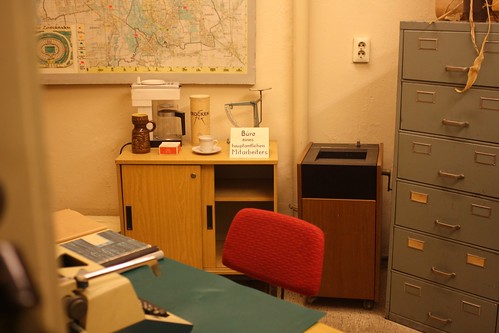
Note: this post written on March 19 for posting after we return. We arrived at Leipzig surprisingly about 5 minutes late on Wednesday morning. My friend Brad was at the Leipzig Hauptbahnhof (central stration) to meet us. As we walked through the city with him, he commented that I hadn t yet tried Currywurst, and there was a stand selling them with different levels of spiciness. I tried one and liked it; Terah was afraid to touch them. After a light lunch with Brad and Anna, we went back into town and saw the V lkerschlachtdenkmal (Monument to the Battle of the Nations). We were warned that it was weird and ugly. And when we arrived, I noticed that it was enormous. And, well, somewhat ugly. And, yes, weird. IMG_2681 After that, we walked through the old trade fair grounds. Leipzig has a long history as a trade center, and after they built the new trade fair grounds, the old ones were reused for other things except for the old Soviet building, which is now both gaudy and abandoned. We picked up Fritzi, who is a very cute 4 years old, from preschool and returned to their house for supper. After that, Brad and I went back into town, intending to hear a reading at the old city pool. When we realized it was a different day, we walked around the city center for awhile and then had a beer at a yes combination cafe/laundromat. Thursday was our day to explore the city. Brad showed us a couple of buildings in the university, including the library, then dropped us off at St. Thomaskirche. That s the church where J. S. Bach was music director for many years, and was buried. Like so many, it was impressive in its height and history. IMG_2703 Next we went to the Stasi museum. The Stasi were the feared and powerful East German secret police during the Communist times. The museum itself was housed in the former Stasi headquarters for Leipzig and was involved with the history of the overthrow of the Communists. The museum covered a lot of the history of the Stasi, including its frantic last days during the 1989 revolution. The level of spying on people was incredible and sophisticated, and they tried to destroy records as the overthrow of the government was imminent. One of the offices in the inner part of the building was left untouched from the Communist years, right down to the typewriter and coffee machine. IMG_2717 After that, we went to the Altes Rathaus (old city hall or townhouse, built in 1556) to do a bit of shopping. Terah was wanting some souvenirs, and I had spotted a shop I thought she might like when walking through the city with Brad the night before. We had already bought some souvenirs at the Schloss Charlottenburg museum store in Berlin (some East German-style crosswalk fridge magnets, and a decorative egg), but wanted something a bit nicer for us and were on the lookout for gifts for others too. We wound up buying a wood carved church scene with a woven wheat tree for us, and another item for others. The shopkeeper spoke no English, and my German vocabulary is small, but we managed to communicate the question of whether or not she could wrap it up in a box for our trip home and she could, and did. Excellent. (I didn t know how to ask about box, but knew how to say that we were Americans, and with a fair bit of gesturing all around, managed to get the idea across.) Then we went in the Altes Rathaus itself, which was both a museum and an interesting cultural experience. We bought our tickets at the booth downstairs, then went upstairs to the entrance. We asked for the English audio guide, which is very common at museums in Germany. (They are small digital audio players that contain recorded information; each room or display has a number you can key in to hear about it in your own language.) We got it, and were told in incredible detail how to use it, even though they are quite easy to figure out and we had used them before. The museum employee told us where the audio tour starts, and in what order it usually goes, which was an effort for her given her limited English. But we all understood and went on our way. It wasn t even 5 minutes later when she had left her desk and came over to us. She was slightly alarmed at two things: one that we didn t have the volume at full blast (which was loud enough for the entire room to hear), and secondly that we weren t looking at the exhibits in the proper order. Never mind that it s easy enough to pull up the audio information about any room just by keying in the number posted in it, I guess. Anyhow, we sort of inwardly shrugged, let her turn the volume up to potentially disturbing the other visitors level, and went through the museum in the order she wanted us to. (Note that this wasn t a museum where there is a one-way flow of traffic or something; you walk into one exhibit, back to the main hall, and then pick your next one.) So we went through the rest of the museum with our English audioguide blaring throughout the large, echoing, wood rooms, feeling a bit rude to the other visitors (maybe 5 of them while we were there) due to its volume. Anyhow, the Altes Rathaus was beautiful and interesting, covering mainly the pre-industrial history of Leipzig. We learned about some of the guilds, the city treasury (vault), and where the town council/parliament met along with rich merchants. There were about as many museum guards as visitors there, and one or two of them sort of followed us around, pointing out the large and completely obvious signs with audio guide numbers in the rooms for us. They are serious about their audio guides in Leipzig. I m glad we went, and I m glad we had the experience we did, too. Terah told me later that she felt reprimanded about the audio guide and visiting order. My take on it was a bit different: the museum is impressive and interesting, but obviously not visited by tourists as much as museums in other cities, or even touristy sites like Thomaskirche in Leipzig. I think they they noticed two people, obviously very foreign (speaking only a little German, and with an American accent) with an interest in their city s history, and took pride in making sure we got the most of our visit and learned as much as possible about something they care about. Here is the main hall of the Altes Rathaus. IMG_2727 We met up with Brad in a cafe near St. Thomaskirche for coffee and cake, then it was on to St. Nikolaikirche (the Church of St. Nicholas), the other large church in town. We stepped out of a passageway to face the large building, and walked in. The interior was decorated in pastels, and was also beautiful and historic. I can t get enough of that sort of building, I think. This building was especially important because it was the site of organizing for the Monday evening protests against the Communist government in 1989. People met at the church, sang a few hymns (to qualify it as a religious service, perhaps), then organized their protest for the evening. Sometimes they would wind through city streets and put flowers at the Stasi headquarters steps, and once the citizens actually overtook the Stasi headquarters. IMG_2745 After awhile we grabbed a bit more for lunch: a pretzel for Terah and a Currywurst for me. (This one wasn t spicy and wasn t all that good.) Then we went to the GDR museum, which was large and interesting, but unfortunately for us, completely in German with no English guide available. That evening, we went to a Bach concert at the Leipzig Gewandhaus, celebrating Bach s 325th birthday. That was fun, and a neat experience with such good music in a very nice venue. The program included Bach s Suite for Orchestra no. 1 in C Major (BWV 1066), Concerto for Violin no. 2 in E major (BWV 1042), Ich habe genug (BWV 82), and Suite for Orchestra no. 4 in D major (BWV 1069). Sir Roger Norrington was conducting, and was rather fun and atypical to watch. He had the audience chuckling a few times with his minimalist conducting or perhaps his flamboyant gestures. Anyhow, the music was excellent and the tickets included free passage on the public transit system 3 hours before and after the concert a nice touch. Due to our schedule, we didn t spend much time with Fritzi, but we did get to play with her a bit. She likes to pretend to be a shopkeeper, and had her store all ready to lay out. We would ask her for some items, which she d put in a basket for us, and then of course there would be a child s twist: we d get our items, and she d pay us for them too. Terah and I brought some books for Fritzi. The particularly enjoyed Goodnight Moon because inside it is an picture of The Runaway Bunny, which she already had. Fritzi chose one of her books to give to Jacob it was a German book (Maulwurf) based on a Czech cartoon mole. That was nice of her, and Jacob really liked it (I ll write about that later). We had a good time in Leipzig, and I was getting fairly good at navigating downtown and with the trams and then, of course, it was time to move on. So Friday morning we caught our 7:50 train from the Leipzig Hauptbahnhof. We took the ICE train to Dresden, then walked a few feet to get onto the EC to Prague. That was a bit of a funny experience. The ICE trains are all sleek, modern, meticulously maintained, and the passengers tend to be very quiet. Talking is barely above a whisper, and people seem alarmed if their cell phone rings, even outside the quiet car. The EC passenger car appears to have been built, or last renovated, in the 1970s, and may have been Hungarian. The seats and curtains are old and faded; some of the seat backs have rips in the vinyl headrests. People were talking or eating loudly, in a very different setting than on the ICE train. As we rode along, we were on the right side the river Elbe for many miles. The scenery was beautiful, with small houses in the river valley, and the occasional house up in the hillside. At one point (a bit before we passed through K nigstein on the way to the Bad Schandau stop), we spotted what looked like an old walled city up on the hill. I figured out later that it was Festung K nigstein (K nigstein Fortress). Update: I forgot to mention a couple of things about Leipzig. One was our walk through a forest yes, a forest in the city. That was a nifty, quiet, and pleasant surprise. Secondly was seeing all the DDR apartment blocks, where the apartments evidently were quite literally blocks. It is interesting to see the Communist architecture.

27 March 2010

John Goerzen: Trip part 4: Berlin

Note: this post was written on March 16 and posted after our return home. Also, I took no photos in Berlin, reasoning that I could leave my camera at the hotel so as to not worry about it, since I m sure there are enough photos of the Brandenburg Gate in the world already. Photos on this story only are from others. We ve had a good time in Berlin it s been adventurous to be out on our own in an unfamiliar city with an unfamiliar language, but has gone well. I feel that I m finally getting used to it a bit, and now tomorrow we move on to Leipzig. Stepping off the train at the Berlin Hauptbahnhof, and seeing all those people connecting to all those trains, I had a feeling of excitement: here is a grand train station that is actively used by so many people. I got a sense of what the beautiful and enormous Kansas City Union Station once felt like, I think; that station at its peak served almost the same number of people in a day at Berlin Hbf does.
(photo by eliotc) Stepping outside in the cold and snow to wait for our bus, I got the first sense that Berlin felt a bit more like an American city than did L beck: a beggar with a suspicious story was working the crowd with Speak English? (We saw many dressed similarly using the exact same tactic during our stay in Berlin.) Our bus ride to the hotel showed us some graffiti a fact of life in many cities in the USA too. Our hotel, the Circus, most definitely did not feel American. The staff was very friendly (I think I ve only seen that level of friendliness and helpfulness at one hotel in the USA: the Portland Doubletree). The room was small (which we expected) but very nice. There was a fresh flower waiting, and a whole printout of information with my name on it waiting in the room: info about the hotel, restaurant, and a multi-page history of this part of the city. They are very energy-conscious there. The hall lights automatically turn off, but you can touch your (apparently RFID-enabled) room card to any switch to turn them on for a few minutes. When in your room, you put your key card in a little holder that keeps it safe and enables the use of the lights. They don t put shampoo in the rooms, but have a selection free for the taking at the front desk: the rationale being that it generates waste when they have to replace it for people that don t need it replaced. They are very environmentally conscious with everything except the showerhead, which appears to use so much water that it would be illegal in the USA. Here s the obligatory surprising to an American comment about Germany: the complete lack of water drinking fountains. In the US, you can get a drink of water at any building of any size airports, train stations, museums, shopping centers, and also in many public places such as parks. I may have seen exactly one water fountain in the Hamburg airport, but that was it. It is odd given the general sense of environmentalism here that so much energy is being wasted on bottling water, not to mention the expense of having to pay for it all over the place. The bus ride to the hotel was interesting. I needed to buy two tickets from the bus driver. I didn t know the German word for ticket, so I just guessed and went with Zwei Ticket, bitte. Wohin? Rosenthaler Str. Then the price came up. I believe that was my first completely successful German-only conversation. (Most Germans hear a couple of words of mine and quickly switch at least partially to English, which probably gets things done a lot faster, and saves me embarrassment, but doesn t give me much chance to practice my German.) We ate dinner Monday night at the Hackesche H fe at Weihenstephaner, a Bavarian restaurant. It was a fun meal, and the tables were long and seated multiple parties. I tried out their special Bavarian beer, and of course had some Wienerschnitzel. I had noticed apple strudel on their website but not on their menu, so when it was time for dessert, I asked our waitress if they had apple strudel today. They did, and it was delicious. Tuesday began with a walk to the Pergamon Museum. From our hotel, this was a walk of about a mile. We had been introduced to excellent German bakeries during our time in L beck. So, since we hadn t had breakfast, when we spotted a bakery along the road, we went in. Terah got a croissant with chocolate on top, which turned out to also have chocolate inside. I found a couple of smaller rolls with various seeds and flavorings on top. All were excellent, and I believe we spent less than EUR 2 all together. We ate our breakfast of rolls as we walked towards the museum. It was a cold and somewhat windy morning, but it was also fun and exciting to be there. The Pergamon was quite the experience. The Pergamon Altar was the first large artifact we saw, and was particularly interesting given that I have recently read The Iliad and The Odyssey.
(photo by *hoodrat*) The Market Gate of Miletus was also impressive, but the true highlight has to be the Ishtar Gate and processional way. Wow. It was built in 575BC by King Nebuchadnezzar II, and importantly was built out of glazed tiles, so the original artwork, color and all, still survives. You can walk through the processional way and get the feeling of kings and armies proceeding there. Truly spectacular.
(photo by Rictor Norton & David Allen) After the Pergamon, we crossed a bridge to the east taking us off Museumsinsel (Museum Island). We walked down a quiet and somewhat forgotten back street and found a small restaurant for lunch. I had the Berlin Wurst , some excellent sausage with excellent and not-so-sour sauerkraut. Terah had some breakfast-type items with fruit. After that, we walked over to the famous Unter den Linden. It wasn t yet spring, so the scenery wasn t all that spectacular yet, but that and the light snow didn t stop the tourists, or the tacky tourist shops, which appear to be a universal global feature. ( Berlin flip-flops and t-shirts made in China, anyone?) The destination of all this walking was the Brandenburger Tor, the famous Berlin icon. The Brandenburg Gate was immense, and the sense of history of standing there was impressive.
(photo by Andrew Mason) We of course walked through the Brandenburg Gate on our way to the Bundestag, which we intended to tour. We didn t, though, due to the cold and very long line snaking out of the building. We then got on the train to Checkpoint Charlie. We saw the outdoor checkpoint still in the middle of the street. We intended to visit the museum Haus am Checkpoint Charlie, but was so packed that it was difficult to even get in the door. We stood in line to buy tickets for a few minutes, but made absolutely no progress; meanwhile, it appeared that an entire school group came in after us somehow and was also waiting to pay. So we decided to go see Schloss Charlottenburg instead.
(photo by Poom!) The Schloss (palace) was a baroque design, intended to impress visitors with the power and wealth of the owners. Only the old wing was open Tuesday, but we had about an hour and a half available to tour it: enough to see the whole thing, but not enough to linger and read all of the information. It was impressive and interesting. Particularly interesting was the chapel, which was this odd state/religion combination decorated both with sacred symbols as well as symbols of the king. After Charlottenburg, we had dinner at the Prussian Restaurant Marjellchen near the Savignyplatz S-bahn. We started with a smoked herring appetizer. Then I had the K nigsberg meatballs, and Terah had creamed ham. Both of us really enjoyed our meals, and Terah s reminded her of Verenike. Wednesday started with an early rise, then we went to Mauerpark to see a remnant of the Berlin Wall. I am glad to have seen it, and was a bit surprised with how small it was at that point compared to my expectations.
(photo by Eichental) Then we had a few minutes back in our hotel to munch on some rolls for breakfast; after that, it was off to the Hauptbahnhof for our train to Leipzig.

26 March 2010

Steve Kemp: I don't like it when people yell at me for no reason at all

Ubuntu always gets a lot of coverage in blogs, and the recent controvesy realisation that it isn't a 100% community-made distribution has triggered yet another round of this. A lot of the controvesy, coverage, and attention can be laid at the feet of Canonical themselves; I think it is fair to say that the visibility, hype, advertising, and the goal of trying to be all things to all men means that even relatively trivial issues can easily get blown out of proportion, and to a certain extent this is a self-inflicted. Live by the sword media & etc ... I think it is fair to say that Ubuntu has attracted a huge swathe of non-technical users. They want something "easy", "free", and "sexy", but more than that they want to use their computer, not develop the operating system. When a particular bug report, with 400+ comments, hits the press we're primarily seeing a marketing-fail rather than technical-fail. The realisation that yes bugs are reported, but no the community (of users) doesn't get input into every single thing is as it should be. If you look back over "controvesy" in the past you'll see comments from the non-technical users which are tantamoint to blackmail:
This should be fixed ... or I'm gonna .. install .. gentoo. yeah. really.
(Similarly you see many comments of the form "I agree", "oh noes", or "Please revert ASAP", rather than technical arguments.) This non-technical nature of the userbase is also readily apparent if you browse through the answers to problems posted in forums for example "Delete this file, I don't know why it works but it fixes it for me!!2!". (I've seen some truly horrific advice upon Ubuntu forums, even so far as chmodding various parts of the system to allow users to write binaries to /bin.) Similarly you'll see that the launchpad is full of generic linux misunderstandings and bugs that aren't "real". The unfortunate fact is that the Ubuntu bug tracker is a wasteland in many places: The tight timescale of releases combined with the sheer number of incoming bug reports means that often issues are overlooked. (For example one bug that bit a colleague is #402188 - on the one hand it is a trivial bug, on the other hand its readily apparent to users. If something like that can be missed it makes you wonder ..?) ObRandom: Ubuntu has 100 bugs open against its Vim package, some of which have been marked as NEW since 2009 (ie. untouched, ignored). By contrast the Debian vim package has way fewer bugs. I'm sure there are packages where the situation is reversed but I think is not an unusual comparison. Finally in addition to sheer numbers of bugs, and tight timescales, it has to be noted that the relative number of developers to users is miniscule, and this in turn has lead to some interesting solutions. The Ubuntu PPA system (personal package archive) should be a good thing. It should allow people to submit new packages for testing, for bugfixes, and for more visibility. Instead downloading a PPA file is no different than going to download.com and downloading a random binary - sure it might be legit, but there's no oversight, no quality control, and most likely no future updates.
Ubuntu as a distribution is interesting, and I'm not trying to be overly critical - A year or two ago had somebody thrown money at me I might have been inclined to accept it. I think most of the perceived problems stem from a single common source, which is largely the issue of scale. (e.g. bug reports to bug handlers. developer numbers to user numbers.)
There are many good things to be said about Ubuntu (& Canonical) in addition to the negative ones that we see in the press or that I've perceived and mentioned above. The truth is it works for a lot of people, and the growing pains will continue until it either dies or both its audience and itself matures. Either way I don't hate Ubuntu, in the same way that I don't hate Microsoft, Oracle, Fedora, Gentoo, or other mass-entities. There are pros and cons to be made for most of them, (and of course Debian itself is no different).
However I will say that every time I see people write "If you want a sexy/shiny/easy to use Linux desktop then install Ubuntu" I glance over at my Debian Lenny desktop, marvel at how sexy, shiny and easy to use it is, and get a little bit disappointed at our own marketing failure(s).
ObFilm: Day of the Woman

John Goerzen: Trip part 3: L beck

Note: This post was written in March 14-15 and posted after our return. When I think about L beck, the first thing that strikes me is the feeling of history underfoot. It struck me most when we set foot inside the Marienkirche. I had never quite felt a wave of a feeling of stepping back in time like that before. The stones on the floor were uneven and imperfect. L beck has had a wet and snowy winter, so the city had spread sand everywhere: sidewalks and roads. Walking into any grand church, I could hear the sound of sand under the shoes of everyone nearby, and feel it under my own shoes. I think I will long associate with L beck the feeling of walking into a grand old church, looking up at the top of the old building at seemingly impossible heights, while feeling the grit of sand and uneven stone beneath my feet. IMG_2643 Marienkirche isn t perfect, like some American churches I ve been in, such as the Basilica of Notre Dame. It doesn t have a lot of gold, either, and both of these attributes are wonderful. Look at a column of bricks, and you can see that each brick isn t exactly like its neighbor, and the entire column isn t perfectly straight. Lots of things in L beck are so old that they aren t perfectly straight, and it made me think that our American notion of always having to fix such things might be somewhat off sometimes. IMG_2629 Look up, and you see the frescos from the 1300s, revealed after many years after the building was struck by an allied bombing raid in 1942. This heavily damaged the building and knocked down plaster from the walls and ceiling, revealing the old artwork. Many parts of Marienkirche were lost as a result of the bombing, which perhaps adds to its slightly sparse and ancient feel. The church bells were sadly melted and crashed to the ground due to the bombing, and have been left exactly where they fell as a memorial. IMG_2641 Look down, and you see the uneven floor, and the concrete slabs above where important people were buried under the floor an attribute common to many of the churches we visited. It was common to see dates of graves from the 1600s and 1700s, though in some places it would go as far back as the 900s. The main part of the church has no heating or cooling, and visiting it on a day just a bit above freezing adds to the feeling of, well, old. Marienkirche has to be my favorite sight in L beck. Walking around the city, I get a similar feel. Many streets and sidewalks are made of stone. The streets that weren t damaged in the war have rows of beautiful old facades. Walk down many streets, and every so often I d see a little tunnel ( just wide enough for a coffin ) that goes under the street-facing houses to a nice little inner courtyard. These are open to the public, but tend to be very quiet and somewhat private. In the courtyard are smaller houses, which would have originally been used by the less wealthy. We also saw the L beck Dom (cathedral), which had a small museum about the destruction due to the Royal Air Force bombing in 1942. It was very sad to see the photo of the Dom in ruins, still smoking, even now. Burning L beck Cathedral after an air raid in 1942 I can only imagine what it must have felt like to residents of L beck to wake up to see many of their priceless centuries-old landmarks and places of worship so horribly destroyed and all of this for little strategic purpose really focused on the morale of the enemy civil population . It s sad that the allies would do such a short-sighted and terrible thing. Europeans have long had to live with the legacy of war upon war, while we Americans have rarely had to see the consequences of war up close. I think it would be good for more of us to visit these sites and come up face to face with what a bomb can do, and then perhaps we will be more judicious with them in the future. Shifting gears now to where we stayed: Andreas & Sigrid, with whom we stayed, have a beautiful 500-year-old house, with lots of original wood beams exposed, and some very old paintings on the walls and ceilings. Nearby were excellent bakeries and a chocolate shop. Terah and I visited it today and bought some very good chocolate. And this brings me to the second thing I ll remember: Andreas & Sigrid s children, Lukas and Rahel. Now, Terah knows no German, I know only a little bit, and the children know no English. So it was a bit slow getting to know each other to start out, but we managed to work around the communication barrier and had a great time. Terah played board games with Rahel, while with me, she kept inventing games to play: hiding somewhere, saying Hallo! , and laughing at how many unsuccessful attempts I might make to find her. I showed Lukas the camera on my Droid, which he used a lot, though a racing game on Terah s iPod Touch was more exciting. They both enjoyed looking at videos of American trains a bit, but especially pictures of our house and yard with Jacob and Oliver. They tried to teach me the German words for things, and also made futile attempts to correct my pronunciation! When we were leaving today, Rahel came over and gave me a kiss on the hand, then the same to Terah s hand, then a little kiss on one of our suitcases. It was touching and sweet. This was one of those experiences no guidebook prepared me for, and no tour bus would have provided. It is something neat to make friends with children despite the large language barrier. On to the rest of the visit We had arrived a little late into Hamburg. After getting our bags and some Euros at an ATM, the next step was to find the bus to L beck. No signs for it were evident, so I found an information desk. The person at the desk was carrying on a conversation in German with the person ahead of me in line. I figured an information desk person in a busy airport would speak English, and was all ready to ask Sprechen Sie Englisch? , but when I walked up, he got a polite smile, and said, Good morning! How can I help? Guess I m obvious. He directed me to the bus, gave me a brochure about it, and told me what time it would leave. Terah and I found the spot to wait, and for a moment I stepped inside the airport terminal. Terah won t let me forget that someone came up to her and asked a question in German, whereas I was spoken to in English. Anyhow, we found the bus, managed to communicate with the driver that doesn t speak English, and sat next to the friendly person that was talking to Terah. He turned out to be a violin player from Munich, and we had a great conversation for the next hour he asking questions about the USA, us asking questions about Germany and Munich. At one point, he commented, You two are so open minded and you re also Americans! He sounded surprised. We exchanged email addresses at the train station. Andreas found us there, and we walked through the city to his house, with him pointing out the sights along the way. L beck is a beautiful city, and though it was damaged in World War II, much of the really old parts still remain. The famous Holstentor Gate has a museum inside, which was fascinating to visit. On Sunday, we went to church with the family we were staying with, Andreas helpfully translating for us. There I met a British Python programmer, which was fun. His wife is a social worker, which was fun for Terah. Monday it was time to get on the train to Berlin. We again walked through a cold and rainy city to the Hauptbahnhof, ready to head to Berlin. There we got on a train to Hamburg, then an ICE train to Berlin. Despite having just a few minutes for a connection in Hamburg, it all went perfectly smoothly. The train left Leipzig about 10 seconds late the clock inside turned over to the minute, then the doors closed and we were off. Impressive. Note: the rest of my photos from L beck are available on Flickr.

24 March 2010

John Goerzen: Review: Travel as a Political Act by Rick Steves

Rick Steves is known for writing books, and producing public TV shows, about travel to Europe. He encourages people to get out of their comfort zone, advocates staying in homes instead of hotels, and giving yourself permission to struggle to communicate in a land of unfamiliar language. That way, you get to experience not just the landmarks, but the culture and history. That was the approach we favored in our recent trip to Europe, and after being there (and seeing tour groups), I think Rick Steves is right on. On the plane to Europe, I read his Travel as a Political Act. This is not a guidebook, but more a book about the philosophy of travel. As usual with my book reviews, unless indicated otherwise, all quotes here come from the book. He starts out with this statement:
I ve taught people how to travel. I focus mostly on the logistics: finding the right hotel, avoiding long lines But that s not why we travel. We travel to have enlightening experiences, to meet inspirational people, to be stimulated, to learn, and to grow. Travel has taught me the fun in having my cultural furniture rearranged and my ethnocentric self-assuredness walloped.
I read this book mostly on the plane to Hamburg, or the week prior to leaving. I can credit Rick Steves directly for encouraging me to strike up a conversation with a random German on the bus from Hamburg to L beck, which I ll discuss here in a couple of days. Probably the biggest lament from Rick Steves is that the people that really ought to travel the ones that are so sure that their ways are correct and best are least likely to do so.
Make a decision that on any trip you take, you ll make a point to be open to new experiences, seek options that get you out of your comfort zone, and be a cultural chameleon trying on new ways of looking at things and striving to become a temporary local. My best vacations have been both fun and intensely educational Travel challenges truths that we were raised thinking were self-evident and God-given. Leaving home, we learn that other people find different truths to be self-evident. We realize that it just makes sense to give everyone a little wiggle room.
The book is set with an introductory encouragement to travel, followed by seven vignettes of different countries he s visited, and descriptions of how it s impacted him. He gave a lesson of the opening of the German Reichstag (parliament building), which he was present for in 1999. He was surrounded by teary-eyed Germans and a few tourists so preoccupied with trivialities forgotten camera batteries, needing a Coke, the lack of air-conditioning that they were missing out on this once-in-a-lifetime opportunity to celebrate a great moment with the German people. He comments that we can learn from other countries that no one country has a monopoly on good ideas, and it is plenty patriotic to insist what we adopt good ideas (such as drug policy) from other countries and adopt them for our own. Particularly touching to me was the description and photo of a memorial in El Salvador, very much looking like the American Vietnam memorial except that one remembering loved ones lost fighting the United States. How many Americans even know that we were involved in a damaging war in El Salvador? A large part of his book was, for me, preaching to the choir, as this comment illustrated:
In the European view, America is trapped in an inescapable cycle to feed its military-industrial complex: As we bulk up our military, we look for opportunities to make use of it. (When your only tool is a hammer, you treat every problem like a nail.) And then, when we employ our military unwisely, we create more enemies which makes us feel the need to grow our military even more. If an American diplomat complained to his European counterpart, America is doing all the heavly lifting when it comes to military, the European might respond, Well, you seem to be enjoying it. We re building roads and bridges instead.
That s a sentiment I ve agreed with for quite some time already, and as such, some parts of the book moved slowly for me though I imagine his target audience included people that had never seriously considered these arguments before. Then there were surprising facts:
by the end of World War I, an estimated half of all the men in France between the ages of 15 and 30 were casualties. When some Americans, frustrated at France s reluctance to follow us into a war, call the French surrender monkeys, I believe it shows their ignorance of history.
And again, I d agree with him on that point. The vignette on Iran was particularly interesting, as he described his experiences in person, they sounded far different than the picture we often get in the media. I have realized, incidentally, that I am terrible at writing book reviews. So rather than inflict more paragraphs upon you with this one, I ll summarize by saying that this is a touching, informative, and motivational book, which I highly recommend. I ll leave you with this quote:
Mark Twain wrote, Travel is fatal to prejudice, bigotry, and narrow-mindedness. These wise words can be a reallying cry for all travelers once comfortably back home. When courageous leaders in our community combat small-mindedness and ignorance travelers can stand with them in solidarity.
I didn t travel to make some sort of statement or as a political act. But I was enriched in many ways by travel of course the obvious ones of contemplating the history of a 900-year-old beautiful church, but also in seeing the different character of different cities, being with two families for a couple of days, and seeing different approaches to common problems. I am very glad I wasn t shut off from this behind a tinted window in a tour bus.

21 March 2010

Alejandro Rios P.: MiniDebconf at Panama (day Three)

Today is the last day of this conference, which has been a great experience of interaction between Central America and Caribbean communities. Yesterday we had packaging, BTS, kernel, pbuilder and quilt related talks. We also expanded the web of trust with a key signing party with almost 30 participants. Even a BoF about people interested in VoIP was held before going downtown to share some beers :)

This morning we had talks about hands on maintaining and translation tasks, we had also a group photo, and a quick visit to the Panama Canal.

Although it has been hard for me to and others to identify common areas of interest towards future work in Debian, it seems to me that these could be centered around l10n and i18n issues, along with packaging and digital inclusion projects.

20 March 2010

Alejandro Rios P.: MiniDebconf at Panama (day Two)

Yesterday began the central america and caribbean MiniDebconf at Panama. Over 50 people from Mexico, Belice, Nicaragua, Guatemala, Costa Rica, Salvador, Colombia and Venezuela, among others, are here to share experiences around Free Software and Debian contributions. All this is possible to several sponsors from Panama and SPI, and the hard work from many people, specially Anto Recio, Mauro Rosero, Carolina Flores, Gunnar Wolf and the local team.

More info(in spanish), including live streaming url can be found on: http://softwarelibre.ca/wiki/MiniDebconf2010

update: Also, on a personal note, I'll take the chance of this event to start my transition to a stronger gpg key, so If you have signed my old one, please take a look at: http://people.debian.org/~alerios/key-transition-2010-03-20.txt

19 March 2010

René Mayorga: MiniDebConf Panam 2010

Finally, after almost 6 months of planing, this event is coming and will be start tomorrow, this is really great, There was a first attempt, and an idea to do a local(central-america based) Debian gathering on 2007 IIRC, now it will happen :) (almost 3 years later and at the same country). There was a lot of things that actually change since the fitst attempt, now Central-america has a more strong FLOSS Community, and now this event is possible, and it will happen this weekend yay! I really need to say thanks to Anto, Mauro Rosero, David, Caro and Gunnar, but I realize that doing all the orga stuffs was hard, I was quite involved since January, and I really say that you need a lot of work and energy to make a small event like this happen, but right now while I still sitting at home trying to finish to prepare my talks I realize that there was a lot of hard work put on this from everyone, and I m really happy to attend this gathering, also I hope that this event do something good on the local FLOSS people, since we have quite nice people here, but they are afraid to contribute, this is the chance to work together and push a bit to get more contributors from central-america.

18 March 2010

Andrew Pollock: [life/americania] We've officially left our mark on the US

We received our US census form the other day. Sarah's already filled it out, but I wanted to look at it before we mailed it back, just out of curiosity. I'm astounded at how incredibly basic it is. Literally all it asks is name, age, date of birth and race. It's somewhat laughable how you're either "white", or one of a bazillion other racial ethnicities. They don't seem to be interested that I'm Australian. Or if I were a white Samoan, for example. I can only remember having filled out one Australian census since I moved out of home, which was the 2001 census. I missed the 2006 census since I was living in the US. The US census seems to be a 10 year affair, compared to Australia's 5 years. "Census night" was always a big deal in Australia. You were supposed to fill out the form on that particular date, for whoever was in that particular dwelling. So you really didn't want to be out visiting friends that night. The US census form claims to care about the state of affairs on April 1, but it also says to mail it back immediately. It seems to only care about "full-time residents", so the whole visitor problem doesn't seem to exist over here. Wikipedia tells me that the 2006 Australia Census had 60 questions, all compulsory, except for the questions about religion. I'm still gobsmacked by how small an amount of data the US tries to collect. I just quickly reviewed the 2001 Australia Census form, and I'm rather amazed at how many questions it asked. I remember there being a meme at the time of the 2001 census to put down "Jedi" as your religion, with the word on the street being that if enough people said that was their religion, it would become officially recognised as one.

17 March 2010

Gunnar Wolf: Getting away from Panam

Several months ago, around the Central American Free Software Encounter (ECSL) in Estel , Nicaragua, I started stirring the waters The Central American regions have vibrant, beautiful Free Software communities, but have mostly (with some very notable examples, of course) shied away from being active participants in major development projects. What was I to do about it? Of course, try to get them to become Debian contributors! During the following weeks, I talked about it with several friends from the region, and the result was an announcement and lots of arguments that followed it. Panam was decided as the host country, and many people have put a lot of work into making the MiniDebConf happen. Mauro Rosero and Anto Recio came up with what appears to be a wonderful local venue and a set of sponsored amenities, and the Debian project is sponsoring what is needed in terms of transportation for people from the whole region (spanning from Mexico to Ecuador and Venezuela IIRC). I am very sorry, however, that I cannot attend this meeting. This very same weekend, I will fly three hours, but in the opposite direction: I will go to Tijuana, where fate decided I will present my first round of CENEVAL equivalence exams (Acuerdo 286 Licenciatura). I expect that to be the topic of another post, to come soon. So, while my friends will be having a good time and talking about Debian and group work, I will sit through three periods of four hours, answering an exam for the first time in a very long time. Fun, hah? Anyway, I will meet Guillermo Amaral (thanks for hosting me! ;-) ), which ensures I will not miss all of the fun ;-)

16 March 2010

Ian Wienand: Handling hostnames, UDP and IPv6 in Python

So, you have some application where you want the user to specify a remote host/port, and you want to support IPv4 and IPv6. For literal addresses, things are fairly simple. IPv4 addresses are simple, and RFC2732 has things covered by putting the IPv6 address within square brackets. It gets more interesting as to what you should do with hostnames. The problem is that getaddrinfo can return you multiple addresses, but without extra disambiguation from the user it is very difficult to know which one to choose. RFC4472 discusses this, but there does not appear to be any good solution. Possibly you can do something like ping/ping6 and have a separate program name or configuration flag to choose IPv6. This comes at a cost of transparency. The glibc implementation of getaddrinfo() puts considerable effort into deciding if you have an IPv6 interface up and running before it will return an IPv6 address. It will even recognise link-local addresses and sort addresses more likely to work to the front of the returned list as described here. However, there is still a small possibility that the IPv6 interface doesn't actually work, and so the library will sort the IPv6 address as first in the returned list when maybe it shouldn't be. If you are using TCP, you can connect to each address in turn to find one that works. With UDP, however, the connect essentially does nothing. So I believe probably the best way to handle hostnames for UDP connections, at least on Linux/glibc, is to trust getaddrinfo to return the sanest values first, try a connect on the socket anyway just for extra security and then essentially hope it works. Below is some example code to do that (literal address splitter bit stolen from Python's httplib).
import socket
DEFAULT_PORT = 123
host = '[fe80::21c:a0ff:fb27:7196]:567'
# the port will be anything after the last :
p = host.rfind(":")
# ipv6 literals should have a closing brace
b = host.rfind("]")
# if the last : is outside the [addr] part (or if we don't have []'s
if (p > b):
    try:
        port = int(host[p+1:])
    except ValueError:
        print "Non-numeric port"
        raise
    host = host[:p]
else:
    port = DEFAULT_PORT
# now strip off ipv6 []'s if there are any
if host and host[0] == '[' and host[-1] == ']':
    host = host[1:-1]
print "host = <%s>, port = <%d>" % (host, port)
the_socket = None
res = socket.getaddrinfo(host, port, socket.AF_UNSPEC, socket.SOCK_DGRAM)
# go through all the returned values, and choose the ipv6 one if
# we see it.
for r in res:
    af,socktype,proto,cname,sa = r
    try:
        the_socket = socket.socket(af, socktype, proto)
        the_socket.connect(sa)
    except socket.error, e:
        # connect failed!  try the next one
        continue
    break
if the_socket == None:
    raise socket.error, "Could not get address!"
# ready to send!
the_socket.send("hi!")

12 March 2010

Dirk Eddelbuettel: RcppArmadillo 0.1.0

Besides the new RcppExamples, another new package RcppArmadillo got spun out of Rcpp with the recent release 0.7.8 of Rcpp. Romain and I already had an example of a simple but fast linear model fit using the (very clever) Armadillo C++ library by Conrad Sanderson. In fact, I had used this as a motivational example of why Rcpp rocks in a recent talk to the ACM chapter at U of Chicago which, thanks to David Smith at REvo, got some further exposure. Now this example is more refined as further glue got added. Given that both Armadillo and Rcpp make use of C++ templates, the actual amount of code in RcppArmadillo is not that large: just over 200 lines in a header file, and a little less for some testing accessor and example functions in a source file. And this makes for some really nice example code: the 'fast regression' example becomes this (where I simply removed two blocks with conditional on the Armadillo version):
#include <RcppArmadillo.h>
extern "C" SEXP fastLm(SEXP ys, SEXP Xs)  
    Rcpp::NumericVector yr(ys);			// creates Rcpp vector from SEXP
    Rcpp::NumericMatrix Xr(Xs);			// creates Rcpp matrix from SEXP
    int n = Xr.nrow(), k = Xr.ncol();
    arma::mat X(Xr.begin(), n, k, false);   	// reuses memory and avoids extra copy
    arma::colvec y(yr.begin(), yr.size(), false);
    arma::colvec coef = solve(X, y);            // fit model y ~ X
    arma::colvec resid = y - X*coef; 		// residuals
    double sig2 = arma::as_scalar( trans(resid)*resid/(n-k) );
    						// std.error of estimate
    arma::colvec stderrest = sqrt( sig2 * diagvec( arma::inv(arma::trans(X)*X)) );
    Rcpp::Pairlist res(Rcpp::Named( "coefficients", coef),
                       Rcpp::Named( "stderr", stderrest));
    return res;
 
No extra copies! Armadillo instantiates directly from the underlying R objects for the vector and matrix, solves the regression equations, computes the standard error of the estimates and returns the two vectors. Leaving us to write about eleven lines of code. Moreover, as Armadillo is well designed and uses template meta-programming to avoid extra copies (see these lecture notes for details), it is about as efficient as it can be (and will use Atlas or other BLAS where available). And, this is just one example. Rcpp should be suitable for other C++ libraries, and provides an easy to use seamless interface between C++ and R. However, we should note that (at about the last minute) we found out about some unit test failures in OS X as well as some issues in a Debian chroot -- cran2deb ran into some build issues on i386 and amd64 in the testing chroot even this 'it all works' swimmingly on our Debian, Ubuntu and Fedora build environments. A follow-up with fixes for either Rcpp and/or RcppArmadillo appears likely.

Update: The build issues seems to be with 64-bit systems and everything appears cool in 32-bit.

11 March 2010

Obey Arthur Liu: Going to DebConf10 and more

Hi folks, I am coming to DebConf10! im_going_to_debconf10 In addition to New York, I ll also be in San Francisco and Seattle. And here s my travel plan to go with it: Day by Day Itinerary Depart: Zurich (ZRH), 19:45 CEST, Arrive: Paris (CDG), 21:10 CEST
Air France 5109 Aircraft Avro RJ85 Avroliner nonstop 1h, 25m 475 km Class K Depart: Paris (CDG), 10:40 CEST, Arrive: San Francisco (SFO), 12:50 PDT
Air France 84 Aircraft Boeing 747-400 nonstop 11h, 10m 8,958 km Class H seat 25A Depart: San Francisco (SFO), 07:00 PDT, Arrive: Seattle (SEA), 09:00 PDT
Virgin America 740 Aircraft Airbus A319 nonstop 2h, 00m 1,090 km Depart: Seattle (SEA), 07:00 PDT, Arrive: San Francisco (SFO), 09:15 PDT
Virgin America 751 Aircraft Airbus A319 nonstop 2h, 15m 1,090 km Depart: San Francisco (SFO), 23:05 PDT, Arrive: New York (JFK), 07:50 EDT(+1 day)
Virgin America 28 Aircraft Airbus A320-100/200 nonstop 5h, 45m 4,150 km DebCamp10! DebConf10! Depart: New York (JFK), 19:05 EDT, Arrive: Paris (CDG), 08:35 CEST(+1 day)
Air France 7 Aircraft 388 nonstop 7h, 30m 5,829 km Class V seat 86A To get an up to date version of my travel plans, visit the TripIt page: http://www.tripit.com/trip/public/id/4CE972068378 I m looking forward to getting as many of our Google Summer of Code students as possible at the DebConf. See you in the US! Update: Actually, I might attend DebCamp too.

Next.

Previous.