Search Results: "edd"

10 December 2014

Dirk Eddelbuettel: Wilco!!

Wilco at The Riviera With a bit of luck due to a collegue having a spare ticket, I managed to make it to an awesome Wilco show at The Riviera in Uptown. This concert was part of a set a six shows. Tweedy and the band were fast, and loose, and wonderful, and totally beloved by the home crowd. An truly outstanding show, and a great evening. Also: I should get out more often. Last blog entry about Wilco was from 2005. Ouch.

This post by Dirk Eddelbuettel originated on his Thinking inside the box blog. Please report excessive re-aggregation in third-party for-profit settings.

Dirk Eddelbuettel: RcppAnnoy 0.0.4

A few weeks ago, RcppAnnoy had its initial release 0.0.2 and subsequent update in release 0.0.3. The latter brought Windows support, thanks to a neat pull request by Qiang Kou. RcppAnnoy wraps the small, fast, and lightweight C++ template header library Annoy written by Erik Bernhardsson for use at Spotify. RcppAnnoy uses Rcpp Modules to offer the exact same functionality as the Python module wrapped around Annoy. In the 0.0.3 release, I overlooked one thing: that with builds on Windows, we would also get builds against what CRAN calls R-oldrel: the previous release, which cannot turn on C++11 via the simple CXX_STD = CXX11 declaration in src/Makevars (and which we need because use of Boost brings in long long which R can only cope with under C++11 ...). So this new release 0.0.4 does nothing more than add a constraint in a Depends: R (>= 3.1.0) to avoid builds not being able to turn on C++11. Courtesy of CRANberries, there is also a diffstat report for this release. More detailed information is on the RcppAnnoy page page.

This post by Dirk Eddelbuettel originated on his Thinking inside the box blog. Please report excessive re-aggregation in third-party for-profit settings.

2 December 2014

Dirk Eddelbuettel: RQuantLib 0.4.0

A new major release of RQuantLib is now on CRAN and getting to Debian. All C++ source files have been rewritten to take advantage of newer Rcpp features. Several Fixed Income functions have been added, or refreshed, thanks to contributions by Michele Salvadore. Calendar support was greatly expanded thanks to a contribution by Danilo Dias da Silva. All key changes are listed in detail below.
Changes in RQuantLib version 0.4.0 (2014-12-01)
  • Changes in RQuantLib code:
    • All function interfaces have been rewritten using Rcpp Attributes. No SEXP remain in the function signatures. This make the code shorter, more readable and more easily extensible.
    • The header files have been reorganized so that plugin use is possible. An impl.h files is imported once for each compilation unit: for RQuantLib from the file src/dates.cpp directory, from a sourced file via a #define set by the plugin wrapper.
    • as<>() and wrap() converters have added for QuantLib Date types.
    • Plugin support has been added, allowing more ad-hoc use via Rcpp Attributes.
    • Several Fixed Income functions have been added, and/or rewritten to better match the QuantLib signatures; this was done mostly by Michele Salvadore.
    • Several Date and Calendar functions have been added.
    • Calendar support has been greatly expanded thanks to Danilo Dias da Silva.
    • Exported curve objects are now more parsimonious and advance entries in the table object roughly one business month at a time.
    • The DiscountCurve and Bond curve construction has been fixed via a corrected evaluation date and omitted the two-year swap rate, as suggested by Luigi Ballabio.
    • The NAMESPACE file has a tighter rule for export of *.default functions, as suggested by Bill Dunlap
    • Builds now use OpenMP where available.
    • The package now depends on QuantLib 1.4.0 or later.
  • Changes in RQuantLib tests:
    • New unit tests for dates have been added.
    • C++ code for the unit tests has also been converted to Rcpp Attributes use; a helper function unitTestSetup() has been added.
    • Continuous Integration via Travis is now enabled from the GitHub repo.
  • Changes in RQuantLib documentation:
    • This NEWS file has been added. Better late than never, as they say.
Courtesy of CRANberries, there is also a diffstat report for the this release. As always, more detailed information is on the RQuantLib page. Questions, comments etc should go to the rquantlib-devel mailing list off the R-Forge page. Issue tickets can be filed at the GitHub repo.

This post by Dirk Eddelbuettel originated on his Thinking inside the box blog. Please report excessive re-aggregation in third-party for-profit settings.

29 November 2014

Dirk Eddelbuettel: RcppArmadillo 0.4.550.1.0

A week ago, Conrad provided another minor release 4.550.0 of Armadillo which has since received one minor correction in 4.550.1.0. As before, I had created a GitHub-only pre-release of his pre-release which was tested against the almost one hundred CRAN dependents of our RcppArmadillo package. This passed fine as usual, and results are as always in the rcpp-logs repository. Processing and acceptance at the CRAN took a little longer as around the same time a fresh failure in unit tests had become apparent on an as-of-yet unannounced new architecture (!!) also tested at CRAN. The R-devel release has since gotten a new capabilities() test for long double, and we now only run this test (for our rmultinom()) if the test asserts that the given R build has this capability. Phew, so with all that the new version in now on CRAN; Windows binaries have been built and I also uploaded new Debian binaries. Changes are summarized below; our end also includes added support for conversion of Field types takes to short pull request by Romain.
Changes in RcppArmadillo version 0.4.550.1.0 (2014-11-26)
  • Upgraded to Armadillo release Version 4.550.1 ("Singapore Sling Deluxe")
    • added matrix exponential function: expmat()
    • faster .log_p() and .avg_log_p() functions in the gmm_diag class when compiling with OpenMP enabled
    • faster handling of in-place addition/subtraction of expressions with an outer product
    • applied correction to gmm_diag relative to the 4.550 release
  • The Armadillo Field type is now converted in as<> conversions
Courtesy of CRANberries, there is also a diffstat report for the most recent release. As always, more detailed information is on the RcppArmadillo page. Questions, comments etc should go to the rcpp-devel mailing list off the R-Forge page.

This post by Dirk Eddelbuettel originated on his Thinking inside the box blog. Please report excessive re-aggregation in third-party for-profit settings.

Dirk Eddelbuettel: CRAN Task Views for Finance and HPC now (also) on GitHub

The CRAN Task View system is a fine project which Achim Zeileis initiated almost a decade ago. It is described in a short R Journal article in Volume 5, Number 1. I have been editor / maintainer of the Finance task view essentially since the very beginning of these CRAN Task Views, and added the High-Performance Computing one in the fall of 2008. Many, many people have helped by sending suggestions or even patches; email continues to be the main venue for the changes. The maintainers of the Web Technologies task view were, at least as far as I know, the first to make the jump to maintaining the task view on GitHub. Karthik and I briefly talked about this when he was in town a few weeks ago for our joint Software Carpentry workshop at Northwestern. So the topic had been on my mind, but it was only today that I realized that the near-limitless amount of awesome that is pandoc can probably help with maintenance. The task view code by Achim neatly converts the very regular, very XML, very boring original format into somewhat-CRAN-website-specific html. Pandoc, being as versatile as it is, can then make (GitHub-flavoured) markdown out of this, and with a minimal amount of sed magic, we get what we need. And hence we now have these two new repos: Contributions are now most welcome by pull request. You can run the included converter scripts, it differs between both repos only by one constant for the task view / file name. As an illustration, the one for Finance is below.
#!/usr/bin/r
## if you do not have /usr/bin/r from littler, just use Rscript
ctv <- "Finance"
ctvfile  <- paste0(ctv, ".ctv")
htmlfile <- paste0(ctv, ".html")
mdfile   <- "README.md"
## load packages
suppressMessages(library(XML))          # called by ctv
suppressMessages(library(ctv))
r <- getOption("repos")                 # set CRAN mirror
r["CRAN"] <- "http://cran.rstudio.com"
options(repos=r)
check_ctv_packages(ctvfile)             # run the check
## create html file from ctv file
ctv2html(read.ctv(ctvfile), htmlfile)
### these look atrocious, but are pretty straight forward. read them one by one
###  - start from the htmlfile
cmd <- paste0("cat ", htmlfile,
###  - in lines of the form  ^<a href="Word">Word.html</a>
###  - capture the 'Word' and insert it into a larger URL containing an absolute reference to task view 'Word'
  "   sed -e 's ^<a href=\"\\([a-zA-Z]*\\)\\.html <a href=\"http://cran.rstudio.com/web/views/\\1.html\" '   ",
###  - call pandoc, specifying html as input and github-flavoured markdown as output
              "pandoc -s -r html -w markdown_github   ",
###  - deal with the header by removing extra  , replacing  ** with ** and **  with **:              
              "sed -e's/ //g' -e's/ \\*\\*/\\*\\*/g' -e's/\\*\\* /\\*\\* /g' -e's/ $/  /g' ",
###  - make the implicit URL to packages explicit
              "-e's ../packages/ http://cran.rstudio.com/web/packages/ g' ",
###  - write out mdfile
              "> ", mdfile)
system(cmd)                             # run the conversion
unlink(htmlfile)                        # remove temporary html file
cat("Done.\n")
I am quite pleased with this setup---so a quick thanks towards the maintainers of the Web Technologies task view; of course to Achim for creating CRAN Task Views in the first place, and maintaining them all those years; as always to John MacFarlance for the magic that is pandoc; and last but not least of course to anybody who has contributed to the CRAN Task Views.

This post by Dirk Eddelbuettel originated on his Thinking inside the box blog. Please report excessive re-aggregation in third-party for-profit settings.

25 November 2014

Dirk Eddelbuettel: Rcpp now used by 300 CRAN packages

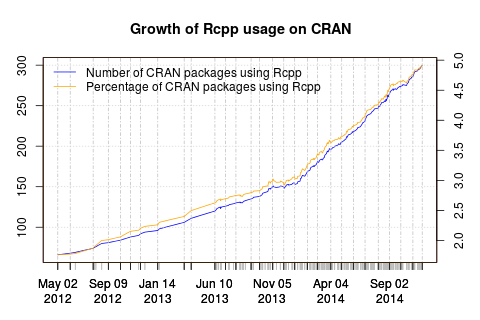
max-heap image This morning, Rcpp reached another round milestone: 300 packages on CRAN now depend on it (as measured by Depends, Imports and LinkingTo declarations). The graph is on the left depicts the growth of Rcpp usage over time. There are 41 more on BioConductor (which is not included in the chart). The first and less detailed part uses manually save entries, the second half of the data set was generated semi-automatically via a short script appending updates to a small file-based backend. A list of user package is kept on this page. Also displayed in the graph is the relative proportion of CRAN packages using Rcpp. The four per-cent hurdle was cleared just before useR! 2014 where I showed a similar graph (as two distinct graphs) in my invited talk. We may well hit five per-cent before the end of the year. 300 is a pretty humbling and staggering number. Also interesting that we we cleared 200 only at the end of April, and 250 in early August. So from everybody behind Rcpp, a heartfelt Thank You! to all the users and of course other contributors.

This post by Dirk Eddelbuettel originated on his Thinking inside the box blog. Please report excessive re-aggregation in third-party for-profit settings.

Dirk Eddelbuettel: YATORP -- Yet Another Tutorial on R Packaging

What the world needs right now is yet another tutorial on R packages and their creation. Luckily, this last Friday and Saturday, I had the opportunity to present in a workshop organized by Frank DiTraglia at Penn's shiny new Warren Center, and held at Wharton. Given the Warren Center's focus, the workshop centered around Big Data and Open Science with R. Yihui Xie and myself alternated on delivering four units on an Introduction to R, Writing R packages, Dynamic Documents with R, and HPC with Rcpp and RcppArmadillo. So I had to come up with a plan for teaching creating R packages -- and decided to do it from the very bottom up, clearly introducing the underlying R CMD ... commands and only then switching to taking advantage of an environment such as the RStudio IDE. The resulting slides are now available on my presentations page. The code examples are in a repo subdirectory on GitHub as well. While both were designed to support the parallel live instruction offered in the workshop, I would be interested in feedback (preferably via email) about how useful the slides are by themselves.

This post by Dirk Eddelbuettel originated on his Thinking inside the box blog. Please report excessive re-aggregation in third-party for-profit settings.

20 November 2014

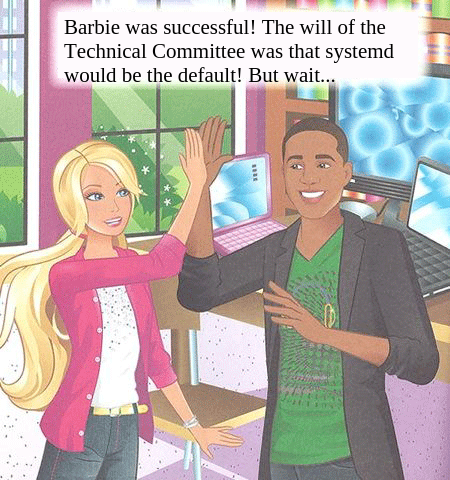
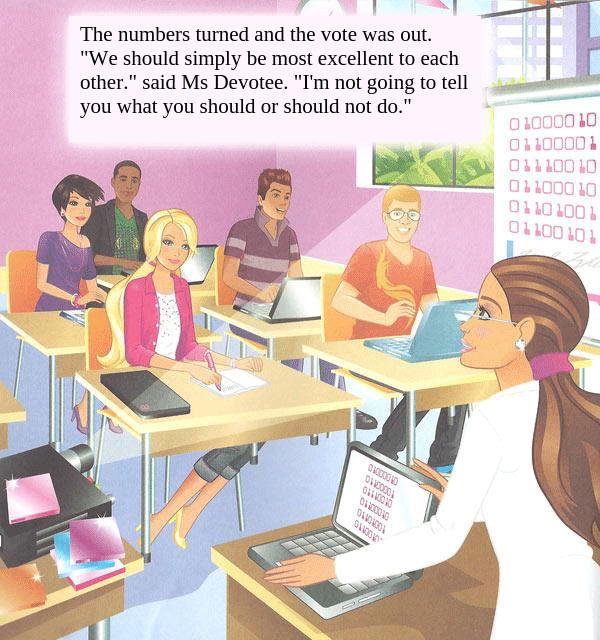
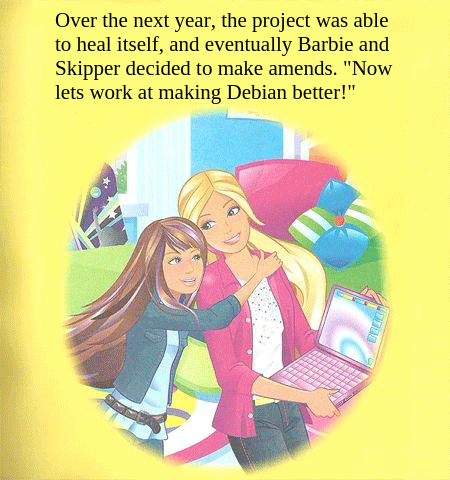
Neil McGovern: Barbie the Debian Developer

Some people may have seen recently that the Barbie series has a rather sexist book out about Barbie the Computer Engineer. Fortunately, there s a way to improve this by making your own version. Thus, I made a short version about Barbie the Debian Developer and init system packager. (For those who don t know me, this is satirical. Any resemblance to people is purely coincidental.) Edit: added text in alt tags. Also, hai reddit!

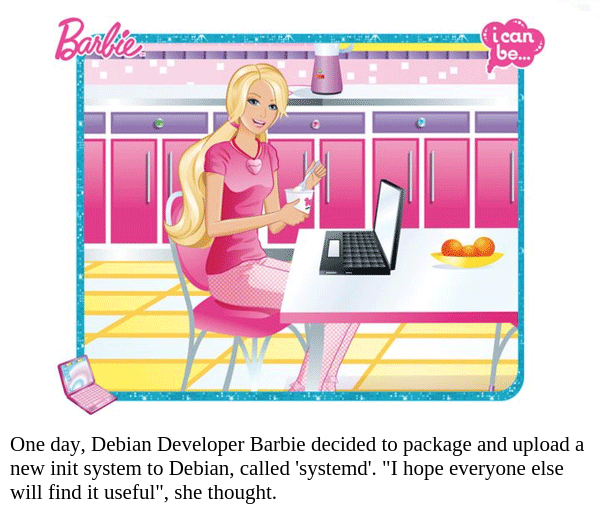
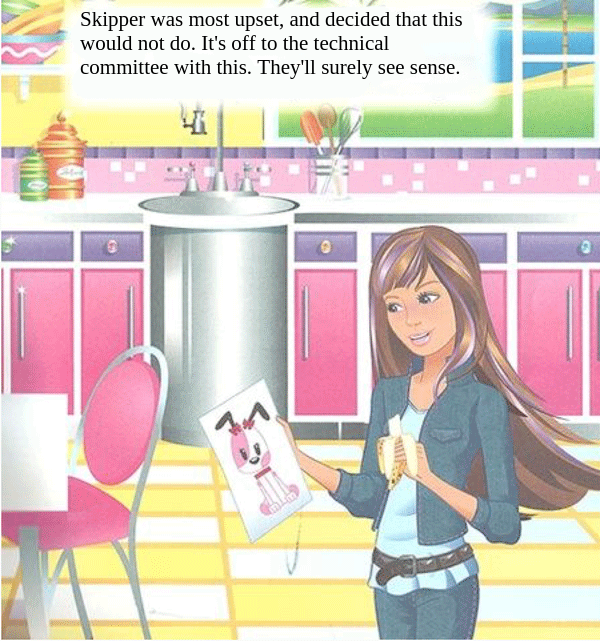
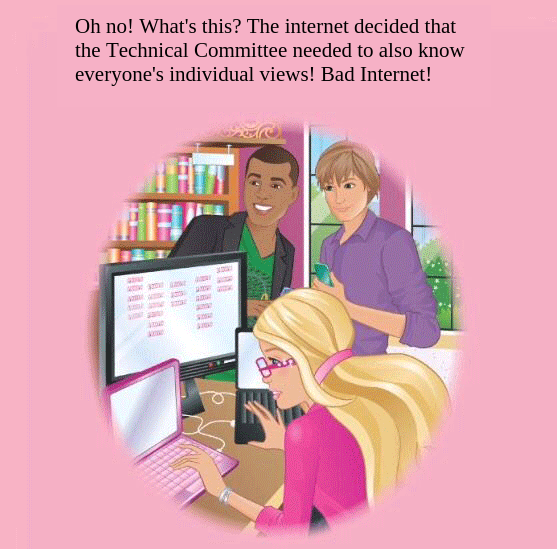
One day, Debian Developer Barbie decided to package and upload a new init system to Debian, called 'systemd'. I hope everyone else will find it useful, she thought.Oh no says Skipper! You'll never take my init system away from me! It's horrendous and Not The Unix Way! Oh dear said Barbie, What have I let myself in to?Skipper was most upset, and decided that this would not do. It's off to the technical committee with this. They'll surely see sense.Oh no! What's this? The internet decided that the Technical Committee needed to also know everyone's individual views! Bad Internet!There was much discussion and consideration. Opinions were reviewed, rows were had, and months passed. Eventually, a decision was agreed upon.Barbie was successful! The will of the Technical Committee was that systemd would be the default! But wait...Skipper still wasn't happy. We need to make sure this never affects me! I'm going to call for a General Resolution!And so, Ms Devotee was called in to look at the various options. She said that the arguments must stop, and we should all accept the result of the general resolution.The numbers turned and the vote was out. We should simply be most excellent to each other said Ms Devotee. I'm not going to tell you what you should or should not do.Over the next year, the project was able to heal itself and eventually Barbie and Skipper decided to make amends. Now let's work at making Debian better!

19 November 2014

Rhonda D'Vine: The Pogues

Actually I was working already on a different music blog entry, but I want to get this one out. I was invited to join the Organic Dancefloor last thursday. And it was a really great experience. A lot of nice people enjoying a dance evening of sort of improvisational traditional folk dancing with influences from different parts of europe. Three bands playing throughout the evening. I definitely plan to go there again. :) Which brings me to the band I want to present you now. They also play sort-of traditional songs, or at least with traditional instruments, and are also quite danceable to. This is about The Pogues. And these are the songs that I do enjoy listening to every now and then: Like always, enjoy!

/music permanent link Comments: 2 Flattr this

Dirk Eddelbuettel: R / Finance 2015 Call for Papers

Earlier today, Josh send the text below to the R-SIG-Finance list, and I updated the R/Finance website, including its Call for Papers page, accordingly. We are once again very excited about our conference, thrilled about the four confirmed keynotes, and hope that many R / Finance users will not only join us in Chicago in May 2015 -- but also submit an exciting proposal. So read on below, and see you in Chicago in May! Call for Papers: R/Finance 2015: Applied Finance with R
May 29 and 30, 2015
University of Illinois at Chicago, IL, USA
The seventh annual R/Finance conference for applied finance using R will be held on May 29 and 30, 2015 in Chicago, IL, USA at the University of Illinois at Chicago. The conference will cover topics including portfolio management, time series analysis, advanced risk tools, high-performance computing, market microstructure, and econometrics. All will be discussed within the context of using R as a primary tool for financial risk management, portfolio construction, and trading. Over the past six years, R/Finance has included attendees from around the world. It has featured presentations from prominent academics and practitioners, and we anticipate another exciting line-up for 2015. This year will include invited keynote presentations by Emanuel Derman, Louis Marascio, Alexander McNeil, and Rishi Narang. We invite you to submit complete papers in pdf format for consideration. We will also consider one-page abstracts (in txt or pdf format) although more complete papers are preferred. We welcome submissions for both full talks and abbreviated "lightning talks." Both academic and practitioner proposals related to R are encouraged. All slides will be made publicly available at conference time. Presenters are strongly encouraged to provide working R code to accompany the slides. Data sets should also be made public for the purposes of reproducibility (though we realize this may be limited due to contracts with data vendors). Preference may be given to presenters who have released R packages. The conference will award two (or more) $1000 prizes for best papers. A submission must be a full paper to be eligible for a best paper award. Extended abstracts, even if a full paper is provided by conference time, are not eligible for a best paper award. Financial assistance for travel and accommodation may be available to presenters, however requests must be made at the time of submission. Assistance will be granted at the discretion of the conference committee. Please make your submission online at this link. The submission deadline is January 31, 2015. Submitters will be notified via email by February 28, 2015 of acceptance, presentation length, and financial assistance (if requested). Additional details will be announced via the R/Finance conference website as they become available. Information on previous years' presenters and their presentations are also at the conference website. For the program committee:
Gib Bassett, Peter Carl, Dirk Eddelbuettel, Brian Peterson, Dale Rosenthal,
Jeffrey Ryan, Joshua Ulrich

18 November 2014

Dirk Eddelbuettel: RcppAnnoy 0.0.3

Hours after the initial blog post announcing the first release of the new package RcppAnnoy, Qiang Kou sent us a very nice pull request adding mmap support in Windows. So a new release with Windows support is on now CRAN, and Windows binaries should be available by this evening as usual. To recap, RcppAnnoy wraps the small, fast, and lightweight C++ template header library Annoy written by Erik Bernhardsson for use at Spotify. RcppAnnoy uses Rcpp Modules to offer the exact same functionality as the Python module wrapped around Annoy. Courtesy of CRANberries, there is also a diffstat report for this release. More detailed information is on the RcppAnnoy page page.

This post by Dirk Eddelbuettel originated on his Thinking inside the box blog. Please report excessive re-aggregation in third-party for-profit settings.

16 November 2014

Dirk Eddelbuettel: Introducing RcppAnnoy

A new package RcppAnnoy is now on CRAN. It wraps the small, fast, and lightweight C++ template header library Annoy written by Erik Bernhardsson for use at Spotify. While Annoy is setup for use by Python, RcppAnnoy offers the exact same functionality from R via Rcpp. A new page for RcppAnnoy provides some more detail, example code and further links. See a recent blog post by Erik for a performance comparison of different approximate nearest neighbours libraries for Python.

This post by Dirk Eddelbuettel originated on his Thinking inside the box blog. Please report excessive re-aggregation in third-party for-profit settings.

11 November 2014

Simon Josefsson: Dice Random Numbers

Generating data with entropy, or random number generation (RNG), is a well-known difficult problem. Many crypto algorithms and protocols assumes random data is available. There are many implementations out there, including /dev/random in the BSD and Linux kernels and API calls in crypto libraries such as GnuTLS or OpenSSL. How they work can be understood by reading the source code. The quality of the data depends on actual hardware and what entropy sources were available the RNG implementation itself is deterministic, it merely convert data with supposed entropy from a set of data sources and then generate an output stream. In some situations, like on virtualized environments or on small embedded systems, it is hard to find sources of sufficient quantity. Rarely are there any lower-bound estimates on how much entropy there is in the data you get. You can improve the RNG issue by using a separate hardware RNG, but there is deployment complexity in that, and from a theoretical point of view, the problem of trusting that you get good random data merely moved from one system to another. (There is more to say about hardware RNGs, I ll save that for another day.) For some purposes, the available solutions does not inspire enough confidence in me because of the high complexity. Complexity is often the enemy of security. In crypto discussions I have said, only half-jokingly, that about the only RNG process that I would trust is one that I can explain in simple words and implement myself with the help of pen and paper. Normally I use the example of rolling a normal six-sided dice (a D6) several times. I have been thinking about this process in more detail lately, and felt it was time to write it down, regardless of how silly it may seem. A dice with six sides produces a random number between 1 and 6. It is relatively straight forward to intuitively convinced yourself that it is not clearly biased: inspect that it looks symmetric and do some trial rolls. By repeatedly rolling the dice, you can generate how much data you need, time permitting. I do not understand enough thermodynamics physics to know how to estimate the amount of entropy of a physical process, so I need to resort to intuitive arguments. It would be easy to just assume that a dice produces 3 bits of entropy, because 2^3=6 which matches the number of possible outcomes. At least I find it easy to convince myself that 3 bits is the upper bound. I suspect that most dice have some form of defect, though, which leads to a very small bias that could be found with a large number of rolls. Thus I would propose that the amount of entropy of most D6 s are slightly below 3 bits on average. Further, to establish a lower bound, and intuitively, it seems easy to believe that if the entropy of particular D6 would be closer to 2 bits than to 3 bits, this would be noticeable fairly quickly by trial rolls. That assumes the dice does not have complex logic and machinery in it that would hide the patterns. With the tinfoil hat on, consider a dice with a power source and mechanics in it that allowed it to decide which number it would land on: it could generate seamingly-looking random pattern that still contained 0 bits of entropy. For example, suppose a D6 is built to produce the pattern 4, 1, 4, 2, 1, 3, 5, 6, 2, 3, 1, 3, 6, 3, 5, 6, 4, this would mean it produces 0 bits of entropy (compare the numbers with the decimals of sqrt(2)). Other factors may also influence the amount of entropy in the output, consider if you roll the dice by just dropping straight down from 1cm/1inch above the table. With this discussion as background, and for simplicity, going forward, I will assume that my D6 produces 3 bits of entropy on every roll. We need to figure out how many times we need to roll it. I usually find myself needing a 128-bit random number (16 bytes). Crypto algorithms and protocols typically use power-of-2 data sizes. 64 bits of entropy results in brute-force attacks requiring about 2^64 tests, and for many operations, this is feasible with today s computing power. Performing 2^128 operations does not seem possible with today s technology. To produce 128 bits of entropy using a D6 that produces 3 bits of entropy per roll, you need to perform ceil(128/3)=43 rolls. We also need to design an algorithm to convert the D6 output into the resulting 128-bit random number. While it would be nice from a theoretical point of view to let each and every bit of the D6 output influence each and every bit of the 128-bit random number, this becomes difficult to do with pen and paper. For simplicity, my process will be to write the binary representation of the D6 output on paper in 3-bit chunks and then read it up as 8-bit chunks. After 8 rolls, there are 24 bits available, which can be read up as 3 distinct 8-bit numbers. So let s do this for the D6 outputs of 3, 6, 1, 1, 2, 5, 4, 1:
3   6   1   1   2   5   4   1
011 111 001 001 010 101 010 001
01111100 10010101 01010001
124 0x7C 149 0x95 81 0x51
After 8 rolls, we have generated the 3 byte hex string 7C9551 . I repeat the process 5 more times, concatenating the strings, resulting in a hex string with 15 bytes of data. To get the last byte, I only need to roll the D6 three more times, where the two high bits of the last roll is used and the lowest bit is discarded. Let s say the last D6 outputs were 4, 2, 3, this would result in:
4   2   3
100 010 011
10001001
137 0x89
So the 16 bytes of random data is 7C9551..89 with .. replaced by the 5 pieces of 3-byte chunks of data. So what s the next step? Depends on what you want to use the random data for. For some purposes, such as generating a high-quality 128-bit AES key, I would be done. The key is right there. To generate a high-quality ECC private key, you need to generate somewhat more randomness (matching the ECC curve size) and do a couple of EC operations. To generate a high-quality RSA private key, unfortunately you will need much more randomness, at the point where it makes more sense to implement a PRNG seeded with a strong 128-bit seed generated using this process. The latter approach is the general solution: generate 128 bits of data using the dice approach, and then seed a CSPRNG of your choice to get large number of data quickly. These steps are somewhat technical, and you lose the pen-and-paper properties, but code to implement these parts are easier to verify compared to verifying that you get good quality entropy out of your RNG implementation. flattr this!

10 November 2014

Dirk Eddelbuettel: BH release 1.54.0-5

A new release of BH, our package providing Boost headers for use by R is now on CRAN. This release was triggered via a request by Ben Goodrich as noted below who asked for Boost Circular Buffer which RStan uses. No other changes were made.
Changes in version 1.54.0-5 (2014-11-09)
  • Added Boost Circular Buffer requested by Ben Goodrich for RStan
Courtesy of CRANberries, there is also a diffstat report for the most recent release Comments and suggestions are welcome via the mailing list or the issue tracker at the GitHubGitHub repo.

This post by Dirk Eddelbuettel originated on his Thinking inside the box blog. Please report excessive re-aggregation in third-party for-profit settings.

Konstantinos Margaritis: New owner/maintainer for CSVChart Drupal module

Back in ~2008, I had created a small Drupal module that used CustomFilter and Google Chart Tools: Image Charts, called CSV Chart. It was a simple module that took embedded CSV data and presented them as Google charts. It was very handy for what I wanted -and still want- to do, present benchmarks for my work on Altivec (and now in general SIMD). However, I don't really code in PHP anymore -haven't coded PHP since 2010- so the module was left to bitrot. I did some minor adjustment to run with the current D7-based site, but that was it. Thankfully, others found the module useful to use and adopt and the result has been that in the last days I transfered ownership of the CSV Chart to Pierre Vriens, so that he can continue development and maintenance of this tiny module. I would like to publicly thank Pierre for his work! And that's the beauty of Free Software!

8 November 2014

Steve Kemp: Some brief notes on Docker

Docker is the well-known tool for building, distributing, and launching containers. I use it personally to run a chat-server, a graphite instance, and I distribute some of my applications with Dockerfiles too, to ease deployment. Here are some brief notes on things that might not be obvious. For a start when you create a container it is identified by a 64-byte ID. This ID is truncated and used as the hostname of the new guest - but if you ever care you can discover the full ID from within the guest:
~# awk -F/ ' print $NF ' /proc/self/cgroup
9d16624a313bf5bb9eb36f4490b5c2b7dff4f442c055e99b8c302edd1bf26036
Compare that with the hostname:
~# hostname
9d16624a313b
Assigning names to containers is useful, for example:
$ docker run -d -p 2222:22 --name=sshd skxskx/sshd
However note that names must be removed before they can be reused:
#!/bin/sh
# launch my ssh-container - removing the name first
docker rm  sshd   true
docker run --name=sshd -d -p 2222:22 skxskx/sshd
The obvious next step is to get the IP of the new container, and setup a hostname for it sshd.docker. Getting the IP is easy, via either the name of the ID:
~$ docker inspect --format '  .NetworkSettings.IPAddress  ' sshd
172.17.0.2
The only missing step is the ability to do that magically. You'd hope there would be a hook that you could run when a container has started - unfortunately there is no such thing. Instead you have two choices: I wrote a simple watcher to fire when events are created, which lets me do the job. But running a deamon just to watch for events seems like the wrong way to go. Instead I've switched to running via a wrapper dock-run:
$ dock-run --name=sshd -d -p 2222:22 skxskx/sshd
This invokes run-parts on the creation directory, if present, and that allows me to update DNS. So "sshd.docker.local" will point to the IP of the new image. The wrapper was two minutes work, but it does work, and if you like you can find it here. That concludes my notes on docker - although you can read articles I wrote on docker elsewhere.

7 November 2014

Riku Voipio: Adventures in setting up local lava service

Linaro uses LAVA as a tool to test variety of devices. So far I had not installed it myself, mostly due to assuming it to be enermously complex to set up. But thanks to Neil Williams work on packaging, installation has got a lot easier. Follow the Official Install Doc and Official install to debian Doc, roughly looking like: 1. Install Jessie into kvm

kvm -m 2048 -drive file=lava2.img,if=virtio -cdrom debian-testing-amd64-netinst.iso
2. Install lava-server

apt-get update; apt-get install -y postgresql nfs-kernel-server apache2
apt-get install lava-server
# answer debconf questions
a2dissite 000-default && a2ensite lava-server.conf
service apache2 reload
lava-server manage createsuperuser --username default --email=foo.bar@example.com
$EDITOR /etc/lava-dispatcher/lava-dispatcher.conf # make sure LAVA_SERVER_IP is right
That's the generic setup. Now you can point your browser to the IP address of the kvm machine, and log in with the default user and the password you made. 3 ... 1000 Each LAVA instance is site customized for the boards, network, serial ports, etc. In this example, I now add a single arndale board.

cp /usr/lib/python2.7/dist-packages/lava_dispatcher/default-config/lava-dispatcher/device-types/arndale.conf /etc/lava-dispatcher/device-types/
sudo /usr/share/lava-server/add_device.py -s arndale arndale-01 -t 7001
This generates us a almost usable config for the arndale. For site specifics I have usb-to-serial. Outside kvm, I provide access to serial ports using the following ser2net config:

7001:telnet:0:/dev/ttyUSB0:115200 8DATABITS NONE 1STOPBIT
7002:telnet:0:/dev/ttyUSB1:115200 8DATABITS NONE 1STOPBIT
TODO: make ser2net not run as root and ensure usb2serial devices always get same name.. For automatic power reset, I wanted something cheap, yet something that wouldn't require much soldering (I'm not a real embedded engineer.. I prefer software side ;) . Discussed with Hector, who hinted about prebuilt relay boxes. Chose one from Ebay, a kmtronic 8-port USB Relay. So now I have this cute boxed nonsense hack. The USB relay is driven with a short script, hard-reset-1

stty -F /dev/ttyACM0 9600
echo -e '\xFF\x01\x00' > /dev/ttyACM0
sleep 1
echo -e '\xFF\x01\x01' > /dev/ttyACM0
Sidenote: If you don't have or want automated power relay for lava, you can always replace this this script with something along "mpg123 puny_human_press_the_power_button_now.mp3" Both the serial port and reset script are on server with dns name aimless. So we take the /etc/lava-dispatcher/devices/arndale-01.conf that add_device.py created and make it look like:

device_type = arndale
hostname = arndale-01
connection_command = telnet aimless 7001
hard_reset_command = slogin lava@aimless -i /etc/lava-dispatcher/id_rsa /home/lava/hard-reset-1
Since in my case I'm only going to test with tftp/nfs boot, the arndale board needs only to be setup to have a u-boot bootloader ready on power-on. Now everything is ready for a test job. I have a locally built kernel and device tree, and I export the directory using the httpd available by default in debian.. Python!

cd out/
python -m SimpleHTTPServer
Go to the lava web server, select api->tokens and create a new token. Next we add the token and use it to submit a job

$ sudo apt-get install lava-tool
$ lava-tool auth-add http://default@lava-server/RPC2/
$ lava-tool submit-job http://default@lava-server/RPC2/ lava_test.json
submitted as job id: 1
$
The first job should now be visible in the lava web frontend, in the scheduler -> jobs part. If everything goes fine, the relay will click in a moment and the job will finish in a few minutes.

Dirk Eddelbuettel: RcppRedis 0.1.2

A new release of RcppRedis is now on CRAN. It contains additional commands for hashes and sets, all contributed by John Laing and Whit Armstrong.
Changes in version 0.1.2 (2014-11-06)
  • New commands execv, hset, hget, sadd, srem, and smembers contributed by John Laing and Whit Armstrong over several pull requests.
Courtesy of CRANberries, there is also a diffstat report for the most recent release. As always, more detailed information is on the RcppRedis page page.

This post by Dirk Eddelbuettel originated on his Thinking inside the box blog. Please report excessive re-aggregation in third-party for-profit settings.

6 November 2014

Dirk Eddelbuettel: A Software Carpentry workshop at Northwestern

On Friday October 31, 2014, and Saturday November 1, 2014, around thirty-five graduate students and faculty members attended a Software Carpentry workshop. Attendees came primarily from the Economics department and the Kellogg School of Management, which was also the host and sponsor providing an excellent venue with the Allen Center on the (main) Evanston campus of Northwestern University. The focus of the two-day workshop was an introduction, and practical initiation, to working effectively at the shell, getting introduced and familiar with the git revision control system, as well as a thorough introduction to working and programming in R---from the basics all the way to advanced graphing as well as creating reproducible research documents. The idea of the workshop had come out of discussion during our R/Finance 2014 conference. Bob McDonald of Northwestern, one of this year's keynote speakers, and I were discussing various topic related to open source and good programming practice --- as well as the lack of a thorough introduction to either for graduate students and researcher. And once I mentioned and explained Software Carpentry, Bob was rather intrigued. And just a few months later we were hosting a workshop (along with outstanding support from Jackie Milhans from Research Computing at Northwestern). We were extremely fortunate in that Karthik Ram and Ramnath Vaidyanathan were able to come to Chicago and act as lead instructors, giving me an opportunity to get my feet wet. The workshop began with a session on shell and automation, which was followed by three session focusing on R: a core introduction, a session focused on function, and to end the day, a session on the split-apply-combine approach to data transformation and analysis. The second day started with two concentrated session on git and the git workflow. In the afternoon, one session on visualization with R as well as a capstone-alike session on reproducible research rounded out the second day.

Things that worked The experience of the instructors showed, as the material was presented and an effective manner. The selection of topics, as well as the pace were seen by most students to be appropriate and just right. Karthik and Ramnath both did an outstanding job. No students experienced any real difficulties installing software, or using the supplied information. Participants were roughly split between Windows and OS X laptops, and had generally no problem with bash, git, or R via RStudio. The overall Software Carpentry setup, the lesson layout, the focus on hands-on exercises along with instruction, the use of the electronic noteboard provided by etherpad and, of course, the tried-and-tested material worked very well.

Things that could have worked better Even more breaks for exercises could have been added. Students had difficulty staying on pace in some of the exercise: once someone fell behind even for a small error (maybe a typo) it was sometimes hard to catch up. That is a general problem for hands-on classes. I feel I could have done better with the scope of my two session. Even more cohesion among the topics could have been achieved via a single continually used example dataset and analysis.

Acknowledgments Robert McDonald from Kellogg, and Jackie Milhans from Research Computing IT, were superb hosts and organizers. Their help in preparing for the workshop was tremendous, and the pick of venue was excellent, and allowed for a stress-free two days of classes. We could not have done this without Karthik and Ramnath, so a very big Thank You to both of them. Last but not least the Software Carpentry 'head office' was always ready to help Bob, Jackie and myself during the earlier planning stage, so another big Thank You! to Greg and Arliss.

Dirk Eddelbuettel: RPushbullet 0.1.1

A minor bugfix release 0.1.1 of the RPushbullet package (interfacing the neat Pushbullet service) landed on CRAN yesterday morning. It cleans up a small issue related to the ability to transfer files between devices via the Pushbullet service where the ability to select a (non-default) target device has now been restored. With that, allow me to borrow one excellent use case of RPushbullet from the blog of Karl Broman: how to use RPushbullet for error notifications from R:
options(error = function()  
    library(RPushbullet)
    pbPost("note", "Error", geterrmessage())
 )
This is very clever: should an error occur, you get immediate notification in browser or on your phone. Left as an exercise for the reader is to combine this with the equally excellent rfoaas package (github cran) to get appropriately colourful error messages... More details about the package are at the RPushbullet webpage and the RPushbullet GitHub repo. Courtesy of CRANberries, there is also a diffstat report for this release.

This post by Dirk Eddelbuettel originated on his Thinking inside the box blog. Please report excessive re-aggregation in third-party for-profit settings.

Next.

Previous.