Search Results: "bod"

1 September 2015

Russ Allbery: Review: Kanban

Review: Kanban, by David J. Anderson
Publisher: Blue Hole
Copyright: 2010
ISBN: 0-9845214-0-2
Format: Trade paperback
Pages: 240
Another belated review, this time of a borrowed book. Which I can now finally return! A delay in the review of this book might be a feature if I had actually used it for, as the subtitle puts it, successful evolutionary change in my technology business. Sadly, I haven't, so it's just late. So, my background: I've done a lot of variations of traditional project management for IT projects (both development and more operational ones), both as a participant and as a project manager. (Although I've never done the latter as a full-time job, and have no desire to do so.) A while back at Stanford, my team adopted Agile, specifically Scrum, so I did a fair bit of research about Scrum including a couple of training courses. Since then, at Dropbox, I've used a few different variations on a vaguely Agile-inspired planning process, although it's not particularly consistent with any one system. I've been hearing about Kanban for a while and have friends who swear by it, but I only had a vague idea of how it worked. That seemed like a good excuse to read a book. And Anderson's book is a good one if, like me, you're looking for a basic introduction. It opens with a basic description and definition, talks about motivation and the expected benefits, and then provides a detailed description of Kanban as a system. The tone is on the theory side, written using the terminology of (I presume) management theory and operations management, areas about which I know almost nothing, but the terminology wasn't so heavy as to make the book hard to read. Anderson goes into lots of detail, and I thought he did a good job of distinguishing between basic principles, optional techniques, and variations that may be appropriate for particular environments. If you're also not familiar, the basic concept of Kanban is to organize work using an in-progress queue. It eschews time-bounded planning entirely in favor of staging work at the start of a sequence of queues and letting the people working on each queue pull from the previous queue when they're ready to take on a new task. As you might guess from that layout, Kanban was originally invented for assembly-line manufacturing (at Toyota). That was one of the problems that I had with it, or at least the presentation in this book: most of my software development doesn't involve finishing one part of something and handing it off to someone else, which made it hard to identify with the pipeline model. Anderson has clearly spent a lot of time working with large-scale programming shops, including outsourced development firms, with dedicated QA and operations roles. This is not at all how Silicon Valley agile development works, so parts of this book felt like missives from a foreign country. That said, the key point of Kanban is not the assembly line but the work limit. One of the defining characteristics of Kanban, at least as Anderson presents it, is that one does not try to estimate work and tile it based on estimates, not even to the extent that Scrum and other Agile methodologies do within the sprint. Instead, each person takes as long as they take on the things they're working on, and pulls a new task when they have free capacity. The system instead puts a limit on how many things they can have in progress at a time. The problem of pipeline stalls is dealt with both via continuous improvement and "swarming" of a problem to unblock the line (since other teams may not be able to work until the block is fixed), and with being careful about the sizing of work items (I'm used to calling them stories) that go in the front end. Predictability, which Scrum uses story sizing and team velocity analysis to try to achieve, is basically statistical. One uses a small number of buckets of sizes of stories, and the whole pipeline will finish some number of work items per unit time, with a variance. The promise made to clients and other teams is that some percentage of the work items will be finished within some time frame from when they enter the system. Most importantly, these are all descriptive properties, determined statistically after the fact, rather than planned properties worked out through story sizing and extensive team discussion. If you, like me, are pretty thoroughly sick of two-hour sprint planning meetings and endless sizing exercises, this is rather appealing. My problem with most work planning systems is that I think they overplan and put too much weight our ability to estimate how long work will take. Kanban is very appealing when viewed through that lens: it gives up on things we're bad at in favor of simple measurement and building a system with enough slack that it can handle work of various different sizes. As mentioned at the top, I haven't had a chance to try it (and I'm not sure it's a good fit with the inter-group planning methods in use at my current workplace), but I came away from this book wanting to do so. If, like me, your experience is mostly with small combined teams or individual programming work, Anderson's examples may seem rather large, rather formal, and bureaucratic. But this is a solid introduction and well worth reading if your only experience with Agile is sprint planning, story writing and sizing, and fast iterations. Rating: 7 out of 10

31 August 2015

Matthew Garrett: Working with the kernel keyring

The Linux kernel keyring is effectively a mechanism to allow shoving blobs of data into the kernel and then setting access controls on them. It's convenient for a couple of reasons: the first is that these blobs are available to the kernel itself (so it can use them for things like NFSv4 authentication or module signing keys), and the second is that once they're locked down there's no way for even root to modify them.

But there's a corner case that can be somewhat confusing here, and it's one that I managed to crash into multiple times when I was implementing some code that works with this. Keys can be "possessed" by a process, and have permissions that are granted to the possessor orthogonally to any permissions granted to the user or group that owns the key. This is important because it allows for the creation of keyrings that are only visible to specific processes - if my userspace keyring manager is using the kernel keyring as a backing store for decrypted material, I don't want any arbitrary process running as me to be able to obtain those keys[1]. As described in keyrings(7), keyrings exist at the session, process and thread levels of granularity.

This is absolutely fine in the normal case, but gets confusing when you start using sudo. sudo by default doesn't create a new login session - when you're working with sudo, you're still working with key posession that's tied to the original user. This makes sense when you consider that you often want applications you run with sudo to have access to the keys that you own, but it becomes a pain when you're trying to work with keys that need to be accessible to a user no matter whether that user owns the login session or not.

I spent a while talking to David Howells about this and he explained the easiest way to handle this. If you do something like the following:
$ sudo keyctl add user testkey testdata @u
a new key will be created and added to UID 0's user keyring (indicated by @u). This is possible because the keyring defaults to 0x3f3f0000 permissions, giving both the possessor and the user read/write access to the keyring. But if you then try to do something like:
$ sudo keyctl setperm 678913344 0x3f3f0000
where 678913344 is the ID of the key we created in the previous command, you'll get permission denied. This is because the default permissions on a key are 0x3f010000, meaning that the possessor has permission to do anything to the key but the user only has permission to view its attributes. The cause of this confusion is that although we have permission to write to UID 0's keyring (because the permissions are 0x3f3f0000), we don't possess it - the only permissions we have for this key are the user ones, and the default state for user permissions on new keys only gives us permission to view the attributes, not change them.

But! There's a way around this. If we instead do:
$ sudo keyctl add user testkey testdata @s
then the key is added to the current session keyring (@s). Because the session keyring belongs to us, we possess any keys within it and so we have permission to modify the permissions further. We can then do:
$ sudo keyctl setperm 678913344 0x3f3f0000
and it works. Hurrah! Except that if we log in as root, we'll be part of another session and won't be able to see that key. Boo. So, after setting the permissions, we should:
$ sudo keyctl link 678913344 @u
which ties it to UID 0's user keyring. Someone who logs in as root will then be able to see the key, as will any processes running as root via sudo. But we probably also want to remove it from the unprivileged user's session keyring, because that's readable/writable by the unprivileged user - they'd be able to revoke the key from underneath us!
$ sudo keyctl unlink 678913344 @s
will achieve this, and now the key is configured appropriately - UID 0 can read, modify and delete the key, other users can't.

This is part of our ongoing work at CoreOS to make rkt more secure. Moving the signing keys into the kernel is the first step towards rkt no longer having to trust the local writable filesystem[2]. Once keys have been enrolled the keyring can be locked down - rkt will then refuse to run any images unless they're signed with one of these keys, and even root will be unable to alter them.

[1] (obviously it should also be impossible to ptrace() my userspace keyring manager)
[2] Part of our Secure Boot work has been the integration of dm-verity into CoreOS. Once deployed this will mean that the /usr partition is cryptographically verified by the kernel at runtime, making it impossible for anybody to modify it underneath the kernel. / remains writable in order to permit local configuration and to act as a data store, and right now rkt stores its trusted keys there.

comment count unavailable comments

Martín Ferrari: Romania

It's been over 2 years since I decided to start a new, nomadic life. I had the idea of blogging about this experience as it happened, but not only I am incredibly lazy when it comes to writing, most of the time I have been too busy just enjoying this lifestyle! The TL;DR version of these last 2 years: And now, I am in Cluj-Napoca, Romania.
View from my window
View from my window
2 comments

Russ Allbery: Review: Through Struggle, The Stars

Review: Through Struggle, The Stars, by John J. Lumpkin
Series: Human Reach #1
Publisher: John J. Lumpkin
Copyright: July 2011
ISBN: 1-4611-9544-6
Format: Kindle
Pages: 429
Never let it be said that I don't read military SF. However, it can be said that I read books and then get hellishly busy and don't review them for months. So we'll see if I can remember this well enough to review it properly. In Lumpkin's future world, mankind has spread to the stars using gate technology, colonizing multiple worlds. However, unlike most science fiction futures of this type, it's not all about the United States, or even the United States and Russia. The great human powers are China and Japan, with the United States relegated to a distant third. The US mostly maintains its independence from either, and joins the other lesser nations and UN coalitions to try to pick up a few colonies of its own. That's the context in which Neil and Rand join the armed services: the former as a pilot in training, and the latter as an army grunt. This is military SF, so of course a war breaks out. But it's a war between Japan and China: improved starship technology and the most sophisticated manufacturing in the world against a much larger economy with more resources and a larger starting military. For reasons that are not immediately clear, and become a plot point later on, the United States president immediately takes an aggressive tone towards China and pushes the country towards joining the war on the side of Japan. Most of this book is told from Neil's perspective, following his military career during the outbreak of war. His plans to become a pilot get derailed as he gets entangled with US intelligence agents (and a bad supervisor). The US forces are not in a good place against China, struggling when they get into ship-to-ship combat, and Neil's ship goes on a covert mission to attempt to complicate the war with political factors. Meanwhile, Rand tries to help fight off a Chinese invasion of one of the rare US colony worlds. Through Struggle, The Stars does not move quickly. It's over 400 pages, and it's a bit surprising how little happens. What it does instead is focus on how the military world and the war feels to Neil: the psychological experience of wanting to serve your country but questioning its decisions, the struggle of working with people who aren't always competent but who you can't just make go away, the complexities of choosing a career path when all the choices are fraught with politics that you didn't expect to be involved in, and the sheer amount of luck and random events involved in the progression of one's career. I found this surprisingly engrossing despite the slow pace, mostly because of how true to life it feels. War is not a never-ending set of battles. Life in a military ship has moments when everything is happening far too quickly, but other moments when not much happens for a long time. Lumpkin does a great job of reflecting that. Unfortunately, I thought there were two significant flaws, one of which means I probably won't seek out further books in this series. First, one middle portion of the book switches away from Neil to follow Rand instead. The first part of that involves the details of fighting orbiting ships with ground-based lasers, which was moderately interesting. (All the technological details of space combat are interesting and thoughtfully handled, although I'm not the sort of reader who will notice more subtle flaws. But David Weber this isn't, thankfully.) But then it turns into a fairly generic armed resistance story, which I found rather boring. It also ties into the second and more serious flaw: the villain. The overall story is constructed such that it doesn't need a personal villain. It's about the intersection of the military and politics, and a war that may be ill-conceived but that is being fought anyway. That's plenty of conflict for the story, at least in my opinion. But Lumpkin chose to introduce a specific, named Chinese character in the villain role, and the characterization is... well. After he's humiliated early in the story by the protagonists, Li Xiao develops an obsession with killing them, for his honor, and then pursues them throughout the book in ways that are sometimes destructive to the Chinese war efforts. It's badly unrealistic compared to the tone of realism taken by the rest of the story. Even if someone did become this deranged, it's bizarre that a professional military (and China's forces are otherwise portrayed as fairly professional) would allow this. Li reads like pure caricature, and despite being moderately competent apart from his inexplicable (but constantly repeated) obsession, is cast in a mustache-twirling role of personal villainy. This is weirdly out of place in the novel, and started irritating me enough that it took me out of the story. Through Struggle, The Stars is the first book of a series, and does not resolve much by the end of the novel. That plus its length makes the story somewhat unsatisfying. I liked Neil's development, and liked him as a character, and those who like the details of combat mixed with front-lines speculation about politics may enjoy this. But a badly-simplified mustache-twirling victim and some extended, uninteresting bits mar the book enough that I probably won't seek out the sequels. Followed by The Desert of Stars. Rating: 6 out of 10

30 August 2015

Russ Allbery: Review: Pound Foolish

Review: Pound Foolish, by Helaine Olen
Publisher: Penguin
Copyright: 2012, 2013
Printing: 2013
ISBN: 1-59184-679-X
Format: Trade paperback
Pages: 241
For at least the last six years, it's not been surprising news that the relationship between the average person and the US financial system is tense at best, and downright exploitative at worst. The collapse of the housing bubble revealed a morass of predatory lending practices, spectacularly poor (or spectacularly cynical) investment decisions, and out-of-control personal debt coupled with erosion of bankruptcy law. Despite this, there's always a second story in all discussions of the finances of the US population: the problem isn't with financial structures and products, but with us. We're too stupid, or naive, or emotional, or uninformed, or greedy, or unprincipled, or impatient. Finances are complicated, yes, but that just means we have to be more thoughtful. All of these complex financial products could have been used properly. Helaine Olen's Pound Foolish is a systemtic, biting, well-researched, and pointed counter to that second story. The short summary of this book is that it's not us. We're being set up for failure, and there is a large and lucrative industry profiting off of that failure. And many (although not all) people in that industry know exactly what they're doing. Pound Foolish is one of my favorite forms of non-fiction: long-form journalism. This is an investigative essay into the personal finance and investment industry, developed to book length. Readers of Michael Lewis will feel right at home. Olen doesn't have Lewis's skill with characterization and biography, but she makes up for it in big-picture clarity. She takes a wealth of individual facts about who is involved in personal finance, how they make money, what they recommend, and who profits, and develops it into a clear and coherent overview. If you have paid any attention to US financial issues, you'll know some of this already. Frontline has done a great job of covering administrative fees in mutual funds. Lots of people have warned about annuities. The spectacular collapse of the home mortgage is old news now. But Olen does a great job of finding the connections between these elements and adding some less familiar ones, including an insightful and damning analysis of financial literacy campaigns and the widespread belief that these problems are caused by lack of consumer understanding. I've read and watched a lot of related material, including several full-book treatments of the mortgage crisis, so I think it's telling that I never got bored in the middle of Olen's treatment. I find the deep US belief in the power of personal improvement fascinating. It feels like one of the defining characteristics of US culture, for both good and for ill. We're very good at writing compelling narratives of personal improvement, and sometimes act on them. We believe that everyone can and should improve themselves. But that comes coupled to a dislike and distrust of expertise, even when it is legitimate and earned (Hofstadter's Anti-Intellectualism in American Life develops this idea at length). And I believe we significantly overestimate the ability of individuals to act despite systems that are stacked against us, and significantly overestimate our responsibility for the inevitable results. This was the main message I took from Pound Foolish: we desperately want to believe in the myth of personal control. We want to believe that our financial troubles are something we can fix through personal education, more will power, better decisions, or just the right investment. And so, we turn to gurus like Suze Orman and buy their mix of muddled financial advice and "tough love" that completely ignores broader social factors. We're easy marks for psychologically-trained investment sellers who mix fear, pressure, and a fantasy of inside knowledge and personal control. We're fooled by a narrative of empowerment and stand by while a working retirement system (guaranteed benefit pensions) is undermined and destroyed in favor of much riskier investment schemes... riskier for us, at least, but loaded with guaranteed profits for the people who "advise" us. And we cling to financial literacy campaigns that are funded by exactly the same credit card companies who fight tooth and nail against regulations that would require they provide simple, comprehensible descriptions of loan terms. One wonders if they support them precisely because they know they don't work. Olen mentions, in passing, the Stanford marshmallow experiment, which is often used as a foundation for arguments about personal responsibility for financial outcomes, but she doesn't do a detailed critique. I wish she had, since I think it's such a good example of the theme of this book. The Stanford marshmallow experiment was a psychological experiment from the late 1960s and early 1970s in delayed gratification. Children were put in a room in front of some treat (marshmallows, cookies, pretzels) and told that they could eat it if they wished. But if they didn't eat the treat before the monitor came back, they would get two of the treat instead. Long-term follow-up studies found that the children who refrained from eating the treat and got the reward had better life outcomes along multiple metrics: SAT scores, educational attainment, and others. On the surface, this seems to support everything US culture loves to believe about the power of self-control, self-improvement, and the Protestant work ethic. People who can delay gratification and save for a future reward do better in the world. (The darker interpretation, also common since the experiment was performed on children, is that the ability to delay gratification has a genetic component, and some people are just doomed to make poor decisions due to their inability to exercise self-control.) However, I can call the traditional interpretation into question with one simple question that the experimenters appeared not to ask: under what circumstances would taking the treat immediately be the rational and best choice? One answer, of course, is when one does not trust the adult to produce the promised reward. If the adult might come back, take the treat away, and not give any treat, it's to the child's advantage to take the treat immediately. Even if the adult left the treat but wouldn't actually double it, it's to the child's advantage to take the treat immediately. The traditional interpretation assumes the child trusts the adults performing the experiment a logical assumption for those of us whose childhood experience was that adults could generally be trusted and that promised rewards would materialize. If the child instead came from a chaotic family where adults weren't reliable, or just one where frequent unexpected money problems meant that promised treats often didn't materialize, the most logical assumption may be much different. One has to ask if such a background may have more to do with the measured long-term life outcomes than the child's unwillingness to trust in a future reward. And this is one of the major themes of this book. Problems the personal finance industry attributes to our personal shortcomings (which they're happy to take our money to remedy) are often systematic, or at least largely outside of our control. We may already be making the most logical choices given our personal situations. We're in worse financial shape because we're making less money. Our retirements are in danger because our retirement systems were dismantled and replaced with risky and expensive alternatives. And where problems are attributed to our poor choices, one can find entire industries that focus on undermining our ability to make good choices: scaring us, confusing us, hiding vital information, and exploiting known weaknesses of human psychology to route our money to them. These are not problems that can be solved by watching Suze Orman yell at us to stop buying things. These are systematic social problems that demand a sweeping discussion about regulation, automatic savings systems, and social insurance programs to spread risk and minimize the weaknesses of human psychology. Exactly the kind of discussion that the personal finance industry doesn't want us to have. Those who are well-read in these topics probably won't find a lot new here. Those who aren't in the US will shake their heads at some of the ways that the US fails its citizens, although many of Olen's points apply even to countries with stronger social safety nets. But if you're interested in solid long-form journalism on this topic, backed by lots of data on just how badly a focus on personal accountability is working for us, I recommend Pound Foolish. Rating: 8 out of 10

29 August 2015

Norbert Preining: Kobo Glo and GloHD firmware 3.17.3 mega update (KSM, nickel patch, ssh, fonts)

I have updated my mega-update for Kobo to the latest firmware 3.17.3. Additionally, I have not built (and tested) updates for both Mark4 hardware (Glo) and Mark6 hardware (GloHD). Please see the previous post for details on what is included. The only difference that is important is the update to KSM (Kobo Start Menu) version 8, which is still in testing phase (thus a warning: the layout and setup of KSM8 might change till release). This is an important update as all version up to V7 could create database corruptions (which I have seen several times!) when used with Calibre and the Kepub driver. Kobo Logo Other things that are included are as usual: Metazoa firmware patches for the Glo (non HD) version I have activated the compact layout patch; koreader, pbchess, coolreader, the ssh part of kobohack, custom dictionaries support, and some side-loaded fonts. Again, for details please see the previous post You can check for database corruption by selecting tools - nickel diverse.msh - db chk integrity.sh in the Kobo Start Menu. If it returns ok, then all is fine. Otherwise you might see problems. I solved the corruption of my database by first dumping the database to an sql file, and reloading it into a new database. Assuming that you have the file KoboReader.sqlite, what I did is:

$ sqlite3  KoboReader.sqlite 
SQLite version 3.8.11.1 2015-07-29 20:00:57
Enter ".help" for usage hints.
sqlite> PRAGMA integrity_check;
*** in database main ***
Page 5237: btreeInitPage() returns error code 11
On tree page 889 cell 1: 2nd reference to page 5237
Page 4913 is never used
Page 5009 is never used
Error: database disk image is malformed
sqlite> .output foo.sql
sqlite> .dump
sqlite> .quit
$ sqlite3 KoboReader.sqlite-NEW
SQLite version 3.8.11.1 2015-07-29 20:00:57
Enter ".help" for usage hints.
sqlite> .read foo.sql
sqlite> .quit
The first part shows that the database is corrupted. Fortunately dumping succeeded and then reloading it into a new database, too. Finally I replaced (after backup) the sqlite on the device with the new database. Download Mark6 Kobo GloHD firmware: Kobo 3.17.3 for GloHD Mega update: Kobo-3.17.3-combined/Mark6/KoboRoot.tgz Mark4 Kobo Glo, Auro HD firmware: Kobo 3.17.3 for Glo and AuroHD Mega update: Kobo-3.17.3-combined/Mark4/KoboRoot.tgz Enjoy.

27 August 2015

Ritesh Raj Sarraf: Laptop Mode Tools - 1.68

I am please to announce the release of Laptop Mode Tools, version 1.68. This release is mainly focused on integration with the newer init system, systemd. Without the help from the awesome Debian systemd maintainers, this would not have been possible. Thank you folks. While the focus now is on systemd, LMT will still support the older SysV Init. With this new release, there are some new files: laptop-mode.service, laptop-mode.timer and lmt-poll.service. All the files should be documented well enough for users. lmt-poll.service is the equivalent of the module battery-level-polling, should you need it. Filtered git log:
1.68 - Thu Aug 27 22:36:43 IST 2015
    * Fix all instances for BATTERY_LEVEL_POLLING
    * Group kill the polling daemon so that its child process get the same signal
    * Release the descriptor explicitly
    * Add identifier about who's our parent
    * Narrow down our power_supply subsystem event check condition
    * Fine tune the .service file
    * On my ultrabook, AC as reported as ACAD
    * Enhance lmt-udev to better work with systemd
    * Add a timer based polling for LMT. It is the equivalent of battery-polling-daemon,
      using systemd
    * Disable battery level polling by default, because most systems will have systemd running
    * Add documentation reference in systemd files
The md5 checksum for the tarball is 15edf643990e08deaebebf66b128b270

Categories:

Keywords:

Like:

Joey Hess: then and now

It's 2004 and I'm in Oldenburg DE, working on the Debian Installer. Colin and I pair program on partman, its new partitioner, to get it into shape. We've somewhat reluctantly decided to use it. Partman is in some ways a beautful piece of work, a mass of semi-object-oriented, super extensible shell code that sprang fully formed from the brow of Anton. And in many ways, it's mad, full of sector alignment twiddling math implemented in tens of thousands of lines of shell script scattered amoung hundreds of tiny files that are impossible to keep straight. In the tiny Oldenburg Developers Meeting, full of obscure hardware and crazy intensity of ideas like porting Debian to VAXen, we hack late into the night, night after night, and crash on the floor. sepia toned hackers round a table It's 2015 and I'm at a Chinese bakery, then at the Berkeley pier, then in a SF food truck lot, catching half an hour here and there in my vacation to add some features to Propellor. Mostly writing down data types for things like filesystem formats, partition layouts, and then some small amount of haskell code to use them in generic ways. Putting these peices together and reusing stuff already in Propellor (like chroot creation). Before long I have this, which is only 2 undefined functions away from (probably) working:
let chroot d = Chroot.debootstrapped (System (Debian Unstable) "amd64") mempty d
        & Apt.installed ["openssh-server"]
        & ...
    partitions = fitChrootSize MSDOS
        [ (Just "/boot", mkPartiton EXT2)
        , (Just "/", mkPartition EXT4)
        , (Nothing, const (mkPartition LinuxSwap (MegaBytes 256)))
        ]
 in Diskimage.built chroot partitions (grubBooted PC)
This is at least a replication of vmdebootstrap, generating a bootable disk image from that config and 400 lines of code, with enormous customizability of the disk image contents, using all the abilities of Propellor. But is also, effectively, a replication of everything partman is used for (aside from UI and RAID/LVM). sailboat on the SF bay What a difference a decade and better choices of architecture make! In many ways, this is the loosely coupled, extensible, highly configurable system partman aspired to be. Plus elegance. And I'm writing it on a lark, because I have some spare half hours in my vacation. Past Debian Installer team lead Tollef stops by for lunch, I show him the code, and we have the conversation old d-i developers always have about partman. I can't say that partman was a failure, because it's been used by millions to install Debian and Ubuntu and etc for a decade. Anything that deletes that many Windows partitions is a success. But it's been an unhappy success. Nobody has ever had a good time writing partman recipes; the code has grown duplication and unmaintainability. I can't say that these extensions to Propellor will be a success; there's no plan here to replace Debian Installer (although with a few hundred more lines of code, propellor is d-i 2.0); indeed I'm just adding generic useful stuff and building further stuff out of it without any particular end goal. Perhaps that's the real difference.

25 August 2015

Norbert Preining: Plex Home Theater 1.4.1 updated for Debian/sid

Debian/sid is going through a big restructuring with the switch to a new gcc and libstc++. Furthermore, libcec3 is now the default. So I have updated my PHT builds for Debian/sid to build and install on the current status, both for amd64 and i386. plex-debian-new Add the following lines to your sources.list:
deb http://www.preining.info/debian/ sid pht
deb-src http://www.preining.info/debian/ sid pht
You can also grab the binary for amd64 directly here for amd64 and i386, you can get the source package with
dget http://www.preining.info/debian/pool/pht/p/plexhometheater/plexhometheater_1.4.1-2.dsc
The release file and changes file are signed with my official Debian key 0x860CDC13. For Debian/testing I am waiting until the transition has settled. Please wait a bit more. Now be ready for enjoying the next movie!

Lunar: Reproducible builds: week 17 in Stretch cycle

A good amount of the Debian reproducible builds team had the chance to enjoy face-to-face interactions during DebConf15.
Names in red and blue were all present at DebConf15
Picture of the  reproducible builds  talk during DebConf15
Hugging people with whom one has been working tirelessly for months gives a lot of warm-fuzzy feelings. Several recorded and hallway discussions paved the way to solve the remaining issues to get reproducible builds part of Debian proper. Both talks from the Debian Project Leader and the release team mentioned the effort as important for the future of Debian. A forty-five minutes talk presented the state of the reproducible builds effort. It was then followed by an hour long roundtable to discuss current blockers regarding dpkg, .buildinfo and their integration in the archive. Picture of the  reproducible builds  roundtable during DebConf15 Toolchain fixes Reiner Herrmann submitted a patch to make rdfind sort the processed files before doing any operation. Chris Lamb proposed a new patch for wheel implementing support for SOURCE_DATE_EPOCH instead of the custom WHEEL_FORCE_TIMESTAMP. akira sent one making man2html SOURCE_DATE_EPOCH aware. St phane Glondu reported that dpkg-source would not respect tarball permissions when unpacking under a umask of 002. After hours of iterative testing during the DebConf workshop, Sandro Knau created a test case showing how pdflatex output can be non-deterministic with some PNG files. Packages fixed The following 65 packages became reproducible due to changes in their build dependencies: alacarte, arbtt, bullet, ccfits, commons-daemon, crack-attack, d-conf, ejabberd-contrib, erlang-bear, erlang-cherly, erlang-cowlib, erlang-folsom, erlang-goldrush, erlang-ibrowse, erlang-jiffy, erlang-lager, erlang-lhttpc, erlang-meck, erlang-p1-cache-tab, erlang-p1-iconv, erlang-p1-logger, erlang-p1-mysql, erlang-p1-pam, erlang-p1-pgsql, erlang-p1-sip, erlang-p1-stringprep, erlang-p1-stun, erlang-p1-tls, erlang-p1-utils, erlang-p1-xml, erlang-p1-yaml, erlang-p1-zlib, erlang-ranch, erlang-redis-client, erlang-uuid, freecontact, givaro, glade, gnome-shell, gupnp, gvfs, htseq, jags, jana, knot, libconfig, libkolab, libmatio, libvsqlitepp, mpmath, octave-zenity, openigtlink, paman, pisa, pynifti, qof, ruby-blankslate, ruby-xml-simple, timingframework, trace-cmd, tsung, wings3d, xdg-user-dirs, xz-utils, zpspell. The following packages became reproducible after getting fixed: Uploads that might have fixed reproducibility issues: Some uploads fixed some reproducibility issues but not all of them: Patches submitted which have not made their way to the archive yet: St phane Glondu reported two issues regarding embedded build date in omake and cduce. Aur lien Jarno submitted a fix for the breakage of make-dfsg test suite. As binutils now creates deterministic libraries by default, Aur lien's patch makes use of a wrapper to give the U flag to ar. Reiner Herrmann reported an issue with pound which embeds random dhparams in its code during the build. Better solutions are yet to be found. reproducible.debian.net Package pages on reproducible.debian.net now have a new layout improving readability designed by Mattia Rizzolo, h01ger, and Ulrike. The navigation is now on the left as vertical space is more valuable nowadays. armhf is now enabled on all pages except the dashboard. Actual tests on armhf are expected to start shortly. (Mattia Rizzolo, h01ger) The limit on how many packages people can schedule using the reschedule script on Alioth has been bumped to 200. (h01ger) mod_rewrite is now used instead of JavaScript for the form in the dashboard. (h01ger) Following the rename of the software, debbindiff has mostly been replaced by either diffoscope or differences in generated HTML and IRC notification output. Connections to UDD have been made more robust. (Mattia Rizzolo) diffoscope development diffoscope version 31 was released on August 21st. This version improves fuzzy-matching by using the tlsh algorithm instead of ssdeep. New command line options are available: --max-diff-input-lines and --max-diff-block-lines to override limits on diff input and output (Reiner Herrmann), --debugger to dump the user into pdb in case of crashes (Mattia Rizzolo). jar archives should now be detected properly (Reiner Herrman). Several general code cleanups were also done by Chris Lamb. strip-nondeterminism development Andrew Ayer released strip-nondeterminism version 0.010-1. Java properties file in jar should now be detected more accurately. A missing dependency spotted by St phane Glondu has been added. Testing directory ordering issues: disorderfs During the reproducible builds workshop at DebConf, participants identified that we were still short of a good way to test variations on filesystem behaviors (e.g. file ordering or disk usage). Andrew Ayer took a couple of hours to create disorderfs. Based on FUSE, disorderfs in an overlay filesystem that will mount the content of a directory at another location. For this first version, it will make the order in which files appear in a directory random. Documentation update Dhole documented how to implement support for SOURCE_DATE_EPOCH in Python, bash, Makefiles, CMake, and C. Chris Lamb started to convert the wiki page describing SOURCE_DATE_EPOCH into a Freedesktop-like specification in the hope that it will convince more upstream to adopt it. Package reviews 44 reviews have been removed, 192 added and 77 updated this week. New issues identified this week: locale_dependent_order_in_devlibs_depends, randomness_in_ocaml_startup_files, randomness_in_ocaml_packed_libraries, randomness_in_ocaml_custom_executables, undeterministic_symlinking_by_rdfind, random_build_path_by_golang_compiler, and images_in_pdf_generated_by_latex. 117 new FTBFS bugs have been reported by Chris Lamb, Chris West (Faux), and Niko Tyni. Misc. Some reproducibility issues might face us very late. Chris Lamb noticed that the test suite for python-pykmip was now failing because its test certificates have expired. Let's hope no packages are hiding a certificate valid for 10 years somewhere in their source! Pictures courtesy and copyright of Debian's own paparazzi: Aigars Mahinovs.

21 August 2015

Simon Kainz: DUCK challenge: Final week

Well, here are the stats for the final week of the DUCK challenge as well as DebConf15: So we had 21 packages fixed and uploaded by 14 different uploaders. People were really working hard on this during DebConf. A big "Thank You" to you!! Since the start of this challenge, a total of 89 packages, were fixed. Here is a quick overview:
Week 1 Week 2 Week 3 Week 4 Week 5 Week 6 Week 7
# Packages 10 15 10 14 10 9 21
Total 10 25 35 49 59 68 89
Thank you all for participating - either on purpose or "accidentially": Some people were really surprised as i sneaked up on them at DebConf15, confronting them with a green lighter! I just tried to put even more fun into Debian, i hope this worked out Pevious articles are here: Week 1, Week 2, Week 3, Week 4, Week 5,Week 6.

17 August 2015

Iustin Pop: A few macro photos

I was walking in the city with my camera and a wide (35mm) lens. I also took in the bag a macro lens, "just in case", although I wasn't sure what would it be useful for, beyond a solitary flower here and there. But as luck would have it, I stumbled upon a floral arrangement which was host to a lot of working bees, bumblebees and ants. Perfect opportunity for some attempts at macro work! Especially as I didn't do many such attempts "outside" before. A few of the photographs turned out "OK". Not good, as there were multiple things fighting against my lack of skills and experience. First, aperture. From normal photography, I thought that f/8 is a small aperture. Turns out that f/8 is not enough to have the entire body of a bee in focus! f/16 is good from the depth-of-field point of view, but then the light is not good enough. Second, wind. Not in the sense of blur - high shutter speed combats wind-induced blur, but the movement of the subject due to wind makes it very hard to focus properly, either automatically or manually, as the depth of field is very thin. In any case, learned something more. The first and last pictures in this set are my favourites; the first one due to the detail in the wings (in stark contrast to the lack of detail in the body), and the last one due to the soft colours. Here they are, or check out the entire set: Mis-focused (bee body is not in focus) but with good results: very nice wings! This turned out much better than I expected, mostly due to the colours.

Iustin Pop: Nikkor 300mm f/4E tests and happy dogs!

I recently got a new lens, which I'm still trying to learn how to properly use . The new lens is the Nikon 300m f/4E PF ED VR (wow, that's a mouthful of acronyms ) and it's as good as I expected, except that it seems that it's too good for the person using it (me). Physically, the lens is indeed very light and very easy to hand-hold; it's barely heavier and longer than the 70-300mm f/4-5.6 zoom, although a bit more bulky. I was fearing something "bigger" and heavier for a fixed-aperture lens, even after hearing all the good reports about it, but it was better than I expected. I was also slightly concerned, this being a prime lens, about finding the subject fast, especially if smaller or far away. It turned out that if the lens is focused at somewhat the right distance (not at the opposite end), it is not a real problem. So, as the first test/learning exercise, I did a couple of hour long walks outdoor, photographing random subjects. First day I used the lens by itself, on the second day I added the Nikon TC-14E(III) tele-converter, for a 420mm focal length. All pictures below except the Huskies are non-cropped, just down-sampled (they have the original field of view); the Husky pictures were cropped. In all cases, camera was set to semi-manual mode, mostly at 1/1000s or 1/2000s, various apertures between f/4 and f/8; this means wide open or stopped down one (when with the tele-converter) or two stops. Semi-manual as auto-ISO was on. Lens focus limiter on, VR either active or sport (to help with the viewfinder image mostly, at this speed), camera set to AF-C and group mode most of the time. Also, all pictures were shot hand-held, with bad technique - until somebody stopped me, turns out he was a photographer, and showed me how to properly hold a telephoto lens; thanks, whoever you were! The "random subjects" parts worked only somewhat, as (at first) the subjects were not too interesting; air-plane flying high above - check, fast focus (although it is easy to focus on a plane in clear sky), or close, static subjects: Airplane in the sky Test of close focusing Birds flying around - almost check, fast focus (both with just the lens and with the TC), although I learned that shooting flying birds while panning needs 1/2000s - my initial attempt at 1/1000s was not enough to eliminate either panning blur or wing-tip blur (both depend on the speed of the respective action); in any case, initial focus acquisition is speedy enough for me. A couple of examples (first without, second with the TC; in the second one, I was unprepared when the I saw the bird from the corner of my eye, and managed to bring up the camera and take exactly one photo before the bird was gone): Not enough speed Too much blur Another attempt was to focus on dogs jumping in the water. Here the problem was different: focusing on the correct object! The splashing around meant that there were lots of water droplets both in front and behind the dog, the dog being partially obscured by them. I don't know what AF settings would have helped here (maybe 3D tracking pre-focused on the black dog)? I had a low success rate on the first attempt, so I'll have to try again. The lens did correctly track the wrong thing, though . Examples: Almost focused Wrong focus Once the dog caught its target, the lens focused well enough, of course, but not perfect; it might need some AF fine-tuning or photographer upgrade : Not quite perfect focus At one point, I was lucky to have a dog running towards me; focus tracking on a subject approaching the camera is a good test for the lens (and camera) auto-focus performance. I was pleasantly surprised, given my failure to track left-to-right flying birds (which should be easier!): Run! Not yet tired! In any case, I was walking and thinking on how to improve on my technique, when I saw in the distance a pair of dogs (Husky's, I believe) which were very active. This case was relatively easy for the camera and lens, since they were moving only left-to-right, instead of forward-backward, so the focus distance was mostly constant, and I just had to pan. Full gallery here, two examples: Jump! Play over, going home These two dogs had an education value beyond the "how is the lens performing"; they were so fast, active (they kept going at it non-stop for a good number of minutes) and playful that they made my day brighter . So, that concludes my first test of this lens and the 1.4 tele-converter. Conclusion: equipment good, need to upgrade the photographer!

Gunnar Wolf: report @mx (that means, sadly, gwolf DebConf15)

<Sigh/> For the second time since I joined Debian, I missed DebConf. This time, mostly for two completely happy reasons (which have, of course, grown up quite significatively): But adding to that very important factor, early-to-mid August is possibly the worst date for me to attend DebConf As that's when we start classes at UNAM, and I really don't want to delegate introducing my class to somebody else (besides it being or not possible). Life has been quite busy here. Besides starting my seventh semester as a teacher (finally being able to present my book on operating systems to the students!), I also took on teaching two modules for a diploma-course on embedded Linux. I'm co- teaching the "User-space Linux" module together with Gabriel Salda a, and will teach the "Boot process" module with Sandino Araico. There are many things that should be improved about the covered program, but we are having good fun working our way on it; Gabriel and I have given two (out of six) 6hr sessions each, and have reached the point where it is actually becoming fun :) As for Debian... I have been doing minimal maintenance work. Answering to some keyring tickets, or taking care of only high-profile important issues. I do not have time to do much. I have been wanting to do some interesting analysis on the evolution of our keyring for several months, but have not had the time to follow it up. Will do at some point, /mehopes. Anyway... This post is probably just because I need to somehow be there at our community's highest social, technical exchange period in the year. That is, there's not much to report, it's only me waving from home!

16 August 2015

Ben Armstrong: McIntosh Run Hike the Greenbelt event, August 2015

Just came back from a wonderful time hiking with my daughter at the finale Hike the Greenbelt event at the Backlands/McIntosh Run! This photo slideshow is from my HP snapshot camera which unfortunately has dust in the lens. But I felt it was more important to get them up soon than to get them perfect, so please click the photo below to start the slideshow. I want to thank everyone who made this event a success, and not going to name specific names as I m sure I ll miss someone important. But thanks especially to Martin, the leader of our group. [slb_group]
Marcos Zentilli explaining geology of the region. Click photo to start slideshow.Marcos Zentilli explaining geology of the region. Click photo to start slideshow.
Barrens Barrens Barrens Barrens DIGITAL CAMERA Jack Pine in Jack Pine ;) DIGITAL CAMERA DIGITAL CAMERA DIGITAL CAMERA DIGITAL CAMERA Part of the waterway DIGITAL CAMERA DIGITAL CAMERA DIGITAL CAMERA DIGITAL CAMERA DIGITAL CAMERA DIGITAL CAMERA DIGITAL CAMERA DIGITAL CAMERA DIGITAL CAMERA DIGITAL CAMERA DIGITAL CAMERA DIGITAL CAMERA DIGITAL CAMERA
facebooktwittergoogle_plusredditpinterestlinkedinmail

Ana Beatriz Guerrero Lopez: Debconf15 and happy birthday Debian!

Debconf15 started yesterday and as expected, talk rooms are always fully crowded! I had to stand up in a couple of talks and I watched another couple of them from outside thanks to the real time streaming. Thanks to the fantastic work of the video team, video recordings of the talks from yesterday have started to be available at http://meetings-archive.debian.net/pub/debian-meetings/2015/debconf15/.
I would heartily recommend you to watch Debian s Central Role in the Future of Software Freedom by Bradley M. Kuhn (video available).
I was expecting a good talk and Bradley exceeded my expectations. I also got to meet again Simon Kainz and to get my DUCK branded lighter from the duck challenge :) After dinner, we celebrated Debian s 22 birthday, that s exactly today. We had a wonderful cake made by DebConf attendees made by small pieces of pastry with fruits drawing a mosaic with a Debian swirl.
While the cake was a very nice detail, the best part of it was watching the people making the cake. Everybody had a great time and this kind of things are what make Debian (and DebConf) great. When people work together to make something wonderful.

15 August 2015

Simon Kainz: DUCK challenge: week 6

Well, here are the stats for week 6 of the DUCK challenge: So we had 9 packages fixed and uploaded by 7 different uploaders. A big "Thank You" to you!! Since the start of this challenge, a total of 68 packages, were fixed. Here is a quick overview:
Week 1 Week 2 Week 3 Week 4 Week 5 Week 6 Week 7
# Packages 10 15 10 14 10 9 -
Total 10 25 35 49 59 68 -
The list of the fixed and updated packages is availabe here. I will try to update this ~daily. If I missed one of your uploads, please drop me a line. So, assuming that the current rate of packages fixed will be somewhat stable and there will be no additional regessions, the number of packages with issues should be down to 0 in about 209 weeks (~ 4 years ) I just arrived at DebConf15 in Heidelberg, and will try to find all of you who fixed & uploaded packages. If you are one of the guys and see me lingering around, please talk to me and get your lighter! The DUCK Challenge will run until the end of DebConf15, but as there might be some delay by my scripts detecting your upload, please contact my directly. Pevious articles are here: Week 1, Week 2, Week 3, Week 4, Week 5.

14 August 2015

Alberto Garc a: I/O limits for disk groups in QEMU 2.4

QEMU 2.4.0 has just been released, and among many other things it comes with some of the stuff I have been working on lately. In this blog post I am going to talk about disk I/O limits and the new feature to group several disks together. Disk I/O limits Disk I/O limits allow us to control the amount of I/O that a guest can perform. This is useful for example if we have several VMs in the same host and we want to reduce the impact they have on each other if the disk usage is very high. The I/O limits can be set using the QMP command block_set_io_throttle, or with the command line using the throttling.* options for the -drive parameter (in brackets in the examples below). Both the throughput and the number of I/O operations can be limited. For a more fine-grained control, the limits of each one of them can be set on read operations, write operations, or the combination of both: Example:
-drive if=virtio,file=hd1.qcow2,throttling.bps-write=52428800,throttling.iops-total=6000
In addition to that, it is also possible to configure the maximum burst size, which defines a pool of I/O that the guest can perform without being limited: One additional parameter named iops_size allows us to deal with the case where big I/O operations can be used to bypass the limits we have set. In this case, if a particular I/O operation is bigger than iops_size then it is counted several times when it comes to calculating the I/O limits. So a 128KB request will be counted as 4 requests if iops_size is 32KB. Group throttling All of these parameters I ve just described operate on individual disk drives and have been available for a while. Since QEMU 2.4 however, it is also possible to have several drives share the same limits. This is configured using the new group parameter. The way it works is that each disk with I/O limits is member of a throttle group, and the limits apply to the combined I/O of all group members using a round-robin algorithm. The way to put several disks together is just to use the group parameter with all of them using the same group name. Once the group is set, there s no need to pass the parameter to block_set_io_throttle anymore unless we want to move the drive to a different group. Since the I/O limits apply to all group members, it is enough to use block_set_io_throttle in just one of them. Here s an example of how to set groups using the command line:
-drive if=virtio,file=hd1.qcow2,throttling.iops-total=6000,throttling.group=foo
-drive if=virtio,file=hd2.qcow2,throttling.iops-total=6000,throttling.group=foo
-drive if=virtio,file=hd3.qcow2,throttling.iops-total=3000,throttling.group=bar
-drive if=virtio,file=hd4.qcow2,throttling.iops-total=6000,throttling.group=foo
-drive if=virtio,file=hd5.qcow2,throttling.iops-total=3000,throttling.group=bar
-drive if=virtio,file=hd6.qcow2,throttling.iops-total=5000
In this example, hd1, hd2 and hd4 are all members of a group named foo with a combined IOPS limit of 6000, and hd3 and hd5 are members of bar. hd6 is left alone (technically it is part of a 1-member group). Next steps I am currently working on providing more I/O statistics for disk drives, including latencies and average queue depth on a user-defined interval. The code is almost ready. Next week I will be in Seattle for the KVM Forum where I will hopefully be able to finish the remaining bits.
I will also attend LinuxCon North America. Igalia is sponsoring the event and we have a booth there. Come if you want to talk to us or see our latest demos with WebKit for Wayland. See you in Seattle!

13 August 2015

Gunnar Wolf: It has landed.

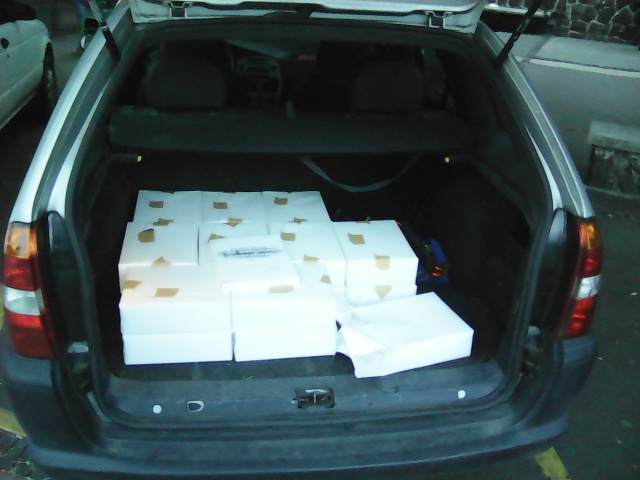
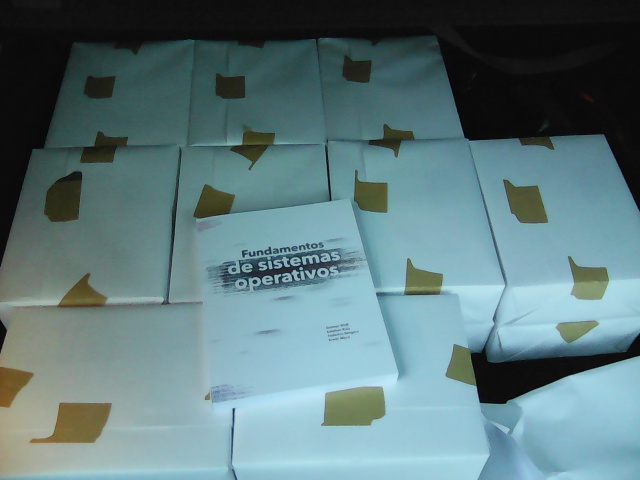
Basically everybody who knows me is aware that, basically for the last two years, I have been writing a book on Operating Systems for use in my class and, of course, in any similar class. Well, long story short, as of today: What's that in my car trunk? Lets have a closer look. Finally, Facultad de Ingenier a finished printing the book! So... Well, some minor data points: Anyway... Very happy here :D
AttachmentSize
IMG_20150812_193756.t.jpg106.36 KB
IMG_20150812_193805.t.jpg82.22 KB

Matthew Palmer: Your "Infrastructure as Code" is still code!

Whether you re a TDD zealot, or you just occasionally write a quick script to reproduce some bug, it s a rare coder who doesn t see value in some sort of automated testing. Yet, somehow, in all of the new-age Infrastructure as Code mania, we appear to have forgotten this, and the tools that are commonly used for implementing Infrastructure as Code have absolutely woeful support for developing your Infrastructure Code. I believe this has to change. At present, the state of the art in testing system automation code appears to be, spin up a test system, run the manifest/state/whatever, and then use something like serverspec or testinfra to SSH in and make sure everything looks OK . It s automated, at least, but it isn t exactly a quick process. Many people don t even apply that degree of rigour to their system config systems, and rely on manual testing, or even just doing it live! , to shake out the bugs they ve introduced. Speed in testing is essential. As the edit-build-test-debug cycle gets longer, frustration grows exponentially. If it takes two minutes to get a something went wrong report out of my tests, I m not going to run them very often. If I m not running my tests very often, then I m not likely to write tests much, and suddenly oops. Everything s on fire. In traditional software development, the unit tests are the backbone of the fast feedback cycle. You re running thousands of tests per second, ideally, and an entire test run might take 5-10 seconds. That s the sweet spot, where you can code and test in a rapid cycle of ever-increasing awesomeness. Interestingly, when I ask the users of most infrastructure management systems about unit testing, they either get a blank look on their face, or, at best, point me in the direction of the likes of Test Kitchen, which is described quite clearly as an integration platform, not a unit testing platform. Puppet has rspec-puppet, which is a pretty solid unit testing framework for Puppet manifests although it isn t widely used. Others, though nobody seems to have any ideas. The blank look is near-universal. If infrastructure developers want to be taken seriously, we need to learn a little about what s involved in the development part of the title we ve bestowed upon ourselves. This means knowing what the various types of testing are, and having tools which enable and encourage that testing. It also means things like release management, documentation, modularity and reusability, and considering backwards compatibility. All of this needs to apply to everything that is within the remit of the infrastructure developer. You don t get to hand-wave away any of this just because it s just configuration! . This goes double when your just configuration! is a hundred lines of YAML interspersed with templating directives (SaltStack, I m looking at you).

Next.

Previous.