Search Results: "az"

20 February 2015

Richard Hartmann: Release Critical Bug report for Week 08

The UDD bugs interface currently knows about the following release critical bugs: How do we compare to the Squeeze and Wheezy release cycles?
Week Squeeze Wheezy Jessie
43 284 (213+71) 468 (332+136) 319 (240+79)
44 261 (201+60) 408 (265+143) 274 (224+50)
45 261 (205+56) 425 (291+134) 295 (229+66)
46 271 (200+71) 401 (258+143) 427 (313+114)
47 283 (209+74) 366 (221+145) 342 (260+82)
48 256 (177+79) 378 (230+148) 274 (189+85)
49 256 (180+76) 360 (216+155) 226 (147+79)
50 204 (148+56) 339 (195+144) ???
51 178 (124+54) 323 (190+133) 189 (134+55)
52 115 (78+37) 289 (190+99) 147 (112+35)
1 93 (60+33) 287 (171+116) 140 (104+36)
2 82 (46+36) 271 (162+109) 157 (124+33)
3 25 (15+10) 249 (165+84) 172 (128+44)
4 14 (8+6) 244 (176+68) 187 (132+55)
5 2 (0+2) 224 (132+92) 175 (124+51)
6 release! 212 (129+83) 161 (109+52)
7 release+1 194 (128+66) 147 (106+41)
8 release+2 206 (144+62) 147 (96+51)
9 release+3 174 (105+69)
10 release+4 120 (72+48)
11 release+5 115 (74+41)
12 release+6 93 (47+46)
13 release+7 50 (24+26)
14 release+8 51 (32+19)
15 release+9 39 (32+7)
16 release+10 20 (12+8)
17 release+11 24 (19+5)
18 release+12 2 (2+0)
Graphical overview of bug stats thanks to azhag:

17 February 2015

John Goerzen: Has Linux lost its way? comments prompt a Debian developer to revisit FreeBSD after 20 years

I ll admit it. I have a soft spot for FreeBSD. FreeBSD was the first Unix I ran, and it was somewhere around 20 years ago that I did so, before I switched to Debian. Even then, I still used some of the FreeBSD Handbook to learn Linux, because Debian didn t have the great Reference that it does now. Anyhow, some comments in my recent posts ( Has modern Linux lost its way? and Reactions to that, and the value of simplicity), plus a latent desire to see how ZFS fares in FreeBSD, caused me to try it out. I installed it both in VirtualBox under Debian, and in an old 64-bit Thinkpad sitting in my basement that previously ran Debian. The results? A mixture of amazing and disappointing. I will say that I am quite glad that both exist; there is plenty of innovation happening everywhere and neat features exist everywhere, too. But I can also come right out and say that the statement that FreeBSD doesn t have issues like Linux does is false and misleading. In many cases, it s running the exact same stack. In others, it s better, but there are also others where it s worse. Perhaps this article might dispell a bit of the FUD surrounding jessie, while also showing off some of the nice things FreeBSD does. My conclusion: Both jessie and FreeBSD 10.1 are awesome Free operating systems, but both have their warts. This article is more about FreeBSD than Debian, but it will discuss a few of Debian s warts as well. The experience My initial reaction to FreeBSD was: wow, this feels so familiar. It reminds me of a commercial Unix, or maybe of Linux from a few years ago. A minimal, well-documented base system, everything pretty much in logical places in the filesystem, and solid memory management. I felt right at home. It was almost reassuring, even. Putting together a FreeBSD box is a lot of package installing and config file editing. The FreeBSD Handbook, describing how to install X, talks about editing this or that file for this or that feature. I like being able to learn directly how things fit together by doing this. But then you start remembering the reasons you didn t like Linux a few years ago, or the commercial Unixes: maybe it s that programs like apache are still not as well supported, or maybe it s that the default vi has this tendency to corrupt the terminal periodically, or perhaps it s that root s default shell is csh. Or perhaps it s that I have to do a lot of package installing and config file editing. It is not quite the learning experience it once was, either; now there are things like paste this XML file into some obscure polkit location to make your mouse work or something. Overall, there are some areas where FreeBSD kills it in a way no other OS does. It is unquestionably awesome in several areas. But there are a whole bunch of areas where it s about 80% as good as Linux, a number of areas (even polkit, dbus, and hal) where it s using the exact same stack Linux is (so all these comments about FreeBSD being so differently put together strike me as hollow), and frankly some areas that need a lot of work and make it hard to manage systems in a secure and stable way. The amazing Let s get this out there: I ve used ZFS too much to use any OS that doesn t support it or something like it. Right now, I m not aware of anything like ZFS that is generally stable and doesn t cost a fortune, so pretty much: if your Unix doesn t do ZFS, I m not interested. (btrfs isn t there yet, but will be awesome when it is.) That s why I picked FreeBSD for this, rather than NetBSD or OpenBSD. ZFS on FreeBSD is simply awesome. They have integreated it extremely well. The installer supports root on zfs, even encrypted root on zfs (though neither is a default). top on a FreeBSD system shows a line of ZFS ARC (cache) stats right alongside everything else. The ZFS defaults for maximum cache size, readahead, etc. auto-tune themselves at boot (unless overridden) based on the amount of RAM in a system and the system type. Seriously, these folks have thought of everything and it just reeks of solid. I haven t seen ZFS this well integrated outside the Solaris-type OSs. I have been using ZFSOnLinux for some time now, but it is just not as mature as ZFS on FreeBSD. ZoL, for instance, still has some memory tuning issues, and is not really suggested for 32-bit machines. FreeBSD just nails it. ZFS on FreeBSD even supports TRIM, which is not available in ZoL and I think fairly unique even among OpenZFS platforms. It also supports delegated administration of the filesystem, both to users and to jails on the system, seemingly very similar to Solaris zones. FreeBSD also supports beadm, which is like a similar tool on Solaris. This lets you basically use ZFS snapshots to make lightweight boot environments , so you can select which to boot into. This is useful, say, before doing upgrades. Then there are jails. Linux has tried so hard to get this right, and fallen on its face so many times, a person just wants to take pity sometimes. We ve had linux-vserver, openvz, lxc, and still none of them match what FreeBSD jails have done for a long time. Linux s current jail-du-jour is LXC, though it is extremely difficult to configure in a secure way. Even its author comments that you won t hear any of the LXC maintainers tell you that LXC is secure and that it pretty much requires AppArmor profiles to achieve reasonable security. These are still rather in flux, as I found out last time I tried LXC a few months ago. My confidence in LXC being as secure as, say, KVM or FreeBSD is simply very low. FreeBSD s jails are simple and well-documented where LXC is complex and hard to figure out. Its security is fairly transparent and easy to control and they just work well. I do think LXC is moving in the right direction and might even get there in a couple years, but I am quite skeptical that even Docker is getting the security completely right. The simply different People have been throwing around the word distribution with respect to FreeBSD, PC-BSD, etc. in recent years. There is an analogy there, but it s not perfect. In the Linux ecosystem, there is a kernel project, a libc project, a coreutils project, a udev project, a systemd/sysvinit/whatever project, etc. You get the idea. In FreeBSD, there is a base system project. This one project covers the kernel and the base userland. Some of what they use in the base system is code pulled in from elsewhere but maintained in their tree (ssh), some is completely homegrown (kernel), etc. But in the end, they have a nicely-integrated base system that always gets upgraded in sync. In the Linux world, the distribution makers are responsible for integrating the bits from everywhere into a coherent whole. FreeBSD is something of a toolkit to build up your system. Gentoo might be an analogy in the Linux side. On the other end of the spectrum, Ubuntu is a just install it and it works, tweak later sort of setup. Debian straddles the middle ground, offering both approaches in many cases. There are pros and cons to each approach. Generally, I don t think either one is better. They are just different. The not-quite-there I said that there are a lot of things in FreeBSD that are about 80% of where Linux is. Let me touch on them here. Its laptop support leaves something to be desired. I installed it on a few-years-old Thinkpad basically the best possible platform for working suspend in a Free OS. It has worked perfectly out of the box in Debian for years. In FreeBSD, suspend only works if it s in text mode. If X is running, the video gets corrupted and the system hangs. I have not tried to debug it further, but would also note that suspend on closed lid is not automatic in FreeBSD; the somewhat obscure instuctions tell you what policykit pkla file to edit to make suspend work in XFCE. (Incidentally, it also says what policykit file to edit to make the shutdown/restart options work). Its storage subsystem also has some surprising misses. Its rough version of LVM, LUKS, and md-raid is called GEOM. GEOM, however, supports only RAID0, RAID1, and RAID3. It does not support RAID5 or RAID6 in software RAID configurations! Linux s md-raid, by comparison, supports RAID0, RAID1, RAID4, RAID5, RAID6, etc. There seems to be a highly experimental RAID5 patchset floating around for many years, but it is certainly not integrated into the latest release kernel. The current documentation makes no mention of RAID5, although it seems that a dated logical volume manager supported it. In any case, RAID5 does not seem to be well-supported in software like it is in Linux. ZFS does have its raidz1 level, which is roughly the same as RAID5. However, that requires full use of ZFS. ZFS also does not support some common operations, like adding a single disk to an existing RAID5 group (which is possible with md-raid and many other implementations.) This is a ZFS limitation on all platforms. FreeBSD s filesystem support is rather a miss. They once had support for Linux ext* filesystems using the actual Linux code, but ripped it out because it was in GPL and rewrote it so it had a BSD license. The resulting driver really only works with ext2 filesystems, as it doesn t work with ext3/ext4 in many situations. Frankly I don t see why they bothered; they now have something that is BSD-licensed but only works with a filesystem so old nobody uses it anymore. There are only two FreeBSD filesystems that are really useable: UFS2 and ZFS. Virtualization under FreeBSD is also not all that present. Although it does support the VirtualBox Open Source Edition, this is not really a full-featured or fast enough virtualization environment for a server. Its other option is bhyve, which looks to be something of a Xen clone. bhyve, however, does not support Windows guests, and requires some hoops to even boot Linux guest installers. It will be several years at least before it reaches feature-parity with where KVM is today, I suspect. One can run FreeBSD as a guest under a number of different virtualization systems, but their instructions for making the mouse work best under VirtualBox did not work. There may have been some X.Org reshuffle in FreeBSD that wasn t taken into account. The installer can be nice and fast in some situations, but one wonders a little bit about QA. I had it lock up on my twice. Turns out this is a known bug reported 2 months ago with no activity, in which the installer attempts to use a package manger that it hasn t set up yet to install optional docs. I guess the devs aren t installing the docs in testing. There is nothing like Dropbox for FreeBSD. Apparently this is because FreeBSD has nothing like Linux s inotify. The Linux Dropbox does not work in FreeBSD s Linux mode. There are sketchy reports of people getting an OwnCloud client to work, but in something more akin to rsync rather than instant-sync mode, if they get it working at all. Some run Dropbox under wine, apparently. The desktop environments tend to need a lot more configuration work to get them going than on Linux. There s a lot of editing of polkit, hal, dbus, etc. config files mentioned in various places. So, not only does FreeBSD use a lot of the same components that cause confusion in Linux, it doesn t really configure them for you as much out of the box. FreeBSD doesn t support as many platforms as Linux. FreeBSD has only two platforms that are fully supported: i386 and amd64. But you ll see people refer to a list of other platforms that are supported , but they don t have security support, official releases, or even built packages. They includ arm, ia64, powerpc, and sparc64. The bad: package management Roughly 20 years ago, this was one of the things that pulled me to Debian. Perhaps I am spolied from running the distribution that has been the gold standard for package management for so long, but I find FreeBSD s package management even pkg-ng in 10.1-RELEASE to be lacking in a number of important ways. To start with, FreeBSD actually has two different package management systems: one for the base system, and one for what they call the ports/packages collection ( ports being the way to install from source, and packages being the way to install from binaries, but both related to the same tree.) For the base system, there is freebsd-update which can install patches and major upgrades. It also has a cron option to automate this. Sadly, it has no way of automatically indicating to a calling script whether a reboot is necessary. freebsd-update really manages less than a dozen packages though. The rest are managed by pkg. And pkg, it turns out, has a number of issues. The biggest: it can take a week to get security updates. The FreeBSD handbook explains pkg audit -F which will look at your installed packages (but NOT the ones in the base system) and alert you to packages that need to be updates, similar to a stripped-down version of Debian s debsecan. I discovered this myself, when pkg audit -F showed a vulnerability in xorg, but pkg upgrade showed my system was up-to-date. It is not documented in the Handbook, but people on the mailing list explained it to me. There are workarounds, but they can be laborious. If that s not bad enough, FreeBSD has no way to automatically install security patches for things in the packages collection. Debian has several (unattended-upgrades, cron-apt, etc.) There is pkg upgrade , but it upgrades everything on the system, which may be quite a bit more than you want to be upgraded. So: if you want to run Apache with PHP, and want it to just always apply security patches, FreeBSD packages are not up to the job like Debian s are. The pkg tool doesn t have very good error-handling. In fact, its error handling seems to be nonexistent at times. I noticed that some packages had failures during install time, but pkg ignored them and marked the package as correctly installed. I only noticed there was a problem because I happened to glance at the screen at the right moment during messages about hundreds of packages. In Debian, by contrast, if there are any failures, at the end of the run, you get a nice report of which packages failed, and an exit status to use in scripts. It also has another issue that Debian resolved about a decade ago: package scripts displaying messages that are important for the administrator, but showing so many of them that they scroll off the screen and are never seen. I submitted a bug report for this one also. Some of these things just make me question the design of pkg. If I can t trust it to accurately report if the installation succeeded, or show me the important info I need to see, then to what extent can I trust it? Then there is the question of testing of the ports/packages. It seems that, automated tests aside, basically everyone is running off the master branch of the ports/packages. That s like running Debian unstable on your servers. I am distinctly uncomfortable with this notion, though it seems FreeBSD people report it mostly works well. There are some other issues, too: FreeBSD ports make no distinction between development and runtime files like Debian s packages do. So, just by virtue of wanting to run a graphical desktop, you get all of the static libraries, include files, build scripts, etc for XOrg installed. For a package as concerned about licensing as FreeBSD, the packages collection does not have separate sections like Debian s main, contrib, and non-free. It s all in one big pot: BSD-license, GPL-license, proprietary without source license. There is /usr/local/share/licenses where you can look up a license for each package, but there is no way with FreeBSD, like there is with Debian, to say never even show me packages that aren t DFSG-free. This is useful, for instance, when running in a company to make sure you never install packages that are for personal use only or something. The bad: ABI stability I m used to being able to run binaries I compiled years ago on a modern system. This is generally possible in Linux, assuming you have the correct shared libraries available. In FreeBSD, this is explicitly NOT possible. After every major version upgrade, you must reinstall or recompile every binary on your system. This is not necessarily a showstopper for me, but it is a hassle for a lot of people. Update 2015-02-17: Some people in the comments are pointing out compat packages in the ports that may help with this situation. My comment was based on advice in the FreeBSD Handbook stating After a major version upgrade, all installed packages and ports need to be upgraded . I have not directly tried this, so if the Handbook is overstating the need, then this point may be in error. Conclusions As I said above, I found little validation to the comments that the Debian ecosystem is noticeably worse than the FreeBSD one. Debian has its warts too particularly with keeping software up-to-date. You can see that the two projects are designed around a different passion: FreeBSD s around the base system, and Debian s around an integrated whole system. It would be wrong to say that either of those is always better. FreeBSD s approach clearly produces some leading features, especially jails and ZFS integration. Yet Debian s approach also produces some leading features in the way of package management and security maintainability beyond the small base. My criticism of excessive complexity in the polkit/cgmanager/dbus area still stands. But to those people commenting that FreeBSD hasn t lost its way like Linux has, I would point out that FreeBSD mostly uses these same components also, and FreeBSD has excessive complexity in its ports/package system and system management tools. I think it s a draw. You pick the best for your use case. If you re looking for a platform to run a single custom app then perhaps all of the Debian package management benefits don t apply to you (you may not even need FreeBSD s packages, or just a few). The FreeBSD ZFS support or jails may well appeal. If you re looking to run a desktop environment, or a server with some application that needs a ton of PHP, Python, Perl, or C libraries, then Debian s package management and security handling may well be attractive. I am disappointed that Debian GNU/kFreeBSD will not be a release architecture in jessie. That project had the promise to provide a best of both worlds for those that want jails or tight ZFS integration.


16 February 2015

Vincent Sanders: To a child, often the box a toy came in is more appealing than the toy itself.

I think Allen Klein might not have been referring to me when he said that but I do seem to like creating boxes for my toys.

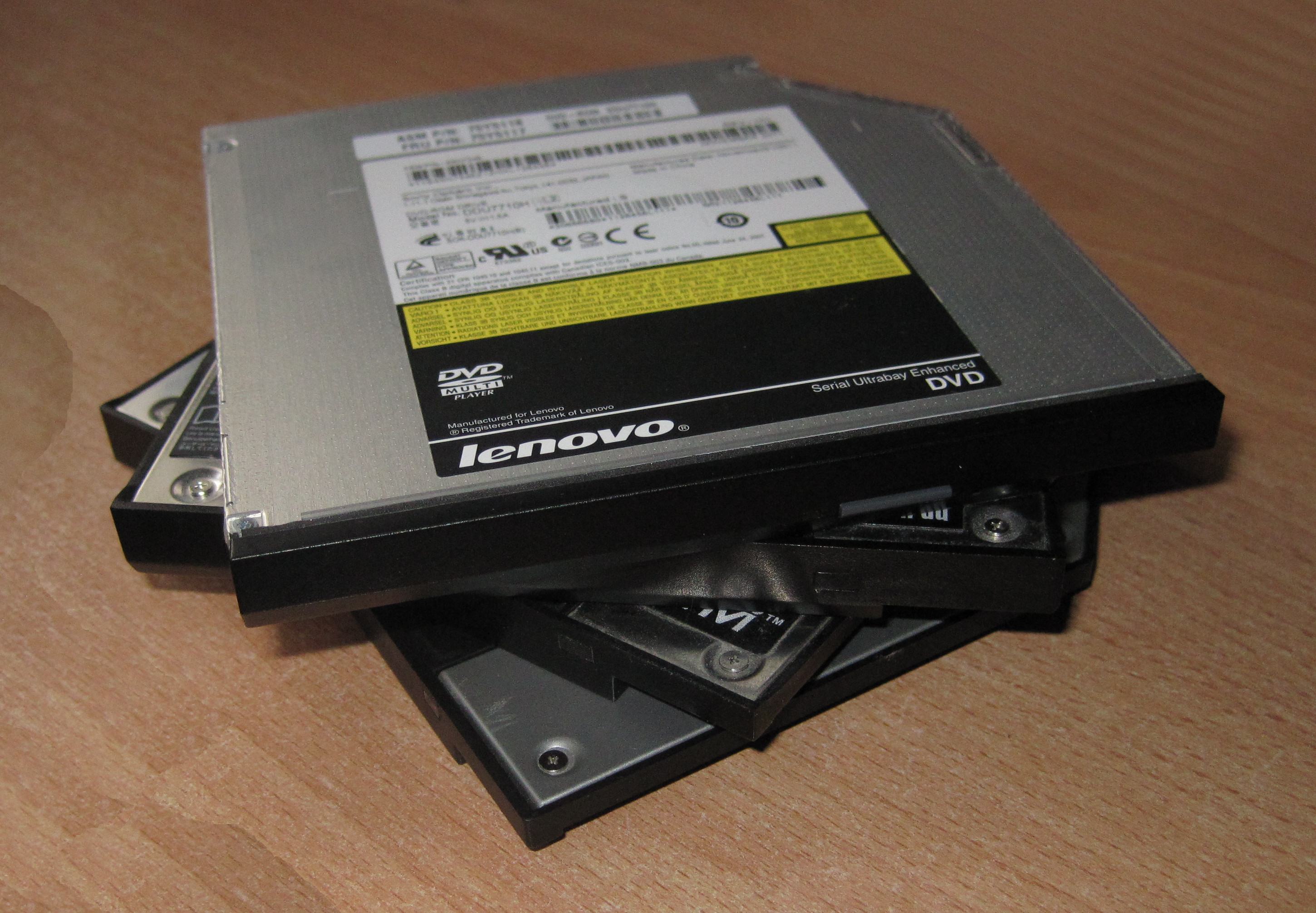
Lenovo laptop with ultrabay ejected
My Lenovo laptop has an Ultrabay, these are a way to easily swap optical and hard drives drives. They allow me to carry around additional storage and, providing I remembered to pack the drive, access optical media.
Over time I have acquired several additional hard drives housed in Ultrabay caddies. Generally I only need to access one at a time but increasingly I want to have more than one available.

Lenovo used to sell docking stations with multiple Ultrabays but since Series 3 was introduced this is no longer the case as the docks have been reduced to port replicators.

One solution is to buy a SATA to USB convertor which lets you use the drive externally. However once you have more than one drive this becomes somewhat untidy, not to mention all those unhoused drives on your desk become something of a hazard.

Recently after another close call I decided what I needed was a proper external enclosure to house all my drives. After some extensive googling I found nothing suitable ready to buy. Most normal people would give up at this point, I appear to be an abnormal person so I got the CAD package out.

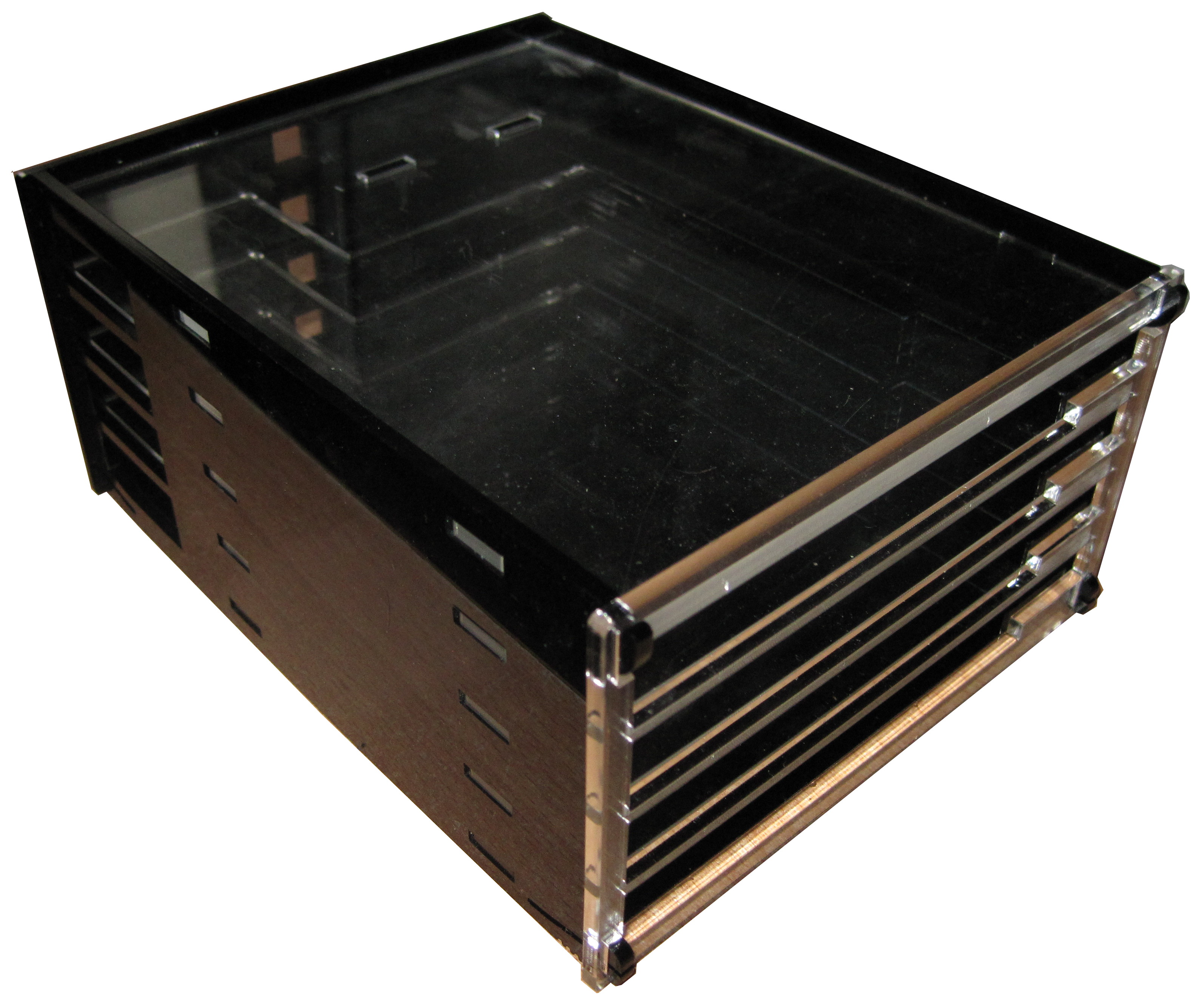
A few hours of design and a load of laser cutting later I came up with a four bay enclosure that now houses all my Ultrabay caddies.

The design was slightly evolved to accommodate the features of some older caddies and allow a pencil to be used to eject the drives (I put a square hole in the back)

The completed unit uses about 10 of plastic and takes 30 minutes to lasercut.

The only issue with the enclosure as manufactured is that Makespace ran out of black plastic stock and I had to use transparent to finish so it is not in classic black as lenovo intended.

As usual all the design files are publicly available from my design repo.

15 February 2015

Matthew Palmer: The Vicious Circle of Documentation

Ever worked at a company (or on a codebase, or whatever) where it seemed like, no matter what the question was, the answer was written down somewhere you could easily find it? Most people haven t, sadly, but they do exist, and I can assure you that it is an absolute pleasure. On the other hand, practically everyone has experienced completely undocumented systems and processes, where knowledge is shared by word-of-mouth, or lost every time someone quits. Why are there so many more undocumented systems than documented ones out there, and how can we cause more well-documented systems to exist? The answer isn t people are lazy , and the solution is simple though not easy.

Why Johnny Doesn t Read When someone needs to know something, they might go look for some documentation, or they might ask someone else or just guess wildly. The behaviour look for documentation is often reinforced negatively, by the result documentation doesn t exist . At the same time, the behaviours ask someone and guess wildly are positively reinforced, by the results I get my question answered and/or at least I can get on with my work . Over time, people optimise their behaviour by skipping the look for documentation step, and just go straight to asking other people (or guessing wildly).

Why Johnny Doesn t Write When someone writes documentation, they re hoping that people will read it and not have to ask them questions in order to be productive and do the right thing. Hence, the behaviour write documentation is negatively reinforced by the results I still get asked questions , and nobody does things the right way around here, dammit! Worse, though, is that there is very little positive reinforcement for the author: when someone does read the docs, and thus doesn t ask a question, the author almost certainly doesn t know they dodged a bullet. Similarly, when someone does things the right way, it s unlikely that anyone will notice. It s only the mistakes that catch the attention. Given that the experience of writing documentation tends to skew towards the negative, it s not surprising that eventually, the time spent writing documentation is reallocated to other, more utility-producing activities.

Death Spiral The combination of these two situations is self-reinforcing. While a suitably motivated reader might start by strictly looking for documentation, or an author initially be enthused to always fully documenting their work, over time the reflex will be for readers to just go ask someone, because there s never any documentation! , and for authors to not write documentation because nobody bothers to read what I write anyway! . It is important to recognise that this iterative feedback loop is the natural state of the reader/author ecosystem, resulting in something akin to thermodynamic entropy. To avoid the system descending into chaos, energy needs to be constantly applied to keep the system in order.

The Solution Effective methods for avoiding the vicious circle can be derived from the things that cause it. Change the forces that apply themselves to readers and authors, and they will behave differently. On the reader s side, the most effective way to encourage people to read documentation is for it to consistently exist. This means that those in control of a project or system mustn t consider something done until the documentation is in a good state. Patches shouldn t be landed, and releases shouldn t be made, unless the documentation is altered to match the functional changes being made. Yes, this requires discipline, which is just a form of energy application to prevent entropic decay. Writing documentation should be an explicit and well-understood part of somebody s job description. Whoever is responsible for documentation needs to be given the time to do it properly. Writing well takes time and mental energy, and that time needs to be factored into the plans. Never forget that skimping on documentation, like short-changing QA or customer support, is a false economy that will cost more in the long term than it saves in the short term. Even if the documentation exists, though, some people are going to tend towards asking people rather than consulting the documentation. This isn t a moral failing on their part, but only happens when they believe that asking someone is more beneficial to them than going to the documentation. To change the behaviour, you need to change the belief. You could change the belief by increasing the cost of asking. You could fire (or hellban) anyone who ever asks a question that is answered in the documentation. But you shouldn t. You could yell RTFM! at everyone who asks a question. Thankfully that s one acronym that s falling out of favour. Alternately, you can reduce the cost of getting the answer from the documentation. Possibly the largest single productivity boost for programmers, for example, has been the existence of Google. Whatever your problem, there s a pretty good chance that a search or two will find a solution. For your private documentation, you probably don t have the power of Google available, but decent full-text search systems are available. Use them. Finally, authors would benefit from more positive reinforcement. If you find good documentation, let the author know! It requires a lot of effort (comparatively) to look up an author s contact details and send them a nice e-mail. The like button is a more low-energy way of achieving a similar outcome you click the button, and the author gets a warm, fuzzy feeling. If your internal documentation system doesn t have some way to close the loop and let readers easily give authors a bit of kudos, fix it so it does. Heck, even if authors just know that a page they wrote was loaded N times in the past week, that s better than the current situation, in which deafening silence persists, punctuated by the occasional plaintive cry of Hey, do you know how to ? . Do you have any other ideas for how to encourage readers to read, and for authors to write?

13 February 2015

Richard Hartmann: Release Critical Bug report for Week 07

The UDD bugs interface currently knows about the following release critical bugs: How do we compare to the Squeeze and Wheezy release cycles?
Week Squeeze Wheezy Jessie
43 284 (213+71) 468 (332+136) 319 (240+79)
44 261 (201+60) 408 (265+143) 274 (224+50)
45 261 (205+56) 425 (291+134) 295 (229+66)
46 271 (200+71) 401 (258+143) 427 (313+114)
47 283 (209+74) 366 (221+145) 342 (260+82)
48 256 (177+79) 378 (230+148) 274 (189+85)
49 256 (180+76) 360 (216+155) 226 (147+79)
50 204 (148+56) 339 (195+144) ???
51 178 (124+54) 323 (190+133) 189 (134+55)
52 115 (78+37) 289 (190+99) 147 (112+35)
1 93 (60+33) 287 (171+116) 140 (104+36)
2 82 (46+36) 271 (162+109) 157 (124+33)
3 25 (15+10) 249 (165+84) 172 (128+44)
4 14 (8+6) 244 (176+68) 187 (132+55)
5 2 (0+2) 224 (132+92) 175 (124+51)
6 release! 212 (129+83) 161 (109+52)
7 release+1 194 (128+66) 147 (106+41)
8 release+2 206 (144+62)
9 release+3 174 (105+69)
10 release+4 120 (72+48)
11 release+5 115 (74+41)
12 release+6 93 (47+46)
13 release+7 50 (24+26)
14 release+8 51 (32+19)
15 release+9 39 (32+7)
16 release+10 20 (12+8)
17 release+11 24 (19+5)
18 release+12 2 (2+0)
Graphical overview of bug stats thanks to azhag:

11 February 2015

John Goerzen: Reactions to Has modern Linux lost its way? and the value of simplicity

Apparently I touched a nerve with my recent post about the growing complexity of issues. There were quite a few good comments, which I ll mention here. It s provided me some clarity on the problem, in fact. I ll try to distill a few more thoughts here. The value of simplicity and predictability The best software, whether it s operating systems or anything else, is predictable. You read the documentation, or explore the interface, and you can make a logical prediction that when I do action X, the result will be Y. grep and cat are perfect examples of this. The more complex the rules in the software, the more hard it is for us to predict. It leads to bugs, and it leads to inadvertant security holes. Worse, it leads to people being unable to fix things themselves one of the key freedoms that Free Software is supposed to provide. The more complex software is, the fewer people will be able to fix it by themselves. Now, I want to clarify: I hear a lot of talk about ease of use. Gnome removes options in my print dialog box to make it easier to use. (This is why I do not use Gnome. It actually makes it harder to use, because now I have to go find some obscure way to just make the darn thing print.) A lot of people conflate ease of use with ease of learning, but in reality, I am talking about neither. I am talking about ease of analysis. The Linux command line may not have pointy-clicky icons, but at least at one time once you understood ls -l and how groups, users, and permission bits interacted, you could fairly easily conclude who had access to what on a system. Now we have a situation where the answer to this is quite unclear in terms of desktop environments (apparently some distros ship network-manager so that all users on the system share the wifi passwords they enter. A surprise, eh?) I don t mind reading a manpage to learn about something, so long as the manpage was written to inform. With this situation of dbus/cgmanager/polkit/etc, here s what it feels like. This, to me, is the crux of the problem: It feels like we are in a twisty maze, every passage looks alike, and our flashlight ran out of battieries in 2013. The manpages, to the extent they exist for things like cgmanager and polkit, describe the texture of the walls in our cavern, but don t give us a map to the cave. Therefore, we are each left to piece it together little bits at a time, but there are traps that keep moving around, so it s slow going. And it s a really big cave. Other user perceptions There are a lot of comments on the blog about this. It is clear that the problem is not specific to Debian. For instance: This stuff is really important, folks. People being able to maintain their own software, work with it themselves, etc. is one of the core reasons that Free Software exists in the first place. It is a fundamental value of our community. For decades, we have been struggling for survival, for relevance. When I started using Linux, it was both a question and an accomplishment to have a useable web browser on many platforms. (Netscape Navigator was closed source back then.) Now we have succeeded. We have GPL-licensed and BSD-licensed software running on everything from our smartphones to cars. But we are snatching defeat from the jaws of victory, because just as we are managing to remove the legal roadblocks that kept people from true mastery of their software, we are erecting technological ones that make the step into the Free Software world so much more difficult than it needs to be. We no longer have to craft Modelines for X, or compile a kernel with just the right drivers. This is progress. Our hardware is mostly auto-detected and our USB serial dongles work properly more often on Linux than on Windows. This is progress. Even our printers and scanners work pretty darn well. This is progress, too. But in the place of all these things, now we have userspace mucking it up. We have people with mysterious errors that can t be easily assisted by the elders in the community, because the elders are just as mystified. We have bugs crop up that would once have been shallow, but are now non-obvious. We are going to leave a sour taste in people s mouth, and stir repulsion instead of interest among those just checking it out. The ways out It s a nasty predicament, isn t it? What are your ways out of that cave without being eaten by a grue? Obviously the best bet is to get rid of the traps and the grues. Somehow the people that are working on this need to understand that elegance is a feature a darn important feature. Sadly I think this ship may have already sailed. Software diagnosis tools like Enrico Zini s seat-inspect idea can also help. If we have something like an ls for polkit that can reduce all the complexity to something more manageable, that s great. The next best thing is a good map good manpages, detailed logs, good error messages. If software would be more verbose about the permission errors, people could get a good clue about where to look. If manpages for software didn t just explain the cavern wall texture, but explain how this room relates to all the other nearby rooms, it would be tremendously helpful. At present, I am unsure if our problem is one of very poor documentation, or is so bad that good documentation like this is impossible because the underlying design is so complex it defies being documented in something smaller than a book (in which case, our ship has not just sailed but is taking on water). Counter-argument: progress One theme that came up often in the comments is that this is necessary for progress. To a certain extent, I buy that. I get why udev is important. I get why we want the DE software to interact well. But here s my thing: this already worked well in wheezy. Gnome, XFCE, and KDE software all could mount/unmount my drives. I am truly still unsure what problem all this solved. Yes, cloud companies have demanding requirements about security. I work for one. Making security more difficult to audit doesn t do me any favors, I can assure you. The systemd angle To my surprise, systemd came up quite often in the discussion, despite the fact that I mentioned I wasn t running systemd-sysv. It seems like the new desktop environemt ecosystem is the systemd ecosystem in a lot of people s minds. I m not certain this is justified; systemd was not my first choice, but as I said in an earlier blog post, jessie will still boot . A final note I still run Debian on all my personal boxes and I m not going to change. It does awesome things. For under $100, I built a music-playing system, with Raspberry Pis, fully synced throughout my house, using a little scripting and software. The same thing from Sonos would have cost thousands. I am passionate about this community and its values. Even when jessie releases with polkit and all the rest, I m still going to use it, because it is still a good distro from good people.

Rhonda D'Vine: Zaz

It is time for some more music. This woman was introduced to me by a friend who actually understands what she sings about, because she sings in French. Regardless, her voice and feeling for music touched me deep, so today I want to present to you Zaz (homepage seems French only). Like mentioned, she sings in French, and her connection with the Chanson genre brought her (deserved) comparison with the great dith Piaf. Without further ado, here are the songs: I hope you can enjoy her as much as I do.

/music permanent link Comments: 1 Flattr this

8 February 2015

Diego Escalante Urrelo: Link Pack #06

The story of Mel Blanc being saved by Bugs Bunny
Such a fantastic and romantic story. Mel Blanc, voice of half the Looney Tunes characters was in an car crash and hanging from a thread in a comma. And it took his characters to save him. It s a very interestingly edited podcast too:
( ) a crazy story about Mel nearly dying in a crash on Dead Man s Curve on Hollywood Boulevard and about the moment two weeks later when Bugs Bunny emerged from Mel s coma before Mel did. In fact, according to neurosurgeon Louis Conway who attended to Mel at the time, it seemed as though Bugs Bunny was trying to save his life.
The audacious rescue plan that might have saved space shuttle Columbia
This is probably the best documentary/kinda fiction article I have read in a long time. It s a long read going over the hypothetical, and nail bitting, plan to rescue the Columbia if it ever got in trouble. It s really intense, and something to sit down and read fully focused, book style.
But imagine an alternate timeline for the Columbia mission in which NASA quickly realized just how devastating the foam strike had been. Could the Columbia astronauts have been safely retrieved from orbit?
Ocean Gravity: Riding sea currents
Cool video of a sea diver running through seafloor currents, really cool and fascinating :). El chavo del ocho en el infierno
This one is in Spanish, and it s a funny take on El chavo del ocho and how it follows some classic models and myths of literature. Chespirito was very fond of classics, so this would make sense. But, of course, the whole article is written on a tongue in cheek style.
En El Chavo del Ocho, Bola os, o el Camus azteca, cre su propia versi n del mito de S sifo. El chavo y compa a est n condenados a empujar por una empinada colina todos los d as esta piedra enorme que siempre regresa, obligandolos al tormento del eterno retorno. La piedra de Quico es cuadrada, no rueda, se desliza. Es c mico, a pesar de tr gico.

Go for some more Link Pack, it s sugar free

Dirk Eddelbuettel: drat Tutorial: First Steps towards Lightweight R Repositories

Now that drat is on CRAN and I got a bit of feedback (or typo corrections) in three issue tickets, I thought I could show how to quickly post such an interim version in a drat repository. Now, I obviously already have a checkout of drat. If you, dear reader, wanted to play along and create your own drat repository, one rather simple way would be to simply clone my repo as this gets you the desired gh-pages branch with the required src/contrib/ directories. Otherwise just do it by hand. Back to a new interim version. I just pushed commit fd06293 which bumps the version and date for the new interim release based mostly on the three tickets addresses right after the initial release 0.0.1. So by building it we get a new version 0.0.1.1:
edd@max:~/git$ R CMD build drat
* checking for file  drat/DESCRIPTION  ... OK
* preparing  drat :
* checking DESCRIPTION meta-information ... OK
* checking for LF line-endings in source and make files
* checking for empty or unneeded directories
* building  drat_0.0.1.1.tar.gz 
edd@max:~/git$ 
Because I want to use the drat repo next, I need to now switch from master to gh-pages; a step I am omitting as we can assume that your drat repo will already be on its gh-pages branch. Next we simply call the drat function to add the release:
edd@max:~/git$ r -e 'drat:::insert("drat_0.0.1.1.tar.gz")'
edd@max:~/git$ 
As expected, now have two updated PACKAGES files (compressed and plain) and a new tarball:
edd@max:~/git/drat(gh-pages)$ git status
On branch gh-pages
Your branch is up-to-date with 'origin/gh-pages'.
Changes not staged for commit:
  (use "git add <file>..." to update what will be committed)
  (use "git checkout -- <file>..." to discard changes in working directory)
        modified:   src/contrib/PACKAGES
        modified:   src/contrib/PACKAGES.gz
Untracked files:
  (use "git add <file>..." to include in what will be committed)
        src/contrib/drat_0.0.1.1.tar.gz
no changes added to commit (use "git add" and/or "git commit -a")
edd@max:~/git/drat(gh-pages)$
All is left to is to add, commit and push---either as I usually via the spectacularly useful editor mode, or on the command-line, or by simply adding commit=TRUE in the call to insert() or insertPackage(). I prefer to use littler's r for command-line work, so I am setting the desired repos in ~/.littler.r which is read on startup (since the recent littler release 0.2.2) with these two lines:

## add RStudio CRAN mirror
drat:::add("CRAN", "http://cran.rstudio.com")
## add Dirk's drat
drat:::add("eddelbuettel")
After that, repos are set as I like them (at home at least):
edd@max:~/git$ r -e'print(options("repos"))'
$repos
                                 CRAN                          eddelbuettel 
            "http://cran.rstudio.com" "http://eddelbuettel.github.io/drat/" 
edd@max:~/git$ 
And with that, we can just call update.packages() specifying the package directory to update:
edd@max:~/git$ r -e 'update.packages(ask=FALSE, lib.loc="/usr/local/lib/R/site-library")'                                                                                                                            
trying URL 'http://eddelbuettel.github.io/drat/src/contrib/drat_0.0.1.1.tar.gz'
Content type 'application/octet-stream' length 5829 bytes
opened URL
==================================================
downloaded 5829 bytes
* installing *source* package  drat  ...
** R
** inst
** preparing package for lazy loading
** help
*** installing help indices
** building package indices
** testing if installed package can be loaded
* DONE (drat)
The downloaded source packages are in
         /tmp/downloaded_packages 
edd@max:~/git$
and presto, a new version of a package we have installed (here the very drat interim release we just pushed above) is updated. Writing this up made me realize I need to update the handy update.r script (see e.g. the littler examples page for more) and it hard-wires just one repo which needs to be relaxed for drat. Maybe in install2.r which already has docopt support...

7 February 2015

Richard Hartmann: Release Critical Bug report for Week 06

Belated post due to meh real life situations. As you may have heard, if a package is removed from testing now, it will not be able to make it back into Jessie. Also, a lot of packages are about to be reoved for being buggy. If those are gone, they are gone. The UDD bugs interface currently knows about the following release critical bugs: How do we compare to the Squeeze and Wheezy release cycles?
Week Squeeze Wheezy Jessie
43 284 (213+71) 468 (332+136) 319 (240+79)
44 261 (201+60) 408 (265+143) 274 (224+50)
45 261 (205+56) 425 (291+134) 295 (229+66)
46 271 (200+71) 401 (258+143) 427 (313+114)
47 283 (209+74) 366 (221+145) 342 (260+82)
48 256 (177+79) 378 (230+148) 274 (189+85)
49 256 (180+76) 360 (216+155) 226 (147+79)
50 204 (148+56) 339 (195+144) ???
51 178 (124+54) 323 (190+133) 189 (134+55)
52 115 (78+37) 289 (190+99) 147 (112+35)
1 93 (60+33) 287 (171+116) 140 (104+36)
2 82 (46+36) 271 (162+109) 157 (124+33)
3 25 (15+10) 249 (165+84) 172 (128+44)
4 14 (8+6) 244 (176+68) 187 (132+55)
5 2 (0+2) 224 (132+92) 175 (124+51)
6 release! 212 (129+83) 161 (109+52)
7 release+1 194 (128+66)
8 release+2 206 (144+62)
9 release+3 174 (105+69)
10 release+4 120 (72+48)
11 release+5 115 (74+41)
12 release+6 93 (47+46)
13 release+7 50 (24+26)
14 release+8 51 (32+19)
15 release+9 39 (32+7)
16 release+10 20 (12+8)
17 release+11 24 (19+5)
18 release+12 2 (2+0)
Graphical overview of bug stats thanks to azhag:

6 February 2015

Antoine Beaupr : Migrating from Drupal to Ikiwiki

TLPL; j'ai chang de logiciel pour la gestion de mon blog. TLDR; I have changed my blog from Drupal to Ikiwiki. Note: since this post uses ikiwiki syntax (i just copied it over here), you may want to read the original version instead of this one. will continue operating for a while to
give a chance to feed aggregators to catch that article. It will also
give time to the Internet archive to catchup with the static
stylesheets (it turns out it doesn't like Drupal's CSS compression at
all!) An archive will therefore continue being available on the
internet archive for people that miss the old stylesheet. Eventually, I will simply redirect the anarcat.koumbit.org URL to
the new blog location, . This will likely be my
last blog post written on Drupal, and all new content will be
available on the new URL. RSS feed URLs should not change.

Why I am migrating away from Drupal because it is basically impossible to
upgrade my blog from Drupal 6 to Drupal 7. Or if it is, I'll have to
redo the whole freaking thing again when Drupal 8 comes along. And frankly, I don't really need Drupal to run a blog. A blog was
originally a really simple thing: a web blog. A set of articles
written on the corner of a table. Now with Drupal, I can add
ecommerce, a photo gallery and whatnot to my blog, but why would I do
that? and why does it need to be a dynamic CMS at all, if I get so
little comments? So I'm switching to ikiwiki, for the following reason:
  • no upgrades necessary: well, not exactly true, i still need to
    upgrade ikiwiki, but that's covered by the Debian package
    maintenance and I only have one patch to it, and there's no data migration! (the last such migration in ikiwiki was in 2009 and was fully supported)
  • offline editing: this is a a big thing for me: i can just note
    things down and push them when I get back online
  • one place for everything: this blog is where I keep my notes, it's
    getting annoying to have to keep track of two places for that stuff
  • future-proof: extracting content from ikiwiki is amazingly
    simple. every page is a single markdown-formatted file. that's it.
Migrating will mean abandoning the
barlow theme, which was
seeing a declining usage anyways.

What So what should be exported exactly. There's a bunch of crap in the old
blog that i don't want: users, caches, logs, "modules", and the list
goes on. Maybe it's better to create a list of what I need to extract:
  • nodes
    • title ([[ikiwiki/directive/meta]] title and guid tags, guid to avoid flooding aggregators)
    • body (need to check for "break comments")
    • nid (for future reference?)
    • tags (should be added as \[[!tag foo bar baz]] at the bottom)
    • URL (to keep old addresses)
    • published date ([[ikiwiki/directive/meta]] date directive)
    • modification date ([[ikiwiki/directive/meta]] updated directive)
    • revisions?
    • attached files
  • menus
    • RSS feed
    • contact
    • search
  • comments
    • author name
    • date
    • title
    • content
  • attached files
    • thumbnails
    • links
  • tags
    • each tag should have its own RSS feed and latest posts displayed

When Some time before summer 2015.

Who Well me, who else. You probably really don't care about that, so let'S
get to the meat of it.

How How to perform this migration... There are multiple paths:
  • MySQL commandline: extracting data using the commandline mysql tool (drush sqlq ...)
  • Views export: extracting "standard format" dumps from Drupal and
    parse it (JSON, XML, CSV?)
Both approaches had issues, and I found a third way: talk directly to
mysql and generate the files directly, in a Python script. But first,
here are the two previous approaches I know of.

MySQL commandline LeLutin switched using MySQL requests,
although he doesn't specify how content itself was migrated. Comments
importing is done with that script:
echo "select n.title, concat('  [[!comment  format=mdwn  username=\"', c.name, '\"  ip=\"', c.hostname, '\"  subject=\"', c.subject, '\"  date=\"', FROM_UNIXTIME(c.created), '\"  content=\"\"\" ', b.comment_body_value, ' \"\"\"]]') from node n, comment c, field_data_comment_body b where n.nid=c.nid and c.cid=b.entity_id;"   drush sqlc   tail -n +2   while read line; do if [ -z "$i" ]; then i=0; fi; title=$(echo "$line"   sed -e 's/[    ]\+ .*//' -e 's/ /_/g' -e 's/[:(),?/+]//g'); body=$(echo "$line"   sed 's/[^ ]*  //'); mkdir -p ~/comments/$title; echo -e "$body" &gt; ~/comments/$title/comment_$i._comment; i=$((i+1)); done
Kind of ugly, but beats what i had before (which was "nothing"). I do think it is the good direction to take, to simply talk to the
MySQL database, maybe with a native Python script. I know the Drupal
database schema pretty well (still! this is D6 after all) and it's
simple enough that this should just work.

Views export [[!img 2015-02-03-233846_1440x900_scrot.png class="align-right" size="300x" align="center" alt="screenshot of views 2.x"]] mvc recommended views data export on Lelutin's
blog. Unfortunately, my experience with the views export interface has
been somewhat mediocre so far. Yet another reason why I don't like
using Drupal anymore is this kind of obtuse dialogs: I clicked through those for about an hour to get JSON output that
turned out to be provided by views bonus instead of
views_data_export. And confusingly enough, the path and
format_name fields are null in the JSON output
(whyyy!?). views_data_export unfortunately only supports XML,
which seems hardly better than SQL for structured data, especially
considering I am going to write a script for the conversion anyways. Basically, it doesn't seem like any amount of views mangling will
provide me with what i need. Nevertheless, here's the [[failed-export-view.txt]] that I was able to
come up with, may it be useful for future freedom fighters.

Python script I ended up making a fairly simple Python script to talk directly to
the MySQL database. The script exports only nodes and comments, and nothing else. It makes
a bunch of assumptions about the structure of the site, and is
probably only going to work if your site is a simple blog like mine,
but could probably be improved significantly to encompass larger and
more complex datasets. History is not preserved so no interaction is
performed with git.

Generating dump First, I imported the MySQL dump file on my local mysql server for easier
development. It is 13.9MiO!!
mysql -e 'CREATE DATABASE anarcatblogbak;'
ssh aegir.koumbit.net "cd anarcat.koumbit.org ; drush sql-dump"   pv   mysql anarcatblogbak
I decided to not import revisions. The majority (70%) of the content has
1 or 2 revisions, and those with two revisions are likely just when
the node was actually published, with minor changes. ~80% have 3
revisions or less, 90% have 5 or less, 95% 8 or less, and 98% 10 or
less. Only 5 articles have more than 10 revisions, with two having the
maximum of 15 revisions. Those stats were generated with:
SELECT title,count(vid) FROM anarcatblogbak.node_revisions group
by nid;
Then throwing the output in a CSV spreadsheet (thanks to
mysql-workbench for the easy export), adding a column numbering the
rows (B1=1,B2=B1+1), another for generating percentages
(C1=B1/count(B$2:B$218)) and generating a simple graph with
that. There were probably ways of doing that more cleanly with R,
and I broke my promise to never use a spreadsheet again, but then
again it was Gnumeric and it's just to get a rough idea. There are 196 articles to import, with 251 comments, which means an
average of 1.15 comment per article (not much!). Unpublished articles
(5!) are completely ignored. Summaries are also not imported as such (break comments are
ignored) because ikiwiki doesn't support post summaries.

Calling the conversion script The script is in [[drupal2ikiwiki.py]]. It is called with:
./drupal2ikiwiki.py -u anarcatblogbak -d anarcatblogbak blog -vv
The -n and -l1 have been used for first tests as well. Use this
command to generate HTML from the result without having to commit and
push all:
ikiwiki --plugin meta --plugin tag --plugin comments --plugin inline  . ../anarc.at.html
More plugins are of course enabled in the blog, see the setup file for
more information, or just enable plugin as you want to unbreak
things. Use the --rebuild flag on subsequent runs. The actual
invocation I use is more something like:
ikiwiki --rebuild --no-usedirs --plugin inline --plugin calendar --plugin postsparkline --plugin meta --plugin tag --plugin comments --plugin sidebar  . ../anarc.at.html
I had problems with dates, but it turns out that I wasn't setting
dates in redirects... Instead of doing that, I started adding a
"redirection" tag that gets ignored by the main page.

Files and old URLs The script should keep the same URLs, as long as pathauto is enabled
on the site. Otherwise, some logic should be easy to add to point to
node/N. To redirect to the new blog, rewrite rules, on original blog, should
be as simple as:
Redirect / http://anarc.at/blog/
When we're sure:
Redirect permanent / http://anarc.at/blog/
Now, on the new blog, some magic needs to happen for files. Both
/files and /sites/anarcat.koumbit.org/files need to resolve
properly. We can't use symlinks because
ikiwiki drops symlinks on generation. So I'll just drop the files in /blog/files directly, the actual
migration is:
cp $DRUPAL/sites/anarcat.koumbit.org/files $IKIWIKI/blog/files
rm -r .htaccess css/ js/ tmp/ languages/
rm foo/bar # wtf was that.
rmdir *
sed -i 's#/sites/anarcat.koumbit.org/files/#/blog/files/#g' blog/*.mdwn
sed -i 's#http://anarcat.koumbit.org/blog/files/#/blog/files/#g' blog/*.mdwn
chmod -R -x blog/files
sudo chmod -R +X blog/files
A few pages to test images:
  • http://anarcat.koumbit.org/node/157
  • http://anarcat.koumbit.org/node/203
There are some pretty big files in there, 10-30MB MP3s - but those are
already in this wiki! so do not import them! Running fdupes on the result helps find oddities. The meta guid directive is used to keep the aggregators from finding
duplicate feed entries. I tested it with Liferea, but it may freak out
some other sites.

Remaining issues
  • postsparkline and calendar archive disrespect meta(date)
  • merge the files in /communication with the ones in /blog/files
    before import
  • import non-published nodes
  • check nodes with a format different than markdown (only a few 3=Full
    HTML
    found so far)
  • replace links to this wiki in blog posts with internal links
More progress information in [[the script drupal2ikiwiki.py]] itself.

Daniel Pocock: Lumicall's 3rd Birthday

Today, 6 February, is the third birthday of the Lumicall app for secure SIP on Android. Happy birthday Lumicall's 1.0 tag was created in the Git repository on this day in 2012. It was released to the Google Play store, known as the Android Market back then, while I was in Brussels, the day after FOSDEM. Since then, Lumicall has also become available through the F-Droid free software marketplace for Android and this is the recommended way to download it. An international effort Most of the work on Lumicall itself has taken place in Switzerland. Many of the building blocks come from Switzerland's neighbours:
  • The ice4j ICE/STUN/TURN implementation comes from the amazing Jitsi softphone, which is developed in France.
  • The ZORG open source ZRTP stack comes from PrivateWave in Italy
  • Lumicall itself is based on the Sipdroid project that has a German influence, while Sipdroid is based on MjSIP which comes out of Italy.
  • The ENUM dialing logic uses code from ENUMdroid, published by Nominet in the UK. The UK is not exactly a neighbour of Switzerland but there is a tremendous connection between the two countries.
  • Google's libPhoneNumber has been developed by the Google team in Zurich and helps Lumicall format phone numbers for dialing through international VoIP gateways and ENUM.
Lumicall also uses the reSIProcate project for server-side infrastructure. The repro SIP proxy and TURN server run on secure and reliable Debian servers in a leading Swiss data center. An interesting three years for free communications Free communications is not just about avoiding excessive charges for phone calls. Free communications is about freedom. In the three years Lumicall has been promoting freedom, the issue of communications privacy has grabbed more headlines than I could have ever imagined. On 5 June 2013 I published a blog about the Gold Standard in Free Communications Technology. Just hours later a leading British newspaper, The Guardian, published damning revelations about the US Government spying on its own citizens. Within a week, Edward Snowden was a household name. Google's Eric Schmidt had previously told us that "If you have something that you don't want anyone to know, maybe you shouldn't be doing it in the first place.". This statement is easily debunked: as CEO of a corporation listed on a public stock exchange, Schmidt and his senior executives are under an obligation to protect commercially sensitive information that could be used for crimes such as insider trading. There is no guarantee that Lumicall will keep the most determined NSA agent out of your phone but nonetheless using a free and open source application for communications does help to avoid the defacto leakage of your conversations to a plethora of marketing and profiling companies that occurs when using a regular phone service or messaging app. How you can help free communications technology evolve As I mentioned in my previous blog on Lumicall, the best way you can help Lumicall is by helping the F-Droid team. F-Droid provides a wonderful platform for distributing free software for Android and my own life really wouldn't be the same without it. It is a privilege for Lumicall to be featured in the F-Droid eco-system. That said, if you try Lumicall and it doesn't work for you, please feel free to send details from the Android logs through the Lumicall issue tracker on Github and they will be looked at. It is impossible for Lumicall developers to test every possible phone but where errors are obvious in the logs some attempt can be made to fix them. Beyond regular SIP Another thing that has emerged in the three years since Lumicall was launched is WebRTC, browser based real-time communications and VoIP. In its present form, WebRTC provides tremendous opportunities on the desktop but it does not displace the need for dedicated VoIP apps on mobile handsets. WebRTC applications using JavaScript are a demanding solution that don't integrate as seamlessly with the Android UI as a native app and they currently tend to be more intensive users of the battery. Lumicall users can receive calls from desktop users with a WebRTC browser using the free calling from browser to mobile feature on the Lumicall web site. This service is powered by JSCommunicator and DruCall for Drupal.

4 February 2015

Tiago Bortoletto Vaz: Raspberry Pi Foundation moving away from its educational mission?

From the news:
"...we want to make Raspberry Pi more open over time, not less."
Right.
"For the last six months we ve been working closely with Microsoft to bring the forthcoming Windows 10 to Raspberry Pi 2"
Hmmm... From a comment:
I m sad to see Windows 10 as a selling point though. This community should not be supporting restrictive proprietary software The Pi is about tinkering and making things while Microsoft is about marketing and spying.
Right. From an answer:
"But I suggest you rethink your comments about MS, spying is going a bit far, don t you think?"
Wrong.

3 February 2015

Mike Hommey: Looking for a new project name for git-remote-hg

If you ve been following this blog, you know I ve been working on a (fast) git remote helper to access mercurial without a local mercurial clone, with the main goal to make it work for Gecko developers. The way git remote helpers work forces how their executable is named: For a foo:: remote prefix, the executable must be named git-remote-foo. So for hg::, it s git-remote-hg. As you may know, there already exists a project with that name. And when I picked the name for this new helper, I didn t really care to find a separate name, especially considering its prototype nature. Now that I m satisfied enough with it that I m close to release it with a version number (which will be 0.1.0), I m thinking that the confusion with the other project with that name is not really helpful, and an unfortunate implementation detail. So I m looking for a new project name and have no good idea. Dear lazy web, do you have good ideas?

31 January 2015

John Goerzen: Home Automation, part 2: Z-Wave and ISY programming

In my part 1 post yesterday, I wrote about the start of the home automation project. I mentioned that I was using Insteon switches, and they mostly were working well (I forgot to mention an annoyance: you can dim, but not totally shut off, their LED status light.) Anyhow, the Insteon battery-operated sensors seem to not be as good as their Z-Wave competition. Setting up Z-Wave Z-Wave devices get joined to the Z-Wave network in much the same way Bluetooth devices get paired with each other. The first time you use a Z-Wave device, you join it to the controller. The controller assigns it an ID on your network, and both devices discover the best route to communicate with each other. I discovered that the Z-Wave module on the ISY-994i has particularly poor reception. Combined with the generally short range of battery-operated Z-wave devices, this meant that my sensors didn t work reliably. As with Insteon, AC-powered Z-wave devices tend to be repeaters, but I didn t have any AC-powered Z-wave devices. I went looking for Z-wave repeaters, and found some. But then I discovered that a Z-wave relay-based appliance switch was actually $5 cheaper, acted as a repeater, and could be used as a switch down the road if needed. A couple of those solved my communications issues. You join them to the network as usual, but then either re-join the battery-powered sensors (so they see the new route) or do a network heal (every device on the network re-learns about its neighbors and routes to the other devices) so they see the new route. Z-Wave Motion / Occupancy Sensors If you have been in new buildings, chances are you have seen light switches with built-in occupancy sensors. My doctor s office has these. They are typically the same size as a regular light switch, but with a passive infrared (PIR) motion sensor used to automatically turn the lights off after a timeout (or even on, when someone walks into the room.) These work fine for small rooms, but if you ve ever been in a bathroom with a PIR lightswitch that goes off while you re still in the room, you are aware of their faults for larger rooms! Most of the time, when you read about occupancy sensors , it s really a PIR sensor, and the term is used interchangeably with motion detector. Motion detectors in home automation systems are commonly used for a number of purposes: detecting occuption of rooms for automatic control of lighting or HVAC systems, triggering alerts, or even locking or unlocking doors. My friend told me he had poor luck with the Insteon PIR sensors, so I tried two different Z-Wave models: the $48 Aeon/Aeotec multi-sensor and the $30 Ecolink PIRZWAVE2-ECO. The Aeon device is clearly the more capable; it can be used indoors or out, and has a lot of options that can be configured by Z-Wave configuration parameters. It also has a ball/socket mount, so it can be easily aimed in different directions. It can draw power from 4 AAA batteries, or a mini USB cable (cable, but not power supply, included). The Aeon multi-sensor also has a temperature, humidity, and illumination (lux) sensor but, as you ll see, they have some drawbacks. The Ecolink device is more basic; it has a few settings that can be altered via jumpers, but none that can be altered via Z-Wave configuration commands. That makes it a bit of a hassle, since you have to open it up to change, and when you do, it triggers a tamper alarm that is both undocumented and never seems to go away. It is powered by a single CR123A 3V Lithium battery, which are about $2 each on Amazon. Both units have a default PIR timeout of 4 minutes. That means that after sensing motion, they will transmit the on signal (meaning motion detected) and then transmit no further signals for at least 4 minutes. This is because operating the radio consumes far more battery power than simply monitoring the PIR sensor, and it cuts down on repeated on/off transmissions. In this configuration, both units should have battery life of 6 months to a year, I figure, with an edge for the Ecolink, perhaps. Both can also be configured to transmit more frequently; the Ecolink has a jumper that can change its timeout to 10 seconds, whereas the Aeon can be configured over Z-Wave for any timeout between 10 seconds and 65535 seconds (values above 4 minutes are rounded to the nearest minute, for some reason.) Both also have adjustable sensitivity; on the Aeon this is via an adjustment knob, and on the Ecolink it s via jumpers. And both can report their battery level to enable software alerts when it s getting low. The Aeon ships with its temperature, humidity, battery, and lux sensors disabled. This appears to be the cause of much confusion online, as they send one transmission and then no more. Sadly, one has to resort to the hard-to-find but very helpful MultiSensor engineering spec document to figure out the way to enable those sensors and set their interval. (It must be said, however, that I doubt most consumers will understand how to set bitfields, and this is either not covered or covered incorrectly in their other manuals.) This can be a real power drain, so I just set it to report battery level every 6 hours (so I can alert myself if it gets low) and leave it at that. The Ecolink manual claims a detection radius of 39 feet and a total angle of 90deg (45deg left or right from center) and a 3-year battery life (I m skeptical). It also is rated for indoor use only. Aeotec claims a detection radius of 16 feet and a total angle of 120 deg. Be skeptical of all these figures. Once set up with good reception, both devices have been working fine. Programming the controller The ISY-994i-Zw Pro controller I mentioned in Part 1 has its own sort of programming language. It s a lot better than the sort of GUI clicky mess that is found in most of these things, but it still has a sort of annoying Java-based editor where you select keywords from a menu and such. Although you can backup and restore the device, and import and export the programs, the file formats are XML and not really suitable for hand-editing. Sigh. The language is limited, but gets the job done. Here is a simple program that turns off the fan in a bathroom 30 minutes after the light was turned off:
If
        Status  '1st Floor / Bathroom + Laundry / Main Bath Fan' is On
    And Status  '1st Floor / Bathroom + Laundry / Main Bath Light' is Off
 
Then
        Wait  30 minutes 
        Set '1st Floor / Bathroom + Laundry / Main Bath Fan' Off
 
Else
   - No Actions - (To add one, press 'Action')
The if/then/else clauses should probably be more properly called when/do/finally. The if clauses are evaluated whenever a relevant event occurs. If the If evaluates to true, if executes the Then section. The program in Then is uninterruptible except for wait and repeat statements. So in this case, the program begins, and if the light stays off and the fan stays on, 30 minutes later it turns off the fan. But if the light comes back on, the program aborts (since there is nothing in else ). Similarly, if the fan goes off, the program aborts. A more complicated example: motion-activated lamp There is a table lamp in our living room controlled by Insteon. By adding a motion sensor in that room, it can be automatically turned on by someone walking through the room. Now, to be useful, I don t want it to turn on during the day. I also don t want it to turn on or adjust itself if other lights are on in the room, or if I turned it on myself; that could cause it to go on and off while I m watching TV, for instance. It s just to be helpful at night. Because the ISY-994i is pretty limited, having almost no control flow operations, this as with many tasks requires several programs . First, here s my main :
If
        Status  '1st Floor / Living + Dining Room / LR Table Lamp' is Off
    And $LR_Lamp_Lockout is 0
    And Status  '1st Floor / Living + Dining Room / ZW 005 Binary Sensor' is On
    And From    Sunset 
        To      Sunrise (next day)
    And $LR_Lamp_Motion_Working is not 0
    And Status  '1st Floor / Living + Dining Room / LR Floor Lamp' is Off
    And Status  '1st Floor / Living + Dining Room / Dining Light' is Off
    And Status  '1st Floor / Living + Dining Room / LR Light' is Off
 
Then
        Set '1st Floor / Living + Dining Room / LR Table Lamp' 22%
        Set '1st Floor / Living + Dining Room / LR S Remote (Table Lamp)' 22%
 
Else
   - No Actions - (To add one, press 'Action')
So, let s look at the conditions. This program triggers if the lamp is off, the sensor is on, the time is between sunset and sunrise, and three other lights are off. (I will explain the lockout and motion_working variables later). If this is the case, it sets the lamp to 22% (and also informs the wall switch for it that the lamp is at 22%). I pick this precise value because it is unlikely I would manually set it via the wall switch, and therefore lamp is 22% bright doubles as a lamp was turned on by this program flag. So this is the turning the lamp on bit. Let s look at the program that turns it back off later:
If
        Status  '1st Floor / Living + Dining Room / LR Table Lamp' is 22%
    And (
             Status  '1st Floor / Living + Dining Room / ZW 005 Binary Sensor' is Off
          Or $LR_Lamp_Motion_Working is 0
          Or Status  '1st Floor / Living + Dining Room / LR Light' is not Off
          Or Status  '1st Floor / Living + Dining Room / LR Floor Lamp' is not Off
          Or Status  '1st Floor / Living + Dining Room / Dining Light' is not Off
        )
 
Then
        Wait  15 seconds
        Set '1st Floor / Living + Dining Room / LR S Remote (Table Lamp)' Off
        Set '1st Floor / Living + Dining Room / LR Table Lamp' Off
 
Else
   - No Actions - (To add one, press 'Action')
 
This is using a sensor with a 4-minute timeout, so the lamp will always be on for at least 4 minutes and 15 seconds. This program runs if the lamp is still at the program-set level (so if, for instance, I turned the lamp full on, the program does nothing to override my setting.) Then, it looks for a condition to trigger turning the lamp off, which could be any of the sensor indicating no more motion, another program detecting it s lost communication with the sensor, or somebody turning on one of the bigger lights in the room. Then it simply sets the light (and the wall switch controlling it) to off. There are a couple more bits to this puzzle. What if the system turned the lamp on, but I really want it off? If I walked up to the wall switch and pushed off , the lamp would go off. And then, a couple seconds later, come back on, since the state of the system met the conditions for the lamp-on program. So we need a lockout that prevents this from happening. Here s my trigger lockout program:
If
        Control '1st Floor / Living + Dining Room / LR Table Lamp' is switched Off
     Or Control '1st Floor / Living + Dining Room / LR Table Lamp' is switched Fast Off
     Or Control '1st Floor / Living + Dining Room / LR S Remote (Table Lamp)' is switched Fast Off
     Or Control '1st Floor / Living + Dining Room / LR S Remote (Table Lamp)' is switched Off
 
Then
        $LR_Lamp_Lockout += 1
        Run Program 'LR Lamp Clear Lockout' (If)
 
Else
   - No Actions - (To add one, press 'Action') 
So if someone pushes the off button at the lamp switch box at the outlet it s plugged into (unlikely), or at the wall switch, it increments the lockout variable and runs another program. This other program is unique in that it is flagged disabled , meaning it is never run automatically by the system, only when called by another program. Here s the clear lockout program:
If
        $LR_Lamp_Lockout > 0
 
Then
        Wait  5 minutes 
        $LR_Lamp_Lockout  = 0
 
Else
   - No Actions - (To add one, press 'Action')
Thus by pushing the off button on the switch, the motion-triggered program won t turn the lamp back on for at least 5 minutes. Before I had reliable Z-Wave communication to the device, I had some times where it would simply drop off the Z-Wave network until a reboot. This was particularly annoying if it occured after having detected motion, since the state of the sensor in the ISY controller is simply whatever state it last received. Therefore, I wrote this program to check if it believes the motion sensor is working:
If
        Status  '1st Floor / Living + Dining Room / ZW 005 Binary Sensor' is On
 
Then
        $LR_Lamp_Motion_Working  = 1
        Wait  1 hour 
        $LR_Lamp_Motion_Working  = 0
 
Else
        $LR_Lamp_Motion_Working  = 1
We don t really care if the motion sensor is broken when the status is off; all that happens then is no lamp turns on. So this program activates when the status is set to on. It flips the working flag to true, then waits for an hour. If the sensor shows no motion within that hour, the program skips to the else (keeping the flag true). But if it is still on after an hour, it decides it must not be working and sets the working flag to false. You can see that flag used in the other programs logic. But because of the Else, which is run whenever the conditions that caused the Then clause to run become false, as soon as the system receives no motion , it will flag the sensor as working again. The final piece to this puzzle is a program flagged to run at boot time of the controller:
If
   - No Conditions - (To add one, press 'Schedule' or 'Condition')
 
Then
        $LR_Lamp_Motion_Working  = 1
 
Else
   - No Actions - (To add one, press 'Action')
This simply initializes the motion working variable to a known state. Keypads The Insteon KeypadLinc is a nice device. It can control a single load directly, but all 8 buttons are fully responsive in the Insteon system. They each also have individually-addressible LED backlights. They are commonly used to do things like ALL OFF , TV (to set lights for watching TV), AWAY (to set the system for everyone being out of the house for awhile), etc. They are the size of a regular Decora switch, and I have installed one already, but haven t programmed much of it yet. REST API The ISY has an extensive REST API, which I ve used to integrate it a bit with my Debian systems. More on that another time. Mobile app Mobile apps are a common thing people look for in these systems. You can t use the Insteon app with the ISY, but they recommend Mobilinc Pro. It does the job. Mobilinc tries to sell a $10/mo connection service, which is totally unnecessary if you can figure out SSL, and has on-screen buttons to bypass, but judging by the Google Play reviews, a lot of people thought they had to pay for that and uninstalled it afterwards. Future directions Many people put in electronic door locks. I don t plan to do that. I do plan to have the house systems be aware of the general state of things (is the house empty? is everyone asleep?) and do appropriate things with lighting and HVAC. I don t really expect the savings in power for lighting control to pay for the system anytime soon. However, if it can achieve some savings in heating and cooling, it may well be able to pay for itself in a few years. So my big next step is thermostats that can integrate with all this. I have had a water mess in my basement before, and water leak sensors are a very common item people deploy in these setups. I certainly plan to add a few of them. Door-open sensors are also useful; they trigger more instantly and reliably than motion detectors and can be used in some nice ways (is it after dark and the door is opening when the house is vacant? If so, turn on the light nearby in case their hands are full.) Issues Some issues I ran into so far are already discussed above. One other major one involves SSL on the ISY-994i Pro. The method for adding SSL keys is cumbersome, but the processor on the device which appears to run some sort of Java is just not up to working with SSL. Apparently they only recently got it fast enough to work with 2048-bit keys. This is rather undocumented, though, so I obtained a cert for a 4096-bit key, my usual. Attempting to connect to the box with SSL appeared to hang not just that but confuse a lot of other things on it as well. Turned out it wasn t hung; it just too a minute and 45 seconds to complete the SSL handshake. Moral of the story: use 2048-bit keys, or stunnel4 or some such to re-wrap the SSL communications with a stronger key. The KeypadLinc backlights can be completely shut off, and both their on and off levels can be customized. I have it set to shut off the backlight during the day and turn it on at night. The wall switches, however, can t have their brightness status LED bar entirely shut off. They can be made dim, but don t ever go away. That s rather annoying. Also annoying is that Insteon doesn t make switches in the traditional toggle switch style in colors other than white. As our house had mostly black switches, I was forced into the Decora style. Overall thoughts This has been a great learning experience for me in a number of ways. I have only begun to tap what the system can do, and the real benefits will probably come once I get the heating and cooling into the mix. It s quite a nice way for a geek to go, and the improvements in lighting have also been popular with everyone else in the house.

John Goerzen: First Steps with Home Automation and LED Lighting

I ve been thinking about home automation automating lights, switches, thermostats, etc. for years. Literally decades, in fact. When I was a child, my parents had a RadioShack X10 control module and one or two target devices. I think I had fun giving people a light show turning on or off one switch and one outlet remotely. But I was stuck there are a daunting number of standards for home automation these days. Zigbee, UPB, Z-Wave, Insteon, and all sorts of Wifi-enabled things that aren t really compatible with each other (hellooooo, Nest) or have their own ecosystem that isn t all that open (helloooo, Apple). Frankly I don t think that Wifi is a great home automation protocol; its power drain completely prohibits it being used in a lot of ways. Earlier this month, my awesome employer had our annual meeting and as part of that our technical teams had some time for anyone to talk about anything geeky. I used my time to talk about flying quadcopters, but two of my colleagues talked about home automation. I had enough to have a place to start, and was hooked. People use these systems to do all sorts of things: intelligently turn off lights when rooms aren t occupied, provide electronic door locks (unlockable via keypad, remote, or software), remote control lighting and heating/cooling via smartphone apps, detect water leakage, control switches with awkward wiring environments, buttons to instantly set multiple switches to certain levels for TV watching, turning off lights left on, etc. I even heard examples of monitoring a swamp cooler to make sure it is being used correctly. The possibilities are endless, and my geeky side was intrigued. Insteon and Z-Wave Based on what I heard from my colleagues, I decided to adopt a hybrid network consisting of Insteon and Z-Wave. Both are reliable protocols (with ACKs and retransmit), so they work far better than X10 did. Both have all sorts of controls and sensors available (browse around on smarthome.com for some ideas). Insteon is a particularly interesting system an integrated dual-mesh network. It has both powerline and RF signaling, and most hardwared Insteon devices act as repeaters for both the wired and RF network simultaneously. Insteon packets contain a maximum hop count that is decremented after each relay, and the packets repeat in such as way that they collide and strengthen one another. There is no need to maintain routing tables or anything like that; it simply scales nicely. This system addresses all sorts of potential complexities. It addresses the split-phase problem of powerline-only systems, but using an RF bridge. It addresses long distances and outbuildings by using the powerline signaling. I found it to work quite well. The downside to Insteon is that all the equipment comes from one vendor: Insteon. If you don t like their thermostat or motion sensor, you don t have any choice. Insteon devices can be used entirely without a central controller. Light switches can talk to each other directly, and you can even set them up so that one switch controls dozens of others, if you have enough patience to go around your house pressing tiny set buttons. Enter Z-Wave. Z-Wave is RF-only, and while it is also a mesh network, it is source-routed, meaning that if you move devices around, you have to heal your network as all your nodes have to re-learn the path to each other. It also doesn t have the easy distance traversal of Insteon, of course. On the other hand, hundreds of vendors make Z-Wave products, and they mostly interoperate well. Z-Wave is said to scale practically to maybe two or three dozen devices, which would have been an issue for me, buut with Insteon doing the heavy lifting and Z-Wave filling in the gaps, it s worked out well. Controlling it all While both Insteon (and, to a certain extent, Z-Wave) devices can control each other, to really spread your wings, you need more centralized control. This lets you have programs that do things like if there s motion in the room on a weekday and it s dark outside, then turn on a light, and turn it back off 5 minutes later. Insteon has several options. One, you can buy their power line modem (PLM). This can be hooked up to a PC to run either Insteon s proprietary software, or something open-source like MisterHouse, written in Perl. Or you can hook it up to a controller I ll mention in a minute. Those looking for a fairly simpe controller might get the Insteon 2242-222 Hub, which has the obligatory smartphone app and basic schedules. For more sophisticated control, my friend recommended the ISY-994i controller. Not only does it have a lot more capable programming language (though still frustrating), it supports both Insteon and Z-Wave in an integrated box, and has a comprehensive REST API for integrating with other things. I went this route. First step: LED lighting I began my project by replacing my light bulbs with LEDs. I found that I could get Cree 4-Flow 60W equivs for $10 at Home Depot. They are dimmable, a key advantage over CFL, and also maintain their brightness throughout their life far better. As I wanted to install dimmer switches, I got a combination of Cree 60W bulbs, Cree TW bulbs (which have a better color spectrum coverage for more true colors), and Cree 100W equiv bulbs for places I needed more coverage. I even put in a few LED flood lights to replace my can lights. Overall I was happy with the LEDs. They are a significant improvement over the CFLs I had been using, and use even less power to boot. I have had issues with three Cree bulbs, though: one arrived broken, and two others have had issues such as being quite dim. They have a good warranty, but it seems their QA could be better. Also, they can have a tendency to flickr when dimmed, though this plagues virtually all LED bulbs. I had done quite a bit of research. CNET has some helpful brightness guides, and Insteon has a color temperature chart. CNET also had a nifty in-depth test of LED bulbs. Second step: switches Once the LED bulbs were in place, I was then able to start installing smart switches. I picked up Insteon s basic switch, the SwitchLinc 2477D at Menard s. This is a dimmable switch and requires a neutral wire in the box, but acts as a dual-band repeater for the system as well. The way Insteon switches work, they can be standalone, or controllers, responders, or both in a scene . A scene is where multiple devices act together. You can create virtual 3-way switches in a scene, or more complicated things where different lights are turned on at different levels. Anyhow, these switches worked out quite well. I have a few boxes where there is no neutral wire, so I had to use the Insteon SwitchLinc 2474D in them. That switch is RF-only and is supposed to have a minimum load of 20W, though they seemed to work OK albeit with limited range and the occasional glitch with my LEDs. There is also the relay-based SwitchLinc 2477S for use with non-dimmable lights, fans, etc. You can also get plug-in modules for controlling lamps and such. I found the Insteon devices mostly lived up to their billing. Occasionally I could provoke a glitch by changing from dimming to brightening in rapid succession on a remote switch controlling a load on a distant one. Twice I had to power cycle an Insteon switch that got confused (rather annoying when they re hardwared). Other than that, though, it s been solid. From what I gather, this stuff isn t ever quite as reliable as a 1950s mechanical switch, but at least in this price range, this is about as good as it gets these days. Well, this post got quite long, so I will have to follow up with part 2 in a little while. I intend to write about sensors and the Z-Wave network (which didn t work quite as easily as Insteon), as well as programming the ISY and my lessons learned along the way.

30 January 2015

Richard Hartmann: Release Critical Bug report for Week 05

The UDD bugs interface currently knows about the following release critical bugs: How do we compare to the Squeeze and Wheezy release cycles?
Week Squeeze Wheezy Jessie
43 284 (213+71) 468 (332+136) 319 (240+79)
44 261 (201+60) 408 (265+143) 274 (224+50)
45 261 (205+56) 425 (291+134) 295 (229+66)
46 271 (200+71) 401 (258+143) 427 (313+114)
47 283 (209+74) 366 (221+145) 342 (260+82)
48 256 (177+79) 378 (230+148) 274 (189+85)
49 256 (180+76) 360 (216+155) 226 (147+79)
50 204 (148+56) 339 (195+144) ???
51 178 (124+54) 323 (190+133) 189 (134+55)
52 115 (78+37) 289 (190+99) 147 (112+35)
1 93 (60+33) 287 (171+116) 140 (104+36)
2 82 (46+36) 271 (162+109) 157 (124+33)
3 25 (15+10) 249 (165+84) 172 (128+44)
4 14 (8+6) 244 (176+68) 187 (132+55)
5 2 (0+2) 224 (132+92) 175 (124+51)
6 release! 212 (129+83)
7 release+1 194 (128+66)
8 release+2 206 (144+62)
9 release+3 174 (105+69)
10 release+4 120 (72+48)
11 release+5 115 (74+41)
12 release+6 93 (47+46)
13 release+7 50 (24+26)
14 release+8 51 (32+19)
15 release+9 39 (32+7)
16 release+10 20 (12+8)
17 release+11 24 (19+5)
18 release+12 2 (2+0)
Graphical overview of bug stats thanks to azhag:

Laura Arjona: Going selfhosting: Installing Debian Wheezy in my home server

It was in my mind to open a new series of articles with topic selfhosting , because I really believe in free software based network services and since long time I want to plug a machine 24 7 at home to host my blog, microblog, MediaGoblin, XMPP server, mail, and, in conclusion, all the services that now I trust to very kind third parties that run them with free software, but I know I could run myself (and offer them to my family and friends). Last September I bought the domain larjona.net (curious, they say buy but it s a rent, for 1,2,3 years never yours. Pending another post about my adventures with the domain name, dynamic DNS, and SSL certs!) and I bought an HP Microserver G7 N54L, with 2 GB RAM. It had a 250GB SATA harddisk and I bought 2 more SATA harddisks, 1 TB each, to setup a RAID 1 (mirror). Total cost (with keyboard and mouse), 300 . A friend gave me a TFT monitor that was too old for him (1024 768) but it serves me well, (it s a server, no graphical interface, and I will connect remotely most of the times). Installing Debian stable (wheezy) I decided to install Debian stable. Jessie was not frozen yet, and since it was my first non-LAMP server install, I wanted to make sure that errors and problems would be my errors, not issues of the non-released-yet distro. I thought to install YunoHost or some other distro prepared for selfhosting, but I ve never tried them, and I have not much free time, so I decided to stick on Debian, my beloved distro, because it s the one that I know best and I m part of its awesome community. And maybe I could contribute back some bug reports or documentation. I wanted to try a crypto setup (just for fun, just for learn, for its benefits, and to be one more freecrypto-tester in the world) so after reading a bit: https://wiki.debian.org/DebianInstaller/SataRaid
https://wiki.archlinux.org/index.php/disk_encryption
http://madduck.net/docs/cryptdisk/
http://linuxgazette.net/140/kapil.html
http://smcv.pseudorandom.co.uk/2008/09/cryptroot/
http://www.linuxquestions.org/questions/linux-security-4/lvm-before-and-after-encryption-871379/ and some other pages, and try some different things, this is the setup that I managed to configure: Everything went well. Yay! Some doubts and one problem Everything went quite well except some doubts: After talking about this issues with friends (and in debian-women IRC channel), I decided to install the non-free driver, just in case, with the same reasoning as with the RAID: let the card do the job, so the CPU can care about other things. Again, I notice that learning a bit about benchmarking (and having some time to do some tests) would be nice And now, the problem: I left this problem apart and go on installing the software. I would think later what to do. Installing MediaGoblin The most urgent selfhosting service, for me, was GNU MediaGoblin, because I wanted to show my server to my family in Christmas, and upload the pictures of the babies and kids of the family. And it s a project where I contribute translations and I am a big fan, so I would be very proud of hosting my own instance. I followed the documentation to setup 2 instances of GNU MediaGoblin 0.7 (the stable release in the moment), with their corresponding PostgreSQL databases. Why two instances? Well, I want an instance to host and show my videos, images, and replicate videos that I like, and a private one for sharing photos and videos with my family. MediaGoblin has no privacy settings yet, so I installed separate instances, and the private one I put it in a different port, with a self-signed SSL cert, and enabled http-authorization in Nginx, so only authorized Linux users of my machine can accesss the website. Installing MediaGoblin was easier than what I thought. I only had some small doubts about the documentation, and they were solved in the IRC channel. You can access, for example, my user profile in my public instance, and see some different files that I already uploaded. I m very happy!! Face to face with the bug, again I had to solve the problem of the password not accepted in reboots. I began to think that it could be a bug in cryptsetup. Should I upgrade the package to the version in wheezy-backports? Jessie was almost frozen, maybe it was time to upgrade the whole system, to see if the problem was solved (and to see how my MediaGoblin was working or not in Jessie. It should work, it s almost packaged! But who knows). And if it didn t work, maybe it was time to file a bug So I upgraded my system to Debian Jessie. And after upgrade, the system didn t boot. But that s the story of another blog post (that I still need to finish to write don t worry, it has happy end, as you could see accessing my Mediagoblin site!). Comments? You can comment in this pump.io thread.
Filed under: My experiences and opinion Tagged: Debian, encryption, English, libre software, MediaGoblin, Moving into free software, N54L, selfhosting, sysadmin

26 January 2015

Francois Marier: Using unattended-upgrades on Rackspace's Debian and Ubuntu servers

I install the unattended-upgrades package on almost all of my Debian and Ubuntu servers in order to ensure that security updates are automatically applied. It works quite well except that I still need to login manually to upgrade my Rackspace servers whenever a new rackspace-monitoring-agent is released because it comes from a separate repository that's not covered by unattended-upgrades. It turns out that unattended-upgrades can be configured to automatically upgrade packages outside of the standard security repositories but it's not very well documented and the few relevant answers you can find online are still using the old whitelist syntax.

Initial setup The first thing to do is to install the package if it's not already done:
apt-get install unattended-upgrades
and to answer yes to the automatic stable update question. If you don't see the question (because your debconf threshold is too low -- change it with dpkg-reconfigure debconf), you can always trigger the question manually:
dpkg-reconfigure -plow unattended-upgrades
Once you've got that installed, the configuration file you need to look at is /etc/apt/apt.conf.d/50unattended-upgrades.

Whitelist matching criteria Looking at the unattended-upgrades source code, I found the list of things that can be used to match on in the whitelist:
  • origin (shortcut: o)
  • label (shortcut: l)
  • archive (shortcut: a)
  • suite (which is the same as archive)
  • component (shortcut: c)
  • site (no shortcut)
You can find the value for each of these fields in the appropriate _Release file under /var/lib/apt/lists/. Note that the value of site is the hostname of the package repository, also present in the first part these *_Release filenames (stable.packages.cloudmonitoring.rackspace.com in the example below). In my case, I was looking at the following inside /var/lib/apt/lists/stable.packages.cloudmonitoring.rackspace.com_debian-wheezy-x86%5f64_dists_cloudmonitoring_Release:
Origin: Rackspace
Codename: cloudmonitoring
Date: Fri, 23 Jan 2015 18:58:49 UTC
Architectures: i386 amd64
Components: main
...
which means that, in addition to site, the only things I could match on were origin and component since there are no Suite or Label fields in the Release file. This is the line I ended up adding to my /etc/apt/apt.conf.d/50unattended-upgrades:
 Unattended-Upgrade::Origins-Pattern  
         // Archive or Suite based matching:
         // Note that this will silently match a different release after
         // migration to the specified archive (e.g. testing becomes the
         // new stable).
 //      "o=Debian,a=stable";
 //      "o=Debian,a=stable-updates";
 //      "o=Debian,a=proposed-updates";
         "origin=Debian,archive=stable,label=Debian-Security";
         "origin=Debian,archive=oldstable,label=Debian-Security";
+        "origin=Rackspace,component=main";
  ;

Testing To ensure that the config is right and that unattended-upgrades will pick up rackspace-monitoring-agent the next time it runs, I used:
unattended-upgrade --dry-run --debug
which should output something like this:
Initial blacklisted packages: 
Starting unattended upgrades script
Allowed origins are: ['origin=Debian,archive=stable,label=Debian-Security', 'origin=Debian,archive=oldstable,label=Debian-Security', 'origin=Rackspace,component=main']
Checking: rackspace-monitoring-agent (["<Origin component:'main' archive:'' origin:'Rackspace' label:'' site:'stable.packages.cloudmonitoring.rackspace.com' isTrusted:True>"])
pkgs that look like they should be upgraded: rackspace-monitoring-agent
...
Option --dry-run given, *not* performing real actions
Packages that are upgraded: rackspace-monitoring-agent

Making sure that automatic updates are happening In order to make sure that all of this is working and that updates are actually happening, I always install apticron on all of the servers I maintain. It runs once a day and emails me a list of packages that need to be updated and it keeps doing that until the system is fully up-to-date. The only thing missing from this is getting a reminder whenever a package update (usually the kernel) requires a reboot to take effect. That's where the update-notifier-common package comes in. Because that package will add a hook that will create the /var/run/reboot-required file whenever a kernel update has been installed, all you need to do is create a cronjob like this in /etc/cron.daily/reboot-required:
#!/bin/sh
cat /var/run/reboot-required 2> /dev/null   true
assuming of course that you are already receiving emails sent to the root user (if not, add the appropriate alias in /etc/aliases and run newaliases).

25 January 2015

Richard Hartmann: KDE battery monitor

Dear lazyweb, using a ThinkPad X1 Carbon with Debian unstable and KDE 4.14.2, I have not had battery warnings for a few weeks, now. The battery status can be read out via acpi -V as well as via the KDE widget. Hibernation via systemctl hibernate works as well. What does not work is the warning when my battery is low, or automagic hibernation when shutting the lid or when the battery level is critical. From what I gather, something in the communication between upower and KDE broke down, but I can't find what it is. I have also been told that Cinnamon is affected as well, so this seems to be a more general problem Sadly, me and anyone else who's affected has been unable to fix this. So, dear lazyweb, please help. In loosely related news, this old status is still valid. UMTS is stable-ish now but even though I saved the SIM's PIN, KDE always displays a "SIM PIN unlock request" prompt after booting or hibernating. Once I enter that PIN, systemd tells me that a system policy prevents the change and wants my user password. If anyone knows how to get rid of that, I would also appreciate any pointers.

Next.

Previous.