Search Results: "zack"

18 March 2011

Christine Spang: on transparency

I found the following quote from Stefano's DPL platform interesting:
When faced with the dilemma, I've favored ditching some DPL tasks and communicating or taking notes about the others, instead of the other way around.
It takes someone who really knows Debian to realize that sometimes communicating about what's being done is more important than doing more.

16 March 2011

Matt Zimmerman: DEX: Debian and its derivatives, getting things done together

Since I resumed active status in Debian, I ve been thinking about how to bridge the gap between Debian and its derivatives*. I ve spoken at length with Zack, the attendees of the Derivatives BoF at DebConf 10, and the fine folks at the Derivatives Front Desk about the technical and social issues affecting derivative projects, and could probably write a very thorough series of blog posts on the subject. Instead, Zack and I decided to try doing something about it: we have begun a project to test out a new approach to the problem. Introducing DEX DEX is all about action: merging patches, fixing bugs, crunching data, whatever is necessary to get changes from derivatives into Debian proper. DEX doesn t try to change the way any existing project works, but adds a fast path for getting code from one place to another. DEX is a joint task force where developers from Debian and its derivatives work together on this common goal. As a pilot project, we ve established an Ubuntu DEX Team focused on merging code from Ubuntu into Debian. With members from both projects, we hope to be able to resolve blockage anywhere in the pipeline. Whatever needs to get done in order to merge an Ubuntu patch, someone in the Ubuntu DEX team will know what to do. If we get good results with Ubuntu, we hope that other derivatives will follow. With thanks to David Paleino, we re excited that the Utnubu project is merging into DEX as it aligns well with their goals. I m very grateful to have Colin Watson and James Westby signed up to contribute as well. Our first project is simple: turn this list green. This is an archive of quite old patches from Ubuntu, most of which have probably been merged already or made obsolete, but they pre-date any kind of tracking system so they need to be verified. Once that s done, we ll move on to a new project with a new todo list. If you want to see Debian benefit from technical work done in derivatives, DEX is a chance for you to act together to make it happen. If you work on a derivative and want to carry a smaller delta, come and join us. I m sure we ll learn a lot from this experience. * There are many instances of great cooperation between Debian and derivative distributions, including joint package maintenance teams, and some derivatives are even part of the Debian project. Nonetheless, there are areas were most people I ve spoken to agree that we need to do better. This is what I ve referred to as the gap .

13 March 2011

Lars Wirzenius: DPL elections: candidate counts

Out of curiosity, and because it is Sunday morning and I have a cold and can't get my brain to do anything tricky, I counted the number of candidates in each year's DPL elections.
Year Count Names
1999 4 Joseph Carter, Ben Collins, Wichert Akkerman, Richard Braakman
2000 4 Ben Collins, Wichert Akkerman, Joel Klecker, Matthew Vernon
2001 4 Branden Robinson, Anand Kumria, Ben Collins, Bdale Garbee
2002 3 Branden Robinson, Rapha l Hertzog, Bdale Garbee
2003 4 Moshe Zadka, Bdale Garbee, Branden Robinson, Martin Michlmayr
2004 3 Martin Michlmayr, Gergely Nagy, Branden Robinson
2005 6 Matthew Garrett, Andreas Schuldei, Angus Lees, Anthony Towns, Jonathan Walther, Branden Robinson
2006 7 Jeroen van Wolffelaar, Ari Pollak, Steve McIntyre, Anthony Towns, Andreas Schuldei, Jonathan (Ted) Walther, Bill Allombert
2007 8 Wouter Verhelst, Aigars Mahinovs, Gustavo Franco, Sam Hocevar, Steve McIntyre, Rapha l Hertzog, Anthony Towns, Simon Richter
2008 3 Marc Brockschmidt, Rapha l Hertzog, Steve McIntyre
2009 2 Stefano Zacchiroli, Steve McIntyre
2010 4 Stefano Zacchiroli, Wouter Verhelst, Charles Plessy, Margarita Manterola
2011 1 Stefano Zacchiroli (no vote yet)
Winner indicate by boldface. I expect Zack to win over "None Of The Above", so I went ahead and boldfaced him already, even if there has not been a vote for this year. Median number of candidates is 4.

6 March 2011

Stefano Zacchiroli: on the influence of Debian and derivatives

Counting derivatives In the news, there's an article by Bruce Byfield discussing the influence of Debian and its (transitive) derivatives on the ecosystem of GNU/Linux distributions: Linux Leaders: Debian and Ubuntu Derivative Distros. The article is a sort of review of what you can find in the vast ecosystem of distributions rooted at Debian: from embedded to supercomputer distro, from netbook to scientific computing distros. The articles cites the Debian derivatives front desk and is a study similar to what we might tackle with the derivatives census by Paul Wise. (By the way: did you check if your favorite Debian derivative is already in? No? Do it!) With this article, Bruce has made me quite a favor in harvesting distrowatch to refresh the figures about the number of derivatives that I often use in speeches. The need of doing that has been polluting my LaTeX "% TODO" comments for a while now Here they are: Update: update figures that Bruce misinterpreted; live data are available, thanks to Loris (see comments) for noticing

3 March 2011

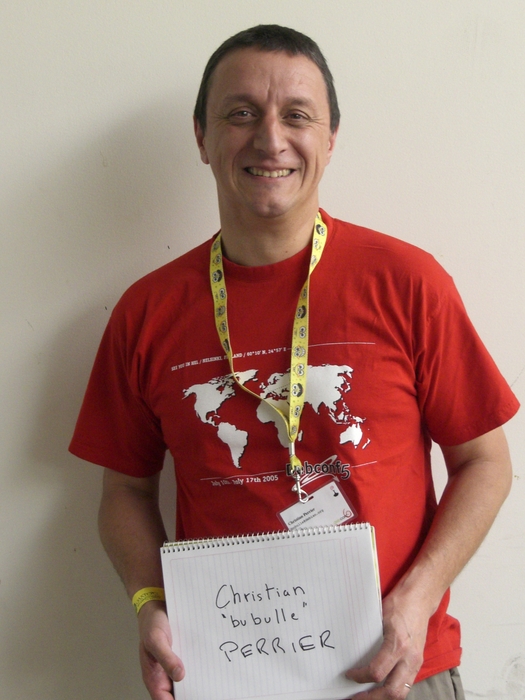
Raphaël Hertzog: People behind Debian: Christian Perrier, translation coordinator

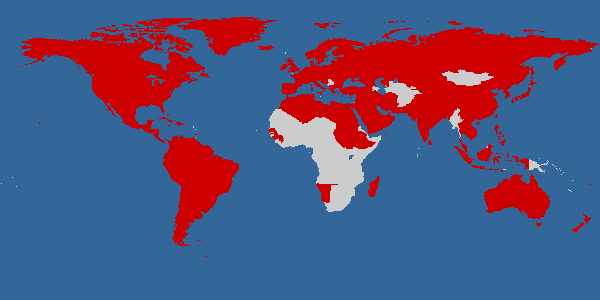
Christian is a figure of Debian, not only because of the tremendous coordination work that he does within the translation project, but also because he s very involved at the social level. He s probably in the top 5 of the persons who attended most often the Debian conference. Christian is a friend (thanks for hosting me so many times when I come to Paris for Debian related events) and I m glad that he accepted to be interviewed. He likes to speak and that shows in the length of his answers :-) but you ll be traveling the world while reading him. My questions are in bold, the rest is by Christian. Who are you? I am a French citizen (which is easy to guess unless you correct my usual mistakes in what follows). I m immensely proud of being married for nearly 26 years with Elizabeth (who deserves a statue from Debian for being so patient with my passion and my dedication to the project). I m also the proud father of 3 wonderful kids , aged 19 to 23. I work as team manager in the Networks and Computers Division of Onera the French Aerospace lab , a public research institute about Aeronautics, Space and Defense. My team provides computer management services for research divisions of Onera, with a specific focus put on individual computing. I entered the world of free software as one of the very first users of Linux in France. Back in the early 1990 s, I happened (though the BBS users communities) to be a friend of several early adopters of Linux and/or BSD386/FreeBSD/NetBSD in France. More specifically, I discovered Linux thanks with my friend Ren Cougnenc (all my free software talks are dedicated to Ren , who passed away in 1996). You re not a programmer, not even a packager. How did you come to Debian? I m definitely not a programmer and I never studied computing (I graduated in Materials Science and worked in that area for a few years after my PhD). However, my daily work always involved computing (I redesigned the creep testing laboratory and its acquisition system all by myself during my thesis research work). An my hobbies often involved playing with home computers, always trying to learn about something new. So, first learning about a new operating system then trying to figure out how to become involved in its development was quite a logical choice. Debian is my distro of choice since it exists. I used Slackware on work machines for a while, but my home server, kheops, first ran Debian 1.1 when I stopped running a BBS on an MS-DOS machine to host a news server. That was back in October 1996. I then happened to be a user, and more specifically a user of genealogy software, also participating very actively in Usenet from this home computer and server, that was running this Debian thing. So, progressively, I joined mailing lists and, being a passionate person, I tried to figure out how I could bring my own little contribution to all this. This is why I became a packager (yes, I am one!) by taking over the geneweb package, which I was using to publish my genealogy research. I applied as DD in January 2001, then got my account in July 2001. My first upload to the Debian archive occurred on August 22nd 2001: that was of course geneweb, which I still maintain. Quite quickly, I became involved in the work on French localization. I have always been a strong supporter of localized software (I even translated a few BBS software back in the early 90 s) as one of the way to bring the power and richness of free software to more users. Localization work lead me to work on the early version of Debian Installer, during those 2003-2005 years where the development of D-I was an incredibly motivating and challenging task, lead by Joey Hess and his inspiring ideas. From user to contributor to leader, I suddenly discovered, around 2004, that I became the coordinator of D-I i18n (internationalization) without even noticing :-) You re the main translation coordinator in Debian. What plans and goals have you set for Debian Wheezy? As always: paint the world in red. Indeed, this is my goal for years. I would like our favorite distro to be able to be used by anyone in the world, whether she speaks English, Northern Sami, Wolof, Uyghur or Secwepemcts n. As a matter of symbol, I use the installer for this. My stance is that one should be able to even install Debian in one s own language. So, for about 7 years, I use D-I as a way to attract new localization contributors. This progress is represented on this page where the world is gradually painted in red as long as the installer supports more languages release after release. The map above tries to illustrate this by painting in red countries when the most spoken language in the country is supported in Debian Installer. However, that map does not give enough reward to many great efforts made to support very different kind of languages. Not only various national languages, but also very different ones: all regional languages of Spain, many of the most spoken languages in India, minority languages such as Uyghur for which an effort is starting, Northern Sami because it is taught in a few schools in Norway, etc., etc. Still, the map gives a good idea of what I would like to see better supported: languages from Africa, several languages in Central Asia. And, as a very very personal goal, I m eagerly waiting for support of Tibetan in Debian Installer, the same way we support its sister language, Dzongkha from Bhutan. For this to happen, we have to make contribution to localization as easy as possible. The very distributed nature of Debian development makes this a challenge, as material to translate (D-I components, debconf screens, native packages, packages descriptions, website, documentation) is very widely spread. A goal, for years, is to set a centralized place where translators could work easily without even knowing about SVN/GIT/BZR or having to report bugs to send their work. The point, however, would be to have this without making compromises on translation quality. So, with peer review, use of thesaurus and translation memory and all such techniques. Tools for this exist: we, for instance, worked with the developers of Pootle to help making it able to cope with the huge amount of material in Debian (think about packages descriptions translations). However, as of now, the glue between such tools and the raw material (that often lies in packages) didn t come. So, currently, translation work in Debian requires a great knowledge of how things are organized, where is the material, how it can be possible to make contribution reach packages, etc. And, as I m technically unable to fulfill the goal of building the infrastructure, I m fulfilling that role of spreading out the knowledge. This is how I can define my coordinator role. Ubuntu uses a web-based tool to make it easy to contribute translations directly in Launchpad. At some point you asked Canonical to make it free software. Launchpad has been freed in the mean time. Have you (re)considered using it? Why not? After all, it more or less fills in the needs I just described. I still don t really figure out how we could have all Debian material gathered in Rosetta/Launchpad .and also how Debian packagers could easily get localized material back from the framework without changing their development processes. I have always tried to stay neutral wrt Ubuntu. As many people now in Debian, I feel like we have reached a good way to achieve our mutual development. When it comes at localization work, the early days where the everything in Rosetta and translates who wants stanza did a lot of harm to several upstream localization projects is, I think, way over. Many people who currently contribute to D-I localization were indeed sent to me by Ubuntu contributors .and by localizing D-I, apt, debconf, package descriptions, etc., they re doing translation work for Ubuntu as well as for Debian. Let s say I m a Debian user and I want to help translate Debian in my language. I can spend 1 hour per week on this activity. What should I do to start? Several language teams use Debian mailing lists to coordinate their work. If you re lucky enough to be a speaker of one of these languages, try joining debian-l10n-<yourlanguage> and follow what s happening there. Don t try to immediately jump in some translation work. First, participate to peer reviews: comment on others translations. Learn about the team s processes, jargon and habits. Then, progressively, start working on a few translations: you may want to start with translations of debconf templates: they are short, often easy to do. That s perfect if you have few time. If no language team exists for your language, try joining debian-i18n and ask about existing effort for your language. I may be able to point you to individuals working on Debian translations (very often along with other free software translation efforts). If I am not, then you have just been named coordinator for your language :-) I may even ask you if you want to work on translating the Debian Installer. What s the biggest problem of Debian? We have no problems, we only have solutions :-) We are maybe facing a growth problem for a few years. Despite the increased welcoming aspects of our processes (Debian Maintainers), Debian is having hard times in growing. The overall number of active contributors is probably stagnating for quite a while. I m still amazed, however, to see how we can cope with that and still be able to release over the years. So, after all, this is maybe not a problem :-) Many people would point communication problems here. I don t. I think that communication inside the Debian project is working fairly well now. Our famous flame wars do of course still happen from time to time, but what large free software project doesn t have flame wars? In many areas, we indeed improved communication very significantly. I want to take as an example the way the release of squeeze has been managed. I think that the release team did, even more this time, a very significant and visible effort to communicate with the entire project. And the release of squeeze has been a great success in that matter. So, there s nearly nothing that frustrates me in Debian. Even when a random developer breaks my beloved 100% completeness of French translations, I m not frustrated for more than 2 minutes. You re known in the Debian community as the organizer of the Cheese & Wine Party during DebConf. Can you tell us what this is about? This is an interesting story about how things build themselves in Debian. It all started in July 2005, before DebConf 5 in Helsinki. Denis Barbier, Nicolas Fran ois and myself agreed to bring at Debconf a few pieces of French cheese as well as 1 or 2 bottles of French wine and share them with some friends. Thus, we settled an informal meeting in the French room where we invited some fellows: from memory, Benjamin Mako Hill, Hannah Wallach, Matt Zimmermann and Moray Allan. All of us fond of smelly cheese, great wine plus some extra p t home-made by Denis in Toulouse. It finally happened that, by word of mouth, a few dozens of other people slowly joined in that French room and turned the whole thing into an improvized party that more or less lasted for the entire night. The tradition was later firmly settled in 2006, first in Debconf 6 in Mexico where I challenged the French DDs to bring as many great cheese as possible, then during the Debian i18n meeting in Extremadura (Sept 2006) where we reached the highest amount of cheese per participant ever. I think that the Creofonte building in Casar de C ceres hasn t fully recovered from it and is still smelling cheese 5 years after. This party later became a real tradition for DebConf, growing over and over each year. I see it as a wonderful way to illustrate the diversity we have in Debian, as well as the mutual enrichment we always felt during DebConfs. My only regret about it is that it became so big over the years that organizing it is always a challenge and I more and more feel pressure to make it successful. However, over the years, I always found incredible help by DebConf participants (including my own son, last year a moment of sharing which we will both remember for years, i think). And, really, in 2010, standing up on a chair, shouting (because the microphone wasn t working) to thank everybody, was the most emotional moment I had at Debconf 10. Is there someone in Debian that you admire for their contributions? So many people. So, just like it happens in many awards ceremonies, I will be very verbose to thank people, sorry in advance for this. The name that comes first is Joey Hess. Joey is someone who has a unique way to perceive what improvements are good for Debian and a very precise and meticulous way to design these improvements. Think about debconf. It is designed for so long now and still reaching its very specific goal. So well designed that it is the entire basis for Joey s other achievement: designing D-I. Moreover, I not only admire Joey for his technical work, but also for his interaction with others. He is not he loudest person around, he doesn t have to .just giving his point in discussion and, guess what? Most of the time, he s right. Someone I would like to name here, also, is Colin Watson. Colin is also someone I worked with for years (the D-I effect, again ) and, here again, the very clever way he works on technical improvements as well as his very friendly way to interact with others just make it. And, how about you, Rapha l? :-) I m really admirative of the way you work on promoting technical work on Debian. Your natural ability to explain things (as good in English as it is in French) and your motivation to share your knowledge are a great benefit for the project. Not to mention the technical achievements you made with Guillem on dpkg of course! Another person I d like to name here is Steve Langasek. We both maintain samba packages for years and collaboration with him has always been a pleasure. Just like Colin, Steve is IMHO a model to follow when it comes at people who work for Canonical while continuing their involvment in Debian. And, indeed, Steve is so patient with my mistakes and stupid questions in samba packaging that he deserves a statue. We re now reaching the end of the year where Stefano Zacchiroli was the Debian Project Leader. And, no offense intended to people who were DPL before him (all of them being people I consider to be friends of mine), I think he did the best term ever. Zack is wonderful in sharing his enthusiasm about Debian and has a unique way to do it. Up to the very end of his term, he has always been working on various aspects of the project and my only hope is that he ll run again (however, I would very well understand that he wants to go back to his hacking activities!). Hat off, Zack!I again have several other people to name in this Bubulle hall of Fame : Don Armstrong, for his constant work on improving Debian BTS, Margarita Manterola as one of the best successes of Debian Women (and the most geeky honeymoon ever), Denis Barbier and Nicolas Fran ois because i18n need really skilled people, Cyril Brulebois and Julien Cristau who kept X.org packaging alive in lenny and squeeze, Otavio Salvador who never gave up on D-I even when we were so few to care about it. I would like to make a special mention for Frans Pop. His loss in 2010 has been a shock for many of us, and particularly me. Frans and I had a similar history in Debian, both mostly working on so-called non technical duties. Frans has been the best release manager for D-I (no offense intended, at all, to Joey or Otavio .I know that both of them share this feeling with me). His very high involvment in his work and the very meticulous way he was doing it lead to great achievements in the installer. The Installation Guide work was also a model and indeed a great example of non technical work that requires as many skills as more classical technical work. So, and even though he was sometimes so picky and, I have to admit, annoying, that explains why I m still feeling sad and, in some way, guilty about Frans loss. One of my goals for wheezy is indeed to complete some things Frans left unachieved. I just found one in bug #564441: I will make this work reach the archive, benefit our users and I know that Frans would have liked that.

Thank you to Christian for the time spent answering my questions. I hope you enjoyed reading his answers as I did. Subscribe to my newsletter to get my monthly summary of the Debian/Ubuntu news and to not miss further interviews. You can also follow along on Identi.ca, Twitter and Facebook.

7 comments Liked this article? Click here. My blog is Flattr-enabled.

26 February 2011

Sylvain Le Gall: OCaml Debian News

... or don't shoot yourself in the foot. This is not a big secret, Debian Squeeze has been released. Right after this event, the OCaml Debian Task force was back in action -- with Stephane in the leading role. He has planned the transition to OCaml 3.12.0. We will proceed in two steps: a small transition of a reduced set of packages that can be transitioned before 3.12 and then the big transition. The reason for the small transition, is to avoid having to dep-wait (waiting for dependencies) of package upload by human. In -- a not so far -- past, the OCaml Debian Task force members were uploading packages by hand and waited for a full rebuild to go to the next step. This was long and cumbersome. We use now binNMU: it is binary only uploads -- with no source changes -- processed automatically by the release team and its infrastructure. This is far more effective and helps us to reduce the delay of the transition... The small transition is happening now!!! Don't update/upgrade your critical Debian installations with OCaml packages, you'll get a lot of removal if you do so. N.B. these removal are part of the famous Enforcing type-safe linking using package dependencies paper. As a side note, I am happy to announce that a full round of new OCaml packages has landed in Debian unstable: People aware of my current work, should notice that all the dependencies of OASIS are now in Debian unstable: ocaml-data-notation, ocamlify, ocaml-expect. This is a hint about the next OCaml Debian package, I will upload. You can also have a look at OASIS enabled packages (all the OASIS dependencies, ocaml-sqlexpr and ocaml-extunix). These packages have been generated using oasis2debian a tool to convert _oasis into debian/ packaging files. After these transition we will continue proceeding with standard upgrade work (e.g. camomile to 0.8.1). Sylvain Le Gall is an OCaml consultant working for OCamlCore SARL

21 February 2011

Stefano Zacchiroli: Squeeze, Debian, and the FSF

Short version: Dear FSF, thanks for your appreciation of Debian Squeeze achievements in getting rid of non-free firmware blobs. We still disagree on the overall freeness assessment of Debian, but I'm positive that steps like this one can further future collaboration, in the interest of both projects. Long version follows.
Historically, the relationships among Debian and the FSF have gone through mixed fortune (and that's quite an euphemism). On the one hand, Debian is committed to 100% Free Software, is an open project explicitly inspired by "the spirit of GNU", has been sponsored by FSF in its infancy, and properly calls itself "GNU/Linux" (or even "GNU/kFreeBSD"). On the other hand, Debian is the project who considers the GNU FDL license to be only conditionally free and which is not considered to be an entirely Free system according to FSF.
So much for the history corner. As a long time member of the Debian Project, as well as an FSF(E) fellow, I've always felt a bit sad about this state of affairs. Not because the two projects should have aligned goals; they clearly focus on different aspects of the quest for a Free (Software) world. Not even because they should agree on how to build a Free distribution: history has shown that FSF technical positions do not always get along with Debian's more "pragmatic" style, as embodied by point 5 of the Social Contract. Rather, my sadness is rooted in the belief that not getting along have encouraged duplication of efforts which could have been easily avoided (e.g. multiple distributions concurrently freeing up kernels). Furthermore, I'm more and more convinced that Debian nowadays enjoys a rather privileged position among Free Software vendors. Indeed, even though GNU/Linux distributions have reached a popularity we didn't dare to imagine 15 years ago or so, most distributions are under the direct or indirect control of commercial vendors. Those commercial vendors play a very important role in the promotion of Free Software. For instance, they are structured in ways that enable them to seal OEM deals with hardware manufacturers to sell computers with GNU/Linux pre-installed. Commercial vendors, by their own nature, are also in general better at marketing than non-commercial vendors. On the flip side however, commercial vendors are not yet relevant enough to drive proprietary drivers out of the market and, as a consequence, cannot yet afford not to support hardware which need such proprietary bits to work. Among mainstream GNU/Linux distributions[1] Debian is one of the very few vendors if not the only one that is both very relevant and, thanks to its independence, can afford taking Free Software's side: no commercial urgency can force Debian to negotiate on that. That is quite an asset to be used in the promotion of Free Software, especially to a public that is interested in and willing to understand what Free Software really is about. Such an "aware" public is on the rise as of lately, together with the general awareness increase of risks entailed by living a digital life, when that life is not under our control (think, as an example, at how often the "Facebook privacy debate" has hit mainstream medias in the last year). The "aware" public is the natural target of both Debian and the FSF. Dividing it would not serve well the cause of Free Software. With all that in mind, last August I took the chance of being on the "right" side of the Atlantic Ocean for DebConf10, to discuss possible venues of collaboration among Debian and the FSF. I sat down and discussed at length with John Sullivan, who I happen to know for his Debian involvement, in his capacities of FSF representative and operations manager. We discussed various topics, with the intention of bringing them up to the respective communities[2]. Then, inevitably, we ended up talking about the overall freeness of Debian and his exclusion from FSF listing of Free systems. (FSF is of course entitled to such judgements, pretty much as Debian is entitled to its own judgements on FSF licenses. Nevertheless those judgements contribute to dividing our public and might lead to wasteful duplication of efforts, where Free Software could better be served by collaboration.) The main ground for exclusion from that list used to be the compromises Debian has made in the past about non-free firmware blobs. But, as I pointed out back in August, those compromises would have been gone starting with Squeeze, making that argument moot. Today 6 months later I'm delighted to cheer at FSF's decision to publicly recognize the achievements Debian has delivered with Squeeze.
Thanks! It's a nice gesture that I've very much appreciated. I'm confident steps like this one will help future collaboration if, on both sides, we will be able to spot actual venues for collaboration. Needlessly to say, I still disagree with the overall FSF assessment of Debian non-freeness. Apparently, it still stands on the basis that Debian also provides a repository of nonfree software [ ] [which] is not part of the Debian system. [ ] but users would be hard-pressed to make a distinction and that people can readily learn about software available through it by browsing Debian's online package database. I respect the principle of non advertising non-free software and I even agree that it is a good principle. But unfortunately it's also a very blurry principle on which, in my opinion, Debian actually scores very well. No non-free software is offered to users by Debian; it's just for users that really want to have non-free software (or need to, in order to run a Free OS on their computers), that Debian tries to stay out of their way. For the "aware" public discussed above, I think it's much better to draw the line where software freedom ends and use that line to explain what does crossing it entails, than locking them up pretending non-free software do not exist. But fair enough: for the time being, I guess, we will need to agree to disagree on this one. Getting a little bit closer in the occasion of the Squeeze release is still an important step forward. It's up to each of us now to seek out initiatives which attract the interest of both projects and that can benefit from synergies.
[1] Sorry, I've no decent definition of "mainstream distribution" to offer, besides folklore and well-established distribution review sites. (Heck, I don't even have a decent definition of "well-established distribution review site" to offer!).
[2] which hasn't happened yet, due to the proverbial amount of available spare time.

16 February 2011

Stefano Zacchiroli: in the news - Debian and the FreedomBox

Fellow geeks who have attended FOSDEM this year probably remember Eben Moglen's announcement about the creation of a foundation to support the development of FreedomBox-es. The FreedomBox foundation and its goals have been featured in a New York Times article appeared yesterday, together with a nice Debian mention which points to our wiki. Debian is also prominently present on the (ikiwiki-powered) website of the foundation. Yet another reason why I'm proud of being part of Debian.
(thanks to Faidon for the heads up)

8 February 2011

Stefano Zacchiroli: ZOMG a Debian release

mythbustering a Debian release This is no news anymore, but in case you don't know yet: Debian 6.0 "Squeeze" has been released the past week-end. If you haven't yet downloaded Squeeze, stop reading this blog post right here and jump to: to choose your ISO; or check the release notes for upgrade instructions from Debian 5.0 "Lenny". Done?
Cool!
I hope you are now enjoying Squeeze as much as I've enjoyed being part of its development cycle which: I'm still shaked by the events, given the release happened in a sort of split context: the teams working on the final phases of the release (release team, ftp-masters, webmasters, cd, DSA, etc.) were "at home" hacking frantically on it, while many EU-based Debian people (including yours truly) were at FOSDEM representing Debian to the community with booth, talks, and answering the recurrent question so, have you released yet? . At FOSDEM, I've been personally submerged by congratulation messages that are not really for me, but rather for the Debian community at large. So: congratulations folks! People out there be them Debian users, users of some derivative, or Free Software enthusiasts in general seem to really love what we have achieved with Squeeze! The people that need to be thanked for this result are way too many, so I won't try to name names. Nonetheless, I've a few personal kudos to deliver to: I'm overwhelmed by happiness about all that and I'll cherish it forever as a souvenir of what a community of volunteers, driven by common ideals, can achieve. Now let's party and then roll up our sleeves for Wheezy, which is already open for development.
PS I've talked again at FOSDEM about the relevance of Debian in the Free Software ecosystem. I've the impression the message is getting through: check out the very nice article Why Debian matters more than ever by Zonker.

Richard Darst: Debian latex-beamer theme

A while ago, I gave a presentation on Debian, and made a latex-beamer color scheme for it. Over time I improved it some. Eventually, I grabbed the colors from the new debian website, since they are much nicer (lighter) than the old colors, and thus fit in a presentation better. Last year, I wanted to write this up so that others could use the scheme.The theme can be found here, and there are examples in this gallery. This is distributed as a few color lines you need to copy and paste into your presentation (it is not much, and I thought that was better than an external dependency). You need to select your own layout theme from those included in beamer, for examples see the gallery. The theme page lists many credits for ideas, in particular zack for the idea of the logo on the background, and some other useful links. I would welcome others to improve this theme and make it more distributable.As a reminder, there is another Debian wiki page for collecting presentations people have given, and it has some other useful links on it.

6 February 2011

Lucas Nussbaum: mutt + notmuch = perfect mail setup?

Following Our Leader, I ve just switched to using notmuch with mutt for searching (instead of maildir-utils, previously). I strongly recommend this setup to all mutt users. As a bonus, accented characters ( , , ) are now handled correctly while searching, which is quite useful in french.

3 February 2011

Stefano Zacchiroli: how to use Notmuch with Mutt

Mutt mail indexing on steroids! I've been using external mail indexing with Mutt for quite a while now. Before now I haven't given Notmuch a try, as it seemed too much experimental at the time of my initial review of mail indexing tools. As there is nothing better than a long oversea flight to perpetrate new hacks, I've now not only tested it, but also switched to Notmuch without looking back at maildir-utils for a split second. Getting started with Notmuch is trivial: Some performance figures: (1) the size of the index is a bit larger than the size of the mails (on my laptop: 535 Mb of index vs 375 Mb of mails stored in 60 maildirs); (2) even if the underlying indexing engine is the same (Xapian) as maildir-utils, Notmuch is much faster. With my setup it is so fast that I've added it as a hook triggered by offlineimap at the end of each synchronization:
    zack@usha:~$ grep -B 1 hook .offlineimaprc
    [Account Upsilon]
    postsynchook = notmuch new

With the big round of new mail downloaded in the morning, it hardly takes more than a few seconds to update Notmuch index, while with other periodic downloads Notmuch almost invariably reports "... in almost no time" (i.e. less than 1 second). Integrating Notmuch with Mutt The basic integration I want between Mutt and a mail indexer is the ability of stating a search query interactively and then jump to a fresh Maildir containing search results only. Additionally, given that Notmuch has neat thread reconstruction abilities, I also want to be able to reconstruct on the fly the thread corresponding to the currently highlighted mail: it comes handy when a thread has been split across different maildirs, archived, or the like. To that end, I've cooked up a little helper, called mutt-notmuch, that enables to trigger mail searches via a Mutt macro (F8 being my choice) and reconstruct threads via another (F9). Check the manpage for the 2-liner configuration snippet for your ~/.muttrc. Arguably, some of the logics of mutt-notmuch could disappear by adding support for a --output=symlinks flag to Notmuch. A bug report requesting that is pending: too bad oversea flights are not as good for accessing the Internet as they are for perpetrating hacks! Download

Pietro Abate: Package Managers Comparison

The Mancoosi Team has recently published the details of a study we conducted analyzing different packages managers available in debian. The goal of this study was to compare MPM (the mancoosi package manager) to other legacy solvers and try to get a big picture regarding of the state of the art. A similar study was conduct during EDOS and the results are still available here. As I wrote few months ago, MPM is a proof of concept that we wrote to test the behavior of a number of solvers that have been developed for the MISC competition in a real world scenario. These results do not show anything new w.r.t. the experience of a lot of poeple dueling daily with their machines in order to install a new piece of software. In a nutshell, we have shown that apt-get, aptitude, smart and cupt perform pretty well when used only with one baseline (for example a stable release) : this conforms with the experience of the majority of users of debian based systems. However problems start to arise when a user start mixing more then one baseline putting a lot of stress on the solver in order to find a satisfying solution. This solution of course exists, but it is cleverly hidden in the dependency structure of more then 40K packages... MPM is not as fast as other package solvers (say 10 seconds for mpm, while apt-get is able to find a solution in 3 second), but is remarkably stable. It is always able to find a satisfying solution, even in the harder cases where all the other failed. In these experiments MPM uses the postdam solver aspcud. This solver uses only GPL components and it would be a good candidate for inclusion in debian (there are actually a couple of ITP already filled for clasp and gringo). The results (with a lot of details) are published on the mancoosi website (a more detailed report is in the works). Enjoy ! During fosdem the Mancoosi team that authored this work (Roberto, Ralf, Zack and Me) will be around, so, please stop us for a chat ! And don't miss Ralf's talk !!

31 January 2011

Stefano Zacchiroli: who the bloody hell cares about Debian

A down-under talk on the role of Debian, A.D. 2011 I'm back from LCA 2011, which I've attended to share some thoughts about the role that Debian plays in the Free Software ecosystem, 18 years after its inception (yes, we are that old^Welder). The talk title---Who the bloody hell cares about Debian? [1]---was meant to be rather provocative. The idea was indeed to challenge the meme that, in the era of distributions that release every 6 months, a distribution with a release cycle of circa 2 years (like Debian, considering the past 5 years) is not a project that deserves your attention anymore. Is it really the case? In the talk I (obviously) claim it is not, using two main arguments. The first argument is based on the observation that Debian offers a set of pretty rare, if not unique, features among mainstream FOSS distributions. Those features consist of a mix of technical and "political" aspects: (1) a focus on package quality, with no distinction among first and second class packages; (2) a strong culture of software freedom, which refuses to offer non-free software (or firmware) by default to users and distribution developers (as parts of the infrastructure used to make Debian); (3) independence from commercial interests, with no single company or entity that could claim to babysit Debian; and (4) a decision making model based on a weighted sum of do-ocracy and democracy, which implies that by doing (rather than talking) everyone has a chance to have an impact on Debian. Considering all that and looking at the most popular FOSS distributions, one can easily identify Debian as one of the few remaining players who both care about Free Software and can be trusted in making choices not driven by profit. Mind you, I've nothing against companies in general and I'm very well aware that many FOSS companies carry a good deal of the burden of developing and promoting Free Software. Nonetheless, in days in which it is striking how quickly FOSS-friendly companies can become very much FOSS-unfriendly, I can't help putting my trust and efforts into community-driven projects, better if with no attached company label whatsoever. Furthermore, having distributions like Debian around can encourage other company-backed distributions to demand more and more independence and clarifications about the relationships between the community and the backing company. The second argument about the relevance of Debian is more pragmatic and rather straightforward: Debian is the root of a huge tree of derived-distribution (AKA "derivatives"), more than 120 according to popular distribution indexing sites. Each Debian derivative focuses its attention on, and directs its people power to, customizing Debian for a specific target and build entierly upon Debian work for all parts that do not need customization. That possibility is one key advantage of Free Software, after all. A well-known derivative example is Ubuntu, which is probably the most popular Debian derivative, enjoying a user base way larger than that of Debian itself. Ubuntu is heavily customized with respect to Debian and still had only about (at the time of Natty) 25% of packages which either differed from their Debian counterparts or that did not exist in Debian at all. Other Debian derivatives tend to be way less customized than that. Either way, if you are running a Debian derivative, chances are that you heavily depend on Debian and on its well-being. (Yes, it is so also if you didn't know about that, sorry.) Let's now fast-forward to the end of the talk, skipping my usual comments on how to keep the whole tree of Debian derivatives sustainable and beneficial for Free Software as a whole (i.e. by reducing as much as possible the viscosity of patch flow along the derivatives tree). Feedback People's reaction to such a provocative talk has been positive and we have enjoyed a fairly long Q&A session discussing the topics mentioned above as well as other Debian-related topics. A (commented) summary of the obtained feedback is reported below. Judging from the recurrent questions and suggestions I've received doing Debian talks in the past 8 months, I dare to say that LCA feedback is fairly representative of the feelings of many Debian users. Slides of the talk are available, while a video will eventually be posted at http://linuxconfau.blip.tv.
[1] Kudos to Francois Marier for suggesting the title. If the title doesn't ring a bell for you (it didn't for me in the beginning), you might want to check out the story of this ad. Update: minor rephrasing in the 4th paragraph

18 January 2011

Stefano Zacchiroli: cross-distribution meeting on application installer

saluting the cross-distro app installer meeting I just want to wish luck to the cross-distribution meeting on applications installers, which is starting today. For some background, check out Vincent's nice blog post on the subject. As far as my memory goes, this is one of the first attempts if not the first one to get representative of as many distros as possible around the same table to design, hack, and discuss a common topic of interest. We don't know yet how it will turn out, but the approach to the meeting has been a commendable one: aim at as much diversity as possible (first gathering people informally to get some ballpark dates, then with an announcement sent to the most appropriate place), be transparent about the organization, and engage in keeping others informed ex post. As they say here in France, chapeau for this attempt at factual cross-distro collaboration. Debian is present at the meeting, represented by Enrico Zini and David Kalnischkies. Thanks to them (for being there), to Vincent Untz (for the organization), to Novell/SUSE (for sponsoring part of Debian attendees' expenses), and to Debian donors (whose donations have been used to sponsor the rest).

17 January 2011

Rapha&#235;l Hertzog: Review of my Debian related goals for 2010

Last year I shared my Debian related goals for 2010 . I announced that I would not be able to complete them all and indeed I have not, but I have still done more than what I expected. Let s have a look. Translate my Debian book into English and get it published: NOT DONE Or rather not yet done. It s still an important project of mine and I will do it this year. When I wrote this last year, I expected to find a publisher that would take care of everything but we failed to find a suitable one so we re going to do it ourselves. Cleanup the dpkg perl API and create libdpkg-perl: DONE libdpkg-perl has been introduced with dpkg 1.15.6. Create dpkg-buildflags: DONE dpkg-buildflags has been introduced with dpkg 1.15.7. It s not widely used yet and it won t really be until debhelper 7 supports it (see #544844). It would be nice to see progress on this front this year. Ensure the new source formats continue to gain acceptance: DONE The adoption rate has been steady, it clearly slowed down since the freeze though. I have implemented quite a few features to satisfy the needs of users, like the possibility to unapply the patches after the build, or the possibility to fail in case of unwanted upstream changes. Design a generic vcs-buildpackage infrastructure to be integrated in dpkg-dev: NOT DONE I believe it s something important on the long term but it never made it to my short-term TODO list and it s unlikely to change any time soon. Continue fixing dpkg bugs faster than they are reported: PARTLY DONE We have dealt with many bugs over the year, but we still have 20 more bugs than at the start of last year (370 vs 350). We re not doing bad compared to many other Debian teams but we can still benefit from some help. Start here if you re interested. Enhance our infrastructure to ease interaction between contributors and to have a better view of how each package is maintained: NOT DONE I am convinced that we need something to have a clearer idea of the commitments made by each contributor. I don t put the same amount of care in maintaining smarty-gettext that I do on dpkg. If we had a database of the stuff that we know we don t do well enough, it s easier to point new contributors towards those. Anyway, this project is still unlikely to come to the top of my priorities any time soon. Work on the developers-reference: NOT DONE We have switched the Maintainer field to debian-policy@lists.debian.org to have more review of the changes suggested through the bug tracking system but that has not changed much on the global situation. I still hope to become more active on it sometimes this year. Maybe by trying to make it more fun and creating the text for some of the wishlist bugs as blog articles first. Rewrite in C the last Perl scripts provided by the dpkg binary package: DONE Dpkg 1.15.8 was the first version working without Perl, I announced it in July. Integrate the 3-way merge tool for Debian changelogs in dpkg-dev: DONE dpkg-mergechangelogs is part of dpkg-dev since 1.15.7. I enjoy it regularly. Unfortunately it doesn t work well for cherry-picks. Would be nice to see this fixed, anyone up to the task? :-)
Click here to subscribe to my free newsletter and get my monthly analysis on what s going on in Debian and Ubuntu. Or just follow along via the RSS feed, Identi.ca, Twitter or Facebook.

One comment Liked this article? Click here. My blog is Flattr-enabled.

7 January 2011

Paul Wise: Another year, another log entry

It has been almost a full year since my last log entry. It has been a busy work year, I attended some nice conferences and did minimal FLOSS stuff. On the work side of things I was a third of an Australian VoIP startup that came and went. I setup Debian servers, installed OpenSIPS and associated software, wrote OpenSIPS scripts, wrote peripheral software and did customer support. We had a good thing going there for a while, some fans on the Whirlpool forums but in the end there wasn't enough money for the requisite marketing and local market circumstances were squeezing Australian VoIP providers anyway. On the conference side of things I went to LCA 2010, the Thai Mini-DebCamp 2010, DebConf10 and FOSSASIA 2010. Had a great time at all of them. At LCA 2010 in windy Wellington, New Zealand the distributions summit organised by Martin Krafft was one of the highlights. It was dominated by Debian/Ubuntu talks but there were some other interesting ones, especially the one on GoboLinux's integration of domain-specific package managers. Also excellent were the keynotes given by Gabriella Coleman (Best & worst of times), Mako Hill (Antifeatures) and others, which I felt gave LCA an improved and very welcome focus on software freedom. There were quite a few Debian folks at LCA, it was great to hang out with them during the week and afterwards. Monopedal sumo with mako and others was hilarious fun. At the Thailand Mini-DebCamp 2010 in Khon Kaen, I was glad to see Andrew Lee (Taiwan) and Christian Perrier (France) again and meet Yukiharu YABUKI (Japan) and Daiki Ueno (Japan). In addition to the five international folks, there were quite a few locals, including Thailand's currently sole Debian member, Theppitak Karoonboonyanan. The event was hosted at Khon Kaen University and opened with my talk about the Debian Social Contract and the Debian Free Software Guidelines. This was followed by a number of talks about Debian package building, a 3-day BSP where we touched 57 bugs, a great day of sightseeing and talks about i18n, derivative distros, keysigning, mirrors, contribution and a discussion about DebConf. During the week there was also the usual beersigning, combined with eating of unfamiliar and "interesting" Thai snacks. After the conference Andrew and I roamed some markets in Bangkok and got Thai massages. Beforehand I also visited a friend from my travels on the RV Heraclitus in Chiang Mai, once again experiencing the awesomeness of trains in Asia, unfortunately during the dry season this time. I took a lot of photos during my time in Thailand and ate a lot of great and spicy food. As a vegetarian I especially appreciated the organiser's efforts to accommodate this during the conference. At DebConf10 in New York City, by far the highlight was Eben Moglen's vision of the FreedomBox. Negotiating the hot rickety subways was fun, the party at the NYC Resistor space was most excellent, Coney Island was hot and the water a bit yuck, zack threw a ball, the food and campus was really nice. Really enjoyed the lintian BoF, ARM discussions, shy folks, GPLv3 question time, paulproteus' comments & insights, wiki BoF, puppet BoF, derivatives BoF, Sita, astronomy rooftop, cheese, virt BoF, Libravatar, DebConf11, Brave new Multimedia World, bagels for breakfast, CUT, OpenStreetMap & lightning talks. Having my power supply die was not fun at all. Afterwards I hung out with a couple of the exhausted organisers, ate awesome vegan food and fell asleep watching a movie about dreams. One weird thing about DebConf10 was that relatively few folks used the DebConf gallery to host their photos, months later only myself and Aigars Mahinovs posted any photos there. At FOSSASIA 2010 in H Ch Minh City (HCMC) was a mini-DebConf. I arrived at the HCMC airport and was greeted by Huyen (thanks!!), one of FOSSASIA's numerous volunteers, who bundled me into a taxi bound for the speakers accommodation and pre-event meetup at The Spotted Cow Bar. The next day the conference opened at the Raffles International College and after looking at the schedule I noticed that I was to give a talk about Debian that day. Since I didn't volunteer for such a talk and had nothing prepared, the schedule took me by surprise. So shortly after an awesome lunch of Vietnamese pancakes we gathered some Debian folks and a random Fedora dude and prepared a short intro to Debian. The rest of the day the highlights were the intro, video greetings and the fonts, YaCy and HTML5 talks. The next day the Debian MiniConf began with Arne Goetje and everyone trying to get Debian Live LXDE USB keys booted on as many machines in the classroom as possible (many didn't boot). Once people started showing up we kicked off with Thomas Goirand's introduction to the breadth of Debian. Others talked about Debian pure blends, Gnuk and building community and packages. The second last session was about showing the Vietnamese folks in the room how to do l10n and translation since Debian had only one Vietnamese translator (Clytie Siddall). After manually switching keyboard layouts (seems LXDE doesn't have a GUI for that) on the English LXDE installs, the two Cambodian folks were able to do some Khmer translation too. This was a great session and it resulted in two extra Vietnamese translators joining Debian. It went over time so I didn't end up doing my presentation about package reviewing. We rushed off to a university where the random Fedora ch^Wambassador was hosting a Fedora 14 release party in a huge packed classroom. There were a lot of excited faces, interesting and advanced questions and it was in general a success. Afterwards we had some food, joined up with some other speakers and ended up in a bar in the gross tourist zone. On the final day we hung around in the Debian room, went downstairs for the group photo and final goodbyes. Later we found a place with baked goods, coffee and juices and navigated the crazy traffic to a nice local restaurant. The next morning Arne & I went to the airport, others went on a Mekong Delta tour and Jonas hung out with the organisers. I took less photos than at other events but got a few interesting ones. I avoided doing a lot of FLOSS stuff over the last year, I hope to work on some things in the coming months; I'm also planning some interesting travel and acquiring some new technological goods, more on those in some later posts.

4 January 2011

Gregor Herrmann: RC bugs 2010/50 - 2010/52

the release team has started to usertag [0] the remaining RC bugs yeah, another step towards the release!

here are my small contributions around RC bugs: [0] if I got it right: update: all tags combined: http://tinyurl.com/squeeze-sort (thanks to the RT for the URL & to zack for the pointer)

30 December 2010

Stefano Zacchiroli: how to contribute to Debian

... looking for an HOWTO? These days, possibly because it's holiday in several countries around the world, I'm receiving a higher number of "how can I help Debian?" mails than usual. This is good and makes me happy! Those mails show we have a community who cares about giving back to Free Software, in exchange of what they have received via Debian. Routinely, in my replies, I point people to the following list of documentation we have on how to contribute to Debian: Am I missing something? At the same time, it happens that I reply to people who clearly went through (at least some of) the above resources, but which are still blocked at the "what I do next?" step. I guess this is because some of the day to day practices of Debian life are not described in the documentation we have. For instance, I find scarce references to "cultural" aspects of Debian technical life such as: And I'm sure I'm missing quite some other cultural/folklore traits, which look obvious to longstanding members of the Debian community, but which are probably not so obvious to external people. So, dear lazyweb, have you started contributing to Debian and remember your experience? If so, I'd like to hear from you. In particular, I'd like to hear your suggestions on how we can improve our documentation on the matter (patches welcome, as usual!). Bonus point. Of the various pieces of documentation we have, it seems that a sufficiently detailed HOWTO-style document, covering both technical and cultural aspects, is missing. If you are into writing for Debian, that might be an experiment worth trying.

23 December 2010

Jonathan Wiltshire: RCBW, week two

This week: Not quite one fix per day, as zack s campaign originally called for. But true to his word, neither have I started receiving hate mail, so I must be doing something right. (I also made my first sponsoring upload an RC fix (#598945), for extra brownie points <g>)
Comments flattr this!

Next.

Previous.