Search Results: "uli"

7 May 2024

Melissa Wen: Get Ready to 2024 Linux Display Next Hackfest in A Coru a!

We re excited to announce the details of our upcoming 2024 Linux Display Next Hackfest in the beautiful city of A Coru a, Spain! This year s hackfest will be hosted by Igalia and will take place from May 14th to 16th. It will be a gathering of minds from a diverse range of companies and open source projects, all coming together to share, learn, and collaborate outside the traditional conference format.

Who s Joining the Fun? We re excited to welcome participants from various backgrounds, including:
  • GPU hardware vendors;
  • Linux distributions;
  • Linux desktop environments and compositors;
  • Color experts, researchers and enthusiasts;
This diverse mix of backgrounds are represented by developers from several companies working on the Linux display stack: AMD, Arm, BlueSystems, Bootlin, Collabora, Google, GravityXR, Igalia, Intel, LittleCMS, Qualcomm, Raspberry Pi, RedHat, SUSE, and System76. It ll ensure a dynamic exchange of perspectives and foster collaboration across the Linux Display community. Please take a look at the list of participants for more info.

What s on the Agenda? The beauty of the hackfest is that the agenda is driven by participants! As this is a hybrid event, we decided to improve the experience for remote participants by creating a dedicated space for them to propose topics and some introductory talks in advance. From those inputs, we defined a schedule that reflects the collective interests of the group, but is still open for amendments and new proposals. Find the schedule details in the official event webpage. Expect discussions on:

KMS Color/HDR
  • Proposal with new DRM object type:
    • Brief presentation of GPU-vendor features;
    • Status update of plane color management pipeline per vendor on Linux;
  • HDR/Color Use-cases:
    • HDR gainmap images and how should we think about HDR;
    • Google/ChromeOS GFX view about HDR/per-plane color management, VKMS and lessons learned;
  • Post-blending Color Pipeline.
  • Color/HDR testing/CI
    • VKMS status update;
    • Chamelium boards, video capture.
  • Wayland protocols
    • color-management protocol status update;
    • color-representation and video playback.
Display control
  • HDR signalling status update;
  • backlight status update;
  • EDID and DDC/CI.
Strategy for video and gaming use-cases
  • Multi-plane support in compositors
    • Underlay, overlay, or mixed strategy for video and gaming use-cases;
    • KMS Plane UAPI to simplify the plane arrangement problem;
    • Shared plane arrangement algorithm desired.
  • HDR video and hardware overlay
Frame timing and VRR
  • Frame timing:
    • Limitations of uAPI;
    • Current user space solutions;
    • Brainstorm better uAPI;
  • Cursor/overlay plane updates with VRR;
  • KMS commit and buffer-readiness deadlines;
Power Saving vs Color/Latency
  • ABM (adaptive backlight management);
  • PSR1 latencies;
  • Power optimization vs color accuracy/latency requirements.
Content-Adaptive Scaling & Sharpening
  • Content-Adaptive Scalers on display hardware;
  • New drm_colorop for content adaptive scaling;
  • Proprietary algorithms.
Display Mux
  • Laptop muxes for switching of the embedded panel between the integrated GPU and the discrete GPU;
  • Seamless/atomic hand-off between drivers on Linux desktops.
Real time scheduling & async KMS API
  • Potential benefits: lower latency input feedback, better VRR handling, buffer synchronization, etc.
  • Issues around async uAPI usage and async-call handling.

In-person, but also geographically-distributed event This year Linux Display Next hackfest is a hybrid event, hosted onsite at the Igalia offices and available for remote attendance. In-person participants will find an environment for networking and brainstorming in our inspiring and collaborative office space. Additionally, A Coru a itself is a gem waiting to be explored, with stunning beaches, good food, and historical sites.
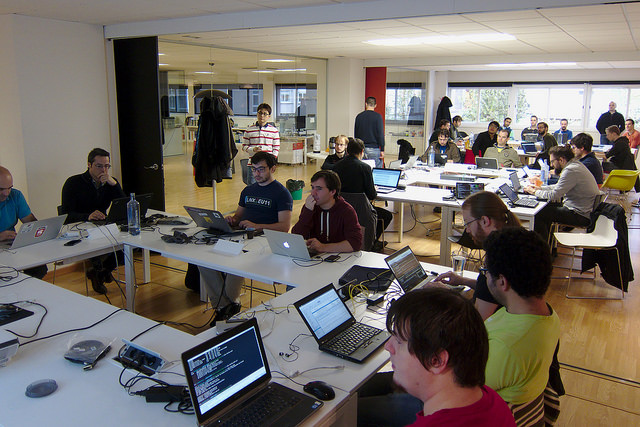
Semi-structured structure: how the 2024 Linux Display Next Hackfest will work
  • Agenda: Participants proposed the topics and talks for discussing in sessions.
  • Interactive Sessions: Discussions, workshops, introductory talks and brainstorming sessions lasting around 1h30. There is always a starting point for discussions and new ideas will emerge in real time.
  • Immersive experience: We will have coffee-breaks between sessions and lunch time at the office for all in-person participants. Lunches and coffee-breaks are sponsored by Igalia. This will keep us sharing knowledge and in continuous interaction.
  • Spaces for all group sizes: In-person participants will find different room sizes that match various group sizes at Igalia HQ. Besides that, there will be some devices for showcasing and real-time demonstrations.

Social Activities: building connections beyond the sessions To make the most of your time in A Coru a, we ll be organizing some social activities:
  • First-day Dinner: In-person participants will enjoy a Galician dinner on Tuesday, after a first day of intensive discussions in the hackfest.
  • Getting to know a little of A Coru a: Finding out a little about A Coru a and current local habits.

Participants of a guided tour in one of the sectors of the Museum of Estrella Galicia (MEGA). Source: mundoestrellagalicia.es
  • On Thursday afternoon, we will close the 2024 Linux Display Next hackfest with a guided tour of the Museum of Galicia s favorite beer brand, Estrella Galicia. The guided tour covers the eight sectors of the museum and ends with beer pouring and tasting. After this experience, a transfer bus will take us to the Maria Pita square.
  • At Maria Pita square we will see the charm of some historical landmarks of A Coru a, explore the casual and vibrant style of the city center and taste local foods while chatting with friends.

Sponsorship Igalia sponsors lunches and coffee-breaks on hackfest days, Tuesday s dinner, and the social event on Thursday afternoon for in-person participants. We can t wait to welcome hackfest attendees to A Coru a! Stay tuned for further details and outcomes of this unconventional and unique experience.


1 May 2024

Russ Allbery: Review: To Each This World

Review: To Each This World, by Julie E. Czerneda
Publisher: DAW
Copyright: November 2022
ISBN: 0-7564-1543-8
Format: Kindle
Pages: 676
To Each This World is a standalone science fiction novel. Henry m'Yama t'Nowak is the Arbiter of New Earth. This is somewhat akin to a president, but only in very specific ways. Henry's job is to deal with the Kmet. New Earth was settled by a slower-than-light colony ship from old Earth, our Earth. It is, so far as they know, the last of humanity in the universe. Origin Earth fell silent hundreds of years previous, before the colonists even landed. New Earth is now a carefully and thoughtfully managed world where humans survived, thrived, and at one point sent out six slower-than-light colony ships of its own. All were feared lost after a rushed launch due to a solar storm. As this story opens, a probe from one of those ships arrives. This is cause for rejoicing, but there are two small problems. The first is that the culture of New Earth has changed drastically since the days when they launched the Halcyon colony ships. New Earth is now part of the Duality, a new alliance with aliens painstakingly negotiated after their portal appeared in orbit. The Kmet were peaceful, eager to form an alliance and offer new technology, although they struggled with concepts such as individuality and insisted on interacting only with the Arbiter. Their technological gifts and the apparent loss of the Halcyon colony ships refocused New Earth on safety and caution. This unexpected message is a somewhat tricky political problem, a reminder of the path not taken. The other small problem is that the reaction of the Kmet to this message is... dramatic. This book has several problems, but the most serious is that it is simply too long. If you have read any other Czerneda novels, you know that she tends towards sprawling world-building, but usually there are enough twists and turns in the plot to keep the story moving while the protagonists slowly puzzle out the scientific mysteries. To Each This World is not sufficiently twisty for 676 pages. I think you could have cut half the novel without losing any major plot points. The interesting parts of this book, to me, were figuring out what's going on with the Kmet, some of the political tensions within the New Earth government, and understanding what Henry and Pilot Killian's story had to do with the apparently-unrelated but intriguing interludes following Beth Seeker in a strange place called Doublet. All that stuff is in here, but it's alongside a whole lot of Henry wrestling with lifeboat ethics in situations where he thinks he needs to lie to and manipulate people for their own good. We also get several extended tours of societies that, while vaguely interesting in a science fiction world-building way, have essentially nothing to do with the plot. We also get a whole lot of Henry's eagerly helpful AI polymorph Flip. I wanted to like this character, and I occasionally managed, but I felt like there was a constant mismatch between, in hindsight, how Czerneda meant for me to see Flip and what I thought she was signaling while I was reading. I wanted Flip to either be a fascinatingly weird companion or to be directly relevant to the plot, but instead there were hundreds of pages of unnerving creepiness mixed with obsequiousness and emotional neediness, all of which I think I read more into than Czerneda had intended. The overall experience was more exhausting than fun. The core of the plot is solid, and if you like SF novels built around world-building and scientific mysteries, there's a lot here to enjoy. I think Czerneda's Species Imperative series (starting with Survival) is a better execution of some of the same ideas, but I liked that series a lot and was willing to read another take on it. Czerneda is one of the SF writers who takes biology seriously and is willing to write very alien aliens, and that leads to a few satisfying twists. Also, Beth Seeker is a great character (I wish we'd seen more of her), and Killian, while a bit generic, is a serviceable protagonist when Czerneda needs someone to go poke things with a stick. Henry... I'm not sure what I think of Henry, and your enjoyment of this book may depend on how much you click with him. Henry is a diplomat and an extrovert. His greatest joy and talent is talking to people, navigating political situations, and negotiating. Science fiction is full of protagonists who should be this character, but they rarely are this character, probably because a lot of writers are introverts. I think Czerneda deserves real credit for making her charismatic politician sufficiently accurate that his thought processes occasionally felt alien. For me, Henry was easiest to appreciate when Killian was the viewpoint protagonist and I could look at him through someone else's eyes, but Henry's viewpoint mostly worked as well. There's a lot of competence porn enjoyment in watching him do his thing. The problem for me is that I thought several of his actions were unforgivably unethical, but no one in the book who matters seems to agree. I can see why he reached those unethical decisions, but they were profound violations of consent. He directly lies to people because he thinks telling the truth would be too risky and not get them to do what he wants them to do, and Czerneda sets up the story to imply that he might be right. This is not necessarily a bad choice in a novel, but the author has to do some work to bring me along, and Czerneda didn't do enough of that work. I kept wanting there to be some twist or sting or complication that forced Henry to come to terms with what he was doing, but it never happens. He has to pick between two moral principles that I consider rather finely balanced, if not tilted in the opposite direction that he does, and he treats one principle as inviolable and the other as mostly unimportant. The plans he makes on that basis work fine, and those on the other side of that decision are never heard from again. It left a bad taste in my mouth, particularly given how much of the book is built around Henry making tough, tricky decisions under pressure. I don't know about this book. I have a lot of mixed feelings. Parts of it I quite enjoyed. Parts of it I mostly enjoyed but wish were much less dragged out. Parts of it frustrated or bored me. It's one of those books where the more I thought about it after reading it, the more the parts I disliked annoyed me. If you like Czerneda's style of world-building and biology, and if you have more tolerance for Henry's decisions than I did, you may well like this, but read Species Imperative first. I should probably also warn that there is a lot of magical technology in this book that blatantly violates some core principles of physics. I have a high tolerance for that sort of thing, but if you don't, you're going to be grumbling. Rating: 6 out of 10

30 April 2024

Russell Coker: Links April 2024

Ron Garret wrote an insightful refutation to 2nd amendment arguments [1]. Interesting article from the UK about British Gas losing a civil suit about bill collecting techniques that are harassment [2]. This should be a criminal offence investigated by the police and prosecuted by the CPS. David Brin wrote a new version of his essay about dealing with blackmail in the US political system [3]. Cory Doctorow gave an insightful lecture about Enshittification for the Transmediale festival in Berlin [4]. This link has video and a transcript, I read the transcript. The Cut has an insightful article by a journalist who gave $50k in cash to a scammer and compares the scam to techniques used to extort false confessions [5]. Truth Dig has an informative article about how Nick Bostrom is racist and how his advocacy of eugenics influences Effective Altruism and a lot of Silicon Valley [6]. Bruce Scneier and Nathan Sanders wrote an insightful article about the problems with a frontier slogan for AI development [7]. Brian Krebs wrote an informative article about the links between Chinese APT companies and the Chinese government [8].

28 April 2024

Evgeni Golov: Running Ansible Molecule tests in parallel

Or "How I've halved the execution time of our tests by removing ten lines". Catchy, huh? Also not exactly true, but quite close. Enjoy! Molecule?! "Molecule project is designed to aid in the development and testing of Ansible roles." No idea about the development part (I have vim and mkdir), but it's really good for integration testing. You can write different test scenarios where you define an environment (usually a container), a playbook for the execution and a playbook for verification. (And a lot more, but that's quite unimportant for now, so go read the docs if you want more details.) If you ever used Beaker for Puppet integration testing, you'll feel right at home (once you've thrown away Ruby and DSLs and embraced YAML for everything). I'd like to point out one thing, before we continue. Have another look at the quote above. "Molecule project is designed to aid in the development and testing of Ansible roles." That's right. The project was started in 2015 and was always about roles. There is nothing wrong about that, but given the Ansible world has moved on to collections (which can contain roles), you start facing challenges. Challenges using Ansible Molecule in the Collections world The biggest challenge didn't change since the last time I looked at the topic in 2020: running tests for multiple roles in a single repository ("monorepo") is tedious. Well, guess what a collection is? Yepp, a repository with multiple roles in it. It did get a bit better though. There is pytest-ansible now, which has integration for Molecule. This allows the execution of Molecule and even provides reasonable logging with something as short as:
% pytest --molecule roles/
That's much better than the shell script I used in 2020! However, being able to execute tests is one thing. Being able to execute them fast is another one. Given Molecule was initially designed with single roles in mind, it has switches to run all scenarios of a role (--all), but it has no way to run these in parallel. That's fine if you have one or two scenarios in your role repository. But what if you have 10 in your collection? "No way?!" you say after quickly running molecule test --help, "But there is "
% molecule test --help
Usage: molecule test [OPTIONS] [ANSIBLE_ARGS]...
 
  --parallel / --no-parallel      Enable or disable parallel mode. Default is disabled.
 
Yeah, that switch exists, but it only tells Molecule to place things in separate folders, you still need to parallelize yourself with GNU parallel or pytest. And here our actual journey starts! Running Ansible Molecule tests in parallel To run Molecule via pytest in parallel, we can use pytest-xdist, which allows pytest to run the tests in multiple processes. With that, our pytest call becomes something like this:
% MOLECULE_OPTS="--parallel" pytest --numprocesses auto --molecule roles/
What does that mean? However, once we actually execute it, we see:
% MOLECULE_OPTS="--parallel" pytest --numprocesses auto --molecule roles/
 
WARNING  Driver podman does not provide a schema.
INFO     debian scenario test matrix: dependency, cleanup, destroy, syntax, create, prepare, converge, idempotence, side_effect, verify, cleanup, destroy
INFO     Performing prerun with role_name_check=0...
WARNING  Retrying execution failure 250 of: ansible-galaxy collection install -vvv --force ../..
ERROR    Command returned 250 code:
 
OSError: [Errno 39] Directory not empty: 'roles'
 
FileExistsError: [Errno 17] File exists: b'/home/user/namespace.collection/collections/ansible_collections/namespace/collection'
 
FileNotFoundError: [Errno 2] No such file or directory: b'/home/user/namespace.collection//collections/ansible_collections/namespace/collection/roles/my_role/molecule/debian/molecule.yml'
You might see other errors, other paths, etc, but they all will have one in common: they indicate that either files or directories are present, while the tool expects them not to be, or vice versa. Ah yes, that fine smell of race conditions. I'll spare you the wild-goose chase I went on when trying to find out what the heck was calling ansible-galaxy collection install here. Instead, I'll just point at the following line:
INFO     Performing prerun with role_name_check=0...
What is this "prerun" you ask? Well "To help Ansible find used modules and roles, molecule will perform a prerun set of actions. These involve installing dependencies from requirements.yml specified at the project level, installing a standalone role or a collection." Turns out, this step is not --parallel-safe (yet?). Luckily, it can easily be disabled, for all our roles in the collection:
% mkdir -p .config/molecule
% echo 'prerun: false' >> .config/molecule/config.yml
This works perfectly, as long as you don't have any dependencies. And we don't have any, right? We didn't define any in a molecule/collections.yml, our collection has none. So let's push a PR with that and see what our CI thinks.
OSError: [Errno 39] Directory not empty: 'tests'
Huh?
FileExistsError: [Errno 17] File exists: b'remote.sh' -> b'/home/runner/work/namespace.collection/namespace.collection/collections/ansible_collections/ansible/posix/tests/utils/shippable/aix.sh'
What?
ansible_compat.errors.InvalidPrerequisiteError: Found collection at '/home/runner/work/namespace.collection/namespace.collection/collections/ansible_collections/ansible/posix' but missing MANIFEST.json, cannot get info.
Okay, okay, I get the idea But why? Well, our collection might not have any dependencies, BUT MOLECULE HAS! When using Docker containers, it uses community.docker, when using Podman containers.podman, etc So we have to install those before running Molecule, and everything should be fine. We even can use Molecule to do this!
$ molecule dependency --scenario <scenario>
And with that knowledge, the patch to enable parallel Molecule execution on GitHub Actions using pytest-xdist becomes:
diff --git a/.config/molecule/config.yml b/.config/molecule/config.yml
new file mode 100644
index 0000000..32ed66d
--- /dev/null
+++ b/.config/molecule/config.yml
@@ -0,0 +1 @@
+prerun: false
diff --git a/.github/workflows/test.yml b/.github/workflows/test.yml
index 0f9da0d..df55a15 100644
--- a/.github/workflows/test.yml
+++ b/.github/workflows/test.yml
@@ -58,9 +58,13 @@ jobs:
       - name: Install Ansible
         run: pip install --upgrade https://github.com/ansible/ansible/archive/$  matrix.ansible  .tar.gz
       - name: Install dependencies
-        run: pip install molecule molecule-plugins pytest pytest-ansible
+        run: pip install molecule molecule-plugins pytest pytest-ansible pytest-xdist
+      - name: Install collection dependencies
+        run: cd roles/repository && molecule dependency -s suse
       - name: Run tests
-        run: pytest -vv --molecule roles/
+        run: pytest -vv --numprocesses auto --molecule roles/
+        env:
+          MOLECULE_OPTS: --parallel
   ansible-lint:
     runs-on: ubuntu-latest
But you promised us to delete ten lines, that's just a +7-2 patch! Oh yeah, sorry, the +10-20 (so a net -10) is the foreman-operations-collection version of the patch, that also migrates from an ugly bash script to pytest-ansible. And yes, that cuts down the execution from ~26 minutes to ~13 minutes. In the collection I originally tested this with, it's a more moderate "from 8-9 minutes to 5-6 minutes", which is still good though :)

24 April 2024

Russell Coker: Source Code With Emoji

The XKCD comic Code Quality [1] inspired me to test out emoji in source. I really should have done this years ago when that XKCD was first published. The following code compiles in gcc and runs in the way that anyone who wants to write such code would want it to run. The hover text in the XKCD comic is correct. You could have a style guide for such programming, store error messages in the doctor and nurse emoji for example.
#include <stdio.h>
int main()
 
  int   = 1,   = 2;
  printf(" =%d,  =%d\n",  ,  );
  return 0;
 
To get this to display correctly in Debian you need to install the fonts-noto-color-emoji package (used by the KDE emoji picker that runs when you press Windows-. among other things) and restart programs that use emoji. The Konsole terminal emulator will probably need it s profile settings changed to work with this if you ran Konsole before installing fonts-noto-color-emoji. The Kitty terminal emulator works if you restart it after installing fonts-noto-color-emoji. This web page gives a list of HTML codes for emoji [2]. If I start writing real code with emoji variable names then I ll have to update my source to HTML conversion script (which handles <>" and repeated spaces) to convert emoji. I spent a couple of hours on this and I think it s worth it. I have filed several Debian bug reports about improvements needed to issues related to emoji.

18 April 2024

Russ Allbery: Review: Unseen Academicals

Review: Unseen Academicals, by Terry Pratchett
Series: Discworld #37
Publisher: Harper
Copyright: October 2009
Printing: November 2014
ISBN: 0-06-233500-6
Format: Mass market
Pages: 517
Unseen Academicals is the 37th Discworld novel and includes many of the long-standing Ankh-Morpork cast, but mostly as supporting characters. The main characters are a new (and delightful) bunch with their own concerns. You arguably could start reading here if you really wanted to, although you would risk spoiling several previous books (most notably Thud!) and will miss some references that depend on familiarity with the cast. The Unseen University is, like most institutions of its sort, funded by an endowment that allows the wizards to focus on the pure life of the mind (or the stomach). Much to their dismay, they have just discovered that an endowment that amounts to most of their food budget requires that they field a football team. Glenda runs the night kitchen at the Unseen University. Given the deep and abiding love that wizards have for food, there is both a main kitchen and a night kitchen. The main kitchen is more prestigious, but the night kitchen is responsible for making pies, something that Glenda is quietly but exceptionally good at. Juliet is Glenda's new employee. She is exceptionally beautiful, not very bright, and a working class girl of the Ankh-Morpork streets down to her bones. Trevor Likely is a candle dribbler, responsible for assisting the Candle Knave in refreshing the endless university candles and ensuring that their wax is properly dribbled, although he pushes most of that work off onto the infallibly polite and oddly intelligent Mr. Nutt. Glenda, Trev, and Juliet are the sort of people who populate the great city of Ankh-Morpork. While the people everyone has heard of have political crises, adventures, and book plots, they keep institutions like the Unseen University running. They read romance novels, go to the football games, and nurse long-standing rivalries. They do not expect the high mucky-mucks to enter their world, let alone mess with their game. I approached Unseen Academicals with trepidation because I normally don't get along as well with the Discworld wizard books. I need not have worried; Pratchett realized that the wizards would work better as supporting characters and instead turns the main plot (or at least most of it; more on that later) over to the servants. This was a brilliant decision. The setup of this book is some of the best of Discworld up to this point. Trev is a streetwise rogue with an uncanny knack for kicking around a can that he developed after being forbidden to play football by his dear old mum. He falls for Juliet even though their families support different football teams, so you may think that a Romeo and Juliet spoof is coming. There are a few gestures of one, but Pratchett deftly avoids the pitfalls and predictability and instead makes Juliet one of the best characters in the book by playing directly against type. She is one of the characters that Pratchett is so astonishingly good at, the ones that are so thoroughly themselves that they transcend the stories they're put into. The heart of this book, though, is Glenda.
Glenda enjoyed her job. She didn't have a career; they were for people who could not hold down jobs.
She is the kind of person who knows where she fits in the world and likes what she does and is happy to stay there until she decides something isn't right, and then she changes the world through the power of common sense morality, righteous indignation, and sheer stubborn persistence. Discworld is full of complex and subtle characters fencing with each other, but there are few things I have enjoyed more than Glenda being a determinedly good person. Vetinari of course recognizes and respects (and uses) that inner core immediately. Unfortunately, as great as the setup and characters are, Unseen Academicals falls apart a bit at the end. I was eagerly reading the story, wondering what Pratchett was going to weave out of the stories of these individuals, and then it partly turned into yet another wizard book. Pratchett pulled another of his deus ex machina tricks for the climax in a way that I found unsatisfying and contrary to the tone of the rest of the story, and while the characters do get reasonable endings, it lacked the oomph I was hoping for. Rincewind is as determinedly one-note as ever, the wizards do all the standard wizard things, and the plot just isn't that interesting. I liked Mr. Nutt a great deal in the first part of the book, and I wish he could have kept that edge of enigmatic competence and unflappableness. Pratchett wanted to tell a different story that involved more angst and self-doubt, and while I appreciate that story, I found it less engaging and a bit more melodramatic than I was hoping for. Mr. Nutt's reactions in the last half of the book were believable and fit his background, but that was part of the problem: he slotted back into an archetype that I thought Pratchett was going to twist and upend. Mr. Nutt does, at least, get a fantastic closing line, and as usual there are a lot of great asides and quotes along the way, including possibly the sharpest and most biting Vetinari speech of the entire series.
The Patrician took a sip of his beer. "I have told this to few people, gentlemen, and I suspect never will again, but one day when I was a young boy on holiday in Uberwald I was walking along the bank of a stream when I saw a mother otter with her cubs. A very endearing sight, I'm sure you will agree, and even as I watched, the mother otter dived into the water and came up with a plump salmon, which she subdued and dragged on to a half-submerged log. As she ate it, while of course it was still alive, the body split and I remember to this day the sweet pinkness of its roes as they spilled out, much to the delight of the baby otters who scrambled over themselves to feed on the delicacy. One of nature's wonders, gentlemen: mother and children dining on mother and children. And that's when I first learned about evil. It is built into the very nature of the universe. Every world spins in pain. If there is any kind of supreme being, I told myself, it is up to all of us to become his moral superior."
My dissatisfaction with the ending prevents Unseen Academicals from rising to the level of Night Watch, and it's a bit more uneven than the best books of the series. Still, though, this is great stuff; recommended to anyone who is reading the series. Followed in publication order by I Shall Wear Midnight. Rating: 8 out of 10

13 April 2024

Simon Josefsson: Reproducible and minimal source-only tarballs

With the release of Libntlm version 1.8 the release tarball can be reproduced on several distributions. We also publish a signed minimal source-only tarball, produced by git-archive which is the same format used by Savannah, Codeberg, GitLab, GitHub and others. Reproducibility of both tarballs are tested continuously for regressions on GitLab through a CI/CD pipeline. If that wasn t enough to excite you, the Debian packages of Libntlm are now built from the reproducible minimal source-only tarball. The resulting binaries are reproducible on several architectures. What does that even mean? Why should you care? How you can do the same for your project? What are the open issues? Read on, dear reader This article describes my practical experiments with reproducible release artifacts, following up on my earlier thoughts that lead to discussion on Fosstodon and a patch by Janneke Nieuwenhuizen to make Guix tarballs reproducible that inspired me to some practical work. Let s look at how a maintainer release some software, and how a user can reproduce the released artifacts from the source code. Libntlm provides a shared library written in C and uses GNU Make, GNU Autoconf, GNU Automake, GNU Libtool and gnulib for build management, but these ideas should apply to most project and build system. The following illustrate the steps a maintainer would take to prepare a release:
git clone https://gitlab.com/gsasl/libntlm.git
cd libntlm
git checkout v1.8
./bootstrap
./configure
make distcheck
gpg -b libntlm-1.8.tar.gz
The generated files libntlm-1.8.tar.gz and libntlm-1.8.tar.gz.sig are published, and users download and use them. This is how the GNU project have been doing releases since the late 1980 s. That is a testament to how successful this pattern has been! These tarballs contain source code and some generated files, typically shell scripts generated by autoconf, makefile templates generated by automake, documentation in formats like Info, HTML, or PDF. Rarely do they contain binary object code, but historically that happened. The XZUtils incident illustrate that tarballs with files that are not included in the git archive offer an opportunity to disguise malicious backdoors. I blogged earlier how to mitigate this risk by using signed minimal source-only tarballs. The risk of hiding malware is not the only motivation to publish signed minimal source-only tarballs. With pre-generated content in tarballs, there is a risk that GNU/Linux distributions such as Trisquel, Guix, Debian/Ubuntu or Fedora ship generated files coming from the tarball into the binary *.deb or *.rpm package file. Typically the person packaging the upstream project never realized that some installed artifacts was not re-built through a typical autoconf -fi && ./configure && make install sequence, and never wrote the code to rebuild everything. This can also happen if the build rules are written but are buggy, shipping the old artifact. When a security problem is found, this can lead to time-consuming situations, as it may be that patching the relevant source code and rebuilding the package is not sufficient: the vulnerable generated object from the tarball would be shipped into the binary package instead of a rebuilt artifact. For architecture-specific binaries this rarely happens, since object code is usually not included in tarballs although for 10+ years I shipped the binary Java JAR file in the GNU Libidn release tarball, until I stopped shipping it. For interpreted languages and especially for generated content such as HTML, PDF, shell scripts this happens more than you would like. Publishing minimal source-only tarballs enable easier auditing of a project s code, to avoid the need to read through all generated files looking for malicious content. I have taken care to generate the source-only minimal tarball using git-archive. This is the same format that GitLab, GitHub etc offer for the automated download links on git tags. The minimal source-only tarballs can thus serve as a way to audit GitLab and GitHub download material! Consider if/when hosting sites like GitLab or GitHub has a security incident that cause generated tarballs to include a backdoor that is not present in the git repository. If people rely on the tag download artifact without verifying the maintainer PGP signature using GnuPG, this can lead to similar backdoor scenarios that we had for XZUtils but originated with the hosting provider instead of the release manager. This is even more concerning, since this attack can be mounted for some selected IP address that you want to target and not on everyone, thereby making it harder to discover. With all that discussion and rationale out of the way, let s return to the release process. I have added another step here:
make srcdist
gpg -b libntlm-1.8-src.tar.gz
Now the release is ready. I publish these four files in the Libntlm s Savannah Download area, but they can be uploaded to a GitLab/GitHub release area as well. These are the SHA256 checksums I got after building the tarballs on my Trisquel 11 aramo laptop:
91de864224913b9493c7a6cec2890e6eded3610d34c3d983132823de348ec2ca  libntlm-1.8-src.tar.gz
ce6569a47a21173ba69c990965f73eb82d9a093eb871f935ab64ee13df47fda1  libntlm-1.8.tar.gz
So how can you reproduce my artifacts? Here is how to reproduce them in a Ubuntu 22.04 container:
podman run -it --rm ubuntu:22.04
apt-get update
apt-get install -y --no-install-recommends autoconf automake libtool make git ca-certificates
git clone https://gitlab.com/gsasl/libntlm.git
cd libntlm
git checkout v1.8
./bootstrap
./configure
make dist srcdist
sha256sum libntlm-*.tar.gz
You should see the exact same SHA256 checksum values. Hooray! This works because Trisquel 11 and Ubuntu 22.04 uses the same version of git, autoconf, automake, and libtool. These tools do not guarantee the same output content for all versions, similar to how GNU GCC does not generate the same binary output for all versions. So there is still some delicate version pairing needed. Ideally, the artifacts should be possible to reproduce from the release artifacts themselves, and not only directly from git. It is possible to reproduce the full tarball in a AlmaLinux 8 container replace almalinux:8 with rockylinux:8 if you prefer RockyLinux:
podman run -it --rm almalinux:8
dnf update -y
dnf install -y make wget gcc
wget https://download.savannah.nongnu.org/releases/libntlm/libntlm-1.8.tar.gz
tar xfa libntlm-1.8.tar.gz
cd libntlm-1.8
./configure
make dist
sha256sum libntlm-1.8.tar.gz
The source-only minimal tarball can be regenerated on Debian 11:
podman run -it --rm debian:11
apt-get update
apt-get install -y --no-install-recommends make git ca-certificates
git clone https://gitlab.com/gsasl/libntlm.git
cd libntlm
git checkout v1.8
make -f cfg.mk srcdist
sha256sum libntlm-1.8-src.tar.gz 
As the Magnus Opus or chef-d uvre, let s recreate the full tarball directly from the minimal source-only tarball on Trisquel 11 replace docker.io/kpengboy/trisquel:11.0 with ubuntu:22.04 if you prefer.
podman run -it --rm docker.io/kpengboy/trisquel:11.0
apt-get update
apt-get install -y --no-install-recommends autoconf automake libtool make wget git ca-certificates
wget https://download.savannah.nongnu.org/releases/libntlm/libntlm-1.8-src.tar.gz
tar xfa libntlm-1.8-src.tar.gz
cd libntlm-v1.8
./bootstrap
./configure
make dist
sha256sum libntlm-1.8.tar.gz
Yay! You should now have great confidence in that the release artifacts correspond to what s in version control and also to what the maintainer intended to release. Your remaining job is to audit the source code for vulnerabilities, including the source code of the dependencies used in the build. You no longer have to worry about auditing the release artifacts. I find it somewhat amusing that the build infrastructure for Libntlm is now in a significantly better place than the code itself. Libntlm is written in old C style with plenty of string manipulation and uses broken cryptographic algorithms such as MD4 and single-DES. Remember folks: solving supply chain security issues has no bearing on what kind of code you eventually run. A clean gun can still shoot you in the foot. Side note on naming: GitLab exports tarballs with pathnames libntlm-v1.8/ (i.e.., PROJECT-TAG/) and I ve adopted the same pathnames, which means my libntlm-1.8-src.tar.gz tarballs are bit-by-bit identical to GitLab s exports and you can verify this with tools like diffoscope. GitLab name the tarball libntlm-v1.8.tar.gz (i.e., PROJECT-TAG.ARCHIVE) which I find too similar to the libntlm-1.8.tar.gz that we also publish. GitHub uses the same git archive style, but unfortunately they have logic that removes the v in the pathname so you will get a tarball with pathname libntlm-1.8/ instead of libntlm-v1.8/ that GitLab and I use. The content of the tarball is bit-by-bit identical, but the pathname and archive differs. Codeberg (running Forgejo) uses another approach: the tarball is called libntlm-v1.8.tar.gz (after the tag) just like GitLab, but the pathname inside the archive is libntlm/, otherwise the produced archive is bit-by-bit identical including timestamps. Savannah s CGIT interface uses archive name libntlm-1.8.tar.gz with pathname libntlm-1.8/, but otherwise file content is identical. Savannah s GitWeb interface provides snapshot links that are named after the git commit (e.g., libntlm-a812c2ca.tar.gz with libntlm-a812c2ca/) and I cannot find any tag-based download links at all. Overall, we are so close to get SHA256 checksum to match, but fail on pathname within the archive. I ve chosen to be compatible with GitLab regarding the content of tarballs but not on archive naming. From a simplicity point of view, it would be nice if everyone used PROJECT-TAG.ARCHIVE for the archive filename and PROJECT-TAG/ for the pathname within the archive. This aspect will probably need more discussion. Side note on git archive output: It seems different versions of git archive produce different results for the same repository. The version of git in Debian 11, Trisquel 11 and Ubuntu 22.04 behave the same. The version of git in Debian 12, AlmaLinux/RockyLinux 8/9, Alpine, ArchLinux, macOS homebrew, and upcoming Ubuntu 24.04 behave in another way. Hopefully this will not change that often, but this would invalidate reproducibility of these tarballs in the future, forcing you to use an old git release to reproduce the source-only tarball. Alas, GitLab and most other sites appears to be using modern git so the download tarballs from them would not match my tarballs even though the content would. Side note on ChangeLog: ChangeLog files were traditionally manually curated files with version history for a package. In recent years, several projects moved to dynamically generate them from git history (using tools like git2cl or gitlog-to-changelog). This has consequences for reproducibility of tarballs: you need to have the entire git history available! The gitlog-to-changelog tool also output different outputs depending on the time zone of the person using it, which arguable is a simple bug that can be fixed. However this entire approach is incompatible with rebuilding the full tarball from the minimal source-only tarball. It seems Libntlm s ChangeLog file died on the surgery table here. So how would a distribution build these minimal source-only tarballs? I happen to help on the libntlm package in Debian. It has historically used the generated tarballs as the source code to build from. This means that code coming from gnulib is vendored in the tarball. When a security problem is discovered in gnulib code, the security team needs to patch all packages that include that vendored code and rebuild them, instead of merely patching the gnulib package and rebuild all packages that rely on that particular code. To change this, the Debian libntlm package needs to Build-Depends on Debian s gnulib package. But there was one problem: similar to most projects that use gnulib, Libntlm depend on a particular git commit of gnulib, and Debian only ship one commit. There is no coordination about which commit to use. I have adopted gnulib in Debian, and add a git bundle to the *_all.deb binary package so that projects that rely on gnulib can pick whatever commit they need. This allow an no-network GNULIB_URL and GNULIB_REVISION approach when running Libntlm s ./bootstrap with the Debian gnulib package installed. Otherwise libntlm would pick up whatever latest version of gnulib that Debian happened to have in the gnulib package, which is not what the Libntlm maintainer intended to be used, and can lead to all sorts of version mismatches (and consequently security problems) over time. Libntlm in Debian is developed and tested on Salsa and there is continuous integration testing of it as well, thanks to the Salsa CI team. Side note on git bundles: unfortunately there appears to be no reproducible way to export a git repository into one or more files. So one unfortunate consequence of all this work is that the gnulib *.orig.tar.gz tarball in Debian is not reproducible any more. I have tried to get Git bundles to be reproducible but I never got it to work see my notes in gnulib s debian/README.source on this aspect. Of course, source tarball reproducibility has nothing to do with binary reproducibility of gnulib in Debian itself, fortunately. One open question is how to deal with the increased build dependencies that is triggered by this approach. Some people are surprised by this but I don t see how to get around it: if you depend on source code for tools in another package to build your package, it is a bad idea to hide that dependency. We ve done it for a long time through vendored code in non-minimal tarballs. Libntlm isn t the most critical project from a bootstrapping perspective, so adding git and gnulib as Build-Depends to it will probably be fine. However, consider if this pattern was used for other packages that uses gnulib such as coreutils, gzip, tar, bison etc (all are using gnulib) then they would all Build-Depends on git and gnulib. Cross-building those packages for a new architecture will therefor require git on that architecture first, which gets circular quick. The dependency on gnulib is real so I don t see that going away, and gnulib is a Architecture:all package. However, the dependency on git is merely a consequence of how the Debian gnulib package chose to make all gnulib git commits available to projects: through a git bundle. There are other ways to do this that doesn t require the git tool to extract the necessary files, but none that I found practical ideas welcome! Finally some brief notes on how this was implemented. Enabling bootstrappable source-only minimal tarballs via gnulib s ./bootstrap is achieved by using the GNULIB_REVISION mechanism, locking down the gnulib commit used. I have always disliked git submodules because they add extra steps and has complicated interaction with CI/CD. The reason why I gave up git submodules now is because the particular commit to use is not recorded in the git archive output when git submodules is used. So the particular gnulib commit has to be mentioned explicitly in some source code that goes into the git archive tarball. Colin Watson added the GNULIB_REVISION approach to ./bootstrap back in 2018, and now it no longer made sense to continue to use a gnulib git submodule. One alternative is to use ./bootstrap with --gnulib-srcdir or --gnulib-refdir if there is some practical problem with the GNULIB_URL towards a git bundle the GNULIB_REVISION in bootstrap.conf. The srcdist make rule is simple:
git archive --prefix=libntlm-v1.8/ -o libntlm-1.8-src.tar.gz HEAD
Making the make dist generated tarball reproducible can be more complicated, however for Libntlm it was sufficient to make sure the modification times of all files were set deterministically to the timestamp of the last commit in the git repository. Interestingly there seems to be a couple of different ways to accomplish this, Guix doesn t support minimal source-only tarballs but rely on a .tarball-timestamp file inside the tarball. Paul Eggert explained what TZDB is using some time ago. The approach I m using now is fairly similar to the one I suggested over a year ago. If there are problems because all files in the tarball now use the same modification time, there is a solution by Bruno Haible that could be implemented. Side note on git tags: Some people may wonder why not verify a signed git tag instead of verifying a signed tarball of the git archive. Currently most git repositories uses SHA-1 for git commit identities, but SHA-1 is not a secure hash function. While current SHA-1 attacks can be detected and mitigated, there are fundamental doubts that a git SHA-1 commit identity uniquely refers to the same content that was intended. Verifying a git tag will never offer the same assurance, since a git tag can be moved or re-signed at any time. Verifying a git commit is better but then we need to trust SHA-1. Migrating git to SHA-256 would resolve this aspect, but most hosting sites such as GitLab and GitHub does not support this yet. There are other advantages to using signed tarballs instead of signed git commits or git tags as well, e.g., tar.gz can be a deterministically reproducible persistent stable offline storage format but .git sub-directory trees or git bundles do not offer this property. Doing continous testing of all this is critical to make sure things don t regress. Libntlm s pipeline definition now produce the generated libntlm-*.tar.gz tarballs and a checksum as a build artifact. Then I added the 000-reproducability job which compares the checksums and fails on mismatches. You can read its delicate output in the job for the v1.8 release. Right now we insists that builds on Trisquel 11 match Ubuntu 22.04, that PureOS 10 builds match Debian 11 builds, that AlmaLinux 8 builds match RockyLinux 8 builds, and AlmaLinux 9 builds match RockyLinux 9 builds. As you can see in pipeline job output, not all platforms lead to the same tarballs, but hopefully this state can be improved over time. There is also partial reproducibility, where the full tarball is reproducible across two distributions but not the minimal tarball, or vice versa. If this way of working plays out well, I hope to implement it in other projects too. What do you think? Happy Hacking!

12 April 2024

Freexian Collaborators: Monthly report about Debian Long Term Support, March 2024 (by Roberto C. S nchez)

Like each month, have a look at the work funded by Freexian s Debian LTS offering.

Debian LTS contributors In March, 19 contributors have been paid to work on Debian LTS, their reports are available:
  • Abhijith PA did 0.0h (out of 10.0h assigned and 4.0h from previous period), thus carrying over 14.0h to the next month.
  • Adrian Bunk did 59.5h (out of 47.5h assigned and 52.5h from previous period), thus carrying over 40.5h to the next month.
  • Bastien Roucari s did 22.0h (out of 20.0h assigned and 2.0h from previous period).
  • Ben Hutchings did 9.0h (out of 2.0h assigned and 22.0h from previous period), thus carrying over 15.0h to the next month.
  • Chris Lamb did 18.0h (out of 18.0h assigned).
  • Daniel Leidert did 12.0h (out of 12.0h assigned).
  • Emilio Pozuelo Monfort did 0.0h (out of 3.0h assigned and 57.0h from previous period), thus carrying over 60.0h to the next month.
  • Guilhem Moulin did 22.5h (out of 7.25h assigned and 15.25h from previous period).
  • Holger Levsen did 0.0h (out of 0.5h assigned and 11.5h from previous period), thus carrying over 12.0h to the next month.
  • Lee Garrett did 0.0h (out of 0.0h assigned and 60.0h from previous period), thus carrying over 60.0h to the next month.
  • Markus Koschany did 40.0h (out of 40.0h assigned).
  • Ola Lundqvist did 19.5h (out of 24.0h assigned), thus carrying over 4.5h to the next month.
  • Roberto C. S nchez did 9.25h (out of 3.5h assigned and 8.5h from previous period), thus carrying over 2.75h to the next month.
  • Santiago Ruano Rinc n did 19.0h (out of 16.5h assigned and 2.5h from previous period).
  • Sean Whitton did 4.5h (out of 4.5h assigned and 1.5h from previous period), thus carrying over 1.5h to the next month.
  • Sylvain Beucler did 25.0h (out of 24.5h assigned and 35.5h from previous period), thus carrying over 35.0h to the next month.
  • Thorsten Alteholz did 14.0h (out of 14.0h assigned).
  • Tobias Frost did 12.0h (out of 12.0h assigned).
  • Utkarsh Gupta did 19.5h (out of 0.0h assigned and 48.75h from previous period), thus carrying over 29.25h to the next month.

Evolution of the situation In March, we have released 31 DLAs. Adrian Bunk was responsible for updating gtkwave not only in LTS, but also in unstable, stable, and old-stable as well. This update involved an upload of a new upstream release of gtkwave to each target suite to address 82 separate CVEs. Guilhem Moulin prepared an update of libvirt which was particularly notable, as it fixed multiple vulnerabilities which would lead to denial of service or information disclosure. In addition to the normal security updates, multiple LTS contributors worked at getting various packages updated in more recent Debian releases, including gross for bullseye/bookworm (by Adrian Bunk), imlib2 for bullseye, jetty9 and tomcat9/10 for bullseye/bookworm (by Markus Koschany), samba for bullseye, py7zr for bullseye (by Santiago Ruano Rinc n), cacti for bullseye/bookwork (by Sylvain Beucler), and libmicrohttpd for bullseye (by Thorsten Alteholz). Additionally, Sylvain actively coordinated with cacti upstream concerning an incomplete fix for CVE-2024-29894.

Thanks to our sponsors Sponsors that joined recently are in bold.

11 April 2024

Reproducible Builds: Reproducible Builds in March 2024

Welcome to the March 2024 report from the Reproducible Builds project! In our reports, we attempt to outline what we have been up to over the past month, as well as mentioning some of the important things happening more generally in software supply-chain security. As ever, if you are interested in contributing to the project, please visit our Contribute page on our website. Table of contents:
  1. Arch Linux minimal container userland now 100% reproducible
  2. Validating Debian s build infrastructure after the XZ backdoor
  3. Making Fedora Linux (more) reproducible
  4. Increasing Trust in the Open Source Supply Chain with Reproducible Builds and Functional Package Management
  5. Software and source code identification with GNU Guix and reproducible builds
  6. Two new Rust-based tools for post-processing determinism
  7. Distribution work
  8. Mailing list highlights
  9. Website updates
  10. Delta chat clients now reproducible
  11. diffoscope updates
  12. Upstream patches
  13. Reproducibility testing framework

Arch Linux minimal container userland now 100% reproducible In remarkable news, Reproducible builds developer kpcyrd reported that that the Arch Linux minimal container userland is now 100% reproducible after work by developers dvzv and Foxboron on the one remaining package. This represents a real world , widely-used Linux distribution being reproducible. Their post, which kpcyrd suffixed with the question now what? , continues on to outline some potential next steps, including validating whether the container image itself could be reproduced bit-for-bit. The post, which was itself a followup for an Arch Linux update earlier in the month, generated a significant number of replies.

Validating Debian s build infrastructure after the XZ backdoor From our mailing list this month, Vagrant Cascadian wrote about being asked about trying to perform concrete reproducibility checks for recent Debian security updates, in an attempt to gain some confidence about Debian s build infrastructure given that they performed builds in environments running the high-profile XZ vulnerability. Vagrant reports (with some caveats):
So far, I have not found any reproducibility issues; everything I tested I was able to get to build bit-for-bit identical with what is in the Debian archive.
That is to say, reproducibility testing permitted Vagrant and Debian to claim with some confidence that builds performed when this vulnerable version of XZ was installed were not interfered with.

Making Fedora Linux (more) reproducible In March, Davide Cavalca gave a talk at the 2024 Southern California Linux Expo (aka SCALE 21x) about the ongoing effort to make the Fedora Linux distribution reproducible. Documented in more detail on Fedora s website, the talk touched on topics such as the specifics of implementing reproducible builds in Fedora, the challenges encountered, the current status and what s coming next. (YouTube video)

Increasing Trust in the Open Source Supply Chain with Reproducible Builds and Functional Package Management Julien Malka published a brief but interesting paper in the HAL open archive on Increasing Trust in the Open Source Supply Chain with Reproducible Builds and Functional Package Management:
Functional package managers (FPMs) and reproducible builds (R-B) are technologies and methodologies that are conceptually very different from the traditional software deployment model, and that have promising properties for software supply chain security. This thesis aims to evaluate the impact of FPMs and R-B on the security of the software supply chain and propose improvements to the FPM model to further improve trust in the open source supply chain. PDF
Julien s paper poses a number of research questions on how the model of distributions such as GNU Guix and NixOS can be leveraged to further improve the safety of the software supply chain , etc.

Software and source code identification with GNU Guix and reproducible builds In a long line of commendably detailed blog posts, Ludovic Court s, Maxim Cournoyer, Jan Nieuwenhuizen and Simon Tournier have together published two interesting posts on the GNU Guix blog this month. In early March, Ludovic Court s, Maxim Cournoyer, Jan Nieuwenhuizen and Simon Tournier wrote about software and source code identification and how that might be performed using Guix, rhetorically posing the questions: What does it take to identify software ? How can we tell what software is running on a machine to determine, for example, what security vulnerabilities might affect it? Later in the month, Ludovic Court s wrote a solo post describing adventures on the quest for long-term reproducible deployment. Ludovic s post touches on GNU Guix s aim to support time travel , the ability to reliably (and reproducibly) revert to an earlier point in time, employing the iconic image of Harold Lloyd hanging off the clock in Safety Last! (1925) to poetically illustrate both the slapstick nature of current modern technology and the gymnastics required to navigate hazards of our own making.

Two new Rust-based tools for post-processing determinism Zbigniew J drzejewski-Szmek announced add-determinism, a work-in-progress reimplementation of the Reproducible Builds project s own strip-nondeterminism tool in the Rust programming language, intended to be used as a post-processor in RPM-based distributions such as Fedora In addition, Yossi Kreinin published a blog post titled refix: fast, debuggable, reproducible builds that describes a tool that post-processes binaries in such a way that they are still debuggable with gdb, etc.. Yossi post details the motivation and techniques behind the (fast) performance of the tool.

Distribution work In Debian this month, since the testing framework no longer varies the build path, James Addison performed a bulk downgrade of the bug severity for issues filed with a level of normal to a new level of wishlist. In addition, 28 reviews of Debian packages were added, 38 were updated and 23 were removed this month adding to ever-growing knowledge about identified issues. As part of this effort, a number of issue types were updated, including Chris Lamb adding a new ocaml_include_directories toolchain issue [ ] and James Addison adding a new filesystem_order_in_java_jar_manifest_mf_include_resource issue [ ] and updating the random_uuid_in_notebooks_generated_by_nbsphinx to reference a relevant discussion thread [ ]. In addition, Roland Clobus posted his 24th status update of reproducible Debian ISO images. Roland highlights that the images for Debian unstable often cannot be generated due to changes in that distribution related to the 64-bit time_t transition. Lastly, Bernhard M. Wiedemann posted another monthly update for his reproducibility work in openSUSE.

Mailing list highlights Elsewhere on our mailing list this month:

Website updates There were made a number of improvements to our website this month, including:
  • Pol Dellaiera noticed the frequent need to correctly cite the website itself in academic work. To facilitate easier citation across multiple formats, Pol contributed a Citation File Format (CIF) file. As a result, an export in BibTeX format is now available in the Academic Publications section. Pol encourages community contributions to further refine the CITATION.cff file. Pol also added an substantial new section to the buy in page documenting the role of Software Bill of Materials (SBOMs) and ephemeral development environments. [ ][ ]
  • Bernhard M. Wiedemann added a new commandments page to the documentation [ ][ ] and fixed some incorrect YAML elsewhere on the site [ ].
  • Chris Lamb add three recent academic papers to the publications page of the website. [ ]
  • Mattia Rizzolo and Holger Levsen collaborated to add Infomaniak as a sponsor of amd64 virtual machines. [ ][ ][ ]
  • Roland Clobus updated the stable outputs page, dropping version numbers from Python documentation pages [ ] and noting that Python s set data structure is also affected by the PYTHONHASHSEED functionality. [ ]

Delta chat clients now reproducible Delta Chat, an open source messaging application that can work over email, announced this month that the Rust-based core library underlying Delta chat application is now reproducible.

diffoscope diffoscope is our in-depth and content-aware diff utility that can locate and diagnose reproducibility issues. This month, Chris Lamb made a number of changes such as uploading versions 259, 260 and 261 to Debian and made the following additional changes:
  • New features:
    • Add support for the zipdetails tool from the Perl distribution. Thanks to Fay Stegerman and Larry Doolittle et al. for the pointer and thread about this tool. [ ]
  • Bug fixes:
    • Don t identify Redis database dumps as GNU R database files based simply on their filename. [ ]
    • Add a missing call to File.recognizes so we actually perform the filename check for GNU R data files. [ ]
    • Don t crash if we encounter an .rdb file without an equivalent .rdx file. (#1066991)
    • Correctly check for 7z being available and not lz4 when testing 7z. [ ]
    • Prevent a traceback when comparing a contentful .pyc file with an empty one. [ ]
  • Testsuite improvements:
    • Fix .epub tests after supporting the new zipdetails tool. [ ]
    • Don t use parenthesis within test skipping messages, as PyTest adds its own parenthesis. [ ]
    • Factor out Python version checking in test_zip.py. [ ]
    • Skip some Zip-related tests under Python 3.10.14, as a potential regression may have been backported to the 3.10.x series. [ ]
    • Actually test 7z support in the test_7z set of tests, not the lz4 functionality. (Closes: reproducible-builds/diffoscope#359). [ ]
In addition, Fay Stegerman updated diffoscope s monkey patch for supporting the unusual Mozilla ZIP file format after Python s zipfile module changed to detect potentially insecure overlapping entries within .zip files. (#362) Chris Lamb also updated the trydiffoscope command line client, dropping a build-dependency on the deprecated python3-distutils package to fix Debian bug #1065988 [ ], taking a moment to also refresh the packaging to the latest Debian standards [ ]. Finally, Vagrant Cascadian submitted an update for diffoscope version 260 in GNU Guix. [ ]

Upstream patches This month, we wrote a large number of patches, including: Bernhard M. Wiedemann used reproducibility-tooling to detect and fix packages that added changes in their %check section, thus failing when built with the --no-checks option. Only half of all openSUSE packages were tested so far, but a large number of bugs were filed, including ones against caddy, exiv2, gnome-disk-utility, grisbi, gsl, itinerary, kosmindoormap, libQuotient, med-tools, plasma6-disks, pspp, python-pypuppetdb, python-urlextract, rsync, vagrant-libvirt and xsimd. Similarly, Jean-Pierre De Jesus DIAZ employed reproducible builds techniques in order to test a proposed refactor of the ath9k-htc-firmware package. As the change produced bit-for-bit identical binaries to the previously shipped pre-built binaries:
I don t have the hardware to test this firmware, but the build produces the same hashes for the firmware so it s safe to say that the firmware should keep working.

Reproducibility testing framework The Reproducible Builds project operates a comprehensive testing framework running primarily at tests.reproducible-builds.org in order to check packages and other artifacts for reproducibility. In March, an enormous number of changes were made by Holger Levsen:
  • Debian-related changes:
    • Sleep less after a so-called 404 package state has occurred. [ ]
    • Schedule package builds more often. [ ][ ]
    • Regenerate all our HTML indexes every hour, but only every 12h for the released suites. [ ]
    • Create and update unstable and experimental base systems on armhf again. [ ][ ]
    • Don t reschedule so many depwait packages due to the current size of the i386 architecture queue. [ ]
    • Redefine our scheduling thresholds and amounts. [ ]
    • Schedule untested packages with a higher priority, otherwise slow architectures cannot keep up with the experimental distribution growing. [ ]
    • Only create the stats_buildinfo.png graph once per day. [ ][ ]
    • Reproducible Debian dashboard: refactoring, update several more static stats only every 12h. [ ]
    • Document how to use systemctl with new systemd-based services. [ ]
    • Temporarily disable armhf and i386 continuous integration tests in order to get some stability back. [ ]
    • Use the deb.debian.org CDN everywhere. [ ]
    • Remove the rsyslog logging facility on bookworm systems. [ ]
    • Add zst to the list of packages which are false-positive diskspace issues. [ ]
    • Detect failures to bootstrap Debian base systems. [ ]
  • Arch Linux-related changes:
    • Temporarily disable builds because the pacman package manager is broken. [ ][ ]
    • Split reproducible_html_live_status and split the scheduling timing . [ ][ ][ ]
    • Improve handling when database is locked. [ ][ ]
  • Misc changes:
    • Show failed services that require manual cleanup. [ ][ ]
    • Integrate two new Infomaniak nodes. [ ][ ][ ][ ]
    • Improve IRC notifications for artifacts. [ ]
    • Run diffoscope in different systemd slices. [ ]
    • Run the node health check more often, as it can now repair some issues. [ ][ ]
    • Also include the string Bot in the userAgent for Git. (Re: #929013). [ ]
    • Document increased tmpfs size on our OUSL nodes. [ ]
    • Disable memory account for the reproducible_build service. [ ][ ]
    • Allow 10 times as many open files for the Jenkins service. [ ]
    • Set OOMPolicy=continue and OOMScoreAdjust=-1000 for both the Jenkins and the reproducible_build service. [ ]
Mattia Rizzolo also made the following changes:
  • Debian-related changes:
    • Define a systemd slice to group all relevant services. [ ][ ]
    • Add a bunch of quotes in scripts to assuage the shellcheck tool. [ ]
    • Add stats on how many packages have been built today so far. [ ]
    • Instruct systemd-run to handle diffoscope s exit codes specially. [ ]
    • Prefer the pgrep tool over grepping the output of ps. [ ]
    • Re-enable a couple of i386 and armhf architecture builders. [ ][ ]
    • Fix some stylistic issues flagged by the Python flake8 tool. [ ]
    • Cease scheduling Debian unstable and experimental on the armhf architecture due to the time_t transition. [ ]
    • Start a few more i386 & armhf workers. [ ][ ][ ]
    • Temporarly skip pbuilder updates in the unstable distribution, but only on the armhf architecture. [ ]
  • Other changes:
    • Perform some large-scale refactoring on how the systemd service operates. [ ][ ]
    • Move the list of workers into a separate file so it s accessible to a number of scripts. [ ]
    • Refactor the powercycle_x86_nodes.py script to use the new IONOS API and its new Python bindings. [ ]
    • Also fix nph-logwatch after the worker changes. [ ]
    • Do not install the stunnel tool anymore, it shouldn t be needed by anything anymore. [ ]
    • Move temporary directories related to Arch Linux into a single directory for clarity. [ ]
    • Update the arm64 architecture host keys. [ ]
    • Use a common Postfix configuration. [ ]
The following changes were also made by:
  • Jan-Benedict Glaw:
    • Initial work to clean up a messy NetBSD-related script. [ ][ ]
  • Roland Clobus:
    • Show the installer log if the installer fails to build. [ ]
    • Avoid the minus character (i.e. -) in a variable in order to allow for tags in openQA. [ ]
    • Update the schedule of Debian live image builds. [ ]
  • Vagrant Cascadian:
    • Maintenance on the virt* nodes is completed so bring them back online. [ ]
    • Use the fully qualified domain name in configuration. [ ]
Node maintenance was also performed by Holger Levsen, Mattia Rizzolo [ ][ ] and Vagrant Cascadian [ ][ ][ ][ ]

If you are interested in contributing to the Reproducible Builds project, please visit our Contribute page on our website. However, you can get in touch with us via:

2 April 2024

Dirk Eddelbuettel: ulid 0.3.1 on CRAN: New Maintainer, Some Polish

Happy to share that ulid is now (back) on CRAN. It provides universally unique identifiers that are lexicographically sortable, which improves over the more well-known uuid generators. ulid is a neat little package put together by Bob Rudis a few years ago. It had recently drifted off CRAN so I offered to brush it up and re-submit it. And as tooted earlier today, it took just over an hour to finish that (after the lead up work I had done, including prior email with CRAN in the loop, the repo transfer from Bob s to my ulid repo plus of course a wee bit of actual maintenance; see below for more). The NEWS entry follows.

Changes in version 0.3.1 (2024-04-02)
  • New Maintainer
  • Deleted several repository files no longer used or needed
  • Added .editorconfig, ChangeLog and cleanup
  • Converted NEWS.md to NEWS.Rd
  • Simplified R/ directory to one source file
  • Simplified src/ removing redundant Makevars
  • Added ulid() alias
  • Updated / edited roxygen and README.md documention
  • Removed vignette which was identical to README.md
  • Switched continuous integration to GitHub Actions
  • Placed upstream (header-only) library into src/ulid/
  • Renamed single interface file to src/wrapper

If you like this or other open-source work I do, you can sponsor me at GitHub.

This post by Dirk Eddelbuettel originated on his Thinking inside the box blog. Please report excessive re-aggregation in third-party for-profit settings.

1 April 2024

Simon Josefsson: Towards reproducible minimal source code tarballs? On *-src.tar.gz

While the work to analyze the xz backdoor is in progress, several ideas have been suggested to improve the software supply chain ecosystem. Some of those ideas are good, some of the ideas are at best irrelevant and harmless, and some suggestions are plain bad. I d like to attempt to formalize two ideas, which have been discussed before, but the context in which they can be appreciated have not been as clear as it is today.
  1. Reproducible tarballs. The idea is that published source tarballs should be possible to reproduce independently somehow, and that this should be continuously tested and verified preferrably as part of the upstream project continuous integration system (e.g., GitHub action or GitLab pipeline). While nominally this looks easy to achieve, there are some complex matters in this, for example: what timestamps to use for files in the tarball? I ve brought up this aspect before.
  2. Minimal source tarballs without generated vendor files. Most GNU Autoconf/Automake-based tarballs pre-generated files which are important for bootstrapping on exotic systems that does not have the required dependencies. For the bootstrapping story to succeed, this approach is important to support. However it has become clear that this practice raise significant costs and risks. Most modern GNU/Linux distributions have all the required dependencies and actually prefers to re-build everything from source code. These pre-generated extra files introduce uncertainty to that process.
My strawman proposal to improve things is to define new tarball format *-src.tar.gz with at least the following properties:
  1. The tarball should allow users to build the project, which is the entire purpose of all this. This means that at least all source code for the project has to be included.
  2. The tarballs should be signed, for example with PGP or minisign.
  3. The tarball should be possible to reproduce bit-by-bit by a third party using upstream s version controlled sources and a pointer to which revision was used (e.g., git tag or git commit).
  4. The tarball should not require an Internet connection to download things.
    • Corollary: every external dependency either has to be explicitly documented as such (e.g., gcc and GnuTLS), or included in the tarball.
    • Observation: This means including all *.po gettext translations which are normally downloaded when building from version controlled sources.
  5. The tarball should contain everything required to build the project from source using as much externally released versioned tooling as possible. This is the minimal property lacking today.
    • Corollary: This means including a vendored copy of OpenSSL or libz is not acceptable: link to them as external projects.
    • Open question: How about non-released external tooling such as gnulib or autoconf archive macros? This is a bit more delicate: most distributions either just package one current version of gnulib or autoconf archive, not previous versions. While this could change, and distributions could package the gnulib git repository (up to some current version) and the autoconf archive git repository and packages were set up to extract the version they need (gnulib s ./bootstrap already supports this via the gnulib-refdir parameter), this is not normally in place.
    • Suggested Corollary: The tarball should contain content from git submodule s such as gnulib and the necessary Autoconf archive M4 macros required by the project.
  6. Similar to how the GNU project specify the ./configure interface we need a documented interface for how to bootstrap the project. I suggest to use the already well established idiom of running ./bootstrap to set up the package to later be able to be built via ./configure. Of course, some projects are not using the autotool ./configure interface and will not follow this aspect either, but like most build systems that compete with autotools have instructions on how to build the project, they should document similar interfaces for bootstrapping the source tarball to allow building.
If tarballs that achieve the above goals were available from popular upstream projects, distributions could more easily use them instead of current tarballs that include pre-generated content. The advantage would be that the build process is not tainted by unnecessary files. We need to develop tools for maintainers to create these tarballs, similar to make dist that generate today s foo-1.2.3.tar.gz files. I think one common argument against this approach will be: Why bother with all that, and just use git-archive outputs? Or avoid the entire tarball approach and move directly towards version controlled check outs and referring to upstream releases as git URL and commit tag or id. One problem with this is that SHA-1 is broken, so placing trust in a SHA-1 identifier is simply not secure. Another counter-argument is that this optimize for packagers benefits at the cost of upstream maintainers: most upstream maintainers do not want to store gettext *.po translations in their source code repository. A compromise between the needs of maintainers and packagers is useful, so this *-src.tar.gz tarball approach is the indirection we need to solve that. Update: In my experiment with source-only tarballs for Libntlm I actually did use git-archive output. What do you think?

24 March 2024

Jacob Adams: Regular Reboots

Uptime is often considered a measure of system reliability, an indication that the running software is stable and can be counted on. However, this hides the insidious build-up of state throughout the system as it runs, the slow drift from the expected to the strange. As Nolan Lawson highlights in an excellent post entitled Programmers are bad at managing state, state is the most challenging part of programming. It s why did you try turning it off and on again is a classic tech support response to any problem. In addition to the problem of state, installing regular updates periodically requires a reboot, even if the rest of the process is automated through a tool like unattended-upgrades. For my personal homelab, I manage a handful of different machines running various services. I used to just schedule a day to update and reboot all of them, but that got very tedious very quickly. I then moved the reboot to a cronjob, and then recently to a systemd timer and service. I figure that laying out my path to better management of this might help others, and will almost certainly lead to someone telling me a better way to do this. UPDATE: Turns out there s another option for better systemd cron integration. See systemd-cron below.

Stage One: Reboot Cron The first, and easiest approach, is a simple cron job. Just adding the following line to /var/spool/cron/crontabs/root1 is enough to get your machine to reboot once a month2 on the 6th at 8:00 AM3:
0 8 6 * * reboot
I had this configured for many years and it works well. But you have no indication as to whether it succeeds except for checking your uptime regularly yourself.

Stage Two: Reboot systemd Timer The next evolution of this approach for me was to use a systemd timer. I created a regular-reboot.timer with the following contents:
[Unit]
Description=Reboot on a Regular Basis
[Timer]
Unit=regular-reboot.service
OnBootSec=1month
[Install]
WantedBy=timers.target
This timer will trigger the regular-reboot.service systemd unit when the system reaches one month of uptime. I ve seen some guides to creating timer units recommend adding a Wants=regular-reboot.service to the [Unit] section, but this has the consequence of running that service every time it starts the timer. In this case that will just reboot your system on startup which is not what you want. Care needs to be taken to use the OnBootSec directive instead of OnCalendar or any of the other time specifications, as your system could reboot, discover its still within the expected window and reboot again. With OnBootSec your system will not have that problem. Technically, this same problem could have occurred with the cronjob approach, but in practice it never did, as the systems took long enough to come back up that they were no longer within the expected window for the job. I then added the regular-reboot.service:
[Unit]
Description=Reboot on a Regular Basis
Wants=regular-reboot.timer
[Service]
Type=oneshot
ExecStart=shutdown -r 02:45
You ll note that this service is actually scheduling a specific reboot time via the shutdown command instead of just immediately rebooting. This is a bit of a hack needed because I can t control when the timer runs exactly when using OnBootSec. This way different systems have different reboot times so that everything doesn t just reboot and fail all at once. Were something to fail to come back up I would have some time to fix it, as each machine has a few hours between scheduled reboots. One you have both files in place, you ll simply need to reload configuration and then enable and start the timer unit:
systemctl daemon-reload
systemctl enable --now regular-reboot.timer
You can then check when it will fire next:
# systemctl status regular-reboot.timer
  regular-reboot.timer - Reboot on a Regular Basis
     Loaded: loaded (/etc/systemd/system/regular-reboot.timer; enabled; preset: enabled)
     Active: active (waiting) since Wed 2024-03-13 01:54:52 EDT; 1 week 4 days ago
    Trigger: Fri 2024-04-12 12:24:42 EDT; 2 weeks 4 days left
   Triggers:   regular-reboot.service
Mar 13 01:54:52 dorfl systemd[1]: Started regular-reboot.timer - Reboot on a Regular Basis.

Sidenote: Replacing all Cron Jobs with systemd Timers More generally, I ve now replaced all cronjobs on my personal systems with systemd timer units, mostly because I can now actually track failures via prometheus-node-exporter. There are plenty of ways to hack in cron support to the node exporter, but just moving to systemd units provides both support for tracking failure and logging, both of which make system administration much easier when things inevitably go wrong.

systemd-cron An alternative to converting everything by hand, if you happen to have a lot of cronjobs is systemd-cron. It will make each crontab and /etc/cron.* directory into automatic service and timer units. Thanks to Alexandre Detiste for letting me know about this project. I have few enough cron jobs that I ve already converted, but for anyone looking at a large number of jobs to convert you ll want to check it out!

Stage Three: Monitor that it s working The final step here is confirm that these units actually work, beyond just firing regularly. I now have the following rule in my prometheus-alertmanager rules:
  - alert: UptimeTooHigh
    expr: (time() - node_boot_time_seconds job="node" ) / 86400 > 35
    annotations:
      summary: "Instance  Has Been Up Too Long!"
      description: "Instance  Has Been Up Too Long!"
This will trigger an alert anytime that I have a machine up for more than 35 days. This actually helped me track down one machine that I had forgotten to set up this new unit on4.

Not everything needs to scale Is It Worth The Time One of the most common fallacies programmers fall into is that we will jump to automating a solution before we stop and figure out how much time it would even save. In taking a slow improvement route to solve this problem for myself, I ve managed not to invest too much time5 in worrying about this but also achieved a meaningful improvement beyond my first approach of doing it all by hand.
  1. You could also add a line to /etc/crontab or drop a script into /etc/cron.monthly depending on your system.
  2. Why once a month? Mostly to avoid regular disruptions, but still be reasonably timely on updates.
  3. If you re looking to understand the cron time format I recommend crontab guru.
  4. In the long term I really should set up something like ansible to automatically push fleetwide changes like this but with fewer machines than fingers this seems like overkill.
  5. Of course by now writing about it, I ve probably doubled the amount of time I ve spent thinking about this topic but oh well

18 March 2024

Gunnar Wolf: After miniDebConf Santa Fe

Last week we held our promised miniDebConf in Santa Fe City, Santa Fe province, Argentina just across the river from Paran , where I have spent almost six beautiful months I will never forget. Around 500 Kilometers North from Buenos Aires, Santa Fe and Paran are separated by the beautiful and majestic Paran river, which flows from Brazil, marks the Eastern border of Paraguay, and continues within Argentina as the heart of the litoral region of the country, until it merges with the Uruguay river (you guessed right the river marking the Eastern border of Argentina, first with Brazil and then with Uruguay), and they become the R o de la Plata. This was a short miniDebConf: we were lent the APUL union s building for the weekend (thank you very much!); during Saturday, we had a cycle of talks, and on sunday we had more of a hacklab logic, having some unstructured time to work each on their own projects, and to talk and have a good time together. We were five Debian people attending: santiago debacle eamanu dererk gwolf @debian.org. My main contact to kickstart organization was Mart n Bayo. Mart n was for many years the leader of the Technical Degree on Free Software at Universidad Nacional del Litoral, where I was also a teacher for several years. Together with Leo Mart nez, also a teacher at the tecnicatura, they contacted us with Guillermo and Gabriela, from the APUL non-teaching-staff union of said university. We had the following set of talks (for which there is a promise to get electronic record, as APUL was kind enough to record them! of course, I will push them to our usual conference video archiving service as soon as I get them)
Hour Title (Spanish) Title (English) Presented by
10:00-10:25 Introducci n al Software Libre Introduction to Free Software Mart n Bayo
10:30-10:55 Debian y su comunidad Debian and its community Emanuel Arias
11:00-11:25 Por qu sigo contribuyendo a Debian despu s de 20 a os? Why am I still contributing to Debian after 20 years? Santiago Ruano
11:30-11:55 Mi identidad y el proyecto Debian: Qu es el llavero OpenPGP y por qu ? My identity and the Debian project: What is the OpenPGP keyring and why? Gunnar Wolf
12:00-13:00 Explorando las masculinidades en el contexto del Software Libre Exploring masculinities in the context of Free Software Gora Ortiz Fuentes - Jos Francisco Ferro
13:00-14:30 Lunch
14:30-14:55 Debian para el d a a d a Debian for our every day Leonardo Mart nez
15:00-15:25 Debian en las Raspberry Pi Debian in the Raspberry Pi Gunnar Wolf
15:30-15:55 Device Trees Device Trees Lisandro Dami n Nicanor Perez Meyer (videoconferencia)
16:00-16:25 Python en Debian Python in Debian Emmanuel Arias
16:30-16:55 Debian y XMPP en la medici n de viento para la energ a e lica Debian and XMPP for wind measuring for eolic energy Martin Borgert
As it always happens DebConf, miniDebConf and other Debian-related activities are always fun, always productive, always a great opportunity to meet again our decades-long friends. Lets see what comes next!

14 March 2024

Freexian Collaborators: Monthly report about Debian Long Term Support, February 2024 (by Roberto C. S nchez)

Like each month, have a look at the work funded by Freexian s Debian LTS offering.

Debian LTS contributors In February, 18 contributors have been paid to work on Debian LTS, their reports are available:
  • Abhijith PA did 10.0h (out of 14.0h assigned), thus carrying over 4.0h to the next month.
  • Adrian Bunk did 13.5h (out of 24.25h assigned and 41.75h from previous period), thus carrying over 52.5h to the next month.
  • Bastien Roucari s did 20.0h (out of 20.0h assigned).
  • Ben Hutchings did 2.0h (out of 14.5h assigned and 9.5h from previous period), thus carrying over 22.0h to the next month.
  • Chris Lamb did 18.0h (out of 18.0h assigned).
  • Daniel Leidert did 10.0h (out of 10.0h assigned).
  • Emilio Pozuelo Monfort did 3.0h (out of 28.25h assigned and 31.75h from previous period), thus carrying over 57.0h to the next month.
  • Guilhem Moulin did 7.25h (out of 4.75h assigned and 15.25h from previous period), thus carrying over 12.75h to the next month.
  • Holger Levsen did 0.5h (out of 3.5h assigned and 8.5h from previous period), thus carrying over 11.5h to the next month.
  • Lee Garrett did 0.0h (out of 18.25h assigned and 41.75h from previous period), thus carrying over 60.0h to the next month.
  • Markus Koschany did 40.0h (out of 40.0h assigned).
  • Roberto C. S nchez did 3.5h (out of 8.75h assigned and 3.25h from previous period), thus carrying over 8.5h to the next month.
  • Santiago Ruano Rinc n did 13.5h (out of 13.5h assigned and 2.5h from previous period), thus carrying over 2.5h to the next month.
  • Sean Whitton did 4.5h (out of 0.5h assigned and 5.5h from previous period), thus carrying over 1.5h to the next month.
  • Sylvain Beucler did 24.5h (out of 27.75h assigned and 32.25h from previous period), thus carrying over 35.5h to the next month.
  • Thorsten Alteholz did 14.0h (out of 14.0h assigned).
  • Tobias Frost did 12.0h (out of 12.0h assigned).
  • Utkarsh Gupta did 11.25h (out of 26.75h assigned and 33.25h from previous period), thus carrying over 48.75 to the next month.

Evolution of the situation In February, we have released 17 DLAs. The number of DLAs published during February was a bit lower than usual, as there was much work going on in the area of triaging CVEs (a number of which turned out to not affect Debia buster, and others which ended up being duplicates, or otherwise determined to be invalid). Of the packages which did receive updates, notable were sudo (to fix a privilege management issue), and iwd and wpa (both of which suffered from authentication bypass vulnerabilities). While this has already been already announced in the Freexian blog, we would like to mention here the start of the Long Term Support project for Samba 4.17. You can find all the important details in that post, but we would like to highlight that it is thanks to our LTS sponsors that we are able to fund the work from our partner, Catalyst, towards improving the security support of Samba in Debian 12 (Bookworm).

Thanks to our sponsors Sponsors that joined recently are in bold.

9 March 2024

Reproducible Builds: Reproducible Builds in February 2024

Welcome to the February 2024 report from the Reproducible Builds project! In our reports, we try to outline what we have been up to over the past month as well as mentioning some of the important things happening in software supply-chain security.

Reproducible Builds at FOSDEM 2024 Core Reproducible Builds developer Holger Levsen presented at the main track at FOSDEM on Saturday 3rd February this year in Brussels, Belgium. However, that wasn t the only talk related to Reproducible Builds. However, please see our comprehensive FOSDEM 2024 news post for the full details and links.

Maintainer Perspectives on Open Source Software Security Bernhard M. Wiedemann spotted that a recent report entitled Maintainer Perspectives on Open Source Software Security written by Stephen Hendrick and Ashwin Ramaswami of the Linux Foundation sports an infographic which mentions that 56% of [polled] projects support reproducible builds .

Mailing list highlights From our mailing list this month:

Distribution work In Debian this month, 5 reviews of Debian packages were added, 22 were updated and 8 were removed this month adding to Debian s knowledge about identified issues. A number of issue types were updated as well. [ ][ ][ ][ ] In addition, Roland Clobus posted his 23rd update of the status of reproducible ISO images on our mailing list. In particular, Roland helpfully summarised that all major desktops build reproducibly with bullseye, bookworm, trixie and sid provided they are built for a second time within the same DAK run (i.e. [within] 6 hours) and that there will likely be further work at a MiniDebCamp in Hamburg. Furthermore, Roland also responded in-depth to a query about a previous report
Fedora developer Zbigniew J drzejewski-Szmek announced a work-in-progress script called fedora-repro-build that attempts to reproduce an existing package within a koji build environment. Although the projects README file lists a number of fields will always or almost always vary and there is a non-zero list of other known issues, this is an excellent first step towards full Fedora reproducibility.
Jelle van der Waa introduced a new linter rule for Arch Linux packages in order to detect cache files leftover by the Sphinx documentation generator which are unreproducible by nature and should not be packaged. At the time of writing, 7 packages in the Arch repository are affected by this.
Elsewhere, Bernhard M. Wiedemann posted another monthly update for his work elsewhere in openSUSE.

diffoscope diffoscope is our in-depth and content-aware diff utility that can locate and diagnose reproducibility issues. This month, Chris Lamb made a number of changes such as uploading versions 256, 257 and 258 to Debian and made the following additional changes:
  • Use a deterministic name instead of trusting gpg s use-embedded-filenames. Many thanks to Daniel Kahn Gillmor dkg@debian.org for reporting this issue and providing feedback. [ ][ ]
  • Don t error-out with a traceback if we encounter struct.unpack-related errors when parsing Python .pyc files. (#1064973). [ ]
  • Don t try and compare rdb_expected_diff on non-GNU systems as %p formatting can vary, especially with respect to MacOS. [ ]
  • Fix compatibility with pytest 8.0. [ ]
  • Temporarily fix support for Python 3.11.8. [ ]
  • Use the 7zip package (over p7zip-full) after a Debian package transition. (#1063559). [ ]
  • Bump the minimum Black source code reformatter requirement to 24.1.1+. [ ]
  • Expand an older changelog entry with a CVE reference. [ ]
  • Make test_zip black clean. [ ]
In addition, James Addison contributed a patch to parse the headers from the diff(1) correctly [ ][ ] thanks! And lastly, Vagrant Cascadian pushed updates in GNU Guix for diffoscope to version 255, 256, and 258, and updated trydiffoscope to 67.0.6.

reprotest reprotest is our tool for building the same source code twice in different environments and then checking the binaries produced by each build for any differences. This month, Vagrant Cascadian made a number of changes, including:
  • Create a (working) proof of concept for enabling a specific number of CPUs. [ ][ ]
  • Consistently use 398 days for time variation rather than choosing randomly and update README.rst to match. [ ][ ]
  • Support a new --vary=build_path.path option. [ ][ ][ ][ ]

Website updates There were made a number of improvements to our website this month, including:

Reproducibility testing framework The Reproducible Builds project operates a comprehensive testing framework (available at tests.reproducible-builds.org) in order to check packages and other artifacts for reproducibility. In February, a number of changes were made by Holger Levsen:
  • Debian-related changes:
    • Temporarily disable upgrading/bootstrapping Debian unstable and experimental as they are currently broken. [ ][ ]
    • Use the 64-bit amd64 kernel on all i386 nodes; no more 686 PAE kernels. [ ]
    • Add an Erlang package set. [ ]
  • Other changes:
    • Grant Jan-Benedict Glaw shell access to the Jenkins node. [ ]
    • Enable debugging for NetBSD reproducibility testing. [ ]
    • Use /usr/bin/du --apparent-size in the Jenkins shell monitor. [ ]
    • Revert reproducible nodes: mark osuosl2 as down . [ ]
    • Thanks again to Codethink, for they have doubled the RAM on our arm64 nodes. [ ]
    • Only set /proc/$pid/oom_score_adj to -1000 if it has not already been done. [ ]
    • Add the opemwrt-target-tegra and jtx task to the list of zombie jobs. [ ][ ]
Vagrant Cascadian also made the following changes:
  • Overhaul the handling of OpenSSH configuration files after updating from Debian bookworm. [ ][ ][ ]
  • Add two new armhf architecture build nodes, virt32z and virt64z, and insert them into the Munin monitoring. [ ][ ] [ ][ ]
In addition, Alexander Couzens updated the OpenWrt configuration in order to replace the tegra target with mpc85xx [ ], Jan-Benedict Glaw updated the NetBSD build script to use a separate $TMPDIR to mitigate out of space issues on a tmpfs-backed /tmp [ ] and Zheng Junjie added a link to the GNU Guix tests [ ]. Lastly, node maintenance was performed by Holger Levsen [ ][ ][ ][ ][ ][ ] and Vagrant Cascadian [ ][ ][ ][ ].

Upstream patches The Reproducible Builds project detects, dissects and attempts to fix as many currently-unreproducible packages as possible. We endeavour to send all of our patches upstream where appropriate. This month, we wrote a large number of such patches, including:

If you are interested in contributing to the Reproducible Builds project, please visit our Contribute page on our website. However, you can get in touch with us via:

8 March 2024

Valhalla's Things: Denim Waistcoat

Posted on March 8, 2024
Tags: madeof:atoms, craft:sewing, FreeSoftWear
A woman wearing a single breasted waistcoat with double darts at the waist, two pocket flaps at the waist and one on the left upper breast. It has four jeans buttons. I had finished sewing my jeans, I had a scant 50 cm of elastic denim left. Unrelated to that, I had just finished drafting a vest with Valentina, after the Cutters Practical Guide to the Cutting of Ladies Garments. A new pattern requires a (wearable) mockup. 50 cm of leftover fabric require a quick project. The decision didn t take a lot of time. As a mockup, I kept things easy: single layer with no lining, some edges finished with a topstitched hem and some with bias tape, and plain tape on the fronts, to give more support to the buttons and buttonholes. I did add pockets: not real welt ones (too much effort on denim), but simple slits covered by flaps. a rectangle of pocketing fabric on the wrong side of a denim
piece; there is a slit in the middle that has been finished with topstitching.
To do them I marked the slits, then I cut two rectangles of pocketing fabric that should have been as wide as the slit + 1.5 cm (width of the pocket) + 3 cm (allowances) and twice the sum of as tall as I wanted the pocket to be plus 1 cm (space above the slit) + 1.5 cm (allowances). Then I put the rectangle on the right side of the denim, aligned so that the top edge was 2.5 cm above the slit, sewed 2 mm from the slit, cut, turned the pocketing to the wrong side, pressed and topstitched 2 mm from the fold to finish the slit. a piece of pocketing fabric folded in half and sewn on all 3
other sides; it does not lay flat on the right side of the fabric because the finished slit (hidden in the picture) is pulling it.
Then I turned the pocketing back to the right side, folded it in half, sewed the side and top seams with a small allowance, pressed and turned it again to the wrong side, where I sewed the seams again to make a french seam. And finally, a simple rectangular denim flap was topstitched to the front, covering the slits. I wasn t as precise as I should have been and the pockets aren t exactly the right size, but they will do to see if I got the positions right (I think that the breast one should be a cm or so lower, the waist ones are fine), and of course they are tiny, but that s to be expected from a waistcoat. The back of the waistcoat, The other thing that wasn t exactly as expected is the back: the pattern splits the bottom part of the back to give it sufficient spring over the hips . The book is probably published in 1892, but I had already found when drafting the foundation skirt that its idea of hips includes a bit of structure. The enough steel to carry a book or a cup of tea kind of structure. I should have expected a lot of spring, and indeed that s what I got. To fit the bottom part of the back on the limited amount of fabric I had to piece it, and I suspect that the flat felled seam in the center is helping it sticking out; I don t think it s exactly bad, but it is a peculiar look. Also, I had to cut the back on the fold, rather than having a seam in the middle and the grain on a different angle. Anyway, my next waistcoat project is going to have a linen-cotton lining and silk fashion fabric, and I d say that the pattern is good enough that I can do a few small fixes and cut it directly in the lining, using it as a second mockup. As for the wrinkles, there is quite a bit, but it looks something that will be solved by a bit of lightweight boning in the side seams and in the front; it will be seen in the second mockup and the finished waistcoat. As for this one, it s definitely going to get some wear as is, in casual contexts. Except. Well, it s a denim waistcoat, right? With a very different cut from the get a denim jacket and rip out the sleeves , but still a denim waistcoat, right? The kind that you cover in patches, right? Outline of a sewing machine with teeth and crossed bones below it, and the text  home sewing is killing fashion / and it's illegal And I may have screenprinted a home sewing is killing fashion patch some time ago, using the SVG from wikimedia commons / the Home Taping is Killing Music page. And. Maybe I ll wait until I have finished the real waistcoat. But I suspect that one, and other sewing / costuming patches may happen in the future. No regrets, as the words on my seam ripper pin say, right? :D

4 March 2024

Colin Watson: Free software activity in January/February 2024

Two months into my new gig and it s going great! Tracking my time has taken a bit of getting used to, but having something that amounts to a queryable database of everything I ve done has also allowed some helpful introspection. Freexian sponsors up to 20% of my time on Debian tasks of my choice. In fact I ve been spending the bulk of my time on debusine which is itself intended to accelerate work on Debian, but more details on that later. While I contribute to Freexian s summaries now, I ve also decided to start writing monthly posts about my free software activity as many others do, to get into some more detail. January 2024 February 2024

12 February 2024

Freexian Collaborators: Monthly report about Debian Long Term Support, January 2024 (by Roberto C. S nchez)

Like each month, have a look at the work funded by Freexian s Debian LTS offering.

Debian LTS contributors In January, 16 contributors have been paid to work on Debian LTS, their reports are available:
  • Abhijith PA did 14.0h (out of 7.0h assigned and 7.0h from previous period).
  • Bastien Roucari s did 22.0h (out of 16.0h assigned and 6.0h from previous period).
  • Ben Hutchings did 14.5h (out of 8.0h assigned and 16.0h from previous period), thus carrying over 9.5h to the next month.
  • Chris Lamb did 18.0h (out of 18.0h assigned).
  • Daniel Leidert did 10.0h (out of 10.0h assigned).
  • Emilio Pozuelo Monfort did 10.0h (out of 14.75h assigned and 27.0h from previous period), thus carrying over 31.75h to the next month.
  • Guilhem Moulin did 9.75h (out of 25.0h assigned), thus carrying over 15.25h to the next month.
  • Holger Levsen did 3.5h (out of 12.0h assigned), thus carrying over 8.5h to the next month.
  • Markus Koschany did 40.0h (out of 40.0h assigned).
  • Roberto C. S nchez did 8.75h (out of 9.5h assigned and 2.5h from previous period), thus carrying over 3.25h to the next month.
  • Santiago Ruano Rinc n did 13.5h (out of 8.25h assigned and 7.75h from previous period), thus carrying over 2.5h to the next month.
  • Sean Whitton did 0.5h (out of 0.25h assigned and 5.75h from previous period), thus carrying over 5.5h to the next month.
  • Sylvain Beucler did 9.5h (out of 23.25h assigned and 18.5h from previous period), thus carrying over 32.25h to the next month.
  • Thorsten Alteholz did 14.0h (out of 14.0h assigned).
  • Tobias Frost did 12.0h (out of 10.25h assigned and 1.75h from previous period).
  • Utkarsh Gupta did 8.5h (out of 35.75h assigned), thus carrying over 24.75h to the next month.

Evolution of the situation In January, we have released 25 DLAs. A variety of particularly notable packages were updated during January. Among those updates were the Linux kernel (both versions 5.10 and 4.19), mariadb-10.3, openjdk-11, firefox-esr, and thunderbird. In addition to the many other LTS package updates which were released in January, LTS contributors continue their efforts to make impactful contributions both within the Debian community.

Thanks to our sponsors Sponsors that joined recently are in bold.

7 February 2024

Reproducible Builds: Reproducible Builds in January 2024

Welcome to the January 2024 report from the Reproducible Builds project. In these reports we outline the most important things that we have been up to over the past month. If you are interested in contributing to the project, please visit our Contribute page on our website.

How we executed a critical supply chain attack on PyTorch John Stawinski and Adnan Khan published a lengthy blog post detailing how they executed a supply-chain attack against PyTorch, a popular machine learning platform used by titans like Google, Meta, Boeing, and Lockheed Martin :
Our exploit path resulted in the ability to upload malicious PyTorch releases to GitHub, upload releases to [Amazon Web Services], potentially add code to the main repository branch, backdoor PyTorch dependencies the list goes on. In short, it was bad. Quite bad.
The attack pivoted on PyTorch s use of self-hosted runners as well as submitting a pull request to address a trivial typo in the project s README file to gain access to repository secrets and API keys that could subsequently be used for malicious purposes.

New Arch Linux forensic filesystem tool On our mailing list this month, long-time Reproducible Builds developer kpcyrd announced a new tool designed to forensically analyse Arch Linux filesystem images. Called archlinux-userland-fs-cmp, the tool is supposed to be used from a rescue image (any Linux) with an Arch install mounted to, [for example], /mnt. Crucially, however, at no point is any file from the mounted filesystem eval d or otherwise executed. Parsers are written in a memory safe language. More information about the tool can be found on their announcement message, as well as on the tool s homepage. A GIF of the tool in action is also available.

Issues with our SOURCE_DATE_EPOCH code? Chris Lamb started a thread on our mailing list summarising some potential problems with the source code snippet the Reproducible Builds project has been using to parse the SOURCE_DATE_EPOCH environment variable:
I m not 100% sure who originally wrote this code, but it was probably sometime in the ~2015 era, and it must be in a huge number of codebases by now. Anyway, Alejandro Colomar was working on the shadow security tool and pinged me regarding some potential issues with the code. You can see this conversation here.
Chris ends his message with a request that those with intimate or low-level knowledge of time_t, C types, overflows and the various parsing libraries in the C standard library (etc.) contribute with further info.

Distribution updates In Debian this month, Roland Clobus posted another detailed update of the status of reproducible ISO images on our mailing list. In particular, Roland helpfully summarised that all major desktops build reproducibly with bullseye, bookworm, trixie and sid provided they are built for a second time within the same DAK run (i.e. [within] 6 hours) . Additionally 7 of the 8 bookworm images from the official download link build reproducibly at any later time. In addition to this, three reviews of Debian packages were added, 17 were updated and 15 were removed this month adding to our knowledge about identified issues. Elsewhere, Bernhard posted another monthly update for his work elsewhere in openSUSE.

Community updates There were made a number of improvements to our website, including Bernhard M. Wiedemann fixing a number of typos of the term nondeterministic . [ ] and Jan Zerebecki adding a substantial and highly welcome section to our page about SOURCE_DATE_EPOCH to document its interaction with distribution rebuilds. [ ].
diffoscope is our in-depth and content-aware diff utility that can locate and diagnose reproducibility issues. This month, Chris Lamb made a number of changes such as uploading versions 254 and 255 to Debian but focusing on triaging and/or merging code from other contributors. This included adding support for comparing eXtensible ARchive (.XAR/.PKG) files courtesy of Seth Michael Larson [ ][ ], as well considerable work from Vekhir in order to fix compatibility between various and subtle incompatible versions of the progressbar libraries in Python [ ][ ][ ][ ]. Thanks!

Reproducibility testing framework The Reproducible Builds project operates a comprehensive testing framework (available at tests.reproducible-builds.org) in order to check packages and other artifacts for reproducibility. In January, a number of changes were made by Holger Levsen:
  • Debian-related changes:
    • Reduce the number of arm64 architecture workers from 24 to 16. [ ]
    • Use diffoscope from the Debian release being tested again. [ ]
    • Improve the handling when killing unwanted processes [ ][ ][ ] and be more verbose about it, too [ ].
    • Don t mark a job as failed if process marked as to-be-killed is already gone. [ ]
    • Display the architecture of builds that have been running for more than 48 hours. [ ]
    • Reboot arm64 nodes when they hit an OOM (out of memory) state. [ ]
  • Package rescheduling changes:
    • Reduce IRC notifications to 1 when rescheduling due to package status changes. [ ]
    • Correctly set SUDO_USER when rescheduling packages. [ ]
    • Automatically reschedule packages regressing to FTBFS (build failure) or FTBR (build success, but unreproducible). [ ]
  • OpenWrt-related changes:
    • Install the python3-dev and python3-pyelftools packages as they are now needed for the sunxi target. [ ][ ]
    • Also install the libpam0g-dev which is needed by some OpenWrt hardware targets. [ ]
  • Misc:
    • As it s January, set the real_year variable to 2024 [ ] and bump various copyright years as well [ ].
    • Fix a large (!) number of spelling mistakes in various scripts. [ ][ ][ ]
    • Prevent Squid and Systemd processes from being killed by the kernel s OOM killer. [ ]
    • Install the iptables tool everywhere, else our custom rc.local script fails. [ ]
    • Cleanup the /srv/workspace/pbuilder directory on boot. [ ]
    • Automatically restart Squid if it fails. [ ]
    • Limit the execution of chroot-installation jobs to a maximum of 4 concurrent runs. [ ][ ]
Significant amounts of node maintenance was performed by Holger Levsen (eg. [ ][ ][ ][ ][ ][ ][ ] etc.) and Vagrant Cascadian (eg. [ ][ ][ ][ ][ ][ ][ ][ ]). Indeed, Vagrant Cascadian handled an extended power outage for the network running the Debian armhf architecture test infrastructure. This provided the incentive to replace the UPS batteries and consolidate infrastructure to reduce future UPS load. [ ] Elsewhere in our infrastructure, however, Holger Levsen also adjusted the email configuration for @reproducible-builds.org to deal with a new SMTP email attack. [ ]

Upstream patches The Reproducible Builds project tries to detects, dissects and fix as many (currently) unreproducible packages as possible. We endeavour to send all of our patches upstream where appropriate. This month, we wrote a large number of such patches, including: Separate to this, Vagrant Cascadian followed up with the relevant maintainers when reproducibility fixes were not included in newly-uploaded versions of the mm-common package in Debian this was quickly fixed, however. [ ]

If you are interested in contributing to the Reproducible Builds project, please visit our Contribute page on our website. However, you can get in touch with us via:

2 February 2024

Ian Jackson: UPS, the Useless Parcel Service; VAT and fees

I recently had the most astonishingly bad experience with UPS, the courier company. They severely damaged my parcels, and were very bad about UK import VAT, ultimately ending up harassing me on autopilot. The only thing that got their attention was my draft Particulars of Claim for intended legal action. Surprisingly, I got them to admit in writing that the disbursement fee they charge recipients alongside the actual VAT, is just something they made up with no legal basis. What happened Autumn last year I ordered some furniture from a company in Germany. This was to be shipped by them to me by courier. The supplier chose UPS. UPS misrouted one of the three parcels to Denmark. When everything arrived, it had been sat on by elephants. The supplier had to replace most of it, with considerable inconvenience and delay to me, and of course a loss to the supplier. But this post isn t mostly about that. This post is about VAT. You see, import VAT was due, because of fucking Brexit. UPS made a complete hash of collecting that VAT. Their computers can t issue coherent documents, their email helpdesk is completely useless, and their automated debt collection systems run along uninfluenced by any external input. The crazy, including legal threats and escalating late payment fees, continued even after I paid the VAT discrepancy (which I did despite them not yet having provided any coherent calculation for it). This kind of behaviour is a very small and mild version of the kind of things British Gas did to Lisa Ferguson, who eventually won substantial damages for harassment, plus 10K of costs. Having tried asking nicely, and sending stiff letters, I too threatened litigation. I would have actually started a court claim, but it would have included a claim under the Protection from Harassment Act. Those have to be filed under the Part 8 procedure , which involves sending all of the written evidence you re going to use along with the claim form. Collating all that would be a good deal of work, especially since UPS and ControlAccount didn t engage with me at all, so I had no idea which things they might actually dispute. So I decided that before issuing proceedings, I d send them a copy of my draft Particulars of Claim, along with an offer to settle if they would pay me a modest sum and stop being evil robots at me. Rather than me typing the whole tale in again, you can read the full gory details in the PDF of my draft Particulars of Claim. (I ve redacted the reference numbers). Outcome The draft Particulars finally got their attention. UPS sent me an offer: they agreed to pay me 50, in full and final settlement. That was close enough to my offer that I accepted it. I mostly wanted them to stop, and they do seem to have done so. And I ve received the 50. VAT calculation They also finally included an actual explanation of the VAT calculation. It s absurd, but it s not UPS s absurd:
The clearance was entered initially with estimated import charges of 400.03, consisting of 387.83 VAT, and 12.20 disbursement fee. This original entry regrettably did not include the freight cost for calculating the VAT, and as such when submitted for final entry the VAT value was adjusted to include this and an amended invoice was issued for an additional 39.84. HMRC calculate the amount against which VAT is raised using the value of goods, insurance and freight, however they also may apply a VAT adjustment figure. The VAT Adjustment is based on many factors (Incidental costs in regards to a shipment), which includes charge for currency conversion if the invoice does not list values in Sterling, but the main is due to the inland freight from airport of destination to the final delivery point, as this charge varies, for example, from EMA to Edinburgh would be 150, from EMA to Derby would be 1, so each year UPS must supply HMRC with all values incurred for entry build up and they give an average which UPS have to use on the entry build up as the VAT Adjustment. The correct calculation for the import charges is therefore as follows: Goods value divided by exchange rate 2,489.53 EUR / 1.1683 = 2,130.89 GBP Duty: Goods value plus freight (%) 2,130.89 GBP + 5% = 2,237.43 GBP. That total times the duty rate. X 0 % = 0 GBP VAT: Goods value plus freight (100%) 2,130.89 GBP + 0 = 2,130.89 GBP That total plus duty and VAT adjustment 2,130.89 GBP + 0 GBP + 7.49 GBP = 2,348.08 GBP. That total times 20% VAT = 427.67 GBP As detailed above we must confirm that the final VAT charges applied to the shipment were correct, and that no refund of this is therefore due.
This looks very like HMRC-originated nonsense. If only they had put it on the original bills! It s completely ridiculous that it took four months and near-litigation to obtain it. Disbursement fee One more thing. UPS billed me a 12 disbursement fee . When you import something, there s often tax to pay. The courier company pays that to the government, and the consignee pays it to the courier. Usually the courier demands it before final delivery, since otherwise they end up having to chase it as a debt. It is common for parcel companies to add a random fee of their own. As I note in my Particulars, there isn t any legal basis for this. In my own offer of settlement I proposed that UPS should:
State under what principle of English law (such as, what enactment or principle of Common Law), you levy the disbursement fee (or refund it).
To my surprise they actually responded to this in their own settlement letter. (They didn t, for example, mention the harassment at all.) They said (emphasis mine):
A disbursement fee is a fee for amounts paid or processed on behalf of a client. It is an established category of charge used by legal firms, amongst other companies, for billing of various ancillary costs which may be incurred in completion of service. Disbursement fees are not covered by a specific law, nor are they legally prohibited. Regarding UPS disbursement fee this is an administrative charge levied for the use of UPS deferment account to prepay import charges for clearance through CDS. This charge would therefore be billed to the party that is responsible for the import charges, normally the consignee or receiver of the shipment in question. The disbursement fee as applied is legitimate, and as you have stated is a commonly used and recognised charge throughout the courier industry, and I can confirm that this was charged correctly in this instance.
On UPS s analysis, they can just make up whatever fee they like. That is clearly not right (and I don t even need to refer to consumer protection law, which would also make it obviously unlawful). And, that everyone does it doesn t make it lawful. There are so many things that are ubiquitous but unlawful, especially nowadays when much of the legal system - especially consumer protection regulators - has been underfunded to beyond the point of collapse. Next time this comes up I might have a go at getting the fee back. (Obviously I ll have to pay it first, to get my parcel.) ParcelForce and Royal Mail I think this analysis doesn t apply to ParcelForce and (probably) Royal Mail. I looked into this in 2009, and I found that Parcelforce had been given the ability to write their own private laws: Schemes made under section 89 of the Postal Services Act 2000. This is obviously ridiculous but I think it was the law in 2009. I doubt the intervening governments have fixed it. Furniture Oh, yes, the actual furniture. The replacements arrived intact and are great :-).

comment count unavailable comments

Next.

Previous.