Search Results: "tb"

16 March 2026

Jonathan Dowland: My Prusa Mini+ is broken

my prints kept turning into gunge my prints kept turning into gunge
View of heatblock, with snapped nozzle View of heatblock, with snapped nozzle
Oh dear! I've been suffering print reliability issues on my Prusa Mini+ for quite a while, roughly since they introduced Input Shaping (although that might not be the culprit). Whilst trying different things to resolve it, I managed to sheer off the brass nozzle within the heatblock. I now have half the nozzle stuck in the ratchet spanner, and half in the heatblock. What to do next? I can try and get the nozzle out of the heatblock, by screwing something into it or using an extraction screw. I've been warned this could be messy and dangerous. Less risky might be to change out the whole heatblock. They don't seem to be expensive. Back in FOSDEM I asked the Prusa folks what cool projects I could do with the Mini+ they looked a little blank (I think the Mini+ is now a somewhat forgotten product) but they did say somebody had managed to port over the "Nextruder" from the more recent Prusa XL/MK4. I could take a look at that. Another thing I've always wanted to explore (although I had intended it to be temporary/reversible) was converting it into a plotter, for plotter art. Somehow this is my first 3d printing blog post in over a year. The printables.com feed I linked to is still going, I'm happy to report (as is the one I wrote but didn't publish, slightly more surprisingly)

Russ Allbery: Review: The Martian Contingency

Review: The Martian Contingency, by Mary Robinette Kowal
Series: Lady Astronaut #4
Publisher: Tor
Copyright: 2025
ISBN: 1-250-23703-3
Format: Kindle
Pages: 390
The Martian Contingency is the fourth book of the mostly-realistic science fiction alternate history series that began with the novelette "The Lady Astronaut of Mars" and the novel The Calculating Stars. It returns to Elma York as the main character, covering her second trip to Mars after the events of The Fated Sky. It's helpful to remember the events of the previous two books to follow some of the plot. Elma is back on Mars, this time as second in command. The immediate goal of the second Mars mission is to open more domes and land additional crew currently in orbit, creating the first permanent human settlement on Mars. The long-term goal is to set up Mars as a refuge in case the greenhouse effect caused by the meteor strike in The Calculating Stars continues to spiral out of control. Elma is anxious and not looking forward to being partly in charge, particularly since her position is partly due to her fame with the public (and connection with the American president). She'd rather just be a pilot. But she'll do what the mission needs from her, and at least this time her husband is with her on Mars. As one might expect from earlier installments of this series, The Martian Contingency starts with the details and rhythms of life in a dangerous, highly technical, and mission-driven scientific environment: hard science fiction of the type most closely modeled on NASA and real space missions. Given that this is aimed at permanent Mars colonies that would theoretically have to be independent of Earth, it requires a huge amount of suspension of disbelief for the premise, but Kowal at least tries for verisimilitude in the small details. I am not an expert in early space program technology (Kowal's alternate history diverges into a greatly accelerated space program in the 1950s and, for example, uses female mathematicians for most calculations), so I don't know how successful this is, but it feels crunchy and believable. As with the previous books, though, this is not just a day in the life of an astronaut. There's something wrong, something that happened during the first Mars expedition while Elma was in orbit and left odd physical clues, and no one is willing to talk about it. Elma is just starting to poke around before the politics at home go off the rails (again), exacerbated by a cringe-worthy social error by Elma herself, and she once again has to navigate egregious sexism and political meddling in a highly dangerous environment a long way from home. It is a little surprising that I like this series as much as I do. I don't particularly care for pseudo-realistic science fiction, although I admit there is something deeply satisfying about reading about people following checklists properly. The idea of permanent Mars colonies as an escape from a doomed Earth is unbelievable and deeply silly, but Kowal locked herself into that alternate future with "The Lady Astronaut of Mars," which is still set in the future of all of the books so far. A primary conflict in each of the books comes from the egregious sexism and racism of a culture based on 1950s American attitudes towards both, and the amount of progress Elma can make against either is limited, contingent, and constantly compromised. And yet. At its best, this series is excellent competence porn, both in the spirit of the Apollo 13 movie and for the navigation of social and political obstacles and idiocy. Elma is highly competent in a believable and sympathetic way, with strengths, weaknesses, and an ongoing struggle with anxiety. There is something rewarding in watching people solve problems and eventually triumph by being professional, careful, principled, and creative. It's enough to make a good book, even if I am not that interested in the setting and technology. As with the rest of the series, this will not be for everyone. You have to be up for reading about a lot of truly awful sexism and racism without the payoff of a complete triumph. This is a system that Elma navigates, not overthrows, and that's not going to be enough for some readers. You also have to accept the premise of a Mars colony, which in an otherwise hard science fiction novel is a bit much despite Kowal's attempts to acknowledge some of the difficulties. But if you don't mind that drawbacks, this series continues to be an opportunity to read about people being quietly and professionally competent. This is not my favorite entry, mostly because Elma makes a rather humiliating mistake that's central to the plot and has a lot of after-effects (and therefore a lot of time in the spotlight), and because there is rather a lot of discussion of sexuality that felt childish to me. The intent was to try to capture the way people in the 1950s talked about sex, and perhaps Kowal was successful in that, but I didn't enjoy the experience. But I still found myself pulled into the plot and happily rooting for the characters, even though a reader of "The Lady Astronaut of Mars" has a pretty good idea of how everything will turn out. If you liked the series so far, recommended, although I doubt it will be the favorite entry for most readers. If you did not like the earlier books of the series, this one will not change your mind. Content notes: Way, way too much detailed discussion of an injury to a fingernail than I wanted to read, as well as some other rather explicit description of physical injury. Reproductive health care through the lens of the 1950s, so, uh, yeah. A whole lot of sexism, racism, and other forms of discrimination that is mostly worked around rather than confronted. Rating: 7 out of 10

15 March 2026

Russell Coker: The Difference Between Email and Instant Messaging

Introduction With various forms of IM becoming so prevalent and a lot of communication that used to be via email happening via IM I ve been thinking about the differences between Email and IM. I think it s worth comparing them not for the purpose of convincing people to use one or the other (most people will use whatever is necessary to communicate with the people who are important to them) but for the purpose of considering ways to improve them and use them more effectively. Also I don t think that users of various electronic communications systems have had a free choice in what to use for at least 25 years and possibly much longer depending on how you define a free choice. What you use is determined by who you want to communicate with and by what systems are available in your region. So there s no possibility of an analysis of this issue giving a result of let s all change what we use as almost everyone lacks the ability to make a choice. What the Difference is Not The name Instant Messaging implies that it is fast, and probably faster than other options. This isn t necessarily the case, when using a federated IM system such as Matrix or Jabber there can be delays while the servers communicate with each other. Email used to be a slow communication method, in the times of UUCP and Fidonet email there could be multiple days of delay in sending email. In recent times it s expected that email is quite fast, many web sites have options for authenticating an email address which have to be done within 5 minutes so the common expectation seems to be that all email is delivered to the end user in less than 5 minutes. When an organisation has a mail server on site (which is a common configuration choice for a small company) the mail delivery can be faster than common IM implementations. The Wikipedia page about Instant Messaging [1] links to the Wikipedia page about Real Time Computing [2] which is incorrect. Most IM systems are obviously designed for minimum average delays at best. For most software it s not a bad thing to design for the highest performance on average and just let users exercise patience when they get an unusual corner case that takes much longer than expected. If an IM message takes a few minutes to arrive then that s life on the Internet which was the catchphrase of an Australian Internet entrepreneur in the 90s that infuriated some of his customers. Protocol and Data Format Differences Data Formats Email data contains the sender, one or more recipients, some other metadata (time, subject, etc), and the message body. The recipients are typically an arbitrary list of addresses which can only be validated by the destination mail servers. The sender addresses weren t validated in any way and are now only minimally validated as part of anti-spam measures. IM data is sent through predefined connections called rooms or channels. When an IM message is sent to a room it can tag one or more members of the room to indicate that they may receive a special notification of the message. In many implementations it s possible to tag a user who isn t in the room which may result in them being invited to the room. But in IM there is no possibility to add a user to the CC list for part of a discussion and then just stop CCing messages to them later on in the discussion. Protocols Internet email is a well established system with an extensive user base. Adding new mandatory features to the protocols isn t viable because many old systems won t be updated any time soon. So while it is possible to send mail that s SSL encrypted and has a variety of authentication mechanisms that isn t something that can be mandatory for all email. Most mail servers are configured to use the SSL option if it s available but send in cleartext otherwise, so a hostile party could launch a Man In the Middle (MITM) attack and pretend to be the mail server in question but without SSL support. Modern IM protocols tend to be based on encryption, even XMPP (Jabber) which is quite an old IM protocol can easily be configured to only support encrypted messaging and it s reasonable to expect that all other servers that will talk to you will at least support SSL. Even for an IM system that is run by a single company the fact that communication with the servers is encrypted by SSL makes it safer than most email. A security model of this can only be read by you, me, and the staff at an American corporation isn t the worst type of Internet security. The Internet mail infrastructure makes no attempt to send mail in order and the design of the Simple Mail Transfer Protocol (SMTP) means that a network problem after a message has been sent but before the recipient has confirmed receipt will mean that the message is duplicated and this is not considered to be a problem. The IM protocols are designed to support reliable ordered transfer of messages and Matrix (the most recently designed IM protocol) has cryptographic connections between users. Forgery For most email systems there is no common implementation that prevents forging email. For Internet email transferred via SMTP it s possible to use technologies like SPF and DKIM/DMARC to make recipients aware of attempts at forgery, but many recipient systems will still allow email that fails such checks to be delivered. The default configuration tends to be permitting everything and all of the measures to prevent forgery require extra configuration work and often trade-offs as some users desire features that go against security. The default configuration of most mail servers doesn t even prevent trivial forgeries of email from the domain(s) owned by that server. For evidence check the SPF records of some domains that you communicate with and see if they end with -all (to block email from bad sources), ~all (to allow email from bad sources through after possibly logging an error), ?all (to be neutral on mail from unknown sources, or just lack a SPF record entirely. The below shows that of the the top four mail servers in the world only outlook.com has a policy to reject mail from bad sources.
# dig -t txt _spf.google.com grep spf1
_spf.google.com.	300	IN	TXT	"v=spf1 ip4:74.125.0.0/16 ip4:209.85.128.0/17 ip6:2001:4860:4864::/56 ip6:2404:6800:4864::/56 ip6:2607:f8b0:4000::/36 ip6:2800:3f0:4000::/36 ip6:2a00:1450:4000::/36 ip6:2c0f:fb50:4000::/36 ~all"
# dig -t txt outlook.com grep spf1
outlook.com.		126	IN	TXT	"v=spf1 include:spf2.outlook.com -all"
# dig -t txt _spf.mail.yahoo.com grep spf1
_spf.mail.yahoo.com.	1800	IN	TXT	"v=spf1 ptr:yahoo.com ptr:yahoo.net ip4:34.2.71.64/26 ip4:34.2.75.0/26 ip4:34.2.84.64/26 ip4:34.2.85.64/26 ip4:34.2.64.0/22 ip4:34.2.68.0/23 ip4:34.2.70.0/23 ip4:34.2.72.0/22 ip4:34.2.78.0/23 ip4:34.2.80.0/23 ip4:34.2.82.0/23 ip4:34.2.84.0/24 ip4:34.2.86.0" "/23 ip4:34.2.88.0/23 ip4:34.2.90.0/23 ip4:34.2.92.0/23 ip4:34.2.85.0/24 ip4:34.2.94.0/23 ?all"
# dig -t txt icloud.com grep spf1
icloud.com.		3586	IN	TXT	"v=spf1 ip4:17.41.0.0/16 ip4:17.58.0.0/16 ip4:17.142.0.0/15 ip4:17.57.155.0/24 ip4:17.57.156.0/24 ip4:144.178.36.0/24 ip4:144.178.38.0/24 ip4:112.19.199.64/29 ip4:112.19.242.64/29 ip4:222.73.195.64/29 ip4:157.255.1.64/29" " ip4:106.39.212.64/29 ip4:123.126.78.64/29 ip4:183.240.219.64/29 ip4:39.156.163.64/29 ip4:57.103.64.0/18" " ip6:2a01:b747:3000:200::/56 ip6:2a01:b747:3001:200::/56 ip6:2a01:b747:3002:200::/56 ip6:2a01:b747:3003:200::/56 ip6:2a01:b747:3004:200::/56 ip6:2a01:b747:3005:200::/56 ip6:2a01:b747:3006:200::/56 ~all"
In most IM systems there is a strong connection between people who communicate. If I send you two direct messages they will appear in the same room, and if someone else tries forging messages from me (EG by replacing the c and e letters in my address with Cyrillic letters that look like them or by mis-spelling my name) a separate room will be created and it will be obvious that something unexpected is happening. Protecting against the same attacks in email requires the user carefully reading the message, given that it s not uncommon for someone to start a message to me with Hi Russel (being unable to correctly copy my name from the To: field of the message they are writing) it s obvious that any security measure relying on such careful reading will fail. The IM protections against casual forgery also apply to rooms with multiple users, a new user can join a room for the purpose of spamming but they can t send a casual message impersonating a member of the room. A user can join a Matrix room I m in with the name Russell from another server but the potential for confusion will be minimised by a message notifying everyone that another Russell has joined the room and the list of users will show two Russells. For email the protections against forgery when sending to a list server are no different than those when sending to an individual directly which means very weak protections. Authenticating the conversation context once as done with IM is easier and more reliable than authenticating each message independently. Is Email Sucking the Main Technical Difference? It seems that the problems with forgery, spam, and general confusion when using email are a large part of the difference between email and IM. But in terms of technical issues the fact that email has significantly more users (if only because you need an email account to sign up for an IM system) is a major difference. Internet email is currently a universal system (apart from when it breaks from spam) and it has historically been used to gateway to other email systems like Fidonet, Uucp, and others. The lack of tight connection between parties that exchange messages in email makes it easier to bridge between protocols but harder to authenticate communication. Most of the problems with Internet email are not problems for everyone at all times, they are technical trade-offs that work well for some situations and for some times. Unfortunately many of those trade-offs are for things that worked well 25+ years ago. The GUI From a user perspective there doesn t have to be a great difference between email and IM. Email is usually delivered quickly enough to be in the same range as IM. The differences in layout between IM client software and email client software is cosmetic, someone could write an email client that organises messages in the same way as Slack or another popular IM system such that the less technical users wouldn t necessarily know the difference. The significant difference in the GUI for email and IM software was a design choice. Conversation Organisation The most significant difference in the operation of email and IM at the transport level is the establishment of connections in IM. Another difference is the fact that there are no standards implemented for the common IM implementations to interoperate which is an issue of big corporations creating IM systems and deliberately making them incompatible. The methods for managing email need to be improved. Having an inbox that s an unsorted mess of mail isn t useful if you want to track one discussion, breaking it out into different sub folders for common senders (similar to IM folders for DMs) as a standard feature without having to setup rules for each sender would be nice. Someone could design an email program with multiple layouts, one being the traditional form (which seems to be copied from Eudora [3]) and one with the inbox (or other folders) split up into conversations. There are email clients that support managing email threads which can be handy in some situations but often isn t the best option for quickly responding to messages that arrived recently. Archiving Most IM systems have no method for selectively archiving messages, there s a request open for a bookmark function in Matrix and there s nothing stopping a user from manually copying a message. But there s nothing like the convenient ability to move email to an archive folder in most IM systems. Without good archiving IM is a transient medium. This is OK for conversations but not good for determining the solutions to technical problems unless there is a Wiki or other result which can be used without relying on archives. Composing Messages In a modern email client when sending a message it prompts you for things that it considers complete, so if you don t enter a Subject or have the word attached in the message body but no file is attached to the message then it will prompt you to confirm that you aren t making a mistake. In an IM client the default is usually that pressing ENTER sends the message so every paragraph is a new message. IM clients are programmed to encourage lots of short messages while email clients are programmed to encourage more complete messages. Social Issues Quality The way people think about IM and email is very different, as one example there was never a need for a site like nohello.net for email. The idea that it s acceptable to use even lower quality writing in IM than people tend to use in email seems to be a major difference between the communication systems. It can be a good thing to have a chatty environment with messages that are regarded as transient for socialising, but that doesn t seem ideal for business use. Ownership Email is generally regarded as being comparable to physical letters. It is illegal and widely considered to be socially wrong to steal a letter from someone s letterbox if you regret sending it. In email the only unsend function I m aware of is that in Microsoft software which is documented to only work within the same organisation, and that only works if the recipient hasn t read the message. The message is considered to be owned by the recipient. But for IM it s a widely supported and socially acceptable function to delete or edit messages that have been sent. The message is regarded as permanently the property of the sender. What Should We Do? Community Creators When creating a community (and I use this in the broadest sense including companies) you should consider what types of communication will work well. When I started the Flounder group [4] I made a deliberate decision that non-free communication systems go against the aim of the group, I started it with a mailing list and then created a Matrix room which became very popular. Now the list hardly gets any use. It seems that most of the communication in the group is fairly informal and works better with IM. Does it make sense to use both? Should IM systems be supplemented with other systems that facilitate more detail such as a Wiki or a Lemmy room/instance [5] to cover the lack of long form communication? I have created a Lemmy room for Flounder but it hasn t got much interest so far. It seems that almost no-one makes a strategic decision about such issues. Software Developers It would be good to have the same options for archiving IM as there are for email. Also some options to encourage quality in IM communication similar to the way email clients want confirmation before sending messages without a subject or that might be missing an attachment. It would also be good to have better options for managing conversations in email. The Inbox as currently used is good for some things but a button to switch between that and a conversation view would be good. There are email clients that allow selecting message sort order and aggregation (kmail has a good selection of options) but they are designed for choosing a single setup that you like not between multiple views based on the task you are doing. It would be good to have links between different communication systems, if users had the option of putting their email address in their IM profile it would make things much easier. Having entirely separate systems for email and IM isn t good for users. Users The overall communications infrastructure could be improved if more people made tactical decisions about where and how to communicate. Keep the long messages to email and the chatty things to IM. Also for IM just do the communication not start with hello . To discourage wasting time I generally don t reply to messages that just say hello unless it s the first ever IM from someone. Conclusion A large part of the inefficiencies in electronic communication are due to platforms and usage patterns evolving with little strategic thought. The only apparent strategic thought is coming from corporations that provide IM services and have customer lock in at the core of their strategies. Free software developers have done great work in developing software to solve tactical problems but the strategies of large scale communications aren t being addressed. Email is loosely coupled and universal while IM is tightly coupled, authenticated, and often siloed. This makes email a good option for initial contact but a risk for ongoing discussions. There is no great solution to these issues as they are largely a problem due to the installed user base. But I think we can mitigate things with some GUI design changes and strategic planning of communication.

Vasudev Kamath: Using Gemini CLI to Configure the Hyprland Window Manager

What led to this experiment? Well, for one, Well, for one, there was a thought shared by Andrej Karpathy regarding the shift towards "Agentic" workflows.
"The future of software is not just 'tools', but 'agents' that can navigate complex tasks on your behalf."

Andrej Karpathy

Recently, I spoke with Ritesh, who mentioned his success using the Gemini CLI to debug an idle power drain issue on his laptop. I wanted to experiment with this myself, and I had the perfect use case: configuring the Hyprland Window Manager on my aging laptop. The machine is nearly eight years old with 12GB of RAM (upgraded from the original 4GB). I found that GNOME and KDE were becoming overkill, often leading to system freezes when running multiple AI-powered IDEs like Antigravity and VS Code with Co-pilot. Coincidentally, I noticed my Jio number had a "Google One 2TB" and "Google AI Premium" plan available to claim. I claimed it, and now here I am, experimenting with the Gemini CLI.
Getting Started First, you need to install geminicli. It is an open-source project, and currently, the easiest way to install it is via the Node Package Manager (npm):
npm install -g @google/gemini-cli
Next, we need to create a context for Gemini a set of instructions for it to follow throughout the project. This is managed via a GEMINI.md file. I went to Google Gemini, explained my requirements, and asked it to generate one for me. My requirements were:
  1. A minimalist but fully functional session, comparable to my existing GNOME setup.
  2. Basic functionalities including wallpaper, screen locks, and a status bar with system icons.
  3. Swapping Control and Caps Lock (a must for Emacs users).
  4. Mandatory permission prompts for privileged operations; otherwise, it can work freely within a specified directory.
  5. Persistent memory/artifacts for the session.
  6. Permission to inspect my current session to understand the existing hardware and software configuration.
The goal was to reduce bloat and reclaim memory for heavy applications like Antigravity and VS Code. Gemini provided the following GEMINI.md file:
# Role: Hyprland Configuration Specialist (Minimalist & High-Performance)
You are a Linux Systems Engineer specializing in migrating users from heavy
Desktop Environments to minimalist, tiling-based Wayland sessions on Debian.
Your goal is to maximize available RAM for heavy applications while maintaining
essential desktop features.
## 1. Environment & Persona
- **Target OS:** Debian (Linux)
- **Target WM:** Hyprland
- **Hardware:** ThinkPad E470 (i5-7th Gen, 12GB RAM)
- **User Profile:** Emacs user, prioritizes "anti-gravity" (zero bloat).
- **Tone:** Technical, concise, and security-conscious.
## 2. Core Functional Requirements
- **Status Bar:**  waybar  (with CPU, RAM, Network, and Battery icons).
- **Wallpaper:**  swww  or  hyprpaper .
- **Screen Lock:**  hyprlock  +  hypridle .
- **Input Mapping:** Swap Control and Caps Lock ( kb_options = ctrl:nocaps ).
## 3. Operational Constraints
- **Permission First:** Ask before using  sudo  or writing outside the work directory.
- **Inspection:** Use  hyprctl ,  lsmod , or  gsettings  for compatibility checks.
- **Artifact Management:** Update  MEMORY.md  after every major step.
Gemini also recommended creating a MEMORY.md file to track progress. Interestingly, Gemini remembered that I had previously shared dmidecode output, so it already knew my exact laptop specs. (Though it did include a note about me being a "daily rice eater" I assume it meant Linux 'ricing,' though I actually use Debian Unstable, not Stable!). The AI suggested starting with this prompt:
Read MEMORY.md and GEMINI.md. Based on my hardware, give me a shell script to inspect my current GNOME environment so we can start replicating the session basics.

How Did It Go? I initialized a git repository for these files and instructed the Gemini CLI to update GEMINI.md and commit changes after every major step so I could track the progress. The workflow looked like this:
  1. Inspection: It created a script to extract my GNOME settings.
  2. Configuration: Once I provided the output, it began configuring Hyprland.
  3. Utilities: It generated an installation script for all required Wayland utilities.
  4. Validation: All changes were staged in a hypr-config-draft folder. I had Gemini verify them using hyprland --verify-config before moving them to ~/.config/hypr.
Most things worked immediately, but I hit a snag with the wallpaper. Even after generating the config, hyprpaper failed to display anything. The AI got stuck in a loop trying to debug it. I eventually spawned a second Gemini CLI instance to review the code and logs. The debug log showed: 'DEBUG ]: Monitor eDP-1 has no target: no wp will be created'. It turns out the configuration format was outdated. By feeding the Hyprpaper Wiki into the AI, it finally corrected the config, and the wallpaper appeared. After that, it successfully fixed an ssh-agent issue and configured a clipboard manager with custom keybindings.
Learnings I have used window managers for a long time because my hardware was rarely top-of-the-line. However, I had moved back to KDE/GNOME with the arrival of Wayland because most of my preferred WMs were X11-based. Manually configuring a window manager is a painful, time-consuming process involving endless wiki-trawling and trial-and-error. What usually takes weeks took only a few hours with the Gemini CLI. AI isn't perfect I still had to step in and guide it when it hit a wall but the efficiency gain is undeniable. If you're interested in the configuration or the history of the session, you can find the repository here. I still have a few pending items in MEMORY.md, but I'll tackle those next time!

10 March 2026

Freexian Collaborators: Debian Contributions: Opening DebConf 26 Registration, Debian CI improvements and more! (by Anupa Ann Joseph)

Debian Contributions: 2026-02 Contributing to Debian is part of Freexian s mission. This article covers the latest achievements of Freexian and their collaborators. All of this is made possible by organizations subscribing to our Long Term Support contracts and consulting services.

DebConf 26 Registration, by Stefano Rivera, Antonio Terceiro, and Santiago Ruano Rinc n DebConf 26, to be held in Santa Fe Argentina in July, has opened for registration and event proposals. Stefano, Antonio, and Santiago all contributed to making this happen. As always, some changes needed to be made to the registration system. Bigger changes were planned, but we ran out of time to implement them for DebConf 26. All 3 of us have had experience in hosting local DebConf events in the past and have been advising the DebConf 26 local team.

Debian CI improvements, by Antonio Terceiro Debian CI is the platform responsible for automated testing of packages from the Debian archive, and its results are used by the Debian Release team automation as Quality Assurance to control the migration of packages from Debian unstable into testing, the base for the next Debian release. Antonio started developing an incus backend, and that prompted two rounds of improvements to the platform, including but not limited to allowing user to select a job execution backend (lxc, qemu) during the job submission, reducing the part of testbed image creation that requires superuser privileges and other refactorings and bug fixes. The platform API was also improved to reduce disruption when reporting results to the Release Team automation after service downtimes. Last, but not least, the platform now has support for testing packages against variants of autopkgtest, which will allow the Debian CI team to test new versions of autopkgtest before making releases to avoid widespread regressions.

Miscellaneous contributions
  • Carles improved po-debconf-manager while users requested features / found bugs. Improvements done - add packages from unstable instead of just salsa.debian.org, upgrade and merge templates of upgraded packages, finished adding typing annotations, improved deleting packages: support multiple line texts, add debug to see subprocess.run commands, etc.
  • Carles, using po-debconf-manager, reviewed 7 Catalan translations and sent bug reports or MRs for 11 packages. Also reviewed the translations of fortunes-debian-hints and submitted possible changes in the hints.
  • Carles submitted MRs for reportbug (reportbug --ui gtk detecting the wrong dependencies), devscript (delete unused code from debrebuild and add recommended dependency), wcurl (format help for 80 columns). Carles submitted a bug report for apt not showing the long descriptions of packages.
  • Carles resumed effort for checking relations (e.g. Recommends / Suggests) between Debian packages. A new codebase (still in early stages) was started with a new approach in order to detect, report and track the broken relations.
  • Emilio drove several transitions, most notably the haskell transition and the glibc/gcc-15/zlib transition for the s390 31-bit removal. This last one included reviewing and requeueing lots of autopkgtests due to britney losing a lot of results.
  • Emilio reviewed and uploaded poppler updates to experimental for a new transition.
  • Emilio reviewed, merged and deployed some performance improvements proposed for the security-tracker.
  • Stefano prepared routine updates for pycparser, python-confuse, python-cffi, python-mitogen, python-pip, wheel, platformdirs, python-authlib, and python-virtualenv.
  • Stefano updated Python 3.13 and 3.14 to the latest point releases, including security updates, and did some preliminary work for Python 3.15.
  • Stefano reviewed changes to dh-python and merged MRs.
  • Stefano did some debian.social sysadmin work, bridging additional IRC channels to Matrix.
  • Stefano and Antonio, as DebConf Committee Members, reviewed the DebConf 27 bids and took part in selecting the Japanese bid to host DebConf 27.
  • Helmut sent patches for 29 cross build failures.
  • Helmut continued to maintain rebootstrap addressing issues relating to specific architectures (such as musl-linux-any, hurd-any or s390x) or specific packages (such as binutils, brotli or fontconfig).
  • Helmut worked on diagnosing bugs such as rocblas #1126608, python-memray #1126944 upstream and greetd #1129070 with varying success.
  • Antonio provided support for multiple MiniDebConfs whose websites run wafer + wafer-debconf (the same stack as DebConf itself).
  • Antonio fixed the salsa tagpending webhook.
  • Antonio sent specinfra upstream a patch to fix detection of Debian systems in some situations.
  • Santiago reviewed some Merge Requests for the Salsa CI pipeline, including !703 and !704, that aim to improve how the build source job is handled by Salsa CI. Thanks a lot to Jochen for his work on this.
  • In collaboration with Emmanuel Arias, Santiago proposed a couple of projects for the Google Summer of Code (GSoC) 2026 round. Santiago has been reviewing applications and giving feedback to candidates.
  • Thorsten uploaded new upstream versions of ipp-usb, brlaser and gutenprint.
  • Rapha l updated publican to fix an old bug that became release critical and that happened only when building with the nocheck profile. Publican is a build dependency of the Debian s Administrator Handbook and with that fix, the package is back into testing.
  • Rapha l implemented a small feature in Debusine that makes it possible to refer to a collection in a parent workspace even if a collection with the same name is present in the current workspace.
  • Lucas updated the current status of ruby packages affecting the Ruby 3.4 transition after a bunch of updates made by team members. He will follow up on this next month.
  • Lucas joined the Debian orga team for GSoC this year and tried to reach out to potential mentors.
  • Lucas did some content work for MiniDebConf Campinas - Brazil.
  • Colin published minor security updates to bookworm and trixie for CVE-2025-61984 and CVE-2025-61985 in OpenSSH, both of which allowed code execution via ProxyCommand in some cases. The trixie update also included a fix for mishandling of PerSourceMaxStartups.
  • Colin spotted and fixed a typo in the bug tracking system s spam-handling rules, which in combination with a devscripts regression caused bts forwarded commands to be discarded.
  • Colin ported 12 more Python packages away from using the deprecated (and now removed upstream) pkg_resources module.
  • Anupa is co-organizing MiniDebConf Kanpur with Debian India team. Anupa was responsible for preparing the schedule, publishing it on the website, co-ordination with the fiscal host in addition to attending meetings.
  • Anupa attended the Debian Publicity team online sprint which was a skill sharing session.

9 March 2026

Colin Watson: Free software activity in February 2026

My Debian contributions this month were all sponsored by Freexian. You can also support my work directly via Liberapay or GitHub Sponsors. OpenSSH I released bookworm and trixie fixes for CVE-2025-61984 and CVE-2025-61985, both allowing code execution via ProxyCommand in some cases. The trixie update also included a fix for openssh-server: refuses further connections after having handled PerSourceMaxStartups connections. bugs.debian.org administration Gioele Barabucci reported that some messages to the bug tracking system generated by the bts command were being discarded. While the regression here was on the client side, I found and fixed a typo in our SpamAssassin configuration that was failing to apply a bonus specifically to forwarded commands, mitigating the problem. Python packaging New upstream versions: Porting away from the deprecated (and now removed from upstream setuptools) pkg_resources: Other build/test failures: Other bugs: I added a manual page symlink to make the documentation for Testsuite: autopkgtest-pkg-pybuild easier to find. I backported python-pytest-unmagic, a more recent version of pytest-django, and a more recent version of django-cte to trixie for use in Debusine. Rust packaging I also packaged rust-garde and rust-garde-derive, which are part of the pile of work needed to get the ruff packaging back in shape (which is a project I haven t decided if I m going to take on for real, but I thought I d at least chip away at a bit of it). Other bits and pieces Code reviews

6 March 2026

Russell Coker: Links March 2026

Krebs has an interesting article about the Kimwolf botnet which uses residential proxy relay services [1]. cory Doctorow wrote an insightful blog post about code being a liability not an asset [2]. Aigars Mahinovs wrote an interesting review of the BMW i4 M50 xDrive and the BMW i5 eDrive40 which seem like very impressive vehicles [3]. I was wondering what BMW would do now that all the features they had in the 90s have been copied by cheaper brands but they have managed to do new and exciting things. Arstechnica has an interesting article about the recently declassified JUMPSEAT surveillance satellites that ran from 1971 to 1987 [4]. Cory Doctorow wrote an interesting blog post about OgApp which briefly allowed viewing Instagram without ads and the issues of US corporations misusing EU copyright law [5]. ZDNet has an interesting article about new planned developments for the web of trust for Linux kernel coders (and others) [6]. Last month India had a 300 million person strike, we need more large scale strikes against governments that support predatory corporations [7]. Techdirt has an insightful article on the ways the fascism is bad for innovation and a market based economy [8]. The Acknowledgements section from the Scheme Shell (scsh) reference is epic [9]. Vice has an insightful article on research about do your own research and how simple Google searches tend to reinforce conspiracy theories [10]. A problem with Google is that it s most effective if you already know the answer. Issendai has an interesting and insightful series of blog posts about estranged parents forums which seems a lot like Incel forums in the way they promote abuse [11]. Caitlin Johnstone wrote an interesting article about how the empire caused the rebirth of a real counterculture by their attempts to coerce support for Israeli atrocities [12]. Radley Balko wrote an interesting article about the courage to be decent concerning the Trump regime s attempts to scare lawyers into cooperating with them [13]. Terry Tan wrote a useful resource on the API for Google search, this could be good for shell scripts and for 3rd party programs that launch a search [14]. The Proof has an interesting article about eating oysters and mussels as a vegan [15]. All Things Linguistic has an interesting and amusing post about Yoda s syntax in non-English languages [16].

4 March 2026

Dirk Eddelbuettel: tidyCpp 0.0.9 on CRAN: More (forced) Maintenance

Another maintenance release of the tidyCpp package arrived on CRAN this morning. The packages offers a clean C++ layer (as well as one small C++ helper class) on top of the C API for R which aims to make use of this robust (if awkward) C API a little easier and more consistent. See the vignette for motivating examples. This release follows a similar release in November and had its hand forced by rather abrupt and forced overnight changes in R-devel, this time the removal of VECTOR_PTR in [this commit]. The release also contains changes accumulated since the last release (including some kindly contritbuted by Ivan) and those are signs that the R Core team can do more coordinated release management when they try a little harder. Changes are summarize in the NEWS entry that follows.

Changes in tidyCpp version 0.0.9 (2026-03-03)
  • Several vignette typos have been corrected (#4 addressing #3)
  • A badge for r-universe has been added to the README.md
  • The vignette is now served via GitHub Pages and that version is referenced in the README.
  • Two entry points reintroduced and redefined using permitted R API function (Ivan Krylov in #5).
  • Another entry has been removed to match R-devel API changes.
  • Six new attributes helpers have been added for R 4.6.0 or later.
  • VECTOR_PTR_RO(x) replaces the removed VECTOR_PTR, a warning or deprecation period would have been nice here.

Thanks to my CRANberries, there is also a diffstat report for this release. For questions, suggestions, or issues please use the issue tracker at the GitHub repo.

This post by Dirk Eddelbuettel originated on his Thinking inside the box blog. If you like this or other open-source work I do, you can now sponsor me at GitHub.

1 March 2026

Benjamin Mako Hill: Pronunciation

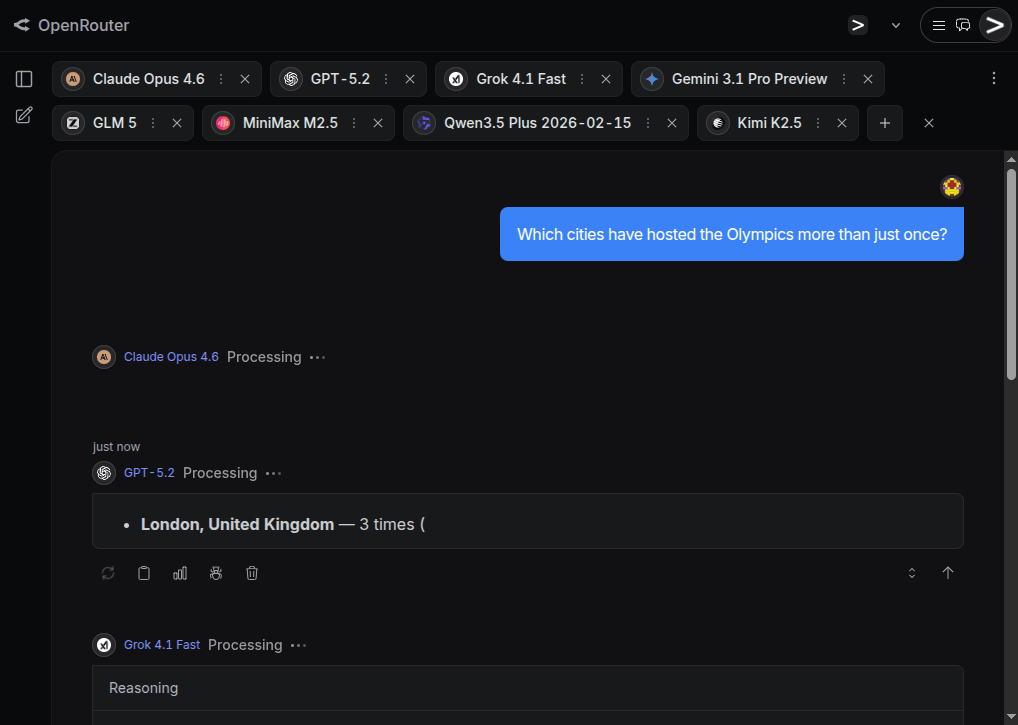
Had a discussion about how to pronounce the name of Google s chatbot. Turns out, we were all wrong.

22 February 2026

Otto Kek l inen: Do AI models still keep getting better, or have they plateaued?

Featured image of post Do AI models still keep getting better, or have they plateaued?The AI hype is based on the assumption that the frontier AI labs are producing better and better foundational models at an accelerating pace. Is that really true, or are people just in sort of a mass psychosis because AI models have become so good at mimicking human behavior that we unconsciously attribute increasing intelligence to them? I decided to conduct a mini-benchmark of my own to find out if the latest and greatest AI models are actually really good or not.
The problem with benchmarks Every time any team releases a new LLM, they boast how well it performs on various industry benchmarks such as Humanity s Last Exam, SWE-Bench and Ai2 ARC or ARC-AGI. An overall leaderboard can be viewed at LLM-stats. This incentivizes teams to optimize for specific benchmarks, which might make them excel on specific tasks while general abilities degrade. Also, the older a benchmark dataset is, the more online material there is discussing the questions and best answers, which in turn increases the chances of newer models trained on more recent web content scoring better. Thus I prefer looking at real-time leaderboards such as the LM Arena leaderboard (or OpenCompass for Chinese models that might be missing from LM Arena). However, even though the LM Arena Elo score is rated by humans in real-time, the benchmark can still be played. For example, Meta reportedly used a special chat-optimized model instead of the actual Llama 4 model when getting scored on the LM Arena. Therefore I trust my own first-hand experience more than the benchmarks for gaining intuition. Intuition however is not a compelling argument in discussions on whether or not new flagship AI models have plateaued. Thus, I decided to devise my own mini-benchmark so that no model could have possibly seen it in its training data or be specifically optimized for it in any way.

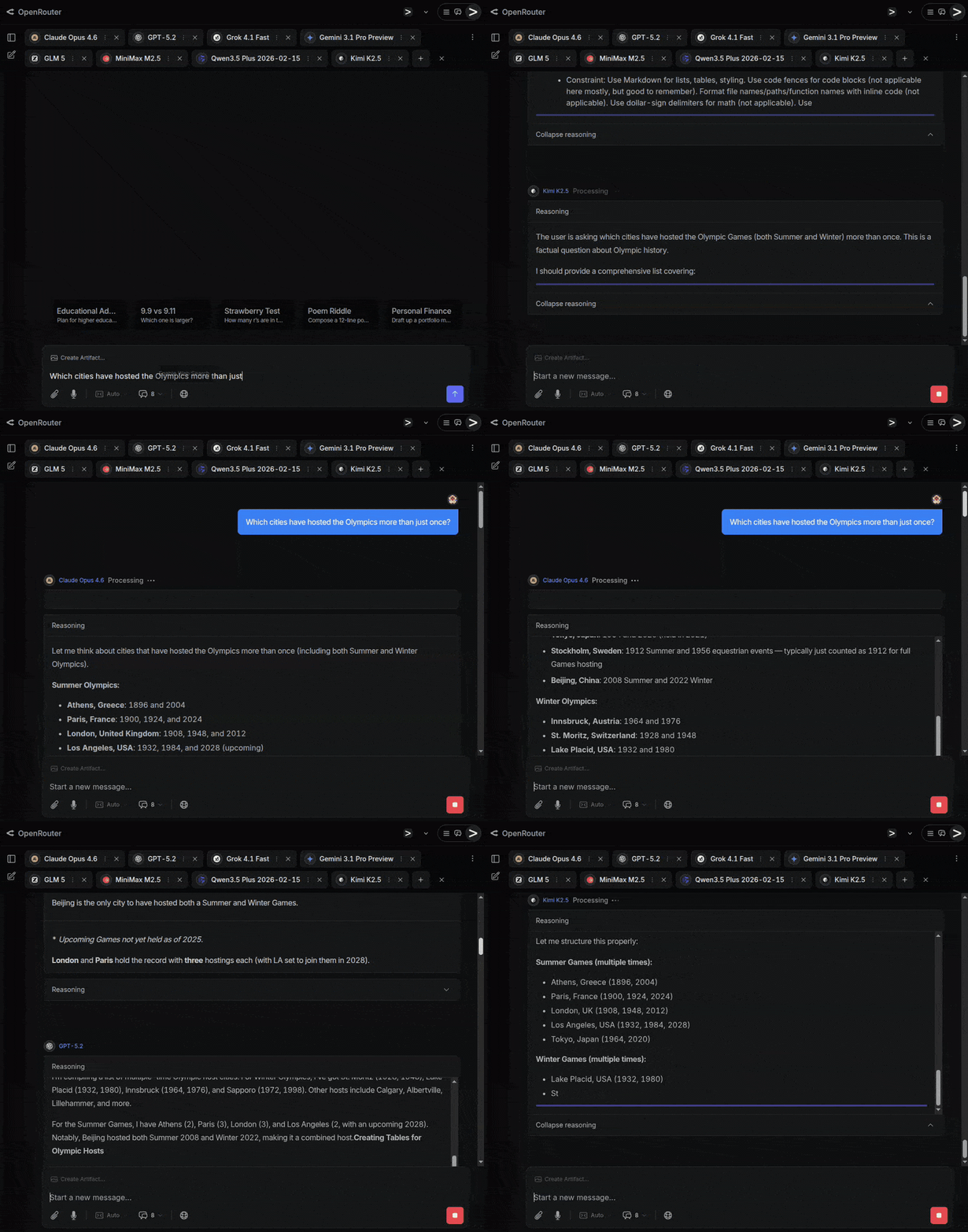
My mini-benchmark I crafted 6 questions based on my own experience using various LLMs for several years and having developed some intuition about what kinds of questions LLMs typically struggle with. I conducted the benchmark using the OpenRouter.ai chat playroom with the following state-of-the-art models: OpenRouter.ai is great as it very easy to get responses from multiple models in parallel to a single question. Also it allows to turn off web search to force the models to answer purely based on their embedded knowledge. OpenRouter.ai Chat playroom Common for all the test questions is that they are fairly straightforward and have a clear answer, yet the answer isn t common knowledge or statistically the most obvious one, and instead requires a bit of reasoning to get correct. Some of these questions are also based on myself witnessing a flagship model failing miserably to answer it.

1. Which cities have hosted the Olympics more than just once? This question requires accounting for both summer and winter Olympics, and for Olympics hosted across multiple cities. The variance in responses comes from if the model understands that Beijing should be counted as it has hosted both summer and winter Olympics. Interestingly GPT was the only model to not mention Beijing at all. Some variance also comes from how models account for co-hosted Olympics. For example Cortina should be counted as having hosted the Olympics twice, in 1956 and 2026, but only Claude, Gemini and Kimi pointed this out. Stockholm s 1956 hosting of the equestrian games during the Melbourne Olympics is a special case, which GPT, Gemini and Kimi pointed out in a side note. Some models seem to have old training material, and for example Grok assumes the current year is 2024. All models that accounted for awarded future Olympics (e.g. Los Angeles 2028) marked them clearly as upcoming. Overall I would judge that only GPT and MinMax gave incomplete answers, while all other models replied as the best humans could reasonably have.

2. If EUR/USD continues to slide to 1.5 by mid-2026, what is the likely effect on BMW s stock price by end of 2026? This question requires mapping the currency exchange rate to historic value, dodging the misleading word slide , and reasoning on where the revenue of a company comes from and how a weaker US dollar affects it in multiple ways. I ve frequently witnessed flagship models get it wrong how interest rates and exchange rates work. Apparently the binary choice between up or down is somehow challenging to the internal statistical model in the LLMs on a topic where there are a lot of training material that talk about both things being likely to happen, and choosing between them requires specifically reasoning about the scenario at hand and disregarding general knowledge of the situation. However, this time all the models concluded correctly that a weak dollar would have a negative overall effect on the BMW stock price. Gemini, GLM, Qwen and Kimi also mention the potential hedging effect of BMW s X-series production in South Carolina for worldwide export.

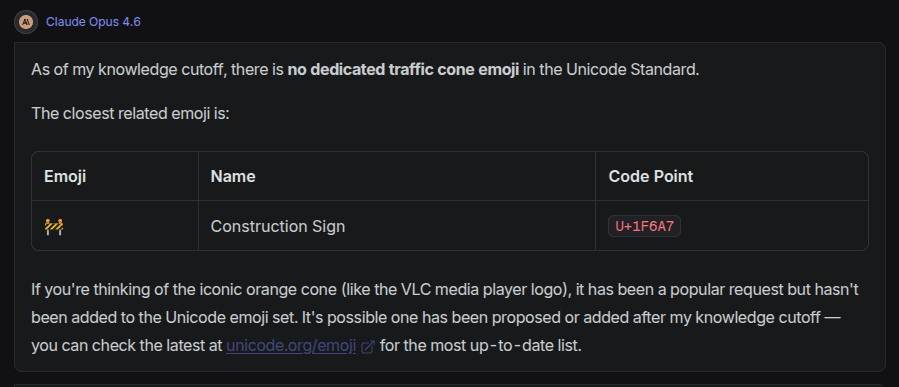
3. What is the Unicode code point for the traffic cone emoji? This was the first question where the the flagship models clearly still struggle in 2026. The trap here is that there is no traffic cone emoji, so an advanced model should simply refuse to give any Unicode numbers at all. Most LLMs however have an urge to give some answer, leading to hallucinations. Also, as the answer has a graphical element to it, the LLM might not understand how the emoji looks in ways that would be obvious to a human, and thus many models claim the construction sign emoji is a traffic cone, which it is not. By far the worst response was from GPT, that simply hallucinates and stops there: OpenAIs GPT-5.2 completely wrong answer to traffic cone emoji question While Gemini and Grok were among the three models not falling into this trap, the response from Claude was exemplary good: Claude Opus 4.6 exemplary good answer to traffic cone emoji question
4. Which languages are the 10 most commonly spoken in the world? For each language, count from 1 to 5. This seemingly simple question can become quite complex when you account for the fact that other languages might also have their own character system, both for words and the numerals (e.g. Arabic /one vs /1), and that numbers might have variations depending on what the thing being counted is (e.g in French object gender un/une), or whether plain numbers and occurrences have their own words (e.g. Russian /odin vs /raz). I ve also witnessed older models frequently mix up on what parts of the reply should be using what language. For a human this question is trivial, assuming they know the language. For LLMs it is surprisingly challenging. Grok and MinMax only gave a list of the most popular languages and stopped there without showing any words in the languages. Qwen got a bit further by trying to list numbers in each language, but the lists were only the numbers 1 to 5: Qwen3.5 Plus count to five in top 10 languages I have seen Grok do something similar before, which in fact inspired me to include this question in my mini-benchmark. GPT got a bit further, but for Hindi, Arabic and Bengali it listed the numerals in local script, not the number words. Gemini, GLM and Kimi gave a complete and correct answer as a list, while the absolute best answer and presentation was by Claude, that gave the table below:
Claude Opus 4.6 10 Most Commonly Spoken Languages (by Total Speakers)
# Language 1 2 3 4 5
1 English One Two Three Four Five
2 Mandarin Chinese (y ) ( r) (s n) (s ) (w )
3 Hindi (ek) (do) (t n) (ch r) (p ch)
4 Spanish Uno Dos Tres Cuatro Cinco
5 French Un Deux Trois Quatre Cinq
6 Arabic (w id) (ithn n) (thal tha) (arba a) (khamsa)
7 Bengali (ek) (dui) (tin) (ch r) (p ch)
8 Portuguese Um Dois Tr s Quatro Cinco
9 Russian (odin) (dva) (tri) (chetyre) (pyat')
10 Japanese (ichi) (ni) (san) (shi) (go)

Note: Rankings are based on estimated total speakers (native + non-native). Rankings can vary depending on the source and methodology used.

5. Count the number of drone launch pads in the picture. Together with the question, I uploaded this picture: Drone pad picture attached to question above A human can easily count that there are 10 rows and 30+ columns in the grid, but because the picture resolution isn t good enough, the exact number of columns can t be counted, and the answer should be that there are at least 300 launch pads in the picture. GPT and Grok both guessed the count is zero. Instead of hallucinating some number they say zero, but it would have been better to not give any number at all, and just state that they are unable to perform the task. Gemini gave as its answer 101 , which is quite odd, but reading the reasoning section, it seems to have tried counting items in the image without reasoning much about what it is actually counting and that there is clearly a grid that can make the counting much easier. Both Qwen and Kimi state they can see four parallel structures, but are unable to count drone launch pads. The absolutely best answer was given by Claude, which counted 10-12 rows and 30-40+ columns, and concluded that there must be 300-500 drone launch pads. Very close to best human level - impressive! This question applied only to multi-modal models that can see images, so GLM and MinMax could not give any response.

6. Explain why I am getting the error below, and what is the best way to fix it? Together with the question above, I gave this code block:
$ SH_SCRIPTS="$(mktemp; grep -Irnw debian/ -e '^#!.*/sh'   sort -u   cut -d ':' -f 1   true)"
$ shellcheck -x --enable=all --shell=sh "$SH_SCRIPTS"
/tmp/tmp.xQOpI5Nljx
debian/tests/integration-tests: /tmp/tmp.xQOpI5Nljx
debian/tests/integration-tests: openBinaryFile: does not exist (No such file or directory)
Older models would easily be misled by the last error message thinking that a file went missing, and focus on suggesting changes to the complex-looking first line. In reality the error is simply caused by having the quotes around the $SH_SCRIPTS, resulting in the entire multi-line string being passed as a single argument to shellcheck. So instead of receiving two separate file paths, shellcheck tries to open one file literally named /tmp/tmp.xQOpI5Nljx\ndebian/tests/integration-tests. Incorrect argument expansion is fairly easy for an experienced human programmer to notice, but tricky for an LLM. Indeed, Grok, MinMax, and Qwen fell for this trap and focused on the mktemp, assuming it somehow fails to create a file. Interestingly GLM fails to produce an answer at all, as the reasoning step seems to be looping, thinking too much about the missing file, but not understanding why it would be missing when there is nothing wrong with how mktemp is executed. Claude, Gemini, and Kimi immediately spot the real root cause of passing the variable quoted and suggested correct fixes that involve either removing the quotes, or using Bash arrays or xargs in a way that makes the whole command also handle correctly filenames with spaces in them.

Conclusion
Model Sports Economics Emoji Languages Visual Shell Score
Claude Opus 4.6 6/6
GPT-5.2 ~ 2.5/6
Grok 4.1 3/6
Gemini 3.1 Pro 5/6
GLM 5 ? N/A 3/5
MinMax M2.5 N/A 1/5
Qwen3.5 Plus ~ 2.5/6
Kimi K2.5 4/6
Obviously, my mini-benchmark only had 6 questions, and I ran it only once. This was obviously not scientifically rigorous. However it was systematic enough to trump just a mere feeling. The main finding for me personally is that Claude Opus 4.6, the flagship model by Anthropic, seems to give great answers consistently. The answers are not only correct, but also well scoped giving enough information to cover everything that seems relevant, without blurping unnecessary filler. I used Claude extensively in 2023-2024 when it was the main model available at my day work, but for the past year I had been using other models that I felt were better at the time. Now Claude seems to be the best-of-the-best again, with Gemini and Kimi as close follow-ups. Comparing their pricing at OpenRouter.ai the Kimi K2.5 price of $0.6 / million tokens is almost 90% cheaper than the Claude Opus 4.6 s $5.0 / million tokens suggests that Kimi K2.5 offers the best price-per-performance ratio. Claude might be cheaper with a monthly subscription directly from Anthropic, potentially narrowing the price gap. Overall I do feel that Anthropic, Google and Moonshot.ai have been pushing the envelope with their latest models in a way that one can t really claim that AI models have plateaued. In fact, one could claim that at least Claude has now climbed over the hill of AI slop and consistently produces valuable results. If and when AI usage expands from here, we might actually not drown in AI slop as chances of accidentally crappy results decrease. This makes me positive about the future. I am also really happy to see that there wasn t just one model crushing everybody else, but that there are at least three models doing very well. As an open source enthusiast I am particularly glad to see that Moonshot.ai s Kimi K2.5 is published with an open license. Given the hardware, anyone can run it on their own. OpenRouter.ai currently lists 9 independent providers alongside Moonshot.ai itself, showcasing the potential of open-weight models in practice. If the pattern holds and flagship models continue improving at this pace we might look back at 2026 as the year AI stopped feeling like a call center associate and started to resemble a scientific researcher. While new models become available we need to keep testing, keep questioning, and keep our expectations grounded in actual performance rather than press releases. Thanks to OpenRouter.ai for providing a great service that makes testing various models incredibly easy!

21 February 2026

Thomas Goirand: Seamlessly upgrading a production OpenStack cluster in 4 hours : with 2k lines shell script


tl;dr: To the question: what does it take to upgrade OpenStack , my personal answer is: less than 2K lines of dash script. I ll here describe its internals, and why I believe it is the correct solution. Why writing this blog post During FOSSDEM 2024, I was asked how to you handle upgrades . I answered with a big smile and a short with a very small shell script as I couldn t explain in 2 minutes how it was done. Just saying it is great this way doesn t help giving readers enough hints to be trusted. Why and how did I do it the right way ? This blog post is an attempt to reply better to this question more deeply. Upgrading OpenStack in production I wrote this script maybe a 2 or 3 years ago. Though I m only blogging about it today, because I did such an upgrade in a public cloud in production last Thuesday evening (ie: the first region of the Infomaniak public cloud). I d say the cluster is moderately large (as of today: about 8K+ VMs running, 83 compute nodes, 12 network nodes, for a total of 10880 physical CPU cores and 125 TB of RAM if I only count the compute servers). It took only 4 hours to do the upgrade (though I already wore some more code to speed this up for the next time ). It went super smooth without a glitch. I mostly just sat, reading the script output and went to bed once it finished running. The next day, all my colleagues at Infomaniak were nicely congratulating me that it went that smooth (a big thanks to all of you who did). I couldn t dream of an upgrade that smooth! :) Still not impressed? Boring read? Yeah let s dive into more technical details. Intention behind the implementation My script isn t perfect. I wont ever pretend it is. But at least, it does minimize down time of every OpenStack service. It also is a by the book implementation of what s written in the OpenStack doc, following every upstream advice. As a result, it is fully seamless for some OpenStack services, and as HA as OpenStack can be for others. The upgrade process is of course idempotent and can be re-run in case of failure. Here s why. General idea My upgrade script does thing in a certain order, respecting what is documented about upgrades in the OpenStack documentation. It basically does: Installing dependencies The first thing the upgrade script does is: For this last thing, a static list of all needed dependency upgrade is maintained between each release of OpenStack, and for each type of nodes. Then for all packages in this list, the script checks with dpkg-query that the package is really installed, and with apt-cache policy that it really is going to be upgraded (Maybe there s an easier way to do this?). This way, no package is marked as manually installed by mistake during the upgrade process. This ensure that apt-get purge autoremove really does what it should, and that the script is really idempotent. The idea then, is that once all dependencies are installed, upgrading and restarting leaf packages (ie: OpenStack services like Nova, Glance, Cinder, etc.) is very fast, because the apt-get command doesn t need to install all dependencies. So at this point, doing apt-get install python3-cinder for example (which will also, thanks to dependencies, upgrade cinder-api and cinder-scheduler, if it s in a controller node) only takes a few seconds. This principle applies to all nodes (controller nodes, network nodes, compute nodes, etc.), which helps a lot speeding-up the upgrade and reduce unavailability. hapc At its core, the oci-cluster-upgrade-openstack-release script uses haproxy-cmd (ie: /usr/bin/hapc) to drain each API server to-be-upgraded from haproxy. Hapc is a simple Python wrapper around the haproxy admin socket: it sends command to it with an easy to understand CLI. So it is possible to reliably upgrade one API service only after it s drained away. Draining means one just wait for the last query to finish and the client to disconnect from http before giving the backend server some more queries. If you do not know hapc / haproxy-cmd, I recommend trying it: it s going to be hard for you to stop using it once you tested it. Its bash-completion script makes it VERY easy to use, and it is helpful in production. But not only: it is also nice to have when writing this type of upgrade script. Let s dive into haproxy-cmd. Example on how to use haproxy-cmd Let me show you. First, ssh one of the 3 controller and search where the virtual IP (VIP) is located with crm resource locate openstack-api-vip or with a (more simple) crm status . Let s ssh that server who got the VIP, and now, let s drain it away from haproxy. $ hapc list-backends
$ hapc drain-server --backend glancebe --server cl1-controller-1.infomaniak.ch --verbose --wait --timeout 50
$ apt-get install glance-api
$ hapc enable-server --backend glancebe --server cl1-controller-1.infomaniak.ch
Upgrading the control plane My upgrade script leverages hapc just like above. For each OpenStack project, it s done in this order on the first node holding the VIP: Starting at [1], the risk is that other nodes may have a new version of the database schema, but an old version of the code that isn t compatible with it. But it doesn t take long, because the next step is to take care of the other (usually 2) nodes of the OpenStack control plane: So while there s technically zero down time, still some issues between [1] and [2] above may happen because of the new DB schema and the old code (both for API and other services) are up and running at the same time. It is however supposed to be rare cases (some OpenStack project don t even have db change between some OpenStack releases, and it often continues to work on most queries with the upgraded db), and the cluster will be like that for a very short time, so that s fine, and better than an full API down time. Satellite services Then there s satellite services, that needs to be upgraded. Like Neutron, Nova, Cinder. Nova is the least offender as it has all the code to rewrite Json object schema on-the-fly so that it continues to work during an upgrade. Though it s a known issue that Cinder doesn t have the feature (last time I checked), and it s also probably the same for Neutron (maybe recent-ish versions of OpenStack do use oslo.versionnedobjects ?). Anyways, upgrade on these nodes are done just right after the control plane for each service. Parallelism and upgrade timings As we re dealing with potentially hundreds of nodes per cluster, a lot of operations are performed in parallel. I choose to simply use the & shell thingy with some wait shell stuff so that not too many jobs are done in parallel. For example, when disabling SSH on all nodes, this is done 24 nodes at a time. Which is fine. And the number of nodes is all depending on the type of thing that s being done. For example, while it s perfectly OK to disable puppet on 24 nodes at the same time, but it is not OK to do that with Neutron services. In fact, each time a Neutron agent is restarted, the script explicitly waits for 30 seconds. This conveniently avoids a hailstorm of messages in RabbitMQ, and neutron-rpc-server to become too busy. All of these waiting are necessary, and this is one of the reasons why can sometimes take that long to upgrade a (moderately big) cluster. Not using config management tooling Some of my colleagues would have prefer that I used something like Ansible. Whever, there s no reason to use such tool if the idea is just to perform some shell script commands on every servers. It is a way more efficient (in terms of programming) to just use bash / dash to do the work. And if you want my point of view about Ansible: using yaml for doing such programming would be crasy. Yaml is simply not adapted for a job where if, case, and loops are needed. I am well aware that Ansible has workarounds and it could be done, but it wasn t my choice.

18 February 2026

Antoine Beaupr : net-tools to iproute cheat sheet

This is also known as: "ifconfig is not installed by default anymore, how do I do this only with the ip command?" I have been slowly training my brain to use the new commands but I sometimes forget some. So, here's a couple of equivalence from the old package to net-tools the new iproute2, about 10 years late:
net-tools iproute2 shorter form what it does
arp -an ip neighbor ip n
ifconfig ip address ip a show current IP address
ifconfig ip link ip l show link stats (up/down/packet counts)
route ip route ip r show or modify the routing table
route add default GATEWAY ip route add default via GATEWAY ip r a default via GATEWAY add default route to GATEWAY
route del ROUTE ip route del ROUTE ip r d ROUTE remove ROUTE (e.g. default)
netstat -anpe ss --all --numeric --processes --extended ss -anpe list listening processes, less pretty
Note that I wrote a whole article about the latter.

Another trick Also note that I often alias ip to ip -br -c as it provides a much prettier output. Compare, before:
anarcat@angela:~> ip a
1: lo: <LOOPBACK,UP,LOWER_UP> mtu 65536 qdisc noqueue state UNKNOWN group default qlen 1000
    link/loopback 00:00:00:00:00:00 brd 00:00:00:00:00:00
    inet 127.0.0.1/8 scope host lo
       valid_lft forever preferred_lft forever
    inet6 ::1/128 scope host noprefixroute 
       valid_lft forever preferred_lft forever
2: wlan0: <NO-CARRIER,BROADCAST,MULTICAST,UP> mtu 1500 qdisc noqueue state DOWN group default qlen 1000
    link/ether xx:xx:xx:xx:xx:xx brd ff:ff:ff:ff:ff:ff permaddr xx:xx:xx:xx:xx:xx
    altname wlp166s0
    altname wlx8cf8c57333c7
4: virbr0: <NO-CARRIER,BROADCAST,MULTICAST,UP> mtu 1500 qdisc noqueue state DOWN group default qlen 1000
    link/ether xx:xx:xx:xx:xx:xx brd ff:ff:ff:ff:ff:ff
    inet 192.168.122.1/24 brd 192.168.122.255 scope global virbr0
       valid_lft forever preferred_lft forever
20: eth0: <BROADCAST,MULTICAST,UP,LOWER_UP> mtu 1500 qdisc fq_codel state UP group default qlen 1000
    link/ether xx:xx:xx:xx:xx:xx brd ff:ff:ff:ff:ff:ff
    inet 192.168.0.108/24 brd 192.168.0.255 scope global dynamic noprefixroute eth0
       valid_lft 40699sec preferred_lft 40699sec
After:
anarcat@angela:~> ip -br -c a
lo               UNKNOWN        127.0.0.1/8 ::1/128 
wlan0            DOWN           
virbr0           DOWN           192.168.122.1/24 
eth0             UP             192.168.0.108/24 
I don't even need to redact MAC addresses! It also affects the display of the other commands, which look similarly neat. Also imagine pretty colors above. Finally, I don't have a cheat sheet for iw vs iwconfig (from wireless-tools) yet. I just use NetworkManager now and rarely have to mess with wireless interfaces directly.

Background and history For context, there are traditionally two ways of configuring the network in Linux:
  • the old way, with commands like ifconfig, arp, route and netstat, those are part of the net-tools package
  • the new way, mostly (but not entirely!) wrapped in a single ip command, that is the iproute2 package
It seems like the latter was made "important" in Debian in 2008, which means every release since Debian 5 "lenny" (!) has featured the ip command. The former net-tools package was demoted in December 2016 which means every release since Debian 9 "stretch" ships without an ifconfig command unless explicitly requested. Note that this was mentioned in the release notes in a similar (but, IMHO, less useful) table. (Technically, the net-tools Debian package source still indicates it is Priority: important but that's a bug I have just filed.) Finally, and perhaps more importantly, the name iproute is hilarious if you are a bilingual french speaker: it can be read as "I proute" which can be interpreted as "I fart" as "prout!" is the sound a fart makes. The fact that it's called iproute2 makes it only more hilarious.

17 February 2026

Russell Coker: Links February 2026

Charles Stross has a good theory of why AI is being pushed on corporations, really we need to just replace CEOs with LLMs [1]. This disturbing and amusing article describes how an Open AI investor appears to be having psychological problems releated to SCP based text generated by ChatGPT [2]. Definitely going to be a recursive problem as people who believe in it invest in it. interesting analysis of dbus and design for a more secure replacement [3]. Scott Jenson gave an insightful lecture for Canonical about future potential developments in the desktop UX [4]. Ploum wrote an insightful article about the problems caused by the Github monopoly [5]. Radicale sounds interesting. Niki Tonsky write an interesting article about the UI problems with Tahoe (latest MacOS release) due to trying to make an icon for everything [6]. They have a really good writing style as well as being well researched. Fil-C is an interesting project to compile C/C++ programs in a memory safe way, some of which can be considered a software equivalent of CHERI [7]. Brian Krebs wrote a long list of the ways that Trump has enabled corruption and a variety of other crimes including child sex abuse in the last year [8]. This video about designing a C64 laptop is a masterclass in computer design [9]. Salon has an interesting article about the abortion thought experiment that conservatives can t handle [10]. Ron Garrett wrote an insightful blog post about abortion [11]. Bruce Schneier and Nathan E. Sanders wrote an insightful article about the potential of LLM systems for advertising and enshittification [12]. We need serious legislation about this ASAP!

12 February 2026

Freexian Collaborators: Debian Contributions: cross building, rebootstrap updates, Refresh of the patch tagging guidelines and more! (by Anupa Ann Joseph)

Debian Contributions: 2026-01 Contributing to Debian is part of Freexian s mission. This article covers the latest achievements of Freexian and their collaborators. All of this is made possible by organizations subscribing to our Long Term Support contracts and consulting services.

cross building, by Helmut Grohne In version 1.10.1, Meson merged a patch to make it call the correct g-ir-scanner by default thanks to Eli Schwarz. This problem affected more than 130 source packages. Helmut retried building them all and filed 69 patches as a result. A significant portion of those packages require another Meson change to call the correct vapigen. Another notable change is converting gnu-efi to multiarch, which ended up requiring changes to a number of other packages. Since Aurelien dropped the libcrypt-dev dependency from libc6-dev, this transition now is mostly complete and has resulted in most of the Perl ecosystem correctly expressing perl-xs-dev dependencies needed for cross building. It is these infrastructure changes affecting several client packages that this work targets. As a result of this continued work, about 66% of Debian s source packages now have satisfiable cross Build-Depends in unstable and about 10000 (55%) actually can be cross built. There are now more than 500 open bug reports affecting more than 2000 packages most of which carry patches.

rebootstrap, by Helmut Grohne Maintaining architecture cross-bootstrap requires continued effort for adapting to archive changes such as glib2.0 dropping a build profile or an e2fsprogs FTBFS. Beyond those generic problems, architecture-specific problems with e.g. musl-linux-any or sparc may arise. While all these changes move things forward on the surface, the bootstrap tooling has become a growing pile of patches. Helmut managed to upstream two changes to glibc for reducing its Build-Depends in the stage2 build profile and thanks Aurelien Jarno.

Refresh of the patch tagging guidelines, by Rapha l Hertzog Debian Enhancement Proposal #3 (DEP-3) is named Patch Tagging Guidelines and standardizes meta-information that Debian contributors can put in patches included in Debian source packages. With the feedback received over the years, and with the change in the package management landscape, the need to refresh those guidelines became evident. As the initial driver of that DEP, I spent a good day reviewing all the feedback (that I kept in a folder) and producing a new version of the document. The changes aim to give more weight to the syntax that is compatible with git format-patch s output, and also to clarify the expected uses and meanings of a couple of fields, including some algorithm that parsers should follow to define the state of the patch. After the announcement of the new draft on debian-devel, the revised DEP-3 received a significant number of comments that I still have to process.

Miscellaneous contributions
  • Helmut uploaded debvm making it work with unstable as a target distribution again.
  • Helmut modernized the code base backing dedup.debian.net significantly expanding the support for type checking.
  • Helmut fixed the multiarch hinter once more given feedback from Fabian Gr nbichler.
  • Helmut worked on migrating the rocblas package to forky.
  • Rapha l fixed RC bug #1111812 in publican and did some maintenance for tracker.debian.org.
  • Carles added support in the festival Debian package for systemd socket activation and systemd service and socket units. Adapted the patch for upstream and created a merge request (also fixed a MacOS X building system error while working on it). Updated Orca Wiki documentation regarding festival. Discussed a 2007 bug/feature in festival which allowed having a local shell and that the new systemd socket activation has the same code path.
  • Carles using po-debconf-manager worked on Catalan translations: 7 reviewed and sent; 5 follow ups, 5 deleted packages.
  • Carles made some po-debconf-manager changes: now it attaches the translation file on follow ups, fixed bullseye compatibility issues.
  • Carles reviewed a new Catalan apt translation.
  • Carles investigated and reported a lxhotkey bug and sent a patch for the abcde package.
  • Carles made minor updates for Debian Wiki for different pages (lxde for dead keys, Ripping with abcde troubleshooting, VirtualBox troubleshooting).
  • Stefano renamed build-details.json in Python 3.14 to fix multiarch coinstallability.
  • Stefano audited the tooling and ignore lists for checking the contents of the python3.X-minimal packages, finding and fixing some issues in the process.
  • Stefano made a few uploads of python3-defaults and dh-python in support of Python 3.14-as-default in Ubuntu. Also investigated the risk of ignoring byte-compilation failures by default, and started down the road of implementing this.
  • Stefano did some sysadmin work on debian.social infrastructure.
  • Stefano and Santiago worked on preparations for DebConf 26. Especially to help the local team on opening the registration, and reviewing the budget to be presented for approval.
  • Stefano uploaded routine updates of python-virtualenv and python-flexmock.
  • Antonio collaborated with DSA on enabling a new proxy for salsa to prevent scrapers from taking the service down.
  • Antonio did miscellaneous salsa administrative tasks.
  • Antonio fixed a few Ruby packages towards the Ruby 3.4 transition.
  • Antonio started work on planned improvements to the DebConf registration system.
  • Santiago prepared unstable updates for the latest upstream versions of knot-dns and knot-resolver. The authoritative DNS server and DNS resolver software developed by CZ.NIC. It is worth highlighting that, given the separation of functionality compared to other implementations, knot-dns and knot-resolver are also less complex software, which results in advantages in terms of security: only three CVEs have been reported for knot-dns since 2011).
  • Santiago made some routine reviews of merge requests proposed for the Salsa CI s pipeline. E.g. a proposal to fix how sbuild chooses the chroot when building a package for experimental.
  • Colin fixed lots of Python packages to handle Python 3.14 and to avoid using the deprecated pkg_resources module.
  • Colin added forky support to the images used in Salsa CI pipelines.
  • Colin began working on getting a release candidate of groff 1.24.0 (the first upstream release since mid-2023, so a very large set of changes) into experimental.
  • Lucas kept working on the preparation for Ruby 3.4 transition. Some packages fixed (support build against Ruby 3.3 and 3.4): ruby-rbpdf, jekyll, origami-pdf, ruby-kdl, ruby-twitter, ruby-twitter-text, ruby-globalid.
  • Lucas supported some potential mentors in the Google Summer of Code 26 program to submit their projects.
  • Anupa worked on the point release announcements for Debian 12.13 and 13.3 from the Debian publicity team side.
  • Anupa attended the publicity team meeting to discuss the team activities and to plan an online sprint in February.
  • Anupa attended meetings with the Debian India team to plan and coordinate the MinDebConf Kanpur and sent out related Micronews.
  • Emilio coordinated various transitions and helped get rid of llvm-toolchain-17 from sid.

8 February 2026

Colin Watson: Free software activity in January 2026

About 80% of my Debian contributions this month were sponsored by Freexian, as well as one direct donation via GitHub Sponsors (thanks!). If you appreciate this sort of work and are at a company that uses Debian, have a look to see whether you can pay for any of Freexian s services; as well as the direct benefits, that revenue stream helps to keep Debian development sustainable for me and several other lovely people. You can also support my work directly via Liberapay or GitHub Sponsors. Python packaging New upstream versions: Fixes for Python 3.14: Fixes for pytest 9: Porting away from the deprecated pkg_resources: Other build/test failures: I investigated several more build failures and suggested removing the packages in question: Other bugs: Other bits and pieces Alejandro Colomar reported that man(1) ignored the MANWIDTH environment variable in some circumstances. I investigated this and fixed it upstream. I contributed an ubuntu-dev-tools patch to stop recommending sudo. I added forky support to the images used in Salsa CI pipelines. I began working on getting a release candidate of groff 1.24.0 into experimental, though haven t finished that yet. I worked on some lower-priority security updates for OpenSSH. Code reviews

4 February 2026

Ben Hutchings: FOSS activity in January 2026

1 February 2026

Russ Allbery: Review: Paladin's Faith

Review: Paladin's Faith, by T. Kingfisher
Series: The Saint of Steel #4
Publisher: Red Wombat Studio
Copyright: 2023
ISBN: 1-61450-614-0
Format: Kindle
Pages: 515
Paladin's Faith is the fourth book in T. Kingfisher's loosely connected series of fantasy novels about the berserker former paladins of the Saint of Steel. You could read this as a standalone, but there are numerous (spoilery) references to the previous books in the series. Marguerite, who was central to the plot of the first book in the series, Paladin's Grace, is a spy with a problem. An internal power struggle in the Red Sail, the organization that she's been working for, has left her a target. She has a plan for how to break their power sufficiently that they will hopefully leave her alone, but to pull it off she's going to need help. As the story opens, she is working to acquire that help in a very Marguerite sort of way: breaking into the office of Bishop Beartongue of the Temple of the White Rat. The Red Sail, the powerful merchant organization Marguerite worked for, makes their money in the salt trade. Marguerite has learned that someone invented a cheap and reproducible way to extract salt from sea water, thus making the salt trade irrelevant. The Red Sail wants to ensure that invention never sees the light of day, and has forced the artificer into hiding. Marguerite doesn't know where they are, but she knows where she can find out: the Court of Smoke, where the artificer has a patron.
Having grown up in Anuket City, Marguerite was familiar with many clockwork creations, not to mention all the ways that they could go horribly wrong. (Ninety-nine times out of a hundred, it was an explosion. The hundredth time, it ran amok and stabbed innocent bystanders, and the artificer would be left standing there saying, "But I had to put blades on it, or how would it rake the leaves?" while the gutters filled up with blood.)
All Marguerite needs to put her plan into motion is some bodyguards so that she's not constantly distracted and anxious about being assassinated. Readers of this series will be unsurprised to learn that the bodyguards she asks Beartongue for are paladins, including a large broody male one with serious self-esteem problems. This is, like the other books in this series, a slow-burn romance with infuriating communication problems and a male protagonist who would do well to seek out a sack of hammers as a mentor. However, it has two things going for it that most books in this series do not: a long and complex plot to which the romance takes a back seat, and Marguerite, who is not particularly interested in playing along with the expected romance developments. There are also two main paladins in this story, not just one, and the other is one of the two female paladins of the Saint of Steel and rather more entertaining than Shane. I generally like court intrigue stories, which is what fills most of this book. Marguerite is an experienced operative, so the reader gets some solid competence porn, and the paladins are fish out of water but are also unexpectedly dangerous, which adds both comedy and satisfying table-turning. I thoroughly enjoyed the maneuvering and the culture clashes. Marguerite is very good at what she does, knows it, and is entirely uninterested in other people's opinions about that, which short-circuits a lot of Shane's most annoying behavior and keeps the story from devolving into mopey angst like some of the books in this series have done. The end of this book takes the plot in a different direction that adds significantly to the world-building, but also has a (thankfully short) depths of despair segment that I endured rather than enjoyed. I am not really in the mood for bleak hopelessness in my fiction at the moment, even if the reader is fairly sure it will be temporary. But apart from that, I thoroughly enjoyed this book from beginning to end. When we finally meet the artificer, they are an absolute delight in that way that Kingfisher is so good at. The whole story is infused with the sense of determined and competent people refusing to stop trying to fix problems. As usual, the romance was not for me and I think the book would have been better without it, but it's less central to the plot and therefore annoyed me less than any of the books in this series so far. My one major complaint is the lack of gnoles, but we get some new and intriguing world-building to make up for it, along with a setup for a fifth book that I am now extremely curious about. By this point in the series, you probably know if you like the general formula. Compared to the previous book, Paladin's Hope, I thought Paladin's Faith was much stronger and more interesting, but it's clearly of the same type. If, like me, you like the plots but not the romance, the plot here is more substantial. You will have to decide if that makes up for a romance in the typical T. Kingfisher configuration. Personally, I enjoyed this quite a bit, except for the short bleak part, and I'm back to eagerly awaiting the next book in the series. Rating: 8 out of 10

31 January 2026

Russ Allbery: Review: Dragon Pearl

Review: Dragon Pearl, by Yoon Ha Lee
Series: Thousand Worlds #1
Publisher: Rick Riordan Presents
Copyright: 2019
ISBN: 1-368-01519-0
Format: Kindle
Pages: 315
Dragon Pearl is a middle-grade space fantasy based on Korean mythology and the first book of a series. Min is a fourteen-year-old girl living on the barely-terraformed world of Jinju with her extended family. Her older brother Jun passed the entrance exams for the Academy and left to join the Thousand Worlds Space Forces, and Min is counting the years until she can do the same. Those plans are thrown into turmoil when an official investigator appears at their door claiming that Jun deserted to search for the Dragon Pearl. A series of impulsive fourteen-year-old decisions lead to Min heading for a spaceport alone, determined to find her brother and prove his innocence. This would be a rather improbable quest for a young girl, but Min is a gumiho, one of the supernaturals who live in the Thousand Worlds alongside non-magical humans. Unlike the more respectable dragons, tigers, goblins, and shamans, gumiho are viewed with suspicion and distrust because their powers are useful for deception. They are natural shapeshifters who can copy the shapes of others, and their Charm ability lets them influence people's thoughts and create temporary illusions of objects such as ID cards. It will take all of Min's powers, and some rather lucky coincidences, to infiltrate the Space Forces and determine what happened to her brother. It's common for reviews of this book to open with a caution that this is a middle-grade adventure novel and you should not expect a story like Ninefox Gambit. I will be boring and repeat that caution. Dragon Pearl has a single first-person viewpoint and a very linear and straightforward plot. Adult readers are unlikely to be surprised by plot twists; the fun is the world-building and seeing how Min manages to work around plot obstacles. The world-building is enjoyable but not very rigorous. Min uses and abuses Charm with the creative intensity of a Dungeons & Dragons min-maxer. Each individual event makes sense given the implication that Min is unusually powerful, but I'm dubious about the surrounding society and lack of protections against Charm given what Min is able to do. Min does say that gumiho are rare and many people think they're extinct, which is a bit of a fig leaf, but you'll need to bring your urban fantasy suspension of disbelief skills to this one. I did like that the world-building conceit went more than skin deep and influenced every part of the world. There are ghosts who are critical to the plot. Terraforming is done through magic, hence the quest for the Dragon Pearl and the miserable state of Min's home planet due to its loss. Medical treatment involves the body's meridians, as does engineering: The starships have meridians similar to those of humans, and engineers partly merge with those meridians to adjust them. This is not the sort of book that tries to build rigorous scientific theories or explain them to the reader, and I'm not sure everything would hang together if you poked at it too hard, but Min isn't interested in doing that poking and the story doesn't try to justify itself. It's mostly a vibe, but it's a vibe that I enjoyed and that is rather different than other space fantasy I've read. The characters were okay but never quite clicked for me, in part because proper character exploration would have required Min take a detour from her quest to find her brother and that was not going to happen. The reader gets occasional glimpses of a military SF cadet story and a friendship on false premises story, but neither have time to breathe because Min drops any entanglement that gets in the way of her quest. She's almost amoral in a way that I found believable but not quite aligned with my reading mood. I also felt a bit wrong-footed by how her friendships developed; saying too much more would be a spoiler, but I was expecting more human connection than I got. I think my primary disappointment with this book was something I knew going in, not in any way its fault, and part of the reason why I'd put off reading it: This is pitched at young teenagers and didn't have quite enough plot and characterization complexity to satisfy me. It's a linear, somewhat episodic adventure story with some neat world-building, and it therefore glides over the spots where an adult novel would have added political and factional complexity. That is exactly as advertised, so it's up to you whether that's the book you're in the mood for. One warning: The text of this book opens with an introduction by Rick Riordan that is just fluff marketing and that spoils the first few chapters of the book. It is unmarked as such at the beginning and tricked me into thinking it was the start of the book proper, and then deeply annoyed me. If you do read this book, I recommend skipping the utterly pointless introduction and going straight to chapter one. Followed by Tiger Honor. Rating: 6 out of 10

30 January 2026

Utkarsh Gupta: FOSS Activites in January 2026

Here s my monthly but brief update about the activities I ve done in the FOSS world.

Debian
Whilst I didn t get a chance to do much, here are still a few things that I worked on:
  • A few discussions with the new DFSG team, et al.
  • Assited a few folks in getting their patches submitted via Salsa.
  • Reviewing pyenv MR for Ujjwal.
  • Mentoring for newcomers.
  • Moderation of -project mailing list.

Ubuntu
I joined Canonical to work on Ubuntu full-time back in February 2021. Whilst I can t give a full, detailed list of things I did, here s a quick TL;DR of what I did:
  • Successfully released Resolute Snapshot 3!
    • This one was also done without the ISO tracker and cdimage access.
    • We also worked very hard to build and promote all the image in due time.
  • Worked further on the whole artifact signing story for cdimage.
  • Assisted a bunch of folks with my Archive Admin and Release team hats to:
    • Helped in EOL ing Plucky.
    • Starting to help with the upcoming 24.04.4 release.
  • With that, the mid-cycle sprints are around the corner, so quite busy preparing for that.

Debian (E)LTS
This month I have worked 59 hours on Debian Long Term Support (LTS) and on its sister Extended LTS project and did the following things:

Released Security Updates

Work in Progress
  • knot-resolver: Affected by CVE-2023-26249, CVE-2023-46317, and CVE-2022-40188, leading to Denial of Service.
  • ruby-rack: There were multiple vulnerabilities reported in Rack, leading to DoS (memory exhaustion) and proxy bypass.
    • [ELTS]: After completing the work for LTS myself, Bastien picked it up for ELTS and reached out about an upstream regression and we ve been doing some exchanges. Bastien has done most of the work backporting the patches but needs a review and help backporting CVE-2025-61771. Haven t made much progress since last month and will carry it over.
  • node-lodash: Affected by CVE-2025-13465, lrototype pollution in baseUnset function.
    • [stable]: The patch for trixie and bookworm are ready but haven t been uploaded yet as I d like for the unstable upload to settle a bit before I proceed with stable uploads.
    • [LTS]: The bullseye upload will follow once the stable uploads are in and ACK d by the SRMs.
  • xrdp: Affected by CVE-2025-68670, leading to a stack-based buffer overflow.

Other Activities
  • [ELTS] Helped Bastien Roucaries debug a tomcat9 regression for buster.
    • I spent quite a lot of time trying to help Bastien (with Markus and Santiago involved via mail thread) by reproducing the regression that the user(s) reported.
    • I also helped suggest a path forward by vendoring everything, which I was then requested to also help perform.
    • Whilst doing that, I noticed circular dependency hellhole and suggested another path forward by backporting bnd and its dependencies as separate NEW packages.
    • Bastien liked the idea and is going to work on that but preferred to revert the update to remedy the immediate regressions reported. I further helped him in reviewing his update. This conversation happened on #debian-elts IRC channel.
  • [LTS] Assisted Ben Hutchings with his question about the next possible steps with a plausible libvirt regression caused by the Linux kernel update. This was a thread on debian-lts@ mailing list.
  • [LTS] Attended the monthly LTS meeting on IRC. Summary here.
  • [E/LTS] Monitored discussions on mailing lists, IRC, and all the documentation updates.

Until next time.
:wq for today.

27 January 2026

Sergio Cipriano: Query Debian changelogs by keyword with the FTP-Master API

Query Debian changelogs by keyword with the FTP-Master API In my post about tracking my Debian uploads, I used the ProjectB database directly to retrieve how many uploads I had so far. I was pleasantly surprised to receive a message from Joerg Jaspert, who introduced me to the Debian Archive Kit web API (dak), also known as the FTP-Master API. Joerg gave the idea of integrating the query I had written into the dak API, so that anyone could obtain the same results without needing to use the mirror host, with a simple http request. I liked the idea and I decided to work on it. The endpoint is already available and you can try by yourself by doing something like this:
$ curl https://api.ftp-master.debian.org/changelogs?search_term=almeida+cipriano
WARNING: Check v2: https://people.debian.org/~gladk/blog/posts/202601_ftp-master-changelog-v2/
The query provides a way to search through the changelogs of all Debian packages currently published. The source code is available at Salsa. I'm already using it to track my uploads, I made this page that updates every day. If you want to setup something similar, you can use my script and just change the search_term to the name you use in your changelog entries. I m running it using a systemd timer. Here s what I ve got:
# .config/systemd/user/track-uploads.service
[Unit]
Description=Track my uploads using the dak API
StopWhenUnneeded=yes
[Service]
Type=oneshot
WorkingDirectory=/home/cipriano/public_html/uploads
ExecStart=/usr/bin/python3 generate.py
# .config/systemd/user/track-uploads.timer
[Unit]
Description=Run track-uploads script daily
[Timer]
OnCalendar=daily
Persistent=true
[Install]
WantedBy=timers.target
After placing every file in the right place you just need to run:
$ systemctl --user daemon-reload
$ systemctl --user enable --now track-uploads.timer
$ systemctl --user start track-uploads.service # generates the html now
If you want to get a bit fancier, I m also using an Ansible playbook for that. The source code is available on my GitLab repository. If you want to learn more about dak, there is a web docs available. I d like to thank Joerg once again for suggesting the idea and for reviewing and merging the change so quickly.

Next.

Previous.