Search Results: "sto"

2 July 2026

Matthew Garrett: Preventing token theft

When you log into a service you re given an authentication token. Each further request to the site includes that token, allowing the server to figure out who you are and ensuring that you have access to your data. Depending on site policy, this token may either be stored in memory (and so vanish if you restart your browser) or disk. The token is the proof of your identity. As far as the site is concerned, anyone with your token is you. These tokens may be traditional browser cookies, but they may also be stored in either site local storage or (if you re not using a browser) in some other storage location. In recent years we ve seen infostealer malware (like LummaC2) gain the ability to exfiltrate user tokens, allowing attackers to gain access to the user s data without needing to retain access to the user s machine. This attack is viable even if the site has strong MFA requirements, so passkeys don t help. Encrypting the tokens on disk doesn t prevent the malware from scraping them out of the browser s RAM or obtaining whatever key is used to encrypt them. This feels like a pretty hard problem to solve. But that hasn t stopped people from trying! Dirk Balfanz wrote an IETF draft describing a mechanism for using self-signed certificates for TLS authentication. This uses the mutual authentication feature of the TLS protocol that requires both sides prove their identity to each other. In regular TLS, the remote site presents a signed certificate that tells you who it is. When performing mutual authentication, you then present a certificate to the remote site telling it who you are. These client certificates are largely unused outside enterprise environments because they re a huge pain to deploy. It s not so much that this has sharp edges, it s that it s entirely made of sharp edges. Managing certificate deployment to your devices is hard. Browsers get confused if the certificates change under them. You have one certificate and it lives forever, so sites you present it to can track your identity. Users are prompted to choose a certificate to authenticate with, and if they pick the wrong one everything breaks and is hard to recover. I ve deployed this and I did not have a good time. But Balfanz s idea was simple. Rather than require certificates to be deployed, browsers would simply generate a certificate on the fly. The goal wasn t to prove the device or user s identity in any global way - but it would associate a TLS session with a specific certificate. You could then, for example, include a hash of the certificate in the cookie, and if someone tried to use that cookie without presenting that certificate then the cookie could be rejected. If the browser used a hardware-backed private key for the certificate then it would be impossible for an attacker to steal it. Sure, you could still steal cookies, but you wouldn t be able to use them. This was written almost 15 years ago, and seems simple, elegant, and functional. It didn t happen. Part of the reason for that is that, well, it wasn t quite so simple. One problem was privacy related. Cookies are only sent after the TLS session is established, so anyone monitoring the network doesn t know anything about the user identity. A naive implementation of this approach would have meant the client certificate being sent before session establishment, and now user identity can be tracked (no longer an issue if this was implemented on top of TLS 1.3, but this was a log time ago). This was avoided by reordering the client handshake, but that meant having to modify the TLS specification and implementations would have to be updated to support this. Another was that figuring out the granularity of the certificates was difficult. You d want to use different certificates for every site to avoid them effectively becoming tracking cookies, but you need to provide the certificate before cookies are set, and you don t know what origin the site is going to set in its cookies. If you generate a certificate for a.example.com and a different one for b.example.com, and a.example.com sets a cookie for *.example.com and includes the certificate you used for a.example.com, that cookie isn t going to work on b.example.com and things are broken. This meant supporting it wasn t as straightforward as it seemed - you d need to ensure that your cookie scope was compatible with the certificate scope. You could probably make this work well enough by aligning it with the Public Suffix List, but there was still some risk of expectations not being aligned. And, perhaps most importantly, TLS session resumption (replaced by pre-shared keys in TLS 1.3) somewhat defeats the purpose of the exercise - clients store state that allows them to re-establish a TLS connection without performing certificate exchange (this reduces overhead if a connection gets interrupted or you switch to a new network or anything along those lines), and anyone in a position to steal cookies could steal that state as well. The followup attempt was channel IDs. This simplified the implementation somewhat - rather than certificates, a raw public key would be sent, along with proof of possession of the private key in the form of a signature over a portion of the TLS handshake. This was required even in the event of session resumption, which avoided having to worry about theft of session secrets. The timing of the exchange was after the encrypted session had been established, so user identity couldn t be leaked that way either. Cookies could then be bound to this identifier. Unfortunately it didn t really deal with the problem of scoping keys in a way that would match cookie requirements, and the spec suggests that the right way of handling this is to scope keys to TLDs, which would enable user tracking across sites (Chrome s implementation apparently restricted it to eTLD+1, which would match the third party cookie policy and avoid the tracking risk). Chrome added support for this, but it was removed in early 2018. The discussion of some of the pain points in that message is interesting, explicitly calling out problems with connection coalescing across domains and the incompatibility with zero-RTT TLS1.3. The overall consensus at the time seems to be that trying to solve this entirely at the TLS layer has too many rough edges, and a different approach should be taken. And so almost 7 years after the initial draft for origin bound certificates, we come to token binding. This ended up being a rather more complex endeavour, covering 3 different RFCs describing how it impacts TLS, how to incorporate it into HTTP, and how to manage all the various parties involved in the process. The short version is that it s pretty similar to channel ID, except that there s also a documented mechanism for allowing tokens to be bound to one party and consumed by another, avoiding any need for widely scoped keys. Token binding effectively solved all the issues in the original proposal, but at the cost of somewhat more complexity. The RFC was finalised in October 2018. Chrome removed its (incomplete, draft) support for token binding in November 2018. Edge carried support until late 2024. Despite getting all the way through the RFC process, it s functionally dead. The process up until this point had been largely initiated by Google, with Microsoft contributing significantly to the token binding standards. The work had been focused on identifying a generic solution to the problem rather than tying it to any specific authentication flow. The next step was in a different direction - rather than trying to fix this for the entire internet, how about we try to fix it for OAuth? RFC 8705 is titled OAuth 2.0 Mutual-TLS Client Authentication and Certificate-Bound Access Tokens . This is basically the 2011 approach, but (a) with an explicit definition of how the certificate should be incorporated into issued auth cookies, and (b) with a proviso that well uh if you re going to use tokens issued by your IdP to authenticate to someone else then well you re going to need to use the same cert for both. This is probably fine for the company-owned-laptop case where you re actually fine with multiple sites being able to tie identities together (that s kind of the point here!), and also works for I am using an app and not a browser , but doesn t work for more generic scenarios. It also doesn t seem to take the session resumption case into account at all? Support for RFC8705 seems poor, as far as I can tell of the big players only Auth0 implements it. In theory it works fine with self-signed client certs but in reality that s going to be almost as difficult to support across multiple platforms as just issuing proper client certs in the first place, so deployment is going to be kind of a pain. But the good news is it doesn t rely on any TLS extensions or custom browser behaviour, so at the client side it works fine with any browser. Which brings us on to RFC 9449, Demonstrating Proof of Possession . This goes even further than RFC8705 in terms of reducing the burden of deployment - it works fine with existing browsers, and it doesn t even require any certs. The client generates a keypair and provides the pubkey when requesting the cookie. The cookie contains the pubkey. Every request to the service now provides the cookie with the pubkey and also provides a signature over the URI and HTTP method. If the signature matches the pubkey in the token then clearly the signature came from the machine the token was issued to, and everything is good. This does come with some downsides, though. The first is that it uses browser interfaces to generate the keys (typically crypto.subtle.generatekey()) and as far as I can tell there are no browsers that guarantee that that key is going to be generated in hardware even if it s marked non-exportable, so anyone able to steal the cookies can also steal the keys. The second is that the signature only covers the URI and HTTP method, and not the message content or any other headers, so anyone able to exfiltrate a valid signature can replay it against the same URI with different message content. The recommended way to handle this is to reject any signatures that weren t generated within the last few seconds, which is a wonderful additional way to allow clock skew to give you a Bad Day. And the third is that every single request has to be separately signed, which is not intrinsically a problem because computers are fast and have multiple cores, but if you re trying to solve the first problem by sticking the key in a TPM then you re dealing with something that s slow and single threaded and that s maybe acceptable if you re using client certificates (because there s going to be one signature per session and you can use the same session for multiple requests) but probably not if you re dealing with a user opening a browser that restores previous tabs and each of those is a webapp that fires off 100 requests in parallel. In case it wasn t clear, I don t like DPoP. It doesn t feel like it actually solves the underlying problem that we see in the real world (malware running in a context where if it can grab the tokens it can grab the keys), it adds a massive amount of overhead, and it has baked in replay vulnerabilities. I don t know why it exists and I m incredibly suspicious of vendors telling me that it fixes my problems, because if they re telling me that then I m going to end up assuming that they either don t understand my problems or they don t understand their technology, and neither of those is good. Still. Then we get to the thing that prompted me to write this - Chrome s announcement that they had launched device-bound session credentials. This is interesting because it s a Chrome feature that s explicitly intended to counter on-device malware, which was one of the things that was out of scope in 2018 when token binding was being removed. Since this is entire web level it doesn t have to be an RFC, and so is instead defined by W3C. I m going to handwave all the complexity and say that it s basically a way to register a public key when a cookie is issued, and then prove possession of the private key when it s time to renew the cookie. By making the cookies shortlived and having support for rotating them in the background, user impact is basically zero and while it s still possible for an attacker to exfiltrate and use a cookie they ll only be able to do so for a short window before it needs to be refreshed - something the attacker can t do, since they don t have the private key. This avoids the DPoP overhead because you only need to do signing once per cookie per cookie lifetime, and not on every single request. I don t like this due to the window where exfiltrated tokens can be used, but it feels like a strict improvement over the status quo. An extension called device-bound session credentials for enterprise allows pre-enrollment of device keys, so even though the actual runtime DBCE flow doesn t involve certificates, certificates can be used for device registration in enterprise environments and you can make sure that auth cookies only go to trusted devices. Unfortunately this is Chrome-only, and so we re going to need to wait for it to be backported to all the random app frameworks for it to have widespread support on mobile or for almost everyone s desktop app that s actually three websites in an Electron wrapper. Mozilla s current position is that they re not in favour of it, so I guess we ll see where Safari lands in terms of broad uptake. The last thing on my list is another client cert/OAuth binding, this one still in draft state at the time of writing. This one is aimed primarily at the use of agent-driven tooling, where you have something running in the background using a whole bunch of tools that are each acting on your behalf. Authenticating to all of them separately isn t a fun time, but giving broadly scoped access tokens to a non-deterministic agent and trusting that it ll never post them somewhere public also isn t a fun time. The key distinction between it and RFC8705 is that it s aimed at connections rather than sessions, which avoids the worries about session resumption. This is done with TLS Exporters, which in TLS 1.3 should be unique to the connection even over session resumption (TLS 1.2 may reuse some of the same key material for exporters over session resumption, so it s recommended to enforce 1.3 for this). By providing a new signature alongside the cookie on every new connection, the client proves that it still has access to the private key. This is a very new spec and I haven t had much time to work through it yet, but my naive understanding is that unlike RFC8705 this would require some additional client support to be able to regenerate the client signature on every TLS reconnection. This doesn t avoid all the problems that RFC8705 has, including how to scope certificates. For the agentic use case that probably doesn t matter - all these tools are acting on behalf of the same user, it s fine if all the sites involved know they re the same user. But it doesn t solve the general purpose user use case, and right now DBSC seems like the best we have there. But. Part of me still wonders whether Dirk Balfanz s approach was the right one. Yes, there s risk associated with TLS session resumption, but in the worst case you could just switch that off for high risk setups. The cookie scope argument is real, and also in cases where it could violate privacy the site owner could already choose to broaden their cookie scope and violate your privacy, and in cases where it breaks things you could just not make use of it. The other problems are largely fixed by TLS 1.3, and then we re just left with Browsers handle client certificates badly to which my answer is Yes, and we should fix that anyway . Despite having a pretty good answer to this solution over a decade ago, the closest we have to actual deployment is something that offers strictly worse security guarantees. And tokens keep getting stolen, and compromises keep occurring, and for the most part people shrug and get on with things.

1 July 2026

Ben Hutchings: FOSS activity in June 2026

This month s work was dominated by the transition of Debian 12 bookworm to support by the LTS team, and by review of some large updates to Linux stable branches. Linux 6.12 is currently available in bookworm-backports, but that suite will stop accepting uploads after the last bookworm point release. I updated some supporting packages in bookworm in preparation for adding Linux 6.12 there. I also prepared for the possibility that bookworm-backports would close earlier. Since the LTS team is still also maintaining Debian 11 bullseye until August, I reviewed upstream changes for both Linux 5.10 and 6.1 stable branches and reported a number of regressions and other issues.

30 June 2026

Utkarsh Gupta: FOSS Activities in June 2026

Here s my monthly but brief update about the activities I ve done in the FOSS world.

Debian
Whilst I didn t get a chance to do much, here are still a few things that I worked on:
  • Leading the DebConf Bursary team along with PEB.
    • This took most of my Debian time this month but we ve been able to wrap that work now.
    • Got back to all the tickets on Zammad, too.
  • Assisted a few folks in getting their patches submitted via Salsa.
  • Mentoring for newcomers.
  • Moderation of -project mailing list.

Ubuntu
I joined Canonical to work on Ubuntu full-time back in February 2021. Whilst I can t give a full, detailed list of things I did, here s a quick TL;DR of what I did:
  • Continued to push for infrastructure improvements:
    • Charming.
    • Artifact signing.
    • Reorganizing cdimage.
    • And so on.
  • Successfully released 26.10 Snapshot 2!
    • We landed a breaking change in the directory structure.
    • whihc had consequences on the rsync, being run by the sysadmins.
      • The 30 GB rsync failed because of the load on the system and it resulted in things blowing up. Yay. Stress-testing the shit out of our infra. :)
      • We got it back under control in the next few days but oh wow, what a journey to get there.
  • Assisted a bunch of folks with my Archive Admin and Release team hats to:
    • Helped in archive opening tasks.
    • Promoting/demoting binaries to/from main.
    • Taking care of package removals and so on.
    • Reviewed the NEW queue.
  • Reviewed quite a lot of MPs, specs, and other people s work.
  • Mentoring, coaching, and leading the Release Management team.

Debian (E)LTS
This month I have worked 15 hours on Debian Long Term Support (LTS) and on its sister Extended LTS project and did the following things:

Released Security Updates

Work in Progress

Other Activities
  • [LTS] Emilio pointed out that the gst-plugins-ugly1.0 binaries were still not fully released, so I ran dcut migrate to fully release them. The DLA had gone out earlier.
  • [ELTS] Did some more work on ruby-rack - a lot of new CVEs have opened up and, whilst I made some progress, Santiago let me know that ruby-rack is no longer supported and so it ll be removed from the ela-needed list.
  • [E/LTS] Set up the security-tracker and a few other things on the new machine, and debugged the git repository size madness. Sent a summary here.
  • [E/LTS] Monitored discussions on mailing lists, IRC, and all the documentation updates.
  • [E/LTS] Attended the monthly LTS meeting on Jitsi. Meeting notes here.

Until next time.
:wq for today.

28 June 2026

Russell Coker: Plaud

While watching a YouTube video I saw an advert for the Plaud AI Note Taker [1]. The Plaud device looks pretty good for what it does, taking notes and managing them, using some sort of LLM function to manage the notes. The devices all cost about $300 which is an amount that doesn t seem unreasonable for someone who s in a lot of meetings. One of the models is the NotePin that seems comparable to the Humane AI Pin I previously blogged about [2]. The business model for Plaud is based on only allowing 5 hours per month of free transcriptions, then charging $16.25/month for 20 hours per month and $33.33/month for unlimited use. That s quite expensive for any serious use. The number of people in the market for an audio recording system that automatically transcribes things may be greater than the number of people in the market for all the stuff that the Humane AI Pin did, but it still may not be enough to run a profitable business when competing with apps on mobile phones. While the product does look decent it seems that they are making the same mistakes as the original Humane developers did, of wanting to lock it down as a subscription based service which reduces the usability of the device. If they had sold an Android hand-held computer with their own app pre-loaded and allowed the user to install a different app then it would have been much more usable. If they had sold Android devices designed for the note taking market and allowed people to choose their own apps to install then their products would have a much longer life expectancy. The majority of Android devices in use are probably out of support but still working while the Humane AI pin can t be used any more and at some time in the not too distant future the Plaud devices will also become unusable. People who buy devices like the Plaud seem to be unaware of the history of such things and the expected future for them. But possibly some people just consider $300 for a year of use to be an acceptable price. If someone wanted to purchase a new high end phone every year and sell their previous one they would probably have a net cost of about $500/year. Maybe I should look for work with a company with an implausible AI based business plan. It would be fun developing such a device if you weren t emotionally invested in the project. Just develop new technology, earn a heap of money, play with fun computers, and move on to the next thing when it collapses. Just like all the Internet companies about 25 years ago.

Russell Coker: Some GPU Stuff

After getting a HP Z4 G4 tower server/workstation to house my Intel Battlemage GPU [1] I ve been playing around with some GPU stuff. For years I ve been just buying GPUs based on the resolution and price and not bothering about anything else due to lack of ability to measure what cards are doing. The nvidia-smi program is really good for NVidia/CUDA setups but I hadn t been aware of anything similar for AMD cards. As I prefer AMD cards for my workstations due to driver issues with NVidia that was a problem for me. I ve recently discovered that the program nvtop (Debian package nvtop) shows the GPU use of multiple GPU types, for me it s worked on AMD and Intel discrete GPUs and shows some information on Intel integrated GPUs, I don t have others convenient for testing at the moment. Currently BOINC has the Einstein@Home [2] project running on the HP Z4 G4 and it s using between 66% and 100% of GPU compute power and 1.6G of GPU RAM. Using 100% GPU compute power allegedly takes 62W of power out of the 190W quoted TDP. I presume that the power use reported by nvtop is very inaccurate. A friend installed a LLM on that system and the libraries used for the LLM were sufficient that BOINC just started using the GPU. On my workstation running an AMD [Radeon RX 460/560D / Pro 450/455/460/555/555X/560/560X] (actually R560) with 4G of GPU RAM I have mpv taking 1G of GPU RAM to play a FullHD video expanded to a full screen window on my 5120*2160 display. I also have about 2G used by the kwin_wayland process (the Wayland server for KDE). That doesn t leave enough GPU RAM to allow Einstein@Home to use the GPU. When playing the FullHD video in question (which is 1.2G for 42 minutes about 500KB/s) at 1.5* speed (a common playback speed I use) that takes about 30% of the compute power on my GPU. I had installed the rocm-opencl-icd package on my workstation (with a 5120*2160 monitor) and restarted boinc-client.service which is all that s needed to allow BOINC to use an AMD GPU. Then the screen started flickering as the Einstein process repeatedly core dumped which I initially assumed to be it s reaction to not having enough GPU RAM available. On every core dump the screen flickered so it went through a process of dozens of screen flickers until it had caused a sufficient number of core dumps and BOINC gave up running that job. Another annoyance is that the boincmgr program (the graphical program for managing BOINC systems) launches two webkit processes that each use about 400M of GPU RAM, so even if other things weren t using all my GPU RAM the boincmgr process would stop the BOINC jobs from using the GPU. I shut down some of the programs that were using GPU RAM until there was 2G free and the BOINC process kept crashing so it seems that there is some other issue. On another system with a 4K monitor there were Chrome and Chromium GPU process taking 1.1G and 500M of GPU RAM respectively and the KWin Wayland process was taking 1G of GPU RAM. So that s well over half the GPU RAM for just browsers and Wayland. With programs like Kitty (terminal emulator) and Nheko (Matrix client) taking over 100M of GPU RAM it seems that 4G is the bare minimum for GPU RAM with modern software and a 4K or similar display. I also noticed the kscreenlocker_greet process taking 440M of GPU RAM. I wonder if a hostile web server could make a web browser take more GPU RAM and starve the screenlocker of GPU RAM, could that allow forcing a screen lock operation to fail? It seems that 4G is the minimum for modern systems, which isn t necessarily a problem as GPUs that are capable of driving 4K displays tend to have no less than 4G. My local computer store has new GPUs with 4G starting at $120 but 12G seems to be the next option up which starts at about $400. Ebay currently has a selection of AMD GPUs with 8G of RAM under $200. I ve had some problems with the GPU in my workstation crashing as described in my previous post where I thought it was driver issues [3]. I now believe that there are hardware issues and will look into buying one of the cards with 8G. Further Investigation I need to determine which of the AMD GPUs that are currently going cheap on ebay are best. While my current PC has support for 150W PCIe power I d rather something less power hungry than that. I have occasional issues of mpv reporting that my system is too slow for a video so slightly more compute power on the GPU would be good, but I think that every available option has significantly more compute power. I need to find out what the relationship is between screen resolution and GPU memory. If I get an 8K display or an array of 4*4K displays (which is quite plausible as 27 4K displays go for $230 each) will I find 16G of GPU RAM as limiting as I find 4G now? The nvtop program tracks PCIe data transfers for AMD GPUs, I haven t yet seen more than 25MB/s and I need to do more tests to see what the maximum is. Running on an Intel Battlemage card nvtop doesn t report PCIe data transfer speed which is a missing feature in either the driver or the program. I need to find out where the problem is and report a bug if someone hasn t already done so. The GPU RAM use of some applications seems excessive. 440M for a lockscreen? 100M+ for a terminal emulator? 320M for Thunderbird?

27 June 2026

Russ Allbery: Review: The Folded Sky

Review: The Folded Sky, by Elizabeth Bear
Series: White Space #3
Publisher: Saga Press
Copyright: June 2025
ISBN: 1-6680-7812-0
Format: Kindle
Pages: 483
The Folded Sky is a far-future space opera and a fairly direct sequel to Ancestral Night, but with a different protagonist. You do not need to have a vivid memory of the previous book to read this one. It is somewhere around Elizabeth Bear's 31st (!) novel, depending on how one counts and what one includes. Sunyata Song is an archinformist, which is sort of an archaeologist, sort of a librarian, and sort of a historian. She recovers, decodes, and organizes information so that it can be preserved and made usefully available. As the book opens, she is, after an exceedingly long white space journey in an actively hostile ship with a (to Sunya at least) an atavistically off-putting crew, reaching her goal: a vast artifact that I won't describe further to avoid any spoilers for Ancestral Night. She is eager to get to work, an eagerness that is both heightened and made more anxious by the discovery that her academic rival and abusive ex has arrived before her. The pirate attack doesn't help, nor (at least at first) does the surprise appearance of her wife and kids. The opening of this book is a lot of infodumping mixed with nearly stream-of-consciousness emotional dumping. The style shift in this series continues to surprise me; previously, Elizabeth Bear books avoided reader hand-holding to the point of bafflement if you weren't paying close attention. Not here. The Folded Sky takes the shift perhaps too far, and I almost stalled out at the start of this book when Sunya's near-constant self-conscious litany and analysis of fears and concerns started feeling like whining. The book picks up considerably after the attempted murder. About a third of the way through, The Folded Sky feels like it's settling into a recognizable subgenre of murder mystery except set in the far future with fascinating technology and aliens. There has been an attempted murder on a closed station besieged by pirates. There is a law enforcement officer present, but they don't have a lot of investigative experience. For various reasons, Sunya decides to start poking around while being conscious she has no idea what she's doing. The bumbling detective is a common trope, so I thought that was where the story was headed. It is, sort of. There is a mystery and Sunya is involved in solving it. But that's only a small fraction of what's going on, and by the end of the book the plot has shifted firmly back to the genre of space opera, with a side note of family... drama is the wrong word. Whatever one would call a story about raising a rebellious teenager while trying very hard to not turn conflicts into actual drama. I am fascinated by the characterization of this book. Sunya is something of an emotional mess, but Bear doesn't use that fact in the ways that I would normally expect. Similar to Ancestral Night, I finished this book thinking that The Folded Sky is primarily an examination of rightminding, but a more subtle one than the previous novel. Rightminding is a central technology of the White Space series, and I suspect its intended thematic core. Humans in this civilization are equipped with near-universal implants that allow conscious manipulation of one's neurotransmitters and thus emotional state, either by the wearer or by a helpful nearby AI. The fox, the implant used to accomplish this, comes with some other features such as sensory recordings and the ability to load ayatanas (James White style personality recordings to provide some bit of necessary expertise), but rightminding is its primary and most frequently-used function. It is the critical technology that allowed humans to break out of cycles of endless war and join the other peaceful inhabitants of the galaxy in a shared civilization. The name is (intentionally, I assume) Orwellian because Bear knows that many readers, particularly those from the US who have been steeped in simplistic libertarian ideas, will find the idea profoundly creepy. (This was a major plot point in Grail.) This book is not the argument for the technology, though; Bear dealt with that in Ancestral Night. This book is a look at its practical messiness for a person who needs a lot of psychological support. Sunya is anxious, prone to catastrophizing, hates surprises, has some PTSD-style symptoms around space habitats due to earlier trauma, and is also dealing with the unwelcome reappearance of her ex-girlfriend who stole her work. Her first-person narration tends towards insecurity and anxiety spirals, and in another book this might signal an unreliable narrator. In this book, though, there are no dramatic emotional revelations or backstory twists the way there were in Ancestral Night, and the resolution of her troubled relationship with her daughter only partly hinges on plot developments. Instead, Sunya muddles through, with a lot of self-analysis, help from her fox, and a great deal of support from her wife. This makes it sounds like the emotional mess at the start of the book is left unresolved at the end, but that's not true at all. The muddling through works! Sunya keeps doing things that I thought were foreshadowing some catastrophe, but she knows herself better than the reader does. Bear largely avoids the sudden ruptures that are normally used to resolve emotional problems in fiction. Instead, Sunya spends a lot of time and energy working on her thinking and her relationships while trying to be ethical and useful, and those efforts slowly bear fruit. I'm worried this makes the book sound boring; rest assured that it isn't. This emotional subplot is only an undercurrent in the novel, and the main plot has enough weird science, alien aliens, and space opera drama to satisfy my page-turning desires. I'm focusing on the emotional arc in this review because I find it so unusual and so oddly compelling, particularly in retrospect. This is not how one normally does emotional development in a novel. Sunya's fox and rightminding aren't even the focus except when the pirates express their typical libertarian disgust for the idea. Rightminding is an entirely normal part of Sunya's life that she relies on. It doesn't solve all of her problems, but it gives her a foundation from which to tackle them in the slow and frustrating and inconsistent way that is required outside of novels, via a long series of small decisions to be the person she wants to be. I think The Folded Sky will be more hit and miss for readers than the other books of this series. Sunya was, for me at least, a much harder character to like early in the book, and it takes quite a while for the plot to get going. But this is one of those books that I've not stopped thinking about since I finished it. I think it makes a fascinating pair with Ancestral Night. The first book makes the philosophical argument for rightminding, and this book shows the practical reality with all of its messiness. The Synarche has some significant flaws (including the status of AIs, which is another interesting subplot), but it's a workable system. It feels rare to read a science fiction novel that shows this level of messiness without pairing it with an argument for radical change, and as frustrating as it was to read in places, I am intrigued by the overall effect. Sometimes acknowledging problems and working on them within an existing framework works. Followed by a book tentatively titled Shipwreck Star that does not yet have a release date. Rating: 7 out of 10

26 June 2026

Russ Allbery: Review: Platform Decay

Review: Platform Decay, by Martha Wells
Series: Murderbot Diaries #8
Publisher: Tor
Copyright: 2026
ISBN: 1-250-82701-9
Format: Kindle
Pages: 245
Platform Decay is the eighth book in the Murderbot science fiction series. You absolutely should not start here, but you also don't need to remember the specifics of the previous books. As the story opens, Murderbot and a friend (the identity of whom is a spoiler for previous books) are infiltrating a Corporation Rim torus, a massive space station that encircles a mined-out planet. (Like most science fiction megastructures, this is more space than the plot really requires.) Murderbot's mission is to exfiltrate some of Dr. Mensah's family members who have become entangled in corporate shenanigans. The corporates are eager to get revenge for the events of System Collapse, not to mention the other times Preservation Station has upended corporate plans. Murderbot's job is to stop them. The group, in addition to one of Dr. Mensah's partners, includes an older woman and a young child. Murderbot is analytical and of course not at all emotional about children, which is reliably a good time. Also, the older woman is gruff, stubborn, and thoroughly enjoyable. There are, of course, complications that lead to picking up more children and going through rather more of the torus than Murderbot wanted to explore. Each section of the torus is run by a different corporation and has a different constructed environment and visual aesthetic, so there are a lot of opportunities for fights, daring escapes, and incidental trouble. Also, well:
So I had installed a mental health module. I know, I was surprised I did it too.
After the events of System Collapse, University Medical decided that Murderbot needed a bit more metal health support.
The only reason I agreed to it was that the mental health module didn't actually try to adjust my processing or core programming or anything; it just monitored my organic neural tissue. When my neural tissue started to generate weird chemicals and whatever, it would ping me to "check in with my emotional state." Seriously, I could have coded that myself. (I told Dr. Bharadwaj that, and she said, "Would you have ever coded that yourself?" which was totally unfair and also correct. I would never have done that.)
Speaking as someone whose neural tissue sometimes generates weird chemicals and whatever, I sympathize. The specific form this module takes is periodic "emotion check" parentheticals throughout the narration, which I found utterly delightful.
I ran that through risk assessment and it produced the equivalent of a shrug. (Emotion check: Shrug sigil right back at you, you piece of shit.)
This is otherwise an extended action movie sort of a book, much like several of the early novellas. There are no major political or interpersonal developments here and the usual cast (apart from Murderbot) is mostly absent. Instead, we get an extended, dangerous journey through a corporation-controlled habitat, mixed with Murderbot trying to interact with humans in a way that minimizes its annoyance while being hopefully reassuring. It's competence porn with awkward but surprisingly heartfelt emotional bonding, not that Murderbot in any way wants to bond or would appreciate that description. I doubt this will be anyone's favorite entry into the series since there are none of the big reveals or major leaps of character development there have been in the past few books. But, like all Murderbot books, the narrative tone is wonderful and all of the small asides and little moments of character interaction are an utter delight. If you've gotten this far in the series, you know what I mean and you'll be as happy to read more of it as I was. There is a part of me that is hoping for some major plot development, and I always want to see more of ART (who has no significant role in this book), but Wells has the narrative style down so perfectly that I would read and enjoy a book about Murderbot doing just about anything. If you're this far in the series, you probably don't need a review, and since this is an action-heavy adventure rather than a character growth novel, I don't have a lot more to add. There's a new short Murderbot novel out and you want to read it. Recommended to everyone who enjoys the series. Rating: 8 out of 10

21 June 2026

Vasudev Kamath: Releasing debvulns: CLI for listing Debian vulnerabilities

Following up on my previous post, I have released the debvulns CLI. This utility uses the same parsing logic as the debsecan-mcp server but exposes the functionality directly via the command line.
Why a new CLI? While Debian's native debsecan utility exists, it lacks modern output formats like JSON and CSV, and fails to expose a significant amount of metadata available in the Debian Security Team's daily snapshot. Additionally, running a persistent Model Context Protocol (MCP) server introduces context window overhead. The manifests and tool descriptions required by the protocol consume tokens even when idle. For debsecan-mcp, the MCP Inspector utility shows an overhead of roughly 150 tokens. By contrast, an LLM can parse a standard CLI help menu on-demand without permanently draining the context window. Integrating the CLI into a persistent agent workflow can be achieved via a skill file, allowing the LLM to leverage the tool without repeated discovery overhead.
What else is NEW? During testing, I observed discrepancies between the output of debsecan-mcp/debvulns and native debsecan. Debugging with an LLM revealed a bug in the version comparison logic that caused debvulns to underreport vulnerabilities. This has been resolved. The current interface supports structured formatting and customizable data backends:
usage: debvulns [-h] [-s  critical,high,medium,low,negligible ] [-f  json,csv ] [--sort-by  package,cve ] [--vuln-url VULN_URL] [--epss-url EPSS_URL] [--suite SUITE]
                [--cache-dir CACHE_DIR] [--no-cache] [-v]
debvulns - CLI Debian Vulnerabilities Tracker
options:
    -h, --help            show this help message and exit
    -s, --severity  critical,high,medium,low,negligible 
                          Filter vulnerabilities by severity
    -f, --format  json,csv 
                          Output format (default: json)
    -sort-by  package,cve 
                          Sort vulnerabilities by 'package' or 'cve'
    --vuln-url VULN_URL   Custom URL or local path for Debian Security Tracker data
    --epss-url EPSS_URL   Custom URL or local path for EPSS scores data
    --suite SUITE         Debian suite name (e.g. bookworm, sid). Auto-detected by default.
    --cache-dir CACHE_DIR
                          Directory to cache fetched and parsed data (default: /var/cache/debvulns)
    --no-cache            Do not use cached data, force downloading and parsing
    -v, --verbose         Enable verbose debug logging (sent to stderr)
By allowing users to override data sources with local snapshots of the Debian Security Tracker and EPSS feeds, debvulns can run natively in airgapped environments.
What Next? The next step is building a Prometheus exporter for this vulnerability data to streamline scanning and monitoring across data center infrastructure. Stay tuned.

20 June 2026

Russell Coker: Font Sizes

The Problem In 2019 I blogged about getting a 4K monitor because of my vision being inadequate for a 2560*1440 monitor [1]. Now I m using a 40 5120*2160 monitor [2] and still trying to find the correct balance between how much I want to see on the screen and what I am physically capable of seeing on screen. Currently Kitty is my terminal emulator of choice [3]. What I most like about it is the feature of having multiple terminal windows in a single OS window, so instead of having 9 or 16 different xterm instances running all with possible alignment issues I have a single window for all terminals which can be brought to the foreground. The impending 6.7 release of KDE (my favourite Linux desktop environment) [4] includes the feature of per-screen virtual desktops which might be the feature I need to make multiple monitors usable for me. One of the factors stopping me from using multiple monitors in the past was the issue of not getting the alignment of dozens of xterms right if a monitor goes to sleep mode and is regarded as disconnected, moving a few Kitty windows is much easier than moving dozens of xterms (also a tiling window manager isn t my style). I ve just decided that the Terminus font (my favourite out of the monospaced fonts in Debian) is too small for me at 9.0 point. But then I tried 10.0 which looked really ugly and an experiment showed that 10.5 looked good. What I ve Learned This is the best explanation I ve seen of how ridiculous the whole font point thing is [5]. It doesn t and won t ever correlate to pixels. So what we ideally want to do is set the size on screen to match the actual pixel size of the font. I can t find any software to interrogate a font file and find out what sizes it supports. The web page for the Terminus font says that it supports 6 12, 8 14, 8 16, 10 18, 10 20, 11 22, 12 24, 14 28 and 16 32 [6]. So the question is how to get a terminal program that uses one of those. Kitty doesn t and won t support specifying font size by pixel. I tried some other terminal programs, I started with the Debian Wiki page TerminalEmulator [7] which wasn t very helpful, I added some new entries to that page. There doesn t seem to be another option for a terminal emulator with multiple terminals in one OS window that can arrange them automatically. I didn t even get to the stage of checking whether other terminal emulators supported font size in pixels. The lcdf-typetools package contains the program otfinfo which gives some interesting information on fonts but nothing about the font sizes in pixels. Sites like Coding Font to compare fonts [8] can never work properly as the fonts will always be slightly different sizes as the same point size doesn t mean the same display size. The Current Situation On my 5120*2160 monitor with 9 Kitty terminal sessions with 9.0 point font they each have 277*50 characters. With 10 point it s 237*46 but fuzzy and unpleasant to read. With 10.5 point it s 208*43 which isn t as good as I m used to but is still almost 4.5* as many characters as the original 80*25 standard for terminals. Some time before 2019 I had a 4*4 array of terminal windows that were 100*25 or 120*25. That left some space at the right and bottom so I could open another 8 or 9 terminals that were partially obscured if I needed to. By 2019 before getting a 4K monitor I had a 3*3 array of terminal windows as my standard desktop and a larger monitor that did 4K resolution allowed me to have 16+ terminals again. Now with Kitty I routinely have 9 terminals in a 3*3 array and I can easily open more if I need them and have them resize appropriately. This situation works reasonably well, but the element of just trying different sizes in 0.5 point increments until I find something that looks good is unpleasant. I should be able to specify the next largest increment of the bitmaps in the font and just have it look good. Conclusion It would be good if more people tested the terminal emulators in Debian and added information to the wiki page about them. The current page is useful but needs more information to support the variety of features that people find important. We need some tools to provide information on fonts in Debian, such as the sizes of bitmapped fonts. The whole point size thing is just wrong and would ideally go away. The vast majority of font use nowadays is for things that will probably never end up on a printed page so trying to map it to a physical size in fractions of an inch makes no sense. But that s just one of many horrible things used for backwards compatibility that aren t going to go away any time soon. Really everything involving inches should go away.

Gunnar Wolf: systemd for Linux SysAdmins

This post is a review for Computing Reviews for systemd for Linux SysAdmins , a book published in Apress
systemd. Yes, in full lowercase. If there was ever a technology to cause controversy in the Linux world, this is it. Since its inception in 2010, systemd s goals were set quite high: to replace the vital part in every Linux system that takes care of the system boot process. It quickly reached maturity, allowing it to be adopted as the main init system in most major distributions just five years later. Despite describing events that happened over a decade ago, systemd adoption still raises the temperature in any Linux-related discussion. David Both s comprehensive book tackles the what, why, and how issues surrounding systemd. Carefully divided into 16 chapters, going from the basics and some of the technical and political history behind the project to the different subsystems and aspects covered by systemd, its almost 450 pages can scare people away. But the text is written in a very clear, tutorial-like fashion, and while it can be read sequentially, cover-to-cover, readers can also pick a single aspect and jump straight to the relevant chapter. A frequent criticism of the systemd project is that it aims to basically rewrite all of a Linux system, and just looking at this book s index shows there is some truth to it. The first chapter is an introduction to the systemd project and a brief overview of its history (including the controversies around it), and the following four chapters deal with understanding and controlling the system boot process. That leaves ten chapters to cover different aspects or subprojects of systemd, such as time and date issues (synchronization, time specifications, and controlling repetitive tasks), understanding and leveraging the system journal that strongly departs from the old syslog system, network configuration and firewall management, system health and performance debugging all aspects that in the traditional Unix philosophy were managed by independent programs. And I can identify several systemd subprojects not covered by this book! We long-time Unix and Linux administrators took pride in how highly performant and stable systems were supported by the simplicity of our tools; systemd critics point out this massive project has absorbed dozens of individual tools, yielding corporate control over vast swaths of vital system tooling. Truth is, as a sysadmin myself, systemd is today one of my greatest allies. I appreciate how the author evaluates every component independently, including his personal evaluation of each even acknowledging when he prefers working with the traditional programs. If I had to note one criticism: given the many console captures, having a maximum width below 70 characters means several lines are unnaturally cut short (and continued with odd indentations). There is probably no right way to solve this, but it does affect the reading experience.

19 June 2026

Wouter Verhelst: Agentic coding and Free Software

Through work, I have paid license to windsurf (recently renamed to "devin"), an application for LLM-based (aka, "Agentic") development. I hadn't been using it that much, but in an effort to more clearly understand how this whole AI development thing works, I decided to give it a closer look recently. My conclusions: In its current form, this whole LLM wave is problematic for multiple reasons. But ignoring that, and looking at the technology only, I can say that:

Problems Lest someone (incorrectly) assume that I am arguing in favour of the current state of affairs with regards to LLMs, let me state this first. The way LLMs are built today is highly parasitic. Websites are downloaded in whole, at unsustainable rates, regardless of the consent of the people who made the original content. The result is predictable: servers get overloaded, server administrators attempt to implement various mitigations. Some of these mitigations work; some do, for a while; some are entirely useless. In actual fact, the mitigations are an arms race -- if too many people implement the same mitigation, then the people who try to build yet another LLM so they can extract rent will just try to work around the mitigation, eventually they will succeed, and you'll just have to come up with another mitigation. It's a bit like spam; you introduce regex-based spam filters, they introduce spelling mistakes, you introduce bayesian filters, they add a large batch of markov chain-generated semi-nonsense words made invisible by markup, you add filters to block emails with such markup, they move the text into an image. We have working mitigations today, but eventually we'll run out of ideas. LLMs glob up everything they can while ignoring the license of the source material. The people who push those LLMs claim that pushing the source material through the machine learning algorithms makes the output of the algorithm distinct enough from the source material that the license no longer applies; I'm not so sure that this is true. I guess the New York Times v OpenAI lawsuit will teach us some of the answer to that question here, but even so the ethical questions about "is it OK to bring down another server just so we can download the internet for another for-pay LLM" are still open. And regardless of what the law states, my opinion on "you're using my copyleft code to generate code under a different license" is not something you might like if you agree with the rent seekers' opinion on the subject. That all being said and true, the technology works. You can have a "conversation" with an LLM that resembles a human one. If you pass it some data, you can use plain english to ask it questions about that data, which is a lot easier than to ask it about that in a formal way. You can request it to generate some code, and it will generate something that looks like what you need and that will be mostly correct for like 95% of the time. Now, yes, 95% of the time is not 100% of the time, and no, you can't ask it to "write me a piece of software that implements this 300-page requirements document and get back to me when you're done", because it will fail, and you won't know where it has failed, and you'll take it into production and expect everything to be fine because it won't and this one minor logic bug will cause half your servers to spin and consume credits with your infrastructure provider with nothing to show for it. But that doesn't mean you can't use an LLM to build a large piece of software. It just means you have to understand the LLMs limitations and strenghts, and use them correctly. Here's what an LLM is good at:
  • Generating plausible text
  • Interpreting text to figure out what a plausible meaning or summary of that text is
  • Giving vague indications as to what the probable context of a given body of text is.
It turns out that that's enough to use the LLM to build a reliable piece of software, provided you do it right.

Paradigm shift An LLM can generate text by the truckful. The generated text could be code. Given a good enough LLM, the generated text might even run and do something useful. You can try to blindly run the code, and if it doesn't run correctly, you can paste the error message to the LLM, and it can tell you what went wrong and how you could possibly fix it. This creates a feedback loop: you ask it for an amount of code, you run the code, you receive an error, you tell it that the code is problematic and give it the error message, it makes changes to the code, now you have something that at least no longer fails at startup. If you ask it to add tests to make sure that your code acts as per your specification, now you get an error if and when the code doesn't act as per your specification. Or, well, at least not as per the part of the specification that was correctly turned into a unit test by the LLM. LLMs have a context window, so if the error message is pasted in the same conversation as where the code was generated, it is able to reuse the earlier prompts to refine how it should interpret the error message that you received. You can't really paste the source code of an entire application into the prompt of your LLM, that would quickly overrun its context window. But LLMs also allow you to provide some form of background information -- a document, say -- on which you ask it to reason. It will interpret that document, but doing so uses less of the LLMs context window. So providing the LLM with your application's source code as background information can help it understand better how your code interacts. This is especially helpful if you only provide the LLM the background information relevant to the actual question. So now if you are able to:
  • Create background context with your application's source code
  • Have the LLM generate a first draft of your requested change, plus the tests to make sure it works
  • Compile (if applicable) the generated code (and tests) and run said tests
  • Return any error messages to the LLM with a request to correct the error
Then the combination of "getting it 95% right off the bat" and the above feedback loop means you can generate syntactically correct code, that probably does what you need, in minutes. I say "probably" for a reason. There are going to be cases where you specify a request without a number of details (because they are implied), and the LLM will get most of those details right but just not implement the one bit because it's an automaton and it doesn't think. Or you will ask it to make sure that two bits of the application look exactly the same, without specifying that they must act the same, now and in the future, and it will just generate the same block of code twice and then in a future change it will change one but not the other. But if you review the changes, and you have experience as a programmer, you will be able to spot most cases where the LLM got it wrong. And so it's possible, if not necessarily easy at first, to use an LLM to generate mostly correct code. There are certain places where "mostly correct" code is not desireable. But equally, there are also cases where, "mostly correct" is good enough. After all, most of the software you run today -- the bits of it that weren't, yet, generated by an LLM -- is only "mostly correct", too, because to err is human and we all make mistakes. If not, there wouldn't be any CVEs and your software would never do anything wrong. Now, doing the feedback loop described above is certainly something you could do manually. You could open an account on one of the LLM websites, upload the source code of your application, ask it to generate some new feature, download the newly generated feature, run it, and then copy/paste any error messages back into the LLM. But that's a lot of manual work of the type that computers are pretty good at. So that's what the "windsurf" tool helps you with: you run it inside your IDE -- either a VSCode-based tool that you download from their website which comes with their product preinstalled, or a separate JetBrains plugin that you can install. You can then open your entire relevant codebase in a workspace in your IDE. You then ask the LLM, through the IDE, to generate a new feature in your codebase, and to also generate the test while it's at it. It will use a mixture of LLM interpretation and non-LLM functionality to scoop out the relevant bits of your codebase to send to the LLM as background information, will send it your prompt, will download the generated code and patch or create files, will compile (if required) and run the newly generated code and tests, and will refine the generated code if the tests produce any errors. All mostly automatic; by default, running anything requires explicit confirmation. You can turn that off completely (probably not a good idea), or you can give it a whitelist of things that you don't want to confirm (perhaps OK), and the tool also passes standing instructions to the LLM to never generate any command that deletes a file (which, like with any LLM, can be overridden, but it requires you to be very stubborn and to use more credits than you'd probably like). All this put together means you can build something without writing any piece of code, provided you do it right.

A technically positive evolution Don't go and say, "here's a 300-page document, read it and write whatever the document says". It will get it wrong, it will write a massive test suite that it will only run at the end, it will choke itself up trying to interpret the massive amount of failures it encounters, it will fill up its context window and it will start to forget some of the requirements. That won't work. But what you can do -- what I did, in fact -- is this. First, create an empty workspace. Don't put any code in it. Then, tell the LLM to generate a backend framework using technology X and a frontend framework using technology Y that initially only says "hello, world". Also add tests to it, and run the tests. It will do that. You'll not get much, but it will work. Then, ask it to add some UI elements. A login page, perhaps. A navigation bar. Small things. Most of it doesn't have to be functional -- but tests must be there for the bits that are, and have it run the tests and evaluate the results. Rinse, repeat, until you have a working application. Importantly, in between the steps, you should also run the application yourself and see if the change was implemented correctly. Sometimes it won't be. Sometimes there will be a subtle bug -- I at one point had a the application hang after a few minutes. Sometimes you tell it that there's a subtle bug, and it will discover it more quickly than you could, and it will fix it, and in implementing the fix it will uncover another bug, and then you have to fix that one -- the fix it came up with for the hang was to move something to an async process on the server, which caused the application to start spinning while trying to create hundreds of async jobs (this is when I realized that the hang was a deadlock due to some part of the codebase doing something that indirectly triggered itself). Sometimes it will try to fix the bug you tell it about, and you'll see that it's going off on a tangent that has nothing to do with what you're seeing. It's important to keep an eye on what it's doing, so you can guide it back on track when that happens -- when I told it about the hang, it started investigating the part of the code which sends out emails, thinking that it could hang while waiting for sendmail to finish, but the hang was happening when the application was idle, not when it was sending out emails, and only when I told it about it happening when it was idle did it find the deadlock. So it's not a fully automatic process, and it needs to be guided by someone who knows what they're doing. But if that is the case, you can come up with something that works. I spent evenings and breaks for about a week, and I managed to create a working application which, had I written it by hand, would have taken me a few months of full-time work to come up with. And I now have a side project, fully complete and working, that I had been thinking about doing for more than a decade, but never got around to actually doing, because of all the work that would be involved and I just didn't see myself having the time for. It's not perfect code. But it's mostly good enough, and it will perform the job it needs to. And it looks far slicker than most of the side projects I've done in the past, because in the past I would prioritize between implementing new features or making something look slick, and I would decide that the new feature was more important because it's only for me and there's only me and nobody cares if it looks good or not and I don't have three weeks to come up with something that looks better. But here, I found myself sometimes spending 10 minutes writing a prompt with instructions on making things look better. Because what's 10 minutes when you just spent an hour writing down and refining specifications for functionality and tests? There are a number of other things in which an LLM can help a programmer. For instance. I received a bug report recently in a project I'm paid to maintain that I couldn't make heads or tails of. I opened the source code in my windsurf IDE, pasted the bug report in the prompt, and then requested the tool to analyze the source code and the associated logs and tell me how the described behavior could be happening. It turned out that I had overlooked something, but with the help of the tool, I found the bug in minutes. I was trying to understand a particular part of a large codebase that I didn't really grasp very well. I loaded the codebase in the tool, and asked it to explain to me how a particular action is performed by the code. I requested specific functions and line numbers. I now have a far better understanding of how the code works, and will be able to write that patch that I've been wanting to write for years -- without using the LLM. I have been struggling for, literally, years with understanding why another tool that I maintain was misbehaving in a particular way but only in Firefox. I opened the codebase in Firefox, explained the buggy behavior in plain English, and asked it to explain how this could be happening. It picked up some obscure corner case behavior of ffmpeg and mp4 containers that I was not aware of and that perfectly explained why things were misbehaving in the way that they were. At the same time, there are limitations. Giving an LLM a codebase that was originally generated by an LLM (either the same one or another one) seems to work well. Giving it a codebase that was written by a human and expecting it to correctly update it seems to be more error-prone. I did one or two of those as a trial, and it is more problematic than anything. An LLM is also not intelligent, notwithstanding the popular term of "Artificial Intelligence". On multiple occasions, I've asked it to write a test case for some code that was not set up to do so; and rather than suggesting a refactor is required, it would instead copy the code that needed to be tested and then test the copy, rather than the original. The tool has made multiple similar errors. I have sometimes people describe agentic coding as "similar to interacting with junior programmers", but that is not the case. A junior programmer will either fill in the gaps in your specifications, or ask for clarification when something seems off. The LLM will not do that; it will do what you ask, exactly that and nothing more. If you missed a corner case in your specification, then all bets are off. I remember learning about programming language generations in college. A first-generation language is "machine code", a second-generation language is "assembler", a third-generation language is any high-level language such as C, Perl, or Pascal. I've forgotten what set a 3rd-generation language apart from a 4th-generation language. But I remember the definition they gave me for a 5th-generation language: "you tell the computer what to do, and it will do it". At the time, I thought it was ridiculous. Nobody could ever write something like that. But it's here. And it's a threat to free software.

A threat to free software? Yes. There is the obvious part where most of the well-known LLMs are non-free software. I mean, there are some "open source" LLM models. The windsurf tool that I used doesn't allow you to use them (directly), but they're there. There are also open source applications that implement what the windsurf editor does. So it's definitely possible to work like this without resorting to non-free software and non-free services, even though the non-free LLMs might be a bit ahead of the curve of the free ones. But that's not what I mean. And there is also the obvious thing which I mentioned earlier in this post, which is that the people who try to build LLMs are doing it in unethical, disgusting ways, causing downtimes and disregarding licenses for whatever they can get their grubby hands on. Ideally we wouldn't be in that situation, and ideally this wouldn't be a problem, but we are where we are. And there's the obvious thing where the OSI sold itself out and declared that a machine learning program can be open source even when the very things it was built from -- the training data -- is not available. That's a major issue that the free software community needs to fight against, but there's not really anything that that is a threat to free software. You just build your own, free software, LLM, and you're done. The actual threat is in funding and developer support. Most large businesses do not care about free-as-in-freedom software. They like the free-as-in-beer part, and they appreciate that the free-as-in-freedom bits can make the software more customizable. They are (mostly) happy to do sponsorships of the free-as-in-freedom projects that they use if that means their free-as-in-beer usage of the software gets improved. But why would you care about all that when you can just generate the code you need, rather than interacting with an open source community that may or may not care about your business's interests?

Where to go from here Although I think the moral and environmental issues with LLMs are real and problematic, given the experiments I did I am not convinced that the concept of interacting with a computer system in natural language and to use it to generate code is necessarily deficient. There are pitfalls, but they can be managed. It is possible to use such a system to create throwaway, proof-of-concept type "good enough" code bases. It can be used to interpret code bases and to understand bug reports. I believe that the major issue with LLMs has to do with that saying about hammers and nails:
If all you have is a hammer, then everything looks like a nail.
LLMs are an outgrowth of machine learning, pushed by large corporations. These large corporations have a lot of money. If all you have is money, then every problem can be fixed by throwing more money at it. The initial language models were promising but not (yet) good enough, and it seemed that one way in which they could be improved was to increase the scale of the statistics: throw more hardware (and thus money) at it, and rather than improving the efficiency of the models, just scale up. Scaling up is something that megacorporations are very good at. It's only a money problem, after all. Does that mean that "scaling up" is the only way to improve the models, though? I'm not convinced. Some hardware, such as most modern Apple and Samsung devices, ship with accelerator hardware for machine learning algorithms. There are some models that are small enough to be able to run on these devices. I don't see why it should not be possible to create a small(er) language model that can do some useful part of the above-described use cases; if not locally, then at least on a server that one can run on-prem rather than requiring that you pay rent to one of the LLM companies. The Software Freedom Conservancy has published an aspirational statement on machine learning-assisted programming that, I think, gets a lot right. It's not quite a definition, but it's something to keep in mind. Perhaps that's the way forward? More questions than answers at this point, anyway.

Freexian Collaborators: Monthly report about Debian Long Term Support, May 2026 (by Santiago Ruano Rinc n)

The Debian LTS Team, funded by Freexian s Debian LTS offering, is pleased to report its activities for May.

Activity summary During the month of May, 21 contributors have been paid to work on Debian LTS (links to individual contributor reports are located below). The team released 56 DLAs fixing 877 CVEs. May was a much busier month than usual, especially due to the disclosed vulnerabilities on linux regarding Local Privilege Escalation (LPE), that included public proof-of-concept (PoC) exploits. These reports of course impacted Debian as a whole, and the situation warrants a special mention to the Kernel Team, especially Ben Hutching and Salvatore Bonaccorso, who faced the pace and released linux packages on a weekly basis. On the LTS side, the Front Desk team also triaged a significant flow of high severity CVEs. It is also important to note that Debian 12 ( bookworm ) will be handed over to the LTS Team on June 11th. If you benefit from Debian, especially during the full 5-year lifecycle, please consider subscribing as a sponsor of Debian LTS: https://www.freexian.com/lts/debian/. Moreover, Debian 11 ( bullseye ) will reach the end of the Debian LTS period on August 31st. After that, Freexian will continue the security support under the Extended LTS offer. The team published several notable updates:
  • As mentioned above, several exploitable LPE vulnerabilities in linux were published during May. Ben released the following DLAs for the Debian LTS versions:
  • exim update (DLA-4580-1), prepared by Thorsten, to address a vulnerability that may result in remote code execution.
  • gnutls28 update (DLA-4595-1) by Guilhem Moulin, fixes several vulnerabilities that may result in execution of arbitrary code, information leak, authentication bypass, among other impacts.
  • krb5 updates released as DLA-4603-1, fixing two vulnerabilities that may yield to a denial of service. Updated prepared by Emmanuel Arias
  • lemonldap-ng (DLA-4602-1), released by Abhijith PA, fixing multiple vulnerabilities
  • Two imagemagick updates (DLA-4559-1 and DLA-4609-1), prepared by Bastien Roucari s, fixing several vulnerabilities
  • openjdk-11 and openjdk-17 updates (DLA-4566-1 and DLA-4565-1), both prepared by Emilio, to fix seven vulnerabilities.
  • php7.4 update (DLA-4586-1) to fix six vulnerabilities that could result in remote code execution, information disclosure or denial of service. Update prepared by Guilhem Moulin.
  • python3.9 update (DLA-4583-1), prepared by Arnaud Rebillout, addressing multiple vulnerabilities.
Contributions from outside the LTS Team: We are greatly thankful for the contributions from people outside the LTS Team:
  • Colin Watson prepared an OpenSSH update, that was released by Santiago as DLA-4584-1.
  • Thomas Goirand handled a keystone update, whose advisory was done by Santiago and released as DLA-4611-1.
  • Christopher Obbard kindly prepared a sentry-python update, released as DLA-4612-1.
  • Christoph Goehre made two thunderbird updates (DLA-4562-1 and DLA-4582-1). As is customary, Emilio released the advisories.
The LTS Team has also contributed with updates to the latest Debian releases: Moreover, thanks to our partnership with Catalyst, it has been possible to extend the support for Samba 4.17, the version shipped with Debian 12. In May, several vulnerabilities were disclosed, and their patches were prepared by Catalyst. For Debian 12, the update was prepared by the Samba maintainer and released as DSA-6297-1.

Individual Debian LTS contributor reports

Thanks to our sponsors Sponsors that joined recently are in bold.

18 June 2026

Mike Gabriel: Commenting on the recent Ubuntu Touch review done by @SwitchandClickOfficial on Youtube

There has been a video blog post recently published with a review of Ubuntu Touch as an option to opt out of the Android world: https://www.youtube.com/watch?v=wTK6TS3pXgc Thanks to @SwitchandClick for spending time on this and publishing that video. Much appreciated. Many Issues amended in upcoming 24.04-2.0 Release When I watched that video referenced above, I continuously thought: ah... this is fixed in the next major release of Ubuntu Touch, or: ah... this is a known issue that we have on the roadmap..., or: ah... this is done in this ways by design (so it's a feature or basic functionality)... Let me just state, that most of the criticized aspects will be resolved in upcoming Ubuntu Touch release 24.04-2.0 (the tests in that video blog post have been run on Ubuntu Touch 24.04-1.x): The full feature preview of the 24.04-2.0 release can be found here: https://ubports.com/blog/ubports-news-1/ubuntu-touch-24-04-2-0-beta-is-n... Ubuntu Touch App Ecosystem The app ecosystem of Ubuntu Touch is quite specific, because many apps in Ubuntu Touch have been explicitly developed for Ubuntu Touch using a widget toolkit called Lomiri.Components. However, in Ubuntu Touch we also encourage developers to provide apps written with other convergent-capable toolkits, such as QQC2-based apps or Kirigami-based apps. One reason for the very different app ecosystem in Ubuntu Touch is that many service providers don't have Ubuntu Touch on their radar when investing in app development for their services. Some Ubuntu Touch App Developers work around this by either implementing unofficial client apps for web services (e.g. the Flow app for Deezer by Sander Klootwijk), others provide the web service via implementing a web app (will not work when offline, but at least will show up as an app in the launcher). The overall solution for making Open-Store.io more familiar to users who migrate from Android is that commercial service providers start honouring digital sovereignty and start providing apps for Linux. Not just for the Linux desktop, but also for mobile Linux platforms. This dual use case can easily achieved with an app development that bears convergence in mind. App Ecosystems are also a Matter of Perspective And one more minor note: whenever I open an Android appstore or can peak over someone's shoulder using an iOS device: I always wonder: what are all these apps about??? Never heard about them. So, familiarity really depends on perspective. And perspective depends on what you are used to. Change what you do and your perspective will follow. Ubuntu Touch's root filesystem (rootfs) is Immutable Only thing from that video blog post that we haven't fixed and won't do so in the midterm future is apt-get not working on the command line. The reason for this is: the Ubuntu Touch root file system is an immutable file system and thus shall not be changed via apt-get & friends by ordinary users. There are various discussions ongoing such as dpkg-divert'ing apt-get to a wrapper shell script that spits out an error message if rootfs is mounted read-only and someone tries to install packages the Debian/Ubuntu way. Other approaches are to mount some RAM disk over the rootfs, so apt-get can be used at runtime but changes to the system get reset at reboot. However, it is possible to mount the root filesystem read-write and test newer package versions (as UT core developers do regularly, in fact). If you tinker with this, it is recommended to reflash your device (don't wipe user data, when you reflash!) from time to time, because adding packages or package upgrades to your rootfs may over time corrupt the integrity of the rootfs. One reason for apt-get breaking the rootfs and thus your Ubuntu Touch development device is that the upgrade process of the rootfs image is incremental, so update tarballs sometimes contain only those parts that got changed between this and your previous upgrade (sometimes, upgrades contain a complete rootf image, depending on the interval between upgrades). If files from an incremental update tarball mix into a rootfs that got tinkered with via apt-get, you really end up on your own. Re-flashing will grab the complete rootfs tarball and wipe the whole rootfs and reinstall a fresh version of the newest rootfs image. Developers also do this in regular intervals to ensure their test device is clean again before running more/other tests.

16 June 2026

Vincent Bernat: Building a Soviet Nail Factory: how KPIs killed efficiency

In 2008, I landed my second job, in the network team at Orange Portails1, the division behind the websites and search engine of the French telecom operator Orange. The place ran like clockwork: a comprehensive technical setup, a dedicated team for every part of the business, and room to focus on what I do best. A few years later, none of that mattered: thanks to an obsession with the numbers, we could no longer deliver new services on time.

Disclaimer This is a story I like to tell to warn people about Goodhart s law.2 As these events happened almost 15 years ago, my recollection is a bit fuzzy. I left in 2012.

The first years During my first years, the department operated like a startup. Its cradle was the French company Echo. They built a search engine. France T l com bought it and renamed it Voila. It was the most visited search engine in France in the early 2000s. France T l com consolidated the portal activities into the Wanadoo Portails division, later renamed Orange Portails. The technical environment was excellent. We had many internal tools:3 a ticket system, an RRD-based graphing tool, an IPAM, a reporting tool, and an SNMP-based alerting tool.4 We deployed our Linux servers with CFEngine. We installed systems and applications from internal Debian repositories. We documented everything in a private MediaWiki instance. Supervision was performed with an ancestor of Xymon. The network architecture was clean and scalable with little legacy. We onboarded new people in a day. It was a nurturing environment for me. I developed several tools: lldpd, an 802.1AB implementation, Snimpy, a pythonic binding for Net-SNMP, Wiremaps, a layer-2 discovery tool with a time machine to know which device is connected where, Kit r , a tool to simulate network conditions, QCSS-3, a controller for load-balancers, and ipoo, a service available through a Jabber chatbot and a Greasemonkey script to expose IP-related information. I added SNMP support for Keepalived and Quagga. I also started this blog, with articles like Anycast DNS, TLS-related articles like TLS computational DoS mitigation, SNMP-related articles like Integration of Net-SNMP into an event loop, Linux-related articles like Tuning Linux IPv4 route cache, and an article about VXLAN long before it was cool.

The collapse When we needed new servers, the on-site team would take a set from the inventory, install our base Linux distribution on them, put them in the datacenter, and cable them to the top-of-the-rack switches. We opened a ticket describing the servers we needed, and one week later, our servers were available. Orange wanted to know if this team was performing well, so they asked for KPIs. They decided to use the number of tickets completed in a year. They asked to double this number. So instead of one ticket for a new service, we would open six tickets one per server. By the end of the year, the KPIs had more than doubled. Everybody saw it as a success for performance management. So, they asked to do the same for the next year. Now, we needed to open a ticket per server and per step. Again, the KPIs doubled. Behind the scenes, the tickets went to different people and were no longer handled in order. So, for the next year, it was decided to have meta-tickets and meetings to follow the progress of these tickets. Of course, all these extra steps pushed the KPI even higher. This performance management method spread to the other teams.5 Everything became slower. Instead of a couple of weeks, a new service now took six months. We built a Soviet nail factory. But the KPIs were good, and we stopped caring. Let me give you another example. We had to estimate the impact of each night operation. We weren t half bad: we declared most operations without any expected impact. Most of the time, there was no impact. One time out of five, there was a 5-second impact. We were told to try harder to meet our expected impact. What did we do? We started declaring a 5-second expected impact. One day, we got a 30-second impact and were told we failed to match the expected impact. In the end, we declared most operations with a 10-minute expected impact, and we stopped caring: instead of carefully shifting traffic around, we allowed ourselves a 5-minute impact. And our KPIs were never better.
Graph showing the impact of night operations. Year after year, the impact tolerance has been increased. In the final year, the expected impact is 10 minutes, and all operations remain under this threshold. However, the impacts are much more significant than they were in the first year.
An artist's rendering of the evolution of impacts over the years.

KPIs are not bad, but they are easy to break. Use them carefully: let the people doing the work help choose the metrics, and tie those metrics to the quality of the service for example, with service level objectives. Otherwise, even dedicated people stop caring, game the system, and eventually quit.6

  1. Internally, this division was named Hebex. It was located in Bagnolet (next to Paris) and Sophia-Antipolis (near Nice).
  2. Goodhart s law often gets the credit, but Campbell s law describes my experience even better: the more you lean on a number to make decisions, the faster people corrupt it.
  3. At the time, SaaS was not really a thing. I remember we considered, with a couple of colleagues, selling Wiremaps as a SaaS, with homomorphic encryption for the database. But who would outsource their observability stack?
  4. Snalert was a metacircular alerting tool in Perl. It was able to poll a very large number of SNMP targets in a short timespan. All our monitoring was SNMP-based, including system monitoring.
  5. My team also managed the rules of many Linux-based firewalls. To increase our KPIs, we used the same method: rather than accepting one ticket with a flow matrix, we requested one ticket per flow.
  6. Orange is not unique. Google s promotion process is another well-known example of a broken KPI. Michael Lynch explains it in Why I Quit Google to Work for Myself.

15 June 2026

Freexian Collaborators: Debian Contributions: Go default compatibility, Trimming build-essential, Python upstream engagement and more! (by Anupa Ann Joseph)

Debian Contributions: 2026-05 Contributing to Debian is part of Freexian s mission. This article covers the latest achievements of Freexian and their collaborators. All of this is made possible by organizations subscribing to our Long Term Support contracts and consulting services.

Go default compatibility, by Helmut Grohne At the MiniDebConf Hamburg, Andrew Lee had prepared a talk on how Debian accidentally chooses Go compatibility. Helmut joined Tobias Quathammer and Andrew Lee in looking into the problem. Go has a compatibility system where modules declare a desired Go version to be compatible with. This influences various features such as whether RSA keys smaller than 1024 bits are accepted. Unfortunately, Debian s way of building Go packages is unique in setting GO111MODULE=off, which practically implies a very old compatibility version that enables a number of insecure settings. Most Linux distributions use the default GO111MODULE=on and therefore consult a go.mod file that often declares a sensible version. While doing so is the way for Debian longer term, getting there involves major changes so we also sought a more short term workaround. We developed a patch to the Go compiler that would enable it to pick up a compatibility version from the environment. Tobias uploaded it to unstable. The next step is communicating the declared compatibility version from go.mod to the compiler via the new variable. Then, rebuilding the archive resolves the immediate symptoms. This does not save us from having to perform the larger transition to GO111MODULE=on, but this shortcut can be backported to trixie.

Trimming build-essential, by Helmut Grohne One of the harder problems of the architecture cross bootstrap is correctly expressing the Build-Depends of glib during the toolchain bootstrap. It implicitly depends on build-essential, which happens to depend on libc6-dev. This poses a cycle. It applies even for cross building, because it is interpreted for the host architecture and that there is no way of satisfying this dependency during the toolchain bootstrap. Given discussions at MiniDebConf Hamburg with Jochen Sprickerhof and others, a seemingly stupid idea evolved: Let s delete build-essential. What looks insane on the surface might deserve a second look. Given how we moved away from C, C++ and autotools, what is in build-essential no longer is required by much of the archive. With the rise of debputy, debian/rules no longer has to be a makefile. While the task would be huge, those packages relevant to architecture bootstrap could explicitly support building without the implied dependency making their dependencies explicit. In a number of cases, this amounts to issuing a dependency on g++-for-host. This dependency requires the use of architecture-prefixed tools. Therefore, Helmut wrote a debhelper change that makes it always pass build tools to various build systems. This also enables more packages to honour environment variables such as CC and CXX.

Python upstream engagement, by Stefano Rivera Stefano attended PyCon US (at personal expense) to improve upstream relations and ensure Debian s voice is heard where it needs to be. On Friday there was a packaging summit (notes) with good discussion on the future of the wheel format, and some discussion of the new abi3t shared library format for free-threaded python. In preparation for the event, Stefano did a complete review of the current patch stack. Stefano s primary goal was to get some of Debian s patches merged during the sprints, and results were mixed. Some trivial patches (e.g. GH-150098, made progress and merged, but the most consequential patch Debian is carrying is still blocked. Stefano will continue to try to drive progress on this.

Miscellaneous contributions
  • Carles worked on po-debconf-manager: Reviewed Catalan translations for 6 packages, submitted 10 packages to maintainers, and removed 3 packages from po-debconf-manager.
  • Carles worked on check-relations: Continued improving the backend, including importing source package build dependencies to better support analysis of Debian blends. Added support for ignoring packages using regular expressions and source package names in response to user feedback. Used the tool to report 5 new bugs and followed up on previously reported issues.
  • Helmut sent a cross build patch on behalf of a customer.
  • Helmut uploaded debvm and guess_concurrency both featuring improved reproducibility and documentation.
  • Helmut continued maintaining rebootstrap and made it correctly handle binNMUs of gcc-defaults. Additionally, he poked at existing gcc patches giving answers, rebasing or closing them.
  • Helmut supported the video team in Hamburg mixing audio.
  • Helmut continued to report undeclared file conflicts of various kinds and corresponded with maintainers about them.
  • Antonio attended a debate during the Brazil Internet Forum about the impacts of the child protection regulation (ECA Digital) on free software operating systems.
  • Antonio worked on Debian CI to improve the system transparency for users. This included listing any pending jobs explicitly in the job lists for each package/architecture/suite page, as well as adding a queue status page that users can check for an estimate of test latency.
  • Antonio worked on several Debian CI maintenance tasks, including but not limited to some monitoring improvements, replacing usage of fonts-font-awesome with fonts-fork-awesome, and adding the ability in debci to configure a global notice (which is being used in Debian CI to point to the system status pages).
  • Antonio started doing some tests related to the change of default Debian CI backend from lxc to incus-lxc. This helped identify an omission in the creation of incus-lxc images. It was missing dpkg-dev, which caused a few packages that assumed its presence to fail. In the end, the incus-lxc backend will be fixed to include dpkg-dev by default in the image, but that uncovered an undeclared dependency in gem2deb (Ruby packaging helper) and in ruby-byebug, both already fixed in unstable.
  • Stefano did some minimal work on debian-reimbursements to get it working with current versions of django-allauth.
  • May included the discovery of several high-severity Linux kernel root exploits. Stefano updated kernels and rebooted debian.social infrastructure several times.
  • Stefano supported the Hamburg miniDebConf s wafer website during the event, and set up an instance for the 2027 edition too.
  • Stefano supported the bursary team issuing bursaries for DebConf 26.
  • Stefano uploaded routine updates of python-pip, pystemmer, snowball-data, snowball (making up a mini, uncoordinated snowball transition), python-authlib, python-discovery, python-installer, python-mitogen, python-pipx, python-cachecontrol, platformdirs, and python-virtualenv.
  • Stefano fixed a small number of bugs in dh-python, culminating in the 7.20260524 upload.
  • Thorsten finally managed to upload a new upstream version of hplip. He also uploaded a new upstream version of epson-inkjet-printer-escpr. Last but not least with the help of other contributors he could fix bugs in lprng.
  • Lucas and Santiago contributed significantly to the DebConf 26 Content team; helping to organize the team, review and rate talk proposals.
  • Lucas also supported a packaging sprint held in India by rebuilding and publishing the latest results of the Ruby 3.4 transition effort.
  • Santiago continued contributing to the efforts to organize DebConf 26, especially supporting the local team with different tasks.
  • In collaboration with Emmanuel Arias, Santiago is mentoring Aryan Karamtoth, a GSoC participant that is working to introduce linux live-patching support in Debian. The GSoC project started in May, with community bonding and coding. Santiago reviewed a merge request to prepare the clang-extract package for debian. clang-extract is one of the building blocks that will help to extract specific functions from large C code, so only relevant code can be patched, without recompiling the whole original basecode.
  • Anupa assisted Jean-Pierre Giraud with the point release announcements for Debian 13.5 and Debian 12.14.
  • Colin backported various security fixes from OpenSSH 10.3 to all supported releases (including LTS and ELTS).
  • Colin backported IP quality-of-service fixes to OpenSSH in trixie. The situation there had been unsatisfactory for some time, and upstream reworked their QoS support in OpenSSH 10.1 in a way that typically produces much better results.
  • Colin imported new upstream versions of 26 Python packages, and fixed around 25 RC bugs for the Python team.

14 June 2026

Jonathan Dowland: HeroQuest

_First Light_ box First Light box
My youngest daughter and I recently started playing the tabletop game HeroQuest. Specifically, the recently-issued, cut-down variant HeroQuest: First Light. This is quite advanced for her age, and I'm a little surprised she's taken to it, but she's really loving it, It's pushed her to read bits of lore on cards and quest books that is way above her expected reading level, and we've been exercising her maths by adding up the gold we find on our quests and calculating what the heroes can buy with it in the store afterwards. Originally from 1989, Hasbro re-issued HeroQuest in 2020. I read about it at the time but didn't buy it. I wasn't sure who I would play it with. It also seemed expensive to me. It probably wasn't unusually expensive in 2020, nor now, for the sheer volume of finely-sculpted miniatures included. I also knew I had the original game in the loft, and I wasn't that keen on buying something I already had, although untangling the contents from several similar boxed games would take me many hours, and I wasn't sure how much of the game I would find.
mix of old and new mix of old and new
First Light was compelling because it is much, much cheaper than the full remake, so I was happy to take a punt. It's cheaper because it doesn't have any plastic monsters or furniture: instead cardboard cut-outs that stand up on plastic stands. For us, that is a significant drawback: 3D miniatures are much more immersive, But I can re-use the plastic miniatures I can find from the original game. First Light has a newly written adventure, better suited to beginners than the original game. The re-issue(s) have new art and new model sculpts that look fantastic. They've changed anything which tied into Games Workshop's IP and I'm really happy about that. They've made an effort to add women, almost entirely absent from the original. I'm certain my daughter wouldn't have tried it otherwise.

10 June 2026

Colin Watson: Free software activity in May 2026

My Debian contributions this month were all sponsored by Freexian. You can also support my work directly via Liberapay or GitHub Sponsors. OpenSSH I backported various security fixes from 10.3 to trixie, bookworm, bullseye, buster, and stretch. For trixie, I also backported several IPQoS fixes to line up with upstream s traffic management settings and drop a rather hacky Debian-specific patch; this needed a quick follow-up fix. I upgraded trixie-backports to 10.3. I fixed openssh uses pidof but does not depend on procps. PuTTY I upgraded from 0.83 to 0.84. Python packaging New upstream versions: Other build/test failures: Other bugs: I updated python-treq upstream to stop vendoring multipart, now that the packaging issues with that have been sorted out. Code reviews Other bits and pieces I contributed a debian-policy patch to fix several links related to build profiles.
9 June 2026

Vincent Bernat: Blogging with LLMs as a non-native speaker

AI slop is invading the web. A recent story about disallowing LLM-generated submissions on Lobsters triggered a lot of debate. My personal worst offenders are LinkedIn articles with AI-generated images and uninspired articles filled with emojis from people trying to masquerade as experts on a subject they don t care enough to write themselves. While I am unhappy about this situation, I rely on LLMs for grammar, copyediting, and translation. I don t see this as a contradiction. I am a native French speaker, but I blog in both English and French. When I started writing this blog in 2011, I was composing in French and translating to English, but I found it was better to work in the reverse order to avoid unnatural and non-idiomatic constructions. One of my goals is to write good English but I never felt it was my strong point.1 For example, verb tenses are often an issue, even if I mostly stick with the present tense. I learn the rules and forget them right away. I also don t feel like hiring an editor for something I see as a hobby. As an example, I have kept the history of the successive iterations when writing Scaling Akvorado BMP RIB with sharding :
  1. the first draft, authored with the help of a thesaurus,2
  2. the edited copy revised by the copyediting skill,
  3. the translation to French generated with the translation skill, and
  4. the human proofread of the French translation, with minor edits to the English version.
I know that LLMs may alter the author s voice when editing, but the corrections in the second step are minor. The prompt asks to apply light stylistic edits, with some guidance around avoiding passive voice, long sentences, bland verbs, and filler words. It also defines the target audience: technical with a B2 level in English. In the following excerpt, I used long time instead of long-standing. The former is missing a hyphen and applies to people a long-time friend, while the later relates to a situation a long-standing agreement. I had a hard time understanding the reason of the second change: the LLM prefers a defining relative clause to provide the definition of RIB sharding.
As the Internet routing table contains more than 1 million routes, Akvorado needs to scale to tens of millions of routes. This has been a long time long-standing challenge, but I expect this issue is now fixed by using RIB sharding, a method to split that splits the routing database into several parts to enable concurrent updates.
In the next modification, the LLM puts device instead of equipment. This is correct as equipment is an uncountable noun. I know that, but I still fall into this trap.
When Akvorado does not find a route from a specific device, it falls back to a route sent by another equipment device.
I ask the LLM to use descriptive verbs and it complies by replacing a multi-word predicate with a lexically rich verb:
The benchmarks demonstrate it has better performance than outperforms other packages, both packages for lookups, insertions, and memory usage.
It also fixes grammar errors. In the next excerpt, a list of routes is a singular expression. Moreover, stored is a state and I should not use into as it expresses a change.
The list of routes for each prefix are is not stored directly into in the prefix tree.
As a last example, consider the following snippet. The require verb accepts a noun or an object followed by a to-infinitive. I can t use it with just a to-infinitive.
An alternative would be to have one prefix tree for each peer but it would require to configure configuring all routers to export their routes.
As someone who didn t grow up speaking English, I struggle with these grammar rules despite reading a lot of English material.3 French is more complex to get started but more systematic. English is full of irregularities.
On each page, I disclose in the footer whether an AI modified the content. There are three levels: Hover or tap the icon to reveal the AI s name and its role in the document.
Screenshot of the footer containing the "sparkles" emoji
Example of AI usage disclosure: Claude Sonnet 4.5 edited this article.
The graph below shows which tool altered each post, year by year. Recently, I applied the grammar skill to past articles. Since 2018, French articles have been translated with the help of DeepL first, then of an LLM. Since 2024, English articles are copyedited.
🖼 Graph showing the AI usage over the years. Each level get its own color.
AI usage over the years. Hover or tap a band for the details.

If you are strongly against any usage of LLMs specifically for writing, I hope you accept my more nuanced position on the usage of these tools as a trade-off to provide clearer and more engaging articles. Years of literature on improving English told us it is important to choose the right word to keep the reader engaged.
[ ] Good writing consists of mastering the fundamentals (vocabulary, grammar, the elements of style) and then filling the third level of your toolbox with the right instruments. Stephen King, On Writing

Note Unlike other recent articles, I did not use an LLM to edit this post: an unnamed person kindly accepted to proofread it. I translated it to French without using an LLM either.

Update (2026-06) See the story associated to this post on Lobsters, as well as the article How developers react to AI-scented blog posts by Cynthia Dunlop, one of the coauthor of Writing for Developers.


  1. I recently read cover to cover Writing for Developers and I found it stimulating. Michael Lynch is currently writing Refactoring English on the same topic and I have subscribed to the early access.
  2. I am quite happy with the writing tools provided by Kagi. Both the translate tool and the dictionary are a valuable help to find different wordings. I also lean on Kagi s research assistant when researching a topic.
  3. When I was ten, I played Monkey Island 2 in English without having taken any classes. I used a dictionary to translate word by word and I found the irregular verbs confusing and not in the dictionary.

Otto Kek l inen: SpacemiT K3 is a compelling RISC-V AI CPU, but difficult to buy

Featured image of post SpacemiT K3 is a compelling RISC-V AI CPU, but difficult to buyThe RISC-V CPU architecture has been gaining a lot of popularity since it launched in 2014, and now that the industry is standardizing on the RVA23 level that includes vector support as a mandatory extension, we are likely to see a lot more edge- and IoT devices with the ability to run local LLMs at reasonable speed, and most importantly at very compelling prices. SpacemiT is a Chinese RISC-V CPU manufacturer that launched on May 11th, 2026, their long-anticipated next-gen RISC-V AI chip K3. It is among the earliest RISC-V CPUs that adhere to the RVA23 standard and performance-wise it is quite capable, providing 130 KDMIPS general computing power, 60 TOPS on INT4 which translates to about 15 tokens per second when running a 30 billion parameter large language model. The aspect that really makes it stand out is: SpacemiT also develops their own Debian-based Linux distribution Bianbu OS, and seems to have collaboration going on with the wider community. Their community site seems active, and they also have a dedicated X account @spacemit_riscv and Reddit account r/spacemit_riscv posting relevant progress info on Linux kernel upstreaming activities. The X account is also responsive, as evidenced by its replies to my questions. Canonical lists the SpacemiT K3 pico-ITX and K3 CoM260 Kit on its official Ubuntu for RISC-V partner-built hardware page, which strengthens the perception that upstream Linux support is being taken seriously. The SpacemiT folks also gave an interesting talk at the 2026 Ubuntu Summit that includes a peek into their roadmap with future K3, K7 and K9 models. For technical details, see SpacemiT s K3 pico-ITX documentation, the Jetson Orin Nano-compatible K3 CoM260 board documentation and documentation of the K3 processor itself. The SpacemiT K3 pico-ITX board and the K3 CoM260 board side-by-side (not to scale)
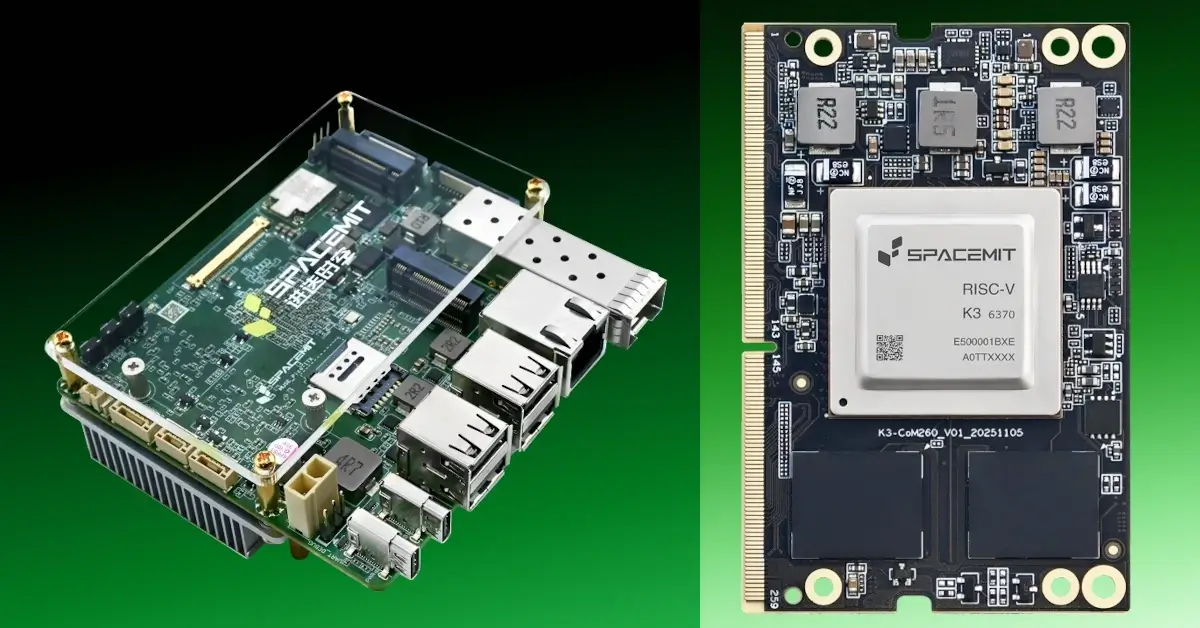
Comparing the resellers SpacemiT does not sell anything directly to consumers. Instead you need to buy a board that includes the K3 chip from an integrator. Currently the main resellers are: All of the above are Chinese companies that ship to customers both inside and outside China. DeepComputing stands out as the only one that actually has done real integration and ships the K3 on a custom board, while the others simply resell the SpacemiT-produced K3 pico-ITX and K3 CoM260 Kit.

Milk-V Milk-V is a RISC-V specialized integrator, as the name already implies. They sell the K3 under the name Jupiter2. Of all the K3 pico-ITX reseller product pages, the Jupiter2 presentation is the nicest and most detailed. Unfortunately their order page at arace.tech only states that it is a pre-order with no information about shipping schedule, taxes, or other details like what SSD is included (if any). Based on the pictures it does ship with a Milk-V branded case. The 32 GB RAM lists at 504 EUR, which is a very reasonable price. The @MilkV_Official account on X recently promoted the K3.

Documentation and support As of this writing, the Milk-V Jupiter2 documentation site is just a stub and has no actual content, and only two links to the SpacemiT K3 documentation site. For support there is a web forum with a dedicated Jupiter2 section. There is also a Matrix space, but unlike their other products, there is no dedicated Jupiter (neither v1 nor v2) channel.

Community size and open source involvement At least one prior Milk-V product was certified by Canonical, which indicates there is some collaboration in progress. Canonical also lists the Milk-V Titan on its official Ubuntu for RISC-V partner-built hardware page.

Sipeed The Sipeed K3 announcement is well written (in English) with all the relevant details and links to additional PDF manuals. However, their main page at sipeed.com says nothing about the K3, so one must know the subpage URL to access it. They offer both the K3 CoM260 kit compatible with Jetson Orin Nano carrier boards, and the stand-alone K3 pico-ITX-sized motherboard. The CoM260 kit is only 10 USD cheaper than the full pico-ITX motherboard, so choosing the latter is a no-brainer if starting from scratch. The pico-ITX model with 32 GB DDR5 RAM sells for 639 USD. The product page does not mention anything about hard disk size, so you don t really know exactly what you will be getting if placing an order. There is no indication about case, Wi-Fi antennas or power supply either, so most likely they are not included. Their store.sipeed.com website does not work at all, and their Taobao and AliExpress stores are not public and only accessible to registered users. The order page also says nothing about shipping time, delivery time, or taxes. The X account @SipeedIO is active and recently posted pictures of shipments in progress.

Documentation and support The main documentation wiki does not yet have any K3 content at the time of writing. There is a Discord channel for general RISC-V discussion, and their MaixHub also has a discussion board, but I didn t find anything K3-specific.

Community size and open source involvement Sipeed has had at least one of their previous devices certified by Canonical, which indicates they are active in the community. Note that the other RISC-V company SiFive that also has had hardware certified and officially supported by Canonical is a different company, despite the very similar name.

Banana Pi Banana Pi announced that they offer both the K3 CoM260 kit and the K3 pico-ITX motherboard version. Their product page for the K3 confusingly shows a MediaTek product in the page banner rather than the SpacemiT K3. Based on the product description and the fact they renamed the product as BPI-SM10, it seems to ship with some carrier board. The product pictures look identical to the SpacemiT documentation and there is no picture of the carrier board, and details are very sparse. The pico-ITX version with 8 GB RAM and 128 GB SSD sells for 293 USD and the CoM260 developer kit with the same specs sells for 287 USD and the 32 GB RAM with 128 GB SSD model sells for 595 USD. The shop page shows only five orders so far and items are currently out of stock. As there was no 32 GB RAM version of the pico-ITX available at all, this isn t an option for me as I want to run 30B parameter models that need the larger memory version. Of all of these resellers, the Banana Pi website seems the most outdated. It does not have a search feature, it is not mobile-friendly, pictures can t be pinched to zoom in and so forth. Product names are also almost all identical, and as the product listings only show the beginning of the product name, figuring out what product is what requires extra effort that just makes the online purchase experience plain bad.

Documentation and support I was only able to find the documentation page for the CoM260 kit, but none for the pico-ITX version. For support there is a forum, but the category list does not show any section for K3, and the forum search prohibits using the search term k3 as too short.

Community size and open source involvement Banana Pi has a long history in the ARM single-board computer market, but their presence in the RISC-V ecosystem is still growing. Their X account @sinovoip has posted only once about the K3 and otherwise promotes their ARM boards. However, their community culture page does express a commitment to open hardware in general, but there is no visible K3-specific community activity.

Firefly Firefly s K3 product page is comprehensive. Based on the details, they do not offer the K3 pico-ITX variant at all, but only the K3 CoM260 board inside the AIBOX-K3 Firefly RISC-V Edge Mini PC product. This is a feature-complete offering with a Jetson Orin Nano carrier board and case. The AIBOX-K3 with 32 GB RAM and 128 GB SSD in a case sells for 689 USD in their own Firefly.store. Unfortunately it only has HDMI and there is no USB-C with DisplayPort support, which is a deal-breaker for me personally. Interestingly, Firefly also offers rack-mounted servers with K3 as the CPU.

Documentation and support The wiki link on the product page is broken. The Firefly wiki does have a section for the AIBOX-K3, but it too has a broken link. It seems that as of the time of writing, there is no wiki section for this product yet. For support there is a web forum, which does have at least one K3 thread covering guides such as Hermes Agent installation, though broader K3-specific sections are still sparse.

Community size and open source involvement Firefly s X account @TeeFirefly has had no posts since 2024, and their GitLab/T-Firefly shows mostly 2024 activity, with only one repository updated in 2025 and nothing in 2026. Historically they have built a moderate community around their ARM-based Rockchip boards, with active forums and wiki contributions for those product lines. Their RISC-V K3 offerings are newer, and likely need a lot more polish to be attractive products overall.

DeepComputing Last, but certainly not least, is the laptop manufacturer DeepComputing that offers a Framework laptop compatible motherboard with the SpacemiT K3 chip. They also sell the plain motherboard, or with the Cooler Master case, which allows one to easily connect it to an external monitor and keyboard and use it as a desktop computer. The plain board with 32 GB RAM and no SSD sells for about 882 EUR. Shipping of the first batch is expected to start by end of June 2026. Their X account @DeepComputingio promotes this DC-ROMA RISC-V Mainboard III as their flagship product, so they seem to put a lot of effort into it. The overall product design and packaging seems good. Of all the K3 resellers and integrators that I was able to find, DeepComputing is the only one that actually designs their own boards with the K3 processor, while all the other vendors above are simply reselling the vanilla K3 boards with or without a case. After reviewing all these options I decided to buy the DC-ROMA RISC-V Mainboard III for Framework Laptop 13 with 32 GB RAM, 1 TB SSD and the Cooler Master case, totalling about 1100 EUR.

Documentation and support DeepComputing maintains product information for their RISC-V hardware at github.com/DC-DeepComputing/Framework, with documentation of the newest Mainboard III (FML13V05) still being finalized ahead of the first batch shipment. They provide community support through Discord and web forum, although the latter has very little activity.

Community size and open source involvement DeepComputing has established itself as a pioneer in RISC-V laptops, beginning with the DC-ROMA. I have seen their stand at FOSDEM, which shows they are genuinely active in the open source community. Canonical lists DeepComputing s first mainboard / FML13V01 on its official Ubuntu for RISC-V partner-built hardware page, and it seems likely that they will continue to collaborate with Canonical with the new model once it ships. While the underlying Linux enablement depends on SpacemiT s upstream efforts, DeepComputing s involvement helps bridge the gap between reference hardware and consumer-ready products. DeepComputing K3 board in the Cooler Master case

Conclusion After weighing all the options, I ended up placing an order with DeepComputing for their custom K3 board with the Cooler Master case. Despite the premium price, the active community support and the properly documented promise of a complete, working system made it easy to place an order with confidence. The SpacemiT K3 is poised to be one of the most significant RISC-V chips for local AI workloads, thanks to its RVA23 compliance and high tokens per second potential. Yet the buying experience in mid-2026 remains fragmented and incomplete. Hopefully this is just because the product is new, and they will get the purchase experience polished soon. What struck me most during this process was how poor the customer experience is across nearly all of these vendor websites: broken links, missing search functions, outdated product banners, pages that show the wrong product entirely, and no information about shipping times, stock levels, taxes, and so on. One wonders why these companies don t fully invest in their web presence. Personally I would assume they likely have enough customers already, primarily through domestic channels like Taobao and JD.com, that they do not feel any pressure to improve their international-facing sites. However, I did also review what was offered on Taobao, and the product details were very incomplete there too. Taobao, however, has a built-in live chat with almost all sellers, which can be used to ask questions and thus compensate for missing product details. I don t fully understand why the sales process seems unpolished. The websites feel almost like an afterthought a checkbox to claim global reach while the real business apparently happens elsewhere via closed platforms or via inaccessible reseller channels. It is a frustrating reminder that in the RISC-V hardware world, the technology may be open and global, but the purchase experience is less so.

4 June 2026

Reproducible Builds: Reproducible Builds in May 2026

Welcome to the May 2026 report from the Reproducible Builds project. These reports outline what we ve been up to over the past month, highlighting items of news from elsewhere in the increasingly-important area of software supply-chain security. As ever, if you are interested in contributing to the Reproducible Builds project, please see the Contribute page on our website. In this month s report, we cover:

  1. Debian to ship reproducible packages in forky and beyond
  2. Holger Levsen on reproducing official Debian packages
  3. Reproducible Builds 2026 summit to be held in Gothenburg, Sweden
  4. Kettle: Attested Builds for Verifiable Software
  5. New rebuilderd version announced
  6. Reproducible open source messengers
  7. Distribution work
  8. Misc news
  9. Patches
  10. Documentation updates


Debian to ship reproducible packages in forky and beyond In a huge change in Debian s reproducibility policy, the Debian Release Team announced that:
we ve decided it s time to say that Debian must ship reproducible packages. Since yesterday, we have enabled our migration software to block migration of new packages that can t be reproduced [on reproduce.debian.net] or existing packages in testing that regress in reproducibility.
That is to say, if newly-uploaded packages are not reproducible, they won t be considered candidates for inclusion in the next stable release of Debian codenamed forky. (Some exceptions may be granted.) This news generated a number of articles and comments in various news outlets:

Holger Levsen on reproducing official Debian packages Reproducible Builds developer Holger Levsen gave a talk at the 2026 Hamburg MiniDebconf this year on the topic of reproduce.debian.net - reproducing what is distributed from ftp.d.o. Holger s talk announced that Debian intends to ship only reproducible packages in forky and beyond (see above), but also talked more broadly about reproducible builds, our testing framework and the Debian archive. That is to say, moving away from testing whether a package is reproducible in a theoretical sense (eg. whether we can build it twice in different environments and achieve the same result in our test system), and attempting to reproduce the same .deb files in the official Debian archive itself. This small-sounding distinction is actually essential, as this is the only means through which the reproducible builds technique can determine whether build systems are compromised are not. A video (32m37s) of the talk is available, as are Holger s slides.

Reproducible Builds 2026 summit to be held in Gothenburg, Sweden As initially announced in March 2026, we will be having our yearly Reproducible Builds summit 2026 in Gothenburg Sweden, from September 22 until 24, followed by two days of hacking! Further information will be provided on our website and on the rb-general mailing list very soon.

Kettle: Attested Builds for Verifiable Software Andr Arko and Amean Asad published a paper this month on Kettle, a build system that produces cryptographically verifiable provenance for software built inside Trusted Execution Environments :
A Kettle build records the source commit, dependency set, toolchain, build environment and output artifact digests in a provenance document produced inside a measured confidential VM. The SHA-256 digest of that document is committed to the TEE platform s attestation report-data field, so the hardware-signed attestation report is itself the signature on the provenance, with the signing identity chaining to the TEE manufacturer s root of trust rather than to the build infrastructure operator. Because the CVM image is itself reproducible, its launch measurement is public and stable, which lets a build requester pre-attest the CVM before submitting any input and optionally deliver source over a TLS channel terminated inside it, so the build runs end-to-end confidentially without the host ever seeing source code in plaintext.
A PDF of the paper is available online.

New rebuilderd version announced rebuilderd, our server designed for monitoring the official package repositories of Linux distributions and attempt to reproduce the observed results there; it powers, amongst other things, reproduce.debian.net. A new version, 0.27.0, was released this month, with the following headline changes:
  • Improved .udeb support
  • Breaking changes in pkg sync configuration
  • Manual cleanup needed for Arch Linux instances
As kpcyrd s announcement mentions:
The new rebuilderd package is currently available in the extra-testing repository. Note the Arch Linux package is upgraded from v0.25.0 from v0.27.0; please be patient with the database migrations on first restart, and make yourself familiar with the breaking changes in v0.26.0 too.

Reproducible open source messengers GitHub developer BarbossHack is maintaining an repository/page on GitHub to track reproducibility status of open source messengers .

Distribution work In Debian this month, the loong64 architecture was added to reproduce.debian.net. This is a 64-bit Reduced Instruction Set Computer (RISC) instruction set architecture developed by Loongson. Vagrant Cascadian performed Non-Maintainer Uploads (NMUs) in Debian for several packages with outstanding patches over a year old. These included rocdbgapi, onevpl-intel-gpu, python-pytest-shell-utilities, python-mt-940 and pympress. On tests.reproducible-builds.org, Vagrant Cascadian fixed the huge spike in build failures by adding passwd to the base tarballs, and re-enabled building gcc and binutils packages with PGO (Profile Guided Optimization) and LTO (Link Time Optimization) to avoid giving a false sense of reproducibility. Inconsistencies on the reproducibility of the condor package were brought up on the Debian reproducible-builds mailing list. Following a hunch, Vagrant Cascadian eventually identified the issue was related to embedded kernel versions which was then fixed upstream and fixed in Debian as well. Lastly, 40 reviews of Debian packages were added, 68 were updated and 75 were removed this month adding to our knowledge about identified issues. A number of issue types were updated, such as the addition of a new sphinx_reading_durations toolchain issue [ ], a golang_mango_generates_manpages_with_build_date issue [ ] and a random_offset_id_in_cython_linetrace [ ]. In addition, the timestamps_in_qhc issue was refocused to timestamps_in_qhc [ ].
In Fedora, Jelle van der Waa submitted a request for an official Fedora rebuilderd package which was reviewed by Neal Gompa.
Lastly, Bernhard M. Wiedemann posted another openSUSE monthly update for their reproducibility work there.

Misc news On our mailing list this month:

Patches The Reproducible Builds project detects, dissects and attempts to fix as many currently-unreproducible packages as possible. We endeavour to send all of our patches upstream where applicable or possible. This month, we wrote a large number of such patches, including:

Documentation updates


Finally, if you are interested in contributing to the Reproducible Builds project, please visit our Contribute page on our website. However, you can get in touch with us via:

Next.

Previous.