Search Results: "rui"

25 June 2020

Russell Coker: How Will the Pandemic Change Things?

The Bulwark has an interesting article on why they can t Reopen America [1]. I wonder how many changes will be long term. According to the Wikipedia List of Epidemics [2] Covid-19 so far hasn t had a high death toll when compared to other pandemics of the last 100 years. People s reactions to this vary from doing nothing to significant isolation, the question is what changes in attitudes will be significant enough to change society. Transport One thing that has been happening recently is a transition in transport. It s obvious that we need to reduce CO2 and while electric cars will address the transport part of the problem in the long term changing to electric public transport is the cheaper and faster way to do it in the short term. Before Covid-19 the peak hour public transport in my city was ridiculously overcrowded, having people unable to board trams due to overcrowding was really common. If the economy returns to it s previous state then I predict less people on public transport, more traffic jams, and many more cars idling and polluting the atmosphere. Can we have mass public transport that doesn t give a significant disease risk? Maybe if we had significantly more trains and trams and better ventilation with more airflow designed to suck contaminated air out. But that would require significant engineering work to design new trams, trains, and buses as well as expense in refitting or replacing old ones. Uber and similar companies have been taking over from taxi companies, one major feature of those companies is that the vehicles are not dedicated as taxis. Dedicated taxis could easily be designed to reduce the spread of disease, the famed Black Cab AKA Hackney Carriage [3] design in the UK has a separate compartment for passengers with little air flow to/from the driver compartment. It would be easy to design such taxis to have entirely separate airflow and if setup to only take EFTPOS and credit card payment could avoid all contact between the driver and passengers. I would prefer to have a Hackney Carriage design of vehicle instead of a regular taxi or Uber. Autonomous cars have been shown to basically work. There are some concerns about safety issues as there are currently corner cases that car computers don t handle as well as people, but of course there are also things computers do better than people. Having an autonomous taxi would be a benefit for anyone who wants to avoid other people. Maybe approval could be rushed through for autonomous cars that are limited to 40Km/h (the maximum collision speed at which a pedestrian is unlikely to die), in central city areas and inner suburbs you aren t likely to drive much faster than that anyway. Car share services have been becoming popular, for many people they are significantly cheaper than owning a car due to the costs of regular maintenance, insurance, and depreciation. As the full costs of car ownership aren t obvious people may focus on the disease risk and keep buying cars. Passenger jets are ridiculously cheap. But this relies on the airline companies being able to consistently fill the planes. If they were to add measures to reduce cross contamination between passengers which slightly reduces the capacity of planes then they need to increase ticket prices accordingly which then reduces demand. If passengers are just scared of flying in close proximity and they can t fill planes then they will have to increase prices which again reduces demand and could lead to a death spiral. If in the long term there aren t enough passengers to sustain the current number of planes in service then airline companies will have significant financial problems, planes are expensive assets that are expected to last for a long time, if they can t use them all and can t sell them then airline companies will go bankrupt. It s not reasonable to expect that the same number of people will be travelling internationally for years (if ever). Due to relying on economies of scale to provide low prices I don t think it s possible to keep prices the same no matter what they do. A new economic balance of flights costing 2-3 times more than we are used to while having significantly less passengers seems likely. Governments need to spend significant amounts of money to improve trains to take over from flights that are cancelled or too expensive. Entertainment The article on The Bulwark mentions Las Vegas as a city that will be hurt a lot by reductions in travel and crowds, the same thing will happen to tourist regions all around the world. Australia has a significant tourist industry that will be hurt a lot. But the mention of Las Vegas makes me wonder what will happen to the gambling in general. Will people avoid casinos and play poker with friends and relatives at home? It seems that small stakes poker games among friends will be much less socially damaging than casinos, will this be good for society? The article also mentions cinemas which have been on the way out since the video rental stores all closed down. There s lots of prime real estate used for cinemas and little potential for them to make enough money to cover the rent. Should we just assume that most uses of cinemas will be replaced by Netflix and other streaming services? What about teenage dates, will kissing in the back rows of cinemas be replaced by Netflix and chill ? What will happen to all the prime real estate used by cinemas? Professional sporting matches have been played for a TV-only audience during the pandemic. There s no reason that they couldn t make a return to live stadium audiences when there is a vaccine for the disease or the disease has been extinguished by social distancing. But I wonder if some fans will start to appreciate the merits of small groups watching large TVs and not want to go back to stadiums, can this change the typical behaviour of groups? Restaurants and cafes are going to do really badly. I previously wrote about my experience running an Internet Cafe and why reopening businesses soon is a bad idea [4]. The question is how long this will go for and whether social norms about personal space will change things. If in the long term people expect 25% more space in a cafe or restaurant that s enough to make a significant impact on profitability for many small businesses. When I was young the standard thing was for people to have dinner at friends homes. Meeting friends for dinner at a restaurant was uncommon. Recently it seemed to be the most common practice for people to meet friends at a restaurant. There are real benefits to meeting at a restaurant in terms of effort and location. Maybe meeting friends at their home for a delivered dinner will become a common compromise, avoiding the effort of cooking while avoiding the extra expense and disease risk of eating out. Food delivery services will do well in the long term, it s one of the few industry segments which might do better after the pandemic than before. Work Many companies are discovering the benefits of teleworking, getting it going effectively has required investing in faster Internet connections and hardware for employees. When we have a vaccine the equipment needed for teleworking will still be there and we will have a discussion about whether it should be used on a more routine basis. When employees spend more than 2 hours per day travelling to and from work (which is very common for people who work in major cities) that will obviously limit the amount of time per day that they can spend working. For the more enthusiastic permanent employees there seems to be a benefit to the employer to allow working from home. It s obvious that some portion of the companies that were forced to try teleworking will find it effective enough to continue in some degree. One company that I work for has quit their coworking space in part because they were concerned that the coworking company might go bankrupt due to the pandemic. They seem to have become a 100% work from home company for the office part of the work (only on site installation and stock management is done at corporate locations). Companies running coworking spaces and other shared offices will suffer first as their clients have short term leases. But all companies renting out office space in major cities will suffer due to teleworking. I wonder how this will affect the companies providing services to the office workers, the cafes and restaurants etc. Will there end up being so much unused space in central city areas that it s not worth converting the city cinemas into useful space? There s been a lot of news about Zoom and similar technologies. Lots of other companies are trying to get into that business. One thing that isn t getting much notice is remote access technologies for desktop support. If the IT people can t visit your desk because you are working from home then they need to be able to remotely access it to fix things. When people make working from home a large part of their work time the issue of who owns peripherals and how they are tracked will get interesting. In a previous blog post I suggested that keyboards and mice not be treated as assets [5]. But what about monitors, 4G/Wifi access points, etc? Some people have suggested that there will be business sectors benefiting from the pandemic, such as telecoms and e-commerce. If you have a bunch of people forced to stay home who aren t broke (IE a large portion of the middle class in Australia) they will probably order delivery of stuff for entertainment. But in the long term e-commerce seems unlikely to change much, people will spend less due to economic uncertainty so while they may shift some purchasing to e-commerce apart from home delivery of groceries e-commerce probably won t go up overall. Generally telecoms won t gain anything from teleworking, the Internet access you need for good Netflix viewing is generally greater than that needed for good video-conferencing. Money I previously wrote about a Basic Income for Australia [6]. One of the most cited reasons for a Basic Income is to deal with robots replacing people. Now we are at the start of what could be a long term economic contraction caused by the pandemic which could reduce the scale of the economy by a similar degree while also improving the economic case for a robotic workforce. We should implement a Universal Basic Income now. I previously wrote about the make-work jobs and how we could optimise society to achieve the worthwhile things with less work [7]. My ideas about optimising public transport and using more car share services may not work so well after the pandemic, but the rest should work well. Business There are a number of big companies that are not aiming for profitability in the short term. WeWork and Uber are well documented examples. Some of those companies will hopefully go bankrupt and make room for more responsible companies. The co-working thing was always a precarious business. The companies renting out office space usually did so on a monthly basis as flexibility was one of their selling points, but they presumably rented buildings on an annual basis. As the profit margins weren t particularly high having to pay rent on mostly empty buildings for a few months will hurt them badly. The long term trend in co-working spaces might be some sort of collaborative arrangement between the people who run them and the landlords similar to the way some of the hotel chains have profit sharing agreements with land owners to avoid both the capital outlay for buying land and the risk involved in renting. Also city hotels are very well equipped to run office space, they have the staff and the procedures for running such a business, most hotels also make significant profits from conventions and conferences. The way the economy has been working in first world countries has been about being as competitive as possible. Just in time delivery to avoid using storage space and machines to package things in exactly the way that customers need and no more machines than needed for regular capacity. This means that there s no spare capacity when things go wrong. A few years ago a company making bolts for the car industry went bankrupt because the car companies forced the prices down, then car manufacture stopped due to lack of bolts this could have been a wake up call but was ignored. Now we have had problems with toilet paper shortages due to it being packaged in wholesale quantities for offices and schools not retail quantities for home use. Food was destroyed because it was created for restaurant packaging and couldn t be packaged for home use in a reasonable amount of time. Farmer s markets alleviate some of the problems with packaging food etc. But they aren t a good option when there s a pandemic as disease risk makes them less appealing to customers and therefore less profitable for vendors. Religion Many religious groups have supported social distancing. Could this be the start of more decentralised religion? Maybe have people read the holy book of their religion and pray at home instead of being programmed at church? We can always hope.

16 June 2020

Ritesh Raj Sarraf: Kodi PS3 BD Remote

Setting up a Sony PS3 Blu-Ray Disc Remote Controller with Kodi TLDR; Since most of the articles on the internet were either obsolete or broken, I ve chosen to write these notes down in the form of a blog post so that it helps me now and in future, and hopefully others too.

Raspberry Pi All this time, I have been using the Raspberry Pi for my HTPC needs. The first RPi I acquired was in 2014 and I have been very very happy with the amount of support in the community and quality of the HTPC offering it has. I also appreciate the RPi s form factor and the power consumption limits. And then, to add more sugar to it, it uses a derivative of Debian, Raspbian, which was very familiar and feel good to me.

Raspberry Pi Issues So primarily, I use my RPi with Kodi. There are a bunch of other (daemon) services but the primary use case is HTPC only. RPi + Kodi has a very very annoying issue wherein it loses its audio pitch during video playback. The loss is so bad that the audio is barely audible. The workaround is to seek the video playback either way and then it comes back to its actual audio level, just to fade again in a while. My suspicion was that it may be a problem with Kodi. Or at least, Kodi would have a workaround in software. But unfortunately, I wasted a lot of time in dealing with my suspicion with no fruitful result. This started becoming a PITA over time. And it seems the issue is with the hardware itself because after I moved my setup to a regular laptop, the audio loss is gone.

Laptop with Kodi Since I had my old Lenovo Yoga 2 13 lying on all the time, it made sense to make some more use of it, using as the HTPC. This machine comes with a Micro-HDMI Out port, so it felt ideal for my High Definition video rendering needs. It comes stock with just Intel HD Video with good driver support in Linux, so it was quite quick and easy getting Kodi charged up and running on it. And as I mentioned above, the sound issues are not seen on this setup. Some added benefits are that I get to run stock Debian on this machine. And I must say a big THANK YOU to the Debian Multimedia Maintainers, who ve done a pretty good job maintaining Kodi under Debian.

HDMI CEC Only after I decommissioned my RPi, I came to notice how convenient the HDMI CEC functionality is. Turns out no standard laptops ship CEC functionality onto them. Even the case of my laptop, which has a Micro HDMI Out port, but still no CEC capabilities. As far as I know, the RPi came with the Pulse-Eight CEC module, so obvious first thought was to opt for a compatible external module of the same; but it comes with a nice price tag, me not willing to spend.

WiFi Remotes Kodi has very well implemented network interface for almost all its features. One could take the Yatse or Music Pump Kodi Remote Android applications that work very very well with Kodi. But wifi can be flaky some times. Especially, my experience with the Realtek network devices hasn t been very good. The driver support in Linux is okay but there are many firmware bugs to deal with. In my case, the machine will lose wifi signal/network every once in a while. And it turns out, for this machine, with this network device type, I m not the only one running into such problems. And to add to that, this is an UltraBook, which means it doesn t have an Ethernet port. So I ve had not much choice other than to live and suffer deal with it. The WiFi chip also provides the Bluetooth module, which so far I had not used much. From my /etc/modprobe.d/blacklist-memstick.conf, all relevant BT modules were added to the blacklist, all this time.
rrs@lenovo:~$ cat /etc/modprobe.d/blacklist-memstick.conf 
blacklist memstick
blacklist rtsx_usb_ms
# And bluetooth too
#blacklist btusb
#blacklist btrtl
#blacklist btbcm
#blacklist btintel
#blacklist bluetooth
21:21            
Also to keep in mind is that the driver for my card gives a very misleading kernel message, which is one of the many reasons for this blog post, so that I don t forget it a couple of months later. The missing firmware error message is okay to ignore, as per this upstream comment.
Jun 14 17:17:08 lenovo kernel: usbcore: registered new interface driver btusb
Jun 14 17:17:08 lenovo systemd[1]: Mounted /boot/efi.
Jun 14 17:17:08 lenovo kernel: Bluetooth: hci0: RTL: examining hci_ver=06 hci_rev=000b lmp_ver=06 lmp_subver=8723
Jun 14 17:17:08 lenovo kernel: Bluetooth: hci0: RTL: rom_version status=0 version=1
Jun 14 17:17:08 lenovo kernel: Bluetooth: hci0: RTL: loading rtl_bt/rtl8723b_fw.bin
Jun 14 17:17:08 lenovo kernel: bluetooth hci0: firmware: direct-loading firmware rtl_bt/rtl8723b_fw.bin
Jun 14 17:17:08 lenovo kernel: Bluetooth: hci0: RTL: loading rtl_bt/rtl8723b_config.bin
Jun 14 17:17:08 lenovo kernel: bluetooth hci0: firmware: failed to load rtl_bt/rtl8723b_config.bin (-2)
Jun 14 17:17:08 lenovo kernel: firmware_class: See https://wiki.debian.org/Firmware for information about missing firmware
Jun 14 17:17:08 lenovo kernel: bluetooth hci0: Direct firmware load for rtl_bt/rtl8723b_config.bin failed with error -2
Jun 14 17:17:08 lenovo kernel: Bluetooth: hci0: RTL: cfg_sz -2, total sz 22496
This device s network + bt are on the same chip.
01:00.0 Network controller: Realtek Semiconductor Co., Ltd. RTL8723BE PCIe Wireless Network Adapter
And then, when the btusb module is initialed (along with the misleading driver message), you ll get the following in your USB device listing
Bus 002 Device 005: ID 0bda:b728 Realtek Semiconductor Corp. Bluetooth Radio

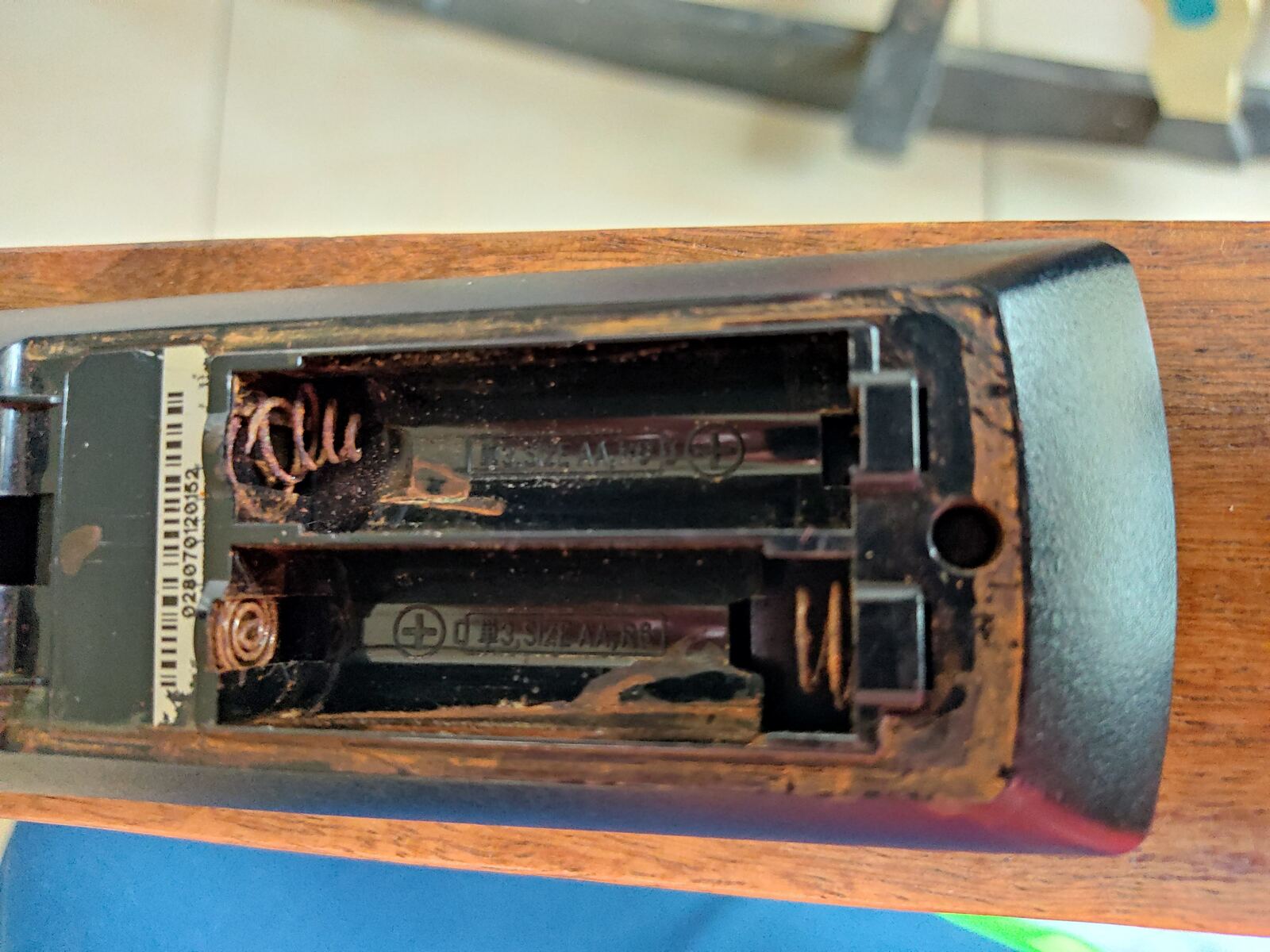
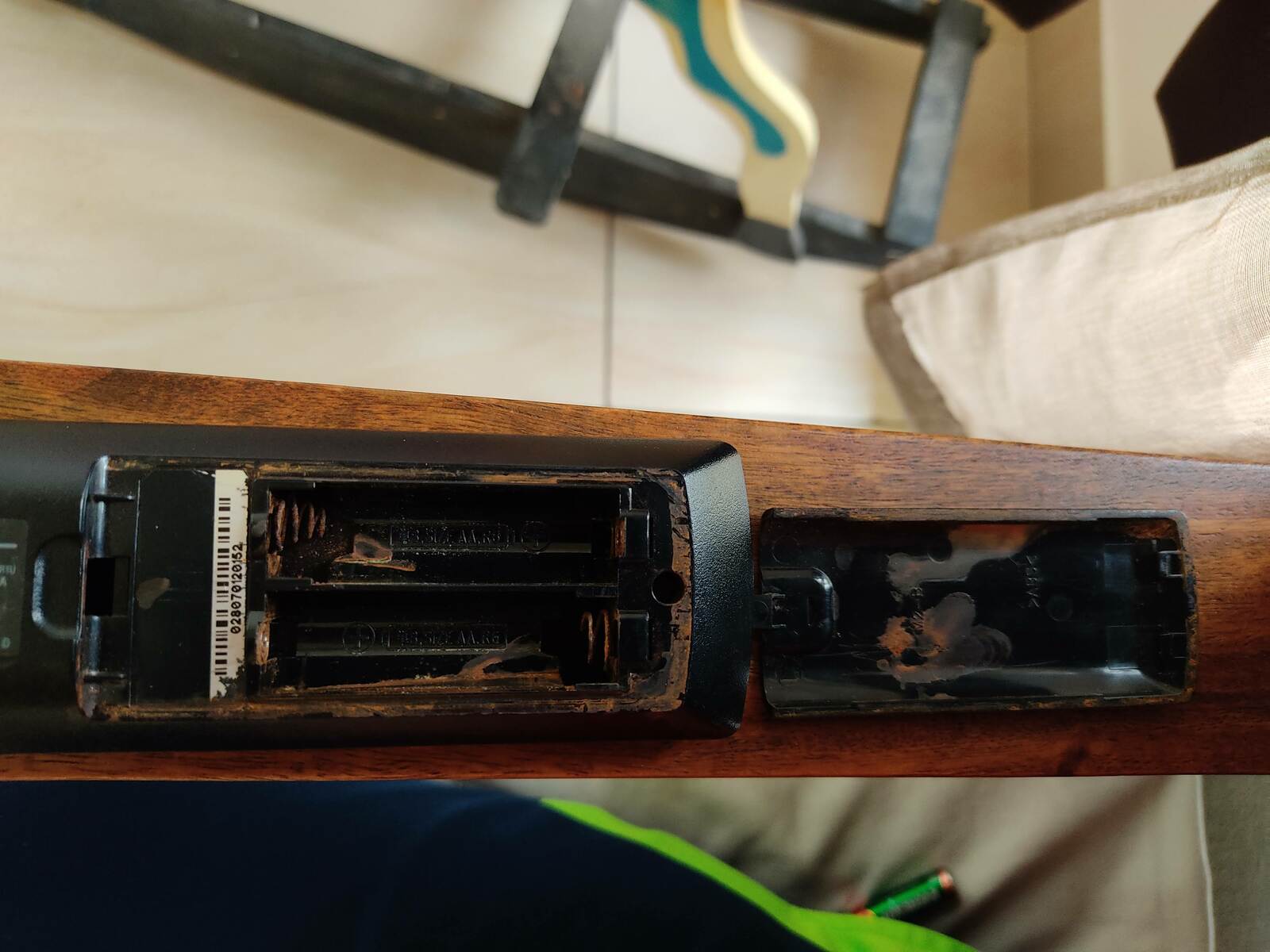
Sony PlayStation 3 BD Remote Almost 10 years ago, I bought the PS3 and many of its accessories. The remote has just been rotting in the shelf. It had rusted so bad that it is better described with these pics.
Rusted inside
Rusted inside
Rusted inside and cover
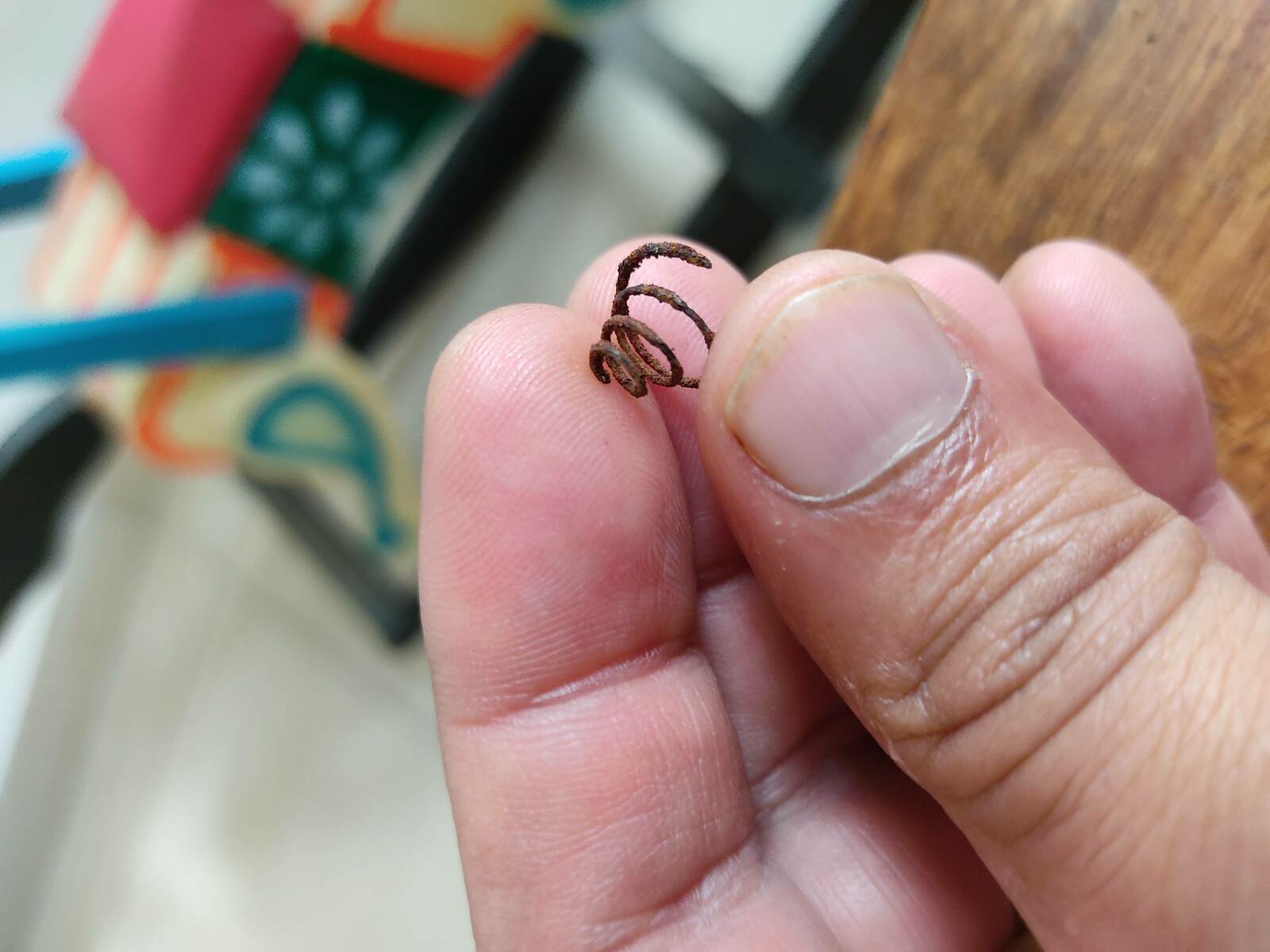
Rusted spring
Rusted spring
The rust was so much that the battery holding spring gave up. A little bit scrubbing and cleaning has gotten it working. I hope it lasts for some time before I find time to open it up and give it a full clean-up.

Pairing the BD Remote to laptop Honestly, with the condition of the hardware and software on both ends, I did not have much hopes of getting this to work. And in all the years on my computer usage, I hardly recollect much days when I ve made use of BT. Probably, because the full BT stack wasn t that well integrated in Linux, earlier. And I mostly used to disable them in hardware and software to save on battery. All yielded results from the internet talked about tools/scripts that were either not working, pointing to broken links etc. These days, bluez comes with a nice utility, bluetoothctl. It was a nice experience using it. First, start your bluetooth service and ensure that the device talks well with the kernel
rrs@lenovo:~$ systemctl status bluetooth                                                                                                          
  bluetooth.service - Bluetooth service                                                                                                           
     Loaded: loaded (/lib/systemd/system/bluetooth.service; enabled; vendor preset: enabled)                                                      
     Active: active (running) since Mon 2020-06-15 12:54:58 IST; 3s ago                                                                           
       Docs: man:bluetoothd(8)                                                                                                                    
   Main PID: 310197 (bluetoothd)                                                                                                                  
     Status: "Running"                                                                                                                            
      Tasks: 1 (limit: 9424)                                                                                                                      
     Memory: 1.3M                                                                                                                                 
     CGroup: /system.slice/bluetooth.service                                                                                                      
              310197 /usr/lib/bluetooth/bluetoothd                                                                                               
                                                                                                                                                  
Jun 15 12:54:58 lenovo systemd[1]: Starting Bluetooth service...                                                                                  
Jun 15 12:54:58 lenovo bluetoothd[310197]: Bluetooth daemon 5.50                                                                                  
Jun 15 12:54:58 lenovo systemd[1]: Started Bluetooth service.                                                                                     
Jun 15 12:54:58 lenovo bluetoothd[310197]: Starting SDP server                                                                                    
Jun 15 12:54:58 lenovo bluetoothd[310197]: Bluetooth management interface 1.15 initialized                                                        
Jun 15 12:54:58 lenovo bluetoothd[310197]: Sap driver initialization failed.                                                                      
Jun 15 12:54:58 lenovo bluetoothd[310197]: sap-server: Operation not permitted (1)                                                                
12:55                                                                                                                                       
Next, then is to discover and connect to your device
rrs@lenovo:~$ bluetoothctl 
Agent registered
[bluetooth]# devices
Device E6:3A:32:A4:31:8F MI Band 2
Device D4:B8:FF:43:AB:47 MI RC
Device 00:1E:3D:10:29:0F BD Remote Control
[CHG] Device 00:1E:3D:10:29:0F Connected: yes
[BD Remote Control]# info 00:1E:3D:10:29:0F
Device 00:1E:3D:10:29:0F (public)
        Name: BD Remote Control
        Alias: BD Remote Control
        Class: 0x0000250c
        Paired: no
        Trusted: yes
        Blocked: no
        Connected: yes
        LegacyPairing: no
        UUID: Human Interface Device... (00001124-0000-1000-8000-00805f9b34fb)
        UUID: PnP Information           (00001200-0000-1000-8000-00805f9b34fb)
        Modalias: usb:v054Cp0306d0100
[bluetooth]# 
In case of the Sony BD Remote, there s no need to pair. In fact, trying to pair fails. It prompts for the PIN code, but neither 0000 or 1234 are accepted. So, the working steps so far are to Trust the device and then Connect the device. For the sake of future use, I also populated /etc/bluetooth/input.conf based on suggestions on the internet. Note: The advertised keymappings in this config file do not work. Note: I m only using it for the power saving measures in instructing the BT connection to sleep after 3 minutes.
rrs@priyasi:/tmp$ cat input.conf 
# Configuration file for the input service
# This section contains options which are not specific to any
# particular interface
[General]
# Set idle timeout (in minutes) before the connection will
# be disconnect (defaults to 0 for no timeout)
IdleTimeout=3
# Enable HID protocol handling in userspace input profile
# Defaults to false (HIDP handled in HIDP kernel module)
#UserspaceHID=true
# Limit HID connections to bonded devices
# The HID Profile does not specify that devices must be bonded, however some
# platforms may want to make sure that input connections only come from bonded
# device connections. Several older mice have been known for not supporting
# pairing/encryption.
# Defaults to false to maximize device compatibility.
#ClassicBondedOnly=true
# LE upgrade security
# Enables upgrades of security automatically if required.
# Defaults to true to maximize device compatibility.
#LEAutoSecurity=true
#
#[00:1E:3D:10:29:0F]
[2c:33:7a:8e:d6:30]
[PS3 Remote Map]
# When the 'OverlayBuiltin' option is TRUE (the default), the keymap uses
# the built-in keymap as a starting point.  When FALSE, an empty keymap is
# the starting point.
#OverlayBuiltin = TRUE
#buttoncode = keypress    # Button label = action with default key mappings
#OverlayBuiltin = FALSE
0x16 = KEY_ESC            # EJECT = exit
0x64 = KEY_MINUS          # AUDIO = cycle audio tracks
0x65 = KEY_W              # ANGLE = cycle zoom mode
0x63 = KEY_T              # SUBTITLE = toggle subtitles
0x0f = KEY_DELETE         # CLEAR = delete key
0x28 = KEY_F8             # /TIME = toggle through sleep
0x00 = KEY_1              # NUM-1
0x01 = KEY_2              # NUM-2
0x02 = KEY_3              # NUM-3
0x03 = KEY_4              # NUM-4
0x04 = KEY_5              # NUM-5
0x05 = KEY_6              # NUM-6
0x06 = KEY_7              # NUM-7
0x07 = KEY_8              # NUM-8
0x08 = KEY_9              # NUM-9
0x09 = KEY_0              # NUM-0
0x81 = KEY_F2             # RED = red
0x82 = KEY_F3             # GREEN = green
0x80 = KEY_F4             # BLUE = blue
0x83 = KEY_F5             # YELLOW = yellow
0x70 = KEY_I              # DISPLAY = show information
0x1a = KEY_S              # TOP MENU = show guide
0x40 = KEY_M              # POP UP/MENU = menu
0x0e = KEY_ESC            # RETURN = back/escape/cancel
0x5c = KEY_R              # TRIANGLE/OPTIONS = cycle through recording options
0x5d = KEY_ESC            # CIRCLE/BACK = back/escape/cancel
0x5f = KEY_A              # SQUARE/VIEW = Adjust Playback timestretch
0x5e = KEY_ENTER          # CROSS = select
0x54 = KEY_UP             # UP = Up/Skip forward 10 minutes
0x56 = KEY_DOWN           # DOWN = Down/Skip back 10 minutes
0x57 = KEY_LEFT           # LEFT = Left/Skip back 5 seconds
0x55 = KEY_RIGHT          # RIGHT = Right/Skip forward 30 seconds
0x0b = KEY_ENTER          # ENTER = select
0x5a = KEY_F10            # L1 = volume down
0x58 = KEY_J              # L2 = decrease the play speed
0x51 = KEY_HOME           # L3 = commercial skip previous
0x5b = KEY_F11            # R1 = volume up
0x59 = KEY_U              # R2 = increase the play speed
0x52 = KEY_END            # R3 = commercial skip next
0x43 = KEY_F9             # PS button = mute
0x50 = KEY_M              # SELECT = menu (as per PS convention)
0x53 = KEY_ENTER          # START = select / Enter (matches terminology in mythwelcome)
0x30 = KEY_PAGEUP         # PREV = jump back (default 10 minutes)
0x76 = KEY_J              # INSTANT BACK (newer RCs only) = decrease the play speed
0x75 = KEY_U              # INSTANT FORWARD (newer RCs only) = increase the play speed
0x31 = KEY_PAGEDOWN       # NEXT = jump forward (default 10 minutes)
0x33 = KEY_COMMA          # SCAN BACK =  decrease scan forward speed / play
0x32 = KEY_P              # PLAY = play/pause
0x34 = KEY_DOT            # SCAN FORWARD decrease scan backard speed / increase playback speed; 3x, 5, 10, 20, 30, 60, 120, 180
0x60 = KEY_LEFT           # FRAMEBACK = Left/Skip back 5 seconds/rewind one frame
0x39 = KEY_P              # PAUSE = play/pause
0x38 = KEY_P              # STOP = play/pause
0x61 = KEY_RIGHT          # FRAMEFORWARD = Right/Skip forward 30 seconds/advance one frame
0xff = KEY_MAX
21:48                 
I have not spent much time finding out why not all the key presses work. Especially, given that most places on the internet mention these mappings. For me, some of the key scan codes aren t even reported. For keys like L1, L2, L3, R1, R2, R3, Next_Item, Prev_Item, they generate no codes in the kernel. If anyone has suggestions, ideas or fixes, I d appreciate if you can drop a comment or email me privately. But given my limited use to get a simple remote ready, to be usable with Kodi, I was apt with only some of the keys working.

Mapping the keys in Kodi With the limited number of keys detected, mapping those keys to what Kodi could use was the next step. Kodi has a very nice and easy to use module, Keymap Editor. It is very simple to use and map detected keys to functionalities you want. With it, I was able to get a functioning remote to use with my Kodi HTPC setup.

Update: Wed Jun 17 11:38:20 2020 One annoying problem that breaks the overall experience is the following bug on the driver side, that results in connections not being established instantly. Once the device goes into sleep mode, in random attempts, waking up and re-establishing a BT connection can be multi-poll affair. This can last from a couple of seconds to well over minute. Random suggestions on the internet mention disabling the autosuspend functionality for the device in the driver with btusb.enable_autosuspend=n, but that did not help in this case. Given that this device is enumberated over the USB Bus, it probably needs this feature applied to the whole USB tree of the device s chain. Something to investigate over the weekend.
Jun 16 20:41:23 lenovo kernel: Bluetooth: hci0: ACL packet for unknown connection handle 7
Jun 16 20:41:43 lenovo kernel: Bluetooth: hci0: ACL packet for unknown connection handle 8
Jun 16 20:41:59 lenovo kernel: Bluetooth: hci0: ACL packet for unknown connection handle 9
Jun 16 20:42:18 lenovo kernel: input: BD Remote Control as /devices/pci0000:00/0000:00:14.0/usb1/1-7/1-7:1.0/bluetooth/hci0/hci0:10/0005:054C:030>
Jun 16 20:42:18 lenovo kernel: sony 0005:054C:0306.0006: input,hidraw1: BLUETOOTH HID v1.00 Gamepad [BD Remote Control] on 2c:33:7a:8e:d6:30
Jun 16 20:51:59 lenovo kernel: input: BD Remote Control as /devices/pci0000:00/0000:00:14.0/usb1/1-7/1-7:1.0/bluetooth/hci0/hci0:11/0005:054C:030>
Jun 16 20:51:59 lenovo kernel: sony 0005:054C:0306.0007: input,hidraw1: BLUETOOTH HID v1.00 Gamepad [BD Remote Control] on 2c:33:7a:8e:d6:30
Jun 16 21:05:55 lenovo rtkit-daemon[1723]: Supervising 3 threads of 1 processes of 1 users.
Jun 16 21:05:55 lenovo rtkit-daemon[1723]: Successfully made thread 32747 of process 1646 owned by '1000' RT at priority 5.
Jun 16 21:05:55 lenovo rtkit-daemon[1723]: Supervising 4 threads of 1 processes of 1 users.
Jun 16 21:05:56 lenovo kernel: Bluetooth: hci0: ACL packet for unknown connection handle 12
Jun 16 21:06:12 lenovo kernel: Bluetooth: hci0: ACL packet for unknown connection handle 1
Jun 16 21:06:34 lenovo kernel: Bluetooth: hci0: ACL packet for unknown connection handle 2
Jun 16 21:06:59 lenovo kernel: input: BD Remote Control as /devices/pci0000:00/0000:00:14.0/usb1/1-7/1-7:1.0/bluetooth/hci0/hci0:3/0005:054C:0306>
Jun 16 21:06:59 lenovo kernel: sony 0005:054C:0306.0008: input,hidraw1: BLUETOOTH HID v1.00 Gamepad [BD Remote Control] on 2c:33:7a:8e:d6:30

Others There s a package, kodi-eventclients-ps3, which can be used to talk to the BD Remote. Unfortunately, it isn t up-to-date. When trying to make use of it, I ran into a couple of problems. First, the easy one is:
rrs@lenovo:~/ps3pair$ kodi-ps3remote localhost 9777
usr/share/pixmaps/kodi//bluetooth.png
Traceback (most recent call last):
  File "/usr/bin/kodi-ps3remote", line 220, in <module>
  File "/usr/bin/kodi-ps3remote", line 208, in main
    xbmc.connect(host, port)
    packet = PacketHELO(self.name, self.icon_type, self.icon_file)
  File "/usr/lib/python3/dist-packages/kodi/xbmcclient.py", line 285, in __init__
    with open(icon_file, 'rb') as f:
11:16         => 1  
This one was simple as it was just a broken path. The second issue with the tool is a leftover from python2 to python3 conversion.
rrs@lenovo:/etc/bluetooth$ kodi-ps3remote localhost
/usr/share/pixmaps/kodi//bluetooth.png
Searching for BD Remote Control
(Hold Start + Enter on remote to make it discoverable)
Redmi (E8:5A:8B:73:57:44) in range
Living Room TV (E4:DB:6D:24:23:E9) in range
Could not find BD Remote Control. Trying again...
Searching for BD Remote Control
(Hold Start + Enter on remote to make it discoverable)
Living Room TV (E4:DB:6D:24:23:E9) in range
Redmi (E8:5A:8B:73:57:44) in range
Could not find BD Remote Control. Trying again...
Searching for BD Remote Control
(Hold Start + Enter on remote to make it discoverable)
BD Remote Control (00:1E:3D:10:29:0F) in range
Found BD Remote Control with address 00:1E:3D:10:29:0F
Attempting to pair with remote
Remote Paired.
Traceback (most recent call last):
  File "/usr/bin/kodi-ps3remote", line 221, in <module>
    main()
  File "/usr/bin/kodi-ps3remote", line 212, in main
    if process_keys(remote, xbmc):
  File "/usr/bin/kodi-ps3remote", line 164, in process_keys
    keycode = data.encode("hex")[10:12]
AttributeError: 'bytes' object has no attribute 'encode'
11:24         => 1  
Fixing that too did not give me the desired result on using the BD Remote in the way I want. So eventually, I gave up and used Kodi s Keymap Editor instead.

Next Next in line, when I can manage to get some free time, is to improve the Kodi Video Scraper to have a fallback mode. Currently, for files where it cannot determine the content, it reject the file resulting in those files not showing up in your collection at all. A better approach would have been to have a fallback mode, that when the scraper cannot determine the content, it should fallback to using the filename scraper

7 June 2020

Enrico Zini: Cooperation links

This comic was based on this essay from Augusten Burroughs: How to live unhappily ever after. In addition to the essay, I highly recommend reading his books. It's also been described in psychology as flow.
With full English subtitles
Confict where it comes from and how to deal with it
Communication skills
Other languages
Distributed teams are where people you work with aren t physically co-located, ie. they re at another office building, home or an outsourced company abroad. They re becoming increasingly popular, for DevOps and other teams, due to recruitment, diversity, flexibility and cost savings. Challenges arise due to timezones, language barriers, cultures and ways of working. People actively participating in Open Source communities tend to be effective in distributed teams. This session looks at how to apply core Open Source principles to distributed teams in Enterprise organisations, and the importance of shared purposes/goals, (mis)communication, leading vs managing teams, sharing and learning. We'll also look at practical aspects of what's worked well for others, such as alternatives to daily standups, promoting video conferencing, time management and virtual coffee breaks. This session is relevant for those leading or working in distributed teams, wanting to know how to cultivate an inclusive culture of increased trust and collaboration that leads to increased productivity and performance.

26 May 2020

Russell Coker: Cruises and Covid19

Problems With Cruises GQ has an insightful and detailed article about Covid19 and the Diamond Princess [1], I recommend reading it. FastCompany has a brief article about bookings for cruises in August [2]. There have been many negative comments about this online. The first thing to note is that the cancellation policies on those cruises are more lenient than usual and the prices are lower. So it s not unreasonable for someone to put down a deposit on a half price holiday in the hope that Covid19 goes away (as so many prominent people have been saying it will) in the knowledge that they will get it refunded if things don t work out. Of course if the cruise line goes bankrupt then no-one will get a refund, but I think people are expecting that won t happen. The GQ article highlights some serious problems with the way cruise ships operate. They have staff crammed in to small cabins and the working areas allow transmission of disease. These problems can be alleviated, they could allocate more space to staff quarters and have more capable air conditioning systems to put in more fresh air. During the life of a cruise ship significant changes are often made, replacing engines with newer more efficient models, changing the size of various rooms for entertainment, installing new waterslides, and many other changes are routinely made. Changing the staff only areas to have better ventilation and more separate space (maybe capsule-hotel style cabins with fresh air piped in) would not be a difficult change. It would take some money and some dry-dock time which would be a significant expense for cruise companies. Cruises Are Great People like social environments, they want to have situations where there are as many people as possible without it becoming impossible to move. Cruise ships are carefully designed for the flow of passengers. Both the layout of the ship and the schedule of events are carefully planned to avoid excessive crowds. In terms of meeting the requirement of having as many people as possible in a small area without being unable to move cruise ships are probably ideal. Because there is a large number of people in a restricted space there are economies of scale on a cruise ship that aren t available anywhere else. For example the main items on the menu are made in a production line process, this can only be done when you have hundreds of people sitting down to order at the same time. The same applies to all forms of entertainment on board, they plan the events based on statistical knowledge of what people want to attend. This makes it more economical to run than land based entertainment where people can decide to go elsewhere. On a ship a certain portion of the passengers will see whatever show is presented each night, regardless of whether it s singing, dancing, or magic. One major advantage of cruises is that they are all inclusive. If you are on a regular holiday would you pay to see a singing or dancing show? Probably not, but if it s included then you might as well do it and it will be pretty good. This benefit is really appreciated by people taking kids on holidays, if kids do things like refuse to attend a performance that you were going to see or reject food once it s served then it won t cost any extra. People Who Criticise Cruises For the people who sneer at cruises, do you like going to bars? Do you like going to restaurants? Live music shows? Visiting foreign beaches? A cruise gets you all that and more for a discount price. If Groupon had a deal that gave you a cheap hotel stay with all meals included, free non-alcoholic drinks at bars, day long entertainment for kids at the kids clubs, and two live performances every evening how many of the people who reject cruises would buy it? A typical cruise is just like a Groupon deal for non-stop entertainment from 8AM to 11PM. Will Cruises Restart? The entertainment options that cruises offer are greatly desired by many people. Most cruises are aimed at budget travellers, the price is cheaper than a hotel in a major city. Such cruises greatly depend on economies of scale, if they can t get the ships filled then they would need to raise prices (thus decreasing demand) to try to make a profit. I think that some older cruise ships will be scrapped in the near future and some of the newer ships will be sold to cruise lines that cater to cheap travel (IE P&O may scrap some ships and some of the older Princess ships may be transferred to them). Overall I predict a decrease in the number of middle-class cruise ships. For the expensive cruises (where the cheapest cabins cost over $1000US per person per night) I don t expect any real changes, maybe they will have fewer passengers and higher prices to allow more social distancing or something. I am certain that cruises will start again, but it s too early to predict when. Going on a cruise is about as safe as going to a concert or a major sporting event. No-one is predicting that sporting stadiums will be closed forever or live concerts will be cancelled forever, so really no-one should expect that cruises will be cancelled forever. Whether companies that own ships or stadiums go bankrupt in the mean time is yet to be determined. One thing that s been happening for years is themed cruises. A group can book out an entire ship or part of a ship for a themed cruise. I expect this to become much more popular when cruises start again as it will make it easier to fill ships. In the past it seems that cruise lines let companies book their ships for events but didn t take much of an active role in the process. I think that the management of cruise lines will look to aggressively market themed cruises to anyone who might help, for starters they could reach out to every 80s and 90s pop group those fans are all old enough to be interested in themed cruises and the musicians won t be asking for too much money. Conclusion Humans are social creatures. People want to attend events with many other people. Covid 19 won t be the last pandemic, and it may not even be eradicated in the near future. The possibility of having a society where no-one leaves home unless they are in a hazmat suit has been explored in science fiction, but I don t think that s a plausible scenario for the near future and I don t think that it s something that will be caused by Covid 19.

Russ Allbery: Review: The Ten Thousand Doors of January

Review: The Ten Thousand Doors of January, by Alix E. Harrow
Publisher: Redhook
Copyright: September 2019
ISBN: 0-316-42198-7
Format: Kindle
Pages: 373
In 1901, at the age of seven, January found a Door. It was barely more than a frame in a ruined house in a field in Kentucky, but she wrote a story about opening it, and then did.
Once there was a brave and temeraryous (sp?) girl who found a Door. It was a magic Door that's why it has a capital D. She opened the Door.
The Door led to a bluff over the sea and above a city, a place very far from Kentucky, and she almost stayed, but she came back through the Door when her guardian, Mr. Locke, called. The adventure cost her a diary, several lectures, days of being locked in her room, and the remnants of her strained relationship with her father. When she went back, the frame of the Door was burned to the ground. That was the end of Doors for January for some time, and the continuation of a difficult childhood. She was cared for by her father's employer as a sort of exotic pet, dutifully attempting to obey, grateful for Mr. Locke's protection, and convinced that he was occasionally sneaking her presents through a box in the Pharaoh Room out of some hidden kindness. Her father appeared rarely, said little, and refused to take her with him. Three things helped: the grocery boy who smuggled her stories, an intimidating black woman sent by her father to replace her nurse, and her dog.
Once upon a time there was a good girl who met a bad dog, and they became the very best of friends. She and her dog were inseparable from that day forward.
I will give you a minor spoiler that I would have preferred to have had, since it would have saved me some unwarranted worry and some mental yelling at the author: The above story strains but holds. January's adventure truly starts the day before her seventeenth birthday, when she finds a book titled The Ten Thousand Doors in the box in the Pharaoh Room. As you may have guessed from the title, The Ten Thousand Doors of January is a portal fantasy, but it's the sort of portal fantasy that is more concerned with the portal itself than the world on the other side of it. (Hello to all of you out there who, like me, have vivid memories of the Wood between the Worlds.) It's a book about traveling and restlessness and the possibility of escape, about the ability to return home again, and about the sort of people who want to close those doors because the possibility of change created by people moving around freely threatens the world they have carefully constructed. Structurally, the central part of the book is told by interleaving chapters of January's tale with chapters from The Ten Thousand Doors. That book within a book starts with the framing of a scholarly treatment but quickly becomes a biography of a woman: Adelaide Lee Larson, a half-wild farm girl who met her true love at the threshold of a Door and then spent much of her life looking for him. I am not a very observant reader for plot details, particularly for books that I'm enjoying. I read books primarily for the emotional beats and the story structure, and often miss rather obvious story clues. (I'm hopeless at guessing the outcomes of mysteries.) Therefore, when I say that there are many things January is unaware of that are obvious to the reader, that's saying a lot. Even more clues were apparent when I skimmed the first chapter again, and a more observant reader would probably have seen them on the first read. Right down to Mr. Locke's name, Harrow is not very subtle about the moral shape of this world. That can make the early chapters of the book frustrating. January is being emotionally (and later physically) abused by the people who have power in her life, but she's very deeply trapped by false loyalty and lack of external context. Winning free of that is much of the story of the book, and at times it has the unpleasantness of watching someone make excuses for her abuser. At other times it has the unpleasantness of watching someone be abused. But this is the place where I thought the nested story structure worked marvelously. January escapes into the story of The Ten Thousand Doors at the worst moments of her life, and the reader escapes with her. Harrow uses the desire to switch scenes back to the more adventurous and positive story to construct and reinforce the emotional structure of the book. For me, it worked extremely well. It helps that the ending is glorious. The payoff is worth all the discomfort and tension-building in the first half of the book. Both The Ten Thousand Doors and the surrounding narrative reach deeply satisfying conclusions, ones that are entangled but separate in just the ways that they need to be. January's abilities, actions, and decisions at the end of the book were just the outcome that I needed but didn't entirely guess in advance. I could barely put down the last quarter of this story and loved every moment of the conclusion. This is the sort of book that can be hard to describe in a review because its merits don't rest on an original twist or easily-summarized idea. The elements here are all elements found in other books: portal fantasy, the importance of story-telling, coming of age, found family, irrepressible and indomitable characters, and the battle of the primal freedom of travel and discovery and belief against the structural forces that keep rulers in place. The merits of this book are in the small details: the way that January's stories are sparse and rare and sometimes breathtaking, the handling of tattoos, the construction of other worlds with a few deft strokes, and the way Harrow embraces the emotional divergence between January's life and Adelaide's to help the reader synchronize the emotional structure of their reading experience with January's.
She writes a door of blood and silver. The door opens just for her.
The Ten Thousand Doors of January is up against a very strong slate for both the Nebula and the Hugo this year, and I suspect it may be edged out by other books, although I wouldn't be unhappy if it won. (It probably has a better shot at the Nebula than the Hugo.) But I will be stunned if Harrow doesn't walk away with the Mythopoeic Award. This seems like exactly the type of book that award was created for. This is an excellent book, one of the best I've read so far this year. Highly recommended. Rating: 9 out of 10

11 May 2020

Gunnar Wolf: Certified printer fumes

After losing a fair bit of hair due to quality and reliability issues with our home laser multifunctional (Brother DCP1600-series, which we bought after checking it was meant to work on Linux And it does, but with a very buggy, proprietary driver Besides being the printer itself of quite low quality), we decided it was time to survey the market again, and get a color inkjet printer. I was not very much an enthusiast of the idea, until I found all of the major manufacturers now offer refillable ink tanks instead of the darn expensive cartridges of past decades. Lets see how it goes! Of course, with over 20 years of training, I did my homework. I was about to buy an Epson printer, but decided for an HP Ink Tank 410 Wireless printer. The day it arrived, not wanting to fuss around too much to get to see the results, I connected it to my computer using the USB cable. Everything ran smoothly and happily! No driver hunting needed, print quality is superb I hope, years from now, we stay with this impression. Next day, I tried to print over WiFi. Of course, it requires configuration. And, of course, configuration strongly wants you to do it from a Windows or MacOS machine which I don t have. OK, fall back to Android For which an app download is required (and does not thrill me, but what can I say. Oh and the app needs location services to even run. Why Maybe because it interacts with the wireless network in WiFi Direct, non-authenticated way?) Anyway, things seem to work. But they don t My computers can identify and connect with the printer from CUPS, but nothing ever comes out. Printer paused, they say. Entering the printer s web interface is somewhat ambiguous Following the old HP practices, I tried http://192.168.1.75:9100/ (no point in hiding my internal IP), and got a partial webpage sometimes (and nothing at all othertimes). Seeing the printer got detected over ipps://, my immediate reaction was to try pointing the browser to port 631. Seems to work! Got some odd messages But it seems I ll soon debug the issue away. I am not a familiar meddler in the dark lands of cups, our faithful print server, but I had to remember my toolkit..
# cupsenable HP_Ink_Tank_Wireless_410_series_C37468_ --release
Sucess in enabling, but self-auto-disabled right away lpstat -t was not more generous, reporting only it was still paused. Some hours later (mix in attending kids and whatnot), I finally remember to try cupsctl --debug-logging, and magically, /var/log/cups/error_log turns from being quiet to being quite chatty. And, of course, my first print job starts being processed:
D [10/May/2020:23:07:20 -0500] Report: jobs-active=1
(...)
D [10/May/2020:23:07:25 -0500] [Job 174] Start rendering...
(...)
D [10/May/2020:23:07:25 -0500] [Job 174] STATE: -connecting-to-device
(...)
Everything looks fine and dandy so far! But, hey, given nothing came out of the printer keep reading one more second of logs (a couple dozen lines)
D [10/May/2020:23:07:26 -0500] [Job 174] Connection is encrypted.
D [10/May/2020:23:07:26 -0500] [Job 174] Credentials are expired (Credentials have expired.)
D [10/May/2020:23:07:26 -0500] [Job 174] Printer credentials: HPC37468 / Thu, 01 Jan 1970 00:00:00 GMT / 28A59EF511A480A34798B6712DEEAE74
D [10/May/2020:23:07:26 -0500] [Job 174] No stored credentials.
D [10/May/2020:23:07:26 -0500] [Job 174] update_reasons(attr=0(), s=\"-cups-pki-invalid,cups-pki-changed,cups-pki-expired,cups-pki-unknown\")
D [10/May/2020:23:07:26 -0500] [Job 174] STATE: -cups-pki-expired
(...)
D [10/May/2020:23:08:00 -0500] [Job 174] envp[16]="CUPS_ENCRYPTION=IfRequested"
(...)
D [10/May/2020:23:08:00 -0500] [Job 174] envp[27]="PRINTER_STATE_REASONS=cups-pki-expired"
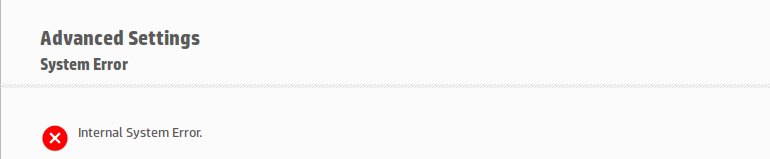
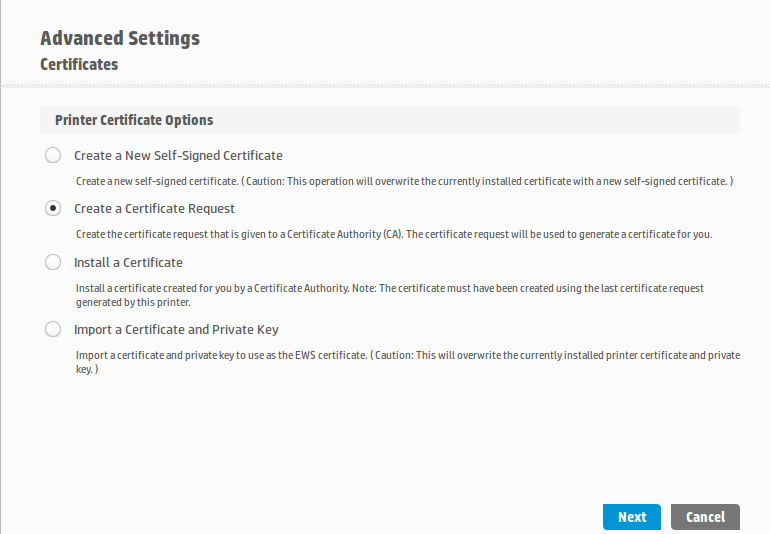
My first stabs were attempts to get CUPS not to care about expired certificates, but it seems to have been hidden or removed from its usual place. Anyway, I was already frustrated. WTF Well, yes, turns out that from the Web interface, I paid some attention to this the first time around, but let it pass (speaks wonders about my security practices!): Way, way, way too expired cert So, the self-signed certificate the printer issued at itself expired 116 years before even being issued. (is this maybe a Y2k38 bug? Sounds like it!) Interesting thing, my CUPS log mentions the printer credentials to expire at the beginning of the Unix Epoch (01 Jan 1970 00:00:00 GMT). OK, lets clickety-click away on the Web interface Didn t take me long to get to Network Advanced settings Certificates: Can manage certs! However, clicking on Configure leads me to the not very reassuring Way, way, way too expired cert I don t remember what I did for the next couple of minutes. Kept fuming Until I parsed again the output of lpstat -t, and found that:
# lpstat -t
(...)
device for HP_Ink_Tank_Wireless_410_series_C37468_: ipps://HPF43909C37468.local:443/ipp/print
(...)
Hmmmm CUPS is connecting using good ol port 443, as if it were a Web thingy What if I do the same? Now we are talking! Click on New self-signed certificate , click on Next, a couple of reloads And a very nice color print came out of the printer, yay! Now, it still baffles me (of course I checked!): The self-signed certificate is now said to come from Issuer : CN=HPC37468, L=Vancouver, ST=Washington, C=US, O=HP,OU=HP-IPG, alright not that it matters (I can import a more meaningful one if I really feel like it), but, why is it Issued On: 2019-06-14 and set to Expires On: 2029-06-11? Anyway, print quality is quite nice. I hope to keep the printer long enough to rant at the certificate being expired in the future!

Comments Jeff Epler (Adafruit) 2020-05-11 20:39:17 -0500 why is it Issued On: 2019-06-14 and set to Expires On: 2029-06-11? Because it s 3650 days Gunnar Wolf 2020-05-11 20:39:17 -0500 Nice catch! Thanks for doing the head-scratching for me

26 April 2020

Russ Allbery: Review: The Last Goodbye

Review: The Last Goodbye, by Matt Potter
Publisher: Silvertail
Copyright: 2014-2016
Printing: 2016
ISBN: 1-909269-42-5
Format: Kindle
Pages: 308
In the contested space between the interested amateur and the trained expert lies the enthusiast. A topic has, for often inexplicable reasons, caught fire in their thoughts and become a mild obsession. They may not have formal training or systematic conceptual grounding beneath their interest, but they partly make up for that lack with sustained fascination. They research widely and obscurely about their particular focus, develop novel theories, see distinctions and classifications that few others would bother to investigate, and present their discoveries to anyone who will stand still long enough. And occasionally, when that interest happens to coincide with writing skill, they produce some surprisingly excellent essays or books. Matt Potter's enthusiasm is resignation letters.
Every damaging resignation letter, every cornered truth attack, every out-of-control speech by a former friend, is more than just an inconvenience, to be countered with positive spin and internal memos: it's an open challenge to the official version of the story, the perfectly controlled brand. They are breaks in an otherwise perfectly planned, smoothly executed narrative of the powerful. Holes in the program code. A rare, irresistible chance to hack into history's shiny, unstoppable operation.
The Last Goodbye: A History of the World in Resignation Letters is not, in truth, a history of the world. It is, first and foremost, a taxonomy, because there are types of resignation letters. The opening chapter, the truth bomb, is the type that one would expect upon discovering that someone wrote a book on the topic (that wasn't advice on how to write a good one). But there are other types, less heavy on the fireworks but just as fascinating. The unquotable expert construction. The knife in the back. The incoherent scream of rage. But also the surprisingly gentle and graceful conclusion.
It is the question that the letters themselves try in vain to answer, over and over again even as they explain, analyse, protest and bear witness to a million other details. The question is: Why? All the forces in the universe stack up against unburdening ourselves in a resignation letter. Professionally, it can be suicide. In practical terms, it is often self-defeating. Self-help books coach against unleashing its force; colleagues and confidantes urge caution, self-restraint. And yet we do it, and damn the consequences. We have no choice but to speak in sorrow, love, grief, cold anger, thirst for revenge, wounded pride, the pain of injustice, loyalty, pangs of regret, throes of vengeful madness, deluded righteousness, panic, black distress, isolation, ecstasies of martyrdom, and a million other shades of human extremity we need to say our piece even as we leave the stage.
The risk of the enthusiast's book is that the lack of structural grounding can leave the conclusions unsupported. A fair critique of this book is that it contains a lot of amateur sociology. Potter has a journalist's eye for motive and narrative, but some of his conclusions may not be warranted. But he compensates for the lack of rigor with, well, enthusiasm. Potter is fascinated by resignation letters and the insight they offer, and that fascination is irresistibly contagious. It's probably obvious that the chapters on truth bombs, fuck yous, and knives in the back have visceral appeal. The resignation letter as a force of truth-telling, as the revenge of a disregarded peon, as a crack in the alliance between the powerful that may let some truth shine through, is what got me to buy this book. And Potter doesn't disappoint; he quotes from both famous and nearly unknown examples, dissects the writing and the intent, and gives us a ringside seat to a few effective acts of revenge. That's not the best part of this book, though. The chapter that I will remember the longest is Potter's dissection of the constructed resignation letter. The carefully drafted public relations statement, the bland formality, the attempt to make a news story disappear. The conversation-ender. It's a truism that any area of human endeavor involves more expertise than those who have only observed it from the outside will realize, but I had never thought to apply that principle to the ghost-written resignation letter. The careful non-apology, the declaration that one has "become a distraction," the tell-tale phrasing of "spending more time with my family" is offensive in its bland dishonesty. But Potter shows that the blandness is expertly constructed to destroy quotability. Those statements are nearly impossible to remember or report on because they have been built that way: nouns carefully separated from verbs, all force dissipated by circuities and modifiers, and subtle grammatical errors introduced to discourage written news from including direct quotes. Potter's journalism background shines here because he can describe the effect on news reporting. He walks the reader through the construction to reveal that the writing is not incompetent but instead is skillfully bad in a way that causes one's attention to skitter off of it. The letter vanishes into its own vagueness. The goal is to smother the story in such mediocrity that it becomes forgettable. And it works. I've written several resignation letters of my own. Somewhat unusually, I've even sent several of them, although (as Potter says is typical) fewer than I've written. I've even written (and sent) the sort of resignation letter that every career advisor will say to never send. Potter's discussion of the motives and thought process behind those letters rang true for me. It's a raw and very human moment, one is never in as much control of it as one wishes, the cracks and emotions break through in the writing, and often those letters are trying to do far too many things at the same time. But it's also a moment in which one can say something important and have others listen, which can be weirdly challenging to do in the normal course of a job. Potter ends this book beautifully by looking at resignation letters that break or transcend the mold of most of the others he's examined: letters where the author seems to have found some peace and internal understanding and expresses that simply and straightforwardly. I found this surprisingly touching after the emotional roller-coaster of the rest of the book, and a lovely note on which to end. This is a great book. Potter has a good eye for language and the emotion encoded in it, a bracing preference for the common worker or employee over the manager or politician, and the skill to produce some memorable turns of phrase. Most importantly, he has the enthusiast's love of the topic. Even if you don't care about resignation letters going in, it will be hard to avoid some fascination with them by the end of this book. Recommended. This book was originally published as F*ck You and Goodbye in the UK. Rating: 8 out of 10

15 April 2020

Antoine Beaupr : OpenDKIM configuration to send debian.org email

Debian.org added support for DKIM in 2020. To configure this on my side, I had to do the following, on top of my email configuration.
  1. add this line to /etc/opendkim/signing.table:
    *@debian.org marcos-debian.anarcat.user
    
  2. add this line to /etc/opendkim/key.table:
    marcos-debian.anarcat.user debian.org:marcos-debian.anarcat.user:/etc/opendkim/keys/marcos-debian.anarcat.user.private
    
    Yes, that's quite a mouthful! That magic selector is long in that way because it needs a special syntax (specifically the .anarcat.user suffix) for Debian to be happy. The -debian string is to tell me where the key is published. The marcos prefix is to remind me where the private is used.
  3. generate the key with:
    opendkim-genkey --directory=/etc/opendkim/keys/ --selector=marcos-debian.anarcat.user --domain=debian.org --verbose
    
    This creates the DNS record in /etc/opendkim/keys/marcos-debian.anarcat.user.txt (alongside the private key in .key).
  4. restart OpenDKIM:
    service opendkim restart
    
    The DNS record will look something like this:
    marcos-debian.anarcat.user._domainkey   IN  TXT ( "v=DKIM1; h=sha256; k=rsa; "
    "p=MIIBIjANBgkqhkiG9w0BAQEFAAOCAQ8AMIIBCgKCAQEAtKzBK2f8vg5yV307WAOatOhypQt3ANQ95iDaewkVehmx42lZ6b4PzA1k5DkIarxjkk+7m6oSpx5H3egrUSLMirUiMGsIb5XVGBPFmKZhDVmC7F5G1SV7SRqqKZYrXTufRRSne1eEtA31xpMP0B32f6v6lkoIZwS07yQ7DDbwA9MHfyb6MkgAvDwNJ45H4cOcdlCt0AnTSVndcl"
    "pci5/2o/oKD05J9hxFTtlEblrhDXWRQR7pmthN8qg4WaNI4WszbB3Or4eBCxhUdvAt2NF9c9eYLQGf0jfRsbOcjSfeus0e2fpsKW7JMvFzX8+O5pWfSpRpdPatOt80yy0eqpm1uQIDAQAB" )  ; ----- DKIM key marcos-debian.anarcat.user for debian.org
    
  5. The "p=MIIB..." string needs to be joined together, without the quotes and the p=, and sent in a signed email to changes@db.debian.org:
    -----BEGIN PGP SIGNED MESSAGE-----
    dkimPubKey: marcos.anarcat.user MIIB[...]
    -----BEGIN PGP SIGNATURE-----
    [...]
    
  6. Wait a few minutes for DNS to propagate. You can check if they have with:
    host -t TXT marcos-debian.anarcat.user._domainkey.debian.org nsp.dnsnode.net
    
    (nsp.dnsnode.net being one of the NS records of the debian.org zone.)
If all goes well, the tests should pass when sending from your server as anarcat@debian.org.

Testing Test messages can be sent to dkimvalidator, mail-tester.com or check-auth@verifier.port25.com. Those tools will run Spamassassin on the received emails and report the results. What you are looking for is:
  • -0.1 DKIM_VALID: Message has at least one valid DKIM or DK signature
  • -0.1 DKIM_VALID_AU: Message has a valid DKIM or DK signature from author's domain
  • -0.1 DKIM_VALID_EF: Message has a valid DKIM or DK signature from envelope-from domain
If one of those is missing, then you are doing something wrong and your "spamminess" score will be worse. The latter is especially tricky as it validates the "Envelope From", which is the MAIL FROM: header as sent by the originating MTA, which you see as from=<> in the postfix lost. The following will happen anyways, as soon as you have a signature, that's normal:
  • 0.1 DKIM_SIGNED: Message has a DKIM or DK signature, not necessarily valid
And this might happen if you have a ADSP record but do not correctly sign the message with a domain field that matches the record:
  • 1.1 DKIM_ADSP_ALL No valid author signature, domain signs all mail
That's bad and will affect your spam core badly. I fixed that issue by using a wildcard key in the key table:
--- a/opendkim/key.table
+++ b/opendkim/key.table
@@ -1 +1 @@
-marcos anarc.at:marcos:/etc/opendkim/keys/marcos.private
+marcos %:marcos:/etc/opendkim/keys/marcos.private

References This is a copy of a subset of my more complete email configuration.

7 April 2020

Shirish Agarwal: GMRT 2020 and lots of stories

First of all, congratulations to all those who got us 2022 Debconf, so we will finally have a debconf in India. There is of course, lot of work to be done between now and then. For those who would be looking forward to visit India and especially Kochi I would suggest you to hear this enriching tale
I am sorry I used youtube link but it is too good a podcast not to be shared. Those who don t want youtube can use the invidio.us link for the same as shared below. https://www.invidio.us/watch?v=BvjgKuKmnQ4 I am sure there are lot more details, questions, answers etc. but would direct them gently to Praveen, Shruti, Balasankar and the rest who are from Kochi to answer if you have any questions about that history.

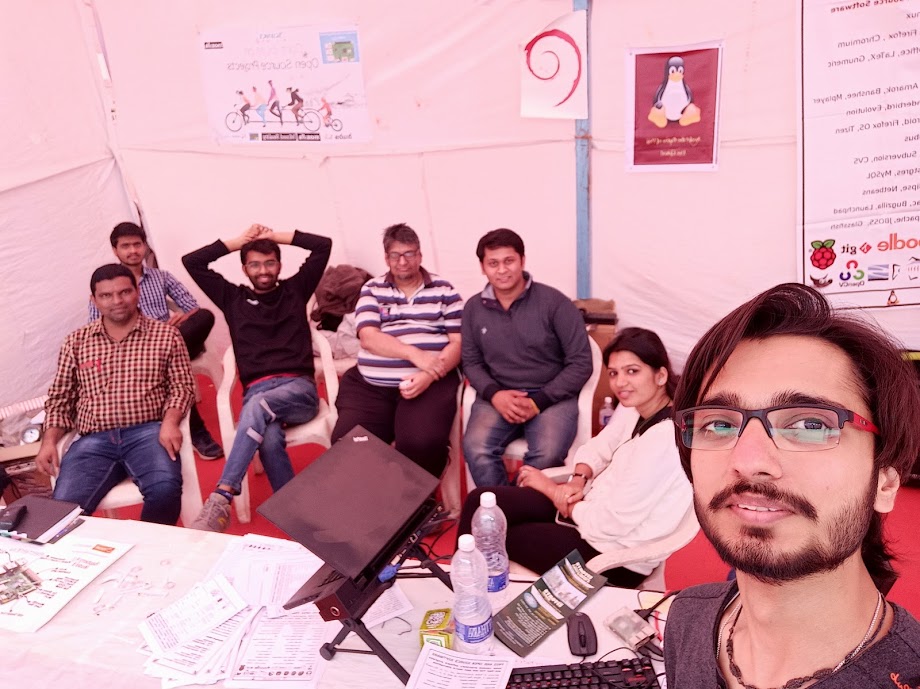
National Science Day, GMRT 2020 First, as always, we are and were grateful to both NCRA as well as GMRT for taking such good care of us. Even though Akshat was not around, probably getting engaged, a few of us were there. About 6-7 from the Mozilla Nasik while the rest representing the foss community. Here is a small picture which commentrates the event
National Science Day, GMRT 2020
While there is and was a lot to share about the event. For e.g. Akshay had bought RPI- Zero as well as RPI-2 (Raspberry Pi s ) and showed some things. He had also bought up a Debian stable live drive with persistence although the glare from the sun was too much that we couldn t show it to clearly to students. This was also the case with RPI but still we shared what and how much we could. Maybe next year, we either ask them to have double screens or give us dark room so we can showcase things much better. We did try playing with contrast and all but it didn t have much of an effect  . Of course in another stall few students had used RPI s as part of their projects so at times we did tell some of the newbies to go to those stalls and see and ask about those projects so they would have a much wider experience of things. The Mozilla people were pushing VR as well as Mozilla lite the browser for the mobile. We also gossiped quite a bit. I shared about indicatelts , a third-party certificate extension although I dunno if I should file a wnpp about it or not. We didn t have a good experience of when I had put an RFP (Request for Package) which was accepted for an extension which had similar functionality which we later come to know was sharing the sites people were using the extension to call home and share both the URL and the IP Address they were using it from. Sadly, didn t leave a good taste in mouth

Delhi Riots One thing I have been disappointed with is the lack of general awareness about things especially in the youth. We have people who didn t know that for e.g. in the Delhi riots which happened recently the law and order (Police) lies with Home Minister of India, Amit Shah. This is perhaps the only capital in the world which has its own Chief Minister but doesn t have any say on its law and order. And this has been the case for last 70 years i.e. since independance. The closest I know so far is the UK but they too changed their tune in 2012. India and especially Delhi seems to be in a time-capsule which while being dysfunctional somehow is made to work. In many ways, it s three body or a body split into three personalities which often makes governance a messy issue but that probably is a topic for another day. In fact, scroll had written a beautiful editorial that full statehood for Delhi was not only Arvind Kejriwal s call (AAP) but also something that both BJP as well as Congress had asked in the past. In fact, nothing about the policing is in AAP s power. All salaries, postings, transfers of police personnel everything is done by the Home Ministry, so if any blame has to be given it has to be given to the Home Ministry for the same.

American Capitalism and Ventilators America had been having a history of high cost healthcare as can be seen in this edition of USA today from 2017 . The Affordable Care Act was signed as a law by President Obama in 2010 which Mr. Trump curtailed when he came into power couple of years back. An estimated 80,000 people died due to seasonal flu in 2018-19 . Similarly, anywhere between 24-63,000 have supposed to have died from Last October to February-March this year. Now if the richest country can t take care of their population which is 1/3rd of the population of this country while at the same time United States has thrice the area that India has. This I am sharing as seasonal flu also strikes the elderly as well as young children more than adults. So in one senses, the vulnerable groups overlap although from some of the recent stats, for Covid-19 even those who are 20+ are also vulnerable but that s another story altogether. If you see the CDC graph of the seasonal flu it is clear that American health experts knew about it. One another common factor which joins both the seasonal flu and covid is both need ventilators for the most serious cases. So, in 2007 it was decided that the number of ventilators needed to be ramped up, they had approximately 62k ventilators at that point in time all over U.S. The U.S. in 2010, asked for bids and got bid from a small californian company called Newport Medic Instruments. The price of the ventilators was approximately INR 700000 at 2010 prices, while Newport said they would be able to mass-produce at INR 200000 at 2010 prices. The company got the order and they started designing the model which needed to be certified by FDA. By 2011, they got the product ready when a big company called Covidgen bought Newport Medic and shutdown the project. This was shared in a press release in 2012. The whole story was broken by New York Times again, just a few days ago which highlighted how America s capitalism rough shod over public health and put people s life unnecessarily in jeopardy. If those new-age ventilators would have been a reality then not just U.S. but India and many other countries would have bought the ventilators as every county has same/similar needs but are unable to pay the high cost which in many cases would be passed on to their citizens either as price of service, or by raising taxes or a mixture of both with public being none the wiser. Due to dearth of ventilators and specialized people to operate it and space, there is possibility that many countries including India may have to make tough choices like Italian doctors had to make as to who to give ventilator to and have the mental and emotional guilt which would be associated with the choices made.

Some science coverage about diseases in wire and other publications Since Covid coverage broke out, the wire has been bringing various reports of India s handling of various epidemics, mysteries, some solved, some still remaining unsolved due to lack of interest or funding or both. The Nipah virus has been amply discussed in the movie Virus (2019) which I shared in the last blog post and how easily it could have been similar to Italy in Kerala. Thankfully, only 24 people including a nurse succumbed to that outbreak as shared in the movie. I had shared about Kerala nurses professionalism when I was in hospital couple of years back. It s no wonder that their understanding of hygeine and nursing procedures are a cut above the rest hence they are sought after not just in India but world-over including US and UK and the middle-east. Another study on respitory illness was bought to my attention by my friend Pavithran.

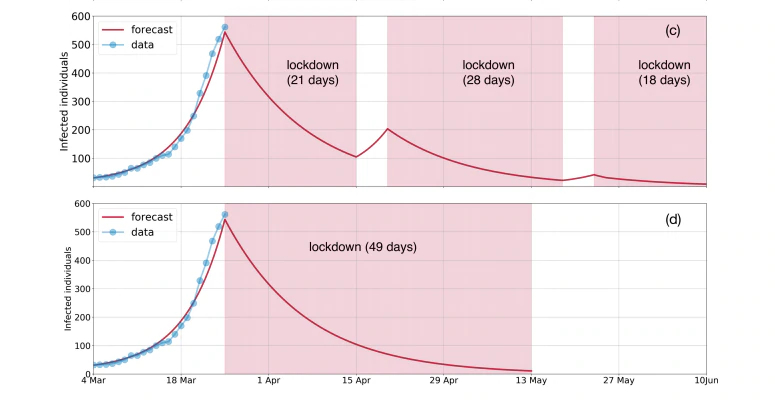
Possibility of extended lockdown in India There was talk in the media of extended lockdown or better put an environment is being created so that an extended lockdown can be done. This is probably in part due to a mathematical model and its derivatives shared by two Indian-origin Cambridge scholars who predict that a minimum 49 days lockdown may be necessary to flatten the covid curve about a week back.
Predictions of the outcome of the current 21-day lockdown (Source: Rajesh Singh, R. Adhikari, Cambridge University)
Alternative lockdown strategies suggested by the Cambridge model (Source: Rajesh Singh, R. Adhikari, Cambridge University)
India caving to US pressure on Hydroxychloroquine While there has been lot of speculation in U.S. about Hydroxychloroquine as the wonder cure, last night Mr. Trump threatened India in a response to a reporter that Mr. Modi has to say no for Hydroxychloroquine and there may be retaliations.
As shared before if youtube is not your cup you can see the same on invidio.us https://www.invidio.us/watch?v=YP-ewgoJPLw Now while there have been several instances in the past of U.S. trying to bully India, going all the way back to 1954. In fact, in recent memory, there were sanctions on India by US under Atal Bihari Vajpayee Government (BJP) 1998 but he didn t buckle under the pressure and now we see our current PM taking down our own notification from a day ago and not just sharing Hydroxychloroquine but also Paracetemol to other countries so it would look as if India is sharing with other countries. Keep in mind, that India, Brazil haven t seen eye to eye on trade agreements of late and Paracetemol prices have risen in India. The price rise has been because the API (Active Pharmaceutical Ingredients) for the same come from China where the supply chain will take time to be fixed and we would also have to open up, although should we, should we not is another question altogether. I talk about supply chains as lean supply chains were the talk since late 90 s when the Japanese introduced Just-in-time manufacturing which lead to lean supply chains as well as lot of outsourcing as consequence. Of course, the companies saved money but at the cost of flexibility and how this model was perhaps flawed was shared by a series of articles in Economist as early as 2004 when there were lot of shocks to that model and would be exaberated since then. There have been frequent shocks to these fragile ecosystem more since 2008 after the financial meltdown and this would put more companies out of business than ever before. The MSME sector in India had already been severely impacted first by demonetization and then by the horrendous implementation of GST whose cries can be heard from all sectors. Also the frequent changing of GST taxes has made markets jumpy and investors unsure. With judgements such as retrospective taxes, AGR (Adjusted Gross Revenue) etc. it made not only the international investors scared, but also domestic investors. The flight of the capital has been noticeable. This I had shared before when Indian Government shared about LRS report which it hasn t since then. In fact Outlook Business had an interesting article about it where incidentally it talked about localcircles, a community networking platform where you get to know of lot of things and whom I am also a member of. At the very end I apologize for not sharing the blog post before but then I was feeling down but then I m not the only one.

Steve Kemp: A busy few days

Over the past few weeks things have been pretty hectic. Since I'm not working at the moment I'm mostly doing childcare instead. I need a break, now and again, so I've been sending our child to p iv koti two days a week with him home the rest of the time. I love taking care of the child, because he's seriously awesome, but it's a hell of a lot of work when most of our usual escapes are unavailable. For example we can't go to the (awesome) Helsinki Central Library as that is closed. Instead of doing things outdoors we've been baking bread together, painting, listening to music and similar. He's a big fan of any music with drums and shouting, so we've been listening to Rammstein, The Prodigy, and as much Queen as I can slip in without him complaining ("more bang bang!"). I've also signed up for some courses at the Helsinki open university, including Devops with Docker so perhaps I have a future career working with computers? I'm hazy. Finally I saw a fun post the other day on reddit asking about the creation of a DSL for server-setup. I wrote a reply which basically said two things: Anyway I had an idea of just expressing things in a simple fashion, borrowing Puppet syntax (which I guess is just Ruby hash literals). So a module to do stuff with files would just look like this:
file   name   => "This is my rule",
       target => "/tmp/blah",
       ensure => "absent"  
The next thing to do is to allow that to notify another rule, when it results in a change. So you add in:
notify => "Name of rule"
# or
notify => [ "Name of rule", "Name of another rule" ]
You could also express dependencies the other way round:
shell   name => "Do stuff",
        command => "wc -l /etc/passwd > /tmp/foo",
        requires => [ "Rule 1", "Rule 2"]  
Anyway the end result is a simple syntax which allows you to do things; I wrote a file to allow me to take a clean system and configure it to run a simple golang application in an hour or so. The downside? Well the obvious one is that there's no support for setting up cron jobs, setting up docker images, MySQL usernames/passwords, etc. Just a core set of primitives. Adding new things is easy, but also an endless job. So I added the ability to run external/binary plugins stored outside the project. To support that is simple with the syntax we have: All good. People can write modules, if they like, and they can do that in any language they like. Fun times. We'll call it marionette since it's all puppet-inspired: And that concludes this irregular update.

16 March 2020

Ulrike Uhlig: Deconstructing the term control freak

Control freaks. You may have called people like this. Or you may have been called one yourself. Maybe you got angry. Or, on the contrary, you felt like being a control freak is a feature, because who would notice all these little details that are not exactly perfect if not you? This post is an attempt to deconstruct the term. Etymological considerations Control - from latin contra- rotulus - refers to the copy of an account register as a means of verification of the original register. So control is about keeping track, not making mistakes, i.e. it's about doing a perfect calculation. The meaning of control in our society is linked to authority, or to policing like in crowd control. What English calls an inspector, is a Kontrolleur in German or contr leur in French. The word is also linked to manufacturing, as in quality control. We also talk about being in control, which is linked to the desire of being autonomous, to be able to act on one's own account. Being in control can also designate a need to preserve one's own integrity: if I have integrity (in the sense of feeling whole), I can self-determine, which is the most fundamental requirement for having one's own identity. Freak - refers to someone who does not fit the norm. Calling someone a freak is per se problematic, because it blames a person for being atypical, abnormal. Freak is a word that, while pointing a finger at difference, at the same time denies people the right to be different and diverse. People can reappropriate such words to make it clear that not fitting the norm is a wanted expression of their diversity we can see that if we follow the history of the word queer for an example. Types of control freaking To me, being a control freak is mostly a feature, if it's about controlling my own life and my own effectiveness. Control freaking becomes troublesome when it's about controlling other people's effectiveness. And it becomes highly problematic when it's about controlling other people's lives. Controlling one's own life Having control over one's own life is a basic human need. In particular people who are part of minorities, people who face discrimination and oppression every day have an increased need for self-determination, and the need to see their existence and their identity acknowledged and accepted by the rest of the world. Too often do we experience that other people (generally the ones with privilege, or not facing the same oppression) try to own the narrative over our lives (1)(2). Calling this control freakish is missing the point, and is probably a sign of looking at it from a perspective of privilege. Controlling one's own effectiveness People produce things. People write code, make ceramics, or write texts, for example. People have a need to control their own effectiveness: they set up routines, product tests, documentation. This type of control is a feature, and can help to release better software, better texts, or perfectly burnt clay pots ultimately controlling one's own effectiveness helps to learn from one's mistakes and to improve routines over time. The grey zone The grey zone describes the zone in between wanting to control one's own effectiveness and wanting to control other people's effectiveness. Here we could situate the type of control freak who does not delegate tasks to others for fear of seeing them done differently then they had expected them to be done. This can be harmful particularly to the person who does not delegate: they can get overworked or burnt out. This type of control freakism might be linked to perfectionism. Controlling other people's effectiveness When we work with other people, our own effectiveness might get in the way of other people's effectiveness, or vice versa. Indeed, it happens - not only in work contexts - that people find themselves in setups in which mutual responsibilities and autonomies conflict with one another because one person is dependent on the other for making decisions or moving things forward as they see fit. (There is generally a relation of dependency between two conflicting parties that is worth looking at (3).) Add to this the fact that, when delegating a task, some people have a hard time also delegating the responsibility and autonomy needed to resolve the task. They lack trust that another person can also do the work, or want that person to do the work exactly in the same way they would do it. (In some cases this can be related to Founder's Syndrome and can result in organizations staying stuck with one or a small group of founders holding knowledge and power, and preventing the organization from growing. Page 11 in the booklet "Working with conflict in our groups" describes how such an informal hierarchy can come into being in grassroot groups.) The (perfectly valid) need behind this type of control freaking could be to make sure that a group of people builds a successful product, releases a fact-checked documentary, or creates a publication without mistakes. But controlling other people's effectiveness as a strategy to satisfy this need can create a non-cooperative climate in which people do not meet each other on eye level, but are dependent on each other, experience a lack autonomy, a break of boundaries, or sometimes feel authority to be overexerted. Acknowledging the need to build a good product, it is possible to create the appropriate strategies to guarantee that the involved people can meet each other on eye level: for example by clearly defining and documenting role-responsibility-accountability along with appropriate decision making processes, or by distributing leadership ( you should totally click on that link!), by looking at inclusive leadership models, by learning from past mistakes, by instating feedback cycles, by making boundaries between the direction of an organization and the day-to-day work clear. An organization I work with has the rule that people can make decisions for themselves if the decision only affects their work, while decisions that affect a team should be made with the team, and decisions that affect the organization as a whole need to be made at the organizational level. They call that a no-brainer, but in organizations with traditional hierarchies, or in grown grassroot environments that have never clearly defined and assigned responsibilities and accountabilities (aka "functional roles") this is not so obvious at all. Controlling someone else's life This type of control freak does not only desire to control their own life but for a reason or another wants to know and control what other people do, think (especially about the control freak), decide, or how they live. In some cases, this type of control freak might even want to force upon others things they should do as a way to be accepted by the control freak. It's what we call narcissism, harassment, abuse. It is unacceptable. Conclusion In summary, the distinctions I came up with in this post describe the boundaries along which control freakism takes hold of someone else's effectiveness or life and ultimately prevents them from self-determining. In German we have the word bergriffig which describes that someone is infringing someone else's boundaries they are over - grabbing, seizing, grasping, taking hold of. Which type of control freak are you, if any?

(1) Like when a West-Berliner in a round of 15 East Germans arrogantly talks about the time when the wall came down and tells the story that he could not go shopping between Thursdays and Sundays because the East Germans bought too many products in the supermarkets while this event marked an unimaginable rift in the biographies of 17 million East Germans, 15 of whom are sitting right in front of him. Thirty years after 1989, many of us are finally starting to question this publicly ( links in German language).

(2) Women experience it similary regularly, see Men Explain Things to me, a book by Rebecca Solnit.

(3) By the way, rather than having "recruited the wrong person" conflict may intrinsically arise as part of certain work relationships, simply due to the inter-dependencies of roles or workers, like in a delivery chain.

11 March 2020

Riku Voipio: This is the year not to fly

If you have to choose one year when you won't fly, this year, 2020, is the one to choose. Why? Because CORSIA. What the heck is CORSIA? CORSIA is not a novel virus, but "Carbon Offsetting and Reduction Scheme for International Aviation". In a nutshell, the aviation industry says they will freeze their co2 emissions from growing. Actually, aviation emissions are still going to grow. The airlines will just pay someone else to reduce emissions with the same amount aviation emissions rise - the "Offsetting" word in CORSIA. If that sounds like greenwashing, well it pretty much is. But that was expected. Getting every country and airline abroad CORSIA would not have been possible if the scheme would actually bite. So it's pretty much a joke. What does it have to do with *this* Year? The first phase of CORSIA will start next year, so the emissions are frozen to year 2020 levels. Due to certain recent events, lots of flights have already been cancelled - which means the reference year aviation emissions are already a lot less than the aviation industry was expecting. By avoiding flying this year, the aviation emissions are going to be frozen at an even lower level. This will increase cost of co2 offsetting for airlines, and the joke is going to be on them. So consider skipping business travel and taking your holiday trip this year with something else than a plane. Wouldn't recommend a cruise ship, tho...
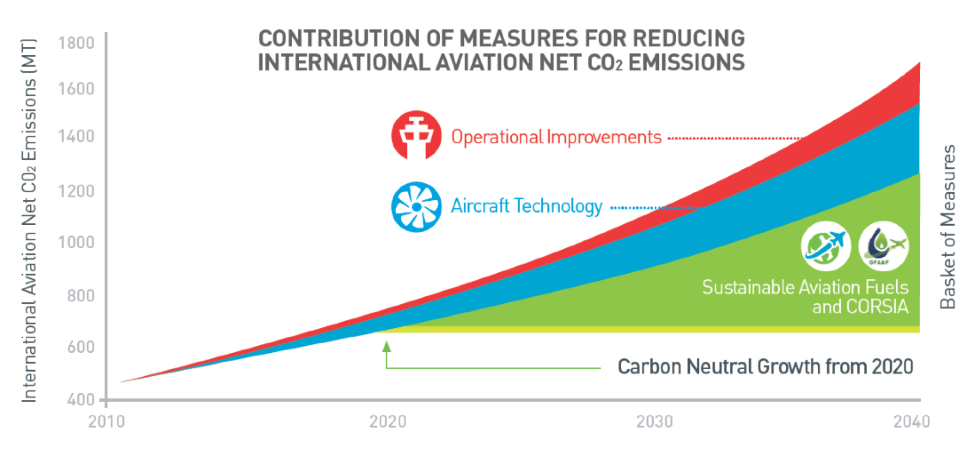
13 November 2017

Markus Koschany: My Free Software Activities in October 2017

Welcome to gambaru.de. Here is my monthly report that covers what I have been doing for Debian. If you re interested in Java, Games and LTS topics, this might be interesting for you. Debian Games Debian Java Debian LTS This was my twentieth month as a paid contributor and I have been paid to work 19 hours on Debian LTS, a project started by Rapha l Hertzog. I will catch up with the remaining 1,75 hours in November. In that time I did the following: Misc Thanks for reading and see you next time.

2 November 2017

Antoine Beaupr : October 2017 report: LTS, feed2exec beta, pandoc filters, git mediawiki

Debian Long Term Support (LTS) This is my monthly Debian LTS report. This time I worked on the famous KRACK attack, git-annex, golang and the continuous stream of GraphicsMagick security issues.

WPA & KRACK update I spent most of my time this month on the Linux WPA code, to backport it to the old (~2012) wpa_supplicant release. I first published a patchset based on the patches shipped after the embargo for the oldstable/jessie release. After feedback from the list, I also built packages for i386 and ARM. I have also reviewed the WPA protocol to make sure I understood the implications of the changes required to backport the patches. For example, I removed the patches touching the WNM sleep mode code as that was introduced only in the 2.0 release. Chunks of code regarding state tracking were also not backported as they are part of the state tracking code introduced later, in 3ff3323. Finally, I still have concerns about the nonce setup in patch #5. In the last chunk, you'll notice peer->tk is reset, to_set to negotiate a new TK. The other approach I considered was to backport 1380fcbd9f ("TDLS: Do not modify RNonce for an TPK M1 frame with same INonce") but I figured I would play it safe and not introduce further variations. I should note that I share Matthew Green's observations regarding the opacity of the protocol. Normally, network protocols are freely available and security researchers like me can easily review them. In this case, I would have needed to read the opaque 802.11i-2004 pdf which is behind a TOS wall at the IEEE. I ended up reading up on the IEEE_802.11i-2004 Wikipedia article which gives a simpler view of the protocol. But it's a real problem to see such critical protocols developed behind closed doors like this. At Guido's suggestion, I sent the final patch upstream explaining the concerns I had with the patch. I have not, at the time of writing, received any response from upstream about this, unfortunately. I uploaded the fixed packages as DLA 1150-1 on October 31st.

Git-annex The next big chunk on my list was completing the work on git-annex (CVE-2017-12976) that I started in August. It turns out doing the backport was simpler than I expected, even with my rusty experience with Haskell. Type-checking really helps in doing the right thing, especially considering how Joey Hess implemented the fix: by introducing a new type. So I backported the patch from upstream and notified the security team that the jessie and stretch updates would be similarly easy. I shipped the backport to LTS as DLA-1144-1. I also shared the updated packages for jessie (which required a similar backport) and stretch (which didn't) and those Sebastien Delafond published those as DSA 4010-1.

Graphicsmagick Up next was yet another security vulnerability in the Graphicsmagick stack. This involved the usual deep dive into intricate and sometimes just unreasonable C code to try and fit a round tree in a square sinkhole. I'm always unsure about those patches, but the test suite passes, smoke tests show the vulnerability as fixed, and that's pretty much as good as it gets. The announcement (DLA 1154-1) turned out to be a little special because I had previously noticed that the penultimate announcement (DLA 1130-1) was never sent out. So I made a merged announcement to cover both instead of re-sending the original 3 weeks late, which may have been confusing for our users.

Triage & misc We always do a bit of triage even when not on frontdesk duty, so I: I also did smaller bits of work on: The latter reminded me of the concerns I have about the long-term maintainability of the golang ecosystem: because everything is statically linked, an update to a core library (say the SMTP library as in CVE-2017-15042, thankfully not affecting LTS) requires a full rebuild of all packages including the library in all distributions. So what would be a simple update in a shared library system could mean an explosion of work on statically linked infrastructures. This is a lot of work which can definitely be error-prone: as I've seen in other updates, some packages (for example the Ruby interpreter) just bit-rot on their own and eventually fail to build from source. We would also have to investigate all packages to see which one include the library, something which we are not well equipped for at this point. Wheezy was the first release shipping golang packages but at least it's shipping only one... Stretch has shipped with two golang versions (1.7 and 1.8) which will make maintenance ever harder in the long term.
We build our computers the way we build our cities--over time, without a plan, on top of ruins. - Ellen Ullman

Other free software work This month again, I was busy doing some serious yak shaving operations all over the internet, on top of publishing two of my largest LWN articles to date (2017-10-16-strategies-offline-pgp-key-storage and 2017-10-26-comparison-cryptographic-keycards).

feed2exec beta Since I announced this new project last month I have released it as a beta and it entered Debian. I have also wrote useful plugins like the wayback plugin that saves pages on the Wayback machine for eternal archival. The archive plugin can also similarly save pages to the local filesystem. I also added bash completion, expanded unit tests and documentation, fixed default file paths and a bunch of bugs, and refactored the code. Finally, I also started using two external Python libraries instead of rolling my own code: the pyxdg and requests-file libraries, the latter which I packaged in Debian (and fixed a bug in their test suite). The program is working pretty well for me. The only thing I feel is really missing now is a retry/fail mechanism. Right now, it's a little brittle: any network hiccup will yield an error email, which are readable to me but could be confusing to a new user. Strangely enough, I am particularly having trouble with (local!) DNS resolution that I need to look into, but that is probably unrelated with the software itself. Thankfully, the user can disable those with --loglevel=ERROR to silence WARNINGs. Furthermore, some plugins still have some rough edges. For example, The Transmission integration would probably work better as a distinct plugin instead of a simple exec call, because when it adds new torrents, the output is totally cryptic. That plugin could also leverage more feed parameters to save different files in different locations depending on the feed titles, something would be hard to do safely with the exec plugin now. I am keeping a steady flow of releases. I wish there was a way to see how effective I am at reaching out with this project, but unfortunately GitLab doesn't provide usage statistics... And I have received only a few comments on IRC about the project, so maybe I need to reach out more like it says in the fine manual. Always feels strange to have to promote your project like it's some new bubbly soap... Next steps for the project is a final review of the API and release production-ready 1.0.0. I am also thinking of making a small screencast to show the basic capabilities of the software, maybe with asciinema's upcoming audio support?

Pandoc filters As I mentioned earlier, I dove again in Haskell programming when working on the git-annex security update. But I also have a small Haskell program of my own - a Pandoc filter that I use to convert the HTML articles I publish on LWN.net into a Ikiwiki-compatible markdown version. It turns out the script was still missing a bunch of stuff: image sizes, proper table formatting, etc. I also worked hard on automating more bits of the publishing workflow by extracting the time from the article which allowed me to simply extract the full article into an almost final copy just by specifying the article ID. The only thing left is to add tags, and the article is complete. In the process, I learned about new weird Haskell constructs. Take this code, for example:
-- remove needless blockquote wrapper around some tables
--
-- haskell newbie tips:
--
-- @ is the "at-pattern", allows us to define both a name for the
-- construct and inspect the contents as once
--
--   is the "empty record pattern": it basically means "match the
-- arguments but ignore the args"
cleanBlock (BlockQuote t@[Table  ]) = t
Here the idea is to remove <blockquote> elements needlessly wrapping a <table>. I can't specify the Table type on its own, because then I couldn't address the table as a whole, only its parts. I could reconstruct the whole table bits by bits, but it wasn't as clean. The other pattern was how to, at last, address multiple string elements, which was difficult because Pandoc treats spaces specially:
cleanBlock (Plain (Strong (Str "Notifications":Space:Str "for":Space:Str "all":Space:Str "responses":_):_)) = []
The last bit that drove me crazy was the date parsing:
-- the "GAByline" div has a date, use it to generate the ikiwiki dates
--
-- this is distinct from cleanBlock because we do not want to have to
-- deal with time there: it is only here we need it, and we need to
-- pass it in here because we do not want to mess with IO (time is I/O
-- in haskell) all across the function hierarchy
cleanDates :: ZonedTime -> Block -> [Block]
-- this mouthful is just the way the data comes in from
-- LWN/Pandoc. there could be a cleaner way to represent this,
-- possibly with a record, but this is complicated and obscure enough.
cleanDates time (Div (_, [cls], _)
                 [Para [Str month, Space, Str day, Space, Str year], Para _])
    cls == "GAByline" = ikiwikiRawInline (ikiwikiMetaField "date"
                                           (iso8601Format (parseTimeOrError True defaultTimeLocale "%Y-%B-%e,"
                                                           (year ++ "-" ++ month ++ "-" ++ day) :: ZonedTime)))
                        ++ ikiwikiRawInline (ikiwikiMetaField "updated"
                                             (iso8601Format time))
                        ++ [Para []]
-- other elements just pass through
cleanDates time x = [x]
Now that seems just dirty, but it was even worse before. One thing I find difficult in adapting to coding in Haskell is that you need to take the habit of writing smaller functions. The language is really not well adapted to long discourse: it's more about getting small things connected together. Other languages (e.g. Python) discourage this because there's some overhead in calling functions (10 nanoseconds in my tests, but still), whereas functions are a fundamental and important construction in Haskell that are much more heavily optimized. So I constantly need to remind myself to split things up early, otherwise I can't do anything in Haskell. Other languages are more lenient, which does mean my code can be more dirty, but I feel get things done faster then. The oddity of Haskell makes frustrating to work with. It's like doing construction work but you're not allowed to get the floor dirty. When I build stuff, I don't mind things being dirty: I can cleanup afterwards. This is especially critical when you don't actually know how to make things clean in the first place, as Haskell will simply not let you do that at all. And obviously, I fought with Monads, or, more specifically, "I/O" or IO in this case. Turns out that getting the current time is IO in Haskell: indeed, it's not a "pure" function that will always return the same thing. But this means that I would have had to change the signature of all the functions that touched time to include IO. I eventually moved the time initialization up into main so that I had only one IO function and moved that timestamp downwards as simple argument. That way I could keep the rest of the code clean, which seems to be an acceptable pattern. I would of course be happy to get feedback from my Haskell readers (if any) to see how to improve that code. I am always eager to learn.

Git remote MediaWiki Few people know that there is a MediaWiki remote for Git which allow you to mirror a MediaWiki site as a Git repository. As a disaster recovery mechanism, I have been keeping such a historical backup of the Amateur radio wiki for a while now. This originally started as a homegrown Python script to also convert the contents in Markdown. My theory then was to see if we could switch from Mediawiki to Ikiwiki, but it took so long to implement that I never completed the work. When someone had the weird idea of renaming a page to some impossible long name on the wiki, my script broke. I tried to look at fixing it and then remember I also had a mirror running using the Git remote. It turns out it also broke on the same issue and that got me looking in the remote again. I got lost in a zillion issues, including fixing that specific issue, but I especially looked at the possibility of fetching all namespaces because I realized that the remote fetches only a part of the wiki by default. And that drove me to submit namespace support as a patch to the git mailing list. Finally, the discussion came back to how to actually maintain that contrib: in git core or outside? Finally, it looks like I'll be doing some maintenance that project outside of git, as I was granted access to the GitHub organisation...

Galore Yak Shaving Then there's the usual hodgepodge of fixes and random things I did over the month.
There is no [web extension] only XUL! - Inside joke

30 October 2017

Russell Coker: Logic of Zombies

Most zombie movies feature shuffling hordes which prefer to eat brains but also generally eat any human flesh available. Because in most movies (pretty much everything but the 28 Days Later series [1]) zombies move slowly they rely on flocking to be dangerous. Generally the main way of killing zombies is severe head injury, so any time zombies succeed in their aim of eating brains they won t get a new recruit for their horde. The TV series iZombie [2] has zombies that are mostly like normal humans as long as they get enough brains and are smart enough to plan to increase their horde. But most zombies don t have much intelligence and show no signs of restraint so can t plan to recruit new zombies. In 28 Days Later the zombies aren t smart enough to avoid starving to death, in contrast to most zombie movies where the zombies aren t smart enough to find food other than brains but seem to survive on magic. For a human to become a member of a shuffling horde of zombies they need to be bitten but not killed. They then need to either decide to refrain from a method of suicide that precludes becoming a zombie (gunshot to the head or jumping off a building) or unable to go through with it. Most zombie movies (I think everything other than 28 Days Later) has the transition process taking some hours so there s plenty of time for an infected person to kill themself or be killed by others. Then they need to avoid having other humans notice that they are infected and kill them before they turn into a zombie. This doesn t seem likely to be a common occurrence. It doesn t seem likely that shuffling zombies (as opposed to the zombies in 28 Days Later or iZombie) would be able to form a horde. In the unlikely event that shuffling zombies managed to form a horde that police couldn t deal with I expect that earth-moving machinery could deal with them quickly. The fact that people don t improvise armoured vehicles capable of squashing zombies is almost as ridiculous as all the sci-fi movies that feature infantry. It s obvious that logic isn t involved in the choice of shuffling zombies. It s more of a choice of whether to have the jump-scare aspect of 18 Days Later, the human-drama aspect of zombies that pass for human in iZombie, or the terror of a slowly approaching horrible fate that you can t escape in most zombie movies. I wonder if any of the music streaming services have a horror-movie playlist that has screechy music to set your nerves on edge without the poor plot of a horror movie. Could listening to scary music in the dark become a thing?

26 October 2017

Russ Allbery: Review: Waypoint Kangaroo

Review: Waypoint Kangaroo, by Curtis C. Chen
Series: Kangaroo #1
Publisher: Thomas Dunne
Copyright: June 2016
ISBN: 1-250-08179-3
Format: Kindle
Pages: 312
Disclaimer: Curtis was a classmate of mine at Stanford and part of the same social circle. That was a surprisingly long time ago. Kangaroo is a spy (and, for this book, you should think James Bond). Agency training, fake identities, lots of gadgets, grumpy yet ridiculously competent support staff... the typical package. But Kangaroo also has a special power, which is the entire reason he ended up in the position he has. He's apparently the only person in the world who can open the pocket: a hole into another dimension, which can function as infinite storage and quite a bit more. Waypoint Kangaroo opens with the tail end of a mission and Kangaroo in action, as an introduction to Kangaroo's first-person narrative voice, job, and the capabilities of the pocket. But the real story starts when Kangaroo is sent on vacation. The office is being audited, Kangaroo hasn't had time off basically ever, and his boss insists on a trip to Mars on the space equivalent of a cruise ship. No work. An expense account. Just relax and have fun. Kangaroo isn't sure he knows how to not work. Or how to avoid boredom when trying hard to not work. It leads to probably ill-advised decisions like falling in love at first glance with the chief engineer, or going on entirely unauthorized spacewalks in the middle of the night. It's very lucky for him that the captain of this commercial cruise ship appears to also work for his agency. And it's good for his inability to stop working that there's a murder on board. For a first novel, this is refreshingly free of a lot of first novel problems. It's lean, well-structured, easy to follow, moves right along, and doesn't feel over-stuffed with exposition or world-building. There's an interplanetary war in the past background, and of course a lot of loving description of the precise mechanics of the pocket and the tricks with momentum and retrieval Kangaroo can do with it, but the book never falls into too much explanation. And the plot is satisfyingly twisty. It's an action story plot, to be clear: don't expect deep puzzles or complex deduction. But there are enough players and hidden motives to keep things interesting. The downside is that I didn't like Kangaroo very much. He's a bit of an ass. Some of this goes with the spy novel territory, and some of it is good (if occasionally grating) characterization. Kangaroo doesn't know how to turn off the part of his brain that makes everything a mission. But his flippant, know-it-all attitude got on my nerves after a book full of first-person narration, and while (full credit to Curtis here) the romance in this book is clearly consensual and stays well away from the creepy romances so common in spy stories, the love-at-first sight bits and some of Kangaroo's awkward reactions provoked more eye-rolling than enjoyment. A lot of this is just personal taste, but that's the peril of books told with first-person narration. The reader has to really like the protagonist to spend a whole book in their head. If that relationship doesn't click, the supporting characters have a harder time salvaging the experience. Waypoint Kangaroo avoids the problem of too many loving descriptions of guns, partly because it's a spy novel and instead has loving descriptions of spy equipment in a future that supports implanted devices. I think there was a smidgen too much of this, but it was within genre conventions and spy stuff is more interesting than guns. But (and I admit that this is probably idiosyncratic), it also had way too many loving descriptions of alcohol and one drunk scene. I don't care to ever read another book with a drunk protagonist (particularly first-person), and I care considerably less about alcohol than I do about spy equipment or guns. That said, I still liked this well enough that I'll probably buy the sequel. (No cliffhangers; Waypoint Kangaroo is a complete story. But this is a character who could easily support a long episodic series.) The pocket is a neat gimmick, the world background is at least mildly interesting, and some of the supporting characters were excellent. (Particularly the security chief and the engineer.) I might even warm to Kangaroo over time if subsequent stories stay more on his creative fast-talking rather than his drinking and awkward romances. I don't think this is quite good enough for me to recommend it, but if you're in the mood for a light and fast-moving first-person Bond-style story with science fiction trappings, it does deliver. Rating: 6 out of 10

23 October 2017

Arturo Borrero Gonz lez: New job at Wikimedia Foundation

Wikimedia Foundation logo Today it s my first day working at the Wikimedia Foundation, the non-profit foundation behind well-known projects like Wikipedia and others. This is a full-time, remote job as part of the Wikimedia Cloud Services team, as Operations Engineer. I will be working with modern infrastructure/hosting technologies such as OpenStack and Kubernetes to provide support to the Wikimedia movement and community. All contributors of the movement that provide value to the Wikimedia movement are welcome to use our resources. The recruitment process took several months and was really challenging, 6 or 7 interviews with different people with, of course, heavy technical checks. The Wikimedia Foundation has been always in my radar due to 2 facts:
  1. They serve a very relevant mission, commited to freedom of knowledge, community colaboration, focusing in the benefit that this provides to the society.
  2. They have a huge infrastructure/technological deployment which, among other things, allows Wikipedia to be one of the TOP5-TOP10 websites.
This new job is a big challenge for me and I m a bit nervous. I feel like this is a big step forward in my professional career and I will try to do my best :-) My new email address is aborrero@wikimedia.org. You can find me in IRC freenode as well, nick arturo. Great times ahead! :-)

17 October 2017

Antoine Beaupr : A comparison of cryptographic keycards

An earlier article showed that private key storage is an important problem to solve in any cryptographic system and established keycards as a good way to store private key material offline. But which keycard should we use? This article examines the form factor, openness, and performance of four keycards to try to help readers choose the one that will fit their needs. I have personally been using a YubiKey NEO, since a 2015 announcement on GitHub promoting two-factor authentication. I was also able to hook up my SSH authentication key into the YubiKey's 2048 bit RSA slot. It seemed natural to move the other subkeys onto the keycard, provided that performance was sufficient. The mail client that I use, (Notmuch), blocks when decrypting messages, which could be a serious problems on large email threads from encrypted mailing lists. So I built a test harness and got access to some more keycards: I bought a FST-01 from its creator, Yutaka Niibe, at the last DebConf and Nitrokey donated a Nitrokey Pro. I also bought a YubiKey 4 when I got the NEO. There are of course other keycards out there, but those are the ones I could get my hands on. You'll notice none of those keycards have a physical keypad to enter passwords, so they are all vulnerable to keyloggers that could extract the key's PIN. Keep in mind, however, that even with the PIN, an attacker could only ask the keycard to decrypt or sign material but not extract the key that is protected by the card's firmware.

Form factor The Nitrokey Pro, YubiKey NEO (worn out), YubiKey 4, and FST-01 The four keycards have similar form factors: they all connect to a standard USB port, although both YubiKey keycards have a capacitive button by which the user triggers two-factor authentication and the YubiKey 4 can also require a button press to confirm private key use. The YubiKeys feel sturdier than the other two. The NEO has withstood two years of punishment in my pockets along with the rest of my "real" keyring and there is only minimal wear on the keycard in the picture. It's also thinner so it fits well on the keyring. The FST-01 stands out from the other two with its minimal design. Out of the box, the FST-01 comes without a case, so the circuitry is exposed. This is deliberate: one of its goals is to be as transparent as possible, both in terms of software and hardware design and you definitely get that feeling at the physical level. Unfortunately, that does mean it feels more brittle than other models: I wouldn't carry it in my pocket all the time, although there is a case that may protect the key a little better, but it does not provide an easy way to hook it into a keyring. In the group picture above, the FST-01 is the pink plastic thing, which is a rubbery casing I received along with the device when I got it. Notice how the USB connectors of the YubiKeys differ from the other two: while the FST-01 and the Nitrokey have standard USB connectors, the YubiKey has only a "half-connector", which is what makes it thinner than the other two. The "Nano" form factor takes this even further and almost disappears in the USB port. Unfortunately, this arrangement means the YubiKey NEO often comes loose and falls out of the USB port, especially when connected to a laptop. On my workstation, however, it usually stays put even with my whole keyring hanging off of it. I suspect this adds more strain to the host's USB port but that's a tradeoff I've lived with without any noticeable wear so far. Finally, the NEO has this peculiar feature of supporting NFC for certain operations, as LWN previously covered, but I haven't used that feature yet. The Nitrokey Pro looks like a normal USB key, in contrast with the other two devices. It does feel a little brittle when compared with the YubiKey, although only time will tell how much of a beating it can take. It has a small ring in the case so it is possible to carry it directly on your keyring, but I would be worried the cap would come off eventually. Nitrokey devices are also two times thicker than the Yubico models which makes them less convenient to carry around on keyrings.

Open and closed designs The FST-01 is as open as hardware comes, down to the PCB design available as KiCad files in this Git repository. The software running on the card is the Gnuk firmware that implements the OpenPGP card protocol, but you can also get it with firmware implementing a true random number generator (TRNG) called NeuG (pronounced "noisy"); the device is programmable through a standard Serial Wire Debug (SWD) port. The Nitrokey Start model also runs the Gnuk firmware. However, the Nitrokey website announces only ECC and RSA 2048-bit support for the Start, while the FST-01 also supports RSA-4096. Nitrokey's founder Jan Suhr, in a private email, explained that this is because "Gnuk doesn't support RSA-3072 or larger at a reasonable speed". Its devices (the Pro, Start, and HSM models) use a similar chip to the FST-01: the STM32F103 microcontroller. Nitrokey Pro with STM32F103TBU6 MCU Nitrokey also publishes its hardware designs, on GitHub, which shows the Pro is basically a fork of the FST-01, according to the ChangeLog. I opened the case to confirm it was using the STM MCU, something I should warn you against; I broke one of the pins holding it together when opening it so now it's even more fragile. But at least, I was able to confirm it was built using the STM32F103TBU6 MCU, like the FST-01. Nitrokey back side But this is where the comparison ends: on the back side, we find a SIM card reader that holds the OpenPGP card that, in turn, holds the private key material and does the cryptographic operations. So, in effect, the Nitrokey Pro is really a evolution of the original OpenPGP card readers. Nitrokey confirmed the OpenPGP card featured in the Pro is the same as the one shipped by the Free Software Foundation Europe (FSFE): the BasicCard built by ZeitControl. Those cards, however, are covered by NDAs and the firmware is only partially open source. This makes the Nitrokey Pro less open than the FST-01, but that's an inevitable tradeoff when choosing a design based on the OpenPGP cards, which Suhr described to me as "pretty proprietary". There are other keycards out there, however, for example the SLJ52GDL150-150k smartcard suggested by Debian developer Yves-Alexis Perez, which he prefers as it is certified by French and German authorities. In that blog post, he also said he was experimenting with the GPL-licensed OpenPGP applet implemented by the French ANSSI. But the YubiKey devices are even further away in the closed-design direction. Both the hardware designs and firmware are proprietary. The YubiKey NEO, for example, cannot be upgraded at all, even though it is based on an open firmware. According to Yubico's FAQ, this is due to "best security practices": "There is a 'no upgrade' policy for our devices since nothing, including malware, can write to the firmware." I find this decision questionable in a context where security updates are often more important than trying to design a bulletproof design, which may simply be impossible. And the YubiKey NEO did suffer from critical security issue that allowed attackers to bypass the PIN protection on the card, which raises the question of the actual protection of the private key material on those cards. According to Niibe, "some OpenPGP cards store the private key unencrypted. It is a common attitude for many smartcard implementations", which was confirmed by Suhr: "the private key is protected by hardware mechanisms which prevent its extraction and misuse". He is referring to the use of tamper resistance. After that security issue, there was no other option for YubiKey NEO users than to get a new keycard (for free, thankfully) from Yubico, which also meant discarding the private key material on the key. For OpenPGP keys, this may mean having to bootstrap the web of trust from scratch if the keycard was responsible for the main certification key. But at least the NEO is running free software based on the OpenPGP card applet and the source is still available on GitHub. The YubiKey 4, on the other hand, is now closed source, which was controversial when the new model was announced last year. It led the main Linux Foundation system administrator, Konstantin Ryabitsev, to withdraw his endorsement of Yubico products. In response, Yubico argued that this approach was essential to the security of its devices, which are now based on "a secure chip, which has built-in countermeasures to mitigate a long list of attacks". In particular, it claims that:
A commercial-grade AVR or ARM controller is unfit to be used in a security product. In most cases, these controllers are easy to attack, from breaking in via a debug/JTAG/TAP port to probing memory contents. Various forms of fault injection and side-channel analysis are possible, sometimes allowing for a complete key recovery in a shockingly short period of time.
While I understand those concerns, they eventually come down to the trust you have in an organization. Not only do we have to trust Yubico, but also hardware manufacturers and designs they have chosen. Every step in the hidden supply chain is then trusted to make correct technical decisions and not introduce any backdoors. History, unfortunately, is not on Yubico's side: Snowden revealed the example of RSA security accepting what renowned cryptographer Bruce Schneier described as a "bribe" from the NSA to weaken its ECC implementation, by using the presumably backdoored Dual_EC_DRBG algorithm. What makes Yubico or its suppliers so different from RSA Security? Remember that RSA Security used to be an adamant opponent to the degradation of encryption standards, campaigning against the Clipper chip in the first crypto wars. Even if we trust the Yubico supply chain, how can we trust a closed design using what basically amounts to security through obscurity? Publicly auditable designs are an important tradition in cryptography, and that principle shouldn't stop when software is frozen into silicon. In fact, a critical vulnerability called ROCA disclosed recently affects closed "smartcards" like the YubiKey 4 and allows full private key recovery from the public key if the key was generated on a vulnerable keycard. When speaking with Ars Technica, the researchers outlined the importance of open designs and questioned the reliability of certification:
Our work highlights the dangers of keeping the design secret and the implementation closed-source, even if both are thoroughly analyzed and certified by experts. The lack of public information causes a delay in the discovery of flaws (and hinders the process of checking for them), thereby increasing the number of already deployed and affected devices at the time of detection.
This issue with open hardware designs seems to be recurring topic of conversation on the Gnuk mailing list. For example, there was a discussion in September 2017 regarding possible hardware vulnerabilities in the STM MCU that would allow extraction of encrypted key material from the key. Niibe referred to a talk presented at the WOOT 17 workshop, where Johannes Obermaier and Stefan Tatschner, from the Fraunhofer Institute, demonstrated attacks against the STMF0 family MCUs. It is still unclear if those attacks also apply to the older STMF1 design used in the FST-01, however. Furthermore, extracted private key material is still protected by user passphrase, but the Gnuk uses a weak key derivation function, so brute-forcing attacks may be possible. Fortunately, there is work in progress to make GnuPG hash the passphrase before sending it to the keycard, which should make such attacks harder if not completely pointless. When asked about the Yubico claims in a private email, Niibe did recognize that "it is true that there are more weak points in general purpose implementations than special implementations". During the last DebConf in Montreal, Niibe explained:
If you don't trust me, you should not buy from me. Source code availability is only a single factor: someone can maliciously replace the firmware to enable advanced attacks.
Niibe recommends to "build the firmware yourself", also saying the design of the FST-01 uses normal hardware that "everyone can replicate". Those advantages are hard to deny for a cryptographic system: using more generic components makes it harder for hostile parties to mount targeted attacks. A counter-argument here is that it can be difficult for a regular user to audit such designs, let alone physically build the device from scratch but, in a mailing list discussion, Debian developer Ian Jackson explained that:
You don't need to be able to validate it personally. The thing spooks most hate is discovery. Backdooring supposedly-free hardware is harder (more costly) because it comes with greater risk of discovery. To put it concretely: if they backdoor all of them, someone (not necessarily you) might notice. (Backdooring only yours involves messing with the shipping arrangements and so on, and supposes that you specifically are of interest.)
Since that, as far as we know, the STM microcontrollers are not backdoored, I would tend to favor those devices instead of proprietary ones, as such a backdoor would be more easily detectable than in a closed design. Even though physical attacks may be possible against those microcontrollers, in the end, if an attacker has physical access to a keycard, I consider the key compromised, even if it has the best chip on the market. In our email exchange, Niibe argued that "when a token is lost, it is better to revoke keys, even if the token is considered secure enough". So like any other device, physical compromise of tokens may mean compromise of the key and should trigger key-revocation procedures.

Algorithms and performance To establish reliable performance results, I wrote a benchmark program naively called crypto-bench that could produce comparable results between the different keys. The program takes each algorithm/keycard combination and runs 1000 decryptions of a 16-byte file (one AES-128 block) using GnuPG, after priming it to get the password cached. I assume the overhead of GnuPG calls to be negligible, as it should be the same across all tokens, so comparisons are possible. AES encryption is constant across all tests as it is always performed on the host and fast enough to be irrelevant in the tests. I used the following:
  • Intel(R) Core(TM) i3-6100U CPU @ 2.30GHz running Debian 9 ("stretch"/stable amd64), using GnuPG 2.1.18-6 (from the stable Debian package)
  • Nitrokey Pro 0.8 (latest firmware)
  • FST-01, running Gnuk version 1.2.5 (latest firmware)
  • YubiKey NEO OpenPGP applet 1.0.10 (not upgradable)
  • YubiKey 4 4.2.6 (not upgradable)
I ran crypto-bench for each keycard, which resulted in the following:
Algorithm Device Mean time (s)
ECDH-Curve25519 CPU 0.036
FST-01 0.135
RSA-2048 CPU 0.016
YubiKey-4 0.162
Nitrokey-Pro 0.610
YubiKey-NEO 0.736
FST-01 1.265
RSA-4096 CPU 0.043
YubiKey-4 0.875
Nitrokey-Pro 3.150
FST-01 8.218
Decryption graph There we see the performance of the four keycards I tested, compared with the same operations done without a keycard: the "CPU" device. That provides the baseline time of GnuPG decrypting the file. The first obvious observation is that using a keycard is slower: in the best scenario (FST-01 + ECC) we see a four-fold slowdown, but in the worst case (also FST-01, but RSA-4096), we see a catastrophic 200-fold slowdown. When I presented the results on the Gnuk mailing list, GnuPG developer Werner Koch confirmed those "numbers are as expected":
With a crypto chip RSA is much faster. By design the Gnuk can't be as fast - it is just a simple MCU. However, using Curve25519 Gnuk is really fast.
And yes, the FST-01 is really fast at doing ECC, but it's also the only keycard that handles ECC in my tests; the Nitrokey Start and Nitrokey HSM should support it as well, but I haven't been able to test those devices. Also note that the YubiKey NEO doesn't support RSA-4096 at all, so we can only compare RSA-2048 across keycards. We should note, however, that ECC is slower than RSA on the CPU, which suggests the Gnuk ECC implementation used by the FST-01 is exceptionally fast. In discussions about improving the performance of the FST-01, Niibe estimated the user tolerance threshold to be "2 seconds decryption time". In a new design using the STM32L432 microcontroller, Aurelien Jarno was able to bring the numbers for RSA-2048 decryption from 1.27s down to 0.65s, and for RSA-4096, from 8.22s down to 3.87s seconds. RSA-4096 is still beyond the two-second threshold, but at least it brings the FST-01 close to the YubiKey NEO and Nitrokey Pro performance levels. We should also underline the superior performance of the YubiKey 4: whatever that thing is doing, it's doing it faster than anyone else. It does RSA-4096 faster than the FST-01 does RSA-2048, and almost as fast as the Nitrokey Pro does RSA-2048. We should also note that the Nitrokey Pro also fails to cross the two-second threshold for RSA-4096 decryption. For me, the FST-01's stellar performance with ECC outshines the other devices. Maybe it says more about the efficiency of the algorithm than the FST-01 or Gnuk's design, but it's definitely an interesting avenue for people who want to deploy those modern algorithms. So, in terms of performance, it is clear that both the YubiKey 4 and the FST-01 take the prize in their own areas (RSA and ECC, respectively).

Conclusion In the above presentation, I have evaluated four cryptographic keycards for use with various OpenPGP operations. What the results show is that the only efficient way of storing a 4096-bit encryption key on a keycard would be to use the YubiKey 4. Unfortunately, I do not feel we should put our trust in such closed designs so I would argue you should either stick with 2048-bit encryption subkeys or keep the keys on disk. Considering that losing such a key would be catastrophic, this might be a good approach anyway. You should also consider switching to ECC encryption: even though it may not be supported everywhere, GnuPG supports having multiple encryption subkeys on a keyring: if one algorithm is unsupported (e.g. GnuPG 1.4 doesn't support ECC), it will fall back to a supported algorithm (e.g. RSA). Do not forget your previously encrypted material doesn't magically re-encrypt itself using your new encryption subkey, however. For authentication and signing keys, speed is not such an issue, so I would warmly recommend either the Nitrokey Pro or Start, or the FST-01, depending on whether you want to start experimenting with ECC algorithms. Availability also seems to be an issue for the FST-01. While you can generally get the device when you meet Niibe in person for a few bucks (I bought mine for around \$30 Canadian), the Seeed online shop says the device is out of stock at the time of this writing, even though Jonathan McDowell said that may be inaccurate in a debian-project discussion. Nevertheless, this issue may make the Nitrokey devices more attractive. When deciding on using the Pro or Start, Suhr offered the following advice:
In practice smart card security has been proven to work well (at least if you use a decent smart card). Therefore the Nitrokey Pro should be used for high security cases. If you don't trust the smart card or if Nitrokey Start is just sufficient for you, you can choose that one. This is why we offer both models.
So far, I have created a signing subkey and moved that and my authentication key to the YubiKey NEO, because it's a device I physically trust to keep itself together in my pockets and I was already using it. It has served me well so far, especially with its extra features like U2F and HOTP support, which I use frequently. Those features are also available on the Nitrokey Pro, so that may be an alternative if I lose the YubiKey. I will probably move my main certification key to the FST-01 and a LUKS-encrypted USB disk, to keep that certification key offline but backed up on two different devices. As for the encryption key, I'll wait for keycard performance to improve, or simply switch my whole keyring to ECC and use the FST-01 or Nitrokey Start for that purpose.
[The author would like to thank Nitrokey for providing hardware for testing.] This article first appeared in the Linux Weekly News.

16 October 2017

Gustavo Noronha Silva: Who knew we still had low-hanging fruits?

Earlier this month I had the pleasure of attending the Web Engines Hackfest, hosted by Igalia at their offices in A Coru a, and also sponsored by my employer, Collabora, Google and Mozilla. It has grown a lot and we had many new people this year. Fun fact: I am one of the 3 or 4 people who have attended all of the editions of the hackfest since its inception in 2009, when it was called WebKitGTK+ hackfest \o/ 20171002_204405 It was a great get together where I met many friends and made some new ones. Had plenty of discussions, mainly with Antonio Gomes and Google s Robert Kroeger, about the way forward for Chromium on Wayland. We had the opportunity of explaining how we at Collabora cooperated with igalians to implemented and optimise a Wayland nested compositor for WebKit2 to share buffers between processes in an efficient way even on broken drivers. Most of the discussions and some of the work that led to this was done in previous hackfests, by the way! 20171002_193518 The idea seems to have been mostly welcomed, the only concern being that Wayland s interfaces would need to be tested for security (fuzzed). So we may end up going that same route with Chromium for allowing process separation between the UI and GPU (being renamed Viz, currently) processes. On another note, and going back to the title of the post, at Collabora we have recently adopted Mattermost to replace our internal IRC server. Many Collaborans have decided to use Mattermost through an Epiphany Web Application or through a simple Python application that just shows a GTK+ window wrapping a WebKitGTK+ WebView. 20171002_101952 Some people noticed that when the connection was lost Mattermost would take a very long time to notice and reconnect its web sockets were taking a long, long time to timeout, according to our colleague Andrew Shadura. I did some quick searching on the codebase and noticed WebCore has a NetworkStateNotifier interface that it uses to get notified when connection changes. That was not implemented for WebKitGTK+, so it was likely what caused stuff to linger when a connection hiccup happened. Given we have GNetworkMonitor, implementation of the missing interfaces required only 3 lines of actual code (plus the necessary boilerplate)! screenshot-from-2017-10-16-11-13-39 I was surprised to still find such as low hanging fruit in WebKitGTK+, so I decided to look for more. Turns out WebCore also has a notifier for low power situations, which was implemented only by the iOS port, and causes the engine to throttle some timers and avoid some expensive checks it would do in normal situations. This required a few more lines to implement using upower-glib, but not that many either! That was the fun I had during the hackfest in terms of coding. Mostly I had fun just lurking in break out sessions discussing the past, present and future of tech such as WebRTC, Servo, Rust, WebKit, Chromium, WebVR, and more. I also beat a few challengers in Street Fighter 2, as usual. I d like to say thanks to Collabora, Igalia, Google, and Mozilla for sponsoring and attending the hackfest. Thanks to Igalia for hosting and to Collabora for sponsoring my attendance along with two other Collaborans. It was a great hackfest and I m looking forward to the next one! See you in 2018 =)

25 September 2017

Lior Kaplan: Recruiting for Open Source jobs

Part of services of Kaplan open source consulting is recruiting services to help companies find good open source people. In addition, we also try to help the community to find open source friendly businesses to work at. Expect the Usual Suspects (e.g. RedHat), I encounter job descriptions which convince me these companies know the advantages of using open source projects and hiring open source people. A few recent examples I found in Israel: From the applicant side, the possibility to know which code base he or she is going to work on could help do a better and more educated choice about the offered position. While from the company side, getting hard evidence of what are the applicant capabilities and code looks like instead of just describing them or trying to demonstrate them on short tests. Not to mention the applicant s ability to work as part of a team or community. For the Israeli readers, you can see the full list at https://kaplanopensource.co.il/jobs/
Filed under: Israeli Community, Open source businesses

Next.

Previous.