Search Results: "rra"

19 January 2025

Petter Reinholdtsen: 121 packages in Debian mapped to hardware for automatic recommendation

For some years now, I have been working on a automatic hardware based package recommendation system for Debian and other Linux distributions. The isenkram system I started on back in 2013 now consist of two subsystems, one locating firmware files using the information provided by apt-file, and one matching hardware to packages using information provided by AppStream. The former is very similar to the mechanism implemented in debian-installer to pick the right firmware packages to install. This post is about the latter system. Thanks to steady progress and good help from both other Debian and upstream developers, I am happy to report that the Isenkram system now are able to recommend 121 packages using information provided via AppStream. The mapping is done using modalias information provided by the kernel, the same information used by udev when creating device files, and the kernel when deciding which kernel modules to load. To get all the modalias identifiers relevant for your machine, you can run the following command on the command line:
find /sys/devices -name modalias -print0   xargs -0 sort -u
The modalias identifiers can look something like this:
acpi:PNP0000
cpu:type:x86,ven0000fam0006mod003F:feature:,0000,0001,0002,0003,0004,0005,0006,0007,0008,0009,000B,000C,000D,000E,000F,0010,0011,0013,0015,0016,0017,0018,0019,001A,001B,001C,001D,001F,002B,0034,003A,003B,003D,0068,006B,006C,006D,006F,0070,0072,0074,0075,0076,0078,0079,007C,0080,0081,0082,0083,0084,0085,0086,0087,0088,0089,008B,008C,008D,008E,008F,0091,0092,0093,0094,0095,0096,0097,0098,0099,009A,009B,009C,009D,009E,00C0,00C5,00E1,00E3,00EB,00ED,00F0,00F1,00F3,00F5,00F6,00F9,00FA,00FB,00FD,00FF,0100,0101,0102,0103,0111,0120,0121,0123,0125,0127,0128,0129,012A,012C,012D,0140,0160,0161,0165,016C,017B,01C0,01C1,01C2,01C4,01C5,01C6,01F9,024A,025A,025B,025C,025F,0282
dmi:bvnDellInc.:bvr2.18.1:bd08/14/2023:br2.18:svnDellInc.:pnPowerEdgeR730:pvr:rvnDellInc.:rn0H21J3:rvrA09:cvnDellInc.:ct23:cvr:skuSKU=NotProvided
pci:v00008086d00008D3Bsv00001028sd00000600bc07sc80i00
platform:serial8250
scsi:t-0x05
usb:v413CpA001d0000dc09dsc00dp00ic09isc00ip00in00
The entries above are a selection of the complete set available on a Dell PowerEdge R730 machine I have access to, to give an idea about the various styles of hardware identifiers presented in the modalias format. When looking up relevant packages in a Debian Testing installation on the same R730, I get this list of packages proposed:
% sudo isenkram-lookup
firmware-bnx2x
firmware-nvidia-graphics
firmware-qlogic
megactl
wsl
%
The list consist of firmware packages requested by kernel modules, as well packages with program to get the status from the RAID controller and to maintain the LAN console. When the edac-utils package providing tools to check the ECC RAM status will enter testing in a few days, it will also show up as a proposal from isenkram. In addition, once the mfiutil package we uploaded in October get past the NEW processing, it will also propose a tool to configure the RAID controller. Another example is the trusty old Lenovo Thinkpad X230, which have hardware handled by several packages in the archive. This is running on Debian Stable:
% isenkram-lookup 
beignet-opencl-icd
bluez
cheese
ethtool
firmware-iwlwifi
firmware-misc-nonfree
fprintd
fprintd-demo
gkrellm-thinkbat
hdapsd
libpam-fprintd
pidgin-blinklight
thinkfan
tlp
tp-smapi-dkms
tpb
%
Here there proposal consist of software to handle the camera, bluetooth, network card, wifi card, GPU, fan, fingerprint reader and acceleration sensor on the machine. Here is the complete set of packages currently providing hardware mapping via AppStream in Debian Unstable: air-quality-sensor, alsa-firmware-loaders, antpm, array-info, avarice, avrdude, bmusb-v4l2proxy, brltty, calibre, colorhug-client, concordance-common, consolekit, dahdi-firmware-nonfree, dahdi-linux, edac-utils, eegdev-plugins-free, ekeyd, elogind, firmware-amd-graphics, firmware-ath9k-htc, firmware-atheros, firmware-b43-installer, firmware-b43legacy-installer, firmware-bnx2, firmware-bnx2x, firmware-brcm80211, firmware-carl9170, firmware-cavium, firmware-intel-graphics, firmware-intel-misc, firmware-ipw2x00, firmware-ivtv, firmware-iwlwifi, firmware-libertas, firmware-linux-free, firmware-mediatek, firmware-misc-nonfree, firmware-myricom, firmware-netronome, firmware-netxen, firmware-nvidia-graphics, firmware-qcom-soc, firmware-qlogic, firmware-realtek, firmware-ti-connectivity, fpga-icestorm, g810-led, galileo, garmin-forerunner-tools, gkrellm-thinkbat, goldencheetah, gpsman, gpstrans, gqrx-sdr, i8kutils, imsprog, ledger-wallets-udev, libairspy0, libam7xxx0.1, libbladerf2, libgphoto2-6t64, libhamlib-utils, libm2k0.9.0, libmirisdr4, libnxt, libopenxr1-monado, libosmosdr0, librem5-flash-image, librtlsdr0, libticables2-8, libx52pro0, libykpers-1-1, libyubikey-udev, limesuite, linuxcnc-uspace, lomoco, madwimax, media-player-info, megactl, mixxx, mkgmap, msi-keyboard, mu-editor, mustang-plug, nbc, nitrokey-app, nqc, ola, openfpgaloader, openocd, openrazer-driver-dkms, pcmciautils, pcscd, pidgin-blinklight, ponyprog, printer-driver-splix, python-yubico-tools, python3-btchip, qlcplus, rosegarden, scdaemon, sispmctl, solaar, spectools, sunxi-tools, t2n, thinkfan, tlp, tp-smapi-dkms, trezor, tucnak, ubertooth, usbrelay, uuu, viking, w1retap, wsl, xawtv, xinput-calibrator, xserver-xorg-input-wacom and xtrx-dkms. In addition to these, there are several with patches pending in the Debian bug tracking system, and even more where no-one wrote patches yet. Good candiates for the latter are packages with udev rules but no AppStream hardware information. The isenkram system consist of two packages, isenkram-cli with the command line tools, and isenkram with a GUI background process. The latter will listen for dbus events from udev emitted when new hardware become available (like when inserting a USB dongle or discovering a new bluetooth device), look up the modalias entry for this piece of hardware in AppStream (and a hard coded list of mappings from isenkram - currently working hard to move this list to AppStream), and pop up a dialog proposing to install any not already installed packages supporting this hardware. It work very well today when inserting the LEGO Mindstorms RCX, NXT and EV3 controllers. :) If you want to make sure more hardware related packages get recommended, please help out fixing the remaining packages in Debian to provide AppStream metadata with hardware mappings. As usual, if you use Bitcoin and want to show your support of my activities, please send Bitcoin donations to my address 15oWEoG9dUPovwmUL9KWAnYRtNJEkP1u1b.

10 January 2025

Sergio Talens-Oliag: Testing New User Tools

On recent weeks I ve had some time to scratch my own itch on matters related to tools I use daily on my computer, namely the desktop / window manager and my text editor of choice. This post is a summary of what I tried, how it worked out and my short and medium-term plans related to them.

Desktop / WMOn the desktop / window manager front I ve been using Cinnamon on Debian and Ubuntu systems since Gnome 3 was published (I never liked version 3, so I decided to move to something similar to Gnome 2, including the keyboard shortcuts). In fact I ve never been a fan of Desktop environments, before Gnome I used OpenBox and IceWM because they where a lot faster than desktop systems on my hardware at the time and I was using them only to place one or two windows on multiple workspaces using mainly the keyboard for my interactions (well, except for the web browsers and the image manipulation programs). Although I was comfortable using Cinnamon, some years ago I tried to move to i3, a tilling window manager for X11 that looked like a good choice for me, but I didn t have much time to play with it and never used it enough to make me productive with it (I didn t prepare a complete configuration nor had enough time to learn the new shortcuts, so I went back to Cinnamon and never tried again). Anyway, some weeks ago I updated my work machine OS (it was using Ubuntu 22.04 LTS and I updated it to the 24.04 LTS version) and the Cinnamon systray applet stopped working as it used to do (in fact I still have to restart Cinnamon after starting a session to make it work) and, as I had some time, I decided to try a tilling window manager again, but now I decided to go for SwayWM, as it uses Wayland instead of X11.

Sway configurationOn my ~/.config/sway/config I tuned some things:
  • Set fuzzel as the application launcher.
  • Installed manually the shikane application and created a configuration to be executed always when sway is started / reloaded (I adjusted my configuration with wdisplays and used shikanectl to save it).
  • Added support for running the xdg-desktop-portal-wlr service.
  • Enabled the swayidle command to lock the screen after some time of inactivity.
  • Adjusted the keyboard to use the es key map
  • Added some keybindings to make my life easier, including the use of grimm and swappy to take screenshots
  • Configured waybar as the environment bar.
  • Added a shell script to start applications when sway is started (it uses swaymsg to execute background commands and the i3toolwait script to wait for the
    #!/bin/sh
    # VARIABLES
    CHROMIUM_LOCAL_STATE="$HOME/.config/google-chrome/Local State"
    I3_TOOLWAIT="$HOME/.config/sway/scripts/i3-toolwait"
    # Functions
    chromium_profile_dir()  
      jq -r ".profile.info_cache to_entries map( (.value.name): .key ) add .\"$1\" // \"\"" "$CHROMIUM_LOCAL_STATE"
     
    # MAIN
    IGZ_PROFILE_DIR="$(chromium_profile_dir "sergio.talens@intelygenz.com")"
    OURO_PROFILE_DIR="$(chromium_profile_dir "sergio.talens@nxr.global")"
    PERSONAL_PROFILE_DIR="$(chromium_profile_dir "stalens@gmail.com")"
    # Common programs
    swaymsg "exec nextcloud --background"
    swaymsg "exec nm-applet"
    # Run spotify on the first workspace (it is mapped to the laptop screen)
    swaymsg -q "workspace 1"
    $ I3_TOOLWAIT  "spotify"
    # Run tmux on the
    swaymsg -q "workspace 2"
    $ I3_TOOLWAIT  -- foot tmux a -dt sto
    wp_num="3"
    if [ "$OURO_PROFILE_DIR" ]; then
      swaymsg -q "workspace $wp_num"
      $ I3_TOOLWAIT  -m ouro-browser -- google-chrome --profile-directory="$OURO_PROFILE_DIR"
      wp_num="$((wp_num+1))"
    fi
    if [ "$IGZ_PROFILE_DIR" ]; then
      swaymsg -q "workspace $wp_num"
      $ I3_TOOLWAIT  -m igz-browser -- google-chrome --profile-directory="$IGZ_PROFILE_DIR"
      wp_num="$((wp_num+1))"
    fi
    if [ "$PERSONAL_PROFILE_DIR" ]; then
      swaymsg -q "workspace $wp_num"
      $ I3_TOOLWAIT  -m personal-browser -- google-chrome --profile-directory="$PERSONAL_PROFILE_DIR"
      wp_num="$((wp_num+1))"
    fi
    # Open the browser without setting the profile directory if none was found
    if [ "$wp_num" = "3" ]; then
      swaymsg -q "workspace $wp_num"
      $ I3_TOOLWAIT  google-chrome
      wp_num="$((wp_num+1))"
    fi
    swaymsg -q "workspace $wp_num"
    $ I3_TOOLWAIT  evolution
    wp_num="$((wp_num+1))"
    swaymsg -q "workspace $wp_num"
    $ I3_TOOLWAIT  slack
    wp_num="$((wp_num+1))"
    # Open a private browser and a console in the last workspace
    swaymsg -q "workspace $wp_num"
    $ I3_TOOLWAIT  -- google-chrome --incognito
    $ I3_TOOLWAIT  foot
    # Go back to the second workspace for keepassxc
    swaymsg "workspace 2"
    $ I3_TOOLWAIT  keepassxc

ConclusionAfter using Sway for some days I can confirm that it is a good choice for me, but some of the components needed to make it work as I want are too new and not available on the Ubuntu 24.04 LTS repositories, so I decided to go back to Cinnamon and try Sway again in the future, although I added more workspaces to my setup (now they are only available on the main monitor, the laptop screen is fixed while there is a big monitor connected), added some additional keyboard shortcuts and installed or updated some applets.

Text editorWhen I started using Linux many years ago I used vi/vim and emacs as my text editors (vi for plain text and emacs for programming and editing HTML/XML), but eventually I moved to vim as my main text editor and I ve been using it since (well, I moved to neovim some time ago, although I kept my old vim configuration). To be fair I m not as expert as I could be with vim, but I m productive with it and it has many plugins that make my life easier on my machines, while keeping my ability to edit text and configurations on any system that has a vi compatible editor installed. For work reasons I tried to use Visual Studio Code last year, but I ve never really liked it and almost everything I do with it I can do with neovim (i. e. I even use copilot with it). Besides, I m a heavy terminal user (I use tmux locally and via ssh) and I like to be able to use my text editor on my shell sessions, and code does not work like that. The only annoying thing about vim/neovim is its configuration (well, the problem is that I have a very old one and probably should spend some time fixing and updating it), but, as I said, it s been working well for me for a long time, so I never really had the motivation to do it. Anyway, after finishing my desktop tests I saw that I had the Helix editor installed for some time but I never tried it, so I decided to give it a try and see if it could be a good replacement for neovim on my environments (the only drawback is that as it is not vi compatible, I would need to switch back to vi mode when working on remote systems, but I guess I could live with that). I ran the helix tutorial and I liked it, so I decided to configure and install the Language Servers I can probably take advantage of on my daily work on my personal and work machines and see how it works.

Language server installationsA lot of manual installations are needed to get the language servers working what I did on my machines is more or less the following:
# AWK
sudo npm i -g 'awk-language-server@>=0.5.2'
# BASH
sudo apt-get install shellcheck shfmt
sudo npm i -g bash-language-server
# C/C++
sudo apt-get install clangd
# CSS, HTML, ESLint, JSON, SCS
sudo npm i -g vscode-langservers-extracted
# Docker
sudo npm install -g dockerfile-language-server-nodejs
# Docker compose
sudo npm install -g @microsoft/compose-language-service
# Helm
app="helm_ls_linux_amd64"
url="$(
  curl -s https://api.github.com/repos/mrjosh/helm-ls/releases/latest  
    jq -r ".assets[]   select(.name == \"$app\")   .browser_download_url"
)"
curl -L "$url" --output /tmp/helm_ls
sudo install /tmp/helm_ls /usr/local/bin
rm /tmp/helm_ls
# Markdown
app="marksman-linux-x64"
url="$(
  curl -s https://api.github.com/repos/artempyanykh/marksman/releases/latest  
    jq -r ".assets[]   select(.name == \"$app\")   .browser_download_url"
)"
curl -L "$url" --output /tmp/marksman
sudo install /tmp/marksman /usr/local/bin
rm /tmp/marksman
# Python
sudo npm i -g pyright
# Rust
rustup component add rust-analyzer
# SQL
sudo npm i -g sql-language-server
# Terraform
sudo apt-get install terraform-ls
# TOML
cargo install taplo-cli --locked --features lsp
# YAML
sudo npm install --global yaml-language-server
# JavaScript, TypeScript
sudo npm install -g typescript-language-server typescript
sudo npm install -g --save-dev --save-exact @biomejs/biome

Helix configurationThe helix configuration is done on a couple of toml files that are placed on the ~/.config/helix directory, the config.toml file I used is this one:
theme = "solarized_light"
[editor]
line-number = "relative"
mouse = false
[editor.statusline]
left = ["mode", "spinner"]
center = ["file-name"]
right = ["diagnostics", "selections", "position", "file-encoding", "file-line-ending", "file-type"]
separator = " "
mode.normal = "NORMAL"
mode.insert = "INSERT"
mode.select = "SELECT"
[editor.cursor-shape]
insert = "bar"
normal = "block"
select = "underline"
[editor.file-picker]
hidden = false
[editor.whitespace]
render = "all"
[editor.indent-guides]
render = true
character = " " # Some characters that work well: " ", " ", " ", " "
skip-levels = 1
And to configure the language servers I used the following language-servers.toml file:
[[language]]
name = "go"
auto-format = true
formatter =   command = "goimports"  
[[language]]
name = "javascript"
language-servers = [
  "typescript-language-server", # optional
  "vscode-eslint-language-server",
]
[language-server.rust-analyzer.config.check]
command = "clippy"
[language-server.sql-language-server]
command = "sql-language-server"
args = ["up", "--method", "stdio"]
[[language]]
name = "sql"
language-servers = [ "sql-language-server" ]
[[language]]
name = "hcl"
language-servers = [ "terraform-ls" ]
language-id = "terraform"
[[language]]
name = "tfvars"
language-servers = [ "terraform-ls" ]
language-id = "terraform-vars"
[language-server.terraform-ls]
command = "terraform-ls"
args = ["serve"]
[[language]]
name = "toml"
formatter =   command = "taplo", args = ["fmt", "-"]  
[[language]]
name = "typescript"
language-servers = [
  "typescript-language-server",
  "vscode-eslint-language-server",
]

Neovim configurationAfter a little while I noticed that I was going to need some time to get used to helix and the most interesting thing for me was the easy configuration and the language server integrations, but as I am already comfortable with neovim and just had installed the language server support tools on my machines I just need to configure them for neovim and I can keep using it for a while. As I said my configuration is old, to configure neovim I have the following init.vim file on my ~/.config/nvim folder:
set runtimepath^=~/.vim runtimepath+=~/.vim/after
let &packpath=&runtimepath
source ~/.vim/vimrc
" load lua configuration
lua require('config')
With that configuration I keep my old vimrc (it is a little bit messy, but it works) and I use a lua configuration file for the language servers and some additional neovim plugins on the ~/.config/nvim/lua/config.lua file:
-- -----------------------
-- BEG: LSP Configurations
-- -----------------------
-- AWS (awk_ls)
require'lspconfig'.awk_ls.setup 
-- Bash (bashls)
require'lspconfig'.bashls.setup 
-- C/C++ (clangd)
require'lspconfig'.clangd.setup 
-- CSS (cssls)
require'lspconfig'.cssls.setup 
-- Docker (dockerls)
require'lspconfig'.dockerls.setup 
-- Docker Compose
require'lspconfig'.docker_compose_language_service.setup 
-- Golang (gopls)
require'lspconfig'.gopls.setup 
-- Helm (helm_ls)
require'lspconfig'.helm_ls.setup 
-- Markdown
require'lspconfig'.marksman.setup 
-- Python (pyright)
require'lspconfig'.pyright.setup 
-- Rust (rust-analyzer)
require'lspconfig'.rust_analyzer.setup 
-- SQL (sqlls)
require'lspconfig'.sqlls.setup 
-- Terraform (terraformls)
require'lspconfig'.terraformls.setup 
-- TOML (taplo)
require'lspconfig'.taplo.setup 
-- Typescript (ts_ls)
require'lspconfig'.ts_ls.setup 
-- YAML (yamlls)
require'lspconfig'.yamlls.setup 
  settings =  
    yaml =  
      customTags =   "!reference sequence"  


-- -----------------------
-- END: LSP Configurations
-- -----------------------
-- ---------------------------------
-- BEG: Autocompletion configuration
-- ---------------------------------
-- Ref: https://github.com/neovim/nvim-lspconfig/wiki/Autocompletion
--
-- Pre requisites:
--
--   # Packer
--   git clone --depth 1 https://github.com/wbthomason/packer.nvim \
--      ~/.local/share/nvim/site/pack/packer/start/packer.nvim
--
--   # Start nvim and run :PackerSync or :PackerUpdate
-- ---------------------------------
local use = require('packer').use
require('packer').startup(function()
  use 'wbthomason/packer.nvim' -- Packer, useful to avoid removing it with PackerSync / PackerUpdate
  use 'neovim/nvim-lspconfig' -- Collection of configurations for built-in LSP client
  use 'hrsh7th/nvim-cmp' -- Autocompletion plugin
  use 'hrsh7th/cmp-nvim-lsp' -- LSP source for nvim-cmp
  use 'saadparwaiz1/cmp_luasnip' -- Snippets source for nvim-cmp
  use 'L3MON4D3/LuaSnip' -- Snippets plugin
end)
-- Add additional capabilities supported by nvim-cmp
local capabilities = require("cmp_nvim_lsp").default_capabilities()
local lspconfig = require('lspconfig')
-- Enable some language servers with the additional completion capabilities offered by nvim-cmp
local servers =   'clangd', 'rust_analyzer', 'pyright', 'ts_ls'  
for _, lsp in ipairs(servers) do
  lspconfig[lsp].setup  
    -- on_attach = my_custom_on_attach,
    capabilities = capabilities,
   
end
-- luasnip setup
local luasnip = require 'luasnip'
-- nvim-cmp setup
local cmp = require 'cmp'
cmp.setup  
  snippet =  
    expand = function(args)
      luasnip.lsp_expand(args.body)
    end,
   ,
  mapping = cmp.mapping.preset.insert( 
    ['<C-u>'] = cmp.mapping.scroll_docs(-4), -- Up
    ['<C-d>'] = cmp.mapping.scroll_docs(4), -- Down
    -- C-b (back) C-f (forward) for snippet placeholder navigation.
    ['<C-Space>'] = cmp.mapping.complete(),
    ['<CR>'] = cmp.mapping.confirm  
      behavior = cmp.ConfirmBehavior.Replace,
      select = true,
     ,
    ['<Tab>'] = cmp.mapping(function(fallback)
      if cmp.visible() then
        cmp.select_next_item()
      elseif luasnip.expand_or_jumpable() then
        luasnip.expand_or_jump()
      else
        fallback()
      end
    end,   'i', 's'  ),
    ['<S-Tab>'] = cmp.mapping(function(fallback)
      if cmp.visible() then
        cmp.select_prev_item()
      elseif luasnip.jumpable(-1) then
        luasnip.jump(-1)
      else
        fallback()
      end
    end,   'i', 's'  ),
   ),
  sources =  
      name = 'nvim_lsp'  ,
      name = 'luasnip'  ,
   ,
 
-- ---------------------------------
-- END: Autocompletion configuration
-- ---------------------------------

ConclusionI guess I ll keep helix installed and try it again on some of my personal projects to see if I can get used to it, but for now I ll stay with neovim as my main text editor and learn the shortcuts to use it with the language servers.

9 January 2025

Valhalla's Things: Poor Man Media Server

Posted on January 9, 2025
Tags: madeof:bits
Some time ago I installed minidlna on our media server: it was pretty easy to do, but quite limited in its support for the formats I use most, so I ended up using other solutions such as mounting the directory with sshfs. Now, doing that from a phone, even a pinephone running debian, may not be as convenient as doing it from the laptop where I already have my ssh key :D and I needed to listed to music from the pinephone. So, in anger, I decided to configure a web server to serve the files. I installed lighttpd because I already had a role for this kind of configuration in my ansible directory, and configured it to serve the relevant directory in /etc/lighttpd/conf-available/20-music.conf:
$HTTP["host"] =~ "music.example.org"  
    server.name          = "music.example.org"
    server.document-root = "/path/to/music"
 
the domain was already configured in my local dns (since everything is only available to the local network), and I enabled both 20-music.conf and 10-dir-listing.conf. And. That s it. It works. I can play my CD rips on a single flac exactly in the same way as I was used to (by ssh-ing to the media server and using alsaplayer). Then this evening I was talking to normal people1, and they mentioned that they wouldn t mind being able to skip tracks and fancy things like those :D and I ve found one possible improvement. For the directories with the generated single-track ogg files I ve added some playlists with the command ls *.ogg > playlist.m3u, then in the directory above I ve run ls */*.m3u > playlist.m3u and that also works. With vlc I can now open http://music.example.org/band/album/playlist.m3u to listen to an album that I have in ogg, being able to move between tracks, or I can open http://music.example.org/band/playlist.m3u and in the playlist view I can browse between the different albums. Left as an exercise to the reader2 are writing a bash script to generate all of the playlist.m3u files (and running it via some git hook when the files change) or writing a php script to generate them on the fly.
Update 2025-01-10: another reader3 wrote the php script and has authorized me to post it here.
<?php
define("MUSIC_FOLDER", __DIR__);
define("ID3v2", false);


function dd()  
    echo "<pre>"; call_user_func_array("var_dump", func_get_args());
    die();
 

function getinfo($file)  
    $cmd = 'id3info "' . MUSIC_FOLDER . "/" . $file . '"';
    exec($cmd, $output);
    $res = [];
    foreach($output as $line)  
    if (str_starts_with($line, "=== "))  
        $key = explode(" ", $line)[1];
        $val = end(explode(": ", $line, 2));
        $res[$key] = $val;
     
     
    if (isset($res['TPE1'])   isset($res['TIT2']))
    echo "#EXTINF: , " . ($res['TPE1'] ?? "Unk") . " - " . ($res['TIT2'] ?? "Untl") . "\r\n";
    if (isset($res['TALB']))
    echo "#EXTALB: " . $res['TALB'] . "\r\n";


function pathencode($path, $name)  
    $path = urlencode($path);
    $path =  str_replace("%2F", "/", $path);
    $name = urlencode($name);
    if ($path != "") $path = "/" . $path;
    return $path . "/" . $name;
 

function serve_playlist($path)  
    echo "#EXTM3U";
    echo "# PATH: $path\n\r";
    foreach (glob(MUSIC_FOLDER . "/$path/*") as $filename)  
    $name = basename($filename);
    if (is_dir($filename))  
        echo pathencode($path, $name) . ".m3u\r\n";
     
    $t = explode(".", $filename);
    $ext = array_pop($t);
    if (in_array($ext, ["mp3", "ogg", "flac", "mp4", "m4a"]))  
        if (ID3v2)  
 	   getinfo($path . "/" . $name);
          else  
 	   echo "#EXTINF: , " . $path . "/" . $name . "\r\n";
         
        echo pathencode($path, $name) . "\r\n";
     
     
    die();


$path = $_SERVER["REQUEST_URI"];
$path = urldecode($path);
$path = trim($path, "/");

if (str_ends_with($path, ".m3u"))  
    $path = str_replace(".m3u", "", $path);

    serve_playlist($path);
 

$path = MUSIC_FOLDER . "/" . $path;
if (file_exists($path) && is_file($path))  
    header('Content-Description: File Transfer');
    header('Content-Type: application/octet-stream');
    header('Expires: 0');
    header('Cache-Control: must-revalidate');
    header('Pragma: public');
    header('Content-Length: ' . filesize($path));
    readfile($path);
 
It s php, so I assume no responsability for it :D

  1. as much as the members of our LUG can be considered normal.
  2. i.e. the person in the LUG who wanted me to share what I had done.
  3. i.e. the other person in the LUG who was in that conversation and suggested the php script option.

4 January 2025

Louis-Philippe V ronneau: Montreal's Debian & Stuff - December 2024

Our Debian User Group met on December 22nd for our last meeting of 2024. I wasn't sure at first it was a good idea, but many people showed up and it was great! Here's what we did: pollo: anarcat: lelutin: lavamind: tvaz: mjeanson and joeDoe: Some of us ended up grabbing a drink after the event at l'Isle de Garde, a pub right next to the venue. Pictures This time around, we were hosted by l'Espace des possibles, at their new location (they moved since our last visit). It was great! People liked the space so much we actually discussed going back there more often :) Group photo at l'Espace des possibles

31 December 2024

Russ Allbery: Review: Metal from Heaven

Review: Metal from Heaven, by August Clarke
Publisher: Erewhon
Copyright: November 2024
ISBN: 1-64566-099-0
Format: Kindle
Pages: 443
Metal from Heaven is industrial-era secondary-world fantasy with a literary bent. It is a complete story in one book, and I would be very surprised by a sequel. Clarke previously wrote the Scapegracers young-adult trilogy, which got excellent reviews and a few award nominations, as H.A. Clarke. This is his first adult novel.
Know I adore you. Look out over the glow. The cities sundered, their machines inverted, mountains split and prairies blazing, that long foreseen Hereafter crowning fast. This calamity is a promise made to you. A prayer to you, and to your shadow which has become my second self, tucked behind my eye and growing in tandem with me, pressing outwards through the pupil, the smarter, truer, almost bursting reason for our wrath. Do not doubt me. Just look. Watch us rise as the sun comes up over the beauty. The future stains the bleakness so pink. When my violence subsides, we will have nothing, and be champions.
Marney Honeycutt is twelve years old, a factory worker, and lustertouched. She works in the Yann I. Chauncey Ichorite Foundry in Ignavia City, alongside her family and her best friend, shaping the magical metal ichorite into the valuable industrial products of a new age of commerce and industry. She is the oldest of the lustertouched, the children born to factory workers and poisoned by the metal. It has made her allergic, prone to fits at any contact with ichorite, but also able to exert a strange control over the metal if she's willing to pay the price of spasms and hallucinations for hours afterwards. As Metal from Heaven opens, the workers have declared a strike. Her older sister is the spokesperson, demanding shorter hours, safer working conditions, and an investigation into the health of the lustertouched children. Chauncey's response is to send enforcer snipers to kill the workers, including the entirety of her family.
The girl sang, "Unalone toward dawn we go, toward the glory of the new morning." An enforcer shot her in the belly, and when she did not fall, her head.
Marney survives, fleeing into the city, swearing an impossible personal revenge against Yann Chauncey. An act of charity gets her a ticket on a train into the countryside. The woman who bought her ticket is a bandit who is on the train to rob it. Marney's ability to control ichorite allows her to help the bandits in return, winning her a place with the Highwayman's Choir who have been preying on the shipments of the rich and powerful and then disappearing into the hills. The Choir's secret is that the agoraphobic and paranoid Baron of the Fingerbluffs is dead and has been for years. He was killed by his staff, Hereafterist idealists, who have turned his remote territory into an anarchist commune and haven for pirates and bandits. This becomes Marney's home and the Choir becomes her family, but she never forgets her oath of revenge or the childhood friend she left behind in the piles of bodies and to whom this story is narrated. First, Clarke's writing is absolutely gorgeous.
We scaled the viny mountain jags at Montrose Barony's legal edge, the place where land was and wasn't Ignavia, Royston, and Drustland alike. There was a border but it was diffuse and hallucinatory, even more so than most. On legal papers and state maps there were harsh lines that squashed topography and sanded down the mountains into even hills in planter's rows, but here among the jutting rocks and craggy heather, the ground was lineless.
The rhythm of it, the grasp of contrast and metaphor, the word choice! That climactic word "lineless," with its echo of limitless. So good. Second, this is the rarest of books: a political fantasy that takes class and religion seriously and uses them for more than plot drivers. This is not at all our world, and the technology level is somewhat ambiguous, but the parallels to the Gilded Age and Progressive Era are unmistakable. The Hereafterists that Marney joins are political anarchists, not in the sense of alternative governance structures and political theory sanitized for middle-class liberals, but in the sense of Emma Goldman and Peter Kropotkin. The society they have built in the Fingerbluffs is temporary, threatened, and contingent, but it is sincere and wildly popular among the people who already lived there. Even beyond politics, class is a tangible force in this book. Marney is a factory worker and the child of factory workers. She barely knows how to read and doesn't magically learn over the course of the book. She has friends who are clever in the sense rewarded by politics and nobility, who navigate bureaucracies and political nuance, but that is not Marney's world. When, towards the end of the book, she has to deal with a gathering of high-class women, the contrast is stark, and she navigates that gathering only by being entirely unexpected. Perhaps the best illustration of the subtlety of this is the terminology in the book for lesbian. Marney is a crawly, which is a slur thrown at people like her (and one of the rare fictional slurs that work exactly as the author intended) but is also simply what she calls herself. Whether or not it functions as a slur depends on context, and the context is never hard to understand. The high-class lesbians she meets later are Lunarists, and react to crawly as a vile and insulting word. They use language to separate themselves from both the insult and from the social class that uses it. Language is an indication of culture and manners and therefore of morality, unlike deeds, which admit endless justifications.
Conversation was fleeting. Perdita managed with whomever stood near her, chipper about every prettiness she saw, the flitting butterflies, the dappled light between the leaves, the lushness and the fragrance of untamed land, and her walking companions took turns sharing in her delight. It was infectious, how happy she was. She was going to slaughter millions. She was going to skip like this all the while.
The handling of religion is perhaps even better. Marney was raised a Tullian, which sits alongside two other fleshed-out fictional religions and sketches of several more. Tullians tend to be conservative and patriarchal, and Marney has a realistically complicated relationship with faith: sticking with some Tullian worship practices and gestures because they're part of who she is, feeling a kinship to other Tullians, discarding beliefs that don't fit her, and revising others. Every major religion has a Hereafterist spin or reinterpretation that upends or reverses the parts of the religion that were used to prop up the existing social order and brings it more in line with Hereafterist ideals. We see the Tullian Hereafterist variation in detail, and as someone who has studied a lot of methods of reinterpreting Christianity, I was impressed by how well Clarke invents both a belief system and its revisionist rewrite. This is exactly how religions work in human history, but one almost never sees this subtlety in fantasy novels. Marney's allergy to ichorite causes her internal dialogue to dissolve into hallucinatory synesthesia when she's manipulating or exposed to it. Since that's most of the book, substantial portions read like drug trips with growing body horror. I normally hate this type of narration, so it's a sign of just how good Clarke's writing is that I tolerated it and even enjoyed parts. It helps that the descriptions are irreverent and often surprising, full of unexpected metaphors and sudden turns. It's very hard not to quote paragraph after paragraph of this book. Clarke is also doing a lot with gender that I don't feel qualified to comment in detail on, but it would not surprise me to see this book in the Otherwise Award recommendation list. I can think of three significant male characters, all of whom are well-done, but every other major character is female by at least some gender definition. Within that group, though, is huge gender diversity of the complicated and personal type that doesn't force people into defined boxes. Marney's sexuality is similarly unclassified and sometimes surprising. My one complaint is that I thought the sex scenes (which, to warn, are often graphic) fell into the literary fiction trap of being described so closely and physically that it didn't feel like anyone involved was actually enjoying themselves. (This is almost certainly a matter of personal taste.) I had absolutely no idea how Clarke was going to end this book, and the last couple of chapters caught me by surprise. I'm still not sure what I think about the climax. It's not the ending that I wanted, but one of the merits of this book is that it never did what I thought I wanted and yet made me enjoy the journey anyway. It is, at least, a genre ending, not a literary ending: The reader gets a full explanation of what is going on, and the setting is not static the way that it so often is in literary fiction. The characters can change the world, for good or for ill. The story felt frustrating and incomplete when I first finished it, but I haven't stopped thinking about this book and I think I like the shape of it a bit more now. It was certainly unexpected, at least by me. Clarke names Dhalgren as one of their influences in the acknowledgments, and yes, Metal from Heaven is that kind of book. This is the first 2024 novel I've read that felt like the kind of book that should be on award shortlists. I'm not sure it was entirely successful, and there are parts of it that I didn't like or that weren't for me, but it's trying to do something different and challenging and uncomfortable, and I think it mostly worked. And the writing is so good.
She looked like a mythic princess from the old woodcuts, who ruled nature by force of goodness and faith and had no legal power.
Metal from Heaven is not going to be everyone's taste. If you do not like literary fantasy, there is a real chance that you will hate this. I am very glad that I read it, and also am going to take a significant break from difficult books before I tackle another one. But then I'm probably going to try the Scapegracers series, because Clarke is an author I want to follow. Content notes: Explicit sex, including sadomasochistic sex. Political violence, mostly by authorities. Murdered children, some body horror, and a lot of serious injuries and death. Rating: 8 out of 10

27 December 2024

Wouter Verhelst: Writing an extensible JSON-based DSL with Moose

At work, I've been maintaining a perl script that needs to run a number of steps as part of a release workflow. Initially, that script was very simple, but over time it has grown to do a number of things. And then some of those things did not need to be run all the time. And then we wanted to do this one exceptional thing for this one case. And so on; eventually the script became a big mess of configuration options and unreadable flow, and so I decided that I wanted it to be more configurable. I sat down and spent some time on this, and eventually came up with what I now realize is a domain-specific language (DSL) in JSON, implemented by creating objects in Moose, extensible by writing more object classes. Let me explain how it works. In order to explain, however, I need to explain some perl and Moose basics first. If you already know all that, you can safely skip ahead past the "Preliminaries" section that's next.

Preliminaries

Moose object creation, references. In Moose, creating a class is done something like this:
package Foo;
use v5.40;
use Moose;
has 'attribute' => (
    is  => 'ro',
    isa => 'Str',
    required => 1
);
sub say_something  
    my $self = shift;
    say "Hello there, our attribute is " . $self->attribute;
 
The above is a class that has a single attribute called attribute. To create an object, you use the Moose constructor on the class, and pass it the attributes you want:
use v5.40;
use Foo;
my $foo = Foo->new(attribute => "foo");
$foo->say_something;
(output: Hello there, our attribute is foo) This creates a new object with the attribute attribute set to bar. The attribute accessor is a method generated by Moose, which functions both as a getter and a setter (though in this particular case we made the attribute "ro", meaning read-only, so while it can be set at object creation time it cannot be changed by the setter anymore). So yay, an object. And it has methods, things that we set ourselves. Basic OO, all that. One of the peculiarities of perl is its concept of "lists". Not to be confused with the lists of python -- a concept that is called "arrays" in perl and is somewhat different -- in perl, lists are enumerations of values. They can be used as initializers for arrays or hashes, and they are used as arguments to subroutines. Lists cannot be nested; whenever a hash or array is passed in a list, the list is "flattened", that is, it becomes one big list. This means that the below script is functionally equivalent to the above script that uses our "Foo" object:
use v5.40;
use Foo;
my %args;
$args attribute  = "foo";
my $foo = Foo->new(%args);
$foo->say_something;
(output: Hello there, our attribute is foo) This creates a hash %args wherein we set the attributes that we want to pass to our constructor. We set one attribute in %args, the one called attribute, and then use %args and rely on list flattening to create the object with the same attribute set (list flattening turns a hash into a list of key-value pairs). Perl also has a concept of "references". These are scalar values that point to other values; the other value can be a hash, a list, or another scalar. There is syntax to create a non-scalar value at assignment time, called anonymous references, which is useful when one wants to remember non-scoped values. By default, references are not flattened, and this is what allows you to create multidimensional values in perl; however, it is possible to request list flattening by dereferencing the reference. The below example, again functionally equivalent to the previous two examples, demonstrates this:
use v5.40;
use Foo;
my $args =  ;
$args-> attribute  = "foo";
my $foo = Foo->new(%$args);
$foo->say_something;
(output: Hello there, our attribute is foo) This creates a scalar $args, which is a reference to an anonymous hash. Then, we set the key attribute of that anonymous hash to bar (note the use arrow operator here, which is used to indicate that we want to dereference a reference to a hash), and create the object using that reference, requesting hash dereferencing and flattening by using a double sigil, %$. As a side note, objects in perl are references too, hence the fact that we have to use the dereferencing arrow to access the attributes and methods of Moose objects. Moose attributes don't have to be strings or even simple scalars. They can also be references to hashes or arrays, or even other objects:
package Bar;
use v5.40;
use Moose;
extends 'Foo';
has 'hash_attribute' => (
    is => 'ro',
    isa => 'HashRef[Str]',
    predicate => 'has_hash_attribute',
);
has 'object_attribute' => (
    is => 'ro',
    isa => 'Foo',
    predicate => 'has_object_attribute',
);
sub say_something  
    my $self = shift;
    if($self->has_object_attribute)  
        $self->object_attribute->say_something;
     
    $self->SUPER::say_something unless $self->has_hash_attribute;
    say "We have a hash attribute!"
 
This creates a subclass of Foo called Bar that has a hash attribute called hash_attribute, and an object attribute called object_attribute. Both of them are references; one to a hash, the other to an object. The hash ref is further limited in that it requires that each value in the hash must be a string (this is optional but can occasionally be useful), and the object ref in that it must refer to an object of the class Foo, or any of its subclasses. The predicates used here are extra subroutines that Moose provides if you ask for them, and which allow you to see if an object's attribute has a value or not. The example script would use an object like this:
use v5.40;
use Bar;
my $foo = Foo->new(attribute => "foo");
my $bar = Bar->new(object_attribute => $foo, attribute => "bar");
$bar->say_something;
(output: Hello there, our attribute is foo) This example also shows object inheritance, and methods implemented in child classes. Okay, that's it for perl and Moose basics. On to...

Moose Coercion Moose has a concept of "value coercion". Value coercion allows you to tell Moose that if it sees one thing but expects another, it should convert is using a passed subroutine before assigning the value. That sounds a bit dense without example, so let me show you how it works. Reimaginging the Bar package, we could use coercion to eliminate one object creation step from the creation of a Bar object:
package "Bar";
use v5.40;
use Moose;
use Moose::Util::TypeConstraints;
extends "Foo";
coerce "Foo",
    from "HashRef",
    via   Foo->new(%$_)  ;
has 'hash_attribute' => (
    is => 'ro',
    isa => 'HashRef',
    predicate => 'has_hash_attribute',
);
has 'object_attribute' => (
    is => 'ro',
    isa => 'Foo',
    coerce => 1,
    predicate => 'has_object_attribute',
);
sub say_something  
    my $self = shift;
    if($self->has_object_attribute)  
        $self->object_attribute->say_something;
     
    $self->SUPER::say_something unless $self->has_hash_attribute;
    say "We have a hash attribute!"
 
Okay, let's unpack that a bit. First, we add the Moose::Util::TypeConstraints module to our package. This is required to declare coercions. Then, we declare a coercion to tell Moose how to convert a HashRef to a Foo object: by using the Foo constructor on a flattened list created from the hashref that it is given. Then, we update the definition of the object_attribute to say that it should use coercions. This is not the default, because going through the list of coercions to find the right one has a performance penalty, so if the coercion is not requested then we do not do it. This allows us to simplify declarations. With the updated Bar class, we can simplify our example script to this:
use v5.40;
use Bar;
my $bar = Bar->new(attribute => "bar", object_attribute =>   attribute => "foo"  );
$bar->say_something
(output: Hello there, our attribute is foo) Here, the coercion kicks in because the value object_attribute, which is supposed to be an object of class Foo, is instead a hash ref. Without the coercion, this would produce an error message saying that the type of the object_attribute attribute is not a Foo object. With the coercion, however, the value that we pass to object_attribute is passed to a Foo constructor using list flattening, and then the resulting Foo object is assigned to the object_attribute attribute. Coercion works for more complicated things, too; for instance, you can use coercion to coerce an array of hashes into an array of objects, by creating a subtype first:
package MyCoercions;
use v5.40;
use Moose;
use Moose::Util::TypeConstraints;
use Foo;
subtype "ArrayOfFoo", as "ArrayRef[Foo]";
subtype "ArrayOfHashes", as "ArrayRef[HashRef]";
coerce "ArrayOfFoo", from "ArrayOfHashes", via   [ map   Foo->create(%$_)   @ $_  ]  ;
Ick. That's a bit more complex. What happens here is that we use the map function to iterate over a list of values. The given list of values is @ $_ , which is perl for "dereference the default value as an array reference, and flatten the list of values in that array reference". So the ArrayRef of HashRefs is dereferenced and flattened, and each HashRef in the ArrayRef is passed to the map function. The map function then takes each hash ref in turn and passes it to the block of code that it is also given. In this case, that block is Foo->create(%$_) . In other words, we invoke the create factory method with the flattened hashref as an argument. This returns an object of the correct implementation (assuming our hash ref has a type attribute set), and with all attributes of their object set to the correct value. That value is then returned from the block (this could be made more explicit with a return call, but that is optional, perl defaults a return value to the rvalue of the last expression in a block). The map function then returns a list of all the created objects, which we capture in an anonymous array ref (the [] square brackets), i.e., an ArrayRef of Foo object, passing the Moose requirement of ArrayRef[Foo]. Usually, I tend to put my coercions in a special-purpose package. Although it is not strictly required by Moose, I find that it is useful to do this, because Moose does not allow a coercion to be defined if a coercion for the same type had already been done in a different package. And while it is theoretically possible to make sure you only ever declare a coercion once in your entire codebase, I find that doing so is easier to remember if you put all your coercions in a specific package. Okay, now you understand Moose object coercion! On to...

Dynamic module loading Perl allows loading modules at runtime. In the most simple case, you just use require inside a stringy eval:
my $module = "Foo";
eval "require $module";
This loads "Foo" at runtime. Obviously, the $module string could be a computed value, it does not have to be hardcoded. There are some obvious downsides to doing things this way, mostly in the fact that a computed value can basically be anything and so without proper checks this can quickly become an arbitrary code vulnerability. As such, there are a number of distributions on CPAN to help you with the low-level stuff of figuring out what the possible modules are, and how to load them. For the purposes of my script, I used Module::Pluggable. Its API is fairly simple and straightforward:
package Foo;
use v5.40;
use Moose;
use Module::Pluggable require => 1;
has 'attribute' => (
    is => 'ro',
    isa => 'Str',
);
has 'type' => (
    is => 'ro',
    isa => 'Str',
    required => 1,
);
sub handles_type  
    return 0;
 
sub create  
    my $class = shift;
    my %data = @_;
    foreach my $impl($class->plugins)  
        if($impl->can("handles_type") && $impl->handles_type($data type ))  
            return $impl->new(%data);
         
     
    die "could not find a plugin for type " . $data type ;
 
sub say_something  
    my $self = shift;
    say "Hello there, I am a " . $self->type;
 
The new concept here is the plugins class method, which is added by Module::Pluggable, and which searches perl's library paths for all modules that are in our namespace. The namespace is configurable, but by default it is the name of our module; so in the above example, if there were a package "Foo::Bar" which
  • has a subroutine handles_type
  • that returns a truthy value when passed the value of the type key in a hash that is passed to the create subroutine,
  • then the create subroutine creates a new object with the passed key/value pairs used as attribute initializers.
Let's implement a Foo::Bar package:
package Foo::Bar;
use v5.40;
use Moose;
extends 'Foo';
has 'type' => (
    is => 'ro',
    isa => 'Str',
    required => 1,
);
has 'serves_drinks' => (
    is => 'ro',
    isa => 'Bool',
    default => 0,
);
sub handles_type  
    my $class = shift;
    my $type = shift;
    return $type eq "bar";
 
sub say_something  
    my $self = shift;
    $self->SUPER::say_something;
    say "I serve drinks!" if $self->serves_drinks;
 
We can now indirectly use the Foo::Bar package in our script:
use v5.40;
use Foo;
my $obj = Foo->create(type => bar, serves_drinks => 1);
$obj->say_something;
output:
Hello there, I am a bar.
I serve drinks!
Okay, now you understand all the bits and pieces that are needed to understand how I created the DSL engine. On to...

Putting it all together We're actually quite close already. The create factory method in the last version of our Foo package allows us to decide at run time which module to instantiate an object of, and to load that module at run time. We can use coercion and list flattening to turn a reference to a hash into an object of the correct type. We haven't looked yet at how to turn a JSON data structure into a hash, but that bit is actually ridiculously trivial:
use JSON::MaybeXS;
my $data = decode_json($json_string);
Tada, now $data is a reference to a deserialized version of the JSON string: if the JSON string contained an object, $data is a hashref; if the JSON string contained an array, $data is an arrayref, etc. So, in other words, to create an extensible JSON-based DSL that is implemented by Moose objects, all we need to do is create a system that
  • takes hash refs to set arguments
  • has factory methods to create objects, which
    • uses Module::Pluggable to find the available object classes, and
    • uses the type attribute to figure out which object class to use to create the object
  • uses coercion to convert hash refs into objects using these factory methods
In practice, we could have a JSON file with the following structure:
 
    "description": "do stuff",
    "actions": [
         
            "type": "bar",
            "serves_drinks": true,
         ,
         
            "type": "bar",
            "serves_drinks": false,
         
    ]
 
... and then we could have a Moose object definition like this:
package MyDSL;
use v5.40;
use Moose;
use MyCoercions;
has "description" => (
    is => 'ro',
    isa => 'Str',
);
has 'actions' => (
    is => 'ro',
    isa => 'ArrayOfFoo'
    coerce => 1,
    required => 1,
);
sub say_something  
    say "Hello there, I am described as " . $self->description . " and I am performing my actions: ";
    foreach my $action(@ $self->actions )  
        $action->say_something;
     
 
Now, we can write a script that loads this JSON file and create a new object using the flattened arguments:
use v5.40;
use MyDSL;
use JSON::MaybeXS;
my $input_file_name = shift;
my $args = do  
    local $/ = undef;
    open my $input_fh, "<", $input_file_name or die "could not open file";
    <$input_fh>;
 ;
$args = decode_json($args);
my $dsl = MyDSL->new(%$args);
$dsl->say_something
Output:
Hello there, I am described as do stuff and I am performing my actions:
Hello there, I am a bar
I am serving drinks!
Hello there, I am a bar
In some more detail, this will:
  • Read the JSON file and deserialize it;
  • Pass the object keys in the JSON file as arguments to a constructor of the MyDSL class;
  • The MyDSL class then uses those arguments to set its attributes, using Moose coercion to convert the "actions" array of hashes into an array of Foo::Bar objects.
  • Perform the say_something method on the MyDSL object
Once this is written, extending the scheme to also support a "quux" type simply requires writing a Foo::Quux class, making sure it has a method handles_type that returns a truthy value when called with quux as the argument, and installing it into the perl library path. This is rather easy to do. It can even be extended deeper, too; if the quux type requires a list of arguments rather than just a single argument, it could itself also have an array attribute with relevant coercions. These coercions could then be used to convert the list of arguments into an array of objects of the correct type, using the same schema as above. The actual DSL is of course somewhat more complex, and also actually does something useful, in contrast to the DSL that we define here which just says things. Creating an object that actually performs some action when required is left as an exercise to the reader.

24 December 2024

Russ Allbery: Review: Number Go Up

Review: Number Go Up, by Zeke Faux
Publisher: Crown Currency
Copyright: 2023
Printing: 2024
ISBN: 0-593-44382-9
Format: Kindle
Pages: 373
Number Go Up is a cross between a history and a first-person account of investigative journalism around the cryptocurrency bubble and subsequent collapse in 2022. The edition I read has an afterward from June 2024 that brings the story up to date with Sam Bankman-Fried's trial and a few other events. Zeke Faux is a reporter for Bloomberg News and a fellow of New America. Last year, I read Michael Lewis's Going Infinite, a somewhat-sympathetic book-length profile of Sam Bankman-Fried that made a lot of people angry. One of the common refrains at the time was that people should read Number Go Up instead, and since I'm happy to read more about the absurdities of the cryptocurrency world, I finally got around to reading the other big crypto book of 2023. This is a good book, with some caveats that I am about to explain at absurd length. If you want a skeptical history of the cryptocurrency bubble, you should read it. People who think that it's somehow in competition with Michael Lewis's book or who think the two books disagree (including Faux himself) have profoundly missed the point of Going Infinite. I agree with Matt Levine: Both of these books are worth your time if this is the sort of thing you like reading about. But (much) more on Faux's disagreements with Lewis later. The frame of Number Go Up is Faux's quixotic quest to prove that Tether is a fraud. To review this book, I therefore need to briefly explain what Tether is. This is only the first of many extended digressions. One natural way to buy cryptocurrency would be to follow the same pattern as a stock brokerage account. You would deposit some amount of money into the account (or connect the brokerage account to your bank account), and then exchange money for cryptocurrency or vice versa, using bank transfers to put money in or take it out. However, there are several problems with this. One is that swapping cryptocurrency for money is awkward and sometimes expensive. Another is that holding people's investment money for them is usually highly regulated, partly for customer safety but also to prevent money laundering. These are often called KYC laws (Know Your Customer), and the regulation-hostile world of cryptocurrency didn't want to comply with them. Tether is a stablecoin, which means that the company behind Tether attempts to guarantee that one Tether is always worth exactly one US dollar. It is not a speculative investment like Bitcoin; it's a cryptocurrency substitute for dollars. People exchange dollars for Tether to get their money into the system and then settle all of their subsequent trades in Tether, only converting the Tether back to dollars when they want to take their money out of cryptocurrency entirely. In essence, Tether functions like the cash reserve in a brokerage account: Your Tether holdings are supposedly guaranteed to be equivalent to US dollars, you can withdraw them at any time, and because you can do so, you don't bother, instead leaving your money in the reserve account while you contemplate what new coin you want to buy. As with a bank, this system rests on the assurance that one can always exchange one Tether for one US dollar. The instant people stop believing this is true, people will scramble to get their money out of Tether, creating the equivalent of a bank run. Since Tether is not a regulated bank or broker and has no deposit insurance or strong legal protections, the primary defense against a run on Tether is Tether's promise that they hold enough liquid assets to be able to hand out dollars to everyone who wants to redeem Tether. (A secondary defense that I wish Faux had mentioned is that Tether limits redemptions to registered accounts redeeming more than $100,000, which is a tiny fraction of the people who hold Tether, but for most purposes this doesn't matter because that promise is sufficient to maintain the peg with the dollar.) Faux's firmly-held belief throughout this book is that Tether is lying. He believes they do not have enough money to redeem all existing Tether coins, and that rather than backing every coin with very safe liquid assets, they are using the dollars deposited in the system to make illiquid and risky investments. Faux never finds the evidence that he's looking for, which makes this narrative choice feel strange. His theory was tested when there was a run on Tether following the collapse of the Terra stablecoin. Tether passed without apparent difficulty, redeeming $16B or about 20% of the outstanding Tether coins. This doesn't mean Faux is wrong; being able to redeem 20% of the outstanding tokens is very different from being able to redeem 100%, and Tether has been fined for lying about its reserves. But Tether is clearly more stable than Faux thought it was, which makes the main narrative of the book weirdly unsatisfying. If he admitted he might be wrong, I would give him credit for showing his work even if it didn't lead where he expected, but instead he pivots to focusing on Tether's role in money laundering without acknowledging that his original theory took a serious blow. In Faux's pursuit of Tether, he wanders through most of the other elements of the cryptocurrency bubble, and that's the strength of this book. Rather than write Number Go Up as a traditional history, Faux chooses to closely follow his own thought processes and curiosity. This has the advantage of giving Faux an easy and natural narrative, something that non-fiction books of this type can struggle with, and it lets Faux show how confusing and off-putting the cryptocurrency world is to an outsider. The best parts of this book were the parts unrelated to Tether. Faux provides an excellent summary of the Axie Infinity speculative bubble and even traveled to the Philippines to interview people who were directly affected. He then wandered through the bizarre world of NFTs, and his first-hand account of purchasing one (specifically a Mutant Ape) to get entrance to a party (which sounded like a miserable experience I would pay money to get out of) really drives home how sketchy and weird cryptocurrency-related software and markets can be. He also went to El Salvador to talk to people directly about the country's supposed embrace of Bitcoin, and there's no substitute for that type of reporting to show how exaggerated and dishonest the claims of cryptocurrency adoption are. The disadvantage of this personal focus on Faux himself is that it sometimes feels tedious or sensationalized. I was much less interested in his unsuccessful attempts to interview the founder of Tether than Faux was, and while the digression into forced labor compounds in Cambodia devoted to pig butchering scams was informative (and horrific), I think Faux leaned too heavily on an indirect link to Tether. His argument is that cryptocurrency enables a type of money laundering that is particularly well-suited to supporting scams, but both scams and this type of economic slavery existed before cryptocurrency and will exist afterwards. He did not make a very strong case that Tether was uniquely valuable as a money laundering service, as opposed to a currently useful tool that would be replaced with some other tool should it go away. This part of the book is essentially an argument that money laundering is bad because it enables crime, and sure, to an extent I agree. But if you're going to put this much emphasis on the evils of money laundering, I think you need to at least acknowledge that many people outside the United States do not want to give US government, which is often openly hostile to them, veto power over their financial transactions. Faux does not. The other big complaint I have with this book, and with a lot of other reporting on cryptocurrency, is that Faux is sloppy with the term "Ponzi scheme." This is going to sound like nit-picking, but I think this sloppiness matters because it may obscure an ongoing a shift in cryptocurrency markets. A Ponzi scheme is not any speculative bubble. It is a very specific type of fraud in which investors are promised improbably high returns at very low risk and with safe principal. These returns are paid out, not via investment in some underlying enterprise, but by taking the money from new investments and paying it to earlier investors. Ponzi schemes are doomed because satisfying their promises requires a constantly increasing flow of new investors. Since the population of the world is finite, all Ponzi schemes are mathematically guaranteed to eventually fail, often in a sudden death spiral of ever-increasing promises to lure new investors when the investment stream starts to dry up. There are some Ponzi schemes in cryptocurrency, but most practices that are called Ponzi schemes are not. For example, Faux calls Axie Infinity a Ponzi scheme, but it was missing the critical elements of promised safe returns and fraudulently paying returns from the investments of later investors. It was simply a speculative bubble that people bought into on the assumption that its price would increase, and like any speculative bubble those who sold before the peak made money at the expense of those who bought at the peak. The reason why this matters is that Ponzi schemes are a self-correcting problem. One can decry the damage caused when they collapse, but one can also feel the reassuring certainty that they will inevitably collapse and prove the skeptics correct. The same is not true of speculative assets in general. You may think that the lack of an underlying economic justification for prices means that a speculative bubble is guaranteed to collapse eventually, but in the famous words of Gary Schilling, "markets can remain irrational a lot longer than you and I can remain solvent." One of the people Faux interviews explains this distinction to him directly:
Rong explained that in a true Ponzi scheme, the organizer would have to handle the "fraud money." Instead, he gave the sneakers away and then only took a small cut of each trade. "The users are trading between each other. They are not going through me, right?" Rong said. Essentially, he was arguing that by downloading the Stepn app and walking to earn tokens, crypto bros were Ponzi'ing themselves.
Faux is openly contemptuous of this response, but it is technically correct. Stepn is not a Ponzi scheme; it's a speculative bubble. There are no guaranteed returns being paid out of later investments and no promise that your principal is safe. People are buying in at price that you may consider irrational, but Stepn never promised you would get your money back, let alone make a profit, and therefore it doesn't have the exponential progression of a Ponzi scheme. One can argue that this is a distinction without a moral difference, and personally I would agree, but it matters immensely if one is trying to analyze the future of cryptocurrencies. Schemes as transparently unstable as Stepn (which gives you coins for exercise and then tries to claim those coins have value through some vigorous hand-waving) are nearly as certain as Ponzi schemes to eventually collapse. But it's also possible to create a stable business around allowing large numbers of people to regularly lose money to small numbers of sophisticated players who are collecting all of the winnings. It's called a poker room at a casino, and no one thinks poker rooms are Ponzi schemes or are doomed to collapse, even though nearly everyone who plays poker will lose money. This is the part of the story that I think Faux largely missed, and which Michael Lewis highlights in Going Infinite. FTX was a legitimate business that made money (a lot of money) off of trading fees, in much the same way that a casino makes money off of poker rooms. Lots of people want to bet on cryptocurrencies, similar to how lots of people want to play poker. Some of those people will win; most of those people will lose. The casino doesn't care. Its profit comes from taking a little bit of each pot, regardless of who wins. Bankman-Fried also speculated with customer funds, and therefore FTX collapsed, but there is no inherent reason why the core exchange business cannot be stable if people continue to want to speculate in cryptocurrencies. Perhaps people will get tired of this method of gambling, but poker has been going strong for 200 years. It's also important to note that although trading fees are the most obvious way to be a profitable cryptocurrency casino, they're not the only way. Wall Street firms specialize in finding creative ways to take a cut of every financial transaction, and many of those methods are more sophisticated than fees. They are so good at this that buying and selling stock through trading apps like Robinhood is free. The money to run the brokerage platform comes from companies that are delighted to pay for the opportunity to handle stock trades by day traders with a phone app. This is not, as some conspiracy theories would have you believe, due to some sort of fraudulent price manipulation. It is because the average person with a Robinhood phone app is sufficiently unsophisticated that companies that have invested in complex financial modeling will make a steady profit taking the other side of their trades, mostly because of the spread (the difference between offered buy and sell prices). Faux is so caught up in looking for Ponzi schemes and fraud that I think he misses this aspect of cryptocurrency's transformation. Wall Street trading firms aren't piling into cryptocurrency because they want to do securities fraud. They're entering this market because there seems to be persistent demand for this form of gambling, cryptocurrency markets reward complex financial engineering, and running a legal casino is a profitable business model. Michael Lewis appears as a character in this book, and Faux portrays him quite negatively. The root of this animosity appears to stem from a cryptocurrency conference in the Bahamas that Faux attended. Lewis interviewed Bankman-Fried on stage, and, from Faux's account, his questions were fawning and he praised cryptocurrencies in ways that Faux is certain he knew were untrue. From that point on, Faux treats Lewis as an apologist for the cryptocurrency industry and for Sam Bankman-Fried specifically. I think this is a legitimate criticism of Lewis's methods of getting close to the people he wants to write about, but I think Faux also makes the common mistake of assuming Lewis is a muckraking reporter like himself. This has never been what Lewis is interested in. He writes about people he finds interesting and that he thinks a reader will also find interesting. One can legitimately accuse him of being credulous, but that's partly because he's not even trying to do the same thing Faux is doing. He's not trying to judge; he's trying to understand. This shows when it comes to the parts of this book about Sam Bankman-Fried. Faux's default assumption is that everyone involved in cryptocurrency is knowingly doing fraud, and a lot of his research is looking for evidence to support the conclusion he had already reached. I don't think there's anything inherently wrong with that approach: Faux is largely, although not entirely, correct, and this type of hostile journalism is incredibly valuable for society at large. Upton Sinclair didn't start writing The Jungle with an open mind about the meat-packing industry. But where Faux and Lewis disagree on Bankman-Fried's motivations and intentions, I think Lewis has the much stronger argument. Faux's position is that Bankman-Fried always intended to steal people's money through fraud, perhaps to fund his effective altruism donations, and his protestations that he made mistakes and misplaced funds are obvious lies. This is an appealing narrative if one is looking for a simple villain, but Faux's evidence in support of this is weak. He mostly argues through stereotype: Bankman-Fried was a physics major and a Jane Street trader and therefore could not possibly be the type of person to misplace large amounts of money or miscalculate risk. If he wants to understand how that could be possible, he could read Going Infinite? I find it completely credible that someone with what appears to be uncontrolled, severe ADHD could be adept at trading and calculating probabilities and yet also misplace millions of dollars of assets because he wasn't thinking about them and therefore they stopped existing. Lewis made a lot of people angry by being somewhat sympathetic to someone few people wanted to be sympathetic towards, but Faux (and many others) are also misrepresenting his position. Lewis agrees that Bankman-Fried intentionally intermingled customer funds with his hedge fund and agrees that he lied about doing this. His only contention is that Bankman-Fried didn't do this to steal the money; instead, he invested customer money in risky bets that he thought would pay off. In support of this, Lewis made a prediction that was widely scoffed at, namely that much less of FTX's money was missing than was claimed, and that likely most or all of it would be found. And, well, Lewis was basically correct? The FTX bankruptcy is now expected to recover considerably more than the amount of money owed to creditors. Faux argues that this is only because the bankruptcy clawed back assets and cryptocurrencies have gone up considerably since the FTX bankruptcy, and therefore that the lost money was just replaced by unexpected windfall profits on other investments, but I don't think this point is as strong as he thinks it is. Bankman-Fried lost money on some of what he did with customer funds, made money on other things, and if he'd been able to freeze withdrawals for the year that the bankruptcy froze them, it does appear most of the money would have been recoverable. This does not make what he did legal or morally right, but no one is arguing that, only that he didn't intentionally steal money for his own personal gain or for effective altruism donations. And on that point, I don't think Faux is giving Lewis's argument enough credit. I have a lot of complaints about this book because I know way too much about this topic than anyone should probably know. I think Faux missed the plot in a couple of places, and I wish someone would write a book about where cryptocurrency markets are currently going. (Matt Levine's Money Stuff newsletter is quite good, but it's about all sorts of things other than cryptocurrency and isn't designed to tell a coherent story.) But if you know less about cryptocurrency and just want to hear the details of the run-up to the 2022 bubble, this is a great book for that. Faux is writing for people who are already skeptical and is not going to convince people who are cryptocurrency true believers, but that's fine. The details are largely correct (and extensively footnoted) and will satisfy most people's curiosity. Lewis's Going Infinite is a better book, though. It's not the same type of book at all, and it will not give you the broader overview of the cryptocurrency world. But if you're curious about what was going through the head of someone at the center of all of this chaos, I think Lewis's analysis is much stronger than Faux's. I'm happy I read both books. Rating: 8 out of 10

21 December 2024

Joey Hess: aiming at December

I have been working all year on a solar upgrade aimed at December. Now here it is, midwinter, and my electric car is charging on a cloudy day from my offgrid solar fence. I lived happily enough with 1 kilowatt of solar that I installed in 2017. Meanwhile, solar panel prices came down massively, incentives increased and everything came together: This was the year. In the spring I started clearing forest trees that were leaning over the house, making both a firebreak and a solar field. In June I picked up a pallet of panels in a box truck.
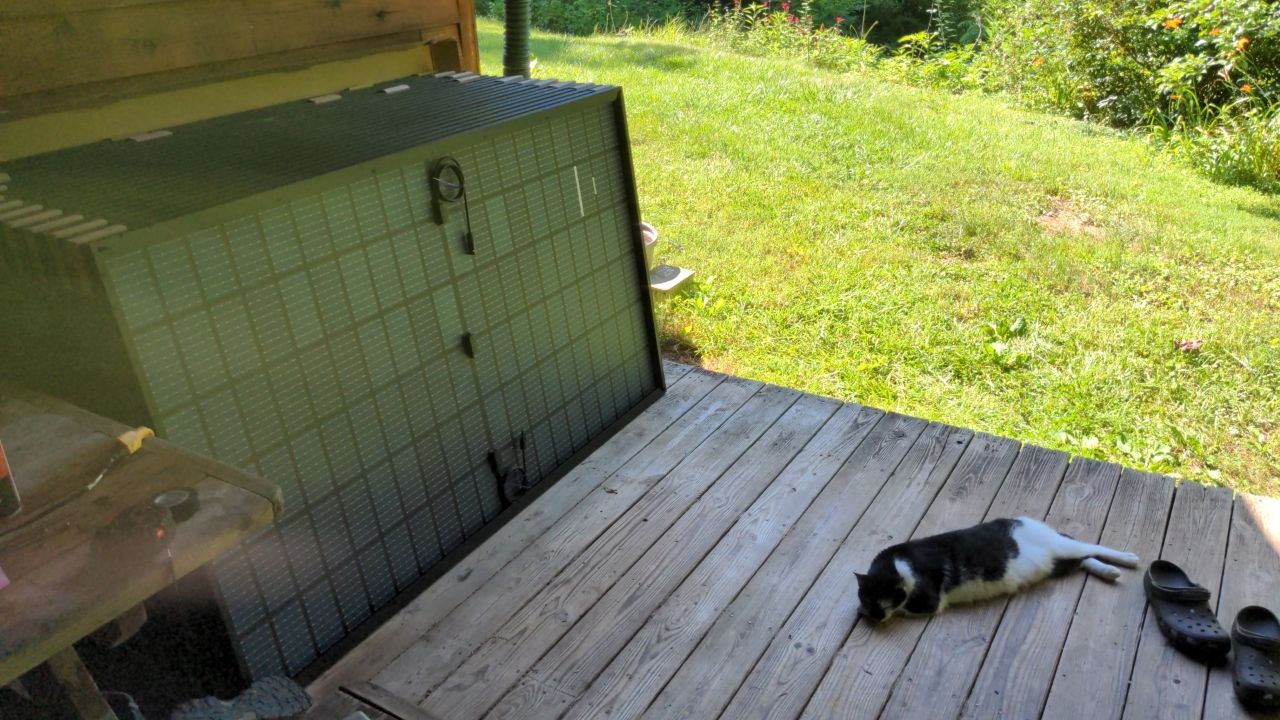
a porch with a a bunch of solar panels, stacked on edge leaning up against the wall. A black and white cat is sprawled in front of them.
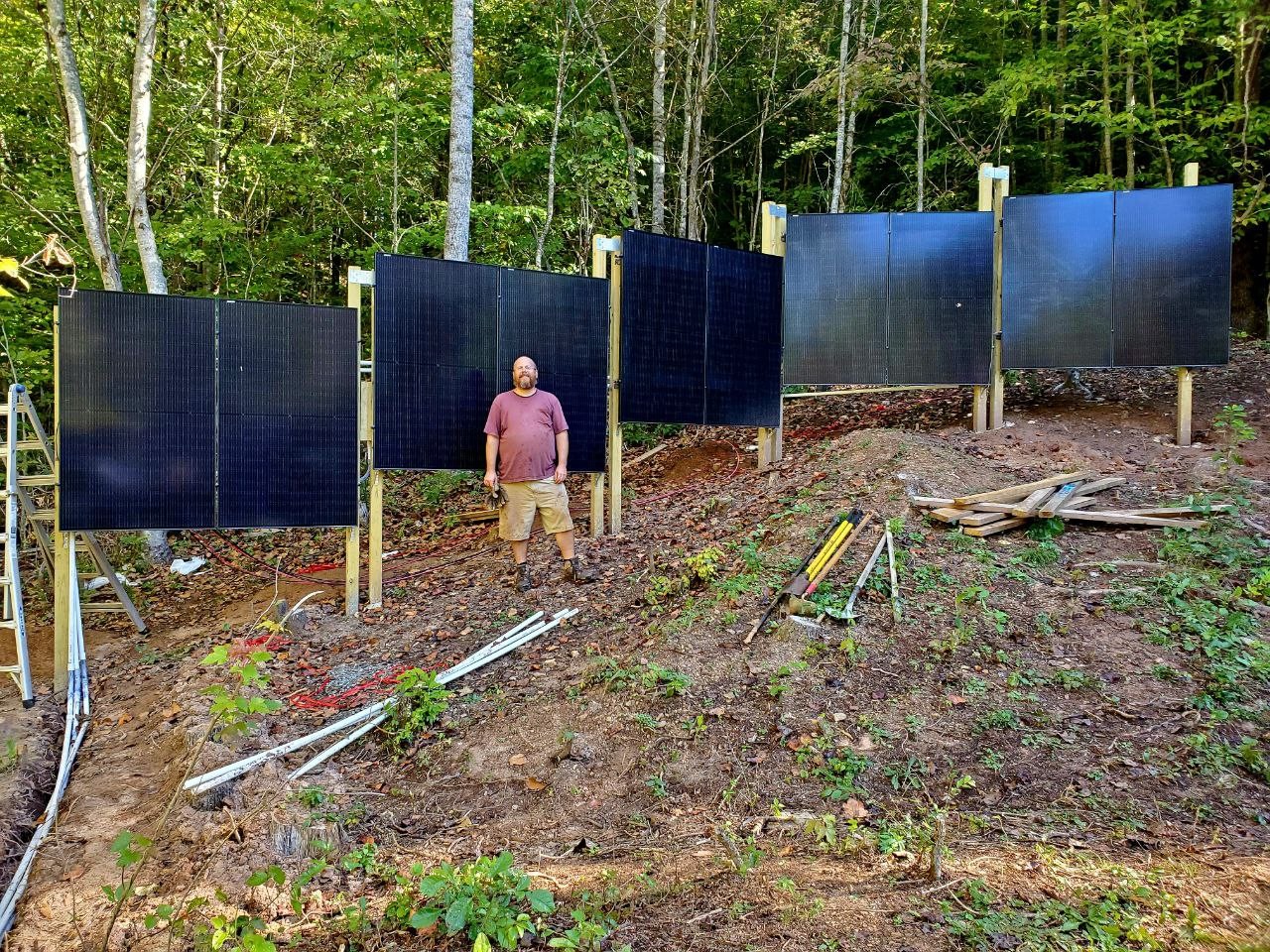
In August I bought the EV and was able to charge it offgrid from my old solar system... a few miles per day on the most sunny days. In September and October I built a solar fence, of my own design.
Me standing in front of the solar fence, which is 10 panels long
For the past several weeks I have been installing additional solar panels on ballasted ground mounts full of gravel. At this point I'm half way through installing my 30 panel upgrade. The design goal of my 12 kilowatt system is to produce 1 kilowatt of power all day on a cloudy day in midwinter, which allows swapping between major loads (EV charger, hot water heater, etc) on a cloudy day and running everything on a sunny day. So the size of the battery bank doesn't matter much. Batteries are getting cheaper fast too, but they are a wear item, so it's better to oversize the solar system and minimize the battery. A lot of this is nonstandard and experimental. And that makes sense with the price of solar panels. It costs more to mount solar panels now than the panels are worth. And non-ideal panel orientation isn't a problem when the system is massively overpaneled. I'm hoping to finish up the install before the end of winter. I have more trees to clear, more ballasted ground mounts to install, and need to come up with something even more experimental for a half dozen or so panels. Using solar panels as mounts for solar panels? Hanging them from trees? Soon the wan light will fade, time to head off to the solstice party to enjoy the long night, and a bonfire.
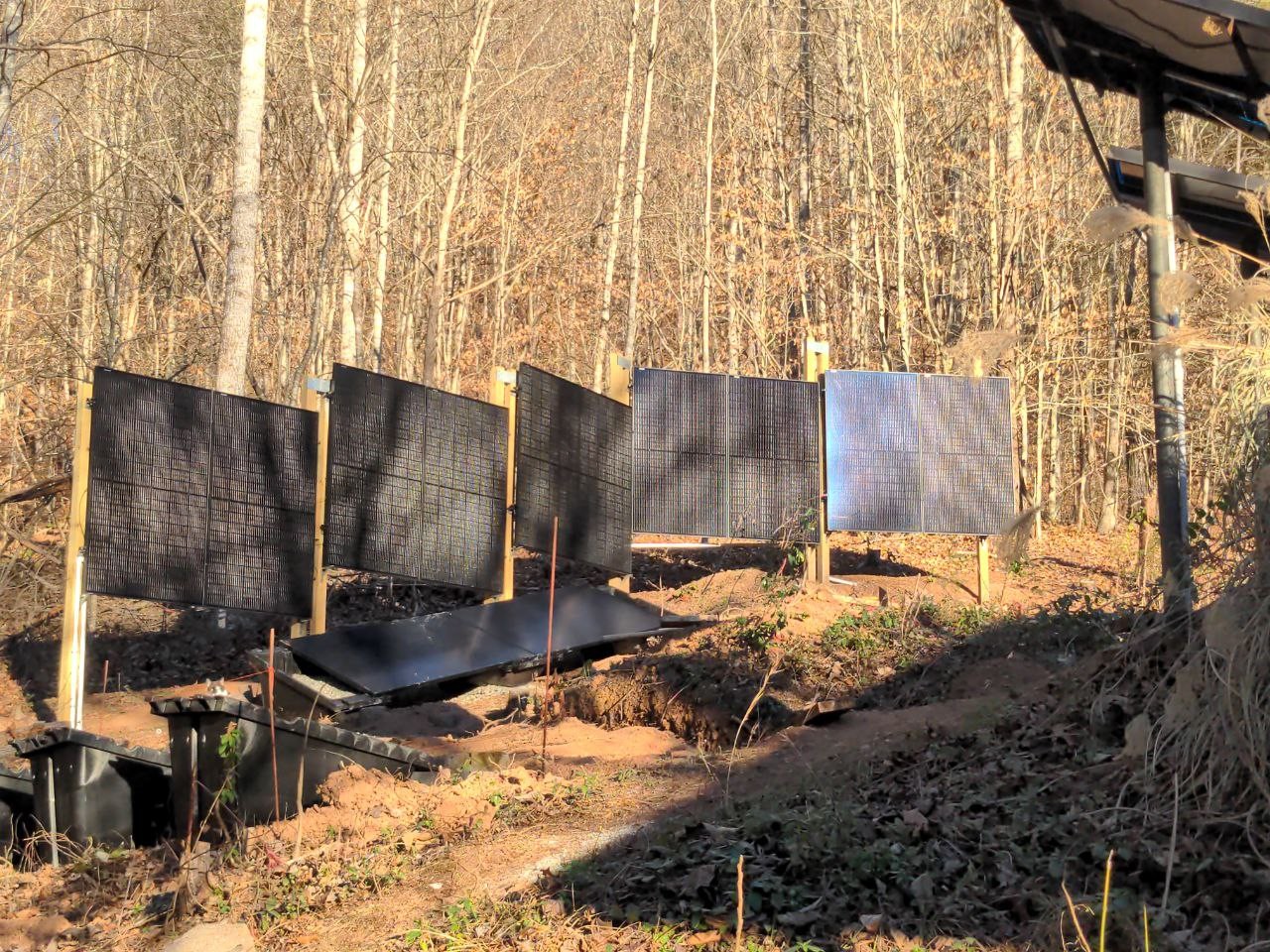
Solar fence with some ballasted ground mounts in front of it, late evening light. Old pole mounted solar panels in the foreground are from the 90's.

19 December 2024

Gregory Colpart: MiniDebConf Toulouse 2024

After the MiniDebConf Marseille 2019, COVID-19 made it impossible or difficult to organize new MiniDebConfs for a few years. With the gradual resumption of in-person events (like FOSDEM, DebConf, etc.), the idea emerged to host another MiniDebConf in France, but with a lighter organizational load. In 2023, we decided to reach out to the organizers of Capitole du Libre to repeat the experience of 2017: hosting a MiniDebConf alongside their annual event in Toulouse in November. However, our request came too late for 2023. After discussions with Capitole du Libre in November 2023 in Toulouse and again in February 2024 in Brussels, we confirmed that a MiniDebConf Toulouse would take place in November 2024! We then assembled a small organizing team and got to work: a Call for Papers in May 2024, adding a two-day MiniDebCamp, coordinating with the DebConf video team, securing sponsors, creating a logo, ordering T-shirts and stickers, planning the schedule, and managing registrations. Even with lighter logistics (conference rooms, badges, and catering during the weekend were handled by Capitole du Libre), there was still quite a bit of preparation to do. On Thursday, November 14, and Friday, November 15, 2024, about forty developers arrived from around the world (France, Spain, Italy, Switzerland, Germany, England, Brazil, Uruguay, India, Brest, Marseille ) to spend two days at the MiniDebCamp in the beautiful collaborative spaces of Artilect in Toulouse city center.
Then, on Saturday, November 16, and Sunday, November 17, 2024, the MiniDebConf took place at ENSEEIHT as part of the Capitole du Libre event. The conference kicked off on Saturday morning with an opening session by J r my Lecour, which included a tribute to Lunar (Nicolas Dandrimont). This was followed by Reproducible Builds Rebuilding What is Distributed from ftp.debian.org (Holger Levsen) and Discussion on My Research Work on Sustainability of Debian OS (Eda). After lunch at the Capitole du Libre food trucks, the intense afternoon schedule began: What s New in the Linux Kernel (and What s Missing in Debian) (Ben Hutchings), Linux Live Patching in Debian (Santiago Ruano Rinc n), Trixie on Mobile: Are We There Yet? (Arnaud Ferraris), PostgreSQL Container Groups, aka cgroups Down the Road (C dric Villemain), Upgrading a Thousand Debian Hosts in Less Than an Hour (J r my Lecour and myself), and Using Debusine to Automate Your QA (Stefano Rivera & co). Sunday marked the second day, starting with a presentation on DebConf 25 (Benjamin Somers), which will be held in Brest in July 2025. The morning continued with talks: How LTS Goes Beyond LTS (Santiago Ruano Rinc n & Roberto C. S nchez), Cross-Building (Helmut Grohne), and State of JavaScript (Bastien Roucari s). In the afternoon, there were Lightning Talks, PyPI Security: Past, Present & Future (Salvo LtWorf Tomaselli), and the classic Bits from DPL (Andreas Tille), before closing with the final session led by Pierre-Elliott B cue. All talks are available on video (a huge thanks to the amazing DebConf video team), and many thanks to our sponsors (Viridien, Freexian, Evolix, Collabora, and Data Bene). A big thank-you as well to the entire Capitole du Libre team for hosting and supporting us see you in Brest in July 2025! Articles about (or mentioning) MiniDebConf Toulouse:

12 December 2024

Matthew Garrett: Android privacy improvements break key attestation

Sometimes you want to restrict access to something to a specific set of devices - for instance, you might want your corporate VPN to only be reachable from devices owned by your company. You can't really trust a device that self attests to its identity, for instance by reporting its MAC address or serial number, for a couple of reasons:
If we want a high degree of confidence that the device we're talking to really is the device it claims to be, we need something that's much harder to spoof. For devices with a TPM this is the TPM itself. Every TPM has an Endorsement Key (EK) that's associated with a certificate that chains back to the TPM manufacturer. By verifying that certificate path and having the TPM prove that it's in posession of the private half of the EK, we know that we're communicating with a genuine TPM[1].

Android has a broadly equivalent thing called ID Attestation. Android devices can generate a signed attestation that they have certain characteristics and identifiers, and this can be chained back to the manufacturer. Obviously providing signed proof of the device identifier is kind of problematic from a privacy perspective, so the short version[2] is that only apps installed using a corporate account rather than a normal user account are able to do this.

But that's still not ideal - the device identifiers involved included the IMEI and serial number of the device, and those could potentially be used to correlate devices across privacy boundaries since they're static[3] identifiers that are the same both inside a corporate work profile and in the normal user profile, and also remains static if you move between different employers and use the same phone[4]. So, since Android 12, ID Attestation includes an "Enterprise Specific ID" or ESID. The ESID is based on a hash of device-specific data plus the enterprise that the corporate work profile is associated with. If a device is enrolled with the same enterprise then this ID will remain static, if it's enrolled with a different enterprise it'll change, and it just doesn't exist outside the work profile at all. The other device identifiers are no longer exposed.

But device ID verification isn't enough to solve the underlying problem here. When we receive a device ID attestation we know that someone at the far end has posession of a device with that ID, but we don't know that that device is where the packets are originating. If our VPN simply has an API that asks for an attestation from a trusted device before routing packets, we could pass that on to said trusted device and then simply forward the attestation to the VPN server[5]. We need some way to prove that the the device trying to authenticate is actually that device.

The answer to this is key provenance attestation. If we can prove that an encryption key was generated on a trusted device, and that the private half of that key is stored in hardware and can't be exported, then using that key to establish a connection proves that we're actually communicating with a trusted device. TPMs are able to do this using the attestation keys generated in the Credential Activation process, giving us proof that a specific keypair was generated on a TPM that we've previously established is trusted.

Android again has an equivalent called Key Attestation. This doesn't quite work the same way as the TPM process - rather than being tied back to the same unique cryptographic identity, Android key attestation chains back through a separate cryptographic certificate chain but contains a statement about the device identity - including the IMEI and serial number. By comparing those to the values in the device ID attestation we know that the key is associated with a trusted device and we can now establish trust in that key.

"But Matthew", those of you who've been paying close attention may be saying, "Didn't Android 12 remove the IMEI and serial number from the device ID attestation?" And, well, congratulations, you were apparently paying more attention than Google. The key attestation no longer contains enough information to tie back to the device ID attestation, making it impossible to prove that a hardware-backed key is associated with a specific device ID attestation and its enterprise enrollment.

I don't think this was any sort of deliberate breakage, and it's probably more an example of shipping the org chart - my understanding is that device ID attestation and key attestation are implemented by different parts of the Android organisation and the impact of the ESID change (something that appears to be a legitimate improvement in privacy!) on key attestation was probably just not realised. But it's still a pain.

[1] Those of you paying attention may realise that what we're doing here is proving the identity of the TPM, not the identity of device it's associated with. Typically the TPM identity won't vary over the lifetime of the device, so having a one-time binding of those two identities (such as when a device is initially being provisioned) is sufficient. There's actually a spec for distributing Platform Certificates that allows device manufacturers to bind these together during manufacturing, but I last worked on those a few years back and don't know what the current state of the art there is

[2] Android has a bewildering array of different profile mechanisms, some of which are apparently deprecated, and I can never remember how any of this works, so you're not getting the long version

[3] Nominally, anyway. Cough.

[4] I wholeheartedly encourage people not to put work accounts on their personal phones, but I am a filthy hypocrite here

[5] Obviously if we have the ability to ask for attestation from a trusted device, we have access to a trusted device. Why not simply use the trusted device? The answer there may be that we've compromised one and want to do as little as possible on it in order to reduce the probability of triggering any sort of endpoint detection agent, or it may be because we want to run on a device with different security properties than those enforced on the trusted device.

comment count unavailable comments

9 December 2024

Gunnar Wolf: Some tips for those who still administer Drupal7-based sites

A bit of history: Drupal at my workplace (and in Debian) My main day-to-day responsibility in my workplace is, and has been for 20 years, to take care of the network infrastructure for UNAM s Economics Research Institute. One of the most visible parts of this responsibility is to ensure we have a working Web presence, and that it caters for the needs of our academic community. I joined the Institute in January 2005. Back then, our designer pushed static versions of our webpage, completely built in her computer. This was standard practice at the time, and lasted through some redesigns, but I soon started advocating for the adoption of a Content Management System. After evaluating some alternatives, I recommended adopting Drupal. It took us quite a bit to do the change: even though I clearly recall starting work toward adopting it as early as 2006, according to the Internet Archive, we switched to a Drupal-backed site around June 2010. We started using it somewhere in the version 6 s lifecycle. As for my Debian work, by late 2012 I started getting involved in the maintenance of the drupal7 package, and by April 2013 I became its primary maintainer. I kept the drupal7 package up to date in Debian until 2018; the supported build methods for Drupal 8 are not compatible with Debian (mainly, bundling third-party libraries and updating them without coordination with the rest of the ecosystem), so towards the end of 2016, I announced I would not package Drupal 8 for Debian. By March 2016, we migrated our main page to Drupal 7. By then, we already had several other sites for our academics projects, but my narrative follows our main Web site. I did manage to migrate several Drupal 6 (D6) sites to Drupal 7 (D7); it was quite involved process, never transparent to the user, and we did have the backlash of long downtimes (or partial downtimes, with sites half-available only) with many of our users. For our main site, we took the opportunity to do a complete redesign and deployed a fully new site. You might note that March 2016 is after the release of D8 (November 2015). I don t recall many of the specifics for this decision, but if I m not mistaken, building the new site was a several months long process not only for the technical work of setting it up, but for the legwork of getting all of the needed information from the different areas that need to be represented in the Institute. Not only that: Drupal sites often include tens of contributed themes and modules; the technological shift the project underwent between its 7 and 8 releases was too deep, and modules took a long time (if at all many themes and modules were outright dumped) to become available for the new release. Naturally, the Drupal Foundation wanted to evolve and deprecate the old codebase. But the pain to migrate from D7 to D8 is too big, and many sites have remained under version 7 Eight years after D8 s release, almost 40% of Drupal installs are for version 7, and a similar proportion runs a currently-supported release (10 or 11). And while the Drupal Foundation made a great job at providing very-long-term support for D7, I understand the burden is becoming too much, so close to a year ago (and after pushing several times the D7, they finally announced support will finish this upcoming January 5.

Drupal 7 must go! I found the following usage graphs quite interesting: the usage statistics for all Drupal versions follows a very positive slope, peaking around 2014 during the best years of D7, and somewhat stagnating afterwards, staying since 2015 at the 25000 28000 sites mark (I m very tempted to copy the graphs, but builtwith s terms of use are very clear in not allowing it). There is a sharp drop in the last year I attribute it to the people that are leaving D7 for other technologies after its end-of-life announcement. This becomes clearer looking only at D7 s usage statistics: D7 peaks at 15000 installs in 2016 stays there for close to 5 years, and has a sharp drop to under 7500 sites in the span of one year. D8 has a more regular rise, peak and fall peaking at ~8500 between 2020 and 2021, and down to close to 2500 for some months already; D9 has a very brief peak of almost 9000 sites in 2023 and is now close to half of it. Currently, the Drupal king appears to be D10, still on a positive slope and with over 9000 sites. Drupal 11 is still just a blip in builtwith s radar, with 3 registered sites as of September 2024 :- After writing this last paragraph, I came across the statistics found in the Drupal webpage; the methodology for acquiring its data is completely different: while builtwith s methodology is their trade secret, you can read more about how Drupal s data is gathered (and agree or disagree with it , but at least you have a page detailing 12 years so far of reported data, producing the following graph (which can be shared under the CC BY-SA license ): Drupal usage statistics by version 2013 2024 This graph is disgregated into minor versions, and I don t want to come up with yet another graph for it but it supports (most of) the narrative I presented above although I do miss the recent drop builtwith reported in D7 s numbers!
And what about Backdrop? During the D8 release cycle, a group of Drupal developers were not happy with the depth of the architectural changes that were being adopted, particularly the transition to the Symfony PHP component framework, and forked the D7 codebase to create the Backdrop CMS, a modern version of Drupal, without dropping the known and tested architecture it had. The Backdrop developers keep working closely together with the Drupal community, and although its usage numbers are way smaller than Drupal s, seems to be sustainable and lively. Of course, as I presented their numbers in the previous section, you can see Backdrop s numbers in builtwith are way, way lower. I have found it to be a very warm and welcoming community, eager to receive new members. And, thanks to its contributed D2B Migrate module, I found it is quite easy to migrate a live site from Drupal 7 to Backdrop.

Migration by playbook! So Well, I m an academic. And (if it s not obvious to you after reading so far ), one of the things I must do in my job is to write. So I decided to write an article to invite my colleagues to consider Backdrop for their D7 sites in Cuadernos T cnicos Universitarios de la DGTIC, a young journal in our university for showcasing technical academical work. And now that my article got accepted and published, I m happy to share it with you of course, if you can read Spanish But anyway Given I have several sites to migrate, and that I m trying to get my colleagues to follow suite, I decided to automatize the migration by writing an Ansible playbook to do the heavy lifting. Of course, the playbook s users will probably need to tweak it a bit to their personal needs. I m also far from an Ansible expert, so I m sure there is ample room fo improvement in my style. But it works. Quite well, I must add.

But with this size of database I did stumble across a big pebble, though. I am working on the migration of one of my users sites, and found that its database is huge. I checked the mysqldump output, and it got me close to 3GB of data. And given the D2B_migrate is meant to work via a Web interface (my playbook works around it by using a client I wrote with Perl s WWW::Mechanize), I repeatedly stumbled with PHP s maximum POST size, maximum upload size, maximum memory size I asked for help in Backdrop s Zulip chat site, and my attention was taken off fixing PHP to something more obvious: Why is the database so large? So I took a quick look at the database (or rather: my first look was at the database server s filesystem usage). MariaDB stores each table as a separate file on disk, so I looked for the nine largest tables:
# ls -lhS head
total 3.8G
-rw-rw---- 1 mysql mysql 2.4G Dec 10 12:09 accesslog.ibd
-rw-rw---- 1 mysql mysql 224M Dec  2 16:43 search_index.ibd
-rw-rw---- 1 mysql mysql 220M Dec 10 12:09 watchdog.ibd
-rw-rw---- 1 mysql mysql 148M Dec  6 14:45 cache_field.ibd
-rw-rw---- 1 mysql mysql  92M Dec  9 05:08 aggregator_item.ibd
-rw-rw---- 1 mysql mysql  80M Dec 10 12:15 cache_path.ibd
-rw-rw---- 1 mysql mysql  72M Dec  2 16:39 search_dataset.ibd
-rw-rw---- 1 mysql mysql  68M Dec  2 13:16 field_revision_field_idea_principal_articulo.ibd
-rw-rw---- 1 mysql mysql  60M Dec  9 13:19 cache_menu.ibd
A single table, the access log, is over 2.4GB long. The three following tables are, cache tables. I can perfectly live without their data in our new site! But I don t want to touch the slightest bit of this site until I m satisfied with the migration process, so I found a way to exclude those tables in a non-destructive way: given D2B_migrate works with a mysqldump output, and given that mysqldump locks each table before starting to modify it and unlocks it after its job is done, I can just do the following:
$ perl -e '$output = 1; while (<>)   $output=0 if /^LOCK TABLES  (accesslog search_index watchdog cache_field cache_path) /; $output=1 if /^UNLOCK TABLES/; print if $output ' < /tmp/d7_backup.sql  > /tmp/d7_backup.eviscerated.sql; ls -hl /tmp/d7_backup.sql /tmp/d7_backup.eviscerated.sql
-rw-rw-r-- 1 gwolf gwolf 216M Dec 10 12:22 /tmp/d7_backup.eviscerated.sql
-rw------- 1 gwolf gwolf 2.1G Dec  6 18:14 /tmp/d7_backup.sql
Five seconds later, I m done! The database is now a tenth of its size, and D2B_migrate is happy to take it. And I m a big step closer to finishing my reliance on (this bit of) legacy code for my highly-visible sites

2 December 2024

Russ Allbery: Review: Long Live Evil

Review: Long Live Evil, by Sarah Rees Brennan
Series: Time of Iron #1
Publisher: Orbit
Copyright: July 2024
ISBN: 0-316-56872-4
Format: Kindle
Pages: 433
Long Live Evil is a portal fantasy (or, arguably more precisely, a western take on an isekai villainess fantasy) and the first book of a series. If the author's name sounds familiar, it's possibly because of In Other Lands, which got a bunch of award nominations in 2018, She has also written a lot of other YA fantasy, but this is her first adult epic fantasy novel. Rae is in the hospital, dying of cancer. Everything about that experience, from the obvious to the collapse of her friendships, absolutely fucking sucks. One of the few bright points is her sister's favorite fantasy series, Time of Iron, which her sister started reading to her during chemo sessions. Rae mostly failed to pay attention until the end of the first book and the rise of the Emperor. She fell in love with the brooding, dangerous anti-hero and devoured the next two books. The first book was still a bit hazy, though, even with the help of a second dramatic reading after she was too sick to read on her own. This will be important later. After one of those reading sessions, Rae wakes up to a strange woman in her hospital room who offers her an option. Rather than die a miserable death that bankrupts her family, she can go through a door to Eyam, the world of Time of Iron, and become the character who suits her best. If she can steal the Flower of Life and Death from the imperial greenhouse on the one day a year that it blooms, she will wake up, cured. If not, she will die. Rae of course goes through, and wakes in the body of Lady Rahela, the Beauty Dipped in Blood, the evil stepsister. One of the villains, on the night before she is scheduled to be executed. Rae's initial panic slowly turns to a desperate glee. She knows all of these characters. She knows how the story will turn out. And she has a healthy body that's not racked with pain. Maybe she's not the heroine, but who cares, the villains are always more interesting anyway. If she's going to be cast as the villain, she's going to play it to the hilt. It's not like any of these characters are real. Stories in which the protagonists are the villains are not new (Nimona and Hench come to mind just among books I've reviewed), but they are having a moment. Assistant to the Villain by Hannah Nicole Maehrer came out last year, and this book and Django Wexler's How to Become the Dark Lord and Die Trying both came out this year. This batch of villain books all take different angles on the idea, but they lean heavily on humor. In Long Live Evil, that takes the form of Rae's giddy embrace of villainous scheming, flouncing, and blatant plot manipulation, along with her running commentary on the various characters and their in-story fates. The setup here is great. Rae is not only aware that she's in a story, she knows it's full of cliches and tropes. Some of them she loves, some of them she thinks are ridiculous, and she isn't shy about expressing both of those opinions. Rae is a naturally dramatic person, and it doesn't take her long to lean into the opportunities for making dramatic monologues and villainous quips, most of which involve modern language and pop culture references that the story characters find baffling and disconcerting. Unfortunately, the base Time of Iron story is, well, bad. It's absurd grimdark epic fantasy with paper-thin characters and angst as a central character trait. This is clearly intentional for both in-story and structural reasons. Rae enjoys it precisely because it's full of blood and battles and over-the-top brooding, malevolent anti-heroes, and Rae's sister likes the impossibly pure heroes who suffer horrible fates while refusing to compromise their ideals. Rae is also about to turn the story on its head and start smashing its structure to try to get herself into position to steal the Flower of Life and Death, and the story has to have a simple enough structure that it doesn't get horribly confusing once smashed. But the original story is such a grimdark parody, and so not my style of fantasy, that I struggled with it at the start of the book. This does get better eventually, as Rae introduces more and more complications and discovers some surprising things about the other characters. There are several delightful twists concerning the impossibly pure heroine of the original story that I will not spoil but that I thought retroactively made the story far more interesting. But that leads to the other problem: Rae is both not very good at scheming, and is flippant and dismissive of the characters around her. These are both realistic; Rae is a young woman with cancer, not some sort of genius mastermind, and her whole frame for interacting with the story is fandom discussions and arguments with her sister. Early in the book, it's rather funny. But as the characters around her start becoming more fleshed out and complex, Rae's inability to take them seriously starts to grate. The grand revelation to Rae that these people have their own independent existence comes so late in the book that it's arguably a spoiler, but it was painfully obvious to everyone except Rae for hundreds of pages before it got through Rae's skull. Those are my main complaints, but there was a lot about this book that I liked. The Cobra, who starts off as a minor villain in the story, is by far the best character of the book. He's not only more interesting than Rae, he makes everyone else in the book, including Rae, more interesting characters through their interactions. The twists around the putative heroine, Lady Rahela's stepsister, are a bit too long in coming but are an absolute delight. And Key, the palace guard that Rae befriends at the start of the story, is the one place where Rae's character dynamic unquestionably works. Key anchors a lot of Rae's scenes, giving them a sense of emotional heft that Rae herself would otherwise undermine. The narrator in this book does not stick with Rae. We also get viewpoint chapters from the Cobra, the Last Hope, and Emer, Lady Rahela's maid. The viewpoints from the Time of Iron characters can be a bit eye-roll-inducing at the start because of how deeply they follow the grimdark aesthetic of the original story, but by the middle of the book I was really enjoying the viewpoint shifts. This story benefited immensely from being seen from more angles than Rae's chaotic manipulation. By the end of the book, I was fully invested in the plot line following Cobra and the Last Hope, to the extent that I was a bit disappointed when the story would switch back to Rae. I'm not sure this was a great book, but it was fun. It's funny in places, but I ended up preferring the heartfelt parts to the funny parts. It is a fascinating merger of gleeful fandom chaos and rather heavy emotional portrayals of both inequality and the experience of terminal illness. Rees Brennan is a stage four cancer survivor and that really shows; there's a depth, nuance, and internal complexity to Rae's reactions to illness, health, and hope that feels very real. It is the kind of book that can give you emotional whiplash; sometimes it doesn't work, but sometimes it does. One major warning: this book ends on a ridiculous cliffhanger and does not in any sense resolve its main plot arc. I found this annoying, not so much because of the wait for the second volume, but because I thought this book was about the right length for the amount of time I wanted to spend in this world and wish Rees Brennan had found a way to wrap up the story in one book. Instead, it looks like there will be three books. I'm in for at least one more, since the story was steadily getting better towards the end of Long Live Evil, but I hope the narrative arc survives being stretched out across that many words. This one's hard to classify, since it's humorous fantasy on the cover and in the marketing, and that element is definitely present, but I thought the best parts of the book were when it finally started taking itself seriously. It's metafictional, trope-subverting portal fantasy full of intentional anachronisms that sometimes fall flat and sometimes work brilliantly. I thought the main appeal of it would be watching Rae embrace being a proper villain, but then the apparent side characters stole the show. Recommended, but you may have to be in just the right mood. Content notes: Cancer, terminal illness, resurrected corpses, wasting disease, lots of fantasy violence and gore, and a general grimdark aesthetic. Rating: 7 out of 10

1 December 2024

Russ Allbery: Review: Unexploded Remnants

Review: Unexploded Remnants, by Elaine Gallagher
Publisher: Tordotcom
Copyright: 2024
ISBN: 1-250-32522-6
Format: Kindle
Pages: 111
Unexploded Remnants is a science fiction adventure novella. The protagonist and world background would support an episodic series, but as of this writing it stands alone. It is Elaine Gallagher's first professional publication. Alice is the last survivor of Earth: an explorer, information trader, and occasional associate of the Archive. She scouts interesting places, looks for inconsistencies in the stories the galactic civilizations tell themselves, and pokes around ruins for treasure. As this story opens, she finds a supposedly broken computer core in the Alta Sidoie bazaar that is definitely not what the trader thinks it is. Very shortly thereafter, she's being hunted by a clan of dangerous Delosi while trying to decide what to do with a possibly malevolent AI with frightening intrusion abilities. This is one of those stories where all the individual pieces sounded great, but the way they were assembled didn't click for me. Unusually, I'm not entirely sure why. Often it's the characters, but I liked Alice well enough. The Lewis Carroll allusions were there but not overdone, her computer agent Bugs is a little too much of a Warner Brothers cartoon but still interesting, and the world building has plenty of interesting hooks. I certainly can't complain about the pacing: the plot moves briskly along to a somewhat predictable but still adequate conclusion. The writing is smooth and competent, and the world is memorable enough that I'm still thinking about it. And yet, I never connected with this story. I think it may be because both Alice and the tight third-person narrator tend towards breezy confidence and matter-of-fact descriptions. Alice does, at times, get scared or angry, but I never felt those emotions. They were just events that were described to me. There wasn't an emotional hook, a place where the character grabbed me, and so it felt like everything was happening at an odd remove. The advantage of this approach is that there are no overwrought emotional meltdowns or brooding angstful protagonists, just an adventure story about a competent and thoughtful character, but I think I wanted a bit more emotional involvement than I got. The world background is the best part and feels like it could be part of a larger series. The Milky Way is connected by an old, vast, and only partly understood network of teleportation portals, which had cut off Earth for unknown reasons and then just as mysteriously reactivated when Alice, then Andrew, drunkenly poked at a standing stone while muttering an old prayer in Gaelic. The Archive spent a year sorting out her intellectual diseases (capitalism was particularly alarming) and giving her a fresh start with a new body. Humanity subsequently destroyed itself in a paroxysm of reactionary violence, leaving Alice a free agent, one of a kind in a galaxy of dizzying variety and forgotten history. Gallagher makes great use of the weirdness of the portal network to create a Star Wars style of universe: the focus is more on the diversity of the planets and alien species than on a coherent unifying structure. The settings of this book are not prone to Planet of the Hats problems. They instead have the contrasts that one would get if one dropped portals near current or former Earth population centers and then took a random walk through them (or, in other words, what playing GeoGuessr on a world map feels like). I liked this effect, but I have to admit that it also added to that sense of sliding off the surface of the story. The place descriptions were great bits of atmosphere, but I never cared about them. There isn't enough emotional coherence to make them memorable. One of the more notable quirks of this story is the description of ideologies and prejudices as viral memes that can be cataloged, cured, and deployed like weapons. This is a theme of the world-building as well: this society, or at least the Archive-affiliated parts of it, classifies some patterns of thought as potentially dangerous but treatable contagious diseases. I'm not going to object too much to this as a bit of background and characterization in a fairly short novella stuffed with a lot of other world-building and plot, but there's was something about treating ethical systems like diseases that bugged me in much the same way that medicalization of neurodiversity bugs me. I think some people will find that sense of moral clarity relaxing and others will find it vaguely irritating, and I seem to have ended up in the second group. Overall, I would classify this as an interesting not-quite-success. It felt like a side story in a larger universe, like a story that would work better if I already knew Alice from other novels and had an established emotional connection with her. As is, I would not really recommend it, but there are enough good pieces here that I would be interested to see what Gallagher does next. Rating: 6 out of 10

30 November 2024

Dima Kogan: Strava track filtering validation

After years of seeing people's strava tracks, I became convinced that they insufficiently filter the data, resulting in over-estimating the effort. Today I did a bit of lazy analysis, and half-confirmed this: in the one case I looked at, strava reported reasonable elevation gain numbers, but greatly overestimated the distance traveled. I looked at a single gps track of a long bike ride. This was uploaded to strava manually, as a .gpx file. I can imagine that different things happen if you use the strava app or some device that integrates with the service (the filtering might happen before the data hits the server, and the server could decide to not apply any more filtering). I processed the data with a simple hysteretic filter, ignoring small changes in position and elevation, trying out different thresholds in the process. I completely ignore the timestamps, and only look at the differences between successive points. This handles the usual GPS noise; it does not handle GPS jumps, which I completely ignore in this analysis. Ignoring these would produce inflated elevation/gain numbers, but I'm working with a looong track, so hopefully this is a small effect. Clearly this is not scientific, but it's something.

The code
Parsing .gpx is slow (this is a big file), so I cache that into a .vnl:
import sys
import gpxpy
filename_in  = 'INPUT.gpx'
filename_out = 'OUTPUT.gpx'
with open(filename_in, 'r') as f:
    gpx = gpxpy.parse(f)
f_out = open(filename_out, 'w')
tracks = gpx.tracks
if len(tracks) != 1:
    print("I want just one track", file=sys.stderr)
    sys.exit(1)
track = tracks[0]
segments = track.segments
if len(segments) != 1:
    print("I want just one segment", file=sys.stderr)
    sys.exit(1)
segment = segments[0]
time0 = segment.points[0].time
print("# time lat lon ele_m")
for p in segment.points:
    print(f" (p.time - time0).seconds   p.latitude   p.longitude   p.elevation ",
          file = f_out)
And I process this data with the different filters (this is a silly Python loop, and is slow):
#!/usr/bin/python3
import sys
import numpy as np
import numpysane as nps
import gnuplotlib as gp
import vnlog
import pyproj
geod = None
def dist_ft(lat0,lon0, lat1,lon1):
    global geod
    if geod is None:
        geod = pyproj.Geod(ellps='WGS84')
    return \
        geod.inv(lon0,lat0, lon1,lat1)[2] * 100./2.54/12.
f = 'OUTPUT.gpx'
track,list_keys,dict_key_index = \
    vnlog.slurp(f)
t      = track[:,dict_key_index['time' ]]
lat    = track[:,dict_key_index['lat'  ]]
lon    = track[:,dict_key_index['lon'  ]]
ele_ft = track[:,dict_key_index['ele_m']] * 100./2.54/12.
@nps.broadcast_define( ( (), ()),
                       (2,))
def filter_track(ele_hysteresis_ft,
                 dxy_hysteresis_ft):
    dist        = 0.0
    ele_gain_ft = 0.0
    lon_accepted = None
    lat_accepted = None
    ele_accepted = None
    for i in range(len(lat)):
        if ele_accepted is not None:
            dxy_here  = dist_ft(lat_accepted,lon_accepted, lat[i],lon[i])
            dele_here = np.abs( ele_ft[i] - ele_accepted )
            if dxy_here < dxy_hysteresis_ft and dele_here < ele_hysteresis_ft:
                continue
            if ele_ft[i] > ele_accepted:
                ele_gain_ft += dele_here;
            dist += np.sqrt(dele_here * dele_here +
                            dxy_here  * dxy_here)
        lon_accepted = lon[i]
        lat_accepted = lat[i]
        ele_accepted = ele_ft[i]
    # lose the last point. It simply doesn't matter
    dist_mi = dist / 5280.
    return np.array((ele_gain_ft, dist_mi))
Nele_hysteresis_ft    = 20
ele_hysteresis0_ft    = 5
ele_hysteresis1_ft    = 100
ele_hysteresis_ft_all = np.linspace(ele_hysteresis0_ft,
                                    ele_hysteresis1_ft,
                                    Nele_hysteresis_ft)
Ndxy_hysteresis_ft = 20
dxy_hysteresis0_ft = 5
dxy_hysteresis1_ft = 1000
dxy_hysteresis_ft  = np.linspace(dxy_hysteresis0_ft,
                                 dxy_hysteresis1_ft,
                                 Ndxy_hysteresis_ft)
# shape (Nele,Ndxy,2)
gain,distance = \
    nps.mv( filter_track( nps.dummy(ele_hysteresis_ft_all,-1),
                          dxy_hysteresis_ft),
            -1,0 )
# Stolen from mrcal
def options_heatmap_with_contours( plotoptions, # we update this on output
                                   *,
                                   contour_min           = 0,
                                   contour_max,
                                   contour_increment     = None,
                                   do_contours           = True,
                                   contour_labels_styles = 'boxed',
                                   contour_labels_font   = None):
    r'''Update plotoptions, return curveoptions for a contoured heat map'''
    gp.add_plot_option(plotoptions,
                       'set',
                       ('view equal xy',
                        'view map'))
    if do_contours:
        if contour_increment is None:
            # Compute a "nice" contour increment. I pick a round number that gives
            # me a reasonable number of contours
            Nwant = 10
            increment = (contour_max - contour_min)/Nwant
            # I find the nearest 1eX or 2eX or 5eX
            base10_floor = np.power(10., np.floor(np.log10(increment)))
            # Look through the options, and pick the best one
            m   = np.array((1., 2., 5., 10.))
            err = np.abs(m * base10_floor - increment)
            contour_increment = -m[ np.argmin(err) ] * base10_floor
        gp.add_plot_option(plotoptions,
                           'set',
                           ('key box opaque',
                            'style textbox opaque',
                            'contour base',
                            f'cntrparam levels incremental  contour_max , contour_increment , contour_min '))
        if contour_labels_font is not None:
            gp.add_plot_option(plotoptions,
                               'set',
                               f'cntrlabel format "%d" font " contour_labels_font "' )
        else:
            gp.add_plot_option(plotoptions,
                               'set',
                               f'cntrlabel format "%.0f"' )
        plotoptions['cbrange'] = [contour_min, contour_max]
        # I plot 3 times:
        # - to make the heat map
        # - to make the contours
        # - to make the contour labels
        _with = np.array(('image',
                          'lines nosurface',
                          f'labels  contour_labels_styles  nosurface'))
    else:
        gp.add_plot_option(plotoptions, 'unset', 'key')
        _with = 'image'
    using = \
        f'( dxy_hysteresis0_ft +$1* float(dxy_hysteresis1_ft-dxy_hysteresis0_ft)/(Ndxy_hysteresis_ft-1) ):' + \
        f'( ele_hysteresis0_ft +$2* float(ele_hysteresis1_ft-ele_hysteresis0_ft)/(Nele_hysteresis_ft-1) ):3'
    plotoptions['_3d']     = True
    plotoptions['_xrange'] = [dxy_hysteresis0_ft,dxy_hysteresis1_ft]
    plotoptions['_yrange'] = [ele_hysteresis0_ft,ele_hysteresis1_ft]
    plotoptions['ascii']   = True # needed for using to work
    gp.add_plot_option(plotoptions, 'unset', 'grid')
    return \
        dict( tuplesize=3,
              legend = "", # needed to force contour labels
              using = using,
              _with=_with)
contour_granularity = 1000
plotoptions = dict()
curveoptions = \
    options_heatmap_with_contours( plotoptions, # we update this on output
                                   # round down to the nearest contour_granularity
                                   contour_min = (np.min(gain) // contour_granularity)*contour_granularity,
                                   # round up to the nearest contour_granularity
                                   contour_max = ((np.max(gain) + (contour_granularity-1)) // contour_granularity) * contour_granularity,
                                   do_contours = True)
gp.add_plot_option(plotoptions, 'unset', 'key')
gp.add_plot_option(plotoptions, 'set', 'size square')
gp.plot(gain,
        xlabel  = "Distance hysteresis (ft)",
        ylabel  = "Elevation hysteresis (ft)",
        cblabel = "Elevation gain (ft)",
        wait = True,
        **curveoptions,
        **plotoptions,
        title    = 'Computed gain vs filtering parameters')
contour_granularity = 10
plotoptions = dict()
curveoptions = \
    options_heatmap_with_contours( plotoptions, # we update this on output
                                   # round down to the nearest contour_granularity
                                   contour_min = (np.min(distance) // contour_granularity)*contour_granularity,
                                   # round up to the nearest contour_granularity
                                   contour_max = ((np.max(distance) + (contour_granularity-1)) // contour_granularity) * contour_granularity,
                                   do_contours = True)
gp.add_plot_option(plotoptions, 'unset', 'key')
gp.add_plot_option(plotoptions, 'set', 'size square')
gp.plot(distance,
        xlabel  = "Distance hysteresis (ft)",
        ylabel  = "Elevation hysteresis (ft)",
        cblabel = "Distance (miles)",
        wait = True,
        **curveoptions,
        **plotoptions,
        title    = 'Computed distance vs filtering parameters')

Results: gain
Strava says the gain was 46307ft. The analysis says:
strava-gain.png
strava-gain-zoom.png
These show the filtered gain for different values of the distance and gain hysteresis thresholds. The same data is shown at diffent zoom levels. There's no sweet spot, but we get 46307ft with a reasonable amount of filtering. Maybe 46307ft is a bit low even.

Results: distance
Strava says the distance covered was 322 miles. The analysis says:
strava-distance.png
strava-distance-zoom.png
Once again, there's no sweet spot, but we get 322 miles only if we apply no filtering at all. That's clearly too high, and is not reasonable. From the map (and from other people's strava routes) the true distance is closer to 305 miles. Why those people's strava numbers are more believable is anybody's guess.

24 November 2024

Edward Betts: A mini adventure at MiniDebConf Toulouse

A mini adventure at MiniDebConf Toulouse Last week, I ventured to Toulouse, for a delightful mix of coding, conversation, and crepes at MiniDebConf Toulouse, part of the broader Capitole du Libre conference, akin to the more well-known FOSDEM but with a distinctly French flair. This was my fourth and final MiniDebConf of the year. no jet bridge My trek to Toulouse was seamless. I hopped on a bus from my home in Bristol to the airport, then took a short flight. I luxuriated in seat 1A, making me the first to disembark a mere ten minutes later, I was already on the bus heading to my hotel.

Exploring the Pink City pink img 29 duck shop Once settled, I wasted no time exploring the charms of Toulouse. Just a short stroll from my hotel, I found myself beside a tranquil canal, its waters mirroring the golden hues of the trees lining its banks. Autumn in Toulouse painted the city in warm oranges and reds, creating a picturesque backdrop that was a joy to wander through. Every corner of the street revealed more of the city's rich cultural tapestry and striking architecture. Known affectionately as 'La Ville Rose' (The Pink City) for its unique terracotta brickwork, Toulouse captivated me with its blend of historical allure and vibrant modern life.

MiniDebCamp FabLab sign laptop setup Prior to the main event, the MiniDebCamp provided two days of hacking at Artilect FabLab a space as creative as it was welcoming. It was a pleasure to reconnect with familiar faces and forge new friendships.
Culinary delights lunch 1 img 14 img 15 img 16 img 17 cakes The hospitality was exceptional. Our lunches boasted a delicious array of quiches, an enticing charcuterie board, and a superb selection of cheeses, all perfectly complemented by exquisite petite fours. Each item was not only a feast for the eyes but also a delight for the palate.
Wine and cheese wine and cheese 1 wine and cheese 2 Leftovers from these gourmet feasts fuelled our impromptu cheese and wine party on Thursday evening a highlight where informal chats blended seamlessly with serious software discussions.


The river at night night river 1 night river 2 night river 3 night river 4 The enchantment of Toulouse doesn't dim with the setting sun; instead, it transforms. My evening strolls took me along the banks of the Garonne, under a sky just turning from twilight to velvet blue. The river, a dark mirror, perfectly reflected the illuminated grandeur of the city's architecture. Notably, the dome of the H pital de La Grave stood out, bathed in a warm glow against the night sky. This architectural gem, coupled with the soft lights of the bridge and the serene river, created a breathtaking scene that was both tranquil and awe-inspiring.

Capitole du Libre making crepes The MiniDebConf itself, part of the larger Capitole du Libre event, was a fantastic immersion into the world of free software. Unlike the ticket-free FOSDEM, this conference required QR codes for entry and even had bag searches, adding an unusual layer of security for a software conference. Highlights included the crepe-making by the organisers, reminiscent of street food scenes from larger festivals. The availability of crepes for MiniDebConf attendees and the presence of food trucks added a festive air, albeit with the inevitable long queues familiar to any festival-goer.

v l Toulouse bike cyclocity The city's bike rental system was a boon easy to use with handy bike baskets perfect for casual city touring. I chose pedal power over electric, finding it a pleasant way to navigate the streets and absorb the city's vibrant atmosphere.

Markets market flatbreads Toulouse's markets were a delightful discovery. From a spontaneous visit to a market near my hotel upon arrival, to cycling past bustling marketplaces, each day presented new local flavours and crafts to explore. The Za'atar flatbread from a Syrian stall was a particularly memorable lunch pick.

La brasserie Les Arcades img 25 img 26 img 27 Our conference wrapped up with a spontaneous gathering at La Brasserie Les Arcades in Place du Capitole. Finding a caf that could accommodate 30 of us on a Sunday evening without a booking felt like striking gold. What began with coffee and ice cream smoothly transitioned into dinner, where I enjoyed a delicious braised duck leg with green peppercorn sauce. This meal rounded off the trip with lively conversations and shared experiences.

The journey back home img 30 img 31 img 32 img 33 Returning from Toulouse, I found myself once again in seat 1A, offering the advantage of being the first off the plane, both on departure and arrival. My flight touched down in Bristol ahead of schedule, and within ten minutes, I was on the A1 bus, making my way back into the heart of Bristol.

Anticipating DebConf 25 in Brittany My trip to Toulouse for MiniDebConf was yet another fulfilling experience; the city was delightful, and the talks were insightful. While I frequently travel, these journeys are more about continuous learning and networking than escape. The food in Toulouse was particularly impressive, a highlight I've come to expect and relish on my trips to France. Looking ahead, I'm eagerly anticipating DebConf in Brest next year, especially the opportunity to indulge once more in the excellent French cuisine and beverages.

18 November 2024

C.J. Collier: Managing HPE SAS Controllers

Notes to self. And anyone else who might find them useful. Following are some ssacli commands which I use infrequently enough that they fall out of cache. This may repeat information in other blogs, but since I search my posts first when commands slip my mind, I thought I d include them here, too. hpacucli is the wrong command. Use ssacli instead.
$ KR='/usr/share/keyrings/hpe.gpg'
$ for fingerprint in \
  882F7199B20F94BD7E3E690EFADD8D64B1275EA3 \
  57446EFDE098E5C934B69C7DC208ADDE26C2B797 \
  476DADAC9E647EE27453F2A3B070680A5CE2D476 ; do \
    curl "https://keyserver.ubuntu.com/pks/lookup?op=get&search=0x$ fingerprint " \
        gpg --no-default-keyring --keyring "$ KR " --import ; \
  done
$ gpg --list-keys --no-default-keyring --keyring "$ KR " 
/usr/share/keyrings/hpe.gpg
---------------------------
pub   rsa2048 2012-12-04 [SC] [expired: 2022-12-02]
      476DADAC9E647EE27453F2A3B070680A5CE2D476
uid           [ expired] Hewlett-Packard Company RSA (HP Codesigning Service)
pub   rsa2048 2014-11-19 [SC] [expired: 2024-11-16]
      882F7199B20F94BD7E3E690EFADD8D64B1275EA3
uid           [ expired] Hewlett-Packard Company RSA (HP Codesigning Service) - 1
pub   rsa2048 2015-12-10 [SCEA] [expires: 2025-12-07]
      57446EFDE098E5C934B69C7DC208ADDE26C2B797
uid           [ unknown] Hewlett Packard Enterprise Company RSA-2048-25 
$ echo "deb [signed-by=$ KR ] http://downloads.linux.hpe.com/SDR/repo/mcp bookworm/current non-free" \
    sudo dd of=/etc/apt/sources.list.d status=none
$ sudo apt-get update
$ sudo apt-get install -y -qq ssacli > /dev/null 2>&1
$ sudo ssacli ctrl all show status
HPE Smart Array P408i-p SR Gen10 in Slot 3
   Controller Status: OK
   Cache Status: OK
   Battery/Capacitor Status: OK
$ sudo ssacli ctrl all show detail
HPE Smart Array P408i-p SR Gen10 in Slot 3
   Bus Interface: PCI
   Slot: 3
   Serial Number: PFJHD0ARCCR1QM
   RAID 6 Status: Enabled
   Controller Status: OK
   Hardware Revision: B
   Firmware Version: 2.65
   Firmware Supports Online Firmware Activation: True
   Driver Supports Online Firmware Activation: True
   Rebuild Priority: High
   Expand Priority: Medium
   Surface Scan Delay: 3 secs
   Surface Scan Mode: Idle
   Parallel Surface Scan Supported: Yes
   Current Parallel Surface Scan Count: 1
   Max Parallel Surface Scan Count: 16
   Queue Depth: Automatic
   Monitor and Performance Delay: 60  min
   Elevator Sort: Enabled
   Degraded Performance Optimization: Disabled
   Inconsistency Repair Policy: Disabled
   Write Cache Bypass Threshold Size: 1040 KiB
   Wait for Cache Room: Disabled
   Surface Analysis Inconsistency Notification: Disabled
   Post Prompt Timeout: 15 secs
   Cache Board Present: True
   Cache Status: OK
   Cache Ratio: 10% Read / 90% Write
   Configured Drive Write Cache Policy: Disable
   Unconfigured Drive Write Cache Policy: Default
   Total Cache Size: 2.0
   Total Cache Memory Available: 1.8
   Battery Backed Cache Size: 1.8
   No-Battery Write Cache: Disabled
   SSD Caching RAID5 WriteBack Enabled: True
   SSD Caching Version: 2
   Cache Backup Power Source: Batteries
   Battery/Capacitor Count: 1
   Battery/Capacitor Status: OK
   SATA NCQ Supported: True
   Spare Activation Mode: Activate on physical drive failure (default)
   Controller Temperature (C): 53
   Cache Module Temperature (C): 43
   Capacitor Temperature  (C): 40
   Number of Ports: 2 Internal only
   Encryption: Not Set
   Express Local Encryption: False
   Driver Name: smartpqi
   Driver Version: Linux 2.1.18-045
   PCI Address (Domain:Bus:Device.Function): 0000:11:00.0
   Negotiated PCIe Data Rate: PCIe 3.0 x8 (7880 MB/s)
   Controller Mode: Mixed
   Port Max Phy Rate Limiting Supported: False
   Latency Scheduler Setting: Disabled
   Current Power Mode: MaxPerformance
   Survival Mode: Enabled
   Host Serial Number: 2M20040D1Q
   Sanitize Erase Supported: True
   Sanitize Lock: None
   Sensor ID: 0
      Location: Capacitor
      Current Value (C): 40
      Max Value Since Power On: 42
   Sensor ID: 1
      Location: ASIC
      Current Value (C): 53
      Max Value Since Power On: 55
   Sensor ID: 2
      Location: Unknown
      Current Value (C): 43
      Max Value Since Power On: 45
   Sensor ID: 3
      Location: Cache
      Current Value (C): 43
      Max Value Since Power On: 44
   Primary Boot Volume: None
   Secondary Boot Volume: None
$ sudo ssacli ctrl all show config
HPE Smart Array P408i-p SR Gen10 in Slot 3  (sn: PFJHD0ARCCR1QM)
   Internal Drive Cage at Port 1I, Box 2, OK
   Internal Drive Cage at Port 2I, Box 2, OK
   Port Name: 1I (Mixed)
   Port Name: 2I (Mixed)
   Array A (SAS, Unused Space: 0  MB)
      logicaldrive 1 (1.64 TB, RAID 6, OK)
      physicaldrive 1I:2:1 (port 1I:box 2:bay 1, SAS HDD, 300 GB, OK)
      physicaldrive 1I:2:2 (port 1I:box 2:bay 2, SAS HDD, 1.2 TB, OK)
      physicaldrive 1I:2:3 (port 1I:box 2:bay 3, SAS HDD, 300 GB, OK)
      physicaldrive 1I:2:4 (port 1I:box 2:bay 4, SAS HDD, 1.2 TB, OK)
      physicaldrive 2I:2:5 (port 2I:box 2:bay 5, SAS HDD, 300 GB, OK)
      physicaldrive 2I:2:6 (port 2I:box 2:bay 6, SAS HDD, 300 GB, OK)
      physicaldrive 2I:2:7 (port 2I:box 2:bay 7, SAS HDD, 1.2 TB, OK)
      physicaldrive 2I:2:8 (port 2I:box 2:bay 8, SAS HDD, 1.2 TB, OK)
   SEP (Vendor ID HPE, Model Smart Adapter) 379  (WWID: 51402EC013705E88, Port: Unknown)
$ sudo ssacli ctrl slot=3 pd 2I:2:7 show detail
HPE Smart Array P408i-p SR Gen10 in Slot 3
   Array A
      physicaldrive 2I:2:7
         Port: 2I
         Box: 2
         Bay: 7
         Status: OK
         Drive Type: Data Drive
         Interface Type: SAS
         Size: 1.2 TB
         Drive exposed to OS: False
         Logical/Physical Block Size: 512/512
         Rotational Speed: 10000
         Firmware Revision: U850
         Serial Number: KZGN1BDE
         WWID: 5000CCA01D247239
         Model: HGST    HUC101212CSS600
         Current Temperature (C): 46
         Maximum Temperature (C): 51
         PHY Count: 2
         PHY Transfer Rate: 6.0Gbps, Unknown
         PHY Physical Link Rate: 6.0Gbps, Unknown
         PHY Maximum Link Rate: 6.0Gbps, 6.0Gbps
         Drive Authentication Status: OK
         Carrier Application Version: 11
         Carrier Bootloader Version: 6
         Sanitize Erase Supported: False
         Shingled Magnetic Recording Support: None
         Drive Unique ID: 5000CCA01D247238
2024-12-09 update I was experiencing a disk failure or predictive failure when I walked into my office this afternoon. I checked this blog post and found the command I used to check the status of the sas array.
cjac@server0:~$ sudo ssacli ctrl all show config
HPE Smart Array P408i-p SR Gen10 in Slot 3  (sn: PFJHD0ARCCR1QM)
   Internal Drive Cage at Port 1I, Box 2, OK
   Internal Drive Cage at Port 2I, Box 2, OK
   Port Name: 1I (Mixed)
   Port Name: 2I (Mixed)
   Array A (SAS, Unused Space: 0  MB)
      logicaldrive 1 (1.64 TB, RAID 6, OK)
      physicaldrive 1I:2:1 (port 1I:box 2:bay 1, SAS HDD, 300 GB, OK)
      physicaldrive 1I:2:2 (port 1I:box 2:bay 2, SAS HDD, 1.2 TB, Predictive Failure)
      physicaldrive 1I:2:3 (port 1I:box 2:bay 3, SAS HDD, 300 GB, OK)
      physicaldrive 1I:2:4 (port 1I:box 2:bay 4, SAS HDD, 1.2 TB, OK)
      physicaldrive 2I:2:5 (port 2I:box 2:bay 5, SAS HDD, 300 GB, OK)
      physicaldrive 2I:2:6 (port 2I:box 2:bay 6, SAS HDD, 300 GB, OK)
      physicaldrive 2I:2:7 (port 2I:box 2:bay 7, SAS HDD, 1.2 TB, OK)
      physicaldrive 2I:2:8 (port 2I:box 2:bay 8, SAS HDD, 300 GB, OK)
   SEP (Vendor ID HPE, Model Smart Adapter) 379  (WWID: 51402EC013705E88, Port: Unknown)
At this point I engaged the under-study to have the flashing disk replaced
cjac@server0:~$ sudo ssacli ctrl all show config
[sudo] password for cjac: 
HPE Smart Array P408i-p SR Gen10 in Slot 3  (sn: PFJHD0ARCCR1QM)
   Internal Drive Cage at Port 1I, Box 2, OK
   Internal Drive Cage at Port 2I, Box 2, OK
   Port Name: 1I (Mixed)
   Port Name: 2I (Mixed)
   Array A (SAS, Unused Space: 0  MB)
      logicaldrive 1 (1.64 TB, RAID 6, Recovering, 56.43% complete)
      physicaldrive 1I:2:1 (port 1I:box 2:bay 1, SAS HDD, 300 GB, OK)
      physicaldrive 1I:2:2 (port 1I:box 2:bay 2, SAS HDD, 300 GB, Rebuilding)
      physicaldrive 1I:2:3 (port 1I:box 2:bay 3, SAS HDD, 300 GB, OK)
      physicaldrive 1I:2:4 (port 1I:box 2:bay 4, SAS HDD, 1.2 TB, OK)
      physicaldrive 2I:2:5 (port 2I:box 2:bay 5, SAS HDD, 300 GB, OK)
      physicaldrive 2I:2:6 (port 2I:box 2:bay 6, SAS HDD, 300 GB, OK)
      physicaldrive 2I:2:7 (port 2I:box 2:bay 7, SAS HDD, 1.2 TB, OK)
      physicaldrive 2I:2:8 (port 2I:box 2:bay 8, SAS HDD, 300 GB, OK)
   SEP (Vendor ID HPE, Model Smart Adapter) 379  (WWID: 51402EC013705E88, Port: Unknown)
In the next and future output, I will elide duplicate lines
cjac@server0:~$ date ; sudo ssacli ctrl all show config
Mon Dec  9 07:36:44 PM PST 2024 ... logicaldrive 1 (1.64 TB, RAID 6, Recovering, 66.85% complete)...
Mon Dec  9 07:39:25 PM PST 2024 ... logicaldrive 1 (1.64 TB, RAID 6, Recovering, 68.97% complete) ...
cjac@server0:~$ date ; sudo ssacli ctrl all show config   grep Recovering
Mon Dec  9 07:43:05 PM PST 2024 ... logicaldrive 1 (1.64 TB, RAID 6, Recovering, 71.85% complete)
Mon Dec  9 07:43:57 PM PST 2024 ... logicaldrive 1 (1.64 TB, RAID 6, Recovering, 72.55% complete)
cjac@server0:~$ sleep 5m ; date ; sudo ssacli ctrl all show config   grep Recovering
Mon Dec  9 07:49:43 PM PST 2024 ... logicaldrive 1 (1.64 TB, RAID 6, Recovering, 77.00% complete)
cjac@server0:~$ date ; sudo ssacli ctrl all show config   grep -e 1I:2:2 -e logicaldrive
Mon Dec  9 11:36:14 PM PST 2024 ... logicaldrive 1 (1.64 TB, RAID 6, OK)
physicaldrive 1I:2:2 (port 1I:box 2:bay 2, SAS HDD, 300 GB, OK)

Russ Allbery: Review: Delilah Green Doesn't Care

Review: Delilah Green Doesn't Care, by Ashley Herring Blake
Series: Bright Falls #1
Publisher: Jove
Copyright: February 2022
ISBN: 0-593-33641-0
Format: Kindle
Pages: 374
Delilah Green Doesn't Care is a sapphic romance novel. It's the first of a trilogy, although in the normal romance series fashion each book follows a different protagonist and has its own happy ending. It is apparently classified as romantic comedy, which did not occur to me while reading but which I suppose I can see in retrospect. Delilah Green got the hell out of Bright Falls as soon as she could and tried not to look back. After her father died, her step-mother lavished all of her perfectionist attention on her overachiever step-sister, leaving Delilah feeling like an unwanted ghost. She escaped to New York where there was space for a queer woman with an acerbic personality and a burgeoning career in photography. Her estranged step-sister's upcoming wedding was not a good enough reason to return to the stifling small town of her childhood. The pay for photographing the wedding was, since it amounted to three months of rent and trying to sell photographs in galleries was not exactly a steady living. So back to Bright Falls Delilah goes. Claire never left Bright Falls. She got pregnant young and ended up with a different life than she expected, although not a bad one. Now she's raising her daughter as a single mom, running the town bookstore, and dealing with her unreliable ex. She and Iris are Astrid Parker's best friends and have been since fifth grade, which means she wants to be happy for Astrid's upcoming wedding. There's only one problem: the groom. He's a controlling, boorish ass, but worse, Astrid seems to turn into a different person around him. Someone Claire doesn't like. Then, to make life even more complicated, Claire tries to pick up Astrid's estranged step-sister in Bright Falls's bar without recognizing her. I have a lot of things to say about this novel, but here's the core of my review: I started this book at 4pm on a Saturday because I hadn't read anything so far that day and wanted to at least start a book. I finished it at 11pm, having blown off everything else I had intended to do that evening, completely unable to put it down. It turns out there is a specific type of romance novel protagonist that I absolutely adore: the sarcastic, confident, no-bullshit character who is willing to pick the fights and say the things that the other overly polite and anxious characters aren't able to get out. Astrid does not react well to criticism, for reasons that are far more complicated than it may first appear, and Claire and Iris have been dancing around the obvious problems with her surprise engagement. As the title says, Delilah thinks she doesn't care: she's here to do a job and get out, and maybe she'll get to tweak her annoying step-sister a bit in the process. But that also means that she is unwilling to play along with Astrid's obsessively controlling mother or her obnoxious fiance, and thus, to the barely disguised glee of Claire and Iris, is a direct threat to the tidy life that Astrid's mother is trying to shoehorn her daughter into. This book is a great example of why I prefer sapphic romances: I think this character setup would not work, at least for me, in a heterosexual romance. Delilah's role only works if she's a woman; if a male character were the sarcastic conversational bulldozer, it would be almost impossible to avoid falling into the gender stereotype of a male rescuer. If this were a heterosexual romance trying to avoid that trap, the long-time friend who doesn't know how to directly confront Astrid would have to be the male protagonist. That could work, but it would be a tricky book to write without turning it into a story focused primarily on the subversion of gender roles. Making both protagonists women dodges the problem entirely and gives them so much narrative and conceptual space to simply be themselves, rather than characters obscured by the shadows of societal gender rules. This is also, at it's core, a book about friendship. Claire, Astrid, and Iris have the sort of close-knit friend group that looks exclusive and unapproachable from the outside. Delilah was the stereotypical outsider, mocked and excluded when they thought of her at all. This, at least, is how the dynamics look at the start of the book, but Blake did an impressive job of shifting my understanding of those relationships without changing their essential nature. She fleshes out all of the characters, not just the romantic leads, and adds complexity, nuance, and perspective. And, yes, past misunderstanding, but it's mostly not the cheap sort that sometimes drives romance plots. It's the misunderstanding rooted in remembered teenage social dynamics, the sort of misunderstanding that happens because communication is incredibly difficult, even more difficult when one has no practice or life experience, and requires knowing oneself well enough to even know what to communicate. The encounter between Delilah and Claire in the bar near the start of the book is cornerstone of the plot, but the moment that grabbed me and pulled me in was Delilah's first interaction with Claire's daughter Ruby. That was the point when I knew these were characters I could trust, and Blake never let me down. I love how Ruby is handled throughout this book, with all of the messy complexity of a kid of divorced parents with her own life and her own personality and complicated relationships with both parents that are independent of the relationship their parents have with each other. This is not a perfect book. There's one prank scene that I thought was excessively juvenile and should have been counter-productive, and there's one tricky question of (nonsexual) consent that the book raises and then later seems to ignore in a way that bugged me after I finished it. There is a third-act breakup, which is not my favorite plot structure, but I think Blake handles it reasonably well. I would probably find more niggles and nitpicks if I re-read it more slowly. But it was utterly engrossing reading that exactly matched my mood the day that I picked it up, and that was a fantastic reading experience. I'm not much of a romance reader and am not the traditional audience for sapphic romance, so I'm probably not the person you should be looking to for recommendations, but this is the sort of book that got me to immediately buy all of the sequels and start thinking about a re-read. It's also the sort of book that dragged me back in for several chapters when I was fact-checking bits of my review. Take that recommendation for whatever it's worth. Content note: Reviews of Delilah Green Doesn't Care tend to call it steamy or spicy. I have no calibration for this for romance novels. I did not find it very sex-focused (I have read genre fantasy novels with more sex), but there are several on-page sex scenes if that's something you care about one way or the other. Followed by Astrid Parker Doesn't Fail. Rating: 9 out of 10

14 November 2024

Stefano Zacchiroli: In memory of Lunar

In memory of Lunar I've had the incredible fortune to share the geek path of Lunar through life on multiple occasions. First, in Debian, beginning some 15+ years ago, where we were fellow developers and participated in many DebConf editions together. Then, on the deontology committee of Nos Oignons, a non-profit organization initiated by Lunar to operate Tor relays in France. This was with the goal of diversifying relay operators and increasing access to censorship-resistance technology for everyone in the world. It was something truly innovative and unheard of at the time in France. Later, as a member of the steering committee of Reproducible Builds, a project that Lunar brought to widespread geek popularity with a seminal "Birds of a Feather" session at DebConf13 (and then many other talks with fellow members of the project in the years to come). A decade later, Reproducible Builds is having a major impact throughout the software industry, primarily due to growing fears about the security of the software supply chain. Finally, we had the opportunity to recruit Lunar a couple of years ago at Software Heritage, where he insisted on working until he was able to, as part of a team he loved, and that loved him back. In addition to his numerous technical contributions to the initiative, he also facilitated our first ever multi-day team seminar. The event was so successful that it has been confirmed as a long-awaited yearly recurrence by all team members. I fondly remember one of the last conversations I had with Lunar, a few months ago, when he told me how proud he was not only of having started Nos Oignons and contributed to the ignition of Reproducible Builds, but specifically about the fact that both initiatives were now thriving without being dependent on him. He was likely thinking about a future world without him, but also realizing how impactful his activism had been on the past and present world. Lunar changed the world for the better and left behind a trail of love and fond memories. Che la terra ti sia lieve, compagno. --- Zack

4 November 2024

Sven Hoexter: Google CloudDNS HTTPS Records with ipv6hint

I naively provisioned an HTTPS record at Google CloudDNS like this via terraform:
resource "google_dns_record_set" "testv6"  
    name         = "testv6.some-domain.example."
    managed_zone = "some-domain-example"
    type         = "HTTPS"
    ttl          = 3600
    rrdatas      = ["1 . alpn=\"h2\" ipv4hint=\"198.51.100.1\" ipv6hint=\"2001:DB8::1\""]
 
This results in a permanent diff because the Google CloudDNS API seems to parse the record content, and stores the ipv6hint expanded (removing the :: notation) and in all lowercase as 2001:db8:0:0:0:0:0:1. Thus to fix the permanent diff we've to use it like this:
resource "google_dns_record_set" "testv6"  
    name = "testv6.some-domain.example."
    managed_zone = "some-domain-example"
    type = "HTTPS"
    ttl = 3600
    rrdatas = ["1 . alpn=\"h2\" ipv4hint=\"198.51.100.1\" ipv6hint=\"2001:db8:0:0:0:0:0:1\""]
 
Guess I should be glad that they already support HTTPS records natively, and not bicker too much about the implementation details.

1 November 2024

Taavi V n nen: Custom domains on the Wikimedia Cloud VPS web proxy

The shared web proxy used on Wikimedia Cloud VPS now has technical support for using arbitrary domains (and not just wmcloud.org subdomains) in proxy names. I think this is a good example of how software slowly evolves over time as new requirements emerge, with each new addition building on top of the previous ones. According to the edit history on Wikitech, the web proxy service has its origins in 2012, although the current idea where you create a proxy and map it to a specific instance and port was only introduced a year later. (Before that, it just directly mapped the subdomain to the VPS instance with the same name). There were some smaller changes in the coming years like the migration to acme-chief for TLS certificate management, but the overall logic stayed very similar until 2020 when the wmcloud.org domain was introduced. That was implemented by adding a config option listing all possible domains, so future domain additions would be as simple as adding the new domain to that list in the configuration. Then the changes start becoming more frequent:

Next.

Previous.