Search Results: "rover"

9 August 2013

Daniel Pocock: GSoC students progress

I've been lucky enough to be involved in a team mentoring two students contributing to Debian under the Google Summer of Code program this year. Both students have demonstrated a lot of enthusiasm and talent and have just passed their mid-term evaluations. Students often provide a fresh insight to projects. Their potential is not to be underestimated: one diligent student, Thomas Herndon from UMass Amherst recently came to fame exposing fundamental spreadsheet errors in calculations used to back the IMF case for austerity. Herndon was lucky to receive a copy of the spreadsheet (the source was not published openly as in free software): that is one problem that GSoC students don't have to wrestle with. Both of our GSoC students have exposed previously unknown issues in the code they are working on: Fabian discovered API differences in GnuTLS caused problems for dynalogin, while Catalin helped discover that some headers from reSIProcate are susceptible to ABI-breaking behavior dependending on the combination of CPPFLAGS. DebConf this month Both students are going to discuss some of their work on 17 August at DebConf - they are particularly keen to meet with other members of the Debian community throughout the week and find out how their work can best be leveraged by the community and Debian's wider userbase (and derivatives). Fabian Gr nbichler : one time passwords Fabian's project has been working on oath-toolkit and dynalogin. These are excellent projects, helping us realise new opportunities to use tokens for various types of authentication exchanges, such as login. Part of his project involves implementing the recently formalized IETF RFC 6287 for OCRA in a practical way that developers can use. Catalin Usurelu : real-time communications Catalin's project involves working with a variety of open source communications applications to make them work well together on a Debian system. One piece of work he is just completing provides a turn-key SIP conferencing solution that could replace Mumble (which attracted quite some controversy in the previous Debian release cycle) Community development These are all community projects and any feedback from users and other developers is always very welcome. For example, if you have time to test or provide suggestions, please feel free to jump in on the mailing lists we use for these projects.

2 August 2013

Joey Hess: DIY crowdfunding and bitcoin

Well, my git-annex crowdfunding campaign is half way to its August 15th conclusion. So far it's raised more than five times what I hoped it would. I wish I could say I'm like some canny NASA engineer who intentionally sets low expectations for their Mars rover, but in both the previous kickstarter and this campaign I've really had no idea how far it'd go. I'm glad that I'll be working on git-annex for another year. I was particularly unsure if it'd be successful to move off Kickstarter. During the git-annex assistant Kickstarter campaign, I saw many small contributions from people who learned of it due to it being a successfully funded project, a staff pick, etc. Losing that easy network effect is a gamble. So far I've had only half the number of contributors that I got on Kickstarter. I've basically missed out entirely on the $5 level casual contributors. On the other hand, my backers have generally been more generous (and some have been exceedingly generous). And I've avoided rewards that will cost much money, so I may end up in the same ballpark funding level in the end! Incidentially, I'm really enjoying getting in touch to let people know when I make their sponsored commits. There's still time to sponsor one of your own ;) Bitcoin I also was curious to experiment with Bitcoin in this campaign. Partly because Paypal isn't available everywhere internationally, and takes really obnoxious percentages of transactions (though probably not as bad as Kickstarter taking its percentage followed by Amazon payments taking its percentage..) and partly because there seem to be interesting possibilities for supporting free software with Bitcoin. (Especially if any of the microtransactions on top of Bitcoin take off.) So far 5% of backers have used Bitcoin. It's been quite strange to actually have significant amounts of bitcoins in my wallet. Wordpress has had 94 bitcoin payments over 9 months since starting accepting them. I've had 47 payments in the two weeks my campaign has run so far. Wow! Most of the bitcoin payments have come in via Coinbase (a few people have found my direct payment address), but of those very few were using bitcoin purchased on Coinbase. Most are probably transfers of bitcoin they already had, or perhaps bitcoin purchased on other sites. The one technical issue I've had with using bitcoin is that Coinbase has not provided details about who sent most of the donations. Probably some of them are intentionally anonymous, but I suspect Coinbase's interface to claim incoming bitcoin transactions failed for some of them. (If you donated bitcoin and want to actually get a reward, please email me.) By the way, I'm converting most of the bitcoins back to USD pretty quickly. I'm not interested in speculating on currency exchange rates with money that has been donated so I can accomplish a particular task.. DIY I put up the campaign website without any means in place to handle updating it. This is because I never automate anything until I've done it at least 10 times by hand. ;) After the first trickle of donations became a flood, I quickly realized I needed at least something to handle keeping the numbers straight. What I whipped up in an hour of coding is a system where I enter incoming payments into a hledger file and a small haskell program parses that and writes out various files that are included into the website. Amusingly the percentage calculation and display code was copied from git-annex, so part of git-annex is helping run its own fundraising campaign. The campaign video is itself hosted in a public git-annex repository, come to think of it. The rest of the site is built using ikiwiki. Given that it's hosted at Branchable, this is a high level of dogfooding and DIY. There are certianly better crowdfunding platforms, but all I miss in this one is automated transaction entry. And I have total flexability, double entry accounting, and a powerful static website generator that handled being on the top of Hacker News without a sweat. Oh, and some money. What's not to like?

22 July 2013

Daniel Pocock: Winning at any cost

It's not every day that a student messing around with keystroke loggers comes to fame through slashdot. Nonetheless, systematically rigging an election and getting sentenced to 12 months in a dorm with bars has helped raise 22 year old Matthew Weaver's profile well above that of the average script kiddie. Now let's stop and reflect on poor Weaver's future. You may be thinking that with an exchange program like this on his academic record he won't be so popular with employers. Given that he was busted by campus security rather than the FBI he won't even attract the interest of those companies who hire ex-hackers. So where could he go? How is it done in Australia? Not too long ago, when I was a student myself, one of our prominent universities was subjected to a very similar scam. Four members of the Tin Tin for NUS ticket at La Trobe University were implicated in stuffing the ballot the old fashioned way. The incidents even share the characteristics of chronic stupidity: just as Weaver had been caught voting for himself 259 times from the same IP address in a campus computer lab, team Tin Tin had tried to hand their bag of manipulated postal votes directly to the deputy returning officer rather than discretely posting them through the internal mail. According to an official report by the Deputy Returning Officer, Karsten Haley, all four candidates were charged with Dishonest Conduct and Interfering with Ballot Papers. Unfortunately, the report notes that
La Trobe University SRC Electoral Regulations do not empower the Returning Officer or Deputy to enforce charges or disciplinary procedures and the charges were never faced by the accused.
Given the seriousness of the matter, Haley did not give up his attempts to hold them to account. He escalated it to the Dean of the college and then to the University Secretary. He reports that "their disinterest was extraordinary" and that nobody would involve the police. Young Labor suspended Just over a year later, in 1997, the ALP's youth division for the state of Victoria, Young Labor, was suspended after attempts to rig the ballot to elect the Young Labor leadership team. The guilty parties were never publicly named. Nobody was formally suspended or expelled and this simply left them with more time on their hands to invest their energy in other elections. The suspension of Victorian Young Labor remained in effect for a number of years. The specific allegations about the Young Labor ballot suggest that those people particularly keen to win had printed fake student cards and given them to stooges who would impersonate other Young Labor members who had not attended to vote in person. Where are they now? It is no co-incidence that these students were (and still are) members of Labor Unity, a powerful faction within Australia's ruling Labor Party, the ALP. Most political organisations would presumably express concern about these allegations. The ALP does things differently. One of the students who withdrew his nomination in La Trobe, Mr Larocca, subsequently became Mayor in the City of Moreland, one of the ALP's strongholds. Even more remarkably from an outsider's viewpoint, another of these figures, Stephen Donnelly, is currently employed as the Assistant State Secretary of the ALP in Victoria. Communications like this newsletter reveal that he is one of the key figures in the party's pre-selection process. He has recently been appointed to direct the ALP's 2013 federal election campaign for the state of Victoria. Another co-incidence On the same weekend that Weaver was in the news for his antics, Donnelly's latest employer, the ALP's Victorian branch, was conducting pre-selection ballots to choose candidates for the upcoming federal election. So it's no surprise that Monday's newspaper headlines report fresh allegations of voting irregularities. Sadly, I've seen some of Labor Unity's bad behavior first hand. About 10 years ago I was living in South Melbourne, which is in the federal electoral district of Melbourne Ports. A young female friend of mine, a member of the local Elwood branch of the ALP, had spent election day handing out brochures for an ALP candidate in a marginal seat rather than assisting the controversial local ALP candidate, Michael Danby. A few days later I was witness to an incident where Danby aggressively confronted this young woman and demanded to know why he hadn't seen her handing out his own leaflets on polling day. He stood within centimeters of her and was literally looking down on her as he demanded some kind of apology to sooth his bruised ego. She looked terrified and barely responded. Within moments one of his handlers approached and physically moved Danby away from this young woman, I dare to think where things would have gone otherwise. Eye for talent Remarkably, at the same time, the infamous Stephen Donnelly had started shadowing Danby in his movements about the district. Fresh out of university, his talents had been recognised by Danby and he was employed in Danby's office, enabling him to continue honing his skills on a full-time basis with a tax-payer funded salary. What a remarkable contrast to the story of Weaver. Can anybody imagine a US congressman collecting Weaver from the prison gates and deploying him to an office on Capitol Hill? The biggest bankruptcy in student history Around the same time, Donnelly's Student Unity, the student arm of Labor Unity were successful in taking over the student union of my own campus, the University of Melbourne. Not long after I graduated I heard that they had been accused of skimming off $1 million from catering providers and a high-risk $46 million property transaction that put the organisation into liquidation. Unlike Mr Weaver, who's scheme at Cal State barely got off the ground, none of those involved in the Melbourne University incident has faced criminal proceedings. One ALP figure, Andrew Landeryou, spent several months in Costa Rica while wanted for questioning in the Supreme Court. His wife has just been endorsed for a seat in the Senate with support from various Labor Unity figures including Danby. The Gillard questions In 1996, around the same time that Donnelly & Co. were romping around student unions learning the tricks of the political trade, a lawyer quietly departed from the firm Slater and Gorden after an internal investigation into a property transaction linked to a union slush fund. Like Donnelly, this lawyer's next move was to take employment in the office of a Labor Party MP. More recently she was backed by Labor Unity to become Prime Minister. The union slush fund remains under investigation, frustrated by the disappearance of documents. The $60 million heist Recently I blogged about Gillard and Abbott, leaders of the two main political parties in Australia, agreeing to take $60 million of taxpayer money to fund their parties' campaigns in the upcoming federal election, giving themselves an obscenely unfair unadvantage over all other contestants. Where would that money end up? In the case of the ALP, does it appear likely that figures like the Victorian ALP's federal campaign director, Mr Donnelly, would be involved in the expenditure? National shame With this background, it becomes easier to understand the quality (or lack of it) in Australia's national leadership. When you consider that the generation responsible for the La Trobe incident, the Young Labor suspension and the MUSU bankruptcy are now growing into positions of greater responsibility in the ALP it leaves me feeling the quality of leadership is only going to get a lot worse before it starts getting better. For example, the recent incident where coloured people were fed to the sharks has nothing to do with the worldwide refugee crisis and everything to do with maintaining the dumbed-down level of political discourse that Labor Unity thugs and their followers can cope with. Real issues like climate change and energy policy, for example, appear to be beyond the pay grade of Australia's political class Ranjini - coloured, indefinite detention It is startling that up to her own recent demise, Gillard herself had repeatedly begged the public to stop asking questions about her own past and remember that Labor politicians are innocent until proven guilty - yet she had a pregnant coloured woman thrown into a concentration camp on unfounded fears about "national security". No evidence has ever been presented that poor Ranjini committed a crime, but the houses bought with money from trade unions, transactions handled through Gillard's own office, seem to be as solid as bricks and mortar. If only poor Matthew Weaver had been an Australian, how much further would his star have risen? Update: please sign the petition at change.org asking La Trobe university to re-examine the report and refer it formally to the police. If you are concerned about the plight of poor Ranjini and other people subject to Australia's domestic rendition program, please take a moment to see Letters for Ranjini

27 June 2013

Russ Allbery: Review: The Odd Clauses

Review: The Odd Clauses, by Jay Wexler
Publisher: Beacon
Copyright: 2011
ISBN: 0-8070-0089-2
Format: Trade paperback
Pages: 193
The subtitle of this book summarizes it nicely: Understanding the Constitution through Ten of Its Most Curious Provisions. (The constitution in question is the United States Constitution.) It's a sort of popularization of US constitutional law, but rather than look at the most well-known and controversial parts, it takes a look at some of the odd side points, obscure clauses, or clauses that one rarely thinks about because they rarely appear in the news. This is partly a tour of curiosity aimed at those who like legal trivia, but it also provides, indirectly, a look at how constitutional law is made and debated, and at some of the burning concerns at the time of the writing that have since faded away. Sometimes why the concern has faded is as interesting as the original problem. This is the sort of book whose table of contents provides a lot of insight into what you're getting. It has ten chapters, each devoted to a particular clause or amendment: incompatibility, weights and measures, recess appointments (one of the rare ones that has made the news), original jurisdiction, natural-born citizen (odd, but sadly now not at all obscure), letters of marque and reprisal, titles of nobility, bills of attainder, and the 3rd and 21st amendments. (For those who haven't memorized all the amendments to the US Constitution, the 3rd is the prohibition on quartering soldiers in private homes and the 21st is Prohibition, which here is examined not for its core intent but for the implications for federalism.) As you can see, this is quite a selection, and while the clauses are often obscure, the issues raised by them are still generally quite active. There are some that were intensely controversial at the time of the original debate that are little more than amusing trivia at this point (the prohibition on officers of the United States taking titles of nobility), or have become so much a part of the structure of the government that people rarely given them a second thought (such as the incompatibility clause, which prohibits members of Congress from holding positions in the executive branch). But most of these clauses establish ground rules for the US government that are still quite current today, even if the legal terminology used at the time is no longer familiar. A good example is the clause prohibiting bills of attainder, something that the writers of the US Constitution saw no need to define. A bill of attainder is an act of a legislature declaring a person guilty of a crime and assigning some punishment without trial. Framed that way, it seems like an obvious extension of the separation of powers system that the US government is constructed around, but unlikely to provoke much modern controversy. However, as Wexler explains quite lucidly, there's a reason why this clause is right next to the prohibition on ex post facto laws. While no one would stand for the US Congress declaring guilt on a matter of criminal law, it has written some startlingly specific laws that seem aimed solely at specific individuals or organizations, which is exactly the sort of behavior that this prohibition, interpreted broadly, was intended to prevent. Similarly, one might think that Congress's power to issue letters of marque and reprisal is little more than ground for an interesting history lesson. But that clause is deeply entangled with the checkered history of US declarations of war and controversies over Congressional oversight, and Wexler uses it as a jumping-off point to take a look at the implications for the modern habit of undeclared wars fought by military contractors. This is a short book, so these treatments are necessarily brief. Some of them are also fairly minor; for example, the discussion of the weights and measures clause is mostly an extended rant on the US refusal to adopt the metric system. That's a sentiment with which I entirely agree, but I'm not sure it has much to do with constitutional law. But Wexler is an entertaining and concise writer; even when the discussion is relatively shallow, I enjoyed reading his analysis. (I will warn, though, that he takes a few potshots from a liberal perspective, so one's enjoyment of his humor may to some extent depend on your personal political allegiances.) I wouldn't rush out to find this book, but I found it mildly diverting and occasionally quite informative. The chapter on original jurisdiction, for instance, explained how the Supreme Court handles certain classes of cases that must be filed directly with it, despite not being a trial court. This was a question that I didn't even know I had, and a side system of judicial procedure that turned out to be surprisingly interesting. I suspect The Odd Clauses will be the most interesting to people who have only a news media understanding of the US Constitution. I went through a personal libertarian period, during which I read the constitution in detail and sought out some discussions of its specifics, so quite a bit of this book was familiar ground to me. Others without that study background may find more novelty. But even with that background, I was entertained, and don't regret buying it. One note, though: I bought this book on the recommendation of Kevin Underhill, author Lowering the Bar, which is a masterpiece of dry humor. If you're looking for legal humor, parts of The Odd Clauses are mildly funny, but Lowering the Bar is the sort of site that will have you staying up late reading just one more page of archives and reading bits aloud to anyone nearby. Rating: 7 out of 10

12 June 2013

Daniel Pocock: When conspiracy theories come true

In a blog attempting to join the dots between Australia's intelligence services and the US PRISM program, I speculated that Australia has had extensive access to data harvested by PRISM. My hunch has just been exposed rather dramatically today: Top secret data center under construction to house all our secrets. "There has been no discussion of the project in Senate estimates committee hearings, and the public reports of Parliament's joint committee on intelligence and security make no reference to it." The news story also suggests that the relationship is bi-directional, with data harvested from Australian ISPs cross referenced against US databases from Facebook and Google. From a human rights perspective, the implications of this data sharing are much more dramatic than the NSA just snooping on US citizens within the US. While Australia often tries to portray the image that it is a safe and happy country, it has a dark side. Police are kept busy investigating politicians and Government officials: Prime Minister and her associates connected to a union slush fund, the central bank's banknote printing agency's chief executive and 8 colleagues on conspiracy charges and even a senator on good old fashioned shoplifting and assault charges Exporting PRISM data to a human rights backwater As an Australian, my own rights and those of my family are more heavily protected and respected living in Europe than if I lived in my country of birth. Australia does not have a bill of rights like the US (where PRISM data is harvested) or the European Convention of Human Rights. Once US data is exported to Australia, it can be used to support sinister programs like the indefinite detention of coloured people in sinister desert camps. Just this week, the Government left over 50 bodies of poor refugees for the sharks to eat. For someone with such a lack of a conscience, can you imagine them thinking twice about using PRISM data for unscrupulous purposes? Is US PRISM data at greater risk? Despite the stench of corruption and lip service to human rights, is there any hard evidence that PRISM data will be at greater risk if allowed into the hands of Australians? Death by SMS One former Australian official (having dual-citizenship with Sri Lanka) is accused of facilitating war crimes in the Sri Lankan civil war. At present he is Sri Lanka's ambassador at the UN, giving him the benefit of diplomatic immunity. When he was working for Australia, how much data did he have access to? Isn't it ludicrous that in the name of stopping terrorism, data may have been collected and handed to war criminals on a silver platter? Behind enemy lines Like James Bond in reverse, an Australian official was exposed unofficially engaging in a relationship with a Vietnamese spy colonel. In addition to the $20 million in bribery to win a bank note printing contract, is data being used as a tool to leverage trade negotiations, officially or otherwise? If an Australian official with top-secret clearance ends up under the control of a foreign agent, what is the risk that they would be exploited to obtain PRISM data? Defence minister resignation in Chinese spy scandal In 2009 Australia's defence minister was identified having close links to a Chinese-Australian business woman including all the usual little luxuries: first class flights, apartment rental and joint business deals with family members. He subsequently resigned. Little details were made public. How much PRISM data was directly available to political officials like the defence minister? Disappearing Prime Ministers The disappearance of a serving Prime Minister, Harold Holt, during the cold war remains an unsolved mystery to this day. People continue to ask was he swept out to sea or voluntarily whisked away in a Chinese or Soviet nuclear submarine. While Australia has traditionally had strong ties to Britain and the US, there have been exceptions to the rule. Fortunately this all happened before PRISM and Harold Holt red submarine rumours are no more well-founded than the UFO theories of his abduction. Where did all the data go? As the music industry has found out the hard way, digital data can be copied at will with the originator having no control. The revelations that Britain and Australia are in on the PRISM shenanigans only confirms that this data is seen as a new form of currency for exchange in geo-political posturing. While used weapons take decades to work their way down the chain, data can spread at the speed of light.

28 May 2013

Daniel Pocock: The BBC and a confused concept of what is free and open

One of the top 10 read pages on the BBC website today is a feature article by acclaimed computer scientist and inventor Jaron Lanier (inventor of the term virtual reality) urging the middle class to Sell your data to save the economy and your future This particular quote stands out:
"The medicine of our time is purported to be open information. The medicine comes in many bottles: open software, free online education, European pirate parties, Wikileaks, social media, and endless variations of the above."
While Lanier makes some legitimate points about the way people share their personal data (everything from relationships to medical records) his writing in this instance seems to put concepts such as "open software" and free online education in the same basket as the abuse of medical records and the systematic collection of fingerprints and DNA samples by new-age tyrants. Various thoughts come to mind:
  • Would he make these same claims against software that is distributed under a strong copy-left license such as the GPL?
  • Is he arguing that software engineers should work for royalties on use of our code rather than salaries paid to developers who produce free, open source software?
  • Is centralised computer power a black-and-white issue? What is to stop the middle class from pooling their resources into distributed clusters that can compete with data-center owners like Facebook? SETI@home is one particularly well known example. By joining the cloud of their choice, the public is, in a way, democratically exercising control over the way computing power is used.
  • How does he define the difference between "free online education" and the free public libraries that we all know and love? If free online education, research papers and other materials are not available, then does he also believe libraries should start charging door fees?
  • Was this article edited by the BBC in such a way that it no longer coherently represents what he aimed to say? Editing errors are not unheard of in the press.
Of course, this type of confusion is not out of place for a country that has multiple broadcast services promoted under the names Freesat, Freesat and Freeview while none of them are actually free of charge due to a controversial tax on watching TV that a whopping 22% of the population refuse to pay.

27 May 2013

Michael Stapelberg: Results of the Debian systemd survey

A week ago, we started the Debian systemd survey. The goal was to figure out a few trends and answer the following two questions:
  1. Do our subjective impressions from the discussions on debian-devel reflect the general sentiment about systemd?
  2. What are the main concerns that most people have?
Thank you all for your participation! General I am happy to tell that 2113 people had a look at the survey and 573 people actually participated. Of those, 45.7% said they are a DD, DM or otherwise maintaining packages. 74.5% said they actually booted and used a computer running systemd. With regards to having systemd in Debian at all, not necessarily as the default init system, answers are as follows: 43.9% said they personally want systemd as the default init system in Debian, while 32.2% don t want that. The remaining 23.7% don t know yet. Top concerns About 50% of participants provided one or more concerns. Evaluating this part of the survey is obviously the hardest, since the answers were provided as free text. I tried categorizing the feedback into a few buckets. Each bucket comes with a number which is a weighted (!) count, i.e. the top concern counts 3 times, the second concern counts 2 times and the last concern just once. If you cannot find your personal concerns, that is because those which were just voiced by less then five people are not listed here. As I said, we cared about trends in this survey, not individual opinions.
  1. systemd is too complex, or bloated, or it does too many things, or has too many dependencies (weight: 217)
  2. systemd is not portable to non-linux systems, e.g. Debian/kFreeBSD or HURD (weight: 199)
  3. Debugging the boot process is harder than in sysvinit (weight: 106)
  4. I have a problem with systemd upstream and/or Lennart in particular (weight: 87)
  5. systemd violates the UNIX philosophy (weight: 35)
  6. I dislike binary logs and/or the journal in general (weight: 30)
  7. systemd is too new, still untested, unstable and experimental (weight: 24)
  8. I cannot find enough documentation in general or about the transition from sysvinit to systemd in particular (weight: 20)
  9. People need to learn new commands/how the new system works (weight: 20)
  10. I don t know what problems systemd solves and/or have no problems with sysvinit currently (weight: 19)
  11. I think the configuration is binary and/or the configuration format is weird (weight: 13)
  12. systemd s code is not good (memory leaks, performance problems) and/or upstream s development lacks best practices such as long-term stable branches (weight: 9)
  13. There are problems with systemd in Debian (e.g. Debian-specific extensions to /etc/fstab not supported, system doesn t boot) (weight: 9)
  14. Customizing the boot is harder than with sysvinit (weight: 8)
  15. systemd is not compatible with sysvinit (weight: 8)
I realize that the choice of buckets is somewhat broad and there are many different, finely nuanced opinions out there. Again, this is for seeing a trend, not accounting for every single individual opinion. In case you strongly believe that I did something wrong when evaluating the survey results, please contact me and we can work something out. Conclusions/Actions I know this is a controversial topic. Please don t start yet another systemd discussion on debian-devel. We, the systemd Debian maintainers, will try to come up with good answers to all listed concerns and communicate them in a friendly and concise way soon. Furthermore, we have recognized the need for more documentation/information about how things are supposed to work with regards to the transition (and systemd in general) and will address that, too. Raw questions/numbers
Total records in survey: 573
Are you a Debian Developer (DD) or Debian Maintainer (DM) or otherwise currently maintaining Debian packages?
262 Yes
311 No
Did you ever boot and use a computer running systemd? It does not matter whether that computer was running Debian or a different operating system.
427 Yes
146 No
What is your general sentiment towards having systemd in Debian (not necessarily as default)?
358 I welcome systemd in Debian, everything is fine.
 81 I am not sure yet.
 46 I don t care.
 88 I don t want systemd in Debian.
Would you personally want systemd as the default init system in Debian?
252 Yes
136 I don t know
185 No

9 May 2013

Benjamin Mako Hill: The Remixing Dilemma: The Trade-off Between Generativity and Originality

This post was written with Andr s Monroy-Hern ndez. It is a summary of a paper just published in American Behavioral Scientist. You can also read the full paper: The remixing dilemma: The trade-off between generativity and originality. It is part of a series of papers I have written with Monroy-Hern ndez using data from Scratch. You can find the others on my academic website.
Remixing the reworking and recombination of existing creative artifacts represents a widespread, important, and controversial form of social creativity online. Proponents of remix culture often speak of remixing in terms of rich ecosystems where creative works are novel and highly generative. However, examples like this can be difficult to find. Although there is a steady stream of media being shared freely on the web, only a tiny fraction of these projects are remixed even once. On top of this, many remixes are not very different from the works they are built upon. Why is some content more attractive to remixers? Why are some projects remixed in deeper and more transformative ways?
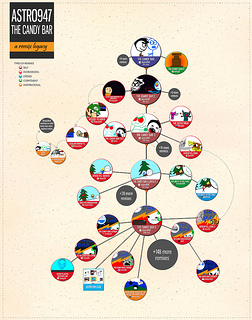
Remix Diagram
We try to shed light on both of these questions using data from Scratch a large online remixing community. Although we find support for several popular theories, we also present evidence in support of a persistent trade-off that has broad practical and theoretical implications. In what we call the remixing dilemma, we suggest that characteristics of projects that are associated with higher rates of remixing are also associated with simpler and less transformative types of derivatives.

Our study is focused on two interrelated research questions. First, we ask why some projects shared in remixing communities are more or less generative than others. Generativity a term we borrow from Jonathan Zittrain describes creative works that are likely to inspire follow-on work. Several scholars have offered suggestions for why some creative works might be more generative than others. We focus on three central theories:
  1. Projects that are moderately complicated are more generative. The free and open source software motto release early and release often suggests that simple projects will offer more obvious opportunities for contribution than more polished projects. That said, projects that are extremely simple (e.g., completely blank slates) may also uninspiring to would-be contributors.
  2. Projects by prominent creators are more generative. The reasoning for this claim comes from the suggestion that remixing can act as a form of cultural conversation and that the work of popular creators can act like a common medium or language.
  3. Projects that are remixes themselves are more generative. The reasoning for this final claim comes from the idea that remixing thrives through the accumulation of contributions from groups of people building on each other s work.
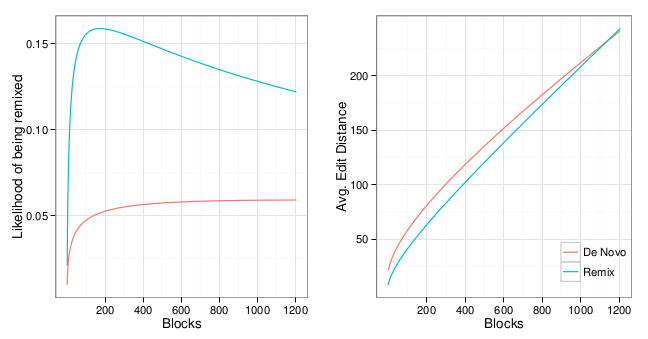
Our second question focuses on the originality of remixes and asks when more or less transformative remixing occurs. For example, highly generative projects may be less exciting if the projects produced based on them are all near-identical copies of antecedent projects. For a series of reasons including the fact that increased generativity might come by attracting less interested, skilled, or motivated individuals we suggest that each of the factors associated with generativity will also be associated with less original forms of remixing. We call this trade-off the remixing dilemma. We answer both of our research questions using a detailed dataset from Scratch, where young people build, share, and collaborate on interactive animations and video games. The community was built to support users of the Scratch programming environment, a desktop application with functionality similar to Flash created by the Lifelong Kindergarten Group at the MIT Media Lab. Scratch is designed to allow users to build projects by integrating images, music, sound, and other media with programming code. Scratch is used by more than a million users, most of them under 18 years old. To test our three theories about generativity, we measure whether or not, as well as how many times, Scratch projects were remixed in a dataset that includes every shared project. Although Scratch is designed as a remixing community, only around one tenth of all Scratch projects are ever remixed. Because more popular projects are remixed more frequently simply because of exposure, we control for the number of times each project is viewed. Our analysis shows at least some support for all three theories of generativity described above. (1) Projects with moderate amounts of code are remixed more often than either very simple or very complex projects. (2) Projects by more prominent creators are more generative. (3) Remixes are more likely to attract remixers than de novo projects. To test our theory that there is a trade-off between generativity and originality, we build a dataset that includes every Scratch remix and its antecedent. For each pair, we construct a measure of originality by comparing the remix to its antecedent and computing an edit distance (a concept we borrow from software engineering) to determine how much the projects differ. We find strong evidence of a trade-off: (1) Projects of moderate complexity are remixed more lightly than more complicated projects. (2) Projects by more prominent creators tend to be remixed in less transformative ways. (3) Cumulative remixing tends to be associated with shallower and less transformative derivatives. That said, our support for (1) is qualified in that we do not find evidence of the increased originality for the simplest projects as our theory predicted.
Two plots of estimated values for prototypical projects. Panel 1 (left) display predicted probabilities of being remixed. Panel 2 (right) display predicted edit distances. Both panels show predicted values for both remixes and de novo projects from 0 to 1,204 blocks (99th percentile).

Two plots of estimated values for prototypical projects. Panel 1 (left) displays predicted probabilities of being remixed. Panel 2 (right) displays predicted edit distances. Both panels show predicted values for both remixes and de novo projects from 0 to 1,204 blocks (99th percentile).

We feel that our results raise difficult but important challenges, especially for the designers of social media systems. For example, many social media sites track and display user prominence with leaderboards or lists of aggregate views. This technique may lead to increased generativity by emphasizing and highlighting creator prominence. That said, it may also lead to a decrease in originality of the remixes elicited. Our results regarding the relationship of complexity to generativity and originality of remixes suggest that supporting increased complexity, at least for most projects, may have fewer drawbacks. As supporters and advocates of remixing, we feel that although highly generative works that lead to highly original derivatives may be rare and difficult for system designers to support, understanding remixing dynamics and encouraging these rare projects remain a worthwhile and important goal. Benjamin Mako Hill, Massachusetts Institute of Technology
Andr s Monroy-Hern ndez, Microsoft Research
For more, see our full paper, The remixing dilemma: The trade-off between generativity and originality. Published in American Behavioral Scientist. 57-5, Pp. 643 663. (Official Link, Pay-Walled ).

8 May 2013

Steve Langasek: Plymouth is not a bootsplash

Congrats to the Debian release team on the new release of Debian 7.0 (wheezy)! Leading up to the release, a meme making the rounds on Planet Debian has been to play a #newinwheezy game, calling out some of the many new packages in 7.0 that may be interesting to users. While upstart as a package is nothing new in wheezy, the jump to upstart 1.6.1 from 0.6.6 is quite a substantial change. It does bring with it a new package, mountall, which by itself isn't terribly interesting because it just provides an upstart-ish replacement for some core scripts from the initscripts package (essentially, /etc/rcS.d/*mount*). Where things get interesting (and, typically, controversial) is the way in which mountall leverages plymouth to achieve this. What is plymouth? There is a great deal of misunderstanding around plymouth, a fact I was reminded of again while working to get a modern version of upstart into wheezy. When Ubuntu first started requiring plymouth as an essential component of the boot infrastructure, there was a lot of outrage from users, particularly from Ubuntu Server users, who believed this was an attempt to force pretty splash screen graphics down their throats. Nothing could be further from the truth. Plymouth provides a splash screen, but that's not what plymouth is. What plymouth is, is a boot-time I/O multiplexer. And why, you ask, would upstart - or mountall, whose job is just to get the filesystem mounted at boot - need a boot-time I/O multiplexer? Why use plymouth? The simple answer is that, like everything else in a truly event-driven boot system, filesystem mounting is handled in parallel - with no defined order. If a filesystem is missing or fails an fsck, mountall may need to interact with the user to decide how to handle it. And if there's more than one missing or broken filesystem, and these are all being found in parallel, there needs to be a way to associate each answer from the user to the corresponding question from mountall, to avoid crossed signals... and lost data. One possible way to handle this would be for mountall to serialize the fsck's / mounts. But this is a pretty unsatisfactory answer; all other things (that is, boot reliability) being equal, admins would prefer their systems to boot as fast as possible, so that they can get back to being useful to users. So we reject the idea of solving the problem of serializing prompts by making mountall serialize all its filesystem checks. Another option would be to have mountall prompt directly on the console, doing its own serialization of the prompts (even though successful mounts / fscks continue to be run in parallel). This, too, is not desirable in the general case, both because some users actually would like to have pretty splash screens at boot time, and this would be incompatible with direct console prompting; and because mountall is not the only piece of software that need to prompt at boot time (see also: cryptsetup). Plymouth: not just a pretty face Enter plymouth, which provides the framework for serializing requests to the user while booting. It can provide a graphical boot splash, yes; ironically, even its own homepage suggests that this is its purpose. But it can also provide a text-only console interface, which is what you get automatically when booting without a splash boot argument, or even handle I/O over a serial console. Which is why, contrary to the initial intuitions of the s390 porters upon seeing this package, plymouth is available for all of Debian's Linux architectures in wheezy, s390 and s390x included, providing a consistent architecture for boot-time I/O for systems that need it - which is any machine using a modern boot system, such as upstart or systemd. Room for improvement Now, having a coherent architecture for your boot I/O is one thing; having a bug-free splash screen is another. The experience of plymouth in Ubuntu has certainly not been bug-free, with plymouth making significant demands of the kernel video layer. Recently, the binary video driver packages in Ubuntu have started to blacklist the framebuffer kernel driver entirely due to stability concerns, making plymouth splash screens a non-starter for users of these drivers and regressing the boot experience. One solution for this would be to have plymouth offload the video handling complexity to something more reliable and better tested. Plymouth does already have an X backend, but we don't use that in Ubuntu because even if we do have an X server, it normally starts much later than when we would want to display the splash screen. With Mir on the horizon for Ubuntu, however, and its clean separation between system and session compositors, it's possible that using a Mir backend - that can continue running even after the greeter has started, unlike the current situation where plymouth has to cede the console to the display manager when it starts - will become an appealing option. This, too, is not without its downsides. Needing to load plymouth when using crypted root filesystems already makes for a bloated initramfs; adding a system compositor to the initramfs won't make it any better, and introduces further questions about how to hand off between initramfs and root fs. Keeping your system compositor running from the initramfs post-boot isn't really ideal, particularly for low-memory systems; whereas killing the system compositor and restarting it will make it harder to provide a flicker-free experience. But for all that, it does have its architectural appeal, as it lets us use plymouth as long as we need to after boot. As the concept of static runlevels becomes increasingly obsolete in the face of dynamic systems, we need to design for the world where the distinction between "booting" and "booted" doesn't mean what it once did.

21 February 2013

MJ Ray: In Praise of Consensus

The constitution of the debian operating system project says things like consistent with the consensus of the opinions of the Developers at various points but doesn t say how strong a consensus or how the project will test for consensus. I think those were mistakes, breaking a couple of the conditions for consensus. Wikipedia s understanding of consensus is even worse. Wikipedia seems to treat consensus as a synonym for unanimity. Its testing methods allow an infinite loop to form where the casual observer can t differentiate between a controversial proposal and consensus. I think those were mistakes. These famous-but-imperfect implementations frequently lead to misdirected rants which seem to misunderstand consensus as requiring perpetual bikeshedding. Apache s implementation is rather better and it may surprise you to learn that our co-op is mostly run by consensus. There are two key differences which I feel makes consensus work for us: we ve set limits beforehand on some decisions where we need to act fast where not making a decision would usually be the same as making a bad decision and our methods of testing for consensus are better. We test for consensus with secret-at-vote-time-but-published-after straw polls, or using Crowd Wise by email. I summarise Crowd Wise as follows: gather all ideas plus option 0 (do nothing) if possible, carry out a de Borda (preference) voting round 1, merge/amend/consolidate ideas, voting round 2 if needed. It does still work better if participants put their ego aside a little and co-operate, but it does put limits on non-co-operators. Anyway, as described in Xana/ xana2/ bamamba/ Why Russ is wrong, debian isn t exactly using consensus much at the moment, anyway. Should we try to fix its bugs? Do you know other projects where consensus is working?

27 January 2013

Russ Allbery: Introversion and mission statements

We had our tech leads retreat on Friday, including the discussion about "why," and I thought it was excellent, although I'm still trying to understand some parts of it. Part of why I'm still working on that is, well, you know that introversion thing? I had five and a half hours of meetings on Friday, and the tail end was an intense four and a half hour retreat, during which I was a major participant the whole time. And tried to say some difficult and intense things, both about the "why" conversation that I posted about and about why the tail end of last year was particularly difficult for me. All that went very well. I was very happy with the overall meeting. Sometimes, I half-convince myself that I'm overstating the degree that introversion or that interpersonal interaction affects me, or that I'm using it as an excuse to duck out of things that aren't really what I want to be working on. Then I do something like this, and find myself completely dead on my feet at the end of the meeting. Not physically tired, but utterly and completely drained. I went home and did something completely right-brain and creative and needed that so desperately that I stayed with it until two in the morning, slept in today until past noon, and still have, despite a couple of minor attempts, absolutely no capability to write code or focus on accomplishing anything. I'm fairly sure I'll still be feeling the after-effects on Monday and Tuesday. I'm a little annoyed at having both missed a day of releasing something to the world (I'd managed to post something every day this year until yesterday) and blowing off exercising yesterday evening for only the second time this year. But I think part of coming to terms with what introversion means is being kind to myself about this. That's something Cain talked a lot about in her book, and it's the advice I'd give to any other introvert, but it's something I'm not applying as well as I could. Being an introvert doesn't mean to not do meetings. It means to pick the ones that are important, do them with all your heart, and then be kind to yourself afterwards just as if you'd put in extreme effort to do something quite energetic and difficult. Because you have. So, I'm trying not to be annoyed at myself. And I think we need to be better about teaching people about this, because apart from Susan Cain, I don't remember many people writing about this, or understanding it. Occasionally there are screeds against meetings, but not a lot of discussion about when it's worth expending the energy, and about how to be kind to oneself and recharge after putting one's energy into the social interactions that are important. I did want to mention that while retreats seem to have a bad reputation in tech circles (and I've heard of a lot of retreats that I would hate), the ones that we do in our group are great. We spent about an hour talking about the things I posted about on Thursday, then a couple of hours talking about the larger organizational roadmap and searching out things that aren't on our upcoming work roadmap that feel like large missing pieces, and then a couple of hours identifying and enumerating our technical debt and deciding what major pieces of technical debt we're going to tackle in the next six months. It's a lot of concrete, specific discussion of what we're going to spend time on and what we're going to defend resources for by pushing back against other priorities. If I had to sum it up in a sentence, I'd say that these retreats are all about listing vaguely equal things that exceed our total capacity and making the decisions about which of them we're going to do and which of them we're not going to do so that we don't have to keep wasting time on revisiting unresolved decisions. The actual mission discussion turned into a discussion by each of us of what we most value in work, stated in terms very similar to what I used in my post, and that was wonderful. I found out things about my co-workers that I didn't know, and which will help me a great deal in improving their enjoyment of their work. I think we came away with a better idea of how to support each other in creating that engagement and excitement, and I think that's the best possible outcome. Since, like I said, I think that's the only real mission statement a group should have. We did, still, talk about having a mission statement anyway. Apparently having a shared statement is really important to people who aren't me. I'm still struggling with this, since it doesn't make sense to me and doesn't feel useful to me. But maybe it's a sort of validation and confirmation that we're allowed to focus on what we care about? But the group mission statement we came away with isn't about any specific technology and focuses on exactly the things that I care about: elegance, robustness, durability, and solving whatever problems the university has. As part of that discussion, we reached a surprising and really satisfying unanimity of opinion about what values we care deeply about. It's a value statement as opposed to a distillation of job descriptions, so if a mission statement is valuable for other people, that's one I'm quite happy with. Even if I don't understand why people want to have one. I'm less satisfied with the roadmap and strategic plan for our larger organization, but I'm starting to realize that's because I'm utterly not the target audience and it's not going to engage or interest me. It's more of a marketing statement that's focused externally, and my proper role in that is to try to help ensure that it reflects the enthusiasms and engagement of the line staff, not to try to turn it into a document that will be inspiring for the line staff. Which ties into what I was writing about previously: in my ideal world, these sorts of focuses flow upwards from the people who will be doing the work, not downward from a high-level manager deciding on an inspirational direction.

25 January 2013

Russ Allbery: The "Why?" of Work

(This is going to be long and rambling. Hopefully at some point I'll be able to distill it into something shorter.) In preparation for a tech leads retreat tomorrow, several of us at work were asked to watch Simon Sinek's TED talk, "How great leaders inspire action". I'll be honest with you: I hated this talk. Sinek lost me right at the start by portraying his idea as the point of commonality among great leaders (don't get me started on survivorship bias; it's a pet peeve) and then compounded the presentation problem with some dubious biology about brain structure. So, after watching it, I ranted a bit about how much I disliked it (to, as it turns out, people who had gotten a lot out of it). (Don't do this, btw. It's nearly always worthwhile to suppress negativity about something someone else enjoyed. I say this to increase the pool of people who can remind me of what I said the next time I forget. Which, if my normal pattern holds, will be about five minutes from now.) Thankfully, I work with tolerant and forgiving people who kindly pointed out the things they saw in the video that I missed, and we ended up having a really good hour and a half discussion, which convinced me that there's an idea under here that's worth talking about. It also helped clarify for me just how much I hate the conventional construction of both leadership and success. This talk is framed around getting other people to do things, which is one of the reasons why I had such a negative reaction to it. It's right there in the title: leaders inspiring action. This feeds into what at least in the United States is an endemic belief that the world consists of leaders and followers, and that the key to success in the world (in business, in politics, in everything else) is to become one of the leaders and accumulate followers (most frequently as customers, since we have a capitalist obsession). This is then defined as success. I think this idea of success is bullshit. Now, that statement requires an immediate qualification. Saying that the societal definition of success is bullshit is a statement from privilege. I have the luxury of saying that because I am successful; I'm in a position where I have a lot of control over my own job, I'm not struggling to make ends meet, and I can spend my time pondering existential questions like how to define success. If I were a little less lucky, success would be whatever put food on the table and kept a roof over my head. I'm making an argument from the top of Maslow's hierarchy. But that is, in a roundabout way, my point: why is defining and constructing success still so hard, and why do we do such a bad job at it, even when we're at the top of the pyramid and able to focus on self-actualization? The context of this talk for my group is pre-work for a discussion about, in Sinek's construction, the "why?" of our group. Why are we here, what is our purpose, and what do we care about? By the mere fact that we are able to ask questions like that, you can correctly surmise that we're already successful. The question, therefore, is what should we do with that success? I normally hear one or more of the following answers, all of which I find unsatisfying or problematic. So, what should I do with success? Or, put another way, since I have the luxury of figuring out a "why?", what's my "why?" This question comes at a good time. As I've mentioned the last couple of days here, I've just come off of two days of the most fun I've had at work in the last several years. I spent about 25 hours total building a log parsing infrastructure that I'm quite fond of, and which may even be useful to other people. And I did that in response to a rather prosaic request: produce a report of user agents by authenticated unique users, rather than by hits, so that we can get an idea of what percentage of our community uses different devices or browsers. This was a problem that I probably could have solved adequately enough for the original request in four hours, maybe less, and then moved on to something else. I spent six times that long on it. That's something I can do because I'm successful: that's the sort of luxury you get when you can define how you want to do your job. So, apparently I have an answer to my question staring me in my face: what I do with success, when I have it, is use that leeway to produce elegant and comprehensive solutions to problems in a way that fully engages me, makes the problem more interesting, and constructs infrastructure that I can reuse for other problems. Huh. That sounds like a "why?" response that's quite common among hackers and software developers. Nothing earth-shattering there... except why is that so rare in a business context? Why isn't it common to answer questions like "what is our group mission statement" with answers like that? This is what I missed in the TED talk, and what the subsequent discussion with my co-workers brought to light for me. I think Sinek was getting at this, but I think he buried the lede. The "why?" should be something that excites you. Something that you're passionate about. Something that you believe in. He says that's because other people will then believe in it too and will buy it from you. I personally don't care about (or, to be honest, have active antipathy towards) that particular outcome, but that's fine; that's not the point. The point is that a "why?" comes from the heart, from something that actually matters, and it creates a motivating and limiting principle. It defines both what you want to do and what you don't want to do. That gives me a personal answer. My "why?" is that I want to build elegant solutions to problems and do work that I find engaging and can be proud of afterwards. I automate common tasks not because I particularly care about being efficient, but because manually doing common tasks is mind-numbing and boring, and I don't like being bored. I write reliable systems not particularly because that helps clients, but primarily because reliable software is more elegant and beautiful and unreliable software offends me. (Being more usable and frustrating for clients is also good; don't get me wrong. It's just not a motive. It's an outcome.) What does that mean for a group mission statement, a group "why?" Usually these exercises produce some sort of distillation of the collective job responsibilities of the people in the group. Our mission is to maintain core infrastructure to let people do their work and to support authentication and authorization services for the university, yadda yadda yadda... this is all true, in its way, but it's also boring. One can work oneself up to caring about things like that, but it requires a lot of effort. But we all have individual "why?" answers, and I bet they look more like my answer than they do like traditional mission statements. If we're in a place where we have the luxury of worrying about self-actualization questions, what gets us up in the morning, what makes it exciting to go into work, is probably some variation on doing interesting and engaging work. But it's probably a different variation for everyone in the group. For example, as you can see from above, I like building things. My happiest moments are when someone gives me a clearly-defined problem statement that fills a real need and then goes away and leaves me in peace to solve it. One thing I've learned is that I'm not very good at coming up with the problem statements myself; I can do it, but usually I end up solving some problem that isn't very important to other people. I love it when my employer can hand me real problems that will make the world better for people, since often they're a lot more interesting (and meaningful) than the problems I come up with on my own. But that's all highly idiosyncratic and is not going to be shared by everyone in my group. I'm an introvert; the "leave me alone" part of that is important. Other people are extroverts; what gets them up in the morning is, in part, engaging with other people. Some people care passionately about UI design. (I also care passionately about UI design, but the UI designs that I'm passionate about are the ones that are natural for my people, who are apparently aliens from another galaxy, so I'm not the person you want doing UI design for things used by humans.) Others might be particularly interested in researching new technology, or coming up with those problem statements, or in smoothly-running production systems, or in metrics and reporting... I don't really know, but I do know that there's no one answer that fits everyone. Which means that none of our individual "why?" responses should become the group "why?". However, I think that leads to an answer, and it's the answer I'm going to advocate for in the meeting tomorrow. I believe the "why?" of our team should be to use the leeway, trust, and credibility that we have because we're successful to try to create an environment in which every individual member of the team can follow their own "why?" responses. In other words, I think the mission of our group should not be about any specific technology, or about any specific set of services, or outcomes. The way we should use our success is to let every member of our team work in a way that lights their fire. That makes them excited to come into work. That lets each of us have as much fun as I had in the past two days. We should have as our goal to create passionate and empowered employees. Nothing more, but nothing less. This is totally not how group mission statements are done. They're always about blending in to some larger overall technological purpose. But I think that's a mistake, and (despite disliking the presentation), I think that's what this TED talk does actually get at. The purpose is the what, or sometimes the how. It's not the why. And the why isn't static; technology is changing fast, and people are using technology in different ways. Any mission statement around technology today is going to be obsolete in short order, and is going to be too narrow. But I think the flip side is that good technological solutions to the problems of the larger organization are outcomes that fall out of having passionate and inspired employees. If people can work in ways that engage and excite them, they will end up solving problems. We're all adults; we know that we're paid to do a job and that job needs to involve solving real problems for the larger organization. All of that is obvious, and therefore none of that belongs in a mission statement. A mission statement should state the inobvious. And while some visionary people can come up with mission statements around technology or around how people use technology that can be a rallying point for a team or organization, I think that's much rarer than people like to think it is. If you stumble across one like that, great, but I think most teams, and certainly our team, would be better served by having the team mission statement be to enable every individual on the team to be passionate about their work. What should our group work on next? Figure out what the university's problems are, line those needs up with the passions of the members of the team, ask the people most excited about each problem how they want to solve that problem, and write down the answers. There's our roadmap and our strategy, all rolled into one.

17 January 2013

Russ Allbery: A few last thoughts on Aaron Swartz

Daniel Kahn Gillmor has a very good blog post. You should read it. It includes a thoughtful rebuttal to some of my earlier thoughts about activism. I think I'm developing a richer understanding of where I see boundaries here, but after my last post, I also realized that by focusing on the specific details of what should have been a minor alleged crime, I'm derailing. Swartz did so much else. I made a note to come back to the more theoretical discussion in six months; now isn't the time. Now is the time to celebrate open content and all of the things Swartz achieved. (But thank you very much to the multiple people who have pointed out flaws in my reasoning and attempted approach.) Hopefully, it's also an opportunity to keep the pressure on for a saner and less abusive judicial system that doesn't threaten people with ridiculous and disproportional punishment in order to terrify them into unwarranted plea bargains. The petition I mentioned has reached nearly 40,000 signatures and passed the threshold (at the time it was posted) for forcing a White House response. Probably more importantly, it also seems to be creating the feedback cycle that I was hoping to see: the popularity of the petition is causing this story to stay in the news cycle and continue to be written about, which in turn drives more signatures to the petition. I'm not particularly hopeful that the Obama administration cares about the vast and deep problems with our criminal justice system, but I'm somewhat more hopeful that they, like most politicians, hate news cycles that they don't control. The longer this goes on, the stronger the incentive to find some way to make it go away, which could lead to real disciplinary action. A key committee in the US House of Representatives is starting a formal investigation. One of my local representatives has proposed modifying the US federal law on computer fraud and abuse to remove violations of terms of service from the definition of the crime. (I don't have much hope that this will pass when proposed by the minority party in a fairly hostile House, but the mere act of proposing it keeps the news focus on.) Glenn Greenwald has a (typically long-winded) round-up of news in the Guardian. Note that both Greenwald and Declan McCullagh link directly to the petition in articles in mainstream news outlets. One thing that slacktivism can do is perpetuate a news cycle until it gets more uncomfortable for people in power. It's still nowhere near as effective as the types of activism that Swartz was so good at, but in this specific case I think one gets a reasonable return on one's five-minute investment of effort. I'm going to stop talking about this now, since other people are a lot better at this sort of post than I am. But one last link: the medical community has a related open content problem, and theirs is also killing people. Possibly people you know. If all of this has inspired you, as it has me, to care even more about open content, be watching the push for open access to clinical trial data. More background is in Ben Goldacre's TED talk.

1 January 2013

Russ Allbery: 2012 Book Reading in Review

For the year of 2012, I finished and reviewed 60 books, the same number as 2011. Given how stressful and chaotic much of the year was, I count this a major triumph. The hardest part was not the reading but the review writing; the end of the year required a significant push to finish writing reviews of all the books I'd read that year, and at one point I was reviewing things I'd read more than two months earlier. But I can enter 2013 entirely caught-up. This continues to feel like about the right pace, striking a balance between reading enough that I can pursue multiple reading goals at the same time, while leaving enough time for other projects and video games. I gave three novels a 10 out of 10 this year, but the stand-out even among that group was Elizabeth Wein's Code Name Verity. Not only was it my favorite book of the year, but it was one of the best books I've ever read. The other two 10-rated books are also highly recommended, of course: Matt Ruff's fascinating novel of multiple personalities, Set This House in Order; and C.J. Cherryh's SF classic, Cyteen. The latter was a re-read in advance of reading the sequel, Regenesis, which I also recommend if you've read and liked the last third of Cyteen. Other fiction highlights of the year were China Mi ville's Embassytown and Suzanne Collins's The Hunger Games triology, particularly the third book, Mockingjay. Embassytown continues the trend from Mi ville's The City & The City of tighter, faster-moving novels while moving into space opera and first contact territory. It keeps Mi ville in the top rank of current SFF writers, despite having some suspension of disbelief problems. Collins's world-building in The Hunger Games also has suspension of disbelief problems, but I understood why the series was so popular. I was caught by surprise by its look at violence and its after-effects and was particularly impressed by Mockingjay and Collins's chosen ending. I think this is a popular series that lives up to the hype. There were no 10 ratings in non-fiction this year, but several books nonetheless stood out. John Kenneth Galbraith's The Affluent Society is a thought-provoking book that questions the foundation of a consumer-oriented economy while perceptively pointing out how it distorts choices away from public goods. Susan Cain's Quiet is a passionate defense of introversion in an extroverted world. And, finally, Joshua Bloch's Effective Java and Damian Conway's Perl Best Practices are both insightful looks at the good and bad of their respective languages and taught me a great deal as a practicing programmer. One final highlight to mention: Eclipse Phase by Posthuman Studios is an excellent RPG sourcebook, at least from the perspective of interesting world-building. I haven't played it, but I thoroughly enjoyed reading it (and have acquired nearly all of the supplements). The full analysis includes some additional personal reading statistics, probably only of interest to me.

11 December 2012

Russell Coker: Links December 2012

Steven Johnson gave an interesting TED talk about where good ideas come from [1]. He starts by attributing coffee replacing alcohol as a standard drink for some good ideas and then moves on to how ideas develop. Erez Lieberman Aiden and Jean-Baptiste Michel gave an interesting and amusing TED talk about the ngram analysis of books that Google scanned [2]. Here is the link for the Google Books ngram search [3]. Clay Shirky gave an insightful TED talk about how the Internet is changing the world [4]. He cites Open Source programmers as the modern day equivalent to the Invisible College based on our supposed great ability to get along with other people on the Internet. If we really are so much better than the rest of the Internet then things must be bad out there. He ends with ways of using Git to draft legislation. Hans Rosling gave an interesting TED talk about religion and the number of babies that women have [5]. His conclusion is that it s more about income and social stability and that the world s population can stabilise at 10 billion if we provide family planning to everyone. Alexis C. Madrigal wrote an interesting interview with Genevieve Bell about her work at Intel and the way people use technology [6]. Indigogo is raising funds for the Cuddle Mattress , it s a mattress with foam slats and a special fitted sheet to allow your arm to slide between the slats [7]. So you could have your arm underneath your SO for an extended period of time without risking nerve damage. They also show that when sleeping on your side your shoulder can go between the slats to avoid back problems. Nate Silver (who is famous for predicting US elections gave an interesting TED talk about racism and politics [8]. One of his main points is to show the correlation between racism and lack of contact of members of other races. Sociological Images has an interesting article by Lisa Wade about whether marriage is a universal human value [9]. In regard to historical marriage she says women were human property, equivalent to children, slaves, servants, and employees . The general trend in the comments seems to be that there are so many types of marriage that it s difficult to make any specific claims to traditional marriage unless you count a tradition of a short period in a single geographic region. Plurality is an excellent sci-fi short movie on youtube [10]. TED has an interesting interview with Hakeem Oluseyi about his research about astrophysics and how he achieved a successful career after being a gangster as a teenager [11]. He has some good ideas about helping other children from disadvantaged environments become successful. Paul Dwerryhouse wrote an interesting blog post about his work in designing and implementing a filesystem based on a Cassandra data store with FUSE [12]. Paul also wrote a post about using Apache Zookeeper to lock metadata to permit atomic operations [13]. The documentary Monumental Myths provides an interesting and insightful analysis of the processes of creating, maintaining, and explaining monuments [14]. It focusses on some significant monuments in the US and explains both sides to each story. Howard Zinn makes the insightful point that when people present a certain point of view of history it s not controversial, as soon as you present the other side they call it controversial . That happens even in debates about current issues. Howard also says to criticise whatever the government does is not anti-America, it s anti-government, it s pro-America, it s pro the people, it s pro the country . The song that plays during the closing credits is interesting too. The music video Same Love is one of the best presentations of the argument for marriage equality [15]. Chris Samuel wrote an interesting post about systems locked down for Windows 8 and options for purchasing PCs for running Linux [16]. His solution is to buy from ZaReason. I saw his laptop in action at the last LUV meeting and it looks really nice. Unfortunately a byproduct of the extremely thin form factor is the fact that it lacks a VGA port, this meant that Chris had to use my Thinkpad T61 (which is rather clunky by comparison) for his presentation.

4 November 2012

Russ Allbery: Review: Set This House in Order

Review: Set This House in Order, by Matt Ruff
Publisher: Perennial
Copyright: 2003
Printing: 2004
ISBN: 0-06-095485-X
Format: Trade paperback
Pages: 479
A textbook case history would say that Andy Gage has disassociative identity disorder (referred to here as the more common although medically inaccurate "multiple personality disorder" for reasons of clarity and to match casual speech, according to the author). However, that's a completely inadequate description. A better description would be that Andy Gage's body is inhabited by a large set of different personalities, who take turns being in control. The original Andy Gage is dead, shattered by horrific childhood abuse. Aaron became the dominant personality and gave structure to the internal geography of the mind they all share, with the help of extensive counselling. But Aaron was exhausted by being the public face and maintaining control of the shared body. Hence, Andrew. Andrew Gage is the first-person narrator of half of this book. He is twenty-eight, the same age as the body, but he's only existed for two years. He considers Aaron his father, since Aaron called him out of the lake inside their internal metal geography. His purpose is to run the body and be the public face of the family. He is by turns capable and naive, shy on personal experience, but able to get the help of the others. The one heard from most frequently is Adam, a rude and mischevious teenager who also has an uncanny ability to read other people, and who frequently watches through the body's eyes from what the family calls the "pulpit" and gives Andrew advice. Andrew works for Julie Sivik, a woman he met the day he quit his job at a big-box store because he couldn't explain his behavior to his boss without discussing being a multiple. Julie is a wholly impractical, slightly unethical, well-meaning force of chaos who serves as the thread that draws the plot of the book together. She's running a startup on ingenuity and borrowed money that is attempting to create a comprehensive and customizable virtual reality world. She's the one who finds Penny and hires her, in part for her skills, and in part to push Penny and Andrew together. Penny Driver has the same condition as Andrew, but Penny is only vaguely aware of it. The world for her is full of blackouts, lost time, waking up in strange and sometimes horrific situations, and attempting to structure her life based on notes left for herself that she didn't write. When she meets Andrew, she's barely making it through life; thankfully, one of her personalities is remarkably good at computers, and that has been enough to make a living despite the chaos. But Julie is the unintentional catalyst for her losing that job, the best job she's ever had, leaving her with no real alternative but to take the job with Julie's company. There are a few things that are important to say up-front about this book. First, neither I nor the author are actually multiples (or, put another way, neither of us have DID), and writing about atypical mental states is fraught with peril. It's very easy to misrepresent other people's experiences, and multiple personalities in particular are frequent material for dramas of all sorts. There's something people find inherently fascinating about the idea, and it's easy for that fascination to run away with reality and distort the lived experience. I recommend reading Ruff's FAQ about the book, which spells out what his goals are and what approach he took. I did some quick searches and didn't uncover a lot of anger or dislike of the book among either people who have DID or psychiatrists, and it seems true to the descriptions of internal reality I've heard from people who are multiples. But despite being more respectful of real experience than most fictional treatments of DID, this is still a work of fiction written by someone without first-hand experience, and it's worth keeping that in mind. Second, DID is an intensely controversial diagnosis among psychiatrists. There are, generally speaking, two major controversies. One is over whether or not DID can actually be caused by traumatic experiences such as childhood abuse, or whether it is a creation of psychiatrists, a mental model that they've imposed on their patients or convinced their patients to believe. Set This House in Order comes down firmly on the first side of that controversy: that DID can be created by abuse and is not a creation of psychotherapy. (So, I should note, does every multiple that I've ever talked to or read.) Second, there is significant controversy over treatment, with some psychiatrists believing that integration of the personalities into one is the only true treatment, and others believing that multiples can remain stable and functional as multiple personalities. Set This House in Order leans strongly towards the view that multiples can be stable as multiples and that while integration may be appropriate for some, it's not for all. Both of these viewpoints are presented very convincingly by the narrative in the book, and both are consistent with the beliefs of a lot of multiples, but it's worth remembering that these are active and often quite heated controversies and a novel is not evidence. It's good to be aware of both of those points, and to read Put This House in Order as something of a what-if, where much more is clear about DID than is actually clear in our world. But once one has done that, one is in for an excellent book. I loved this book from start to finish. (Well, okay, I felt some surprise at the nature of the ending, but it grew on me after further consideration.) It's simply a brilliant novel, with a little bit of everything: very good characterization, messy love affairs, the satisfying tension of someone overcoming great odds to put themselves together with the help of friends, a startlingly original perspective of the world, some excellent surprises, and some absolutely wonderful characters. Andrew is a good choice of narrator: he brings an earnest calm to a story that could otherwise be quite chaotic and provides a great vantage point for the reader. And I found Penny (and particularly some of her other souls) impossible not to like. Set This House in Order is a tense book in places, and it's a book where people's lives break down before they can get better. It's also a book about rather horrific abuse, and while nearly all of the specifics happen off-stage, imagination fills in some nasty details. But Ruff manages to write it with a structure and with enough calm assurance that I felt just reassured enough without taking away the tension. That's a tricky balance; few books do it better. And the supporting characters are a delight. One might think, with all the complexity happening for both Andrew and Penny, that Ruff wouldn't have room in the narrative for other characters, but one would be wrong. There are very few saints and demons here, just a lot of complex people, with their own problems and their own perspectives, who are generally trying to do the best they can from day to day. There are some clear-cut villains in the past Ruff wisely makes no attempt to add shades of grey to abusers but even there one can see some clear signs of untreated severe mental illness and chaotic lives rather than mustache-twirling pre-meditated villainy. This is, in short, a book full of people, in all their messy complications, which is what makes it so delightful. I'm not going to say anything more about the plot, or even the various personalities, since discovering the direction of the book was so much of the fun. I will say that, despite the subject matter and some of the events, the book is surprisingly gentle. One of the things about it that I loved the most was the emotional tone Ruff gave to being a multiple: the sense of a squabbling but tight-knit family looking out for each other. I can't judge the reality of this impression, but it makes for a wonderful story. Highly recommended. The best book I've read so far this year. Rating: 10 out of 10

29 October 2012

Matthew Garrett: Ted Ts'o is a rape apologist and why this matters

(This post contains some discussion of rape and sexual assault but does not go into any specifics)

There was a brief controversy at Linux.conf.au back in 2011. The final keynote speaker gave a compelling presentation on online privacy, including some slides containing sexualised imagery. This was against the terms of the conference policies, and resulted in an apology from the conference organisers and the speaker. The situation was unfortunate but well handled, and that should have been the end of it.

Afterwards, there was some pushback on the conference mailing list. Concerns were raised about the policy being overly restrictive and the potential for it to be used to stifle speech that influential groups disagreed with. I don't agree with these arguments, but discussion of why policies have been implemented is completely natural and provides an opportunity for a community to determine what its expected standards are.

And then Ted Ts'o effectively called rape victims liars[1]. At first I assumed that this was just some sort of horrific failure to understand the implications of what he was saying, so I emailed him to check. The reply I got drew a pretty clear distinction between the case of a drunk college student raping another drunk college student in their room and the case of knifepoint rape in a dark park. You know, the difference between accidental rape and rape rape. The difference between the one any of us might have done and the one that only bad people do. Legitimate rape and the "rape" that those feminists talk about. The distinction that lets rapists convince themselves that they didn't really rape anyone because they weren't holding a knife at the time.

Ted Ts'o argues that only a small percentage of rape really counts as what people think of as rape. Ted Ts'o is a rape apologist.

There's an ongoing scandal in the UK at the moment. A well known DJ, Jimmy Savile, died last year. He grew up in a working class family, but through hard work and natural talent was one of the most significant figures in promoting pop music in the UK in the 50s and 60s, and worked in various parts of the BBC for the best part of 30 years. He spent significant amounts of time raising money for charity, and it's estimated that he raised over 40 million for various causes. Since his death, around 300 people have accused him of sexually abusing them. The BBC is desperately trying to explain why it cancelled an expose shortly before it aired. Multiple people who worked there at the time claim that everyone knew he was involved in indecent activities, but saying anything would risk both their career and the charities that depended on his fundraising. Nobody said anything, and he was allegedly free to continue his abuse.

Ted Ts'o is a significant figure in the Linux kernel community. He has expressed abhorrent beliefs that damage that community. Condemnation was limited to a mailing list with limited readership, meaning, effectively, that nobody said anything. Last week the Ada Initiative published a blog post pointing out the damage that did, and I realised that my effective silence was not only helping to alienate 50% of the population from involving themselves with Linux, it was also implicitly supporting my community leadership. I was giving the impression that I was basically fine with our community leaders telling people that it wasn't really rape if you were both drunk enough. I was increasing the chances of members of our community being sexually assaulted. Silence is endorsement. Saying nothing is not ok.

In the absence of an apology and explanation from Ted, I'll be interacting with him to the bare minimum that I'm compelled to as a result of my job. I won't be attending any Linux Foundation events he's involved in organising. If I'm running any events, I won't be inviting him. At a time when we're finally making progress in making our community more open and supportive, we don't need leaders who undermine that work. Support organisations who encourage that progress, not the people who help drag us back.

Footnotes

[1]The original archive has vanished. I've put up a copy of the relevant thread here. Throughout, Ted states that he's actually arguing against the idea that women need to be frightened of sexual assault, and not against the definition of rape. Except saying things like This one does a pretty good job of taking apart the Koss / Ms. Magazine study, which is the source for the "1 in 4" number. For example, it points out that over half of those cases were ones where undergraduates were plied with alcohol, and did not otherwise involve using physical force or other forms of coercion is difficult to read in any way other than "Half of the people you're counting as having been raped haven't really been raped", and favourably referring to an article that asserts that the rate of false rape reports is probably close to 50% is pretty strong support for the idea that many rape victims are liars.

(Update 2012/10/30: Adam Williamson suggests in this comment that this mail is a better example of Ted's behaviour - there's some explicit victim blaming and a lot of "Is that rape" questioning with the obvious implication that the answer should be "no". Ted Ts'o is a victim blaming rape apologist.)

(Update 2012/11/05: It's been suggested that I haven't been sufficiently clear about which of Ted's statements justify my claims. So, here we go.

In this mail, Ted links to and endorses this article. He explicitly links to it because of its treatment of rape statistics. Quoting directly from that article:
the rate of false reports is at least 9 percent and probably closer to 50 percent
Ted explicitly endorses an article that claims that a significant percentage of reported rapes are false. The study that generated that figure is held in poor regard by other researchers in the field - Australian police figures indicate that 2.1% of rape accusations were classified as false. Ted asserts that he was trying to argue against poor use of statistics, so it's a fair assumption that he agrees with the alternative statistics that he's citing. Ted believes that many rape victims are making false accusations. Ted believes that many rape victims are liars.

Again in this mail, Ted argues against a claimed figure that 1 in 4 women have been sexually assaulted. One of his arguments is that Also found in the Koss study, although not widely reported, was the statistic that of the women whom she classified as being raped (although 73% refused to self-classify the event as rape), 46% of them had subsequent sex with the reported assailant. Ted disagrees with a statistic because some rape victims subsequently have sex with the reported assailant. This means that Ted believes that this indicates that they were not really raped. Ted is a rape apologist.)

comment count unavailable comments

13 October 2012

Vasudev Kamath: Weekly Log - 06/13-102012

Update for 06/10/2012 Well I had not written the weekly work log for the last week that is because the week was short (oh yeah thanks to all these bandhs our week got fluctuated and to be frank the week was only 4 days long) and second was my lazyness. Here goes the update * After a long discussion with Aravinda on "why productivity is reducing these days." We concluded the social network is eating up most of time. So decision was made and I closed all pinned tabs for Twitter Gmail Identi.ca and Friendica on my browser * After the above resolution I finished almost 4 chapters of Moder Perl within 2 hours!. Indeed Social networks kill the productivity. Update for 13/10/2012 I've really fallen in love with computerised bots, thanks to the wonderful KGB bot :-). So majority of my work on this week is on bots. Jabber Dictionary Redesign After thinking for a while I decided to re-write the dictionary bot which when release got an overwhelming response as see in the comments of above link. Few reason for re-write
  1. Generalise the bot framework so single bot can handle multiple languages
  2. Improve the data collection on bot side
  3. Current code base was not very well organised and trying to add more feature it had become messy.
  4. Provide XEP support to help in data collections
Few changes which are already implemented include
  1. New code is now using pyxmpp2 library instead of GPLed xmppy used by current code.
  2. Implemented XEP-0071 extension to properly format the meaning display by the bot
  3. Current implementation was displaying all words in one set without distinguishing between adjectives,verbs proverbs etc. even though wiktionary displays meaning based on this. New implementation gives out meaning in same format as it is displayed on wiktionary.
Things remaining todo
  1. Separating wiktionary parsing logic from bot code by providing some sort of intermediate interface between bot and wiktionary parsers.
  2. Adding more language wiktionary parsers and teaching the bot to become multilingual :-)
  3. Integrating XEP-0004 (Data Forms) for taking the meaning input from user. Current code requires user to enter data in particular format
suckless-tools fix for Wheezy Jakub Wilk suggested me to prepare a minimal version of suckless-tools for Wheezy which includes a patch to the bug #685611. And few minor changes which involve taking over the package and fixes in copyright file other than above mentioned bug. Hopefully release-team will be okay with these changes. I'm waiting for the upload to file an unblock-request. I did face a problem I was halfway through wit suckless-tools_39-1 when Jakub asked me about this change and current repository was fresh one prepared for 39-1 and didn't have history for 38 version. First I thought of preparing separate repository for 38 version which was not an correct option, but I even couldn't play with current repository. So finally I renamed current version of repository to suckless-tools-39.git on collab-maint and prepared fresh repository suckless-tools.git basing it on 38-1 version. From 39 version suckless-tools will be following 3.0 (quilt) source format and will not be working with git-buildpackage as the tool can't handle multi-tarball packages. Yes every tool involved in the package will have separate tarball from 39. More work on Bots Well today I again worked on Jabber bot, but not the dictionary bot. This time its an SMS Gateway bot for Jonas Smedegard and the coding was done in Perl. Thanks to jonas I finally could apply what I learnt in Perl. Code may not be very elegant but it works :-). And after hacking one full day in Perl now I'm not feeling very much interested to go back and hack on my own Python based dictionary bot :-). But I will anyway. Misc So that's it folks. Quite longish post hope you are not bored reading it :-). Well time for movie C'ya all with next weeks log.

31 July 2012

Russell Coker: The Retina Display

Last night I played with an Apple Macbook Pro with the new Retina Display (Wikipedia link). Wikipedia cites some controversy about whether the display actually has higher resolution than the human eye can perceive. When wearing glasses my vision is considerably better than average (I have average vision without glasses) and while kneeling in front of the Macbook I couldn t easily distinguish pixels. So Apple s marketing claims seem technically correct to me. When I tested the Macbook Pro I found that the quality of the text display was very high, even now the 1680*1050 display on my Thinkpad T61 looks completely crap when compared to the 2880*1800 display on the Macbook. The Macbook was really great for text and for a JPEG that was installed on the system for testing. But unfortunately pictures on web sites didn t look particularly good. Pictures on my blog looked quite poor and pictures returned by a Google search for art didn t look that great either. I wonder if Safari (the Apple web browser) isn t properly optimised for the display or if there is something that we should do when preparing pictures for web sites to make them look better on Safari. The retina display has a 71% greater DPI which means 2.93* the total number of pixels of my Thinkpad. The overall quality of the experience for me (apart from web pictures) seems more like a factor of 2.93 when compared with my Thinkpad than a factor of 1.71. This has to be one of the most desirable products I ve seen from a company that s opposed to freedom for it s users. I m not about to buy one though, $2,300 is a lot of money for a system that can t be upgraded, repaired, or recycled, and doesn t even have an Ethernet port. I m sure that if I bought one I would discover that it some of the hardware features don t work properly with Linux. The new Apple design trend of making it impossible to repair anything works reasonably well for phones and tablets which are cheap enough that they are hardly worth repairing when they have been used for a while. Lots of people can afford to spend about $600 on something that may be discarded after a year or two, but very few people can afford to spend more than $2,000 on such a disposable product. Why is Apple the only company producing systems with such displays? If someone produced regular PCs that have the expected features (including an Ethernet port) with such a display at a lower price then I m sure that there would be a great demand. Related posts:
  1. Modern Laptops Suck One of the reasons why I m moving from a laptop...
  2. A First Digital Camera I ve just been asked for advice on buying a digital...
  3. RPC and SE Linux One ongoing problem with TCP networking is the combination of...

30 July 2012

Russell Coker: Links July 2012

The New York Times has an interesting article about hacker hostels [1]. I had an idea for similar things after watching a Japanese movie about Tokiwa-s a shared apartment for Manga artists which among others inspired the creator of Astro Boy [2]. The TED blog has an interesting interview with William Noel about open access to art and historical data [3]. Most of his talk concerns an Archimedes codex which has been recovered and published on the Internet. He advocates publishing all manner of art and historical data under a Creative Commons license. The education system is often criticised for trying too hard to make children feel successful and not teaching them skills needed to be successful, it seems that the US military fails the same way in it s war games [4]. Webroot.com published an interesting article last year about the first BIOS rootkit in the wild [5]. I really wish that they would design motherboards with a switch to enable BIOS writing which would default to off . I recently did a poll at a LUG meeting and found that only half the audience had updated the BIOS on most systems they owned, if the most technical people generally don t need a dangerous feature then it should probably be disabled by default. Matthew Wright wrote an interesting article about the costs of upgrading the electricity grid in Australia vs the costs of upgrading air-conditioners [6]. It seems that it would be a lot cheaper for the government to buy everyone a new air-conditioner than to upgrade the grid. Owl City has a post of 10 Myths About Introverts [7]. That could probably be titled 10 Myths About Aspies and still be correct. Susan Cain gave the most popular talk of TED 2012 about The Power of Introverts , here is an interesting interview about the talk and Introversion [8]. Related posts:
  1. Links April 2012 Karen Tse gave an interesting TED talk about how to...
  2. Links July 2011 The Reid Report has an article about the marriage pledge...
  3. Links March 2012 Washington s Blog has an informative summary of recent articles about...

Next.

Previous.