Search Results: "ron"

9 May 2026

Russell Coker: Packaging Amazfish for Debian

I have done some packaging work on Amazfish (the smart-watch software that works with the PineTime among others) for Debian. Here is my Git repository for libnemodbus (a dependency for Amazfish that isn t in Debian) [1]. Here is my Git repository for Amazfish itself [2]. These packages are currently using QT5 which is a good reason to not upload them now as the transition to QT6 is in progress. Patching them to work with QT6 (as the libnemodbus upstream is apparently not migrating to QT6 yet) shouldn t be that difficult but is something that needs some care and communication to get it right. Running this package on my laptop with my PineTime (which worked very reliably when run by GadgetBridge on Android) wasn t reliable and the PineTime would disconnect and refuse to connect again. Doing it on the Furilabs FLX1s gave a similar result. If Amazfish was the only Bluetooth program having problems on my laptop and on my FLX1s then I d blame it, but both those systems have some other Bluetooth issues. Running this on my laptop Amazfish would send it s own test notifications to my watch but system notifications (from notify-send among others) wouldn t get sent. Running this on my FLX1s I got ONE notification from my network monitoring system sent to my watch before my phone and watch stopped talking to each other. To make things even more difficult for me the harbour-amazfish-ui program doesn t work correctly with the libraries installed on my FLX1s and doesn t display the content of many screens but it works correctly when running in a container environment with stock Debian/Testing. Below is the script that I m currently using to launch apps in a Debian/Testing container on my FLX1s. The comment about unshare-user doesn t apply to this version of the script but I left it in to avoid the potential for future confusion. The Furilabs people diverted the bwrap binary and have a wrapper that removes a set of parameters that they think will cause problems.
#!/bin/bash
set -e
BUILDBASE=/chroot/testing
# bwrap: Can't mount proc on /newroot/proc: Device or resource busy
# get the above with --unshare-user and --unshare-pid
exec bwrap.real --bind /tmp /tmp --bind /run /run --bind $HOME $HOME --ro-bind $BUILDBASE/etc /etc --ro-bind $BUILDBASE/usr /usr --ro-bind $BUILDBASE/var/lib /var/lib --symlink usr/bin /bin --symlink usr/sbin /sbin --symlink usr/lib /lib --proc /proc --dev-bind /dev /dev --die-with-parent --new-session "$@"
Due to the range of problems I m having I think it would be best to pass this package on to someone else who has a different test setup. It could be that further testing will reveal that my issues are related to bugs in Amazfish but I can t prove it either way at this time. Maybe when using a smart watch other than a Pine Time it will work more reliably but it seems most likely that my laptop and phone are to blame. I can t make more progress on this now.

Russell Coker: Bad Criticism of LLMs (not AI)

Discussion of AI systems seems to be dominated by fears of uncommon and unlikely threats. I think that we should be focusing more on real issues with LLMs and with society in general and put the most effort towards the biggest problems. It s Not AI True Artificial Intelligence [1] (IE a computer that has the mental capacity of a household pet) is something that I think can be developed, but it hasn t been developed and we don t have good plans for developing it. We seem to be a lot further away from achieving that goal than we were from landing on the moon in 1962 when JFK gave his historic speech. What we have is a variety of pattern recognition systems that can predict what fits into a pattern. The most well known type of Machine Learning (ML) is the Large Language Model (LLM) which means ChatGPT and similar systems which predict which text would be likely to come next and can make an essay from it. They can give interesting and useful output, but there is no thought behind it, it s just a better form of Eliza (the famous program from 1964 that simulates conversation by pattern matching) [2]. By analysing billions of documents, storing the data in a condensed mathematical way, and then using computation to extract from that record LLMs can produce output that is unfortunately considered by some people to be good enough to include in legal documents submitted to courts, university assignments, and many other documents. But they do so without even having the thinking ability of a mouse. To call current systems AIs without any significant qualifiers when criticising them is to concede the debate about the worth of such things. If we develop AIs that can actually think we will have to deal with the issues in the SciFi horror short story Lena by qntm [3]. The Bad Arguments Here is a list of some of the most unreasonable arguments I ve seen against AI which distract attention from real problems both related to AI and other problems in society. Suicide and Homicide Wikipedia has a page listing Deaths Linked to Chatbots [4] which right now has 16 entries from 2023 to Feb 2026. They are all tragedies and as a society we should try to prevent such things. But what I would like to see from the media is some analysis of overall trends, yes it gets people s attention when someone dies in an unusual way but we need to have attention paid to the more numerous deaths which are preventable. It has become a standard practice to give information on Lifeline in media referencing suicide, it would be good if they also developed a practice of mentioning the relative incidence of a problem when publishing an article about it. One of the many factors that cause more suicides than chatbots is school, Scientific American has an informative article from 2022 about the correlation between child suicide and school [5]. It is based on US statistics and shows that the lowest suicide rate is in July (a no-school month in the US) which has a rate of 2.3 per 100,000 person years. So if kids had a quality of life equivalent to July all year around then there would be 2.3 suicides per 100,000 kids every year while if they had a quality of life equivalent to a Monday in January or November it would be 3.9 suicides per 100,000 kids every year. The article states Any time I present these data to teachers, parents, principals or school administrators, they are shocked. This should be common knowledge. It is common knowledge to anyone who takes any notice of what happens in schools, but paying attention to serious problems is unpleasant, it s more fun to pretend that school is good for everyone. No parent wants to think that they sent their child to a place that was horrible, no teacher wants to think that they are part of a system that harms kids. The US CDC has an informative article about youth suicide [6] which documents it as the 3rd largest cause of death in the 14-18 age range fro 2021. This article was published in 2024 and based on statistics from 2023 and earlier. It notes significant differences in suicides, attempts, and persistent feelings of sadness or hopelessness which had girls at more than twice the rate of boys and LGBQ+ kids at more than twice the rate of heterosexual students. It seems obvious that misogyny and homophobia is correlated with suicide and that s something that could and should be addressed in schools. My state has a Safer Schools program [7] to try and alleviate the problems related to homophobia, but I expect that things are getting worse in the US in that regard. 39.7% of kids in US high schools had persistent feelings of sadness or hopelessness before LLMs became popular, school could and should be a happy time for the vast majority of kids but instead almost half of the kids don t enjoy it and a majority of girls and LGBQ+ kids don t. Having no mention of trans kids is a significant omission from that article, based on everything I ve heard from trans people I expect that their statistics would be even worse. One could argue that the small number of deaths inspired by use or misuse of LLMs is an indication of a larger number of people suffering in ways that don t result in death and don t get noticed. But I don t think that can compare to the fact that the majority of girls and LGBQ+ kids have persistent feelings of sadness or hopelessness in the current school system. Regarding homicide, the Australian Institute of Criminology has an article showing that in the 2003-2004 time period 49% of women who were killed were listed as a domestic argument [8], that s something that could and should be addressed. That article claimed 308 homicide victims in that time period which is larger than the world-wide death toll from LLMs but also less than 1/3 the death toll from car accidents in Australia. Australia has less than 0.4% of the world population, a fairly low homicide rate, and a number of homicides that vastly outnumbers all world homicides related to LLMs. I think it s great to address any cause of suicide or homicide, but devoting government resources and legislation towards very uncommon causes instead of things that happen every day is not a good strategy. It would be fine to address all factors leading to suicide, but problems with the school system have been a major factor for decades with little effort applied to fix it. Fraud and Other Crime There is evidence of criminals using LLMs to help prepare for crimes, the ability to generate large amounts of text quickly can be used for fraud and extortion. This is going to be a serious problem and we need structural changes to society to deal with it. There is an ongoing issue of scammers convincing older people that their child or other young relative is in trouble and a large amount of cash is required to address it. This sort of scam as well as the more well known Nigerian scams will probably become more common as the cost of running them decreases. This may be more of a problem for people in developing countries as currently a common scam business model is to have people in regions where wages are low (such as Pakistan for one who I spoke to) scamming people in relatively wealthy countries like Australia so an attack with a low probability of success is financially viable. Cheaper attacks will make less affluent victims financially viable to the scammers. While writing this post I received a financial scam phone call trying to get me to invest in SpaceX that was run by an AI chat system, I expect to receive more of them and this is something that needs to be dealt with via both technical measures and legislation. Do we have to accept less freedom and less anonymity in finances as a cost of reducing financial crime? Greater restrictions on the use of cash would make some crimes more difficult or less profitable for criminals. As a society I think we need to have a discussion about a balance between financial freedom and freedom from criminal exploitation, failing to have such a discussion is likely to lead to policies which don t work well. Also one thing that ML systems are good at is recognising patterns in data. Banks could scan all their transactions and look for patterns that correlate with fraud. They currently do this badly and do things like locking credit cards when someone goes to another country and spends money. They could do a better job of that and involve the police in cases of obvious fraud even when the customer doesn t realise that they are a victim. This isn t a reason to criticise AIs , it s a reason to plan defensive technology that matches the capabilities of attackers. As an aside I used to work for a company that was developing AI software to scan bank phone calls and allow banks to recognise employees who acted illegally. Unfortunately the Royal Commission into banking misconduct [9] didn t impose any penalties that gave the banks a financial reason to avoid criminal activity. Unemployment and Inequality There are many claims about AI systems making large numbers of jobs obsolete, some of them are outlandish such as the claims that all white-collar jobs will be obsolete in the near future. There are some reasonable claims like the ability to replace some mundane jobs. Replacing jobs that suck with computers, robots, and other machinery is a good thing! Very few people wish that they were working on a farm without a tractor. In 1900 it s estimated that between 60% and 70% of the world labour force worked in agriculture and 40% of the US labour force did so. Now it s something like 27% globally and between 1% and 3% in developed countries. Automated factories are also a good thing, it s best to avoid boring and dangerous work. The most plausible claims about job replacement from AI is jobs that involve analysing and summarising documents. One example that comes to mind is the worst kind of journalism where press releases from companies are massaged into the format of a feature article. I don t think anyone wants that sort of job and doing it with AI hopefully means no human has to sign their name to it. For work like programming few people will be directly replaced by AI but if people can do their work more efficiently while using it then less people are required. I don t think that any programmer likes the part of their job where they have to skim read long documents looking for a clue about how to solve a problem with a library or protocol. A LLM processing the document and finding the potentially useful things will take away the drudgery from the work and allow greater productivity. The trend in replacing people has been making people work longer. If you force all employees to work 60 hour weeks then that can theoretically allow hiring fewer people than having 40 hour weeks. For some work that applies but for skilled work it mostly doesn t as productivity and work quality on average drops when people work more than 40 hours in a week. Another trend for exploiting people is having a low minimum wage and making accommodation expensive so that many people need to work two jobs. What we need is legislation to restore the situation in the 70s where a single full time job was sufficient to provide for a family. The low minimum wage and high expenses for many things is a problem that s been slowly developing over the course of decades while being mostly ignored by journalists. If they could concentrate on the real issues that are hurting workers today they could incite political action to fix these problems. Academic Cheating There is no shortage of ways of cheating in school and university. There are people who are paid to write essays, mobile phones are used for cheating in exams, etc. Getting an AI to write essays makes it easier to cheat for the essay writing part but does so with lower quality and in a less stealthy way. What s the worst case scenario? That we have to change to oral exams for all university subjects? In the US the average annual price for tuition at a university is apparently $25,000, if each student had individually supervised assessment for their exams at a cost of $100 per hour it would make the degree cost 4% more. The cost of university in the US is unreasonably high and that s a problem that needs to be fixed, but a hypothetical case of increasing the price by 4% isn t going to be a major part of it. Weak Arguments Against AI Computer Security Attacks There have been many claims made that AI will break the security of all systems and cause the type of disruption that was previously predicted for year 2000. Bruce Schneier has written a good analysis of the issues including how AI can be used by both attackers and defenders [10], he doesn t have a strong conclusion on whether the net result will be good or bad but his article does make it clear that the result is not going to be a total disaster. While I was working on this post I read another post by Bruce Schneier that was significantly more negative about this issue [11]. While I still don t think this will destroy civilisation I found his other post convincing enough to move computer security from the bad argument section to the weak argument section. Spidering the Web to Death There are issues of bots from AI companies doing a bad job of trying to download all the Internet s content and using a lot of resources. When it was just the major search engines and the Wayback Machine doing it the load was small due to having a small number of organisations that were very good at the way they did it having evolved practices over many years. Now we have a lot of idiots doing it badly and repeatedly hitting generated content. This is really annoying but is something that we can deal with. Currently my blog and many other sites are hosted on a Hetzner server with a E3-1271 v3 CPU with 32G of RAM and there are occasions where more than half the CPU power is being used to service web requests from such systems. Even on the server bidding (renting servers previously used by other customers) Hetzner isn t offering systems so slow nowadays, the slowest they offer is about 20% faster than that. This is something that can be dealt with by spending a little more on hosting until the companies doing that go bankrupt. I m sure this is a serious problem for some people, but for most people it s not a big deal. Also hostile traffic on the Internet is something we have all had to deal with as a part of life since the mid to late 90s. RAM Prices The unreasonably high prices for RAM are annoying and hurt the development of useful computer projects. Big companies can afford it, even with current high prices and large quantities of RAM used for some servers it s still not significant. But it is a major issue for hobbyists and small projects. Things like setting up a dozen test VMs for FOSS development are now too expensive for many people who develop software in their spare time. But this is a temporary thing, if AI companies were to keep buying RAM at high rates for a few years companies would just manufacture more of it to meet demand. In some situations capitalism can work. Environmental Damage There are many people claiming that power used by data centers for AI will lead to environmental damage, using power and water when there isn t enough. The trend of computer hardware is to get smaller and faster. It hasn t been going as fast as it used to in many areas but it hasn t stopped either and it s an exponential trend. There has been an increase in data centers (DCs) for AI use as the use has been increasing faster than the hardware gets smaller. Eventually they will stop increasing faster than advances in hardware and software can match and the size of DCs will decrease. As the production of renewable energy is increases the environmental cost of energy hungry industries decreases. In a few years this won t be an issue anyone is bothered about. False Claims About Danger as PR Jamie McClelland makes an interesting claim that the AI companies are pushing dangers of AI as a method of PR [12]. That seems plausible and combined with the tendency of many journalists to just massage press releases from companies into articles could be the reason for a lot of the bad arguments against AI. Good Arguments Against AI Spam Everywhere I ve previously written about Communication and Hostile AIs [13]. I think that filling all communication channels with rubbish is a denial of service attack against society. In the past communication took some effort, even the simplest email that was directly targeted at the recipient took some human effort and that reduced it s frequency. I get a lot of spam saying something like I see your web site doesn t rank in the top for Google searches while my web site in fact rates well and the actor named Russell Coker is ranking below me, so I know that such spam hasn t had the minimum of human involvement. Now a spammer who wanted to do a better job could get an LLM written spam for every target so the message was specifically aimed at them and would take much longer to be recognised by a human as spam and would also avoid most anti-spam software. Searching for businesses used to be easy, the phone book had listings for them and there was a real cost to being in the book as well as humans actively trying to stop fraud. Creating fake web sites to get business isn t too difficult but it s also not trivial at the moment and such fake sites won t look complete. Now with LLMs it s possible to create hundreds of sites that have content and look reasonable without human involvement. Instead of the small number of suicides and homicides inspired by AI chat systems we should probably be concerned about people who need psychological or medical advice being misled by bogus web sites created as part of fraud campaigns. Imagine people searching for mental health assistance finding web sites run by cults who oppose psychology as a profession. Imagine people searching for basic medical advice such as how to cook a healthy meal getting sucked in to web sites that start sane and then lead people to Ivermectin as a universal medicine. LLMs have the potential to take spam from quick and simple attacks to large scale targeted fraud aimed at people and organisations that don t have the resources to defend against it. There have been many reports of CEO impersonation fraud against major corporations aiming to steal hundreds of thousands of dollars and fraud against individuals who are persuaded to get amounts like $50,000 to help a relative who is allegedly in a difficult situation. But if every corner store experienced the same type of attack that CEOs experience and if every child had someone trying to steal the pocket money in the same way that relatively wealthy people are being targeted now it would really change things. David Brin wrote an insightful and informative blog post about this focusing on how AI generated content is being allowed to destroy YouTube [14]. Deep Fakes There is some overlap between filling all communications channels with rubbish (fake news etc) and deep fake. Making a fake photo of a politician or celebrity to lobby for legislative changes is a real issue but it s not what most people think of when the term deep fake is used. Using photo and video faking targeting non-consenting people is a serious issue. It s not just fake porn (which is a major issue and will cause some suicides) as there are many other possibilities. Fake videos showing behaviour that justifies sacking people from their jobs is going to become an issue, for people in public facing positions even proof that the videos are fake won t necessarily help them. Will we find ourselves in a situation where every politician gets deep-fake porn made of them and the only people who run for public office are ones who are cool with that? Will positions of leadership in the technology industry be restricted to people who aren t bothered by having the most depraved fake porn made of them? The Justice System We have seen a lot of evidence of law enforcement and the court system based on bias leading to bad results. The Innocence Project attempts to correct that and it s web site documents some of the things that have gone wrong [15]. Using AI systems to do some of the work of law enforcement by training computers on the flawed results of current systems can entrench bias and also make it harder to spot. When determining whether someone should be considered a suspect or whether a prisoner should be eligible for parole the number of factors that a human can use is limited. But a computer can take many more factors into account so the issues of whether inappropriate factors are being used can be masked. Computers are also unable to explain decisions that they made and are also able to come up with better fake reasons. In the past there have been racist policies in the US about banks not lending to people living in suburbs where most houses were owned by non-white people, these policies were documented and the documents have become part of the historical record showing racist policies. If a LLM decides not to lend money to people based on mathematical correlations it determined based on historical banking practices it could assign negative weights to factors such as non-English names and implement the racism in a large array of numbers with no proof. The current cases of lawyers getting LLM systems to do some of their work and having their incompetence revealed when the computer generated work is shown to be ridiculously bad are amusing. But that is not the real problem. The real problems will start when the computers in police cars start flagging every car owned by a non-write person as having a probable cause for a drug stop. Technically Not Financial Fraud The majority of the ecosystem around AI is a financial scam [16]. There are companies and individuals doing good things with machine learning some of which is based on hardware and software developed as part of this ecosystem. But the majority of it has no plausible path to profits and a the future of it inevitably ends with some bankruptcies. There are circular flows of money that have the major cloud providers and NVidia looped in, when the values of these companies correct it will become apparent that they have all burned a lot of money keeping this running and all the senior people have got a share of it (the entire purpose of stock options is to allow senior people to suck money out of the company). Then every cloud provider will increase costs while under chapter 11 and all the companies that depend on them will pay whatever it takes. That includes all major companies and most governments. Unlike the dot-com boom and crash and the housing crash the coming financial crash will impact every company that we deal with and most governments. So the people in first-world countries will effectively be taxed to pay for this scam while the executives go party in Monaco. This may seem like an extreme claim but it all happened before with the dot com crash and the housing market crash. The CEO class has an ongoing practice of doing things that aren t crimes because they lobby (bribe) politicians to make them legal. So the current stock market shenanigans around AI don t seem to involve things that governments consider to be crimes. But any normal person might be surprised to learn that such things are legal and most people would vote for such things to be crimes if they had the opportunity. A global financial crisis is the least of the problems that seem likely to afflict society from AI systems. But it will be more immediately obvious when it happens which could be this year! Propaganda Creating art requires skills that the type of people who want to create propaganda tend to lack. AI technologies allow creating art that is based on mathematical models of actual art to the requirements of the person running the program. I have seen the term AI Fascism used to describe the use of AI to help authoritarian governments. I am dubious about whether it deserves that term and while every article I ve read about the topic has had some good points I thought that they were all weak points. But there are lots of ways that governments can abuse their populations without going full fascist. In the last century there were lots of truly terrible governments that didn t even make the top 10 of fascism. AI Sycophants Bruce Schneier wrote an informative blog post about AI Chatbots and Trust which focused on sycophantic chatbots [17]. We have seen a lot of evidence of terrible behaviour and stupid decisions from rich people due to having no negative consequences for bad choices. The vast majority of the history of kings concerns bad decisions made by such people. A future where middle class and poor people can make the same bad decisions as rich people wouldn t be good. Good Things About ML Machine Learning (abbreviated as ML) can do useful things. It s not just Large Language Models (LLMs) such as ChatGPT etc. There are also ML systems that can analyse images and other data sets. I have found ChatGPT to be very useful for making suggestions for improving blog posts. I don t get it to write anything just ask for suggestions. It has pointed out things that I missed such as when I didn t include the price when reviewing a car because the car in question was much more expensive than I will ever pay, the price wasn t relevant to me but would be to some readers. It has also made useful suggestions about structure of blog posts, repeating points, and having a good conclusion. It has some downsides which include trying to erase my voice from my writing, suggesting that the rhetorical question does email suck? is unprofessional. I have worked for a company that used ML systems to analyse driver performance and alert people if a driver is falling asleep, using a phone, or otherwise seems unable to drive safely. Their business model involved a human reviewing the images from the drivers the computer flagged and then determining who is actually doing the wrong thing. This seems a good use of the technology. I have also worked for a company that used ML systems to analyse the performance of bank employees and detect potentially fraudulent behaviour. Preventing crime seems to be clearly a good thing and in this case the manager of the employee in question would review the evidence to make sure that they weren t being falsely accused. Conclusion I don t think that the problems with managing the changes that so called AI is introducing are particularly new. An example of how society handles change that s worth considering is car safety. The seat belt first became mandatory for aeroplanes in some jurisdictions in 1928. The Model T Ford is widely regarded as the first vehicle to start a mass market for cars and it was released in 1925. So if society acted in a reasonable way then for the majority of mass market cars seat belts would have been a standard feature. However seat belts were first made compulsory in 1970 in Victoria Australia and there are still people who think that they are safer without seat belts! The delay in adoption of car seat belts is only one example of needless deaths caused by not taking reasonable measures for car safety but it s one that s easy to demonstrate and measure. The difference between past problems like car safety and the current problems of AI is that the AI problems will be more pervasive. Most of my history as a car driver and car passenger was in cars that are much less safe than cars made in the last 10 years. But partly through luck I ve never been in a serious crash so being in cars that wouldn t have given me a low probability of surviving a freeway speed crash didn t affect me. There is no possibility that through any combination of luck and skill someone could avoid the downsides of AI . If nothing else the results of elections will be affected and no-one can avoid that. As a society we really need to address the real issues related to AI which in some cases requires legislation.

Russell Coker: Systemd, Mobile Linux, and Containers

I ve had some problems running apps I want on my Furilabs FLX1s [1], so I decided to install some container environments to test various versions. I started with Debian/Testing so I can test the build process for some packages I m about to upload to Unstable. Systemd Issues When running debootstrap testing testing to setup the chroot the process aborted with errors including the following from the systemd postinst:
Failed to enable units: Protocol driver not attached.
Cannot open '/etc/machine-id': Protocol driver not attached
This turned out to be from trying to run systemctl in the postinst, I just removed the set -e line from /chroot/testing/var/lib/dpkg/info/systemd.postinst and kept on going (I m not planning to actually use systemd so it s failure to setup wasn t a problem). Then I installed a bunch of -dev packages needed to build my package which had a dependency chain that included udev leading to the following error:
Setting up udev (260.1-1) ...
Failed to chase and open directory '/etc/udev/hwdb.d', ignoring: Protocol driver not attached
Failed to chase and open directory '/usr/lib/udev/hwdb.d', ignoring: Protocol driver not attached
Udev is also a part of systemd. Googling for this turned up a closed systemd bug about this indicating that it has a minimum kernel version of 5.10 [2]. The Furiphone has kernel 4.19.325-furiphone-radon due to being based on Android. Checking the kernel version isn t that hard to do, if the systemd programs in question checked the version and reported can t run on kernels prior to 5.10 then it would avoid a lot of confusion and also bug reports that the systemd developers don t want. Some Debian package dependencies can probably do with revision. Installing the packages libkdb3-dev libkf5archive-dev qtdeclarative5-dev qtpositioning5-dev qttools5-dev ideally wouldn t have a dependency chain leading to udev. The Furilabs people appear to have patched the latest Debian version of systemd to work with the older kernels, the version is currently 260.1-1+furios0+git20260425023744.8401044.forky.production. Compile Times I got this working by just editing every postinst script and either removing the set -e or adding an exit 0 at the top, I don t need things to be configured properly for a running OS I just need the files in the right locations for a container. One issue I discovered when I started compiling is that it was only running on 1 core and the nprocs program was returning 1 . The lscpu program showed that only 1 of the 8 cores was online, it was a single Cortex-A78 core. Some combination of putting it in caffeine mode and having the screen on enabled all 6*Cortex-A55 and 2*Cortex-A78 cores. The below table compares compiling Harbour-Amazfish on the Furiphone with all 8 CPU cores active, my E5-2696 v4 workstation (almost the fastest socket 2011-3 CPU ever made), running ARM64 software emulation on a system with two E5-2699A v4 CPUs, and a Radxa 8 core ARM SBC (which I will review in a future blog post). Given that the source apparently limits the parallelism to less than 7 cores on average it s pretty impressive for the elapsed time to be only 2.5* longer on the phone. Emulating the ARM64 build at about 4* the system CPU time is impressive too, as the system has 4.5* as many CPU cores it could theoretically compile ARM code faster than the native ARM hardware I own for any project that uses enough cores.
System User time System time Elapsed %CPU
Furiphone 2252.76 164.51 7:00.88 574
E5-2696 v4 workstation 679.64 119.07 1:58.63 673
2*22core Intel CPUs (qemu) 8476.65 113.14 10:24.57 1375
Radxa 2011.45 239.40 6:25.55 583

5 May 2026

Thorsten Alteholz: My Debian Activities in April 2026

Debian LTS/ELTS This was my hundred-forty-second month that I did some work for the Debian LTS initiative, started by Raphael Hertzog at Freexian. During my allocated time I uploaded or worked on: I also did a week of front desk duties and started to work on backports of the cups CVEs. Debian Printing This month I uploaded a new upstream versions: Unfortunately the first upload of cups introduces a regression and another upload was needed to take care of a crash. The patch for one CVE also broke a test script, which is used by lots of printing packages in Debian. As a result some autopkgtest runs failed. This could be fixed as well and the only remaining issue that needs some more investigation is related to cups-pdf. This work is generously funded by Freexian! Debian Lomiri This month I continued to work on unifying packaging on Debian and Ubuntu. This makes it easier to work on those packages independent of the used platform. I also started working on two new packages: lomiri-radio-app and lomiri-fretboardtrainer-app This work is generously funded by Fre(i)e Software GmbH! Debian Astro This month I uploaded a new upstream version or a bugfix version of: Debian IoT This month I uploaded a new upstream version or a bugfix version of: Marcos Talau joined the Debian IoT group, welcome aboard. Debian Mobcom This month I uploaded a new upstream version or a bugfix version of: misc This month I uploaded a new upstream version or a bugfix version of:

4 May 2026

Russell Coker: Copy Fail on Debian and SE Linux

I have just learned of the Copy Fail kernel vulnerability [1] thanks to alexanderkjall@mastodon.social (who I have just followed on Mastodon and I recommend that you follow too). The question for me (after installing the patched kernel the systems of mine that are most exposed) is whether SE Linux would have stopped that. Basic Policy Analysis For the SE Linux policy analysis the alg_socket class is the one that is related to the exploit. So the following policy analysis command (run as non-root with policy copied to /tmp from a running system) shows what domains are allowed access on my current Debian development system:
$ sesearch -A -c alg_socket /tmp/policy.35 
allow NetworkManager_t NetworkManager_t:alg_socket   accept bind create read setopt write  ;
allow bluetooth_t bluetooth_t:alg_socket   accept append bind connect create getattr getopt ioctl listen read setattr setopt shutdown write  ;
allow daemon init_t:alg_socket   getattr getopt ioctl read setopt write  ;
allow devicekit_disk_t domain:alg_socket getattr;
allow lvm_t lvm_t:alg_socket   append bind connect create getattr getopt ioctl read setattr setopt shutdown write  ;
allow sosreport_t domain:alg_socket getattr;
allow sysadm_t domain:alg_socket getattr;
allow unconfined_domain_type domain:alg_socket   accept append bind connect create getattr getopt ioctl listen lock map name_bind read recvfrom relabelfrom relabelto sendto setattr setopt shutdown write  ;
The above is the same as on the Trixie release policy as these things aren t changed often. Below is from Debian/Bookworm which is the same apart from Bookworm not allowing lvm_t:
$ sesearch -A -c alg_socket /tmp/policy.33
allow NetworkManager_t NetworkManager_t:alg_socket   accept bind create read setopt write  ;
allow bluetooth_t bluetooth_t:alg_socket   accept append bind connect create getattr getopt ioctl listen read setattr setopt shutdown write  ;
allow daemon init_t:alg_socket   getattr getopt ioctl read setopt write  ;
allow devicekit_disk_t domain:alg_socket getattr;
allow sosreport_t domain:alg_socket getattr;
allow sysadm_t domain:alg_socket getattr;
allow unconfined_domain_type domain:alg_socket   accept append bind connect create getattr getopt ioctl listen lock map name_bind read recvfrom relabelfrom relabelto sendto setattr setopt shutdown write  ;
I checked every Debian policy back to when the alg_socket class was first added and found that the older versions had fewer domains granted access. The most recently added was bluetooth_t and the one before that was NetworkManager_t. The Risky Lines Of those allow statements the following are the risks: Unconfined Domains and the unconfined_domain_type Attribute When writing policy lines like the following line aren t generally considered a problem as unconfined domains are allowed full access to the system. However it can be an issue if you have a process in an unconfined domain without root access, which means a regular user login. Unfortunately this happens to be where this exploit and the default Debian SE Linux configuration intersect.
allow unconfined_domain_type domain:alg_socket   accept append bind connect create getattr getopt ioctl listen lock map name_bind read recvfrom relabelfrom relabelto sendto setattr setopt shutdown write  ;
The following shell code gets a list of unconfined domains which can be entered from user domains.
A=""
for n in $(seinfo -x -a unconfined_domain_type grep _t$) ; do
  A="$A ($n)"
done
A=$(echo $A sed -e s/^.//)
sesearch -T -s user_application_exec_domain -c process egrep "$A;"
Below is the output on a Debian/Trixie (Stable) system. So a confined user in the user_t domain could run an X server and try and get it to run the exploit code (which seems difficult) or running a Wine or Mono program from the Window manager in a Wayland environment.
type_transition user_t xserver_exec_t:process xserver_t;
type_transition user_wm_t mono_exec_t:process mono_t;
type_transition user_wm_t wine_exec_t:process wine_t;
type_transition user_wm_t xserver_exec_t:process xserver_t;
The issue of unconfined domains in SE Linux policy needs much more work. I ll write some blog posts about it later and the next release of Debian will be significantly better in this regard. Daemons that Have Access
allow NetworkManager_t NetworkManager_t:alg_socket   accept bind create read setopt write  ;
allow bluetooth_t bluetooth_t:alg_socket   accept append bind connect create getattr getopt ioctl listen read setattr setopt shutdown write  ;
Network Manager is something that can potentially be exploited by a desktop user as it has a large attack surface for the desktop interface. But as the vast majority of desktop user accounts are unconfined that s not an issue. This might be an issue for some restricted desktop PCs, maybe kiosk systems and those PCs that were being installed in prisons. The bluetooth_t domain is used by the bluetooth daemon that runs as root. While we generally are less concerned about a root process being exploited the daemon will handle some data from hostile sources and it could be used as an escalation attack by someone with a hostile Bluetooth device. These can t be exploited without another bug. The Lines that Aren t Problems The getattr Lines
allow devicekit_disk_t domain:alg_socket getattr;
allow sosreport_t domain:alg_socket getattr;
allow sysadm_t domain:alg_socket getattr;
The above getattr access isn t an issue as it just allows seeing process information, and it s also by privileged domains. The init_t Sockets
allow daemon init_t:alg_socket   getattr getopt ioctl read setopt write  ;
The daemon access to sockets inherited from init_t probably isn t a great idea, it s from the following section in init.te which is to allow socket activation for daemons, the comment is concerning in this context. Also socket_class_set is overly broad as without even inspecting the systemd source code I m pretty sure that far fewer than 1/3 of the 55 classes allowed by that rule are actually supported in systemd.
ifdef( init_systemd', 
        # Until systemd is fixed
        allow daemon init_t:socket_class_set   getattr getopt ioctl read setopt write  ;
But that s not really a problem as systemd has to just not create a socket of that type, if a hostile party can make systemd create such sockets then you have probably already lost. SE Linux Protection Overall SE Linux systems running confined users (kiosks and other confined GUI environments) will be protected barring a bug in Network Manager or the Bluetooth daemon as long as there is no Xserver installed (or the X server won t run scripts on startup), no Wine system installed, and no Mono. SE Linux servers and VMs will be protected against daemon issues as long as the daemon isn t unconfined. To convert the default login to user_t run the following commands:
semanage login -m -s user_u -r s0 __default__
restorecon -R -v -F /home
But it is still possible to access an unconfined domain from user_t (a topic I will address in detail in a future blog post). To remove unconfined entirely (not a task for novices or something to be done on in production without testing and planning) run the following commands:
semanage login -m -s root -r s0 root
# logout and login again
semodule -X 100 -r unconfined
Then a Debian/Trixie system running SE Linux will be safe against this attack even when running a vulnerable kernel. If you still want to use root as unconfined_t but still have untrusted shell users then run the following command to remove the easiest ways for users to run a program in an unconfined domain:
semodule -X 100 -r mono wine
Success and Failure Blocked by SE Linux Below is what happens on stdout/stderr when SE Linux blocks the exploit (tested with vulnerable Debian kernel 6.12.74+deb13+1-amd64):
test@testing1:~$ python3 ./copy_fail_exp.py 
Traceback (most recent call last):
  File "/home/test/./copy_fail_exp.py", line 9, in <module>
    while i<len(e):c(f,i,e[i:i+4]);i+=4
                   ~^^^^^^^^^^^^^^
  File "/home/test/./copy_fail_exp.py", line 5, in c
    a=s.socket(38,5,0);a.bind(("aead","authencesn(hmac(sha256),cbc(aes))"));h=279;v=a.setsockopt;v(h,1,d('0800010000000010'+'0'*64));v(h,5,None,4);u,_=a.accept();o=t+4;i=d('00');u.sendmsg([b"A"*4+c],[(h,3,i*4),(h,2,b'\x10'+i*19),(h,4,b'\x08'+i*3),],32768);r,w=g.pipe();n=g.splice;n(f,w,o,offset_src=0);n(r,u.fileno(),o)
  File "/usr/lib/python3.13/socket.py", line 233, in __init__
    _socket.socket.__init__(self, family, type, proto, fileno)
    ~~~~~~~~~~~~~~~~~~~~~~~^^^^^^^^^^^^^^^^^^^^^^^^^^^^^^^^^^^PermissionError: [Errno 13] Permission denied
test@testing1:~$ su
Password:
When the attack is blocked by SE Linux there will be no messages in the kernel message log but the SE Linux audit log (typically stored in /var/log/audit/audit.log) will have lines like the following:
type=AVC msg=audit(1777803068.070:76): avc:  denied    create   for  pid=811 comm="python3" scontext=user_u:user_r:user_t:s0 tcontext=user_u:user_r:user_t:s0 tclass=alg_socket permissive=0
type=SYSCALL msg=audit(1777803068.070:76): arch=c000003e syscall=41 success=no exit=-13 a0=26 a1=80005 a2=0 a3=0 items=0 ppid=791 pid=811 auid=1000 uid=1000 gid=1000 euid=1000 suid=1000 fsuid=1000 egid=1000 sgid=1000 fsgid=1000 tty=pts0 ses=1 comm="python3" exe="/usr/bin/python3.13" subj=user_u:user_r:user_t:s0 key=(null)ARCH=x86_64 SYSCALL=socket AUID="test" UID="test" GID="test" EUID="test" SUID="test" FSUID="test" EGID="test" SGID="test" FSGID="test"
type=PROCTITLE msg=audit(1777803068.070:76): proctitle=707974686F6E33002E2F636F70795F6661696C5F6578702E7079
For that the :76 is the audit log entry number, the command ausearch -i -a 76 will interpret that message with the following output:
type=PROCTITLE msg=audit(05/03/26 10:11:08.070:76) : proctitle=python3 ./copy_fail_exp.py 
type=SYSCALL msg=audit(05/03/26 10:11:08.070:76) : arch=x86_64 syscall=socket success=no exit=EACCES(Permission denied) a0=alg a1=SOCK_SEQPACKET a2=ip a3=0x0 items=0 ppid=791 pid=811 auid=test uid=test gid=test euid=test suid=test fsuid=test egid=test sgid=test fsgid=test tty=pts0 ses=1 comm=python3 exe=/usr/bin/python3.13 subj=user_u:user_r:user_t:s0 key=(null) 
type=AVC msg=audit(05/03/26 10:11:08.070:76) : avc:  denied    create   for  pid=811 comm=python3 scontext=user_u:user_r:user_t:s0 tcontext=user_u:user_r:user_t:s0 tclass=alg_socket permissive=0 
When it Works Below is what happens when it works (again tested with Debian kernel 6.12.74+deb13+1-amd64):
test@testing1:~$ python3 ./copy_fail_exp.py 
# 
Here is the kernel log when the attack works:
[   30.441830] alg: No test for authencesn(hmac(sha256),cbc(aes)) (authencesn(hmac(sha256-avx2),cbc-aes-aesni))
[   30.447466] process 'su' launched '/bin/sh' with NULL argv: empty string added
When the Kernel Isn t Vulnerable If the kernel isn t vulnerable and SE Linux permits the attack (EG run from an unconfined domain) the following is seen on stdout/stderr:
$ python3 ./copy_fail_exp.py 
Password: 
su: Authentication failure
In that situation the kernel will log something like the following:
[   36.647023] alg: No test for authencesn(hmac(sha256),cbc(aes)) (authencesn(hmac-sha256-lib,cbc-aes-aesni))
This was tested on the Debian/Unstable kernel 6.19.13+deb14-amd64. Conclusion Run the following commands and then force all users to logout to make a Debian SE Linux system offering shell access reasonably safe against this bug. But also upgrade your kernel as soon as convenient because having multiple layers of protection is always good.
semanage login -m -s user_u -r s0 __default__
restorecon -R -v -F /home
semodule -X 100 -r mono wine
The GrapheneOS people are doing really good work on securing phones, I am most interested in Mobian (Debian on phones) but for people who have made different choices GrapheneOS is a good option. Here is the GrapheneOS statement on Copy Fail (they are not vulnerable to it) [3]. For people interested in running a secure Android build GrapheneOS is the best option. Their supported devices list shows Pixel 6 to Pixel 10 supported and Pixel 8 to Pixel 10a recommended [4]. In Australia Kogan sells refurbished Pixel 6 phones starting at $251 including delivery and refurbished Pixel 8 phones starting at $499 with First membership, they seem to have the cheapest Pixel phones. I want to make Debian more like Android in terms of security, but that s a topic for other blog posts. Here is the Debian page listing kernels that have been fixed against this exploit [5].

3 May 2026

Jelmer Vernoo : Inquest, a test result repository in Rust

testrepository For a long time I ve used Robert Collins testrepository (testr) to run tests in many of the projects I work on. It s a small, focused tool built around a simple idea: decouple the running of tests from the recording and querying of their results. The way it works is straightforward. A test runner emits a subunit stream a compact binary protocol for test results and testrepository stores those streams in a per-project .testrepository/ directory. Once results are in the repository, you can ask questions like which tests failed in the last run? , re-run only the failures , what are the slowest tests? , or what changed between this run and the previous one? . The killer feature, for me, has always been the failing-test loop. When a big test suite breaks, you don t want to re-run the whole thing after every fix you want to iterate on just the failures, and only re-run the full suite once they re all green. testrepository made that workflow ergonomic long before most language-specific test runners had anything comparable, and many of them still don t have a good answer for it. testrepository has served me well for over a decade, but it has been largely unmaintained for a while, and I had some ideas of improvements that I wanted to try out. So I wrote a Rust port, which has since grown a number of features of its own.
Inquest Inquest is a Rust port of testrepository that has since grown a number of features of its own. The binary is called inq.
Goals The goals are deliberately modest:
  • a single static binary, no Python runtime required
  • no need to write a dedicated config file for most projects
  • compatible enough with testrepository s workflow that I can switch projects over without retraining my fingers
  • a richer on-disk format that captures more about each run (git commit, command line, duration, exit code, concurrency)
  • good support for the languages I actually use day-to-day: Rust, Python, Go, and Node.js
  • mostly Do What I Mean (DWIM), e.g. getting me to know as quickly as possible what tests are failing and why, and being clever about doing this
Inquest reads and writes subunit v2 streams, so anything that can produce subunit (directly or via one of the many converters) can feed into it.
Quick start Inquest can usually figure out how to run your tests on its own. In a Rust, Python, Go or Node.js project:
 $ cd my-project
 $ inq
Or if the auto-detection doesn t work, you can ask it to generate a config file and then run the tests:
 $ inq auto
 $ inq run
inq auto writes an inquest.toml describing how to invoke the test runner; inq run runs the tests, captures the subunit stream, and stores the results in a .inquest/ directory. For a Rust project the generated config looks like:
 test_command = "cargo subunit $IDOPTION"
 test_id_option = "--test $IDFILE"
 test_list_option = "--list"
After the first run, the usual queries work:
 $ inq stats             # repository-wide statistics
 $ inq last              # results of the most recent run
 $ inq failing           # only the failing tests
 $ inq slowest           # the slowest tests in the last run
 $ inq run --failing     # re-run only what failed last time
The last one is the workflow I use most often: run the full suite once, fix the obvious failures, then iterate on inq run --failing until the list is empty.
A few things that aren t in testrepository Some of the features that have grown in inquest beyond the original testrepository functionality:
  • Timeouts. --test-timeout, --max-duration, and --no-output-timeout will kill a test process that is hanging or has stopped producing output. --test-timeout auto derives a per-test timeout from the historical duration of that test, which is handy for catching tests that hang. Once the test runner is killed, the test is marked as failed and the next test is started, so a broken test doesn t hold up the whole suite.

  • Ordering --order can be used to run tests in a specific order, e.g. to run the slowest tests first, to run the tests that failed most recently first, or to run the widest variety of tests first to maximize the chance of finding a failure early on.

  • Live progress. inq running tails the in-progress subunit stream on disk and reports observed/expected test counts, percent complete, elapsed wall-clock time, and an ETA derived from each test s historical duration. Useful when a CI run is taking longer than you d like.

  • Flakiness ranking. inq flaky ranks tests by pass fail transitions in consecutive runs in which the test was recorded, so chronically broken tests rank low and genuinely flapping tests rank high.

  • Comparing runs. inq diff <A> <B> shows what changed between two test runs newly failing, newly passing, and tests that flipped state which makes it easy to see whether your last change actually fixed (or broke) anything.

  • Bisecting git history. inq bisect <TEST> drives git bisect to find the commit that broke a given test. It defaults the known-good and known-bad commits from the recorded run history (the most recent run where the test passed, and the most recent where it failed), so in the common case there is no need to remember either just point it at the test name and let it work.

  • Richer run metadata. inq info shows the git commit, command line, duration, exit code, and concurrency for a run, with a flag for whether the working tree was dirty when the run started. Combined with inq diff this makes it much easier to triangulate when a regression was introduced.

  • Rerun a previous run verbatim. inq rerun <ID> re-runs exactly the tests of a previous run, in the same order, forwarding the same -- arguments that the original run used. inq rerun -1 repeats the latest.

  • Web based view. inq web serves a web-based view of the repository, with a dashboard of recent runs and detailed views of individual runs and tests.

Web UI Most of the time I drive inquest from the command line, but for browsing historical results of a large suite spotting flapping tests, drilling into a single test s run history, or just getting a visual sense of which parts of the suite are hurting a web view is more pleasant. inq web starts a local server with exactly that:
 $ inq web
The repository overview shows totals and a per-test history grid where each cell is one run, coloured by outcome. Bands of red make it easy to pick out tests that have been broken for a long time, and isolated red cells in an otherwise green column point at flaky tests. Inquest web UI repository overview, with a grid of per-run results Drilling into an individual test gives you its full run history, a duration sparkline, and per-run pass/fail status: Inquest web UI per-test view with run history and duration sparkline
Migrating from testrepository If you already have a .testrepository/ directory full of historical runs, inq upgrade will migrate it into the new .inquest/ format, with a progress bar for the impatient. The legacy .testr.conf (INI) format is still understood, so existing projects don t have to be converted to inquest.toml immediately though the TOML format is preferred for new projects.
Trying it The source is on GitHub at jelmer/inquest. To install from source:
 $ cargo install inquest
In a project with a Rust, Python, Go or Node.js test suite:
 $ inq
Bug reports and patches are welcome.

Birger Schacht: Status update, February - April 2026

Due to health reasons I did not have the energy to write individual status updates for February & March, so I ll just combine them with the April update: In February I cleaned out my GitHub account and moved all remaining projects to Codeberg. I archived the repositories on GitHub and added links to the new repositories on Codeberg. GitHub is a platform that is more and more frustrating to use. I still have to use it for my dayjob, though. The number of pull requests and issues that are written either by bots or by users that use bots increased in the last two years. Combined with that, GitHub provides a very low barrier for entitled users who do not want to contribute to a productive environment. GitHub now feels like the Twitter/X of git forges. Codeberg on the other hand is a community project. I feel a lot more at home there and the platform itself feels a lot more responsive than GitHub.

Debian Related Work
  • Uploaded wayback 0.3-1 to experimental
  • Uploaded slurp 1.6.0-1 to unstable
  • Uploaded first a prerelease of sway to experimental to be able to test wlroots 0.20.0 and then uploaded rc1, rc2 and rc3 of the upcoming 1.12 release
  • Uploaded waybar 0.15.0-1 to unstable
  • Uploaded kanshi 1.9.0-1 to unstable, which was possible because the dependency libscfg finally went through NEW
  • Uploaded libscfg 0.2.0-1 to unstable
  • Uploaded swaybg 1.2.2-1 to unstable
  • Uploaded labwc 0.9.4-1, 0.9.5 & 0.9.6 to unstable
  • Fixed the packaging of vali and uploaded version 0.1.1-1 to unstable; then added vali to the build dependencies of kanshi and reuploaded 1.9.0-2 thereof
  • Uploaded swaylock 1.8.5-1 to unstable
  • Uploaded fcft 3.3.3-1 to unstable
  • Uploaded foot 1.26.1-1 to unstable
  • Uploaded swayimg 5.0-1 and 5.1-1 to unstable
  • Fixed some packaging metadata in libsfdo and uploaded 0.1.4-2 to unstable
  • Reverted the upload of slurp from 1.6.0-1 to 1.6.0really1.5.0-1 because the upstream release of 1.6.0 was made by mistake and yanked a week later. Maybe I should add a cooldown period before uploading new releases ;)
  • Uploaded mako-notifier 1.11.0-1 to unstable
  • Uploaded cage 0.3.0-1 to experimental which uses wlroots 0.20.0
  • Uploaded xdg-desktop-portal-wlr 0.8.2-1 to unstable
  • Voted

DH Related Work I took part in the DHD 2026 Conference in Vienna, including a hands-on workshop of the dhinfra project. I released 0.60.0, 0.61.0 and 0.62.0 of apis-core-rdf. We rewrote the configuration format for the importer. We previously used TOML files, but that does not give us inheritance. So we now use simply Python classes as configuration format. I implemented a new backend for our apis-bibsonomy Django package. The package is meant to provide a datamodel for storing reference data that links to Bibsonomy or Zotero. Given that we don t use Bibsonomy anymore we now dropped the Bibsonomy backend but added a Zotero backend that allows to cache the entries locally.

30 April 2026

Russell Coker: Links April 2026

Charles Stross wrote an interesting blog post about the apparent desire of super rich people to kill the poor, it seems that the people in power want to make all the conspiracy theories come true [1]. Wouter wrote an insightful blog post about the need for free firmware [2]. Matthew Garrett wrote an interesting blog post about the potential security issues raised by non-free firmware and firmware updates [3]. Which goes well with Wouter s post. Interesting article about fake job adverts with a code sample for the applicant to show their skils which depends on hostile libraries that install a RAT [4]. Do we need Qubes for software development nowadays? Bruce Schneier wrote an insightful and informative article about the two-tiered Internet access scheme in Iran and how it is bad for society [5]. Caleb Hearth gave an interesting talk Don t Get Distracted about the often ignored unethical uses of software [6]. Techdirt has an insightful article from 2025 Fascism For First Time Founders about why it s a bad idea for tech companies to support fascism, this aged very well [7]. Dr. Bret C. Devereaux wrote an informative blog post about why fascists always fail at war, and also authoritarians in general [8]. Bruce Schneier and Nathan Sanders wrote an interesting blog post about the new Japanese political party Team Mirai, we need this sort of party in every country to save democracy [9]. Sam Varghese wrote an insightful article about the current situation in Israel and Iran and the poor performance of Australian journalists in covering the issues [10]. Louis Rossman made a video about the Norwegian Consumer Council s advertising campaign about Enshittification, he includes an excellent advert that the Norwegians produced [11]. Marga Manterola gave a really good talk at Fosdem 2026 Free as in Burned Out: Who Really Pays for Open Source? [12].

28 April 2026

Ravi Dwivedi: A day in Vienna

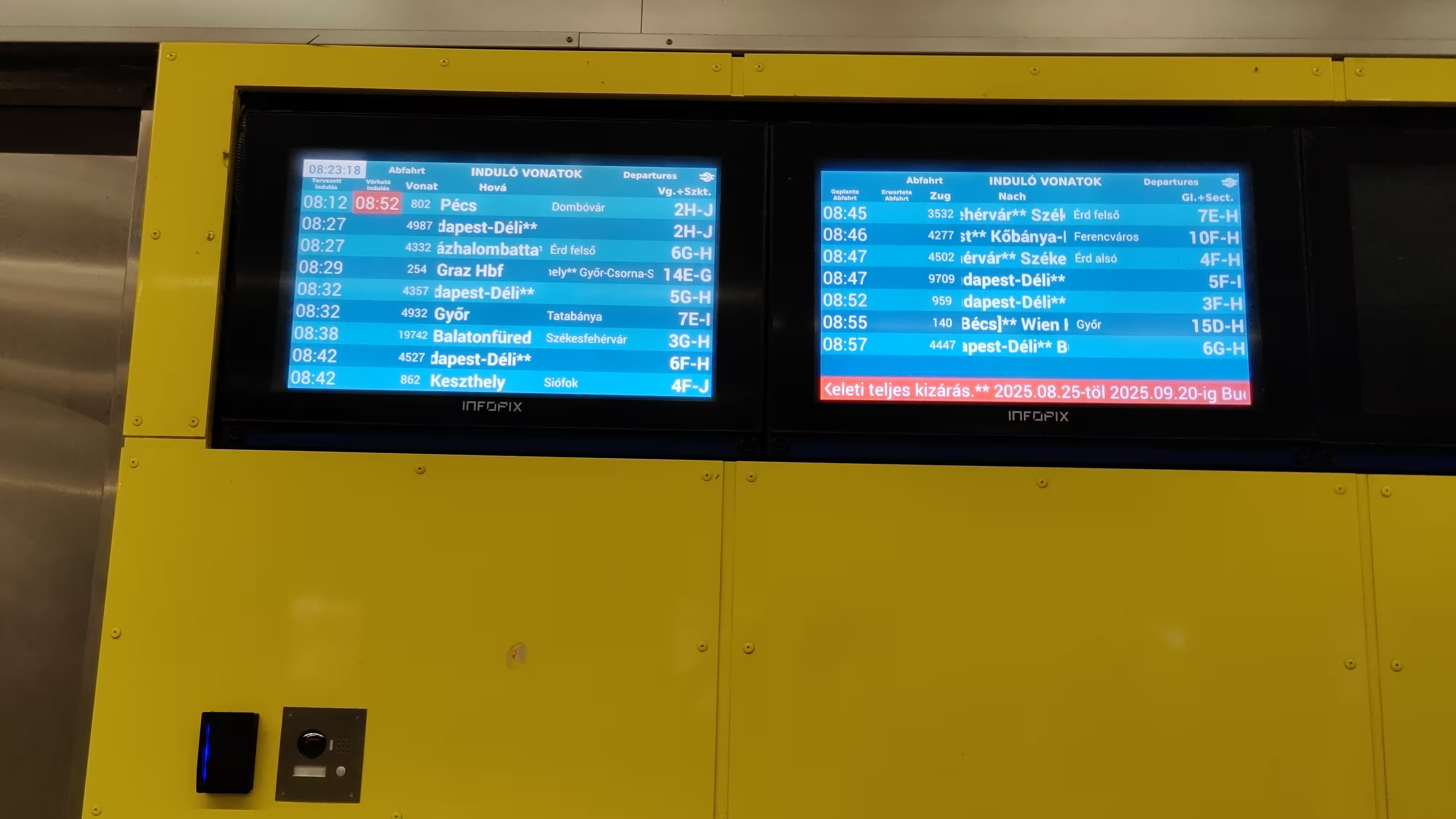
On the 7th of September 2025, my friend Dione and I had a day trip to Vienna the capital of Austria. We were attending a conference in Budapest, Hungary, which is 250 km from Vienna. So, it was a good opportunity to visit Vienna. We took a morning train from Budapest to Vienna and got back to Budapest by night. However, booking these tickets turned out to be a bit complicated. There were many websites to book the train ticket Hungarian Railways, Austrian Railways, and third-party sites such as Omio. All these websites had different prices for the same ticket. I booked the tickets from the Hungarian Railways website as it was the cheapest. The train from Budapest to Vienna was 13, operated by Eurocity. Also, I had to pay 2 for the seat reservation on top. The train from Vienna to Budapest operated by Railjet was 21, along with 2 extra for reservation again making it 23. The tickets for the two-way journey added up to 38. The cost of these tickets varied depending on when one purchses them: the sooner you purchase, the lower the price. I bought my tickets 15 days ahead of the date of journey and paid just 38. In contrast, Dione booked just one day before her trip and paid around 100 for her tickets. As for the seat reservation, long-distance trains in Europe usually require paying extra for the seat reservation. This ensures that you get your preferred seat, such as a window seat or an aisle seat. Nevertheless, you will get a seat on long-distance trains because they do not sell more tickets than there are seats. Therefore, you will get a seat without reservation as well. However, we reserved our seats so that we can sit together. This helped us more in the return part of the journey from Vienna to Budapest which was more crowded than the train we took from Budapest to Vienna in the morning. On another note, reservation is mandatory on some trains in Europe, but ours wasn t one of them. In addition, people also use rail passes, so an extra charge is required on top for reserving the seats for pass holders. On the other hand, local trains do not require seat reservations in general. Our train s scheduled departure was at 08:55 from the Budapest Kelenfold station. We reached the train station 40 minutes before the train s scheduled departure. The Kelenfold station had free Wi-Fi, which was handy because I didn t have a local SIM.
A departures board at Budapest Kelenfold station. A departures board at Budapest Kelenfold station. Photo by Ravi Dwivedi, released under CC-BY-SA 4.0.

A platform on Budapest Kelenfold station. This is platform number 15 of Budapest Kelenfold station where we boarded our train. Photo by Ravi Dwivedi, released under CC-BY-SA 4.0.

Our train arrived on time. I tried to find our coach number but could not find the numbers written anywhere on the side of the coach. Luckily, we were helped by a fellow passenger who directed me to look at the doors, where the numbers were mentioned clearly! Then we got into our compartment and took our respective seats. Our tickets were checked twice - once while the train was in Hungary and the other when in Austria. Showing the PDF of the train ticket on our mobile to the ticket inspector was good enough for the purpose. Austria and Hungary are a part of the open transit Schengen area, which means this was the extent of the border control checks we had to go through.
Interior of the train. Interior of our Budapest to Vienna train. Photo by Ravi Dwivedi, released under CC-BY-SA 4.0.

The train also had free Wi-Fi, albeit with poor connection at times. There were no eatery options inside the train. We deboarded at the Wien Hauptbahnhof station in Vienna. The journey was 250 km and took 2.5 hours, reaching Vienna at 11:25, which was the scheduled time.
A blue and white colored train on a railway platform This blue colored train was the one we took for our Budapest to Vienna journey. Photo by Ravi Dwivedi, released under CC-BY-SA 4.0.

A red colored train standing at the Vienna station An BB train standing at a platform of Vienna train station. BB is the national carrier of Austria. Photo by Ravi Dwivedi, released under CC-BY-SA 4.0.

Wien Hauptbahnhof train station Wien Hauptbahnhof train station. Photo by Ravi Dwivedi, released under CC-BY-SA 4.0.

At the station, we bought a 24-hour public transport pass from a ticket machine for 8. The pass includes unlimited access to all the public transport in Vienna for 24 hours. My pass was valid from the 7th of September at 11:34 to the 8th of September at 11:33. A single public transport ticket (from anywhere to anywhere) costs 2.4. A single ticket of 2.4 can be used once on any public transport in Vienna trams, metros, and buses. Therefore, the pass is a good deal if you are going to take at least four public transport trips in a day. Unlike the public transport pass I got in Budapest, the pass in Vienna was anonymous and not tied to the rider s name.
Public transport pass for Vienna. My public transport pass in Vienna.
We wanted to visit the Sch nbrunn Palace. The palace was reachable by subway. In order to get to the subway station, we started by going outside the station. But it was not outside. So we came back inside the station building and realized that the subway was underground. We took the subway and deboarded at the Sch nbrunn subway station the closest one to the palace. The ride was smooth; the train was pretty silent. By the way, like Budapest, there were no AFC gates for boarding the subway in Vienna. The stations had ticket validators instead, where you are supposed to validate your tickets before getting into the subway.
Vienna subway Instead of AFC gates, Vienna has ticket validators as in the picture. You need to tap your ticket in the validator before boarding the subway. Photo by Ravi Dwivedi, released under CC-BY-SA 4.0.

These validators are in place to ensure that you use your ticket only once. Unlike AFC gates, which are present in metros of most of the countries I have been to, the ticket validators don t act as a physical barrier to enter the boarding area. If you board the metro without validating your ticket, you will be facing hefty fines upon getting caught. I have heard that the fine is around 100. On the other hand, if you have a public transport pass like we did, then you don t need to validate it before boarding. In addition, there were no annoying security checks either, unlike in Indian cities. In the Delhi metro, for example, you would need to scan your bags and pass through a security check before getting to the AFC gates.
Vienna subway Vienna subway. Photo by Ravi Dwivedi, released under CC-BY-SA 4.0.
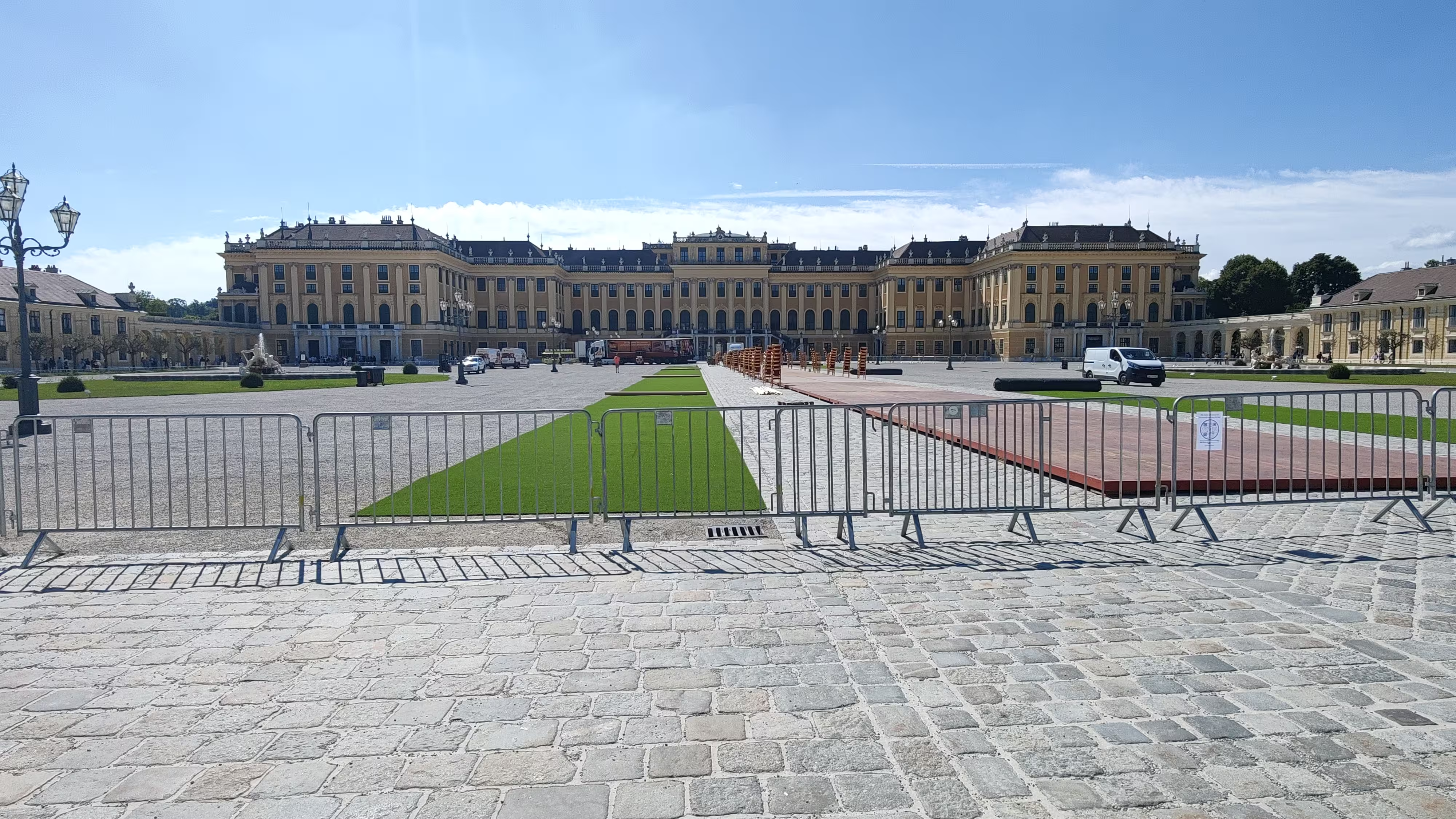
Now back to the story, after alighting at the Sch nbrunn subway station, we walked to the Sch nbrunn Palace. One can roam around outside the palace and click pictures for free. To go inside, however, requires buying tickets. The tickets for the palace can be booked in advance on the internet. We didn t take the tickets in advance, as we decided to visit the palace at the last moment. So we went to the ticket counter and found out that we needed to wait for 1 hour 40 minutes before going inside if we took the tickets at that moment. In addition, one ticket costs 44 (around 4000 Indian rupees). Since we had to return to Budapest in the evening and only had a few hours in the city, we decided not to go inside the palace. Instead, we clicked a few pictures outside the palace.
Photo of Sch nbrunn Palace. Sch nbrunn Palace. Photo by Ravi Dwivedi, released under CC-BY-SA 4.0.
The Sch nbrunn Palace is a UNESCO World Heritage Site and is a historically significant place. It servedas one of the residences of the powerful Habsburg dynasty. The palace looked so good that my friend Dione said, It seemed like the palace was built yesterday . This remark applied to other parts of Vienna we went to. For example, the subway stations also seemed like they were built yesterday.
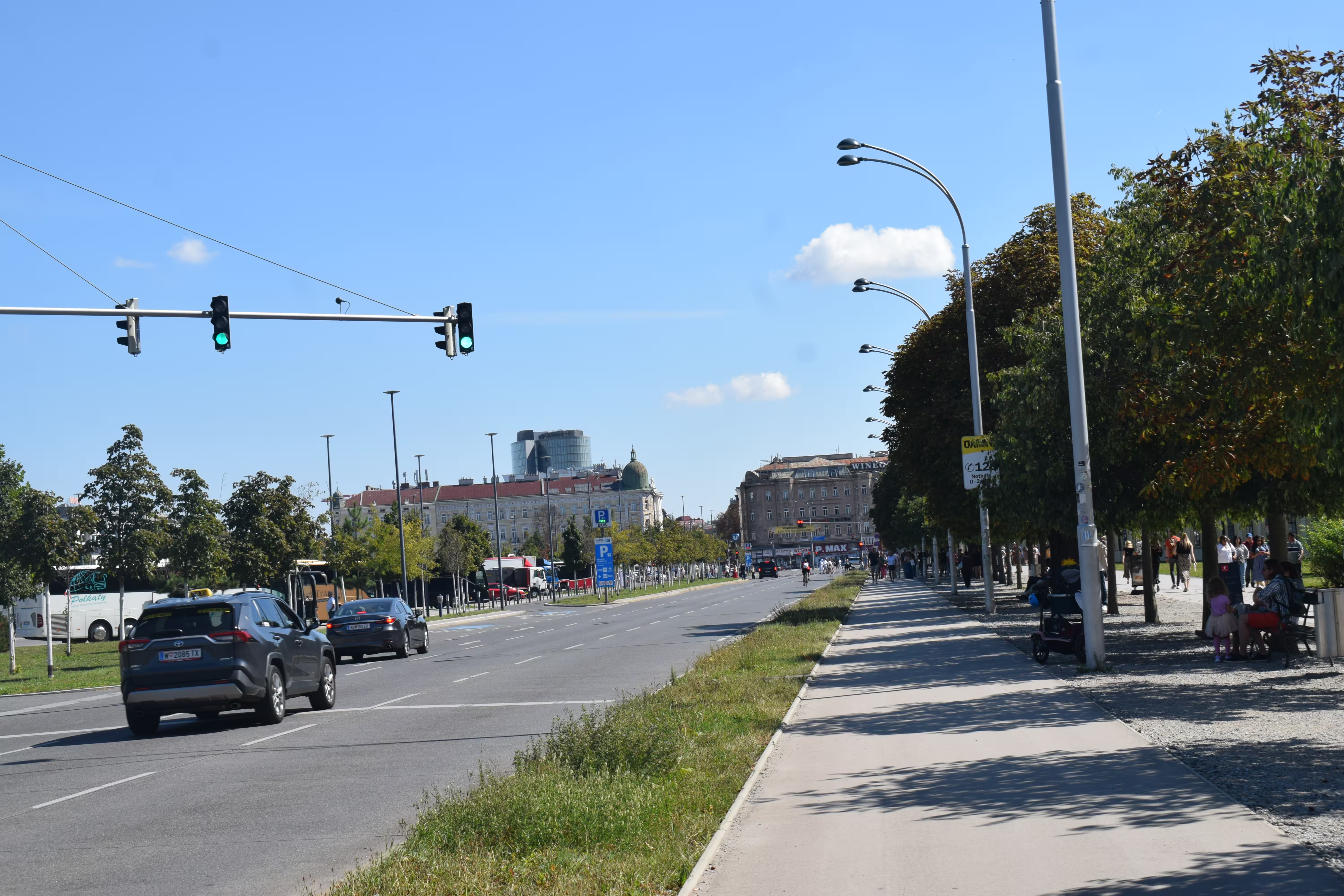
A street near Sch nbrunn Palace. A street near Sch nbrunn Palace. Photo by Ravi Dwivedi, released under CC-BY-SA 4.0.

Now, we wanted to go someplace to grab a bite. I asked my friend Urbec for suggestions on where to go. They suggested we visit the steps named Strudlhofstiege, which had the added benefit of being in a neighborhood with good bakeries and buildings. So, we took the subway and deboarded at the Ro auer L nde station, followed by walking around a kilometer to reach the stairs.
A subway station in Vienna. Ro auer L nde subway station. Photo by Ravi Dwivedi, released under CC-BY-SA 4.0.

Platform of the _Ro auer L nde_ subway station. Platform of the Ro auer L nde subway station. Photo by Ravi Dwivedi, released under CC-BY-SA 4.0.

stairs with road in the front and trees in the background. Blue sky can also be seen in the background. The The Strudlhofstiege steps. Photo by Ravi Dwivedi, released under CC-BY-SA 4.0.

On the way, we were also looking for a place to eat. Unfortunately, it was Sunday, and Vienna closes on Sunday. That means most of the shops including bakeries and caf s are closed. Only places like railway stations have shops open on Sundays. By the way, walking around in the streets of Vienna was a treat. The streets were not crowded (as it was not exactly a touristy neighborhood) and had good pedestrian infrastructure, with clean streets and separate cycling tracks. The buildings were also beautiful.
Buildings and streets in Vienna. A random street in Vienna.
Buildings and streets in Vienna. Another street in Vienna.
After some walking, we found a restaurant open. I grabbed the menu to check the prices. A lady at the shop asked me what I was doing, and I told her that I was browsing the menu. She said that the menu was in German. I don t know how she knew that we didn t know German, but it seemed like a racist thing to be told. We roamed around further and found a caf by the name of Blue Orange, where we ordered coffee and croissants. When we got our order, the waiter told us that they were having some issues, so they wouldn t charge us for the croissant if it wasn t good.
Picture of a caf . A picture of Blue Orange caf . Photo by Ravi Dwivedi, released under CC-BY-SA 4.0.
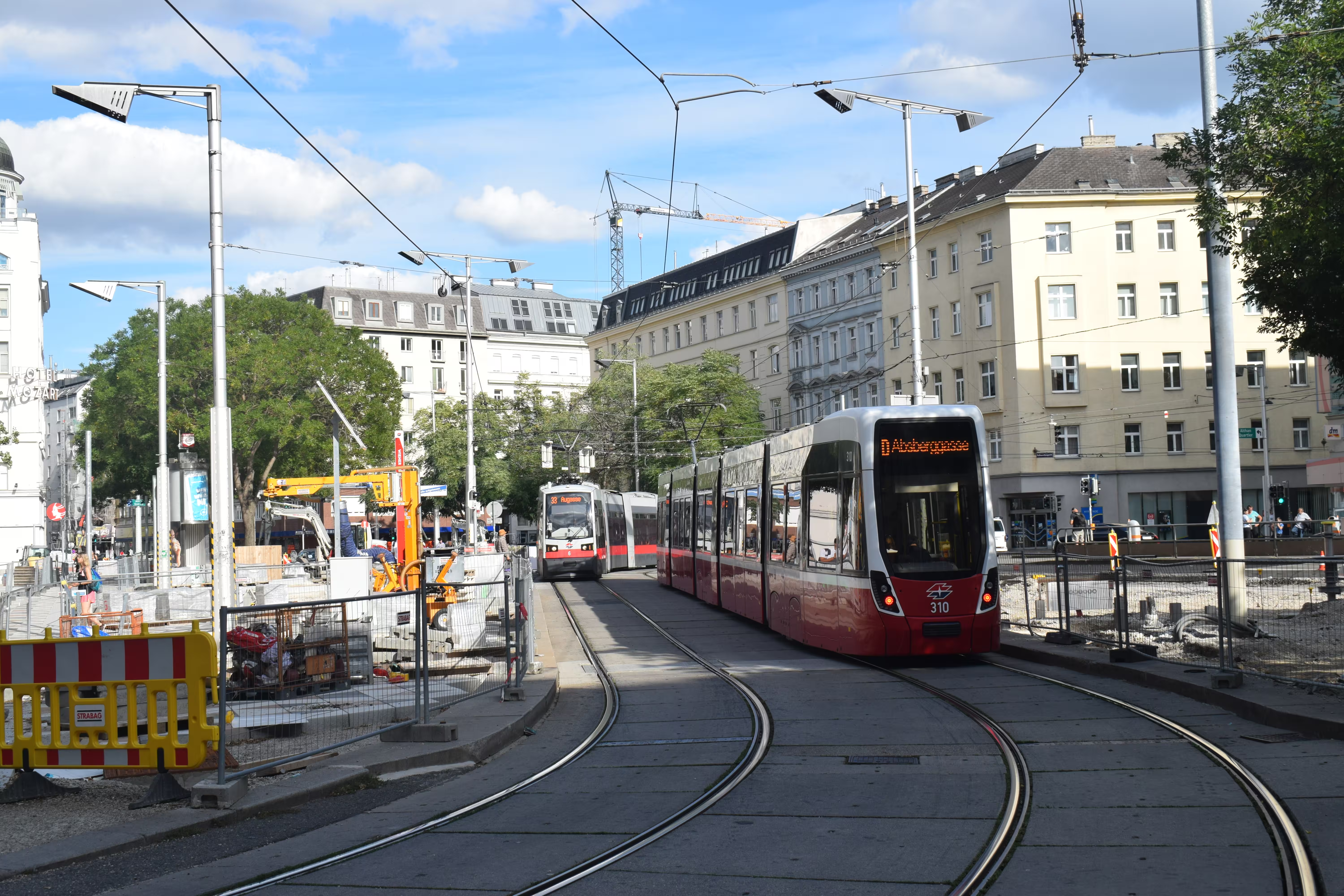
My friend and I took a bite, and both of us didn t like the croissant. After some time, the waiter came to us and asked whether the croissant was okay, to which we said no. Therefore, they didn t charge us for the croissant. This was the first time something like this happened to me. It felt like I was in a different world. I added a small tip at the end for this gesture, which I had to put in a jar at the counter. The cappuccino I ordered was 4.50, while the espresso that Dione ordered was 3.60. The croissant would have been 3.60. I remember Paris having cheaper croissants! Then when the waiter brought our drinks out, they automatically gave me the espresso and Dione the cappuccino. Dione found this funny because there is a stereotype in her country (Australia) that men drink strong black coffee, and women drink milky drinks like cappuccinos. She found it interesting that this stereotype seems to exist in Austrian culture too. We hopped on a tram to reach the nearest subway station and went to the Wien Hauptbahnhof station to have something before we caught our return train to Budapest.
Trams with buildings and the blue sky in the background Trams in Vienna. Photo by Ravi Dwivedi, released under CC-BY-SA 4.0.

At the station, I had Esterhazyschnitten and Punschkrapfen (thanks, Urbec, for the suggestion). The lady at the shop warned me that punschkrapfen had alcohol in it, to which I said okay. Esterhazyschnitten was a cake made of almonds, while punschkrapfen was a jam-filled sponge cake, soaked in rum. Esterhazyschnitten was my favorite out of the two. The punschkrapfen was too sweet for my taste.
Punschkrapfen Punschkrapfen. Photo by Ravi Dwivedi, released under CC-BY-SA 4.0.

Esterhazyschnitten Esterhazyschnitten. Photo by Ravi Dwivedi, released under CC-BY-SA 4.0.
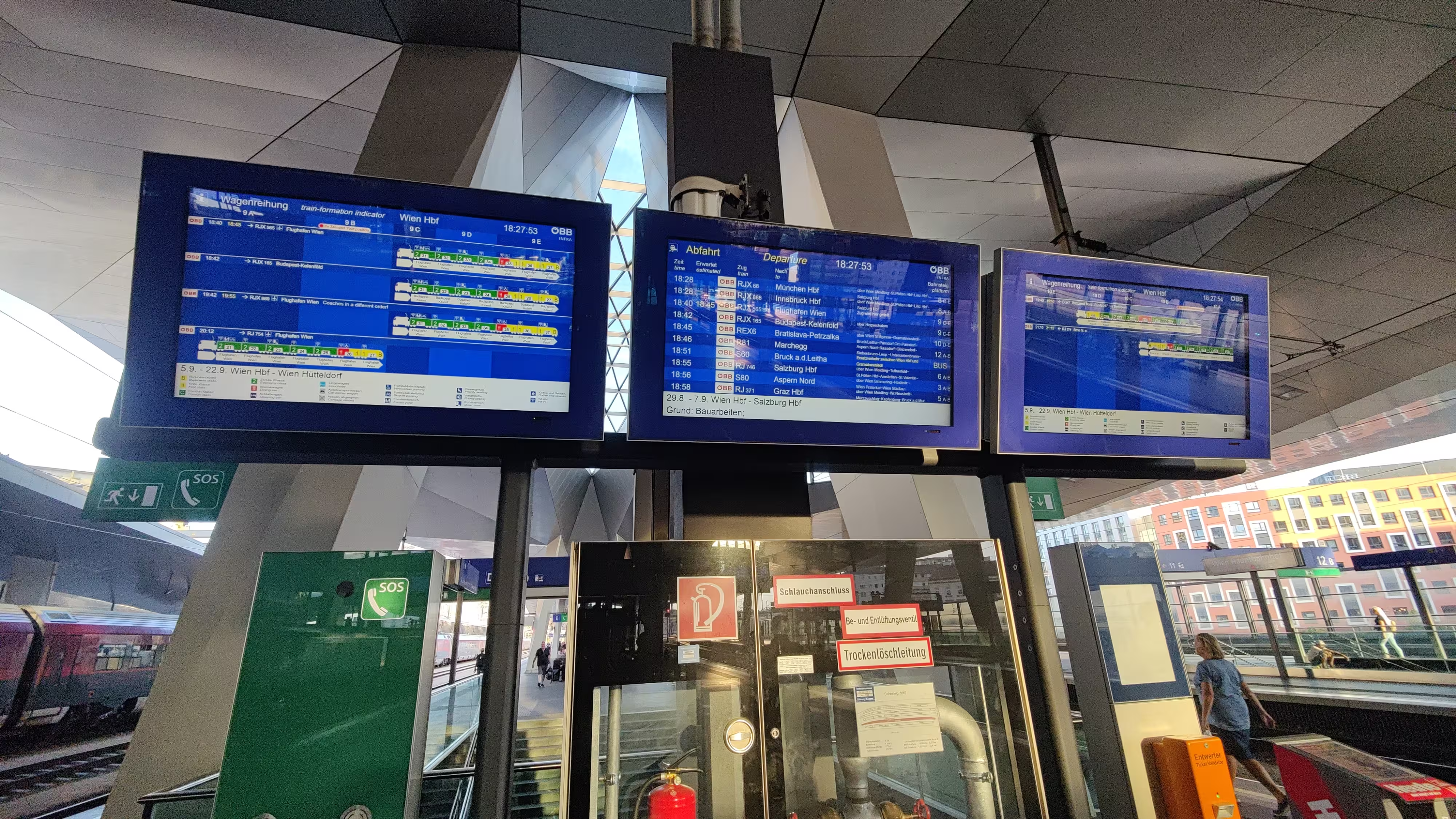
While the station was well-built, there were a couple of things about the Wien Hauptbahnhof station that we didn t like. There were no seats inside the station, so we had to eat outside the building. Also, the toilets needed to be paid for. It costs 50 cents to use the toilets at this station. The Vienna train station had departure boards all over the place. So, we went to the platform our train was to arrive on.
A departure board in Vienna displaying information about the trains Departure boards in Vienna displaying information about the trains. Photo by Ravi Dwivedi, released under CC-BY-SA 4.0.

Platform and tracks at Wien Hauptbahnhof station. Platform and tracks at Wien Hauptbahnhof station. Photo by Ravi Dwivedi, released under CC-BY-SA 4.0.

When our train arrived, we had some difficulty locating our compartment. This train was operated by a different company (Railjet) than the one we took in the morning (Eurocity) from Budapest to Vienna, and we were able to locate the coach numbers using the digital board at the station. Each compartment had a digital board next to it on the station displaying the coach number. However, that wasn t the problem. Even after reading the coach numbers and trying to find ours, it didn t appear where we expected in the sequence. When we were not able to find our coach for a while, we asked a ticket inspector of the train who was standing on the platform. He directed us towards the front side of the train. So we started running to the front side as we didn t know how long the train stops. As we ran toward our coach, we found out that the engine of the back train was connected with the last compartment of the train at the front. At that point, we realized that the train was a combination of two trains. At a later station, the train on the back side parted ways and went towards Vienna Airport.
Inside our train. Interior of the train we took from Vienna to Budapest. Photo by Ravi Dwivedi, released under CC-BY-SA 4.0.

A red colored train standing on the platform of Budapest Kelenfold station. This is the train we took for our return journey from Vienna to Budapest. It is standing on a platform in Budapest Kelenfold station. Photo by Ravi Dwivedi, released under CC-BY-SA 4.0.
We had a smooth journey and reached Budapest a couple of hours later. Vienna is a beautiful city; we enjoyed being there, and we would like to visit the city again! That s it for now. Signing off. See you in the next one! Credits: Thanks to Dione and Badri for proofreading.

27 April 2026

Gunnar Wolf: Heads we win, tails you lose AI detectors in education

This post is an unpublished review for Heads we win, tails you lose AI detectors in education
Educators throughout the world are tasked with the difficult requirement of evaluating students works, making sure the grades meaningfully reflect the students understanding of the subject, and that a graded assignment maps to the relevant work invested in solving it. After the irruption of Large-Language Models in late 2023, this task became obviously much harder: if a widely available computer program is able to solve an assignment in a way that resembles a human-generated response, how can educators meaningfully grade their groups? As it has been the case with different innovations over time (such as with the appearance of electronic calculators or the mass availability of digital encyclopedias), the first reactions were of prohibition and denial: students who use the new tool in question are to be disqualified or somehow punished. It is only some time after the innovation in question settles that teachers find a way to properly weigh, integrate and accept its use. The authors of this position article present several arguments as to why it is impossible, unethical and unadvisable to use automated AI detection systems to process student assignments. The first argument is whether it is at all possible to reliably differentiate human-written essays from LLM-generated artifacts. The first criticism is that AI detectors are, themselves, LLMs trained on human-generated texts (negative) and LLM-generated texts (positive). However, the only way to assert the training material is not noisy is to use pre-2020 text as human-generated but natural ways of writing are influenced by what people read, and the authors quote studies pointing out that human language, particularly in the scholarly fields, has incorporated terms and constructions that were used as LLM markers. Quoting the authors, As exposure to AI-generated material becomes increasingly widespread, it is reasonable to expect that the linguistic patterns of human writing will shift, reflecting the influence of AI-assisted texts encountered across education, media, and everyday communication . Stylistic elements and other such markers are being adopted back into regular speech at a high rate. Then, the aspect of ethics comes into play as well. While it is expected that teachers should demand intellectual integrity from students, and plagiarism detectors have been widely accepted into the workflow of academics, the accusation of presenting LLM output as own work is necessarily an uphill battle: the accused party is tasked with providing proof of innocence based on nebulous, probabilistic accusations. The authors argue, once an accusation of turning in a LLM-generated text is made on a student, the onus on proving innocence lies with the accused. The authors review and argue against a series of techniques that have been presented in literature to aid teachers in detecting LLM abuse, such as linguistic markers, single or multiple AI detectors, the use of false references, hidden adversarial prompts, arguing in all cases the techniques fail to be trustable enough and highlighting the probability of both false positives and negatives. They also present AI detection as a false dichotomy: many works presented are not 100% human generated nor 100% LLM-generated, but some pertinent LLM-generated paragraphs are presented mixed with human-generated content, in a positive, critical AI use ( Students work is frequently created with, not by, generative AI ). The article closes by reiterating the authors position: AI detection in education is not merely flawed; it is conceptually unsound . they call upon institutions to accept the use of generative LLMs cannot be solved through surveillance and punishment , but has to be tackled by an assessment design that recognizes AI s role in learning . This article s position is very strong and well argued, and although it will surely meet with ample opposition, it surely poses an important, very current problematic. As a teacher, I found it a very enlightening read.

Sahil Dhiman: Weekly Notes

Weekly notes is a genre where people chronicle their week on their blogs. Weekly notes are like a window. I love going through these, as they re a steady stream of week on week happenings and progress in people s lives. It shows people making efforts to improve: from basic things like learning to swim or drive, to planning long-term goals such as vacations, moving house, states, or even countries. In some cases, they carry internal monologues, thoughts, and anxieties. These are like a constant nudge for me to work on myself, like them. These are the weekly notes I read nowadays: Most are there on Thejesh s weekly notes planet which autoupdates when new posts arrive, usually starting on Friday evenings, and by Monday, almost everyone has posted. It reminds of a word from The Dictionary of Obscure Sorrows - Kenaway :
the longing to see how other people live their lives when they re not in public; wishing you could tune in to the raw feed of another human existence, in all its messiness and solitude shimmying in place while brushing their teeth, squabbling over where to put the shoes, talking out their problems on solitary commutes if only to give you something to compare your own life against, and figure out whether you re bizarrely normal or normally bizarre.
Close enough.

Russ Allbery: Review: What We Are Seeking

Review: What We Are Seeking, by Cameron Reed
Publisher: Tor
Copyright: 2026
ISBN: 1-250-36474-4
Format: Kindle
Pages: 339
What We Are Seeking is a bit hard to classify beyond science fiction. I think I would call it anthropological science fiction, but it's also a first contact story and a planetary colony story. It is a standalone novel (well, so far as I know; see later in the review for caveats). This is Cameron Reed's second novel after the excellent and memorable cyberpunk novel The Fortunate Fall, first published in 1996 under Reed's former name of Raphael Carter. John Maraintha is a doctor from the world of Essius. He took what he thought was a temporary job on the Free Ship Edgar's Folly, where he's endured considerable culture shock. As the novel opens, John learns that the colonists on Scythia have requested a translator to talk to one of the native life forms, and a doctor since they're down to only one. John will be that doctor. The captain has decided, and by the rules of the free ships, John does not get a choice in the matter. The Scythian colony is about four hundred people, now located in a desert climate since the complex native life forms destroyed their previous settlement. The colonists are a split between Ischnurans and Zandaheans, two other human civilizations from the scatter of colony worlds left after Earth embraced AIs (aiyis here) and turned inward. Both of those groups marry, something John considers a moral abomination. Neither of them seem likely to understand Essian sexual ethics. More devastatingly, John had intended to spend some time as a ship doctor and then return home to a new place in Essian society. Once he lands on Scythia, the chances of that are gone; it is highly unlikely any ship would pick him up again and take him home. I have been trying to find the right books to compare What We Are Seeking with ever since I read it. The best I've come up with are Ursula K. Le Guin (particularly The Dispossessed), Eleanor Arnason's A Woman of the Iron People, and Becky Chambers's To Be Taught, If Fortunate. The start of the book felt like an intentional revisiting of an earlier era of science fiction, with somewhat updated science and politics, but the last half of the book, where the action picks up considerably, is a meditation on gender, social systems, religion, and small-group politics. All of that is mixed with biological exploration and a first-contact story with some quite-alien aliens. This is the sort of novel where the protagonist's culture is as foreign to the reader as any of the other cultures he counters, so the reader is assembling several jigsaw puzzles at once. John is dropped into an established colony with its own social norms and established hierarchies. The one other outsider, the translator Sudharma Jain, is, as his name implies, a Jain who keeps very strict religious observances. Half of the colony is from something akin to a fundamentalist Christian religious sect that practices patriarchy and strict marriage codes. The other half is more gently sexist (but still sexist) and has its own tradition of a third gender that becomes central to the story. John, meanwhile, is a strong believer in the Essian approach to social organization: Any two partners of any gender freely have sex by mutual consent and without obligation, and family is based solely on blood relations. These beliefs do not fit comfortably together, even when people are trying (as they mostly do) to be welcoming. The first half of this book is very slow. This gives all of the characters space to breathe and become comfortable, and the characterization is superb, but it is a book to start when you're in the mood for something slow and observational. There is a plot that gradually becomes apparent, or rather there are several plots that are intertwined, but tension and urgency are mostly reserved for the second half of the book. Instead, the book opens with a lot of close observation of alien flora and fauna and the untangling of subtle social dynamics among the Scythians. There is also a visitor from earth, much to the distress of the Scythians. Earth presence means the ships will not return and the colony may be cut off from any sort of technological resupply. Despite speaking a common language, that visitor is as mutually alien to the other groups as they are to the native flora. Her life is fully integrated with aiyis, giving her essentially godlike powers and the ability to turn off inconvenient emotions and disregard anything she doesn't want to see. What she and the Earth aiyis are doing on the planet is one of the early mysteries. The dialogue in this book is truly excellent. Each characters has their own voice, there are fascinating digressions on different words that lead to tidbits of world-building, and some of the culture-specific idioms are delightful.
"I'm making a mess of this. None of that matters. Let me fall out the window and come in the door again. This is how my story ought to start:"
The challenges for the characters in this story are slow but deep ones: belonging and self-definition, the conflict between cultural tradition and personal circumstance, and the sacrifices required to live with small groups in situations where civil war is viscerally attractive. It has one of the most comprehensive and fascinating treatments of transgender issues that I've read in science fiction. Its commentary on current politics is subtle and estranged in the way that science fiction does best, but still pointed and satisfying. And, well, there are passages like this that I absolutely adore:
"I wouldn't go that far. It could be they are right, the universe we see exists because a mind like ours created it at least, a mind enough like ours that we can say it wants one thing and not another, and when it acts it does so with intent. That's as good an idea as any. But it is certainly not plausible that such a being believes that people everywhere should marry, or that men should never visit men, or no one should become a jess. Look at what they have created. The universe could have been nothing at all, or one atom of hydrogen floating in a void, or a diamond crystal infinite in all directions, if their mind cared for simplicity or tidiness. Instead we have stars and planets and black holes and nebulas. It could have all been cold and dead, but there is life. They could have made one species for each world, or just a few, which could have stayed the same forever, but instead we have millions and millions, all of which are changing every moment, varying among themselves and boiling off in all directions. Such a god is like an artist who fills up a library of sketchbooks with their drawings of strange creatures, and when every scrap of paper in the place is used up, goes back with a different color ink and scribbles over them again. They are obsessed with variation they gorge themselves with it and never grow full. Do you really think a mind like that could want us all to live in the same way?"
I had one problem with this book, though, and for me it was a big one: There is no ending. Reed effectively builds tension, gets me caring about all of the characters, sets up several problems, starts down a path towards resolution, and then the book just... ends. Long-time readers of my reviews will know that I'm a denouement fanatic. I want the scouring of the shire, I want the chapter set in the happily ever after, I want the catharsis of an ending. This made me so grumpy! To be clear, this is not sequel bait (at least so far as I can tell). I can write a philosophical defense of the ending. The types of problems and lives that Reed set up don't have clear endings; this is, to some extent, the point. We muddle through, and then those who come after us muddle through some more, and the cumulative effect is called human civilization. And there is some denouement; Reed doesn't leave the reader at a cliffhanger or anything that egregious. But still, I wanted the happy ending, even though that was unrealistic for the style of story this is, because I'm a happy ending reader. This is not an ending sort of book; it's the sort of book where I get a sinking feeling at the 95% mark because there aren't enough pages left for the number of remaining unresolved problems. I've gotten less annoyed in the days since I finished the book, and I can appreciate the thematic point made by how the book ends, but I still feel like it's worth an advance warning if you're a reader like I am. I would be delighted by a sequel, but it didn't feel like that was the intent. Apart from that, this was both excellent and rather unlike a lot of current science fiction. I think the closest comparison I can make among recent novels I've read is Sue Burke's Semiosis. What We Are Seeking has a similar sort of world-building, but I liked these characters so much more. It felt like a classic literary science fiction novel, but very much written in 2026. Highly recommended, just beware of the lack of closure. Content notes: Sexism, homophobia, stomach illness, and some religious abuse. Rating: 8 out of 10

25 April 2026

Russ Allbery: Review: The Genocidal Healer

Review: The Genocidal Healer, by James White
Series: Sector General #8
Publisher: Orb
Copyright: 1991
Printing: May 2003
ISBN: 0-7653-0663-8
Format: Trade paperback
Pages: 255
The Genocidal Healer is the eighth book in James White's medical science fiction series about the Sector General hospital. As with the rest of the series, detailed memory of the previous books is not required and the books could be read out of order if you didn't mind spoilers. I read this as part of the Orb General Practice omnibus. Surgeon-Captain Lioren is a Tarlan doctor who was in charge of the medical response to a newly-discovered civilization. The aliens were suffering from an apparently universal plague and an ongoing vicious war waged entirely through hand-to-hand combat, putting them on the edge of extinction. Lioren rushed the distribution of a possible cure against the advice of the doctors working on developing it, with catastrophic results. As The Genocidal Healer opens, Lioren is insisting on a court-martial in the hope of receiving the sentence it believes it deserves and was denied: death. (It pronouns are the convention in the Sector General series for all alien races and formal discussions, because even someone prone to bouts of gender essentialism such as White understood the need for avoiding gender assumptions in a science fiction medical context.) Predictably, both Sector General and the Monitor Corps that technically runs the hospital are flatly unwilling to execute Lioren. Instead, he is assigned as a new apprentice in the psychology department under the legendary O'Mara, where he is ordered to investigate the psychological fitness of a senior doctor named Seldal. This leads him to talk to Seldal's patients, which in turn leads to a challenging set of ethical dilemmas. The first five chapters (and more than sixty pages) are the story of Lioren's trial and a recounting of the events on Cromsag. The series is full of medical and cultural puzzles like this, and usually I like them, but I thought this one was less successful. We know the vague (and horrible) outline of the ending in advance, and the massive simplification and artificial universality that is required to make this puzzle work is particularly blatant. A universally infectious disease is more of a fiction plot than a believable biological concept, and the number of failures of communication, analysis, and misunderstanding that have to line up to create White's predetermined outcome were a bit much for me. Once the story gets past that and into Lioren's psychological work, the novel improves. Lioren is guilt-ridden and irrational, but also rather arrogant about his guilt and his concepts of professional responsibility in a way that I think mostly worked. Most of the novel consists of Lioren slowly discovering that people like him and enjoy talking to him, much to his bafflement. In that, it has the gentle kindness and sense of universal basic decency that is characteristic of this series. There are, of course, medical puzzles to solve, although this time they are primarily psychological in nature. Various characters from previous books make an appearance, but White re-explains their background in sufficient detail that you don't need to remember (or have read) those previous books. There are a lot of similarities between this book and the previous one, Code Blue Emergency. Both feature nonhuman viewpoint protagonists and amusing descriptions of human facial expressions from an alien perspective. Both feature protagonists with overly rigid ethical structures that partly clash with the generally human policies of Sector General. The Genocidal Healer is a bit more subtle and nuanced, although a lot of Lioren's psychological evaluation rests on an ethical difference that I found somewhat unbelievable. This book, though, tackles a subject the previous book did not: religion. The treatment isn't horrible, but I have some complaints. My primary issue is that Lioren, who starts as an atheist, does extensive research into religion to help a patient and then starts making statements summarizing the religions beliefs of the majority of known species that are just... Christianity. As someone raised Christian, I recognized it immediately as the sort of abstracted Christianity that Christians claim is universal while completely ignoring the opinions of the adherents of any other religion. Key components of this majority galactic religious pattern, according to Lioren, include an omnipotent and omnibenevolent creator god, a religious figure who preaches forgiveness and mercy and is persecuted, and emphasis on redemption. This simply is not some abstract universal religion. This is just Christianity in disguise. Even in religions that have some of those elements in their traditions, they do not get the same emphasis and are not handled the way that Lioren describes them. I therefore found Lioren's extended discussions of religion rather annoying, since he kept claiming as relatively universal principles beliefs that are not even held by the majority of religious adherents on Earth, let alone a wildly varying collection of alien races with entirely different biology and societal constructions. It caused a lot of problems for my suspension of disbelief, on top of the annoyance at this repetition of, frankly, Christian propaganda. Lioren goes, from that research, into theodicy (the problem of evil). The interesting part of this is White's earnest portrayal of a doctor's approach to societal problems: a desire to find workarounds and patches and fixes for anything that makes people unhappy, whether medical or social. It makes sense, given the horrible biologic hands that some of the aliens in this series have been dealt, that they would question the idea of a benevolent god, so this philosophical digression is justified in that sense. But you might guess that a mid-list science fiction author is not going to say something new about one of the oldest problems in Christianity, and indeed he does not. Lioren arrives at the standard handwaving about the unknowability of divine intent, which I found tedious to read but at least not fatal to the plot. White, thankfully, doesn't take the religious material too far. The characters recognize how sensitive of an issue religion is in a hospital, Lioren never adopts religion fully, and the resolution of the plot is as much biological as philosophical. White is going somewhere with the introduction of religion, and although some of the path there annoyed me, I think the destination worked. White was from Northern Ireland, and therefore well aware of the drawbacks of religion, and he abhorred violence (hence Sector General as a setting), so the reader is in better hands with him than with most authors who might attempt this plot. I think I know a bit too much about religion to be the best audience for this entry in the series, and I'm not sure the introductory five chapters quite worked. But as with all of the other books in the series, this kept me turning the pages and I'm glad I read it. The Genocidal Healer probably isn't worth seeking out unless you're reading the whole series, but if you're enjoying the rest of the series, you'll probably like this too. Followed by The Galactic Gourmet. Rating: 6 out of 10

24 April 2026

Freexian Collaborators: Monthly report about Debian Long Term Support, March 2026 (by Santiago Ruano Rinc n)

The Debian LTS Team, funded by [Freexian s Debian LTS offering] (https://www.freexian.com/lts/debian/), is pleased to report its activities for March.

Activity summary During the month of March, 20 contributors have been paid to work on Debian LTS (links to individual contributor reports are located below). The team released 24 DLAs fixing 250 CVEs. We also welcomed two new members: Lukas M rdian and Emmanuel Arias to the team, who actually started to contribute to the LTS project several months ago. The team continued preparing security updates in its usual rhythm. Beyond the updates targeting Debian 11 ( bullseye ), which is the current release under LTS, the team also proposed updates for more recent releases (Debian 12 ( bookworm ) and Debian 13 ( trixie )), including Debian unstable. We highlight several notable security updates here below.
  • ansible (DLA 4502-1), prepared by Lee Garret in collaboration with Jochen, fixing a vulnerability that allows attackers to bypass unsafe content protections
  • asterisk (DLA 4515-1), prepared by Lukas M rdian, fixing four CVEs that include possible privilege escalations.
  • gimp (DLA 4500-1), prepared by Thorsten, fixing four CVEs related to denial of service or execution of arbitrary code.
  • gst-plugins-base1.0 and gst-plugins-ugly1.0 (DLA-4514-1, DLA-4516-1, respectively), both prepared by Utkarsh, addressing vulnerabilities that may yield to arbitrary code execution.
  • imagemagick, released by Bastien Roucari s (DLA 4497-1) fixing multiple vulnerabilities that could lead to information leaks, bypass of security policies, denial of service or arbitrary code execution.
  • libpng1.6 (DLA 4521-1), prepared by Tobias Frost, fixing an arbitrary code execution vulnerability
  • linux: Ben Hutchings released DLA 4498-1 and DLA 4499-1 for linux 5.10 and linux 6.1, respectively. Those updates especially address the CrackArmor flaw.
  • ruby-rack (DLA 4505-1), prepared by Utkarsh Gupta, addressing two vulnerabilities
  • strongswan (DLA 4512-1), prepared by Thorsten Alteholz, fixing a Denial of Service vulnerability
  • roundcube (DLA 4517-1) prepared by Guilhem Moulin, who discovered that one of the fixes provided by upstream was incomplete.
Contributions from outside the LTS Team: As usual, the thunderbird update, released as DLA 4511-1, was prepared by its maintainer Christoph Goehre. Thanks a lot for his continuous contributions. The LTS Team has also contributed with updates to the latest Debian releases:
  • Andreas Henriksson completed the uploads of glib2.0 for both trixie and bookworm
  • Arnaud Rebillout: python-cryptography for trixie
  • Arnaud and Bastien worked together to prepare a ca-certificates-java release for unstable
  • Bastien completed the upload of gpsd for trixie that was proposed in January.
  • Bastien uploaded a regression update of apache2 for trixie
  • Bastien prepared a zabbix point update for trixie
  • Bastien in collaboration with Markus released netty updates for trixie and bookworm DSA 6160-1
  • Daniel Leidert proposed python-tornado releases for both trixie and bookworm.
  • Daniel also prepared a python-authlib update for trixie
  • Guilhem prepared a mapserver update for bookworm.
  • Lucas Kanashiro proposed merge requests to fix three CVEs in erlang for both trixie and bookworm
  • Sylvain Beucler continued the work to replace p7zip with 7zip in the different supported releases, and proposed a point update for bookworm
  • Tobias prepared trixie and bookworm security updates, released as DSA-6189-1
  • Utkarsh prepared trixie and bookworm security update for ruby-rack, released as DSA-6180-1

Individual Debian LTS contributor reports

Thanks to our sponsors Sponsors that joined recently are in bold.

23 April 2026

Sergio Talens-Oliag: Developing a Git Worktree Helper with Copilot

Over the past few weeks I ve been developing and using a personal command-line tool called gwt (Git Worktree) to manage Git repositories using worktrees. This article explains what the tool does, how it evolved, and how I used GitHub Copilot CLI to develop it (in fact the idea of building the script was also to test the tool).

The Problem: Managing Multiple BranchesI was working on a project with multiple active branches, including orphans; the regular branches are for fixes or features, while the orphans are used to keep copies of remote documents or store processed versions of those documents. The project also uses a special orphan branch that contains the scripts and the CI/CD configuration to store and process the external documents (it is on a separate branch to avoid mixing its operation with the main project code). The plan is trigger a pipeline against the special branch from remote projects to create or update the doc branch for it in our git repository, retrieving artifacts from the remote projects to get the files and put them on an orphan branch (initially I added new commits after each update, but I changed the system to use force pushes and keep only one commit, as the history is not really needed). The original documents have to be changed, so, after ingesting them, we run a script that modifies them and adds or updates another branch with the processed version; the contents of that branch are used by the main branch build process (there we use git fetch and git archive to retrieve its contents). When working on the scripts to manage the orphan branches I discovered the worktree feature of git, a functionality that allows me to keep multiple branches checked out in parallel using a single .git folder, removing the need to use git switch and git stash when changing between branches (until now I ve been a heavy user of those commands). Reading about it I found that a lot of people use worktrees with the help of a wrapper script to simplify the management. After looking at one or two posts and the related scripts I decided to create my own using a specific directory structure to simplify things. That s how I started to work on the gwt script; as I also wanted to test copilot I decided to build it using its help (I have a pro license at work and wanted to play with the cli version instead of integrated into an editor, as I didn t want to learn a lot of new keyboard shortcuts).

The gwt Philosophy: Opinionated and Transparentgwt enforces a simple, filesystem-visible model:
  • Exactly one bare repository named bare.git (treated as an implementation detail)
  • One worktree directory per branch where the directory name matches the branch name
  • Single responsibility: gwt doesn t try to be a general git wrapper; it only handles operations that map cleanly to this layout
The repository structure looks like this:
my-repo/
+-- bare.git/           # the Git repository (internal)
+-- main/               # worktree for branch "main"
+-- feature/api/        # worktree for branch "feature/api"
+-- fix/docs/           # worktree for branch "fix/docs"
+-- orphan-history/     # worktree for the "orphan-history" branch
The tool follows five core design principles:
  1. Explicit over clever: Git commands are not hidden or reinterpreted
  2. Transparent execution: Every operation is printed before it happens
  3. Safe, preview-first operations: Destructive commands default to preview, confirmation, then apply
  4. Shell-agnostic core: The script never changes the caller s working directory (shell wrappers handle that)
  5. Opinionated but minimal: Only commands that fit the layout model are included

Core CommandsThe script provides these essential commands:
  • gwt init <url> Clone a repository and set up the gwt layout
  • gwt convert <dir> Convert an existing Git checkout to the gwt layout
  • gwt add [--orphan] <branch> [<base>] Create a new worktree (optionally orphaned)
  • gwt remove <branch> Remove a worktree and unregister it (asks the user to remove the local branch too, useful when removing already merged branches)
  • gwt rename <old> <new> Rename a branch AND its worktree directory
  • gwt list List all worktrees
  • gwt default [<branch>] Get or set the default branch
  • gwt current Print the current worktree or branch name
Except init and convert all of the commands work inside a directory structure that follows the gwt layout, which looks for the bare.git folder to find the root folder of the structure. As I don t want to hide which commands are really used by the wrapper, all git and filesystem operations pass through a single run shell function that prints each command before executing it. This gives complete visibility into what the tool is doing. Also, destructive operations (remove, rename) default to preview mode:
$ gwt remove feature-old --dry-run
+ git -C bare.git branch -d feature-old
+ git -C bare.git worktree remove feature-old/
Apply these changes? [y/N]:
The user sees exactly what will happen, can verify it s correct, and only then confirm execution.

Incremental Development with CopilotThe gwt script has grown from 597 lines in its original version (git-wt) to 1,111 lines when writing the first draft of this post. This growth happened through incremental, test-driven development, with each feature being refined based on real usage patterns. What follows is a little history of the script evolution written with the help of git log.

Initial versionFirst I wrote a design document and asked copilot to create the initial version of the git-wt script with the original core commands. I started to use the tool with a remote repostory (I made copies of the branches in some cases to avoid missing work) and fixed bugs (trivial ones with neovim, larger ones asking copilot to fix the issues for me, so I had less typing to do).

First command updateOne of the first commands I had to enhance was rename:
  • as I normally use branches with / on their name and my tool checks out the worktrees using the branch name as the path inside the gwt root folder (i.e. a fix/rename branch creates the fix directory and checks the branch inside the fix/rename folder) the rename command had to clean up the empty parent directories
  • when renaming a worktree we move the folders and fix the references using the worktree repair command to make things work locally, but the rename also affects the remote branch reference, to avoid surprises the command unsets the remote branch reference so it can be pushed again using the new name (of course, the user is responsible of managing the old remote branch, as the gwt can t guess what it should do with it).

Integration with the shellAs I use zsh with the Powerlevel10k theme I asked copilot to help me add visual elements to the prompt when working with gwt folders, something that I would have never tried without help, as it would have required a lot of digging on my part on how to do it, as I never looked into it. The initial version of the code was on an independent file that I sourced from my .zshrc file and it prints on the right part of the prompt when we are inside a gwt folder (note that if the folder is a worktree we see the existing git integration text right before it, so we have the previous behavior and we see that it is a gwt friendly repo) and if we are on the root folder or the bare.git folder we see gwt or bare (I added the text because there are no git promts on those folders). I also asked copilot to create zsh autocompletion functions (I only use zsh, so I didn t add autocompletion for other shells). The good thing here is that I wouldn t have done that manually, as it would have required some reading to get it right, but the output of copilot worked and I can update things using it or manually if I need to. One thing I was missing from the script was the possibility of changing the working directory easily, so I wrote a gwt wrapper function for zsh that intercepts commands that require shell cooperation (changing the working directory) and delegates everything else to the core script. Currently the function supports the following enhanced commands:
  • cd [<branch>]: change into a worktree or the default one if missing
  • convert <dir>: convert a checkout, then cd into the initial worktree
  • add [--orphan] <branch> [<base>]: create a worktree, then cd into it on success
  • rename <old> <new>: rename a worktree, then cd into it if we were inside it
Note that the cd command will not work on other shells or if the user does not load my wrapper, but the rest will still work without the working directory changes.

Renaming the commandAs I felt that git-wt was a long name I renamed the tool to gwt, I could have done it by hand, but using copilot I didn t have to review all files by myself and it did it right (note that I have it configured to always ask me before doing changes, as it sometimes tries to do something I don t want and I like to check its changes as I have the files in git repos, I manually add the files when I like the status and if the cli output is not clear I allow it to apply it and check the effects with git diff so I can validate or revert what was done).

The convert commandAfter playing with one repo I added the convert subcommand for migrating existing checkouts, it seemed a simple task at first, but it took multiple iterations to get it right, as I found multiple issues while testing (in fact I did copies of the existing checkouts to be able to re-test each update, as some of the iterations broke them). The version of the function when this post was first edited had the following comment explaining what it does:
# ---------------------------------------------------------------------------
# convert - convert an existing checkout into the gwt layout
# ---------------------------------------------------------------------------
#
# Must be run from the parent directory of <dir>.
#
# Steps:
#   1. Read branch from the checkout's HEAD
#   2. Rename <dir> to <dir>.wt.tmp (sibling, same filesystem)
#   3. Create <dir>/ as the new gwt root
#   4. Move <dir>.wt.tmp/.git to <dir>/bare.git; set core.bare = true
#   5. Fix fetch refspec (bare clone default maps refs directly, no remotes/)
#   6. Add a --no-checkout worktree so git wires up the metadata and
#      creates <dir>/<branch>/.git (the only file in that dir)
#   7. Move that .git file into the real working tree (<dir>.wt.tmp)
#   8. Remove the now-empty placeholder directory
#   9. Move the real working tree into place as <dir>/<branch>
#  10. Reset the index to HEAD so git status is clean
#      (--no-checkout leaves the index empty)
#  11. Create <dir>/.git -> bare.git symlink so plain git commands work
#      from the root without --git-dir
#
# The .git file ends up at the same absolute path git recorded in step 5,
# so no worktree repair is needed. Working tree files are never modified.
The .git link was added when I noticed that I could run commands that don t need the checked out files on the root of the gwt structure, which is handy sometimes (i.e. a git fetch or a git log, that shows the log of the branch marked as default). After playing with commands that used the bare.git folder I updated the init and convert commands to keep the origin refs, ensuring that the remote tracking works correctly.

Improving the add commandWhile playing with the tool on more repos I noticed that I also had to enhance the add command to better handle worktree creation, depending on my needs. Right now the tool supports the following use cases:
  • if the branch exists locally or on origin, it just checks it out.
  • if the branch does not exist, we create it using the given base branch or, if no base is given, the current worktree (if we are in the root folder or bare.git the command fails).
  • as I needed it for my project, I added a --orphan option to be able to create orphan branches directly.

Moving to a single fileEventually I decided to make the tool self contained; I removed the design document (I moved the content to comments on the top of the script and details to comments on each function definition) and added a pair of commands to print the code to source for the p10k and zsh integration (autocompletion & functions), leaving everything in a single file. Now my .zshrc file adds the following to source both things:
# After loading the p10k configuration
if type gwt >/dev/null 2>&1; then
  source <(gwt p10k)
fi
[...]
# After loading autocompletion
if type gwt >/dev/null 2>&1; then
  source <(gwt zsh)
fi

VersioningAs I modified the script I found interesting to use CalVer-based versioning (the version variable has the format YYYY.mm.dd-r#) so I added a subcommand to show its value or bump it using the current date and computing the right revision number.

About the use of copilotAlthough I ve never been a fan of AI tools I have to admit that the copilot CLI has been very useful for building the tool:
  • Rapid prototyping: Each commit represented a small feature or fix that I could implement, test immediately in my actual workflow, and iterate on based on the result
  • Edge case handling: Rather than trying to anticipate every scenario upfront, I could ask Copilot how to handle edge cases as they appeared in real usage
  • Script refinement: Questions like "how do I clean up empty directories after a rename" or "how do I detect if I m inside a specific worktree" were quickly answered with working code
  • Shell integration: The Zsh wrapper and completion system grew from simple prototypes to sophisticated features, with each iteration informed by how I actually used the tool
For example, the convert command started as a simple rename operation, but evolved to also create a .git symlink and intelligently handle various migration scenarios all because I used it repeatedly and refined the implementation each time.

Self-Contained and Opinionatedgwt is deliberately opinionated:
  • Zsh & Powerlevel10k Integration: The tool includes built-in Zsh shell integration, accessed via source <(gwt zsh) and supports adding a prompt segment when using p10k, as described earlier.
  • Directory Structure: The bare.git directory name is non-negotiable. This is how gwt discovers the repository root from any subdirectory, and how the tool knows whether a directory is a gwt repository. The simplicity of this marker means the discovery mechanism is foolproof and requires no configuration.
  • No Configuration Files: gwt deliberately has no configuration. There are no .gwtrc files or config directories. This makes it portable; the tool works the same way everywhere, and repositories can be shared across systems without synchronizing configuration.

From Script to SystemWhat started as a small helper script for managing worktrees has become a complete system:
  1. Core script (gwt): 1,111 lines of pure shell, no external dependencies
  2. Shell integration: Zsh functions and completions
  3. Prompt integration: Powerlevel10k segment
  4. Documentation: Built-in help and design philosophy documentation
The script is self-contained, everything needed for the tool to work is in a single file. This makes it trivial to update (just replace the script) or audit (no hidden dependencies).

Development with AI supportDeveloping gwt with copilot taught me some things:
  • Incremental refinement works well for small tools: Each iteration informed the next, resulting in a tool that handles real use cases elegantly
  • Transparency is a feature: Making operations visible builds confidence and is easier to debug
  • Opinionated tools can be powerful: By constraining the problem space (one bare repo, one worktree per branch), the solution becomes simpler and more robust
  • Shell integration matters: The same core commands are easier to use when they can automatically change directories and provide completions
  • Real-world testing is essential: I wouldn t have discovered the need for automatic directory cleanup or context-aware cd behavior without actually using the tool daily

What was next?The tool is stable and handles my daily workflow well, so my guess is that I would keep using it and fixing issues if or when I found them, but I do not plan to include additional features unless I find a use case that justifies it (i.e. I never added support for some of the worktree subcommands, as it is easier to use the git versions if I ever needed them).

What really happenedWhile editing this post I discovered that I needed to add another command to it and fixed a bug (see below). With those changes and the inclusion of a license and copyright notice (just in case I distribute it at some point) now the script is 1,217 lines long instead of the 1,111 it had when I started to write this entry.

Submodule SupportWhen I converted this blog repository to the gwt format and tried to preview the post using docker compose, it failed because the worktree I was on didn t have the Git submodule initialized. My blog theme is included on the repository as a submodule, and when I used gwt to check out different branches in worktrees, the submodule was not initialized in the new worktrees. This led me to add new internal function and a gwt submodule command to handle submodule initialization; the internal function is called from convert and add (when converting a repo or adding a worktree) and the public command is useful to update the submodules on existing branches.

Path Handling with Branch Names Containing SlashesThe second discovery was a bug in how the tool handled branch names containing slashes (e.g., feature/new-api, docs/user-guide), the worktree directories are created with the branch name as the path, so a branch like feature/new-api would create two nested folders (feature and new-api inside it). However, there was a mismatch in how the zsh wrapper function resolved worktree paths (initially it used shell parameter expansion, i.e. rel="$ cwd#"$REPO_ROOT"/ "), versus how the core script calculated them, causing the cd command to fail or navigate to the wrong location when branch names contained slashes. The fix involved ensuring consistent path resolution throughout the script and wrapper (now it uses a function that processes the git worktree list output), so that gwt cd feature/new-api correctly navigates to the worktree directory regardless of path depth.

Conclusiongwt is a tool that solves a real problem: managing multiple Git branches simultaneously without context-switching overhead. I m sure I m going to keep using it for my projects, as it simplifies some workflows, although I ll also use switch and stash in some cases, but I like the use of multiple worktrees in parallel. In fact I converted this blog repository checkout to the gwt format to work on a separate branch as it felt the right approach even if I m the only one using the repo now, and it helped me improve the tool, as explained before. Also, it was a good example of how to use AI tools like copilot to develop a simple tool and keep it evolving while using it. In any case, although I find the copilot useful and has saved me time, I don t trust it to work without supervision, it worked well, but got stuck some times and didn t do the things as I wanted in multiple occasions. I also have an additional problem now I ve been reading about it, but I don t really know which models to use or how the premium requests are computed (I ve only been playing with it since last month and I ran out of requests the last day of the month on purpose, just to see what happened it stops working ;). On my work machine I ve been using a specific user account with a GitHub Copilot Business subscription and I only used the Anthropic Claude Sonnet 4.6 model and with my personal account I configured the Anthropic Claude Haiku 4.5 model, but I ve only used that to create the initial draft of this post (I ended up rewriting most of it manually anyway) and to review the final version (I m not a native speaker and it was useful for finding typos and improving the style in some parts). I guess I ll try other models with copilot in the future and check other command line tools like aider or claude-code, but probably only using free accounts unless I get a payed account at work, as I have with GitHub Copilot. To be fair, what I will love to be able to do is to use local models (aider can do it), but the machines I have are not powerful enough. I tried to run a simple test and it felt really slow, but when I have the time or the need I ll try again, just in case.

22 April 2026

Vincent Bernat: CSS & vertical rhythm for text, images, and tables

Vertical rhythm aligns lines to a consistent spacing cadence down the page. It creates a predictable flow for the eye to follow. Thanks to the rlh CSS unit, vertical rhythm is now easier to implement for text.1 But illustrations and tables can disrupt the layout. The amateur typographer in me wants to follow Bringhurst s wisdom:
Headings, subheads, block quotations, footnotes, illustrations, captions and other intrusions into the text create syncopations and variations against the base rhythm of regularly leaded lines. These variations can and should add life to the page, but the main text should also return after each variation precisely on beat and in phase. Robert Bringhurst, The Elements of Typographic Style

Text Three factors govern vertical rhythm: font size, line height and margin or padding. Let s set our baseline with an 18-pixel font and a 1.5 line height:
html  
  font-size: 112.5%;
  line-height: 1.5;
 
h1, h2, h3, h4  
  font-size: 100%;
 
html, body,
h1, h2, h3, h4,
p, blockquote,
dl, dt, dd, ol, ul, li  
  margin: 0;
  padding: 0;
 
CSS Values and Units Module Level 4 defines the rlh unit, equal to the computed line height of the root element. All browsers support it since 2023.2 Use it to insert vertical spaces or to fix the line height when altering font size:3
h1, h2, h3, h4  
  margin-top: 2rlh;
  margin-bottom: 1rlh;
 
h1  
  font-size: 2.5rem;
  line-height: 2rlh;
 
h2  
  font-size: 1.5rem;
  line-height: 1rlh;
 
h3  
  font-size: 1.25rem;
  line-height: 1rlh;
 
p, blockquote, pre  
  margin-top: 1rlh;
 
aside  
  font-size: 0.875rem;
  line-height: 1rlh;
 
We can check the result by overlaying a grid4 on the content:
Screenshot of my website with a grid as an overlay and each line of text fitting on the grid
Using CSS rlh unit to set vertical space works well for text. You can display the grid using Ctrl+Shift+G.
If a child element uses a font with taller intrinsic metrics, it may stretch the line s box beyond the configured line height.5 A workaround is to reduce the line height to 1. The glyphs overflow but don t push the line taller.
code, kbd  
  line-height: 1;
 

Responsive images Responsive images are difficult to align on the grid because we don t know their height. CSS Rhythmic Sizing Module Level 1 introduces the block-step property to adjust the height of an element to a multiple of a step unit. But most browsers don t support it yet. With JavaScript, we can add padding around the image so it does not disturb the vertical rhythm:
const targets = document.querySelectorAll(".lf-media-outer");
const adjust = (el, height) =>  
  const rlh = parseFloat(getComputedStyle(document.documentElement).lineHeight);
  const padding = Math.ceil(height / rlh) * rlh - height;
  el.style.padding =  $ padding / 2 px 0 ;
 ;
targets.forEach((el) => adjust(el, el.clientHeight));
Screenshot of my website with a grid as an overlay and an image not breaking the vertical rhythm. Additional padding is visible before and after the image. The height of the image with padding is 216.
The image is snapped to the grid thanks to the additional padding computed with JavaScript. 216 is divisible by 27, our line height in this example.
As the image is responsive, its height can change. We need to wrap a resize observer around the adjust() function:
const ro = new ResizeObserver((entries) =>  
  for (const entry of entries)  
    const height = entry.contentBoxSize[0].blockSize;
    adjust(entry.target, height);
   
 );
for (const target of targets)  
  ro.observe(target);
 

Tables Table cells could set 1rlh as their height but they would feel constricted. Using 2rlh wastes too much space. Instead, we use incremental leading: we align one in every five lines.
table  
  border-spacing: 2px 0;
  border-collapse: separate;
  th  
    padding: 0.4rlh 1em;
   
  td  
    padding: 0.2rlh 0.5em;
   
 
To align the elements after the table, we need to add some padding. We can either reuse the JavaScript code from images or use a few lines of CSS that count the regular rows and compute the missing vertical padding:
table:has(tbody tr:nth-child(5n):last-child)     padding-bottom: 0.2rlh;  
table:has(tbody tr:nth-child(5n+1):last-child)   padding-bottom: 0.8rlh;  
table:has(tbody tr:nth-child(5n+2):last-child)   padding-bottom: 0.4rlh;  
table:has(tbody tr:nth-child(5n+3):last-child)   padding-bottom: 0  
table:has(tbody tr:nth-child(5n+4):last-child)   padding-bottom: 0.6rlh;  
A header cell has twice the padding of a regular cell. With two regular rows, the total padding is 2 2 0.2+2 0.4=1.6. We need to add 0.4rlh to reach 2rlh of extra vertical padding across the table.
Screenshot of my website with a grid as an overlay and a table following the vertical rhythm. Additional padding is visible after the table. The height of the table with padding is 405.
One line out of five is aligned to the grid. Additional padding is added after the table to not break the vertical rhythm. 405 is divisible by 27, our line height in this example.

None of this is necessary. But once you start looking, you can t unsee it. Until browsers implement CSS Rhythmic Sizing, a bit of CSS wizardry and a touch of JavaScript is enough to pull it off. The main text now returns after each intrusion precisely on beat and in phase.

  1. See Vertical rhythm using CSS lh and rlh units by Pawe Grzybek.
  2. For broader compatibility, you can replace 2rlh with calc(var(--line-height) * 2rem) and set the --line-height custom property in the :root pseudo-class. I wrote a simple PostCSS plugin for this purpose.
  3. It would have been nicer to compute the line height with calc(round(up, calc(2.4rem / 1rlh), 0) * 1rlh). Unfortunately, typed arithmetic is not supported by Firefox yet. Moreover, browsers support round() only since 2024. Instead, I coded a PostCSS plugin for this as well.
  4. The following CSS code defines a grid tracking the line height:
    body  
      position: relative;
     
    body::after  
      content: "";
      position: absolute;
      inset: 0;
      z-index: 9999;
      background: linear-gradient(180deg, #c8e1ff99 1px, transparent 1px);
      background-size: 20px 1rlh;
      pointer-events: none;
     
    
  5. See Deep dive CSS: font metrics, line-height and vertical-align by Vincent De Oliveira.

21 April 2026

Dirk Eddelbuettel: RcppArmadillo 15.2.6-1 on CRAN: Several Updates

armadillo image Armadillo is a powerful and expressive C++ template library for linear algebra and scientific computing. It aims towards a good balance between speed and ease of use, has a syntax deliberately close to Matlab, and is useful for algorithm development directly in C++, or quick conversion of research code into production environments. RcppArmadillo integrates this library with the R environment and language and is widely used by (currently) 1263 other packages on CRAN, downloaded 45.7 million times (per the partial logs from the cloud mirrors of CRAN), and the CSDA paper (preprint / vignette) by Conrad and myself has been cited 683 times according to Google Scholar. This versions updates to the 15.2.5 and 15.2.6 upstream Armadillo releases from, respectively, two and five days ago. The package has already been updated for Debian, and built for r2u. When we ran the reverse-dependency check for 15.2.5 at the end of last week, one package failed. I got in touch with the authors, filed an issue, poked some more, isolated the one line that caused an example to fail and right then 15.2.6 came out fixing just that. It was after all an upstream issue. We used to ran these checks before Conrad made a release, he now skips this and hence needed a quick follow-up release. It can happen. The other big change is that this R package release phases out the dual support for both C++14 or newer (as in current Armadillo) along with a C++11 fallback for more slowly updating packages. I am happy to say that after over eight months of this managed transition (during which CRAN expulsed some laggard packages that were not moving in from C++11) we are now at all packages using C++14 or newer which is nice. And I will take this as an opportunity to stress that one can in fact manage a disruptive API change this way as we just demonstrated. Sadly, R Core does not seem to have gotten that message and rollout of this package was also still a little delayed because of the commotion created by the last minute API changes preceding the R 4.6.0 release later this week. Smaller changes in the package are a switch in pdf vignette production to the Rcpp::asis() driver, and a higher-precision computation in rmultinom() (matching a change made in R-devel during last week in its use of Kahan summation). All detailed changes since the last CRAN release follow.

Changes in RcppArmadillo version 15.2.6-1 (2026-04-20)
  • Upgraded to Armadillo release 15.2.6 (Medium Roast Deluxe)
    • Ensure internally computed tolerances are not NaN
  • The rmultinom deploys 'Kahan summation' as R-devel does now.

Changes in RcppArmadillo version 15.2.5-1 [github-only] (2026-04-18)
  • Upgraded to Armadillo release 15.2.5 (Medium Roast Deluxe)
    • Fix for handling NaN elements in .is_zero()
    • Fix for handling NaN in tolerance and conformance checks
    • Faster handling of diagonal views and submatrices with one row>

  • Sunset the C++11 fallback of including Armadillo 14.6.3 (#504 closing #503)
  • The vignettes have refreshed bibliographies, and are now built using the Rcpp::asis vignette builder (#506)
  • One rmultinom test is skipped under R-devel which has switched to a higher precisions calc
Courtesy of my CRANberries, there is a diffstat report relative to previous release. More detailed information is on the RcppArmadillo page. Questions, comments etc should go to the rcpp-devel mailing list off the Rcpp R-Forge page.

This post by Dirk Eddelbuettel originated on his Thinking inside the box blog. If you like this or other open-source work I do, you can sponsor me at GitHub. You can also sponsor my Tour de Shore 2026 ride in support of the Maywood Fine Arts Center.

Mike Gabriel: Join us at Lomiri CodeFest on May 16-17 & Fre(i)e Software GmbH is hiring more Lomiri Developers

Lomiri Codefest in Tilburg NL (May 16-17 2026) Just a quick invitation to an in-person event in Tilburg, the Netherlands. All people interested in the Lomiri Operating Environment are invited to join us at the Lomiri Codefest [codefest] taking place on May 16-17 (participation is free of charge). We are hiring Lomiri developers And as another side node, we still have budget (until 07/2027) for 2-3 additional Lomiri developers (depends on each devs weekly availability). The details of my previous post [hiringdetails] +/- still apply. One more limitation / strength: You need real coding skills to apply for the open positions, AI-generated contributions will not be accepted for the tasks at hand. If you are interested and a skilled FLOSS developer (you need previous OSS contributions as references) and available with at least 10 hrs / week, please get in touch [fsgmbh]. References [codefest] https://codefest.os-sci.info/?lang=en
[hiringdetails] https://sunweavers.net/blog/node/150
[fsgmbh] https://freiesoftware.gmbh/

Russell Coker: More About Ebook Readers in Debian

FBReader After my previous blog post about eBook readers in Debian [1] a reader recommended FBReader. I tried it and it s now my favourite reader. It works nicely on laptop and phone and takes significantly less RAM than Calibre or Arianna (especially important for phones). While the problems with my FLX1s not displaying text with Calibre or Arianna might be the fault of something on the FLX1s side those problems just don t happen with FBReader. FBReader has apparently now got a proprietary version as the upstream, but we still have FOSS code to use in Debian. It would be nice if someone updated it to store the reading location using WebDAV and/or a local file that can be copied with the NextCloud client or similar. Currently there is code to store reading location in the Google cloud which I don t want to use. It s not THAT difficult to see what chapter you are at with one device and just skip to that part on another, but it is an annoyance. One thing I really like about FBReader is that you can run it with a epub file on the command line and it just opens it and when it s been closed you can just open it again to the same spot in the same file. I don t want a library to view a book list, I just want to go back to what I was last reading in a hurry. Calibre might be better for some uses, for example I can imagine someone in the publishing industry with a collection of thousands of epub files finding that Calibre works better for them. But for the typical person who just wants to read one book and keep reading it until they finish it FBReader seems clearly better. The GUI is a little unusual, but it s not at all confusing and it works really well on mobile. Okular I tried Okular (the KDE viewer for PDF files etc) which displays epub files if you have the okular-extra-backends installed, but it appears to not display books with the background color set to black. I would appreciate it if someone who has read some public domain or CC licences epub files can recommend ones with a black background that I could use for testing as I can t file a Debian bug report without sample data to reproduce the bug. I decided not to use it for actual book reading as FBReader is far better for my use taking less RAM and being well optimised for mobile use. Folite Foliate supports specifying a book on the command-line which is nice. But it takes more memory than FBReader which is probably mostly due to using webkit to display things. The output was in 2 columns on my laptop in small text which is probably configurable but I didn t proceed with it. I determined that it doesn t compare with FBReader for my use. It s written in JavaScript which may be a positive feature for some people. Koodo I had a brief test of Koodo which isn t in Debian. Here is the Koodo Reader Github [2]. I installed the .deb that they created, it installs files to /opt/Koodo Reader/ (yes that s a space in the directory name) and appears to have Chromium as part of the runtime. I didn t go past that even though it appears to have a decent feature set. It is licensed under version 3 of the AGPL so is suitable for Debian packaging if someone wants to do it. Thorium I saw the Thorium reader on Github [3] which looks promising, it s under the BSD 3 clause license so is suitable for Debian packaging. The EDR Lab seems like a good project for advancing electronic document use [4] and it would be good to have their stuff in Debian. For the moment I m happy using FBReader.

20 April 2026

Russ Allbery: Review: Surface Detail

Review: Surface Detail, by Iain M. Banks
Publisher: Orbit
Copyright: October 2010
Printing: May 2011
ISBN: 0-316-12341-2
Format: Trade paperback
Pages: 627
Surface Detail is the ninth novel in Banks's Culture science fiction (literary space opera?) series. As with most of the Culture novels, it can be read in any order, although this isn't the best starting point. There is an Easter egg reference to Use of Weapons that would be easier to notice if you have read that book recently, but which is not that important to the story. Lededje Y'breq is an Indented Intagliate from the Sichultian Enablement. Her body is patterned from her skin down to her bones, covered with elaborate markings similar to tattoos that extend to her internal organs. As an intagliate, she is someone's property. In her case, she is the property of Joller Veppers, the richest man in the Enablement and her father's former business partner. Intagliates are a tradition of great cultural pride in the Enablement. They are a living representation of the seriousness with which debts and honor are taken, up to and including one's not-yet-born children becoming the property of one's debtor. Such children are decorated as living works of art of the highest skill and technical sophistication; after all, the Enablement are not barbarians. As the story opens, Lededje is attempting, not for the first time, to escape. This attempt is successful in an unexpected way. Prin and Chay are Pavulean researchers and academics who, as this story opens, are in Hell. They are not dead; they have infiltrated the Hell that Pavuleans are shown to scare them into proper behavior in order to prove that it is not an illusion and their society does indeed torture people in an afterlife, in more awful ways than people dare imagine. They have reached the portal through which temporary visitors exit, hoping to escape with firm evidence of the existence and horrors of the Pavulean afterlife. They will not be entirely successful. Yime Nsokyi is a Culture agent for Quietus, the part of Contact that concerns itself with the dead. Many advanced societies throughout the galaxy have invented and reinvented the ability to digitize a mind and then run it in a virtual environment. Once a society can capture the minds of every person in that society from that point forward, it faces the question of whether to do so and, if it does, what to do with those minds. More specifically, it faces the moral question of whether to punish the minds of people who were horrible in life. It faces the question of whether to create Hell. Vatueil is a soldier in a contestation, a limited and carefully monitored virtual war. The purpose of that war game is to, once and for all, resolve the question of whether civilizations should be allowed to create Hells. Some civilizations consider them integral to their religion or self-conception. Others consider them morally abhorrent, and that conflict was in danger of spilling over into war in the Real. Hence the War in Heaven: Both sides committed to fight in a virtual space under specific and structured rules, and the winner decides the fate of the galaxy's Hells. Vatueil is fighting for the anti-Hell side. The anti-Hell side is losing. There are very few authors who were better at big-idea science fiction than Iain M. Banks. I've been reading a few books about AI ships and remembered that I had two unread Culture novels that I was saving. It felt like a good time to lose myself in something sprawling. Surface Detail does sprawl. Even by Banks's standards, there was an impressive amount of infodumping in this book. Banks always has huge and lovingly described set pieces, and this book is no exception, but there are also paragraphs and pages of background and cultural musings and galactic politics. We are introduced to not one but three new Contact divisions; as well as the already-mentioned Quietus, there is Numina, which concerns itself with the races that have sublimed (transcended), and Restoria, which deals with hegemonizing swarms (grey goo nanotech, paperclip maximizers, and their equivalents). Infodumping is both a feature and a bane of big-idea science fiction, and it helps to be in the right mood. It also helps if the info being dumped is interesting, and this is where Banks shines. This is a huge, sprawling book, but it deals with some huge, sprawling questions and it has interesting and non-reductive thoughts about them. The problems posed by the plot come with history, failed solutions, multi-sided political disputes, strategies and tactics of varying morality and efficacy, and an effort to wrestle with the irreducible complexity of trying to resolve political and ethical disagreements in a universe full of profound disagreements and moral systems that one cannot simply steamroll. It also helps that the characters are interesting, even when they're not likable. Surface Detail has one fully hissable villain (Veppers) as a viewpoint character, but even Veppers is interesting in a "let me check the publication date to see if Banks was aware of Peter Thiel" sort of way. The Culture ships, of which there are several in this story, tend towards a gently sarcastic kindness that I find utterly charming. Lededje provides the compelling motive force of someone who has no involvement in the broader philosophical questions and instead intends to resolve one specific problem through lethal violence. Vatueil and Yime were a bit bland in personality, more exposition generators than characters I warmed to, but their roles and therefore the surrounding exposition were fascinating enough that I still enjoyed their sections. I'm sure this is not an original observation, but I was struck reading this book in the first half of 2026 that the Culture functions as an implementation of what the United States likes to think it is but has never been. It has a strong sense of shared ethics and moral principles, it tries to export them to the rest of the galaxy through example, persuasion, and careful meddling, but it tries to follow some combination of pragmatic and moral rules while doing so, partly to avoid a backlash and partly to avoid becoming its own sort of hegemonizing swarm. That is a powerfully attractive vision of how to be an advanced civilization, and the fact that every hegemon that has claimed that mantle has behaved appallingly just makes it more intriguing as a fictional concept. In this book, like in many Culture books, the Culture is painfully aware of the failure modes of meddling, and the story slowly reveals the effort the Culture put into staying just on a defensible side of their own moral lines. This is, in a sense, a Prime Directive story, but with a level of hard-nosed pragmatism and political sophistication that the endless Star Trek Prime Directive episodes never reach. Surface Detail does tend to sprawl, and I'm not sure Banks pulled together all the pieces of the plot. For example, if there was a point to the subplot involving the Unfallen Bulbitian, it was lost on me. (There is always a possibility with Banks that I wasn't paying close enough attention.) But the descriptions are so elaborate and the sense of politics and history are so deep that I was never bored, even when following a plot thread that meandered off into apparent irrelevance. The main plot line comes to a satisfying conclusion that may be even more biting social commentary today than it was in 2010. A large part of the plot does involve Hell, so a warning for those who haven't read much Banks: He adores elaborate descriptions of body horror and physical torture. The sections involving Prin and Chay are rather grim and horrific, probably a bit worse than Dante's Inferno. I have a low tolerance for horror and I was able to read past and around the worst bits, but be warned that Banks indulges his love for the painfully grotesque quite a bit. This was great, and exactly what I was hoping for when I picked it up. It's not the strongest Culture novel (for me, that's either The Player of Games or Excession), but it's one of the better ones. Highly recommended, although if you're new to the Culture, I would start with one of the earlier books that provide a more gradual introduction to the Culture and Special Circumstances. Followed, in the somewhat disconnected Culture series sense, by The Hydrogen Sonata. Content warnings: Rape (largely off-screen), graphic violence, lots of Bosch-style grotesque torture, and a lot of Veppers being a thoroughly awful human being as a viewpoint character. Rating: 8 out of 10

Next.

Previous.