Search Results: "rkd"

21 February 2021

Dmitry Shachnev: ReText turns 10 years

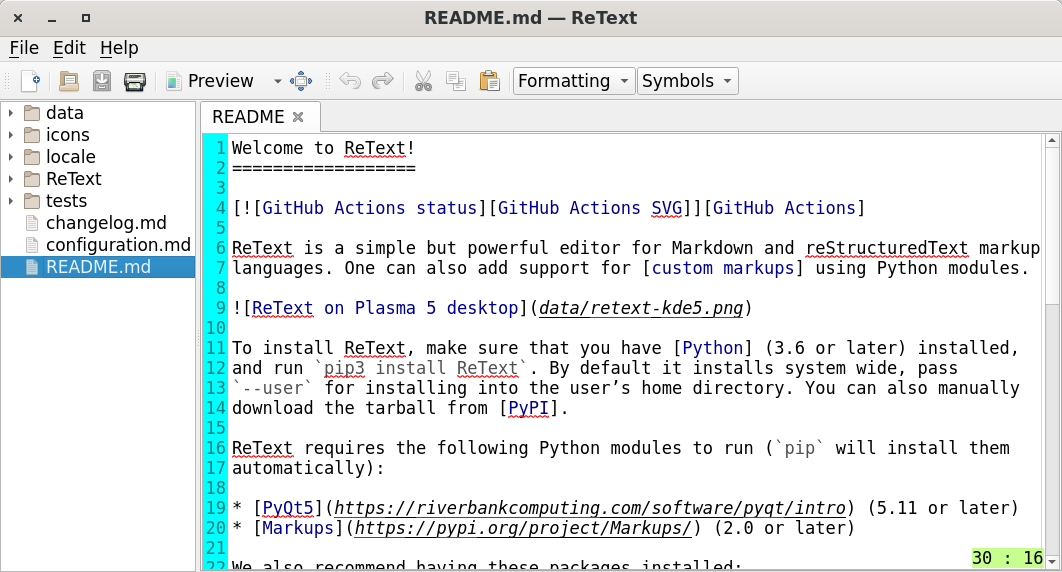
Exactly ten years ago, in February 2011, the first commit in ReText git repository was made. It was just a single 364 lines Python file back then (now the project has more than 6000 lines of Python code). Since 2011, the editor migrated from SourceForge to GitHub, gained a lot of new features, and most importantly now there is an active community around it, which includes both long-time contributors and newcomers who create their first issues or pull requests. I don t always have enough time to reply to issues or implement new features myself, but the community members help me with this. Earlier this month, I made a new release (7.2), which adds a side panel with directory tree (contributed by Xavier Gouchet), option to fully highlight wrapped lines (contributed by nihillum), ability to search in the preview mode and much more see the release page on GitHub. Side panel in ReText Also a new version of PyMarkups module was released, which contains all the code for processing various markup languages. It now supports markdown-extensions.yaml files which allow specifying complex extensions options and adds initial support for MathJax 3. Also check out the release notes for 7.1 which was not announced on this blog. Future plans include making at least one more release this year, adding support for Qt 6. Qt 5 support will last for at least one more year.

22 January 2021

Enrico Zini: Exploring nspawn for CIs

This post is part of a series about trying to setup a gitlab runner based on systemd-nspawn. I published the polished result as nspawn-runner on GitHub. Here I try to figure out possible ways of invoking nspawn for the prepare, run, and cleanup steps of gitlab custom runners. The results might be useful invocations beyond Gitlab's scope of application. I begin with a chroot which will be the base for our build environments:
debootstrap --variant=minbase --include=git,build-essential buster workdir
Fully ephemeral nspawn This would be fantastic: set up a reusable chroot, mount readonly, run the CI in a working directory mounted on tmpfs. It sets up quickly, it cleans up after itself, and it would make prepare and cleanup noops:
mkdir workdir/var/lib/gitlab-runner
systemd-nspawn --read-only --directory workdir --tmpfs /var/lib/gitlab-runner "$@"
However, run gets run multiple times, so I need the side effects of run to persist inside the chroot between runs. Also, if the CI uses a large amount of disk space, tmpfs may get into trouble. nspawn with overlay Federico used --overlay to keep the base chroot readonly while allowing persistent writes on a temporary directory on the filesystem. Note that using --overlay requires systemd and systemd-container from buster-backports because of systemd bug #3847. Example:
mkdir -p tmp-overlay
systemd-nspawn --quiet -D workdir \
  --overlay=" pwd /workdir: pwd /tmp-overlay:/"
I can run this twice, and changes in the file system will persist between systemd-nspawn executions. Great! However, any process will be killed at the end of each execution. machinectl I can give a name to systemd-nspawn invocations using --machine, and it allows me to run multiple commands during the machine lifespan using machinectl and systemd-run. In theory machinectl can also fully manage chroots and disk images in /var/lib/machines, but I haven't found a way with machinectl to start multiple machines sharing the same underlying chroot. It's ok, though: I managed to do that with systemd-nspawn invocations. I can use the --machine=name argument to systemd-nspawn to make it visible to machinectl. I can use the --boot argument to systemd-nspawn to start enough infrastructure inside the container to allow machinectl to interact with it. This gives me any number of persistent and named running systems, that share the same underlying chroot, and can cleanup after themselves. I can run commands in any of those systems as I like, and their side effects persist until a system is stopped. The chroot needs systemd and dbus for machinectl to be able to interact with it:
debootstrap --variant=minbase --include=git,systemd,systemd,build-essential buster workdir
Let's boot the machine:
mkdir -p overlay
systemd-nspawn --quiet -D workdir \
    --overlay=" pwd /workdir: pwd /overlay:/"
    --machine=test --boot
Let's try machinectl:
# machinectl list
MACHINE CLASS     SERVICE        OS     VERSION ADDRESSES
test    container systemd-nspawn debian 10      -
1 machines listed.
# machinectl shell --quiet test /bin/ls -la /
total 60
[ ]
To run commands, rather than machinectl shell, I need to use systemd-run --wait --pipe --machine=name, otherwise machined won't forward the exit code. The result however is pretty good, with working stdin/stdout/stderr redirection and forwarded exit code. Good, I'm getting somewhere. The terminal where I ran systemd-nspawn is currently showing a nice getty for the booted system, which is cute, and not what I want for the setup process of a CI. Spawning machines without needing a terminal machinectl uses /lib/systemd/system/systemd-nspawn@.service to start machines. I suppose there's limited magic in there: start systemd-nspawn as a service, use --machine to give it a name, and machinectl manages it as if it started it itself. What if, instead of installing a unit file for each CI run, I try to do the same thing with systemd-run?
systemd-run \
  -p 'KillMode=mixed' \
  -p 'Type=notify' \
  -p 'RestartForceExitStatus=133' \
  -p 'SuccessExitStatus=133' \
  -p 'Slice=machine.slice' \
  -p 'Delegate=yes' \
  -p 'TasksMax=16384' \
  -p 'WatchdogSec=3min' \
  systemd-nspawn --quiet -D  pwd /workdir \
    --overlay=" pwd /workdir: pwd /overlay:/"
    --machine=test --boot
It works! I can interact with it using machinectl, and fine tune DevicePolicy as needed to lock CI machines down. This setup has a race condition where if I try to run a command inside the machine in the short time window before the machine has finished booting, it fails:
# systemd-run [ ] systemd-nspawn [ ] ; machinectl --quiet shell test /bin/ls -la /
Failed to get shell PTY: Protocol error
# machinectl shell test /bin/ls -la /
Connected to machine test. Press ^] three times within 1s to exit session.
total 60
[ ]
systemd-nspawn has the option --notify-ready=yes that solves exactly this problem:
# systemd-run [ ] systemd-nspawn [ ] --notify-ready=yes ; machinectl --quiet shell test /bin/ls -la /
Running as unit: run-r5a405754f3b740158b3d9dd5e14ff611.service
total 60
[ ]
On nspawn's side, I should now have all I need. Next steps My next step will be wrapping it all together in a gitlab runner.

25 December 2020

Russ Allbery: DocKnot 4.00

This release of my static site generator and software release management tool is finally at a point where I'm happy with some of the interface and think that piece may be stable for a while. This release converts the package metadata format from JSON to YAML and cleans up a bunch of organizational errors I made when I designed it originally. That also means that the entire metadata is now in a single file, docs/docknot.yaml by convention, instead of needing a whole directory of files. (This comes with the minor drawback that one edits Markdown in text blocks in YAML, which has somewhat less editor support, but it works fine for me.) There's a whole other blog post in how I've now tried many different markup formats, including TOML, and have decided YAML is the best one around if you want humans to be able to write it. (JSON or Protobuf is probably best if you only care about information exchange between software.) The short version is that YAML is way too large of a language and very painful to fully implement, but everything else fails to deal with one or more hard problems: nested structure, multi-line text, comments, or not requiring tedious quoting of everything. I'll be converting other software I maintain over to YAML with time. This release also drops support for pointing the bug reporting address at the CPAN RT instance, since that's going away early in 2021. I will need to do new releases of all my Perl modules to point them at a different bug tracker. Also in this release are some fixes for word wrapping and verbatim paragraph detection, some improved markup in generated README.md files, and other minor fixes. As of this release, I'm now uploading the Debian packages to Debian proper as well. I'm not sure if anyone else will ever use this software, but since I'm going to be doing more automatic generation of files in source releases using it, it's properly part of the build toolchain for the software I maintain. You can get the latest version from the DocKnot distribution page.

3 October 2020

Dirk Eddelbuettel: pinp 0.0.10: More Tweaks

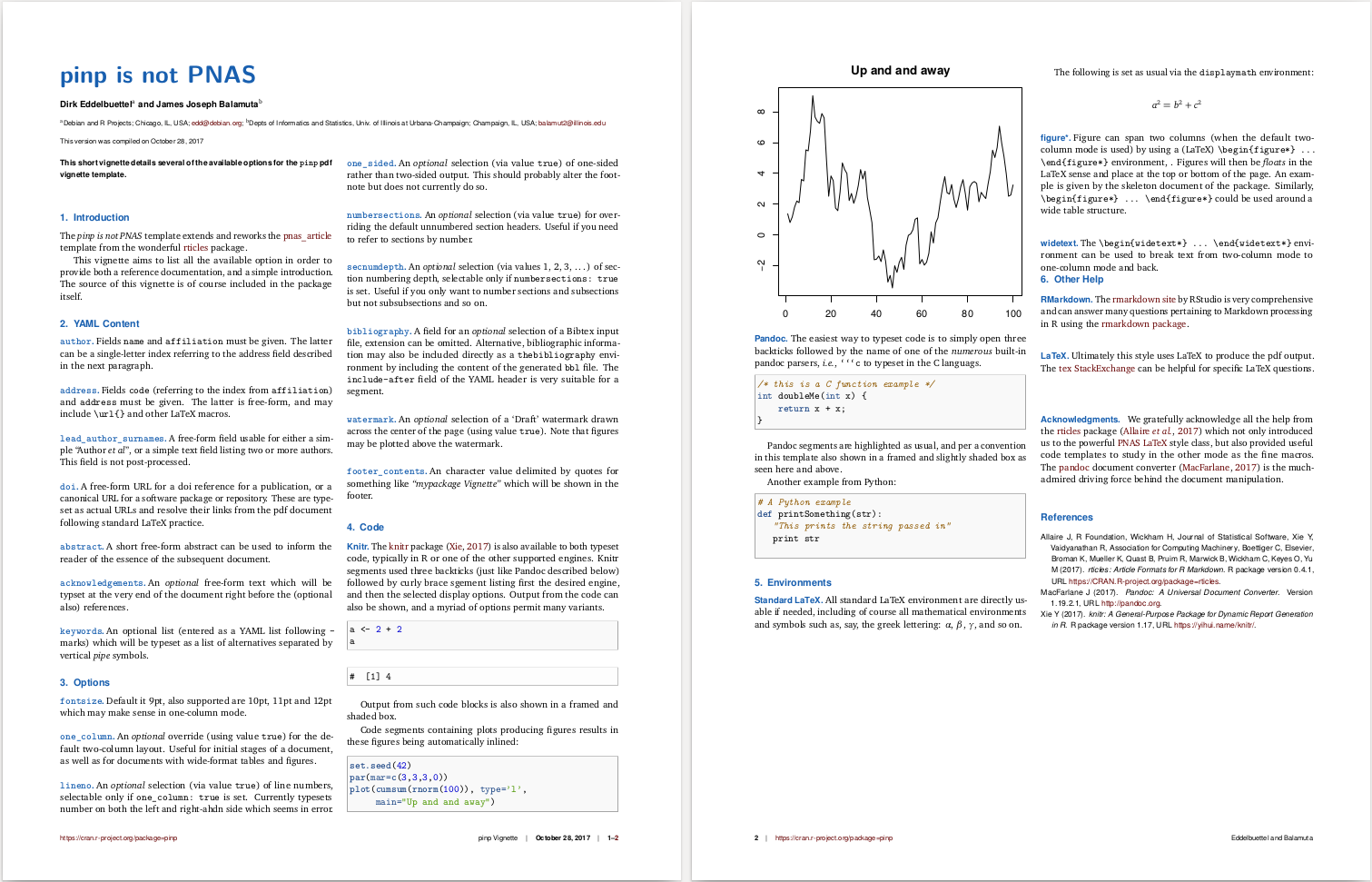
A new version of our pinp package arrived on CRAN two days ago, roughly one year after the previous release. The pinp package allows for snazzier one or two column Markdown-based pdf vignettes, and is now used by a few packages. A screenshot of the package vignette can be seen below. Additional screenshots are at the pinp page. pinp vignette This release adds another option for a customized date YAML variable suitable for e.g. a published at date thanks to Ilya Kashnitsky, has some tweaks to the README.md as well as support for pandoc columns mode (as a small extension of code from the nice repo by Grant McDermott). The NEWS entry for this release follows.

Changes in pinp version 0.0.10 (2020-10-01)
  • New document_date YAML variable to optionally set a 'Published at' or alike date (Ilya Kashnitsky in #85).
  • Small tweaks to README.md (Dirk)
  • Support pandoc columns mode (Dirk in #88)

Courtesy of my CRANberries, there is a comparison to the previous release. More information is on the tint page. For questions or comments use the issue tracker off the GitHub repo. If you like this or other open-source work I do, you can now sponsor me at GitHub. For the first year, GitHub will match your contributions.

This post by Dirk Eddelbuettel originated on his Thinking inside the box blog. Please report excessive re-aggregation in third-party for-profit settings.

30 September 2020

Antoine Beaupr : Presentation tools

I keep forgetting how to make presentations. I had a list of tools in a wiki from a previous job, but that's now private and I don't see why I shouldn't share this (even if for myself!). So here it is. What's your favorite presentation tool?

Tips
  • if you have some text to present, outline keywords so that you can present your subject without reading every word
  • ideally, don't read from your slides - they are there to help people follow, not for people to read
  • even better: make your slides pretty with only a few words, or don't make slides at all
Further advice: I'm currently using Pandoc with PDF input (with a trip through LaTeX) for most slides, because PDFs are more reliable and portable than web pages. I've also used Libreoffice, Pinpoint, and S5 (through RST) in the past. I miss Pinpoint, too bad that it died. Some of my presentations are available in my GitLab.com account: See also my list of talks and presentations which I can't seem to keep up to date.

Tools

Beamer (LaTeX)
  • LaTeX class
  • Do not use directly unless you are a LaTeX expert or masochist, see Pandoc below
  • see also powerdot
  • Home page

Darkslide
  • HTML, Javascript
  • presenter notes, table of contents, Markdown, RST, Textile, themes, code samples, auto-reload
  • Home page, demo

Impress.js

Impressive
  • simply displays PDFs or images
  • page transitions, overview screen, highlighting
  • Home page

Libreoffice Impress
  • Powerpoint clone
  • Makes my life miserable
  • PDF export, presenter notes, outline view, etc
  • Home page, screenshots

Magicpoint
  • ancestor of everyone else (1997!)
  • text input format, image support, talk timer, slide guides, HTML/Postscript export, draw on slides, X11 output
  • no release since 2008
  • Home page

mdp and lookatme (commandline)

Pandoc
  • Allows converting from basically whatever into slides, including Beamer, DZSlides, reveal.js, slideous, slidy, Powerpoint
  • PDF, HTML, Powerpoint export, presentation notes, full screen background images
  • nice plain text or markdown input format
  • Home page, documentation

PDF Presenter
  • PDF presentation tool, shows presentation notes
  • basically "Keynote for Linux"
  • Home page, pdf-presenter-console in Debian

Pinpoint
  • Native GNOME app
  • Full screen slides, PDF export, live change, presenter notes, pango markup, video, image backgrounds
  • Home page
  • Abandoned since at least 2019

Reveal.js
  • HTML, Javascript
  • PDF export, Markdown, LaTeX support, syntax-highlighting, nested slides, speaker notes
  • Source code, demo

S5
  • HTML, CSS
  • incremental, bookmarks, keyboard controls
  • can be transformed from ReStructuredText (RST) with rst2s5 with python-docutils
  • Home page, demo

sent
  • X11 only
  • plain text, black on white, image support, and that's it
  • from the suckless.org elitists
  • Home page

Sozi
  • Entire presentation is one poster, zooming and jumping around
  • SVG + Javascript
  • Home page, demo

Other options Another option I have seriously considered is just generate a series of images with good resolution, hopefully matching the resolution (or at least aspect ratio) of the output device. Then you flip through a series of images one by one. In that case, any of those image viewers (not an exhaustive list) would work: Update: it turns out I already wrote a somewhat similar thing when I did a recent presentation. If you're into rants, you might enjoy the README file accompanying the Kubecon rant presentation. TL;DR: "makes me want to scream" and "yet another unsolved problem space, sigh" (refering to "display images full-screen" specifically).

Chris Lamb: Free software activities in September 2020

Here is my monthly update covering what I have been doing in the free software world during September 2020 (previous month):

Reproducible Builds One of the original promises of open source software is that distributed peer review and transparency of process results in enhanced end-user security. However, whilst anyone may inspect the source code of free and open source software for malicious flaws, almost all software today is distributed as pre-compiled binaries. This allows nefarious third-parties to compromise systems by injecting malicious code into ostensibly secure software during the various compilation and distribution processes. The motivation behind the Reproducible Builds effort is to ensure no flaws have been introduced during this compilation process by promising identical results are always generated from a given source, thus allowing multiple third-parties to come to a consensus on whether a build was compromised. The project is proud to be a member project of the Software Freedom Conservancy. Conservancy acts as a corporate umbrella allowing projects to operate as non-profit initiatives without managing their own corporate structure. If you like the work of the Conservancy or the Reproducible Builds project, please consider becoming an official supporter. This month, I:

diffoscope I made the following changes to diffoscope, including preparing and uploading versions 159 and 160 to Debian:

Debian Lintian For Lintian, the static analysis tool for Debian packages, I uploaded versions 2.93.0, 2.94.0, 2.95.0 & 2.96.0 (not counting uploads to the backports repositories), as well as: Debian LTS This month I've worked 18 hours on Debian Long Term Support (LTS) and 12 hours on its sister Extended LTS project. You can find out more about the project via the following video:
Uploads Bugs filed

17 August 2020

Arnaud Rebillout: Modify Vim syntax files for your taste

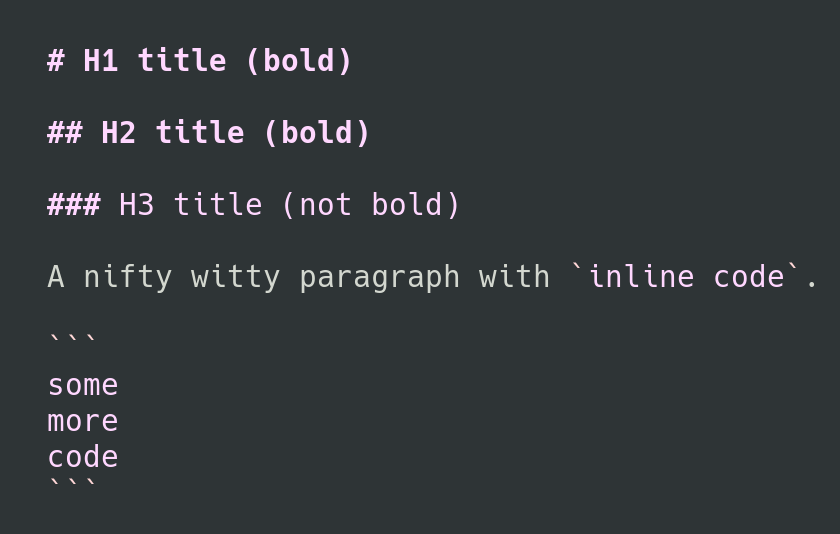
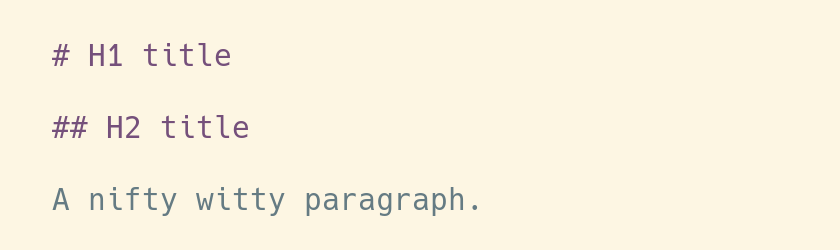
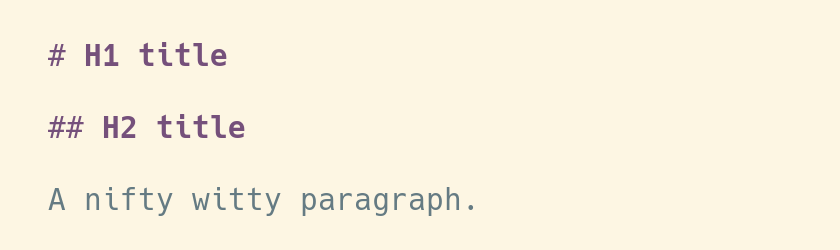
In this short how-to, we'll see how to make small modifications to a Vim syntax file, in order to change how a particular file format is highlighted. We'll go for a simple use-case: modify the Markdown syntax file, so that H1 and H2 headings (titles and subtitles, if you prefer) are displayed in bold. Of course, this won't be exactly as easy as expected, but no worries, we'll succeed in the end. The calling Let's start with a screenshot: how Vim displays Markdown files for me, someone who use the GNOME terminal with the Solarized light theme. Vim - Markdown file with original highlighting I'm mostly happy with that, except for one or two little details. I'd like to have the titles displayed in bold, for example, so that they're easier to spot when I skim through a Markdown file. It seems like a simple thing to ask, so I hope there can be a simple solution. The first steps Let's learn the basics. In Vim world, the rules to highlight files formats are defined in the directory /usr/share/vim/vim82/syntax (I bet you'll have to adjust this path depending on the version of Vim that is installed on your system). And so, for the Markdown file format, the rules are defined in the file /usr/share/vim/vim82/syntax/markdown.vim. The first thing we could do is to have a look at this file, try to make sense of it, and maybe start to make some modifications. But wait a moment. You should know that modifying a system file is not a great idea. First because your changes will be lost as soon as an update kicks in and the package manager replaces this file by a new version. Second, because you will quickly forget what files you modified, and what were your modifications, and if you do that too much, you might experience what is called "maintenance headache" in the long run. So instead, maybe you DO NOT modify this file, and instead you copy it in your personal Vim folder, more precisely in ~/.vim/syntax. Create this directory if it does not exist:
mkdir -p ~/.vim/syntax
cp /usr/share/vim/vim82/syntax/markdown.vim ~/.vim/syntax
The file in your personal folder takes precedence over the system file of the same name in /usr/share/vim/vim82/syntax/, it is a replacement for the existing syntax files. And so from now on, Vim uses the file ~/.vim/syntax/markdown.vim, and this is where we can make our modifications. (And by the way, this is explained in the Vim faq-24.12) And so, it's already nice to know all of that, but wait, there's even better. There's is another location of interest, and it is ~/.vim/after/syntax. You can drop syntax files in this directory, and these files are treated as additions to the existing syntax. So if you only want to make slight modifications, that's the way to go. (And by the way, this is explained in the Vim faq-24.11) So let's forget about a syntax replacement in ~/.vim/syntax/markdown.vim, and instead let's go for some syntax additions in ~/.vim/after/syntax/markdown.vim.
mkdir -p ~/.vim/after/syntax
touch ~/.vim/after/syntax/markdown.vim
Now, let's answer the initial question: how do we modify the highlighting rules for Markdown files, so that the titles are displayed in bold? First, we have to understand where are the rules that define the highlighting for titles. Here there are, from the file /usr/share/vim/vim82/syntax/markdown.vim:
hi def link markdownH1 htmlH1
hi def link markdownH2 htmlH2
hi def link markdownH3 htmlH3
...
You should know that H1 means Heading 1, and so on, and so we want to make H1 and H2 bold. What we can see here is that the headings in the Markdown files are highlighted like the headings in HTML files, and this is obviously defined in the file /usr/share/vim/vim82/syntax/html.vim. So let's have a look into this file:
hi def link htmlH1 Title
hi def link htmlH2 htmlH1
hi def link htmlH3 htmlH2
...
Let's keep digging a bit. Where is Title defined? For those using the default color scheme like me, this is defined straight in the Vim source code, in the file src/highlight.c.
CENT("Title term=bold ctermfg=DarkMagenta",
     "Title term=bold ctermfg=DarkMagenta gui=bold guifg=Magenta"),
And for those using custom color schemes, it might be defined in a file under /usr/share/vim/vim82/colors/. Alright, so how do we override that? We can just define this kind of rules in our syntax additions file at ~/.vim/after/syntax/markdown.vim:
hi link markdownH1 markdownHxBold
hi link markdownH2 markdownHxBold
hi markdownHxBold  term=bold ctermfg=DarkMagenta gui=bold guifg=Magenta cterm=bold
As you can see, the only addition we made, compared to what's defined in src/highlight.c, is cterm=bold. And that's already enough to achieve the initial goal, make the titles (ie. H1 and H2) bold. The result can be seen in the following screenshot: Vim - Markdown file with modified highlighting The rabbit hole So we could stop right here, and life would be easy and good. However, with this solution there's still something that is not perfect. We use the color DarkMagenta as defined in the default color scheme. What I didn't mention however, is that this is applicable for a light background. If you have a dark background though, dark magenta won't be easy to read. Actually, if you look a bit more into src/highlight.c, you will see that the default color scheme comes in two variants, one for a light background, and one for a dark background. And so the definition for Title for a dark background is as follow:
CENT("Title term=bold ctermfg=LightMagenta",
     "Title term=bold ctermfg=LightMagenta gui=bold guifg=Magenta"),
Hmmm, so how do we do that in our syntax file? How can we support both light and dark background, so that the color is right in both cases? After a bit of research, and after looking at other syntax files, it seems that the solution is to check for the value of the background option, and so our syntax file becomes:
hi link markdownH1 markdownHxBold
hi link markdownH2 markdownHxBold
if &background == "light"
  hi markdownHxBold term=bold ctermfg=DarkMagenta gui=bold guifg=Magenta cterm=bold
else
  hi markdownHxBold term=bold ctermfg=LightMagenta gui=bold guifg=Magenta cterm=bold
endif
In case you wonder, in Vim script you prefix Vim options with &, and so you get the value of the background option by writing &background. You can learn this kind of things in the Vim scripting cheatsheet. And so, it's easy enough, except for one thing: it doesn't work. The headings always show up in DarkMagenta, even for a dark background. This is why I called this paragraph "the rabbit hole", by the way. So... Well after trying a few things, I noticed that in order to make it work, I would have to reload the syntax files with :syntax on. At this point, the most likely explanation is that the background option is not set yet when the syntax files are loaded at startup, hence it needs to be reloaded manually afterward. And after muuuuuuch research, I found out that it's actually possible to set a hook for when an option is modified. Meaning, it's possible to execute a function when the background option is modified. Quite cool actually. And so, there it goes in my ~/.vimrc:
" Reload syntax when the background changes 
autocmd OptionSet background if exists("g:syntax_on")   syntax on   endif
For humans, this line reads as:
  1. when the background option is modified -- autocmd OptionSet background
  2. check if the syntax is on -- if exists("g:syntax_on")
  3. if that's the case, reload it -- syntax on
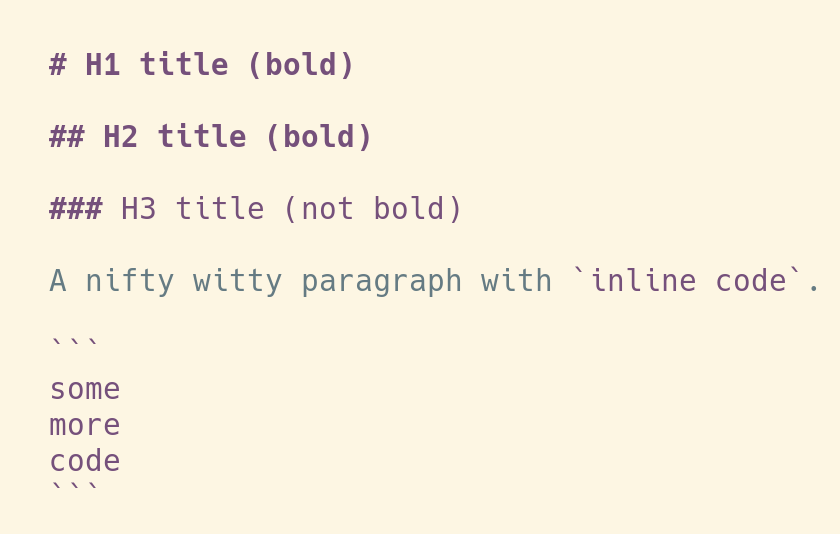
With that in place, my Markdown syntax overrides work for both dark and light background. Champagne! The happy end To finish, let me share my actual additions to the markdown.vim syntax. It makes H1 and H2 bold, along with their delimiters, and it also colors the inline code and the code blocks.
" H1 and H2 headings -> bold
hi link markdownH1 markdownHxBold
hi link markdownH2 markdownHxBold
" Heading delimiters (eg '#') and rules (eg '----', '====') -> bold
hi link markdownHeadingDelimiter markdownHxBold
hi link markdownRule markdownHxBold
" Code blocks and inline code -> highlighted
hi link markdownCode htmlH1
" The following test requires this addition to your vimrc:
" autocmd OptionSet background if exists("g:syntax_on")   syntax on   endif
if &background == "light"
  hi markdownHxBold term=bold ctermfg=DarkMagenta gui=bold guifg=Magenta cterm=bold
else
  hi markdownHxBold term=bold ctermfg=LightMagenta gui=bold guifg=Magenta cterm=bold
endif
And here's how it looks like with a light background: Vim - Markdown file with final highlighting (light) And a dark background: Vim - Markdown file with final highlighting (dark) That's all, that's very little changes compared to the highlighting from the original syntax file, and now that we understand how it's supposed to be done, it's not much effort to achieve it. It's just that finding the workaround to make it work for both light and dark background took forever, and leaves the usual, unanswered question: bug or feature?
1 August 2020

Utkarsh Gupta: FOSS Activites in July 2020

Here s my (tenth) monthly update about the activities I ve done in the F/L/OSS world.

Debian
This was my 17th month of contributing to Debian. I became a DM in late March last year and a DD last Christmas! \o/ Well, this month I didn t do a lot of Debian stuff, like I usually do, however, I did a lot of things related to Debian (indirectly via GSoC)! Anyway, here are the following things I did this month:

Uploads and bug fixes:

Other $things:
  • Mentoring for newcomers.
  • FTP Trainee reviewing.
  • Moderation of -project mailing list.
  • Sponsored php-twig for William, ruby-growl, ruby-xmpp4r, and uby-uniform-notifier for Cocoa, sup-mail for Iain, and node-markdown-it for Sakshi.

GSoC Phase 2, Part 2! In May, I got selected as a Google Summer of Code student for Debian again! \o/
I am working on the Upstream-Downstream Cooperation in Ruby project. The first three blogs can be found here: Also, I log daily updates at gsocwithutkarsh2102.tk. Whilst the daily updates are available at the above site^, I ll breakdown the important parts of the later half of the second month here:
  • Marc Andre, very kindly, helped in fixing the specs that were failing earlier this month. Well, the problem was with the specs, but I am still confused how so. Anyway..
  • Finished documentation of the second cop and marked the PR as ready to be reviewed.
  • David reviewed and suggested some really good changes and I fixed/tweaked that PR as per his suggestion to finally finish the last bits of the second cop, RelativeRequireToLib.
  • Merged the PR upon two approvals and released it as v0.2.0!
  • We had our next weekly meeting where we discussed the next steps and the things that are supposed to be done for the next set of cops.
  • Introduced rubocop-packaging to the outer world and requested other upstream projects to use it! It is being used by 13 other projects already!
  • Started to work on packaging-style-guide but I didn t push anything to the public repository yet.
  • Worked on refactoring the cops_documentation Rake task which was broken by the new auto-corrector API. Opened PR #7 for it. It ll be merged after the next RuboCop release as it uses CopsDocumentationGenerator class from the master branch.
  • Whilst working on autoprefixer-rails, I found something unusual. The second cop shouldn t really report offenses if the require_relative calls are from lib to lib itself. This is a false-positive. Opened issue #8 for the same.

Debian (E)LTS
Debian Long Term Support (LTS) is a project to extend the lifetime of all Debian stable releases to (at least) 5 years. Debian LTS is not handled by the Debian security team, but by a separate group of volunteers and companies interested in making it a success. And Debian Extended LTS (ELTS) is its sister project, extending support to the Jessie release (+2 years after LTS support). This was my tenth month as a Debian LTS and my first as a Debian ELTS paid contributor.
I was assigned 25.25 hours for LTS and 13.25 hours for ELTS and worked on the following things:

LTS CVE Fixes and Announcements:

ELTS CVE Fixes and Announcements:

Other (E)LTS Work:
  • Did my LTS frontdesk duty from 29th June to 5th July.
  • Triaged qemu, firefox-esr, wordpress, libmediainfo, squirrelmail, xen, openjpeg2, samba, and ldb.
  • Mark CVE-2020-15395/libmediainfo as no-dsa for Jessie.
  • Mark CVE-2020-13754/qemu as no-dsa/intrusive for Stretch and Jessie.
  • Mark CVE-2020-12829/qemu as no-dsa for Jessie.
  • Mark CVE-2020-10756/qemu as not-affected for Jessie.
  • Mark CVE-2020-13253/qemu as postponed for Jessie.
  • Drop squirrelmail and xen for Stretch LTS.
  • Add notes for tomcat8, shiro, and cacti to take care of the Stretch issues.
  • Emailed team@security.d.o and debian-lts@l.d.o regarding possible clashes.
  • Maintenance of LTS Survey on the self-hosted LimeSurvey instance. Received 1765 (just wow!) responses.
  • Attended the fourth LTS meeting. MOM here.
  • General discussion on LTS private and public mailing list.

Other(s)
Sometimes it gets hard to categorize work/things into a particular category.
That s why I am writing all of those things inside this category.
This includes two sub-categories and they are as follows.

Personal: This month I did the following things:
  • Released v0.2.0 of rubocop-packaging on RubyGems!
    It s open-sourced and the repository is here.
    Bug reports and pull requests are welcomed!
  • Released v0.1.0 of get_root on RubyGems!
    It s open-sourced and the repository is here.
  • Wrote max-word-frequency, my Rails C1M2 programming assignment.
    And made it pretty neater & cleaner!
  • Refactored my lts-dla and elts-ela scripts entirely and wrote them in Ruby so that there are no issues and no false-positives!
    Check lts-dla here and elts-ela here.
  • And finally, built my first Rails (mini) web-application!
    The repository is here. This was also a programming assignment (C1M3).
    And furthermore, hosted it at Heroku.

Open Source: Again, this contains all the things that I couldn t categorize earlier.
Opened several issues and PRs:
  • Issue #8273 against rubocop, reporting a false-positive auto-correct for Style/WhileUntilModifier.
  • Issue #615 against http reporting a weird behavior of a flaky test.
  • PR #3791 for rubygems/bundler to remove redundant bundler/setup require call from spec_helper generated by bundle gem.
  • Issue #3831 against rubygems, reporting a traceback of undefined method, rubyforge_project=.
  • Issue #238 against nheko asking for enhancement in showing the font name in the very font itself.
  • PR #2307 for puma to constrain rake-compiler to v0.9.4.
  • And finally, I joined the Cucumber organization! \o/

Thank you for sticking along for so long :) Until next time.
:wq for today.

1 July 2020

Utkarsh Gupta: FOSS Activites in June 2020

Here s my (ninth) monthly update about the activities I ve done in the F/L/OSS world.

Debian
This was my 16th month of contributing to Debian. I became a DM in late March last year and a DD last Christmas! \o/ This month was a little intense. I did a lot of different kinds of things in Debian this month. Whilst most of my time went on doing security stuff, I also sponsored a bunch of packages. Here are the following things I did this month:

Uploads and bug fixes:

Other $things:
  • Hosted Ruby team meeting. Logs here.
  • Mentoring for newcomers.
  • FTP Trainee reviewing.
  • Moderation of -project mailing list.
  • Sponsored ruby-ast for Abraham, libexif for Hugh, djangorestframework-gis and karlseguin-ccache for Nilesh, and twig-extensions, twig-i18n-extension, and mariadb-mysql-kbs for William.

GSoC Phase 1, Part 2! Last month, I got selected as a Google Summer of Code student for Debian again! \o/
I am working on the Upstream-Downstream Cooperation in Ruby project. The first half of the first month is blogged here, titled, GSoC Phase 1.
Also, I log daily updates at gsocwithutkarsh2102.tk. Whilst the daily updates are available at the above site^, I ll breakdown the important parts of the later half of the first month here:
  • Documented the first cop, GemspecGit via PR #2.
  • Made an initial release, v0.1.0!
  • Spread the word/usage about this tool/library via adding them in the official RuboCop docs.
  • We had our third weekly meeting where we discussed the next steps and the things that are supposed to be done for the next set of cops.
  • Wrote more tests so as to cover different aspects of the GemspecGit cop.
  • Opened PR #4 for the next Cop, RequireRelativeToLib.
  • Introduced rubocop-packaging to the outer world and requested other upstream projects to use it! It is being used by 6 other projects already
  • Had our fourth weekly meeting where we pair-programmed (and I sucked :P) and figured out a way to make the second cop work.
  • Found a bug, reported at issue #5 and raised PR #6 to fix it.
  • And finally, people loved the library/tool (and it s outcome):


    (for those who don t know, @bbatsov is the author of RuboCop, @lienvdsteen is an amazing fullstack engineer at GitLab, and @pboling is the author of some awesome Ruby tools and libraries!)

Debian LTS
Debian Long Term Support (LTS) is a project to extend the lifetime of all Debian stable releases to (at least) 5 years. Debian LTS is not handled by the Debian security team, but by a separate group of volunteers and companies interested in making it a success. This was my ninth month as a Debian LTS paid contributor. I was assigned 30.00 hours and worked on the following things:

CVE Fixes and Announcements:

Other LTS Work:
  • Triaged sympa, apache2, qemu, and coturn.
  • Add fix for CVE-2020-0198/libexif.
  • Requested CVE for bug#60251 against apache2 and prodded further.
  • Raised issue #947 against sympa reporting an incomplete patch for CVE-2020-10936. More discussions internally.
  • Created the LTS Survey on the self-hosted LimeSurvey instance.
  • Attended the third LTS meeting. Logs here.
  • General discussion on LTS private and public mailing list.

Other(s)
Sometimes it gets hard to categorize work/things into a particular category.
That s why I am writing all of those things inside this category.
This includes two sub-categories and they are as follows.

Personal: This month I did the following things:
  • Wrote and published v0.1.0 of rubocop-packaging on RubyGems!
    It s open-sourced and the repository is here.
    Bug reports and pull requests are welcomed!
  • Integrated a tiny (yet a powerful) hack to align images in markdown for my blog.
    Commit here.
  • Released v0.4.0 of batalert on RubyGems!

Open Source: Again, this contains all the things that I couldn t categorize earlier.
Opened several issues and PRs:
Thank you for sticking along for so long :) Until next time.
:wq for today.

30 June 2020

Chris Lamb: Free software activities in June 2020

Here is my monthly update covering what I have been doing in the free software world during June 2020 (previous month): For Lintian, the static analysis tool for Debian packages:

Reproducible Builds One of the original promises of open source software is that distributed peer review and transparency of process results in enhanced end-user security. However, whilst anyone may inspect the source code of free and open source software for malicious flaws, almost all software today is distributed as pre-compiled binaries. This allows nefarious third-parties to compromise systems by injecting malicious code into ostensibly secure software during the various compilation and distribution processes. The motivation behind the Reproducible Builds effort is to ensure no flaws have been introduced during this compilation process by promising identical results are always generated from a given source, thus allowing multiple third-parties to come to a consensus on whether a build was compromised. The project is proud to be a member project of the Software Freedom Conservancy. Conservancy acts as a corporate umbrella allowing projects to operate as non-profit initiatives without managing their own corporate structure. If you like the work of the Conservancy or the Reproducible Builds project, please consider becoming an official supporter. This month, I:

Elsewhere in our tooling, I made the following changes to diffoscope including preparing and uploading versions 147, 148 and 149 to Debian: trydiffoscope is the web-based version of diffoscope. This month, I specified a location for the celerybeat scheduler to ensure that the clean/tidy tasks are actually called which had caused an accidental resource exhaustion. (#12)

Debian I filed three bugs against: Debian LTS This month I have worked 18 hours on Debian Long Term Support (LTS) and 5 hours on its sister Extended LTS project. You can find out more about the project via the following video:
Uploads

10 June 2020

Dirk Eddelbuettel: binb 0.0.6: Small enhancements

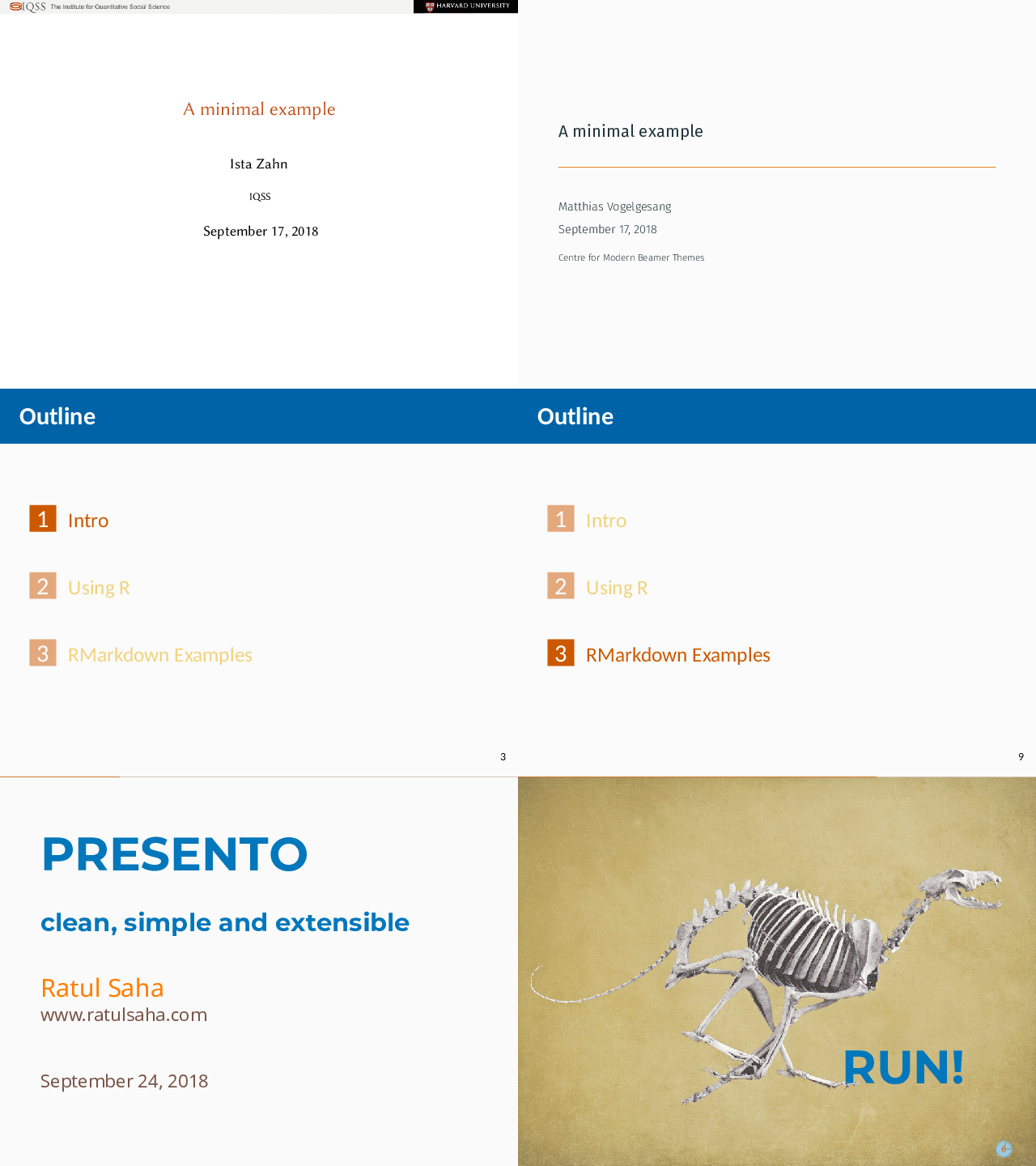
The sixth release of the binb package is now on CRAN. binb regroups four rather nice themes for writing LaTeX Beamer presentations much more easily in (R)Markdown. As a teaser, a quick demo combining all four themes follows; documentation and examples are in the package. Via two contributed PRs, this releases adds titlepage support via the YAML header for Metropolis, and suppresses nags about the changed natbib default. A little polish on the README and Travis rounds everything off.

Changes in binb version 0.0.6 (2020-06-10)
  • Support for YAML option titlegraphic was added in Metropolis (Andras Scraka in #23).
  • The README.md file received another badge (Dirk).
  • The natbib default value was updated to accomodate rmarkdown (Joseph Stachelek in #26).
  • Travis now uses R 4.0.0 and 'bionic' (Dirk).

CRANberries provides a summary of changes to the previous version. For questions or comments, please use the issue tracker at GitHub. If you like this or other open-source work I do, you can now sponsor me at GitHub. For the first year, GitHub will match your contributions.

This post by Dirk Eddelbuettel originated on his Thinking inside the box blog. Please report excessive re-aggregation in third-party for-profit settings.

7 April 2020

Norbert Preining: QOwnNotes for Debian (update)

Update 2020-04-18: I have removed my QOwnNotes repository, since there is a OBS build by upstream that includes builds for Debian/unstable, testing, Buster. So no need for me. Please see https://www.qownnotes.org/installation for details!! Some time ago I posted about QOwnNotes for Debian. My recent experience with the openSUSE Build System has convinced me to move also the QOwnNotes packages there, which allows me to provide builds for Debian/Buster, Debian/testing, and Debian/sid, all for both i386 and amd64 architectures. To repeat a bit about QOwnNotes, it is a cross-platform plain text and markdown note taking application. By itself, it wouldn t be something to talk about, we have vim and emacs and everything in between. But QOwnNotes integrates nicely with the Notes application from NextCloud and OwnCloud, as well as providing useful integration with NextCloud like old version of notes, access to deleted files, watching changes, etc. The new locations for binary packages for both amd64 and i386 architectures are as follows below. To make these repositories work out of the box, you need to import my OBS gpg key: obs-npreining.asc, best to download it and put the file into /etc/apt/trusted.gpg.d/obs-npreining.asc. Debian/buster:
deb http://download.opensuse.org/repositories/home:/npreining:/debian-qownnotes/Debian_10  ./
Debian/testing:
deb http://download.opensuse.org/repositories/home:/npreining:/debian-qownnotes/Debian_Testing  ./
Debian/unstable:
deb http://download.opensuse.org/repositories/home:/npreining:/debian-qownnotes/Debian_Unstable  ./
The source can be obtained from either the git repository or the OBS project debian-qownnotes. Enjoy.

4 November 2017

Dirk Eddelbuettel: tint 0.0.4: Small enhancements

A maintenance release of the tint package arrived on CRAN earlier today. Its name expands from tint is not tufte as the package offers a fresher take on the Tufte-style for html and pdf presentations. A screenshot of the pdf variant is below.
This release brings some minor enhancements and polish, mostly learned from having done the related pinp (two-column vignette in the PNAS style) and linl (LaTeX letter) RMarkdown-wrapper packages; see below for details from the NEWS.Rd file.

Changes in tint version 0.0.4 (2017-11-02)
  • Skeleton files are also installed as vignettes (#20).
  • A reference to the Tufte source file now points to tint (Ben Marwick in #19, later extended to other Rmd files).
  • Several spelling and grammar errors were corrected too (#13 and #16 by R. Mark Sharp and Matthew Henderson)

Courtesy of CRANberries, there is a comparison to the previous release. More information is on the tint page. For questions or comments use the issue tracker off the GitHub repo.

This post by Dirk Eddelbuettel originated on his Thinking inside the box blog. Please report excessive re-aggregation in third-party for-profit settings.

2 November 2017

Antoine Beaupr : October 2017 report: LTS, feed2exec beta, pandoc filters, git mediawiki

Debian Long Term Support (LTS) This is my monthly Debian LTS report. This time I worked on the famous KRACK attack, git-annex, golang and the continuous stream of GraphicsMagick security issues.

WPA & KRACK update I spent most of my time this month on the Linux WPA code, to backport it to the old (~2012) wpa_supplicant release. I first published a patchset based on the patches shipped after the embargo for the oldstable/jessie release. After feedback from the list, I also built packages for i386 and ARM. I have also reviewed the WPA protocol to make sure I understood the implications of the changes required to backport the patches. For example, I removed the patches touching the WNM sleep mode code as that was introduced only in the 2.0 release. Chunks of code regarding state tracking were also not backported as they are part of the state tracking code introduced later, in 3ff3323. Finally, I still have concerns about the nonce setup in patch #5. In the last chunk, you'll notice peer->tk is reset, to_set to negotiate a new TK. The other approach I considered was to backport 1380fcbd9f ("TDLS: Do not modify RNonce for an TPK M1 frame with same INonce") but I figured I would play it safe and not introduce further variations. I should note that I share Matthew Green's observations regarding the opacity of the protocol. Normally, network protocols are freely available and security researchers like me can easily review them. In this case, I would have needed to read the opaque 802.11i-2004 pdf which is behind a TOS wall at the IEEE. I ended up reading up on the IEEE_802.11i-2004 Wikipedia article which gives a simpler view of the protocol. But it's a real problem to see such critical protocols developed behind closed doors like this. At Guido's suggestion, I sent the final patch upstream explaining the concerns I had with the patch. I have not, at the time of writing, received any response from upstream about this, unfortunately. I uploaded the fixed packages as DLA 1150-1 on October 31st.

Git-annex The next big chunk on my list was completing the work on git-annex (CVE-2017-12976) that I started in August. It turns out doing the backport was simpler than I expected, even with my rusty experience with Haskell. Type-checking really helps in doing the right thing, especially considering how Joey Hess implemented the fix: by introducing a new type. So I backported the patch from upstream and notified the security team that the jessie and stretch updates would be similarly easy. I shipped the backport to LTS as DLA-1144-1. I also shared the updated packages for jessie (which required a similar backport) and stretch (which didn't) and those Sebastien Delafond published those as DSA 4010-1.

Graphicsmagick Up next was yet another security vulnerability in the Graphicsmagick stack. This involved the usual deep dive into intricate and sometimes just unreasonable C code to try and fit a round tree in a square sinkhole. I'm always unsure about those patches, but the test suite passes, smoke tests show the vulnerability as fixed, and that's pretty much as good as it gets. The announcement (DLA 1154-1) turned out to be a little special because I had previously noticed that the penultimate announcement (DLA 1130-1) was never sent out. So I made a merged announcement to cover both instead of re-sending the original 3 weeks late, which may have been confusing for our users.

Triage & misc We always do a bit of triage even when not on frontdesk duty, so I: I also did smaller bits of work on: The latter reminded me of the concerns I have about the long-term maintainability of the golang ecosystem: because everything is statically linked, an update to a core library (say the SMTP library as in CVE-2017-15042, thankfully not affecting LTS) requires a full rebuild of all packages including the library in all distributions. So what would be a simple update in a shared library system could mean an explosion of work on statically linked infrastructures. This is a lot of work which can definitely be error-prone: as I've seen in other updates, some packages (for example the Ruby interpreter) just bit-rot on their own and eventually fail to build from source. We would also have to investigate all packages to see which one include the library, something which we are not well equipped for at this point. Wheezy was the first release shipping golang packages but at least it's shipping only one... Stretch has shipped with two golang versions (1.7 and 1.8) which will make maintenance ever harder in the long term.
We build our computers the way we build our cities--over time, without a plan, on top of ruins. - Ellen Ullman

Other free software work This month again, I was busy doing some serious yak shaving operations all over the internet, on top of publishing two of my largest LWN articles to date (2017-10-16-strategies-offline-pgp-key-storage and 2017-10-26-comparison-cryptographic-keycards).

feed2exec beta Since I announced this new project last month I have released it as a beta and it entered Debian. I have also wrote useful plugins like the wayback plugin that saves pages on the Wayback machine for eternal archival. The archive plugin can also similarly save pages to the local filesystem. I also added bash completion, expanded unit tests and documentation, fixed default file paths and a bunch of bugs, and refactored the code. Finally, I also started using two external Python libraries instead of rolling my own code: the pyxdg and requests-file libraries, the latter which I packaged in Debian (and fixed a bug in their test suite). The program is working pretty well for me. The only thing I feel is really missing now is a retry/fail mechanism. Right now, it's a little brittle: any network hiccup will yield an error email, which are readable to me but could be confusing to a new user. Strangely enough, I am particularly having trouble with (local!) DNS resolution that I need to look into, but that is probably unrelated with the software itself. Thankfully, the user can disable those with --loglevel=ERROR to silence WARNINGs. Furthermore, some plugins still have some rough edges. For example, The Transmission integration would probably work better as a distinct plugin instead of a simple exec call, because when it adds new torrents, the output is totally cryptic. That plugin could also leverage more feed parameters to save different files in different locations depending on the feed titles, something would be hard to do safely with the exec plugin now. I am keeping a steady flow of releases. I wish there was a way to see how effective I am at reaching out with this project, but unfortunately GitLab doesn't provide usage statistics... And I have received only a few comments on IRC about the project, so maybe I need to reach out more like it says in the fine manual. Always feels strange to have to promote your project like it's some new bubbly soap... Next steps for the project is a final review of the API and release production-ready 1.0.0. I am also thinking of making a small screencast to show the basic capabilities of the software, maybe with asciinema's upcoming audio support?

Pandoc filters As I mentioned earlier, I dove again in Haskell programming when working on the git-annex security update. But I also have a small Haskell program of my own - a Pandoc filter that I use to convert the HTML articles I publish on LWN.net into a Ikiwiki-compatible markdown version. It turns out the script was still missing a bunch of stuff: image sizes, proper table formatting, etc. I also worked hard on automating more bits of the publishing workflow by extracting the time from the article which allowed me to simply extract the full article into an almost final copy just by specifying the article ID. The only thing left is to add tags, and the article is complete. In the process, I learned about new weird Haskell constructs. Take this code, for example:
-- remove needless blockquote wrapper around some tables
--
-- haskell newbie tips:
--
-- @ is the "at-pattern", allows us to define both a name for the
-- construct and inspect the contents as once
--
--   is the "empty record pattern": it basically means "match the
-- arguments but ignore the args"
cleanBlock (BlockQuote t@[Table  ]) = t
Here the idea is to remove <blockquote> elements needlessly wrapping a <table>. I can't specify the Table type on its own, because then I couldn't address the table as a whole, only its parts. I could reconstruct the whole table bits by bits, but it wasn't as clean. The other pattern was how to, at last, address multiple string elements, which was difficult because Pandoc treats spaces specially:
cleanBlock (Plain (Strong (Str "Notifications":Space:Str "for":Space:Str "all":Space:Str "responses":_):_)) = []
The last bit that drove me crazy was the date parsing:
-- the "GAByline" div has a date, use it to generate the ikiwiki dates
--
-- this is distinct from cleanBlock because we do not want to have to
-- deal with time there: it is only here we need it, and we need to
-- pass it in here because we do not want to mess with IO (time is I/O
-- in haskell) all across the function hierarchy
cleanDates :: ZonedTime -> Block -> [Block]
-- this mouthful is just the way the data comes in from
-- LWN/Pandoc. there could be a cleaner way to represent this,
-- possibly with a record, but this is complicated and obscure enough.
cleanDates time (Div (_, [cls], _)
                 [Para [Str month, Space, Str day, Space, Str year], Para _])
    cls == "GAByline" = ikiwikiRawInline (ikiwikiMetaField "date"
                                           (iso8601Format (parseTimeOrError True defaultTimeLocale "%Y-%B-%e,"
                                                           (year ++ "-" ++ month ++ "-" ++ day) :: ZonedTime)))
                        ++ ikiwikiRawInline (ikiwikiMetaField "updated"
                                             (iso8601Format time))
                        ++ [Para []]
-- other elements just pass through
cleanDates time x = [x]
Now that seems just dirty, but it was even worse before. One thing I find difficult in adapting to coding in Haskell is that you need to take the habit of writing smaller functions. The language is really not well adapted to long discourse: it's more about getting small things connected together. Other languages (e.g. Python) discourage this because there's some overhead in calling functions (10 nanoseconds in my tests, but still), whereas functions are a fundamental and important construction in Haskell that are much more heavily optimized. So I constantly need to remind myself to split things up early, otherwise I can't do anything in Haskell. Other languages are more lenient, which does mean my code can be more dirty, but I feel get things done faster then. The oddity of Haskell makes frustrating to work with. It's like doing construction work but you're not allowed to get the floor dirty. When I build stuff, I don't mind things being dirty: I can cleanup afterwards. This is especially critical when you don't actually know how to make things clean in the first place, as Haskell will simply not let you do that at all. And obviously, I fought with Monads, or, more specifically, "I/O" or IO in this case. Turns out that getting the current time is IO in Haskell: indeed, it's not a "pure" function that will always return the same thing. But this means that I would have had to change the signature of all the functions that touched time to include IO. I eventually moved the time initialization up into main so that I had only one IO function and moved that timestamp downwards as simple argument. That way I could keep the rest of the code clean, which seems to be an acceptable pattern. I would of course be happy to get feedback from my Haskell readers (if any) to see how to improve that code. I am always eager to learn.

Git remote MediaWiki Few people know that there is a MediaWiki remote for Git which allow you to mirror a MediaWiki site as a Git repository. As a disaster recovery mechanism, I have been keeping such a historical backup of the Amateur radio wiki for a while now. This originally started as a homegrown Python script to also convert the contents in Markdown. My theory then was to see if we could switch from Mediawiki to Ikiwiki, but it took so long to implement that I never completed the work. When someone had the weird idea of renaming a page to some impossible long name on the wiki, my script broke. I tried to look at fixing it and then remember I also had a mirror running using the Git remote. It turns out it also broke on the same issue and that got me looking in the remote again. I got lost in a zillion issues, including fixing that specific issue, but I especially looked at the possibility of fetching all namespaces because I realized that the remote fetches only a part of the wiki by default. And that drove me to submit namespace support as a patch to the git mailing list. Finally, the discussion came back to how to actually maintain that contrib: in git core or outside? Finally, it looks like I'll be doing some maintenance that project outside of git, as I was granted access to the GitHub organisation...

Galore Yak Shaving Then there's the usual hodgepodge of fixes and random things I did over the month.
There is no [web extension] only XUL! - Inside joke

31 October 2017

Dirk Eddelbuettel: linl 0.0.2: Couple improvements

Following up on the initial 0.0.1 release of linl, Aaron and I are happy to announce release 0.0.2 which reached the CRAN network on Sunday in a smooth 'CRAN-pretest-publish' auto-admittance. linl provides a simple-yet-powerful Markdown---and RMarkdown---wrapper around the venerable LaTeX letter class; see below for an expanded example also included as the package vignette. This versions sets a few sensible default values for font, font size, margins, signature (non-)indentation and more; it also expands the documentation.
The NEWS entry follows:

Changes in tint version 0.0.2 (2017-10-29)
  • Set a few defaults for a decent-looking skeleton and template: font, fontsize, margins, left-justify closing (#3)
  • Blockquote display is now a default as well (#4).
  • Updated skeleton.Rmd and vignette source accordingly
  • Documented new default options (#5 and #6).
  • Links are now by default printed as footnotes (#9).

Courtesy of CRANberries, there is a comparison to the previous release. More information is on the tint page. For questions or comments use the issue tracker off the GitHub repo. For questions or comments use the issue tracker off the GitHub repo.

This post by Dirk Eddelbuettel originated on his Thinking inside the box blog. Please report excessive re-aggregation in third-party for-profit settings.

Norbert Preining: Debian/TeX Live 2017.20171031-1

Halloween is here, time to upload a new set of scary packages of TeX Live. About a month has passed, so there is the usual big stream up updates. There was actually an intermediate release to get out some urgent fixes, but I never reported the news here. So here are the accumulated changes and updates. My favorite this time is wallcalendar, a great class to design all kind of calendars, it looks really well done. I immediately will start putting one together. On the font side there is the new addition coelacanth. To quote from the README: Coelacanth is inspired by the classic Centaur type design of Bruce Rogers, described by some as the most beautiful typeface ever designed. It aims to be a professional quality type family for general book typesetting. And indeed it is beautiful! Other noteworthy addition is the Spark font that allows creating sparklines in the running text with LaTeX. Enjoy. New packages algobox, amscls-doc, beilstein, bib2gls, coelacanth, crossreftools, dejavu-otf, dijkstra, ducksay, dynkin-diagrams, eqnnumwarn, fetchcls, fixjfm, glossaries-finnish, hagenberg-thesis, hecthese, ifxptex, isopt, istgame, ku-template, limecv, mensa-tex, musicography, na-position, notestex, outlining, pdfreview, spark-otf, spark-otf-fonts, theatre, unitn-bimrep, upzhkinsoku, wallcalendar, xltabular. Updated packages acmart, amsmath, animate, arabluatex, arara, babel, babel-french, bangorexam, baskervillef, beebe, biblatex-philosophy, biblatex-source-division, bibletext, bidi, bxjaprnind, bxjscls, bxpapersize, bytefield, classicthesis, cochineal, complexity, cooking-units, curves, datetime2-german, dccpaper, doclicense, docsurvey, eledmac, epstopdf, eqparbox, esami, etoc, fbb, fei, fithesis, fmtcount, fnspe, fonts-tlwg, fontspec, genealogytree, glossaries, glossaries-extra, hecthese, hepthesis, hvfloat, ifplatform, ifptex, inconsolata, jfmutil, jsclasses, ketcindy, knowledge, koma-script, l3build, l3experimental, l3kernel, l3packages, langsci, latex2man, latexbug, lato, leadsheets, libertinust1math, listofitems, luatexja, luatexko, luatodonotes, lwarp, markdown, mcf2graph, media9, newtx, novel, numspell, ocgx2, overpic, philokalia, phonenumbers, platex, poemscol, pst-exa, pst-geometrictools, pst-ovl, pst-plot, pst-pulley, pst-tools, pst-vehicle, pst2pdf, pstool, pstricks, pstricks-add, pxchfon, pxjahyper, quran, randomlist, rec-thy, reledmac, robustindex, scratch, skrapport, spectralsequences, tcolorbox, tetex, tex4ht, texcount, texdoc, tikzducks, tikzsymbols, toptesi, translation-biblatex-de, unicode-math, updmap-map, uplatex, widetable, xcharter, xepersian, xetexko, xetexref, xsim, zhlipsum.

22 October 2017

Dirk Eddelbuettel: linl 0.0.1: linl is not Letter

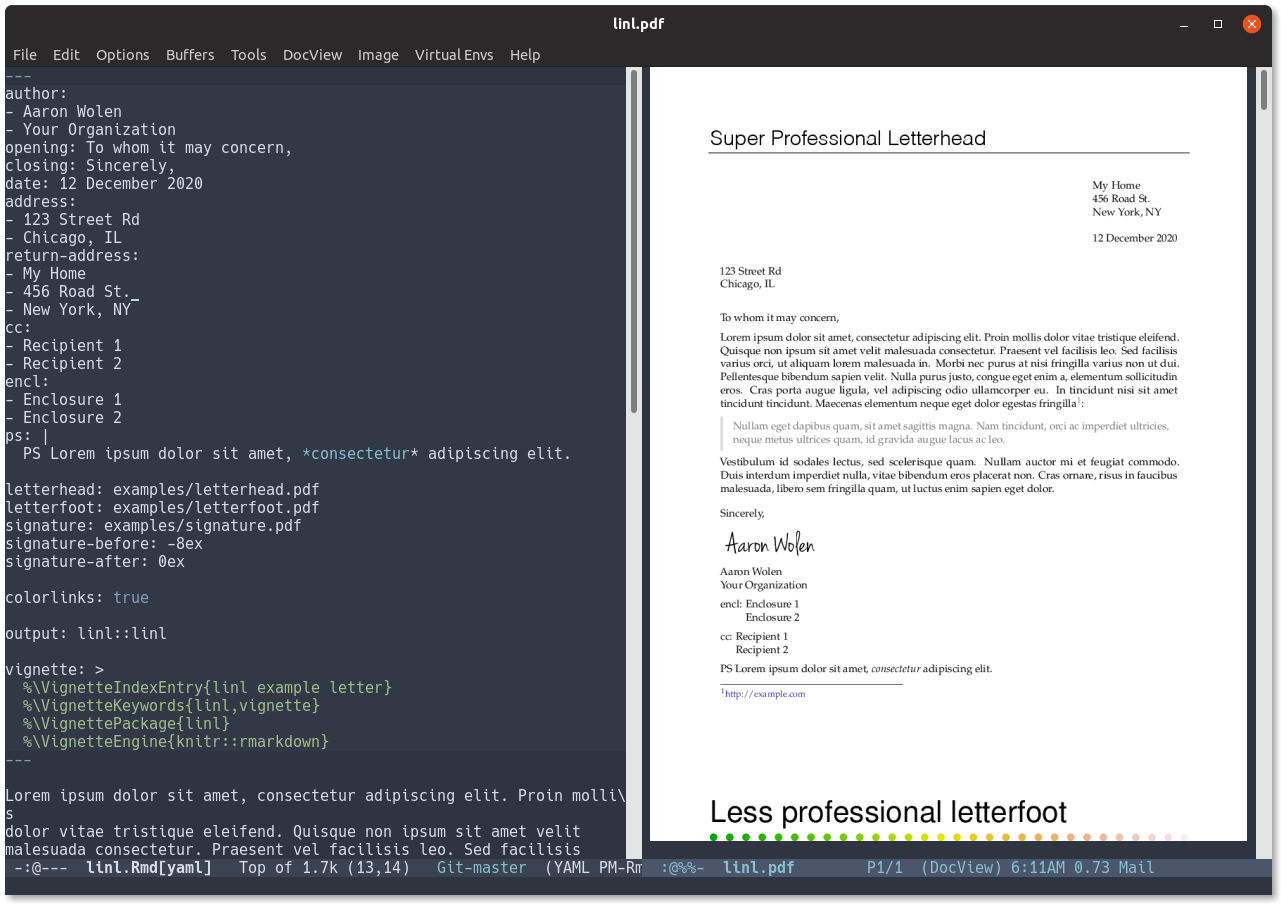
Aaron Wolen and I are pleased to announce the availability of the initial 0.0.1 release of our new linl package on the CRAN network. It provides a simple-yet-powerful Markdown---and RMarkdown---wrapper the venerable LaTeX letter class. Aaron had done the legwork in the underlying pandoc-letter repository upon which we build via proper rmarkdown integration. The package also includes a LaTeX trick or two: optional header and signature files, nicer font, better size, saner default geometry and more. See the following screenshot which shows the package vignette---itself a simple letter---along with (most of) its source:
The initial (short) NEWS entry follows:

Changes in tint version 0.0.1 (2017-10-17)
  • Initial CRAN release

The date is a little off; it took a little longer than usual for the good folks at CRAN to process the initial submission. We expect future releases to be more timely. For questions or comments use the issue tracker off the GitHub repo.

This post by Dirk Eddelbuettel originated on his Thinking inside the box blog. Please report excessive re-aggregation in third-party for-profit settings.

12 October 2017

Dirk Eddelbuettel: RcppArmadillo 0.8.100.1.0

armadillo image We are thrilled to announce a new big RcppArmadillo release! Conrad recently moved Armadillo to the 8.* series, with significant improvements and speed ups for sparse matrix operations, and more. See below for a brief summary. This also required some changes at our end which Binxiang Ni provided, and Serguei Sokol improved some instantiations. We now show the new vignette Binxiang Ni wrote for his GSoC contribution, and I converted it (and the other main vignette) to using the pinp package for sleeker pdf vignettes. This release resumes our bi-monthly CRAN release cycle. I may make interim updates available at GitHub "as needed". And this time I managed to mess up the reverse depends testing, and missed one sync() call on the way back to R---but all that is now taken care of. Armadillo is a powerful and expressive C++ template library for linear algebra aiming towards a good balance between speed and ease of use with a syntax deliberately close to a Matlab. RcppArmadillo integrates this library with the R environment and language--and is widely used by (currently) 405 other packages on CRAN. A high-level summary of changes follows.

Changes in RcppArmadillo version 0.8.100.1.0 (2017-10-05)
  • Upgraded to Armadillo release 8.100.1 (Feral Pursuits)
    • faster incremental construction of sparse matrices via element access operators
    • faster diagonal views in sparse matrices
    • expanded SpMat to save/load sparse matrices in coord format
    • expanded .save(),.load() to allow specification of datasets within HDF5 files
    • added affmul() to simplify application of affine transformations
    • warnings and errors are now printed by default to the std::cerr stream
    • added set_cerr_stream() and get_cerr_stream() to replace set_stream_err1(), set_stream_err2(), get_stream_err1(), get_stream_err2()
    • new configuration options ARMA_COUT_STREAM and ARMA_CERR_STREAM
  • Constructors for sparse matrices of types dgt, dtt amd dst now use Armadillo code for improved performance (Serguei Sokol in #175 addressing #173)
  • Sparse matrices call .sync() before accessing internal arrays (Binxiang Ni in #171)
  • The sparse matrix vignette has been converted to Rmarkdown using the pinp package, and is now correctly indexed. (#176)

Courtesy of CRANberries, there is a diffstat report. More detailed information is on the RcppArmadillo page. Questions, comments etc should go to the rcpp-devel mailing list off the R-Forge page.

This post by Dirk Eddelbuettel originated on his Thinking inside the box blog. Please report excessive re-aggregation in third-party for-profit settings.

4 October 2017

Dirk Eddelbuettel: RProtoBuf 0.4.11

RProtoBuf provides R bindings for the Google Protocol Buffers ("ProtoBuf") data encoding and serialization library used and released by Google, and deployed fairly widely in numerous projects as a language and operating-system agnostic protocol. A new releases RProtoBuf 0.4.11 appeared on CRAN earlier today. Not unlike the other recent releases, it is mostly a maintenance release which switches two of the vignettes over to using the pinp package and its template for vignettes.

Changes in RProtoBuf version 0.4.11 (2017-10-03)
  • The RProtoBuf-intro and RProtoBuf-quickref vignettes were converted to Rmarkdown using the templates and style file from the pinp package.
  • A few minor internal upgrades

CRANberries also provides a diff to the previous release. The RProtoBuf page has copies of the (older) package vignette, the 'quick' overview vignette, a unit test summary vignette, and the pre-print for the JSS paper. Questions, comments etc should go to the GitHub issue tracker off the GitHub repo.

This post by Dirk Eddelbuettel originated on his Thinking inside the box blog. Please report excessive re-aggregation in third-party for-profit settings.

3 October 2017

Dimitri John Ledkov: An interesting bug - network-manager, glibc, dpkg-shlibdeps, systemd, and finally binutils

Not so long ago I went to effectively recompile NetworkManager and fix up minor bug in it. It built fine across all architectures, was considered to be installable etc. And I was expecting it to just migrate across. At the time, glibc was at 2.26 in artful-proposed and NetworkManager was built against it. However release pocket was at glibc 2.24. In Ubuntu we have a ProposedMigration process in place which ensures that newly built packages do not regress in the number of architectures built for; installable on; and do not regress themselves or any reverse dependencies at runtime.

Thus before my build of NetworkManager was considered for migration, it was tested in the release pocket against packages in the release pocket. Specifically, since package metadata only requires glibc 2.17 NetworkManager was tested against glibc currently in the release pocket, which should just work fine....
autopkgtest [21:47:38]: test nm: [-----------------------
test_auto_ip4 (__main__.ColdplugEthernet)
ethernet: auto-connection, IPv4 ... FAIL ----- NetworkManager.log -----
NetworkManager: /lib/x86_64-linux-gnu/libc.so.6: version GLIBC_2.25' not found (required by NetworkManager)
At first I only saw failing tests, which I thought is transient failure. Thus they were retried a few times. Then I looked at the autopkgtest log and saw above error messages. Perplexed, I have started a lxd container with ubuntu artful, enabled proposed and installed just network-manager from artful-proposed and indeed a simple NetworkManager --help failed with above error from linker.

I am too young to know what dependency-hell means, since ever since I used Linux (Ubuntu 7.04) all glibc symbols were versioned, and dpkg-shlibdeps would generate correct minimum dependencies for a package. Alas in this case readelf confirmed that indeed /usr/sbin/NetworkManager requires 2.25 and dpkg depends is >= 2.17.

Further reading readelf output I checked that all of the glibc symbols used are 2.17 or lower, and only the "Version needs section '.gnu.version_r'" referenced GLIBC_2.25 symbol. Inspecting dpkg-shlibdeps code I noticed that it does not parse that section and only searches through the dynamic symbols used to establish the minimum required version.

Things started to smell fishy. On one hand, I trust dpkg-shlibdeps to generate the right dependencies. On the other hand I also trust linker to not tell lies either. Hence I opened a Debian BTS bug report about this issue.

At this point, I really wanted to figure out where the reference to 2.25 comes from. Clearly it was not from any private symbols as then the reference would be on 2.26. Checking glibc abi lists I found there were only a handful of symbols marked as 2.25
$ grep 2.25 ./sysdeps/unix/sysv/linux/x86_64/64/libc.abilist
GLIBC_2.25 GLIBC_2.25 A
GLIBC_2.25 __explicit_bzero_chk F
GLIBC_2.25 explicit_bzero F
GLIBC_2.25 getentropy F
GLIBC_2.25 getrandom F
GLIBC_2.25 strfromd F
GLIBC_2.25 strfromf F
GLIBC_2.25 strfroml F
Blindly grepping for these in network-manager source tree I found following:
$ grep explicit_bzero -r configure.ac src/
configure.ac: explicit_bzero],
src/systemd/src/basic/string-util.h:void explicit_bzero(void *p, size_t l);
src/systemd/src/basic/string-util.c:void explicit_bzero(void *p, size_t l)
src/systemd/src/basic/string-util.c: explicit_bzero(x, strlen(x));
First of all it seems like network-manager includes a partial embedded copy of systemd. Secondly that code is compiled into a temporary library and has autconf detection logic to use explicit_bzero. It also has an embedded implementation of explicit_bzero when it is not available in libc, however it does not have FORTIFY_SOURCES implementation of said function (__explicit_bzero_chk) as was later pointed out to me. And whilst this function is compiled into an intermediary noinst library, no functions that use explicit_bzero are used in the end by NetworkManger binary. To proof this, I've dropped all code that uses explicit_bzero, rebuild the package against glibc 2.26, and voila it only had Version reference on glibc 2.17 as expected from the end-result usage of shared symbols.

At this point toolchain bug was a suspect. It seems like whilst explicit_bzero shared symbol got optimised out, the version reference on 2.25 persisted to the linked binaries. At this point in the archive a snapshot version of binutils was in use. And in fact forcefully downgrading bintuils resulted in correct compilation / versions table referencing only glibc 2.17.

Mathias then took over a tarball of object files and filed upstream bug report against bintuils: "[2.29 Regression] ld.bfd keeps a version reference in .gnu.version_r for symbols which are optimized out". The discussion in that bug report is a bit beyond me as to me binutils is black magic. All I understood there was "we moved sweep and pass to another place due to some bugs", doing that introduced this bug, thus do multiple sweep and passes to make sure we fix old bugs and don't regress this either. Or something like that. Comments / Better description of the bintuils fix are welcomed.

Binutils got fixed by upstream developers, cherry-picked into debian, and ubuntu, network-manager got rebuild and everything is wonderful now. However, it does look like unused / deadend code paths tripped up optimisations in the toolchain which managed to slip by distribution package dependency generation and needless require a higher up version of glibc. I guess the lesson here is do not embed/compile unused code. Also I'm not sure why network-manager uses networkd internals like this, and maybe systemd should expose more APIs or serialise more state into /run, as most other things query things over dbus, private socket, or by establishing watches on /run/systemd/netif. I'll look into that another day.

Thanks a lot to Guillem Jover, Matthias Klose, Alan Modra, H.J. Lu, and others for getting involved. I would not be able to raise, debug, or fix this issue all by myself.

Next.

Previous.