Search Results: "orv"

7 March 2010

Evgeni Golov: RFT: hdapsd for Intel MacBooks and Hewlett-Packard laptops

After quite some time (last release 01-04-2009), hdapsd got a bit of love.
Brice Arnould has contributed some code for Hewlett-Packard laptops (those supported by the hp_accel module, see drivers/hwmon/hp_accel.c) and I finally crossed all lines and wrote support for Apple MacBooks (the Intel ones, via applesmc module, see drivers/hwmon/applesmc.c).

The HP code is interesting, as it support a hardware-logic mode, where hdapsd only parks the heads when told so by the HP hardware. As I do not own any compatible hardware, this is only tested by Brice himself.
The Apple SMC code isn't tested at all, as I don't have the hardware either.

That's why I want YOU to test it further (both, on HP and Apple) and report me bugs (mail to evgeni@debian.org preferred) if you find any :)

You can get the latest source either via git from github:
git clone -b new-interfaces git://github.com/evgeni/hdapsd.git

Or from githubs tarball generator: http://github.com/evgeni/hdapsd/tarball/eb711f30395ac9bc682b14c22d8445b7ddf0b4a0

After you got the source, a simple
./autogen.sh
make

should produce a src/hdapsd binary, that you can test.

I can provide Debian and Ubuntu .debs if needed too.

7 February 2010

Marco d'Itri: Advances in networking for virtual machines

So far the networking of virtual machines has usually been managed by configuring a Virtual Ethernet Bridge (VEB) in the host, i.e. the good old implementation of 802.1D in the Linux Kernel:
A Virtual Ethernet Bridge (VEB) is a capability within a physical end station that supports local bridging between multiple virtual end stations and (optionally) the external bridging environment.
While this works well and in some cases is the best solution, in other setups performances or policy needs dictate that the traffic between virtual machines is forwarded to an external bridge (the Ethernet switch connected to the host) and back without having in the host a real bridge learning MAC addresses from its ports and implementing the STP. Enters the VEPA:
A Virtual Ethernet Port Aggregator (VEPA) is a capability within a physical end station that collaborates with an adjacent, external bridge to provide bridging support between multiple virtual end stations and external networks. The VEPA collaborates by forwarding all station-originated frames to the adjacent bridge for frame processing and frame relay (including "hairpin" forwarding) and by steering and replicating frames received from the VEPA uplink to the appropriate destinations.
Support for VEPAs has been added to Linux 2.6.33 with a simple change to the macvlan driver. The next step will be to use the macvtap driver (available in 2.6.34), which exposes a tap character device usable by kvm-qemu and "connected" to a macvlan-like interface.

31 January 2010

Debian News: New Debian Developers (January 2010)

The following developers got their Debian accounts in the last month: Congratulations!

19 November 2009

Matthew Garrett: Sigh.

If only eeepc-laptop sent standard keycodes, or something.

Oh, wait.

Writing a Linux distribution is hard. There's a huge range of interconnected dependencies. It takes a long time to learn how everything fits together, and fixing things properly rather than adding device-specific hacks often requires rewriting a lot of code. I'm sure Google will figure it out in time[1], and I'm also sure that the majority of their work is going into their UI rather than the underlying infrastructure. But even so, don't expect that you'll be able install Chromium OS on a random piece of hardware and have it work as well as, say, Fedora in the near future.

[1] Based on that script, I'd say they're about equal to Xandros at the moment

26 October 2009

Mark Brown: Setting up regulator consumers with dev_name

The Linux kernel regulator API requires that each system sets up the connections between the various voltage and current regulators in the system and the devices they supply, known as consumers within the regulator API. This is done using the struct device for the consumer device as the key for consumer access. This works well for things like platform devices which are generally always allocated at system startup but is not really usable with buses like I2C which only allocate the struct device late on during system startup. To help work with these buses Linux 2.6.32 will follow the clock API and allow the use of the dev_name() for the device instead. A new field dev_name has been added to struct regulator_consumer_supply which should be used instead of dev this is now the preferred mechanism. It is a simple string and so does not depend on any other initialization. For those backporting the relevant commit is 744ea1d0b59bf084f19559b8f199b644fbb0899c.

24 September 2009

Matthew Garrett: Intel IGD opregion and GMA500

A while back, Intel defined a specification for binding ACPI-defined methods for controlling hardware to the OS-specific driver, ensuring that the two don't get out of synchronisation. I added support for this to the in-kernel i915 driver last year, and after a couple of awkwardnesses it works well now. One consequence of this that showed up slightly later is that it's necessary to do some of the setup from the i915 driver rather than the ACPI driver, which meant that we had to defer the ACPI driver from binding until the drm driver had done that setup.

The problem with GMA500 is that it also implements the IGD Opregion spec, and the ACPI video driver detects this and refuses to bind. But the GMA500 kernel driver doesn't implement support for the spec and so doesn't call the function that triggers the ACPI video registration. Working around this is simple - just add acpi_video_register() to the init function of the GMA500 drm. But note that this means that you're failing to implement the spec properly, and there's potential for stuff to be broken. A full implementation of the spec for GMA500 wouldn't be especially difficult, but there's no docs and I have no hardware so I'm not going to do it myself.

The reason I bring this up is that various people have been approaching this problem in a different way. It's easy to assume that the check in the acpi driver was naively assuming that all Intel hardware was driven by i915 and that this patch was broken. It's actually entirely correct and the (out of tree) GMA500 driver was broken. If Intel had made the effort to get their code properly upstream, it'd have been fixed there when the original change was made and nobody would ever have had a problem. Just say no to out of tree drivers.

13 September 2009

Robert Millan: Torvalds on EFI


Insightful quote of the day:
Not that I d ever claim that the BIOS is wonderful either, but at least everybody knows that the BIOS is just a bootloader, and doesn t try to make it anything else.
Linus Torvalds (in reference to EFI)
I couldn t agree more. Notice that GRUB is a bootloader too, and argueably a better one than BIOS. If we re looking for a replacement to old legacy BIOS, why not use something modern and flexible instead? EFI is just the repetition of the same design mistakes, which the industry already rejected, using a less obsolete instruction set. Today s legacy i8086 realmode is tomorrow s legacy ia32/amd64. Are we going to fall for it?

7 May 2009

Jaldhar Vyas: Shaka, When the Firewall Fell

Debra and Ian at Tanagra. The Source. The Source at Yahoo. Jaldhar and the Source at Tanagra. Torvalds under two moons, his sky is grey. Git, his arms wide. Jaldhar of Tanagra, Git of Torvalds, at Lungha. Jaldhar and Git in court. The court of silence. Jaldhar, his eyes closed. #debian-devel, its arms wide, its thighs fat. Jaldhar, his eyes open! The Source in Git, its sails unfurled. Update: From Barak A. Pearlmutter who doesn't have a blog.
JOIN US, AS GNULIB HAS.
THERE IS NOTHING TO FEAR.
SUSPEND YOUR DOUBTS.
SUBMIT TO THE GIT.OR.CZ SUPERIORITY.
YOUR REPOSITORY WILL BE CONVERTED.
COMPLEXITY IS BLISS.
ALL CODE WILL BE REPLICATED.
ALL BRANCHES SERVE THE CONSENSUALITY.
YOUR INDIVIDUALITY WILL BE A
TREASURED ASSET OF THE GITHUB.

24 April 2009

Jon Dowland: my first attempt at hacking on Linux: a story

I have a little job that runs on my web server and tells me what URIs people have tried to fetch over the last 24 hours which were not successful. One of these URIs was for a page that used to contain my first ever Linux device driver. That device driver is now obsolete and so there was little point in tracking down the code and putting it back in place, but I did think there was a story to tell, so today I wrote down what happened with this driver at the URI. Thanks to the magic of ikiwiki's "inline" directive, here it is in the log: This is a story about my first real attempt to contribute to the Linux kernel. The Davicom DM9601 is a cheap USB NIC that I picked up on ebay at some point in late 2006. Suprisingly, at the time, there was no driver for it in the Linux kernel. I'd had some experience hacking on the kernel whilst working for IBM and I've always wanted to get more involved, so I thought this would be a good opportunity. I searched around and managed to find a vendor-written driver for the 2.4.x kernel series, but nothing newer. I felt that the best approach would be to start porting this driver to 2.6, improving it along the way. I got to work, and after several hours I had something that would compile against 2.6 series headers, at least, so I put my progress online and wrote a short log post about it (dm9601). A really invaluable resource whilst doing this was LWN.net's "Porting device drivers to the 2.6 kernel". Once I had the code up there, kernel hacker Arnd Bergmann got in touch with me. He said, quite frankly, that my driver had a long way to go, but that he would be willing to help mentor me and guide me in improving it so that it would make it into mainline. This was fantastic news: this is exactly what people need when trying to get up to speed with the customs of something as complex as the kernel development community. Arnd sent me a long list of things I needed to fix. Whilst I had my code online I had several other people get in touch with me and provide things like device IDs for their NICs that they needed to add in order to get it to work for their hardware. Several weeks later, after implementing a good chunk of Arnd's suggestions, I had a driver that worked, at least a little bit, with 2.6, so I got back in touch with Arnd. Bad news, for me at least: Peter Korsgaard, another kernel hacker, had implemented a dm9601 driver from scratch over a weekend. Apparently he was at a friend's house, his friend had this device, he noticed there wasn't a driver in the kernel already and sat down to write it as a fun project. From scratch. In one weekend. This was a bit of a blow. I couldn't imagine having the skill and knowledge required to be able to pump out a driver like that, but I knew the first step on the road was what I was doing, and that road was now closed. I couldn't really blame Peter, I could only really feel quite jealous at his prowess, so that was the end of that. His driver was much leaner, much tidier, fitted the kernel programming style properly, and was thus accepted. However, for my hardware at least, it didn't actually work, and he didn't have access to the device after that one weekend, so he wasn't in a position to fix it. This situation lasted about 4 months from 2007-02-23, when Peter's driver was accepted, until about 2007-06-27 with this patch. From this whole experience, I did manage to get one small patch into the kernel: one which added the device IDs for my NIC and those of the people who had got in touch with me.

24 March 2009

Maximilian Attems: 2.6.29 in sid

Latest Tasmanian Devil Linux 2.6.29 adds quite a lot of new features: Kernelnewbies 2.6.29 Overview. Thanks a lot to the FTP Master Team for making possible the same day upload. Big thanks also for the regular testers of the rcX trunk snapshots.

22 February 2009

Theodore Ts'o: Should Filesystems Be Optimized for SSD s?

In one of the comments to my last blog entry, an anonymous commenter writes:
You seem to be taking a different perspective to linus on the adapting to the the disk technology front (Linus seems to against having to have the OS know about disk boundaries and having to do levelling itself)
That s an interesting question, and I figure it s worth its own top-level entry, as opposed to a reply in the comment stream. One of the interesting design questions in any OS or Computer Architecture is where the abstraction boundaries should be drawn and which side of an abstraction boundary should various operations be pushed. Linus s arguments is that there a flash controller can do a better job of wear leveling, including detecting how worn a particular flash cell might be (for example, perhaps by looking at the charge levels at an analog level and knowing when the last time the cell was programmed), and so it doesn t make sense to try to do wear leveling in a flash file system. Some responsibilities of flash management, such as coalescing newly written blocks into erase blocks to avoid write amplification can be done either on the SSD or in the file system for example, by using a log-structured file system, or some other copy-on-write file system, instead of a rewrite-in-place style file system, you can essentially solve the write amplification problem. In some cases, it s necessary let additional information leak across the abstraction for example, the ATA TRIM command is a way for the file system to let the disk know that certain blocks no longer need to be used. If too much information needs to be pushed across the abstraction, one way or another, then maybe we need to rethink whether the abstraction barrier is in the right place. In addition, if the abstraction has been around for a long time, changing it also has costs, which has to be taken into account. The 512 byte sector LBA abstraction has been around long time, and therefore dislodging it is difficult and costly. For example, the same argument which says that because the underlying hardware details are changing between different generations of SSD is all of these details should be hidden in hardware, was also used to justify something that has been a complete commercial failure for years if not decades: Object Based Disks. One of the arguments of OBD s was that the hard drive has the best knowledge of how and where to store an contiguous stream of bytes, and so perhaps filesystems should not be trying to decide where on disk an inode should be stored, but instead tell the hard drive, I have this object, which is 134 kilobytes long; please store it somewhere on the disk . At least in theory the HDD or SSD could handle all of the details of knowing the best place to store the object on the spinning magnetic media or flash media, taking into account how worn the flash is and automatically move the object around in the case of an SSD, and in the case of the HDD, the drive could know about (real) cylinder and track boundaries, and store the object in the most efficient way possible, since the drive has intimate knowledge about the low-level details of how data is stored on the disk. This theory makes a huge amount of sense; but there s only one problem. Object Based Disks have been proposed in academia and advanced R&D shops of companies like Seagate et.al. have been proposing them for over a decade, with absolutely nothing to show for it. Why? There have been two reasons proposed. One is that OBD vendors were too greedy, and tried to charge too much money for OBD s. Another explanation is that the interface abstraction for OBD s was too different, and so there wasn t enough software or file systems or OS s that could take advantage of OBD s. Both explanations undoubtedly contributed to the commercial failure of OBD s, but the question is which is the bigger reason. And the reason why it is particularly important here is because at least as far as Intel s SSD strategy is concerned, its advantage is that (modulo implementation shortcomings such as the reported internal LBA remapping table fragmentation problem and the lack of ATA TRIM support) filesystems don t need to change (much) in order to take advantage of the Intel SSD and get at least decent performance. However, if the price delta is a stronger reason for its failure, then the X25-M may be in trouble. Currently the 80GB Intel X25-M has a street price of $400, so it costs roughly $5 per gigabyte. Dumb MLC SATA SSD s are available for roughly half the cost/gigabyte (64 GB for $164). So what does the market look like 12-18 months from now? If dumb SSD s are still available at 50% of the cost of smart SSD s, it would probably be worth it to make a copy-on-write style filesystem that attempts to do the wear leveling and write amplification reduction in software. Sure, it s probably more efficient to do it in hardware, but a 2x price differential might cause people will settle for a cheaper solution even if isn t the absolutely best technical choice. On the hand, if prices drop significantly, and/or dumb SSD s completely disappear from the market, then time spent now optimizing for dumb SSD s will be completely wasted. So for Linus to make the proclamation that it s completely stupid to optimize for dumb SSD s seems to be a bit premature. Market externalities for example, does Intel have patents that will prevent competing smart SSD s from entering the market and thus forcing price drops? could radically change the picture. It s not just a pure technological choice, which is what makes projections and prognostications difficult. As another example, I don t know whether or not Intel will issue a firmware update that adds ATA TRIM support to the X25-M, or how long it will take before such SSD s become available. Until ATA TRIM support becomes available, it will be advantageous to add support in ext4 for a block allocator option that aggressively reuses blocks above all else, and avoids using blocks that have never been allocated or used before, even if it causes more in-file system fragmentation and deeper extent allocation trees. The reason for this is at the moment, once a block is used by the file system, at least today, the X25-M has absolutely no idea whether we still care about the contents of that block, or whether the block has since been released when the file was deleted. However, if 20% of the SSD s blocks have never been used, the X25-M can use 20% of the flash for better garbage collection and defragmentation algorithms. And if Intel never releases a firmware update to add ATA TRIM support, then I will be out $400 out of my own pocket for an SSD that lacks this capability, and so adding a block allocator which works around limitations of the X25-M probably makes sense. If it turns out that it takes two years before disks that have ATA TRIM support show up, then it will definitely make sense to add such an optimization. (Hard drive vendors have been historically S-L-O-W to finish standardizing new features and then letting such features enter the market place, so I m not necessarily holding my breath; after all, the Linux block device layer and and file systems have been ready to send ATA TRIM support for about six months; what s taking the ATA committees and SSD vendors so long? <grin> On the other hand, if Intel releases ATA TRIM support next month, then it might not be worth my effort to add such a mount option to ext4. Or maybe Sandisk will make an ATA TRIM capable SSD available soon, and which is otherwise competitive with Intel, and I get a free sample, but it turns out another optimization on Sandisk SSD s will give me an extra 10% performance gain under some workloads. Is it worth it in that case? Hard to tell, unless I know whether such a tweak addresses an optimization problem which is fundamental, and whether or not such a tweak will either be unnecessary, or perhaps actively unhelpful in the next generation. As long as SSD manufacturers force us treat these devices as black boxes, there may be a certain amount of cargo cult science which may be forced upon us file system designers or I guess I should say, in order to be more academically respectable, we will be forced to rely more on empirical measurements leading to educated engineering estimations about what the SSD is doing inside the black box . Heh. Related posts (automatically generated):
  1. Aligning filesystems to an SSD s erase block size I recently purchased a new toy, an Intel X25-M SSD,...

20 February 2009

Kapil Paranjape: Stallman vs Torvalds (Oh! No! Not again!)

The recent issue of Frontline has an interview of Stallman. It is indeed a nice thing to see that nationally circulated news magazines in India are talking about Mukta Software. However, it is disappointing to see the FSF take one more pot-shot at Linus Torvalds.
Torvalds said he rejects GNU GPL Version 3 because he approves of tivoization, because he does not agree that users deserve the freedom to change their own copies of software.
By choosing the GPL for his own code Linus Torvalds gave users the freedom to change their own copies of Linux. This certainly seems at odds with what is quoted. There are many different points of view about how the cause of mukta software and its users can be strengthened. I think we can agree that it is certainly not strengthened by shooting each other in the foot. The GPLv3 bolsters-up one aspect of this cause: use the legal system to make if difficult (if not impossible) to take free software and put it in proprietary bottles. Linus Torvalds and all his "show me the code" buddies are addressing another aspect; to ensure that there are enough people accomplished in the task of reading, improving and writing high quality free software. The West has traditionally had more success with the law. When free programs was written in the 70's and 80's by people who did not care to preserve its freedom with a free license, this code was gobbled up and re-gurgitated as proprietary software. Once free licenses became commonplace in the 90's, the West has had a resurgence of high quality public code and coders. Unfortunately, some of the latter tend to look down on "mere users". Over here, in India, we have little faith in the legal system. (For reasons, see this report and a more recent one). We know that freedom is hard fought even when the law is technically on your side. At the same time, the brahminical approach of knowledge being safe-guarded by the self-proclaimed elite was what rang the death knell for Indian knowledge systems in the past. So it is important that the breed of skeptical people in India who tinker with their computers and software (and everything else) grows.
We have far too many cattle who will follow any flute-playing good-looking young person who is willing to fight their demons for them.

17 February 2009

John Goerzen: How To Think About Compression

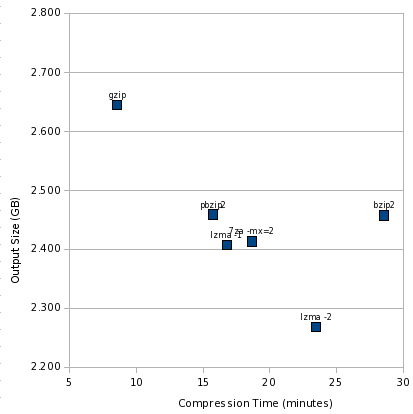
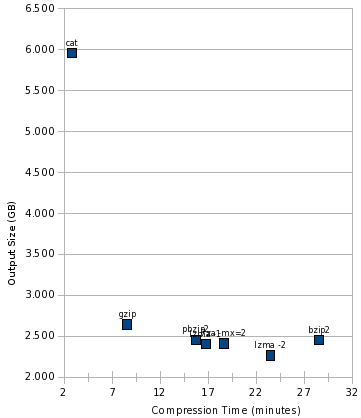
and the case against bzip2 Compression is with us all the time. I want to talk about general-purpose lossless compression here. There is a lot of agonizing over compression ratios: the size of output for various sizes of input. For some situations, this is of course the single most important factor. For instance, if you re Linus Torvalds putting your code out there for millions of people to download, the benefit of saving even a few percent of file size is well worth the cost of perhaps 50% worse compression performance. He compresses a source tarball once a month maybe, and we are all downloading it thousands of times a day. On the other hand, when you re doing backups, the calculation is different. Your storage media costs money, but so does your CPU. If you have a large photo collection or edit digital video, you may create 50GB of new data in a day. If you use a compression algorithm that s too slow, your backup for one day may not complete before your backup for the next day starts. This is even more significant a problem when you consider enterprises backing up terabytes of data each day. So I want to think of compression both in terms of resulting size and performance. Onward Starting Point I started by looking at the practical compression test, which has some very useful charts. He has charted savings vs. runtime for a number of different compressors, and with the range of different settings for each. If you look at his first chart, you ll notice several interesting things: All this was very interesting, but had one limitation: it applied only to the gimp source tree, which is something of a best-case scenario for compression tools. A 6GB Test
I wanted to try something a bit more interesting. I made an uncompressed tar file of /usr on my workstation, which comes to 6GB of data. My /usr contains highly compressible data such as header files and source code, ELF binaries and libraries, already-compressed documentation files, small icons, and the like. It is a large, real-world mix of data. In fact, every compression comparison I saw was using data sets less than 1GB in size hardly representative of backup workloads. Let s start with the numbers:
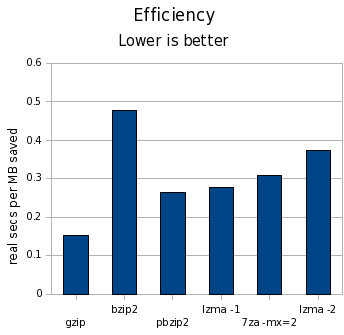
Tool MB saved Space vs. gzip Time vs. gzip Cost
gzip 3398 100.00% 100.00% 0.15
bzip2 3590 92.91% 333.05% 0.48
pbzip2 3587 92.99% 183.77% 0.26
lzma -1 3641 91.01% 195.58% 0.28
lzma -2 3783 85.76% 273.83% 0.37
In the MB saved column, higher numbers are better; in all other columns, lower numbers are better. I m using clock seconds here on a dual-core machine. The cost column is clock seconds per MB saved. What does this tell us? Some Pretty Charts First, let s see how the time vs. size numbers look: compress-zoomed Like the other charts, the best area is the lower left, and worst is upper right. It s clear we have two outliers: gzip and bzip2. And a cluster of pretty similar performers. This view somewhat magnifies the differences, though. Let s add cat to the mix: compress-big And finally, look at the cost: compress-efficiency Conclusions First off, the difference in time is far larger than the difference in space. We re talking a difference of 15% at the most in terms of space, but orders of magnitude for time. I think this pretty definitively is a death knell for bzip2. lzma -1 can achieve better compression in significantly less time, and lzma -2 can achieve significantly better compression in a little less time. pbzip2 can help even that out in terms of clock time on multicore machines, but 7za already has a parallel LZMA implementation, and it seems only a matter of time before /usr/bin/lzma gets it too. Also, if I were to chart CPU time, the numbers would be even less kind to pbzip2 than to bzip2. bzip2 does have some interesting properties, such as resetting everything every 900K, which could provide marginally better safety than any other compressor here though I don t know if lzma provides similar properties, or could. I think a strong argument remains that gzip is most suitable for backups in the general case. lzma -1 makes a good contender when space is at more of a premium. bzip2 doesn t seem to make a good contender at all now that we have lzma. I have also made my spreadsheet (OpenOffice format) containing the raw numbers and charts available for those interested. Update Part 2 of this story is now available, which considers more compression tools, and looks at performance compressing files individually rather than the large tar file.

29 January 2009

Bdale Garbee: Facial Dignity

People keep asking me about the beard thing... Here's my take on what happened and why. Just before I left for LCA 2009, my wife offered to send along one of the limited edition prints of her award-winning waterfall photograph. She knew from prior years that the LCA organizers often host an auction or raffle to raise money for some worthy charity at the conference banquet. Since the photo was taken at Milford Sound on the way to last year's LCA in Melbourne, there was a connection between the photo and LCA. We had no idea what this year's charity might be, nor did we anticipate that her photo would become the centerpiece of the evening's fund-raising activities. The charity selected this year was an organization that is trying to save the Tasmanian Devil from extinction. Professor Hamish McCallum, the chief scientist with the program, gave a talk after dinner and before the auction began. The native population is suffering from a fatal facial tumor disease that results in horrible lesions, and is likely to kill off all the Devils within a decade or three. My family and I all have a strong love of nature, and Karen and I had the pleasure of touring Tasmania after LCA 2003 in Perth, so this seemed like a great charity to raise money for with her photo. As often happens at LCA, the auction and related fund-raising activities got complicated. This year, the photo alone was bid up to $2500 (which was very cool!), before people started offering things for higher bids. For years, going maybe as far back as Perth, I've been cajoled about shaving my beard if the bidding hit some level, and have always said no. This year, someone offered $5000 if I would shave my beard, and again I said no. Much later, after more cajoling and many counter offers, when the bids and various matching offers had us approaching $20,000 in total donation to the charity, I relented and announced that if we hit a total of $25,000 going to the charity I would consent to a shave. The resulting frenzy, including the suggestion that if it went high enough Linus should do the shaving, and the formation of a bidding consortium that kept raising more money and bidding against itself, was completely unexpected! Others have tried to capture details of the insanity, but the bottom line is that by the end of the evening, the total had blown way past anything we could have imagined, and by the end of the conference the total going to the charity was on the order of $40,000! Why did I agree to let Linus shave my beard? To be honest, I'm not entirely certain. I only had one beer that evening, so I can't blame intoxication. The fact that it would yield a worthy charity something over 10 times what my wife's photo alone had drawn as a maximum bid seemed significant to me. In hindsight, I also think I was at least a little bit curious to see what my face looked like after having a beard since sometime around September of 1982! In any case, I made the offer, insane amounts of money were raised, and on the last day of the conference, over the lunch hour, Linus took trimmers in hand and removed my beard in front of an audience. The reactions have been completely overwhelming. A local TV station and a local newspaper in Hobart were both there and ran stories. The ripple of mentions in the blogosphere was and is just astounding. There's even a silly Shaving Bdale game created overnight by the "Mad Scientists" at Secret Lab! And from all over the globe, people I do and don't know have been sending emails and finding me on IRC to plead with me to grow my beard again! Right after the shave, my good friend Keith Packard said "Bdale, grow it back!". Before I left Hobart, my wife emailed saying she and the kids hoped I wasn't waiting until I got home to start. Joey Hess blogged a hairy tale about how I'd scarred the minds of young Debian developers. The leader of Debian-RS sent word by email that the group all hoped I would re-grow my beard. And on and on and on... I'm really not used to being the center of so much attention! Being suddenly without beard felt weird in lots of silly little ways. I was hyper-sensitive to drafts. The feel of cold beverages hitting my upper lip was downright strange. And I kept wanting to scratch what wasn't there! After making faces at myself in the mirror for a while, I decided I really wasn't happy, and do prefer being bearded. So I haven't shaved since Saturday morning in Hobart, and am pretty scruffy looking. My wife said today that I'm "already starting to look like Bdale again". At the current growth rate, I have high hopes of having at least some facial dignity back by the time I speak at FOSDEM. And no, I won't be shaving my beard off again any time soon...

23 January 2009

Joey Hess: a hairy tale

When I was a kid, I had a daddy with this moustache. One day, he shaved it off. I looked at the pale, exposed strip of lip, and demanded he grow it back. There are no images of this event, besides those burned into my brain. It was in simpler times. Dad did grow it back, and a beard too, and and now he's (great)-Grandpa Hess. Who, come to think, looks similar to my tie-died friend Bdale. Bdale is one of the Debian grandfathers, those old guys who the young ones in the project look up to. And today, he scarred all their minds. The collective shout of "grow it back!" is gonna be huge. Did I mention that it all involves Tasmanian devils, charity, and the mean razor of Linus Torvalds? These are not simple times.

22 January 2009

Joerg Jaspert: Bugs, Bugs, Bugs and a nice speed improvement

This all started when a DSA (Debian SysAdmin (those with root rights on all .debian.org machines)) wanted to upgrade the kernel running on our ftp-master host. It was shortly before dinstall, but hey, there it went, and the machine rebooted into a 2.6.28. Besides murphy taking his share making the machine fsck its huge filesystem that is all fine. What wasn t fine was the result we found. An odd one. Suddenly one tool we run during our dinstall run decided to blow up. Well, it did nt break, it just went dead-slow. Usual runtime had been about 5 minutes before, now we had over an hour - and only about 20% of the work was done. YUCK. Thats sure not going to work. Reboot in a 2.6.27 kernel did not show this problem, going back to .28 had it again. Which meant we had yet another reboot to get a working system. At which point investigation of the problem started. Turns out that pythons popen2.popen2 function is closing all available filehandles before it forks. Thats all fine and also what you usually want. Problem is (and all the glory to have found the cause goes to Peter weasel Palfrader) that the .28 kernel included a patch titled rlimit: permit setting RLIMITNOFILE to RLIMINFINITY (0c2d64fb6cae9aae480f6a46cfe79f8d7d48b59f) that allows, as the title implies, to set the limit for number of files to infinity. More citation from weasels mail: Closer investigation showed that the broken default ulimit did not apply to system processes (like stuff started from init). In the end I could establish that all processes that passed through pam_limit at one point had the bad resource limit. Apparently the pam library in Debian etch (4.0) initializes the limits to some default values when it doesn t have any settings in limit.conf to override them. Turns out that for nofiles this is RLIMINFINITY. Commenting out case RLIMITNOFILE in pam_limit.c:267 of our pam package version 0.79-5 fixes that - tho I m not sure what side effects that has. Debian lenny (the upcoming 5.0 version) doesn t have this issue as it uses a different pam (version). So, whatever the fix might be for etch, if any, there is no way we Ftpmaster can force DSA to live with a 2.6.27 kernel forever on our host. As the problem occurs when using popen2 - lets get rid of it. Luckily popen2 was used in dak by people that either did not know the gzip module python has, or it has been there since before that exists. Don t know, but that made removing popen2 a not too hard deal, done by our newest addition to the Ftpteam, Mike O Connor, stew (Thanks!). A pretty nice side effect is a huge improvement to the speed of the tool Prior, using popen2, it took around 5 minutes to do its job. Now using the gzip module we are down to some 44 seconds. Yes, below one minute, but well, must have some effect if you stop forking a thousand times and all that thousand times close all (1024) available filehandles But that alone isn t enough. There was a second tool also using popen2 (thankfully only once instead of a million times). Fixing that tool got its runtime from 2 minutes down to 0.7 seconds. Yes, less than one second, getting the same result out. Thats the gain you get from not going like get a tempfile, zcat foo > tempfile, filehandle=open(file), dowork including reading its content but foo=gzipfile.readitscontents, dowork(foo) . I like it. And am now sure that avoid popen2 at nearly all costs, if you can is a good motto. :)

14 January 2009

Aurelien Jarno: QEMU PowerPC

For a few weeks Laurent Vivier, Blue Swirl and myself have been working on getting QEMU PowerPC working correctly with recent distributions. QEMU used to rely on OpenHackWare for the OpenFirmware implementation on PowerPC. It is a very limited implementation (for example it as no Forth support), which is unable to boot most 2.6.x kernels with the OldWorld emulation. It is able to boot recent kernels with the PReP emulation, but things like the PCI bus emulation are not working correctly. Moreover the PReP kernels are gone with the removal of the arch/ppc tree. OpenBIOS was already used for the OpenFirmware implementation of Sparc 32 and Sparc 64 targets. It now supports PowerPC for the OldWorld emulation. As a result it is now possible to use Debian PowerPC under QEMU emulating an OldWorld machine. What works? What doesn t work / has to be done? For those who want to test, an Etch image is available. You will need to compile QEMU by manually given that the version in Debian is too old and that openbios-ppc is still in the NEW queue.

8 January 2009

Sven Mueller: About Usability

Sami Haahtinen wrote a nice post about usability. I do mostly agree with him, except for one little thing: A few years back, I noticed that I often started as a kind of Joe User with new applications, and often even stayed that way, often wishing that the UI of that application was simpler or at least made it more obvious which options are important and which I could most likely keep at their defaults.
Yet I am a system administrator and programmer/developer, so most people would probably consider me as an advanced user by default (wether that is correct in any given context or not, for example I still don t really grok GIMP).
Also I did have quite a lot of contact with users that have very little experience, knowledge and interest in computers and software and only use them to achive certain goals. Anyway, I m quite sure most readers of this blog are aware that Linus Torvalds once complained about the Gnome printing dialog being simplified way too much. And at that time, I had to agree (note that I didn t check out Gnome again since those days, at least 2 years ago). What I really wonder (especially since I realized this in some of my own applications) is why it is so hard for developers to add some additional checkbox or button that enables/disables advanced options. For example, let s take an applications printing dialog. By default, it would only allow the selection of a printer, orientation (if sensible) and (if the selected printer supports more than one) the paper size. Now advanced options might include duplex printing (automatic or manual), printing mutliple pages on a single sheet of paper, printing in grey on color printers, These options might be of use to anyone, but would most likely confuse beginners. So what I did in most of my little application was to just show the basic options and add an advanced options button which provided access to additional functionality which was not normally needed. As for the issue with firefox updates mentioned by Sami: I don t think it is a problem that firefox asks what to do with extensions. For one, it only lists extensions which are installed but claim not to support the new version of firefox. Second, practically everyone I know of who uses any extension can be considered to be an advanced user. And third: The dialog is pretty straightforward about what it is asking and when I once hit it while a ( dumb user ) friend was sitting with me, he understood what it was about quite easily (I didn t explain the dialog, just what extensions were). So my idea of a good UI is:
As simple as possible for beginning users, but allow advanced users to get to the details ( Details or Advanced options buttons/checkboxes/dialogs).

23 December 2008

Wouter Verhelst: Root on NBD, now with partitions

A while ago, I wrote an initrd script and hook that would allow one to run a system with root on a Network Block Device (NBD), that I maintain both upstream and in Debian. Since then, Laurent Vivier submitted a kernel patch that got merged, and which will allow one to partition an NBD device. I had a patch for my initrd script that would support running root off a partitioned NBD device, but did not yet have the time to test and debug it. Until today, that is. Well... not really. I made the time, but I didn't really have it. For reference, the time is 07:25 right now, and yes, I did stay up all night. But, well, who cares, right? Right. I'd really love to get this into lenny still, but since we're in deep freeze... not keeping my breath. We'll see, I guess. The upload is going to unstable, anyway after this one final test. So how does it work? Unfortunately, no d-i support as of yet. I'd been working on that, but then it turned out that in order to support root-on-NBD, I'd have to somehow, somewhere, teach partman that NBD is this strange thing which can be formatted, but not partitioned. I was way far in my research (but nowhere in code, yet) on that when Laurent sent in his partitioning patch, so it got postponed then, and I didn't get a chance to pick it up anymore in time. But if you're willing to use debootstrap manually, it's really simple to set up:
# apt-get install nbd-client
# nbd-client server port /dev/nbd0
# fdisk /dev/nbd0
[... create partitions ...]
# mkfs -t ext3 /dev/nbd0p1
# mkdir /mnt/tmp
# mount /dev/nbd0p1 /mnt/tmp
# debootstrap --include=nbd-client sid /mnt/tmp
# echo KILLALL=false >> /mnt/tmp/etc/nbd-client
The "KILLALL" is necessary, since otherwise the nbd-client initscript will do nasty things with your root filesystem. Note that you still need nbd-client installed and run the initscript, even if it only uses nbd-client inside the initrd; because the initscript writes the nbd-client PID to /lib/init/rw/sendsigs.omit.d, which is also required if you don't want sendsigs to shoot the root filesystem from under your nose. This might see some changes in the future. Now boot with your kernel and initramfs, and boot it with the following arguments:
nbdroot=server,port root=/dev/nbd0p1
Obviously, in the above two examples, you should replace 'server' by the IP address or hostname of your server, and 'port' by the port number on which your nbd-server is running. It is of course also possible to use nbd1p2 or nbd0p4, should you want that. And that's all there is to it. Well, almost; due to the way the network configuration is written in initramfs, I had to choose between reinventing the wheel, or hardcoding the NIC name to 'eth0'. I chose the latter. What this means is that if you want to boot off an NBD blockdevice that is only available on eth1 or wlan0 or some such, you lose. Other than that, go ahead and try. Should be on a DMNY (Debian Mirror Near You) RSN. Update: fill in the link to git.kernel.org, and mention the KILLALL thing. Oops.

Next.

Previous.