Benjamin Mako Hill: Anxiety
 I am haunted by the nagging fear that I have mailboxes, tucked into a
dark corner of an office somewhere, and perhaps even full of checks
and important documents, that I don't know exist.
I am haunted by the nagging fear that I have mailboxes, tucked into a
dark corner of an office somewhere, and perhaps even full of checks
and important documents, that I don't know exist.
I often hear criticism of "negative campaigning" in the free software
movement. For example, in reply to a blog post I once wrote about
an FSF campaign, several people argued against, "negative campaigning
of any sort, in any realm." Drawing an analogy to political smear
campaigns, some members of the free software community have taken
the position that negative campaigning in general is not useful
and that negativity has no place in our advocacy.
First, it is important to be clear on what we mean by a negative
campaigns. I believe that there is a fundamental difference between
speaking out against policies or actions and smear campaigns that
employ untrue claims, ad hominem attacks, and that attempt to avoid a
real conversation about issues. I will categorically condemn the
latter form of smear campaigning in campaigns for software freedom or
for anything else.
That said, negativity directed at negativity has had a positive effect
in many social movements. I have supported and participated in
"negative" campaigns against proprietary software, software patents,
DRM, centralized network services, and the firms behind these
practices. I've done so because I believe that if one is taking an
ethical position, it is justified, and often necessary, to not only
speak about the benefits of freedom but against acts of dispossession
and disenfranchisement.
In some of the most effective social movements, unambiguously negative
messages have been central. Should a campaign for abolishing child
labor talk only about how valuable adult workers are to their
employers or how happy kids are when they don't work? Should a
campaign trying to abolish land mines talk only about the benefits of
bomb-free fields and intact lower limbs? Should a free speech
organization only speak out about the social welfare brought by a free
press and never against acts of censorship? These may seem like
outlandish comparisons but you can find people writing, only a couple
centuries ago, about how slavery should be abolished by arguing in
favor of the benefits of paid labor. Even if the economic arguments
in favor of paid work are strong, these arguments seems irrelevant and
offensive today. Whether slavery is more or less efficient is a moot
point. Society has rejected it because it is wrong.
We have made important strides toward eliminating injustices like
child labor and slavery because activists waged decidedly negative
campaigns against them and convinced others to join in opposition. In
doing so, activists declared the status quo unconscionable and created
an ethical responsibility to find alternatives and to redefine what
was "realistic." While I will not suggest that the movement for
software freedom is comparable in ethical weight to these other
causes, I know that the free software mission is similar in kind.
Of course, if one does not think that user control over technology is
an ethical issue but is instead merely a matter of choice, one will
probably oppose negative campaigns. It is also possible that a
particular negative campaign is tactically unwise in that it is
unlikely to reach a large audience, unlikely to change people's minds,
or be difficult to carry out successfully. But such campaigns are a
bad idea because they are ineffective, not because they are
negative. Additionally, a movement that is purely negative and offers
no reasonable alternative to the stated ill may also be unlikely to
succeed. This is why, for example, I believe it is good that the FSF
uses the large majority of its resources in the "positive" role of
supporting free software.
For those that do treat technological empowerment as an ethical ideal,
it is both justified and essential to condemn the systematic
disempowerment of others through non-free software just as we
celebrate the benefits of software freedom. "Negative" campaigns
against proprietary software, software patents, and DRM in music have
already led our community to important -- if incomplete --
victories. The desire to right wrongs has been a critical part of our
movement's success and of many others'. We would be wise not to give
it up.

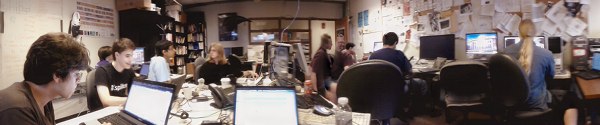
(Photo credit: Obey Arthur Liu; originally on Picasa, license.)
Three weekends ago, I participated in a Debian bug squashing party. It was more fun than I had guessed!
The event worked: we squashed bugs. Geoffrey Thomas (geofft) organized it as an event for MIT's student computing group, SIPB. In this post, I'll review the good parts and the bad. I'll conclude with beaming photos of my two mentees and talk about the bugs they fixed.
So, the good:
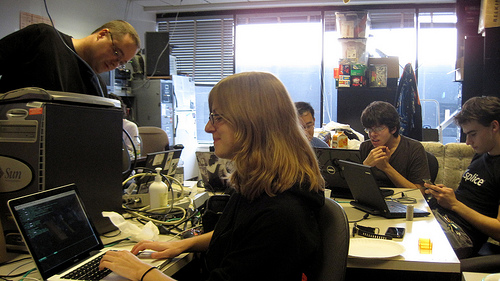 Jessica McKellar is a software engineer at
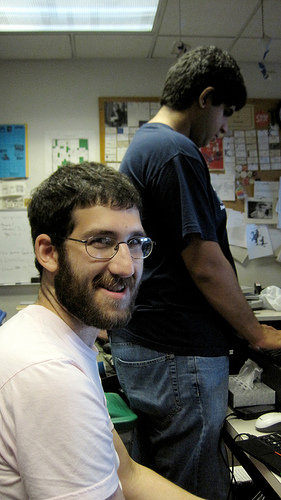 Noah Swartz is a recent graduate of Case Western Reserve University where he studied Mathematics and played Magic. He is an intern at the MIT Media Lab where he contributes to DoppelLab in Joe Paradiso's Responsive Environments group. This was definitely his first direct contribution to Debian. It was also one of the most intense command-line experiences he has had so far. Noah wasn't originally planning to come, but we were having lunch together before the hackathon, and I convinced him to join us.
Noah fixed #625177, a fails-to-build-from-source (FTBFS) bug in nslint. The problem was that "-Wl" was instead written in all lowercase in the debian/rules file, as "-wl". Noah fixed that, making sure the package properly built in pbuilder, and then spent some quality time with lintian figuring out the right way to write a debian/changelog.
That's a wrap! We'll hopefully have one again in a few months, and before that, I hope to write up a guide so that we run things even more smoothly next time.
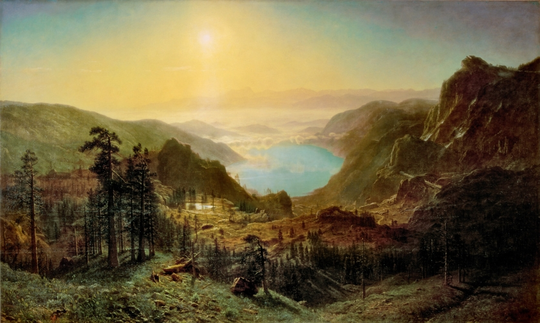 In the Peabody Essex Museum a couple weeks ago, I saw a beautiful
landscape by Albert Bierstadt of Donner Pass whose label
referenced the famous Donner Party of 1846 and their, "sensational
story of privation, cannibalism, and death." I would reorder
that sentence.
SeeClickFix makes a mobile application you can use to report
Boston drivers using their smartphones while driving, while
driving.
When you care for somebody, it is difficult to tell them "no." When
you trust somebody, you will tell them.
Much of my academic research involves statistics and crunching through
big datasets. To do this, I use computer clusters like Amazon's
EC2 and a cluster at the Harvard MIT Data Center. I will
frequently kick of a job to run overnight on the full HMDC cluster of
~100 computers. Some of my friends do so nearly every night on similar
clusters. Like many researchers and engineers, it costs me nothing to
kick off a big job. That said, computers consume a lot of energy so I
did a little back-of-the-envelope calculation to figure out what the
cost in terms of resources might add up to.
An overnight job that uses a 100 computer cluster might use 800
computer-hours. Although power efficiency varies hugely between
computers, most statistical analysis is CPU intensive and should come
close to maximizing power consumption. According to a few sources
[e.g., 1 2 3], 200 watts might be a conservative estimate
of much a modern multi-CPU server will draw under high load and won't
include other costs like cooling. Using this estimate, the overnight
job on 100 machines would easily use 160 kilowatt hours (kWh) of
energy.
In Massachusetts, most of our power comes from coal. This page
suggests that an efficient coal plant will generate 2,460 kWh for each
ton of coal. That means that one overnight job would use 59 kg (130
lbs) of coal. In the process, you would also create 153 kg (338 lb)
of CO2 and a bit under half a kilogram (about 1 lb) of nitrogen oxides
and sulfur dioxide each. It's a very rough estimate but it certainly
generates some pressure to make sure the research counts!
Of course, I've written some free software that runs on many thousands
of computers and servers. How many tons of coal are burnt to support
laziness or a lack of optimization in my software? What is the coal
cost of choosing to write a program in a less efficient, but easier to
write, higher-level programming languages like Python or Ruby instead
of writing a more efficient version in C?
Recently, I was working with Daf and Rob on a little offline wiki
project -- more on that soon -- and we realized that we needed to
parse some dates in ISO 8601 format. One of us wondered out loud
if there was a Python module that could help us. I offered to take a
look.
Turns out, less than two months before, someone had uploaded just such
a module into Debian. The maintainer? Me.
The Acetarium, where I live, runs what we like to think of as the
world's smallest artistic residency program by hosting artists,
social scientists, hackers, and free software and free culture folks
for periods of 1-3 months.
Our most recently graduated resident, Noah, built a lawn scrabble
set on the Media Lab ShopBot and held a Scrabble picnic this weekend
with some former Acetarium residents and others. I don't really like
playing Scrabble, so you can see me working on an essay (and verifying
words) in the background.

 Thanks to Ben Schwartz as I yoinked these pictures from his blog.


 At the Copenhagen airport, Mika and I found the quiet room. It
was a soft, well lit, room designed for prayer and reflection. During
the hour I was in it, the only other visitor was a child cracking open
the doorway to peer in. The room had a guest book with hundreds of
messages left by other travelers over the last couple years. People
praised the airport administrators for providing the room, made
suggestions, and complained about the room, the airport, and the
country's shortcomings. They talked about themselves, their travels,
their happiness and unhappiness with departing or returning home, and
their thoughts about the world.
I spend a lot of time in airports but only rarely speak to my fellow
travelers. It's amazing how little I know about the thousands of
people waiting in line with me, sitting near me on the plane, and
sharing in the long, lonely, and often stressful experience of moving
between countries and continents. The guest book provided a rare
window into these people in what is normally the anonymous and
depersonalized non-place of airports. In the quiet room, I could
-- for the first time -- hear some of these fellow travelers speak.
Marcus Rohwetter has recently published a very detailed article about
Antifeatures in the German monthly magazine Zeit
Wissen. Although I've only read the article through automatic
translation -- unfortunately, I don't read German -- I'm hugely
honored that Rohwetter has taken the time to engage with the idea so
deeply and to help translate the argument for a much broader community
than the free software community I come from and am best able to
speak to.
A lot of what I've been trying to do in the last year or so is to
figure out how to speak more effectively about the politics of
technology control to audiences of non-technologists. Indeed, that's
the whole point of the antifeatures concept. I deeply appreciate
the help of Rohwetter, and others, in that project.
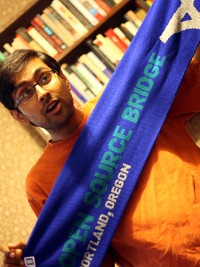
 On Friday, June 24, the last day of Open Source Bridge, I won a scarf! It says, "Open Source Citizen."
I wasn't the only one. The attendees nominated people who "made an extra effort to help others and share their knowledge," and the conference committee chose the three people they felt exemplified this. The winners were Sumana Harihareswara, Igal Koshevoy, and me.
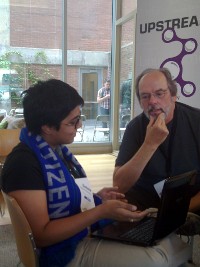
In case you don't know Sumana, she's the new Wikimedia Volunteer Development Coordinator, a friend, and a commenter here at Asheeshworld. In the photo of her and her new scarf, you can also see Ward Cunningham. I suggest reading her wrap-up about the conference, and checking out the notes from her talk.
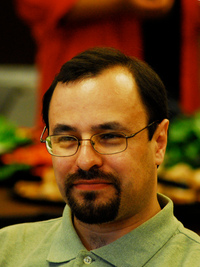
I haven't met Igal, but I've learned he's a fixture of the Portland tech scene. He's user number one on opensourcebridge.org and one of the original contributors to calagator, the most important event calendar in the Portland tech world. That's just a brief summary; follow him on Twitter to keep in touch.
I started the conference a little shy, not wanting to introduce myself to people, so I hung out with Sumana. She talked to everyone she could find, and there I was standing next to her. On the first day, it was only because of Sumana's outgoingness that people knew who I was. On the second and third days, I was involved in two sessions: a panel on open source communities and a talk about the OpenHatch training missions.
I was extremely honored to be chosen. There were so many other spectacular people I met for the first time, like Valerie Aurora,
Jacinta Richardson, Brian Aker, and Alex Linsker. These are all people with three crucial traits: they're extremely knowledgeable, friendly, and opinionated. I'm glad I had a chance to attend and meet them!
Photo credits: Thanks to Noah Swartz for the photo of me. Sumana's photo comes from her post to wikitech-l. Igal's comes from his Open Source Bridge user profile.
Last week, the Berkman Center for Internet and Society announced
it's 2011-2012 list of fellows. I'm honored and excited that they
elected to include me in a pretty incredible list of fellows, faculty
associates, and other affiliates. It seems I'll be at Harvard next year.
In my first year as an undergraduate -- when fights over Napster were
raging -- I took a class taught by a Berkman Fellow on the political
and social implications of Internet technology. The next year, I
worked part-time as a teaching assistant for Harvard Law professor
(and Berkman director) Jonathan Zittrain. These experiences had a
enormous influence on my life and work. Before, my goal was to
study and teach English literature.
I've hung around on the fringes of the center for much of the last
decade and I've grown immeasurably from the experience. Most recently,
I've been working closely with Berkman director Yochai Benkler and
current fellow Aaron Shaw on research in online cooperation. The
new crop of fellows includes a pretty great group of people working on
similar stuff and I'm looking forward to expanding the online
cooperation research at the center and to a year of fascinating
talks and discussions. I also hope that, after all these, years, I'll
be able to give a bit back to an organization that has give me so
much.
I've been in Europe for the last couple weeks but pretty occupied with
things like attending my brother wedding and a series of outdoor
excursions in Spain.
Today Mika and I arrived in Berlin where I am going to attending and
giving a talk at the Open Knowledge Conference on When Free
Software Isn't Better. I'll also participate in a session on
Wikipedia research facilitated by Mayo Fuster Morrell.
On July 2nd, I'll be taking an overnight train to Vienna where I'll be
attending the Open and User Innovation Workshop -- an academic
conference where I'll presenting some of my research. From there I'll
be hitching a ride to Munich with Marcell Mars on July 6th and,
after that, a flight back to Boston with a weekend long layover in
Reykjavik.
Details on the trip are on page on my wiki and I encourage anyone
to contact me if you're in Berlin, Vienna, Munich, or Reykjavik
and want to meet up for a drink or a chat.
 Let me explain something to you: jacking up prices for your laptops
by 10% on June 1st and simultaneously declaring an "incredible,
5-days only, 10% off sale on all Thinkpads" on your website is not
how your sell more laptops. That's how you make your potential
customers recognize that they are probably better off looking
elsewhere for their next laptop.
Specifically, I'm talking about an Intel-based Thinkpad Edge 11 with
4GB RAM, which was listed at 663 EUR on lenovo.ie before June 1st, but
is now, during the "promotion", is listed at 736 EUR. Notably, even
after the discount, it still works out to be more expensive than what
Amazon UK has to offer, at 552 GBP for the same laptop (NVY5EUK).
 Two weeks ago, I was lucky to celebrate my 33th birthday with my closest
friends in l'Alqueria. When asked to wish something before blowing
the candles on Victor's delicious apple cake, I thought I have basically
everything I'd want, but it'd be cool if some real changes happened in this
world.
Not long after, big demonstrations asking for Real Democracy Now
happened throughout the Spanish state, and today, that Sunday seems to be
an eternity away. Huge assemblies, thousands of strangers working together,
more demonstrations, an election campaign eclipsed by #15m, hundreds of
well thought, plausible claims published, the movement crossing the Spanish
borders and leaking into France and Greece, the feeling that this is
the good one, the basis for a fresh start that can make our lives
better, our society a fair one and the possibility to stand in front of the
fuckers who have made our lives a lot harder, to tell them it's not going
to work like that anymore. All of this in 15 days.
Unfortunately, revolution came when I'm in a crucial month to finish my
studies and swamped with other little things, so I've been unable to be in
the Valencian camp site for more than 3 days. Hopefully when I'm done on the
22nd people will still be
taking the square, because
Mako and
Mika will be visiting then.
Yay!

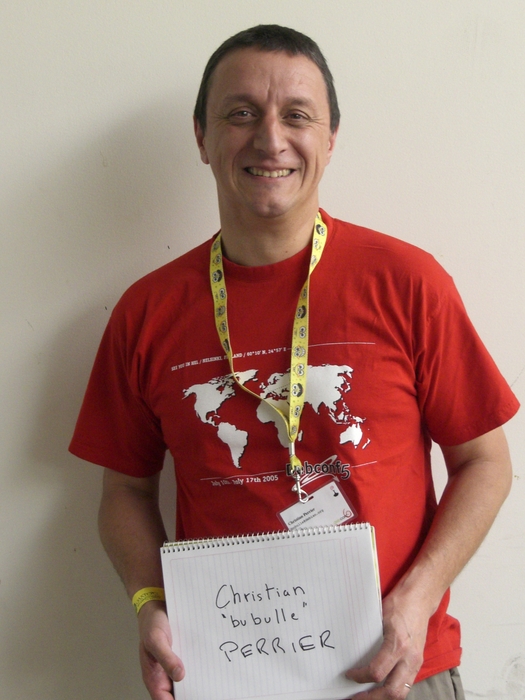 Christian is a figure of Debian, not only because of the tremendous coordination work that he does within the translation project, but also because he s very involved at the social level. He s probably in the top 5 of the persons who attended most often the Debian conference.
Christian is a friend (thanks for hosting me so many times when I come to Paris for Debian related events) and I m glad that he accepted to be interviewed. He likes to speak and that shows in the length of his answers
 but you ll be traveling the world while reading him.
My questions are in bold, the rest is by Christian.
Who are you?
I am a French citizen (which is easy to guess unless you correct my
usual mistakes in what follows). I m immensely proud of being married
for nearly 26 years with Elizabeth (who deserves a statue from Debian
for being so patient with my passion and my dedication to the
project).
I m also the proud father of 3 wonderful kids , aged 19 to
23.
I work as team manager in the Networks and Computers Division of Onera
the French Aerospace lab , a public research institute about
Aeronautics, Space and Defense. My team provides computer management
services for research divisions of Onera, with a specific focus put on
individual computing.
I entered the world of free software as one of the very first users of
Linux in France. Back in the early 1990 s, I happened (though the BBS
users communities) to be a friend of several early adopters of Linux
and/or BSD386/FreeBSD/NetBSD in France. More specifically, I
discovered Linux thanks with my friend Ren Cougnenc (all my free
software talks are dedicated to Ren , who passed away in 1996).
You re not a programmer, not even a packager. How did you come
to Debian?
I m definitely not a programmer and I never studied computing (I
graduated in Materials Science and worked in that area for a few years
after my PhD).
However, my daily work always involved computing (I redesigned the
creep testing laboratory and its acquisition system all by myself
during my thesis research work). An my hobbies often involved
playing with home computers, always trying to learn about something
new.
So, first learning about a new operating system then trying to
figure out how to become involved in its development was quite a
logical choice.
Debian is my distro of choice since it exists. I used Slackware on work
machines for a while, but my home server, kheops,
first ran Debian 1.1 when I stopped running a BBS on an MS-DOS machine
to host a news server. That was back in October 1996.
I then happened to be a user, and more specifically a user of
genealogy software, also participating very actively in Usenet from
this home computer and server, that was running this Debian thing.
So, progressively, I joined mailing lists and, being a passionate
person, I tried to figure out how I could bring my own little
contribution to all this.
This is why I became a packager (yes, I am one!) by taking over the
geneweb package, which I was using to publish my genealogy
research. I applied as DD in January 2001, then got my account in July
2001. My first upload to the Debian archive occurred on August 22nd
2001: that was of course geneweb, which I still maintain.
Quite quickly, I became involved in the work on French localization. I
have always been a strong supporter of localized software (I even
translated a few BBS software back in the early 90 s) as one of the
way to bring the power and richness of free software to more users.
Localization work lead me to work on the early version of Debian
Installer, during those 2003-2005 years where the development of D-I
was an incredibly motivating and challenging task, lead by Joey Hess
and his inspiring ideas.
From user to contributor to leader, I suddenly discovered, around
2004, that I became the coordinator of D-I i18n (internationalization)
without even noticing
You re the main translation coordinator in Debian. What plans
and goals have you set for Debian Wheezy?
As always: paint the world in red.
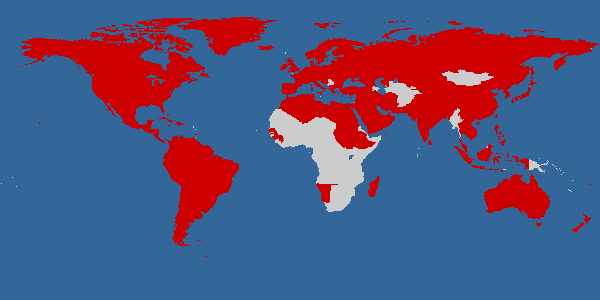 Indeed, this is my goal for years. I would like our favorite distro to
be able to be used by anyone in the world, whether she speaks
English, Northern Sami, Wolof, Uyghur or Secwepemcts n.
As a matter of symbol, I use the installer for this. My stance is that
one should be able to even install Debian in one s own language. So,
for about 7 years, I use D-I as a way to attract new localization
contributors.
This progress is represented on
this
page where the world
is gradually painted in red as long as the installer supports more
languages release after release. The map above tries to illustrate
this by painting in red countries when the most spoken language in the
country is supported in Debian Installer.
However, that map does not give enough reward to many great efforts
made to support very different kind of languages. Not only various
national languages, but also very different ones: all regional
languages of Spain, many of the most spoken languages in India,
minority languages such as Uyghur for which an effort is starting,
Northern Sami because it is taught in a few schools in Norway, etc.,
etc.
Still, the map gives a good idea of what I would like to see better
supported: languages from Africa, several languages in Central
Asia. And, as a very very personal goal, I m eagerly waiting for
support of Tibetan in Debian Installer, the same way we support its
sister language, Dzongkha from Bhutan.
For this to happen, we have to make contribution to localization as
easy as possible. The very distributed nature of Debian development
makes this a challenge, as material to translate (D-I components,
debconf screens, native packages, packages descriptions, website,
documentation) is very widely spread.
A goal, for years, is to set a centralized place where
translators could work easily without even knowing about SVN/GIT/BZR
or having to report bugs to send their work. The point, however, would
be to have this without making compromises on translation quality. So,
with peer review, use of thesaurus and translation memory and all such
techniques.
Tools for this exist: we, for instance, worked with the developers of
Pootle to help making it able to cope with the huge amount of material
in Debian (think about packages descriptions translations). However, as
of now, the glue between such tools and the raw material (that often
lies in packages) didn t come.
So, currently, translation work in Debian requires a great knowledge
of how things are organized, where is the material, how it can be
possible to make contribution reach packages, etc.
And, as I m technically unable to fulfill the goal of building the
infrastructure, I m fulfilling that role of spreading out the
knowledge. This is how I can define my coordinator role.
Ubuntu uses a web-based tool to make it easy to contribute
translations directly in Launchpad. At some point you asked Canonical to
make it free software. Launchpad has been freed in the mean time. Have you
(re)considered using it?
Why not? After all, it more or less fills in the needs I just
described. I still don t really figure out how we could have all
Debian material gathered in Rosetta/Launchpad .and also how Debian
packagers could easily get localized material back from the framework
without changing their development processes.
I have always tried to stay neutral wrt Ubuntu. As many people now in
Debian, I feel like we have reached a good way to achieve our mutual
development. When it comes at localization work, the early days where
the everything in Rosetta and translates who wants stanza did a lot
of harm to several upstream localization projects is, I think, way
over.
Many people who currently contribute to D-I localization were indeed
sent to me by Ubuntu contributors .and by localizing D-I, apt,
debconf, package descriptions, etc., they re doing translation work
for Ubuntu as well as for Debian.
Let s say I m a Debian user and I want to help translate Debian
in my language. I can spend 1 hour per week on this activity. What should
I do to start?
Several language teams use Debian mailing lists to coordinate their
work. If you re lucky enough to be a speaker of one of these
languages, try joining debian-l10n-<yourlanguage>
and follow what s happening there. Don t try to immediately jump in some
translation work. First, participate to peer reviews: comment on
others translations. Learn about the team s processes, jargon and
habits.
Then, progressively, start working on a few translations: you may want
to start with translations of debconf templates: they are short, often
easy to do. That s perfect if you have few time.
If no language team exists for your language, try joining debian-i18n
and ask about existing effort for your language. I may be able to
point you to individuals working on Debian translations (very often
along with other free software translation efforts). If I am not, then
you have just been named coordinator for your language I may
even ask you if you want to work on translating the Debian Installer.
What s the biggest problem of Debian?
We have no problems, we only have solutions
We are maybe facing a growth problem for a few years. Despite the
increased welcoming aspects of our processes (Debian Maintainers),
Debian is having hard times in growing. The overall number of active
contributors is probably stagnating for quite a while. I m still
amazed, however, to see how we can cope with that and still be able to
release over the years. So, after all, this is maybe not a
problem
Many people would point communication problems here. I don t. I
think that communication inside the Debian project is working fairly
well now. Our famous flame wars do of course still happen from time
to time, but what large free software project doesn t have flame wars?
In many areas, we indeed improved communication very significantly. I
want to take as an example the way the release of squeeze has been
managed. I think that the release team did, even more this time, a
very significant and visible effort to communicate with the entire
project. And the release of squeeze has been a great success in that
matter.
So, there s nearly nothing that frustrates me in Debian. Even when a
random developer breaks my beloved 100% completeness of French
translations, I m not frustrated for more than 2 minutes.
You re known in the Debian community as the organizer of the
Cheese & Wine Party during DebConf. Can you tell us what this is
about?
 This is an interesting story about how things build themselves in
Debian.
It all started in July 2005, before DebConf 5 in Helsinki. Denis
Barbier, Nicolas Fran ois and myself agreed to bring at Debconf a few
pieces of French cheese as well as 1 or 2 bottles of French wine and
share them with some friends. Thus, we settled an informal meeting in
the French room where we invited some fellows: from memory, Benjamin
Mako Hill, Hannah Wallach, Matt Zimmermann and Moray Allan. All of
us fond of smelly cheese, great wine plus some extra p t
home-made by Denis in Toulouse.
It finally happened that, by word of mouth, a few dozens of other
people slowly joined in that French room and turned the whole thing
into an improvized party that more or less lasted for the entire
night.
The tradition was later firmly settled in 2006, first in Debconf 6 in
Mexico where I challenged the French DDs to bring as many great cheese
as possible, then during the Debian i18n meeting in Extremadura (Sept
2006) where we reached the highest amount of cheese per participant
ever. I think that the Creofonte building in Casar de C ceres hasn t
fully recovered from it and is still smelling cheese 5 years after.
This party later became a real tradition for DebConf, growing over
and over each year. I see it as a wonderful way to illustrate the
diversity we have in Debian, as well as the mutual enrichment we
always felt during DebConfs.
My only regret about it is that it became so big over the years that
organizing it is always a challenge and I more and more feel pressure
to make it successful. However, over the years, I always found
incredible help by DebConf participants (including my own son, last
year a moment of sharing which we will both remember for years, i think).
And, really, in 2010, standing up on a chair, shouting (because the
microphone wasn t working) to thank everybody, was the most emotional
moment I had at Debconf 10.
Is there someone in Debian that you admire for their
contributions?
So many people. So, just like it happens in many awards ceremonies, I
will be very verbose to thank people, sorry in advance for this.
The name that comes first is Joey Hess. Joey is someone who has a
unique way to perceive what improvements are good for Debian and a
very precise and meticulous way to design these improvements. Think
about debconf. It is designed for so long now and still reaching its
very specific goal. So well designed that it is the entire basis for
Joey s other achievement: designing D-I. Moreover, I not only admire
Joey for his technical work, but also for his interaction with
others. He is not he loudest person around, he doesn t have to .just
giving his point in discussion and, guess what? Most of the time, he s
right.
Someone I would like to name here, also, is Colin Watson. Colin is
also someone I worked with for years (the D-I effect, again ) and,
here again, the very clever way he works on technical improvements as
well as his very friendly way to interact with others just make it.
And, how about you, Rapha l? I m really admirative of the way you
work on promoting technical work on Debian. Your natural ability to
explain things (as good in English as it is in French) and your
motivation to share your knowledge are a great benefit for the
project. Not to mention the technical achievements you made with
Guillem on dpkg of course!
Another person I d like to name here is Steve Langasek. We both
maintain samba packages for years and collaboration with him has
always been a pleasure. Just like Colin, Steve is IMHO a model to
follow when it comes at people who work for Canonical while continuing
their involvment in Debian. And, indeed, Steve is so patient with my
mistakes and stupid questions in samba packaging that he deserves a
statue.
We re now reaching the end of the year where Stefano Zacchiroli was
the Debian Project Leader. And, no offense intended to people who were
DPL before him (all of them being people I consider to be friends of
mine), I think he did the best term ever. Zack is wonderful in sharing
his enthusiasm about Debian and has a unique way to do it. Up to the
very end of his term, he has always been working on various aspects of
the project and my only hope is that he ll run again (however, I would
very well understand that he wants to go back to his hacking
activities!). Hat off, Zack!I again have several other people to name in this Bubulle hall of
Fame : Don Armstrong, for his constant work on improving Debian BTS,
Margarita Manterola as one of the best successes of Debian Women (and
the most geeky honeymoon ever), Denis Barbier and Nicolas Fran ois
because i18n need really skilled people, Cyril Brulebois and Julien
Cristau who kept X.org packaging alive in lenny and squeeze, Otavio
Salvador who never gave up on D-I even when we were so few to care
about it.
I would like to make a special mention for Frans Pop. His loss in 2010
has been a shock for many of us, and particularly me. Frans and I had
a similar history in Debian, both mostly working on so-called non
technical duties. Frans has been the best release manager for D-I (no
offense intended, at all, to Joey or Otavio .I know that both of
them share this feeling with me). His very high involvment in his work
and the very meticulous way he was doing it lead to great achievements
in the installer. The Installation Guide work was also a model and
indeed a great example of non technical work that requires as many
skills as more classical technical work. So, and even though he was
sometimes so picky and, I have to admit, annoying, that explains why
I m still feeling sad and, in some way, guilty about Frans loss.
One of my goals for wheezy is indeed to complete some things Frans
left unachieved. I just found one in bug #564441: I will make this
work reach the archive, benefit our users and I know that Frans would
have liked that.
7 comments Liked this article? Click here. My blog is Flattr-enabled.
 When Reddit sold to Cond Nast and the founders all moved to
California, their old place in Davis Square was empty for a few
months and they let Mika I move in and take it over. It's an awesome
place and we're still there along with some Web 2.0 graffiti they
left on the roof.
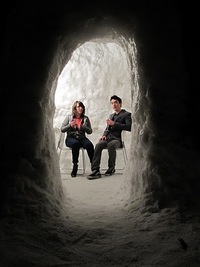
And so it is with pleasure that I've agreed to be interviewed by
redditor Danny Piccirillo in a giant igloo he helped build --
if the unseasonably warm weather streak of weather doesn't manage to
melt it before next week.
Questions are being gathered at Reddit so feel free to go there and
ask me any question you'd like to see me answer in an igloo.
Next.