Search Results: "lucas"

4 July 2014

Raphaël Hertzog: My Free Software Activity in June 2014

This is my monthly summary of my free software related activities. If you re among the people who made a donation to support my work (168.17 , thanks everybody!), then you can learn how I spent your money. Otherwise it s just an interesting status update on my various projects. Debian LTS After having put in place the infrastructure to allow companies to contribute financially to Debian LTS, I spent quite some time to draft the announce of the launch of Debian LTS (on a suggestion of Moritz M hlenhoff who pointed out to me that there was no such announce yet). I m pretty happy about the result because we managed to mention a commercial offer without generating any pushback from the community. The offer is (in my necessarily biased opinion) clearly in the interest of Debian but still the money doesn t go to Debian so we took extra precautions. When I got in touch with the press officers, I included the Debian leader in the discussion and his feedback has been very helpful to improve the announce. He also officially acked the press release to give some confidence to the press officers that they were doing the right thing. Lucas also pushed me to seek public review of the draft press release, which I did. The discussion was constructive and the draft got further improved. The news got widely relayed, but on the flip side, the part with the call for help got almost no attention from the press. Even Linux Weekly News skipped it! On the Freexian side, we just crossed 10% of a full-time position (funded by 6 companies) and we are in contact with a few other companies in discussion. But we re far from our goal yet so we will have to actively reach out to more companies. Do you know companies who are still running Debian 6 servers ? If yes, please send me the details (name + url + contact info if possible) to deblts@freexian.com so that I can get in touch and invite them to contribute to the project. Distro Tracker In the continuation of the Debian France game, I continued to work together with Joseph Herlant and Christophe Siraut on multiple improvements to distro tracker in order to prepare for its deployment on tracker.debian.org (which I just announced \o/). Debian France Since the Debian France game was over, I shipped the rewards. 5 books have been shipped to: Misc Debian work I orphaned sql-ledger and made a last upload to change the maintainer to Debian QA (with a new upstream version). After having been annoyed a few times by dch breaking my name in the changelog, I filed #750855 which got quickly fixed. I disabled a broken patch in quilt to fix RC bug #751109. I filed #751771 when I discovered an incorrect dependency on ruby-uglifier (while doing packaging work for Kali Linux). I tested newer versions of ruby-libv8 on armel/armhf on request of the upstream author. I had reported him those build failures (github ticket here). Thanks See you next month for a new summary of my activities.

One comment Liked this article? Click here. My blog is Flattr-enabled.

2 June 2014

Raphaël Hertzog: My Free Software Activities since January 2014

If you follow my blog closely, you noticed that I skipped all my usual monthly summaries in 2014. It s not that I stopped doing free software work, instead I was just too busy to be able to report about what I did. As an excuse, let me tell you that we just moved into a new house which was in construction since may last year. The lack of visible activity on my blog resulted in a steady decrease of the amount of donations received (January: 70.72 , February: 71.75 , March: 51.25 , April: 39.9 , May: 40.33 ). Special thanks to all the people who kept supporting my work even though I stopped reporting about it. So let s fix this. This report will be a bit less detailed since it covers the whole period since the start of the year. Debian France Preparations related to general assemblies. The year started with lots of work related to Debian France. First I took care of setting up limesurvey with Alexandre Delano to handle the vote to pick our new logo:
The new logo of Debian France I also helped Sylvestre Ledru to finalize and close the accounting books for 2013 in preparation for the general assembly that was due later in the month. I wrote the moral report of the president to be presented to the assembly. And last step, I collected vote mandates to ensure that we were going to meet the quorum for the extraordinary assembly that was planned just after the usual yearly assembly. The assemblies took place during a two days mini-debconf in Paris (January 17-18) where I was obviously present even though I gave no talk besides announcing the logo contest winner and thanking people for their participation.
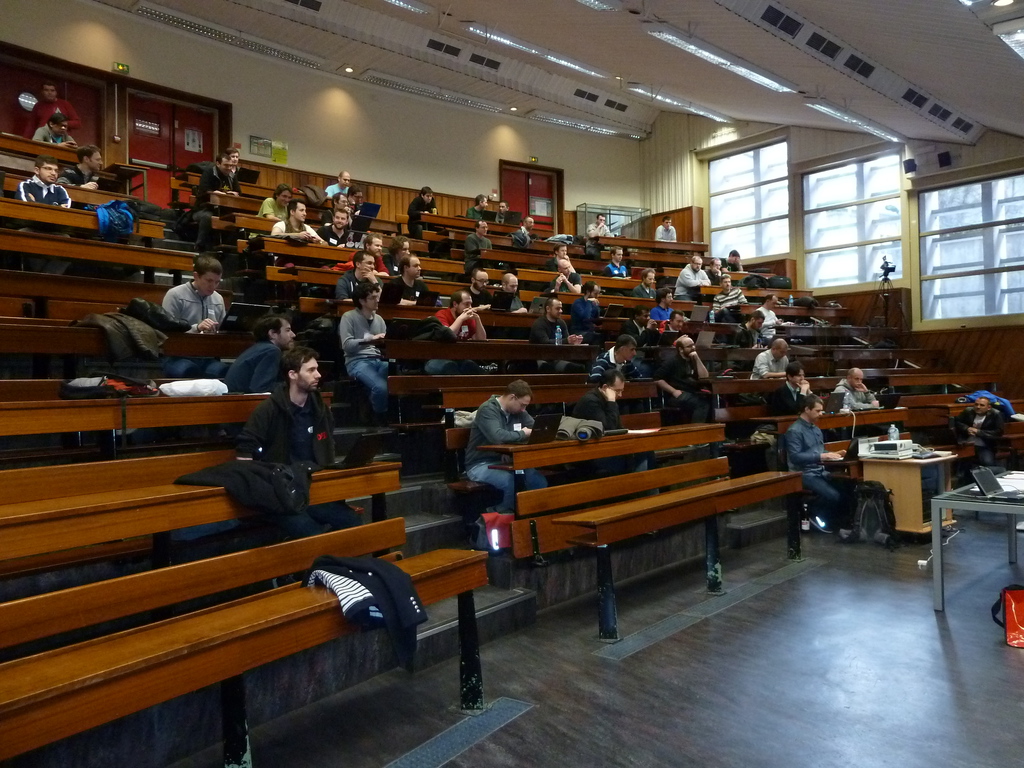
Assembl e g n rale 2014 de Debian France

The Debian France members during the general assembly

It s worth noting that the extraordinary assembly was meant primarily to enshrine in our bylaws the possibility to act as a trusted organization for Debian. This status should be officialized by the Debian project leader (Lucas Nussbaum) in the upcoming weeks since we answered satisfactorily to all questions. Our paypal donation form and the accounting tools behind it are ready. Galette packaging and members map. I managed to hand over the package maintenance of galette to Fran ois-R gis Vuillemin. I sponsored all his uploads and we packaged a new plugin that allows to create a map with all the members who accept to share their location. The idea was to let people meet each other when they don t live far away with the long term goal to have Debian France organized activities not only in Paris but everywhere in France. New contributor game. Last but not least, I organized a game to encourage people to do their first contribution to Debian by offering them a copy of my book if they managed to complete a small Debian project. We got many interesting projects but the result so far seem to be very mixed. Many people did not complete their project (yet) that said for the few that did substantial work, it was rather good and they seem to be interested to continue to contribute. Debian France booth at Solutions Linux in Paris. Like each year, I spent two days in Paris to help man the Debian France booth at Solutions Linux. We had lots of goodies on sale and we made more than 2000 EUR in earnings during the two days. I also used this opportunity to try to convince companies to support the new Debian LTS effort.
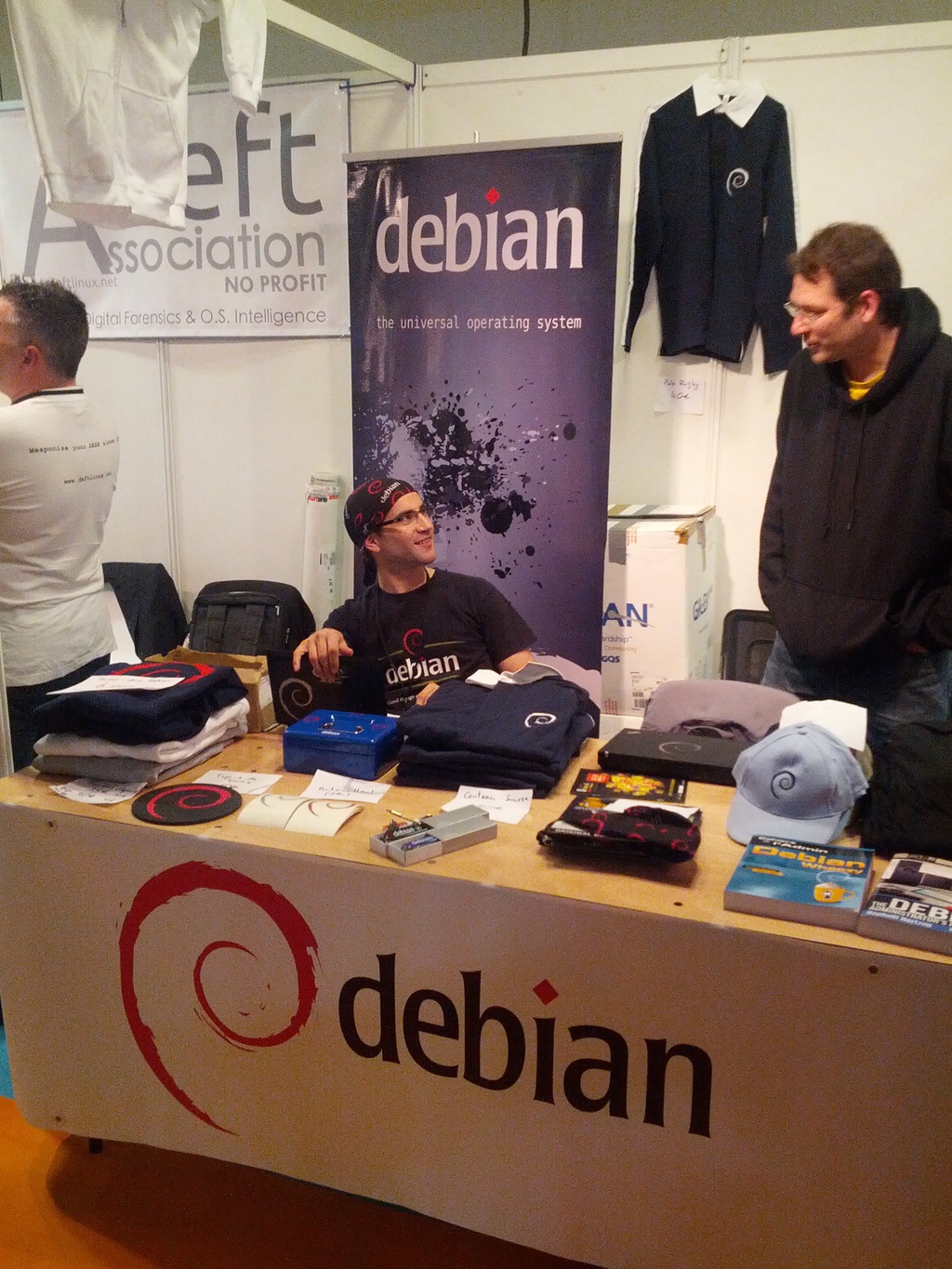
Debian France booth at Solutions Linux

Tanguy Ortolo and Fernando Lagrange behind the Debian France booth

The Debian Administrator s Handbook In the last days of 2013, we released the wheezy update of the book. Then I quickly organized everything needed so that the various translation teams can now focus their efforts on the latest release of the book. Later (in February) I announced the availability of the French and Spanish translations. Debian Squeeze LTS When the security team called for help to try to put in place long term support for Squeeze, I replied positively because I m convinced that it s very important if Debian wants to stay an acceptable choice in big deployments and because I knew that some of my customers would be interested Thus I followed all the discussions (on a semi-private list first and then on debian-lts@lists.debian.org) and contributed my own experience. I have also taken up the responsibility to coordinate with the Debian contributors who can be hired to work on Squeeze LTS so that we have a clear common offer for all the companies who have offered financial support towards Squeeze LTS. Expect further news on this front in the upcoming days/weeks. Tryton I have been a long time user of SQL-Ledger to manage the accounting of my company Freexian. But while the license is free software, the project is not. It s the work of a single developer who doesn t really accept help. I have thus been considering to move to something else for a long time but never did anything. This year, after some rough evaluation, I decided to switch to Tryton for my company. It s probably not a wise choice from a business perspective because that migration took me many hours of unpaid labor but from a free software perspective it s definitely better than everything else I saw. I contributed a lot of bug reports and a few patches already (#3596, #3631, #3633, #3665, #3667, #3694, #3695, #3696, #3697) mainly about problems found in the French chart of accounts but also about missing features for my use case. I also accepted to sponsor Matthias Berhle, who is maintaining the official Debian packages of Tryton. He s already a Debian maintainer so it s mainly a matter of reviewing new source packages and granting him the required rights. Misc Debian work Thanks See you next month for a new summary of my activities.

2 comments Liked this article? Click here. My blog is Flattr-enabled.

1 June 2014

Antonio Terceiro: An introduction to the Debian Continuous Integration project

Debian is a big system. At the time of writing, looking at my local package list caches tells me that the unstable suite contains 21306 source packages, and 42867 binary packages on amd64. Between these 42867 binary packages, there is an unthinkable number of inter-package dependencies. For example the dependency graph of the ruby packages contains other 20-something packages. A new version of any of these packages can potentially break some functionality in the ruby package. And that dependency graph is very small. Looking at the dependency graph for, say, the rails package will make your eyes bleed. I tried it here, and GraphViz needed a PNG image with 7653 10003 pixels to draw it. It ain t pretty. Installing rails on a clean Debian system will pull in another 109 packages as part of the dependency chain. Again, as new versions of those packages are uploaded the archive, there is a probability that a backwards-incompatible change, or even a bug fix which was being worked around, might make some funcionality in rails stop working. Even if that probability is low for each package in the dependency chain, with enough packages the probability of any of them causing problems for rails is quite high. And still the rails dependency chain is not that big. libreoffice will pull in another 264 packages. gnome will pull in 1311 dependencies, and kde-full 1320 (!). With a system this big, problems will arrive, and that s a fact of life. As developers, what we can do is try to spot these problems as early as possible, and fixing them in time to make a solid release with the high quality Debian is known for. While automated testing is not the proverbial Silver Bullet of Software Engineering, it is an effective way of finding regressions. Back in 2006, Ian Jackson started the development of autopkgtest as a tool to test Debian packages in their installed form (as opposed to testing packages using their source tree). In 2011, the autopkgtest test suite format was proposed as a standard for the Debian project, in what we now know as the DEP-8 specification. Since then, some maintainers such as myself started experimenting with DEP-8 tests in their packages. There was an expectation in the air that someday, someone would run those tests for the entire archive, and that would be a precious source of QA information. Durign the holiday break last year, I decided to give it a shot. I initially called the codebase dep8. Later I renamed it to debci, since it could potentially also run other other types of test suites in the future. Since early January, ci.debian.net run an instance of debci for the Debian Project. The Debian continuous Integration will trigger tests at most 4 times a day, 3 hours after each dinstall run. It will update a local APT cache and look for packages that declare a DEP-8 test suite. Each package with a test suite will then have its test suite executed if there was any change in its dependency chain since the last test run. Existing test results are published at ci.debian.net every hour, and at the end of each batch a global status is updated. Maintainers can subscribe to a per package Atom feed to keep up with their package test results. People interested in the overall status can subscribe to a global Atom feed of events. Since the introduction of Debian CI in mid-January 2014, we have seen an amazing increase in the number of packages with test suites. We had little less than 200 packages with test suites back then, against around 350 now (early June 2014). The ratio of packages passing passing their test suite has also improved a lot, going from less than 50% to more than 75%. There is documentation available, including a FAQ for package maintainers with further information about how the system works, how to declare test suites in their packages and how to reproduce test runs locally. Also available is development information about debci itself, to those inclined to help improve the system. This is just the beginning. debci is under a good rate of development, and you can expect to see a constant flux of improvements. In special, I would like to mention a few people who are giving amazing contributions to the project:

22 April 2014

Bits from Debian: Debian welcomes its 2014 GSoC students!

We're excited to announce that 19 students have been selected to work with Debian during the Google Summer of Code this year! Here is the list of accepted students and projects: As always, you will be able to follow their progress on the SoC coordination mailing-list Congratulations to all the students and let's make sure we all have an amazing summer!

14 April 2014

Bits from Debian: DPL election is over, Lucas Nussbaum re-elected

The Debian Project Leader election has concluded and the winner is Lucas Nussbaum. Of a total of 1003 developers, 401 developers voted using the Condorcet method. More information about the result is available in the Debian Project Leader Elections 2014 page. The new term for the project leader will start on April 17th and expire on April 17th 2015.

9 April 2014

Lucas Nussbaum: speedtest.net, or how not to do bandwidth tests

While trying to debug a bandwidth problem on a 3G connection, I tried speedtest.net, which ranks fairly high when one searches for bandwidth test on various search engines. I was getting very strange results, so I started wondering if my ISP might be bandwidth-throttling all traffic except the one from speedtest.net tests. After all, that s on a 3G network, and another french 3G ISP (SFR) apparently uses Citrix ByteMobile to optimize the QoE by minifying HTML pages and recompressing images on-the-fly (amongst other things). So, I fired wireshark, and discovered that no, it s just speedtest being a bit naive. Speedtest uses its own text-based protocol on port 8080. Here is an excerpt of a download speed test:

> HI
< HELLO 2.1 2013-08-14.01
> DOWNLOAD 1000000
< DOWNLOAD JABCDEFGHIJABCDEFGHIJABCDEFGHIJABCDEFGHIJABCDEFGHIJABCDEFGHIJABCDEFGHIJABCDEFGHIJABCDEFGHIJABCDEFGHIJABCDEFGHIJABCDEFGHIJABCDEFGHIJABCDEFGHIJABCDEFGHIJABCDEFGHIJABCDEFGHIJABCDEFGHIJABCDEFGHIJABCDEFGHIJABCDEFGHIJABCDEFGHIJABCDEFGHIJABCDEFGHIJABCDEFGHIJABCDEFGHIJABCDEFGHIJABCDEFGHIJABCDEFGHIJABCDEFGHIJABCDEFGHIJABCDEFGHIJABCDEFGHIJABCDEFGHIJABCDEFGHIJABCDEFGHIJABCDEFGHIJABCDEFGHIJABCDEFGHIJABCDEFGHIJABCDEFGHIJABCDEFGHIJABCDEFGHIJABCDEFGHIJABCDEFGHIJABCDEFGHIJABCDEFGHIJABCDEFGHIJABCDEFGHIJABCDEFGHIJABCDEFGHIJABCDEFGHIJABCDEFGHIJABCDEFGHIJABCDEFGHIJABCDEFGHIJABCDEFGHIJABCDEFGHIJABCDEFGHIJABCDEFGHIJABCDEFGHIJABCDEFGHIJABCDEFGHIJABCDEFGHIJABCDEFGHIJABCDEFGHIJABCDEFGHIJABCDEFGHIJABCDEFGHIJABCDEFGHIJABCDEFGHIJABCDEFGHIJABCDEFGHIJABCDEFGHIJABCDEFGHIJABCDEFGHIJABCDEFGHIJABCDEFGHIJABCDEFGHIJABCDEFGHIJABCDEFGHIJABCDEFGHIJABCDEFGHIJABCDEFGHIJABCDEFGHIJABCDEFGHIJABCDEFGHIJABCDEFGHIJABCDEFGHIJABCDEFGHIJABCDEFGHIJABCDEFGHIJABCDEFGHIJABCDEFGHIJABCDEFGHIJABCDEFGHIJABCDEFGHIJABCDEFGHIJABCDEFGHIJABCDEFGHIJABCDEFGHIJABCDEFGHIJABCDEFGHIJABCDEFGHIJABCDEFGHIJABCDEFGHIJABCDEFGHIJABCDEFGHIJABCDEFGHIJABCDEFGHIJABCDEFGHIJABCDEFGHIJABCDEFGHIJABCDEFGHIJABCDEFGHIJABCDEFGHIJABCDEFGHIJABCDEFGHIJABCDEFGHIJABCDEFGHIJABCDEFGHIJABCDEFGHIJABCDEFGHIJABCDEFGHIJABCDEFGHIJABCDEFGHIJABCDEFGHIJABCDEFGHIJABCDEFGHIJABCDEFGHIJABCDEFGHIJABCDEFGHIJABCDEFGHIJABCDEFGHIJABCDEFGHIJABCDEFGHIJABCDEFGHIJABCDEFGHIJABCDEFGHIJABCDEFGHIJABCDEFGHIJABCDEFGHIJABCDEFGHIJABCDEFGHIJABCDEFGHIJABCDEFGHIJABCDEFGHIJABCDEFGHIJABCDEFGHIJABCDEFGHIJABCDEFGHIJABCDEFGHIJABCDEFGHIJABCDEFGHIJABCDEFGHIJABCDEFGHIJABCDEFGHIJABCDEFGHIJABCDEFGHIJABCDEFGHIJABCDEFGHIJABCDEFGHIJABCDEFG
Yeah, right: sequences of ABCDEFGHIJ . How course, extremely easy to compress, which apparently happens transparently on 3G (or is it PPP? but I tried to disable PPP compression, and it did not see any change). It s funny how digging into problems that look promising at first sight often results in big disappointments :-(

1 April 2014

Bits from Debian: Debian Project elects Javier Merino Cacho as Project Leader

This post was an April Fools' Day joke. Alt Red Nose DPL In accordance with its constitution, the Debian Project has just elected Javier Merino Cacho as Debian Project Leader. More than 80% of voters put him as their first choice (or equal first) on their ballot papers. Javier's large majority over his opponents shows how his inspiring vision for the future of the Debian project is largely shared by the other developers. Lucas Nussbaum and Neil McGovern also gained a lot of support from Debian project members, both coming many votes ahead of the None of the above ballot choice. Javier has been a Debian Developer since February 2012 and, among other packages, works on keeping the mercurial package under control, as mercury is very poisonous for trouts. After it was announced that he had won this year's election, Javier said: I'm flattered by the trust that Debian members have put in me. One of the main points in my platform is to remove the "Debian is old and boring" image. In order to change that, my first action as DPL is to encourage all Debian Project Members to wear a clown red nose in public. Among others, the main points from his platform are mainly related to improve the communication style in mailing lists through an innovative filter called aponygisator, to make Debian less "old and boring", as well as solve technical issues among developers with barehanded fights. Betting on the fights will be not only allowed but encouraged for fundraising reasons. Javier also contemplated the use of misleading talk titles such as The use of cannabis in contemporary ages: a practical approach and Real Madrid vs Barcelona to lure new users and contributors to Debian events. Javier's platform was collaboratively written by a team of communication experts and high profile Debian contributors during the last DebConf. It has since evolved thanks to the help of many other contributors.

20 March 2014

Bits from Debian: Debian Project Leader elections 2014

It's again that time of the year for the Debian Project: the elections of its Project Leader! Starting on March 31st, and during the following two weeks, the Debian Developers will vote to choose the person who will guide the project for one year. Among this year's candidates there is the current DPL, Lucas Nussbaum, who admits that "the workload involved in being the DPL is just huge," and motivates his nomination with the need for stability in the project in this release cycle, especially after the difficult decision about the default init system. In his platform, Lucas speaks of technical and social steps to improve the project: from reproducible builds for a more secure archive to a renewed effort to run Debian on new platforms (especially smartphone and tablets); from a more welcoming approach to prospective contributors to an easier collaboration with organizations. The only other candidate left after Gergely Nagy withdrew his nomination, is former Release Manager Neil McGovern. Neil's platform focuses mainly on the need to "ensure that we cater to our users, and there's millions of them. From those running the latest software in unstable, to people who simply want a rock solid core release." In his opinion "the size of Debian is increasing, and will reach a point where we're unable to guarantee basic compatibility with other packages, or the length of time it takes to do so becomes exponentially longer, unless something changes." To fix this problem, Neil proposes the implementation of PPAs (Personal Package Archives), the modernisation of the current build and infrastructure system as well as generally supporting the various teams. The campaigning period will last until March 30th: the candidates are already engaged in debates and discussions on the debian-vote mailing list where they'll reply to questions from users and contributors.

27 February 2014

Lucas Nussbaum: self-hosting my calendar, follow-up

Following my blog post on the topic, I played a bit with various options. But let s explain my use case (which might be quite specific). I need to deal with three main sources of events: Additionally, I follow some ICS feeds for some colleagues and other events.
I tend to access my calendar mostly on my computer, and sometimes on my N900 phone. None of the web interfaces I looked at enabled me to (1) manage different calendars hosted on different CalDav servers; (2) subscribe to ICS feeds; (3) provide a CalDav interface to synchronize my phone. I ended up using a radicale instance for my personal calendar, which was extremely easy to set up. It s unfortunately a bit slow when there are many events (1600 since 2010 in my case), so I ended up importing only future events, and I will probably have to cleanup from time to time. I switched to using IceDove with the Lightning add-on to manage all my calendars and ICS feeds. It s unfortunately slower and less user-friendly than Google Calendar, but I ll live with it. On my N900, I used syncevolution to synchronize my various CalDav calendars. It works fine, but understanding how to configure it is rather tricky due to the number of concepts involved (templates, databases, servers, contexts, ). The synchronization is quite slow (several minutes for the 400-events Zimbra calendar), but works. I also wanted a way to export my calendars to colleagues (both in a free/busy version, and in a full information version). I quickly hacked something using ruby-agcaldav (which is not packaged in Debian, and required quite a few dependencies, but it was easy to generate packages for all of them using gem2deb the situation with other languages did not look better).
The resulting script is:
require 'agcaldav'
require 'date'
cal = AgCalDAV::Client.new(:uri => 'LABCALDAVSERVER', :user => 'xx', :password => "xx")
ev = cal.find_events(:start => '2014-02-01', :end => '2200-01-01') cal = AgCalDAV::Client.new(:uri => 'RADICALESERVER', :user => 'xx', :password => "xx")
ev2 = cal.find_events(:start => '2014-02-01', :end => '2200-01-01') limit = (Time::now - 7*86400).to_datetime # create new empty calendars
ncpriv = Icalendar::Calendar.new
ncpub = Icalendar::Calendar.new (ev + ev2).each do e
next if e.end < limit # drop old events to keep the calendar small # build event for the free/busy calendar
pe = Icalendar::Event.new
pe.start = e.start
pe.end = e.end
pe.klass = "PRIVATE"
pe.transp = e.transp
ncpriv.add(pe) # build event for the calendar with event information
pube = Icalendar::Event.new
pube.start = e.start
pube.end = e.end
pube.transp = e.transp
if not e.klass == "PRIVATE"
pube.summary = e.summary
pube.location = e.location
end
ncpub.add(pube)
end # export free/busy calendar
fd = File::new('xx.ics', 'w')
fd.puts ncpriv.to_ical
fd.close
# export calendar with event information
fd = File::new('yy-Zeeh9bie.ics', 'w')
fd.puts ncpub.to_ical
fd.close
So, mostly everything works. The only thing that doesn't is that I haven't found a way to subscribe to an ICS feed on my N900. Any ideas?

25 February 2014

Lucas Nussbaum: self-hosting my calendar

I m trying to self-host my calendar setup, and I must admit that I m lost between all the different solutions. My requirements are: It does not seem to be possible to find a single framework doing all of the above. AFAIK: What did I miss?

10 February 2014

Bits from Debian: skyrocketing how-can-i-help popcon count

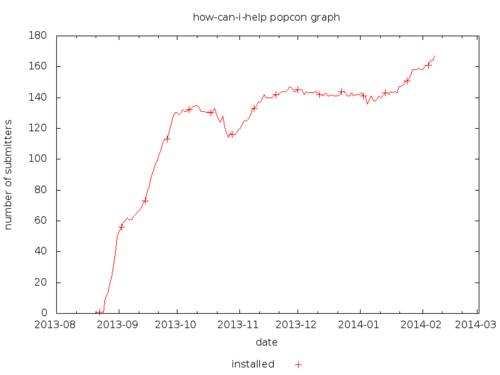
This is a repost from Stefano Zacchiroli's post how-can-i-help by Lucas Nussbaum is one of the best things that happened in the area of attracting contributions to Debian in quite a while. It can be used both as a standalone tool to list opportunities for contributing to Debian which are related to your installed packages, and as an APT hook (which is also the default configuration) that at each upgrade will inform you of new contribution opportunities. how-can-i-help is great for newbies who are looking for ways to give back to Debian which are a good match for their skills: among other things, how-can-i-help shows bugs tagged "gift" related to packages you use. how-can-i-help is also great for experienced developers, as it allows them to find out, in a timely manner, that packages they use are in dire need of help: RC bugs, pending removals, adoptions needed, requests for sponsor, etc. (As highly unscientific evidence: I've noticed a rather quick turnover of RFA/O/ITA bugs on packages installed on my machine. I suspect how-can-i-help is somehow responsible for that, due to the fact that it increases awareness of ongoing package issues directly with the people using them.) So, if you haven't yet, please apt-get install how-can-i-help RIGHT NOW. I daresay that we should aim at installing how-can-i-help by default on all Debian machines, but that might be an ambitious initial goal. In the meantime I'll settle for making how-can-i-help's popcon count skyrocket. As of today, it looks like this: Alt how-can-i-help popularity contest graph 10/02/2014 which is definitely too low for my taste. Please spread the word about how-can-i-help. And let's see what we can collectively do to that graph. how-can-i-help is just a tiny teeny helper, but I'm convinced it can do wonders in liberating dormant contributions to the Debian Project.

Stefano Zacchiroli: apt-get install how-can-i-help

skyrocketing how-can-i-help popcon count how-can-i-help by Lucas Nussbaum is one of the best things that happened in the area of attracting contributions to Debian in quite a while. It can be used both as a standalone tool to list opportunities for contributing to Debian which are related to your installed packages, and as an APT hook (which is also the default configuration) that at each upgrade will inform you of new contribution opportunities. how-can-i-help is great for newbies who are looking for ways to give back to Debian which are a good match for their skills: among other things, how-can-i-help shows bugs tagged "gift" related to packages you use. how-can-i-help is also great for experienced developers, as it allows them to find out, in a timely manner, that packages they use are in dire need of help: RC bugs, pending removals, adoptions needed, requests for sponsor, etc. (As highly unscientific evidence: I've noticed a rather quick turnover of RFA/O/ITA bugs on packages installed on my machine. I suspect how-can-i-help is somehow responsible for that, due to the fact that it increases awareness of ongoing package issues directly with the people using them.) So, if you haven't yet, please apt-get install how-can-i-help RIGHT NOW. I daresay that we should aim at installing how-can-i-help by default on all Debian machines, but that might be an ambitious initial goal. In the meantime I'll settle for making how-can-i-help's popcon count skyrocket. As of today, it looks like this:
how-can-i-help popularity contest graph, 10/02/2014
which is definitely too low for my taste. Please spread the word about how-can-i-help. And let's see what we can collectively do to that graph. how-can-i-help is just a tiny teeny helper, but I'm convinced it can do wonders in liberating dormant contributions to the Debian Project.

17 January 2014

Lucas Nussbaum: RSS feed available in the Debian Maintainer Dashboard

One of my pet projects in Debian is the Debian Maintainer Dashboard. Built on top of UDD, DMD provides a maintainer-centric view to answer the I have a few hours for Debian, what should I do now? question (see example). Christophe Siraut did a lot of great work recently on DMD, rewriting much of the internals. As a result, he also added a RSS feed feature: you can now get notified of new TODO list items by subscribing to that feed. If you have suggestions or comments, please use the debian-qa@ list (see this thread). Thanks, Christophe!

29 November 2013

Keith Packard: Debian TC

Appointed to the Debian Tech Committee I m pleased to announce that I ve been appointed to serve on the Debain Technical Committee. I d like to thank the other committee members and the Debian project leader, Lucas Nussbaum, for giving me this opportunity to serve. I look forward to working within the committee to further Debian s goals as the universal operating system.

7 October 2013

Lucas Nussbaum: talk at Open World Forum

I attended Open World Forum last week (thanks to Inria for funding my travel). It was a fantastic opportunity to meet many people, and to watch great talks. If I had to single out just one talk, it would clearly be John Sullivan s What do you mean you can t Skype?!. On Saturday, I delivered a talk presenting the Debian project. It was my first DPL-ish talk to the general public, so it still needs some tuning, but I think it went quite well (slides available). Next opportunity to talk about Debian: LORIA, Nancy, France, 2013-10-17 13:30 (iPAC seminar).

25 September 2013

Lucas Nussbaum: Software for brainstorm / ideas sharing and voting?

Some time ago, Ubuntu had Ubuntu Brainstorm, a website where non-developers could submit ideas of improvements, and other people could comment and vote on them. I was wondering if there was existing software to deploy a similar service, e.g. as a plugin to popular forum software. I ve found ideascale.com, but relying on the Cloud for that is not acceptable for my planned use. (For clarification: my immediate interest for that is unrelated to Debian work)

21 September 2013

Niels Thykier: Lintian 2.5.18

I have just uploaded Lintian 2.5.18 to unstable. While fixing 22 bugs, it only features 5 new tags. The release also include fixes to some false-positives, such as python:any dependencies triggering python-script-but-no-python-dep, a rewritten README file. We also included a patch to make Lintian accept the Original-Maintainer field by default for non-Debian vendors (even if they do not have a profile and Lintian ends up loading the debian/main profile). We also added support for running Lintian directly from a git checkout or source tree without setting LINTIAN_ROOT (or passing root). Since that was the primary use-case for root that option has now been deprecated. I also had lintian and lintian-info require the include-dir and [no-]user-dir options as the first if given at all. I would like to thank Bastien Roucari s, Gaudenz Steinlin, Gunnar Wolf, J r my Bobbio and Lucas Nussbaum for contributing to Lintian and the many who submitted reports or suggestions for improvements. I would also like to thank Brian hugmeir Fraser, who assisted me in identifying and working around a bug in Perl s glob function when run under threads (filed upstream as RT#119897).

16 September 2013

Debian Med

DebConf 13 report (by Andreas Tille) General impression unofficial  Scenic Hacklab I'm beginning my DebConf report in an unofficial "Scenic Hacklab" right at the edge of the lake in Yverdon. This is the right place to memorise the last days. When I started from this place cycling to Le Camp 12 days ago I was full of great expectations and what should I say - the reality has even beaten these. Once it comes about comparing DebConfs even if it is an unfair comparison due all the differences my secret long term favourite was Helsinki very closely followed by Argentina and also very closely followed by all the other great DebConfs I joined (and I joined all in Europe). Would Le Camp be able to beat it? The short answer is: Yes, it is now my favourite DebConf while I think I do not suffer from the last-Debconf-was-the-best-DebConf-syndrome (and I realised there are others thinking the same). As you might probably know I'm a bit addicted to swimming. While Helsinki had admittedly the better conditions I was at least able to fix the distance issue using my bicycle. (Hey, those Le Camp photographers did a great job in hiding the fact that you can not actually touch the lake right from the meadow of Le Camp.) Being able to have my bicycle at DebConf scored some extra points. However, the really great view of the lake, the inspiring "Scenic Hacklab" which was my favourite place has bumped DebConf13 at first place in my personal ranking. So it comes quite natural to say: "Kudos to the great organisation team!" They did a Swiss-like precise work and perfectly succeeded in hiding any problems (I assume there were some as always) from the attendees so everything went smooth, nice and shiny for the attendees. The local team was even precise in setting up great weather conditions for DebConf. sunrise over  the lake While saying thanks to the local team I would like to also explicitly thank Luca Capello who has quite some share that this DebConf was possible at all (while I have to decrease my DebConf score one point because he was not really there - Luca to bad that you were not able to come full time!) Also thanks to Gunnar and Gannef who helped remotely (another score down because I were missing them this year as well). Even if it was my favourite DebConf I was not able to work down my todo list fully (which was not only uploading one package per day which I at least statistically fullfilled). But that's probably a general feature of todo lists anyway. One item was definitely done: Doing my daily swimming BoF. I actually was able to do the other parts of the triathlon which was skipped by Christian and have done in summary about 150km cycling with 3500m elevation and estimated 7-8km swimming (0m elevation ;-)). Considering the great view at sunrise over the lake I was not hating my "Senile bed escape" disease too much (I was every day waking up at sunset) - it was simply a great experience. I will never forget seeing water drips glimmering like gold inside the morning sun while seeing the Alps panorama in the distant. I hope I was able to help all interested swimmers with the DebConf Beach Map which was just a by-product of my activities in DebCamp. Speaking about OSM: I was astonished that the area was way less covered than I expected. Thanks to several DebConf attendees the situation became better and the map does not only show random trees in the wild but also the tracks leading to these. (Remark: It was no DebConf attendee who is responsible for plastering the map with single trees.) While I had my mapping focus basically close to the edge of the lake I was also able to even map my very own street. :-) I clearly remember one specific mapping tour when I was invited by the DPL: He convinced me to join him on a bicycle tour and since I was afraid to get fired I joined him instead to keep on hacking. Also Sorina was brave enough to join us on the tour and she did quite well. (Sorina, do you remember the agreement about your work on the installer? ;-)) Lucas described the tour as: going uphill on only asphalted roads. Sorina and me were witnessing the mighty DPL powers when we left the wood around Le Camp to reach the described road: The asphalt was just put onto the road - no doubt that it was done on the immediate demand of mighty DPL. :-) DebCamp time was flying like nose dive and a lot of known (and unknown) faces arrived at Le Camp. What I really liked a lot this year was that several really young children has pulled down the average age of DebConf attendees. I clearly remember all the discussion one year ago what to do about children. As always the issue was solved in a typical Debian way: Just do it and bring your children - they had obviously a great time as well. I think the youngest child was 2 months and the oldest "child" above 20. ;-) Actually Baptiste Perrier did great in making the C&W party a success and had obviously a nice time. (I wished my son would have been able to come as well but he needs to write his bachelor s thesis in physics. :-() It was nice to see the kids using all playing facilities and communicating with geeks. Also I would like to point out that even the very young attendees had their share at the success of DebConf: Just think of the three "bell ringing assistants" who helped me ringing the bells for lunch and dinner. I've got this cool job from Didier in the beginning of DebCamp. I must say having some real bells ringing is by far nicer than just the "lunch / dinner starts in 10 minutes" from IRC bot. The only thing I did not understand was that people did not considered ringing the bells at 8:00 for breakfast as a good idea. Regarding the food in general I would also like to send kudos to the kitchen: It was tasty, freshly prepared, regional food with a good change rate. I really liked this. Extra points for having the chance to sit outside when eating. Talks But lets have a look into the conference programme. I'd really recommend watching the videos of the talks Bits from the DPL (video) and Debian Cosmology (video). I considered both talks as entertaining and interesting. I also really hope that the effort Enrico Zini started in Debian Contributors (video) will be successful. I had some talks and BoFs myself starting with Why running a Blend (video) and I admit that (as usual) the number of attendees was quite low even if I think there is some proof (see below) that it is interesting for way more people who should consider working more "blendish" in their team. Do you know how to recruit one developer per year and relax the man power problem in your team? Feel free to watch the video. We have confirmation that ten DDs of our team have considered to join Debian only because Debian Med exists. Admittedly biology and medicine are really leaf topics inside the Debian universe. So if even this topic that has a very tiny share of the Debian users is able to attract this level of attention - how many more people could we win for multimedia, games, GIS and others? So if you feel you are quite overworked with your packaging and you have no time this is most probably wrong. The amount of time is basically a matter of priorities you set for your tasks. Try to put some higher priority onto using the just existing Blends tools I explained in my talk to attract more users and developers to your team and by doing so spread the workload over more people. It works, the prove was given in my main talk. So before you start working on a specific package you should wonder who else could have an even stronger interest to get this work done and provide him with some additional motivation and help to get the common goal done. The interesting thing is that my BoF about How to attract new developers for your team (video) - which was a simple report about some by-product of the Blends work - made it into the main talk room and got way more attention. For me this is the proof that the Blends concept itself is probably badly perceived as something like "a few outsiders are doing damn specific stuff which is not really interesting for anybody else" instead of what is really is: Smoothing the way from specific upstream applications to the end user via Debian. Once you see the video of this BoF you can observe how my friend Asheesh Laroia became more and more excited about the Blends concept and admitted what I said above: We should have more Blends for different fields. Funnily enough Asheesh asked me in his excitement to talk more about Blends. This would have been a really good suggestion ten years ago. At DebConf 3 in Oslo I had my very first talk about Blends (at this time under the name "Debian Internal Projects"). I continuously kept on talking about this (MiniDebConf Peking 2005, DebConf 5, Helsinki (video), DebConf 7, Edinburgh (video), DebConf 8, Mar del Plata (video), DebConf 9, C ceres (video), MiniDebConf Berlin 2010 (video in German), MiniDebConf Paris 2010 (not video recorded), DebConf 11, Banja Luka (video) ... and these are only (Mini)DebConfs my talks page is full of this topic) and every new year I try different ways to communicate the idea to my fellow Debianistas. I'm wondering how I could invent a title + abstract avoiding the term Blends, put "Git", "release" and "systemd versus upstart" in and being able to inform about Blends reasonably by not becoming to off topic with the abstract. I also registered the Debian Science round table. I admit we were lacking some input from remote via IRC which used to be quite helpful in the past. The attendees agreed upon the handling of citations in debian/upstream files which was invented by Debian Med team to create even stronger bounds to our upstream developers by giving their work extra reward and providing users with even better documentation (see my summary in Wiki). As usual I suggested to create some Debian Science offsprings like "Debian Astronomy", "Debian Electronics", "Debian Mathematics", "Debian Physics" etc. who could perfectly leave the Debian Science umbrella to get a more fine grained structure and a more focused team to enhance the contact to our users. Unfortunately there is nobody who volunteers to take over the lead for such Blends. I have given a short summary about this BoF on the Debian Science mailing list. In the Debian Med meeting I have given some status report. No other long term team members were attending DebConf and so I gave some kind of introduction for newcomers and interested people. I touched also the DebiChem topic which maintains some packages that are used by biologists frequently and so we have a good connection to this team. Finally I had registered three BoFs in Blends I'm actually not (or not yet) active part of. My motivation was to turn the ideas I have explained in my main talk into specific application inside these teams and helping them to implement the Blends framework. In the first BoF about Debian GIS I have shown the usual team metrics graphs to demonstrate, that the one packaging team Pkg-OSM is in danger to become MIA. There are only three persons doing actual uploads. Two of them were at DebConf but did not joined the BoF because they do not consider their contribution to Pkg-OSM as a major part of their general Debian work. I will contact the main contributor David Paleino about his opinion to move the packages step by step into maintenance of Debian GIS packaging team to try to overcome the split of two teams that are sharing a good amount of interest. At least if I might become an Uploader for one of the packages currently maintained by Pkg-OSM I will move this to pkg-grass-devel (which is the name of the packaging team of Debian GIS for historical reasons). The attendees of the BoF have considered this plan as sensible. Moreover I talked about my experiences with OSGeo Live - an Ubuntu derivative that tries to provide a full tool chain to work on GIS and OSM problems ... basically the same goal as Debian GIS has just provided by the OSGeo project. I'm lurking on OSGeo mailing list when I asked explicitly I've got the answer that they are working together with Debian GIS and are using common repository (which is IMHO the optimal way of cooperation). However, it seems that several protagonists of OSGeo Live are underestimating the resources provided by Debian. For instance there was a question about Java packaging issues but people were not aware about the existence of the debian-java mailing list. I was able to give an example how the Debian Med team managed to strengthen its ties to BioLinux that is also an Ubuntu derivative for biologists. At our first Debian Med sprint in 2011 we invited developers from BioLinux and reached a state where they are using the very same VCS on Alioth where we are maintaining our packages. At DebConf I was able to upload two packages where BioLinux developers did certain changes for enhancing the user experience. My "work" was just bumping the version number in changelog and so we did profit from the work of the BioLinux developers as well as they are profiting from our work. I plan to dive a bit more into Debian GIS and try to strengthen the connection to OSGeo Live a bit. The next BoF was the Debian Multimedia meeting. It was nice that the current leader of Ubuntu Studio Kaj Ailomaa joined the meeting. When I was explaining my ideas about cooperation with derivatives I repeated my detailed explanation about the relation with BioLinux. It seems every topic you could cover inside Debian has its related derivative. So to me it seems to be quite natural to work together with the developers of the derivative to join forces. I actually consider a Blend a derivative done the right way = inside Debian. The final work for the derivers that might be left for them is doing some shiny customising of backgrounds or something like this - but all the hard work could and should be done in common with the relevant Debian team. My dream is to raise such relevant teams inside Debian ... the Blends. Finally the last BoF of this series was the Debian Games meeting. As always I presented the team metrics graphs and the Debian Games team members who attended the BoF were quite interested. So it seems to be some unknown fact that team metrics are done for several teams in side Debian and so I repeat the link to it for those who are not yet aware of it. As a result of the BoF Debian Games team members agreed to put some more effort into maintaining their Blends tasks. Moreover Miriam Ruiz wants to put some effort into reviving Debian Jr. Regarding Debian Jr. there was an interesting talk about DouDouLinux - in case you might want to watch the video I'd recommend skipping the first 30min and rather watch the nice live demo. There was also an ad hoc BoF about Debian Jr scheduled to bring together all people interested into this cute project and Per Anderson volunteered to take over the lead. I have given a summary about this specific BoF at the Debian Jr list. For some other talks that I'd regard as remarkable for some reasons: I'd regard the talk "Debian-LAN" by Andreas Mundt as some hidden pearl because it did not got a lot of attention but after having seen the video I was quite impressed - specifically because it is also relevant for the Blends topic. Memories I also liked "Paths into Debian" by Moray Allan (and I was only able to enjoy the latter talks thanks to the great work of the video team!) because it also scratched the same topic I was concerned about in my mentoring talk. Related to this was in my opinion also "Women in Debian 2013" were we tried to find out reasons for the lack of woman compared to other projects and how to overcome this issue. Geert hovering  over the grass Besides the talks I will probably never forget two specific moments that make DebConf so special. One of these moments is recorded on an image that clearly needs no words - just see Geert hovering over the grass. Another strong moment in my personal record was in the DebConf Newbies BoF "First time at DebConf" that unfortunately was not recorded but at least for this statement it would have been very great if we would have some reference better than personal memory. Aarsh Shah a GSoC student from India suddenly raised up and said: "Four months ago I was not even aware that Free Software exists. Now I'm here with so many people who are totally equal. If I will tell my mother at home that I was standing in the same queue where the Debian Project Leader was queuing up for food she will never believe me." He was totally excited about things we are regarding as normal. IMHO we should memorise moments like this that might be part of the key to success in cultures, where Debian is widely unknown and very rarely in use. Amongst these not scheduled great moments the scheduled day trip was also a great thing. I had a really hard time to decide what tour I might join but ended up in the "long distance walking (or should I say running) group". Inspired by the "running Bubulle" who was flashing between the walking groups we went uphill with 5.4km/h which was a nice exercise. Our destination the large cliff was an exciting landscape and I guess we all enjoyed the dinner organised by the "Trout cabal". ;-) say goodby to  friends So I had a hard time to leave Le Camp and tried hard to make sure my memories will remain as long as possible. Keeping some signs attached to my bicycle, conserving the "Scenic Hacklab" sign for my private "scenic hacklab @ home" was one part. I also have cut some branches of the Buxus sempervirens in Le Camp and have put them in my garden at home (where I create some hedgerow from places where I spent some great time). These will probably build a great part of the hedgerow ... Thanks for reading this longish report. Looking forward to see you all in Germany 2015 (or earlier) Andreas. Scenic Hacklab  @ home

2 September 2013

Francesca Ciceri: Gems from DebConf13 talks

"I think that we need to be better at accepting mistakes. It's OK to not know everything, it's OK to not be perfect right from the start, but it's better to be vocal about things you don't know, things you are unsure, than to just hide it under the carpet and hope nobody will notice."
Lucas Nussbaum, Bits from the DPL "This is my definition for a team: waking up in the morning and realizing that somebody else has solved your problem from yesterday."
Andreas Tille, How to attract new developers for your team
While working on English subtitles for DC13 talks, you can stumble upon some real gems. The subtitling work is progressing nicely: four talks have now subtitles available (you can find them here), thanks to the work of Daniel, Gunnar and myself (as well as the reviews from Justin, Andreas and Michael!). In the meanwhile we created an alioth group and a related repository for the sub team, and there are several subtitles in progress! How can you help?

Next.

Previous.