Search Results: "lamby"

31 August 2013

Chris Lamb: Decrypting the Caesar cipher using shell

In cryptography, a Caesar cipher, also known as Caesar's cipher, the shift cipher, Caesar's code or Caesar shift, is one of the simplest and most widely known encryption techniques. It is a type of substitution cipher in which each letter in the plaintext is replaced by a letter some fixed number of positions down the alphabet. [...]
#!/bin/sh
IN="MJHVIZN ZPIO YJHPN"
for I in $(seq 25); do
    echo $I $IN   tr $(printf %$ I s   tr ' ' '.')\A-Z A-ZA-Z
done
This outputs:
1 NKIWJAO AQJP ZKIQO
2 OLJXKBP BRKQ ALJRP
3 PMKYLCQ CSLR BMKSQ
4 QNLZMDR DTMS CNLTR
5 ROMANES EUNT DOMUS
6 SPNBOFT FVOU EPNVT
7 TQOCPGU GWPV FQOWU
8 URPDQHV HXQW GRPXV
9 VSQERIW IYRX HSQYW
10 WTRFSJX JZSY ITRZX
11 XUSGTKY KATZ JUSAY
12 YVTHULZ LBUA KVTBZ
13 ZWUIVMA MCVB LWUCA
14 AXVJWNB NDWC MXVDB
15 BYWKXOC OEXD NYWEC
16 CZXLYPD PFYE OZXFD
17 DAYMZQE QGZF PAYGE
18 EBZNARF RHAG QBZHF
19 FCAOBSG SIBH RCAIG
20 GDBPCTH TJCI SDBJH
21 HECQDUI UKDJ TECKI
22 IFDREVJ VLEK UFDLJ
23 JGESFWK WMFL VGEMK
24 KHFTGXL XNGM WHFNL
25 LIGUHYM YOHN XIGOM
The only line which makes sense is 5 ROMANES EUNT DOMUS, giving us our solution.

20 August 2013

Chris Lamb: Thomas Fuchs on frontend Javascript frameworks in startups

What you end up with is building a layer cake that doesn t add any value and slows down development. Especially when you re starting out and need to stay flexible you don t want to have too much code around and Rails is great for that. But adding a JSON API layer and basically a second application that runs on the client is annihilating this advantage for you.
Source.

12 August 2013

Chris Lamb: Cotswold Classic Middle Distance triathlon

https://chris-lamb.co.uk/wp-content/2013/cotswold_course.jpg Since becoming interested in triathlon in October of last year, my goal in 2013 was not to just finish a "70.3" (or "Half-Ironman"), but to complete one in under 5 hours. At the time, each discipline was woefully inadequate; I had not swum in over a decade, my cycling was average and I had only begun running again after years away from exercise. The somewhat arbitrary target time would dictate my training. For example, the high proportion of time spent on the bike combined with the injury-sensitive nature of running meant that cycling would have a highest return on investment of the three disciplines. Despite that, I would need to take the run seriously but carefully - I decided to enter a series of monthly 10K races where I could steadily reduce my times over the year. Races themselves formed a crucial part of my preparation and a carefully balanced race calendar was surprisingly important, balancing upcoming milestones that would provide an achievable goal as well as uncovering weaknesses in enough time so they could be worked on. Whilst I did post about my first triathlon, I felt no compulsion with the interleaving five or six races as I was evaluating them in the context of the 70.3 rather than as races in their own right.
Swim
Distance
1900m
Time
37:42
Whilst this wasn't my worst open water swim, it was certainly not my best. The first 500m was straightforward, but I lost my form over the next 500m and I overcompensated with excessive kick. My calves responded by cramping badly two or three times after that, losing both momentum and time. Curiously, whenever I could identify my speed relative to my effort (for example, by some underwater reeds) I could use that as feedback and my rotation (etc.) would temporarily return. Pool swimming always has markers of this kind, whilst a murky lake does not. In conclusion, my lack of open water training outside of races held me back more than I expected.
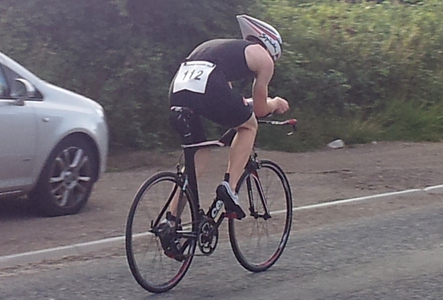
Bike https://chris-lamb.co.uk/wp-content/2013/cotswold_bike.jpg
Distance
52 miles
Time
2:22 (21.9 mph average)
I had thoroughly absorbed the advice that you should prepare for your primary race so that it feels like another day at the office. On this criterion, the bike leg was almost perfect. My nutrition strategy energy drink every 5 minutes, gel every 30 minutes worked fine until mile 35 where I felt like I had taken on too much fluid (and no time to take a bathroom break). I had a temporary hiccup with my rear derailleur but my "tame" 52/34 12x28 gearing was vindicated on the climbs, although in retrospect that might mostly be schadenfreude. Tens of hours acclimatising to a time trial bike was rewarded by being able to spend the entire leg in "aero" position (ignoring 90-degree turns or serious gradients), improving efficiency.
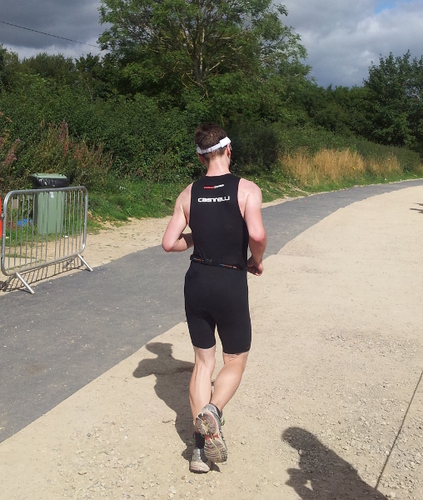
Run https://chris-lamb.co.uk/wp-content/2013/cotswold_run.jpg
Distance
13.1 miles (21km)
Time
1:54:18 (5:25/km)
I had prepared a chart which provided the pace I required based on the race time at the start of the run. I would then only need to monitor my run pace instead of repeatedly extrapolating a finish time as even basic arithmetic can become impossible when fatigued. This strategy was chosen as I was too risk-adverse to aim for a faster time than strictly required; the downside of missing the target from aiming too high and "blowing up" outweighed going a few minutes faster overall. Despite that, I ran half-marathon personal best. Unfortunately, due to pressing the wrong watch button after the swim, the chart was worthless unless I could assume the race started exactly at 6:30AM. With no other option I decided to trust that with some padding, but the uncertainly it added was unsettling. Adding to that feeling, my left hip started to twinge at 7K, something it has never done before. My plan was to get to 16K, take a caffeine gel and then keep ratcheting up the pace until the finish. In my long run training I could speed up to a 4:10/km pace but after 5 hours of racing and being reasonably sure I was going to reach my goal, the best I could summon was 4:45/km. My form completely shot, I crossed the finish line and got into a fetal position in the shade behind a tent, scaring the race organisers for a few minutes.
Overall
Total time
4:56:50
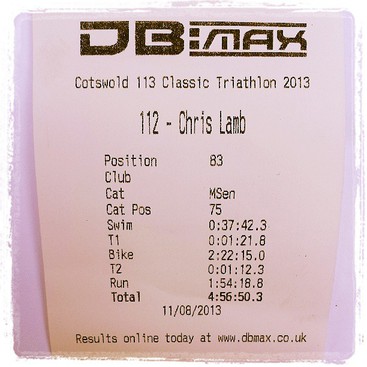
Writing this the day after the race, I am still a little unsure of how I feel. I am obviously extremely content that I reached my goal but given the volume and detail of preparation it was not a huge surprise to me on race day that I did so. This combined with the "real" work and progress being achieved throughout the training seems to have robbed the event of some element of triumph it could have had, but that in itself was somewhat expected. Where next? I had always dismissed the consensus view of needing to take a decent break after the season has ended but now I am looking forward to putting triathlon-specific training on hold for a while and explore other things. I highly doubt this will be my last triathlon though. https://chris-lamb.co.uk/wp-content/2013/cotswold_result.jpg (Full results)

6 April 2013

Chris Lamb: Thames Turbo Sprint Triathlon 2013 Race 1

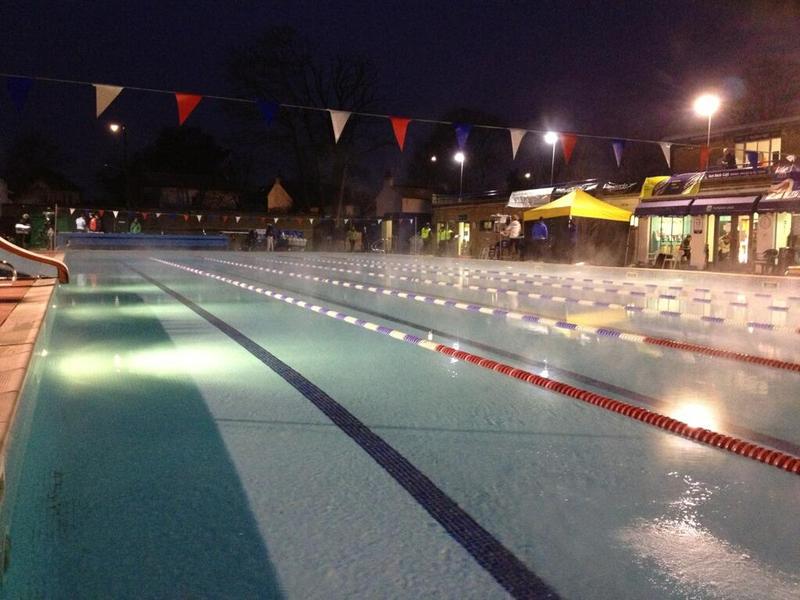
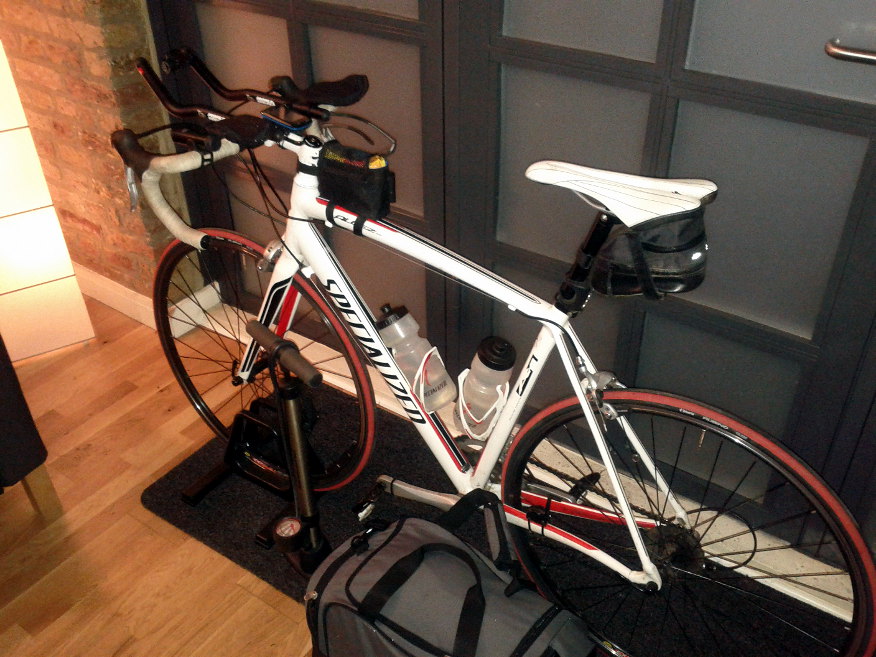
/wp-content/2013/hampton_wick_pool.jpg /wp-content/2013/bike_tt_01.jpg On Monday I took part in my first triathlon, a "sprint" distance race organised by Thames Turbo Triathlon Club.
Swim
Distance
428m (+ pool exit chute)
Time
10:23 (2:26/100m)
I was glad to be given a low race number as it would reduce the time standing around 0 C in swimming gear. The 28 C heated pool was a welcome relief and I was quickly on my way, although perhaps overcooking it in the first half. Overall, I was quite pleased with my swim time as I had cut it by well over 50% during March; there are perhaps 1-2 minutes of fairly easy gains still to be made as well.
T1 (time: 5:32) Due to the cold temperature and forecast for snow, the race director insisted that competitors added extra layers covering their arms and torso on the bike. An additional "free" 5 minutes was also granted for T1 in order that clothing was not skipped in expense of time. I eventually wore a long-sleeve base layer, tights, a short-sleeved jersey, arm warmers and two pairs of gloves.
Bike
Distance
13.8 miles (+ mounting/demounting chutes)
Time
39:59 (19.5 mph)
I overtook 10-15 riders in the first half of the bike leg, a couple of them even seeking me out to later to congratulate me on looking so fast. I was thus more than a little disappointed when I discovered my final bike split as I was hoping for at least a sub-39 minute time. Analysing my GPS later I can see my average speed was over 1.5mph slower in the second half, yet I cannot recall being limited by fatigue or headwind in the last 6 miles. I was either overly reliant on other riders to "reel in" during the first half (but had run out of people to catch in the latter stage) or I simply was not giving 100%.
T2 (time: 3:30) Leaving T2 I failed to start both my GPS and stopwatch correctly so I do not have splits of my time. I also did not pick up my running gloves resulting in distractingly cold hands in Bushy Park.
Run
Distance
5k
Time
24:21 (4:52/km)
Throughout the first kilometer my legs were extremely sluggish and I simply could not get them to do what I wanted - typical triathlon "brick legs". I did not know it at the time but I was also running up a slight but extended incline. I struggled to get to the 1k marker and briefly stopped to mentally regroup. I joined another runner a few moments later and we ran the rest of the 5k at a fairly easy pace. It's clear that the lack of serious brick workouts compromised my run time, as well as my inability to dial down the pace once it was clearly too optimistic. Knowing the elevation profile of the run should have adjusted my expectations too, leading to a better overall time.
Overall
Total time
1:18:44
Position
127/261
Position male
109/202
Position 25-29 male
16/25
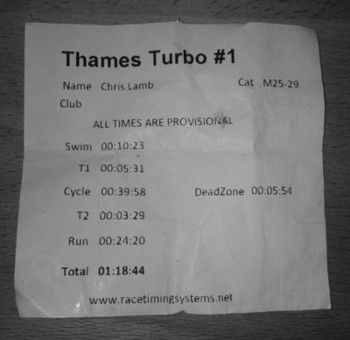
Despite finishing just to the left of the overall bell curve, it is difficult avoid feeling disappointed with my time as it was hindered by well-documented and avoidable errors. The sub-optimal pacing throughout meant I still had something left "in the tank" at the end, adding to a general feeling of under-achieving on the way home. Preperation was also less than ideal - two days before the race I had twinged my back in a 70-mile reconnaissance ride (!) by overusing my clip-on bars although this only affected me mentally in the race. I additionally ate too much before and during the race in retrospect. Nevertheless, there must be some value in learning these lessons first-hand and and early on. /wp-content/2013/tt_1_times.jpg (Full results)

31 December 2012

Chris Lamb: 2012: Selected highlights

January Started cycling again. By the end of the year I had done 2,300 miles. (Strava profile) /wp-content/2012/highlights/01.png February Private concert at the British Museum of Haydn baryton trios for the annual winding of the Thomas Tompion Mostyn clock. /wp-content/2012/highlights/02.jpg March Zadok Baroque premiere concert, East Sheen. (review) /wp-content/2012/highlights/03.jpg April Belsize Baroque concert, Bloomsbury. /wp-content/2012/highlights/04.jpg May Lute concert, Greenwich. /wp-content/2012/highlights/05.jpg June Left Playfire. /wp-content/2012/highlights/06.jpg July/August YCombinator, California. /wp-content/2012/highlights/07.jpg September Renaissance viol weekend, West Sussex. /wp-content/2012/highlights/09.jpg October Moved house. /wp-content/2012/highlights/10.jpg November Battersea Park 5K. Ran 200 miles this year. /wp-content/2012/highlights/11.jpg December Beethoven Triple concerto, Cambridge. (more) /wp-content/2012/highlights/12.jpg

13 December 2012

Chris Lamb: Beethoven Triple Concerto

/wp-content/2012/beethoven_triple.jpg

21 August 2011

Chris Lamb: Timezone bingo in debian/changelog files

Tim pointed out that it's worth travelling simply for the new timezone in your debian/changelog entries. We can use AptFs to work out who has collected the most so far:
import os
import glob
import itertools
import collections
from dateutil.parser import parse
from debian.changelog import Changelog
data = collections.defaultdict(set)
for package in glob.glob('/apt/*'):
    if os.path.islink(package):
        continue # Consider source packages only
    try:
        changelog = Changelog(open('%s/debian/changelog' % package))
    except:
        continue # Ignore invalid changelogs
    for entry in changelog:
        try:
            data[entry.author].add(parse(entry.date).strftime('%z'))
        except ValueError:
            pass # Ignore invalid dates
fn = lambda x: len(x[1])
top = sorted(data.items(), key=fn, reverse=True)
for k, g in itertools.groupby(top, key=fn):
    print "\n%d timezone(s):" % k
    for author, timezones in sorted(g):
        print " * %s (%s)" % (
            author.encode('utf8', 'ignore'),
            ', '.join(sorted(timezones, reverse=True)),
        )
14 timezone(s):
 * Bdale Garbee <bdale@gag.com> (-0800, -0700, -0600, -0500, -0400, -0300,
   +1300, +1100, +1030, +0900, +0300, +0200, +0100, +0000)
12 timezone(s):
 * Joey Hess <joeyh@debian.org> (-1000, -0900, -0800, -0700, -0500, -0400,
   -0300, -0200, +0300, +0200, +0100, +0000)
11 timezone(s):
 * Paul Wise <pabs@debian.org> (-0400, -0300, +1300, +1100, +1000, +0930,
   +0900, +0800, +0200, +0100, +0000)
9 timezone(s):
 * Barak A. Pearlmutter <bap@debian.org> (-0700, -0600, -0500, -0400, +0500,
   +0300, +0200, +0100, +0000)
 * Martin Michlmayr <tbm@cyrius.com> (-1000, -0700, -0300, +1100, +1000,
   +0300, +0200, +0100, +0000)
 * Martin Pitt <mpitt@debian.org> (-0800, -0700, -0600, -0500, -0400, +0300,
   +0200, +0100, +0000)
 * Sam Hocevar (Debian packages) <sam+deb@zoy.org> (-0700, -0500, -0400, -0300,
   +0930, +0300, +0200, +0100, +0000)
Full output. However, something tells me we aren't going to see widespread gamification of Debian development.

12 August 2011

Chris Lamb: Careful what you wish for...

Via #241343:
* Package name    : apt-gentoo
  Version         : 0.0.1
* URL             : http://www-jcsu.jesus.cam.ac.uk/~mma29/apt-gentoo/
* License         : GPL version 2 or above
  Description     : enhanced package installation
 apt-gentoo enhances the Debian package installation experience to make
 it fully competitive with newly-popular source-based distributions.
 As packages are installed, apt-gentoo automatically downloads their
 build logs from the buildd network. The logs are then slowly scrolled
 past on the user's terminal to simulate building the software on the
 local machine.
 [..]
So, something like:
#!/usr/bin/env python
#
# Insert into /etc/apt/conf.d/50apt-gentoo:
#
# DPkg  
#         Pre-Install-Pkgs   "/path/to/apt-gentoo   true";  ;
#  ;
import time
import random
import urllib
import urllib2
import urlparse
import fileinput
from lxml import etree
from debian import debfile
for filename in fileinput.input():
    pkg_data = debfile.DebFile(filename.strip()).debcontrol()
    url = "https://buildd.debian.org/status/logs.php?%s" % urllib.urlencode( 
        'pkg': pkg_data['Package'],
        'ver': pkg_data['Version'],
        'arch': pkg_data['Architecture'],
     )
    html = etree.parse(urllib2.urlopen(url), etree.HTMLParser())
    link = html.xpath("//table[@class='data logs']//td[3]/a")
    try:
        fetch_url = urlparse.urljoin(
            'https://buildd.debian.org/status/',
            link[0].get('href'),
        )
    except IndexError:
        continue
    html = etree.parse(urllib2.urlopen(fetch_url), etree.HTMLParser())
    try:
        log = html.xpath('//pre')[0].text.split('\n')
    except IndexError:
        continue
    for line in log:
        print line
        time.sleep(random.random() * 0.09)
Package/source and example installation transcript.

1 August 2011

Chris Lamb: Monitoring Redis? Check last_save_time

As Redis writes to disk asychronously, it is not sufficient to monitor whether it is still listening to TCP/IP connections - you must check whether it is managing to persist the in-memory data to disk. However, as it is not currently possible to deterministically monitor the status of these background saves, we are limited to checking that the number of seconds since the last save has not exceeded some specific number. This is possible by using last_save_time which is available via the INFO command:
$ redis-cli info   grep last_save_time
last_save_time:1312045364
Checking for this has already saved me twice: once when my vm.overcommit_memory = 1 change was accidentally rolled back (see "Background saving is failing with a fork() error" in the Redis FAQ), and again when the machine simply did not have enough disk space. To monitor this with Nagios:
#!/usr/bin/env python
import sys
import time
import redis
def main(host, warning, critical):
    try:
        client = redis.Redis(host=host)
        last_save = time.time() - client.info()['last_save_time']
    except Exception, e:
        print "CRITICAL: %s" % e
        return 2
    ret = 0
    state = 'OK'
    for limit, state_, ret_ in (
        (int(warning), 'WARNING', 1),
        (int(critical), 'CRITICAL', 2),
    ):
        if last_save > limit:
            ret = ret_
            state = state_
    print "%s: Last dump was %d seconds ago" % (state, last_save)
    return ret
if __name__ == '__main__':
    sys.exit(main(*sys.argv[1:]))
The following invokation will trigger a warning when we haven't saved in an hour and become critical if we haven't saved within 24 hours. (If we cannot connect to the server we are immediately critical, so we avoid an extra check just for this.)
$ check_redis 127.0.0.1 3600 86400
This setup works well, although we are now monitoring a non-deterministic heuristic. To remedy this, Redis could expose background save failures in the INFO output (last_bgsave_status=fail, perhaps?). However, the treatment of previous contributions puts me off sending further patches.

31 July 2011

Chris Lamb: Sysadmin-friendly deployment of Gunicorn in Debian

Over the last 18 months Gunicorn has replaced mod_wsgi as the de facto container for deploying Django projects. However, whilst it was first uploaded to Debian in April 2010, it was not particularly sysadmin friendly. In particular, it required custom initscripts (or some other mechanism) to manage each Gunicorn instance. To improve that, you can now place multiple configuration files inside /etc/gunicorn.d:
# /etc/gunicorn.d/django.example: defaults are commented out
CONFIG =  
    'mode': 'django',
    'environment':  
        'PYTHONPATH': '/path/to/custom/python/packages',
     ,
    # 'working_dir': '/',
    # 'user': 'www-data',
    # 'group': 'www-data',
    'args': (
        # '--bind=127.0.0.1:8000',
        '--workers=4',
        # '--worker-class=egg:gunicorn#sync',
        # '--timeout=30',
       'settings',
    ),
 
All instances can then be restarted using:
$ /etc/init.d/gunicorn restart
Stopping Gunicorn workers: [example] [site_a] [site_b].
Starting Gunicorn workers: [example] [site_a] [site_b].
Sites using plain WSGI can use the wsgi mode - see /etc/gunicorn.d/wsgi.example.

30 July 2011

Chris Lamb: Optimising directory navigation with multiple terminals

This simple shell snippet has saved me countless keystrokes and mental context switches. It works on the assumption that most tasks are based in or around a single directory such as a Git working tree.
s()  
        pwd > ~/.saved_dir
 
i()  
        cd "$(cat ~/.saved_dir)"
 
I typically use it like this:
$ cd /srv/long/path/that/is/tricky/to/autocomplete
$ ls
one   two   three
$ s
(Switch to another terminal tab or GNU Screen window, etc.)
$ pwd
/home/lamby
$ i
$ pwd
/srv/long/path/that/is/tricky/to/autocomplete
$ ls
one   two   three
This saves me having to navigate or even think about navigating to the deeply nested directory.

27 July 2011

Chris Lamb: Official Redis packages for Debian &quot;squeeze&quot;

Due to high demand I have prepared official Redis packages for Debian "squeeze":
  1. Add the following line to /etc/apt/sources.list:

    deb http://backports.debian.org/debian-backports squeeze-backports main
    
  2. Update your local package lists:

    sudo apt-get update
    
  3. Install redis-server with:

    sudo apt-get -t squeeze-backports install redis-server
    
The current version number in this repository may be found here. Bugs should be reported in the usual way. For the sections of the web community who insist on hitting problems solved years ago, here is why you should use these packages over installing Redis manually:

24 July 2011

Chris Lamb: Calculating requests per second with pv

Miss apachetop under nginx or lighttpd? You can use pv to get a quick-and-dirty readout for almost any daemon:
sudo tail -F /var/log/nginx/access.log   pv -lr >/dev/null
[54.7/s ]
grep can naturally be used to filter the results.

8 September 2010

Chris Lamb: irccat plugin for supybot

Like irccat but for when you are already running a Supybot instance.
import supybot
from twisted.internet import reactor, protocol
from twisted.protocols import basic
class IRCCatProtocol(basic.LineOnlyReceiver):
    delimiter = '\n'
    def lineReceived(self, text):
        irc = self.factory.irc
        for channel in irc.state.channels:
            irc.queueMsg(supybot.ircmsgs.notice(channel, text))
class IRCCat(supybot.callbacks.Plugin):
    def __init__(self, irc):
        super(IRCCat, self).__init__(irc)
        factory = protocol.Factory()
        factory.protocol = IRCCatProtocol
        factory.irc = irc
        self.server = reactor.listenTCP(12345, factory)
    def die(self):
        self.server.stopListening()
Class = IRCCat
You can then post messages with:
$ echo hai2u   nc -q0 hostname 12345

2 August 2010

Chris Lamb: Debian Live Studio

http://chris-lamb.co.uk/wp-content/2010/live_studio.png
Over the last couple of days I have been creating Debian Live Studio, a web-based service for creating Debian Live systems. After choosing between various options, you wait a few minutes and the server generates an ISO or USB stick image for download. I have a list of features I plan to implement but have put the service live so I can respond to feedback throughout DebConf. Please grab me. Regarding the current server infrastructure, I'm hosting this on a $15 virtual machine which will fill up in a few hours. If anyone can donate more serious hosting for this service please get in touch. You can check it out at: http://studio.debian.net.

1 August 2010

Chris Lamb: screen-message prompt for Awesome

The following snippet adds a screen-message prompt to the Awesome window manager:
mypromptbox = widget( 
  type = "textbox",
  name = "mypromptbox",
  align = "left"
 )
globalkeys = awful.util.table.join(
  -- [..]
  awful.key(  "Mod1"  , "F6", function ()
    awful.prompt.run(
        prompt = "Msg: "  ,
      mypromptbox,
      function (msg)
        awful.util.spawn_with_shell(
          'echo ' .. msg .. '   sm - -b Black -f White'
        )
      end
  ) end)
)
root.keys(globalkeys)
(The default colour scheme of black-on-white is painful.)

29 July 2010

Tim Retout: Reverse build-depends

I've started to build up to actually doing some development-related activities. Maybe. But first, we've got QR Codes dotted around the hacklab and on our namebadges if we're taking part in the keysigning - I persuaded zbarcam (from the zbar-tools package) to reveal their mysterious secrets. I'm looking into packaging some Java libraries that use maven. Fun. I think I'll be attending some of the talks in the Java track, although I feel like I'm three years late to the party. While trying to find a good example, I wanted to list all packages which reverse-build-depended on maven-debian-helper. This must be a common task? With some stuff stolen from lamby, I hacked together a shell alias:
rbuilddep()  
    grep-dctrl -sPackage -i -r -F Build-Depends,Build-Depends-Indep "\b$1\b" \
            /var/lib/apt/lists/*_Sources \
          awk '  print $2  ' \
          sort \
          uniq
 
But this surely can't be the last word on this. For one thing, it might also be useful to recursively find these reverse dependencies. I hope I've missed some obvious way of doing this. I reckon my attention span has got really poor over the last couple of years. More running tomorrow morning. But first, ice cream, I think.

24 July 2010

Chris Lamb: Four men in a mine

kumbunterland posed this question in the park yesterday:
There are four men in a coal mine. This exit is narrow so that no more than 2 men can exit at the same time. In addition, there is only one torch and they can't leave the mine without it. Each man walks at a different speed. The first man takes one minute to exit the mine the bridge distance, the second takes two minutes, the third takes five, and the fourth takes eight minutes. If two men walk together they must walk at the slower speed. For example, if person #1 and person #3 go together, they will leave the mine in 5 minutes. Then, person #1 could return back to return the torch to the others (taking another one minute) so they can use it to exit again. The coal mine will collapse in exactly 15 minutes; you must find a way to allow all the men to leave the mine within this time.
Unfortunately, swi-prolog is broken on the N900, so I wasn't able to solve it right then:
solution(Men, Bound, Out) :-
    torchInside(Men, [], [], Log),
    totalDuration(Log, 0, Duration), Duration =< Bound,
    swritef(Out, '%w  (%w minutes)', [Log, Duration]).
% We use torch Inside,Outside  predicates like a state machine.
torchInside(A, B, Log, X) :-
    % Move two people from inside -> outside the mine
    combination(2, A, S), subtract(A, S, A1), append(S, B, B1),
    torchOutside(A1, B1, [S Log], X).
torchOutside([], _, Log, Log).
torchOutside(A, B, Log, X) :-
    % Move someone from outside -> inside the mine
    combination(1, B, S), subtract(B, S, B1), append(S, A, A1),
    torchInside(A1, B1, [S Log], X).
% Utilities:
totalDuration([], X, X).
totalDuration([H T], Acc, X) :-
    max_list(H, Max), NewAcc is Acc + Max,
    totalDuration(T, NewAcc, X).
combination(0, _, []).
combination(N, [H T], [H Comb]) :-
    N > 0, N1 is N - 1, combination(N1, T, Comb).
combination(N, [_ T], Comb) :-
    N > 0, combination(N, T, Comb).
?- solution([1, 2, 5, 8], 15, X).
X = "[[2, 1], [2], [5, 8], [1], [1, 2]]  (15 minutes)" ;
X = "[[1, 2], [1], [5, 8], [2], [1, 2]]  (15 minutes)" ;
false.
I'm fun at parties.

12 July 2010

Chris Lamb: 10K Challenge: Week 1

Wasn't the best start this week, unfortunately.
http://chris-lamb.co.uk/wp-content/2010/10k_schedule_1.png

5 July 2010

Chris Lamb: 10K Challenge: Week 0

On Sunday 5 September I will be entering a 10K running event, probably the Middlesex 10K in Victoria Park. This will be my first running event, so I've put together a training schedule based on a few sources on the web. Whilst nine weeks preparation appears quite conservative I have been running for about 5 weeks already I will be in North America for about a month of that with an unpredictable schedule. Below is what I'm currently shooting for. Units are in miles, a hyphen indicates a rest day and "cross" stands for cross-training. I haven't decided what I'm going to do for that yet although swimming is tempting.
http://chris-lamb.co.uk/wp-content/2010/10k_schedule.png
Tasks for this week:

Next.

Previous.