Search Results: "kaplan"

1 March 2008

Lior Kaplan: Risk report: Three years of Red Hat Enterprise Linux 4


Mark J Cox, the Director of the Red Hat Security Response Team, published an update to RHEL 4 risk report:
Red Hat Enterprise Linux 4 was released on February 15th, 2005. This report takes a look at the state of security for the first three years from
release.
Two of the lines in the conclusion are:
A default installation of Enterprise Linux 4 AS was vulnerable to seven critical security issues over the first three years. A customised installation of Enterprise Linux 4, selecting every package, would have been vulnerable to 76 critical browser security issues, and 11 in non-browser packages in the three years.
But I doubt how many people use the default installation “as is” or are fulish enough in install everything. I would like to know the security effect of RHEL4 minimal installation, as this my way to install RHEL. It will also be interesting to see similar reports from other distributions, especially on the response times, as I guess most security issues are common anyway due to shared applications.

26 February 2008

Lior Kaplan: Israeli government stops Openoffice.org l10n funds


Quoting an announcement by Jonathan Ben Avraham from Tk Open Systems Ltd to the Israeli OO.org malling list:
The Hebrew OpenOffice project at openoffice.org.il will close for an indefinite recess at the end of February 2008.
…
As of this date I do not have any further information regarding the possible resumption of the project. A senior figure in the MoF has recently indicated an interest in continuing MoF support but that approval for funding, if at all, might take several months.
During the last year there was an effort to push many bug fixes to upstream. Fixes not accepted upstream appeared in the a releases made by Tk Open Systems Ltd at http://www.openoffice.org.il. I was very sorry to read Jonathan’s announcement as I enjoy the results of the l10n project on a daily basis. I hope to see the government decide to continue the support to make sure an alternative to proprietary software exists, and hopefully making it a de facto standard in Israel in the future.

25 February 2008

Lior Kaplan: FOSDEM 2008 and the art of Juggling


People have different methods to handle the overwhelming amount of lecture and events. Some just stick to one or two rooms and hear all the related issues, some goes by topic (which might be presented in different places) and I prefer to try and juggle between the lectures and try to have it all. I’ve planned the lectures I’d like to go to, always keeping an alternative in case the first one isn’t interesting enough for me. I left some lectures early to get to other lectures (usually leaving during the Q&A parts). And some lectures even required me to arrive a bit earlier just to get a seat (especially important if you intend to stay for a few lectures in a row). While rushing back and forth between rooms, I’ve tried to find I have questions for and people I’m interested to talk with. Moving enough at the campus usually means you’ll eventually find them. The only problem with the whole process is that it’s consuming a lot of effort and energy during these two days, and I’m feeling exhusted by the end of FOSDEM. But the productivity of talking so many people face to face and getting new information from the lectures makes it all worthwhile. So my advise is to try and use FOSDEM to expend your horizons instead of going to these familiar talks about stuff you probably already know enough,

    19 February 2008

    Lior Kaplan: The 2nd Debian Openoffice.org bug triage


    In 24 hours 21% of the triage is already done due to an amazing responsiveness from Debian’s openoffice.org users. From the total of 285 bugs targeted by the triage, 35 were closed and 27 were reproduced. Another 20 bugs are in my processing queue. With today’s result the total bug count for openoffice.org in Debian crossed the 300 outstanding bugs mark. I hope to lower it to the area of 200 by the end of this triage. I must say most users were very happy to see their bugs’ get some attention, and some were really happy to see their bug was already fixed. I got a few mails with very warm words about the triage, openoffice.org in debian and the project in general. Getting this feedback from users is one of the things that motivates me to keep and contribute to Debian in general, and to do bug triages in particular. One issue I noticed is that some of our users don’t know how to close bug reports. While it’s more important they’ll know how to report bugs than how to close them, it’s a good idea to refer them to “Closing bug reports” on Developers’ information regarding the bug processing system.

    17 February 2008

    Lior Kaplan: Openoffice.org bug triage


    Lior: “My name is Lior, and it has been 6 months since my last bug triage.”
    Support group: “we love you Lior…”
    While I was thinking of doing another openoffice.org bug triage for version 2.2.1, version 2.3.1 had already entered testing. Meaning the versions in testing/unstable are very similar. This also means users can easily test a fairly recent version of openoffice.org without running unstable… So, I’m glad to announce the beginning of (my) 2nd openoffice.org bug triage. This triage targets 285 bugs out of 330 open oo.org bugs. The selected bug are ones which were reported against versions lower the 2.3.1 or have no version information at all. The goal of the triage isn’t to close as much bugs as possible, but to get all the bugs updated with recent version. Hoping “not relevant any more” will be the answer for most pings. Last time about 1/3 of the bugs were reported as already fixed / not relevant any more. For those of you who will get one of my pings, please don’t forget to send you current openoffice.org version info. I know some of you don’t necessary agree with this method for closing bugs, as it allegedly puts the burden of testing and updating bug information on the users/reporter than upstream. While I partially agree, I don’t see how can teams with so much bugs can handle all the bugs themselves without having someone doing a full time job on this issue (any volunteers ?). People wish to review the progress of the triage (or even help…) can check the triage bugs list. p.s. Seems I was too slow with this triage, version 2.4.0~rc1 is already in unstable… p.s. 2 It’s been only 4 moths since my last triage…

    12 February 2008

    Lior Kaplan: The benifits of working with GPL drivers


    For the last few day I’m having problem with the tg3 driver for Broadcom’s NetXtreme Ethernet NIC on an IBM System x3850 machine with RHEL4 update 4. The problem was that the tg3 driver recognizes only one NIC and ignores the other, although lspci / lshw can show there are two on board NICs. The weird thing is that I couldn’t find reference to such a problem on google. IBM’s technical people suggested that I should use an updated driver, a change I’m usually reluctant to do, as some hardware requires proprietary drivers which come as a “black box”. But this time, the driver is licensed under the GPL and is also available in latest kernel releases. IBM provides a set of pre-built RPMs for RHEL4, but it only covers old updates for RHEL (which also represent minor changes to the kernel installed). With this set IBM also provides a source RPM to build the module yourself. That was easy enough to do, just install rpmbuild, the right kernel development package (usually kernel- uname - -devel), install the source RPM and build the custom RPM for your kernel. I fail to understand why IBM also provides a few more scripts and tools to build the rpm and install the pre-built ones. Every system administrator should be comfortable with using RPMs directly instead of using scripts to run a lot of other stuff before the actual RPM commands. The updated driver did solve the problem, and I finally can use both NICs. Having IBM’s stuff is nice, but I wanted to know what options do people have, without using their wrapping over the original driver. So I went to see what Broadcom have to offer. On their FAQ, Broadcom declare:
    To better support users, Broadcom has been actively supporting, maintaining, and testing the in-kernel Linux drivers for the NetXtreme, NetXtreme II, NetLink and 4401 product lines.
    I found that Broadcom offer an updated version for the tg3 driver (comparing to RHEL4 update 4) on their NetXtreme Server Drivers page. Clicking the download page showed this message:
    The Broadcom Linux Ethernet drivers are licensed under the GNU GPL. The full text of the license is available in the driver archive.
    That’s must be a good start (: Broadcom doesn’t give you pre-built RPMs, but they do provide a source RPM to ease your job. I actually preferred their simple spec file over IBM’s complex spec file. To conclude, having GPL drivers enable system administrator to build the drivers specifically for their system (operating system, distribution and kernel version), and lower the pressure (or necessity) for vendors to offer pre-built packages for each possible combination.

    5 February 2008

    Lior Kaplan: Commercial companies and (the lack of) changelogs


    As a Debian maintainer, I got a habit of reading the changelog of packages I install or want/need to upgrade. My problems begin with these packages come from some commercial compay, as most of them don’t log their changes. Oracle’s OCFS2 RPMs have this “useful” changelog:
    * Fri Jun 23 2006 Sunil Mushran
    - Add largesmp * Sun Jan 25 2004 Manish Singh
    - Initial rpm spec file
    and
    * Fri Jan 28 2005 Manish Singh
    - Add ocfs2console * Sat Jan 22 2005 Manish Singh
    - Initial rpm spec
    That’s a start, but not very informative one. The packages were last updated on November 2007, the changelog doesn’t mention the various changes done on the packages. Skype’s Etch deb file has this changeog entry:
    skype (1.4.0.118-1) extra; urgency=low * Added Changelog for compliance with debian rules. – Skype Technologies <info@skype.net> Wed, 10 Aug 2005 17:50:14 +0300
    When I read that my reaction was “gee, thanks for the changlog”. I’m glad companies recognize the debian policy and comply to it, but let’s not forget the files is there to have some substance. Having a empty (or a place holder) changelog isn’t the real essence of the debian policy rule. These are just two examples I encountered, but these are also the companies who actually wrote a changlog. I see a lot of packages which have an empty changelog. I know companies work differently from community projects, what I fail to understand why don’t provide more information about their products. They all have “a support matrix”, tons of documentation and such, but when I want to know if I can install the new package easily - I don’t have this info, and usually the documentation doesn’t mention these technical changes. So, my message for the commercial companies: you have a lot to learn from community projects, especially for those companies what want to be a part of the free software world. We (the community) usually have a high standards and we expect you to keep them. I’m sure you’ll also benifit from these standards, if you’re not already enjoying it.

    31 January 2008

    Lior Kaplan: The kernel evolution speed


    Apc quotes Jonathan Corbet on his “The Kernel Report” talk in LCA 2008:
    “We are adding about 2000 lines of code to the kernel every single day of the year, without exception,” Corbet said. “Nobody can really keep up with this [on their own] any more. It’s an amazing process, and it seems to be working.”
    Although I didn’t (and probably can’t) contribute a single line to the kernel, reading this made me a prouder Linux user… you too ?

    Lior Kaplan: tar.bz2 sources in debian


    Reading Raphael’s Misc development news (#2), I thought I can now upload packages with orig.tar.bz2 sources. Dak quickly replied an error, and the ftp-masters verified that this feature isn’t available (yet). So, for people like me, who didn’t read the text carefully or comprehended it wrongly, the new feature refers to the comprssion of the .deb file itself and not the the one of the upstream tarball. I just wonder when will it be possible to upload .orig.tar.bz2 files to the archive, as it will save me repackaging some of my upstream tarballs…

    27 January 2008

    Lior Kaplan: My thoughts on RHEL 5.1 installation


    I decided to test RHEL 5.1 to check what changed since RHEL 4. As I usually do a network installation, I had a few surprises. The installation was done with qemu (with kqemu module) on an AMD Athlon(tm) XP 1800+ processor. The virtual ram was set to 256MB. The installation was done an an LVM LV, and took 25 minutes (pretty good I believe). I tried to do a minimal installation, so I deselected all the available packages from the list. I ended up with 366 rpms and 935 MB on the disk (excluding /boot). Look back in the anaconda-ks.cfg seems like that not the minimal installation as this is the %packages section:
    %packages
    @dialup
    @core
    @base
    @java
    device-mapper-multipath
    -sysreport
    I couldn’t find on the CDs a file to explain each of the groups here. The manuals talk about comps.xml for this info, but there is no such file on the 5 CDs. Such files are available for the extra software on the CDs like the cluster / virtualization software. I also was surprised to see that I needed 3 CDs for the minimal installation. Although cd #2 was needed only for:
    • libgcj
    • java-1.4.2-gcj-compat
    • gjdoc
    • jpackage-utils
    and cd #3 only for:
    • wvdial
    • isdn4k
    • minicom
    • lrzsz
    • libwvstreams
    • antlr
    I guess these could easily be moved to the first CD and save people the CD changes which wastes time while babysitting the installation instead of doing it completely unattended. Also, seems like by removed the @dialup and @java groups we can be satisfied with only the #1 CD. This also brought to my attention the method red hat choose on which CD each RPM will be placed. I’m sure doing a popularity contest like Debian is hard for a commercial distribution, but still knowing the method behind the CDs will be useful. Generaly speaking, the installation went fine. I can start testing the system itself. about testing the

    18 January 2008

    Lior Kaplan: Pidgin blist.xml error message


    When I opened pidgin today, I got an error message regarding my buddy list file. Since the program couldn’t use the current list, it has loaded an old file with about half my buddies. Pidgin blist.xml error message The problem with this error message, is that it doesn’t give you any clue to the root cause of the error. This of course makes it harder for me to fix the problem and get on with using the program. I’ve opened the file with vi, and it generally seemed OK with the all the major starting/ending XML tags. So I opened it with Firefox, to see if it parses the XML, and only then I could see the real problem:
    XML Parsing Error: reference to invalid character number
    Location: file:///home/kaplan/.purple/blist.xml~
    Line Number 416, Column 47:
    Looks like one of my buddies has a weird Unicode character in his nickname, which wasn’t correctly escaped by pidgin when it had been written to the XML file. Removing the problematic character fixed the problem and pidgin started with my full buddy list. For me, as a technical person, seeing a problem with a XML file, usually raises the flag regarding parsing errors. I don’t expect common users to have this information. But giving a more informative error message could help such a user to get help and directions to the solution in forums or IRC. So to all the programmers reading this, I’d like to ask you to try and give a clue to the problem in your error messages. It can simplify usres’ life…

    17 January 2008

    Lior Kaplan: Why does Oracle s applications needs xscreensaver in order to run ?


    Working with some of Oracle’s products, made me wonder about their installation requirements as appears in the documentation. Let start with Oracle Database 10g Release 2. The installation guide for linux x86 says under “Checking the Software Requirements” it needs the following RPMs for RHEL 4.0:
    • binutils
    • compat-db
    • compat-libstdc++-296
    • control-center
    • gcc
    • gcc-c++
    • glibc
    • glibc-common
    • gnome-libs
    • libstdc++
    • libstdc++-devel
    • make
    • pdksh
    • sysstat
    • xscreensaver
    • setarch
    Most of them are valid requirements when needing to compile C/C++ code (as it may be done inside the database). But why do I need to install gnome’s libraries, gnome’s control-center and xscreensaver? I fail to see how are these 3 are related to running a database. It is reasonable to require these packages for running a graphical installation, but that’s not a runtime requirement! I even tested that with checking the database opened files while it’s been running. I really don’t want to have these packages installed on servers unless I must, as I believe server should contain the minimal software required on top of the distribution default installation. Another funny (and weird) fact is that for SELS 9.0 there isn’t any requirement for gnome’s control-center. For RHEL 3.0 there aren’t any requirements for the 3 packages… Mentioning optional requirements are probably the best why to solve this, unless there’s some real requirement that eludes me. John Smiley’s “Installing Oracle Database 10g Release 2 on Linux x86″ has this for openmotif21 which is mentioned as needed only for Oracle demos. The same happens for Oracle Enterprise Manager in installation guide for linux x86 10g Release 2 (10.2), but this time the package requirements for RHEL 3.0 and SELS 9.0 don’t mention any of the 3 packages, whilst they are required for RHEL 4.0. Very weird. The status for Oracle Application Server 10g Release 3 is similar. I would be happy if someone could shed some light on the issue.

    16 January 2008

    Lior Kaplan: Who moved my PEs (or why does pvmove sucks on linux) ?


    Yesterday I wanted to extend an existing LVM VG with some central storage disks. In the process, I notice the VG is built upon local & external disk, which isn’t according to my standards. So I decided to extend the VG with the external disks, and then use pvmove command to move all the PE from the internal disk before reducing the VG. The problem is, that on RHEL 4.4, the pvmove command hangs during it’s work, never returns to the prompt, and locks all the other LVM commands. Seems that for little amounts of PEs the command works, but for 10G disks it hangs. As nothing else helped, I was forced to hard boot the server using to power button. Running the command in single user also doesn’t effect the result, although non other user/services are running. RHEL 4.4 has LVM2 version 2.02.06, RHEL 4.5 has version 2.02.21 and RHEL 4.6 has version 2.02.27. Reading upstream’s changelog seems there isn’t any change regarding pvmove, although it’s still worth testing if upgrade helps. Version 2.02.29 has “Refactor pvmove allocation code” in its changelog, but it will take time before this version will be officially available for RHEL (fedora 8 only has 2.02.28). Hoepfully it will solve the problem, as my HP-UX colleagues are laughing on my expense… And that I have to invest more time in mimicking pvmove work manually.

    5 January 2008

    Lior Kaplan: usertag support for mass-bug script


    While working on mass bug filling in Debconf, I noticed problems with specifying user & usertags in mass-bug’s templates. Which resulted with some manual work to tag all the reported bugs after getting the bugs’ numbers. Thanks to Mohammed Adn ne Trojette, it seems to be resolved:
    * mass-bug: add –user and –usertags options to avoid their wrapping. (Closes: #429479)
    So I guess that’s a small improvement for the QA people… Enjoy.

    1 January 2008

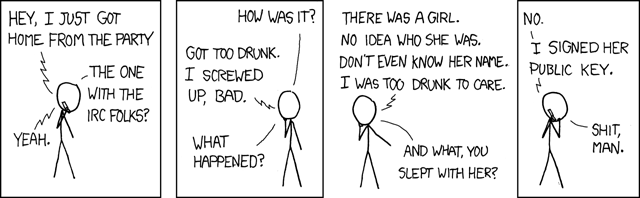
    Lior Kaplan: Responsible Behavior


    For all those DDs who love to drink: (click to enlarge) By xkcd, A webcomic of romance, sarcasm, math, and language.

    29 December 2007

    Lior Kaplan: Getting motivation from other people work and cooperation


    Recently, I found it hard to contribute to open source in general and Debian in particular. There are several reasons for that: beginning with less free time to contribute and continuing with feeling my contribution becomes more and more routine and thus less interesting / challenging. Yesterday I found the time and motivation to upload fixes to 6 of my packages. I thought it might be interesting to share the reasons for this motivation burst, as it can demonstrate how each of us can affect others. The final trigger was seeing (= getting svn diffs) Baruch Even working on the libhdate package (which is co-maintained as part of debian-hebrew). Prior to that I had people showing interest in my packages, helping with solving bugs, sending patches and even one guy becoming a co-maintainer of a package of mine. Oddly, most of them are ubuntu users. I’m not looking for others to do my work or do it for me, but getting help is always fun and motivating. Also, working with other people creates commitment as they wait for something you should do, or waiting for you to use what they’ve done. For me this starts a positive snow ball which ends with better packages for me and happier people after receiving credit for their work (usually a changelog entry and a thank you mail). So go on, and inspire people (:

    28 December 2007

    Lior Kaplan: conffiles, newer packages and purging


    Earlier this month Kumar Appaiah opened a bug against the culmus package as part of the stable -> unstable piuparts upgrade tests. First, I’m proud in Debian to have these tests. Thanks for the people involved with running them, parsing the log files and reporting the bugs. I really feel the lake of such checks in commercial distributions I work with. After finding the time to get to the bottom of the bug, and talking with Kumar, it seems most of the bugs found in the test are similar. I think this might indicate something wrong in a more basic level of the package handling. The source of these bugs is how to handle files which were conffile in version x, but aren’t included in version x+1 (as a regular file). In the common situation, the conffiles are removed only during the purge process and not during upgrade or removal. But if a conffile doesn’t exist in the x+1 package, no one will “own” it after the upgrade, and no will purge it in due time. This is why changing conffiles can result in extra files on our system, which is the problem discovered by the recent piuparts test. One solution will be that each package maintainer will add the necessary code to the maintainer scripts to remove the file on upgrade. A second solution is to decide the wanted behavior in such a case and to have dpkg handle it for all packages. The behavior can be to remove the old conffile during the upgrade (postinst script) or to dynamically add it to the list of files owned by the package. Although technically possible, I’m not sure if the second method is “legal” with the debian policy. I thought it would be better to hear others’ opinions before submitting a wishlist bug about this.

    21 December 2007

    Lior Kaplan: Thinking of another triage for openoffice bugs


    With the release of version 2.3.1 and upload to unstable, I started to wonder if it’s time for another bug triage for openoffice.org package. The last triage targeted bugs older than version 2.0.0, but now I’d like to target versions 2.0.0 to 2.2.1 (which is in testing right now). Preferably getting answers for 2.3.1 in unstable. Another goal for the triage is to add up-to-date version info to the bug reports, as I think it makes the maintainers’ life a bit easier. The actual question is whether to start now or to wait for version 2.3.1 to enter testing. The problem is that I don’t know when would this happen. It took a “while” for 2.2.1 to do so.

    12 December 2007

    Lior Kaplan: MovableType goes Open Source

    MovableType, the blog infrastructure, is announcing today the availability of an open source version. While this is a good step in the right direction, it seems that it will take a while for this project to stand on his feet. The status page shows that the required infrastructure for an open source project isn’t available yet. The nightly build link at the getting-the-source page leads to an 404 message which contains info about how to purchase a license. The download links use the word free (as in gratis) , and show a non-free (as in libre) license. Quite shameful after reading the “we’re going open source” announcement. On the other hand, the source code is already available on the SVN, including the appropriate GPL headers. To conclude, it seems that the release announcement was a bit too early, and it might have been better to build some more infrastructures for the project first. But it will be very interesting to see the blogoshphere hitting up while MovableType and Wordpress compete, and hopefully also cooperate.

    10 December 2007

    Lior Kaplan: Load Balancing Jboss with Apache and mod_jk

    Apache’s mod_jk has nice load balancing features. They work quite well for me with Jboss. The basic configuration is to install Jboss on several machines and have an Apache to load balance them. But while the load balancing is good, the Apache machine becomes a single point of failure. I was asked how to overcome that. The main principle I want keep is the “keep it simple, stupid” principle. Doing a round robin DNS between two machines is nice, but doesn’t really provides real the load balancing (as it always does 50/50). It also doesn’t check for the the load before it does the balancing. Other options like using mod_backhand and mod_proxy_balancer all leave me with the same single point of failure problem. That’s why I prefer to use an active/passive cluster to make sure Apache can move to another server in case of a failure. The IP address the users get is a virtual (or floating) IP, which can “jump” between the cluster nodes. There are several ways to create that cluster, but that’s probably for another more general post. I’ll be happy to hear other opinions…

    Next.

    Previous.