Search Results: "joey"

11 March 2015

Joey Hess: 7drl 2015 day 5 type directed spell system development

I want my 7drl game Scroll to have lots of interesting spells. So, as I'm designing its spell system, I've been looking at the types, and considering the whole universe of possible spells that fit within the constraints of the types. My first throught was that a spell would be a function from World -> World. That allows any kind of spell that manipulates the game map. Like, for instance a "whiteout" that projects a stream of whitespace from the player's mouth. Since Scroll has a state monad, I quickly generalized that; making spell actions a state monad M (), which lets spells reuse other monadic actions, and affect the whole game state, including the player. Now I could write a spell like "teleport", or "grow". But it quickly became apparent this was too limiting: While spells could change the World map, the player, and even change the list of supported spells, they had no way to prompting for input. I tried a few types of the Event -> M () variety, but they were all too limiting. Finally, I settled on this type for spell actions: M NextStep -> M NextStep. And then I spent 3 hours exploring the universe of spells that type allows! To understand them, it helps to see what a NextStep is:
type Step = Event -> M NextStep
data NextStep = NextStep View (Maybe Step)
Since NextStep is a continuation, spells take the original continuation, and can not only modify the game state, but can return an altered continuation. Such as one that prompts for input before performing the spell, and then calls the original continuation to get on with the game. That let me write "new", a most interesting spell, that lets the player add a new way to cast an existing spell. Spells are cast using ingredients, and so this prompts for a new ingredient to cast a spell. (I hope that "new farming" will be one mode of play to possibly win Scroll.) And, it lets me write spells that fail in game-ending ways. (Ie, "genocide @"). A spell can cause the game to end by returning a continuation that has Nothing as its next step. Even better, I could write spells that return a continuation that contains a forked background task, using the 66 line contiuation based threading system I built in day 3. This allows writing lots of fun spells that have an effect that lasts for a while. Things like letting the player quickly digest letters they eat, or slow down the speed of events. And then I thought of "dream". This spell stores the input continuation and game state, and returns a modified continuation that lets the game continue until it ends, and then restores from the point it saved. So, the player dreams they're playing, and wakes back up where they cast the spell. A wild spell, which can have different variants, like precognitive dreams where the same random numbers are used as will be used upon awaking, or dreams where knowledge carries back over to the real world in different ways. (Supports Inception too..) Look how easy it was to implement dreaming, in this game that didn't have any notion of "save" or "restore"!
runDream :: M NextStep -> M NextStep -> (S -> S) -> M NextStep
runDream sleepcont wakecont wakeupstate = go =<< sleepcont
   where
         go (NextStep v ms) = return $ NextStep v $ Just $
        maybe wake (go <=<) ms
         wake _evt = do
                 modify wakeupstate
                 wakecont
I imagine that, if I were not using Haskell, I'd have just made the spell be an action, that can do IO in arbitrary ways. Such a spell system can of course do everything I described above and more. But, I think that using a general IO action is so broad that it hides the interesting possibilities like "dream". By starting with a limited type for spells, and exploring toward more featureful types, I was able to think about the range of possibilities of spells that each type allowed, be inspired with interesting ideas, and implement them quickly. Just what I need when writing a roguelike in just 7 days!
Fun comment thread on reddit

10 March 2015

Joey Hess: 7drl 2015 day 4 coding through exhaustion

Slow start today; I was pretty exhausted after yesterday and last night's work. Somehow though, I got past the burn and made major progress today. All the complex movement of both the player and the scroll is finished now, and all that remains is to write interesting spells, and a system for learning spells, and to balance out the game difficulty.
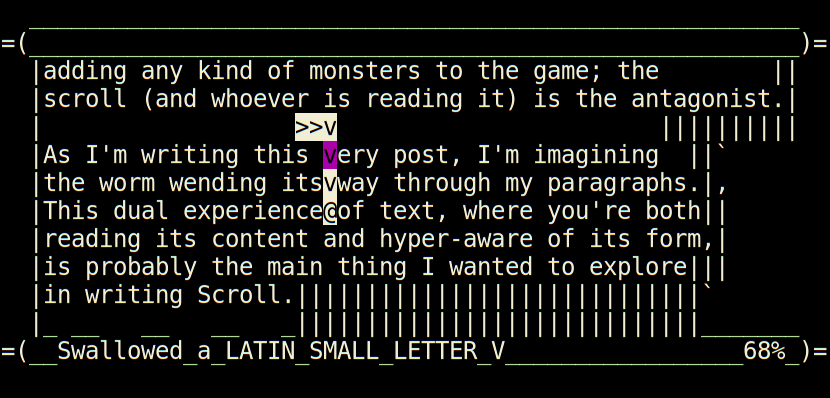
I haven't quite said what Scroll is about yet, let's fix that: In Scroll, you're a bookworm that's stuck on a scroll. You have to dodge between words and use spells to make your way down the page as the scroll is read. Go too slow and you'll get wound up in the scroll and crushed. The character is multiple chars in size (size is the worm's only stat), and the worm interacts with the scroll in lots of ways, like swallowing letters, or diving through a hole to the other side of the scroll. While it can swallow some letters, if it gets too full, it can't move forward anymore, so letters are mostly consumed to be used as spell components. I think that I will manage to get away without adding any kind of monsters to the game; the scroll (and whoever is reading it) is the antagonist. As I'm writing this very post, I'm imagining the worm wending its way through my paragraphs. This dual experience of text, where you're both reading its content and hyper-aware of its form, is probably the main thing I wanted to explore in writing Scroll. As to the text that fills the scroll, it's broadly procedurally generated, in what I hope are unusual and repeatedly surprising (and amusing) ways. I'm not showing any screenshots of the real text, because I don't want to give that surprise away. But, the other thing about Scroll is that it's scroll, a completely usable (if rather difficult..) Unix pager!

9 March 2015

Joey Hess: 7drl 2015 day 3 movement at last

Got the player moving in the map! And, got the map to be deadly in its own special way.
        HeadCrush -> do
                showMessage "You die."
                endThread
Even winning the game is implemented. The game has a beginning, a middle, and an end. I left the player movement mostly unconstrained, today, while I was working on things to do with the end of the game, since that makes it easier to play through and test them. Tomorrow, I will turn on fully constrained movement (an easy change), implement inventory (which is very connected to movement constraints in Scroll), and hope to start on the spell system too.
At this point, Scroll is 622 lines of code, including content. Of which, I notice, fully 119 are types and type classes. Only 4 days left! Eep! I'm very glad that scroll's central antagonist is already written. I don't plan to add other creatures, which will save some time.
Last night as I was drifting off to sleep, it came to me a way to implement my own threading system for my roguelike. Since time in a roguelike happens in discrete ticks, as the player takes each action, normal OS threads are not suitable. And in my case, I'm doing everything in pure code anyway and certianly cannot fork off a thread for some background job. But, since I'm using continuation passing style, I can just write my own fork, that takes two continuations and combines them, causing both to be run on each tick, and recursing to handle combining the resulting continuations. It was really quite simple to implement. Typechecked on the first try even!
fork :: M NextStep -> M NextStep -> M NextStep
fork job rest = do
        jn <- job
        rn <- rest
        runthread jn rn
  where
        runthread (NextStep _ (Just contjob)) (NextStep v (Just contr)) =
                return $ NextStep v $ Just $ \i -> do
                        jn <- contjob i
                        rn <- contr i
                        runthread jn rn
        runthread (NextStep _ Nothing) (NextStep v (Just contr)) =
                return $ NextStep v (Just contr)
        runthread _ (NextStep v Nothing) =
                return $ NextStep v Nothing
endThread :: M NextStep
endThread = nextStep Nothing
background :: M NextStep -> M NextStep
background job = fork job continue
demo :: M NextStep
demo = do
    showMessage "foo"
    background $ next $ const $
        clearMessage >> endThread
That has some warts, but it's good enough for my purposes, and pretty awesome for a threading system in 66 LOC.

8 March 2015

Joey Hess: 7drl 2015 day 2 level generation and game concept

Much as I want to get my @ displayed and moving around screen, last night and today have focused on level generation instead. Scroll has kinda strange level generation method, compared to how I suppose most roguelikes do it. There are only 3 calls to rand in all of Scroll. Just a 3 random parameters, but that's enough to ensure a different level each time.
-- Random level generation function.
level :: Bool -> StdGen -> [String]
level randomize r = concat
        [ final (length tutorial + extra) $ concat $ rand mariner1body
        , concat $ rand mariner1end
        , concatMap rand kubla
        ]
  where
    -- here be spoilers
You could say there are two influences in Scroll's level generation method: Nick Montfort and Samuel Taylor Coleridge.
I have thought some about Scroll before starting the 7drl week, but my idea for the game was missing some key concepts. There was nothing to keep the player engaged in moving forward, an unclear victory condition, no clue how to generate appropriate random levels, a large potential for getting stuck, and no way to lose the game. This is all a problem for a roguelike. But, I had an idea finally last night, about a single unified thing that all of that stuff falls out from. And it's right there in the name of the game! Now that I understand Scroll better, I wrote the tutorial level. It's a very meta tutorial level that sets the scene well and serves more purposes than are at first apparent. I count a total of 6 things that this "tutorial level" will let the user do. And interestingly, while the tutorial level is static, it interacts with the rest of the game in a way that will make it be experienced differently every time through.
The strangest line of code I wrote today is:
import GPL
Somehow, I have never before, in all my time programming, written a line like that one.
Finally, after 7 hours of nonstop coding, I got ncurses to display the generated game world, scrolling around in the display viewport. No @ yet; that will need to wait for tonight or tomorrow!

7 March 2015

Joey Hess: 7drl 2015 day 1 groundwork

Scroll is a roguelike, with a twist, which I won't reveal until I've finished building it. I'll just say: A playable roguelike pun, set in a filesystem near you. I'm creating Scroll as part of the 7DRL Challange. If all goes well, I'll have a usable roguelike game finished in 7 days. This is my first time developing a roguelike, and my first time writing a game in Haskell, and my first time writing a game to a time limit. Wow!
First, some groundwork. I'm writing Scroll in Haskell, so let's get the core data types and monads and IO squared away. Then I can spend days 2-7 writing entirely pure functional code, in the Haskell happy place. To represent the current level, I'm using a Vector of Vectors of Chars. Actually, MVectors, which can be mutated safely by pure code running inside the ST monad, so it's fast and easy to read or write any particular location on the level.
-- Writes a Char to a position in the world.
writeWorld :: Pos -> Char -> M ()
writeWorld (x, y) c = modWorld $ \yv -> do
    xv <- V.read yv y
    V.write xv x c
showPlayer :: M ()
showPlayer = writeWorld (5,8) '@'
(I wish these Vectors had their size as part of their types. There are vector libraries on hackage that do, but not the standard vector library, which has mutable vectors. As it is, if I try to access outside the bounds of the world, it'll crash at runtime.) Since the game will need some other state, I'm using the state monad. The overall monad stack is type M = StateT S (ST RealWorld). (It could be forall s. StateT S (ST s), but I had some trouble getting that to type check, so I fixed s to RealWorld, which is ok since it'll be run using stToIO. Next, a concept of time, and the main event loop. I decided to use a continutation passing style, so the main loop takes the current continuation, and runs it to get a snapshot of the state to display, and a new continutation. The advantage of using continuations this way is that all the game logic can be handled in the pure code. I should probably be using the Cont monad in my monad stack, but I've not learned it and lack time. For now I'm handling the continuations by hand, which seems ok.
updateWorld :: Step
updateWorld (Just 'Q') = do
        addMessage "Are you sure you want to quit? [yn]"
        next $ \i -> case i of
                Just 'y' -> quit
                _ -> continue
updateWorld input = do
        addMessage ("pressed " ++ show input)
        continue
Finally, I wrote some ncurses display code, which is almost working.
Start time: After midnight last night. Will end by midnight next Friday. Lines of code written today: 368 Craziest type signature today: writeS :: forall a. ((Vec2 a -> ST RealWorld ()) -> M ()) -> Pos -> a -> M ()
By the way, there's a whole LambdaHack library for Haskell, targeted at just this kind of roguelike construction. It looks excellent. I'm not using it for two reasons:
  1. Scroll is going to be unusual in a lot of ways, and LambdaHack probably makes some assumptions that don't fit.
  2. mainSer :: (MonadAtomic m, MonadServerReadRequest m) => [String] -> COps -> (m () -> IO ()) -> (COps -> DebugModeCli -> ((FactionId -> ChanServer ResponseUI RequestUI -> IO ()) -> (FactionId -> ChanServer ResponseAI RequestAI -> IO ()) -> IO ()) -> IO ()) -> IO ()
    That's a lot of stuff to figure out! I only have a week, so it's probably easier to build my own framework, and this gives me an opportunity to learn more generally useful stuff, like how to use mutable Vectors.

4 March 2015

Zlatan Todori : Interviews with FLOSS developers: Paul Wise

After starting with Joey Hess, we continue with Paul Wise. What makes his star to shine are many things such as being a DSA (Debian System Administrator), a helpful hand on mailings list, encouraging people to join Debian teams but most of all - he has encyclopedia knowledge on Debian as a whole which he gladly shares with anyone who asks (very fast response on IRC channels). It is almost impossible for any single person to count all Debian teams, work and places - to know most of those things, you can image the vast knowledge which Paul has. The legend says that his brain has better and faster search engine algorithm on Debian related queries than all other engines combined. So lets see what he has to share with world. me: Who are you? pabs: Paul Wise (pabs) and I have to say that I'm no-where near as knowledgeable as your intro suggests. me: How did you start programming? pabs: Messing around with fractals and graphics things in MS BASIC. me: How would you now advise others to start programming? pabs: Pick an issue in a tool you use, investigate how the tool works and how you can change it, fix that and contribute the change back to the project that created that tool. In the process you will learn skills, interact with the community and contribute to the project. me: Setup of your development machine? pabs: Lenovo Thinkpad with external monitor, Debian testing and some tweaks me What is your preferable language (for hacking)? Why? How do you compare it to other languages? pabs: I currently prefer Python for its readability. It still has some rough edges though the documentation covers them fairly well. I generally pick up new languages when working on projects written in them. Haskell is next on the horizon due to Nikki and the Robots. me: Describe your current most memorable situation as software developer/hacker? pabs: I had a great time creating fractals in BASIC, learning about the Mandelbrot set, L-systems and more. My days and nights of hacking on frhed (a GPLed hex editor for Windows) to help me cheat at Civilisation were pretty memorable. frhed led to my work on reverse engineering the CHM file format (a documentation format for Windows programs). A stand-out moment during my time with Debian was hacking on the derivates census patch generation code during the Debian UK BBQ weekend, surrounded by geeks playing Portal, cooking things, hacking on Debian and generally having a good time (thanks Steve!). me: Some memorable moments from Debian conferences? pabs: There are so many; meeting Debian folks, playing Mao once and then never again, late night games of werewolf, both delectably delicious and hideously disgusting cheeses, fried insects, day trips to beautiful landscapes, inspiring keynotes, exciting BoFs, secret IRC channels for planning surprise birthday parties, blue hair, wet air, blocks of fried cheese, a vast quantity of icecream, pants, geeks in the surf, volcanoes, hiking, a wonderful view, a uni-cycling stormtrooper & more. me: How do you see future of Debian development? pabs: I hope we will continue to exist and uphold our principles for the foreseeable future. I don't have any crystal balls though. me: You recently became member of Debian DSA - what is that like, what roles do you have and what tasks are in front of DSA? pabs: We wrote a bit of text about that for DPN recently. me: You have large knowledge on Debian and you share it with anyone who wants to know more. What motivates you to do so? pabs: I want the operating system I personally rely on to exist into the future, helping folks work on and join Debian can help with that. me: Why should developers and users join Debian community? What makes Debian a great and happy place? pabs: Every Debian contributor has different reasons for joining the community. Personally the Social Contract, the DFSG and the spirit and culture behind them are the main reason to be involved. I also like our many efforts towards technical excellence and correctness. Of course I've made a number of good friends over the years, especially as a result of attending DebConf every year since 2007. me: You are member of Debian publicity team which writes Debian news - do you need more people to join that team and how can they start? pabs: Since there is an infinite amount of work to do, pretty much every part of Debian always needs help, that includes the publicity team. We published a post about ways to help here. me: If someone wants to contribute to Debian in terms of packaging, can they do it anonymously (for example over Tor network, does Debian have .onion address)? pabs: Due to Debian's penchant for transparency it is harder but there are definitely package maintainers who have built up a reputation for good work under a pseudonym over the years and become Debian contributors as a result. I'm not aware of completely anonymous package maintainers but there are definitely people who file bugs using one-off pseudonyms, which is almost the same thing as anonymously. There are definitely Debian contributors and members who use Tor while contributing to Debian. In fact, as Debian is very highly dependent on OpenPGP and the best practices for OpenPGP include refreshing your keyring slowly over Tor, so probably quite a number of Debian contributors use Tor. As far as I know Debian itself does not run any Tor relays or onion services. me: What are places that non-packaging developers and people could join and help spread Debian even more? pabs: There are many ways to help Debian, including non-technical ones. Unfortunately our web page about helping Debian isn't quite up-to-date with all of them but a few more are to volunteer at DebConf, helo with artwork requests, speak about Debian at events or even come up with ideas for projects. Whatever skills you have, Debian can probably make use of them. If you aren't sure where to start, jump on the debian-mentors mailing list or IRC channel and we can probably guide you to the right place within Debian. Don't worry about not being skilled enough, everyone starts somewhere. me: How do you see Debian will manage webapps? pabs: Personally I prefer locally installed software, standard data formats and standard data transfer protocols to the wild webapps world but I understand they are becoming very popular to produce and use due to the ubiquity of the web browser platform. Antonio Terceiro is mentoring a project for this year's newcomer mentorship programs (outreachy/gsoc) that aims to improve support for installing web apps on Debian installations. I hope it succeeds as it could help make Debian more popular on servers and home servers in particular. me: How would you advise Debian (and other FLOSS users) to setup their machine in terms of security and anonymity? pabs: All technology has upsides and downsides. I would advise anyone to analyse their situation and protect themselves accordingly. For example if you have a bad memory, full disk encryption, which is based on pass-phrases might lead to data loss and physical security might be a better choice for protecting your data. The right choices around technology are very much a personal thing. me: Is it better to setup xmonad (because it is Haskell based WM) with small dependency chain or GNOME (because it is getting sandboxed apps) in term of security and privacy implications? pabs: Again, the right choices around technology are very much a personal thing. Due to the design of X11, both of these are approximately equivalent from a window-manager security properties point of view, that is to say, pretty bad. Wayland is one of the possible X11 successors and offers much better security properties. GNOME folks are working on switching to Wayland. Ultimately though it comes down to how each person uses their window manager and which software they run under it. me: Should Debian join Tor project as distro that installs Tor relays by default - should it offer that as option in installer in Debian 9? pabs: Running a Tor relay requires a reasonably fast and reliable Internet connection and should be a conscious decision on behalf of the sysadmin for a computer so Debian probably shouldn't install them by default. If tasksel gets support for installing tasks from Debian Pure Blends, then we could add a Tor relay task to the Debian Sanctuary Pure Blend. me: Have you ever considered joining initiatives such as FreedomBox? pabs: I was quite moved by Eben Moglen's talk at DebConf10 in New York and the resulting BoF. It seemed like a very ambitious project but I didn't really have the knowledge, skills or time to contribute yet. me: Are you a gamer? Valve Steam games are offered for free to Debian Developers - do you use steam and play Valve games? Your thoughts on Steam and non-free Linux gaming? pabs: I play computer games occasionally, all from Debian main or ones that I'm packaging. 0ad is my current go-to for a bit of gaming. I don't have any experience with Steam or non-free games on Linux. me: Is there something you would change in FLOSS ecosystem? pabs: Various folks have highlighted new and ongoing challenges for the FLOSS ecosystem in various places in recent years. Something that I would like to highlight that does not get talked about enough is the choices we make around our digital artefacts. This is the discussion around "preferred form for modification" or "source". The "source" for a particular digital artefact is a deliberate choice on behalf of the authors. Often generated files are distributed alongside the "source" without any instructions for reproducing the generated files from the "source". It sometimes happens that FLOSS contributors forget to distriute what they have chosen as "source", instead just distributing the generated files. This is a fairly well known issue but still happens. What isn't thought about quite as much is that the choice of "source" has consequences for future development possibilities of that "source". Some forms of "source" are more expressive than others, can be modified in a wider variety of ways and are better choices in general. Sometimes the consequences of choosing less expressive forms are mild and other times they are quite important. I hope more people will start to think about these choices. Some examples where, in my opinion, various people could have made better choices are listed in the mail I sent to the games team list last year. Another thing I would like to highlight is the work that organisations like Software Freedom Conservancy and Software in the Public Interest do to protect, defend, promote and support FLOSS projects. It is very important work that needs our interest and support. me: Can FLOSS world create great alternatives to Viber, Dropbox, WhatsUp, Facebook, Skype and other non-free services? pabs: I think that the FLOSS world has already created alternatives to all of those. The success of non-free services doesn't take these alternatives away but it does mean some of them are less useful because some of them are the kind of tools that become more useful with a larger amount of people using them. I don't know what it would take for the FLOSS alternatives to achieve similar success as network effects are hard to overcome. Hopefully mako is right and the network effects are overrated. me: Your thoughts and compare Cloud, IaaS, PaaS, SaaSS? To what should the FLOSS world pay more attention and energy? pabs: Initially I dismissed these as buzzwords and a threat to Free Software. These days I view them as potential opportunities for Free Software. Cloud-related technologies such as OpenStack and virtual machines can make private compute farm hardware more flexible and useful to their owners. IaaS providers can be used to run Debian more simply and cheaply and therefore bring Debian to more people than possible with hardware. PaaS providers can be used to run Free Software services. SaaSS can be based entirely on Free Software and respect users. Of course, just like running Free Software on hardware (proprietary or libre), cloud technology, IaaS, PaaS and SaaSS all come with downsides. The FLOSS world should aim to inform users of our software of these downsides. For example, the Debian installer could note that it is running on Intel CPUs with a proprietary BIOS and various proprietary software running, that it is running on a mobile phone with a locked bootloader, that it is running in a Xen VM on machines owned by Amazon. Free Software services could note they are running on Google App Engine etc. Free Software web browsers, chat clients etc could note when they are connecting to proprietary network services. All these notes could inform users about the downsides present in the particular situation encountered. There is also much work to be done making it easier to run Free Software on top of or use Free Software to connect to all manner of platforms from lowRISC to UEFI to VMware to Google App Engine to GitHub to Facebook. The more places Free Software can reach, the more people will be exposed to the philosophy behind it and the more potential there is for folks to join the community. While co-option of the FLOSS world is a dangerous certainty, co-option of proprietary platforms might be able to expand the reach of the philosophy behind Free Software. me: Your thoughts on Purism (the open hardware laptop initiative that got recently funded on CrowdSupply)? pabs: I don't know enough about that to comment but personally I am more interested in a laptop based on a libre CPU architecture. The RISC-V ISA and the lowRISC project seems to be one of the more promising possibilities at this point in time. me: Did you watch Citizenfour - comments on it? pabs: I've seen the trailer and look forward to watching it at some point, I read there might be a screening at DebConf15.

2 March 2015

Jonathan Dowland: Debian and Docker

I've been playing around with Debian and Docker a little bit. I found Joey Hess' post about Docker trust interesting reading, in particular this advice:
I'd recommend only trusting docker images you build yourself. I have some docker images published somewhere that are built with 100% straight debootstrap with no modifications (...) But I'm not going to link to them, because again, you should only trust docker images you built yourself.
On that advice, I did exactly that. I've pushed the basic scripts I used to build my images to github:jmtd/debian-docker. Suggestions welcome! However, I am planning to share the images I build, at least for my own convenience, on the Docker repository. I'm hoping to publish some PGP-signed sums somewhere so you could verify the binary images on the Docker registry if you so wish. The three images I'm currently maintaining are: (note: I haven't pushed them all yet.) With docker 1.5.x at least, the i386 image works fine on amd64 hosts. I've used it as the basis for running wine and Windows binaries. I might push a wine image if I generalise it enough to be more useful. The Docker folks recommend using Debian as a base image because it's a small size (approx. 163M for my base image, 85.01M for the semi-official one: See Joey's blog for some of the differences) but with a good set of tools. I wondered whether I could leverage the efforts of the Emdebian project to get an even smaller base image. Unfortunately, the Emdebian project discontinued their 'Grip' project midway through last year. A basic Emdebian grip install is a fair bit smaller than the equivalent wheezy image, but once you've applied security updates most of the difference is lost. I suspect that some of Emdebian's minimisation techniques would be useful and applicable for shrinking Docker base images.

28 February 2015

Zlatan Todori : Interviews with FLOSS developers: Joey Hess

Edit: Now translated to Chinese. Thanks zhang wei! There is really hardly a better way to open a series of interviewing with developers behind Free Libre Open Source Software project, then with incredible mind such as Joey Hess. To write his contributions to Free software ecosystem, especially in Debian, would be a book by itself. His impact exceeds even his projects - people literally follow his blog posts to see what he is doing and how is he living. A hacker from cabin. If you really need to have a picture of true hacker, then Joey is the one. As this isn't a book I will just mention few projects that he has been behind - git-annex, ikiwiki, etckeeper, debian installer, parts of dpkg, debhelper, devscripts, taskel. So without further waiting here it is. Picture of Joey Hess me: Who are you? joeyh: I'm Joey -- https://joeyh.name/ me: How did you start programming? joeyh: Atari 130XE which came with BASIC and a boring word processor and not much else. No other friends had one, so the only way to get software was to type in demo programs from manual and then begin to change and write my own. So, the easy way to learn. Also some Logo in school. me: How would you now advise others to start programming? joeyh: Difficult question, it seems much harder to get an intimate understanding of things than when I started, and much harder to be motivated to program when there's so much stuff easily available. Maybe simple bare-metal systems like Arduino coupled with real-world interaction are the answer. I've recently been mentoring my nephew who is learning python and Python the Hard Way has gotten him far impressively fast. me: Setup of your development machine? joeyh: Lenovo laptop de-spywared with Debian unstable, xmonad, xfce, vim. me: Your thoughts on Purism (the open hardware laptop initiative that got recently funded on CrowdSupply)? joeyh: I don't know much about that one, but it seems that consumer level hardware has gotten so low quality, and so closed and untrustworthy that it makes sense to either build alternatives that are open, or pick out, as a community, the stuff we can adapt to our needs and concentrate on it. Several projects are trying, I hope they succeed. me: How do you see future of Debian development? joeyh: Well, I've mostly stopped worrying about it. If you look back at my presentations at the past 2 or 3 DebConfs, you'll find my best thoughts on the matter. me: You retired as Debian developer - do you intend sometime soon to come back and/or do you plan to join some other communities? joeyh: It would be glorious to come back, wouldn't it? But I don't think I will. Can't step in the same river twice, and all. Instead, Debian will probably have to put up with me as an annoying upstream author who doesn't ship tarballs, but does ship debian/ directories, and as a bug reporter who enjoys reporting amusing bugs like -0 NaN. I seem to have more time to spend in other online communities since I left Debian, but in a more diffuse way. Maybe that's just what it's like, to be involved in Free Software but not in the embrace of a big project like Debian. me: Some memorable moments from Debian conferences? joeyh: There are so many! Picnicing on berries and tamales at the Portland farmer's market right outside the venue; rainbows and bonfire in Switzerland after crazy busy days; impromptu pipe organ repair in a weird night venue in Edinburgh; walking through Porto Alegre at night with Ian Murdock and how humble he was about what he'd started; hacking all night in Spain; failing to sleep through midnight sun and incessent partying Finland; hanging out in the hotel lobby in Atlanta where we designed Build-Depends. me: Are you a gamer? Valve Steam games are offered for free to Debian Developers - do you use steam and play Valve games? joeyh: I've played through Half Life and Portal, but nethack has claimed more of my time. I mostly enjoy short, indie games, or games that tell us something new about the medium of games, A recent favorite was A Dark Room. But really, I have more pure fun playing real world Tabletop games with friends, like Carcassanne Discovery and Hive. In March, I am going to try to write a roguelike game in one week, in Haskell, for the Seven Day Roguelike Challenge and I'll be blogging about my progress daily. me: You are nowdays a Haskell hacker (git-annex) - what would you like to say about this language and how does it compare to Python, C, JavaScript, Ruby and Perl? joeyh: Not just git-annex; all my current projects are written in Haskell. I think it's amazing how much we expect programmers to keep in their heads while writing code. Is that buffer going to overflow? Is changing the value of that global variable going to break some other part of the code? Is that input sanitized yet? Did that interface change? Haskell solves some of these outright, but more, it makes you start noticing this kind of pervasive issue, and it provides ways to completely eliminate a class of problems from your code. For example http://joeyh.name/blog/entry/making_propellor_safer_with_GADTs_and_type_families/. The class of bugs I avoided there had never affected my code even once, but it was still worth preventing that whole class of bugs, so I don't have to worry about them ever again. me: Would you suggest Haskell as first language to learn especially for those that have an itch for mathematics? joeyh: I think that can work well. Or it can go other the way -- I had an affinity to mathematics when I was young, but it got knocked out of me in the way that happens to many people, and languages like perl and C don't do much to make you want to learn more about higher-order math. I've been picking up a bit more here and there via Haskell. me: How do you compare your productivity in Haskell compared to your Perl days? joeyh: It's very different; I'm a very different programmer now. I probably would bang out quick hacks more quickly when I was writing Perl. But, they tended to stay quick hacks. Now, I might take a little longer to get there, but the code seems a lot more solid, while also being more malleable to turn into larger or different programs. I'm also a lot more drawn toward writing software libraries. me: Can you describe your philosophy of life (you live in cabin, in forest, using a lot of solar power - many people are intrigued (including myself) what drives you towards that kind of life and how does it impact your overall quality of life and happiness. Looking the todays modern predator capitalistic society, in which you could easily earn more then $10.000 a month, you seem to be an anarchist and very humble human)? joeyh: I want to build worthwhile things that might last. Which is super hard in the world of software, both because it's hard to think far ahead at all, and because most jobs don't emphasize that kind of real value. I've been lucky and bootstrapped up to a point where I've been able to work full time on free software for years, and I'm willing to forgo a lot to continue that. Living in the woods without modern conveniences is great, because it's quiet and you can think as much as you like; the internet is just as close as it is anywhere else (maybe a bit slower); and when you've spent too much time quietly thinking you'll need to go chop wood, or haul water, or jump in the river to cool off, depending on the season. (Humble? Like most programmers, I am internally a flaming tower of ego...)
Vote on Hacker News

8 February 2015

Gregor Herrmann: RC bugs 2015/04-06

my small contributions around RC bugs during the last weeks:

25 January 2015

Joey Hess: making propellor safer with GADTs and type families

Since July, I have been aware of an ugly problem with propellor. Certain propellor configurations could have a bug. I've tried to solve the problem at least a half-dozen times without success; it's eaten several weekends. Today I finally managed to fix propellor so it's impossible to write code that has the bug, bending the Haskell type checker to my will with the power of GADTs and type-level functions. the bug Code with the bug looked innocuous enough. Something like this:
foo :: Property
foo = property "foo" $
    unlessM (liftIO $ doesFileExist "/etc/foo") $ do
        bar <- liftIO $ readFile "/etc/foo.template"
        ensureProperty $ setupFoo bar
The problem comes about because some properties in propellor have Info associated with them. This is used by propellor to introspect over the properties of a host, and do things like set up DNS, or decrypt private data used by the property. At the same time, it's useful to let a Property internally decide to run some other Property. In the example above, that's the ensureProperty line, and the setupFoo Property is run only sometimes, and is passed data that is read from the filesystem. This makes it very hard, indeed probably impossible for Propellor to look inside the monad, realize that setupFoo is being used, and add its Info to the host. Probably, setupFoo doesn't have Info associated with it -- most properties do not. But, it's hard to tell, when writing such a Property if it's safe to use ensureProperty. And worse, setupFoo could later be changed to have Info. Now, in most languages, once this problem was noticed, the solution would probably be to make ensureProperty notice when it's called on a Property that has Info, and print a warning message. That's Good Enough in a sense. But it also really stinks as a solution. It means that building propellor isn't good enough to know you have a working system; you have to let it run on each host, and watch out for warnings. Ugh, no! the solution This screams for GADTs. (Well, it did once I learned how what GADTs are and what they can do.) With GADTs, Property NoInfo and Property HasInfo can be separate data types. Most functions will work on either type (Property i) but ensureProperty can be limited to only accept a Property NoInfo.
data Property i where
    IProperty :: Desc -> ... -> Info -> Property HasInfo
    SProperty :: Desc -> ... -> Property NoInfo
data HasInfo
data NoInfo
ensureProperty :: Property NoInfo -> Propellor Result
Then the type checker can detect the bug, and refuse to compile it. Yay! Except ... Property combinators There are a lot of Property combinators in propellor. These combine two or more properties in various ways. The most basic one is requires, which only runs the first Property after the second one has successfully been met. So, what's it's type when used with GADT Property?
requires :: Property i1 -> Property i2 -> Property ???
It seemed I needed some kind of type class, to vary the return type.
class Combine x y r where
    requires :: x -> y -> r
Now I was able to write 4 instances of Combines, for each combination of 2 Properties with HasInfo or NoInfo. It type checked. But, type inference was busted. A simple expression like
foo  requires  bar
blew up:
   No instance for (Requires (Property HasInfo) (Property HasInfo) r0)
      arising from a use of  requires'
    The type variable  r0' is ambiguous
    Possible fix: add a type signature that fixes these type variable(s)
    Note: there is a potential instance available:
      instance Requires
                 (Property HasInfo) (Property HasInfo) (Property HasInfo)
        -- Defined at Propellor/Types.hs:167:10
To avoid that, it needed ":: Property HasInfo" appended -- I didn't want the user to need to write that. I got stuck here for an long time, well over a month. type level programming Finally today I realized that I could fix this with a little type-level programming.
class Combine x y where
    requires :: x -> y -> CombinedType x y
Here CombinedType is a type-level function, that calculates the type that should be used for a combination of types x and y. This turns out to be really easy to do, once you get your head around type level functions.
type family CInfo x y
type instance CInfo HasInfo HasInfo = HasInfo
type instance CInfo HasInfo NoInfo = HasInfo
type instance CInfo NoInfo HasInfo = HasInfo
type instance CInfo NoInfo NoInfo = NoInfo
type family CombinedType x y
type instance CombinedType (Property x) (Property y) = Property (CInfo x y)
And, with that change, type inference worked again! \o/ (Bonus: I added some more intances of CombinedType for combining things like RevertableProperties, so propellor's property combinators got more powerful too.) Then I just had to make a massive pass over all of Propellor, fixing the types of each Property to be Property NoInfo or Property HasInfo. I frequently picked the wrong one, but the type checker was able to detect and tell me when I did. A few of the type signatures got slightly complicated, to provide the type checker with sufficient proof to do its thing...
before :: (IsProp x, Combines y x, IsProp (CombinedType y x)) => x -> y -> CombinedType y x
before x y = (y  requires  x)  describe  (propertyDesc x)
onChange
    :: (Combines (Property x) (Property y))
    => Property x
    => Property y
    => CombinedType (Property x) (Property y)
onChange = -- 6 lines of code omitted
fallback :: (Combines (Property p1) (Property p2)) => Property p1 -> Property p2 -> Property (CInfo p1 p2)
fallback = -- 4 lines of code omitted
.. This mostly happened in property combinators, which is an acceptable tradeoff, when you consider that the type checker is now being used to prove that propellor can't have this bug. Mostly, things went just fine. The only other annoying thing was that some things use a [Property], and since a haskell list can only contain a single type, while Property Info and Property NoInfo are two different types, that needed to be dealt with. Happily, I was able to extend propellor's existing (&) and (!) operators to work in this situation, so a list can be constructed of properties of several different types:
propertyList "foos" $ props
    & foo
    & foobar
    ! oldfoo    
conclusion The resulting 4000 lines of changes will be in the next release of propellor. Just as soon as I test that it always generates the same Info as before, and perhaps works when I run it. (eep) These uses of GADTs and type families are not new; this is merely the first time I used them. It's another Haskell leveling up for me. Anytime you can identify a class of bugs that can impact a complicated code base, and rework the code base to completely avoid that class of bugs, is a time to celebrate!

6 January 2015

Joey Hess: a bug in my ear

True story: Two days ago, as I was about to drift off to sleep at 2 am, a tiny little bug flew into my ear. Right down to my eardrum, which it fluttered against with its wings. It was a tiny little moth-like bug, the kind you don't want to find in a bag of flour, and it had been beating against my laptop screen a few minutes before. This went on for 20 minutes, in which I failed to get it out with a cue tip and shaking my head. It is very weird to have a bug flapping in your head. I finally gave up and put in eardrops, and stopped the poor thing flapping. I happen to know these little creatures mass almost nothing, and rapidly break up into nearly powder when dead. So while I've not had any bug bits come out, I'm going by the way my ear felt a little stopped up yesterday, and just fine today, and guessing it'll be ok. Oh, and I've been soaking it in the tub and putting in eardrops for good measure. If I've seemed a little distracted lately, now you know why!

2 January 2015

Jeff Licquia: Happy 2015!

[en] Look, it s 2015. How d that happen? Blogging has been pretty much nonexistent this year, apart from a public service announcement about the Heartbleed bug and a public statement about boring encryption stuff. (Which, if you re actually interested in that sort of thing: I did finally get the requisite number of signatures and replaced my key in Debian just in time to avoid the Great Key Purge of 2014.) It s a new world. Social media has made blogs obsolete, supposedly, except that they re now too busy competing with each other (and, sometimes, their own fans) to be terribly useful. I ve tried to write a blog post about that a few times, only to delete it out of frustration and long-windedness. So there s a resolution for 2015: get past these social media issues and get back to regular communication. Maybe what I need is a good social media rant. I m sure you re all waiting on pins and needles for that one. Lots has been going on. I m an empty-nester now; the youngest kid started college this fall. I ve been busy at work and busy at skill freshening, including getting on this funky Haskell bandwagon that seems to be all the rage among the cool kids. And plenty of other things going on, some of which probably deserve their own blog posts. Maybe those will get written in 2015. Plan: write. Journey of a thousand miles starting with single steps, and all that.

27 December 2014

Joey Hess: shell monad day 3

I have been hard at work on the shell-monad ever since it was born on Christmas Eve. It's now up to 820 lines of code, and has nearly comprehensive coverage of all shell features. Time to use it for something interesting! Let's make a shell script and a haskell program that both speak a simple protocol. This kind of thing could be used by propellor when it's deploying itself to a new host. The haskell program can ssh to a remote host and run the shell program, and talk back and forth over stdio with it, using the protocol they both speak. abstract beginnings First, we'll write a data type for the commands in the protocol.
data Proto
    = Foo String
      Bar
      Baz Integer
    deriving (Show)
Now, let's go type class crazy!
class Monad t => OutputsProto t where
    output :: Proto -> t ()
instance OutputsProto IO where
    output = putStrLn . fromProto
So far, nothing interesting; this makes the IO monad an instance of the OutputsProto type class, and gives a simple implementation to output a line of the protocol.
instance OutputsProto Script where
    output = cmd "echo" . fromProto
Now it gets interesting. The Script monad is now also a member of the OutputsProto. To output a line of the protocol, it just uses echo. Yeah -- shell code is a member of a haskell type class. Awesome -- most abstract shell code evar! Similarly, we can add another type class for monads that can input the protocol:
class Monad t => InputsProto t p where
    input :: t p
instance InputsProto IO Proto where
    input = toProto <$> readLn
instance InputsProto Script Var where
    input = do
        v <- newVar ()
        readVar v
        return v
While the IO version reads and deserializes a line back to a Proto, the shell script version of this returns a Var, which has the newly read line in it, not yet deserialized. Why the difference? Well, Haskell has data types, and shell does not ... speaking the protocol Now we have enough groundwork to write haskell code in the IO monad that speaks the protocol in arbitrary ways. For example:
protoExchangeIO :: Proto -> IO Proto
protoExchangeIO p = do
    output p
    input
fooIO :: IO ()
fooIO = do
    resp <- protoExchangeIO (Foo "starting up")
    -- etc
But that's trivial and uninteresting. Anyone who has read to here certianly knows how to write haskell code in the IO monad. The interesting part is making the shell program speak the protocol, including doing various things when it receives the commands.
foo :: Script ()
foo = do
    stopOnFailure True
    handler <- func (NamedLike "handler") $
        handleProto =<< input
    output (Foo "starting up")
    handler
    output Bar
    handler
handleFoo :: Var -> Script ()
handleFoo v = toStderr $ cmd "echo" "yay, I got a Foo" v
handleBar :: Script ()
handleBar = toStderr $ cmd "echo" "yay, I got a Bar"
handleBaz :: Var -> Script ()
handleBaz num = forCmd (cmd "seq" (Val (1 :: Int)) num) $
    toStderr . cmd "echo" "yay, I got a Baz"
serialization I've left out a few serialization functions. fromProto is used in both instances of OutputsProto. The haskell program and the script will both use this to serialize Proto.
fromProto :: Proto -> String
fromProto (Foo s) = pFOO ++ " " ++ s
fromProto Bar = pBAR ++ " "
fromProto (Baz i) = pBAZ ++ " " ++ show i
pFOO, pBAR, pBAZ :: String
(pFOO, pBAR, pBAZ) = ("FOO", "BAR", "BAZ")
And here's the haskell function to convert the other direction, which was also used earlier.
toProto :: String -> Proto
toProto s = case break (== ' ') s of
    (w, ' ':rest)
          w == pFOO -> Foo rest
          w == pBAR && null rest -> Bar
          w == pBAZ -> Baz (read rest)
          otherwise -> error $ "unknown protocol command: " ++ w
    (_, _) -> error "protocol splitting error"
We also need a version of that written in the Script monad. Here it is. Compare and contrast the function below with the one above. They're really quite similar. (Sadly, not so similar to allow refactoring out a common function..)
handleProto :: Var -> Script ()
handleProto v = do
    w <- getProtoCommand v
    let rest = getProtoRest v
    caseOf w
        [ (quote (T.pack pFOO), handleFoo =<< rest)
        , (quote (T.pack pBAR), handleBar)
        , (quote (T.pack pBAZ), handleBaz =<< rest)
        , (glob "*", do
            toStderr $ cmd "echo" "unknown protocol command" w
            cmd "false"
          )
        ]
Both toProto and handleProto split the incoming line apart into the first word, and the rest of the line, then match the first word against the commands in the protocol, and dispatches to appropriate actions. So, how do we split a variable apart like that in the Shell monad? Like this...
getProtoCommand :: Var -> Script Var
getProtoCommand v = trimVar LongestMatch FromEnd v (glob " *")
getProtoRest :: Var -> Script Var
getProtoRest v = trimVar ShortestMatch FromBeginning v (glob "[! ]*[ ]")
(This could probably be improved by using a DSL to generate the globs too..) conclusion And finally, here's a main to generate the shell script!
main :: IO ()
main = T.writeFile "protocol.sh" $ script foo
The pretty-printed shell script that produces is not very interesting, but I'll include it at the end for completeness. More interestingly for the purposes of sshing to a host and running the command there, we can use linearScript to generate a version of the script that's all contained on a single line. Also included below. I could easily have written the pretty-printed version of the shell script in twice the time that it took to write the haskell program that generates it and also speaks the protocol itself. I would certianly have had to test the hand-written shell script repeatedly. Code like for _x in $(seq 1 "$ _v#[!\ ]*[\ ] ") doesn't just write and debug itself. (Until now!) But, the generated scrpt worked 100% on the first try! Well, it worked as soon as I got the Haskell program to compile... But the best part is that the Haskell program and the shell script don't just speak the same protocol. They both rely on the same definition of Proto. So this is fairly close to the kind of type-safe protocol serialization that Fay provides, when compiling Haskell to javascript. I'm getting the feeling that I won't be writing too many nontrivial shell scripts by hand anymore! :) the complete haskell program Is here, all 99 lines of it. the pretty-printed shell program
#!/bin/sh
set -x
_handler ()   :
    _v=
    read _v
    case "$ _v%%\ * " in FOO) :
        echo 'yay, I got a Foo' "$ _v#[!\ ]*[\ ] " >&2
    : ;; BAR) :
        echo 'yay, I got a Bar' >&2
    : ;; BAZ) :
        for _x in $(seq 1 "$ _v#[!\ ]*[\ ] ")
        do :
            echo 'yay, I got a Baz' "$_x" >&2
        done
    : ;; *) :
        echo 'unknown protocol command' "$ _v%%\ * " >&2
        false
    : ;; esac
 
echo 'FOO starting up'
_handler
echo 'BAR '
_handler
the one-liner shell program
set -p; _handler ()   :;    _v=;    read _v;    case "$ _v%%\ * " in FOO) :;        echo 'yay, I got a Foo' "$ _v#[!\ ]*[\ ] " >&2;     : ;; BAR) :;        echo 'yay, I got a Bar' >&2;    : ;; BAZ) :;        for _x in $(seq 1 "$ _v#[!\ ]*[\ ] ");      do :;           echo 'yay, I got a Baz' "$_x" >&2;      done;   : ;; *) :;      echo 'unknown protocol command' "$ _v%%\ * " >&2;       false;  : ;; esac;  ; echo 'FOO starting up'; _handler; echo 'BAR '; _handler

24 December 2014

Joey Hess: generating shell scripts from haskell using a shell monad

Shell script is the lingua franca of Unix, it's available everywhere and often the only reasonable choice to Get Stuff Done. But it's also clumsy and it's easy to write unsafe shell scripts, that forget to quote variables, typo names of functions, etc. Wouldn't it be nice if we could write code in some better language, that generated nicely formed shell scripts and avoided such gotchas? Today, I've built a Haskell monad that can generate shell code. Here's a fairly involved example. This demonstrates several features, including the variadic cmd, the ability to define shell functions, to bind and use shell variables, to build pipes (with the -:- operator), and to factor out generally useful haskell functions like pipeLess and promptFor ...
santa = script $ do
    hohoho <- func $
        cmd "echo" "Ho, ho, ho!" "Merry xmas!"
    hohoho
    promptFor "What's your name?" $ \name -> pipeLess $ do
        cmd "echo" "Let's see what's in" (val name <> quote "'s") "stocking!"
        forCmd (cmd "ls" "-1" (quote "/home/" <> val name)) $ \f -> do
            cmd "echo" "a shiny new" f
            hohoho
    cmd "rm" "/table/cookies" "/table/milk"
    hohoho
pipeLess :: Script () -> Script ()
pipeLess c = c - - cmd "less"
promptFor :: T.Text -> (Var -> Script ()) -> Script ()
promptFor prompt cont = do
    cmd "printf" (prompt <> " ")
    var <- newVar "prompt"
    readVar var
    cont var
When run, that haskell program generates this shell code. Which, while machine-generated, has nice indentation, and is generally pretty readable.
#!/bin/sh
f1 ()   :
    echo 'Ho, ho, ho!' 'Merry xmas!'
 
f1
printf 'What'"'"'s your name?  '
read '_prompt1'
(
    echo 'Let'"'"'s see what'"'"'s in' "$_prompt1"''"'"'s' 'stocking!'
    for _x1 in $(ls '-1' '/home/'"$_prompt1")
    do :
        echo 'a shiny new' "$_x1"
        f1
    done
)   (
    less
)
rm '/table/cookies' '/table/milk'
f1
Santa has already uploaded shell-monad to hackage and git. There's a lot of things that could be added to this library (if, while, redirection, etc), but I can already see using it in various parts of propellor and git-annex that need to generate shell code.

12 December 2014

Joey Hess: a brainfuck monad

Inspired by "An ASM Monad", I've built a Haskell monad that produces brainfuck programs. The code for this monad is available on hackage, so cabal install brainfuck-monad. Here's a simple program written using this monad. See if you can guess what it might do:
import Control.Monad.BrainFuck
demo :: String
demo = brainfuckConstants $ \constants -> do
        add 31
        forever constants $ do
                add 1
                output
Here's the brainfuck code that demo generates: >+>++>+++>++++>+++++>++++++>+++++++>++++++++>++++++++++++++++++++++++++++++++<<<<<<<<[>>>>>>>>+.<<<<<<<<] If you feed that into a brainfuck interpreter (I'm using hsbrainfuck for my testing), you'll find that it loops forever and prints out each character, starting with space (32), in ASCIIbetical order. The implementation is quite similar to the ASM monad. The main differences are that it builds a String, and that the BrainFuck monad keeps track of the current position of the data pointer (as brainfuck lacks any sane way to manipulate its instruction pointer).
newtype BrainFuck a = BrainFuck (DataPointer -> ([Char], DataPointer, a))
type DataPointer = Integer
-- Gets the current address of the data pointer.
addr :: BrainFuck DataPointer
addr = BrainFuck $ \loc -> ([], loc, loc)
Having the data pointer address available allows writing some useful utility functions like this one, which uses the next (brainfuck opcode >) and prev (brainfuck opcode <) instructions.
-- Moves the data pointer to a specific address.
setAddr :: Integer -> BrainFuck ()
setAddr n = do
        a <- addr
        if a > n
                then prev >> setAddr n
                else if a < n
                        then next >> setAddr n
                        else return ()
Of course, brainfuck is a horrible language, designed to be nearly impossible to use. Here's the code to run a loop, but it's really hard to use this to build anything useful..
-- The loop is only entered if the byte at the data pointer is not zero.
-- On entry, the loop body is run, and then it loops when
-- the byte at the data pointer is not zero.
loopUnless0 :: BrainFuck () -> BrainFuck ()
loopUnless0 a = do
        open
        a
        close
To tame brainfuck a bit, I decided to treat data addresses 0-8 as constants, which will contain the numbers 0-8. Otherwise, it's very hard to ensure that the data pointer is pointing at a nonzero number when you want to start a loop. (After all, brainfuck doesn't let you set data to some fixed value like 0 or 1!) I wrote a little brainfuckConstants that runs a BrainFuck program with these constants set up at the beginning. It just generates the brainfuck code for a series of ASCII art fishes: >+>++>+++>++++>+++++>++++++>+++++++>++++++++> With the fishes^Wconstants in place, it's possible to write a more useful loop. Notice how the data pointer location is saved at the beginning, and restored inside the loop body. This ensures that the provided BrainFuck action doesn't stomp on our constants.
-- Run an action in a loop, until it sets its data pointer to 0.
loop :: BrainFuck () -> BrainFuck ()
loop a = do
    here <- addr
    setAddr 1
    loopUnless0 $ do
        setAddr here
        a
I haven't bothered to make sure that the constants are really constant, but that could be done. It would just need a Control.Monad.BrainFuck.Safe module, that uses a different monad, in which incr and decr and input don't do anything when the data pointer is pointing at a constant. Or, perhaps this could be statically checked at the type level, with type level naturals. It's Haskell, we can make it safer if we want to. ;) So, not only does this BrainFuck monad allow writing brainfuck code using crazy haskell syntax, instead of crazy brainfuck syntax, but it allows doing some higher-level programming, building up a useful(!?) library of BrainFuck combinators and using them to generate brainfuck code you'd not want to try to write by hand. Of course, the real point is that "monad" and "brainfuck" so obviously belonged together that it would have been a crime not to write this.

9 December 2014

Joey Hess: podcasts that don't suck, 2014 edition

Also, out of the podcasts I listed previously, I still listen to and enjoy Free As In Freedom, Off the Hook, and the Long Now Seminars. PS: A nice podcatcher, for the technically inclined is git-annex importfeed. Featuring list of feeds in a text file, and distributed podcatching!

5 December 2014

Joey Hess: clean OS reinstalls with propellor

You have a machine someplace, probably in The Cloud, and it has Linux installed, but not to your liking. You want to do a clean reinstall, maybe switching the distribution, or getting rid of the cruft. But this requires running an installer, and it's too difficult to run d-i on remote machines. Wouldn't it be nice if you could point a program at that machine and have it do a reinstall, on the fly, while the machine was running? This is what I've now taught propellor to do! Here's a working configuration which will make propellor convert a system running Fedora (or probably many other Linux distros) to Debian:
testvm :: Host
testvm = host "testvm.kitenet.net"
        & os (System (Debian Unstable) "amd64")
        & OS.cleanInstallOnce (OS.Confirmed "testvm.kitenet.net")
                 onChange  propertyList "fixing up after clean install"
                        [ User.shadowConfig True
                        , OS.preserveRootSshAuthorized
                        , OS.preserveResolvConf
                        , Apt.update
                        , Grub.boots "/dev/sda"
                                 requires  Grub.installed Grub.PC
                        ]
        & Hostname.sane
        & Hostname.searchDomain
        & Apt.installed ["linux-image-amd64"]
        & Apt.installed ["ssh"]
        & User.hasSomePassword "root"
And here's a video of it in action.
It was surprisingly easy to build this. Propellor already knew how to create a chroot, so from there it basically just has to move files around until the chroot takes over from the old OS. After the cleanInstallOnce property does its thing, propellor is running inside a freshly debootstrapped Debian system. Then we just need a few more Propertites to get from there to a bootable, usable system: Install grub and the kernel, turn on shadow passwords, preserve a few config files from the old OS, etc. It's really astounding to me how much easier this was to build than it was to build d-i. It took years to get d-i to the point of being able to install a working system. It took me a few part days to add this capability to propellor (It's 200 lines of code), and I've probably spent a total of less than 30 days total developing propellor in its entirity. So, what gives? Why is this so much easier? There are a lot of reasons: This seems like the opposite of the Second System effect to me. So perhaps d-i was the second system all along? I don't know if I'm going to take this all the way to propellor is d-i 2.0. But in theory, all that's needed now is:
cleanInstallOnce and associated Properties will be included in propellor's upcoming 1.1.0 release, and are available in git now. Oh BTW, you could parameterize a few Properties by OS, and Propellor could be used to install not just Debian or Ubuntu, but whatever Linux distribution you want. Patches welcomed...

1 December 2014

Joey Hess: snowdrift - sustainable crowdfunding for free software development

In a recent blog post, I mentioned how lucky I feel to keep finding ways to work on free software. In the past couple years, I've had a successful Kickstarter, and followed that up with a second crowdfunding campaign, and now a grant is funding my work. A lot to be thankful for. A one-off crowdfunding campaign to fund free software development is wonderful, if you can pull it off. It can start a new project, or kick an existing one into a higher gear. But in many ways, free software development is a poor match for kickstarter-type crowdfunding. Especially when it comes to ongoing development, which it's really hard to do a crowdfunding pitch for. That's why I was excited to find Snowdrift.coop, which has a unique approach. Imagine going to a web page for a free software project that you care about, and seeing this button: 1283 patrons will donate MORE when you pledge That's a lot stronger incentive than some paypal donation button or flattr link! The details of how it works are explained on their intro page, or see the ever-insightful and thoughtful Mike Linksvayer's blog post about it. When I found out about this, I immediately sent them a one-off donation. Later, I got to meet one of the developers face to face in Portland. I've also done a small amount of work on the Snowdrift platform, which is itself free software. (My haskell code will actually render that button above!) Free software is important, and its funding should be based, not on how lucky or good we are at kickstarter pitches, but on its quality and how useful it is to everyone. Snowdrift is the most interesting thing I've seen in this space, and I really hope they succeed. If you agree, they're running their own crowdfunding campaign right now.

21 November 2014

Joey Hess: propelling containers

Propellor has supported docker containers for a "long" time, and it works great. This week I've worked on adding more container support. docker containers (revisited) The syntax for docker containers has changed slightly. Here's how it looks now:
example :: Host
example = host "example.com"
    & Docker.docked webserverContainer
webserverContainer :: Docker.Container
webserverContainer = Docker.container "webserver" "joeyh/debian-stable"
    & os (System (Debian (Stable "wheezy")) "amd64")
    & Docker.publish "80:80"
    & Apt.serviceInstalledRunning "apache2"
    & alias "www.example.com"
That makes example.com have a web server in a docker container, as you'd expect, and when propellor is used to deploy the DNS server it'll automatically make www.example.com point to the host (or hosts!) where this container is docked. I use docker a lot, but I have drank little of the Docker KoolAid. I'm not keen on using random blobs created by random third parties using either unreproducible methods, or the weirdly underpowered dockerfiles. (As for vast complicated collections of containers that each run one program and talk to one another etc ... I'll wait and see.) That's why propellor runs inside the docker container and deploys whatever configuration I tell it to, in a way that's both replicatable later and lets me use the full power of Haskell. Which turns out to be useful when moving on from docker containers to something else... systemd-nspawn containers Propellor now supports containers using systemd-nspawn. It looks a lot like the docker example.
example :: Host
example = host "example.com"
    & Systemd.persistentJournal
    & Systemd.nspawned webserverContainer
webserverContainer :: Systemd.Container
webserverContainer = Systemd.container "webserver" chroot
    & Apt.serviceInstalledRunning "apache2"
    & alias "www.example.com"
  where
    chroot = Chroot.debootstrapped (System (Debian Unstable) "amd64") Debootstrap.MinBase
Notice how I specified the Debian Unstable chroot that forms the basis of this container. Propellor sets up the container by running debootstrap, boots it up using systemd-nspawn, and then runs inside the container to provision it. Unlike docker containers, systemd-nspawn containers use systemd as their init, and it all integrates rather beautifully. You can see the container listed in systemctl status, including the services running inside it, use journalctl to examine its logs, etc. But no, systemd is the devil, and docker is too trendy... chroots Propellor now also supports deploying good old chroots. It looks a lot like the other containers. Rather than repeat myself a third time, and because we don't really run webservers inside chroots much, here's a slightly different example.
example :: Host
example = host "mylaptop"
    & Chroot.provisioned (buildDepChroot "git-annex")
buildDepChroot :: Apt.Package -> Chroot.Chroot
buildDepChroot pkg = Chroot.debootstrapped system Debootstrap.BuildD dir
    & Apt.buildDep pkg
  where
    dir = /srv/chroot/builddep/"++pkg
   system = System (Debian Unstable) "amd64"
Again this uses debootstrap to build the chroot, and then it runs propellor inside the chroot to provision it (btw without bothering to install propellor there, thanks to the magic of bind mounts and completely linux distribution-independent packaging). In fact, the systemd-nspawn container code reuses the chroot code, and so turns out to be really rather simple. 132 lines for the chroot support, and 167 lines for the systemd support (which goes somewhat beyond the nspawn containers shown above). Which leads to the hardest part of all this... debootstrap Making a propellor property for debootstrap should be easy. And it was, for Debian systems. However, I have crazy plans that involve running propellor on non-Debian systems, to debootstrap something, and installing debootstrap on an arbitrary linux system is ... too hard. In the end, I needed 253 lines of code to do it, which is barely one magnitude less code than the size of debootstrap itself. I won't go into the ugly details, but this could be made a lot easier if debootstrap catered more to being used outside of Debian. closing Docker and systemd-nspawn have different strengths and weaknesses, and there are sure to be more container systems to come. I'm pleased that Propellor can add support for a new container system in a few hundred lines of code, and that it abstracts away all the unimportant differences between these systems. PS Seems likely that systemd-nspawn containers can be nested to any depth. So, here's a new kind of fork bomb!
infinitelyNestedContainer :: Systemd.Container
infinitelyNestedContainer = Systemd.container "evil-systemd"
    (Chroot.debootstrapped (System (Debian Unstable) "amd64") Debootstrap.MinBase)
    & Systemd.nspawned infinitelyNestedContainer
Strongly typed purely functional container deployment can only protect us against a certian subset of all badly thought out systems. ;)

19 November 2014

Thomas Goirand: Rotten tomatoes

There s many ways to interpret the last GR. The way I see it is how Joey hoped Debian was: the outcome of the poll shows that we don t want to do technical decisions by voting. At the beginning of this GR, I was supportive of it, and though it was a good thing to enforce the rule that we care for non-systemd setups. Though I have slowly changed my mind. I still think it was a good idea to see what the community thought after a so long debate. I now think that this final outcome is awesome and couldn t have been better. Science (and computer science) has never been about voting, otherwise the earth would be flat, without drifting continents. So my hope is that the Debian project as a whole, will allow itself to do mistakes, iterative trials, errors, and go back on any technical decision if they don t make sense anymore. When being asked something, it s ok to reply: I don t know , and it should be ok for the Debian project to have this alternative as one of the possible answers. I m convince that refusing to take a drastic choice in this point in time was exactly what we needed to do. And my hope is that Joey comes back after he realizes that we ve all understood and embarrassed his position that science cannot be governed by polls. For Stretch, I m sure there s going to be a lot of new alternatives. Maybe uselessd, eudev and others. Maybe I ll have a bit of time to work on OpenRC Debian integration myself (hum I m dreaming here ). Maybe something else. Let s just wait. We have more than 300 bugs to fix before Jessie can be released. Let s happilly work on that together, and forget about the init systems for a while P.S: Just to be on the safe side: the rotten tomatoes image was not about criticizing the persons who started the poll, who I respect a lot, especially Ian, who I am convinced is trying to do his best for Debian (hug).

Next.

Previous.