Search Results: "jmtd"

5 November 2021

Jonathan Dowland: 25 things I would like to 3D print

Last year I started collecting ideas of things I would like to 3D print one day, on Twitter. Twitter is fundamentally ephemeral, so I'll collect it here instead. I got up to 14 items on Twitter, and now I'm up to 25. I don't own a 3D printer, but I have access to one at the work office. Perhaps this list is my subconcious trying to convince me to buy one. What am I missing? What else should I be thinking of printing? Let me know!
  1. Some kind of 45 leaning prong to dry bottles and flasks on
  2. A tea tray and coasters
  3. a replacement prop arm/foot for my computer keyboard (something like this but for the Lenovo Ultranav)
  4. some attempted representation of Borges Library of Babel, a la @jwz The Library of Babel, again
  5. an exploration of the geometry of Susanna Clarke s Piranesi
  6. further iterations of my castle
  7. Small tins to keep loose-leaf tea in
  8. Who am I kidding, bound to be a map from DOOM. E1M1 perhaps, or something more regular (MAP07? E2M8?) See also this amazing print of Quake 3: Arena's "Camping Grounds"
  9. replacement bits for kids toy sets, e.g. a bolt with long shank from Early Learning Centre Build It Deluxe Set, without all 4 of which you can't build much of anything
  10. A stand for a decorative Christmas bauble (kid's hand print on it) A roll of cellotape works pretty well in the mean time
  11. DIY bits-and-bobs sorter/storage (nuts and bolts etc)
  12. A space ship from Elite/Frontier. Probably a Cobra mk3 or maybe a Viper mk2. In a glow-in-the-dark PLA which i d overpaint with gunmetal except for the fuselage
  13. A watch stand/holder/storage thing Except it would look nicer in wood (And I m more inclined to get rid of all but one watch instead)
  14. Little tabbed 7 dividers for vinyl records, with A-Z cut into the tabs 12 ones might be a stretch (something like this)
  15. A low-profile custom trackpoint cover like the ones by SaotoTech (e.g.)
  16. A vinyl record. (Not sure that any 3D printer I would have access to would have the necessary resolution. I haven't done any research yet.)
  17. A free-standing inclined vinyl record display stand (e.g.)
  18. A "Settlers of Catan" set. I've got the travel edition which is great but it would be nicer to have a larger-sized set. There are some things I really like about the travel set that the full-size set lacks; so designing and printing a larger set myself could incorporate them. Also I don't feel inclined to buy the full-size set for 50 or so to end up with essentially the same game I already bought. No doubt I'd spent at least that much in PLA.
  19. Little kids trinkets. Pacman ghosts, that sort-of thing. Whatever my daughters come up with next.
  20. Lego storage/sorters.
  21. Some kind of lenticular picture. Perhaps a gift or Christmas card combined in one.
  22. A bracket to install a Gotek drive in my Amiga 500 (e.g.). I've managed without but the fit isn't great.
  23. An attempt at using the 3D printer for 2D drawing. I would never get the same kind of quality results you can get from a proper plotter, but still Take a look at some proper plotter art!
  24. Garden decorations. I like the idea of porous geometric shapes that you can plant mosses or ferns into, but also things which might be taken over and "used" by nature in ways I hadn't thought of.
  25. Floor plans / 3D plans of my house (including variations if I remodelled)

Jonathan Dowland: Mastodon again

I've been an occasional Mastodon user for (apparently) four years. I experimented with running my own instance for a while before giving that up, then I shopped around for an interesting little instance and settled on one, which was lovely until the maintainer decided (quite reasonably) it wasn't worth the trouble any more and turned it off. So I'm in need of a new instance! The first account I had was @Jmtd@mastodon.cloud, but that instance was too busy for my liking. I'd like to find something with small but vibrant local traffic, ideally matching to my interests. In fact one of the problems with my last instance1 was it was too quiet, and the local timeline was mostly empty. So something between "empty" and "overwhelmingly busy" as mastodon.cloud is, or was. Recommendations welcome! I'd set @jmtd@mastodon.cloud to forward to my instance for most of the last four years. I've turned that off now, so I am (at least temporarily) back to that instance. That's got me thinking: perhaps it's less onerous to run a local instance that only forwards, and to use that as a sort-of "permalink", allowing me to migrate from real instance-to-instance when required, but giving me a Mastodon "perma-link". Something to look at. (It's also worth considering that you should back up the list of accounts you are following off whichever instance you are on. I'm starting again with almost a clean slate.)

  1. I'm deliberately omitting the name of my last instance to give the former maintainer a break.

14 September 2021

Jonathan Dowland: GHC rewrite rules

The Glasgow Haskell Compiler (GHC) has support for user-supplied rewrite rules, which applied during one of the compiler optimisation stages. An example rule is
 -# RULES
      "streamFilter fuse" forall f g xs.
          streamFilter f (streamFilter g xs) = streamFilter (f.g) xs
  #- 
I spent some time today looking at these more closely. In order for rewrite rules to be applied, optimisation needs to be enabled. This conflicts with interactive use of GHC, so you can't explore these things in GHCi. I think rewrite rules are enabled by default (with optimisation), but you can ask for them explicitly. When investigating these it's also useful to ask ghc to always recompile, otherwise you have to change the source or manually remove .hi or .o files (etc.) between invocations. A starting set of command-line options to use then, are
-O -fenable-rewrite-rules -fforce-recomp
GHC runs several compilation stages, and the source program is transformed into several different languages or language dialects as it goes. Before the phase where rewrite rules are applied, some other optimisations take place, and the source gets desugared. You can see the results of the desugaring by passing the argument -ddump-ds. Here's an example program
main = print (unStream (streamFilter (>3) (streamFilter (<10)
    (mkStream [0..20]))))
And here's what it looks like after the first pass optimisation and desugaring:
main
  = print
      ($fShow[] $fShowInteger)
      (unStream
         (streamFilter
            (let  
               ds
               ds = 3   in
             \ ds -> > $fOrdInteger ds ds)
            (streamFilter
               (let  
                  ds
                  ds = 10   in
                \ ds -> < $fOrdInteger ds ds)
               (mkStream (enumFromTo $fEnumInteger 0 20)))))
(Note: I used -dsuppress-all and -dsuppress-uniques to improve the clarity of the above output. See Suppressing unwanted information for further details). Those short-hand sections ((<3)) in the input program are expanded to something quite a lot longer. Out of curiosity I tried it again with plain lambdas, not sections, and the result was smaller
main
  = print
      ($fShow[] $fShowInteger)
      (unStream
         (streamFilter
            (\ x -> > $fOrdInteger x 3)
            (streamFilter
               (\ x -> < $fOrdInteger x 10)
               (mkStream (enumFromTo $fEnumInteger 0 20)))))
Rewrite rules happen after this. Once they're done (and several other passes), the program is translated into an intermediate representation called Tiny Core. This language faintly resembles the input Haskell. GHC will output the Tiny Core program if you supply the argument -ddump-simpl. Here's (most) of the program in Tiny Core (I've substituted some constants for clarity):
main  = hPutStr' stdout main1 True
main1 = $fShowInteger_$cshowList (catMaybes1 (main_go 0)) []
main_go
  = \ x ->
      case gtInteger# x 20 of  
        DEFAULT ->
          case ltInteger# x 10 of  
            DEFAULT -> main_go (plusInteger x 1);
            1# ->
              case gtInteger# x 3 of  
                DEFAULT -> main_go (plusInteger x 1);
                1# -> : (Just x) (main_go (plusInteger x 1))
               
           ;
        1# -> []
       
After Tiny Core, GHC continues to translate the program into other forms (including STG, CMM, ASM) and you can ask GHC to dump those representations too, but this is all downstream from the rewrites so not relevant to them. The rewrite rule at the top of this blog post is never applied: It doesn't get a chance, because the function it operates on (streamFilter) is inlined by GHC. GHC can detect this in some circumstances (-Winline-rule-shadowing). You instruct GHC to report on which rules fired with -ddump-rule-firings and can see before-and-after snippets of Tiny Core for each rule applied with -ddump-rule-rewrites. I played around with adding -# NOINLINE functionName #- pragmas to disable inlining various functions to try and provoke a situation where the above rule could match, but it was a losing battle: GHC's built-in optimisations are just too good. But, it's also moot: the outcome I want (the filters to be fused) is happening, it's just the built-in rewrite rules are achieving it, once striot's functions have been inlined away.
20 August 2021

Jonathan Dowland: PhD year 4 progression

I've now completed my 4th year on my part-time PhD (a.k.a. Stage 2). I'm 2/3 of the way through. Here's my stage 2 / year 4 report. As I've written before, this isn't graded so it might not be an example of a good one, but I did pass progression. I had hoped to write some more blog posts about the actual content of my work before another administrative document. I spent a couple of hours drafting one a few weeks back but didn't finish it!

19 August 2021

Jonathan Dowland: Budgeting tools

YNAB On the advice of many friends, I tried to use You Need A Budget. I gave it a seriously long, proper evaluation: over a year. But I just couldn't get it to work for me. I don't want to try and explain why. To be honest, those same friends who advocated for it fairly strongly, also gave me a pretty hard time for giving up on it! Despite it not clicking for me, there are a few concepts from YNAB that I quite like: GNUCash Jimmy Kaplowitz suggested back in 2012 that I should take a look at GNUCash. It took me a few more years before I did. The eventual trigger point for me was organising an event where I paid for a load of things on behalf of others and needed to track who had paid me back. It excelled for that. I've continued to use GNUCash to manage my personal money that is, my "play money" and anything I've accumulated but I haven't committed to it for my family finances. Practically speaking that would lock my wife out of them, which wouldn't be fair. But also because GNUCash's shortcomings (and despite its strengths, it certainly has some) mean that I don't expect I will be using it into the indefinite future, even for my personal stuff. The most significant drawback, in my opinion, is GNUCash's support for scripting. Sometimes, there's a laborious but easily-mechanisable (in theory) task I need to perform that would be ideal to script. GNUCash has built-in scripting support using Guile the GNU lisp/scheme dialect but this is limited to Reports only, I don't think it can be used for a task such as "match a series of transactions using one or more filters or regular expressions, and apply a transformation to them, such as change the account to which they are posted", etc. It also has a C library and auto-generated bindings for other languages. This has a horrible API, which is carried over into the language bindings. Documentation for the whole lot is basically non-existent too. Plain-text accounting For that reason I set out to find some better tools. There's a lot of interest and activity in plain-text accounting (PTA), including tools such as beancount, ledger or the Haskell re-implementation hledger. In a future post I'll write about PTA and hledger.

30 July 2021

Jonathan Dowland: Accounting: pooling income

I wrote about budgeting nine years ago and I've been a little reluctant to write about it again: by far, it's the blog post that has attracted the most requests from people asking me to link to their blog, site, or service. I wasn't good at budgeting then and I'm still not good at it now, although I have learned a few things in the intervening time. Those things more properly relate to accounting than budgeting (so there's the first thing: I learned the difference!). I wanted to write about some of the things I've learned since then, starting with our family's approach to pooling income. Pooling From talking to friends about how they manage stuff, this doesn't seem to be a common approach. We pay all our income into a shared account. We agree on an amount of "play money" that we can individually spend on whatever we like, and we pay that amount to ourselves from the shared account every month. Crucially, the amount we pick is the same for each of us, irrespective of our relative incomes. All of our shared family expenses come out of the shared account. Some of my friends, especially (exclusively) the bread-winners, find this a bit alarming. One of the things I like about it is that whichever partner earns less than the other is not disadvantaged in terms of their discretionary spending. When my wife earned less than me, and I believe structural sexism was a contributing factor to that, that impacted us both equally. When my wife was not earning a salary at all, but was doing the lion's share of bringing up our children, she has the same discretionary spend as I do. Apart from the equity of it, there's a whole class of gripes and grumbles that some of my friends have about their partner's spending habits or money management that we completely avoid.

15 July 2021

Jonathan Dowland: Small tweaks to git branch behaviour

Despite my best efforts, I often end up with a lot of branches in my git repositories, many of which need cleaning up, but even so, may which don't. Two git configuration tweaks make the output of git branch much more useful for me. Motivational example, default git behaviour:
 git branch
  2021-apr-cpu-proposed
  OPENJDK-159-openj9-FROM
  OPENJDK-312-passwd
  OPENJDK-407-dnf-modules-fonts
  create_override_files_in_redhat_189
* develop
  inline-container-yaml
  local-modules
  mdrafiur-pr185-jolokia
  openjdk-containers-1.9
  openjdk-rm-jolokia
  osbs-openjdk
  release
  signing-intent-release
  ubi-1.3-mergedown
  ubi-11-singleton-jdk
  ubi8.2
  update-FROM-lines
  update-for-cct-module-changes-maven-etc
The default sort order is alphabetical, but that's never useful for the repositories I work in. The age of the branch is generally more useful. This particular example isn't that long, but often the number of branches can fill the screen. git can be configured to use columns for branch listings, which I think generally improves readability.
 git config --global branch.sort authordate
 git config --global column.branch auto
After:
 git branch
  update-for-cct-module-changes-maven-etc   signing-intent-release
  openjdk-rm-jolokia                        local-modules
  ubi8.2                                    mdrafiur-pr185-jolokia
  ubi-11-singleton-jdk                      OPENJDK-312-passwd
  ubi-1.3-mergedown                         create_override_files_in_redhat_189
  OPENJDK-159-openj9-FROM                   2021-apr-cpu-proposed
  openjdk-containers-1.9                    OPENJDK-407-dnf-modules-fonts
  inline-container-yaml                     release
  update-FROM-lines                       * develop
  osbs-openjdk

5 July 2021

Jonathan Dowland: Photos and WhatsApp

I woke up this morning to a lovely little gallery of pictures of our children that my wife had sent me via WhatsApp. This has become the most common way we interact with family photos. We regularly send and receive photos to and from our families via WhatsApp, which re-compresses them for transit and temporary storage across their network. The original photos, wherever they are, will be in a very high quality (as you get on most modern cameras) and will be backed up in perfect fidelity to either Apple or Google s photo storage solutions. But all of that seems moot, when the most frequent way we engage with the pictures is via a method which compresses so aggressively that you can clearly see the artefacts, even thumbnailed on a phone screen. I still don t feel particularly happy with the solution in place for backing up the photos (or even: getting them off the phone). Both Apple and Google make it less than convenient to get them out of their respective walled gardens. I ve been evaluating the nextCloud app and a Nextcloud instance on my home NAS as a possible alternative.

14 June 2021

Jonathan Dowland: Opinionated IkiWiki v1

It's been more than a year since I wrote about Opinionated IkiWiki, a pre-configured, containerized deployment of Ikiwiki with opinions. My intention was to make something that is easy to get up and running if you are more experienced with containers than IkiWiki. I haven't yet switched to Opinionated IkiWiki for this site, but that was my goal, and I think it's mature enough now that I can migrate over at some point, so it seems a good time to call it Version 1.0. I have been using it for my own private PIM systems for a while now. You can pull built images from quay.io, here: https://quay.io/repository/jdowland/opinionated-ikiwiki The source lives here: https://github.com/jmtd/opinionated-ikiwiki A description of some of the changes made to the IkiWiki version lives here: https://github.com/jmtd/ikiwiki/blob/opinionated-doc/README.md

8 June 2021

Jonathan Dowland: LaTeX draft documents

I'm writing up a PhD deliverable (which will show up here eventually) using LaTeX, which is my preferred tool for such things, since I also use it for papers, and will eventually be using it for my thesis itself. For this last document, I experimented with a few packages and techniques for organising the document which I found useful, so I thought I'd share them. What version is this anyway? I habitually store and develop my documents in git repositories. From time to time I generate a PDF and copy it off elsewhere to review (e.g., an iPad). Later on it can be useful to be able to figure out exactly what source built the PDF. I achieve this using
\newcommand \version \input "git describe --always --dirty" 
And \version\ somewhere in the header of the document. Draft mode The common document classes all accept a draft argument, to enable Draft Mode.
\documentclass[12pt,draft] article 
Various other packages behave differently if Draft Mode is enabled. The graphicx package, for example, doesn't actually draw pictures in draft mode, which I don't find useful. So for that package, I force it to behave as if we were in "Final Mode" at all times:
\usepackage[final] graphicx 
I want to also include some different bits and pieces in Draft Mode. Although the final version won't need it, I find having a Table of Contents very helpful during the writing process. The ifdraft package adds a convenience macro to query whether we are in draft or not. I use it like so:
\ifdraft 
This page will be cut from the final report.
\tableofcontents
\newpage
 
For this document, I have been given the section headings I must use and the number of pages each section must run to. When drafting, I want to include the page budget in the section names (e.g. Background (2 pages)). I also force new pages at the beginning of each Section, to make it easier to see how close I am to each section's page budget.
\ifdraft \newpage 
\section Work completed\ifdraft  (1 page)  % 1 Page
todonotes
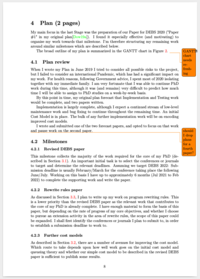
Two TODO items in the margin Two TODO items in the margin
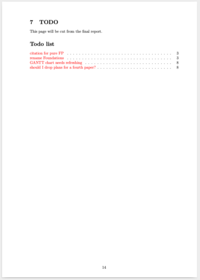
Collated TODOs in a list Collated TODOs in a list
The todonotes package package is one of many that offers macros to make managing in-line TODO notes easier. Within the source of my document, I can add a TODO right next to the relevant text with \todo something to do . In the document, by default, this is rendered in the right-hand margin. With the right argument, the package will only render the notes in draft mode.
\usepackage[textsize=small,obeyDraft] todonotes 
todonotes can also collate all the TODOs together into a single list. The list items are hyperlinked back to the page where the relevant item appears.
\ifdraft 
\newpage
\section TODO 
  This page will be cut from the final report.
  \listoftodos
 

28 May 2021

Jonathan Dowland: Queueing theory

Last year I began looking at queuing theory, to try and see if I could use it as a robust underpinning for a cost model to evaluate rewritten stream-processing programs. I started to work with my co-supervisor, Dr. Paul Ezhilchelvan, who is an expert in this area. In order to brief him on the work I'd done so far as well as my initial efforts to map queueing theory concepts onto Striot's concepts, I prepared a brief presentation:

Jonathan Dowland: Queuing theory

Last year I began looking at queuing theory, to try and see if I could use it as a robust underpinning for a cost model to evaluate rewritten stream-processing programs. I started to work with my co-supervisor, Dr. Paul Ezhilchelvan, who is an expert in this area. In order to brief him on the work I'd done so far as well as my initial efforts to map queueing theory concepts onto Striot's concepts, I prepared a brief presentation:

24 May 2021

Jonathan Dowland: OpenJDK Runtime Containers

The UBI OpenJDK containers are full fat developer containers: they've got the full OpenJDK distribution in them (including javac etc.); they include Maven and there are various quality-of-life additions such as a Prometheus agent for metrics gathering in OpenShift and a run-java script to control launching the eventual application, as well as OpenShift Source-To-Image (S2I) integration. We've had a number of customers request that we produce some runtime-only images. It took a while to properly scope the request, as each person who wanted such a thing wanted a different subset of functionality included from the existing images. One consistent request though related to image size: It became clear that the runtime images should be as minimal as possible. Last week we launched ubi8/openjdk-8-runtime and ubi8/openjdk-11-runtime containers which weight in at 106.M1iB and 119.7 MiB respectively. They are extremely bare-bones, containing just a subset of the OpenJDK distribution (that which is packaged as java-N-openjdk-headless in RHEL) on top of the UBI minimal flavour base images. To explain one way these could be use in an OpenShift environment I wrote a blog post for Red Hat Developer: Build lean Java containers with the new Red Hat Universal Base Images OpenJDK runtime images. We've got a couple of avenues under exploration in this area which should result in even leaner or more tailored images in the future. I'll write more when we have something to show!

Jonathan Dowland: Answering my own Template Haskell question

A couple of weeks ago I stumbled across a Template Haskell question on the Haskell sub-reddit. This was quite exciting because I rarely see TH questions, and this one was by someone working on something which was quite similar to what I had done: they were writing a code generator, and had pure functions of type Exp -> Exp -> Exp, but wanted to leverage TH's quasi-quotation syntax (e.g. [ \p -> p + 1 ]) as a syntactic short-hand. Alas these quasi-quotes are of type Q Exp, so the question becomes, how to escape Q? I had to do exactly this, so I knew an answer: use unsafePerformIO. Another commenter pointed at this Overloaded Quotation Brackets GHC Proposal which I was not aware of and is a much more elegant solution, available since GHC 9.0.1. There was something odd about the question, though. Sometime later on, I checked back to find that the thread had been deleted. It turns out it was one of a set of duplicate posts with exactly the same question. Spammers are copying old questions and reposting them, presumably in an attempt to harvest "Reddit karma". When I learned that, my sense of oddness about the question remained, so I went to find the original thread, to discover I wrote the original question a year ago and had therefore literally answered my own question a year later. Back to the more elegant solution. In GHC versions 9 onwards, quasi-quotation returns a different type that is not bound up in the Q Monad: GHC 8.8.4:
 > :t [  42  ]
[  42  ] :: Language.Haskell.TH.Lib.Internal.ExpQ
 > [  42  ]
<interactive>:5:1: error:
      No instance for (Show Language.Haskell.TH.Lib.Internal.ExpQ)
        arising from a use of  print 
      In a stmt of an interactive GHCi command: print it
GHC 9.0.1:
 > :t [  42  ]
[  42  ]
  :: Language.Haskell.TH.Syntax.Quote m =>
     m Language.Haskell.TH.Syntax.Exp
 > [  42  ]
LitE (IntegerL 42)

11 April 2021

Jonathan Dowland: 2020 in short fiction

Cover for *Episodes*
Following on from 2020 in Fiction: In 2020 I read a couple of collections of short fiction from some of my favourite authors. I started the year with Christopher Priest's Episodes. The stories within are collected from throughout his long career, and vary in style and tone. Priest wrote new little prologues and epilogues for each of the stories, explaining the context in which they were written. I really enjoyed this additional view into their construction.
Cover for *Adam Robots*
By contrast, Adam Robert's Adam Robots presents the stories on their own terms. Each of the stories is written in a different mode: one as golden-age SF, another as a kind of Cyberpunk, for example, although they all blend or confound sub-genres to some degree. I'm not clever enough to have decoded all their secrets on a first read, and I would have appreciated some "Cliff's Notes on any deeper meaning or intent.
Cover for *Exhalation*
Ted Chiang's Exhalation was up to the fantastic standard of his earlier collection and had some extremely thoughtful explorations of philosophical ideas. All the stories are strong but one stuck in my mind the longest: Omphalos) With my daughter I finished three of Terry Pratchett's short story collections aimed at children: Dragon at Crumbling Castle; The Witch's Vacuum Cleaner and The Time-Travelling Caveman. If you are a Pratchett fan and you've overlooked these because they're aimed at children, take another look. The quality varies, but there are some true gems in these. Several stories take place in common settings, either the town of Blackbury, in Gritshire (and the adjacent Even Moor), or the Welsh border-town of Llandanffwnfafegettupagogo. The sad thing was knowing that once I'd finished them (and the fourth, Father Christmas's Fake Beard) that was it: there will be no more.
Cover for Interzone, issue 277
8/31 of the "books" I read in 2020 were issues of Interzone. Counting them as "books" for my annual reading goal has encouraged me to read full issues, whereas before I would likely have only read a couple of stories from each issue. Reading full issues has rekindled the enjoyment I got out of it when I first discovered the magazine at the turn of the Century. I am starting to recognise stories by authors that have written stories in other issues, as well as common themes from the current era weaving their way into the work (Trump, Brexit, etc.) No doubt the Pandemic will leave its mark on 2021's stories.

23 March 2021

Jonathan Dowland: The Cure: 40 Live

Back in 2019, The Cure released a double-video-album featuring two live shows from 2018, their 40th anniversary concert at Hyde Park (which I attended) and their experimental "Curaetion" show from the Meltdown festival a few weeks earier. Rumours that there would be a release had been circulating since the gig itself, where video director Tim Pope was spotted filming the gig (sporting a tee shirt reading "Yes I'm Filming. No I don't know when you'll see it."). Earlier in 2019 the "Anniversary" half had a limited run in cinemas, but the home video release was not officially revealed until much later, and the inclusion of Curaetion an unexpected bonus. 'deluxe' releases The release is available in several configurations. The "standard" issue is a two-DVD (or Blu Ray) set in a hard-book case, with some liner notes in the middle. A "deluxe" issue is a roughly twice-as-large boxed set containing the two video discs and two CD-audio discs of the shows. When it comes to deluxe editions, I would historically have been the perfect "mark", but I've had some bad experiences with other releases (this is a story for another blog post), so for this release I pre-ordered the standard BR edition. Right up until release, I wondered whether I should have made the other choice. Eventually, pictures of other people's Deluxe Editions started to circulate, and I was re-assured that I made the right call. The larger box is just something harder to store, the larger booklet is an exact reproduction of the smaller, standard edition liner notes, which are not really notable. The shows I think the shows are great. The Hyde Park show is a fairly standard "best of" setlist, and my enjoyment of it might be coloured by having been at the show and having fond memories of it. But it's a great performance and very well captured, so I think there's something for people who like the Cure but weren't there to enjoy too. I wasn't at the Meltdown show. The setlist for that one is much more esoteric, and it's lovely to have renditions of songs that are rarely performed live (And: across the two sets you get If Only Tonight We Could Sleep twice). Getting the audio I knew in advance that I would likely listen to the shows more often than watch them, so the CDs in the Deluxe set would have been useful for that, but I was fairly sure the audio mix would be the same as on the video discs, so I could just extract that. I was half-right: the BR set (at least) has 5.1 surround and separate lossless stereo mixes, but they have been mastered quite differently to the CD audio, which appears to be brick-wall mastered, to such an extent that the audio distorts quite noticeably in a few places. The BR audio does not seem to suffer from the same problems. Getting the audio off the discs was interesting. On Linux, the tool of choice for decoding encrypted Blu Rays is libaacs, which requires a list of Blu Ray keys which you must source separately. With my BR drive I was not able to decode the discs using the keys I could find online. However, the separate tool MakeMKV was able to decode them. I don't know exactly how but I speculate that MakeMKV contains some leaked hardware player keys that are not in more general circulation. Once I had decoded copies of the two videos, the trusty tool ffmpeg is able to easily extract the PCM stereo audio track. Unfortunately it cannot, in one go, split the audio track at the chapter boundary points. This is easy to script around: one ffmpeg invocation to get the chapter offsets, then some scripting to turn that into seek and duration command-line arguments for further ffmpeg invocations. For space reasons, I opted to transcode to FLAC at the same time as extracting each track. I hit an interesting (although not fatal) problem: the time taken to extract each track got progressively slower, almost as if ffmpeg was transcoding the entire audio track up to the point specified as the offset to start extracting from. If I wanted to answer categorically whether the BR audio was preferable, I would need to perform a double-blind listening test, using a tool such as squishyball. I certainly can't be bothered: the BR audio is fine for me.

13 March 2021

Jonathan Dowland: Internal Gotek

This is the eleventh part in a series of blog posts. The previous post was FlashFloppy OLED display. The whole series is available here: Amiga.
It's still mostly all quiet on the Amiga project front. The last few months with both my kids at home have been too difficult and busy with no time for side projects. Primary Schools in the UK went back this week, and I've finally got around to installing the Gotek floppy emulator inside the Amiga A500's chassis. I followed A short "Internal Gotek Floppy" Installation Guide , which explains that you don't need to print (or buy) a special mount for it: Simply removing the Gotek's top plastic case is enough for it to fit inside, and you can support it with some nuts and bolts.
Gotek bolted into place Gotek bolted into place
Easy in theory, but it still took me a while, with plenty of trial and error to line it up just right. I ended up using some M4 bolts and smaller (the kind that you use in electrical sockets) to support the bottom part of the Gotek case in three places: one, at the front, re-using an original vertical support for the old floppy drive; and two at the back, screwing through two holes in the A500's outer case and mainboard. If I'd chosen short enough bolts, the back of the Gotek case could have probably just rested on the ends of those bolts, but the ones I had were another few cm longer, so I drilled holes in the Gotek case to run the bolts through, and secured it with nuts.
Knob, display and mount, external Knob, display and mount, external
In that guide, the author has an OLED display for their Gotek that they wanted on the top of the Amiga case, so they fed the four tiny wires through the grill. I had a go at that, but I've got the OLED display and a rotary encoder, so that's 8 wires total, and damn fiddly. Instead for now I've just routed them all out through the hole left behind by the floppy drive's Button. I'm going to try and tidy it up with some heat shrink or similar. So finally, my Amiga is one "unit" again, without dangly bits hanging off it (if you ignore those 8 tiny wires for now) that I can move around to store or use much more easily.

19 February 2021

Jonathan Dowland: Wrist Watches

red strap red strap
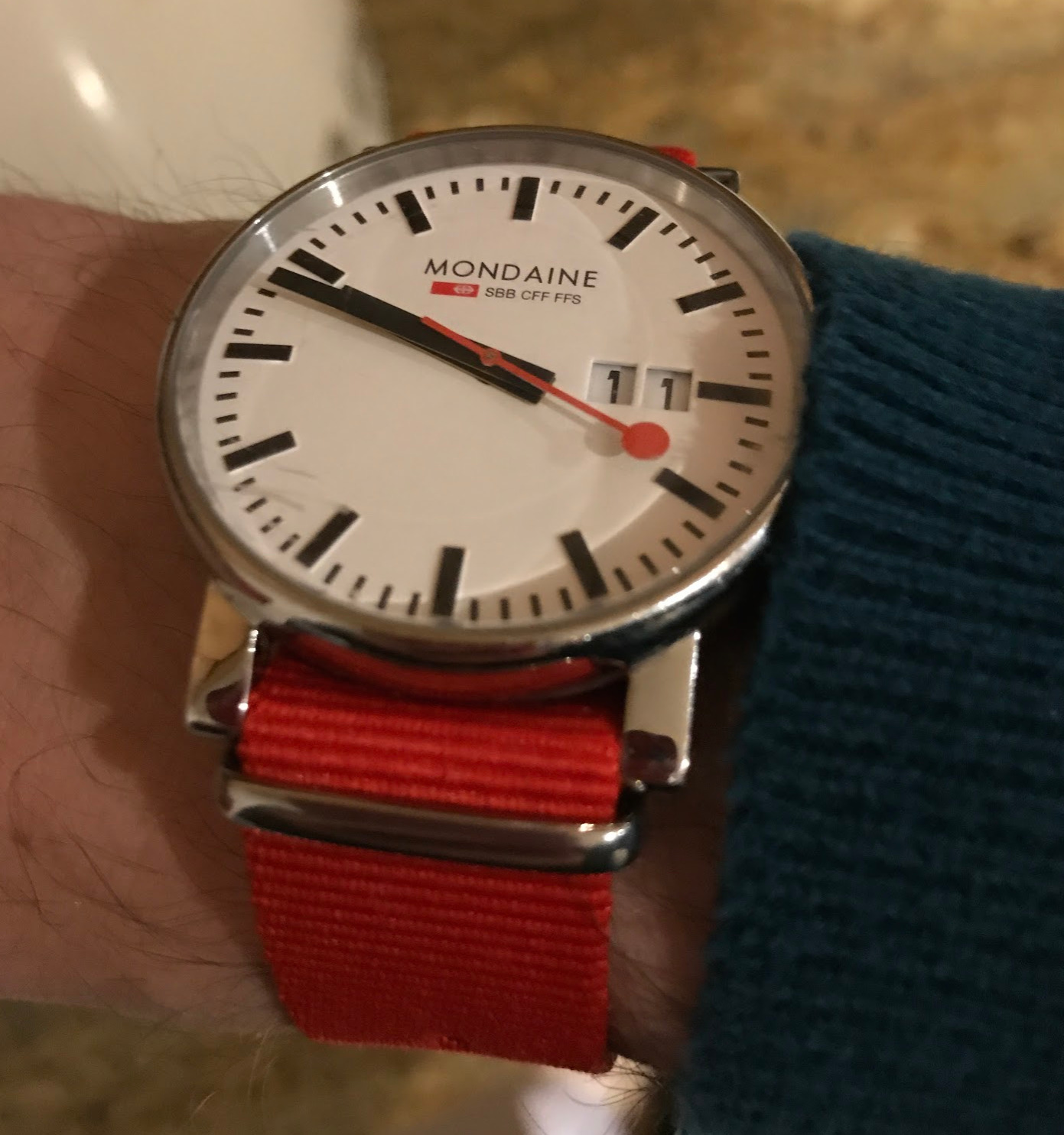
This is everything I have to say about watches (or time pieces, or chronometers, if you prefer: I don't). I've always worn a watch, and still do; but I've never really understood the appeal of the kind of luxury watches you see advertise here there and everywhere, with their chunky cases, over-complicated faces and enormous price-tags. So the world of watch-appreciation was closed to me, until my 30th birthday (a while ago) when my wife bought me a Mondaine Evo "Big Date" quartz watch. It's not an analogue watch nor an "heirloom timepiece", neither of which are properties that matter to me. The large face has almost nothing extraneous on it, although my model includes day-of-the-month. I like it very much. And so I cracked open the door a little onto the world of watches and watch fashion and had a short spell of interest in some other styles, types, and the like. This drew to a close with buying a selection of cheap, coloured nylon fabric "nato"-style straps. Now whenever I feel the itch for a change, I just change the strap. Smart Watches have never appealed to me. I can see some of their advantages, but the last thing I need is another gadget to regularly charge, or another avenue to check my email. I appreciate that wearing a wrist watch at all is anachronistic (sorry), and I did wonder whether it's a habit I could get out of. A few weeks ago, during our endless Lockdown, my watch battery ran out, so I spent a couple of weeks un-learning my reliance on a wristwatch to orient myself. I've managed to get it replaced now (some watch repair places being considered Essential Services) and I'm comfortably back in my default mode of wearing and relying upon it.

27 January 2021

Jonathan Dowland: 2020 in Fiction

Cover for Susanna Clarke's Piranesi
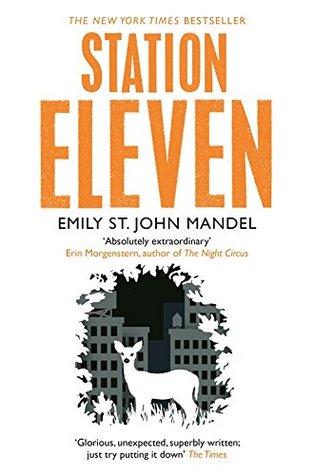
Cover for Emily St. John Mandel's Station 11
I managed to read 31 "books" in 2020. I'm happy with that. I thought the Pandemic would prevent me reaching my goal (30), since I did most of my reading on the commute to the Newcastle office, pre-pandemic. Somehow I've managed to compensate. I started setting a goal for books read per year in 2012 when I started to use goodreads. Doing so started to influence the type of reading I do (which is the reason I stopped my Interzone subscription in 2014, although I resumed it again sometime afterwards). Once I realised that I've been a bit more careful to ensure setting a goal was a worthwhile thing to do and not just another source of stress in my life. Two books I read were published in 2020. The first was Robert Galbraith's (a.k.a. J K Rowling's) Troubled Blood, the fifth (and largest) in the series of crime novels featuring Cormoran Strike (and the equally important Robin Ellacott). Nowadays Rowling is a controversial figure, but I'm not writing about that today, or the book itself, in much detail: briefly, it exceeded expectations, and my wife and I really enjoyed it. The other was Susanna Clarke's Piranesi: an utterly fantastic modern-fantasy story, quite short, completely different to her successful debut novel Jonathan Strange & Mr Norrell. I really loved this book, partly because it appeals to my love of fantasy geography, but also because it is very well put together, with a strong sense of the value of people's lives. A couple of the other books I read were quite Pandemic-appropriate. I tore through Josh Malerman's Bird Box, a fast-paced post-apocalyptic style horror/suspense story. The appeal was mostly in the construction and delivery: the story itself was strong enough to support the book at the length that it is, but I don't really feel it could have lasted much longer, and so I've no idea how the new sequel (Malorie) will work. The other was Station Eleven by Emily St. John Mandel. This was a story about a group of travelling musicians in a post-apocalyptic (post-pandemic) North America. A cast of characters all revolve around their relationship (or six degrees of separation) to an actor who died just prior to the Pandemic. The world-building in this book was really strong, and I felt sufficiently invested in the characters that I would love to read more about them in another book. However, I think that (although I'm largely just guessing here), in common with Bird Box, the setting was there to support the novel and the ideas that the author wanted to get across, and so I (sadly) doubt she will return to it. Finally I read a lot of short fiction. I'll write more about that in a separate blog post.

21 January 2021

Russell Coker: Links January 2021

Krebs on Security has an informative article about web notifications and how they are being used for spamming and promoting malware [1]. He also includes links for how to permanently disable them. If nothing else clicking no on each new site that wants to send notifications is annoying. Michael Stapelberg wrote an insightful posts about inefficiencies in the Debian development processes [2]. While I agree with most of his assessment of Debian issues I am not going to decrease my involvement in Debian. Of the issues he mentions the 2 that seem to have the best effort to reward ratio are improvements to mailing list archives (to ideally make it practical to post to lists without subscribing and read responses in the archives) and the issues of forgetting all the complexities of the development process which can be alleviated by better Wiki pages. In my Debian work I ve contributed more to the Wiki in recent times but not nearly as much as I should. Jacobin has an insightful article Ending Poverty in the United States Would Actually Be Pretty Easy [3]. Mark Brown wrote an interesting blog post about the Rust programming language [4]. He links to a couple of longer blog posts about it. Rust has some great features and I ve been meaning to learn it. Scientific America has an informative article about research on the spread of fake news and memes [5]. Something to consider when using social media. Bruce Schneier wrote an insightful blog post on whether there should be limits on persuasive technology [6]. Jonathan Dowland wrote an interesting blog post about git rebasing and lab books [7]. I think it s an interesting thought experiment to compare the process of developing code worthy of being committed to a master branch of a VCS to the process of developing a Ph.D thesis. CBS has a disturbing article about the effect of Covid19 on people s lungs [8]. Apparently it usually does more lung damage than long-term smoking and even 70%+ of people who don t have symptoms of the disease get significant lung damage. People who live in heavily affected countries like the US now have to worry that they might have had the disease and got lung damage without knowing it. Russ Allbery wrote an interesting review of the book Because Internet about modern linguistics [9]. The topic is interesting and I might read that book at some future time (I have many good books I want to read). Jonathan Carter wrote an interesting blog post about CentOS Streams and why using a totally free OS like Debian is going to be a better option for most users [10]. Linus has slammed Intel for using ECC support as a way of segmenting the market between server and desktop to maximise profits [11]. It would be nice if a company made a line of Ryzen systems with ECC RAM support, but most manufacturers seem to be in on the market segmentation scam. Russ Allbery wrote an interesting review of the book Can t Even about millenials as the burnout generation and the blame that the corporate culture deserves for this [12].

Next.

Previous.