Search Results: "jam"

7 March 2023

Robert McQueen: Flathub in 2023

It s been quite a few months since the most recent updates about Flathub last year. We ve been busy behind the scenes, so I d like to share what we ve been up to at Flathub and why and what s coming up from us this year. I want to focus on: Today Flathub is going strong: we offer 2,000 apps from over 1,500 collaborators on GitHub. We re averaging 700,000 app downloads a day, with 898 million HTTP requests totalling 88.3 TB served by our CDN each day (thank you Fastly!). Flatpak has, in my opinion, solved the largest technical issue which has held back the mainstream growth and acceptance of Linux on the desktop (or other personal computing devices) for the past 25 years: namely, the difficulty for app developers to publish their work in a way that makes it easy for people to discover, download (or sideload, for people in challenging connectivity environments), install and use. Flathub builds on that to help users discover the work of app developers and helps that work reach users in a timely manner. Initial results of this disintermediation are promising: even with its modest size so far, Flathub has hundreds of apps that I have never, ever heard of before and that s even considering I ve been working in the Linux desktop space for nearly 20 years and spent many of those staring at the contents of dselect (showing my age a little) or GNOME Software, attending conferences, and reading blog posts, news articles, and forums. I am also heartened to see that many of our OS distributor partners have recognised that this model is hugely complementary and additive to the indispensable work they are doing to bring the Linux desktop to end users, and that having more apps available to your users is a value-add allowing you to focus on your core offering and not a zero-sum game that should motivate infighting. Ongoing Progress Getting Flathub into its current state has been a long ongoing process. Here s what we ve been up to behind the scenes: Development Last year, we concluded our first engagement with Codethink to build features into the Flathub web app to move from a build service to an app store. That includes accounts for users and developers, payment processing via Stripe, and the ability for developers to manage upload tokens for the apps they control. In parallel, James Westman has been working on app verification and the corresponding features in flat-manager to ensure app metadata accurately reflects verification and pricing, and to provide authentication for paying users for app downloads when the developer enables it. Only verified developers will be able to make direct uploads or access payment settings for their apps. Legal So far, the GNOME Foundation has acted as an incubator and legal host for Flathub even though it s not purely a GNOME product or initiative. Distributing software to end users along with processing and forwarding payments and donations also has a different legal profile in terms of risk exposure and nonprofit compliance than the current activities of the GNOME Foundation. Consequently, we plan to establish an independent legal entity to own and operate Flathub which reduces risk for the GNOME Foundation, better reflects the independent and cross-desktop interests of Flathub, and provides flexibility in the future should we need to change the structure. We re currently in the process of reviewing legal advice to ensure we have the right structure in place before moving forward. Governance As Flathub is something we want to set outside of the existing Linux desktop and distribution space and ensure we represent and serve the widest community of Linux users and developers we ve been working on a governance model that ensures that there is transparency and trust in who is making decisions, and why. We have set up a working group with myself and Mart n Abente Lahaye from GNOME, Aleix Pol Gonzalez, Neofytos Kolokotronis, and Timoth e Ravier from KDE, and Jorge Castro flying the flag for the Flathub community. Thanks also to Neil McGovern and Nick Richards who were also more involved in the process earlier on. We don t want to get held up here creating something complex with memberships and elections, so at first we re going to come up with a simple/balanced way to appoint people into a board that makes key decisions about Flathub and iterate from there. Funding We have received one grant for 2023 of $100K from Endless Network which will go towards the infrastructure, legal, and operations costs of running Flathub and setting up the structure described above. (Full disclosure: Endless Network is the umbrella organisation which also funds my employer, Endless OS Foundation.) I am hoping to grow the available funding to $250K for this year in order to cover the next round of development on the software, prepare for higher operations costs (e.g., accounting gets more complex), and bring in a second full-time staff member in addition to Bart omiej Piotrowski to handle enquiries, reviews, documentation, and partner outreach. We re currently in discussions with NLnet about funding further software development, but have been unfortunately turned down for a grant from the Plaintext Group for this year; this Schmidt Futures project around OSS sustainability is not currently issuing grants in 2023. However, we continue to work on other funding opportunities. Remaining Barriers My personal hypothesis is that our largest remaining barrier to Linux desktop scale and impact is economic. On competing platforms mobile or desktop a developer can offer their work for sale via an app store or direct download with payment or subscription within hours of making a release. While we have taken the time to first download time down from months to days with Flathub, as a community we continue to have a challenging relationship with money. Some creators are lucky enough to have a full-time job within the FLOSS space, while a few superstar developers are able to nurture some level of financial support by investing time in building a following through streaming, Patreon, Kickstarter, or similar. However, a large proportion of us have to make do with the main payback from our labours being a stream of bug reports on GitHub interspersed with occasional conciliatory beers at FOSDEM (other beverages and events are available). The first and most obvious consequence is that if there is no financial payback for participating in developing apps for the free and open source desktop, we will lose many people in the process despite the amazing achievements of those who have brought us to where we are today. As a result, we ll have far fewer developers and apps. If we can t offer access to a growing base of users or the opportunity to offer something of monetary value to them, the reward in terms of adoption and possible payment will be very small. Developers would be forgiven for taking their time and attention elsewhere. With fewer apps, our platform has less to entice and retain prospective users. The second consequence is that this also represents a significant hurdle for diverse and inclusive participation. We essentially require that somebody is in a position of privilege and comfort that they have internet, power, time, and income not to mention childcare, etc. to spare so that they can take part. If that s not the case for somebody, we are leaving them shut out from our community before they even have a chance to start. My belief is that free and open source software represents a better way for people to access computing, and there are billions of people in the world we should hope to reach with our work. But if the mechanism for participation ensures their voices and needs are never represented in our community of creators, we are significantly less likely to understand and meet those needs. While these are my thoughts, you ll notice a strong theme to this year will be leading a consultation process to ensure that we are including, understanding and reflecting the needs of our different communities app creators, OS distributors and Linux users as I don t believe that our initiative will be successful without ensuring mutual benefit and shared success. Ultimately, no matter how beautiful, performant, or featureful the latest versions of the Plasma or GNOME desktops are, or how slick the newly rewritten installer is from your favourite distribution, all of the projects making up the Linux desktop ecosystem are subdividing between ourselves an absolutely tiny market share of the global market of personal computers. To make a bigger mark on the world, as a community, we need to get out more. What s Next? After identifying our major barriers to overcome, we ve planned a number of focused initiatives and restructuring this year: Phased Deployment We re working on deploying the work we have been doing over the past year, starting first with launching the new Flathub web experience as well as the rebrand that Jakub has been talking about on his blog. This also will finally launch the verification features so we can distinguish those apps which are uploaded by their developers. In parallel, we ll also be able to turn on the Flatpak repo subsets that enable users to select only verified and/or FLOSS apps in the Flatpak CLI or their desktop s app center UI. Consultation We would like to make sure that the voices of app creators, OS distributors, and Linux users are reflected in our plans for 2023 and beyond. We will be launching this in the form of Flathub Focus Groups at the Linux App Summit in Brno in May 2023, followed up with surveys and other opportunities for online participation. We see our role as interconnecting communities and want to be sure that we remain transparent and accountable to those we are seeking to empower with our work. Whilst we are being bold and ambitious with what we are trying to create for the Linux desktop community, we also want to make sure we provide the right forums to listen to the FLOSS community and prioritise our work accordingly. Advisory Board As we build the Flathub organisation up in 2023, we re also planning to expand its governance by creating an Advisory Board. We will establish an ongoing forum with different stakeholders around Flathub: OS vendors, hardware integrators, app developers and user representatives to help us create the Flathub that supports and promotes our mutually shared interests in a strong and healthy Linux desktop community. Direct Uploads Direct app uploads are close to ready, and they enable exciting stuff like allowing Electron apps to be built outside of flatpak-builder, or driving automatic Flathub uploads from GitHub actions or GitLab CI flows; however, we need to think a little about how we encourage these to be used. Even with its frustrations, our current Buildbot ensures that the build logs and source versions of each app on Flathub are captured, and that the apps are built on all supported architectures. (Is 2023 when we add RISC-V? Reach out if you d like to help!). If we hand upload tokens out to any developer, even if the majority of apps are open source, we will go from this relatively structured situation to something a lot more unstructured and we fear many apps will be available on only 64-bit Intel/AMD machines. My sketch here is that we need to establish some best practices around how to integrate Flathub uploads into popular CI systems, encouraging best practices so that we promote the properties of transparency and reproducibility that we don t want to lose. If anyone is a CI wizard and would like to work with us as a thought partner about how we can achieve this make it more flexible where and how build tasks can be hosted, but not lose these cross-platform and inspectability properties we d love to hear from you. Donations and Payments Once the work around legal and governance reaches a decent point, we will be in the position to move ahead with our Stripe setup and switch on the third big new feature in the Flathub web app. At present, we have already implemented support for one-off payments either as donations or a required purchase. We would like to go further than that, in line with what we were describing earlier about helping developers sustainably work on apps for our ecosystem: we would also like to enable developers to offer subscriptions. This will allow us to create a relationship between users and creators that funds ongoing work rather than what we already have. Security For Flathub to succeed, we need to make sure that as we grow, we continue to be a platform that can give users confidence in the quality and security of the apps we offer. To that end, we are planning to set up infrastructure to help ensure developers are shipping the best products they possibly can to users. For example, we d like to set up automated linting and security scanning on the Flathub back-end to help developers avoid bad practices, unnecessary sandbox permissions, outdated dependencies, etc. and to keep users informed and as secure as possible. Sponsorship Fundraising is a forever task as is running such a big and growing service. We hope that one day, we can cover our costs through some modest fees built into our payments but until we reach that point, we re going to be seeking a combination of grant funding and sponsorship to keep our roadmap moving. Our hope is very much that we can encourage different organisations that buy into our vision and will benefit from Flathub to help us support it and ensure we can deliver on our goals. If you have any suggestions of who might like to support Flathub, we would be very appreciative if you could reach out and get us in touch. Finally, Thank You! Thanks to you all for reading this far and supporting the work of Flathub, and also to our major sponsors and donors without whom Flathub could not exist: GNOME Foundation, KDE e.V., Mythic Beasts, Endless Network, Fastly, and Equinix Metal via the CNCF Community Cluster. Thanks also to the tireless work of the Freedesktop SDK community to give us the runtime platform most Flatpaks depend on, particularly Seppo Yli-Olli, Codethink and others. I wanted to also give my personal thanks to a handful of dedicated people who keep Flathub working as a service and as a community: Bart omiej Piotrowski is keeping the infrastructure working essentially single-handedly (in his spare time from keeping everything running at GNOME); Kolja Lampe and Bart built the new web app and backend API for Flathub which all of the new functionality has been built on, and Filippe LeMarchand maintains the checker bot which helps keeps all of the Flatpaks up to date. And finally, all of the submissions to Flathub are reviewed to ensure quality, consistency and security by a small dedicated team of reviewers, with a huge amount of work from Hubert Figui re and Bart to keep the submissions flowing. Thanks to everyone named or unnamed for building this vision of the future of the Linux desktop together with us. (originally posted to Flathub Discourse, head there if you have any questions or comments)

Dirk Eddelbuettel: RcppFastAD 0.0.1 and 0.0.2: New Package on CRAN!

James Yang and I are thrilled to announce the new CRAN package RcppFastAD which arrived at CRAN last Monday as version 0.0.1, and is as of today at version 0.0.2 with a first set of small updates. It is based on the FastAD header-only C++ library by James which provides a C++ implementation of both forward and reverse mode of automatic differentiation in an easy-to-use header library (which we wrapped here) that is both lightweight and performant. With a little of bit of Rcpp glue, it is also easy to use from R in simple C++ applications. Included in the package are three example: a simple quadratic expression evaluating x' S x for given x and S return the expression value with a gradient, a linear regression example generalising this and using the gradient to derive to arrive at the least-squares minimizing solution, as well as the well-known Black-Scholes options pricer and its important partial derivatives delta, rho, theta and vega derived via automatic differentiation. The NEWS file for these two initial releases follows.

Changes in version 0.0.2 (2023-03-05)
  • One C++ operation is protected from operating on a nullptr
  • Additional tests have been added, tests now cover all three demo / example functions
  • Return values and code for the examples linear_regression and quadratic_expression have been adjusted

Changes in version 0.0.1 (2023-02-24)
  • Initial release version and CRAN upload

Courtesy of my CRANberries, there is also a diffstat report for the most recent release. More information is available at the repository or the package page. If you like this or other open-source work I do, you can now sponsor me at GitHub.

This post by Dirk Eddelbuettel originated on his Thinking inside the box blog. Please report excessive re-aggregation in third-party for-profit settings.

5 March 2023

Reproducible Builds: Reproducible Builds in February 2023

Welcome to the February 2023 report from the Reproducible Builds project. As ever, if you are interested in contributing to our project, please visit the Contribute page on our website.
FOSDEM 2023 was held in Brussels on the 4th & 5th of February and featured a number of talks related to reproducibility. In particular, Akihiro Suda gave a talk titled Bit-for-bit reproducible builds with Dockerfile discussing deterministic timestamps and deterministic apt-get (original announcement). There was also an entire track of talks on Software Bill of Materials (SBOMs). SBOMs are an inventory for software with the intention of increasing the transparency of software components (the US National Telecommunications and Information Administration (NTIA) published a useful Myths vs. Facts document in 2021).
On our mailing list this month, Larry Doolittle was puzzled why the Debian verilator package was not reproducible [ ], but Chris Lamb pointed out that this was due to the use of Python s datetime.fromtimestamp over datetime.utcfromtimestamp [ ].
James Addison also was having issues with a Debian package: in this case, the alembic package. Chris Lamb was also able to identify the Sphinx documentation generator as the cause of the problem, and provided a potential patch that might fix it. This was later filed upstream [ ].
Anthony Harrison wrote to our list twice, first by introducing himself and their background and later to mention the increasing relevance of Software Bill of Materials (SBOMs):
As I am sure everyone is aware, there is a growing interest in [SBOMs] as a way of improving software security and resilience. In the last two years, the US through the Exec Order, the EU through the proposed Cyber Resilience Act (CRA) and this month the UK has issued a consultation paper looking at software security and SBOMs appear very prominently in each publication. [ ]

Tim Retout wrote a blog post discussing AlmaLinux in the context of CentOS, RHEL and supply-chain security in general [ ]:
Alma are generating and publishing Software Bill of Material (SBOM) files for every package; these are becoming a requirement for all software sold to the US federal government. What s more, they are sending these SBOMs to a third party (CodeNotary) who store them in some sort of Merkle tree system to make it difficult for people to tamper with later. This should theoretically allow end users of the distribution to verify the supply chain of the packages they have installed?

Debian

F-Droid & Android

diffoscope diffoscope is our in-depth and content-aware diff utility. Not only can it locate and diagnose reproducibility issues, it can provide human-readable diffs from many kinds of binary formats. This month, Chris Lamb released versions 235 and 236; Mattia Rizzolo later released version 237. Contributions include:
  • Chris Lamb:
    • Fix compatibility with PyPDF2 (re. issue #331) [ ][ ][ ].
    • Fix compatibility with ImageMagick version 7.1 [ ].
    • Require at least version 23.1.0 to run the Black source code tests [ ].
    • Update debian/tests/control after merging changes from others [ ].
    • Don t write test data during a test [ ].
    • Update copyright years [ ].
    • Merged a large number of changes from others.
  • Akihiro Suda edited the .gitlab-ci.yml configuration file to ensure that versioned tags are pushed to the container registry [ ].
  • Daniel Kahn Gillmor provided a way to migrate from PyPDF2 to pypdf (#1029741).
  • Efraim Flashner updated the tool metadata for isoinfo on GNU Guix [ ].
  • FC Stegerman added support for Android resources.arsc files [ ], improved a number of file-matching regular expressions [ ][ ] and added support for Android dexdump [ ]; they also fixed a test failure (#1031433) caused by Debian s black package having been updated to a newer version.
  • Mattia Rizzolo:
    • updated the release documentation [ ],
    • fixed a number of Flake8 errors [ ][ ],
    • updated the autopkgtest configuration to only install aapt and dexdump on architectures where they are available [ ], making sure that the latest diffoscope release is in a good fit for the upcoming Debian bookworm freeze.

reprotest Reprotest version 0.7.23 was uploaded to both PyPI and Debian unstable, including the following changes:
  • Holger Levsen improved a lot of documentation [ ][ ][ ], tidied the documentation as well [ ][ ], and experimented with a new --random-locale flag [ ].
  • Vagrant Cascadian adjusted reprotest to no longer randomise the build locale and use a UTF-8 supported locale instead [ ] (re. #925879, #1004950), and to also support passing --vary=locales.locale=LOCALE to specify the locale to vary [ ].
Separate to this, Vagrant Cascadian started a thread on our mailing list questioning the future development and direction of reprotest.

Upstream patches The Reproducible Builds project detects, dissects and attempts to fix as many currently-unreproducible packages as possible. We endeavour to send all of our patches upstream where appropriate. This month, we wrote a large number of such patches, including:

Testing framework The Reproducible Builds project operates a comprehensive testing framework (available at tests.reproducible-builds.org) in order to check packages and other artifacts for reproducibility. In February, the following changes were made by Holger Levsen:
  • Add three new OSUOSL nodes [ ][ ][ ] and decommission the osuosl174 node [ ].
  • Change the order of listed Debian architectures to show the 64-bit ones first [ ].
  • Reduce the frequency that the Debian package sets and dd-list HTML pages update [ ].
  • Sort Tested suite consistently (and Debian unstable first) [ ].
  • Update the Jenkins shell monitor script to only query disk statistics every 230min [ ] and improve the documentation [ ][ ].

Other development work disorderfs version 0.5.11-3 was uploaded by Holger Levsen, fixing a number of issues with the manual page [ ][ ][ ].
Bernhard M. Wiedemann published another monthly report about reproducibility within openSUSE.
If you are interested in contributing to the Reproducible Builds project, please visit the Contribute page on our website. You can get in touch with us via:

12 February 2023

Russell Coker: T320 iDRAC Failure and new HP Z640

The Dell T320 Almost 2 years ago I made a Dell PowerEdge T320 my home server [1]. It was a decent upgrade from the PowerEdge T110 II that I had used previously. One benefit of that system was that I needed more RAM and the PowerEdge T1xx series use unbuffered ECC RAM which is unreasonably expensive as well as the DIMMs tending to be smaller (no Load Reduced DIMMS) and only having 4 slots. As I had bought two T320s I put all the RAM in a single server getting a total of 96G and then put some cheap DIMMs in the other one and sold it with 48G. The T320 has all the server reliability features including hot-swap redundant PSUs and hot-swap hard drives. One thing it doesn t have redundancy on is the motherboard management system known as iDRAC. 3 days ago my suburb had a power outage and when power came back on the T320 gave an error message about a failure to initialise the iDRAC and put all the fans on maximum speed, which is extremely loud. When a T320 is running in a room that s not particularly hot and it doesn t have SAS disks it s a very quiet server, one of the quietest I ve ever owned. When it goes into emergency cooling mode due to iDRAC failure it s loud enough to be heard from the other end of the house with doors closed in between. Googling this failure gave a few possible answers. One was for some combinations of booting with the iDRAC button held down, turning off for a while and booting with the iDRAC button held down, etc (this didn t work). One was for putting a iDRAC firmware file on the SD card so iDRAC could automatically load it (which I tested even though I didn t have the flashing LED which indicates that it is likely to work, but it didn t do anything). The last was to enable serial console and configure the iDRAC to load new firmware via TFTP, I didn t get a iDRAC message from the serial console just the regular BIOS stuff. So it looks like I ll have to sell the T320 for parts or find someone who wants to run it in it s current form. Currently to boot it I have to press F1 a few times to bypass BIOS messages (someone on the Internet reported making a device to key-jam F1). Then when it boots it s unreasonably loud, but apparently if you are really keen you can buy fans that have temperature sensors to control their own speed and bypass the motherboard control. I d appreciate any advice on how to get this going. At this stage I m not going to go back to it but if I can get it working properly I can sell it for a decent price. The HP Z640 I ve replaced the T320 with a HP Z640 workstation with 32G of RAM which I had recently bought to play with Stable Diffusion. There were hundreds of Z640 workstations with NVidia Quadro M6000 GPUs going on eBay for under $400 each, it looked like a company that did a lot of ML work had either gone bankrupt or upgraded all their employees systems. The price for the systems was surprisingly cheap, at regular eBay prices it seems that the GPU and the RAM go for about the same price as the system. It turned out that Stable Diffusion didn t like the video card in my setup for unknown reasons but also that the E5-1650v3 CPU could render an image in 15 minutes which is fast enough to test it out but not fast enough for serious use. I had been planning to blog about that. When I bought the T320 server the DDR3 Registered ECC RAM it uses cost about $100 for 8*8G DIMMs, with 16G DIMMs being much more expensive. Now the DDR4 Registered ECC RAM used by my Z640 goes for about $120 for 2*16G DIMMs. In the near future I ll upgrade that system to 64G of RAM. It s disappointing that the Z640 only has 4 DIMM sockets per CPU so if you get a single-CPU version (as I did) and don t get the really expensive Load Reduced RAM then you are limited to 64G. So the supposed capacity benefit of going from DDR3 to DDR4 doesn t seem to apply to this upgrade. The Z640 I got has 4 bays for hot-swap SAS/SATA 2.5 SSD/HDDs and 2 internal bays for 3.5 hard drives. The T320 has 8*3.5 hot swap bays and I had 3 hard drives in them in a BTRFS RAID-10 configuration. Currently I ve got one hard drive attached via USB but that s obviously not a long-term solution. The 3 hard drives are 4TB, they have worked since 4TB was a good size. I have a spare 8TB disk so I could buy a second ($179 for a shingle HDD) to make a 8TB RAID-1 array. The other option is to pay $369 for a 4TB SSD (or $389 for a 4TB NVMe + $10 for the PCIe card) to keep the 3 device RAID-10. As tempting as 4TB SSDs are I ll probably get a cheap 8TB disk which will take capacity from 6TB to 8TB and I could use some extra 4TB disks for backups. I haven t played with the AMT/MEBX features on this system, I presume that they will work the same way as AMT/MEBX on the HP Z420 I ve used previously [2]. Update: HP has free updates for the BIOS etc available here [3]. Unfortunately it seems to require loading a kernel module supplied by HP to do this. This is a bad thing, kernel code that isn t in the mainline kernel is either of poor quality or isn t licensed correctly. I had to change my monitoring system to alert on temperatures over 100% of the high range while on the T320 I had it set at 95% of high and never got warnings. This is disappointing, enterprise class gear running in a reasonably cool environment (ambient temperature of about 22C) should be able to run all CPU cores at full performance without hitting 95% of the high temperature level.

8 February 2023

Thorsten Alteholz: My Debian Activities in January 2023

FTP master This month I accepted 419 and rejected 46 packages. The overall number of packages that got accepted was 429. Looking at these numbers and comparing them to the previous month, one can see: the freeze is near. Everybody wants to get some packages into the archive and I hope nobody is disappointed. Debian LTS This was my hundred-third month that I did some work for the Debian LTS initiative, started by Raphael Hertzog at Freexian. This month my all in all workload has been 14h. During that time I uploaded: I also attended the monthly LTS meeting and did some days of frontdesk duties. Debian ELTS This month was the fifty fourth ELTS month. Last but not least I did some days of frontdesk duties. Debian Astro This month I uploaded improved packages or new versions of: I also uploaded new packages: Debian IoT This month I uploaded improved packages of: Debian Printing This month I uploaded new versions or improved packages of: I also uploaded new packages:

6 February 2023

Reproducible Builds: Reproducible Builds in January 2023

Welcome to the first report for 2023 from the Reproducible Builds project! In these reports we try and outline the most important things that we have been up to over the past month, as well as the most important things in/around the community. As a quick recap, the motivation behind the reproducible builds effort is to ensure no malicious flaws can be deliberately introduced during compilation and distribution of the software that we run on our devices. As ever, if you are interested in contributing to the project, please visit our Contribute page on our website.


News In a curious turn of events, GitHub first announced this month that the checksums of various Git archives may be subject to change, specifically that because:
the default compression for Git archives has recently changed. As result, archives downloaded from GitHub may have different checksums even though the contents are completely unchanged.
This change (which was brought up on our mailing list last October) would have had quite wide-ranging implications for anyone wishing to validate and verify downloaded archives using cryptographic signatures. However, GitHub reversed this decision, updating their original announcement with a message that We are reverting this change for now. More details to follow. It appears that this was informed in part by an in-depth discussion in the GitHub Community issue tracker.
The Bundesamt f r Sicherheit in der Informationstechnik (BSI) (trans: The Federal Office for Information Security ) is the agency in charge of managing computer and communication security for the German federal government. They recently produced a report that touches on attacks on software supply-chains (Supply-Chain-Angriff). (German PDF)
Contributor Seb35 updated our website to fix broken links to Tails Git repository [ ][ ], and Holger updated a large number of pages around our recent summit in Venice [ ][ ][ ][ ].
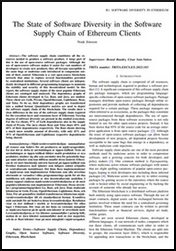
Noak J nsson has written an interesting paper entitled The State of Software Diversity in the Software Supply Chain of Ethereum Clients. As the paper outlines:
In this report, the software supply chains of the most popular Ethereum clients are cataloged and analyzed. The dependency graphs of Ethereum clients developed in Go, Rust, and Java, are studied. These client are Geth, Prysm, OpenEthereum, Lighthouse, Besu, and Teku. To do so, their dependency graphs are transformed into a unified format. Quantitative metrics are used to depict the software supply chain of the blockchain. The results show a clear difference in the size of the software supply chain required for the execution layer and consensus layer of Ethereum.

Yongkui Han posted to our mailing list discussing making reproducible builds & GitBOM work together without gitBOM-ID embedding. GitBOM (now renamed to OmniBOR) is a project to enable automatic, verifiable artifact resolution across today s diverse software supply-chains [ ]. In addition, Fabian Keil wrote to us asking whether anyone in the community would be at Chemnitz Linux Days 2023, which is due to take place on 11th and 12th March (event info). Separate to this, Akihiro Suda posted to our mailing list just after the end of the month with a status report of bit-for-bit reproducible Docker/OCI images. As Akihiro mentions in their post, they will be giving a talk at FOSDEM in the Containers devroom titled Bit-for-bit reproducible builds with Dockerfile and that my talk will also mention how to pin the apt/dnf/apk/pacman packages with my repro-get tool.
The extremely popular Signal messenger app added upstream support for the SOURCE_DATE_EPOCH environment variable this month. This means that release tarballs of the Signal desktop client do not embed nondeterministic release information. [ ][ ]

Distribution work

F-Droid & Android There was a very large number of changes in the F-Droid and wider Android ecosystem this month: On January 15th, a blog post entitled Towards a reproducible F-Droid was published on the F-Droid website, outlining the reasons why F-Droid signs published APKs with its own keys and how reproducible builds allow using upstream developers keys instead. In particular:
In response to [ ] criticisms, we started encouraging new apps to enable reproducible builds. It turns out that reproducible builds are not so difficult to achieve for many apps. In the past few months we ve gotten many more reproducible apps in F-Droid than before. Currently we can t highlight which apps are reproducible in the client, so maybe you haven t noticed that there are many new apps signed with upstream developers keys.
(There was a discussion about this post on Hacker News.) In addition:
  • F-Droid added 13 apps published with reproducible builds this month. [ ]
  • FC Stegerman outlined a bug where baseline.profm files are nondeterministic, developed a workaround, and provided all the details required for a fix. As they note, this issue has now been fixed but the fix is not yet part of an official Android Gradle plugin release.
  • GitLab user Parwor discovered that the number of CPU cores can affect the reproducibility of .dex files. [ ]
  • FC Stegerman also announced the 0.2.0 and 0.2.1 releases of reproducible-apk-tools, a suite of tools to help make .apk files reproducible. Several new subcommands and scripts were added, and a number of bugs were fixed as well [ ][ ]. They also updated the F-Droid website to improve the reproducibility-related documentation. [ ][ ]
  • On the F-Droid issue tracker, FC Stegerman discussed reproducible builds with one of the developers of the Threema messenger app and reported that Android SDK build-tools 31.0.0 and 32.0.0 (unlike earlier and later versions) have a zipalign command that produces incorrect padding.
  • A number of bugs related to reproducibility were discovered in Android itself. Firstly, the non-deterministic order of .zip entries in .apk files [ ] and then newline differences between building on Windows versus Linux that can make builds not reproducible as well. [ ] (Note that these links may require a Google account to view.)
  • And just before the end of the month, FC Stegerman started a thread on our mailing list on the topic of hiding data/code in APK embedded signatures which has been made possible by the Android APK Signature Scheme v2/v3. As part of this, they made an Android app that reads the APK Signing block of its own APK and extracts a payload in order to alter its behaviour called sigblock-code-poc.

Debian As mentioned in last month s report, Vagrant Cascadian has been organising a series of online sprints in order to clear the huge backlog of reproducible builds patches submitted by performing NMUs (Non-Maintainer Uploads). During January, a sprint took place on the 10th, resulting in the following uploads: During this sprint, Holger Levsen filed Debian bug #1028615 to request that the tracker.debian.org service display results of reproducible rebuilds, not just reproducible CI results. Elsewhere in Debian, strip-nondeterminism is our tool to remove specific non-deterministic results from a completed build. This month, version 1.13.1-1 was uploaded to Debian unstable by Holger Levsen, including a fix by FC Stegerman (obfusk) to update a regular expression for the latest version of file(1) [ ]. (#1028892) Lastly, 65 reviews of Debian packages were added, 21 were updated and 35 were removed this month adding to our knowledge about identified issues.

Other distributions In other distributions:

diffoscope diffoscope is our in-depth and content-aware diff utility. Not only can it locate and diagnose reproducibility issues, it can provide human-readable diffs from many kinds of binary formats. This month, Chris Lamb made the following changes to diffoscope, including preparing and uploading versions 231, 232, 233 and 234 to Debian:
  • No need for from __future__ import print_function import anymore. [ ]
  • Comment and tidy the extras_require.json handling. [ ]
  • Split inline Python code to generate test Recommends into a separate Python script. [ ]
  • Update debian/tests/control after merging support for PyPDF support. [ ]
  • Correctly catch segfaulting cd-iccdump binary. [ ]
  • Drop some old debugging code. [ ]
  • Allow ICC tests to (temporarily) fail. [ ]
In addition, FC Stegerman (obfusk) made a number of changes, including:
  • Updating the test_text_proper_indentation test to support the latest version(s) of file(1). [ ]
  • Use an extras_require.json file to store some build/release metadata, instead of accessing the internet. [ ]
  • Updating an APK-related file(1) regular expression. [ ]
  • On the diffoscope.org website, de-duplicate contributors by e-mail. [ ]
Lastly, Sam James added support for PyPDF version 3 [ ] and Vagrant Cascadian updated a handful of tool references for GNU Guix. [ ][ ]

Upstream patches The Reproducible Builds project attempts to fix as many currently-unreproducible packages as possible. This month, we wrote a large number of such patches, including:

Testing framework The Reproducible Builds project operates a comprehensive testing framework at tests.reproducible-builds.org in order to check packages and other artifacts for reproducibility. In January, the following changes were made by Holger Levsen:
  • Node changes:
  • Debian-related changes:
    • Only keep diffoscope s HTML output (ie. no .json or .txt) for LTS suites and older in order to save diskspace on the Jenkins host. [ ]
    • Re-create pbuilder base less frequently for the stretch, bookworm and experimental suites. [ ]
  • OpenWrt-related changes:
    • Add gcc-multilib to OPENWRT_HOST_PACKAGES and install it on the nodes that need it. [ ]
    • Detect more problems in the health check when failing to build OpenWrt. [ ]
  • Misc changes:
    • Update the chroot-run script to correctly manage /dev and /dev/pts. [ ][ ][ ]
    • Update the Jenkins shell monitor script to collect disk stats less frequently [ ] and to include various directory stats. [ ][ ]
    • Update the real year in the configuration in order to be able to detect whether a node is running in the future or not. [ ]
    • Bump copyright years in the default page footer. [ ]
In addition, Christian Marangi submitted a patch to build OpenWrt packages with the V=s flag to enable debugging. [ ]
If you are interested in contributing to the Reproducible Builds project, please visit the Contribute page on our website. You can get in touch with us via:

5 February 2023

James Valleroy: A look back at FreedomBox project in 2022

This post is very late, but better late than never! I want to take a look back at the work that was done on FreedomBox during 2022. Several apps were added to FreedomBox in 2022. The email server app (that was developed by a Google Summer of Code student back in 2021) was finally made available to the general audience of FreedomBox users. You will find it under the name Postfix/Dovecot , which are the main services configured by this app. Another app that was added is Janus, which has the description video room . It is called video room instead of video conference because the room itself is persistent. People can join the room or leave, but there isn t a concept of calling or ending the call . Actually, Janus is a lightweight WebRTC server that can be used as a backend for many different types of applications. But as implemented currently, there is just the simple video room app. In the future, more advanced apps such as Jangouts may be packaged in Debian and made available to FreedomBox. RSS-Bridge is an app that generates RSS feeds for websites that don t provide their own (for example, YouTube). It can be used together with any RSS news feed reader application, such as TT-RSS which is also available in FreedomBox. There is now a Privacy page in the System menu, which allows enabling or disabling the Debian popularity-contest tool. If enabled, it reports the Debian packages that are installed on the system. The results can be seen at https://popcon.debian.org, which currently shows over 400 FreedomBoxes are reporting data. A major feature added to FreedomBox in 2022 is the ability to uninstall apps. This feature is still considered experimental (it won t work for every app), but many issues have been fixed already. There is an option to take a backup of the app s data before uninstalling. There is also now an operations queue in case the user starts multiple install or uninstall operations concurrently. XEP-0363 (HTTP File Upload) has been enabled for Ejabberd Chat Server. This allows files to be transferred between XMPP clients that support this feature. There were a number of security improvements to FreedomBox, such as adding fail2ban jails for Dovecot, Matrix Synapse, and WordPress. Firewall rules were added to ensure that authentication and authorization for services proxied through Apache web server cannot be bypassed by programs running locally on the system. Also, we are no longer using libpam-tmpdir to provide temporary folder isolation, because it causes issues for several packages. Instead we use systemd s sandboxing features, which provide even better isolation for services. Some things were removed in 2022. The ez-ipupdate package is no longer used for Dynamic DNS, since it is replaced by a Python implementation of GnuDIP. An option to restrict who can log in to the system was removed, due to various issues that arose from it. Instead there is an option to restrict who can login through SSH. The DNSSEC diagnostic test was removed, because it caused confusion for many users (although use of DNSSEC is still recommended). Finally, some statistics. There were 31 releases in 2022 (including
point releases). There were 68 unique contributors to the git
repository; this includes code contributions and translations (but not
contributions to the manual pages). In total, there were 980 commits to the git repository.

C.J. Collier: IPv6 with CenturyLink Fiber

In case you want to know how to configure IPv6 using CenturyLink s 6rd tunneling service. There are four files to update with my script: There are a couple of environment variables in /etc/default/centurylink-6rd that you will want to set. Mine looks like this:
LAN_IFACE="ens18,ens21,ens22"
HEADER_FILE=/etc/radvd.conf.header
The script will configure radvd to advertise v6 routes to a /64 of clients on each of the interfaces delimited by a comma in LAN_IFACE. Current interface limit is 9. I can patch something to go up to 0xff, but I don t want to at this time. If you have some static configuration that you want to preserve, place them into the file pointed to by $ HEADER_FILE and it will be prepended to the generated /etc/radvd.conf file. The up script will remove the file and re-create it every time your ppp link comes up, so keep that in mind and don t manually modify the file and expect it to perist. You ve been warned :-) So here s the script. It s also linked above if you want to curl it.
#!/bin/bash
#
# Copyright 2023 Collier Technologies LLC
# https://wp.c9h.org/cj/?p=1844
#
# # These variables are for the use of the scripts run by run-parts
# PPP_IFACE="$1"
# PPP_TTY="$2"
# PPP_SPEED="$3"
# PPP_LOCAL="$4"
# PPP_REMOTE="$5"
# PPP_IPPARAM="$6"
$ PPP_IFACE:="ppp0" 
if [[ -z $ PPP_LOCAL  ]]; then
    PPP_LOCAL=$(curl -s https://icanhazip.com/)
fi
6rd_prefix="2602::/24"
#printf "%x%x:%x%x\n" $(echo $PPP_LOCAL   tr . ' ')
# This configuration option came from CenturyLink:
# https://www.centurylink.com/home/help/internet/modems-and-routers/advanced-setup/enable-ipv6.html
border_router=205.171.2.64
TUNIFACE=6rdif
first_ipv6_network=$(printf "2602:%02x:%02x%02x:%02x00::" $(echo $ PPP_LOCAL    tr . ' '))
ip tunnel del $ TUNIFACE  2>/dev/null
ip -l 5 -6 addr flush scope global dev $ IFACE 
ip tunnel add $ TUNIFACE  mode sit local $ PPP_LOCAL  remote $ border_router 
ip tunnel 6rd dev $ TUNIFACE  6rd-prefix "$ first_ipv6_network 0/64" 6rd-relay_prefix $ border_router /32
ip link set up dev $ TUNIFACE 
ip -6 route add default dev $ TUNIFACE 
ip addr add $ first_ipv6_network 1/64 dev $ TUNIFACE 
rm /etc/radvd.conf
i=1
DEFAULT_FILE="/etc/default/centurylink-6rd"
if [[ -f $ DEFAULT_FILE  ]]; then
    source $ DEFAULT_FILE 
    if [[ -f $ HEADER_FILE  ]]; then
	cp $ HEADER_FILE  /etc/radvd.conf
    fi
else
    LAN_IFACE="setThis"
fi
   
for IFACE in $( echo $ LAN_IFACE    tr , ' ' ) ; do
    ipv6_network=$(printf "2602:%02x:%02x%02x:%02x0$ i ::" $(echo $ PPP_LOCAL    tr . ' '))
    ip addr add $ ipv6_network 1/64 dev $ TUNIFACE 
    ip -6 route replace "$ ipv6_network /64" dev $ IFACE  metric 1
    echo "
interface $ IFACE   
   AdvSendAdvert on;
   MinRtrAdvInterval 3;
   MaxRtrAdvInterval 10;
   AdvLinkMTU 1280;
   prefix $ ipv6_network /64  
     AdvOnLink on;
     AdvAutonomous on;
     AdvRouterAddr on;
     AdvValidLifetime 86400;
     AdvPreferredLifetime 86400;
    ;
 ;
" >> /etc/radvd.conf
    let "i=i+1"
done
systemctl restart radvd

4 February 2023

Jonathan Dowland: The Horror Show!

the boy from the chemist is here to see you, Kerry Stuart, 1993
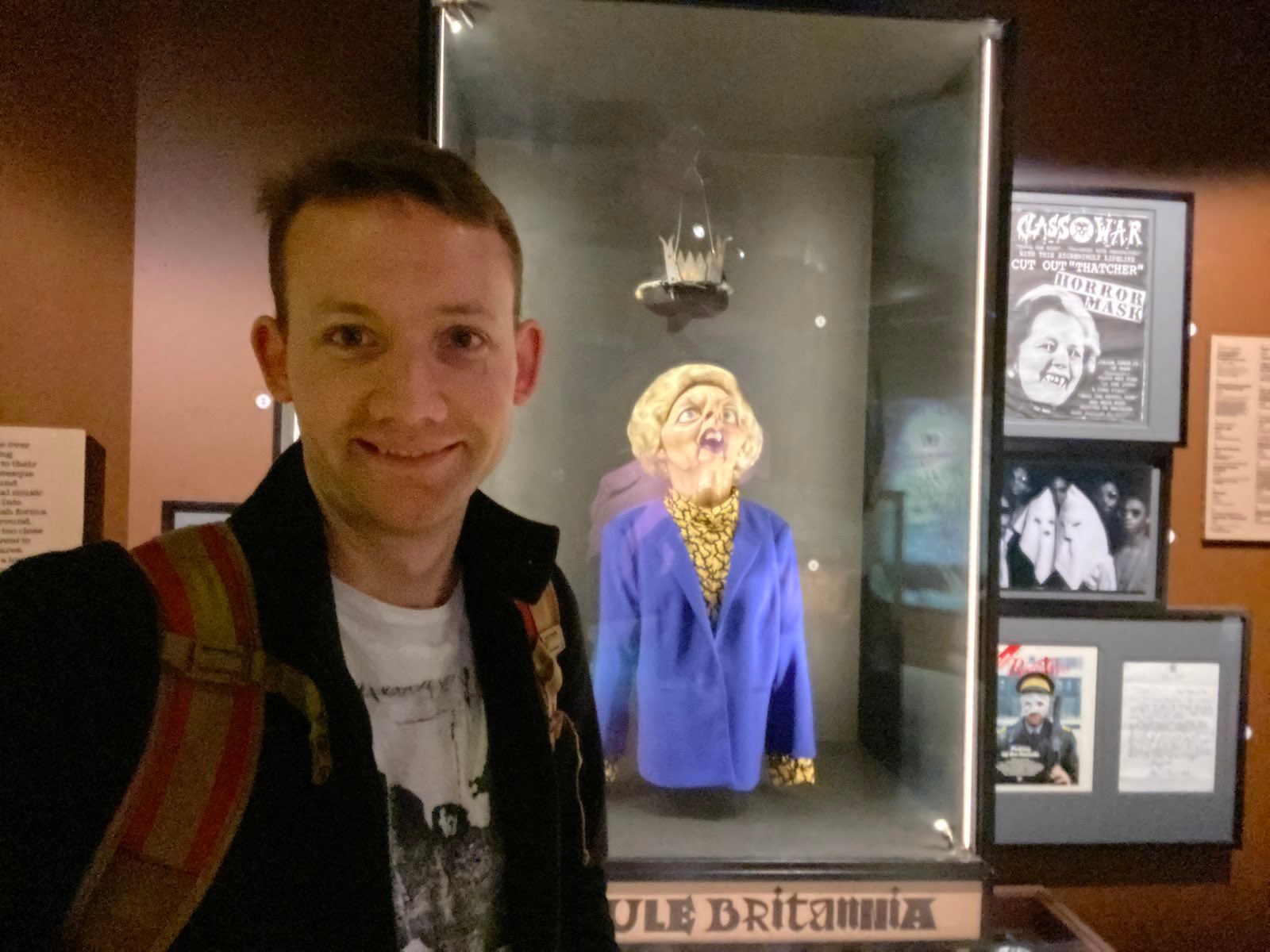
I was passing through London on Friday and I had time to get to The Horror Show! Exhibit at Somerset House, over by Victoria embankment. I learned about the exhibition from Gazelle Twin s website: she wrote music for the final part of the exhibit, with Maxine Peake delivering a monologue over the top. I loved it. It was almost like David Keenan s book England s Hidden Reverse had been made into an exhibition. It s divided into three themes: Monster, Ghost and Witch, although the themes are loose with lots of cross over and threads running throughout.
Thatcher (right) Thatcher (right)
Derek Jarman's Blue Derek Jarman's Blue
The show is littered with artefacts from culturally significant works from a recently-bygone age. There s a strong theme of hauntology. The artefacts that stuck out to me include some of Leigh Bowery s costumes; the spitting image doll of Thatcher; the cover of a Radio Times featuring the cult BBC drama Threads; Nigel Kneale s the stone tape VHS alongside more recent artefacts from Inside Number 9 and a MR James adaptation by Mark Gatiss (a clear thread of inspiration there); various bits relating to Derek Jarman including the complete Blue screening in a separate room; Mica Levi s eerie score to under the skin playing in the Witch section, and various artefacts and references to the underground music group Coil. Too much to mention! Having said that, the things which left the most lasting impression are the some of the stand-alone works of art: the charity box boy model staring fractured and refracted through a glass door (above); the glossy drip of blood running down a wall; the performance piece on a Betamax tape; the self portrait of a drowned man; the final piece, "The Neon Heiroglyph". Jonathan Jones at the Guardian liked it. The show runs until the 19th February and is worth a visit if you can.

1 February 2023

Simon Josefsson: Apt Archive Transparency: debdistdiff & apt-canary

I ve always found the operation of apt software package repositories to be a mystery. There appears to be a lack of transparency into which people have access to important apt package repositories out there, how the automatic non-human update mechanism is implemented, and what changes are published. I m thinking of big distributions like Ubuntu and Debian, but also the free GNU/Linux distributions like Trisquel and PureOS that are derived from the more well-known distributions. As far as I can tell, anyone who has the OpenPGP private key trusted by a apt-based GNU/Linux distribution can sign a modified Release/InRelease file and if my machine somehow downloads that version of the release file, my machine could be made to download and install packages that the distribution didn t intend me to install. Further, it seems that anyone who has access to the main HTTP server, or any of its mirrors, or is anywhere on the network between them and my machine (when plaintext HTTP is used), can either stall security updates on my machine (on a per-IP basis), or use it to send my machine (again, on a per-IP basis to avoid detection) a modified Release/InRelease file if they had been able to obtain the private signing key for the archive. These are mighty powers that warrant overview. I ve always put off learning about the processes to protect the apt infrastructure, mentally filing it under so many people rely on this infrastructure that enough people are likely to have invested time reviewing and improving these processes . Simultaneous, I ve always followed the more free-software friendly Debian-derived distributions such as gNewSense and have run it on some machines. I ve never put them into serious production use, because the trust issues with their apt package repositories has been a big question mark for me. The enough people part of my rationale for deferring this is not convincing. Even the simple question of is someone updating the apt repository is not easy to understand on a running gNewSense system. At some point in time the gNewSense cron job to pull in security updates from Debian must have stopped working, and I wouldn t have had any good mechanism to notice that. Most likely it happened without any public announcement. I ve recently switched to Trisquel on production machines, and these questions has come back to haunt me. The situation is unsatisfying and I looked into what could be done to improve it. I could try to understand who are the key people involved in each project, and may even learn what hardware component is used, or what software is involved to update and sign apt repositories. Is the server running non-free software? Proprietary BIOS or NIC firmware? Are the GnuPG private keys on disk? Smartcard? TPM? YubiKey? HSM? Where is the server co-located, and who has access to it? I tried to do a bit of this, and discovered things like Trisquel having a DSA1024 key in its default apt trust store (although for fairness, it seems that apt by default does not trust such signatures). However, I m not certain understanding this more would scale to securing my machines against attacks on this infrastructure. Even people with the best intentions, and the state of the art hardware and software, will have problems. To increase my trust in Trisquel I set out to understand how it worked. To make it easier to sort out what the interesting parts of the Trisquel archive to audit further were, I created debdistdiff to produce human readable text output comparing one apt archive with another apt archive. There is a GitLab CI/CD cron job that runs this every day, producing output comparing Trisquel vs Ubuntu and PureOS vs Debian. Working with these output files has made me learn more about how the process works, and I even stumbled upon something that is likely a bug where Trisquel aramo was imported from Ubuntu jammy while it contained a couple of package (e.g., gcc-8, python3.9) that were removed for the final Ubuntu jammy release. After working on auditing the Trisquel archive manually that way, I realized that whatever I could tell from comparing Trisquel with Ubuntu, it would only be something based on a current snapshot of the archives. Tomorrow it may look completely different. What felt necessary was to audit the differences of the Trisquel archive continously. I was quite happy to have developed debdistdiff for one purpose (comparing two different archives like Trisquel and Ubuntu) and discovered that the tool could be used for another purpose (comparing the Trisquel archive at two different points in time). At this time I realized that I needed a log of all different apt archive metadata to be able to produce an audit log of the differences in time for the archive. I create manually curated git-repositories with the Release/InRelease and the Packages files for each architecture/component of the well-known distributions Trisquel, Ubuntu, Debian and PureOS. Eventually I wrote scripts to automate this, which are now published in the debdistget project. At this point, one of the early question about per-IP substitution of Release files were lingering in my mind. However with the tooling I now had available, coming up with a way to resolve this was simple! Merely have apt compute a SHA256 checksum of the just downloaded InRelease file, and see if my git repository had the same file. At this point I started reading the Apt source code, and now I had more doubts about the security of my systems than I ever had before. Oh boy how the name Apt has never before felt more Apt?! Oh well, we must leave some exercises for the students. Eventually I realized I wanted to touch as little of apt code basis as possible, and noticed the SigVerify::CopyAndVerify function called ExecGPGV which called apt-key verify which called GnuPG s gpgv. By setting Apt::Key::gpgvcommand I could get apt-key verify to call another tool than gpgv. See where I m going? I thought wrapping this up would now be trivial but for some reason the hash checksum I computed locally never matched what was on my server. I gave up and started working on other things instead. Today I came back to this idea, and started to debug exactly how the local files looked that I got from apt and how they differed from what I had in my git repositories, that came straight from the apt archives. Eventually I traced this back to SplitClearSignedFile which takes an InRelease file and splits it into two files, probably mimicking the (old?) way of distributing both Release and Release.gpg. So the clearsigned InRelease file is split into one cleartext file (similar to the Release file) and one OpenPGP signature file (similar to the Release.gpg file). But why didn t the cleartext variant of the InRelease file hash to the same value as the hash of the Release file? Sadly they differ by the final newline. Having solved this technicality, wrapping the pieces up was easy, and I came up with a project apt-canary that provides a script apt-canary-gpgv that verify the local apt release files against something I call a apt canary witness file stored at a URL somewhere. I m now running apt-canary on my Trisquel aramo laptop, a Trisquel nabia server, and Talos II ppc64el Debian machine. This means I have solved the per-IP substitution worries (or at least made them less likely to occur, having to send the same malicious release files to both GitLab and my system), and allow me to have an audit log of all release files that I actually use for installing and downloading packages. What do you think? There are clearly a lot of work and improvements to be made. This is a proof-of-concept implementation of an idea, but instead of refining it until perfection and delaying feedback, I wanted to publish this to get others to think about the problems and various ways to resolve them. Btw, I m going to be at FOSDEM 23 this weekend, helping to manage the Security Devroom. Catch me if you want to chat about this or other things. Happy Hacking!

22 January 2023

Simon Josefsson: Understanding Trisquel

Ever wondered how Trisquel and Ubuntu differs and what s behind the curtain from a developer perspective? I have. Sharing what I ve learnt will allow you to increase knowledge and trust in Trisquel too.
Trisquel GNU/Linux logo
The scripts to convert an Ubuntu archive into a Trisquel archive are available in the ubuntu-purge repository. The easy to read purge-focal script lists the packages to remove from Ubuntu 20.04 Focal when it is imported into Trisquel 10.0 Nabia. The purge-jammy script provides the same for Ubuntu 22.04 Jammy and (the not yet released) Trisquel 11.0 Aramo. The list of packages is interesting, and by researching the reasons for each exclusion you can learn a lot about different attitudes towards free software and understand the desire to improve matters. I wish there were a wiki-page that for each removed package summarized relevant links to earlier discussions. At the end of the script there is a bunch of packages that are removed for branding purposes that are less interesting to review. Trisquel adds a couple of Trisquel-specific packages. The source code for these packages are in the trisquel-packages repository, with sub-directories for each release: see 10.0/ for Nabia and 11.0/ for Aramo. These packages appears to be mostly for branding purposes. Trisquel modify a set of packages, and here is starts to get interesting. Probably the most important package to modify is to use GNU Linux-libre instead of Linux as the kernel. The scripts to modify packages are in the package-helpers repository. The relevant scripts are in the helpers/ sub-directory. There is a branch for each Trisquel release, see helpers/ for Nabia and helpers/ for Aramo. To see how Linux is replaced with Linux-libre you can read the make-linux script. This covers the basic of approaching Trisquel from a developers perspective. As a user, I have identified some areas that need more work to improve trust in Trisquel: I hope to publish more about my work into these areas. Hopefully this will inspire similar efforts in related distributions like PureOS and the upstream distributions Ubuntu and Debian. Happy hacking!

13 January 2023

Reproducible Builds (diffoscope): diffoscope 232 released

The diffoscope maintainers are pleased to announce the release of diffoscope version 232. This version includes the following changes:
[ Chris Lamb ]
* Allow ICC tests to (temporarily) fail.
* Update debian/tests/control after the addition of PyPDF 3 support.
[ FC Stegerman ]
* Update regular expression for Android .APK files.
[ Sam James ]
* Support PyPDF version 3.
You find out more by visiting the project homepage.

8 January 2023

Dirk Eddelbuettel: RVowpalWabbit 0.0.18: Maintenance

A new maintenance release, now at version 0.0.18, of the RVowpalWabbit package arrived on CRAN. It improves several sprintf() calls by changing them to snprintf() (though there is a remaining one creeping in from a linked-to library). As noted before, there is a newer package rvw based on the excellent GSoC 2018 and beyond work by Ivan Pavlov (mentored by James and myself) so if you are into VowpalWabbit from R go check it out. CRANberries provides a summary of changes to the previous version. More information is on the RVowpalWabbit page. Issues and bugreports should go to the GitHub issue tracker. If you like this or other open-source work I do, you can now sponsor me at GitHub.

This post by Dirk Eddelbuettel originated on his Thinking inside the box blog. Please report excessive re-aggregation in third-party for-profit settings.

7 January 2023

Reproducible Builds: Reproducible Builds in December 2022

Welcome to the December 2022 report from the Reproducible Builds project.
We are extremely pleased to announce that the dates for the Reproducible Builds Summit in 2023 have been announced in 2022 already: We plan to spend three days continuing to the grow of the Reproducible Builds effort. As in previous events, the exact content of the meeting will be shaped by the participants. And, as mentioned in Holger Levsen s post to our mailing list, the dates have been booked and confirmed with the venue, so if you are considering attending, please reserve these dates in your calendar today.
R my Gr nblatt, an associate professor in the T l com Sud-Paris engineering school wrote up his pain points of using Nix and NixOS. Although some of the points do not touch on reproducible builds, R my touches on problems he has encountered with the different kinds of reproducibility that these distributions appear to promise including configuration files affecting the behaviour of systems, the fragility of upstream sources as well as the conventional idea of binary reproducibility.
Morten Linderud reported that he is quietly optimistic that if Go programming language resolves all of its issues with reproducible builds (tracking issue) then the Go binaries distributed from Google and by Arch Linux may be bit-for-bit identical. It s just a bit early to sorta figure out what roadblocks there are. [But] Go bootstraps itself every build, so in theory I think it should be possible.
On December 15th, Holger Levsen published an in-depth interview he performed with David A. Wheeler on supply-chain security and reproducible builds, but it also touches on the biggest challenges in computing as well. This is part of a larger series of posts featuring the projects, companies and individuals who support the Reproducible Builds project. Other instalments include an article featuring the Civil Infrastructure Platform project and followed this up with a post about the Ford Foundation as well as a recent ones about ARDC, the Google Open Source Security Team (GOSST), Jan Nieuwenhuizen on Bootstrappable Builds, GNU Mes and GNU Guix and Hans-Christoph Steiner of the F-Droid project.
A number of changes were made to the Reproducible Builds website and documentation this month, including FC Stegerman adding an F-Droid/apksigcopier example to our embedded signatures page [ ], Holger Levsen making a large number of changes related to the 2022 summit in Venice as well as 2023 s summit in Hamburg [ ][ ][ ][ ] and Simon Butler updated our publications page [ ][ ].
On our mailing list this month, James Addison asked a question about whether there has been any effort to trace the files used by a build system in order to identify the corresponding build-dependency packages. [ ] In addition, Bernhard M. Wiedemann then posed a thought-provoking question asking How to talk to skeptics? , which was occasioned by a colleague who had published a blog post in May 2021 skeptical of reproducible builds. The thread generated a number of replies.

Android news obfusk (FC Stegerman) performed a thought-provoking review of tools designed to determine the difference between two different .apk files shipped by a number of free-software instant messenger applications. These scripts are often necessary in the Android/APK ecosystem due to these files containing embedded signatures so the conventional bit-for-bit comparison cannot be used. After detailing a litany of issues with these tools, they come to the conclusion that:
It s quite possible these messengers actually have reproducible builds, but the verification scripts they use don t actually allow us to verify whether they do.
This reflects the consensus view within the Reproducible Builds project: pursuing a situation in language or package ecosystems where binaries are bit-for-bit identical (over requiring a bespoke ecosystem-specific tool) is not a luxury demanded by purist engineers, but rather the only practical way to demonstrate reproducibility. obfusk also announced the first release of their own set of tools on our mailing list. Related to this, obfusk also posted to an issue filed against Mastodon regarding the difficulties of creating bit-by-bit identical APKs, especially with respect to copying v2/v3 APK signatures created by different tools; they also reported that some APK ordering differences were not caused by building on macOS after all, but by using Android Studio [ ] and that F-Droid added 16 more apps published with Reproducible Builds in December.

Debian As mentioned in last months report, Vagrant Cascadian has been organising a series of online sprints in order to clear the huge backlog of reproducible builds patches submitted by performing NMUs (Non-Maintainer Uploads). During December, meetings were held on the 1st, 8th, 15th, 22nd and 29th, resulting in a large number of uploads and bugs being addressed: The next sprint is due to take place this coming Tuesday, January 10th at 16:00 UTC.

Upstream patches The Reproducible Builds project attempts to fix as many currently-unreproducible packages as possible. This month, we wrote a large number of such patches, including:

Testing framework The Reproducible Builds project operates a comprehensive testing framework at tests.reproducible-builds.org in order to check packages and other artifacts for reproducibility. In October, the following changes were made by Holger Levsen:
  • The osuosl167 machine is no longer a openqa-worker node anymore. [ ][ ]
  • Detect problems with APT repository signatures [ ] and update a repository signing key [ ].
  • reproducible Debian builtin-pho: improve job output. [ ]
  • Only install the foot-terminfo package on Debian systems. [ ]
In addition, Mattia Rizzolo added support for the version of diffoscope in Debian stretch which doesn t support the --timeout flag. [ ][ ]

diffoscope diffoscope is our in-depth and content-aware diff utility. Not only can it locate and diagnose reproducibility issues, it can provide human-readable diffs from many kinds of binary formats. This month, Chris Lamb made the following changes to diffoscope, including preparing and uploading versions 228, 229 and 230 to Debian:
  • Fix compatibility with file(1) version 5.43, with thanks to Christoph Biedl. [ ]
  • Skip the test_html.py::test_diff test if html2text is not installed. (#1026034)
  • Update copyright years. [ ]
In addition, Jelle van der Waa added support for Berkeley DB version 6. [ ] Orthogonal to this, Holger Levsen bumped the Debian Standards-Version on all of our packages, including diffoscope [ ], strip-nondeterminism [ ], disorderfs [ ] and reprotest [ ].
If you are interested in contributing to the Reproducible Builds project, please visit our Contribute page on our website. You can get in touch with us via:

30 December 2022

Chris Lamb: Favourite books of 2022: Non-fiction

In my three most recent posts, I went over the memoirs and biographies, classics and fiction books that I enjoyed the most in 2022. But in the last of my book-related posts for 2022, I'll be going over my favourite works of non-fiction. Books that just missed the cut here include Adam Hochschild's King Leopold's Ghost (1998) on the role of Leopold II of Belgium in the Congo Free State, Johann Hari's Stolen Focus (2022) (a personal memoir on relating to how technology is increasingly fragmenting our attention), Amia Srinivasan's The Right to Sex (2021) (a misleadingly named set of philosophic essays on feminism), Dana Heller et al.'s The Selling of 9/11: How a National Tragedy Became a Commodity (2005), John Berger's mindbending Ways of Seeing (1972) and Louise Richardson's What Terrorists Want (2006).

The Great War and Modern Memory (1975)
Wartime: Understanding and Behavior in the Second World War (1989) Paul Fussell Rather than describe the battles, weapons, geopolitics or big personalities of the two World Wars, Paul Fussell's The Great War and Modern Memory & Wartime are focused instead on how the two wars have been remembered by their everyday participants. Drawing on the memoirs and memories of soldiers and civilians along with a brief comparison with the actual events that shaped them, Fussell's two books are a compassionate, insightful and moving piece of analysis. Fussell primarily sets himself against the admixture of nostalgia and trauma that obscures the origins and unimaginable experience of participating in these wars; two wars that were, in his view, a "perceptual and rhetorical scandal from which total recovery is unlikely." He takes particular aim at the dishonesty of hindsight:
For the past fifty years, the Allied war has been sanitised and romanticised almost beyond recognition by the sentimental, the loony patriotic, the ignorant and the bloodthirsty. I have tried to balance the scales. [And] in unbombed America especially, the meaning of the war [seems] inaccessible.
The author does not engage in any of the customary rose-tinted view of war, yet he remains understanding and compassionate towards those who try to locate a reason within what was quite often senseless barbarism. If anything, his despondency and pessimism about the Second World War (the war that Fussell himself fought in) shines through quite acutely, and this is especially the case in what he chooses to quote from others:
"It was common [ ] throughout the [Okinawa] campaign for replacements to get hit before we even knew their names. They came up confused, frightened, and hopeful, got wounded or killed, and went right back to the rear on the route by which they had come, shocked, bleeding, or stiff. They were forlorn figures coming up to the meat grinder and going right back out of it like homeless waifs, unknown and faceless to us, like unread books on a shelf."
It would take a rather heartless reader to fail to be sobered by this final simile, and an even colder one to view Fussell's citation of such an emotive anecdote to be manipulative. Still, stories and cruel ironies like this one infuse this often-angry book, but it is not without astute and shrewd analysis as well, especially on the many qualitative differences between the two conflicts that simply cannot be captured by facts and figures alone. For example:
A measure of the psychological distance of the Second [World] War from the First is the rarity, in 1914 1918, of drinking and drunkenness poems.
Indeed so. In fact, what makes Fussell's project so compelling and perhaps even unique is that he uses these non-quantitive measures to try and take stock of what happened. After all, this was a war conducted by humans, not the abstract school of statistics. And what is the value of a list of armaments destroyed by such-and-such a regiment when compared with truly consequential insights into both how the war affected, say, the psychology of postwar literature ("Prolonged trench warfare, whether enacted or remembered, fosters paranoid melodrama, which I take to be a primary mode in modern writing."), the specific words adopted by combatants ("It is a truism of military propaganda that monosyllabic enemies are easier to despise than others") as well as the very grammar of interaction:
The Field Service Post Card [in WW1] has the honour of being the first widespread exemplary of that kind of document which uniquely characterises the modern world: the "Form". [And] as the first widely known example of dehumanised, automated communication, the post card popularised a mode of rhetoric indispensable to the conduct of later wars fought by great faceless conscripted armies.
And this wouldn't be a book review without argument-ending observations that:
Indicative of the German wartime conception [of victory] would be Hitler and Speer's elaborate plans for the ultimate reconstruction of Berlin, which made no provision for a library.
Our myths about the two world wars possess an undisputed power, in part because they contain an essential truth the atrocities committed by Germany and its allies were not merely extreme or revolting, but their full dimensions (embodied in the Holocaust and the Holodomor) remain essentially inaccessible within our current ideological framework. Yet the two wars are better understood as an abyss in which we were all dragged into the depths of moral depravity, rather than a battle pitched by the forces of light against the forces of darkness. Fussell is one of the few observers that can truly accept and understand this truth and is still able to speak to us cogently on the topic from the vantage point of experience. The Second World War which looms so large in our contemporary understanding of the modern world (see below) may have been necessary and unavoidable, but Fussell convinces his reader that it was morally complicated "beyond the power of any literary or philosophic analysis to suggest," and that the only way to maintain a na ve belief in the myth that these wars were a Manichaean fight between good and evil is to overlook reality. There are many texts on the two World Wars that can either stir the intellect or move the emotions, but Fussell's two books do both. A uniquely perceptive and intelligent commentary; outstanding.

Longitude (1995) Dava Sobel Since Man first decided to sail the oceans, knowing one's location has always been critical. Yet doing so reliably used to be a serious problem if you didn't know where you were, you are far more likely to die and/or lose your valuable cargo. But whilst finding one's latitude (ie. your north south position) had effectively been solved by the beginning of the 17th century, finding one's (east west) longitude was far from trustworthy in comparison. This book first published in 1995 is therefore something of an anachronism. As in, we readily use the GPS facilities of our phones today without hesitation, so we find it difficult to imagine a reality in which knowing something fundamental like your own location is essentially unthinkable. It became clear in the 18th century, though, that in order to accurately determine one's longitude, what you actually needed was an accurate clock. In Longitude, therefore, we read of the remarkable story of John Harrison and his quest to create a timepiece that would not only keep time during a long sea voyage but would survive the rough ocean conditions as well. Self-educated and a carpenter by trade, Harrison made a number of important breakthroughs in keeping accurate time at sea, and Longitude describes his novel breakthroughs in a way that is both engaging and without talking down to the reader. Still, this book covers much more than that, including the development of accurate longitude going hand-in-hand with advancements in cartography as well as in scientific experiments to determine the speed of light: experiments that led to the formulation of quantum mechanics. It also outlines the work being done by Harrison's competitors. 'Competitors' is indeed the correct word here, as Parliament offered a huge prize to whoever could create such a device, and the ramifications of this tremendous financial incentive are an essential part of this story. For the most part, though, Longitude sticks to the story of Harrison and his evolving obsession with his creating the perfect timepiece. Indeed, one reason that Longitude is so resonant with readers is that many of the tropes of the archetypical 'English inventor' are embedded within Harrison himself. That is to say, here is a self-made man pushing against the establishment of the time, with his groundbreaking ideas being underappreciated in his life, or dishonestly purloined by his intellectual inferiors. At the level of allegory, then, I am minded to interpret this portrait of Harrison as a symbolic distillation of postwar Britain a nation acutely embarrassed by the loss of the Empire that is now repositioning itself as a resourceful but plucky underdog; a country that, with a combination of the brains of boffins and a healthy dose of charisma and PR, can still keep up with the big boys. (It is this same search for postimperial meaning I find in the fiction of John le Carr , and, far more famously, in the James Bond franchise.) All of this is left to the reader, of course, as what makes Longitute singularly compelling is its gentle manner and tone. Indeed, at times it was as if the doyenne of sci-fi Ursula K. LeGuin had a sideline in popular non-fiction. I realise it's a mark of critical distinction to downgrade the importance of popular science in favour of erudite academic texts, but Latitude is ample evidence that so-called 'pop' science need not be patronising or reductive at all.

Closed Chambers: The Rise, Fall, and Future of the Modern Supreme Court (1998) Edward Lazarus After the landmark decision by the U.S. Supreme Court in *Dobbs v. Jackson Women's Health Organization that ended the Constitutional right to abortion conferred by Roe v Wade, I prioritised a few books in the queue about the judicial branch of the United States. One of these books was Closed Chambers, which attempts to assay, according to its subtitle, "The Rise, Fall and Future of the Modern Supreme Court". This book is not merely simply a learned guide to the history and functioning of the Court (although it is completely creditable in this respect); it's actually an 'insider' view of the workings of the institution as Lazurus was a clerk for Justice Harry Blackmun during the October term of 1988. Lazarus has therefore combined his experience as a clerk and his personal reflections (along with a substantial body of subsequent research) in order to communicate the collapse in comity between the Justices. Part of this book is therefore a pure history of the Court, detailing its important nineteenth-century judgements (such as Dred Scott which ruled that the Constitution did not consider Blacks to be citizens; and Plessy v. Ferguson which failed to find protection in the Constitution against racial segregation laws), as well as many twentieth-century cases that touch on the rather technical principle of substantive due process. Other layers of Lazurus' book are explicitly opinionated, however, and they capture the author's assessment of the Court's actions in the past and present [1998] day. Given the role in which he served at the Court, particular attention is given by Lazarus to the function of its clerks. These are revealed as being far more than the mere amanuenses they were hitherto believed to be. Indeed, the book is potentially unique in its the claim that the clerks have played a pivotal role in the deliberations, machinations and eventual rulings of the Court. By implication, then, the clerks have plaedy a crucial role in the internal controversies that surround many of the high-profile Supreme Court decisions decisions that, to the outsider at least, are presented as disinterested interpretations of Constitution of the United States. This is of especial importance given that, to Lazarus, "for all the attention we now pay to it, the Court remains shrouded in confusion and misunderstanding." Throughout his book, Lazarus complicates the commonplace view that the Court is divided into two simple right vs. left political factions, and instead documents an ever-evolving series of loosely held but strongly felt series of cabals, quid pro quo exchanges, outright equivocation and pure personal prejudices. (The age and concomitant illnesses of the Justices also appears to have a not insignificant effect on the Court's rulings as well.) In other words, Closed Chambers is not a book that will be read in a typical civics class in America, and the only time the book resorts to the customary breathless rhetoric about the US federal government is in its opening chapter:
The Court itself, a Greek-style temple commanding the crest of Capitol Hill, loomed above them in the dim light of the storm. Set atop a broad marble plaza and thirty-six steps, the Court stands in splendid isolation appropriate to its place at the pinnacle of the national judiciary, one of the three independent and "coequal" branches of American government. Once dubbed the Ivory Tower by architecture critics, the Court has a Corinthian colonnade and massive twenty-foot-high bronze doors that guard the single most powerful judicial institution in the Western world. Lights still shone in several offices to the right of the Court's entrance, and [ ]
Et cetera, et cetera. But, of course, this encomium to the inherent 'nobility' of the Supreme Court is quickly revealed to be a narrative foil, as Lazarus soon razes this dangerously na ve conception to the ground:
[The] institution is [now] broken into unyielding factions that have largely given up on a meaningful exchange of their respective views or, for that matter, a meaningful explication or defense of their own views. It is of Justices who in many important cases resort to transparently deceitful and hypocritical arguments and factual distortions as they discard judicial philosophy and consistent interpretation in favor of bottom-line results. This is a Court so badly splintered, yet so intent on lawmaking, that shifting 5-4 majorities, or even mere pluralities, rewrite whole swaths of constitutional law on the authority of a single, often idiosyncratic vote. It is also a Court where Justices yield great and excessive power to immature, ideologically driven clerks, who in turn use that power to manipulate their bosses and the institution they ostensibly serve.
Lazurus does not put forward a single, overarching thesis, but in the final chapters, he does suggest a potential future for the Court:
In the short run, the cure for what ails the Court lies solely with the Justices. It is their duty, under the shield of life tenure, to recognize the pathologies affecting their work and to restore the vitality of American constitutionalism. Ultimately, though, the long-term health of the Court depends on our own resolve on whom [we] select to join that institution.
Back in 1998, Lazurus might have had room for this qualified optimism. But from the vantage point of 2022, it appears that the "resolve" of the United States citizenry was not muscular enough to meet his challenge. After all, Lazurus was writing before Bush v. Gore in 2000, which arrogated to the judicial branch the ability to decide a presidential election; the disillusionment of Barack Obama's failure to nominate a replacement for Scalia; and many other missteps in the Court as well. All of which have now been compounded by the Trump administration's appointment of three Republican-friendly justices to the Court, including hypocritically appointing Justice Barrett a mere 38 days before the 2020 election. And, of course, the leaking and ruling in Dobbs v. Jackson, the true extent of which has not been yet. Not of a bit of this is Lazarus' fault, of course, but the Court's recent decisions (as well as the liberal hagiographies of 'RBG') most perforce affect one's reading of the concluding chapters. The other slight defect of Closed Chambers is that, whilst it often implies the importance of the federal and state courts within the judiciary, it only briefly positions the Supreme Court's decisions in relation to what was happening in the House, Senate and White House at the time. This seems to be increasingly relevant as time goes on: after all, it seems fairly clear even to this Brit that relying on an activist Supreme Court to enact progressive laws must be interpreted as a failure of the legislative branch to overcome the perennial problems of the filibuster, culture wars and partisan bickering. Nevertheless, Lazarus' book is in equal parts ambitious, opinionated, scholarly and dare I admit it? wonderfully gossipy. By juxtaposing history, memoir, and analysis, Closed Chambers combines an exacting evaluation of the Court's decisions with a lively portrait of the intellectual and emotional intensity that has grown within the Supreme Court's pseudo-monastic environment all while it struggles with the most impactful legal issues of the day. This book is an excellent and well-written achievement that will likely never be repeated, and a must-read for anyone interested in this ever-increasingly important branch of the US government.

Crashed: How a Decade of Financial Crises Changed the World (2018)
Shutdown: How Covid Shook the World's Economy (2021) Adam Tooze The economic historian Adam Tooze has often been labelled as an unlikely celebrity, but in the fourteen years since the global financial crisis of 2008, a growing audience has been looking for answers about the various failures of the modern economy. Tooze, a professor of history at New York's Columbia University, has written much that is penetrative and thought-provoking on this topic, and as a result, he has generated something of a cult following amongst economists, historians and the online left. I actually read two Tooze books this year. The first, Crashed (2018), catalogues the scale of government intervention required to prop up global finance after the 2008 financial crisis, and it characterises the different ways that countries around the world failed to live up to the situation, such as doing far too little, or taking action far too late. The connections between the high-risk subprime loans, credit default swaps and the resulting liquidity crisis in the US in late 2008 is fairly well known today in part thanks to films such as Adam McKay's 2015 The Big Short and much improved economic literacy in media reportage. But Crashed makes the implicit claim that, whilst the specific and structural origins of the 2008 crisis are worth scrutinising in exacting detail, it is the reaction of states in the months and years after the crash that has been overlooked as a result. After all, this is a reaction that has not only shaped a new economic order, it has created one that does not fit any conventional idea about the way the world 'ought' to be run. Tooze connects the original American banking crisis to the (multiple) European debt crises with a larger crisis of liberalism. Indeed, Tooze somehow manages to cover all these topics and more, weaving in Trump, Brexit and Russia's 2014 annexation of Crimea, as well as the evolving role of China in the post-2008 economic order. Where Crashed focused on the constellation of consequences that followed the events of 2008, Shutdown is a clear and comprehensive account of the way the world responded to the economic impact of Covid-19. The figures are often jaw-dropping: soon after the disease spread around the world, 95% of the world's economies contracted simultaneously, and at one point, the global economy shrunk by approximately 20%. Tooze's keen and sobering analysis of what happened is made all the more remarkable by the fact that it came out whilst the pandemic was still unfolding. In fact, this leads quickly to one of the book's few flaws: by being published so quickly, Shutdown prematurely over-praises China's 'zero Covid' policy, and these remarks will make a reader today squirm in their chair. Still, despite the regularity of these references (after all, mentioning China is very useful when one is directly comparing economic figures in early 2021, for examples), these are actually minor blemishes on the book's overall thesis. That is to say, Crashed is not merely a retelling of what happened in such-and-such a country during the pandemic; it offers in effect a prediction about what might be coming next. Whilst the economic responses to Covid averted what could easily have been another Great Depression (and thus showed it had learned some lessons from 2008), it had only done so by truly discarding the economic rule book. The by-product of inverting this set of written and unwritten conventions that have governed the world for the past 50 years, this 'Washington consensus' if you well, has yet to be fully felt. Of course, there are many parallels between these two books by Tooze. Both the liquidity crisis outlined in Crashed and the economic response to Covid in Shutdown exposed the fact that one of the central tenets of the modern economy ie. that financial markets can be trusted to regulate themselves was entirely untrue, and likely was false from the very beginning. And whilst Adam Tooze does not offer a singular piercing insight (conveying a sense of rigorous mastery instead), he may as well be asking whether we're simply going to lurch along from one crisis to the next, relying on the technocrats in power to fix problems when everything blows up again. The answer may very well be yes.

Looking for the Good War: American Amnesia and the Violent Pursuit of Happiness (2021) Elizabeth D. Samet Elizabeth D. Samet's Looking for the Good War answers the following question what would be the result if you asked a professor of English to disentangle the complex mythology we have about WW2 in the context of the recent US exit of Afghanistan? Samet's book acts as a twenty-first-century update of a kind to Paul Fussell's two books (reviewed above), as well as a deeper meditation on the idea that each new war is seen through the lens of the previous one. Indeed, like The Great War and Modern Memory (1975) and Wartime (1989), Samet's book is a perceptive work of demystification, but whilst Fussell seems to have been inspired by his own traumatic war experience, Samet is not only informed by her teaching West Point military cadets but by the physical and ontological wars that have occurred during her own life as well. A more scholarly and dispassionate text is the result of Samet's relative distance from armed combat, but it doesn't mean Looking for the Good War lacks energy or inspiration. Samet shares John Adams' belief that no political project can entirely shed the innate corruptions of power and ambition and so it is crucial to analyse and re-analyse the role of WW2 in contemporary American life. She is surely correct that the Second World War has been universally elevated as a special, 'good' war. Even those with exceptionally giddy minds seem to treat WW2 as hallowed:
It is nevertheless telling that one of the few occasions to which Trump responded with any kind of restraint while he was in office was the 75th anniversary of D-Day in 2019.
What is the source of this restraint, and what has nurtured its growth in the eight decades since WW2 began? Samet posits several reasons for this, including the fact that almost all of the media about the Second World War is not only suffused with symbolism and nostalgia but, less obviously, it has been made by people who have no experience of the events that they depict. Take Stephen Ambrose, author of Steven Spielberg's Band of Brothers miniseries: "I was 10 years old when the war ended," Samet quotes of Ambrose. "I thought the returning veterans were giants who had saved the world from barbarism. I still think so. I remain a hero worshiper." If Looking for the Good War has a primary thesis, then, it is that childhood hero worship is no basis for a system of government, let alone a crusading foreign policy. There is a straight line (to quote this book's subtitle) from the "American Amnesia" that obscures the reality of war to the "Violent Pursuit of Happiness." Samet's book doesn't merely just provide a modern appendix to Fussell's two works, however, as it adds further layers and dimensions he overlooked. For example, Samet provides some excellent insight on the role of Western, gangster and superhero movies, and she is especially good when looking at noir films as a kind of kaleidoscopic response to the Second World War:
Noir is a world ruled by bad decisions but also by bad timing. Chance, which plays such a pivotal role in war, bleeds into this world, too.
Samet rightfully weaves the role of women into the narrative as well. Women in film noir are often celebrated as 'independent' and sassy, correctly reflecting their newly-found independence gained during WW2. But these 'liberated' roles are not exactly a ringing endorsement of this independence: the 'femme fatale' and the 'tart', etc., reflect a kind of conditional freedom permitted to women by a post-War culture which is still wedded to an outmoded honour culture. In effect, far from being novel and subversive, these roles for women actually underwrote the ambient cultural disapproval of women's presence in the workforce. Samet later connects this highly-conditional independence with the liberation of Afghan women, which:
is inarguably one of the more palatable outcomes of our invasion, and the protection of women's rights has been invoked on the right and the left as an argument for staying the course in Afghanistan. How easily consequence is becoming justification. How flattering it will be one day to reimagine it as original objective.
Samet has ensured her book has a predominantly US angle as well, for she ends her book with a chapter on the pseudohistorical Lost Cause of the Civil War. The legacy of the Civil War is still visible in the physical phenomena of Confederate statues, but it also exists in deep-rooted racial injustice that has been shrouded in euphemism and other psychological devices for over 150 years. Samet believes that a key part of what drives the American mythology about the Second World War is the way in which it subconsciously cleanses the horrors of brother-on-brother murder that were seen in the Civil War. This is a book that is not only of interest to historians of the Second World War; it is a work for anyone who wishes to understand almost any American historical event, social issue, politician or movie that has appeared since the end of WW2. That is for better or worse everyone on earth.

29 December 2022

Chris Lamb: Favourite books of 2022: Memoir/biography

In my two most recent posts, I listed the fiction and classic fiction I enjoyed the most in 2022. I'll leave my roundup of general non-fiction until tomorrow, but today I'll be going over my favourite memoirs and biographies, in no particular order. Books that just missed the cut here include Roisin Kiberd's The Disconnect: A Personal Journey Through the Internet (2019), Steve Richards' The Prime Ministers (2019) which reflects on UK leadership from Harold Wilson to Boris Johnson, Robert Graves Great War memoir Goodbye to All That (1929) and David Mikics's portrait of Stanley Kubrick called American Filmmaker.

Afropean: Notes from Black Europe (2019) Johny Pitts Johny Pitts is a photographer and writer who lives in the north of England who set out to explore "black Europe from the street up" those districts within European cities that, although they were once 'white spaces' in the past, they are now occupied by Black people. Unhappy with the framing of the Black experience back home in post-industrial Sheffield, Pitts decided to become a nomad and goes abroad to seek out the sense of belonging he cannot find in post-Brexit Britain, and Afropean details his journey through Paris, Brussels, Lisbon, Berlin, Stockholm and Moscow. However, Pitts isn't just avoiding the polarisation and structural racism embedded in contemporary British life. Rather, he is seeking a kind of super-national community that transcends the reductive and limiting nationalisms of all European countries, most of which have based their national story on a self-serving mix of nostalgia and postcolonial fairy tales. Indeed, the term 'Afropean' is the key to understanding the goal of this captivating memoir. Pitts writes at the beginning of this book that the word wasn't driven only as a response to the crude nativisms of Nigel Farage and Marine Le Pen, but that it:
encouraged me to think of myself as whole and unhyphenated. [ ] Here was a space where blackness was taking part in shaping European identity at large. It suggested the possibility of living in and with more than one idea: Africa and Europe, or, by extension, the Global South and the West, without being mixed-this, half-that or black-other. That being black in Europe didn t necessarily mean being an immigrant.
In search of this whole new theory of home, Pitts travels to the infamous banlieue of Clichy-sous-Bois just to the East of Paris, thence to Matong in Brussels, as well as a quick and abortive trip into Moscow and other parallel communities throughout the continent. In these disparate environs, Pitts strikes up countless conversations with regular folk in order to hear their quotidian stories of living, and ultimately to move away from the idea that Black history is defined exclusively by slavery. Indeed, to Pitts, the idea of race is one that ultimately restricts one's humanity; the concept "is often forced to embody and speak for certain ideas, despite the fact it can't ever hold in both hands the full spectrum of a human life and the cultural nuances it creates." It's difficult to do justice to the effectiveness of the conversations Pitts has throughout his travels, but his shrewd attention to demeanour, language, raiment and expression vividly brings alive the people he talks to. Of related interest to fellow Brits as well are the many astute observations and comparisons with Black and working-class British life. The tone shifts quite often throughout this book. There might be an amusing aside one minute, such as the portrait of an African American tourist in Paris to whom "the whole city was a film set, with even its homeless people appearing to him as something oddly picturesque." But the register abruptly changes when he visits Clichy-sous-Bois on an anniversary of important to the area, and an element of genuine danger is introduced when Johny briefly visits Moscow and barely gets out alive. What's especially remarkable about this book is there is a freshness to Pitt s treatment of many well-worn subjects. This can be seen in his account of Belgium under the reign of Leopold II, the history of Portuguese colonialism (actually mostly unknown to me), as well in the way Pitts' own attitude to contemporary anti-fascist movements changes throughout an Antifa march. This chapter was an especial delight, and not only because it underlined just how much of Johny's trip was an inner journey of an author willing have his mind changed. Although Johny travels alone throughout his journey, in the second half of the book, Pitts becomes increasingly accompanied by a number of Black intellectuals by the selective citing of Frantz Fanon and James Baldwin and Caryl Phillips. (Nevertheless, Jonny has also brought his camera for the journey as well, adding a personal touch to this already highly-intimate book.) I suspect that his increasing exercise of Black intellectual writing in the latter half of the book may be because Pitts' hopes about 'Afropean' existence ever becoming a reality are continually dashed and undercut. The unity among potential Afropeans appears more-and-more unrealisable as the narrative unfolds, the various reasons of which Johny explores both prosaically and poetically. Indeed, by the end of the book, it's unclear whether Johny has managed to find what he left the shores of England to find. But his mix of history, sociology and observation of other cultures right on my doorstep was something of a revelation to me.

Orwell's Roses (2021) Rebecca Solnit Orwell s Roses is an alternative journey through the life and afterlife of George Orwell, reimaging his life primarily through the lens of his attentiveness to nature. Yet this framing of the book as an 'alternative' history is only revisionist if we compare it to the usual view of Orwell as a bastion of 'free speech' and English 'common sense' the roses of the title of this book were very much planted by Orwell in his Hertfordshire garden in 1936, and his yearning of nature one was one of the many constants throughout his life. Indeed, Orwell wrote about wildlife and outdoor life whenever he could get away with it, taking pleasure in a blackbird's song and waxing nostalgically about the English countryside in his 1939 novel Coming Up for Air (reviewed yesterday).
By sheer chance, I actually visited this exact garden immediately to the publication of this book
Solnit has a particular ability to evince unexpected connections between Orwell and the things he was writing about: Joseph Stalin's obsession with forcing lemons to grow in ludicrously cold climates; Orwell s slave-owning ancestors in Jamaica; Jamaica Kincaid's critique of colonialism in the flower garden; and the exploitative rose industry in Colombia that supplies the American market. Solnit introduces all of these new correspondences in a voice that feels like a breath of fresh air after decades of stodgy Orwellania, and without lapsing into a kind of verbal soft-focus. Indeed, the book displays a marked indifference towards the usual (male-centric) Orwell fandom. Her book draws to a close with a rereading of the 'dystopian' Nineteen Eighty-Four that completes her touching portrait of a more optimistic and hopeful Orwell, as well as a reflection on beauty and a manifesto for experiencing joy as an act of resistance.

The Disaster Artist (2013) Greg Sestero & Tom Bissell For those not already in the know, The Room was a 2003 film by director-producer-writer-actor Tommy Wiseau, an inscrutable Polish immigr with an impenetrable background, an idiosyncratic choice of wardrobe and a mysterious large source of income. The film, which centres on a melodramatic love triangle, has since been described by several commentators and publications as one of the worst films ever made. Tommy's production completely bombed at the so-called 'box office' (the release was actually funded entirely by Wiseau personally), but the film slowly became a favourite at cult cinema screenings. Given Tommy's prominent and central role in the film, there was always an inherent cruelty involved in indulging in the spectacle of The Room the audience was laughing because the film was astonishingly bad, of course, but Wiseau infused his film with sincere earnestness that in a heartless twist of irony may be precisely why it is so terrible to begin with. Indeed, it should be stressed that The Room is not simply a 'bad' film, and therefore not worth paying any attention to: it is uncannily bad in a way that makes it eerily compelling to watch. It unintentionally subverts all the rules of filmmaking in a way that captivates the attention. Take this representative example:
This thirty-six-second scene showcases almost every problem in The Room: the acting, the lighting, the sound design, the pacing, the dialogue and that this unnecessary scene (which does not advance the plot) even exists in the first place. One problem that the above clip doesn't capture, however, is Tommy's vulnerable ego. (He would later make the potentially conflicting claims that The Room was both an ironic cult success and that he is okay with people interpreting it sincerely). Indeed, the filmmaker's central role as Johnny (along with his Willy-Wonka meets Dracula persona) doesn't strike viewers as yet another vanity project, it actually asks more questions than it answers. Why did Tommy even make this film? What is driving him psychologically? And why and how? is he so spellbinding? On the surface, then, 2013's The Disaster Artist is a book about the making of one the strangest films ever made, written by The Room's co-star Greg Sestero and journalist Tom Bissell. Naturally, you learn some jaw-dropping facts about the production and inspiration of the film, the seed of which was planted when Greg and Tommy went to see an early screening of The Talented Mr Ripley (1999). It turns out that Greg's character in The Room is based on Tommy's idiosyncratic misinterpretation of its plot, extending even to the character's name Mark who, in textbook Tommy style, was taken directly (or at least Tommy believed) from one of Ripley's movie stars: "Mark Damon" [sic]. Almost as absorbing as The Room itself, The Disaster Artist is partly a memoir about Thomas P. Wiseau and his cinematic masterpiece. But it could also be described as a biography about a dysfunctional male relationship and, almost certainly entirely unconsciously, a text about the limitations of hetronormativity. It is this latter element that struck me the most whilst reading this book: if you take a step back for a moment, there is something uniquely sad about Tommy's inability to connect with others, and then, when Wiseau poured his soul into his film people just laughed. Despite the stories about his atrocious behaviour both on and off the film set, there's something deeply tragic about the whole affair. Jean-Luc Godard, who passed away earlier this year, once observed that every fictional film is a documentary of its actors. The Disaster Artist shows that this well-worn aphorism doesn't begin to cover it.

27 December 2022

Chris Lamb: Favourite books of 2022: Fiction

This post marks the beginning my yearly roundups of the favourite books and movies that I read and watched in 2022 that I plan to publish over the next few days. Just as I did for 2020 and 2021, I won't reveal precisely how many books I read in the last year. I didn't get through as many books as I did in 2021, though, but that's partly due to reading a significant number of long nineteenth-century novels in particular, a fair number of those books that American writer Henry James once referred to as "large, loose, baggy monsters." However, in today's post I'll be looking at my favourite books that are typically filed under fiction, with 'classic' fiction following tomorrow. Works that just missed the cut here include John O'Brien's Leaving Las Vegas, Colson Whitehead's Sag Harbor and possibly The Name of the Rose by Umberto Eco, or Elif Batuman's The Idiot. I also feel obliged to mention (or is that show off?) that I also read the 1,079-page Infinite Jest by David Foster Wallace, but I can't say it was a favourite, let alone recommend others unless they are in the market for a good-quality under-monitor stand.

Mona (2021) Pola Oloixarac Mona is the story of a young woman who has just been nominated for the 'most important literary award in Europe'. Mona sees the nomination as a chance to escape her substance abuse on a Californian campus and so speedily decamps to the small village in the depths of Sweden where the nominees must convene for a week before the overall winner is announced. Mona didn't disappear merely to avoid pharmacological misadventures, though, but also to avoid the growing realisation that she is being treated as something of an anthropological curiosity at her university: a female writer of colour treasured for her flourish of exotic diversity that reflects well upon her department. But Mona is now stuck in the company of her literary competitors who all have now gathered from around the world in order to do what writers do: harbour private resentments, exchange empty flattery, embody the selfsame racialised stereotypes that Mona left the United States to avoid, stab rivals in the back, drink too much, and, of course, go to bed together. But as I read Mona, I slowly started to realise that something else is going on. Why does Mona keep finding traces of violence on her body, the origins of which she cannot or refuses to remember? There is something eerily defensive about her behaviour and sardonic demeanour in general as well. A genre-bending and mind-expanding novel unfolded itself, and, without getting into spoiler territory, Mona concludes with such a surprising ending that, according to Adam Thirlwell:
Perhaps we need to rethink what is meant by a gimmick. If a gimmick is anything that we want to reject as extra or excessive or ill-fitting, then it may be important to ask what inhibitions or arbitrary conventions have made it seem like excess, and to revel in the exorbitant fictional constructions it produces. [...]
Mona is a savage satire of the literary world, but it's also a very disturbing exploration of trauma and violence. The success of the book comes in equal measure from the author's commitment to both ideas, but also from the way the psychological damage component creeps up on you. And, as implied above, the last ten pages are quite literally out of this world.

My Brilliant Friend (2011)
The Story of a New Name (2012)
Those Who Leave and Those Who Stay (2013)
The Story of the Lost Child (2014) Elena Ferrante Elena Ferrante's Neopolitan Quartet follows two girls, both brilliant in their own way. Our protagonist-narrator is Elena, a studious girl from the lower rungs of the middle class of Naples who is inspired to be more by her childhood friend, Lila. Lila is, in turn, far more restricted by her poverty and class, but can transcend it at times through her fiery nature, which also brands her as somewhat unique within their inward-looking community. The four books follow the two girls from the perspective of Elena as they grow up together in post-war Italy, where they drift in-and-out of each other's lives due to the vicissitudes of change and the consequences of choice. All the time this is unfolding, however, the narrative is very always slightly charged by the background knowledge revealed on the very first page that Lila will, many years later, disappear from Elena's life. Whilst the quartet has the formal properties of a bildungsroman, its subject and conception are almost entirely different. In particular, the books are driven far more by character and incident than spectacular adventures in picturesque Italy. In fact, quite the opposite takes place: these are four books where ordinary-seeming occurrences take on an unexpected radiance against a background of poverty, ignorance, violence and other threats, often bringing to mind the films of the Italian neorealism movement. Brilliantly rendered from beginning to end, Ferrante has a seemingly studious eye for interpreting interactions and the psychology of adolescence and friendship. Some utterances indeed, perhaps even some glances are dissected at length over multiple pages, something that Vittorio De Sica's classic Bicycle Thieves (1948) could never do. Potential readers should not take any notice of the saccharine cover illustrations on most editions of the books. The quartet could even win an award for the most misleading artwork, potentially rivalling even Vladimir Nabokov's Lolita. I wouldn't be at all surprised if it is revealed that the drippy illustrations and syrupy blurbs ("a rich, intense and generous-hearted story ") turn out to be part of a larger metatextual game that Ferrante is playing with her readers. This idiosyncratic view of mine is partially supported by the fact that each of the four books has been given a misleading title, the true ambiguity of which often only becomes clear as each of the four books comes into sharper focus. Readers of the quartet often fall into debating which is the best of the four. I've heard from more than one reader that one has 'too much Italian politics' and another doesn't have enough 'classic' Lina moments. The first book then possesses the twin advantages of both establishing the environs and finishing with a breathtaking ending that is both satisfying and a cliffhanger as well but does this make it 'the best'? I prefer to liken the quartet more like the different seasons of The Wire (2002-2008) where, personal favourites and preferences aside, although each season is undoubtedly unique, it would take a certain kind of narrow-minded view of art to make the claim that, say, series one of The Wire is 'the best' or that the season that focuses on the Baltimore docks 'is boring'. Not to sound like a neo-Wagnerian, but each of them adds to final result in its own. That is to say, both The Wire and the Neopolitan Quartet achieve the rare feat of making the magisterial simultaneously intimate.

Out There: Stories (2022) Kate Folk Out There is a riveting collection of disturbing short stories by first-time author Kate Fork. The title story first appeared in the New Yorker in early 2020 imagines a near-future setting where a group of uncannily handsome artificial men called 'blots' have arrived on the San Francisco dating scene with the secret mission of sleeping with women, before stealing their personal data from their laptops and phones and then (quite literally) evaporating into thin air. Folk's satirical style is not at all didactic, so it rarely feels like she is making her points in a pedantic manner. But it's clear that the narrator of Out There is recounting her frustration with online dating. in a way that will resonate with anyone who s spent time with dating apps or indeed the contemporary hyper-centralised platform-based internet in general. Part social satire, part ghost story and part comic tales, the blurring of the lines between these factors is only one of the things that makes these stories so compelling. But whilst Folk constructs crazy scenarios and intentionally strange worlds, she also manages to also populate them with characters that feel real and genuinely sympathetic. Indeed, I challenge you not to feel some empathy for the 'blot' in the companion story Big Sur which concludes the collection, and it complicates any primary-coloured view of the dating world of consisting entirely of predatory men. And all of this is leavened with a few stories that are just plain surreal. I don't know what the deal is with Dating a Somnambulist (available online on Hobart Pulp), but I know that I like it.

Solaris (1961) Stanislaw Lem When Kelvin arrives at the planet Solaris to study the strange ocean that covers its surface, instead of finding an entirely physical scientific phenomenon, he soon discovers a previously unconscious memory embodied in the physical manifestation of a long-dead lover. The other scientists on the space station slowly reveal that they are also plagued with their own repressed corporeal memories. Many theories are put forward as to why all this is occuring, including the idea that Solaris is a massive brain that creates these incarnate memories. Yet if that is the case, the planet's purpose in doing so is entirely unknown, forcing the scientists to shift focus and wonder whether they can truly understand the universe without first understanding what lies within their own minds and in their desires. This would be an interesting outline for any good science fiction book, but one of the great strengths of Solaris is not only that it withholds from the reader why the planet is doing anything it does, but the book is so forcefully didactic in its dislike of the hubris, destructiveness and colonial thinking that can accompany scientific exploration. In one of its most vitriolic passages, Lem's own anger might be reaching out to the reader:
We are humanitarian and chivalrous; we don t want to enslave other races, we simply want to bequeath them our values and take over their heritage in exchange. We think of ourselves as the Knights of the Holy Contact. This is another lie. We are only seeking Man. We have no need of other worlds. We need mirrors. We don t know what to do with other worlds. A single world, our own, suffices us; but we can t accept it for what it is. We are searching for an ideal image of our own world: we go in quest of a planet, of a civilisation superior to our own, but developed on the basis of a prototype of our primaeval past. At the same time, there is something inside us that we don t like to face up to, from which we try to protect ourselves, but which nevertheless remains since we don t leave Earth in a state of primal innocence. We arrive here as we are in reality, and when the page is turned, and that reality is revealed to us that part of our reality that we would prefer to pass over in silence then we don t like it anymore.
An overwhelming preoccupation with this idea infuses Solaris, and it turns out to be a common theme in a lot of Lem's work of this period, such as in his 1959 'anti-police procedural' The Investigation. Perhaps it not a dislike of exploration in general or the modern scientific method in particular, but rather a savage critique of the arrogance and self-assuredness that accompanies most forms of scientific positivism, or at least pursuits that cloak themselves under the guise of being a laudatory 'scientific' pursuit:
Man has gone out to explore other worlds and other civilizations without having explored his own labyrinth of dark passages and secret chambers and without finding what lies behind doorways that he himself has sealed.
I doubt I need to cite specific instances of contemporary scientific pursuits that might meet Lem's punishing eye today, and the fact that his critique works both in 2022 and 1961 perhaps tells us more about the human condition than we'd care to know. Another striking thing about Solaris isn't just the specific Star Trek and Stargate SG-1 episodes that I retrospectively realised were purloined from the book, but that almost the entire register of Star Trek: The Next Generation in particular seems to be rehearsed here. That is to say, TNG presents itself as hard and fact-based 'sci-fi' on the surface, but, at its core, there are often human, existential and sometimes quite enormously emotionally devastating human themes being discussed such as memory, loss and grief. To take one example from many, the painful memories that the planet Solaris physically materialises in effect asks us to seriously consider what it actually is taking place when we 'love' another person: is it merely another 'mirror' of ourselves? (And, if that is the case, is that... bad?) It would be ahistorical to claim that all popular science fiction today can be found rehearsed in Solaris, but perhaps it isn't too much of a stretch:
[Solaris] renders unnecessary any more alien stories. Nothing further can be said on this topic ...] Possibly, it can be said that when one feels the urge for such a thing, one should simply reread Solaris and learn its lessons again. Kim Stanley Robinson [...]
I could go on praising this book for quite some time; perhaps by discussing the extreme framing devices used within the book at one point, the book diverges into a lengthy bibliography of fictional books-within-the-book, each encapsulating a different theory about what the mechanics and/or function of Solaris is, thereby demonstrating that 'Solaris studies' as it is called within the world of the book has been going on for years with no tangible results, which actually leads to extreme embarrassment and then a deliberate and willful blindness to the 'Solaris problem' on the part of the book's scientific community. But I'll leave it all here before this review gets too long... Highly recommended, and a likely reread in 2023.

Brokeback Mountain (1997) Annie Proulx Brokeback Mountain began as a short story by American author Annie Proulx which appeared in the New Yorker in 1997, although it is now more famous for the 2005 film adaptation directed by Taiwanese filmmaker Ang Lee. Both versions follow two young men who are hired for the summer to look after sheep at a range under the 'Brokeback' mountain in Wyoming. Unexpectedly, however, they form an intense emotional and sexual attachment, yet life intervenes and demands they part ways at the end of the summer. Over the next twenty years, though, as their individual lives play out with marriages, children and jobs, they continue reuniting for brief albeit secret liaisons on camping trips in remote settings. There's no feigned shyness or self-importance in Brokeback Mountain, just a close, compassionate and brutally honest observation of a doomed relationship and a bone-deep feeling for the hardscrabble life in the post-War West. To my mind, very few books have captured so acutely the desolation of a frustrated and repressed passion, as well as the particular flavour of undirected anger that can accompany this kind of yearning. That the original novella does all this in such a beautiful way (and without the crutch of the Wyoming landscape to look at ) is a tribute to Proulx's skills as a writer. Indeed, even without the devasting emotional undertones, Proulx's descriptions of the mountains and scree of the West is likely worth the read alone.

Luster (2020) Raven Leilani Edie is a young Black woman living in New York whose life seems to be spiralling out of control. She isn't good at making friends, her career is going nowhere, and she has no close family to speak of as well. She is, thus, your typical NYC millennial today, albeit seen through a lens of Blackness that complicates any reductive view of her privilege or minority status. A representative paragraph might communicate the simmering tone:
Before I start work, I browse through some photos of friends who are doing better than me, then an article on a black teenager who was killed on 115th for holding a weapon later identified as a showerhead, then an article on a black woman who was killed on the Grand Concourse for holding a weapon later identified as a cell phone, then I drown myself in the comments section and do some online shopping, by which I mean I put four dresses in my cart as a strictly theoretical exercise and then let the page expire.
She starts a sort-of affair with an older white man who has an affluent lifestyle in nearby New Jersey. Eric or so he claims has agreed upon an 'open relationship' with his wife, but Edie is far too inappropriate and disinhibited to respect any boundaries that Eric sets for her, and so Edie soon becomes deeply entangled in Eric's family life. It soon turns out that Eric and his wife have a twelve-year-old adopted daughter, Akila, who is also wait for it Black. Akila has been with Eric's family for two years now and they aren t exactly coping well together. They don t even know how to help her to manage her own hair, let alone deal with structural racism. Yet despite how dark the book's general demeanour is, there are faint glimmers of redemption here and there. Realistic almost to the end, Edie might finally realise what s important in her life, but it would be a stretch to say that she achieves them by the final page. Although the book is full of acerbic remarks on almost any topic (Dogs: "We made them needy and physically unfit. They used to be wolves, now they are pugs with asthma."), it is the comments on contemporary race relations that are most critically insightful. Indeed, unsentimental, incisive and funny, Luster had much of what I like in Colson Whitehead's books at times, but I can't remember a book so frantically fast-paced as this since the Booker-prize winning The Sellout by Paul Beatty or Sam Tallent's Running the Light.

14 December 2022

Russ Allbery: Review: Contact

Review: Contact, by Carl Sagan
Publisher: Pocket Books
Copyright: 1985
Printing: October 1986
ISBN: 0-671-43422-5
Format: Mass market
Pages: 434
Contact is a standalone first-contact science fiction novel. Carl Sagan (1934 1996) was best known as a non-fiction writer, astronomer, and narrator of the PBS non-fiction program Cosmos. This is his first and only novel. Ellie Arroway is the director of Project Argus, a radio telescope array in the New Mexico desert whose primary mission is SETI: the search for extra-terrestrial intelligence by scanning the skies for unexpected radio signals. Its assignment to SETI is controversial; there are radio astronomy projects waiting, and although 25% of the telescope time is assigned to non-SETI projects, some astronomers think the SETI mission should be scrapped and Argus fully diverted to more useful research. That changes overnight when Argus picks up a signal from Vega, binary pulses representing the sequence of prime numbers. The signal of course doesn't stop when the Earth rotates, so Ellie and her team quickly notify every radio observatory they can get hold of to follow the signal as it passes out of their line of sight. Before long, nearly every country with a radio telescope is involved, and Russian help is particularly vital since they have ship-mounted equipment. The US military and intelligence establishment isn't happy about this and make a few attempts to shove the genie back into the bottle and keep any further discoveries secret, without a lot of success. (Sagan did not anticipate the end of the Cold War, and yet ironically relations with the Russians in his version of the 1990s are warmer by far than they are today. Not that this makes the military types any happier.) For better or worse, making sense of the alien signal becomes a global project. You may be familiar with this book through its 1997 movie adaptation starring Jodie Foster. What I didn't know before reading this book is that it started life as a movie treatment, co-written with Ann Druyan, in 1979. When the movie stalled, Sagan expanded it into a novel. (Given the thanks to Druyan in the author's note, it may not be far wrong to name her as a co-author.) If you've seen the movie, you will have a good idea of what will happen, but the book gives the project a more realistic international scope. Ellie has colleagues carefully selected from all over the world, including for the climactic moment of the story. The biggest problem with Contact as a novel is that Sagan is a non-fiction writer who didn't really know how to write a novel. The long, detailed descriptions of the science and the astronomical equipment fit a certain type of SF story, but the descriptions of the characters, even Ellie, are equally detailed and yet use the same style. The book starts with an account of Ellie's childhood and path into science written like a biography or a magazine profile, not like a novel in which she's the protagonist. The same is true of the other characters: we get characterization of a sort, but the tone ranges from Wikipedia article to long-form essay and never quite feels like a story. Ellie is the most interesting character in the book, partly because the way Sagan writes her is both distant but oddly compelling. Sagan (or perhaps Druyan?) tries hard to show what life is like for a woman born in the middle of the 20th century who is interested in science and I think mostly succeeds, although Ellie's reactions to sexism felt weirdly emotionless. The descriptions of her relationships are even odder and the parts where this book felt the least like a novel, but Sagan does sell some of that tone as reflective of Ellie's personality. She's a scientist, the work is the center of her life, and everything else, even when important, is secondary. It doesn't entirely make the writing style work, but it helps. Sagan does attempt to give Ellie a personal development arc related to her childhood and her relationships with her father and step-father. I thought the conclusion to that was neither believable nor anywhere near as important as Sagan thought it was, which was off-putting. Better were her ongoing arguments with evangelical Christians, one of whom is a close-minded ass and the other of which is a far more interesting character. They felt wedged into this book, and I'm dubious a realistic version of Ellie would have been the person to have those debates, but it's a subject Sagan clearly has deep personal interest in and that shows in how they're written. The other problem with Contact as a novel is that Sagan does not take science fiction seriously as a genre, instead treating it as a way to explore a thought experiment. To a science fiction reader, or at least to this science fiction reader, the interesting bits of this story involve the aliens. Those are not the bits Sagan is interested in. His attention is on how this sort of contact, and project, would affect humanity and human politics. We do get some more traditional science fiction near the end of the book, but Sagan then immediately backs away from it, minimizes that part of the story, and focuses exclusively on the emotional and philosophical implications for humans of his thought experiment. Since I found his philosophical musings about agnosticism and wonder and discovery less interesting than the actual science fiction bits, I found this somewhat annoying. The ending felt a bit more like a cheap trick than a satisfying conclusion. Interestingly, this entire novel is set in an alternate universe, for reasons entirely unexplained (at least that I noticed) in the book. It's set in the late 1990s but was written in 1985, so of course this is an alternate future, but the 1985 of this world still isn't ours. Yuri Gagarin was the first man to set foot on the moon, and the space program and the Cold War developed in subtly different ways. I'm not sure why Sagan made that choice, but it felt to me like he was separating his thought experiment farther from our world to give the ending more plausible deniability. There are, at the time of the novel, permanent orbital colonies for (mostly) rich people, because living in space turns out to greatly extend human lifespans. That gives Sagan an opportunity to wax poetic about the life-altering effects of seeing Earth from space, which in his alternate timeline rapidly sped up nuclear disarmament and made the rich more protective of the planet. This is an old bit of space boosterism that isn't as common these days, mostly because it's become abundantly clear that human psychology doesn't work this way. Sadly, rich sociopaths remain sociopaths even when you send them into space. I was a bit torn between finding Sagan's predictions charmingly hopeful and annoyingly daft. I don't think this novel is very successful as a novel. It's much longer than it needs to be and long parts of it drag. But it's still oddly readable; even knowing the rough shape of the ending in advance, I found it hard to put down once the plot properly kicks into gear about two-thirds of the way through. There's a lot in here that I'd argue with Sagan about, but he's thoughtful and makes a serious attempt to work out the political and scientific ramifications of such a discovery in detail. Despite the dry tone, he does a surprisingly good job capturing the anticipation and excitement of a very expensive and risky scientific experiment. I'm not sure I would recommend this book to anyone, but I'm also the person who found Gregory Benford's Timescape to be boring and tedious, despite its rave reviews as a science fiction novel about the practice of science. If that sort of book is more your jam, you may like Contact better than I did. Rating: 6 out of 10

8 December 2022

Louis-Philippe V ronneau: Debian Python Team 2022 Sprint Report

This is the report for the Debian Python Team remote sprint that took place on December 2-3-4 2022. Many thanks to those who participated, namely: Here is a list of issues we worked on: pybuild autodep8 feature About a year ago, Antonio Terceiro contributed code to pybuild to make it possible to automatically run the upstream test suite as autopkgtests. This feature has now been merged and uploaded to unstable. Although you can find out more about it in the pybuild-autopkgtest manpage, an email providing more details should be sent to the debian-python mailing list relatively soon. Fixing packages that run tests via python3 setup.py test Last August, Stefano Rivera poked the team about the deprecation of the python3 setup.py test command to run tests in pybuild. Although this feature has been deprecated upstream for 6 years now, many packages in the archive still use it to run the upstream test suite during build. Around 29 of the 67 packages that are team-maintained by the Debian Python Team were fixed during the sprint. Ideally, all of them would be before the feature is removed from pybuild. if a package you maintain still runs this command, please consider fixing it! Fixing packages that use nose nose, provided by the python3-nose package, is an obsolete testing framework for Python and has been unmaintained since 2015. During the sprint, people worked on fixing some of the many bugs filled against packages still running tests via nose, but there are still around 240 packages affected by this issue in the archive. Again, if a package you maintain still runs this command, please consider fixing it! Removal of the remaining Python2 packages With the upload of dh-python 5.20221202, Stefano Rivera officially removed support for dh_python2 and dh_pypy, thus closing the "Python2 removal in sid/bullseye" bug. It seems some work still needs to be done for complete Python2 removal from Sid, but I expect this will be done in time for the Bookworm release. Working on Lintian tags for the Team During the sprint, I managed to work on some Lintian issues that we had targeted, namely: I also worked on a few other Lintian tags, but they were unrelated to the Debian Python Team itself. I'm also happy to report many of the tags I wrote for the team in the past few months were merged by the awesome Russ Allbery and should land in unstable as soon as a new release is made. I'm particularly looking forward the new "uses-python-distutils" tag that should help us flag packages that still use the deprecated distutils library. Patching distro-tracker (tracker.debian.org) to show pending team MRs It's often hard to have a good overview of pending merge requests when working with team-maintained packages, as by default, Salsa doesn't notify anyone when a MR is opened. Although our workflow typically does not involve creating merge requests, some people still do and they end up sitting there, unnoticed. During the sprint, Kurt Kremitzki worked on solving this issue by having distro-tracker show the pending MRs on our team's tracker page. Sadly, it seems little progress was made, as the removal of python3-django-jsonfield from the archive and breaking changes in python3-selenium has broken the test suite. Migrate packages building with the flit plugin to the generic pyproject one pybuild has been supporting building with PEP-517 style pyproject.toml files via a generic plugin (pybuild-plugin-pyproject) for a while now. As this plugin supersedes the old flit plugin, we've been thinking of deprecating it in time for the Bookworm release. To make this possible, most of the packages in the archive that still used this plugin were migrated to the generic one and I opened bugs on the last handful of packages that were not team-maintained. Other work Many other things were done during the sprint, such as: Thanks Thanks again to everyone who joined the sprint, and three big cheers for all the folks who donate to Debian and made it possible for us to have a food budget for the event.

26 November 2022

Benjamin Mako Hill: The Financial Times has been printing an obvious error on its Market Data page for 18 months and nobody else seems to have noticed

Market Data section of the Financial Times US Edition print edition from May 5, 2021.
If you ve flipped through printed broadsheet newspapers, you ve probably seen pages full of tiny text listing prices and other market information for stocks and commodities. And you ve almost certainly just turned the page. Anybody interested in this market prices today will turn to the internet where these numbers are available in real time and where you don t need to squint to find what you need. This is presumably why many newspapers have stopped printing these types of pages or dramatically reduced the space devoted to them. Major financial newspapers however like the Financial Times (FT) still print multiple pages of market data daily. But does anybody read them? The answer appears to be no. How do I know? I noticed an error in the FT s Market Data page that anybody looking in the relevant section of the page would have seen. And I have seen it reproduced every single day for the last 18 months. In early May last year, I noticed that the Japanese telecom giant Nippon Telegraph and Telephone (NTT) was listed twice on the FT s list of the 500 largest global companies: once as Nippon T&T and also as Nippon TT. One right above the other. All the numbers are identical. Clearly a mistake.
Reproduction of the FT Market Data section showing a subset of Japanese companies from the FT 500 list of global companies. The duplicate lines are highlighted in yellow. This page is from today s paper (November 26, 2022).
Wondering if it was a one-off error, I looked at a copy of the paper from about a week before and saw that the error did not exist then. I looked at a copy from one day before and saw that it did. Since the issue was apparently recurring, but new at the time, I figured someone at the paper would notice and fix it quickly. I was wrong. It has been 18 months now and the error has been reproduced every single day. Looking through the archives, it seems that the first day the error showed up was May 5, 2021. I ve included a screenshot from the electronic paper version from that day and from the fifth of every month since then (or the sixth if the paper was not printed on the fifth) that shows that the error is reproduced every day. A quick look in the archives suggests it not only appears in the US edition but also in the UK, European, Asian, and Middle East editions. All of them. Why does this matter? The FT prints over 112,000 copies of its paper, six days a week. This duplicate line takes up almost no space, of course, so it s not a big deal on its own. But devoting two full broadsheet pages to market data that is out date as soon as it is printed much of which nobody appears to be reading doesn t seem like a great use of resources. There s an argument to made that papers like the FT print these pages not because they are useful but because doing so is a signal of the publications identities as serious financial papers. But that hardly seems like a good enough reason on its own if nobody is looking at them. It seems well past time for newspapers to stop wasting paper and ink on these pages. I respect that some people think that printing paper newspapers at all is wasteful when one can just read the material online. Plenty of people disagree, of course. But who will disagree with a call to stop printing material that evidence suggests is not being seen by anybody? If an error this obvious can exist for so long, it seems clear that nobody not even anybody at the FT itself is reading it.

Next.

Previous.