Search Results: "gabriel"

23 May 2014

Mike Gabriel: X2Go on FLOSS Weekly

On May 21st 2014, the two Mikes (Gabriel DePaulo) from the X2Go core developer team were interviewed about X2Go by the famous Randal L. Schwartz (merlyn) and equally famous Randi Harper (freebsdgirl) on the FLOSS Weekly Netcast [1]. If you're having trouble watching the embedded video on that page, try one of the below alternatives: HD Video [2]
SD Video, large [3]
SD Video, small [4]
Audio only [5] light+love,
Mike [1] http://twit.tv/floss295 read more

7 April 2014

Holger Levsen: 20140407-some-jenkins-activities

Some jenkins.debian.net activities Yesterday and today I've spent some time time on jenkins.debian.net, so that it's finally only available via https, or so I thought. I quickly learned that it's better still serving via http, but only when queried from localhost :) Second, I've moved the git repo to QA group namespace on alioth and set up IRC notifications using the wonderful KGB client. There is no mailinglist which receives commit diffs yet, but thats also because it's mostly still me working on this. Though since yesterday there are now seven committers in the git history, which is two more than before: Niels Thykier submitted job configuratios for running the lintian testsuite on stable, testing and sid on every commit to the lintian git repo. The test suite passes nicely on testing and unstable but fails for stable as it needs backports and we need to make the job to install those. Gabriele Giacone submitted several patches so that soon hurd wgnu/hurd can be tested too. Currently this fails for two reasons, both of which are very temporarily: the hurd .iso image which was here this morning is gone now, and secondly I haven't installed (the locally build packages for) qemu and qemu-kvm packages with the fixes for #742386 as that .iso ain't there so this is pointless atm ;-) But I'm very happy to have a hopefully soon working job which will regularily test installation of Debian hurd and I do hope that some Debian kfreebsd enthusiasts will pick up and fix the existing jobs for kfreebsd tests. (Hint hint hint! I'm also totally happy to help with that!) This reminds me to mention one last bit: Thanks to Paul Wise, jenkins.d.n bugs are now tracked in the BTS among other Debian QA group bugs!

18 December 2013

Antoine Beaupr : Password reset of Speedstream 5200 modems

After an extended downtime on my ADSL uplink at home during a nice snowstorm, I got curious and wanted to find out the SNR (Signal to Noise Ratio) I had on my line, to try to explain why it was down. It turned out it was more complicated than I thought, because the modem was locked down by Bell Canada (even though I am not a customer). There was a Windows utility, but since I haven't been running this pathetic operating system in years, I had to find an alternative. Fortunately, the author of that utility posted a description of the packet format used for the password reset, and here I was trying to send raw ethernet frames using Linux (for testing and, why not!) and FreeBSD (because I use FreeBSD for routing, because I dislike iptables). The result is this somewhat poorly written C program, available in this git repository. It uses raw sockets in Linux but the BPF (Berkeley Packet Filter) in FreeBSD, as their interface is a little broken for raw sockets. See the README file for more information. Enjoy.

4 September 2013

Mike Gabriel: Python X2Go now has support for passphrase-protected SSH keys

Yesterday, I (with my X2Go upstream hat on) have added a new (long waited for) feature to PyHoca-GUI / Python X2Go. So far, in PyHoca-GUI (python-x2go) it was only possible to use passphrase-protected / encrypted SSH keys via an ssh-agent process that unlocks those keys when being added to the agent's keyring previous to logging into an X2Go Server. Unlocking those keys natively in PyHoca-GUI was not possible so far.
-> Now it is!!! This feature will be available with PyHoca-GUI 0.4.0.9 / Python X2Go 0.4.0.9 (and PyHoca-CLI 0.4.0.3). read more

27 April 2013

Mike Gabriel: Unity Greeter with X2Go Remote Login Support

For the Danish company Fleten.net [1] (with my X2Go [2] developer hat on) I have recently developed X2Go integration into the Unity Greeter [3] theme of LightDM [4] in Ubuntu. Fleten.net--as a Canonical Partner--is providing FOSS based IT-services to schools and municipalities in Denmark and Norway, based on Ubuntu and X2Go. read more

11 March 2013

Russ Allbery: Small non-fiction haul

Long time no write. A variety of things, including getting sick with a particularly bad cold (I'm still coughing up phlegm), led to my schedule and general life organization getting turned on its head, and I'm only slowly recovering. Work gets top priority (including a security release of OpenAFS), so I'm afraid non-work things such as reviews and journal posts (and Debian, and non-work-related software development, and conversations with friends...) have been getting second shrift. Hopefully this is finally starting to improve, and I have a block of time for working remotely coming up that should help. In the meantime, more books have, of course, been acquired. This particular order was mostly to get one book (The Making of the Indebted Man), which I'm going to read and discuss as part of a surprisingly fun political discussion about basic income guarantee and, somewhat by extension, Marxist analysis of capitalism. But it's impossible to buy just one book, similar to how it's impossible to eat just one potato chip: Neil Barofsky Bailout (non-fiction)
E. Gabriella Coleman Coding Freedom (non-fiction)
Joshua Foer Moonwalking with Einstein (non-fiction)
Maurizio Lazzarato The Making of the Indebted Man (non-fiction)
Isabel Wilkerson The Warmth of Other Suns (non-fiction) I of course preordered Coding Freedom and am quite looking forward to reading it, although it will surprise no one to hear that I have rather a long queue. The Warmth of Other Suns I picked up based on a recommendation by Ta-Nehisi Coates, whose writing for The Atlantic I wholeheartedly recommend. I have such a large pile of books that I've read but not yet reviewed that I cringe to think about it. But no progress will be made on that this evening (damn you, Benjamin Franklin! *shakes fist*). More tomorrow if I survive five and a half hours of scheduled forced social interaction.

21 February 2013

Biella Coleman: Coding Freedom: The Ethics and Aesthetics of Hacking

Although the book has been out for a number of months, available for purchase and download, Coding Freedom finally has a dedicated home on the Interwebz. Based on my graduate research in anthropology and my dissertation, the book takes an up front and close look at various personal, affective, ethical and political dimensions of free software development. While the book is not on Debian per se, there is one chapter dedicated to the project and a whole lot of Debian developers were interviewed for the book. You can read some reviews and if you like what you see, take a dip.

6 February 2013

Biella Coleman: Edward Tufte was a phreak

It has been so very long since I have left a trace here. I guess moving to two new countries (Canada and Quebec), starting a new job, working on Anonymous, and finishing my first book was a bit much. I miss this space, not so much because what I write here is any good. But it a handy way for me to keep track of time and what I do and even think. My life feels like a blur at times and hopefully here I can see its rhythms and changes a little more clearly if I occasionally jot things down here. So I thought it would nice to start with something that I found surprising: famed information designer, Edward Tufte, a professor emeritus at Yale was a phone phreak (and there is a stellar new book on the topic by former phreak Phil Lapsley. He spoke about his technological exploration during a sad event, a memorial service in NYC which I attended for the hacker and activist Aaron Swartz. I had my wonderful RA transcribe the speech, so here it is [we may not have the right spelling for some of the individuals so please let us know of any mistakes]:
Edward Tufte s Speech From Aaron Swartz s Memorial
Speech starts 41:00 [video cuts out in beginning]
We would then meet over the years for a long talk every now and then, and my responsibility was to provide him with a reading list, a reading list for life and then about two years ago Quinn had Aaron come to Connecticut and he told me about the four and a half million downloads of scholarly articles and my first question is, Why isn t MIT celebrating this? .
[Video cuts out again]
Obviously helpful in my career there, he then became president of the Mellon foundation, he then retired from the Mellon foundation, but he was asked by the Mellon foundation to handle the problem of JSTOR and Aaron. So I wrote Bill Bullen(sp?) an email about it, I said first that Aaron was a treasure and then I told a personal story about how I had done some illegal hacking and been caught at it and what happened. In 1962, my housemate and I invented the first blue box, that s a device that allows for free, undetectable, unbillable long distance telephone calls. And we got this up and played around with it and the end of our research came when we concluded what was the longest long distance call ever made, which was from Palo Alto to New York time-of-day via Hawaii, well during our experimentation, AT&T, on the second day it turned out, had tapped our phone and uh but it wasn t until about 6 months later when I got a call from the gentleman, AJ Dodge, senior security person at AT&T and I said, I know what you re calling about. and so we met and he said You what you are doing is a crime that would , you know all that. But I knew it wasn t serious because he actually cared about the kind of engineering stuff and complained that the tone signals we were generating were not the standard because they record them and play them back in the network to see what numbers they we were that you were trying to reach, but they couldn t break though the noise of our signal. The upshot of it was that uh oh and he asked why we went off the air after about 3 months, because this was to make long distance telephone calls for free and I said this was because we regarded it as an engineering problem and we made the longest long distance call and so that was it. So the deal was, as I explained in my email to Bill Bullen, that we wouldn t try to sell this and we were told, I was told that crime significance would pay a great deal for this, we wouldn t do any more of it and that we would turn our equipment over to AT&T, and so they got a complete vacuum tube isolator kit for making long distance phone calls. But I was grateful for AJ Dodge and I must say, AT&T that they decided not to wreck my life. And so I told Bill Bullen that he had a great opportunity here, to not wreck somebody s life, course he thankfully did the right thing.
Aaron s unique quality was that he was marvelously and vigorously different. There is a scarcity of that. Perhaps we can be all a little more different too.
Thank you very much.

14 November 2012

Petter Reinholdtsen: Debian Edu interview: Angela Fu

Here is another interview with one of the people in the Debian Edu and Skolelinux community. I am running short on people willing to be interviewed, so if you know about someone I should interview, Please send me an email. After asking for many months, I finally managed to lure another one of the people behind the German "IT-Zukunft Schule" project out from maternity leave to conduct an interview. Give a warm welcome to Angela Fu . :) Who are you, and how do you spend your days? I am a 39-year-old woman living in the very north of Germany near Denmark. I live in a patchwork family with "my man" Mike Gabriel, my two daughters, Mikes daughter and Mikes and my rather newborn son. At the moment - because of our little baby - I am spending most of the day by being a caring and organising mom for all the kids. Besides that I am really involved into and occupied with several inner growth processes: New born souls always bring the whole familiar system into movement and that needs time and focus ;-). We are also in the middle of buying a house and moving to it. In 2013 I will work again in my job in a German foundation for nature conservation. I am doing public relation work there. Besides that - and that is the connection to Skolelinux / Debian Edu - I am working in our own school project "IT-Zukunft Schule" in North Germany. I am responsible for the quality assurance, the customer relationship management and the communication processes in the project. Since 2001 I constantly have been training myself in communication and leadership. Besides that I am a forester, a landscaping gardener and a yoga teacher. How did you get in contact with the Skolelinux / Debian Edu project? I fell in love with Mike ;-). Very soon after getting to know him I was completely enrolled into Free Software. At this time Mike did IT-services for one newly founded school in Kiel. Other schools in Kiel needed concepts for their IT environment. Often when Mike came home from working at the newly founded school I found myself listening to his complaints about several points where the communication with the schools head or the teachers did not work. So we were clear that he would not work for one more school if we did not set up a structure for communication between him, the schools head, the teachers, the students and the parents. Together with our friend and hardware supplier Andreas Buchholz we started to get an overview of free software solutions suitable for schools. One day before Christmas 2010 Mike and I had a date with Kurt Gramlich in G tersloh. As Kurt and I are really interested in building networks of people and in being in communication we dived into Skolelinux and brought it to the first grammar schools in Northern Germany. For information about our school project you can read the interview with Mike Gabriel. What do you see as the advantages of Skolelinux / Debian Edu? First I have to say: I cannot answer this question technically. My answer comes rather from a social point of view. The biggest advantage of Skolelinux / Debian Edu I see is the large and strong international community of Debian Developers in the background which is very alive and connected over mailinglists, blogs and meetings. My constant feeling for the Debian Community is: If something does not work they will somehow fix it. All is well ;-). This is of course a user experience. What I also get as a big advantage of Skolelinux / Debian Edu is that everybody who uses it and works with it can also contribute to it - that includes students, teachers, parents... What do you see as the disadvantages of Skolelinux / Debian Edu? I will answer this question relating to the internal structure of Skolelinux / Debian Edu. What I see as a major disadvantage is that there is a gap between the group of developers for Debian Edu and the people who make the marketing, that means the people that bring Skolelinux to the schools. There is a lack of communication between these two groups and I think that does not really work for Skolelinux / Debian Edu. Further I appreciate that Skolelinux / Debian Edu is known as a do-ocracy. Nevertheless I keep asking myself if at some points a democracy or some kind of hierarchical project structure would be good and helpful. I am also missing some kind of contact between the Skolelinux / Debian Edu communities in Europe or on an international level. I think it would be good if there was more sharing between the different countries using Skolelinux / Debian Edu. Which free software do you use daily? On my laptop I am still using an Ubuntu 10.04 with a Gnome Desktop on. As applications I use Openoffice.org, Gedit, Firefox, Pidgin, LaTeX and GnuCash. For mails I am using Horde. And I am really fond of my N900 running with Maemo. Which strategy do you believe is the right one to use to get schools to use free software? I am really convinced that in our school project "IT-Zukunft Schule" we have developed (and keep developing) a great way to get schools to use Free Software. We have written a detailed concept for that so I cannot explain the whole thing here. But in a nutshell the strategy has three crucial pillars:

2 June 2012

Petter Reinholdtsen: Debian Edu interview: Mike Gabriel

Back in 2010, Mike Gabriel showed up on the Debian Edu and Skolelinux mailing list. He quickly proved to be a valuable developer, and thanks to his tireless effort we now have Kerberos integrated into the Debian Edu Squeeze version. Who are you, and how do you spend your days? My name is Mike Gabriel, I am 38 years old and live near Kiel, Schleswig-Holstein, Germany. I live together with a wonderful partner (Angela Fu ) and two own children and two bonus children (contributed by Angela). During the day I am part-time employed as a system administrator and part-time working as an IT consultant. The consultancy work touches free software topics wherever and whenever possible. During the nights I am a free software developer. In the gaps I also train in becoming an osteopath. Starting in 2010 we (Andreas Buchholz, Angela Fu , Mike Gabriel) have set up a free software project in the area of Kiel that aims at introducing free software into schools. The project's name is "IT-Zukunft Schule" (IT future for schools). The project links IT skills with communication skills. How did you get in contact with the Skolelinux/Debian Edu project? While preparing our own customised Linux distribution for "IT-Zukunft Schule" we were repeatedly asked if we really wanted to reinvent the wheel. What schools really need is already available, people said. From this impulse we started evaluating other Linux distributions that target being used for school networks. At the end we short-listed two approaches and compared them: a commercial Linux distribution developed by a company in Bremen, Germany, and Skolelinux / Debian Edu. Between 12/2010 and 03/2011 we went to several events and met people being responsible for marketing and development of either of the distributions. Skolelinux / Debian Edu was by far much more convincing compared to the other product that got short-listed beforehand--across the full spectrum. What was most attractive for me personally: the perspective of collaboration within the developmental branch of the Debian Edu project itself. In parallel with this, we talked to many local and not-so-local people. People teaching at schools, headmasters, politicians, data protection experts, other IT professionals. We came to two conclusions: First, a technical conclusion: What schools need is available in bits and pieces here and there, and none of the solutions really fit by 100%. Any school we have seen has a very individual IT setup whereas most of each school's requirements could mapped by a standard IT solution. The requirement to this IT solution is flexibility and customisability, so that individual adaptations here and there are possible. In terms of re-distributing and rolling out such a standardised IT system for schools (a system that is still to some degree customisable) there is still a lot of work to do here locally. Debian Edu / Skolelinux has been our choice as the starting point. Second, a holistic conclusion: What schools need does not exist at all (or we missed it so far). There are several technical solutions for handling IT at schools that tend to make a good impression. What has been missing completely here in Germany, though, is the enrolment of people into using IT and teaching with IT. "IT-Zukunft Schule" tries to provide an approach for this. Only some schools have some sort of a media concept which explains, defines and gives guidance on how to use IT in class. Most schools in Northern Germany do not have an IT service provider, the school's IT equipment is managed by one or (if the school is lucky) two (admin) teachers, most of the workload these admin teachers get done in there spare time. We were surprised that only a very few admin teachers were networked with colleagues from other schools. Basically, every school here around has its individual approach of providing IT equipment to teachers and students and the exchange of ideas has been quasi non-existent until 2010/2011. Quite some (non-admin) teachers try to avoid using IT technology in class as a learning medium completely. Several reasons for this avoidance do exist. We discovered that no-one has ever taken a closer look at this social part of IT management in schools, so far. On our quest journey for a technical IT solution for schools, we discussed this issue with several teachers, headmasters, politicians, other IT professionals and they all confirmed: a holistic approach of considering IT management at schools, an approach that includes the people in place, will be new and probably a gain for all. What do you see as the advantages of Skolelinux/Debian Edu? There is a list of advantages: international context, openness to any kind of contributions, do-ocracy policy, the closeness to Debian, the different installation scenarios possible (from stand-alone workstation to complex multi-server sites), the transparency within project communication, honest communication within the group of developers, etc. What do you see as the disadvantages of Skolelinux/Debian Edu? Every coin has two sides: Technically: BTS issue #311188, tricky upgradability of a Debian Edu main server, network client installations on top of a plain vanilla Debian installation should become possible sometime in the near future, one could think about splitting the very complex package debian-edu-config into several portions (to make it easier for new developers to contribute). Another issue I see is that we (as Debian Edu developers) should find out more about the network of people who do the marketing for Debian Edu / Skolelinux. There is a very active group in Germany promoting Skolelinux on the bigger Linux Days within Germany. Are there other groups like that in other countries? How can we bring these marketing people together (marketing group A with group B and all of them with the group of Debian Edu developers)? During the last meeting of the German Skolelinux group, I got the impression of people there being rather disconnected from the development department of Debian Edu / Skolelinux. Which free software do you use daily? For my daily business, I do not use commercial software at all. For normal stuff I use Iceweasel/Firefox, Libreoffice.org. For serious text writing I prefer LaTeX. I use gimp, inkscape, scribus for more artistic tasks. I run virtual machines in KVM and Virtualbox. I am one of the upstream developers of X2Go. In 2010 I started the development of a Python based X2Go Client, called PyHoca-GUI. PyHoca-GUI has brought forth a Python X2Go Client API that currently is being integrated in Ubuntu's software center. For communications I have my own Kolab server running using Horde as web-based groupware client. For IRC I love to use irssi, for Jabber I have several clients that I use, mostly pidgin, though. I am also the Debian maintainer of Coccinella, a Jabber-based interactive whiteboard. My favourite terminal emulator is KDE's Yakuake. Which strategy do you believe is the right one to use to get schools to use free software? Communicate, communicate, communicate. Enrol people, enrol people, enrol people.

1 June 2012

Raphaël Hertzog: My Debian Activities in May 2012

This is my monthly summary of my Debian related activities. If you re among the people who made a donation to support my work (338.26 , thanks everybody!), then you can learn how I spent your money. Otherwise it s just an interesting status update on my various projects. Dpkg Like last month, I did almost nothing concerning dpkg. This will probably change in June now that the book is out The only thing worth noting is that I have helped Carey Underwood who was trying to diagnose why btrfs was performing so badly when unpacking Debian packages (compared to ext4). Apparently this already resulted in some btrfs improvements. But not as much as what could be hoped. The sync_file_range() calls that dpkg are doing only force the writeback of the underlying data and not of the meta-data. So the numerous fsync() that follow still create many journal transactions that would be better handled as one big transaction. As a proof of this, replacing the fsync() with a sync() brings the performance on par with ext4. (Beware this is my own recollection of the discussion, while it should be close to the truth, it s probably not 100% accurate when speaking of the brtfs behaviour) Packaging I uploaded new versions of smarty-gettext and smarty-validate because they were uninstallable after the removal of smarty. The whole history of smarty in Debian/Ubuntu has been a big FAIL since the start. Once upon a time, there was a smarty package and some plugins. Everything was great except that the files were installed in a way that differs from the upstream recommendations. So Ubuntu changed the path in their version of the package and did not check whether it broke anything else (and it did break all the plugins). Despite the brokenness of the plugins, this divergence survived for years. So several packages that were using Smarty were modified to use dpkg-vendor to use the correct path depending on whether it was built on Debian or Ubuntu. In 2010, Smarty 3.0 has been released and instead of upgrading the smarty package to this version, one of the smarty co-maintainers introduced a smarty3 package that used yet another path (despite the fact that smarty 3 had a mode to be compatible with smarty 2).
At some point, I informed him that he had to handle the migration of users of smarty to smarty3 he acknowledged and then lost interest in smarty ( I m no longer using it ) and did nothing. After some more bitrot, smarty has been forcefully orphaned in August 2011 by a member of the security team. And in March this year, it has been removed from unstable despite the fact that it still had reverse dependencies (usually removals only happen when they impact no other packages, I don t know why this wasn t the case here). At least the brokenness attracted some attention to the situation and Mike Gabriel contacted me about it. I offered him to take over the various packages since they all needed a real maintainer and he accepted. I sponsored his uploads of all smarty related packages (bringing in the latest upstream versions at the same time). In the end, the situation is looking better now, except that there s no migration path from users who rely on smarty in Squeeze. They will discover that they need smarty3 in Wheezy and that the various paths have to be adjusted. It s probably acceptable since the new upstream versions are no longer backwards compatible with smarty 2 The Debian Administrator s Handbook At the start of the month, I was busy preparing the release of the book. I introduced the publican-debian package to unstable, it s a Publican brand (aka a set of CSS and XSL stylesheets to tailor the output of Publican) using the Debian colors and using the Debian logo. This brand is used by the book. I also created the debian-handbook package and setup the public Git repository on alioth.debian.org. I was ready or so I thought. A few hours after the announce, the website became unusable because the numerous visitors were exhausting the maximum number of client connections. And I could not increase the limit due to Apache s memory usage (with PHP and WordPress). We quickly off-loaded most of the static files traffic to another machine and we setup bittorrent. The problem was solved for the short term. Thousands of persons downloaded the ebook and to this date, 135 copies of the paperback have been sold. Then I took a one-week vacation. Even though I had no Internet at the place I was, I wandered in the street to find a Freewifi wifi network (customers of the Free ISP can use those freely) to stay on top of incoming email. We quickly received some bug reports and I dealt with the easy ones (typos and the like) on the fly. When I came back at home, I manually placed 54 lulu orders for the people who opted for the paperback as reward during the fundraising campaign. A bit tedious but it had to be done (if only Lulu supported a way to batch many orders at once ). I also wanted a long term solution to avoid the use of an external host to serve static files (should a new traffic spike arrive ). So I installed nginx as a front-end. It serves static files directly, as well as WordPress pages which have been cached by wp-super-cache. Apache is still here listening on a local port and responding to the remaining queries forwarded by nginx. Once I ll migrate to wheezy, I might completely ditch apache in favor of php5-fpm to handle the PHP pages. Last but not least, I wanted to bootstrap the various translations that people offered to contribute. I wrote some documentation for interested translators and blogged about it. It s shaping up nicely check it out if you re interested to help! Thanks See you next month for a new summary of my activities.

No comment Liked this article? Click here. My blog is Flattr-enabled.

23 April 2012

Russell Coker: Links April 2012

Karen Tse gave an interesting TED talk about how to stop police torture as an investigative tool [1]. Mostly it s about training and empowering public defenders. Phil Plait gave an interesting TED talk about how to defend the Earth from asteroids [2]. Julian Baggini wrote an interesting article for the Financial Times about the persecution of Atheists in the US [3]. Charlie Todd of Improv Everywhere gave an amusing TED talk about Improv events that he has run [4]. He is most famous for organising people to wear blue shirts and khaki pants in Best Buy, but he s done lots of other funny things. Paul Zak gave an interesting TED talk about trust, morality, and oxytocin [5]. One of the many interesting fact that he shared is that oxytocin levels can significantly increase when using social networking sites. So people who use Facebook etc are likely to be more trustworthy as well as more trusting. The Occupy the Judge Rotenberg Center movement aims to stop the torture of Autistic children in the US [6], Anonymous is involved in that too. Paul Lewis gave an insightful TED talk about the use of crowdsourced data in news reporting [7]. A lot of the analysis of citizen journalism is based on comparing bloggers with full-time paid journalists, but Paul describes how professional full-time journalistic work can be greatly assisted by random people filming and photographing things that seem noteworthy. Make sure your next phone has the best possible camera phone cameras will never be great but the quality of the camera you have with you is what matters. Sam Harris published an interesting interview with Tim Prowse who is a Baptist minister who faked belief for two years after becoming an atheist [8A]. He also references The Clergy Project a support group for atheists who are current or former members of the clergy [8B]. Cracked has an insightful article about 6 things that rich people need to stop saying [9]. How do the 1% not understand these things? Barack Obama and Nichelle Nichols (who played Lt Uhura in the original Star Treck) give the Vulcan Salute in the White-House [10]. Gabriel Arana wrote an insightful article about his experiences with the ex-gay movement [11]. The therapist who hurt him so much is still doing the same to other victims. S#!T Ignorant People Say To Autistics is an interesting youtube video about ignorant and annoying people [12]. Strangely I ve received little of that myself, I wonder whether women on the Autism Spectrum get a lot more of that than men. At GManCaseFile an ex-FBI agent has written an informative post about how the TSA is failing [13]. The Nieder Family has an interesting article about how patents are being used to prevent the creation of assisted communication (AAC) devices for children [14]. Apparently the company that has the patents wants all AAC devices to be really expensive and profitable for them. This is yet another example of patents doing harm not good. Renew Economy has an informative article by Giles Parkinson about the affect that solar power generation will have on power prices [15]. In short as solar systems produce power when it s most needed (during the day and at the hottest time of the day for warm climates) it will dramatically reduce the auction price for wholesale power. That will hurt the business of the power companies and also allow lower prices on the retail market. Related posts:
  1. Links March 2012 Washington s Blog has an informative summary of recent articles about...
  2. Links February 2012 Sociological Images has an interesting article about the attempts to...
  3. Links April 2010 Sam Harris gave an interesting TED talk about whether there...

18 February 2012

Biella Coleman: Montreal, first impressions

frozenlights When I told people of my plans to move to Montreal, it usually prompted one of two reactions: one was some version of joyful envy, many people exclaiming breathlessly Montreal is one of my favorite cities, one person once even clutching my arm and told me as he looked me straight in the eye: you are so lucky, there is no city quite like Montreal in North America. The second reaction came off as a thinly veiled mixture of disdain and disbelief usually peppered with many reallys: oh wow, really, really you would really leave NYC? I am pretty certain they really were thinking something along the lines of what a fool, how dare she leave a great job, a great university, a world class city (the only city to live) for some Canadian mid-sized city, which is like tundra for a good chunk of the year? The decision to move weighed heavily on me, if for no other reason I had a choice to stay or to go and I honestly have not had a choice, a decision to make about where to go since I got accepted to graduate school (and even then the choice was more obvious than this one). So over a month into my move what is my verdict? In a word, win. I don t miss NYC at all though I get why some people cannot leave the place and know that despite some oddities and difficulties of living in Montreal, it fits my tastes and needs much better than NYC which dwarfed me in so many ways. I never felt I could enjoy it, I grew tired of the cramped living quarters, the noise ate at my soul, and I simply felt more overwhelmed by the fact that I could not even get a handle on the neighborhoods in my vicinity, much less all the other hoods in the area. Instead of dogging NYC anymore, I think I will spend a little time on first impressions, as they will soon be lost to the familiarity borne with time and experience. In essence Montreal is chock full of life but rather intimate, a quirky city with lots of charm but some grit and lacking the way over designed and done feel of cities like Portland. Here are some of quirks: 1. The Hawt Metro: I fell in love with the Metro when I first rode it a few years ago. I just love the powder blue color of the cars and the super sweet 1960s aesthetic of many stations. Even better and unlike NYC, they are just clean and quiet. The downside? The temperatures approximates a sauna during the winter and while you would think this is a good thing, when you are layered with the clothing necessary to survive outside (re: long underwear along with Canada-coat, gloves, hat, and scarf), it is hooooooot down there and you feel like you need to pass out. 2. Spend money, get free stuff: In many establishments you get free stuff (like blueberries or some like sports bar) when you spend over a certain amount of money, like 70 bucks. Quirky local tradition. 3. The culture of negotiation and the kick ass standard lease: Housing is amazing here. There is plenty of it, there are many different styles, and it is rather fun exploring all the different hoods that make up the city. Problem is too that lots of apartments have weird problems and issues and I had to steer clear of anything that could even possibly have mold. I spent weeks day in day out looking for a place, desperate to move out of my corporate apartment very nicely provided by the university but still not my ideal living situation. Finally found a place that fit all my needs in the perfect location and I took it to only find out that places are priced to negotiate and I was faced with the decision to negotiate or not. Sort of did, was not thrilled about it (thinking that I might lose the place) but it sort of worked and I scored the place. If price is up to haggling, the lease on the other hand, is standard (you can buy one at your local bodega ). It is the law to use it and it is like a no nonsense, straightforward lease, which is very protective of renters. 4. Montreal is known for its exceptional food but you know Poutine is just plain gross: Food here is good and I can tell that I will get a handle of restaurants in a way that felt impossible in NYC. The gluten free religion seems to be spreading, thankfully. There are many little Fruiterias! to get your fruits veggies which I am still exploring and right around my house is a crazy supermarket that is so cheap, which is weird because consumer goods generally ain t cheap in Montreal like they are in the states but this place is a gem and everyone agrees (and almost impossible to notice from the street!). Now Poutine is disgusting. Ok it did not help that the first night I went out to eat it, I was still under the clutches of Noro virus, and I think it re-activated the nausea that had been zapped by some strong medicine and the hospital, the day before, which brings me to the next point, the health care system. 5. Healthcare, I had to use it way too early: So last week I came down with the Noro virus and you usually wait it out as it runs through you quickly but I was dehydrated before I even started to vomit to for 8 hours straight, at which point severely tired and so nauseous (I was yelling to make it stop), I went to the hospital. Now I had talked to lot of people about the healthcare system in Montreal as it seems good, really great but a bit over taxed, especially compared to where I had lived in Edmonton where it was like a magic fairy tale dream. I had heard of two things: the care is excellent but the facilities are shocking and the wait times unless dire can be atrociously long. So facilities, yea they are kinda shocking, somewhat shabby but who cares, so long as the care is good, no? Packaging is irrelevant so long as the goods are derived. Before going I was scared of the long wait times (and also the taxi took me by mistake to Montreal General Hospital was looked too much like a HUGE version of the creepy buildings in The Shining for me, and I was supposed to go to Jewish General so left for there). The wait time: nearly none, somewhat as shocking as the facilities first looked to me. I think it was a combination of the time I arrived, with the fact that my lounge was parched and yellowish-gross (sorry, it was gross), indicating I was dehydrated, oh and I was crying bit hysterically, for despite my high threshold for pain, nausea terrorizes me. I was covered by insurance and since I did not yet have my McGill health cards (it takes three months to qualify for the local stuff), I did pay and the price was laughably cheap compared to what I would pay in NYC for the same treatment. 6. Now for my favorite, snow so nice, ice oh Christ: Well this winter has been, by all accounts, weak and warm, the spirit of winter barely making its way from the underworld to the outerworld. But even though it is has been more idle than full throttle, I still got a pretty accurate taste of what winter is like, with a few days of 20- c temps, and having to walk a number of times on a layer of frozen ice that makes it feel like a very dangerous mini-ice age in the making. IMAG0028-1 I do rather love the quiet snow falling and just love love sprinting through the snow with my dog, Roscoe, who has taken a liking for prancing in the white stuff and looks awful cute with his winter man s ice beard. After a sizable snowfall, it is clear they city does not toy with the snow removal although the sidewalk snow plows do look somewhat like very large and dangerous but kinda cute toys. But let s be frank, winters are hard, so hard that I think I would go mad if I had to stay through the entire thing, being born and raised in the tropics So the fact that I am writing this from the southern hemisphere in the height of summer gives me the assurance I can handle the rest of the snow, ice, ice and snow upon my return.


22 December 2011

Biella Coleman: The Best of NYC

Rosco-Biella-on-Train Now that the semester is done and now that I have compiled my crazy paperwork for Canada (wow, it is a lot), I will be heading in six days to the wonderful city of Montreal to settle down, at least for a few years. I am ready to leave but it is not an easy move, as I like NYC and my job. I came to New York City for the first time at the age of 19 after spending a year on a ship and I rather did not like the city for those 5 years, although loved my college years and all the time I spent chasing a Frisbee while running on grassy fields all over the east coast. When I left in 1998, I said, never again. But the future is impossible to predict so of course I came back when I got a job, my only job, at NYU MCC and headed quite happily here (incidentally from Canada). And NYC was much much much better the second time around, most likely as I had a salary, and here is what I <3 and loved about the city. 1. Not having a car (which will still be the case in Montreal)
2. The bike path on the Hudson, especially the gardens and the Irish famine memoriall
3. The farmer s markets (won t miss the prices though)
4. High walkability factor (and though I did not love my hood, I loved being 1.5 blocks from my office)
5. The music jam circles in Washington Square Park (I was always left wondering if they were spontaneously generated or long standing groups // prolly both) and the occasional but mighty impressive hawks in the park.
6. Coney Island especially under certain special conditions when you can rly enjoy the lights radiating out of the amusement park
7. Leaving the city for some nature time
8. 24 hour trains (despite not loving them cuz the noise robbed some life from me every time I took them)
9. Grand Central Station s ceiling
10. The gluten free options (this is going to be the hardest to give up as Montreal sort of sucks in comparison)
11. Being able to take your small dog on the train ;-) which is only a recent pleasure
12. My department
13. East Asian Starr library at Columbia University (still my favorite library in the world) and totally loathed NYU s Bobst, ugly on the outside, ugly on the inside
14. NYC sunrises which I have like only seen 3 times (sadly) but they have been stunning every time
15. Walking across the Brooklyn Bridge
16. HOPE
17. The Highline
18. The Strand
19. My favorite thing = Massive Snow Storms in the City (good thing I am moving to Canada, eh?)

24 October 2011

Biella Coleman: Occupy S o Paulo Under Threat

Occupy Sao Paulo Under Threat I was in Brazil last week and had the pleasure of participating in a teach-in at Occupy S o Paulo, a vibrant camp set up last week in the heart of the old down town. There are now under threat, please see below for details and spread the word. *** On October 15, a group of nearly 300 activists began an occupation of S o Paulo in the Valley of Anhagabau, one of the sites of the first rallies for direct elections during the end of the Brazilian military dictatorship in the 1980s. After a week of peaceful encampment, educational and cultural programs, and creating a sustainable community for not just themselves but many homeless people in downtown S o Paulo, the Occupy S o Paulo movement is coming under increased police threat. Today, Monday October 24, the governor of the state of S o Paulo, Geraldo Alckmin is holding two special events. First, he is hosting Florida Governor Rick Scott (R). Second, Alckmin has decided to hold a parade of 3000 military police right next to the encampment (see photo above). After a week of police harrassment and a pending court case for them to hold the right to pitch their tents, the Occupy S o Paulo movement sees this as an escalation of the harassment they have already faced by city police. Further, the presence of 3000 military police next to 300 occupiers is clearly meant to intimidate both occupiers and members of the public who have been coming up to the encampment and learning about the movement. Please take the time to call or email the governor and the secretary of public security of the state of S o Paulo to condemn this action. You can also send messages of solidarity to the S o Paulo occupation at occupysampaenglish@googlegroups.com. To contact Governor Geraldo Alckmin s office of citizen and organizational relations: Fill out a comment form at: http://www.saopaulo.sp.gov.br/en/fale/fale.php
Phone: 55-11-2193-8463 To contact the Secretary of Public Security, Ant nio Ferreiro Pinto:
Email: seguranca@sp.gov.br
Phone: 55-11-3291-8500

16 October 2011

Biella Coleman: What a Hackable World?

I really don t know what to make of this Cisco-made video What a Hackable World. It is sort of interesting that Anonymous and Lulzsec made it in but the video is not all that clever. And what up with the nerd-o-matic sys admin (most sys admin I know are more hoodie, less nerdie). But can anyone explain what/who the main featured dude is supposed to be? Hacker detective/destroyer? Cisco customer?

Biella Coleman: Going to S o Paulo next week

lolcat_brazilian First, is that image really the best LOLcat referencing Brazil that exists out on the Internets? I sure hope not as it is sort of lame but it was the only one I could find (in the 30 seconds I looked, which I admit, is not all that much time). But all of this lolcat in Brazil stuff is really to say, I am heading to S o Paulo tomorrow to give a talk on Anon on Thursday at this conference. If you are an Anon in the city and can make it, please do. If you are not Anon and are still interested, come along as well ;=) If there are Debian developers as well in the city, it would be great to meet at some point. I am there from Tuesday morning to Friday night.

14 October 2011

Biella Coleman: Jobs vs Ritchie

Denis! Best said here Let not make the final statement and not a single newspaper cares " into a reality. PS: Do check out Against Nostalgia, a great jab at Jobs.

26 September 2011

Gunnar Wolf: e-voting: Something is brewing in Jalisco...

There's something brewing, moving in Jalisco (a state in Mexico's West, where our second largest city, Guadalajara, is located). And it seems we have an opportunity to participate, hopefully to be taken into account for the future. Ten days ago, I was contacted by phone by the staff of UDG Noticias, for an interview on the Universidad de Guadalajara radio station. The topic? Electronic voting. If you are interested in what I said there, you can get the interview from my webpage. I held some e-mail contact with the interviewer, and during the past few days, he sent me some links to notes in the La Jornada de Jalisco newspaper, and asked for my opinion on them: On September 23, a fellow UNAM researcher, C sar Astudillo, claims the experience in three municipalities in Jalisco prove that e-voting is viable in the state, and today (September 26), third generation of an electronic booth is appearingly invulnerable. Of course, I don't agree with the arguments presented (and I'll reproduce the mails I sent to UDG Noticias about it before my second interview just below They are in Spanish, though). However, what I liked here is that it does feel like a dialogue. Their successive texts seem to answer to my questioning. So, even though I cannot yet claim this is a real dialogue (it would be much better to be able to sit down face to face and have a fluid conversation), it feels very nice to actually be listened to from the other side! My answer to the first note:
El tema de las urnas electr nicas sigue dando de qu hablar por ac en Jalisco... nosotros en Medios UDG hemos presentado distintas voces como la del Dr. Gabriel Corona Armenta, que est a favor del voto electr nico, del Dr. Luis Antonio Sobrado, magistrado presidente del tribunal supremo de elecciones de Costa Rica, quien nos habl sobre los 20 MDD que les cuesta implementar el sistema por lo que no lo han logrado hasta el momento, pudimos hablar hasta argentina con Federico Heinz y su rotunda oposici n al voto electr nico y por supuesto la entrevista que le realizamos a usted. Sin embargo este d a La Jornada Jalisco publica la siguiente nota http://www.lajornadajalisco.com.mx/2011/09/23/index.php?section=politica... nos gustar a saber cu l es su punto de vista al respecto, quedo a la espera de su respuesta
Hola, Pues... Bueno, s que el IFE hizo un desarrollo muy interesante y bien hecho hace un par de a os, dise ando desde cero las urnas que propon an emplear, pero no se instrumentaron fuera de pilotos (por cuesti n de costos, hasta donde entiendo). Se me hace triste y peligroso que el IEPC de Jalisco est proponiendo, teniendo ese antecedente, la compra de tecnolog a prefabricada, y confiando en lo que les ofrece un proveedor. Se me hace bastante iluso, directamente, lo que propone el t tulo: comicios en tres municipios prueban la viabilidad del voto electr nico en todo el estado . Pong moslo en estos t rminos: El que no se caiga una choza de l mina con estructura de madera demuestra que podemos construir rascacielos de l mina con estructura de madera? Ahora, un par de p rrafos que me llaman la atenci n de lo que publica esta nota de La Jornada:
la propuesta de realizar la elecci n en todo el estado con urnas electr nicas que desea llevar a cabo el Instituto Electoral y de Participaci n Ciudadana (IEPC) es viable, pues los comicios realizados en tres municipios son pruebas suficientes para demostrar que la urna es fiable
y algunos p rrafos m s adelante,
Cu ntas experiencias m s se necesitan para saber si es confiable, 20, 30, no lo s (...) Pero cuando se tiene un diagn stico real, efectivo y serio de cu ndo t cnicamente procede, se puede tomar la decisi n
Como lo menciono en mi art culo... No podemos confundir a la ausencia de evidencia con la evidencia de ausencia. Esto es, que en un despliegue menor no haya habido irregulares no significa que no pueda haberlas. Que haya pa ses que operan 100% con urnas electr nicas no significa que sea el camino a seguir. Hay algunas -y no pocas- experiencias de fallas en diversos sentidos de urnas electr nicas, y eso demuestra que no puede haber confianza en las implementaciones. Aunque el equipo nos saliera gratis (que no es el caso), hay que invertir recursos en su resguardo y mantenimiento. Aunque se generara un rastro impreso verificado por el votante (que s lo ha sido el caso en una peque a fracci n de las estacione de votaci n), nada asegura que los resultados reportados por el equipo sean siempre consistentes con la realidad. El potencial para mal uso que ofrecen es demasiado. Saludos,
And to September 26th:
Disculpe que lo molestemos otra vez, pero este d a fue publicada otra nota m s sobre el tema de las Urnas electr nicas en Jalisco donde se asegura que la urna es invulnerable. http://www.lajornadajalisco.com.mx/2011/09/26/index.php?section=politica... nos podr a conceder unos minutos para hablar con usted, como la vez pasada, v a telef nica sobre el caso espec fico de Jalisco, en referencia a estas notas publicadas recientemente? si es posible podr a llamarle este d a a las 2 pm? Quedo a la espera de su respuesta agradeci ndole su ayuda, apreciamos mucho esta colaboraci n que est haciendo con nosotros
Hola, ( ) Respecto a esta nota: Nuevamente, ausencia de evidencia no es evidencia de ausencia. Se le permite a un peque o segmento de personas jugar con una m quina. Significa eso que fue una prueba completa, exhaustiva? No, s lo que ante un jugueteo casual no pudieron encontrar fallos obvios y graves. Un verdadero proceso que brindara confianza consistir a en (como lo hicieron en Brasil - Y resultaron vulnerables) convocar a la comunidad de expertos en seguridad en c mputo a hacer las pruebas que juzguen necesarias teniendo un nivel razonable de acceso al equipo. Adem s, la seguridad va m s all de modificar los resultados guardados. Un par de ejemplos que se me ocurren sin darle muchas vueltas:
  • Qu pasa si meto un chicle a la ranura lectora de tarjeta magn tica?
  • Qu pasa si golpeo alguna de las teclas lo suficiente para hacerla un poquito menos sensible sin destruirla por completo? (o, ya entrados en gastos, si la destruyo)
La negaci n de servicio es otro tipo de ataque con el cual tenemos que estar familiarizados. No s lo es posible modificar el sentido de la votaci n, sino que es muy f cil impedir que la poblaci n ejerza su derecho. Qu har an en este caso? Bueno, podr an caer de vuelta a votaci n sobre papel - Sobre hojas de un block, probablemente firmadas por cada uno de los funcionarios, por ejemplo. Pero si un atacante bloque la lectura de la tarjeta magn tica, que es necesaria para que el presidente de casilla la marque como cerrada, despoj de su voto a los usuarios. S , se tienen los votos impresos (que, francamente, me da mucho gusto ver que esta urna los maneja de esta manera). El conteo es posible, aunque un poco m s inc modo que en una votaci n tradicional (porque hay que revisar cu les son los que est n marcados como invalidados - no me queda muy claro c mo es el escenario del elector que vot por una opci n, se imprimi otra, y el resultado fue corregido y marcado como tal)... Pero es posible. Sin embargo, y para cerrar con esta respuesta: Si hacemos una corrida de prueba, en circunstancias controladas, obviamente no se notar n los much simos fallos que una urna electr nica puede introducir cuando los "chicos malos" son sus programadores. Podemos estar seguro que este marcador Atlas-Chivas-Cruz Azul tenga el mismo ndice de fiabilidad como una elecci n de candidatos reales, uno de los cuales puede haberle pagado a la empresa desarrolladora para manipular la elecci n? Y a n si el proceso fuera perfecto, indican aqu que est n _intentando_ licitar estas urnas (y nuevamente, si lo que menciona esta nota es cierto, son de las mejores urnas disponibles, y han atendido a muchos de los se alamientos - Qu bueno!)... Para qu ? Qu nos van a dar estas urnas, qu va a ganar la sociedad? Mayor rapidez? Despreciable - Media hora de ganancia. A cambio de cu nto dinero? Mayor confiabilidad? Me queda claro que no, siendo que no s lo somos cuatro trasnochados los que ponemos su sistema en duda, sino que sus mismos proponentes apuntan a la duda generalizada. La frase con la que cierra la nota se me hace digna para colgar un ep logo: "en ese futuro quiz no tan distante la corrupci n tambi n ocurre y sta se debe siempre al factor humano". Y el factor humano sigue ah . Las urnas electr nicas son programadas por personas, por personas falibles. Sin importar del lado que est n, recordar n la pol mica cuando se hizo p blico que la agregaci n de votos en el 2006 fue supervisada por la empresa Hildebrando, propiedad del cu ado del entonces candidato a la presidencia Felipe Calder n. Qu evita que caigamos en un escenario similar, pero ampliamente distribu do? Y aqu hay que referirnos a la sentencia de la Suprema Corte de Alemania: En dicho pa s, las votaciones electr nicas fueron declaradas anticonstitucionales porque s lo un grupo de especialistas podr an auditarlas. Una caja llena de papeles con la evidencia clara del sentido del voto de cada participante puede ser comprendida por cualquier ciudadano. El c digo que controla a las urnas electr nicas, s lo por un peque o porcentaje de la poblaci n.

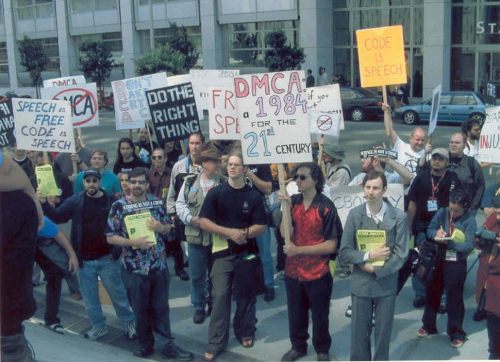
Biella Coleman: Now for the harder photo request: Free Dmitry!

Free Dmitry! So one my favorite fieldwork photos is the one above and I would love to include it in my book but I have no idea where I got it from much less who took it. The photo was taken during a San Francisco protest against the DMCA, and more urgently at the time, also calling for the release of Dimitry Sklyrov (and we were all listening to Richard Stallman who was giving a small speech and I am on the right hand side of the photo, furiously scribbling notes) I am looking for a high quality photo from one of the many Dmitry Sklyarov protests that were held in San Francisco or San Jose a photo that is either under CC license or given to me with formal permission to publish (I have forms to get official permissions). As I mentioned in my previous post, the book will be published with Princeton University Press with a CC license.

Next.

Previous.