Search Results: "fh"

20 August 2015

Axel Beckert: German-written Debian Package Management Book

Thursday was our big day: After more than 2.5 years of working in the hidden, ups and downs, Frank Hofmann and myself were able to announce the availability of our book project Debian Package Management under a free license (Creative Commons Attribution ShareAlike 4.0 International License, short CC BY-SA 4.0 ) during a Lightning Talk at DebConf15 in Heidelberg. This became possible because we found Onyx Neon, a publishing company which is specialised on books with contents under free licenses. Its founder does not only have a faible for Perl but also for Debian. (Since the question already came up: We also thought about self-publishing, e.g. via Lulu or Epubli and it would have been our fallback solution , but we prefer the professionalism and services of a real publisher. I m though happy to share what I found out about self-publishing in the past few months.) The source code of the book is written in the AsciiDoc format and available on GitHub. The book is still work in progress. But if you want, you can already build an e-book out of the publically available source code:
sudo apt-get install asciidoc dblatex git
git clone git://github.com/dpmb/dpmb.git
cd dpmb
make
(Works fine on Debian 7 Wheezy, Debian 8 Jessie and Ubuntu 14.04 LTS Trusty. Does not work on Ubuntu 12.04 LTS Precise.) If you find an error in the book, please file an issue on GitHub. If you also know how to fix the error, please for the Git repository on GitHub, fix the error in your Git repository and file a pull request. (The first pull request already happenend and has been applied.) Initially there will be only a German written issue as e-book (at least in HTML, PDF and EPUB formats, maybe also KF8/MOBI and EPUB3) and at some point in the future also as printed book at Onyx Neon. But we re also planning a translation to English as well as a Debian package. If your want to get informed when we publish a printed book, a translation or an official e-book release, please subscribe to one of our mailing lists: There s one in German and one in English.

Simon Kainz: vim in Heidelberg

Following the tradition of Love Locks, apparently there is someone really in love with vim in Heidelberg! Valerie Found at the Old Bridge in Heidelberg during DebConf15.

16 August 2015

Ben Armstrong: McIntosh Run Hike the Greenbelt event, August 2015

Just came back from a wonderful time hiking with my daughter at the finale Hike the Greenbelt event at the Backlands/McIntosh Run! This photo slideshow is from my HP snapshot camera which unfortunately has dust in the lens. But I felt it was more important to get them up soon than to get them perfect, so please click the photo below to start the slideshow. I want to thank everyone who made this event a success, and not going to name specific names as I m sure I ll miss someone important. But thanks especially to Martin, the leader of our group. [slb_group]
Marcos Zentilli explaining geology of the region. Click photo to start slideshow.Marcos Zentilli explaining geology of the region. Click photo to start slideshow.
Barrens Barrens Barrens Barrens DIGITAL CAMERA Jack Pine in Jack Pine ;) DIGITAL CAMERA DIGITAL CAMERA DIGITAL CAMERA DIGITAL CAMERA Part of the waterway DIGITAL CAMERA DIGITAL CAMERA DIGITAL CAMERA DIGITAL CAMERA DIGITAL CAMERA DIGITAL CAMERA DIGITAL CAMERA DIGITAL CAMERA DIGITAL CAMERA DIGITAL CAMERA DIGITAL CAMERA DIGITAL CAMERA DIGITAL CAMERA
facebooktwittergoogle_plusredditpinterestlinkedinmail

3 August 2015

Jamie McClelland: Agents, the kinds that work for us.

I recently decided I wanted to adjust how long my gpg password cache lasts and realized I had no idea how either my ssh-agent or gpg-agent was being launched or even which programs were being used as the agent for which protocol. While I appreciate that everthing just works based on blind faith, I decided to investigate more closely. I started by reading the man pages for ssh-agent and gpg-agent and discovered that gpg-agent could be used for providing ssh-agent. Since I run openbox, I decided to dig through my ~/.config/openbox/autostart file and discovered that I was also launching gnome-keyring-daemon, which provides both an ssh-agent and a gpg-agent. This is getting confusing. I then examined the output of ps -eFH and found this:
jamie    28499 28489  0  1082  1516   1 10:06 tty1     00:00:00     /bin/sh /usr/bin/startx
jamie    28542 28499  0  3987  1912   1 10:06 tty1     00:00:00       xinit /etc/X11/xinit/xinitrc -- /etc/X11/xinit/xserverrc :0 vt1 -auth /tmp/serverauth.gn3C5pYbPc
root     28543 28542  0 58065 25036   3 10:06 tty1     00:00:05         /usr/bin/X -nolisten tcp :0 vt1 -auth /tmp/serverauth.gn3C5pYbPc
jamie    28548 28542  0 69563 19980   0 10:06 tty1     00:00:00         /usr/bin/openbox --startup /usr/lib/x86_64-linux-gnu/openbox-autostart OPENBOX
jamie    28604 28548  0  2774   348   1 10:06 ?        00:00:00           /usr/bin/ssh-agent /usr/bin/gpg-agent --daemon --sh --write-env-file=/home/jamie/.gnupg/gpg-agent-info-animal /usr/bin/dbus-launch --exit-with-session /usr/bin/monkeysphere-validation-agent /usr/bin/im-launch /home/jamie/.xsession
jamie    28605 28548  0  4915   248   0 10:06 ?        00:00:00           /usr/bin/gpg-agent --daemon --sh --write-env-file=/home/jamie/.gnupg/gpg-agent-info-animal /usr/bin/dbus-launch --exit-with-session /usr/bin/monkeysphere-validation-agent /usr/bin/im-launch /home/jamie/.xsession
jamie    28610 28548  0 22402 34456   0 10:06 tty1     00:00:00           /usr/bin/perl -wT /usr/bin/monkeysphere-validation-agent /usr/bin/im-launch /home/jamie/.xsession
Further down (and not nested under the xinit process), I found my gnome-keyring-daemon process. I started by removing my own call to gnome-keyring-daemon and realized that everything still worked fine (both gpg and ssh). I must have added that line before things were configured system-wide to run automatically. Then, I saw that the gpg-agent was being launched without the --enable-ssh-support option (and ssh-agent was running), so looks like ssh is handled by ssh-agent and gpg is handled by gpg-agent. So far so good. Now, how do they get launched?? I start my graphical session by logging in at a console and running exec startx. In my home directory, I have ~/.xsession which contains the line exec /usr/bin/openbox-session. Therefore, I started by scouring all things openbox on my system and couldn't find any reference to these agents. Next, I turned my attention to X. Based on my ps -eFH output, I started with /etc/X11/xinit/xinitrc, which led me to /etc/X11/Xsession which led me to /etc/X11/Xsession.d and presto, I found my answer: a series of shell scripts that modify a global variable STARTUP which is executed by X. Thanks Debian developers for making it all work out of the box!

10 July 2015

Gunnar Wolf: Finishing the course on "Free Software and Open Standards"

A couple of months ago, I was invited to give the starting course for the Masters degree in Free Software in the Universidad Andina Sim n Bol var university. UASB is a multinational university, with campuses in (at least) Ecuador, Chile, Bolivia and Colombia; I was doubtful at first regarding the seriousness of this proposal and the viability of the program, but time made my doubts disappear. Bolivia is going through an interesting process, as they have one of the strongest worded government mandates for migration to free software for the public administration in the next couple of years; this migration has prompted the interest of many professionals in the country. In particular, we have over 40 registered people for this Masters degree. Studying a Masters degree is a long-term commitment which signifies a big time investment, and although many of the student are quite new to the idea of free software, they are willing to spend this time (and money, as the university is privately owned and charges for its enrollment). I gave this class together with Alejandro Miranda (a.k.a. @pooka), as we have a very good pair-teaching dynamics; we had already given many conferences together, but this is the first time we had the opportunity to share a whole course and the experience was very good. We have read the students' logs, and many of them clearly agree with this. I had to skip two of the (ten) lessons, as I travelled from Mexico to Argentina halfway through it (of course, we brought the babies to meet my wife's family and friends!), so we had also the honor of having Esteban Lima fill in for those sessions. I am very happy and grateful that the University took care to record our presentations and intend to record and put online all of the classes; as we were the first in the program, there were some understandable hiccups and some sessions were lost, but most are available. Here they are, in case you are interested in refering to them:
Topic Video (my server) Video (Youtube)
Introduction to free software Watch Watch
History Watch Watch
Free culture N/A N/A
The effects of free software Watch Watch
Free software and open standards related to technologic soverignity Watch Watch
The free software ecosystem Watch Watch
Free software implementation in Bolivia Watch Watch
Introduction to intelectual property: Copyright, patents, trademarks, etc. Watch Watch
Who is "the community" and why do we speak about it? Watch Watch
Current status and challenges for the movement N/A N/A
We have yet another video file (which I have not fully followed through) titled ADSIB - Migration plan. It can also be downloaded from my server or watched online at Youtube. All in all: This was a great opportunity and a joy to do. I think the material we used and developed fit well what was expected from us, and we had fun giving somewhat heterodox readings on our movement.

8 June 2015

Timo Jyrinki: Quick Look: Dell XPS 13 Developer Edition (2015) with Ubuntu 14.04 LTS

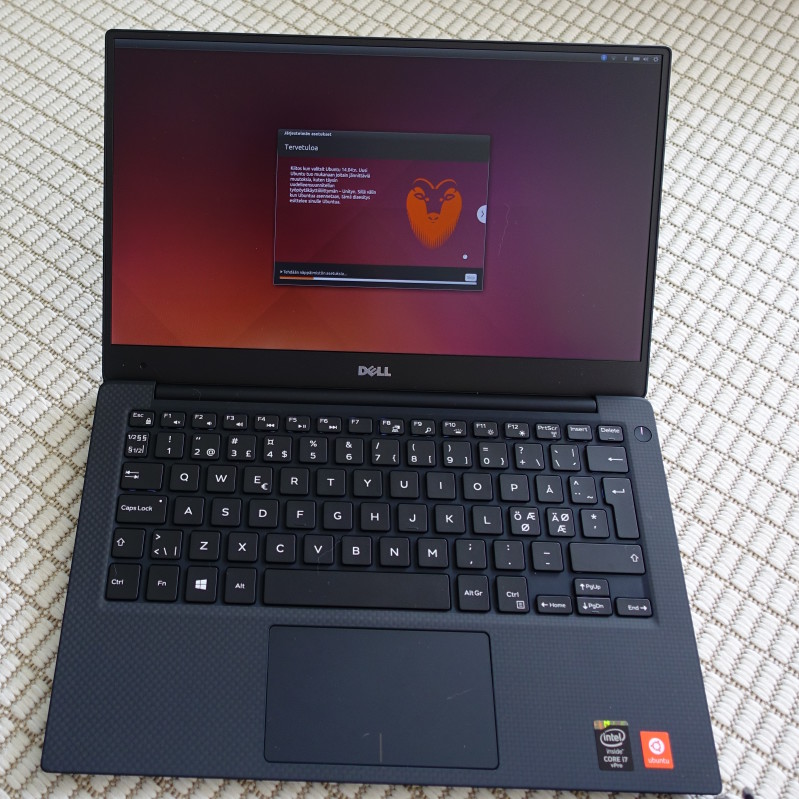
I recently obtained the newest Dell's Ubuntu developer offering, XPS 13 (2015, model 9343). I opted in for FullHD non-touch display, mostly because of better battery life, the actual no need for higher resolution, and matte screen which is great outside. Touch would have been "nice-to-have", but in my work I don't really need it.

The other specifications include i7-5600U CPU, 8GB RAM, 256GB SSD [edit: lshw], and of course Ubuntu 14.04 LTS pre-installed as OEM specific installation. It was not possible to directly order it from Dell site, as Finland is reportedly not online market for Dell... The wholesale company however managed to get two models on their lists and so it's now possible to order via retailers. [edit: here are some country specific direct web order links however US, DE, FR, SE, NL]

In this blog post I give a quick look on how I started up using it, and do a few observations on the pre-installed Ubuntu included. I personally was interested in using the pre-installed Ubuntu like a non-Debian/Ubuntu developer would use it, but Dell has also provided instructions for Ubuntu 15.04, Debian 7.0 and Debian 8.0 advanced users among else. Even if not using the pre-installed Ubuntu, the benefit from buying an Ubuntu laptop is obviously smaller cost and on the other hand contributing to free software (by paying for the hardware enablement engineering done by or purchased by Dell).
Unboxing
The Black Box. (and white cat)

Opened box.


First time lid opened, no dust here yet!
First time boot up, transitioning from the boot logo to a first time Ubuntu video.
A small clip from the end of the welcoming video.
First time setup. Language, Dell EULA, connecting to WiFi, location, keyboard, user+password.
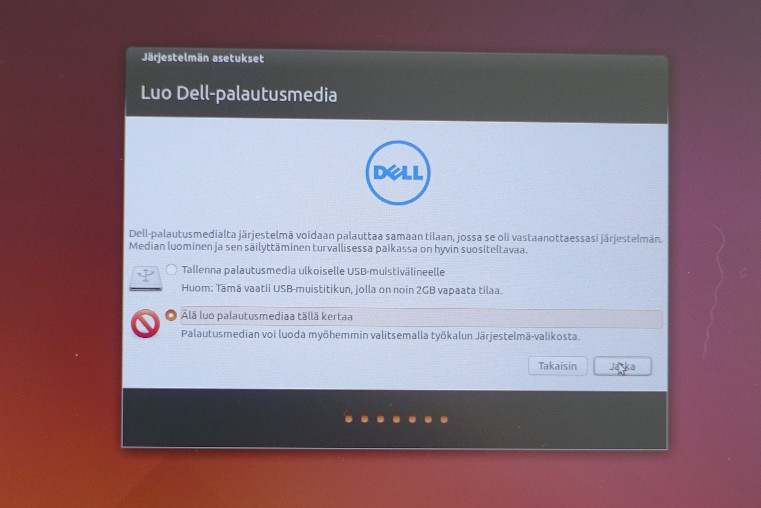
Creating recovery media. I opted not to do this as I had happened to read that it's highly recommended to install upgrades first, including to this tool.
Finalizing setup.
Ready to log in!
It's alive!
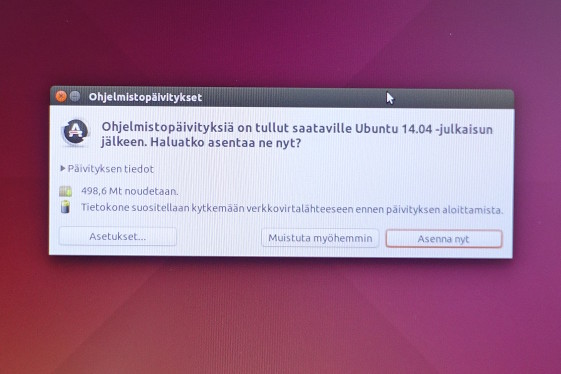
Not so recent 14.04 LTS image... lots of updates.
Problems in the First BatchUnfortunately the first batch of XPS 13:s with Ubuntu are going to ship with some problems. They're easy to fix if you know how to, but it's sad that they're there to begin with in the factory image. There is no knowledge when a fixed batch will start shipping - July maybe?

First of all, installing software upgrades stops. You need to run the following command via Dash Terminal once: sudo apt-get install -f (it suggests upgrading libc-dev-bin, libc6-dbg, libc6-dev and udev). After that you can continue running Software Updater as usual, maybe rebooting in between.

Secondly, the fixed touchpad driver is included but not enabled by default. You need to enable the only non-enabled Additional Driver as seen in the picture below or instructed in Youtube.

Dialog enabling the touchpad driver.

Clarification: you can safely ignore the two paragraphs below, they're just for advanced users like me who want to play with upgraded driver stacks.

Optionally, since I'm interested in the latest graphics drivers especially in case of a brand new hardware like Intel Broadwell, I upgraded my Ubuntu to use the 14.04.2 Hardware Enablement stack (matches 14.10 hardware support): sudo apt install --install-recommends libgles2-mesa-lts-utopic libglapi-mesa-lts-utopic linux-generic-lts-utopic xserver-xorg-lts-utopic libgl1-mesa-dri-lts-utopic libegl1-mesa-drivers-lts-utopic libgl1-mesa-glx-lts-utopic:i386

Even though it's much better than a normal Ubuntu 14.10 would be since many of the Dell fixes continue to be in use, some functionality might become worse compared to the pre-installed stack. The only thing I have noticed though is the internal microphone not working anymore out-of-the-box, requiring a kernel patch as mentioned in Dell's notes. This is not a surprise since the real eventual upstream support involves switching from HDA to I2S and during 14.10 kernel work that was not nearly done. If you're excited about new drivers, I'd recommend waiting until August when the 15.04 based 14.04.3 stack is available (same package names, but 'vivid' instead of 'utopic'). [edit: I couldn't resist myself when I saw linux-generic-lts-vivid (3.19 kernel) is already in the archives. 14.04.2 + that gives me working microphone again!]
ConclusionDell XPS 13 Developer Edition with Ubuntu 14.04 LTS is an extremely capable laptop + OS combination nearing perfection, but not quite there because of the software problems in the launch pre-install image. The laptop looks great, feels like a quality product should and is very compact for the screen size.

I've moved over all my work onto it and everything so far is working smoothly in my day-to-day tasks. I'm staying at Ubuntu 14.04 LTS and using my previous LXC configuration to run the latest Ubuntu and Debian development versions. I've also done some interesting changes already like LUKS In-Place Conversion, converting the pre-installed Ubuntu into whole disk encrypted one (not recommended for the faint hearted, GRUB reconfiguration is a bit of a pain).

I look happily forward to working a few productive years with this one!

19 May 2015

Andrew Cater: CI20 - MIPS dev. board - first impressions.

Annoyingly, I've bought one of these just before the form factor changes and it becomes a nice square board.

Up and running immediately out of the box, which is nice.

The kernel supplied on NAND flash is recent enough that it supports CONFIG_FHANDLE which is needed for the upgrade to Jessie.

The instructions for Jessie upgrade are straightforward and appear to be working correctly: they also suggest apt-get autoremove and apt-get autoclean to clean up which is a very nice touch.

The sources.list in apt was already pointing to my country's Debian mirror which was even nicer.

Quite a good experience immediately from unboxing: it also adds to the number of machine architectures I've run Debian on:
alpha, amd64, arm, armel, armhf, i386, sparc - not bad for a start.

It's a bit slow - but it's a SoC, so what can you expect? The PowerVR graphics demos were spectacular but the drivers are very definitely non-free - you can't have everything.

[I do notice that there is an FSF-friendly Debian variant, though not yet certified as such - presumably not including PowerVR drivers]

(Lots of occurrences of the word "nice" in this post that I've just noticed. It's either understatement or just that I'm British)

17 May 2015

Lunar: Reproducible builds: week 3 in Stretch cycle

What happened about the reproducible builds effort for this week: Toolchain fixes Tomasz Buchert submitted a patch to fix the currently overzealous package-contains-timestamped-gzip warning. Daniel Kahn Gillmor identified #588746 as a source of unreproducibility for packages using python-support. Packages fixed The following 57 packages became reproducible due to changes in their build dependencies: antlr-maven-plugin, aspectj-maven-plugin, build-helper-maven-plugin, clirr-maven-plugin, clojure-maven-plugin, cobertura-maven-plugin, coinor-ipopt, disruptor, doxia-maven-plugin, exec-maven-plugin, gcc-arm-none-eabi, greekocr4gamera, haskell-swish, jarjar-maven-plugin, javacc-maven-plugin, jetty8, latexml, libcgi-application-perl, libnet-ssleay-perl, libtest-yaml-valid-perl, libwiki-toolkit-perl, libwww-csrf-perl, mate-menu, maven-antrun-extended-plugin, maven-antrun-plugin, maven-archiver, maven-bundle-plugin, maven-clean-plugin, maven-compiler-plugin, maven-ear-plugin, maven-install-plugin, maven-invoker-plugin, maven-jar-plugin, maven-javadoc-plugin, maven-processor-plugin, maven-project-info-reports-plugin, maven-replacer-plugin, maven-resources-plugin, maven-shade-plugin, maven-site-plugin, maven-source-plugin, maven-stapler-plugin, modello-maven-plugin1.4, modello-maven-plugin, munge-maven-plugin, ocaml-bitstring, ocr4gamera, plexus-maven-plugin, properties-maven-plugin, ruby-magic, ruby-mocha, sisu-maven-plugin, syncache, vdk2, wvstreams, xml-maven-plugin, xmlbeans-maven-plugin. The following packages became reproducible after getting fixed: Some uploads fixed some reproducibility issues but not all of them: Ben Hutchings also improved and merged several changes submitted by Lunar to linux. Currently untested because in contrib: reproducible.debian.net
Thanks to the reproducible-build team for running a buildd from hell. gregor herrmann
Mattia Rizzolo modified the script added last week to reschedule a package from Alioth, a reason can now be optionally specified. Holger Levsen splitted the package sets page so each set now has its own page. He also added new sets for Java packages, Haskell packages, Ruby packages, debian-installer packages, Go packages, and OCaml packages. Reiner Herrmann added locales-all to the set of packages installed in the build environment as its needed to properly identify variations due to the current locale. Holger Levsen improved the scheduling so new uploads get tested sooner. He also changed the .json output that is used by tracker.debian.org to lists FTBFS issues again but only for issues unrelated to the toolchain or our test setup. Amongst many other small fixes and additions, the graph colors should now be more friendly to red-colorblind people. The fix for pbuilder given in #677666 by Tim Landscheidt is now used. This fixed several FTBFS for OCaml packages. Work on rebuilding with different CPU has continued, a kvm-on-kvm build host has been set been set up for this purpose. debbindiff development Version 19 of debbindiff included a fix for a regression when handling info files. Version 20 fixes a bug when diffing files with many differences toward a last line with no newlines. It also now uses the proper encoding when writing the text output to a pipe, and detects info files better. Documentation update Thanks to Santiago Vila, the unneeded -depth option used with find when fixing mtimes has been removed from the examples. Package reviews 113 obsolete reviews have been removed this week while 77 has been added.

19 April 2015

Laura Arjona: Six months selfhosting: my userop experiences

Note: In this post I mention some problems and ask questions (to myself, like thinking aloud ). The goal is not to get answers to those questions (I suppose that I will find them soon or later in the internet, manuals and so), but to show the kind of problems and questions that arise in my selfhosting adventures, which I suppose are common to other people trying to administer a home server with some web services. Am I an userop? Well I m something in the middle of (GNU/Linux) user and sysadmin: I have studied computer technical engineering but most of my experience has been in helpdesk, providing support for Windows users. I m running Debian in some LAMP boxes at work (without GUI) since 2008 or so, and in my desktops (with GUI) since 2010. I don t code nor package, but I don t mind trying to read code and understand it (or not). I know a bit of C, a bit of Python, of PHP, and enough Perl to open a Perl file and close it after two minutes, understanding that it s great, but too much for me :) I translate software, so I m not scared to clone a repository, edit files, commit or submit a patch. I m not scared of compiling a program (except if it s an Android app: I try to avoid setting up the development environment just to try some translation that I made but I built my Puma before it was the binary available for download or in F-Droid). In conclusion, I feel more like a GNU/Linux power user than a sysadmin . Sometimes just a user or even a newbie (for example, I don t know very well the Unix/Linux folder tree where are the wallpapers stored? Does it depend on the desktop that I use?). Anyway. I won t stop my free software + free networks digital life because I don t know many things. I bought a small server for home last September, and I wanted to try to selfhost some services, for me and for my family. I want to be a home sysadmin or something like that, so I joined the userops mailing list :) Here you have my experiences on selfhosting/being an userop until now. Mail I even didn t try to setup my mail server, because many people say it s a pain (although nice articles were published about how to do it, for example this series in ArsTechnica) and I need a static IP which is 14 /month more to my ISP, and Gandi, the place where I rented my domain name, provides mail, and they use Debian and Roundcube, and sponsor Debian too, so I decided to trust on them. So this is my strategy now, to try to keep mail under my control: MediaGoblin I ve setup two MediaGoblin instances (yes, two!). I managed to do it in Debian 7 stable (I think NodeJS npm was not needed then), but soon later I upgraded to Jessie so now it s even better. I installed Nginx and PostgreSQL via apt, to use them for both instances (and probably some more software later). One instance is public, and I use a Debian user, a PostgreSQL database, and it s running in http://media.larjona.net
I have requested an SSL cert to Gandi but I still didn t deployed it (lazy LArjona!!). The other instance is private, for family photos. I didn t know very well how much of my existing setup could reuse and how to keep both instances in case of downtimes or attack I know more or less the concept or chroot but I don t know how to deploy it in my machine. So I decided to use another Debian user, another PostgreSQL database, deploy MediaGoblin in a different folder, and create another virtual server in my Nginx to serve it. I managed to setup that virtual server to http-authenticate and to serve content via a different port, and use a self-signed SSL certificate (it s only for family, so it does not matter). I created another (unprivileged) Debian user with a password for the nginx authentication, and gave my family the URL in the form https://mediaprivate.larjona.net:PortNumber and the user and password (mediaprivate is a string, and PortNumber is a number). I think they don t use the instance too much, but at least I upload photos there from time to time and email the link instead of emailing the photos themselves (they don t use GPG either ). Upgrades I upgraded MediaGoblin from 0.7.1 to 0.8.0 successfully, I sent a report about how I did it to the mailing list. First I upgraded the public instance, when I figure out the process, I upgraded the second instance to test my instructions, and then, I sent the report with the instructions to the mailing list. Static site and LimeSurvey: the power of free software (with instructions) I wanted to act as a mirror of floss2013.libresoft.es and surveys.libresoft.es since they suffer a downtime and I participated in that project (not in the sysadmin part, but in the research and content creation). The static site floss2013.libresoft.es offered a zip with the whole website tree (since the website was licensed as AGPL), and I had access to the git repo holding the development copy of the website. So I just cloned the repository and setup another nginx virtual server in my machine, and tuned my DNS zone in Gandi website to serve floss2013.larjona.net from home. 10 minutes setup YAY! #inGitWeTrust #FreeSoftwareFTW :) For surveys.larjona.net I had to install a LimeSurvey instance. I knew how to do it because we use LimeSurvey at work, but at home I had Nginx instead of Apache, and PostgreSQL instead of MySQL. And no PHP I searched about how to install PHP in Nginx (I can use apt-get, nice!) and how to install LimeSurvey with Nginx and PostgreSQL (I had documentation about that, so I followed, and it worked). For making available the data (one survey and its results, so people can login as visitor to query and get statistics), I downloaded the LimeSurvey export dataset that we were providing in the static website, followed the replication instructions (hey, I wrote them!), and they worked #oleole! (And here, dear researchers, gets demonstrated that free software and free culture really empower your research and help spreading your results). Etherpad: not so easy, it seems! I m trying to install Etherpad-Lite, but I m suffering a bit. I think I did everything ok according to some guides but I get Bad Gateway and these kind of errors when trying to browse with Lynx in the host:
[error] 3615#0: *24 upstream timed out (110: Connection timed out) 
while reading response header from upstream, 
client: 127.0.0.1, 
server: pad.larjona.net, 
request: "GET / HTTP/1.0", 
upstream: "http://127.0.0.1:9001/", 
host: "pad.larjona.net"
2015/04/17 20:52:56 [error] 3615#0: *24 connect() failed 
(111: Connection refused) while connecting to upstream, 
client: 127.0.0.1, 
server: pad.larjona.net, 
request: "GET / HTTP/1.0", 
upstream: "http://[::1]:9001/", 
host: "pad.larjona.net"
I m not sure if I need to open some port in iptables, my router, or change my nginx configuration because the guides assume you re only serving one website in the port 80 (and I have several of them, now ), or what I ve spent three chunks of time (maybe ~2h each?) on this, in different days, and couldn t figure it out, so I decided to round-robin in my TODO list. Userops thoughts Debian brings peace of mind (for me) On one side, maintaining a Debian box it s quite easy, and the more software that it s packaged, the less time that I spend installing or upgrading. I like being in stable, I m in Jessie now (I migrated when it was frozen), but I ll stay in stable as much as I can. I like that I can use the software that I installed via apt-get for several services (nginx, PostgreSQL ). About the software that is not packaged (MediaGoblin, LimeSurvey, EtherPad, maybe others later), I wonder how dependencies and updates are handled. And maybe (probably) I have installed some components several times, one for each service (this sounds like a Windows box #grr). For example MediaGoblin uses PyPump. PyPump 0.5 is packaged in Debian Jessie. MediaGoblin uses PyPump 0.7+. What if PyPump 0.7+ gets, let s say, into Jessie-backports? Can I benefit from that? I know that MediaGoblin upgrade instructions includes upgrading the dependencies, but what about some security patch in one dependency? Should I upgrade the pip modules periodically? How to know if some upgrade is recommended because patches a vulnerability, or it s just new features (and maybe breaking my setup)? This kind of things are the peace of mind that Debian packaging brings to me: when some piece of software is packaged, I know maybe I need to care about proper setup and configuration, but later, it s kind-of-easy to maintain (since the Debian maintainers care about the rest). I don t mind about cloning a repo and compiling, I mind about later, or coexistance with other program/services. I trust in the MediaGoblin community and I m an active member (I m not developer, but hang on IRC, follow the mailing list, etc) but for example I don t know anything about the EtherPad project. And I don t feel like joining the community (I m already an active member in Debian, MediaGoblin, F-Droid, Pump.io, translator of LimeSurvey and many other small apps that I use, and in the future will use more services, like OwnCloud, XMPP ), joining the community of each software that I use is becoming not sustainable :s Free software is more than software I follow the userop mailing list, and it s becoming very technical. I mostly understand the problems (which are similar to the problems that I face: how to isolate different services, how to easily-configure them, how to make them installable by average user ) But I don t understand most of the solutions proposed, and I think that probably we need technical solutions, but in the meanwhile, some issues can be addressed not with software, but with other means: good documentation, community support, translations, beta-testers This is my conclusion until now. When a project is well documented, I think I can find my way to selfhost no matter if the software is packaged (or contained ) or not. MediaGoblin, and LimeSurvey, are well documented, and the user support channels are very responsive. I find lots of instructions that assume that you will use a whole machine for their service (and not for other things). And lots of documentation for the LAMP stack, but not for Nginx + PostgreSQL and Node instead of PHP So, for each particularity of my setup, I search the internet and try to pick good sources to help me do what I wanted to do. I m kind of privileged Some elements, not software related, to take into account as pre-requisites for succeed selfhosting services: These aspects are not present in a lot of people. If I look around to the computer users that I know (mostly Windows+Android, some GNU/Linux users, some Mac OSX users, some iOS users), I find that they search things like X does not work or they cannot write a proper search query in English. Or they trust some random person writing a recipe in their blog, without trying first to understand what the recipe does. Other people just say I m not a professional sysadmin, I ll just do what everybody does (aka use Google services or whatever). What if I try and I don t succeed? . Things like that. We may need some technical solutions (and hackers are thinking about that, and working on that). But I feel that we need (more) a huge group of beta-testers, dogfooding people, aventurers that try the half-cooked solutions and provide successful and unsuccessful experiences, to guide the research and make software technologies advance. I m not sure if I am an userop, but I feel part of that vanguard force , I want to be part of the future of free software and free networks. Comments? You can comment about this post on this pump.io thread.
Filed under: My experiences and opinion Tagged: Communities, Contributing to libre software, Debian, Developer motivations, English, free networks, Free Software, Freedom, innovation, MediaGoblin, Moving into free software, Project Management, selfhosting, sysadmin

31 March 2015

Laura Arjona: Upgrading my home server (HP Microserver N54L G7) to Debian Jessie

Note: this is a long overdue post. I upgraded some months ago but I promised myself to blog about my selfhosting adventures, so here you are.
You may know the story TL;DR After searching a bit for information about my problem and not finding anything helpful, I began to think that maybe upgrading to Jessie could fix it (recent versions of kernel and cryptsetup ). And the Jessie freeze was almost there, and I also thought that trying to make my MediaGoblin work in Jessie now that I still didn t upload lots of content, would be a nice idea And, I wanted to feel the adventure! Whatever. I decided to upgrade to Jessie. This is the glory of free software at home : you only waste your time (and probably not, because you can learn something, at least, what not to do). Upgrading my system to Jessie, and making it boot! I changed sources.list, updated, did a safe-upgrade, and then upgrade. Then reboot and the system didn t boot. What happened? I m not sure, everything looked ok during the upgrade But now, my system even was not asking for the passphrase to unlock the encrypted disk. It was trying to access the physical volume group as if it was in an unencrypted disk, and so, failing. The boot process left me in a initramfs console in which I didn t know what to do. I asked help from @luisgf, the system administrator of mipump.es (a Pump.io public server) and mijabber.es (an XMPP public server). We met via XMPP and with my thinking aloud and his patient listening and advice, we solved the problem, as you will see: I tried to boot my rescue system (a complete system installed in different partitions in a different disk) and it booted. I tried then to manually unencrypt the encrypted disk (cryptsetup luksopen /dev/xxx), and it worked, and I could list the volume group and the volumes, and activate them, and mount the partitions. Yay! my (few) data was safe. I rebooted and in the initramfs console I tried to do the same, but cryptsetup was not present in my initramfs. Then I tried to boot in the old Wheezy kernel: it didn t asked for the passphrase to unencrypt the disk, but in that initramfs console, cryptsetup was working well. So after manually unencrypt the system, activate the volumes and mount the partitions, I could exit the console and the system was booting #oleole! So, how to tell the boot process to ask for the encryption password? Maybe reinstalling the kernel was enough I tried to reinstall the 3.16 kernel package. It (re)generated /boot/initrd.img-3.16.0-4-amd64 and then I restarted the system, and the problem was solved. It seems that the first time, the kernel didn t generate the initrd image correctly, and I didn t notice about that. Well, problem solved. My system was booting again! No other boot problems and Jessie seemed to run perfectly. Thanks @luisgf for your help! In addition to that, since then, my password has been accepted in every reboot, so it seems that the original problem is also gone. A note on systemd After all the noise of last months, I was a bit afraid that any of the different services that run on my system would not start with the migration to systemd.
I had no special tweaks, just two handmade init scripts (for MediaGoblin, and for NoIP), but I didn t write them myself (I just searched about systemd init scripts for the corresponding services), so if it was any problem there I was not sure that I could solve it. However, everything worked fine after the migration. Thanks Debian hackers to make this transition as smooth as possible! Reinstalling MediaGoblin My MediaGoblin was not working, and I was not sure why. Maybe it was just that I need to tune nginx or whatever, after the upgrade But I was not going to spend time trying to know what part of the stack was the culprit, and my MediaGoblin sites were almost empty So I decided to follow again the documentation and reinstall (maybe update would be enough, who knows). I reused the Debian user(s), the PostgreSQL users and databases, and the .ini files and nginx configuration files. So it was quick, and it worked. Updating Jessie I have updated my Jessie system several times since then (kernel updates, OpenSSL, PostgreSQL, and other security updates and RC bugs fixes, with the corresponding reboots or service restarts) and I didn t experience the cryptsetup problem again. The system is working perfectly. I m very happy. Using dropbear to remotely provide the cryptsetup password The last thing I made in my home server was setting up dropbear so I can remotely provide the encryption password, and then, remotely reboot my system. I followed this guide and it worked like a charm. Some small annoyances and TODO list
[  0.203617] [Firmware Bug]: ACPI: BIOS _OSI(Linux) query ignored
[  0.214828] ACPI: Dynamic OEM Table Load:
[  0.214841] ACPI: OEMN 0xFFFF880074642000 000624 (v01 AMD  NAHP  00000001 INTL 20051117)
[  0.226879] \_SB_:_OSC evaluation returned wrong type
[  0.226883] _OSC request data:1 1f 
[  0.227055] ACPI: Interpreter enabled
[  0.227062] ACPI Exception: AE_NOT_FOUND, While evaluating Sleep State [\_S1_] (20140424/hwxface-580)
[  0.227067] ACPI Exception: AE_NOT_FOUND, While evaluating Sleep State [\_S2_] (20140424/hwxface-580)
[  0.227070] ACPI Exception: AE_NOT_FOUND, While evaluating Sleep State [\_S3_] (20140424/hwxface-580)
[  0.227083] ACPI: (supports S0 S4 S5)
[  0.227085] ACPI: Using IOAPIC for interrupt routing
[  0.227298] HEST: Table parsing has been initialized.
[  0.227301] PCI: Using host bridge windows from ACPI; if necessary, use "pci=nocrs" and report a bug
And this one
[  1.635130] ERST: Failed to get Error Log Address Range.
[  1.645802] [Firmware Warn]: GHES: Poll interval is 0 for generic hardware error source: 1, disabled.
[  1.645894] GHES: APEI firmware first mode is enabled by WHEA _OSC.
And this one, about the 250GB disk (it came with the server, it s not in the RAID):
[    3.320913] ata6: SATA link up 3.0 Gbps (SStatus 123 SControl 300)
[    3.321551] ata6.00: failed to enable AA (error_mask=0x1)
[    3.321593] ata6.00: ATA-8: VB0250EAVER, HPG9, max UDMA/100
[    3.321595] ata6.00: 488397168 sectors, multi 0: LBA48 NCQ (depth 31/32)
[    3.322453] ata6.00: failed to enable AA (error_mask=0x1)
[    3.322502] ata6.00: configured for UDMA/100
A note about RAID Some people commented about the benefits of the software RAID (mainly, not to depend on a particular, proprietary firmware, what happens if my motherboard dies and I cannot find a compatible replacement?). Currenty I have a RAID 1 (mirror) using the capabilities of the motherboard. The problem is that, frankly, I am not sure about how to migrate the current setup (BIOS RAID + cryptsetup + LVM + partitions) to the new setup (software RAID + cryptsetup + LVM + partitions, or better other order?). As you see, lots of things to read/think/try I hope I can find time for my home server more often! Comments? You can comment on this pump.io thread.
Filed under: My experiences and opinion Tagged: Debian, encryption, English, Free Software, libre software, MediaGoblin, Moving into free software, N54L, selfhosting, sysadmin

20 March 2015

Zlatan Todori : Interviews with FLOSS developers: Laura Arjona

One of fresh additions to Debian, that is showing Debian's commitment to diversity in all fields is Laura Arjona Reina. A helpful hand on channels and a great flux of FLOSS energy she brings with herself. Although applied for non-packaging Debian Developer status, Laura does recognize that there are still some technical aspects what must grasp on. Her dedication to FLOSS and trying to solve some of its issues is astonishing, as this woman is doing a lot of self-hosting and system administration. Yes, you read it right - she does all of that and still applied for non-packaging Debian Developer. She is perfect example how FLOSS enhances humans in many ways. Hello Laura. Picture of Laura Who are you? I am Laura Arjona, I work as IT assistant at Technic University of Madrid, I am married and I have a son, and I use and promote free (libre) software both at job and at home and with friends. I have a nice time contributing in Debian and other FLOSS projects but I always want to do more than what I manage to actually do (I hope I can improve that, as time goes by... and maybe when I get retired I am the SuperLArjona that you wrote about!). What parts of FLOSS community are you engaged? I use Debian, and CyanogenMod + F-Droid in my phone. I coordinate the translation of the Debian website into Spanish, help with FSFE website translation too, and translate some other free software (GNU MediaGoblin, F-Droid, Android apps that I use, web services that we use at work...). I use and promote some free social networks: pump.io, GNU Social, and XMPP. My work/friends environment is mostly Windows/Android so I try to find/promote libre software replacements or interesting applications for them. I give free FLOSS stickers to everybody showing interest for libre software, and a nice Debian sticker if they finally install it in their computers. Setup of your main machine? My machine is a humble Compaq Mini 110C laptop (32bits, Atom N270@1.60GHz, 1GB RAM) and I have Debian Jessie (future-stable ATM) with xfce on it. I'm not tied to particular tools, for example I use Mousepad for editing here in my xfce, Kate in my desktop at work, nano in the server. The only "tuning" that I always do is to set a dark background for terminals and text editors, but I don't even switch to a desktop dark theme... (BTW I love Jessie's theme, "Lines"!). I know there are awesome pieces of software out there (hey emacs-org-mode!), but I just don't have fun having to learn them by myself (no LUG near, I'm afraid...). Some memorable moments from Debian conferences? I've only been at Barcelona MiniDebConf Women 2014 and it was great. It was memorable that I promoted the keysigning for that MiniDebConf, and came home with lots of signatures and papers to verify and sign... and then I was not remembering my GPG main key passphrase! so I hid under my desk for two months, and then, decided to start again (created a new key and tried to meet some Debian people in Madrid...). So I guess I should go to some (Mini)DebConf again. You are currently involved in process of becoming non-packaging Debian Developer - what made you take that step? I began translating in 2011, and since then, I enjoyed contributing in Debian (women, l10n-es, website, publicity). I'm quite regular with the translation work, and applying for DD is a plan to 'force' myself to find chunks of time to contribute more in the other areas too. I also believe that applying I may help other people to also apply or get more involved or become more visible. So here I am. Although you applied for non-packaging Debian Developer you recognize that there is still a technical learning curve in Debian even for that - what are the technical aspects a non-Developer should grasp? Well, I suppose it depends on the area you are contributing. In Publicity you find repositories in git (bits.debian.org), and subversion (Debian Project News). The website uses CVS (www.debian.org)... So you need the basics of 3 different version control systems to commit your changes (or send them to the mailing list and wait somebody to commit them). We use a mail robot to coordinate the translation work, so you need to write the subject with a certain format, and some people complains when somebody send mail in HTML (plain text is preferred). There are some other tools such as IRC and GPG that I began using just for contributing to Debian. Once that you learn them a bit and you learn how Debian works, you understand they are the great tools and you get in love (hey meetbot and KGB! hey i18n.debian.org!), but I wonder how people with no technical background, or even Computer Engineering students nowadays, accostumed to instant messaging in the mobile, fancy web interfaces and so on, look at these tools and just don't even try. How do you see future of Debian development? I don't know, Debian is huge... Some areas in which I hope we, as a community, find the way to work more: packaging (or help configuring) web applications or network services, provide LTS support, and keep on improving outreach/diversity. What are your future plans in Debian, what would you like to work on? In the Spanish team area, my plan is to go on translating the website, jump more often into translating package descriptions too, and help first-time-contributors to keep themselves involved. In the website and publicity teams, I hope I manage to put some weekly time to help with pending tasks/bugs, and serve as liaison with the other areas in which I'm involved (women, l10n, contributors...). If I become DD, I would like to create/adopt some data sources for contributors.debian.org, or convince people to do it I'm not sure if I will be able to attend DebConf some year; meanwhile, at least, I'll continue trying to help with the blog and promotion (as -publicity-team member). Why should developers and users join Debian community? What makes Debian a great and happy place? For using it: the desktop experience has improved very much in the last years, there's a clear separation between free and non-free software so the Debian users always know where are we, and there is wide documentation (in English, at least. Probably in other languages too). For getting involved: I like very much that you can lurk what almost everybody does: just join some mailing lists or IRC channels, the Debian people work in the open. So you know a bit where are you jumping in. Later you learn that everything is easier than what was looking from the outside, because you make friends and with friends everything is better.
Contributions made to Debian have many chances to reach a very wide community: Debian users, upstream projects, and the hundreds of derivatives. It's a quite horizontal, decentralized organization (that has its downsides too, but I can live with them). Is there something you would change in FLOSS ecosystem? We need much more internationalization and localization efforts. People don't need English for using libre software nowadays in their desktop, it's one of our big strenghts, but they definitely need English for using libre software for Android, or solving problems with the libre software they use in your computers/devices, or to contribute to any community. I think we need more local groups for user support/outreach, more libre-software-based translation tools and online services (replacements for Google Translator, for Transifex...),and more internationalization and localization efforts (manuals, websites... not only the software itself). If we work hard in this area, we'll gain much more users and much more contributors. Why does privacy matter to you? I have a son, at our family we interchange photos, and sometimes I have private conversations using the smartphone, mail or other internet services. I want to have the chance that the day that I (or my family) need privacy, we can have it easily. And I want that the people that really need privacy today, have proper tools at their hand. So I try to use PGP, selfhost my multimedia website, use decentralized, free software based networks and XMPP mobile apps... to help those projects to thrive. I try do my part of the network effect! You are being upset with rise of Github - why is that and what would change would you like to see? I totally agree with Mako's essay "Free software needs free tools". Yes, many nonfree web services are easier and have better features right now, but the key is that only dogfooding can change that, the same like changed it with the GNU/Linux desktop and Open/LibreOffice for example...
I would like to see more people trying to selfhost, use and promote libre software based forges, so in addition to avoid vendor lock in and win consistency in our discourse, we polish the available tools and eventually win the battle also in the technical side. You are hosting yours own instances of Mediagoblin - as it is not officially packaged in Debian yet, how do you manage it and how would you encourage others to do it? I followed the MediaGoblin documentation for its last stable release, and hanged on the IRC channel when in doubts/problems. It was not so hard, because it's well documented for Debian systems, and most of the dependencies are already packaged (in stable and testing). MediaGoblin is in its way to stretch too (thanks simonft and the rest of people working on this!). I'm documenting my adventures with selfhosting in [my blog (http://larjona.wordpress.com), but I need to write more often, and put more time in my small server (now I try to selfhost my git projects with cgit, and I want to setup an XMPP server and Etherpad Lite too). You are trying to resolve with self-hosting personal issues with services such as WhatsUp and other non-free parts of our everyday lives- what issues are you hitting on during your way and how do you resolve them? "#iloveemail", but people don't love it anymore, it seems... I've researched a bit about instant messaging to try to propose alternatives to WhatsApp to my family and friends. It seems Conversations with a community XMPP server where to create multi user chat rooms can be a replacement, so my plan is to try during this year. Meanwhile, I've setup the MediaGoblin site so I upload the photos there instead of sending them with the phone, and for the 1-to-1 chat I try to move people to Kontalk (instant messaging, GPG, photos, voice notes...). For the videocalls, I promote Jitsi or just point people to meet.jit.si/FancyNameofChatRoom. I have account and owndrive.com and will try to host Owncloud too. We'll see what happens. You are interested in radio shows - what drives you into that field and will we see soon any podcasts from Laura? I like to talk and I'm not a shy person, so the few times that in any of my social groups there was a chance to "talk in the radio", I volunteered and enjoyed. This has been, in my life, 6 or 7 times (in Spanish, talking about social activism or politics. No records, though!). Some months ago the people of "El Binario" invited me to talk at "findenegro" about pump.io and free networks (in Spanish), I accepted and had a very nice time (audios in my mediagoblin). I wish I have more free time to listen to podcasts and maybe to join some other people to participate in a program in a regular basis. OTOH, my son asks for a tale almost each day... I follow one of Gianni Rodari "The grammar of fantasy"'s approach: take some day-to-day facts and add something unexpected and crazy, and tailor a short story. Maybe I could record them and publish in my MediaGoblin... Of course their literary quality is not even near to Gianni Rodari's but people that listened to them when I was storytelling (in the metro, my mother at home, some friends...) say they are fun and interesting. Who knows! Work of Laura's son

18 March 2015

Mario Lang: Call for Help: BMC -- Braille Music Compiler

Since 2009, I am persuing a personal programming project. As I am not a professional programmer, I have spent quite a lot of that time exploring options. I have thrown out about three or four prototype implementations already. My last implementation seems to contain enough accumulated wisdom to be actually useful. I am far from finished, but the path I am walking now seems relatively sound. So, what is this project about? I have set myself a rather ambitious goal: I am trying to implement a two-way bridge between visual music notation and braille music code. It is called BMC (Braille Music Compiler). My problem: I am, as some of you might remember, 100% blind. So I am trying to write a translator between something I will never see directly, and its counterpart representation in a tactile encoding I had to learn from scratch to be able to work on this project. Braille music code is probably the most cryptic thing I have ever tried to learn. It basically is a method to represent a 2-dimensional structure like staff-notation as a stream of characters encoded in 6-dot braille. As the goal above states, I am ultimately trying to implement a converter that works both ways. One of my prototypes already implemented reading digital staff notation (MusicXML) and transcribing it to Braille. However, to be able to actually understand all the concepts involved, I ended up starting from the other end of the spectrum with my new implementation: parsing braille music code and emitting digital staff notation (LilyPond and MusicXML). This is a rather unique feature, since while there is commercial (and very expensive) software out there to convert MusicXML to braille music code, there is, as far as I know, no system that allows to input un-annotated braille music code and have it automatically converted to sighted music notation. So the current state of things is, that we are able to read certain braille music code formats, and output either reformatted (to new line-width) braille music code, LilyPond or MusicXML. The ultimate goal is to also implement a MusicXML reader, and convert the data to something that can be output as braille music code. While the initial description might not sound very hard, there are a lot of complications arising from how braille music code works, which make this quite a programming challenge. For one, braille music note and rest values are ambigious. A braille music note or rest that looks like a whole can mean a whole or 16th. A braille music note or rest that looks like a half can mean a half or a 32nd. And so on. So each braille music code value can have two meanings. The actual value can be caluclated with a recursive algorithm that I have worked out from scratch over the years. The original implementation was inspired by Samuel Thibault (thanks!) and has since then evolved into something that does what we need, while trying to do that very fast. Most input documents can be processed in almost no time, however, time signatures with a value > 1 (such as 12/8) tend to make the number of possible choices exploed quite heavily. I have found so far one piece from J.S. Bach (BWV988 Variation 3) which takes about 1.5s on my 3GHz AMD (and the code is already using several CPU cores). Additionally, braille music code supports a form of "micro"-repetitions which are not present in visual staff notation which effectively allow certain musical patterns to be compressed if represented in braille. Another algorithmically interesting part of BMC that I have started to taclke just recently is the linebreaking problem. Braille music code has some peculiar rules when it comes to breaking a measure of musical material into several lines. I ended up adapting Donald E. Knuth's algorithm from Breaking Paragraphs into Lines for fixed-width text. In other words, I am ignoring the stretch/shrink factors, while making use of different penalty values to find the perfect solution for the problem of breaking a paragraph of braille music code into several lines. One thing that I have learnt from my perivous prototype (which was apparently useful enough to already acquire some users) is that it is not enough to just transcribe one format to another. I ultimately want to store meta information about the braille that is presented to the user such that I can implement interactive querying and editing features. Braille music code is complicated, and one of the original motivations to work on software to deal with it was to ease the learning curve. A user of BMC should be able to ask the system for a description of a character at a certain position. The user interface (not implemented yet) should allow to play a certain note interactively, or play the measure under the cursor, or play the whole document, and if possible, have the cursor scroll along while playback plays notes. These features are not implemented in BMC yet, but they have been impleemnted in the previous prototype and their usefulness is apparent. Also, when viewing a MusicXML document in braille music code, certain non-structural changes like adding/removing fingering annotations should be possible while preserving unhandled features of the original MusicXML document. This also has been implemented in the previous prototype, and is a goal for BMC.
I need your help The reason why I am explaining all of this here is that I need your help for this project to succeed. Helping the blind to more easily work with traditional music notation is a worthwhile goal to persue. There is no free system around that really tries to adhere to the braille music code standard, and aims to cover converting both ways. I have reached a level of conformance that surpasses every implementation of the same problem that I have seen so far on the net. However, the primary audience of this software is going to be using Windows. We desperately need a port to that OS, and a user interface resembling NotePad with a lot fewer menu entires. We also need a GTK interface that does the same thing on Linux. wxWindows is unfortunately out of question, since it does not provide the same level of Accessibility on all the platforms it supports. Ideally, we'd also have a Cocoa interface for OS X. I am afraid there is no platform independent GUI framework that offers the same level of Accessibility on all supported platforms. And since much of our audience is going to rely on working Accessibility, it looks like we need to implement three user interfaces to achieve this goal :-(. I also desperately need code reviews and inspiration from fellow programmers. BMC is a C++11 project heavily making use of Boost. If you are into one of these things, please give it a whirl, and emit pull requests, no matter how small they are. While I have learnt a lot in the last years, I am sure there are many places that could use some fresh winds of thought by people that are not me. I am suffering from what I call "the lone coder syndrome". I also need (technical) writers to help me complete the pieces of documentation that are already lying around. I have started to write a braille music tutorial based on the underlying capabilities of BMC. In other words, the tutorial includes examples which are being typeset in braille and staff notation, using LilyPond as a rendering engine. However, something like a user manual is missing, basically, because the user interface is missing. BMC is currently "just" a command-line tool (well enough for me) that transcribes input files to STDOUT. This is very good for testing the backend, which is all that has been important to me in the last years. However, BMC has reached a stage now where its functionality is likely useful enough to be exposed to users. While I try to improve things steadily as I can, I realize that I really need to put out this call for help to make any useful progress in a foreseeable time. If you think it is a worthwhile goal to help the blind to more easily work with music notation, and also enable communication between blind and sighted musicians in both ways, please take the time and consider how you could help this project to advance. My email address can be found on my GitHub page. Oh, and while you are over at GitHub, make sure to star BMC if you think it is a nice project. It would be nice if we could produce a end-user oriented release before the end of this year.

14 March 2015

Yves-Alexis Perez: ThinkPad X250

So, I also got myself a new toy. My current ThinkPad is a bit ancient, but still sturdy. It's an X201s from 2010 (brought refurbished), and it's still working pretty fine, but eh, I couldn't resist. The X230 was nice, but didn't have a large resolution screen (1366 768). The X240 brought a full HD (1920 1080) IPS screen, but lost the hardware trackpoint buttons. Finally, the X250 brings back the buttons, still have a nice screen (not qHD or some other trendy resolutions, but still FHD and IPS). And on top of that, it comes with Broadwell, so that means I get smap. It runs mostly fine out of the box on Debian sid, but for full support some tuning is needed. I've setup a page with more information on the laptop, and some images can be found over there.

22 February 2015

Hideki Yamane: New laptop ThinkPad E450

I've got a new laptop, Lenovo ThinkPad E450.

  • CPU: Intel Core i5 (upgraded)
  • Mem: 8GB (upgraded, one empty slot, can up to 16GB)
  • HDD: 500GB
  • LCD: FHD (1920x1080, upgraded)
  • wifi: 802.11ac (upgraded, Intel 7265 BT ACBGN)
nice, it was less than $600 $500.


Well, probably you know about Superfish issue with Lenovo Laptop, but it didn't affect to me because first thing when I got it is replacing HDD with another empty one, and did fresh install Debian Jessie (of course).

30 January 2015

Laura Arjona: Going selfhosting: Installing Debian Wheezy in my home server

It was in my mind to open a new series of articles with topic selfhosting , because I really believe in free software based network services and since long time I want to plug a machine 24 7 at home to host my blog, microblog, MediaGoblin, XMPP server, mail, and, in conclusion, all the services that now I trust to very kind third parties that run them with free software, but I know I could run myself (and offer them to my family and friends). Last September I bought the domain larjona.net (curious, they say buy but it s a rent, for 1,2,3 years never yours. Pending another post about my adventures with the domain name, dynamic DNS, and SSL certs!) and I bought an HP Microserver G7 N54L, with 2 GB RAM. It had a 250GB SATA harddisk and I bought 2 more SATA harddisks, 1 TB each, to setup a RAID 1 (mirror). Total cost (with keyboard and mouse), 300 . A friend gave me a TFT monitor that was too old for him (1024 768) but it serves me well, (it s a server, no graphical interface, and I will connect remotely most of the times). Installing Debian stable (wheezy) I decided to install Debian stable. Jessie was not frozen yet, and since it was my first non-LAMP server install, I wanted to make sure that errors and problems would be my errors, not issues of the non-released-yet distro. I thought to install YunoHost or some other distro prepared for selfhosting, but I ve never tried them, and I have not much free time, so I decided to stick on Debian, my beloved distro, because it s the one that I know best and I m part of its awesome community. And maybe I could contribute back some bug reports or documentation. I wanted to try a crypto setup (just for fun, just for learn, for its benefits, and to be one more freecrypto-tester in the world) so after reading a bit: https://wiki.debian.org/DebianInstaller/SataRaid
https://wiki.archlinux.org/index.php/disk_encryption
http://madduck.net/docs/cryptdisk/
http://linuxgazette.net/140/kapil.html
http://smcv.pseudorandom.co.uk/2008/09/cryptroot/
http://www.linuxquestions.org/questions/linux-security-4/lvm-before-and-after-encryption-871379/ and some other pages, and try some different things, this is the setup that I managed to configure: Everything went well. Yay! Some doubts and one problem Everything went quite well except some doubts: After talking about this issues with friends (and in debian-women IRC channel), I decided to install the non-free driver, just in case, with the same reasoning as with the RAID: let the card do the job, so the CPU can care about other things. Again, I notice that learning a bit about benchmarking (and having some time to do some tests) would be nice And now, the problem: I left this problem apart and go on installing the software. I would think later what to do. Installing MediaGoblin The most urgent selfhosting service, for me, was GNU MediaGoblin, because I wanted to show my server to my family in Christmas, and upload the pictures of the babies and kids of the family. And it s a project where I contribute translations and I am a big fan, so I would be very proud of hosting my own instance. I followed the documentation to setup 2 instances of GNU MediaGoblin 0.7 (the stable release in the moment), with their corresponding PostgreSQL databases. Why two instances? Well, I want an instance to host and show my videos, images, and replicate videos that I like, and a private one for sharing photos and videos with my family. MediaGoblin has no privacy settings yet, so I installed separate instances, and the private one I put it in a different port, with a self-signed SSL cert, and enabled http-authorization in Nginx, so only authorized Linux users of my machine can accesss the website. Installing MediaGoblin was easier than what I thought. I only had some small doubts about the documentation, and they were solved in the IRC channel. You can access, for example, my user profile in my public instance, and see some different files that I already uploaded. I m very happy!! Face to face with the bug, again I had to solve the problem of the password not accepted in reboots. I began to think that it could be a bug in cryptsetup. Should I upgrade the package to the version in wheezy-backports? Jessie was almost frozen, maybe it was time to upgrade the whole system, to see if the problem was solved (and to see how my MediaGoblin was working or not in Jessie. It should work, it s almost packaged! But who knows). And if it didn t work, maybe it was time to file a bug So I upgraded my system to Debian Jessie. And after upgrade, the system didn t boot. But that s the story of another blog post (that I still need to finish to write don t worry, it has happy end, as you could see accessing my Mediagoblin site!). Comments? You can comment in this pump.io thread.
Filed under: My experiences and opinion Tagged: Debian, encryption, English, libre software, MediaGoblin, Moving into free software, N54L, selfhosting, sysadmin

9 January 2015

Uwe Hermann: My GPG key transition to a 4096-bit key

This is long overdue, so here goes:
-----BEGIN PGP SIGNED MESSAGE-----
Hash: SHA1,SHA512
I'm transitioning my GPG key from an old 1024D key to a new 4096R key.
The old key will continue to be valid for some time, but I prefer
all new correspondance to be encrypted to the new key, and will be making
all signatures going forward with the new key.
This transition document is signed with both keys to validate the transition.
If you have signed my old key, I would appreciate signatures on my new
key as well, provided that your signing policy permits that without
re-authenticating me.
Old key:
pub   1024D/0x5DD5685778D621B4 2000-03-07
      Key fingerprint = 0F3C 34D1 E4A3 8FC6 435C  01BA 5DD5 6857 78D6 21B4
New key:
pub   4096R/0x1D661A372FED8F94 2013-12-30
      Key fingerprint = 9A17 578F 8646 055C E19D  E309 1D66 1A37 2FED 8F94
-----BEGIN PGP SIGNATURE-----
Version: GnuPG v1
iEYEARECAAYFAlSwEaIACgkQXdVoV3jWIbQW5QCgoFHVU/D4fKSbvmGv3nNy3MAW
S2UAn075ztmxQ8Y9/22crbUug1sEjfh5iQIcBAEBCgAGBQJUsBGiAAoJEB1mGjcv
7Y+U9PgP/29jPvrNcdWsLI8YK9U6+JzS+TMXNyfp6CQXc8O/+zJwqvvxNpqY3rLM
5otRLIEJ2EVdiF8sCWTDGusS9NkMePzumR0AFAR0iltIkekO5O0HbHhK0sXJQv0s
EipDpFRO9k4/CBpJEy6Pkkxwd3ndtmwrL1/oKeVmM4E62PJd9ofMpQb/gMUsrA8u
F8xoOXY8Os82Rrd759PypSxNecjd6SYaVJTHgFbZ0QIMJkdKaufifzARdw+v5jwg
8Q11BhpYxvUSugZgiciKA6RjRK5bfRnT8VQPFd0zneilsIW13zz/jub9df/vtM5L
vY/6jHvXczYXSG8EGpHJQCD3KtQJPWZ0Nz9rAm4emEPmR2qav6KGARatYAm0RBqZ
Y81YUEuiWzGli6DH1m9SQe8bqM/J94vQAAX9VqUn2gz0Z0Ey25kVQE7NOGsbbGVS
vD/E74FSk1At9/RGpstrfEjsDKPRman2xk/oZe+08sRB22CJl40N4tZV9AkCJNom
HHGZKp+VEKaCEiLUIRjKTHt2HTThg39zmxl+OnoTSFYvloxrDJyi9SxZgCAmBhbD
7kLkaSDmdUj6CmoilGU+gd2zmQl2D+RHinYZBxOUf1vi1MDLWNcLIMgrz4mRXgzE
YKkG0newf9UbyJw42sXe2ukNQBIqBcL/DmAhG7V+r0RD7MQnMEYy
=09bN
-----END PGP SIGNATURE-----
The new key is available from keyservers, e.g. pgp.mit.edu or others. In other news: Yes, I've not been blogging much recently, will try to do updates more often. In the mean time, you can also refer to my Twitter account for random stuff or the new sigrok Twitter account for sigrok-related posts.

22 December 2014

Jonathan Dowland: Blade Runner: Alien Easter Egg?

A few weeks ago I went to see Blade Runner: The Final Cut in a one-off showing at the Tyneside Cinema. I've only watched the Final Cut once and that viewing was a bit compromised, so it was nice to see it properly, and on a massive screen with decent surround sound too. Whilst watching it I saw something that I thought might potentially have been a visual reference to Scott's earlier movie, Alien. When Deckard is climbing onto the roof of the Bradbury building, there's a decorative motif that to me, looks very Giger-esque, biomechanical, a bit like a chest-burster.

click for full frame click for full frame
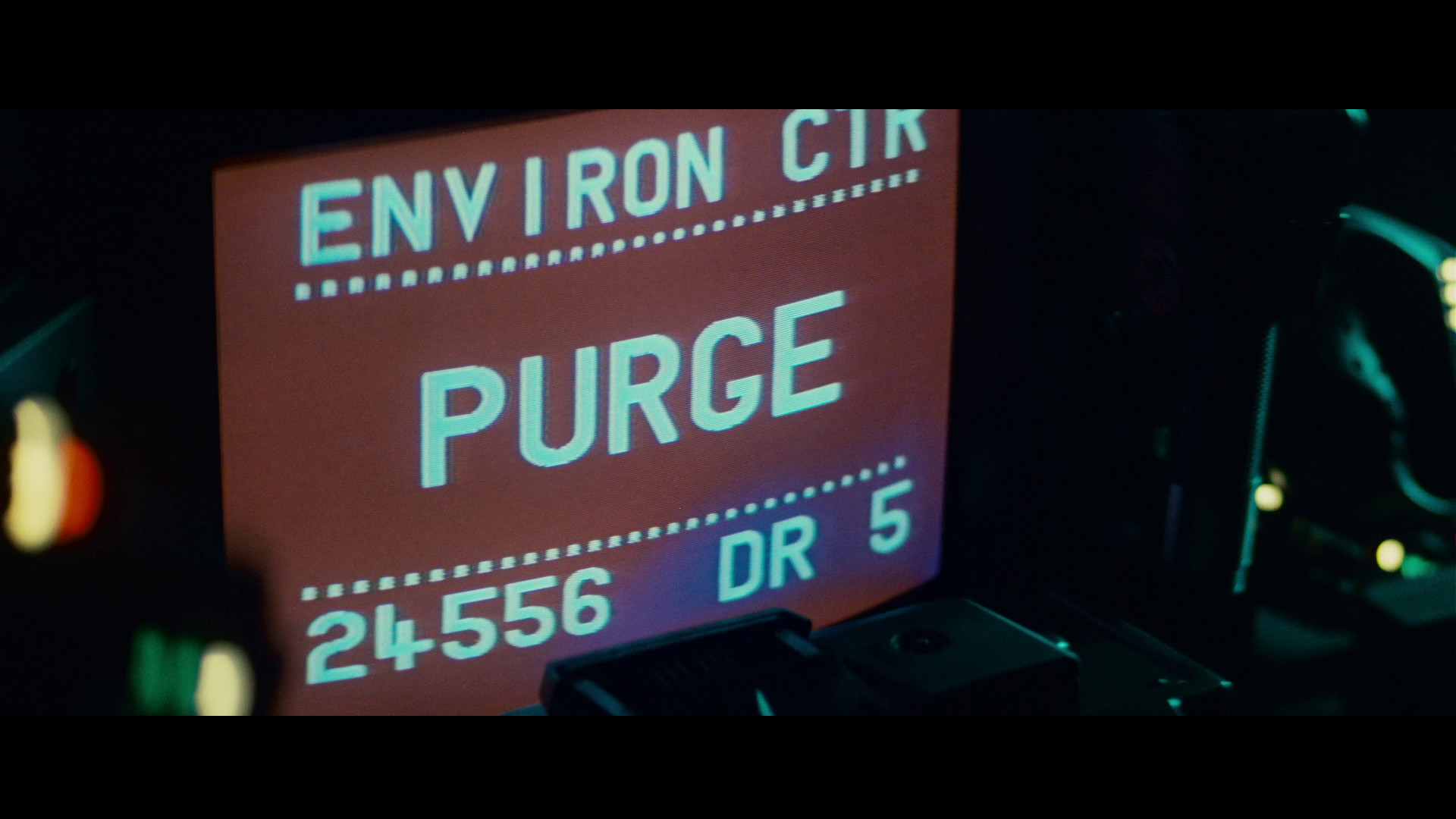
I went back and took a screenshot from the Blu Ray at the same point. What do you think? As it happens, whilst the inner regions of the building in the movie are the Bradbury building (or at least the entrance hall), I don't think the upper exterior shots are.
Purge Purge
There are a few other, well-known references to Alien in Blade Runner, although they are likely simply re-used effects rather than explicitly easter eggs. The display screen in Gaff's Spinner is re-used from the Narcissus (here's a comparison) and the ambience in Deckard's apartment also featured in the Nostromo's medical bay. Some enterprising person has put together a 12 hour session of that particular sound effect looping. There's a number of other comparisons and spots at this propsummit.com thread.

10 November 2014

Gustavo Noronha Silva: Yay, the left won! Or did it?

Originally published on politi.kov I have been asked by a bunch of friends from outside of Brazil for my opinion regarding the recent elections we had in Brazil, and it is a bit complicated to explain it without some background, so I decided to write this piece providing a bit of history so that people can understand my opinion. The elections this year were a rematch of our traditional polarization between the workers party (PT) and the social democracy party (PSDB), which has been going on since 1994. PT and PSDB used to be allies. In the 80s, when the dictatorship dropped the law that forbade more than 2 parties, the opposition party, MDB, began breaking up in several smaller ones. PSDB was founded by politicians and intelectuals who were inspired by Europe s social democracy and political systems. Parliamentarism, for instance, is one of the historical causes of the party. The workers party had a more grassroots origin, with union leaders, marxist intelectuals and marxist-inspired catholic priests being the main founders. They drew their inspiration from the USSR and Cuba, and were very close to social movements.
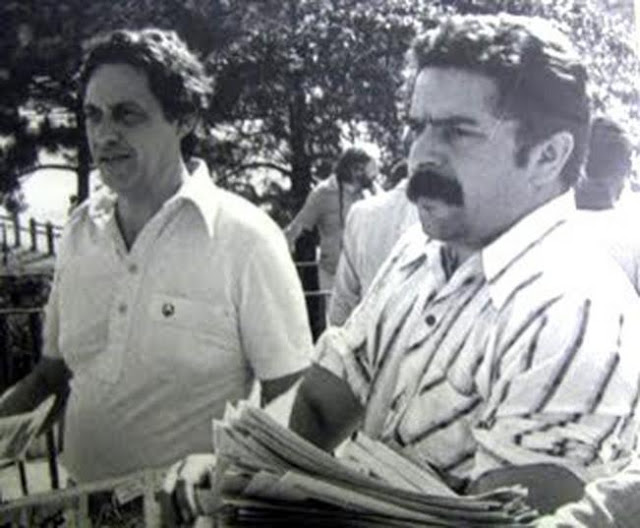
Lula and FHC campaigning together in 1981, by Cl vis Cranchi Sobrinho

Lula (PT) and FHC (PSDB) campaigning together in 1981, by Cl vis Cranchi Sobrinho

Some people have celebrated the reelection of Dilma Roussef as a victory of the left against the right. In my opinion that view is wrong for several reasons. First, because I disagree that PSDB and A cio Neves in particular are right-wing, both in terms of economics and social/moral issues. Second, because I believe Dilma s first government has taken a quite severe turn to the right in several topics that matter a lot to me. Since comparisons with PSDB s government during the 90s has been one of the main strategies of the campaign this year, I ll argue why I think it was actually a pretty good government with a lot of left in it. Unlike what happens in most other places, Brazil does not really have an actual right-wing party, economics-wise. Although we might see the birth of a couple in the near future, no current party is really against public health, education and social security being provided by the state as rights, or wants to decrease state size and lower taxes significantly. It should come as no surprise that even though it has undergone a lot of liberal reforms over the last 20 years, Brazil is still a very closed country, with very high import tariffs and a huge presence of the state in the economy. There is a certain consensus about all of that, with disagreements being essentially on implementation details, not goals. On the other hand, and contrary to popular belief, when it comes to social and moral issues we are a very conservative people. Ironically, the two parties which have been in power over the last 20 years are quite progressive, being historically proponents of diversity, minorities rights, reproductive rights. They have had to compromise on those causes to become viable alternatives, given the conservative nature of the majority of the voters. Despite their different origins and beliefs, both parties share socialist inclinations and were allies from the onset. That changed in 1992, when president Collor, who had been elected on a runoff against Lula (who PSDB supported), was impeached by Congress for corruption. With no formal political support and a chaotic situation in his hands, Itamar Franco, the vice president, called for a national union government to go through the last two years of his term. PSDB answered the call, but the workers party decided against being part of the government. Fernando Henrique Cardoso, a sociologist who was one of the leaders of PSDB was chosen to lead the Foreign Relations Ministry, but a few months later got nominated to the Economy. At the time, Brazil lived under hyperinflation of close to 1000% a year, and several stabilization plans had been attempted. Economy Ministers did not last very much in office at the time. FHC gathered a team of economists and sponsored their stabilization plan, which turned out to be highly successful: the Plano Real ( Real Plan ). In addition to introducing a new currency, something that was becoming pretty common to Brazilians by then, it also attacked the structural causes of inflation. Lula was counting on the failure of the Plano Real when he ran against FHC in 1994, but the plan succeeded, giving FHC two terms as president. During those two terms, FHC introduced several institutional changes that made Brazil a saner country. In addition to the hyperinflation, Brazil had lived a debt crises for decades and was still in default. FHC s team renegotiated the debts, reopened lines of credit, but most importantly, introduced reforms that made the Brazilian finances and financial system credible. The problem was not even that Brazil had a fiscal d ficit, it just did not have any control whatsoever of money supply and budget. Banks, regardless of whether they were private or public, had very little regulation and took advantage of the hyperinflation to hide monstrous holes in their balances. When inflation was gone and regulation became more strict, those became apparent, and it was pretty clear that the system would collapse if nothing was done. Some people like to say that FHC was a president who ruled for the rich and didn t care about the poor. I think the way the potential collapse of the banking system was handled is a great counter-example of that. The government passed laws that made the owners of the banks responsible for the financial problems, regardless of whether caused by mismanagement or fraud. If a bank went under, the central bank intervened and added enough money to protect the deposits, but that money was a loan that had to be repaid by the owners of the bank, and the owners properties were added as collateral to the loan. As a brazilian journalist once said, the people did not risk losing their deposits, the bankers did risk losing the banks, though. Today, we have a separate fund, filled with money from the banks, that does what the central bank did back then when required. Compare that to countries where the banking system was saved with tax payer money and executives kept getting huge bonuses regardless, while owners kept their profits. It is hard to find an initiative that is more focused on the public interest against the interest of the rich people who caused the problem. This legislation, called PROER, is still in place today, and it came along with solid regulation of the banking system. It should come as no surprise that Brazil went through the financial crisis of 2008 with not a single hiccup of the banking system and no fear of bank runs. Despite having been against PROER back in the day, Lula celebrated its existence in 2008, when it was clear it was one of the reasons we would not suffer much. He even advertised it as something that should be adopted by the US and Europe. It is also pretty common to hear that under FHC social questions were not a priority. I believe it is pretty simple to see that that was not the case both by inspecting the growth of social spending and the improvement of social indicators for the period, such as UN s human development index. One area in which people are particularly critical of the FHC government is the investment on higher education, and they are actually quite right. Brazil has free Federal universities and those did not get a lot of priority in the 90s. However, I would argue that while it is a matter of priorities, it is not one of education versus something else, but rather of what to invest on inside education. The reality is basic education was the priority. When FHC came to power, Brazil had a significant number of children who were not going to school at all. The goal was to make access to schools universal for young children, and that goal was reached. Every child has been going to school since the early 2000s, and that is a significant achievement which reaches the poorest. While the federal universities are attended essentially by the Brazilian elite, given the difficulty of passing the exams and the relative lack of quality of free public schools compared to private ones, which is still a reality to this day, investment on getting children to even go to school for the early years has a significant impact on the lives of the poorest. It is important to remember that getting every child to go to school is also what gave birth to one of the most celebrated programs from the Lula era: Bolsa Fam lia ( Family Allowance ) is a direct money transfer to poor families, particularly those who have children and has been an important contribution to lowering inequality and getting people out of extreme poverty. To get the money, the families need to ensure their children are 1) attending school and 2) getting vaccinated. That program comes from the FHC government, in which it was created with the name Bolsa Escola ( School Allowance ), in its turn inspired by a program of the same name by governor Cristovam Buarque, from PT. What Lula did, and he deserves a lot of credit for this, was to merge a series of smaller programs with Bolsa Escola, and then expand the program to ensure it got to more and more people. Interestingly, during the announcement of the program he credited the idea of doing that to a state governor from PSDB. You can see why I think these two should be allies again. When faced with all these arguments, people will eventually say that FHC was bad because he privatized companies and used orthodox economic policies. Well, if that is what it takes, then we ll have to take Lula down with him, because his first term was essentially a continuation of FHC s second term: orthodox economic policies to keep inflation down, along with privatization of several state-owned companies and banks. But Lula, whom I voted for and whose government I believe was a good one, is not my subject: Dilma is. On Lula s second term, Dilma gained a lot of power when other major leaders of PT went down for corruption. She became second in command and started leading several programs. A big believer in developmentalism, she started pushing for a bigger role of the state in the coordination of the productive sector, with a clear focus on growing the industrial base. One of the initiatives she sponsored was a sizable increase on the number and size of subsidized loans given out by the national development bank (BNDES). Brazil started an unnofficial national champions program, where the government elected a few big companies to get a huge amount of subsidized credit. The goal was for these selected firms to get big enough to be competitive on the global market. The criteria for the choices is completely opaque, if it even exists, and includes handing out milions in subsidized credit for Eike Batista, who became Brazil s richest enterpreneur for a while, and lost pretty much everything when it became clear the oil would not be pumping out of his camps after all, sinking with them a huge amount of public funds invested by BNDES. The way this policy was enacted, it is unclear how much it really costs in terms of public funds: the Brazilian treasury emits debt to capitalize, lends that money to BNDES with higher than market interest, and BNDES then lends it out to the big companies with a lower than market interest rate. Although it is obviously unsustainable, the problem does not yet show in the balance because the grace period for BNDES debt with the treasury is 2040. The fact that this has a cost and, perhaps more importantly, a huge opportunity cost is not clear because it is not part of the government budget. Why are we putting money in this rather than quadrupling Bolsa Fam lia, which studies show generates 1,78 reais in GDP for every 1 real invested? Worse, why are we not even updating Bolsa Fam lia enough to cover inflation? When Dilma got elected in 2010, the first signs were pretty bad. She was already seen as someone who did not care much for the environment, and on her first month in power she made good on that promise by pushing to get the Belo Monte Dam building started as soon as possible regardless of conditionalities being satisfied. To this day there are several issues with how the building of the dam is going: the handling of the indigenous people and the small city nearby are lacking, conditionalities are not met. Beyond Belo Monte, indigenous leaders are being assassinated, deforestation in the Amazon forest has increased by 122% in 2014 alone. Dilma s answer to people who question her on these kinds of issues is essentially: would you rather not have electric power? Her populist authoritarian nature and obsession with industry are also pretty evident when it comes to her policies in the energy area as a whole. She showed up in national tv on the eve of our independence day celebration to announce a reduction in electric tariffs, mainly for industry, but also for homes. Nobody really knew how. The following week she sent a fast-track project to Congress to automatically renew concessions of power grid operators, requiring those who accepted it to lower tariffs, instead of doing an auction, which was already necessary anyway because the concessions were up on 2015. There was no discussion with stakeholders, there was just a populist announcement and a great deal of rhethoric to paint anyone who opposed as being against the people. And now, everything went into the crapper because that represented a breach of contract that required indemnification, and we had a pretty bad drought that made power more expensive given the need to turn on the thermal generators. Combining the costs of the thermal generation, indemnity, and financial fallout that the grid operators suffered, we are already at 105 billion reais and counting, nobody knows how high the cost will reach. Any reduction in tariffs has long been invalidated. And the fact that industry has lowered production significantly ends up being good news, we would probably be under rationing already if that was not the case. You would expect someone who fought a dictatorship to be pretty good in terms of human and civil rights. What we see in reality is a lack of respect for those things. During the world cup, Dilma has put the army on the streets and has supported arbitrary behaviour from state polices throughout the country. They jailed a bunch of demonstrators preemptively. No shit. The would be demonstrators were kept in jail throghout the tournament under false accusations. Dilma s Minister of Justice said several times that the case against them was solid and that the arrests were legal, but it turned out the case simply did not exist. Just this week we had a number of executions orchestrated by policemen in the state of Par and there is zero reaction from the federal government. In the oil industry, Dilma has enacted a policy of subsidizing gas prices by using a fixed price that used to be lower than the international prices (it is no longer the case with the fall in international prices). That would not be a problem if Brazil was selfsufficient in oild and gas, which we are not: we had to import a significant amount of both. The implicit subsidy cost Petrobr s a huge amount of cash the more gas it sold, the bigger the losses. This lead not only to decreasing the company s market value (it is a state-controlled, but open company), but to reducing its capacity of investment as well. That is more problematic than it sounds because, with our current concession model, every single oil camp needs to have Petrobr s as a member of the consortium. Limiting the company s investment capacity limits the rate at which our pre-salt oil camps can be explored and thus the speed at which we can become selfsufficient. Chicken and egg anyone? To make things worse, Dilma has made policies that lowered taxes on car production, used to foster economic activity during the crisis in 2008-2010, essentially permanent. This lead to a significant increase in traffic and polution on Brazilian cities, while at the same time increasing the pressure on Petrobr s, which had to import more and more gas. Meanwhile, Brazilian cities suffer from a severe lack of mobility infrastructure. A recent study has shown that Brazil has spend almost twice as much subsidized money on pro-car policies than on pro-mass transit projects. Talk about good usage of public funds. One of the only remaining good news the government was still able to mention was the constant reduction in extreme poverty. Dilma was actually ellected promising to erradicate extreme poverty and changed the government s slogan to A rich country is a country with no poverty (Pa s rico pa s sem pobreza). Well, it turns out all of these policies caused inequality and extreme poverty both to stop falling as of 2013. And given the policies were actually deepened in 2014, I believe it is very likely we ll see an increase in both when we get the data for 2014, next year. Other than that, her policies ended up being a complete failure. Despite giving tax benefits to several sectors, investment has fallen, growth has fallen and inflation is quite high at 6,6% for the last 12 months. In terms of minorities, her government has been a severe set back, with the government going back on educational material against homophoby saying it would not do advertisement of sexual choice , and going back on a decree that allowed the public health system to perform abortions on the cases allowed by the law (essentially if the woman has been raped). Looking at Dilma s policies, I really can t see that much of the left, honestly. So why, you might ask, has this victory been deemed a victory of the left over the right? My explanation is the aura the workers party still manages to keep over itself. There s a notion that whatever PT does, it will still be more to the left than PSDB, which I think is just crazy. There is also a fair amount of idealizing Dilma just because she is Lula s proteg . People will forgive anything, provided it is the workers party doing it. Thankfully, the number of people aligned on the left that supported the candidate from PSDB this election tells me this is changing quite rapidly. Hopefully that leads to PT having to reinvent itself, and get in touch with the left again.

Neil Williams: On getting NEW packages into stable

There s a lot of discussion / moaning /arguing at this time, so I thought I d post something about how LAVA got into Debian Jessie, the work involved and the lessons I ve learnt. Hopefully, it will help someone avoid the disappointment of having their package missing the migration into a future stable release. This was going to be a talk at the Minidebconf-uk in Cambridge but I decided to put this out as a permanent blog entry in the hope that it will be a useful reference for the future, not just Jessie. Context LAVA relies on a number of dependencies which were at the time all this started NEW to Debian as well as many others already in Debian. I d been running LAVA using packages on my own system for a few months before the packages were ready for use on the main servers (I never actually installed LAVA using the old virtualenv method on my own systems, except in a VM). I did do quite a lot of this on my own but I also had a team supporting the effort and valuing the benefits of moving to a packaged system. At the time, LAVA was based on Ubuntu (12.04 LTS Precise Pangolin) and a new Ubuntu LTS was close (Trusty Tahr 14.04) but I started work on this in 2013. By the time my packages were ready for general usage, it was winter 2013 and much too close to get anything into Ubuntu in time for Trusty. So I started a local repo using space provided by Linaro. At the same time, I started uploading the dependencies to Debian. json-schema-validator, django-testscenarios and others arrived in April and May 2014. (Trusty was released in April). LAVA arrived in NEW in May, being accepted into unstable at the end of June. LAVA arrived in testing for the first time in July 2014. Upstream development continued apace and a regular monthly upload, with some hotfixes in between, continued until close to the freeze. At this point, note that although upstream is a medium sized team, the Debian packaging also has a team but all the uploads were made by me. I planned ahead. I knew that I would be going to Macau for Linaro Connect in February a critical stage in the finalisation of the packages and the migration of existing instances from the old methods. I knew that I would be on vacation from August through to the end of September 2014 including at least two weeks with absolutely no connectivity of any kind. Right at this time, Django1.7 arrived in experimental with the intent to go into unstable and hence into Jessie. This was a headache for me, I initially sought to delay the migration until after Jessie. However, we discussed it upstream, allocated time within the busy schedule and also sought help from within Debian with the RFH tag. Rapha l Hertzog contributed patches for django1.7 support and we worked on those patches upstream, once I was back from vacation. (The final week of my vacation was a work conference, so we had everyone together at one hacking table.) Still there was more to do, the django1.7 patches allowed the unit tests to complete but broke other parts of the lava-server package and needed subsequent tweaks and fixes. Even with all this, the auto-removal from testing for packages affected by RC bugs in their dependencies became very important to monitor (it still is). It would be useful if some packages had less complex dependency chains (I m looking at you, uwsgi) as the auto-removal also covers build-depends. This led to some more headaches with libmatheval. I m not good with functional programming languages, I did have some exposure to Scheme when working on Gnucash upstream but it wasn t pleasant. The thought of fixing a scheme problem in the test suite of libmatheval was daunting. Again though, asking for help, I found people in the upstream team who wanted to refresh their use of scheme and were able to help out. The fix migrated into testing in October. Just for added complications, lava-server gained a few RC bugs of it s own during that time too fixed upstream but awkward nonetheless. Achievement unlocked So that s how a complex package like lava-server gets into stable. With a lot of help. The main problem with top-level packages like this is the sheer weight of the dependency chain. Something seemingly unrelated (like libmatheval) can seriously derail the migrations. The package doesn t use the matheval support provided by uwsgi. The bug in matheval wasn t in the parts of matheval used by uwsgi. It wasn t in a language I am at all comfortable in fixing but it s my name on the changelog of the NMU. That happened because I asked for help. OK, when django1.7 was scheduled to arrive in Debian unstable and I knew that lava was not ready, I reacted out of fear and anxiety. However, I sought help, help was provided and that help was enough to get upstream to a point where the side-effects of the required changes could be fixed. Maintaining a top-level package in Debian is becoming more like maintaining a core package in Debian and that is a good thing. When your package has a lot of dependencies, those dependencies become part of the maintenance workload of your package. It doesn t matter if those are install time dependencies, build dependencies or reverse dependencies. It doesn t actually matter if the issues in those packages are in languages you would personally wish to be expunged from the archive. It becomes your problem but not yours alone. Debian has a lot of flames right now and Enrico encouraged us to look at what else is actually happening in Debian besides those arguments. Well, on top of all this with lava, I also did what I could to help the arm64 port along and I m very happy that this has been accepted into Jessie as an official release architecture. That s a much bigger story than LAVA yet LAVA was and remains instrumental in how arm64 gained the support in the kernel and various upstreams which allowed patches to be accepted and fixes to be incorporated into Debian packages. So a roll call of helpers who may otherwise not have been recognised via changelogs, in no particular order: Also general thanks to the Debian FTP and Release teams. Lessons learnt
  1. Allow time! None of the deadlines or timings involved in this entire process were hidden or unexpected. NEW always takes a finite but fairly lengthy amount of time but that was the only timeframe with any amount of uncertainty. That is actually a benefit it reminds you that this entire process is going to take a significant amount of time and the only loser if you try to rush it is going to be you and your package. Plan for the time and be sceptical about how much time is actually required.
  2. Ask for help! Everyone in Debian is a volunteer. Yes, the upstream for this project is a team of developers paid to work on this code (and largely only this code) but the upstream also has priorities, requirements, objectives and deadlines. It s no good expecting upstream to do everything. It s no good leaving upstream insufficient time to fit the required work into the existing upstream schedules. So ask for help within upstream and within Debian ask for help wherever you can. You don t know who may be able to help you until you ask. Be clear when asking for help how would someone test their proposed fix? Exactly what are you asking for help doing? (Hint: everything is not a good answer.)
  3. Keep on top of announcements and changes. The release team in Debian have made the timetable strict and have published regular updates, guidelines and status notes. As maintainer, it is your responsibility to keep up with those changes and make others in the upstream team aware of the changes and the implications. Upstream will rely on you to provide accurate information about these requirements. This is almost more important than actually providing the uploads or fixes. Without keeping people informed, even asking for help can turn out to be counter-productive. Communicate within Debian too talk to the teams, send status updates to bugs (even if the status is tag 123456 + help).
  4. Be realistic! Life happens around us, things change, personal timetables get torn up. Time for voluntary activity can appear and disappear (it tends to disappear far more often than extends, so take that into account too).
  5. Do not expect others to do the work for you asking for help is one thing, leaving the work to others is quite another. No complaining to the release team that they are blocking your work and avoid pleading or arguing when a decision is made. The policies and procedures within Debian are generally clear and there are quite enough arguments without adding more. Read the policies, read the guidelines, watch how other packages and other maintainers are handled and avoid those mistakes. Make it easy for others to help deliver what you want.
  6. Get to know your dependency chain follow the links on the packages.debian.org pages and get a handle on which packages are relevant to your package. Subscribe to the bug pages for some of the more high-risk packages. There are tools to help. rc-alert can help you spot problems with runtime dependencies (you do have your own package installed on a system running unstable if not, get that running NOW). Watching build-dependencies is more difficult, especially build-dependencies of a runtime dependency, so watch the RC bug lists for packages in your dependency chain.
Above all else, remember why you and upstream want the packages in Debian in the first place. Debian is a respected distribution and has an acknowledged reputation for stability and portability. The very qualities that you and your upstream desire from having your package in Debian have direct implications for the amount of work and the amount of time that will be required to get your packages into Debian and keep them there. Having your package in Debian will bring considerable benefits but you will be required to invest a considerable amount of time. It is this contribution which is valuable to Debian and it is this work which will deliver the benefits you seek. Being an expert in the one package is wildly inadequate. Debian is about the system, the whole distribution and sooner or later, you as the maintainer will be absolutely required to handle something which is so far out of your comfort zone it s untrue. The reality is that you are not expected to fix that problem you are expected to handle that problem and that includes seeking and acknowledging the help of others. The story isn t over until release day. Having your package in testing the day before the freeze is one step. It may be a large step, but it is only one. The status of that package still needs monitoring. That long dependency chain can still come back and bite. Don t wait for problems to surprise you. Finally One thing I do ask is that other upstream teams and maintainers think about the dependency chain they are creating. It may sound nice to have bindings for every interpreted language possible when releasing your compiled library but it does not help people using that library. Yes, it is more work releasing the bindings separately because a stable API is going to be needed to allow version 1.2.3 to work alongside 1.2.2 and 1.3.0 or the entire effort is pointless. Consider how your upstream package migrates. Consider how adding yet another build-dependency for an optional component makes things exponentially harder for those who need to rely on that upstream. If it is truly optional, release it separately and keep backwards compatibility on each side. It is more work but in reality, all that is happening is that the work is being transferred from the distribution (where it helps only that one distribution and causes duplication into other distributions) into the upstream (where it helps all distributions). Think carefully about what constitutes core functionality and release the rest separately. Combining bindings for php, ruby, python, java, lua and xslt into a single upstream release tarball is a complete nonsense. It simply means that the package gets blocked from new uploads by the constant churn of being involved in every transition that occurs in the distribution. There is a very real risk that the package will miss a stable release simply by having fingers in too many pies. That hurts not only this upstream but every upstream trying to use any part of your code. Every developer likes to think that people are using and benefiting from their effort. It s not nice to directly harm the interests of other developers trying to use your code. It is not enough for the binary packages to be discrete migrations happen by source package and the released tarball needs to not include the optional bindings. It must be this way because it is the source package which determines whether version 1.2.3 of plugin foo can work with version 1.2.0 of the library as well as with version 1.3.0. Maintainers regularly deal with these issues so talk to your upstream teams and explain why this is important to that particular team. Help other maintainers use your code and help make it easier to make a stable release of Debian. The quicker the freeze & release process becomes, the quicker new upstream versions can be uploaded and backported.

4 November 2014

Marco d'Itri: My position on the "init system coupling" General Resolution

I first want to clarify for the people not intimately involved with Debian that the GR-2014-003 vote is not about choosing the default init system or deciding if sysvinit should still be supported: its outcome will not stop systemd from being Debian's default init system and will not prevent any interested developers from supporting sysvinit. Some non-developers have recently threatened of "forking Debian" if this GR will not pass, apparently without understanding well the concept: Debian welcomes forks and I think that having more users working on free software would be great no matter which init system they favour. The goal of Ian Jackson's proposal is to force the maintainers who want to use the superior features of systemd in their packages to spend their time on making them work with sysvinit as well. This is antisocial and also hard to reconcile it with the Debian Constitution, which states: 2.1.1 Nothing in this constitution imposes an obligation on anyone to do work for the Project. A person who does not want to do a task which has been delegated or assigned to them does not need to do it. [...] As it has been patiently explained by many other people, this proposal is unrealistic: if the maintainers of some packages were not interested in working on support for sysvinit and nobody else submitted patches then we would probably still have to release them as is even if formally declared unsuitable for a release. On the other hand, if somebody is interested in working on sysvinit support then there is no need for a GR forcing them to do it. The most elegant outcome of this GR would be a victory of choice 4 ("please do not waste everybody's time with pointless general resolutions"), but Ian Jackson has been clear enough in explaining how he sees the future of this debate: If my GR passes we will only have to have this conversation if those who are outvoted do not respect the project's collective decision. If my GR fails I expect a series of bitter rearguard battles over individual systemd dependencies. There are no significant practical differences between choices 2 "support alternative init systems as much as possible" and 3 "packages may require specific init systems if maintainers decide", but the second option is more explicit in supporting the technical decisions of maintainers and upstream developers. This is why I think that we need a stronger outcome to prevent discussing this over and over, no matter how each one of us feels about working personally on sysvinit support in the future. I will vote for choices 3, 2, 4, 1.

Next.

Previous.