Search Results: "eric"

16 August 2024

Dirk Eddelbuettel: RcppEigen 0.3.4.0.1 on CRAN: Minor Maintenance

A new maintenance release of RcppEigen is now on CRAN, and will go to Debian shortly as usual. Eigen is a C++ template library for linear algebra: matrices, vectors, numerical solvers, and related algorithms. A very recent change in the development version of R (aka r-devel ) expanded the set of declared BLAS and LAPACK functions (and I tooted approvingly about it as well). It turns out that the xerbla() declaration there (which, as usual for R and as discussed in Writing R Extensions, defines the new optional character length entry for a char vector) conflicts with one in the blas.h header in Eigen upsetting the compilation of just one reverse-dependency. So CRAN, as they so often (and quietly) do in these cases, gave us a friendly and concise heads-up and asked for a change so we complied, did the usual reverse-dependency check of the other 400+ packages using RcppEigen and produced the new release which was injected into the repository during the current summer break. The complete NEWS file entry follows.

Changes in RcppEigen version 0.3.4.0.1 (2024-08-14)
  • Conditionally comment-out xerbla in blas.h as it is now providedd by R-devel albeit with FC_LEN_T (per a CRAN request)
  • Minor package updates (continuous integration, badges)

Courtesy of CRANberries, there is also a diffstat report for the most recent release. If you like this or other open-source work I do, you can sponsor me at GitHub.

This post by Dirk Eddelbuettel originated on his Thinking inside the box blog. Please report excessive re-aggregation in third-party for-profit settings.

9 August 2024

Kalyani Kenekar: One Backpack, One Passport: My First Solo Trip

Planing A Self Organized Solo Trip You know the movie Queen? The actor Kangana Ranaut plays in that movie the role of Rani Mehra, a 24-year-old Punjabi woman, who was a simple, homely girl that was always reliant on her family. Similar to Rani I too rarely ventured out without my parents and often needed my younger sibling by my side. Inspired by her transformation, I decided it was time to take control of my own story and discover who I truly am. Queen movie picture Of Kangana

Trip Requirements

My First Passport The journey began with a significant first step: Obtaining my first passport Never having had one before, I scheduled the nearest available interview date on June 29 2022. This meant traveling to Solapur, a city 309 km from my hometown, accompanied by my father. After successfully completing the interview, I received my passport on July 14 2022.

Select A Country, Booking Flights And Accommodation Excited and ready to embark on my adventure, I planed trip to Albania and booked the flight tickets. Why? I had heard from friends that it was a beautiful European country with beaches and other attractions, and importantly, it didn t require a visa for Indian citizens and was more affordable than other European destinations. Before heading to Albania, I planned a overnight stop in Abu Dhabi with a transit visa, thanks to friend who knew the process for obtaining it. Some of my friends did travel also to Europe at the same time and quite close to my plannings, but that I realized just later the trip.

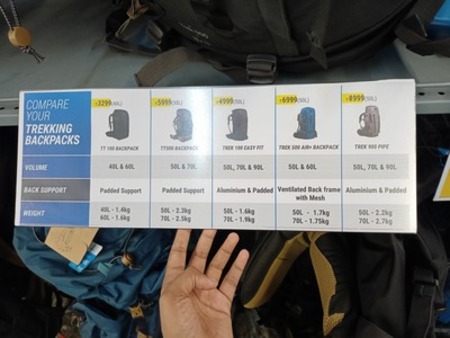
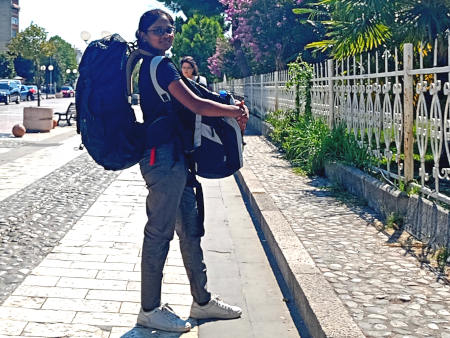
Day 1, Starting The Experience On July 20, 2022, I started my journey by traveling from Pune, Maharashtra, to Delhi, where my brother lives. He came to see me off at the airport, adding a touch of warmth and support to the beginning of my solo adventure. Upon arriving in Delhi, with my next flight scheduled for July 21, I stayed at a backpacker hostel named Zostel, Paharganj, Delhi to rest. During my stay, I noticed that many travelers at the hostel carried rucksacks, which sparked a desire in me to get one for my own trip to Europe. Up until then, I had always shopped with my mom and had never bought anything on my own. Inspired by the travelers, I set out to find a suitable rucksack. I traveled alone by metro from Paharganj to Rohini to visit a Decathlon store, where I purchased a 50-liter rucksack. This was a significant step in preparing for my European adventure and marked a milestone in my journey of self reliance. Rucksack description tag Kalyani s packpacker

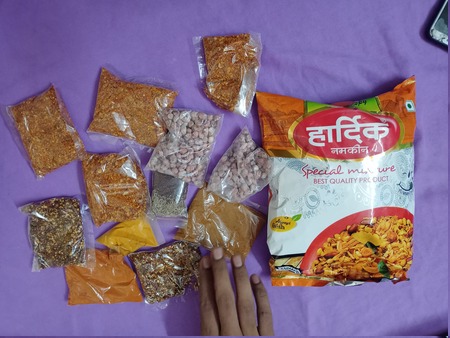
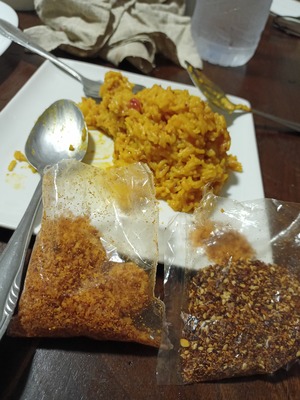
Day 2, Flying To Abu Dhabi The following day, July 21 2024, I had a flight to Abu Dhabi. I spent the night at the hostel to rest before my journey. On the day of the flight, I needed to reach the airport by 3 PM, and a friend kindly came to drop me off. With my rucksack packed and excitement building, I was ready for the next leg of my adventure. When we arrived at the airport, my friend saw me off, marking the start of my international journey. With mom made spices, chutneys, and chilly flakes packed for comfort, I completed my immigration process in about two and a half hours. I then settled at the gate for my flight, feeling a mix of excitement and anxiety as thoughts raced through my mind. mom-made spices Passport and boarding pass To ease my nerves, I struck up a conversation with a man seated nearby who was also traveling to Abu Dhabi for work. He provided helpful information about safety and transportation in Abu Dhabi, which reassured me. With the boarding process complete and my anxiety somewhat eased. I found my window seat on the flight and settled in, excited for the journey ahead. Next to me was a young man from Ranchi(Zarkhand, India), heading to Abu Dhabi for work at a mining factory. We had an engaging conversation about work culture in Abu Dhabi and recruitment from India. Upon arriving in Abu Dhabi, I completed my transit, collected my luggage, and began finding my way to the hotel Premier Inn AbuDhabi, which was in the airport area. To my surprise, I ran into the same man from the flight, now in a cab. He kindly offered to drop me at my hotel, which I gladly accepted since navigating an unfamiliar city with a short acquaintance felt safer. At the hotel gate, he asked if I had local currency (Dirhams) for payment, as sometimes online transactions can fail. That hadn t crossed my mind, and I realized I might be left stranded if a transaction failed. Recognizing his help as a godsend, I asked if he could lend me some Dirhams, promising to transfer the amount later. He kindly assured me to pay him back once I reached the hotel room. With that relief, I checked into the hotel, feeling deeply grateful for the unexpected assistance and transferred the money to him after getting to my room. dhiramm money hotel room Kalyani in hotel room

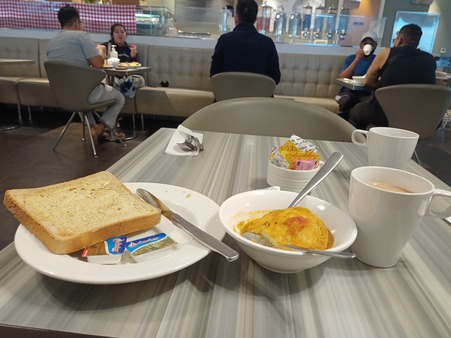
Day 3, Flying And Arrive In Tirana Once in the hotel room, I found it hard to sleep, anxious about waking up on time for my flight. I set an alarm to wake up early, but my subconscious mind kept me alert, and I woke up before the alarm went off. I got freshened up and went down for breakfast, where I found some vegetarian options like Idli-Sambar and bread with butter, along with some morning tea. After breakfast, I headed back to the airport, ready to catch my flight to my final destination: Tirana, Albania. Breakfast at hotel Airport area I reached Tirana, Albania after a six hours flight, feeling exhausted and I was suffering from a headache. The air pressure had blocked my ears, and jet lag added to my fatigue. After collecting my checked luggage, I headed to the first ATM machine at the airport. Struggling to insert my card, I asked a nearby gentleman for help. He tried his best, but my card got stuck inside the machine. Panic set in as I worried about how I would survive without money. Taking a deep breath, I found an airport employee and explained the situation. The gentleman stayed with me, offering support and repeatedly apologizing for his mistake. However, it wasn t his fault, the ATM was out of order, which I hadn t noticed. My focus was solely on retrieving my ATM card. The airport employee worked diligently, using a hairpin to carefully extract my card. Finally, the card was freed, and I felt an immense sense of relief, grateful for the help of these kind strangers. I used another ATM, successfully withdrew money, and then went to an airport mobile SIM shop to buy a new SIM card for local internet and connectivity. sim plans

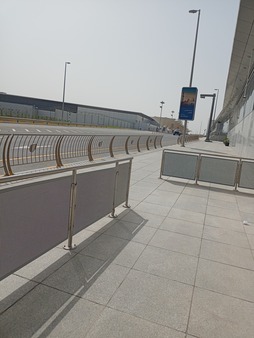
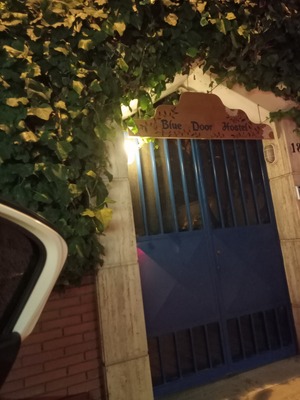
Day 4, Arriving In Tirana, Facing Challenges In A Foreign Country I had booked a stay at a backpacker hostel near the city center of Tirana. After sorting out the ATM and SIM card issues, I searched for a bus or any transport to get there. It was quite late, around 8:30 PM, and being in a new city, I was in a hurry. I saw a bus nearly leaving the airport, stopped it, and asked if it went to the city center. They gave me the green flag, so I boarded the airport service bus and reached the city center. Feeling very tired, I discovered that the hostel was about an hour and a half away by walking. Deciding to take a cab, I faced a challenge as the driver couldn t understand my English or accent. Using a mobile translator to convert my address from English to Albanian, I finally communicated my destination to him. With that sorted out, I headed to the Blue Door Backpacker Hostel and arrived around 9 PM, relieved to have finally reached my destination and I checked in. Hostel gate Street in Tirana I found my top bunk bed, only to realize I had booked a mixed-gender dormitory. This detail had completely escaped my notice during the booking process. I felt unsure about how to handle the situation. Coincidentally, my experience mirrored what Kangana faced in the movie Queen . Feeling acidic due to an empty stomach and the exhaustion of heavy traveling, I wasn t up to cooking in the hostel s kitchen. I asked the front desk about the nearest restaurant. It was nearly 9:30 PM, and the streets were deserted. To avoid any mishaps like in the movie Queen, I kept my passport securely locked in my bag, ensuring it wouldn t be a victim of theft. Venturing out for dinner, I felt uneasy on the quiet streets. I eventually found a restaurant recommended by the hostel, but the menu was almost entirely non-vegetarian. I struggled to ask about vegetarian options and was uncertain if any dishes contained eggs, as some people consider eggs to be vegetarian. Feeling frustrated and unsure, I left the restaurant without eating. I noticed a nearby grocery store that was about to close and managed to get a few extra minutes to shop. I bought some snacks, wafers, milk, and tea bags (though I couldn t find tea powder to make Indian-style tea). Returning to the hostel, I made do with wafers, cookies, and milk for dinner. That day was incredibly tough for me, I filled with exhaustion and struggle in a new country, I was on the verge of tears . I made a video call home before sleeping on the top bunk bed. It was a new experience for me, sharing a room with both unknown men and women. I kept my passport safe inside my purse and under my pillow while sleeping, staying very conscious about its security.

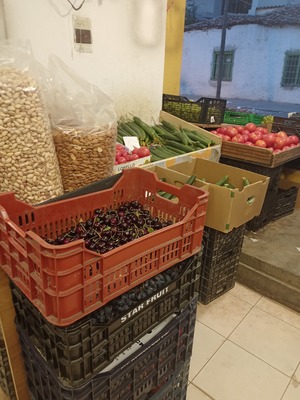
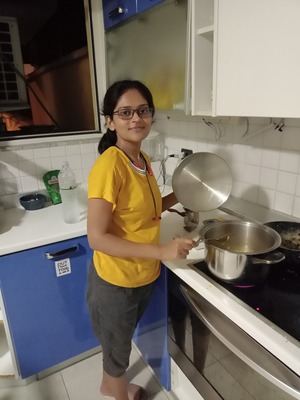
Day 5, Exploring Nearby Places I woke up the next day at noon. After having some coffee, the hostel management girl asked if I wanted breakfast. She offered curd with cornflakes, which I refused because I don t like curd. Instead, I ordered a pizza from a vegetarian pizza place with her help, and I started feeling better. I met some people in the hostel, some from Syria and others from Italy. I struggled to understand their accents but kept pushing myself to get involved in their discussions. Despite the challenges, I felt more at ease and was slowly adapting to my new environment. I went out from the hostel in the evening to buy some vegetables to cook something. I searched for shops and found some potatoes, tomatoes, and rice. I decided to cook Khichdi, an Indian dish made with rice, and added some chili flakes I brought from home. After preparing my dinner, I ate and then went to sleep again. vegetable shop cooking in kitchen Food

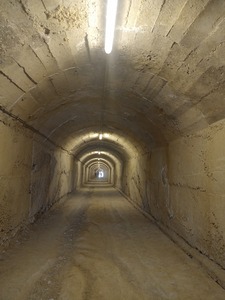
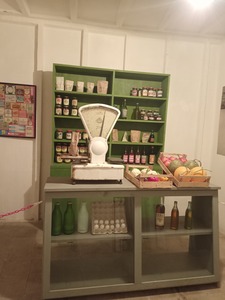
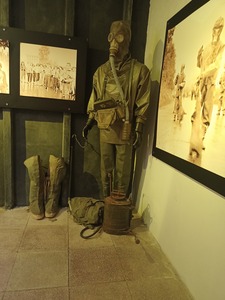
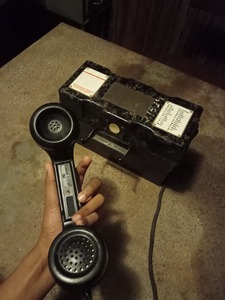
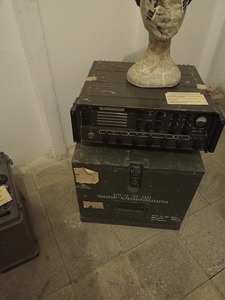
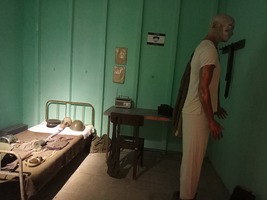
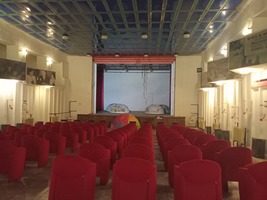
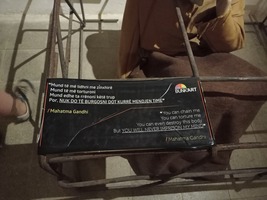
Day 6, Tiranas Recent History The next day, I planned to explore the city and visited Bunkart-1, a fascinating museum in a massive underground bunker from the communist era. Originally built as a shelter for Albania s political and military elite, it now offers a unique glimpse into the country s history under Enver Hoxha s oppressive regime. The museum s exhibits include historical artifacts, photographs, and multimedia displays that detail the lives of Albanians during that time. Walking through the dimly lit corridors, I felt the weight of history and gained a deeper understanding of Albania s past. Bunkart Bunkart Bunkart Bunkart Bunkart Bunkart Bunkar Bunkart Bunkart Bunkart Bunkart

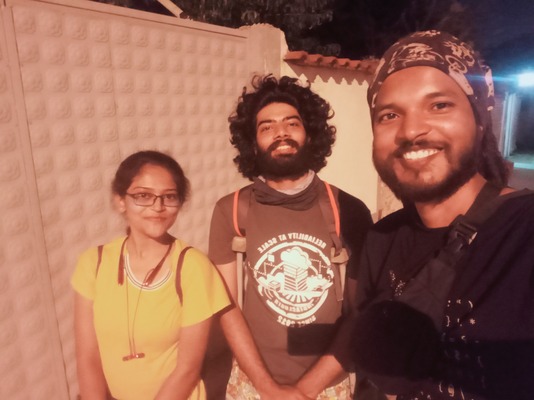
Day 7-8, Meeting Friends From India The next day, I accidentally met with Chirag, who was returning from the Debian Conference 2022 held in Prizren, Kosovo, and staying at the same hostel. When I encountered him, he was talking on the phone, and I recognized he was Indian by his accent. I introduced myself, and we discovered we had some mutual friends. Chirag told me that our common friend, Raju, was also coming to stay at the hostel the next day. This news made me feel relaxed and happy to have known people around. When Raju arrived, the three of us, Chirag, Raju, and I planned to have dinner at an Indian restaurant and explore Tirana city. I had a great time talking and enjoying their company. Friends on street

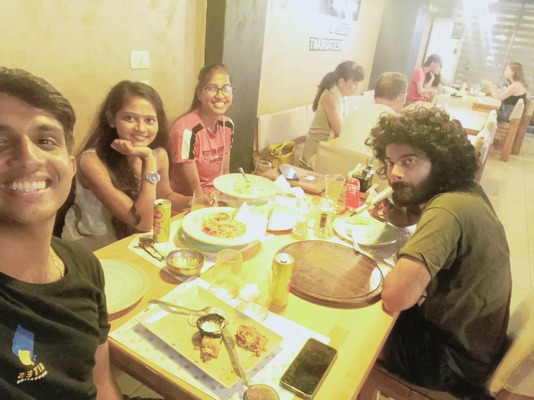
Day 9-10, Meeting More Friends Raju had a ticket to leave soon, so Chirag and I made a plan to visit Shkod r and the nearby Komani Lake for kayaking. We started our journey early in the morning by bus and reached Shkod r. There, we met new friends from the conference, Pavit and Abraham, who were already there. We had dinner together and enjoyed an ice cream treat from Chirag. Friends on dinner

Day 12, Kayaking And Say Good Bye To Friends The next day, Pavit and Abraham had a flight back to India, so Chirag and I went to Komani Lake. We had an adventurous time kayaking, even though neither of us knew how to swim. We took a ferry through the backwaters to the island on Komani Lake and enjoyed a fantastic adventure together. After our trip, Chirag returned to Tirana for his flight back to India, leaving me to continue my journey alone. Lake with mountain Kayak

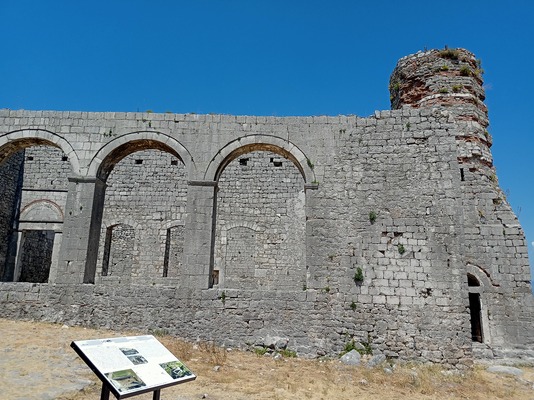
Day 13, Climbing Rozafa Castel By stopping at Shkod r, I visited Rozafa Castle. Despite the language barrier, as most locals only spoke Albanian, people around me guided me correctly on how to get there. At times, I used applications like Google Translate to communicate. To read signs or hotel menus, I used Google Photos' language converter. I even used the audio converter to understand and speak some basic Albanian phrases. View from top of Castel Rozafa castel I took a bus from Shkod r to the southern part of Albania, heading to Sarand . The journey lasted about five to six hours, and I had booked a stay at Mona s Hostel. Upon arrival, I met Eliza from America, and we went together to Ksamil Beach, spending a wonderful day there.

Day 14, Vlora Beach: Beach Side Cycling Next, I traveled to Vlor , where I stayed for one day. During my time there, I enjoyed beach side cycling with a cycle provided by the hostel owner and spent some time feeding fish. I also met a fellow traveler from Delhi who had brought along some preserved Indian curry. He kindly shared it with me, which was a welcome change after nearly 15 days without authentic Indian cuisine, except for what I had cooked myself in various hostels. Sunset on BeachKalyani on Beach Beach with streetBeach side cycling

Day 15-16 Visiting Durress, Travelling Back To Tirana I then visited Durr s, exploring its beautiful beaches, before heading back to Tirana one day before my flight home. On the day of my flight, my alarm didn t go off, and I woke up late at the hostel. In a frantic rush, I packed everything in just five minutes and dashed toward the city center to catch the bus to the airport. If I had been just five minutes later, I would have missed the bus. Thankfully, I managed to stop it just in time and began my journey back home, reflecting on the incredible adventure I had experienced. Fortunately, I wasn t late; I arrived at the airport just in time. After clearing immigration, I boarded my flight, which had a layover in Warsaw, Poland. The journey from Tirana to Warsaw took about two and a half hours, followed by a seven to eight-hour flight from Poland back to India. Once I arrived in Delhi, I returned to Zostel and booked a train ticket to Aurangabad for the next three days.

Backview This trip was an incredible adventure for me. I never imagined I could accomplish something like this, but I did. Meeting diverse people, experiencing different cultures, and learning so much made this journey truly unforgettable. Looking back, I realize how much I ve grown from this experience. Although I may have more opportunities to travel abroad in the future, this trip will always hold a special place in my heart. The memories I made and the incredible people I met along the way are irreplaceable. This experience goes beyond what I can express through this blog or words; it was incredibly precious to me. Every moment of this journey is etched in my memory, and I am grateful for every part of it.

30 July 2024

Russell Coker: Links July 2024

Interesting Scientific American article about the way that language shapes thought processes and how it was demonstrated in eye tracking experiments with people who have Aboriginal languages as their first language [1]. David Brin wrote an interesting article Do We Really Want Immortality [2]. I disagree with his conclusions about the politics though. Better manufacturing technology should allow decreasing the retirement age while funding schools well. Scientific American has a surprising article about the differences between Chimp and Bonobo parenting [3]. I d never have expected Chimp moms to be protective. Sam Varghese wrote an insightful and informative article about the corruption in Indian politics and the attempts to silence Australian journalist Avani Dias [4]. WorksInProgress has an insightful article about the world s first around the world solo yacht race [5]. It has some interesting ideas about engineering. Htwo has an interesting video about adverts for fake games [6]. It s surprising how they apparently make money from advertising games that don t exist. Elena Hashman wrote an insightful blog post about Chronic Fatigue Syndrome [7]. I hope they make some progress on curing it soon. The fact that it seems similar to long Covid which is quite common suggests that a lot of research will be applied to that sort of thing. Bruce Schneier wrote an insightful blog post about the risks of MS Copilot [8]. Krebs has an interesting article about how Apple does Wifi AP based geo-location and how that can be abused for tracking APs in warzones etc. Bad Apple! [9]. Bruce Schneier wrote an insightful blog post on How AI Will Change Democracy [10]. Charles Stross wrote an amusing and insightful post about MS Recall titled Is Microsoft Trying to Commit Suicide [11]. Bruce Schneier wrote an insightful blog post about seeing the world as a data structure [12]. Luke Miani has an informative YouTube video about eBay scammers selling overprices MacBooks [13]. The Yorkshire Ranter has an insightful article about Ronald Coase and the problems with outsourcing big development contracts as an array of contracts without any overall control [14].

21 July 2024

Russell Coker: SE Linux Policy for Dell Management

The recent issue of Windows security software killing computers has reminded me about the issue of management software for Dell systems. I wrote policy for the Dell management programs that extract information from iDRAC and store it in Linux. After the break I ve pasted in the policy. It probably needs some changes for recent software, it was last tested on a PowerEdge T320 and prior to that was used on a PowerEdge R710 both of which are old hardware and use different management software to the recent hardware. One would hope that the recent software would be much better but usually such hope is in vain. I deliberately haven t submitted this for inclusion in the reference policy because it s for proprietary software and also it permits many operations that we would prefer not to permit. The policy is after the break because it s larger than you want on a Planet feed. But first I ll give a few selected lines that are bad in a noteworthy way:
  1. sys_admin means the ability to break everything
  2. dac_override means break Unix permissions
  3. mknod means a daemon creates devices due to a lack of udev configuration
  4. sys_rawio means someone didn t feel like writing a device driver, maintaining a device driver for DKMS is hard and getting a driver accepted upstream requires writing quality code, in any case this is a bad sign.
  5. self:lockdown is being phased out, but used to mean bypassing some integrity protections, that would usually be related to sys_rawio or similar.
  6. dev_rx_raw_memory is bad, reading raw memory allows access to pretty much everything and execute of raw memory is something I can t imagine a good use for, the Reference Policy doesn t use this anywhere!
  7. dev_rw_generic_chr_files usually means a lack of udev configuration as udev should do that.
  8. storage_raw_write_fixed_disk shouldn t be needed for this sort of thing, it doesn t do anything that involves managing partitions.
Now without network access or other obvious ways of remote control this level of access while excessive isn t necessarily going to allow bad things to happen due to outside attack. But if there are bugs in the software there s nothing to stop it from giving the worst results.
allow dell_datamgrd_t self:capability   dac_override dac_read_search mknod sys_rawio sys_admin  ;
allow dell_datamgrd_t self:lockdown integrity;
dev_rx_raw_memory(dell_datamgrd_t)
dev_rw_generic_chr_files(dell_datamgrd_t)
dev_rw_ipmi_dev(dell_datamgrd_t)
dev_rw_sysfs(dell_datamgrd_t)
storage_raw_read_fixed_disk(dell_datamgrd_t)
storage_raw_write_fixed_disk(dell_datamgrd_t)
allow dellsrvadmin_t self:lockdown integrity;
allow dellsrvadmin_t self:capability   sys_admin sys_rawio  ;
dev_read_raw_memory(dellsrvadmin_t)
dev_rw_sysfs(dellsrvadmin_t)
dev_rx_raw_memory(dellsrvadmin_t)
The best thing that Dell could do for their customers is to make this free software and allow the community to fix some of these issues.
Here is dellsrvadmin.te:
policy_module(dellsrvadmin,1.0.0)
require  
  type dmidecode_exec_t;
  type udev_t;
  type device_t;
  type event_device_t;
  type mon_local_test_t;
 
type dellsrvadmin_t;
type dellsrvadmin_exec_t;
init_daemon_domain(dellsrvadmin_t, dellsrvadmin_exec_t)
type dell_datamgrd_t;
type dell_datamgrd_exec_t;
init_daemon_domain(dell_datamgrd_t, dell_datamgrd_t)
type dellsrvadmin_var_t;
files_type(dellsrvadmin_var_t)
domain_transition_pattern(udev_t, dellsrvadmin_exec_t, dellsrvadmin_t)
modutils_domtrans(dellsrvadmin_t)
allow dell_datamgrd_t device_t:dir rw_dir_perms;
allow dell_datamgrd_t device_t:chr_file create;
allow dell_datamgrd_t event_device_t:chr_file   read write  ;
allow dell_datamgrd_t self:process signal;
allow dell_datamgrd_t self:fifo_file rw_file_perms;
allow dell_datamgrd_t self:sem create_sem_perms;
allow dell_datamgrd_t self:capability   dac_override dac_read_search mknod sys_rawio sys_admin  ;
allow dell_datamgrd_t self:lockdown integrity;
allow dell_datamgrd_t self:unix_dgram_socket create_socket_perms;
allow dell_datamgrd_t self:netlink_route_socket r_netlink_socket_perms;
modutils_domtrans(dell_datamgrd_t)
can_exec(dell_datamgrd_t, dmidecode_exec_t)
allow dell_datamgrd_t dellsrvadmin_var_t:dir rw_dir_perms;
allow dell_datamgrd_t dellsrvadmin_var_t:file manage_file_perms;
allow dell_datamgrd_t dellsrvadmin_var_t:lnk_file read;
allow dell_datamgrd_t dellsrvadmin_var_t:sock_file manage_file_perms;
kernel_read_network_state(dell_datamgrd_t)
kernel_read_system_state(dell_datamgrd_t)
kernel_search_fs_sysctls(dell_datamgrd_t)
kernel_read_vm_overcommit_sysctl(dell_datamgrd_t)
# for /proc/bus/pci/*
kernel_write_proc_files(dell_datamgrd_t)
corecmd_exec_bin(dell_datamgrd_t)
corecmd_exec_shell(dell_datamgrd_t)
corecmd_shell_entry_type(dell_datamgrd_t)
dev_rx_raw_memory(dell_datamgrd_t)
dev_rw_generic_chr_files(dell_datamgrd_t)
dev_rw_ipmi_dev(dell_datamgrd_t)
dev_rw_sysfs(dell_datamgrd_t)
files_search_tmp(dell_datamgrd_t)
files_read_etc_files(dell_datamgrd_t)
files_read_etc_symlinks(dell_datamgrd_t)
files_read_usr_files(dell_datamgrd_t)
logging_search_logs(dell_datamgrd_t)
miscfiles_read_localization(dell_datamgrd_t)
storage_raw_read_fixed_disk(dell_datamgrd_t)
storage_raw_write_fixed_disk(dell_datamgrd_t)
can_exec(mon_local_test_t, dellsrvadmin_exec_t)
allow mon_local_test_t dellsrvadmin_var_t:dir search;
allow mon_local_test_t dellsrvadmin_var_t:file read_file_perms;
allow mon_local_test_t dellsrvadmin_var_t:file setattr;
allow mon_local_test_t dellsrvadmin_var_t:sock_file write;
allow mon_local_test_t dell_datamgrd_t:unix_stream_socket connectto;
allow mon_local_test_t self:sem   create read write destroy unix_write  ;
allow dellsrvadmin_t self:process signal;
allow dellsrvadmin_t self:lockdown integrity;
allow dellsrvadmin_t self:sem create_sem_perms;
allow dellsrvadmin_t self:fifo_file rw_file_perms;
allow dellsrvadmin_t self:packet_socket create;
allow dellsrvadmin_t self:unix_stream_socket   connectto create_stream_socket_perms  ;
allow dellsrvadmin_t self:capability   sys_admin sys_rawio  ;
dev_read_raw_memory(dellsrvadmin_t)
dev_rw_sysfs(dellsrvadmin_t)
dev_rx_raw_memory(dellsrvadmin_t)
allow dellsrvadmin_t dellsrvadmin_var_t:dir rw_dir_perms;
allow dellsrvadmin_t dellsrvadmin_var_t:file manage_file_perms;
allow dellsrvadmin_t dellsrvadmin_var_t:lnk_file read;
allow dellsrvadmin_t dellsrvadmin_var_t:sock_file write;
allow dellsrvadmin_t dell_datamgrd_t:unix_stream_socket connectto;
kernel_read_network_state(dellsrvadmin_t)
kernel_read_system_state(dellsrvadmin_t)
kernel_search_fs_sysctls(dellsrvadmin_t)
kernel_read_vm_overcommit_sysctl(dellsrvadmin_t)
corecmd_exec_bin(dellsrvadmin_t)
corecmd_exec_shell(dellsrvadmin_t)
corecmd_shell_entry_type(dellsrvadmin_t)
files_read_etc_files(dellsrvadmin_t)
files_read_etc_symlinks(dellsrvadmin_t)
files_read_usr_files(dellsrvadmin_t)
logging_search_logs(dellsrvadmin_t)
miscfiles_read_localization(dellsrvadmin_t)
Here is dellsrvadmin.fc:
/opt/dell/srvadmin/sbin/.*        --        gen_context(system_u:object_r:dellsrvadmin_exec_t,s0)
/opt/dell/srvadmin/sbin/dsm_sa_datamgrd        --        gen_context(system_u:object_r:dell_datamgrd_t,s0)
/opt/dell/srvadmin/bin/.*        --        gen_context(system_u:object_r:dellsrvadmin_exec_t,s0)
/opt/dell/srvadmin/var(/.*)?                        gen_context(system_u:object_r:dellsrvadmin_var_t,s0)
/opt/dell/srvadmin/etc/srvadmin-isvc/ini(/.*)?        gen_context(system_u:object_r:dellsrvadmin_var_t,s0)

17 July 2024

Gunnar Wolf: Script for weather reporting in Waybar

While I was living in Argentina, we (my family) found ourselves checking for weather forecasts almost constantly weather there can be quite unexpected, much more so that here in Mexico. So it took me a bit of tinkering to come up with a couple of simple scripts to show the weather forecast as part of my Waybar setup. I haven t cared to share with anybody, as I believe them to be quite trivial and quite dirty. But today, V ctor was asking for some slightly-related things, so here I go. Please do remember I warned: Dirty. Forecast I am using OpenWeather s open API. I had to register to get an APPID, and it allows me for up to 1,000 API calls per day, more than plenty for my uses, even if I am logged in at my desktops at three different computers (not an uncommon situation). Having that, I set up a file named /etc/get_weather/, that currently reads:
# Home, Mexico City
LAT=19.3364
LONG=-99.1819
# # Home, Paran , Argentina
# LAT=-31.7208
# LONG=-60.5317
# # PKNU, Busan, South Korea
# LAT=35.1339
#LONG=129.1055
APPID=SomeLongRandomStringIAmNotSharing
Then, I have a simple script, /usr/local/bin/get_weather, that fetches the current weather and the forecast, and stores them as /run/weather.json and /run/forecast.json:
#!/usr/bin/bash
CONF_FILE=/etc/get_weather
if [ -e "$CONF_FILE" ]; then
    . "$CONF_FILE"
else
    echo "Configuration file $CONF_FILE not found"
    exit 1
fi
if [ -z "$LAT" -o -z "$LONG" -o -z "$APPID" ]; then
    echo "Configuration file must declare latitude (LAT), longitude (LONG) "
    echo "and app ID (APPID)."
    exit 1
fi
CURRENT=/run/weather.json
FORECAST=/run/forecast.json
wget -q "https://api.openweathermap.org/data/2.5/weather?lat=$ LAT &lon=$ LONG &units=metric&appid=$ APPID " -O "$ CURRENT "
wget -q "https://api.openweathermap.org/data/2.5/forecast?lat=$ LAT &lon=$ LONG &units=metric&appid=$ APPID " -O "$ FORECAST "
This script is called by the corresponding systemd service unit, found at /etc/systemd/system/get_weather.service:
[Unit]
Description=Get the current weather
[Service]
Type=oneshot
ExecStart=/usr/local/bin/get_weather
And it is run every 15 minutes via the following systemd timer unit, /etc/systemd/system/get_weather.timer:
[Unit]
Description=Get the current weather every 15 minutes
[Timer]
OnCalendar=*:00/15:00
Unit=get_weather.service
[Install]
WantedBy=multi-user.target
(yes, it runs even if I m not logged in, wasting some of my free API calls but within reason) Then, I declare a "custom/weather" module in the desired position of my ~/.config/waybar/waybar.config, and define it as:
"custom/weather":  
    "exec": "while true;do /home/gwolf/bin/parse_weather.rb;sleep 10; done",
"return-type": "json",
 ,
This script basically morphs a generic weather JSON description into another set of JSON bits that display my weather in the way I prefer to have it displayed as:
#!/usr/bin/ruby
require 'json'
Sources =  :weather => '/run/weather.json',
           :forecast => '/run/forecast.json'
           
Icons =  '01d' => ' ', # d   day
         '01n' => ' ', # n   night
         '02d' => ' ',
         '02n' => ' ',
         '03d' => ' ',
         '03n' => ' ',
         '04d'  => ' ',
         '04n' => ' ',
         '09d' => ' ',
         '10n' =>  '  ',
         '10d' => ' ',
         '13d' => ' ',
         '50d' => ' '
         
ret =  'text': nil, 'tooltip': nil, 'class': 'weather', 'percentage': 100 
# Current weather report: Main text of the module
begin
  weather = JSON.parse(open(Sources[:weather],'r').read)
  loc_name = weather['name']
  icon = Icons[weather['weather'][0]['icon']]   ' ' + f['weather'][0]['icon'] + f['weather'][0]['main']
  temp = weather['main']['temp']
  sens = weather['main']['feels_like']
  hum = weather['main']['humidity']
  wind_vel = weather['wind']['speed']
  wind_dir = weather['wind']['deg']
  portions =  
  portions[:loc] = loc_name
  portions[:temp] = '%s  %2.2f C (%2.2f)' % [icon, temp, sens]
  portions[:hum] = '  %2d%%' % hum
  portions[:wind] = ' %2.2fm/s %d ' % [wind_vel, wind_dir]
  ret['text'] = [:loc, :temp, :hum, :wind].map   p  portions[p] .join(' ')
rescue => err
  ret['text'] = 'Could not process weather file (%s   %s: %s)' % [Sources[:weather], err.class, err.to_s]
end
# Weather prevision for the following hours/days
begin
  cast = []
  forecast = JSON.parse(open(Sources[:forecast], 'r').read)
  min = ''
  max = ''
  day=Time.now.strftime('%Y.%m.%d')
  by_day =  
  forecast['list'].each_with_index do  f,i 
    by_day[day]  = []
    time = Time.at(f['dt'])
    time_lbl = '%02d:%02d' % [time.hour, time.min]
    icon = Icons[f['weather'][0]['icon']]   ' ' + f['weather'][0]['icon'] + f['weather'][0]['main']
    by_day[day] << f['main']['temp']
    if time.hour == 0
      min = '%2.2f' % by_day[day].min
      max = '%2.2f' % by_day[day].max
      cast << '          min: <b>%s C</b> max: <b>%s C</b>' % [min, max]
      day = time.strftime('%Y.%m.%d')
      cast << '        <b>%04d.%02d.%02d</b>  ' %
              [time.year, time.month, time.day]
    end
    cast << '%s   %2.2f C    %2d%%   %s %s' % [time_lbl,
                                                f['main']['temp'],
                                                f['main']['humidity'],
                                                icon,
                                                f['weather'][0]['description']
                                               ]
  end
  cast << '          min: <b>%s</b> C max: <b>%s C</b>' % [min, max]
  ret['tooltip'] = cast.join("\n")
  
rescue => err
  ret['tooltip'] = 'Could not process forecast file (%s   %s)' % [Sources[:forecast], err.class, err.to_s]
end
# Print out the result for Waybar to process
puts ret.to_json
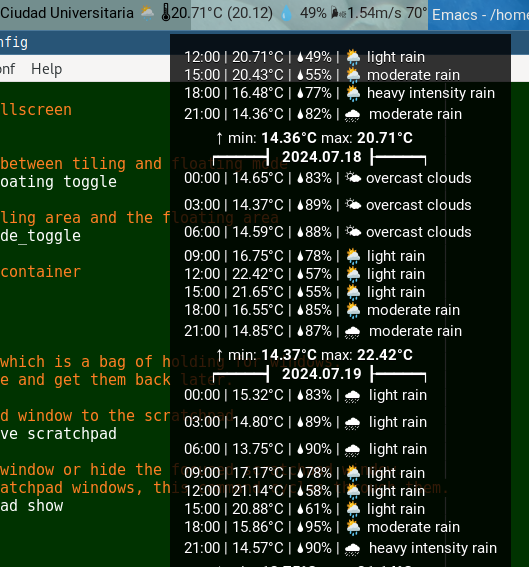
The end result? Nothing too stunning, but definitively something I find useful and even nicely laid out: Screenshot Do note that it seems OpenWeather will return the name of the closest available meteorology station with (most?) recent data for my home, I often get Ciudad Universitaria, but sometimes Coyoac n or even San ngel Inn.

Mike Gabriel: Weather Experts with Translation Skills Needed!

Lomiri Weather App goes Open Meteo In Ubuntu Touch / Lomiri, Maciej Sopy o has updated Lomiri's Weather App to operate against a different weather forecast provider (Open Meteo). Additionally, the new implementation is generic and pluggable, so other weather data providers can be added-in later. Big thanks to Maciej for working on this just in time (the previous implementation's API has recently been EOL'ed and is not available anymore to Ubuntu Touch / Lomiri users). Lomiri Weather App - new Meteorological Terms part of the App now While the old weather data provider implementation obtained all the meteorological information as already localized strings from the provider, the new implementation requires all sorts of weather conditions being translated within the Lomiri Weather App itself. The meteorological terms are probably not easy to translate for the usual software translator, so special help might be required here. Call for Translations: Lomiri Weather App So, if you feel entitled to help here, please join the Hosted Weblate service [1] and start working on Lomiri Weather App. Thanks a lot! light+love
Mike Gabriel (aka sunweaver) [1] https://hosted.weblate.org/
[2] https://hosted.weblate.org/projects/lomiri/lomiri-weather-app/

10 July 2024

Petter Reinholdtsen: Some notes from the 2024 LinuxCNC Norwegian developer gathering

The Norwegian The LinuxCNC developer gathering 2024 is over. It was a great and productive weekend, and I am sad that it is over. Regular readers probably still remember what LinuxCNC is, but her is a quick summary for those that forgot? LinuxCNC is a free software system for numerical control of machines such as milling machines, lathes, plasma cutters, routers, cutting machines, robots and hexapods. It eats G-code and produce motor movement and other changes to the physical world, while reading sensor input. I am not quite sure about the total head count, as not all people were present at the gathering the entire weekend, but I believe it was close to 10 people showing their faces at the gathering. The "hard core" of the group, who stayed the entire weekend, were two from Norway, two from Germany and one from England. I am happy with the outcome from the gathering. We managed to wrap up a new stable LinuxCNC release 2.9.3 and even tested it on real hardware within minutes of the release. The release notes for 2.9.3 are still being written, but should show up on on the project site in the next few days. We managed to go through around twenty pull requests and merge then into either the stable release (2.9) or the development branch (master). There are still around thirty pull requests left to process, so we are not out of work yet. We even managed to fix/improve a slightly worn lathe, and experiment with running a mechanical clock using G-code. The evening barbeque worked well both on Saturday and Sunday. It is quite fun to light up a charcoal grill using compressed air. Sadly the weather was not the best, so we stayed indoors most of the time. This gathering was made possible partly with sponsoring from both Redpill Linpro, Debian and NUUG Foundation, and we are most grateful for the support. I would also like to thank the local school for lending us some furniture, and of course the rest of the members of the organizers team, Asle and Bosse, for their countless contributions. The gathering was such success that we want to do it again next year. We plan to organize the next Norwegian LinuxCNC developer gathering at the end of June next year, the weekend Friday 27th to Sunday 29th of June 2025. I recommend you reserve the dates on your calendar today. Other related communities are also welcome to join in, for example those working on systems like FreeCAD and opencamlib, as I am sure we have much in common and sharing experiences would be very useful to all involved. We are of course looking for sponsors for this gathering already. The total budget for this gathering was around NOK 25.000 (around EUR 2.300), so our needs are quite modest. Perhaps a machine or tools company would like to help out the free software manufacturing community by sponsoring food, lodging and transport for such gathering?

3 July 2024

Sahil Dhiman: RTI to NPL Regarding Their NTP Infrastructure

I became interested in Network Time Protocol (NTP) last year after learning how fundamental this protocol is to the functioning of the global Internet. NTP helps synchronize clocks on devices over the Internet, which is essential for secure browsing, timestamping, keeping everyone in sync or just checking what time it is. Computers usually have a hardware real-time clock (RTC) but that deviates over time, so an occasional sync over NTP is required to keep the time accurate. Many network and IoT devices don t have hardware RTC so have even more reliance on NTP. Accurate time keeping starts with reference clocks like atomic clocks, GPS etc. Multiple government standard agencies host these reference clocks, which are regarded as Stratum 0. Stratum 1 servers are known as primary servers, and directly connect to Stratum 0 clocks for time. Stratum 1 servers then distribute time to Stratum 2 and further down the hierarchy. Computers typically connects to one or more Stratum 1/2/3 servers to get their time. Someone has to host these public Stratum 1,2,3 NTP servers. That s what NTP pool, a global effort by volunteers does. They provide NTP servers for the public to use. As of today, there are 4700+ servers in the pool which are free to use for anyone. Now let s come to the reason for writing this post. Indian Computer Emergency Response Team (CERT-In) in April 2022 released a set of cybersecurity directions which set the alarm bells ringing. Internet Society (and almost everyone else) wrote about it. And then there was this specific section about NTP:
All service providers, intermediaries, data centres, body corporate and Government organisations shall connect to the Network Time Protocol (NTP) Server of National Informatics Centre (NIC) or National Physical Laboratory (NPL) or with NTP servers traceable to these NTP servers, for synchronisation of all their ICT systems clocks. Entities having ICT infrastructure spanning multiple geographies may also use accurate and standard time source other than NPL and NIC, however it is to be ensured that their time source shall not deviate from NPL and NIC.
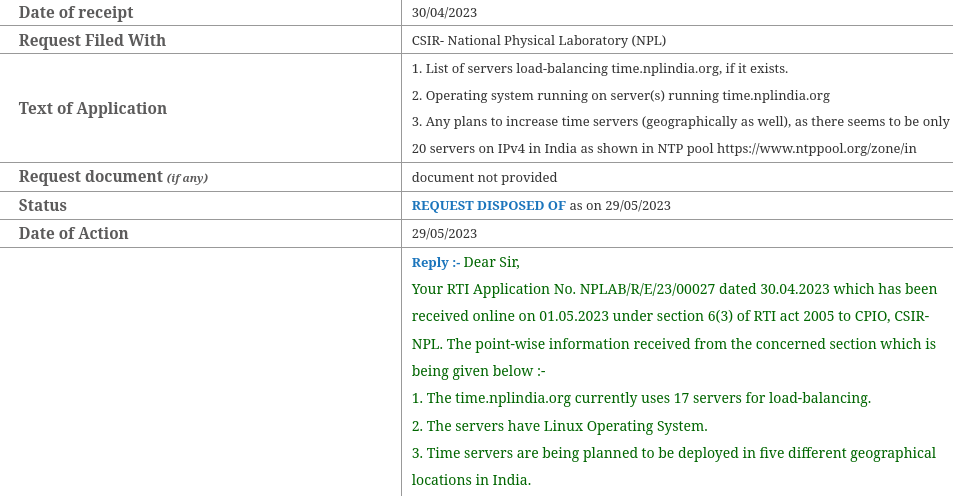
CSIR-National Physical Laboratory (NPL) is the official timekeeper for India and hosts the only public Stratum 1 clock in India, according to NTP pool website. So I was naturally curious to know what kind of infrastructure they re running for NTP. India has a Right to Information (RTI) Act which, like the Freedom of Information Act (FOIA) in the United States, gives citizens rights to request information from governmental entities, to which they have to respond in under 30 days. So last year, I filed two sets of RTI (one after the first reply came) inquiring about NPL s public NTP server setup. The first RTI had some generic questions: RTI 1
First RTI. Click to enlarge
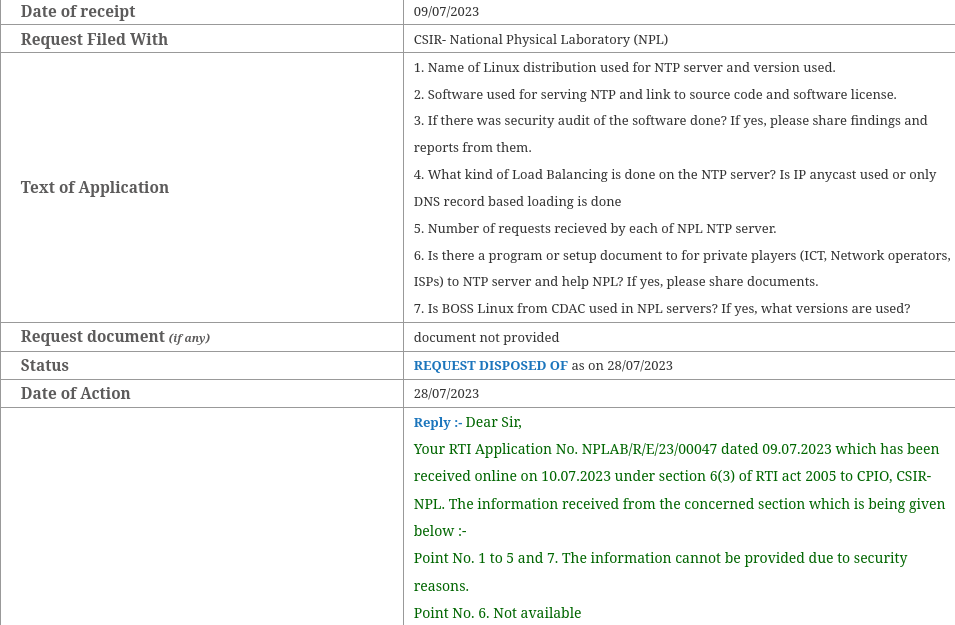
This gave a vague idea about the setup, so I sat down and came with some specific questions in the next RTI. RTI 2
Second RTI. Click to enlarge
Feel free to make your conclusions from it now. Bear in mind these were filled last year so things might have changed. Do let me know if you have more information about it. Update (07/07/2024): Found an article from Medianama about Indian government time servers with information sourced through RTI.

2 July 2024

Dima Kogan: vnlog.slurp() with non-numerical data

For a while now I'd see an annoying problem when trying to analyze data. I would be trying to import into numpy an innocuous-looking data file like this:
#  image   x y z temperature
image1.png 1 2 5 34
image2.png 3 4 1 35
As usual, I would be using vnlog.slurp() (a thin wrapper around numpy.loadtxt()) to read this in, but that doesn't work: the image filenames aren't parseable as numerical values. Up until now I would work around this by using the suprocess module to fork off a vnl-filter -p !image and then slurp that, but it's a pain and slow and has other issues. I just solved this conclusively using the numpy structured dtypes. I can now do this:
dtype = np.dtype([ ('image',       'U16'),
                   ('x y z',       int, (3,)),
                   ('temperature', float), ])
arr = vnlog.slurp("data.vnl", dtype=dtype)
This will read the image filename, the xyz points and the temperature into different sub-arrays, with different types each. Accessing the result looks like this:
print(arr['image'])
---> array(['image1.png', 'image2.png'], dtype='<U16')
print(arr['x y z'])
---> array([[1, 2, 5],
            [3, 4, 1]])
print(arr['temperature'])
---> array([34., 35.])
Notes: We still do not support records with any null values (-). This could probably be handled with the converters kwarg of numpy.loadtxt(), but that sounds slow. I'll look at that later. This is available today in vnlog 1.38.

1 July 2024

Guido G nther: Free Software Activities June 2024

A short status update of what happened on my side last month. Was able to test our Cellbroadcast bits, feedbackd became more flexible regarding LEDs, Phosh 0.40 is out, and some more. Phosh Phoc gmobile phosh-mobile-settings phosh-wallpapers emacs Debian ModemManager Feedbackd Livi Calls Chatty meta-phosh Libhandy If you want to support my work see donations.

22 June 2024

Russ Allbery: Review: And the Stars Will Sing

Review: And the Stars Will Sing, by Michelle Browne
Series: The Meaning Wars #1
Publisher: Michelle Browne
Copyright: 2012, 2021
Printing: 2021
ASIN: B0075G7GEA
Format: Kindle
Pages: 85
And the Stars Will Sing is a self-published science fiction novella, the first of a (currently) five book series. I believe it may be Browne's first publication, although I don't have a good data source to confirm. Crystal Weiss is a new graduate from Mars, about to leave the solar system to her first job assignment: installation of a permanent wormhole in the vicinity of Messier 14. Her expertise is the placement calculations. The heavy mathematical lifting is of course done by computers, but humans have to do the mapping and some of the guidance. And the Stars Will Sing is an epistolary novel, told in the form of her letters to her friend Sarah. I feel bad when I stumble across a book like this. I want to stick with my habit of writing a review of each book I read, but it's one thing to pan a bad book by a famous author and another thing to pick on a self-published novella that I read due to some recommendation or mention whose details I've forgotten. Worse, I think this wasn't even the recommended book; I looked up the author, saw that the first of a series was on sale, and thought "oh, hey, I like epistolary novels and I'm in the mood for some queer space opera." This book didn't seem that queer (there is a secondary lesbian relationship but the main relationship seemed rather conventional), but I'll get to the romance in a moment. I was not the reader for this book. There's a reason why most of the books I read are from traditional publishers; I'm too critical of a reader for a lot of early self-published work. It's not that I dislike self-publishing as a concept many self-published books are excellent and the large publishers have numerous problems but publishers enforce a quality bar. Inconsistently, unfairly, and by rejecting a lot of good work, but still, they do. I'm fairly sure traditional publishers would have passed on this book; the quality of the writing isn't there yet. (It's certainly a better book than I could have written! But that's why I'm writing my reviews over in my quiet corner of the Internet and not selling fiction to other people.) The early chapters aren't too bad, although they have a choppy, cliched style that more writing experience usually smoothes out. The later chapters have more dialogue, enough that I started wondering how Crystal could remember that much dialogue verbatim to put into a letter, and it's not good. All of the characters talk roughly the same (even the aliens), the dialogue felt even more cliched than the rest of the writing, and I started getting distracted by the speech tags. Crystal comes across as very young, impulsive, and a drama magnet who likes being all up in her coworkers' business. None of these are objective flaws in the book, but I could tell early on that I was going to find her annoying. She has a heavily-foreshadowed enemies-to-lovers thing with one of her male coworkers. Her constant complaining about him at the start of the story was bad enough, but the real problem is that in the very few places where he has more personality than plastic lawn furniture, he's being obnoxious to Crystal. I'm used to being puzzled by a protagonist's choice in love interests, but this one felt less like an odd personality choice and more a lack of writing skill. Even if the relationship is being set up for failure (not true by the end of this book), you've got to help me understand what the protagonist saw in him or was getting out of the relationship. The plot was so predictable that it ironically surprised me. I was sure that some sort of twist or complication was coming, but no. I will give Browne some credit for writing a slightly more realistic character reaction to violence than most SF authors, but there was nothing in the plot to hold my interest. The world-building was generic science fiction with aliens. It had a few glimmers of promise, but there was some sort of psychic hand-waving involved in siting wormholes that didn't work for me and the plot climax made no sense to me whatsoever. This is the kind of bad book that I don't want to hold against the writer. Twelve years later and with numerous other novels and novellas under her belt, her writing is probably much better. I do think this book would have benefited from an editor telling her it wasn't good enough for publication yet, but that's not how the Kindle self-publishing world works. Mostly, this is my fault: I half-followed a recommendation into an area of publishing that I know from past experience I should avoid without a solid review from an equally critical reader. Followed by The Stolen, a two-story collection. Rating: 3 out of 10

8 June 2024

Thorsten Alteholz: My Debian Activities in May 2024

FTP master This month I accepted 347 and rejected 49 packages. The overall number of packages that got accepted was 348.

Debian LTS This was my hundred-nineteenth month that I did some work for the Debian LTS initiative, started by Raphael Hertzog at Freexian. During my allocated time I uploaded or worked on: I also continued to work on tiff and last but not least did a week of FD and attended the monthly LTS/ELTS meeting. Unfortunately I used lots of time to debug an issue with nghttp2. Please see my odyssey below. Debian ELTS This month was the seventieth ELTS month. During my allocated time I uploaded: For some tests I installed the new nghttp2 package on my Stretch VM and started the daemon. Unfortunately I got an unexpected error from getaddrinfo() about ai_socktype not supported. The daemon was configured to listen on lo, the device was available, but the error remained. I was pretty sure that my patch was not the reason for this and indeed the unpatched version showed this error as well. I didn t want to release an untested package, so nghttp2 had to start at least! Therefore I built a minimal example to reproduce the issue. getaddrinfo() failed for hints.ai_socktype=SOCK_STREAM and a numerical IP address. Having no hints at all or localhost instead of 127.0.0.1 made the error disappear (as a remark: localhost resolves to 127.0.0.1, the ipv6 variant is ip6-localhost ). I could see that in nghttp2 as well. Configuring it with localhost let the error vanish but the daemon still exited due to other reasons. After some time of debugging, I added another network interface to my VM and configured it with a dummy IPv4 address. Voila, everything worked as expected. According to Wikipedia, IPv6 was ratified as standard in 2017 and Stretch was also released in 2017. No wonder that a IPv6-only-VM had problems back then and these problems survived to the present. I also continued to work on an update for tiff in Jessie and Stretch, did a week of FD and attended the LTS/ELTS meeting. Debian Printing This month I uploaded new upstream or bugfix versions of: This work is generously funded by Freexian! Debian Astro This month I uploaded a new upstream or bugfix version of: Debian IoT This month I uploaded new upstream or bugfix versions of: Debian Mobcom Due to more and more problems with time_t, I removed osmo-iuh and all dependencies from armel, armhf and i386, sorry. If there is really anybody using this software on 32-bit architectures don t hesitate to get in touch. It is official now, the GSoC student working on the Mobcom packages is Nathan Doris. He already finished the hardest part of the job and I could upload the latest version of libosmocore. I really enjoy working with him and look forward to a pleasant SoC :-). misc This month I uploaded new upstream or bugfix versions of: Did I already mention that I love lists with topics I can work on. I print out such lists and enjoy checking off one after the other. End of May Helmut told me that I am a bit lazy and gave me such a list with all my packages that have one or the other issue with /usr-move. Most of the uploads above are packages on that list and I could check off a lot :-).

Reproducible Builds: Reproducible Builds in May 2024

Welcome to the May 2024 report from the Reproducible Builds project! In these reports, we try to outline what we have been up to over the past month and highlight news items in software supply-chain security more broadly. As ever, if you are interested in contributing to the project, please visit our Contribute page on our website. Table of contents:
  1. A peek into build provenance for Homebrew
  2. Distribution news
  3. Mailing list news
  4. Miscellaneous news
  5. Two new academic papers
  6. diffoscope
  7. Website updates
  8. Upstream patches
  9. Reproducibility testing framework


A peek into build provenance for Homebrew Joe Sweeney and William Woodruff on the Trail of Bits blog wrote an extensive post about build provenance for Homebrew, the third-party package manager for MacOS. Their post details how each bottle (i.e. each release):
[ ] built by Homebrew will come with a cryptographically verifiable statement binding the bottle s content to the specific workflow and other build-time metadata that produced it. [ ] In effect, this injects greater transparency into the Homebrew build process, and diminishes the threat posed by a compromised or malicious insider by making it impossible to trick ordinary users into installing non-CI-built bottles.
The post also briefly touches on future work, including work on source provenance:
Homebrew s formulae already hash-pin their source artifacts, but we can go a step further and additionally assert that source artifacts are produced by the repository (or other signing identity) that s latent in their URL or otherwise embedded into the formula specification.

Distribution news In Debian this month, Johannes Schauer Marin Rodrigues (aka josch) noticed that the Debian binary package bash version 5.2.15-2+b3 was uploaded to the archive twice. Once to bookworm and once to sid but with differing content. This is problem for reproducible builds in Debian due its assumption that the package name, version and architecture triplet is unique. However, josch highlighted that
This example with bash is especially problematic since bash is Essential:yes, so there will now be a large portion of .buildinfo files where it is not possible to figure out with which of the two differing bash packages the sources were compiled.
In response to this, Holger Levsen performed an analysis of all .buildinfo files and found that this needs almost 1,500 binNMUs to fix the fallout from this bug. Elsewhere in Debian, Vagrant Cascadian posted about a Non-Maintainer Upload (NMU) sprint to take place during early June, and it was announced that there is now a #debian-snapshot IRC channel on OFTC to discuss the creation of a new source code archiving service to, perhaps, replace snapshot.debian.org. Lastly, 11 reviews of Debian packages were added, 15 were updated and 48 were removed this month adding to our extensive knowledge about identified issues. A number of issue types have been updated by Chris Lamb as well. [ ][ ]
Elsewhere in the world of distributions, deep within a larger announcement from Colin Percival about the release of version 14.1-BETA2, it was mentioned that the FreeBSD kernels are now built reproducibly.
In Fedora, however, the change proposal mentioned in our report for April 2024 was approved, so, per the ReproduciblePackageBuilds wiki page, the add-determinism tool is now running in new builds for Fedora 41 ( rawhide ). The add-determinism tool is a Rust program which, as its name suggests, adds determinism to files that are given as input by attempting to standardize metadata contained in binary or source files to ensure consistency and clamping to $SOURCE_DATE_EPOCH in all instances . This is essentially the Fedora version of Debian s strip-nondeterminism. However, strip-nondeterminism is written in Perl, and Fedora did not want to pull Perl in the buildroot for every package. The add-determinism tool eliminates many causes of non-determinism and work is ongoing to continue the scope of packages it can operate on.

Mailing list news On our mailing list this month, regular contributor kpcyrd wrote to the list with an update on their source code indexing project, whatsrc.org. The whatsrc.org project, which was launched last month in response to the XZ Utils backdoor, now contains and indexes almost 250,000 unique source code archives. In their post, kpcyrd gives an example of its intended purpose, noting that it shown that whilst there seems to be consensus about [the] source code for zsh 5.9 in various Linux distributions, it does not align with the contents of the zsh Git repository . Holger Levsen also posted to the list with a pre-announcement of sorts for the 2024 Reproducible Builds summit. In particular:
[Whilst] the dates and location are not fixed yet, however if you don help us with finding a suitable location soon, it is very likely that we ll meet again in Hamburg in the 2nd half of September 2024 [ ].
Lastly, Frederic-Emmanuel Picca wrote to the list asking for help understanding the non-reproducible status of the Debian silx package and received replies from both Vagrant Cascadian and Chris Lamb.

Miscellaneous news strip-nondeterminism is our tool to remove specific non-deterministic results from a completed build. This month strip-nondeterminism version 1.14.0-1 was uploaded to Debian unstable by Chris Lamb chiefly to incorporate a change from Alex Muntada to avoid a dependency on Sub::Override to perform monkey-patching and break circular dependencies related to debhelper [ ]. Elsewhere in our tooling, Jelle van der Waa modified reprotest because the pipes module will be removed in Python version 3.13 [ ].
It was also noticed that a new blog post by Daniel Stenberg detailing How to verify a Curl release mentions the SOURCE_DATE_EPOCH environment variable. This is because:
The [curl] release tools document also contains another key component: the exact time stamp at which the release was done using integer second resolution. In order to generate a correct tarball clone, you need to also generate the new version using the old version s timestamp. Because the modification date of all files in the produced tarball will be set to this timestamp.

Furthermore, Fay Stegerman filed a bug against the Signal messenger app for Android to report that their reproducible builds cannot, in fact, be reproduced. However, Fay is quick to note that she has:
found zero evidence of any kind of compromise. Some differences are yet unexplained but everything I found seems to be benign. I am disappointed that Reproducible Builds have been broken for months but I have zero reason to doubt Signal s security in any way.

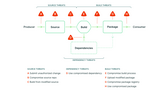
Lastly, it was observed that there was a concise and diagrammatic overview of supply chain threats on the SLSA website.

Two new academic papers Two new scholarly papers were published this month. Firstly, Mathieu Acher, Beno t Combemale, Georges Aaron Randrianaina and Jean-Marc J z quel of University of Rennes on Embracing Deep Variability For Reproducibility & Replicability. The authors describe their approach as follows:
In this short [vision] paper we delve into the application of software engineering techniques, specifically variability management, to systematically identify and explicit points of variability that may give rise to reproducibility issues (e.g., language, libraries, compiler, virtual machine, OS, environment variables, etc.). The primary objectives are: i) gaining insights into the variability layers and their possible interactions, ii) capturing and documenting configurations for the sake of reproducibility, and iii) exploring diverse configurations to replicate, and hence validate and ensure the robustness of results. By adopting these methodologies, we aim to address the complexities associated with reproducibility and replicability in modern software systems and environments, facilitating a more comprehensive and nuanced perspective on these critical aspects.
(A PDF of this article is available.)
Secondly, Ludovic Court s, Timothy Sample, Simon Tournier and Stefano Zacchiroli have collaborated to publish a paper on Source Code Archiving to the Rescue of Reproducible Deployment. Their paper was motivated because:
The ability to verify research results and to experiment with methodologies are core tenets of science. As research results are increasingly the outcome of computational processes, software plays a central role. GNU Guix is a software deployment tool that supports reproducible software deployment, making it a foundation for computational research workflows. To achieve reproducibility, we must first ensure the source code of software packages Guix deploys remains available.
(A PDF of this article is also available.)

diffoscope diffoscope is our in-depth and content-aware diff utility that can locate and diagnose reproducibility issues. This month, Chris Lamb made a number of changes such as uploading versions 266, 267, 268 and 269 to Debian, making the following changes:
  • New features:
    • Use xz --list to supplement output when comparing .xz archives; essential when metadata differs. (#1069329)
    • Include xz --verbose --verbose (ie. double) output. (#1069329)
    • Strip the first line from the xz --list output. [ ]
    • Only include xz --list --verbose output if the xz has no other differences. [ ]
    • Actually append the xz --list after the container differences, as it simplifies a lot. [ ]
  • Testing improvements:
    • Allow Debian testing to fail right now. [ ]
    • Drop apktool from Build-Depends; we can still test APK functionality via autopkgtests. (#1071410)
    • Add a versioned dependency for at least version 5.4.5 for the xz tests as they fail under (at least) version 5.2.8. (#374)
    • Fix tests for 7zip 24.05. [ ][ ]
    • Fix all tests after additon of xz --list. [ ][ ]
  • Misc:
    • Update copyright years. [ ]
In addition, James Addison fixed an issue where the HTML output showed only the first difference in a file, while the text output shows all differences [ ][ ][ ], Sergei Trofimovich amended the 7zip version test for older 7z versions that include the string [64] [ ][ ] and Vagrant Cascadian relaxed the versioned dependency to allow version 5.4.1 for the xz tests [ ] and proposed updates to guix for versions 267, 268 and pushed version 269 to Guix. Furthermore, Eli Schwartz updated the diffoscope.org website in order to explain how to install diffoscope on Gentoo [ ].

Website updates There were a number of improvements made to our website this month, including Chris Lamb making the print CSS stylesheet nicer [ ]. Fay Stegerman made a number of updates to the page about the SOURCE_DATE_EPOCH environment variable [ ][ ][ ] and Holger Levsen added some of their presentations to the Resources page. Furthermore, IOhannes zm lnig stipulated support for SOURCE_DATE_EPOCH in clang version 16.0.0+ [ ], Jan Zerebecki expanded the Formal definition page and fixed a number of typos on the Buy-in page [ ] and Simon Josefsson fixed the link to Trisquel GNU/Linux on the Projects page [ ].

Upstream patches This month, we wrote a number of patches to fix specific reproducibility issues, including:

Reproducibility testing framework The Reproducible Builds project operates a comprehensive testing framework running primarily at tests.reproducible-builds.org in order to check packages and other artifacts for reproducibility. In May, a number of changes were made by Holger Levsen:
  • Debian-related changes:
    • Enable the rebuilder-snapshot API on osuosl4. [ ]
    • Schedule the i386 architecture a bit more often. [ ]
    • Adapt cleanup_nodes.sh to the new way of running our build services. [ ]
    • Add 8 more workers for the i386 architecture. [ ]
    • Update configuration now that the infom07 and infom08 nodes have been reinstalled as real i386 systems. [ ]
    • Make diffoscope timeouts more visible on the #debian-reproducible-changes IRC channel. [ ]
    • Mark the cbxi4a-armhf node as down. [ ][ ]
    • Only install the hdmi2usb-mode-switch package only on Debian bookworm and earlier [ ] and only install the haskell-platform package on Debian bullseye [ ].
  • Misc:
    • Install the ntpdate utility as we need it later. [ ]
    • Document the progress on the i386 architecture nodes at Infomaniak. [ ]
    • Drop an outdated and unnoticed notice. [ ]
    • Add live_setup_schroot to the list of so-called zombie jobs. [ ]
In addition, Mattia Rizzolo reinstalled the infom07 and infom08 nodes [ ] and Vagrant Cascadian marked the cbxi4a node as online [ ].

If you are interested in contributing to the Reproducible Builds project, please visit our Contribute page on our website. However, you can get in touch with us via:

7 June 2024

Freexian Collaborators: Debian Contributions: DebConf Bursaries, /usr-move, sbuild, and more! (by Stefano Rivera)

Contributing to Debian is part of Freexian s mission. This article covers the latest achievements of Freexian and their collaborators. All of this is made possible by organizations subscribing to our Long Term Support contracts and consulting services.

DebConf Bursary updates, by Utkarsh Gupta Utkarsh is the bursaries team lead for DebConf 24. Bursary requests are dispatched to a team of volunteers to review. The results are collated, adjusted and merged to produce priority lists of requests to fund. Utkarsh raised the team, coordinated the review, and issued bursaries to attendees.

/usr-move, by Helmut Grohne More and more, the /usr-move transition is being carried out by multiple contributors and many performed around a hundred of the requested uploads. Of these, Helmut contributed five patches and two uploads. As a result, there are less than 350 packages left to be converted, and all of the non-trivial cases have patches. We started with three times that number. Thanks to everyone involved for supporting this effort. For people interested in background information of this transition, Helmut gave a presentation at MiniDebConf Berlin 2024 (slides).

sbuild, by Helmut Grohne While unshare mode of sbuild has existed for quite a while, it is now getting significant use in Debian, and new problems are popping up. Helmut looked into an apparmor-related failure and provided a diagnosis. While relevant code would detect the chroot nature of a schroot backend and skip apparmor tests, the unshare environment would be just good enough to run and fail the test. As sbuild exposes fewer special kernel filesystems, the tests will be skipped again. Another problem popped up when gobject-introspection added a dependency on the host architecture Python interpreter in a cross build environment. sbuild would prefer installing (and failing) a host architecture Python to installing the qemu alternative. Attempts to fix this would result in systemd killing sbuild. ischroot as used by libc6.postinst would not classify the unshare environment as a chroot. Therefore libc6.postinst would run telinit which would kill the build process. This is a complex interaction problem that shall eventually be solved by providing triggers from libc6 to be implemented by affected init systems.

Salsa CI updates, by Santiago Ruano Rinc n Several issues arose about Salsa CI last month, and it is probably worth mentioning part of the challenges of defining its framework in YAML. With the upcoming end-of-support of Debian 10 buster as LTS, armel was removed from deb.debian.org, making the jobs that build images for buster/armel to fail. While the removal of buster/armel from the repositories is a natural change, it put some light on the flaws in the Salsa CI design regarding the support of the different Debian releases. Currently, the images are defined like these (from .images-debian.yml):
.all-supported-releases: &all-supported-releases
  - stretch
  - stretch-backports
  - buster
  - bullseye
  - bullseye-backports
  - bookworm
  - bookworm-backports
  - trixie
  - sid
  - experimental
And from them, different images are built according to the different jobs and how they are supported, for example:
images-prod-arm:
  stage: build
  extends: .build_template
  tags:
    - $SALSA_CI_ARM_RUNNER_TAG
  parallel:
    matrix:
      # Base image, all releases, all arches
      - IMAGE_NAME: base
        ARCH:
          - arm32v5
          - arm32v7
          - arm64v8
        RELEASE: *all-supported-releases
The removal of buster/armel could be easily reflected as:
images-prod-arm:
  stage: build
  extends: .build_template
  tags:
    - $SALSA_CI_ARM_RUNNER_TAG
  parallel:
    matrix:
      # Base image, fully supported releases, all arches
      - IMAGE_NAME: base
        ARCH:
          - arm32v5
          - arm32v7
          - arm64v8
        RELEASE:
          - stretch
          - buster
          - bullseye
          - bullseye-backports
          - bookworm
          - bookworm-backports
          - trixie
          - sid
          - experimental
      # buster only supports armhf and arm64
      - IMAGE_NAME: base
        ARCH:
          - arm32v7
          - arm64v8
        RELEASE: buster
Evidently, this increases duplication of the release support data, which is of course not optimal and it is error prone when changing the data about supported releases. A better approach would be to have two different YAML lists, such as:
# releases that have partial support. E.g.: buster is transitioning to
# Debian LTS, and buster armel is no longer found in deb.debian.org
.old-releases: &old-releases
  - stretch
  - buster

.currently-supported-releases: &currently-supported-releases
  - bullseye
  - bullseye-backports
  - bookworm
  - bookworm-backports
  - trixie
  - sid
  - experimental
and then a unified list:
.all-supported-releases: &all-supported-releases
  - *old-releases
  - *currently-supported-releases
that could be used in the matrix of the jobs that build all the images available in the pipeline container registry. However, due to limitations in GitLab, it is not possible to expand the variables or mapping values in a parallel:matrix context. At least not in an elegant fashion. This is the kind of issue that recently arose and that Santiago is currently working to solve, in the simplest possible way. Astute readers would notice that stretch is listed in the fully supported releases. And there is no problem with stretch, because it is built from archive.debian.org. Otto actually has tried to fix the broken image build job doing the same, but it is still incorrect, because the security repository is not (yet) available in archive.debian.org. Additionally, Santiago has also worked on other merge requests, such as:
  1. support branch/tags as target head in the test projects,
  2. build autopkgtest image on top of stable
  3. Add .yamllint and make it happy in the autopkgtest-lxc project
  4. enable FF_SCRIPT_SECTIONS to log multiline commands, among others.

Archiving DebConf Websites, by Stefano Rivera DebConf, the annual Debian conference, has its own new website every year. These are typically complex dynamic web applications (featuring registration, call for papers, scheduling, etc.) Once the conference is over, there is no need to keep maintaining these applications, so we archive the sites off as static HTML, and serve them from Debian s static CDN. Stefano archived the websites for the last two DebConfs. The schedule system behind DebConf 14 and 15 s websites was a derivative of Canonical s summit system. This was only used for a couple of years before migrating to wafer, the current system. Archiving summit content has been on the nice to have list for years, but nobody has ever tackled it. The machine that served the sites went away a couple of years ago. After much digging, a backup of the database was found, and Stefano got this code running on an ancient Python 2.7. Recently Stefano put this all together and hooked in an archive export to finally get this content preserved.

Python 3.x and pypy3 security bug triage, by Stefano Rivera Stefano Rivera triaged all the open security bugs against the Python 3.x and PyPy3 packages for Debian s stable and LTS releases. Several had been fixed but this wasn t recorded in the security tracker.

Linux livepatching support for Debian, by Santiago Ruano Rinc n In collaboration with Emmanuel Arias, Santiago filed ITP bug #1070494. As stated in the bug, more than an Intent to Package, it is an Intent to Design and Implement live patching support for the Linux kernel in Debian. For now, Emmanuel and Santiago have done exploratory work and they are working to understand the different possibilities to implement livepatching. One possible direction is to rely on kpatch, and the other is to package the modules using regular packaging tools. Also, it is needed to evaluate if it is possible to rely on distributing the modules via packages, or instead as a service, as it is done by some commercial distributions.

Miscellaneous contributions
  • Thorsten Alteholz uploaded cups-bjnp to improve packaging.
  • Colin Watson tracked down a baffling CI issue in openssh to unblock several merge requests, removed the user_readenv=1 option from its PAM configuration, and started on the first stage of his plan to split out GSS-API key exchange support to separate packages.
  • Colin did his usual routine work on the Python team, upgrading 26 packages to new upstream versions, and cherry-picking an upstream PR to fix a pytest 8 incompatibility in ipywidgets.
  • Colin NMUed a couple of packages to reduce the need for explicit overrides in Packages-arch-specific, and removed some other obsolete entries from there.
  • Emilio managed various library transitions, and helped finish a few of the remaining t64 transitions.
  • Helmut sent a patch for enabling piuparts to work as a regular user building on earlier work.
  • Helmut sent patches for 7 cross build failures, 6 other debian bugs and fixed an infrastructure problem in crossqa.debian.net.
  • Nicholas worked on a sponsored package upload, and discovered the blhc tool for diagnosing build hardening.
  • Stefano Rivera started and completed the re2 transition. The release team suggested moving to a virtual package scheme that includes the absl ABI (as re2 now depends on it). Adopted this.
  • Stefano continued to work on DebConf 24 planning.
  • Santiago continued to work on DebConf24 Content tasks as well as Debconf25 organisation.

1 June 2024

Ian Jackson: What your vote is worth - a back of the envelope calculation

tl;dr: Your vote really counts! Each vote in a UK General Election is worth maybe 100,000 - to you and all your fellow citizens taken together. If you really care about the welfare of everyone affected by actions of the UK government, then it s worth that to you too. Introduction It seems a common perception that one vote, in amongst all those millions, doesn t really matter. So maybe it s not worth voting. But, voting is (largely) what determines what the government does - and the government is big. It s as big as all the people. If you are the kind of person who cares about what happens to everyone in your polity and indeed everyone its actions affect, then even your one vote is very important indeed. A method for back of the envelope calculation It would be nice to give a quantitative estimate. Many things in our society are measured in money, so let s try taking a stab at calculating the money value of your vote. The argument I m going to make is this: the government (by which I include the legislature), which is selected by our votes, decides how to spend the national budget. So, basically, I m going to divide the budget, by the electorate. UK Parliament UK Parliamentary elections decide not only the House of Commons, but, through that, the government. The upper house, the House of Lords, has very limited influence. So I think it s fair to regard the Parliamentary election as, simply, controlling that budget. Being lazy, I m going to use Wikipedia data. We have the size of the electorate, for 2019, 47.6 million. But your influence isn t shared with the whole electorate, only with the other people who also vote. Turnout in 2019 was 67.3%. The 2019 budget isn t listed but I ll just average the 2018 and March 2020 figures 842bn and 873bn, so 857 billion. (Strictly speaking I should add up the budgets for the period of the Parliament, but that seems like a lot of effort.) There s a discrepancy in the timescale we need to account for. Your vote influences the budgets for several years, depending how long it is until the next election. Taking Wikipedia s list of elections this century there ve been 7 in 24 years. So that s an average of about 3.4y. So, multiplying it through, we have ( 857b * (24 / 7)) / (47.6M * 67.3%), giving a guess at the value of your UK General Election vote: 92,000. European Parliament 2022 budget for the European Union (Wikipedia again) was 170.6 bn. The last election, in 2019, had a turnout of 198,352,638. Each EU Parliament lasts 5 years. The Parliament, however, shares responsibility for the budget with the European Council, which is controlled, ultimately, by national governments. We have to pick a numerical value for the Parliament s share of the influence. Over the past years the Parliament has gradually been more willing to exercise its powers in this area. I m going to arbitrarily call its share 50%. The calculation, then, is 170.6 bn * 5 * 50% / 198M, giving a guess at the value of your EU Parliamentary Election vote: 2150. This much smaller figure reflects simply that the EU doesn t spend very much money, for a polity of its size. (Those stories in the British press giving the impression that the EU is massively wasteful are, simply, lies.) The interaction of this calculation with the Council s share of the influence, and with national budgets, is a bit of a question, but given the much smaller amounts involved, it doesn t seem worth thinking about that too hard. Only if you care about other people as much as yourself! All of this is only true for you if you value and want to help everyone in your society. That includes immigrants, women, unemployed people, disabled people, people who are much poorer or richer than you, etc. If you think about it in purely personal terms, your vote is hardly worth anything - because while the effect of your vote, overall, is very large, that effect is shared by everyone in your polity. So if you only care about yourself, voting is a total waste of time. The more selfish and xenophobic and racist and so on you are - caring only about people like yourself - the less your vote is worth. This is why voting is rightly seen as a civic duty. I just spent 30 to courier my EP vote to Den Haag. That only makes sense because I m very willing to spend that 30 to try to improve the spending of the 2000 or so that s my share of the EU budget. This is a very rough analysis These calculations neglect a lot of very important things: politics isn t just about the allocation of resources. It s also about values, and bad politics can seriously harm people. Arguably many of those effects of your vote, are much more important than just how the budget is set and spent. It would be interesting to see an attempt at a similar analysis but for taking into account life and death questions like hate crime, traffic violence, healthcare, refugees welfare, and so on. I m not sure how to approach that. Maybe some real social scientists have done so? References welcome. Also, even on its own terms, this analysis is very rough and ready. We haven t modelled the ability of the government to change its tax rates; perhaps we should be multiplying GDP (or some other better measure) by 90% percentile total tax rate amongst countries like this one . The amount of influence that can be wielded by one vote is probably nonlinear in the size of the political faction, but IDK in which direction. In unfair voting systems like the UK s, some people s votes are worth much more than others. In a very marginal constituency, which is a target seat, your vote might be worth tens of millions. In a safe seat, it might only be worth a few thousand. And in practical terms you don t get to choose precisely the policies you want; you have to pick a party, which is sometimes very much a question of the lesser evil. So, there is much I haven t modelled. But the key point stands: Conclusion Although your vote is diluted by everyone else s votes, together, we control the government, which affects us all. So if you care about the whole of society, the big numbers in the divisor, and the numerator, cancel out. You can think of your vote as controlling one citizen s worth of government activity.
edited 2024-06-01 09:40 Z to fix a grammar botch


comment count unavailable comments

Russell Coker: Links May 2024 (late)

VoltageDivide has an interesting article on Unconventional Uses of FPGAs [1]. Tagline Every sensor is a temperature sensor, nearly everything is a resistor or a conductor if you try hard enough and anything is an antenna. Datasheets are just a suggestion, and finally, often we pretend things are ideal, when they often are not. Interesting blog post about the way npm modules that depend on everything exposed flaws in the entire npm system [2]. The conclusion should have included use a fake name for doing unusual tests . Krebs on Security has an interesting article about MFA bombing [3]. Looks like Apple has some flaws in their MFA system, other companies developing MFA should learn from this. Joey wrote an informative blog post about the Vultr hosting company wanting to extract data from VMs run for clients to train ML [4]. If your email is stored on such a VM it could be generated by an AI system. John Goerzen wrote an interesting post looking at the causes of the xz issue from a high level [5]. Interesting article about self proclaimed Autistic pro-natalists [6]. They seem somewhat abusive to their kids and are happy to associate with neo-Nazis. :( Joey Hess wrote an interesting blog post about the possibility of further undiscovered attacks on xz [7]. Going back to an earlier version seems like a good idea. The Guardian has an interesting article about Amazon s 2 pizza rule and the way the company is structured [8]. It s interesting how they did it, but we really need to have it broken up via anti-trust legislation. John Goerzen wrote an informative post about Facebook censorship and why we should all move to Mastodon [9]. Facebook needs to be broken up under anti-trust laws. Kobold Letters is an attack on HTML email that results in the visual representation of email changing when it is forwarded. [10]. You could have the original email hide some sections which are revealed with the recipient forwards it for a CEO impersonation attack.

31 May 2024

Petter Reinholdtsen: The 2024 LinuxCNC Norwegian developer gathering

The LinuxCNC project is still going strong. And I believe this great software system for numerical control of machines such as milling machines, lathes, plasma cutters, routers, cutting machines, robots and hexapods, would do even better with more in-person developer gatherings, so we plan to organise such gathering this summer too. The Norwegian LinuxCNC developer gathering take place the weekend Friday July 5th to 7th this year, and is open for everyone interested in contributing to LinuxCNC and free software manufacturing. Up to date information about the gathering can be found in the developer mailing list thread where the gathering was announced. Thanks to the good people at Debian as well as leftover money from last years gathering from Redpill-Linpro and NUUG Foundation, we have enough sponsor funds to pay for food, and probably also shelter for the people traveling from afar to join us. If you would like to join the gathering, get in touch and add your details on the pad. As usual, if you use Bitcoin and want to show your support of my activities, please send Bitcoin donations to my address 15oWEoG9dUPovwmUL9KWAnYRtNJEkP1u1b.

20 May 2024

Debian Brasil: MiniDebConf Belo Horizonte 2024 - um breve relato

De 27 a 30 de abril de 2024 foi realizada a MiniDebConf Belo Horizonte 2024 no Campus Pampulha da UFMG - Universidade Federal de Minas Gerais, em Belo Horizonte - MG. MiniDebConf BH 2024 banners Esta foi a quinta vez que uma MiniDebConf (como um evento presencial exclusivo sobre Debian) aconteceu no Brasil. As edi es anteriores foram em Curitiba (2016, 2017, e 2018), e em Bras lia 2023. Tivemos outras edi es de MiniDebConfs realizadas dentro de eventos de Software Livre como o FISL e a Latinoware, e outros eventos online. Veja o nosso hist rico de eventos. Paralelamente MiniDebConf, no dia 27 (s bado) aconteceu o FLISOL - Festival Latino-americano de Instala o de Software Livre, maior evento da Am rica Latina de divulga o de Software Livre realizado desde o ano de 2005 simultaneamente em v rias cidades. A MiniDebConf Belo Horizonte 2024 foi um sucesso (assim como as edi es anteriores) gra as participa o de todos(as), independentemente do n vel de conhecimento sobre o Debian. Valorizamos a presen a tanto dos(as) usu rios(as) iniciantes que est o se familiarizando com o sistema quanto dos(as) desenvolvedores(as) oficiais do projeto. O esp rito de acolhimento e colabora o esteve presente em todos os momentos. MiniDebConf BH 2024 flisol N meros da edi o 2024 Durante os quatro dias de evento aconteceram diversas atividades para todos os n veis de usu rios(as) e colaboradores(as) do projeto Debian. A programa o oficial foi composta de: MiniDebConf BH 2024 palestra Os n meros finais da MiniDebConf Belo Horizonte 2024 mostram que tivemos um recorde de participantes. Dos 224 participantes, 15 eram contribuidores(as) oficiais brasileiros sendo 10 DDs (Debian Developers) e 05 (Debian Maintainers), al m de diversos(as) contribuidores(as) n o oficiais. A organiza o foi realizada por 14 pessoas que come aram a trabalhar ainda no final de 2023, entre elas o Prof. Lo c Cerf do Departamento de Computa o que viabilizou o evento na UFMG, e 37 volunt rios(as) que ajudaram durante o evento. Como a MiniDebConf foi realizado nas instala es da UFMG, tivemos a ajuda de mais de 10 funcion rios da Universidade. Veja a lista com os nomes das pessoas que ajudaram de alguma forma na realiza o da MiniDebConf Belo Horizonte 2024. A diferen a entre o n mero de pessoas inscritas e o n mero de pessoas presentes provavelmente se explica pelo fato de n o haver cobran a de inscri o, ent o se a pessoa desistir de ir ao evento ela n o ter preju zo financeiro. A edi o 2024 da MiniDebconf Belo Horizonte foi realmente grandiosa e mostra o resultado dos constantes esfor os realizados ao longo dos ltimos anos para atrair mais colaboradores(as) para a comunidade Debian no Brasil. A cada edi o os n meros s aumentam, com mais participantes, mais atividades, mais salas, e mais patrocinadores/apoiadores. MiniDebConf BH 2024 grupo
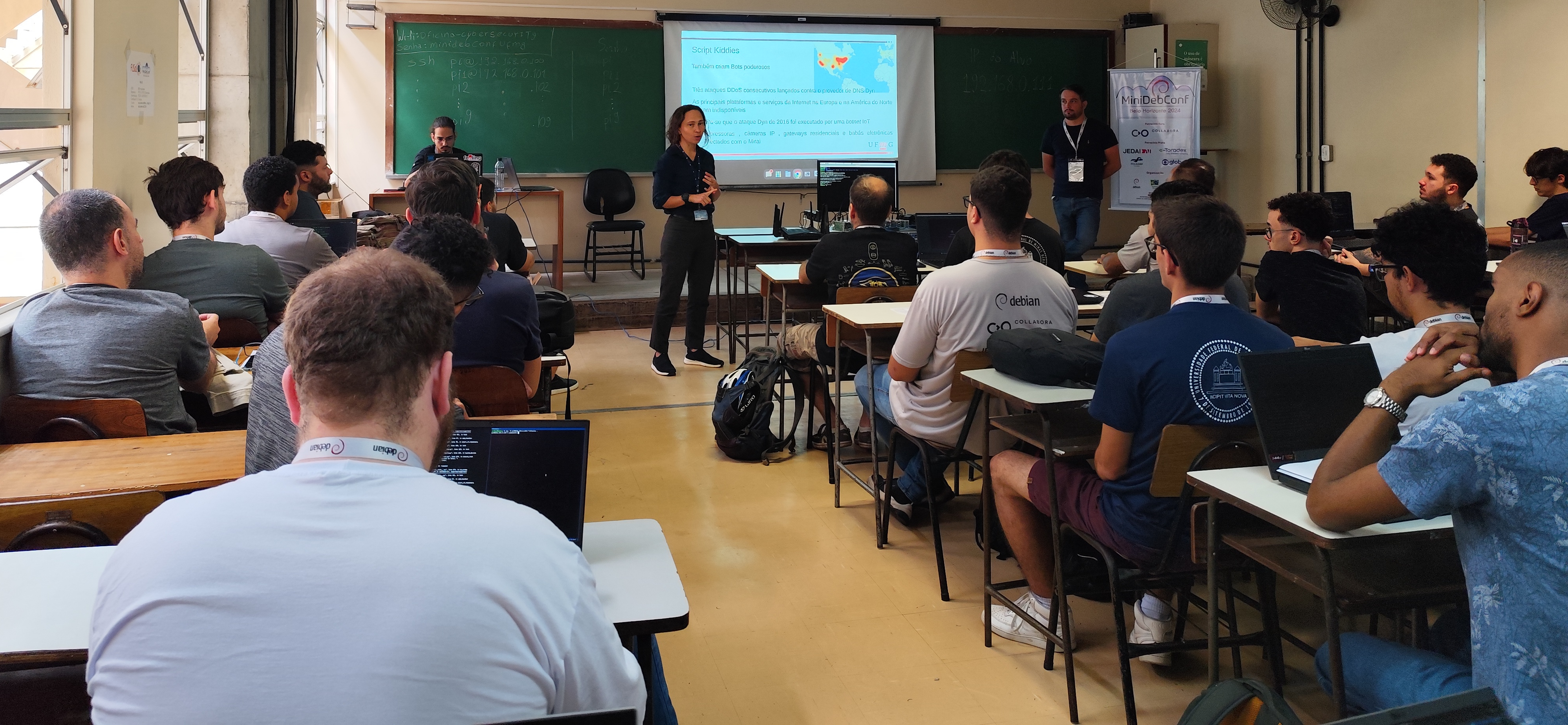
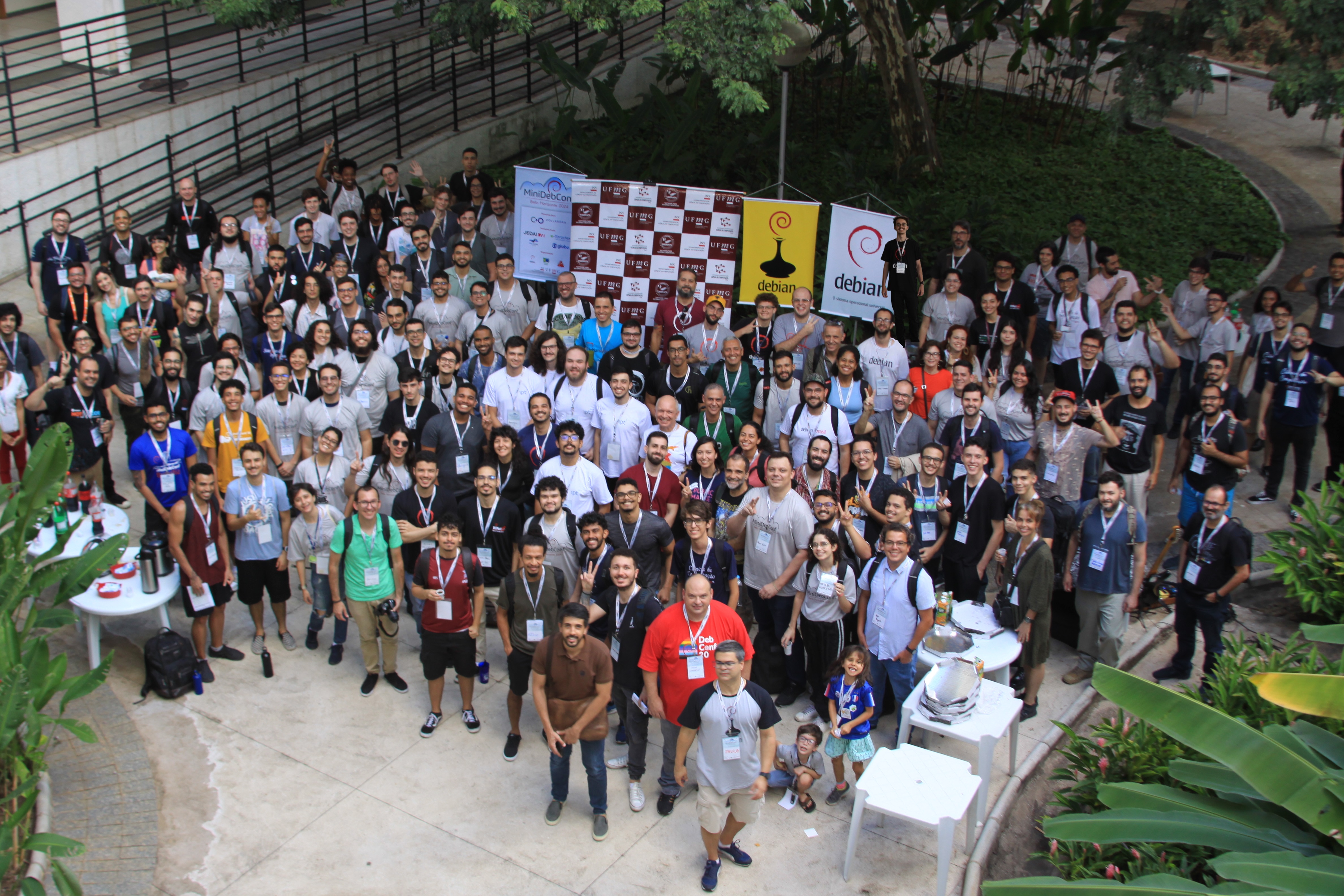
MiniDebConf BH 2024 grupo Atividades A programa o da MiniDebConf foi intensa e diversificada. Nos dias 27, 29 e 30 (s bado, segunda e ter a-feira) tivemos palestras, debates, oficinas e muitas atividades pr ticas. MiniDebConf BH 2024 palestra J no dia 28 (domingo), ocorreu o Day Trip, um dia dedicado a passeios pela cidade. Pela manh sa mos do hotel e fomos, em um nibus fretado, para o Mercado Central de Belo Horizonte. O pessoal aproveitou para comprar v rias coisas como queijos, doces, cacha as e lembrancinhas, al m de experimentar algumas comidas locais. MiniDebConf BH 2024 mercado Depois de 2 horas de passeio pelo Mercado, voltamos para o nibus e pegamos a estrada para almo armos em um restaurante de comida t pica mineira. MiniDebConf BH 2024 palestra Com todos bem alimentados, voltamos para Belo Horizonte para visitarmos o principal ponto tur stico da cidade: a Lagoa da Pampulha e a Capela S o Francisco de Assis, mais conhecida como Igrejinha da Pampulha. MiniDebConf BH 2024 palestra Voltamos para o hotel e o dia terminou no hacker space que montamos na sala de eventos para o pessoal conversar, empacotar, e comer umas pizzas. MiniDebConf BH 2024 palestra Financiamento coletivo Pela terceira vez fizemos uma campanha de financiamento coletivo e foi incr vel como as pessoas contribu ram! A meta inicial era arrecadar o valor equivalente a uma cota ouro de R$ 3.000,00. Ao atingirmos essa meta, definimos uma nova, equivalente a uma cota ouro + uma cota prata (R$ 5.000,00). E novamente atingimos essa meta. Ent o propusermos como meta final o valor de uma cota ouro + prata + bronze, que seria equivalente a R$ 6.000,00. O resultado foi que arrecadamos R$ 7.239,65 com a ajuda de mais de 100 pessoas! Muito obrigado as pessoas que contribu ram com qualquer valor. Como forma de agradecimento, listamos os nomes das pessoas que doaram. MiniDebConf BH 2024 doadores Bolsas de alimenta o, hospedagem e/ou passagens para participantes Cada edi o da MiniDebConf trouxe alguma inova o, ou algum benef cio diferente para os(a) participantes. Na edi o deste ano em Belo Horizonte, assim como acontece nas DebConfs, oferecemos bolsas de alimenta o, hospedagem e/ou passagens para ajudar aquelas pessoas que gostariam de vir para o evento mas que precisariam de algum tipo de ajuda. No formul rio de inscri o, colocamos a op o para a pessoa solicitar bolsa de alimenta o, hospedagem e/ou passagens, mas para isso, ela deveria se identificar como contribuidor(a) (oficial ou n o oficial) do Debian e escrever uma justificativa para o pedido. N mero de pessoas beneficiadas: A bolsa de alimenta o forneceu almo o e jantar todos os dias. Os almo os inclu ram pessoas que moram em Belo Horizonte e regi o. J o jantares foram pagos para os(as) participantes que tamb m receberam a bolsa de hospedagem e/ou passagens. A hospedagem foi realizada no Hotel BH Jaragu . E as passagens inclu ram de avi o ou de nibus, ou combust vel (para quem veio de carro ou moto). Boa parte do dinheiro para custear as bolsas vieram do Projeto Debian, principalmente para as passagens. Enviamos um or amento o ent o l der do Debian Jonathan Carter, e ele prontamente aprovou o nosso pedido. Al m deste or amento do evento, o l der tamb m aprovou os pedidos individuais enviados por alguns DDs que preferiram solicitar diretamente para ele. A experi ncia de oferecer as bolsas foi realmente muito boa porque permitiu a vinda de v rias pessoas de outras cidades. MiniDebConf BH 2024 grupo Fotos e v deos Voc pode assistir as grava es das palestras nos links abaixo: E ver as fotos feitas por v rios(as) colaboradores(as) nos links abaixo: Agradecimentos Gostar amos de agradecer a todos(as) os(as) participantes, organizadores(as), volunt rios(as), patrocinadores(as) e apoiadores(as) que contribu ram para o sucesso da MiniDebConf Belo Horizonte 2024. MiniDebConf BH 2024 grupo Patrocinadores Ouro: Prata: Bronze: Apoiadores Organiza o
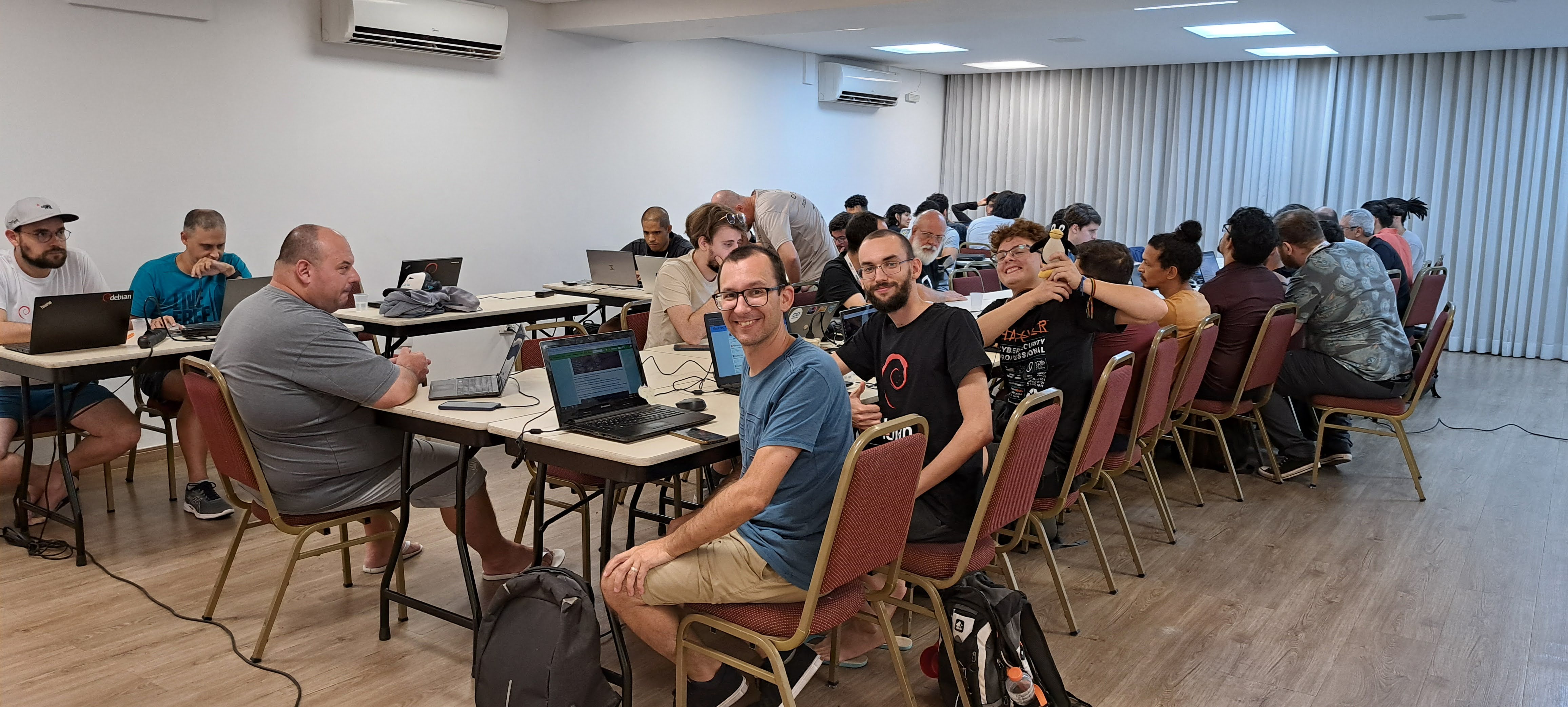
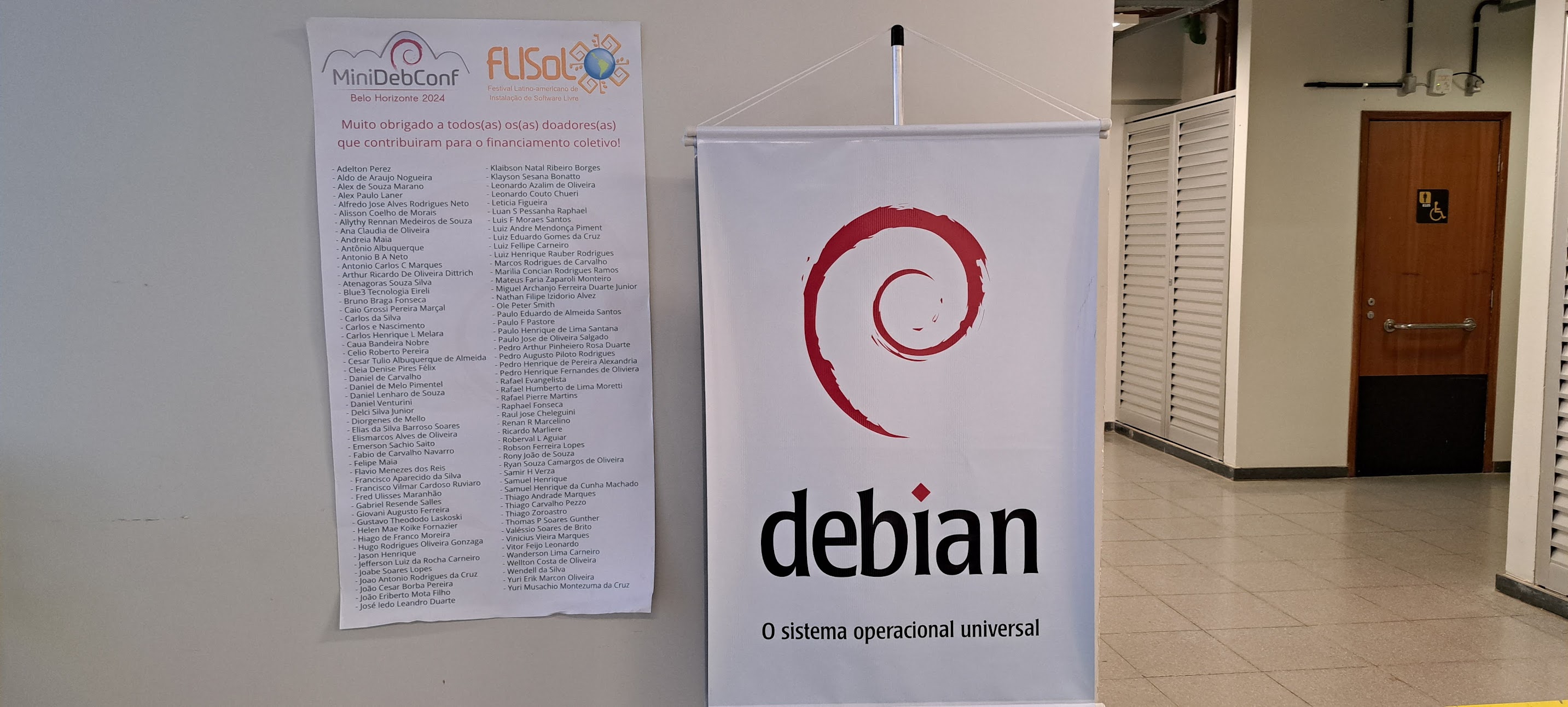
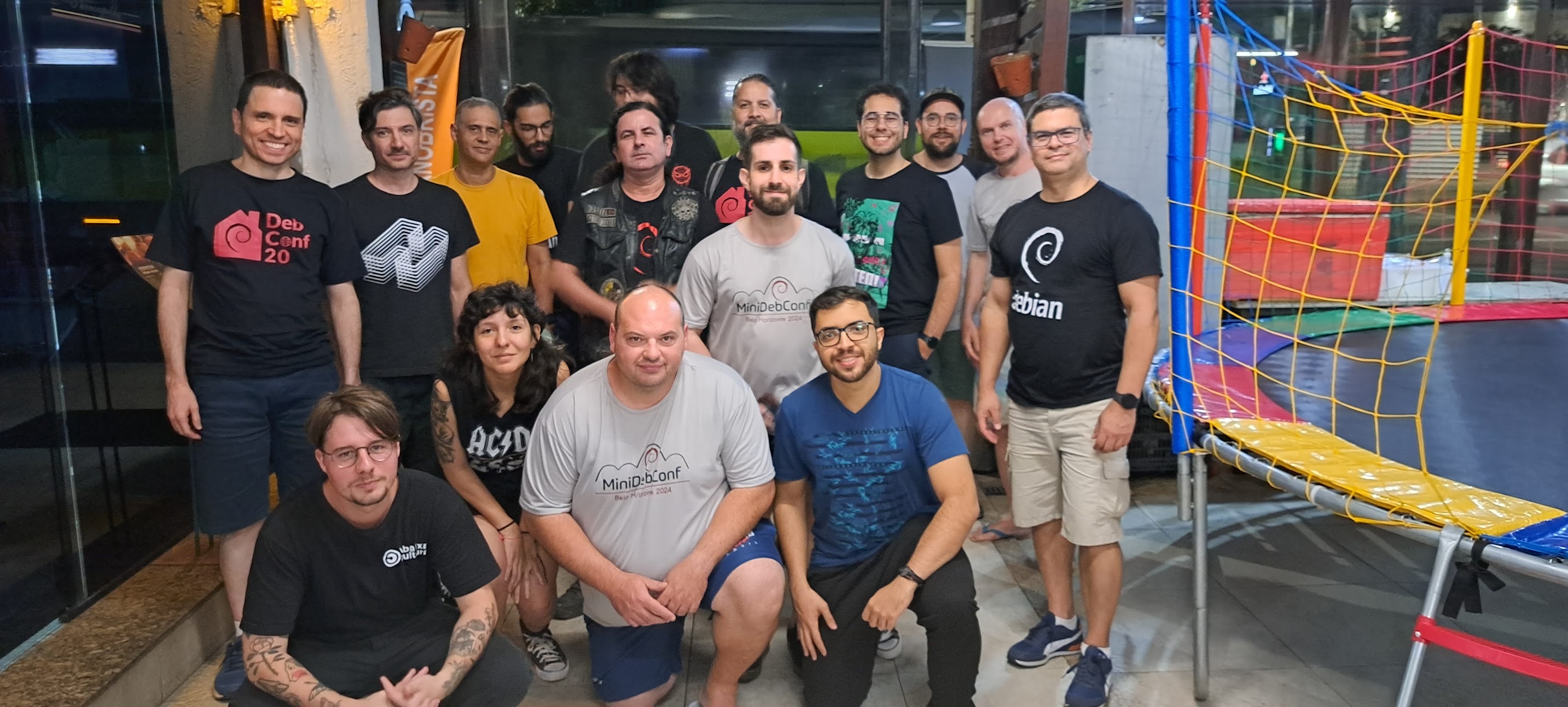
10 May 2024

Reproducible Builds: Reproducible Builds in April 2024

Welcome to the April 2024 report from the Reproducible Builds project! In our reports, we attempt to outline what we have been up to over the past month, as well as mentioning some of the important things happening more generally in software supply-chain security. As ever, if you are interested in contributing to the project, please visit our Contribute page on our website. Table of contents:
  1. New backseat-signed tool to validate distributions source inputs
  2. NixOS is not reproducible
  3. Certificate vulnerabilities in F-Droid s fdroidserver
  4. Website updates
  5. Reproducible Builds and Insights from an Independent Verifier for Arch Linux
  6. libntlm now releasing minimal source-only tarballs
  7. Distribution work
  8. Mailing list news
  9. diffoscope
  10. Upstream patches
  11. reprotest
  12. Reproducibility testing framework

New backseat-signed tool to validate distributions source inputs kpcyrd announced a new tool called backseat-signed, after:
I figured out a somewhat straight-forward way to check if a given git archive output is cryptographically claimed to be the source input of a given binary package in either Arch Linux or Debian (or both).
Elaborating more in their announcement post, kpcyrd writes:
I believe this to be the reproducible source tarball thing some people have been asking about. As explained in the README, I believe reproducing autotools-generated tarballs isn t worth everybody s time and instead a distribution that claims to build from source should operate on VCS snapshots instead of tarballs with 25k lines of pre-generated shell-script.
Indeed, many distributions packages already build from VCS snapshots, and this trend is likely to accelerate in response to the xz incident. The announcement led to a lengthy discussion on our mailing list, as well as shorter followup thread from kpcyrd about bootstrapping Autotools projects.

NixOS is not reproducible Morten Linderud posted an post on his blog this month, provocatively titled, NixOS is not reproducible . Although quickly admitting that his title is indeed clickbait , Morten goes on to clarify the precise guarantees and promises that NixOS provides its users. Later in the most, Morten mentions that he was motivated to write the post because:
I have heavily invested my free-time on this topic since 2017, and met some of the accomplishments we have had with Doesn t NixOS solve this? for just as long and I thought it would be of peoples interest to clarify[.]

Certificate vulnerabilities in F-Droid s fdroidserver In early April, Fay Stegerman announced a certificate pinning bypass vulnerability and Proof of Concept (PoC) in the F-Droid fdroidserver tools for managing builds, indexes, updates, and deployments for F-Droid repositories to the oss-security mailing list.
We observed that embedding a v1 (JAR) signature file in an APK with minSdk >= 24 will be ignored by Android/apksigner, which only checks v2/v3 in that case. However, since fdroidserver checks v1 first, regardless of minSdk, and does not verify the signature, it will accept a fake certificate and see an incorrect certificate fingerprint. [ ] We also realised that the above mentioned discrepancy between apksigner and androguard (which fdroidserver uses to extract the v2/v3 certificates) can be abused here as well. [ ]
Later on in the month, Fay followed up with a second post detailing a third vulnerability and a script that could be used to scan for potentially affected .apk files and mentioned that, whilst upstream had acknowledged the vulnerability, they had not yet applied any ameliorating fixes.

Website updates There were a number of improvements made to our website this month, including Chris Lamb updating the archive page to recommend -X and unzipping with TZ=UTC [ ] and adding Maven, Gradle, JDK and Groovy examples to the SOURCE_DATE_EPOCH page [ ]. In addition Jan Zerebecki added a new /contribute/opensuse/ page [ ] and Sertonix fixed the automatic RSS feed detection [ ][ ].

Reproducible Builds and Insights from an Independent Verifier for Arch Linux Joshua Drexel, Esther H nggi and Iy n M ndez Veiga of the School of Computer Science and Information Technology, Hochschule Luzern (HSLU) in Switzerland published a paper this month entitled Reproducible Builds and Insights from an Independent Verifier for Arch Linux. The paper establishes the context as follows:
Supply chain attacks have emerged as a prominent cybersecurity threat in recent years. Reproducible and bootstrappable builds have the potential to reduce such attacks significantly. In combination with independent, exhaustive and periodic source code audits, these measures can effectively eradicate compromises in the building process. In this paper we introduce both concepts, we analyze the achievements over the last ten years and explain the remaining challenges.
What is more, the paper aims to:
contribute to the reproducible builds effort by setting up a rebuilder and verifier instance to test the reproducibility of Arch Linux packages. Using the results from this instance, we uncover an unnoticed and security-relevant packaging issue affecting 16 packages related to Certbot [ ].
A PDF of the paper is available.

libntlm now releasing minimal source-only tarballs Simon Josefsson wrote on his blog this month that, going forward, the libntlm project will now be releasing what they call minimal source-only tarballs :
The XZUtils incident illustrate that tarballs with files that are not included in the git archive offer an opportunity to disguise malicious backdoors. [The] risk of hiding malware is not the only motivation to publish signed minimal source-only tarballs. With pre-generated content in tarballs, there is a risk that GNU/Linux distributions [ship] generated files coming from the tarball into the binary *.deb or *.rpm package file. Typically the person packaging the upstream project never realized that some installed artifacts was not re-built[.]
Simon s post goes into further details how this was achieved, and describes some potential caveats and counters some expected responses as well. A shorter version can be found in the announcement for the 1.8 release of libntlm.

Distribution work In Debian this month, Helmut Grohne filed a bug suggesting the removal of dh-buildinfo, a tool to generate and distribute .buildinfo-like files within binary packages. Note that this is distinct from the .buildinfo generation performed by dpkg-genbuildinfo. By contrast, the entirely optional dh-buildinfo generated a debian/buildinfo file that would be shipped within binary packages as /usr/share/doc/package/buildinfo_$arch.gz. Adrian Bunk recently asked about including source hashes in Debian s .buildinfo files, which prompted Guillem Jover to refresh some old patches to dpkg to make this possible, which revealed some quirks Vagrant Cascadian discovered when testing. In addition, 21 reviews of Debian packages were added, 22 were updated and 16 were removed this month adding to our knowledge about identified issues. A number issue types have been added, such as new random_temporary_filenames_embedded_by_mesonpy and timestamps_added_by_librime toolchain issues. In openSUSE, it was announced that their Factory distribution enabled bit-by-bit reproducible builds for almost all parts of the package. Previously, more parts needed to be ignored when comparing package files, but now only the signature needs to be deleted. In addition, Bernhard M. Wiedemann published theunreproduciblepackage as a proper .rpm package which it allows to better test tools intended to debug reproducibility. Furthermore, it was announced that Bernhard s work on a 100% reproducible openSUSE-based distribution will be funded by NLnet. He also posted another monthly report for his reproducibility work in openSUSE. In GNU Guix, Janneke Nieuwenhuizen submitted a patch set for creating a reproducible source tarball for Guix. That is to say, ensuring that make dist is reproducible when run from Git. [ ] Lastly, in Fedora, a new wiki page was created to propose a change to the distribution. Titled Changes/ReproduciblePackageBuilds , the page summarises itself as a proposal whereby A post-build cleanup is integrated into the RPM build process so that common causes of build irreproducibility in packages are removed, making most of Fedora packages reproducible.

Mailing list news On our mailing list this month:
  • Continuing a thread started in March 2024 about the Arch Linux minimal container now being 100% reproducible, John Gilmore followed up with a post about the practical and philosophical distinctions of local vs. remote storage of the various artifacts needed to build packages.
  • Chris Lamb asked the list which conferences readers are attending these days: After peak Covid and other industry-wide changes, conferences are no longer the must attend events they previously were especially in the area of software supply-chain security. In rough, practical terms, it seems harder to justify conference travel today than it did in mid-2019. The thread generated a number of responses which would be of interest to anyone planning travel in Q3 and Q4 of 2024.
  • James Addison wrote to the list about a quirk in Git related to its core.autocrlf functionality, thus helpfully passing on a slightly off-topic and perhaps not of direct relevance to anyone on the list today note that might still be the kind of issue that is useful to be aware of if-and-when puzzling over unexpected git content / checksum issues (situations that I do expect people on this list encounter from time-to-time) .

diffoscope diffoscope is our in-depth and content-aware diff utility that can locate and diagnose reproducibility issues. This month, Chris Lamb made a number of changes such as uploading versions 263, 264 and 265 to Debian and made the following additional changes:
  • Don t crash on invalid .zip files, even if we encounter their badness halfway through the file and not at the time of their initial opening. [ ]
  • Prevent odt2txt tests from always being skipped due to an (impossibly) new version requirement. [ ]
  • Avoid parens-in-parens in test skipping messages. [ ]
  • Ensure that tests with >=-style version constraints actually print the tool name. [ ]
In addition, Fay Stegerman fixed a crash when there are (invalid) duplicate entries in .zip which was originally reported in Debian bug #1068705). [ ] Fay also added a user-visible note to a diff when there are duplicate entries in ZIP files [ ]. Lastly, Vagrant Cascadian added an external tool pointer for the zipdetails tool under GNU Guix [ ] and proposed updates to diffoscope in Guix as well [ ] which were merged as [264] [265], fixed a regression in test coverage and increased verbosity of the test suite[ ].

Upstream patches The Reproducible Builds project detects, dissects and attempts to fix as many currently-unreproducible packages as possible. We endeavour to send all of our patches upstream where appropriate. This month, we wrote a large number of such patches, including:

reprotest reprotest is our tool for building the same source code twice in different environments and then checking the binaries produced by each build for any differences. This month, reprotest version 0.7.27 was uploaded to Debian unstable) by Vagrant Cascadian who made the following additional changes:
  • Enable specific number of CPUs using --vary=num_cpus.cpus=X. [ ]
  • Consistently use 398 days for time variation, rather than choosing randomly each time. [ ]
  • Disable builds of arch:any packages. [ ]
  • Update the description for the build_path.path option in README.rst. [ ]
  • Update escape sequences for compatibility with Python 3.12. (#1068853). [ ]
  • Remove the generic upstream signing-key [ ] and update the packages signing key with the currently active team members [ ].
  • Update the packaging Standards-Version to 4.7.0. [ ]
In addition, Holger Levsen fixed some spelling errors detected by the spellintian tool [ ] and Vagrant Cascadian updated reprotest in GNU Guix to 0.7.27.

Reproducibility testing framework The Reproducible Builds project operates a comprehensive testing framework running primarily at tests.reproducible-builds.org in order to check packages and other artifacts for reproducibility. In April, an enormous number of changes were made by Holger Levsen:
  • Debian-related changes:
    • Adjust for changed internal IP addresses at Codethink. [ ]
    • Automatically cleanup failed diffoscope user services if there are too many failures. [ ][ ]
    • Configure two new nodes at infomanik.cloud. [ ][ ]
    • Schedule Debian experimental even less. [ ][ ]
  • Breakage detection:
    • Exclude currently building packages from breakage detection. [ ]
    • Be more noisy if diffoscope crashes. [ ]
    • Health check: provide clickable URLs in jenkins job log for failed pkg builds due to diffoscope crashes. [ ]
    • Limit graph to about the last 100 days of breakages only. [ ]
    • Fix all found files with bad permissions. [ ]
    • Prepare dealing with diffoscope timeouts. [ ]
    • Detect more cases of failure to debootstrap base system. [ ]
    • Include timestamps of failed job runs. [ ]
  • Documentation updates:
    • Document how to access arm64 nodes at Codethink. [ ]
    • Document how to use infomaniak.cloud. [ ]
    • Drop notes about long stalled LeMaker HiKey960 boards sponsored by HPE and hosted at ETH. [ ]
    • Mention osuosl4 and osuosl5 and explain their usage. [ ]
    • Mention that some packages are built differently. [ ][ ]
    • Improve language in a comment. [ ]
    • Add more notes how to query resource usage from infomaniak.cloud. [ ]
  • Node maintenance:
    • Add ionos4 and ionos14 to THANKS. [ ][ ][ ][ ][ ]
    • Deprecate Squid on ionos1 and ionos10. [ ]
    • Drop obsolete script to powercycle arm64 architecture nodes. [ ]
    • Update system_health_check for new proxy nodes. [ ]
  • Misc changes:
    • Make the update_jdn.sh script more robust. [ ][ ]
    • Update my SSH public key. [ ]
In addition, Mattia Rizzolo added some new host details. [ ]

If you are interested in contributing to the Reproducible Builds project, please visit our Contribute page on our website. However, you can get in touch with us via:

1 May 2024

Bits from Debian: Debian welcomes the 2024 GSOC contributors/students

GSoC logo We are very excited to announce that Debian has selected seven contributors to work under mentorship on a variety of projects with us during the Google Summer of Code. Here are the list of the projects, students, and details of the tasks to be performed.
Project: Android SDK Tools in Debian Deliverables of the project: Make the entire Android toolchain, Android Target Platform Framework, and SDK tools available in the Debian archives.
Project: Benchmarking Parallel Performance of Numerical MPI Packages Deliverables of the project: Deliver an automated method for Debian maintainers to test selected numerical Debian packages for their parallel performance in clusters, in particular to catch performance regressions from updates, and to verify expected performance gains, such as Amdahl s and Gufstafson s law, from increased cluster resources.
Project: Debian MobCom Deliverables of the project: Update the outdated mobile packages and recreate aged packages due to new dependencies. Bring in more mobile communication tools by adding about 5 new packages.
Project: Improve support of the Rust coreutils in Debian Deliverables of the project: Make uutils behave more like GNU s coreutils by improving compatibility with GNU coreutils test suit.
Project: Improve support of the Rust findutils in Debian Deliverables of the project: A safer and more performant implementation of the GNU suite's xargs, find, locate and updatedb tools in rust.
Project: Expanding ROCm support within Debian and derivatives Deliverables of the project: Building, packaging, and uploading missing ROCm software into Debian repositories, starting with simple tools and progressing to high-level applications like PyTorch, with the final deliverables comprising a series of ROCm packages meeting community quality assurance standards.
Project: procps: Development of System Monitoring, Statistics and Information Tools in Rust Deliverables of the project: Improve the usability of the entire Rust-based implementation of the procps utility on Linux.
Congratulations and welcome to all the contributors! The Google Summer of Code program is possible in Debian thanks to the efforts of Debian Developers and Debian Contributors that dedicate part of their free time to mentor contributors and outreach tasks. Join us and help extend Debian! You can follow the contributors' weekly reports on the debian-outreach mailing-list, chat with us on our IRC channel or reach out to the individual projects' team mailing lists.

Next.

Previous.