Search Results: "christoph"

10 September 2014

Raphaël Hertzog: Freexian s first report about Debian Long Term Support

When we setup Freexian s offer to bring together funding from multiple companies in order to sponsor the work of multiple developers on Debian LTS, one of the rules that I imposed is that all paid contributors must provide a public monthly report of their paid work. While the LTS project officially started in June, the first month where contributors were actually paid has been July. Freexian sponsored Thorsten Alteholz and Holger Levsen for 10.5 hours each in July and for 16.5 hours each in August. Here are their reports: It s worth noting that Freexian sponsored Holger s work to fix the security tracker to support squeeze-lts. It s my belief that using the money of our sponsors to make it easier for everybody to contribute to Debian LTS is money well spent. As evidenced by the progress bar on Freexian s offer page, we have not yet reached our minimal goal of funding the equivalent of a half-time position. And it shows in the results, the dla-needed.txt still shows around 30 open issues. This is slightly better than the state two months ago but we can improve a lot on the average time to push out a security update To have an idea of the relative importance of the contributions of the paid developers, I counted the number of uploads made by Thorsten and Holger since July: of 40 updates, they took care of 19 of them, so about the half. I also looked at the other contributors: Rapha l Geissert stands out with 9 updates (I believe that he is contracted by lectricit de France for doing this) and most of the other contributors look like regular Debian maintainers taking care of their own packages (Paul Gevers with cacti, Christoph Berg with postgresql, Peter Palfrader with tor, Didier Raboud with cups, Kurt Roeckx with openssl, Balint Reczey with wireshark) except Matt Palmer and Luciano Bello who (likely) are benevolent members of the LTS team. There are multiple things to learn here:
  1. Paid contributors already handle almost 70% of the updates. Counting only on volunteers would not have worked.
  2. Quite a few companies that promised help (and got mentioned in the press release) have not delivered the promised help yet (neither through Freexian nor directly).
Last but not least, this project wouldn t exist without the support of multiple companies and organizations. Many thanks to them: Hopefully this list will expand over time! Any help to reach out to new companies and organizations is more than welcome.

One comment Liked this article? Click here. My blog is Flattr-enabled.

2 September 2014

Raphaël Hertzog: My Free Software Activities in August 2014

This is my monthly summary of my free software related activities. If you re among the people who made a donation to support my work (65.55 , thanks everybody!), then you can learn how I spent your money. Otherwise it s just an interesting status update on my various projects. Distro Tracker Even though I was officially in vacation during 3 of the 4 weeks of August, I spent many nights working on Distro Tracker. I m pleased to have managed to bring back Python 3 compatibility over all the (tested) code base. The full test suite now passes with Python 3.4 and Django 1.6 (or 1.7). From now on, I ll run tox on all code submitted to make sure that we won t regress on this point. tox also runs flake8 for me so that I can easily detect when the submitted code doesn t respect the PEP8 coding style. It also catches other interesting mistakes (like unused variable or too complex functions). Getting the code to pass flake8 was also a major effort, it resulted in a huge commit (89 files changed, 1763 insertions, 1176 deletions). Thanks to the extensive test suite, all those refactoring only resulted in two regressions that I fixed rather quickly. Some statistics: 51 commits over the last month, 41 by me, 3 by Andrew Starr-Bochicchio, 3 by Christophe Siraut, 3 by Joseph Herlant and 1 by Simon Kainz. Thanks to all of them! Their contributions ported some features that were already available on the old PTS. The new PTS is now warning of upcoming auto-removals, is displaying problems with uptream URLs, includes a short package description in the page title, and provides a link to screenshots (if they exist on screenshots.debian.net). We still have plenty of bugs to handle, so you can help too: check out https://tracker.debian.org/docs/contributing.html. I always leave easy bugs for others to handle, so grab one and get started! I ll review your patch with pleasure. :-) Tryton After my last batch of contributions to Tryton s French Chart of Accounts (#4108, #4109, #4110, #4111) C dric Krier granted me commit rights to the account_fr mercurial module. Debconf 14 I wasn t able to attend this year but thanks to awesome work of the video team, I watched some videos (and I still have a bunch that I want to see). Some of them were put online the day after they had been recorded. Really amazing work! Django 1.7 After the initial bug reports, I got some feedback of maintainers who feared that it would be difficult to get their packages working with Django 1.7. I helped them as best as I can by providing some patches (for horizon, for django-restricted-resource, for django-testscenarios). Since I expected many maintainers to be not very pro-active, I rebuilt all packages with Django 1.7 to detect at least those that would fail to build. I tagged as confirmed all the corresponding bug reports. Looking at https://bugs.debian.org/cgi-bin/pkgreport.cgi?users=python-django@packages.debian.org;tag=django17, one can see that some progress has been made with 25 packages fixed. Still there are at least 25 others that are still problematic in sid and 35 that have not been investigated at all (except for the automatic rebuild that passed). Again your help is more than welcome! It s easy to install python-django 1.7 from experimental and they try to use/rebuild the packages from the above list. Dpkg translation With the freeze approaching, I wanted to ensure that dpkg was fully translated in French. I thus pinged debian-l10n-french@lists.debian.org and merged some translations that were done by volunteers. Unfortunately it looks like nobody really stepped up to maintain it in the long run so I did myself the required update when dpkg 1.17.12 got uploaded. Is there anyone willing to manage dpkg s French translation? With the latest changes in 1.17.13, we have again a few untranslated strings:
$ for i in $(find . -name fr.po); do echo $i; msgfmt -c -o /dev/null --statistics $i; done
./po/fr.po
1083 translated messages, 4 fuzzy translations, 1 untranslated message.
./dselect/po/fr.po
268 translated messages, 3 fuzzy translations.
./scripts/po/fr.po
545 translated messages.
./man/po/fr.po
2277 translated messages, 8 fuzzy translations, 3 untranslated messages.
Misc stuff I made an xsane QA upload (it s currently orphaned) to drop the (build-)dependency on liblcms1 and avoid getting it removed from Debian testing (see #745524). For the record, how-can-i-help warned me of this after one dist-upgrade. With the Django 1.7 work and the need to open up an experimental branch, I decided to switch python-django s packaging to git even though the current team policy is to use subversion. This triggered (once more) the discussion about a possible switch to git and I was pleased to see more enthusiasm this time around. Barry Warsaw tested a few workflows, shared his feeling and pushed toward a live discussion of the switch during Debconf. It looks like it might happen for good this time. I contributed my share in the discussions on the mailing list. Thanks See you next month for a new summary of my activities.

2 comments Liked this article? Click here. My blog is Flattr-enabled.

31 August 2014

Ritesh Raj Sarraf: apt-offline 1.4

apt-offline 1.4 has been released [1]. This is a minor bug fix release. In fact, one feature, offline bug reports (--bug-reports), has been dropped for now. The Debian BTS interface seems to have changed over time and the older debianbts.py module (that used the CGI interface) does not seem to work anymore. The current debbugs.py module seems to have switched to the SOAP interface. There are a lot of changes going on personally, I just haven't had the time to spend. If anyone would like to help, please reach out to me. We need to use the new debbugs.py module. And it should be cross-platform. Also, thanks to Hans-Christoph Steiner for providing the bash completion script. [1] https://alioth.debian.org/projects/apt-offline/

AddThis:

Categories:

Keywords:

1 August 2014

Raphaël Hertzog: My Free Software Activities in July 2014

This is my monthly summary of my free software related activities. If you re among the people who made a donation to support my work (548.59 , thanks everybody!), then you can learn how I spent your money. Otherwise it s just an interesting status update on my various projects. Distro Tracker Now that tracker.debian.org is live, people reported bugs (on the new tracker.debian.org pseudo-package that I requested) faster than I could fix them. Still I spent many, many hours on this project, reviewing submitted patches (thanks to Christophe Siraut, Joseph Herlant, Dimitri John Ledkov, Vincent Bernat, James McCoy, Andrew Starr-Bochicchio who all submitted some patches!), fixing bugs, making sure the code works with Django 1.7, and started the same with Python 3. I added a tox.ini so that I can easily run the test suite in all 4 supported environments (created by tox as virtualenv with the combinations of Django 1.6/1.7 and Python 2.7/3.4). Over the month, the git repository has seen 73 commits, we fixed 16 bugs and other issues that were only reported over IRC in #debian-qa. With the help of Enrico Zini and Martin Zobel, we enabled the possibility to login via sso.debian.org (Debian s official SSO) so that Debian developers don t even have to explicitly create their account. As usual more help is needed and I ll gladly answer your questions and review your patches. Misc packaging work Publican. I pushed a new upstream release of publican and dropped a useless build-dependency that was plagued by a difficult to fix RC bug (#749357 for the curious, I tried to investigate but it needs major work for make 4.x compatibility). GNOME 3.12. With gnome-shell 3.12 hitting unstable, I had to update gnome-shell-timer (and filed an upstream ticket at the same time), a GNOME Shell extension to start some run-down counters. Django 1.7. I packaged python-django 1.7 release candidate 1 in experimental (found a small bug, submitted a ticket with a patch that got quickly merged) and filed 85 bugs against all the reverse dependencies to ask their maintainers to test their package with Django 1.7 (that we want to upload before the freeze obviously). We identified a pain point in upgrade for packages using South and tried to discuss it with upstream, but after closer investigation, none of the packages are really affected. But the problem can hit administrators of non-packaged Django applications. Misc stuff. I filed a few bugs (#754282 against git-import-orig uscan, #756319 against wnpp to see if someone would be willing to package loomio), reviewed an updated package for django-ratelimit in #755611, made a non-maintainer upload of mairix (without prior notice) to update the package to a new upstream release and bring it to modern packaging norms (Mako failed to make an upload in 4 years so I just went ahead and did what I would have done if it were mine). Kali work resulting in Debian contributions Kali wants to switch from being based on stable to being based on testing so I did try to setup britney to manage a new kali-rolling repository and encountered some problems that I reported to debian-release. Niels Thykier has been very helpful and even managed to improve britney thanks to the very specific problem that the kali setup triggered. Since we use reprepro, I did write some Python wrapper to transform the HeidiResult file in a set of reprepro commands but at the same time I filed #756399 to request proper support of heidi files in reprepro. While analyzing britney s excuses file, I also noticed that the Kali mirrors contains many source packages that are useless because they only concern architectures that we don t host (and I filed #756523 against reprepro). While trying to build a live image of kali-rolling, I noticed that libdb5.1 and db5.1-util were still marked as priority standard when in fact Debian already switched to db5.3 and thus should only be optional (I filed #756623 against ftp.debian.org). When doing some upgrade tests from kali (wheezy based) to kali-rolling (jessie based) I noticed some problems that were also affecting Debian Jessie. I filed #756629 against libfile-fcntllock-perl (with a patch), and also #756618 against texlive-base (missing Replaces header). I also pinged Colin Watson on #734946 because I got a spurious base-passwd prompt during upgrade (that was triggered because schroot copied my unstable s /etc/passwd file in the kali chroot and the package noticed a difference on the shell of all system users). Thanks See you next month for a new summary of my activities.

One comment Liked this article? Click here. My blog is Flattr-enabled.

9 July 2014

Christoph Berg: New urxvt tab in current directory

Following Enrico's terminal-emulators comparison, I wanted to implement "start a new terminal tab in my current working directory" for rxvt-unicode aka urxvt. As Enrico notes, this functionality is something between "rather fragile" and non-existing, so I went to implement it myself. Martin Pohlack had the right hint, so here's the patch:
--- /usr/lib/urxvt/perl/tabbed  2014-05-03 21:37:37.000000000 +0200
+++ ./tabbed    2014-07-09 18:50:26.000000000 +0200
@@ -97,6 +97,16 @@
       $term->resource (perl_ext_2 => $term->resource ("perl_ext_2") . ",-tabbed");
     ;
 
+   if (@  $self-> tabs   )  
+      # Get the working directory of the current tab and append a -cd to the command line
+      my $pid = $self-> cur pid ;
+      my $pwd = readlink "/proc/$pid/cwd";
+      #print "pid $pid pwd $pwd\n";
+      if ($pwd)  
+         push @argv, "-cd", $pwd;
+       
+    
+
    push @urxvt::TERM_EXT, urxvt::ext::tabbed::tab::;
 
    my $term = new urxvt::term
@@ -312,6 +322,12 @@
    1
  
 
+sub tab_child_start  
+   my ($self, $term, $pid) = @_;
+   $term-> pid  = $pid;
+   1;
+ 
+
 sub tab_start  
    my ($self, $tab) = @_;
 
@@ -402,7 +418,7 @@
 # simply proxies all interesting calls back to the tabbed class.
 
  
-   for my $hook (qw(start destroy key_press property_notify))  
+   for my $hook (qw(start destroy key_press property_notify child_start))  
       eval qq 
          sub on_$hook  
             my \$parent = \$_[0] term parent 

4 July 2014

Raphaël Hertzog: My Free Software Activity in June 2014

This is my monthly summary of my free software related activities. If you re among the people who made a donation to support my work (168.17 , thanks everybody!), then you can learn how I spent your money. Otherwise it s just an interesting status update on my various projects. Debian LTS After having put in place the infrastructure to allow companies to contribute financially to Debian LTS, I spent quite some time to draft the announce of the launch of Debian LTS (on a suggestion of Moritz M hlenhoff who pointed out to me that there was no such announce yet). I m pretty happy about the result because we managed to mention a commercial offer without generating any pushback from the community. The offer is (in my necessarily biased opinion) clearly in the interest of Debian but still the money doesn t go to Debian so we took extra precautions. When I got in touch with the press officers, I included the Debian leader in the discussion and his feedback has been very helpful to improve the announce. He also officially acked the press release to give some confidence to the press officers that they were doing the right thing. Lucas also pushed me to seek public review of the draft press release, which I did. The discussion was constructive and the draft got further improved. The news got widely relayed, but on the flip side, the part with the call for help got almost no attention from the press. Even Linux Weekly News skipped it! On the Freexian side, we just crossed 10% of a full-time position (funded by 6 companies) and we are in contact with a few other companies in discussion. But we re far from our goal yet so we will have to actively reach out to more companies. Do you know companies who are still running Debian 6 servers ? If yes, please send me the details (name + url + contact info if possible) to deblts@freexian.com so that I can get in touch and invite them to contribute to the project. Distro Tracker In the continuation of the Debian France game, I continued to work together with Joseph Herlant and Christophe Siraut on multiple improvements to distro tracker in order to prepare for its deployment on tracker.debian.org (which I just announced \o/). Debian France Since the Debian France game was over, I shipped the rewards. 5 books have been shipped to: Misc Debian work I orphaned sql-ledger and made a last upload to change the maintainer to Debian QA (with a new upstream version). After having been annoyed a few times by dch breaking my name in the changelog, I filed #750855 which got quickly fixed. I disabled a broken patch in quilt to fix RC bug #751109. I filed #751771 when I discovered an incorrect dependency on ruby-uglifier (while doing packaging work for Kali Linux). I tested newer versions of ruby-libv8 on armel/armhf on request of the upstream author. I had reported him those build failures (github ticket here). Thanks See you next month for a new summary of my activities.

One comment Liked this article? Click here. My blog is Flattr-enabled.

27 June 2014

Christoph Egger

I've been working on my backup strategy for the notebook recently. The idea is to have full backups every now month and then incremental backups in between as fine-grained as possible. As it's a mobile device there's no point in time where it is guaranteed to be up, connected and within reach of the backup server. As I'm running Debian GNU/kFreeBSD on it, using ZFS and specifically zfs send comes quite naturally. I'm now generating a new file system snapshot every day (if the notebook happens to be online during that day) using cron.
@daily zfs snapshot base/root@ date -I 
@daily zfs snapshot base/home@ date -I 
@reboot zfs snapshot base/root@ date -I 
@reboot zfs snapshot base/home@ date -I 
When connected to the home network I'm synchronizing off all incrementals that are not yet on the backup server. This is using zfs send together with gpg to encrypt the data and then put it off to some sftp storage. For the first snapshot every month a full backup is created. As there doesn't seem to be a way to merge zfs send streams without importing everything in a zfs pool I create additional incremental streams to the first snapshot of last month so I'm able to delete older full backups and daily snapshots and still keep coarse-gained backups for a longer period of time.
#!/usr/bin/python
# -*- coding: utf-8 -*-
####################
# Config
SFTP_HOST = 'botero.siccegge.de'
SFTP_DIR  = '/srv/backup/mitoraj'
SFTP_USER = 'root'
ZPOOL     = 'base'
GPGUSER   = '9FED5C6CE206B70A585770CA965522B9D49AE731'
#
####################
import subprocess
import os.path
import sys
import paramiko
term =  
    'green':  "\033[0;32m",
    'red':    "\033[0;31m",
    'yellow': "\033[0;33m",
    'purple': "\033[0;35m",
    'none':   "\033[0m",
     
sftp = None
def print_colored(data, color):
    sys.stdout.write(term[color])
    sys.stdout.write(data)
    sys.stdout.write(term['none'])
    sys.stdout.write('\n')
    sys.stdout.flush()
def postprocess_datasets(datasets):
    devices = set([entry.split('@')[0] for entry in datasets])
    result = dict()
    for device in devices:
        result[device] = sorted([ entry.split('@')[1] for entry in datasets
                                    if entry.startswith(device) ])
    return result
def sftp_connect():
    global sftp
    host_keys = paramiko.util.load_host_keys(os.path.expanduser('~/.ssh/known_hosts'))
    hostkeytype = host_keys[SFTP_HOST].keys()[0]
    hostkey = host_keys[SFTP_HOST][hostkeytype]
    agent = paramiko.Agent()
    transport = paramiko.Transport((SFTP_HOST, 22))
    transport.connect(hostkey=hostkey)
    for key in agent.get_keys():
        try:
            transport.auth_publickey(SFTP_USER, key)
            break
        except paramiko.SSHException:
            continue
    sftp = paramiko.SFTPClient.from_transport(transport)
    sftp.chdir(SFTP_DIR)
def sftp_send(dataset, reference=None):
    zfscommand = ['sudo', 'zfs', 'send', '%s/%s' % (ZPOOL, dataset)]
    if reference is not None:
        zfscommand = zfscommand + ['-i', reference]
    zfs = subprocess.Popen(zfscommand, stdout=subprocess.PIPE)
    gpgcommand = [ 'gpg', '--batch', '--compress-algo', 'ZLIB',
                   '--sign', '--encrypt', '--recipient', GPGUSER ]
    gpg = subprocess.Popen(gpgcommand, stdout=subprocess.PIPE,
                                       stdin=zfs.stdout,
                                       stderr=subprocess.PIPE)
    gpg.poll()
    if gpg.returncode not in [None, 0]:
        print_colored("Error:\n\n" + gpg.stderr, 'red')
        return
    if reference is None:
        filename = '%s.full.zfs.gpg' % dataset
    else:
        filename = '%s.from.%s.zfs.gpg' % (dataset, reference)
    with sftp.open(filename, 'w') as remotefile:
        sys.stdout.write(term['purple'])
        while True:
            junk = gpg.stdout.read(1024*1024)
            if len(junk) == 0:
                break
            sys.stdout.write('#')
            sys.stdout.flush()
            remotefile.write(junk)
        print_colored(" DONE", 'green')
def syncronize(local_datasets, remote_datasets):
    for device in local_datasets.keys():
        current = ""
        for dataset in local_datasets[device]:
            last = current
            current = dataset
            if device in remote_datasets:
                if dataset in remote_datasets[device]:
                    print_colored("%s@%s -- found on remote server" % (device, dataset), 'yellow')
                    continue
            if last == '':
                print_colored("Initial syncronization for device %s" % device, 'green')
                sftp_send("%s@%s" % (device, dataset))
                lastmonth = dataset
                continue
            if last[:7] == dataset[:7]:
                print_colored("%s@%s -- incremental backup (reference: %s)" %
                              (device, dataset, last), 'green')
                sftp_send("%s@%s" % (device, dataset), last)
            else:
                print_colored("%s@%s -- full backup" % (device, dataset), 'green')
                sftp_send("%s@%s" % (device, dataset))
                print_colored("%s@%s -- doing incremental backup" % (device, dataset), 'green')
                sftp_send("%s@%s" % (device, dataset), lastmonth)
                lastmonth = dataset
def get_remote_datasets():
    datasets = sftp.listdir()
    datasets = filter(lambda x: '@' in x, datasets)
    datasets = [ entry.split('.')[0] for entry in datasets ]
    return postprocess_datasets(datasets)
def get_local_datasets():
    datasets = subprocess.check_output(['sudo', 'zfs', 'list', '-t', 'snapshot', '-H', '-o', 'name'])
    datasets = datasets.strip().split('\n')
    datasets = [ entry[5:] for entry in datasets ]
    return postprocess_datasets(datasets)
def main():
    sftp_connect()
    syncronize(get_local_datasets(), get_remote_datasets())
if __name__ == '__main__':
    main()
Rumors have it, btrfs has gained similar functionality to zfs send so maybe I'll be able to extend that code and use it on my linux nodes some future day (after migrating to btrfs there for a start).

Christoph Egger

I've written a small dmenu-based script which allows to select passwords from one's pass password manager and have it xdotool typed in. This should completely bypass the clipboard (which is distrusted by people for a reason). As I've been asked about the script a few times in the past here it is. Feel free to copy and any suggestions welcome.
#!/bin/bash
shopt -s nullglob globstar
list_passwords()  
	basedir=~/.password-store/
	passwords=( ~/.password-store/**/*.gpg )
	for password in "$ passwords[@] "
	do
		filename="$ password#$basedir "
		filename="$ filename%.gpg "
		echo $filename
	done
 
xdotool_command()  
	echo -n "type "
	pass "$1"
 
selected_password="$(list_passwords 2>/dev/null  dmenu)"
echo $selected_password
if [ -n "$selected_password" ]
then
	xdotool_command "$selected_password"   xdotool -
fi

25 June 2014

Christoph Berg: Comparing Version Numbers in Shell

On RedHat/CentOS/rpm systems, there's no dpkg --compare-versions available - sort -V can help to compare version numbers:
version_lt ()  
    newest=$( ( echo "$1"; echo "$2" )   sort -V   tail -n1)
    [ "$1" != "$newest" ]
 
$ version_lt 1.5 1.1 && echo yes
$ version_lt 1.5 1.10 && echo yes
yes

16 May 2014

Christoph Berg: PostgreSQL 9.4 on Debian

Yesterday saw the first beta release of the new PostgreSQL version 9.4. Along with the sources, we uploaded binary packages to Debian experimental and apt.postgresql.org, so there's now packages ready to be tested on Debian wheezy, squeeze, testing/unstable, and Ubuntu trusty, saucy, precise, and lucid. If you are using one of the release distributions of Debian or Ubuntu, add this to your /etc/apt/sources.list.d/pgdg.list to have 9.4 available: deb http://apt.postgresql.org/pub/repos/apt/ codename-pgdg main 9.4 On Debian jessie and sid, install the packages from experimental. Happy testing!

25 February 2014

Christoph Berg: Trusty and Saucy on apt.postgresql.org

Over the past few weeks, new distributions have been added on apt.postgresql.org: Ubuntu 13.10 codenamed "saucy" and the upcoming Ubuntu LTS release 14.04 codenamed "trusty". Adding non-LTS releases for the benefit of developers using PostgreSQL on their notebooks and desktop machines has been a frequently requested item since we created the repository. I had some qualms about targeting a new Ubuntu release every 6 months, but with having automated more and more parts of the repository infrastructure, and the bootstrapping process now being painless, the distributions are now available for use. Technically, trusty started as empty, so it hasn't all packages yet, but of course all the PostgreSQL server packages are there, along with pgAdmin. Saucy started as a copy of precise (12.04) so it has all packages. Not all packages have been rebuilt for saucy, but the precise packages included (you can tell by the version number ending in .pgdg12.4+12 or .pgdg13.10+1) will work, unless apt complains about dependency problems. I have rebuilt the packages needing it I was aware about (most notably the postgresql-plperl packages) - if you spot problems, please let us know on the mailing list. Needless to say, last week's PostgreSQL server updates are already included in the repository.

18 February 2014

Christoph Egger

Writing this because there seems to be no correct documentation on the relevant google websites and it turns out to be non-trivial. Our goal here is to unsubscribe from a ordinary google group. Mails from the google group contain the quoted footer:
-- 
You received this message because you are subscribed to the Google
Groups "FOO" group.
To unsubscribe from this group and stop receiving emails from it, send
an email to FOO+unsubscribe@googlegroups.com.
Visit this group at http://groups.google.com/group/FOO
For more options, visit https://groups.google.com/groups/opt_out.
Seems easy enough, so let's send a Mail to this FOO+unsubscribe address. Back comes a E-Mail:
From: FOO <FOO+unsubconfirm@googlegroups.com>
Subject: Unsubscribe request for FOO [ EJzZjpgFhDHd9seTdRA0 ]
To: Christoph Egger <christoph@example.com>
Date: Tue, 18 Feb 2014 18:55:24 +0000 (38 minutes, 53 seconds ago)
 [Leave This Group]
Visit Go 
[Start] your own group, [visit] the help center, or [report]
abuse.
So click on the [Leave This Group] link and be done? Unfortunately not. Looking at the link you notice it's called http://groups.google.com/group/FOO/subscribe -- no token and "subscribe"? I actually want to unsubscribe! And indeed, clicking gets an Interface that offers to "Enter the email address to subscribe:" + Captcha. And whatever it does, it -- of course -- doesn't unsubscribe. (My guess is, it would actually work if you had a real google account associated with that email address and were logged in to that account but there's no way of verifying this as already the first condition is false in this case) Now if you disable HTML completely for the email, a totally different content emerges:
Hello christoph@example.com,
We have received your request to unsubscribe from FOO. In order for us to complete the request, please reply to this email or visit the following confirmation URL:
http://groups.google.com/group/FOO/subscribe
If you have questions related to this or any other Google Group, visit the Help Center at http://groups.google.com/support/.
Thanks,
Google Groups
Still the non-functional link, however it also mentions a different solution: "please reply to this email" which was not present in the HTML mail at all. And it works.

12 February 2014

Christoph Berg: ci.debian.net on DDPO

More and more packages are getting autopkgtest aka DEP-8 testsuites these days. Thanks to Antonio Terceiro, there is ci.debian.net" running the tests. Last weekend, I've added a "CI" column on DDPO that shows the current test results for your packages. Enjoy, and add tests to your packages!

17 January 2014

Lucas Nussbaum: RSS feed available in the Debian Maintainer Dashboard

One of my pet projects in Debian is the Debian Maintainer Dashboard. Built on top of UDD, DMD provides a maintainer-centric view to answer the I have a few hours for Debian, what should I do now? question (see example). Christophe Siraut did a lot of great work recently on DMD, rewriting much of the internals. As a result, he also added a RSS feed feature: you can now get notified of new TODO list items by subscribing to that feed. If you have suggestions or comments, please use the debian-qa@ list (see this thread). Thanks, Christophe!

5 January 2014

Jon Dowland: 2013 In Fiction

I read a lot this year - I'll write more about that and reflections on goodreads in another post - but most of the things I read weren't published in 2013. (I should also write a bit about my thoughts on e-readers). However, it seems I have enough to write about 2013's novels to make a round-up post worthwhile, so here we go.
The Cuckoos Calling UK cover
This year, crime author Robert Galbraith published his first novel The Cuckoo's Calling. I'd never have heard of it if Galbraith was not outed as an alias for Joanne "JK" Rowling. Clues that Rowling was working on a detective story exist as early as a Guardian preview article in 2012 for her last novel, The Casual Vacancy. Further hints, for me, that this was no first-time author were the taglines from Ian Rankin and Val McDermid on the cover, writers of a calibre I'd be surprised a new author could attract. However I don't know whether they were on the pre-unveiling cover or not. Rowling was upset be outed, having enjoyed the freedom to write without the baggage of expectation that she is subject to. I hope she's pleased: prior to her unmasking the novel was warmly received by the (admittedly relatively small) number of people who read it. And a very good novel it is too. It starts with a genre clich of a grizzled, meloncholy detective, Mr. Cormoran Strike, in an upstairs office with a neon light flickering through the window, but fleshes the story out both forwards - a client, a mysterious death - and backwards - how did Mr. Strike end up in that upstairs office - living out of it, no less? As is traditional for the genre there's a very clever twist. What I really enjoyed about Cormoran Strike was Galbraith/Rowling moving quickly from Chandler-esque everyman to a well fleshed-out, complex protagonist, intertwining the development of the character with the unfolding of the wider plot. I'm looking forward to the sequel, expected in 2014.

The Shining Girls UK cover
A second surprise favourite this year was Lauren Beukes' time-tripping crime story The Shining Girls. A monsterous murder of women somehow finds a room in Chicago that lets him travel through time (or perhaps the room finds him). He uses this facility to stalk and murder a set of Shining Girls: women who, for one reason or another, literally 'shine' in his perception of them. One such woman survives his first attack and decides to try and find out who attacked her, and why. The crimes are described in a brutal fashion which - from a distance - resemble the sometimes glorified violence for which crime fiction is sometimes criticised, but the focus of the story is very much on the victims: they are fully fleshed out characters and each death is felt by the reader as a genuine tragedy. I discovered Beukes when her earlier novel Zoo City was included in a Humble eBook bundle. On reading The Shining Girls I felt that the novel deserved to be more widely known than I would expect it to be trapped in the ghetto of genre fiction, so I was pleased to discover that the very mainstream Richard and Judy Book Club discovered it. In established author news, Terry Pratchett, having adopted speech recognition for writing (to combat his debilitating Alzheimer's) has seemingly managed to accelerate his rate of production and squeezed out at least two this year: The Long War with Stephen Baxter is the sequel to 2012's The Long Earth which I very much enjoyed, but it really felt like "difficult second novel" to me. Hopefully there'll be a third. Raising Steam, the 40th Discworld novel, was an enjoyable romp around the concept of steam trains, featuring the relatively new Moist von Lipwig who has managed to become one of my favourite Discworld characters. I can't think of much more to say about the novel, really. It's a Discworld novel, probably not the best introduction to the series for a new reader, but will give a reader familiar with the franchise everything they expect, and possibly no more. Iain Banks sadly died this year, shortly after the publication of his last novel, The Quarry. It's sat on my hardback shelf for the time being. I couldn't bring myself to read it in 2013. I did read his last SF offering from the year prior, The Hydrogen Sonata. Sadly, yet coincidentally, both of these books examine the nature of living and dying, The Quarry in particular from the point of view of a terminal cancer sufferer. I have a small backlog of unread Banks fiction which I want to take my time over with. Finally, whilst not really a book, I thoroughly enjoyed the BBC's 2013 adaptation of Neil Gaiman's Neverwhere. Natalie Dormer wrote a piece on the making of the drama which should serve as a good introduction. At the time of writing, most of the programmes have disappeared from iPlayer, but I would be surprised if this wasn't released commercially at some point.

20 December 2013

Christoph Egger

Greetings from the FAU Security Team (FAUST), the Uni Erlangen CTF group. We were participating in the RuCTFe competition and made it to 4th place. Following is my write-up on the nsaless service, the main crypto challenge in the competition. nsaless is a nodejs webservice providing a short message service. People can post messages and their followers receive the message encrypted to their individual RSA key.

About the gameserver protocol
The gameserver created groups of 8 users on the service 7 were just following the first user (and authorized by the first user to do so) while the first user sent a tweet containing the flag. The service used 512bit RSA with 7 as public exponent. While RSA512 is certainly weak, it's strong enough to make it unfeasible to break directly.

Attacking RSA
There are some known attacks against RSA with small exponents if no proper padding is done. The most straightforward version just takes the e-th root of the cipher-text and, if the clear message was small enough, outputs that root as plain-text. As the flag was long enough to make this attack impossible, we need a somewhat improved Attack.

H stad's Broadcast Attack
Reminder:
  • In RSA, given a plain-text A, the sender computes A mod N to build the cipher-text B.
  • Given simultaneous congruences we can efficiently compute a x such that x satisfies all congruences using the Chinese remainder theorem.
For NSAless we actually get several such B for different N (each belonging to different users receiving the tweet because they follow the poster). This effectively means we get A in mod N for different N. Using the Chinese remainder theorem we can now compute a x A mod N . If we use at least e different B for this we are guaranteed that x actually equals A (in ): A needs to be smaller than N for all N used (otherwise we lose information during encryption), therefore A needs to be smaller than N . Computing now the e-th root of x we get the plain-text A the flag.

Fix
Fixing your service is easy enough, just increase e to an suitable number > 8. At the end of the contest 5 Teams had fixed this vulnerability by either using 17 or 65537.

EXPLOIT
The basic exploit is shown below. Unfortunately it needs to retrieve all tweets for all users the compute the flags which just takes too long to be feasible (at least at the end of the competition where tons of users already existed) so you would need some caching to make it actually work. Would have been a great idea to have users expire after an hour or two in the service!
#!/usr/bin/python
import httplib
import urllib
import re
import json
import pprint
import gmpy
import sys
userparse_re = re.compile('<a [^>]*>([^<]*)</a></div>\s*<div>([^<]*)</div>')
tweetparse_re = re.compile("<div id='last_tweet'>([0-9]+)</div>")
followingparse_re = re.compile('<div><a href="/[0-9]+">([0-9]+)</a></div>')
def my_parse_number(number):
    string = "%x" % number
    if len(string) != 64:
        return ""
    erg = []
    while string != '':
        erg = erg + [chr(int(string[:2], 16))]
        string = string[2:]
    return ''.join(erg)
def extended_gcd(a, b):
    x,y = 0, 1
    lastx, lasty = 1, 0
    while b:
        a, (q, b) = b, divmod(a,b)
        x, lastx = lastx-q*x, x
        y, lasty = lasty-q*y, y
    return (lastx, lasty, a)
def chinese_remainder_theorem(items):
  N = 1
  for a, n in items:
    N *= n
  result = 0
  for a, n in items:
    m = N/n
    r, s, d = extended_gcd(n, m)
    if d != 1:
      raise "Input not pairwise co-prime"
    result += a*s*m
  return result % N, N
def get_tweet(uid):
    try:
        conn = httplib.HTTPConnection("%s:48879" % sys.argv[1], timeout=60)
        conn.request("GET", "/%s" % uid)
        r1 = conn.getresponse()
        data = r1.read()
        tweet = re.findall(tweetparse_re, data)
        if len(tweet) != 1:
            return None
        followers = re.findall(followingparse_re, data)
        return tweet[0], followers
    except:
        return None
def get_users():
    conn = httplib.HTTPConnection("%s:48879" % sys.argv[1], timeout=60)
    conn.request("GET", "/users")
    r1 = conn.getresponse()
    data1 = r1.read(1024 * 1024)
    data = dict()
    for i in re.findall(userparse_re, data1)[:100]:
        userinfo = get_tweet(i[0])
        if userinfo != None:
            data[i[0]] = (json.loads(i[1].replace('&quot;', '"'))['n'], userinfo)
    return data
users = get_users()
allusers = users.keys()
masters = [ user for user in allusers if len(users[user][1][1]) > 0 ]
for test in masters:
    try:
        followers = users[test][1][1]
        data = []
        for fol in followers:
            n = int(users[fol][0])
            tweet = int(users[fol][1][0])
            data = data + [(tweet, n)]
        x, n = chinese_remainder_theorem(data)
        realnum = gmpy.mpz(x).root(7)[0].digits()
        print my_parse_number(int(realnum))
    except:
        pass

9 December 2013

Pau Garcia i Quiles: Going to FOSDEM 2014

Once more, I m going to FOSDEM 2014, the largest Free/Libre/Open Source Software event in Europe (5,000 attendants every year). fosdem-logo As usual, I will be in charge of the Desktops DevRoom, together with our friends from Gnome (Christophe Fergeau), Unity (Didier Roche), Enlightenment (Philippe Caseiro) and others. See you in Brussels 1-2 February 2014! BTW, have you already submitted your talk proposal for the Desktops DevRoom? The deadline (15th December) is very close! Do not wait any more!!! See the details here: FOSDEM 2014 Desktops DevRoom Call for Talks

8 December 2013

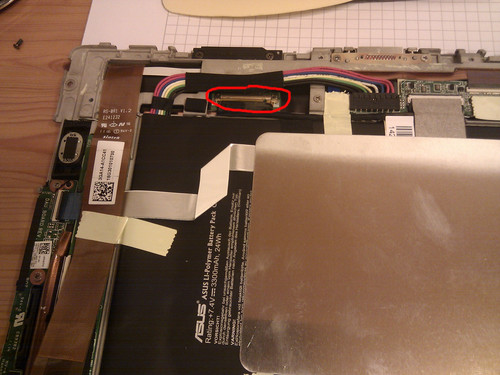
Christoph Berg: TF101 flickering and a loose cable

My ASUS Transformer TF101 had suddenly started flickering in all sorts of funny colors some weeks ago. As tapping it gently on the table in the right angle made the problem go away temporarily, it was clear the problem was about a loose cable, or some other hardware connection issue. As I needed to go on a business trip the other day, I didn't look up the warranty expiration day until later that week. Then, Murphy struck: the tablet was now 2 years + 1 day old! Calling ASUS, some friendly guy there suggested I still tried to get ASUS to accept it for warranty, because the tablet had been with them last year for 5 days, so if they added that, it would still be within the warranty period. I filled out the RMA form, but one hour later the reply was they rejected it because it was out of warranty. Another guy on the phone then said they would probably only do the adding if it had been with them for maybe 10 days, or actually really 30 days, or whatever. Some googling suggested that the loose cable theory was indeed worth a try, so I took it apart. Thanks to a forum post I could then locate the display connector and fix it. Putting the case back together was actually harder than disassembling it because some plastic bits got stuck, but now everything is back to normal.

7 December 2013

Dirk Eddelbuettel: R and Big Data at Big Data Summit at UI Research Park

I spent yesterday at the very enjoyable Big Data Summit held at the University of Illinois Research Park at the edge of the University of Illinois at Urbana-Champaign. campus. My (short) presentation was part of a panel session on R and Big Data which Doug Simpson of the UIUC Statistics department had put together very well. We heard from a vendor / technology provider with Christopher Nguyen from Adatao talking about their "Big R", from industry with Andy Stevens talking about a number of some real-life challenges with big data at John Deere, from academia with Jonathon Greenberg talking about R and HPC for geospatial research and I added a few short comments and links about R, HPC and Rcpp. My few slides are now up on my talks / presentations page. Overall, a good day with a number of interesting presentations and of course a number of engaging hallway discussions.

This post by Dirk Eddelbuettel originated on his Thinking inside the box blog. Please report excessive re-aggregation in third-party for-profit settings.

4 October 2013

Paul Sarbinowski: Debian android app is published

Now that GSOC is over and DebianDroid is in a more functional state i ve decided to finally publish the app to the Google Play Store and to F-Droid. That way I can get way more feedback about it plus it might already be useful for some people.
You can find a features and todo list in the readme in my github repo or alioth mirror. Special thanks to Hans-Christoph Steiner (my gsoc mentor) and to Paul Tagliamonte for their help and feedback along the way. If you want to help send me your feedback about the app via mail to onexemailx@gmail.com or via github or play store. I m looking for bugs, new feature ideas, suggestions for rest/soap/any other apis I can use to implement features in the todo list and also possibly for other icon or design ideas. That s all for now. :) Edit: I did a last minute rename of the app package to net.debian.debiandroid (since debian.com doesn t exist) and it was a bit more complicated that I expected so I had to republish the app in the play store. Just uninstall the old one and install it again from the link above. I changed the description of the old app as well so it should be clear which is which. Sorry for the inconvenience. The good thing is that I fixed some bugs/crashes as well.

Next.

Previous.