Search Results: "anbe"

21 December 2024

Dirk Eddelbuettel: anytime 0.3.11 on CRAN: Maintenance

A follow-up release 0.3.11 to the recent 0.3.10 release release of the anytime package arrived on CRAN two days ago. The package is fairly feature-complete, and code and functionality remain mature and stable, of course. anytime is a very focused package aiming to do just one thing really well: to convert anything in integer, numeric, character, factor, ordered, input format to either POSIXct (when called as anytime) or Date objects (when called as anydate) and to do so without requiring a format string as well as accomodating different formats in one input vector. See the anytime page, or the GitHub repo for a few examples, and the beautiful documentation site for all documentation. This release simply skips one test file. CRAN labeled an error M1mac yet it did not reproduce on any of the other M1 macOS I can access (macbuilder, GitHub Actions) as this appeared related to a local setting of timezone values I could not reproduce anywwhere. So the only way to get rid of the fail is to not to run the test. Needless to say the upload process was a little tedious as I got the passive-aggressive not responding treatment on a first upload and the required email answer it lead to. Anyway, after a few days, and even more deep breaths, it is taken care of and now the package result standing is (at least currently) pristinely clean. The short list of changes follows.

Changes in anytime version 0.3.11 (2024-12-18)
  • Skip a test file

Courtesy of my CRANberries, there is also a diffstat report of changes relative to the previous release. The issue tracker tracker off the GitHub repo can be use for questions and comments. More information about the package is at the package page, the GitHub repo and the documentation site.

This post by Dirk Eddelbuettel originated on his Thinking inside the box blog. If you like this or other open-source work I do, you can now sponsor me at GitHub.

17 December 2024

Dirk Eddelbuettel: BH 1.87.0-1 on CRAN: New Upstream

Boost Boost is a very large and comprehensive set of (peer-reviewed) libraries for the C++ programming language, containing well over one hundred individual libraries. The BH package provides a sizeable subset of header-only libraries for (easier, no linking required) use by R. It is fairly widely used: the (partial) CRAN mirror logs (aggregated from the cloud mirrors) show over 38.5 million package downloads. Version 1.87.0 of Boost was released last week following the regular Boost release schedule of April, August and December releases. As before, we packaged it almost immediately and started testing following our annual update cycle which strives to balance being close enough to upstream and not stressing CRAN and the user base too much. The reverse depends check revealed six packages requiring changes or adjustments. We opened issue #103 to coordinate the issue (just as we did in previous years). Our sincere thanks to Matt Fidler who fixed two packages pretty much immediately. As I had not heard back from the other maintainers since filing the issue, I uploaded the package to CRAN suggesting that the coming winter break may be a good opportunity for the four other packages to catch up. CRAN concurred, and 1.87.0-1 is now available there. There are no other changes apart from cosmetics in the DESCRIPTION file. For once, we did not add any new Boost libraries. The short NEWS entry follows.

Changes in version 1.87.0-1 (2024-12-17)
  • Upgrade to Boost 1.87.0, patched as usual to comment-out diagnostic suppression messages per the request of CRAN
  • Switched to Authors@R

Via my CRANberries, there is a diffstat report relative to the previous release. Comments and suggestions about BH are welcome via the issue tracker at the GitHub repo.

This post by Dirk Eddelbuettel originated on his Thinking inside the box blog. If you like this or other open-source work I do, you can now sponsor me at GitHub.

12 December 2024

Dirk Eddelbuettel: RcppCCTZ 0.2.13 on CRAN: Maintenance

A new release 0.2.13 of RcppCCTZ is now on CRAN. RcppCCTZ uses Rcpp to bring CCTZ to R. CCTZ is a C++ library for translating between absolute and civil times using the rules of a time zone. In fact, it is two libraries. One for dealing with civil time: human-readable dates and times, and one for converting between between absolute and civil times via time zones. And while CCTZ is made by Google(rs), it is not an official Google product. The RcppCCTZ page has a few usage examples and details. This package was the first CRAN package to use CCTZ; by now several others packages (four the last time we counted) include its sources too. Not ideal, but beyond our control. This version include most routine package maintenance as well as one small contributed code improvement. The changes since the last CRAN release are summarised below.

Changes in version 0.2.13 (2024-12-11)
  • No longer set compilation standard as recent R version set a sufficiently high minimum
  • Qualify a call to cctz::format (Michael Quinn in #44)
  • Routine updates to continuous integration and badges
  • Switch to Authors@R in DESCRIPTION

Courtesy of my CRANberries, there is a diffstat report relative to to the previous version. More details are at the RcppCCTZ page; code, issue tickets etc at the GitHub repository. If you like this or other open-source work I do, you can sponsor me at GitHub.

This post by Dirk Eddelbuettel originated on his Thinking inside the box blog. Please report excessive re-aggregation in third-party for-profit settings.

8 December 2024

Dirk Eddelbuettel: pinp 0.0.11 on CRAN: Maintenance

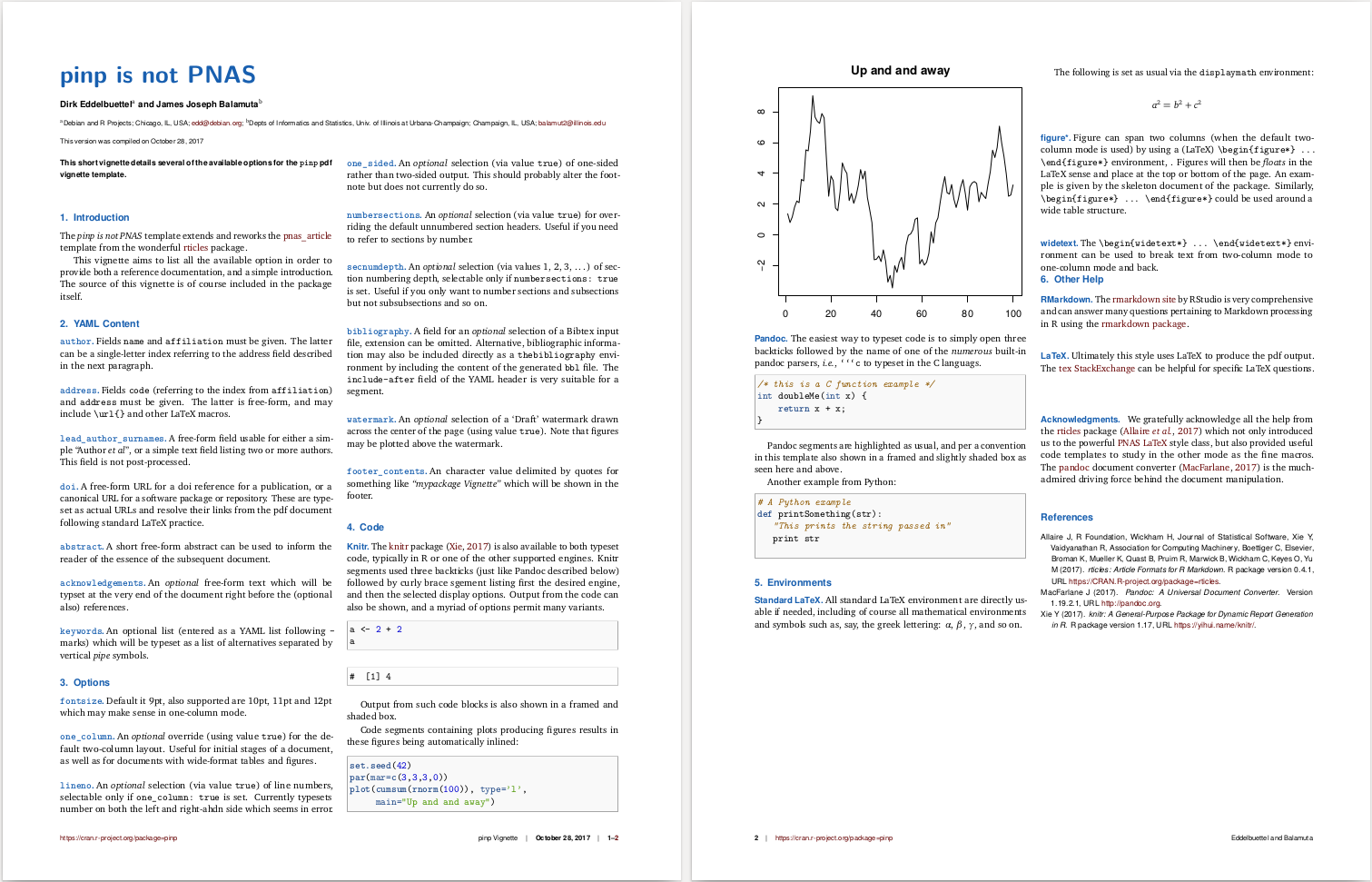
A new version of our pinp package arrived on CRAN today, and is the first release in four years. The pinp package allows for snazzier one or two column Markdown-based pdf vignettes, and is now used by a few packages. A screenshot of the package vignette can be seen below. Additional screenshots are at the pinp page. pinp vignette This release contains no new features or new user-facing changes but reflects the standard package and repository maintenance over the four-year window since the last release: updating of actions, updating of URLs and addressing small packaging changes spotted by ever-more-vigilant R checking code. The NEWS entry for this release follows.

Changes in pinp version 0.0.11 (2024-12-08)
  • Standard package maintenance for continuous integration, URL updates, and packaging conventions
  • Correct two minor nags in the Rd file

Courtesy of my CRANberries, there is a diffstat report relative to previous release. More detailed information is on the ping page. For questions or comments use the issue tracker off the GitHub repo. If you like this or other open-source work I do, you can sponsor me at GitHub.

This post by Dirk Eddelbuettel originated on his Thinking inside the box blog. Please report excessive re-aggregation in third-party for-profit settings.

6 December 2024

Dirk Eddelbuettel: RcppArmadillo 14.2.2-1 on CRAN: Small Upstream Fixes

armadillo image Armadillo is a powerful and expressive C++ template library for linear algebra and scientific computing. It aims towards a good balance between speed and ease of use, has a syntax deliberately close to Matlab, and is useful for algorithm development directly in C++, or quick conversion of research code into production environments. RcppArmadillo integrates this library with the R environment and language and is widely used by (currently) 1197 other packages on CRAN, downloaded 37.5 million times (per the partial logs from the cloud mirrors of CRAN), and the CSDA paper (preprint / vignette) by Conrad and myself has been cited 605 times according to Google Scholar. Conrad released a minor version 14.2.2 yesterday. This followed a bit of recent work a few of us did in the ensmallen and mlpack repositories following the [14.2.0 release]. Use of (member functions) .min(index) and .max(index) was deprecated in Armadillo in favor of .index_mix() and .index_max(). By now ensmallen and mlpack have been updated at CRAN. To add some spice, CRAN emailed that the (very much unreleased as of now, but coming likely next spring) gcc-15 was unhappy with RcppArmadillo due to some Armadillo code. This likely related to the listed gcc-15 C++ change about Qualified name lookup failure into the current instantiation . Anyway, Conrad fixed it within days and that change too is part of this new version (as is a small behaviour normalization between the two indexing methods that matters in case of ties, this was in 14.2.1). The changes since the last CRAN release are summarised below.

Changes in RcppArmadillo version 14.2.2-1 (2024-12-05)
  • Upgraded to Armadillo release 14.2.2 (Smooth Caffeine)
    • Workarounds for regressions in pre-release versions of GCC 15
    • More selective detection of symmetric/hermitian matrices by various functions

Changes in RcppArmadillo version 14.2.1-1 (2024-11-24) (GitHub Only)
  • Upgraded to Armadillo release 14.2.1 (Smooth Caffeine)
    • Fix for index_min() and index_max() to ensure that the first index of equal extremum values is found

Courtesy of my CRANberries, there is a diffstat report relative to previous release. More detailed information is on the RcppArmadillo page. Questions, comments etc should go to the rcpp-devel mailing list off the Rcpp R-Forge page. If you like this or other open-source work I do, you can sponsor me at GitHub.

This post by Dirk Eddelbuettel originated on his Thinking inside the box blog. Please report excessive re-aggregation in third-party for-profit settings.

2 December 2024

Dirk Eddelbuettel: anytime 0.3.10 on CRAN: Multiple Enhancements

A new release of the anytime package arrived on CRAN today the first is well over four years. The package is fairly feature-complete, and code and functionality remain mature and stable, of course. anytime is a very focused package aiming to do just one thing really well: to convert anything in integer, numeric, character, factor, ordered, input format to either POSIXct (when called as anytime) or Date objects (when called as anydate) and to do so without requiring a format string as well as accomodating different formats in one input vector. See the anytime page, or the GitHub repo for a few examples, and the beautiful documentation site for all documentation. This release slowly matured over four years. It combines a number of strictly internal repository maintenance such as changes to continuous integration with small enhancements (adding for example some new formats, responding better to an error condition, dealing with logical input as an error) with a relaxation of the C++ compilation standard. While we once needed C++11, it is now a constraint as as R itself is quite proactive (the last two releases defaulted already to C++17, suitable compiler permitting) we can now relax this constraint. The documentation site is new, as some other small changes. See the full list of changes which follows.

Changes in anytime version 0.3.10 (2024-12-02)
  • A new documentation site was added.
  • Continuous Integration now uses run.sh from r-ci with bspm
  • Logical input vectors are now recognised as an error (#121)
  • Additional dot-separated format '%Y.%m.%d' is supported
  • Other small updates were made throughout the package
  • No longer set a C++ compilation standard as the default choices by R are sufficient for the package
  • Switch Rcpp include file to Rcpp/Lightest
  • We recommend ~/.R/Makevars compiler flag options -Wno-ignored-attributes -Wno-nonnull -Wno-parentheses
  • The tinytest runner was simplified
  • NA values from conversion now trigger a warning

Courtesy of my CRANberries, there is also a diffstat report of changes relative to the previous release. The issue tracker tracker off the GitHub repo can be use for questions and comments. More information about the package is at the package page, the GitHub repo and the documentation site. If you like this or other open-source work I do, you can now sponsor me at GitHub.

This post by Dirk Eddelbuettel originated on his Thinking inside the box blog. Please report excessive re-aggregation in third-party for-profit settings.

29 November 2024

Dirk Eddelbuettel: RcppAPT 0.0.10: Maintenance

A new version of the RcppAPT package arrived on CRAN earlier today. RcppAPT connects R to the C++ library behind the awesome apt, apt-get, apt-cache, commands (and their cache) which powering Debian, Ubuntu and other derivative distributions. RcppAPT allows you to query the (Debian or Ubuntu) package dependency graph at will, with build-dependencies (if you have deb-src entries), reverse dependencies, and all other goodies. See the vignette and examples for illustrations. This release moves the C++ compilation standard from C++11 to C++17. I had removed the setting for C++11 last year as compilation by compiler default worked well enough. But the version at CRAN still carried, which started to lead to build failures on Debian unstable so it was time for an update. And rather than implicitly relying on C++17 as selected by the last two R releases, we made it explicit. Otherwise a few of the regular package and repository updates have been made, but no new code or features were added The NEWS entries follow.

Changes in version 0.0.10 (2024-11-29)
  • Package maintenance updating continuous integration script versions as well as coverage link from README, and switching to Authors@R
  • C++ compilation standards updated to C++17 to comply with libapt-pkg

Courtesy of my CRANberries, there is also a diffstat report for this release. A bit more information about the package is available here as well as at the GitHub repo. If you like this or other open-source work I do, you can now sponsor me at GitHub.

This post by Dirk Eddelbuettel originated on his Thinking inside the box blog. Please report excessive re-aggregation in third-party for-profit settings.

18 November 2024

Dirk Eddelbuettel: RcppArmadillo 14.2.0-1 on CRAN: New Upstream Minor

armadillo image Armadillo is a powerful and expressive C++ template library for linear algebra and scientific computing. It aims towards a good balance between speed and ease of use, has a syntax deliberately close to Matlab, and is useful for algorithm development directly in C++, or quick conversion of research code into production environments. RcppArmadillo integrates this library with the R environment and language and is widely used by (currently) 1191 other packages on CRAN, downloaded 37.2 million times (per the partial logs from the cloud mirrors of CRAN), and the CSDA paper (preprint / vignette) by Conrad and myself has been cited 603 times according to Google Scholar. Conrad released a minor version 14.2.0 a few days ago after we spent about two weeks with several runs of reverse-dependency checks covering corner cases. After a short delay at CRAN due to a false positive on a test, a package failing tests we also failed under the previous version, and some concern over new deprecation warnings _whem using the headers directly as _e.g. mlpack R package does we are now on CRAN. I noticed a missing feature under large 64bit word (for large floating-point matrices) and added an exporter for icube going to double to support the 64-bit integer range (as we already did, of course, for vectors and matrices). Changes since the last CRAN release are summarised below.

Changes in RcppArmadillo version 14.2.0-1 (2024-11-16)
  • Upgraded to Armadillo release 14.2.0 (Smooth Caffeine)
    • Faster handling of symmetric matrices by inv() and rcond()
    • Faster handling of hermitian matrices by inv(), rcond(), cond(), pinv(), rank()
    • Added solve_opts::force_sym option to solve() to force the use of the symmetric solver
    • More efficient handling of compound expressions by solve()
  • Added exporter specialisation for icube for the ARMA_64BIT_WORD case

Courtesy of my CRANberries, there is a diffstat report relative to previous release. More detailed information is on the RcppArmadillo page. Questions, comments etc should go to the rcpp-devel mailing list off the Rcpp R-Forge page. If you like this or other open-source work I do, you can sponsor me at GitHub.

This post by Dirk Eddelbuettel originated on his Thinking inside the box blog. Please report excessive re-aggregation in third-party for-profit settings.

11 November 2024

Dirk Eddelbuettel: RcppSpdlog 0.0.19 on CRAN: New Upstream, New Features

Version 0.0.19 of RcppSpdlog arrived on CRAN early this morning and has been uploaded to Debian. RcppSpdlog bundles spdlog, a wonderful header-only C++ logging library with all the bells and whistles you would want that was written by Gabi Melman, and also includes fmt by Victor Zverovich. You can learn more at the nice package documention site. This releases updates the code to the version 1.15.0 of spdlog which was released on Saturday, and contains fmt 11.0.2. It also contains a contributed PR which allows use std::format under C++20, bypassing fmt (with some post-merge polish too), and another PR correcting a documentation double-entry. The NEWS entry for this release follows.

Changes in RcppSpdlog version 0.0.19 (2024-11-10)
  • Support use of std::format under C++20 via opt-in define instead of fmt (Xanthos Xanthopoulos in #19)
  • An erroneous duplicate log=level documentation level was removed (Contantinos Giachalis in #20)
  • Upgraded to upstream release spdlog 1.15.0 (Dirk in #21)
  • Partially revert / simplify src/formatter.cpp accomodating both #19 and previous state (Dirk in #21)

Courtesy of my CRANberries, there is also a diffstat report. More detailed information is on the RcppSpdlog page, or the package documention site. If you like this or other open-source work I do, you can sponsor me at GitHub.

This post by Dirk Eddelbuettel originated on his Thinking inside the box blog. Please report excessive re-aggregation in third-party for-profit settings.

10 November 2024

Dirk Eddelbuettel: inline 0.3.20: Mostly Maintenance

A new release of the inline package got to CRAN today marking the first release in three and half years. inline facilitates writing code in-line in simple string expressions or short files. The package was used quite extensively by Rcpp in the very early days before Rcpp Attributes arrived on the scene providing an even better alternative for its use cases. inline is still used by rstan and a number of other packages. This release was tickled by changing in r-devel just this week, and the corresponding please fix or else email I received this morning. R_NO_REMAP is now the default in r-devel, and while we had already converted most (old-style) calls into the API to using the now mandatory Rf_ prefix, the package contained few remaining cases in examples as well as one in code generation. The release also contains a helpful contributed PR making an error message a little clearer, plus several small and common maintenance changed around continuous integration, package layout and the repository. The NEWS extract follows and details the changes some more.

Changes in inline version 0.3.20 (2024-11-10)
  • Error message formatting is improved for compileCode (Alexis Derumigny in #25)
  • Switch to using Authors@R, other general packaging maintenance for continuous integration and repository
  • Use Rf_ in a handful of cases as R-devel now mandates it

Thanks to my CRANberries, you can also look at a diff to the previous release Questions, comments etc should go to the rcpp-devel mailing list off the R-Forge page. Bugs reports are welcome at the GitHub issue tracker as well (where one can also search among open or closed issues). If you like this or other open-source work I do, you can sponsor me at GitHub.

This post by Dirk Eddelbuettel originated on his Thinking inside the box blog. Please report excessive re-aggregation in third-party for-profit settings.

2 November 2024

Dirk Eddelbuettel: Rcpp 1.0.13-1 on CRAN: Hot Fix

rcpp logo A hot-fix release 1.0.13-1, consisting of two small PRs relative to the last regular CRAN release 1.0.13, just arrived on CRAN. When we prepared 1.0.13, we included a change related to the tightening of the C API of R itself. Sadly, we pinned an expected change to comes with next (minor) release 4.4.2 rather than now next (normal aka major) release 4.5.0 . And now that R 4.4.2 is out (as of two days ago) we accidentally broke building against the header file with that check. Whoops. Bugs happen, and we are truly sorry but this is now addressed in 1.0.13-1. The normal (bi-annual) release cycle will resume with 1.0.14 slated for January. As you can see from the NEWS file of the development branch, we have a number of changes coming. You can safely access that release candidate version, either off the default branch at github or via r-universe artifacts. The list below details all changes, as usual. The only other change concerns the now-mandatory use of Authors@R.

Changes in Rcpp release version 1.0.13-1 (2024-11-01)
  • Changes in Rcpp API:
    • Use read-only VECTOR_PTR and STRING_PTR only with with R 4.5.0 or later (Kevin in #1342 fixing #1341)
  • Changes in Rcpp Deployment:
    • Authors@R is now used in DESCRIPTION as mandated by CRAN

Thanks to my CRANberries, you can also look at a diff to the previous release Questions, comments etc should go to the rcpp-devel mailing list off the R-Forge page. Bugs reports are welcome at the GitHub issue tracker as well (where one can also search among open or closed issues). If you like this or other open-source work I do, you can sponsor me at GitHub.

This post by Dirk Eddelbuettel originated on his Thinking inside the box blog. Please report excessive re-aggregation in third-party for-profit settings.

30 October 2024

Dirk Eddelbuettel: gcbd 0.2.7 on CRAN: More Mere Maintenance

Another pure maintenance release 0.2.7 of the gcbd package is now on CRAN. The gcbd proposes a benchmarking framework for LAPACK and BLAS operations (as the library can exchanged in a plug-and-play sense on suitable OSs) and records result in local database. Its original motivation was to also compare to GPU-based operations. However, as it is both challenging to keep CUDA working packages on CRAN providing the basic functionality appear to come and go so testing the GPU feature can be challenging. The main point of gcbd is now to actually demonstrate that yes indeed we can just swap BLAS/LAPACK libraries without any change to R, or R packages. The configure / rebuild R for xyz often seen with xyz being Goto or MKL is simply plain wrong: you really can just swap them (on proper operating systems, and R configs see the package vignette for more). But nomatter how often we aim to correct this record, it invariably raises its head another time. This release accommodates a CRAN change request as we were referencing the (now only suggested) package gputools. As hinted in the previous paragraph, it was once on CRAN but is not right now so we adjusted our reference. CRANberries also provides a diffstat report for the latest release. If you like this or other open-source work I do, you can sponsor me at GitHub.

This post by Dirk Eddelbuettel originated on his Thinking inside the box blog. Please report excessive re-aggregation in third-party for-profit settings.

22 October 2024

Dirk Eddelbuettel: drat 0.2.5 on CRAN: Small Updates

drat user A new minor release of the drat package arrived on CRAN today, which is just over a year since the previous release. drat stands for drat R Archive Template, and helps with easy-to-create and easy-to-use repositories for R packages. Since its inception in early 2015 it has found reasonably widespread adoption among R users because repositories with marked releases is the better way to distribute code. Because for once it really is as your mother told you: Friends don t let friends install random git commit snapshots. Properly rolled-up releases it is. Just how CRAN shows us: a model that has demonstrated for over two-and-a-half decades how to do this. And you can too: drat is easy to use, documented by six vignettes and just works. Detailed information about drat is at its documentation site. That said, and these days , if you mainly care about github code then r-universe is there too, also offering binaries its makes and all that jazz. But sometimes you just want to, or need to, roll a local repository and drat can help you there. This release contains a small PR (made by Arne Holmin just after the previous release) adding support for an OSflacour variable (helpful for macOS). We also corrected an issue with one test file being insufficiently careful of using git2r only when installed, and as usual did a round of maintenance for the package concerning both continuous integration and documentation. The NEWS file summarises the release as follows:

Changes in drat version 0.2.5 (2024-10-21)
  • Function insertPackage has a new optional argument OSflavour (Arne Holmin in #142)
  • A test file conditions correctly about git2r being present (Dirk)
  • Several smaller packaging updates and enhancements to continuous integration and documentation have been added (Dirk)

Courtesy of my CRANberries, there is a comparison to the previous release. More detailed information is on the drat page as well as at the documentation site. If you like this or other open-source work I do, you can sponsor me at GitHub.

This post by Dirk Eddelbuettel originated on his Thinking inside the box blog. Please report excessive re-aggregation in third-party for-profit settings.

15 October 2024

Dirk Eddelbuettel: qlcal 0.0.13 on CRAN: Small Calendar Update

The thirteenth release of the qlcal package arrivied at CRAN today. qlcal delivers the calendaring parts of QuantLib. It is provided (for the R package) as a set of included files, so the package is self-contained and does not depend on an external QuantLib library (which can be demanding to build). qlcal covers over sixty country / market calendars and can compute holiday lists, its complement (i.e. business day lists) and much more. Examples are in the README at the repository, the package page, and course at the CRAN package page. This releases synchronizes qlcal with the QuantLib release 1.36 (made this week) and contains some minor updates to two calendars.

Changes in version 0.0.13 (2024-10-15)
  • Synchronized with QuantLib 1.36 released yesterday
  • Calendar updates for South Korea and Poland

Courtesy of my CRANberries, there is a diffstat report for this release. See the project page and package documentation for more details, and more examples. If you like this or other open-source work I do, you can sponsor me at GitHub.

This post by Dirk Eddelbuettel originated on his Thinking inside the box blog. Please report excessive re-aggregation in third-party for-profit settings.

14 October 2024

Dirk Eddelbuettel: RcppDate 0.0.4: New Upstream Minor

RcppDate wraps the featureful date library written by Howard Hinnant for use with R. This header-only modern C++ library has been in pretty wide-spread use for a while now, and adds to C++11/C++14/C++17 what will be (with minor modifications) the date library in C++20. This release, the first in 3 1/2 years, syncs the code with the recent date 3.0.2 release from a few days ago. It also updates a few packaging details such as URLs, badges or continuous integration.

Changes in version 0.0.4 (2024-10-14)
  • Updated to upstream version 3.0.2 (and adjusting one pragma)
  • Several small updates to overall packaging and testing

Courtesy of my CRANberries, there is also a diffstat report for the most recent release. More information is available at the repository or the package page. If you like this or other open-source work I do, you can sponsor me at GitHub.

This post by Dirk Eddelbuettel originated on his Thinking inside the box blog. Please report excessive re-aggregation in third-party for-profit settings.

29 September 2024

Dirk Eddelbuettel: RApiSerialize 0.1.4 on CRAN: Added C++ Namespace

A new minor release 0.1.5 of RApiSerialize arrived on CRAN today. The RApiSerialize package is used by both my RcppRedis as well as by Travers excellent qs package. This release adds an optional C++ namespace, available when the API header file is included in a C++ source file. And as one often does, the release also brings a few small updates to different aspects of the packaging.

Changes in version 0.1.4 (2024-09-28)
  • Add C++ namespace in API header (Dirk in #9 closing #8)
  • Several packaging updates: switched to Authors@R, README.md badge updates, added .editorconfig and cleanup

Courtesy of my CRANberries, there is a diffstat report relative to previous release. More details are at the RApiSerialize page; code, issue tickets etc at the GitHub repositoryrapiserializerepo. If you like this or other open-source work I do, you can sponsor me at GitHub.

This post by Dirk Eddelbuettel originated on his Thinking inside the box blog. Please report excessive re-aggregation in third-party for-profit settings.

24 September 2024

Dirk Eddelbuettel: RcppFastAD 0.0.4 on CRAN: Updated Again

A new release 0.0.4 of the RcppFastAD package by James Yang and myself is now on CRAN. RcppFastAD wraps the FastAD header-only C++ library by James which provides a C++ implementation of both forward and reverse mode of automatic differentiation. It offers an easy-to-use header library (which we wrapped here) that is both lightweight and performant. With a little of bit of Rcpp glue, it is also easy to use from R in simple C++ applications. This release updates the quick fix in release 0.0.3 from a good week ago. James took a good look and properly disambiguated the statement that lead clang to complain, so we are back to compiling as C++17 under all compilers which makes for a slightly wider reach. The NEWS file for this release follows.

Changes in version 0.0.4 (2024-09-24)
  • The package now properly addresses a clang warning on empty variadic macros arguments and is back to C++17 (James in #10)

Courtesy of my CRANberries, there is also a diffstat report for the most recent release. More information is available at the repository or the package page. If you like this or other open-source work I do, you can sponsor me at GitHub.

This post by Dirk Eddelbuettel originated on his Thinking inside the box blog. Please report excessive re-aggregation in third-party for-profit settings.

18 September 2024

Dirk Eddelbuettel: Rblpapi 0.3.15: Updated and New BLP Library

bloomberg terminal Version 0.3.15 of the Rblpapi package arrived on CRAN today. Rblpapi provides a direct interface between R and the Bloomberg Terminal via the C++ API provided by Bloomberg (but note that a valid Bloomberg license and installation is required). This is the fifteenth release since the package first appeared on CRAN in 2016. This release updates to the current version 3.24.6 of the Bloomberg API, and rounds out a few corners in the packaging from continuous integration to the vignette. The detailed list of changes follow below.

Changes in Rblpapi version 0.3.15 (2024-09-18)
  • A warning is now issued if more than 1000 results are returned (John in #377 addressing #375)
  • A few typos in the rblpapi-intro vignette were corrected (Michael Streatfield in #378)
  • The continuous integration setup was updated (Dirk in #388)
  • Deprecation warnings over char* where C++ class Name is now preferred have been addressed (Dirk in #391)
  • Several package files have been updated (Dirk in #392)
  • The request formation has been corrected, and an example was added (Dirk and John in #394 and #396)
  • The Bloomberg API has been upgraded to release 3.24.6.1 (Dirk in #397)

Courtesy of my CRANberries, there is also a diffstat report for the this release. As always, more detailed information is at the Rblpapi repo or the Rblpapi page. Questions, comments etc should go to the issue tickets system at the GitHub repo. If you like this or other open-source work I do, you can sponsor me at GitHub.

This post by Dirk Eddelbuettel originated on his Thinking inside the box blog. Please report excessive re-aggregation in third-party for-profit settings.

17 September 2024

Dirk Eddelbuettel: nanotime 0.3.10 on CRAN: Update

A minor update 0.3.10 for our nanotime package is now on CRAN. nanotime relies on the RcppCCTZ package (as well as the RcppDate package for additional C++ operations) and offers efficient high(er) resolution time parsing and formatting up to nanosecond resolution, using the bit64 package for the actual integer64 arithmetic. Initially implemented using the S3 system, it has benefitted greatly from a rigorous refactoring by Leonardo who not only rejigged nanotime internals in S4 but also added new S4 types for periods, intervals and durations. This release updates one S4 methods to very recent changes in r-devel for which CRAN had reached out. This concerns the setdiff() method when applied to two nanotime objects. As it only affected R 4.5.0, due next April, if rebuilt in the last two or so weeks it will not have been visible to that many users, if any. In any event, it now works again for that setup too, and should be going forward. We also retired one demo function from the very early days, apparently it relied on ggplot2 features that have since moved on. If someone would like to help out and resurrect the demo, please get in touch. We also cleaned out some no longer used tests, and updated DESCRIPTION to what is required now. The NEWS snippet below has the full details.

Changes in version 0.3.10 (2024-09-16)
  • Retire several checks for Solaris in test suite (Dirk in #130)
  • Switch to Authors@R in DESCRIPTION as now required by CRAN
  • Accommodate R-devel change for setdiff (Dirk in #133 fixing #132)
  • No longer ship defunction ggplot2 demo (Dirk fixing #131)

Thanks to my CRANberries, there is a diffstat report for this release. More details and examples are at the nanotime page; code, issue tickets etc at the GitHub repository and all documentation is provided at the nanotime documentation site. If you like this or other open-source work I do, you can sponsor me at GitHub.

This post by Dirk Eddelbuettel originated on his Thinking inside the box blog. Please report excessive re-aggregation in third-party for-profit settings.

15 September 2024

Dirk Eddelbuettel: RcppFastAD 0.0.3 on CRAN: Updated

A new release 0.0.3 of the RcppFastAD package by James Yang and myself is now on CRAN. RcppFastAD wraps the FastAD header-only C++ library by James which provides a C++ implementation of both forward and reverse mode of automatic differentiation. It offers an easy-to-use header library (which we wrapped here) that is both lightweight and performant. With a little of bit of Rcpp glue, it is also easy to use from R in simple C++ applications. This release turns compilation to the C++20 standard as newer clang++ versions complained about a particular statement (it took to be C++20) when compiled under C++17. So we obliged. The NEWS file for these two initial releases follows.

Changes in version 0.0.3 (2024-09-15)
  • The package now compiles under the C++20 standard to avoid a warning under clang++-18 (Dirk addressing #9)
  • Minor updates to continuous integration and badges have been made as well

Courtesy of my CRANberries, there is also a diffstat report for the most recent release. More information is available at the repository or the package page. If you like this or other open-source work I do, you can sponsor me at GitHub.

This post by Dirk Eddelbuettel originated on his Thinking inside the box blog. Please report excessive re-aggregation in third-party for-profit settings.

Next.

Previous.