I use sway as window manager on my main machine. As I prefer dark mode, I looked for a way to enable dark mode everywhere.
For GTK-based this is fairly straightforward: Just install whatever theme you prefer, and apply it.
However, QT-based applications on a non-QT based desktop will look
The Problem
Just over 2 years ago my Dell T320 server had a motherboard failure [1]. I recently bought another T320 that had been gutted (no drives, PSUs, or RAM) and put the bits from my one in it.
I installed Debian and the resulting installation wouldn t boot, I tried installing with both UEFI and BIOS modes with the same result. Then I realised that the disks I had installed were available even though I hadn t gone through the RAID configuration (I usually make a separate RAID-0 for each disk to work best with BTRFS or ZFS). I tried changing the BIOS setting for SATA disks between RAID and AHCI modes which didn t change things and realised that the BIOS setting in question probably applies to the SATA connector on the motherboard and that the RAID card was in IT mode which means that each disk is seen separately.
If you are using ZFS or BTRFS you don t want to use a RAID-1, RAID-5, or RAID-6 on the hardware RAID controller, if there are different versions of the data on disks in the stripe then you want the filesystem to be able to work out which one is correct. To use IT mode you have to flash a different unsupported firmware on the RAID controller and then you either have to go to some extra effort to make it bootable or have a different device to boot from.
The Root Causes
Dell has no reason to support unusual firmware on their RAID controllers. Installing different firmware on a device that is designed for high availability is going to have some probability of data loss and perhaps more importantly for Dell some probability of customers returning hardware during the support period and acting innocent about why it doesn t work. Dell has a great financial incentive to make it difficult to install Dell firmware on LSI cards from other vendors which have equivalent hardware as they don t want customers to get all the benefits of iDRAC integration etc without paying the Dell price premium.
All the other vendors have similar financial incentives so there is no official documentation or support on converting between different firmware images. Dell s support for upgrading the Dell version is pretty good, but it aborts if it sees something different.
The Attempts
I tried following the instructions in this document to flash back to Dell firmware [2]. This document is about the H310 RAID card in my Dell T320 AKA a LSI SAS 9211-8i . The sas2flash.efi program didn t seem to do anything, it returned immediately and didn t give an error message.
This page gives a start of how to get inside the Dell firmware package but doesn t work [3]. It didn t cover the case where sasdupie aborts with an error because it detects the current version as 00.00.00.00 not something that the upgrade program is prepared to upgrade from. But it s a place to start looking for someone who wants to try harder at this.
This forum post has some interesting information, I gave up before trying it, but it may be useful for someone else [4].
The Solution
Dell tower servers have as a standard feature an internal USB port for a boot device. So I created a boot image on a spare USB stick and installed it there and it then loads the kernel and mounts the filesystem from a SATA hard drive. Once I got that working everything was fine. The Debian/Trixie installer would probably have allowed me to install an EFI device on the internal USB stick as part of the install if I had known what was going to happen.
The system is now fully working and ready to sell. Now I just need to find someone who wants IT mode on the RAID controller and hopefully is willing to pay extra for it.
Whatever I sell the system for it seems unlikely to cover the hours I spent working on this. But I learned some interesting things about RAID firmware and hopefully this blog post will be useful to other people, even if only to discourage them from trying to change firmware.
Utkarsh Gupta
did 15.0h (out of 1.0h assigned and 14.0h from previous period).
Evolution of the situation
In July, we released 24 DLAs.
Notable security updates:
angular.js, prepared by Bastien Roucari s, fixes multiple vulnerabilities including input sanitization and potential regular expression denial of service (ReDoS)
tomcat9, prepared by Markus Koschany, fixes an assortment of vulnerabilities
mediawiki, prepared by Guilhem Moulin, fixes several information disclosure and privilege escalation vulnerabilities
php7.4, prepared by Guilhem Moulin, fixes several server side request forgery and denial of service vulnerabilities
This month s contributions from outside the regular team include an update to thunderbird, prepared by Christoph Goehre (the package maintainer).
LTS Team members also contributed updates of the following packages:
commons-beanutils (to stable and unstable), prepared by Adrian Bunk
djvulibre (to oldstable, stable, and unstable), prepared by Adrian Bunk
git (to stable), prepared by Adrian Bunk
redis (to oldstable), prepared by Chris Lamb
libxml2 (to oldstable), prepared by Guilhem Moulin
commons-vfs (to oldstable), prepared by Daniel Leidert
Additionally, LTS Team member Santiago Ruano Rinc n proposed and implemented an improvement to the debian-security-support package. This package is available so that interested users can quickly determine if any installed packages are subject to limited security support or are excluded entirely from security support. However, there was not previously a way to identify explicitly supported packages, which has become necessary to note exceptions to broad exclusion policies (e.g., those which apply to substantial package groups, like modules belonging to the Go and Rust language ecosystems). Santiago s work has enabled the notation of exceptions to these exclusions, thus ensuring that users of debian-security-support have accurate status information concerning installed packages.
DebCamp 25 Security Tracker Sprint
The previously announced security tracker sprint took place at DebCamp from 7-13 July. Participants included 8 members of the standing LTS Team, 2 active Debian Developers with an interest in LTS, 3 community members, and 1 member of the Debian Security Team (who provided guidance and reviews on proposed changes to the security tracker); participation was a mix of in person at the venue in Brest, France and remote. During the days of the sprint, the team tackled a wide range of bugs and improvements, mostly targeting the security tracker.
The sprint participants worked on the following items:
Continued work (which was in progress prior to the sprint) on improved tooling to support security releases of packages from language ecosystems that rely heavily on static linking
As can be seen from the above list, only a small number of changes were brought to completion during the sprint week itself. Given the very compressed timeframe involved, the broad scope of tasks which were under consideration, and the highly sensitive data managed by the security tracker, this is not entirely unexpected and in no way diminishes the great work done by the sprint participants. The LTS Team would especially like to thank Salvatore Bonaccorso of the Debian Security Team for making himself available throughout the sprint to answer questions, for providing guidance on the work, and for helping the work by reviewing and merging the MRs which were able to merged during the sprint itself.
In the weeks that follow the sprint, the team will continue working towards completing the in progress items.
Thanks to our sponsors
Sponsors that joined recently are in bold.
Welcome to the seventh report from the Reproducible Builds project in 2025. Our monthly reports outline what we ve been up to over the past month, and highlight items of news from elsewhere in the increasingly-important area of software supply-chain security. If you are interested in contributing to the Reproducible Builds project, please see the Contribute page on our website.
In this report:
Reproducible Builds Summit 2025
We are extremely pleased to announce the upcoming Reproducible Builds Summit, set to take place from October 28th 30th 2025 in Vienna, Austria!
We are thrilled to host the eighth edition of this exciting event, following the success of previous summits in various iconic locations around the world, including Venice, Marrakesh, Paris, Berlin, Hamburg and Athens. Our summits are a unique gathering that brings together attendees from diverse projects, united by a shared vision of advancing the Reproducible Builds effort.
During this enriching event, participants will have the opportunity to engage in discussions, establish connections and exchange ideas to drive progress in this vital field. Our aim is to create an inclusive space that fosters collaboration, innovation and problem-solving.
If you re interesting in joining us this year, please make sure to read the event page which has more details about the event and location. Registration is open until 20th September 2025, and we are very much looking forward to seeing many readers of these reports there!
[Everything] changed earlier this year when reproducible-builds for SLES-16 became an official goal for the product. More people are talking about digital sovereignty and supply-chain security now. [ ] Today, only 9 of 3319 (source) packages have significant problems left (plus 7 with pending fixes), so 99.5% of packages have reproducible builds.
There are numerous policy compliance and regulatory processes being developed that target software development but do they solve actual problems? Does it improve the quality of software? Do Software Bill of Materials (SBOMs) actually give you the information necessary to verify how a given software artifact was built? What is the goal of all these compliance checklists anyways or more importantly, what should the goals be? If a software object is signed, who should be trusted to sign it, and can they be trusted forever?
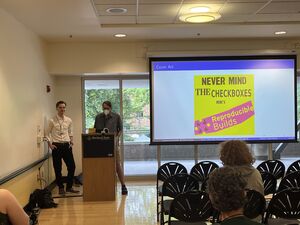
Hosted by the Software Freedom Conservancy and taking place in Portland, Oregon, USA, FOSSY aims to be a community-focused event: Whether you are a long time contributing member of a free software project, a recent graduate of a coding bootcamp or university, or just have an interest in the possibilities that free and open source software bring, FOSSY will have something for you . More information on the event is available on the FOSSY 2025 website, including the full programme schedule.
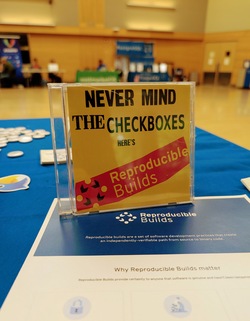
Vagrant and Chris also staffed a table, where they will be available to answer any questions about Reproducible Builds and discuss collaborations with other projects.
Automation to derive declarative build definitions for existing PyPI (Python), npm (JS/TS), and Crates.io (Rust) packages.
SLSA Provenance for thousands of packages across our supported ecosystems, meeting SLSA Build Level 3 requirements with no publisher intervention.
Build observability and verification tools that security teams can integrate into their existing vulnerability management workflows.
Infrastructure definitions to allow organizations to easily run their own instances of OSS Rebuild to rebuild, generate, sign, and distribute provenance.
One difference with most projects that aim for bit-for-bit reproducibility, OSS Rebuild aims for a kind of semantic reproducibility:
Through automation and heuristics, we determine a prospective build definition for a target package and rebuild it. We semantically compare the result with the existing upstream artifact, normalizing each one to remove instabilities that cause bit-for-bit comparisons to fail (e.g. archive compression).
The extensive post includes examples about how to access OSS Rebuild attestations using the Go-based command-line interface.
New extension of Python setuptools to support reproducible builds
Wim Jeantine-Glenn has written a PEP 517 Build backend in order to enable reproducible builds when building Python projects that use setuptools.
Called setuptools-reproducible, the project s README file contains the following:
Setuptools can create reproducible wheel archives (.whl) by setting SOURCE_DATE_EPOCH at build time, but setting the env var is insufficient for creating reproducible sdists (.tar.gz). setuptools-reproducible [therefore] wraps the hooks build_sdistbuild_wheel with some modifications to make reproducible builds by default.
diffoscopediffoscope is our in-depth and content-aware diff utility that can locate and diagnose reproducibility issues. This month, Chris Lamb made the following changes, including preparing and uploading versions 301, 302 and 303 to Debian:
Improvements:
Use Difference.from_operation in an attempt to pipeline the output of the extract-vmlinux script, potentially avoiding it all in memory. []
Memoize a number of calls to --version, saving a very large number of external subprocess calls.
Bug fixes:
Don t check for PyPDF version 3 specifically, check for versions greater than 3. []
Ensure that Java class files are named .class on the filesystem before passing them to javap(1). []
Mask stderr from extract-vmlinux script. [][]
Avoid spurious differences in h5dump output caused by exposure of absolute internal extraction paths. (#1108690)
Misc:
Use our_check_output in the ODT comparator. []
Update copyright years. []
In addition:
Siva Mahadevan made a change to use the --print-armap long option when calling nm(1) for wider compatibility. []
Lastly, Chris Lamb added a tmpfs to try.diffoscope.org so that diffoscope has a non-trivial temporary area to unpack archives, etc. []
Elsewhere in our tooling, however, reprotest is our tool for building the same source code twice in different environments and then checking the binaries produced by each build for any differences. This month, reprotest version 0.7.30 was uploaded to Debian unstable by Holger Levsen, chiefly including a change by Rebecca N. Palmer to not call sudo with the -h flag in order to fix Debian bug #1108550. []
New library to patch system functions for reproducibility
Nicolas Graves has written and published libfate, a simple collection of tiny libraries to patch system functions deterministically using LD_PRELOAD. According to the project s README:
libfate provides deterministic replacements for common non-deterministic system functions that can break reproducible builds. Instead of relying on complex build systems or apps or extensive patching, libfate uses the LD_PRELOAD trick to intercept system calls and return fixed, predictable values.
Describing why he wrote it, Nicolas writes:
I originally used the OpenSUSE dettrace approach to make Emacs reproducible in Guix. But when Guix switch to GCC@14, dettrace stopped working as expected. dettrace is a complex piece of software, my need was much less heavy: I don t need to systematically patch all sources of nondetermism, just the ones that make a process/binary unreproducible in a container/chroot.
One desirable property is that someone else should be able to reproduce the same git bundle, and not only that a single individual is able to reproduce things on one machine. It surprised me to see that when I ran the same set of commands on a different machine (started from a fresh git clone), I got a different checksum. The different checksums occurred even when nothing had been committed on the server side between the two runs.
Website updates
Once again, there were a number of improvements made to our website this month including:
Bernhard M. Wiedemann added an entry related to R-B-OS on the History page. []
Chris Lamb:
Replaced rbtlog run by Fay by rbtlog run by Benl on the Who is involved page. []
Debian contributors have made significant progress toward ensuring package builds produce byte-for-byte reproducible results. You can check the status for packages installed on your system using the new package debian-repro-status, or visit reproduce.debian.net for Debian s overall statistics for trixie and later. You can contribute to these efforts by joining #debian-reproducible on IRC to discuss fixes, or verify the statistics by installing the new rebuilderd package and setting up your own instance.
Reproducibility testing framework
The Reproducible Builds project operates a comprehensive testing framework running primarily at tests.reproducible-builds.org in order to check packages and other artifacts for reproducibility. In July, however, a number of changes were made by Holger Levsen, including:
Make the dsa-check-packages output more useful. []
Setup the ppc64el architecture again, has it has returned this time with a 2.7 GiB database instead of 72 GiB. []
In addition, Jochen Sprickerhof improved the reproducibility statistics generation:
Enable caching of statistics. [][][]
Add some common non-reproducible patterns. []
Change output to directory. []
Add a page sorted by diffoscope size. [][]
Switch to Python s argparse module and separate output(). []
Holger also submitted a number of Debian bugs against rebuilderd and rebuilderd-worker:
Config files and scripts for a simple one machine setup. [][]
Create a rebuilderd user. []
Create rebuilderd-worker user with sbuild. []
Lastly, Mattia Rizzolo added a scheduled job to renew some SSL certificates [] and Vagrant Cascadian performed some node maintenance [][].
Upstream patches
The Reproducible Builds project detects, dissects and attempts to fix as many currently-unreproducible packages as possible. We endeavour to send all of our patches upstream where appropriate. This month, we wrote a large number of such patches, including:
Finally, if you are interested in contributing to the Reproducible Builds project, please visit our Contribute page on our website. However, you can get in touch with us via:
Introducing git-remote-notmuch
Based on an idea and ruby implementation by Felipe
Contreras, I have been developing a git remote helper for
notmuch. I will soon post an updated version of the patchset to
the notmuch mailing list (I wanted to refer to this post in my
email). In this blog post I'll outline my experiments with using that
tool, along with git-annex to store (and sync) a moderate sized
email store along with its notmuch metadata.
WARNING
The rest of this post describes some relatively complex operations
using (at best) alpha level software (namely
git-remote-notmuch). git-annex is good at not losing your files,
but git-remote-notmuch can (and did several times during debugging)
wipe out your notmuch database. If you have a backup (e.g. made with
notmuch-dump), this is much less annoying, and in particular you can
decide to walk away from this whole experiment and restore your
database.
Why git-annex?
I currently have about 31GiB of email, spread across more than 830,000
files. I want to maintain the ability to search and read my email
offline, so I need to maintain a copy on several workstations and at
least one server (which is backed up explicitly). I am somewhat
commited to maintaining synchronization of tags to git since that is
how the notmuch bug tracker works. Commiting the email files to
git seems a bit wasteful: by design notmuch does not modify email
files, and even with compression, the extra copy adds a fair amount of
overhead (in my case, 17G of git objects, about 57% overhead). It is
also notoriously difficult to completely delete files from a git
repository. git-annex offers potential mitigation for these two
issues, at the cost of a somewhat more complex mental model. The main
idea is that instead of committing every version of a file to the git
repository, git-annex tracks the filename and metadata, with the
file content being stored in a key-value store outside
git. Conceptually this is similar to git-lfs. From our current
point, the important point is that instead of a second (compressed)
copy of the file, we store one copy, along with a symlink and a couple
of directory entries.
What to annex
For sufficiently small files, the overhead of a symlink and couple of
directory entries is greater than the cost of a compressed second
copy. When this happens depends on several variables, and will
probably depend on the file content in a particular collection of
email. I did a few trials of different settings for annex.largefiles
to come to a threshold of largerthan=32k1. For the curious, my
experimental results are below. One potentially surprising aspect is
that annexing even a small fraction of the (largest) files yields a
big drop in storage overhead.
Threshold
fraction annexed
overhead
0
100%
30%
8k
29%
13%
16k
12%
9.4%
32k
7%
8.9%
48k
6%
8.9%
100k
3%
9.1%
256k
2%
11%
(git)
0 %
57%
In the end I chose to err on the side of annexing more files (for the
flexibility of deletion) rather than potentially faster operations
with fewer annexed files at the same level of overhead.
Summarizing the configuration settings for git-annex (some of these
are actually defaults, but not in my environment).
Delivering mail
To get new mail, I do something like
# compute a date based folder under $HOME/Maildir
$ dest = $(folder)
# deliver mail to $ dest  (somehow).
$ notmuch new
$ git -C $HOME/Maildir add $ folder
$ git -C $HOME/Maildir diff-index --quiet HEAD $ folder    git -C $HOME/Maildir commit -m 'mail delivery'
The call to diff-index is just an optimization for the case when
nothing was delivered. The default configuration of git-annex will
automagically annex any files larger than my threshold. At this point
the git-annex repo knows nothing about tags.
There is some git configuration that can speed up the "git add" above, namely
See git-status(1) under "UNTRACKED FILES AND PERFORMANCE"
Defining notmuch as a git remote
Assuming git-remote-notmuch is somewhere in your path, you can define
a remote to connect to the default notmuch database.
The --allow-unrelated should be needed only the first time.
In my case the many small files used to represent the tags (one per
message), use a noticeable amount of disk space (in my case about the
same amount of space as the xapian database).
Once you start merging from the database to the git repo, you will
likely have some conflicts, and most conflict resolution tools leave
junk lying around. I added the following .gitignore file to the top
level of the repo
*.orig
*~
This prevents our cavalier use of git add from adding these files to
our git history (and prevents pushing random junk to the notmuch
database.
To push the tags from git to notmuch, you can run
$ git push database master
You might need to run notmuch new first, so that the database knows
about all of the messages (currently git-remote-notmuch can't index
files, only update metadata).
git annex sync should work with the new remote, but pushing back
will be very slow 2. I disable automatic pushing as follows
$ git config remote.database.annex-push false
Unsticking the database remote
If you are debugging git-remote-notmuch, or just unlucky, you may
end up in a sitation where git thinks the database is ahead of your
git remote. You can delete the database remote (and associated stuff)
and re-create it. Although I cannot promise this will never cause
problems (because, computers), it will not modify your local copy of
the tags in the git repo, nor modify your notmuch database.
Snapshot mirroring in Debian (and Ubuntu)
The use of snapshots has been routine in both Debian and Ubuntu for several years now or more than 15 years for Debian, to be precise. Snapshots have become not only very reliable, but also an increasingly important part of the Debian package archive.
This week, I encountered a problem at work that could be perfectly solved by correctly using the Snapshot service. However, while trying to figure it out, I ran into some shortcomings in the documentation. Until the docs are updated, I am publishing this blog post to make this information easier to find.
Problem 1: Ensure fully reproducible creation of Docker containers with the exact same packages installed, even years after the original images were generated.
Solution 1: Pin everything! Use a pinned source image in the FROM statement, such as debian:trixie-20250721-slim, and also pin the APT package sources to the "same" date - "20250722".
Hint: The APT packages need to be newer than the Docker image base. If the APT packages are a bit newer, that's not a problem, as APT can upgrade packages without issues. However, if your Docker image has a newer package than your APT package sources, you will have a big problem. For example, if you have "libbearssl0" version 0.6-2 installed in the Docker image, but your package sources only have the older version 0.6-1, you will fail when trying to install the "libbearssl-dev" package. This is because you only have version 0.6-1 of the "-dev" package available, which hard-depends on exactly version 0.6-1 of "libbearssl0", and APT will refuse to downgrade an already installed package to satisfy that dependency.
Problem 2: You are using a lot of images in a lot of executions and building tens of thousands of images per day. It would be a bad idea to put all this load on public Debian servers. Using local sources is also faster and adds extra security.
Solution 2: Use local (transparently caching) mirrors for both the Docker Hub repository and the APT package source.
At this point, I ran into another issue I could not easily figure out how to specify a local mirror for the snapshot part of the archive service.
First of all, snapshot support in both Ubuntu and Debian accepts both syntaxes described in the Debian and Ubuntu documentation above. The documentation on both sites presents different approaches and syntax examples, but both work.
The best approach nowadays is to use the "deb822" sources syntax. Remove /etc/apt/sources.list (if it still exists), delete all contents of the /etc/apt/sources.list.d directory, and instead create this file at /etc/apt/sources.list.d/debian.sources:
Types: deb
URIs: https://common.mirror-proxy.local/ftp.debian.org/debian/
Suites: trixie
Components: main non-free-firmware non-free contrib
Signed-By: /usr/share/keyrings/debian-archive-keyring.gpg
Snapshot: 20250722
Hint: This assumes you have a mirror service running at common.mirror-proxy.local that proxies requests (with caching) to whitelisted domains, based on the name of the first folder in the path.
If you now run sudo apt update --print-uris, you will see that your configuration accesses your mirror, but does not actually use the snapshot.
Next, add the following to /etc/apt/apt.conf.d/80snapshots:
APT::Snapshot "20250722";
That should work, right? Let's try sudo apt update --print-uris again. I've got good news and bad news! The good news is that we are now actually using the snapshot we specified (twice). The bad news is that we are completely ignoring the mirror and going directly to snapshots.debian.org instead.
Finding the right information was a bit of a challenge, but after a few tries, this worked: to specify a custom local mirror of the Debian (or Ubuntu) snapshot service, simply add the following line to the same file, /etc/apt/apt.conf.d/80snapshots:
Now, if you check again with sudo apt update --print-uris, you will see that the requests go to your mirror and include the specified snapshot identifier. Success!
Now you can install any packages you want, and everything will be completely local and fully reproducible, even years later!
Debconf 25 photos
Debconf 25 came to the end in Brest, France this year a couple weeks ago.
This has been a very different and unusually interesting Debconf. For me it was for two, related reasons: for one the conference
was close enough in Western Europe that I could simply drive there with a car (which reminds me that I should make a blog post
about the BMW i5, before I am done with it at the end of this year) and for the other - the conference is close enough to Western
Europe that many other Debian developers could join this year who have not been seen at the event for many years. Being able to arrive early, decompress and spend extra time looking around the place made the event itself even more enjoyable than usual.
The French cuisine, especially in its Breton expression, has been a very welcome treat. Even if there were some rough patches
with the food selection, amount, or waiting, it was still a great experience.
I specifically want to say a big thank you to the
organisers for everything, but very explicitly for planning all the talk/BOF rooms in the same building and almost on the same
floor. It saved me a lot of footwork, but also for other participants the short walks between the talks made it possible to always
have a few minutes to talk to people or grab a croissant before running to the next talk.
IMHO we should come back to a tradition of organising Debconf in Europe every 2-3 years. This maximises one of the main goals of
Debconf - bringing as many Debian Developers as possible together in one physical location. This works best when the location is
actually close to large concentrations of existing developers. In other years, the other goal of Debconf can then take priority -
recruiting new developers in new locations. However, these goals could both be achieved at the same time - there are plenty of
locations in Europe and even in Western Europe that still have good potential for attracting new developers. Especially if we focus
on organising the event on the campuses of some larger technically-oriented universities.
This year was also very productive for me a lot of conversations with various people about all kinds of topics, especially technical packaging questions. It has been a long time since the very basic foundations of Debian packaging work have been so fundamentally refactored and modernized as in the past year. Tag2upload has become a catalyst for git-based packaging and for automated workflows via Salsa, and all of that feeds back into focusing on a few best-supported packaging workflows. There is still a bit of a documentation gap
of a new contributor getting to these modern packaging workflows from the point where the New Maintainers Guide stops.
In any case, next year Debconf will be happening in Santa Fe, Argentina. And the year after that it is all still open and in
a close competition
between Japan, Spain, Portugal, Brazil and .. El Salvador? Personally, I would love to travel to Japan (again), but Spain or
Portugal would also be great locations to meet more European developers again.
As for Santa Fe ... it is quite likely that I will not be able to make it there next year, for (planned) health reasons. I guess
I should also write a new blog post about what it means to be a Debconf Photographer, so that someone else could do this as well,
and also reduce the "bus factor" along the way.
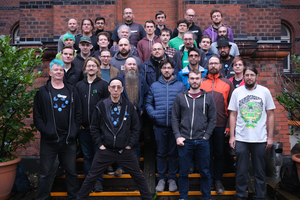
But before that - here is the main group photo from this year:
You can also see it on:
Additionally, check out photos from other people on GIT LFS and consider adding your own photos there as well.
Other places I have updated with up-to-date information are these wiki pages:
In July I attended
DebCamp and DebConf in Brest,
France. I very much enjoyed the opportunity to reconnect with other
Debian contributors in person. I had a number of interesting and
fruitful conversations there, besides the formally organised BoFs and
talks.
I also gave my own talk on
What s new in the Linux kernel (and what s missing in Debian).
Here s the usual categorisation of activity:
As I m writing this, we re one hour away from landing, and thus our Grand (with
a capital G for sure) Japan 2025 vacation is over. Planning started about nine
months ago, plane tickets bought six months in advance, most hotels booked
about four months ahead, and then a wonderful, even if a bit packed, almost 3
weeks in Japan. And now we re left with lots of good memories, some mishaps
that we re going to laugh about in a few months s time, and quite a few
thousand pictures to process and filter, so that so they can be viewed in a
single session.
Oh, and I m also left with a nice bottle of plum wine, thanks to inflight
shopping. Was planning to, but didn t manage to buy one in the airport, as
Haneda International departures, after the security check, is a bit small. But
in 15 hours of flying, there was enough time to implement 2 tiny Corydalis
features, and browse the shopping catalog . I only learned on the flight that
some items need to be preordered, a lesson for next time
Thanks to the wonders of inflight internet, I can write and publish this, but
it not being StarLink, Visual Studio Code managed to download an update for the
UI, but now the remote server package is too big? slow? and can t be
downloaded. Well, it started download 5 times, and aborted at about 80% each
time. Well, thankful my blog is lightweight and I can write it in vi and push
it . And pushing the above-mentioned features to GitHub was also possible.
A proper blog post will follow, once I can select some pictures and manage to
condense three weeks in an overall summary And in the meantime, back to the
real world!
The gnulib project publish a git bundle as a stable archival copy of the gnulib git repository once in a while.
Why? We don t know exactly what this may be useful for, but I m promoting for this to see if we can establish some good use-case.
A git bundle may help to establish provinence in case of an attack on the Savannah hosting platform that compromise the gnulib git repository.
Another use is in the Debian gnulib package: that gnulib bundle is git cloned when building some Debian packages, to get to exactly the gnulib commit used by each upstream project see my talk on gnulib at Debconf24 and this approach reduces the amount of vendored code that is part of Debian s source code, which is relevant to mitigate XZ-style attacks.
The first time we published the bundle, I wanted it to be possible to re-create it bit-by-bit identically by others.
At the time I discovered a well-written blog post by Paul Beacher on reproducible git bundles and thought he had solved the problem for me. Essentially it boils down to disable threading during compression when producing the bundle, and his final example show this results in a predictable bit-by-bit identical output:
$ for i in $(seq 1 100); do \
> git -c 'pack.threads=1' bundle create -q /tmp/bundle-$i --all; \
> done
$ md5sum /tmp/bundle-*   cut -f 1 -d ' '   uniq -c
    100 4898971d4d3b8ddd59022d28c467ffca
So what remains to be said about this? It seems reproducability goes deeper than that. One desirable property is that someone else should be able to reproduce the same git bundle, and not only that a single individual is able to reproduce things on one machine.
It surprised me to see that when I ran the same set of commands on a different machine (started from a fresh git clone), I got a different checksum. The different checksums occured even when nothing had been committed on the server side between the two runs.
I thought the reason had to do with other sources of unpredictable data, and I explored several ways to work around this but eventually gave up. I settled for the following sequence of commands:
REV=ac9dd0041307b1d3a68d26bf73567aa61222df54 # master branch commit to package
git clone https://git.savannah.gnu.org/git/gnulib.git
cd gnulib
git fsck # attempt to validate input
# inspect that the new tree matches a trusted copy
git checkout -B master $REV # put $REV at master
for b in $(git branch -r   grep origin/stable-   sort --version-sort); do git checkout $ b#origin/ ; done
git remote remove origin # drop some unrelated branches
git gc --prune=now # drop any commits after $REV
git -c 'pack.threads=1' bundle create gnulib.bundle --all
V=$(env TZ=UTC0 git show -s --date=format:%Y%m%d --pretty=%cd master)
mv gnulib.bundle gnulib-$V.bundle
build-aux/gnupload --to ftp.gnu.org:gnulib gnulib-$V.bundle
At the time it felt more important to publish something than to reach for perfection, so we did so using the above snippet. Afterwards I reached out to the git community on this and there were good discussion about my challenge.
At the end of that thread you see that I was finally able to reproduce a bit-by-bit identical bundles from two different clones, by using an intermediate git -c pack.threads=1 repack -adF step. I now assume that the unpredictable data I got earlier was introduced during the git clone steps, compressing the pack differently each time due to threaded compression. The outcome could also depend on what content the server provided, so if someone ran git gc, git repack on the server side things would change for the user, even if the user forced threading to 1 during cloning more experiments on what kind of server-side alterations results in client-side differences would be good research.
A couple of months passed and it is now time to publish another gnulib bundle somewhat paired to the bi-yearly stable gnulib branches so let s walk through the commands and explain what they do. First clone the repository:
REV=225973a89f50c2b494ad947399425182dd42618c   # master branch commit to package
S1REV=475dd38289d33270d0080085084bf687ad77c74d # stable-202501 branch commit
S2REV=e8cc0791e6bb0814cf4e88395c06d5e06655d8b5 # stable-202507 branch commit
git clone https://git.savannah.gnu.org/git/gnulib.git
cd gnulib
git fsck # attempt to validate input
I believe the git fsck will validate that the chain of SHA1 commits are linked together, preventing someone from smuggling in unrelated commits earlier in the history without having to do SHA1 collision. SHA1 collisions are economically feasible today, so this isn t much of a guarantee of anything though.
git checkout -B master $REV # put $REV at master
# Add all stable-* branches locally:
for b in $(git branch -r   grep origin/stable-   sort --version-sort); do git checkout $ b#origin/ ; done
git checkout -B stable-202501 $S1REV
git checkout -B stable-202507 $S2REV
git remote remove origin # drop some unrelated branches
git gc --prune=now # drop any unrelated commits, not clear this helps
This establish a set of branches pinned to particular commits. The older stable-* branches are no longer updated, so they shouldn t be moving targets. In case they are modified in the future, the particular commit we used will be found in the official git bundle.
time git -c pack.threads=1 repack -adF
That s the new magic command to repack and recompress things in a hopefully more predictable way. This leads to a 72MB git pack under .git/objects/pack/ and a 62MB git bundle. The runtime on my laptop is around 5 minutes.
I experimented with -c pack.compression=1 and -c pack.compression=9 but the size was roughly the same; 76MB and 66MB for level 1 and 72MB and 62MB for level 9. Runtime still around 5 minutes.
Git uses zlib by default, which isn t the most optimal compression around. I tried -c pack.compression=0 and got a 163MB git pack and a 153MB git bundle. The runtime is still around 5 minutes, indicating that compression is not the bottleneck for the git repack command.
That 153MB uncompressed git bundle compresses to 48MB with gzip default settings and 46MB with gzip -9; to 39MB with zst defaults and 34MB with zst -9; and to 28MB using xz defaults with a small 26MB using xz -9.
Still the inconvenience of having to uncompress a 30-40MB archive into the much larger 153MB is probably not worth the savings compared to shipping and using the (still relatively modest) 62MB git bundle.
Now finally prepare the bundle and ship it:
Yay! Another gnulib git bundle snapshot is available from https://ftp.gnu.org/gnu/gnulib/.
The essential part of the git repack command is the -F parameter. In the thread -f was suggested, which translates into the git pack-objects--no-reuse-delta parameter:
--no-reuse-delta
When creating a packed archive in a repository that has existing packs, the command reuses existing deltas. This sometimes results in a slightly suboptimal pack. This flag tells the command not to reuse existing deltas but compute them from scratch.
When reading the man page, I though that using -F which translates into --no-reuse-object would be slightly stronger:
--no-reuse-object
This flag tells the command not to reuse existing object data at all, including non deltified object, forcing recompression of everything. This implies --no-reuse-delta. Useful only in the obscure case where wholesale enforcement of a different compression level on the packed data is desired.
On the surface, without --no-reuse-objects, some amount of earlier compression could taint the final result. Still, I was able to get bit-by-bit identical bundles by using -f so possibly reaching for -F is not necessary.
All the commands were done using git 2.51.0 as packaged by Guix. I fear the result may be different with other git versions and/or zlib libraries. I was able to reproduce the same bundle on a Trisquel 12 aramo (derived from Ubuntu 22.04) machine, which uses git 2.34.1. This suggests there is some chances of this being possible to reproduce in 20 years time. Time will tell.
I also fear these commands may be insufficient if something is moving on the server-side of the git repository of gnulib (even just something simple as a new commit), I tried to make some experiments with this but let s aim for incremental progress here. At least I have now been able to reproduce the same bundle on different machines, which wasn t the case last time.
Happy Reproducible Git Bundle Hacking!
It's Sunday and I'm now sitting in the train from Brest to Paris where I will be changing to Germany, on the way back from the annual Debian conference. A full week of presentations, discussions, talks and socializing is laying behind me and my head is still spinning from the intensity.
Pollito and the gang of DebConf mascots wearing their conference badges (photo: Christoph Berg)
Table of Contents
Sunday, July 13th
It started last Sunday with traveling to the conference. I got on the Eurostar in Duisburg and we left on time, but even before reaching Cologne, the train was already one hour delayed for external reasons, collecting yet another hour between Aachen and Liege for its own technical problems. "The train driver is working on trying to fix the problem." My original schedule had well over two hours for changing train stations in Paris, but being that late, I missed the connection to Brest in Montparnasse. At least in the end, the total delay was only one hour when finally arriving at the destination. Due to the French julliet quatorze fireworks approaching, buses in Brest were rerouted, but I managed to catch the right bus to the conference venue, already meeting a few Debian people on the way.
The conference was hosted at the IMT Atlantique Brest campus, giving the event a nice university touch. I arrived shortly after 10 in the evening and after settling down a bit, got on one of the "magic" buses for transportation to the camping site where half of the attendees where stationed. I shared a mobile home with three other Debianites, where I got a small room for myself.
Monday, July 14th
Next morning, we took the bus back to the venue with a small breakfast and the opening session where Enrico Zini invited me to come to his and Nicolas Dandrimont's session about Debian community governance and curation, which I gladly did. Many ideas about conflict moderation and community steering were floated around. I hope some of that can be put into effect to make flamewars on the mailing lists less heated and more directed. After that, I attended Olly Betts' "Stemming with Snowball" session, which is the stemmer used also in PostgreSQL. Text search is one of the areas in PostgreSQL that I never really looked closely at, including the integration into the postgresql-common package, so it was nice to get more information about that.
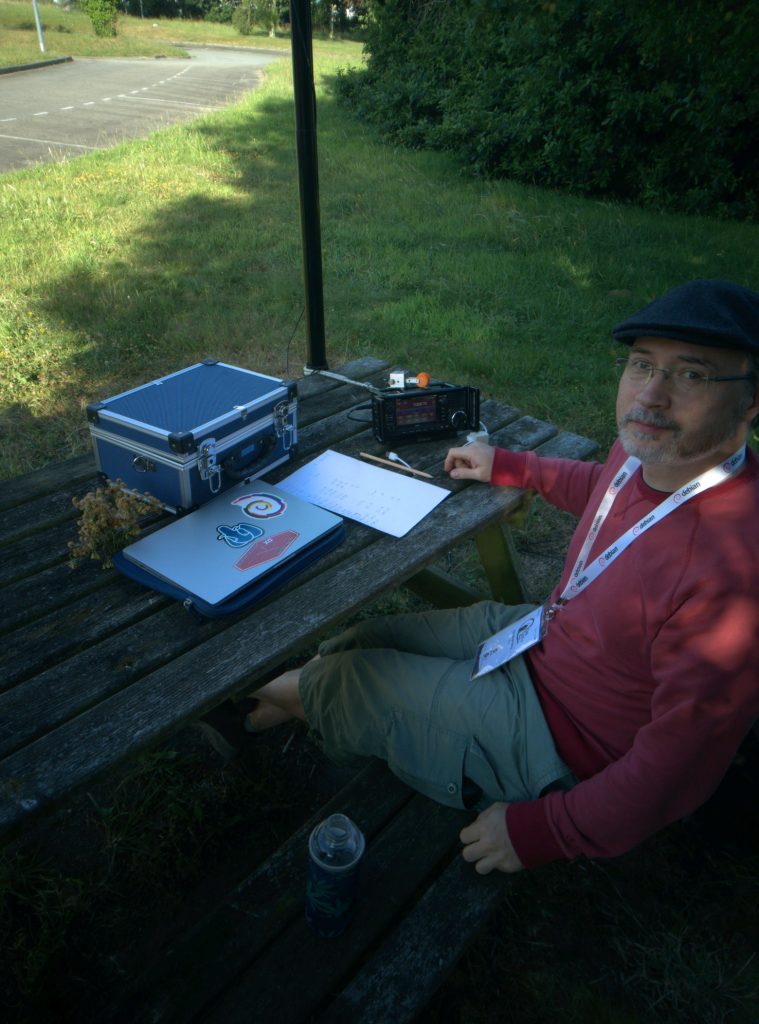
In preparation for the conference, a few of us Ham radio operators in Debian had decided to bring some radio gear to DebConf this year in order to perhaps spark more interest for our hobby among the fellow geeks. In the afternoon after the talks, I found a quieter spot just outside of the main hall and set up a shortwave antenna by attaching a 10m mast to one of the park benches there. The 40m band was still pretty much closed, but I could work a few stations from England, just across the channel from Bretagne, answering questions from interested passing-by Debian people between the contacts. Over time, the band opened and more European stations got into the log.
F/DF7CB in Brest (photo: Evangelos Ribeiro Tzaras)
Tuesday, July 15th
Tuesday started with Helmut Grohne's session about "Reviving (un)schroot". The schroot program has been Debian's standard way of managing build chroots for a long time, but it is more and more being regarded as obsolete with all kinds of newer containerization and virtualization technologies taking over. Since many bits of Debian infrastructure depend on schroot, and its user interface is still very useful, Helmut reimplemented it using Linux namespaces and the "unshare" systemcall. I had already worked with him at the Hamburg Minidebconf to replace the apt.postgresql.org buildd machinery with the new system, but we were not quite there yet (network isolation is nice, but we still sometimes need proper networking), so it was nice to see the effort is still progressing and I will give his new scripts a try when I'm back home.
Next, Stefano Rivera and Colin Watson presented Debusine, a new package repository and workflow management system. It looks very promising for anyone running their own repository, so perhaps yet another bit of apt.postgresql.org infrastructure to replace in the future. After that, I went to the Debian LTS BoF session by Santiago Ruano Rinc n and Bastien Roucari s - Debian releases plus LTS is what we are covering with apt.postgresql.org. Then there were bits from the DPL (Debian Project Leader), and a session moderated by Stefano Rivera interesting to me as a member of the Debian Technical Committee on the future structure of the packages required for cross-building in Debian, a topic which had been brought to TC a while ago. I am happy that we could resolve the issue without having to issue a formal TC ruling as the involved parties (kernel, glibc, gcc and the cross-build people) found a promising way forward themselves. DebConf is really a good way to get such issues unstuck.
Ten years ago at the 2015 Heidelberg DebConf, Enrico had given a seminal "Semi-serious stand-up comedy" talk, drawing parallels between the Debian Open Source community and the BDSM community - "People doing things consensually together". (Back then, the talk was announced as "probably unsuitable for people of all ages".) With his unique presentation style and witty insights, the session made a lasting impression on everyone attending. Now, ten years later (and he and many in the audience being ten years older), he gave an updated version of it. We are now looking forward to the sequel in 2035. The evening closed with the famous DebConf tradition of the Cheese & Wine party in a old fort next to the coast, just below the conference venue. Even when he's a fellow Debian Developer, Ham and also TC member, I had never met Paul Tagliamonte in person before, but we spent most of the evening together geeking out on all things Debian and Ham radio.
The northern coast of Ushant (photo: Christoph Berg)
Wednesday, July 16th
Wednesday already marked the end of the first half of the week, the day of the day trips. I had chosen to go to Ouessant island (Ushant in English) which marks the Western end of French mainland and hosts one of the lighthouses yielding the way into the English channel. The ferry trip included surprisingly big waves which left some participants seasick, but everyone recovered fast. After around one and a half hours we arrived, picked up the bicycles, and spent the rest of the day roaming the island. The weather forecast was originally very cloudy and 18 C, but over noon this turned into sunny and warm, so many got an unplanned sunburn. I enjoyed the trip very much - it made up for not having time visiting the city during the week. After returning, we spent the rest of the evening playing DebConf's standard game, Mao (spoiler alert: don't follow the link if you ever intend to play).
Having a nice day (photo: Christoph Berg)
Thursday, July 17th
The next day started with the traditional "Meet the Technical Committee" session. This year, we trimmed the usual slide deck down to remove the boring boilerplate parts, so after a very short introduction to the work of the committee by our chairman Matthew Vernon, we opened up the discussion with the audience, with seven (out of 8) TC members on stage. I think the format worked very well, with good input from attendees. Next up was "Don't fear the TPM" by Jonathan McDowell. A common misconception in the Free Software community is that the TPM is evil DRM hardware working against the user, but while it could be used in theory that way, the necessary TPM attestations seem to impossible to attain in practice, so that wouldn't happen anyway. Instead, it is a crypto coprocessor present in almost all modern computers that can be used to hold keys, for example to be used for SSH. It will also be interesting to research if we can make use of it for holding the Transparent Data Encryption keys for CYBERTEC's PostgreSQL Enterprise Edition.
Aigars Mahinovs then directed everyone in place for the DebConf group picture, and Lucas Nussbaum started a discussion about archive-wide QA tasks in Debian, an area where I did a lot of work in the past and that still interests me. Antonio Terceiro and Paul Gevers followed up with techniques to track archive-wide rebuilding and testing of packages and in turn filing a lot of bugs to track the problems. The evening ended with the conference dinner, again in the fort close by the coast. DebConf is good for meeting new people, and I incidentally ran into another Chris, who happened to be one of the original maintainers of pgaccess, the pre-predecessor of today's pgadmin. I admit still missing this PostgreSQL frontend for its simplicity and ability to easily edit table data, but it disappeared around 2004.
Friday, July 18th
On Friday, I participated in discussion sessions around contributors.debian.org (PostgreSQL is planning to set up something similar) and the New Member process which I had helped to run and reform a decade or two ago. Agathe Porte (also a Ham radio operator, like so many others at the conference I had no idea of) then shared her work on rust-rewriting the slower parts of Lintian, the Debian package linter. Craig Small talked about "Free as in Bytes", the evolution of the Linux procps free command. Over the time and many kernel versions, the summary numbers printed became better and better, but there will probably never be a version that suits all use cases alike. Later over dinner, Craig (who is also a TC member) and I shared our experiences with these numbers and customers (not) understanding them. He pointed out that for PostgreSQL and looking at used memory in the presence of large shared memory buffers, USS (unique set size) and PSS (proportional set size) should be more realistic numbers than the standard RSS (resident set size) that the top utility is showing by default.
Antonio Terceiro and Paul Gevers again joined to lead a session, now on ci.debian.net and autopkgtest, the test driver used for running tests on packages after then have been installed on a system. The PostgreSQL packages are heavily using this to make sure no regressions creep in even after builds have successfully completed and test re-runs are rescheduled periodically. The day ended with Bdale Garbee's electronics team BoF and Paul Tagliamonte and me setting up the radio station in the courtyard, again answering countless questions about ionospheric conditions and operating practice.
Saturday, July 19th
Saturday was the last conference day. In the first session, Nikos Tsipinakis and Federico Vaga from CERN announced that the LHC will be moving to Debian for the accelerator's frontend computers in their next "long shutdown" maintenance period in the next year. CentOS broke compatibility too often, and Debian trixie together with the extended LTS support will cover the time until the next long shutdown window in 2035, until when the computers should have all been replaced with newer processors covering higher x86_64 baseline versions. The audience was very delighted to hear that Debian is now also being used in this prestige project.
Ben Hutchings then presented new Linux kernel features. Particularly interesting for me was the support for atomic writes spanning more than one filesystem block. When configured correctly, this would mean PostgreSQL didn't have to record full-page images in the WAL anymore, increasing throughput and performance. After that, the Debian ftp team discussed ways to improve review of new packages in the archive, and which of their processes could be relaxed with new US laws around Open Source and cryptography algorithms export. Emmanuel Arias led a session on Salsa CI, Debian's Gitlab instance and standard CI pipeline. (I think it's too slow, but the runners are not under their control.) Julian Klode then presented new features in APT, Debian's package manager. I like the new display format (and a tiny bit of that is also from me sending in wishlist bugs).
In the last round of sessions this week, I then led the Ham radio BoF with an introduction into the hobby and how Debian can be used. Bdale mentioned that the sBitx family of SDR radios is natively running Debian, so stock packages can be used from the radio's touch display. We also briefly discussed his involvement in ARDC and the possibility to get grants from them for Ham radio projects. Finally, DebConf wrapped up with everyone gathering in the main auditorium and cheering the organizers for making the conference possible and passing Pollito, the DebConf mascot, to the next organizer team.
Pollito on stage (photo: Christoph Berg)
Sunday, July 20th
Zoom back to the train: I made it through the Paris metro and I'm now on the Eurostar back to Germany. It has been an intense week with all the conference sessions and meeting all the people I had not seen so long. There are a lot of new ideas to follow up on both for my Debian and PostgreSQL work. Next year's DebConf will take place in Santa Fe, Argentina. I haven't yet decided if I will be going, but I can recommend the experience to everyone!
The post The Debian Conference 2025 in Brest appeared first on CYBERTEC PostgreSQL Services & Support.
The diffoscope maintainers are pleased to announce the release of diffoscope
version 302. This version includes the following changes:
[ Chris Lamb ]
* Mask stderr from the extract-vmlinux script.
* Make it much more explicit that we return 'success' from the
  extract-vmlinux script instead of just falling through to the bottom of the
  script.
* Use Difference.from_operation in an attempt to pipeline the output of
  extract-vmlinux, potentially avoiding it all residing in memory. This is an
  attempt to prevent out of memory issues on try.diffoscope.org.
[ Siva Mahadevan ]
* Use --print-armap long option with nm in the "ar" comparator for wider
  compatibility.
Posted on July 24, 2025
Tags: madeof:bits
An unsorted list, including some I already knew, but was reminded of.
dpkg-mergechangelogs exists.
Sewing your own shirt, posting it on planet and wearing it on the
first day of DebConf, is more effective than a badge for making people
recognise you.
I need to look into a number of tools for testings things (and try to
start using some of those at $DAYJOB).
Masks are good. masks protect you from debbugs. masks protect you from
ring cameras in the hotel you re staying on the day after debconf.
It s really nice to be chatting of random topics during lunch and
discover that you are talking to the maintainer of a package of which
you are one of the very few users! (the latter bit needs to be changed
:) ).
I need to look into sequoia and all of the modern OpenPGP stuff.
Even if I don t have a lot of money, apparently I have even less sense
(there will be blog posts on the topic in the mid-term future).
I can go to a talk about AI
and not hate the speaker (yeah, the bar is pretty low there :D ). The
automatic subtitles still failed in the same way as automatic
subtitles always fail.
In the last past weeks, I have done something I had been meaning to do for a
while but always pushed back at the bottom of my TODO pile: prepare for my
death.
I am still quite young and perfectly healthy (mentally and physically) and I do
plan to live a long and full life, but death is something that comes from us all
and can strike anytime. Having witnessed friends and colleagues who lost loved
ones who did not prepare adequately for their passing, dealing with all this
legal stuff ahead of time seems like the best gift you can leave them.
Writing my will was the easiest part of this "preparation for death" process.
I have few material possessions and I'm leaving everything to my SO. As for the
copyright for my code, I have decided everything I wrote will be licensed under
CC0 (public domain) when I die. Quebec where I live also accepts
holograph wills, which means I didn't have to hire a notary.
Apart from the will, I also wrote a protection mandate1, filled
out Quebec's organ donation form2, took a contract for prearranged
funeral services3 and finally, wrote a disaster recovery plan.
This recovery plan was by far the longest and most tedious part of this entire
ordeal. If all your machines use full-disk encryption and you die or forget
your passwords (for example after a head injury), can your data be recovered?
How do you arbitrate between easy recovery and data security? If all your local
devices burn down and you also pass away in the process, how will your next of
kin access your remote backups and extract the relevant data (in my case, my
password manager)?
I had to ask myself many complex questions in this process and although I won't
be sharing my disaster recovery plan here (security through obscurity), I urge
you to take the time to do something similar yourself and make sure you will
leave a house in order when you go away.
in case I become incapacitated and can't make choices by myself
anymore.
it's sadly still opt-in here...
you pay now for the services you want, the money is kept in a trust
in your name and you can't be charged extra when you do pass away. This
protects you from inflation and is a great way to make sure your next of
kin don't have to deal with the complexities of funeral services while
grieving.
Tobias Frost
did 2.5h (out of 12.0h assigned), thus carrying over 9.5h to the next month.
Evolution of the situation
In June, we released 35 DLAs.
Notable security updates:
mariadb-10.5, prepared by Otto Kek l inen, fixes vulnerabilities which could result in denial of service, information disclosure, or unauthorized data modification
python-django, prepared by Chris Lamb, fixes vulnerabilities which would result in log injection or denial of service
webkit2gtk, prepared by Emilio Pozuelo Monfort, fixes many vulnerabilities which could results in a wide range of issues
xorg-server, prepared by Emilio Pozuelo Monfort, fixes multiple vulnerabilities which may result in privilege escalation
sudo, prepared by Thorsten Alteholz, fixes a vulnerability which could result in privilege escalation
Notable non-security updates:
debian-security-support, prepared by Santiago Ruano Rinc n, updates status of packages which receive limited security support or which have reached the end of security support
dns-root-data, prepared by Sylvain Beucler, updates the DNSSEC trust anchors
This month s contributions from outside the regular team include the mariadb-10.5 update mentioned above, prepared by Otto Kek l inen (the package maintainer); an update to libfile-find-rule-perl, prepared by Salvatore Bonaccorso (a member of the Debian Security Team); an update to activemq, prepared by Emmanuel Arias (a maintainer of the package).
Additionally, LTS Team members contributed stable updates of the following packages:
curl, prepared by Carlos Henrique Lima Melara
python-tornado, prepared by Daniel Leidert
python-flask-cors, prepared by Daniel Leidert
common-vfs, prepared by Daniel Leidert
cjson, prepared by Adrian Bunk
icu, prepared by Adrian Bunk
node-tar-fs, prepared by Adrian Bunk
rar, prepared by Adrian Bunk
Something of particular noteworthiness is that LTS contributor Carlos Henrique Lima Melara discovered a regression in the upstream fix for CVE-2023-2753 in curl. The corrective action which he took included providing a patch to upstream, uploading a stable update of curl, and further updating the version of curl in LTS.
DebConf, the annual Debian Conference, is coming up in July and, as is customary each year, the week preceding the conference will feature an event called DebCamp. The DebCamp week provides an opportunity for teams and other interested groups/individuals to meet together in person in the same venue as the conference itself, with the purpose of doing focused work, often called sprints . LTS coordinator Roberto C. S nchez has announced that the LTS Team is planning to hold a sprint primarily focused on the Debian security tracker and the associated tooling used by the LTS Team and the Debian Security Team.
Thanks to our sponsors
Sponsors that joined recently are in bold.
unschroot, by Helmut Grohne
Quite a while back, the sbuild maintainers added the unshare backend to
enable better isolation of builds, but in doing so sbuild now effectively
bundles a container runtime. unschroot is an attempt to separate containment
from sbuild by implementing the same features and more in a schroot-compatible
way. Last year, vague feature parity
was achieved, but going beyond required changing the model from keeping state in
the filesystem to keeping Linux namespaces as session state. A proof of concept
is now available. While it still has sharp corners, it enables building packages
on a squashfs with an overlayfs or id-mapped bind mounting of your ccache
neither of which is possible with sbuild s unshare backend. There shall be a
DebConf25 presentation
about this work.
DebConf 25, by Stefano Rivera, Santiago Ruano Rinc n and Lucas Kanashiro
DebConf 25 is now under way in Brest,
France. Santiago is part of the local team running the event, and Stefano Rivera
is part of the DebConf committee, supporting the event, as well as the video
team. Both have spent considerable time in the last month, getting things ready
for DebConf. Lucas Kanashiro built the schedule for DebConf 25. Also followed-up
on multiple requests from speakers and stakeholders.
Miscellaneous contributions
Carles did general maintenance on simplemonitor, qnetload and qdacco packages;
provided simplemonitor upstream feedback on new feature.
Carles s updates about po-debconf-manager: prepared for DebCamp/DebConf, used
it for reviewing and merging different packages. Also fixed multispeech
po-debconf templates.
Colin Watson found a crash in pterm (PuTTY s terminal emulator) when running
in a Wayland session, and backported the resulting upstream fix
to trixie.
Colin responded to an upstream groff bug report
about URLs being dropped from PDF output in some cases on Debian, and backported
the fix to trixie.
Helmut debugged rebootstrap failures and worked around build failures
related to gcc-15 when they had patches and sent ones otherwise.
Thorsten Alteholz uploaded cups to fix a FTBFS-bug. This bug was introduced by
a change in systemd, which bumped the maximum number of open files. This
resulted in a longer test duration that triggered a timeout so that the build
failed. Thorsten also uploaded mtink and lprng, which got new translation files.
Lucas Kanashiro followed-up on multiple unblock requests for ruby packages due
to reproducible builds fixes. All of them were accepted into trixie.
Lucas Kanashiro discussed license issues with upstream involving Redis 8 new
license and the possibility of backporting patches to old versions with a
different license. Outcome is that upstream is adding a new paragraph to their
license to allow the backport for security fixes.
Lucas Kanashiro fixed multiple CVEs reported against valkey in unstable and
trixie.
Lucas Kanashiro gave a Debian packaging course of 8 hours for students at a
free software development course at the University of Sao Paulo.
Lucas Kanashiro fixed a couple of cross building issues in the ruby ecosystem
with Helmut s help.
Lucas Kanashiro is working on a debci fix for
#1107645 (ongoing).
Stefano Rivera updated python-mitogen to the latest beta releases with
upstream support for Ansible 12.
Stefano Rivera spent some time winding up DebConf 24 books.
Stefano Rivera fixed packages that were blocking cPython 3.13.5 from migrating
to trixie, and filed an unblock request.
Stefano Rivera investigated a regression in cPython 3.13 that was breaking
OpenStack Nova. There is a patch in progress for cPython, but it is not ready
for use, yet.
Santiago reviewed different MRs in Salsa CI. For example, the
MR !605
proposed by Aquila that aims to introduce a new debdiff job, as well as the
autopkgtest MR !33
to extend the support to architectures other than amd64. Also reviewed
MR !611
by Aayush Raj that fixes the autopkgtest images cleanup. And the
MR !614,
prepared by Charles, to change the suffix name used to bump the version used in
the pipeline.
Anupa procured supplies needed for the DebConf ID tag for the DebConf
registration team and co-ordinated its transport to the venue.
Anupa joined Nattie to complete the registration team tasks.
AH00484: server reached MaxRequestWorkers setting, consider raising the
MaxRequestWorkers setting
For starters, it means I have to relearn how MaxRequestWorkers functions in Apache:
For threaded and hybrid servers (e.g. event or worker), MaxRequestWorkers
restricts the total number of threads that will be available to serve
clients. For hybrid MPMs, the default value is 16 (ServerLimit) multiplied by
the value of 25 (ThreadsPerChild). Therefore, to increase MaxRequestWorkers
to a value that requires more than 16 processes, you must also raise
ServerLimit.
Ok remind me what ServerLimit refers to?
For the prefork MPM, this directive sets the maximum configured value for
MaxRequestWorkers for the lifetime of the Apache httpd process. For the
worker and event MPMs, this directive in combination with ThreadLimit sets
the maximum configured value for MaxRequestWorkers for the lifetime of the
Apache httpd process. For the event MPM, this directive also defines how many
old server processes may keep running and finish processing open connections.
Any attempts to change this directive during a restart will be ignored, but
MaxRequestWorkers can be modified during a restart. Special care must be
taken when using this directive. If ServerLimit is set to a value much higher
than necessary, extra, unused shared memory will be allocated. If both
ServerLimit and MaxRequestWorkers are set to values higher than the system
can handle, Apache httpd may not start or the system may become unstable.
With the prefork MPM, use this directive only if you need to set
MaxRequestWorkers higher than 256 (default). Do not set the value of this
directive any higher than what you might want to set MaxRequestWorkers to.
With worker, use this directive only if your MaxRequestWorkers and
ThreadsPerChild settings require more than 16 server processes (default). Do
not set the value of this directive any higher than the number of server
processes required by what you may want for MaxRequestWorkers and
ThreadsPerChild. With event, increase this directive if the process number
defined by your MaxRequestWorkers and ThreadsPerChild settings, plus the
number of gracefully shutting down processes, is more than 16 server
processes (default).
Got it? In other words, you can consider raising the MaxRequestWorkers
setting all you want, but you can t just change that setting, you have to read
about several other compliated settings, do some math, and spend a lot of time
wondering if you are going to remember what you just did and how to undo it if
you blow up your server.
On the plus side, typically, nobody should increase this limit - because if the
server runs out of connections, it usually means something else is wrong.
In our case, on a shared web server running Apache2 and PHP-FPM, it s usually
because a single web site has gone out of control.
But wait! How can that happen, we are using PHP-FPM s max_children setting to prevent
a single PHP web site from taking down the server?
After years of struggling with this problem I have finally made some headway.
Our PHP pool configuration typically looks like this:
With these settings in place, what happens when we use up all 12 max_children?
According to the docs:
By default, mod_proxy will allow and retain the maximum number of connections
that could be used simultaneously by that web server child process. Use the
max parameter to reduce the number from the default. The pool of connections
is maintained per web server child process, and max and other settings are
not coordinated among all child processes, except when only one child process
is allowed by configuration or MPM design.
The max parameter seems to default to the ThreadsPerChild, so it seems that
the default here is to allow any web site to consume ThreadsPerChild (25) x
ServerLimit (16), which is also the max number of over all connections. Not
great.
To make matter worse, there is another setting available which is mysteriously
called acquire:
If set, this will be the maximum time to wait for a free connection in the
connection pool, in milliseconds. If there are no free connections in the
pool, the Apache httpd will return SERVER_BUSY status to the client.
By default this is not set which seems to suggest Apache will just hang on to
connections forever until a free PHP process becomes available (or some other
time out happens).
So, let s try something different:
This snippet is the way you can configure the proxy configuration we setup in
the SetHandler statement above. It s documented on the Apache mod_proxy
page.
Now we limit the maximum pool size per process to half of what is available for
the entire server and we tell Apache to immediately throw a 503 error if we
have exceeded our maximum number of connecitons.
Now, if a site is overwhelmed with traffic, instead of maxing out the available
Apache connections while leaving user with constantly spinning browsers, the
users will get 503 ed and the server will be able to server other sites.
Okay, here s the deal, I pushed my first post on Reimagined Doodle - Alias Command, five years ago on July 8th, 2020. Don t think I ever mentioned that post started out as a Github Gist which I later transferred here seeking a more long-term home on an independent platform.
Writing about writings, motivations, and the blog itself has been a recurring theme here over the years. 123456789
I m unsure how I sustained expressing myself and writing here for this long. Now and then, I go months without any thought of writing, and then all of a sudden I start in bursts with sequential posts one after another. There isn t a pattern per se in topics other than whatever burning question I have at the moment.
So here s to a milestone and then some.

 Like each month, have a look at the work funded by








 Introducing
 Snapshot mirroring in Debian (and Ubuntu)
The use of snapshots has been routine in both

 In July I attended
 The following contributors got their Debian Developer accounts in the last two
months:
 It's Sunday and I'm now sitting in the train from Brest to Paris where I will be changing to Germany, on the way back from the
 Pollito and the gang of DebConf mascots wearing their conference badges (photo: Christoph Berg)
 F/DF7CB in Brest (photo: Evangelos Ribeiro Tzaras)
 The northern coast of Ushant (photo: Christoph Berg)
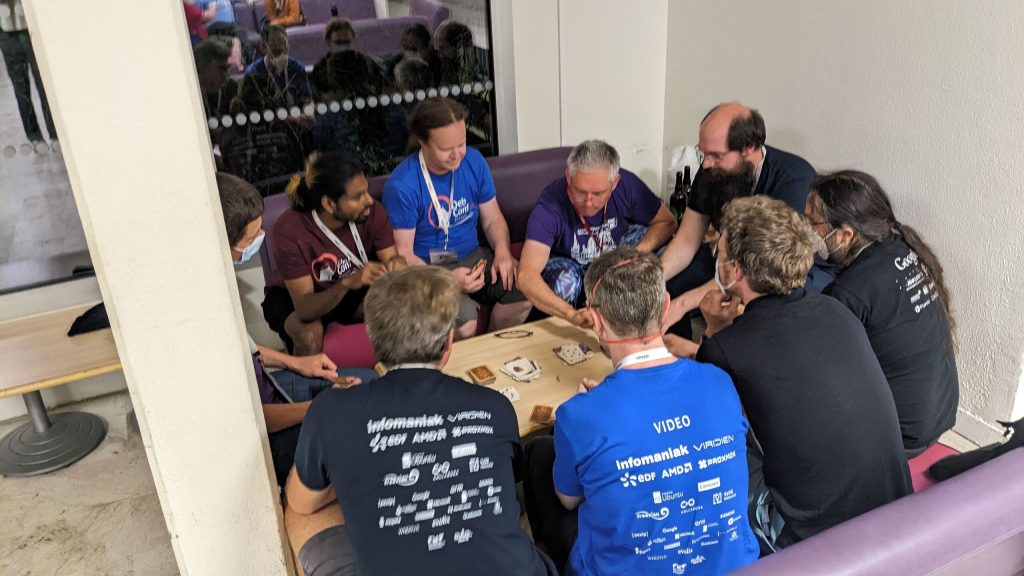 Having a nice day (photo: Christoph Berg)
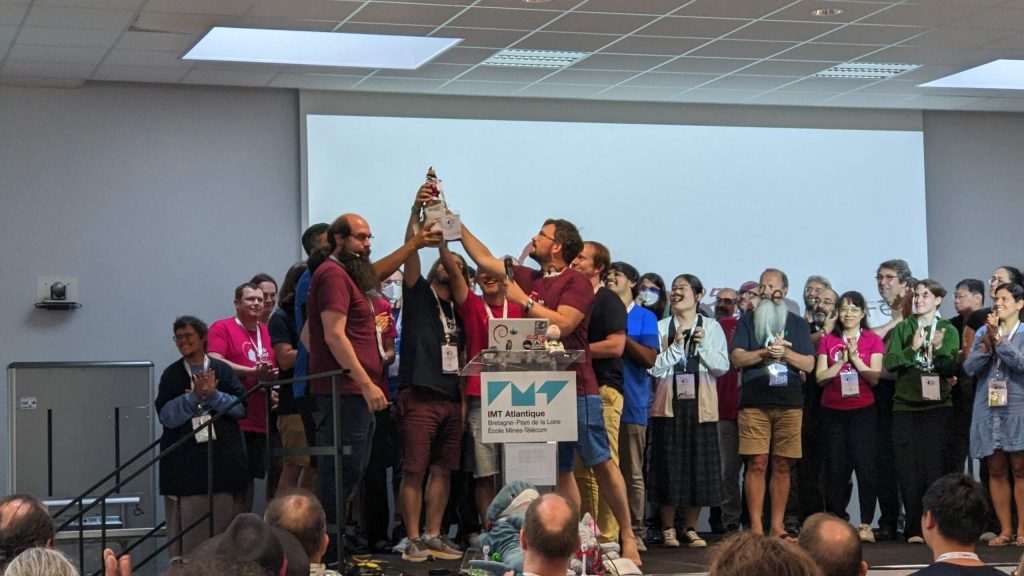 Pollito on stage (photo: Christoph Berg)
 In the last past weeks, I have done something I had been meaning to do for a
while but always pushed back at the bottom of my TODO pile: prepare for my
death.
I am still quite young and perfectly healthy (mentally and physically) and I do
plan to live a long and full life, but death is something that comes from us all
and can strike anytime. Having witnessed friends and colleagues who lost loved
ones who did not prepare adequately for their passing, dealing with all this
legal stuff ahead of time seems like the best gift you can leave them.
Writing my will was the easiest part of this "preparation for death" process.
I have few material possessions and I'm leaving everything to my SO. As for the
copyright for my code, I have decided everything I wrote will be licensed under