Welcome to post 58 in the R4 series.
R and the CRAN repositories maintain a very
high level of what we might call quality assurrance by requiring that
newly-added code does not break any existing dependencies. This is
frequently called a reverse-dependency check . For any given CRAN package one can quickly
determine it reverse dependencies. Calling
tools::package_dependencies(pkgName, reverse=TRUE) will for
a scalar or vector-valued argument return a named list with the reverse
dependencies. It is then a matter of looping over this list. There are
helper functions in base R as well as in contributed packages on and off
CRAN. I also wrote my own with
package prrd which,
while possibly a wee bit specialised and under-documented has served me
well to check on Rcpp and
related packages which can indeed have a large number of
reverse dependencies.
I recently looked into one of these contributed runner packages, and
while I will refrain from naming its implementation language let me just
mention that the term cargo cult may be a real thing
here. What go me interested in this was the fact that if one
has a simple-to-use runner then the fact that r2u makes it fast, easy,
reliable: pick all three (to borrow its slogan) to deal with actual
depencies if Ubuntu has indeed been selected as the host. We will
maintain the position that if you can in fact integrate with
the system-wide package management then any alternative per-repo package
management approach not doing so will likely be dominated by an approach
that does integrate with the system facilities. Which is what precisely
what r2u does, and
offers. And why it is used enough to by now have shipped eighty eight
million binary packages. So I tested it for the reverse-dependency check
task.
What I learned by looking into the (much more complicated) runner was
that it at the end of the day it hands the actual task of running the
reverse dependecies off to a helper function rev_check that
is part of the xfun package
by Yuhui. I quickly found that besides xfun we would also need its
suggested dependency tinytex which in turn
would error unless the tlmgr binary was present. So as the
sole requirement (on an Ubuntu system with r2u) turns out to be
where we do it all in one apt call (as root
in the container). (Given r2u we could also call
install.packages(c("xfun","tinytext")) followed by
apt install texlive-base but it is simpler for this setup
step to be just one call).
With that we are basically done. I did this (twice) using a
rocker/r2u container with r2u preinstalled, mounting
a local work and scrap directory for the container. In it we expand the
package to be tested (i.e. tar xaf pkgName_*tar.gz for a
given source package pkgName from CRAN) and then just call with the
package name and expanded direcrtory. I.e. I used this call to test my
package AsioHeaders (which has just three reverse
dependencies) to both name it and to point to the expanded source
directory created for this purposed:
> system.time( res <- xfun::rev_check("AsioHeaders", src="AsioHeaders") )
## ... earlier output omitted for brevity here ...
user system elapsed
35.732 3.333 149.683
> res
httpgd ipaddress websocket
0 0 0
> res. As I checked the current CRAN version, the check was as
expected free of concerns or issues.
To support this, r2u
did indeed go off and install about sixty seven binary packages (and the
total includes all binary dependencies fully resolved) delivering on the
just works promise by the r2u documentation.
As another check, I did the same for RcppAnnoy which has
seven reverse dependencies and needed about two hundred CRAN packages to be installed. The
full test took just over four minutes with the timing function reporting
some nice gains from parallelisation as total user compute time was on
the order of just under eight minutes. Again, test results were clean
and free of worries as expected:
> system.time( res <- xfun::rev_check("RcppAnnoy", src="RcppAnnoy") )
## ... earlier output omitted for brevity here ...
user system elapsed
471.765 378.220 266.855
> res
bbknnR bigANNOY blocking scDHA Seurat uwot VectrixDB
0 0 0 0 0 0 0
> This post by Dirk Eddelbuettel originated on his Thinking inside the box blog. If you like this or other open-source work I do, you can now sponsor me at GitHub.
Summer Holiday. Busy time as a parent.
Today I stumbled over some behavior that I found quite surprising:

$ ipython3 -c 'import httpx;print(httpx.URL("https://example.com/foo/bar/../../baz"))'
https://example.com/baz
Even more surprising that behavior is actually standards-compliant,
even mandated by RFC 3986.
The underlying motivation is relative reverences.
If some resource reachable by "https://example.com/foo/bar"
references another resource relatively as "../../baz" then
this is of course the intended result.
Getting from this problem to what RFC 3986 suggests
might be surprising in the result, but somewhat understandable if you
look at the consequences of that problem:
Giving the path components ".." (and ".")
special meaning at the start of the relative reference means that if you allowed
them in absolute URLs those would be impossible (or at least very convoluted)
to address as relative URLs.
So RFC 3986 describes a way to handle them everywhere:
Just join the path of the base URL and the path of the relative reference
and normalize the result. Or normalize the absolute on either side if only
that is to be taken.
This makes things very convenient:
Multiple reference URLs can just be joined without special handling for
relative references starting with dots, making writing applications handling
them easier.
Programmers don't have to care how to handle relative references and can
just join everything in whatever way they want.
For maximum elegance there is still some corner case left:
What happens if an absolute URL has a path starting with double-dot components?
Or an relative path starting with more of them then the base URL's path has components.
You just ignore them:
$ ipython3 -c 'import httpx;print(httpx.URL("https://example.com/../../baz"))'
https://example.com/baz
With that last point every URL is valid and has well-defined meaning.
Handling relative references and relative paths is very easy and convenient.
So this shows a high regard for simplicity, elegance and convenience.
And a total and uncompromising disregard of security.
After all the most convenient it is for an attacker;
If they are allowed to supply a path component for a request a system
does in their behalf, then they can easily escape anything they were supposed
to be limited to.
The ignoring of dots at the start means they don't even have to know
exactly how deep their request is:
$ python3 -c 'import httpx;print(httpx.URL("https://example.com/public/api/public/resources/harmless/../../../../../../../../../internal/data"))'
https://example.com/internal/data
So even if the resource server securely handles request
(unless you consider not having any way to lower your permissions for one request to a specific subset),
your fully RFC conforming client library will already request the permission they should not have permission for.
Even worse dots are usually not characters you can easily forbid so once slashes are to be allowed things get complicated.
There also would have been a simple, elegant and secure way:
Consider every path element ".." or "."
in an (absolute) URL an error.
Define a reference resolution that allows the relative reference to only start
with "./" or one or multiple "../" and
consider every appearance of a dot or two dots as path components after than an error.
Everything joining two paths has to either use an implementation of that path joining
algorithm, but only if they want to joins paths in the potentially dangerous
way allowing leading "../". Otherwise they can just use the normal
join and even if an attacker gets those dots that will just cause the generated URL
to be rejected as invalid.
Of course using a secure implementation is now even more inconvenient thanks to RFC 3986 being around:
If you have no control over the generator of relative references, it is always possible
that they generate relative references with ".." components after non-dot
components.
And if you check all code to properly filter out "/../",
keep in mind that convienence does not stop there.
After all it is not unheared of for server implementations to helpfully normalize
unicode characters, too, or translate them to their nearest ASCII equivalents.
Or translate percent escaped characters back before doing path splitting.
Or you might think there was some unicode codepoints between those two dots,
but they that those were some meaningless control characters that can be omitted.
So you need some really restrictive allow lists...
I dedicate this release of C-Kermit to Frank da Cruz. Frank was directly involved with Kermit for 44 years, from its initial design in 1981 all the way through 2025. He maintained Kermit as an Open Source project after Columbia University ended its sponsorship. I know of no other Open Source project where the founder remains so personally involved for so long. When Kermit was begun, transfers between different hardware and operating systems were difficult or impossible. Frank helped build a bridge. Kermit glued systems together, from the International Space Station to pocket calculators, and set a new standard for interoperability. It continues to do so. Kermit is still one of the quietly-working pillars of computing today, enabling everything from firmware upgrades to radios. And, yes, it still reliably transfers files over serial lines. As we start to spend a lot of time in the Kermit codebase, we do so standing on the shoulders of a giant. Thanks, Frank, for your decades of work on Kermit. John Goerzen, July 2026
I built my current house server back in 2019. It had an upgrade from the original Ryzen 2700 to a 5700G in late 2021, but otherwise is still running with the original setup. Back in November it developed some erratic behaviour (initially manifesting as problems with the TPM, which is ironic as I ve spent a bunch of time at my day job trying to improve TPM reliability), culminating in unreliable reboots. I had a limited amount of ability to swap parts out, but ultimately decided it was a motherboard issue (thinking perhaps VRM problems), found a replacement locally, and everything seemed fine.
Until May.
At that point I rebooted the machine for a Debian point release, and it failed to come back. Fans would spin, but there was no sign of actual life. I ended up pressing a temporary machine into service (that could at least run the Home Assistant container, and a few other critical bits) while I tried to work out what was wrong. I d kept the previous motherboard, and still had the Ryzen 2700, so I did a bunch of swaps (and obtained a motherboard buzzer to try and get some indication about whether there were useful beep codes being emitted), and ultimately came to the conclusion that the CPU had died.
I m not quite clear what happened here. I played it safe and replaced the PSU at the same time, in case that was the original cause back in November and ultimately damaged the CPU, but both old + new motherboards worked just fine with the 2700.
That left a decision about what to do. This previous server was from 2013, so this machine has now lasted longer than that and I could justifiably upgrade. However when I went to look at what the equivalent modern machine would be it s only a couple of generations later (Zen 5 vs Zen 3), and 64GB RAM alone would have set me back ~ 1k. For not a lot of gain. So I ended up buying a replacement Ryzen 5700G, hopefully allowing me to put off thinking about an upgrade until Zen 6 is out, and RAM prices are saner (though I understand that might take a couple of years).
It s not the first time I ve had a faulty PSU be the cause of a dead machine, but it was a pretty frustrating experience.
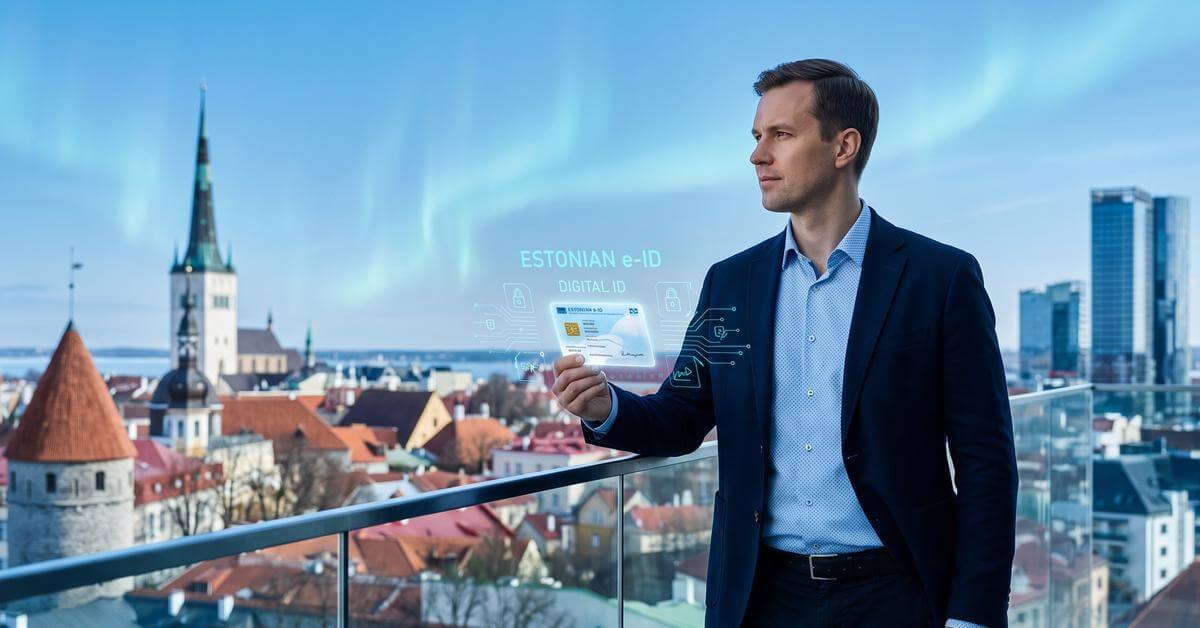
While many Western democracies seem to be in a state of decay and are no longer the safe, civilized and prosperous countries they once were, there are still some European countries that are governed well. One of those that stand out is Estonia.
Estonia is probably most well known for multiple software companies that originated from there, such as Wise, Bolt, Pipedrive and Skype. The government itself is also famous for being early in issuing government IDs with an embedded smart chip for online authentication already in the 1990s. Via the national portal at eesti.ee all residents can access extensive eServices ranging from viewing their health benefits to filing taxes.
Estonia has also been running an e-Residency program since 2014, where they issue digital ID cards to foreigners, making it easy for them to remotely log into the government portals and for example, establish businesses, file annual reports and so forth. Note that the e-Residency is not a path to physical residency. Estonia does, however, have a separate Digital Nomad visa program that makes it easy for non-EU citizens to also physically establish themselves in Estonia, assuming, of course, you meet the criteria, which includes, among others, a minimum monthly income of 3960 from outside Estonia. EU citizens naturally have free mobility inside the EU and can simply get an apartment and register as a resident in Estonia if they so choose. And there are plenty of reasons to do so.
Estonians also seem to value the school system highly. The government has been actively raising teacher pay and has a stated goal of reaching 120% of the national average by 2027. The students are also expected to value the education and respect their teachers. According to the TALIS 2024 survey (OECD s international teacher survey), Estonian teachers spend significantly more time on actual teaching and learning and waste less time on interruptions or keeping classroom order compared to the OECD average. This is among the highest rates internationally, meaning they spend relatively little time on maintaining order or dealing with disruptions. While the international education benchmark PISA scores have been dropping globally, Estonia has consistently been climbing the ranks in past decades. In the latest PISA study (from 2022), Estonia ranked number one in Europe for reading, mathematics and science. In the overall results, Estonia ranked seventh globally, only behind countries such as Japan, Korea and Singapore.

Valuing entrepreneurship is evident in how the taxation system is set up in Estonia. Famously, in Estonia, companies can defer taxes on annual earnings and reinvest all of their profit in growing the company. Taxes are due only later, when paid out from the company, for example as dividends. For individuals, receiving dividends from any Estonian or foreign company is tax-free as long as the company paying dividends already paid corporate tax on the same income.
The tax system is also very simple. For all individuals, all types of income, including salary and capital gains, are always taxed at a flat rate of 22%. This removes the incentive for anyone to try to convert income into different types, setting up holding company structures and other optimizations as there is no gain. All entrepreneurs can simply focus on growing their business and forget extra bureaucracy. There is also no marginal tax rate cliff to stop working at everyone is encouraged to always try to produce as much value as they can. A simple tax system is also reflected in the fact that anyone can easily read all tax rules that apply to individuals in plain English on the Estonian tax authority website, and one does not need to hire any accountants simply to file taxes.
Estonia also has a very straightforward investment account system: any person can freely open a self-directed investment account at any brokerage at no extra cost and report it as such to the tax authority, and then use it to save for an apartment, retirement, or other purposes, and defer all income taxes until withdrawal. There are no caps or time limits, and all residents are encouraged to save and invest as much as they can and thus take responsibility for their own wealth accumulation.
It seems that culturally Estonians respect people who are active and progress in their careers and businesses more than in other countries. Unlike in Finland, successful people are admired and living on government welfare is not romanticized. At the same time, the government benefits are less generous so people can t live comfortably on them and, for example, many of the asylum seekers Estonia accepted have since left on their own initiative to other European countries in search of better benefits.
This is not just my personal experience. According to the Numbeo crime index, Estonia has one of the lowest crime rates in the world. Also, comparing drug and property crime stats, for example, Finland has twice as much crime per capita, and places like Vancouver in Canada almost five times more.

I don t have any clear explanation for why crime is so much lower in Estonia, but some suggest that higher social cohesion and lower levels of welfare contribute to people standing to lose more if they behave antisocially. Compared to Finland, Estonia also more readily jails repeat offenders, and those who are put on trial will experience a swifter court process thanks to simplified legal processes and more efficient governance.
The next step is to buy a local prepaid SIM card at e.g., an R-Kiosk or a convenience store as signing up for other matters later on will require an Estonian phone number. Once you have an apartment and e.g., signed a rental agreement, you can register in the population registry online.
After that, you have proof you are a local resident with an address and telephone number in Estonia. With local resident status, you can go to the police station to get a local ID card. Don t bother scheduling an appointment, just go to the Tammesaare police station in Tallinn, take a queue number and wait. Once it is your turn, they will guide you on how to use the photo booth, fingerprint registration device, and file your application. A few days later you will receive an email confirming whether your application was accepted, and after a few more days, you will get another email notifying you that your ID card has been printed and is available for pick-up at the same location. This will also be your first practical experience of how fast and efficient the government in Estonia is.
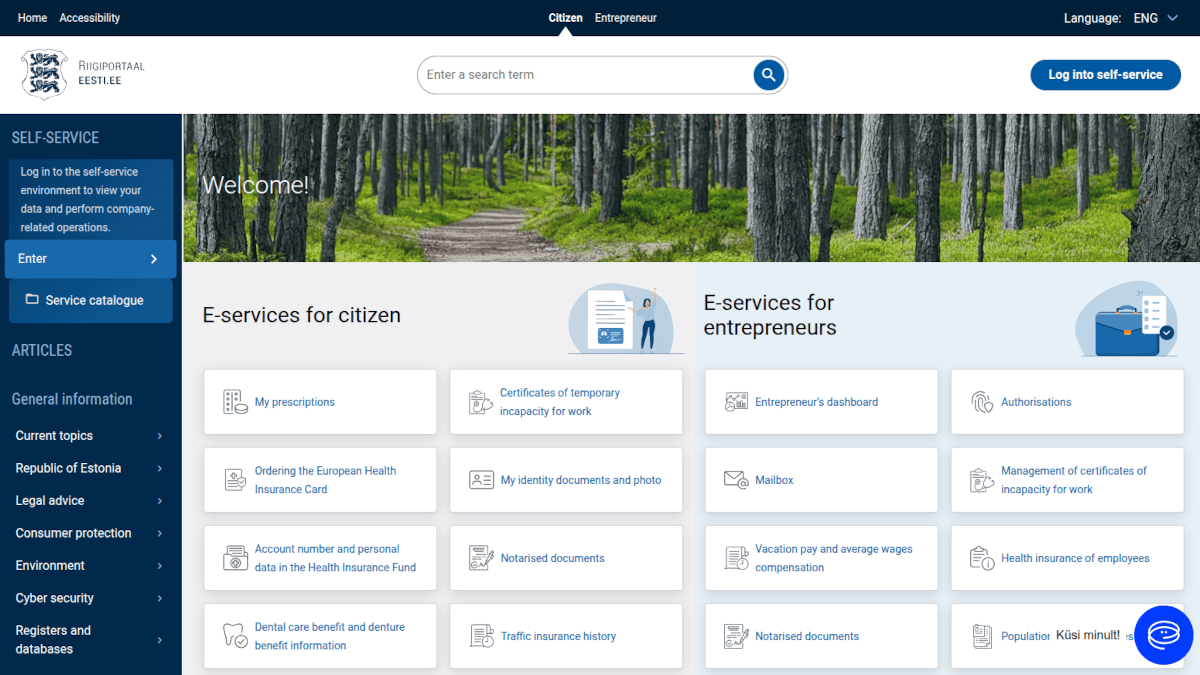
Once you have the local ID card, you can use the smart card feature to log into all the government eServices and sort out the rest of the relocation process, such as registering tax residency and getting a family doctor.
jj's builtin merge editor finally became
too much for me. So, I looked at the list of merge
tool options, saw vimdiff, and thought, Oh, cool,
I know how to use vimdiff. So, I launched
jj config edit --user, added a ui section, and
set merge-editor to vimdiff. With the new
config, I ran jj resolve again. It was at that
point that I realized that I do not, in fact, know
how to use vimdiff: I only know how to use
vimdiff with two buffers. What appeared in my
terminal was a 4-pane monstrosity. Why are there
four panes? I'm trying to resolve conflicts
between only two changes on only one file. For a
moment, I nearly go down a rabbit hole, because
this
says that by default, vimdiff is barely useable
[sic]. Should I be installing some addon or a
Python script? Apparently there are tradeoffs.
I just want to resolve these conflicts without
doing line-by-line approvals for how ever many
hours that would take.
Accordingly, I ran away in terror, installed meld,
set merge-editor to meld, and went clicky-clicky
in the GUI. I'm not happy using a GUI, but at least
it didn't have a mysterious extra buffer to confuse
and taunt me.
I enjoyed reading this post by Marginalia

"Your harddrive is probably full"
You can construct an entropic argument that there are simply more ways for a harddrive to be full than ways in which it can be empty.Of course it made me check how full my laptop drive is, and indeed it was more than 75% full, as predicted. But, I almost never feel that my hard drive is full. I can very easily free up almost any amount of disk space at any time, without any thought. While writing this blog post, I ran a single command and now my harddrive is 50% empty.
The other part of the equation is that a full disk isn t a problem until it s so full you can t put more stuff on it, and at the point it s so irredeemably cluttered that when you do clean it up, you only have the patience to clean up enough to bide your time, judging the fate of every file on the harddrive is simply too much work.Why doesn't this apply to me? Because I have put in the up-front thought to organize things, so that I never have to do that anymore. I have 3 categories of files that I can remove at any time I need more space, without any thought:
git-annex drop any file and stop it using disk
space, but the file is still there (as a broken symlink) so you don't
risk losing or forgetting about it.~/tmp/, which is reserved for any files I only want to have a
passing acquaintance with. If I'm not comfortable with something being
deleted at any time, I don't put it there./tmp/ as an example that I long ago used as the basis for the rules for my
~/tmp/. I hope that git-annex might also serve as an example
that moving files between drives is not the best way to manage disk space
use.
| Series: | Midlife Recorder #1 |
| Publisher: | Linzi Day |
| Copyright: | July 2022 |
| ISBN: | 9798837010774 |
| Format: | Kindle |
| Pages: | 464 |
I loved reading books about kickass women who took no crap and fixed their lives up exactly how they wanted them to be. But how did they get to be that way? They always started out awesome in the books. Seriously, did they kick ass at sixteen? Or did their superpower kickassery not kick in until they were thirty? Forty? If so, then I was screwed. Would I need to wait till I was fifty or until a genie arrived offering wishes? I already felt as if I d spent my whole life waiting for something wild and wonderful to happen.Niki is a Specific Type to a somewhat hilarious degree, and I'm not sure if Day is playing into that intentionally or if she's projecting herself into the book. The amount of self-insertion is not zero: Day also lives in Gretna Green, owns a Bichon Frise, and worked as an assistant registrar and civil celebrant. Niki also drinks wine regularly, has a psychic gift, occasionally reads tarot cards, is an accommodating pushover at work who struggles to say no to her abusive boss, has impostor syndrome problems, and swears by a fictional self-help book about grief that provides the quotes at the starts of chapters. There is a cat, because of course there's a cat. (The fictional self-help book is a spot-on parody played entirely straight in the story. I think Day is having some fun with the reader? I can't tell!) This is what I mean by unapologetic. It's easy to read Niki as a stereotype, but she's a stereotype a lot of real people can identify with and there's something highly satisfying in watching her find her footing. I like wish fulfillment books; it's fun to see someone's wishes come true! Particularly in the year of 2026, there's something immensely satisfying in seeing an ordinary, insecure person get a massive amount of power and use it to make the world better. I don't need everything to be hard, fraught, and laden with costs in fiction, although I wouldn't want every book I read to be like this. Also, the world building is great. It's not polished; there's a bit of a grab bag feeling to it, I'm dubious the magic system has any underlying rigorous rule set, and Niki's powers, once she has access to them, are more of a semi-sentient genie than a skill she has to learn with hard practice. But the magic is fun. The sentient house is one of the best characters, particularly after Niki realizes how underused it has been, and I am a sucker for any good sentient house book. The cat is a far more interesting character than I first thought she would be. And Niki's new magical job is more complicated and less typical than the normal Celtic-inspired fantasy that I thought it was going to be at first. My primary warning about this book is that Niki starts out beaten down and grieving her dead husband, and it took me about five pages to decide that her dead husband was a complete piece of shit who was not worth any of the grief Niki puts into him. She also doesn't stand up for herself for the first hundred pages or so, which made me want to yell at the book a few times. Both of these problems go away farther into the book, and Niki does eventually figure out that Nick was abusive trash, but I was relieved when the "make endless excuses for worthless men" portion of the story was finally over. You have to stick with it until Niki gets brave enough to try being the protagonist; once that happens, it becomes great fun. It is fairly obvious that Midlife in Gretna Green was self-published, and I wish it had gotten the editing that it deserved. My copy had a couple of obvious formatting errors, the plot veers about more than was strictly necessary, and I think a careful editing pass could have tightened the writing by about fifty pages or so without losing any important detail. If that sort of thing bothers you, make sure you're in self-published fiction mode before starting this one. But it also has that irrepressible, bubbling-with-ideas feeling of a book where nothing has suppressed the author's enthusiasm. It's a very grabby book; once Niki starts embracing her new life, I could barely put it down. If you're in the mood for a good fantasy wish-fulfillment story that has no romance and a whole lot of "why are things run this way, no, we're changing that," highly recommended. I had so much fun with this book, and the series is currently making the rounds of my whole family. Don't read this when you're looking for something challenging and literary and deep; save it for when you desperately want to watch someone just fix something for once, damn it. Followed by Painting the Blues in Gretna Green, which I have already read, breaking my usual rule of writing reviews before reading the next book in a series. Rating: 8 out of 10
RcppDate ships
the featureful date
library written by Howard
Hinnant to enable use from R packages. This header-only modern C++
library has been in pretty wide-spread use for a while now, and adds to
C++11, C++14 and C++17 what is (with minor modifications) the date
library in C++20. The RcppDate package
adds no extra R or C++ code and can therefore be a zero-cost dependency
for any other project; yet a number of other projects decided to
re-vendor it resulting in less-efficient duplication. Oh well. C est
la vie.
This release syncs with upstream release 3.0.5 made yesterday. We
also made two routine updates to the continuous integration since the
last release a good year ago. The Debian and r2u packages for this new
release have already been uploaded too.
Courtesy of my CRANberries, there is also a diffstat report for the most recent release. More information is available at the repository or the package page.Changes in version 0.0.7 (2026-07-27)
- Updated to upstream version 3.0.5
- Regular updates to continuous integration setup
This post by Dirk Eddelbuettel originated on his Thinking inside the box blog. If you like this or other open-source work I do, you can sponsor me at GitHub.
Welcome to post 57 in the R4 series.
R packages with compiled codes can use the file
src/Makevars to set compilation flags. We often rely on
this to set libraries, include directories or compilation options. When
using external libraries, be it header-only or via headers and linking,
we are often experiencing compilation noise when these libraries
tickle warnings under generally-recommended flags such as
-Wall -pedantic. Two packages I maintain are clearly repeat
offenders here: Eigen, and BH. Both cam generate pages and pages of
compiler output. This is generally not great as it may hide genuine
warnings from our own code.
What makes matters worse is that some of the available and specific
options for the compilers are treated by R CMD check as
non-portable leading to a nag on package checking. Examples are
-Wno-parentheses, -Wno-maybe-uninitialize or
-Wno-nunnull.
I have long resorted to adding these to my per-user
~/.R/Makevars. When added there, compilation is quieter,
but R CMD check still nags here where the option
is set but not at CRAN or
r-universe. A situation that is not ideal but what somewhat
stable .
More recently, I realized there was an available check we can use to
conditionally add extra compilation flags but leave them off by
default. That makes local development quiet allowing us to focus on the
quality of our additions here without noise from third-party libraries
we may use. At the same time we do not need to do anything else to let
CRAN do its work.
The check we now use is whether there is a .git/
directory present. If so, we are indeed building from local sources and
can add extra flags. If not, we are likely building from a tar.gz source
archive which is the case for CRAN and hence do not set these.
An example use is this recent additional to package qlcal where this bit of R
code is invoked from a minimal shell script configure and
replaces the stub @XTRAFLAGS@ in
src/Makevars.in (or src/Makevars.win.in)
if (dir.exists(".git"))
## development from a .git directory can use these flags
xtraflags <- "-Wno-nonnull -Wno-deprecated-declarations"
else
## else build from tarball so stick with existing flags
xtraflags <- ""
win <- if (Sys.info()[["sysname"]] == "Windows") ".win" else ""
infile <- file.path("src", paste0("Makevars", win, ".in"))
outfile <- file.path("src", paste0("Makevars", win))
lines <- readLines(infile)
lines <- gsub("@XTRAFLAGS@", xtraflags, lines)
writeLines(lines, outfile)configure
file written in autoconf. Here is a similar example from RcppEigen
(showing some relevants parts of the whole file)
# PKG_CXXFLAGS initialized earlier ...
## Check if building locally
AC_MSG_CHECKING([whether .git/ exists])
if test -d "$srcdir/.git"; then
AC_MSG_RESULT([yes, adding extra flags])
AC_SUBST([PKG_CXXFLAGS],["$ PKG_CXXFLAGS -Wno-ignored-attributes -Wno-maybe-uninitialized"])
else
AC_MSG_RESULT([no, consider adding '-Wno-ignored-attributes -Wno-maybe-uninitialized' to ~/.R/Makevars])
fi
AC_SUBST([PKG_CXXFLAGS], ["$ PKG_CXXFLAGS "])
AC_CONFIG_FILES([src/Makevars])
AC_OUTPUTThis post by Dirk Eddelbuettel originated on his Thinking inside the box blog. If you like this or other open-source work I do, you can now sponsor me at GitHub.
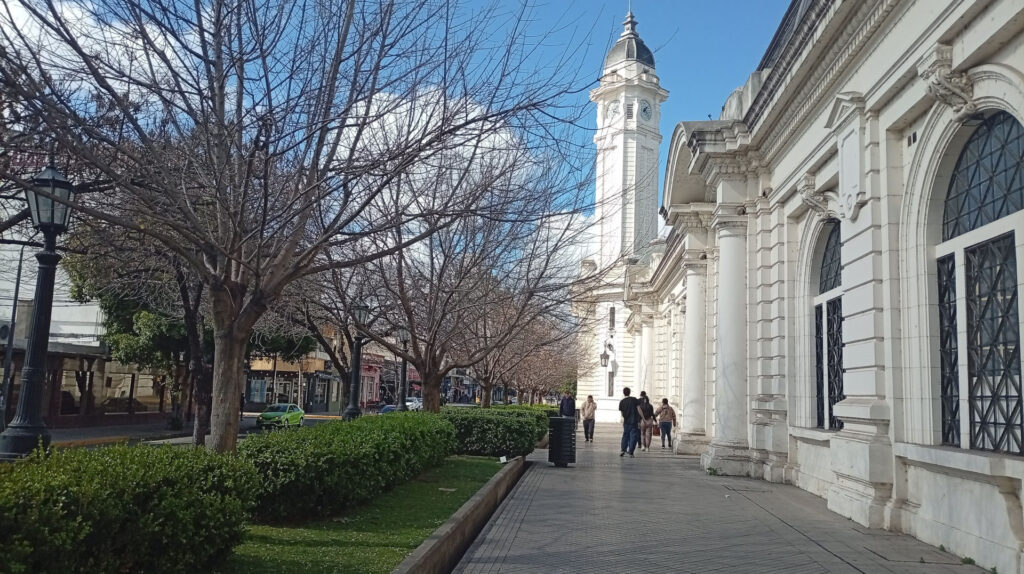
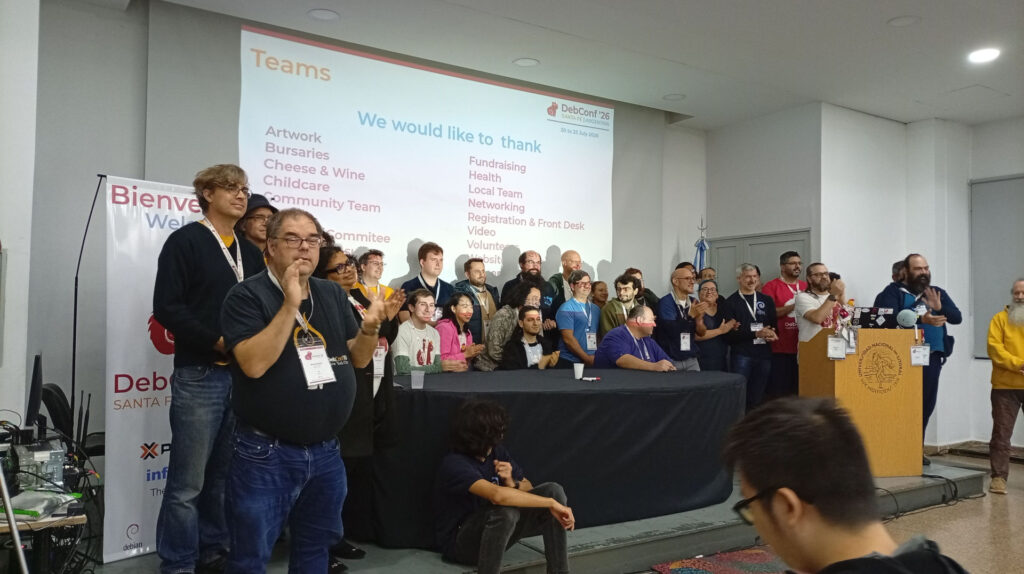
TL;DR: What a great DebConf! I managed to recharge my Debian batteries, and my talks / BoF sessions all went fine. Already looking forward to DebConf in Japan next year!
The evening before DebCamp started, we had a nice bbq (we taught some locals to call it a braai at an organiser s house and went for a walk around the river as the sun set. It was a very peaceful lead-in to DebCamp.


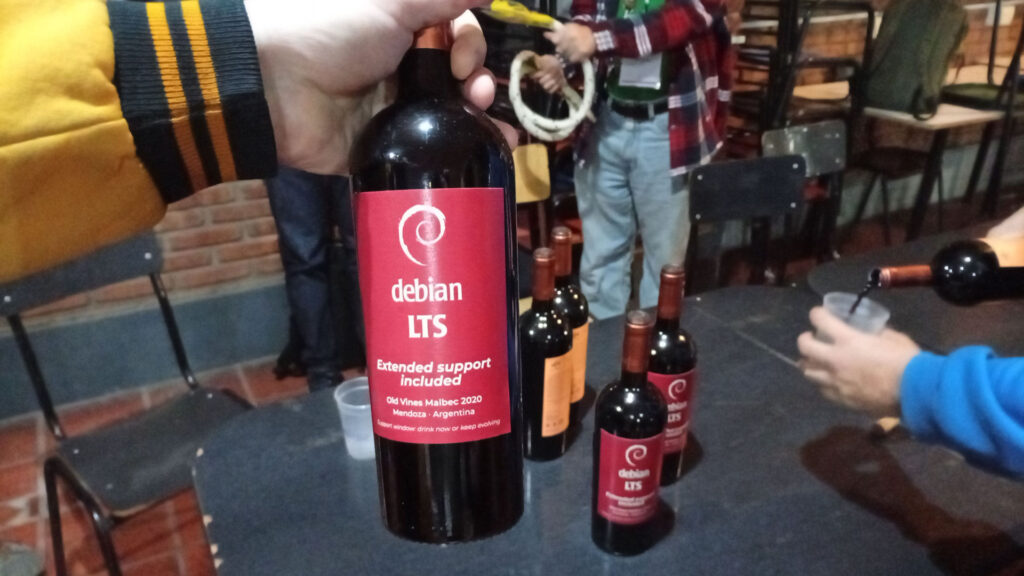
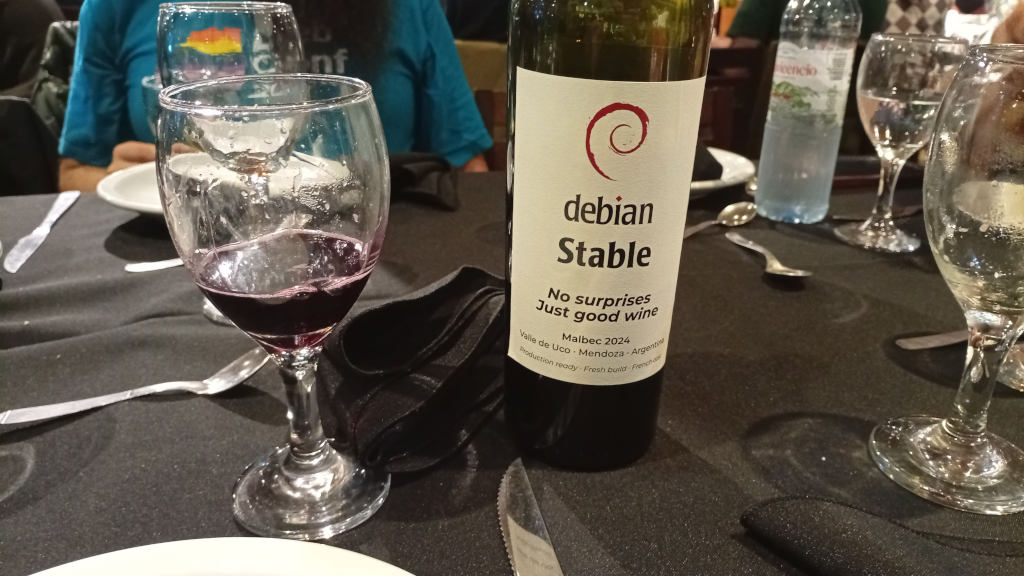
Debian LTS wine

View of Santa Fe city from hotel
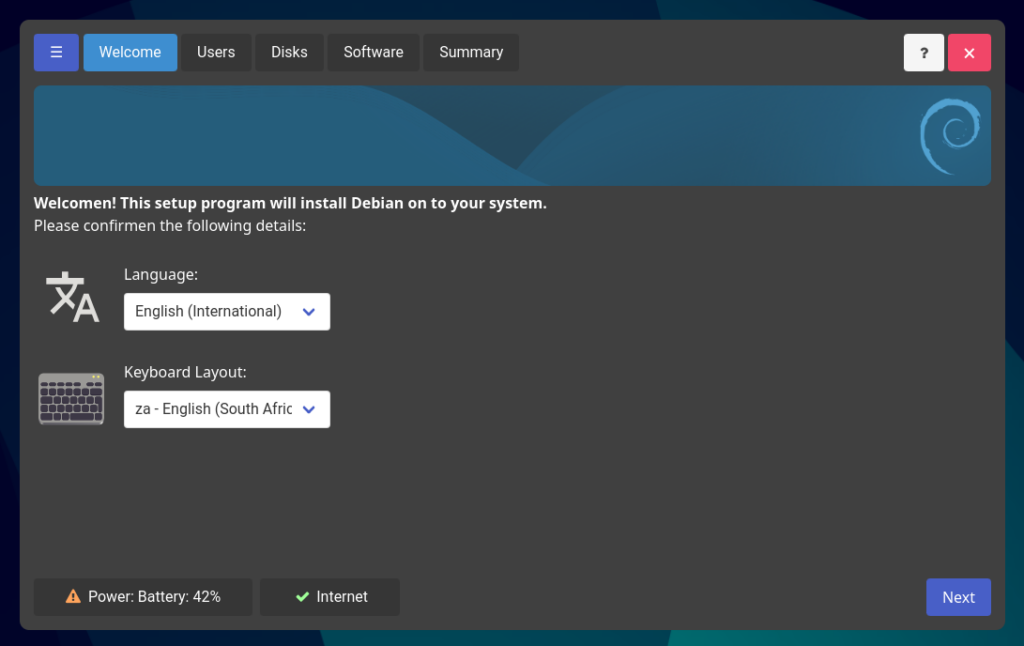
In this talk I do a very quick comparison of system installers based on my experience with them. It s hard to directly compare all of them, since there are so many, and each have their own niche that they attempt to satisfy.
I also introduce Yasi my attempt to answer the question of whether we could build a universal installer, which can also better cover advanced installations, automated installations and niche setups.
It s very early days for the project, and I didn t quite feel ready to share the code with the world, but it was nice that I did a quick demo where I could install a Debian system and the resulting system actually booted up. *phew*.
This is also going to be my main focus for the mid-term future. I aim to have all the basic partitioning options working by the time Debian 14 (Forky) is released, and by the time Debian 15 is released, I have a long list of features that I aim to have working. So, my timeline for having something that s generally useful is around a year from now, and in around 3 years it should be a fully fledged installer that should cover a very large amount of Debian use cases and architectures.

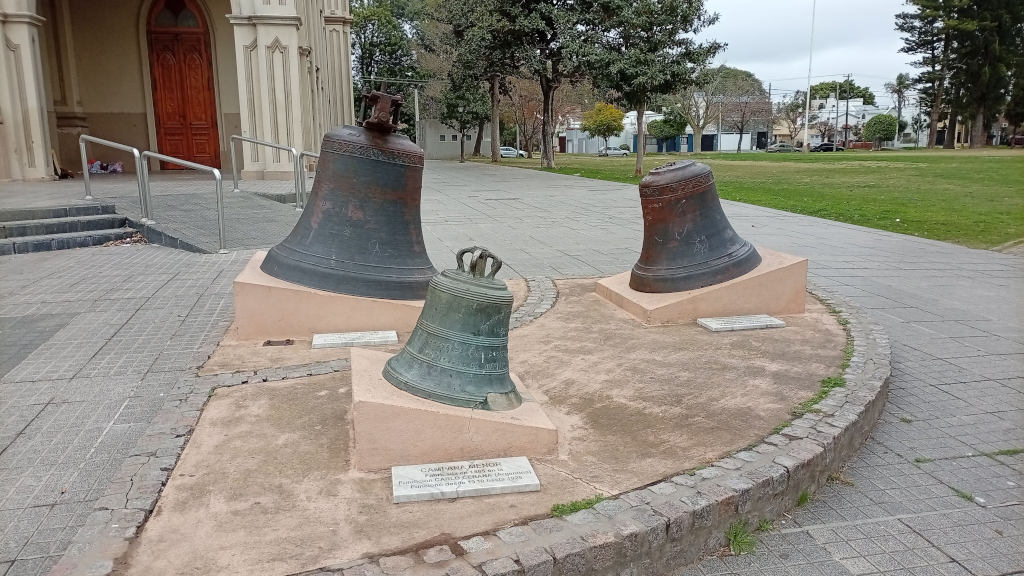
For the day trip, we did a tour across Santa Fe, visited Constituci n de la Naci n Argentina, had lunch where we tried various dishes based on local fish from the river, and then went on a boat ride on the river.


Funding in Free Software Projects: I initially registered this BoF because I m increasingly concerned about how upstreams are asking for donations in their software. I increased the scope to talk about funding in free software in general. It followed Marga s talk about funding, which focussed more about how developers are funded in general. We didn t dive very deep into this, but we certainly need some further discussion (and action) on this within Debian.
Debian Social Team: My most important issue for this team is a carry-over from last year, I want to set up barman (packaged in Debian) for live postgres syncing for our larger databases. For the smaller DBs, doing a daily dump is quite cheap. But for Matrix, it s very expensive in terms if i/o and CPU, so it would be ideal to do less regular complete dumps and use live replication for the first line of redundancy instead.
Images Team: I wasn t initially planning to say much during this session, I have some ideas to reduce both size and count of images, without losing any benefits, but I don t have any work to show for that yet. I ended up talking a lot more than I anticipated, the topics covered were quite good and representative of the current state of Debian images built. I don t have time to create a full summary, so I suggest checking the etherpad / video recording if you re interested.

Some more wine variety during the conference dinner

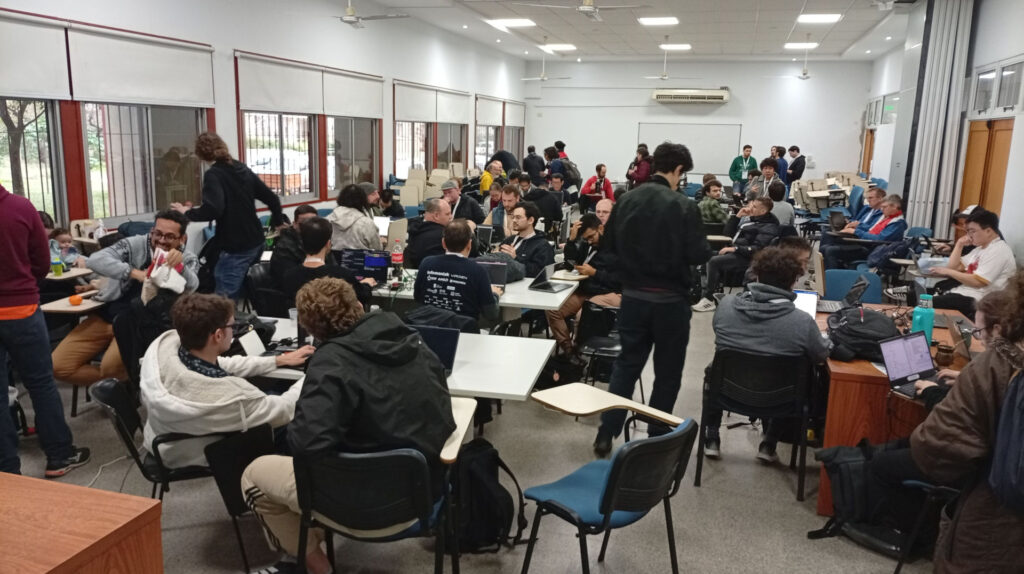
Debianites in the main hacklab

I m spending two days in Rosario before I head home. Exploring a bit, catching up with sleep, finishing this blog post, signing keys and exploring some ideas I made note of during DebConf.

It was a little surreal not being part of any DebConf team for the first time ever, I ve just been too focussed on getting Yasi ready for my talk (no regrets!). I hope to be more involved again next year, in the meantime, I m very grateful to everyone who has made this happen, you did a stellar job! I hope to see many of you again next year in Japan!
Armadillo is a powerful
and expressive C++ template library for linear algebra and scientific
computing. It aims towards a good balance between speed and ease of use,
has a syntax deliberately close to Matlab, and is useful for algorithm
development directly in C++, or quick conversion of research code into
production environments. RcppArmadillo
integrates this library with the R environment and language and is
widely used by (currently) 1293 other packages on CRAN, downloaded 47.8 million
times (per the partial logs from the cloud mirrors of CRAN), and the CSDA paper (preprint
/ vignette) by Conrad and myself has been cited 710 times according
to Google Scholar.
This versions updates to the 15.4.2 upstream Armadillo release made this
week, as well as to included 15.4.1 version we released only to GitHub
and r-universe so do not exceed the (roughly) monthly cadence. For this
release, we had run the usual complete reverse-dependency check which
came back spotless, and did CRAN so no email exchange needed despite
nearly 1300 reverse dependencies. Automation can be helpful when used
with a well-maintained software stack. The package has also already been
updated for Debian, built for r2u, and will build
shortly at CRAN for the
different binary releases.
All changes since the last CRAN release follow.
Courtesy of my CRANberries, there is a diffstat report relative to previous release. More detailed information is on the RcppArmadillo page. Questions, comments etc should go to the rcpp-devel mailing list off the Rcpp R-Forge page.Changes in RcppArmadillo version 15.4.2-1 (2026-07-25)
- Upgraded to Armadillo release 15.4.2 (Medium Roast Agave)
- Fix speed regressions in
diagvec()anddiagmat()Changes in RcppArmadillo version 15.4.1-1 [github-only] (2026-07-09)
- Upgraded to Armadillo release 15.4.1 (Medium Roast Agave)
- Fix for rare infinite recursion bug in sparse version of
diagmat()- More efficient checks for aliasing
This post by Dirk Eddelbuettel originated on his Thinking inside the box blog. If you like this or other open-source work I do, you can sponsor me at GitHub.
So it will not play cyberpunk 2077, but if you prefer opensource drivers for your hardware, nouveau is certainly an option for some opensource gaming.
Using kernel 7.0 from debian backports, I could run opensource classics requiring 3D acceleration flawlessly with nouveau:
I would like to highlight here how good is LibreQuake.
It is an horror cosmic 3D shooter, using the Quake engine, but with newly made game assets under the GPL, thus creating a 100% opensource Quake-based first person shooter. Although their documentation mentions it is a work in progress, as of 2026 I find it very much of a finished product.
Dismal shores, my preferred game level.
I missed Quake in the 90s, happy to discover such a classic today.
The Debian LTS Team, funded by [Freexian s Debian LTS offering]
(https://www.freexian.com/lts/debian/), is pleased to report its activities for
June.
Next.