Search Results: "Petter Reinholdtsen"

31 October 2015

Petter Reinholdtsen: New book, "Fri kultur" by @lessig, a Norwegian Bokm l translation of "Free Culture" from 2004

People keep asking me where to get the various forms of the book I published last week, the Norwegian Bokm l edition of Lawrence Lessigs book Free Culture. It was published on paper via lulu.com, and is also available in PDF, ePub and MOBI format. I currently sell the paper edition for self cost from lulu.com, but might extend the distribution to book stores like Amazon and Barnes & Noble later. This will double the price and force me to make a profit from selling the book. Anyway, here are links to get the book in different formats: Note that the MOBI version have problems with the table of content, at least with the viewers I have been able to test. And the ePub file have several problems according to epubcheck, but seem to display fine in the viewers I have tested. All the files needed to create the book in various forms are available from the github project page. The project got press coverage from the Norwegian IT news site digi.no. Check out the article "Vil pne politikernes yne for Creative Commons". I've blogged about the project as it moved along. The blogs document the translation progress and insights I had along the way.

23 October 2015

Petter Reinholdtsen: "Free Culture" by @lessig - The background story for Creative Commons - new edition available

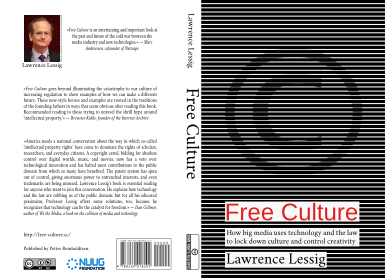
Click here to buy the book. In 2004, as the Creative Commons movement gained momentum, its creator Lawrence Lessig wrote the book Free Culture to explain the problems with increasing copyright regulation and suggest some solutions. I read the book back then and was very moved by it. Reading the book inspired me and changed the way I looked on copyright law, and I would love it if more people would read it too. Because of this, I decided in the summer of 2012 to translate it to Norwegian Bokm l and publish it for those of my friends and family that prefer to read books in Norwegian. I translated the book using docbook and a gettext PO file, and a byproduct of this process is a new edition of the English original. I've been in touch with the author during by work, and he said it was fine with him if I also published an English version. So I decided to do so. Today, I made this edition available for sale on Lulu.com, for those interested in a paper book. This is the cover:

The Norwegian Bokm l version will be available for purchase in a few days. I also plan to publish a French version in a few weeks or months, depending on the amount of people with knowledge of French to join the translation project. So far there is only one active person, but the French book is almost completely translated but need some proof reading. The book is also available in PDF, ePub and MOBI formats from my github project page. Note the ePub and MOBI versions have some formatting problems I believe is due to bugs in the docbook tool dbtoepub (Debian BTS issues #795842 and #796871), but I have not taken the time to investigate. I recommend the PDF and ePub version for now, as they seem to show up fine in the viewers I have available. After the translation to Norwegian Bokm l was complete, I was able to secure some sponsoring from the NUUG Foundation to print the book. This is the reason their logo is located on the back cover. I am very grateful for their contribution, and will use it to give a copy of the Norwegian edition to members of the Norwegian Parliament and other decision makers here in Norway.

19 October 2015

Petter Reinholdtsen: Lawrence Lessig interviewed Edward Snowden a year ago

Last year, US president candidate in the Democratic Party Lawrence interviewed Edward Snowden. The one hour interview was published by Harvard Law School 2014-10-23 on Youtube, and the meeting took place 2014-10-20. The questions are very good, and there is lots of useful information to be learned and very interesting issues to think about being raised. Please check it out. I find it especially interesting to hear again that Snowden did try to bring up his reservations through the official channels without any luck. It is in sharp contrast to the answers made 2013-11-06 by the Norwegian prime minister Erna Solberg to the Norwegian Parliament, claiming Snowden is no Whistle-Blower because he should have taken up his concerns internally and using official channels. It make me sad that this is the political leadership we have here in Norway.

8 October 2015

Petter Reinholdtsen: The Story of Aaron Swartz - Let us all weep!

The movie "The Internet's Own Boy: The Story of Aaron Swartz" is both inspiring and depressing at the same time. The work of Aaron Swartz has inspired me in my work, and I am grateful of all the improvements he was able to initiate or complete. I wish I am able to do as much good in my life as he did in his. Every minute of this 1:45 long movie is inspiring in documenting how much impact a single person can have on improving the society and this world. And it is depressing in documenting how the law enforcement of USA (and other countries) is corrupted to a point where they can push a bright kid to his death for downloading too many scientific articles. Aaron is dead. Let us all weep. The movie is also available on Youtube. I wish there were Norwegian subtitles available, so I could show it to my parents.

Petter Reinholdtsen: The Story of Aron Swartz - Let us all weep!

The movie "The Internet's Own Boy: The Story of Aaron Swartz" is both inspiring and depressing at the same time. The work of Aaron Swartz has inspired me in my work, and I am grateful of all the improvements he was able to initiate or complete. I wish I am able to do as much good in my life as he did in his. Every minute of this 1:45 long movie is inspiring in documenting how much impact a single person can have on improving the society and this world. And it is depressing in documenting how the law enforcement of USA (and other countries) is corrupted to a point where they can push a bright kid to his death for downloading too many scientific articles. Aron is dead. Let us all weep. The movie is also available on Youtube. I wish there were Norwegian subtitles available, so I could show it to my parents.

1 October 2015

Petter Reinholdtsen: French Docbook/PDF/EPUB/MOBI edition of the Free Culture book

As I wrap up the Norwegian version of Free Culture book by Lawrence Lessig (still waiting for my final proof reading copy to arrive in the mail), my great dblatex helper and developer of the dblatex docbook processor, Beno t Guillon, decided a to try to create a French version of the book. He started with the French translation available from the Wikilivres wiki pages, and wrote a program to convert it into a PO file, allowing the translation to be integrated into the po4a based framework I use to create the Norwegian translation from the English edition. We meet on the #dblatex IRC channel to discuss the work. If you want to help create a French edition, check out his git repository and join us on IRC. If the French edition look good, we might publish it as a paper book on lulu.com. A French version of the drawings and the cover need to be provided for this to happen.

28 September 2015

Antoine Beaupr : Fun experiments with laptop battery

After reading up on a eye-opening blog from Petter Reinholdtsen about laptop batteries, or more specifically Lithium-Ion laptop batteries, I figured I needed to try out the "TLP Linux Advanced Power Management" that I had been keeping an eye on for a while. tlp is yet another tool to control power usage on laptops (mostly Thinkpad, mine is a X120e). The novelty of tlp is the "hands off" approach: everything should be automatically configured for you... Obviously, that means I then went on working for a few hours on breaking and fixing my laptop in random operations. I opened a bunch of pull requests on the interesting battery status package that Petter produced to make it work with my setup and make it display graphs directly (instead of into a file). I also rewrote the graphing tool in Python with SciPy in order to have cleaner labels and be able to deduce the date at which a battery would be completely unusuable because it can't recharge high enough. (At the time of writing, the battery estimated death time is december 7th, but that data is skewed because of a quick change in the battery charge after the BIOS upgrade, below.) I then went on to try to limit my laptop charging to 80%, since this seems to make the battery last longer (sources from Petter: 1, 2, 3). Unfortunately, even after building a local (and trivial) backport of the tlp package to Debian stable (8.2/Jessie), I still couldn't access those controls, as TLP is really just a set of shell scripts that glue a bunch of stuff together.
The backport was simply:
apt-get source tlp
cd tlp*/
debuild
sudo dpkg -i ../tlp*.deb
I read here and there (and in Petter's post) that I needed the tp-smapi-dkms package, so I went ahead an installed it:
sudo apt install tp-smapi-dkms
(Yes, Jessie has a neat apt command now, it's great, upgrade now.) Unfortunately, this still didn't work. I think the error back then was something like:
thinkpad_ec: thinkpad_ec_request_row: arg0 rejected: (0x01:0x00)->0x00
thinkpad_ec: thinkpad_ec_read_row: failed requesting row: (0x01:0x00)->0xfffffffb
thinkpad_ec: initial ec test failed
I have seen suggestions here and there to try the acpi-call-dkms package, but that was useless as it doesn't support my model (but may work with others!). The error there was:
acpi_call: Cannot get handle: Error: AE_NOT_FOUND
Note: I still have it installed - it's unclear what impact it has, and I do not want to break my current setup.
So I then started to look at upgrading my BIOS, for some reason. I was running version 1.13 (8FET29WW) from 05/06/2011. I was able to update to 1.17 (8FET33WW) from 11/07/2012, using the memdisk binary from the syslinux-common package, with some help from the quite useful grub-imageboot package:
sudo apt install syslinux-common grub-imageboot
wget https://download.lenovo.com/ibmdl/pub/pc/pccbbs/mobiles/8fuj10uc.iso
sudo mkdir /boot/images
sudo mv 8fuj10uc.iso /boot/images
sudo reboot
I found the image on the Thinkpad x120e support page from Lenovo (which happily bounces around, so don't rely on the above URLs too much). When I rebooted, I was offered to boot from the image by grub, which went on fine, considering it was running some version of DOS, which is always a bit scary considering it is software that is somewhat almost as old as me.
I wish I could have installed some free software in the BIOS instead of the outdated crap that Lenovo provides, but unfortunately, it seems this will never be possible with Libreboot or Coreboot, mostly because Intel is evil and installs backdoors in all their computers. Fun times.
Fortunately and surprisingly, the update worked and went on pretty smoothly. After that, I was able to set the charge limit with:
echo 80   sudo tee /sys/devices/platform/smapi/BAT0/stop_charge_thresh
Amazing! I had almost forgotten why I almost bricked my system on a thursday, good thing that worked! Now the fun part was that, after some reboots or something I did, I am not sure what, the above stopped working: I couldn't load the drivers at all anymore, dmesg treating me with a nasty:
thinkpad_ec: thinkpad_ec_read_row: failed requesting row: (0x01:0x00)->0xfffffff0
thinkpad_ec: initial ec test failed
Now that is some obscure error message material! Fun stuff. I tried uninstalling tlp, the smapi modules, the acpi-call modules, rebooting, turning the machine off, removing the battery, nothing worked. Even more hilarious, the charge controler was now stuck at 80%: I had artificially destroyed 20% of the battery capacity in software. Ouch. I think this may have been related to uninstalling the tp-smapi-dkms package without unloading it at first. I found some weird entries in my kern.log like this:
tp_smapi unloaded.
thinkpad_ec: thinkpad_ec_read_row: failed requesting row: (0x14:0x00)->0xfffffff0
hdaps: cannot power off
hdaps: driver unloaded.
thinkpad_ec: unloaded.
I think that after that point, I couldn't load either module, not even thinkpad_ec... After tearing out a few more hairs and hammering my head on the keyboard randomly, I thought I could just try another BIOS upgrade, just for the fun of it. Turns out you actually can't rerun the upgrade, but you can change the model number through the same software, and this seems to reset some stuff. So I went back in the ISO image I had loaded earlier, and went on to change the model number (actually setting it to the same value, but whatever, it still ran the update). It turns out this seems to have reset a bunch of stuff and now everything works. I can use tlp setcharge and all the neat tools go well. The two key commands are:
# limit charging to 80% of the battery, but not lower than 40%
sudo tlp setcharge 40 80
# clear the above setting and just charge the battery to 100%
sudo tlp fullcharge
It seems that the 40% bit isn't supported by my laptop, but whatever: the battery stays charged when on AC power anyways, so I don't really understand what the setting is for in the first place. The error there is:
smapi smapi: smapi_request: SMAPI error: Function is not supported by SMAPI BIOS (func=2116)
smapi smapi: __get_real_thresh: cannot get start_thresh of bat=0: Function is not supported by SMAPI BIOS
The second command is what I will need to remember to run before I unplug the laptop for a trip. I suspect this will be really annoying and I may end up disabling all this stuff and just yank the power cable out when the battery reaches 80%, by hand, when I need to. But it was a fun geeking out, and hopefully this will be useful for others. And of course, the graphs from Petter will be interesting in a few months... Before the BIOS upgrade, the battery capacity was reported as 100% (actually, at 100.03%, which was strange). Now, the capacity is at 98.09%, which is probably just a more accurate reading that was fixed in the BIOS upgrade. Finally, also see the useful thinkwiki troubleshooting page and especially their interesting BIOS upgrade documentation which inspired me to write my own version. I would have gladly contributed to theirs, but I seem to have lost my password on this site, with no recovery possible... The arch linux wiki has obviously excellent documentation as well, as usual.
24 September 2015

Petter Reinholdtsen: The life and death of a laptop battery

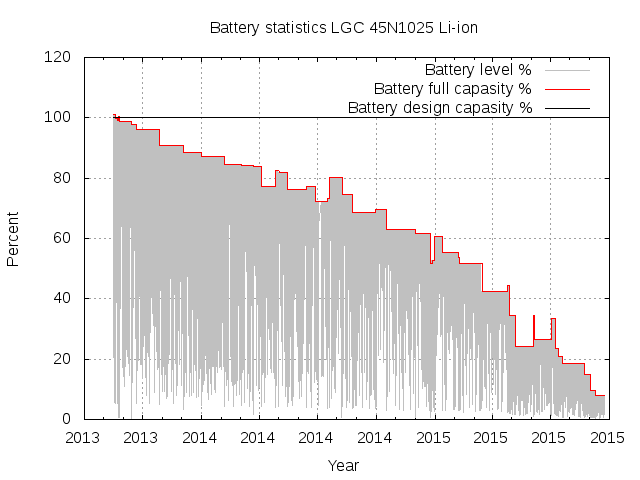
When I get a new laptop, the battery life time at the start is OK. But this do not last. The last few laptops gave me a feeling that within a year, the life time is just a fraction of what it used to be, and it slowly become painful to use the laptop without power connected all the time. Because of this, when I got a new Thinkpad X230 laptop about two years ago, I decided to monitor its battery state to have more hard facts when the battery started to fail. First I tried to find a sensible Debian package to record the battery status, assuming that this must be a problem already handled by someone else. I found battery-stats, which collects statistics from the battery, but it was completely broken. I sent a few suggestions to the maintainer, but decided to write my own collector as a shell script while I waited for feedback from him. Via a blog post about the battery development on a MacBook Air I also discovered batlog, not available in Debian. I started my collector 2013-07-15, and it has been collecting battery stats ever since. Now my /var/log/hjemmenett-battery-status.log file contain around 115,000 measurements, from the time the battery was working great until now, when it is unable to charge above 7% of original capacity. My collector shell script is quite simple and look like this:
#!/bin/sh
# Inspired by
# http://www.ifweassume.com/2013/08/the-de-evolution-of-my-laptop-battery.html
# See also
# http://blog.sleeplessbeastie.eu/2013/01/02/debian-how-to-monitor-battery-capacity/
logfile=/var/log/hjemmenett-battery-status.log
files="manufacturer model_name technology serial_number \
    energy_full energy_full_design energy_now cycle_count status"
if [ ! -e "$logfile" ] ; then
    (
	printf "timestamp,"
	for f in $files; do
	    printf "%s," $f
	done
	echo
    ) > "$logfile"
fi
log_battery()  
    # Print complete message in one echo call, to avoid race condition
    # when several log processes run in parallel.
    msg=$(printf "%s," $(date +%s); \
	for f in $files; do \
	    printf "%s," $(cat $f); \
	done)
    echo "$msg"
 
cd /sys/class/power_supply
for bat in BAT*; do
    (cd $bat && log_battery >> "$logfile")
done
The script is called when the power management system detect a change in the power status (power plug in or out), and when going into and out of hibernation and suspend. In addition, it collect a value every 10 minutes. This make it possible for me know when the battery is discharging, charging and how the maximum charge change over time. The code for the Debian package is now available on github. The collected log file look like this:
timestamp,manufacturer,model_name,technology,serial_number,energy_full,energy_full_design,energy_now,cycle_count,status,
1376591133,LGC,45N1025,Li-ion,974,62800000,62160000,39050000,0,Discharging,
[...]
1443090528,LGC,45N1025,Li-ion,974,4900000,62160000,4900000,0,Full,
1443090601,LGC,45N1025,Li-ion,974,4900000,62160000,4900000,0,Full,
I wrote a small script to create a graph of the charge development over time. This graph depicted above show the slow death of my laptop battery. But why is this happening? Why are my laptop batteries always dying in a year or two, while the batteries of space probes and satellites keep working year after year. If we are to believe Battery University, the cause is me charging the battery whenever I have a chance, and the fix is to not charge the Lithium-ion batteries to 100% all the time, but to stay below 90% of full charge most of the time. I've been told that the Tesla electric cars limit the charge of their batteries to 80%, with the option to charge to 100% when preparing for a longer trip (not that I would want a car like Tesla where rights to privacy is abandoned, but that is another story), which I guess is the option we should have for laptops on Linux too. Is there a good and generic way with Linux to tell the battery to stop charging at 80%, unless requested to charge to 100% once in preparation for a longer trip? I found one recipe on askubuntu for Ubuntu to limit charging on Thinkpad to 80%, but could not get it to work (kernel module refused to load). I wonder why the battery capacity was reported to be more than 100% at the start. I also wonder why the "full capacity" increases some times, and if it is possible to repeat the process to get the battery back to design capacity. And I wonder if the discharge and charge speed change over time, or if this stay the same. I did not yet try to write a tool to calculate the derivative values of the battery level, but suspect some interesting insights might be learned from those. Update 2015-09-24: I got a tip to install the packages acpi-call-dkms and tlp (unfortunately missing in Debian stable) packages instead of the tp-smapi-dkms package I had tried to use initially, and use 'tlp setcharge 40 80' to change when charging start and stop. I've done so now, but expect my existing battery is toast and need to be replaced. The proposal is unfortunately Thinkpad specific.

3 September 2015

Petter Reinholdtsen: Book cover for the Free Culture book finally done

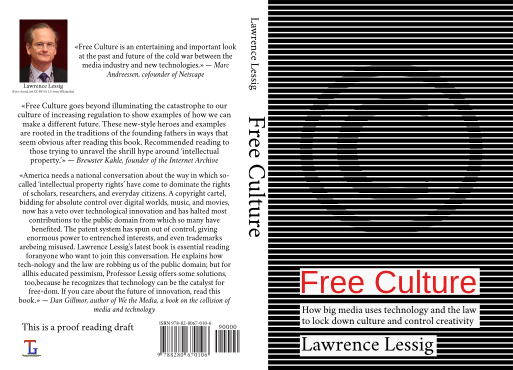
Creating a good looking book cover proved harder than I expected. I wanted to create a cover looking similar to the original cover of the Free Culture book we are translating to Norwegian, and I wanted it in vector format for high resolution printing. But my inkscape knowledge were not nearly good enough to pull that off. But thanks to the great inkscape community, I was able to wrap up the cover yesterday evening. I asked on the #inkscape IRC channel on Freenode for help and clues, and Marc Jeanmougin (Mc-) volunteered to try to recreate it based on the PDF of the cover from the HTML version. Not only did he create a SVG document with the original and his vector version side by side, he even provided an instruction video explaining how he did it. But the instruction video is not easy to follow for an untrained inkscape user. The video is a recording on how he did it, and he is obviously very experienced as the menu selections are very quick and he mentioned on IRC that he did use some keyboard shortcuts that can't be seen on the video, but it give a good idea about the inkscape operations to use to create the stripes with the embossed copyright sign in the center. I took his SVG file, copied the vector image and re-sized it to fit on the cover I was drawing. I am happy with the end result, and the current english version look like this: I am not quite sure about the text on the back, but guess it will do. I picked three quotes from the official site for the book, and hope it will work to trigger the interest of potential readers. The Norwegian cover will look the same, but with the texts and bar code replaced with the Norwegian version. The book is very close to being ready for publication, and I expect to upload the final draft to Lulu in the next few days and order a final proof reading copy to verify that everything look like it should before allowing everyone to order their own copy of Free Culture, in English or Norwegian Bokm l. I'm waiting to give the the productive proof readers a chance to complete their work.

19 August 2015

Petter Reinholdtsen: In my hand, a pocket book edition of the Norwegian Free Culture book!

Today, finally, my first printed draft edition of the Norwegian translation of Free Culture I have been working on for the last few years arrived in the mail. I had to fake a cover to get the interior printed, and the exterior of the book look awful, but that is irrelevant at this point. I asked for a printed pocket book version to get an idea about the font sizes and paper format as well as how good the figures and images look in print, but also to test what the pocket book version would look like. After receiving the 500 page pocket book, it became obvious to me that that pocket book size is too small for this book. I believe the book is too thick, and several tables and figures do not look good in the size they get with that small page sizes. I believe I will go with the 5.5x8.5 inch size instead. A surprise discovery from the paper version was how bad the URLs look in print. They are very hard to read in the colophon page. The URLs are red in the PDF, but light gray on paper. I need to change the color of links somehow to look better. But there is a printed book in my hand, and it feels great. :) Now I only need to fix the cover, wrap up the postscript with the store behind the book, and collect the last corrections from the proof readers before the book is ready for proper printing. Cover artists willing to work for free and create a Creative Commons licensed vector file looking similar to the original is most welcome, as my skills as a graphics designer are mostly missing.

9 August 2015

Petter Reinholdtsen: First paper version of the Norwegian Free Culture book heading my way

Typesetting a book is harder than I hoped. As the translation is mostly done, and a volunteer proof reader was going to check the text on paper, it was time this summer to focus on formatting my translated docbook based version of the Free Culture book by Lawrence Lessig. I've been trying to get both docboox-xsl+fop and dblatex to give me a good looking PDF, but in the end I went with dblatex, because its Debian maintainer and upstream developer were responsive and very helpful in solving my formatting challenges. Last night, I finally managed to create a PDF that no longer made Lulu.com complain after uploading, and I ordered a text version of the book on paper. It is lacking a proper book cover and is not tagged with the correct ISBN number, but should give me an idea what the finished book will look like. Instead of using Lulu, I did consider printing the book using CreateSpace, but ended up using Lulu because it had smaller book size options (CreateSpace seem to lack pocket book with extended distribution). I looked for a similar service in Norway, but have not seen anything so far. Please let me know if I am missing out on something here. But I still struggle to decide the book size. Should I go for pocket book (4.25x6.875 inches / 10.8x17.5 cm) with 556 pages, Digest (5.5x8.5 inches / 14x21.6 cm) with 323 pages or US Trade (6x8 inches / 15.3x22.9 cm) with 280 pages? Fewer pager give a cheaper book, and a smaller book is easier to carry around. The test book I ordered was pocket book sized, to give me an idea how well that fit in my hand, but I suspect I will end up using a digest sized book in the end to bring the prize down further. My biggest challenge at the moment is making nice cover art. My inkscape skills are not yet up to the task of replicating the original cover in SVG format. I also need to figure out what to write about the book on the back (will most likely use the same text as the description on web based book stores). I would love help with this, if you are willing to license the art source and final version using the same CC license as the book. My artistic skills are not really up to the task. I plan to publish the book in both English and Norwegian and on paper, in PDF form as well as EPUB and MOBI format. The current status can as usual be found on github in the archive/ directory. So far I have spent all time on making the PDF version look good. Someone should probably do the same with the dbtoepub generated e-book. Help is definitely needed here, as I expect to run out of steem before I find time to improve the epub formatting. Please let me know via github if you find typos in the book or discover translations that should be improved. The final proof reading is being done right now, and I expect to publish the finished result in a few months.

16 July 2015

Petter Reinholdtsen: Typesetting DocBook footnotes as endnotes with dblatex

I'm still working on the Norwegian version of the Free Culture book by Lawrence Lessig, and is now working on the final typesetting and layout. One of the features I want to get the structure similar to the original book is to typeset the footnotes as endnotes in the notes chapter. Based on the feedback from the Debian maintainer and the dblatex developer, I came up with this recipe I would like to share with you. The proposal was to create a new LaTeX class file and add the LaTeX code there, but this is not always practical, when I want to be able to replace the class using a make file variable. So my proposal misuses the latex.begindocument XSL parameter value, to get a small fragment into the correct location in the generated LaTeX File. First, decide where in the DocBook document to place the endnotes, and add this text there:
<?latex \theendnotes ?>
Next, create a xsl stylesheet file dblatex-endnotes.xsl to add the code needed to add the endnote instructions in the preamble of the generated LaTeX document, with content like this:
<?xml version='1.0'?>
<xsl:stylesheet xmlns:xsl="http://www.w3.org/1999/XSL/Transform" version='1.0'>
  <xsl:param name="latex.begindocument">
    <xsl:text>
\usepackage endnotes 
\let\footnote=\endnote
\def\enoteheading \mbox \par\vskip-\baselineskip  
\begin document 
    </xsl:text>
  </xsl:param>
</xsl:stylesheet>
Finally, load this xsl file when running dblatex, for example like this:
dblatex --xsl-user=dblatex-endnotes.xsl freeculture.nb.xml
The end result can be seen on github, where my book project is located.

7 July 2015

Petter Reinholdtsen: MPEG LA on "Internet Broadcast AVC Video" licensing and non-private use

After asking the Norwegian Broadcasting Company (NRK) why they can broadcast and stream H.264 video without an agreement with the MPEG LA, I was wiser, but still confused. So I asked MPEG LA if their understanding matched that of NRK. As far as I can tell, it does not. I started by asking for more information about the various licensing classes and what exactly is covered by the "Internet Broadcast AVC Video" class that NRK pointed me at to explain why NRK did not need a license for streaming H.264 video:
According to a MPEG LA press release dated 2010-02-02, there is no charge when using MPEG AVC/H.264 according to the terms of "Internet Broadcast AVC Video". I am trying to understand exactly what the terms of "Internet Broadcast AVC Video" is, and wondered if you could help me. What exactly is covered by these terms, and what is not? The only source of more information I have been able to find is a PDF named AVC Patent Portfolio License Briefing, which states this about the fees:
  • Where End User pays for AVC Video
    • Subscription (not limited by title) 100,000 or fewer subscribers/yr = no royalty; > 100,000 to 250,000 subscribers/yr = $25,000; >250,000 to 500,000 subscribers/yr = $50,000; >500,000 to 1M subscribers/yr = $75,000; >1M subscribers/yr = $100,000
    • Title-by-Title - 12 minutes or less = no royalty; >12 minutes in length = lower of (a) 2% or (b) $0.02 per title
  • Where remuneration is from other sources
    • Free Television - (a) one-time $2,500 per transmission encoder or (b) annual fee starting at $2,500 for > 100,000 HH rising to maximum $10,000 for >1,000,000 HH
    • Internet Broadcast AVC Video (not title-by-title, not subscription) no royalty for life of the AVC Patent Portfolio License
Am I correct in assuming that the four categories listed is the categories used when selecting licensing terms, and that "Internet Broadcast AVC Video" is the category for things that do not fall into one of the other three categories? Can you point me to a good source explaining what is ment by "title-by-title" and "Free Television" in the license terms for AVC/H.264? Will a web service providing H.264 encoded video content in a "video on demand" fashing similar to Youtube and Vimeo, where no subscription is required and no payment is required from end users to get access to the videos, fall under the terms of the "Internet Broadcast AVC Video", ie no royalty for life of the AVC Patent Portfolio license? Does it matter if some users are subscribed to get access to personalized services? Note, this request and all answers will be published on the Internet.
The answer came quickly from Benjamin J. Myers, Licensing Associate with the MPEG LA:
Thank you for your message and for your interest in MPEG LA. We appreciate hearing from you and I will be happy to assist you. As you are aware, MPEG LA offers our AVC Patent Portfolio License which provides coverage under patents that are essential for use of the AVC/H.264 Standard (MPEG-4 Part 10). Specifically, coverage is provided for end products and video content that make use of AVC/H.264 technology. Accordingly, the party offering such end products and video to End Users concludes the AVC License and is responsible for paying the applicable royalties. Regarding Internet Broadcast AVC Video, the AVC License generally defines such content to be video that is distributed to End Users over the Internet free-of-charge. Therefore, if a party offers a service which allows users to upload AVC/H.264 video to its website, and such AVC Video is delivered to End Users for free, then such video would receive coverage under the sublicense for Internet Broadcast AVC Video, which is not subject to any royalties for the life of the AVC License. This would also apply in the scenario where a user creates a free online account in order to receive a customized offering of free AVC Video content. In other words, as long as the End User is given access to or views AVC Video content at no cost to the End User, then no royalties would be payable under our AVC License. On the other hand, if End Users pay for access to AVC Video for a specific period of time (e.g., one month, one year, etc.), then such video would constitute Subscription AVC Video. In cases where AVC Video is delivered to End Users on a pay-per-view basis, then such content would constitute Title-by-Title AVC Video. If a party offers Subscription or Title-by-Title AVC Video to End Users, then they would be responsible for paying the applicable royalties you noted below. Finally, in the case where AVC Video is distributed for free through an "over-the-air, satellite and/or cable transmission", then such content would constitute Free Television AVC Video and would be subject to the applicable royalties. For your reference, I have attached a .pdf copy of the AVC License. You will find the relevant sublicense information regarding AVC Video in Sections 2.2 through 2.5, and the corresponding royalties in Section 3.1.2 through 3.1.4. You will also find the definitions of Title-by-Title AVC Video, Subscription AVC Video, Free Television AVC Video, and Internet Broadcast AVC Video in Section 1 of the License. Please note that the electronic copy is provided for informational purposes only and cannot be used for execution. I hope the above information is helpful. If you have additional questions or need further assistance with the AVC License, please feel free to contact me directly.
Having a fresh copy of the license text was useful, and knowing that the definition of Title-by-Title required payment per title made me aware that my earlier understanding of that phrase had been wrong. But I still had a few questions:
I have a small followup question. Would it be possible for me to get a license with MPEG LA even if there are no royalties to be paid? The reason I ask, is that some video related products have a copyright clause limiting their use without a license with MPEG LA. The clauses typically look similar to this:
This product is licensed under the AVC patent portfolio license for the personal and non-commercial use of a consumer to (a) encode video in compliance with the AVC standard ("AVC video") and/or (b) decode AVC video that was encoded by a consumer engaged in a personal and non-commercial activity and/or AVC video that was obtained from a video provider licensed to provide AVC video. No license is granted or shall be implied for any other use. additional information may be obtained from MPEG LA L.L.C.
It is unclear to me if this clause mean that I need to enter into an agreement with MPEG LA to use the product in question, even if there are no royalties to be paid to MPEG LA. I suspect it will differ depending on the jurisdiction, and mine is Norway. What is MPEG LAs view on this?
According to the answer, MPEG LA believe those using such tools for non-personal or commercial use need a license with them:
With regard to the Notice to Customers, I would like to begin by clarifying that the Notice from Section 7.1 of the AVC License reads: THIS PRODUCT IS LICENSED UNDER THE AVC PATENT PORTFOLIO LICENSE FOR THE PERSONAL USE OF A CONSUMER OR OTHER USES IN WHICH IT DOES NOT RECEIVE REMUNERATION TO (i) ENCODE VIDEO IN COMPLIANCE WITH THE AVC STANDARD ("AVC VIDEO") AND/OR (ii) DECODE AVC VIDEO THAT WAS ENCODED BY A CONSUMER ENGAGED IN A PERSONAL ACTIVITY AND/OR WAS OBTAINED FROM A VIDEO PROVIDER LICENSED TO PROVIDE AVC VIDEO. NO LICENSE IS GRANTED OR SHALL BE IMPLIED FOR ANY OTHER USE. ADDITIONAL INFORMATION MAY BE OBTAINED FROM MPEG LA, L.L.C. SEE HTTP://WWW.MPEGLA.COM The Notice to Customers is intended to inform End Users of the personal usage rights (for example, to watch video content) included with the product they purchased, and to encourage any party using the product for commercial purposes to contact MPEG LA in order to become licensed for such use (for example, when they use an AVC Product to deliver Title-by-Title, Subscription, Free Television or Internet Broadcast AVC Video to End Users, or to re-Sell a third party's AVC Product as their own branded AVC Product). Therefore, if a party is to be licensed for its use of an AVC Product to Sell AVC Video on a Title-by-Title, Subscription, Free Television or Internet Broadcast basis, that party would need to conclude the AVC License, even in the case where no royalties were payable under the License. On the other hand, if that party (either a Consumer or business customer) simply uses an AVC Product for their own internal purposes and not for the commercial purposes referenced above, then such use would be included in the royalty paid for the AVC Products by the licensed supplier. Finally, I note that our AVC License provides worldwide coverage in countries that have AVC Patent Portfolio Patents, including Norway. I hope this clarification is helpful. If I may be of any further assistance, just let me know.
The mentioning of Norwegian patents made me a bit confused, so I asked for more information:
But one minor question at the end. If I understand you correctly, you state in the quote above that there are patents in the AVC Patent Portfolio that are valid in Norway. This make me believe I read the list available from <URL: http://www.mpegla.com/main/programs/AVC/Pages/PatentList.aspx > incorrectly, as I believed the "NO" prefix in front of patents were Norwegian patents, and the only one I could find under Mitsubishi Electric Corporation expired in 2012. Which patents are you referring to that are relevant for Norway?
Again, the quick answer explained how to read the list of patents in that list:
Your understanding is correct that the last AVC Patent Portfolio Patent in Norway expired on 21 October 2012. Therefore, where AVC Video is both made and Sold in Norway after that date, then no royalties would be payable for such AVC Video under the AVC License. With that said, our AVC License provides historic coverage for AVC Products and AVC Video that may have been manufactured or Sold before the last Norwegian AVC patent expired. I would also like to clarify that coverage is provided for the country of manufacture and the country of Sale that has active AVC Patent Portfolio Patents. Therefore, if a party offers AVC Products or AVC Video for Sale in a country with active AVC Patent Portfolio Patents (for example, Sweden, Denmark, Finland, etc.), then that party would still need coverage under the AVC License even if such products or video are initially made in a country without active AVC Patent Portfolio Patents (for example, Norway). Similarly, a party would need to conclude the AVC License if they make AVC Products or AVC Video in a country with active AVC Patent Portfolio Patents, but eventually Sell such AVC Products or AVC Video in a country without active AVC Patent Portfolio Patents.
As far as I understand it, MPEG LA believe anyone using Adobe Premiere and other video related software with a H.264 distribution license need a license agreement with MPEG LA to use such tools for anything non-private or commercial, while it is OK to set up a Youtube-like service as long as no-one pays to get access to the content. I still have no clear idea how this applies to Norway, where none of the patents MPEG LA is licensing are valid. Will the copyright terms take precedence or can those terms be ignored because the patents are not valid in Norway?

5 July 2015

Petter Reinholdtsen: New laptop - some more clues and ideas based on feedback

Several people contacted me after my previous blog post about my need for a new laptop, and provided very useful feedback. I wish to thank every one of these. Several pointed me to the possibility of fixing my X230, and I am already in the process of getting Lenovo to do so thanks to the on site, next day support contract covering the machine. But the battery is almost useless (I expect to replace it with a non-official battery) and I do not expect the machine to live for many more years, so it is time to plan its replacement. If I did not have a support contract, it was suggested to find replacement parts using FrancEcrans, but it might present a language barrier as I do not understand French. One tip I got was to use the Skinflint web service to compare laptop models. It seem to have more models available than prisjakt.no. Another tip I got from someone I know have similar keyboard preferences was that the HP EliteBook 840 keyboard is not very good, and this matches my experience with earlier EliteBook keyboards I tested. Because of this, I will not consider it any further. When I wrote my blog post, I was not aware of Thinkpad X250, the newest Thinkpad X model. The keyboard reintroduces mouse buttons (which is missing from the X240), and is working fairly well with Debian Sid/Unstable according to Corsac.net. The reports I got on the keyboard quality are not consistent. Some say the keyboard is good, others say it is ok, while others say it is not very good. Those with experience from X41 and and X60 agree that the X250 keyboard is not as good as those trusty old laptops, and suggest I keep and fix my X230 instead of upgrading, or get a used X230 to replace it. I'm also told that the X250 lack leds for caps lock, disk activity and battery status, which is very convenient on my X230. I'm also told that the CPU fan is running very often, making it a bit noisy. In any case, the X250 do not work out of the box with Debian Stable/Jessie, one of my requirements. I have also gotten a few vendor proposals, one was Pro-Star, another was Libreboot. The latter look very attractive to me. Again, thank you all for the very useful feedback. It help a lot as I keep looking for a replacement. Update 2015-07-06: I was recommended to check out the lapstore.de web shop for used laptops. They got several different old thinkpad X models, and provide one year warranty.

3 July 2015

Petter Reinholdtsen: Time to find a new laptop, as the old one is broken after only two years

My primary work horse laptop is failing, and will need a replacement soon. The left 5 cm of the screen on my Thinkpad X230 started flickering yesterday, and I suspect the cause is a broken cable, as changing the angle of the screen some times get rid of the flickering. My requirements have not really changed since I bought it, and is still as I described them in 2013. The last time I bought a laptop, I had good help from prisjakt.no where I could select at least a few of the requirements (mouse pin, wifi, weight) and go through the rest manually. Three button mouse and a good keyboard is not available as an option, and all the three laptop models proposed today (Thinkpad X240, HP EliteBook 820 G1 and G2) lack three mouse buttons). It is also unclear to me how good the keyboard on the HP EliteBooks are. I hope Lenovo have not messed up the keyboard, even if the quality and robustness in the X series have deteriorated since X41. I wonder how I can find a sensible laptop when none of the options seem sensible to me? Are there better services around to search the set of available laptops for features? Please send me an email if you have suggestions.

2 July 2015

Petter Reinholdtsen: MakerCon Nordic videos now available on Frikanalen

Last oktober I was involved on behalf of NUUG with recording the talks at MakerCon Nordic, a conference for the Maker movement. Since then it has been the plan to publish the recordings on Frikanalen, which finally happened the last few days. A few talks are missing because the speakers asked the organizers to not publish them, but most of the talks are available. The talks are being broadcasted on RiksTV channel 50 and using multicast on Uninett, as well as being available from the Frikanalen web site. The unedited recordings are available on Youtube too. This is the list of talks available at the moment. Visit the Frikanalen video pages to view them. Part of the reason this took so long was that the scripts NUUG had to prepare a recording for publication were five years old and no longer worked with the current video processing tools (command line argument changes). In addition, we needed better audio normalization, which sent me on a detour to package bs1770gain for Debian. Now this is in place and it became a lot easier to publish NUUG videos on Frikanalen.

Michael Prokop: HAProxy with Debian/squeeze clients causing random Hash Sum mismatch

Update on 2015-07-02 22:15 UTC: as Petter Reinholdtsen noted in the comments:

Try adding /etc/apt/apt.conf.d/90squid with content like this: Acquire::http::Pipeline-Depth 0; It turn off the feature in apt confusing proxies.
this indeed avoids those Hash Sum mismatch failures with HAProxy as well. Thanks, Petter! Many of you might know apt s Hash Sum mismatch issue and there are plenty of bug reports about it (like #517874, #624122, #743298 + #762079). Recently I saw the Hash Sum mismatch usually only when using random mirrors with e.g. httpredir.debian.org in apt s sources.list, but with a static mirror such issues usually don t exist anymore. A customer of mine has a Debian mirror and this issue wasn t a problem there neither, until recently: Since the mirror also includes packages provided to customers and the mirror needs to be available 24/7 we decided to provide another instance of the mirror and put those systems behind HAProxy (version 1.5.8-3 as present in Debian/jessie). The HAProxy setup worked fine and we didn t notice any issues in our tests, until the daily Q/A builds randomly started to report failures:
Failed to fetch http://example.org/foobar_amd64.deb Hash Sum mismatch
When repeating the download there was no problem though. This problem only appeared about once every 15-20 minutes with random package files and it affected only Debian/squeeze clients (wheezy and jessie aren t affected at all). The problem also didn t appear when directly accessing the mirrors behind HAproxy. We tried plenty of different options for apt (Acquire::http::No-Cache=true, Acquire::http::No-Partial=true, ) and also played with some HAProxy configurations, nothing really helped. With apt s Debug::Acquire::http=True we saw that there really was a checksum failure and HTTP status code 102 ( Processing , or in terms of apt: Waiting for headers ) seems to be involved. The actual problem between apt on Debian/squeeze and HAProxy is still unknown to us though. While digging deeper into this issue is on my todo list yet, I found a way to avoid those Hash Sum mismatch failures: switch from http to https in sources.list. As soon as https is used the problem doesn t appear anymore. I m documenting it here just in case anyone else should run into it.

29 June 2015

Lunar: Reproducible builds: week 9 in Stretch cycle

What happened about the reproducible builds effort this week: Toolchain fixes Norbert Preining uploaded texinfo/6.0.0.dfsg.1-2 which makes texinfo indices reproducible. Original patch by Chris Lamb. Lunar submitted recently rebased patches to make the file order of files inside .deb stable. akira filled #789843 to make tex4ht stop printing timestamps in its HTML output by default. Dhole wrote a patch for xutils-dev to prevent timestamps when creating gzip compresed files. Reiner Herrmann sent a follow-up patch for wheel to use UTC as timezone when outputing timestamps. Mattia Rizzolo started a discussion regarding the failure to build from source of subversion when -Wdate-time is added to CPPFLAGS which happens when asking dpkg-buildflags to use the reproducible profile. SWIG errors out because it doesn't recognize the aforementioned flag. Trying to get the .buildinfo specification to more definitive state, Lunar started a discussion on storing the checksums of the binary package used in dpkg status database. akira discovered while proposing a fix for simgrid that CMake internal command to create tarballs would record a timestamp in the gzip header. A way to prevent it is to use the GZIP environment variable to ask gzip not to store timestamps, but this will soon become unsupported. It's up for discussion if the best place to fix the problem would be to fix it for all CMake users at once. Infrastructure-related work Andreas Henriksson did a delayed NMU upload of pbuilder which adds minimal support for build profiles and includes several fixes from Mattia Rizzolo affecting reproducibility tests. Neils Thykier uploaded lintian which both raises the severity of package-contains-timestamped-gzip and avoids false positives for this tag (thanks to Tomasz Buchert). Petter Reinholdtsen filled #789761 suggesting that how-can-i-help should prompt its users about fixing reproducibility issues. Packages fixed The following packages became reproducible due to changes in their build dependencies: autorun4linuxcd, libwildmagic, lifelines, plexus-i18n, texlive-base, texlive-extra, texlive-lang. The following packages became reproducible after getting fixed: Some uploads fixed some reproducibility issues but not all of them: Untested uploaded as they are not in main: Patches submitted which have not made their way to the archive yet: debbindiff development debbindiff/23 includes a few bugfixes by Helmut Grohne that result in a significant speedup (especially on larger files). It used to exhibit the quadratic time string concatenation antipattern. Version 24 was released on June 23rd in a hurry to fix an undefined variable introduced in the previous version. (Reiner Herrmann) debbindiff now has a test suite! It is written using the PyTest framework (thanks Isis Lovecruft for the suggestion). The current focus has been on the comparators, and we are now at 93% of code coverage for these modules. Several problems were identified and fixed in the process: paths appearing in output of javap, readelf, objdump, zipinfo, unsqusahfs; useless MD5 checksum and last modified date in javap output; bad handling of charsets in PO files; the destination path for gzip compressed files not ending in .gz; only metadata of cpio archives were actually compared. stat output was further trimmed to make directory comparison more useful. Having the test suite enabled a refactoring of how comparators were written, switching from a forest of differences to a single tree. This helped removing dust from the oldest parts of the code. Together with some other small changes, version 25 was released on June 27th. A follow up release was made the next day to fix a hole in the test suite and the resulting unidentified leftover from the comparator refactoring. (Lunar) Documentation update Ximin Luo improved code examples for some proposed environment variables for reference timestamps. Dhole added an example on how to fix timestamps C pre-processor macros by adding a way to set the build date externally. akira documented her fix for tex4ht timestamps. Package reviews 94 obsolete reviews have been removed, 330 added and 153 updated this week. Hats off for Chris West (Faux) who investigated many fail to build from source issues and reported the relevant bugs. Slight improvements were made to the scripts for editing the review database, edit-notes and clean-notes. (Mattia Rizzolo) Meetings A meeting was held on June 23rd. Minutes are available. The next meeting will happen on Tuesday 2015-07-07 at 17:00 UTC. Misc. The Linux Foundation announced that it was funding the work of Lunar and h01ger on reproducible builds in Debian and other distributions. This was further relayed in a Bits from Debian blog post.

15 June 2015

Petter Reinholdtsen: Graphing the Norwegian company ownership structure

It is a bit work to figure out the ownership structure of companies in Norway. The information is publicly available, but one need to recursively look up ownership for all owners to figure out the complete ownership graph of a given set of companies. To save me the work in the future, I wrote a script to do this automatically, outputting the ownership structure using the Graphviz/dotty format. The data source is web scraping from Proff, because I failed to find a useful source directly from the official keepers of the ownership data, Br nn ysundsregistrene. To get an ownership graph for a set of companies, fetch the code from git and run it using the organisation number. I'm using the Norwegian newspaper Dagbladet as an example here, as its ownership structure is very simple:
% time ./bin/eierskap-dotty 958033540 > dagbladet.dot
real    0m2.841s
user    0m0.184s
sys     0m0.036s
%
The script accept several organisation numbers on the command line, allowing a cluster of companies to be graphed in the same image. The resulting dot file for the example above look like this. The edges are labeled with the ownership percentage, and the nodes uses the organisation number as their name and the name as the label:
digraph ownership  
rankdir = LR;
"Aller Holding A/s" -> "910119877" [label="100%"]
"910119877" -> "998689015" [label="100%"]
"998689015" -> "958033540" [label="99%"]
"974530600" -> "958033540" [label="1%"]
"958033540" [label="AS DAGBLADET"]
"998689015" [label="Berner Media Holding AS"]
"974530600" [label="Dagbladets Stiftelse"]
"910119877" [label="Aller Media AS"]
 
To view the ownership graph, run "dotty dagbladet.dot" or convert it to a PNG using "dot -T png dagbladet.dot > dagbladet.png". The result can be seen below: Note that I suspect the "Aller Holding A/S" entry to be incorrect data in the official ownership register, as that name is not registered in the official company register for Norway. The ownership register is sensitive to typos and there seem to be no strict checking of the ownership links. Let me know if you improve the script or find better data sources. The code is licensed according to GPL 2 or newer. Update 2015-06-15: Since the initial post I've been told that "Aller Holding A/S" is a Danish company, which explain why it did not have a Norwegian organisation number. I've also been told that there is a web services API available from Br nn ysundsregistrene, for those willing to accept the terms or pay the price.

11 June 2015

Petter Reinholdtsen: Measuring and adjusting the loudness of a TV channel using bs1770gain

Television loudness is the source of frustration for viewers everywhere. Some channels are very load, others are less loud, and ads tend to shout very high to get the attention of the viewers, and the viewers do not like this. This fact is well known to the TV channels. See for example the BBC white paper "Terminology for loudness and level dBTP, LU, and all that" from 2011 for a summary of the problem domain. To better address the need for even loadness, the TV channels got together several years ago to agree on a new way to measure loudness in digital files as one step in standardizing loudness. From this came the ITU-R standard BS.1770, "Algorithms to measure audio programme loudness and true-peak audio level". The ITU-R BS.1770 specification describe an algorithm to measure loadness in LUFS (Loudness Units, referenced to Full Scale). But having a way to measure is not enough. To get the same loudness across TV channels, one also need to decide which value to standardize on. For European TV channels, this was done in the EBU Recommondaton R128, "Loudness normalisation and permitted maximum level of audio signals", which specifies a recommended level of -23 LUFS. In Norway, I have been told that NRK, TV2, MTG and SBS have decided among themselves to follow the R128 recommondation for playout from 2016-03-01. There are free software available to measure and adjust the loudness level using the LUFS. In Debian, I am aware of a library named libebur128 able to measure the loudness and since yesterday morning a new binary named bs1770gain capable of both measuring and adjusting was uploaded and is waiting for NEW processing. I plan to maintain the latter in Debian under the Debian multimedia umbrella. The free software based TV channel I am involved in, Frikanalen, plan to follow the R128 recommondation ourself as soon as we can adjust the software to do so, and the bs1770gain tool seem like a good fit for that part of the puzzle to measure loudness on new video uploaded to Frikanalen. Personally, I plan to use bs1770gain to adjust the loudness of videos I upload to Frikanalen on behalf of the NUUG member organisation. The program seem to be able to measure the LUFS value of any media file handled by ffmpeg, but I've only successfully adjusted the LUFS value of WAV files. I suspect it should be able to adjust it for all the formats handled by ffmpeg.

Next.

Previous.