Search Results: "Norbert Preining"

16 February 2016

Norbert Preining: Debian/TeX Live 2015.20160215-1

About one month has passed and here is the usual updated of TeX Live packages for Debian. While I am not really calling for testers at the moment, building of preliminary packages for TeX Live 2016 has begone. The binaries are already uploaded to experimental, and arch=all packages for experimental will follow soon. Debian - TeX Live 2015 As with the last time, here is the list of new and updated pacakges with (auto-generated) links to the package pages on CTAN. New packages adtrees, babel-occitan, crimson, emisa, glossaries-extra, gloss-occitan, libertinus, luatex-def, mynsfc, nihbiosketch, signchart, smartunits, tikz-feynman, uhrzeit, xduthesis. Updated packages achemso, acro, animate, apnum, archaeologie, babel, babel-french, babel-greek, babel-macedonian, bangorcsthesis, biblatex-bookinarticle, biblatex-gost, biblatex-manuscripts-philology, br-lex, caption, chemgreek, chemmacros, chemnum, cmtiup, csplain, csquotes, ctanify, ctex, cweb, datatool, datetime2, datetime2-english, delimseasy, droit-fr, dvips, erewhon, exsheets, fibeamer, fira, fontspec, forest, geschichtsfrkl, glossaries, graphics, greek-fontenc, greektonoi, hyph-utf8, inconsolata, isodoc, l2tabu, l3build, l3experimental, l3kernel, l3packages, latex, latex-bin, latex-make, leadsheets, leaflet, luaotfload, luatexja, mathastext, mcf2graph, mcmthesis, media9, metrix, mhchem, ndsu-thesis, newpx, newtx, ocgx2, pas-tableur, pdftex, pdfx, pict2e, pst-perspective, pstricks, pstricks-add, ptex, quran, ran_toks, realscripts, schemata, showhyphens, siunitx, sr-vorl, sttools, tempora, tetex, tex4ht, texfot, texlive-scripts, thinsp, thuthesis, tkz-orm, tools, uantwerpendocs, ulthese, unicode-data, uptex, xassoccnt, xcjk2uni, xebaposter, xecjk, xetex, xetexko, xltxtra, xpinyin, zhnumber, zhspacing. Enjoy.

14 February 2016

Lunar: Reproducible builds: week 42 in Stretch cycle

What happened in the reproducible builds effort between February 7th and February 13th 2016:

Toolchain fixes
  • James McCoy uploaded devscripts/2.16.1 which makes dcmd supports .buildinfo files. Original patch by josch.
  • Lisandro Dami n Nicanor P rez Meyer uploaded qt4-x11/4:4.8.7+dfsg-6 which make files created by qch reproducible by using a fixed date instead of the current time. Original patch by Dhole.
Norbert Preining rejected the patch submitted by Reiner Herrmann to make the CreationDate not appear in comments of DVI / PS files produced by TeX. He also mentioned that some timestamps can be replaced by using the -output-comment option and that the next version of pdftex will have patches inspired by reproducible build to mitigate the effects (see SOURCE_DATE_EPOCH patches) .

Packages fixed The following packages have become reproducible due to changes in their build dependencies: abntex, apt-dpkg-ref, arduino, c++-annotations, cfi, chaksem, clif, cppreference-doc, dejagnu, derivations, ecasound, fdutils, gnash, gnu-standards, gnuift, gsequencer, gss, gstreamer0.10, gstreamer1.0, harden-doc, haskell98-report, iproute2, java-policy, libbluray, libmodbus, lizardfs, mclibs, moon-buggy, nurpawiki, php-sasl, shishi, stealth, xmltex, xsom. The following packages became reproducible after getting fixed: Some uploads fixed some reproducibility issues, but not all of them: Patches submitted which have not made their way to the archive yet:
  • #813944 on cvm by Reiner Herrmann: remove gzip headers, fix permissions of some directories and the order of the md5sums.
  • #814019 on latexdiff by Reiner Herrmann: remove the current build date from documentation.
  • #814214 on rocksdb by Chris Lamb: add support for SOURCE_DATE_EPOCH.

reproducible.debian.net A new armhf build node has been added (thanks to Vagrant Cascadian) and integrated into the Jenkins setup for 4 new armhf builder jobs. (h01ger) All packages for Debian testing (Stretch) have been tested on armhf in just 42 days. It took 114 days to get the same point for unstable back when the armhf test infrastructure was much smaller. Package sets have been enabled for testing on armhf. (h01ger) Packages producing architecture-independent ( Arch:all ) binary packages together with architecture dependent packages targeted for specific architectures will now only be tested on matching architectures. (Steven Chamberlain, h01ger) As the Jenkins setup is now made of 252 different jobs, the overview has been split into 11 different smalller views. (h01ger)

Package reviews 222 reviews have been removed, 110 added and 50 updated in the previous week. 35 FTBFS reports were made by Chris Lamb, Danny Edel, and Niko Tyni.

Misc. The recordings of Ludovic Court s' talk at FOSDEM 16 about reproducible builds and GNU Guix is now available. One can also have a look at slides from Fabian Keil's talk about ElecrtroBSD and Baptiste Daroussin's talk about FreeBSD packages.

13 February 2016

Norbert Preining: OpenPHT 1.5.1 for Debian/sid

I have updated the openpht repository with builds of OpenPHT 1.5.1 for Debian/sid for both amd64 and i386 architecture. For those who have forgotten it, OpenPHT is the open source fork of Plex Home Theater that is used on RasPlex, see my last post concerning OpenPHT for details. plex-debian-new sid and testing For sid use the following lines:
deb http://www.preining.info/debian/ openpht-sid main
deb-src http://www.preining.info/debian/ openpht-sid main
You can also grab the binary for amd64 directly here for amd64 and i386, you can get the source package with
dget http://www.preining.info/debian/pool/main/o/openpht/openpht_1.5.1.508-1.dsc
jessie Builds for Debian stable release jessie are not done by now. The release file and changes file are signed with my official Debian key 0x860CDC13. Now be ready for enjoying the next movie!

2 February 2016

Norbert Preining: Gaming: The Talos Principle Road to Gehenna

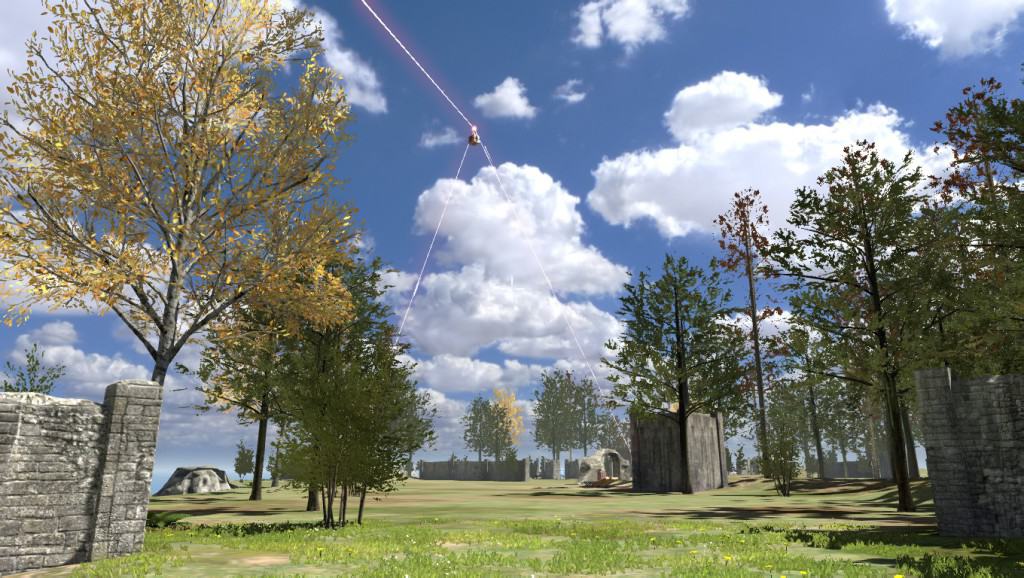
After finishing the Talos Principle I immediately started to play the extension Road to Gehenna, but was derailed near completion by the incredible Portal Stories: Mel. Now that I finally managed to escape from the test chambers my attention returned to the Road to Gehenna. As with the pair Portal 2 and Portal Stories: Mel, the challenges are going up considerably from the original Talos Principle to the Road to Gehenna. Checking the hours of game play it took me about 24h through all the riddles in Road to Gehenna, but I have to admit, I had some riddles where I needed to cheat. road-to-gehenna.jpg The Road to Gehenna does not bring much new game play elements, but loads of new riddles. And the best of all, playable on Linux! And as with the original game, the graphics are really well done, while still be playable on my Vaio Pro laptop with Intel integrated graphic card a plus that is rare in the world of computer games where everyone is expected to have a high-end nVidia or Radeon card. Ok, there is not much action going on where quick graphic computations are necessary, still the impression of the game is great.
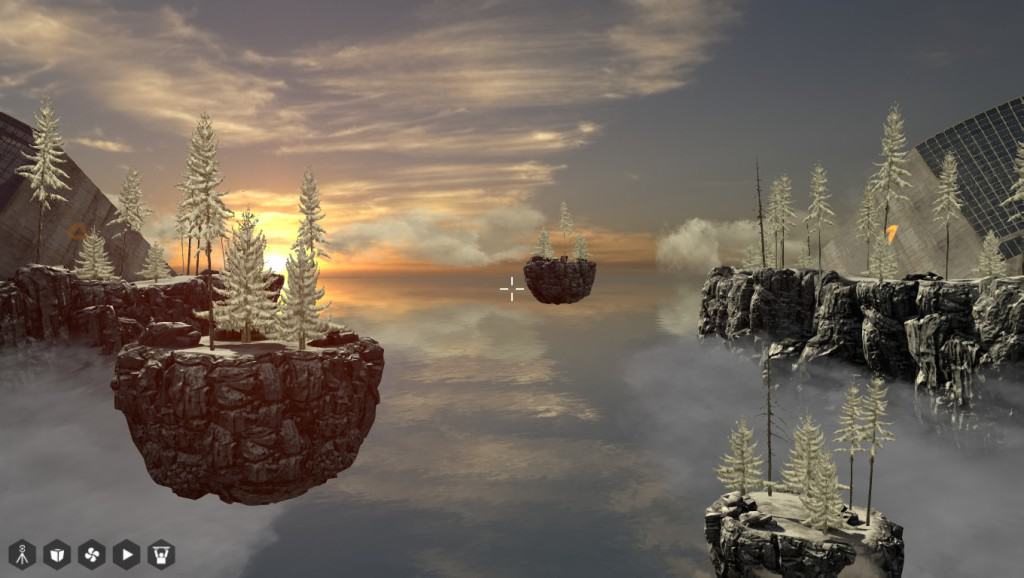
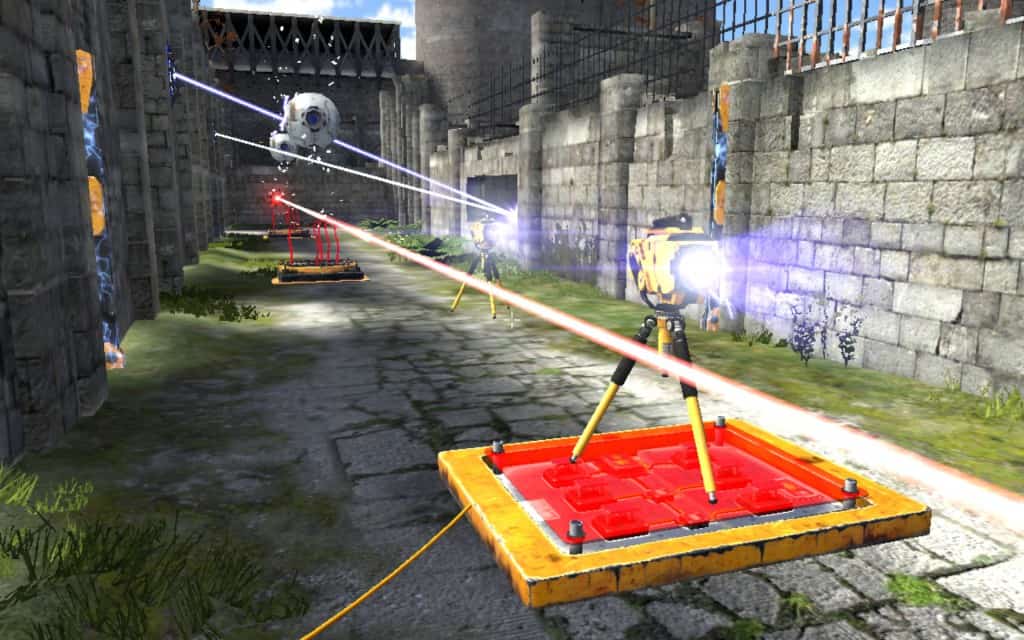
gehenna1 The riddles contain the well known elements (connectors, boxes, jammer, etc), but the settings are often spectacular, sometimes very small and narrow, just a few moves if done in the right order, sometimes like wide open fields with lots of space to explore. Transportation between various islands suspended in the air is with vents, giving you a lot of nice flight time!
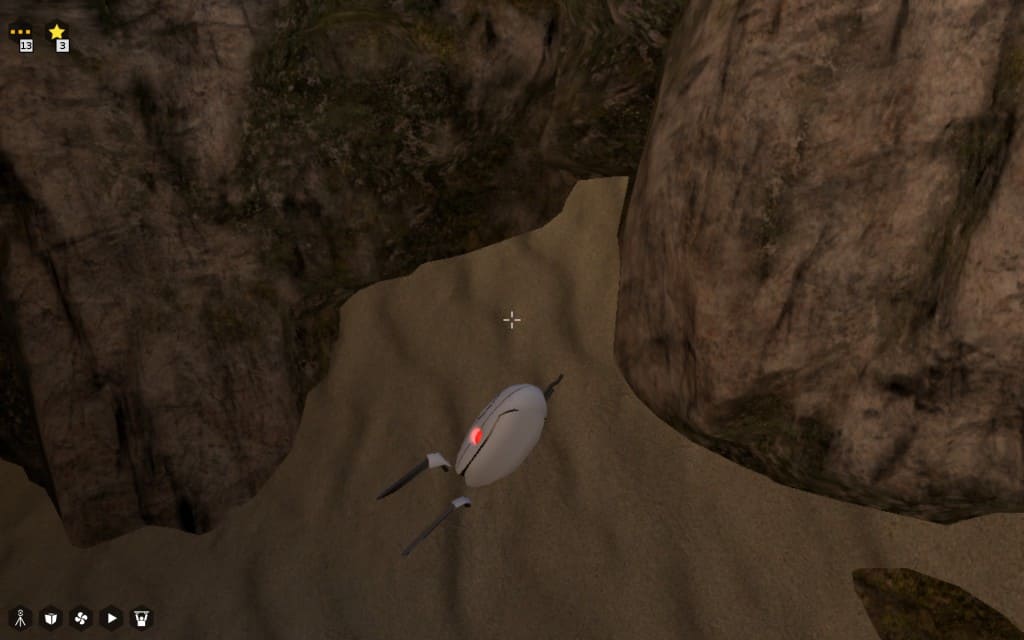
gehenna2 If one searches a lot, or uses a bit of cheating, one can find good old friends from the Portal series, burried in the sand in one of the world. This is not the only easter egg hidden in the game, there are actually a lot, some of which I have not seen but only read about afterwards. Guess I need to replay the whole game.
gehenna3 Coming back to the riddles, I really believe that the makers have been ingenious in using the few items at hand to create challenging and surprising riddles. As it is so often, many of the riddles look completely impossible at first glance, and often even after staring at them for tens and tens of minutes. Until (and if) one has the the a-ha effect and understands the trick. This often still needs a lot of handwork and trial-error rounds, but all in all the game is well balanced. What is a bit a pain similar to the original game are collecting the stars to reach the hidden world and free the admin. There the developers overdid it in my opinion, with some rather absurd and complicated stars.
gehenna4 The end of the game, ascension of the messengers, is rather unspectacular. A short discussion on who remains and then a big closing scene with the messenger being beamed up a la Starship Enterprise, and a closing black screen. But well, the fun was with the riddles.
gehenna5 All in all an extension that is well worth the investment if one enjoyed the original Talos, and is looking for rather challenging riddles. Now that I have finished all the Portal and Talos titles, I am hard thinking of what is next looking into Braid Enjoy!

18 January 2016

Norbert Preining: Debian/TeX Live 2015.20160117-1 and biber 2.3-1

About one month has passed and here is the usual updated of TeX Live packages for Debian, this time also with an update to biber to accompany the updated version of biblatex. Nothing spectacular here besides fixes for some broken links of fonts. Debian - TeX Live 2015 As a bonus this time, I provide (auto-generated) links to the packages on CTAN, so that one can check the package descriptions and manuals. Updated packages academicons, acro, apnum, babel, babel-french, babel-icelandic, babel-spanish, babel-vietnamese, bclogo, biblatex, bibtexperllibs, calxxxx-yyyy, chemformula, chemgreek, chess-problem-diagrams, chickenize, cjk-gs-integrate, cmcyr, csplain, datatool, dvips, embrac, enotez, etex-pkg, fibeamer, fithesis, invoice, isodoc, l3kernel, latexdiff, luamplib, mathastext, mcf2graph, media9, nameauth, newpx, newtx, newtxsf, nucleardata, paralist, pdftex, pgfplots, pict2e, pmxchords, prftree, ptex, reledmac, schwalbe-chess, siunitx, tempora, tetex, tex4ht, texinfo, texlive-cz, texlive-docindex, texlive-scripts, thalie, thuthesis, tkz-orm, uantwerpendocs, unicode-data, xassoccnt, xespotcolor. New packages continue, ecobiblatex, econometrics, getitems, librebodoni, lshort-estonian, moodle, nimbus15, seuthesix, uantwerpendocs. Enjoy.

17 January 2016

Norbert Preining: Gaming: Portal Stories: Mel

The last days, after about 20 hours of gameplay, I have finally finished Portal Stories: Mel, the single player mod for Portal 2. After having played Portal and Portal 2, I have to say this one mod took be by surprise. I remember very well that, after having played through Portal 2 and found it to easy, I was pointed to Portal Stories: Mel in several comments, I thought Well, it cannot be that difficult! . I couldn t have been more wrong!
portal-stories-mel Portal Stories: Mel is really difficult, at least for me. I remember game sessions where I just started the game, looked at the configuration of the current riddle for 20min, and then quit the game without actually moving around an inch. This kind of logical riddles, paired with a certain element of action and speed, is exactly what I am enjoying.
portal-stories-mel-final It took me quite some time, and I have to admit, I had to cheat at some points during the game being stuck completely without an idea. Only the finish was a bit surprising surprisingly simple. The big boss at the end was not really worth it. Still, leaving the testing facilities at the end gave me some kind or relieve
portal-stories-mel-exit Considering that Portal Stories: Mel is something like a fan-art, developed by Prism Studios, a group made up of eight fans of the Portal games, this is a fantastic achievement. I really loved it, and I am deeply impressed by the ingenuity of the creators. Thanks!

15 January 2016

Norbert Preining: CJK fonts and Ghostscript: cjk-gs-integrate release 20160115.0

I have made a new release of cjk-gs-integrate, the script that searches for all kind of CJK fonts, and makes them available to Ghostscript (and if asked for also to TeX by linking). The update has been uploaded to CTAN (link) and it will land in TeX Live within the next days. cjk-ghostscript Changes made in this version are mostly related to link handling and removal: For more explanations concerning how to run cjk-gs-integrate, please see the dedicated page: CJK fonts and Ghostscript integration. For feedback and bug reports, please use the github project page. Enjoy.

13 January 2016

Norbert Preining: Ian Buruma: Wages of Guilt

Since moving to Japan, I got more and more interested in history, especially the recent history of the 20th century. The book I just finished, Ian Buruma (Wiki, home page) Wages of Guilt Memories of War in Germany and Japan (Independent, NYRB), has been a revelation for me. As an Austrian living in Japan, I am experiencing the discrepancy between these two countries with respect to their treatment of war legacy practically daily, and many of my blog entries revolve around the topic of Japanese non-reconciliation.
Willy Brandt went down on his knees in the Warsaw ghetto, after a functioning democracy had been established in the Federal Republic of Germany, not before. But Japan, shielded from the evil world, has grown into an Oskar Matzerath: opportunistic, stunted, and haunted by demons, which it tries to ignore by burying them in the sand, like Oskar s drum.
Ian Buruma, Wages of Guilt, Clearing Up the Ruins
Buruma-Wages_of_Guilt The comparison of Germany and Japan with respect to their recent history as laid out in Buruma s book throws a spotlight on various aspects of the psychology of German and Japanese population, while at the same time not falling into the easy trap of explaining everything with difference in the guilt culture. A book of great depth and broad insights everyone having even the slightest interest in these topics should read.
This difference between (West) German and Japanese textbooks is not just a matter of detail; it shows a gap in perception.
Ian Buruma, Wages of Guilt, Romance of the Ruins
Only thinking about giving a halfway full account of this book is something impossible for me. The sheer amount of information, both on the German and Japanese side, is impressive. His incredible background (studies of Chinese literature and Japanese movie!) and long years as journalist, editor, etc, enriches the book with facets normally not available: In particular his knowledge of both the German and Japanese movie history, and the reflection of history in movies, were complete new aspects for me (see my recent post (in Japanese)). The book is comprised of four parts: The first with the chapters War Against the West and Romance of the Ruins; the second with the chapters Auschwitz, Hiroshima, and Nanking; the third with History on Trial, Textbook Resistance, and Memorials, Museums, and Monuments; and the last part with A Normal Country, Two Normal Towns, and Clearing Up the Ruins. Let us look at the chapters in turn: The boook somehow left me with a bleak impression of Japanese post-war times as well as Japanese future. Having read other books about the political ignorance in Japan (Norma Field s In the realm of a dying emperor, or the Chibana history), Buruma s characterization of Japanese politics is striking. He couldn t foresee the recent changes in legislation pushed through by the Abe government actually breaking the constitution, or the rewriting of history currently going on with respect to comfort women and Nanking. But reading his statement about Article Nine of the constitution and looking at the changes in political attitude, I am scared about where Japan is heading to:
The Nanking Massacre, for leftists and many liberals too, is the main symbol of Japanese militarism, supported by the imperial (and imperialist) cult. Which is why it is a keystone of postwar pacifism. Article Nine of the constitution is necessary to avoid another Nanking Massacre. The nationalist right takes the opposite view. To restore the true identity of Japan, the emperor must be reinstated as a religious head of state, and Article Nine must be revised to make Japan a legitimate military power again. For this reason, the Nanking Massacre, or any other example of extreme Japanese aggression, has to be ignored, softened, or denied.
Ian Buruma, Wages of Guilt, Nanking
While there are signs of resistance in the streets of Japan (Okinawa and the Hanako bay, the demonstrations against secrecy law and reversion of the constitution), we are still to see a change influenced by the people in a country ruled and distributed by oligarchs. I don t think there will be another Nanking Massacre in the near future, but Buruma s books shows that we are heading back to a nationalistic regime similar to pre-war times, just covered with a democratic veil to distract critics.
I close with several other quotes from the book that caught my attention: In the preface and introduction:
[ ] mainstream conservatives made a deliberate attempt to distract people s attention from war and politics by concentrating on economic growth.
The curious thing was that much of what attracted Japanese to Germany before the war Prussian authoritarianism, romantic nationalism, pseudo-scientific racialism had lingered in Japan while becoming distinctly unfashionable in Germany.
In Romance of the Ruins:
The point of all this is that Ikeda s promise of riches was the final stage of what came to be known as the reverse course, the turn away from a leftist, pacifist, neutral Japan a Japan that would never again be involved in any wars, that would resist any form of imperialism, that had, in short, turned its back for good on its bloody past. The Double Your Incomes policy was a deliberate ploy to draw public attention away from constitutional issues.
In Hiroshima:
The citizens of Hiroshima were indeed victims, primarily of their own military rulers. But when a local group of peace activists petitioned the city of Hiroshima in 1987 to incorporate the history of Japanese aggression into the Peace Memorial Museum, the request was turned down. The petition for an Aggressors Corner was prompted by junior high school students from Osaka, who had embarrassed Peace Museum officials by asking for an explanation about Japanese responsibility for the war.
The history of the war, or indeed any history, is indeed not what the Hiroshima spirit is about. This is why Auschwitz is the only comparison that is officially condoned. Anything else is too controversial, too much part of the flow of history .
In Nanking, by the governmental pseudo-historian Tanaka:
Unlike in Europe or China, writes Tanaka, you won t find one instance of planned, systematic murder in the entire history of Japan. This is because the Japanese have a different sense of values from the Chinese or the Westerners.
In History on Trial:
In 1950, Becker wrote that few things have done more to hinder true historical self-knowledge in Germany than the war crimes trials. He stuck to this belief. Becker must be taken seriously, for he is not a right-wing apologist for the Nazi past, but an eminent liberal.
There never were any Japanese war crimes trials, nor is there a Japanese Ludwigsburg. This is partly because there was no exact equivalent of the Holocaust. Even though the behavior of Japanese troops was often barbarous, and the psychological consequences of State Shinto and emperor worship were frequently as hysterical as Nazism, Japanese atrocities were part of a military campaign, not a planned genocide of a people that included the country s own citizens. And besides, those aspects of the war that were most revolting and furthest removed from actual combat, such as the medical experiments on human guinea pigs (known as logs ) carried out by Unit 731 in Manchuria, were passed over during the Tokyo trial. The knowledge compiled by the doctors of Unit 731 of freezing experiments, injection of deadly diseases, vivisections, among other things was considered so valuable by the Americans in 1945 that the doctors responsible were allowed to go free in exchange for their data.
Some Japanese have suggested that they should have conducted their own war crimes trials. The historian Hata Ikuhiko thought the Japanese leaders should have been tried according to existing Japanese laws, either in military or in civil courts. The Japanese judges, he believed, might well have been more severe than the Allied tribunal in Tokyo. And the consequences would have been healthier. If found guilty, the spirits of the defendants would not have ended up being enshrined at Yasukuni. The Tokyo trial, he said, purified the crimes of the accused and turned them into martyrs. If they had been tried in domestic courts, there is a good chance the real criminals would have been flushed out.
After it was over, the Nippon Times pointed out the flaws of the trial, but added that the Japanese people must ponder over why it is that there has been such a discrepancy between what they thought and what the rest of the world accepted almost as common knowledge. This is at the root of the tragedy which Japan brought upon herself.
Emperor Hirohito was not Hitler; Hitler was no mere Shrine. But the lethal consequences of the emperor-worshipping system of irresponsibilities did emerge during the Tokyo trial. The savagery of Japanese troops was legitimized, if not driven, by an ideology that did not include a Final Solution but was as racialist as Hider s National Socialism. The Japanese were the Asian Herrenvolk, descended from the gods.
Emperor Hirohito, the shadowy figure who changed after the war from navy uniforms to gray suits, was not personally comparable to Hitler, but his psychological role was remarkably similar.
In fact, MacArthur behaved like a traditional Japanese strongman (and was admired for doing so by many Japanese), using the imperial symbol to enhance his own power. As a result, he hurt the chances of a working Japanese democracy and seriously distorted history. For to keep the emperor in place (he could at least have been made to resign), Hirohito s past had to be freed from any blemish; the symbol had to be, so to speak, cleansed from what had been done in its name.
In Memorials, Museums, and Monuments:
If one disregards, for a moment, the differences in style between Shinto and Christianity, the Yasukuni Shrine, with its relics, its sacred ground, its bronze paeans to noble sacrifice, is not so very different from many European memorials after World War I. By and large, World War II memorials in Europe and the United States (though not the Soviet Union) no longer glorify the sacrifice of the fallen soldier. The sacrificial cult and the romantic elevation of war to a higher spiritual plane no longer seemed appropriate after Auschwitz. The Christian knight, bearing the cross of king and country, was not resurrected. But in Japan, where the war was still truly a war (not a Holocaust), and the symbolism still redolent of religious exultation, such shrines as Yasukuni still carry the torch of nineteenth-century nationalism. Hence the image of the nation owing its restoration to the sacrifice of fallen soldiers.
In A Normal Country:
The mayor received a letter from a Shinto priest in which the priest pointed out that it was un-Japanese to demand any more moral responsibility from the emperor than he had already taken. Had the emperor not demonstrated his deep sorrow every year, on the anniversary of Japan s surrender? Besides, he wrote, it was wrong to have spoken about the emperor in such a manner, even as the entire nation was deeply worried about his health. Then he came to the main point: It is a common error among Christians and people with Western inclinations, including so-called intellectuals, to fail to grasp that Western societies and Japanese society are based on fundamentally different religious concepts . . . Forgetting this premise, they attempt to place a Western structure on a Japanese foundation. I think this kind of mistake explains the demand for the emperor to bear full responsibility.
In Two Normal Towns:
The bust of the man caught my attention, but not because it was in any way unusual; such busts of prominent local figures can be seen everywhere in Japan. This one, however, was particularly grandiose. Smiling across the yard, with a look of deep satisfaction over his many achievements, was Hatazawa Kyoichi. His various functions and titles were inscribed below his bust. He had been an important provincial bureaucrat, a pillar of the sumo wrestling establishment, a member of various Olympic committees, and the recipient of some of the highest honors in Japan. The song engraved on the smooth stone was composed in praise of his rich life. There was just one small gap in Hatazawa s life story as related on his monument: the years from 1941 to 1945 were missing. Yet he had not been idle then, for he was the man in charge of labor at the Hanaoka mines.
In Clearing Up the Ruins:
But the question in American minds was understandable: could one trust a nation whose official spokesmen still refused to admit that their country had been responsible for starting a war? In these Japanese evasions there was something of the petulant child, stamping its foot, shouting that it had done nothing wrong, because everybody did it.
Japan seems at times not so much a nation of twelve-year-olds, to repeat General MacArthur s phrase, as a nation of people longing to be twelve-year-olds, or even younger, to be at that golden age when everything was secure and responsibility and conformity were not yet required.
For General MacArthur was right: in 1945, the Japanese people were political children. Until then, they had been forced into a position of complete submission to a state run by authoritarian bureaucrats and military men, and to a religious cult whose high priest was also formally chief of the armed forces and supreme monarch of the empire.
I saw Jew S ss that same year, at a screening for students of the film academy in Berlin. This showing, too, was followed by a discussion. The students, mostly from western Germany, but some from the east, were in their early twenties. They were dressed in the international uniform of jeans, anoraks, and work shirts. The professor was a man in his forties, a 68er named Karsten Witte. He began the discussion by saying that he wanted the students to concentrate on the aesthetics of the film more than the story. To describe the propaganda, he said, would simply be banal: We all know the what, so let s talk about the how. I thought of my fellow students at the film school in Tokyo more than fifteen years before. How many of them knew the what of the Japanese war in Asia.

11 January 2016

Norbert Preining: 10 years TeX Live in Debian

I recently dug through my history of involvement with TeX (Live), and found out that in January there are a lot of anniversaries I should celebrate: 14 years ago I started building binaries for TeX Live, 11 years ago I proposed the packaging TeX Live for Debian, 10 years ago the TeX Live packages entered Debian. There are other things to celebrate next year (2017), namely the 10 year anniversary of the (not so new anymore) infrastructure in short tlmgr of TeX Live packaging, but this will come later. In this blog post I want to concentrate on my involvement in TeX Live and Debian. TeX Live/Debian Those of you not interested in boring and melancholic look-back onto history can safely skip reading this one. For those a bit interested in the history of TeX in Debian, please read on. Debian releases and TeX systems The TeX system of choice has been for long years teTeX, curated by Thomas Esser. Digging through the Debian Archive and combining it with changelog entries as well as personal experiences since I joined Debian, here is a time line of TeX in Debian, all to my best knowledge.
Date Version Name teTeX/TeX Live Maintainers
1993-96 <1 ? ? Christoph Martin
6/1996 1.1 Buzz ?
12/1996 1.2 Rec ?
6/1997 1.3 Bo teTeX 0.4
7/1998 2.0 Ham teTeX 0.9
3/1999 2.1 Slink teTeX 0.9.9N
8/2000 2.2 Potato teTeX 1.0
7/2002 3.0 Woody teTeX 1.0
6/2005 3.1 Sarge teTeX 2.0 Atsuhito Kohda
4/2007 4.0 Etch teTeX 3.0, TeX Live 2005 Frank K ster, NP
2/2009 5.0 Lenny TeX Live 2007 NP
2/2011 6.0 Squeeze TeX Live 2009
5/2013 7.0 Whezzy TeX Live 2012
4/2015 8.0 Jessie TeX Live 2014
??? ??? Stretch TeX Live 2015
The history of TeX in Debian is thus split more or less in 10 years teTeX, and 10 years TeX Live. While I cannot check back to the origins, my guesses are that already in the very first releases (te)TeX was included. The first release I can confirm (via the Debian archive) shipping teTeX is the release Bo (June 1997). Maintainership during the first 10 years showed some fluctuation: The first years/releases (till about 2002) were dominated by Christoph Martin with Adrian Bunk and few others, who did most packaging work on teTeX version 1. After this Atsuhito Kohda with help from Hilmar Preusse and some people brought teTeX up to version 2, and from 2004 to 2007 Frank K ster, again with help of Hilmar Preusse and some other, took over most of the work on teTeX. Other names appearing throughout the changelog are (incomplete list) Julian Gilbey, Ralf Stubner, LaMont Jones, and C.M Connelly (and many more bug-reporters and fixers). Looking at the above table I have to mention the incredible amount of work that both Atsuhito Kohda and Frank K ster have put into the teTeX packages, and many of their contributions have been carried over into the TeX Live packages. While there haven t been many releases during their maintainership, their work has inspired and supported the packaging of TeX Live to a huge extend. Start of TeX Live I got involved in TeX Live back in 2002 when I started building binaries for the alpha-linux architecture. I can t remember when I first had the idea to package TeX Live for Debian, but here is a time line from my first email to the Debian Developers mailing list concerning TeX Live, to the first accepted upload:
Date Subject/Link Comment
2005-01-11 binaries for different architectures in debian packages The first question concerning packaging TeX Live, about including pre-built binaries
2005-01-25 Debian-TeXlive Proposal II A better proposal, but still including pre-built binaries
2005-05-17 Proposal for a tex-base package Proposal for tex-base, later tex-common, as basis for both teTeX and TeX live packages
2015-06-10 Bug#312897: ITP: texlive ITP bug for TeX Live
2005-09-17 Re: Take over of texinfo/info packages Taking over texinfo which was somehow orphaned started here
2005-11-28 Re: texlive-basic_2005-1_i386.changes REJECTED My answer to the rejection by ftp-master of the first upload. This email sparked a long discussion about packaging and helped improve the naming of packages (but not really the packaging itself).
2006-01-12 Upload of TeX Live 2005-1 to Debian The first successful upload
2006-01-22 Accepted texlive-base 2005-1 (source all) TeX Live packages accepted into Debian/experimental
One can see from the first emails that at that time I didn t have any idea about Debian packaging and proposed to ship the binaries built within the TeX Live system on Debian. What followed was first a long discussion about whether there is any need for just another TeX system. The then maintainer Frank K ster took a clear stance in favor of including TeX Live, and after several rounds of proposals, tests, rejections and improvements, the first successful upload of TeX Live packages to Debian/experimental happened on 12 January 2006, so exactly 10 years ago. Packaging Right from the beginning I used a meta-packaging approach. That is, instead of working directly with the source packages, I wrote (Perl) scripts that generated the source packages from a set of directives. There were several reasons why I choose to introduce this extra layer: Till now I am not 100% sure whether it was the best idea, but the scripts remain in place till now, only adapted to the new packaging paradigm in TeX Live (without xml) and adding new functionality. This allows me to just kick off one script that does do all the work, including building .orig.tar.gz, source packages, binary packages. For those interested to follow the frantic activity during the first years, there is a file CHANGES.packaging which for the years from 2005 to 2011 documents very extensively the changes I made in these years. I don t want to count the hours the went into all this  Development over the years TeX Live 2005 was just another TeX system but not the preferred one in Debian Etch and beyond. But then in May 2006, Thomas Esser announced the end of development of teTeX, which cleared the path for TeX Live as main TeX system in Debian (and the world!). The next release of Debian, Lenny (1/2009), already carried only TeX Live. Unfortunately it was only TeX Live 2007 and not 2008, mostly due to me having been involved in rewriting the upstream infrastructure based on Debian package files instead of the notorious xml files. This took quite a lot of attention and time from Debian away to upstream development, but this will be discussed in a different post. Similarly, the release of TeX Live included in Debian Squeeze (released 2/2011) was only TeX Live 2009 (instead of 2010), but since then (Wheezy and Jessie) the releases of TeX Live in Debian were always the latest released ones. Current status Since about 2013 I am trying to keep a regular schedule of new TeX Live packages every month. These helps me to keep up with the changes in upstream packaging and reduces the load of packaging a new release of TeX Live. It also bring to users of unstable and testing a very up-to-date TeX system, where packages at most lack 1 month of behind the TeX Live net updates. Future As most of the readers here know, besides caring for TeX (Live) and related packages in Debian, I am also responsible for the TeX Live Manager (tlmgr) and most of upstream s infrastructure including network distribution. Thus, my (spare, outside work) time needs to be distributed between all these projects (and some others) which leaves less and less time for Debian packaging. Fortunately the packaging is in a state that making regular updates once a month is less of a burden, since most steps are automatized. What is still a bit of a struggle is adapting the binary package (src:texlive-bin) to new releases. But also this has become simpler due to less invasive changes over the years. All in all, I don t have many plans for TeX Live in Debian besides keeping the current system running as it is. Search for and advise to future maintainers and collaborators I would be more than happy if new collaborators appear, with fresh ideas and some spare time. Unfortunately, my experience over these 10 years with people showing up and proposing changes (anyone remembers the guy proposing a complete rewrite in ML or so?) is that nobody really wants to invest time and energy, but search for quick solutions. This is not something that will work with a package like TeX Live, sized of several gigabyte (the biggest in the Debian archive), and complicated inner workings. I advise everyone being interested in helping to package TeX Live for Debian, to first install normal TeX Live from TUG, get used to what actions happen during updates (format rebuilds, hyphenation patters, map file updates). One does not need to have a perfect understanding of what exactly happens down there in the guts (I didn t have in the beginning, either), but if you want to help packaging and never heard about what format dumps or map files are, then this might be a slight obstacle. Conclusion TeX Live is the only TeX system in wide use across lots of architectures and operating systems, and the only comparable system, MikTeX, is Windows specific (also there are traces of ports to Unix). Backed by all the big user groups of TeX, TeX Live will remain the prime choice for the foreseeable future, and thus also TeX Live in Debian.

9 January 2016

Norbert Preining: Kobo firmware 3.19.5761 mega update (KSM, nickel patch, ssh, fonts)

Since 3.18.0 there have been two new firmwares for the Kobo eInk devices. For the very recently released firmware release 3.19.5761 I have updated my collection of patches and features. As with previous mega-package, I prepared updates for all three hardwares, Mark4 (Glo), Mark5 (Aura), and Mark6 (GloHD), but only the one for Mark6 is tested by myself. Kobo Logo Changes since last release: Included patches from the Metazoa firmware patches: Custom reading footer style, My 15 line spacing values, Custom left & right margins, Brightness fine control, Search in Library by default, Custom page refresh options (1,2,3, ,12), Fix three KePub fullScreenReading bugs, Always display chapter name on navigation menu. Other things that are included are as usual: koreader, pbchess, coolreader, the ssh part of kobohack, and some side-loaded fonts. For details on the respective parts please see the previous post Download Mark6 Kobo GloHD firmware: Kobo 3.19.5761 for GloHD Mega update: Kobo-3.19.5761-combined/Mark6/KoboRoot.tgz Mark5 Aura firmware: Kobo 3.19.5761 for Aura Mega update: Kobo-3.19.5761-combined/Mark5/KoboRoot.tgz Mark4 Kobo Glo, Aura HD firmware: Kobo 3.19.5761 for Glo and AuraHD Mega update: Kobo-3.19.5761-combined/Mark4/KoboRoot.tgz Enjoy.

8 January 2016

Norbert Preining: WordPress 4.4 and older themes how to break backward compatibility

Since quite some time I was wondering why my blog suddenly does not display a title in the browser bar. Hmm, Of course I thought I broke something, but it turned out that this is a feature of a recent WordPress update. Mentioned in a blog entry on the development or should I say, hidden there so that nobody knows about it the changes stirred quite some reactions, not the least because a lot, if not all older themes, are suddenly broken. Congratulations WordPress developer to this great move. wordpress-breaks-themes So what has happened? Many themes use the wp_title function to ship out title tags. After a short period of deprecation WordPress developers instantiated the function, but in a way that it doesn t work with older themes. Perfect. To quote from the kind of annoucement:
This latest change makes the new API (almost) feature complete and theme authors are discouraged from using wp_title() in the future. If it was decided to add a UI to let users choose the make up of their document title, or another improvement to how title generation works, we now have a forward compatible way to handle these things. To upgrade themes from using wp_title() to declaring theme support for core s title-tag without breaking backwards compatibility with WordPress 4.0 and older, theme authors can check if the callback function exists and add a shiv in case it does not:
Well, thanks for putting this well hidden in a development blog. Furthermore, one needs to read the following code quite carefully, otherwise one overlooks that it is necessary to delete the calls to wp_title. Fortunately, on blog of the Theme Review Team the this post was found, which explains what has to be done: Indeed, that worked. Since I am already a child theme the changes were minimal, once one found them. Coming from a TeX world, things like backward compatibility in other products always strike me as funny

Norbert Preining: Fighting with IPv6

During the last weeks I finally got my hands dirty with IPv6. A comment on my blog and an email informed me that my server (hosting this blog) is not reachable via IPv6, albeit it has an IPv6 address. That said, I tried to get that running and fell into several holes, due to firewalls, my home provider not doing IPv6, and not the least due to my own ignorance of IPv6. ipv6-pain Fortunately, with the help of some good souls and the technical support I finally got IPv6 connectivity on both my server, as well as at home, up. Server So my server is still running wheezy, which is a bit old, but upgrading with lots of hand-installed stuff is a bit a pain. The network interface was configured via a static IPv4 address, and no traces of IPv6 for now. Simple minded as I am, I assumed that this is the problem and started playing around with all kind of IPv6 configurations in the interfaces file, from using dhcp, and static configuration. The static configuration somehow worked out, but I never got a proper default route set. So I was really puzzled. In addition, at home I don t have IPv6, my provider is not distributing IPv6, so I couldn t test it (but on this a bit later). Fortunately, the good soul from the Netherland Filip B., did a lot of testing and also send permanent suggestions and analysis of the IPv6 situation, I am very much indebted to him. Anyway, his last advice about the problem with the default route was contacting the technical support of my provider, who within a very short time sent me an answer which made it clear to me: My firewall was blocking some ports that are necessary for IPv6 route autonegotiation. As firewall I use ferm, kind of a meta iptables language. In my server s setup the firewall blocks most of the ip traffic outside the expected servers, as well as does rate limit checks on ssh connections (those script kiddies). And while I have had some of the icmpv6 types allowed, it seemed that was insufficient. The solution at the end was to open icmpv6-type s 1-4, 133-137, 141, 142, 148, 149, as well as 130-132 from link-local adresses (fe80::/10). After having changed my ferm.conf, even removing everything related to IPv6 from the interfaces file and rebooting finally provided the server with an IPv6 address and a proper route. Wow, first step done. For Apache, fortunately I am doing already wildcard definitions, so no change was necessary and voil , the server is reachable via IPv6. Home As already mentioned, my provider at home does not provide IPv6 addresses. In addition, the DNS server of the provider is also very, well, peculiar about resolving IPv6 (i.e., AAAA records). Trying to get the AAAA record for ipv6.google.com works without a problem:
$ host -t AAAA ipv6.google.com
ipv6.google.com is an alias for ipv6.l.google.com.
ipv6.l.google.com has IPv6 address 2404:6800:4002:803::1003
but trying this with my own server, or for that matter any other server, resulted in no answer (preining.info has no AAAA record). Well, that didn t help. Despite these problems, I tried to get an IPv6 address via 6-in-4 tunneling (tunnelbroker), but that didn t work either, probably due to some reverse lookup and the fact that between the world and me there is a cable modem and a wlan router that all on top of the slightly funny infrastructure here in Japan, where you have to rent lines from NTT, but use a different company as Internet provider. I finally found the solution that worked for me, and that is installing miredo, available in Debian. Installation of the package, and starting the miredo service with systemctl start miredo (or /etc/init.d/miredo start) gave me in an instant a working IPv6 connectivity. ping6 worked on IPv6 addresses. Still, I couldn t fix the DNS lookup problem, so for the time being I have added IPv6 addresses for my own server in /etc/hosts, and by using the SixOrNot Firefox plugin I can actually check that it works. Conclusion It is 2016, and we are still far from end-to-end IPv6, and I have to admit that also my IPv6 knowledge is quite meager, and that I only recently have started to grasp some understanding. The good point was that Debian wheezy already works out of the box with IPv6 (if one is not as clumsy as me and blocks the necessary ports), including web servers and mail servers. I have also contacted my provider (AsahiNet) in the hope that they can update their DNS server, and learned that they are planning to roll out IPv6 addresses in the near future whatever that might mean in Japan, maybe next century?

6 January 2016

Norbert Preining: TeX Live security improvements

Today I committed a set of changes to the TeX Live subversion repository that should pave the way for better security handling in the future. Work is underway to use strong cryptographic signatures to verify that packages downloaded and installed into a TeX Live installation have not been tinkered with. texlive2015 While there is still a long way to go and to figure out, the current changes already improve the situation considerably. Status up to now Although we did ship size and checksum information within the TeX Live database, these information were only considered by the installer when re-starting an installation to make sure that the downloaded packages are the ones we should use. Neither the installer nor tlmgr did use the checksum to verify that the downloaded packages is correct, relying mostly on the fact that the packages are xz-compressed and would create rubbish when there is a transfer error. Although none of us believes that there is a serious interest in tinkering with the TeX Live distribution maybe to steal just another boring scientific paper? the door was still open. Changes implemented The changes committed to the repository today, which will be in a testing phase to get rid of bugs, consists of the following: Together these two changes will allow install-tl/tlmgr to verify that a package (.tar.xz) is according to the information in the accompanying texlive.tlpdb. This still leaves the option of tampering with a package and updating the texlive.tlpdb for the fixes checksums/sizes. Upcoming changes For the future we do plan mostly two things: The last step above will give a very high level of security, as it will be not practically possible to alter the information in the texlive.tlpdb, thus no tampering with the checksum information of the containers, and in turn no tampering with the actual containers will be possible. Restrictions Due to the wide range of supported architectures and operating systems, we will not make verification obligatory, but if a gpg binary is found, it will be used to verify the downloaded texlive.tlpdb.checksum. Details have to be hammered out and the actual programming has to be done, but we are on the way. Enjoy.

1 January 2016

Norbert Preining: Best Wishes for 2016

Happy New Year 2016. I wish all the readers of this blog, and everyone else, a good start into 2016, may some of your wishes and hopes become true! nengajo2015-web

29 December 2015

Norbert Preining: CafeOBJ 1.5.5 released

Yesterday we have released CafeOBJ 1.5.5 with a long list of changes, and many more internal changes. Documentation pages have been updated with the latest reference manual (PDF, Html) as well as some new docs on CITP (in Japanese for now) and tutorials. cafeobj-logo To quote from our README:
CafeOBJ is a new generation algebraic specification and programming language. As a direct successor of OBJ, it inherits all its features (flexible mix-fix syntax, powerful typing system with sub-types, and sophisticated module composition system featuring various kinds of imports, parameterised modules, views for instantiating the parameters, module expressions, etc.) but it also implements new paradigms such as rewriting logic and hidden algebra, as well as their combination.
Changes Availability Binary packages for Windows, MacOS, and Linux have been built, and can be found at the CafeOBJ download page. The source code can also be found on the download page, or directly from here: cafeobj-1.5.5.tar.gz. The CafeOBJ Debian package will be updated soon. Macports file has also been updated, please see the above download/install page for details how to add our sources to your macport. Bug reports If you find a bug, have suggestions, or complains, please open an issue at the issue tracker for CafeOBJ. For other inquiries, please use info@cafeobj.org

26 December 2015

Norbert Preining: Debian/TeX Live 2015.20151226-1

Before I disappear into the Japanese winter holidays, here the Christmas update of all TeX Live packages. Nothing spectacular here, just the usual bunch of updates of loads of packages. There is a bug with respect to a file move from one package to another, will be fixed in an upload soon. Debian - TeX Live 2015 Updated packages apnum, appendix, archaeologie, babel, babel-french, babel-greek, babel-hungarian, bangorcsthesis, beamer-verona, bhcexam, bibarts, bidi, bxjscls, chemfig, commado, comprehensive, context, cslatex, csplain, ctanify, doclicense, dvips, ejpecp, exsheets, fbb, fibeamer, fithesis, fontools, francais-bst, gitinfo2, glossaries, gnuplottex, greek-fontenc, hyph-utf8, indextools, ksp-thesis, l3build, l3experimental, l3kernel, l3packages, latexcourse-rug, lollipop, lstbayes, lualibs, luaotfload, luatexja, luatexko, luatodonotes, make4ht, mcf2graph, media9, mex, mfirstuc, mhchem, mptopdf, nameauth, nevelok, newtx, nicetext, nucleardata, ocgx2, pageslts, petri-nets, phonrule, pkuthss, powerdot, proofread, proposal, pst-labo, pst-solides3d, reledmac, sapthesis, serbian-lig, showlabels, t2, tcolorbox, tempora, testhyphens, tetex, tex4ebook, tex4ht, texlive-scripts, texsis, thuthesis, toptesi, tudscr, ucharcat, versonotes, xcharter, xepersian, xifthen, xindy, xint. New packages beamertheme-detlevcm, beamertheme-metropolis, beamertheme-phnompenh, beamer-verona, bitpattern, carbohydrates, delimseasy, drawmatrix, einfuehrung2, ellipse, ffslides, gitlog, greektonoi, ksp-thesis, longfbox, options, simpler-wick, unicode-data. Enjoy.

25 December 2015

Norbert Preining: Plex Home Theater becomes OpenPHT release 1.5.0 for Debian sid and jessie

The nice guys from RasPlex have forked the abandoned Plex Home Theater into OpenPHT (github, Plex forum) and updated it with several improvements. Plex itself is now developing a new player called Plex Media Player, which unfortunately uses closed source components. I tried to build also the Plex Media Player for Debian, but a hitherto unreleased Qt versions is necessary, so I gave up for now. So here is a new built of OpenPHT for Debian/sid and jessie, amd64 and i386. This new package conflicts with the old plexhometheater. plex-debian-new Note also that the lines for sources.list have changed again. I will also remove the builds of plexhometheater from my server soon. sid and testing For sid use the following lines:
deb http://www.preining.info/debian/ openpht-sid main
deb-src http://www.preining.info/debian/ openpht-sid main
You can also grab the binary for amd64 directly here for amd64 and i386, you can get the source package with
dget http://www.preining.info/debian/pool/main/o/openpht/openpht_1.5.0.502-1.dsc
jessie For the stable release jessie, use the following lines:
deb http://www.preining.info/debian/ openpht-jessie main
deb-src http://www.preining.info/debian/ openpht-jessie main
You can also grab the binary for amd64 directly here for amd64 and i386, you can get the source package with
dget http://www.preining.info/debian/pool/main/o/openpht/openpht_1.5.0.502-1~bpo8+1.dsc
The release file and changes file are signed with my official Debian key 0x860CDC13. Now be ready for enjoying the next movie!

2 December 2015

Norbert Preining: My unconscious bias

Here is my unconscious bias, probably only one of it, though. all-taste-the-same Thanks to ANTIFA on Facebook.

Norbert Preining: SJW attitude in science

Recently, Eric Raymond, famous for is The Cathedral and the Bazaar , stepped forward to speak out against mixing social agenda, like equal treatment for everyone outside the white straight group, with meritocracy, the evaluation of one solely based on his/her contribution. And without fail, the SJW side of the Internet didn t take much time to munch down on Raymond like hungry wolves in a long winter: Coraline Ada Ehmke (should that recall Ada Lovelace?), Tim Chevalier, Matthew Garret, just to name a few. rastafari2 The arguments are quite easy to summarize: The meritocracy party proposes that One s contribution should only be evaluated based on the content and the quality , while the SJW party asserts that in case the submitter as from a minority group, in particular everyone outside the white straight group, the contribution has to be accepted with higher probability (or without discussion) to ensure equality. (Added here for clarification: A SJW is someone who puts the agenda of anti-genderization and anti-biasization (nice word) above all other objectives, often by quoting scientific results on existing and not deniable bias) Well, I am a scientist, and I can tell you just one thing: I simply don t give a shit for whether someone is white, black, red, green, red, straight, gay, a Rastafari or Pastafari (well, to be honest, I really give an extra 3 plus points to Pastafari!), really, I check their proofs. And if they are rubbish, they are rubbish. If they are ok, they are ok. Let us for a moment assume that the world of research would work the same way as the proposed world of Ehmke, Chevalier, Garret, and all the other SJW: A lesbian female black is submitting an article to a scientific journal (first of all, as a referee I wouldn t even know about her sexual interest, nor her color, nor her background in most of the cases), and the honest referee reports would dare to reject the paper due to technical and methodological insufficiencies. A very common case. Now, the average SJW (including the above named, according to their blog posts) would require us to be open and, well, publish a rubbish paper just because it is written by an non-white-non-male author. What should I say well stupidity seemingly does not have a limit. Hopefully software projects around the world do not fall into this stupid trap, and continue evaluating contributions solely on their actual merit. This is all I am asking for, quite in contrast to the SJW groupies. And this is also what Raymond is asking for so I have not the slightest idea why anyone around this planet sees a need to step up and become noisy.

27 November 2015

Norbert Preining: Slick Google Map 0.3 released

I just have pushed a new version of the Slick Google Map plugin for WordPress to the servers. There are not many changes, but a crucial fix for parsing coordinates in DMS (degree-minute-second) format. slick-google-map-logo The documentation described that all kind of DMS formats can be used to specify a location, but these DMS encoded locations were sent to Google for geocoding. Unfortunately it seems Google is incapable of handling DMS formats, and returns slightly of coordinates. By using a library for DMS conversion, which I adapted slightly, it is now possible to use a wide variety of location formats. Practically everything that can reasonably interpreted as a location will be properly converted to decimal coordinates. Plans for the next release are: Please see the dedicated page or the WordPress page for more details and downloads. Enjoy.

Next.

Previous.