Search Results: "Gunnar Wolf"

26 March 2016

Gunnar Wolf: Yes! I can confirm that...

I am very very (very very very!) happy to confirm that... This year, and after many years of not being able to, I will cross the Atlantic. To do this, I will take my favorite excuse: Attending DebConf! So, yes, this image I am pasting here is as far as you can imagine from official promotional material. But, having bought my plane tickets, I have to start bragging about it ;-) In case it is of use to others (at least, to people from my general geographic roundabouts), I searched for plane tickets straight from Mexico. I was accepting my lack of luck, facing an over-36-hour trip(!!) and at very high prices. Most routes were Mexico- central_europe -Arab Emirates-South Africa... Great for collecting frequent-flier miles, but terrible for anything else. Of course, requesting a more logical route (say, via Sao Paulo in Brazil) resulted in a price hike to over US$3500. Not good. I found out that Mexico-Argentina tickets for that season were quite agreeable at US$800, so I booked our family vacation to visit the relatives, and will fly from there at US$1400. So, yes, in a 48-hr timespan I will do MEX-GRU-ROS, then (by land) Rosario to Buenos Aires, then AEP-GRU-JNB-CPT. But while I am at DebConf, Regina and the kids will be at home with the grandparents and family and friends. In the end, win-win with just an extra bit of jetlag for me ;-) I *really* expect flights to be saner for USians, Europeans, and those coming from further far away. But we have grown to have many Latin Americans, and I hope we can all meet in CPT for the most intense weeks of the year! See you all in South Africa!

20 March 2016

Gunnar Wolf: Busy with the worthy things...

My online activity, in most if not all of the projects I most care about, has dropped to a lifelong minimum. But that is not necessarily a bad thing Yes, I want to be more involved again in everything. And yes, I am in a permanent crisis of lack of time (and/or sleep). I didn't even remember to blog about this on time... but never mind... A little over a year after the single, most important moment I have lived, we are not only enjoying, but deeply understanding the true meaning of life.

12 January 2016

Gunnar Wolf: Readying up for the second "Embedded Linux" diploma course

I am happy to share here a project I was a part of during last year, that ended up being a complete success and now stands to be repeated: The diploma course on embedded Linux, taught at Facultad de Ingenier a, UNAM, where I'm teaching my regular classes as well. Back in November, we held the graduation for our first 10 students. This photo shows only seven, as the remaining three have already relocated to Guadalajara, where they were hired by Continental, a company that promoted the creation of this specialization program. After this first excercise, we went over the program and made some adequations; future generations will have a shorter and more focused program (240 instead of 288 hours, leaving out several topics that were not deemed related to the topic or were thoroughly understood by students to begin with); we intend to start the semester-long course in early February. I will soon update here with the full program and promotional material, as soon as I receive it. update (01-19): You can download the promotional information, or go to an (unofficial) URL with the full information. We are close to starting the program, so hurry! I am specially glad that this course is taught by people I admire and recognize, and a very interesting mix between long-time academic and stemming from my free-software-related friends: From the academic side, Facultad de Ingenier a's professors Laura Sandoval, Karen S enz and Oscar Valdez, and from the free-software side, Sandino Araico, Iv n Chavero, C sar Y ez and Gabriel Salda a (and myself on both camps, of course )
AttachmentSize
OT401_nota.jpg75.82 KB
Linux Embebido - Folleto.pdf455.32 KB

6 January 2016

Gunnar Wolf: Starting work / call for help: Debianizing Drupal 8

I have helped maintain Drupal 7.x in Debian for several years (and am now the leading maintainer). During this last year, I got a small article published in the Drupal Watchdog, where I stated:
What About Drupal 8? Now... With all the hype set in the future, it might seem striking that throughout this article I only talked about Drupal 7. This is because Debian seeks to ship only production ready software: as of this writing, Drupal 8 is still in beta. Not too long ago, we still saw internal reorganizations of its directory structure. Once Drupal 8 is released, of course, we will take care to package it. And although Drupal 8 will not be a part of Debian 8, it will be offered through the Backports archive, following all of Debian's security and stability requirements.
Time passes, and I have to take care of following what I promise. Drupal 8 was released on November 18, so I must get my act together and put it in shape for Debian! So, prompted by a mail by a fellow Debian Developer, I pushed today to Alioth the (very little) work I have so far done to this effect; every DD can now step in and help (and I guess DMs and other non-formally-affiliated contributors, but I frankly haven't really read how you can be a part of collab-maint). So, what has been done? What needs to be done? Although the code bases are massively different, I took the (un?)wise step to base off the Drupal7 packaging, and start solving Lintian problems and installation woes. So far, I have an install that looks sane (but has not yet been tested), but has lots of Lintian warnings and errors. The errors are mostly of missing sources, as Drupal8 inlines many unrelated projects (fortunately documented and frozen to known-good versions) in it; there are two possible courses of action:
  1. Prefered way: Find which already made Debian package provides each of them, remove from the binary package, declare dependency.
  2. Pragmatic way: As the compatibility must sometimes be to a specific version level, just provide the needed sources in debian/missing-sources
We can, of course, first go pragmatic and later start reviewing what can be safely depended upon. But for this, we need people with better PHP experience than me (which is not much to talk about). This cleanup will correspond with cleaning up the extra license file Lintian warnings, as there is one for each such project Of course, documenting each such license in debian/copyright is also a must. Anyway, there is quite a bit of work to do. And later, we have to check that things work reliably. And also, quite probably, adapt any bits of dh-make-drupal to work with v8 as well as v7 (and I am not sure if I already deprecated v6, quite probably I have). So... If you are interested in working on this, please contact me directly. If we get more than a handful, building a proper packaging team might be in place, otherwise we can just go on working as part of collab-maint. I am very short on time, so any extra hands will be most helpful!

5 December 2015

Gunnar Wolf: Scientific resarch and a moral stand should go hand in hand

During the last few days, I found several references to a beautiful just-published paper, which I hope everybody reads: The Moral Character of Cryptographic Work, by Phillip Rogaway; Cryptology ePrint Report 2015/1162, published on December 1st this year. It is more an academic essay than most crypto-related papers, and a long one at that (46 pages, packed with references and anecdotal notes). But it is surprisingly easy to read. I am sitting in front of my computer while my students work on their final exam, and I have got over half way through the text; earlier today I looked at the quick presentation (as this work was presented by Rogaway at the Asiacrypt 2015 as an invited talk), and just loved it. Now, I know most of the people reading my blog have a moral stand on their work (after all, I expect most of you to be committed to Free Software just as I am, and that is a tremendous political statement). We are also more a practice community than an academic/scientific one. But many of us dwell on several projects and hold more than one hats in life through which we are defined. This paper/essay is really clicking with me, and it deeply resonates with the justification I presented when I joined the Masters on Security Engineering and Information Technologies program which I'm halfway through. Computer security does not exist in a void, and does not exist just for itself. As professionals, we have a mission to fulfill in society, and that will then shape how society evolves. So, I invite everybody to at least take a casual look at this paper. I hope you enjoy it as much as I did, and I hope it changes people's hearts and career decisions.

5 November 2015

Gunnar Wolf: WTF @omarfayad Should *all* computer activity be illegal now? #LeyFayad

Last week, Senator Omar Fayad presented one of the prime examples of a poorly redacted law that, if enacted, will make basically any way of computer use illegal. And yes, even if he states this is merely a draft, it has so many factual and conceptual errors that there is no way to trust sanity can be regained at any point. Oh, and before I continue with this rant: If the topic interests you, I suggest you to read the 10 key points about Ley Fayad, the worst Internet initiative in history, published by r3d.mx. [update] An English equivalent of the work at r3d, at revolution-news.com: #LeyFayad: The Worst Bill in Internet History The full text (in Spanish, of course) for the law initiative is available at the Senate webpage; the law will be called Ley Federal para Prevenir y Sancionar los Delitos Inform ticos (Federal law to prevent and punish informatic felonies<) A bad name to start with, as there are many laws already in that contested area. I started reading with the preamble (Exposici n de motivos), which already shows bad signs of imprecise redaction and is plagued with factual errors (i.e. asserting that the real danger stems from the Web migrating to the Web 2.0, from which stems that this migration and not any previous one. Or by stating that (quoting+translating a full paragraph):
Activities such as electronic commerce, digital periodism, publicity and the opinions, messages or elements written in social networks can lead to patrimonial, reputation, honor or professional activity losses for people.
He continues by stating that only 16% of the countries have some kind of cybersecurity strategy (and, of course, Mexico doesn't). That... Well, is very hard to believe, as Mexico has two separate policial groups devoted to cybersecurity, and laws regulating from electronic signatures, commerce, identity, privacy, use and abuse, and a long list. Of course, as most law proposals go, it quickly decays into a dry, boring document... And I must admit I didn't fully read it, but picked here and there. I won't copy in full the note I mentioned at the beginning at r3d.mx, but will continue with some strange points, such as:
Article 16
Every person that, without the corresponding authorization or exceeding the authorization confered, accesses, intercepts, interfers or uses an information system, will be punished by one to eight years of prision and fined by 800 to 1000 days of minimum wage
So, yes, borrowing your computer without getting explicit permission, or playing around with the options in kiosks, or tons of whatever we curious people do with systems we encounter are basis for jail. (And yes, fines in this country are expressed in "days of minimum wage", which goes at ~MX$70 per day, which is ~US$4). But it gets funkier quickly:
Article 17
Whoever fraudulently destroys, disables, damages or in any way alters the working of an informatic system or any of its components, will be punished by fice to fifteen years of jail and fined by up to a thousand minimum wage days The same punishment will be given to whoever, without authorization, destroys, damages, modifies, divulges, transfers or disables information contained in any Informatic System or any of its components. The punishment will be ten to twenty years in prision and a fine of up to a thousand days of minimum wage if the effects here mentioned are done by the creation, introduction or fraudulent transmission, by any means, of an informatic weapon or malicious code
This law is meant to protect against cyberfelonies, if such a thing exists. However, here we are putting at risk people even for accidental equipment destructions. I dropped your portable hard disk with my elbow off the table? Accuse me of acting fraudulently, and I'm up for a serious jail time. And yes, laws are meant to be interpreted... And I don't want to be at the receiving end of this one! In this last article, Fayad mentions informatic weapons, which are defined in the preamble as any informatic program, informatic system, or in general, any device or material created or designed with the purpose of committing an informatic crime. So the very next article makes me, as it should make all of my fellow students and researchers, very uneasy:
Article 18
Whoever uses informatic weapons or malicious code will be imprisioned by two to six years, and fined with 200 to 500 days of minimum wage.
Article 19
Whoever builds, distributes, commerces with informatic weapons or malicious codes will be punished by three to seven years of prision and 200 to 500 days of minimum wage.
If we need to analyze malware for our classes (or for paid work, or as a hobby), we clearly fall in article 18. If we write something that can be classified as malware (without even releasing it, as an academic excercise only!), we are covered by article 19. If I give my students code that's known to be malicious (which could be as inofensive as linking to a well-known Web comic), I'm also covered by article 19. I'll jump all the way to article 31 (reproduced only partially):
Article 31
Whoever, by any means, creates, captures, records, copies, alters, duplicates, clones or deletes the information contained in a credit or debit card (...) will be punished by 8 to 14 years of prision and 300 to 500 days of minimum wage. (...)
This clearly disincentivates any way of e-commerce. When I try to buy anything online, I have to capture+copy my (rightfully owned) credit card data. The services provider has to copy, process and then delete said information. Any e-transaction is punished by jail! Well... But thinking about this again, maybe I shouldn't be so worried about the malware distribution issue at my classes. There are clearer and more contundent articles. Say...
Article 35
Whoever convenes, organizes, is part of, or executes a cibernetic attack, will be punished by 20 to 30 years of prision and fined with 100 to 1000 days of minimum wage
Of course we have convened, organized, been part of and executed cibernetic attacks at the computer security lab at ESIME. Why would there be such a lab otherwise? Then, there are clear indications that the Senator didn't understand the topic his team was working on:
Article 37
Who manipulates the digital seals used by command of the public authority will be punished with 240 days of community work
Now... What is a digital seal? It's not a phisical one that does not allow opening the doors to a business found at fault, but something that just proves a document is legitimate and pristine. How can I manipulate them? Of course, if the seals are MD5-based, I can easily forge them (and SHA1-based, it seems they will be broken enough soon to be considered no longer trustable)... But that's about it! And there is more, lots more. I'm swamped with work, and have to get back to it. But chapters the following chapters have a lot of potential for finding holes. PS - And yes, the only use I do of Twitter is via the headlines in my blog ;-) [update] Ley Fayad is dead, yay! \o/ The senator withdrew the proposal.

14 October 2015

Norbert Preining: On Lars Wirzenius, Mart n Ferrari, and Debian

Now that the tsunami that followed my recent blog post has passed, I can read through all the nice comments and blogs of other people. I didn t expect that just writing up some links to posts on LKML, plus adding my personal opinion on what has happened and about my interpretation concerning Debian could gather so much attention. Anyway, let us look at the blog posts written in the aftermath. debian-newspeak-coc In particular do I want to answer to two blogs: Lars Wirzenius blog and Mart n Ferrari s blog, both of which are excellent examples of insults. I also want to mention that although the previous two are bad examples, there are fortunately also those who are able to resist primitive insults, in particular Gunnar Wolf (direct link to the blog does not work), and Miriam Ruiz blog, which contradict my blog and propose a different view, without pulling the knife. Lars Wirzenius Let us start with Lars (ah sorry, I have to call him Wirzenius here, strange custom has suddenly popped up in Debian!):
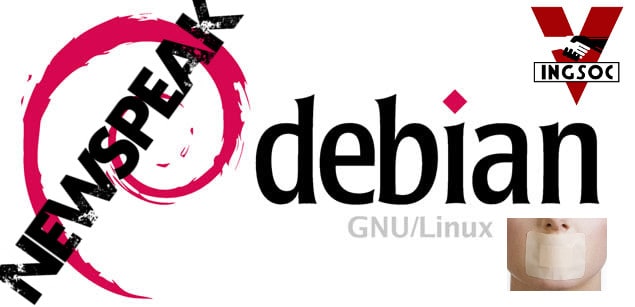

I think Preining mis-characterises what happens on the Linux kernel mailing list, and in Debian, in free software development in general, and what Sarah Sharp has said and done. I continue to think he is wrong about everything on this topic.
I am very surprised that Lars^WWirzenius is in possession of a crystal ball that allows him to see and evaluate my attitude towards all these items, considering that I have presented links to posts on the LKML, and yes, my interpretation of the matter. Mind that the whole text amounts to about 130 lines on my screen, while my personal opinion was stated in two paragraphs of total 9 lines plus some interspersed comments. And in these maybe 20 lines I didn t make general statements about open source, kernel development etc etc. Lars, I know you have closed your blog for comments so I couldn t ask you but please, can you send me one of your crystal balls if you have more of them? At least he has managed to keep a bit of proper writing and disagreed with my statement on Debian (whether there is fun or not in Debian). He is of course free to do that, but please, don t rob me the right to state that I think Debian has changed. All this dispute centers around people not being capable to distinguish two things: One, being against the Code of Conduct due to the inclusion of administrative actions without clear definitions, and Two, being pro offensive behavior and and insults. Now, dear Lars^WWirzenius, please listen: I never advocated abusive behavior or insults, nor do I defend it. (Did you hear that!) I simply opposed the Code of Conduct as ruling instrument. And what kind of emails I got due to my opposition was far outside the Code of Conduct you are so strongly defending. So please, stay at the facts, and stop insulting me. Thanks. Mart n Ferrari Concerning Mart n I don t have much to say but please, stop spreading lies. You stated:
Once again, he s complaining about how the fun from Debian has been lost because making sexist jokes, or treating other people like shit is not allowed any more.
Could you please come up with a reference to this? Or are you just interpreting? I am very disappointed about this level of discussion between Debian Developers. You not even cared to answer my comment on your blog. Should I say something clear here you should be happy that this has not been written on a Debian mailing list, otherwise I hope the Code of Conduct hammer would hit you.
So yes, it seems that at least these two blogs underline exactly what my opinion is: Communication culture in Debian has changed to be more company-like. Probably due to the ever increasing amount of developers that are paid for their work on Debian (Ubuntu), the pressure to follow US company codes has taken a firm grip, so firm that even stating my diverging opinion is already enough to get branded. Good Future!

8 October 2015

Gunnar Wolf: On evolving communities and changing social practices

I will join Lars and Tincho in stating this, and presenting a version contrary to what Norbert portraits. I am very glad and very proud that the community I am most involved in, the Debian project, has kept its core identity over the years, at least for the slightly-over-a-decade I have been involved in it. And I am very glad and very proud that being less aggressive, more welcoming and in general more respectful to each other does not counter this. When I joined Debian, part of the mantra chants we had is that in order to join a Free Software project you had to grow a thick skin, as sooner or later we'd all be exposed to flamefests. But, yes, the median age of the DD was way lower back then I don't have the data at hand, but IIRC I have always been close to our median. Which means we are all growing old and grumpy. But old and wiser. A very successful, important and dear subproject to many of us is the Debian Women Project. Its original aim was, as the name shows, to try to reduce the imbalance between men and women participants in Debian IIRC back in 2004 we had 3 female DDs, and >950 male DDs. Soon, the project started morphing into pushing all of Debian to be less hostile, more open to contributions from any- and everyone (as today our diversity statement reads). And yes, we are still a long, long, long way from reaching equality. But we have done great steps. And not just WRT women, but all of the different minorities, as well as to diverging opinions within our community. Many people don't enjoy us abiding by a code of conduct; I also find it irritating sometimes to have to abide by certain codes if we mostly know each other and know we won't be offended by a given comment... Or will we? So, being more open and more welcoming also means being more civil. I cannot get myself to agree with Linus' quote, when he says that respect is not just given to everybody but must be earned. We should always start, and I enjoy feeling that in Debian this is becoming the norm, by granting respect to everybody And not losing it, even if things get out of hand. Thick skins are not good for communication.

Norbert Preining: Looking at the facts: Sarah Sharp s crusade

Much has been written around the internet about this geeky kernel maintainer Sarah Sharp who left kernel development. I have now spent two hours reading through lkml posts, and want to summarize a few mails from the long thread, since most of the usual news sites just rewrap the original blog of hers without adding any background. darth-cookie The whole thread evolved out call for stable kernel review by Greg Kroah-Hartman where he complained about too many patches that are not actually in rc1 before going into stable:
<rant>
  I'm sitting on top of over 170 more patches that have been marked for
  the stable releases right now that are not included in this set of
  releases.  The fact that there are this many patches for stable stuff
  that are waiting to be merged through the main -rc1 merge window cycle
  is worrying to me.
  [...]
from where it developed into a typical Linus rant on people flagging crap for stable, followed by some jokes:
On Fri, Jul 12, 2013 at 8:47 AM, Steven Rostedt <rostedt@goodmis.org> wrote:
> I tend to hold things off after -rc4 because you scare me more than Greg
> does ;-)
 
Have you guys *seen* Greg? The guy is a freakish giant. He *should*
scare you. He might squish you without ever even noticing.
 
              Linus
and Ingo Molnar giving advice to Greg KH:
So Greg, if you want it all to change, create some _real_ threat: be frank 
with contributors and sometimes swear a bit. That will cut your mailqueue 
in half, promise!
with Greg KH taking a funny position in answering:
Ok, I'll channel my "inner Linus" and take a cue from my kids and start
swearing more.
Up to now a pretty decent and normal thread with some jokes and poking, nobody minded, and reading through it I had a good time. The thread continues with a discussion on requirements what to submit to stable, and some side threads on particular commits. And then, out of the blue, Social Justice Warrior (SJW) Sarah Sharp pops in with a very important contribution:
Seriously, guys?  Is this what we need in order to get improve -stable?
Linus Torvalds is advocating for physical intimidation and violence.
Ingo Molnar and Linus are advocating for verbal abuse.
 
Not *fucking* cool.  Violence, whether it be physical intimidation,
verbal threats or verbal abuse is not acceptable.  Keep it professional
on the mailing lists.
 
Let's discuss this at Kernel Summit where we can at least yell at each
other in person.  Yeah, just try yelling at me about this.  I'll roar
right back, louder, for all the people who lose their voice when they
get yelled at by top maintainers.  I won't be the nice girl anymore.
Onto which Linus answers in a great way:
That's the spirit.
 
Greg has taught you well. You have controlled your fear. Now, release
your anger. Only your hatred can destroy me.
 
Come to the dark side, Sarah. We have cookies.
On goes Sarah, gearing up in her SJW mode and starting to rant:
However, I am serious about this.  Linus, you're one of the worst
offenders when it comes to verbally abusing people and publicly tearing
their emotions apart.
 
http://marc.info/?l=linux-kernel&m=135628421403144&w=2
http://marc.info/?l=linux-acpi&m=136157944603147&w=2
 
I'm not going to put up with that shit any more.
Linus himself made clear what he thinks of her:
Trust me, there's a really easy way for me to curse at people: if you
are a maintainer, and you make excuses for your bugs rather than
trying to fix them, I will curse at *YOU*.
 
Because then the problem really is you.
[...]
It is easy to verify what Linus said, by reading the above two links and the answers of the maintainers, both agreed that it was their failure and were sorry. (Mauro s answer, Rafael s answer) It is just the geeky SJW that was not even attacked (who would dare to attack a woman nowadays?). The overall reaction to her by the maintainers can be exemplified by Thomas Gleixner s post:
Just for the record. I got grilled by Linus several times over the
last years and I can't remember a single instance where it was
unjustified.
What follows is a nearly endless discussion with Sarah meandering around, changing permanently her opinion what is acceptable. Linus tried to explain to her in simple words, without success, she continues to rant around. Here arguments are so weak I had nothing but good laugh:
> Sarah, that's a pretty potent argument by Linus, that "acting 
> professionally" risks replacing a raw but honest culture with a
> polished but dishonest culture - which is harmful to developing
> good technology.
> 
> That's a valid concern. What's your reply to that argument?
 
I don't feel the need to comment, because I feel it's a straw man
argument.  I feel that way because I disagree with the definition of
professionalism that people have been pushing.
 
To me, being "professional" means treating each other with respect.  I
can show emotion, express displeasure, be direct, and still show respect
for my fellow developers.
 
For example, I find the following statement to be both direct and
respectful, because it's criticizing code, not the person:
 
"This code is SHIT!  It adds new warnings and it's marked for stable
when it's clearly *crap code* that's not a bug fix.  I'm going to revert
this merge, and I expect a fix from you IMMEDIATELY."
 
The following statement is not respectful, because it targets the
person:
 
"Seriously, Maintainer.  Why are you pushing this kind of *crap* code to
me again?  Why the hell did you mark it for stable when it's clearly
not a bug fix?  Did you even try to f*cking compile this?"
Fortunately, she was immediately corrected and Ingo Molnar wrote an excellent refutation (starting another funny thread) of all her emails, statements, accusations (all of the email is a good read):
_That_ is why it might look to you as if the person was
attacked, because indeed the actions of the top level maintainer were
wrong and are criticised.
 
... and now you want to 'shut down' the discussion. With all due respect,
you started it, you have put out various heavy accusations here and elsewhere,
so you might as well take responsibility for it and let the discussion be
brought to a conclusion, wherever that may take us, compared to your initial view?
(He retracted that last statement, though I don t see a reason for it) Last but not least, let us return to her blog post, where she states herself that:
FYI, comments will be moderated by someone other than me. As this is my blog, not a
government entity, I have the right to replace any comment I feel like with 
 fart fart fart fart .
and she made lots of use of it, I counted at least 10 instances. She seems to remove or fart fart fart any comment that is not in line with her opinion. Further evidence is provided by this post on lkml. Everyone is free to have his own opinion (sorry, his/her), and I am free to form my own opinion on Sarah Sharp by just simply reading the facts. I am more than happy that one more SJW has left Linux development, as the proliferation of cleaning of speech from any personality has taken too far a grip. Coming to my home-base in Debian, unfortunately there is no one in the position and the state of mind of Linus, so we are suffering the same stupidities imposed by social justice worriers and some brainless feminists (no, don t get me wrong, these are two independent attributes. I do NOT state that feminism is brainless) that Linus and the maintainer crew was able to fend of this time. I finish with my favorite post from that thread, by Steven Rosted (from whom I also stole the above image!):
On Tue, 2013-07-16 at 18:37 -0700, Linus Torvalds wrote:
> Emotions aren't bad. Quite the reverse. 
 
Spock and Dr. Sheldon Cooper strongly disagree.
Post Scriptum (after a bike ride) The last point by Linus is what I criticize most on Debian nowdays, it has become a sterilized over-governed entity, where most fun is gone. Making fun is practically forbidden, since there is the slight chance that some minority somewhere on this planet might feel hurt, and by this we are breaking the CoC. Emotions are restricted to the Happy happy how nice we are and how good we are level of US and also Japanese self-reenforcement society. Post Post Scriptum I just read Sarah Sharp s post on What makes a good community? , and without giving a full account or review, I am just pi**ed by the usage of the word microaggressions I can only recommend everyone to read this article and this article to get a feeling how bs the idea of microaggressions has taken over academia and obviously not only academia. Post3 Scriptum I am happy to see Lars Wirzenius, Gunnar Wolf, and Mart n Ferrari opposing my view. I agree with them that my comments concerning Debian are not mainstream in Debian something that is not very surprising, though, and I think it is great that they have fun in Debian, like many other contributors. Post4 Scriptum Although nobody will read this, here is a great response from a female developer:
[...] To Linus: You're a hero to many of us. Don't change. Please. You DO
NOT need to take time away from doing code to grow a pair of breasts
and judge people's emotional states: [...]
Nothing to add here!

10 September 2015

Gunnar Wolf: So you want to get our book?

OK, I already bragged that our book on Operating Systems is finally printed and has, thus, been formally published. What I had not yet mentioned is how we planned its physical distribution. Yes, it is available for sale at some UNAM libraries... But coming to UNAM is sadly an option only for people who are in Mexico City. I have been quite busy, and was unable to come up with anything earlier, but I have finally finished setting up a decent although minimal web page for the book. In it, I mention the possible ways you can get your own printed copy of Fundamentos de sistemas operativos: Of course, the book is and will always be free for downloading, and its sources are online so you can easily derive from it as well. Enjoy! (and please report me any bugs you see!)

Gunnar Wolf: UNAM, more open than ever before.

Today I was refered to the publication of an "agreement" signed by my university's Rector: The Agreement that establishes the General Guidelines for the Open Access Policy of Universidad Nacional Aut noma de M xico. This is a document we have been waiting and pushing for throughout several years; I got involved in the Network of Digital Collections (Red de Acervos Digitales), RAD-UNAM back in 2011, and am honored to be its current coordinator, but this group has roots back in 2005. And, of course, by then several other people had been working on the topic without formal coordination. Not only we are happy because the agreement explicitly mentions our group as one of The Venues for Open Access publishing and dissemination in UNAM. In its seventh point, it mentions:
In the matters of Open Access, academic entities and university dependencies have the following obligations:
(...)
VII. Promote and support the creation and maintenance of institutional repositories, as well as the deposit of the digital resources produced by its academic community, which should be incorporated into Red de Acervos Digitales de la UNAM
(...)
So... We have done a good job. And there will be surely more to follow! I'm including here a copy of the agreement by itself (without the whole number of the Gaceta UNAM) because I will surely have to refer to it in the future.
AttachmentSize
Lineamientos generales para la pol tica de acceso abierto de la Universidad Nacional Aut noma de M xico89.83 KB

28 August 2015

Gunnar Wolf: 180

180 degrees people say their life has changed by 180 whenever something alters their priorities, their viewpoints, their targets in life. In our case, it's been 180 days. 183 by today, really. The six most amazing months in my life. We are still the same people, with similar viewpoints and targets. Our priorities have clearly shifted. But our understanding of the world, and our sources of enjoyment, and our outlook for the future... Are worlds apart. Not 180 , think more of a quantic transposition.

17 August 2015

Gunnar Wolf: report @mx (that means, sadly, gwolf DebConf15)

<Sigh/> For the second time since I joined Debian, I missed DebConf. This time, mostly for two completely happy reasons (which have, of course, grown up quite significatively): But adding to that very important factor, early-to-mid August is possibly the worst date for me to attend DebConf As that's when we start classes at UNAM, and I really don't want to delegate introducing my class to somebody else (besides it being or not possible). Life has been quite busy here. Besides starting my seventh semester as a teacher (finally being able to present my book on operating systems to the students!), I also took on teaching two modules for a diploma-course on embedded Linux. I'm co- teaching the "User-space Linux" module together with Gabriel Salda a, and will teach the "Boot process" module with Sandino Araico. There are many things that should be improved about the covered program, but we are having good fun working our way on it; Gabriel and I have given two (out of six) 6hr sessions each, and have reached the point where it is actually becoming fun :) As for Debian... I have been doing minimal maintenance work. Answering to some keyring tickets, or taking care of only high-profile important issues. I do not have time to do much. I have been wanting to do some interesting analysis on the evolution of our keyring for several months, but have not had the time to follow it up. Will do at some point, /mehopes. Anyway... This post is probably just because I need to somehow be there at our community's highest social, technical exchange period in the year. That is, there's not much to report, it's only me waving from home!

13 August 2015

Gunnar Wolf: It has landed.

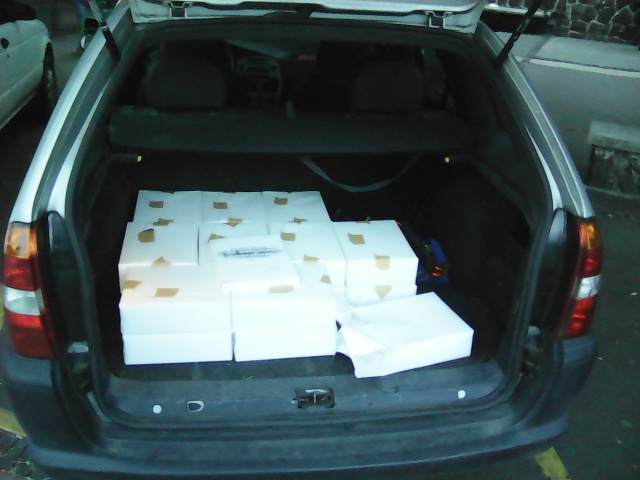
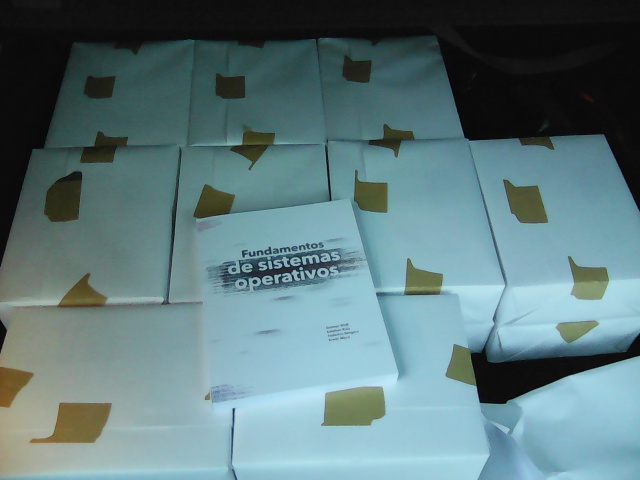
Basically everybody who knows me is aware that, basically for the last two years, I have been writing a book on Operating Systems for use in my class and, of course, in any similar class. Well, long story short, as of today: What's that in my car trunk? Lets have a closer look. Finally, Facultad de Ingenier a finished printing the book! So... Well, some minor data points: Anyway... Very happy here :D
AttachmentSize
IMG_20150812_193756.t.jpg106.36 KB
IMG_20150812_193805.t.jpg82.22 KB

10 July 2015

Gunnar Wolf: Finishing the course on "Free Software and Open Standards"

A couple of months ago, I was invited to give the starting course for the Masters degree in Free Software in the Universidad Andina Sim n Bol var university. UASB is a multinational university, with campuses in (at least) Ecuador, Chile, Bolivia and Colombia; I was doubtful at first regarding the seriousness of this proposal and the viability of the program, but time made my doubts disappear. Bolivia is going through an interesting process, as they have one of the strongest worded government mandates for migration to free software for the public administration in the next couple of years; this migration has prompted the interest of many professionals in the country. In particular, we have over 40 registered people for this Masters degree. Studying a Masters degree is a long-term commitment which signifies a big time investment, and although many of the student are quite new to the idea of free software, they are willing to spend this time (and money, as the university is privately owned and charges for its enrollment). I gave this class together with Alejandro Miranda (a.k.a. @pooka), as we have a very good pair-teaching dynamics; we had already given many conferences together, but this is the first time we had the opportunity to share a whole course and the experience was very good. We have read the students' logs, and many of them clearly agree with this. I had to skip two of the (ten) lessons, as I travelled from Mexico to Argentina halfway through it (of course, we brought the babies to meet my wife's family and friends!), so we had also the honor of having Esteban Lima fill in for those sessions. I am very happy and grateful that the University took care to record our presentations and intend to record and put online all of the classes; as we were the first in the program, there were some understandable hiccups and some sessions were lost, but most are available. Here they are, in case you are interested in refering to them:
Topic Video (my server) Video (Youtube)
Introduction to free software Watch Watch
History Watch Watch
Free culture N/A N/A
The effects of free software Watch Watch
Free software and open standards related to technologic soverignity Watch Watch
The free software ecosystem Watch Watch
Free software implementation in Bolivia Watch Watch
Introduction to intelectual property: Copyright, patents, trademarks, etc. Watch Watch
Who is "the community" and why do we speak about it? Watch Watch
Current status and challenges for the movement N/A N/A
We have yet another video file (which I have not fully followed through) titled ADSIB - Migration plan. It can also be downloaded from my server or watched online at Youtube. All in all: This was a great opportunity and a joy to do. I think the material we used and developed fit well what was expected from us, and we had fun giving somewhat heterodox readings on our movement.

13 June 2015

Gunnar Wolf: Almost free Some experiences with the Raspberry Pi, CI20, BananaPi, CuBox-i... And whatever will follow

I know very little about hardware. I think I have a good understanding on many aspects of what happens inside a computer, but my knowledge is clearly firmer on what happens once an operating system is already running. And even then, my understanding of the lower parts of reality is shaky at most At least according to my self-evaluation, of course, comparing to people I'm honored to call "my peers". During the last ~18 months, my knowledge of this part of reality, while still far from complete, has increased quite a bit Maybe mostly showing that I'm basically very cheap: As I have come across very cheap (or even free for me!) hardware, I have tried to understand and shape what happens in levels below those where I dwell. I have been meaning to do a writeup on the MIPS Creator CI20, which was shipped to me for free (thanks++!) by Imagination Technologies; I still want to get more familiar with the board and have better knowledge before reporting on it. Just as a small advance, as this has been keeping me somewhat busy: I got this board after their offer to Debian Developers, and prompted because I'll be teaching some modules on the Embedded Linux diploma course dictated by Facultad de Ingenier a, UNAM Again, I'll blog about that later. My post today follows Riku's, titled Dystopia of things, where he very clearly finds holes in the Internet of Things offering of one specific product and one specific company, but allows for generalizations on what we will surely see as the model. Riku says:
Today, the GPL sources for hub are available - at least the kernel and a patch for busybox. The proper GPL release is still only through written offer. The sources appeared online April this year while Hub has been sold for two years already. Even if I ordered the GPL CD, it's unlikely I could build a modified system with it - too many proprietary bits. The whole GPL was invented by someone who couldn't make a printer do what he wanted. The dystopian today where I have to rewrite the whole stack running on a Linux-based system if I'm not happy what's running there as provided by OEM.
This is not exactly the situation on the boards/products (it's a disservice to call the cute CuBox-i just a board!) I mention I'm using, but it's neither too far. Being used to the easy x86 world, I am used to bitching on specific hardware that does not get promptly recognized by the Linux kernel But even with the extra work UEFI+SecureBoot introduces, getting the kernel to boot is something we just take for granted. In the MIPS and ARM worlds, this is not so much of a given; I'm still treating the whole SPL and DeviceTree world as a black box, but that's where a lot of the work happens. The boards I am working on try to make a point they are Open Hardware. The CI20 is quite impressive in this regard, as not only it has a much more complete set of on-board peripherials than any other, but a wealth of schematics, datasheets and specifications for the different parts of its components. And, of course, the mere availability of the MIPSfpga program to universities worldwide is noteworthy Completely outside of my skillset, but looks most interesting. However... Despite being so much almost-Free-with-a-capital-F, all those boards fail our definitions of freedom in several ways. And yes, they lead us to a situation similar to what Riku describes, to what Stallman feared... To a situation not really better to where we stand on openly closed-source, commodity x86 hardware: Relying on binary blobs and on non-free portions of code to just use our hardware, or at least to use many of the features that would be available to us otherwise. As an example, both the CI20 and the CuBox-i vendors provide system images able to boot what they describe as a Debian 7 system, based on a 3.0 Linux kernel (which Debian never used; IIRC the CuBox-i site said it was derived from a known-good Android kernel)... Only that it's an image resulting of somebody else installing and configuring it. Why should we trust their image to be sane? Yes, the resulting installation is quite impressive (i.e. the CI20's 3D demos are quite impressive for a system that feels otherwise sluggish, and out of my ARM experience, I'd wager it feels sluggish mostly because of a slow SSD)... I have managed to do clean Debian installs on most of my ARM machines (the CuBox-i as described in my previous blog post; this post from Elena of Valhalla'' prompted me into trying the already well documented way of running the official Debian Installer, which worked like a charm and gave me a very nice and responsive Debian 8 install Modulo yes, the Banana's non-free video interface, which AFAICT uses the non-free Mail binary driver... And which I haven't had the time to play with yet. Of course, my CuBox is in a similar situation, where it works like a charm as a personal server, but is completely worthless as a set-top box. So, with those beautiful, small, cheap SoC systems, we are close to where we stood twenty years ago with x86 Linux: Good support for a small set of peripherials, but a far cry from having a functional system with exclusively free software. ,
Despite claims of being open source, this is not open source hardware. If you are thinking of getting this device, you should also try looking into the hardware from our Community instead.
Still... Playing with these boards has taught me a lot, and has clearly taught me I'm still standing on the first steps of the n00b level. I have a lot to learn to be able to responsibly teach my part of the diploma course, and I'm very thankful for the differences in hardware (and, of course, for the hardware manufacturers, specially for the MIPS Creator CI20 and the Lemaker Banana Pi for giving me boards to work on!) I shall keep posting on this topic.

19 May 2015

Gunnar Wolf: Feeling somewhat special

Today I feel more special than I have ever felt. Or... Well, or something like that. Thing is, there is no clear adjective for this But I successfully finished my Specialization degree! Yes, believe it or not, today I can formally say I am Specialist in Informatic Security and Information Technologies (Especialista en Seguridad Inform tica y Tecnolog as de la Informaci n), as awarded by the Higher School of Electric and Mechanic Engineering (Escuela Superior de Ingenier a Mec nica y El ctrica) of the National Polytechnical Institute (Instituto Polit cnico Nacional). In Mexico and most Latin American countries, degrees are usually incorporated to your name as if they were a nobiliary title. Thus, when graduating from Engineering studies (pre-graduate universitary level), I became "Ingeniero Gunnar Wolf". People graduating from further postgraduate programs get to introduce themselves as "Maestro Foobar Baz" or "Doctor Quux Noox". And yes, a Specialization is a small posgraduate program (I often say, the smallest possible posgraduate). And as a Specialist... What can I brag about? Can say I am Specially Gunnar Wolf? Or Special Gunnar Wolf? Nope. The honorific title for a Specialization is a pointer to null, and when casted into a char* it might corrupt your honor-recognizing function. So I'm still Ingeniero Gunnar Wolf, for information security reasons. So that's the reason I am now enrolled in the Masters program. I hope to write an addenda to this message soonish (where soonish 18 months) saying I'm finally a Maestro. As a sidenote, many people asked me: Why did I take on the specialization, which is a degree too small for most kinds of real work recognition? Because it's been around twenty years since I last attended a long-term scholar program as a student. And my dish is quite full with activities and responsabilities. I decided to take a short program, designed for 12 months (I graduated in 16, minus two months that the university was on strike... Quite good, I'd say ;-) ) to see how I fared on it, and only later jumping on the full version. Because, yes, to advance my career at the university, I finally recognized and understood that I do need postgraduate studies. Oh, and what kind of work did I do for this? Besides the classes I took, I wrote a thesis on a model for evaluating covert channels for establishing secure communications.

14 May 2015

Gunnar Wolf: Everybody seems to have an opinion on the taxis vs. Uber debate...

The discussion regarding the legality and convenience of Uber, Cabify and similar taxi-by-app services has come to Mexico City Over the last few days, I've seen newspapers talk about taxi drivers demonstrating against said companies, early attempts at regulating their service, and so on. I hold the view that every member of a society should live by its accepted rules (i.e. laws) and if they hold the laws as incorrect, unfair or wrong, they should strive to get the laws to change. Yes, it's a hard thing to do, most often filled with resistence, but it's the only socially responsible way to go. Private driver hiring applications have several flaws, but maybe the biggest one is that they are... How to put it? I cannot find a word better than illegal. Taxi drivers in our city (and in most cities, as far as I have read) undergo a long process to ensure they are fit for the task. Is the process incomplete? Absolutely. But the answer is not to abolish it in the name of the free market. The process must be, if anything, tightened. The process for granting a public driver license to an individual is way stricter than to issue me a driving license (believe it or not, Mexico City abolished taking driving tests several years ago). Taxis do get physical and mechanical review Is their status mint and perfect? No way. But compare them to taxis in other Mexican states, and you will see they are in general in a much better shape. Now... One of the things that angered me most about the comments to articles such as the ones I'm quoting is the middle class mentality they are written from. I have seen comments ranging from stupidly racist humor attempts (Mr. Mayor, the Guild of Kidnappers and Robbers of Iztapalapa demand the IMMEDIATE prohibition on UBER as we are running low on clients or the often repeated comment that taxi drivers are (...) dirty, armpit-smelly that listen to whatever music they want) to economic culture-based discrimination Uber is just for credit card users as if it were enough of an argument... Much to the opposite, it's just discrimination, as many people in this city are not credit subjects and do not exist in the banking system, or cannot have an always-connected smartphone Should they be excluded from the benefits of modernity just because of their economic difference? And yes, I'm by far not saying Mexico City's taxi drivers are optimal. I am an urban cyclist, and my biggest concern/fear are usually taxi drivers (more so than microbus drivers, which are a class of their own). Again , as I said at the beginning of the post, I am of the idea that if current laws and their enforcement are not enough for a society, it has to change due to that society's pressure It cannot just be ignored because nobody follows the rules anyway. There is quite a bit that can be learnt from Uber's ways, and there are steps that can be taken by the company to become formal and legal, in our country and in others where they are accused of the same lacking issues. We all deserve better services. Not just those of us that can pay for a smartphone and are entitled to credit cards. And all passenger-bearing services require strict regulations.

8 May 2015

Gunnar Wolf: Guests in the Classroom: Felipe Esquivel (@felipeer) on the applications on parallelism, focusing on 3D animation

I love having guests give my classes :) This time, we had Felipe Esquivel, a good friend who had been once before invited by me to the Faculty, about two years ago. And it was due time to invite him again! Yes, this is the same Felipe I recently blogged about To give my blog some credibility, you can refer to Felipe's entry in IMDb and, of course, to the Indiegogo campaign page for Natura. Felipe knows his way around the different aspects of animation. For this class (2015-04-15), he explained how traditional ray-tracing techniques work, and showed clear evidences on the promises and limits of parallelism Relating back to my subject and to academic rigor, he clearly shows the speed with which we face Amdahl's Law, which limits the efficiency of parallelization at a certain degree perprogram construct, counterpointed against Gustafson's law, where our problem will be able to be solved in better detail given more processing abilities (and will thus not hit Amdahl's hard ceiling). A nice and entertaining talk. But I know you are looking for the videos! Get them, either at my server or at archive.org.

28 April 2015

Gunnar Wolf: Bestest birthday ever

Bestest birthday ever
That's all I need to enjoy the best best party ever. Oh! Shall I mention that we got a beautiful present for the kids from our very dear DebConf official Laminatrix! Photos not yet available, but will provide soon.

Next.

Previous.