Search Results: "Dirk Eddelbuettel"

17 March 2025

Dirk Eddelbuettel: RcppExamples 0.1.10: New factor Example, Other Updates

A new version 0.1.10 of the RcppExamples package is now on CRAN, and marks the first release in five and half years. RcppExamples provides a handful of short examples detailing by concrete working examples how to set up basic R data structures in C++. It also provides a simple example for packaging with Rcpp. The package provides (generally fairly) simple examples, more (and generally longer) examples are at the Rcpp Gallery. This releases brings a bi-directorial example of factor conversion, updates the Date example, removes the explicitly stated C++ compilation standard (which CRAN now nags about) and brings a number of small fixes and maintenance that accrued since the last release. The NEWS extract follows:

Changes in RcppExamples version 0.1.10 (2025-03-17)
  • Simplified DateExample by removing unused API code
  • Added a new FactorExample with conversion to and from character vectors
  • Updated and modernised continuous integrations multiple times
  • Updated a few documentation links
  • Updated build configuration
  • Updated README.md badges and URLs
  • No longer need to set a C++ compilation standard

Courtesy of my CRANberries, there is also a diffstat report for this release. For questions, suggestions, or issues please use the issue tracker at the GitHub repo.

This post by Dirk Eddelbuettel originated on his Thinking inside the box blog. If you like this or other open-source work I do, you can now sponsor me at GitHub.
9 March 2025

Dirk Eddelbuettel: RcppNLoptExample 0.0.2: Minor Updates

An update to our package RcppNLoptExample arrived on CRAN earlier today marking the first update since the intial release more than four year ago. The nloptr package, created by Jelmer Ypma, has long been providing an excellent R interface to NLopt, a very comprehensive library for nonlinear optimization. In particular, Jelmer carefully exposed the API entry points such that other R packages can rely on NLopt without having to explicitly link to it (as one can rely on R providing sufficient function calling and registration to make this possible by referring back to nloptr which naturally has the linking information and resolution). This package demonstrates this in a simple-to-use Rcpp example package that can serve as a stanza. More recent NLopt versions appear to have changed behaviour a little so that an example we relied upon in simple unit test now converges to a marginally different numerical value, so we adjusted a convergence treshold. Other than that we did a number of the usual small updates to package metadata, to the README.md file, and to continuous integration. The (very short) NEWS entry follows:

Changes in version 0.0.2 (2025-03-09)
  • Updated tolerance in simple test as newer upstream nlopt change behaviour ever so slightly leading to an other spurious failure
  • Numerous small and standard updates to DESCRIPTION, README.md, badges, and continuous integration setup

Courtesy of my CRANberries, there is also a diffstat report for this release. For questions, suggestions, or issues please use the issue tracker at the GitHub repo.

This post by Dirk Eddelbuettel originated on his Thinking inside the box blog. If you like this or other open-source work I do, you can now sponsor me at GitHub.

8 March 2025

Dirk Eddelbuettel: RcppTOML 0.2.3 on CRAN: Compiler Nag, Small Updates

A new (mostly maintenance) release 0.2.3 of RcppTOML is now on CRAN. TOMLis a file format that is most suitable for configurations, as it is meant to be edited by humans but read by computers. It emphasizes strong readability for humans while at the same time supporting strong typing as well as immediate and clear error reports. On small typos you get parse errors, rather than silently corrupted garbage. Much preferable to any and all of XML, JSON or YAML though sadly these may be too ubiquitous now. TOML is frequently being used with the projects such as the Hugo static blog compiler, or the Cargo system of Crates (aka packages ) for the Rust language. This release was tickled by another CRAN request: just like yesterday s and the RcppDate release two days ago, it responds to the esoteric whitespace in literal operator depreceation warning. We alerted upstream too. The short summary of changes follows.

Changes in version 0.2.3 (2025-03-08)
  • Correct the minimum version of Rcpp to 1.0.8 (Walter Somerville)
  • The package now uses Authors@R as mandated by CRAN
  • Updated 'whitespace in literal' issue upsetting clang++-20
  • Continuous integration updates including simpler r-ci setup

Courtesy of my CRANberries, there is also a diffstat report for this release. For questions, suggestions, or issues please use the issue tracker at the GitHub repo.

This post by Dirk Eddelbuettel originated on his Thinking inside the box blog. If you like this or other open-source work I do, you can now sponsor me at GitHub.

7 March 2025

Dirk Eddelbuettel: RcppSimdJson 0.1.13 on CRAN: Compiler Nag, New Upsteam

A new release 0.1.13 of the RcppSimdJson package is now on CRAN. RcppSimdJson wraps the fantastic and genuinely impressive simdjson library by Daniel Lemire and collaborators. Via very clever algorithmic engineering to obtain largely branch-free code, coupled with modern C++ and newer compiler instructions, it results in parsing gigabytes of JSON parsed per second which is quite mindboggling. The best-case performance is faster than CPU speed as use of parallel SIMD instructions and careful branch avoidance can lead to less than one cpu cycle per byte parsed; see the video of the talk by Daniel Lemire at QCon. This release was tickled by another CRAN request: just like yesterday s RcppDate release, it responds to the esoteric whitespace in literal operator depreceation warning. Turns out that upstream simdjson had this fixed a few months ago as the node bindings package ran into it. Other changes include a bit of earlier polish by Daniel, another CRAN mandated update, CI improvements, and a move of two demos to examples/ to avoid having to add half a dozen packages to Suggests: for no real usage gain in the package. The short NEWS entry for this release follows.

Changes in version 0.1.13 (2025-03-07)
  • A call to std::string::erase is now guarded (Daniel)
  • The package now uses Authors@R as mandated by CRAN (Dirk)
  • simdjson was upgraded to version 3.12.2 (Dirk)
  • Continuous integration updated to more compilers and simpler setup
  • Two demos are now in inst/examples to not inflate Suggests

Courtesy of my CRANberries, there is also a diffstat report for this release. For questions, suggestions, or issues please use the issue tracker at the GitHub repo.

This post by Dirk Eddelbuettel originated on his Thinking inside the box blog. If you like this or other open-source work I do, you can now sponsor me at GitHub.

6 March 2025

Dirk Eddelbuettel: RcppDate 0.0.5: Address Minor Compiler Nag

RcppDate wraps the featureful date library written by Howard Hinnant for use with R. This header-only modern C++ library has been in pretty wide-spread use for a while now, and adds to C++11/C++14/C++17 what will is (with minor modifications) the date library in C++20. The RcppDate adds no extra R or C++ code and can therefore be a zero-cost dependency for any other project; yet a number of other projects decided to re-vendor it resulting in less-efficient duplication. Oh well. C est la via. This release sync wuth the (already mostly included) upstream release 3.0.3, and also addresses a new fresh (and mildly esoteric) nag from clang++-20. One upstream PR already addressed this in the files tickled by some CRAN packages, I followed this up with another upstream PR addressing this in a few more occurrences.

Changes in version 0.0.5 (2025-03-06)
  • Updated to upstream version 3.0.3
  • Updated 'whitespace in literal' issue upsetting clang++-20; this is also fixed upstream via two PRs

Courtesy of my CRANberries, there is also a diffstat report for the most recent release. More information is available at the repository or the package page.

This post by Dirk Eddelbuettel originated on his Thinking inside the box blog. If you like this or other open-source work I do, you can sponsor me at GitHub.

5 March 2025

Dirk Eddelbuettel: #46: Adding arm64 to r2u

Welcome to post 46 in the $R^4 series! r2u, introduced less than three years ago in post #37, has become a runaway success. When I last tabulated downloads in early January, we were already at 33 million downloads of binary CRAN packages across the three Ubuntu LTS releases we support. These were exclusively for the amd64 platform of standard (Intel or AMD made) x64_64 cpus. Now we are happy to announce that arm64 support has been added and is available!

Why arm64? The arm64 platform is already popular on (cloud) servers and is being pushed quite actively by the cloud vendors. AWS calls their cpu graviton , GCS calls it axion . General servers call the cpu ampere ; on laptop / desktops it is branded snapdragon or cortex or something else. Apple calls their variant M1, M2, up to M4 by now (and Linux support exists for the brave, it is less straightforward). What these have in common is a generally more favourable power consumed to ops provided ratio. That makes these cheaper to run or rent on cloud providers. And in laptops they tend to last longer on a single charge too. Distributions such as Debian, Ubuntu, Fedora had arm64 for many years. In fact, the CRAN binaries of R, being made as builds at launchpad.net long provided arm64 in Michael s repo, we now also mirror these to CRAN. Similarly, Docker has long supported containers. And last but not least two issue tickets (#40, #55) had asked a while back.

So Why Now? Good question. I still do not own any hardware with it, and I have not (yet?) bothered with the qemu-based emulation layer. The real difference maker was the recent availability of GitHub Actions instances of ubuntu-24.04-arm (and now apparently also for 22.04). So I started some simple experiments which made it clear this was viable.

What Does It Mean for a CRAN Repo? Great question. As is commonly known, of the (currently) 22.1k CRAN packages, a little under 5k are compiled . Why does this matter? Because the Linux distributions know what they are doing. The 17k (give or take) packages that do not contain compiled code can be used as is (!!) on another platform. Debian and Ubuntu call these builds binary: all as they work all platforms as is . The others go by binary: any and will work on any platform for which they have been built. So we are looking at roughly 5k new binaries.

So How Many Are There? As I write this in early March, roughly 4.5k of the 5k. Plus the 17.1k binary: all and we are looking at near complete coverage!

So What Is The Current State? Pretty complete. Compare to the amd64 side of things, we do not (yet ?) have BioConductor support; this may be added. A handful of packages do not compile because their builds seem to assume Linux so must be amd64 and fail over cpu instructions. Similarly, a few packages want to download binary build blobs (my own Rblpapi among them) but none exist for arm64. Such is life. We will try to fix builds as time permits and report build issues to the respective upstream repos. Help in that endeavour would be most welcome. But all the big and slow compiles one may care about (hello duckdb, hello arrow, ) are there. Which is pretty exciting!

How Does One Get Started? In GitHub Actions, just pick ubuntu-24.04-arm as the platform, and use the r-ci or r2u-setup actiions. A first test yaml exists worked (though this last version had the arm64 runner commented out again). (And no, arm64 was not faster than amd64. More tests needed.) For simple tests, Docker. The rocker/r-ubuntu:24.04 container exists for arm64 (see here), and one can add r2u support as is done in this Dockerfile which is used by the builds and available as eddelbuettel/r2u_build:noble. I will add the standard rocker/r2u:24.04 container (or equally rocker/r2u:noble) in a day or two, I had not realised I wasn t making them for arm64. One a real machine such as a cloud instance or a proper instance, just use the standard r2u script for noble aka 24.04 available here. The key lines are the two lines
echo "deb [arch=amd64,arm64] https://r2u.stat.illinois.edu/ubuntu noble main" \
    > /etc/apt/sources.list.d/cranapt.list

# ...

echo "deb [arch=amd64,arm64] https://cloud.r-project.org/bin/linux/ubuntu noble-cran40/" \
     > /etc/apt/sources.list.d/cran_r.list
creating the apt entry and which are now arm64-aware. After that, apt works as usual, and of course r2u works as usual thanks also to bspm so you can just do, say
install.packages(c("tidyverse", "brms", "rstan", "sf", "terra"))
and enjoy the binaries rolling in. So give it a whirl if you have access to such hardware. We look forward to feedback, suggestes, feature requests or bug reports. Let us know how it goes!

This post by Dirk Eddelbuettel originated on his Thinking inside the box blog. If you like this or other open-source work I do, you can now sponsor me at GitHub.

20 February 2025

Dirk Eddelbuettel: Rcpp now used by 3000 CRAN packages!

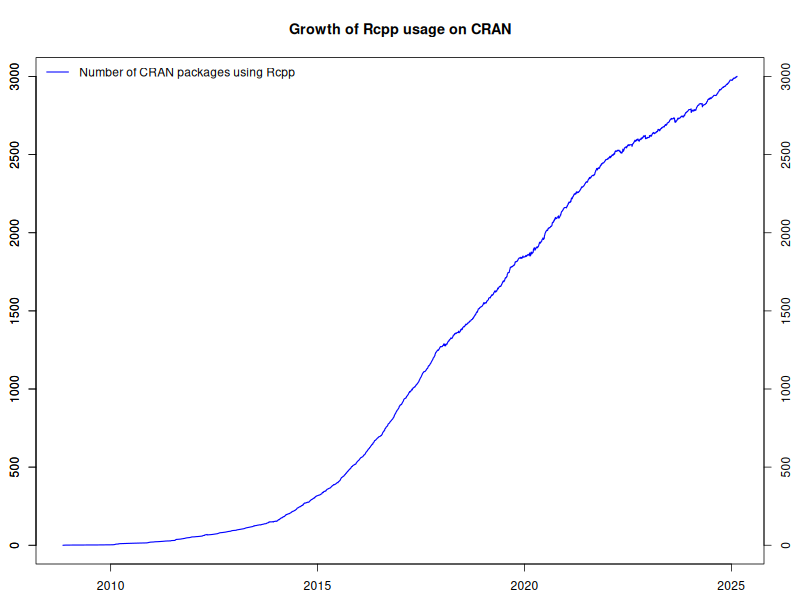
3000 Rcpp packages As of today, Rcpp stands at 3001 reverse-dependencies on CRAN. The graph on the left depicts the growth of Rcpp usage (as measured by Depends, Imports and LinkingTo, but excluding Suggests) over time. Rcpp was first released in November 2008. It took seven year years to clear 500 packages in late October 2015 after which usage of R and Rcpp accelerated: 1000 packages in April 2017, 1500 packages in November 2018, 2000 packages in July 2020, and 2500 package in February 2022. The chart extends to the very beginning via manually compiled data from CRANberries and checked with crandb. The core part of the data set is generated semi-automatically when updating a (manually curated) list of packages using Rcpp that is available too. The Rcpp team aims to keep Rcpp as performant and reliable as it has been (and see e.g. here for more details). Last month s 1.0.14 release post is a good example of the ongoing work. A really big shoutout and Thank You! to all users and contributors of Rcpp for help, suggestions, bug reports, documentation or, of course, code.

This post by Dirk Eddelbuettel originated on his Thinking inside the box blog. If you like this or other open-source work I do, you can sponsor me at GitHub.

18 February 2025

Dirk Eddelbuettel: RcppDE 0.1.8 on CRAN: Maintenance

A maintenance release of our RcppDE package arrived at CRAN. RcppDE is a port of DEoptim, a package for derivative-free optimisation using differential evolution, from plain C to C++. By using RcppArmadillo the code became a lot shorter and more legible. Our other main contribution is to leverage some of the excellence we get for free from using Rcpp, in particular the ability to optimise user-supplied compiled objective functions which can make things a lot faster than repeatedly evaluating interpreted objective functions as DEoptim does (and which, in fairness, most other optimisers do too). The gains can be quite substantial. This release is mostly maintenance. In the repo, we switched to turning C++11 as a compilation standard off fairly soon after the previous release two and a half years ago. But as CRAN is now more insistent, it drove this release (as it has a few reccent ones). We also made a small internal change to allow compilation under ARMA_64BIT_WORD for larger vectors (which we cannot easily default to as 32-bit integers are engrained in R). Other than that just the usual updates to badges and continuous integration. Courtesy of my CRANberries, there is also a diffstat report. More detailed information is on the RcppDE page, or the repository.

This post by Dirk Eddelbuettel originated on his Thinking inside the box blog. If you like this or other open-source work I do, you can sponsor me at GitHub.

12 February 2025

Dirk Eddelbuettel: RcppUUID 1.2.0 on CRAN: Adding Clock-based UUIDs

The RcppUUID package on CRAN has been providing UUIDs (based on the underlying Boost library) for several years. Written by Artem Klemsov and maintained in this gitlab repo, the package is a very nice example of clean and straightforward library binding. As it had dropped off CRAN over a relatively minor issue, I descided to adopted it with the previous 1.1.2 release made quite recently. This release adds new high-resolution clock-based UUIDs accordingt to the v7 spec. Internally 100ns increments are represented. The resulting UUIDs are both unique and sortable. I added this recent example to the README.md which illustrated both the implicit ordering and uniqueness. The unit tests check this with a much larger N.
> RcppUUID::uuid_generate_time(5)
[1] "0194d8fa-7add-735c-805b-6bbf22b78b9e" "0194d8fa-7add-735e-8012-3e0e53895b19"
[3] "0194d8fa-7add-735e-81af-bc67bb435ade" "0194d8fa-7add-735e-82b1-405bf57963ad"
[5] "0194d8fa-7add-735f-801e-efe57078b2e7"
>
While one can revert from the UUID object to the clock object, I am not aware of a text parser so there is currently no inverse function (as ulid offers) for the character representation. The NEWS entry for the two releases follows.

Changes in version 1.2.0 (2025-02-12)
  • Time-based UUIDs, ie version 7, can now be generated (requiring Boost 1.86 or newer as in the current BH package)

Changes in version 1.1.2 (2025-01-31)
  • New maintainer to resurrect package on CRAN

Courtesy of my CRANberries, there is also a diffstat report. More detailed information is on the RcppUUID page, or the github repo.

This post by Dirk Eddelbuettel originated on his Thinking inside the box blog. If you like this or other open-source work I do, you can sponsor me at GitHub.

7 February 2025

Dirk Eddelbuettel: zigg 0.0.2 on CRAN: Micromaintenance

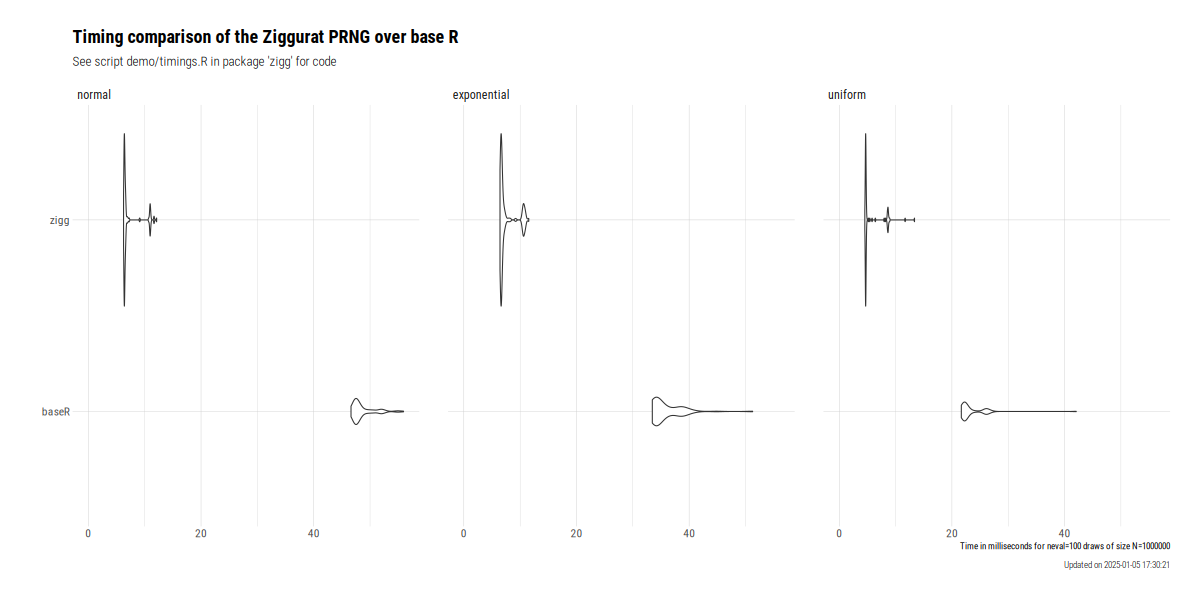
benchmark chart The still very new package zigg which arrived on CRAN a week ago just received a micro-update at CRAN. zigg provides the Ziggurat pseudo-random number generator (PRNG) for Normal, Exponential and Uniform draws proposed by Marsaglia and Tsang (JSS, 2000), and extended by Leong et al. (JSS, 2005). This PRNG is lightweight and very fast: on my machine speedups for the Normal, Exponential, and Uniform are on the order of 7.4, 5.2 and 4.7 times faster than the default generators in R as illustrated in the benchmark chart borrowed from the git repo. As wrote last week in the initial announcement, I had picked up their work in package RcppZiggurat and updated its code for the 64-buit world we now live in. That package alredy provided the Normal generator along with several competing implementations which it compared rigorously and timed them. As one of the generators was based on the GNU GSL via the implementation of Voss, we always ended up with a run-time dependency on the GSL too. No more: this new package is zero-depedency, zero-suggsts and hence very easy to deploy. Moreover, we also include a demonstration of four distinct ways of accessing the compiled code from another R package: pure and straight-up C, similarly pure C++, inclusion of the header in C++ as well as via Rcpp. The other advance is the resurrection of the second generator for the Exponential distribution. And following Burkardt we expose the Uniform too. The main upside of these generators is their excellent speed as can be seen in the comparison the default R generators generated by the example script timings.R: Needless to say, speed is not everything. This PRNG comes the time of 32-bit computing so the generator period is likely to be shorter than that of newer high-quality generators. If in doubt, forgo speed and stick with the high-quality default generators. This release essentially just completes the DESCRIPTION file and README.md now that this is a CRAN package. The short NEWS entry follows.

Changes in version 0.0.2 (2025-02-07)
  • Complete DESCRIPTION and README.md following initial CRAN upload

Courtesy of my CRANberries, there is a diffstat report relative to previous release. For more information, see the package page or the git repo.

This post by Dirk Eddelbuettel originated on his Thinking inside the box blog. If you like this or other open-source work I do, you can sponsor me at GitHub.

6 February 2025

Dirk Eddelbuettel: RcppArmadillo 14.2.3-1 on CRAN: Small Upstream Fix

armadillo image Armadillo is a powerful and expressive C++ template library for linear algebra and scientific computing. It aims towards a good balance between speed and ease of use, has a syntax deliberately close to Matlab, and is useful for algorithm development directly in C++, or quick conversion of research code into production environments. RcppArmadillo integrates this library with the R environment and language and is widely used by (currently) 1215 other packages on CRAN, downloaded 38.2 million times (per the partial logs from the cloud mirrors of CRAN), and the CSDA paper (preprint / vignette) by Conrad and myself has been cited 612 times according to Google Scholar. Conrad released a minor version 14.2.3 yesterday. As it has been two months since the last minor release, we prepared a new version for CRAN too which arrived there early this morning. The changes since the last CRAN release are summarised below.

Changes in RcppArmadillo version 14.2.3-1 (2025-02-05)
  • Upgraded to Armadillo release 14.2.3 (Smooth Caffeine)
    • Minor fix for declaration of xSYCON and xHECON functions in LAPACK
    • Fix for rare corner-case in reshape()

Courtesy of my CRANberries, there is a diffstat report relative to previous release. More detailed information is on the RcppArmadillo page. Questions, comments etc should go to the rcpp-devel mailing list off the Rcpp R-Forge page.

This post by Dirk Eddelbuettel originated on his Thinking inside the box blog. If you like this or other open-source work I do, you can sponsor me at GitHub.

2 February 2025

Dirk Eddelbuettel: RcppUUID 1.1.2 on CRAN: Newly Adopted Package

The RcppUUID package on CRAN has been providing UUIDs (based on the underlying Boost library) for several years. Written by Artem Klemsov and maintained in this gitlab repo, the package is a very nice example of clean and straightforward library binding. When we did our annual BH upgrade to 1.87.0 and check reverse dependencies, we noticed the RcppUUID needed a small and rather minor update which we showed as a short diff in an issue filed. Neither I nor CRAN heard from Artem, so the packaged ended up being archived last week. Which in turn lead me to make this minimal update to 1.1.2 to resurrect it, which CRAN processed more or less like a regular update given this explanation and so it arrived last Friday. Courtesy of my CRANberries, there is also a a new package note (no diffstat report yet). More detailed information is on the RcppUUID page, or the github repo.

This post by Dirk Eddelbuettel originated on his Thinking inside the box blog. If you like this or other open-source work I do, you can sponsor me at GitHub.

Dirk Eddelbuettel: RcppSpdlog 0.0.20 on CRAN: New Upstream, New Features

Version 0.0.20 of RcppSpdlog arrived on CRAN early this morning and has been uploaded to Debian. RcppSpdlog bundles spdlog, a wonderful header-only C++ logging library with all the bells and whistles you would want that was written by Gabi Melman, and also includes fmt by Victor Zverovich. You can learn more at the nice package documention site. This release updates the code to the version 1.15.1 of spdlog which was released this morning as well. It also contains a contributed PR which illustrates logging in a multithreaded context. The NEWS entry for this release follows.

Changes in RcppSpdlog version 0.0.20 (2025-02-01)
  • New multi-threaded logging example (Young Geun Kim and Dirk via #22)
  • Upgraded to upstream release spdlog 1.15.1

Courtesy of my CRANberries, there is also a diffstat report. More detailed information is on the RcppSpdlog page, or the package documention site.

This post by Dirk Eddelbuettel originated on his Thinking inside the box blog. If you like this or other open-source work I do, you can sponsor me at GitHub.

31 January 2025

Dirk Eddelbuettel: zigg 0.0.1 on CRAN: New Package!

Thrilled to announce a new package: zigg. It arrived on CRAN today after a few days of review in the newbies queue. zigg provides the Ziggurat pseudo-random number generator for Normal, Exponential and Uniform draws proposed by Marsaglia and Tsang (JSS, 2000), and extended by Leong et al. (JSS, 2005). I had picked up their work in package RcppZiggurat and updated its code for the 64-buit world we now live in. That package alredy provided the Normal generator along with several competing implementations which it compared rigorously and timed them. As one of the generators was based on the GNU GSL via the implementation of Voss, we always ended up with a run-time dependency on the GSL too. No more: this new package is zero-depedency, zero-suggsts and hence very easy to deploy. Moreover, we also include a demonstration of four distinct ways of accessing the compiled code from another R package: pure and straight-up C, similarly pure C++, inclusion of the header in C++ as well as via Rcpp. The other advance is the resurrection of the second generator for the Exponential distribution. And following Burkardt we expose the Uniform too. The main upside of these generators is their excellent speed as can be seen in the comparison the default R generators generated by the example script timings.R: Needless to say, speed is not everything. This PRNG comes the time of 32-bit computing so the generator period is likely to be shorter than that of newer high-quality generators. If in doubt, forgo speed and stick with the high-quality default generators. The short NEWS entry follows.

Changes in version 0.0.1 (2021-01-30)
  • Initial version and CRAN upload

For more, see the package page or the git repo.

This post by Dirk Eddelbuettel originated on his Thinking inside the box blog. If you like this or other open-source work I do, you can sponsor me at GitHub.

30 January 2025

Dirk Eddelbuettel: RcppStreams 0.1.4: Maintenance

Streamulus A new maintenance release of RcppStreams is now on CRAN marking the first release in almost six years. RcppStreams brings the excellent Streamulus C++ template library for event stream processing to R. Streamulus, written by Irit Katriel, uses clever template meta-programming (via Boost Fusion) to implement an embedded domain-specific event language created specifically for event stream processing. This release covers only package and CRAN-specific updates. The NEWS file entries follows below:

Changes in version 0.1.4 (2024-01-29)
  • Package maintenance with updates to DESCRIPTION and README.md
  • Continunous integration has been update multiple times
  • No longer set a C++ compilation standard

Courtesy of my CRANberries, there is also a diffstat report for this release. More detailed information is on the RcppStreams page page and of course on the Streamulus page. For questions, suggestions, or issues please use the issue tracker at the GitHub repo.

This post by Dirk Eddelbuettel originated on his Thinking inside the box blog. If you like this or other open-source work I do, you can now sponsor me at GitHub.

26 January 2025

Dirk Eddelbuettel: RcppBDT 0.2.7 on CRAN: Maintenance

Another minor maintenance release for the RcppBDT package is now on CRAN. The RcppBDT package is an early adopter of Rcpp and was one of the first packages utilizing Boost and its Date_Time library. The now more widely-used package anytime is a direct descentant of RcppBDT. This release follows the recent updates of other package updating their C++ compilation standard along with other standard package updates. No feature or interface changes. The NEWS entry follows:

Changes in version 0.2.7 (2025-01-25)
  • The package no longer sets a C++ compilation standard
  • Package infrastructure, documentation and continuous integration support have been updated
  • Several manual pages now have package anchors for the code link
  • A demo/ file has been move to inst/examples/

Courtesy of my CRANberries, there is also a diffstat report for this release. For questions, suggestions, or issues please use the issue tracker at the GitHub repo.

This post by Dirk Eddelbuettel originated on his Thinking inside the box blog. If you like this or other open-source work I do, you can now sponsor me at GitHub.

23 January 2025

Dirk Eddelbuettel: qlcal 0.0.14 on CRAN: Calendar Updates

The fourteenth release of the qlcal package arrivied at CRAN today, following the QuantLib 1.37 release two days ago. qlcal delivers the calendaring parts of QuantLib. It is provided (for the R package) as a set of included files, so the package is self-contained and does not depend on an external QuantLib library (which can be demanding to build). qlcal covers over sixty country / market calendars and can compute holiday lists, its complement (i.e. business day lists) and much more. Examples are in the README at the repository, the package page, and course at the CRAN package page. This releases synchronizes qlcal with the QuantLib release 1.37 (made this week), and moves a demo/ file to examples/.

Changes in version 0.0.14 (2025-01-23)
  • Synchronized with QuantLib 1.37 released two days ago
  • Calendar updates for United States and New Zealand
  • The demo/ file is now in inst/examples/

This update includes the inclusion of the January 9, 2025, holiday for the memorial of President Carter that was observed at the NYSE and shown by the allUScalendars.R example:
edd@rob:~/git/qlcal-r/inst/examples(master)$ Rscript allUScalendars.R 
           LiborImpact NYSE GovernmentBond NERC FederalReserve SOFR
2025-01-01        TRUE TRUE           TRUE TRUE           TRUE TRUE
2025-01-09          NA TRUE             NA   NA             NA   NA
2025-01-20        TRUE TRUE           TRUE   NA           TRUE TRUE
2025-02-17        TRUE TRUE           TRUE   NA           TRUE TRUE
2025-04-18          NA TRUE           TRUE   NA             NA TRUE
2025-05-26        TRUE TRUE           TRUE TRUE           TRUE TRUE
2025-06-19        TRUE TRUE           TRUE   NA           TRUE TRUE
2025-07-04        TRUE TRUE           TRUE TRUE           TRUE TRUE
2025-09-01        TRUE TRUE           TRUE TRUE           TRUE TRUE
2025-10-13        TRUE   NA           TRUE   NA           TRUE TRUE
2025-11-11        TRUE   NA           TRUE   NA           TRUE TRUE
2025-11-27        TRUE TRUE           TRUE TRUE           TRUE TRUE
2025-12-25        TRUE TRUE           TRUE TRUE           TRUE TRUE
edd@rob:~/git/qlcal-r/inst/examples(master)$ 
Courtesy of my CRANberries, there is a diffstat report for this release. See the project page and package documentation for more details, and more examples. If you like this or other open-source work I do, you can sponsor me at GitHub.

This post by Dirk Eddelbuettel originated on his Thinking inside the box blog. Please report excessive re-aggregation in third-party for-profit settings.

21 January 2025

Dirk Eddelbuettel: ttdo 0.0.10 on CRAN: Small Extension

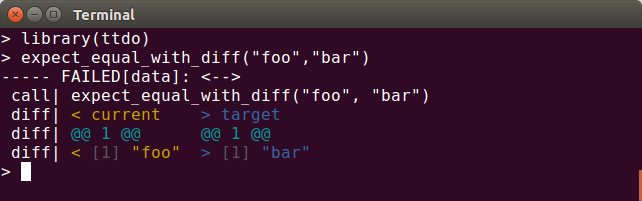
A new minor release of our ttdo package arrived on CRAN a few days ago. The ttdo package extends the excellent (and very minimal / zero depends) unit testing package tinytest by Mark van der Loo with the very clever and well-done diffobj package by Brodie Gaslam to give us test results with visual diffs (as shown in the screenshot below) which seemingly is so compelling an idea that it eventually got copied by another package which shall remain unnamed And as of this release, we also support visual diffs as provided by tinysnapshot by Vincent Arel-Bundock. ttdo screenshot This release chiefly adds support for visual diff plots. As we extend tinytest for use in the R autograder we maintain and deploy within the lovely PrairieLearn framework, we need to encode the diffplot that has been produced by the autograder (commonly in a separate Docker process) to communicate it back to the controlling (Docker also) instance of PrairieLearn. We also did the usual bits of package maintenance keeping badges, URLs, continuous integration and minor R coding standards current. As usual, the NEWS entry follows.

Changes in ttdo version 0.0.10 (2025-01-21)
  • Regular packaging updates to badges and continuous integration setup
  • Add support for a 'visual difference' taking advantage of a tinysnapshot feature returning a ttvd-typed result
  • Added (versioned) dependency on tinysnapshot (to also get the plot 'style' enhancement in the most recent version) and base64enc
  • Return ttdo-typed result if diffobj-printed result is returned
  • Ensure all package-documentation links in manual page have anchors to the package

Courtesy of my CRANberries, there is also a diffstat report for this release. For questions, suggestions, or issues please use the issue tracker at the GitHub repo.

This post by Dirk Eddelbuettel originated on his Thinking inside the box blog. If you like this or other open-source work I do, you can now sponsor me at GitHub.

20 January 2025

Dirk Eddelbuettel: RcppMsgPack 0.2.4 on CRAN: Maintenance

Another maintenance release of RcppMsgPack got onto CRAN today. MessagePack itself is an efficient binary serialization format. It lets you exchange data among multiple languages like JSON. But it is faster and smaller. Small integers are encoded into a single byte, and typical short strings require only one extra byte in addition to the strings themselves. RcppMsgPack brings both the C++ headers of MessagePack as well as clever code (in both R and C++) Travers wrote to access MsgPack-encoded objects directly from R. This is the first release in over six years, and contains mostly maintenance. One somewhat embarassing aspect is that Travers and I forgot about a PR that had been ready all this since the last release, it has now been integrated. Details follow from the NEWS file.

Changes in version 0.2.4 (2025-01-19)
  • Use Rcpp::RawVector instead of std::vector<unsigned char> saving extra copy (Travers in #16)
  • Several updates to README.md with R Journal paper, add badges, add Authors@R, add CITATION file, add repo info to DESCRIPTION
  • Update continuous integration via r-ci
  • Update to no longer require compilation standard

Courtesy of my CRANberries, there is also a diffstat report for this release. For questions, suggestions, or issues please use the [issue tracker][issue tickets] at the GitHub repo.

This post by Dirk Eddelbuettel originated on his Thinking inside the box blog. If you like this or other open-source work I do, you can now sponsor me at GitHub.

15 January 2025

Dirk Eddelbuettel: RcppFastFloat 0.0.5 on CRAN: New Upstream, Updates

A new minor release of RcppFastFloat just arrived on CRAN. The package wraps fast_float, another nice library by Daniel Lemire. For details, see the arXiv preprint or published paper showing that one can convert character representations of numbers into floating point at rates at or exceeding one gigabyte per second. This release updates the underlying fast_float library version to the current version 7.0.0, and updates a few packaging aspects.

Changes in version 0.0.5 (2025-01-15)
  • No longer set a compilation standard
  • Updates to continuous integration, badges, URLs, DESCRIPTION
  • Update to fast_float 7.0.0
  • Per CRAN Policy comment-out compiler 'diagnostic ignore' instances

Courtesy of my CRANberries, there is also a diffstat report for this release. For questions, suggestions, or issues please use the [issue tracker][issue tickets] at the GitHub repo.

This post by Dirk Eddelbuettel originated on his Thinking inside the box blog. If you like this or other open-source work I do, you can now sponsor me at GitHub.

Next.

Previous.