Search Results: "ag"

8 September 2011

Sylvain Beucler: Scientific OpenGL

plot Guus started a new section in the OpenGL wikibook about scientific uses! In a first tutorial, he showcases how to interactively plot a simple mathematic function:
http://en.wikibooks.org/wiki/OpenGL_Programming#The_scientific_arc
suzanne The lighting front is also progressing with a new tutorial on ambient and specular lights:
http://en.wikibooks.org/wiki/GLSL_Programming/GLUT/Specular_Highlights
Enjoy!

Dirk Eddelbuettel: Faster (recursive) function calls: Another quick Rcpp case study

There was another question recently on StackOverflow that I had meant to discuss in a follow-up post here. User deltanovember asked about slow recursive functions and used the very classic Fibonacci number as an example. To recap, Fibonacci number are defined with two initial values F(0) = 0 and F(1) = 1; thereafter the Fibonacci number F(n) is defined as the sum of the two preceding numbers: F(n) = F(n-2) + F(n-1). This leads to very straightforward implementations using recursion:
## R implementation of recursive Fibonacci sequence
fibR <- function(n)  
    if (n == 0) return(0)
    if (n == 1) return(1)
    return (fibR(n - 1) + fibR(n - 2))
 
Unfortunately, this elegant implementation which remain close to the abtract formulation of the recurrence algorithm performs very poorly in R as there is noticeable overhead in function calls which becomes dominant in a recursion. This lead to the original question on StackOverflow, and the accepted answer uses a trick presented by Pat Burns in his lovely R Inferno: rewrite the solution using a computer science trick called memoization:
fibonacci <- local( 
    memo <- c(1, 1, rep(NA, 100))
    f <- function(x)  
        if(x == 0) return(0)
        if(x < 0) return(NA)
        if(x > length(memo))
        stop("'x' too big for implementation")
        if(!is.na(memo[x])) return(memo[x])
        ans <- f(x-2) + f(x-1)
        memo[x] <<- ans
        ans
     
 )
That is a fair answer, and even more was suggested with a link to a terrific analysis calling the Fibonacci recurrence the worst algorithm in the world. That is also fair, but all the basic research into better algorithms exploiting some structure of the problem to advance performance (and of course understanding) is overlooking one crucial part: algorithm analysis is essentially independent of the language. So whatever improvements we obtain by thinking really hard about a problem are then available for other implementations too. So with a tip of the hat to the old Larry Wall quote about Lazyness, Impatience and Hubris, I would like to suggest what I consider a much simpler route to much better performance: recode it in C++ using both Rcpp (for the R/C++ integration) and inline for the on-the-fly compilation, linking and loading of C++ code into R.
## inline to compile, load and link the C++ code
require(inline)
## we need a pure C/C++ function as the generated function
## will have a random identifier at the C++ level preventing
## us from direct recursive calls
incltxt <- '
  int fibonacci(const int x)  
     if (x == 0) return(0);
     if (x == 1) return(1);
     return (fibonacci(x - 1)) + fibonacci(x - 2);
   '
## now use the snippet above as well as one argument conversion
## in as well as out to provide Fibonacci numbers via C++
fibRcpp <- cxxfunction(signature(xs="int"),
                       plugin="Rcpp",
                       incl=incltxt,
                       body
                       ='
   int x = Rcpp::as<int>(xs);
   return Rcpp::wrap( fibonacci(x) );
')
This single R function call cxxfunction() takes the code embedded in the arguments to the body variable (for the core function) and the incltxt variable for the helper function we need to call. This helper function is needed for the recursion as cxxfunction() will use an randomized internal identifier for the function called from R preventing us from calling this (unknown) indentifier. But the rest of the algorithm is simple, and as beautiful as the initial recurrence. Three lines, three statements, and three cases for F(0), F(1) and the general case F(n) solved by recursive calls. This also illustrates how easy it is to get an integer from R to C++ and back: the as and wrap simply do the right thing converting to and from the SEXP types used internally by the C API of R. A performance comparison of the basic R version fibR, its byte-compiled variant fibRC and and the C++ version fibRcpp shown above is very compelling. We have added a file fibonacci.r to the large and still growing set of examples included with Rcpp, and we can just execute that script with Rscript or (as here) r from the littler package:
edd@max:~/svn/rcpp/pkg/Rcpp/inst/examples/Misc$ r fibonacci.r
Loading required package: inline
Loading required package: methods
Loading required package: compiler
        test replications elapsed relative user.self sys.self
3 fibRcpp(N)            1   0.092   1.0000      0.09     0.00
2   fibRC(N)            1  61.480 668.2609     61.47     0.00
1    fibR(N)            1  61.877 672.5761     61.83     0.02
edd@max:~/svn/rcpp/pkg/Rcpp/inst/examples/Misc$ 
So the recursion for the original argument of N=35 takes just over a minute at about 61.5 and 61.9 seconds, respectively, for the R version and its byte-compiled variant (as per the column titled elapsed). So byte-compilation essentially offers no help for the bottleneck of slow function calls. The C++ versions relying on Rcpp which created in a few lines of code and a single call to cxxfunction however takes just 92 milliseconds---or a relative gain of well over six-hundred times. That provides another nice demonstration of what Rcpp can do. Improved algorithms for well-understood problems are surely one way to accelerate solutions. But there are (many ?) times when we do not have the luxury of being able to think through to a new and improved approach. Or worse, such an approach may even introduce new errors or inaccurracies if we get it wrong on a first try. With Rcpp, we are able to the express the problem as written in its original statement: a simple recursion. The gain relative to a slow R implementation is noteworthy---and could of course be improved further if we really needed to by relying on better algorithms like memoization. But for day to day tasks, I gladly take speedups of (up to) a few hundred times thanks to Rcpp without having to do hard algorithmic work. Before closing, a quick reminder that I will be giving two classes on Rcpp in a few weeks. These will be in New York on September 24, and San Franciso on October 8, see this blog post as well as this page at Revolution Analytics (who are a co-organiser of the classes) for details and registration information.

Jose Luis Rivas Contreras: Moved from approx to apt-cacher-ng

I have been a long-time user of
approx
, I got used to it and knew how to configure it so all my machines + VMs used the same cache and saved me a lot of bandwidth. But that was when I got a stable connection at >100KiB/s in a daily-basis. Now I m with a mobile connection at <30KiB/s and sometimes is intermittent, so
approx
started giving me a lot of headaches. When
approx
tries to connect a host that can t be resolved its domain name, then gets 404. How does that reflects in the
/pool
? Well, you get a file
touch
d and 0 bytes size. When you try again,
approx
will find the same file with 0 bytes size and will gives you again a 404, even if you can now resolve the name address of that domain. And as I like to use what I know, then I made a workaround: Each time this happened I ran:
# find /var/cache/approx -size 0 xargs rm
So next time I requested a file to
approx
it tried to connect to the host. But I got tired. I installed
apt-cacher-ng
, tweaked a bit
/etc/apt-cacher-ng/acng.conf
so it uses port 9999 and the cache dir redirects to the same cache than
approx
and done.
apt-cacher-ng
returns 503 when it can t connect to the peer, even tries to several repositories with only a line in
/etc/apt/sources.list
in my clients. It makes me happy and keeps saving me a lot more of bandwidth than
approx
.

David Welton: Zero to Profitable - LiberWriter Lessons Learned

Here's how I have created the beginnings of a profitable Kindle formatting and conversion service, LiberWriter, from scratch. Last Winter, I read one of the best business books I have read in a long time, Rob Walling's Start Small, Stay Small: <iframe frameborder="0" marginheight="0" marginwidth="0" scrolling="no" src="http://rcm.amazon.com/e/cm?lt1=_blank&amp;bc1=000000&amp;IS2=1&amp;bg1=FFFFFF&amp;fc1=000000&amp;lc1=0000FF&amp;t=dedasys-20&amp;o=1&amp;p=8&amp;l=as4&amp;m=amazon&amp;f=ifr&amp;ref=ss_til&amp;asins=B003YH9MMI" style="width: 120px; height: 240px;"></iframe> Rather than being a "big idea" book that includes one big idea and lots of stories to support it, it's a very practical book on how to go about creating a small online business. I've always been someone who loves to build things, from various open source projects, to diverse web sites that people have found valuable. However, I am not a "business guy". I'm not that good at making money, so the simple approach in the book is really better for people like me: make something and sell it. Advertising can certainly work, but it's so much harder to figure out the numbers compared with a product, where you can compare the cost of providing the product to the price people will pay for it. And that's just one thing; the book has tons of ideas about practical ways of going about putting together a profitable small online business. It's not a "get rich quick" book - part of the idea is that if you are looking at a niche that is fairly small, it will simply not be of interest to larger companies, so you aren't going to get outspent and outcompeted by them. In any event, though, at about the same time I read the book, I was poking around looking at Amazon's KDP, which allows you to self publish for the Kindle, and noticing how difficult the process is. The native format of Amazon's books is HTML with several XML files thrown in for good measure. Now, for someone technical, that's certainly not an insurmountable obstacle, but for many authors, it's a very unpleasant prospect. Granted, you can also manipulate a Word file to make it suitable for the KDP, but even that is something that many people dont' find to be a productive use of their time. They're authors, and they want to write. Having spotted a niche that looked interesting - I love to read, and I like the idea of helping out authors - I discarded the book idea I was looking at myself and did some writing of my own: source code for a project that would automate the process of converting and formatting Kindle books. The core of the system was a fun evenings/weekends project, and soon it was able to produce pretty good books. After "inflicting" the beta version of the system on several people, such as Rich Bowen (thanks again, Rich!), I got it beat into shape and started accepting the first paying customers. It's very exciting to have those first few people pay for something you made - it's a great feeling! Initially, my thought was to sell it as a way to write books directly for the Kindle, however, it soon became evident that 99% of people have already written their books with Microsoft Word, so what they were really interested in was a conversion and formatting system that would take a Word document, poke and prod, stitch and stretch it some, and output a nice looking book for the Kindle. One of the lessons from Rob's book was that stuff doesn't have to be perfect if it works. Initially, I had people putting their word documents into LiberWriter not with the smooth(ish) upload process we have now, but by cutting and pasting in their documents! As a computer guy, doing things in a hacky way is sometimes very unpleasant, but you know what? It worked, and it was easy for people to handle, so I ran with it until a better system was in place. Writing code was the easy part, and definitely within my "comfort zone". Some of the other things I've had to do have been much more difficult, and as a consequence, more of a learning experience. For instance, I realized early on that the process would never be 100% automatic, so I'd have to get some people to work on the books, with the idea being to provide them tools to make the process as simple, quick, and easy as possible. I'm always on the lookout for new things to script within the system. However, need people it does, and finding them and engaging them has been a difficult process. As per the book's suggestion, I've primarily used oDesk to find contractors, and have grardually begun to find some people who work really well. It has taken time, and has not been easy, though. I'm not an introvert, but in some ways I'm happiest when doing my own thing. Being the 'boss' is new. One of the tricky aspects of oDesk is that pretty much any job posting gets tons of responses, some of them from people who appear to have barely read the posting. One trick I learned is to request that the potential contractor creates an account with LiberWriter. Very simple and not a waste of time, and yet a majority of applicants ignored the request. Through most of the spring and summer, LiberWriter remained something strictly for the evenings and weekends, as I was busy with client work during the days, and with my daughter during the afternoons, but as August rolled around, I found some more time on my hands, and really started investing more energy in LiberWriter. It has been very rewarding to see a corresponding increase in the number of customers. We (at this point, between myself and the contractors, LiberWriter is a group, and no longer "I") also raised prices - another valuable piece of advice from the book, and... pretty much anyone who writes for people jumping into online businesses. As tech people, we often tend to aim low in terms of prices. Indeed, soonish, prices will likely go up again. Another challenge has been turning it as much as possible into a "productized service". Since Kindle books are fairly simple in what you can do with them, as long as you don't get too fancy, it's possible to automate *most* things, but not everything, so it's not just a product that people buy and it works and that's that; there's a human element involved, which means more communication, and more potential for things to go off the rails. I've been investing time in automating the workflow of the system, but have a lot more to do on that front. Also, one of the things our customers love about the service is being able to deal with "real people", something that is more difficult at Amazon. That's good for us in one way, but in the future, it will be critical to document things and make them as simple as possible to avoid generating unneccessary support requests, as it can easily take up a lot of time. Indeed, because LiberWriter does attract customers who are often not all that technical, making the user experience as easy and straightforward for them as possible (and then some) is extremely important. It can be exasperating once in a while, but I do my best to channel any frustrated energy on my part into making the site ever easier and ever more straightforward. In other words, instead of "how the heck do they not get that?!" it's "what can I do to make sure the tools and information they need are even easier for them to get?". There's lots to do on that front, but on the whole it's actually part of the project that I've grown to like a lot. Rather than dealing with other techies like myself, our customers are people who really benefit from what we offer because we can save them so much time and frustration. Marketing the system is fun, but another area where I have a lot to learn: I'm not a natural when it comes to marketing or selling. One thing that has worked well so far is finding forums where your target users hang out, and then.... spam them as often as possible? No way! Be yourself, and provide genuine help and value to people in the forums. By being on the level, and not trying to sell! sell! sell! people are friendlier and more receptive to your message. It can be time consuming, but I suppose it's the sort of thing where taking the wrong short cut could be very detrimental over the long haul. Without disclosing too much, I don't think I'll ever get rich from LiberWriter, but it is incredibly satisfying to have created and marketed a product of my own that goes beyond just selling my own time. LiberWriter doesn't bring in as much as consulting, yet, but it feels like much more of an investment, something that will have some momentum of its own, and of course it has been an incredible learning experience. I like programming, but being outside of my "comfort zone", doing stuff that's new and challenging is also a very positive part of the project. If things continue to grow the way they have been, I could envision depending on LiberWriter as my primary source of income in the very near future. That's a bit of a jump into the unknown in some ways, but I'd love it. I have worked very hard on it lately, and one of the things I am enjoying is always having new ideas about how to improve every aspect of the system, from customer service to the mechanics of the conversion process, to tracking the finances. In some ways it's tiring because I'm thinking about it *all* the time, but it's that "good kind of tired". It's been a tumultous summer, and in the past few weeks we (well, my wife much more than me!) had a new baby boy, and bought a house here in Padova. To keep things interesting for the future, I applied to the Startup Chile program with LiberWriter. I suspect they're more interested in startups with high growth potential, but I feel strongly that the approach outlined in Rob's book is one that people outside of Silicon Valley, without easy access to venture capital and the huge talent pool that area has, should consider, rather than trying to copy what makes Silicon Valley work like it does. Whether I get accepted or not, LiberWriter will continue to grow, and, I sincerely hope, thrive. A big thanks to all our customers, and to my wife Ilenia, and children, Helen and Daniel for tollerating all the time I spend with the computer. I wrestled a bit with writing this post, as I don't want to "jinx things", and I've only just got a small taste of "success", but I've always enjoyed reading about how "ordinary people" have managed to create their own small businesses, people like those behind Balsamiq, "Bingo Card Creator", and the like, and I figure that writing up my own experiences is a way of "paying it forward".

Stefano Zacchiroli: gnu hackers meeting 2011

report from GHM 2011 Debian and GNU have a lot in common: starting from the fact that strstr() applied to the respective project (full) names does not return NULL, up to the the common objective of building a UNIX-like operating system that grants fundamental software freedoms to its users. That is why I've been very pleased when the organizers of GNU Hackers Meeting 2011 (GHM) invited me to attend and speak about Debian and its relationships with GNU at the event. Slides of my talk are already available, while a video is being encoded (it will probably show up on both GHM homepage and IRILL website). Acknowledging the commonalities of goals on both Debian and GNU sides, we took the chance of this encounter to review how each project feel about relationships with the other (my original inquiries for the Debian community can be found on debian-project) and to talk it over during a discussion session scheduled to happen just after my talk. Yesterday, I've summarized all my notes from GHM 2011 in a report posted to debian-project. Quoting from there: After this experience, it is striking for me how much we have in common with GNU (ideally, culturally, socially, etc.) and at the same time how harsh can our "family battles" become at a times. Let's avoid that the remaining [few] differences get too much in the way [of collaboration], especially when that can be easily avoided. Enjoy!

Wouter Verhelst: Why I think MySQL is a toy.

A commentor on my previous post asked why I think MySQL is a toy. I've actually blogged about that a number of times, but when wanting to point that out, I found that most of those posts point out just one thing, rather than having one post that enumerates them all. So let's remedy that, shall we? There are many things wrong with MySQL, including, but not limited to: So it's my opinion that any database which fails to store data correctly in its default settings can't be anything but a toy; or that a database which has a comparatively small feature set can't be anything but a toy. But maybe that's just me. [1] No, I haven't used all those features; but I have used asynchronous notification, sequences (other than for primary keys), kerberos auth, custom data types, and (obviously) I have enjoyed the extra peace of mind of knowing that my database is ACID compliant, meaning that it will either accept my transaction as a whole, or reject it as a whole (but usually the former). In addition, I've seen customers use the table inheritance feature.

Russell Coker: Moving from a Laptop to a Cloud Lifestyle

My Laptop History In 1998 I bought my first laptop, it was a Thinkpad 385XD, it had a PentiumMMX 233MHz CPU, 96M of RAM, and an 800*600 display. This was less RAM than I could have afforded in a desktop system and the 800*600 display didn t compare well to the 1280*1024 resolution 17 inch Trinitron monitor I had been using. Having only 1/3 the pixels is a significant loss and a 12.1 inch TFT display of that era compared very poorly with a good Trinitron monitor. In spite of this I found it a much better system to use because it was ALWAYS with me, I used it for many things that were probably better suited to a PDA (there probably aren t many people who have carried a 7.1 pound (3.2Kg) laptop to as many places as I did). But some of my best coding was done on public transport. But I didn t buy my first laptop for that purpose, I bought it because I was moving to another country and there just wasn t any other option for having a computer. In late 1999 I bought my second laptop, it was a Thinkpad 600E [1]. It had twice the CPU speed, twice the RAM, and a 1024*768 display that displayed color a lot better. Since then I had another three Thinkpads, a T21, a T43, and now a T61. One of the ways I measure a display is the number of 80*25 terminal windows that I can display at one time, my first Thinkpad could display four windows with a significant amount of overlap. My second could display four with little overlap, my third (with 1280*1024 resolution) could display four clearly and another two with overlap, and my current Thinkpad does 1680*1050 and can display four windows clearly and another five without excessive overlap. For most of the last 13 years my Thinkpads weren t that far behind what I could afford to get as a desktop system, until now. A Smart Phone as the Primary Computing Device For the past 6 months the Linux system I ve used most frequently is my Sony Ericsson Xperia X10 Android phone [2]. Most of my computer use is on my laptop, but the many short periods of time using my phone add up. This has forced some changes to the way I work. I now use IMAP instead of POP for receiving mail so I can use my phone and my laptop with the same mail spool. This is a significant benefit for my email productivity, instead of having 100 new mailing list messages waiting for me when I get home I can read them on my phone and then have maybe 1 message that can t be addressed without access to something better than a phone. My backlog of 10,000 unread mailing list messages lasted less than a month after getting an Android phone! A few years ago I got an EeePC 701 that I use for emergency net access when a server goes down. But even a 920g EeePC is more weight than I want to carry, as I need to have a mobile phone anyway there is effectively no extra mass or space used to have a phone capable of running a ssh client. My EeePC doesn t get much use nowadays. A Cheap 27 inch Monitor from Dell Dell Australia is currently selling a 27 inch monitor that does 2560*1440 (WQHD) for $899AU. Dell Australia offers a motor club discount which pretty much everyone in Australia can get as almost everyone is either a member of such a club or knows a member well enough to use their membership number for the discount. This discount reduces the price to $764.15. The availability of such a great cheap monitor has caused me to change my working habits. It doesn t make sense to have a reasonably powerful laptop used in one location for almost all the time when a desktop system with a much better monitor can be used. The Plan Now that my 27 inch monitor has arrived I have to figure out a way of making things work. I still need to work from a laptop on occasion but my main computer use is going to be a smart-phone and a desktop system. Email is already sorted out, I already have three IMAP client systems (netbook, laptop, and phone), adding a desktop system as a fourth isn t going to change anything. The next issue is software development. In the past I haven t used version control systems that much for my hobby work, I have just released a new version every time I had some significant changes. Obviously to support development on two or three systems I need to use a VCS rigorously. I m currently considering Subversion and Git. Subversion is really easy to use (for me), but it seems to be losing popularity. Git is really popular so if I use it for my own projects then I could allow anonymous access for anyone who s interested maybe that will encourage more people to contribute. One thing I haven t even investigated yet is how to manage my web browsing work-flow in a distributed manner. My pattern when using a laptop is to have many windows and tabs open at the same time for issues that I am researching and to only close them days or weeks later when I have finished with the issue. For example if I m buying some new computer gear I will typically open a web browser window with multiple tabs related to the equipment (hardware, software, prices, etc) and keep them all open until I have received it and got it working. Chromium, Mozilla, and presumably other modern web browsers have a facility to reopen windows after a crash. It would be ideal for me if there was some sort of similar facility that allowed me to open the windows that are open on another system and to push window open commands to another system. For example when doing web browsing on my phone I would like to be able to push the URLs of pages that can t be viewed on a phone to my desktop system and have them open waiting for me when I get home. It would be nice if web browsing could be conceptually similar to a remote desktop service in terms of what the user sees. Finally in my home directory there are lots of random files. Probably about half of them could be deleted if I was more organised (disk space is cheap and most of the files are small). For the rest it would be good if they could be accessed from other locations. I have read about people putting the majority of their home directory under version control, but I m not sure that would work well for me. It would be good if I could do something similar with editor sessions, if I had a file open in vi on my desktop before I left home it would be good if I could get a session on my laptop to open the same file (well the same named file checked out of the VCS). Configuring the Desktop System One of the disadvantages of a laptop is that RAID usually isn t viable. With a desktop system software RAID-1 is easy to configure but it results in two disks making heat and noise. For my new desktop system I m thinking of using a DRBD device for /home to store the data locally as well as almost instantly copying it to RAID-1 storage on the server. The main advantage of DRBD over NFS, NBD, and iSCSI is that I can keep working if the server becomes unavailable (EG use the desktop system to ask Google how to fix a server fault). Also with DRBD it s a configuration option to allow synchronous writes to return after the data is written locally which is handy if the server is congested. Another option that I m considering is a diskless system using NBD or iSCSI for all storage. This will prevent using swap (you can t swap to a network device to avoid deadlocks) but that won t necessarily be a problem given the decrease in RAM prices as I can just buy enough RAM to not need swap. The Future Eventually I want to be able to use a tablet for almost everything including software development. While a tablet display isn t going to be great for coding I m sure that I can make use of enough otherwise wasted time to justify the expense. I will probably need a tablet that acts like a regular Linux computer not an Android tablet.

7 September 2011

Soeren Sonnenburg: Shogun at Google Summer of Code 2011

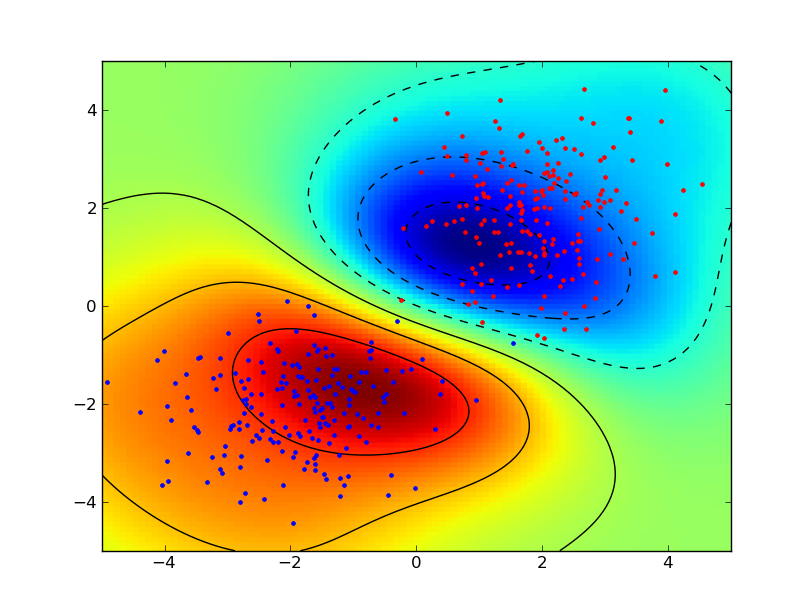
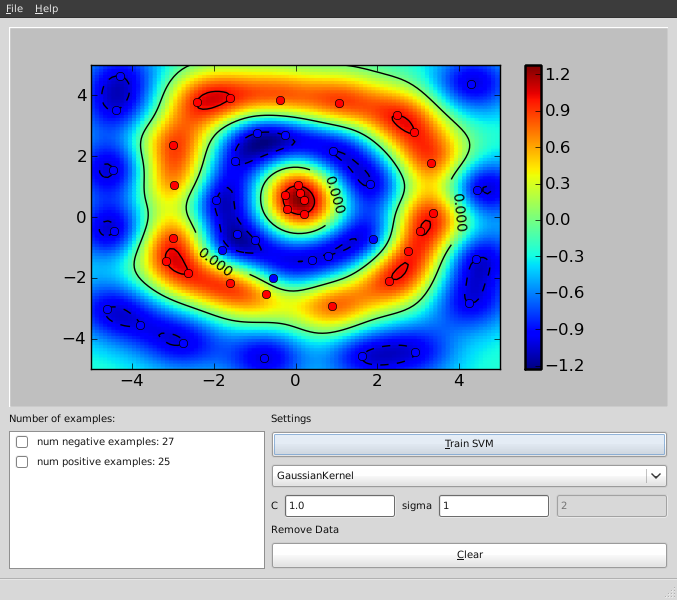
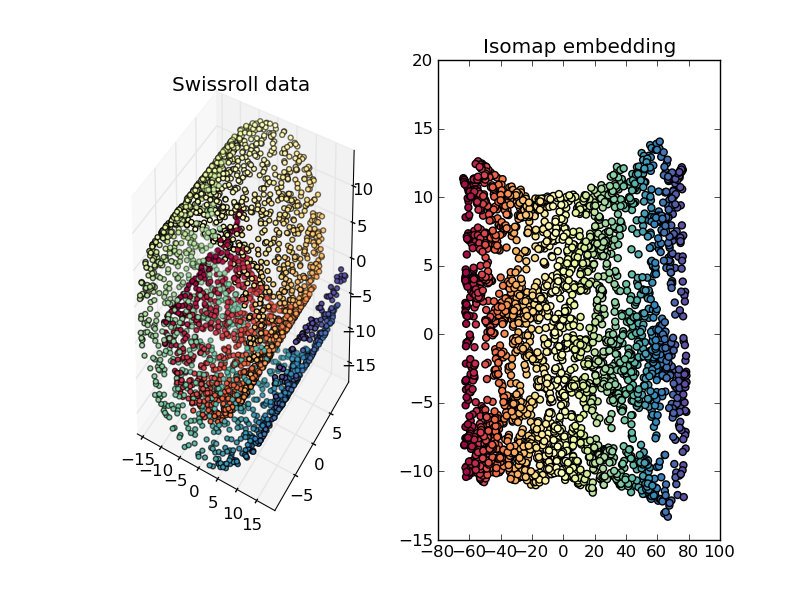
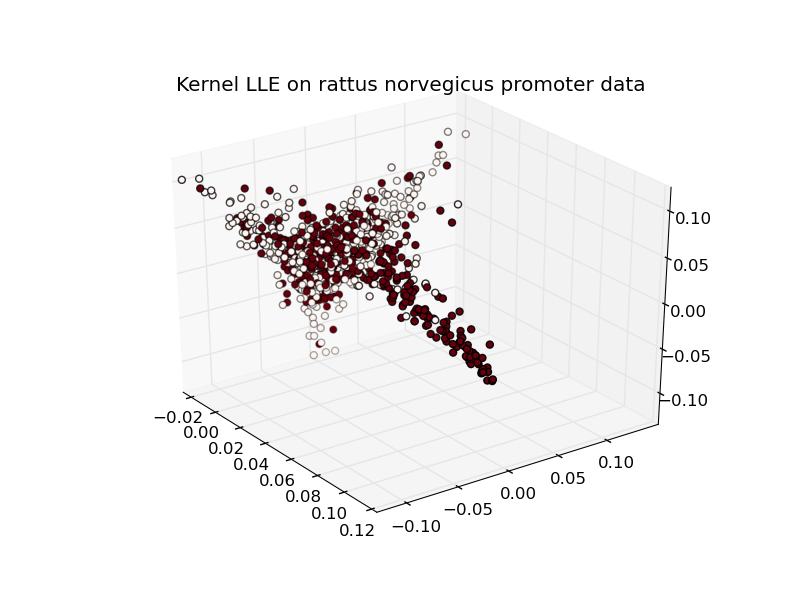
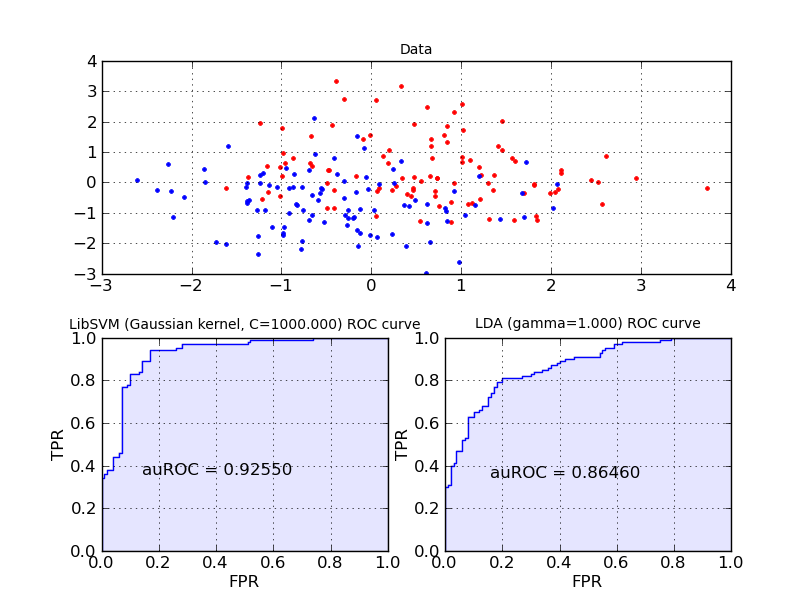
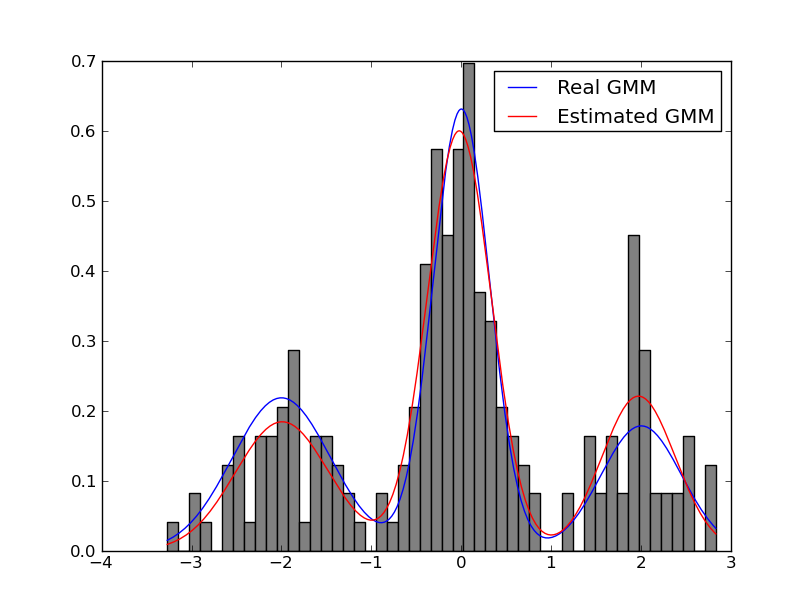
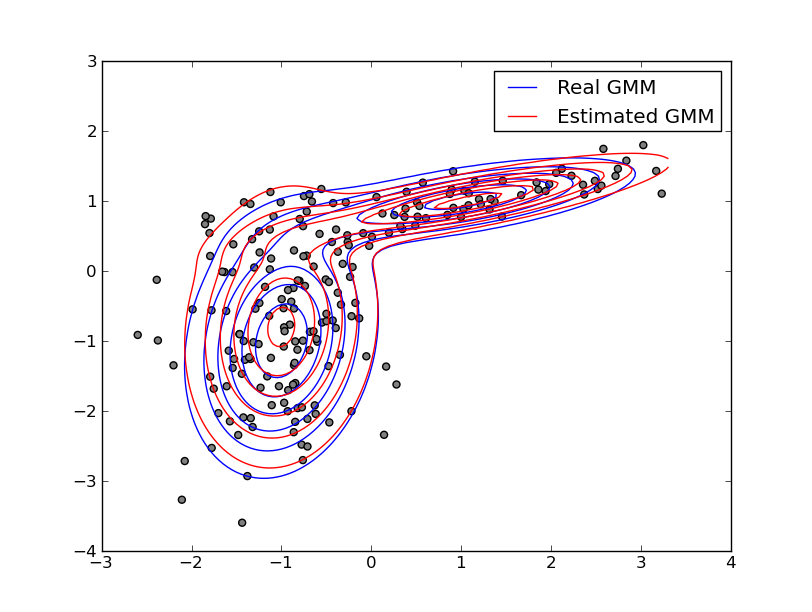
Google Summer of Code 2011 gave a big boost to the development of the shogun machine learning toolbox. In case you have never heard of shogun or machine learning: Machine Learning involves algorithms that do intelligent'' and even automatic data processing and is nowadays used everywhere to e.g. do face detection in your camera, compress the speech in you mobile phone, powers the recommendations in your favourite online shop, predicts solulabily of molecules in water, the location of genes in humans, to name just a few examples. Interested? Then you should give it a try. Some very simple examples stemming from a sub-branch of machine learning called supervised learning illustrate how objects represented by two-dimensional vectors can be classified in good or bad by learning a so called support vector machine. I would suggest to install the python_modular interface of shogun and to run the example interactive_svm_demo.py also included in the source tarball. Two images illustrating the training of a support vector machine follow (click to enlarge): svm svm interactive Now back to Google Summer of Code: Google sponsored 5 talented students who were working hard on various subjects. As a result we now have a new core developer and various new features implemented in shogun: Interfaces to new languages like java, c#, ruby, lua written by Baozeng; A model selection framework written by Heiko Strathman, many dimension reduction techniques written by Sergey Lisitsyn, Gaussian Mixture Model estimation written by Alesis Novik and a full-fledged online learning framework developed by Shashwat Lal Das. All of this work has already been integrated in the newly released shogun 1.0.0. In case you want to know more about the students projects continue reading below, but before going into more detail I would like to summarize my experience with GSoC 2011. My Experience with Google Summer of Code We were a first time organization, i.e. taking part for the first time in GSoC. Having received many many student applications we were very happy to hear that we at least got 5 very talented students accepted but still had to reject about 60 students (only 7% acceptance rate!). Doing this was an extremely tough decision for us. Each of us ended up in scoring students even then we had many ties. So in the end we raised the bar by requiring contributions even before the actual GSoC started. This way we already got many improvements like more complete i/o functions, nicely polished ROC and other evaluation routines, new machine learning algorithms like gaussian naive bayes and averaged perceptron and many bugfixes. The quality of the contributions and independence of the student aided us coming up with the selection of the final five. I personally played the role of the administrator and (co-)mentor and scheduled regular (usually) monthly irc meetings with mentors and students. For other org admins or mentors wanting into GSoC here come my lessons learned: Now please read on to learn about the newly implemented features: Dimension Reduction Techniques Sergey Lisitsyn (Mentor: Christian Widmer) Dimensionality reduction is the process of finding a low-dimensional representation of a high-dimensional one while maintaining the core essence of the data. For one of the most important practical issues of applied machine learning, it is widely used for preprocessing real data. With a strong focus on memory requirements and speed, Sergey implemented the following dimension reduction techniques: See below for the some nice illustrations of dimension reduction/embedding techniques (click to enlarge). isomap swissrollrno kllelocal tangent space alignment Cross-Validation Framework Heiko Strathmann (Mentor: Soeren Sonnenburg) Nearly every learning machine has parameters which have to be determined manually. Before Heiko started his project one had to manually implement cross-validation using (nested) for-loops. In his highly involved project Heiko extend shogun's core to register parameters and ultimately made cross-validation possible. He implemented different model selection schemes (train,validation,test split, n-fold cross-validation, stratified cross-validation, etc and did create some examples for illustration. Note that various performance measures are available to measure how good'' a model is. The figure below shows the area under the receiver operator characteristic curve as an example. foo Interfaces to the Java, C#, Lua and Ruby Programming Languages Baozeng (Mentor: Mikio Braun and Soeren Sonnenburg) Boazeng implemented swig-typemaps that enable transfer of objects native to the language one wants to interface to. In his project, he added support for Java, Ruby, C# and Lua. His knowlegde about swig helped us to drastically simplify shogun's typemaps for existing languages like octave and python resolving other corner-case type issues. The addition of these typemaps brings a high-performance and versatile machine learning toolbox to these languages. It should be noted that shogun objects trained in e.g. python can be serialized to disk and then loaded from any other language like say lua or java. We hope this helps users working in multiple-language environments. Note that the syntax is very similar across all languages used, compare for yourself - various examples for all languages ( python, octave, java, lua, ruby, and csharp) are available. Largescale Learning Framework and Integration of Vowpal Wabbit Shashwat Lal Das (Mentor: John Langford and Soeren Sonnenburg) Shashwat introduced support for 'streaming' features into shogun. That is instead of shogun's traditional way of requiring all data to be in memory, features can now be streamed from e.g. disk, enabling the use of massively big data sets. He implemented support for dense and sparse vector based input streams as well as strings and converted existing online learning methods to use this framework. He was particularly careful and even made it possible to emulate streaming from in-memory features. He finally integrated (parts of) vowpal wabbit, which is a very fast large scale online learning algorithm based on SGD. Expectation Maximization Algorithms for Gaussian Mixture Models Alesis Novik (Mentor: Vojtech Franc) The Expectation-Maximization algorithm is well known in the machine learning community. The goal of this project was the robust implementation of the Expectation-Maximization algorithm for Gaussian Mixture Models. Several computational tricks have been applied to address numerical and stability issues, like An illustrative example of estimating a one and two-dimensional Gaussian follows below. 1D GMM2D GMM Final Remarks All in all, this year s GSoC has given the SHOGUN project a great push forward and we hope that this will translate into an increased user base and numerous external contributions. Also, we hope that by providing bindings for many languages, we can provide a neutral ground for Machine Learning implementations and that way bring together communities centered around different programming languages. All that s left to say is that given the great experiences from this year, we d be more than happy to participate in GSoC2012.

Gunnar Wolf: Language designers, API designers, PHP and utter fails

After many years of successfully dodging doing any serious programming in PHP, I had to get my feet wet with PHP for my RL job: I was requested to develop a simple but non-trivial module for our Institute's Drupal-based webpage. It basically meant two and a half weeks devoted to head-scratching: I had read the very good John van Dyk's Pro Drupal Development book, and knew it would be an important resource were I to face writing a module or work on a theme beyond the most basic stuff So I checked it out of the library, and started basically writing something similar to my good and trusty Perl code. After all, PHP seems quite similar to Perl, although forcing you to write more for no gain (i.e. requiring an array() declaration whenever you want to store more than one value together) or lacking important and useful constructs (not having a sane way to prepare a SQL statement for multiple executions with different parameters Yes, there are DB access methods that do provide it, but Drupal 6 does not use them). Anyway, book in hand, I started understanding while implementing (which is way different than just reading the book, right?) Drupal's notions. I cannot say I like them, but it's ahem doable. Now, I hit a problem twice. I chose to ignore it the first time, as it was a corner case I'd look into later on, but had to devote for hours of my attention later on. When designing the menu (which for Drupal means not only the facility which prepares/displays links to the bits of functionality, but also the access control layer and the action dispatcher a huge yay! for responsability separation!), I had only two access levels: Public and administrator. So, this seemed like a good fit:

  1. $public = array('first/action', 'second/action',
  2. 'third/action', 'something/else');
  3. foreach (array_keys($items) as $item)
  4. if (array_search($item, $public))
  5. $items[$item]['access callback'] = TRUE
  6. else
  7. $items[$item]['access arguments'] = array('diradmin');
But... No matter what I did, the first element in $public refused to be publicly visible. It was not until after a severe amount of head-scratching I came across this jewel in the PHP online manual:
Warning This function may return Boolean FALSE, but may also return a non-Boolean value which evaluates to FALSE, such as 0 or "". Please read the section on Booleans for more information. Use the === operator for testing the return value of this function.
GRAH. Using a sane language for some time had made me forget about the problems of true/false sharing space with other meaningful values. So, yes, checking for inclusion of a value in an array in PHP this way should be compared with class-bound identity (that's what === means) to FALSE, or better yet, using a function that exclusively returns a boolean (as in_array()). Anyway While arrays (which in PHP are any kind of list, be it keyed as a hash or consecutive as a traditional array) are such an usual construct in any language, please do take a look at PHP's array-handling API. Too long. Too complex. Too many corner cases. I cannot but wonder what keeps PHP as a popular language. It hurts.

Wouter Verhelst: No more MySQL on my machine

I've said it before: I think MySQL is a toy, and I want as little to do with it as possible. Unfortunately, since the KDE PIM suite depends on akonadi, which depends on a database, which was initially implemented against MySQL, not having MySQL installed on a Debian machine if you want to use the KDE PIM suite, for the longest time, wasn't even possible. Today it is, but it requires some manual steps:
sudo apt-get --purge install akonadi-backend-postgresql akonadi-backend-mysql-
akonadictl stop
rm -rf .config/akonadi
rm -rf .local/share/akonadi
cat > .config/akonadi/akonadiserverrc <<EOF
[%General]
Driver=QPSQL
[QPSQL]
Name=akonadi-wouter
Host=
Options=
StartServer=false
EOF
createdb akonadi-wouter
Change "akonadi-wouter" for a suitable database name. And now it should work. Note that this requires you run PostgreSQL system-wide and create a system-wide database in that server. It should, in theory, be possible to have akonadi run its own private PostgreSQL instance, much like how the MySQL backend does things, but a) I couldn't get that to work, and b) I don't think having each user run their own database server instance is a good idea to start with, so honestly I didn't try very hard. And there, pronto! I now no longer have toy databases on my laptop. Word.

Emmanuel Bouthenot: Sympa in Squeeze Backports

For those interested in Sympa, version 6.1.4 has been uploaded to squeeze-backports. This version fixes around two dozen bugs since the version present in squeeze (6.0.1). I strongly recommend to use this version with squeeze as it fixes some very annoying bugs. How to install it: For squeeze users Be sure to have squeeze-backports repository enabled in your sources.list as explained on Debian Backports website then:
apt-get -t squeeze-backports install sympa
For lenny users For lenny users with a running sympa installation who plan to upgrade to squeeze and use sympa from squeeze-backports, it is recommended to upgrade directly from the version 5.3.4 (lenny's version) to 6.1.4. To do so, you just need to add some apt pinning in /etc/apt/preferences (see below) and then dist-ugprade normally.
Package: sympa
Pin: version 6.1.4*
Pin-Priority: 500
Sympa 6.1.6 is already out and should be uploaded in unstable soon, it should also be backported to squeeze-backports if all goes fine. Special thanks to Gerfried (rhonda) and Alexander (formorer) for their work on Debian Backports.

6 September 2011

Lars Wirzenius: Entropy key: a review

I recently bought a Simtec Entropy Key. It's a hardware randomness generator encapsulated as a USB device, the size of a flash drive. It's good for any host or cluster that uses a lot of kernel-provided random numbers (/dev/random), or does things that cause the kernel to use a lot of random numbers. Opening a lot of network connections, or generating session keys for public key encryption. That kind of stuff. If the kernel has too little entropy available to generate good random numbers, things will stall until it gets some more. The ekey gives you real random bits, not just software-produced pseudo-random numbers. In other words, it's some kind of magic. I got the device in a DVD box, with a leaflet explaining how to install stuff, a CD with the software, an envelope with a secret key, and the actual device itself. I read the leaflet, which said to install the ekeyd daemon first. I ignored the CD, since a) my laptop has no optical drive and b) the software is in Debian stable (squeeze) anyway, so apt-getting it is easier and faster. I was utterly disappointed with the software. I didn't have to edit a single hard disk sector, or do a BIOS upgrade, or anything. Utterly, totally, boring. I had reserved an afternoon and evening for this, but I had to find something else to do instead. After plugging in the device in a spare USB port, I opened the envelope and ran a command to specify the secret key. The key and host processors use encryption to make sure nobody can eavesdrop on the randomness -- that would give them an edge in cracking SSL and GPG encryption, I guess. Here's an example of how it works. Before I plug in the device, the kernel has some, but not too much entropy available:
liw@havelock$ cat /proc/sys/kernel/random/entropy_avail 
1053
A few seconds after the ekey is inserted:
liw@havelock$ cat /proc/sys/kernel/random/entropy_avail 
3968
And here's the kicker: pretty much regardless of what I do, the entropy stays at about 4 kilounits (I don't know if it's bits or bytes, and I'm too lazy to check). In the end, the only thing I can really complain about is the typography and layout of the leaflet. The text is clear enough, but it's laid out too densely. It needs more whitespace. Some pictures of bunnies or kittens would be nice, too.

5 September 2011

Eugene V. Lyubimkin: cupt: 2.2.0~rc1

It took longer than usual, but I believe it's worth.

I just released Cupt 2.2.0~rc1 to Debian experimental. To experimental, because there are important changes and I would appreciate "in-field" testing before final 2.2.0.

Here are the major changes since 2.1.x:


Enjoy and send the bug reports.

Steve Kemp: Scriptable email clients

This is just a quick post to remind myself in the morning, as soon as I've made it I intend to turn my computer off and leave it off until I can re-organize my office. I've been using mutt for my email for the past few years. Nothing compares to the flexibility of procmail/sieve for organizing server-side mail, and then mutt is ideal for reading them. With the addition of the mutt-patched sidebar mode you can even go for a few days before realizing you're not in a graphical environment. But one thing I do long for is the ability to execute scripts at various times. Thus far I've not actually planned what I'd like to do, but as a starting point imagine being able to execute a hook when new mail arrives? Or when you send a message matching a pattern in some fashion? There are some things out there, such as the various hacks which are designed to abort sending a message if you mention "See attachment" in a message body but fail to add one before sendign the message. These hacks generally abuse the sendmail configuration such that they're extremely ad-hoc and hard to chain/nest. I've mellowed out over the years and I have no interest in attempting to write a mail-client (though at the same time how hard can it be? Just restrict yourself to using inotify on ~/Maildir and offload delivery to exim and you're almost done? I guess the hard part is the UI, though I do like the mutt + sidebar layout. Write the whole thing in some scripty language?) I'll re-examine notmuch and gnus over the next week or two, but I suspect both will continue to disappoint in various ways. Anyway, for the moment I'm just pondering. But threading is an obvious concern. Most current mutt hooks relate to the local folder, or the local message. If I were viewing a message in one directory and a new mail notification fired for a delivery to both ~/Maildir and ~/Maildir/.people.foo I'd need to either serialise them or thread them. Ponder ponder. In other news I've been doing more photography recently. Nothing cohesive except for my recent experiment with shooting a "street-girl" outdoors in falling light, but that was an interesting challenge and the results were sufficient to make me want to try shooting outdoors in an organized fashion again. (Some random images have been linked to from my wee twitter page.) ObFilm: "She doesn't get eaten by the eels at this time " - The Princess Bride

Steve McIntyre: Armhf buildds and porter box hosted at ARM

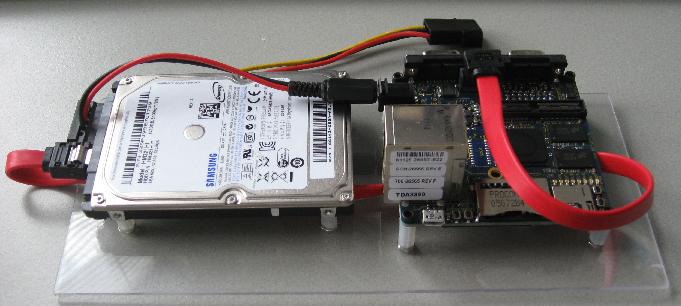
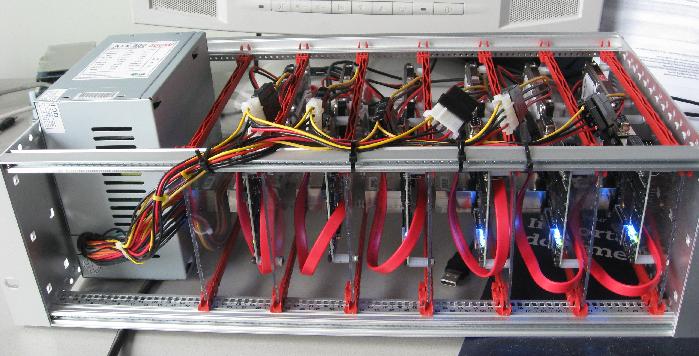
I'm in the middle of setting up new build machines for the armhf port (see the wiki for more details). We'll shortly have six machines set up in the machine room here at ARM in Cambridge: hartmann All of these machines are Freescale i.MX53 Quickstart (aka "loco") development boards. They include a 1GHz i.MX53 CPU (based around the ARM Cortex A8, one of the ARMv7-A family). They have 1GB of RAM and native SATA. They're lovely little machines, measuring just 3 inches square. To mount them usefully in a machine room, I've mounted each board with a 320GB notebook hard drive and the necessary cabling onto a small perspex card as you can see here. Then we can fit 6 such machines and a normal PC-style ATX PSU into a 3U mini-rack. Well, it almost fits - the power supply pokes out a little so we'll need 4U of space when we come to mount it. armhf mini rack The Quickstart boards have been sponsored by Linaro, and ditto my time setting up these machines. Thanks! As is common with new development boards, these machines are not quite fully supported in Debian yet. The kernels we're using are locally-built, using the sources supplied by Freescale. For now, that means a heavily-patched "2.6.35" kernel but we're expecting to be able to switch to mainline very soon. The .config I'm using is kernel.config, and I've built it natively on harris using fakeroot make -j2 deb-pkg DEBEMAIL=93sam@debian.org DEBFULLNAME="Steve McIntyre" KDEB_PKGVERSION=1buildd1 Similarly to the setup for the armel machines, for now I've tweaked things when installing the kernel: Finally, I've tweaked the uboot config on the machines to use the uImage and uInitrd files that are generated by flash-kernel:

MX53-LOCO U-Boot > setenv loadaddr 0x70800000
MX53-LOCO U-Boot > setenv initrdaddr 0x71000000
MX53-LOCO U-Boot > setenv bootargs_sata set bootargs \$\ bootargs\  root=/dev/sda2 rw rootwait
MX53-LOCO U-Boot > setenv load_sata_kernel ext2load sata 0:1 \$\ loadaddr\  /uImage
MX53-LOCO U-Boot > setenv load_sata_initrd ext2load sata 0:1 \$\ initrdaddr\  /uInitrd
MX53-LOCO U-Boot > setenv load_sata run load_sata_kernel load_sata_initrd
MX53-LOCO U-Boot > setenv bootcmd_sata sata init\; run bootargs_base bootargs_sata load_sata\; bootm \$\ loadaddr\  \$\ initrdaddr\ 
MX53-LOCO U-Boot > setenv bootcmd run bootcmd_sata
And I've added extra config into uboot to use the pre-installed Ubuntu system on the micro SD card as a fall-back:
MX53-LOCO U-Boot > setenv bootcmd_rescue sata init\; run bootargs_base bootargs_sata\; mmc read 0 \$\ loadaddr\  0x800 0x1800\; bootm

Andrew Pollock: [life] Four years later

I'm not very good with dates. For the last two years now, Joshua's anniversary has snuck up on me and caught me by surprise. I don't think that I'd really appreciated until this year that we lost him on the Labor Day long weekend. I'll have to remember that for next year so I don't forget. I don't know what my problem was this year. I just didn't realise that it was this early in September that we lost him. Last year I was just too exhausted from dealing with a new baby to realise when his anniversary was, and I felt terrible for missing it. This year, I just felt terrible for not realising when it was, but at least Sarah pointed it out before the fact. For added irony, the 4th of September this year is Father's Day in Australia. Yesterday, I was looking at photos of Joshua to remember him, and Gallery gave me a random photo of Zoe in the corner. That was something. I'm not sure what. I feel like Zoe being a wonderful child is some sort of consolation prize from the universe for taking Joshua, but I often wonder what Joshua would be like today if he were almost four.

Wouter Verhelst: One day

Went to see One Day yesterday. As I usually do after watching a movie, I next went to wikipedia to read up more about it. Was shocked to read that it received 'mostly negative' reviews. I thought it was pretty good. After reading a few of the aforementioned reviews, I understand what the problem is, and though I disagree with the resulting negativity in the review, I can see where it's coming from. You see, One Day is a novel-turned-movie. As with most movies that were sourced from a novel, the movie is a disappointment to those who read the book, mainly because there's always going to be more material in the book, and therefore some of your favourite passages from the book are going to be removed, or changed so that they'll lose some of their original goodness. This is even true for beyond-feature-length movies sourced from novels; for instance, when I saw the horse whisperer after reading the book, I found it a disappointment too, even if my brother and sister who saw it at the same time as me did like it. Ignoring that, there's a second problem; while it's a love story, I don't think it qualifies as a 'romantic comedy'. For it to be a romantic comedy, you'd expect 'happily ever after', and you'd expect a story about two people quickly (or slowly, as the case may be) falling in love with eachother, overcoming some problems that stand in the way of their relationship. Most importantly, you'd expect it to be lighthearted and funny you'd expect it to be a comedy. One day doesn't deliver that; if you go see it, expecting a romantic comedy, you'll be sorely disappointed. But if you accept the fact that it isn't a romantic comedy, it's still a very interesting film. It's not lighthearted, but that doesn't mean there isn't a laugh or a cry in there. And, without wanting to spoil the plot, while the movie doesn't bring 'happily ever after', it does still come up with a believable, emotional, and very compelling ending. The plot takes you through the 15th of July in the lives of the two main characters, every year for two decades. Sometimes they're spending that day together, sometimes they're not. Sometimes they're calling, sometimes they're fighting, sometimes they're kissing. The days shown are snapthots of both their lives; this adds an interesting angle to the plot, as much of the story, much of what is going on, can't actually be shown on-screen, since it happened in between the two 15ths of July. While, as said, I wouldn't describe the movie as a romantic comedy, I think it can be accurately described as a romantic drama. It's not going to be a legendary movie, a must-have-seen, one which you'll grow to hate over watching it on every TV station's prime time over the next few years. But it's a charming, novel, and interesting piece of drama. Did I like it? Definitely. When I go to the movies, sometimes I want a silly movie, some action flick that I can have a bit fun laughing at; but sometimes I want a movie that touches my heart and makes me reflect on my own life while feeling for the characters. When I went to see The Expendables, I have a lot of fun for one night, and then promptly forgot about it. But 'One Day' rang true with me on an emotional level; and for that alone, I can recommend it. Even if that wasn't the reason why I chose to pay 8 for this movie rather than anything else. I'll be perfectly honest: Anne Hathaway. Good actress, and sporting the most interesting pair of bright eyes you've ever seen; what more could one want? A film that allows these two eyes, and acting talent to shine, of course. And One Day delivers.

Kai Wasserb ch: What wasn't said about the Linux graphics stack

This post is a small follow-up on yesterday's post about the Linux graphics stack. I'm still keeping to high level stuff and won't dig too deep, but a few questions arose (others reached me by e-mail), so, here we go. Gallium3D is a framework, initially developed by Tungsten Graphics, which were bought by VMware. The idea behind Gallium3D is, that many functions can be shared between drivers for different GPUs and that the effort to support a new platform/system is for classic drivers pretty high. With Gallium3D you just need a state tracker and a target. The state tracker is code, that gives the pipeline of Gallium3D drivers access to a platform/system, like OpenGL or X on various operating systems. A target is the required as glue between a state tracker and the actual driver. For example: there is a state tracker for video playback acceleration (the recently added g3dvl). The state tracker itself offers the interface and common functions (with some help from the auxilliary stuff) between the Gallium3D pipeline and the userland libraries like libvdpau1. Targets like vdpau-[DRIVER] glue the driver and the state tracker together. The winsys part of Gallium3D is a similar concept but it abstracts the windowing system on the target platform away (e.g. Wayland, X or GDI). I didn't write about the proprietary drivers yesterday, as I don't consider them a real part of the Linux graphics stack, more like parasites, and didn't want to encourage anyone to use them (yes, I know, there are some cases in which you might be better off with them, but generally I'd avoid them). Anyway, I got some questions about those (some by e-mail, the other I'm aware off, can be found behind the link at the beginning of this entry). So, where do the proprietary drivers come in? They are basically the entire stack in a closed form, plugging into the public interfaces of the Kernel (whether that's legal is disputed), some other parts like X (by building a DDX) and building their own libGL. Especially the last part can be a cause for a lot of pain, when you don't use the proprietary driver packages offered by the distribution (e.g. Debian's fglrx packages divert the libGL and restore the default one on unistallation, with the vendor build scripts and tools this is not really guaranteed, which might leave you with a broken OpenGL setup). Another question was, why Mesa was lacking support for a recent OpenGL version (i.e. 4.x). In my opinion there are a few reasons, though I don't really feal like the best person to answer this. The first are design issues by some internal representations (e.g. missing integer support in the intermediate representations). The second is the available number of developers being able to implement new OpenGL functions. Apart from a not all too clear specification the Mesa code base is huge (even if you ignore most of the drivers), which makes it difficult for new developers to start coding away. Then you need an understanding of how modern GPUs operate to find good solutions for the problems faced. If you want to get an idea for this, take a look at Zack Rusin's or Alex Deucher's blog. Then, there is a sad split of developers, on the one hand we've got the Gallium3D-using developers on the other we've got the ones staying with the classic driver model. This means, that you have to implement e.g. GLSL extensions for TGSI and Mesa's IR respectivly. There might be other reasons, I'm totally missing, but this should give you some insight into why it takes so long, to get current OpenGL versions supported. I hope this clears some of the remaining questions, if not, feel free to write me an e-mail, but please remember, that this is not an in-depth analysis.

Kai Wasserb ch: Mesa packages on dev.carbon-project.org

Thanks to the awesome patent situation (if you're unaware of what I'm talking, you can catch up by listening to PRI's This American Life episode about patents, reading Florian Mueller's write-ups about the patent wars (current focus: mobile devices) or by having a look into my posts with the "patent-mess" tag), Debian will most likely be unable to distribute Mesa packages with ARB_texture_float enabled (if you want to build mesa yourself with this extension enabled, just add --enable-texture-float to confflags-dri in the Mesa source package's debian/rules). But some programs really like to have this extension, thus I started building Mesa myself. The resulting packages can be found on dev.carbon-project.org. Big fat warning: please check, whether you're affected by the US patent #6,650,327 (i.e. if it's a valid patent in your jurisdiction) before you use the packages. If in doubt, consult with your lawyer. By the way, if you're not working in an area where knowledge of the specifc claims/content of the patent might be harmful, you have some time on your hands and you want to learn, what's "patentworthy" these days, have a look at the claims of the patent. Otherwise the three links from the beginning must do. Before I end this post, just one more remark about my Mesa packages: they'll follow upstream's Git and thus might have problems from time to time. If Debian's Mesa packages suffice your needs, stay with them. If not, feel free to use my packages or use them as a base for your own packages.

4 September 2011

Sune Vuorela: Network status aware apps

Am I online or not? There is a summary at the end for the quick readers. It is in many modern applications important to be able to more or less gracefully handle if the application user is online or not. For example, there is no need to try to fetch emails if the device (computer, phone, tablet, laptop, ) doesn t have network (wifi, cable, umts, ip over avian carriers, ..). KDE has of course made nice functionality for this, and here I will try to describe how to make your app network status aware and what to be aware of in the process. Solid background All this is going on in Solid, using two parts of Solid and a bit of KDE s infrastructure: The networkstatus KDED module is trying it best to gather information from the computer to see if one is connected or not. It has the possibility to gather information from various sources, and handle changes and such. The as of writing available sources that the networkstatus module gathers information from is Collecting from different sources is important, because some people might have configurations like Manage wireless thru wicd , manage umts dongle with Network Manager and manage wired network with /etc/network/interfaces and all of it needs to be combined. Solid reports, if wicd thinks online , and network manager thinks offline that the user is Connected.. Solid States There is a enum with 5 values in Solid to describe the current state of the network:

enum Status
Unknown,
Unconnected,
Disconnecting,
Connecting,
Connected
;
Connected is the easy state. Here, Solid knows that you are having some kind of connection according to at least one of the sources. But it might just be a local network connection, and not actually a internet connection. So one here should handle connection failures gracefully. Unconnected is a similar easy state. Here, Solid knows that you don t have any internet connection according to the sources it knows about. One should here not try to do any networking. Connecting and Disconnecting is that a state change is happening, so that you can prepare to react on it. Solid also has the state of Unknown, used for cases where Solid doesn t have the required data to actually know it. A example could be a system without any of the data providers. You should here probably try to connect, and be able to handle failures gracefully. Also described as Proceed with caution . The bright reader might here notice that one both in the Unknown and Connected case actually should do the same. Querying for network status At any given time:

Solid::Networking::Status currentStatus = Solid::Networking::status();
if(currentStatus==Connected currentStatus==Unknown)
//try to do networking things
else
//mark application as offline.

Here, we first query Solid for current status, and then if the state is Connected OR Unknown, then we proceed. Getting notified Maybe you don t want the roundtrip of asking (resulting in a dbus rountrip each time) when you need to know the state changes. Then you of course can get notified. class MyNetworkAwareClass : public QObject
Q_OBJECT
public:
MyNetworkAwareClass();
void doNetworkActivity();
private Q_SLOTS:
void networkStatusChanged(Solid::Networking::Status newstatus);
private:
Solid::Networking::Status m_current_state
;
MyNetworkAwareClass::MyNetworkAwareClass : m_current_state(Solid::Networking::Status())
connect(Solid::Networking::notifier(), SIGNAL(statusChanged(Solid::Networking::Status),this,SLOT(networkStatusChanged(Solid::Networking::Status)));

void MyNetworkAwareClass::networkStatusChanged(Solid::Networking::Status newstate)
m_current_state = newstate;
void MyNetworkAwareClass::doNetworkActivity()
if(m_current_state == Unknown m_current_state == Connected)
//try to do network activity


I guess this should be pretty self explaining. Summary Oh. And I m out looking for a job.

Next.

Previous.