Search Results: "ag"

12 September 2011

Dirk Eddelbuettel: RQuantLib 0.3.8

A bug-fix release RQuantLib 0.3.8 is now on CRAN and in Debian. RQuantLib combines (some of) the quantitative analytics of QuantLib with the R statistical computing environment and language. Thanks to Helmut Heiming who noticed a side-effec t from the DiscountCurve functions: the Quantlib-global variable determining the evaluation date was overriden; this could affect subsequent curve-related pricers. This is now fixed, and we added a new function setEvaluationDate to set this date from R too. We added this call in some of the examples in the manual pages. Otherwise two very minor build system tweaks were added, but no other changes were made Thanks to CRANberries, there is also a diff to the previous release 0.3.7. Full changelog details, examples and more details about this package are at my RQuantLib page.

Jose Luis Rivas Contreras: Full-Page Background with CSS with crossbrowser support

I ve been trying to get the perfect full-page background without using JavaScript since a while. I tried with CSS3 but, obviously for IE <9 was a pain in the ass, even for older Firefox' releases. So I decided to go with the plain-CSS option:
<!doctype html>
<head>
<link rel="stylesheet" href="style.css">
</head>
<body>
<img id="bg" src="/img/bg.jpg">

<p>Content</p>
</body>
</html>
img#bg
min-width: 100%;
min-height: 100%;

/* Proportionate re-dimension */
width: 100%;
height: auto;

position: fixed; top: 0; left: 0;

z-index: -1;
What does it does? It takes an inline image and uses it as if were a background-image thanks to the z-index: -1 CSS-rule. There are lots of other techniques at CSS-Tricks but none works in every browser as this one in particular. Enjoy.

Jaldhar Vyas: 9/11: Never Forget

As many people reading this may know, my wife Jyoti was in the World Trade Center on 9/11. When the first plane hit, she joined some colleagues at her employers offices on the 78th floor of the South Tower to see what was going on. A few minutes later she went downstairs to her desk on the 77th floor to call me and tell me about it. That's when the second plane hit. Everyone on the 78th floor was instantly killed as she would have been if she had decided to stay. She and some friends, covered in debris and soaked in jet fuel, blinded by thick black smoke made their way down 77 flights of stairs (the elevators were out of action) and even though she was seven months pregnant with our daughter at the time she went all the way down without stopping to rest. An NYPD officer Ramon Suarez helped her out and to an ambulance. He went back to rescue others and died half an hour later when the North Tower collapsed. I was at home. After getting ready and saying my morning prayers, I was leisurly preparing breakfast before starting the day. I started getting phone calls asking "Is Jyoti ok?" Of course she was. Why wouldn't she be? I somehow don't remember who said it first but I was told to turn on the TV because a plane had hit the World Trade Center. I spent the rest of the morning glued to the screen in horror as information on what exactly had happened. Absolutely the lowest moment of my life was when I saw, in real time, the twin towers fall. It was several more hours before I actually got to talk to Jyoti on the phone, confirmation that she was still alive. I didn't get to actually see her and hold her until the next day owing to the curfew around Manhattan. So that's what happened that day. We have repeatedly been told "Never forget" but truth be told some of the details are already fading from my memory. For my wife too, while she occasionally had panic attacks at first, every day life is foremost now and it is only on days like this that her ordeal comes to mind. Our daughter Shailaja is now 10 years old and an honor roll student who just started 4th grade. She knows the story but is not affected by it. These are good things in my opinion. What the jihadists want most of all is apocalypse. They wanted the world to change course but ten years later America remains as generous, bull-headed, lively, spiritual, garish and crude as ever. That's the sweetest revenge lovers of life can have. Don't give up your rights and your daily routines to fear but make the bastards give up theirs. Or as the cliche goes, the terrorists will win.

John Goerzen: Mexico Part 2: Lodging & Family

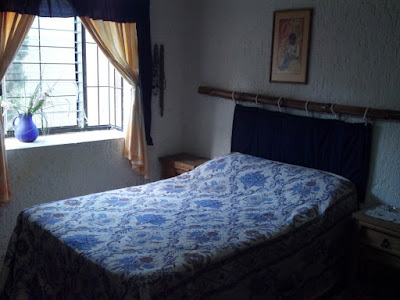
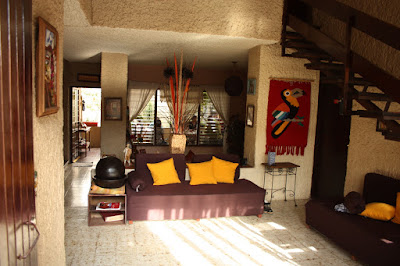
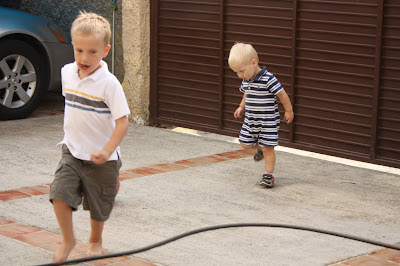
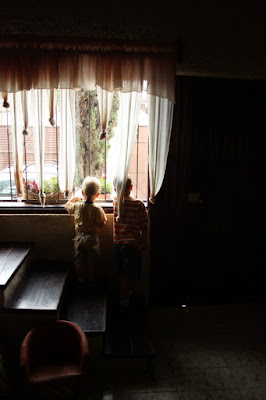
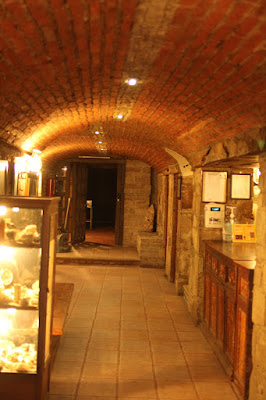
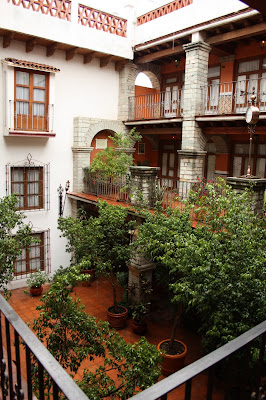
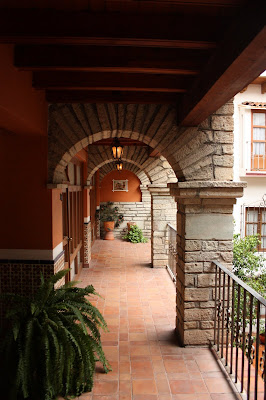
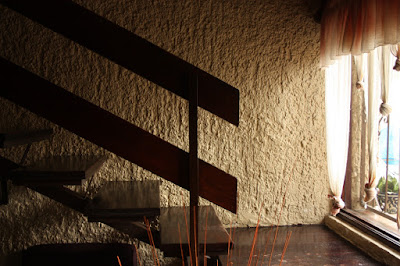
As I wrote in part 1, my family and I were in Mexico recently. Today I ll write about the places we stayed. We spent most of the time in a room we rented in a private home in Guadalajara. My friend Jonathan had found it for us, and it was not too far from his home. The owner was a grandmother, and across the courtyard was more family, including a granddaughter close in age to our boys. They enjoyed playing together. It was really a perfect arrangement for us. There s no better way to be a part of local life when traveling than to stay in someone s house. Here s our bedroom: Notice the glass slats in the window it s a nifty, though not airtight, alternative to our regular windows. More on that later. More of the inside: We had a bit of a language barrier while in Mexico, though never anything significant. My Spanish vocabulary started with almost nothing and I reached maybe a few dozen words by the time we left. Terah knew some Spanish from high school and college, and my friend was fluent. Our hostess also knew a little English. But we all communicated well enough. Terah or Jonathan would help translate when needed. As I d seen before, the children would say things to each other, but never seemed to be bothered that their playmates didn t understand what was being said. They just had a great time anyhow. On Sunday afternoon, when we came back from our activities, there was a buzz of activity. Children everywhere outside, running and playing. Adults too, chatting. We didn t know exactly what was happening, but sent Jacob and Oliver out to play anyhow (which they were eager to do). The yard was enclosed by a wall, so children could pretty much run around without lots of supervision. Eventually they were invited to have some birthday cake (ah ha!) it was one of the children s birthday. Jacob and Oliver actually were served the first two pieces of cake (as the amigos ). Everyone seemed so friendly, warm, and welcoming. Each morning started with breakfast at the house, followed by a scene like this: That s Jacob and Oliver, looking to see if Jonathan had arrived for the day yet. I often noticed in Mexico that I was unsure if I was inside or outside. Here in Kansas, we can have a string of summer days that each exceed 110F (44C) or a few weeks in winter that never get above 15F (-9C), even in daytime. And then we have some pleasant days like right now, too or rain blowing sideways at 60MPH. In general, we spend a lot of effort keeping the outside, well, out. It is quite clear that this isn t a problem in the Guadalajara area. Some restaurants could have been described as buildings with large, open windows so you feel a lot of breeze while inside. Or perhaps as a simple shade roof with a few supports on the edges, so you re never really inside at all (sort of like going under a small shade tent outdoors). To the extent that windows could close, many of them couldn t be made airtight. It was clear that in that area, people spend more energy finding ways to invite the outdoors in rather than to keep it out, thanks to the year-round moderate climate. Perhaps the best example of this surprised me one evening. We were arriving in Guanajuato, an old silver mining town in the mountains, and were going to spend the night at Hotel Socav n, which had been recommended to us by a local friend of Jonathan s. From the street, the hotel looked tiny. But walk in, and you get in this old-looking (and feeling) entry tunnel: That s the front desk, apparently cut out of it there on the right. We asked to see some of the rooms before buying apparently a normal request around there. The innkeeper agreed, and gave us keys and directions to find them on the third floor. It included going up 2 flights of stairs, passing through a courtyard, and going up another flight. It was after dark, and the hotel was dimly lit something I was fine with. I thought we were stepping out into a beautiful atrium with some potted plants in the center of the building something fairly common in some nicer hotels. Until I felt rain on my head. Then I realized that the courtyard, which began two floors up from the street, was open to the sky. Beautiful! Here was the view from out room door: And down the hall : After getting home, a Google happened to turn up some reviews of this hotel. I was so annoyed at what some people wrote! One person gave them only 3 stars because they didn t have air conditioning, had poor water pressure, and lots of steps . Someone else complained of the dark entry tunnel something I couldn t help but smiling about the moment I entered. My review, which should hopefully get posted soon, is certainly different. I gave them 5 stars, because if I wanted a Super 8 with generic fluorescent lighting and the same layout as thousands of other hotels, I would have gone to Nebraska instead of Mexico. Most homes and local hotels in the region don t have air conditioning because they don t need it, and that s just how water pressure is in Mexico (due to needing to pump it from municipal supplies to private storage tanks overhead). And who doesn t appreciate entering a hotel through a brick tunnel? Ah, sigh This should give you some idea of the kind of travel we like: part of the point of traveling is enjoying the differences from home, and I think it is a huge mistake to be annoyed at everything that is different. Enjoy the differences! Finally, here s a photo of the staircase in the home we stayed in, which I thought was fascinating:

11 September 2011

Gregor Herrmann: RC bugs 2011/36

after some months of looking only at "my" packages, I'm back in the #RCBW flow. here's my overview of RC bug activities & NMUs in the last week: two short observations:

Andrea Veri: A few other additions to my Mutt and Desktop setup!

A few days ago I blogged about my main computer s configuration files and desktop s appearance and today I managed to add a few little tweaks to those, they are: Curious to know how you can easily integrate your Google s contacts into Mutt? Well, you should be able to achieve that within a few minutes after reading this small HowTo: 1. Download and install goobook as explained here. 2. Setup a .goobookrc file into your Home directory. It should look like this:
machine google.com
 login example@gmail.com
 password yourpassword
3. Add the relevant configuration bits into your /etc/Muttrc file:
set query_command="goobook query '%s'"
bind editor <Tab> complete-query
macro index,pager a "<pipe-message>goobook add<return>" "Add sender's address to your Google contacts"
4. Your configuration should be good to go now, so here s a few examples on goobook s usage within Mutt: We can now move on on customizing your Login Screen running GDM3. Let s begin with a screenshoot: I definitely love it, it s clear and clean and most of all it has everything I need, no extra toolbars or menus. If you agree with me, open up the /etc/gdm3/greeter.gconf-defaults file and do the needed changes. This is how your greeter.gconf-defaults file should look like:
/desktop/gnome/background/picture_filename      /path/to/your/dusty-bg/file # dusty's background can be downloaded here.
/desktop/gnome/interface/gtk_theme              Darklooks # this is my main theme, feel free to adapt that to your needs.
/apps/gdm/simple-greeter/logo_icon_name         debian-swirl # this is the default on Debian's systems.
/desktop/gnome/sound/event_sounds               false # I don't like hearing any sound when when I am prompted to insert my user's details on the Login Screen.
/apps/gdm/simple-greeter/disable_user_list      true # users list will be disabled, you won't be able to select your username from a list but you'll have to insert that yourself.
/apps/metacity/general/compositing_manager      false # default, no need to change this.
/apps/gnome-power-manager/ui/icon_policy        never # default, no need to change this.
We are close to the end but we are missing an important detail: how can you safely remove bottom s toolbar and menus for a clearer and cleaner Login Screen? Open up the /var/lib/gdm3/.gconf.mandatory/%gconf-tree.xml file, search for the <dir name= general > section and apply the following change:
- <entry name="compositing_manager" mtime="1315580582" type="bool" value="false"/>
+ <entry name="compositing_manager" mtime="1315580582" type="bool" value="true"/>
But what if you prefer keeping the toolbar as it is, but you definitely don t like seeing the Accessibility icon appearing on your Login Screen? On the same file as above, search for the <dir name= accessibility > section and modify the following string as it follows:
- <entry name="enable" mtime="1315580582" type="bool" value="true"/>
+ <entry name="enable" mtime="1315580582" type="bool" value="false"/>
See you on my next blog post and don t forget to have a look at my GitHub s repository! Oh and follow me on Twitter!

Julien Valroff: Quick and dirty Debian packages for various kernel modules

As I own several more or less recent laptops, some of their features require updated/new kernel modules to work as expected. I have hence decided to create Debian packages for them, primarily for my own use. Note that these packages are meant to be used with caution, I have only tested them on my own hardware, and they would deserve more careful review. All -source and -dkms packages are available in my personal repository for Debian sid. The sources are maintained in git, as usual.

Christian Perrier: [life] [running] Last race before Berlin

Today was my last race before Berlin marathon on Sept. 25th. Berlin is meant to be one of the three "peaks" of my running year, after the succession of Paris Ecotrail (55km) and Paris marathon in two weeks in April....and before a 67km night race in November (Le Puy-Firminy). I was worried about my shaky training last weeks because of some pain in an ankle which I partly twisted while running on a very steep trail in early August. So, I planned running an half-marathon today in Bois d'Arcy, very close to my place. Last year saw me completing this one in 1h37. Of course, no way this time to try this again: the point was running at my planned marathon pace (5'05"/km) for the first 18-19km and "see what happens" later on. Even trying this two weeks before a marathon is....unrecommended! I made this fairly well, with a 5'/km pace for the first 10km, then a little slowdown between km10 and 15 (mostly because I was running all alone in large and very straight alleys in the forest)....and a very very long sprint from km 18.5 with speeds up to 4'40"/km, and a final 400m where I was kinda flying (1'37"). So, finally, I end up with a very promising 1h43'19", much below the planned 1h45, and my second half-marathon time ever. Now, two weeks mostly resting as the goal will be keeping this 5'05" pace in Berlin, for a targeted 3h35 (which is kinda ambitious considering my lack of speed work during last weeks while I was trying to recover this injured ankle). See you in Berlin on 25th....

Craig Sanders: how to set gnome-fallback as the default session for gnome3 & gdm3

This works in debian update-alternatives --install /usr/bin/x-session-manager x-session-manager \
/usr/bin/gnome-session-fallback 100 --slave /usr/share/man/man1/x-session-manager.1.gz \
x-session-manager.1.gz /usr/share/man/man1/gnome-session.1.gz
gives it a much higher priority than gnome-session so is unlikely to be bumped by any other session managers that might get installed/upgraded how to set gnome-fallback as the default session for gnome3 & gdm3 is a post from: Errata

Craig Sanders: Setting gnome-fallback as the default session

How to set gnome-fallback as the default session for gnome3 & gdm3. The easiest way to do it in debian is to use update-alternatives to "install" a new alternative x-session-manager.
update-alternatives --install /usr/bin/x-session-manager x-session-manager \
/usr/bin/gnome-session-fallback 100 --slave /usr/share/man/man1/x-session-manager.1.gz \
x-session-manager.1.gz /usr/share/man/man1/gnome-session.1.gz
This gives gnome-session-fallback a much higher priority than gnome-session so is unlikely to be bumped by any other session managers that might get installed/upgraded Setting gnome-fallback as the default session is a post from: Errata

Christian Perrier: Cleaning spam in Spanish-speaking Debian mailing lists

A new effort for removing spam from a set of Debian mailing list has started: on September 3rd, Fernando Estrada announced the launch of the "Eliminar correo no deseado de las listas en espa ol" effort. Muchas gracias, Fernando, for this initiative. So, if you happen to be a Spanish native speaker and want to help this effort (no need to be a Debian developer or maintainer for that, just motivation and some time)....feel free to join the effort. As a first result of this, I had, today, a few dozens of proposed spam messages to review, coming from debian-user-spanish. Yay!

John Goerzen: Mexico Part 1: Genesis and Travel

My family and I (including our boys) are just back from a great visit to Mexico. It was my first time there, and also the first time our boys have been outside the USA. I ll be writing about all the fun stuff in the posts to come, so you ll have to bear with me on this one as I describe why we did something that appears to horrify a segment of Americans. About a year ago, I wrote a review of Travel as a Political Act by Rick Steves. Rick s point wasn t actually directly political in the conventional sense, but summed up as:
I ve taught people how to travel. I focus mostly on the logistics: finding the right hotel, avoiding long lines But that s not why we travel. We travel to have enlightening experiences, to meet inspirational people, to be stimulated, to learn, and to grow. Travel has taught me the fun in having my cultural furniture rearranged and my ethnocentric self-assuredness walloped.
He speaks of giving onesself permission to have a conversation with someone that doesn t speak a language you know, for instance. I got an email this spring from my longtime friend Jonathan Hall, who had moved to Mexico a couple of years ago. He invited my family and me to go to Mexico, generously offered to host us and show us around, and specifically mentioned my review of Rick Steves as a reason to do so, this was immediately intriguing. Due to his other plans, it was also something of a limited-time offer. Those of you that don t live in the USA may not know what sort of stories we get about Mexico over here. Most of them involve either illegal immigration to the USA or the Mexican drug war. Occasionally there is some sort of drug-related violence on the US side of the border as well, which always makes the news. There are a lot of people that have the perception that Mexico is a dangerous place to be. Terah even knows some people that grew up in Mexico and are too afraid to return. So we did some research, asked some questions, and it became pretty clear that yes, some parts of Mexico are dangerous, but many parts are really quite safe, and Jonathan had invited us to one of those. The reactions we got from Americans when we told them of our plan ranged from excitement that we would get to visit a beautiful country to concern and worry about our safety. Besides that, I knew almost no Spanish and Terah had a few high school and college classes years ago to go on. And, we knew that Mexico would, in many ways, be more different from the USA than Germany was. We concluded that this would get us out of our comfort zone in a significant way, have lots of great things to do, be a good experience for the boys, and something that we wouldn t do without Jonathan. So we bought the tickets for it! As you might notice, I m quite glad we did. I ll follow up with the details in the next stories, but for today I ll end with the story of getting there. It involves two cute boys, so of course it ll be interesting. Jacob is almost 5 and Oliver is 2, and neither one of them had flown for over a year. Despite leaving home at 5AM to drive to the airport (about an hour away), they were both awake and alert. Jacob was jabbering away the whole way there. He enjoyed the security process and found it interesting I had to explain that they were checking to make sure everyone was following the airplane rules. Then as we walked to our gate, he pressed his face against every window, looking at the parked airplanes in the dark. Oliver would see him doing this and run over to join him. With a bit of help, he noticed some airplanes had United Express painted on them, and others had American with an AA on them. He would talk about American AA and United Express airplanes for the rest of the week whenever he heard one in the sky. I sat between the boys on our flight to Dallas, and Terah was in the row ahead of us. This is how Jacob spent most of the flight. And Oliver, who had the aisle seat, enjoyed paging through the inflight magazines, safety brochure, wifi instruction card, and airsickness bag. The real highlight came at the Dallas/Ft. Worth (DFW) airport, where we had a connection. And the reason: we needed to take a train to get to our connecting gate. The DFW Skylink system really works very well but the boys cared most that it s a TRAIN. It was difficult to get them both away from it when we got off. They wanted to see it leave, stay and watch the next one come, etc. Jacob was only happy when he realized he could see the Skylink trains running high above the window at our departure gate for Guadalajara. The 2.5-hour flight to Guadalajara got a little long for them, but they managed OK. We struck up several conversations with friendly people that knew English as we waited in various lines. It seems to be something of a rarity for American families with young children and no Mexican heritage to visit Mexico. People went out of their way to be friendly and welcoming even the customs officials. It felt like a great start to the visit. One Mexican man who was chatting with me encouraged me to learn some Spanish. I said my wife knows some, and that I had tried to learn some German back when I took foreign language classes. Laughing, he said, Why would you do that? Not as an insult; it just genuinely didn t seem useful to him. I think they were happy and proud that someone wanted to visit Mexico and was excited about it! More to come.

10 September 2011

Kai Wasserb ch: wine-unstable 1.3.28 available

Just a short entry: sorry for the 1.3.28 upload delay, but due to #640864 ([UPDATE]: a big "thank you" goes to the GCC maintainers for their fast response[/UPDATE]) I've been unable to do a build. The latest version is now available (binary packages might take a few minutes to appear after this post went up). [UPDATE 2011-09-11]: All binary packages (i386 and amd64) built as of now. i386 took a little longer, because the i386 packages of gcc-4.6 (4.6.1-10) hadn't reached my mirror in time for yesterday's (CEST) last build run.[/UPDATE]

Biella Coleman: How to secure revolution in Silicon Valley

This is the best response to this (simplistic) claim about net access and revolt in Egypt featured in the New York Times: [m] In a widely circulated American Political Science Association conference paper, Yale scholar Navid Hassanpour argues that shutting down the internet made things difficult for sustaining a centralized revolutionary movement in Egypt. But, he adds, the shutdown actually encouraged the development of smaller revolutionary uprisings at local levels where the face-to-face interaction between activists was more intense and the mobilization of inactive lukewarm
[m] maybe we ll have some more fiber optic cable cuts in silicon valley and then the revolution will happen

Christian Perrier: Ka mate! Ka mate! Ka ora!

So, Rugby World Cup 2011 began yesterday. Tricky for us europeans to watch those games in New Zealand, particularly during the week. So, I think I'll mostly tape the games that happen in the morning (New Zealand's evening) or night (NZ afternoon)....and try to avoid my work colleagues to spoil results. One game per day will be mostly what we'll be watching, so expect me talking about scrums, offsides, tries, etc. in this blog, for about 1.5 months until October 23rd. The opening ceremony was great, with many references to New Zealand's roots and culture as well as the rugby traditions and values. Its closing with fireworks all over Auckland were apparently very nice...unfortunately they were ruined by the broadcasting of the infamous TF1 TV channel here. Yes, unfortunately RWC games are mostly broadcasted on TF1 here, a channel that usually never broadcasts rugby. This already was a big PITA for RWC2007 and I fear it will be the same this time, particularly for games of the french team. The opening game between Tonga and New Zealand was without surprise. Tonga were indeed crushed very quicly in 1st half, mostly because being too weak in defense on the outside game. All Blacks rear players were very inspired and nearly didn't miss anything during that lahftime, which lead to 29-3 after 4 minutes. Impressive. However, All Blacks game vanished during 2nd halftime and Tonga could even score a try after a really impressive 10 minutes pick and go battle. That made me happy for the Tonga players (half of them do indeed play in France...). In 45 minutes, we'll have the opening for France, against Japan. That should theoretically be easy but, well, anything can happen. We'll see!

9 September 2011

Mike Hommey: Initial VMFS 5 support

Today I added an initial VMFS 5 support to vmfs-tools. For the most part, VMFS 5 is VMFS 3, so these should just work as before, and adds new features; but this initial support is very limited: On related news, while the git repository here is kept alive, I also pushed it to github. The main reason I did so is the Issue tracker. Update: It turns out the small file support makes the vmfs-tools crash when accessing files bigger than 256GB, because the assumption made when reverse engineering was wrong and clashes with how files bigger than 256GB are implemented. It also turns out large single extent volumes may be working already because it looks like it was only about tuning an existing value, like smaller sub-block and increased file count. Update 2: Latest master now supports small files without crashing with files bigger than 256GB.

Russell Coker: Modern Laptops Suck

One of the reasons why I m moving from a laptop to a cloud lifestyle [1] is that laptops suck nowadays. Engineering Trade-offs Laptops have always had disadvantages when compared to desktop systems. The screen has to be smaller, the keyboard is inconveniently small on the smaller laptops and netbooks, you don t get PCI slots (CardBus isn t nearly as good), you usually can t have multiple hard drives and expansion options for other things are limited. Also due to the difficulty in designing a computer that uses a small volume it s very difficult to repair a laptop and there are no realistic options for upgrading the motherboard to use a faster CPU etc. This is OK, it s engineering trade-offs that we have to deal with. CPU Speed Modern laptops however have some bad design choices. Firstly they appear to be trying to compete with desktop systems for CPU speed. This was reasonable when desktop systems had 200MHz CPUs which dissipated about 15W (see the Wikipedia page about CPU power dissipation) but now that desktop CPUs are dissipating 65W at the low end and more than 100W at the high end it s really not practical to try and compete. My Thinkpad T61 has a T7500 CPU that can dissipate 35W, getting that much heat out of a laptop case is a significant engineering challenge no matter how you do it. It s a pity that no-one seems to be making laptops with large screens that have a low-power CPU. Sure it takes a moderate amount of CPU power to use a large display for games or playing video, but if you want to use a laptop for work purposes then not much CPU power is required. For tasks which take a lot of CPU power you can offload it to the cloud, I can ssh to a server to do compiles, and one of my clients is setting up an Adobe After Effects render farm [2] (in the broadest sense of the word Cloud can include a server accessed by ssh and a few servers on the LAN running After Effects). Thin Laptops The next problem is laptops being thin, it is really convenient to have a thin laptop, but the thinner it is the smaller the fans have to be and the faster the cooling air has to travel through small heat sinks. At the best of times this results in more noise from the cooling fan (which really isn t so bad). But it also increases the rate at which dust builds up inside the case and insulates the heat sink. When a laptop is thin and light for convenience and also wide to have a large display it just can t be that strong, so laptops tend to bend. If I put an Australian 10c piece (the size of a US Quarter) under one of the feet of my Thinkpad T61 the other three feet touch the desk! Presumably the laptop would bend in every way imaginable if you were to put it on your lap which of course you can t do because there are cooling vents in the bottom so it can give you a hot lap and an overheated laptop. My first Thinkpad was 61mm high according to the IBM spec sheet. I measured my latest one at 34mm. As 61mm wasn t too bad I think I could survive now with a laptop that was 45mm high and had more strength and less cooling problems. My Thinkpad T61 currently has some serious cooling problems, I suspect that something is broken inside. As it s out of warranty I took it apart but couldn t find anything wrong, so I guess I ll have to pay to get it repaired. This will be the third time I ve had a Thinkpad repaired because of cooling problems, but the first time one has been out of warranty. I blame the engineering trade-offs required to make them thin. Portable Desktop/Server systems If you want a small portable computer that delivers great performance then a Mac Mini seems to be a good option [3]. The people who use a laptop at their desk at work and their desk at home would probably be better served by a Mac Mini. The Mac Mini can be purchased with SSD storage to reduce the risk of data loss due to being dropped. Admittedly the Mac Mini needs to be plugged in before it can be used, but if you had a USB Ethernet device and a USB hub then only three cables would be required, power, USB, and video one more cable than the typical office laptop use with Ethernet and power. Some modern laptop/netbook systems (such as the Thinkpad T61 and the EeePC 701) seem to be designed to use the keyboard as part of the cooling system. If you run it with the lid closed then it becomes significantly hotter. This makes laptops unsuitable for use as a portable server. Probably one exception to this is the Apple laptops which have a rubbery keyboard that doesn t allow air flow of course anyone who likes the feel of a real keyboard won t buy an Apple laptop for that reason (but a keyboard that has one really hot section above the CPU doesn t feel great either). In the past I ve used laptops as servers once they become unsuitable for their primary use, probably in future I won t be able to do that. ARM Laptops There are some laptops and tablets with ARM CPUs that should dissipate little heat. But I m not aware of any such devices that I consider to be practical Linux laptops. I ve done some work with iPaQ s running Familiar in the past, it was a nice system but it was a niche market and everything was different from every other system I ve ever used. That made all the work take longer. What would be ideal is an ARM based laptop (not netbook a big screen is good) that boots from a regular CF or SD card (so the main storage can be installed in another machine to fix any boot failures) and which is supported by a major Linux distribution. Does anyone know of any work towards such a goal?

Rapha&#235;l Hertzog: People behind Debian: Enrico Zini, member of the New Maintainer Frontdesk

Enrico ZiniEven though Enrico is not smiling on this picture, he s one of the friendliest Debian person that I know. I always enjoy his presentations because he can t refrain from inserting jokes or other funny tricks. :-) That said he s serious too, there s lots of good stuff that he has developed over the years (starting with Debtags) and he has put a lot of effort in reforming the New Maintainer process. Read on to learn more about his various projects. Raphael: Who are you? Enrico: Hi, I m Enrico Zini, a DD from Italy. I m 35 and I work as a freelance Free Software developer. One of my historical roles in Debian is taking care of Debtags, but that is not all I do: my paid work led me to write and maintain some weather forecast related software in Debian, and recently I gained a Front Desk hat, and then a DAM hat. Raphael: How did you start contributing to Debian? Enrico: It was 2001, I was at uni, I was using Debian. At some point I wanted to learn packaging so I read through the whole Policy from top to bottom. Then I thought: why package only for myself? . There were many DDs at my uni, and it only seemed natural to me to join Debian as well. Evidently this was also natural for Zack [Note from editor: Stefano Zacchiroli], who had become DD 6 months earlier and didn t hesitate to advocate me. I found the Policy and the Developer s Reference to be very interesting things to read, and I welcomed my AM s questions as an excuse to learn more. I completely understand those people who have fun trying to answer all the questions in the NM templates while they wait for an AM. With my super DAM powers I can see that my AM report was submitted on October 16, 2001 by my AM Martin Michlmayr, and that James Troup created my account 9 days later, on October 25. Raphael: You have a special interest in the New Maintainer (NM) Process since you are a Debian Account Manager (DAM) and a member of the NM Frontdesk. Thanks to your work the process is much less academic/bureaucratic than it used to be. Can you remember us the main changes? Enrico: One of the first things I noticed when I become a Front Desk member is that there was a tendency to advocate people too early, thinking by the time they ll get an AM, they ll know enough . Unfortunately, this didn t always work, and once the real NM process started it would turn into a very long and demotivating experience both for the applicant and for the AM. So we tried raising the bar on advocacies, and that seems to have helped a lot. If people join NM when they are ready, it means that NM is quick and painless both for them and their AMs, who are therefore able to process more applicants. We also did a rather radical cleanup of the NM templates , which are a repository of questions that Application Managers can ask to their applicants. We realized that AMs were just sending the whole templates to their applicants, so we moved all non-essential questions to separate files, to drastically reduce the amounts of questions that are asked by default. Other improvements in the NM process came from other parts of Debian: nowadays there are lots of ways to learn and gradually gain experience and reputation inside the project before joining NM, which means that we get many candidates who we can process quickly. For example, packages can now be uploaded via sponsors, and the Mentors project helps new contributors to find sponsors and get their first packages reviewed. Then one can now become Debian Maintainer and take full responsibility of their own packages, gaining experience and reputation. The idea of working in teams also helped: big teams like the Perl, Python, KDE, Ocaml, Haskell teams (and many more) are excellent entry points for people who have something to package. But Debian is not just for packagers, and one could join teams like the Website team, the Press and Publicity team, the Events and Merchandise team or their local translation team. Becoming DDs the non-uploading way is not just for non-technical people: one could enjoy programming but not packaging. An interesting way to get involved in that way is to help writing or maintaining some of the many Debian services. Note that I m not suggesting this as a way to learn how to program, but as a way to get involved in Debian by writing code. Finally, we started to appreciate the importance of having people activities in Debian explicitly visible, which means that the more obviously good work one has done in Debian, the less questions we need to ask. Jan Dittberner s DDPortfolio is an excellent resource for AMs and Front Desk, and I m maintaining a service called minechangelogs that for people who have done lots of work in Debian is able to fully replace the Tasks&Skills parts of the NM process. Raphael: What are your plans for Debian Wheezy? Enrico: For Wheezy I hope to be able to streamline and simplify Debtags a bit more. At Debconf11 I had a conversation with FTP-masters on how to make some tags more official, and I now have to work a bit more on that. I d also like to considerably downsize the codebase behind the debtags package, now that its job is quite clear and I don t need to experiment with fancy features the way I did in the past. I have to say that I enjoy programming more than I enjoy packaging, so most of my plans in Debian are not tied to releases. For example, I d like to finish and deploy the new NM website codebase soon: it would mean to have a codebase that s much easier to maintain, and in which it s much easier to implement new features. I d also like to design a way to allow maintainers to review the tag submission to their own packages instead of having to wait for me or David Paleino to do a regular review of all the submissions. Finally, I d like to promote the usage of apt-xapian-index in more cutting-edge packaging applications. And to design a way to maintain up to date popcon information in one s local index. And improve and promote those services that I maintain, and I tend to often have ideas for new ones. Raphael: If you could spend all your time on Debian, what would you work on? Enrico: If I could spend all my time on Debian, I would do a lot of software development: I love doing software development, but most of my development energy is spent on my paid work. I guess I would start my all your time in Debian by taking better care of the things that I m already doing, and by promoting them better so that I wouldn t end up being the only person maintaining them. After that, however, I reckon that I do have a tendency of noticing new, interesting problems in need(?) of a solution, and I guess I would end up wildly experimenting new ideas in Debian much like a victorian mad scientist. Which reminds me that I most definitely need minions! Where can I find minions? Raphael: You re the author of the Debian Community Guidelines. I have always felt that this document should be more broadly advertised. For example by integrating it in the Developer s Reference. What do you think? Enrico: The DCG was really a collection of tips to improve one s online communication, based on ideas and feedback that I collected from pestering many experienced and well-respected people for some time. Like every repository of common sense, I think it should be widely promoted but never ever turned into law. It wouldn t be a bad idea to mention it in the Developer s Reference, or to package it as a separate file in the developers-reference package. The reasons I haven t actively been pushing for that to happen are two: there isn t much in the DCG that is specific to Debian, and I don t have the resources to do a proper job maintaining it. It d be great if somebody could take over its maintenance and make it become some proper, widespread, easy-to-quote online reference document, like one of those HOWTOs that all serious people have read at some point in their lives. Raphael: What s the biggest problem of Debian? Enrico: It s sometimes hard to get feedback or help if you work on something unusual. That is partly to be expected, and partly probably due to me not having yet learnt how to get people involved in what I do. Raphael: What motivates you to continue to contribute year after year? Enrico: Debian keeps evolving, so there is always something to learn. And Debian is real, so everything I do is constantly measured against reality. What more intellectual stimulation could one possibly want? Raphael: Is there someone in Debian that you admire for their contributions? Enrico: I don t think I could reasonably list everyone I admire in Debian: pretty much in every corner of the project there is someone, sometimes not very well known, who is putting a lot of Quality in what they do. Someone who decided that X should work well in Debian or that Debian should work well for Y or that Z is something Debian people can rely on and makes sure that it is so. Those are the people who make sure Debian is and will be not just a hobby, but a base upon which I can rely for my personal and working life.
Thank you to Enrico for the time spent answering my questions. I hope you enjoyed reading his answers as I did.

Subscribe to my newsletter to get my monthly summary of the Debian/Ubuntu news and to not miss further interviews. You can also follow along on Identi.ca, Twitter and Facebook.

5 comments Liked this article? Click here. My blog is Flattr-enabled.

Jaldhar Vyas: And I Didn't Even Have To Raise Your Taxes

[job graph]

Martin Pitt: Dropping PostgreSQL 9.0 packages for Debian/Ubuntu/backports

PostgreSQL 9.1 has had its first release candidate out for some two weeks without major problem reports, so it s time to promote this more heavily. If you use PostgreSQL, now is the time to try it out and report problems. We always strive to minimize the number of major versions which we have to support. They not only mean more maintenance for developers, but also more upgrade cycles for the users. 9.0 has not been in any stable Debian or Ubuntu release, and 9.1 final will be released soon. So we recently updated the current Ubuntu development release for 11.10 ( oneiric ) to 9.1. In Debian, the migration from 8.4/9.0 to 9.1 is making good progress, and there is not much which is left until postgresql-9.0 can be removed. Consequently, I also removed 9.0 from my PostgreSQL backports PPA, as there is nothing any more to backport it from. However, that mostly means that people will now set up installations with 9.1 instead of 9.0, and won t magically make your already installed 9.0 packages go away. They will just be marked as obsolete in the postgresql-common debconf note. If you want to build future 9.0 packages yourself, you can do this based on the current branch: bzr branch lp:~pitti/postgresql/debian-9.0, get a the new upstream tarball, name it accordingly, add a new changelog with a new upstream version number, and run bzr bd to build the package (you need to install the bzr-builddeb package for this). Update 2011-09-09: As I got a ton of pleas to continue the 9.0 backports for a couple of months, and to keep it in Debian unstable for a while longer, I put them back now. I also updated the removal request in Debian to point out that I m mainly interested in getting 9.0 out of testing. I don t mind much maintaining it for a couple of more months in unstable. My dear, I had no idea that my backports PPA was that popular!

Next.

Previous.