Search Results: "will"

3 August 2007

Evan Prodromou: 15 Thermidor CCXV

It's been a few days since I posted on my blog -- since I left Montreal for Taipei and Wikimania 2007. My time has been upside-down and backwards as I've traveled around to the other side of the clock and a day into the future, and I've just been insanely busy with other work. My flight to Taipei was dreamy. I travelled enough last year to get Air Canada's "silver" frequent-flier level, which earned me a couple of system-wide upgrade certificates. They came in handy, since I bumped up to business class on the leg between Montreal and Vancouver, and then to the "Premier Laurel" class on the EVA Air codeshare between Vancouver and Taipei. That was first class across the Pacific Ocean, and man, it's the only way to fly. Jimmy Wales was on the same plane (but back in business class...), so we got to chat a bit and we shared a taxi to the conference site. Jimmy's really fun to talk to -- it's always nice talking to another entrepreneur who's passionately dedicated to Free and Open Content. (We were in line for customs together, too, and I tried to peek at his passport to find out his date of birth, over which there is some confusion. But he had his thumb over the day (intentionally...?), and all I got was "Aug 1966", which everyone agrees on anyways. Dang! My personal theory is that Jimmy was born on 6 June 1966 and uses 8 Aug 1966 instead to avoid the demonic stigma.) The conference centre we're in is great -- a really big, clean, modern place. It's nice when we're inside, but Taipei in August is muggy and hot like a laundromat in rural Mississippi. I find myself rushing between buildings. tags:

IM IN TAIPEI HACKING UR DAYS I came in a couple of days early to participate in the Hacking Days event. This is a pre-conference meetup for MediaWiki developers and those who love them. The meetup was really unstructured and fun because of it, although there were a few points of uncomfortable silence when people stopped talking and we all realized we had 14 more hours of meetings and not much left to say. There's also a real tension between the conference organizers, who've encouraged non-developers to come to Hacking Days, and the core developers who really want to just be left alone and get some work done. This year the 2-day event was split into "Hacking Days" and "Hacking Days Extra", with the first being invite-only and the second being open to all. I think it's a tension that needs to be resolved -- if outsiders aren't invited to Hacking Days, we just need to say that and live with it. We shouldn't let people think they're going to participate and then cut them out. That's a bait-and-switch tactic and it's unfair. I think that there's a need for an open-attendance MediaWiki conference; I also think that MW is a big enough piece of software that third-party conference organizers would be eager to make an MWCon work. And core developers could get hefty fees for coming to talk! tags:

Announcements I've been having problems sleeping here. I've been falling asleep at the wrong times and waking up at the very wrong time. Last night, I missed the Wikitravel Eat-together because I fell asleep at dinner time and didn't get up for the event. Make mental note: don't miss your favorite wiki's user get-together! Fortunately Jani covered for me and apparently the event was a lot of fun. Speaking of Jani: this morning he announced a new venture that Maj and I have been helping him with. Wikitravel Press is an independent company that will be publishing a line of printed travel guidebooks (yes, paper books! That you can hold in your hand!) based on Wikitravel content. I think it's a great project and I'm really glad we're going to finally be fulfilling this important goal of the Wikitravel project. I also think it's going to be a great way to attract a new round of contributors -- people who are more reliant on their paper guidebooks than to a search engine for learning about their destinations. I think that the idea that they can change and improve the books they have will be a really important incentive for these folks. And like it or not, there are still a lot of people who don't consider digital information "real" in the same way as analog-stored info. So putting Wikitravel guides on paper is like Pinocchio becoming a Real Boy. Thank you, Blue Fairy! More info at the project's announcement and the on-site discussion (Wikitravel:3 August 2007). tags:

Called out This morning's keynote address by the Wikimedia Foundation chairwoman Florence Devouard was informative and interesting. She even talked about ways to bring money into the Foundation... including selling books based on the site content. I was giggling about this with Jani as she moved on to talking about the attention economy, to hear, "For example, Evan is not paying attention right now and talking to his neighbour." D'oh! Lesson learned: don't mess with User:Anthere! tags:

2 August 2007

Russell Coker: Starting a Heartbeat Resource Without Heartbeat

The command crm_resource allows you to do basic editing of resources in the Heartbeat configuration database. But sometimes you need to do different things and the tool xmlstarlet is a good option. The below script can be used for testing Heartbeat OCF resource scripts. It uses the Heartbeat management program cibadmin to get the XML configuration data and then uses xmlstarlet to process it. The sel option for xmlstarlet selects some data from an XML file, the -t -m options instruct it to match data from a template. The template is the /resources/primitive part. The --value-of expression will print the values of some labels from the XML. The script will concatenate the name and value tags and export them as environment variables (see my post about Configuring a Heartbeat Service for an explanation of the use of the variables). The TYPE variable is the name of the script under the /usr/lib/ocf/resource.d/heartbeat directory. In recent versions of Heartbeat (2.1.x) the OCF_ROOT environment variable must be set before an OCF script is called. Setting it on older versions of Heartbeat doesn’t do any harm so I unconditionally set it in this script (which should work for all 2.x.x versions of Heartbeat). The first parameter for the script is the id of the service to be operated on and the second parameter is the operation to perform (start, stop, and status are the only interesting values). The script will echo the exit code to the screen (0 means success, 7 means that the service is not running or the operation failed, and any other number means a serious error that will trigger a STONITH if Heartbeat gets it). #!/bin/sh
$(cibadmin -Q -o resources xmlstarlet sel -t -m \
"/resources/primitive [@id='$1']/instance_attributes/attributes/nvpair" \
--value-of "concat('export OCF_RESKEY_',@name,'=',@value,'
','TYPE=',../../../@type,'
')")
OCF_ROOT=/usr/lib/ocf /usr/lib/ocf/resource.d/heartbeat/$TYPE $2
echo $? Below is another version of the same script that instead uses crm_resource to get the XML data. The output of crm_resource has a couple of lines of non-XML data at the start (removed by the grep) and also only gives the XML tree related to the primitive in question (so the /resources part is removed from the xmlstarlet command-line). #!/bin/sh
$(crm_resource -r $1 -x grep -v ^[a-z] xmlstarlet sel -t -m \
  "/primitive/instance_attributes/attributes/nvpair" --value-of \
  "concat('export OCF_RESKEY_',@name,'=',@value,'
','TYPE=',../../../@type,'
')")
OCF_ROOT=/usr/lib/ocf /usr/lib/ocf/resource.d/heartbeat/$TYPE $2
echo $? The problem with both of those scripts is that they rely on Heartbeat being operational. Performing any operations other than a status check while Heartbeat is running is a risky thing to do. If Heartbeat starts a service at the same time as you start it via such a script then the results will probably be undesired. One situation where it is safe to run this is when a service fails to start. After it has failed repeatedly Heartbeat may stop trying to restart it (depending on the configuration) in which case it will be safe to try and start it. Also you can put in temporary constraints to stop the resource from running by repeatedly running crm_resource -M -r ID until all nodes have been prohibited from running it (make sure you run crm_resource -U -r ID afterwards to remove the temporary constraints). The following script does the same thing but directly reads the XML file for the Heartbeat configuration. This is designed to be used when Heartbeat is not running. For example you could copy the XML file from a running cluster to a test machine and then test your OCF resource scripts. #!/bin/sh
$(cat /var/lib/heartbeat/crm/cib.xml xmlstarlet sel -t -m \
  "/cib/configuration/resources/primitive [@id='$1']/instance_attributes/attributes/nvpair" \
  --value-of \
  "concat('export OCF_RESKEY_',@name,'=',@value,'
','TYPE=',../../../@type,'
')")
OCF_ROOT=/usr/lib/ocf /usr/lib/ocf/resource.d/heartbeat/$TYPE $2
echo $?

Nico Golde: newsbeuter 0.5

I just uploaded the 0.5 release of the newsbeuter RSS feed reader to unstable.
Apart from improvements in HTML rendering and lock file handling the new release:
and finally you are also able to freely configure all key bindings.

The new filter language is pretty cool, you can now filter feeds for title, url, author etc. (see the documentation for all fields) using regular expressions like:
rssurl =~ "^http:\/\/nion\.modprobe.*", you can use the comparison operators and you are able to logical connect them.

The regexp support also enables you to killfile certain articles using the new ignore-article option, ignore-article "*" "title =~ \"SuSE\"" for example ;-P (press F to try it out)

With the notification support you are allowed to execute a specified program if a new article arrives, easy and useful for blog junkies.

Hopefully newsbeuter will become a good alternative for raggle and snownews users now as the snownews author is not really working on it anymore and raggle seems to have a stalled development as well.

Ross Burton: Evolution Love

If anyone fancies getting their hands dirty with some Evolution Data Server code, I just marked #314709 with the gnome-love keyword. This patch involves adding support for per-contact geopositioning to EDS. Half of the patch is trivial: adding a #define. The other half involves creating a struct to represent the GEO field (two floats), and hooking it up to the EContact accessors. I'm willing to mentor anyone who seriously wants to implement this. NP: (), Sigur Rós

Biella Coleman: Thanks and remember, get your plants!

Thanks for sending me the article and someone also sent me a link to an accessible copy here. And remember, plants work wonders to curb indoor air pollution, which can be as bad or worse than outdoor ones. Here is a list of some of the best polluting fightin’ plants . I used to have many many many plants but when you move nearly every year, you slowly have to get rid of them. last year in Canada we had one and we had to sadly part way with the plant that has been with us for 5 years. But now that I have moved somewhere that will be my home for a bit, I am going to go a little nuts with the plants again. I just love having them. Now I need to find a good greenhouse in NYC that does not charge an arm and a leg.

David Welton: Windows for Linux Users

After many months of few contributions, and lots of spam, I decided to shut down the Windows for Linux Users wiki, and transfer its contents to an article on my new personal web site: http://www.welton.it/articles/windows_for_linux_users.html I will still accept contributions, of course, but it's more efficient to simply apply them myself rather than sort through a lot of spam on a relatively static wiki. The content is based on my experiences with windows several years ago - I realized that I knew very little about using it productively, and so I attempted to share what I learned about turninig it into an environment I could be productive in. Since most people go from Windows to Linux, they're not likely to face those problems, but for those who do, some of the listed tips and tricks are useful. These days, I can happily report that I'm happily back to a windows-free life.

Russell Coker: Xen Saves

A couple of days ago the hardware that is used to host this blog was upgraded - doubling the amount of RAM in the machine. To do this the machine was halted, memtest86+ was run to ensure that the new RAM worked correctly, and then it was booted up again. During that process my ssh session was not stopped! I merely refrained from typing anything until the upgrade was complete. This is one feature I really like about Xen. It can save the memory image of a running domain to a file and then restart it later. TCP sessions remain open if timeouts have not elapsed. The command xm save can be used to save the state to a file and the command xm restore will restore it. In Debian the location of the save files is stored in the file /etc/default/xendomains with the variable name XENDOMAINS_SAVE and defaults to /var/lib/xen/save. A quick experiment with one test domain (running Debian/unstable in 128M of RAM and had just run apt-get dist-upgrade so the memory contents would not be all zeros) showed that gzip -9 would decrease the file to 35% of it’s size at a cost of just over 1 minute of CPU time on a Pentium-M 1.7GHz. But gzip -3 compresses it to 37% and only takes 9 seconds. 9 seconds of CPU time to save 80M of disk space seems a reasonable trade-off. In my particular case it saves CPU time as the encryption I use for my root filesystem takes more CPU time than gzip -3 so compressing the data saves time. But I don’t expect my case to be common. Now when Xen is used on a more modern machine with a faster CPU gzip -3 has the potential to save time as well as disk space. A machine with a CPU that is in aggregate 10x faster than my laptop (I think that means most 64bit multi-core CPUs) running with a single S-ATA disk (that will have a sustained contiguous read speed of 80MB/s and write speed that is less) will save time when saving multiple Xen DomU’s if it runs them in parallel and compresses them. Also gzip is not the fastest compression program. There may be other options that are better suited to the needs of Xen. I have filed a Debian bug 435406 requesting that compression be supported.

Benjamin Mako Hill: Wikimania 2007

I'm in Taipei this week whole week for Wikimania 2007. I'm here for two days for a retreat of the Wikimedia Foundation board of directors and advisory board. I'm also going to be giving two and a half talks in the conference itself, attending a Debian birthday party, and perhaps giving a talk on Ubuntu at ITRI. Here are the overviews of my talks at Wikimania: Details on Debian's birthday party are online too which will have talks, food, beer, and more. As always, get in contact if you want to meet up or just find me at the conference.

Steve Kemp: You better stop the things you do

A year ago I setup a xen hosting platform, because I was selfish and wanted a lot more resources than I could otherwise buy within my budget. At that time I managed to setup a system which gave 7 users 256Mb of memory, 10Gb of disk space and 3 IP addresses all for 11.50 a month, or 138 a year. On the first anniversary I've managed to increase those resources such that our users can now have: All for the same price. One user decided to buy two accounts upon the machine, so that he could have a combined 512mb+20Gb account, and as the resources have increased this year this is no longer required - so we have a space free for one more user. Last year several people asked for accounts and I had to reject them - I don't want to be a hosting company I just want to have enough users to fill a machine so that I can be selfish and get a higher spec for myself! So if anybody who asked last year is still looking for cheap hosting there will be one space at the given spec and price available from this coming Friday / Saturday. (Unfortunately I must insist upon a years payment in advance.) Uptime last year was good I can recall two reboots with minimal notice, which is reasonable enough I think. You'll get as much support as I can offer, my mobile number, and a clean install of any Debian derived distribution. (The xen-shell package was developed for this service last year, and allows you to reboot your machine remotely, manage reverse DNS, and connect to the serial console if you break your networking. You'll be able to use that over SSH.) Please comment if you're interested - If there are more people interested I guess I'll work though the list in order of comments until somebody commits to paying.. Questions welcome,. TODO: Update website, get great testimonials about my "service" ;) Update: Space gone.

Joey Hess: xen hosting

Thanks to hosting my server on xen hosting, Kite will get a faster CPU, and twice as much disk this year as it got last year. And I'll be paying only half what I paid last year. I can't say enough good things about the little co-op Steve has set up. Ineed, my only complaint after a year of hosting Kite on xen is that I can't yet install my own kernel. But the much nicer hardware than I could afford, the absurdly low price (lower than any other xen hosting I've found), xen's shielding me from server reboots and downtime and general mucking around with nasty hardware and colos, the xen-shell management interface, and everything else, is great. There's one free slot opening up on the machine. Whoever gets it will be a very lucky person. Everyone who doesn't should consider putting together a system following the xen hosting model.

1 August 2007

Russell Coker: Advogato and Hateful/Divisive Posts

Firstly for the benefit of people who haven’t heard of it, the Advogato FAQ and the Wikipedia Page describe what Advogato does. Pete Zaitcev posted a strange article about me to Advogato. In it he accused me of “pumping hateful leftist propaganda into Advogato“, said propaganda being my regular blog posts. In an addendum he accused me of insanity, and said that my “attacks” were “divisive“. I considered writing an Advogato post in response but first read the Posting Guidelines which say: Both of those criteria rule out Pete’s post and any response that I might make would risk being in breach of such conditions - so I will use my blog as the Advogato admins recommend. Pete’s ad-hominem attack on me claiming that my posts are hateful is bizarre. Pete, for the benefit of all the interested onlookers could you please inform us which of my posts you consider hateful and why you have such an opinion? As a general rule you should always cite articles that you reference. When you make accusations without any evidence to back them up it makes you look bad and prevents any positive discussion of the acts in question. As for the accusation of being divisive, that only happens when people are forced to choose sides. For example when you encourage other people to rate me down on Advogato because of my political opinions that can divide the community (in a small way, neither you, nor me, nor Advogato is important enough to cause a serious problem in this regard). The idea that I was intentionally pumping anything into Advogato was also strange to me. When I entered the URL for my blog into the Advogato settings page I didn’t even realise that it was being syndicated until I reviewed my web logs some time later. It seems that Advogato only has a small number of readers, a recent post about strange ZCAV performance included a graph and judging by the referrer tags it seems that 412 people read the post from Advogato out of 10468 total (so Advogato gets less than 4% of my readers). Planet Debian seems to get more than 15x the number of readers of Advogato. Incidentally if you don’t currently include images in your blog the reader tracking ability is one reason for including an image in an occasional post. Another strange ad-hominem attack was the reference to “college indoctrination“. When I was in university I supported the Liberal party (the Australian equivalent of the Republican party in the US). The influence of Linux programmers (including some of Pete’s colleagues at Red Hat) had much more of an effect on my political opinions than that of my university experience. I am not criticising Pete for disagreeing with me in regard to politics (I don’t even know what he disagrees with). Here are my specific criticisms of Pete’s behaviour:
  1. Ad-hominem attacks

  2. Encouraging mis-use of Advogato trust metrics for political reasons (this one may not have been deliberate)

  3. Non-specific accusations which do not allow me to either defend myself against the accusations or change my actions if he turns out to have any reasonable points

  4. Hypocrisy - he breaks two of the posting guidelines for the purpose of criticising my blog posts which supposedly break some unwritten rule

  5. Not reading the Advogato FAQ - it has a specific section about political disagreements
But I’m not going to advocate voting him down on Advogato. He does write some interesting things on occasion. Check out his page on guns for example.

Biella Coleman: Printers and air quality

Thinking of getting a new printer? Check this out first. Oh and if you have access to the original, can you please send to me??? My library does not have access to the journal and I may be getting a new printer soon so it is good to know which ones will not lodge particles into my lungs.

Lior Kaplan: 3rd (and last) reminder for the OO.org bug triage

Today, with the slogan “Please help the Debian oo.org team to help you”, I’ve sent the 3rd (and final) reminder to bug submitters which have bugs against open office in versions older than 2.0.0. In the last month, 22 bugs were reproduced with newer versions of open office, and 49 bugs were closed as fixed or not relevant any more. By mid August all the remaining will be closed as the submitter didn’t respond to 3 pings during a period of 6 weeks, and the bug is reported to an ancient version of open office. When version 2.2.x will propagate to testing, I’ll do another triage get updates for the rest of the bugs.

Neil Williams: epiphany-browser extensions

Baby mentions using epiphany-browser as the default Gnome browser.
I did this a few weeks ago (when I had problems with Galeon). The most important thing to do with epiphany is:
$ sudo apt-get install epiphany-extensions

That gives epiphany a whole new lease of life. Galeon bookmarks can be imported and there are wonderful things called Smart Bookmarks. Like Galeon, these can be put on the toolbar with input boxes so that an entry in the input is substituted into the URL of the bookmark. Firefox/iceweasel has these for searching but epiphany allows a much more useful customisation. I use them to create several very useful smart bookmarks:

That makes it easy to look up particular packages and buildd status - just enter the package name or bug number in an input box on the toolbar! Lovely. You can add as many as you can fit into your window.
Well worth installing - and customising. Thanks epiphany.

Isaac Clerencia: Dream of Californication

Wow, the pilot of Californication, a new TV series starring David Duchovny (from X-Files hall of fame), is awesome! Quoting Wikipedia, the show is about “a troubled novelist whose obsessions with sex and drugs interfere with his personal and professional lives”. It was created by Showtime and it will begin airing on August 13th but the preair was leaked some days ago. It’s really cool and full of memorable quotes, I hope the rest of the episodes are as nice as the pilot. Go watch it!

Ross Burton: Poky Linux 3.0 "Blinky" Released

After much blood, sweat and tears, Poky Linux 3.0 (also known as Blinky) is released. Poky is an OpenEmbedded derivative, focused on building GNOME Mobile-based images for embedded and handheld devices such as the Sharp Zaurus or the Nokia N800. Aside from the usual set of software updates and infrastructure improvements, Blinky contains the first public release of Sato, an example GTK+/Matchbox based PDA environment aimed at devices with high resolution, physically small screens. This includes a new Matchbox panel and desktop, the Pimlico suite of PIM applications, and a fast, clear GTK+ theme. Pretty much everyone at OpenedHand has been involved in Poky to some extent, so it's great to see a release. Personally I'm really pleased with how far Blinky has advanced over the last release, Clyde, and will shortly be working on a branch of Blinky to integrate the complete GNOME 2.20 release set. If anyone is interested in Poky then it is easy to try: there are for a several devices: the Nokia N800 and several Sharp Zaurus models; and Qemu images for both ARM and Intel. Give it a go and tell us what you think! NP: Love and Affection, Joan Armatrading

Lars Wirzenius: Obnam: Generating backup data sets

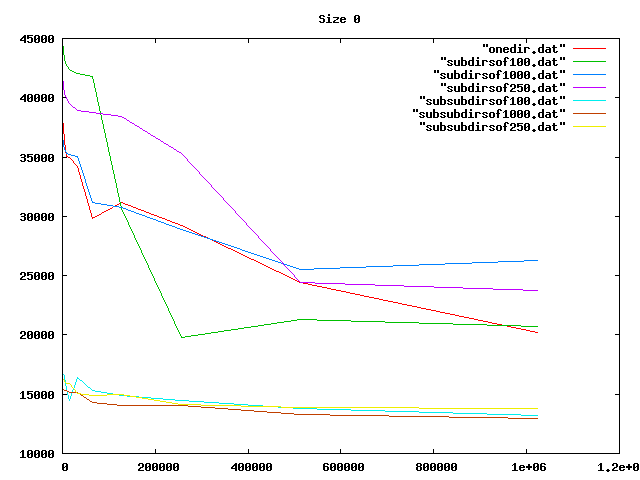
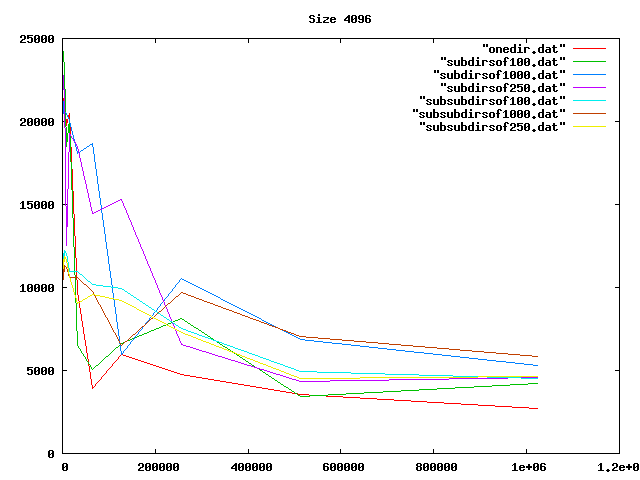
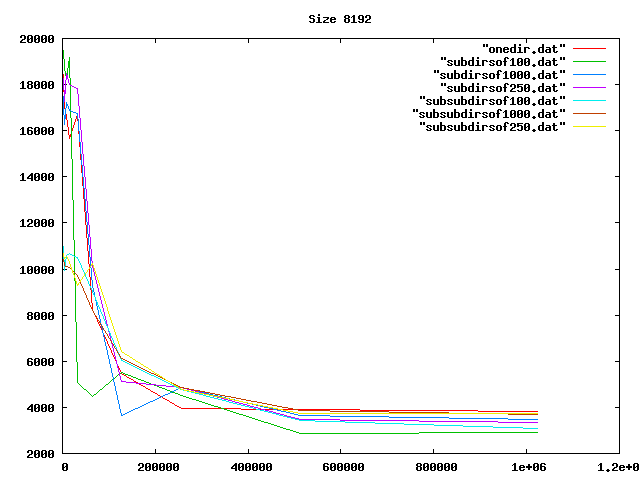
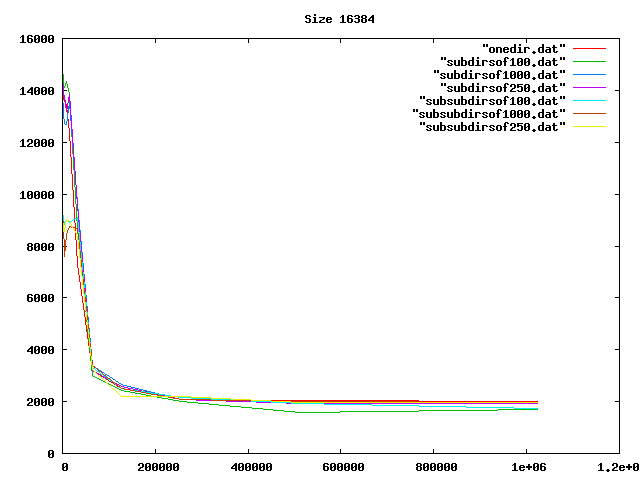
Sometimes in programming one gets to concentrate for a bit on a single, simple, pure program. A command line utility which is completely in batch mode, does not handle any kind of complicated data, does not need to deal with other programs, or the network, or anything nasty like that. Something where one can just look at the one or two interesting parts and not have to worry about anything else. This is the story of one such program. I need a program to generate test data sets for backup performance testing. The program needs to be reasonably efficient, since the simulated backups may be rather large. My first attempt was not fast enough. There were two reasons for this: the way I was generating random binary data, and the way I was generating filenames. The program generates random binary data to simulate large files, such as image, audio, or video files, and thus it needs to be uncompressible with the usual compression algorithms. My first attempt was to generate each output byte with the Python pseudo-random number generator (random.randint). This only results in about 0.1 megabyte/s (on my laptop), so I needed to improve it. After some iteration and advice, I landed on the following: I generate random bytes with the Python PRNG (random.getrandbits), and feed these to an MD5 checksum. After each byte, I get the current digest and append it to the output. This way, for each random byte, I get 16 bytes of output. It isn't completely random, but it satisfies the uncompressibility requirement. This resulted in about 2.5 MB/s. I then tweaked the code a bit, doing things like avoiding unnecessary arithmetic. I further decided to only feed the first few dozen bytes from the PRNG, and the rest as the same constant byte. The initial run of randomness is enough to make sure the output is unique for different files, so that compression doesn't find lots of duplicates of the big files. This resulted in a speed of about 6.6 MB/s on my laptop and about 13 MB/s on my server. This still didn't make the program fast enough, but the remaining problem was not that writing the contents of one file was too slow, but operations on directories were very, very slow. After benchmarking with zero-byte files, turns out that at the slowest, with file counts in the millions, it would create only a few tens of files per second. That's empty files, so only requiring an update of indoes and the creation of a new directory entry. Obviously, the problem was that I was putting too many files in directories, causing the filesystem to spend a lot time scanning them. I was creating up to 250 files per sub-directory, and then creating a new sub-directory. All of these sub-directories were going directly under the user's chosen output directory. To measure what the optimal size of a directory was, and whether to create two levels of sub-directories, I wrote a little benchmark program.
Graph, 0-byte files Graph, 4096-byte files Graph, 8196-byte files Graph, 16384-byte files Some graphs from the benchamrks: for 0, 4, 8, and 16 KiB files, for up to one million files of each size. onedir puts all files in the same directory, subdirsofN puts N files per directory, and subsubdirsofN has two levels of directories, the leaf directories getting N files each.
From the graphs I deduced that overall, having two levels of directories and up to 1000 files per sub-directory was the best option of those tested. On the other hand, the bigger the files, the less it mattered what the directory structure was. Perhaps the obvious reason for the slowness wasn't that, after all. Then I realized my code was slow because I was doing an os.listdir (listing all files in a directory) for every directory every time I creted a file. Fixing that idiocy made the code so fast that any overhead from the directory operations was no longer relevant. But at least I had some nice graphs. On the server I will be generating my test data the program is now happily generating just over 11 MB/s of test data. I wouldn't mind having it be a lot faster, but it's fast enough. It will take hours to generate hundreds of gigabytes, but I hopefully won't need to do that very often. Thus, further optimization isn't worth my time, right now. The program is genbackupdata, in case anyone else cares about it.

31 July 2007

Neil Williams: pilot-qof and gpe-expenses new releases

Minor bug fix and translation update release for pilot-qof and what was originally going to be a similar upload for gpe-expenses - until I decided that the PO files should really be split because apps using the expenses object library didn't need translated strings from the gpe-expenses application.
So what I learnt on gpe-cash has been put into place for gpe-expenses. A few consequences:

Neil Williams: More on multiple po directories

Further to problems with
gettext and split po files, glib_gettextize turns out not to be usable with more than one po/ directory. I've just converted gpe-expenses to multiple POT files (for the same reasons as gpe-cash) and I'm due to make the upstream release and upload later. glib_gettextize needs to be replaced by gettextize but this is not problem free. gettextize is noisy and keeps tampering with my build, putting in things like config.rpath and forcing -I m4 additions when that is already included elsewhere. So ./autogen.sh now supports gettextize but stops it running twice. I'm storing the gettextize support files in CVS just to allow the post-gettextize environment to be retained without needing to deal with the aftermath of gettextize --force.
Also, one tweak is needed to the Makevars file in the new directory - change the subdir po location to po-lib or whatever you use.
The changes will show up in gpe-expenses CVS later.

Adrian von Bidder: Debian Press Clippings

I am subscribed to the Google news alerts for the keyword Debian, and usually this means that I am notified of every security upgrade at least three or four times (needlessly, since I'm subscribed to Debian's security announcements anyway...) But today, two headlines sparked my interest: One, Carla Schroeder wrote an introductory article into building Custom Linux kernels with Debian and Fedora (though why somebody would want to do this is beyond me...), showing how easy the process is (I may be biased, but I find Debian's way is easier. On the other hand, it within the -- rpm -- package framework instead of a custom command -- make-kpkg in Debian -- feels more consistent and logical. Without reading documentation you won't get anywhere on both systems, so it probably doesn't matter...) One down for Carla, however, for not doing enough basic research: “The new naming convention [linux-* instead of kernel-* packages] opens the door to using other kernels with Debian, which I don't know what those would be, but Debian is ready for them.” Or one down for us, the Debian project, for not making enough noise around the various non-Linux ports. Though that will come when GNU/kFreeBSD is released with lenny... Two, Debian derivative SimplyMEPIS, which switched to Ubuntu as a base operating system a year ago, is now returning to Debian GNU/Linux as its base system. The main reason seems to be long term stability and upgradeability - which is a key strength of Debian for many other users as well (me, for one.) The reason for switching to Ubuntu in the first place has been newer application versions and predictable upgrade schedules (and that Warren Woodford misunderstood how Ubuntu LTS was to be maintained, apparently) -- both issues are being addressed within Debian as we get better release management and faster integration of new application versions (the big pieces of software I use regularly are the Linux kernel, X.org, KDE and OpenOffice.org, all of which I find are integrated in unstable fast enough, and much faster than 2 years ago. That the testing migration sometimes takes time is not a problem since mixing etch, lenny and sid is usually possible without problems even in a production (desktop) environment.) So, if we take a step back from the day-to-day squabbling between developers working at cross purposes and look at the output we produce, I believe we're still doing some things right.

Next.

Previous.