Search Results: "sten"

19 September 2014

Dariusz Dwornikowski: getting real "done date" of a bug from Debian BTS

As I wrote in my last post currently, SOAP interface, nor Ultimate Debian Database do not provide a date when a given bug was closed (done date). It is quite hard to calculate statistics on a bug tracker when you do not know when a bug was closed (!!). Done date of bug can be found in its log. The log itself can be downloaded by SOAP method get_bug_log but the processing of it is quite complicated. The same comes to web scrapping of a BTS's web interface. Fortunatelly the web interface gives a possibility to download a log in an mbox format. Below is a script that extracts the done date of a bug from its log in mbox format. It uses requests to download the mbox and caches the result in ~/.cache/rfs_bugs, which you need to create. It performs different checks:
  1. Check existence of a header e.g. Received: (at 657783-done) by bugs.debian.org; 29 Jan 2012 13:27:42 +0000
  2. Check for header CC: NUMBER-close done
  3. Check for header TO: NUMBER-close done
  4. Check for Close: NUMBER in body.
The code is below:
import requests
from datetime import datetime
import mailbox
import re
import os
import tempfile
def get_done_date(bug_num):
    CACHE_DIR = os.path.expanduser("~") + "/.cache/rfs_bugs/"
    def get_from_cache():
        if os.path.exists(" ".format(CACHE_DIR, bug_num)):
            with open(" ".format(CACHE_DIR, bug_num)) as f:
                return datetime.strptime(f.readlines()[0].rstrip(), "%Y-%m-%d").date()
        else:
            return None
    done_date = get_from_cache()
    if done_date is not None:
        return done_date
    else:
        r = requests.get("https://bugs.debian.org/cgi-bin/bugreport.cgi?mbox=yes;bug= ;mboxstatus=yes".format(self._num))
        d = try_header(r.text)
        if d is None:
            d = try_cc(r.text)
        if d is None:
            d = try_body(r.text)
        if d is not None:
            with open(" ".format(CACHE_DIR, bug_num), "w") as f:
                f.write(" ".format(d.date()))
        else:
            return None
        return d.date()
    def try_body(text):
        reg = "\(at\s.+\)\s+by\sbugs\.debian\.org;\s(\d 1,2 \s\w\w\w\s\d\d\d\d)"
        handle, name = tempfile.mkstemp()
        with open(name, "w") as f:
            f.write(text.encode('latin-1'))
        mbox = mailbox.mbox(name)
        for i in mbox.items():
            if i[1].is_multipart():
                for m in i[1].get_payload():
                    if "close" in str(m) or "done" in str(m):
                        try:
                            result = re.search(reg, i[1]['Received'])
                            return datetime.strptime(result.group(1), "%d %b %Y")
                        except:
                            return None
            else:
                if "close" in i[1].get_payload() or "done" in i[1].get_payload():
                    try:
                        result = re.search(reg, i[1]['Received'])
                        return datetime.strptime(result.group(1), "%d %b %Y")
                    except:
                        return None
        return None
    def try_header(text):
        reg = "Received:\s\(at\s\d\d\d\d\d\d-(close done)\)\s+by.+"
        try:
            result = re.search(reg, r.text)
            line = result.group(0)
            reg2 = "\d 1,2 \s\w\w\w\s\d\d\d\d"
            result = re.search(reg2, line)
            d = datetime.strptime(result.group(0), "%d %b %Y")
            return d
        except:
            return None
    def try_cc(text):
        reg = "\(at\s.+\)\s+by\sbugs\.debian\.org;\s(\d 1,2 \s\w\w\w\s\d\d\d\d)"
        handle, name = tempfile.mkstemp()
        with open(name, "w") as f:
            f.write(text.encode('latin-1'))
        mbox = mailbox.mbox(name)
        for i in mbox.items():
            if ('CC' in i[1] and "done" in i[1]['CC']) or ('To' in i[1] and "done" in i[1]['To']):
                try:
                    result = re.search(reg, i[1]['Received'])
                    return datetime.strptime(result.group(1), "%d %b %Y")
                except:
                    return None
if __name__ == "__main__":
    print get_done_date(752210)

PS: I hope that the script will be not needed in the near future, as Don Armstrong plans a new BTS database, a Debconf14 video is here.

16 September 2014

Matthew Garrett: ACPI, kernels and contracts with firmware

ACPI is a complicated specification - the latest version is 980 pages long. But that's because it's trying to define something complicated: an entire interface for abstracting away hardware details and making it easier for an unmodified OS to boot diverse platforms.

Inevitably, though, it can't define the full behaviour of an ACPI system. It doesn't explicitly state what should happen if you violate the spec, for instance. Obviously, in a just and fair world, no systems would violate the spec. But in the grim meathook future that we actually inhabit, systems do. We lack the technology to go back in time and retroactively prevent this, and so we're forced to deal with making these systems work.

This ends up being a pain in the neck in the x86 world, but it could be much worse. Way back in 2008 I wrote something about why the Linux kernel reports itself to firmware as "Windows" but refuses to identify itself as Linux. The short version is that "Linux" doesn't actually identify the behaviour of the kernel in a meaningful way. "Linux" doesn't tell you whether the kernel can deal with buffers being passed when the spec says it should be a package. "Linux" doesn't tell you whether the OS knows how to deal with an HPET. "Linux" doesn't tell you whether the OS can reinitialise graphics hardware.

Back then I was writing from the perspective of the firmware changing its behaviour in response to the OS, but it turns out that it's also relevant from the perspective of the OS changing its behaviour in response to the firmware. Windows 8 handles backlights differently to older versions. Firmware that's intended to support Windows 8 may expect this behaviour. If the OS tells the firmware that it's compatible with Windows 8, the OS has to behave compatibly with Windows 8.

In essence, if the firmware asks for Windows 8 support and the OS says yes, the OS is forming a contract with the firmware that it will behave in a specific way. If Windows 8 allows certain spec violations, the OS must permit those violations. If Windows 8 makes certain ACPI calls in a certain order, the OS must make those calls in the same order. Any firmware bug that is triggered by the OS not behaving identically to Windows 8 must be dealt with by modifying the OS to behave like Windows 8.

This sounds horrifying, but it's actually important. The existence of well-defined[1] OS behaviours means that the industry has something to target. Vendors test their hardware against Windows, and because Windows has consistent behaviour within a version[2] the vendors know that their machines won't suddenly stop working after an update. Linux benefits from this because we know that we can make hardware work as long as we're compatible with the Windows behaviour.

That's fine for x86. But remember when I said it could be worse? What if there were a platform that Microsoft weren't targeting? A platform where Linux was the dominant OS? A platform where vendors all test their hardware against Linux and expect it to have a consistent ACPI implementation?

Our even grimmer meathook future welcomes ARM to the ACPI world.

Software development is hard, and firmware development is software development with worse compilers. Firmware is inevitably going to rely on undefined behaviour. It's going to make assumptions about ordering. It's going to mishandle some cases. And it's the operating system's job to handle that. On x86 we know that systems are tested against Windows, and so we simply implement that behaviour. On ARM, we don't have that convenient reference. We are the reference. And that means that systems will end up accidentally depending on Linux-specific behaviour. Which means that if we ever change that behaviour, those systems will break.

So far we've resisted calls for Linux to provide a contract to the firmware in the way that Windows does, simply because there's been no need to - we can just implement the same contract as Windows. How are we going to manage this on ARM? The worst case scenario is that a system is tested against, say, Linux 3.19 and works fine. We make a change in 3.21 that breaks this system, but nobody notices at the time. Another system is tested against 3.21 and works fine. A few months later somebody finally notices that 3.21 broke their system and the change gets reverted, but oh no! Reverting it breaks the other system. What do we do now? The systems aren't telling us which behaviour they expect, so we're left with the prospect of adding machine-specific quirks. This isn't scalable.

Supporting ACPI on ARM means developing a sense of discipline around ACPI development that we simply haven't had so far. If we want to avoid breaking systems we have two options:

1) Commit to never modifying the ACPI behaviour of Linux.
2) Exposing an interface that indicates which well-defined ACPI behaviour a specific kernel implements, and bumping that whenever an incompatible change is made. Backward compatibility paths will be required if firmware only supports an older interface.

(1) is unlikely to be practical, but (2) isn't a great deal easier. Somebody is going to need to take responsibility for tracking ACPI behaviour and incrementing the exported interface whenever it changes, and we need to know who that's going to be before any of these systems start shipping. The alternative is a sea of ARM devices that only run specific kernel versions, which is exactly the scenario that ACPI was supposed to be fixing.

[1] Defined by implementation, not defined by specification
[2] Windows may change behaviour between versions, but always adds a new _OSI string when it does so. It can then modify its behaviour depending on whether the firmware knows about later versions of Windows.

comment count unavailable comments

15 September 2014

Keith Packard: xserver-pending-fixes

A Forest of X Server Changes We've got about another month left in the X server merge window for 1.17 and I've written a small set of fixes which haven't been reviewed yet for merging. I thought I'd advertise them a bit and see if I couldn't encourage a few of you to take a look and see if they're useful, correct and complete. All of these are in my personal X server repository:

git://people.freedesktop.org/~keithp/xserver.git
Cleaning up the X Registry Branch: registry-fixes I'll bet most of you don't even know about this code. It serves as a database mapping various X enumerations to strings to aid in diagnostics. For the security extensions, SECURITY and XSELinux, it holds names for all of the request, event and errors in the core protocol and all registered extensions. For X-Resource, it has the names of the registered resource types. The X registry gets the request, event and error data from a file, "protocol.txt", which is installed in /usr/lib/xorg/protocol.txt on my machine. It gets the resource names as a part of resource type allocation. So, what's wrong with this? Three basic things:
  1. A simple bug -- protocol.txt is left open while the server runs. This consumes a file descriptor for no good reason.
  2. protocol.txt is read and parsed even if the security extensions aren't available. This wastes time and memory.
  3. The resource names are kept even if X-Resource isn't in use.
The fixes remove the configure options for including the registry code; these functions are only used by the above extensions, so we can tell whether to include the code based solely on whether the extensions are being built. Getting rid of the TCP listener by default Branch: listen-fixes We've had the '-nolisten' option for a while now to disable inbound TCP connections. It's useful for security reasons, but we've never enabled this by default. This patch sequence provides configure options for each of the listen sockets (tcp, unix and local), leaves unix and local enabled by default and disables tcp by default. A new option, '-listen', is added which allows the user to override the -nolisten defaults in case they actually want to use TCP connections to X. Glamor bug fixes branch: glamor-fixes This branch fixes two bugs:
  1. Scale a large pixmap down to a small pixmap. This happens when you display enormous images in a web page. Iceweasel sends the whole huge image to X and uses Render to scale it to the screen. If the image is larger than a single texture, the X server splits it up into tiles, but the code which tries to perform the merged scale is just broken. Five patches fix this.
  2. Shader-based trapezoids. This code uses area coverage to compute trapezoids. That violates the Render spec, which requires point sampling. Further, the performance of these trapezoids is lower than software (by a lot). This one patch removes the code.
Present bug fixes branch: present-fixes A selection of small bug fixes:
  1. Clear pending flips at CloseScreen. This removes a reference to any pending flip pixmap, allowing it to be freed. Otherwise, we'll leak memory across server reset.
  2. Add support for PresentOptionCopy. This has been in the protocol spec for a while, and was completely trivial to implement. However, it never got done. One tiny little patch.
  3. Expose the Present API to drivers via sdksyms.sh. Until now, the present extension APIs have only been available inside the X server. This exposes them to drivers. This took a few cleanup patches first.
Use Present for Glamor XV branch: glamor-present-xv Painting XV to the screen should be done at vblank time to avoid tearing. Present offers vblank synchronized operations. Hooking those two together required a few new present APIs to expose the vblank functionality outside of the present code, then a bit of glamor code to hook up that new API to the XV bits. Switching Glamor to a GL core profile context branch: glamor-core-profile This patch set is still in progress, but demonstrates how close we are. We'll be requiring OpenGL 3.3 for this so that we get texture swizzling, which is required for our single channel objects. The changes present on the branch are:
  1. Switch single channel surfaces from GL_ALPHA to GL_RED.
  2. Use vertex array objects.
  3. Switch ephyr over to using a core 3.3 profile.
Still left to do is
  1. Switch Render code to VBOs
The core code uses VBOs everywhere, but the Render code doesn't. This means that all Render drawing fails, which makes the resulting server not very useful. My main objective for getting this done is to reduce memory usage by about 16MB, which is the space allocated for software rendering in Mesa in case someone does something which the hardware doesn't handle, and that can only with some legacy OpenGL APIs. Please help out! All of these friendly little patches are looking for a bit of review so that they can get merged before the 1.17 window closes.

Vincent Sanders: NetSurf 3.2

We recently released a new version of NetSurf this was largely to address numerous small bugs but did also include the persistent caching implementation I have written about previously. A release used to require the release manager (usually me) to perform a lot of manual processes and while we had a checklist it was far too easy to miss things.

The Continuous Integration (CI) system combined with signed release tags in git has resulted in a greatly simplified process indeed it has become almost completely automated. The majority of the manual work is now confined to doing the tasks that require actual decision making and checking we are releasing what was intended.

By having the CI system build release binaries the project now has a much clearer and importantly traceable process, I can recommend such a system to any project that produces releases especially if they release binaries for any of their targets.

I have also managed to package and upload this version of NetSurf ready for the Debian Jessie release. I would like to thank Jonathan Wiltshire for his assistance in ensuring this was a good quality package.

The release incorporates the successfully merged work of Rupinder Singh who was our our GSoc 2014 student. Rupinder mainly made improvements to our core DOM implementation and was very responsive and enthusiastic throughout his time despite the mentor team sometimes not being available.

This work goes towards improving NetSurf in the future by ensuring the underlying features are present in our core libraries. The GSoc mentors and all project developers are all pleased with the results of this years GSoc participation and would like to thank everyone involved in making our participation possible.

Along with the good news comes a little bad:
PowerPC Mac OS X
Despite repeated calls for assistance with new hardware and Java builds none has been forthcoming meaning that from this release we ware no longer able to ship PowerPC builds for MAC OS X.

The main issue is the last version of MAC OS X that runs on PPC is Leopard and there is no viable Java 1.6 port necessary for our CI system to run. Additionally the fully loaded PPC Mac mini (kindly donated to us by Mythic Beasts) had become far too slow to keep up with our builds and was causing long delays.
Bugs
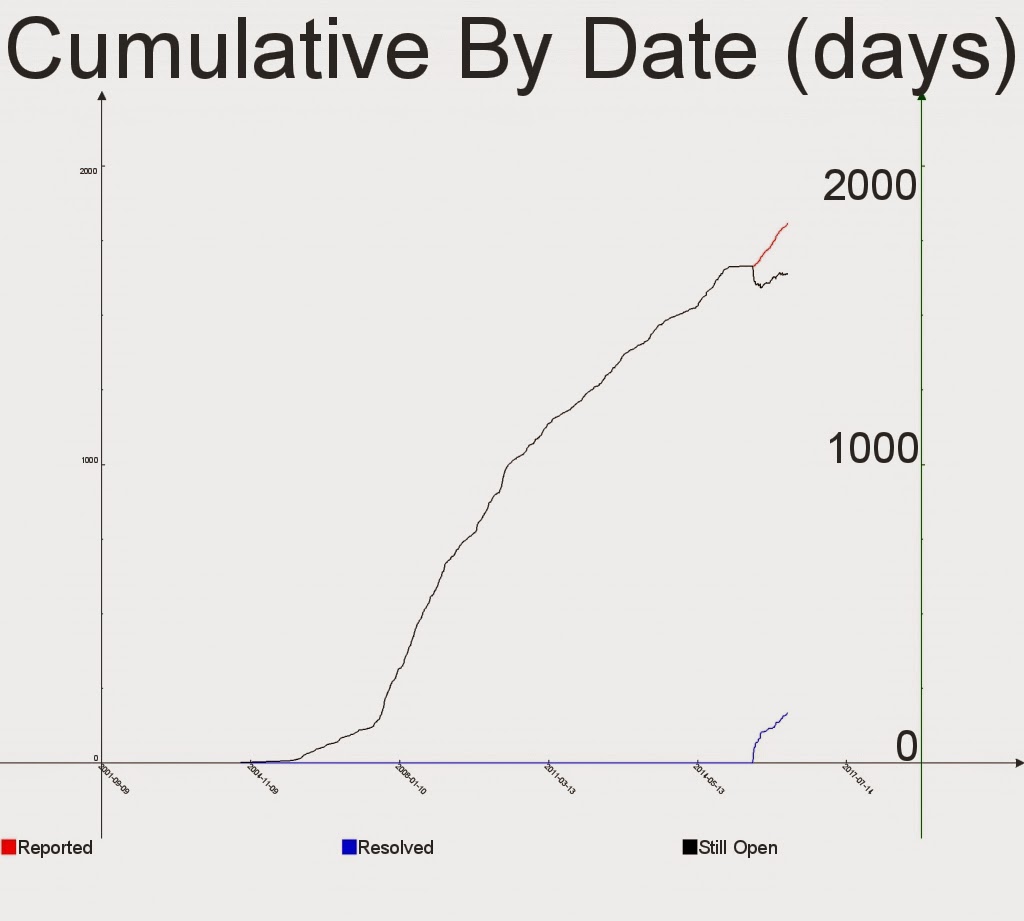
NetSurf 3.2 Bug graph
We have a lot of bugs, in fact just during this release cycle we have 30 more bugs reported than we closed.So while the new bug reporting system has been a success and our users are reporting issues when they find them the development team is not keeping up..

The failure to keep up stems from the underlying issue of lack of manpower. We have relatively few active developers which is especially problematic when there are many users for a platform, such as RISCOS, but the maintainer is unable to commit enough time to fixing issues.

If you would like to help making NetSurf a better browser we are always happy to work with new contributors.

14 September 2014

Gregor Herrmann: RC bugs 2014/34-37

the perl 5.20 transition is over, debconf14 is over, so I should have more time for RC bugs? yes & no: I fixed some, but only in "our" (as in: pkg-perl) packages:

10 September 2014

Raphaël Hertzog: Freexian s first report about Debian Long Term Support

When we setup Freexian s offer to bring together funding from multiple companies in order to sponsor the work of multiple developers on Debian LTS, one of the rules that I imposed is that all paid contributors must provide a public monthly report of their paid work. While the LTS project officially started in June, the first month where contributors were actually paid has been July. Freexian sponsored Thorsten Alteholz and Holger Levsen for 10.5 hours each in July and for 16.5 hours each in August. Here are their reports: It s worth noting that Freexian sponsored Holger s work to fix the security tracker to support squeeze-lts. It s my belief that using the money of our sponsors to make it easier for everybody to contribute to Debian LTS is money well spent. As evidenced by the progress bar on Freexian s offer page, we have not yet reached our minimal goal of funding the equivalent of a half-time position. And it shows in the results, the dla-needed.txt still shows around 30 open issues. This is slightly better than the state two months ago but we can improve a lot on the average time to push out a security update To have an idea of the relative importance of the contributions of the paid developers, I counted the number of uploads made by Thorsten and Holger since July: of 40 updates, they took care of 19 of them, so about the half. I also looked at the other contributors: Rapha l Geissert stands out with 9 updates (I believe that he is contracted by lectricit de France for doing this) and most of the other contributors look like regular Debian maintainers taking care of their own packages (Paul Gevers with cacti, Christoph Berg with postgresql, Peter Palfrader with tor, Didier Raboud with cups, Kurt Roeckx with openssl, Balint Reczey with wireshark) except Matt Palmer and Luciano Bello who (likely) are benevolent members of the LTS team. There are multiple things to learn here:
  1. Paid contributors already handle almost 70% of the updates. Counting only on volunteers would not have worked.
  2. Quite a few companies that promised help (and got mentioned in the press release) have not delivered the promised help yet (neither through Freexian nor directly).
Last but not least, this project wouldn t exist without the support of multiple companies and organizations. Many thanks to them: Hopefully this list will expand over time! Any help to reach out to new companies and organizations is more than welcome.

One comment Liked this article? Click here. My blog is Flattr-enabled.

7 September 2014

Craig Small: How not to get Galaxy Tab into Safe Mode

For weeks my Galaxy Tab 10.1 has reasonably consistently gone into safe mode. Not booting into it but I d use it fine then put it away and next time I looked at it, Safe Mode was there. It wasn t every time, but averaged to be about every second time. So the first thing was a bit of googling to see what this Safe Mode was. Most of the suggestions were around how to put it into safe mode during the boot process but my problem was opposite; it wasn t during booting and I wanted something to stop safe mode, not put the device into it. The closest I got to it was there was some misbehaving program that kicked the thing into safe mode. The problem was, I checked several times and there were no running programs. I really did start to worry I had a hardware fault or something wrong deep within the OS. When you have problems in IT, you re usually asked What s new? What s changed? . The answer is generally Nothing which gets a switch No really, what did change . The only answer I could come up with was a hardware keyboard. This slim aluminum uses bluetooth to communicate to the tablet and clips onto the front screen to protect it when not in use. Could this be the change I was looking for? The clue was that sometimes when you boot Android, if you hold down some keys it boots into safemode. It seems that holding down some combination of keys (volume up/down, power) puts into safe mode. The keyboard can clip onto the tablet in two ways, one long edge has some raised edges while one doesn t. If the raised edge was connected to the same side as the buttons, I d get safe mode sometimes as the edge pushed some of those buttons. More importantly, putting the raised edge on the side with no buttons meant no more safe mode. Not really a software or electrical fault, more one of just mechanics.

6 September 2014

Joachim Breitner: ICFP 2014

Another on-my-the-journey-back blog post; this time from the Frankfurt Airport Train Station my flight was delayed (if I knew that I could have watched the remaining Lightning Talks), and so was my train, but despite 5min of running through the Airport just not enough. And now that the free 30 Minutes of Railway Station Internet are used up, I have nothing else to do but blog... Last week I was attending ICFP 2014 in Gothenburg, followed by the Haskell Symposium and the Haskell Implementors Workshop. The justification to attend was the paper on Safe Coercions (joint work with Richard Eisenberg, Simon Peyton Jones and Stephanie Weirich), although Richard got to hold the talk, and did so quite well. So I got to leisurely attend the talks, while fighting the jet-lag that I brought from Portland. There were as expected quite a few interesting talks. Among them the first keynote, Kathleen Fisher on the need for formal methods in cars and toy-quadcopters and unmanned battle helicopters, which made me conclude that my Isabelle skills might eventually become relevant in practical applications. And did you know that if someone gains access to your car s electronics, they can make the seat belt pull you back hard? Stefanie Weirich s keynote (and the subsequent related talks by Jan Stolarek and Richard Eisenberg) on what a dependently typed Haskell would look like and what we could use it for was mouth-watering. I am a bit worried that Haskell will be become a bit obscure for newcomers and people that simply don t want to think about types too much, on the other hand it seems that Haskell as we know it will always stay there, just as a subset of the language. Similarly interesting were refinement types for Haskell (talks by Niki Vazou and by Eric Seidel), in the form of LiquidTypes, something that I have not paid attention to yet. It seems to be a good way for more high assurance in Haskell code. Finally, the Haskell Implementors Workshop had a truckload of exciting developments in and around Haskell: More on GHCJS, Partial type signatures, interactive type-driven development like we know it from Agda, the new Haskell module system and amazing user-defined error messages the latter unfortunately only in Helium, at least for now. But it s not the case that I only sat and listened. During the Haskell Implementors Workshop I held a talk Contributing to GHC with a live demo of me fixing a (tiny) bug in GHC, with the aim of getting more people to hack on GHC (slides, video). The main message here is that it is not that big of deal. And despite me not actually saying much interesting in the talk, I got good feedback afterwards. So if it now actually motivates someone to contribute to GHC, I m even more happier. And then there is of course the Hallway Track. I discussed the issues with fusing a left fold (unfortunately, without a great solution). In order to tackle this problem more systematically, John Wiegley and I created the beginning of a List Fusion Lab , i.e. a bunch of list benchmark and the possibility to compare various implementations (e.g. with different RULES) and various compilers. With that we can hopefully better assess the effect of a change to the list functions. PS: The next train is now also delayed, so I ll likely miss my tram and arrive home even later... PPS: I really have to update my 10 year old picture on my homepage (or redesign it completely). Quite a few people knew my name, but expected someone with shoulder-long hair... PPPS: Haskell is really becoming mainstream: I just talked to a randomly chosen person (the boy sitting next to me in the train), and he is a Haskell enthusiast, building a structured editor for Haskell together with his brother. And all that as a 12th-grader...

31 August 2014

Thorsten Alteholz: My Debian activities in August 2014

FTP assistant By pure chance I was able to accept 237 packages, the same number as last month. 33 times I contacted the maintainer to ask a question about a package and 55 times I had to reject a package. The reject number increased a bit as I also worked on packages that already got a note but had not been fully processed. In contrast I only filed three serious bugs this month. Currently there are about 200 packages still waiting in the NEW queue As the freeze for Jessie comes closer every day, I wonder whether all of them can be processed in time. So I don t mind if every maintainer checks the package again and maybe uploads an improved version that can be processed faster. Squeeze LTS This was my second month that I did some work for the Squeeze LTS initiative, started by Raphael Hertzog at Freexian All in all I got assigned a workload of 16.5h for August. I spent these hours to upload new versions of As last month I prepared these uploads on the basis of the corresponding DSAs for Wheezy. For these packages backporting the Wheezy patches to Squeeze was rather easy. I also had a look at python-django and eglibc. Although the python-django patches apply now, the package fails some tests and these issues need some further investigation. In case of eglibc, my small pbuilder didn t have enough resources and trying to build the package resulted in a full disk after more than three hours of work. For PHP5 Ond ej Sur (the real maintainer) suggested to use point releases of upstream instead of applying only patches. I am curious about how much effort is needed for this approach. Stay tuned, next month you will be told more details! Anyway, this is still a lot of fun and I hope I can finish python-django, eglibc and php5 in September. Other packages This month my meep packages plus mpb have been part of a small hdf5 transition. All five packages needed a small patch and a new upload. As the patch was already provided by Gilles Filippini, this was done rather quickly. Support If you would like to support my Debian work you could either be part of the Freexian initiative (see above) or consider to send some bitcoins to 1JHnNpbgzxkoNexeXsTUGS6qUp5P88vHej. Contact me at donation@alteholz.eu if you prefer another way to donate. Every kind of support is most appreciated.

29 August 2014

Steve Kemp: Migration of services and hosts

Yesterday I carried out the upgrade of a Debian host from Squeeze to Wheezy for a friend. I like doing odd-jobs like this as they're generally painless, and when there are problems it is a fun learning experience. I accidentally forgot to check on the status of the MySQL server on that particular host, which was a little embarassing, but later put together a reasonably thorough serverspec recipe to describe how the machine should be setup, which will avoid that problem in the future - Introduction/tutorial here. The more I use serverspec the more I like it. My own personal servers have good rules now:
shelob ~/Repos/git.steve.org.uk/server/testing $ make
..
Finished in 1 minute 6.53 seconds
362 examples, 0 failures
Slow, but comprehensive. In other news I've now migrated every single one of my personal mercurial repositories over to git. I didn't have a particular reason for doing that, but I've started using git more and more for collaboration with others and using two systems felt like an annoyance. That means I no longer have to host two different kinds of repositories, and I can use the excellent gitbucket software on my git repository host. Needless to say I wrote a policy for this host too:
#
#  The host should be wheezy.
#
describe command("lsb_release -d") do
  its(:stdout)   should match /wheezy/  
end
#
# Our gitbucket instance should be running, under runit.
#
describe supervise('gitbucket') do
  its(:status)   should eq 'run'  
end
#
# nginx will proxy to our back-end
#
describe service('nginx') do
  it   should be_enabled    
  it   should be_running    
end
describe port(80) do
  it   should be_listening  
end
#
#  Host should resolve
#
describe host("git.steve.org.uk" ) do
  it   should be_resolvable.by('dns')  
end
Simple stuff, but being able to trigger all these kind of tests, on all my hosts, with one command, is very reassuring.

Robert Collins: Test processes as servers

Since its very early days subunit has had a single model you run a process, it outputs test results. This works great, except when it doesn t. On the up side, you have a one way pipeline there s no interactivity needed, which makes it very very easy to write a subunit backend that e.g. testr can use. On the downside, there s no interactivity, which means that anytime you want to do something with those tests, a new process is needed and thats sometimes quite expensive particularly in test suites with 10 s of thousands of tests.Now, for use in the development edit-execute loop, this is arguably ok, because one needs to load the new tests into memory anyway; but wouldn t it be nice if tools like testr that run tests for you didn t have to decide upfront exactly how they were going to run. If instead they could get things running straight away and then give progressively larger and larger units of work to be run, without forcing a new process (and thus new discovery directory walking and importing) ? Secondly, testr has an inconsistent interface if testr is letting a user debug things to testr through to child workers in a chain, it needs to use something structured (e.g. subunit) and route stdin to the actual worker, but the final testr needs to unwrap everything this is needlessly complex. Lastly, for some languages at least, its possibly to dynamically pick up new code at runtime so a simple inotify loop and we could avoid new-process (and more importantly complete-enumeration) *entirely*, leading to very fast edit-test cycles. So, in this blog post I m really running this idea up the flagpole, and trying to sketch out the interface and hopefully get feedback on it. Taking subunit.run as an example process to do this to:
  1. There should be an option to change from one-shot to server mode
  2. In server mode, it will listen for commands somewhere (lets say stdin)
  3. On startup it might eager load the available tests
  4. One command would be list-tests which would enumerate all the tests to its output channel (which is stdout today so lets stay with that for now)
  5. Another would be run-tests, which would take a set of test ids, and then filter-and-run just those ids from the available tests, output, as it does today, going to stdout. Passing somewhat large sets of test ids in may be desirable, because some test runners perform fixture optimisations (e.g. bringing up DB servers or web servers) and test-at-a-time is pretty much worst case for that sort of environment.
  6. Another would be be std-in a command providing a packet of stdin used for interacting with debuggers
So that seems pretty approachable to me we don t even need an async loop in there, as long as we re willing to patch select etc (for the stdin handling in some environments like Twisted). If we don t want to monkey patch like that, we ll need to make stdin a socketpair, and have an event loop running to shepard bytes from the real stdin to the one we let the rest of Python have. What about that nirvana above? If we assume inotify support, then list_tests (and run_tests) can just consult a changed-file list and reload those modules before continuing. Reloading them just-in-time would be likely to create havoc I think reloading only when synchronised with test completion makes a great deal of sense. Would such a test server make sense in other languages? What about e.g. testtools.run vs subunit.run such a server wouldn t want to use subunit, but perhaps a regular CLI UI would be nice

25 August 2014

Hideki Yamane: Could you try to consider speaking more slowly and clearly at sessions, please?


Some people (including me :) are not native English speaking person, and also not use English for usual conversation. So, it's a bit tough for them to hear what you said if you speak as usual speed. We want to listen your presentation to understand and discuss about it (of course!), but sometimes machine gun speaking would prevent it.

Calm down, take a deep breath and do your presentation - then it'll be a fantastic, my cat will be pleased with it as below (meow!).


Thank you for your reading. See you in cheese & wine party.

23 August 2014

Thorsten Alteholz: Moving WordPress to another server

Today I moved this blog from a vServer to a dedicated server. The migration went surprisingly smooth. I just had to apt-get install the Debian packages apache2, mysql-server and wordpress. Afterwards only the following steps were necessary: and almost done Finally some fine tuning of /etc/wordpress/htaccess and access rights of a few directories to allow installation of plugins. As I wanted to clean up my wp-content-directory, I manually reinstalled all plugins instead of just copying them. Thankfully all of the important plugins store their data in the database and all settings survived the migration.

Steve Kemp: Updating Debian Administration, the code

So I previously talked about the setup behind Debian Administration, and my complaints about the slownes. The previous post talked about the logical setup, and the hardware. This post talks about the more interesting thing. The code. The code behind the site was originally written by Denny De La Haye. I found it and reworked it a lot, most obviously adding structure and test cases. Once I did that the early version of the site was born. Later my version became the official version, as when Denny setup Police State UK he used my codebase rather than his. So the code huh? Well as you might expect it is written in Perl. There used to be this layout:
]
yawns/cgi-bin/index.cgi
yawns/cgi-bin/Pages.pl
yawns/lib/...
yawns/htdocs/
Almost every request would hit the index.cgi script, which would parse the request and return the appropriate output via the standard CGI interface. How did it know what you wanted? Well sometimes there would be a paramater set which would be looked up in a dispatch-table:
/cgi-bin/index.cgi?article=40         - Show article 40
/cgi-bin/index.cgi?view_user=Steve    - Show the user Steve
/cgi-bin/index.cgi?recent_comments=10 - Show the most recent comments.
Over time the code became hard to update because there was no consistency, and over time the site became slow because this is not a quick setup. Spiders, bots, and just average users would cause a lot of perl processes to run. So? What did I do? I moved the thing to using FastCGI, which avoids the cost of forking Perl and loading (100k+) the code. Unfortunately this required a bit of work because all the parameter handling was messy and caused issues if I just renamed index.cgi -> index.fcgi. The most obvious solution was to use one parameter, globally, to specify the requested mode of operation. Hang on? One parameter to control the page requested? A persistant environment? What does that remind me of? Yes. CGI::Application. I started small, and pulled some of the code out of index.cgi + Pages.pl, and over into a dedicated CGI::Application class: So now every part of the site that is called by Ajax has one persistent handler, and every part of the site which returns RSS feeds has another. I had some fun setting up the sessions to match those created by the old stuff, but I quickly made it work, as this example shows: The final job was the biggest, moving all the other (non-feed, non-ajax) modes over to a similar CGI::Application structure. There were 53 modes that had to be ported, and I did them methodically, first porting all the Poll-related requests, then all the article-releated ones, & etc. I think I did about 15 a day for three days. Then the rest in a sudden rush. In conclusion the code is now fast because we don't use CGI, and instead use FastCGI. This allowed minor changes to be carried out, such as compiling the HTML::Template templates which determine the look and feel, etc. Those things don't make sense in the CGI environment, but with persistence they are essentially free. The site got a little more of a speed boost when I updated DNS, and a lot more when I blacklisted a bunch of IP-space. As I was wrapping this up I realized that the code had accidentally become closed - because the old repository no longer exists. That is not deliberate, or intentional, and will be rectified soon. The site would never have been started if I'd not seen Dennys original project, and although I don't think others would use the code it should be possible. I remember at the time I was searching for things like "Perl CMS" and finding Slashcode, and Scoop, which I knew were too heavyweight for my little toy blog. In conclusion Debian Administration website is 10 years old now. It might not have changed the world, it might have become less relevant, but I'm glad I tried, and I'm glad there were years when it really was the best place to be. These days there are HowtoForges, blogs, spam posts titled "How to install SSH on Trusty", "How to install SSH on Wheezy", "How to install SSH on Precise", and all that. No shortage of content, just finding the good from the bad is the challenge. Me? The single best resource I read these days is probably LWN.net. Starting to ramble now. Go look at my quick hack for remote command execution https://github.com/skx/nanoexec ?

22 August 2014

Russell Coker: Men Commenting on Women s Issues

A lecture at LCA 2011 which included some inappropriate slides was followed by long discussions on mailing lists. In February 2011 I wrote a blog post debunking some of the bogus arguments in two lists [1]. One of the noteworthy incidents in the mailing list discussion concerned Ted Ts o (an influential member of the Linux community) debating the definition of rape. My main point on that issue in Feb 2011 was that it s insensitive to needlessly debate the statistics. Recently Valerie Aurora wrote about another aspect of this on The Ada Initiative blog [2] and on her personal blog. Some of her significant points are that conference harassment doesn t end when the conference ends (it can continue on mailing lists etc), that good people shouldn t do nothing when bad things happen, and that free speech doesn t mean freedom from consequences or the freedom to use private resources (such as conference mailing lists) without restriction. Craig Sanders wrote a very misguided post about the Ted Ts o situation [3]. One of the many things wrong with his post is his statement I m particularly disgusted by the men who intervene way too early without an explicit invitation or request for help or a clear need such as an immediate threat of violence in womens issues . I believe that as a general rule when any group of people are involved in causing a problem they should be involved in fixing it. So when we have problems that are broadly based around men treating women badly the prime responsibility should be upon men to fix them. It seems very clear that no matter what scope is chosen for fixing the problems (whether it be lobbying for new legislation, sociological research, blogging, or directly discussing issues with people to change their attitudes) women are doing considerably more than half the work. I believe that this is an indication that overall men are failing. Asking for Help I don t believe that members of minority groups should have to ask for help. Asking isn t easy, having someone spontaneously offer help because it s the right thing to do can be a lot easier to accept psychologically than having to beg for help. There is a book named Women Don t Ask which has a page on the geek feminism Wiki [4]. I think the fact that so many women relate to a book named Women Don t Ask is an indication that we shouldn t expect women to ask directly, particularly in times of stress. The Wiki page notes a criticism of the book that some specific requests are framed as complaining , so I think we should consider a complaint from a woman as a direct request to do something. The geek feminism blog has an article titled How To Exclude Women Without Really Trying which covers many aspects of one incident [5]. Near the end of the article is a direct call for men to be involved in dealing with such problems. The geek feminism Wiki has a page on Allies which includes Even a blog post helps [6]. It seems clear from public web sites run by women that women really want men to be involved. Finally when I get blog comments and private email from women who thank me for my posts I take it as an implied request to do more of the same. One thing that we really don t want is to have men wait and do nothing until there is an immediate threat of violence. There are two massive problems with that plan, one is that being saved from a violent situation isn t a fun experience, the other is that an immediate threat of violence is most likely to happen when there is no-one around to intervene. Men Don t Listen to Women Rebecca Solnit wrote an article about being ignored by men titled Men Explain Things to Me [7]. When discussing women s issues the term Mansplaining is often used for that sort of thing, the geek feminism Wiki has some background [8]. It seems obvious that the men who have the greatest need to be taught some things related to women s issues are the ones who are least likely to listen to women. This implies that other men have to teach them. Craig says that women need space to discover and practice their own strength and their own voices . I think that the best way to achieve that goal is to listen when women speak. Of course that doesn t preclude speaking as well, just listen first, listen carefully, and listen more than you speak. Craig claims that when men like me and Matthew Garrett comment on such issues we are making women s spaces more comfortable, more palatable, for men . From all the discussion on this it seems quite obvious that what would make things more comfortable for men would be for the issue to never be discussed at all. It seems to me that two of the ways of making such discussions uncomfortable for most men are to discuss sexual assault and to discuss what should be done when you have a friend who treats women in a way that you don t like. Matthew has covered both of those so it seems that he s doing a good job of making men uncomfortable I think that this is a good thing, a discussion that is comfortable and palatable for the people in power is not going to be any good for the people who aren t in power. The Voting Aspect It seems to me that when certain issues are discussed we have a social process that is some form of vote. If one person complains then they are portrayed as crazy. When other people agree with the complaint then their comments are marginalised to try and preserve the narrative of one crazy person. It seems that in the case of the discussion about Rape Apology and LCA2011 most men who comment regard it as one person (either Valeria Aurora or Matthew Garrett) causing a dispute. There is even some commentary which references my blog post about Rape Apology [9] but somehow manages to ignore me when it comes to counting more than one person agreeing with Valerie. For reference David Zanetti was the first person to use the term apologist for rapists in connection with the LCA 2011 discussion [10]. So we have a count of at least three men already. These same patterns always happen so making a comment in support makes a difference. It doesn t have to be insightful, long, or well written, merely I agree and a link to a web page will help. Note that a blog post is much better than a comment in this regard, comments are much like conversation while a blog post is a stronger commitment to a position. I don t believe that the majority is necessarily correct. But an opinion which is supported by too small a minority isn t going to be considered much by most people. The Cost of Commenting The Internet is a hostile environment, when you comment on a contentious issue there will be people who demonstrate their disagreement in uncivilised and even criminal ways. S. E. Smith wrote an informative post for Tiger Beatdown about the terrorism that feminist bloggers face [11]. I believe that men face fewer threats than women when they write about such things and the threats are less credible. I don t believe that any of the men who have threatened me have the ability to carry out their threats but I expect that many women who receive such threats will consider them to be credible. The difference in the frequency and nature of the terrorism (and there is no other word for what S. E. Smith describes) experienced by men and women gives a vastly different cost to commenting. So when men fail to address issues related to the behavior of other men that isn t helping women in any way. It s imposing a significant cost on women for covering issues which could be addressed by men for minimal cost. It s interesting to note that there are men who consider themselves to be brave because they write things which will cause women to criticise them or even accuse them of misogyny. I think that the women who write about such issues even though they will receive threats of significant violence are the brave ones. Not Being Patronising Craig raises the issue of not being patronising, which is of course very important. I think that the first thing to do to avoid being perceived as patronising in a blog post is to cite adequate references. I ve spent a lot of time reading what women have written about such issues and cited the articles that seem most useful in describing the issues. I m sure that some women will disagree with my choice of references and some will disagree with some of my conclusions, but I think that most women will appreciate that I read what women write (it seems that most men don t). It seems to me that a significant part of feminism is about women not having men tell them what to do. So when men offer advice on how to go about feminist advocacy it s likely to be taken badly. It s not just that women don t want advice from men, but that advice from men is usually wrong. There are patterns in communication which mean that the effective strategies for women communicating with men are different from the effective strategies for men communicating with men (see my previous section on men not listening to women). Also there s a common trend of men offering simplistic advice on how to solve problems, one thing to keep in mind is that any problem which affects many people and is easy to solve has probably been solved a long time ago. Often when social issues are discussed there is some background in the life experience of the people involved. For example Rookie Mag has an article about the street harassment women face which includes many disturbing anecdotes (some of which concern primary school students) [12]. Obviously anyone who has lived through that sort of thing (which means most women) will instinctively understand some issues related to threatening sexual behavior that I can t easily understand even when I spend some time considering the matter. So there will be things which don t immediately appear to be serious problems to me but which are interpreted very differently by women. The non-patronising approach to such things is to accept the concerns women express as legitimate, to try to understand them, and not to argue about it. For example the issue that Valerie recently raised wasn t something that seemed significant when I first read the email in question, but I carefully considered it when I saw her posts explaining the issue and what she wrote makes sense to me. I don t think it s possible for a man to make a useful comment on any issue related to the treatment of women without consulting multiple women first. I suggest a pre-requisite for any man who wants to write any sort of long article about the treatment of women is to have conversations with multiple women who have relevant knowledge. I ve had some long discussions with more than a few women who are involved with the FOSS community. This has given me a reasonable understanding of some of the issues (I won t claim to be any sort of expert). I think that if you just go and imagine things about a group of people who have a significantly different life-experience then you will be wrong in many ways and often offensively wrong. Just reading isn t enough, you need to have conversations with multiple people so that they can point out the things you don t understand. This isn t any sort of comprehensive list of ways to avoid being patronising, but it s a few things which seem like common mistakes. Anne Onne wrote a detailed post advising men who want to comment on feminist blogs etc [13], most of it applies to any situation where men comment on women s issues.

21 August 2014

Steve Kemp: Updating Debian Administration

Recently I've been getting annoyed with the Debian Administration website; too often it would be slower than it should be considering the resources behind it. As a brief recap I have six nodes: The misc server is designed to display events. There is a node.js listener which receives UDP messages and stores them in a rotating buffer. The messages might contain things like "User bob logged in", "Slaughter ran", etc. It's a neat hack which gives a good feeling of what is going on cluster-wide. I need to rationalize that code - but there's a very simple predecessor posted on github for the curious. Anyway enough diversions, the database is tuned, and "small". The misc server is almost entirely irrelevent, non-public, and not explicitly advertised. So what do the web nodes run? Well they run a lot. Potentially. Each web node has four services configured: Apache runs the main site, listening on *:8080. One of the nodes will be special and will claim a virtual IP provided via ucarp. The virtual IP is actually the end-point visitors hit, meaning we have:
Master HostOther hosts
Running:
  • Apache.
  • Pound.
  • Varnish
Running:
  • Apache.
Pound is configured to listen on the virtual IP and perform SSL termination. That means that incoming requests get proxied from "vip:443 -> vip:80". Varnish listens on "vip:80" and proxies to the back-end apache instances. The end result should be high availability. In the typical case all four servers are alive, and all is well. If one server dies, and it is not the master, then it will simply be dropped as a valid back-end. If a single server dies and it is the master then a new one will appear, thanks to the magic of ucarp, and the remaining three will be used as expected. I'm sure there is a pathological case when all four hosts die, and at that point the site will be down, but that's something that should be atypical. Yes, I am prone to over-engineering. The site doesn't have any availability requirements that justify this setup, but it is good to experiment and learn things. So, with this setup in mind, with incoming requests (on average) being divided at random onto one of four hosts, why is the damn thing so slow? We'll come back to that in the next post. (Good news though; I fixed it ;)

18 August 2014

Julien Danjou: OpenStack Ceilometer and the Gnocchi experiment

A little more than 2 years ago, the Ceilometer project was launched inside the OpenStack ecosystem. Its main objective was to measure OpenStack cloud platforms in order to provide data and mechanisms for functionalities such as billing, alarming or capacity planning. In this article, I would like to relate what I've been doing with other Ceilometer developers in the last 5 months. I've lowered my involvement in Ceilometer itself directly to concentrate on solving one of its biggest issue at the source, and I think it's largely time to take a break and talk about it. Ceilometer early design For the last years, Ceilometer didn't change in its core architecture. Without diving too much in all its parts, one of the early design decision was to build the metering around a data structure we called samples. A sample is generated each time Ceilometer measures something. It is composed of a few fields, such as the the resource id that is metered, the user and project id owning that resources, the meter name, the measured value, a timestamp and a few free-form metadata. Each time Ceilometer measures something, one of its components (an agent, a pollster ) constructs and emits a sample headed for the storage component that we call the collector. This collector is responsible for storing the samples into a database. The Ceilometer collector uses a pluggable storage system, meaning that you can pick any database system you prefer. Our original implementation has been based on MongoDB from the beginning, but we then added a SQL driver, and people contributed things such as HBase or DB2 support. The REST API exposed by Ceilometer allows to execute various reading requests on this data store. It can returns you the list of resources that have been measured for a particular project, or compute some statistics on metrics. Allowing such a large panel of possibilities and having such a flexible data structure allows to do a lot of different things with Ceilometer, as you can almost query the data in any mean you want. The scalability issue We soon started to encounter scalability issues in many of the read requests made via the REST API. A lot of the requests requires the data storage to do full scans of all the stored samples. Indeed, the fact that the API allows you to filter on any fields and also on the free-form metadata (meaning non indexed key/values tuples) has a terrible cost in terms of performance (as pointed before, the metadata are attached to each sample generated by Ceilometer and is stored as is). That basically means that the sample data structure is stored in most drivers in just one table or collection, in order to be able to scan them at once, and there's no good "perfect" sharding solution, making data storage scalability painful. It turns out that the Ceilometer REST API is unable to handle most of the requests in a timely manner as most operations are O(n) where n is the number of samples recorded (see big O notation if you're unfamiliar with it). That number of samples can grow very rapidly in an environment of thousands of metered nodes and with a data retention of several weeks. There is a few optimizations to make things smoother in general cases fortunately, but as soon as you run specific queries, the API gets barely usable. During this last year, as the Ceilometer PTL, I discovered these issues first hand since a lot of people were feeding me back with this kind of testimony. We engaged several blueprints to improve the situation, but it was soon clear to me that this was not going to be enough anyway.
Thinking outside the box Unfortunately, the PTL job doesn't leave him enough time to work on the actual code nor to play with anything new. I was coping with most of the project bureaucracy and I wasn't able to work on any good solution to tackle the issue at its root. Still, I had a few ideas that I wanted to try and as soon as I stepped down from the PTL role, I stopped working on Ceilometer itself to try something new and to think a bit outside the box. When one takes a look at what have been brought recently in Ceilometer, they can see the idea that Ceilometer actually needs to handle 2 types of data: events and metrics. Events are data generated when something happens: an instance start, a volume is attached, or an HTTP request is sent to an REST API server. These are events that Ceilometer needs to collect and store. Most OpenStack components are able to send such events using the notification system built into oslo.messaging. Metrics is what Ceilometer needs to store but that is not necessarily tied to an event. Think about an instance CPU usage, a router network bandwidth usage, the number of images that Glance is storing for you, etc These are not events, since nothing is happening. These are facts, states we need to meter. Computing statistics for billing or capacity planning requires both of these data sources, but they should be distinct. Based on that assumption, and the fact that Ceilometer was getting support for storing events, I started to focus on getting the metric part right. I had been a system administrator for a decade before jumping into OpenStack development, so I know a thing or two on how monitoring is done in this area, and what kind of technology operators rely on. I also know that there's still no silver bullet this made it a good challenge. The first thing that came to my mind was to use some kind of time-series database, and export its access via a REST API as we do in all OpenStack services. This should cover the metric storage pretty well. Cooking Gnocchi
A cloud of gnocchis!
At the end of April 2014, this led met to start a new project code-named Gnocchi. For the record, the name was picked after confusing so many times the OpenStack Marconi project, reading OpenStack Macaroni instead. At least one OpenStack project should have a "pasta" name, right? The point of having a new project and not send patches on Ceilometer, was that first I had no clue if it was going to make something that would be any better, and second, being able to iterate more rapidly without being strongly coupled with the release process. The first prototype started around the following idea: what you want is to meter things. That means storing a list of tuples of (timestamp, value) for it. I've named these things "entities", as no assumption are made on what they are. An entity can represent the temperature in a room or the CPU usage of an instance. The service shouldn't care and should be agnostic in this regard. One feature that we discussed for several OpenStack summits in the Ceilometer sessions, was the idea of doing aggregation. Meaning, aggregating samples over a period of time to only store a smaller amount of them. These are things that time-series format such as the RRDtool have been doing for a long time on the fly, and I decided it was a good trail to follow. I assumed that this was going to be a requirement when storing metrics into Gnocchi. The user would need to provide what kind of archiving it would need: 1 second precision over a day, 1 hour precision over a year, or even both. The first driver written to achieve that and store those metrics inside Gnocchi was based on whisper. Whisper is the file format used to store metrics for the Graphite project. For the actual storage, the driver uses Swift, which has the advantages to be part of OpenStack and scalable. Storing metrics for each entities in a different whisper file and putting them in Swift turned out to have a fantastic algorithm complexity: it was O(1). Indeed, the complexity needed to store and retrieve metrics doesn't depends on the number of metrics you have nor on the number of things you are metering. Which is already a huge win compared to the current Ceilometer collector design. However, it turned out that whisper has a few limitations that I was unable to circumvent in any manner. I needed to patch it to remove a lot of its assumption about manipulating file, or that everything is relative to now (time.time()). I've started to hack on that in my own fork, but then everything broke. The whisper project code base is, well, not the state of the art, and have 0 unit test. I was starring at a huge effort to transform whisper into the time-series format I wanted, without being sure I wasn't going to break everything (remember, no test coverage). I decided to take a break and look into alternatives, and stumbled upon Pandas, a data manipulation and statistics library for Python. Turns out that Pandas support time-series natively, and that it could do a lot of the smart computation needed in Gnocchi. I built a new file format leveraging Pandas for computing the time-series and named it carbonara (a wink to both the Carbon project and pasta, how clever!). The code is quite small (a third of whisper's, 200 SLOC vs 600 SLOC), does not have many of the whisper limitations and it has test coverage. These Carbonara files are then, in the same fashion, stored into Swift containers. Anyway, Gnocchi storage driver system is designed in the same spirit that the rest of OpenStack and Ceilometer storage driver system. It's a plug-in system with an API, so anyone can write their own driver. Eoghan Glynn has already started to write a InfluxDB driver, working closely with the upstream developer of that database. Dina Belova started to write an OpenTSDB driver. This helps to make sure the API is designed directly in the right way. Handling resources Measuring individual entities is great and needed, but you also need to link them with resources. When measuring the temperature and the number of a people in a room, it is useful to link these 2 separate entities to a resource, in that case the room, and give a name to these relations, so one is able to identify what attribute of the resource is actually measured. It is also important to provide the possibility to store attributes on these resources, such as their owners, the time they started and ended their existence, etc.
Relationship of entities and resources
Once this list of resource is collected, the next step is to list and filter them, based on any criteria. One might want to retrieve the list of resources created last week or the list of instances hosted on a particular node right now. Resources also need to be specialized. Some resources have attributes that must be stored in order for filtering to be useful. Think about an instance name or a router network. All of these requirements led to to the design of what's called the indexer. The indexer is responsible for indexing entities, resources, and link them together. The initial implementation is based on SQLAlchemy and should be pretty efficient. It's easy enough to index the most requested attributes (columns), and they are also correctly typed. We plan to establish a model for all known OpenStack resources (instances, volumes, networks, ) to store and index them into the Gnocchi indexer in order to request them in an efficient way from one place. The generic resource class can be used to handle generic resources that are not tied to OpenStack. It'd be up to the users to store extra attributes. Dropping the free form metadata we used to have in Ceilometer makes sure that querying the indexer is going to be efficient and scalable.
The indexer classes and their relations
REST API All of this is exported via a REST API that was partially designed and documented in the Gnocchi specification in the Ceilometer repository; though the spec is not up-to-date yet. We plan to auto-generate the documentation from the code as we are currently doing in Ceilometer. The REST API is pretty easy to use, and you can use it to manipulate entities and resources, and request the information back.
Macroscopic view of the Gnocchi architecture
Roadmap & Ceilometer integration All of this plan has been exposed and discussed with the Ceilometer team during the last OpenStack summit in Atlanta in May 2014, for the Juno release. I led a session about this entire concept, and convinced the team that using Gnocchi for our metric storage would be a good approach to solve the Ceilometer collector scalability issue. It was decided to conduct this project experiment in parallel of the current Ceilometer collector for the time being, and see where that would lead the project to. Early benchmarks Some engineers from Mirantis did a few benchmarks around Ceilometer and also against an early version of Gnocchi, and Dina Belova presented them to us during the mid-cycle sprint we organized in Paris in early July. The following graph sums up pretty well the current Ceilometer performance issue. The more you feed it with metrics, the more slow it becomes.
For Gnocchi, while the numbers themselves are not fantastic, what is interesting is that all the graphs below show that the performances are stable without correlation with the number of resources, entities or measures. This proves that, indeed, most of the code is built around a complexity of O(1), and not O(n) anymore.
Next steps
Cl ment drawing the logo
While the Juno cycle is being wrapped-up for most projects, including Ceilometer, Gnocchi development is still ongoing. Fortunately, the composite architecture of Ceilometer allows a lot of its features to be replaced by some other code dynamically. That, for example, enables Gnocchi to provides a Ceilometer dispatcher plugin for its collector, without having to ship the actual code in Ceilometer itself. That should help the development of Gnocchi to not be slowed down by the release process for now. The Ceilometer team aims to provide Gnocchi as a sort of technology preview with the Juno release, allowing it to be deployed along and plugged with Ceilometer. We'll discuss how to integrate it in the project in a more permanent and strong manner probably during the OpenStack Summit for Kilo that will take place next November in Paris.

17 August 2014

Francesca Ciceri: Adventures in Mozillaland #4

Yet another update from my internship at Mozilla, as part of the OPW. An online triage workshop One of the most interesting thing I've done during the last weeks has been to held an online Bug Triage Workshop on the #testday channel at irc.mozilla.org.
That was a first time for me: I had been a moderator for a series of training sessions on IRC organized by Debian Women, but never a "speaker".
The experience turned out to be a good one: creating the material for the workshop had me basically summarize (not too much, I'm way too verbose!) all what I've learned in this past months about triaging in Mozilla, and speaking of it on IRC was a sort of challenge to my usual shyness. And I was so very lucky that a participant was able to reproduce the bug I picked as example, thus confirming it! How cool is that? ;) The workshop was about the very basics of triaging for Firefox, and we mostly focused on a simplified lifecycle of bugs, a guided tour of bugzilla (including the quicksearch and the advanced one, the list view, the individual bug view) and an explanation of the workflow of the triager. I still have my notes, and I plan to upload them to the wiki, sooner or later. I'm pretty satisfied of the outcome: the only regret is that the promoting wasn't enough, so we have few participants.
Will try to promote it better next time! :) about:crashes Another thing that had me quite busy in the last weeks was to learn more about crashes and stability in general.
If you are unfortunate enough to experience a crash with Firefox, you're probably familiar with the Mozilla Crash Reporter dialog box asking you to submit the crash report. But how does it works? From the client-side, Mozilla uses Breakpad as set of libraries for crash reporting. The Mozilla specific implementation adds to that a crash-reporting UI, a server to collect and process crash reported data (and particularly to convert raw dumps into readable stack traces) and a web interface, Socorro to view and parse crash reports. Curious about your crashes? The about:crashes page will show you a list of the submitted and unsubmitted crash reports. (And by the way, try to type about:about in the location bar, to find all the super-secret about pages!) For the submitted ones clicking on the CrashID will take you to the crash report on crash-stats, the website where the reports are stored and analyzed. The individual crash report page on crash-stats is awesome: it shows you the reported bug numbers if any bug summaries match the crash signature, as well as many other information. If crash-stats does not show a bug number, you really should file one! The CrashKill team works on these reports tracking the general stability of the various channels, triaging the top crashes, ensuring that the crash bugs have enough information and are reproducible and actionable by the devs.
The crash-stats site is a mine of information: take a look at the Top Crashes for Firefox 34.0a1.
If you click on a individual crash, you will see lots of details about it: just on the first tab ("Signature Summary") you can find a breakdown of the crashes by OS, by graphic vendors or chips or even by uptime range.
A very useful one is the number of crashes per install, so that you know how widespread is the crashing for that particular signature. You can also check the comments the users have submitted with the crash report, on the "Comments" tab. One and Done tasks review Last week I helped the awesome group of One and Done developers, doing some reviewing of the tasks pages. One and Done is a brilliant idea to help people contribute to the QA Mozilla teams.
It's a website proposing the user a series of tasks of different difficulty and on different topics to contribute to Mozilla. Each task is self-contained and can last few minutes or be a bit more challenging. The team has worked hard on developing it and they have definitely done an awesome job! :) I'm not a coding person, so I just know that they're using Django for it, but if you are interested in all the dirty details take a look at the project repository. My job has been only to check all the existent tasks and verify that the description and instruction are correct, that the task is properly tagged and so on. My impression is that this an awesome tool, well written and well thought with a lot of potential for helping people in their first steps into Mozilla. Something that other projects should definitely imitate (cough Debian cough). What's next? Next week I'll be back on working on bugs. I kind of love bugs, I have to admit it. And not squashing them: not being a coder make me less of a violent person toward digital insects. Herding them is enough for me. I'm feeling extremely non-violent toward bugs. I'll try to help Liz with the Test Plan for Firefox 34, on the triaging/verifying bugs part.
I'll also try to triage/reproduce some accessibility bugs (thanks Mario for the suggestion!).

14 August 2014

Gregor Herrmann: RC bugs 2014/13 - 2014/33

perl 5.20 got uploaded to debian unstable a few minutes ago; be prepared for some glitches when upgrading sid machines/chroots in the next days, while all 557 reverse dependencies are rebuilt via binNMUs. how does this relate to this blog post's title? it does, since during the last weeks I was mostly trying to help with the preparation of this transition. & we managed to fix quite a few bugs while they were not bumped to serious yet, otherwise the list below would be a bit longer :) anyway, here are the the RC bugs I've worked on in the last 20 or so weeks: p.s.: & now, go & enjoy the new perl 5.20 features :)

23 July 2014

Matthew Palmer: Per-repo update hooks with gitolite

Gitolite is a popular way to manage collections of git repositories entirely from the command line it s configured using configuration stored in a git repo, which is nicely self-referential. Providing per-branch access control and a wide range of addons, it s quite a valuable system. In recent versions (3.6), it added support for configuring per-repository git hooks from within the gitolite-admin repo itself something which previously required directly jiggering around with the repo metadata on the filesystem. It allows you to chain multiple hooks together, too, which is a nice touch. You can, for example, define hooks for validate style guidelines , submit patch to code review and push to the CI server . Then for each repo you can pick which of those hooks to execute. It s neat. There s one glaring problem, though you can only use these chained, per-repo hooks on the pre-receive, post-receive, and post-update hooks. The update hook is special, and gitolite wants to make sure you never, ever forget it. You can hook into the update processing chain by using something called a virtual ref ; they re stored in a separate configuration directory, use a different syntax in the config file, and if you re trying to learn what they do, you ll spend a fair bit of time on them. The documentation describes VREFs as a mechanism to add additional constraints to a push . The association between that and the update hook is one you get to make for yourself. The interesting thing is that there s no need for this gratuitous difference in configuration methods between the different hooks. I wrote a very small and simple patch that makes the update hook configurable in exactly the same way as the other server-side hooks, with no loss of existing functionality. The reason I m posting it here is that I tried to submit it to the primary gitolite developer, and was told I m not touching the update hook [ ] I m not discussing this [ ] take it or leave it . So instead, I m publicising this patch for anyone who wants to locally patch their gitolite installation to have a consistent per-repo hook UI. Share and enjoy!

Next.

Previous.